
何嘉安
138 Posts

何嘉安
Report
Block User
学无止境
High-Frequency Trader
5.5 Years
8 Following
5.2K+ Followers
645 Liked
Posts
All
Quotes
PINNED
·
--
I hope this is useful for you, wishing everyone prosperity!
$DOGE
I hope this is useful for you, wishing everyone prosperity!
$DOGE
$DOGE
20
2
22
10.2k


·
--

Article
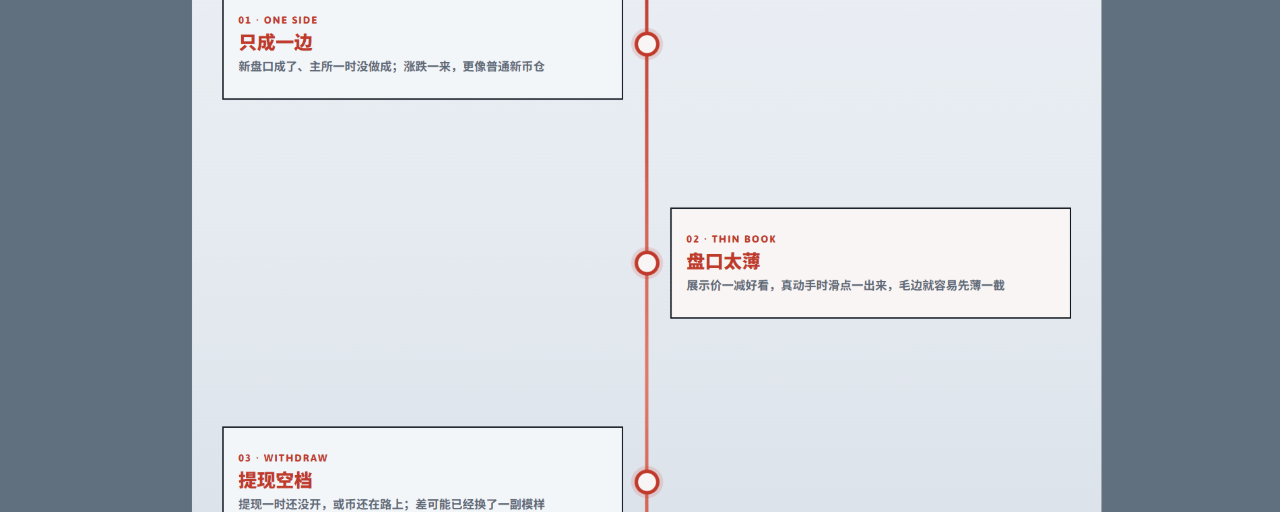
Arbitrage Strategies: The Most Common Fake Edges in Inter-Exchange Funding Rate DifferentialsThe previous article covered what’s left after costs: the gross funding edge minus execution costs. This article focuses on one thing: what common fake edges look like when something appears to be an inter-exchange funding rate arbitrage, but the two sides usually aren’t properly matched or the full costs haven’t been calculated.
1. What’s the principle?
When people talk about “fake edges” in inter-exchange funding rate differentials, you don’t need to guess which way the narrative will move first. Just remember this:
People may call it arbitrage, and the rate difference between the two exchanges may look attractive. But if one side hasn’t been filled yet, the rate calculations don’t quite match, or opening and closing trades, slippage, and price movements haven’t been factored in, it may look like an inter-exchange funding rate differential trade—but in practice, it’s more like a regular perpetual futures position, or the rough estimate simply won’t match the result.
Arbitrage Strategies: The Most Common Fake Edges in Inter-Exchange Funding Rate Differentials
The previous article covered what’s left after costs: the gross funding edge minus execution costs. This article focuses on one thing: what common fake edges look like when something appears to be an inter-exchange funding rate arbitrage, but the two sides usually aren’t properly matched or the full costs haven’t been calculated.
1. What’s the principle?
When people talk about “fake edges” in inter-exchange funding rate differentials, you don’t need to guess which way the narrative will move first. Just remember this:
People may call it arbitrage, and the rate difference between the two exchanges may look attractive. But if one side hasn’t been filled yet, the rate calculations don’t quite match, or opening and closing trades, slippage, and price movements haven’t been factored in, it may look like an inter-exchange funding rate differential trade—but in practice, it’s more like a regular perpetual futures position, or the rough estimate simply won’t match the result.
213
·
--

Article
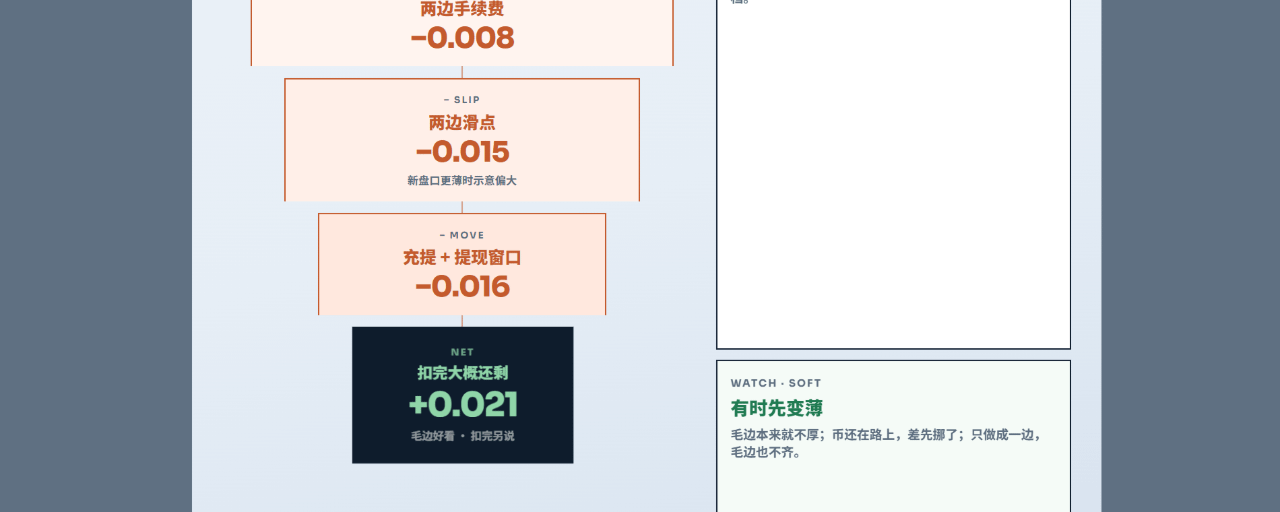
Arbitrage Strategies: What’s Left of a Cross-Exchange Funding Rate Spread After Costs?The previous article explained why the spread exists: funding rates for the same coin can diverge briefly between perpetual contracts on two exchanges. This article focuses on one thing: roughly how much of the cross-exchange funding rate spread on paper remains after deducting entry and exit fees on both sides and the friction of holding the positions.
1. What’s the principle?
When people ask “what’s left after costs” in cross-exchange funding rate spreads, you don’t have to guess which way the narrative will move. Just remember this:
Once the two sides are roughly matched and the rate spread looks promising, what matters more is the initial gross spread minus the entry and exit fees on both sides, slippage, and the friction from the spread shifting while you hold the positions, settlement conventions, and timing not lining up perfectly. A gross spread may look attractive, but how much is left after costs is another question.
Arbitrage Strategies: What’s Left of a Cross-Exchange Funding Rate Spread After Costs?
The previous article explained why the spread exists: funding rates for the same coin can diverge briefly between perpetual contracts on two exchanges. This article focuses on one thing: roughly how much of the cross-exchange funding rate spread on paper remains after deducting entry and exit fees on both sides and the friction of holding the positions.
1. What’s the principle?
When people ask “what’s left after costs” in cross-exchange funding rate spreads, you don’t have to guess which way the narrative will move. Just remember this:
Once the two sides are roughly matched and the rate spread looks promising, what matters more is the initial gross spread minus the entry and exit fees on both sides, slippage, and the friction from the spread shifting while you hold the positions, settlement conventions, and timing not lining up perfectly. A gross spread may look attractive, but how much is left after costs is another question.
1
293
·
--

Article
Arbitrage Strategies: Why Does a Funding Rate Spread Across Exchanges Occur?Earlier, we discussed how to pair positions on the two exchanges: one perpetual position in the same coin on Exchange A and another on Exchange B, with the pairing based on which exchange offers the more favorable funding rate. This article focuses on one thing: why funding rates for the same coin’s perpetual contract can temporarily differ between Exchange A and Exchange B, and where that funding rate spread across exchanges comes from.
I. How it works
When discussing where the “spread” in funding rates across exchanges comes from, you don’t have to guess how the narrative will affect prices. Start by remembering this:
Exchange A and Exchange B don’t have identical perpetual markets: their traders, position structures, settlement rules, and timing can all differ temporarily. In the short term, the funding rates for the same coin can diverge; that gap is what we mean here by the funding rate spread across exchanges.
Arbitrage Strategies: Why Does a Funding Rate Spread Across Exchanges Occur?
Earlier, we discussed how to pair positions on the two exchanges: one perpetual position in the same coin on Exchange A and another on Exchange B, with the pairing based on which exchange offers the more favorable funding rate. This article focuses on one thing: why funding rates for the same coin’s perpetual contract can temporarily differ between Exchange A and Exchange B, and where that funding rate spread across exchanges comes from.
I. How it works
When discussing where the “spread” in funding rates across exchanges comes from, you don’t have to guess how the narrative will affect prices. Start by remembering this:
Exchange A and Exchange B don’t have identical perpetual markets: their traders, position structures, settlement rules, and timing can all differ temporarily. In the short term, the funding rates for the same coin can diverge; that gap is what we mean here by the funding rate spread across exchanges.
129
·
--

Article
Arbitrage Strategies: How to Set Up Both Sides of a Multi-Exchange Funding Rate SpreadEarlier, we explained what a multi-exchange funding rate spread is: the funding rates for the same coin’s perpetual contracts on Exchange A and Exchange B are temporarily out of sync. This article focuses on how to set up both sides—what each side is, how they’re commonly compared, and how to make it clearer that both sides are covered.
1. What’s the principle?
When discussing how to set up both sides of a multi-exchange funding rate spread, you don’t have to guess which way the market narrative will push prices. Just remember this:
For the same coin, open one perpetual position on Exchange A and one on Exchange B, in roughly opposite directions and similar sizes. Once both legs are in place, some of the price movement cancels out. After that, what you’ll usually focus on is how this multi-exchange funding rate spread changes over time.
Arbitrage Strategies: How to Set Up Both Sides of a Multi-Exchange Funding Rate Spread
Earlier, we explained what a multi-exchange funding rate spread is: the funding rates for the same coin’s perpetual contracts on Exchange A and Exchange B are temporarily out of sync. This article focuses on how to set up both sides—what each side is, how they’re commonly compared, and how to make it clearer that both sides are covered.
1. What’s the principle?
When discussing how to set up both sides of a multi-exchange funding rate spread, you don’t have to guess which way the market narrative will push prices. Just remember this:
For the same coin, open one perpetual position on Exchange A and one on Exchange B, in roughly opposite directions and similar sizes. Once both legs are in place, some of the price movement cancels out. After that, what you’ll usually focus on is how this multi-exchange funding rate spread changes over time.
301
·
--
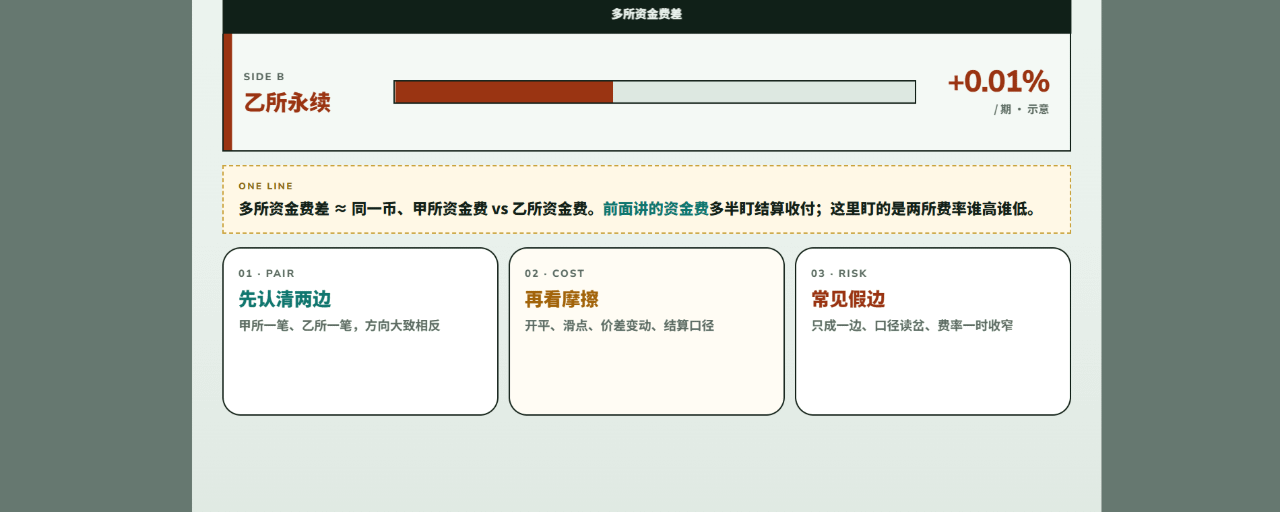
Article
Arbitrage Strategies: What Is Cross-Exchange Funding Rate Arbitrage?The previous article covered price differences for newly listed coins, focusing on how new order books can diverge from those on major exchanges. This article takes a different angle: why the funding rates for perpetual contracts on the same coin can temporarily differ between Exchange A and Exchange B.
1. What’s the principle?
When people talk about “arbitrage” in connection with funding rate differences across exchanges, they’re usually not guessing whether a coin’s price will rise or fall tomorrow. They’re referring to the following logic:
The same coin can temporarily have two different funding rates for perpetual contracts on Exchange A and Exchange B. You take a position on the side with the more “favorable” rate and hedge it on the other side (or take opposite positions on both sides). More importantly, you need to understand where the rate difference comes from and how large it is, then factor in fees and check whether the price spread between the two exchanges has become distorted.
Arbitrage Strategies: What Is Cross-Exchange Funding Rate Arbitrage?
The previous article covered price differences for newly listed coins, focusing on how new order books can diverge from those on major exchanges. This article takes a different angle: why the funding rates for perpetual contracts on the same coin can temporarily differ between Exchange A and Exchange B.
1. What’s the principle?
When people talk about “arbitrage” in connection with funding rate differences across exchanges, they’re usually not guessing whether a coin’s price will rise or fall tomorrow. They’re referring to the following logic:
The same coin can temporarily have two different funding rates for perpetual contracts on Exchange A and Exchange B. You take a position on the side with the more “favorable” rate and hedge it on the other side (or take opposite positions on both sides). More importantly, you need to understand where the rate difference comes from and how large it is, then factor in fees and check whether the price spread between the two exchanges has become distorted.
326
·
--
Article
Arbitrage Strategies: The Most Common False Edges in New-Token ListingsThe previous article covered what’s left after costs: the gross listing spread minus execution costs. This one focuses on just one thing: what common false edges look like when something appears to be new-token listing arbitrage, but the two sides often aren’t properly matched or the full costs haven’t been included.
1. What’s the principle?
When people talk about a “false edge” in new-token listings, you don’t need to guess which way the narrative will push the price. Just remember this:
People may call it arbitrage, and the price gap between a new market and a major exchange may look attractive. But if one side doesn’t get filled, or the price you’re using isn’t really executable—and you haven’t accounted for deposits, withdrawals, and fees—it may look like you’ve captured a listing spread, but in practice it’s more like ordinary new-token trading, or a rough estimate that doesn’t match the result.
Arbitrage Strategies: The Most Common False Edges in New-Token Listings
The previous article covered what’s left after costs: the gross listing spread minus execution costs. This one focuses on just one thing: what common false edges look like when something appears to be new-token listing arbitrage, but the two sides often aren’t properly matched or the full costs haven’t been included.
1. What’s the principle?
When people talk about a “false edge” in new-token listings, you don’t need to guess which way the narrative will push the price. Just remember this:
People may call it arbitrage, and the price gap between a new market and a major exchange may look attractive. But if one side doesn’t get filled, or the price you’re using isn’t really executable—and you haven’t accounted for deposits, withdrawals, and fees—it may look like you’ve captured a listing spread, but in practice it’s more like ordinary new-token trading, or a rough estimate that doesn’t match the result.
494
·
--
Article
Arbitrage Strategies: What’s Left After Fees in New-Token Listing Arbitrage?Earlier, we discussed why the spread appears: the same new token can be temporarily mispriced between a new trading venue and a major exchange. This article focuses on just one thing—roughly how much of the listing price spread on paper is left after fees on both sides and deposit/withdrawal friction.
1. What’s the principle?
When asking “what’s left after fees?” in new-token listing arbitrage, you don’t need to guess the narrative or price direction first. Just remember this:
Once the two sides are roughly matched and the listing price spread looks promising, what matters more is the initial gross listing edge minus fees on both sides, slippage, and the friction that can gradually eat into it on your own—deposit and withdrawal fees, whether withdrawals are enabled, and gaps in arrival times. A good-looking gross edge doesn’t tell you how much will actually be left after costs.
Arbitrage Strategies: What’s Left After Fees in New-Token Listing Arbitrage?
Earlier, we discussed why the spread appears: the same new token can be temporarily mispriced between a new trading venue and a major exchange. This article focuses on just one thing—roughly how much of the listing price spread on paper is left after fees on both sides and deposit/withdrawal friction.
1. What’s the principle?
When asking “what’s left after fees?” in new-token listing arbitrage, you don’t need to guess the narrative or price direction first. Just remember this:
Once the two sides are roughly matched and the listing price spread looks promising, what matters more is the initial gross listing edge minus fees on both sides, slippage, and the friction that can gradually eat into it on your own—deposit and withdrawal fees, whether withdrawals are enabled, and gaps in arrival times. A good-looking gross edge doesn’t tell you how much will actually be left after costs.
135
·
--

Article
Arbitrage Strategies: Why Do Price Gaps Appear When New Coins Are Listed?We’ve already covered how to pair the two sides: one trade in the same new coin on the new exchange, and another on a major / established exchange, then compare which is more expensive and which is cheaper. This article focuses on one thing: why the same new coin can temporarily have two different prices on the new exchange and the major exchange, and where that listing price gap comes from.
1. What’s the principle?
When discussing where the price gap in a new coin listing comes from, you don’t have to guess which way the narrative will move. Start with this:
The order book on a newly launched exchange and the one on a major / established exchange are not the same: the newly launched side is often thinner and its rules change more frequently, while the other side has been trading for longer. The traders, depth, availability, and deposit and withdrawal schedules can all differ temporarily, so the same new coin may have mismatched prices in the short term. That mismatch is the listing price gap discussed here.
Arbitrage Strategies: Why Do Price Gaps Appear When New Coins Are Listed?
We’ve already covered how to pair the two sides: one trade in the same new coin on the new exchange, and another on a major / established exchange, then compare which is more expensive and which is cheaper. This article focuses on one thing: why the same new coin can temporarily have two different prices on the new exchange and the major exchange, and where that listing price gap comes from.
1. What’s the principle?
When discussing where the price gap in a new coin listing comes from, you don’t have to guess which way the narrative will move. Start with this:
The order book on a newly launched exchange and the one on a major / established exchange are not the same: the newly launched side is often thinner and its rules change more frequently, while the other side has been trading for longer. The traders, depth, availability, and deposit and withdrawal schedules can all differ temporarily, so the same new coin may have mismatched prices in the short term. That mismatch is the listing price gap discussed here.
64
·
--

Article
Arbitrage Strategies: How to Pair Both Sides of a New Coin Listing?We’ve already explained what the listing price spread for a new coin is: the price of the same new coin may temporarily differ between the new market and the main / older exchange. This article focuses on how to pair the two sides—what each side is, how they’re commonly compared, and how to tell when both sides are clearly defined.
1. What’s the principle?
When people ask “how do you pair the two sides?” for a new coin listing, you don’t have to guess whether the price will rise or fall. Just remember this:
For the same new coin, take one position in the new market and another on the main / older exchange. The positions should be roughly opposite in direction and similar in size. Once both sides are in place, some of the gains and losses offset each other. After that, the main thing to watch is how the listing price spread changes over time.
Arbitrage Strategies: How to Pair Both Sides of a New Coin Listing?
We’ve already explained what the listing price spread for a new coin is: the price of the same new coin may temporarily differ between the new market and the main / older exchange. This article focuses on how to pair the two sides—what each side is, how they’re commonly compared, and how to tell when both sides are clearly defined.
1. What’s the principle?
When people ask “how do you pair the two sides?” for a new coin listing, you don’t have to guess whether the price will rise or fall. Just remember this:
For the same new coin, take one position in the new market and another on the main / older exchange. The positions should be roughly opposite in direction and similar in size. Once both sides are in place, some of the gains and losses offset each other. After that, the main thing to watch is how the listing price spread changes over time.
121
·
--

Article
Arbitrage Strategies: What Is New-Coin Listing Price Spread Arbitrage?The previous article looked at stablecoin depegs—when the market price doesn’t line up with the peg / redemption value. This article takes a different angle: why can the same new coin trade at two different prices on a newly launched market and a market where it has already been trading for longer (or on the main exchange)?
1. What’s the principle?
When people talk about “arbitrage” around new coins/listings, they’re usually not guessing whether the coin will go up or down tomorrow. The logic is more like this:
The same new coin can temporarily trade at two different prices on a newly opened market and an older exchange / main exchange. You buy on the cheaper side and cash out on the more expensive side (or set up both sides in advance). What often matters more is where this listing price spread comes from and how large it is.
Arbitrage Strategies: What Is New-Coin Listing Price Spread Arbitrage?
The previous article looked at stablecoin depegs—when the market price doesn’t line up with the peg / redemption value. This article takes a different angle: why can the same new coin trade at two different prices on a newly launched market and a market where it has already been trading for longer (or on the main exchange)?
1. What’s the principle?
When people talk about “arbitrage” around new coins/listings, they’re usually not guessing whether the coin will go up or down tomorrow. The logic is more like this:
The same new coin can temporarily trade at two different prices on a newly opened market and an older exchange / main exchange. You buy on the cheaper side and cash out on the more expensive side (or set up both sides in advance). What often matters more is where this listing price spread comes from and how large it is.
154
·
--

Article
Arbitrage Strategies: The Most Common Fake Edges in On-Chain DEX TradingEarlier, we covered what’s left after costs: the gross on-chain edge minus the costs of execution. This article focuses on one thing: common types of fake edges that look like on-chain/DEX arbitrage, but where the two sides often aren’t fully matched up or the calculation doesn’t include everything.
1. What’s the principle?
When people talk about a “fake edge” on-chain or on a DEX, you don’t need to guess whether prices will rise or fall. Just remember this:
People may call it arbitrage, or point to an appealing price gap between a CEX and a DEX (or between two pools). But one side may not have executed, or the price you’re using may not be one you could actually get in the pool—and gas, bridging, and deposit/withdrawal fees may not be included. It looks like a locked-in on-chain price gap, but in practice it’s more like an ordinary trade, or the rough estimate doesn’t quite match the result.
Arbitrage Strategies: The Most Common Fake Edges in On-Chain DEX Trading
Earlier, we covered what’s left after costs: the gross on-chain edge minus the costs of execution. This article focuses on one thing: common types of fake edges that look like on-chain/DEX arbitrage, but where the two sides often aren’t fully matched up or the calculation doesn’t include everything.
1. What’s the principle?
When people talk about a “fake edge” on-chain or on a DEX, you don’t need to guess whether prices will rise or fall. Just remember this:
People may call it arbitrage, or point to an appealing price gap between a CEX and a DEX (or between two pools). But one side may not have executed, or the price you’re using may not be one you could actually get in the pool—and gas, bridging, and deposit/withdrawal fees may not be included. It looks like a locked-in on-chain price gap, but in practice it’s more like an ordinary trade, or the rough estimate doesn’t quite match the result.
188
·
--
Article
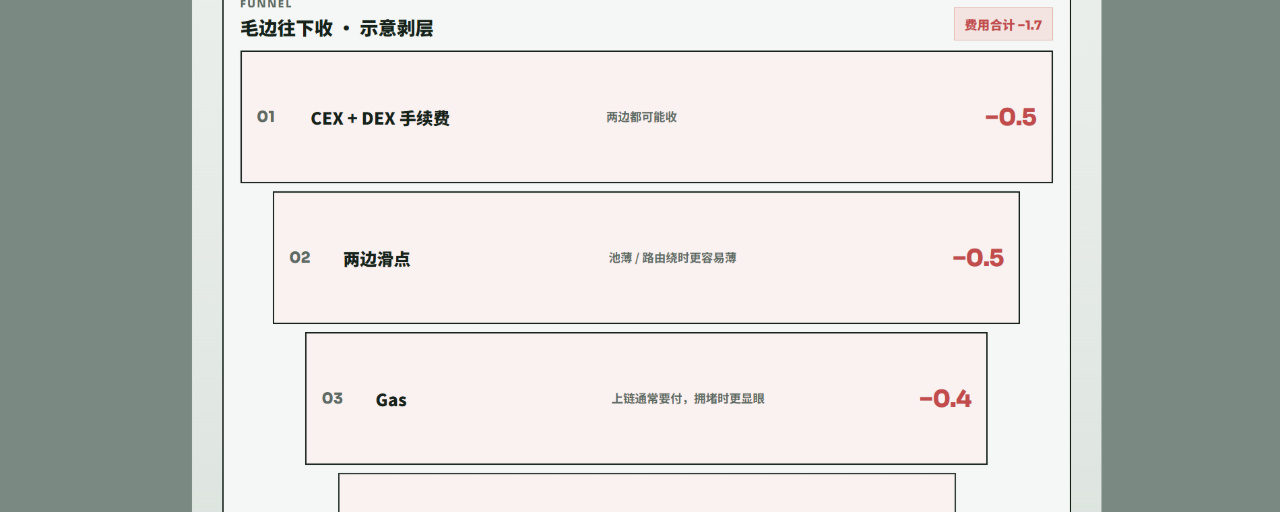
Arbitrage Strategies: What’s Left After Fees on an On-Chain DEX?The previous article explained why spreads appear: CEXs and DEXs (or two pools) can fall out of sync for a short time. This article focuses on one thing: roughly how much of the apparent on-chain spread remains after deducting the actual costs on both sides, plus Gas and bridging friction.
1. What’s the principle?
When people ask “what’s left after fees” on-chain / in DEXs, you don’t have to guess which way prices will move. Just keep this in mind:
Once both sides are set up and a price gap appears, what matters more is the initial gross spread, minus CEX / DEX fees, slippage, Gas, bridging / deposit and withdrawal costs, and the friction that gradually eats into the spread while you wait for the transaction to go on-chain; a spread may look attractive, but what remains after deductions is another question.
Arbitrage Strategies: What’s Left After Fees on an On-Chain DEX?
The previous article explained why spreads appear: CEXs and DEXs (or two pools) can fall out of sync for a short time. This article focuses on one thing: roughly how much of the apparent on-chain spread remains after deducting the actual costs on both sides, plus Gas and bridging friction.
1. What’s the principle?
When people ask “what’s left after fees” on-chain / in DEXs, you don’t have to guess which way prices will move. Just keep this in mind:
Once both sides are set up and a price gap appears, what matters more is the initial gross spread, minus CEX / DEX fees, slippage, Gas, bridging / deposit and withdrawal costs, and the friction that gradually eats into the spread while you wait for the transaction to go on-chain; a spread may look attractive, but what remains after deductions is another question.
189
·
--

Article
Arbitrage Strategies: Why Do Price Gaps Arise on On-Chain DEXs?Earlier, we covered how to pair the two sides: the same coin, one trade on a CEX (or Pool A), one on a DEX (or Pool B), in opposite directions, with roughly similar amounts. This article focuses on one question: why can a CEX and a DEX (or two pools) temporarily have different prices, and where does that gap come from?
1. What’s the principle?
When asking “where does the gap come from?” on-chain or in a DEX, you don’t have to guess which way prices will move. Just remember this:
CEXs and DEXs (or two pools) each have their own pricing system: one typically matches orders through an order book, while the other typically quotes prices based on a formula or routing through a pool. The traders, liquidity depth, and update mechanisms differ, so the same coin can be priced differently in the short term. That discrepancy is the price gap we’re talking about here.
Arbitrage Strategies: Why Do Price Gaps Arise on On-Chain DEXs?
Earlier, we covered how to pair the two sides: the same coin, one trade on a CEX (or Pool A), one on a DEX (or Pool B), in opposite directions, with roughly similar amounts. This article focuses on one question: why can a CEX and a DEX (or two pools) temporarily have different prices, and where does that gap come from?
1. What’s the principle?
When asking “where does the gap come from?” on-chain or in a DEX, you don’t have to guess which way prices will move. Just remember this:
CEXs and DEXs (or two pools) each have their own pricing system: one typically matches orders through an order book, while the other typically quotes prices based on a formula or routing through a pool. The traders, liquidity depth, and update mechanisms differ, so the same coin can be priced differently in the short term. That discrepancy is the price gap we’re talking about here.
299
·
--
Article
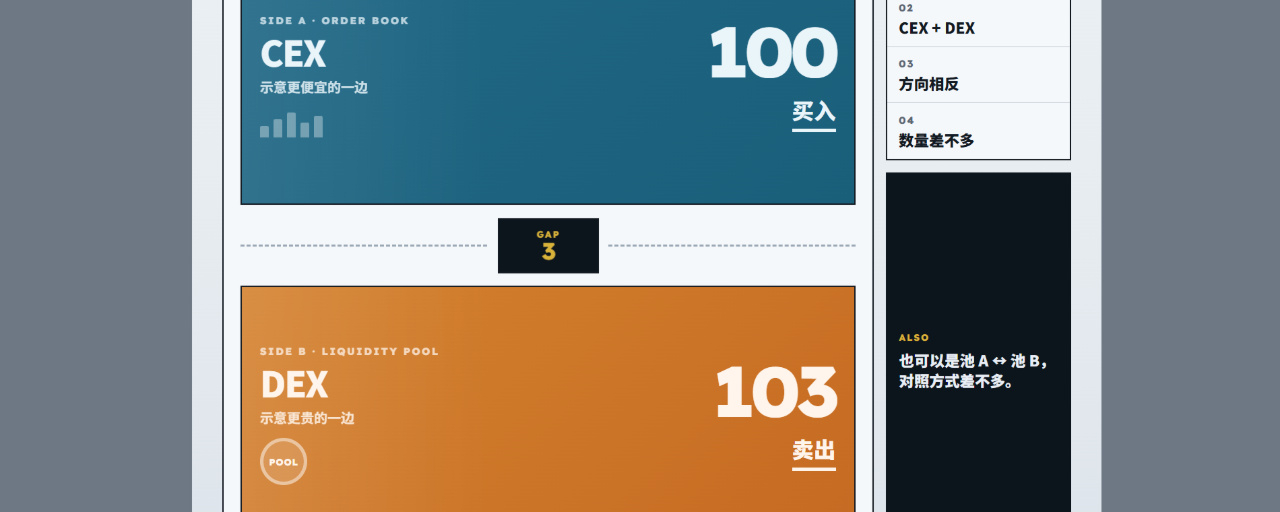
Arbitrage Strategies: How to Pair the Two Sides in On-Chain DEXs?Earlier, we explained what on-chain / DEX means: comparing the price difference between a CEX and a DEX (or between two pools). This article focuses on how to pair the two sides—what to do on each side, common ways to pair them, and how to tell whether the two sides are properly matched.
1. What’s the principle?
When people talk about “how to pair the two sides” on-chain / in DEXs, you don’t have to guess which way prices will move. Just remember this:
For the same coin, make one trade on a CEX (or Pool A) and another on a DEX (or Pool B), with roughly opposite directions and similar amounts. Once both sides are in place, some of the price movement cancels out. What you’ll usually focus on next is how the price difference between the two sides changes.
Arbitrage Strategies: How to Pair the Two Sides in On-Chain DEXs?
Earlier, we explained what on-chain / DEX means: comparing the price difference between a CEX and a DEX (or between two pools). This article focuses on how to pair the two sides—what to do on each side, common ways to pair them, and how to tell whether the two sides are properly matched.
1. What’s the principle?
When people talk about “how to pair the two sides” on-chain / in DEXs, you don’t have to guess which way prices will move. Just remember this:
For the same coin, make one trade on a CEX (or Pool A) and another on a DEX (or Pool B), with roughly opposite directions and similar amounts. Once both sides are in place, some of the price movement cancels out. What you’ll usually focus on next is how the price difference between the two sides changes.
209
·
--

Article
Arbitrage Strategies: The Most Common Fake Spreads Across ExchangesEarlier, we discussed what’s left after deductions: the gross cross-exchange spread minus the costs of execution. This article focuses on one thing: common types of fake spreads that look like cross-exchange arbitrage, but where the two sides usually haven’t both been set up or the full costs haven’t been calculated.
I. What’s the principle?
When people talk about “fake spreads” across exchanges, you don’t need to guess which way prices will move. Just remember this:
People may call it arbitrage, and the price gap between two exchanges may look attractive, but if one side wasn’t actually executed, the prices used weren’t really executable, or deposits, withdrawals, and fees haven’t been factored in, then what looks like a locked-in cross-exchange spread may turn out to be an ordinary trade—or the rough estimate may not match the actual result.
Arbitrage Strategies: The Most Common Fake Spreads Across Exchanges
Earlier, we discussed what’s left after deductions: the gross cross-exchange spread minus the costs of execution. This article focuses on one thing: common types of fake spreads that look like cross-exchange arbitrage, but where the two sides usually haven’t both been set up or the full costs haven’t been calculated.
I. What’s the principle?
When people talk about “fake spreads” across exchanges, you don’t need to guess which way prices will move. Just remember this:
People may call it arbitrage, and the price gap between two exchanges may look attractive, but if one side wasn’t actually executed, the prices used weren’t really executable, or deposits, withdrawals, and fees haven’t been factored in, then what looks like a locked-in cross-exchange spread may turn out to be an ordinary trade—or the rough estimate may not match the actual result.
253
·
--

Article
Arbitrage Strategies: What’s Left After Fees in Cross-Exchange Trading?Earlier, we discussed why spreads occur: the same coin can be temporarily priced differently on two exchanges. This article focuses on one thing—roughly how much of the apparent cross-exchange spread remains after subtracting the actual fees and deposit/withdrawal friction on both exchanges.
1. What’s the principle?
When people talk about “what’s left after deductions” in cross-exchange trading, you don’t have to guess which way prices will move first. Just remember this:
Once both sides are matched and a price spread appears, what matters more is the initial gross cross-exchange spread minus the fees on both exchanges, slippage, deposit and withdrawal fees, and the friction of the spread shifting while funds are in transit. A gross spread may look attractive, but how much remains after deductions is another question.
Arbitrage Strategies: What’s Left After Fees in Cross-Exchange Trading?
Earlier, we discussed why spreads occur: the same coin can be temporarily priced differently on two exchanges. This article focuses on one thing—roughly how much of the apparent cross-exchange spread remains after subtracting the actual fees and deposit/withdrawal friction on both exchanges.
1. What’s the principle?
When people talk about “what’s left after deductions” in cross-exchange trading, you don’t have to guess which way prices will move first. Just remember this:
Once both sides are matched and a price spread appears, what matters more is the initial gross cross-exchange spread minus the fees on both exchanges, slippage, deposit and withdrawal fees, and the friction of the spread shifting while funds are in transit. A gross spread may look attractive, but how much remains after deductions is another question.
283
·
--
Article
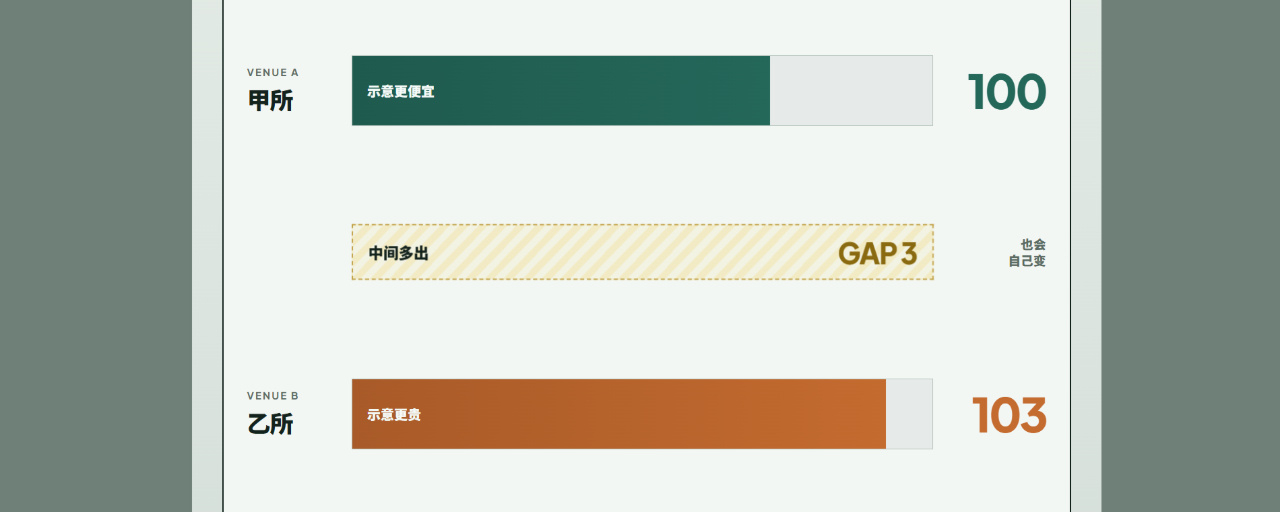
Arbitrage Strategies: Why Do Cross-Exchange Price Differences Occur?Earlier, we covered how to pair trades on the two sides: the same coin, one trade on Exchange A and one on Exchange B, in opposite directions, with roughly the same quantity. This article focuses on just one thing—why the same coin can temporarily have two different prices on two exchanges, and where that cross-exchange gap comes from.
1. What’s the principle?
When talking about where cross-exchange price differences come from, you don’t have to guess which way prices will move. Just remember this:
Exchange A and Exchange B don’t share the same order book: their traders, market depth, update speeds, and deposit and withdrawal rhythms are all different. In the short term, the same coin can be quoted at different prices on each exchange. That gap is what we mean here by a cross-exchange price difference.
Arbitrage Strategies: Why Do Cross-Exchange Price Differences Occur?
Earlier, we covered how to pair trades on the two sides: the same coin, one trade on Exchange A and one on Exchange B, in opposite directions, with roughly the same quantity. This article focuses on just one thing—why the same coin can temporarily have two different prices on two exchanges, and where that cross-exchange gap comes from.
1. What’s the principle?
When talking about where cross-exchange price differences come from, you don’t have to guess which way prices will move. Just remember this:
Exchange A and Exchange B don’t share the same order book: their traders, market depth, update speeds, and deposit and withdrawal rhythms are all different. In the short term, the same coin can be quoted at different prices on each exchange. That gap is what we mean here by a cross-exchange price difference.
254
·
--

Article
Arbitrage Strategies: How to Pair the Two Sides in Cross-Exchange TradingThe previous article explained cross-exchange trading: the same coin on two exchanges, with the focus on the price gap between them. This article focuses on how to pair the two sides—what to do on each exchange, how they’re commonly matched, and how to tell whether the two sides are properly paired.
1. How does it work?
When people talk about “how to pair the two sides” in cross-exchange trading, you don’t have to guess which way prices will move. Start with this:
For the same coin, place one trade on Exchange A and another on Exchange B, in roughly opposite directions and for similar amounts. When both sides are in place, some of the price movement cancels out. What you’ll usually watch next is how the price gap between the two exchanges changes.
Broken down, it’s roughly three steps:
Arbitrage Strategies: How to Pair the Two Sides in Cross-Exchange Trading
The previous article explained cross-exchange trading: the same coin on two exchanges, with the focus on the price gap between them. This article focuses on how to pair the two sides—what to do on each exchange, how they’re commonly matched, and how to tell whether the two sides are properly paired.
1. How does it work?
When people talk about “how to pair the two sides” in cross-exchange trading, you don’t have to guess which way prices will move. Start with this:
For the same coin, place one trade on Exchange A and another on Exchange B, in roughly opposite directions and for similar amounts. When both sides are in place, some of the price movement cancels out. What you’ll usually watch next is how the price gap between the two exchanges changes.
Broken down, it’s roughly three steps:
384
Log in to explore more content
Join global crypto users on Binance Square
⚡️ Get latest and useful information about crypto.
💬 Trusted by the world’s largest crypto exchange.
👍 Discover real insights from verified creators.
Email / Phone number
Trending Topics
NVIDIAReinstatesJensenHuangasCEO
98,698 views
899 Discussing
TradFi News | Nvidia Board Unanimously Reinstates Jensen Huang as CEO; Shares Jump 30% Premarket
Binance News
·39 Likes
·40.8k views
WillMarketsStageAThanksgivingReliefRally?
206,266 views
1,891 Discussing
WillOctCorePCEShiftFedHikeExpectations?
73,270 views
807 Discussing