
Earlier, we covered what’s left after costs: the gross on-chain edge minus the costs of execution. This article focuses on one thing: common types of fake edges that look like on-chain/DEX arbitrage, but where the two sides often aren’t fully matched up or the calculation doesn’t include everything.
1. What’s the principle?
When people talk about a “fake edge” on-chain or on a DEX, you don’t need to guess whether prices will rise or fall. Just remember this:
People may call it arbitrage, or point to an appealing price gap between a CEX and a DEX (or between two pools). But one side may not have executed, or the price you’re using may not be one you could actually get in the pool—and gas, bridging, and deposit/withdrawal fees may not be included. It looks like a locked-in on-chain price gap, but in practice it’s more like an ordinary trade, or the rough estimate doesn’t quite match the result.
Broken down, it comes to roughly three steps:
1) Real spread: both legs are matched, and the spread is executable
The same asset, one trade on a CEX and one on a DEX (or another pool), in opposite directions and in roughly equal quantities, using prices close to what you can actually execute at; with gas and bridging costs roughly accounted for.
2) Fake spread: the spread exists on paper, but the two legs may not be matched
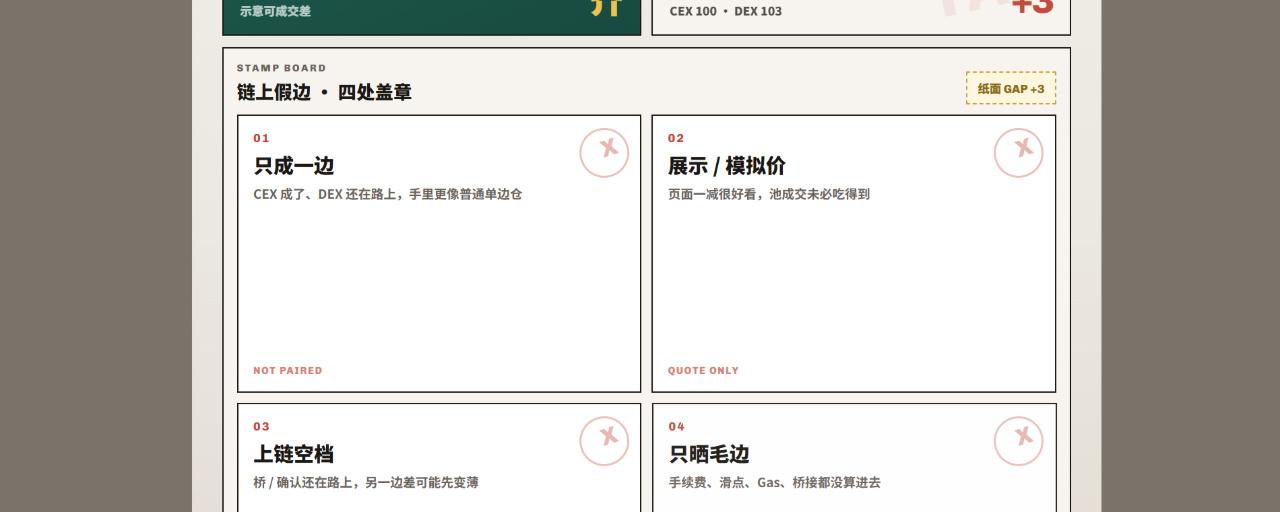
Only one leg goes through; displayed / simulated prices are simply subtracted; a route quote looks good but may not be executable; only the gross spread is shown, without accounting for gas or bridging; or the coins are still in transit through deposits / withdrawals or on-chain. All of these can make “on-chain arbitrage” sound like a matched trade when in reality the legs often aren't matched yet.
3) A fake spread doesn't necessarily turn bad immediately, but what you're looking at may already be misleading
Once prices move, a confirmation delay occurs, or fees are deducted, the result often differs from what you might expect when you think “both legs are matched.” In short:
Fake spread ≈ It looks like on-chain / DEX arbitrage, but the two legs are usually not fully matched, or the costs haven't all been accounted for.
You can just remember this one thing:
When you spot an on-chain spread, check whether both legs are matched and all the costs are accounted for. Fake spreads commonly involve “only one leg going through, attractive displayed / simulated prices, delays while a transaction is on-chain, or showing only the gross spread.”
II. An Example
The figures are for illustration only. The CEX is around 100 and the DEX around 103 on the page, so the spread appears to be +3.
Suppose, in reality:
• Only the CEX trade goes through, while the DEX trade is still waiting on routing or confirmation, or vice versa; or
• The +3 comes from subtracting displayed prices / simulator prices, but the pool's actual execution price may be different; or
• The coins are still being bridged or are in transit through deposits / withdrawals, while the price on the other side has already converged; or
• Only the gross spread of +3 is shown, without accounting for fees, slippage, gas, or bridging
The +3 on paper is still there, but in practice you most likely don't yet have two matched on-chain legs. Once prices move, your holdings look more like a regular position on one side; and after costs, you also lose the part of the spread that would have come from having the legs properly matched.
III. What “Both Legs” Means
You can also understand a fake spread by comparing it with what a “real spread” should look like:
• Real spread: The assets match, both legs are in place, the directions are opposite, and the quantities are roughly equal; the quoted prices are close to executable prices; and fees, gas, bridging / deposits and withdrawals, and confirmation delays are all roughly accounted for.
• Fake spread: One or more of the above is missing—especially when only one leg goes through, displayed / simulated prices look attractive, there's a delay while the transaction is on-chain, or only the gross spread is shown.
So for this article, when we talk about “both legs,” we can focus less on how to place the orders and more on whether the spread shown on paper and the spread between two fully matched, fully accounted-for legs are actually the same thing.
IV. Where the Profit Comes From
The fake-spread article barely discusses “how to make more”; it only notes a few things related to matching and identification:
1) Once both legs are truly matched, the price spread is what you tend to watch
When both legs are in place and the directions are right, what you tend to watch next is how the spread between the CEX and DEX (or between the two pools) changes. The price movement of either side on its own becomes less prominent.
2) When a fake spread appears, what you watch can easily shift
When only one leg goes through, price movements matter more again. If you mistake the pricing basis or displayed price, it can also become hard to say exactly how much is “locked in.”
3) A good-looking gross spread may still exist mostly on paper
If you leave out fees, slippage, gas, and bridging, the numbers on paper may look great, but they may not line up when it comes to execution—and this often overlaps with a “fake spread.”
V. Risks
The most common fake spreads on-chain / in DEX trading are roughly as follows.
The two legs are not yet matched
Only one leg goes through
The CEX trade goes through, but the DEX trade is still awaiting confirmation or the route fails—or vice versa. Price movements matter more again. For now, it looks more like a regular position, so you can pause and take stock.
The assets don't match, or the pool / route is different
One side involves a certain coin, while the other involves a wrapped version or a different pool. It may be called on-chain arbitrage, but in practice the two sides often don't match.
The quantities differ too much
One side is large and the other is small, so price movements may still cause noticeable swings—the quantities probably haven't been properly balanced.
When a transaction fails, gas has often already been paid
A common on-chain scenario: a transaction is submitted but ultimately fails; gas has usually already been paid. The spread on paper is still there, but your holdings are more like an unmatched position, and you have an extra fee to account for.
The numbers aren't fully accounted for, or the spread narrows while you wait
A calculation based on displayed prices / simulated prices often doesn't line up with the actual execution price
The numbers may look great when you subtract prices on a page or in a simulator, but in reality you'll most likely face the order-book price or the pool's execution price. Once slippage kicks in, the gross spread can quickly shrink.
Showing only the gross spread, without counting gas or bridging
If you leave out fees, slippage, gas, and bridging / deposits and withdrawals, it may look like there's still a spread, but little may remain after costs—and the numbers may not line up at execution.
The spread narrows while the transaction is on-chain / being bridged
While the coins are in transit, or the transaction is awaiting confirmation, the price on the other side may already have converged or moved away. It may look like the initial spread has been locked in, but by the time the legs match, things often look quite different.
Too much time between the two trades
One side goes through first while the other is still waiting on deposits and withdrawals, on-chain confirmation, or routing. The spread may have changed in the meantime.
In short: the most common fake spreads on-chain / in DEX trading usually come from only one leg going through, attractive displayed / simulated prices, delays while a transaction is on-chain, or showing only the gross spread. After you spot a spread, it helps to check whether both legs are matched and all the costs are accounted for.
This article is for informational purposes only, explains the underlying principles, and does not constitute investment advice or recommend any specific trade combination.