
The previous article covered price differences for newly listed coins, focusing on how new order books can diverge from those on major exchanges. This article takes a different angle: why the funding rates for perpetual contracts on the same coin can temporarily differ between Exchange A and Exchange B.
1. What’s the principle?
When people talk about “arbitrage” in connection with funding rate differences across exchanges, they’re usually not guessing whether a coin’s price will rise or fall tomorrow. They’re referring to the following logic:
The same coin can temporarily have two different funding rates for perpetual contracts on Exchange A and Exchange B. You take a position on the side with the more “favorable” rate and hedge it on the other side (or take opposite positions on both sides). More importantly, you need to understand where the rate difference comes from and how large it is, then factor in fees and check whether the price spread between the two exchanges has become distorted.
Broadly speaking, there are three steps:
1) Start with two funding rates
Exchange A and Exchange B each settle funding separately: rates can be positive or negative, and settlement schedules and conventions may also differ. At the same moment, the rates shown on the two exchanges’ pages don’t have to match.
2) Compare the two sides
A common approach is to take the direction on whichever side has a rate more favorable to the funding you want to receive, and use an opposing position on the other side to offset some of the price movement. Whether the accounts, margin, and settlement times on both sides are in sync—and whether the differential is properly captured—also depends on these factors.
3) The opportunity comes from the rate differential
When the rates on the two sides don’t match, an additional differential emerges. Put simply, what matters more to the outcome is how large this cross-exchange funding rate differential is, whether both sides can be executed, and how much remains after costs when held for several funding periods.
One way to remember it is:
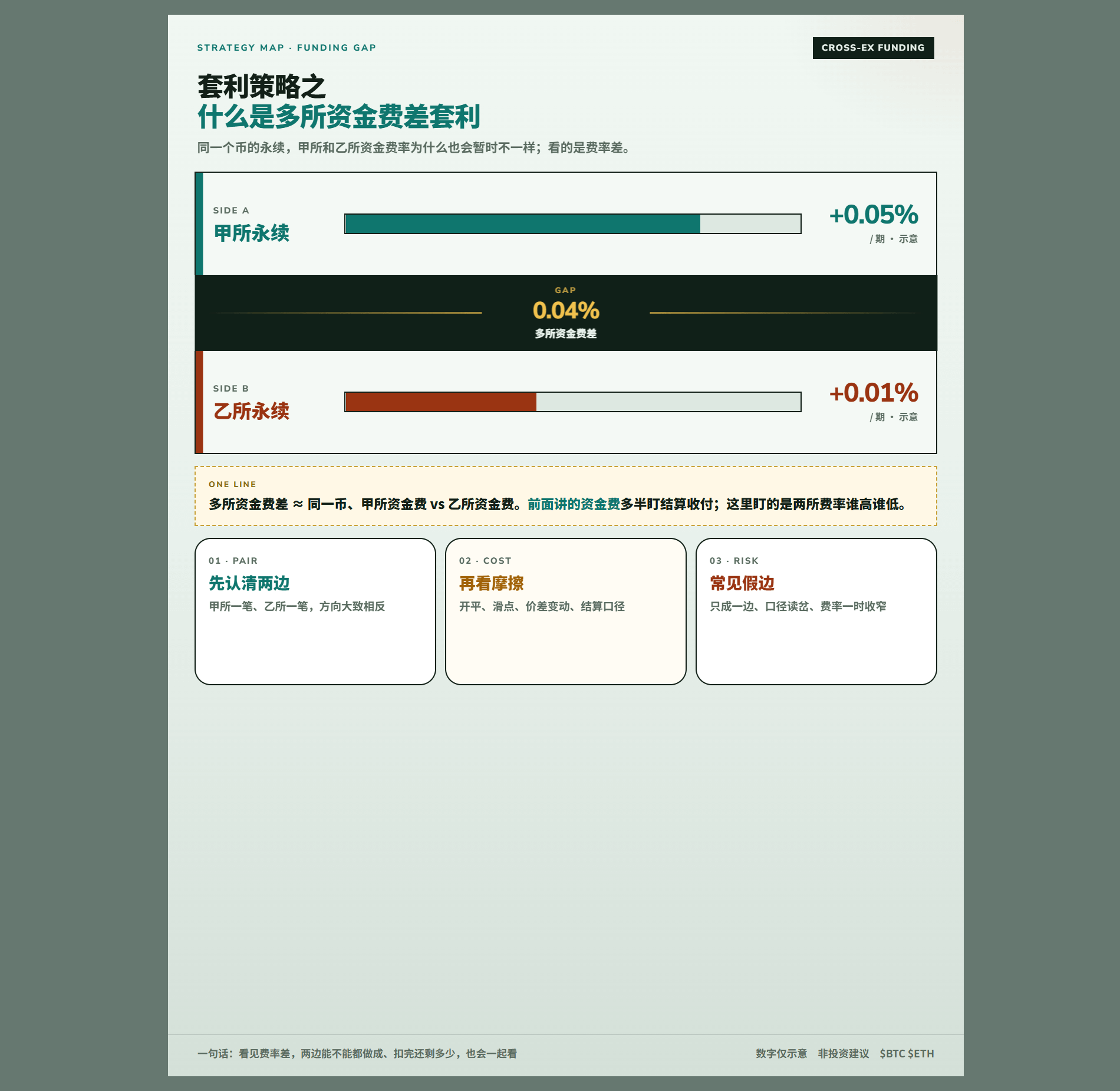
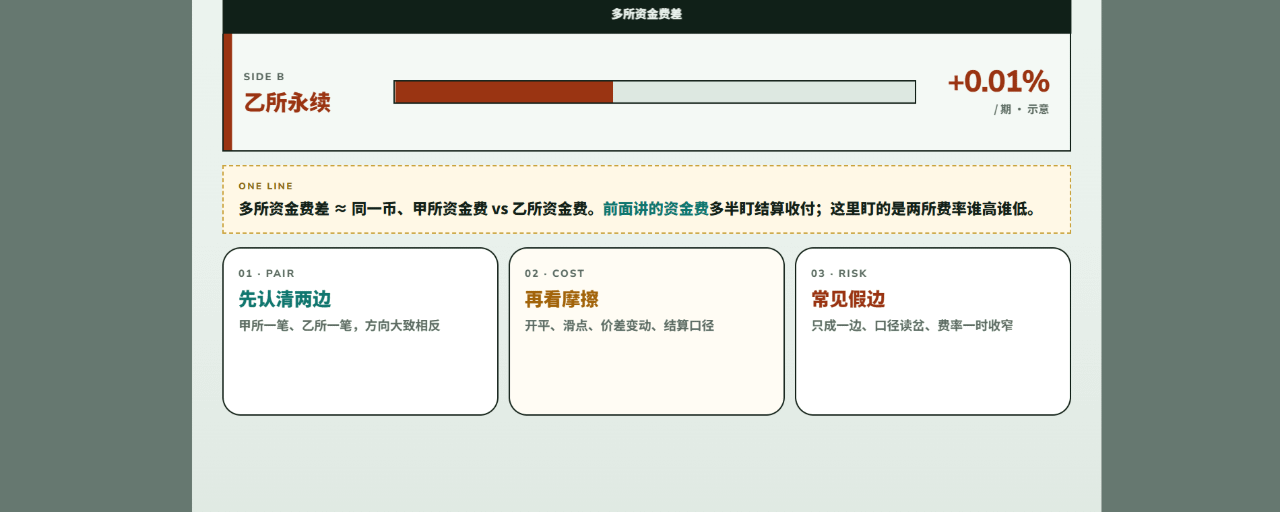
Cross-exchange funding rate arbitrage ≈ same coin, Exchange A funding vs. Exchange B funding; focus on the rate differential between the two sides.
You can distinguish it from the funding arbitrage discussed earlier as follows:
• A2 funding: usually spot + perpetual, focusing on the “funding payments” themselves;
• A9 cross-exchange funding rate differential: focusing on which exchange has the higher or lower rate, and the size of that difference.
II. An example
The numbers are for illustration only. Suppose there are perpetuals for the same coin:
• Exchange A funding rate: about +0.05% per period
• Exchange B funding rate: about +0.01% per period
• Cross-exchange funding rate differential: about 0.04% per period
An illustrative approach would be to take the direction that receives funding on the side with the more favorable rate, and use an opposing position on the other side to hedge (when the accounts and margin on both sides are sufficient, the positions are more likely to be properly matched).
By a rough estimate, the rate differential between the two sides is about 0.04% per period. The profit mainly comes from this cross-exchange funding rate differential, minus opening and closing costs, and any changes in the spread between the two sides while holding the positions.
It’s a lot like a regular cross-exchange spread: the two exchanges are out of sync. The difference is that here, the focus is usually on funding rates, not just bid and ask prices.
III. What are the two sides?
Here, you can generally think of the “two sides” as:
• Perpetual on Exchange A: specify the coin, whether you’re long or short, and roughly how much; at the funding time, pay or receive funding according to Exchange A’s rules.
• Perpetual on Exchange B: a perpetual contract for the same coin, with a broadly opposite direction; at the funding time, pay or receive funding according to Exchange B’s rules.
You can distinguish this from the previous types as follows:
• Cross-exchange spread: usually compares prices on the two exchanges;
• Cross-exchange funding rate differential: usually compares the funding rates on the two exchanges (and whether their settlement times roughly line up).
When both sides are executed, it’s more like trading the rate differential; when only one side is executed, what you hold is more like a regular perpetual position, plus a funding payment.
IV. Where the potential profit comes from
The “opportunity” often discussed in cross-exchange funding rate differentials is mainly not about predicting whether a narrative will drive prices up or down, but about several factors coming together.
1) The two exchanges’ rates can temporarily diverge
The participants, position structures, and rules differ between the two sides, so the rates can diverge for a while. Cross-exchange funding rate differentials often arise this way.
2) Once both sides are matched, the focus shifts to how the rate differential changes, rather than one-way price moves
If the two sides broadly hedge each other, it’s less like simply betting on whether the coin’s price will rise or fall. What often matters more to profit and loss is how large the initial rate differential was, how many funding periods you held it for, and whether it later narrowed or widened.
3) The differential comes from segmented markets and two separate settlement systems
People are trading perpetuals for the same coin, but Exchange A and Exchange B may not have “aligned” their rates in the short term. The differential comes from the mismatch between the rates on the two sides, rather than betting on whether a narrative will drive prices up or down.
V. Risks
The risks can be viewed in two parts: first, fees and spread movements can eat into the estimated opportunity; second, positions or settlement timing can more easily go awry.
How much fees and friction can eat into the opportunity
Common costs to deduct include:
• Opening and closing fees / slippage on both sides: both exchanges may charge fees; slippage is more noticeable when the order book is thin.
• Spread movements while holding: the spread between the two perpetuals (or between a perpetual and spot) may widen or narrow, and this is easy to overlook.
• Settlement conventions and timing: the rate units, settlement intervals, and meanings of positive and negative rates may differ between the exchanges.
• Margin and limits: one side may not have enough margin, or the other may hit a limit, making it hard to keep both sides aligned for a while.
Positions or execution paths can go awry
Only one side gets executed
The order on Exchange A gets filled, but the one on Exchange B doesn’t for a while, or vice versa. Price movements then have a bigger impact, and for now it looks more like a regular perpetual position. You can also pause and assess the situation.
The rate pages look promising, but the conventions don’t quite line up
One side may use an eight-hour interval while the other uses a different schedule, or the positive and negative signs may be read in reverse. The apparent differential on paper can therefore look much larger than it really is.
The rate differential temporarily narrows or reverses
By the time both sides are matched, the rates may have already converged or reversed; the estimated opportunity may have changed completely.
The instruments don’t quite match
Contracts with the same name but different multipliers or settlement currencies may all be casually called the same perpetual, even though they may not match well.
Simply put, this kind of cross-exchange funding rate strategy usually compares funding rates on Exchange A and Exchange B, rather than trying to predict whether a narrative will drive prices up or down; the main focus is the rate differential between the two sides.
This article explains the principles only. It is not investment advice and does not recommend any specific coin or trading combination.