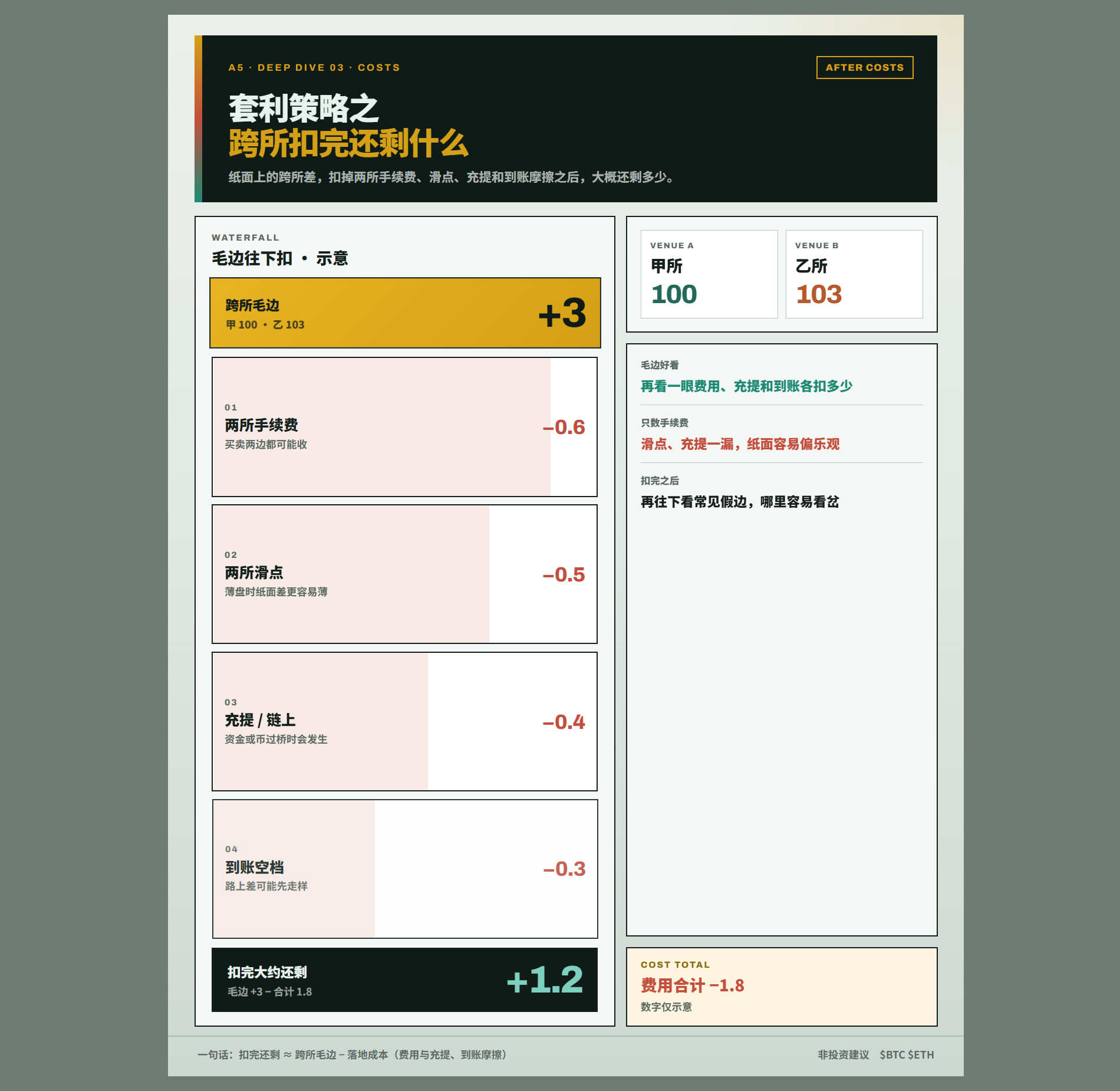

Earlier, we discussed why spreads occur: the same coin can be temporarily priced differently on two exchanges. This article focuses on one thing—roughly how much of the apparent cross-exchange spread remains after subtracting the actual fees and deposit/withdrawal friction on both exchanges.
1. What’s the principle?
When people talk about “what’s left after deductions” in cross-exchange trading, you don’t have to guess which way prices will move first. Just remember this:
Once both sides are matched and a price spread appears, what matters more is the initial gross cross-exchange spread minus the fees on both exchanges, slippage, deposit and withdrawal fees, and the friction of the spread shifting while funds are in transit. A gross spread may look attractive, but how much remains after deductions is another question.
Broken down, it’s roughly three steps:
1) First, there’s a cross-exchange gross spread
Suppose Exchange A and Exchange B both execute roughly as planned, leaving a price difference between them—that’s the gross spread, before any deductions.
2) Then subtract the costs one by one
Common deductions include the fees and slippage on each exchange. If coins or funds need to be transferred from one exchange to another, there may also be deposit/withdrawal or on-chain fees. Slow settlement confirmation, or one side executing while the other is still in transit, can also cause the price spread itself to shrink, and that should be factored in too.
3) What remains after deductions is closer to the actual result
Simply put:
Amount left after costs ≈ cross-exchange gross spread − costs incurred in practice (fees on both exchanges, transfers, and settlement friction).
Here’s one thing to remember:
When you see a cross-exchange price difference, also check how much is deducted by fees, transfers, and settlement.
II. An example
The numbers are for illustration only. Assume both sides are roughly matched:
• Cross-exchange gross spread: about +3 (around 100 on Exchange A and 103 on Exchange B)
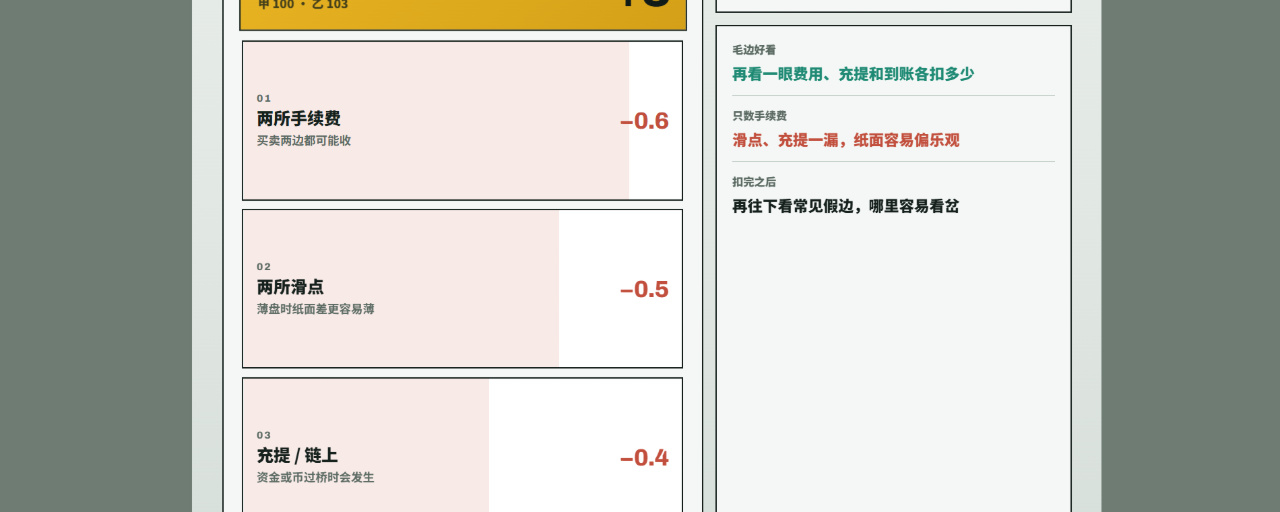
• Total fees on both exchanges: about 0.6
• Slippage on both exchanges: about 0.5
• Deposit/withdrawal or on-chain fees: about 0.4 (illustrative)
• Friction related to settlement delays: about 0.3 (illustrative)
• Estimated total deductions: about 1.8
By this rough calculation, the gross spread is +3; after deducting about 1.8, roughly +1.2 remains.
If you mainly see “a difference of 3 between the two exchanges” on the page, but haven’t accounted for opening and closing trades, slippage, transfers, or settlement delays, the on-paper spread and the actual result can easily differ.
III. What are the two sides
In this article, “the two sides” refers to the cross-exchange gross spread on one side, and the cost breakdown on the other:
• The gross-spread side: the prices on the two exchanges are matched at levels close to execution, showing how much they differ at the start.
• The cost side: the fees and friction incurred when the money actually changes hands.
Common costs and friction include:
• Fees on both exchanges: fees may apply to both the buy and sell, and together they can add up noticeably.
• Slippage: the order books on both exchanges can slip. With thin liquidity or larger orders, the spread shown on the page can quickly shrink.
• Deposit/withdrawal fees and on-chain fees: these apply when transferring coins or funds between exchanges.
• Settlement time: if confirmation is slow, the price spread may change while the transfer is in progress.
• Limits: withdrawal or order limits may prevent you from fully executing on both sides. They may not translate directly into a specific “deduction,” but they can also make it hard to realize the full gross spread.
IV. Where the profit comes from
The points most directly related to “what’s left after costs” are these:
1) The gross spread is more like a starting point
A 3-unit difference between two exchanges usually means their prices didn’t line up at that moment. How much remains after costs still needs to be calculated separately.
2) The more complete the list of costs, the closer the estimate
Miss even one item—fees, slippage, transfers, or settlement delays—and the remaining figure can easily be overly optimistic.
3) Transfers and settlement are often more noticeable than trading within one exchange
On-exchange triangular arbitrage usually cycles through trades on the same exchange; cross-exchange trading often also requires moving funds or coins. When the gross spread is already thin, it’s safer to factor in the transfer process too.
V. Where the risks lie
Common pitfalls related to “what’s left after costs” include the following.
Missing costs or using the wrong price
Counting only the fees
If you leave out slippage, transfer costs, or settlement delays, the on-paper remainder may look large, but the actual result may not line up.
The displayed price versus the actual execution price
Subtracting the latest prices on the two exchanges can look great, but the prices you actually encounter are usually the order-book prices. Once slippage kicks in, the gross spread can quickly shrink.
Costs or delays narrow the opportunity
When the gross spread is already thin
When the cross-exchange price difference is tiny, fees on both exchanges, slippage, and transfer costs can leave little room after a rough calculation.
The spread disappears while the transfer is in progress
While the coins are in transit, the price on the other side may already have converged or moved further away. Before you’ve even deducted all the costs, the gross spread itself may have narrowed. It’s worth calculating the fees, and also taking into account any part of the spread that has already changed.
Only one side gets executed
If one side executes while the other is still waiting for a transfer or an order to fill, you’re left with something closer to a regular position. In that case, “what’s left after costs” also excludes the gross spread from having both sides fully matched.
Simply put: what remains after costs in cross-exchange trading is the cross-exchange gross spread minus the costs incurred in practice. Even if the gross spread looks attractive, it’s safer to check how much is deducted by fees on both exchanges, transfers, and settlement.
This article explains the principles only. It does not constitute investment advice or recommend any specific combination of trades.