
#cryptography
cryptography
22,156 views
196 Discussing
Hot
Latest

·
--
Bullish
Cryptography in Blockchain: The Locks, Keys, and Signatures That Secure Everything
Without cryptography, anyone could steal your crypto or fake a transaction. With it, mathematics does the job that banks and lawyers traditionally handle.
---
1. The Three Core Jobs of Cryptography
Job Crypto Tool What It Does Real-Life Analogy
Prove it's YOU Digital Signatures Verifies you authorized the transaction Your handwritten signature on a check
Keep it secret Public/Private Keys Ensures only you can spend your funds Your house key + your mailbox address
Lock blocks together Hash Functions Makes data tamper-proof A wax seal that breaks if opened
---
2. How It Works: Sending $BITCOIN to a Friend
Let's walk through sending 0.5 BTC to Sara:
Step 1: Your Two Keys
Every wallet comes with a pair:
· Public Key = Your wallet address (like your email) — anyone can send to it
· Private Key = A secret 64-character code (like your $ATM PIN) — only you should ever know it
Step 2: Creating a Digital Signature
You craft the transaction: "Send 0.5 $BTC to Sara"
Then you use your Private Key to "sign" it. This generates a unique cryptographic signature that mathematically proves: "Only the person holding this private key could have created this signature."
The network nodes verify the signature using your Public Key.
· Matches? ✅ Valid transaction
· Doesn't match? ❌ Rejected instantly
Important: Your private key is never revealed during this process.
Step 3: Hashing for Immutability
Once confirmed, your transaction is bundled into a "block."
That block gets hashed — turned into a unique digital fingerprint.
This hash is then embedded into the next block.
Here's the magic: Change even one letter in the original transaction, and the hash changes completely — breaking the entire chain. This makes historical data impossible to alter without detection.
#cryptography #blockchain #locks #keys #BinanceSquareFamily
{spot}(ATMUSDT)
Cryptography in Blockchain: The Locks, Keys, and Signatures That Secure Everything
Without cryptography, anyone could steal your crypto or fake a transaction. With it, mathematics does the job that banks and lawyers traditionally handle.
---
1. The Three Core Jobs of Cryptography
Job Crypto Tool What It Does Real-Life Analogy
Prove it's YOU Digital Signatures Verifies you authorized the transaction Your handwritten signature on a check
Keep it secret Public/Private Keys Ensures only you can spend your funds Your house key + your mailbox address
Lock blocks together Hash Functions Makes data tamper-proof A wax seal that breaks if opened
---
2. How It Works: Sending $BITCOIN to a Friend
Let's walk through sending 0.5 BTC to Sara:
Step 1: Your Two Keys
Every wallet comes with a pair:
· Public Key = Your wallet address (like your email) — anyone can send to it
· Private Key = A secret 64-character code (like your $ATM PIN) — only you should ever know it
Step 2: Creating a Digital Signature
You craft the transaction: "Send 0.5 $BTC to Sara"
Then you use your Private Key to "sign" it. This generates a unique cryptographic signature that mathematically proves: "Only the person holding this private key could have created this signature."
The network nodes verify the signature using your Public Key.
· Matches? ✅ Valid transaction
· Doesn't match? ❌ Rejected instantly
Important: Your private key is never revealed during this process.
Step 3: Hashing for Immutability
Once confirmed, your transaction is bundled into a "block."
That block gets hashed — turned into a unique digital fingerprint.
This hash is then embedded into the next block.
Here's the magic: Change even one letter in the original transaction, and the hash changes completely — breaking the entire chain. This makes historical data impossible to alter without detection.
#cryptography #blockchain #locks #keys #BinanceSquareFamily
Without cryptography, anyone could steal your crypto or fake a transaction. With it, mathematics does the job that banks and lawyers traditionally handle.
---
1. The Three Core Jobs of Cryptography
Job Crypto Tool What It Does Real-Life Analogy
Prove it's YOU Digital Signatures Verifies you authorized the transaction Your handwritten signature on a check
Keep it secret Public/Private Keys Ensures only you can spend your funds Your house key + your mailbox address
Lock blocks together Hash Functions Makes data tamper-proof A wax seal that breaks if opened
---
2. How It Works: Sending $BITCOIN to a Friend
Let's walk through sending 0.5 BTC to Sara:
Step 1: Your Two Keys
Every wallet comes with a pair:
· Public Key = Your wallet address (like your email) — anyone can send to it
· Private Key = A secret 64-character code (like your $ATM PIN) — only you should ever know it
Step 2: Creating a Digital Signature
You craft the transaction: "Send 0.5 $BTC to Sara"
Then you use your Private Key to "sign" it. This generates a unique cryptographic signature that mathematically proves: "Only the person holding this private key could have created this signature."
The network nodes verify the signature using your Public Key.
· Matches? ✅ Valid transaction
· Doesn't match? ❌ Rejected instantly
Important: Your private key is never revealed during this process.
Step 3: Hashing for Immutability
Once confirmed, your transaction is bundled into a "block."
That block gets hashed — turned into a unique digital fingerprint.
This hash is then embedded into the next block.
Here's the magic: Change even one letter in the original transaction, and the hash changes completely — breaking the entire chain. This makes historical data impossible to alter without detection.
#cryptography #blockchain #locks #keys #BinanceSquareFamily
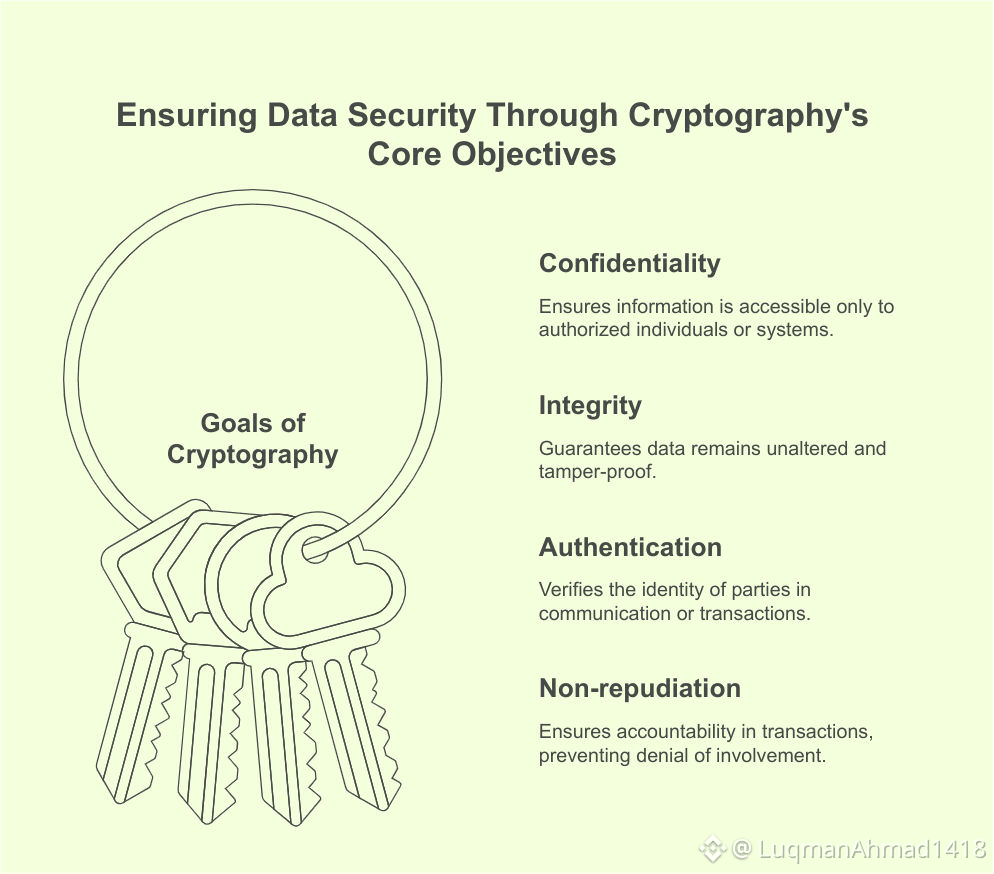
133

·
--
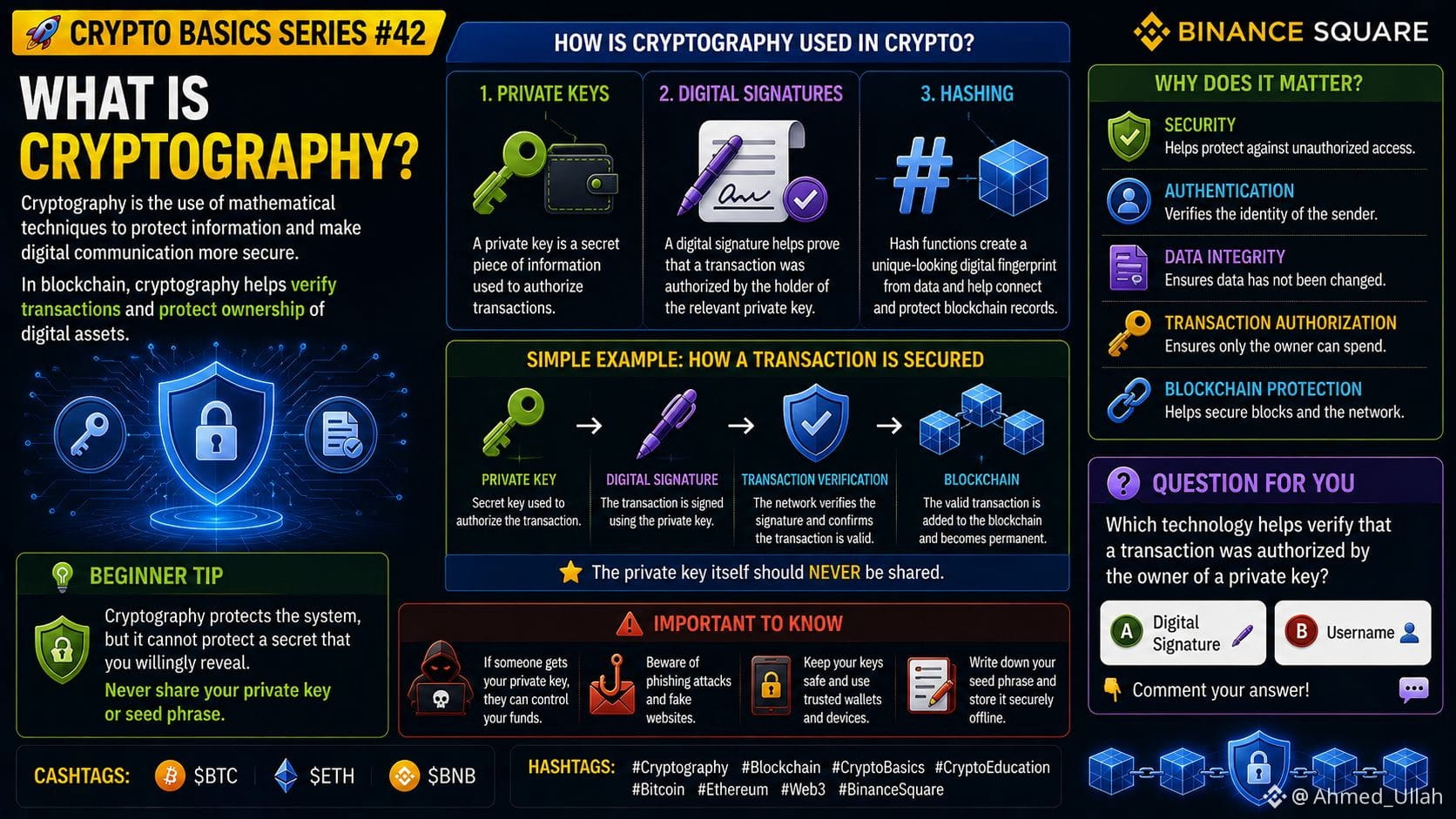
🚀 Crypto Basics Series #42: What Is Cryptography?
🔐 What Is Cryptography?
Cryptography is the use of mathematical techniques to protect information and make digital communication more secure.
In blockchain, cryptography helps verify transactions and protect ownership of digital assets.
⚙️ How Is It Used in Crypto?
🔑 Private Keys
A private key is a secret piece of information used to authorize transactions.
✍️ Digital Signatures
A digital signature helps prove that a transaction was authorized by the holder of the relevant private key.
#️⃣ Hashing
Hash functions create a unique-looking digital fingerprint from data and help connect and protect blockchain records.
💡 Simple Example
Think of your private key as a secret authorization tool.
You use it to sign a transaction:
Private Key → Digital Signature → Transaction Verification → Blockchain
The private key itself should never be shared.
🛡️ Why Does It Matter?
Cryptography helps provide:
🔒 Security
✅ Authentication
🧾 Data integrity
✍️ Transaction authorization
🔗 Blockchain protection
⚠️ Beginner Tip
Cryptography protects the system, but it cannot protect a secret that you willingly reveal.
Never share your private key or seed phrase.
💬 Question for You
Which technology helps verify that a transaction was authorized by the owner of a private key?
🅰️ Digital Signature ✍️
🅱️ Username
👇 Comment your answer!
$BTC $ETH $BNB
#Cryptography #Blockchain #CryptoBasics #CryptoEducation #Bitcoin
🚀 Crypto Basics Series #42: What Is Cryptography?
🔐 What Is Cryptography?
Cryptography is the use of mathematical techniques to protect information and make digital communication more secure.
In blockchain, cryptography helps verify transactions and protect ownership of digital assets.
⚙️ How Is It Used in Crypto?
🔑 Private Keys
A private key is a secret piece of information used to authorize transactions.
✍️ Digital Signatures
A digital signature helps prove that a transaction was authorized by the holder of the relevant private key.
#️⃣ Hashing
Hash functions create a unique-looking digital fingerprint from data and help connect and protect blockchain records.
💡 Simple Example
Think of your private key as a secret authorization tool.
You use it to sign a transaction:
Private Key → Digital Signature → Transaction Verification → Blockchain
The private key itself should never be shared.
🛡️ Why Does It Matter?
Cryptography helps provide:
🔒 Security
✅ Authentication
🧾 Data integrity
✍️ Transaction authorization
🔗 Blockchain protection
⚠️ Beginner Tip
Cryptography protects the system, but it cannot protect a secret that you willingly reveal.
Never share your private key or seed phrase.
💬 Question for You
Which technology helps verify that a transaction was authorized by the owner of a private key?
🅰️ Digital Signature ✍️
🅱️ Username
👇 Comment your answer!
$BTC $ETH $BNB
#Cryptography #Blockchain #CryptoBasics #CryptoEducation #Bitcoin
🔐 What Is Cryptography?
Cryptography is the use of mathematical techniques to protect information and make digital communication more secure.
In blockchain, cryptography helps verify transactions and protect ownership of digital assets.
⚙️ How Is It Used in Crypto?
🔑 Private Keys
A private key is a secret piece of information used to authorize transactions.
✍️ Digital Signatures
A digital signature helps prove that a transaction was authorized by the holder of the relevant private key.
#️⃣ Hashing
Hash functions create a unique-looking digital fingerprint from data and help connect and protect blockchain records.
💡 Simple Example
Think of your private key as a secret authorization tool.
You use it to sign a transaction:
Private Key → Digital Signature → Transaction Verification → Blockchain
The private key itself should never be shared.
🛡️ Why Does It Matter?
Cryptography helps provide:
🔒 Security
✅ Authentication
🧾 Data integrity
✍️ Transaction authorization
🔗 Blockchain protection
⚠️ Beginner Tip
Cryptography protects the system, but it cannot protect a secret that you willingly reveal.
Never share your private key or seed phrase.
💬 Question for You
Which technology helps verify that a transaction was authorized by the owner of a private key?
🅰️ Digital Signature ✍️
🅱️ Username
👇 Comment your answer!
$BTC $ETH $BNB
#Cryptography #Blockchain #CryptoBasics #CryptoEducation #Bitcoin

Follow Me
From Ahmed_Ullah
3
77

·
--
Google Research Triggers Quantum Threat Panic 😳 Is Blockchain Encryption At Risk? 😲While short-term day traders are entirely fixated on minor daily price wicks, a massive, long-term structural anxiety has entered the global cryptocurrency matrix. Following recent data updates from tech giant Google suggesting that advanced quantum computing could begin cracking conventional cryptographic encryption by 2029, top layer-1 and layer-2 networks are moving into an absolute defensive scramble!
High-volume VSA (Volume Spread Analysis) charts reveal that smart money is already beginning to price in this long-term security narrative. Because the $2 Trillion global crypto market relies heavily on traditional ECDSA cryptography to protect digital wallets and validate blockchain transactions, any compression of the quantum timeline creates a massive incentive for capital to favor forward-thinking protocols. Whales are actively using this long-term shift as a perfect smokescreen—forcefully creating localized volatility on older, un-upgraded network pairs to clear out retail leverage, while simultaneously rotating spot allocations into projects that are actively developing post-quantum cryptography (PQC) solutions.
The immediate market structure is absorbing this fundamental shift quite well, especially as major cybersecurity and blockchain infrastructure groups step up to develop quantum-resistant defense patches. However, it proves that the criteria for long-term digital asset holding is rapidly changing.
📉 For Future Traders: Do not let long-term structural headlines cause you to panic-sell your localized lower-timeframe setups. Manage your leverage tightly against short-term volatility spikes and focus your risk parameters strictly around verified macro demand floors where big money is heavily protecting the line.
Will the rising quantum threat completely force a total rewrite of blockchain architecture, or will the crypto industry implement defenses long before the 2029 deadline? Let me know your predictions below! 👇
#QuantumComputing #BlockchainSecurity #Cryptography #CryptoNews #CryptoTrading #TechnicalAnalysis #BinanceWrite2Earn
Google Research Triggers Quantum Threat Panic 😳 Is Blockchain Encryption At Risk? 😲
While short-term day traders are entirely fixated on minor daily price wicks, a massive, long-term structural anxiety has entered the global cryptocurrency matrix. Following recent data updates from tech giant Google suggesting that advanced quantum computing could begin cracking conventional cryptographic encryption by 2029, top layer-1 and layer-2 networks are moving into an absolute defensive scramble!
High-volume VSA (Volume Spread Analysis) charts reveal that smart money is already beginning to price in this long-term security narrative. Because the $2 Trillion global crypto market relies heavily on traditional ECDSA cryptography to protect digital wallets and validate blockchain transactions, any compression of the quantum timeline creates a massive incentive for capital to favor forward-thinking protocols. Whales are actively using this long-term shift as a perfect smokescreen—forcefully creating localized volatility on older, un-upgraded network pairs to clear out retail leverage, while simultaneously rotating spot allocations into projects that are actively developing post-quantum cryptography (PQC) solutions.
The immediate market structure is absorbing this fundamental shift quite well, especially as major cybersecurity and blockchain infrastructure groups step up to develop quantum-resistant defense patches. However, it proves that the criteria for long-term digital asset holding is rapidly changing.
📉 For Future Traders: Do not let long-term structural headlines cause you to panic-sell your localized lower-timeframe setups. Manage your leverage tightly against short-term volatility spikes and focus your risk parameters strictly around verified macro demand floors where big money is heavily protecting the line.
Will the rising quantum threat completely force a total rewrite of blockchain architecture, or will the crypto industry implement defenses long before the 2029 deadline? Let me know your predictions below! 👇
#QuantumComputing #BlockchainSecurity #Cryptography #CryptoNews #CryptoTrading #TechnicalAnalysis #BinanceWrite2Earn
High-volume VSA (Volume Spread Analysis) charts reveal that smart money is already beginning to price in this long-term security narrative. Because the $2 Trillion global crypto market relies heavily on traditional ECDSA cryptography to protect digital wallets and validate blockchain transactions, any compression of the quantum timeline creates a massive incentive for capital to favor forward-thinking protocols. Whales are actively using this long-term shift as a perfect smokescreen—forcefully creating localized volatility on older, un-upgraded network pairs to clear out retail leverage, while simultaneously rotating spot allocations into projects that are actively developing post-quantum cryptography (PQC) solutions.
The immediate market structure is absorbing this fundamental shift quite well, especially as major cybersecurity and blockchain infrastructure groups step up to develop quantum-resistant defense patches. However, it proves that the criteria for long-term digital asset holding is rapidly changing.
📉 For Future Traders: Do not let long-term structural headlines cause you to panic-sell your localized lower-timeframe setups. Manage your leverage tightly against short-term volatility spikes and focus your risk parameters strictly around verified macro demand floors where big money is heavily protecting the line.
Will the rising quantum threat completely force a total rewrite of blockchain architecture, or will the crypto industry implement defenses long before the 2029 deadline? Let me know your predictions below! 👇
#QuantumComputing #BlockchainSecurity #Cryptography #CryptoNews #CryptoTrading #TechnicalAnalysis #BinanceWrite2Earn
2
22
·
--
Cryptography isn't just for hackers and spies — it's running quietly behind every app you use today. Book 1 breaks down the invisible math that keeps your digital life secure, built for total beginners who want the ‘how’ before the ‘why.’ #Cryptography #bitcoin
Cryptography isn't just for hackers and spies — it's running quietly behind every app you use today. Book 1 breaks down the invisible math that keeps your digital life secure, built for total beginners who want the ‘how’ before the ‘why.’ #Cryptography #bitcoin
1
111

·
--
Zero-Knowledge Proofs (ZKP) Utility
Zero-Knowledge tech is moving out of the academic phase and into core production. Beyond privacy, ZKPs are essential for scaling blockchains by allowing complex transactions to be verified instantly without heavy computation.
This shift will radically lower gas costs and increase execution speeds.
#ZKProofs #Cryptography #Web3Dev
Zero-Knowledge Proofs (ZKP) Utility
Zero-Knowledge tech is moving out of the academic phase and into core production. Beyond privacy, ZKPs are essential for scaling blockchains by allowing complex transactions to be verified instantly without heavy computation.
This shift will radically lower gas costs and increase execution speeds.
#ZKProofs #Cryptography #Web3Dev
Zero-Knowledge tech is moving out of the academic phase and into core production. Beyond privacy, ZKPs are essential for scaling blockchains by allowing complex transactions to be verified instantly without heavy computation.
This shift will radically lower gas costs and increase execution speeds.
#ZKProofs #Cryptography #Web3Dev
1
319

Critical security insight 🛡️
Anthropic's Claude AI has successfully identified vulnerabilities in a post-quantum signature scheme slated for U.S. federal standardization. This highlights AI's potential to bypass advanced cryptographic defenses previously considered secure against quantum threats.
#AI #Cryptography
Critical security insight 🛡️
Anthropic's Claude AI has successfully identified vulnerabilities in a post-quantum signature scheme slated for U.S. federal standardization. This highlights AI's potential to bypass advanced cryptographic defenses previously considered secure against quantum threats.
#AI #Cryptography
Anthropic's Claude AI has successfully identified vulnerabilities in a post-quantum signature scheme slated for U.S. federal standardization. This highlights AI's potential to bypass advanced cryptographic defenses previously considered secure against quantum threats.
#AI #Cryptography
8
·
--
Every time you send a message, log in, or make a payment, cryptography is working invisibly in the background. Book 1 starts from zero: what cryptography actually is, and why it's the foundation everything else in this library builds on. #Cryptography #bitcoin
Every time you send a message, log in, or make a payment, cryptography is working invisibly in the background. Book 1 starts from zero: what cryptography actually is, and why it's the foundation everything else in this library builds on. #Cryptography #bitcoin
98

·
--
🚨 LATEST UPDATE 🚨
A major breakthrough in cryptographic research has been recorded. A new AI model, Claude Mythos Preview, managed to weaken the HAWK digital-signature scheme in just 60 hours. The attack reduced the effective strength of the smallest key set from 2^64 to 2^38 operations at a cost of $100,000. 🛡️
While current Bitcoin and Ethereum signatures remain unaffected, this development is significant. Bitcoin developers are already working on quantum-resistant plans (BIP-360/361) because current encryption is expected to fail against future quantum computers. This news highlights that classical attacks are also accelerating much faster than anticipated. ⚡
As the race between security and cryptanalysis intensifies, the window for migrating to quantum-resistant standards may be closing sooner than expected. 🔐
Do you think the crypto industry can migrate fast enough?
#CyberSecurity #Bitcoin #Cryptography
$BNB $UNI $USD1
🚨 LATEST UPDATE 🚨
A major breakthrough in cryptographic research has been recorded. A new AI model, Claude Mythos Preview, managed to weaken the HAWK digital-signature scheme in just 60 hours. The attack reduced the effective strength of the smallest key set from 2^64 to 2^38 operations at a cost of $100,000. 🛡️
While current Bitcoin and Ethereum signatures remain unaffected, this development is significant. Bitcoin developers are already working on quantum-resistant plans (BIP-360/361) because current encryption is expected to fail against future quantum computers. This news highlights that classical attacks are also accelerating much faster than anticipated. ⚡
As the race between security and cryptanalysis intensifies, the window for migrating to quantum-resistant standards may be closing sooner than expected. 🔐
Do you think the crypto industry can migrate fast enough?
#CyberSecurity #Bitcoin #Cryptography
$BNB $UNI $USD1
A major breakthrough in cryptographic research has been recorded. A new AI model, Claude Mythos Preview, managed to weaken the HAWK digital-signature scheme in just 60 hours. The attack reduced the effective strength of the smallest key set from 2^64 to 2^38 operations at a cost of $100,000. 🛡️
While current Bitcoin and Ethereum signatures remain unaffected, this development is significant. Bitcoin developers are already working on quantum-resistant plans (BIP-360/361) because current encryption is expected to fail against future quantum computers. This news highlights that classical attacks are also accelerating much faster than anticipated. ⚡
As the race between security and cryptanalysis intensifies, the window for migrating to quantum-resistant standards may be closing sooner than expected. 🔐
Do you think the crypto industry can migrate fast enough?
#CyberSecurity #Bitcoin #Cryptography
$BNB $UNI $USD1

85

·
--
$ETH 'S CRYPTOGRAPHIC REVOLUTION: POSEIDON OUT, SHA2 IN 🔐⚡
Ethereum L1 is making a historic pivot. Justin Drake confirmed the network will abandon Poseidon — the SNARK-friendly hash standard since 2019 — in favor of battle-tested traditional hashes like SHA2 and BLAKE2s. The catalyst? A SNARK design breakthrough.
By natively aligning binary field operations with traditional hashes, proofs now hit 1 million per second at just ~100x overhead. Drake calls it "science fiction-grade cryptography," crediting Binius and Flock. This accelerates Ethereum's roadmap — leanVM lands in 2027, with full layer deployment in 2028.
In the post-quantum arms race, hash-based schemes are emerging victorious over lattice and isogeny approaches. AI-powered cryptographic analysis is shifting the battlefield, and Ethereum sits at the front line.
How do you see this shift impacting Ethereum's long-term security narrative? 👇
⚠️ Not financial advice. Always manage your risk. 🛡️
🏷️ $ETH #Ethereum #Cryptography #PostQuantum #Blockchain
🔐⚡
$ETH 'S CRYPTOGRAPHIC REVOLUTION: POSEIDON OUT, SHA2 IN 🔐⚡
Ethereum L1 is making a historic pivot. Justin Drake confirmed the network will abandon Poseidon — the SNARK-friendly hash standard since 2019 — in favor of battle-tested traditional hashes like SHA2 and BLAKE2s. The catalyst? A SNARK design breakthrough.
By natively aligning binary field operations with traditional hashes, proofs now hit 1 million per second at just ~100x overhead. Drake calls it "science fiction-grade cryptography," crediting Binius and Flock. This accelerates Ethereum's roadmap — leanVM lands in 2027, with full layer deployment in 2028.
In the post-quantum arms race, hash-based schemes are emerging victorious over lattice and isogeny approaches. AI-powered cryptographic analysis is shifting the battlefield, and Ethereum sits at the front line.
How do you see this shift impacting Ethereum's long-term security narrative? 👇
⚠️ Not financial advice. Always manage your risk. 🛡️
🏷️ $ETH #Ethereum #Cryptography #PostQuantum #Blockchain
🔐⚡
Ethereum L1 is making a historic pivot. Justin Drake confirmed the network will abandon Poseidon — the SNARK-friendly hash standard since 2019 — in favor of battle-tested traditional hashes like SHA2 and BLAKE2s. The catalyst? A SNARK design breakthrough.
By natively aligning binary field operations with traditional hashes, proofs now hit 1 million per second at just ~100x overhead. Drake calls it "science fiction-grade cryptography," crediting Binius and Flock. This accelerates Ethereum's roadmap — leanVM lands in 2027, with full layer deployment in 2028.
In the post-quantum arms race, hash-based schemes are emerging victorious over lattice and isogeny approaches. AI-powered cryptographic analysis is shifting the battlefield, and Ethereum sits at the front line.
How do you see this shift impacting Ethereum's long-term security narrative? 👇
⚠️ Not financial advice. Always manage your risk. 🛡️
🏷️ $ETH #Ethereum #Cryptography #PostQuantum #Blockchain
🔐⚡
15

·
--

Article
Network Anchors: Header Math, P2A Scripts, and the First Mining Pool🚀
The cryptographic certainty of @BitcoinKE is fundamentally driven by the rigid mathematics of the Bitcoin block header hash calculation. To mine a block, hardware must endlessly hash a 80-byte header string containing six specific fields: software version, previous block hash, Merkle root, timestamp, difficulty bits, and a 32-bit nonce. Passing this data through double SHA-256 functions produces a unique, irreversible string. If the resulting output does not sit below the targeted difficulty, the nonce increments, and the process repeats. This tie to physics guarantees absolute data immutability. ⚙️
To seamlessly expand Layer-2 contract infrastructure upon this secure base, the concept of payment-to-anchors (P2A) outputs optimizes fee management. P2A creates standardized, minimal-weight output scripts explicitly designed for anchoring ephemeral fee-bumping mechanisms to off-chain smart contracts. Instead of bloating standard spending scripts with complex code, P2A enables users to instantly attach child-pays-for-parent (CPFP) transaction fee accelerations when broadcasting. This keeps base-layer data clean, reduces overhead, and keeps networks stable. ⚡
This vast global mining network would not exist without the historic origin of the first mining pool, Slush Pool, launched in late 2010. Before its creation, solo mining was the only option, leaving smaller operations facing immense payout variance and erratic rewards. By introducing a server architecture that allowed individual miners to pool their computational hash rate and share rewards based on their submitted shares, the pool decentralized network participation. This innovation transformed mining from a solitary lottery into a highly predictable, globally distributed industry. 🛡️ $BTC
{spot}(BTCUSDT)
#SECDelaysEventContractETFs #Cryptography #MempoolTech #SlushPool #CryptoHistoryRepeats
Network Anchors: Header Math, P2A Scripts, and the First Mining Pool
🚀
The cryptographic certainty of @BitcoinKE is fundamentally driven by the rigid mathematics of the Bitcoin block header hash calculation. To mine a block, hardware must endlessly hash a 80-byte header string containing six specific fields: software version, previous block hash, Merkle root, timestamp, difficulty bits, and a 32-bit nonce. Passing this data through double SHA-256 functions produces a unique, irreversible string. If the resulting output does not sit below the targeted difficulty, the nonce increments, and the process repeats. This tie to physics guarantees absolute data immutability. ⚙️
To seamlessly expand Layer-2 contract infrastructure upon this secure base, the concept of payment-to-anchors (P2A) outputs optimizes fee management. P2A creates standardized, minimal-weight output scripts explicitly designed for anchoring ephemeral fee-bumping mechanisms to off-chain smart contracts. Instead of bloating standard spending scripts with complex code, P2A enables users to instantly attach child-pays-for-parent (CPFP) transaction fee accelerations when broadcasting. This keeps base-layer data clean, reduces overhead, and keeps networks stable. ⚡
This vast global mining network would not exist without the historic origin of the first mining pool, Slush Pool, launched in late 2010. Before its creation, solo mining was the only option, leaving smaller operations facing immense payout variance and erratic rewards. By introducing a server architecture that allowed individual miners to pool their computational hash rate and share rewards based on their submitted shares, the pool decentralized network participation. This innovation transformed mining from a solitary lottery into a highly predictable, globally distributed industry. 🛡️ $BTC
#SECDelaysEventContractETFs #Cryptography #MempoolTech #SlushPool #CryptoHistoryRepeats
The cryptographic certainty of @BitcoinKE is fundamentally driven by the rigid mathematics of the Bitcoin block header hash calculation. To mine a block, hardware must endlessly hash a 80-byte header string containing six specific fields: software version, previous block hash, Merkle root, timestamp, difficulty bits, and a 32-bit nonce. Passing this data through double SHA-256 functions produces a unique, irreversible string. If the resulting output does not sit below the targeted difficulty, the nonce increments, and the process repeats. This tie to physics guarantees absolute data immutability. ⚙️
To seamlessly expand Layer-2 contract infrastructure upon this secure base, the concept of payment-to-anchors (P2A) outputs optimizes fee management. P2A creates standardized, minimal-weight output scripts explicitly designed for anchoring ephemeral fee-bumping mechanisms to off-chain smart contracts. Instead of bloating standard spending scripts with complex code, P2A enables users to instantly attach child-pays-for-parent (CPFP) transaction fee accelerations when broadcasting. This keeps base-layer data clean, reduces overhead, and keeps networks stable. ⚡
This vast global mining network would not exist without the historic origin of the first mining pool, Slush Pool, launched in late 2010. Before its creation, solo mining was the only option, leaving smaller operations facing immense payout variance and erratic rewards. By introducing a server architecture that allowed individual miners to pool their computational hash rate and share rewards based on their submitted shares, the pool decentralized network participation. This innovation transformed mining from a solitary lottery into a highly predictable, globally distributed industry. 🛡️ $BTC
#SECDelaysEventContractETFs #Cryptography #MempoolTech #SlushPool #CryptoHistoryRepeats
20
·
--

Article
Cryptographic Evolution: Schnorr Signatures, Transaction Batching, and Watchtowers🚀
The security architecture of @BitcoinKE relies heavily on advanced mathematics, recently upgraded through the integration of Schnorr signatures over the legacy Elliptic Curve Digital Signature Algorithm (ECDSA). While ECDSA requires individual validation for every cryptographic signature inside a complex multi-sig setup, Schnorr math enables key and signature aggregation. This means multiple inputs can be combined into a single, compact signature. This mathematical breakthrough drastically reduces transaction data weight, enhances base-layer privacy, and lowers network fees. ⚙️
This focus on structural optimization is mirrored by major platforms through the massive impact of transaction batching for exchanges. Instead of broadcasting a unique on-chain transaction every time an individual user requests a withdrawal, exchanges combine hundreds of separate output destinations into one single, massive transaction. This structural batching radically minimizes overall data footprint in the mempool, defusing network congestion during intense market cycles. It allows institutions to save millions in network fees while preserving blockchain throughput. 📊
To extend this efficiency to Layer-2 scaling, the concept of watchtowers provides vital decentralized security inside payment channels. Because off-chain protocols like the Lightning Network require users to monitor the blockchain for fraudulent old channel states, offline users could be vulnerable to theft. Watchtowers solve this by acting as automated, trustless sentinels. If a counterparty attempts to broadcast an invalid state to steal $BTC
{spot}(BTCUSDT)
, the watchtower instantly detects it, broadcasts a justice transaction, and secures the funds automatically. 🛡️
#BitcoinDunyamiz #Cryptography #SchnorrSignatures #CryptoSecurity #lightningnetwork
Cryptographic Evolution: Schnorr Signatures, Transaction Batching, and Watchtowers
🚀
The security architecture of @BitcoinKE relies heavily on advanced mathematics, recently upgraded through the integration of Schnorr signatures over the legacy Elliptic Curve Digital Signature Algorithm (ECDSA). While ECDSA requires individual validation for every cryptographic signature inside a complex multi-sig setup, Schnorr math enables key and signature aggregation. This means multiple inputs can be combined into a single, compact signature. This mathematical breakthrough drastically reduces transaction data weight, enhances base-layer privacy, and lowers network fees. ⚙️
This focus on structural optimization is mirrored by major platforms through the massive impact of transaction batching for exchanges. Instead of broadcasting a unique on-chain transaction every time an individual user requests a withdrawal, exchanges combine hundreds of separate output destinations into one single, massive transaction. This structural batching radically minimizes overall data footprint in the mempool, defusing network congestion during intense market cycles. It allows institutions to save millions in network fees while preserving blockchain throughput. 📊
To extend this efficiency to Layer-2 scaling, the concept of watchtowers provides vital decentralized security inside payment channels. Because off-chain protocols like the Lightning Network require users to monitor the blockchain for fraudulent old channel states, offline users could be vulnerable to theft. Watchtowers solve this by acting as automated, trustless sentinels. If a counterparty attempts to broadcast an invalid state to steal $BTC
, the watchtower instantly detects it, broadcasts a justice transaction, and secures the funds automatically. 🛡️
#BitcoinDunyamiz #Cryptography #SchnorrSignatures #CryptoSecurity #lightningnetwork
The security architecture of @BitcoinKE relies heavily on advanced mathematics, recently upgraded through the integration of Schnorr signatures over the legacy Elliptic Curve Digital Signature Algorithm (ECDSA). While ECDSA requires individual validation for every cryptographic signature inside a complex multi-sig setup, Schnorr math enables key and signature aggregation. This means multiple inputs can be combined into a single, compact signature. This mathematical breakthrough drastically reduces transaction data weight, enhances base-layer privacy, and lowers network fees. ⚙️
This focus on structural optimization is mirrored by major platforms through the massive impact of transaction batching for exchanges. Instead of broadcasting a unique on-chain transaction every time an individual user requests a withdrawal, exchanges combine hundreds of separate output destinations into one single, massive transaction. This structural batching radically minimizes overall data footprint in the mempool, defusing network congestion during intense market cycles. It allows institutions to save millions in network fees while preserving blockchain throughput. 📊
To extend this efficiency to Layer-2 scaling, the concept of watchtowers provides vital decentralized security inside payment channels. Because off-chain protocols like the Lightning Network require users to monitor the blockchain for fraudulent old channel states, offline users could be vulnerable to theft. Watchtowers solve this by acting as automated, trustless sentinels. If a counterparty attempts to broadcast an invalid state to steal $BTC
, the watchtower instantly detects it, broadcasts a justice transaction, and secures the funds automatically. 🛡️
#BitcoinDunyamiz #Cryptography #SchnorrSignatures #CryptoSecurity #lightningnetwork
35
·
--
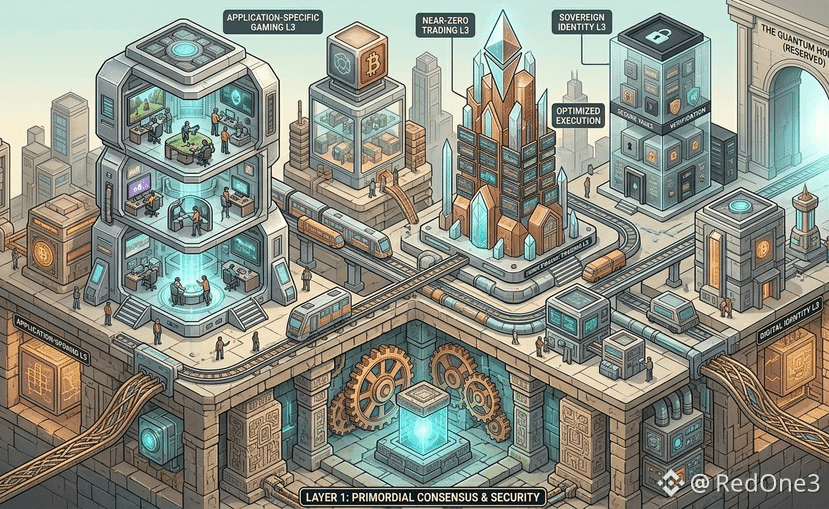
Is Bitcoin Ready for Quantum Computers? ⚛️
Quantum computing is no longer a distant sci-fi threat.
The core cryptographic foundations of major blockchains are beginning to integrate Post-Quantum Cryptography (PQC) to ensure that digital scarcity remains unhackable for decades to come.
#QuantumComputing #Cryptography #BitcoinSecurity #TechTrends .
Is Bitcoin Ready for Quantum Computers? ⚛️
Quantum computing is no longer a distant sci-fi threat.
The core cryptographic foundations of major blockchains are beginning to integrate Post-Quantum Cryptography (PQC) to ensure that digital scarcity remains unhackable for decades to come.
#QuantumComputing #Cryptography #BitcoinSecurity #TechTrends .
Quantum computing is no longer a distant sci-fi threat.
The core cryptographic foundations of major blockchains are beginning to integrate Post-Quantum Cryptography (PQC) to ensure that digital scarcity remains unhackable for decades to come.
#QuantumComputing #Cryptography #BitcoinSecurity #TechTrends .
95
·
--

Article
Schnorr Multisig, Coal Mine Methane Mining, and Financial Privacy Law⚖️
The long-term resilience of $BTC
{spot}(BTCUSDT)
relies heavily on multi-party Schnorr multisig protocols, reclaiming abandoned coal mine methane for localized hashing, and the legal evolution of decentralized financial privacy in cross-border commerce.
Multi-party Schnorr multisig protocols are transforming network efficiency [1]. By combining multiple public keys and signatures into a single, compact cryptographic proof, this technology makes complex corporate multi-signature wallets look identical to simple single-signature transfers on the public ledger. This saves massive block space while maximizing user privacy. This software agility matches crucial environmental upgrades, like reclaiming abandoned coal mine methane for localized hashing. Specialized generation units capture highly toxic gas leaking from old, inactive coal shafts, converting it directly into clean electricity for containerized mining rigs. This process removes a potent greenhouse pollutant while securing the ledger.
Concurrently, the legal evolution of financial privacy is reshaping cross-border commerce. Courts are increasingly setting precedents that protect non-custodial cryptographic tools from overreaching surveillance mandates. These legal rulings confirm that using decentralized open-source code does not strip individuals of their fundamental constitutional rights to privacy. As @Bitcoinworld unifies efficient Schnorr multisig scripts with green coal-methane energy reclamation and strong legal protections for financial data, it secures its position as global hard money. 🌐
#IndiaCryptoDreams #Cryptography #GreenMining" #Cryptolaw #FinanceNews
Schnorr Multisig, Coal Mine Methane Mining, and Financial Privacy Law
⚖️
The long-term resilience of $BTC
relies heavily on multi-party Schnorr multisig protocols, reclaiming abandoned coal mine methane for localized hashing, and the legal evolution of decentralized financial privacy in cross-border commerce.
Multi-party Schnorr multisig protocols are transforming network efficiency [1]. By combining multiple public keys and signatures into a single, compact cryptographic proof, this technology makes complex corporate multi-signature wallets look identical to simple single-signature transfers on the public ledger. This saves massive block space while maximizing user privacy. This software agility matches crucial environmental upgrades, like reclaiming abandoned coal mine methane for localized hashing. Specialized generation units capture highly toxic gas leaking from old, inactive coal shafts, converting it directly into clean electricity for containerized mining rigs. This process removes a potent greenhouse pollutant while securing the ledger.
Concurrently, the legal evolution of financial privacy is reshaping cross-border commerce. Courts are increasingly setting precedents that protect non-custodial cryptographic tools from overreaching surveillance mandates. These legal rulings confirm that using decentralized open-source code does not strip individuals of their fundamental constitutional rights to privacy. As @Bitcoinworld unifies efficient Schnorr multisig scripts with green coal-methane energy reclamation and strong legal protections for financial data, it secures its position as global hard money. 🌐
#IndiaCryptoDreams #Cryptography #GreenMining" #Cryptolaw #FinanceNews
The long-term resilience of $BTC
relies heavily on multi-party Schnorr multisig protocols, reclaiming abandoned coal mine methane for localized hashing, and the legal evolution of decentralized financial privacy in cross-border commerce.
Multi-party Schnorr multisig protocols are transforming network efficiency [1]. By combining multiple public keys and signatures into a single, compact cryptographic proof, this technology makes complex corporate multi-signature wallets look identical to simple single-signature transfers on the public ledger. This saves massive block space while maximizing user privacy. This software agility matches crucial environmental upgrades, like reclaiming abandoned coal mine methane for localized hashing. Specialized generation units capture highly toxic gas leaking from old, inactive coal shafts, converting it directly into clean electricity for containerized mining rigs. This process removes a potent greenhouse pollutant while securing the ledger.
Concurrently, the legal evolution of financial privacy is reshaping cross-border commerce. Courts are increasingly setting precedents that protect non-custodial cryptographic tools from overreaching surveillance mandates. These legal rulings confirm that using decentralized open-source code does not strip individuals of their fundamental constitutional rights to privacy. As @Bitcoinworld unifies efficient Schnorr multisig scripts with green coal-methane energy reclamation and strong legal protections for financial data, it secures its position as global hard money. 🌐
#IndiaCryptoDreams #Cryptography #GreenMining" #Cryptolaw #FinanceNews
42

·
--
$BTC PERMANENT CRYPTOGRAPHIC RECEIPTS SIMPLIFY POST-TRANSACTION AUDITS 🔥
Permanent cryptographic compliance receipts eliminate the need for messy cross-system data reconstruction. Post-transaction audits become straightforward when each swap leaves an immutable trail that any regulator can verify directly on-chain.
This structural advantage is gaining traction as compliance requirements tighten globally. Networks that embed audit trails natively are seeing increased institutional interest as they reduce overhead while maintaining transparency.
Which blockchain are you watching for compliance adoption?
Not financial advice. Always manage your risk.
#BTC #CryptoCompliance #BlockchainAudit #Cryptography
🔥
$BTC PERMANENT CRYPTOGRAPHIC RECEIPTS SIMPLIFY POST-TRANSACTION AUDITS 🔥
Permanent cryptographic compliance receipts eliminate the need for messy cross-system data reconstruction. Post-transaction audits become straightforward when each swap leaves an immutable trail that any regulator can verify directly on-chain.
This structural advantage is gaining traction as compliance requirements tighten globally. Networks that embed audit trails natively are seeing increased institutional interest as they reduce overhead while maintaining transparency.
Which blockchain are you watching for compliance adoption?
Not financial advice. Always manage your risk.
#BTC #CryptoCompliance #BlockchainAudit #Cryptography
🔥
Permanent cryptographic compliance receipts eliminate the need for messy cross-system data reconstruction. Post-transaction audits become straightforward when each swap leaves an immutable trail that any regulator can verify directly on-chain.
This structural advantage is gaining traction as compliance requirements tighten globally. Networks that embed audit trails natively are seeing increased institutional interest as they reduce overhead while maintaining transparency.
Which blockchain are you watching for compliance adoption?
Not financial advice. Always manage your risk.
#BTC #CryptoCompliance #BlockchainAudit #Cryptography
🔥
29

·
--
According to @Square-Creator-aeeb2e1e4ba1 2026 will be remembered as the year blockchain stopped preparing for the quantum era and started building for it. 💧
$SUI is introducing Quantum Secure Addresses and Programmable Quantum Vaults.
Two complementary standards. Two different purposes. One protocol designed for the future.
This isn't a marketing milestone. It's the result of more than two years of collaboration with leading cryptographers, top universities, regulators, custodians, exchanges, wallet providers, HSM manufacturers, and infrastructure teams.
The landscape has fundamentally changed.
• Mysten Labs pioneered the first backward-compatible migration from elliptic-curve accounts to post-quantum addresses-once considered impossible.
• NIST finalized the FIPS standards for post-quantum cryptography after years of rigorous evaluation.
• Google accelerated industry awareness by demonstrating how quickly the quantum timeline is evolving.
• The crypto community uncovered critical implementation pitfalls in early PQ libraries, proving that secure deployment matters as much as secure algorithms.
• Innovations like Remora Proxies dramatically reduced the scalability concerns surrounding large post-quantum signatures.
• Sui's Address Aliases enable seamless migration without sacrificing user identity or wallet continuity.
The discussion is no longer if blockchains should become quantum-safe. It's how to do it without compromising security, decentralization, or user experience.
A dedicated working group will vote this Monday to finalize the cryptographic protocols powering Sui's quantum transition.
→ Next week, we'll share the final architecture, implementation timeline, and, most importantly, the reasoning behind every design choice.
Because quantum security isn't just about protecting Sui, it's about reducing the global attack surface before large-scale quantum computers become a practical threat. 🚀
The best defense isn't reacting after the breakthrough.
#Sui #PostQuantum #Cryptography $DODO $VANRY
According to @kostas crypto 2026 will be remembered as the year blockchain stopped preparing for the quantum era and started building for it. 💧
$SUI is introducing Quantum Secure Addresses and Programmable Quantum Vaults.
Two complementary standards. Two different purposes. One protocol designed for the future.
This isn't a marketing milestone. It's the result of more than two years of collaboration with leading cryptographers, top universities, regulators, custodians, exchanges, wallet providers, HSM manufacturers, and infrastructure teams.
The landscape has fundamentally changed.
• Mysten Labs pioneered the first backward-compatible migration from elliptic-curve accounts to post-quantum addresses-once considered impossible.
• NIST finalized the FIPS standards for post-quantum cryptography after years of rigorous evaluation.
• Google accelerated industry awareness by demonstrating how quickly the quantum timeline is evolving.
• The crypto community uncovered critical implementation pitfalls in early PQ libraries, proving that secure deployment matters as much as secure algorithms.
• Innovations like Remora Proxies dramatically reduced the scalability concerns surrounding large post-quantum signatures.
• Sui's Address Aliases enable seamless migration without sacrificing user identity or wallet continuity.
The discussion is no longer if blockchains should become quantum-safe. It's how to do it without compromising security, decentralization, or user experience.
A dedicated working group will vote this Monday to finalize the cryptographic protocols powering Sui's quantum transition.
→ Next week, we'll share the final architecture, implementation timeline, and, most importantly, the reasoning behind every design choice.
Because quantum security isn't just about protecting Sui, it's about reducing the global attack surface before large-scale quantum computers become a practical threat. 🚀
The best defense isn't reacting after the breakthrough.
#Sui #PostQuantum #Cryptography $DODO $VANRY
$SUI is introducing Quantum Secure Addresses and Programmable Quantum Vaults.
Two complementary standards. Two different purposes. One protocol designed for the future.
This isn't a marketing milestone. It's the result of more than two years of collaboration with leading cryptographers, top universities, regulators, custodians, exchanges, wallet providers, HSM manufacturers, and infrastructure teams.
The landscape has fundamentally changed.
• Mysten Labs pioneered the first backward-compatible migration from elliptic-curve accounts to post-quantum addresses-once considered impossible.
• NIST finalized the FIPS standards for post-quantum cryptography after years of rigorous evaluation.
• Google accelerated industry awareness by demonstrating how quickly the quantum timeline is evolving.
• The crypto community uncovered critical implementation pitfalls in early PQ libraries, proving that secure deployment matters as much as secure algorithms.
• Innovations like Remora Proxies dramatically reduced the scalability concerns surrounding large post-quantum signatures.
• Sui's Address Aliases enable seamless migration without sacrificing user identity or wallet continuity.
The discussion is no longer if blockchains should become quantum-safe. It's how to do it without compromising security, decentralization, or user experience.
A dedicated working group will vote this Monday to finalize the cryptographic protocols powering Sui's quantum transition.
→ Next week, we'll share the final architecture, implementation timeline, and, most importantly, the reasoning behind every design choice.
Because quantum security isn't just about protecting Sui, it's about reducing the global attack surface before large-scale quantum computers become a practical threat. 🚀
The best defense isn't reacting after the breakthrough.
#Sui #PostQuantum #Cryptography $DODO $VANRY

176

🚨 Big feat of AI in crypto security! 🚨
Anthropic’s Claude Mythos AI has discovered mathematical weaknesses in HAWK and AES (7-round) encryption with quantum-level security! 🧠💻
🔒 Don’t panic! Currently, our real-world systems are completely secure. But this research has shown that AI will play an important role in strengthening future security systems.
#AI #CyberSecurity #Anthropic #Claude #TechNews #Cryptography
🚨 Big feat of AI in crypto security! 🚨
Anthropic’s Claude Mythos AI has discovered mathematical weaknesses in HAWK and AES (7-round) encryption with quantum-level security! 🧠💻
🔒 Don’t panic! Currently, our real-world systems are completely secure. But this research has shown that AI will play an important role in strengthening future security systems.
#AI #CyberSecurity #Anthropic #Claude #TechNews #Cryptography
Anthropic’s Claude Mythos AI has discovered mathematical weaknesses in HAWK and AES (7-round) encryption with quantum-level security! 🧠💻
🔒 Don’t panic! Currently, our real-world systems are completely secure. But this research has shown that AI will play an important role in strengthening future security systems.
#AI #CyberSecurity #Anthropic #Claude #TechNews #Cryptography

104
·
--

Article
Technical Excellence: SHA-256 Math, Dust Limits, and Layer-2 Watchtowers🚀
The cryptographic foundation of @Bitcoinworld relies heavily on the profound mathematics of SHA-256. The Secure Hash Algorithm 256-bit is a cryptographic hash function that converts any input into a unique, fixed-size 256-bit string. This one-way mathematical function forms the bedrock of proof-of-work mining and block verification. Because it is practically impossible to reverse-engineer, SHA-256 ensures the immutable nature of the ledger, making $BTC
{spot}(BTCUSDT)
the most secure computational network on Earth. 🛡️
While the base layer handles massive security, the mechanics of transaction dust limits protect the ledger from bloat. "Dust" refers to tiny amounts of currency that cost more to spend in transaction fees than they are actually worth. By enforcing strict dust limits, the protocol filters out these economically unviable transactions. This essential mechanism prevents malicious actors from spamming the network with millions of micro-transactions, ensuring that node storage remains highly optimized and decentralized worldwide. 📊
To scale efficiently on top of this architecture, the concept of watchtowers in Layer-2 scaling provides vital protection for users. In the Lightning Network, watchtowers act as automated, third-party sentinels that monitor the blockchain for fraudulent activity. If a counterparty attempts to broadcast an outdated channel state to steal funds while a user is offline, the watchtower instantly detects the cheat. It automatically broadcasts a justice transaction, penalizing the attacker and securing user capital seamlessly. ⚡
#ARMAStrategicBitcoinReserve #Cryptography #SHA256 #lightningnetwork #BlockchainSecurity
Technical Excellence: SHA-256 Math, Dust Limits, and Layer-2 Watchtowers
🚀
The cryptographic foundation of @Bitcoinworld relies heavily on the profound mathematics of SHA-256. The Secure Hash Algorithm 256-bit is a cryptographic hash function that converts any input into a unique, fixed-size 256-bit string. This one-way mathematical function forms the bedrock of proof-of-work mining and block verification. Because it is practically impossible to reverse-engineer, SHA-256 ensures the immutable nature of the ledger, making $BTC
the most secure computational network on Earth. 🛡️
While the base layer handles massive security, the mechanics of transaction dust limits protect the ledger from bloat. "Dust" refers to tiny amounts of currency that cost more to spend in transaction fees than they are actually worth. By enforcing strict dust limits, the protocol filters out these economically unviable transactions. This essential mechanism prevents malicious actors from spamming the network with millions of micro-transactions, ensuring that node storage remains highly optimized and decentralized worldwide. 📊
To scale efficiently on top of this architecture, the concept of watchtowers in Layer-2 scaling provides vital protection for users. In the Lightning Network, watchtowers act as automated, third-party sentinels that monitor the blockchain for fraudulent activity. If a counterparty attempts to broadcast an outdated channel state to steal funds while a user is offline, the watchtower instantly detects the cheat. It automatically broadcasts a justice transaction, penalizing the attacker and securing user capital seamlessly. ⚡
#ARMAStrategicBitcoinReserve #Cryptography #SHA256 #lightningnetwork #BlockchainSecurity
The cryptographic foundation of @Bitcoinworld relies heavily on the profound mathematics of SHA-256. The Secure Hash Algorithm 256-bit is a cryptographic hash function that converts any input into a unique, fixed-size 256-bit string. This one-way mathematical function forms the bedrock of proof-of-work mining and block verification. Because it is practically impossible to reverse-engineer, SHA-256 ensures the immutable nature of the ledger, making $BTC
the most secure computational network on Earth. 🛡️
While the base layer handles massive security, the mechanics of transaction dust limits protect the ledger from bloat. "Dust" refers to tiny amounts of currency that cost more to spend in transaction fees than they are actually worth. By enforcing strict dust limits, the protocol filters out these economically unviable transactions. This essential mechanism prevents malicious actors from spamming the network with millions of micro-transactions, ensuring that node storage remains highly optimized and decentralized worldwide. 📊
To scale efficiently on top of this architecture, the concept of watchtowers in Layer-2 scaling provides vital protection for users. In the Lightning Network, watchtowers act as automated, third-party sentinels that monitor the blockchain for fraudulent activity. If a counterparty attempts to broadcast an outdated channel state to steal funds while a user is offline, the watchtower instantly detects the cheat. It automatically broadcasts a justice transaction, penalizing the attacker and securing user capital seamlessly. ⚡
#ARMAStrategicBitcoinReserve #Cryptography #SHA256 #lightningnetwork #BlockchainSecurity
27

·
--
Bullish
CRYPTOGRAPHY 🔐
Cryptography is the foundation of security, privacy, and trust in the digital world. It is the science of protecting information through advanced encryption techniques that prevent unauthorized access and keep sensitive data secure. In blockchain and cryptocurrency systems, cryptography plays a major role in creating safe transactions, protecting identities, and maintaining network integrity.
IB☆CRYPT believes cryptography represents intelligence, innovation, and digital protection in the modern era. Without cryptography, secure communication and trusted blockchain systems would not exist. It allows people to transfer digital assets confidently while reducing risks associated with fraud and cyber threats.
The power of cryptography comes from mathematics, encryption algorithms, and advanced security systems designed to protect digital information. Every blockchain transaction depends on cryptographic security to ensure transparency, accuracy, and reliability across decentralized networks.
As technology continues evolving, cryptography becomes even more important in finance, communication, cybersecurity, and global digital systems. Businesses, governments, and technology companies all rely heavily on cryptographic solutions to protect valuable information and maintain trust.
IB☆CRYPT stands for resilience, intelligence, and technological advancement in the crypto industry. Success in the digital age requires understanding security, protecting assets, and embracing innovative technologies that strengthen the future.
Cryptography is not just about hiding information — it is about creating confidence, security, and stability in a rapidly changing digital world.
Stay secure. Stay smart. Stay protected.
IB☆CRYPT 💎#Cryptography
CRYPTOGRAPHY 🔐
Cryptography is the foundation of security, privacy, and trust in the digital world. It is the science of protecting information through advanced encryption techniques that prevent unauthorized access and keep sensitive data secure. In blockchain and cryptocurrency systems, cryptography plays a major role in creating safe transactions, protecting identities, and maintaining network integrity.
IB☆CRYPT believes cryptography represents intelligence, innovation, and digital protection in the modern era. Without cryptography, secure communication and trusted blockchain systems would not exist. It allows people to transfer digital assets confidently while reducing risks associated with fraud and cyber threats.
The power of cryptography comes from mathematics, encryption algorithms, and advanced security systems designed to protect digital information. Every blockchain transaction depends on cryptographic security to ensure transparency, accuracy, and reliability across decentralized networks.
As technology continues evolving, cryptography becomes even more important in finance, communication, cybersecurity, and global digital systems. Businesses, governments, and technology companies all rely heavily on cryptographic solutions to protect valuable information and maintain trust.
IB☆CRYPT stands for resilience, intelligence, and technological advancement in the crypto industry. Success in the digital age requires understanding security, protecting assets, and embracing innovative technologies that strengthen the future.
Cryptography is not just about hiding information — it is about creating confidence, security, and stability in a rapidly changing digital world.
Stay secure. Stay smart. Stay protected.
IB☆CRYPT 💎#Cryptography
Cryptography is the foundation of security, privacy, and trust in the digital world. It is the science of protecting information through advanced encryption techniques that prevent unauthorized access and keep sensitive data secure. In blockchain and cryptocurrency systems, cryptography plays a major role in creating safe transactions, protecting identities, and maintaining network integrity.
IB☆CRYPT believes cryptography represents intelligence, innovation, and digital protection in the modern era. Without cryptography, secure communication and trusted blockchain systems would not exist. It allows people to transfer digital assets confidently while reducing risks associated with fraud and cyber threats.
The power of cryptography comes from mathematics, encryption algorithms, and advanced security systems designed to protect digital information. Every blockchain transaction depends on cryptographic security to ensure transparency, accuracy, and reliability across decentralized networks.
As technology continues evolving, cryptography becomes even more important in finance, communication, cybersecurity, and global digital systems. Businesses, governments, and technology companies all rely heavily on cryptographic solutions to protect valuable information and maintain trust.
IB☆CRYPT stands for resilience, intelligence, and technological advancement in the crypto industry. Success in the digital age requires understanding security, protecting assets, and embracing innovative technologies that strengthen the future.
Cryptography is not just about hiding information — it is about creating confidence, security, and stability in a rapidly changing digital world.
Stay secure. Stay smart. Stay protected.
IB☆CRYPT 💎#Cryptography

91

·
--
🚀 ai agents reportedly recreated ~80% of google’s undisclosed quantum breakthrough in days—boosting elliptic curve point addition circuits tied to shor’s algorithm & ecdsa. $btc & $eth security watch. #quantum #aiagents #cryptography #binancesquare
🚀 ai agents reportedly recreated ~80% of google’s undisclosed quantum breakthrough in days—boosting elliptic curve point addition circuits tied to shor’s algorithm & ecdsa. $btc & $eth security watch. #quantum #aiagents #cryptography #binancesquare
104

·
--
Article
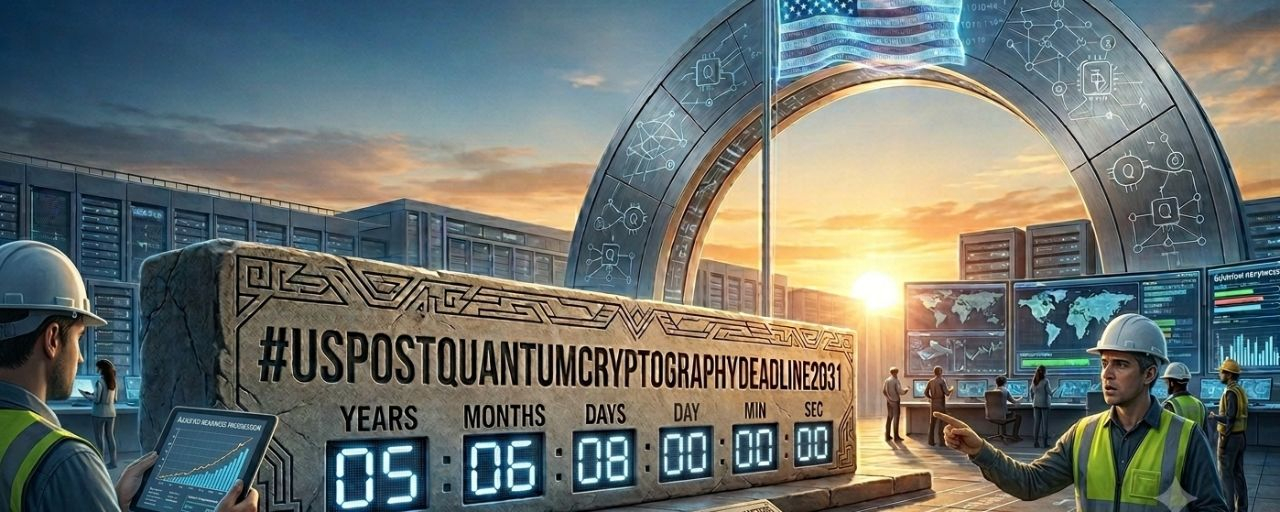
"Q-DAY" IS COMING CLOSER THAN WE THINK: The 2031 Post-Quantum Cryptography Shift ExplainedThe hashtag #uspostquantumcryptographydeadline2031 is gaining attention because it reflects a major shift in how governments are preparing for the future of cybersecurity, not just a technical upgrade.
The focus is on Post-Quantum Cryptography (PQC), which is designed to protect digital systems from potential threats posed by powerful quantum computers. Today’s global infrastructure—including banking systems, communication networks, and Bitcoin—relies on traditional encryption like ECC and RSA. These systems are safe under current computing limits, but quantum computing changes the long-term assumption.
📊 Market perspective:
The idea of a “US Post-Quantum Cryptography Deadline 2031” is less about a fixed date and more about a warning signal.
It tells us that:
Cryptography is entering a new eraSecurity systems are being redesigned before failureAnd quantum computing is now a serious planning factor, not just theory
In that sense, this isn’t just a tech upgrade story.
It’s a reminder that the foundation of the entire digital economy is evolving quietly in the background.
From a financial and crypto market angle, this is not an immediate risk event. Quantum computing is still in an early stage, and most experts place meaningful threat scenarios beyond 2030.
Because of this, markets are not pricing in panic, but they are slowly acknowledging future infrastructure costs and security transitions.
And by the time most people notice it, the transition may already be well underway.
$BTC #USPostQuantumCryptographyDeadline2031 #crypto #Cryptography
"Q-DAY" IS COMING CLOSER THAN WE THINK: The 2031 Post-Quantum Cryptography Shift Explained
The hashtag #uspostquantumcryptographydeadline2031 is gaining attention because it reflects a major shift in how governments are preparing for the future of cybersecurity, not just a technical upgrade.
The focus is on Post-Quantum Cryptography (PQC), which is designed to protect digital systems from potential threats posed by powerful quantum computers. Today’s global infrastructure—including banking systems, communication networks, and Bitcoin—relies on traditional encryption like ECC and RSA. These systems are safe under current computing limits, but quantum computing changes the long-term assumption.
📊 Market perspective:
The idea of a “US Post-Quantum Cryptography Deadline 2031” is less about a fixed date and more about a warning signal.
It tells us that:
Cryptography is entering a new eraSecurity systems are being redesigned before failureAnd quantum computing is now a serious planning factor, not just theory
In that sense, this isn’t just a tech upgrade story.
It’s a reminder that the foundation of the entire digital economy is evolving quietly in the background.
From a financial and crypto market angle, this is not an immediate risk event. Quantum computing is still in an early stage, and most experts place meaningful threat scenarios beyond 2030.
Because of this, markets are not pricing in panic, but they are slowly acknowledging future infrastructure costs and security transitions.
And by the time most people notice it, the transition may already be well underway.
$BTC #USPostQuantumCryptographyDeadline2031 #crypto #Cryptography
The focus is on Post-Quantum Cryptography (PQC), which is designed to protect digital systems from potential threats posed by powerful quantum computers. Today’s global infrastructure—including banking systems, communication networks, and Bitcoin—relies on traditional encryption like ECC and RSA. These systems are safe under current computing limits, but quantum computing changes the long-term assumption.
📊 Market perspective:
The idea of a “US Post-Quantum Cryptography Deadline 2031” is less about a fixed date and more about a warning signal.
It tells us that:
Cryptography is entering a new eraSecurity systems are being redesigned before failureAnd quantum computing is now a serious planning factor, not just theory
In that sense, this isn’t just a tech upgrade story.
It’s a reminder that the foundation of the entire digital economy is evolving quietly in the background.
From a financial and crypto market angle, this is not an immediate risk event. Quantum computing is still in an early stage, and most experts place meaningful threat scenarios beyond 2030.
Because of this, markets are not pricing in panic, but they are slowly acknowledging future infrastructure costs and security transitions.
And by the time most people notice it, the transition may already be well underway.
$BTC #USPostQuantumCryptographyDeadline2031 #crypto #Cryptography
3
81
Log in to explore more content
Join global crypto users on Binance Square
⚡️ Get latest and useful information about crypto.
💬 Trusted by the world’s largest crypto exchange.
👍 Discover real insights from verified creators.
Email / Phone number
Trending Topics
1
#FedRateWatch
480,197 views
2,466 Discussing
2
#BitcoinSlidesTo$76000
14,607 views
103 Discussing
3
#BitcoinReboundsTo$79K
59,215 views
395 Discussing
4
#StrategyMarketCapPassesFord
27,438 views
571 Discussing
5
#ClarityActOddsHalveOnPolymarket
36,652 views
460 Discussing
6
#US30YTreasuryYieldTops5.40%
24,700 views
325 Discussing
7
#BessentEndorsesFinalClarityActDraft
47,927 views
694 Discussing
8
#ZamaOpens16ConfidentialMorphoVaults
16,254 views
328 Discussing
9
#USDCOnChainVolumeTops$100Trillion
2,505 views
48 Discussing
10
#BitcoinSpotETFsNetInflow$160M
3,471 views
102 Discussing