
#bstocks
bstocks
1.5M views
6,734 Discussing
Hot
Latest

·
--
Article
Tokenized Stocks Hit a Record $4.8B, and Binance bStocks Now Leads the MarketCrypto prices had a rough November. But one corner of on-chain finance kept setting records: tokenized stocks. On 10 November 2026, Token Terminal data showed the market reaching a record $4.8 billion, and Binance's bStocks was the largest product in it. Here is what the data says.
Quick Facts
Tokenized stocks AUM: a record $4.8B on 10 November 2026 (Token Terminal).Growth of over 640% from about $645M at the start of the year.bStocks: about $1.5B in AUM, over 31% of the market.Tokenized equities are the fastest-growing real-world asset category of 2026.
01 What Tokenized Stocks Are
A tokenized stock is a token that tracks a real share or ETF. It can trade on-chain, often 24/7, and move between wallets. bStocks, for example, are backed 1:1 by US shares held at a regulated custodian.
02 The Record in Numbers
Token Terminal's figures tell a strong story:
From about $645M at the start of 2026 to $4.8B on 10 November.That is growth of more than 640% in under a year.bStocks alone held about $1.5B, over 31% of the category.
Different trackers count slightly differently, and some put the market at $4.6-4.9B, but they agree on the direction.
03 From Zero to Leader in Five Months
bStocks only launched in June 2026. Binance Research reported that it reached $1B in assets in 125 days. By November, it was the largest tokenized stock product on the market. That speed is the result of a huge user base and the 1:1 conversion with Binance Stocks.
04 Not Moving With Crypto
The Block noted that tokenized stocks shrugged off the crypto selloff. Since 28 August, the market value of equity tokens rose about $784M: new tokens minted added about $1,123M, while falling share prices took away about $339M. In other words, the growth came from real new demand, not from rising prices.
05 Why It Matters
Tokenized stocks give people in places like Cambodia access to US equities from a few dollars, at any hour. Their value follows the stock market, not Bitcoin, so they add a different kind of exposure to a crypto portfolio.
06 What I Keep in Mind
The whole category is still tiny compared with the global stock market. bStocks give price exposure, not shareholder rights, and they are only available to eligible users. Check your app before you plan, and remember that share prices can fall as well as rise.
Bottom Line
Tokenized stocks are 2026's fastest-growing real-world asset, and Binance's bStocks became the market leader in just five months. Even in a weak crypto month, new demand kept coming. That is a trend worth watching.
This article is for information only and is not financial advice.
#bStocks #Tokenization #RWA #Binance #Jxlolo
Tokenized Stocks Hit a Record $4.8B, and Binance bStocks Now Leads the Market
Crypto prices had a rough November. But one corner of on-chain finance kept setting records: tokenized stocks. On 10 November 2026, Token Terminal data showed the market reaching a record $4.8 billion, and Binance's bStocks was the largest product in it. Here is what the data says.
Quick Facts
Tokenized stocks AUM: a record $4.8B on 10 November 2026 (Token Terminal).Growth of over 640% from about $645M at the start of the year.bStocks: about $1.5B in AUM, over 31% of the market.Tokenized equities are the fastest-growing real-world asset category of 2026.
01 What Tokenized Stocks Are
A tokenized stock is a token that tracks a real share or ETF. It can trade on-chain, often 24/7, and move between wallets. bStocks, for example, are backed 1:1 by US shares held at a regulated custodian.
02 The Record in Numbers
Token Terminal's figures tell a strong story:
From about $645M at the start of 2026 to $4.8B on 10 November.That is growth of more than 640% in under a year.bStocks alone held about $1.5B, over 31% of the category.
Different trackers count slightly differently, and some put the market at $4.6-4.9B, but they agree on the direction.
03 From Zero to Leader in Five Months
bStocks only launched in June 2026. Binance Research reported that it reached $1B in assets in 125 days. By November, it was the largest tokenized stock product on the market. That speed is the result of a huge user base and the 1:1 conversion with Binance Stocks.
04 Not Moving With Crypto
The Block noted that tokenized stocks shrugged off the crypto selloff. Since 28 August, the market value of equity tokens rose about $784M: new tokens minted added about $1,123M, while falling share prices took away about $339M. In other words, the growth came from real new demand, not from rising prices.
05 Why It Matters
Tokenized stocks give people in places like Cambodia access to US equities from a few dollars, at any hour. Their value follows the stock market, not Bitcoin, so they add a different kind of exposure to a crypto portfolio.
06 What I Keep in Mind
The whole category is still tiny compared with the global stock market. bStocks give price exposure, not shareholder rights, and they are only available to eligible users. Check your app before you plan, and remember that share prices can fall as well as rise.
Bottom Line
Tokenized stocks are 2026's fastest-growing real-world asset, and Binance's bStocks became the market leader in just five months. Even in a weak crypto month, new demand kept coming. That is a trend worth watching.
This article is for information only and is not financial advice.
#bStocks #Tokenization #RWA #Binance #Jxlolo
1
1
·
--
Article
What Are bStocks? Binance's Tokenized Securities ExplainedWhen Binance launched bStocks in June 2026, a common question was: is this a real stock or just a crypto token? The honest answer is "a bit of both". Here is a simple explanation, based on the official [bStocks announcement](https://www.binance.com/en/blog/markets/introducing-bstocks-tokenized-securities-11-backing-with-247-trading).
Quick Facts
Tokenized securities, each backed 1:1 by a US share held at a regulated custodian.Issued by BTech Holdings, a Binance group affiliate.First tokenized securities admitted to the FSRA Official List in ADGM.Trade 24/7 from about $5.
01 What a bStock Is
A bStock is a token that represents an interest in a real US share or ETF. The share sits with a regulated custodian, and one bStock is backed by one share. Examples at launch included Nvidia, Tesla and Micron. The list has grown since then, with new tickers added in batches, so it is worth checking the Spot market for the current list. Each ticker ends with a B, for example NVDAB or TSLAB, which makes them easy to spot next to the normal crypto pairs.
02 How bStocks Work
The practical points:
Trade 24/7 on Binance Spot against USDT, including weekends.Settle in seconds, not days.Start from about $5 with fractional amounts.Withdraw to a BNB Chain-compatible wallet and use them in supported DeFi apps.Convert 1:1 with Binance Stocks (real shares) with no conversion fee.
03 The Regulatory Milestone
On 11 June 2026, the Financial Services Regulatory Authority of Abu Dhabi Global Market (ADGM) approved the prospectuses, and bStocks became the first tokenized securities admitted to its Official List. That is a big step: they are treated as regulated securities, not just tokens.
04 Growth Since Launch
Binance Research reported that bStocks reached $1B in assets in 125 days. By 10 November 2026 they held about $1.5B, roughly 31% of the tokenized stock market, and conversions between Binance Stocks and bStocks had passed $6B.
05 Dividends: the Multiplier
When a company pays a dividend, you do not receive a cash payment. The net dividend is reinvested automatically through an on-chain adjustment called the Multiplier, so your token's value grows. Splits are handled the same way.
06 What bStocks Are Not
bStocks do not make you a shareholder: no voting rights and no direct ownership. Dividend adjustments are net of withholding tax. They are offered under an approved prospectus in ADGM and are only available to eligible users in permitted places, so check your app.
Bottom Line
bStocks put real US shares on-chain, open 24/7 and regulated in ADGM. They are not the same as owning a share, but for many people they are the easiest way to get stock exposure inside the crypto world.
This article is for information only and is not financial advice.
#bStocks #Tokenization #RWA #Binance #Jxlolo
What Are bStocks? Binance's Tokenized Securities Explained
When Binance launched bStocks in June 2026, a common question was: is this a real stock or just a crypto token? The honest answer is "a bit of both". Here is a simple explanation, based on the official bStocks announcement.
Quick Facts
Tokenized securities, each backed 1:1 by a US share held at a regulated custodian.Issued by BTech Holdings, a Binance group affiliate.First tokenized securities admitted to the FSRA Official List in ADGM.Trade 24/7 from about $5.
01 What a bStock Is
A bStock is a token that represents an interest in a real US share or ETF. The share sits with a regulated custodian, and one bStock is backed by one share. Examples at launch included Nvidia, Tesla and Micron. The list has grown since then, with new tickers added in batches, so it is worth checking the Spot market for the current list. Each ticker ends with a B, for example NVDAB or TSLAB, which makes them easy to spot next to the normal crypto pairs.
02 How bStocks Work
The practical points:
Trade 24/7 on Binance Spot against USDT, including weekends.Settle in seconds, not days.Start from about $5 with fractional amounts.Withdraw to a BNB Chain-compatible wallet and use them in supported DeFi apps.Convert 1:1 with Binance Stocks (real shares) with no conversion fee.
03 The Regulatory Milestone
On 11 June 2026, the Financial Services Regulatory Authority of Abu Dhabi Global Market (ADGM) approved the prospectuses, and bStocks became the first tokenized securities admitted to its Official List. That is a big step: they are treated as regulated securities, not just tokens.
04 Growth Since Launch
Binance Research reported that bStocks reached $1B in assets in 125 days. By 10 November 2026 they held about $1.5B, roughly 31% of the tokenized stock market, and conversions between Binance Stocks and bStocks had passed $6B.
05 Dividends: the Multiplier
When a company pays a dividend, you do not receive a cash payment. The net dividend is reinvested automatically through an on-chain adjustment called the Multiplier, so your token's value grows. Splits are handled the same way.
06 What bStocks Are Not
bStocks do not make you a shareholder: no voting rights and no direct ownership. Dividend adjustments are net of withholding tax. They are offered under an approved prospectus in ADGM and are only available to eligible users in permitted places, so check your app.
Bottom Line
bStocks put real US shares on-chain, open 24/7 and regulated in ADGM. They are not the same as owning a share, but for many people they are the easiest way to get stock exposure inside the crypto world.
This article is for information only and is not financial advice.
#bStocks #Tokenization #RWA #Binance #Jxlolo
1
4
·
--
Article
Fund Flow Friday: What Binance Stock Traders' Capital Movements Reveal This WeekEvery week, Binance Research publishes the Binance Equity Weekly Fund Flow: how much money users put into, or took out of, stocks across Binance's equity products. I think it is one of the most underrated signals around. For this edition, I look back at the July run of the series and what it tells us.
Quick Facts
Net flow = user buys minus sells across Binance's equity products, Thursday to Wednesday.Five editions in July tracked about $791.5M of net inflows.Record week: about $275M (week to 29 July).81-91% of net inflows came from emerging-market users.
01 What the Report Measures
Binance Research counts net buying in US$ across Binance Stocks, bStocks and related equity products, in a weekly window from Thursday to Wednesday. A positive number means users added stock exposure. A negative number means they cut it.
02 The Weekly Numbers
July 2026 was a wild month:
Week to 1 July: $193.3M of net inflows, down 15% from $227.3M the week before.Mid-July: flows dropped to a low of about $5.1M.Then a 29-fold rebound to $149M in the week semiconductors bottomed.Week to 29 July: a record of about $275M.The following week: users sold the recovery, about $91M.
03 The Rotation Signal
Early in the month, Binance Research titled one report "From Missiles to Memory" as money rotated out of defense stocks and into memory and chip names. Catalysts such as TSMC earnings showed up in flows about a week later.
04 Where the Money Went
Technology dominated. In the week to 1 July it took $159M, or 83% of net inflows. In the record week it took $180M, about 65%. SanDisk, SK Hynix and Micron were the largest single-name destinations on record.
05 Who Is Moving the Money
Binance Research found that 81-91% of net inflows came from emerging-market users. The pattern looked contrarian: users bought into sharp drops and took profit into rebounds. That is not the "dumb money" picture many people expect, and it is a good reminder that new investors can be disciplined.
06 What I Keep in Mind
Flows show what users did, not what prices will do next. Concentration in a few chip names is also a risk. I use this data as a mood gauge, not a trading signal. If you follow this series, compare each week with the week before and look for a change in direction, not just a big number.
Bottom Line
Fund flows give a rare look at what real users do with their money. In July, Binance stock traders leaned hard into AI chips, bought dips and sold rallies. I will keep watching each new edition for the next shift.
This article is for information only and is not financial advice.
#bStocks #Stocks #Semiconductors #Binance #Jxlolo
Fund Flow Friday: What Binance Stock Traders' Capital Movements Reveal This Week
Every week, Binance Research publishes the Binance Equity Weekly Fund Flow: how much money users put into, or took out of, stocks across Binance's equity products. I think it is one of the most underrated signals around. For this edition, I look back at the July run of the series and what it tells us.
Quick Facts
Net flow = user buys minus sells across Binance's equity products, Thursday to Wednesday.Five editions in July tracked about $791.5M of net inflows.Record week: about $275M (week to 29 July).81-91% of net inflows came from emerging-market users.
01 What the Report Measures
Binance Research counts net buying in US$ across Binance Stocks, bStocks and related equity products, in a weekly window from Thursday to Wednesday. A positive number means users added stock exposure. A negative number means they cut it.
02 The Weekly Numbers
July 2026 was a wild month:
Week to 1 July: $193.3M of net inflows, down 15% from $227.3M the week before.Mid-July: flows dropped to a low of about $5.1M.Then a 29-fold rebound to $149M in the week semiconductors bottomed.Week to 29 July: a record of about $275M.The following week: users sold the recovery, about $91M.
03 The Rotation Signal
Early in the month, Binance Research titled one report "From Missiles to Memory" as money rotated out of defense stocks and into memory and chip names. Catalysts such as TSMC earnings showed up in flows about a week later.
04 Where the Money Went
Technology dominated. In the week to 1 July it took $159M, or 83% of net inflows. In the record week it took $180M, about 65%. SanDisk, SK Hynix and Micron were the largest single-name destinations on record.
05 Who Is Moving the Money
Binance Research found that 81-91% of net inflows came from emerging-market users. The pattern looked contrarian: users bought into sharp drops and took profit into rebounds. That is not the "dumb money" picture many people expect, and it is a good reminder that new investors can be disciplined.
06 What I Keep in Mind
Flows show what users did, not what prices will do next. Concentration in a few chip names is also a risk. I use this data as a mood gauge, not a trading signal. If you follow this series, compare each week with the week before and look for a change in direction, not just a big number.
Bottom Line
Fund flows give a rare look at what real users do with their money. In July, Binance stock traders leaned hard into AI chips, bought dips and sold rallies. I will keep watching each new edition for the next shift.
This article is for information only and is not financial advice.
#bStocks #Stocks #Semiconductors #Binance #Jxlolo
1
1

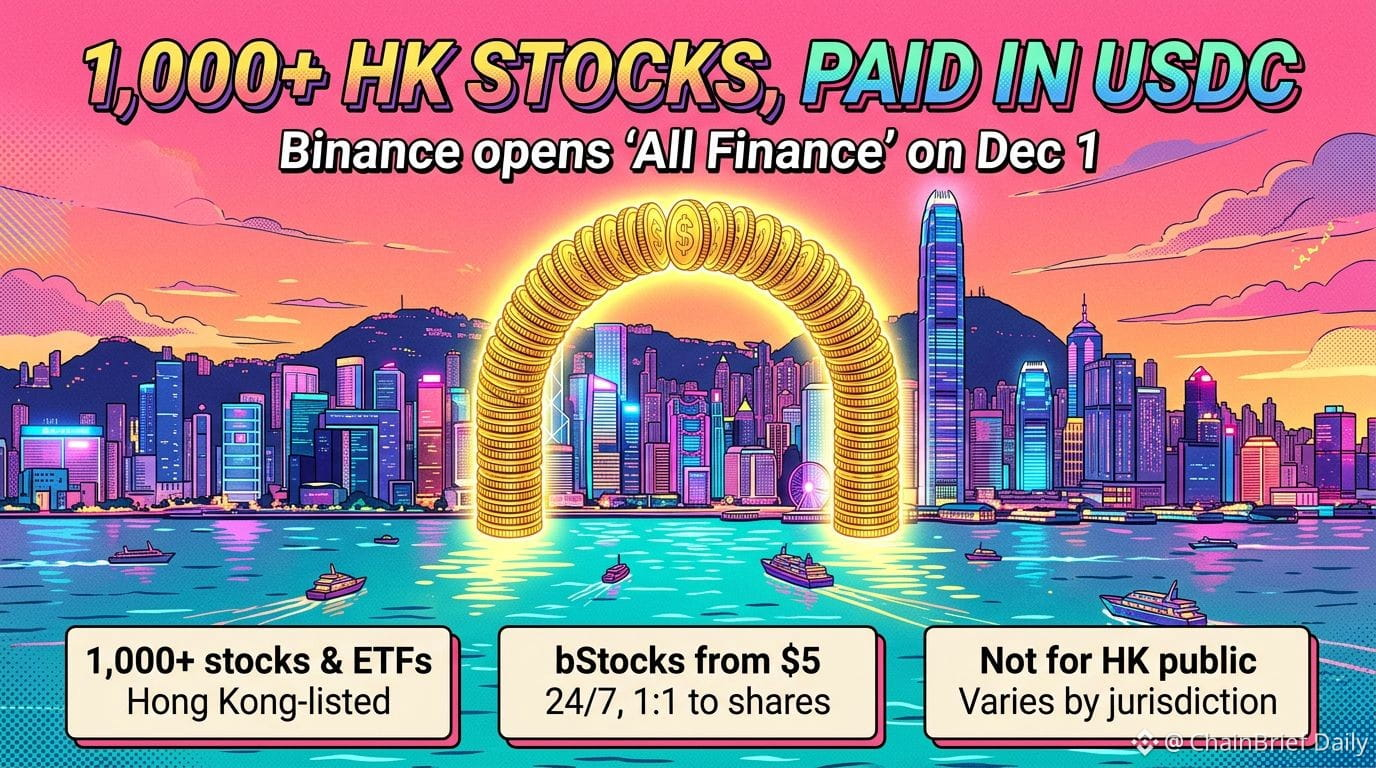
Binance just announced its next chapter: "All Finance on Binance."
At Binance Blockchain Week, co-CEO Yi He said eligible users will be able to trade more than 1,000 Hong Kong-listed stocks and ETFs starting December 1, paying directly in USDC from the same account they already use for crypto and U.S.-listed shares. Binance calls it the first step, with more markets to follow.
Key details from the company's release:
• Some Hong Kong names will also come as bStocks, tokenized shares that trade 24/7, start at $5, and convert 1:1 into the underlying stock.
• Binance says about 70% of its bStocks volume comes from emerging markets.
• Availability varies by jurisdiction, and the Hong Kong stock service is not offered to the Hong Kong public.
• Press reports say the direct stock route runs through a partner broker, with Binance acting as the introducing party.
Why it matters: a crypto exchange is now building a stablecoin-funded gateway into traditional equities. For users abroad, USDC-to-stock in one account skips the usual chain of swapping, wiring, and converting to HKD. It also shows how much the industry is leaning on TradFi products during a weak market, with sentiment deep in "extreme fear."
Keep it calm: bStocks are tokenized securities, not the same as holding the shares directly. Check which version you are buying, your local rules, the fees, and who holds the underlying assets. Product launches can also change in scope after day one.
Do you see stablecoin-funded stock trading becoming a main reason users stay on exchanges, or is it just a bear-market pivot?
#Binance #bStocks #USDC $BNB
Not financial advice.
44
·
--
Article
Binance Never Sleeps: How bStocks Priced the Market Before Wall Street OpenedMarkets close, but news does not. When a big company reports after the bell or something happens on a weekend, the first price reaction now often happens on crypto platforms. Two names come up most: Binance with bStocks and Hyperliquid with stock perps. Here is what the data says about where the market moves first.
Quick Facts
Across seven weekends, bStocks captured a median 92% of the Monday price move.The remaining gap at the Monday open was about 0.19%.Binance handles about 69% of tokenized-stock volume in US hours, rising to 82% overnight.Hyperliquid has also shown 24/7 price discovery, mostly through perps.
01 The Race to Set the First Price
When traditional markets are shut, the first venue to price new information becomes the reference everyone watches. That is a powerful position, and both Binance and Hyperliquid want it.
02 What the Weekend Data Shows
Binance Research studied seven weekends:
bStocks had already priced in a median 92% of the Monday move.The leftover gap at the open was only about 0.19%.On large gaps, bStocks pointed the right way 41 out of 41 times.
Binance Research also says the sample is small, which is fair to keep in mind.
03 More Share When the US Sleeps
Binance handles about 69% of tokenized-stock volume during regular US hours, and that share rises to about 82% overnight. In other words, the further you get from New York hours, the more the trading happens on Binance.
04 Where Hyperliquid Fits
Hyperliquid is a serious player. Its stock and commodity perps have shown continuous weekend price discovery, and TradFi perps are a large part of its volume. The main difference is the product: Hyperliquid mostly offers perpetual contracts, while bStocks are tokens backed 1:1 by real shares and can be converted to Direct Stocks.
05 Why This Matters for Users
If you live in Asia, US news often lands in your daytime. Being able to act right away, on a deep and liquid venue, means you are not stuck waiting for New York to wake up.
06 What I Keep in Mind
First moves can overshoot, and weekend markets can be thinner. A seven-weekend study is a good signal, not a guarantee. Tokenized stocks track prices but may not give full shareholder rights, and availability depends on your country, so I check what my account in Cambodia can use.
I like that the comparison is out in the open. Healthy competition between venues usually means better prices and better products for users, whichever platform they choose.
Bottom Line
Markets are becoming real-time. The data shows bStocks on Binance are already doing much of the price discovery before Wall Street opens, and competition with venues like Hyperliquid will only push that further.
This article is for information only and is not financial advice.
#bStocks #PriceDiscovery #Hyperliquid #Binance #Jxlolo
Binance Never Sleeps: How bStocks Priced the Market Before Wall Street Opened
Markets close, but news does not. When a big company reports after the bell or something happens on a weekend, the first price reaction now often happens on crypto platforms. Two names come up most: Binance with bStocks and Hyperliquid with stock perps. Here is what the data says about where the market moves first.
Quick Facts
Across seven weekends, bStocks captured a median 92% of the Monday price move.The remaining gap at the Monday open was about 0.19%.Binance handles about 69% of tokenized-stock volume in US hours, rising to 82% overnight.Hyperliquid has also shown 24/7 price discovery, mostly through perps.
01 The Race to Set the First Price
When traditional markets are shut, the first venue to price new information becomes the reference everyone watches. That is a powerful position, and both Binance and Hyperliquid want it.
02 What the Weekend Data Shows
Binance Research studied seven weekends:
bStocks had already priced in a median 92% of the Monday move.The leftover gap at the open was only about 0.19%.On large gaps, bStocks pointed the right way 41 out of 41 times.
Binance Research also says the sample is small, which is fair to keep in mind.
03 More Share When the US Sleeps
Binance handles about 69% of tokenized-stock volume during regular US hours, and that share rises to about 82% overnight. In other words, the further you get from New York hours, the more the trading happens on Binance.
04 Where Hyperliquid Fits
Hyperliquid is a serious player. Its stock and commodity perps have shown continuous weekend price discovery, and TradFi perps are a large part of its volume. The main difference is the product: Hyperliquid mostly offers perpetual contracts, while bStocks are tokens backed 1:1 by real shares and can be converted to Direct Stocks.
05 Why This Matters for Users
If you live in Asia, US news often lands in your daytime. Being able to act right away, on a deep and liquid venue, means you are not stuck waiting for New York to wake up.
06 What I Keep in Mind
First moves can overshoot, and weekend markets can be thinner. A seven-weekend study is a good signal, not a guarantee. Tokenized stocks track prices but may not give full shareholder rights, and availability depends on your country, so I check what my account in Cambodia can use.
I like that the comparison is out in the open. Healthy competition between venues usually means better prices and better products for users, whichever platform they choose.
Bottom Line
Markets are becoming real-time. The data shows bStocks on Binance are already doing much of the price discovery before Wall Street opens, and competition with venues like Hyperliquid will only push that further.
This article is for information only and is not financial advice.
#bStocks #PriceDiscovery #Hyperliquid #Binance #Jxlolo
1
1
·
--
Article
From Chips to Carts: Binance Prices the Retail Read Before the Market OpensFor most of 2026, AI chips were the story that moved markets. But markets rotate. In the week when Walmart, Home Depot and Target report, the focus shifts from chips to shopping carts. Consumer data tells us a lot about inflation and interest rates, and on Binance, that shift shows up in prices before Wall Street opens.
Quick Facts
Retail giants WMT, HD and TGT report earnings in the same week.Consumer spending data shapes the inflation and rates outlook.bStocks trade 24/7, so reactions show up outside US hours.Same market, different aisle: the focus moves from AI to consumption.
01 From AI to Consumption
AI earnings dominated headlines for months. When retail companies report, the question changes: are people still spending? That answer affects how investors think about the whole economy.
02 Why Retail Earnings Matter
Walmart, Home Depot and Target give a direct read on consumers:
Walmart shows everyday spending and price pressure.Home Depot shows big-ticket and home spending.Target shows discretionary shopping.
Together they help explain where inflation and interest rates may go.
03 Reports Often Land Outside Asian Daytime
US earnings usually come out before the US market opens or after it closes. For people in Asia, that is often late at night or early morning. Traditional markets make us wait for the opening bell to react.
04 How Binance Shows the Move Early
bStocks trade 24/7. When a retail report lands, users can see and act on the price reaction right away, in their own time zone. That gives an early read on how the market might open.
05 Reading the Signal
I find it useful to watch how retail stocks move compared with tech stocks in the same window. If consumer names rise while chips cool, it hints at a rotation. It is one more data point, not a promise.
06 What I Keep in Mind
Off-hours markets can be thinner, so moves can be bigger. Tokenized stocks track prices but may not give the same rights as shares. I check what my account in Cambodia can use before trading.
For me, this is also a good reminder that markets are about more than one theme. Chips, AI and big tech get most of the attention, but everyday spending is what keeps an economy moving. Watching how retail reports land helps me understand the bigger picture, even if I never trade those stocks myself. And being able to see the reaction in my own daytime makes it easier to learn from it.
It is also a good way to teach newcomers how earnings season works, one sector at a time.
Bottom Line
When the market turns from chips to carts, Binance lets you see the retail read in real time, before the opening bell.
This article is for information only and is not financial advice.
#bStocks #Earnings #Walmart #Binance #Jxlolo
From Chips to Carts: Binance Prices the Retail Read Before the Market Opens
For most of 2026, AI chips were the story that moved markets. But markets rotate. In the week when Walmart, Home Depot and Target report, the focus shifts from chips to shopping carts. Consumer data tells us a lot about inflation and interest rates, and on Binance, that shift shows up in prices before Wall Street opens.
Quick Facts
Retail giants WMT, HD and TGT report earnings in the same week.Consumer spending data shapes the inflation and rates outlook.bStocks trade 24/7, so reactions show up outside US hours.Same market, different aisle: the focus moves from AI to consumption.
01 From AI to Consumption
AI earnings dominated headlines for months. When retail companies report, the question changes: are people still spending? That answer affects how investors think about the whole economy.
02 Why Retail Earnings Matter
Walmart, Home Depot and Target give a direct read on consumers:
Walmart shows everyday spending and price pressure.Home Depot shows big-ticket and home spending.Target shows discretionary shopping.
Together they help explain where inflation and interest rates may go.
03 Reports Often Land Outside Asian Daytime
US earnings usually come out before the US market opens or after it closes. For people in Asia, that is often late at night or early morning. Traditional markets make us wait for the opening bell to react.
04 How Binance Shows the Move Early
bStocks trade 24/7. When a retail report lands, users can see and act on the price reaction right away, in their own time zone. That gives an early read on how the market might open.
05 Reading the Signal
I find it useful to watch how retail stocks move compared with tech stocks in the same window. If consumer names rise while chips cool, it hints at a rotation. It is one more data point, not a promise.
06 What I Keep in Mind
Off-hours markets can be thinner, so moves can be bigger. Tokenized stocks track prices but may not give the same rights as shares. I check what my account in Cambodia can use before trading.
For me, this is also a good reminder that markets are about more than one theme. Chips, AI and big tech get most of the attention, but everyday spending is what keeps an economy moving. Watching how retail reports land helps me understand the bigger picture, even if I never trade those stocks myself. And being able to see the reaction in my own daytime makes it easier to learn from it.
It is also a good way to teach newcomers how earnings season works, one sector at a time.
Bottom Line
When the market turns from chips to carts, Binance lets you see the retail read in real time, before the opening bell.
This article is for information only and is not financial advice.
#bStocks #Earnings #Walmart #Binance #Jxlolo
1
1
·
--

Article
While Wall Street Sleeps: How On-Chain bStocks Are Pricing the Weekend NewsWall Street closes on Friday afternoon, but news does not take the weekend off. Earnings, economic data and world events keep coming. Stock holders usually have to wait until Monday to react. On Binance, bStocks keep trading, and the data shows they are doing real price discovery while traditional markets are shut.
Quick Facts
Across 7 weekends, bStocks priced in a median 92% of the Monday gap.On gaps above 3%, bStocks called the direction correctly all 41 times.In one week, 92% of on-chain volume traded while US markets were closed.About US$1.5B changed hands during closed hours that week.
01 The Monday Gap Problem
When big news lands on a Saturday, a stock often opens on Monday far from its Friday close. That jump is called a gap. If you hold the stock, you cannot do anything about it until the bell rings.
02 What the Weekend Data Shows
Binance Research looked at how bStocks traded over weekends:
Over 7 weekends, bStocks had already priced in a median 92% of the Monday gap.When the gap was bigger than 3%, bStocks pointed the right way in all 41 cases.
In simple words, by Sunday night the on-chain price was usually close to where Monday would open.
03 Most Volume Happens When Wall Street Is Closed
In one recent week, 92% of on-chain bStocks volume traded while US markets were shut, with around US$1.5 billion changing hands in those closed hours. That is not a side activity. It is where most of the trading happens.
04 Why This Matters to Regular Investors
For people in Asia, US market hours fall in our night. Weekend and off-hours trading lets us react to news in our own daytime. It also gives everyone an early read on how the market might open.
05 Price Discovery Is Moving On-Chain
Price discovery is the market's most basic job: finding a fair price as new information arrives. If that process increasingly happens on-chain while traditional venues are closed, it changes how we should think about where markets really live.
06 What I Keep in Mind
Off-hours markets can be thinner, so prices can move more. A tokenized stock tracks the price of a real share but may not give the same rights. I always check what is available for my account in Cambodia.
I find this useful even if I never trade on a weekend. Checking where bStocks moved on Sunday gives me a rough idea of how Monday might open, so I can plan instead of being surprised.
Bottom Line
When Wall Street sleeps, bStocks keep working. The weekend data shows on-chain markets are already doing much of the price discovery before Monday even starts.
This article is for information only and is not financial advice.
#bStocks #PriceDiscovery #Tokenization #Binance #Jxlolo
While Wall Street Sleeps: How On-Chain bStocks Are Pricing the Weekend News
Wall Street closes on Friday afternoon, but news does not take the weekend off. Earnings, economic data and world events keep coming. Stock holders usually have to wait until Monday to react. On Binance, bStocks keep trading, and the data shows they are doing real price discovery while traditional markets are shut.
Quick Facts
Across 7 weekends, bStocks priced in a median 92% of the Monday gap.On gaps above 3%, bStocks called the direction correctly all 41 times.In one week, 92% of on-chain volume traded while US markets were closed.About US$1.5B changed hands during closed hours that week.
01 The Monday Gap Problem
When big news lands on a Saturday, a stock often opens on Monday far from its Friday close. That jump is called a gap. If you hold the stock, you cannot do anything about it until the bell rings.
02 What the Weekend Data Shows
Binance Research looked at how bStocks traded over weekends:
Over 7 weekends, bStocks had already priced in a median 92% of the Monday gap.When the gap was bigger than 3%, bStocks pointed the right way in all 41 cases.
In simple words, by Sunday night the on-chain price was usually close to where Monday would open.
03 Most Volume Happens When Wall Street Is Closed
In one recent week, 92% of on-chain bStocks volume traded while US markets were shut, with around US$1.5 billion changing hands in those closed hours. That is not a side activity. It is where most of the trading happens.
04 Why This Matters to Regular Investors
For people in Asia, US market hours fall in our night. Weekend and off-hours trading lets us react to news in our own daytime. It also gives everyone an early read on how the market might open.
05 Price Discovery Is Moving On-Chain
Price discovery is the market's most basic job: finding a fair price as new information arrives. If that process increasingly happens on-chain while traditional venues are closed, it changes how we should think about where markets really live.
06 What I Keep in Mind
Off-hours markets can be thinner, so prices can move more. A tokenized stock tracks the price of a real share but may not give the same rights. I always check what is available for my account in Cambodia.
I find this useful even if I never trade on a weekend. Checking where bStocks moved on Sunday gives me a rough idea of how Monday might open, so I can plan instead of being surprised.
Bottom Line
When Wall Street sleeps, bStocks keep working. The weekend data shows on-chain markets are already doing much of the price discovery before Monday even starts.
This article is for information only and is not financial advice.
#bStocks #PriceDiscovery #Tokenization #Binance #Jxlolo
1
1
·
--
Article
Crypto Made Markets 24/7. Now Wall Street Is Playing Catch-UpWhen I started trading crypto, one thing surprised me: the market never closed. Weekends, holidays, 3 a.m. in Phnom Penh, it did not matter. Stock markets felt old-fashioned next to that. Now Wall Street is moving toward longer hours too. To me, that says crypto had the right idea first.
Quick Facts
Nasdaq plans to go live 23 hours a day, five days a week, from 6 December 2026.Extended hours only work if someone is awake to trade.About half of bStocks volume on Binance already trades outside US market hours.TradFi is adopting the always-on model crypto has used for years.
01 Crypto Was Always On
Bitcoin has traded every minute of every day since it started. People got used to reacting to news the moment it happens, not waiting for an opening bell. That habit is now spreading into traditional finance.
02 Wall Street Is Extending Its Hours
Nasdaq plans to move to 23 hours a day, five days a week, starting 6 December 2026. It is a big change for a market that has kept fixed sessions for a very long time. The reason is simple: investors around the world want to trade when news breaks in their own time zone.
03 The Liquidity Problem
Longer hours are only useful if there are buyers and sellers. When it is night in New York, most US investors are asleep. That liquidity has to come from other regions, like Asia, the Middle East and Africa. Without them, extended sessions can be thin and prices can jump.
04 Where Binance Already Fits
Binance has a global, emerging-market user base that is awake when the US sleeps. Around half of bStocks volume already happens outside US market hours. In other words, the off-hours crowd that Wall Street now needs is already active on Binance.
05 Convergence, Not Competition
I do not see this as crypto against Wall Street. TradFi is adopting crypto infrastructure like 24/7 trading, and crypto platforms supply the global users who make those hours useful. Both sides move closer together.
06 What I Keep in Mind
Trading at night can mean thinner markets and bigger price swings. Tokenized stocks track real shares but may not give the same rights. Availability depends on your country, so I check what my account in Cambodia can access first.
For people in Cambodia, this shift is personal. US market hours fall in our evening and night, so many of us have always been late to US news. Round-the-clock markets mean we can act in our own daytime, with the same information as everyone else.
Bottom Line
Crypto showed that markets do not need to sleep. Wall Street is now catching up, and platforms like Binance already have the always-on users that make round-the-clock markets work.
This article is for information only and is not financial advice.
#bStocks #TradFi #Nasdaq #Binance #Jxlolo
Crypto Made Markets 24/7. Now Wall Street Is Playing Catch-Up
When I started trading crypto, one thing surprised me: the market never closed. Weekends, holidays, 3 a.m. in Phnom Penh, it did not matter. Stock markets felt old-fashioned next to that. Now Wall Street is moving toward longer hours too. To me, that says crypto had the right idea first.
Quick Facts
Nasdaq plans to go live 23 hours a day, five days a week, from 6 December 2026.Extended hours only work if someone is awake to trade.About half of bStocks volume on Binance already trades outside US market hours.TradFi is adopting the always-on model crypto has used for years.
01 Crypto Was Always On
Bitcoin has traded every minute of every day since it started. People got used to reacting to news the moment it happens, not waiting for an opening bell. That habit is now spreading into traditional finance.
02 Wall Street Is Extending Its Hours
Nasdaq plans to move to 23 hours a day, five days a week, starting 6 December 2026. It is a big change for a market that has kept fixed sessions for a very long time. The reason is simple: investors around the world want to trade when news breaks in their own time zone.
03 The Liquidity Problem
Longer hours are only useful if there are buyers and sellers. When it is night in New York, most US investors are asleep. That liquidity has to come from other regions, like Asia, the Middle East and Africa. Without them, extended sessions can be thin and prices can jump.
04 Where Binance Already Fits
Binance has a global, emerging-market user base that is awake when the US sleeps. Around half of bStocks volume already happens outside US market hours. In other words, the off-hours crowd that Wall Street now needs is already active on Binance.
05 Convergence, Not Competition
I do not see this as crypto against Wall Street. TradFi is adopting crypto infrastructure like 24/7 trading, and crypto platforms supply the global users who make those hours useful. Both sides move closer together.
06 What I Keep in Mind
Trading at night can mean thinner markets and bigger price swings. Tokenized stocks track real shares but may not give the same rights. Availability depends on your country, so I check what my account in Cambodia can access first.
For people in Cambodia, this shift is personal. US market hours fall in our evening and night, so many of us have always been late to US news. Round-the-clock markets mean we can act in our own daytime, with the same information as everyone else.
Bottom Line
Crypto showed that markets do not need to sleep. Wall Street is now catching up, and platforms like Binance already have the always-on users that make round-the-clock markets work.
This article is for information only and is not financial advice.
#bStocks #TradFi #Nasdaq #Binance #Jxlolo
1
1
·
--
Article
$500M and Counting: How Binance Tokenized Stocks Became a Real MarketBig numbers are easy to announce. What matters more is what the money is doing. bStocks on Binance crossed US$500 million in assets under management, and when I look underneath that number, I see signs of a real, working market, not just a wrapper around a stock.
Quick Facts
bStocks passed US$500M in assets under management.About US$216M has gone into cross-market arbitrage.58% of volume traded when US markets were closed.Prices track the real stock within basis points.
01 Why the Headline Number Is Not the Story
AUM tells you how much money sits in a product. It does not tell you if people are actually using it. To see that, you need to look at trading behaviour, timing and pricing.
02 Arbitrage Shows the Market Is Alive
Around US$216 million has gone into cross-market arbitrage, where traders buy in one market and sell in another when prices differ. Arbitrage is a sign of a healthy market, because it pulls prices back in line and adds liquidity.
03 Trading When Wall Street Is Closed
58% of bStocks volume happened while US markets were closed. For users in Asia and other regions, that is exactly when they are awake. It shows bStocks are not copying Wall Street hours. They are filling the gap Wall Street leaves.
04 Prices That Track the Real Stock
A tokenized stock is only useful if its price stays close to the real share. bStocks have tracked their underlying stocks within basis points, which is a tiny difference. That tight tracking is what gives users confidence.
05 What Comes Next
As more people use bStocks for everyday investing, I expect more assets, more liquidity and more use in DeFi, for example as collateral. The base is already there.
06 What I Keep in Mind
bStocks give price exposure, not direct ownership of the share. They still carry the same market risk as the stock. Availability depends on your country, so I check my account in Cambodia first.
For me, the most interesting part is who it can reach. Many people who want US stock exposure live in places where opening a US brokerage account is slow or expensive. A tokenized stock they can buy with a few dollars, at any hour, opens a door that used to be closed. That is why I think the half-billion mark is only the start. As more people discover it, the market should keep growing in both size and depth.
I also like that the numbers are easy to check over time. AUM, volume and tracking quality are things anyone can follow, so the story does not rely on promises.
Bottom Line
Half a billion dollars is a milestone, but the real proof is in the activity: arbitrage, off-hours trading and tight price tracking. Tokenized stocks on Binance have become a real market.
This article is for information only and is not financial advice.
#bStocks #TokenizedStocks #RWA #Binance #Jxlolo
$500M and Counting: How Binance Tokenized Stocks Became a Real Market
Big numbers are easy to announce. What matters more is what the money is doing. bStocks on Binance crossed US$500 million in assets under management, and when I look underneath that number, I see signs of a real, working market, not just a wrapper around a stock.
Quick Facts
bStocks passed US$500M in assets under management.About US$216M has gone into cross-market arbitrage.58% of volume traded when US markets were closed.Prices track the real stock within basis points.
01 Why the Headline Number Is Not the Story
AUM tells you how much money sits in a product. It does not tell you if people are actually using it. To see that, you need to look at trading behaviour, timing and pricing.
02 Arbitrage Shows the Market Is Alive
Around US$216 million has gone into cross-market arbitrage, where traders buy in one market and sell in another when prices differ. Arbitrage is a sign of a healthy market, because it pulls prices back in line and adds liquidity.
03 Trading When Wall Street Is Closed
58% of bStocks volume happened while US markets were closed. For users in Asia and other regions, that is exactly when they are awake. It shows bStocks are not copying Wall Street hours. They are filling the gap Wall Street leaves.
04 Prices That Track the Real Stock
A tokenized stock is only useful if its price stays close to the real share. bStocks have tracked their underlying stocks within basis points, which is a tiny difference. That tight tracking is what gives users confidence.
05 What Comes Next
As more people use bStocks for everyday investing, I expect more assets, more liquidity and more use in DeFi, for example as collateral. The base is already there.
06 What I Keep in Mind
bStocks give price exposure, not direct ownership of the share. They still carry the same market risk as the stock. Availability depends on your country, so I check my account in Cambodia first.
For me, the most interesting part is who it can reach. Many people who want US stock exposure live in places where opening a US brokerage account is slow or expensive. A tokenized stock they can buy with a few dollars, at any hour, opens a door that used to be closed. That is why I think the half-billion mark is only the start. As more people discover it, the market should keep growing in both size and depth.
I also like that the numbers are easy to check over time. AUM, volume and tracking quality are things anyone can follow, so the story does not rely on promises.
Bottom Line
Half a billion dollars is a milestone, but the real proof is in the activity: arbitrage, off-hours trading and tight price tracking. Tokenized stocks on Binance have become a real market.
This article is for information only and is not financial advice.
#bStocks #TokenizedStocks #RWA #Binance #Jxlolo
1
2
·
--
Article
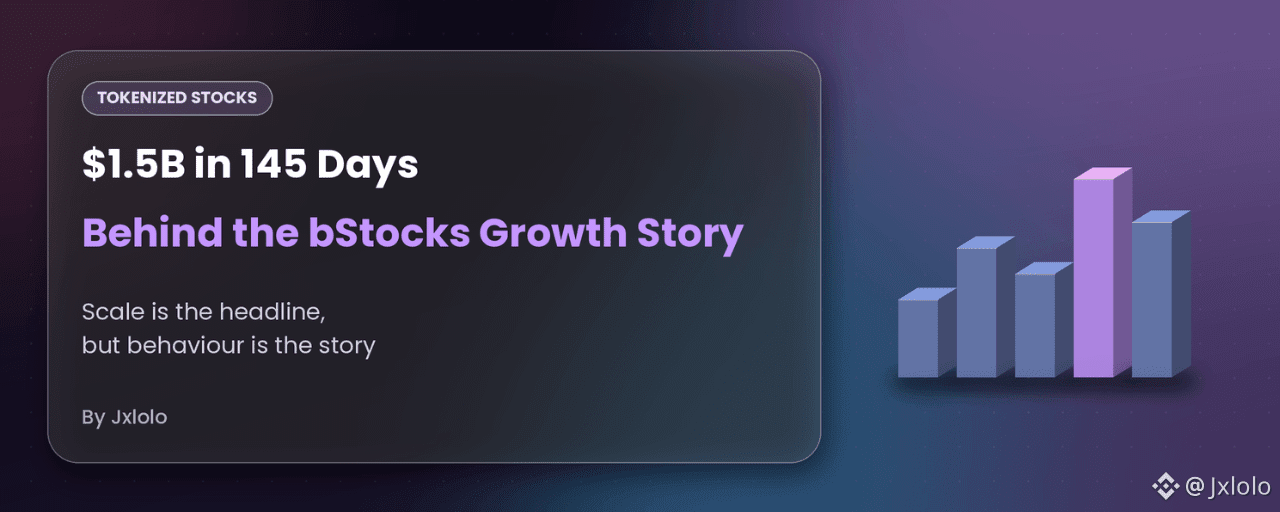
$1.5B in 145 Days: What's Actually Behind the bStocks Growth StorybStocks passed 1.5 billion dollars in assets under management in 145 days. That is the headline. The more useful question is what sits behind the number, because scale tells you how big something is, while behaviour tells you whether it will last.
Quick Facts
bStocks reached 1.5 billion dollars in AUM in 145 days, according to Binance ResearchThe tokenized equities market reached a record 4.8 billion dollars in early November 2026bStocks listings grew from 6 to nearly 10056% of bStocks trading happens outside US market hours
01: The Headline Number
Binance Research reported on 10 November 2026 that bStocks crossed 1.5 billion dollars in AUM 145 days after launch, which made it the largest tokenized equities product by AUM. It had passed 1 billion dollars on 15 October. In the same period the whole tokenized equities market grew to a record 4.8 billion dollars, up 164% between June and early November.
02: Inflows, Not Only Price
AUM can grow in two ways. Prices of the assets can rise, or users can add new money. The first can reverse quickly when markets fall. The second shows real demand. According to Binance Research, net inflows account for most of the bStocks growth. For me this is the most important line in the report, because it means users are choosing to put funds in, and the number is not simply a reflection of a rising market.
03: From a Few Names to a Broad Market
Early on, the top five assets held 97% of bStocks AUM. That is normal for a new product, where activity starts around a few well-known names. As listings grew from 6 to nearly 100, the share of the top five fell to under half. Users are now spread across many more assets, which makes the product less dependent on the mood around any single stock.
04: Trading When Wall Street Is Closed
56% of bStocks trading happens outside US market hours. This tells you who the users are and what they want. Many of them live in time zones where the US market opens late at night. A product that trades around the clock lets them react to news during their own day, not only during a short window on the other side of the world.
05: What bStocks Are, and What They Are Not
bStocks are tokenized assets that give price exposure to underlying stocks and ETFs. Holding a bStock is not the same as owning the share directly, and availability depends on your country and eligibility. Prices can fall as well as rise, and trading outside regular market hours can come with wider price moves.
06: What I Take From It
Growth driven by inflows is healthier than growth driven by priceA broader spread of assets lowers concentration risk for the productAround-the-clock access matters most to users outside the USA large AUM figure is not a reason to buy anything
Bottom Line
The number is impressive, but the behaviour behind it is the real story: new money coming in, more assets in use, and more than half of the trading happening while Wall Street is closed. Whether this continues is something to watch in the next reports, not something to assume.
This article is for information only and is not financial advice.
Which of these four figures surprised you most? Tell me in the comments.
#bStocks #TokenizedStocks #RWA #Binance #Jxlolo
$1.5B in 145 Days: What's Actually Behind the bStocks Growth Story
bStocks passed 1.5 billion dollars in assets under management in 145 days. That is the headline. The more useful question is what sits behind the number, because scale tells you how big something is, while behaviour tells you whether it will last.
Quick Facts
bStocks reached 1.5 billion dollars in AUM in 145 days, according to Binance ResearchThe tokenized equities market reached a record 4.8 billion dollars in early November 2026bStocks listings grew from 6 to nearly 10056% of bStocks trading happens outside US market hours
01: The Headline Number
Binance Research reported on 10 November 2026 that bStocks crossed 1.5 billion dollars in AUM 145 days after launch, which made it the largest tokenized equities product by AUM. It had passed 1 billion dollars on 15 October. In the same period the whole tokenized equities market grew to a record 4.8 billion dollars, up 164% between June and early November.
02: Inflows, Not Only Price
AUM can grow in two ways. Prices of the assets can rise, or users can add new money. The first can reverse quickly when markets fall. The second shows real demand. According to Binance Research, net inflows account for most of the bStocks growth. For me this is the most important line in the report, because it means users are choosing to put funds in, and the number is not simply a reflection of a rising market.
03: From a Few Names to a Broad Market
Early on, the top five assets held 97% of bStocks AUM. That is normal for a new product, where activity starts around a few well-known names. As listings grew from 6 to nearly 100, the share of the top five fell to under half. Users are now spread across many more assets, which makes the product less dependent on the mood around any single stock.
04: Trading When Wall Street Is Closed
56% of bStocks trading happens outside US market hours. This tells you who the users are and what they want. Many of them live in time zones where the US market opens late at night. A product that trades around the clock lets them react to news during their own day, not only during a short window on the other side of the world.
05: What bStocks Are, and What They Are Not
bStocks are tokenized assets that give price exposure to underlying stocks and ETFs. Holding a bStock is not the same as owning the share directly, and availability depends on your country and eligibility. Prices can fall as well as rise, and trading outside regular market hours can come with wider price moves.
06: What I Take From It
Growth driven by inflows is healthier than growth driven by priceA broader spread of assets lowers concentration risk for the productAround-the-clock access matters most to users outside the USA large AUM figure is not a reason to buy anything
Bottom Line
The number is impressive, but the behaviour behind it is the real story: new money coming in, more assets in use, and more than half of the trading happening while Wall Street is closed. Whether this continues is something to watch in the next reports, not something to assume.
This article is for information only and is not financial advice.
Which of these four figures surprised you most? Tell me in the comments.
#bStocks #TokenizedStocks #RWA #Binance #Jxlolo
1
109
·
--
SpaceX, on Binance 🚀 $SPCXB
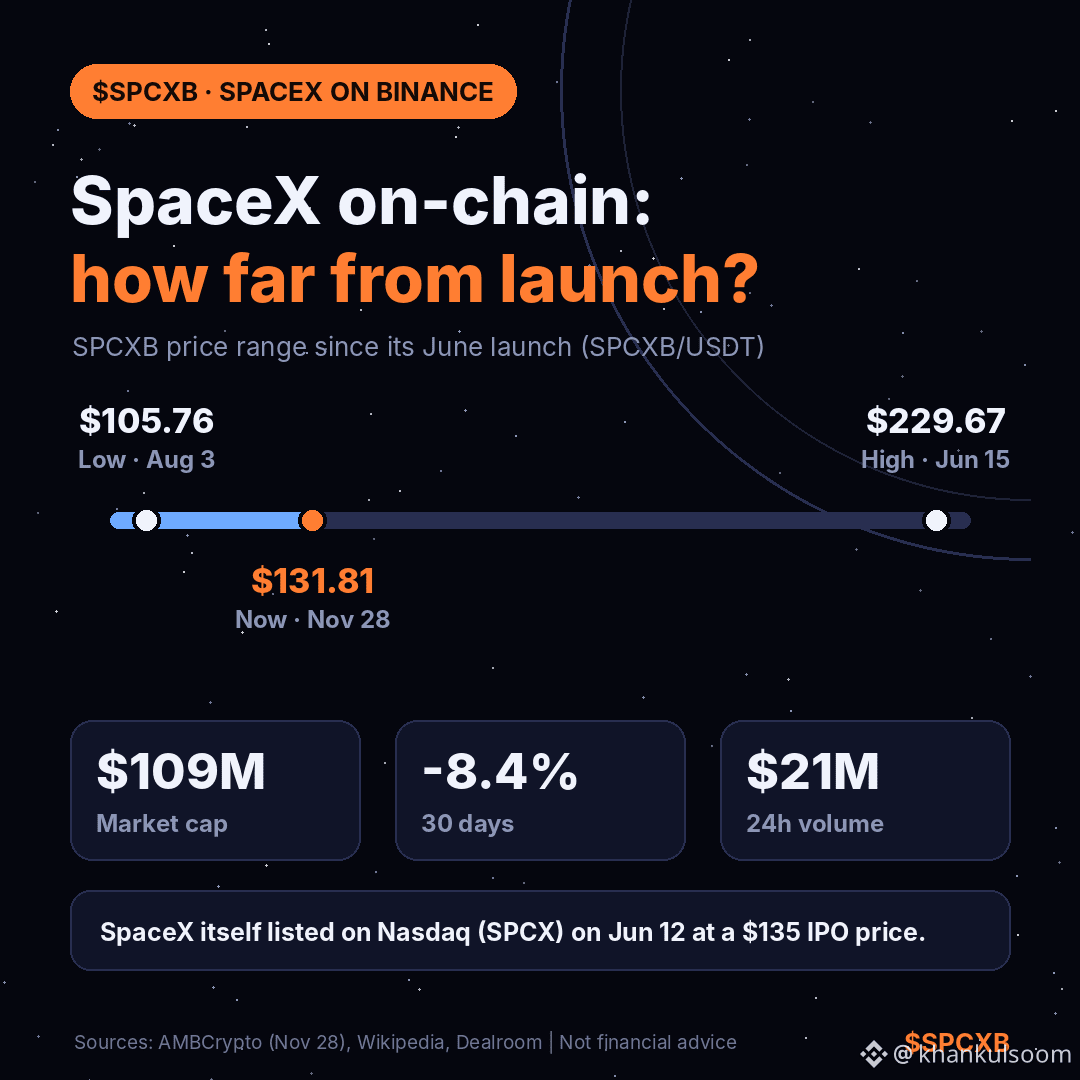
Price: about $131.81, market cap about $109M
Since launch in mid-June: high $229.67 (Jun 15), low $105.76 (Aug 3)
Last 30 days: about -8.4%, with ~$21M traded in 24h
For reference, SpaceX itself listed on Nasdaq (SPCX) on Jun 12 at a $135 IPO price
$SPCXB is a tokenized stock (bStock), so holders get price exposure, not direct ownership of SpaceX shares.
{spot}(SPCXBUSDT)
Do you prefer owning tokenized stocks on-chain or the real shares?
$SPCXB #spcxb #stochasticRSI #SpaceX #BStocks
SpaceX, on Binance 🚀 $SPCXB
Price: about $131.81, market cap about $109M
Since launch in mid-June: high $229.67 (Jun 15), low $105.76 (Aug 3)
Last 30 days: about -8.4%, with ~$21M traded in 24h
For reference, SpaceX itself listed on Nasdaq (SPCX) on Jun 12 at a $135 IPO price
$SPCXB is a tokenized stock (bStock), so holders get price exposure, not direct ownership of SpaceX shares.
Do you prefer owning tokenized stocks on-chain or the real shares?
$SPCXB #spcxb #stochasticRSI #SpaceX #BStocks
66
·
--
$NVDAB holders, mark your calendar 🗓️
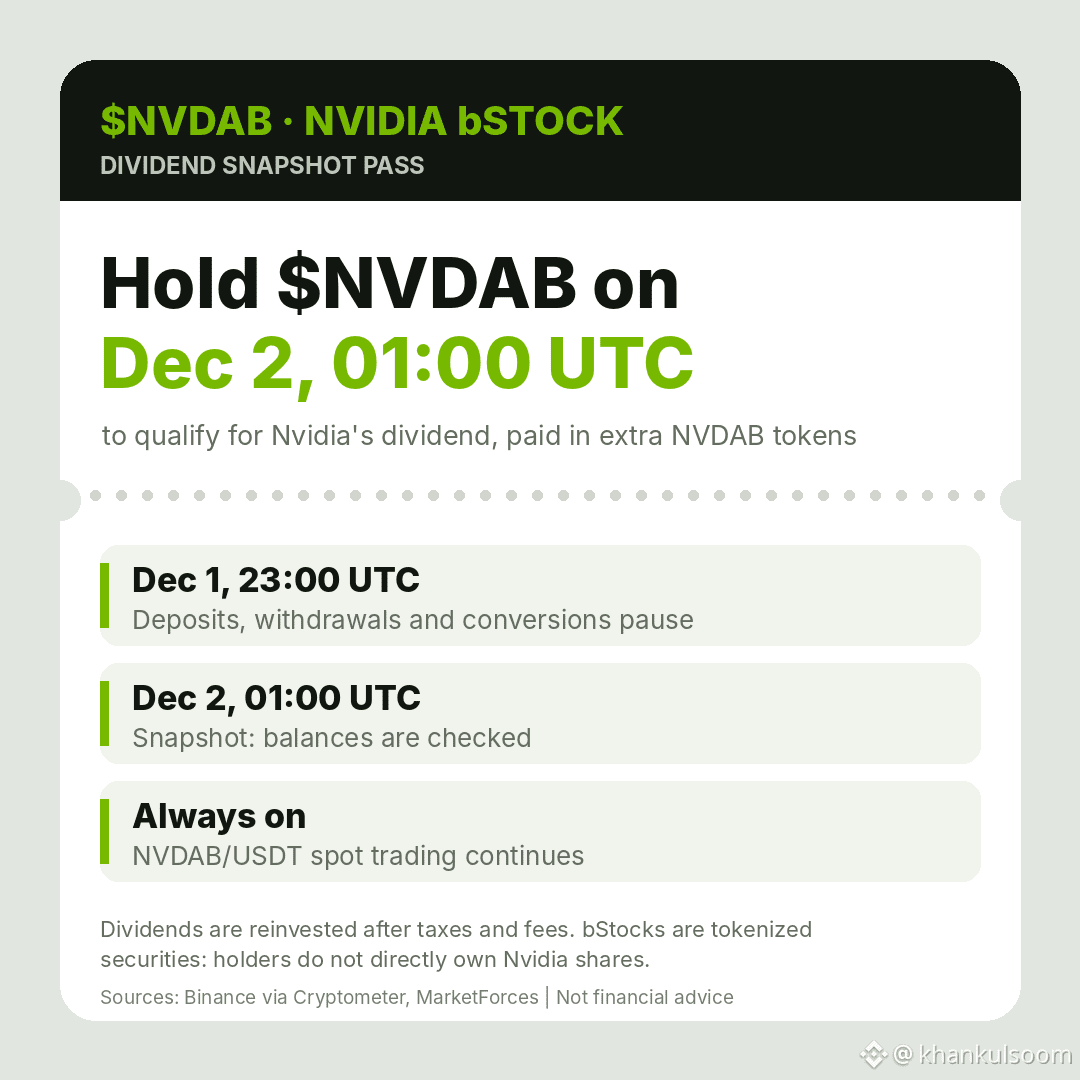
Binance will pay Nvidia dividends to bStock holders:
Dec 1, 23:00 UTC: deposits, withdrawals and conversions pause
Dec 2, 01:00 UTC: balance snapshot Dividends are paid as extra NVDAB tokens (fractions included), after taxes and fees NVDAB/USDT spot trading stays open throughout
Note: bStocks are tokenized securities, so holders do not directly own Nvidia shares.
Will you hold through the snapshot?
{spot}(NVDABUSDT)
{spot}(BTCUSDT)
$NVDAB $BTC #NVIDIA #BStocks #NVDAB #bstock
$NVDAB holders, mark your calendar 🗓️
Binance will pay Nvidia dividends to bStock holders:
Dec 1, 23:00 UTC: deposits, withdrawals and conversions pause
Dec 2, 01:00 UTC: balance snapshot Dividends are paid as extra NVDAB tokens (fractions included), after taxes and fees NVDAB/USDT spot trading stays open throughout
Note: bStocks are tokenized securities, so holders do not directly own Nvidia shares.
Will you hold through the snapshot?
$NVDAB $BTC #NVIDIA #BStocks #NVDAB #bstock
16


·
--
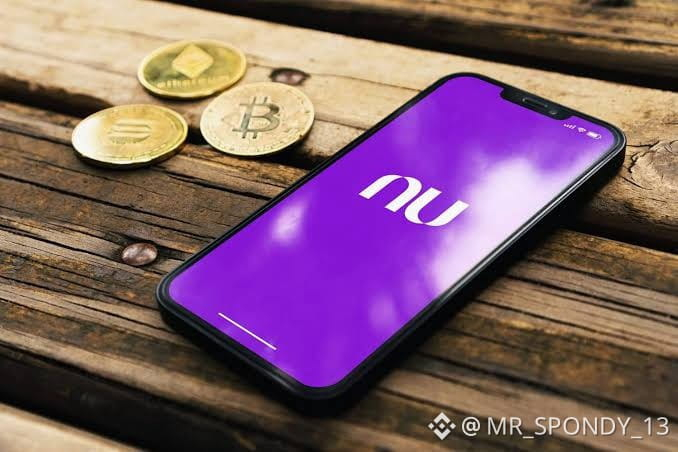
NUB: Traditional Banking Meets Blockchain-Based Access
Nu Holdings is a financial technology company known for its digital banking ecosystem in Latin America.
Its business focuses on digital banking, payments, credit, and financial services.
Market Snapshot
Screenshot price: $13.22
24H: +5.42%
Important: NUB is a bStock representation, not a conventional cryptocurrency.
For this asset, monitor the underlying stock, trading conditions, and bStock-specific risks rather than applying a crypto futures setup.
$NUB
{spot}(NUBUSDT)
#NuHoldings #TradFi #bStocks #Mr_SPONDY_13
NUB: Traditional Banking Meets Blockchain-Based Access
Nu Holdings is a financial technology company known for its digital banking ecosystem in Latin America.
Its business focuses on digital banking, payments, credit, and financial services.
Market Snapshot
Screenshot price: $13.22
24H: +5.42%
Important: NUB is a bStock representation, not a conventional cryptocurrency.
For this asset, monitor the underlying stock, trading conditions, and bStock-specific risks rather than applying a crypto futures setup.
$NUB
#NuHoldings #TradFi #bStocks #Mr_SPONDY_13
1
528

·
--
Bullish
$KSTRB $SNXXB $KORUB are among the top gaining bStocks right now. 📈
Binance is currently offering a Fee Promo for Spot bStocks trading. Have you tried trading bStocks yet? 👇
{spot}(KSTRBUSDT)
{spot}(SNXXBUSDT)
{spot}(KORUBUSDT)
❌ This is not an advice ❌
✅ Always Do Your Own Research ✅
#BStocks #BinanceSquare #WriteToEarn
#gainers #topgainerslist
$KSTRB $SNXXB $KORUB are among the top gaining bStocks right now. 📈
Binance is currently offering a Fee Promo for Spot bStocks trading. Have you tried trading bStocks yet? 👇
❌ This is not an advice ❌
✅ Always Do Your Own Research ✅
#BStocks #BinanceSquare #WriteToEarn
#gainers #topgainerslist
Binance is currently offering a Fee Promo for Spot bStocks trading. Have you tried trading bStocks yet? 👇
❌ This is not an advice ❌
✅ Always Do Your Own Research ✅
#BStocks #BinanceSquare #WriteToEarn
#gainers #topgainerslist
330
·
--
Binance said on November 27, 2026 that holders of five tokenized U.S. stocks on bStocks will receive cash dividends as more of the same tokens, not cash.
The tokens are WENB (Wendy's), NVDAB (NVIDIA), QCOMB (Qualcomm), PYPLB (PayPal) and WDCB (Western Digital). After withholding taxes, fees and other deductions, the net dividend is reinvested into additional units or fractional shares of the same security. Eligible users receive the matching bStocks; on-chain holders get a multiplier adjustment.
Snapshots are at 01:00 UTC on December 1, 2026 (WENB), December 2, 2026 (NVDAB), December 3, 2026 (QCOMB) and December 4, 2026 (PYPLB and WDCB). The related USDT spot pairs keep trading. Conversion, deposits, withdrawals and Binance Convert for each token pause at 23:00 UTC the day before its snapshot, then resume after the distribution, with no further notice. Dividends from Savings or Margin accounts go to Spot.
#bStocks #Binance #TokenizedStocks
DYOR. Not financial advice.

170

·
--
Verified
At Yi Jie's AMA meet-and-greet, I put to her the questions I cared most about regarding Binance bStocks and TradFi @heyi . Combined with the Hong Kong stock plan announced that day, the answers form a complete picture of Binance's stock-token product lineup.
Q1: What was Binance's original motivation for creating bStocks? What would convince traditional U.S. stock investors to switch over?
Yi Jie: U.S. stock investors aren't short on options, and buying U.S. stocks is already easy. The real demand is outside the U.S.—Binance is serving people who have had trouble opening accounts and accessing dollar-denominated assets. She also spoke frankly about the gap: most U.S. stock investors are still using brokerages like Futu, Longbridge, and Tiger Brokers. “Our product experience still has a pretty big gap compared with theirs,” and “the only thing we can really claim as an advantage is 24-hour trading.”
Q2: How does Binance participate in company listings? What about companies already listed elsewhere?
Yi Jie: “This IPO isn't an IPO on Binance; we're just an underwriter.” Approval authority rests with the local exchange. Shares already listed locally but with poor liquidity can be brought over directly and made available as assets. She considers three things: whether an official partnership has been established, which assets can be brought over, and which projects are suitable for applying locally.
Q3: About the Hong Kong stock trading product plan.
Binance plans to launch trading in Hong Kong-listed stocks and ETFs on December 1, with over 1,000 instruments in the initial offering, purchasable directly with USDC. Yi Jie described this move by Binance as the first step toward a cryptocurrency exchange becoming an “all finance” platform.
To sum up, Binance sees bStocks as an entry point, IPO underwriting as the supply side for creating new assets, and Hong Kong stocks as the next market for expansion. 24-hour trading is currently Binance's competitive differentiator in stock-token trading. It's also clear that Binance has made a major effort on stock trading products this year and will continue rolling out more products to strengthen its securities tokenization ecosystem.
{spot}(BNBUSDT)
#币安区块链周进化由你 #BStocks #TradFi
At Yi Jie's AMA meet-and-greet, I put to her the questions I cared most about regarding Binance bStocks and TradFi @Yi He . Combined with the Hong Kong stock plan announced that day, the answers form a complete picture of Binance's stock-token product lineup.
Q1: What was Binance's original motivation for creating bStocks? What would convince traditional U.S. stock investors to switch over?
Yi Jie: U.S. stock investors aren't short on options, and buying U.S. stocks is already easy. The real demand is outside the U.S.—Binance is serving people who have had trouble opening accounts and accessing dollar-denominated assets. She also spoke frankly about the gap: most U.S. stock investors are still using brokerages like Futu, Longbridge, and Tiger Brokers. “Our product experience still has a pretty big gap compared with theirs,” and “the only thing we can really claim as an advantage is 24-hour trading.”
Q2: How does Binance participate in company listings? What about companies already listed elsewhere?
Yi Jie: “This IPO isn't an IPO on Binance; we're just an underwriter.” Approval authority rests with the local exchange. Shares already listed locally but with poor liquidity can be brought over directly and made available as assets. She considers three things: whether an official partnership has been established, which assets can be brought over, and which projects are suitable for applying locally.
Q3: About the Hong Kong stock trading product plan.
Binance plans to launch trading in Hong Kong-listed stocks and ETFs on December 1, with over 1,000 instruments in the initial offering, purchasable directly with USDC. Yi Jie described this move by Binance as the first step toward a cryptocurrency exchange becoming an “all finance” platform.
To sum up, Binance sees bStocks as an entry point, IPO underwriting as the supply side for creating new assets, and Hong Kong stocks as the next market for expansion. 24-hour trading is currently Binance's competitive differentiator in stock-token trading. It's also clear that Binance has made a major effort on stock trading products this year and will continue rolling out more products to strengthen its securities tokenization ecosystem.
#币安区块链周进化由你 #BStocks #TradFi

我家的媳妇:
第一就是第一
4
1
19
10.1k
·
--
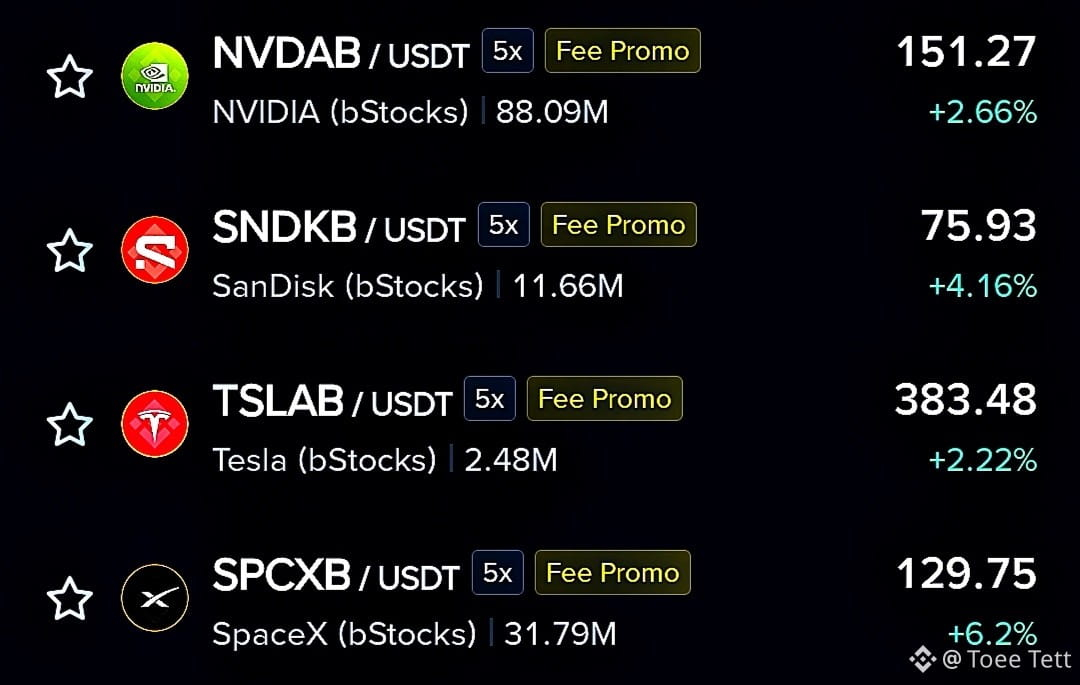
Spot trading bStocks like $NVDAB , $TSLAB , and $SPCXB comes with a Fee Promo on Binance right now! 🎯
Not sure how long this promo will stay live, so I'm taking advantage of the smoother fee structure while it's here.
I honesty don't know how long will the promo last guys.
Have you tried trading bStocks yet? 👇
{spot}(NVDABUSDT)
{spot}(TSLABUSDT)
{spot}(SPCXBUSDT)
Disclaimer : ❌ This is not an advice❌
✅ Always Do Your Own Research ✅
☑️Good Luck to All Traders ☑️
#bStocks #CanMarketsReboundAfterThanksgiving? #CouldSpaceX’sOrbitalDataCentersBoostAIChipDemand? #EvolveAtBinanceBlockchainWeek
Spot trading bStocks like $NVDAB , $TSLAB , and $SPCXB comes with a Fee Promo on Binance right now! 🎯
Not sure how long this promo will stay live, so I'm taking advantage of the smoother fee structure while it's here.
I honesty don't know how long will the promo last guys.
Have you tried trading bStocks yet? 👇
Disclaimer : ❌ This is not an advice❌
✅ Always Do Your Own Research ✅
☑️Good Luck to All Traders ☑️
#bStocks #CanMarketsReboundAfterThanksgiving? #CouldSpaceX’sOrbitalDataCentersBoostAIChipDemand? #EvolveAtBinanceBlockchainWeek
267

·
--
Binance announced in Bangkok that, starting December 1, eligible users will be able to use USDC to buy directly more than 1,000 Hong Kong stocks and ETFs. Some Hong Kong stocks will also have tokenized versions called bStocks, which can be traded around the clock and, according to the announcement, converted one-to-one with the corresponding stocks. The two products offer direct stock ownership and exposure to tokenized securities, respectively. Hong Kong stock trading services are not available to the Hong Kong public.
After the Hong Kong stock market closes, whether round-the-clock trading is useful depends on how many people are still placing orders in the token market. Once the initial list and conversion terms are published, it will be possible to compare the bid-ask spreads and trading volumes of the same token during Hong Kong market hours and after the market closes, and to check whether conversions are available outside trading hours. If spreads widen significantly, round-the-clock availability may not mean there is enough liquidity. #bStocks Not investment advice.
After the Hong Kong stock market closes, whether round-the-clock trading is useful depends on how many people are still placing orders in the token market. Once the initial list and conversion terms are published, it will be possible to compare the bid-ask spreads and trading volumes of the same token during Hong Kong market hours and after the market closes, and to check whether conversions are available outside trading hours. If spreads widen significantly, round-the-clock availability may not mean there is enough liquidity. #bStocks Not investment advice.
46

·
--
🚨 IS MONEY FLOWING INTO bSTOCKS? THE ALTERNATIVE TO CRYPTO PANIC
The market is getting chilly in the early hours—not just because of the time. $BTC remains stuck around $59,500, and the atmosphere of panic isn't helping. But if we look at bStocks (tokenized stocks on Binance), things change—and I'm not just talking about volume.
The truth is, you can sense people getting tired of the usual altcoin volatility on the forums, and many are rotating liquidity into this digitized traditional sector. In addition to the move involving SpaceX bStock ($SPCXB ) and the recent arrival of Anthropic ($ANTB), the bStocks market now holds nearly $4.8 billion in assets. Many are using them to "seek refuge" without leaving the blockchain, while also taking advantage of dividends and 3x volume toward the platform's VIP level.
A word of caution: this doesn't mean bStocks don't carry their own market risks or depend on Wall Street. But on days of "extreme fear" in crypto, they're an alternative that not everyone knows about or knows how to use.
Have you tried these stock tokens, or would you rather hold on to $BNB until the market decides where it's headed? 👇
#bStocks #Bitcoin #MercadoCripto #BinanceSquare #finanzas

110
·
--
Binance has opened Phase 3 of its bStocks recurring-buy campaign, with 50 SPCXB in token vouchers shared among the first 5,000 eligible users.
The promotion runs from 00:00 UTC on November 26 to 23:59 UTC on December 23, 2026. Through Binance Convert Recurring, eligible users can schedule automated purchases of supported bStocks, tokenized U.S. shares, starting from just 0.01 USDC equivalent.
To qualify, users must register on the promotion page, complete at least 75 USDC equivalent in bStock buys through newly created recurring plans, and keep those plans active for the whole period. Pausing or cancelling a plan removes its volume. Rewards are capped at 0.01 SPCXB per user and land within three weeks after the end. bStocks are offered under an ADGM prospectus and are not available everywhere.
New to Binance and $BNB? Register with code A8899: https://www.binance.com/join?ref=A8899
#Binance #bStocks #BinanceConvert
DYOR. Not financial advice.
Binance has opened Phase 3 of its bStocks recurring-buy campaign, with 50 SPCXB in token vouchers shared among the first 5,000 eligible users.
The promotion runs from 00:00 UTC on November 26 to 23:59 UTC on December 23, 2026. Through Binance Convert Recurring, eligible users can schedule automated purchases of supported bStocks, tokenized U.S. shares, starting from just 0.01 USDC equivalent.
To qualify, users must register on the promotion page, complete at least 75 USDC equivalent in bStock buys through newly created recurring plans, and keep those plans active for the whole period. Pausing or cancelling a plan removes its volume. Rewards are capped at 0.01 SPCXB per user and land within three weeks after the end. bStocks are offered under an ADGM prospectus and are not available everywhere.
New to Binance and $BNB ? Register with code A8899: https://www.binance.com/join?ref=A8899
#Binance #bStocks #BinanceConvert
DYOR. Not financial advice.

121
Log in to explore more content
Join global crypto users on Binance Square
⚡️ Get latest and useful information about crypto.
💬 Trusted by the world’s largest crypto exchange.
👍 Discover real insights from verified creators.
Email / Phone number
Trending Topics
1
#EvolveAtBinanceBlockchainWeek
2.7M views
21,583 Discussing
2
#IBSGovAccountMints1BTokensDrains5.71M
24,382 views
298 Discussing
3
#OPECReportedlyKeepsOilQuotasUnchangedForQ1
3,084 views
77 Discussing
4
#SunReportedlyOffered4BToRescueFTX
1,583 views
24 Discussing
5
#WorldLibertyActsToCutLiquidationRisk
77,397 views
642 Discussing
6
#XRPLAmendmentsEnterActivationWindow
10,425 views
102 Discussing
7
#LiquidHackerMoves598BTC
55,695 views
402 Discussing
8
#TrumpMediaCouldFace883.5MRepaymentDemand
30,097 views
158 Discussing
9
#BitcoinETFsExtendOutflowStreakToEightDays
122,691 views
941 Discussing
10
#BitcoinETFsSee$5.39BNetOutflowRecord
3,887 views
17 Discussing