
#amm
amm
17,254 views
127 Discussing
Hot
Latest

·
--
Market rumors say Robinhood-related assets surged 326% within one hour after the “deployment of AMM.” This run-up really reflects the current sentiment: whenever traditional finance gets involved in on-chain trading and automated market making, capital tends to buy first and then seek verification.
But AMM itself isn’t a profit magic trick—it’s merely a liquidity pricing mechanism. Whether it can sustain the valuation later depends on regulatory boundaries, real trading volume, liquidity depth, the fee structure, and how well the product is integrated. A vertical spike triggered by a single concept often goes hand in hand with short-covering and short-term speculation.
When you see this kind of market action, don’t rush into FOMO. Verify the source of the news, and whether the trading volume and the price increase have already been front-run. That matters more than chasing the numbers. When good news finally lands, it’s often also the moment when volatility is most dangerous.
#Robinhood #DeFi #AMM
Market rumors say Robinhood-related assets surged 326% within one hour after the “deployment of AMM.” This run-up really reflects the current sentiment: whenever traditional finance gets involved in on-chain trading and automated market making, capital tends to buy first and then seek verification.
But AMM itself isn’t a profit magic trick—it’s merely a liquidity pricing mechanism. Whether it can sustain the valuation later depends on regulatory boundaries, real trading volume, liquidity depth, the fee structure, and how well the product is integrated. A vertical spike triggered by a single concept often goes hand in hand with short-covering and short-term speculation.
When you see this kind of market action, don’t rush into FOMO. Verify the source of the news, and whether the trading volume and the price increase have already been front-run. That matters more than chasing the numbers. When good news finally lands, it’s often also the moment when volatility is most dangerous.
#Robinhood #DeFi #AMM
But AMM itself isn’t a profit magic trick—it’s merely a liquidity pricing mechanism. Whether it can sustain the valuation later depends on regulatory boundaries, real trading volume, liquidity depth, the fee structure, and how well the product is integrated. A vertical spike triggered by a single concept often goes hand in hand with short-covering and short-term speculation.
When you see this kind of market action, don’t rush into FOMO. Verify the source of the news, and whether the trading volume and the price increase have already been front-run. That matters more than chasing the numbers. When good news finally lands, it’s often also the moment when volatility is most dangerous.
#Robinhood #DeFi #AMM
11

The trending page information is engaging enough: the Anon concept, the Robinhood narrative, the AMM launch—then the price surged 326% within an hour. But the more exaggerated the curve, the more you need to first distinguish whether it’s liquidity improving or attention being temporarily squeezed.
AMM only provides an on-chain trading gateway; it doesn’t create yield by itself, nor does it mean the project is safe. Pool depth, whether LP is locked, contract permissions, whale holdings, and buy/sell taxes are what determine whether you’re stepping into an opportunity or getting slippage. When the K-line is at its most lively, early capital often already has enough room to exit.
You can follow memes, but don’t treat a screenshot of the price increase as a buying rationale. Check on-chain data first, then decide whether to participate; missing a single bullish candle is far better than catching a drop-off and getting stuck when liquidity is thin.
#Meme币 #AMM #on-chain data
The trending page information is engaging enough: the Anon concept, the Robinhood narrative, the AMM launch—then the price surged 326% within an hour. But the more exaggerated the curve, the more you need to first distinguish whether it’s liquidity improving or attention being temporarily squeezed.
AMM only provides an on-chain trading gateway; it doesn’t create yield by itself, nor does it mean the project is safe. Pool depth, whether LP is locked, contract permissions, whale holdings, and buy/sell taxes are what determine whether you’re stepping into an opportunity or getting slippage. When the K-line is at its most lively, early capital often already has enough room to exit.
You can follow memes, but don’t treat a screenshot of the price increase as a buying rationale. Check on-chain data first, then decide whether to participate; missing a single bullish candle is far better than catching a drop-off and getting stuck when liquidity is thin.
#Meme币 #AMM #on-chain data
AMM only provides an on-chain trading gateway; it doesn’t create yield by itself, nor does it mean the project is safe. Pool depth, whether LP is locked, contract permissions, whale holdings, and buy/sell taxes are what determine whether you’re stepping into an opportunity or getting slippage. When the K-line is at its most lively, early capital often already has enough room to exit.
You can follow memes, but don’t treat a screenshot of the price increase as a buying rationale. Check on-chain data first, then decide whether to participate; missing a single bullish candle is far better than catching a drop-off and getting stuck when liquidity is thin.
#Meme币 #AMM #on-chain data
1

·
--
An image thrown out by an anonymous account has been going viral in the community: Robinhood’s stock was said to have skyrocketed 326% within an hour after deploying an AMM.
Don’t rush into FOMO yet. The stock prices of traditional brokerages and on-chain AMMs are not simply a matter of direct cause and effect. The source of the news, the screenshot timing, and actual business progress all need to be verified. What’s really being traded may be the imagined possibilities of “traditional finance connecting to DeFi”—or it may just be a meme-driven, momentum-led market move.
If there’s no subsequent official announcement or real trading volume to back it up, rapid pump-ups are often followed—and faster—by equally rapid sell-offs. Understand the narrative, and also keep tight control of your position size.
#DeFi #AMM #Robinhood
An image thrown out by an anonymous account has been going viral in the community: Robinhood’s stock was said to have skyrocketed 326% within an hour after deploying an AMM.
Don’t rush into FOMO yet. The stock prices of traditional brokerages and on-chain AMMs are not simply a matter of direct cause and effect. The source of the news, the screenshot timing, and actual business progress all need to be verified. What’s really being traded may be the imagined possibilities of “traditional finance connecting to DeFi”—or it may just be a meme-driven, momentum-led market move.
If there’s no subsequent official announcement or real trading volume to back it up, rapid pump-ups are often followed—and faster—by equally rapid sell-offs. Understand the narrative, and also keep tight control of your position size.
#DeFi #AMM #Robinhood
Don’t rush into FOMO yet. The stock prices of traditional brokerages and on-chain AMMs are not simply a matter of direct cause and effect. The source of the news, the screenshot timing, and actual business progress all need to be verified. What’s really being traded may be the imagined possibilities of “traditional finance connecting to DeFi”—or it may just be a meme-driven, momentum-led market move.
If there’s no subsequent official announcement or real trading volume to back it up, rapid pump-ups are often followed—and faster—by equally rapid sell-offs. Understand the narrative, and also keep tight control of your position size.
#DeFi #AMM #Robinhood
9

·
--
Reports say that concepts related to ANON surged 326% within an hour due to the “Robinhood deploying AMM.” They quickly climbed into trending topics. But don’t rush to treat the percentage gain as a guaranteed opportunity: AMM is only an on-chain liquidity mechanism in itself, and it does not automatically mean improved revenue, users, or fundamentals.
For memecoins, what matters more is verifying pool depth, trading slippage, contract permissions, and how concentrated the token holdings are—as well as whether this news is being over-interpreted. Very often, the most outrageous spike happens exactly when market sentiment is at its hottest and the subsequent buy pressure is easiest to exhaust.
Follow the narrative if you want, but there’s no need to pass the FOMO baton. If you understand, participate with a small position; if you don’t, wait and observe. It’s always safer than chasing the top and becoming the passive bag-holder afterward.
#Memecoin #AMM
Reports say that concepts related to ANON surged 326% within an hour due to the “Robinhood deploying AMM.” They quickly climbed into trending topics. But don’t rush to treat the percentage gain as a guaranteed opportunity: AMM is only an on-chain liquidity mechanism in itself, and it does not automatically mean improved revenue, users, or fundamentals.
For memecoins, what matters more is verifying pool depth, trading slippage, contract permissions, and how concentrated the token holdings are—as well as whether this news is being over-interpreted. Very often, the most outrageous spike happens exactly when market sentiment is at its hottest and the subsequent buy pressure is easiest to exhaust.
Follow the narrative if you want, but there’s no need to pass the FOMO baton. If you understand, participate with a small position; if you don’t, wait and observe. It’s always safer than chasing the top and becoming the passive bag-holder afterward.
#Memecoin #AMM
For memecoins, what matters more is verifying pool depth, trading slippage, contract permissions, and how concentrated the token holdings are—as well as whether this news is being over-interpreted. Very often, the most outrageous spike happens exactly when market sentiment is at its hottest and the subsequent buy pressure is easiest to exhaust.
Follow the narrative if you want, but there’s no need to pass the FOMO baton. If you understand, participate with a small position; if you don’t, wait and observe. It’s always safer than chasing the top and becoming the passive bag-holder afterward.
#Memecoin #AMM
2


·
--
Bearish
@ANFELIA_INVESTMENT
Trader HFT
DeFi Series — Post 4 of 5
AMMs and liquidity pools: how the DeFi engine works.
Every time you make a swap on a DEX, someone like you put that capital there. AMMs replaced the order book with pure math. Understanding how it works means understanding where the real risk is.
"An AMM has no human counterparty. Just a formula: x × y = k."
AMM mechanics step by step
x The pool has two assets in a constant ratio (e.g., SOL + USDC)
× The formula x × y = k keeps the product constant at all times
→ You buy SOL → there is less SOL in the pool → the price rises automatically
$ Liquidity provider earns a % of each swap executed in the pool
Risks you must model before getting in
1️⃣ Impermanent Loss: automatic rebalancing leaves you with less of the asset that went up
2️⃣ Slippage: in small pools, large trades move the price against you
3️⃣ Smart contract: a bug in the code = total loss of the pool’s capital
4️⃣ Rug pull: the team drains liquidity if the protocol has no timelock
x×y=k
Base AMM formula
0.3%
Uniswap standard fee
IL
Main LP risk
TVL
Measures pool health
Important note:
A pool with 200% APY on a new token without an audit is an exit signal, not an entry signal. The liquidity providers’ capital is what funds that APY.
Comment AMM and we’ll explain how to choose the right pool according to your risk profile.
#AMM #DEX #uniswap #raydium #AnfeliaInvestment $SOL
{future}(SOLUSDT)
Content for educational purposes only. Does not constitute investment advice. — ANFELIA_INVESTMENT
@ANFELIA_INVESTMENT
Trader HFT
DeFi Series — Post 4 of 5
AMMs and liquidity pools: how the DeFi engine works.
Every time you make a swap on a DEX, someone like you put that capital there. AMMs replaced the order book with pure math. Understanding how it works means understanding where the real risk is.
"An AMM has no human counterparty. Just a formula: x × y = k."
AMM mechanics step by step
x The pool has two assets in a constant ratio (e.g., SOL + USDC)
× The formula x × y = k keeps the product constant at all times
→ You buy SOL → there is less SOL in the pool → the price rises automatically
$ Liquidity provider earns a % of each swap executed in the pool
Risks you must model before getting in
1️⃣ Impermanent Loss: automatic rebalancing leaves you with less of the asset that went up
2️⃣ Slippage: in small pools, large trades move the price against you
3️⃣ Smart contract: a bug in the code = total loss of the pool’s capital
4️⃣ Rug pull: the team drains liquidity if the protocol has no timelock
x×y=k
Base AMM formula
0.3%
Uniswap standard fee
IL
Main LP risk
TVL
Measures pool health
Important note:
A pool with 200% APY on a new token without an audit is an exit signal, not an entry signal. The liquidity providers’ capital is what funds that APY.
Comment AMM and we’ll explain how to choose the right pool according to your risk profile.
#AMM #DEX #uniswap #raydium #AnfeliaInvestment $SOL
Content for educational purposes only. Does not constitute investment advice. — ANFELIA_INVESTMENT
Trader HFT
DeFi Series — Post 4 of 5
AMMs and liquidity pools: how the DeFi engine works.
Every time you make a swap on a DEX, someone like you put that capital there. AMMs replaced the order book with pure math. Understanding how it works means understanding where the real risk is.
"An AMM has no human counterparty. Just a formula: x × y = k."
AMM mechanics step by step
x The pool has two assets in a constant ratio (e.g., SOL + USDC)
× The formula x × y = k keeps the product constant at all times
→ You buy SOL → there is less SOL in the pool → the price rises automatically
$ Liquidity provider earns a % of each swap executed in the pool
Risks you must model before getting in
1️⃣ Impermanent Loss: automatic rebalancing leaves you with less of the asset that went up
2️⃣ Slippage: in small pools, large trades move the price against you
3️⃣ Smart contract: a bug in the code = total loss of the pool’s capital
4️⃣ Rug pull: the team drains liquidity if the protocol has no timelock
x×y=k
Base AMM formula
0.3%
Uniswap standard fee
IL
Main LP risk
TVL
Measures pool health
Important note:
A pool with 200% APY on a new token without an audit is an exit signal, not an entry signal. The liquidity providers’ capital is what funds that APY.
Comment AMM and we’ll explain how to choose the right pool according to your risk profile.
#AMM #DEX #uniswap #raydium #AnfeliaInvestment $SOL
Content for educational purposes only. Does not constitute investment advice. — ANFELIA_INVESTMENT
1
419

·
--
LayerZero teams up with Oblivious Labs and Carnegie Mellon University to publish a paper, introducing a new AMM mechanism called OTTER that is resistant to MEV.
OTTER uses a batch settlement mechanism similar to a VCG auction, making it a dominant strategy for traders to truthfully report their valuations and budgets, while weakening block builders’ ability to profit through transaction ordering, sandwich attacks, or injecting false bids.
The residual value that might originally have been captured by MEV will be redistributed to liquidity providers, traders, liquidity pools, or underlying chain validators, reducing the impact of builders’ advantages on how ecosystem value is allocated.
#LayerZero #MEV #DeFi #AMM
LayerZero teams up with Oblivious Labs and Carnegie Mellon University to publish a paper, introducing a new AMM mechanism called OTTER that is resistant to MEV.
OTTER uses a batch settlement mechanism similar to a VCG auction, making it a dominant strategy for traders to truthfully report their valuations and budgets, while weakening block builders’ ability to profit through transaction ordering, sandwich attacks, or injecting false bids.
The residual value that might originally have been captured by MEV will be redistributed to liquidity providers, traders, liquidity pools, or underlying chain validators, reducing the impact of builders’ advantages on how ecosystem value is allocated.
#LayerZero #MEV #DeFi #AMM
OTTER uses a batch settlement mechanism similar to a VCG auction, making it a dominant strategy for traders to truthfully report their valuations and budgets, while weakening block builders’ ability to profit through transaction ordering, sandwich attacks, or injecting false bids.
The residual value that might originally have been captured by MEV will be redistributed to liquidity providers, traders, liquidity pools, or underlying chain validators, reducing the impact of builders’ advantages on how ecosystem value is allocated.
#LayerZero #MEV #DeFi #AMM
115

·
--
🚨 Automatic trades can happen even at 3:00 AM!
Who are the “invisible traders” behind DeFi?
Group: [点击进入玖玖的粉丝群](https://app.binance.com/uni-qr/UaxtSTYi)
Have you ever wondered: why at 3:00 AM, when there’s no traditional trader watching the charts, you can still exchange one token for another?
The answer is AMM—Automated Market Maker.
It’s arguably one of the core infrastructures behind DeFi trading. Once you understand liquidity pools and AMMs, you can truly see how many decentralized exchanges work under the hood.⚡
In simple terms, a liquidity pool is a “shared pool of funds.”
It typically contains two different assets—such as Token A and Token B. When users deposit assets, they create market liquidity; other users can then swap directly through this pool.
Most importantly: there’s no need for a buyer and a seller to wait on each other in the traditional sense.
AMMs calculate prices automatically using mathematical formulas.
The classic model can be understood like this:
x × y = k
When someone takes Token A out of the pool and adds Token B, the asset ratio inside the pool changes, and the price adjusts accordingly.
So what you see as “automatic execution” isn’t really someone matching trades for you—it’s smart contracts and math working.🤯
So who would be willing to put their assets into a pool?
Those people are liquidity providers—LPs.
After LPs deposit assets into the liquidity pool, they can earn trading fees based on their share.
Sounds pretty straightforward, right?
But the important details—are exactly here.
An AMM isn’t “put it in and you’ll always profit.”
The first risk is impermanent loss.
If the prices of the two assets in the pool move significantly, the value of what the LP withdraws may be lower than simply holding both assets separately.
The second risk is the smart contract.
AMMs rely on code running; if there’s a vulnerability in the contract, the funds could be at risk.
The third risk is slippage.
Click the avatar to watch the live stream + join the Jiujiu chat group to get daily strategies 🚀
#defi #AMM
🚨 Automatic trades can happen even at 3:00 AM!
Who are the “invisible traders” behind DeFi?
Group: 点击进入玖玖的粉丝群
Have you ever wondered: why at 3:00 AM, when there’s no traditional trader watching the charts, you can still exchange one token for another?
The answer is AMM—Automated Market Maker.
It’s arguably one of the core infrastructures behind DeFi trading. Once you understand liquidity pools and AMMs, you can truly see how many decentralized exchanges work under the hood.⚡
In simple terms, a liquidity pool is a “shared pool of funds.”
It typically contains two different assets—such as Token A and Token B. When users deposit assets, they create market liquidity; other users can then swap directly through this pool.
Most importantly: there’s no need for a buyer and a seller to wait on each other in the traditional sense.
AMMs calculate prices automatically using mathematical formulas.
The classic model can be understood like this:
x × y = k
When someone takes Token A out of the pool and adds Token B, the asset ratio inside the pool changes, and the price adjusts accordingly.
So what you see as “automatic execution” isn’t really someone matching trades for you—it’s smart contracts and math working.🤯
So who would be willing to put their assets into a pool?
Those people are liquidity providers—LPs.
After LPs deposit assets into the liquidity pool, they can earn trading fees based on their share.
Sounds pretty straightforward, right?
But the important details—are exactly here.
An AMM isn’t “put it in and you’ll always profit.”
The first risk is impermanent loss.
If the prices of the two assets in the pool move significantly, the value of what the LP withdraws may be lower than simply holding both assets separately.
The second risk is the smart contract.
AMMs rely on code running; if there’s a vulnerability in the contract, the funds could be at risk.
The third risk is slippage.
Click the avatar to watch the live stream + join the Jiujiu chat group to get daily strategies 🚀
#defi #AMM
Who are the “invisible traders” behind DeFi?
Group: 点击进入玖玖的粉丝群
Have you ever wondered: why at 3:00 AM, when there’s no traditional trader watching the charts, you can still exchange one token for another?
The answer is AMM—Automated Market Maker.
It’s arguably one of the core infrastructures behind DeFi trading. Once you understand liquidity pools and AMMs, you can truly see how many decentralized exchanges work under the hood.⚡
In simple terms, a liquidity pool is a “shared pool of funds.”
It typically contains two different assets—such as Token A and Token B. When users deposit assets, they create market liquidity; other users can then swap directly through this pool.
Most importantly: there’s no need for a buyer and a seller to wait on each other in the traditional sense.
AMMs calculate prices automatically using mathematical formulas.
The classic model can be understood like this:
x × y = k
When someone takes Token A out of the pool and adds Token B, the asset ratio inside the pool changes, and the price adjusts accordingly.
So what you see as “automatic execution” isn’t really someone matching trades for you—it’s smart contracts and math working.🤯
So who would be willing to put their assets into a pool?
Those people are liquidity providers—LPs.
After LPs deposit assets into the liquidity pool, they can earn trading fees based on their share.
Sounds pretty straightforward, right?
But the important details—are exactly here.
An AMM isn’t “put it in and you’ll always profit.”
The first risk is impermanent loss.
If the prices of the two assets in the pool move significantly, the value of what the LP withdraws may be lower than simply holding both assets separately.
The second risk is the smart contract.
AMMs rely on code running; if there’s a vulnerability in the contract, the funds could be at risk.
The third risk is slippage.
Click the avatar to watch the live stream + join the Jiujiu chat group to get daily strategies 🚀
#defi #AMM

25

·
--

Article
Correlation Pairing: AMM’s Breakthrough From the Margins to Mainstream Financeimage
To be honest, does an apparently “stupid” passive market-making model like an automated market maker (AMM) actually have the potential to swallow up the fattest markets in traditional finance?
Ten years ago, almost every professional trader would tell you—no. Without any human intervention, how could an algorithmic pool possibly compete with market makers armed with supercomputers? But data doesn’t lie. Today, decentralized exchanges have already captured more than a fifth of the spot market, and that number is still rising.
More importantly, a structural shift beneath “growth in trading volume” is quietly taking place.
Correlation Pairing: AMM’s Breakthrough From the Margins to Mainstream Finance
image
To be honest, does an apparently “stupid” passive market-making model like an automated market maker (AMM) actually have the potential to swallow up the fattest markets in traditional finance?
Ten years ago, almost every professional trader would tell you—no. Without any human intervention, how could an algorithmic pool possibly compete with market makers armed with supercomputers? But data doesn’t lie. Today, decentralized exchanges have already captured more than a fifth of the spot market, and that number is still rising.
More importantly, a structural shift beneath “growth in trading volume” is quietly taking place.
To be honest, does an apparently “stupid” passive market-making model like an automated market maker (AMM) actually have the potential to swallow up the fattest markets in traditional finance?
Ten years ago, almost every professional trader would tell you—no. Without any human intervention, how could an algorithmic pool possibly compete with market makers armed with supercomputers? But data doesn’t lie. Today, decentralized exchanges have already captured more than a fifth of the spot market, and that number is still rising.
More importantly, a structural shift beneath “growth in trading volume” is quietly taking place.
1
334
·
--
🚨 Uniswap co-founder speaks up:
A $18B market—AMMs may just be getting started!
Group: [点击进入玖玖的粉丝群](https://app.binance.com/uni-qr/UaxtSTYi)
Uniswap’s co-founder recently reiterated a direction:
AMM, or automated market makers. Although they’ve handled transactions worth tens of billions of dollars, the real big opportunities may be just beginning. The reason is—tokenized assets are rapidly moving on-chain.👀
Data shows that, as of early 2026, the size of RWA on public blockchains has reached about $18 billion, growing 18-fold compared to 2022. These assets are no longer just crypto assets.
U.S. Treasury bonds, funds, bonds, and other traditional financial products are gradually being brought onto the blockchain.
But once assets are on-chain, a new problem also emerges:
Having assets doesn’t automatically mean having liquidity. This is also why AMMs may become increasingly important. Traditional markets rely on order books and professional market makers, while AMMs enable on-chain trading of assets through liquidity pools and algorithmic pricing.
In simple terms, here’s what it means👇
In the future, more and more assets may be tokenized—but how these assets circulate quickly, how to find counterparties, and how to form stable prices will all require new market infrastructure.
AMM is one of the key directions.
However, today’s AMMs are not perfect either. Data indicates that on platforms like Uniswap V3, most liquidity is still concentrated in the hands of a small number of professional liquidity providers. This means that even if the market looks decentralized, professional capital is still needed to provide depth.
Even more worth watching is regulation. As tokenized stocks, bonds, and funds continue to move on-chain, regulators are starting to ask:
Is on-chain AMM only a technical protocol?
Or is it actually taking on traditional financial functions like order execution, price discovery, and even settlement?
This question may determine whether liquidity for tokenized assets will happen more on decentralized platforms—or be absorbed into the traditional financial system.
Tap the profile picture to watch the live stream and understand the big market trend behind it all🚀
#uniswap #AMM #RWA
🚨 Uniswap co-founder speaks up:
A $18B market—AMMs may just be getting started!
Group: 点击进入玖玖的粉丝群
Uniswap’s co-founder recently reiterated a direction:
AMM, or automated market makers. Although they’ve handled transactions worth tens of billions of dollars, the real big opportunities may be just beginning. The reason is—tokenized assets are rapidly moving on-chain.👀
Data shows that, as of early 2026, the size of RWA on public blockchains has reached about $18 billion, growing 18-fold compared to 2022. These assets are no longer just crypto assets.
U.S. Treasury bonds, funds, bonds, and other traditional financial products are gradually being brought onto the blockchain.
But once assets are on-chain, a new problem also emerges:
Having assets doesn’t automatically mean having liquidity. This is also why AMMs may become increasingly important. Traditional markets rely on order books and professional market makers, while AMMs enable on-chain trading of assets through liquidity pools and algorithmic pricing.
In simple terms, here’s what it means👇
In the future, more and more assets may be tokenized—but how these assets circulate quickly, how to find counterparties, and how to form stable prices will all require new market infrastructure.
AMM is one of the key directions.
However, today’s AMMs are not perfect either. Data indicates that on platforms like Uniswap V3, most liquidity is still concentrated in the hands of a small number of professional liquidity providers. This means that even if the market looks decentralized, professional capital is still needed to provide depth.
Even more worth watching is regulation. As tokenized stocks, bonds, and funds continue to move on-chain, regulators are starting to ask:
Is on-chain AMM only a technical protocol?
Or is it actually taking on traditional financial functions like order execution, price discovery, and even settlement?
This question may determine whether liquidity for tokenized assets will happen more on decentralized platforms—or be absorbed into the traditional financial system.
Tap the profile picture to watch the live stream and understand the big market trend behind it all🚀
#uniswap #AMM #RWA
A $18B market—AMMs may just be getting started!
Group: 点击进入玖玖的粉丝群
Uniswap’s co-founder recently reiterated a direction:
AMM, or automated market makers. Although they’ve handled transactions worth tens of billions of dollars, the real big opportunities may be just beginning. The reason is—tokenized assets are rapidly moving on-chain.👀
Data shows that, as of early 2026, the size of RWA on public blockchains has reached about $18 billion, growing 18-fold compared to 2022. These assets are no longer just crypto assets.
U.S. Treasury bonds, funds, bonds, and other traditional financial products are gradually being brought onto the blockchain.
But once assets are on-chain, a new problem also emerges:
Having assets doesn’t automatically mean having liquidity. This is also why AMMs may become increasingly important. Traditional markets rely on order books and professional market makers, while AMMs enable on-chain trading of assets through liquidity pools and algorithmic pricing.
In simple terms, here’s what it means👇
In the future, more and more assets may be tokenized—but how these assets circulate quickly, how to find counterparties, and how to form stable prices will all require new market infrastructure.
AMM is one of the key directions.
However, today’s AMMs are not perfect either. Data indicates that on platforms like Uniswap V3, most liquidity is still concentrated in the hands of a small number of professional liquidity providers. This means that even if the market looks decentralized, professional capital is still needed to provide depth.
Even more worth watching is regulation. As tokenized stocks, bonds, and funds continue to move on-chain, regulators are starting to ask:
Is on-chain AMM only a technical protocol?
Or is it actually taking on traditional financial functions like order execution, price discovery, and even settlement?
This question may determine whether liquidity for tokenized assets will happen more on decentralized platforms—or be absorbed into the traditional financial system.
Tap the profile picture to watch the live stream and understand the big market trend behind it all🚀
#uniswap #AMM #RWA

313

Uniswap Founder: In the Era of Tokenized Assets, AMM-Related Correlated Asset Pairing Will Reshape Global Liquidity
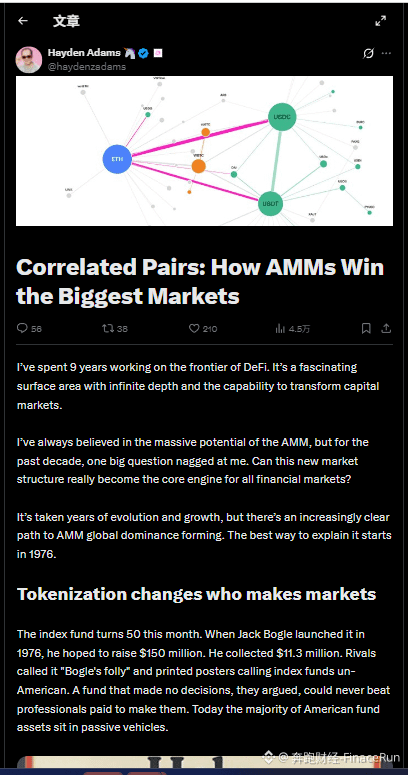
Recently, Uniswap founder Hayden Adams posted on X that the core competitive advantage of AMM’s automated market-making model lies in the correlated asset pairing mechanism formed through the natural evolution of the market.
Specifically, in the DeFi ecosystem, tokenized assets will spontaneously pair and trade with other assets within the same ecosystem. When liquidity providers allocate two assets with highly correlated price movements, the risk of holding inventory positions is lower, and the pool’s liquidity becomes deeper.
As tokenization of real-world assets advances, a unified on-chain settlement layer can break down the fragmentation of traditional market systems and the limitations of relying on USD rails—enabling direct trading between any assets.
Adams believes that, compared with delta-neutral strategies used by traditional market makers, correlated pairing can significantly reduce market-making costs—for example, directly pairing NVDA with SPY would deliver far higher trading efficiency than trading NVDA versus USD.
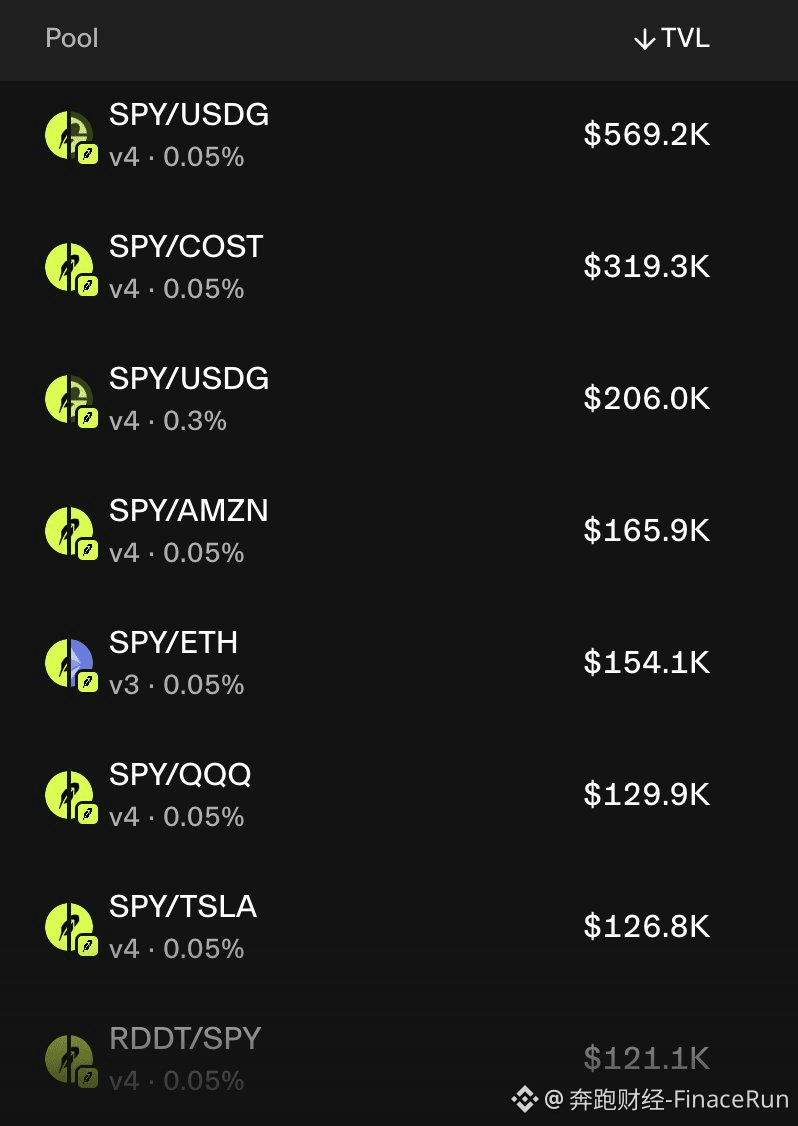
In fact, an Uniswap pool on the Robinhood Chain has already validated this logic. In it, among trading pairs formed by ten tokenized stocks and SPY, trading volume surpassed $33 million in the first 12 days after launch, with some trades occurring during U.S. stock market closures.
Correlated trading pairs also appeared in the pool, such as a combination linking Musk’s MEME coin with Tesla stock, highlighting stronger adaptability and innovation potential in AMM-related pairing logic.
In Adams’s view, passive liquidity will replicate the successful path of the development of index funds—thereby greatly lowering the barriers to market creation and participation, and unlocking more far-reaching industry impact.
Overall, although Uniswap has processed more than $4.6 trillion in cumulative trading volume, Adams still believes AMM is in its early development stage, with ample room for future growth.
#Uniswap #AMM
Uniswap Founder: In the Era of Tokenized Assets, AMM-Related Correlated Asset Pairing Will Reshape Global Liquidity
Recently, Uniswap founder Hayden Adams posted on X that the core competitive advantage of AMM’s automated market-making model lies in the correlated asset pairing mechanism formed through the natural evolution of the market.
Specifically, in the DeFi ecosystem, tokenized assets will spontaneously pair and trade with other assets within the same ecosystem. When liquidity providers allocate two assets with highly correlated price movements, the risk of holding inventory positions is lower, and the pool’s liquidity becomes deeper.
As tokenization of real-world assets advances, a unified on-chain settlement layer can break down the fragmentation of traditional market systems and the limitations of relying on USD rails—enabling direct trading between any assets.
Adams believes that, compared with delta-neutral strategies used by traditional market makers, correlated pairing can significantly reduce market-making costs—for example, directly pairing NVDA with SPY would deliver far higher trading efficiency than trading NVDA versus USD.
In fact, an Uniswap pool on the Robinhood Chain has already validated this logic. In it, among trading pairs formed by ten tokenized stocks and SPY, trading volume surpassed $33 million in the first 12 days after launch, with some trades occurring during U.S. stock market closures.
Correlated trading pairs also appeared in the pool, such as a combination linking Musk’s MEME coin with Tesla stock, highlighting stronger adaptability and innovation potential in AMM-related pairing logic.
In Adams’s view, passive liquidity will replicate the successful path of the development of index funds—thereby greatly lowering the barriers to market creation and participation, and unlocking more far-reaching industry impact.
Overall, although Uniswap has processed more than $4.6 trillion in cumulative trading volume, Adams still believes AMM is in its early development stage, with ample room for future growth.
#Uniswap #AMM
Recently, Uniswap founder Hayden Adams posted on X that the core competitive advantage of AMM’s automated market-making model lies in the correlated asset pairing mechanism formed through the natural evolution of the market.
Specifically, in the DeFi ecosystem, tokenized assets will spontaneously pair and trade with other assets within the same ecosystem. When liquidity providers allocate two assets with highly correlated price movements, the risk of holding inventory positions is lower, and the pool’s liquidity becomes deeper.
As tokenization of real-world assets advances, a unified on-chain settlement layer can break down the fragmentation of traditional market systems and the limitations of relying on USD rails—enabling direct trading between any assets.
Adams believes that, compared with delta-neutral strategies used by traditional market makers, correlated pairing can significantly reduce market-making costs—for example, directly pairing NVDA with SPY would deliver far higher trading efficiency than trading NVDA versus USD.
In fact, an Uniswap pool on the Robinhood Chain has already validated this logic. In it, among trading pairs formed by ten tokenized stocks and SPY, trading volume surpassed $33 million in the first 12 days after launch, with some trades occurring during U.S. stock market closures.
Correlated trading pairs also appeared in the pool, such as a combination linking Musk’s MEME coin with Tesla stock, highlighting stronger adaptability and innovation potential in AMM-related pairing logic.
In Adams’s view, passive liquidity will replicate the successful path of the development of index funds—thereby greatly lowering the barriers to market creation and participation, and unlocking more far-reaching industry impact.
Overall, although Uniswap has processed more than $4.6 trillion in cumulative trading volume, Adams still believes AMM is in its early development stage, with ample room for future growth.
#Uniswap #AMM
1
395

·
--
🔄 What is an AMM (Automated Market Maker)? The Core Mechanism of DEX
Current Fear and Greed Index: 30
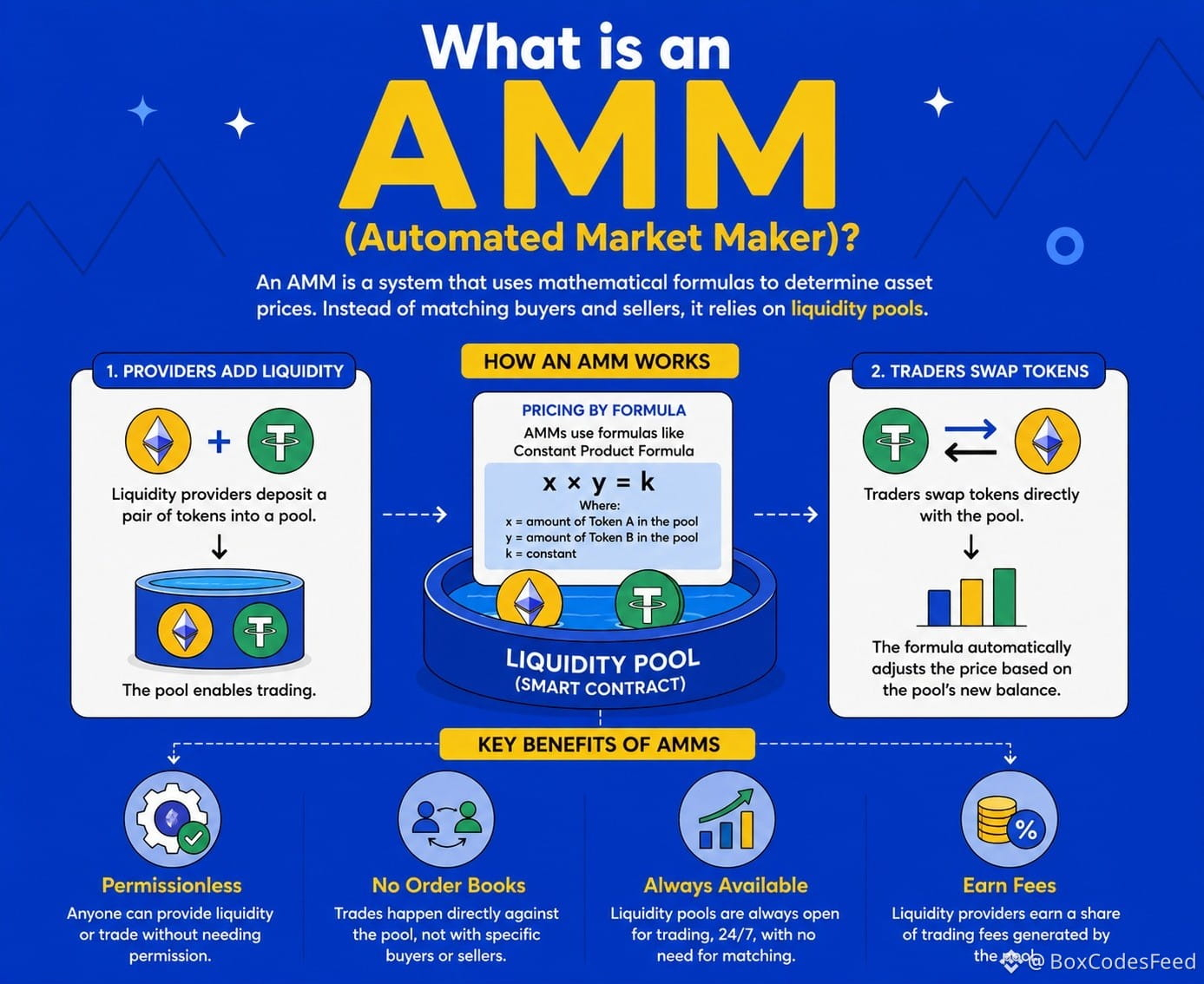
AMM = A trading method that uses algorithms for automatic pricing, the backbone of decentralized exchanges.
How do traditional exchanges operate?
Buyers and sellers place orders, and the exchange matches them.
How does AMM work?
No counterparties needed! You trade directly with the "liquidity pool."
Core formula (x * y = k):
• x = Amount of Token A
• y = Amount of Token B
• k = Constant
• Buying A → A decreases → A price automatically rises
For example:
The pool has 100 ETH + 8,000,000 USDT
k = 100 × 8,000,000 = 800,000,000
You use 80,000 USDT to buy ETH:
New USDT = 8,080,000
New ETH = 800,000,000 / 8,080,000 ≈ 99.01
You bought ≈ 0.99 ETH
What is slippage?
The more you buy, the larger the price deviation. Large trades can cause significant price volatility.
Representative projects:
• Uniswap (Largest DEX on Ethereum)
• Curve (Optimal for stablecoin trading)
• PancakeSwap (Largest DEX on BNB Chain)
• Jupiter (Largest DEX on Solana)
Advantages: Trade anytime, no counterparties needed
Disadvantages: Large trades suffer from high slippage, potential impermanent loss
💬 Interactive Question: Have you traded on a DEX? Have you ever been caught by slippage?
#AMM #DEX #DeFi #Uniswap #TradingMechanism
💡 In-depth Market Analysis:
From the current market structure, the forces of bulls and bears are being redistributed. Short-term volatility does not mean a trend change; the key is to identify the true intentions of the main funds. It's advisable to monitor changes in trading volume and on-chain data, as these often reflect the market's real condition better than price itself.
🧠 Trading Psychology Development:
• Don't make frequent moves because of short-term fluctuations; patiently wait for the optimal entry point.
• Develop a trading plan and stick to it, avoiding emotional decisions.
• Accepting losses is part of trading; what matters is controlling the extent of those losses.
• Maintain a learning mindset; the market is always changing, and knowledge must be updated continuously.
• Remember: Preserving your capital is always more important than chasing profits.
📚 Industry Knowledge Expansion:
• Blockchain technology is evolving from mere digital currencies to broader financial infrastructure.
• DeFi (Decentralized Finance) is reshaping how traditional financial services operate.
• NFTs and GameFi are opening new application scenarios for digital assets.
• Regulatory policies in various countries are gradually clarifying; compliance is the inevitable trend in industry development.
🔄 What is an AMM (Automated Market Maker)? The Core Mechanism of DEX
Current Fear and Greed Index: 30
AMM = A trading method that uses algorithms for automatic pricing, the backbone of decentralized exchanges.
How do traditional exchanges operate?
Buyers and sellers place orders, and the exchange matches them.
How does AMM work?
No counterparties needed! You trade directly with the "liquidity pool."
Core formula (x * y = k):
• x = Amount of Token A
• y = Amount of Token B
• k = Constant
• Buying A → A decreases → A price automatically rises
For example:
The pool has 100 ETH + 8,000,000 USDT
k = 100 × 8,000,000 = 800,000,000
You use 80,000 USDT to buy ETH:
New USDT = 8,080,000
New ETH = 800,000,000 / 8,080,000 ≈ 99.01
You bought ≈ 0.99 ETH
What is slippage?
The more you buy, the larger the price deviation. Large trades can cause significant price volatility.
Representative projects:
• Uniswap (Largest DEX on Ethereum)
• Curve (Optimal for stablecoin trading)
• PancakeSwap (Largest DEX on BNB Chain)
• Jupiter (Largest DEX on Solana)
Advantages: Trade anytime, no counterparties needed
Disadvantages: Large trades suffer from high slippage, potential impermanent loss
💬 Interactive Question: Have you traded on a DEX? Have you ever been caught by slippage?
#AMM #DEX #DeFi #Uniswap #TradingMechanism
💡 In-depth Market Analysis:
From the current market structure, the forces of bulls and bears are being redistributed. Short-term volatility does not mean a trend change; the key is to identify the true intentions of the main funds. It's advisable to monitor changes in trading volume and on-chain data, as these often reflect the market's real condition better than price itself.
🧠 Trading Psychology Development:
• Don't make frequent moves because of short-term fluctuations; patiently wait for the optimal entry point.
• Develop a trading plan and stick to it, avoiding emotional decisions.
• Accepting losses is part of trading; what matters is controlling the extent of those losses.
• Maintain a learning mindset; the market is always changing, and knowledge must be updated continuously.
• Remember: Preserving your capital is always more important than chasing profits.
📚 Industry Knowledge Expansion:
• Blockchain technology is evolving from mere digital currencies to broader financial infrastructure.
• DeFi (Decentralized Finance) is reshaping how traditional financial services operate.
• NFTs and GameFi are opening new application scenarios for digital assets.
• Regulatory policies in various countries are gradually clarifying; compliance is the inevitable trend in industry development.
Current Fear and Greed Index: 30
AMM = A trading method that uses algorithms for automatic pricing, the backbone of decentralized exchanges.
How do traditional exchanges operate?
Buyers and sellers place orders, and the exchange matches them.
How does AMM work?
No counterparties needed! You trade directly with the "liquidity pool."
Core formula (x * y = k):
• x = Amount of Token A
• y = Amount of Token B
• k = Constant
• Buying A → A decreases → A price automatically rises
For example:
The pool has 100 ETH + 8,000,000 USDT
k = 100 × 8,000,000 = 800,000,000
You use 80,000 USDT to buy ETH:
New USDT = 8,080,000
New ETH = 800,000,000 / 8,080,000 ≈ 99.01
You bought ≈ 0.99 ETH
What is slippage?
The more you buy, the larger the price deviation. Large trades can cause significant price volatility.
Representative projects:
• Uniswap (Largest DEX on Ethereum)
• Curve (Optimal for stablecoin trading)
• PancakeSwap (Largest DEX on BNB Chain)
• Jupiter (Largest DEX on Solana)
Advantages: Trade anytime, no counterparties needed
Disadvantages: Large trades suffer from high slippage, potential impermanent loss
💬 Interactive Question: Have you traded on a DEX? Have you ever been caught by slippage?
#AMM #DEX #DeFi #Uniswap #TradingMechanism
💡 In-depth Market Analysis:
From the current market structure, the forces of bulls and bears are being redistributed. Short-term volatility does not mean a trend change; the key is to identify the true intentions of the main funds. It's advisable to monitor changes in trading volume and on-chain data, as these often reflect the market's real condition better than price itself.
🧠 Trading Psychology Development:
• Don't make frequent moves because of short-term fluctuations; patiently wait for the optimal entry point.
• Develop a trading plan and stick to it, avoiding emotional decisions.
• Accepting losses is part of trading; what matters is controlling the extent of those losses.
• Maintain a learning mindset; the market is always changing, and knowledge must be updated continuously.
• Remember: Preserving your capital is always more important than chasing profits.
📚 Industry Knowledge Expansion:
• Blockchain technology is evolving from mere digital currencies to broader financial infrastructure.
• DeFi (Decentralized Finance) is reshaping how traditional financial services operate.
• NFTs and GameFi are opening new application scenarios for digital assets.
• Regulatory policies in various countries are gradually clarifying; compliance is the inevitable trend in industry development.
191

·
--
The Sui network yield infrastructure $HAEDAL a recently integrated a new product, PropAMM, always with the goal of improving yields for users.
But before diving into the new feature, let’s go back to the basics so everyone can easily follow along.
A classic AMM (like the ones you see everywhere) is a liquidity pool where you and I deposit tokens. The price moves automatically according to a fixed mathematical curve. It’s great because it’s open to everyone and very composable.
But here’s the problem: on heavily traded pairs like (SOL/USDC, SUI/USDC, etc.), this passive liquidity shows its limits. There is a lot of slippage, and a large part of arbitrage profits goes to external bots instead of benefiting the protocol and its community.
That’s where PropAMMs come in to fix that. Haedal understood the game and is moving up a gear!
Do you want the rest?
#defi #AMM
The Sui network yield infrastructure $HAEDAL a recently integrated a new product, PropAMM, always with the goal of improving yields for users.
But before diving into the new feature, let’s go back to the basics so everyone can easily follow along.
A classic AMM (like the ones you see everywhere) is a liquidity pool where you and I deposit tokens. The price moves automatically according to a fixed mathematical curve. It’s great because it’s open to everyone and very composable.
But here’s the problem: on heavily traded pairs like (SOL/USDC, SUI/USDC, etc.), this passive liquidity shows its limits. There is a lot of slippage, and a large part of arbitrage profits goes to external bots instead of benefiting the protocol and its community.
That’s where PropAMMs come in to fix that. Haedal understood the game and is moving up a gear!
Do you want the rest?
#defi #AMM
But before diving into the new feature, let’s go back to the basics so everyone can easily follow along.
A classic AMM (like the ones you see everywhere) is a liquidity pool where you and I deposit tokens. The price moves automatically according to a fixed mathematical curve. It’s great because it’s open to everyone and very composable.
But here’s the problem: on heavily traded pairs like (SOL/USDC, SUI/USDC, etc.), this passive liquidity shows its limits. There is a lot of slippage, and a large part of arbitrage profits goes to external bots instead of benefiting the protocol and its community.
That’s where PropAMMs come in to fix that. Haedal understood the game and is moving up a gear!
Do you want the rest?
#defi #AMM

6
2.7k


·
--
Article
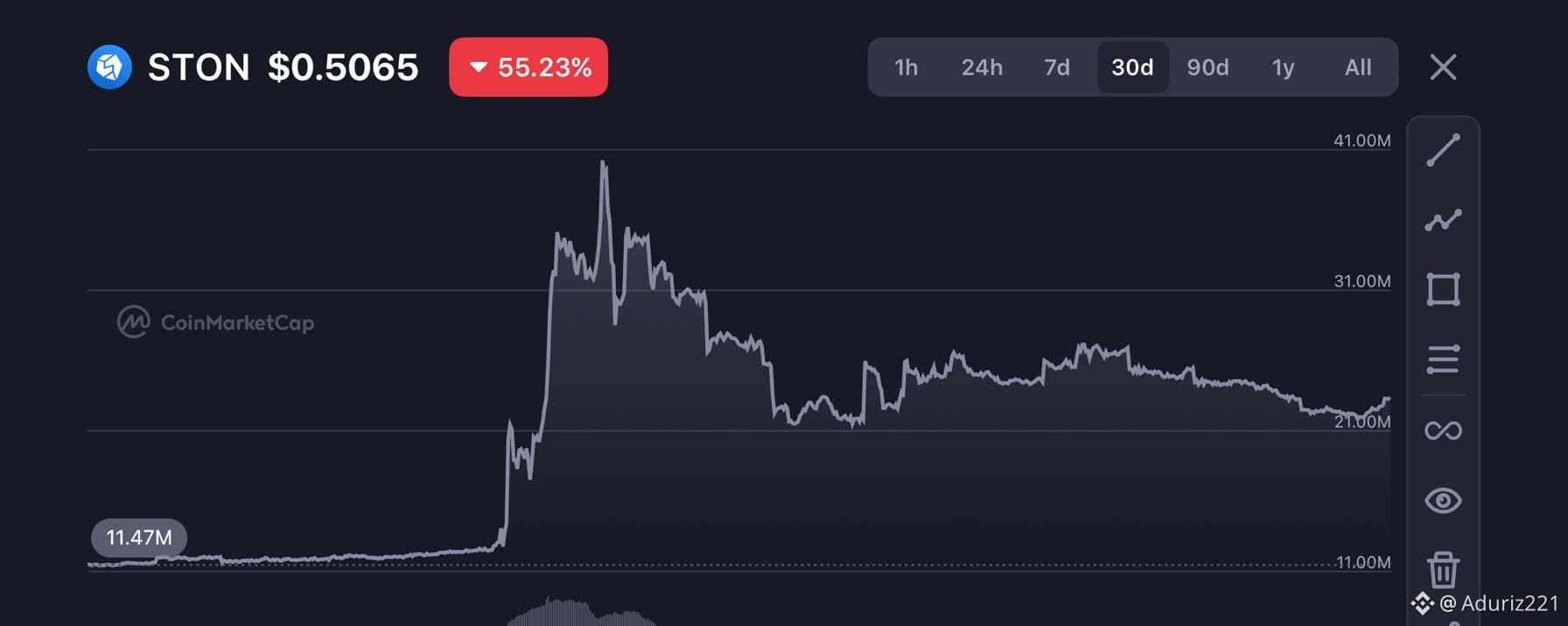
Demystifying Automated Market Makers: The Architecture of Passive Fee Accumulation on TONThe transition from centralized order-book systems to decentralized liquidity architectures represents a fundamental shift in how market participants interact with digital assets. In traditional financial frameworks, liquidity provisioning is highly gatekept, favoring institutional market makers who capture the spread on high-volume asset movement.
Within the $TON ecosystem, STON.fi decentralizes this infrastructure entirely through its native Automated Market Maker (AMM) protocol. Instead of relying on matching buyers and sellers manually via a centralized matching engine, STON.fi utilizes deterministic liquidity pools.
By depositing assets into these pools, everyday market participants shift from speculative trading to becoming protocol infrastructure operators.
Every trade routed through the AMM triggers a fixed execution fee, distributed proportionally back to the liquidity providers.
Because Stonfi is engineered directly on TON’s asynchronous, infinitely sharded ledger, it handles massive transactional spikes during high-volume weekend trading without ledger congestion or predatory slippage taxes.
In a landscape defined by volatility, positioning capital as core trading infrastructure remains the most sustainable mechanism for long-term value accrual
#TONBlockchain #AMM
Demystifying Automated Market Makers: The Architecture of Passive Fee Accumulation on TON
The transition from centralized order-book systems to decentralized liquidity architectures represents a fundamental shift in how market participants interact with digital assets. In traditional financial frameworks, liquidity provisioning is highly gatekept, favoring institutional market makers who capture the spread on high-volume asset movement.
Within the $TON ecosystem, STON.fi decentralizes this infrastructure entirely through its native Automated Market Maker (AMM) protocol. Instead of relying on matching buyers and sellers manually via a centralized matching engine, STON.fi utilizes deterministic liquidity pools.
By depositing assets into these pools, everyday market participants shift from speculative trading to becoming protocol infrastructure operators.
Every trade routed through the AMM triggers a fixed execution fee, distributed proportionally back to the liquidity providers.
Because Stonfi is engineered directly on TON’s asynchronous, infinitely sharded ledger, it handles massive transactional spikes during high-volume weekend trading without ledger congestion or predatory slippage taxes.
In a landscape defined by volatility, positioning capital as core trading infrastructure remains the most sustainable mechanism for long-term value accrual
#TONBlockchain #AMM
Within the $TON ecosystem, STON.fi decentralizes this infrastructure entirely through its native Automated Market Maker (AMM) protocol. Instead of relying on matching buyers and sellers manually via a centralized matching engine, STON.fi utilizes deterministic liquidity pools.
By depositing assets into these pools, everyday market participants shift from speculative trading to becoming protocol infrastructure operators.
Every trade routed through the AMM triggers a fixed execution fee, distributed proportionally back to the liquidity providers.
Because Stonfi is engineered directly on TON’s asynchronous, infinitely sharded ledger, it handles massive transactional spikes during high-volume weekend trading without ledger congestion or predatory slippage taxes.
In a landscape defined by volatility, positioning capital as core trading infrastructure remains the most sustainable mechanism for long-term value accrual
#TONBlockchain #AMM
145

💧 Understanding Liquidity Pools: How Automated Market Makers Keep Crypto Markets Moving
On July 12, 2026, with total daily volume of $48.24B, automated market makers (AMMs) are responsible for a significant portion of trading activity. But how do they work?
Liquidity pools are collections of funds locked in smart contracts that provide liquidity for trading. Users (liquidity providers) deposit tokens into these pools and earn fees from trades.
AMMs use mathematical formulas to determine prices based on the ratio of assets in the pool, ensuring there's always liquidity available — even for less popular trading pairs.
📌 Key Takeaway:
Liquidity pools and AMMs are the backbone of DeFi trading — they democratize market making and enable permissionless exchange.
#AMM #LiquidityPools #DeFi #CryptoEducation
#BinanceAlphaAlert
💧 Understanding Liquidity Pools: How Automated Market Makers Keep Crypto Markets Moving
On July 12, 2026, with total daily volume of $48.24B, automated market makers (AMMs) are responsible for a significant portion of trading activity. But how do they work?
Liquidity pools are collections of funds locked in smart contracts that provide liquidity for trading. Users (liquidity providers) deposit tokens into these pools and earn fees from trades.
AMMs use mathematical formulas to determine prices based on the ratio of assets in the pool, ensuring there's always liquidity available — even for less popular trading pairs.
📌 Key Takeaway:
Liquidity pools and AMMs are the backbone of DeFi trading — they democratize market making and enable permissionless exchange.
#AMM #LiquidityPools #DeFi #CryptoEducation
#BinanceAlphaAlert
On July 12, 2026, with total daily volume of $48.24B, automated market makers (AMMs) are responsible for a significant portion of trading activity. But how do they work?
Liquidity pools are collections of funds locked in smart contracts that provide liquidity for trading. Users (liquidity providers) deposit tokens into these pools and earn fees from trades.
AMMs use mathematical formulas to determine prices based on the ratio of assets in the pool, ensuring there's always liquidity available — even for less popular trading pairs.
📌 Key Takeaway:
Liquidity pools and AMMs are the backbone of DeFi trading — they democratize market making and enable permissionless exchange.
#AMM #LiquidityPools #DeFi #CryptoEducation
#BinanceAlphaAlert
20
📚 Automated Market Makers AMMs: How DEXs price assets without order books
On July 16, 2026, AMMs are the backbone of decentralized exchanges. Unlike traditional exchanges that match buy and sell orders, AMMs use mathematical formulas to price assets automatically based on the ratio of tokens in a liquidity pool.
The simplest AMM uses the constant product formula: x × y = k. If a pool has 100 Token A and 100 Token B, k = 10,000. When you buy Token A with Token B, the ratio shifts and the price adjusts according to the curve.
AMMs allow anyone to become a market maker by depositing tokens into liquidity pools. Liquidity providers earn trading fees in return, but must understand impermanent loss — the risk of holding tokens in a pool vs holding them separately.
📌 Key Takeaway:
AMMs use mathematical formulas instead of order books to price assets. The constant product formula (x×y=k) enables automated, trustless trading on DEXs like Uniswap.
#AMM #DeFi
#BinanceAlphaAlert
📚 Automated Market Makers AMMs: How DEXs price assets without order books
On July 16, 2026, AMMs are the backbone of decentralized exchanges. Unlike traditional exchanges that match buy and sell orders, AMMs use mathematical formulas to price assets automatically based on the ratio of tokens in a liquidity pool.
The simplest AMM uses the constant product formula: x × y = k. If a pool has 100 Token A and 100 Token B, k = 10,000. When you buy Token A with Token B, the ratio shifts and the price adjusts according to the curve.
AMMs allow anyone to become a market maker by depositing tokens into liquidity pools. Liquidity providers earn trading fees in return, but must understand impermanent loss — the risk of holding tokens in a pool vs holding them separately.
📌 Key Takeaway:
AMMs use mathematical formulas instead of order books to price assets. The constant product formula (x×y=k) enables automated, trustless trading on DEXs like Uniswap.
#AMM #DeFi
#BinanceAlphaAlert
On July 16, 2026, AMMs are the backbone of decentralized exchanges. Unlike traditional exchanges that match buy and sell orders, AMMs use mathematical formulas to price assets automatically based on the ratio of tokens in a liquidity pool.
The simplest AMM uses the constant product formula: x × y = k. If a pool has 100 Token A and 100 Token B, k = 10,000. When you buy Token A with Token B, the ratio shifts and the price adjusts according to the curve.
AMMs allow anyone to become a market maker by depositing tokens into liquidity pools. Liquidity providers earn trading fees in return, but must understand impermanent loss — the risk of holding tokens in a pool vs holding them separately.
📌 Key Takeaway:
AMMs use mathematical formulas instead of order books to price assets. The constant product formula (x×y=k) enables automated, trustless trading on DEXs like Uniswap.
#AMM #DeFi
#BinanceAlphaAlert
17

·
--
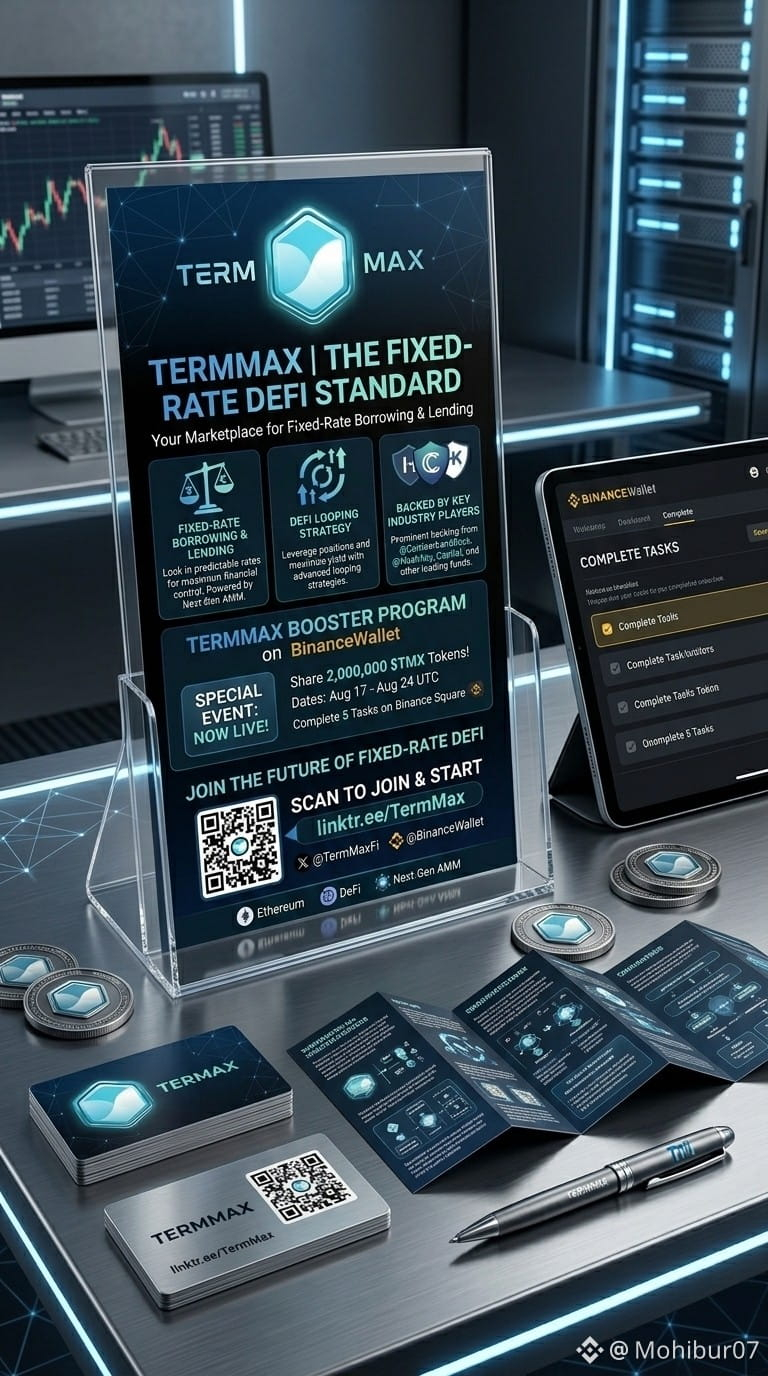
#termmax @termmax 🚀 TERMMAX: Building a New Standard for Fixed-Rate DeFi
DeFi has transformed how people borrow, lend, and put capital to work. But one challenge continues to shape the experience: rate uncertainty.
Variable borrowing and lending rates can move quickly as market conditions change. For users managing leveraged positions, yield strategies, or longer-term capital, that uncertainty can make planning much harder.
Fixed-Rate DeFi Is Getting a New Standard
What if borrowing and lending could be built around **predictable fixed rates** instead of constantly changing market conditions?
Meet **TermMax** — a fixed-rate DeFi marketplace designed to bring more structure and flexibility to on-chain borrowing and lending.
🔹 **Fixed-Rate Borrowing & Lending**
Lock in predictable rates and plan your positions with greater clarity.
🔹 **DeFi Looping Strategies**
Leverage positions and explore advanced looping strategies designed to maximize capital efficiency.
🔹 **Next-Gen AMM Infrastructure**
A new approach to fixed-rate DeFi liquidity and market infrastructure.
🔥 **TERMMAX BOOSTER PROGRAM × Binance Wallet**
The special event is **LIVE from Aug 17–24 UTC**.
🎁 **2,000,000 $TMX tokens** in rewards
📌 Complete **5 tasks on Binance Square**
⚡ Participate, explore TermMax, and join the growing fixed-rate DeFi ecosystem.
👉 **Join & Start:** linktr.ee/TermMax
Follow **@TermMaxFi** and stay tuned for more updates.
#TermMax #TMX #DeFi #BinanceWallet #BinanceSquare #FixedRateDeFi #Crypto #Web3 #AMM
#termmax @TermMax 🚀 TERMMAX: Building a New Standard for Fixed-Rate DeFi
DeFi has transformed how people borrow, lend, and put capital to work. But one challenge continues to shape the experience: rate uncertainty.
Variable borrowing and lending rates can move quickly as market conditions change. For users managing leveraged positions, yield strategies, or longer-term capital, that uncertainty can make planning much harder.
Fixed-Rate DeFi Is Getting a New Standard
What if borrowing and lending could be built around **predictable fixed rates** instead of constantly changing market conditions?
Meet **TermMax** — a fixed-rate DeFi marketplace designed to bring more structure and flexibility to on-chain borrowing and lending.
🔹 **Fixed-Rate Borrowing & Lending**
Lock in predictable rates and plan your positions with greater clarity.
🔹 **DeFi Looping Strategies**
Leverage positions and explore advanced looping strategies designed to maximize capital efficiency.
🔹 **Next-Gen AMM Infrastructure**
A new approach to fixed-rate DeFi liquidity and market infrastructure.
🔥 **TERMMAX BOOSTER PROGRAM × Binance Wallet**
The special event is **LIVE from Aug 17–24 UTC**.
🎁 **2,000,000 $TMX tokens** in rewards
📌 Complete **5 tasks on Binance Square**
⚡ Participate, explore TermMax, and join the growing fixed-rate DeFi ecosystem.
👉 **Join & Start:** linktr.ee/TermMax
Follow **@TermMaxFi** and stay tuned for more updates.
#TermMax #TMX #DeFi #BinanceWallet #BinanceSquare #FixedRateDeFi #Crypto #Web3 #AMM
DeFi has transformed how people borrow, lend, and put capital to work. But one challenge continues to shape the experience: rate uncertainty.
Variable borrowing and lending rates can move quickly as market conditions change. For users managing leveraged positions, yield strategies, or longer-term capital, that uncertainty can make planning much harder.
Fixed-Rate DeFi Is Getting a New Standard
What if borrowing and lending could be built around **predictable fixed rates** instead of constantly changing market conditions?
Meet **TermMax** — a fixed-rate DeFi marketplace designed to bring more structure and flexibility to on-chain borrowing and lending.
🔹 **Fixed-Rate Borrowing & Lending**
Lock in predictable rates and plan your positions with greater clarity.
🔹 **DeFi Looping Strategies**
Leverage positions and explore advanced looping strategies designed to maximize capital efficiency.
🔹 **Next-Gen AMM Infrastructure**
A new approach to fixed-rate DeFi liquidity and market infrastructure.
🔥 **TERMMAX BOOSTER PROGRAM × Binance Wallet**
The special event is **LIVE from Aug 17–24 UTC**.
🎁 **2,000,000 $TMX tokens** in rewards
📌 Complete **5 tasks on Binance Square**
⚡ Participate, explore TermMax, and join the growing fixed-rate DeFi ecosystem.
👉 **Join & Start:** linktr.ee/TermMax
Follow **@TermMaxFi** and stay tuned for more updates.
#TermMax #TMX #DeFi #BinanceWallet #BinanceSquare #FixedRateDeFi #Crypto #Web3 #AMM
5
5
112

·
--
Why STON.fi Is Becoming a Key Part of DeFi on TON
If you’ve been exploring the Telegram and TON ecosystem, there’s a good chance you’ve come across STON.fi. But what makes it such an important part of the TON DeFi landscape?
Here’s a quick look at some of the features that stand out:
1. Non-Custodial Trading
Users keep control of their assets and can interact with STON.fi directly through supported wallets, rather than depositing funds into a centralized exchange.
2. AMM-Based Trading
STON.fi uses automated market maker technology, allowing users to trade through liquidity pools instead of relying on traditional order books.
3. Low Transaction Costs
TON is designed for fast, low-cost transactions, which can make activities such as swapping tokens and providing liquidity more accessible.
Whether you’re exploring new tokens, swapping assets, or contributing liquidity to DeFi pools, STON.fi provides an important gateway into the growing TON DeFi ecosystem.
#Amm #Stonfi
Why STON.fi Is Becoming a Key Part of DeFi on TON
If you’ve been exploring the Telegram and TON ecosystem, there’s a good chance you’ve come across STON.fi. But what makes it such an important part of the TON DeFi landscape?
Here’s a quick look at some of the features that stand out:
1. Non-Custodial Trading
Users keep control of their assets and can interact with STON.fi directly through supported wallets, rather than depositing funds into a centralized exchange.
2. AMM-Based Trading
STON.fi uses automated market maker technology, allowing users to trade through liquidity pools instead of relying on traditional order books.
3. Low Transaction Costs
TON is designed for fast, low-cost transactions, which can make activities such as swapping tokens and providing liquidity more accessible.
Whether you’re exploring new tokens, swapping assets, or contributing liquidity to DeFi pools, STON.fi provides an important gateway into the growing TON DeFi ecosystem.
#Amm #Stonfi
If you’ve been exploring the Telegram and TON ecosystem, there’s a good chance you’ve come across STON.fi. But what makes it such an important part of the TON DeFi landscape?
Here’s a quick look at some of the features that stand out:
1. Non-Custodial Trading
Users keep control of their assets and can interact with STON.fi directly through supported wallets, rather than depositing funds into a centralized exchange.
2. AMM-Based Trading
STON.fi uses automated market maker technology, allowing users to trade through liquidity pools instead of relying on traditional order books.
3. Low Transaction Costs
TON is designed for fast, low-cost transactions, which can make activities such as swapping tokens and providing liquidity more accessible.
Whether you’re exploring new tokens, swapping assets, or contributing liquidity to DeFi pools, STON.fi provides an important gateway into the growing TON DeFi ecosystem.
#Amm #Stonfi


11

·
--
$UNI
A push-up to 4.575, followed by three consecutive candles with upper wicks. The bulls couldn’t push any further.
From 3.67 to 4.57, it rose 24.6% in 12 days. That’s not a mild move among major coins. Uniswap is the DEX king, and the pioneer of the AMM model—on-chain trading can’t really avoid it. But when the good news is “fully priced in,” the more widely recognized the leader, the more orderly the sell pressure becomes.
Market signals. Currently consolidating around 4.33, it has fallen 5.3% from the 24h high of 4.575. The marked price is 4.3345, basically matching the current price, with no clear bias between longs and shorts. Funding rate is 0.0094%, positive—longs are still paying. But it’s very low, suggesting long leverage isn’t aggressive. This isn’t a phase of frenzy pump; it looks more like profit-taking gradually exiting.
Market sentiment. 24h trading volume is 192 million, with volume of 43.76 million tokens. Compared with the rally period where single 4h candles reached 9.49 million in volume, the current volume has already shrunk. Heavy volume at the high followed by a stall is a typical turnover/switching signal—some people are selling here, others are absorbing. But the absorption strength is weakening: the latest 4h candle’s volume is only 1.18 million, which is six times lower than the previous one’s 7.09 million. Sentiment is cooling.
Whale activity. Early in the rally there were two huge-volume candles: 9.41 million and 9.49 million in traded volume—that was institutions or big players pushing. After that, candle volume kept declining: 7.09 million → 6.99 million → 1.18 million. Whales pumped and then left; retail is the one catching bids at the highs. This isn’t a conspiracy theory—just the simplest volume-price logic. Mark price and index price almost overlap, with no one firmly propping up the price hard on the contract side. Spot dictates direction; the derivatives follow.
Volume-price structure. 4.575 is the short-term ceiling. Below it, the first support at 4.315–4.258 is the low zone of the recent pullback. Further down, 3.978–3.957 is the platform before the pump, and also the launch point of this wave. If it breaks 4.25, there’s a good chance it returns to around 3.97. In a +24% rally, a pullback of 30%–50% is considered a normal retracement.
Candlestick details. In the most recent five 4h candles, four have upper wicks. The longest upper wick appeared at 4.575—price was smashed back to 4.37 after the spike. It then rebounded to 4.564, only to be rejected again. Both attempts failed in the same area, meaning there are real sell orders there. The current candle’s body is small, with short upper and lower wicks; volatility is narrowing. A turning point is near. Direction? Bearish. Consecutive failed breakout attempts + shrinking volume + funding rate not cooperating.
Nini’s plan. Bearish bias. Current price: 4.33. If the rebound can’t break through and hold in the 4.45–4.50 range, enter a short in that area with a stop-loss above 4.60. Targets: first look at 4.25; if it breaks, then 3.97. No long entries, and no left-side catching of the bottom. Wait for a pullback to the support zone, a volume contraction, and stabilization before considering. This rally rose too fast—pullbacks are inevitable; it’s just a question of timing and how deep it goes.
#$UNI #DEX #AMM
$UNI
A push-up to 4.575, followed by three consecutive candles with upper wicks. The bulls couldn’t push any further.
From 3.67 to 4.57, it rose 24.6% in 12 days. That’s not a mild move among major coins. Uniswap is the DEX king, and the pioneer of the AMM model—on-chain trading can’t really avoid it. But when the good news is “fully priced in,” the more widely recognized the leader, the more orderly the sell pressure becomes.
Market signals. Currently consolidating around 4.33, it has fallen 5.3% from the 24h high of 4.575. The marked price is 4.3345, basically matching the current price, with no clear bias between longs and shorts. Funding rate is 0.0094%, positive—longs are still paying. But it’s very low, suggesting long leverage isn’t aggressive. This isn’t a phase of frenzy pump; it looks more like profit-taking gradually exiting.
Market sentiment. 24h trading volume is 192 million, with volume of 43.76 million tokens. Compared with the rally period where single 4h candles reached 9.49 million in volume, the current volume has already shrunk. Heavy volume at the high followed by a stall is a typical turnover/switching signal—some people are selling here, others are absorbing. But the absorption strength is weakening: the latest 4h candle’s volume is only 1.18 million, which is six times lower than the previous one’s 7.09 million. Sentiment is cooling.
Whale activity. Early in the rally there were two huge-volume candles: 9.41 million and 9.49 million in traded volume—that was institutions or big players pushing. After that, candle volume kept declining: 7.09 million → 6.99 million → 1.18 million. Whales pumped and then left; retail is the one catching bids at the highs. This isn’t a conspiracy theory—just the simplest volume-price logic. Mark price and index price almost overlap, with no one firmly propping up the price hard on the contract side. Spot dictates direction; the derivatives follow.
Volume-price structure. 4.575 is the short-term ceiling. Below it, the first support at 4.315–4.258 is the low zone of the recent pullback. Further down, 3.978–3.957 is the platform before the pump, and also the launch point of this wave. If it breaks 4.25, there’s a good chance it returns to around 3.97. In a +24% rally, a pullback of 30%–50% is considered a normal retracement.
Candlestick details. In the most recent five 4h candles, four have upper wicks. The longest upper wick appeared at 4.575—price was smashed back to 4.37 after the spike. It then rebounded to 4.564, only to be rejected again. Both attempts failed in the same area, meaning there are real sell orders there. The current candle’s body is small, with short upper and lower wicks; volatility is narrowing. A turning point is near. Direction? Bearish. Consecutive failed breakout attempts + shrinking volume + funding rate not cooperating.
Nini’s plan. Bearish bias. Current price: 4.33. If the rebound can’t break through and hold in the 4.45–4.50 range, enter a short in that area with a stop-loss above 4.60. Targets: first look at 4.25; if it breaks, then 3.97. No long entries, and no left-side catching of the bottom. Wait for a pullback to the support zone, a volume contraction, and stabilization before considering. This rally rose too fast—pullbacks are inevitable; it’s just a question of timing and how deep it goes.
#$UNI #DEX #AMM
A push-up to 4.575, followed by three consecutive candles with upper wicks. The bulls couldn’t push any further.
From 3.67 to 4.57, it rose 24.6% in 12 days. That’s not a mild move among major coins. Uniswap is the DEX king, and the pioneer of the AMM model—on-chain trading can’t really avoid it. But when the good news is “fully priced in,” the more widely recognized the leader, the more orderly the sell pressure becomes.
Market signals. Currently consolidating around 4.33, it has fallen 5.3% from the 24h high of 4.575. The marked price is 4.3345, basically matching the current price, with no clear bias between longs and shorts. Funding rate is 0.0094%, positive—longs are still paying. But it’s very low, suggesting long leverage isn’t aggressive. This isn’t a phase of frenzy pump; it looks more like profit-taking gradually exiting.
Market sentiment. 24h trading volume is 192 million, with volume of 43.76 million tokens. Compared with the rally period where single 4h candles reached 9.49 million in volume, the current volume has already shrunk. Heavy volume at the high followed by a stall is a typical turnover/switching signal—some people are selling here, others are absorbing. But the absorption strength is weakening: the latest 4h candle’s volume is only 1.18 million, which is six times lower than the previous one’s 7.09 million. Sentiment is cooling.
Whale activity. Early in the rally there were two huge-volume candles: 9.41 million and 9.49 million in traded volume—that was institutions or big players pushing. After that, candle volume kept declining: 7.09 million → 6.99 million → 1.18 million. Whales pumped and then left; retail is the one catching bids at the highs. This isn’t a conspiracy theory—just the simplest volume-price logic. Mark price and index price almost overlap, with no one firmly propping up the price hard on the contract side. Spot dictates direction; the derivatives follow.
Volume-price structure. 4.575 is the short-term ceiling. Below it, the first support at 4.315–4.258 is the low zone of the recent pullback. Further down, 3.978–3.957 is the platform before the pump, and also the launch point of this wave. If it breaks 4.25, there’s a good chance it returns to around 3.97. In a +24% rally, a pullback of 30%–50% is considered a normal retracement.
Candlestick details. In the most recent five 4h candles, four have upper wicks. The longest upper wick appeared at 4.575—price was smashed back to 4.37 after the spike. It then rebounded to 4.564, only to be rejected again. Both attempts failed in the same area, meaning there are real sell orders there. The current candle’s body is small, with short upper and lower wicks; volatility is narrowing. A turning point is near. Direction? Bearish. Consecutive failed breakout attempts + shrinking volume + funding rate not cooperating.
Nini’s plan. Bearish bias. Current price: 4.33. If the rebound can’t break through and hold in the 4.45–4.50 range, enter a short in that area with a stop-loss above 4.60. Targets: first look at 4.25; if it breaks, then 3.97. No long entries, and no left-side catching of the bottom. Wait for a pullback to the support zone, a volume contraction, and stabilization before considering. This rally rose too fast—pullbacks are inevitable; it’s just a question of timing and how deep it goes.
#$UNI #DEX #AMM
293

$RAY /USDT — 🔴 SHORT · Conf 70%
📍 Entry: 1.3001 – 1.3079
🛑 SL: 1.4415
🎯 TP1: 1.2388
✅ TP2: 1.1866
🏆 TP3: 1.1084
1H structure is rolling over hard after wicking to 1.4758 — price is now sitting below the MA7 with volume fading, classic exhaustion print.
$RAY : Raydium is Solana's leading AMM and liquidity layer, powering a large share of on-chain DEX volume via its concentrated liquidity pools — risk is high Solana ecosystem dependency and the token's history of sharp post-pump drawdowns.
When RAY pumps +20% in a single session like this, does the liquidity Raydium generates for the Solana ecosystem actually translate into sustained token demand, or is RAY still trading more like a memecoin than a fundamental DeFi asset?
#RAY #Raydium #Crypto #TradingSignal #AMM
{spot}(RAYUSDT)
$RAY /USDT — 🔴 SHORT · Conf 70%
📍 Entry: 1.3001 – 1.3079
🛑 SL: 1.4415
🎯 TP1: 1.2388
✅ TP2: 1.1866
🏆 TP3: 1.1084
1H structure is rolling over hard after wicking to 1.4758 — price is now sitting below the MA7 with volume fading, classic exhaustion print.
$RAY : Raydium is Solana's leading AMM and liquidity layer, powering a large share of on-chain DEX volume via its concentrated liquidity pools — risk is high Solana ecosystem dependency and the token's history of sharp post-pump drawdowns.
When RAY pumps +20% in a single session like this, does the liquidity Raydium generates for the Solana ecosystem actually translate into sustained token demand, or is RAY still trading more like a memecoin than a fundamental DeFi asset?
#RAY #Raydium #Crypto #TradingSignal #AMM
📍 Entry: 1.3001 – 1.3079
🛑 SL: 1.4415
🎯 TP1: 1.2388
✅ TP2: 1.1866
🏆 TP3: 1.1084
1H structure is rolling over hard after wicking to 1.4758 — price is now sitting below the MA7 with volume fading, classic exhaustion print.
$RAY : Raydium is Solana's leading AMM and liquidity layer, powering a large share of on-chain DEX volume via its concentrated liquidity pools — risk is high Solana ecosystem dependency and the token's history of sharp post-pump drawdowns.
When RAY pumps +20% in a single session like this, does the liquidity Raydium generates for the Solana ecosystem actually translate into sustained token demand, or is RAY still trading more like a memecoin than a fundamental DeFi asset?
#RAY #Raydium #Crypto #TradingSignal #AMM

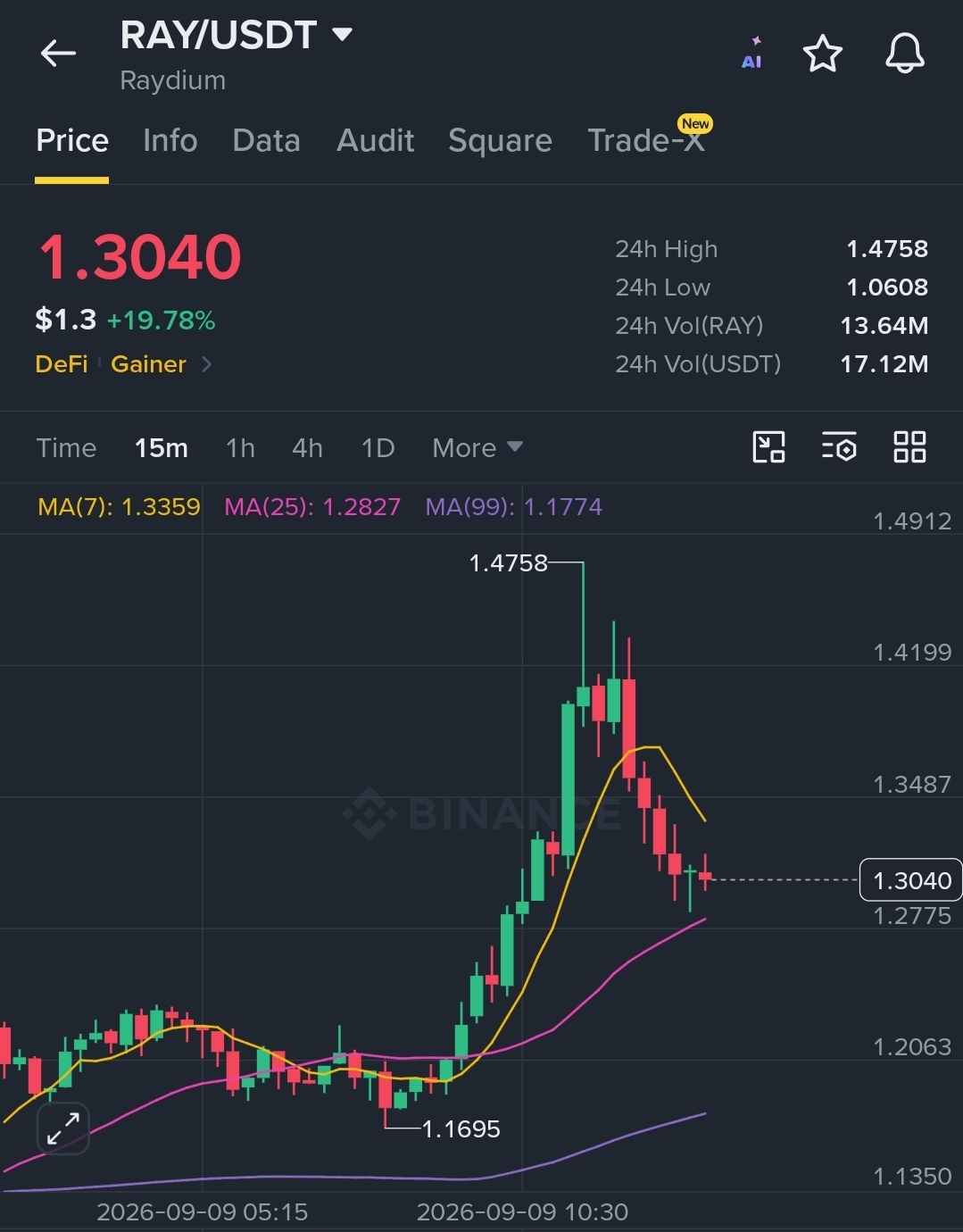
2
281
Log in to explore more content
Join global crypto users on Binance Square
⚡️ Get latest and useful information about crypto.
💬 Trusted by the world’s largest crypto exchange.
👍 Discover real insights from verified creators.
Email / Phone number
Trending Topics
1
#FedRateWatch
294,660 views
1,841 Discussing
2
#BitcoinSlidesTo$76000
4,884 views
64 Discussing
3
#BitcoinReboundsTo$79K
51,928 views
366 Discussing
4
#StrategyMarketCapPassesFord
12,051 views
366 Discussing
5
#ClarityActOddsHalveOnPolymarket
9,233 views
284 Discussing
6
#US30YTreasuryYieldTops5.40%
11,418 views
240 Discussing
7
#BessentEndorsesFinalClarityActDraft
30,231 views
558 Discussing
8
#ZamaOpens16ConfidentialMorphoVaults
11,200 views
268 Discussing
9
#USDCOnChainVolumeTops$100Trillion
1,664 views
40 Discussing
10
#BitcoinSpotETFsNetInflow$160M
2,505 views
92 Discussing