

#tokenomics
tokenomics
2.1M views
4,715 Discussing
Hot
Latest

·
--
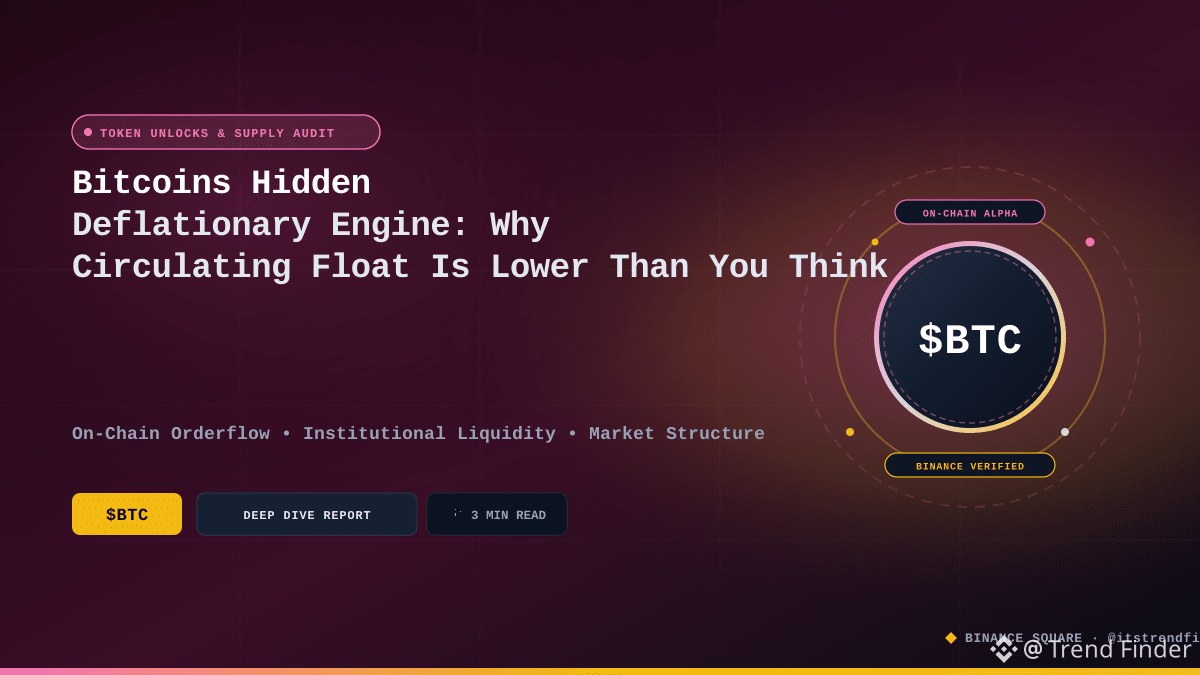
Bitcoin's Hidden Deflationary Engine: Why Circulating Float Is Lower Than You Think
While standard token unlock dashboards focus on aggressive venture capital vesting cliffs for new layer-1 protocols, Bitcoin operates under a completely different economic paradigm. With the April halving cutting daily issuance from 900 to 450 coins, annual supply expansion dropped below 0.85 percent. But looking strictly at the protocol emission schedule misses more than half of the supply-side reality.
Unlike altcoins that face periodic supply dilutive unlocks, $BTC experiences an organic, unscripted supply reduction every single day. On-chain forensics indicate roughly 3.7 million coins are permanently out of circulation due to lost private keys, early-era wallet dormancy, and unrecoverable early mining rewards. When you subtract these lost coins from the 19.7 million currently mined, the actual effective circulating float drops closer to 16 million coins.
With spot price floating near 80060 USD, illiquid supply held by long-term entities for over one year remains sitting at multi-year highs. This tight illiquid float means market absorption of daily miner issuance happens effortlessly. Unlike fiat central banks expanding supply endlessly, BTC combines a strict 21 million hard cap with continuous structural illiquidity, creating a compounding supply squeeze over multi-year cycles.
The real question isn't just how many new coins enter the market each block, but how few are actually available for spot buyers to absorb right now. Are you tracking effective liquid float or just looking at the aggregate market cap?
#TokenUnlocks #Tokenomics
Bitcoin's Hidden Deflationary Engine: Why Circulating Float Is Lower Than You Think
While standard token unlock dashboards focus on aggressive venture capital vesting cliffs for new layer-1 protocols, Bitcoin operates under a completely different economic paradigm. With the April halving cutting daily issuance from 900 to 450 coins, annual supply expansion dropped below 0.85 percent. But looking strictly at the protocol emission schedule misses more than half of the supply-side reality.
Unlike altcoins that face periodic supply dilutive unlocks, $BTC experiences an organic, unscripted supply reduction every single day. On-chain forensics indicate roughly 3.7 million coins are permanently out of circulation due to lost private keys, early-era wallet dormancy, and unrecoverable early mining rewards. When you subtract these lost coins from the 19.7 million currently mined, the actual effective circulating float drops closer to 16 million coins.
With spot price floating near 80060 USD, illiquid supply held by long-term entities for over one year remains sitting at multi-year highs. This tight illiquid float means market absorption of daily miner issuance happens effortlessly. Unlike fiat central banks expanding supply endlessly, BTC combines a strict 21 million hard cap with continuous structural illiquidity, creating a compounding supply squeeze over multi-year cycles.
The real question isn't just how many new coins enter the market each block, but how few are actually available for spot buyers to absorb right now. Are you tracking effective liquid float or just looking at the aggregate market cap?
#TokenUnlocks #Tokenomics
While standard token unlock dashboards focus on aggressive venture capital vesting cliffs for new layer-1 protocols, Bitcoin operates under a completely different economic paradigm. With the April halving cutting daily issuance from 900 to 450 coins, annual supply expansion dropped below 0.85 percent. But looking strictly at the protocol emission schedule misses more than half of the supply-side reality.
Unlike altcoins that face periodic supply dilutive unlocks, $BTC experiences an organic, unscripted supply reduction every single day. On-chain forensics indicate roughly 3.7 million coins are permanently out of circulation due to lost private keys, early-era wallet dormancy, and unrecoverable early mining rewards. When you subtract these lost coins from the 19.7 million currently mined, the actual effective circulating float drops closer to 16 million coins.
With spot price floating near 80060 USD, illiquid supply held by long-term entities for over one year remains sitting at multi-year highs. This tight illiquid float means market absorption of daily miner issuance happens effortlessly. Unlike fiat central banks expanding supply endlessly, BTC combines a strict 21 million hard cap with continuous structural illiquidity, creating a compounding supply squeeze over multi-year cycles.
The real question isn't just how many new coins enter the market each block, but how few are actually available for spot buyers to absorb right now. Are you tracking effective liquid float or just looking at the aggregate market cap?
#TokenUnlocks #Tokenomics
1
1


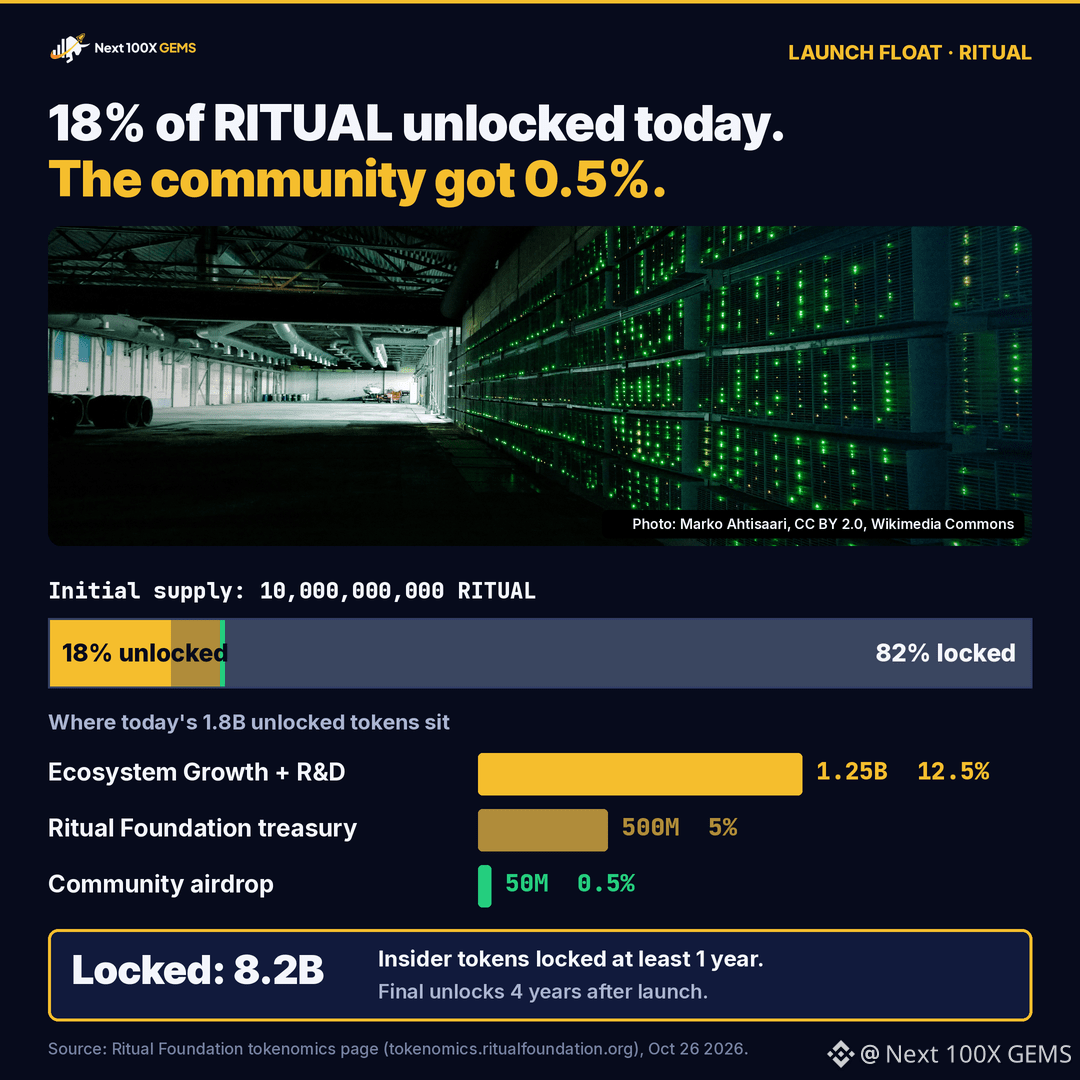
Ritual went live on mainnet today, and the token page says 18% of RITUAL is unlocked at launch. That is 1.8B tokens out of a 10B initial supply. Coinbase listed RITUAL-USD for today too, with trading opening once liquidity conditions are met.
The part worth reading twice is where that 1.8B sits. 1.25B comes from the Ecosystem Growth + R&D bucket and 500M from the Ritual Foundation treasury. The community airdrop to node operators, Frenrug users and long-time members is 50M tokens, 0.5% of supply, fully unlocked.
So 97% of the day-one float is held by the project side, not by airdrop farmers. If you are trying to read sell pressure this week, the airdrop wallets are the small story. Foundation and ecosystem wallets moving to exchanges would be the big one.
The other 8.2B is locked. Core contributors (29%) and Labs investors (11.3%) wait at least a year, and the last tokens unlock four years after launch. Supply has no cap either: about 5% yearly issuance, partly offset by base-fee burns.
Before you trade the listing, check the float math, not just the chart.
$RITUAL
#Ritual #Tokenomics
NFA. DYOR.
Ritual went live on mainnet today, and the token page says 18% of RITUAL is unlocked at launch. That is 1.8B tokens out of a 10B initial supply. Coinbase listed RITUAL-USD for today too, with trading opening once liquidity conditions are met.
The part worth reading twice is where that 1.8B sits. 1.25B comes from the Ecosystem Growth + R&D bucket and 500M from the Ritual Foundation treasury. The community airdrop to node operators, Frenrug users and long-time members is 50M tokens, 0.5% of supply, fully unlocked.
So 97% of the day-one float is held by the project side, not by airdrop farmers. If you are trying to read sell pressure this week, the airdrop wallets are the small story. Foundation and ecosystem wallets moving to exchanges would be the big one.
The other 8.2B is locked. Core contributors (29%) and Labs investors (11.3%) wait at least a year, and the last tokens unlock four years after launch. Supply has no cap either: about 5% yearly issuance, partly offset by base-fee burns.
Before you trade the listing, check the float math, not just the chart.
$RITUAL
#Ritual #Tokenomics
NFA. DYOR.
The part worth reading twice is where that 1.8B sits. 1.25B comes from the Ecosystem Growth + R&D bucket and 500M from the Ritual Foundation treasury. The community airdrop to node operators, Frenrug users and long-time members is 50M tokens, 0.5% of supply, fully unlocked.
So 97% of the day-one float is held by the project side, not by airdrop farmers. If you are trying to read sell pressure this week, the airdrop wallets are the small story. Foundation and ecosystem wallets moving to exchanges would be the big one.
The other 8.2B is locked. Core contributors (29%) and Labs investors (11.3%) wait at least a year, and the last tokens unlock four years after launch. Supply has no cap either: about 5% yearly issuance, partly offset by base-fee burns.
Before you trade the listing, check the float math, not just the chart.
$RITUAL
#Ritual #Tokenomics
NFA. DYOR.
60

$SHELL | Why Market-Cap Figures Differ Between Data Sites
The research report found that recent $SHELL market-cap estimates varied from roughly $6 million to 10.4 million. It also noted a substantial difference in reported circulating supply, with some sources listing approximately 270 million tokens and others around 458 million.
That discrepancy matters because market capitalization is calculated by multiplying the current token price by the circulating supply used by the data provider.
If two platforms use different circulating-supply figures, their market-cap estimates can differ even when they show nearly identical prices. This does not automatically mean one platform has made a mistake, but it does mean the underlying methodology needs to be checked.
Three terms are especially important.
Circulating market capitalization uses the provider's estimate of tokens currently circulating.
Fully diluted valuation, or FDV, generally uses the total or maximum token supply specified by the relevant methodology.
Total supply describes tokens that have been created, although the exact treatment of locked, burned or otherwise restricted tokens may vary by provider.
These measures answer different questions. Market cap estimates the value of the circulating supply at the current price, while FDV illustrates what valuation would look like under a broader supply assumption. Neither number alone tells us whether a token is cheap or expensive.
When comparing tokens, record the source, timestamp, circulating supply and calculation method. Consistent methodology makes comparisons far more meaningful.
#Tokenomics #MarketCap #DataQuality CryptoEducation Fundamentals
$SHELL | Why Market-Cap Figures Differ Between Data Sites
The research report found that recent $SHELL market-cap estimates varied from roughly $6 million to 10.4 million. It also noted a substantial difference in reported circulating supply, with some sources listing approximately 270 million tokens and others around 458 million.
That discrepancy matters because market capitalization is calculated by multiplying the current token price by the circulating supply used by the data provider.
If two platforms use different circulating-supply figures, their market-cap estimates can differ even when they show nearly identical prices. This does not automatically mean one platform has made a mistake, but it does mean the underlying methodology needs to be checked.
Three terms are especially important.
Circulating market capitalization uses the provider's estimate of tokens currently circulating.
Fully diluted valuation, or FDV, generally uses the total or maximum token supply specified by the relevant methodology.
Total supply describes tokens that have been created, although the exact treatment of locked, burned or otherwise restricted tokens may vary by provider.
These measures answer different questions. Market cap estimates the value of the circulating supply at the current price, while FDV illustrates what valuation would look like under a broader supply assumption. Neither number alone tells us whether a token is cheap or expensive.
When comparing tokens, record the source, timestamp, circulating supply and calculation method. Consistent methodology makes comparisons far more meaningful.
#Tokenomics #MarketCap #DataQuality CryptoEducation Fundamentals
The research report found that recent $SHELL market-cap estimates varied from roughly $6 million to 10.4 million. It also noted a substantial difference in reported circulating supply, with some sources listing approximately 270 million tokens and others around 458 million.
That discrepancy matters because market capitalization is calculated by multiplying the current token price by the circulating supply used by the data provider.
If two platforms use different circulating-supply figures, their market-cap estimates can differ even when they show nearly identical prices. This does not automatically mean one platform has made a mistake, but it does mean the underlying methodology needs to be checked.
Three terms are especially important.
Circulating market capitalization uses the provider's estimate of tokens currently circulating.
Fully diluted valuation, or FDV, generally uses the total or maximum token supply specified by the relevant methodology.
Total supply describes tokens that have been created, although the exact treatment of locked, burned or otherwise restricted tokens may vary by provider.
These measures answer different questions. Market cap estimates the value of the circulating supply at the current price, while FDV illustrates what valuation would look like under a broader supply assumption. Neither number alone tells us whether a token is cheap or expensive.
When comparing tokens, record the source, timestamp, circulating supply and calculation method. Consistent methodology makes comparisons far more meaningful.
#Tokenomics #MarketCap #DataQuality CryptoEducation Fundamentals

1
33
·
--
Traders staring exclusively at the spot ticker hovering near 740.87 are missing the structural plumbing that is quietly altering the entire market dynamics for $BNB. While legacy altcoins bleed liquidity into heavy vesting schedules and recurring team unlocks, the Binance ecosystem operates in a completely different reality. The era of early investor dilution is long gone, replaced by a ruthless, automated supply contraction that changes how base layer economics function.
The core of this supply squeeze comes down to the relentless velocity of the BNB Auto-Burn mechanism paired with massive staking participation. When you calculate the actual circulating float against the volume of protocol fees being permanently removed from circulation every quarter, the net issuance rate dips deep into negative territory. Unlike inflationary layer-ones that constantly fight sell pressure from emissions, BNB runs on a deflationary engine driven by real platform revenue recycling.
On top of the burn mechanics, a staggering percentage of the total supply is currently locked up in validator nodes and ecosystem staking contracts. This creates an intense supply vacuum on open order books. Institutional money isn't chasing short-term hype waves here; they are positioning themselves around the base layer maths where available tradeable float shrinks quarter after quarter. With no looming cliff unlocks or venture capital distribution overhangs left to pressure spot markets, the supply-demand imbalance becomes mathematically severe.
Are you factoring these deep deflationary metrics into your long-term thesis, or are you still just watching the order book?
#TokenUnlocks #Tokenomics
Traders staring exclusively at the spot ticker hovering near 740.87 are missing the structural plumbing that is quietly altering the entire market dynamics for $BNB . While legacy altcoins bleed liquidity into heavy vesting schedules and recurring team unlocks, the Binance ecosystem operates in a completely different reality. The era of early investor dilution is long gone, replaced by a ruthless, automated supply contraction that changes how base layer economics function.
The core of this supply squeeze comes down to the relentless velocity of the BNB Auto-Burn mechanism paired with massive staking participation. When you calculate the actual circulating float against the volume of protocol fees being permanently removed from circulation every quarter, the net issuance rate dips deep into negative territory. Unlike inflationary layer-ones that constantly fight sell pressure from emissions, BNB runs on a deflationary engine driven by real platform revenue recycling.
On top of the burn mechanics, a staggering percentage of the total supply is currently locked up in validator nodes and ecosystem staking contracts. This creates an intense supply vacuum on open order books. Institutional money isn't chasing short-term hype waves here; they are positioning themselves around the base layer maths where available tradeable float shrinks quarter after quarter. With no looming cliff unlocks or venture capital distribution overhangs left to pressure spot markets, the supply-demand imbalance becomes mathematically severe.
Are you factoring these deep deflationary metrics into your long-term thesis, or are you still just watching the order book?
#TokenUnlocks #Tokenomics
The core of this supply squeeze comes down to the relentless velocity of the BNB Auto-Burn mechanism paired with massive staking participation. When you calculate the actual circulating float against the volume of protocol fees being permanently removed from circulation every quarter, the net issuance rate dips deep into negative territory. Unlike inflationary layer-ones that constantly fight sell pressure from emissions, BNB runs on a deflationary engine driven by real platform revenue recycling.
On top of the burn mechanics, a staggering percentage of the total supply is currently locked up in validator nodes and ecosystem staking contracts. This creates an intense supply vacuum on open order books. Institutional money isn't chasing short-term hype waves here; they are positioning themselves around the base layer maths where available tradeable float shrinks quarter after quarter. With no looming cliff unlocks or venture capital distribution overhangs left to pressure spot markets, the supply-demand imbalance becomes mathematically severe.
Are you factoring these deep deflationary metrics into your long-term thesis, or are you still just watching the order book?
#TokenUnlocks #Tokenomics
56

·
--
🔥 $APT SUPPLY SQUEEZE LOADING AS ANNUAL BURN RATE HITS 1.8M TOKENS! 📊
Smart money tracks supply dynamics long before price reflects the squeeze. $APT just destroyed 152.9K tokens in August alone, pushing its total mainnet burn past 1.7 million tokens. 📊
At an average transaction fee of just $0.0005, network usage is ramping up while generating a projected annual burn rate of 1.8 million APT. 🔍 Constant downward supply pressure combined with ultra-low user costs creates a compelling structural tailwind for long-term momentum setups.
🤔 Do you see this ongoing burn mechanism triggering a macro supply shock for $APT , or are you waiting for higher transaction volume confirmation? 👇
⚠️ Not financial advice. Always manage your risk. 🛡️
🏷️ #APT #Layer1 #Crypto #Tokenomics
⚡ 💎
🔥 $APT SUPPLY SQUEEZE LOADING AS ANNUAL BURN RATE HITS 1.8M TOKENS! 📊
Smart money tracks supply dynamics long before price reflects the squeeze. $APT just destroyed 152.9K tokens in August alone, pushing its total mainnet burn past 1.7 million tokens. 📊
At an average transaction fee of just $0.0005, network usage is ramping up while generating a projected annual burn rate of 1.8 million APT. 🔍 Constant downward supply pressure combined with ultra-low user costs creates a compelling structural tailwind for long-term momentum setups.
🤔 Do you see this ongoing burn mechanism triggering a macro supply shock for $APT , or are you waiting for higher transaction volume confirmation? 👇
⚠️ Not financial advice. Always manage your risk. 🛡️
🏷️ #APT #Layer1 #Crypto #Tokenomics
⚡ 💎
Smart money tracks supply dynamics long before price reflects the squeeze. $APT just destroyed 152.9K tokens in August alone, pushing its total mainnet burn past 1.7 million tokens. 📊
At an average transaction fee of just $0.0005, network usage is ramping up while generating a projected annual burn rate of 1.8 million APT. 🔍 Constant downward supply pressure combined with ultra-low user costs creates a compelling structural tailwind for long-term momentum setups.
🤔 Do you see this ongoing burn mechanism triggering a macro supply shock for $APT , or are you waiting for higher transaction volume confirmation? 👇
⚠️ Not financial advice. Always manage your risk. 🛡️
🏷️ #APT #Layer1 #Crypto #Tokenomics
⚡ 💎
22

·
--
Bullish
🚨 $BNB SUPPLY PRESSURE IS TELLING A DIFFERENT STORY!
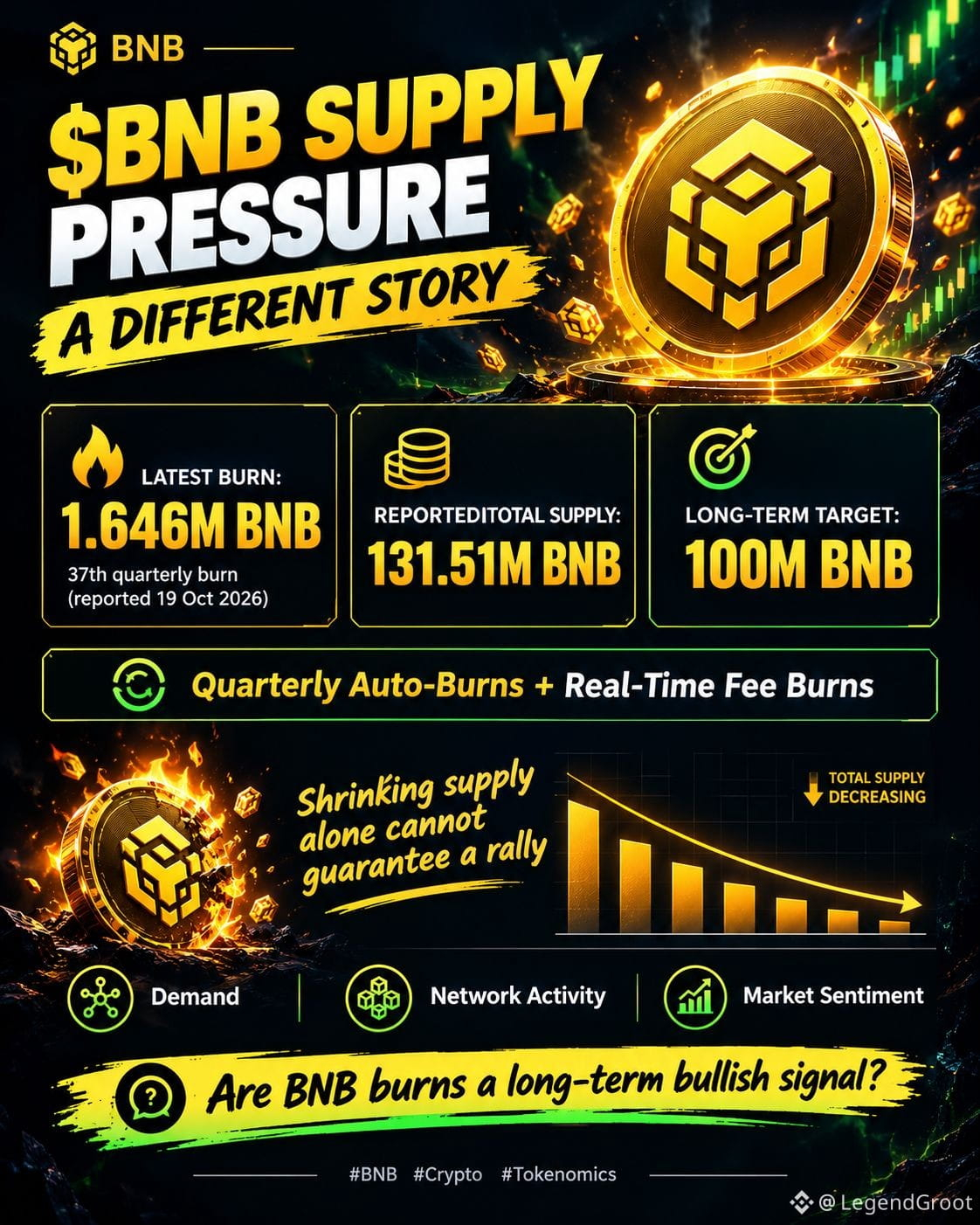
Unlike tokens facing heavy unlock schedules, BNB is designed to reduce supply through quarterly Auto-Burns and real-time fee burns.
🔥 Latest burn: 1.646M BNB
📉 Reported total supply: 131.51M BNB
🎯 Long-term target: 100M BNB
But remember, shrinking supply alone cannot guarantee a price rally. Demand, network activity, and market sentiment still matter.
Are BNB burns a long-term bullish signal? 👀
#BNB #Crypto #Tokenomics
🚨 $BNB SUPPLY PRESSURE IS TELLING A DIFFERENT STORY!
Unlike tokens facing heavy unlock schedules, BNB is designed to reduce supply through quarterly Auto-Burns and real-time fee burns.
🔥 Latest burn: 1.646M BNB
📉 Reported total supply: 131.51M BNB
🎯 Long-term target: 100M BNB
But remember, shrinking supply alone cannot guarantee a price rally. Demand, network activity, and market sentiment still matter.
Are BNB burns a long-term bullish signal? 👀
#BNB #Crypto #Tokenomics
Unlike tokens facing heavy unlock schedules, BNB is designed to reduce supply through quarterly Auto-Burns and real-time fee burns.
🔥 Latest burn: 1.646M BNB
📉 Reported total supply: 131.51M BNB
🎯 Long-term target: 100M BNB
But remember, shrinking supply alone cannot guarantee a price rally. Demand, network activity, and market sentiment still matter.
Are BNB burns a long-term bullish signal? 👀
#BNB #Crypto #Tokenomics
172

·
--
💡 A $0.01 Crypto Coin Is Not Always Cheap!
Many beginners look at a coin priced at $0.01 and think it has huge growth potential.
But the price of one coin doesn't tell the whole story. 👇
📊 Example:
🔹 Coin A: $0.01 price × 100 billion tokens = $1 billion market cap.
🔹 Coin B: $100 price × 10 million tokens = $1 billion market cap.
Both have the same market cap — despite very different prices per coin.
Before investing, look at:
✅ Market cap
✅ Circulating supply
✅ Fully Diluted Valuation (FDV)
✅ Token unlocks and supply inflation
A low price per token doesn't automatically mean a coin is undervalued.
Do you check market cap before buying a coin, or do you mainly look at its price? 👇
Follow me for daily crypto insights & market updates. 🚀📊
#CryptoEducation #MarketCap #Altcoins #Tokenomics #BinanceSquare
💡 A $0.01 Crypto Coin Is Not Always Cheap!
Many beginners look at a coin priced at $0.01 and think it has huge growth potential.
But the price of one coin doesn't tell the whole story. 👇
📊 Example:
🔹 Coin A: $0.01 price × 100 billion tokens = $1 billion market cap.
🔹 Coin B: $100 price × 10 million tokens = $1 billion market cap.
Both have the same market cap — despite very different prices per coin.
Before investing, look at:
✅ Market cap
✅ Circulating supply
✅ Fully Diluted Valuation (FDV)
✅ Token unlocks and supply inflation
A low price per token doesn't automatically mean a coin is undervalued.
Do you check market cap before buying a coin, or do you mainly look at its price? 👇
Follow me for daily crypto insights & market updates. 🚀📊
#CryptoEducation #MarketCap #Altcoins #Tokenomics #BinanceSquare
Many beginners look at a coin priced at $0.01 and think it has huge growth potential.
But the price of one coin doesn't tell the whole story. 👇
📊 Example:
🔹 Coin A: $0.01 price × 100 billion tokens = $1 billion market cap.
🔹 Coin B: $100 price × 10 million tokens = $1 billion market cap.
Both have the same market cap — despite very different prices per coin.
Before investing, look at:
✅ Market cap
✅ Circulating supply
✅ Fully Diluted Valuation (FDV)
✅ Token unlocks and supply inflation
A low price per token doesn't automatically mean a coin is undervalued.
Do you check market cap before buying a coin, or do you mainly look at its price? 👇
Follow me for daily crypto insights & market updates. 🚀📊
#CryptoEducation #MarketCap #Altcoins #Tokenomics #BinanceSquare
1
107
·
--
Checking $ADA supply dynamics today at 0.2054. The ~70% staking ratio is doing heavy lifting by keeping effective circulation super tight. No heavy VC vesting cliffs ahead means low net inflation pressure. Healthy setup for $BTC correlation.
#TokenUnlocks #Tokenomics #ADA
Checking $ADA supply dynamics today at 0.2054. The ~70% staking ratio is doing heavy lifting by keeping effective circulation super tight. No heavy VC vesting cliffs ahead means low net inflation pressure. Healthy setup for $BTC correlation.
#TokenUnlocks #Tokenomics #ADA
#TokenUnlocks #Tokenomics #ADA
3

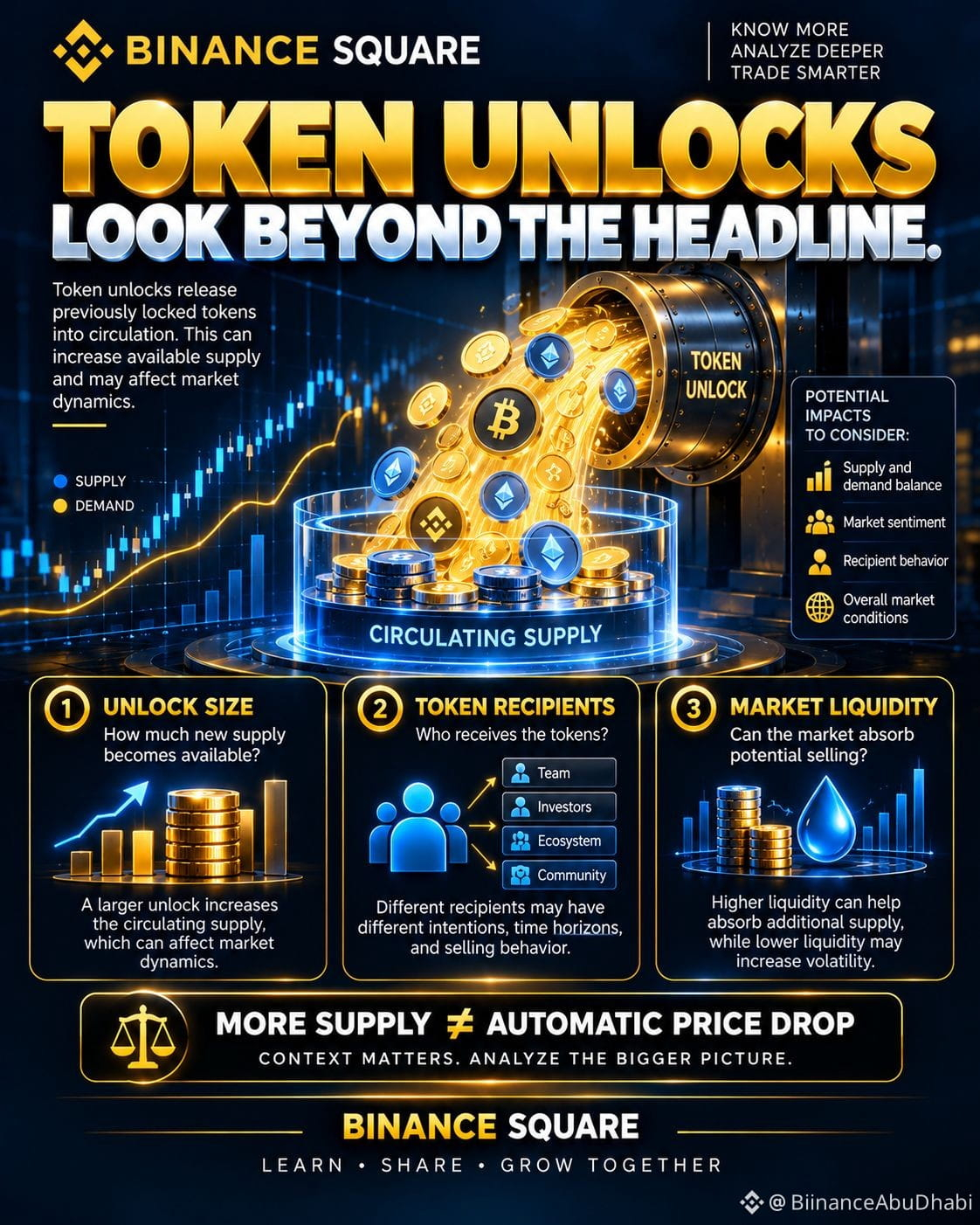
🚨 TOKEN UNLOCKS: LOOK BEYOND THE HEADLINE.
.
A scheduled token unlock doesn't automatically mean a price dump. But it can change the balance between supply and demand.
.
Before trading, check three things:
.
🔹 Unlock size: How much of the circulating supply becomes available?
🔹 Recipients: Who receives the tokens, and what might they do with them?
🔹 Market liquidity: Can the market absorb potential selling pressure?
.
More tokens becoming available doesn't guarantee a sell-off. Context matters more than headlines.
.
Smart traders investigate the supply—not just the sentiment.
.
What do you check first when researching a token unlock?
.
#BTC $BTC #Tokenomics #CryptoEducation #TradingTips #BinanceSquare
🚨 TOKEN UNLOCKS: LOOK BEYOND THE HEADLINE.
.
A scheduled token unlock doesn't automatically mean a price dump. But it can change the balance between supply and demand.
.
Before trading, check three things:
.
🔹 Unlock size: How much of the circulating supply becomes available?
🔹 Recipients: Who receives the tokens, and what might they do with them?
🔹 Market liquidity: Can the market absorb potential selling pressure?
.
More tokens becoming available doesn't guarantee a sell-off. Context matters more than headlines.
.
Smart traders investigate the supply—not just the sentiment.
.
What do you check first when researching a token unlock?
.
#BTC $BTC #Tokenomics #CryptoEducation #TradingTips #BinanceSquare
.
A scheduled token unlock doesn't automatically mean a price dump. But it can change the balance between supply and demand.
.
Before trading, check three things:
.
🔹 Unlock size: How much of the circulating supply becomes available?
🔹 Recipients: Who receives the tokens, and what might they do with them?
🔹 Market liquidity: Can the market absorb potential selling pressure?
.
More tokens becoming available doesn't guarantee a sell-off. Context matters more than headlines.
.
Smart traders investigate the supply—not just the sentiment.
.
What do you check first when researching a token unlock?
.
#BTC $BTC #Tokenomics #CryptoEducation #TradingTips #BinanceSquare
16

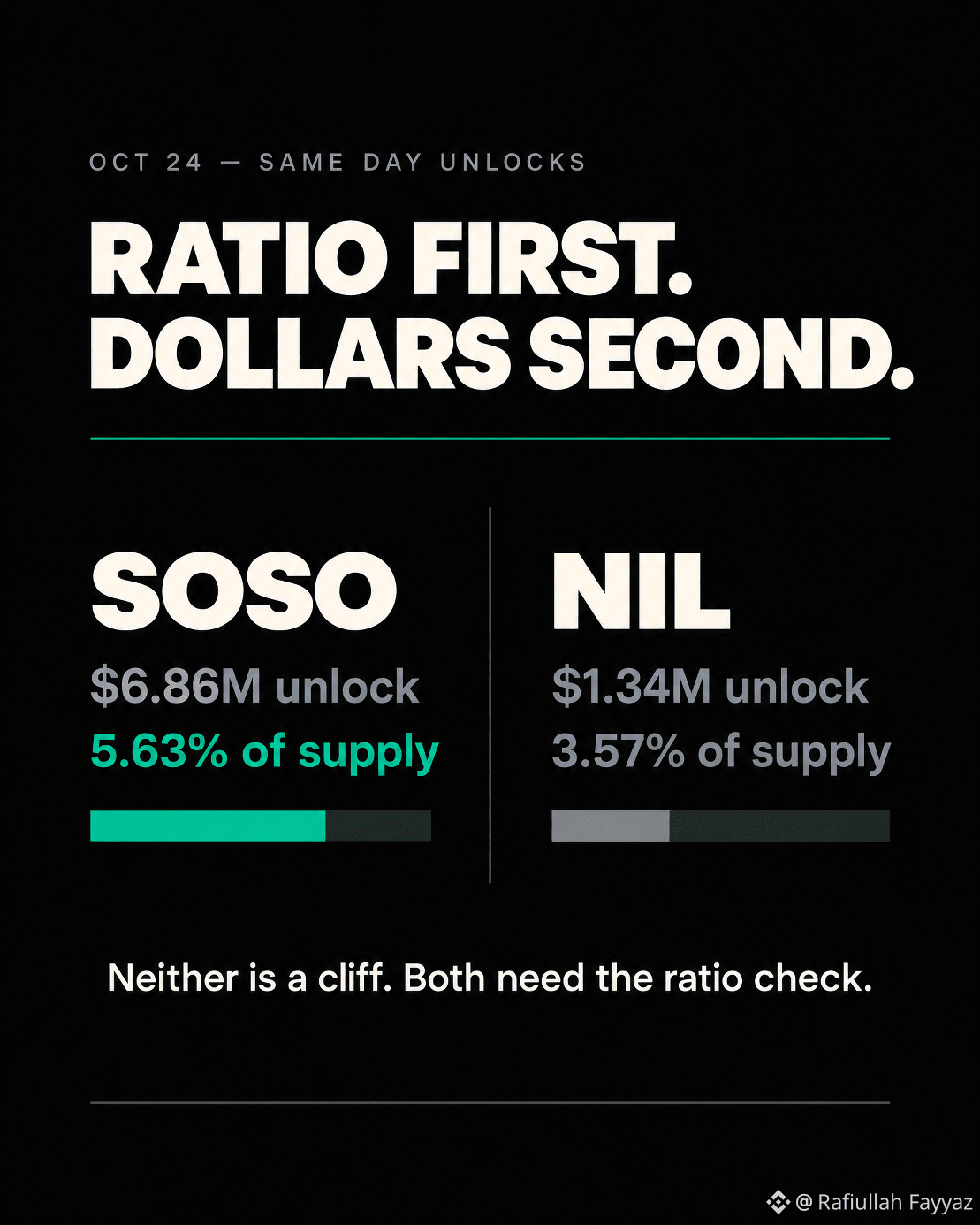
SOSO unlocked $6.86 million today. NIL unlocks $1.34 million.
SOSO's dollar amount is five times larger. But SOSO's unlock is 5.63% of its circulating supply. NIL's is 3.57%.
Neither is a cliff. Both are relatively small ratios. But the comparison still matters.
Most people screen unlocks by dollar value. That's the wrong filter. A $50M unlock on a billion-dollar project is 5% dilution. A $5M unlock on a $40M project is 12.5%. The smaller dollar amount is the bigger event.
SOSO and NIL are both mid-range. But the framework is the same: ratio first, dollars second.
$SOSO $NIL
#crypto #EducationalContent #Tokenomics #unlocks #BinanceSquare
{spot}(NILUSDT)
SOSO unlocked $6.86 million today. NIL unlocks $1.34 million.
SOSO's dollar amount is five times larger. But SOSO's unlock is 5.63% of its circulating supply. NIL's is 3.57%.
Neither is a cliff. Both are relatively small ratios. But the comparison still matters.
Most people screen unlocks by dollar value. That's the wrong filter. A $50M unlock on a billion-dollar project is 5% dilution. A $5M unlock on a $40M project is 12.5%. The smaller dollar amount is the bigger event.
SOSO and NIL are both mid-range. But the framework is the same: ratio first, dollars second.
$SOSO $NIL
#crypto #EducationalContent #Tokenomics #unlocks #BinanceSquare
SOSO's dollar amount is five times larger. But SOSO's unlock is 5.63% of its circulating supply. NIL's is 3.57%.
Neither is a cliff. Both are relatively small ratios. But the comparison still matters.
Most people screen unlocks by dollar value. That's the wrong filter. A $50M unlock on a billion-dollar project is 5% dilution. A $5M unlock on a $40M project is 12.5%. The smaller dollar amount is the bigger event.
SOSO and NIL are both mid-range. But the framework is the same: ratio first, dollars second.
$SOSO $NIL
#crypto #EducationalContent #Tokenomics #unlocks #BinanceSquare
1
261
·
--
Keeping a close eye on the $SOL supply schedule. Upcoming vesting cliffs and linear unlocks are major factors while price sits at 101.9. The split between ecosystem growth and early investor allocations is where the real story lives. High staking ratios help, but net inflation and fee burn velocity are the metrics to watch. Supply dynamics never lie. _
#TokenUnlocks #Tokenomics #SOL
Keeping a close eye on the $SOL supply schedule. Upcoming vesting cliffs and linear unlocks are major factors while price sits at 101.9. The split between ecosystem growth and early investor allocations is where the real story lives. High staking ratios help, but net inflation and fee burn velocity are the metrics to watch. Supply dynamics never lie. _
#TokenUnlocks #Tokenomics #SOL
#TokenUnlocks #Tokenomics #SOL
1
1

🚨 $JST
{spot}(JSTUSDT)
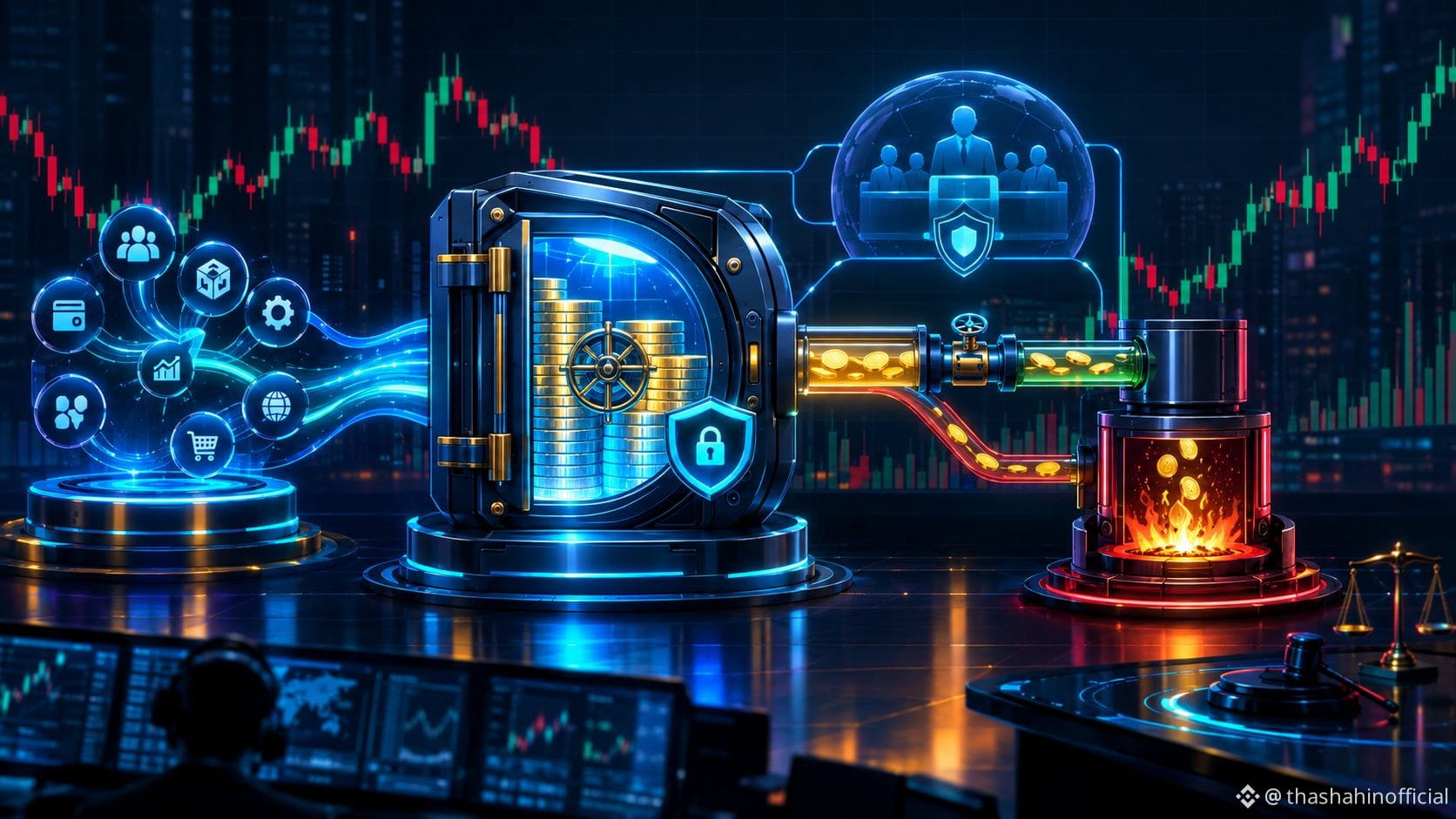
A $50M TREASURY FLOOR CHANGES THE BUYBACK STORY.
JUST announced a redesigned buyback-and-burn mechanism on October 23, placing governance under JUST DAO and requiring at least $50M in treasury reserves. Buybacks are funded by sustainable quarterly ecosystem revenue—not unlimited spending.
For JST holders, the key test is whether revenue consistently exceeds reserve and operating needs. Track actual buyback transactions, revenue disclosures, and tokens burned. A new mechanism is not a guarantee of price gains.
Can revenue-driven burns create lasting value for JST?
#JST #JUST #Tokenomics #CryptoNews
🚨 $JST
A $50M TREASURY FLOOR CHANGES THE BUYBACK STORY.
JUST announced a redesigned buyback-and-burn mechanism on October 23, placing governance under JUST DAO and requiring at least $50M in treasury reserves. Buybacks are funded by sustainable quarterly ecosystem revenue—not unlimited spending.
For JST holders, the key test is whether revenue consistently exceeds reserve and operating needs. Track actual buyback transactions, revenue disclosures, and tokens burned. A new mechanism is not a guarantee of price gains.
Can revenue-driven burns create lasting value for JST?
#JST #JUST #Tokenomics #CryptoNews
A $50M TREASURY FLOOR CHANGES THE BUYBACK STORY.
JUST announced a redesigned buyback-and-burn mechanism on October 23, placing governance under JUST DAO and requiring at least $50M in treasury reserves. Buybacks are funded by sustainable quarterly ecosystem revenue—not unlimited spending.
For JST holders, the key test is whether revenue consistently exceeds reserve and operating needs. Track actual buyback transactions, revenue disclosures, and tokens burned. A new mechanism is not a guarantee of price gains.
Can revenue-driven burns create lasting value for JST?
#JST #JUST #Tokenomics #CryptoNews
146

·
--
Backpack (BP) tokenomics are once again drawing heightened discussion (2026-10-23): total supply of 1 billion tokens; 25% released at TGE (240 million for points users + 10 million for Mad Lads); the remaining 37.5% is allocated to the Pre-IPO milestone pool and 37.5% to the Post-IPO treasury (locked for ≥1 year after the IPO). The founder, executives, and investors receive zero tokens and zero warrants. Staking offers fee discounts; Pre-IPO tokens may be mapped to an equity pool of up to ~20%. Current price is about ~$0.99, with a staking rate of about ~56.4% (around 140.88 million tokens).
Key mechanics: This is a “zero insider allocation + dual-track milestone/treasury” structure, tying supply releases to post-listing governance rather than using the traditional linear unlock schedule for team/VC allocations. A staking rate above 50% suggests significant ties between circulating supply friction and fees, but the pace of milestone fulfillment and the details of equity mapping still need to be monitored.
Next things to watch: Whether the Pre-IPO milestone triggers are publicly disclosed and verifiable, and whether the staking rate stays above 50% in volatile markets.
Sources: Crypto Briefing https://cryptobriefing.com/backpack-founder-extreme-tokenomics-no-insider-tokens/ ; Backpack https://backpack.exchange/bp ; Official Backpack https://x.com/Backpack/status/2113643108449837214
#Backpack #BP #Web3 #Tokenomics $BP
For informational purposes only; this is not investment advice / NFA
Backpack (BP) tokenomics are once again drawing heightened discussion (2026-10-23): total supply of 1 billion tokens; 25% released at TGE (240 million for points users + 10 million for Mad Lads); the remaining 37.5% is allocated to the Pre-IPO milestone pool and 37.5% to the Post-IPO treasury (locked for ≥1 year after the IPO). The founder, executives, and investors receive zero tokens and zero warrants. Staking offers fee discounts; Pre-IPO tokens may be mapped to an equity pool of up to ~20%. Current price is about ~$0.99, with a staking rate of about ~56.4% (around 140.88 million tokens).
Key mechanics: This is a “zero insider allocation + dual-track milestone/treasury” structure, tying supply releases to post-listing governance rather than using the traditional linear unlock schedule for team/VC allocations. A staking rate above 50% suggests significant ties between circulating supply friction and fees, but the pace of milestone fulfillment and the details of equity mapping still need to be monitored.
Next things to watch: Whether the Pre-IPO milestone triggers are publicly disclosed and verifiable, and whether the staking rate stays above 50% in volatile markets.
Sources: Crypto Briefing https://cryptobriefing.com/backpack-founder-extreme-tokenomics-no-insider-tokens/ ; Backpack https://backpack.exchange/bp ; Official Backpack https://x.com/Backpack/status/2113643108449837214
#Backpack #BP #Web3 #Tokenomics $BP
For informational purposes only; this is not investment advice / NFA
Key mechanics: This is a “zero insider allocation + dual-track milestone/treasury” structure, tying supply releases to post-listing governance rather than using the traditional linear unlock schedule for team/VC allocations. A staking rate above 50% suggests significant ties between circulating supply friction and fees, but the pace of milestone fulfillment and the details of equity mapping still need to be monitored.
Next things to watch: Whether the Pre-IPO milestone triggers are publicly disclosed and verifiable, and whether the staking rate stays above 50% in volatile markets.
Sources: Crypto Briefing https://cryptobriefing.com/backpack-founder-extreme-tokenomics-no-insider-tokens/ ; Backpack https://backpack.exchange/bp ; Official Backpack https://x.com/Backpack/status/2113643108449837214
#Backpack #BP #Web3 #Tokenomics $BP
For informational purposes only; this is not investment advice / NFA
26

·
--
Why 80% FDV Coins Dump: The Hidden Danger of Low-Float Tokens 🚨📉
You spot a new token pumping right after listing. The market cap is only $200M, the community is screaming "100x gem," and you jump in.
Six months later, the price is down 70%—even though the team delivered every roadmap update.
What happened? You fell directly into the Low-Float, High-FDV trap.
1. Market Cap vs. Fully Diluted Valuation (FDV)
To survive this market, you must understand the gap between these two numbers:
Market Cap (MCap): Current Price × Circulating Supply
This is only what is currently liquid and tradable.
Fully Diluted Valuation (FDV): Current Price × Total Max Supply
This is what the project is worth once every single token is unlocked.
The Red Flag Ratio:
If a token has a $200M Market Cap but an FDV of $2 Billion, that means only 10% of the supply is currently in circulation.
The remaining 90% of the tokens are locked—and they are heading straight for the market
$BTC #ETH #Tokenomics #BinanceSquare #CryptoTradingInsights
Why 80% FDV Coins Dump: The Hidden Danger of Low-Float Tokens 🚨📉
You spot a new token pumping right after listing. The market cap is only $200M, the community is screaming "100x gem," and you jump in.
Six months later, the price is down 70%—even though the team delivered every roadmap update.
What happened? You fell directly into the Low-Float, High-FDV trap.
1. Market Cap vs. Fully Diluted Valuation (FDV)
To survive this market, you must understand the gap between these two numbers:
Market Cap (MCap): Current Price × Circulating Supply
This is only what is currently liquid and tradable.
Fully Diluted Valuation (FDV): Current Price × Total Max Supply
This is what the project is worth once every single token is unlocked.
The Red Flag Ratio:
If a token has a $200M Market Cap but an FDV of $2 Billion, that means only 10% of the supply is currently in circulation.
The remaining 90% of the tokens are locked—and they are heading straight for the market
$BTC #ETH #Tokenomics #BinanceSquare #CryptoTradingInsights
You spot a new token pumping right after listing. The market cap is only $200M, the community is screaming "100x gem," and you jump in.
Six months later, the price is down 70%—even though the team delivered every roadmap update.
What happened? You fell directly into the Low-Float, High-FDV trap.
1. Market Cap vs. Fully Diluted Valuation (FDV)
To survive this market, you must understand the gap between these two numbers:
Market Cap (MCap): Current Price × Circulating Supply
This is only what is currently liquid and tradable.
Fully Diluted Valuation (FDV): Current Price × Total Max Supply
This is what the project is worth once every single token is unlocked.
The Red Flag Ratio:
If a token has a $200M Market Cap but an FDV of $2 Billion, that means only 10% of the supply is currently in circulation.
The remaining 90% of the tokens are locked—and they are heading straight for the market
$BTC #ETH #Tokenomics #BinanceSquare #CryptoTradingInsights
Mo7_Aj:
DONE ✅
100
5
100
·
--
Bullish
5 QUESTIONS TO ANSWER BEFORE INVESTING IN A TOKEN 🔍
Don’t just look at the price chart or listen to promotional claims. Start by doing your research:
1️⃣ What problem does the project solve?
Is there real-world demand, or is it relying solely on community attention?
2️⃣ What is the token used for?
Does the token have a clear utility in the ecosystem, or does its value mainly come from speculation?
3️⃣ What does the tokenomics look like?
The total supply, circulating supply, token unlock schedule, and team allocation can all affect selling pressure.
4️⃣ What are the team and ecosystem like?
Are there products, active development, and real users?
5️⃣ What are the biggest risks?
Competition, security, regulation, liquidity, or dependence on a small group?
Even with a large ecosystem like Ethereum ($ETH ), thorough research still cannot guarantee profits.
In my opinion, understanding why you own an asset is more important than buying it just because other people are buying.
If you could choose just one factor to evaluate a crypto project, would you choose its technology, team, or tokenomics?
#Ethereum #ETH #CryptoResearch #Tokenomics #Web3
{future}(ETHUSDT)
5 QUESTIONS TO ANSWER BEFORE INVESTING IN A TOKEN 🔍
Don’t just look at the price chart or listen to promotional claims. Start by doing your research:
1️⃣ What problem does the project solve?
Is there real-world demand, or is it relying solely on community attention?
2️⃣ What is the token used for?
Does the token have a clear utility in the ecosystem, or does its value mainly come from speculation?
3️⃣ What does the tokenomics look like?
The total supply, circulating supply, token unlock schedule, and team allocation can all affect selling pressure.
4️⃣ What are the team and ecosystem like?
Are there products, active development, and real users?
5️⃣ What are the biggest risks?
Competition, security, regulation, liquidity, or dependence on a small group?
Even with a large ecosystem like Ethereum ($ETH ), thorough research still cannot guarantee profits.
In my opinion, understanding why you own an asset is more important than buying it just because other people are buying.
If you could choose just one factor to evaluate a crypto project, would you choose its technology, team, or tokenomics?
#Ethereum #ETH #CryptoResearch #Tokenomics #Web3
Don’t just look at the price chart or listen to promotional claims. Start by doing your research:
1️⃣ What problem does the project solve?
Is there real-world demand, or is it relying solely on community attention?
2️⃣ What is the token used for?
Does the token have a clear utility in the ecosystem, or does its value mainly come from speculation?
3️⃣ What does the tokenomics look like?
The total supply, circulating supply, token unlock schedule, and team allocation can all affect selling pressure.
4️⃣ What are the team and ecosystem like?
Are there products, active development, and real users?
5️⃣ What are the biggest risks?
Competition, security, regulation, liquidity, or dependence on a small group?
Even with a large ecosystem like Ethereum ($ETH ), thorough research still cannot guarantee profits.
In my opinion, understanding why you own an asset is more important than buying it just because other people are buying.
If you could choose just one factor to evaluate a crypto project, would you choose its technology, team, or tokenomics?
#Ethereum #ETH #CryptoResearch #Tokenomics #Web3
2
58
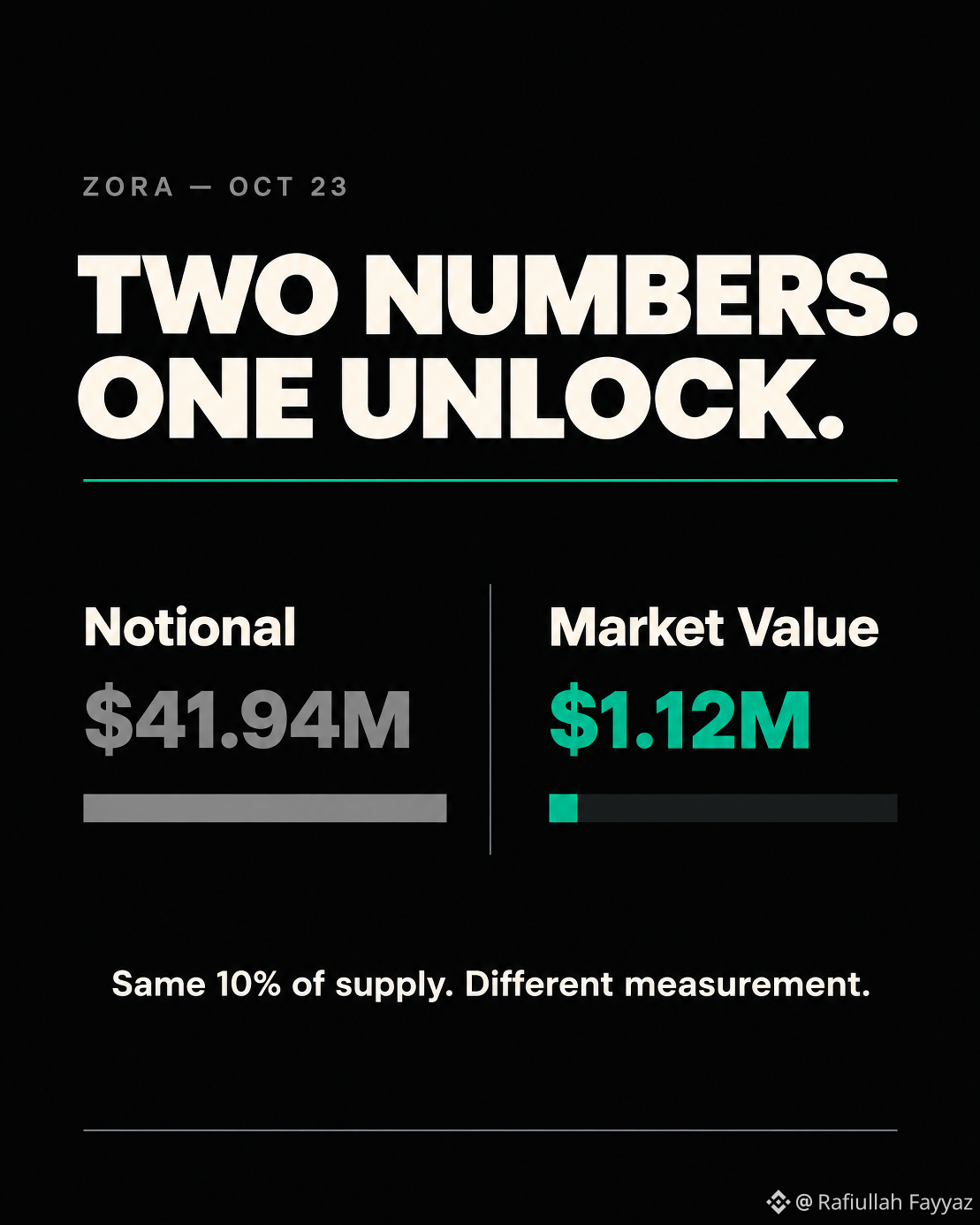
ZORA unlocks today. One source says $41.94M. Another says $1.12M.
Both are right. They're measuring different things.
The $41.94M figure is the notional value of 1.67 billion tokens at a reference price. The $1.12M figure is the actual market value at current prices. The supply itself is ~10% of circulating.
This is the unlock data problem. Notional value and market value can differ by 30x. If you only read the headline number, you're measuring the wrong thing.
The ratio is 10%. That doesn't change.
$ZORA
#crypto #EducationalContent #Tokenomics #unlocks #BinanceSquare
{future}(ZORAUSDT)
ZORA unlocks today. One source says $41.94M. Another says $1.12M.
Both are right. They're measuring different things.
The $41.94M figure is the notional value of 1.67 billion tokens at a reference price. The $1.12M figure is the actual market value at current prices. The supply itself is ~10% of circulating.
This is the unlock data problem. Notional value and market value can differ by 30x. If you only read the headline number, you're measuring the wrong thing.
The ratio is 10%. That doesn't change.
$ZORA
#crypto #EducationalContent #Tokenomics #unlocks #BinanceSquare
Both are right. They're measuring different things.
The $41.94M figure is the notional value of 1.67 billion tokens at a reference price. The $1.12M figure is the actual market value at current prices. The supply itself is ~10% of circulating.
This is the unlock data problem. Notional value and market value can differ by 30x. If you only read the headline number, you're measuring the wrong thing.
The ratio is 10%. That doesn't change.
$ZORA
#crypto #EducationalContent #Tokenomics #unlocks #BinanceSquare
185

🚀 $OG : Only 5 Million Tokens? Could #Scarcity Fuel the Next Rally?
💎 If $OG has a fixed total supply of just 5 million tokens with no further issuance, scarcity could become an interesting part of its market narrative.
📈 Could $15 Be the Next Target? At $15 per token, a fully circulating supply of 5 million would imply a market capitalization of approximately $75 million.
{spot}(OGUSDT)
🎯 Investor Watch: Before anticipating a breakout, verify the official tokenomics, circulating supply, exchange liquidity, and buying volume. A limited supply can support a bullish thesis, but reaching $15 would still require sufficient demand and market momentum.
👀 Is $OG preparing for a major move, or does it need stronger confirmation first? Share your view below! 💬
#OG #CryptoAnalysis #Tokenomics #CoinVahini
🚀 $OG : Only 5 Million Tokens? Could #Scarcity Fuel the Next Rally?
💎 If $OG has a fixed total supply of just 5 million tokens with no further issuance, scarcity could become an interesting part of its market narrative.
📈 Could $15 Be the Next Target? At $15 per token, a fully circulating supply of 5 million would imply a market capitalization of approximately $75 million.
🎯 Investor Watch: Before anticipating a breakout, verify the official tokenomics, circulating supply, exchange liquidity, and buying volume. A limited supply can support a bullish thesis, but reaching $15 would still require sufficient demand and market momentum.
👀 Is $OG preparing for a major move, or does it need stronger confirmation first? Share your view below! 💬
#OG #CryptoAnalysis #Tokenomics #CoinVahini
💎 If $OG has a fixed total supply of just 5 million tokens with no further issuance, scarcity could become an interesting part of its market narrative.
📈 Could $15 Be the Next Target? At $15 per token, a fully circulating supply of 5 million would imply a market capitalization of approximately $75 million.
🎯 Investor Watch: Before anticipating a breakout, verify the official tokenomics, circulating supply, exchange liquidity, and buying volume. A limited supply can support a bullish thesis, but reaching $15 would still require sufficient demand and market momentum.
👀 Is $OG preparing for a major move, or does it need stronger confirmation first? Share your view below! 💬
#OG #CryptoAnalysis #Tokenomics #CoinVahini
15
·
--
The supply-side physics of $SILVER are undergoing a major transition right now that many are overlooking in favor of high-beta volatility. While physical silver is holding firm at 60.27 and gold is pushing 4,140, the Gold/Silver Ratio at 68.5 tells us the commodity complex is leaning toward a silver outperformance. In the digital realm, the data around SILVER is even more compelling because we are moving out of the heavy vesting cliff phase and into a structural burn cycle.
Current on-chain data shows that the circulating float is tightening as the final 12 percent of seed-round unlocks have been absorbed by institutional desks. With the spot reference sitting at 53.716, the gap between the tokenized value and physical bullion is creating a unique arbitrage pressure. Unlike PAXG which tracks gold 1:1, the specific mechanics of SILVER involve a periodic supply burn triggered by transaction volume, which effectively lowers the total supply cap every time a whale moves liquidity between exchanges.
Central banks are still aggressively padding their reserves, and the DXY inverse correlation remains the dominant macro driver. As the Dollar Index shows signs of fatigue, the flight to commodity-backed assets is accelerating. We are seeing massive outflows from centralized exchanges into cold storage, mirroring the physical bullion market where COMEX inventories are hitting multi-year lows. The deflationary pressure here is not just a marketing narrative; it is backed by hard-coded vesting schedules that have officially flipped from inflationary to contractionary.
The next few weeks will test whether the current burn rate can keep up with the increasing demand for on-chain commodity exposure. Are you seeing more value in holding physical-backed assets right now, or are you still chasing the purely algorithmic projects?
#TokenUnlocks #Tokenomics
The supply-side physics of $SILVER are undergoing a major transition right now that many are overlooking in favor of high-beta volatility. While physical silver is holding firm at 60.27 and gold is pushing 4,140, the Gold/Silver Ratio at 68.5 tells us the commodity complex is leaning toward a silver outperformance. In the digital realm, the data around SILVER is even more compelling because we are moving out of the heavy vesting cliff phase and into a structural burn cycle.
Current on-chain data shows that the circulating float is tightening as the final 12 percent of seed-round unlocks have been absorbed by institutional desks. With the spot reference sitting at 53.716, the gap between the tokenized value and physical bullion is creating a unique arbitrage pressure. Unlike PAXG which tracks gold 1:1, the specific mechanics of SILVER involve a periodic supply burn triggered by transaction volume, which effectively lowers the total supply cap every time a whale moves liquidity between exchanges.
Central banks are still aggressively padding their reserves, and the DXY inverse correlation remains the dominant macro driver. As the Dollar Index shows signs of fatigue, the flight to commodity-backed assets is accelerating. We are seeing massive outflows from centralized exchanges into cold storage, mirroring the physical bullion market where COMEX inventories are hitting multi-year lows. The deflationary pressure here is not just a marketing narrative; it is backed by hard-coded vesting schedules that have officially flipped from inflationary to contractionary.
The next few weeks will test whether the current burn rate can keep up with the increasing demand for on-chain commodity exposure. Are you seeing more value in holding physical-backed assets right now, or are you still chasing the purely algorithmic projects?
#TokenUnlocks #Tokenomics
Current on-chain data shows that the circulating float is tightening as the final 12 percent of seed-round unlocks have been absorbed by institutional desks. With the spot reference sitting at 53.716, the gap between the tokenized value and physical bullion is creating a unique arbitrage pressure. Unlike PAXG which tracks gold 1:1, the specific mechanics of SILVER involve a periodic supply burn triggered by transaction volume, which effectively lowers the total supply cap every time a whale moves liquidity between exchanges.
Central banks are still aggressively padding their reserves, and the DXY inverse correlation remains the dominant macro driver. As the Dollar Index shows signs of fatigue, the flight to commodity-backed assets is accelerating. We are seeing massive outflows from centralized exchanges into cold storage, mirroring the physical bullion market where COMEX inventories are hitting multi-year lows. The deflationary pressure here is not just a marketing narrative; it is backed by hard-coded vesting schedules that have officially flipped from inflationary to contractionary.
The next few weeks will test whether the current burn rate can keep up with the increasing demand for on-chain commodity exposure. Are you seeing more value in holding physical-backed assets right now, or are you still chasing the purely algorithmic projects?
#TokenUnlocks #Tokenomics

1
3

·
--
Verified

Article
AAVE TOKENOMICS 3.0: BUYBACKS, STAKING & BURNS!Aave ($AAVE ) is preparing a major tokenomics upgrade!
Founder Stani Kulechov has confirmed that Aavenomics 3.0 will include three key mechanisms:
💰 Buybacks — purchasing AAVE tokens from the market.
🔒 Staking — allowing token holders to stake their tokens under the updated system.
🔥 Token burns — permanently removing tokens from circulation.
📉 Why does this matter?
Aave's previous buybacks accumulated tokens in its treasury rather than permanently destroying them. Adding burns could introduce a direct supply-reduction mechanism.
Buybacks have been paused since April following the rsETH exploit. Meanwhile, the Aave DAO committed 25,000 ETH to the DeFi United recovery effort and arranged a credit line of up to 30,000 ETH from Mantle.
👀 The big question: Can Aavenomics 3.0 strengthen AAVE's long-term token economics?
The direction is promising, but the impact will depend on the final rules, implementation, and actual demand.
#defi #crypto #Tokenomics
AAVE TOKENOMICS 3.0: BUYBACKS, STAKING & BURNS!
Aave ($AAVE ) is preparing a major tokenomics upgrade!
Founder Stani Kulechov has confirmed that Aavenomics 3.0 will include three key mechanisms:
💰 Buybacks — purchasing AAVE tokens from the market.
🔒 Staking — allowing token holders to stake their tokens under the updated system.
🔥 Token burns — permanently removing tokens from circulation.
📉 Why does this matter?
Aave's previous buybacks accumulated tokens in its treasury rather than permanently destroying them. Adding burns could introduce a direct supply-reduction mechanism.
Buybacks have been paused since April following the rsETH exploit. Meanwhile, the Aave DAO committed 25,000 ETH to the DeFi United recovery effort and arranged a credit line of up to 30,000 ETH from Mantle.
👀 The big question: Can Aavenomics 3.0 strengthen AAVE's long-term token economics?
The direction is promising, but the impact will depend on the final rules, implementation, and actual demand.
#defi #crypto #Tokenomics
Founder Stani Kulechov has confirmed that Aavenomics 3.0 will include three key mechanisms:
💰 Buybacks — purchasing AAVE tokens from the market.
🔒 Staking — allowing token holders to stake their tokens under the updated system.
🔥 Token burns — permanently removing tokens from circulation.
📉 Why does this matter?
Aave's previous buybacks accumulated tokens in its treasury rather than permanently destroying them. Adding burns could introduce a direct supply-reduction mechanism.
Buybacks have been paused since April following the rsETH exploit. Meanwhile, the Aave DAO committed 25,000 ETH to the DeFi United recovery effort and arranged a credit line of up to 30,000 ETH from Mantle.
👀 The big question: Can Aavenomics 3.0 strengthen AAVE's long-term token economics?
The direction is promising, but the impact will depend on the final rules, implementation, and actual demand.
#defi #crypto #Tokenomics
Rao G 914:
Great insight
1
2
64

🚨 $AAVE: Buybacks, Burns & Staking — The Real Story
Aave is exploring a new direction for its token economics, and AAVE holders are watching closely.
On October 22, founder Stani Kulechov said Aavenomics 3.0 would include buybacks, token burns, and staking mechanisms.
But there’s an important detail many traders could overlook.
⚠️ The Catch
AAVE buybacks have been paused since April 19, 2026, according to Aave governance records. The new mechanisms should not be confused with an active, fully implemented program.
📊 Why It Matters
• Buybacks can create demand for AAVE. • Burns permanently remove tokens from circulation. • Staking can provide incentives, depending on the final design.
None of these automatically guarantees a higher token price.
🧠 The idea is worth watching, but execution matters more than headlines. I’d look for an official proposal, clear implementation details, and evidence that the program is actually running before drawing a bullish conclusion.
💬 Which could matter most for AAVE: buybacks, token burns, or staking?
#AAVE #DeFi #CryptoNews #Tokenomics
🚨 $AAVE: Buybacks, Burns & Staking — The Real Story
Aave is exploring a new direction for its token economics, and AAVE holders are watching closely.
On October 22, founder Stani Kulechov said Aavenomics 3.0 would include buybacks, token burns, and staking mechanisms.
But there’s an important detail many traders could overlook.
⚠️ The Catch
AAVE buybacks have been paused since April 19, 2026, according to Aave governance records. The new mechanisms should not be confused with an active, fully implemented program.
📊 Why It Matters
• Buybacks can create demand for AAVE. • Burns permanently remove tokens from circulation. • Staking can provide incentives, depending on the final design.
None of these automatically guarantees a higher token price.
🧠 The idea is worth watching, but execution matters more than headlines. I’d look for an official proposal, clear implementation details, and evidence that the program is actually running before drawing a bullish conclusion.
💬 Which could matter most for AAVE: buybacks, token burns, or staking?
#AAVE #DeFi #CryptoNews #Tokenomics
Aave is exploring a new direction for its token economics, and AAVE holders are watching closely.
On October 22, founder Stani Kulechov said Aavenomics 3.0 would include buybacks, token burns, and staking mechanisms.
But there’s an important detail many traders could overlook.
⚠️ The Catch
AAVE buybacks have been paused since April 19, 2026, according to Aave governance records. The new mechanisms should not be confused with an active, fully implemented program.
📊 Why It Matters
• Buybacks can create demand for AAVE. • Burns permanently remove tokens from circulation. • Staking can provide incentives, depending on the final design.
None of these automatically guarantees a higher token price.
🧠 The idea is worth watching, but execution matters more than headlines. I’d look for an official proposal, clear implementation details, and evidence that the program is actually running before drawing a bullish conclusion.
💬 Which could matter most for AAVE: buybacks, token burns, or staking?
#AAVE #DeFi #CryptoNews #Tokenomics
49
Log in to explore more content
Join global crypto users on Binance Square
⚡️ Get latest and useful information about crypto.
💬 Trusted by the world’s largest crypto exchange.
👍 Discover real insights from verified creators.
Email / Phone number
Trending Topics
1
#BinancePick
3.3M views
161,452 Discussing
2
#EarningsSeason
5.4M views
26,534 Discussing
3
#StrategySkipsBitcoinPurchasesSpends$205MOnSTRCBuybacks
56 views
6 Discussing
4
#BitmineAdds10452ETH
3,875 views
105 Discussing
5
#SouthKoreaConsidersEducationTaxOnCryptoExchanges
3,837 views
96 Discussing
6
#OCCUrgesCommunityBanksToEnterStablecoinPayments
3,121 views
63 Discussing
7
#RippleWinsFullApprovalAsNationalTrustBank
2,872 views
64 Discussing
8
#AkashSelectsSolanaAsMigrationTarget
1,235 views
24 Discussing
9
#OndoToOpenSubscriptionsForOpenAIPreIPOTokenizedNotes
110 views
7 Discussing
10
#AnthropicTTMRevenueGrewAbout1200%
51,483 views
537 Discussing