
#stablecoins
stablecoins
7.4M views
26,827 Discussing
Hot
Latest

See translation
🚨 LEGACY BANKS BLOCKED CLARITY ACT BECAUSE THEY FEAR $SYN AND STABLECOIN DOMINANCE! 🏦
Wall Street legacy institutions didn't stall crypto legislation out of disinterest—they panicked over deposit flight to yield-bearing digital assets. 🏦 When traditional banks lobby this aggressively to protect their moat, it confirms smart money is already shifting into decentralized rails. 🔍
This isn't a regulatory defeat; it's high-level institutional validation that digital assets are encroaching on traditional banking models. 💡 As liquidity prepares for the next rotation, assets like $SYN , $LSK , and $ZEC remain key focal points for narrative momentum. 📊
💬 Do you see this bank pushback as short-term noise or the ultimate validation for the next altcoin expansion? 👇
⚠️ Not financial advice. Always manage your risk. 🛡️
🏷️ #SYN #Stablecoins #CryptoNews #Altcoins #Banking
🔥 💎
🚨 LEGACY BANKS BLOCKED CLARITY ACT BECAUSE THEY FEAR $SYN AND STABLECOIN DOMINANCE! 🏦
Wall Street legacy institutions didn't stall crypto legislation out of disinterest—they panicked over deposit flight to yield-bearing digital assets. 🏦 When traditional banks lobby this aggressively to protect their moat, it confirms smart money is already shifting into decentralized rails. 🔍
This isn't a regulatory defeat; it's high-level institutional validation that digital assets are encroaching on traditional banking models. 💡 As liquidity prepares for the next rotation, assets like $SYN , $LSK , and $ZEC remain key focal points for narrative momentum. 📊
💬 Do you see this bank pushback as short-term noise or the ultimate validation for the next altcoin expansion? 👇
⚠️ Not financial advice. Always manage your risk. 🛡️
🏷️ #SYN #Stablecoins #CryptoNews #Altcoins #Banking
🔥 💎
Wall Street legacy institutions didn't stall crypto legislation out of disinterest—they panicked over deposit flight to yield-bearing digital assets. 🏦 When traditional banks lobby this aggressively to protect their moat, it confirms smart money is already shifting into decentralized rails. 🔍
This isn't a regulatory defeat; it's high-level institutional validation that digital assets are encroaching on traditional banking models. 💡 As liquidity prepares for the next rotation, assets like $SYN , $LSK , and $ZEC remain key focal points for narrative momentum. 📊
💬 Do you see this bank pushback as short-term noise or the ultimate validation for the next altcoin expansion? 👇
⚠️ Not financial advice. Always manage your risk. 🛡️
🏷️ #SYN #Stablecoins #CryptoNews #Altcoins #Banking
🔥 💎

405

·
--
Article
See translation
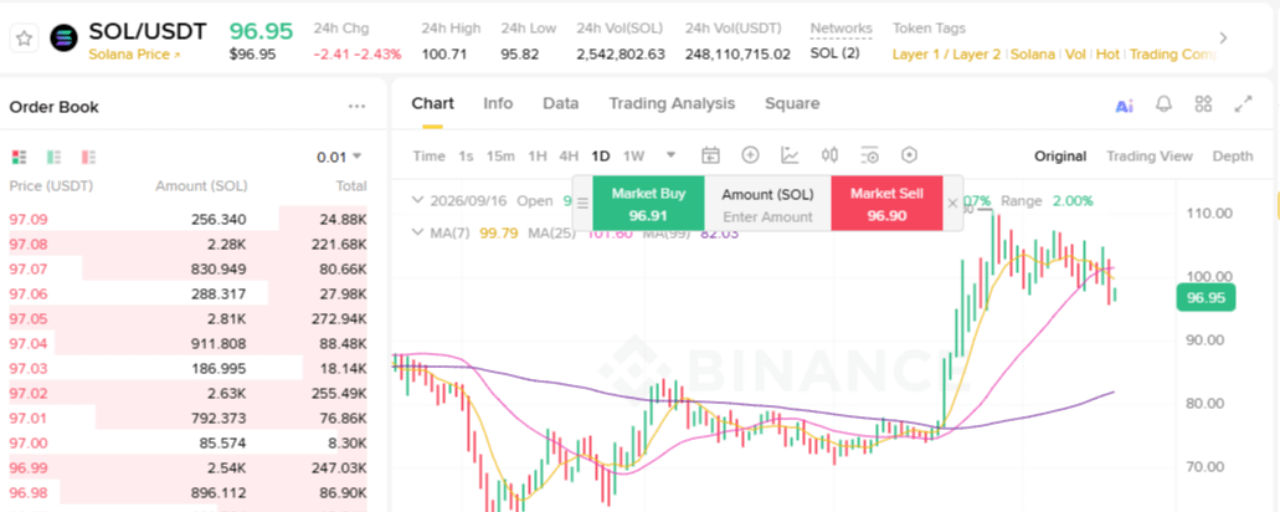
$SOL traders: one of crypto’s biggest payment experiments is quietly moving onto Solana.Visa has expanded its stablecoin settlement capabilities to include Solana, allowing participating partners to send or receive USDC settlement payments over the network.
Solana’s appeal for payments is straightforward: high throughput, low transaction costs and fast settlement make it suitable for applications where moving stablecoins efficiently matters.
Stablecoins are increasingly becoming infrastructure rather than simply assets traders hold between positions.
WHY IT MATTERS
The bigger $SOL narrative may not be memecoins.
If payment companies, fintechs and institutions increasingly use public blockchains for settlement, networks competing for that activity could gain more durable demand than networks driven mainly by speculation.
🔮 MARKET INTERPRETATION — SPECULATION
🔥 Catalyst: growing institutional stablecoin settlement and payment adoption on Solana.
⚠️ Risks: institutional adoption can develop slowly, competing networks are targeting the same market, and stronger network usage does not automatically translate into higher SOL prices.
My focus:
Stablecoin volume → institutional usage → network fees → $SOL relative strength.
That tells me more than chasing one green candle.
👇 What becomes Solana’s bigger long-term narrative: payments or trading?
#solana #Stablecoins #sol #BinanceSquareTalks
$SOL
{spot}(SOLUSDT)
$SOL traders: one of crypto’s biggest payment experiments is quietly moving onto Solana.
Visa has expanded its stablecoin settlement capabilities to include Solana, allowing participating partners to send or receive USDC settlement payments over the network.
Solana’s appeal for payments is straightforward: high throughput, low transaction costs and fast settlement make it suitable for applications where moving stablecoins efficiently matters.
Stablecoins are increasingly becoming infrastructure rather than simply assets traders hold between positions.
WHY IT MATTERS
The bigger $SOL narrative may not be memecoins.
If payment companies, fintechs and institutions increasingly use public blockchains for settlement, networks competing for that activity could gain more durable demand than networks driven mainly by speculation.
🔮 MARKET INTERPRETATION — SPECULATION
🔥 Catalyst: growing institutional stablecoin settlement and payment adoption on Solana.
⚠️ Risks: institutional adoption can develop slowly, competing networks are targeting the same market, and stronger network usage does not automatically translate into higher SOL prices.
My focus:
Stablecoin volume → institutional usage → network fees → $SOL relative strength.
That tells me more than chasing one green candle.
👇 What becomes Solana’s bigger long-term narrative: payments or trading?
#solana #Stablecoins #sol #BinanceSquareTalks
$SOL
Solana’s appeal for payments is straightforward: high throughput, low transaction costs and fast settlement make it suitable for applications where moving stablecoins efficiently matters.
Stablecoins are increasingly becoming infrastructure rather than simply assets traders hold between positions.
WHY IT MATTERS
The bigger $SOL narrative may not be memecoins.
If payment companies, fintechs and institutions increasingly use public blockchains for settlement, networks competing for that activity could gain more durable demand than networks driven mainly by speculation.
🔮 MARKET INTERPRETATION — SPECULATION
🔥 Catalyst: growing institutional stablecoin settlement and payment adoption on Solana.
⚠️ Risks: institutional adoption can develop slowly, competing networks are targeting the same market, and stronger network usage does not automatically translate into higher SOL prices.
My focus:
Stablecoin volume → institutional usage → network fees → $SOL relative strength.
That tells me more than chasing one green candle.
👇 What becomes Solana’s bigger long-term narrative: payments or trading?
#solana #Stablecoins #sol #BinanceSquareTalks
$SOL
10

·
--
See translation
💫⭐ One Trend That Stands Out in 2026💥
{future}(STABLEUSDT)
$STABLE are moving beyond crypto trading.
They’re increasingly being used for payments, transfers and everyday digital finance.
📌$BNB Chain⛓️💥 is a big part of this trend: it processes around 10M stable coin transactions every day, according to Binance Research.
And the trend is spreading to traditional finance too — 21 major financial institutions have announced plans for a U.S. dollar stable coin targeted for 2027.
$STABLE → From trading tool to payment infrastructure. 🌍💰
#Stablecoins #BNBChain #BinanceVietnamSquare #Crypto #Web3Revolution
💫⭐ One Trend That Stands Out in 2026💥
$STABLE are moving beyond crypto trading.
They’re increasingly being used for payments, transfers and everyday digital finance.
📌$BNB Chain⛓️💥 is a big part of this trend: it processes around 10M stable coin transactions every day, according to Binance Research.
And the trend is spreading to traditional finance too — 21 major financial institutions have announced plans for a U.S. dollar stable coin targeted for 2027.
$STABLE → From trading tool to payment infrastructure. 🌍💰
#Stablecoins #BNBChain #BinanceVietnamSquare #Crypto #Web3Revolution
$STABLE are moving beyond crypto trading.
They’re increasingly being used for payments, transfers and everyday digital finance.
📌$BNB Chain⛓️💥 is a big part of this trend: it processes around 10M stable coin transactions every day, according to Binance Research.
And the trend is spreading to traditional finance too — 21 major financial institutions have announced plans for a U.S. dollar stable coin targeted for 2027.
$STABLE → From trading tool to payment infrastructure. 🌍💰
#Stablecoins #BNBChain #BinanceVietnamSquare #Crypto #Web3Revolution

64

·
--
See translation
The correspondent banking system was built in the 1970s. It still moves most of the $150 trillion in annual cross-border B2B payments. Every hop along the chain takes 2-5 days, strips 1-3% in fees, and introduces settlement risk at every intermediary bank.
Stablecoins don't improve this system. They bypass it entirely.
A business in Lagos can settle a $2M invoice to a supplier in São Paulo in 4 seconds for less than a dollar. No Nostro-Vostro account balances. No SWIFT MT103 messaging. No correspondent bank taking a cut at each leg. Just a signed transaction on a public ledger.
The GENIUS Act in the US and MiCA in Europe didn't create this capability — they validated it. The difference now is that regulated stablecoin issuers have a compliance framework that large enterprises can actually use without legal uncertainty. That's the unlock.
The chains that capture this flow won't be the ones with the highest TPS or the loudest marketing. They'll be the ones with the deepest stablecoin liquidity, the most predictable fee structures, and the settlement finality that CFOs require before moving treasury operations on-chain. $BNB $ETH and $SOL are the structural beneficiaries of this rail system.
The question isn't whether stablecoins replace correspondent banking. It's how quickly, and which chains capture the flow.
#Stablecoins #CrossBorderPayments #CryptoAdoption #DeFi #BinanceSquare
The correspondent banking system was built in the 1970s. It still moves most of the $150 trillion in annual cross-border B2B payments. Every hop along the chain takes 2-5 days, strips 1-3% in fees, and introduces settlement risk at every intermediary bank.
Stablecoins don't improve this system. They bypass it entirely.
A business in Lagos can settle a $2M invoice to a supplier in São Paulo in 4 seconds for less than a dollar. No Nostro-Vostro account balances. No SWIFT MT103 messaging. No correspondent bank taking a cut at each leg. Just a signed transaction on a public ledger.
The GENIUS Act in the US and MiCA in Europe didn't create this capability — they validated it. The difference now is that regulated stablecoin issuers have a compliance framework that large enterprises can actually use without legal uncertainty. That's the unlock.
The chains that capture this flow won't be the ones with the highest TPS or the loudest marketing. They'll be the ones with the deepest stablecoin liquidity, the most predictable fee structures, and the settlement finality that CFOs require before moving treasury operations on-chain. $BNB $ETH and $SOL are the structural beneficiaries of this rail system.
The question isn't whether stablecoins replace correspondent banking. It's how quickly, and which chains capture the flow.
#Stablecoins #CrossBorderPayments #CryptoAdoption #DeFi #BinanceSquare
Stablecoins don't improve this system. They bypass it entirely.
A business in Lagos can settle a $2M invoice to a supplier in São Paulo in 4 seconds for less than a dollar. No Nostro-Vostro account balances. No SWIFT MT103 messaging. No correspondent bank taking a cut at each leg. Just a signed transaction on a public ledger.
The GENIUS Act in the US and MiCA in Europe didn't create this capability — they validated it. The difference now is that regulated stablecoin issuers have a compliance framework that large enterprises can actually use without legal uncertainty. That's the unlock.
The chains that capture this flow won't be the ones with the highest TPS or the loudest marketing. They'll be the ones with the deepest stablecoin liquidity, the most predictable fee structures, and the settlement finality that CFOs require before moving treasury operations on-chain. $BNB $ETH and $SOL are the structural beneficiaries of this rail system.
The question isn't whether stablecoins replace correspondent banking. It's how quickly, and which chains capture the flow.
#Stablecoins #CrossBorderPayments #CryptoAdoption #DeFi #BinanceSquare
80

See translation
🦈 $STABLE INFRA JUST GOT $20M FUEL — CROSS-BORDER SETTLEMENT IS THE REAL BREAKOUT
Fin.com stepping out of stealth with $20M is not just a funding headline — it is a bid on the plumbing layer that lets stablecoins, USD accounts, Swift, and local rails finally move like one machine. 📊
When payment infrastructure gets orchestrated, volume follows. That means more on-chain settlement demand, more stablecoin circulation, and more reasons for capital to treat crypto rails as serious global finance. 💡 The market often front-runs utility before the token cycle catches up.
Are you watching stablecoin infrastructure as the next major narrative, or waiting for retail to wake up? 👇
⚠️ Not financial advice. Always manage your risk. 🛡️
🏷️ #STABLE #Stablecoins #PaymentRails #Crypto
⚡
🦈 $STABLE INFRA JUST GOT $20M FUEL — CROSS-BORDER SETTLEMENT IS THE REAL BREAKOUT
Fin.com stepping out of stealth with $20M is not just a funding headline — it is a bid on the plumbing layer that lets stablecoins, USD accounts, Swift, and local rails finally move like one machine. 📊
When payment infrastructure gets orchestrated, volume follows. That means more on-chain settlement demand, more stablecoin circulation, and more reasons for capital to treat crypto rails as serious global finance. 💡 The market often front-runs utility before the token cycle catches up.
Are you watching stablecoin infrastructure as the next major narrative, or waiting for retail to wake up? 👇
⚠️ Not financial advice. Always manage your risk. 🛡️
🏷️ #STABLE #Stablecoins #PaymentRails #Crypto
⚡
Fin.com stepping out of stealth with $20M is not just a funding headline — it is a bid on the plumbing layer that lets stablecoins, USD accounts, Swift, and local rails finally move like one machine. 📊
When payment infrastructure gets orchestrated, volume follows. That means more on-chain settlement demand, more stablecoin circulation, and more reasons for capital to treat crypto rails as serious global finance. 💡 The market often front-runs utility before the token cycle catches up.
Are you watching stablecoin infrastructure as the next major narrative, or waiting for retail to wake up? 👇
⚠️ Not financial advice. Always manage your risk. 🛡️
🏷️ #STABLE #Stablecoins #PaymentRails #Crypto
⚡
28

·
--
See translation
🚨 USDC HITS A MAJOR MILESTONE
$USDC has surpassed $100 trillion in cumulative on-chain transaction volume, highlighting the growing scale of stablecoin activity across blockchain networks.
The milestone reflects increasing use of USDC for payments, liquidity and on-chain settlement.
📊 Sentiment: 🟢 Bullish for stablecoin adoption
⚠️ This does not automatically mean the wider crypto market will rise.
#USDC✅ #Stablecoins #CryptoNewss s #blockchain #defi
🚨 USDC HITS A MAJOR MILESTONE
$USDC has surpassed $100 trillion in cumulative on-chain transaction volume, highlighting the growing scale of stablecoin activity across blockchain networks.
The milestone reflects increasing use of USDC for payments, liquidity and on-chain settlement.
📊 Sentiment: 🟢 Bullish for stablecoin adoption
⚠️ This does not automatically mean the wider crypto market will rise.
#USDC✅ #Stablecoins #CryptoNewss s #blockchain #defi
$USDC has surpassed $100 trillion in cumulative on-chain transaction volume, highlighting the growing scale of stablecoin activity across blockchain networks.
The milestone reflects increasing use of USDC for payments, liquidity and on-chain settlement.
📊 Sentiment: 🟢 Bullish for stablecoin adoption
⚠️ This does not automatically mean the wider crypto market will rise.
#USDC✅ #Stablecoins #CryptoNewss s #blockchain #defi
mansoor5450
·
--
USDC Surpasses $100 Trillion in Cumulative On-Chain Volume
$USDC has reached a major milestone, with its cumulative on-chain transaction volume surpassing $100 trillion. This highlights the growing role of dollar-backed stablecoins in the blockchain economy.
However, this figure needs context. On-chain volume does not mean $100 trillion of new money entered the crypto market. A significant amount of activity can come from DeFi operations, liquidity management, automated transactions and repeated movements of the same funds.
$USDC’s growing transaction activity shows increasing demand for stablecoin liquidity and blockchain-based settlement infrastructure across the crypto ecosystem.
📊 Market Sentiment: 🟢 Moderately Bullish
This milestone is bullish for USDC and stablecoin adoption because it demonstrates significant on-chain usage and liquidity.
However, it should not be treated as a direct bullish signal for Bitcoin, Ethereum or the wider crypto market. High transaction volume does not automatically mean crypto prices will rise.
🔎 Bottom Line
The $100 trillion milestone demonstrates the huge scale of stablecoin activity on blockchain networks. However, it represents cumulative on-chain transaction volume, not $100 trillion of fresh investment or new capital entering crypto.
#USDC #Stablecoins #CryptoNewss ews #DeFi #blockchain #CryptoAdoption
Educational purposes only — not financial advice.
However, this figure needs context. On-chain volume does not mean $100 trillion of new money entered the crypto market. A significant amount of activity can come from DeFi operations, liquidity management, automated transactions and repeated movements of the same funds.
$USDC’s growing transaction activity shows increasing demand for stablecoin liquidity and blockchain-based settlement infrastructure across the crypto ecosystem.
📊 Market Sentiment: 🟢 Moderately Bullish
This milestone is bullish for USDC and stablecoin adoption because it demonstrates significant on-chain usage and liquidity.
However, it should not be treated as a direct bullish signal for Bitcoin, Ethereum or the wider crypto market. High transaction volume does not automatically mean crypto prices will rise.
🔎 Bottom Line
The $100 trillion milestone demonstrates the huge scale of stablecoin activity on blockchain networks. However, it represents cumulative on-chain transaction volume, not $100 trillion of fresh investment or new capital entering crypto.
#USDC #Stablecoins #CryptoNewss ews #DeFi #blockchain #CryptoAdoption
Educational purposes only — not financial advice.

69

See translation
🚨 $BTC : JPMORGAN DOUBTS INSTITUTIONAL STABLECOIN DEMAND 💥
📊 The JPMorgan note cuts through the narrative: institutions may not see stablecoins as a core cash-management tool. 💡 That matters because stablecoin growth is often framed as the bridge between TradFi liquidity and crypto rails.
🌊 If institutional demand stays muted, stablecoins may not become the next major liquidity catalyst for $BTC . ⚡ The market still needs to prove that this is a balance-sheet adoption story, not just a settlement convenience. 💬 Are stablecoins still the missing institutional unlock, or just a retail-friendly plumbing layer?
⚠️ Not financial advice. Always manage your risk. 🛡️
🏷️ #BTC #Stablecoins #InstitutionalCrypto #MarketStructure #Crypto
🎯 🦈
🚨 $BTC : JPMORGAN DOUBTS INSTITUTIONAL STABLECOIN DEMAND 💥
📊 The JPMorgan note cuts through the narrative: institutions may not see stablecoins as a core cash-management tool. 💡 That matters because stablecoin growth is often framed as the bridge between TradFi liquidity and crypto rails.
🌊 If institutional demand stays muted, stablecoins may not become the next major liquidity catalyst for $BTC . ⚡ The market still needs to prove that this is a balance-sheet adoption story, not just a settlement convenience. 💬 Are stablecoins still the missing institutional unlock, or just a retail-friendly plumbing layer?
⚠️ Not financial advice. Always manage your risk. 🛡️
🏷️ #BTC #Stablecoins #InstitutionalCrypto #MarketStructure #Crypto
🎯 🦈
📊 The JPMorgan note cuts through the narrative: institutions may not see stablecoins as a core cash-management tool. 💡 That matters because stablecoin growth is often framed as the bridge between TradFi liquidity and crypto rails.
🌊 If institutional demand stays muted, stablecoins may not become the next major liquidity catalyst for $BTC . ⚡ The market still needs to prove that this is a balance-sheet adoption story, not just a settlement convenience. 💬 Are stablecoins still the missing institutional unlock, or just a retail-friendly plumbing layer?
⚠️ Not financial advice. Always manage your risk. 🛡️
🏷️ #BTC #Stablecoins #InstitutionalCrypto #MarketStructure #Crypto
🎯 🦈

43

·
--
See translation
🚀 RLUSD Supply Hits Record $2.44B
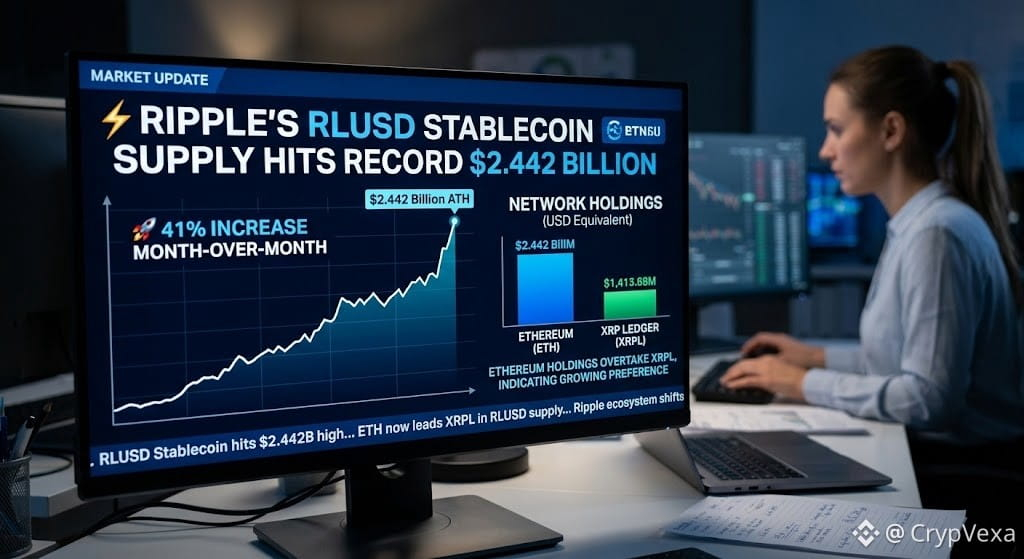
💰 Ripple’s RLUSD stablecoin supply reportedly reached an all-time high of $2.442 billion, marking a roughly 41% increase from the previous month.
🔗 A large share of the new supply has reportedly moved to Ethereum, with Ethereum holdings now overtaking those on the XRP Ledger.
📈 The shift highlights growing use of Ethereum as a settlement and liquidity network for RLUSD, while Ripple’s stablecoin continues expanding across chains.
👀 Could Ethereum’s growing share of RLUSD strengthen its position in the stablecoin market?
#RLUSD #Ripple #Ethereum #Stablecoins
🚀 RLUSD Supply Hits Record $2.44B
💰 Ripple’s RLUSD stablecoin supply reportedly reached an all-time high of $2.442 billion, marking a roughly 41% increase from the previous month.
🔗 A large share of the new supply has reportedly moved to Ethereum, with Ethereum holdings now overtaking those on the XRP Ledger.
📈 The shift highlights growing use of Ethereum as a settlement and liquidity network for RLUSD, while Ripple’s stablecoin continues expanding across chains.
👀 Could Ethereum’s growing share of RLUSD strengthen its position in the stablecoin market?
#RLUSD #Ripple #Ethereum #Stablecoins
💰 Ripple’s RLUSD stablecoin supply reportedly reached an all-time high of $2.442 billion, marking a roughly 41% increase from the previous month.
🔗 A large share of the new supply has reportedly moved to Ethereum, with Ethereum holdings now overtaking those on the XRP Ledger.
📈 The shift highlights growing use of Ethereum as a settlement and liquidity network for RLUSD, while Ripple’s stablecoin continues expanding across chains.
👀 Could Ethereum’s growing share of RLUSD strengthen its position in the stablecoin market?
#RLUSD #Ripple #Ethereum #Stablecoins
1
81


See translation
#USDCOnChainVolumeTops$100Trillion
💵 USDC On-Chain Volume Tops $100 Trillion: The Stablecoin Signal Getting Hard to Ignore 💵
The screens were moving, wallets were active, and somewhere beneath the market noise, billions of dollars kept changing hands. Then one number suddenly put the scale into perspective: USDC has crossed $100 trillion in cumulative on-chain transaction volume.
This is not simply a giant headline. Circle reported $14.8 trillion of USDC on-chain volume in Q2 2026, up 151% year over year, while cumulative activity has now pushed beyond the $100 trillion mark.
The interesting part is what sits behind the number. USDC is increasingly used across DeFi, payments, trading, liquidity management and other on-chain activity. That makes transaction volume a window into how actively digital dollars are moving through crypto infrastructure.
Circle also reported $21.5 trillion of USDC on-chain volume in Q1, showing that the acceleration was already underway before this latest milestone.
My take: $100 trillion does not mean $100 trillion of fresh capital entered crypto. Transaction volume measures movement, and the same capital can circulate many times. But the scale still highlights growing utility for programmable dollar liquidity.
That may be the bigger story. Stablecoins are becoming less like passive parking assets and more like financial infrastructure connecting exchanges, DeFi and global payments.
When money starts moving this efficiently on-chain, the real question is not how big the number looks, but what the next layer of utility will be.
❓ Do you think stablecoin usage will become one of crypto's strongest adoption metrics?
Disclaimer: Educational content only, not financial advice.
#Stablecoins #GrowWithSAC #FedRateWatch $USDC $ASTR $HIVE
#USDCOnChainVolumeTops$100Trillion
💵 USDC On-Chain Volume Tops $100 Trillion: The Stablecoin Signal Getting Hard to Ignore 💵
The screens were moving, wallets were active, and somewhere beneath the market noise, billions of dollars kept changing hands. Then one number suddenly put the scale into perspective: USDC has crossed $100 trillion in cumulative on-chain transaction volume.
This is not simply a giant headline. Circle reported $14.8 trillion of USDC on-chain volume in Q2 2026, up 151% year over year, while cumulative activity has now pushed beyond the $100 trillion mark.
The interesting part is what sits behind the number. USDC is increasingly used across DeFi, payments, trading, liquidity management and other on-chain activity. That makes transaction volume a window into how actively digital dollars are moving through crypto infrastructure.
Circle also reported $21.5 trillion of USDC on-chain volume in Q1, showing that the acceleration was already underway before this latest milestone.
My take: $100 trillion does not mean $100 trillion of fresh capital entered crypto. Transaction volume measures movement, and the same capital can circulate many times. But the scale still highlights growing utility for programmable dollar liquidity.
That may be the bigger story. Stablecoins are becoming less like passive parking assets and more like financial infrastructure connecting exchanges, DeFi and global payments.
When money starts moving this efficiently on-chain, the real question is not how big the number looks, but what the next layer of utility will be.
❓ Do you think stablecoin usage will become one of crypto's strongest adoption metrics?
Disclaimer: Educational content only, not financial advice.
#Stablecoins #GrowWithSAC #FedRateWatch $USDC $ASTR $HIVE
💵 USDC On-Chain Volume Tops $100 Trillion: The Stablecoin Signal Getting Hard to Ignore 💵
The screens were moving, wallets were active, and somewhere beneath the market noise, billions of dollars kept changing hands. Then one number suddenly put the scale into perspective: USDC has crossed $100 trillion in cumulative on-chain transaction volume.
This is not simply a giant headline. Circle reported $14.8 trillion of USDC on-chain volume in Q2 2026, up 151% year over year, while cumulative activity has now pushed beyond the $100 trillion mark.
The interesting part is what sits behind the number. USDC is increasingly used across DeFi, payments, trading, liquidity management and other on-chain activity. That makes transaction volume a window into how actively digital dollars are moving through crypto infrastructure.
Circle also reported $21.5 trillion of USDC on-chain volume in Q1, showing that the acceleration was already underway before this latest milestone.
My take: $100 trillion does not mean $100 trillion of fresh capital entered crypto. Transaction volume measures movement, and the same capital can circulate many times. But the scale still highlights growing utility for programmable dollar liquidity.
That may be the bigger story. Stablecoins are becoming less like passive parking assets and more like financial infrastructure connecting exchanges, DeFi and global payments.
When money starts moving this efficiently on-chain, the real question is not how big the number looks, but what the next layer of utility will be.
❓ Do you think stablecoin usage will become one of crypto's strongest adoption metrics?
Disclaimer: Educational content only, not financial advice.
#Stablecoins #GrowWithSAC #FedRateWatch $USDC $ASTR $HIVE

ABO3ZAM:
هذا التدفق الضخم يعكس تحول العملات المستقرة إلى عصب السيولة الأساسي، مما يسرع من تمركز الزخم في الأسواق. استغل هذه البيانات لتعزيز مراكزك، لكن لا تغفل عن تأمين الأرباح عند مناطق الرفض السعري، فالسوق لا يرحم من يطمع في ذروة الصعود.
6
2
671

See translation
💵 RLUSD supply just hit a new record of $2.442 billion.
Ripple’s stablecoin continues to grow rapidly. Increasing supply often reflects rising demand and adoption.
Do you see RLUSD becoming a serious competitor in the stablecoin space?
$RLUSD
{spot}(RLUSDUSDT)
#RLUSD #Stablecoins #Ripple #RLUSDSupplyHitsRecord$2.442B
💵 RLUSD supply just hit a new record of $2.442 billion.
Ripple’s stablecoin continues to grow rapidly. Increasing supply often reflects rising demand and adoption.
Do you see RLUSD becoming a serious competitor in the stablecoin space?
$RLUSD
#RLUSD #Stablecoins #Ripple #RLUSDSupplyHitsRecord$2.442B
Ripple’s stablecoin continues to grow rapidly. Increasing supply often reflects rising demand and adoption.
Do you see RLUSD becoming a serious competitor in the stablecoin space?
$RLUSD
#RLUSD #Stablecoins #Ripple #RLUSDSupplyHitsRecord$2.442B
1

See translation
💰 THIS PART OF THE CLARITY ACT COULD MATTER A LOT
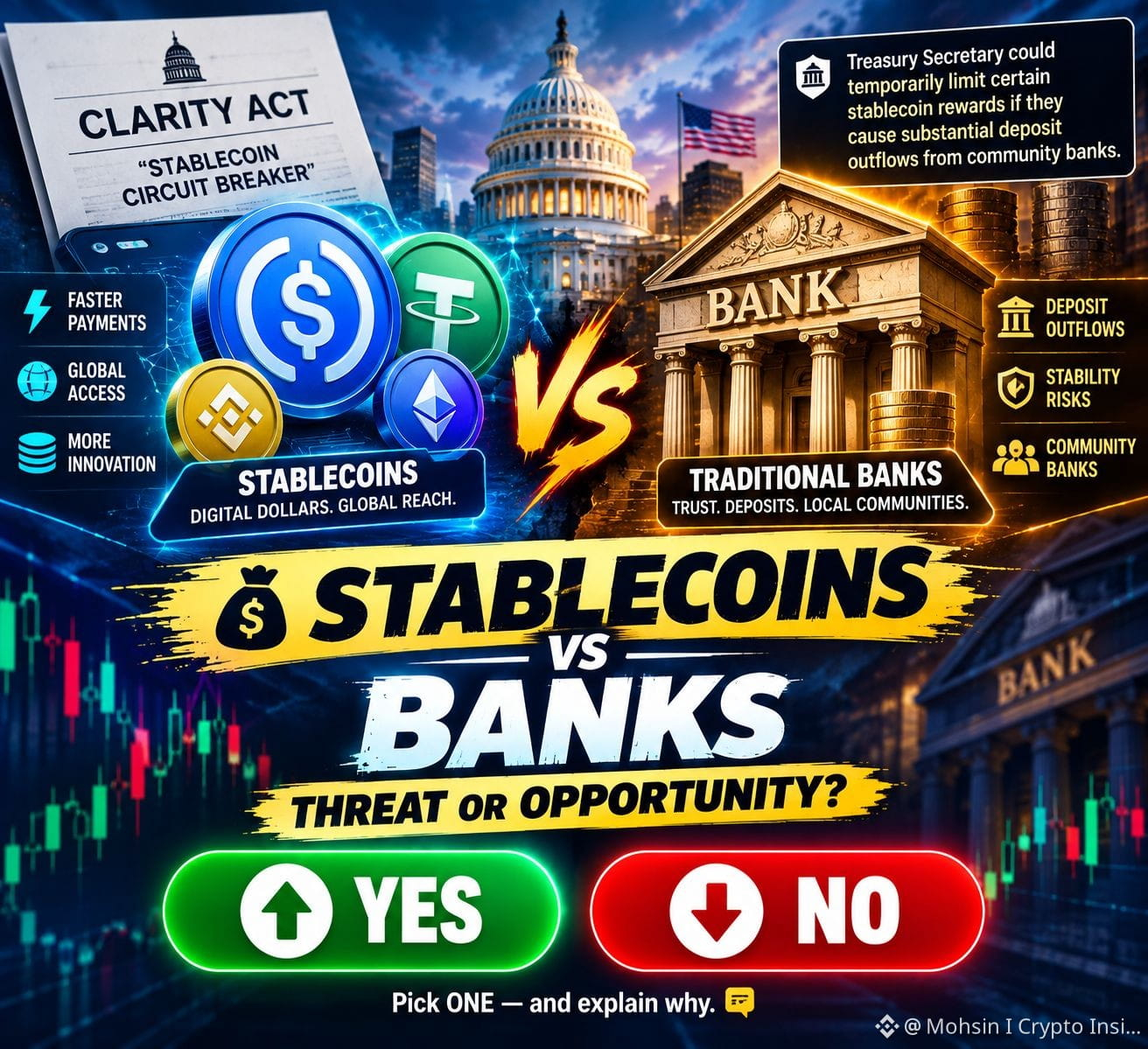
The latest draft includes a proposed stablecoin “circuit breaker” that would give the Treasury secretary authority to temporarily limit certain stablecoin rewards if they cause substantial deposit outflows from community banks.
That's bigger than just crypto trading.
It touches:
Crypto ↔ Stablecoins ↔ Banks
So:
Are stablecoins a threat to traditional banking?
🟢 YES
🔴 NO
Explain your answer. 👇
#Stablecoins #crypto #defi #Regulation
💰 THIS PART OF THE CLARITY ACT COULD MATTER A LOT
The latest draft includes a proposed stablecoin “circuit breaker” that would give the Treasury secretary authority to temporarily limit certain stablecoin rewards if they cause substantial deposit outflows from community banks.
That's bigger than just crypto trading.
It touches:
Crypto ↔ Stablecoins ↔ Banks
So:
Are stablecoins a threat to traditional banking?
🟢 YES
🔴 NO
Explain your answer. 👇
#Stablecoins #crypto #defi #Regulation
The latest draft includes a proposed stablecoin “circuit breaker” that would give the Treasury secretary authority to temporarily limit certain stablecoin rewards if they cause substantial deposit outflows from community banks.
That's bigger than just crypto trading.
It touches:
Crypto ↔ Stablecoins ↔ Banks
So:
Are stablecoins a threat to traditional banking?
🟢 YES
🔴 NO
Explain your answer. 👇
#Stablecoins #crypto #defi #Regulation

·
--
See translation
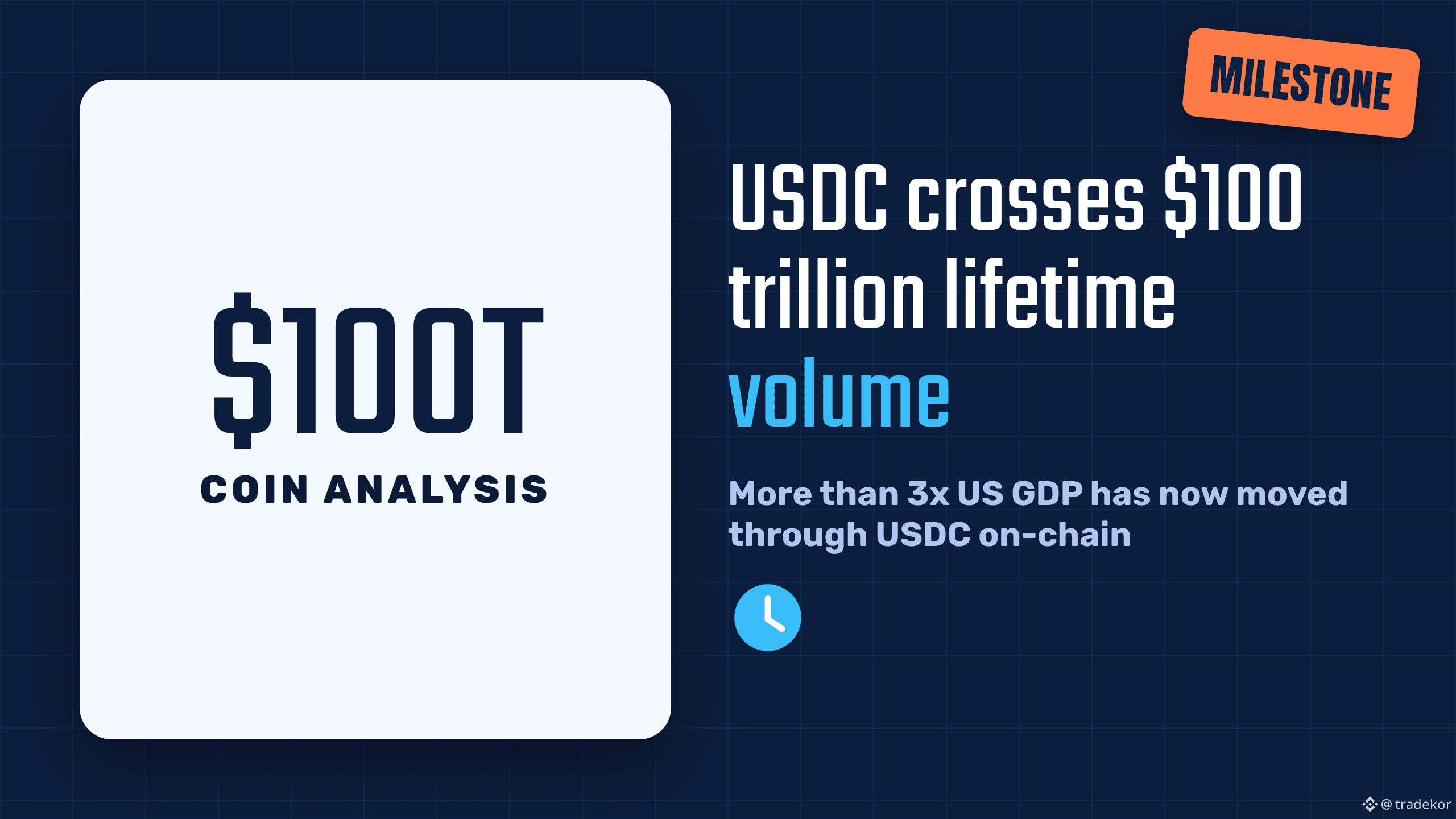
USDC just crossed $100 trillion in lifetime on-chain transaction volume -- more than 3x the entire US GDP, moved through one stablecoin.
The trajectory got steep fast: USDC hit $80T in cumulative volume back in April, $90T by July, and $100T now in mid-September. Q2 2026 alone accounted for $14.8T in on-chain volume, up 151% year-over-year, after an even bigger $21.5T in Q1. Circle says USDC now settles around 77% of all stablecoin activity market-wide.
The catch: cumulative volume isn't the same as circulating supply or "money in the system" -- a lot of that $100T is the same dollars moving many times over (trading, remittances, DeFi loops), not $100T of distinct economic activity. It's a real measure of how much rail USDC has become, not a market-cap number.
Our read: whatever discount you apply for repeat transfers, the growth curve itself is the story -- USDC went from $80T to $100T of lifetime volume in about five months, and it's increasingly the settlement layer of choice on Ethereum for everything from trading to cross-border payments.
Does a stablecoin doing 3x US GDP in on-chain volume change how you think about who actually won the "digital dollar" race?
Not financial advice. DYOR.
$ETH #CryptoNews #Stablecoins #USDC
USDC just crossed $100 trillion in lifetime on-chain transaction volume -- more than 3x the entire US GDP, moved through one stablecoin.
The trajectory got steep fast: USDC hit $80T in cumulative volume back in April, $90T by July, and $100T now in mid-September. Q2 2026 alone accounted for $14.8T in on-chain volume, up 151% year-over-year, after an even bigger $21.5T in Q1. Circle says USDC now settles around 77% of all stablecoin activity market-wide.
The catch: cumulative volume isn't the same as circulating supply or "money in the system" -- a lot of that $100T is the same dollars moving many times over (trading, remittances, DeFi loops), not $100T of distinct economic activity. It's a real measure of how much rail USDC has become, not a market-cap number.
Our read: whatever discount you apply for repeat transfers, the growth curve itself is the story -- USDC went from $80T to $100T of lifetime volume in about five months, and it's increasingly the settlement layer of choice on Ethereum for everything from trading to cross-border payments.
Does a stablecoin doing 3x US GDP in on-chain volume change how you think about who actually won the "digital dollar" race?
Not financial advice. DYOR.
$ETH #CryptoNews #Stablecoins #USDC
The trajectory got steep fast: USDC hit $80T in cumulative volume back in April, $90T by July, and $100T now in mid-September. Q2 2026 alone accounted for $14.8T in on-chain volume, up 151% year-over-year, after an even bigger $21.5T in Q1. Circle says USDC now settles around 77% of all stablecoin activity market-wide.
The catch: cumulative volume isn't the same as circulating supply or "money in the system" -- a lot of that $100T is the same dollars moving many times over (trading, remittances, DeFi loops), not $100T of distinct economic activity. It's a real measure of how much rail USDC has become, not a market-cap number.
Our read: whatever discount you apply for repeat transfers, the growth curve itself is the story -- USDC went from $80T to $100T of lifetime volume in about five months, and it's increasingly the settlement layer of choice on Ethereum for everything from trading to cross-border payments.
Does a stablecoin doing 3x US GDP in on-chain volume change how you think about who actually won the "digital dollar" race?
Not financial advice. DYOR.
$ETH #CryptoNews #Stablecoins #USDC
76

·
--
See translation
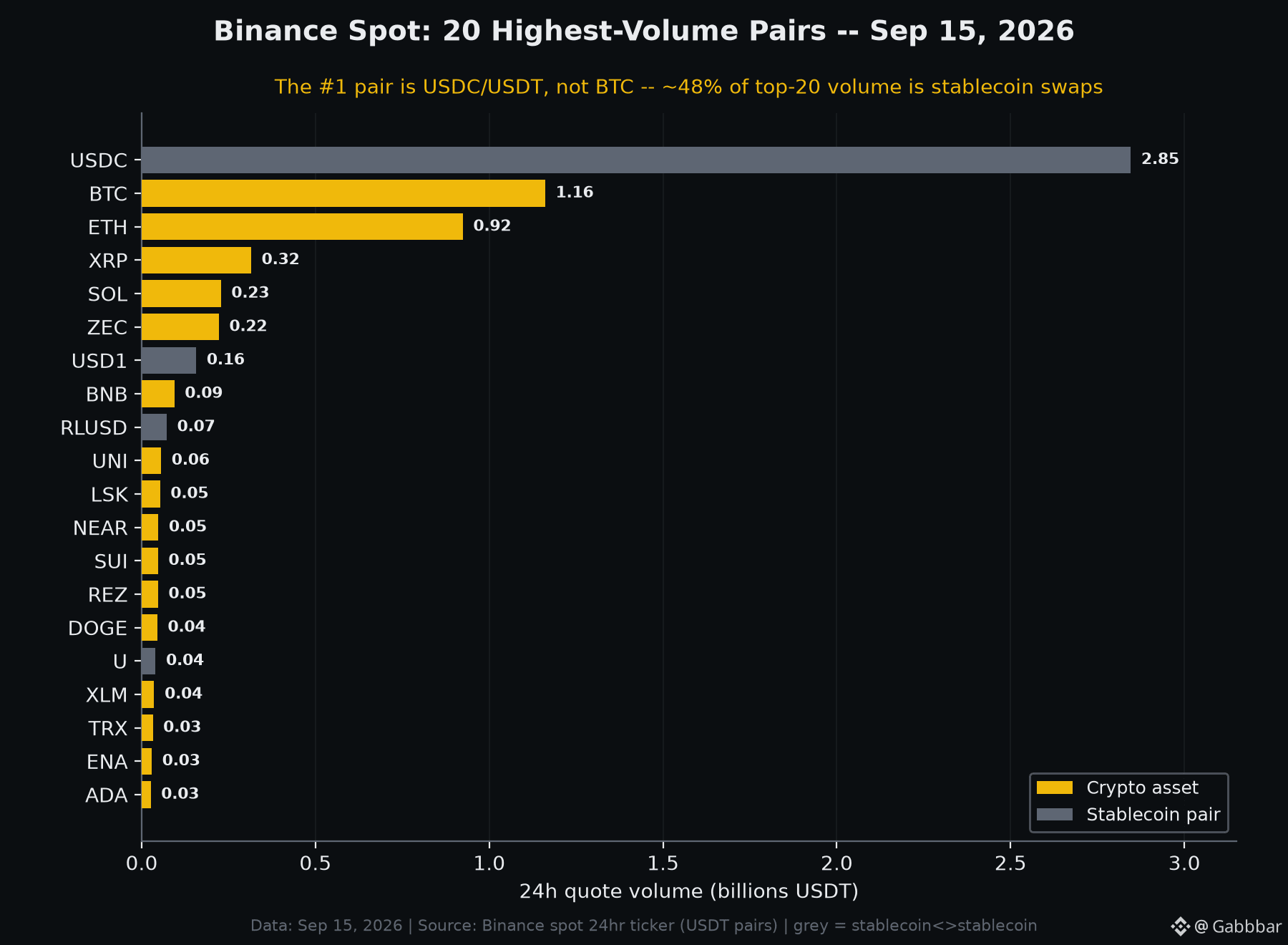
The single busiest market on Binance right now isn't Bitcoin. It's USDC/USDT -- one dollar-stablecoin traded against another. On September 15, 2026, that pair did about $2.85B in 24h spot volume, more than double BTC/USDT's $1.16B.
Here are Binance spot's 20 highest-volume USDT pairs on Sep 15, 2026 (24h quote volume, USD):
1. USDC - $2.85B
2. BTC - $1.16B
3. ETH - $0.92B
4. XRP - $315M
5. SOL - $228M
6. ZEC - $222M
7. USD1 - $157M
8. BNB - $94M
9. RLUSD - $72M
10. UNI - $56M
11. LSK - $53M
12. NEAR - $48M
13. SUI - $47M
14. REZ - $47M
15. DOGE - $45M
16. U - $40M
17. XLM - $36M
18. TRX - $32M
19. ENA - $29M
20. ADA - $26M
The counterintuitive part: four of the top 20 (USDC, USD1, RLUSD, U) are stablecoins trading against another stablecoin. Together they account for roughly $3.12B -- about 48% of all volume in this top-20 list. Nearly half of the "trading activity" at the top of the book is people moving between dollar pegs, not making directional bets on crypto.
A few other things stand out: ZEC ($222M) out-traded BNB, DOGE and ADA combined, and LSK ($53M) is still churning heavy volume after its sharp drop this session.
When you judge "volume" as a signal of interest in an asset, are you separating real directional turnover from stablecoin plumbing -- and how much does that change the picture?
#Binance #Stablecoins #CryptoData
The single busiest market on Binance right now isn't Bitcoin. It's USDC/USDT -- one dollar-stablecoin traded against another. On September 15, 2026, that pair did about $2.85B in 24h spot volume, more than double BTC/USDT's $1.16B.
Here are Binance spot's 20 highest-volume USDT pairs on Sep 15, 2026 (24h quote volume, USD):
1. USDC - $2.85B
2. BTC - $1.16B
3. ETH - $0.92B
4. XRP - $315M
5. SOL - $228M
6. ZEC - $222M
7. USD1 - $157M
8. BNB - $94M
9. RLUSD - $72M
10. UNI - $56M
11. LSK - $53M
12. NEAR - $48M
13. SUI - $47M
14. REZ - $47M
15. DOGE - $45M
16. U - $40M
17. XLM - $36M
18. TRX - $32M
19. ENA - $29M
20. ADA - $26M
The counterintuitive part: four of the top 20 (USDC, USD1, RLUSD, U) are stablecoins trading against another stablecoin. Together they account for roughly $3.12B -- about 48% of all volume in this top-20 list. Nearly half of the "trading activity" at the top of the book is people moving between dollar pegs, not making directional bets on crypto.
A few other things stand out: ZEC ($222M) out-traded BNB, DOGE and ADA combined, and LSK ($53M) is still churning heavy volume after its sharp drop this session.
When you judge "volume" as a signal of interest in an asset, are you separating real directional turnover from stablecoin plumbing -- and how much does that change the picture?
#Binance #Stablecoins #CryptoData
Here are Binance spot's 20 highest-volume USDT pairs on Sep 15, 2026 (24h quote volume, USD):
1. USDC - $2.85B
2. BTC - $1.16B
3. ETH - $0.92B
4. XRP - $315M
5. SOL - $228M
6. ZEC - $222M
7. USD1 - $157M
8. BNB - $94M
9. RLUSD - $72M
10. UNI - $56M
11. LSK - $53M
12. NEAR - $48M
13. SUI - $47M
14. REZ - $47M
15. DOGE - $45M
16. U - $40M
17. XLM - $36M
18. TRX - $32M
19. ENA - $29M
20. ADA - $26M
The counterintuitive part: four of the top 20 (USDC, USD1, RLUSD, U) are stablecoins trading against another stablecoin. Together they account for roughly $3.12B -- about 48% of all volume in this top-20 list. Nearly half of the "trading activity" at the top of the book is people moving between dollar pegs, not making directional bets on crypto.
A few other things stand out: ZEC ($222M) out-traded BNB, DOGE and ADA combined, and LSK ($53M) is still churning heavy volume after its sharp drop this session.
When you judge "volume" as a signal of interest in an asset, are you separating real directional turnover from stablecoin plumbing -- and how much does that change the picture?
#Binance #Stablecoins #CryptoData
126

·
--
Bullish
See translation
#USDCOnChainVolumeTops$100Trillion
🚨 USDC ON-CHAIN VOLUME CROSSES $100 TRILLION! 💰
This is a massive milestone for the stablecoin market. 👀
USDC’s total on-chain transaction volume has now surpassed $100 trillion, showing how much capital is moving through the stablecoin ecosystem.
Why does it matter? 👇
💵 More stablecoin activity
🌐 Growing crypto adoption
⚡ More liquidity moving on-chain
📈 Stronger infrastructure for the crypto market
This doesn't mean $100T is entering crypto today — it represents cumulative on-chain volume.
🔥 $USDC adoption keeps growing. Is this bullish for the entire crypto market?
#USDC #crypto #Stablecoins
#USDCOnChainVolumeTops$100Trillion
🚨 USDC ON-CHAIN VOLUME CROSSES $100 TRILLION! 💰
This is a massive milestone for the stablecoin market. 👀
USDC’s total on-chain transaction volume has now surpassed $100 trillion, showing how much capital is moving through the stablecoin ecosystem.
Why does it matter? 👇
💵 More stablecoin activity
🌐 Growing crypto adoption
⚡ More liquidity moving on-chain
📈 Stronger infrastructure for the crypto market
This doesn't mean $100T is entering crypto today — it represents cumulative on-chain volume.
🔥 $USDC adoption keeps growing. Is this bullish for the entire crypto market?
#USDC #crypto #Stablecoins
🚨 USDC ON-CHAIN VOLUME CROSSES $100 TRILLION! 💰
This is a massive milestone for the stablecoin market. 👀
USDC’s total on-chain transaction volume has now surpassed $100 trillion, showing how much capital is moving through the stablecoin ecosystem.
Why does it matter? 👇
💵 More stablecoin activity
🌐 Growing crypto adoption
⚡ More liquidity moving on-chain
📈 Stronger infrastructure for the crypto market
This doesn't mean $100T is entering crypto today — it represents cumulative on-chain volume.
🔥 $USDC adoption keeps growing. Is this bullish for the entire crypto market?
#USDC #crypto #Stablecoins
ABO3ZAM:
تجاوز هذا الرقم يعكس عمق السيولة التراكمية ويدعم استقرار البنية التحتية، لكنه لا يترجم لتدفق لحظي مباشر. راقب تمركز الزخم عند مناطق الرفض السعري، وأمن أرباحك بصرامة عند كل قمة؛ فالسوق لا يرحم من يغفل عن إدارة المخاطر في أوقات التفاؤل المفرط.
2
1
23

·
--
Bullish
˗ˋˏ🚨ˎˊ˗ U.S. BANK TESTS ITS OWN STABLECOIN ON $XLM STELLAR࿐😱࿐
⚡️One of the biggest banks in the United States just took an important step toward moving banking money to a public blockchain.
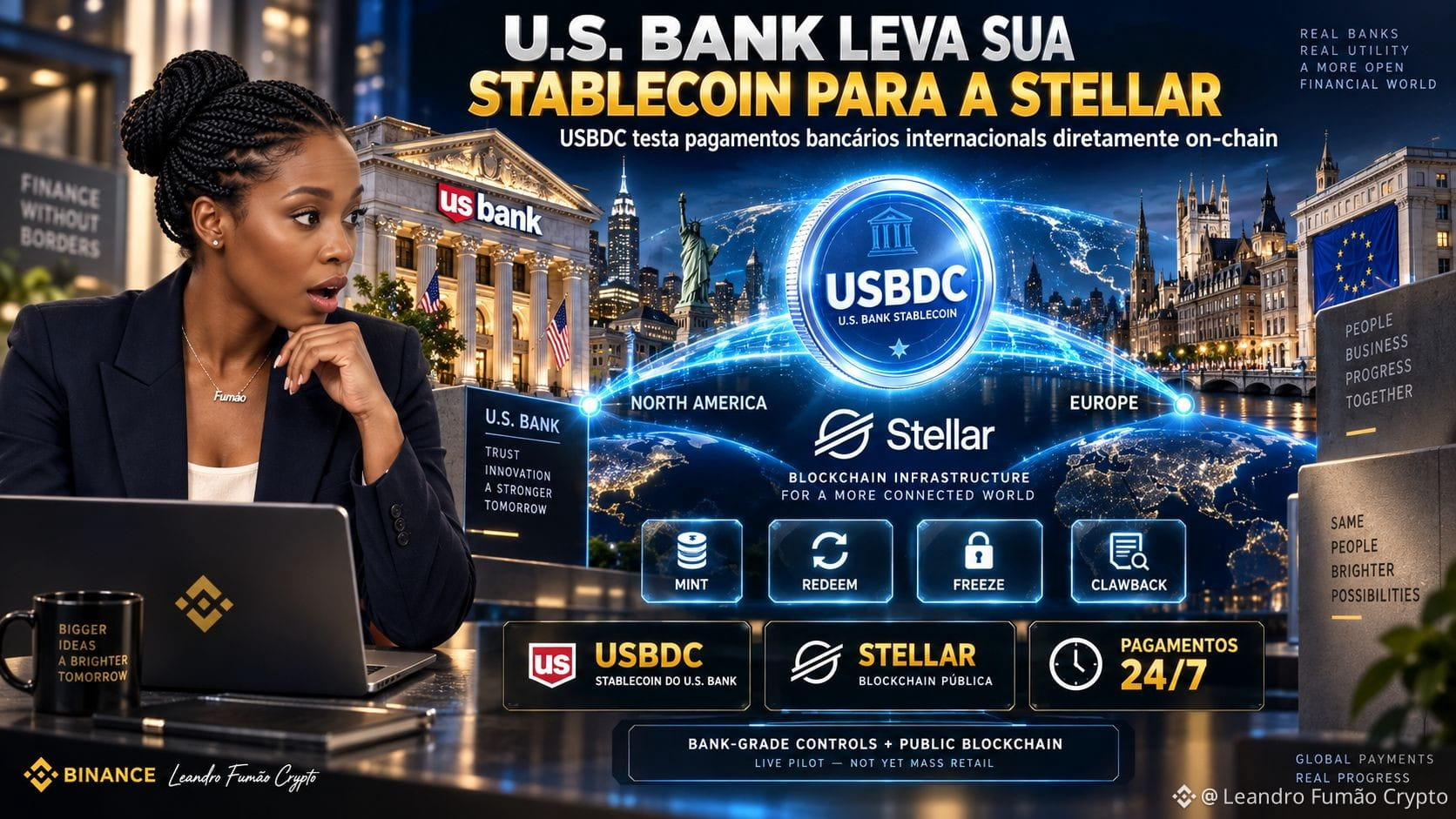
U.S. Bank executed a real pilot transaction with USBDC, its own dollar-backed stablecoin, using Stellar to make a payment between bank entities in North America and Europe.
🔥 The most interesting part isn’t just the stablecoin.
The operation was integrated into the bank’s traditional systems for:
▸Finance
▸Risk
▸Compliance
▸Operations
In other words: Stellar acted as the blockchain rail, while U.S. Bank maintained traditional banking controls.
The platform was also tested for:
MINTING USBDC
REDEEMING
FREEZING ASSETS
CLAWBACK / CONTROLLED REVERSAL
According to the Stellar Development Foundation, precisely these control features at the network level helped make the infrastructure attractive for regulated banking applications.
👀 And the bank is already looking beyond international payments.
After the pilot, U.S. Bank is studying uses such as liquidity management, collateral movement, and international treasury. The bank also takes part in the Open USD project, which brings together more than 140 banks, fintechs, and companies in the financial ecosystem.
⚠️ Important: USBDC is not yet a retail stablecoin broadly available to the public, and that also doesn’t mean payments are already being made to $XLM .
Stellar is the blockchain infrastructure used in the pilot.
🔥 The biggest shift may be this:
banks are starting to put their own forms of money directly on-chain.
👇 Can bank-issued stablecoins become a new layer of global payments?
#stellar #Stablecoins #XLM/
˗ˋˏ🚨ˎˊ˗ U.S. BANK TESTS ITS OWN STABLECOIN ON $XLM STELLAR࿐😱࿐
⚡️One of the biggest banks in the United States just took an important step toward moving banking money to a public blockchain.
U.S. Bank executed a real pilot transaction with USBDC, its own dollar-backed stablecoin, using Stellar to make a payment between bank entities in North America and Europe.
🔥 The most interesting part isn’t just the stablecoin.
The operation was integrated into the bank’s traditional systems for:
▸Finance
▸Risk
▸Compliance
▸Operations
In other words: Stellar acted as the blockchain rail, while U.S. Bank maintained traditional banking controls.
The platform was also tested for:
MINTING USBDC
REDEEMING
FREEZING ASSETS
CLAWBACK / CONTROLLED REVERSAL
According to the Stellar Development Foundation, precisely these control features at the network level helped make the infrastructure attractive for regulated banking applications.
👀 And the bank is already looking beyond international payments.
After the pilot, U.S. Bank is studying uses such as liquidity management, collateral movement, and international treasury. The bank also takes part in the Open USD project, which brings together more than 140 banks, fintechs, and companies in the financial ecosystem.
⚠️ Important: USBDC is not yet a retail stablecoin broadly available to the public, and that also doesn’t mean payments are already being made to $XLM .
Stellar is the blockchain infrastructure used in the pilot.
🔥 The biggest shift may be this:
banks are starting to put their own forms of money directly on-chain.
👇 Can bank-issued stablecoins become a new layer of global payments?
#stellar #Stablecoins #XLM/
⚡️One of the biggest banks in the United States just took an important step toward moving banking money to a public blockchain.
U.S. Bank executed a real pilot transaction with USBDC, its own dollar-backed stablecoin, using Stellar to make a payment between bank entities in North America and Europe.
🔥 The most interesting part isn’t just the stablecoin.
The operation was integrated into the bank’s traditional systems for:
▸Finance
▸Risk
▸Compliance
▸Operations
In other words: Stellar acted as the blockchain rail, while U.S. Bank maintained traditional banking controls.
The platform was also tested for:
MINTING USBDC
REDEEMING
FREEZING ASSETS
CLAWBACK / CONTROLLED REVERSAL
According to the Stellar Development Foundation, precisely these control features at the network level helped make the infrastructure attractive for regulated banking applications.
👀 And the bank is already looking beyond international payments.
After the pilot, U.S. Bank is studying uses such as liquidity management, collateral movement, and international treasury. The bank also takes part in the Open USD project, which brings together more than 140 banks, fintechs, and companies in the financial ecosystem.
⚠️ Important: USBDC is not yet a retail stablecoin broadly available to the public, and that also doesn’t mean payments are already being made to $XLM .
Stellar is the blockchain infrastructure used in the pilot.
🔥 The biggest shift may be this:
banks are starting to put their own forms of money directly on-chain.
👇 Can bank-issued stablecoins become a new layer of global payments?
#stellar #Stablecoins #XLM/
206
·
--
See translation
Stablecoins have quietly become the most used blockchain product in existence. Not through hype cycles or meme frenzies — but through simple utility: moving value across borders faster and cheaper than any traditional rail.
The numbers tell the story. Stablecoin settlement volumes now rival major payment networks on an annualized basis. USDT alone processes trillions in quarterly transfer value. And the gap is widening as emerging markets adopt stablecoins not for speculation, but for savings and commerce.
What's changing in 2026 is infrastructure maturity. Layer 2s have brought transfer costs to fractions of a cent. Cross-chain bridges are making stablecoin interoperability seamless. And regulated frameworks in the EU, Singapore, and UAE are giving institutions the confidence to build real payment products on top of public chains.
The implication for investors: the tokens powering the cheapest, most reliable settlement layers will capture disproportionate value from this trend. It's not about which chain has the most hype — it's about which chain can settle a million micro-payments per second without breaking.
Watch the payment rail narrative closely. The next wave of crypto adoption won't come from a new token narrative. It will come from your coffee.
$BTC $ETH $BNB
#Stablecoins #PaymentRails #CryptoAdoption #DeFi #Web3
Stablecoins have quietly become the most used blockchain product in existence. Not through hype cycles or meme frenzies — but through simple utility: moving value across borders faster and cheaper than any traditional rail.
The numbers tell the story. Stablecoin settlement volumes now rival major payment networks on an annualized basis. USDT alone processes trillions in quarterly transfer value. And the gap is widening as emerging markets adopt stablecoins not for speculation, but for savings and commerce.
What's changing in 2026 is infrastructure maturity. Layer 2s have brought transfer costs to fractions of a cent. Cross-chain bridges are making stablecoin interoperability seamless. And regulated frameworks in the EU, Singapore, and UAE are giving institutions the confidence to build real payment products on top of public chains.
The implication for investors: the tokens powering the cheapest, most reliable settlement layers will capture disproportionate value from this trend. It's not about which chain has the most hype — it's about which chain can settle a million micro-payments per second without breaking.
Watch the payment rail narrative closely. The next wave of crypto adoption won't come from a new token narrative. It will come from your coffee.
$BTC $ETH $BNB
#Stablecoins #PaymentRails #CryptoAdoption #DeFi #Web3
The numbers tell the story. Stablecoin settlement volumes now rival major payment networks on an annualized basis. USDT alone processes trillions in quarterly transfer value. And the gap is widening as emerging markets adopt stablecoins not for speculation, but for savings and commerce.
What's changing in 2026 is infrastructure maturity. Layer 2s have brought transfer costs to fractions of a cent. Cross-chain bridges are making stablecoin interoperability seamless. And regulated frameworks in the EU, Singapore, and UAE are giving institutions the confidence to build real payment products on top of public chains.
The implication for investors: the tokens powering the cheapest, most reliable settlement layers will capture disproportionate value from this trend. It's not about which chain has the most hype — it's about which chain can settle a million micro-payments per second without breaking.
Watch the payment rail narrative closely. The next wave of crypto adoption won't come from a new token narrative. It will come from your coffee.
$BTC $ETH $BNB
#Stablecoins #PaymentRails #CryptoAdoption #DeFi #Web3
117

·
--
Chinese version:
UK greenlights stablecoin payments! Routine transfers and cash exchanges are not regulated, but crypto lending and swap services remain restricted. This is basically the spring of stablecoins! UK policy clearly draws a distinction, which bodes well for stablecoins like USDT and USDC. In the short term, the stablecoin sector will likely see capital inflows, but the crypto lending space may face pressure. It looks like regulators are looking for a balance point—acknowledging the value of stablecoins while also guarding against risks. $USDT $USDC #stablecoins #crypto regulation
UK just opened the door for stablecoin payments! Routine transfers and cash exchanges get a free pass, while crypto lending and swaps remain restricted. This is a huge win for stablecoins like USDT and USDC! In the short term, expect capital inflow into the stablecoin space, but crypto lending might take a hit. UK regulators are clearly drawing a line—embracing stablecoins' utility while reining in riskier activities. $USDT $USDC #stablecoins #crypto regulation
Chinese version:
UK greenlights stablecoin payments! Routine transfers and cash exchanges are not regulated, but crypto lending and swap services remain restricted. This is basically the spring of stablecoins! UK policy clearly draws a distinction, which bodes well for stablecoins like USDT and USDC. In the short term, the stablecoin sector will likely see capital inflows, but the crypto lending space may face pressure. It looks like regulators are looking for a balance point—acknowledging the value of stablecoins while also guarding against risks. $USDT $USDC #stablecoins #crypto regulation
UK just opened the door for stablecoin payments! Routine transfers and cash exchanges get a free pass, while crypto lending and swaps remain restricted. This is a huge win for stablecoins like USDT and USDC! In the short term, expect capital inflow into the stablecoin space, but crypto lending might take a hit. UK regulators are clearly drawing a line—embracing stablecoins' utility while reining in riskier activities. $USDT $USDC #stablecoins #crypto regulation
UK greenlights stablecoin payments! Routine transfers and cash exchanges are not regulated, but crypto lending and swap services remain restricted. This is basically the spring of stablecoins! UK policy clearly draws a distinction, which bodes well for stablecoins like USDT and USDC. In the short term, the stablecoin sector will likely see capital inflows, but the crypto lending space may face pressure. It looks like regulators are looking for a balance point—acknowledging the value of stablecoins while also guarding against risks. $USDT $USDC #stablecoins #crypto regulation
UK just opened the door for stablecoin payments! Routine transfers and cash exchanges get a free pass, while crypto lending and swaps remain restricted. This is a huge win for stablecoins like USDT and USDC! In the short term, expect capital inflow into the stablecoin space, but crypto lending might take a hit. UK regulators are clearly drawing a line—embracing stablecoins' utility while reining in riskier activities. $USDT $USDC #stablecoins #crypto regulation
6

🚨 Morgan Says Institutions Still Don’t Need Stablecoins 📈 TETHER CEO Mocks Back 🧠
📊 | $BTC | $ETH | $BNB |
- Please follow, like, and leave a comment to discuss the latest market developments together. 📈
- Morgan’s co-chairman, Doug Petno, said institutional demand for stablecoins is still in its early stages.
- He noted that institutions have not yet included stablecoins in their asset allocation.
- Tether’s CEO dismissed Morgan’s remarks, publicly mocking the claim that institutional demand is overstated.
- This dispute has drawn market attention, and in the short term it has pushed related coins to move upward with increased volatility. 🔥
- If institutions accelerate their rollout once regulation becomes clearer, stablecoin demand could surge sharply.
- This may also push the prices of major stablecoins like USDT higher in the short term and attract liquidity inflows.
- Whale capital has already started accumulating USDT, indicating smart money is positioning early.
- It’s expected that, in the near term, the market’s volatility preference will lean positive, and more short-term trading opportunities may emerge.
- When do you think institutions will truly start including stablecoins in their asset allocation? Feel free to share your thoughts.
- Follow us for the latest, first-hand updates on the crypto market. We welcome your comments and engagement.
#Crypto #Stablecoins #Whales #Market #Trading
🚨 Morgan Says Institutions Still Don’t Need Stablecoins 📈 TETHER CEO Mocks Back 🧠
📊 | $BTC | $ETH | $BNB |
- Please follow, like, and leave a comment to discuss the latest market developments together. 📈
- Morgan’s co-chairman, Doug Petno, said institutional demand for stablecoins is still in its early stages.
- He noted that institutions have not yet included stablecoins in their asset allocation.
- Tether’s CEO dismissed Morgan’s remarks, publicly mocking the claim that institutional demand is overstated.
- This dispute has drawn market attention, and in the short term it has pushed related coins to move upward with increased volatility. 🔥
- If institutions accelerate their rollout once regulation becomes clearer, stablecoin demand could surge sharply.
- This may also push the prices of major stablecoins like USDT higher in the short term and attract liquidity inflows.
- Whale capital has already started accumulating USDT, indicating smart money is positioning early.
- It’s expected that, in the near term, the market’s volatility preference will lean positive, and more short-term trading opportunities may emerge.
- When do you think institutions will truly start including stablecoins in their asset allocation? Feel free to share your thoughts.
- Follow us for the latest, first-hand updates on the crypto market. We welcome your comments and engagement.
#Crypto #Stablecoins #Whales #Market #Trading
📊 | $BTC | $ETH | $BNB |
- Please follow, like, and leave a comment to discuss the latest market developments together. 📈
- Morgan’s co-chairman, Doug Petno, said institutional demand for stablecoins is still in its early stages.
- He noted that institutions have not yet included stablecoins in their asset allocation.
- Tether’s CEO dismissed Morgan’s remarks, publicly mocking the claim that institutional demand is overstated.
- This dispute has drawn market attention, and in the short term it has pushed related coins to move upward with increased volatility. 🔥
- If institutions accelerate their rollout once regulation becomes clearer, stablecoin demand could surge sharply.
- This may also push the prices of major stablecoins like USDT higher in the short term and attract liquidity inflows.
- Whale capital has already started accumulating USDT, indicating smart money is positioning early.
- It’s expected that, in the near term, the market’s volatility preference will lean positive, and more short-term trading opportunities may emerge.
- When do you think institutions will truly start including stablecoins in their asset allocation? Feel free to share your thoughts.
- Follow us for the latest, first-hand updates on the crypto market. We welcome your comments and engagement.
#Crypto #Stablecoins #Whales #Market #Trading
231

·
--
Bullish
Verified
It’s curious that many #venezolanos are unaware that as the market for #Stablecoins grows, the money that goes into Treasury bills (T-Bills) grows as well. When we manage #Stablecoins from our phone, most of the time—without knowing it—we are lending money to the U.S.
Why does the U.S. need #CLARITYAct ?
Because the older holders of its debt are withdrawing. Japan sells U.S. Treasury bonds to protect the strength of the yen.
Bonds held by China fell from $1.3 trillion at the peak to less than $700 billion. For U.S. debt, which exceeds $40 trillion, new buyers are needed.
The new buyers are investors who have #Stablecoins. . The Clarity Act is the law that makes that base of buyers grow.
It’s curious that many #venezolanos are unaware that as the market for #Stablecoins grows, the money that goes into Treasury bills (T-Bills) grows as well. When we manage #Stablecoins from our phone, most of the time—without knowing it—we are lending money to the U.S.
Why does the U.S. need #CLARITYAct ?
Because the older holders of its debt are withdrawing. Japan sells U.S. Treasury bonds to protect the strength of the yen.
Bonds held by China fell from $1.3 trillion at the peak to less than $700 billion. For U.S. debt, which exceeds $40 trillion, new buyers are needed.
The new buyers are investors who have #Stablecoins. . The Clarity Act is the law that makes that base of buyers grow.
Why does the U.S. need #CLARITYAct ?
Because the older holders of its debt are withdrawing. Japan sells U.S. Treasury bonds to protect the strength of the yen.
Bonds held by China fell from $1.3 trillion at the peak to less than $700 billion. For U.S. debt, which exceeds $40 trillion, new buyers are needed.
The new buyers are investors who have #Stablecoins. . The Clarity Act is the law that makes that base of buyers grow.
128

·
--
🚨 Stablecoins may increase demand for US dollars and US Treasuries — Bank of England 🧠
📊 | $BTC | $ETH | $BNB |
- Follow our channel, like, and leave a comment to discuss 📈
- The circulating supply of USD stablecoins has reached about $300 billion
- Policy makers at the Bank of England warn that their expansion could increase demand for US Treasuries
- Meanwhile, large-scale redemptions could introduce new risks
- Stablecoins may extend their impact into the US financial system 🔥
- Stablecoin expansion could lead to higher short-term Treasury demand, and interest rates may fall
- Due to high redemption risk, the market may see volatility; investors should stay alert
- Big whales may allocate or accumulate at low levels amid the volatility; large sell-offs could occur in the short term
- The market is expected to remain under pressure over the coming week, with elevated volatility
- How long do you think stablecoins’ impact on the US Treasury market will last?
- Follow us for more in-depth market analysis and real-time updates
#Stablecoins #USDT #Treasuries #Whales #Market
🚨 Stablecoins may increase demand for US dollars and US Treasuries — Bank of England 🧠
📊 | $BTC | $ETH | $BNB |
- Follow our channel, like, and leave a comment to discuss 📈
- The circulating supply of USD stablecoins has reached about $300 billion
- Policy makers at the Bank of England warn that their expansion could increase demand for US Treasuries
- Meanwhile, large-scale redemptions could introduce new risks
- Stablecoins may extend their impact into the US financial system 🔥
- Stablecoin expansion could lead to higher short-term Treasury demand, and interest rates may fall
- Due to high redemption risk, the market may see volatility; investors should stay alert
- Big whales may allocate or accumulate at low levels amid the volatility; large sell-offs could occur in the short term
- The market is expected to remain under pressure over the coming week, with elevated volatility
- How long do you think stablecoins’ impact on the US Treasury market will last?
- Follow us for more in-depth market analysis and real-time updates
#Stablecoins #USDT #Treasuries #Whales #Market
📊 | $BTC | $ETH | $BNB |
- Follow our channel, like, and leave a comment to discuss 📈
- The circulating supply of USD stablecoins has reached about $300 billion
- Policy makers at the Bank of England warn that their expansion could increase demand for US Treasuries
- Meanwhile, large-scale redemptions could introduce new risks
- Stablecoins may extend their impact into the US financial system 🔥
- Stablecoin expansion could lead to higher short-term Treasury demand, and interest rates may fall
- Due to high redemption risk, the market may see volatility; investors should stay alert
- Big whales may allocate or accumulate at low levels amid the volatility; large sell-offs could occur in the short term
- The market is expected to remain under pressure over the coming week, with elevated volatility
- How long do you think stablecoins’ impact on the US Treasury market will last?
- Follow us for more in-depth market analysis and real-time updates
#Stablecoins #USDT #Treasuries #Whales #Market
26
Log in to explore more content
Join global crypto users on Binance Square
⚡️ Get latest and useful information about crypto.
💬 Trusted by the world’s largest crypto exchange.
👍 Discover real insights from verified creators.
Email / Phone number
Trending Topics
1
#FedRateWatch
1.6M views
6,921 Discussing
2
#ZcashRises6%
68,487 views
732 Discussing
3
#XRPSinks10%
44,463 views
483 Discussing
4
#BitcoinETFsShed$450M
8,608 views
101 Discussing
5
#CircleOpensArcMainnet
20,290 views
311 Discussing
6
#ZcashHoldersBackNU7Upgrade
32,836 views
473 Discussing
7
#MSTRTradingVolumeSurpassesMorganStanley
29,757 views
621 Discussing
8
#BitcoinFalls4%
60,763 views
969 Discussing
9
#SKHynixInTalksToMakeMemoryChipsInUS
22,902 views
374 Discussing
10
#OpenAIDiscussesNewFundingAt$1.2TValuation
6,442 views
62 Discussing