

Block signal
80 Posts

Block signal
Report
Block User
🚀 Crypto News | 📊 Market Insights | 🔍 Research & Analysis | 🌐 Web.3 Learn, Stay Informed & Stay ahead.
0 Following
19 Followers
40 Liked
Posts
·
--
See translation
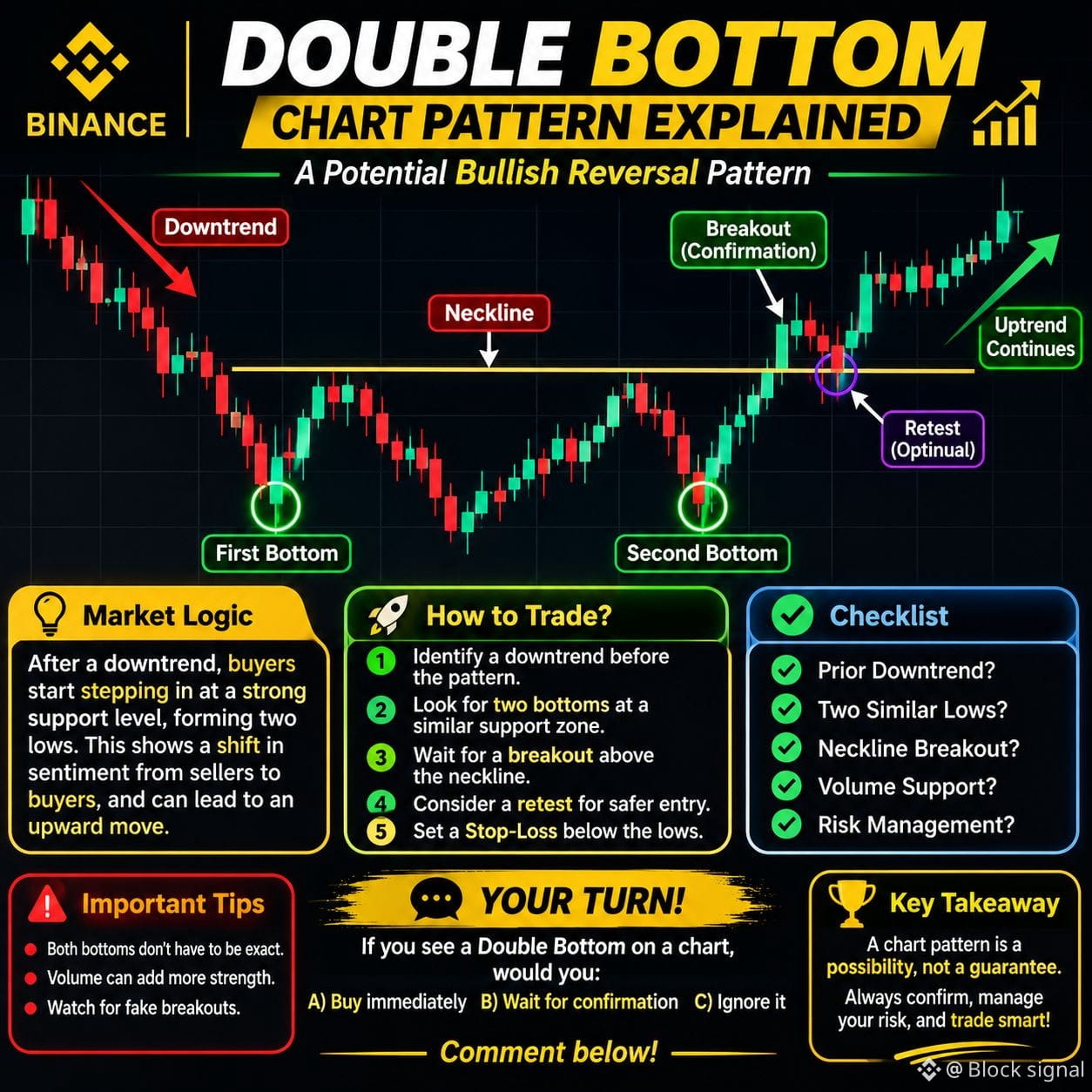
📊 CRYPTO CHART PATTERN SERIES #1: DOUBLE BOTTOM
Can a simple W-shaped pattern help you identify a potential market reversal? 👀
Let's understand the Double Bottom pattern!
🔍 WHAT IS A DOUBLE BOTTOM?
A Double Bottom is a potential bullish reversal pattern that can form after a downtrend.
Here's how it works:
1️⃣ First Bottom: Price falls to a support zone, where buyers begin stepping in.
2️⃣ Recovery: Price bounces and creates a swing high.
3️⃣ Second Bottom: Price returns to a similar support zone, but selling pressure may weaken.
4️⃣ Neckline Breakout: Price breaks above the swing high between the two bottoms, potentially confirming a bullish reversal.
✅ HOW TO VERIFY THE PATTERN
• Was there a downtrend before the pattern?
• Are the two lows near a similar support zone?
• Has price closed above the neckline?
• Is trading volume supporting the breakout?
• Have you defined your risk before entering?
⚠️ COMMON MISTAKE
Seeing a W shape and buying immediately!
Without a confirmed breakout, the pattern may fail. Even a confirmed breakout can reverse.
💡 PRO TIP
Some traders wait for a neckline retest before entering. This can offer another confirmation opportunity, but a retest is never guaranteed.
🎯 YOUR TURN:
If you spot a Double Bottom on a Bitcoin chart, what would you do?
A) Buy immediately
B) Wait for a confirmed breakout
C) Wait for a breakout and possible retest
Comment A, B, or C! 👇
Follow this series for more practical crypto chart pattern lessons.
#CryptoEducation #Bitcoin #ETH #TradingPatterns #BinanceSquare $BTC $ETH $AAPLB
34
·
--
See translation
🐋 BITCOIN WHALES AREN'T MAGIC. HERE'S WHAT YOU SHOULD UNDERSTAND.
Many traders see a large Bitcoin transaction and immediately assume:
🚀 "Whales are buying! The price will pump!"
Or...
🔻 "Whales are selling! A crash is coming!"
But a large transfer alone doesn't tell you the full story.
A transaction could represent an exchange transfer, internal wallet movement, custody activity, or an actual purchase or sale.
So what should you examine?
🔍 1. Exchange inflows and outflows
🔍 2. Spot trading volume
🔍 3. Price reaction around key levels
🔍 4. Whether the move has confirmation
💡 THE BIG LESSON:
On-chain data provides clues, not guaranteed trading signals.
Never buy or sell Bitcoin based on a single whale alert.
📢 Let's hear your opinion:
Do you follow whale movements when trading BTC?
YES 🐋 or NO 📊
And which data matters most to you?
#Bitcoin #BTC #Whales #OnChainAnalysis #ETH $BTC $ETH $AAPLB
49
·
--
See translation
📉 YOU CAN BE RIGHT ABOUT THE MARKET AND STILL LOSE MONEY.
Here's why.
Imagine you buy Bitcoin because you expect the price to rise.
Your analysis is correct eventually, but the market drops sharply first.
If you used excessive leverage, your position could be liquidated before your prediction comes true.
That's why professional trading isn't just about predicting direction.
It's about managing risk.
✅ 5 RULES EVERY TRADER SHOULD KNOW:
1️⃣ Define your entry before opening a position.
2️⃣ Decide where your trade idea becomes invalid.
3️⃣ Calculate your position size based on your acceptable loss.
4️⃣ Avoid excessive leverage, especially during volatile markets.
5️⃣ Never risk money you cannot afford to lose.
🔥 Remember:
A good trader doesn't need to win every trade.
A good trader needs a process that survives losing trades.
👇 QUESTION FOR BEGINNERS:
What's harder for you?
A) Finding the right entry
B) Controlling emotions
C) Managing risk
Let's discuss in the comments!
#Trading #BTC #CryptoTrading #Bitcoin #RiskManagement $BTC $AAPLB $NVDAB
51
·
--
See translation
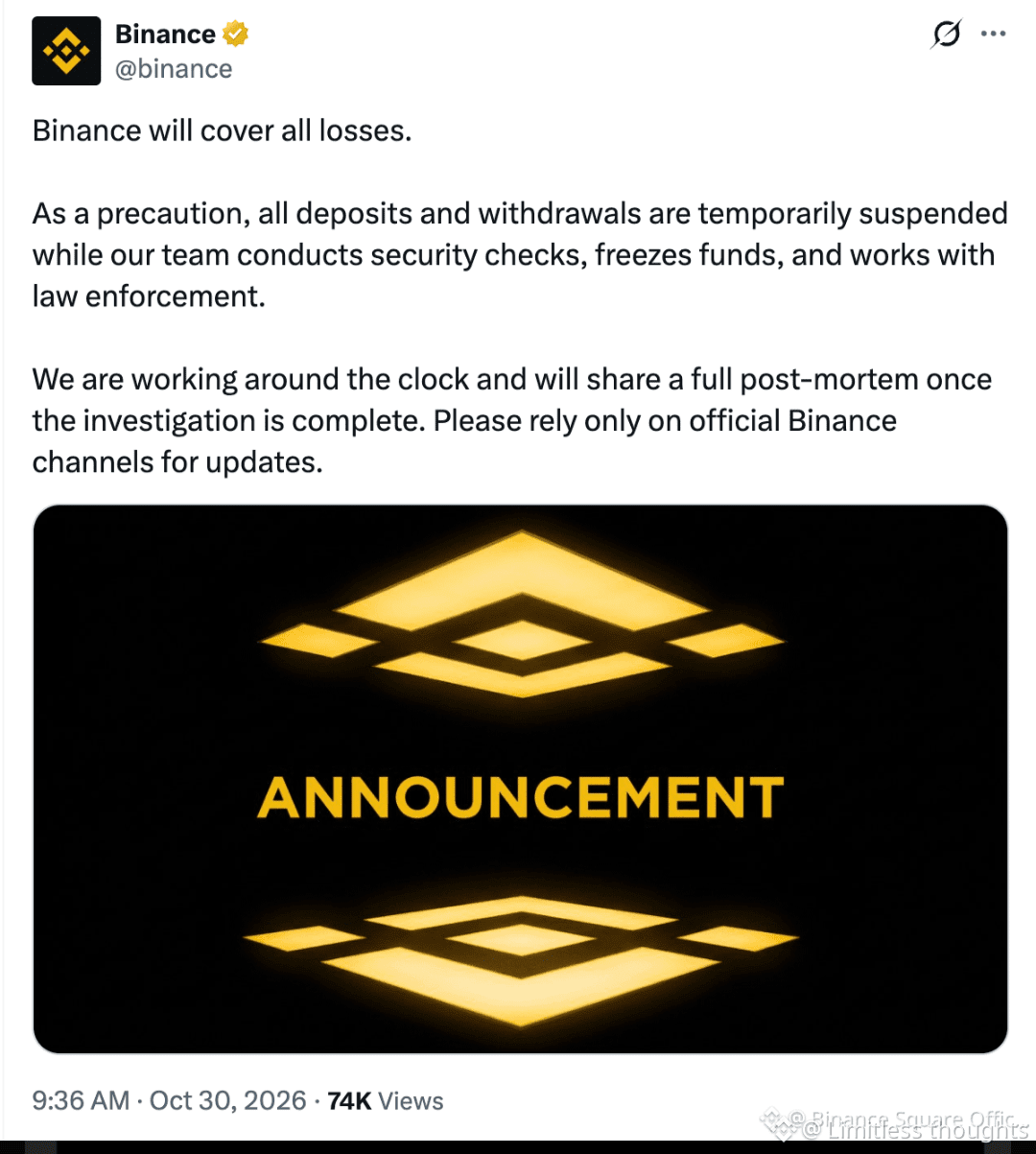
🚨 CRYPTO UPDATE: BINANCE'S $6.3 BILLION SECURITY INCIDENT
A major security incident has put crypto exchange security back in the spotlight.
📌 What we know:
According to Reuters' October 31 report, Binance said it had replenished approximately 90% of the affected assets.
The exchange has stated that it will absorb the financial impact rather than pass the losses on to users.
But what should traders learn from this?
🔐 1. Exchange security is a serious risk.
📊 2. Proof of Reserves and transparent updates matter.
⚠️ 3. Always verify withdrawal availability before making time-sensitive transactions.
🛡️ 4. Never share your passwords, OTPs, or API keys.
IMPORTANT: Asset replenishment does not mean every platform service is automatically back to normal. Check Binance's official announcements for the latest status.
💭 MY QUESTION:
Will this incident change how you store your crypto?
A) Keep most funds on exchanges
B) Prefer self-custody wallets
C) Use a combination of both
Comment A, B, or C and tell us why!
#Binance $BTC $ETH $MSFTB #CryptoNews #Bitcoin #ETH #blockchain
79
·
--
See translation
🚨 BITCOIN TRADERS: Don't Predict the Market. Prepare for It.
Everyone wants to know one thing:
📈 Is Bitcoin going higher?
📉 Or are we about to see another correction?
But experienced traders approach the market differently.
Here's what I'm watching:
🔹 Market Structure: Is BTC making higher highs and higher lows, or losing momentum?
🔹 Support & Resistance: Where has price repeatedly bounced or faced selling pressure?
🔹 Trading Volume: Is the move supported by real participation, or is momentum fading?
🔹 Liquidity: Could a move above resistance or below support trigger stop-losses?
💡 Remember: A breakout without confirmation can turn into a trap.
Don't enter just because a candle looks exciting. Wait for your setup, define your invalidation level, and manage your risk.
👇 YOUR TURN:
Are you currently more interested in a Bitcoin breakout or a healthy correction?
Comment your view and explain why!
#Bitcoin #BTC #CryptoTrading #BinanceSquare #ETH $BTC $ETH $SUI
{spot}(BTCUSDT)
{spot}(ETHUSDT)
🚨 BITCOIN TRADERS: Don't Predict the Market. Prepare for It.
Everyone wants to know one thing:
📈 Is Bitcoin going higher?
📉 Or are we about to see another correction?
But experienced traders approach the market differently.
Here's what I'm watching:
🔹 Market Structure: Is BTC making higher highs and higher lows, or losing momentum?
🔹 Support & Resistance: Where has price repeatedly bounced or faced selling pressure?
🔹 Trading Volume: Is the move supported by real participation, or is momentum fading?
🔹 Liquidity: Could a move above resistance or below support trigger stop-losses?
💡 Remember: A breakout without confirmation can turn into a trap.
Don't enter just because a candle looks exciting. Wait for your setup, define your invalidation level, and manage your risk.
👇 YOUR TURN:
Are you currently more interested in a Bitcoin breakout or a healthy correction?
Comment your view and explain why!
#Bitcoin #BTC #CryptoTrading #BinanceSquare #ETH $BTC $ETH $SUI

175
·
--
See translation
🏦 BANK OF ENGLAND OPENS CONSULTATION ON TOKENIZED COLLATERAL!
A major traditional finance development could have implications for blockchain adoption.
On October 29, the Bank of England launched a consultation on allowing central counterparties to accept eligible tokenized collateral.
Why does this matter?
• Potentially faster collateral transfers.
• More efficient collateral management.
• Better support for financial market infrastructure.
• Greater integration of tokenization into traditional finance.
The consultation closes on February 12, 2027.
This is not simply another crypto announcement.
It's a sign that traditional financial infrastructure is exploring blockchain-based solutions.
💬 Could tokenization become a major part of global financial markets?
#Tokenization #Blockchain #BankOfEngland #RWA #CryptoNews $BTC $NVDAB $MSFTB
32
·
--
See translation
🚨 BITCOIN DROPS BELOW $80,000!
Crypto markets are facing serious selling pressure.
According to Reuters, Bitcoin touched a six-week low of $77,646 on October 30.
Other market developments:
📉 Ethereum reached a two-month low of $2,238.76.
📉 BNB dropped more than 8% over 24 hours.
⚠️ Binance reported a major security incident, with an estimated impact of $6.3 billion.
Approximately $3 billion in affected assets had been frozen on-chain, according to Binance.
Market sentiment is under pressure as investors assess both security concerns and broader economic uncertainty.
The key question now: Can Bitcoin regain the $80K level?
💬 Is this a temporary market shock or a sign of deeper weakness?
#Bitcoin #BTC #Ethereum #BNB #CryptoMarket $BTC $AAPLB $NVDAB
4
·
--
See translation
🚨 FIRST DIGITAL BLACKLISTS AN ATTACKER-LINKED WALLET!
A significant development has emerged following the reported Binance security incident.
Blockchain monitoring reports indicate that First Digital blacklisted a wallet linked by an on-chain analyst to the attacker.
The wallet reportedly held approximately 3.4 million FDUSD.
Meanwhile, Binance's October 30 security update stated:
• Estimated incident impact: $6.3 billion
• Assets frozen on-chain: Approximately $3 billion
• Binance says user losses will be covered through its SAFU fund and company funds.
The investigation is ongoing.
This highlights the importance of blockchain monitoring and cooperation between crypto companies.
💬 Should stablecoin issuers have stronger emergency response mechanisms?
#FDUSD #Binance #CryptoSecurity #blockchain #ETH $BTC $ETH $BNB
36
·
--
See translation
🚨 STRATEGY REPORTS A MASSIVE Q3 NUMBER!
Strategy reported $20.91 BILLION in operating income for Q3 2026.
Here are the key numbers:
📊 Operating income: $20.91B
💰 Net income: $19.53B
₿ Bitcoin holdings: 848,517 BTC as of October 25
📉 Revenue: $125.4M, down 3% year over year
IMPORTANT: The $20.91B operating income was driven by gains on digital assets, not ordinary business revenue.
This distinction matters when evaluating a Bitcoin-heavy company's financial performance.
Strategy remains one of the biggest corporate Bitcoin holders.
💬 What do you think about companies holding Bitcoin on their balance sheets?
#strategy #Bitcoin #BTC #CryptoMarket #ETH $BTC $ETH $SAMSUNG
30
·
--
See translation
🇨🇭 SWITZERLAND'S FIRST SPOT BITCOIN ETF IS COMING!
Switzerland has approved a significant development for its crypto investment market.
The country's first genuine spot Bitcoin ETF, BBIT, is expected to begin trading on SIX Swiss Exchange in November 2026.
Why does this matter?
• Direct Bitcoin exposure through a regulated fund.
• Overseas banks and brokers can access the fund.
• Bitcoin holdings are kept separate from the fund manager's assets.
The exact trading date has not yet been announced.
Another important step in connecting traditional finance with Bitcoin.
💬 Could more European markets follow this direction?
#BitcoinETF #BTC $BTC $ETH $AAPLB #Switzerland #BTC #CryptoAdoption
3
·
--
See translation
🚨 BINANCE JUST POSTPONED THE PREDICT LISTING!
Binance has officially announced that the scheduled PREDICT spot trading launch on October 30 has been postponed until further notice.
What we know:
• Original scheduled date: October 30
• New listing time: Not announced
• Trading status: Postponed
• Official confirmation: Binance announcement
This is an important reminder: listing announcements and actual trading start times are not always the same.
Always verify exchange announcements before sharing listing news.
💬 What do you think about this unexpected delay?
#BTC #ETH $BTC $ETH $BNB #predict #BNBChain #CryptoNews
41
·
--
See translation
🚨 STRATEGY'S STRC IS BACK NEAR $100!
Strategy's STRC perpetual preferred stock reached $99.95 for the first time in 165 days.
That's just $0.05 below its $100 par value.
Why is this interesting?
STRC is part of Strategy's broader capital strategy, which is closely connected to its Bitcoin treasury operations.
The move came ahead of Strategy's Q3 earnings announcement.
A notable development for investors following the intersection of traditional finance and Bitcoin.
💬 Is Strategy becoming an increasingly important part of the Bitcoin market?
#strategy $BTC $ETH $AAPLB #strc #bitcoin #BTC #CryptoNews
92
·
--
See translation
🇺🇸 US MIDTERM ELECTIONS ARE IMPORTANT FOR CRYPTO!
The upcoming US midterm elections could reshape the political environment for the crypto industry.
Why does it matter?
• Congressional committees influence crypto legislation.
• Stablecoin regulation remains an important issue.
• The future of broader crypto market legislation could face changes.
• Regulatory oversight may become a bigger focus.
The election outcome could influence how the US approaches digital assets in the coming years.
Crypto is not just about price movements anymore. Regulation matters too.
💬 Do you think clearer US crypto regulations will help the industry?#bitcoin #USMidtermElections #CryptoNews #ETH #BTC走势分析 $BTC $ETH $AAPLB
50
·
--
🚨 BIG TECH RESULTS ARE SHAKING THE MARKET!
Microsoft, Google and Amazon have delivered mixed signals:
📉 Alphabet faced a sharp stock sell-off after concerns over AI spending and weaker-than-expected results.
📈 Microsoft exceeded expectations for revenue and earnings.
🔥 Amazon reported:
• Revenue: $201.9 billion
• AWS growth: 39.3%
• Operating income: $28.1 billion
The big question is no longer how much companies are spending on AI.
It's whether AI investments can generate sustainable returns.
And this matters for crypto too: technology market sentiment can influence Bitcoin and other risk assets.
💬 Is the AI boom getting too expensive?
#EarningsSeason话题浏览量已超过一百三十六万次 #BTC $BTC $ETH $SAMSUNG #CryptoMarket #AI #ETH
99
·
--
See translation
🌎 THE FED'S RATE DECISION — WHY CRYPTO IS WATCHING
On October 28, the US Federal Reserve kept its benchmark interest rate at 3.75%–4%.
But the decision wasn't entirely relaxed: two policymakers preferred a 0.25 percentage-point rate increase, while inflation remained elevated.
🔎 Why crypto cares:
• Interest-rate expectations can affect risk appetite.
• Higher yields may make speculative assets less attractive.
• Incoming inflation and economic data could shift expectations again.
This doesn't determine crypto's next move by itself — markets react to many factors.
💬 How much do macroeconomic events influence your crypto outlook?
#ETH #CryptoNews #Bitcoin #BinanceSquare #BTC $BTC $ETH $SOL
{spot}(BTCUSDT)
{spot}(ETHUSDT)
{spot}(SOLUSDT)
Source: Reuters, October 29, 2026, reporting on the October 28 Fed decision.
🌎 THE FED'S RATE DECISION — WHY CRYPTO IS WATCHING
On October 28, the US Federal Reserve kept its benchmark interest rate at 3.75%–4%.
But the decision wasn't entirely relaxed: two policymakers preferred a 0.25 percentage-point rate increase, while inflation remained elevated.
🔎 Why crypto cares:
• Interest-rate expectations can affect risk appetite.
• Higher yields may make speculative assets less attractive.
• Incoming inflation and economic data could shift expectations again.
This doesn't determine crypto's next move by itself — markets react to many factors.
💬 How much do macroeconomic events influence your crypto outlook?
#ETH #CryptoNews #Bitcoin #BinanceSquare #BTC $BTC $ETH $SOL
Source: Reuters, October 29, 2026, reporting on the October 28 Fed decision.
4
·
--
See translation
⚠️ $356 MILLION IN CRYPTO FUTURES LIQUIDATIONS
Crypto volatility intensified as approximately $356 million in futures positions were liquidated over a reported 24-hour period.
📊 According to CoinDesk:
• Total liquidations: ~$356M
• Long positions: ~$205M
• Bitcoin futures: ~$94M
• Ethereum futures: ~$72M
When prices move sharply against leveraged positions, forced closures can add to market volatility.
📌 Liquidation totals cover a specific time window and change continuously. Leverage can magnify losses.
💬 Do you think volatility will remain elevated?
#CryptoNewss #Bitcoin #ETH #BTC #solana $BTC $ETH $SOL
{spot}(BTCUSDT)
{spot}(ETHUSDT)
{spot}(SOLUSDT)
Source: CoinDesk, October 29, 2026.
⚠️ $356 MILLION IN CRYPTO FUTURES LIQUIDATIONS
Crypto volatility intensified as approximately $356 million in futures positions were liquidated over a reported 24-hour period.
📊 According to CoinDesk:
• Total liquidations: ~$356M
• Long positions: ~$205M
• Bitcoin futures: ~$94M
• Ethereum futures: ~$72M
When prices move sharply against leveraged positions, forced closures can add to market volatility.
📌 Liquidation totals cover a specific time window and change continuously. Leverage can magnify losses.
💬 Do you think volatility will remain elevated?
#CryptoNewss #Bitcoin #ETH #BTC #solana $BTC $ETH $SOL
Source: CoinDesk, October 29, 2026.
49
·
--
See translation
📉 ALTCOINS FEEL THE PRESSURE AS CRYPTO SELLS OFF
Bitcoin wasn't the only asset under pressure on October 29. Ethereum, XRP and Solana also declined in market reports.
🔎 What to watch:
• Whether altcoins stabilize alongside BTC.
• Trading volume during any rebound.
• Whether weakness spreads across more sectors.
A falling market can create sharp bounces too — one red day doesn't establish a trend.
💬 Which altcoin's price action are you following?
#Altcoins #ETH #solana #xrp #BTC $BTC $ETH $SOL
Source: CoinDesk market report, October 29, 2026. Exact prices may have changed.
89
·
--
See translation
🚨 BITCOIN SLIPS BELOW $80,000 — WHAT'S NEXT?
Bitcoin briefly dropped below the $80,000 level on October 29, reversing its recent recovery.
📉 Why does it matter?
• $80K is a key psychological level.
• Broader risk aversion weighed on crypto.
• Traders are watching whether BTC can reclaim the level.
⚠️ A move below a key level doesn't guarantee further downside. Watch confirmation, volume, and volatility.
💬 Do you think BTC can reclaim $80K?
Source: CoinDesk, October 29, 2026. This is a dated market update, not a live quote.
#BitcoinDunyamiz #Ethereum #altsesaon #BTC #ETH $BTC $ETH $SAMSUNG
11
·
--
See translation
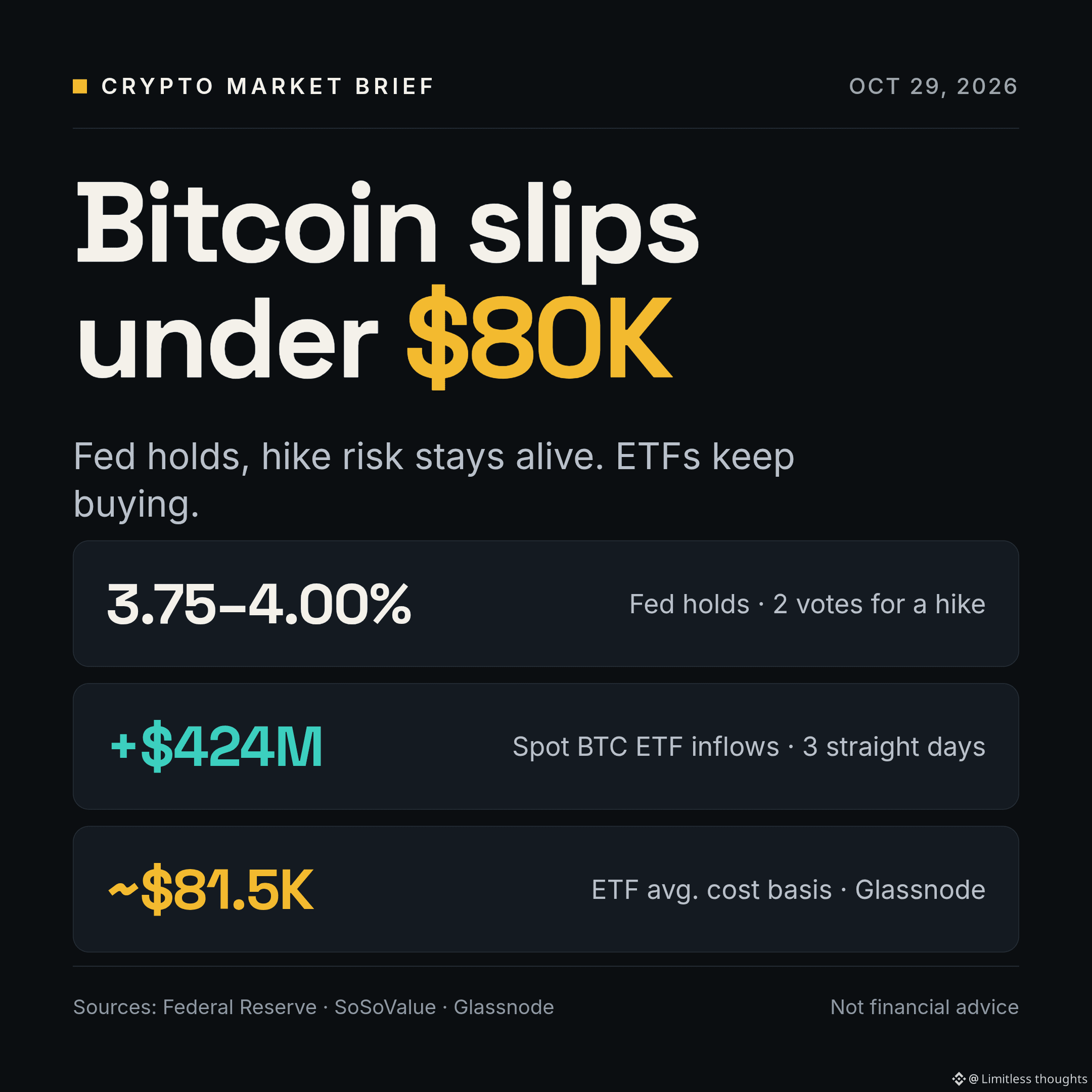
🚨 $BTC dipped under $80K after the Fed's hold, and the bounce above $81K faded fast.
(cryptonews)
Full market picture (Oct 29):
🏦 Fed held at 3.75–4.00% in a 10–2 vote. Both dissenters wanted a HIKE. CME Fed watch puts December hike odds near 83%.
(CNBC) (foxbusiness)
📈 Spot BTC ETFs took in about $424M over 3 straight sessions, after roughly $774M of outflows on Oct 22–23.
(crypto) (digitaltoday)
⚠️ Glassnode puts the ETF average cost basis near $81.5K, above spot.
(cryptonews)
💥 $355M+ liquidated in 24h, about $207M of it longs (CoinGlass).
(fxstreet)
🧱 Binance order book: only ~$3.4M in bids at $80K vs ~$42M at $78–79K (Glassnode).
(Cointelegraph)
📉 $BTC is -4.2% in October vs a +18.1% average since 2020 (CryptoQuant).
(analyticsinsight)
Majors: $ETH ~$2.3K (spot ETH ETFs: 3rd straight outflow day) · $SOL ~$100 · $XRP ~$1.29, all lower. $BNB ~$748, flat-to-green.
(Crypto prices today: Oct 29, 2026 - Samzal +3)
Next catalysts: Sept PCE + Q3 GDP (8:30 ET today) → US midterms Nov 3 → Dec FOMC.
(morningstar) (Cointelegraph)
My take: money is returning, but a ~5% 10-year yield and hike odds still cap risk appetite.
(cryptonews)
Which breaks first: $78K or $82K? #FedWatch #BTC $BTC #cryptouniverseofficial #ETH #bitcoin
(cryptonews)
Full market picture (Oct 29):
🏦 Fed held at 3.75–4.00% in a 10–2 vote. Both dissenters wanted a HIKE. CME Fed watch puts December hike odds near 83%.
(CNBC) (foxbusiness)
📈 Spot BTC ETFs took in about $424M over 3 straight sessions, after roughly $774M of outflows on Oct 22–23.
(crypto) (digitaltoday)
⚠️ Glassnode puts the ETF average cost basis near $81.5K, above spot.
(cryptonews)
💥 $355M+ liquidated in 24h, about $207M of it longs (CoinGlass).
(fxstreet)
🧱 Binance order book: only ~$3.4M in bids at $80K vs ~$42M at $78–79K (Glassnode).
(Cointelegraph)
📉 $BTC is -4.2% in October vs a +18.1% average since 2020 (CryptoQuant).
(analyticsinsight)
Majors: $ETH ~$2.3K (spot ETH ETFs: 3rd straight outflow day) · $SOL ~$100 · $XRP ~$1.29, all lower. $BNB ~$748, flat-to-green.
(Crypto prices today: Oct 29, 2026 - Samzal +3)
Next catalysts: Sept PCE + Q3 GDP (8:30 ET today) → US midterms Nov 3 → Dec FOMC.
(morningstar) (Cointelegraph)
My take: money is returning, but a ~5% 10-year yield and hike odds still cap risk appetite.
(cryptonews)
Which breaks first: $78K or $82K? #FedWatch #BTC $BTC #cryptouniverseofficial #ETH #bitcoin
23
Log in to explore more content
Join global crypto users on Binance Square
⚡️ Get latest and useful information about crypto.
💬 Trusted by the world’s largest crypto exchange.
👍 Discover real insights from verified creators.
Email / Phone number
Trending Topics
BinanceSAFUFundTransferCompleted7499BTC
28,042 views
679 Discussing
Binance Says SAFU Fund Transfer Completed, Covering 7,499 BTC
Binance News
·35 Likes
·18.6k views
BinanceRecovery90% of stolen assets
114,138 views
154 Discussing
YiHe:ProofOfReserves:10TokensAt100%Backing
119,782 views
681 Discussing