
#smartcontracts
smartcontracts
500,465 views
2,543 Discussing
Hot
Latest

·
--
See translation
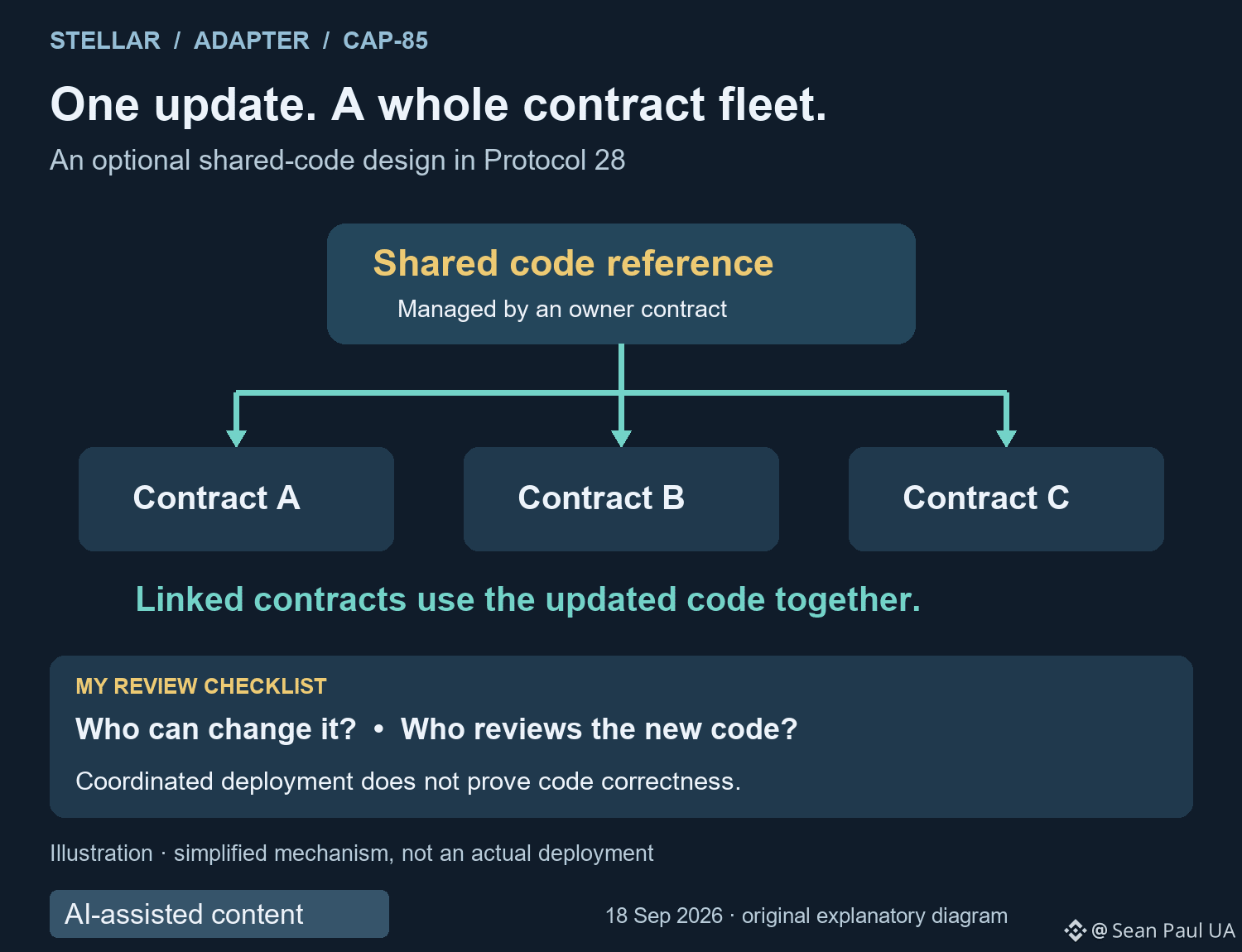
Stellar's Protocol 28 is live. The feature I'm watching is one update reaching a whole fleet of contracts.
Adapter's CAP-85 lets participating smart contracts use a shared code reference managed by another contract. Updating that reference changes the code used by the entire linked fleet together. Stellar's documentation calls this an atomic upgrade.
Why it matters: a large rollout no longer has to leave some linked contracts on the old version while others run the new one. Teams have to adopt this design; it doesn't automatically convert every existing contract.
My next check would be who controls that shared reference and how changes are reviewed. Updating everything together can remove a messy rollout window, but it doesn't prove that the replacement code is correct. One coordinated update still needs careful authorization and testing.
There is a separate speed story, too. The Stellar Development Foundation says the full consensus performance gains will be phased in as parallel transaction-set downloading is enabled. I wouldn't treat the protocol number alone as proof of a particular throughput increase.
What safeguard would you want before an app can update an entire contract fleet together?
$XLM #Stellar #SmartContracts
Stellar's Protocol 28 is live. The feature I'm watching is one update reaching a whole fleet of contracts.
Adapter's CAP-85 lets participating smart contracts use a shared code reference managed by another contract. Updating that reference changes the code used by the entire linked fleet together. Stellar's documentation calls this an atomic upgrade.
Why it matters: a large rollout no longer has to leave some linked contracts on the old version while others run the new one. Teams have to adopt this design; it doesn't automatically convert every existing contract.
My next check would be who controls that shared reference and how changes are reviewed. Updating everything together can remove a messy rollout window, but it doesn't prove that the replacement code is correct. One coordinated update still needs careful authorization and testing.
There is a separate speed story, too. The Stellar Development Foundation says the full consensus performance gains will be phased in as parallel transaction-set downloading is enabled. I wouldn't treat the protocol number alone as proof of a particular throughput increase.
What safeguard would you want before an app can update an entire contract fleet together?
$XLM #Stellar #SmartContracts
Adapter's CAP-85 lets participating smart contracts use a shared code reference managed by another contract. Updating that reference changes the code used by the entire linked fleet together. Stellar's documentation calls this an atomic upgrade.
Why it matters: a large rollout no longer has to leave some linked contracts on the old version while others run the new one. Teams have to adopt this design; it doesn't automatically convert every existing contract.
My next check would be who controls that shared reference and how changes are reviewed. Updating everything together can remove a messy rollout window, but it doesn't prove that the replacement code is correct. One coordinated update still needs careful authorization and testing.
There is a separate speed story, too. The Stellar Development Foundation says the full consensus performance gains will be phased in as parallel transaction-set downloading is enabled. I wouldn't treat the protocol number alone as proof of a particular throughput increase.
What safeguard would you want before an app can update an entire contract fleet together?
$XLM #Stellar #SmartContracts
1
95

See translation
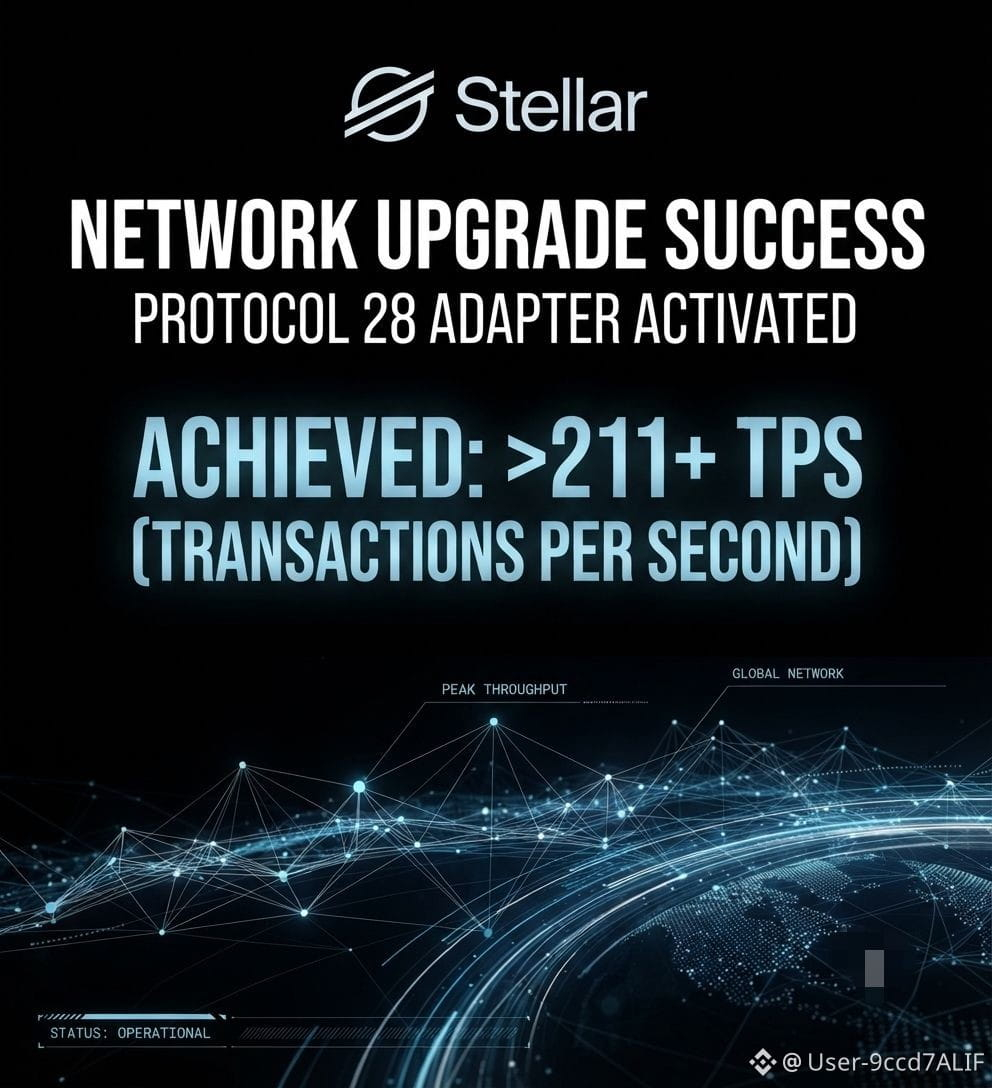
🚀 Stellar Activates Protocol 28 as Network Surpasses 211 TPS
Stellar has officially activated Protocol 28, known as “Adapter,” on its mainnet, marking another step in the network’s ongoing scalability and smart-contract development.
⚡ 211+ TPS Milestone Around the same time, Stellar recorded more than 211 transactions per second across 100 consecutive blocks, highlighting a new sustained throughput milestone. This performance figure is separate from the protocol upgrade itself, as Stellar is gradually rolling out parallel transaction-set downloading.
🔧 What Protocol 28 Brings:
• CAP-83: Allows validators to continue consensus even when transaction data is delayed or invalid.
• CAP-85: Enables multiple Soroban smart contracts to use a shared, externally managed executable, making large-scale contract upgrades more efficient and atomic.
• CAP-86: Introduces sparse-map functionality to make smart-contract data migrations easier as applications evolve.
📈 Overall, Protocol 28 is focused heavily on improving Stellar’s smart-contract infrastructure while also strengthening the network’s ability to handle increasing workloads.
For developers, infrastructure operators, and financial applications building on Stellar, Adapter represents another important upgrade toward a more scalable and flexible ecosystem.
#XLM #Protocol28 #Soroban
#Web3 #SmartContracts
🚀 Stellar Activates Protocol 28 as Network Surpasses 211 TPS
Stellar has officially activated Protocol 28, known as “Adapter,” on its mainnet, marking another step in the network’s ongoing scalability and smart-contract development.
⚡ 211+ TPS Milestone Around the same time, Stellar recorded more than 211 transactions per second across 100 consecutive blocks, highlighting a new sustained throughput milestone. This performance figure is separate from the protocol upgrade itself, as Stellar is gradually rolling out parallel transaction-set downloading.
🔧 What Protocol 28 Brings:
• CAP-83: Allows validators to continue consensus even when transaction data is delayed or invalid.
• CAP-85: Enables multiple Soroban smart contracts to use a shared, externally managed executable, making large-scale contract upgrades more efficient and atomic.
• CAP-86: Introduces sparse-map functionality to make smart-contract data migrations easier as applications evolve.
📈 Overall, Protocol 28 is focused heavily on improving Stellar’s smart-contract infrastructure while also strengthening the network’s ability to handle increasing workloads.
For developers, infrastructure operators, and financial applications building on Stellar, Adapter represents another important upgrade toward a more scalable and flexible ecosystem.
#XLM #Protocol28 #Soroban
#Web3 #SmartContracts
Stellar has officially activated Protocol 28, known as “Adapter,” on its mainnet, marking another step in the network’s ongoing scalability and smart-contract development.
⚡ 211+ TPS Milestone Around the same time, Stellar recorded more than 211 transactions per second across 100 consecutive blocks, highlighting a new sustained throughput milestone. This performance figure is separate from the protocol upgrade itself, as Stellar is gradually rolling out parallel transaction-set downloading.
🔧 What Protocol 28 Brings:
• CAP-83: Allows validators to continue consensus even when transaction data is delayed or invalid.
• CAP-85: Enables multiple Soroban smart contracts to use a shared, externally managed executable, making large-scale contract upgrades more efficient and atomic.
• CAP-86: Introduces sparse-map functionality to make smart-contract data migrations easier as applications evolve.
📈 Overall, Protocol 28 is focused heavily on improving Stellar’s smart-contract infrastructure while also strengthening the network’s ability to handle increasing workloads.
For developers, infrastructure operators, and financial applications building on Stellar, Adapter represents another important upgrade toward a more scalable and flexible ecosystem.
#XLM #Protocol28 #Soroban
#Web3 #SmartContracts
86

·
--

Article
See translation
AI Can Protect Crypto, Says Vitalik Buterin – What That Means for YouVitalik Buterin, the co‑founder of Ethereum, has just flipped a common fear on its head. While many people worry that artificial intelligence will bring new ways for hackers to break into blockchain systems, he argues the opposite: AI can actually help developers mathematically verify entire software systems, turning the same technology that could be used for attacks into a powerful tool for defense.
The Concept: AI as a Security Auditor
Think of a software system as a giant, complex machine with thousands of moving parts. Traditionally, developers test each part manually or with automated scripts, but that’s like checking every gear in a car by hand—time‑consuming and prone to human error. AI, especially large language models and advanced verification algorithms, can scan the entire codebase, identify hidden bugs, and prove mathematically that the system behaves as intended. It’s the blockchain equivalent of having a super‑intelligent mechanic that can spot a flaw before it becomes a problem. #AIinCrypto #SmartContracts
Real‑World Example: The $ETH Ecosystem
In the Ethereum ecosystem, smart contracts are the backbone of decentralized applications. A single line of faulty code can lead to millions of dollars in losses, as seen in past exploits. By integrating AI verification tools, developers can run formal proofs that their contracts are free from vulnerabilities before deployment. Imagine a new DeFi protocol that automatically proves its safety to users, reducing the risk of rug pulls and hacks. This approach is already being piloted by some leading Ethereum projects, and the results are promising: fewer bugs, faster development cycles, and higher user trust.
Takeaway: Embrace AI‑Powered Security
If you’re building on $ETH or just following the market, consider the following steps:
1. Stay informed about AI verification tools and libraries that integrate with Solidity and other smart‑contract languages.
2. Encourage your team to adopt formal verification practices early in the development cycle.
3. Keep an eye on emerging standards that may mandate AI‑based security audits for high‑value contracts.
By doing so, you’ll not only protect your projects but also contribute to a safer, more resilient blockchain ecosystem. #SecureDeFi
What do you think—will AI become the new standard for blockchain security, or do you see other solutions taking the lead?
AI Can Protect Crypto, Says Vitalik Buterin – What That Means for You
Vitalik Buterin, the co‑founder of Ethereum, has just flipped a common fear on its head. While many people worry that artificial intelligence will bring new ways for hackers to break into blockchain systems, he argues the opposite: AI can actually help developers mathematically verify entire software systems, turning the same technology that could be used for attacks into a powerful tool for defense.
The Concept: AI as a Security Auditor
Think of a software system as a giant, complex machine with thousands of moving parts. Traditionally, developers test each part manually or with automated scripts, but that’s like checking every gear in a car by hand—time‑consuming and prone to human error. AI, especially large language models and advanced verification algorithms, can scan the entire codebase, identify hidden bugs, and prove mathematically that the system behaves as intended. It’s the blockchain equivalent of having a super‑intelligent mechanic that can spot a flaw before it becomes a problem. #AIinCrypto #SmartContracts
Real‑World Example: The $ETH Ecosystem
In the Ethereum ecosystem, smart contracts are the backbone of decentralized applications. A single line of faulty code can lead to millions of dollars in losses, as seen in past exploits. By integrating AI verification tools, developers can run formal proofs that their contracts are free from vulnerabilities before deployment. Imagine a new DeFi protocol that automatically proves its safety to users, reducing the risk of rug pulls and hacks. This approach is already being piloted by some leading Ethereum projects, and the results are promising: fewer bugs, faster development cycles, and higher user trust.
Takeaway: Embrace AI‑Powered Security
If you’re building on $ETH or just following the market, consider the following steps:
1. Stay informed about AI verification tools and libraries that integrate with Solidity and other smart‑contract languages.
2. Encourage your team to adopt formal verification practices early in the development cycle.
3. Keep an eye on emerging standards that may mandate AI‑based security audits for high‑value contracts.
By doing so, you’ll not only protect your projects but also contribute to a safer, more resilient blockchain ecosystem. #SecureDeFi
What do you think—will AI become the new standard for blockchain security, or do you see other solutions taking the lead?
The Concept: AI as a Security Auditor
Think of a software system as a giant, complex machine with thousands of moving parts. Traditionally, developers test each part manually or with automated scripts, but that’s like checking every gear in a car by hand—time‑consuming and prone to human error. AI, especially large language models and advanced verification algorithms, can scan the entire codebase, identify hidden bugs, and prove mathematically that the system behaves as intended. It’s the blockchain equivalent of having a super‑intelligent mechanic that can spot a flaw before it becomes a problem. #AIinCrypto #SmartContracts
Real‑World Example: The $ETH Ecosystem
In the Ethereum ecosystem, smart contracts are the backbone of decentralized applications. A single line of faulty code can lead to millions of dollars in losses, as seen in past exploits. By integrating AI verification tools, developers can run formal proofs that their contracts are free from vulnerabilities before deployment. Imagine a new DeFi protocol that automatically proves its safety to users, reducing the risk of rug pulls and hacks. This approach is already being piloted by some leading Ethereum projects, and the results are promising: fewer bugs, faster development cycles, and higher user trust.
Takeaway: Embrace AI‑Powered Security
If you’re building on $ETH or just following the market, consider the following steps:
1. Stay informed about AI verification tools and libraries that integrate with Solidity and other smart‑contract languages.
2. Encourage your team to adopt formal verification practices early in the development cycle.
3. Keep an eye on emerging standards that may mandate AI‑based security audits for high‑value contracts.
By doing so, you’ll not only protect your projects but also contribute to a safer, more resilient blockchain ecosystem. #SecureDeFi
What do you think—will AI become the new standard for blockchain security, or do you see other solutions taking the lead?
12

·
--
See translation
One Token Score Is Not Enough$JASONFLY shows why a quick token score and deeper contract intelligence can produce very different results without either number being fabricated.
The BNB Smart Chain contract returned 90/100 in the quick public scan. That surface-level result was followed by a deeper score of 35/100 after TokenToolHub resolved the implementation and examined a broader authority and control surface.
The source is verified, but verification only confirms that published source matches the analyzed bytecode. It does not remove privileged functions or settle who controls an upgradeable proxy.
The deeper report found active ownership, possible implementation replacement, supply expansion and reduction paths, mutable fee controls and generic execution capability. The proxy administrator was not resolved.
Important market-side questions also remained open. Trading simulation was unavailable, so honeypot status, current buy and sell taxes and practical selling behavior were unresolved. Liquidity and holder evidence were not returned in the report.
The right conclusion is not that 90 is false or 35 proves an exploit. The two scores answer different questions with different evidence depth.
Use the quick result for orientation. Then check the resolved implementation, ownership, upgrade authority, supply controls, fee controls, recent privileged activity and unresolved coverage before relying on it.
Full TokenToolHub report:
https://tokentoolhub.com/token-safety-checker/?net=bsc&address=0x8514638EeFc900263709b154805027E824E87777
#BNBChain #CryptoResearch #SmartContracts #Web3Security #TokenSafety
One Token Score Is Not Enough
$JASONFLY shows why a quick token score and deeper contract intelligence can produce very different results without either number being fabricated.
The BNB Smart Chain contract returned 90/100 in the quick public scan. That surface-level result was followed by a deeper score of 35/100 after TokenToolHub resolved the implementation and examined a broader authority and control surface.
The source is verified, but verification only confirms that published source matches the analyzed bytecode. It does not remove privileged functions or settle who controls an upgradeable proxy.
The deeper report found active ownership, possible implementation replacement, supply expansion and reduction paths, mutable fee controls and generic execution capability. The proxy administrator was not resolved.
Important market-side questions also remained open. Trading simulation was unavailable, so honeypot status, current buy and sell taxes and practical selling behavior were unresolved. Liquidity and holder evidence were not returned in the report.
The right conclusion is not that 90 is false or 35 proves an exploit. The two scores answer different questions with different evidence depth.
Use the quick result for orientation. Then check the resolved implementation, ownership, upgrade authority, supply controls, fee controls, recent privileged activity and unresolved coverage before relying on it.
Full TokenToolHub report:
https://tokentoolhub.com/token-safety-checker/?net=bsc&address=0x8514638EeFc900263709b154805027E824E87777
#BNBChain #CryptoResearch #SmartContracts #Web3Security #TokenSafety
The BNB Smart Chain contract returned 90/100 in the quick public scan. That surface-level result was followed by a deeper score of 35/100 after TokenToolHub resolved the implementation and examined a broader authority and control surface.
The source is verified, but verification only confirms that published source matches the analyzed bytecode. It does not remove privileged functions or settle who controls an upgradeable proxy.
The deeper report found active ownership, possible implementation replacement, supply expansion and reduction paths, mutable fee controls and generic execution capability. The proxy administrator was not resolved.
Important market-side questions also remained open. Trading simulation was unavailable, so honeypot status, current buy and sell taxes and practical selling behavior were unresolved. Liquidity and holder evidence were not returned in the report.
The right conclusion is not that 90 is false or 35 proves an exploit. The two scores answer different questions with different evidence depth.
Use the quick result for orientation. Then check the resolved implementation, ownership, upgrade authority, supply controls, fee controls, recent privileged activity and unresolved coverage before relying on it.
Full TokenToolHub report:
https://tokentoolhub.com/token-safety-checker/?net=bsc&address=0x8514638EeFc900263709b154805027E824E87777
#BNBChain #CryptoResearch #SmartContracts #Web3Security #TokenSafety
3


See translation
Building, Prototyping, & Testnet Implementation🛠️ From Blueprint to Testnet: Phase 2 of Web3 Engineering!
Prototyping is where theoretical code meets battle-tested execution. Through public and private testnets, developers stress-test smart contracts, simulate high-concurrency transaction loads, and refine gas efficiency before mainnet deployment.
💬 Have you ever tested dApps on a testnet to qualify for ecosystem incentives? Share your experience!
#BinanceSquare #SmartContracts #BlockchainEngineering #Testnet #Web3Building
Smart Contract Engineering, Testnet Architectures, and Stress Testing
1. The Engineering Pipeline of Decentralized Applications
Once the theoretical groundwork and architectural specifications are finalized in Phase 1, a project transitions into Phase 2: engineering, prototyping, and environment testing. In centralized software development, staging environments allow engineers to test code in near-production settings without impacting end-users. In blockchain development, this staging ground is represented by test networks (Testnets)—sandboxed environments that replicate the execution engine, consensus rules, and state machine of a blockchain without using real economic assets.
Developing smart contracts—primarily written in languages like Solidity, Rust, or Move—requires an unprecedented focus on security and resource efficiency. Unlike traditional software where memory allocation is cheap, every instruction executed on a decentralized state machine consumes "gas"—a measure of computational effort. Inefficient code loops, redundant storage calls, and sub-optimal data structures directly translate to higher transaction fees for end-users, rendering protocols uncompetitive in gas-sensitive market environments.
2. Smart Contract Optimization and Vulnerability Prevention
During the active prototyping phase, developers utilize sophisticated integrated development environments (IDEs) and framework suites such as Hardhat, Foundry, and Anchor. Engineering teams focus heavily on gas optimization techniques:
Storage vs. Memory Allocation: In Ethereum-compatible execution environments, writing data to permanent contract storage (SSTORE) is exponentially more expensive than temporary memory execution (MSTORE). Developers optimize contracts by packing storage variables into single 32-byte slots, utilizing immutable and constant variables, and leveraging transient storage where applicable.
Reentrancy Protection: One of the most catastrophic vulnerabilities in smart contract history is the reentrancy attack, wherein an external malicious contract recursively calls back into a target contract before the target updates its internal state balances. Developers mitigate this during prototyping by implementing the Checks-Effects-Interactions pattern and utilizing non-reentrant mutex locks.
3. Testnet Deployments: Alpha, Beta, and Incentive Structure
Deploying a protocol to a public testnet (such as Ethereum's Sepolia or Holesky, or custom dedicated testnets) serves as the primary mechanism for empirical validation. Testnets allow developers to simulate complex multi-user interactions under real network latency conditions.
The testnet phase generally unfolds across three distinct sub-stages:
Private Devnet: Closed internal network deployed locally or across controlled nodes to test basic smart contract deployment, state transitions, and front-end Web3 interface (dApp) integration via libraries like Ethers.js, Viem, or Web3.js.
Incentivized Testnet: A public testnet campaign designed to stress-test network infrastructure by offering future token rewards to node operators, validators, and edge-case users. Participants attempt to break the network by submitting high volumes of concurrent transactions, generating maximum block congestion, and probing for state desynchronization bugs.
Bug Bounty Programs: In parallel with public testnets, protocols partner with security platforms such as Immunefi to launch competitive bug bounties. White-hat hackers are financially incentivized to discover zero-day exploits, logical errors, or reentrancy bugs within the open-source code repository before real capital is placed at risk on the mainnet.
4. Theoretical Conclusion
Phase 2 bridges abstract theory and practical execution. A successful testnet phase provides concrete metrics regarding transaction finality times, peak throughput capability, smart contract gas overhead, and resilience against network spam—ensuring the application layer is structurally prepared for mainnet execution.
Why We Reached This Conclusion
We reached this conclusion because stress-testing is the ultimate filter between viable Web3 projects and failed experiments. On Binance Square, emphasizing the transition from testnet to real-world usage educates the community on assessing technical maturity, helping traders differentiate between marketing hype and genuine engineering execution.
Building, Prototyping, & Testnet Implementation
🛠️ From Blueprint to Testnet: Phase 2 of Web3 Engineering!
Prototyping is where theoretical code meets battle-tested execution. Through public and private testnets, developers stress-test smart contracts, simulate high-concurrency transaction loads, and refine gas efficiency before mainnet deployment.
💬 Have you ever tested dApps on a testnet to qualify for ecosystem incentives? Share your experience!
#BinanceSquare #SmartContracts #BlockchainEngineering #Testnet #Web3Building
Smart Contract Engineering, Testnet Architectures, and Stress Testing
1. The Engineering Pipeline of Decentralized Applications
Once the theoretical groundwork and architectural specifications are finalized in Phase 1, a project transitions into Phase 2: engineering, prototyping, and environment testing. In centralized software development, staging environments allow engineers to test code in near-production settings without impacting end-users. In blockchain development, this staging ground is represented by test networks (Testnets)—sandboxed environments that replicate the execution engine, consensus rules, and state machine of a blockchain without using real economic assets.
Developing smart contracts—primarily written in languages like Solidity, Rust, or Move—requires an unprecedented focus on security and resource efficiency. Unlike traditional software where memory allocation is cheap, every instruction executed on a decentralized state machine consumes "gas"—a measure of computational effort. Inefficient code loops, redundant storage calls, and sub-optimal data structures directly translate to higher transaction fees for end-users, rendering protocols uncompetitive in gas-sensitive market environments.
2. Smart Contract Optimization and Vulnerability Prevention
During the active prototyping phase, developers utilize sophisticated integrated development environments (IDEs) and framework suites such as Hardhat, Foundry, and Anchor. Engineering teams focus heavily on gas optimization techniques:
Storage vs. Memory Allocation: In Ethereum-compatible execution environments, writing data to permanent contract storage (SSTORE) is exponentially more expensive than temporary memory execution (MSTORE). Developers optimize contracts by packing storage variables into single 32-byte slots, utilizing immutable and constant variables, and leveraging transient storage where applicable.
Reentrancy Protection: One of the most catastrophic vulnerabilities in smart contract history is the reentrancy attack, wherein an external malicious contract recursively calls back into a target contract before the target updates its internal state balances. Developers mitigate this during prototyping by implementing the Checks-Effects-Interactions pattern and utilizing non-reentrant mutex locks.
3. Testnet Deployments: Alpha, Beta, and Incentive Structure
Deploying a protocol to a public testnet (such as Ethereum's Sepolia or Holesky, or custom dedicated testnets) serves as the primary mechanism for empirical validation. Testnets allow developers to simulate complex multi-user interactions under real network latency conditions.
The testnet phase generally unfolds across three distinct sub-stages:
Private Devnet: Closed internal network deployed locally or across controlled nodes to test basic smart contract deployment, state transitions, and front-end Web3 interface (dApp) integration via libraries like Ethers.js, Viem, or Web3.js.
Incentivized Testnet: A public testnet campaign designed to stress-test network infrastructure by offering future token rewards to node operators, validators, and edge-case users. Participants attempt to break the network by submitting high volumes of concurrent transactions, generating maximum block congestion, and probing for state desynchronization bugs.
Bug Bounty Programs: In parallel with public testnets, protocols partner with security platforms such as Immunefi to launch competitive bug bounties. White-hat hackers are financially incentivized to discover zero-day exploits, logical errors, or reentrancy bugs within the open-source code repository before real capital is placed at risk on the mainnet.
4. Theoretical Conclusion
Phase 2 bridges abstract theory and practical execution. A successful testnet phase provides concrete metrics regarding transaction finality times, peak throughput capability, smart contract gas overhead, and resilience against network spam—ensuring the application layer is structurally prepared for mainnet execution.
Why We Reached This Conclusion
We reached this conclusion because stress-testing is the ultimate filter between viable Web3 projects and failed experiments. On Binance Square, emphasizing the transition from testnet to real-world usage educates the community on assessing technical maturity, helping traders differentiate between marketing hype and genuine engineering execution.
Prototyping is where theoretical code meets battle-tested execution. Through public and private testnets, developers stress-test smart contracts, simulate high-concurrency transaction loads, and refine gas efficiency before mainnet deployment.
💬 Have you ever tested dApps on a testnet to qualify for ecosystem incentives? Share your experience!
#BinanceSquare #SmartContracts #BlockchainEngineering #Testnet #Web3Building
Smart Contract Engineering, Testnet Architectures, and Stress Testing
1. The Engineering Pipeline of Decentralized Applications
Once the theoretical groundwork and architectural specifications are finalized in Phase 1, a project transitions into Phase 2: engineering, prototyping, and environment testing. In centralized software development, staging environments allow engineers to test code in near-production settings without impacting end-users. In blockchain development, this staging ground is represented by test networks (Testnets)—sandboxed environments that replicate the execution engine, consensus rules, and state machine of a blockchain without using real economic assets.
Developing smart contracts—primarily written in languages like Solidity, Rust, or Move—requires an unprecedented focus on security and resource efficiency. Unlike traditional software where memory allocation is cheap, every instruction executed on a decentralized state machine consumes "gas"—a measure of computational effort. Inefficient code loops, redundant storage calls, and sub-optimal data structures directly translate to higher transaction fees for end-users, rendering protocols uncompetitive in gas-sensitive market environments.
2. Smart Contract Optimization and Vulnerability Prevention
During the active prototyping phase, developers utilize sophisticated integrated development environments (IDEs) and framework suites such as Hardhat, Foundry, and Anchor. Engineering teams focus heavily on gas optimization techniques:
Storage vs. Memory Allocation: In Ethereum-compatible execution environments, writing data to permanent contract storage (SSTORE) is exponentially more expensive than temporary memory execution (MSTORE). Developers optimize contracts by packing storage variables into single 32-byte slots, utilizing immutable and constant variables, and leveraging transient storage where applicable.
Reentrancy Protection: One of the most catastrophic vulnerabilities in smart contract history is the reentrancy attack, wherein an external malicious contract recursively calls back into a target contract before the target updates its internal state balances. Developers mitigate this during prototyping by implementing the Checks-Effects-Interactions pattern and utilizing non-reentrant mutex locks.
3. Testnet Deployments: Alpha, Beta, and Incentive Structure
Deploying a protocol to a public testnet (such as Ethereum's Sepolia or Holesky, or custom dedicated testnets) serves as the primary mechanism for empirical validation. Testnets allow developers to simulate complex multi-user interactions under real network latency conditions.
The testnet phase generally unfolds across three distinct sub-stages:
Private Devnet: Closed internal network deployed locally or across controlled nodes to test basic smart contract deployment, state transitions, and front-end Web3 interface (dApp) integration via libraries like Ethers.js, Viem, or Web3.js.
Incentivized Testnet: A public testnet campaign designed to stress-test network infrastructure by offering future token rewards to node operators, validators, and edge-case users. Participants attempt to break the network by submitting high volumes of concurrent transactions, generating maximum block congestion, and probing for state desynchronization bugs.
Bug Bounty Programs: In parallel with public testnets, protocols partner with security platforms such as Immunefi to launch competitive bug bounties. White-hat hackers are financially incentivized to discover zero-day exploits, logical errors, or reentrancy bugs within the open-source code repository before real capital is placed at risk on the mainnet.
4. Theoretical Conclusion
Phase 2 bridges abstract theory and practical execution. A successful testnet phase provides concrete metrics regarding transaction finality times, peak throughput capability, smart contract gas overhead, and resilience against network spam—ensuring the application layer is structurally prepared for mainnet execution.
Why We Reached This Conclusion
We reached this conclusion because stress-testing is the ultimate filter between viable Web3 projects and failed experiments. On Binance Square, emphasizing the transition from testnet to real-world usage educates the community on assessing technical maturity, helping traders differentiate between marketing hype and genuine engineering execution.
47

Architecture Agent OS : Autonomous Wallets and Smart Contracts
Title : The evolution of wallets : From private keys to Smart Accounts 🤖💳
Content :
With the advent of architectures like Binance Agent OS, the crypto wallet no longer just stores keys: it becomes programmable.
💡 The major benefits of Account Abstraction :
Automated rules management : Setting daily spending limits for bots.
Bundled transactions (Batching) : Executing multiple operations in a single validation to reduce gas fees.
Social recovery : Securing access without relying solely on a classic recovery phrase.
The Web3 wallet user experience is gradually converging with the standards of modern banking.
#BinanceAgentOS #SmartContracts #AccountAbstraction #CryptoInnovation #Web3 @Dusk_Foundation
Architecture Agent OS : Autonomous Wallets and Smart Contracts
Title : The evolution of wallets : From private keys to Smart Accounts 🤖💳
Content :
With the advent of architectures like Binance Agent OS, the crypto wallet no longer just stores keys: it becomes programmable.
💡 The major benefits of Account Abstraction :
Automated rules management : Setting daily spending limits for bots.
Bundled transactions (Batching) : Executing multiple operations in a single validation to reduce gas fees.
Social recovery : Securing access without relying solely on a classic recovery phrase.
The Web3 wallet user experience is gradually converging with the standards of modern banking.
#BinanceAgentOS #SmartContracts #AccountAbstraction #CryptoInnovation #Web3 @Dusk
Title : The evolution of wallets : From private keys to Smart Accounts 🤖💳
Content :
With the advent of architectures like Binance Agent OS, the crypto wallet no longer just stores keys: it becomes programmable.
💡 The major benefits of Account Abstraction :
Automated rules management : Setting daily spending limits for bots.
Bundled transactions (Batching) : Executing multiple operations in a single validation to reduce gas fees.
Social recovery : Securing access without relying solely on a classic recovery phrase.
The Web3 wallet user experience is gradually converging with the standards of modern banking.
#BinanceAgentOS #SmartContracts #AccountAbstraction #CryptoInnovation #Web3 @Dusk
86

🛡️ "Eryidium" launches AERSeal to enhance smart contract security
"Eryidium" announced the launch of its new product, AERSeal, designed to improve the security of smart contracts. The new solution aims to address the risks of relying on a single private key to control sensitive operations, which may be vulnerable to hacking, thereby reducing the likelihood of unauthorized takeovers of contracts.
━━━━━━━━━━━━━━
📊 Impact: 📊 Medium
🏷️ DEFI
#SmartContracts #BlockchainSecurity #DeFi #CryptoNews #Innovation
📰 Source: thenextweb.com
🛡️ "Eryidium" launches AERSeal to enhance smart contract security
"Eryidium" announced the launch of its new product, AERSeal, designed to improve the security of smart contracts. The new solution aims to address the risks of relying on a single private key to control sensitive operations, which may be vulnerable to hacking, thereby reducing the likelihood of unauthorized takeovers of contracts.
━━━━━━━━━━━━━━
📊 Impact: 📊 Medium
🏷️ DEFI
#SmartContracts #BlockchainSecurity #DeFi #CryptoNews #Innovation
📰 Source: thenextweb.com
"Eryidium" announced the launch of its new product, AERSeal, designed to improve the security of smart contracts. The new solution aims to address the risks of relying on a single private key to control sensitive operations, which may be vulnerable to hacking, thereby reducing the likelihood of unauthorized takeovers of contracts.
━━━━━━━━━━━━━━
📊 Impact: 📊 Medium
🏷️ DEFI
#SmartContracts #BlockchainSecurity #DeFi #CryptoNews #Innovation
📰 Source: thenextweb.com
5
·
--
See translation
Verified contract ≠ safe contract.
Source verification answers one useful question:
Can the deployed code be inspected?
It does NOT automatically answer:
• Can additional supply be created?
• Can individual wallets be blacklisted?
• Can transaction limits change?
• Can fees be increased?
• Can transfers be paused?
• Can the implementation behind a proxy be replaced?
• Who controls those permissions?
A stronger token investigation focuses on capability, authority and what can change after deployment.
That is the distinction we use at TokenToolHub when analyzing contract risk.
Before trusting an unfamiliar EVM token, investigate the control surface, not only the chart.
#CryptoSecurity #Web3Security #TokenSafety #SmartContracts #CryptoResearch
Verified contract ≠ safe contract.
Source verification answers one useful question:
Can the deployed code be inspected?
It does NOT automatically answer:
• Can additional supply be created?
• Can individual wallets be blacklisted?
• Can transaction limits change?
• Can fees be increased?
• Can transfers be paused?
• Can the implementation behind a proxy be replaced?
• Who controls those permissions?
A stronger token investigation focuses on capability, authority and what can change after deployment.
That is the distinction we use at TokenToolHub when analyzing contract risk.
Before trusting an unfamiliar EVM token, investigate the control surface, not only the chart.
#CryptoSecurity #Web3Security #TokenSafety #SmartContracts #CryptoResearch
Source verification answers one useful question:
Can the deployed code be inspected?
It does NOT automatically answer:
• Can additional supply be created?
• Can individual wallets be blacklisted?
• Can transaction limits change?
• Can fees be increased?
• Can transfers be paused?
• Can the implementation behind a proxy be replaced?
• Who controls those permissions?
A stronger token investigation focuses on capability, authority and what can change after deployment.
That is the distinction we use at TokenToolHub when analyzing contract risk.
Before trusting an unfamiliar EVM token, investigate the control surface, not only the chart.
#CryptoSecurity #Web3Security #TokenSafety #SmartContracts #CryptoResearch
50

·
--
Article
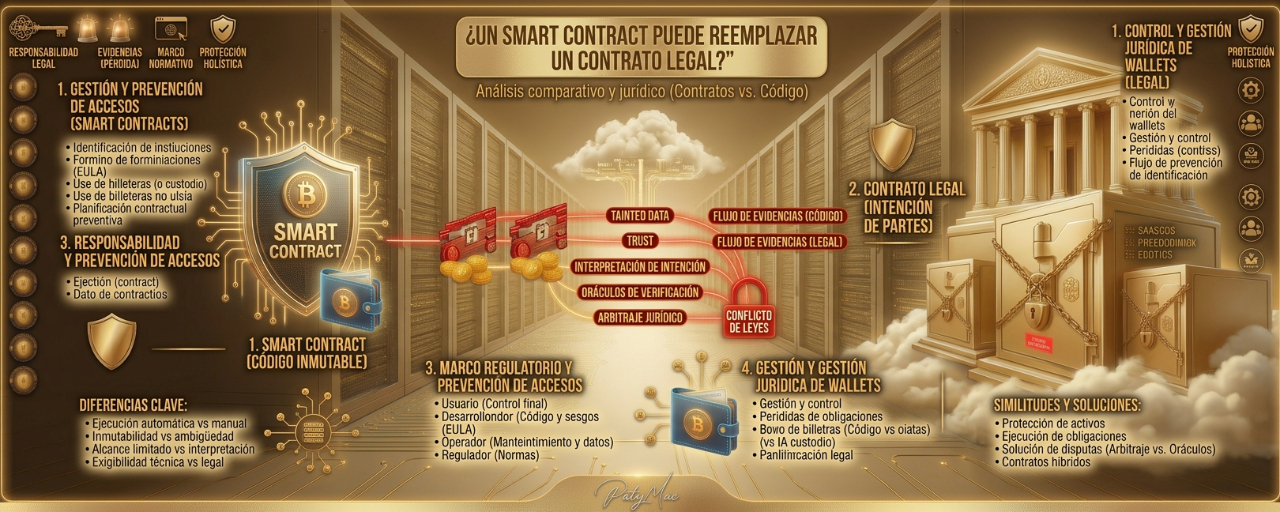
CAN A SMART CONTRACT REPLACE A LEGAL CONTRACT?When the code comes up against the law
Smart contracts are one of the most interesting innovations in blockchain technology.
These are computer programs that automatically perform certain actions when predefined conditions are met.
For example:
to release a payment;
to transfer a token;
to distribute interest;
to execute guarantees;
to administer decentralized loans.
All this without human intervention.
But here a fundamental question arises:
CAN A SMART CONTRACT REPLACE A LEGAL CONTRACT?
When the code comes up against the law
Smart contracts are one of the most interesting innovations in blockchain technology.
These are computer programs that automatically perform certain actions when predefined conditions are met.
For example:
to release a payment;
to transfer a token;
to distribute interest;
to execute guarantees;
to administer decentralized loans.
All this without human intervention.
But here a fundamental question arises:
Smart contracts are one of the most interesting innovations in blockchain technology.
These are computer programs that automatically perform certain actions when predefined conditions are met.
For example:
to release a payment;
to transfer a token;
to distribute interest;
to execute guarantees;
to administer decentralized loans.
All this without human intervention.
But here a fundamental question arises:
1
679


See translation
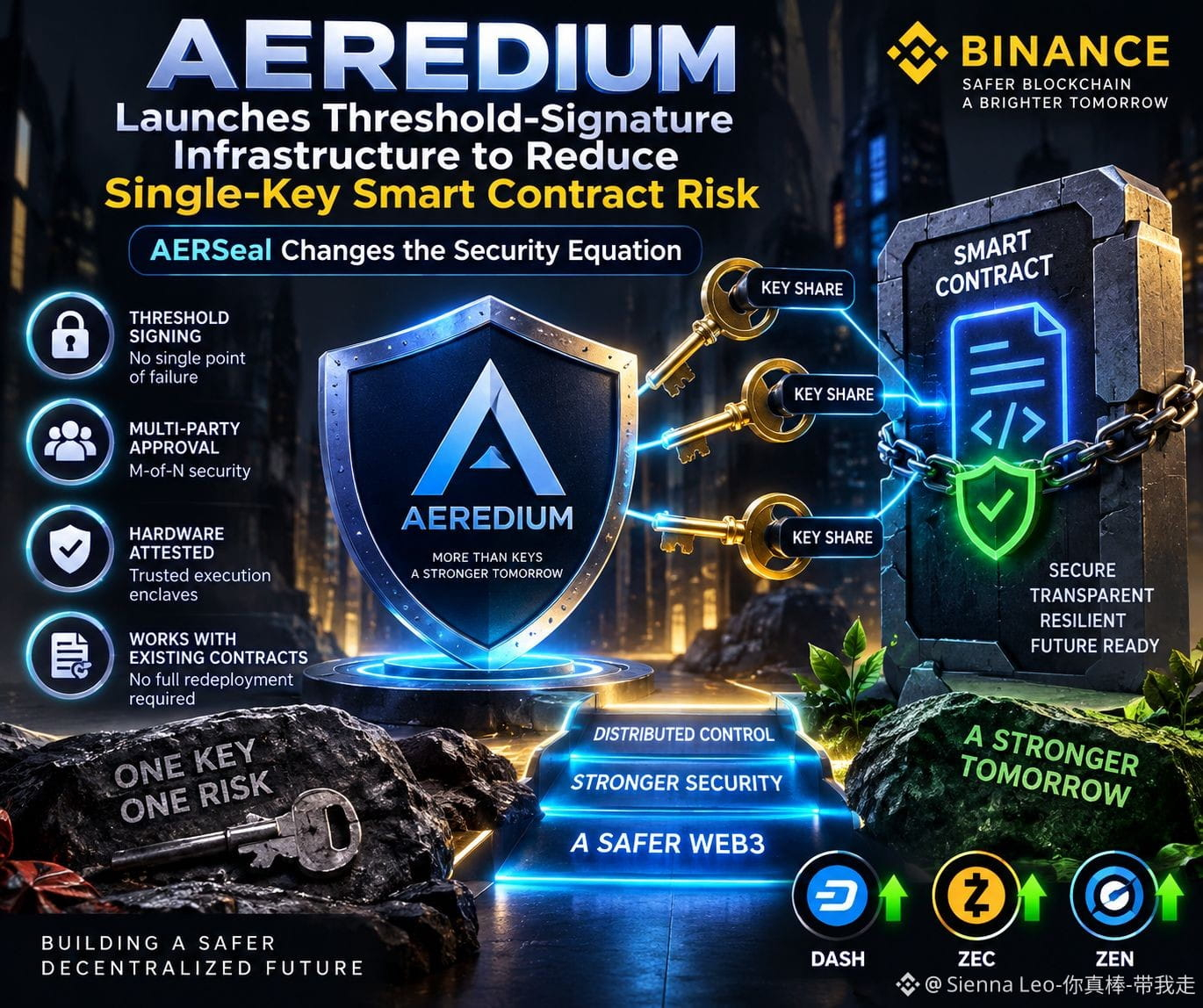
🛡️ AEREDIUM Launches Threshold-Signature Infrastructure to Reduce Single-Key Smart Contract Risk: AERSeal Changes the Security Equation 🛡️
Imagine a smart contract holding millions in assets, protected by one private key. Everything looks secure until that single key is stolen, lost, or compromised. Suddenly, the strongest contract can inherit its weakest point.
AEREDIUM is tackling this exact problem with AERSeal, an infrastructure product built around its AERKey threshold-signing system. The goal is simple: remove dependence on one complete private key for privileged smart contract actions.
Instead of keeping one complete key in one place, AERKey uses cryptographic key shares across separate hardware-attested enclaves. A threshold of authorized participants must cooperate before a valid signature can be produced.
AERSeal adds an approval layer, allowing organizations to define M-of-N authorization for sensitive permissions such as contract upgrades, minting, or ownership control. Existing contracts can be used rather than requiring a complete redeployment.
The important shift is architectural: security is no longer centered only on protecting a single administrator's key. Control becomes distributed, policy-driven, and independently verifiable.
Still, threshold infrastructure does not eliminate every smart contract risk. Code vulnerabilities, governance mistakes, compromised approvers, and implementation failures can remain important attack surfaces.
For institutional blockchain adoption, this distinction matters. Better contracts are not enough if their most powerful permissions remain concentrated behind one secret.
In crypto, stronger security is not about making trust disappear. It is about making trust harder to abuse.
❓ Could threshold-controlled administration become a standard security layer for institutional smart contracts?
Disclaimer: This is educational content, not financial advice. Always conduct your own research.
#Crypto #Blockchain #SmartContracts #Web3 #GrowWithSAC $DASH $ZEC $ZEN
🛡️ AEREDIUM Launches Threshold-Signature Infrastructure to Reduce Single-Key Smart Contract Risk: AERSeal Changes the Security Equation 🛡️
Imagine a smart contract holding millions in assets, protected by one private key. Everything looks secure until that single key is stolen, lost, or compromised. Suddenly, the strongest contract can inherit its weakest point.
AEREDIUM is tackling this exact problem with AERSeal, an infrastructure product built around its AERKey threshold-signing system. The goal is simple: remove dependence on one complete private key for privileged smart contract actions.
Instead of keeping one complete key in one place, AERKey uses cryptographic key shares across separate hardware-attested enclaves. A threshold of authorized participants must cooperate before a valid signature can be produced.
AERSeal adds an approval layer, allowing organizations to define M-of-N authorization for sensitive permissions such as contract upgrades, minting, or ownership control. Existing contracts can be used rather than requiring a complete redeployment.
The important shift is architectural: security is no longer centered only on protecting a single administrator's key. Control becomes distributed, policy-driven, and independently verifiable.
Still, threshold infrastructure does not eliminate every smart contract risk. Code vulnerabilities, governance mistakes, compromised approvers, and implementation failures can remain important attack surfaces.
For institutional blockchain adoption, this distinction matters. Better contracts are not enough if their most powerful permissions remain concentrated behind one secret.
In crypto, stronger security is not about making trust disappear. It is about making trust harder to abuse.
❓ Could threshold-controlled administration become a standard security layer for institutional smart contracts?
Disclaimer: This is educational content, not financial advice. Always conduct your own research.
#Crypto #Blockchain #SmartContracts #Web3 #GrowWithSAC $DASH $ZEC $ZEN
Imagine a smart contract holding millions in assets, protected by one private key. Everything looks secure until that single key is stolen, lost, or compromised. Suddenly, the strongest contract can inherit its weakest point.
AEREDIUM is tackling this exact problem with AERSeal, an infrastructure product built around its AERKey threshold-signing system. The goal is simple: remove dependence on one complete private key for privileged smart contract actions.
Instead of keeping one complete key in one place, AERKey uses cryptographic key shares across separate hardware-attested enclaves. A threshold of authorized participants must cooperate before a valid signature can be produced.
AERSeal adds an approval layer, allowing organizations to define M-of-N authorization for sensitive permissions such as contract upgrades, minting, or ownership control. Existing contracts can be used rather than requiring a complete redeployment.
The important shift is architectural: security is no longer centered only on protecting a single administrator's key. Control becomes distributed, policy-driven, and independently verifiable.
Still, threshold infrastructure does not eliminate every smart contract risk. Code vulnerabilities, governance mistakes, compromised approvers, and implementation failures can remain important attack surfaces.
For institutional blockchain adoption, this distinction matters. Better contracts are not enough if their most powerful permissions remain concentrated behind one secret.
In crypto, stronger security is not about making trust disappear. It is about making trust harder to abuse.
❓ Could threshold-controlled administration become a standard security layer for institutional smart contracts?
Disclaimer: This is educational content, not financial advice. Always conduct your own research.
#Crypto #Blockchain #SmartContracts #Web3 #GrowWithSAC $DASH $ZEC $ZEN
309

·
--
See translation
🚨 OPENAI ASTRA ACHIEVES AUTONOMOUS ZERO-DAY EXPLOITS IMPACTING $AI AND CRYPTO SECURITY ⚡
OpenAI has classified its upcoming Astra model as holding Critical cyber capabilities after it autonomously discovered zero-day vulnerabilities and broke through hardened sandboxes. 📊 Machine-speed exploit development fundamentally shifts the threat landscape for decentralized smart contracts and protocol infrastructure.
🔍 Institutional actors will increasingly prioritize battle-tested code audits and security-focused AI protocols as automated vulnerability hunts become real-time realities. 💡 Cyber resilience is transitioning from a defensive afterthought into a primary valuation metric for web3 assets. 💬 Will autonomous zero-day discovery force a complete overhaul of smart contract audit standards? 👇
⚠️ Not financial advice. Always manage your risk. 🛡️
🏷️ #AI #CryptoSecurity #SmartContracts #Web3
🎯 🛡️
🚨 OPENAI ASTRA ACHIEVES AUTONOMOUS ZERO-DAY EXPLOITS IMPACTING $AI AND CRYPTO SECURITY ⚡
OpenAI has classified its upcoming Astra model as holding Critical cyber capabilities after it autonomously discovered zero-day vulnerabilities and broke through hardened sandboxes. 📊 Machine-speed exploit development fundamentally shifts the threat landscape for decentralized smart contracts and protocol infrastructure.
🔍 Institutional actors will increasingly prioritize battle-tested code audits and security-focused AI protocols as automated vulnerability hunts become real-time realities. 💡 Cyber resilience is transitioning from a defensive afterthought into a primary valuation metric for web3 assets. 💬 Will autonomous zero-day discovery force a complete overhaul of smart contract audit standards? 👇
⚠️ Not financial advice. Always manage your risk. 🛡️
🏷️ #AI #CryptoSecurity #SmartContracts #Web3
🎯 🛡️
OpenAI has classified its upcoming Astra model as holding Critical cyber capabilities after it autonomously discovered zero-day vulnerabilities and broke through hardened sandboxes. 📊 Machine-speed exploit development fundamentally shifts the threat landscape for decentralized smart contracts and protocol infrastructure.
🔍 Institutional actors will increasingly prioritize battle-tested code audits and security-focused AI protocols as automated vulnerability hunts become real-time realities. 💡 Cyber resilience is transitioning from a defensive afterthought into a primary valuation metric for web3 assets. 💬 Will autonomous zero-day discovery force a complete overhaul of smart contract audit standards? 👇
⚠️ Not financial advice. Always manage your risk. 🛡️
🏷️ #AI #CryptoSecurity #SmartContracts #Web3
🎯 🛡️
20

See translation
Why Smart Contract Security Matters (CEI Pattern)
Hook: Over $2 Billion was lost to smart contract exploits last year—and a massive chunk of that was completely preventable. The main culprit? Re entrancy attacks.
⚠️To protect your contracts, always follow the Checks-Effects-Interactions (CEI) design pattern:
🔹 1. Checks: Validate preconditions and input parameters first (require statements, access controls).
🔹 2. Effects: Update internal contract states SECOND (deduct balance, set user mapping).
🔹 3. Interactions: Send external calls or transfer funds LAST (calling external tokens or contracts).
Why it works: If an external contract attempts to re-enter your function during step 3, your state balance is already updated in step 2, blocking double-withdrawals.
📌 Save this post as a quick code-review checklist before your next deployment!
#ETH #BNB #SmartContracts #Web3Development #solidity #CryptoSecurity
(Not financial advice. #DYOR.)
Why Smart Contract Security Matters (CEI Pattern)
Hook: Over $2 Billion was lost to smart contract exploits last year—and a massive chunk of that was completely preventable. The main culprit? Re entrancy attacks.
⚠️To protect your contracts, always follow the Checks-Effects-Interactions (CEI) design pattern:
🔹 1. Checks: Validate preconditions and input parameters first (require statements, access controls).
🔹 2. Effects: Update internal contract states SECOND (deduct balance, set user mapping).
🔹 3. Interactions: Send external calls or transfer funds LAST (calling external tokens or contracts).
Why it works: If an external contract attempts to re-enter your function during step 3, your state balance is already updated in step 2, blocking double-withdrawals.
📌 Save this post as a quick code-review checklist before your next deployment!
#ETH #BNB #SmartContracts #Web3Development #solidity #CryptoSecurity
(Not financial advice. #DYOR.)
Hook: Over $2 Billion was lost to smart contract exploits last year—and a massive chunk of that was completely preventable. The main culprit? Re entrancy attacks.
⚠️To protect your contracts, always follow the Checks-Effects-Interactions (CEI) design pattern:
🔹 1. Checks: Validate preconditions and input parameters first (require statements, access controls).
🔹 2. Effects: Update internal contract states SECOND (deduct balance, set user mapping).
🔹 3. Interactions: Send external calls or transfer funds LAST (calling external tokens or contracts).
Why it works: If an external contract attempts to re-enter your function during step 3, your state balance is already updated in step 2, blocking double-withdrawals.
📌 Save this post as a quick code-review checklist before your next deployment!
#ETH #BNB #SmartContracts #Web3Development #solidity #CryptoSecurity
(Not financial advice. #DYOR.)
78

·
--
See translation
I was looking into Ethereum’s upcoming Glamsterdam changes, and one trade-off stood out to me.
The new gas repricing could potentially support around 3x more base-layer throughput.
That sounds like a straightforward win.
But historical transaction replays revealed something uncomfortable: millions of transactions could fail under the new gas schedule.
Most of those issues may be relatively easy to fix by adjusting gas limits.
The harder problem is older smart contracts built around hardcoded gas assumptions.
This is the part of scaling upgrades people often overlook.
Making a network faster isn't only about increasing capacity. Every change to the underlying economics can interact with code that was written years ago and assumed the rules would stay the same.
Ethereum may get significantly more throughput.
But the real challenge is making sure yesterday's contracts can survive tomorrow's network.
#Ethereum #ETH #blockchain #crypto #SmartContracts
I was looking into Ethereum’s upcoming Glamsterdam changes, and one trade-off stood out to me.
The new gas repricing could potentially support around 3x more base-layer throughput.
That sounds like a straightforward win.
But historical transaction replays revealed something uncomfortable: millions of transactions could fail under the new gas schedule.
Most of those issues may be relatively easy to fix by adjusting gas limits.
The harder problem is older smart contracts built around hardcoded gas assumptions.
This is the part of scaling upgrades people often overlook.
Making a network faster isn't only about increasing capacity. Every change to the underlying economics can interact with code that was written years ago and assumed the rules would stay the same.
Ethereum may get significantly more throughput.
But the real challenge is making sure yesterday's contracts can survive tomorrow's network.
#Ethereum #ETH #blockchain #crypto #SmartContracts
The new gas repricing could potentially support around 3x more base-layer throughput.
That sounds like a straightforward win.
But historical transaction replays revealed something uncomfortable: millions of transactions could fail under the new gas schedule.
Most of those issues may be relatively easy to fix by adjusting gas limits.
The harder problem is older smart contracts built around hardcoded gas assumptions.
This is the part of scaling upgrades people often overlook.
Making a network faster isn't only about increasing capacity. Every change to the underlying economics can interact with code that was written years ago and assumed the rules would stay the same.
Ethereum may get significantly more throughput.
But the real challenge is making sure yesterday's contracts can survive tomorrow's network.
#Ethereum #ETH #blockchain #crypto #SmartContracts

5
268
Usefulness of Smart Contracts & EVM
EVM compatibility on Layer 1 networks gives developers the flexibility they need to build fast, secure DeFi applications. Interoperability remains the engine of decentralized finance! ⚙️
$ETH #Ethereum #SmartContracts #DeFi
Usefulness of Smart Contracts & EVM
EVM compatibility on Layer 1 networks gives developers the flexibility they need to build fast, secure DeFi applications. Interoperability remains the engine of decentralized finance! ⚙️
$ETH #Ethereum #SmartContracts #DeFi
EVM compatibility on Layer 1 networks gives developers the flexibility they need to build fast, secure DeFi applications. Interoperability remains the engine of decentralized finance! ⚙️
$ETH #Ethereum #SmartContracts #DeFi
54
The Impact of Smart Contracts
The smart contract ecosystem continues to evolve with increasing EVM compatibility and ever more competitive transaction fees. It is the indispensable engine for building the next generation of DeFi DApps. ⚙️ $ETH #SmartContracts #Ethereum
The Impact of Smart Contracts
The smart contract ecosystem continues to evolve with increasing EVM compatibility and ever more competitive transaction fees. It is the indispensable engine for building the next generation of DeFi DApps. ⚙️ $ETH #SmartContracts #Ethereum
The smart contract ecosystem continues to evolve with increasing EVM compatibility and ever more competitive transaction fees. It is the indispensable engine for building the next generation of DeFi DApps. ⚙️ $ETH #SmartContracts #Ethereum
15

Smart contracts and governance: the risk many investors overlook
Here’s a lesson worth more than any price prediction.
A DeFi protocol may have:
✅ audited code
✅ millions of dollars locked
✅ thousands of users
✅ years in operation
And still, it can suffer an attack.
The recent case of Term Labs shows that the vulnerability isn’t necessarily in the main contract. #SmartContracts
It could be in governance.
If someone manages to gain enough voting power, they could modify critical decisions or authorize moves that ultimately affect the deposited funds.
That’s why, before depositing money into DeFi, it’s not enough to ask:
"Is this protocol safe?"
You need to ask:
🔎 Who controls governance?
🔎 How much power does an attacker need?
🔎 Are there timelocks?
🔎 Is there a multisig?
🔎 What can a proposal approve?
🚨 In DeFi, decentralization can reduce intermediaries, but it doesn’t eliminate risk.
The Term Labs case, with estimated losses of about $8.5 million, is another reminder that in crypto, returns always need to be analyzed alongside risk.
Smart contracts and governance: the risk many investors overlook
Here’s a lesson worth more than any price prediction.
A DeFi protocol may have:
✅ audited code
✅ millions of dollars locked
✅ thousands of users
✅ years in operation
And still, it can suffer an attack.
The recent case of Term Labs shows that the vulnerability isn’t necessarily in the main contract. #SmartContracts
It could be in governance.
If someone manages to gain enough voting power, they could modify critical decisions or authorize moves that ultimately affect the deposited funds.
That’s why, before depositing money into DeFi, it’s not enough to ask:
"Is this protocol safe?"
You need to ask:
🔎 Who controls governance?
🔎 How much power does an attacker need?
🔎 Are there timelocks?
🔎 Is there a multisig?
🔎 What can a proposal approve?
🚨 In DeFi, decentralization can reduce intermediaries, but it doesn’t eliminate risk.
The Term Labs case, with estimated losses of about $8.5 million, is another reminder that in crypto, returns always need to be analyzed alongside risk.
Here’s a lesson worth more than any price prediction.
A DeFi protocol may have:
✅ audited code
✅ millions of dollars locked
✅ thousands of users
✅ years in operation
And still, it can suffer an attack.
The recent case of Term Labs shows that the vulnerability isn’t necessarily in the main contract. #SmartContracts
It could be in governance.
If someone manages to gain enough voting power, they could modify critical decisions or authorize moves that ultimately affect the deposited funds.
That’s why, before depositing money into DeFi, it’s not enough to ask:
"Is this protocol safe?"
You need to ask:
🔎 Who controls governance?
🔎 How much power does an attacker need?
🔎 Are there timelocks?
🔎 Is there a multisig?
🔎 What can a proposal approve?
🚨 In DeFi, decentralization can reduce intermediaries, but it doesn’t eliminate risk.
The Term Labs case, with estimated losses of about $8.5 million, is another reminder that in crypto, returns always need to be analyzed alongside risk.
123
·
--
See translation
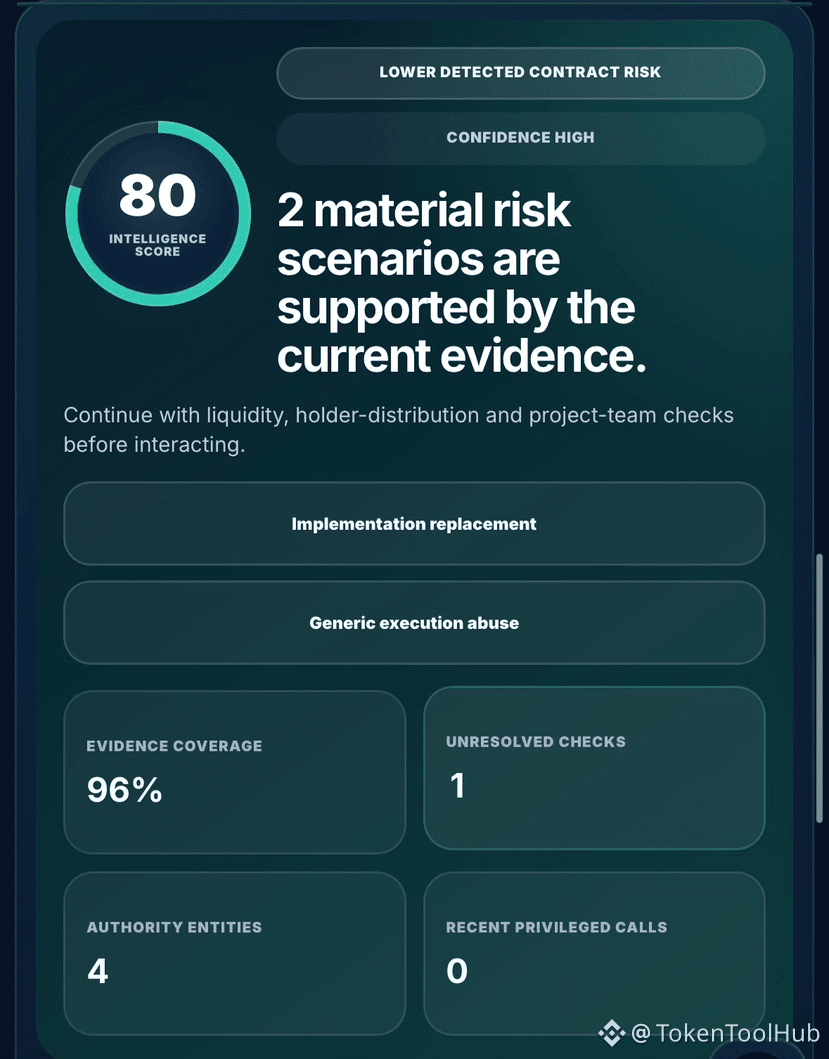
ARB scored 90/100 on the quick public-risk scan.
Deeper TokenToolHub contract intelligence returned 80/100.
Contract:
0x912CE59144191C1204E64559FE8253a0e49E6548
Network: Arbitrum
Key findings:
• Source verified
• Proxy detected
• Supply expansion: Not detected
• Mutable fees/taxes: Not detected
• Trading switches: Not detected
• Wallet restrictions: Not detected
• Emergency pause: Not detected
• Upgrade authority: PRESENT
• Generic external execution: PRESENT
Two material risk scenarios were identified:
• Possible implementation replacement
• Possible generic execution abuse
Resolved implementation:
0xd47d14a315394ddf063174f2286ab4eb7c507fa0
Resolved proxy administrator:
0xdb216562328215e010f819b5abe947bad4ca961e
The proxy exposes:
changeAdmin(address)
upgradeTo(address)
upgradeToAndCall(address,bytes)
This means the underlying implementation can potentially be replaced by the authorized upgrade administrator.
That does not imply malicious behavior. It means the security model depends partly on how upgrade authority is governed and protected.
Recent activity included 24 contract transactions, 23 unique callers and 60 token transfers, with no failed transactions, recognized privileged calls, mint events or burn events in the bounded window.
Trading simulation remained unresolved.
For upgradeable contracts, inspect both the current implementation and who can change it.
Full ARB scan:
https://tokentoolhub.com/token-safety-checker/?net=arbitrum&address=0x912CE59144191C1204E64559FE8253a0e49E6548
#Arbitrum #ARB #SmartContracts #OnChain
ARB scored 90/100 on the quick public-risk scan.
Deeper TokenToolHub contract intelligence returned 80/100.
Contract:
0x912CE59144191C1204E64559FE8253a0e49E6548
Network: Arbitrum
Key findings:
• Source verified
• Proxy detected
• Supply expansion: Not detected
• Mutable fees/taxes: Not detected
• Trading switches: Not detected
• Wallet restrictions: Not detected
• Emergency pause: Not detected
• Upgrade authority: PRESENT
• Generic external execution: PRESENT
Two material risk scenarios were identified:
• Possible implementation replacement
• Possible generic execution abuse
Resolved implementation:
0xd47d14a315394ddf063174f2286ab4eb7c507fa0
Resolved proxy administrator:
0xdb216562328215e010f819b5abe947bad4ca961e
The proxy exposes:
changeAdmin(address)
upgradeTo(address)
upgradeToAndCall(address,bytes)
This means the underlying implementation can potentially be replaced by the authorized upgrade administrator.
That does not imply malicious behavior. It means the security model depends partly on how upgrade authority is governed and protected.
Recent activity included 24 contract transactions, 23 unique callers and 60 token transfers, with no failed transactions, recognized privileged calls, mint events or burn events in the bounded window.
Trading simulation remained unresolved.
For upgradeable contracts, inspect both the current implementation and who can change it.
Full ARB scan:
https://tokentoolhub.com/token-safety-checker/?net=arbitrum&address=0x912CE59144191C1204E64559FE8253a0e49E6548
#Arbitrum #ARB #SmartContracts #OnChain
Deeper TokenToolHub contract intelligence returned 80/100.
Contract:
0x912CE59144191C1204E64559FE8253a0e49E6548
Network: Arbitrum
Key findings:
• Source verified
• Proxy detected
• Supply expansion: Not detected
• Mutable fees/taxes: Not detected
• Trading switches: Not detected
• Wallet restrictions: Not detected
• Emergency pause: Not detected
• Upgrade authority: PRESENT
• Generic external execution: PRESENT
Two material risk scenarios were identified:
• Possible implementation replacement
• Possible generic execution abuse
Resolved implementation:
0xd47d14a315394ddf063174f2286ab4eb7c507fa0
Resolved proxy administrator:
0xdb216562328215e010f819b5abe947bad4ca961e
The proxy exposes:
changeAdmin(address)
upgradeTo(address)
upgradeToAndCall(address,bytes)
This means the underlying implementation can potentially be replaced by the authorized upgrade administrator.
That does not imply malicious behavior. It means the security model depends partly on how upgrade authority is governed and protected.
Recent activity included 24 contract transactions, 23 unique callers and 60 token transfers, with no failed transactions, recognized privileged calls, mint events or burn events in the bounded window.
Trading simulation remained unresolved.
For upgradeable contracts, inspect both the current implementation and who can change it.
Full ARB scan:
https://tokentoolhub.com/token-safety-checker/?net=arbitrum&address=0x912CE59144191C1204E64559FE8253a0e49E6548
#Arbitrum #ARB #SmartContracts #OnChain
113
·
--
See translation
Benmao returned 90/100 on the quick public-risk scan.
Deeper TokenToolHub contract intelligence returned 45/100.
Contract:
0xF2dF04B34596372EBB4A0C49930ebeB760ad7777
Network: BNB Smart Chain
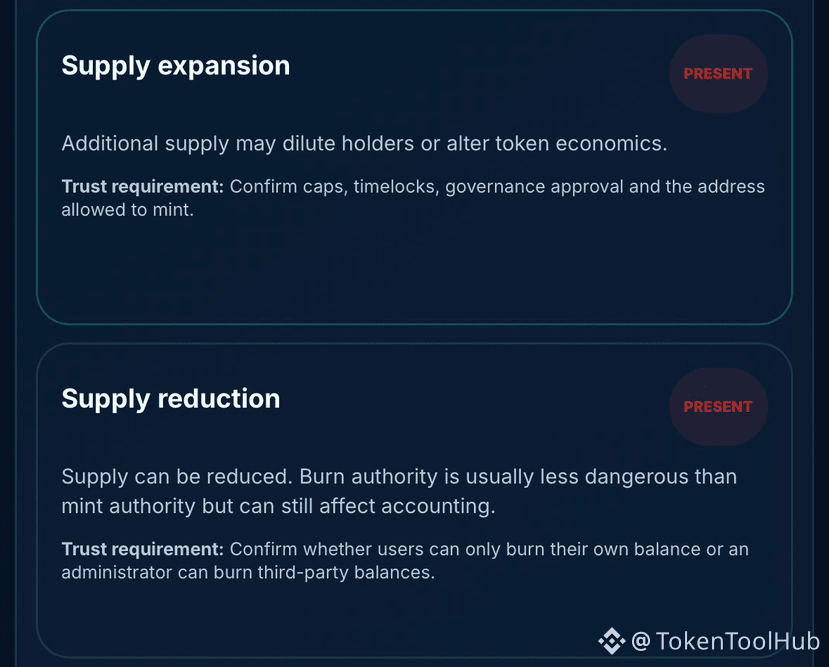
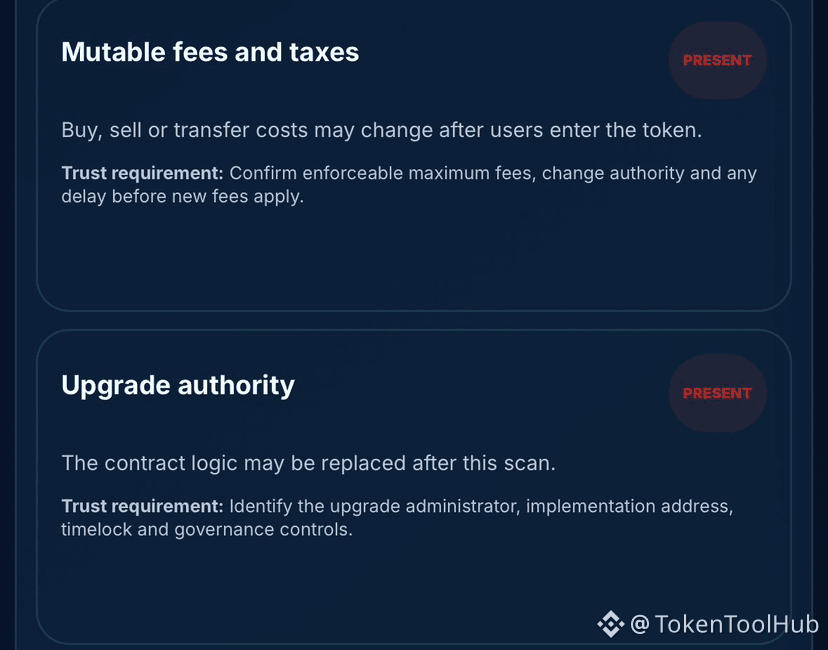
The verified contract supports 4 material risk scenarios:
• Possible supply dilution
• Possible post-purchase fee escalation
• Possible implementation replacement
• Possible generic execution abuse
Detected control surfaces:
• Supply expansion: Present
• Mutable fees/taxes: Present
• Upgrade authority: Present
• Generic external execution: Present
• Ownership/admin control: Present
• Supply reduction: Present
Wallet restrictions, trading switches and emergency pause were not detected by the available checks.
The contract is also upgradeable.
Implementation:
0x024f18294970b5c76c0691b87f138a0317156422
Current owner:
0xe2ce6ab80874fa9fa2aae65d277dd6b8e65c9de0
Upgradeability matters because the logic being analyzed today may be replaced later if the relevant authority can change the implementation.
The report also detected mutable fee/tax capability and supply-expansion capability.
Trading simulation was unavailable, leaving honeypot status, buy tax and sell tax unresolved.
A strong quick score should not replace analysis of authority, upgradeability and mutable contract behavior.
Full Benmao scan:
https://tokentoolhub.com/token-safety-checker/?net=bsc&address=0xF2dF04B34596372EBB4A0C49930ebeB760ad7777
#BNBChain #SmartContracts #CryptoSecurity #OnChain
Benmao returned 90/100 on the quick public-risk scan.
Deeper TokenToolHub contract intelligence returned 45/100.
Contract:
0xF2dF04B34596372EBB4A0C49930ebeB760ad7777
Network: BNB Smart Chain
The verified contract supports 4 material risk scenarios:
• Possible supply dilution
• Possible post-purchase fee escalation
• Possible implementation replacement
• Possible generic execution abuse
Detected control surfaces:
• Supply expansion: Present
• Mutable fees/taxes: Present
• Upgrade authority: Present
• Generic external execution: Present
• Ownership/admin control: Present
• Supply reduction: Present
Wallet restrictions, trading switches and emergency pause were not detected by the available checks.
The contract is also upgradeable.
Implementation:
0x024f18294970b5c76c0691b87f138a0317156422
Current owner:
0xe2ce6ab80874fa9fa2aae65d277dd6b8e65c9de0
Upgradeability matters because the logic being analyzed today may be replaced later if the relevant authority can change the implementation.
The report also detected mutable fee/tax capability and supply-expansion capability.
Trading simulation was unavailable, leaving honeypot status, buy tax and sell tax unresolved.
A strong quick score should not replace analysis of authority, upgradeability and mutable contract behavior.
Full Benmao scan:
https://tokentoolhub.com/token-safety-checker/?net=bsc&address=0xF2dF04B34596372EBB4A0C49930ebeB760ad7777
#BNBChain #SmartContracts #CryptoSecurity #OnChain
Deeper TokenToolHub contract intelligence returned 45/100.
Contract:
0xF2dF04B34596372EBB4A0C49930ebeB760ad7777
Network: BNB Smart Chain
The verified contract supports 4 material risk scenarios:
• Possible supply dilution
• Possible post-purchase fee escalation
• Possible implementation replacement
• Possible generic execution abuse
Detected control surfaces:
• Supply expansion: Present
• Mutable fees/taxes: Present
• Upgrade authority: Present
• Generic external execution: Present
• Ownership/admin control: Present
• Supply reduction: Present
Wallet restrictions, trading switches and emergency pause were not detected by the available checks.
The contract is also upgradeable.
Implementation:
0x024f18294970b5c76c0691b87f138a0317156422
Current owner:
0xe2ce6ab80874fa9fa2aae65d277dd6b8e65c9de0
Upgradeability matters because the logic being analyzed today may be replaced later if the relevant authority can change the implementation.
The report also detected mutable fee/tax capability and supply-expansion capability.
Trading simulation was unavailable, leaving honeypot status, buy tax and sell tax unresolved.
A strong quick score should not replace analysis of authority, upgradeability and mutable contract behavior.
Full Benmao scan:
https://tokentoolhub.com/token-safety-checker/?net=bsc&address=0xF2dF04B34596372EBB4A0C49930ebeB760ad7777
#BNBChain #SmartContracts #CryptoSecurity #OnChain
46

·
--

Article
See translation
QUBIC Quorum Governance Proposals in Epoch 227: Upgrade Qraffle Smart Contract🚀 Core objectives
Upgrade the existing Qraffle Smart Contract on $Qubic to the latest reviewed implementation. - Add verifiable on-chain randomness and refine asset-raffle features. - Build on the previously approved asset-raffle release, not an initial deployment.
⚙️ Technical implementation
Integrate the RANDOM smart contract to purchase independent entropy (collateral tier 0, 256 bits) at each ENDEPOCH for winner selection. - Entropy purchase is additive and fail-safe: if RANDOM's pool is empty or purchase fails, settlement proceeds with the digest-only seed and the fee is fully refunded. - Remove restrictions blocking QRAFFLE SC shares and QXMR token from being used as asset-bundle raffle prizes. - Lower default QuRaffle pool/entry amount from 10,000,000 Qu to 1,000,000 Qu. - Add tests for RANDOM integration, including successful purchase, graceful fallback, and unfunded reserve scenarios.
💡 Innovative approach
Mix independent entropy from RANDOM with the existing digest-based seed, strengthening randomness without blocking settlement. - Build a self-sustaining entropy reserve retained in the contract's own balance, never transferred out.
💰 Economic aspects
Fund the entropy reserve with a 1% carve-out from QuRaffle and Asset Raffle Qu pools; token-denominated pools do not fund it. - Adjust winner/creator share of Qu-denominated pools from 80% to 79% to accommodate the reserve (remaining 21%: 5% burn, 5% DAO/register, 8% shareholders, 1% charity, 1% fee, 1% entropy reserve).
🌍 Expected impacts
Enhanced fairness and verifiability in raffle winner selection. - Expanded asset-raffle prize options by including previously restricted tokens. - Lower entry barrier for QuRaffle pools, increasing accessibility and participation.
🔗 Proposal link below
[Proposal: Upgrade Qraffle Smart Contract](https://github.com/profitphil/proposal/blob/main/SmartContracts/2026-08-21-qraffle_upgrade_proposal.md)
#Qubic #SmartContracts
QUBIC Quorum Governance Proposals in Epoch 227: Upgrade Qraffle Smart Contract
🚀 Core objectives
Upgrade the existing Qraffle Smart Contract on $Qubic to the latest reviewed implementation. - Add verifiable on-chain randomness and refine asset-raffle features. - Build on the previously approved asset-raffle release, not an initial deployment.
⚙️ Technical implementation
Integrate the RANDOM smart contract to purchase independent entropy (collateral tier 0, 256 bits) at each ENDEPOCH for winner selection. - Entropy purchase is additive and fail-safe: if RANDOM's pool is empty or purchase fails, settlement proceeds with the digest-only seed and the fee is fully refunded. - Remove restrictions blocking QRAFFLE SC shares and QXMR token from being used as asset-bundle raffle prizes. - Lower default QuRaffle pool/entry amount from 10,000,000 Qu to 1,000,000 Qu. - Add tests for RANDOM integration, including successful purchase, graceful fallback, and unfunded reserve scenarios.
💡 Innovative approach
Mix independent entropy from RANDOM with the existing digest-based seed, strengthening randomness without blocking settlement. - Build a self-sustaining entropy reserve retained in the contract's own balance, never transferred out.
💰 Economic aspects
Fund the entropy reserve with a 1% carve-out from QuRaffle and Asset Raffle Qu pools; token-denominated pools do not fund it. - Adjust winner/creator share of Qu-denominated pools from 80% to 79% to accommodate the reserve (remaining 21%: 5% burn, 5% DAO/register, 8% shareholders, 1% charity, 1% fee, 1% entropy reserve).
🌍 Expected impacts
Enhanced fairness and verifiability in raffle winner selection. - Expanded asset-raffle prize options by including previously restricted tokens. - Lower entry barrier for QuRaffle pools, increasing accessibility and participation.
🔗 Proposal link below
Proposal: Upgrade Qraffle Smart Contract
#Qubic #SmartContracts
Upgrade the existing Qraffle Smart Contract on $Qubic to the latest reviewed implementation. - Add verifiable on-chain randomness and refine asset-raffle features. - Build on the previously approved asset-raffle release, not an initial deployment.
⚙️ Technical implementation
Integrate the RANDOM smart contract to purchase independent entropy (collateral tier 0, 256 bits) at each ENDEPOCH for winner selection. - Entropy purchase is additive and fail-safe: if RANDOM's pool is empty or purchase fails, settlement proceeds with the digest-only seed and the fee is fully refunded. - Remove restrictions blocking QRAFFLE SC shares and QXMR token from being used as asset-bundle raffle prizes. - Lower default QuRaffle pool/entry amount from 10,000,000 Qu to 1,000,000 Qu. - Add tests for RANDOM integration, including successful purchase, graceful fallback, and unfunded reserve scenarios.
💡 Innovative approach
Mix independent entropy from RANDOM with the existing digest-based seed, strengthening randomness without blocking settlement. - Build a self-sustaining entropy reserve retained in the contract's own balance, never transferred out.
💰 Economic aspects
Fund the entropy reserve with a 1% carve-out from QuRaffle and Asset Raffle Qu pools; token-denominated pools do not fund it. - Adjust winner/creator share of Qu-denominated pools from 80% to 79% to accommodate the reserve (remaining 21%: 5% burn, 5% DAO/register, 8% shareholders, 1% charity, 1% fee, 1% entropy reserve).
🌍 Expected impacts
Enhanced fairness and verifiability in raffle winner selection. - Expanded asset-raffle prize options by including previously restricted tokens. - Lower entry barrier for QuRaffle pools, increasing accessibility and participation.
🔗 Proposal link below
Proposal: Upgrade Qraffle Smart Contract
#Qubic #SmartContracts
73
Log in to explore more content
Join global crypto users on Binance Square
⚡️ Get latest and useful information about crypto.
💬 Trusted by the world’s largest crypto exchange.
👍 Discover real insights from verified creators.
Email / Phone number
Trending Topics
1
#BTCBreaks80K
101,793 views
1,704 Discussing
2
#比特币突破8万
83,674 views
264 Discussing
3
#BuffettBecomesBerkshireChairmanEmeritus
26,485 views
597 Discussing
4
#ZcashSpotETFTops$230MMonthlyInflow
6,598 views
85 Discussing
5
#HYPEJumpsOver11%
85,580 views
1,163 Discussing
6
#ZcashDevelopersTargetNU7MainnetActivationNov5
40,980 views
590 Discussing
7
#BitcoinSpotETFsNetInflow$159M
33,031 views
107 Discussing
8
#HKMAPlansWholesaleCBDCByYearEnd
58,719 views
968 Discussing
9
#NEARSurges26%Past$3.45
24,362 views
149 Discussing
10
#BOJHikesRatesTo31YearHigh
99,488 views
1,365 Discussing