

#contentcreation
contentcreation
285,726 views
542 Discussing
Hot
Latest


Article
See translation
WHY ARE YOUR BINANCE SQUARE POSTS GETTING LOW REACH? Here’s What Creators Need to UnderstandMany crypto creators spend hours writing posts, analyzing charts, sharing market updates, and publishing predictions, yet their content barely gets noticed.
Meanwhile, some creators consistently attract meaningful discussions and build loyal audiences.
So what is the difference?
The answer is not simply posting more frequently or adding more hashtags. Content quality, originality, authenticity, and genuine audience engagement matter.
1. Posting More Does Not Automatically Mean More Reach
One common mistake is publishing multiple posts every hour without considering whether each post offers anything new.
If your feed contains repeated price predictions, generic market updates, and slightly modified versions of the same analysis, readers have little reason to stop scrolling.
Instead of asking, "How many posts can I publish today?", ask yourself:
- Does this post teach the reader something?
- Does it provide a useful observation or a fresh perspective?
- Is it different from what everyone else is publishing?
- Would someone want to save it or discuss it?
One genuinely useful analysis can be more valuable to your audience than ten repetitive posts.
2. Generic AI Content Can Hurt Your Strategy
AI tools can help creators research topics, organize information, and improve writing. However, relying entirely on automated content is a risky strategy.
Binance Square's official updates have specifically warned that entirely AI-generated content may receive reduced distribution in certain contexts. Binance also emphasizes originality and genuine contributions.
Simply asking an AI tool to write "Bitcoin analysis today" and publishing the result without checking the data, adding your own perspective, or verifying the claims does not create a distinctive voice.
Use AI as an assistant, not as a replacement for your own thinking.
Add your interpretation of the market, explain what you noticed, identify uncertainties, and support your conclusions with evidence.
3. Repetitive Content Makes Your Account Forgettable
Imagine seeing these posts from the same creator every day:
"BTC is ready to pump."
"Bitcoin could explode soon."
"Massive BTC move coming."
Even if the wording changes, the underlying message remains the same.
Build a broader content strategy instead:
- Market analysis: Explain support, resistance, volume, and possible scenarios.
- Education: Teach beginners how to understand indicators and manage risk.
- News analysis: Explain why an announcement matters, rather than merely repeating the headline.
- Trade reviews: Discuss what worked, what failed, and what you learned.
- On-chain insights: Explain relevant data and its limitations.
- Community discussions: Ask meaningful questions that encourage thoughtful responses.
Give readers a reason to recognize and return to your content.
4. Fake Engagement Is Not a Sustainable Growth Strategy
Buying engagement, coordinating artificial likes, using automated comments, or repeatedly interacting without genuinely reading content can undermine your account's performance.
Binance has explicitly stated that engagement farming and manipulated interactions may be detected and deprioritized. Its October 2026 Content Mining update also emphasizes genuine interactions rather than scripted activity or repeated engagement from the same readers.
Do not focus on making your engagement numbers look impressive. Focus on earning real engagement.
A thoughtful comment that adds a new perspective is more valuable for community building than dozens of meaningless replies.
5. Your Opening Lines Might Be Losing Readers
The first few lines of your post should make the topic and its value immediately clear.
Compare these examples:
Weak opening:
"Hello everyone! Today I want to talk about the crypto market."
Stronger opening:
"Bitcoin's price is only part of the story. The more important question is whether buyers can defend the current support level."
The second opening introduces a specific idea and gives readers a reason to continue.
Avoid exaggerated promises, fabricated breaking news, and guaranteed price targets. A compelling hook should attract attention without misleading your audience.
6. Stop Publishing Analysis Without Explaining the Reasoning
Writing that a coin will rise 50% is not the same as providing useful analysis.
A stronger post explains:
- The current market structure.
- The key support and resistance levels.
- The evidence supporting a bullish or bearish scenario.
- What would invalidate the analysis.
- The risks involved and what traders should monitor.
For example, instead of claiming that a token is guaranteed to pump, explain which resistance level buyers need to break, whether volume supports the move, and what could cause the setup to fail.
Readers learn to trust creators who acknowledge uncertainty rather than pretending to predict every market move.
7. Use Images, Charts, and Formatting With a Purpose
A relevant chart or infographic can make complex information easier to understand. However, an image alone cannot rescue weak content.
Use visuals to explain something specific: a market structure, a comparison, a risk-management framework, or a blockchain concept.
Keep paragraphs readable, use headings for longer articles, and avoid filling every post with unnecessary emojis or hashtags.
Choose relevant hashtags and token tags that accurately describe the subject. They help categorize content, but they cannot guarantee distribution.
8. Build a Real Audience Instead of Chasing One Viral Post
Sustainable growth comes from giving people a reason to follow your work.
Try a consistent weekly structure:
- Monday: Weekly market outlook.
- Tuesday: Educational crypto lesson.
- Wednesday: Detailed coin analysis.
- Thursday: Important news explained.
- Friday: Risk-management lesson or trade review.
- Weekend: Weekly recap and community discussion.
This is a suggested schedule, not an algorithm requirement. Adapt it to the quality of your research and the response you receive.
After publishing, respond to relevant comments, ask follow-up questions, and participate in other discussions where you can contribute something useful.
9. Measure What Actually Works
Do not judge every post by its first few minutes or by likes alone.
Review your content analytics to compare views, shares, comments, follower growth, and other available engagement metrics. Allow time for reporting data to update.
Look for patterns:
- Which topics consistently attract readers?
- Which openings make people interested?
- Which posts generate meaningful discussions?
- Which formats bring new followers?
- Which articles receive views but little engagement?
Repeat successful approaches while continuing to test new ideas. Do not assume one post's performance proves a permanent algorithm rule.
10. Understand Binance Square's Current Direction
Binance's October 2026 Content Mining update introduced engagement-based rewards for eligible text and image content, with an emphasis on interaction quality and genuine community participation.
Its published guidance also warns against mass posting of highly similar content and manipulated engagement.
This means creators should not assume that raw posting volume, repeated likes, or automated activity will produce better results. Eligibility and rewards depend on the applicable program rules, and high reach is never guaranteed.
The goal should be to create content that people genuinely want to read, discuss, and learn from.
FINAL THOUGHTS
If your Binance Square posts are receiving low reach, do not immediately blame the algorithm.
Start by examining your own content.
Is it original? Is it useful? Is it accurate? Does it offer a clear perspective? Does it encourage a genuine discussion?
You cannot control every recommendation decision, but you can improve the quality of what you publish.
Stop chasing impressions. Start building trust.
Because long-term growth is not just about getting people to see your posts. It is about giving them a reason to come back.
What do you think is the biggest challenge for Binance Square creators right now: low distribution, repetitive content, or changing engagement rules?
#BinanceSquare #CryptoEducation #ContentCreation #Trading #Web3
WHY ARE YOUR BINANCE SQUARE POSTS GETTING LOW REACH? Here’s What Creators Need to Understand
Many crypto creators spend hours writing posts, analyzing charts, sharing market updates, and publishing predictions, yet their content barely gets noticed.
Meanwhile, some creators consistently attract meaningful discussions and build loyal audiences.
So what is the difference?
The answer is not simply posting more frequently or adding more hashtags. Content quality, originality, authenticity, and genuine audience engagement matter.
1. Posting More Does Not Automatically Mean More Reach
One common mistake is publishing multiple posts every hour without considering whether each post offers anything new.
If your feed contains repeated price predictions, generic market updates, and slightly modified versions of the same analysis, readers have little reason to stop scrolling.
Instead of asking, "How many posts can I publish today?", ask yourself:
- Does this post teach the reader something?
- Does it provide a useful observation or a fresh perspective?
- Is it different from what everyone else is publishing?
- Would someone want to save it or discuss it?
One genuinely useful analysis can be more valuable to your audience than ten repetitive posts.
2. Generic AI Content Can Hurt Your Strategy
AI tools can help creators research topics, organize information, and improve writing. However, relying entirely on automated content is a risky strategy.
Binance Square's official updates have specifically warned that entirely AI-generated content may receive reduced distribution in certain contexts. Binance also emphasizes originality and genuine contributions.
Simply asking an AI tool to write "Bitcoin analysis today" and publishing the result without checking the data, adding your own perspective, or verifying the claims does not create a distinctive voice.
Use AI as an assistant, not as a replacement for your own thinking.
Add your interpretation of the market, explain what you noticed, identify uncertainties, and support your conclusions with evidence.
3. Repetitive Content Makes Your Account Forgettable
Imagine seeing these posts from the same creator every day:
"BTC is ready to pump."
"Bitcoin could explode soon."
"Massive BTC move coming."
Even if the wording changes, the underlying message remains the same.
Build a broader content strategy instead:
- Market analysis: Explain support, resistance, volume, and possible scenarios.
- Education: Teach beginners how to understand indicators and manage risk.
- News analysis: Explain why an announcement matters, rather than merely repeating the headline.
- Trade reviews: Discuss what worked, what failed, and what you learned.
- On-chain insights: Explain relevant data and its limitations.
- Community discussions: Ask meaningful questions that encourage thoughtful responses.
Give readers a reason to recognize and return to your content.
4. Fake Engagement Is Not a Sustainable Growth Strategy
Buying engagement, coordinating artificial likes, using automated comments, or repeatedly interacting without genuinely reading content can undermine your account's performance.
Binance has explicitly stated that engagement farming and manipulated interactions may be detected and deprioritized. Its October 2026 Content Mining update also emphasizes genuine interactions rather than scripted activity or repeated engagement from the same readers.
Do not focus on making your engagement numbers look impressive. Focus on earning real engagement.
A thoughtful comment that adds a new perspective is more valuable for community building than dozens of meaningless replies.
5. Your Opening Lines Might Be Losing Readers
The first few lines of your post should make the topic and its value immediately clear.
Compare these examples:
Weak opening:
"Hello everyone! Today I want to talk about the crypto market."
Stronger opening:
"Bitcoin's price is only part of the story. The more important question is whether buyers can defend the current support level."
The second opening introduces a specific idea and gives readers a reason to continue.
Avoid exaggerated promises, fabricated breaking news, and guaranteed price targets. A compelling hook should attract attention without misleading your audience.
6. Stop Publishing Analysis Without Explaining the Reasoning
Writing that a coin will rise 50% is not the same as providing useful analysis.
A stronger post explains:
- The current market structure.
- The key support and resistance levels.
- The evidence supporting a bullish or bearish scenario.
- What would invalidate the analysis.
- The risks involved and what traders should monitor.
For example, instead of claiming that a token is guaranteed to pump, explain which resistance level buyers need to break, whether volume supports the move, and what could cause the setup to fail.
Readers learn to trust creators who acknowledge uncertainty rather than pretending to predict every market move.
7. Use Images, Charts, and Formatting With a Purpose
A relevant chart or infographic can make complex information easier to understand. However, an image alone cannot rescue weak content.
Use visuals to explain something specific: a market structure, a comparison, a risk-management framework, or a blockchain concept.
Keep paragraphs readable, use headings for longer articles, and avoid filling every post with unnecessary emojis or hashtags.
Choose relevant hashtags and token tags that accurately describe the subject. They help categorize content, but they cannot guarantee distribution.
8. Build a Real Audience Instead of Chasing One Viral Post
Sustainable growth comes from giving people a reason to follow your work.
Try a consistent weekly structure:
- Monday: Weekly market outlook.
- Tuesday: Educational crypto lesson.
- Wednesday: Detailed coin analysis.
- Thursday: Important news explained.
- Friday: Risk-management lesson or trade review.
- Weekend: Weekly recap and community discussion.
This is a suggested schedule, not an algorithm requirement. Adapt it to the quality of your research and the response you receive.
After publishing, respond to relevant comments, ask follow-up questions, and participate in other discussions where you can contribute something useful.
9. Measure What Actually Works
Do not judge every post by its first few minutes or by likes alone.
Review your content analytics to compare views, shares, comments, follower growth, and other available engagement metrics. Allow time for reporting data to update.
Look for patterns:
- Which topics consistently attract readers?
- Which openings make people interested?
- Which posts generate meaningful discussions?
- Which formats bring new followers?
- Which articles receive views but little engagement?
Repeat successful approaches while continuing to test new ideas. Do not assume one post's performance proves a permanent algorithm rule.
10. Understand Binance Square's Current Direction
Binance's October 2026 Content Mining update introduced engagement-based rewards for eligible text and image content, with an emphasis on interaction quality and genuine community participation.
Its published guidance also warns against mass posting of highly similar content and manipulated engagement.
This means creators should not assume that raw posting volume, repeated likes, or automated activity will produce better results. Eligibility and rewards depend on the applicable program rules, and high reach is never guaranteed.
The goal should be to create content that people genuinely want to read, discuss, and learn from.
FINAL THOUGHTS
If your Binance Square posts are receiving low reach, do not immediately blame the algorithm.
Start by examining your own content.
Is it original? Is it useful? Is it accurate? Does it offer a clear perspective? Does it encourage a genuine discussion?
You cannot control every recommendation decision, but you can improve the quality of what you publish.
Stop chasing impressions. Start building trust.
Because long-term growth is not just about getting people to see your posts. It is about giving them a reason to come back.
What do you think is the biggest challenge for Binance Square creators right now: low distribution, repetitive content, or changing engagement rules?
#BinanceSquare #CryptoEducation #ContentCreation #Trading #Web3
57

·
--
See translation
#blockchain100awards
Crypto creator awards are becoming popularity contests where begging for votes matters more than knowing anything about crypto.**
Some creators chase votes harder than they research projects. They recycle content, throw around crypto buzzwords, and present themselves as experts without offering meaningful analysis.
Where is the real research? The technical understanding? The original insight that actually helps people make informed decisions?
A fancy profile, thousands of followers, and an award badge do not prove crypto knowledge.
If popularity is the only qualification, stop calling it a creator award and call it a popularity contest.
Crypto needs creators who educate, investigate, challenge hype, and verify facts not people who confuse engagement with expertise.
**Reward knowledge. Recognize research. Respect credibility.
Because in crypto, influence without understanding is just noise.
What should matter more in creator awards: the votes you collect or the value you create?
#TheBlockchain100 #ContentCreation $BTC

kingbrand295:
you are Pakistani
3
9
837

·
--
See translation
#EarningsSeason #earningsseason
🚀 Binance Square Is Evolving: Quality Matters More Than Ever
In crypto, attention is easy to attract, but trust is much harder to earn.
A successful creator doesn't just chase views. They educate readers, explain market movements, share meaningful insights, and build genuine conversations with the community.
📊 What truly makes a crypto post valuable?
❤️ Likes show appreciation. 💬 Meaningful comments create discussion. 👥 Genuine followers help build a lasting community. 📈 Quality analysis gives readers a reason to return.
The real goal isn't simply to publish more content. It's to publish content that helps people understand the market better.
For creators on Binance Square, this is a great reminder to focus on originality, consistency, and authentic engagement rather than empty numbers.
My strategy is simple: Research deeply, explain clearly, and create value with every post.
The future belongs to creators who earn attention through quality, not those who chase numbers.
What matters more to you in crypto content: high views or valuable insights? 👇
#BinanceSquare #CryptoCommunity #CryptoEducation #ContentCreation
1
71

See translation
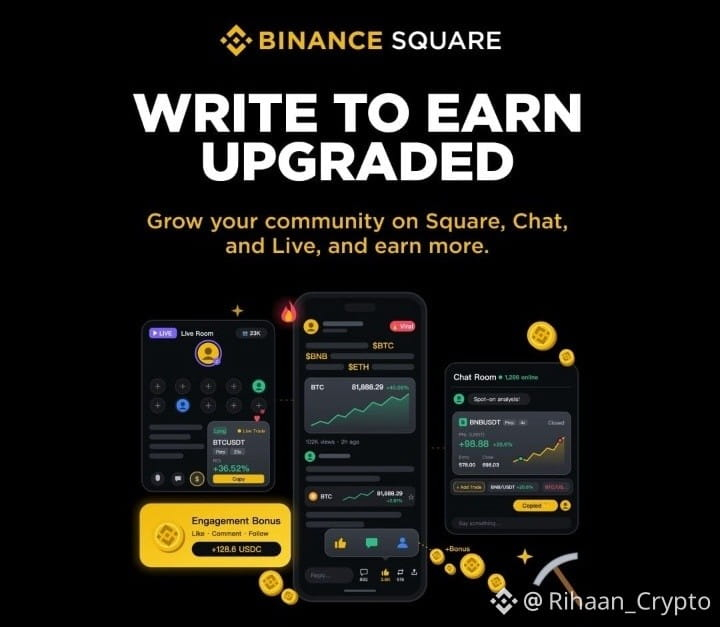
From now on, Binance will provide reward bonuses to content creators based on engagement. Previously, rewards were earned solely through commissions. This is great news for us.
what's your openion?
#ContentCreation #Reward
From now on, Binance will provide reward bonuses to content creators based on engagement. Previously, rewards were earned solely through commissions. This is great news for us.
what's your openion?
#ContentCreation #Reward
what's your openion?
#ContentCreation #Reward
123

·
--
See translation
Exploring On-Chain Creator Rewards: A New Model for Content Monetization
The Web3 creator economy is evolving rapidly. Traditional platforms take significant cuts from content creators, but new blockchain-based models are emerging to address this imbalance.
One interesting approach I've been researching is the BSCASH.ONE creator program, which operates on Binance Smart Chain. Here's what caught my attention:
Key Features:
✅ On-chain transparency - Reward distribution is verifiable on the blockchain
✅ No wallet connection required for participation - reduces security risks
✅ Low barrier to entry - Only 7 followers needed to apply
✅ Token-based rewards - Creators receive BNCB tokens for approved content
This model represents a shift toward decentralized content monetization, where creators have more control and transparency over their earnings.
For those interested in exploring this further, you can use reference code: SR-3AEB7E90AE741CCA32490BDF
The long-term viability of such programs will depend on token utility, community engagement, and sustainable reward mechanisms. It's an interesting experiment in Web3 creator economics.
Disclaimer: This is educational content about Web3 creator models. Not financial advice. Always DYOR before participating in any token-based program. $CASH
#Web3 #CreatorEconomy #BinanceSquare #CryptoEducation #BSC #ContentCreation
86

·
--
See translation
Why Content Copying Hurts the Community
Over the last 10 days, I've noticed a pattern that raises concerns about content quality on Binance Square. Some users are commenting on posts by directly copying lines from the original content instead of adding their own thoughts or analysis.
When a post starts gaining visibility, these copy-paste comments often appear suddenly. This doesn't add value to discussions and can discourage creators who spend time researching and writing educational content for the community.
A strong community is built on original ideas, constructive feedback, and meaningful engagement—not recycled content. If campaigns are intended to reward participation and learning, then originality should matter.
The question is whether platforms and project teams will take steps to address repeated content copying and low-quality engagement. Maintaining content standards is important for the long-term health of any educational ecosystem.
What are your thoughts on content originality and engagement quality on Binance Square?
@CZ @heyi
@OpenGradient $OPG #BinanceSquare #OpenGradient #ContentCreation #OriginalContent
Why Content Copying Hurts the Community
Over the last 10 days, I've noticed a pattern that raises concerns about content quality on Binance Square. Some users are commenting on posts by directly copying lines from the original content instead of adding their own thoughts or analysis.
When a post starts gaining visibility, these copy-paste comments often appear suddenly. This doesn't add value to discussions and can discourage creators who spend time researching and writing educational content for the community.
A strong community is built on original ideas, constructive feedback, and meaningful engagement—not recycled content. If campaigns are intended to reward participation and learning, then originality should matter.
The question is whether platforms and project teams will take steps to address repeated content copying and low-quality engagement. Maintaining content standards is important for the long-term health of any educational ecosystem.
What are your thoughts on content originality and engagement quality on Binance Square?
@CZ @Yi He
@OpenGradient $OPG #BinanceSquare #OpenGradient #ContentCreation #OriginalContent
2
1
90

See translation
💡 **Earn While You Write!**
Did you know you can make money just by sharing your thoughts on **Binance Square**? 🤑
📝 Create engaging crypto content
👥 Build your audience
💰 Earn up to **50% commission rewards**
No experience needed—just your ideas and consistency! Start today and turn your content into cash. 🚀
#Crypto #BinanceSquare #EarnOnline #ContentCreation
91

·
--
See translation
Most people think AI is about creating content faster.
I think it's about creating content smarter.
One strong idea can become videos, posts, threads, and more with the right workflow.
That's how creators save time while staying consistent.
Learn the workflow:
🔗 mihu8891.gumroad.com/l/ai-video-machine
What's your favorite AI tool for content creation?
#AI #Web3 #CreatorEconomy #ContentCreation #DigitalBusiness #Automation #Productivity
$GOOGL.US
{stock_us}(GOOGL.US)
$AAPL.US
{stock_us}(AAPL.US)
$NVDAB
{spot}(NVDABUSDT)
Most people think AI is about creating content faster.
I think it's about creating content smarter.
One strong idea can become videos, posts, threads, and more with the right workflow.
That's how creators save time while staying consistent.
Learn the workflow:
🔗 mihu8891.gumroad.com/l/ai-video-machine
What's your favorite AI tool for content creation?
#AI #Web3 #CreatorEconomy #ContentCreation #DigitalBusiness #Automation #Productivity
$GOOGL.US
$AAPL.US
$NVDAB

1
1
110

See translation
#WriteToEarn ✍️💰
The internet has transformed writing from a hobby into an opportunity. Today, a single post can educate thousands, start meaningful discussions, and even generate rewards.
The key isn't writing more—it's writing something valuable.
📌 Share insights
📌 Start conversations
📌 Teach what you learn
📌 Stay consistent
Great creators don't chase rewards. They focus on creating content people want to read, and rewards follow naturally.
Every expert started with their first post. Every audience started with one follower.
What topic are you writing about today? 👇#ContentCreation #Web3 #LearnAndEarn #CommunityDiscussion $USDT
{future}(USDCUSDT)
#WriteToEarn ✍️💰
The internet has transformed writing from a hobby into an opportunity. Today, a single post can educate thousands, start meaningful discussions, and even generate rewards.
The key isn't writing more—it's writing something valuable.
📌 Share insights
📌 Start conversations
📌 Teach what you learn
📌 Stay consistent
Great creators don't chase rewards. They focus on creating content people want to read, and rewards follow naturally.
Every expert started with their first post. Every audience started with one follower.
What topic are you writing about today? 👇#ContentCreation #Web3 #LearnAndEarn #CommunityDiscussion $USDT
1
80
·
--
See translation
I have observed a growing issue across many social media reward campaigns.
Too often, visibility is driven by engagement numbers alone. Accounts using engagement groups, repetitive comments, or artificial interactions can accumulate points quickly, while creators who focus on research, education, and original insights may struggle to receive the same recognition.
This creates a challenge for the ecosystem. When rewards are tied primarily to metrics rather than content quality, the incentive shifts away from learning and meaningful discussion.
Long-term growth comes from rewarding value, accuracy, and genuine community contributions—not just impressions and comment counts.
A stronger campaign model would balance engagement metrics with content quality, originality, educational value, and authentic participation.
The goal should not be the loudest voices, but the most valuable ones.
@Binance_Italy @Square-Creator-1ab2a2e1f1b3 #BinanceSquare #Crypto #Web3 #ContentCreation #SocialFi $BNB
I have observed a growing issue across many social media reward campaigns.
Too often, visibility is driven by engagement numbers alone. Accounts using engagement groups, repetitive comments, or artificial interactions can accumulate points quickly, while creators who focus on research, education, and original insights may struggle to receive the same recognition.
This creates a challenge for the ecosystem. When rewards are tied primarily to metrics rather than content quality, the incentive shifts away from learning and meaningful discussion.
Long-term growth comes from rewarding value, accuracy, and genuine community contributions—not just impressions and comment counts.
A stronger campaign model would balance engagement metrics with content quality, originality, educational value, and authentic participation.
The goal should not be the loudest voices, but the most valuable ones.
@Binance Italy @Binnace Reward Hub #BinanceSquare #Crypto #Web3 #ContentCreation #SocialFi $BNB
2
217

·
--
See translation
🚨 $BTC TRADERS: 10 REASONS YOUR BINANCE SQUARE POSTS GET ZERO TRAFFIC 💥
📊 Attention is the real asset on Binance Square, and most creators are dumping into an illiquid pool. The biggest killers? Outdated topics, weak headlines, and zero originality. Readers want current market analysis, not yesterday's news. 💡
📌 Structure your posts like a clean setup: strong headline, short paragraphs, and your own market insight. Engage with comments, publish consistently, and stop copying others. The algorithm rewards uniqueness and value. 🔍
💬 Which of these 10 mistakes have you been guilty of? 👇
⚠️ Not financial advice. Always manage your risk. 🛡️
🏷️ #BTC #BinanceSquare #ContentCreation #CryptoCommunity #WriteToEarn
🔥 💎
28


Article
See translation
Genius#genius $GENIUS The digital world is evolving faster than ever, and platforms that combine creativity, technology, and community are becoming the future of online growth. One of the most exciting opportunities right now is the #genius Write to Earn campaign. It allows creators, learners, and Web3 enthusiasts to share ideas, gain exposure, and earn rewards at the same time. In a world where content is king, initiatives like this prove that quality writing and valuable engagement can open real opportunities for everyone.
The rise of AI and blockchain technology has changed how people interact online. Traditional social media platforms mostly reward popularity, but modern ecosystems are starting to value contribution, consistency, and knowledge. That is why projects like @genius stand out. They create an environment where users are encouraged to participate actively, express their thoughts, and contribute meaningful content to the community.
One of the biggest advantages of the Write to Earn model is accessibility. Anyone with ideas, creativity, or passion can participate. You do not need expensive equipment or advanced technical skills to get started. All you need is dedication and the willingness to learn. Whether someone is interested in AI, crypto, blockchain, finance, gaming, or digital innovation, platforms connected with $GENIUS provide a space to grow and connect with like-minded people.
Another important factor is community building. Strong communities are the backbone of every successful Web3 project. Campaigns like this help users interact with each other, exchange knowledge, and support innovation. Instead of simply consuming content, users become contributors to a larger ecosystem. This creates a more engaging and rewarding experience for everyone involved.
AI is also becoming one of the biggest technological revolutions of our generation. From automation to smart assistants and advanced data analysis, artificial intelligence is transforming industries around the world. Combining AI with blockchain and decentralized communities creates endless possibilities for the future. The #genius ecosystem represents this modern vision where innovation and community-driven growth work together.
Consistency is another major key to success in any online journey. Many people quit too early because results do not appear instantly. However, campaigns like the Genius Write to Earn initiative reward active participation and continuous improvement. Every post, idea, and interaction helps users develop their skills while increasing their visibility within the community. Over time, consistent effort can lead to greater opportunities, stronger networks, and valuable experience.
The online economy is shifting toward creator-focused systems. In the past, creators often struggled to monetize their content fairly. Today, Web3 projects are changing that by giving more value back to the community. This is why the Write to Earn concept has become so popular. It motivates users to produce useful content while also helping ecosystems grow naturally through authentic engagement.
I believe the future belongs to people who adapt, learn, and stay consistent. Platforms powered by innovation and strong communities will continue to lead the next generation of the internet. The #genius campaign is more than just a writing opportunity — it is a chance to become part of a growing movement focused on creativity, technology, and digital empowerment.
The journey in Web3 is only beginning, and projects like @genius are opening doors for thousands of people worldwide. By participating, learning, and sharing ideas, users can become part of something much bigger than themselves. The combination of AI, blockchain, and creator-driven ecosystems has the potential to reshape the internet in ways we are only starting to understand.
#genius @GeniusOfficial $GENIUS #WriteToEarn #AI #Web3 #Crypto #Blockchain #ContentCreation
Genius
#genius $GENIUS The digital world is evolving faster than ever, and platforms that combine creativity, technology, and community are becoming the future of online growth. One of the most exciting opportunities right now is the #genius Write to Earn campaign. It allows creators, learners, and Web3 enthusiasts to share ideas, gain exposure, and earn rewards at the same time. In a world where content is king, initiatives like this prove that quality writing and valuable engagement can open real opportunities for everyone.
The rise of AI and blockchain technology has changed how people interact online. Traditional social media platforms mostly reward popularity, but modern ecosystems are starting to value contribution, consistency, and knowledge. That is why projects like @genius stand out. They create an environment where users are encouraged to participate actively, express their thoughts, and contribute meaningful content to the community.
One of the biggest advantages of the Write to Earn model is accessibility. Anyone with ideas, creativity, or passion can participate. You do not need expensive equipment or advanced technical skills to get started. All you need is dedication and the willingness to learn. Whether someone is interested in AI, crypto, blockchain, finance, gaming, or digital innovation, platforms connected with $GENIUS provide a space to grow and connect with like-minded people.
Another important factor is community building. Strong communities are the backbone of every successful Web3 project. Campaigns like this help users interact with each other, exchange knowledge, and support innovation. Instead of simply consuming content, users become contributors to a larger ecosystem. This creates a more engaging and rewarding experience for everyone involved.
AI is also becoming one of the biggest technological revolutions of our generation. From automation to smart assistants and advanced data analysis, artificial intelligence is transforming industries around the world. Combining AI with blockchain and decentralized communities creates endless possibilities for the future. The #genius ecosystem represents this modern vision where innovation and community-driven growth work together.
Consistency is another major key to success in any online journey. Many people quit too early because results do not appear instantly. However, campaigns like the Genius Write to Earn initiative reward active participation and continuous improvement. Every post, idea, and interaction helps users develop their skills while increasing their visibility within the community. Over time, consistent effort can lead to greater opportunities, stronger networks, and valuable experience.
The online economy is shifting toward creator-focused systems. In the past, creators often struggled to monetize their content fairly. Today, Web3 projects are changing that by giving more value back to the community. This is why the Write to Earn concept has become so popular. It motivates users to produce useful content while also helping ecosystems grow naturally through authentic engagement.
I believe the future belongs to people who adapt, learn, and stay consistent. Platforms powered by innovation and strong communities will continue to lead the next generation of the internet. The #genius campaign is more than just a writing opportunity — it is a chance to become part of a growing movement focused on creativity, technology, and digital empowerment.
The journey in Web3 is only beginning, and projects like @genius are opening doors for thousands of people worldwide. By participating, learning, and sharing ideas, users can become part of something much bigger than themselves. The combination of AI, blockchain, and creator-driven ecosystems has the potential to reshape the internet in ways we are only starting to understand.
#genius @GeniusOfficial $GENIUS #WriteToEarn #AI #Web3 #Crypto #Blockchain #ContentCreation
73

·
--
See translation
✍️ Write to Earn: Turn Your Words into Rewards
The Write to Earn trend is creating new opportunities for content creators, bloggers, and crypto enthusiasts. Instead of writing solely for views or engagement, users can now earn rewards for producing valuable content on supported platforms.
Whether you're sharing market insights, educational articles, personal experiences, or project reviews, quality content can attract readers and generate earnings. The key to success is consistency, originality, and providing real value to your audience.
However, not every post will go viral. Focus on building trust, improving your writing skills, and engaging with the community. Avoid copying content or chasing trends without research, as long-term growth comes from credibility.
Write to Earn combines creativity with opportunity, allowing anyone with knowledge and dedication to potentially earn while contributing meaningful content to the digital ecosystem.
$BTC $BNB $ETH
#writetoearn n#Crypto_Jobs🎯 #ContentCreation #Web3
125


·
--
Bearish
See translation
🎉 Just earned 0.44 USDc with Write to Earn!
Not a huge amount, but ranking in the top with a 20% commission feels amazing. Every post counts, and the rewards add up.
If you're not posting yet, what are you waiting for? Consistency pays off — literally.
Let’s keep writing, keep earning, and climb those ranks together! 💪✍️
#WriteToEarn #CryptoRewards #ContentCreation #KeepPosting #PassiveIncome
$LAB $TAC $EVAA
{future}(EVAAUSDT)
{future}(TACUSDT)
{future}(LABUSDT)
🎉 Just earned 0.44 USDc with Write to Earn!
Not a huge amount, but ranking in the top with a 20% commission feels amazing. Every post counts, and the rewards add up.
If you're not posting yet, what are you waiting for? Consistency pays off — literally.
Let’s keep writing, keep earning, and climb those ranks together! 💪✍️
#WriteToEarn #CryptoRewards #ContentCreation #KeepPosting #PassiveIncome
$LAB $TAC $EVAA

1
558

·
--
Why do some Crypto accounts gain followers so fast?
From what I’ve observed,
it’s usually not because they “know more.”
Instead, it’s because they:
① Keep the content simple enough
② Have a clear point of view
③ Keep posting consistently
④ Spark discussions
Knowledge is just the foundation.
Communication skills are also growth skills.
#crypto #ContentCreation #Growth

105

·
--
Towards a smart content strategy: when 'point gaming' meets brand building#bedrock $BR towards a smart content strategy: when 'point gaming' meets 'brand building'
In the trading world, success isn't just about reading the candlesticks; it also involves 'impact engineering'. When we look at the task interface on the platform @Binance_Square_Official shown in the image, we see a mini economic model designed to stimulate content creation.
Towards a smart content strategy: when 'point gaming' meets brand building
#bedrock $BR towards a smart content strategy: when 'point gaming' meets 'brand building'
In the trading world, success isn't just about reading the candlesticks; it also involves 'impact engineering'. When we look at the task interface on the platform @Binance Square Official shown in the image, we see a mini economic model designed to stimulate content creation.
In the trading world, success isn't just about reading the candlesticks; it also involves 'impact engineering'. When we look at the task interface on the platform @Binance Square Official shown in the image, we see a mini economic model designed to stimulate content creation.
86

·
--
See translation
🎉 Small Wins Lead to Big Gains! Consistency is the Ultimate Key in the Write-to-Earn Journey! ✍️💰👇
Hard work and daily consistency behind the screen always pay off! I am thrilled to share a quick milestone update from the Binance Square 'Write to Earn' campaign. By consistently pushing high-quality technical analysis and market breakdowns, I officially locked in a 20% commission reward totaling 0.30 USDC last week and ranked right among the top creators! 🚀📊
Every single content piece, chart mapping, and community interaction builds up the momentum. This is just a small step, but it proves that putting out valuable market insights directly creates ecosystem rewards. Huge shoutout to everyone who engages, likes, and tracks my daily update feeds—we are just getting started!
💡 TO MY FELLOW CREATORS: Never underestimate the power of showing up every single day. Keep analyzing, keep tracking the technical parameters, and keep publishing. The rewards follow the effort! Let’s keep building momentum together! 📈🔥
{future}(BTCUSDT)
{future}(ETHUSDT)
{future}(SOLUSDT)
#BinanceSquare #writetoearn #cryptocreator #USDC #ContentCreation
🎉 Small Wins Lead to Big Gains! Consistency is the Ultimate Key in the Write-to-Earn Journey! ✍️💰👇
Hard work and daily consistency behind the screen always pay off! I am thrilled to share a quick milestone update from the Binance Square 'Write to Earn' campaign. By consistently pushing high-quality technical analysis and market breakdowns, I officially locked in a 20% commission reward totaling 0.30 USDC last week and ranked right among the top creators! 🚀📊
Every single content piece, chart mapping, and community interaction builds up the momentum. This is just a small step, but it proves that putting out valuable market insights directly creates ecosystem rewards. Huge shoutout to everyone who engages, likes, and tracks my daily update feeds—we are just getting started!
💡 TO MY FELLOW CREATORS: Never underestimate the power of showing up every single day. Keep analyzing, keep tracking the technical parameters, and keep publishing. The rewards follow the effort! Let’s keep building momentum together! 📈🔥
#BinanceSquare #writetoearn #cryptocreator #USDC #ContentCreation


2k
15
87
2k
·
--
See translation
Free Creator Tip
Most creators wait for perfect market conditions before posting.
Don't.
Educational content works in every market.
Share:
✅ One lesson
✅ One chart explanation
✅ One common mistake
✅ One practical tip
People follow creators who help them understand, not just those who predict prices.
If you want a faster content workflow with templates and captions:
🔗 https://mihu8891.gumroad.com/l/vdxury
#BingXHack #CryptoCreator #ContentCreation #DigitalProducts
$AAPL.US
{stock_us}(AAPL.US)
$GOOGL.US
{stock_us}(GOOGL.US)
Free Creator Tip
Most creators wait for perfect market conditions before posting.
Don't.
Educational content works in every market.
Share:
✅ One lesson
✅ One chart explanation
✅ One common mistake
✅ One practical tip
People follow creators who help them understand, not just those who predict prices.
If you want a faster content workflow with templates and captions:
🔗 https://mihu8891.gumroad.com/l/vdxury
#BingXHack #CryptoCreator #ContentCreation #DigitalProducts
$AAPL.US
$GOOGL.US
AAPLUS-0.50%
GOOGLUS+0.90%
1
112

See translation
BUILDING YOUR BRAND ON BINANCE SQUARE IS A SMART MOVE FOR LONG TERM GROWTH ⚡
The platform is running a new creator event that offers some solid incentives for those sharing their trading journey and market insights. It is a practical way to increase your visibility while documenting your progress in the space.
I have found that staying consistent with quality content is the best way to build a reputation here. If you are already active on the feed, this is a good opportunity to get some recognition for your work. Are you planning to participate in this round of the creator event?
Not financial advice. Always manage your risk.
#BinanceSquare #CryptoTrading #ContentCreation #Growth
⚡
36

See translation
💡 In crypto, knowledge is an asset—and sharing it can create even more value.
The best content isn't always the longest or the most technical. Sometimes, a simple explanation can help thousands of people understand a concept they were struggling with.
Write to Earn is an opportunity to transform your ideas into meaningful content. Every original post helps you improve your skills, connect with like-minded people, and contribute to the crypto community.
Don't focus on going viral.
Focus on being useful.
When readers trust your content, growth follows naturally.
📈 Learn consistently.
✍️ Write with purpose.
🌍 Share without fear.
🚀 Grow one post at a time.
Your next article could be the one that inspires someone's crypto journey.
💬 What's one crypto lesson you wish you had learned earlier? Share it in the comments!
$AB $B2 $ZBT
{spot}(ZBTUSDT)
{future}(B2USDT)
{alpha}(560x95034f653d5d161890836ad2b6b8cc49d14e029a)
#BinanceSquare #WriteToEarn #Crypto #Blockchain #Web3 #CryptoEducation #LearnAndEarn #CryptoCommunity #Binance #ContentCreation
“Come closer. Let me tell you why your eyes have lingered on me for so long.”
💡 In crypto, knowledge is an asset—and sharing it can create even more value.
The best content isn't always the longest or the most technical. Sometimes, a simple explanation can help thousands of people understand a concept they were struggling with.
Write to Earn is an opportunity to transform your ideas into meaningful content. Every original post helps you improve your skills, connect with like-minded people, and contribute to the crypto community.
Don't focus on going viral.
Focus on being useful.
When readers trust your content, growth follows naturally.
📈 Learn consistently.
✍️ Write with purpose.
🌍 Share without fear.
🚀 Grow one post at a time.
Your next article could be the one that inspires someone's crypto journey.
💬 What's one crypto lesson you wish you had learned earlier? Share it in the comments!
$AB $B2 $ZBT
#BinanceSquare #WriteToEarn #Crypto #Blockchain #Web3 #CryptoEducation #LearnAndEarn #CryptoCommunity #Binance #ContentCreation
“Come closer. Let me tell you why your eyes have lingered on me for so long.”

9
220
Log in to explore more content
Join global crypto users on Binance Square
⚡️ Get latest and useful information about crypto.
💬 Trusted by the world’s largest crypto exchange.
👍 Discover real insights from verified creators.
Email / Phone number
Trending Topics
1
#CanMicrosoftDeliverOnAI
394,482 views
3,080 Discussing
2
#CanGoogleDefindItsCore
240,016 views
2,190 Discussing
3
#EarningsSeason
5.9M views
29,143 Discussing
4
#$10.9BBitcoinOptionsExpireFriday
1,112 views
58 Discussing
5
#ThailandSupremeCourtRulesBitcoinIsProperty
5,048 views
233 Discussing
6
#BitcoinSurpasses$81K
25,408 views
93 Discussing
7
#RobinhoodFalls8.4%AfterItsResults
16,193 views
323 Discussing
8
#KOSPISurges6.63%BackAbove6000
15,527 views
331 Discussing
9
#DatavaultAICantWithdrawBitcoinFromBiconomy
17,965 views
296 Discussing
10
#FOMCWatch
9.3M views
29,657 Discussing