

Ayyaakamaall
279 Posts

Ayyaakamaall
Report
Block User
94 Following
634 Followers
2.3K+ Liked
Posts
All
Quotes
Videos
Live
·
--
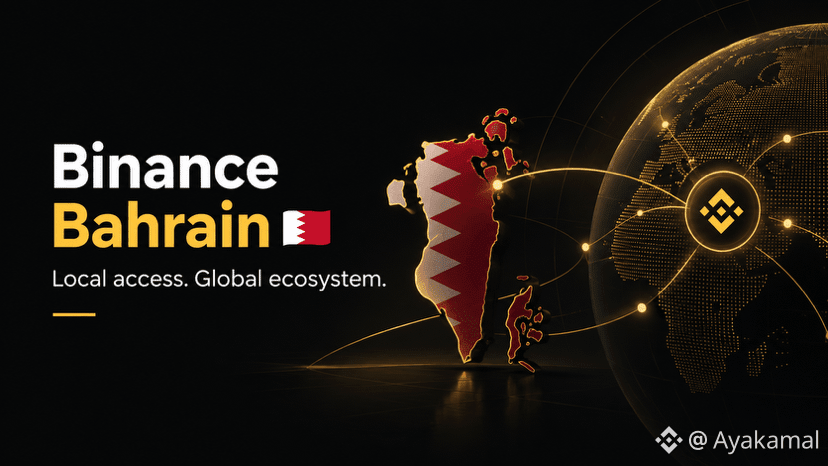
🇧🇭 Binance Bahrain: What makes it different?
Binance Bahrain isn’t just another way to access Binance.
It’s a locally regulated platform in Bahrain, licensed by the Central Bank of Bahrain (CBB), with local funding options for eligible users.
And here’s the part many users may not know 👀
You can be eligible to have both a Binance Bahrain account and a Binance global account — giving you more flexibility in how you access and fund your crypto journey.
🇧🇭 Local regulation
🌍 Global Binance ecosystem
🏦 Local funding options
Would you use Binance Bahrain if you’re eligible? 👀
#BinanceBahrain #Binance
Educational content only. Not financial advice. DYOR. Availability and eligibility vary by user and region. Terms apply.
🇧🇭 Binance Bahrain: What makes it different?
Binance Bahrain isn’t just another way to access Binance.
It’s a locally regulated platform in Bahrain, licensed by the Central Bank of Bahrain (CBB), with local funding options for eligible users.
And here’s the part many users may not know 👀
You can be eligible to have both a Binance Bahrain account and a Binance global account — giving you more flexibility in how you access and fund your crypto journey.
🇧🇭 Local regulation
🌍 Global Binance ecosystem
🏦 Local funding options
Would you use Binance Bahrain if you’re eligible? 👀
#BinanceBahrain #Binance
Educational content only. Not financial advice. DYOR. Availability and eligibility vary by user and region. Terms apply.
Binance Bahrain isn’t just another way to access Binance.
It’s a locally regulated platform in Bahrain, licensed by the Central Bank of Bahrain (CBB), with local funding options for eligible users.
And here’s the part many users may not know 👀
You can be eligible to have both a Binance Bahrain account and a Binance global account — giving you more flexibility in how you access and fund your crypto journey.
🇧🇭 Local regulation
🌍 Global Binance ecosystem
🏦 Local funding options
Would you use Binance Bahrain if you’re eligible? 👀
#BinanceBahrain #Binance
Educational content only. Not financial advice. DYOR. Availability and eligibility vary by user and region. Terms apply.
1
69
·
--
Think you know crypto? 👀
Prove it. 🧠
Binance Trivia is happening today on the Binance Arabic Telegram community.
3 questions.
20 winners.
💰 100 USDC prize pool
Only one thing stands between you and a share of the rewards:
Your crypto knowledge. 👀
Questions will drop at a random time today.
Don’t miss it. 🔥
#BinanceTrivia #Binance #MENA #كريبتو 💛
Think you know crypto? 👀
Prove it. 🧠
Binance Trivia is happening today on the Binance Arabic Telegram community.
3 questions.
20 winners.
💰 100 USDC prize pool
Only one thing stands between you and a share of the rewards:
Your crypto knowledge. 👀
Questions will drop at a random time today.
Don’t miss it. 🔥
#BinanceTrivia #Binance #MENA #كريبتو 💛
Prove it. 🧠
Binance Trivia is happening today on the Binance Arabic Telegram community.
3 questions.
20 winners.
💰 100 USDC prize pool
Only one thing stands between you and a share of the rewards:
Your crypto knowledge. 👀
Questions will drop at a random time today.
Don’t miss it. 🔥
#BinanceTrivia #Binance #MENA #كريبتو 💛

1
63
·
--
Verified
🚨 Strive adds another 1,107 BTC to its Bitcoin treasury
According to the company’s latest disclosure, Strive purchased approximately 1,107 BTC between September 21 and September 25 for around $94.5M.
The reported average purchase price was approximately $85,396 per BTC, bringing Strive’s total holdings to 27,462 BTC.
But the interesting part isn’t just the BTC count 👀
Around 85% of the capital used for the latest purchase came from SATA-related preferred stock financing, while warrant exercises generated approximately $12.4M.
That highlights an important part of the corporate Bitcoin treasury model:
Buying more BTC doesn’t automatically mean each share becomes more valuable.
The way purchases are financed — including equity, preferred securities, or other capital — can affect shareholders and Bitcoin exposure on a per-share basis.
So when you see headlines about a company adding Bitcoin to its treasury, there’s more to look at than the headline BTC number.
BTC held ≠ the whole story. 👀
What do you think matters more when evaluating a corporate Bitcoin treasury:
BTC holdings or BTC per share?
🚨 Strive adds another 1,107 BTC to its Bitcoin treasury
According to the company’s latest disclosure, Strive purchased approximately 1,107 BTC between September 21 and September 25 for around $94.5M.
The reported average purchase price was approximately $85,396 per BTC, bringing Strive’s total holdings to 27,462 BTC.
But the interesting part isn’t just the BTC count 👀
Around 85% of the capital used for the latest purchase came from SATA-related preferred stock financing, while warrant exercises generated approximately $12.4M.
That highlights an important part of the corporate Bitcoin treasury model:
Buying more BTC doesn’t automatically mean each share becomes more valuable.
The way purchases are financed — including equity, preferred securities, or other capital — can affect shareholders and Bitcoin exposure on a per-share basis.
So when you see headlines about a company adding Bitcoin to its treasury, there’s more to look at than the headline BTC number.
BTC held ≠ the whole story. 👀
What do you think matters more when evaluating a corporate Bitcoin treasury:
BTC holdings or BTC per share?
According to the company’s latest disclosure, Strive purchased approximately 1,107 BTC between September 21 and September 25 for around $94.5M.
The reported average purchase price was approximately $85,396 per BTC, bringing Strive’s total holdings to 27,462 BTC.
But the interesting part isn’t just the BTC count 👀
Around 85% of the capital used for the latest purchase came from SATA-related preferred stock financing, while warrant exercises generated approximately $12.4M.
That highlights an important part of the corporate Bitcoin treasury model:
Buying more BTC doesn’t automatically mean each share becomes more valuable.
The way purchases are financed — including equity, preferred securities, or other capital — can affect shareholders and Bitcoin exposure on a per-share basis.
So when you see headlines about a company adding Bitcoin to its treasury, there’s more to look at than the headline BTC number.
BTC held ≠ the whole story. 👀
What do you think matters more when evaluating a corporate Bitcoin treasury:
BTC holdings or BTC per share?
1
64
·
--
Everyone looks at Bitcoin’s price.
But here’s the thing 👀
Price is only one piece of the puzzle.
If you’re trying to understand what’s happening in the market, look beyond the number:
₿ Price — what 1 BTC is trading at
📊 Volume — how much is being traded
💧 Liquidity — how easily assets can be bought or sold without significantly affecting the price
One number rarely tells the whole story.
Which metric do you check first?
$BTC #BTC
{spot}(BTCUSDT)
Everyone looks at Bitcoin’s price.
But here’s the thing 👀
Price is only one piece of the puzzle.
If you’re trying to understand what’s happening in the market, look beyond the number:
₿ Price — what 1 BTC is trading at
📊 Volume — how much is being traded
💧 Liquidity — how easily assets can be bought or sold without significantly affecting the price
One number rarely tells the whole story.
Which metric do you check first?
$BTC #BTC
But here’s the thing 👀
Price is only one piece of the puzzle.
If you’re trying to understand what’s happening in the market, look beyond the number:
₿ Price — what 1 BTC is trading at
📊 Volume — how much is being traded
💧 Liquidity — how easily assets can be bought or sold without significantly affecting the price
One number rarely tells the whole story.
Which metric do you check first?
$BTC #BTC
1
49
·
--
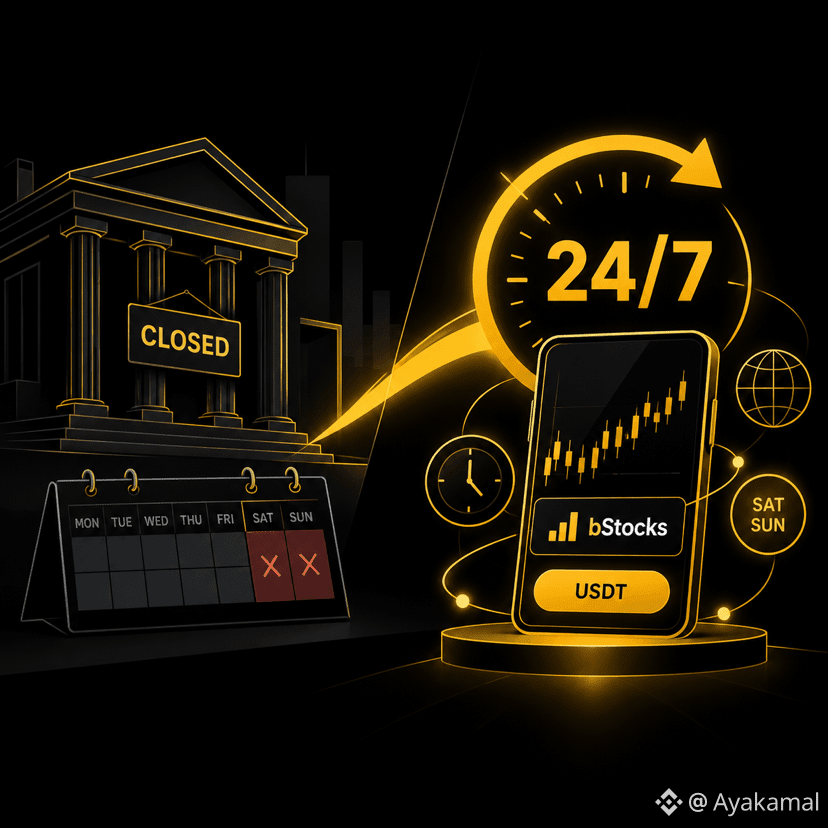
السوق قفل… بس الأخبار ما بتقفش. 👀
وهنا واحدة من أكتر الحاجات الملفتة في bStocks:
التداول متاح 24/7 — حتى في الويك إند.
في الأسواق التقليدية، بعد انتهاء جلسة الجمعة، عليك الانتظار حتى تفتح الجلسة التالية.
لكن مع bStocks، تقدر تتداول 24/7
ويمكن الشراء باستخدام USDT، وفقًا للتوفر وأهلية المستخدم.
والأجمل؟
المعاملات تتم على البلوك تشين، مع تسوية عادةً في أقل من ثانية.
يعني بدل ما تكون البنية التحتية مرتبطة بساعات السوق التقليدية، عندك بنية تحتية تعمل 24/7.
لكن خليك واخد بالك من نقطة مهمة 👇
التداول 24/7 لا يعني أن السعر يتبع السوق التقليدي 24/7.
خارج ساعات التداول الأمريكية، يمكن أن يتحرك سعر bStocks حسب العرض والطلب على Binance، وقد يختلف عن آخر سعر إغلاق للأصل الأساسي.
وده بالضبط أحد الأشياء المثيرة للاهتمام في ترميز الأصول:
السوق ممكن يقفل…
لكن البلوك تشين لا يتوقف. 🟡
هل تعتقد أن التداول 24/7 هيبقى طبيعي في الأسواق مستقبلًا؟
⚠️ محتوى تعليمي فقط وليس نصيحة مالية.
bStocks أوراق مالية مُرمّزة وليست أسهمًا أو حصصًا، ولا تمثل ملكية مباشرة في الشركة الأساسية
التوفر يختلف حسب الدولة وأهلية المستخدم.
#Binance #BStocks #TokenizedStocks #RWA
السوق قفل… بس الأخبار ما بتقفش. 👀
وهنا واحدة من أكتر الحاجات الملفتة في bStocks:
التداول متاح 24/7 — حتى في الويك إند.
في الأسواق التقليدية، بعد انتهاء جلسة الجمعة، عليك الانتظار حتى تفتح الجلسة التالية.
لكن مع bStocks، تقدر تتداول 24/7
ويمكن الشراء باستخدام USDT، وفقًا للتوفر وأهلية المستخدم.
والأجمل؟
المعاملات تتم على البلوك تشين، مع تسوية عادةً في أقل من ثانية.
يعني بدل ما تكون البنية التحتية مرتبطة بساعات السوق التقليدية، عندك بنية تحتية تعمل 24/7.
لكن خليك واخد بالك من نقطة مهمة 👇
التداول 24/7 لا يعني أن السعر يتبع السوق التقليدي 24/7.
خارج ساعات التداول الأمريكية، يمكن أن يتحرك سعر bStocks حسب العرض والطلب على Binance، وقد يختلف عن آخر سعر إغلاق للأصل الأساسي.
وده بالضبط أحد الأشياء المثيرة للاهتمام في ترميز الأصول:
السوق ممكن يقفل…
لكن البلوك تشين لا يتوقف. 🟡
هل تعتقد أن التداول 24/7 هيبقى طبيعي في الأسواق مستقبلًا؟
⚠️ محتوى تعليمي فقط وليس نصيحة مالية.
bStocks أوراق مالية مُرمّزة وليست أسهمًا أو حصصًا، ولا تمثل ملكية مباشرة في الشركة الأساسية
التوفر يختلف حسب الدولة وأهلية المستخدم.
#Binance #BStocks #TokenizedStocks #RWA
وهنا واحدة من أكتر الحاجات الملفتة في bStocks:
التداول متاح 24/7 — حتى في الويك إند.
في الأسواق التقليدية، بعد انتهاء جلسة الجمعة، عليك الانتظار حتى تفتح الجلسة التالية.
لكن مع bStocks، تقدر تتداول 24/7
ويمكن الشراء باستخدام USDT، وفقًا للتوفر وأهلية المستخدم.
والأجمل؟
المعاملات تتم على البلوك تشين، مع تسوية عادةً في أقل من ثانية.
يعني بدل ما تكون البنية التحتية مرتبطة بساعات السوق التقليدية، عندك بنية تحتية تعمل 24/7.
لكن خليك واخد بالك من نقطة مهمة 👇
التداول 24/7 لا يعني أن السعر يتبع السوق التقليدي 24/7.
خارج ساعات التداول الأمريكية، يمكن أن يتحرك سعر bStocks حسب العرض والطلب على Binance، وقد يختلف عن آخر سعر إغلاق للأصل الأساسي.
وده بالضبط أحد الأشياء المثيرة للاهتمام في ترميز الأصول:
السوق ممكن يقفل…
لكن البلوك تشين لا يتوقف. 🟡
هل تعتقد أن التداول 24/7 هيبقى طبيعي في الأسواق مستقبلًا؟
⚠️ محتوى تعليمي فقط وليس نصيحة مالية.
bStocks أوراق مالية مُرمّزة وليست أسهمًا أو حصصًا، ولا تمثل ملكية مباشرة في الشركة الأساسية
التوفر يختلف حسب الدولة وأهلية المستخدم.
#Binance #BStocks #TokenizedStocks #RWA
3
65
·
--
Article
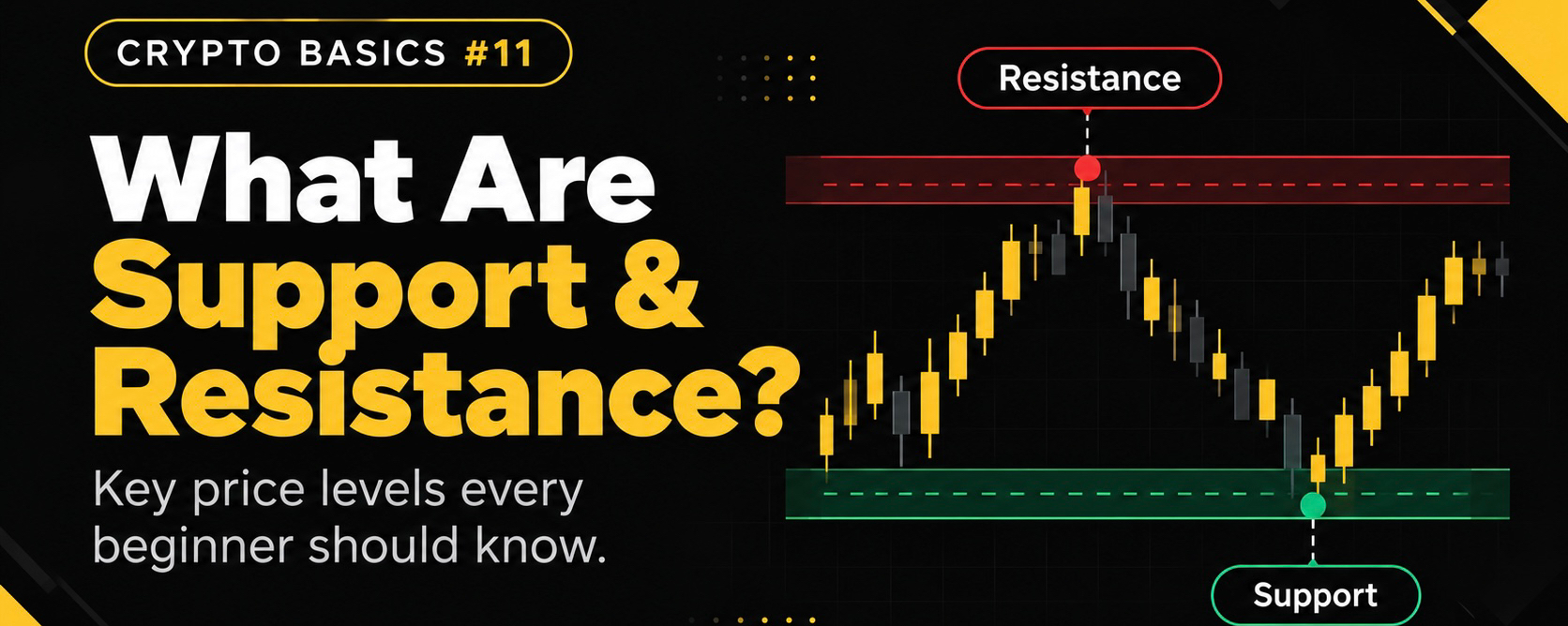
CRYPTO BASICS #11 — Support & Resistance ExplainedWhen you look at a crypto chart, you’ll often hear traders talk about Support and Resistance.
But what do these terms actually mean?
🟢 What is Support?
Support is a price area where buying interest may increase, making it harder for the price to move lower.
Think of it as a potential floor.
🔴 What is Resistance?
Resistance is a price area where selling pressure may increase, making it harder for the price to move higher.
Think of it as a potential ceiling.
📍 They are zones, not exact prices
One important thing to understand:
Support and resistance aren’t always a single price point.
They’re better viewed as zones where price has previously shown stronger buying or selling activity.
That’s why price can move slightly above or below a level without automatically invalidating it.
🔄 When levels switch roles
A support zone can later become resistance.
For example:
Support → Price breaks below → Retest → Resistance
The opposite can happen too:
Resistance → Price breaks above → Retest → Support
This is often called a support-resistance flip.
The simple takeaway
Support = potential floor
Resistance = potential ceiling
They can help you understand how price has behaved around certain areas, but they don’t guarantee that price will hold or reverse.
📚 Want to go deeper? Learn more through Binance Academy.
Educational content only, not financial advice. DYOR and use official Binance sources.
#Binance #BinanceAcademy #CryptoBasics #cryptoeducation
CRYPTO BASICS #11 — Support & Resistance Explained
When you look at a crypto chart, you’ll often hear traders talk about Support and Resistance.
But what do these terms actually mean?
🟢 What is Support?
Support is a price area where buying interest may increase, making it harder for the price to move lower.
Think of it as a potential floor.
🔴 What is Resistance?
Resistance is a price area where selling pressure may increase, making it harder for the price to move higher.
Think of it as a potential ceiling.
📍 They are zones, not exact prices
One important thing to understand:
Support and resistance aren’t always a single price point.
They’re better viewed as zones where price has previously shown stronger buying or selling activity.
That’s why price can move slightly above or below a level without automatically invalidating it.
🔄 When levels switch roles
A support zone can later become resistance.
For example:
Support → Price breaks below → Retest → Resistance
The opposite can happen too:
Resistance → Price breaks above → Retest → Support
This is often called a support-resistance flip.
The simple takeaway
Support = potential floor
Resistance = potential ceiling
They can help you understand how price has behaved around certain areas, but they don’t guarantee that price will hold or reverse.
📚 Want to go deeper? Learn more through Binance Academy.
Educational content only, not financial advice. DYOR and use official Binance sources.
#Binance #BinanceAcademy #CryptoBasics #cryptoeducation
But what do these terms actually mean?
🟢 What is Support?
Support is a price area where buying interest may increase, making it harder for the price to move lower.
Think of it as a potential floor.
🔴 What is Resistance?
Resistance is a price area where selling pressure may increase, making it harder for the price to move higher.
Think of it as a potential ceiling.
📍 They are zones, not exact prices
One important thing to understand:
Support and resistance aren’t always a single price point.
They’re better viewed as zones where price has previously shown stronger buying or selling activity.
That’s why price can move slightly above or below a level without automatically invalidating it.
🔄 When levels switch roles
A support zone can later become resistance.
For example:
Support → Price breaks below → Retest → Resistance
The opposite can happen too:
Resistance → Price breaks above → Retest → Support
This is often called a support-resistance flip.
The simple takeaway
Support = potential floor
Resistance = potential ceiling
They can help you understand how price has behaved around certain areas, but they don’t guarantee that price will hold or reverse.
📚 Want to go deeper? Learn more through Binance Academy.
Educational content only, not financial advice. DYOR and use official Binance sources.
#Binance #BinanceAcademy #CryptoBasics #cryptoeducation
2
87
·
--
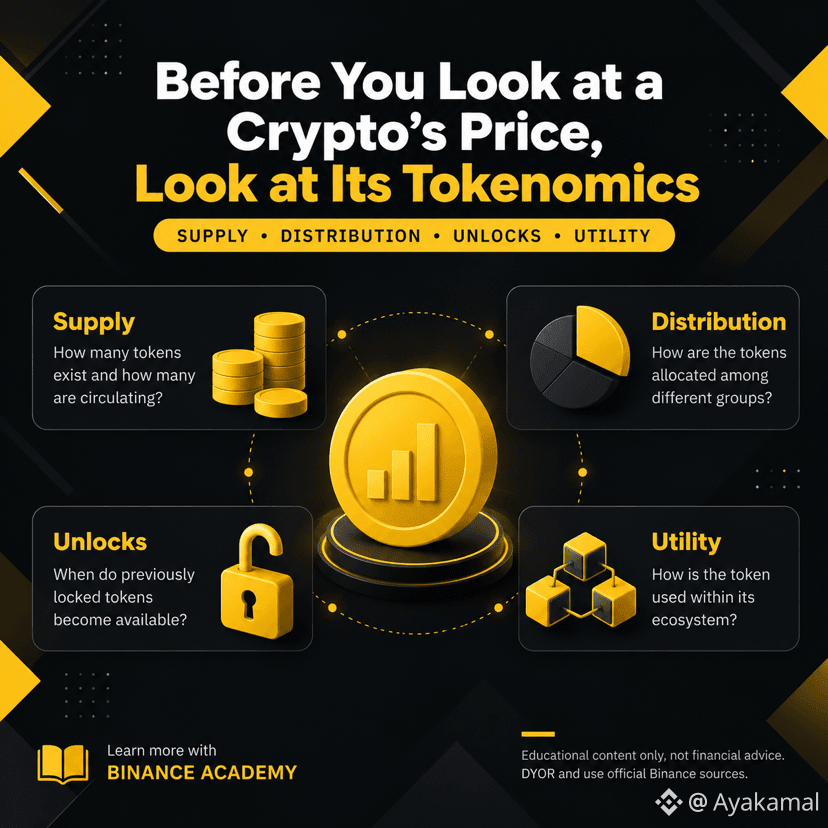
Before You Look at a Crypto’s Price, Look at Its Tokenomics
A crypto’s price is only one piece of the picture.
Two tokens can have very different prices — but that doesn’t tell you how many tokens exist, who holds them, or how the supply may change over time.
That’s where Tokenomics comes in.
🪙 What is Tokenomics?
Tokenomics refers to the economic design of a cryptocurrency or token.
It can include:
* Supply — how many tokens exist and how many are currently circulating
* Distribution — how tokens are allocated among different groups
* Unlocks — when previously locked tokens become available
* Utility — how the token is used within its ecosystem
📊 Why does supply matter?
Not all tokens are necessarily circulating from day one.
Some may be locked or scheduled to be released later, so looking at the circulating supply alone may not give you the complete picture of a token’s supply structure.
👥 Who owns the tokens?
Token allocation can include the project team, investors, community, treasury, and other groups.
Understanding the distribution can help you see how the token is structured.
🔓 What are Token Unlocks?
Some tokens are released gradually according to a predetermined schedule.
Knowing when and how many tokens may become available can help you understand how the token’s supply could change over time.
The simple takeaway:
Supply → Distribution → Unlocks → Utility
Before focusing only on a token’s price, understand what’s behind it.
📚 Learn more with Binance Academy.
Educational content only, not financial advice. DYOR and use official Binance sources.
#Binance #CryptoEducation
Before You Look at a Crypto’s Price, Look at Its Tokenomics
A crypto’s price is only one piece of the picture.
Two tokens can have very different prices — but that doesn’t tell you how many tokens exist, who holds them, or how the supply may change over time.
That’s where Tokenomics comes in.
🪙 What is Tokenomics?
Tokenomics refers to the economic design of a cryptocurrency or token.
It can include:
* Supply — how many tokens exist and how many are currently circulating
* Distribution — how tokens are allocated among different groups
* Unlocks — when previously locked tokens become available
* Utility — how the token is used within its ecosystem
📊 Why does supply matter?
Not all tokens are necessarily circulating from day one.
Some may be locked or scheduled to be released later, so looking at the circulating supply alone may not give you the complete picture of a token’s supply structure.
👥 Who owns the tokens?
Token allocation can include the project team, investors, community, treasury, and other groups.
Understanding the distribution can help you see how the token is structured.
🔓 What are Token Unlocks?
Some tokens are released gradually according to a predetermined schedule.
Knowing when and how many tokens may become available can help you understand how the token’s supply could change over time.
The simple takeaway:
Supply → Distribution → Unlocks → Utility
Before focusing only on a token’s price, understand what’s behind it.
📚 Learn more with Binance Academy.
Educational content only, not financial advice. DYOR and use official Binance sources.
#Binance #CryptoEducation
A crypto’s price is only one piece of the picture.
Two tokens can have very different prices — but that doesn’t tell you how many tokens exist, who holds them, or how the supply may change over time.
That’s where Tokenomics comes in.
🪙 What is Tokenomics?
Tokenomics refers to the economic design of a cryptocurrency or token.
It can include:
* Supply — how many tokens exist and how many are currently circulating
* Distribution — how tokens are allocated among different groups
* Unlocks — when previously locked tokens become available
* Utility — how the token is used within its ecosystem
📊 Why does supply matter?
Not all tokens are necessarily circulating from day one.
Some may be locked or scheduled to be released later, so looking at the circulating supply alone may not give you the complete picture of a token’s supply structure.
👥 Who owns the tokens?
Token allocation can include the project team, investors, community, treasury, and other groups.
Understanding the distribution can help you see how the token is structured.
🔓 What are Token Unlocks?
Some tokens are released gradually according to a predetermined schedule.
Knowing when and how many tokens may become available can help you understand how the token’s supply could change over time.
The simple takeaway:
Supply → Distribution → Unlocks → Utility
Before focusing only on a token’s price, understand what’s behind it.
📚 Learn more with Binance Academy.
Educational content only, not financial advice. DYOR and use official Binance sources.
#Binance #CryptoEducation
3
79
·
--
Can traditional markets meet the crypto world? 👀
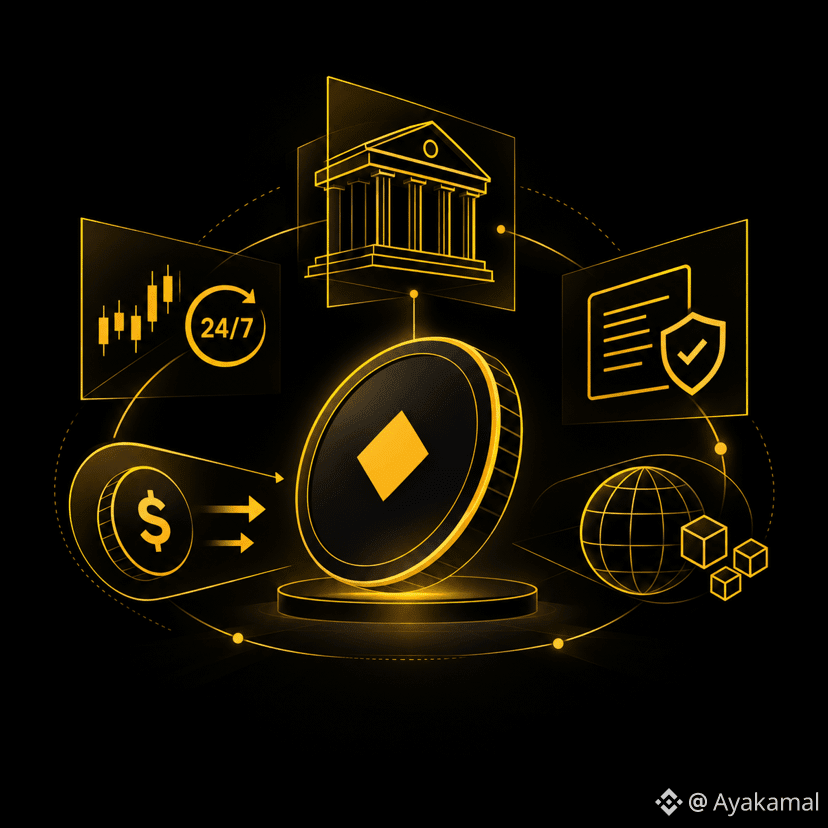
That’s one of the ideas behind bStocks.
bStocks are tokenized securities on Binance that provide economic exposure to traditional assets through blockchain infrastructure.
Here’s how it works;
🔹 Buy or tokenize
You can buy bStocks on Spot using USDT, or tokenize eligible Direct Stocks 1:1.
🔹 1:1 backed
Each bStock is backed 1:1 by a real share held in custody.
Proof of Collateral is available to help provide transparency around the assets backing the tokenized securities.
🔹 Hold & use
You can hold bStocks on Binance, use self-custody on BNBChain, or use them within DeFi, subject to availability and eligibility.
🔹 Convert back
bStocks can be converted back according to the product structure.
There are no conversion, custody, or management fees for tokenizing or converting back, while standard Spot trading fees may apply.
🔹 24/7 access
Traditional markets operate within set trading hours.
bStocks can be traded 24/7, including weekends, with instant settlement.
🔹 Dividends
Dividends are automatically reinvested on the ex-date, according to the product structure.
⚠️ One important distinction
bStocks are not stocks or shares and do not represent direct ownership of the underlying company.
They provide economic exposure through a tokenized securities structure.
Always check whether the product and its features are available in your jurisdiction.
Crypto involves risk. Not financial advice.
Dyor.
#Binance #BStocks #RWA #BNBChain 💛
Can traditional markets meet the crypto world? 👀
That’s one of the ideas behind bStocks.
bStocks are tokenized securities on Binance that provide economic exposure to traditional assets through blockchain infrastructure.
Here’s how it works;
🔹 Buy or tokenize
You can buy bStocks on Spot using USDT, or tokenize eligible Direct Stocks 1:1.
🔹 1:1 backed
Each bStock is backed 1:1 by a real share held in custody.
Proof of Collateral is available to help provide transparency around the assets backing the tokenized securities.
🔹 Hold & use
You can hold bStocks on Binance, use self-custody on BNBChain, or use them within DeFi, subject to availability and eligibility.
🔹 Convert back
bStocks can be converted back according to the product structure.
There are no conversion, custody, or management fees for tokenizing or converting back, while standard Spot trading fees may apply.
🔹 24/7 access
Traditional markets operate within set trading hours.
bStocks can be traded 24/7, including weekends, with instant settlement.
🔹 Dividends
Dividends are automatically reinvested on the ex-date, according to the product structure.
⚠️ One important distinction
bStocks are not stocks or shares and do not represent direct ownership of the underlying company.
They provide economic exposure through a tokenized securities structure.
Always check whether the product and its features are available in your jurisdiction.
Crypto involves risk. Not financial advice.
Dyor.
#Binance #BStocks #RWA #BNBChain 💛
That’s one of the ideas behind bStocks.
bStocks are tokenized securities on Binance that provide economic exposure to traditional assets through blockchain infrastructure.
Here’s how it works;
🔹 Buy or tokenize
You can buy bStocks on Spot using USDT, or tokenize eligible Direct Stocks 1:1.
🔹 1:1 backed
Each bStock is backed 1:1 by a real share held in custody.
Proof of Collateral is available to help provide transparency around the assets backing the tokenized securities.
🔹 Hold & use
You can hold bStocks on Binance, use self-custody on BNBChain, or use them within DeFi, subject to availability and eligibility.
🔹 Convert back
bStocks can be converted back according to the product structure.
There are no conversion, custody, or management fees for tokenizing or converting back, while standard Spot trading fees may apply.
🔹 24/7 access
Traditional markets operate within set trading hours.
bStocks can be traded 24/7, including weekends, with instant settlement.
🔹 Dividends
Dividends are automatically reinvested on the ex-date, according to the product structure.
⚠️ One important distinction
bStocks are not stocks or shares and do not represent direct ownership of the underlying company.
They provide economic exposure through a tokenized securities structure.
Always check whether the product and its features are available in your jurisdiction.
Crypto involves risk. Not financial advice.
Dyor.
#Binance #BStocks #RWA #BNBChain 💛
4
81
·
--

Article
From Holding Stocks to Using Them: How Tokenized Equities Are Rewriting On-Chain Finance📈 Tokenized stocks are no longer just about putting traditional assets on a blockchain.
The more interesting shift is what happens after they get on-chain.
According to Binance Research, tokenized stocks crossed US$3B in market capitalization in September 2026, making them the fastest-growing RWA category this year.
But the real story goes beyond market cap.
🚀 From holding to activity
On-chain tokenized-stock transfers, including trading volume, surpassed US$100B in Q3 2026, compared with just US$6B in Q1.
That’s more than 16× growth in quarterly transfer volume.
At the same time, the 60-day DeFi TVL ratio for tokenized stocks increased from 1.8% to 6.3% during 2026.
This means tokenized stocks are increasingly moving beyond simple holding.
They can be transferred, traded and, where supported, used across DeFi applications such as lending markets and liquidity pools.
🟡 BNB Chain is becoming a major hub
This shift is also visible on BNB Chain.
As of mid-September, BNB Chain held around US$1B in tokenized stocks, representing approximately 34% of the market.
But holder count tells another part of the story.
BNB Chain had around 1.8M tokenized-stock holders, representing 45% of the sector.
That makes holder count an important metric alongside market capitalization, because it gives a clearer view of how widely these assets are being distributed.
⚡ bStocks is driving part of the growth
The momentum accelerated after bStocks launched in June.
In less than four months, bStocks reached around US$0.8B, roughly a quarter of the tokenized-stock sector.
It also became the most transferred tokenized-stock product on-chain.
That combination is important: the growth isn’t only showing up in market capitalization, but also in actual on-chain transfer activity.
🌐 The bigger shift
There’s another signal that shows how tokenized stocks are entering the broader on-chain economy.
Their DEX ratio stayed near 0% through 2025 and most of the first half of 2026.
By September, it had climbed to an average of 11%, getting closer to memecoins at 17%.
The infrastructure that was built around crypto-native assets is increasingly carrying traditional financial assets too.
Stocks, stablecoins, RWAs and crypto assets can now operate across shared, always-on rails.
🔥 From holding to using
That’s what makes the current tokenization trend interesting.
The story isn’t simply that more stocks are becoming tokenized.
It’s that these assets are becoming part of an on-chain financial environment where they can move, trade and interact with other financial applications.
The on-chain economy is evolving from a crypto-native ecosystem into a broader financial network.
And BNB Chain and bStocks are playing a visible role in that shift.
📖 Source: Binance Research — Rewriting the On-Chain Economy
[Read the full report](https://www.binance.com/en/research/analysis/rewriting-the-on-chain-economy)
@Binance_Angels
From Holding Stocks to Using Them: How Tokenized Equities Are Rewriting On-Chain Finance
📈 Tokenized stocks are no longer just about putting traditional assets on a blockchain.
The more interesting shift is what happens after they get on-chain.
According to Binance Research, tokenized stocks crossed US$3B in market capitalization in September 2026, making them the fastest-growing RWA category this year.
But the real story goes beyond market cap.
🚀 From holding to activity
On-chain tokenized-stock transfers, including trading volume, surpassed US$100B in Q3 2026, compared with just US$6B in Q1.
That’s more than 16× growth in quarterly transfer volume.
At the same time, the 60-day DeFi TVL ratio for tokenized stocks increased from 1.8% to 6.3% during 2026.
This means tokenized stocks are increasingly moving beyond simple holding.
They can be transferred, traded and, where supported, used across DeFi applications such as lending markets and liquidity pools.
🟡 BNB Chain is becoming a major hub
This shift is also visible on BNB Chain.
As of mid-September, BNB Chain held around US$1B in tokenized stocks, representing approximately 34% of the market.
But holder count tells another part of the story.
BNB Chain had around 1.8M tokenized-stock holders, representing 45% of the sector.
That makes holder count an important metric alongside market capitalization, because it gives a clearer view of how widely these assets are being distributed.
⚡ bStocks is driving part of the growth
The momentum accelerated after bStocks launched in June.
In less than four months, bStocks reached around US$0.8B, roughly a quarter of the tokenized-stock sector.
It also became the most transferred tokenized-stock product on-chain.
That combination is important: the growth isn’t only showing up in market capitalization, but also in actual on-chain transfer activity.
🌐 The bigger shift
There’s another signal that shows how tokenized stocks are entering the broader on-chain economy.
Their DEX ratio stayed near 0% through 2025 and most of the first half of 2026.
By September, it had climbed to an average of 11%, getting closer to memecoins at 17%.
The infrastructure that was built around crypto-native assets is increasingly carrying traditional financial assets too.
Stocks, stablecoins, RWAs and crypto assets can now operate across shared, always-on rails.
🔥 From holding to using
That’s what makes the current tokenization trend interesting.
The story isn’t simply that more stocks are becoming tokenized.
It’s that these assets are becoming part of an on-chain financial environment where they can move, trade and interact with other financial applications.
The on-chain economy is evolving from a crypto-native ecosystem into a broader financial network.
And BNB Chain and bStocks are playing a visible role in that shift.
📖 Source: Binance Research — Rewriting the On-Chain Economy
Read the full report
@Binance Angels
The more interesting shift is what happens after they get on-chain.
According to Binance Research, tokenized stocks crossed US$3B in market capitalization in September 2026, making them the fastest-growing RWA category this year.
But the real story goes beyond market cap.
🚀 From holding to activity
On-chain tokenized-stock transfers, including trading volume, surpassed US$100B in Q3 2026, compared with just US$6B in Q1.
That’s more than 16× growth in quarterly transfer volume.
At the same time, the 60-day DeFi TVL ratio for tokenized stocks increased from 1.8% to 6.3% during 2026.
This means tokenized stocks are increasingly moving beyond simple holding.
They can be transferred, traded and, where supported, used across DeFi applications such as lending markets and liquidity pools.
🟡 BNB Chain is becoming a major hub
This shift is also visible on BNB Chain.
As of mid-September, BNB Chain held around US$1B in tokenized stocks, representing approximately 34% of the market.
But holder count tells another part of the story.
BNB Chain had around 1.8M tokenized-stock holders, representing 45% of the sector.
That makes holder count an important metric alongside market capitalization, because it gives a clearer view of how widely these assets are being distributed.
⚡ bStocks is driving part of the growth
The momentum accelerated after bStocks launched in June.
In less than four months, bStocks reached around US$0.8B, roughly a quarter of the tokenized-stock sector.
It also became the most transferred tokenized-stock product on-chain.
That combination is important: the growth isn’t only showing up in market capitalization, but also in actual on-chain transfer activity.
🌐 The bigger shift
There’s another signal that shows how tokenized stocks are entering the broader on-chain economy.
Their DEX ratio stayed near 0% through 2025 and most of the first half of 2026.
By September, it had climbed to an average of 11%, getting closer to memecoins at 17%.
The infrastructure that was built around crypto-native assets is increasingly carrying traditional financial assets too.
Stocks, stablecoins, RWAs and crypto assets can now operate across shared, always-on rails.
🔥 From holding to using
That’s what makes the current tokenization trend interesting.
The story isn’t simply that more stocks are becoming tokenized.
It’s that these assets are becoming part of an on-chain financial environment where they can move, trade and interact with other financial applications.
The on-chain economy is evolving from a crypto-native ecosystem into a broader financial network.
And BNB Chain and bStocks are playing a visible role in that shift.
📖 Source: Binance Research — Rewriting the On-Chain Economy
Read the full report
@Binance Angels
4
98
·
--
$188M flowed into Solana ETFs this week.
That makes it the second-highest weekly inflow since launch, according to SoSoValue data reported by Binance News.
But here’s what caught my attention:
$86.7M came in on September 25 alone.
So what does this actually tell us?
ETF inflows show that investors are putting money into these investment products.
But they don’t automatically mean SOL’s price has to go up.
Price can still be affected by liquidity, market sentiment, macro conditions, and activity across the broader crypto market.
So instead of asking:
“Is SOL going up?”
I’m more interested in:
“Is demand for crypto exposure expanding beyond BTC and ETH?”
Because that’s a much bigger trend to watch. 👀
What are you watching more closely right now:
SOL ETF flows or SOL on-chain activity?
#sol #solana #crypto #Binance
Educational content only. Not financial advice. DYOR. Crypto assets are volatile and involve risk.
$188M flowed into Solana ETFs this week.
That makes it the second-highest weekly inflow since launch, according to SoSoValue data reported by Binance News.
But here’s what caught my attention:
$86.7M came in on September 25 alone.
So what does this actually tell us?
ETF inflows show that investors are putting money into these investment products.
But they don’t automatically mean SOL’s price has to go up.
Price can still be affected by liquidity, market sentiment, macro conditions, and activity across the broader crypto market.
So instead of asking:
“Is SOL going up?”
I’m more interested in:
“Is demand for crypto exposure expanding beyond BTC and ETH?”
Because that’s a much bigger trend to watch. 👀
What are you watching more closely right now:
SOL ETF flows or SOL on-chain activity?
#sol #solana #crypto #Binance
Educational content only. Not financial advice. DYOR. Crypto assets are volatile and involve risk.
That makes it the second-highest weekly inflow since launch, according to SoSoValue data reported by Binance News.
But here’s what caught my attention:
$86.7M came in on September 25 alone.
So what does this actually tell us?
ETF inflows show that investors are putting money into these investment products.
But they don’t automatically mean SOL’s price has to go up.
Price can still be affected by liquidity, market sentiment, macro conditions, and activity across the broader crypto market.
So instead of asking:
“Is SOL going up?”
I’m more interested in:
“Is demand for crypto exposure expanding beyond BTC and ETH?”
Because that’s a much bigger trend to watch. 👀
What are you watching more closely right now:
SOL ETF flows or SOL on-chain activity?
#sol #solana #crypto #Binance
Educational content only. Not financial advice. DYOR. Crypto assets are volatile and involve risk.
3
90
·
--
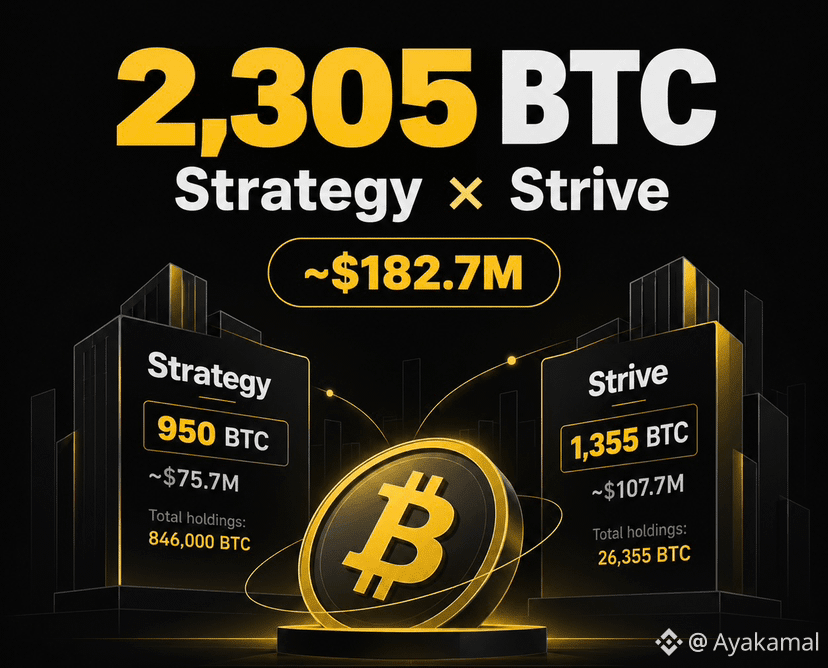
2,305 BTC.
But the number isn’t the whole story. 👀
Strategy and Strive recently disclosed a combined 2,305 BTC purchase, worth about $182.7M.
Here’s the breakdown:
🟡 Strategy: +950 BTC
→ Total holdings: 846,000 BTC
🟡 Strive: +1,355 BTC
→ Total holdings: 26,355 BTC
Both purchases were made between September 14–20, with average purchase prices around $79.5K–$79.7K per BTC.
But here’s what I find more interesting:
Corporate Bitcoin buying isn’t happening evenly across the market.
Some companies are continuing to add BTC to their treasuries, while other corporate holders have reduced holdings or changed how they manage their balance sheets.
So the real question isn’t:
“Is 2,305 BTC bullish?”
It’s:
“Why are these companies still adding Bitcoin to their balance sheets?”
And that’s a much more interesting trend to watch.
What do you think is driving corporate BTC accumulation right now? 👀
#bitcoin #crypto #Binance #BinanceSquare #BitcoinTreasury
Educational content only. Not financial advice. DYOR. Crypto assets are volatile and involve risk.
2,305 BTC.
But the number isn’t the whole story. 👀
Strategy and Strive recently disclosed a combined 2,305 BTC purchase, worth about $182.7M.
Here’s the breakdown:
🟡 Strategy: +950 BTC
→ Total holdings: 846,000 BTC
🟡 Strive: +1,355 BTC
→ Total holdings: 26,355 BTC
Both purchases were made between September 14–20, with average purchase prices around $79.5K–$79.7K per BTC.
But here’s what I find more interesting:
Corporate Bitcoin buying isn’t happening evenly across the market.
Some companies are continuing to add BTC to their treasuries, while other corporate holders have reduced holdings or changed how they manage their balance sheets.
So the real question isn’t:
“Is 2,305 BTC bullish?”
It’s:
“Why are these companies still adding Bitcoin to their balance sheets?”
And that’s a much more interesting trend to watch.
What do you think is driving corporate BTC accumulation right now? 👀
#bitcoin #crypto #Binance #BinanceSquare #BitcoinTreasury
Educational content only. Not financial advice. DYOR. Crypto assets are volatile and involve risk.
But the number isn’t the whole story. 👀
Strategy and Strive recently disclosed a combined 2,305 BTC purchase, worth about $182.7M.
Here’s the breakdown:
🟡 Strategy: +950 BTC
→ Total holdings: 846,000 BTC
🟡 Strive: +1,355 BTC
→ Total holdings: 26,355 BTC
Both purchases were made between September 14–20, with average purchase prices around $79.5K–$79.7K per BTC.
But here’s what I find more interesting:
Corporate Bitcoin buying isn’t happening evenly across the market.
Some companies are continuing to add BTC to their treasuries, while other corporate holders have reduced holdings or changed how they manage their balance sheets.
So the real question isn’t:
“Is 2,305 BTC bullish?”
It’s:
“Why are these companies still adding Bitcoin to their balance sheets?”
And that’s a much more interesting trend to watch.
What do you think is driving corporate BTC accumulation right now? 👀
#bitcoin #crypto #Binance #BinanceSquare #BitcoinTreasury
Educational content only. Not financial advice. DYOR. Crypto assets are volatile and involve risk.
3
111
·
--
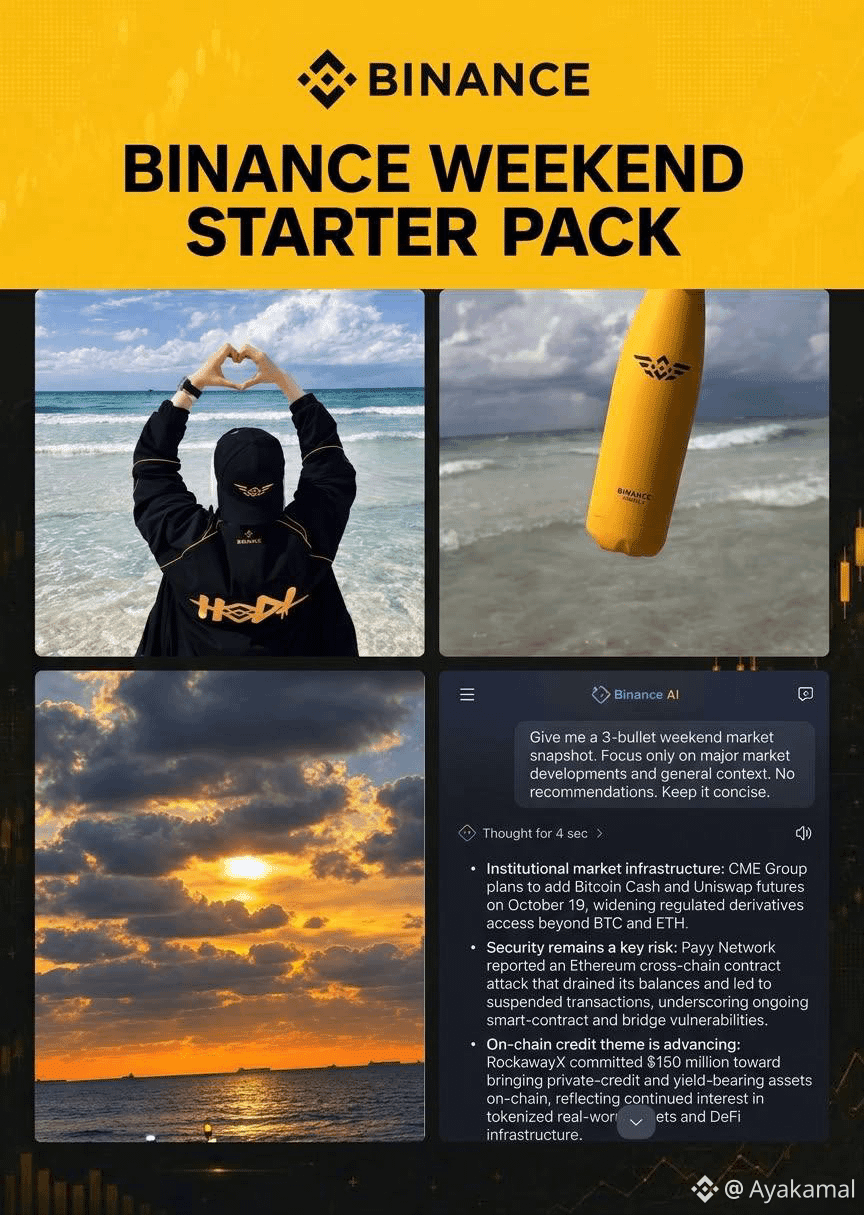
🌊💛 My Binance Weekend Starter Pack
Beach. Hydration. Sunset. And one quick market check. 👀
My weekend go-to is Binance AI.
I use it for a quick market snapshot — what happened, what matters, and what’s worth keeping an eye on — without spending my whole weekend scrolling through updates.
Quick check. Then back to the weekend. 🌅
What’s in your weekend starter pack?
#BinanceWeekend #Binance
🌊💛 My Binance Weekend Starter Pack
Beach. Hydration. Sunset. And one quick market check. 👀
My weekend go-to is Binance AI.
I use it for a quick market snapshot — what happened, what matters, and what’s worth keeping an eye on — without spending my whole weekend scrolling through updates.
Quick check. Then back to the weekend. 🌅
What’s in your weekend starter pack?
#BinanceWeekend #Binance
Beach. Hydration. Sunset. And one quick market check. 👀
My weekend go-to is Binance AI.
I use it for a quick market snapshot — what happened, what matters, and what’s worth keeping an eye on — without spending my whole weekend scrolling through updates.
Quick check. Then back to the weekend. 🌅
What’s in your weekend starter pack?
#BinanceWeekend #Binance
3
64
·
--
BTC is around $84K. But the interesting part isn’t just the price. 👀
Bitcoin has been moving in a relatively tight range lately, while traders are also watching institutional flows and market liquidity.
So what are ETF flows actually telling us?
ETF inflows can indicate that money is entering spot Bitcoin ETFs.
ETF outflows mean investors are withdrawing from those products.
But here’s the important part:
ETF flows ≠ guaranteed price direction.
Price can still move because of macro data, liquidity, derivatives positioning, market sentiment, and other factors.
That’s why looking at one metric alone can be misleading.
When BTC is moving sideways, I personally find it more useful to watch price + volume + ETF flows + major macro events together instead of chasing every candle. 📊
What are you watching right now: BTC price or ETF flows?
#bitcoin #BTC #BinanceSquare #MarketUpdate
Educational content only. Not financial advice. DYOR.
BTC is around $84K. But the interesting part isn’t just the price. 👀
Bitcoin has been moving in a relatively tight range lately, while traders are also watching institutional flows and market liquidity.
So what are ETF flows actually telling us?
ETF inflows can indicate that money is entering spot Bitcoin ETFs.
ETF outflows mean investors are withdrawing from those products.
But here’s the important part:
ETF flows ≠ guaranteed price direction.
Price can still move because of macro data, liquidity, derivatives positioning, market sentiment, and other factors.
That’s why looking at one metric alone can be misleading.
When BTC is moving sideways, I personally find it more useful to watch price + volume + ETF flows + major macro events together instead of chasing every candle. 📊
What are you watching right now: BTC price or ETF flows?
#bitcoin #BTC #BinanceSquare #MarketUpdate
Educational content only. Not financial advice. DYOR.
Bitcoin has been moving in a relatively tight range lately, while traders are also watching institutional flows and market liquidity.
So what are ETF flows actually telling us?
ETF inflows can indicate that money is entering spot Bitcoin ETFs.
ETF outflows mean investors are withdrawing from those products.
But here’s the important part:
ETF flows ≠ guaranteed price direction.
Price can still move because of macro data, liquidity, derivatives positioning, market sentiment, and other factors.
That’s why looking at one metric alone can be misleading.
When BTC is moving sideways, I personally find it more useful to watch price + volume + ETF flows + major macro events together instead of chasing every candle. 📊
What are you watching right now: BTC price or ETF flows?
#bitcoin #BTC #BinanceSquare #MarketUpdate
Educational content only. Not financial advice. DYOR.
3
104
·
--
Your Binance Funding Account is changing 👀
Starting September 29, Binance will begin gradually moving crypto assets from Funding Accounts to Spot Accounts.
So what happens to the Funding Account?
It will eventually become the Stocks Account, designed specifically for settlement of stock and stock options trading.
The transition is expected to run through January 2027, with specific migration dates announced separately.
What you need to know:
• Crypto in Funding → Spot
• Funding Account → Stocks Account
• Stocks Account will support stock & stock options settlement
• Supported settlement assets include USD, USDC, USDT, USD1, U, and BNB
• Your total asset value and fund safety are not affected by the migration.
So if you use Binance for both crypto and stocks, this is an update worth knowing before September 29.
Have you already checked your Binance account structure? 👀
#crypto #stocks #StockOptions #TradFi #BinanceSquare
Educational content only. Not financial advice. Product availability and eligibility vary by region.
Your Binance Funding Account is changing 👀
Starting September 29, Binance will begin gradually moving crypto assets from Funding Accounts to Spot Accounts.
So what happens to the Funding Account?
It will eventually become the Stocks Account, designed specifically for settlement of stock and stock options trading.
The transition is expected to run through January 2027, with specific migration dates announced separately.
What you need to know:
• Crypto in Funding → Spot
• Funding Account → Stocks Account
• Stocks Account will support stock & stock options settlement
• Supported settlement assets include USD, USDC, USDT, USD1, U, and BNB
• Your total asset value and fund safety are not affected by the migration.
So if you use Binance for both crypto and stocks, this is an update worth knowing before September 29.
Have you already checked your Binance account structure? 👀
#crypto #stocks #StockOptions #TradFi #BinanceSquare
Educational content only. Not financial advice. Product availability and eligibility vary by region.
Starting September 29, Binance will begin gradually moving crypto assets from Funding Accounts to Spot Accounts.
So what happens to the Funding Account?
It will eventually become the Stocks Account, designed specifically for settlement of stock and stock options trading.
The transition is expected to run through January 2027, with specific migration dates announced separately.
What you need to know:
• Crypto in Funding → Spot
• Funding Account → Stocks Account
• Stocks Account will support stock & stock options settlement
• Supported settlement assets include USD, USDC, USDT, USD1, U, and BNB
• Your total asset value and fund safety are not affected by the migration.
So if you use Binance for both crypto and stocks, this is an update worth knowing before September 29.
Have you already checked your Binance account structure? 👀
#crypto #stocks #StockOptions #TradFi #BinanceSquare
Educational content only. Not financial advice. Product availability and eligibility vary by region.
3
81
·
--
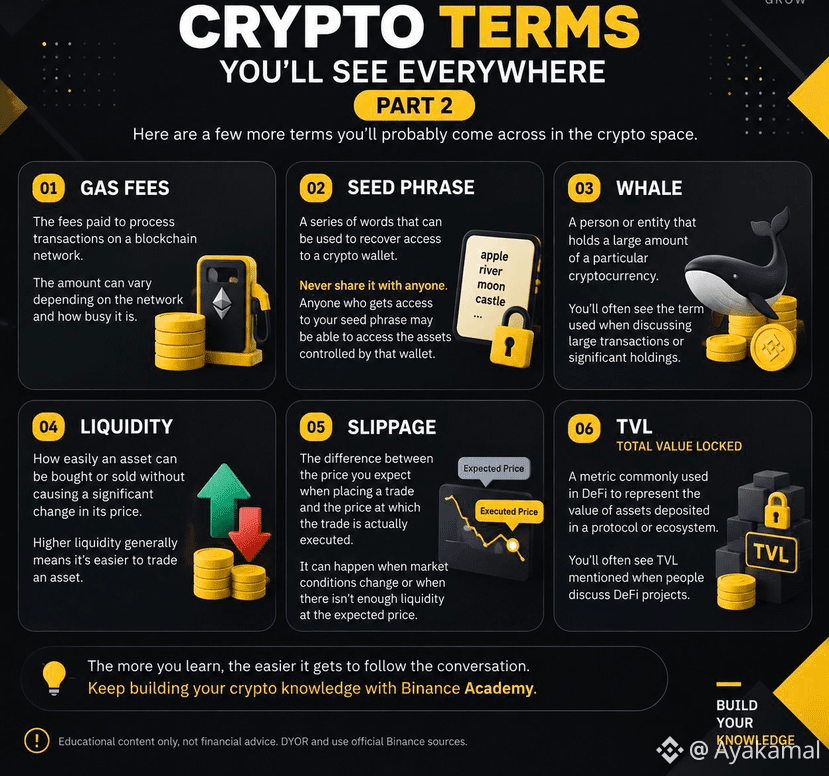
CRYPTO TERMS YOU’LL SEE EVERYWHERE — PART 2
Crypto has its own language.
Here are 6 more terms you’ll come across as you explore trading, DeFi, and crypto wallets.
⛽ Gas Fees
Gas fees are payments made to cover the computing power needed to process and validate transactions on a blockchain.
On networks like Ethereum, gas fees are paid in ETH, and the cost can change depending on network demand.
🔐 Seed Phrase
A seed phrase is a set of 12 to 24 words that can be used to recover a crypto wallet.
Think of it as a master key to a self-custody wallet.
Never share your seed phrase or store it in screenshots, emails, or cloud storage.
🐋 Whale
A whale is an individual or entity holding a large amount of a particular cryptocurrency.
There’s no fixed amount that automatically makes someone a whale — it depends on the asset and its overall supply.
💧 Liquidity
Liquidity describes how easily an asset can be bought or sold without significantly affecting its price.
Markets with more liquidity generally have more active buyers and sellers and can have less price impact when trades are executed.
📉 Slippage
Slippage is the difference between the price you expect when placing a trade and the price at which it actually executes.
It can happen when liquidity is limited or when the market moves quickly while your order is being processed.
🔒 TVL — Total Value Locked
TVL is the total value of assets deposited in a DeFi protocol or across a blockchain ecosystem, usually measured in USD.
It’s commonly used as a metric for DeFi activity, but TVL alone doesn’t tell you whether a protocol is good or sustainable.
⸻
The more crypto terms you understand, the easier it becomes to follow the conversation.
Gas Fees • Seed Phrase • Whale • Liquidity • Slippage • TVL
📚 Keep learning with Binance Academy.
Educational content only, not financial advice. DYOR and use official Binance sources. Availability and requirements may vary by region.
#Binance #blockchain #CryptoEducation💡🚀
CRYPTO TERMS YOU’LL SEE EVERYWHERE — PART 2
Crypto has its own language.
Here are 6 more terms you’ll come across as you explore trading, DeFi, and crypto wallets.
⛽ Gas Fees
Gas fees are payments made to cover the computing power needed to process and validate transactions on a blockchain.
On networks like Ethereum, gas fees are paid in ETH, and the cost can change depending on network demand.
🔐 Seed Phrase
A seed phrase is a set of 12 to 24 words that can be used to recover a crypto wallet.
Think of it as a master key to a self-custody wallet.
Never share your seed phrase or store it in screenshots, emails, or cloud storage.
🐋 Whale
A whale is an individual or entity holding a large amount of a particular cryptocurrency.
There’s no fixed amount that automatically makes someone a whale — it depends on the asset and its overall supply.
💧 Liquidity
Liquidity describes how easily an asset can be bought or sold without significantly affecting its price.
Markets with more liquidity generally have more active buyers and sellers and can have less price impact when trades are executed.
📉 Slippage
Slippage is the difference between the price you expect when placing a trade and the price at which it actually executes.
It can happen when liquidity is limited or when the market moves quickly while your order is being processed.
🔒 TVL — Total Value Locked
TVL is the total value of assets deposited in a DeFi protocol or across a blockchain ecosystem, usually measured in USD.
It’s commonly used as a metric for DeFi activity, but TVL alone doesn’t tell you whether a protocol is good or sustainable.
⸻
The more crypto terms you understand, the easier it becomes to follow the conversation.
Gas Fees • Seed Phrase • Whale • Liquidity • Slippage • TVL
📚 Keep learning with Binance Academy.
Educational content only, not financial advice. DYOR and use official Binance sources. Availability and requirements may vary by region.
#Binance #blockchain #CryptoEducation💡🚀
Crypto has its own language.
Here are 6 more terms you’ll come across as you explore trading, DeFi, and crypto wallets.
⛽ Gas Fees
Gas fees are payments made to cover the computing power needed to process and validate transactions on a blockchain.
On networks like Ethereum, gas fees are paid in ETH, and the cost can change depending on network demand.
🔐 Seed Phrase
A seed phrase is a set of 12 to 24 words that can be used to recover a crypto wallet.
Think of it as a master key to a self-custody wallet.
Never share your seed phrase or store it in screenshots, emails, or cloud storage.
🐋 Whale
A whale is an individual or entity holding a large amount of a particular cryptocurrency.
There’s no fixed amount that automatically makes someone a whale — it depends on the asset and its overall supply.
💧 Liquidity
Liquidity describes how easily an asset can be bought or sold without significantly affecting its price.
Markets with more liquidity generally have more active buyers and sellers and can have less price impact when trades are executed.
📉 Slippage
Slippage is the difference between the price you expect when placing a trade and the price at which it actually executes.
It can happen when liquidity is limited or when the market moves quickly while your order is being processed.
🔒 TVL — Total Value Locked
TVL is the total value of assets deposited in a DeFi protocol or across a blockchain ecosystem, usually measured in USD.
It’s commonly used as a metric for DeFi activity, but TVL alone doesn’t tell you whether a protocol is good or sustainable.
⸻
The more crypto terms you understand, the easier it becomes to follow the conversation.
Gas Fees • Seed Phrase • Whale • Liquidity • Slippage • TVL
📚 Keep learning with Binance Academy.
Educational content only, not financial advice. DYOR and use official Binance sources. Availability and requirements may vary by region.
#Binance #blockchain #CryptoEducation💡🚀
3
10
·
--
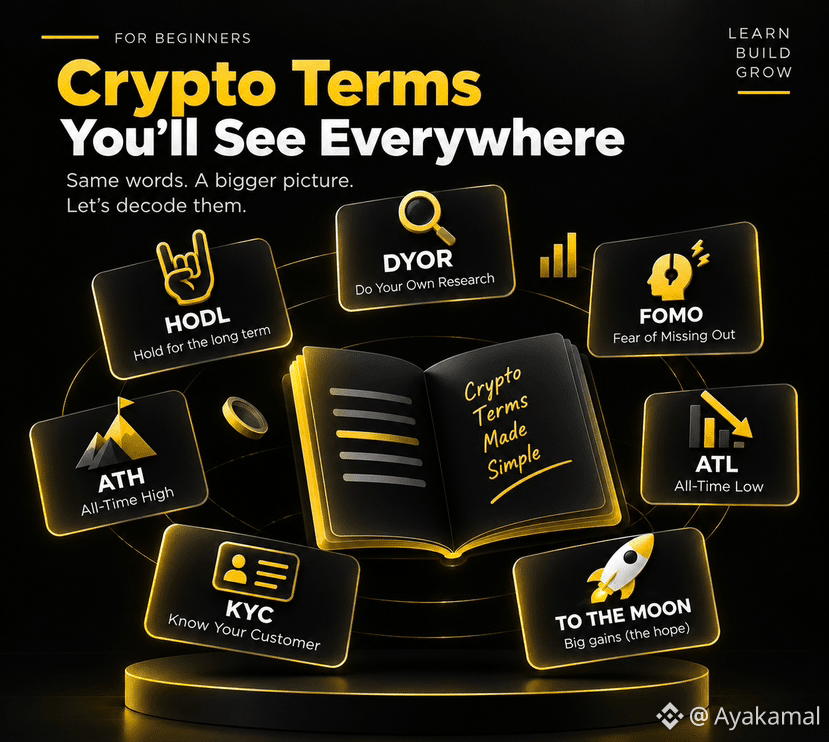
Crypto Terms You’ll See Everywhere
You’ve learned some of the most common crypto terms.
Now let’s decode a few more you’ll see everywhere — especially on Crypto X. 👀
🔎 DYOR — Do Your Own Research
A reminder to independently research and verify information before making a financial decision, rather than relying only on someone else’s opinion.
💎 HODL
Crypto slang for holding a digital asset for the long term instead of selling during short-term price swings.
The term originated from a misspelling of “HOLD” in a 2013 BitcoinTalk post.
😰 FOMO — Fear of Missing Out
That feeling that you’re missing an opportunity because everyone else seems to be getting involved.
In crypto, FOMO can lead people to make decisions based on emotion rather than research.
📈 ATH — All-Time High
The highest price an asset has ever reached in its trading history.
📉 ATL — All-Time Low
The lowest price an asset has ever reached.
🪪 KYC — Know Your Customer
KYC is the process used by financial platforms, including crypto exchanges, to verify a customer’s identity.
It can involve documents such as a government-issued ID or proof of address.
🚀 TO THE MOON
A popular crypto expression used when people expect — or hope for — a very large increase in an asset’s price.
It’s crypto slang, not a technical financial term.
These are just a few of the terms that make up the language of crypto.
DYOR • HODL • FOMO • ATH • ATL • KYC • TO THE MOON
📚 Keep learning with Binance Academy.
Educational content only, not financial advice. DYOR and use official Binance sources. Availability and requirements may vary by region.
#Binance #CryptoEducation
Crypto Terms You’ll See Everywhere
You’ve learned some of the most common crypto terms.
Now let’s decode a few more you’ll see everywhere — especially on Crypto X. 👀
🔎 DYOR — Do Your Own Research
A reminder to independently research and verify information before making a financial decision, rather than relying only on someone else’s opinion.
💎 HODL
Crypto slang for holding a digital asset for the long term instead of selling during short-term price swings.
The term originated from a misspelling of “HOLD” in a 2013 BitcoinTalk post.
😰 FOMO — Fear of Missing Out
That feeling that you’re missing an opportunity because everyone else seems to be getting involved.
In crypto, FOMO can lead people to make decisions based on emotion rather than research.
📈 ATH — All-Time High
The highest price an asset has ever reached in its trading history.
📉 ATL — All-Time Low
The lowest price an asset has ever reached.
🪪 KYC — Know Your Customer
KYC is the process used by financial platforms, including crypto exchanges, to verify a customer’s identity.
It can involve documents such as a government-issued ID or proof of address.
🚀 TO THE MOON
A popular crypto expression used when people expect — or hope for — a very large increase in an asset’s price.
It’s crypto slang, not a technical financial term.
These are just a few of the terms that make up the language of crypto.
DYOR • HODL • FOMO • ATH • ATL • KYC • TO THE MOON
📚 Keep learning with Binance Academy.
Educational content only, not financial advice. DYOR and use official Binance sources. Availability and requirements may vary by region.
#Binance #CryptoEducation
You’ve learned some of the most common crypto terms.
Now let’s decode a few more you’ll see everywhere — especially on Crypto X. 👀
🔎 DYOR — Do Your Own Research
A reminder to independently research and verify information before making a financial decision, rather than relying only on someone else’s opinion.
💎 HODL
Crypto slang for holding a digital asset for the long term instead of selling during short-term price swings.
The term originated from a misspelling of “HOLD” in a 2013 BitcoinTalk post.
😰 FOMO — Fear of Missing Out
That feeling that you’re missing an opportunity because everyone else seems to be getting involved.
In crypto, FOMO can lead people to make decisions based on emotion rather than research.
📈 ATH — All-Time High
The highest price an asset has ever reached in its trading history.
📉 ATL — All-Time Low
The lowest price an asset has ever reached.
🪪 KYC — Know Your Customer
KYC is the process used by financial platforms, including crypto exchanges, to verify a customer’s identity.
It can involve documents such as a government-issued ID or proof of address.
🚀 TO THE MOON
A popular crypto expression used when people expect — or hope for — a very large increase in an asset’s price.
It’s crypto slang, not a technical financial term.
These are just a few of the terms that make up the language of crypto.
DYOR • HODL • FOMO • ATH • ATL • KYC • TO THE MOON
📚 Keep learning with Binance Academy.
Educational content only, not financial advice. DYOR and use official Binance sources. Availability and requirements may vary by region.
#Binance #CryptoEducation
3
11
·
--
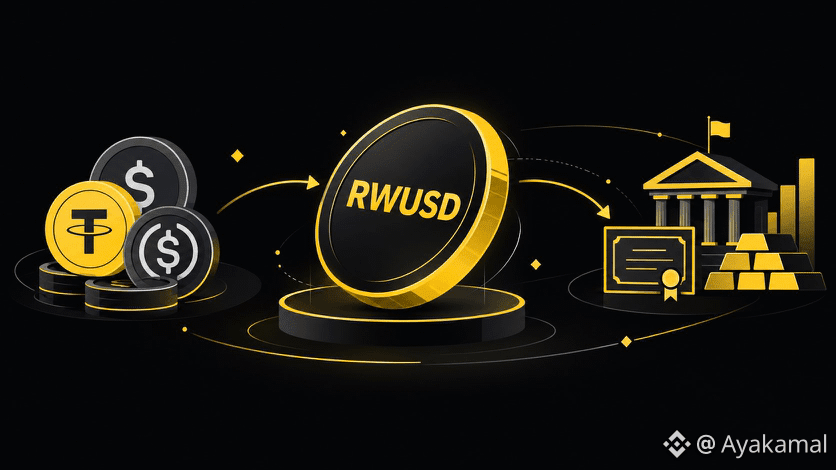
🌍 What if your stablecoins could be connected to Real-World Assets?
That’s the idea behind RWUSD on Binance Earn.
RWUSD is a principal-protected yield product that lets eligible users subscribe with USDT or USDC and receive an equivalent amount of RWUSD in their Spot Wallet.
The interesting part? Its rewards are supported by sources including Real-World Assets (RWAs) such as tokenized U.S. Treasury Bills, alongside yields from the Binance ecosystem.
The advertised rate can be up to 4.2% APR, with rewards calculated and distributed daily. The rate is variable and can change over time.
There’s also no trading involved. You subscribe, hold RWUSD, and rewards are automatically credited according to the product’s reward mechanism.
One important detail: RWUSD is not a stablecoin and doesn’t exist on-chain. It can’t be traded, transferred, or withdrawn like a regular crypto asset.
For redemption, users can choose between Standard and Fast Redemption, subject to the applicable fees, quotas, and terms.
💡 Why is RWUSD interesting?
It’s another example of how RWA tokenization is bringing traditional financial assets, such as U.S. Treasury Bills, closer to the crypto ecosystem.
If you’re exploring how RWAs are being used in crypto, RWUSD is definitely a product worth understanding.
📖 Read the full Binance article:
[https://binance.onelink.me/mL1z/bv22w3p8](https://binance.onelink.me/mL1z/bv22w3p8)
RWUSD Is Here: Earn up to 4.2% Daily Rewards
⚠️ Educational content only. APR is variable and subject to change. Product availability, features, fees, limits, and terms may vary by region. DYOR. This is not financial advice or an investment recommendation.
#Binance #blockchain #crypto
🌍 What if your stablecoins could be connected to Real-World Assets?
That’s the idea behind RWUSD on Binance Earn.
RWUSD is a principal-protected yield product that lets eligible users subscribe with USDT or USDC and receive an equivalent amount of RWUSD in their Spot Wallet.
The interesting part? Its rewards are supported by sources including Real-World Assets (RWAs) such as tokenized U.S. Treasury Bills, alongside yields from the Binance ecosystem.
The advertised rate can be up to 4.2% APR, with rewards calculated and distributed daily. The rate is variable and can change over time.
There’s also no trading involved. You subscribe, hold RWUSD, and rewards are automatically credited according to the product’s reward mechanism.
One important detail: RWUSD is not a stablecoin and doesn’t exist on-chain. It can’t be traded, transferred, or withdrawn like a regular crypto asset.
For redemption, users can choose between Standard and Fast Redemption, subject to the applicable fees, quotas, and terms.
💡 Why is RWUSD interesting?
It’s another example of how RWA tokenization is bringing traditional financial assets, such as U.S. Treasury Bills, closer to the crypto ecosystem.
If you’re exploring how RWAs are being used in crypto, RWUSD is definitely a product worth understanding.
📖 Read the full Binance article:
https://binance.onelink.me/mL1z/bv22w3p8
RWUSD Is Here: Earn up to 4.2% Daily Rewards
⚠️ Educational content only. APR is variable and subject to change. Product availability, features, fees, limits, and terms may vary by region. DYOR. This is not financial advice or an investment recommendation.
#Binance #blockchain #crypto
That’s the idea behind RWUSD on Binance Earn.
RWUSD is a principal-protected yield product that lets eligible users subscribe with USDT or USDC and receive an equivalent amount of RWUSD in their Spot Wallet.
The interesting part? Its rewards are supported by sources including Real-World Assets (RWAs) such as tokenized U.S. Treasury Bills, alongside yields from the Binance ecosystem.
The advertised rate can be up to 4.2% APR, with rewards calculated and distributed daily. The rate is variable and can change over time.
There’s also no trading involved. You subscribe, hold RWUSD, and rewards are automatically credited according to the product’s reward mechanism.
One important detail: RWUSD is not a stablecoin and doesn’t exist on-chain. It can’t be traded, transferred, or withdrawn like a regular crypto asset.
For redemption, users can choose between Standard and Fast Redemption, subject to the applicable fees, quotas, and terms.
💡 Why is RWUSD interesting?
It’s another example of how RWA tokenization is bringing traditional financial assets, such as U.S. Treasury Bills, closer to the crypto ecosystem.
If you’re exploring how RWAs are being used in crypto, RWUSD is definitely a product worth understanding.
📖 Read the full Binance article:
https://binance.onelink.me/mL1z/bv22w3p8
RWUSD Is Here: Earn up to 4.2% Daily Rewards
⚠️ Educational content only. APR is variable and subject to change. Product availability, features, fees, limits, and terms may vary by region. DYOR. This is not financial advice or an investment recommendation.
#Binance #blockchain #crypto
3
19
·
--
Your location can shape which financial markets you can access. 🌍
That’s one reason the expansion of financial products across digital platforms is worth paying attention to.
For users in emerging markets, accessing traditional markets can involve different brokers, accounts, funding methods and eligibility requirements.
A multi-asset platform can potentially make the experience more connected by bringing different products into one ecosystem.
Binance is expanding in this direction with products including direct U.S. stocks and ETFs, tokenized securities, and TradFi perpetuals.
But this is where the important part comes in:
MENA is not one regulatory market.
Dubai ≠ Riyadh ≠ Cairo.
Product availability and access can differ by country, regulatory framework and user eligibility.
So the right question isn’t:
“Can everyone in MENA access these products?”
It’s:
“Which products are actually available to me, in my jurisdiction?”
That’s the part every user should check before trading.
Educational content only. Not financial advice.
Availability varies by region and eligibility. DYOR.
#Binance #MENA #TradFi #crypto #SuperFinancialApp
Your location can shape which financial markets you can access. 🌍
That’s one reason the expansion of financial products across digital platforms is worth paying attention to.
For users in emerging markets, accessing traditional markets can involve different brokers, accounts, funding methods and eligibility requirements.
A multi-asset platform can potentially make the experience more connected by bringing different products into one ecosystem.
Binance is expanding in this direction with products including direct U.S. stocks and ETFs, tokenized securities, and TradFi perpetuals.
But this is where the important part comes in:
MENA is not one regulatory market.
Dubai ≠ Riyadh ≠ Cairo.
Product availability and access can differ by country, regulatory framework and user eligibility.
So the right question isn’t:
“Can everyone in MENA access these products?”
It’s:
“Which products are actually available to me, in my jurisdiction?”
That’s the part every user should check before trading.
Educational content only. Not financial advice.
Availability varies by region and eligibility. DYOR.
#Binance #MENA #TradFi #crypto #SuperFinancialApp
That’s one reason the expansion of financial products across digital platforms is worth paying attention to.
For users in emerging markets, accessing traditional markets can involve different brokers, accounts, funding methods and eligibility requirements.
A multi-asset platform can potentially make the experience more connected by bringing different products into one ecosystem.
Binance is expanding in this direction with products including direct U.S. stocks and ETFs, tokenized securities, and TradFi perpetuals.
But this is where the important part comes in:
MENA is not one regulatory market.
Dubai ≠ Riyadh ≠ Cairo.
Product availability and access can differ by country, regulatory framework and user eligibility.
So the right question isn’t:
“Can everyone in MENA access these products?”
It’s:
“Which products are actually available to me, in my jurisdiction?”
That’s the part every user should check before trading.
Educational content only. Not financial advice.
Availability varies by region and eligibility. DYOR.
#Binance #MENA #TradFi #crypto #SuperFinancialApp

3
57
·
--
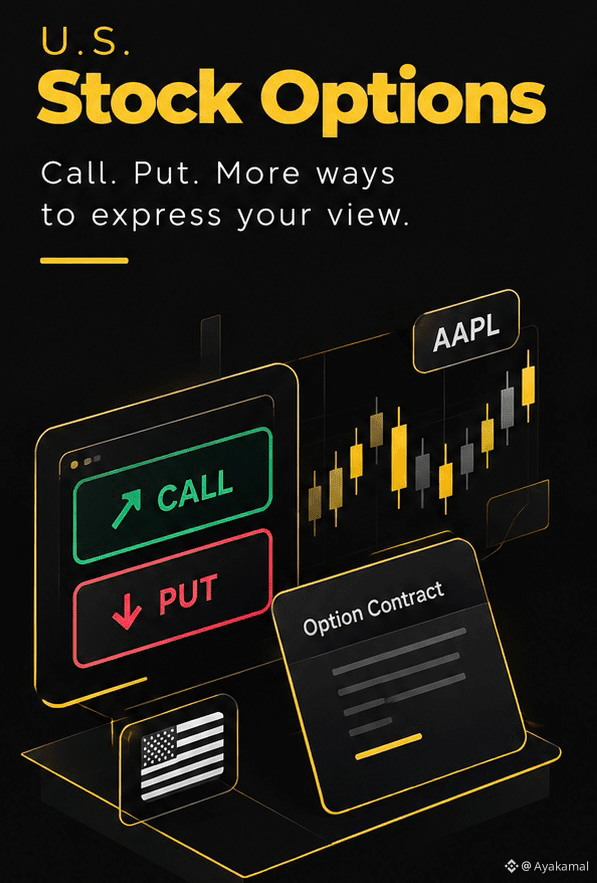
**“I’m bullish on this stock.”
That sentence can mean more than one thing. 👀
One way to express that view is through a Call Option.
A bearish view can be expressed through a Put Option.
But what exactly are you buying?
A stock option is a contract that gives the buyer the right, but not the obligation, to buy or sell an underlying security at a specified strike price by the relevant expiration date.
Binance launched Stock Options for eligible users on U.S.-listed stocks and ETFs in September 2026.
A few things matter here:
📌 Options have an expiration date.
📌 The buyer pays a premium for the option.
📌 The option itself does not represent ownership of the underlying stock.
📌 Binance’s current Stock Options are long-only: Buy Call or Buy Put.
📌 For option buyers, the maximum loss is the premium paid.
These options are physically settled, meaning the underlying shares can be delivered according to the contract and settlement terms if exercised.
And unlike perpetuals, options are not open-ended contracts.
Different product.
Different mechanics.
Different risks.
If you understand the stock but not the option, you don’t understand the trade yet.
Educational content only. Not financial advice.
Stock Options may not be available in your region. Check eligibility, contract terms and risk disclosures before trading. DYOR.
#Binance #StockOptions #TradFi #stocks #ETFs
**“I’m bullish on this stock.”
That sentence can mean more than one thing. 👀
One way to express that view is through a Call Option.
A bearish view can be expressed through a Put Option.
But what exactly are you buying?
A stock option is a contract that gives the buyer the right, but not the obligation, to buy or sell an underlying security at a specified strike price by the relevant expiration date.
Binance launched Stock Options for eligible users on U.S.-listed stocks and ETFs in September 2026.
A few things matter here:
📌 Options have an expiration date.
📌 The buyer pays a premium for the option.
📌 The option itself does not represent ownership of the underlying stock.
📌 Binance’s current Stock Options are long-only: Buy Call or Buy Put.
📌 For option buyers, the maximum loss is the premium paid.
These options are physically settled, meaning the underlying shares can be delivered according to the contract and settlement terms if exercised.
And unlike perpetuals, options are not open-ended contracts.
Different product.
Different mechanics.
Different risks.
If you understand the stock but not the option, you don’t understand the trade yet.
Educational content only. Not financial advice.
Stock Options may not be available in your region. Check eligibility, contract terms and risk disclosures before trading. DYOR.
#Binance #StockOptions #TradFi #stocks #ETFs
That sentence can mean more than one thing. 👀
One way to express that view is through a Call Option.
A bearish view can be expressed through a Put Option.
But what exactly are you buying?
A stock option is a contract that gives the buyer the right, but not the obligation, to buy or sell an underlying security at a specified strike price by the relevant expiration date.
Binance launched Stock Options for eligible users on U.S.-listed stocks and ETFs in September 2026.
A few things matter here:
📌 Options have an expiration date.
📌 The buyer pays a premium for the option.
📌 The option itself does not represent ownership of the underlying stock.
📌 Binance’s current Stock Options are long-only: Buy Call or Buy Put.
📌 For option buyers, the maximum loss is the premium paid.
These options are physically settled, meaning the underlying shares can be delivered according to the contract and settlement terms if exercised.
And unlike perpetuals, options are not open-ended contracts.
Different product.
Different mechanics.
Different risks.
If you understand the stock but not the option, you don’t understand the trade yet.
Educational content only. Not financial advice.
Stock Options may not be available in your region. Check eligibility, contract terms and risk disclosures before trading. DYOR.
#Binance #StockOptions #TradFi #stocks #ETFs
3
68
·
--
**A stock can trade during market hours.
But what if the contract tracking its price could trade 24/7? 👀**
That’s where TradFi Perpetuals come in.
A TradFi Perpetual is a derivative contract designed to track the price of an underlying traditional asset.
That can include:
📈 Selected stocks
🥇 Gold
🥈 Silver
📊 Selected ETFs and indices
The key point:
You’re trading the price movement — not buying the underlying asset itself.
Unlike traditional futures, perpetual contracts have no fixed expiry date.
On Binance, TradFi Perpetuals are USDT-settled and use funding mechanisms to help keep the contract price aligned with the underlying asset.
Some contracts also support leverage.
And that’s where the risk comes in:
Leverage can amplify both gains and losses, while funding costs and liquidation can affect your position.
So “24/7 access” doesn’t mean “lower risk.”
It means a different way of getting price exposure to traditional assets.
Understand the contract before you trade the ticker.
Educational content only. Not financial advice.
Product availability and trading parameters vary by region and may change. DYOR.
#Binance #TradFi #TradFiPerps #BİNANCEFUTURES #Crypto
**A stock can trade during market hours.
But what if the contract tracking its price could trade 24/7? 👀**
That’s where TradFi Perpetuals come in.
A TradFi Perpetual is a derivative contract designed to track the price of an underlying traditional asset.
That can include:
📈 Selected stocks
🥇 Gold
🥈 Silver
📊 Selected ETFs and indices
The key point:
You’re trading the price movement — not buying the underlying asset itself.
Unlike traditional futures, perpetual contracts have no fixed expiry date.
On Binance, TradFi Perpetuals are USDT-settled and use funding mechanisms to help keep the contract price aligned with the underlying asset.
Some contracts also support leverage.
And that’s where the risk comes in:
Leverage can amplify both gains and losses, while funding costs and liquidation can affect your position.
So “24/7 access” doesn’t mean “lower risk.”
It means a different way of getting price exposure to traditional assets.
Understand the contract before you trade the ticker.
Educational content only. Not financial advice.
Product availability and trading parameters vary by region and may change. DYOR.
#Binance #TradFi #TradFiPerps #BİNANCEFUTURES #Crypto
But what if the contract tracking its price could trade 24/7? 👀**
That’s where TradFi Perpetuals come in.
A TradFi Perpetual is a derivative contract designed to track the price of an underlying traditional asset.
That can include:
📈 Selected stocks
🥇 Gold
🥈 Silver
📊 Selected ETFs and indices
The key point:
You’re trading the price movement — not buying the underlying asset itself.
Unlike traditional futures, perpetual contracts have no fixed expiry date.
On Binance, TradFi Perpetuals are USDT-settled and use funding mechanisms to help keep the contract price aligned with the underlying asset.
Some contracts also support leverage.
And that’s where the risk comes in:
Leverage can amplify both gains and losses, while funding costs and liquidation can affect your position.
So “24/7 access” doesn’t mean “lower risk.”
It means a different way of getting price exposure to traditional assets.
Understand the contract before you trade the ticker.
Educational content only. Not financial advice.
Product availability and trading parameters vary by region and may change. DYOR.
#Binance #TradFi #TradFiPerps #BİNANCEFUTURES #Crypto
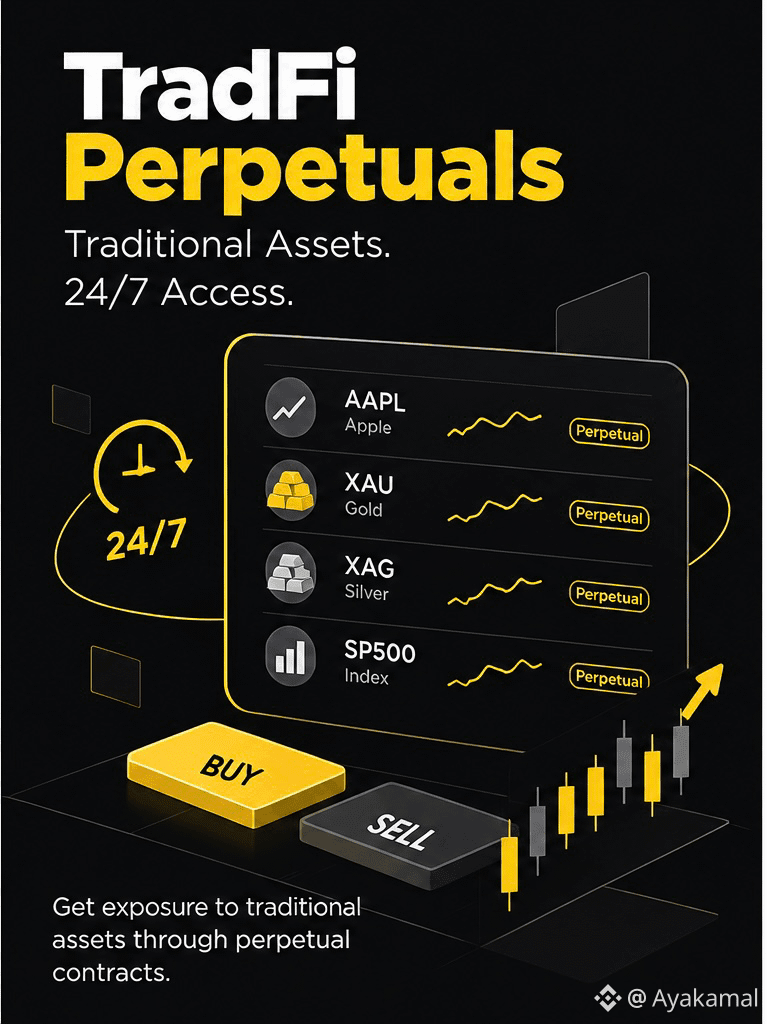
3
259
Log in to explore more content
Join global crypto users on Binance Square
⚡️ Get latest and useful information about crypto.
💬 Trusted by the world’s largest crypto exchange.
👍 Discover real insights from verified creators.
Email / Phone number
Trending Topics
FedMinutesFocusOnOctoberPause
62,533 views
831 Discussing
The latest Federal Reserve meeting minutes are under intense scrutiny, with the market desperately searching for any indication of a potential pause in interest rate hikes for October. This focus highlights the significant impact Fed policy has on cryptocurrency markets, as higher rates often lead to reduced liquidity and investor appetite for riskier assets like digital currencies. Traders and analysts are dissecting every word for signals that could influence market sentiment and potential price movements across major cryptocurrencies. The anticipation itself is creating volatility as participants position themselves ahead of any definitive announcement.
Disclaimer: This is not investment advice. Always do your own research.
#FedMinutesFocusOnOctoberPause $BTC $ETH
Luong Nguyen Ba
·1 Likes
·3.9k views
BinanceLaunchesBinanceIntelligence
1M views
6,106 Discussing
EvernorthDelaysNasdaqDebutToOct12
2,791 views
145 Discussing