
NguyenMax
100 Posts
NguyenMax
Open Trade
Frequent Trader
4.6 Years
119 Following
71 Followers
80 Liked
Posts
Portfolio
All
Quotes
ITLG and the power of community voices
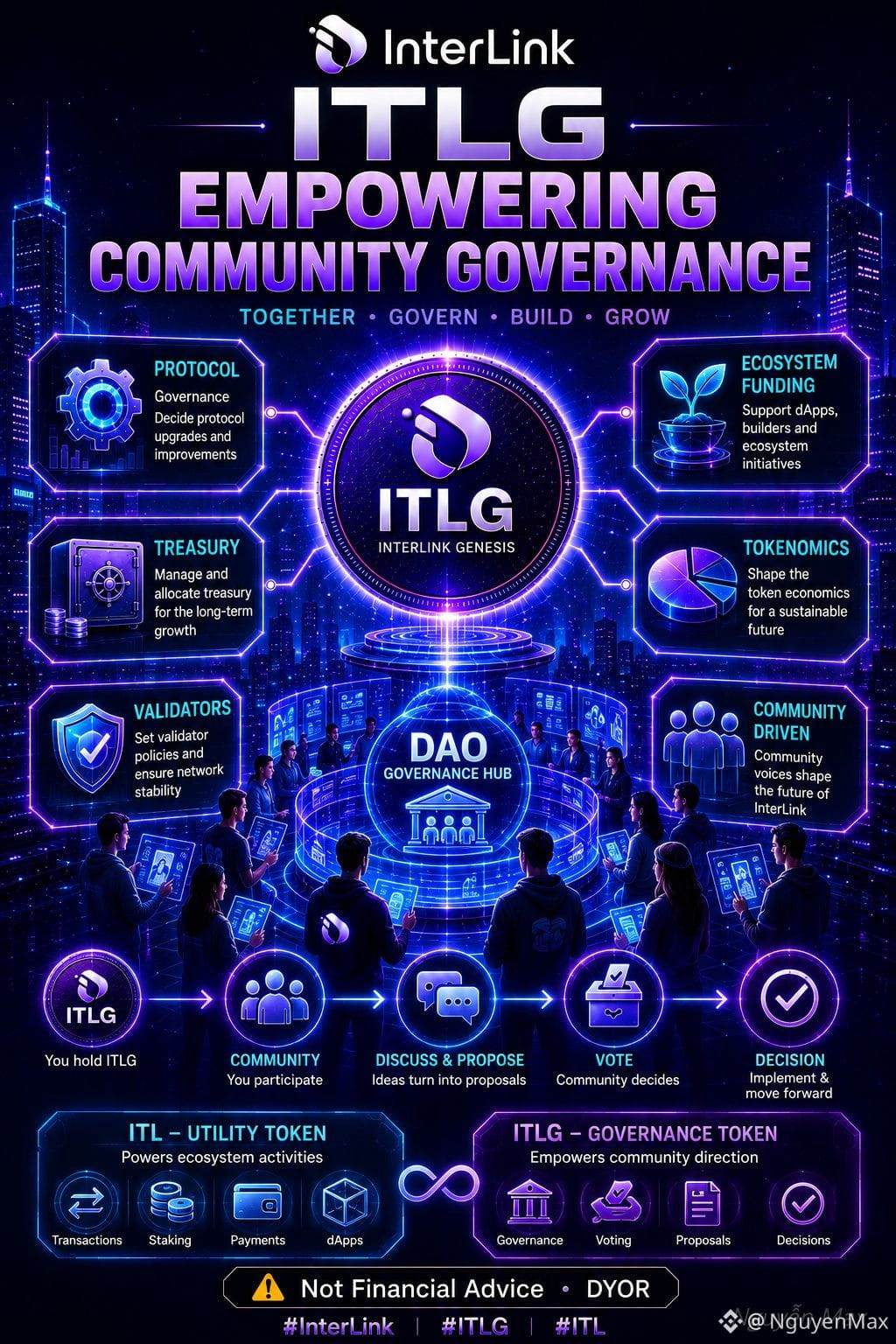
A DAO truly matters only when the community has a mechanism to propose, discuss, and participate in decision-making. This is a key difference between a centralized governance system and a decentralized governance model.
Under InterLink’s direction, ITLG (InterLink Genesis) is designed as the governance token of the InterLink DAO. This role helps ITLG connect to the community’s process of contributing to how the ecosystem develops.
You can imagine the process like this:
ITLG → Community → Discussion → Proposal → Voting → Decision
Governance issues may include:
Protocol Upgrade
Treasury Management
Validator Policy
Ecosystem Funding
Tokenomics
A strong community doesn’t mean all members always agree with one another. More importantly, it requires a transparent mechanism to bring different viewpoints to the table, analyze them, and put them to a vote.
This is also why Governance must go hand in hand with responsibility. Participants should read proposals, understand their impacts, and evaluate the information before making decisions.
If ITL represents utility and economic activity within the ecosystem, then ITLG is intended to support the community’s voice in governance.
Lesson 25: Learn about Treasury management and why the treasury is one of the most important issues for a DAO.
⚠️ Warning: The content is for information sharing only, not investment advice. DYOR and comply with Vietnamese laws regarding tokenized assets.
Hashtag
#InterLink #ITLG #ITL
A DAO truly matters only when the community has a mechanism to propose, discuss, and participate in decision-making. This is a key difference between a centralized governance system and a decentralized governance model.
Under InterLink’s direction, ITLG (InterLink Genesis) is designed as the governance token of the InterLink DAO. This role helps ITLG connect to the community’s process of contributing to how the ecosystem develops.
You can imagine the process like this:
ITLG → Community → Discussion → Proposal → Voting → Decision
Governance issues may include:
Protocol Upgrade
Treasury Management
Validator Policy
Ecosystem Funding
Tokenomics
A strong community doesn’t mean all members always agree with one another. More importantly, it requires a transparent mechanism to bring different viewpoints to the table, analyze them, and put them to a vote.
This is also why Governance must go hand in hand with responsibility. Participants should read proposals, understand their impacts, and evaluate the information before making decisions.
If ITL represents utility and economic activity within the ecosystem, then ITLG is intended to support the community’s voice in governance.
Lesson 25: Learn about Treasury management and why the treasury is one of the most important issues for a DAO.
⚠️ Warning: The content is for information sharing only, not investment advice. DYOR and comply with Vietnamese laws regarding tokenized assets.
Hashtag
#InterLink #ITLG #ITL
ITLG and the right to participate in ecosystem direction
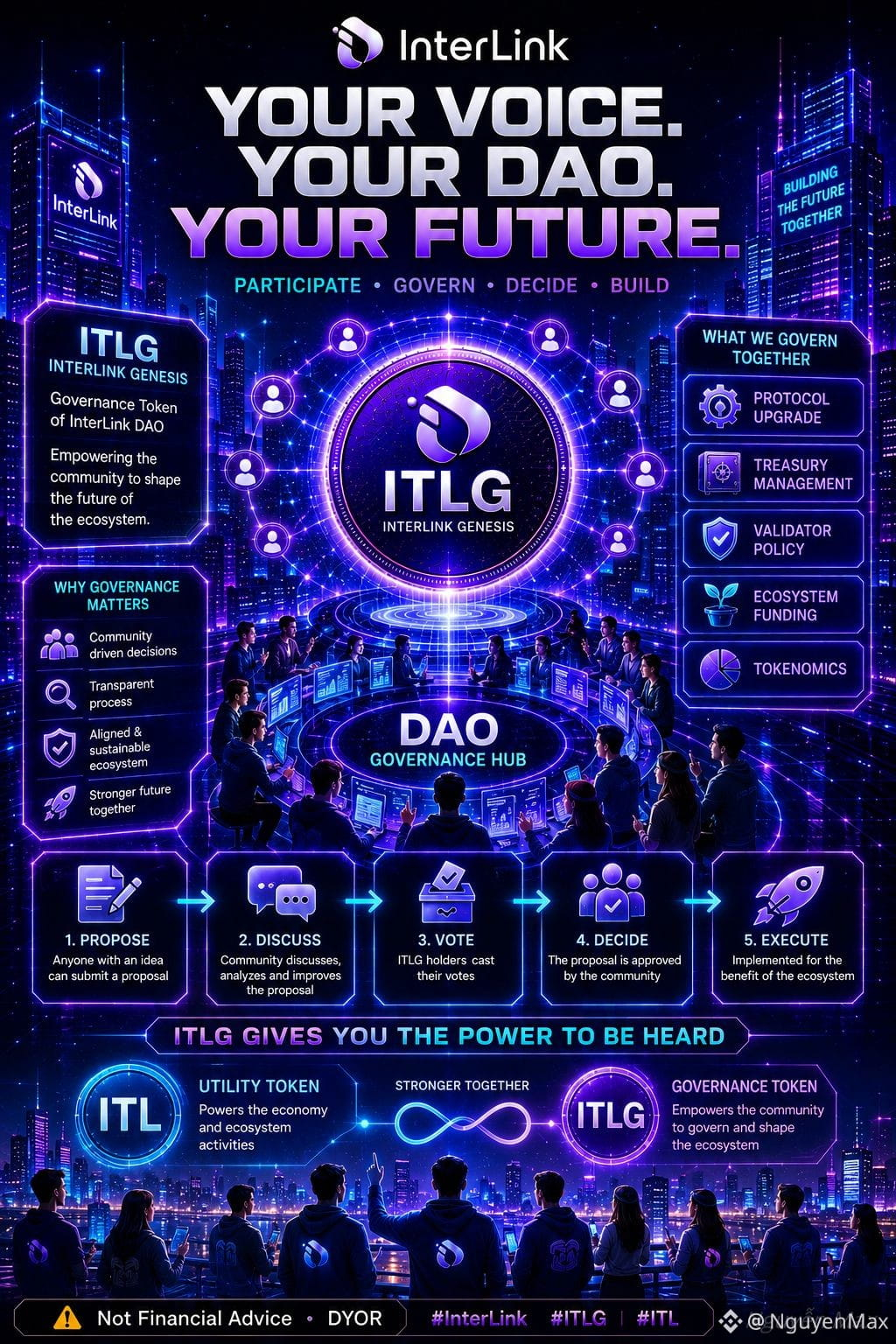
In a decentralized ecosystem, the community not only serves as users but can also take part in shaping the development process.
That is one of the important meanings of a Governance Token.
Under InterLink’s roadmap, ITLG (InterLink Genesis) is designed as the governance token of the InterLink DAO. Through governance mechanisms, ITLG aims to empower the community to participate in key decisions of the ecosystem.
Potential areas may include:
🔹 Protocol upgrades
🔹 Treasury management
🔹 Validator policy
🔹 Ecosystem funding
🔹 Tokenomics
🔹 Important development proposals
A notable point is that governance rights create a link between participants and the network’s direction of development.
If the community has complete information, engages in high-quality discussions, and participates responsibly, the DAO mechanism can become a tool to make decision-making more transparent and community-driven.
A simple way to understand it:
ITL → Utility and economic activities of the ecosystem.
ITLG → Governance and community direction.
The two tokens have different roles, yet both are part of InterLink’s development picture.
Therefore, the value of governance should not only be viewed through token price fluctuations, but also by considering participation rights, governance mechanisms, and the ecosystem’s real level of development.
⚠️ Disclaimer: This content is for information sharing only, not investment advice. DYOR and comply with Vietnamese law regarding crypto assets.
#InterLink #ITLG #ITL #Web3 #Blockchain #DAO #Crypto #DeFi
In a decentralized ecosystem, the community not only serves as users but can also take part in shaping the development process.
That is one of the important meanings of a Governance Token.
Under InterLink’s roadmap, ITLG (InterLink Genesis) is designed as the governance token of the InterLink DAO. Through governance mechanisms, ITLG aims to empower the community to participate in key decisions of the ecosystem.
Potential areas may include:
🔹 Protocol upgrades
🔹 Treasury management
🔹 Validator policy
🔹 Ecosystem funding
🔹 Tokenomics
🔹 Important development proposals
A notable point is that governance rights create a link between participants and the network’s direction of development.
If the community has complete information, engages in high-quality discussions, and participates responsibly, the DAO mechanism can become a tool to make decision-making more transparent and community-driven.
A simple way to understand it:
ITL → Utility and economic activities of the ecosystem.
ITLG → Governance and community direction.
The two tokens have different roles, yet both are part of InterLink’s development picture.
Therefore, the value of governance should not only be viewed through token price fluctuations, but also by considering participation rights, governance mechanisms, and the ecosystem’s real level of development.
⚠️ Disclaimer: This content is for information sharing only, not investment advice. DYOR and comply with Vietnamese law regarding crypto assets.
#InterLink #ITLG #ITL #Web3 #Blockchain #DAO #Crypto #DeFi
TXHASH: VERIFICATION STEP ON THE BLOCKCHAIN
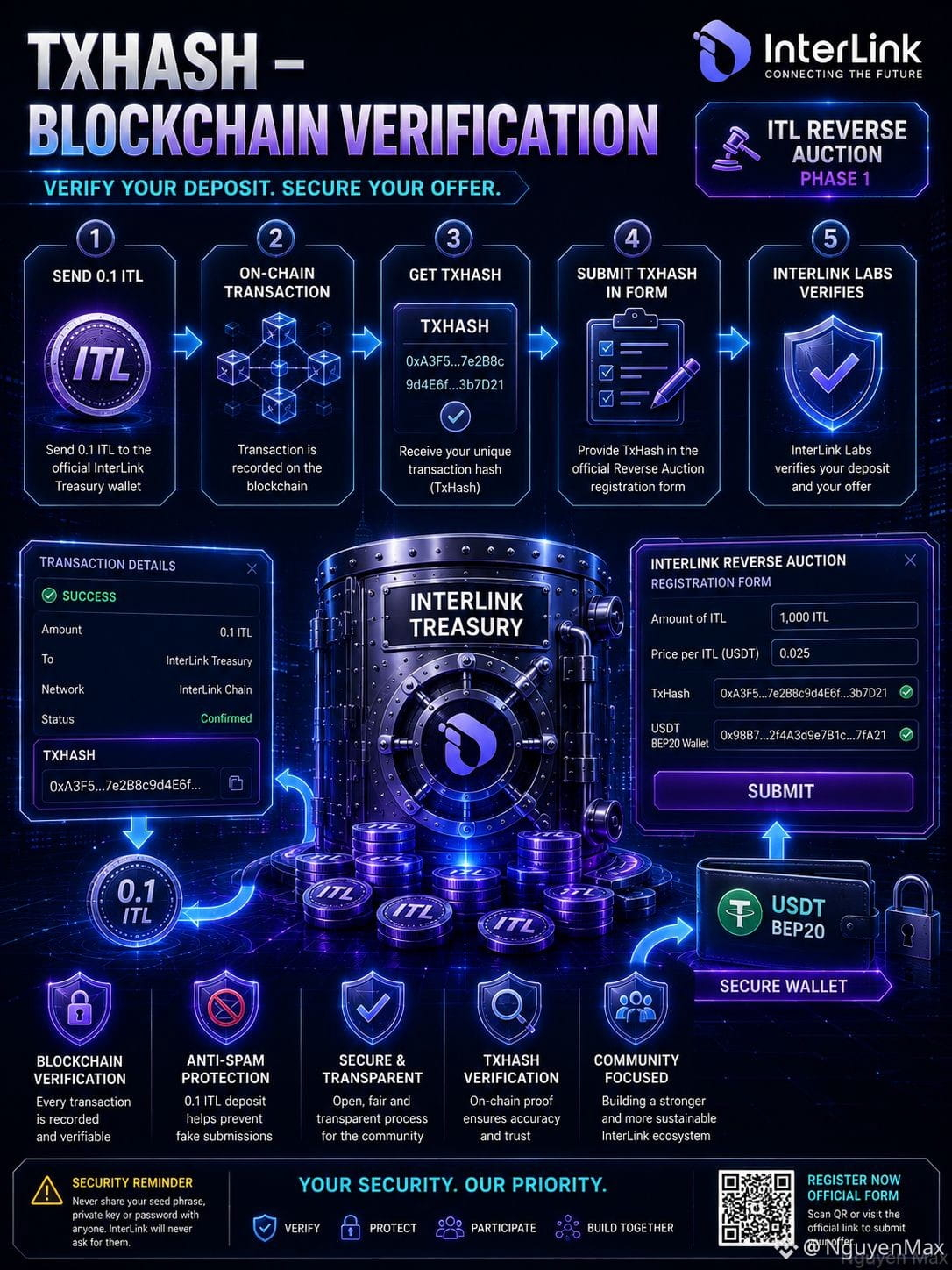
🧾 What is TxHash and why do you need to provide it?
In the ITL Reverse Auction Purchase Program – Phase 1, participants need to send 0.1 ITL to the official InterLink Labs Treasury wallet to verify the offer and limit spam.
After the transaction is completed, you will receive a TxHash (Transaction Hash).
In simple terms, TxHash is the identifier code of a transaction on the blockchain, allowing you to identify and look up the deposit transaction.
🔎 Basic process:
Send 0.1 ITL
⬇️
Transaction is recorded on the blockchain
⬇️
Receive TxHash
⬇️
Provide TxHash in the form
⬇️
InterLink Labs verifies the offer
📌 When registering, participants should check carefully:
✅ TxHash of the correct 0.1 ITL transaction.
✅ The correct blockchain network required by the program.
✅ The correct official Treasury wallet address.
✅ The USDT BEP20 wallet address is entered accurately.
⚠️ Security note: Never provide your seed phrase, private key, or wallet password to anyone who claims to be an InterLink employee.
🔗 Official registration form:
Register for Reverse Auction ITL�
💬 Have you ever checked the TxHash of a blockchain transaction?
🧾 What is TxHash and why do you need to provide it?
In the ITL Reverse Auction Purchase Program – Phase 1, participants need to send 0.1 ITL to the official InterLink Labs Treasury wallet to verify the offer and limit spam.
After the transaction is completed, you will receive a TxHash (Transaction Hash).
In simple terms, TxHash is the identifier code of a transaction on the blockchain, allowing you to identify and look up the deposit transaction.
🔎 Basic process:
Send 0.1 ITL
⬇️
Transaction is recorded on the blockchain
⬇️
Receive TxHash
⬇️
Provide TxHash in the form
⬇️
InterLink Labs verifies the offer
📌 When registering, participants should check carefully:
✅ TxHash of the correct 0.1 ITL transaction.
✅ The correct blockchain network required by the program.
✅ The correct official Treasury wallet address.
✅ The USDT BEP20 wallet address is entered accurately.
⚠️ Security note: Never provide your seed phrase, private key, or wallet password to anyone who claims to be an InterLink employee.
🔗 Official registration form:
Register for Reverse Auction ITL�
💬 Have you ever checked the TxHash of a blockchain transaction?
🔐 Treasury discipline: The foundation of long-term value
In a blockchain ecosystem, token management is not only a matter of how many tokens to distribute, but also of how to manage capital.
Under InterLink’s long-term orientation, all activities using ITL must be carried out within the following framework:
🔹 Strict governance – the use of ITL must comply with appropriate governance decisions.
🔹 Treasury discipline – capital must be managed responsibly, rather than used arbitrarily.
🔹 Multiple layers of approval – strengthen control and accountability.
🔹 Financial independence – organizations within the ecosystem should gradually achieve autonomy over their capital instead of relying on continuous allocation from the Fund.
This is also why the strategic Reverse Auction is noteworthy.
Instead of viewing the treasury as a token supply for continuous distribution, InterLink aims to turn the treasury into a tool for managing strategic assets.
The ultimate goal is not simply to hold or buy more ITL.
The goal is to build an ecosystem that knows how to generate value, manage capital, and grow using its own resources.
💬 In your view, is financial discipline just as important as technology for the long-term success of a blockchain project?
⚠️ Disclaimer: This article is for informational purposes only about the InterLink ecosystem and does not constitute investment advice, an offer to buy or sell, or any financial recommendation. Please do your own research (DYOR) and take full responsibility for all of your decisions.
Hashtag
#InterLink #ITLG #ITL #Web3
In a blockchain ecosystem, token management is not only a matter of how many tokens to distribute, but also of how to manage capital.
Under InterLink’s long-term orientation, all activities using ITL must be carried out within the following framework:
🔹 Strict governance – the use of ITL must comply with appropriate governance decisions.
🔹 Treasury discipline – capital must be managed responsibly, rather than used arbitrarily.
🔹 Multiple layers of approval – strengthen control and accountability.
🔹 Financial independence – organizations within the ecosystem should gradually achieve autonomy over their capital instead of relying on continuous allocation from the Fund.
This is also why the strategic Reverse Auction is noteworthy.
Instead of viewing the treasury as a token supply for continuous distribution, InterLink aims to turn the treasury into a tool for managing strategic assets.
The ultimate goal is not simply to hold or buy more ITL.
The goal is to build an ecosystem that knows how to generate value, manage capital, and grow using its own resources.
💬 In your view, is financial discipline just as important as technology for the long-term success of a blockchain project?
⚠️ Disclaimer: This article is for informational purposes only about the InterLink ecosystem and does not constitute investment advice, an offer to buy or sell, or any financial recommendation. Please do your own research (DYOR) and take full responsibility for all of your decisions.
Hashtag
#InterLink #ITLG #ITL #Web3
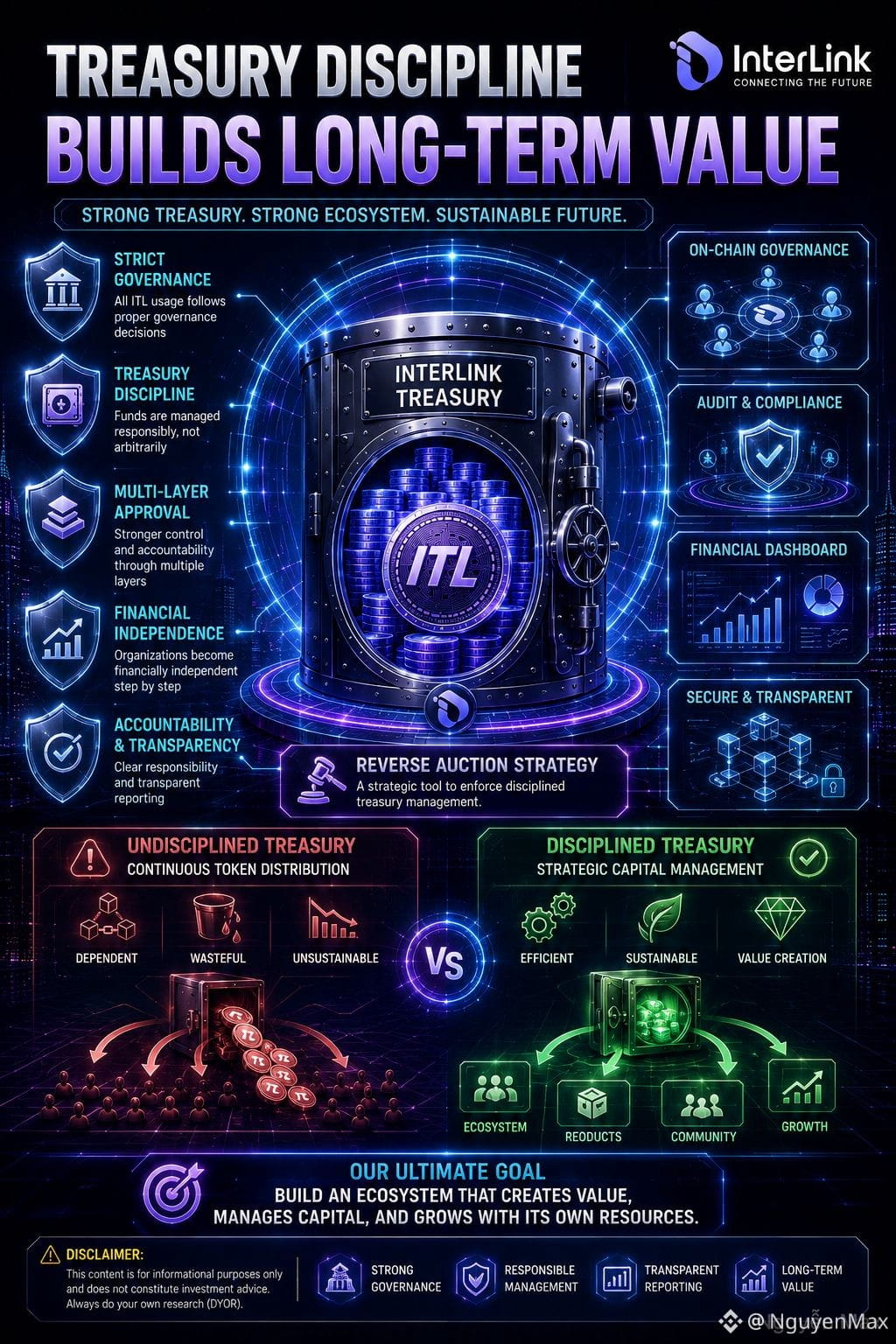
💰 What price do you want to sell ITL at?
A key point of the Reverse Auction is that participants themselves submit their bids.
You need to determine:
How many ITL do you want to sell?
and
What price do you want to sell each ITL for?
InterLink Labs will then review the valid bids after the registration period ends.
This program is not simply “first come, first served.”
According to the notice, bids will be assessed based on the most competitive price and the available treasury budget.
Therefore, it is important for participants to understand that:
🔹 Submitting a bid does not guarantee that you will definitely be able to sell.
🔹 Selection happens after the bid submission phase ends.
🔹 The selected bidder will receive USDT to the BEP20 wallet address they provided.
🔹 Unselected bidders will have their 0.1 ITL deposit refunded according to the program’s mechanism.
🔗 Official form:
Register at the Reverse Auction ITL form�
⚠️ Disclaimer: The content is for information sharing only and does not constitute investment advice, buying/selling recommendations, or financial advice.
#InterLink #ITLG #ITL #ITLBuyback #Web3
A key point of the Reverse Auction is that participants themselves submit their bids.
You need to determine:
How many ITL do you want to sell?
and
What price do you want to sell each ITL for?
InterLink Labs will then review the valid bids after the registration period ends.
This program is not simply “first come, first served.”
According to the notice, bids will be assessed based on the most competitive price and the available treasury budget.
Therefore, it is important for participants to understand that:
🔹 Submitting a bid does not guarantee that you will definitely be able to sell.
🔹 Selection happens after the bid submission phase ends.
🔹 The selected bidder will receive USDT to the BEP20 wallet address they provided.
🔹 Unselected bidders will have their 0.1 ITL deposit refunded according to the program’s mechanism.
🔗 Official form:
Register at the Reverse Auction ITL form�
⚠️ Disclaimer: The content is for information sharing only and does not constitute investment advice, buying/selling recommendations, or financial advice.
#InterLink #ITLG #ITL #ITLBuyback #Web3
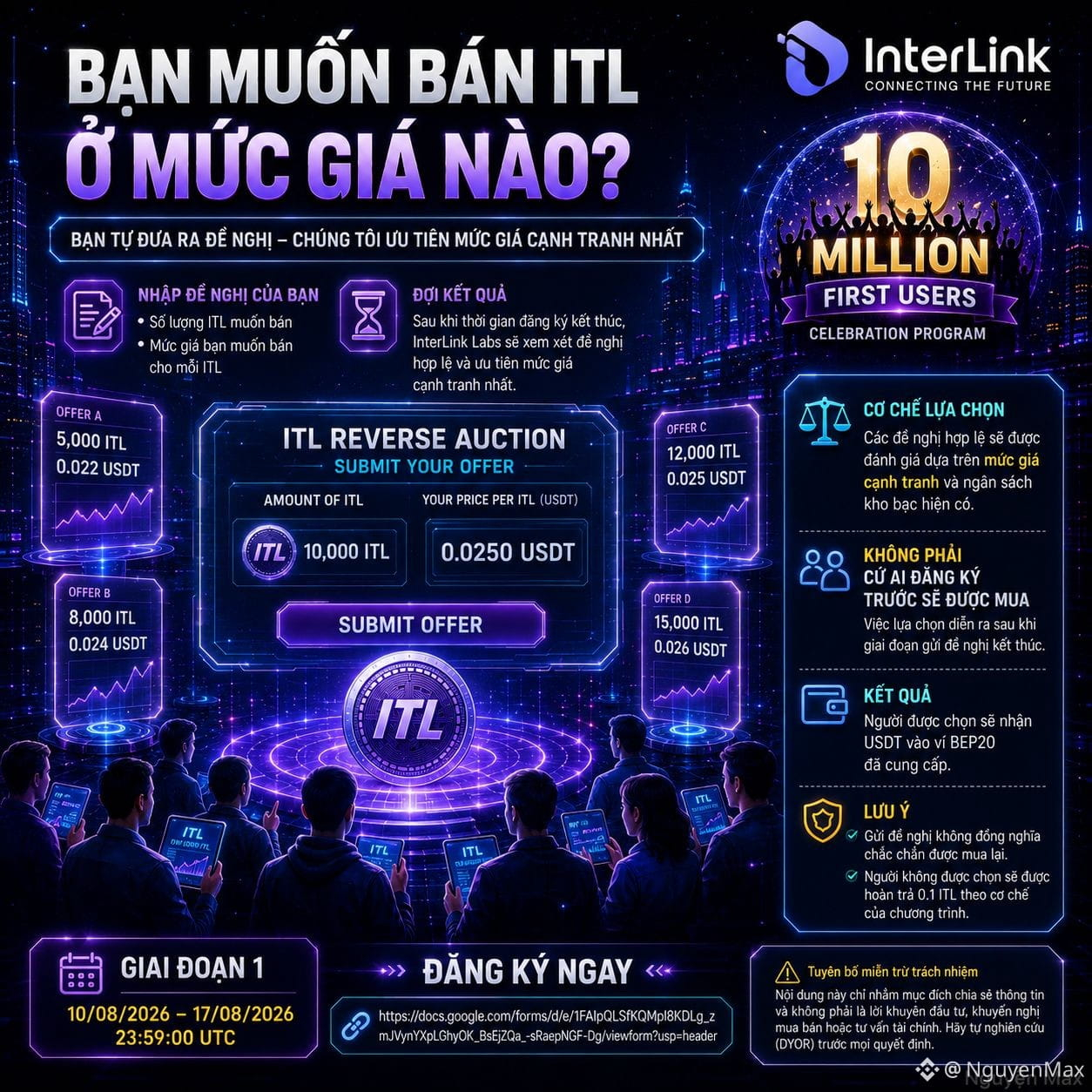
🚨 INTERLINK OFFICIALLY OPENS BUYBACK PHASE 1 OF ITL
InterLink Labs has officially announced Phase 1 of the ITL Reverse Auction Buyback Program and opened the registration form for those who currently hold ITL.
This is the first buyback program implemented under the 10 Millionth First Users Commemoration Program.
In this phase, holders who want to participate can proactively submit offers:
🔹 The amount of ITL they want to sell.
🔹 The desired price for each ITL.
After the registration period ends, InterLink Labs will review valid proposals and select based on competitive pricing along with the treasury budget available.
⏰ Phase 1 Deadline:
Until 17/08/2026 – 23:59:00 UTC.
This is the time for the community to clearly understand the mechanism before deciding whether to participate or not.
🔗 Official registration form:
Register for the ITL Reverse Auction Buyback Program�
⚠️ Disclaimer: This content is for information sharing purposes about the InterLink program only and is not investment advice, a recommendation to buy or sell, or financial guidance. Please do your own research and verify official information before carrying out any transactions.
#InterLink #ITLG #ITL #Web3
InterLink Labs has officially announced Phase 1 of the ITL Reverse Auction Buyback Program and opened the registration form for those who currently hold ITL.
This is the first buyback program implemented under the 10 Millionth First Users Commemoration Program.
In this phase, holders who want to participate can proactively submit offers:
🔹 The amount of ITL they want to sell.
🔹 The desired price for each ITL.
After the registration period ends, InterLink Labs will review valid proposals and select based on competitive pricing along with the treasury budget available.
⏰ Phase 1 Deadline:
Until 17/08/2026 – 23:59:00 UTC.
This is the time for the community to clearly understand the mechanism before deciding whether to participate or not.
🔗 Official registration form:
Register for the ITL Reverse Auction Buyback Program�
⚠️ Disclaimer: This content is for information sharing purposes about the InterLink program only and is not investment advice, a recommendation to buy or sell, or financial guidance. Please do your own research and verify official information before carrying out any transactions.
#InterLink #ITLG #ITL #Web3
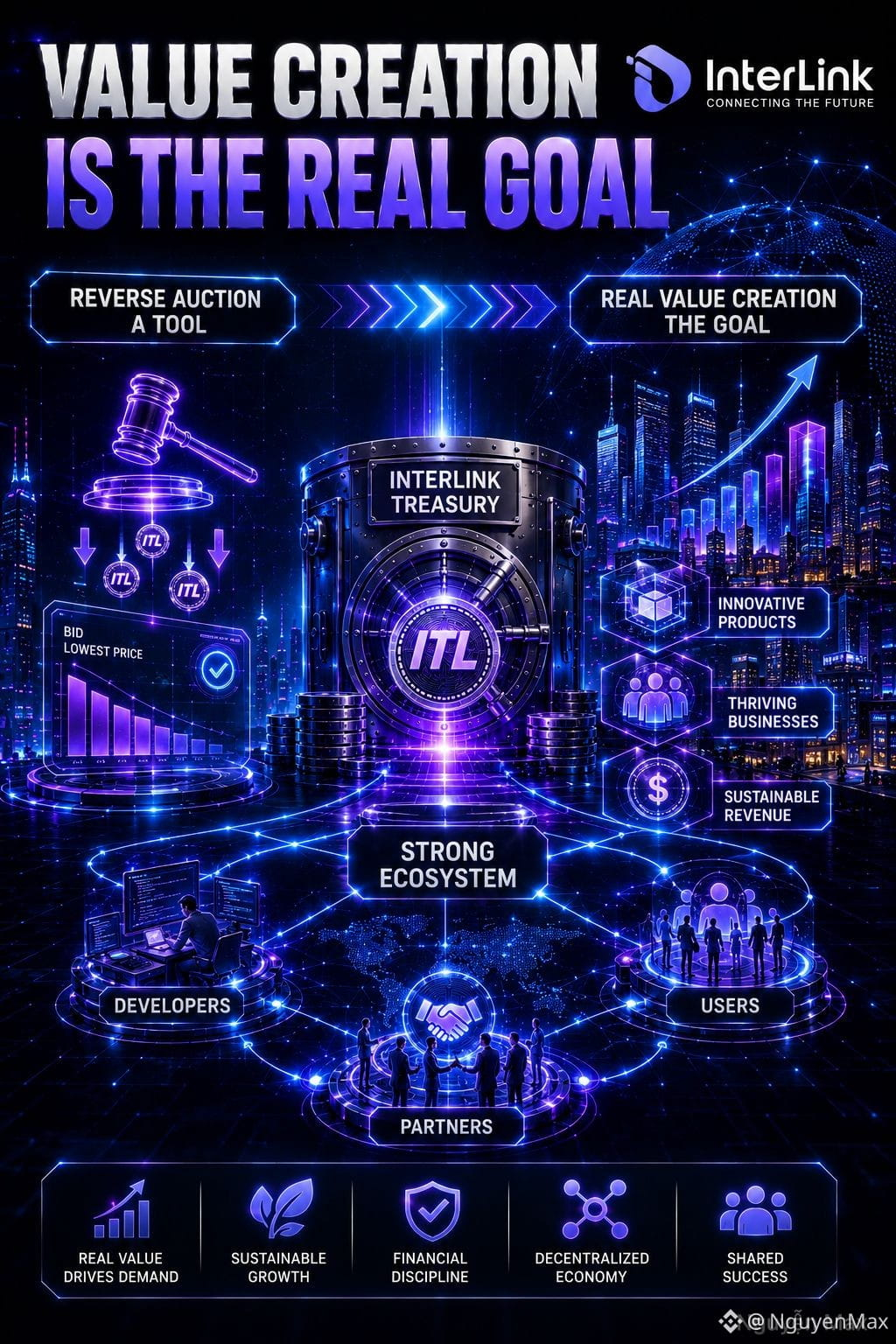
⚖️ Reverse Auction is just a tool; the goal is to create value
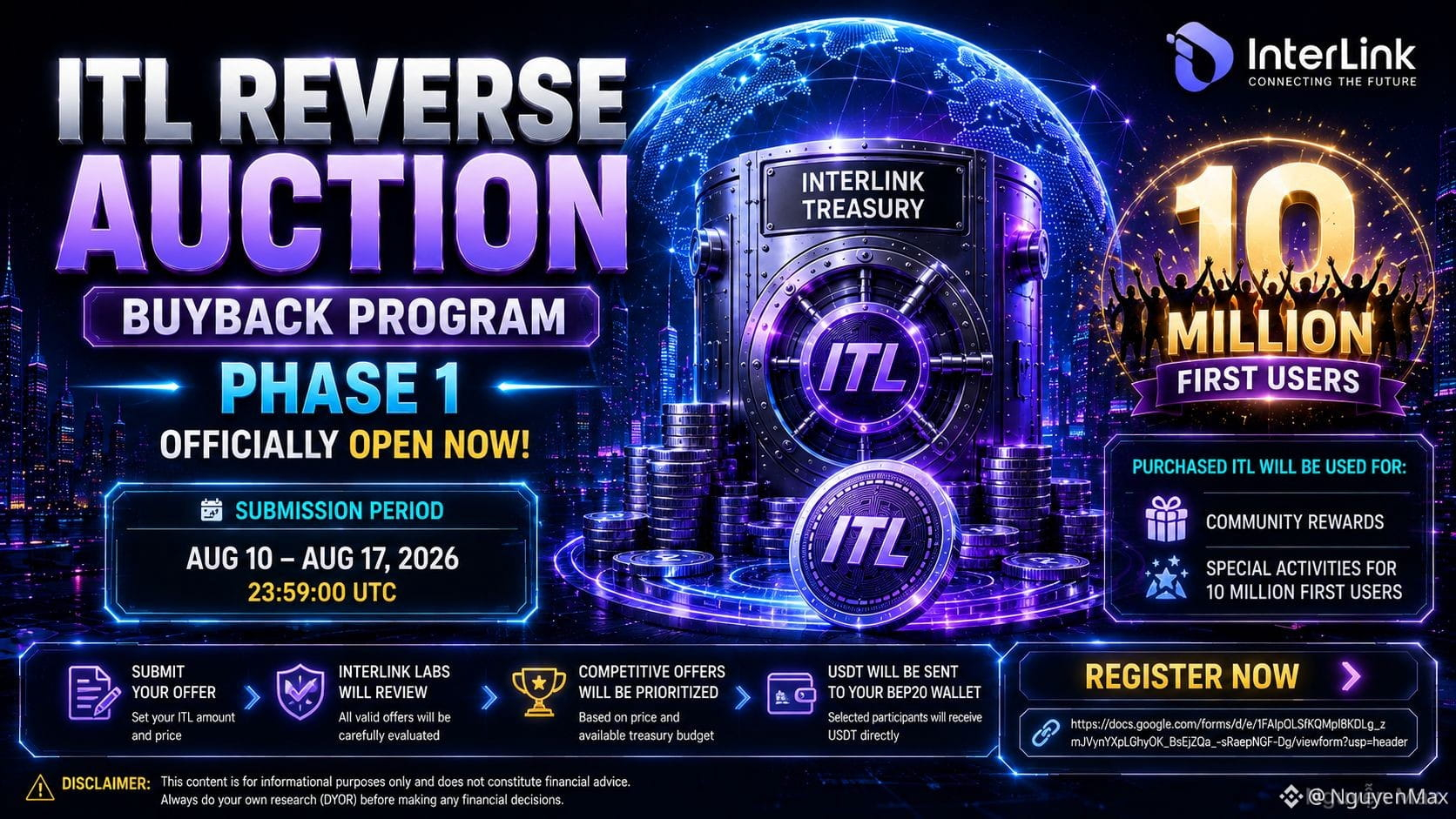
When people talk about Reverse Auction, many often focus only on the ITL buyback mechanism. However, that is only a means, not the end.
What InterLink aims for is to build an ecosystem where organizations worthy of owning ITL do so through the value they create.
That means:
🔹 Developing products with real value.
🔹 Bringing benefits to users and the community.
🔹 Creating sustainable revenue.
🔹 Managing capital with financial discipline.
🔹 Proactively participating in the market to own ITL when expansion is needed.
In this model, Reverse Auction plays the role of a tool supporting treasury management strategy, while the long-term goal remains building a blockchain economy operated by real business activity and real value.
A strong ecosystem is not stronger because it distributes more tokens, but because more organizations create more value.
💬 In your view, what matters more for a blockchain ecosystem: the token management mechanism or the ability to create real value? Share your perspective!
⚠️ Disclaimer: This article is for informational purposes only about the InterLink ecosystem and is not investment advice, an offer to buy or sell, or a financial recommendation. Do your own research (DYOR) and take full responsibility for all your decisions.
$NVDA.US $AAPLB
#InterLink #ITLG #ITL #ValueCreation #DigitalEconomy
When people talk about Reverse Auction, many often focus only on the ITL buyback mechanism. However, that is only a means, not the end.
What InterLink aims for is to build an ecosystem where organizations worthy of owning ITL do so through the value they create.
That means:
🔹 Developing products with real value.
🔹 Bringing benefits to users and the community.
🔹 Creating sustainable revenue.
🔹 Managing capital with financial discipline.
🔹 Proactively participating in the market to own ITL when expansion is needed.
In this model, Reverse Auction plays the role of a tool supporting treasury management strategy, while the long-term goal remains building a blockchain economy operated by real business activity and real value.
A strong ecosystem is not stronger because it distributes more tokens, but because more organizations create more value.
💬 In your view, what matters more for a blockchain ecosystem: the token management mechanism or the ability to create real value? Share your perspective!
⚠️ Disclaimer: This article is for informational purposes only about the InterLink ecosystem and is not investment advice, an offer to buy or sell, or a financial recommendation. Do your own research (DYOR) and take full responsibility for all your decisions.
$NVDA.US $AAPLB
#InterLink #ITLG #ITL #ValueCreation #DigitalEconomy
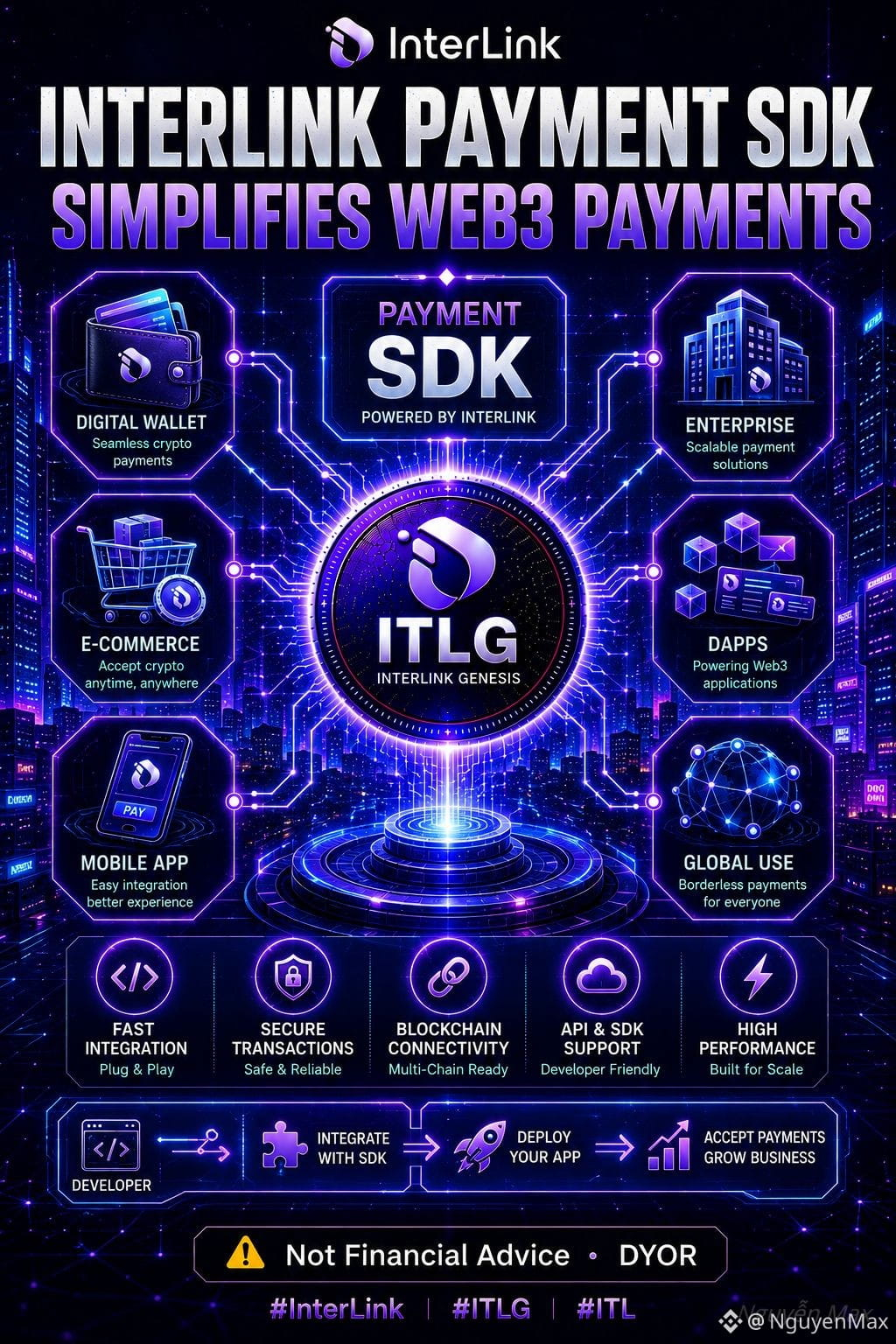
InterLink Payment SDK – Simplifying Web3 Payments
One of the biggest barriers in Web3 is integrating blockchain payments into applications and businesses. This process often requires technical expertise, development time, and the ability to connect with blockchain infrastructure.
Payment SDK (Software Development Kit) is designed to help developers integrate payment functions faster, reduce complexity, and shorten product development time.
Aligned with InterLink’s vision, the InterLink Payment SDK aims to support businesses and developers in building more convenient Web3 payment solutions. The goal is to enable applications to connect with the blockchain through a set of development tools, laying the groundwork for expanding digital services across the ecosystem.
If widely deployed, a Payment SDK can bring many benefits:
Reduce integration time.
Standardize the payment process.
Improve the user experience.
Help businesses access blockchain technology more easily.
Promote the growth of dApps and Web3 services.
For a blockchain ecosystem, providing developer-friendly tools is an important factor in attracting developers and expanding real-world applications.
Lesson 20 will explore how the Payment SDK can help businesses deploy blockchain payments across different industries.
⚠️ Warning: For information sharing purposes only, not investment advice. Do your own research (DYOR) and comply with Vietnamese law when participating in or using crypto assets.
#InterLink #ITLG #ITL
One of the biggest barriers in Web3 is integrating blockchain payments into applications and businesses. This process often requires technical expertise, development time, and the ability to connect with blockchain infrastructure.
Payment SDK (Software Development Kit) is designed to help developers integrate payment functions faster, reduce complexity, and shorten product development time.
Aligned with InterLink’s vision, the InterLink Payment SDK aims to support businesses and developers in building more convenient Web3 payment solutions. The goal is to enable applications to connect with the blockchain through a set of development tools, laying the groundwork for expanding digital services across the ecosystem.
If widely deployed, a Payment SDK can bring many benefits:
Reduce integration time.
Standardize the payment process.
Improve the user experience.
Help businesses access blockchain technology more easily.
Promote the growth of dApps and Web3 services.
For a blockchain ecosystem, providing developer-friendly tools is an important factor in attracting developers and expanding real-world applications.
Lesson 20 will explore how the Payment SDK can help businesses deploy blockchain payments across different industries.
⚠️ Warning: For information sharing purposes only, not investment advice. Do your own research (DYOR) and comply with Vietnamese law when participating in or using crypto assets.
#InterLink #ITLG #ITL
🏛️ Independent Treasury - The Foundation for a Sustainable Ecosystem
A blockchain ecosystem that develops over the long term not only needs advanced technology, but also requires a transparent governance mechanism and independent finance.
In the new strategy, InterLink aims to clearly separate the roles of different organizations within the ecosystem.
🔹 InterLink Foundation focuses on governance, protecting the ecosystem’s long-term interests, and overseeing the use of ITL.
🔹 InterLink Labs focuses on building products, generating revenue, managing its own treasury, and implementing long-term development strategies.
This separation of responsibilities helps:
✅ Increase transparency.
✅ Strengthen accountability.
✅ Establish a system of checks and balances.
✅ Encourage organizations to achieve financial independence step by step, instead of relying on token allocations.
The ultimate goal is to build an ecosystem where each organization grows based on the value it creates, rather than depending on continuous support.
A sustainable blockchain economy starts with organizations capable of self-sufficiency.
💬 In your view, does separating governance from operations help a blockchain ecosystem become more transparent and sustainable? Share your thoughts!
⚠️ Disclaimer: This article is for informational purposes only about the InterLink ecosystem and is not investment advice, an offer to buy or sell, or a financial recommendation. Do your own research (DYOR) and take full responsibility for all of your decisions.
#InterLink #ITLG #ITL #blockchain
A blockchain ecosystem that develops over the long term not only needs advanced technology, but also requires a transparent governance mechanism and independent finance.
In the new strategy, InterLink aims to clearly separate the roles of different organizations within the ecosystem.
🔹 InterLink Foundation focuses on governance, protecting the ecosystem’s long-term interests, and overseeing the use of ITL.
🔹 InterLink Labs focuses on building products, generating revenue, managing its own treasury, and implementing long-term development strategies.
This separation of responsibilities helps:
✅ Increase transparency.
✅ Strengthen accountability.
✅ Establish a system of checks and balances.
✅ Encourage organizations to achieve financial independence step by step, instead of relying on token allocations.
The ultimate goal is to build an ecosystem where each organization grows based on the value it creates, rather than depending on continuous support.
A sustainable blockchain economy starts with organizations capable of self-sufficiency.
💬 In your view, does separating governance from operations help a blockchain ecosystem become more transparent and sustainable? Share your thoughts!
⚠️ Disclaimer: This article is for informational purposes only about the InterLink ecosystem and is not investment advice, an offer to buy or sell, or a financial recommendation. Do your own research (DYOR) and take full responsibility for all of your decisions.
#InterLink #ITLG #ITL #blockchain
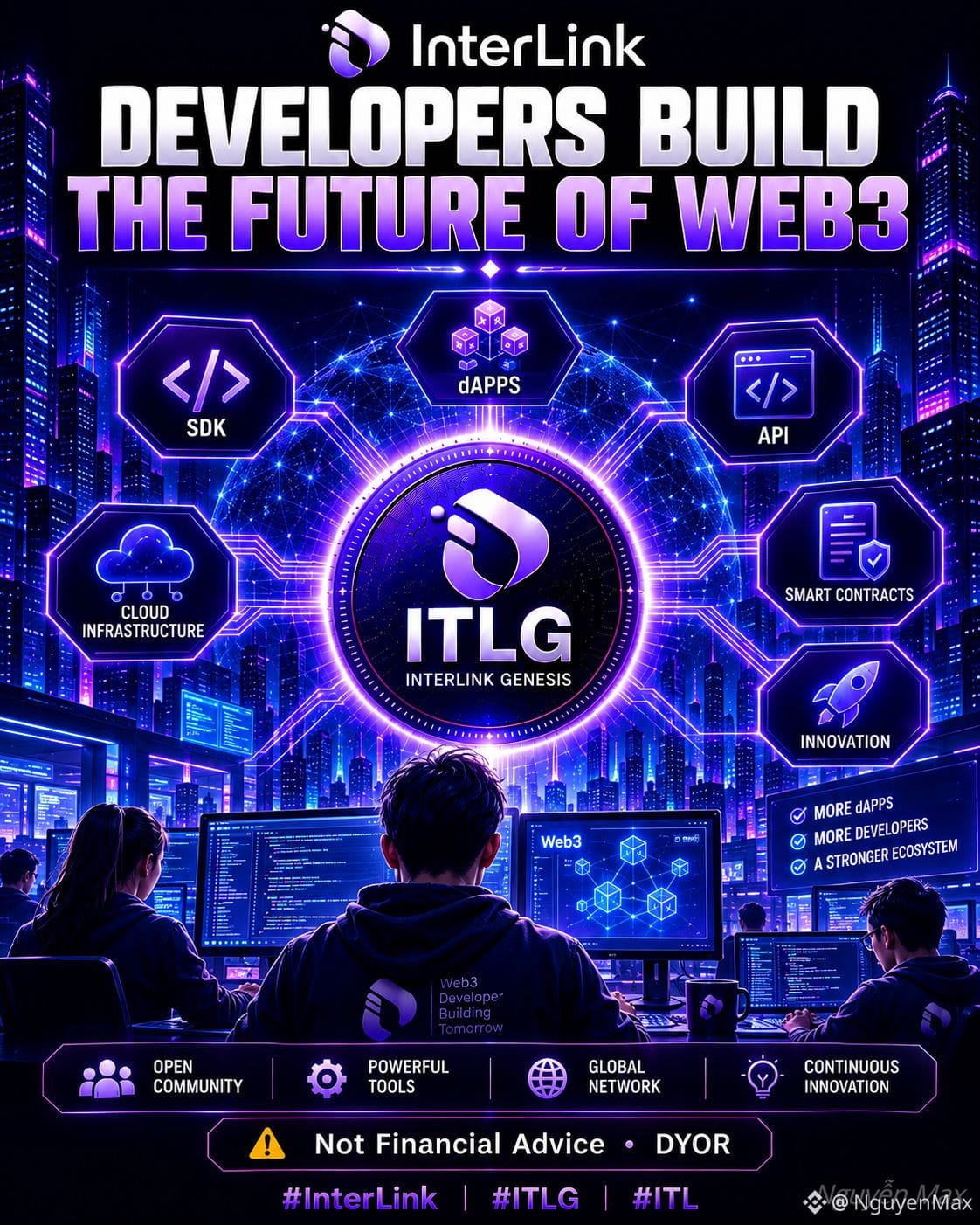
Developer Ecosystem – A Driving Force for InterLink Innovation
A blockchain ecosystem that wants to grow sustainably needs to attract developers. They are the ones who build dApps, tools, and new solutions, helping expand the value of the entire network.
A strong Developer Ecosystem typically includes:
Development toolkits (SDKs, APIs).
Clear technical documentation.
A testing environment.
A supportive community for sharing knowledge.
Opportunities to deploy Web3 applications.
Under InterLink’s direction, the ecosystem is built to support developers in creating dApps and blockchain solutions. When more high-quality applications are deployed, the ecosystem attracts more users, businesses, and partners—creating a positive growth loop.
For the community, the growth of the Developer Ecosystem not only brings more new products, but also helps expand the real-world applicability of blockchain.
The more developers participate in an ecosystem, the higher the potential for innovation and sustainable growth.
Lesson 18 will explore why SDKs and APIs play an important role in helping businesses and programmers build applications on InterLink.
⚠️ Warning: For informational purposes only, not investment advice. Do your own research (DYOR) and comply with Vietnamese law when participating in or using crypto assets.
#InterLink #ITLG #ITL #blockchain #Web3
A blockchain ecosystem that wants to grow sustainably needs to attract developers. They are the ones who build dApps, tools, and new solutions, helping expand the value of the entire network.
A strong Developer Ecosystem typically includes:
Development toolkits (SDKs, APIs).
Clear technical documentation.
A testing environment.
A supportive community for sharing knowledge.
Opportunities to deploy Web3 applications.
Under InterLink’s direction, the ecosystem is built to support developers in creating dApps and blockchain solutions. When more high-quality applications are deployed, the ecosystem attracts more users, businesses, and partners—creating a positive growth loop.
For the community, the growth of the Developer Ecosystem not only brings more new products, but also helps expand the real-world applicability of blockchain.
The more developers participate in an ecosystem, the higher the potential for innovation and sustainable growth.
Lesson 18 will explore why SDKs and APIs play an important role in helping businesses and programmers build applications on InterLink.
⚠️ Warning: For informational purposes only, not investment advice. Do your own research (DYOR) and comply with Vietnamese law when participating in or using crypto assets.
#InterLink #ITLG #ITL #blockchain #Web3
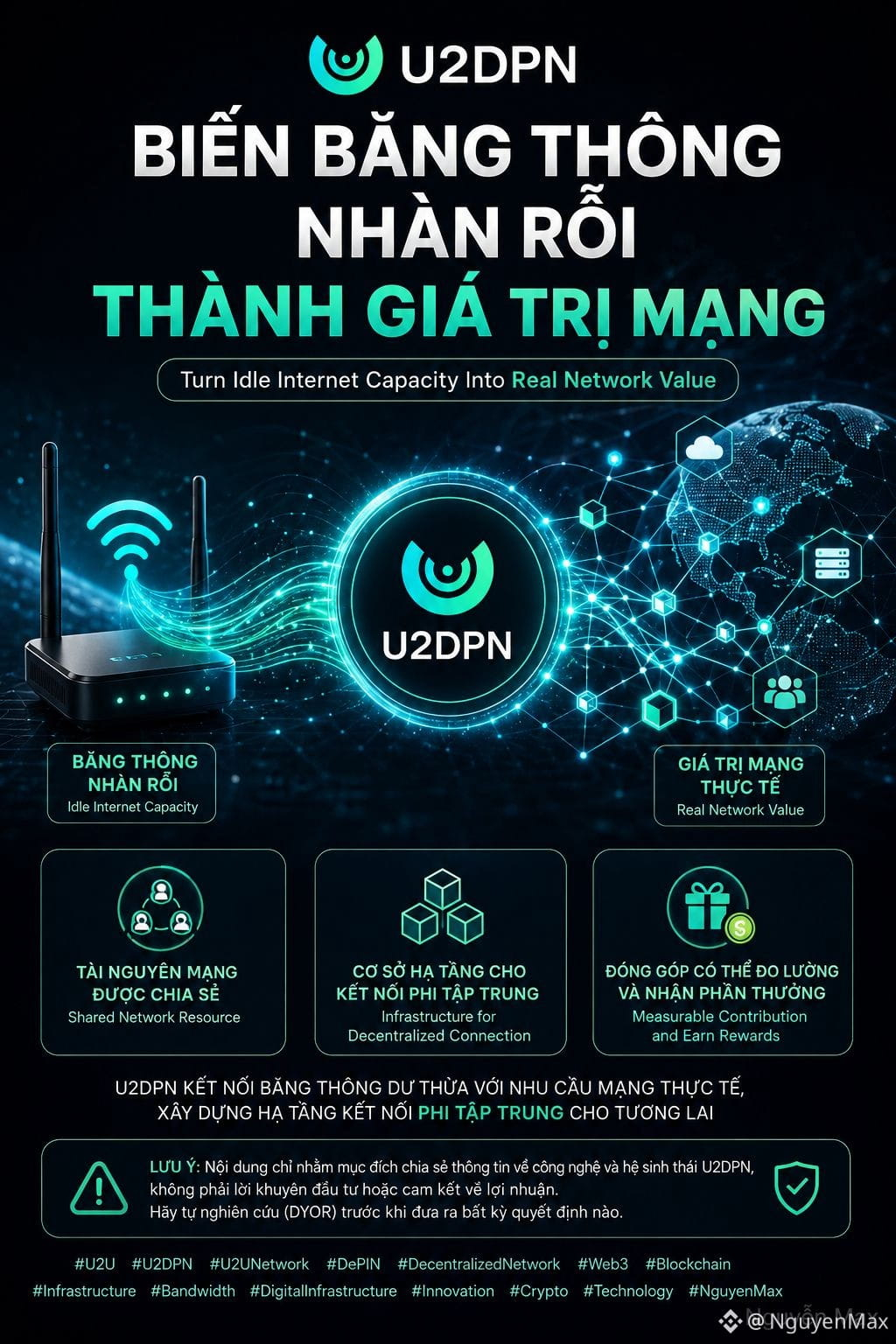
Don’t let unused internet bandwidth become a wasted resource.
Every day, millions of GB of unexploited bandwidth go untapped while global demand for connectivity and data transmission continues to rise without pause.
U2DPN aims to make use of that resource by connecting excess bandwidth with real network needs, helping build a more effective decentralized connectivity infrastructure.
With U2DPN, idle bandwidth can become:
✅ Shared network resources
✅ Infrastructure supporting decentralized connectivity
✅ A contribution source that can be recognized and rewarded when used according to the network’s mechanism
Turn unused bandwidth into real network value with U2DPN.
⚠️ Note: This content is for informational sharing about technology and the U2DPN ecosystem only—not investment advice or any profit guarantee. Do your own research (DYOR) before making any decision.
Source taken from the official U2DPN X channel
#U2U #U2DPN #U2UNetwork #DePIN #Blockchain $NVDAB $NVDA.US
Every day, millions of GB of unexploited bandwidth go untapped while global demand for connectivity and data transmission continues to rise without pause.
U2DPN aims to make use of that resource by connecting excess bandwidth with real network needs, helping build a more effective decentralized connectivity infrastructure.
With U2DPN, idle bandwidth can become:
✅ Shared network resources
✅ Infrastructure supporting decentralized connectivity
✅ A contribution source that can be recognized and rewarded when used according to the network’s mechanism
Turn unused bandwidth into real network value with U2DPN.
⚠️ Note: This content is for informational sharing about technology and the U2DPN ecosystem only—not investment advice or any profit guarantee. Do your own research (DYOR) before making any decision.
Source taken from the official U2DPN X channel
#U2U #U2DPN #U2UNetwork #DePIN #Blockchain $NVDAB $NVDA.US
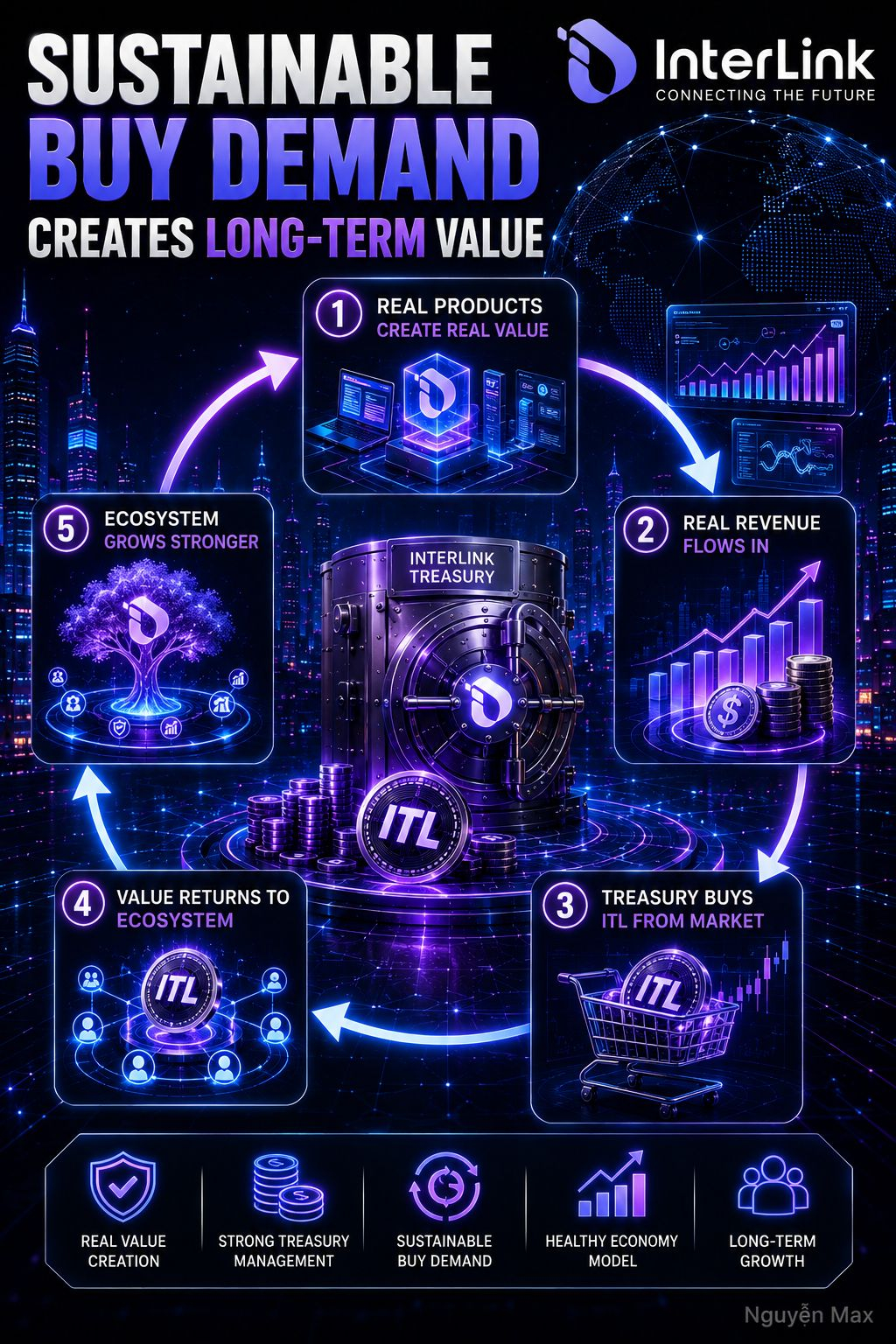
📈 The need for sustainable buying matters more than constant selling pressure
A sustainable blockchain ecosystem requires not only good technology, but also a healthy economic model.
When tokens are continuously distributed to the market, the circulating supply can increase over time and create selling pressure.
InterLink chooses a different approach.
Instead of focusing only on issuing more ITL, the ecosystem aims to channel the value created back to the market through buybacks of ITL.
This creates a positive feedback loop:
💼 Products generate revenue.
💰 Additional revenue goes to the treasury.
🪙 The treasury can buy back ITL from the market.
🌱 Value is reinvested into the ecosystem’s development.
Notably, InterLink Labs is willing to use real capital to buy back ITL, reflecting a long-term development direction and disciplined capital management.
A sustainable ecosystem isn’t built by issuing more tokens, but by creating more value.
💬 In your opinion, what does naturally creating buy demand mean for the long-term growth of a blockchain ecosystem? Share your thoughts!
⚠️ Disclaimer: This article is for information sharing about the InterLink ecosystem only and does not constitute investment advice, an offer to buy or sell, or any financial recommendation. Please do your own research (DYOR) and take responsibility for all your decisions.
#InterLink #ITLG #ITL
A sustainable blockchain ecosystem requires not only good technology, but also a healthy economic model.
When tokens are continuously distributed to the market, the circulating supply can increase over time and create selling pressure.
InterLink chooses a different approach.
Instead of focusing only on issuing more ITL, the ecosystem aims to channel the value created back to the market through buybacks of ITL.
This creates a positive feedback loop:
💼 Products generate revenue.
💰 Additional revenue goes to the treasury.
🪙 The treasury can buy back ITL from the market.
🌱 Value is reinvested into the ecosystem’s development.
Notably, InterLink Labs is willing to use real capital to buy back ITL, reflecting a long-term development direction and disciplined capital management.
A sustainable ecosystem isn’t built by issuing more tokens, but by creating more value.
💬 In your opinion, what does naturally creating buy demand mean for the long-term growth of a blockchain ecosystem? Share your thoughts!
⚠️ Disclaimer: This article is for information sharing about the InterLink ecosystem only and does not constitute investment advice, an offer to buy or sell, or any financial recommendation. Please do your own research (DYOR) and take responsibility for all your decisions.
#InterLink #ITLG #ITL
What is a Validator? Why should the community care?
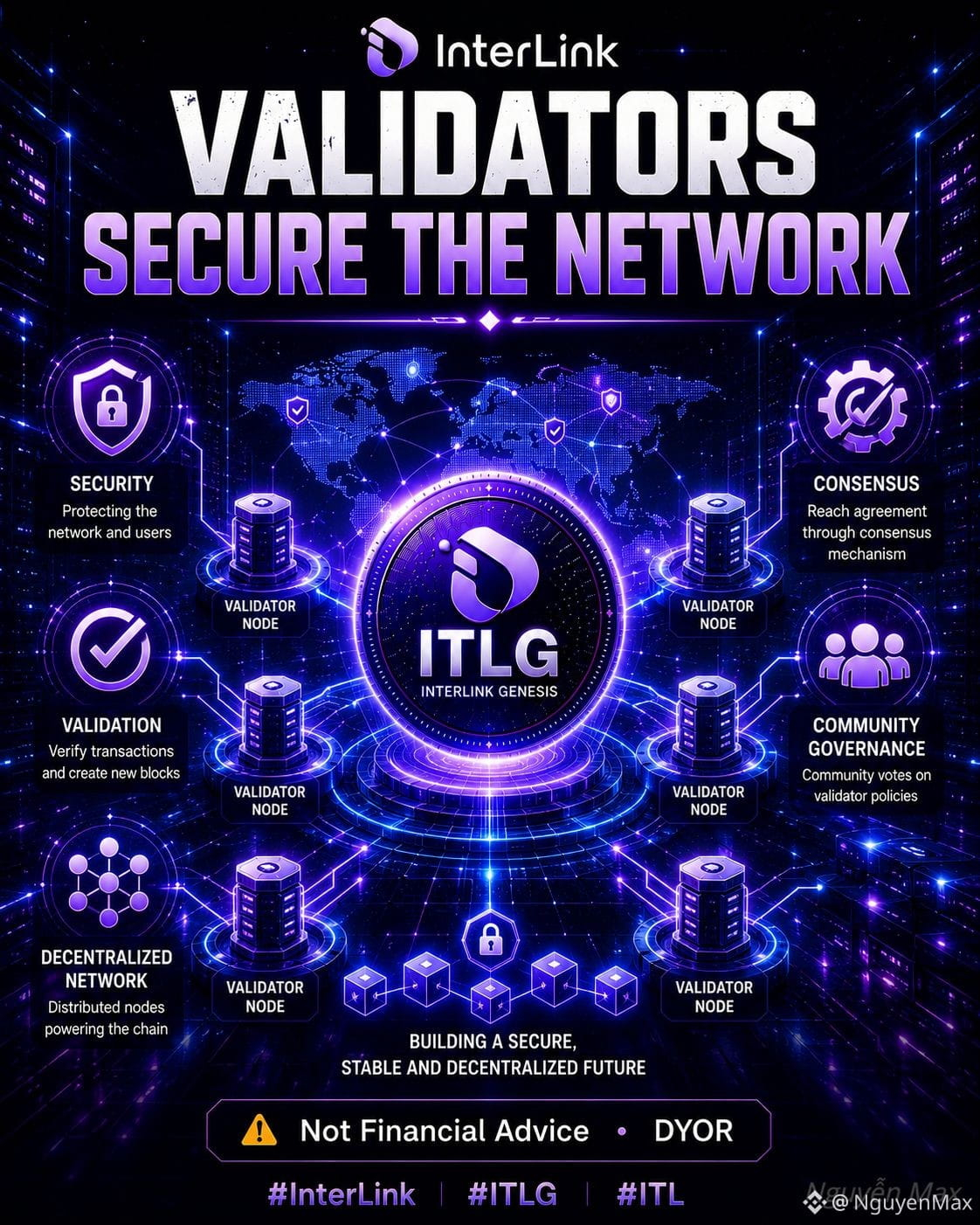
A blockchain can only operate reliably when transactions are verified safely and transparently. That is exactly the role of a Validator.
Validators are network nodes that participate in transaction verification, create new blocks, and help maintain the blockchain’s operations according to the network’s consensus mechanism. Each blockchain has its own standards and process for selecting Validators.
Following InterLink’s direction, ITLG (InterLink Genesis) is designed to support the governance mechanism of the InterLink DAO. In the development roadmap, the community can participate in voting on proposals related to Validator policies, contributing to building a transparent network and sustainable development.
An effective Validator system will help:
Enhance network security.
Maintain stability when processing transactions.
Support decentralization.
Increase community trust in the ecosystem.
A blockchain isn’t built by technology alone—it also relies on coordination between technical infrastructure and community governance mechanisms.
At the end of Topic 2, we learned about DAO, Governance Token, Proposal, Voting, Treasury, and Validator. Topic 3 will begin with the Ecosystem Revenue Sharing mechanism and how value is created within the InterLink ecosystem.
⚠️ Warning: For information-sharing purposes only, not investment advice. Please DYOR and comply with Vietnamese law when participating in or using crypto assets.
Hashtag
#InterLink #ITLG #ITL #blockchain #Web3
A blockchain can only operate reliably when transactions are verified safely and transparently. That is exactly the role of a Validator.
Validators are network nodes that participate in transaction verification, create new blocks, and help maintain the blockchain’s operations according to the network’s consensus mechanism. Each blockchain has its own standards and process for selecting Validators.
Following InterLink’s direction, ITLG (InterLink Genesis) is designed to support the governance mechanism of the InterLink DAO. In the development roadmap, the community can participate in voting on proposals related to Validator policies, contributing to building a transparent network and sustainable development.
An effective Validator system will help:
Enhance network security.
Maintain stability when processing transactions.
Support decentralization.
Increase community trust in the ecosystem.
A blockchain isn’t built by technology alone—it also relies on coordination between technical infrastructure and community governance mechanisms.
At the end of Topic 2, we learned about DAO, Governance Token, Proposal, Voting, Treasury, and Validator. Topic 3 will begin with the Ecosystem Revenue Sharing mechanism and how value is created within the InterLink ecosystem.
⚠️ Warning: For information-sharing purposes only, not investment advice. Please DYOR and comply with Vietnamese law when participating in or using crypto assets.
Hashtag
#InterLink #ITLG #ITL #blockchain #Web3
Log in to explore more content