
溪月 Xīyuè
7.9k Posts

溪月 Xīyuè
Report
Block User
加密分析师 | 市场洞察短期与长期信号 | 比特币、以太坊及其他币种分享实时设置与基于研究的观点 与加密女王👸
Open Trade
Frequent Trader
2.5 Years
787 Following
29.8K+ Followers
4.7K+ Liked
Posts
Portfolio
All
Quotes
Live
·
--
Bullish
Two daily gains above 80% stand out in this group of perpetual markets. The next test is how well those gains hold.
$AKE is trading at $0.061762, up 88.47%, with 996.32M USDT in volume. It leads these three in both percentage gains and trading activity, though that alone doesn’t confirm another move higher.
$ONE is at $0.0032647, up 86.61%, with 425.44M USDT in volume. It’s nearly matching $AKE’s daily performance, making the difference in turnover worth watching without assuming which rally will last.
$ZAMA is trading at $0.08060, up 36.26%. That’s the smallest gain here, but still a sharp advance that I’d give time to settle before chasing.
I’m watching for stability and follow-through. Which one is on your watchlist?
{future}(AKEUSDT)
{future}(ONEUSDT)
{future}(ZAMAUSDT)
#AKE #ONE/USDT #Zama
Two daily gains above 80% stand out in this group of perpetual markets. The next test is how well those gains hold.
$AKE is trading at $0.061762, up 88.47%, with 996.32M USDT in volume. It leads these three in both percentage gains and trading activity, though that alone doesn’t confirm another move higher.
$ONE is at $0.0032647, up 86.61%, with 425.44M USDT in volume. It’s nearly matching $AKE ’s daily performance, making the difference in turnover worth watching without assuming which rally will last.
$ZAMA is trading at $0.08060, up 36.26%. That’s the smallest gain here, but still a sharp advance that I’d give time to settle before chasing.
I’m watching for stability and follow-through. Which one is on your watchlist?
#AKE #ONE/USDT #Zama
$AKE is trading at $0.061762, up 88.47%, with 996.32M USDT in volume. It leads these three in both percentage gains and trading activity, though that alone doesn’t confirm another move higher.
$ONE is at $0.0032647, up 86.61%, with 425.44M USDT in volume. It’s nearly matching $AKE ’s daily performance, making the difference in turnover worth watching without assuming which rally will last.
$ZAMA is trading at $0.08060, up 36.26%. That’s the smallest gain here, but still a sharp advance that I’d give time to settle before chasing.
I’m watching for stability and follow-through. Which one is on your watchlist?
#AKE #ONE/USDT #Zama
Bullish 💚
Bearish♥️
23 hr(s) left
2
1
41
·
--
Bearish
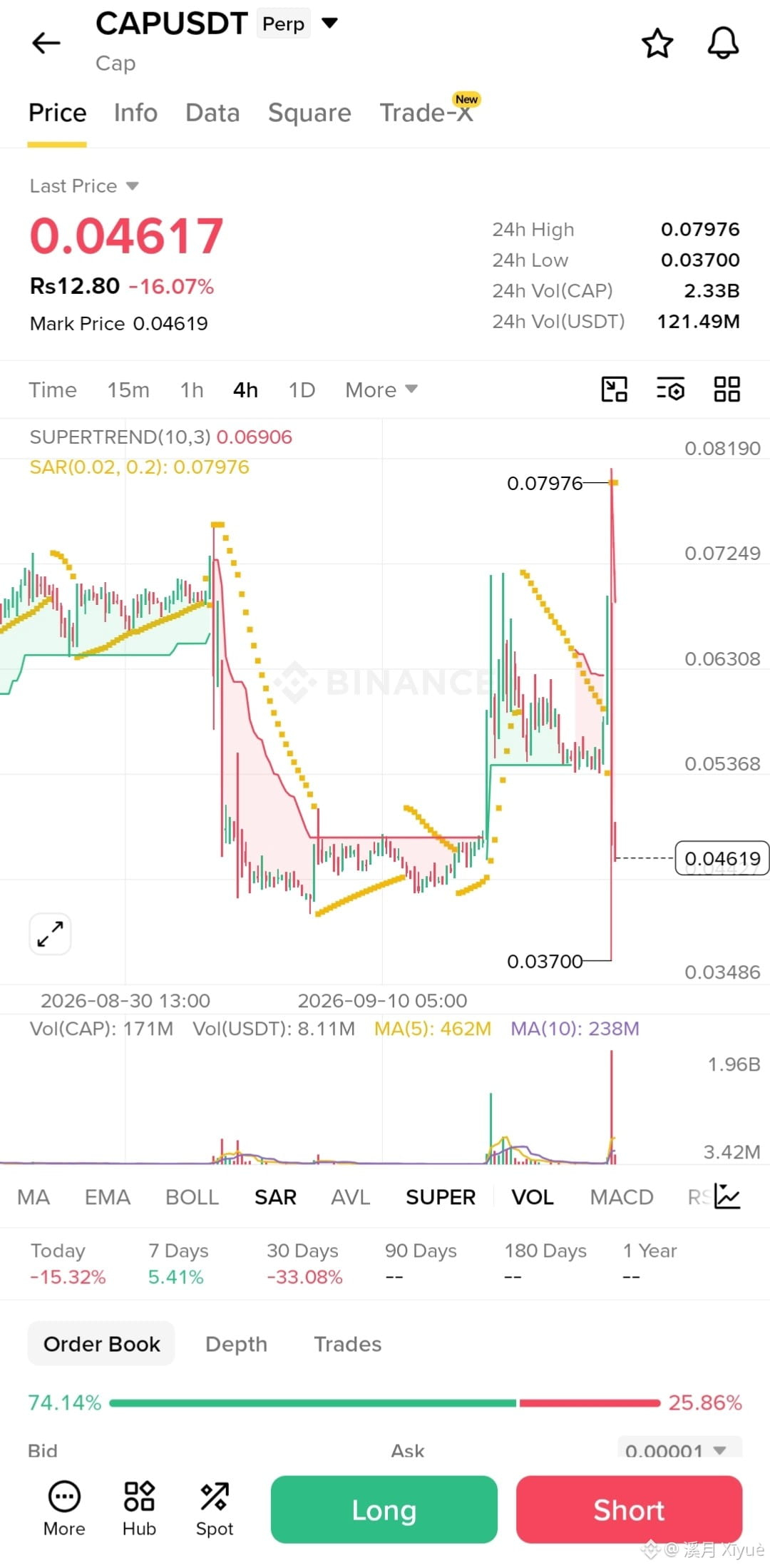
$CAP
That $0.07976 spike got sold almost immediately, and that changes the character of the chart.
Instead of chasing the volatility, I’d treat the failed push and loss of the prior range as the main signal here.
EP
$0.04619–$0.05368
TP
$0.03700
$0.03486
SL
$0.06308
The 4H structure has weakened sharply after rejection from $0.07976, with heavy volume accompanying the selloff. Price is also below the visible Supertrend at $0.06906, while SAR has flipped above price. For a short, I’d prefer a weak rebound that fails around $0.05368 rather than chasing the drop near current levels. Reclaiming $0.06308 would make this bearish setup much less attractive.
Let's go $CAP
{future}(CAPUSDT)
#CAPUSDT
$CAP
That $0.07976 spike got sold almost immediately, and that changes the character of the chart.
Instead of chasing the volatility, I’d treat the failed push and loss of the prior range as the main signal here.
EP
$0.04619–$0.05368
TP
$0.03700
$0.03486
SL
$0.06308
The 4H structure has weakened sharply after rejection from $0.07976, with heavy volume accompanying the selloff. Price is also below the visible Supertrend at $0.06906, while SAR has flipped above price. For a short, I’d prefer a weak rebound that fails around $0.05368 rather than chasing the drop near current levels. Reclaiming $0.06308 would make this bearish setup much less attractive.
Let's go $CAP
#CAPUSDT
That $0.07976 spike got sold almost immediately, and that changes the character of the chart.
Instead of chasing the volatility, I’d treat the failed push and loss of the prior range as the main signal here.
EP
$0.04619–$0.05368
TP
$0.03700
$0.03486
SL
$0.06308
The 4H structure has weakened sharply after rejection from $0.07976, with heavy volume accompanying the selloff. Price is also below the visible Supertrend at $0.06906, while SAR has flipped above price. For a short, I’d prefer a weak rebound that fails around $0.05368 rather than chasing the drop near current levels. Reclaiming $0.06308 would make this bearish setup much less attractive.
Let's go $CAP
#CAPUSDT
1
157
·
--
Bullish
$ZAMA
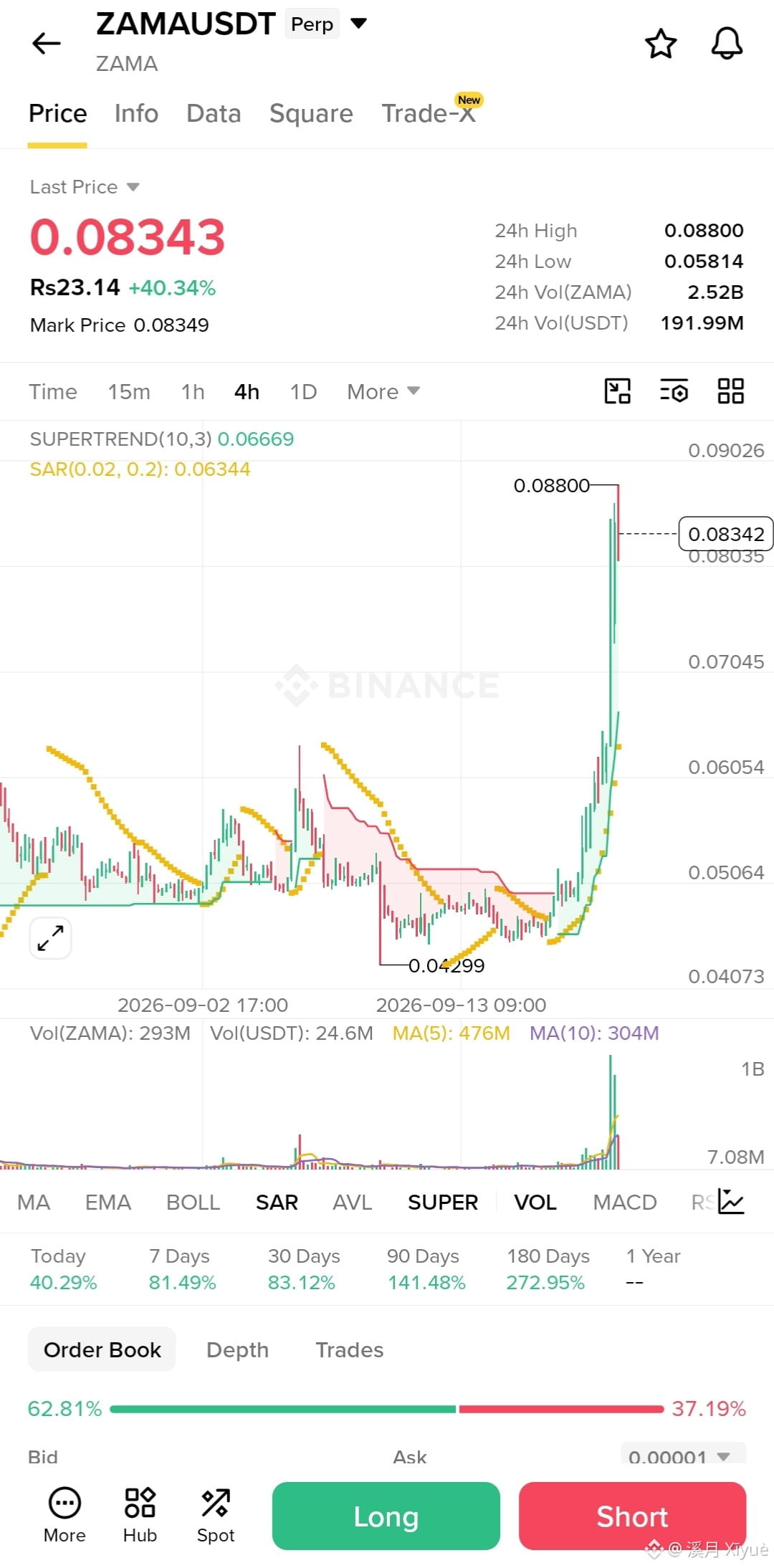
A breakout this vertical can stay strong longer than expected, but it’s also where chasing becomes expensive.
ZAMA has exploded out of its previous range on the 4H chart, with a major volume expansion confirming that this isn’t a quiet move.
EP
$0.08035–$0.08343
TP
$0.08800
$0.09026
SL
$0.07045
The trend remains bullish with Supertrend at $0.06669 and SAR at $0.06344 sitting below price. The immediate problem is the rejection from $0.08800, so I’d want $0.08035 to survive any pullback before trusting another push. A clean break of $0.08800 would reopen continuation, while losing $0.07045 would damage the current breakout structure.
Let's go $ZAMA
{future}(ZAMAUSDT)
$ZAMA
A breakout this vertical can stay strong longer than expected, but it’s also where chasing becomes expensive.
ZAMA has exploded out of its previous range on the 4H chart, with a major volume expansion confirming that this isn’t a quiet move.
EP
$0.08035–$0.08343
TP
$0.08800
$0.09026
SL
$0.07045
The trend remains bullish with Supertrend at $0.06669 and SAR at $0.06344 sitting below price. The immediate problem is the rejection from $0.08800, so I’d want $0.08035 to survive any pullback before trusting another push. A clean break of $0.08800 would reopen continuation, while losing $0.07045 would damage the current breakout structure.
Let's go $ZAMA
A breakout this vertical can stay strong longer than expected, but it’s also where chasing becomes expensive.
ZAMA has exploded out of its previous range on the 4H chart, with a major volume expansion confirming that this isn’t a quiet move.
EP
$0.08035–$0.08343
TP
$0.08800
$0.09026
SL
$0.07045
The trend remains bullish with Supertrend at $0.06669 and SAR at $0.06344 sitting below price. The immediate problem is the rejection from $0.08800, so I’d want $0.08035 to survive any pullback before trusting another push. A clean break of $0.08800 would reopen continuation, while losing $0.07045 would damage the current breakout structure.
Let's go $ZAMA
91
·
--
Bullish
$AKE
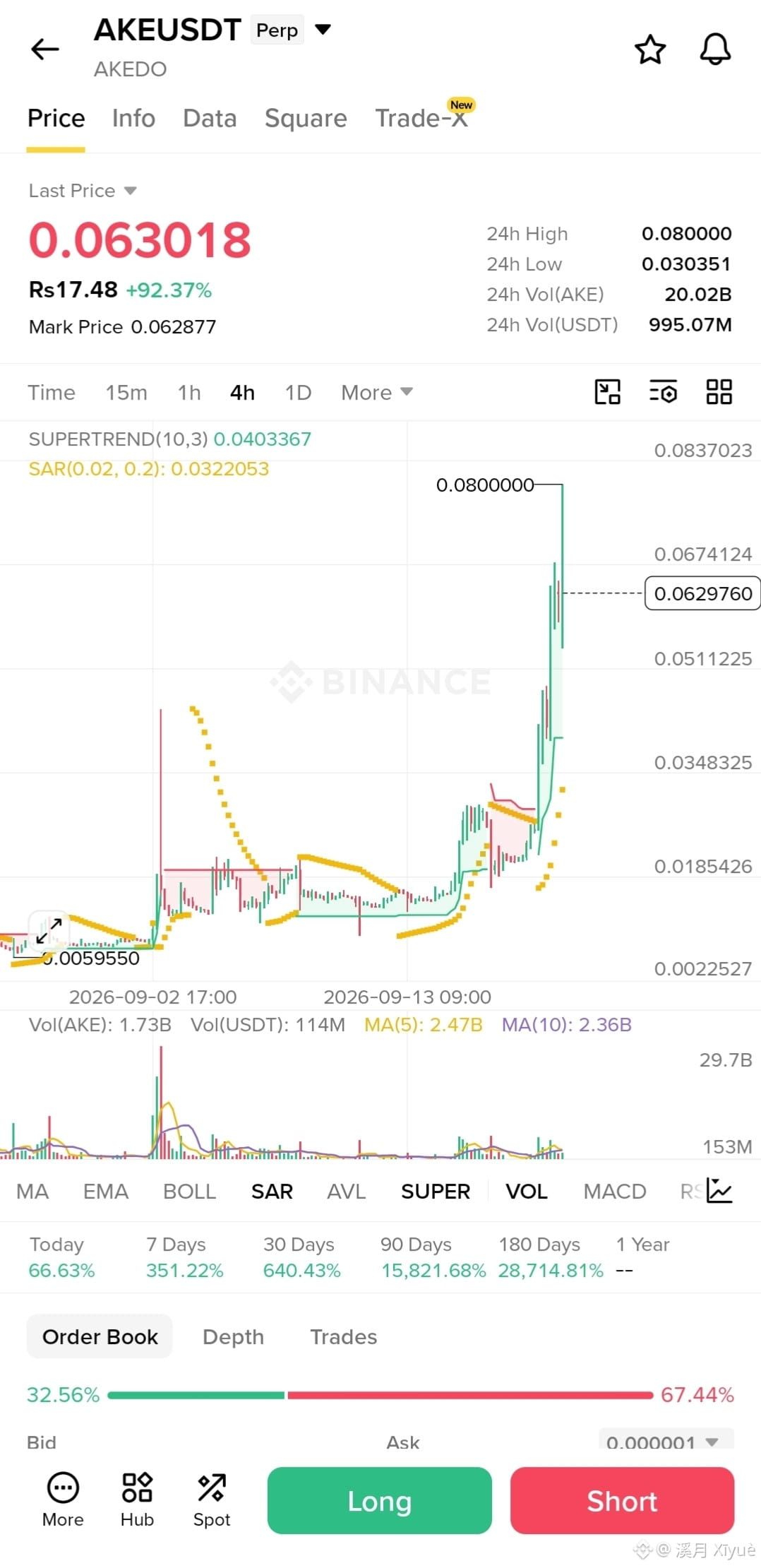
After a near-vertical expansion, protecting the entry matters more than trying to catch every last candle.
AKE is still bullish on the 4H structure, but the rejection from $0.080000 shows how quickly volatility can turn after an extended run.
EP
$0.0511225–$0.063018
TP
$0.0674124
$0.080000
$0.0837023
SL
$0.0403367
Price remains well above the visible Supertrend at $0.0403367 and SAR at $0.0322053, so the broader move hasn't technically broken. The cleaner continuation case would be a controlled hold above $0.0511 followed by a reclaim of $0.0674. Losing the Supertrend would change the structure enough for me to abandon this long idea rather than fight the reversal.
Let's go $AKE
{future}(AKEUSDT)
$AKE
After a near-vertical expansion, protecting the entry matters more than trying to catch every last candle.
AKE is still bullish on the 4H structure, but the rejection from $0.080000 shows how quickly volatility can turn after an extended run.
EP
$0.0511225–$0.063018
TP
$0.0674124
$0.080000
$0.0837023
SL
$0.0403367
Price remains well above the visible Supertrend at $0.0403367 and SAR at $0.0322053, so the broader move hasn't technically broken. The cleaner continuation case would be a controlled hold above $0.0511 followed by a reclaim of $0.0674. Losing the Supertrend would change the structure enough for me to abandon this long idea rather than fight the reversal.
Let's go $AKE
After a near-vertical expansion, protecting the entry matters more than trying to catch every last candle.
AKE is still bullish on the 4H structure, but the rejection from $0.080000 shows how quickly volatility can turn after an extended run.
EP
$0.0511225–$0.063018
TP
$0.0674124
$0.080000
$0.0837023
SL
$0.0403367
Price remains well above the visible Supertrend at $0.0403367 and SAR at $0.0322053, so the broader move hasn't technically broken. The cleaner continuation case would be a controlled hold above $0.0511 followed by a reclaim of $0.0674. Losing the Supertrend would change the structure enough for me to abandon this long idea rather than fight the reversal.
Let's go $AKE
386
·
--
Bullish
$ONE
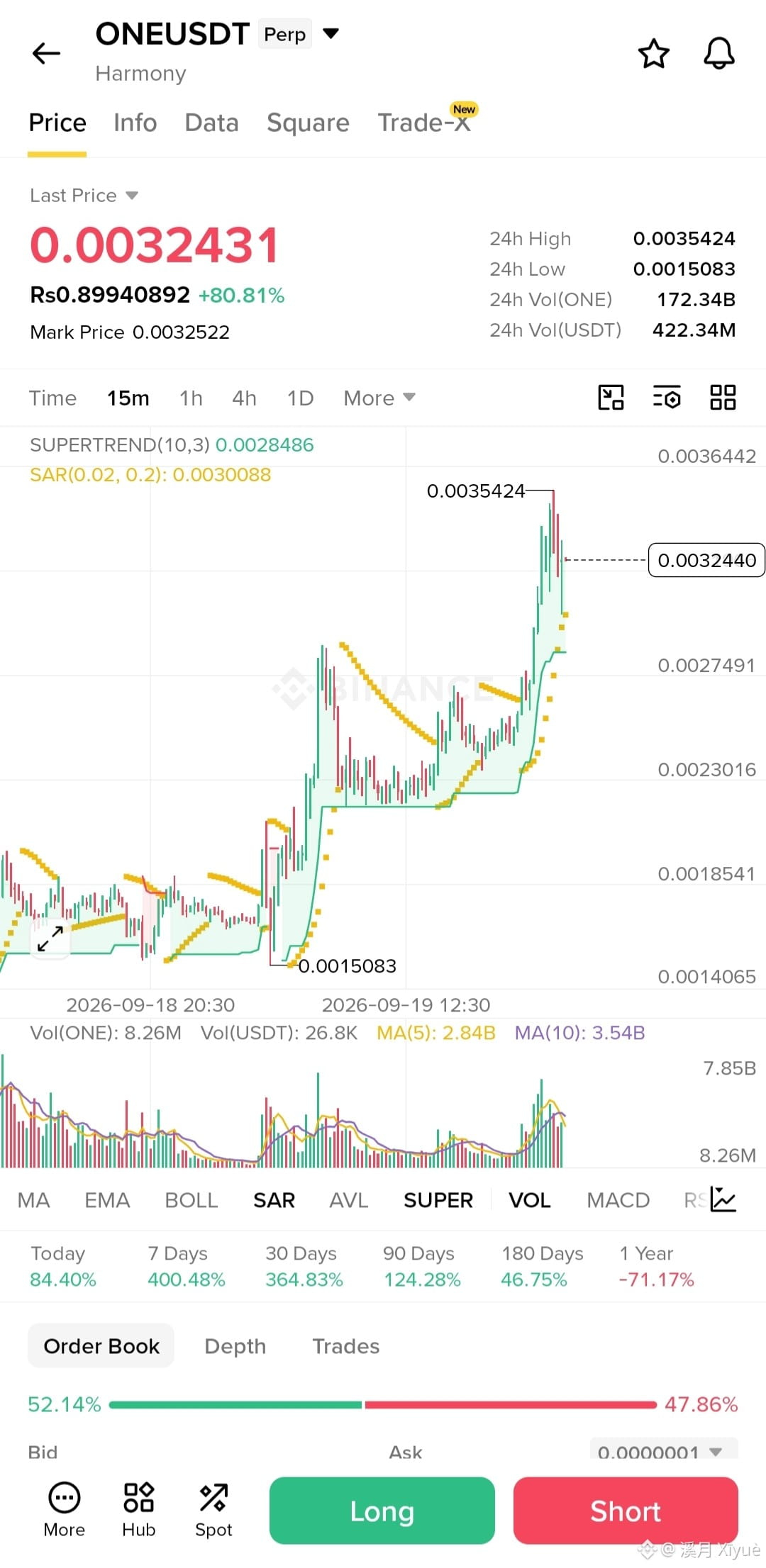
An 80% daily move is exactly where chasing becomes expensive.
The 15m trend is still pointed higher, but rejection from $0.0035424 shows the first serious hesitation after a near-vertical expansion.
entry :$0.0030088–$0.0032440
tp1 : $0.0035424
tp2 : $0.0036442
tp3 : $0.0038408
SL :$0.0028486
ONE remains above both the visible SAR at $0.0030088 and Supertrend at $0.0028486, so the short-term structure hasn't broken yet. I'd rather see the $0.0030 area defended on a pullback before considering continuation. Losing the Supertrend would materially weaken this setup, while clearing $0.0035424 would put the recent high back under buyer control.
Let's go $ONE
#one
{future}(ONEUSDT)
$ONE
An 80% daily move is exactly where chasing becomes expensive.
The 15m trend is still pointed higher, but rejection from $0.0035424 shows the first serious hesitation after a near-vertical expansion.
entry :$0.0030088–$0.0032440
tp1 : $0.0035424
tp2 : $0.0036442
tp3 : $0.0038408
SL :$0.0028486
ONE remains above both the visible SAR at $0.0030088 and Supertrend at $0.0028486, so the short-term structure hasn't broken yet. I'd rather see the $0.0030 area defended on a pullback before considering continuation. Losing the Supertrend would materially weaken this setup, while clearing $0.0035424 would put the recent high back under buyer control.
Let's go $ONE
#one
An 80% daily move is exactly where chasing becomes expensive.
The 15m trend is still pointed higher, but rejection from $0.0035424 shows the first serious hesitation after a near-vertical expansion.
entry :$0.0030088–$0.0032440
tp1 : $0.0035424
tp2 : $0.0036442
tp3 : $0.0038408
SL :$0.0028486
ONE remains above both the visible SAR at $0.0030088 and Supertrend at $0.0028486, so the short-term structure hasn't broken yet. I'd rather see the $0.0030 area defended on a pullback before considering continuation. Losing the Supertrend would materially weaken this setup, while clearing $0.0035424 would put the recent high back under buyer control.
Let's go $ONE
#one
101
·
--
Bullish
Verified
#bojraisesratesto31yearhigh
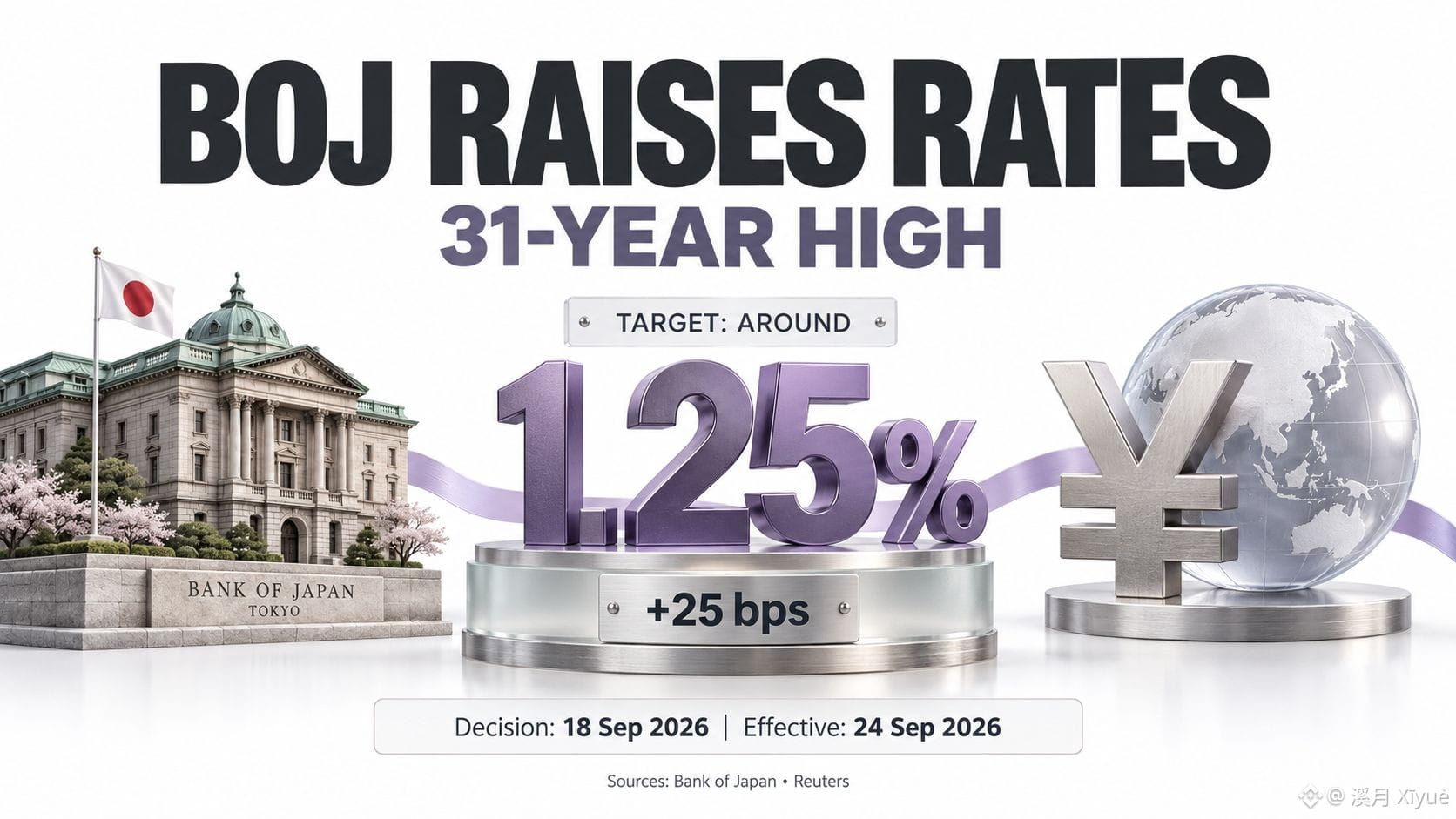
BOJ Raises Rates to a 31-Year High — Why the Yen’s Reaction Matters
Japan has approved another rate increase, putting borrowing costs and global funding conditions back in focus.
On September 18, 2026, the Bank of Japan voted 7–2 to raise its short-term policy-rate target to around 1.25%, effective September 24.
The decision brings the benchmark to its highest level in 31 years.
Yet the yen weakened against the dollar afterward, as signals about further tightening fell short of market expectations. That reaction highlights how much the anticipated path of rates matters.
My take: the potential global impact runs through funding costs, exchange rates and leverage. Investors borrowing yen to purchase other assets face greater pressure if borrowing becomes more expensive and the yen strengthens, increasing the cost of repaying those loans.
However, an announced hike alone cannot establish that these positions are being unwound. The currency’s actual direction, the speed of any move and investors’ positioning all matter.
For crypto, I would watch whether sharp yen appreciation coincides with weaker equities, reduced leverage and sustained selling in BTC or ETH. That combination would warrant closer scrutiny, although simultaneous moves would still require evidence before assigning a cause.
What are you watching most closely after this decision: the yen, bond yields or crypto leverage?
#BOJRaisesRatesTo31YearHigh #BankOfJapan #Macro
$AKE $ONE $AR
{future}(ARUSDT)
{future}(ONEUSDT)
{future}(AKEUSDT)
#bojraisesratesto31yearhigh
BOJ Raises Rates to a 31-Year High — Why the Yen’s Reaction Matters
Japan has approved another rate increase, putting borrowing costs and global funding conditions back in focus.
On September 18, 2026, the Bank of Japan voted 7–2 to raise its short-term policy-rate target to around 1.25%, effective September 24.
The decision brings the benchmark to its highest level in 31 years.
Yet the yen weakened against the dollar afterward, as signals about further tightening fell short of market expectations. That reaction highlights how much the anticipated path of rates matters.
My take: the potential global impact runs through funding costs, exchange rates and leverage. Investors borrowing yen to purchase other assets face greater pressure if borrowing becomes more expensive and the yen strengthens, increasing the cost of repaying those loans.
However, an announced hike alone cannot establish that these positions are being unwound. The currency’s actual direction, the speed of any move and investors’ positioning all matter.
For crypto, I would watch whether sharp yen appreciation coincides with weaker equities, reduced leverage and sustained selling in BTC or ETH. That combination would warrant closer scrutiny, although simultaneous moves would still require evidence before assigning a cause.
What are you watching most closely after this decision: the yen, bond yields or crypto leverage?
#BOJRaisesRatesTo31YearHigh #BankOfJapan #Macro
$AKE $ONE $AR
BOJ Raises Rates to a 31-Year High — Why the Yen’s Reaction Matters
Japan has approved another rate increase, putting borrowing costs and global funding conditions back in focus.
On September 18, 2026, the Bank of Japan voted 7–2 to raise its short-term policy-rate target to around 1.25%, effective September 24.
The decision brings the benchmark to its highest level in 31 years.
Yet the yen weakened against the dollar afterward, as signals about further tightening fell short of market expectations. That reaction highlights how much the anticipated path of rates matters.
My take: the potential global impact runs through funding costs, exchange rates and leverage. Investors borrowing yen to purchase other assets face greater pressure if borrowing becomes more expensive and the yen strengthens, increasing the cost of repaying those loans.
However, an announced hike alone cannot establish that these positions are being unwound. The currency’s actual direction, the speed of any move and investors’ positioning all matter.
For crypto, I would watch whether sharp yen appreciation coincides with weaker equities, reduced leverage and sustained selling in BTC or ETH. That combination would warrant closer scrutiny, although simultaneous moves would still require evidence before assigning a cause.
What are you watching most closely after this decision: the yen, bond yields or crypto leverage?
#BOJRaisesRatesTo31YearHigh #BankOfJapan #Macro
$AKE $ONE $AR
4
3.7k
·
--
Bullish
Verified
#buffettstepsdownasberkshirechairman
Buffett Steps Down as Berkshire Chairman — The Next Test Is Execution
Berkshire Hathaway’s succession has reached another major milestone.
On September 18, 2026, the company announced that Warren Buffett became chairman emeritus, effective immediately, while remaining a director. Its board elected Howard Buffett as chairman, with Greg Abel continuing as CEO.
Buffett’s shareholder letter clearly separates the responsibilities: Abel runs the business, while Howard is tasked with preserving Berkshire’s culture and values.
My take: investors now have a clearer framework for judging the transition. The important questions concern how management allocates capital, how the board scrutinizes major decisions, and whether Berkshire maintains discipline when attractive opportunities are scarce.
An orderly handover can reduce uncertainty around responsibilities. Building confidence over time requires good decisions on acquisitions, reinvestment and shareholder returns. A familiar name at the board’s head cannot replace that evidence.
Preserving the culture also means making difficult choices: rejecting overpriced deals, acknowledging mistakes and balancing managers’ independence with effective oversight. These habits become particularly valuable when markets put pressure on companies to act quickly.
Future earnings reports and major investment decisions will offer practical evidence of how the new leadership arrangement works. The succession announcement establishes who is responsible; execution will determine the results.
Which decision will you watch most closely in Berkshire’s next chapter?
#BuffettStepsDownAsBerkshireChairman #BerkshireHathaway #Investing
{future}(AKEUSDT)
$AKE $ONE $AR
{future}(ARUSDT)
{future}(ONEUSDT)
#buffettstepsdownasberkshirechairman
Buffett Steps Down as Berkshire Chairman — The Next Test Is Execution
Berkshire Hathaway’s succession has reached another major milestone.
On September 18, 2026, the company announced that Warren Buffett became chairman emeritus, effective immediately, while remaining a director. Its board elected Howard Buffett as chairman, with Greg Abel continuing as CEO.
Buffett’s shareholder letter clearly separates the responsibilities: Abel runs the business, while Howard is tasked with preserving Berkshire’s culture and values.
My take: investors now have a clearer framework for judging the transition. The important questions concern how management allocates capital, how the board scrutinizes major decisions, and whether Berkshire maintains discipline when attractive opportunities are scarce.
An orderly handover can reduce uncertainty around responsibilities. Building confidence over time requires good decisions on acquisitions, reinvestment and shareholder returns. A familiar name at the board’s head cannot replace that evidence.
Preserving the culture also means making difficult choices: rejecting overpriced deals, acknowledging mistakes and balancing managers’ independence with effective oversight. These habits become particularly valuable when markets put pressure on companies to act quickly.
Future earnings reports and major investment decisions will offer practical evidence of how the new leadership arrangement works. The succession announcement establishes who is responsible; execution will determine the results.
Which decision will you watch most closely in Berkshire’s next chapter?
#BuffettStepsDownAsBerkshireChairman #BerkshireHathaway #Investing
$AKE $ONE $AR
Buffett Steps Down as Berkshire Chairman — The Next Test Is Execution
Berkshire Hathaway’s succession has reached another major milestone.
On September 18, 2026, the company announced that Warren Buffett became chairman emeritus, effective immediately, while remaining a director. Its board elected Howard Buffett as chairman, with Greg Abel continuing as CEO.
Buffett’s shareholder letter clearly separates the responsibilities: Abel runs the business, while Howard is tasked with preserving Berkshire’s culture and values.
My take: investors now have a clearer framework for judging the transition. The important questions concern how management allocates capital, how the board scrutinizes major decisions, and whether Berkshire maintains discipline when attractive opportunities are scarce.
An orderly handover can reduce uncertainty around responsibilities. Building confidence over time requires good decisions on acquisitions, reinvestment and shareholder returns. A familiar name at the board’s head cannot replace that evidence.
Preserving the culture also means making difficult choices: rejecting overpriced deals, acknowledging mistakes and balancing managers’ independence with effective oversight. These habits become particularly valuable when markets put pressure on companies to act quickly.
Future earnings reports and major investment decisions will offer practical evidence of how the new leadership arrangement works. The succession announcement establishes who is responsible; execution will determine the results.
Which decision will you watch most closely in Berkshire’s next chapter?
#BuffettStepsDownAsBerkshireChairman #BerkshireHathaway #Investing
$AKE $ONE $AR

1.5k
·
--
Bullish
#xrpexchangereserveshitsevenyearlow
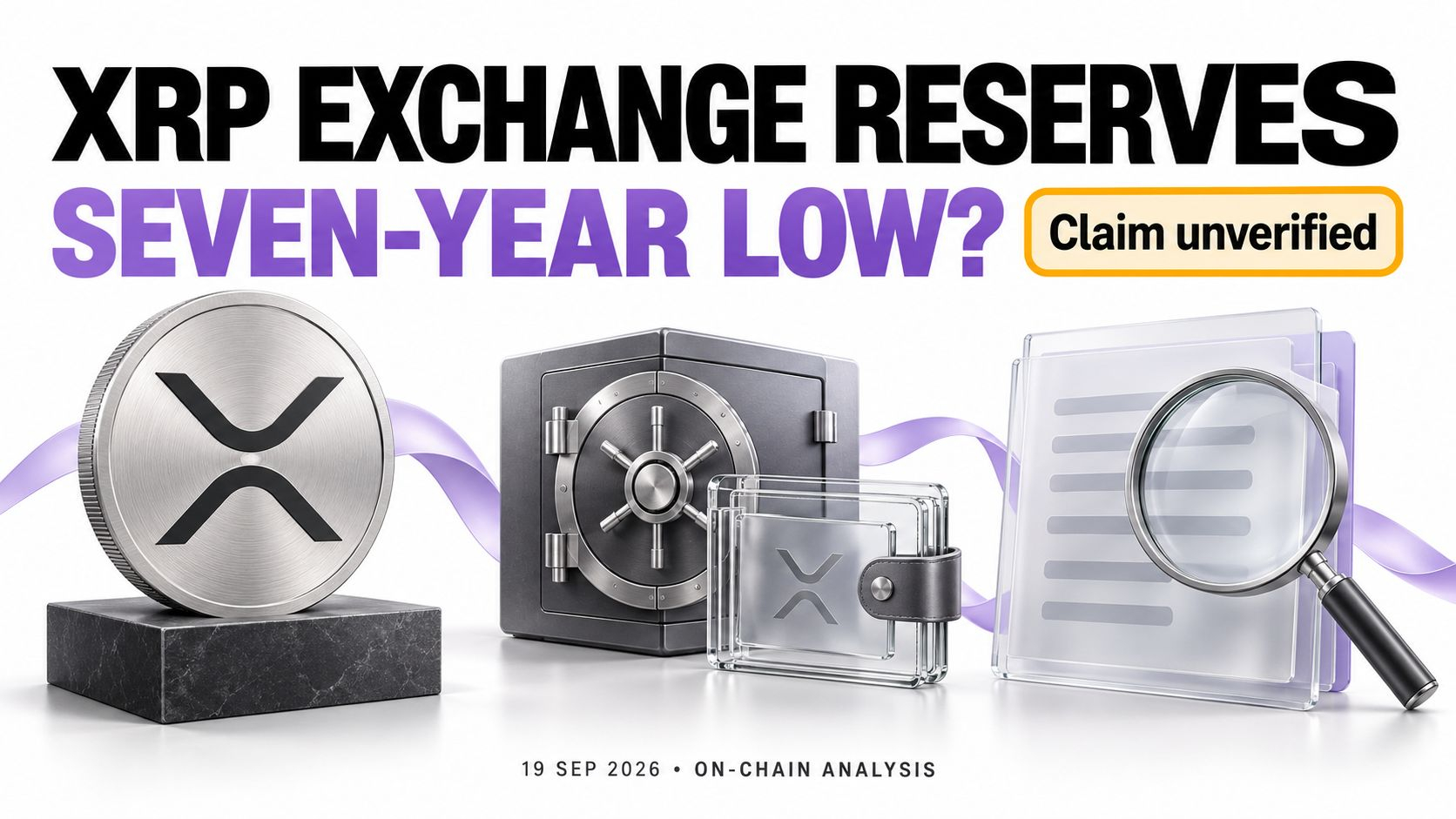
XRP Exchange Reserves at a Seven-Year Low? Here’s What Would Matter
A seven-year-low claim is circulating on Binance Square, putting XRP’s exchange balances in focus. I couldn’t independently verify the historical dataset or exchange coverage behind that claim, so it remains unconfirmed.
Exchange reserves measure coins held in exchange-controlled addresses. They help track where assets sit, but they don’t directly measure how many tokens holders intend to sell.
My take: a confirmed decline would deserve attention, especially if withdrawals persist across several exchanges while spot buying strengthens. That combination could support a stronger case for reduced selling pressure.
But moving XRP between wallets doesn’t remove it from circulation. Transfers could reflect self-custody, custody arrangements or changes in how exchange addresses are identified. A falling balance alone cannot establish whale accumulation or institutional buying.
The next useful checks are the destination wallets, consistent exchange coverage and whether withdrawals continue over time. Actual order-book depth also matters: reserve balances and liquidity available at a particular price measure different things.
Even a verified seven-year low would be one part of the picture. Buyers still need to absorb selling, and withdrawn tokens can return to exchanges.
What would strengthen your confidence more: sustained withdrawals or stronger spot buying?
#XRPExchangeReservesHitSevenYearLow #xrp #OnChainAnalysis
$AKE $XRP $ONE
{future}(ONEUSDT)
{future}(XRPUSDT)
{future}(AKEUSDT)
#xrpexchangereserveshitsevenyearlow
XRP Exchange Reserves at a Seven-Year Low? Here’s What Would Matter
A seven-year-low claim is circulating on Binance Square, putting XRP’s exchange balances in focus. I couldn’t independently verify the historical dataset or exchange coverage behind that claim, so it remains unconfirmed.
Exchange reserves measure coins held in exchange-controlled addresses. They help track where assets sit, but they don’t directly measure how many tokens holders intend to sell.
My take: a confirmed decline would deserve attention, especially if withdrawals persist across several exchanges while spot buying strengthens. That combination could support a stronger case for reduced selling pressure.
But moving XRP between wallets doesn’t remove it from circulation. Transfers could reflect self-custody, custody arrangements or changes in how exchange addresses are identified. A falling balance alone cannot establish whale accumulation or institutional buying.
The next useful checks are the destination wallets, consistent exchange coverage and whether withdrawals continue over time. Actual order-book depth also matters: reserve balances and liquidity available at a particular price measure different things.
Even a verified seven-year low would be one part of the picture. Buyers still need to absorb selling, and withdrawn tokens can return to exchanges.
What would strengthen your confidence more: sustained withdrawals or stronger spot buying?
#XRPExchangeReservesHitSevenYearLow #xrp #OnChainAnalysis
$AKE $XRP $ONE
XRP Exchange Reserves at a Seven-Year Low? Here’s What Would Matter
A seven-year-low claim is circulating on Binance Square, putting XRP’s exchange balances in focus. I couldn’t independently verify the historical dataset or exchange coverage behind that claim, so it remains unconfirmed.
Exchange reserves measure coins held in exchange-controlled addresses. They help track where assets sit, but they don’t directly measure how many tokens holders intend to sell.
My take: a confirmed decline would deserve attention, especially if withdrawals persist across several exchanges while spot buying strengthens. That combination could support a stronger case for reduced selling pressure.
But moving XRP between wallets doesn’t remove it from circulation. Transfers could reflect self-custody, custody arrangements or changes in how exchange addresses are identified. A falling balance alone cannot establish whale accumulation or institutional buying.
The next useful checks are the destination wallets, consistent exchange coverage and whether withdrawals continue over time. Actual order-book depth also matters: reserve balances and liquidity available at a particular price measure different things.
Even a verified seven-year low would be one part of the picture. Buyers still need to absorb selling, and withdrawn tokens can return to exchanges.
What would strengthen your confidence more: sustained withdrawals or stronger spot buying?
#XRPExchangeReservesHitSevenYearLow #xrp #OnChainAnalysis
$AKE $XRP $ONE
2
2.7k
·
--
🎙️ "Billionfold Golden Dog: Episode 130": "People's Daily Commentary: The best meme in history, the greatest meme on the internet—love you, Old Yi." Starts at 22:00 Beijing time. Welcome to follow

End
02 h 47 m 47 s
627
3
6
·
--
Bullish
#EthereumReclaims$2600
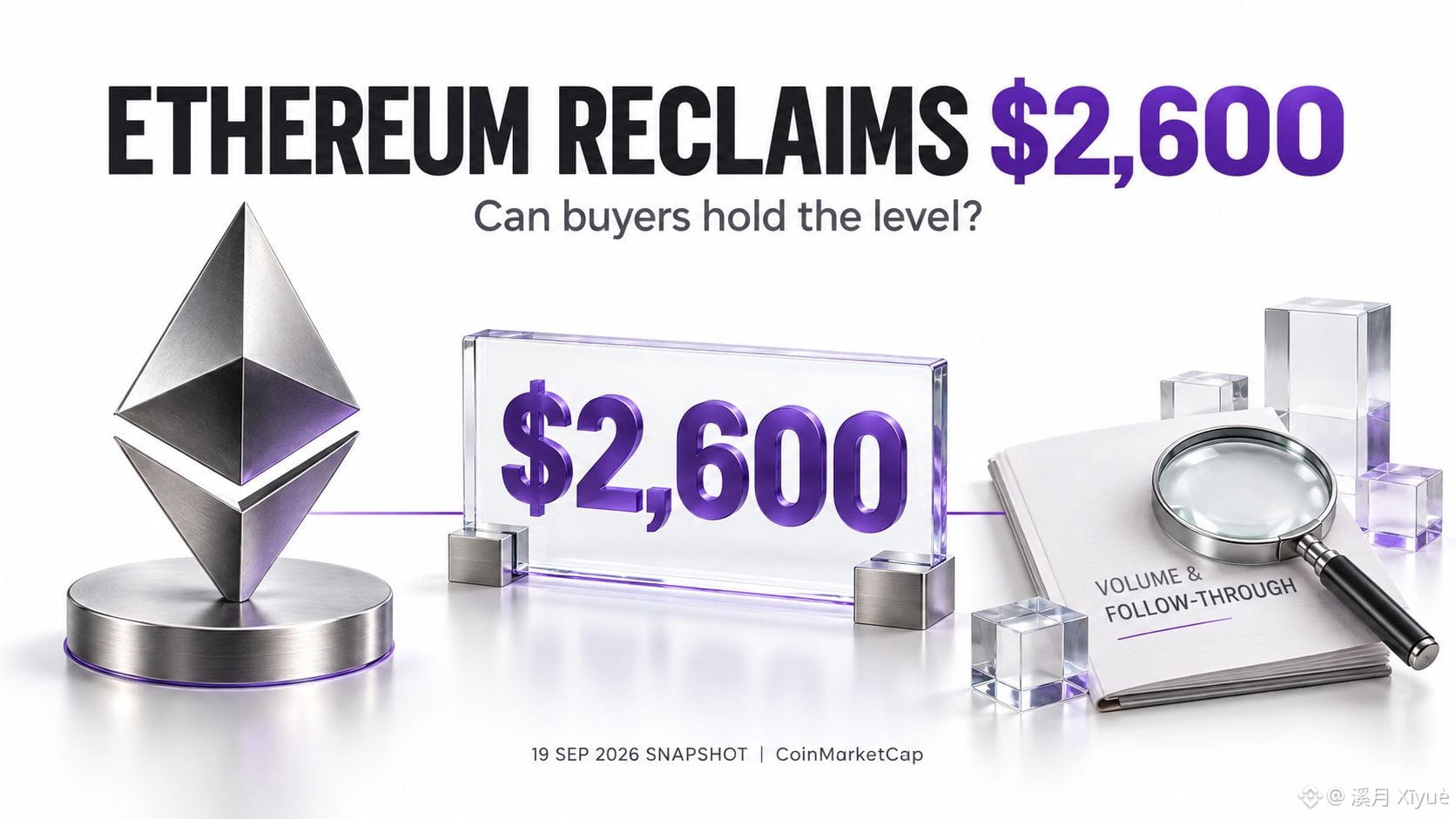
Ethereum Reclaims $2,600 — Holding It Is the Next Test
ETH is back above $2,600, giving traders a clear reference point for judging the recovery.
In a September 19, 2026 snapshot, CoinMarketCap quoted ETH around $2,640, up approximately 5.6% over 24 hours. Reported trading volume was roughly $19.93 billion, with a 24-hour price range of approximately $2,493–$2,658. These figures reflect a market snapshot and will change.
My take: $2,600 becomes more useful if buyers defend it during a pullback. A retest followed by sustained trading above that level would strengthen the recovery case. Repeated moves back below it would make the reclaim less convincing.
ETH was already trading near the upper end of its reported daily range, making the response to selling pressure worth watching. If buyers absorb that pressure without quickly surrendering the recovered level, the move would have more substance.
The volume figure also needs context: turnover alone cannot establish whether fresh spot demand or leveraged positioning is driving the advance.
Before calling this a broader trend change, I would look for strength across several sessions and check whether ETH also gains against Bitcoin. That would provide more evidence than one price threshold being crossed.
What would convince you more: a successful $2,600 retest or another strong daily close?
#Ethereum #ETH
$AKE $ETH $B2
{future}(B2USDT)
{future}(ETHUSDT)
{future}(AKEUSDT)
#EthereumReclaims$2600
Ethereum Reclaims $2,600 — Holding It Is the Next Test
ETH is back above $2,600, giving traders a clear reference point for judging the recovery.
In a September 19, 2026 snapshot, CoinMarketCap quoted ETH around $2,640, up approximately 5.6% over 24 hours. Reported trading volume was roughly $19.93 billion, with a 24-hour price range of approximately $2,493–$2,658. These figures reflect a market snapshot and will change.
My take: $2,600 becomes more useful if buyers defend it during a pullback. A retest followed by sustained trading above that level would strengthen the recovery case. Repeated moves back below it would make the reclaim less convincing.
ETH was already trading near the upper end of its reported daily range, making the response to selling pressure worth watching. If buyers absorb that pressure without quickly surrendering the recovered level, the move would have more substance.
The volume figure also needs context: turnover alone cannot establish whether fresh spot demand or leveraged positioning is driving the advance.
Before calling this a broader trend change, I would look for strength across several sessions and check whether ETH also gains against Bitcoin. That would provide more evidence than one price threshold being crossed.
What would convince you more: a successful $2,600 retest or another strong daily close?
#Ethereum #ETH
$AKE $ETH $B2
Ethereum Reclaims $2,600 — Holding It Is the Next Test
ETH is back above $2,600, giving traders a clear reference point for judging the recovery.
In a September 19, 2026 snapshot, CoinMarketCap quoted ETH around $2,640, up approximately 5.6% over 24 hours. Reported trading volume was roughly $19.93 billion, with a 24-hour price range of approximately $2,493–$2,658. These figures reflect a market snapshot and will change.
My take: $2,600 becomes more useful if buyers defend it during a pullback. A retest followed by sustained trading above that level would strengthen the recovery case. Repeated moves back below it would make the reclaim less convincing.
ETH was already trading near the upper end of its reported daily range, making the response to selling pressure worth watching. If buyers absorb that pressure without quickly surrendering the recovered level, the move would have more substance.
The volume figure also needs context: turnover alone cannot establish whether fresh spot demand or leveraged positioning is driving the advance.
Before calling this a broader trend change, I would look for strength across several sessions and check whether ETH also gains against Bitcoin. That would provide more evidence than one price threshold being crossed.
What would convince you more: a successful $2,600 retest or another strong daily close?
#Ethereum #ETH
$AKE $ETH $B2
304
·
--
Bullish
Verified
#hkcompletesfirsthkdstablecoinusecase
Hong Kong Brings HKD Stablecoins Into Digital Fund Investing
Digital cash is finding a practical role in buying and redeeming fund units.
On September 18, 2026, ChinaAMC (HK) announced a completed investment use case using Anchorpoint’s HKDAP stablecoin through OSL HK accounts. OSL handled subscription, trading and settlement, while Standard Chartered provided token and fund-unit custody and acted as tokenisation agent.
ChinaAMC describes it as one of Hong Kong’s first regulated HKD stablecoin use cases for digital money market fund subscriptions and redemptions. 24/7 dealing and instant settlement remain future goals.
My take: the useful development is connecting digital money with an investment product through a process that includes custody and settlement. For treasury teams, this could simplify moving between cash and funds, provided fees, eligibility checks and redemption arrangements work reliably.
Broader adoption will depend on repeat use and measurable improvements. I would watch actual dealing hours, settlement times and how easily proceeds return to bank accounts.
HKDAP itself pays no interest under its issuer’s terms; any potential fund return belongs to the separate investment product and carries its own risks.
Which would matter more for adoption: lower costs or easier cash management?
#HKCompletesFirstHKDStablecoinUseCase #Stablecoins #Tokenization
$AKE $B2 $MYX
{future}(MYXUSDT)
{future}(B2USDT)
{future}(AKEUSDT)
#hkcompletesfirsthkdstablecoinusecase
Hong Kong Brings HKD Stablecoins Into Digital Fund Investing
Digital cash is finding a practical role in buying and redeeming fund units.
On September 18, 2026, ChinaAMC (HK) announced a completed investment use case using Anchorpoint’s HKDAP stablecoin through OSL HK accounts. OSL handled subscription, trading and settlement, while Standard Chartered provided token and fund-unit custody and acted as tokenisation agent.
ChinaAMC describes it as one of Hong Kong’s first regulated HKD stablecoin use cases for digital money market fund subscriptions and redemptions. 24/7 dealing and instant settlement remain future goals.
My take: the useful development is connecting digital money with an investment product through a process that includes custody and settlement. For treasury teams, this could simplify moving between cash and funds, provided fees, eligibility checks and redemption arrangements work reliably.
Broader adoption will depend on repeat use and measurable improvements. I would watch actual dealing hours, settlement times and how easily proceeds return to bank accounts.
HKDAP itself pays no interest under its issuer’s terms; any potential fund return belongs to the separate investment product and carries its own risks.
Which would matter more for adoption: lower costs or easier cash management?
#HKCompletesFirstHKDStablecoinUseCase #Stablecoins #Tokenization
$AKE $B2 $MYX
Hong Kong Brings HKD Stablecoins Into Digital Fund Investing
Digital cash is finding a practical role in buying and redeeming fund units.
On September 18, 2026, ChinaAMC (HK) announced a completed investment use case using Anchorpoint’s HKDAP stablecoin through OSL HK accounts. OSL handled subscription, trading and settlement, while Standard Chartered provided token and fund-unit custody and acted as tokenisation agent.
ChinaAMC describes it as one of Hong Kong’s first regulated HKD stablecoin use cases for digital money market fund subscriptions and redemptions. 24/7 dealing and instant settlement remain future goals.
My take: the useful development is connecting digital money with an investment product through a process that includes custody and settlement. For treasury teams, this could simplify moving between cash and funds, provided fees, eligibility checks and redemption arrangements work reliably.
Broader adoption will depend on repeat use and measurable improvements. I would watch actual dealing hours, settlement times and how easily proceeds return to bank accounts.
HKDAP itself pays no interest under its issuer’s terms; any potential fund return belongs to the separate investment product and carries its own risks.
Which would matter more for adoption: lower costs or easier cash management?
#HKCompletesFirstHKDStablecoinUseCase #Stablecoins #Tokenization
$AKE $B2 $MYX

2
607
·
--
Bullish
#vietnamplansfirstcryptolicensesin2026
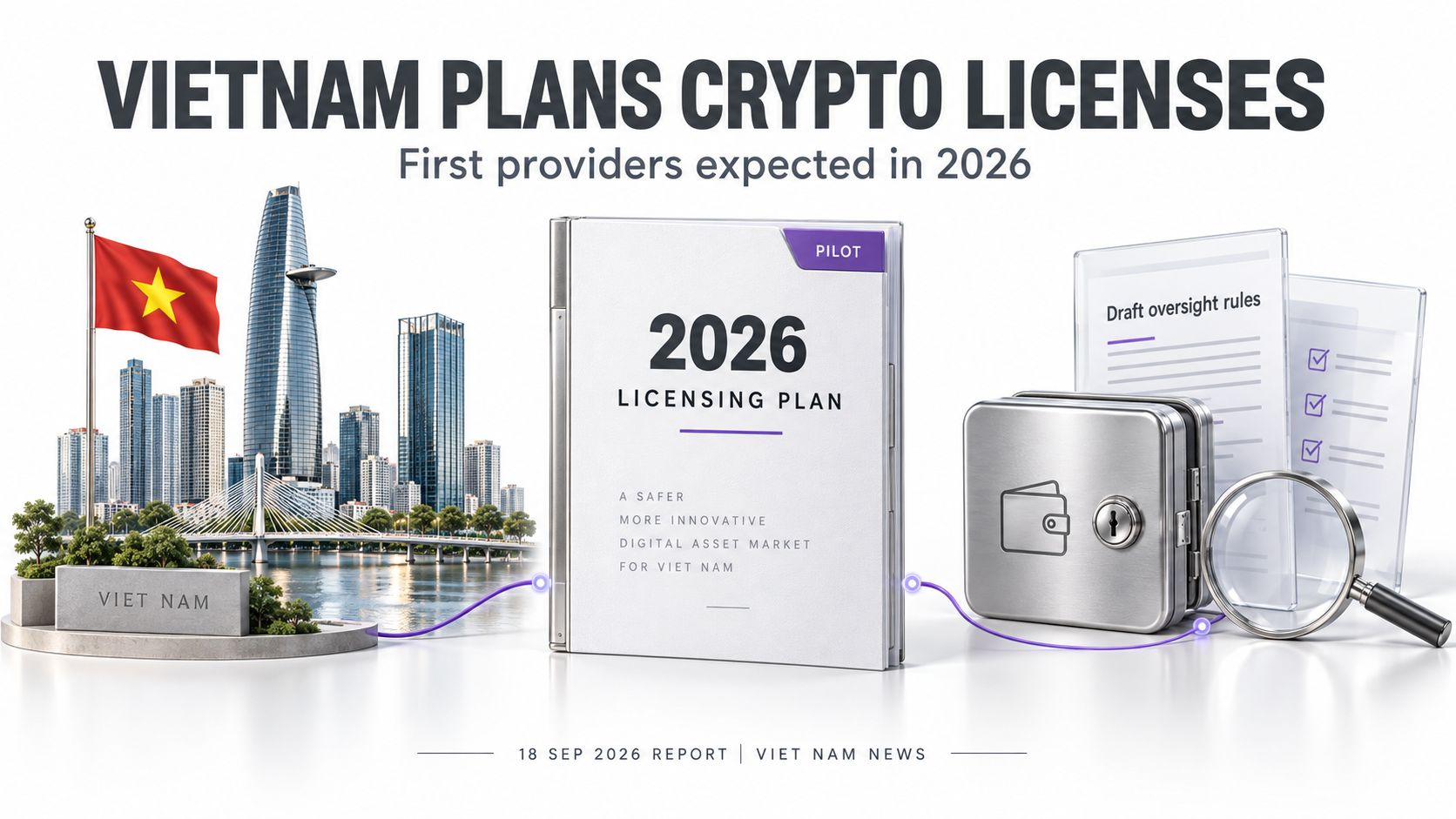
Vietnam Plans First Crypto Licenses in 2026 — Platform Standards Matter
Vietnam’s next crypto milestone could bring clearer accountability to the platforms handling users’ assets.
According to a September 18, 2026 report by Việt Nam News, the country expects its first crypto-asset service providers to receive licenses and begin operating in 2026. This remains an expected milestone. The report also describes proposed requirements for weekly custody reporting and twice-yearly audited reports on customer assets. Those reporting requirements are still draft proposals.
The licensing effort sits within the pilot framework established under Resolution 05/2025/NQ-CP, issued on September 9, 2025.
My take: a license could give users clearer accountability when choosing where to hold and trade assets. Its practical value would depend on how platforms handle custody, withdrawals, disclosures and complaints once they are operating.
Regular reporting could help regulators identify problems earlier, while compliance would also add operating costs. Competitive fees, reliable banking access and sufficient liquidity would influence how much activity these platforms attract.
The developments worth watching are the named licensees, final operating requirements and actual launch dates. Together, they would show how the framework translates into everyday services.
What would matter most to you: custody transparency, reliable withdrawals or trading costs?
#VietnamPlansFirstCryptoLicensesIn2026 #CryptoRegulation #DigitalAssets
$AKE $B2 $MYX
{future}(MYXUSDT)
{future}(B2USDT)
{future}(AKEUSDT)
#vietnamplansfirstcryptolicensesin2026
Vietnam Plans First Crypto Licenses in 2026 — Platform Standards Matter
Vietnam’s next crypto milestone could bring clearer accountability to the platforms handling users’ assets.
According to a September 18, 2026 report by Việt Nam News, the country expects its first crypto-asset service providers to receive licenses and begin operating in 2026. This remains an expected milestone. The report also describes proposed requirements for weekly custody reporting and twice-yearly audited reports on customer assets. Those reporting requirements are still draft proposals.
The licensing effort sits within the pilot framework established under Resolution 05/2025/NQ-CP, issued on September 9, 2025.
My take: a license could give users clearer accountability when choosing where to hold and trade assets. Its practical value would depend on how platforms handle custody, withdrawals, disclosures and complaints once they are operating.
Regular reporting could help regulators identify problems earlier, while compliance would also add operating costs. Competitive fees, reliable banking access and sufficient liquidity would influence how much activity these platforms attract.
The developments worth watching are the named licensees, final operating requirements and actual launch dates. Together, they would show how the framework translates into everyday services.
What would matter most to you: custody transparency, reliable withdrawals or trading costs?
#VietnamPlansFirstCryptoLicensesIn2026 #CryptoRegulation #DigitalAssets
$AKE $B2 $MYX
Vietnam Plans First Crypto Licenses in 2026 — Platform Standards Matter
Vietnam’s next crypto milestone could bring clearer accountability to the platforms handling users’ assets.
According to a September 18, 2026 report by Việt Nam News, the country expects its first crypto-asset service providers to receive licenses and begin operating in 2026. This remains an expected milestone. The report also describes proposed requirements for weekly custody reporting and twice-yearly audited reports on customer assets. Those reporting requirements are still draft proposals.
The licensing effort sits within the pilot framework established under Resolution 05/2025/NQ-CP, issued on September 9, 2025.
My take: a license could give users clearer accountability when choosing where to hold and trade assets. Its practical value would depend on how platforms handle custody, withdrawals, disclosures and complaints once they are operating.
Regular reporting could help regulators identify problems earlier, while compliance would also add operating costs. Competitive fees, reliable banking access and sufficient liquidity would influence how much activity these platforms attract.
The developments worth watching are the named licensees, final operating requirements and actual launch dates. Together, they would show how the framework translates into everyday services.
What would matter most to you: custody transparency, reliable withdrawals or trading costs?
#VietnamPlansFirstCryptoLicensesIn2026 #CryptoRegulation #DigitalAssets
$AKE $B2 $MYX
2.3k
·
--
🎙️ Physics AI is an important ecosystem laid out on the BitrootAI public chain

End
03 h 46 m 17 s
3.2k
5
7
·
--
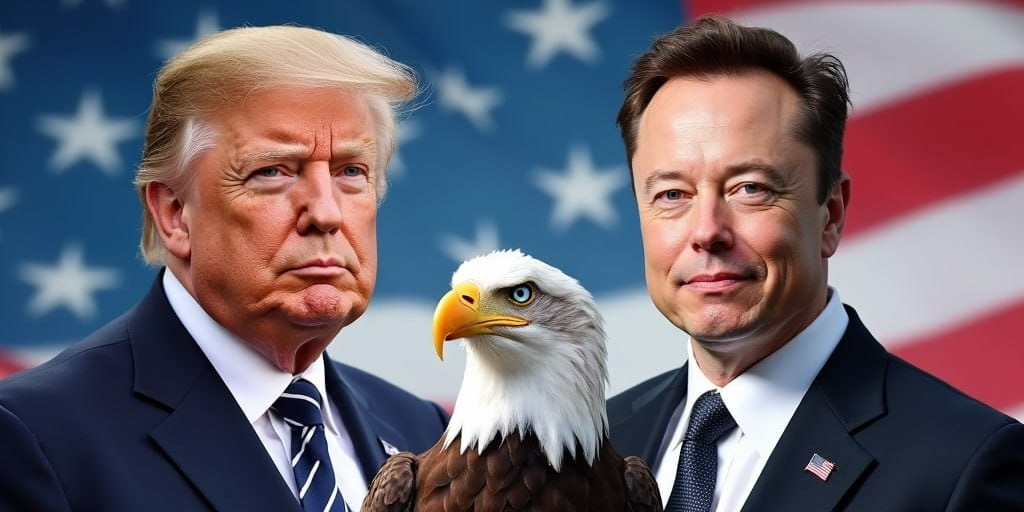
🎙️ Hawk Trump’s pet, Musk tweets to empower, Biden legislation, Hawk maintains ecological balance, spreading the idea of freedom! Hawk is influencing every city around the world!
End
03 h 02 m 33 s
2.5k
11
52
·
--
🎙️ Crypto market discussion; answers to new users' questions ✅ Co-create the Binance Square 🦅 and spread the ideals of freedom! Maintain ecological balance!

End
03 h 14 m 29 s
8.7k
21
59
·
--
Bullish
Verified
#linerashutsdownafterfundraisingfallsshort
Linera’s Shutdown Puts Crypto’s Funding Runway in Focus
A project’s next milestone depends on having enough funding to reach it.
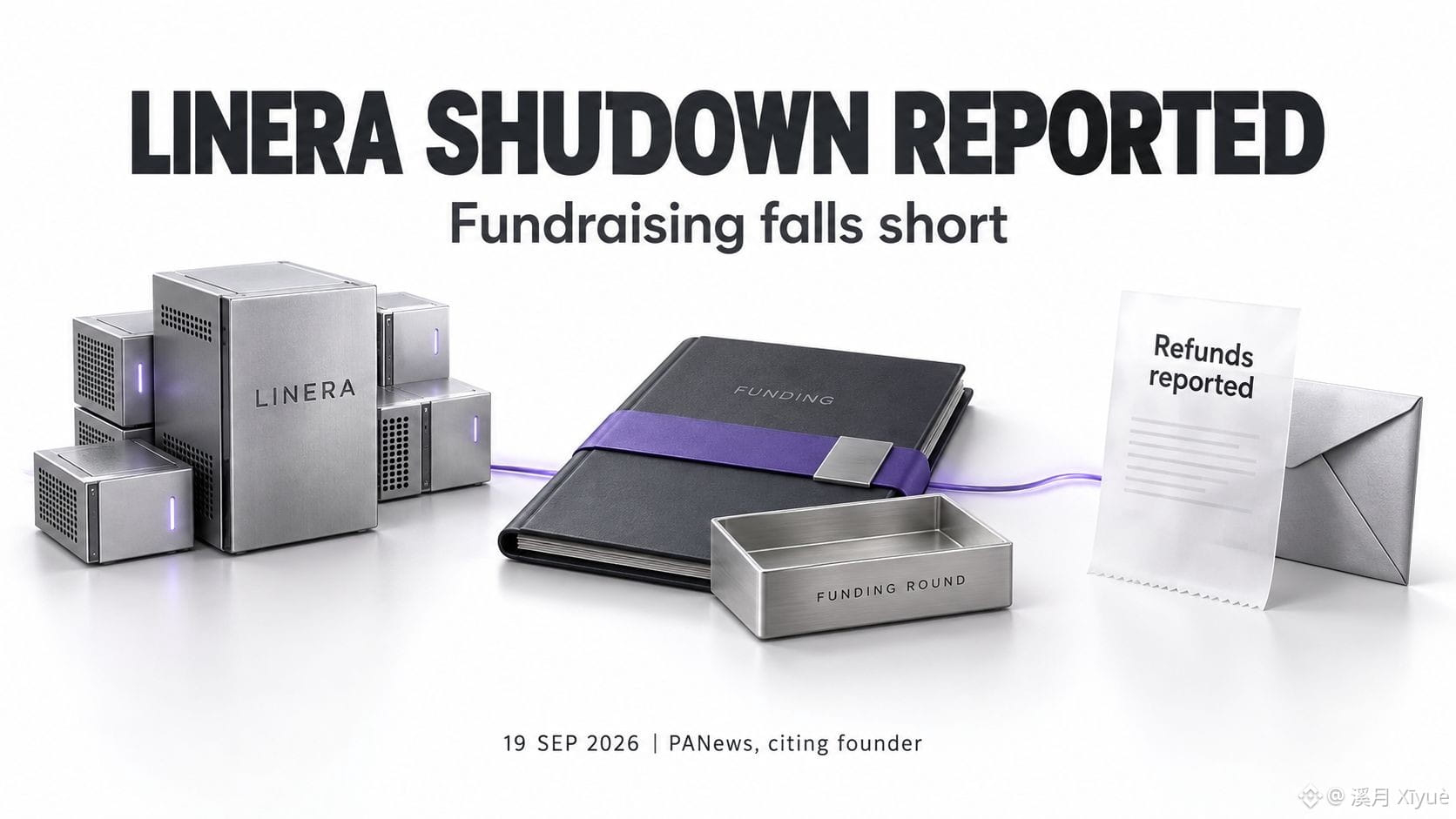
On September 19, 2026, PANews reported that Linera founder Mathieu Baudet announced on Discord that the project would stop operating immediately after fundraising fell short. Its Sonar token sale attracted approximately $900,000 in commitments, below the minimum required to complete the sale. An attempt to secure emergency financing to continue until mainnet also failed. Baudet said participants’ subscription funds had been returned.
My take: the question for an early-stage project is how much development it can fund if its next raise fails. Engineering, infrastructure and support all require continued spending, while launch delays can extend those costs. Clear disclosures about available cash, spending commitments and contingency plans would help supporters assess whether a roadmap has enough financial backing.
For Linera’s community, useful follow-up details would include who maintains the code, what happens to development resources and how ongoing support will be handled. The reported refunds address participants’ contributions; the future availability of the project’s work remains a separate question.
Should funding runway receive as much attention as a crypto project’s technical roadmap?
#LineraShutsDownAfterFundraisingFallsShort #Linera #Web3
$AKE $MYX $BR
{future}(BRUSDT)
{future}(MYXUSDT)
{future}(AKEUSDT)
#linerashutsdownafterfundraisingfallsshort
Linera’s Shutdown Puts Crypto’s Funding Runway in Focus
A project’s next milestone depends on having enough funding to reach it.
On September 19, 2026, PANews reported that Linera founder Mathieu Baudet announced on Discord that the project would stop operating immediately after fundraising fell short. Its Sonar token sale attracted approximately $900,000 in commitments, below the minimum required to complete the sale. An attempt to secure emergency financing to continue until mainnet also failed. Baudet said participants’ subscription funds had been returned.
My take: the question for an early-stage project is how much development it can fund if its next raise fails. Engineering, infrastructure and support all require continued spending, while launch delays can extend those costs. Clear disclosures about available cash, spending commitments and contingency plans would help supporters assess whether a roadmap has enough financial backing.
For Linera’s community, useful follow-up details would include who maintains the code, what happens to development resources and how ongoing support will be handled. The reported refunds address participants’ contributions; the future availability of the project’s work remains a separate question.
Should funding runway receive as much attention as a crypto project’s technical roadmap?
#LineraShutsDownAfterFundraisingFallsShort #Linera #Web3
$AKE $MYX $BR
Linera’s Shutdown Puts Crypto’s Funding Runway in Focus
A project’s next milestone depends on having enough funding to reach it.
On September 19, 2026, PANews reported that Linera founder Mathieu Baudet announced on Discord that the project would stop operating immediately after fundraising fell short. Its Sonar token sale attracted approximately $900,000 in commitments, below the minimum required to complete the sale. An attempt to secure emergency financing to continue until mainnet also failed. Baudet said participants’ subscription funds had been returned.
My take: the question for an early-stage project is how much development it can fund if its next raise fails. Engineering, infrastructure and support all require continued spending, while launch delays can extend those costs. Clear disclosures about available cash, spending commitments and contingency plans would help supporters assess whether a roadmap has enough financial backing.
For Linera’s community, useful follow-up details would include who maintains the code, what happens to development resources and how ongoing support will be handled. The reported refunds address participants’ contributions; the future availability of the project’s work remains a separate question.
Should funding runway receive as much attention as a crypto project’s technical roadmap?
#LineraShutsDownAfterFundraisingFallsShort #Linera #Web3
$AKE $MYX $BR
3
3k
·
--
Bullish
Trump Signs Russia Sanctions Law Authorizing Tariffs of Up to 100%
The U.S. has expanded its power to put trade pressure on buyers of Russian energy.
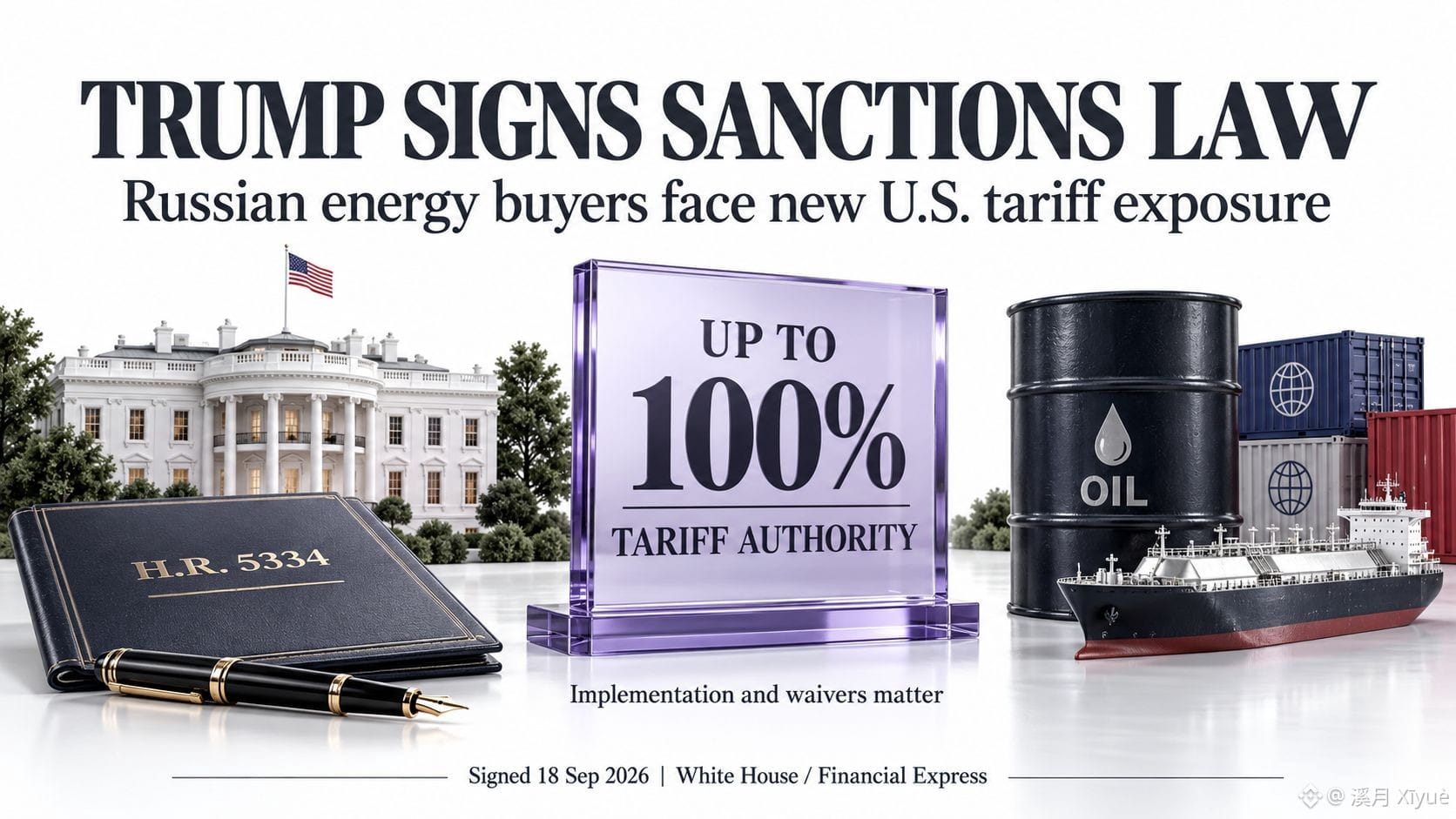
President Donald Trump signed H.R. 5334, the Lindsey O. Graham Sanctioning Russia and Iran Act of 2026, on September 18. The White House confirmed the signing and the expansion of sanctions and tariff authority.
Financial Express reports that the law permits tariffs of up to 100% on goods from the five biggest buyers of Russian oil and gas, with presidential waiver powers.
Signing the law does not automatically activate 100% duties on every buyer. Country selection, implementation and exemptions remain essential details.
My take: the market impact will depend on whether enforcement changes actual energy flows. If buyers face higher replacement costs, inflation concerns could intensify. Broader trade restrictions could also weaken growth expectations, creating competing pressures on bonds, currencies and risk assets.
For Bitcoin and altcoins, the relevant channels would be interest-rate expectations, dollar strength and investor appetite for risk. The signing alone gives limited evidence about the direction of crypto prices.
I would watch implementation notices, waiver decisions and changes in oil purchases next.
Which market do you expect to react most clearly: oil, currencies or crypto?
#RussianOil #USTariffs #MacroMarkets #TrumpNFT
$TRUMP $CL $AKE
{future}(AKEUSDT)
{future}(CLUSDT)
{future}(TRUMPUSDT)
Trump Signs Russia Sanctions Law Authorizing Tariffs of Up to 100%
The U.S. has expanded its power to put trade pressure on buyers of Russian energy.
President Donald Trump signed H.R. 5334, the Lindsey O. Graham Sanctioning Russia and Iran Act of 2026, on September 18. The White House confirmed the signing and the expansion of sanctions and tariff authority.
Financial Express reports that the law permits tariffs of up to 100% on goods from the five biggest buyers of Russian oil and gas, with presidential waiver powers.
Signing the law does not automatically activate 100% duties on every buyer. Country selection, implementation and exemptions remain essential details.
My take: the market impact will depend on whether enforcement changes actual energy flows. If buyers face higher replacement costs, inflation concerns could intensify. Broader trade restrictions could also weaken growth expectations, creating competing pressures on bonds, currencies and risk assets.
For Bitcoin and altcoins, the relevant channels would be interest-rate expectations, dollar strength and investor appetite for risk. The signing alone gives limited evidence about the direction of crypto prices.
I would watch implementation notices, waiver decisions and changes in oil purchases next.
Which market do you expect to react most clearly: oil, currencies or crypto?
#RussianOil #USTariffs #MacroMarkets #TrumpNFT
$TRUMP $CL $AKE
The U.S. has expanded its power to put trade pressure on buyers of Russian energy.
President Donald Trump signed H.R. 5334, the Lindsey O. Graham Sanctioning Russia and Iran Act of 2026, on September 18. The White House confirmed the signing and the expansion of sanctions and tariff authority.
Financial Express reports that the law permits tariffs of up to 100% on goods from the five biggest buyers of Russian oil and gas, with presidential waiver powers.
Signing the law does not automatically activate 100% duties on every buyer. Country selection, implementation and exemptions remain essential details.
My take: the market impact will depend on whether enforcement changes actual energy flows. If buyers face higher replacement costs, inflation concerns could intensify. Broader trade restrictions could also weaken growth expectations, creating competing pressures on bonds, currencies and risk assets.
For Bitcoin and altcoins, the relevant channels would be interest-rate expectations, dollar strength and investor appetite for risk. The signing alone gives limited evidence about the direction of crypto prices.
I would watch implementation notices, waiver decisions and changes in oil purchases next.
Which market do you expect to react most clearly: oil, currencies or crypto?
#RussianOil #USTariffs #MacroMarkets #TrumpNFT
$TRUMP $CL $AKE
85
·
--
Bullish
#bitcoinmarketcaptopstesla
Bitcoin’s Market Cap Tops Tesla: What the Comparison Shows
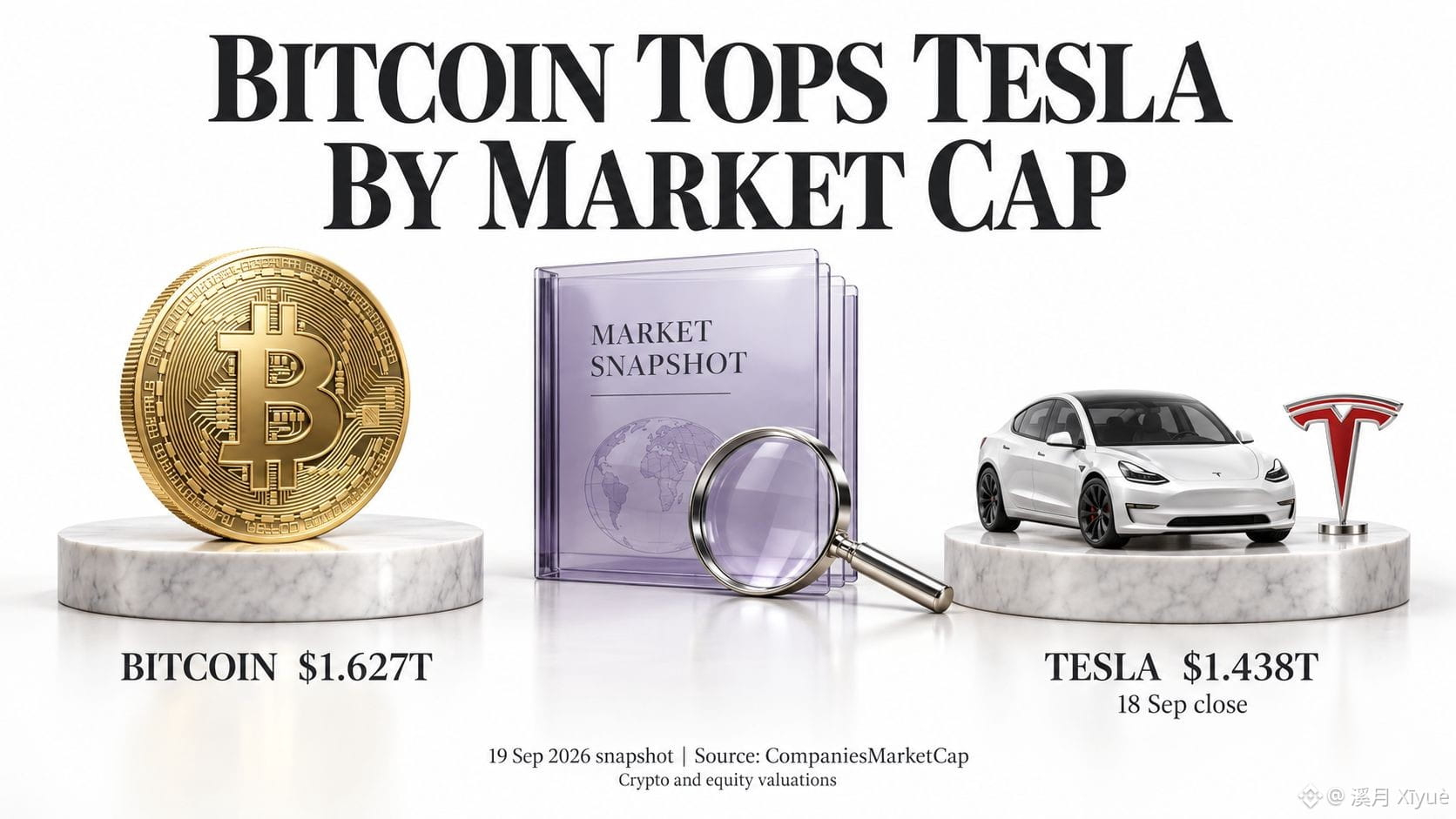
CompaniesMarketCap’s September 19 snapshot listed Bitcoin at approximately $1.627 trillion, compared with $1.438 trillion for Tesla. That puts BTC roughly $189 billion, or 13.1%, ahead, calculated from the displayed figures.
Tesla’s figure reflects the September 18 close. This is a dated comparison with continuously traded Bitcoin, and the gap can change as prices update.
Bitcoin’s capitalization multiplies its price by circulating supply. Tesla’s measures the market value of its outstanding shares. These figures describe different kinds of ownership.
My take: the comparison helps put Bitcoin’s scale into familiar terms, while assessing each investment requires different evidence. For Bitcoin, I would watch sustained spot demand, liquidity and its response to tighter financial conditions. For Tesla, earnings, cash generation and execution on its business plans remain central questions.
A rising market cap revalues existing supply at the latest price; it does not measure how much new money entered the asset. The $189 billion gap therefore describes relative valuation without establishing that capital moved from Tesla into BTC.
The more informative test is whether Bitcoin maintains this lead through changing market conditions.
What would make Bitcoin’s valuation more durable in your view?
{future}(AKEUSDT)
#BitcoinMarketCapTopsTesla #bitcoin #MarketAnalysis
$AKE $BTC $G
{future}(GUSDT)
{future}(BTCUSDT)
#bitcoinmarketcaptopstesla
Bitcoin’s Market Cap Tops Tesla: What the Comparison Shows
CompaniesMarketCap’s September 19 snapshot listed Bitcoin at approximately $1.627 trillion, compared with $1.438 trillion for Tesla. That puts BTC roughly $189 billion, or 13.1%, ahead, calculated from the displayed figures.
Tesla’s figure reflects the September 18 close. This is a dated comparison with continuously traded Bitcoin, and the gap can change as prices update.
Bitcoin’s capitalization multiplies its price by circulating supply. Tesla’s measures the market value of its outstanding shares. These figures describe different kinds of ownership.
My take: the comparison helps put Bitcoin’s scale into familiar terms, while assessing each investment requires different evidence. For Bitcoin, I would watch sustained spot demand, liquidity and its response to tighter financial conditions. For Tesla, earnings, cash generation and execution on its business plans remain central questions.
A rising market cap revalues existing supply at the latest price; it does not measure how much new money entered the asset. The $189 billion gap therefore describes relative valuation without establishing that capital moved from Tesla into BTC.
The more informative test is whether Bitcoin maintains this lead through changing market conditions.
What would make Bitcoin’s valuation more durable in your view?
#BitcoinMarketCapTopsTesla #bitcoin #MarketAnalysis
$AKE $BTC $G
Bitcoin’s Market Cap Tops Tesla: What the Comparison Shows
CompaniesMarketCap’s September 19 snapshot listed Bitcoin at approximately $1.627 trillion, compared with $1.438 trillion for Tesla. That puts BTC roughly $189 billion, or 13.1%, ahead, calculated from the displayed figures.
Tesla’s figure reflects the September 18 close. This is a dated comparison with continuously traded Bitcoin, and the gap can change as prices update.
Bitcoin’s capitalization multiplies its price by circulating supply. Tesla’s measures the market value of its outstanding shares. These figures describe different kinds of ownership.
My take: the comparison helps put Bitcoin’s scale into familiar terms, while assessing each investment requires different evidence. For Bitcoin, I would watch sustained spot demand, liquidity and its response to tighter financial conditions. For Tesla, earnings, cash generation and execution on its business plans remain central questions.
A rising market cap revalues existing supply at the latest price; it does not measure how much new money entered the asset. The $189 billion gap therefore describes relative valuation without establishing that capital moved from Tesla into BTC.
The more informative test is whether Bitcoin maintains this lead through changing market conditions.
What would make Bitcoin’s valuation more durable in your view?
#BitcoinMarketCapTopsTesla #bitcoin #MarketAnalysis
$AKE $BTC $G
1
3
2k
Log in to explore more content
Join global crypto users on Binance Square
⚡️ Get latest and useful information about crypto.
💬 Trusted by the world’s largest crypto exchange.
👍 Discover real insights from verified creators.
Email / Phone number
Trending Topics
BOJRaisesRatesTo31YearHigh
23,365 views
615 Discussing
Bitcoin Reclaims the Spotlight as Macro Pressure Fails to Break Crypto Demand
Fatima_Tariq
·9 Likes
·5.4k views
BuffettStepsDownAsBerkshireChairman
6,414 views
238 Discussing
XRPExchangeReservesHitSevenYearLow
9,995 views
265 Discussing