
#usdt
usdt
2.9G views
12.7M Discussing
Hot
Latest

·
--
Verified
Article
Who Keeps the Interest on Your USDT? A $10,000 Worked ExampleDisclosure: It is not financial advice
Stablecoins had a very "mainstream" week. On 17 November the World Bank Group said it will explore regulated stablecoin rails with Citi and Circle for its fund disbursements. On 18 November Circle and DBS announced that eligible institutional clients in Singapore can mint and redeem USDC directly with near-instant, round-the-clock dollar settlement (CoinDesk, 18 Nov 2026).
All of that is about moving money. I wanted to answer a different question that I rarely see worked out in numbers: when you hold a stablecoin, the reserve behind it earns interest. Who keeps it?
The short answer: the issuer, and in the US-regulated model the law keeps it that way. Here is the arithmetic on $10,000.
What $10,000 of reserves could earn
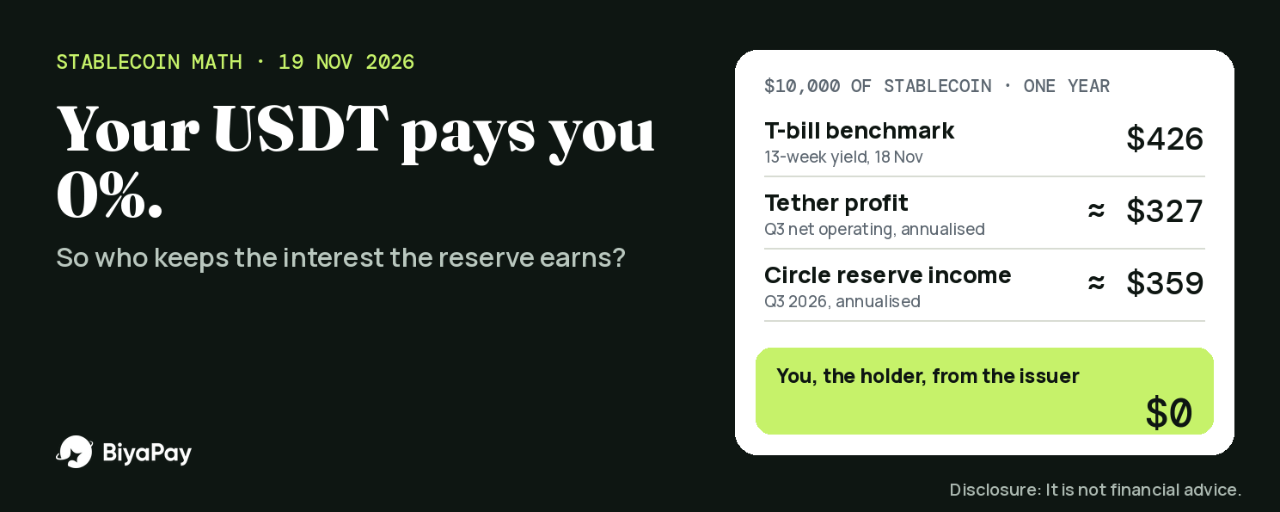
The US Treasury's daily bill rates for 18 November 2026 show the 13-week bill at 4.16% (bank discount basis) and 4.26% (coupon-equivalent yield). Take the 4.26% as a round "about 4.2%" benchmark:
$10,000 × 4.26% = $426 a year, or about $35.50 a month, grossThat ignores the issuer's costs, taxes, and the fact that the yield changes every day
This is only a benchmark for what short-term US government debt pays. It is not what any issuer actually earns.
What issuers actually report
Circle, Q3 2026 results (released 4 November 2026):
Average USDC in circulation: $73.3 billionReserve income: $658 millionReserve return rate: 3.5%Annualised: $658M × 4 = $2.63B, divided by $73.3B, is about 3.6%. Per $10,000 of USDC that is roughly $359 a yearDistribution and transaction costs in the same quarter: $409 million, equal to about 62% of reserve income
Tether, Q3 2026 attestation (BDO, as of 30 September 2026, published 30 October 2026):
Total assets $191.45 billion; liabilities $183.50 billion, of which $183.47 billion are tokens issued; assets exceed liabilities by $7.95 billionDirect and indirect US Treasury bill holdings: $132.4 billionNet operating profit: $1.5 billion in Q3, which Tether says was mostly from T-bills and reverse reposAnnualised: $1.5B × 4 = $6.0B, divided by $183.47B of tokens, is about 3.3%. Per $10,000 of USDT that is roughly $327 a year of profit
And what did the holder of $10,000 get from the issuer? $0.
Why it is $0: the rule
The GENIUS Act, signed on 18 July 2025, says that no permitted payment stablecoin issuer or foreign payment stablecoin issuer may pay a holder "any form of interest or yield" solely in connection with holding, using or retaining the coin (12 U.S.C. § 5903(11)).
On 21 October 2026 the OCC issued its final rule implementing the Act, effective 18 January 2027. It kept the ban on issuers paying holders. According to American Banker and AP, it dropped a proposed presumption that third-party rewards arrangements are automatically prohibited, and says it will look at the facts of each case. That is why exchanges and apps can sometimes offer "rewards" while the issuer itself cannot pay interest.
I am not a lawyer, and the rule applies differently depending on who the issuer is and where you live, so treat this as a reading aid, not a legal opinion.
Where a holder's yield can come from
Any yield above zero has to come from somewhere. In my notes there are four sources:
A platform passing on some of the T-bill-like income as a reward. The OCC rule leaves this to case-by-case reviewLending, where the platform lends your coins out and you take credit and operational riskOn-chain DeFi strategies, which add smart-contract riskA promotion, where the platform pays from its own budget for a limited time
None of them is the same thing as the 4.26% benchmark above. They each come with a different risk, and the risk is what the extra percentage points pay for.
Rates also move. With the Fed's October minutes (published 18 November) showing officials open to more hikes, and futures pricing a 25 basis point increase in December (Reuters/Straits Times, 18-19 Nov 2026), bill yields could rise. If the 13-week yield rose by 0.25 percentage points, $10,000 of reserves would earn $25 more a year, gross. Whether that is passed to holders depends on the rules above.
What BiyaPay's public Earn page shows
I checked BiyaPay's public Earn page on 19 November 2026 at about 06:28 WIB, signed out.
What you can do: the page lists flexible-term products. At the time I looked, the displayed annualised rates were U EARN phase II 10.22%, USD EARN phase II 10.22%, XAUT Flexible Savings 10%, "Deposit USDC to Earn" 7.2%, HKD Earn 5%, BTC Earn 3.5%, SOL 3% and ETH 2%. The USDC card says "withdrawal at any time". A banner says "Earn an Extra +5% When You Open a Position"; the conditions are not shown publiclyRequirements: you have to sign in to subscribe. The page says BiyaPay cannot provide services in the United States. Other eligibility rules are not on the public pageSteps shown publicly: open Earn, choose a product, tap "To Subscribe", sign in. Minimum and maximum amounts, payout timing and how each rate is set are behind the login, and I have not verified themFees and limits: none are stated on the public page. I would check them in the app before depositing anything
Now the arithmetic. The USDC product shows 7.2%. Against the 4.26% bill yield that is 2.94 percentage points higher. On $10,000 that is $720 against $426, a gap of $294 a year. The 10.22% products would be $1,022, a gap of about $596.
A displayed rate is not a promise of what you will receive, and the public page does not explain how it is generated. A gap that size is exactly what I would want explained before I put money in.
My opinion
I use USDT and USDC as payment and settlement tools, not as a savings account. Holding them in a wallet earns nothing by design, and I find that fair as long as I know it.
If I want yield, I treat it as a separate decision with its own risk. The first thing I do is compare the displayed rate with the T-bill benchmark. The bigger the gap, the more I want to know where it comes from, who can change it, and how fast I can get my money out.
When this applies, and when it does not
This applies to dollar-backed stablecoins whose reserves sit in short-term US government debt. It does not apply to stablecoins that are backed differently, to platform products that are not simply "holding a stablecoin", or to your local tax and legal situation. The numbers above are illustrative, rounded and based on published reports, and they change every quarter.
Checklist I use
Compare any displayed rate with the current 13-week T-bill yield from the US TreasuryAsk where the extra percentage points come from: reserve income, lending, DeFi or a promotionRead who bears the loss if something goes wrong, and whether the product is a deposit, a loan or something elseCheck minimums, fees, payout timing and withdrawal speed in the app before depositingCheck whether the service is available in your countryRead the issuer's latest attestation for what actually backs the tokenNever put in money you may need soon
#BiyaPay #USDT #USDC #Stablecoins #TBills
Who Keeps the Interest on Your USDT? A $10,000 Worked Example
Disclosure: It is not financial advice
Stablecoins had a very "mainstream" week. On 17 November the World Bank Group said it will explore regulated stablecoin rails with Citi and Circle for its fund disbursements. On 18 November Circle and DBS announced that eligible institutional clients in Singapore can mint and redeem USDC directly with near-instant, round-the-clock dollar settlement (CoinDesk, 18 Nov 2026).
All of that is about moving money. I wanted to answer a different question that I rarely see worked out in numbers: when you hold a stablecoin, the reserve behind it earns interest. Who keeps it?
The short answer: the issuer, and in the US-regulated model the law keeps it that way. Here is the arithmetic on $10,000.
What $10,000 of reserves could earn
The US Treasury's daily bill rates for 18 November 2026 show the 13-week bill at 4.16% (bank discount basis) and 4.26% (coupon-equivalent yield). Take the 4.26% as a round "about 4.2%" benchmark:
$10,000 × 4.26% = $426 a year, or about $35.50 a month, grossThat ignores the issuer's costs, taxes, and the fact that the yield changes every day
This is only a benchmark for what short-term US government debt pays. It is not what any issuer actually earns.
What issuers actually report
Circle, Q3 2026 results (released 4 November 2026):
Average USDC in circulation: $73.3 billionReserve income: $658 millionReserve return rate: 3.5%Annualised: $658M × 4 = $2.63B, divided by $73.3B, is about 3.6%. Per $10,000 of USDC that is roughly $359 a yearDistribution and transaction costs in the same quarter: $409 million, equal to about 62% of reserve income
Tether, Q3 2026 attestation (BDO, as of 30 September 2026, published 30 October 2026):
Total assets $191.45 billion; liabilities $183.50 billion, of which $183.47 billion are tokens issued; assets exceed liabilities by $7.95 billionDirect and indirect US Treasury bill holdings: $132.4 billionNet operating profit: $1.5 billion in Q3, which Tether says was mostly from T-bills and reverse reposAnnualised: $1.5B × 4 = $6.0B, divided by $183.47B of tokens, is about 3.3%. Per $10,000 of USDT that is roughly $327 a year of profit
And what did the holder of $10,000 get from the issuer? $0.
Why it is $0: the rule
The GENIUS Act, signed on 18 July 2025, says that no permitted payment stablecoin issuer or foreign payment stablecoin issuer may pay a holder "any form of interest or yield" solely in connection with holding, using or retaining the coin (12 U.S.C. § 5903(11)).
On 21 October 2026 the OCC issued its final rule implementing the Act, effective 18 January 2027. It kept the ban on issuers paying holders. According to American Banker and AP, it dropped a proposed presumption that third-party rewards arrangements are automatically prohibited, and says it will look at the facts of each case. That is why exchanges and apps can sometimes offer "rewards" while the issuer itself cannot pay interest.
I am not a lawyer, and the rule applies differently depending on who the issuer is and where you live, so treat this as a reading aid, not a legal opinion.
Where a holder's yield can come from
Any yield above zero has to come from somewhere. In my notes there are four sources:
A platform passing on some of the T-bill-like income as a reward. The OCC rule leaves this to case-by-case reviewLending, where the platform lends your coins out and you take credit and operational riskOn-chain DeFi strategies, which add smart-contract riskA promotion, where the platform pays from its own budget for a limited time
None of them is the same thing as the 4.26% benchmark above. They each come with a different risk, and the risk is what the extra percentage points pay for.
Rates also move. With the Fed's October minutes (published 18 November) showing officials open to more hikes, and futures pricing a 25 basis point increase in December (Reuters/Straits Times, 18-19 Nov 2026), bill yields could rise. If the 13-week yield rose by 0.25 percentage points, $10,000 of reserves would earn $25 more a year, gross. Whether that is passed to holders depends on the rules above.
What BiyaPay's public Earn page shows
I checked BiyaPay's public Earn page on 19 November 2026 at about 06:28 WIB, signed out.
What you can do: the page lists flexible-term products. At the time I looked, the displayed annualised rates were U EARN phase II 10.22%, USD EARN phase II 10.22%, XAUT Flexible Savings 10%, "Deposit USDC to Earn" 7.2%, HKD Earn 5%, BTC Earn 3.5%, SOL 3% and ETH 2%. The USDC card says "withdrawal at any time". A banner says "Earn an Extra +5% When You Open a Position"; the conditions are not shown publiclyRequirements: you have to sign in to subscribe. The page says BiyaPay cannot provide services in the United States. Other eligibility rules are not on the public pageSteps shown publicly: open Earn, choose a product, tap "To Subscribe", sign in. Minimum and maximum amounts, payout timing and how each rate is set are behind the login, and I have not verified themFees and limits: none are stated on the public page. I would check them in the app before depositing anything
Now the arithmetic. The USDC product shows 7.2%. Against the 4.26% bill yield that is 2.94 percentage points higher. On $10,000 that is $720 against $426, a gap of $294 a year. The 10.22% products would be $1,022, a gap of about $596.
A displayed rate is not a promise of what you will receive, and the public page does not explain how it is generated. A gap that size is exactly what I would want explained before I put money in.
My opinion
I use USDT and USDC as payment and settlement tools, not as a savings account. Holding them in a wallet earns nothing by design, and I find that fair as long as I know it.
If I want yield, I treat it as a separate decision with its own risk. The first thing I do is compare the displayed rate with the T-bill benchmark. The bigger the gap, the more I want to know where it comes from, who can change it, and how fast I can get my money out.
When this applies, and when it does not
This applies to dollar-backed stablecoins whose reserves sit in short-term US government debt. It does not apply to stablecoins that are backed differently, to platform products that are not simply "holding a stablecoin", or to your local tax and legal situation. The numbers above are illustrative, rounded and based on published reports, and they change every quarter.
Checklist I use
Compare any displayed rate with the current 13-week T-bill yield from the US TreasuryAsk where the extra percentage points come from: reserve income, lending, DeFi or a promotionRead who bears the loss if something goes wrong, and whether the product is a deposit, a loan or something elseCheck minimums, fees, payout timing and withdrawal speed in the app before depositingCheck whether the service is available in your countryRead the issuer's latest attestation for what actually backs the tokenNever put in money you may need soon
#BiyaPay #USDT #USDC #Stablecoins #TBills
Stablecoins had a very "mainstream" week. On 17 November the World Bank Group said it will explore regulated stablecoin rails with Citi and Circle for its fund disbursements. On 18 November Circle and DBS announced that eligible institutional clients in Singapore can mint and redeem USDC directly with near-instant, round-the-clock dollar settlement (CoinDesk, 18 Nov 2026).
All of that is about moving money. I wanted to answer a different question that I rarely see worked out in numbers: when you hold a stablecoin, the reserve behind it earns interest. Who keeps it?
The short answer: the issuer, and in the US-regulated model the law keeps it that way. Here is the arithmetic on $10,000.
What $10,000 of reserves could earn
The US Treasury's daily bill rates for 18 November 2026 show the 13-week bill at 4.16% (bank discount basis) and 4.26% (coupon-equivalent yield). Take the 4.26% as a round "about 4.2%" benchmark:
$10,000 × 4.26% = $426 a year, or about $35.50 a month, grossThat ignores the issuer's costs, taxes, and the fact that the yield changes every day
This is only a benchmark for what short-term US government debt pays. It is not what any issuer actually earns.
What issuers actually report
Circle, Q3 2026 results (released 4 November 2026):
Average USDC in circulation: $73.3 billionReserve income: $658 millionReserve return rate: 3.5%Annualised: $658M × 4 = $2.63B, divided by $73.3B, is about 3.6%. Per $10,000 of USDC that is roughly $359 a yearDistribution and transaction costs in the same quarter: $409 million, equal to about 62% of reserve income
Tether, Q3 2026 attestation (BDO, as of 30 September 2026, published 30 October 2026):
Total assets $191.45 billion; liabilities $183.50 billion, of which $183.47 billion are tokens issued; assets exceed liabilities by $7.95 billionDirect and indirect US Treasury bill holdings: $132.4 billionNet operating profit: $1.5 billion in Q3, which Tether says was mostly from T-bills and reverse reposAnnualised: $1.5B × 4 = $6.0B, divided by $183.47B of tokens, is about 3.3%. Per $10,000 of USDT that is roughly $327 a year of profit
And what did the holder of $10,000 get from the issuer? $0.
Why it is $0: the rule
The GENIUS Act, signed on 18 July 2025, says that no permitted payment stablecoin issuer or foreign payment stablecoin issuer may pay a holder "any form of interest or yield" solely in connection with holding, using or retaining the coin (12 U.S.C. § 5903(11)).
On 21 October 2026 the OCC issued its final rule implementing the Act, effective 18 January 2027. It kept the ban on issuers paying holders. According to American Banker and AP, it dropped a proposed presumption that third-party rewards arrangements are automatically prohibited, and says it will look at the facts of each case. That is why exchanges and apps can sometimes offer "rewards" while the issuer itself cannot pay interest.
I am not a lawyer, and the rule applies differently depending on who the issuer is and where you live, so treat this as a reading aid, not a legal opinion.
Where a holder's yield can come from
Any yield above zero has to come from somewhere. In my notes there are four sources:
A platform passing on some of the T-bill-like income as a reward. The OCC rule leaves this to case-by-case reviewLending, where the platform lends your coins out and you take credit and operational riskOn-chain DeFi strategies, which add smart-contract riskA promotion, where the platform pays from its own budget for a limited time
None of them is the same thing as the 4.26% benchmark above. They each come with a different risk, and the risk is what the extra percentage points pay for.
Rates also move. With the Fed's October minutes (published 18 November) showing officials open to more hikes, and futures pricing a 25 basis point increase in December (Reuters/Straits Times, 18-19 Nov 2026), bill yields could rise. If the 13-week yield rose by 0.25 percentage points, $10,000 of reserves would earn $25 more a year, gross. Whether that is passed to holders depends on the rules above.
What BiyaPay's public Earn page shows
I checked BiyaPay's public Earn page on 19 November 2026 at about 06:28 WIB, signed out.
What you can do: the page lists flexible-term products. At the time I looked, the displayed annualised rates were U EARN phase II 10.22%, USD EARN phase II 10.22%, XAUT Flexible Savings 10%, "Deposit USDC to Earn" 7.2%, HKD Earn 5%, BTC Earn 3.5%, SOL 3% and ETH 2%. The USDC card says "withdrawal at any time". A banner says "Earn an Extra +5% When You Open a Position"; the conditions are not shown publiclyRequirements: you have to sign in to subscribe. The page says BiyaPay cannot provide services in the United States. Other eligibility rules are not on the public pageSteps shown publicly: open Earn, choose a product, tap "To Subscribe", sign in. Minimum and maximum amounts, payout timing and how each rate is set are behind the login, and I have not verified themFees and limits: none are stated on the public page. I would check them in the app before depositing anything
Now the arithmetic. The USDC product shows 7.2%. Against the 4.26% bill yield that is 2.94 percentage points higher. On $10,000 that is $720 against $426, a gap of $294 a year. The 10.22% products would be $1,022, a gap of about $596.
A displayed rate is not a promise of what you will receive, and the public page does not explain how it is generated. A gap that size is exactly what I would want explained before I put money in.
My opinion
I use USDT and USDC as payment and settlement tools, not as a savings account. Holding them in a wallet earns nothing by design, and I find that fair as long as I know it.
If I want yield, I treat it as a separate decision with its own risk. The first thing I do is compare the displayed rate with the T-bill benchmark. The bigger the gap, the more I want to know where it comes from, who can change it, and how fast I can get my money out.
When this applies, and when it does not
This applies to dollar-backed stablecoins whose reserves sit in short-term US government debt. It does not apply to stablecoins that are backed differently, to platform products that are not simply "holding a stablecoin", or to your local tax and legal situation. The numbers above are illustrative, rounded and based on published reports, and they change every quarter.
Checklist I use
Compare any displayed rate with the current 13-week T-bill yield from the US TreasuryAsk where the extra percentage points come from: reserve income, lending, DeFi or a promotionRead who bears the loss if something goes wrong, and whether the product is a deposit, a loan or something elseCheck minimums, fees, payout timing and withdrawal speed in the app before depositingCheck whether the service is available in your countryRead the issuer's latest attestation for what actually backs the tokenNever put in money you may need soon
#BiyaPay #USDT #USDC #Stablecoins #TBills
Trong_Hatachi:
Interesting distinction between moving stablecoins and earning on them—who actually keeps the interest in your $10,000 example? Follow back if you find this useful.
2
1
1.5k

·
--
S&P Global Ratings kept Tether's USDT at 5, the weakest score on its stablecoin stability scale. S&P says higher-risk reserve assets such as gold, Bitcoin, secured loans and corporate bonds now equal about 28% of USDT in circulation, up from 24%, and flagged transparency concerns. Tether pushed back, saying the traditional framework doesn't fit, and USDT has held its dollar peg.
Do ratings like this change how you hold stablecoins? 🤔
#USDT #Tether #Stablecoins
S&P Global Ratings kept Tether's USDT at 5, the weakest score on its stablecoin stability scale. S&P says higher-risk reserve assets such as gold, Bitcoin, secured loans and corporate bonds now equal about 28% of USDT in circulation, up from 24%, and flagged transparency concerns. Tether pushed back, saying the traditional framework doesn't fit, and USDT has held its dollar peg.
Do ratings like this change how you hold stablecoins? 🤔
#USDT #Tether #Stablecoins
Do ratings like this change how you hold stablecoins? 🤔
#USDT #Tether #Stablecoins
2

Tether just channeled 'The Big Short' in a fiery response to S&P Global's stablecoin ratings. By pushing back against traditional financial institutions trying to grade crypto reserves, Tether is highlighting a massive disconnect. Wall Street rating agencies often miss the unique liquidity mechanics of digital assets. While USDT dominance continues to grow, this clash proves that traditional risk models are fundamentally struggling to evaluate crypto-native backing accurately. $USDT #Tether #USDT #CryptoRegulation
Tether just channeled 'The Big Short' in a fiery response to S&P Global's stablecoin ratings. By pushing back against traditional financial institutions trying to grade crypto reserves, Tether is highlighting a massive disconnect. Wall Street rating agencies often miss the unique liquidity mechanics of digital assets. While USDT dominance continues to grow, this clash proves that traditional risk models are fundamentally struggling to evaluate crypto-native backing accurately. $USDT #Tether #USDT #CryptoRegulation
85

·
--
#USDT What exactly is USDT and how does it work? Also, it is no longer visible in my profile—what should I do now?
#USDT What exactly is USDT and how does it work? Also, it is no longer visible in my profile—what should I do now?
272

🚨 $USDT RESERVES UNDER THE MICROSCOPE AS RATING AGENCY CLASHES WITH ISSUER! 📊
Institutional stability metrics reveal $USDT maintaining an over-collateralized posture with $191.5B in assets backing $183.5B in liabilities. 📊 Yet external ratings agencies continue assigning bottom-tier stability scores due to non-traditional reserve compositions like gold and corporate debt. 💡
Smart money liquidity flows rely heavily on stablecoin health during market stress tests. 🦈 As collateral frameworks face ongoing scrutiny, market participants must weigh balance sheet reality against institutional sentiment. ⚡
💬 Are these rating discrepancies a legitimate structural risk or just traditional finance misreading digital liquidity pools? 👇
⚠️ Not financial advice. Always manage your risk. 🛡️
🏷️ #USDT #Stablecoins #CryptoNews #MarketStructure
🦈 ⚖️
🚨 $USDT RESERVES UNDER THE MICROSCOPE AS RATING AGENCY CLASHES WITH ISSUER! 📊
Institutional stability metrics reveal $USDT maintaining an over-collateralized posture with $191.5B in assets backing $183.5B in liabilities. 📊 Yet external ratings agencies continue assigning bottom-tier stability scores due to non-traditional reserve compositions like gold and corporate debt. 💡
Smart money liquidity flows rely heavily on stablecoin health during market stress tests. 🦈 As collateral frameworks face ongoing scrutiny, market participants must weigh balance sheet reality against institutional sentiment. ⚡
💬 Are these rating discrepancies a legitimate structural risk or just traditional finance misreading digital liquidity pools? 👇
⚠️ Not financial advice. Always manage your risk. 🛡️
🏷️ #USDT #Stablecoins #CryptoNews #MarketStructure
🦈 ⚖️
Institutional stability metrics reveal $USDT maintaining an over-collateralized posture with $191.5B in assets backing $183.5B in liabilities. 📊 Yet external ratings agencies continue assigning bottom-tier stability scores due to non-traditional reserve compositions like gold and corporate debt. 💡
Smart money liquidity flows rely heavily on stablecoin health during market stress tests. 🦈 As collateral frameworks face ongoing scrutiny, market participants must weigh balance sheet reality against institutional sentiment. ⚡
💬 Are these rating discrepancies a legitimate structural risk or just traditional finance misreading digital liquidity pools? 👇
⚠️ Not financial advice. Always manage your risk. 🛡️
🏷️ #USDT #Stablecoins #CryptoNews #MarketStructure
🦈 ⚖️

8

·
--
Article
RUSSIA’S NEW CRYPTO ERA: A 🇺🇸 MAJOR MARKET SHIFT?🇷🇺Russia is taking a major step toward integrating cryptocurrency into its regulated financial system.
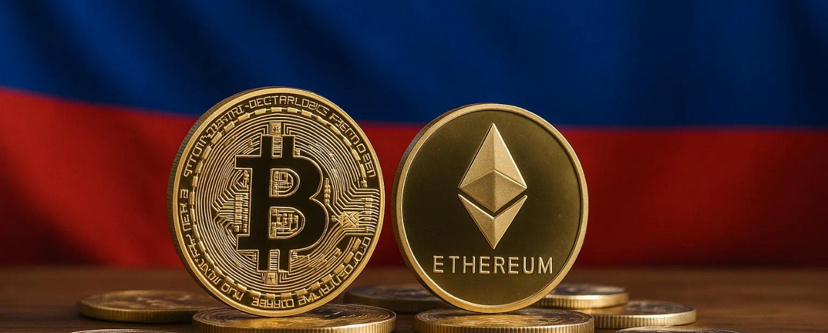
The Bank of Russia has approved Bitcoin (#BTC ), Ethereum (#ETH ), and Tether (#USDT ) for public trading through authorized intermediaries starting November 17, 2026.
Key developments:
• Retail investors face an annual limit of ₽300,000 per intermediary.
• Investors must pass a risk-awareness test.
• Exchanges may begin organized crypto trading from November 22, subject to regulatory approval.
• Moscow Exchange plans to launch its crypto market on December 1.
Beyond trading, Russia’s new legal framework also allows cryptocurrency use in international trade settlements, while domestic crypto payments remain prohibited.
WHY IT MATTERS
This marks a significant shift in Russia’s approach to digital assets, creating a regulated market structure involving banks, brokers and exchanges.
The next milestone will be the launch of organized crypto trading.
The global market will be watching.
— #DRAGOMEN 🐉
$ETH $BNB $BTC
RUSSIA’S NEW CRYPTO ERA: A 🇺🇸 MAJOR MARKET SHIFT?🇷🇺
Russia is taking a major step toward integrating cryptocurrency into its regulated financial system.
The Bank of Russia has approved Bitcoin (#BTC ), Ethereum (#ETH ), and Tether (#USDT ) for public trading through authorized intermediaries starting November 17, 2026.
Key developments:
• Retail investors face an annual limit of ₽300,000 per intermediary.
• Investors must pass a risk-awareness test.
• Exchanges may begin organized crypto trading from November 22, subject to regulatory approval.
• Moscow Exchange plans to launch its crypto market on December 1.
Beyond trading, Russia’s new legal framework also allows cryptocurrency use in international trade settlements, while domestic crypto payments remain prohibited.
WHY IT MATTERS
This marks a significant shift in Russia’s approach to digital assets, creating a regulated market structure involving banks, brokers and exchanges.
The next milestone will be the launch of organized crypto trading.
The global market will be watching.
— #DRAGOMEN 🐉
$ETH $BNB $BTC
The Bank of Russia has approved Bitcoin (#BTC ), Ethereum (#ETH ), and Tether (#USDT ) for public trading through authorized intermediaries starting November 17, 2026.
Key developments:
• Retail investors face an annual limit of ₽300,000 per intermediary.
• Investors must pass a risk-awareness test.
• Exchanges may begin organized crypto trading from November 22, subject to regulatory approval.
• Moscow Exchange plans to launch its crypto market on December 1.
Beyond trading, Russia’s new legal framework also allows cryptocurrency use in international trade settlements, while domestic crypto payments remain prohibited.
WHY IT MATTERS
This marks a significant shift in Russia’s approach to digital assets, creating a regulated market structure involving banks, brokers and exchanges.
The next milestone will be the launch of organized crypto trading.
The global market will be watching.
— #DRAGOMEN 🐉
$ETH $BNB $BTC
Abu Fahadأ:
💛
3
1
1
580

USDT vs USDC: Are Stablecoins Really Stable?
Stablecoins are designed to stay close to $1. But does that mean they are risk-free? Not exactly.
Let's compare two major stablecoins: USDT and USDC.
1. What Are Stablecoins?
Stablecoins are cryptocurrencies designed to maintain a stable value, usually linked to the US dollar.
Both USDT and USDC aim to maintain a 1:1 value with USD.
2. USDT vs USDC
USDT — Tether
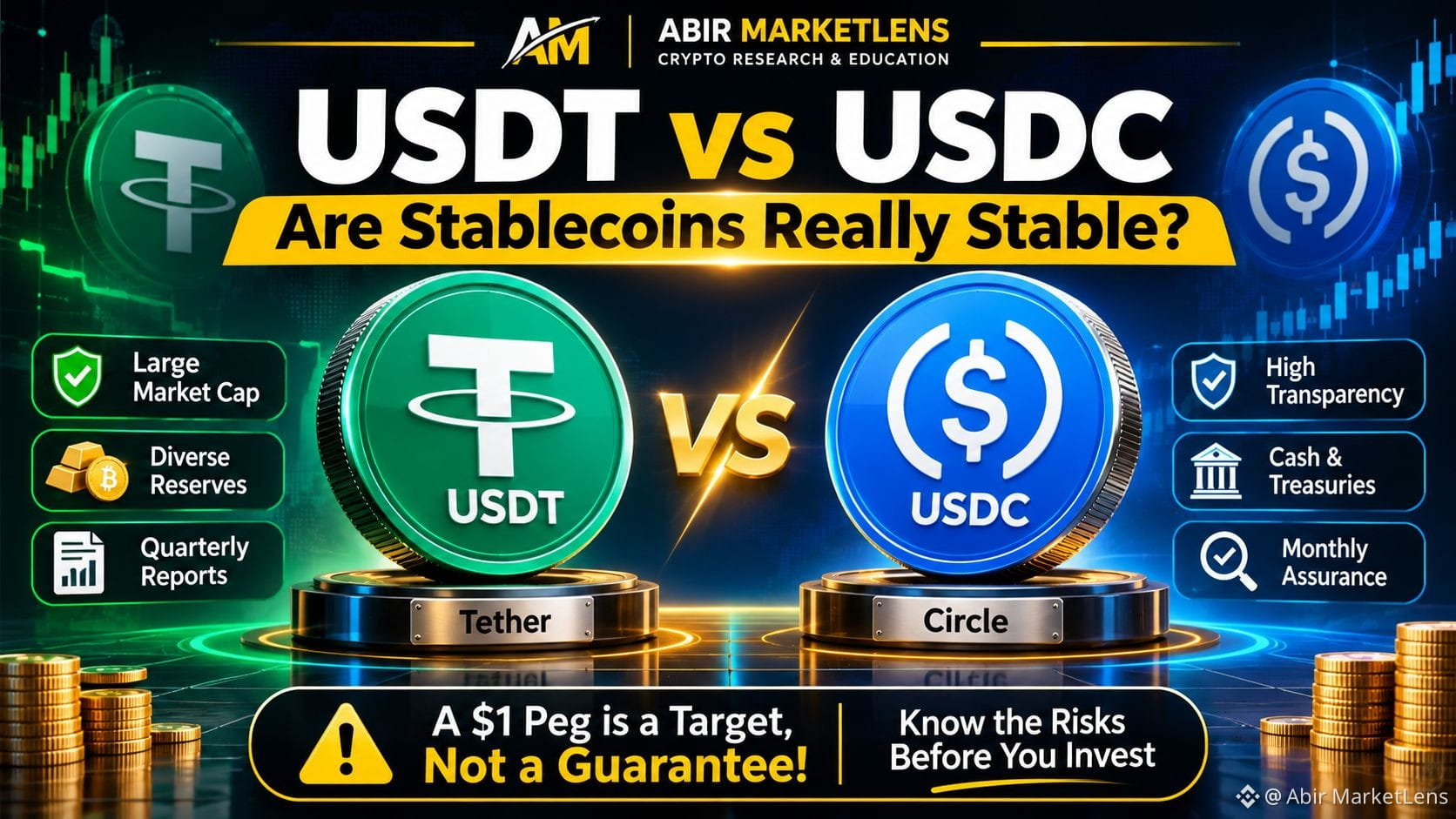
Backed by a mix of cash, US Treasuries and other assets.
Publishes quarterly reserve reports.
USDC — Circle
Backed mainly by cash and short-term US Treasury assets.
Provides weekly reserve disclosures and monthly assurance reports.
3. Can They Lose Their $1 Peg?
Yes. Stablecoins can temporarily fall below or rise above $1 because of:
Reserve concerns
Heavy selling or redemption pressure
Banking disruptions
Market panic
Remember: A $1 peg is a target, not a guarantee.
4. What Should You Check?
Before choosing a stablecoin, look at:
Reserve quality
Transparency
Redemption policies
Issuer and blockchain risks
Final Thought
USDT and USDC are both widely used, but neither is completely risk-free.
Which matters more to you: Liquidity or Transparency?
Share your thoughts below.
Educational content only. Not financial advice.
#USDT #USDC #Stablecoins #cryptoeducation #AbirMarketLens
USDT vs USDC: Are Stablecoins Really Stable?
Stablecoins are designed to stay close to $1. But does that mean they are risk-free? Not exactly.
Let's compare two major stablecoins: USDT and USDC.
1. What Are Stablecoins?
Stablecoins are cryptocurrencies designed to maintain a stable value, usually linked to the US dollar.
Both USDT and USDC aim to maintain a 1:1 value with USD.
2. USDT vs USDC
USDT — Tether
Backed by a mix of cash, US Treasuries and other assets.
Publishes quarterly reserve reports.
USDC — Circle
Backed mainly by cash and short-term US Treasury assets.
Provides weekly reserve disclosures and monthly assurance reports.
3. Can They Lose Their $1 Peg?
Yes. Stablecoins can temporarily fall below or rise above $1 because of:
Reserve concerns
Heavy selling or redemption pressure
Banking disruptions
Market panic
Remember: A $1 peg is a target, not a guarantee.
4. What Should You Check?
Before choosing a stablecoin, look at:
Reserve quality
Transparency
Redemption policies
Issuer and blockchain risks
Final Thought
USDT and USDC are both widely used, but neither is completely risk-free.
Which matters more to you: Liquidity or Transparency?
Share your thoughts below.
Educational content only. Not financial advice.
#USDT #USDC #Stablecoins #cryptoeducation #AbirMarketLens
Stablecoins are designed to stay close to $1. But does that mean they are risk-free? Not exactly.
Let's compare two major stablecoins: USDT and USDC.
1. What Are Stablecoins?
Stablecoins are cryptocurrencies designed to maintain a stable value, usually linked to the US dollar.
Both USDT and USDC aim to maintain a 1:1 value with USD.
2. USDT vs USDC
USDT — Tether
Backed by a mix of cash, US Treasuries and other assets.
Publishes quarterly reserve reports.
USDC — Circle
Backed mainly by cash and short-term US Treasury assets.
Provides weekly reserve disclosures and monthly assurance reports.
3. Can They Lose Their $1 Peg?
Yes. Stablecoins can temporarily fall below or rise above $1 because of:
Reserve concerns
Heavy selling or redemption pressure
Banking disruptions
Market panic
Remember: A $1 peg is a target, not a guarantee.
4. What Should You Check?
Before choosing a stablecoin, look at:
Reserve quality
Transparency
Redemption policies
Issuer and blockchain risks
Final Thought
USDT and USDC are both widely used, but neither is completely risk-free.
Which matters more to you: Liquidity or Transparency?
Share your thoughts below.
Educational content only. Not financial advice.
#USDT #USDC #Stablecoins #cryptoeducation #AbirMarketLens
Trong_Hatachi:
Good point that a $1 peg is a target, not a guarantee. For me, reserve transparency matters most—what’s your take? Follow back if you enjoy crypto discussions!
1
2
393

·
--
Article
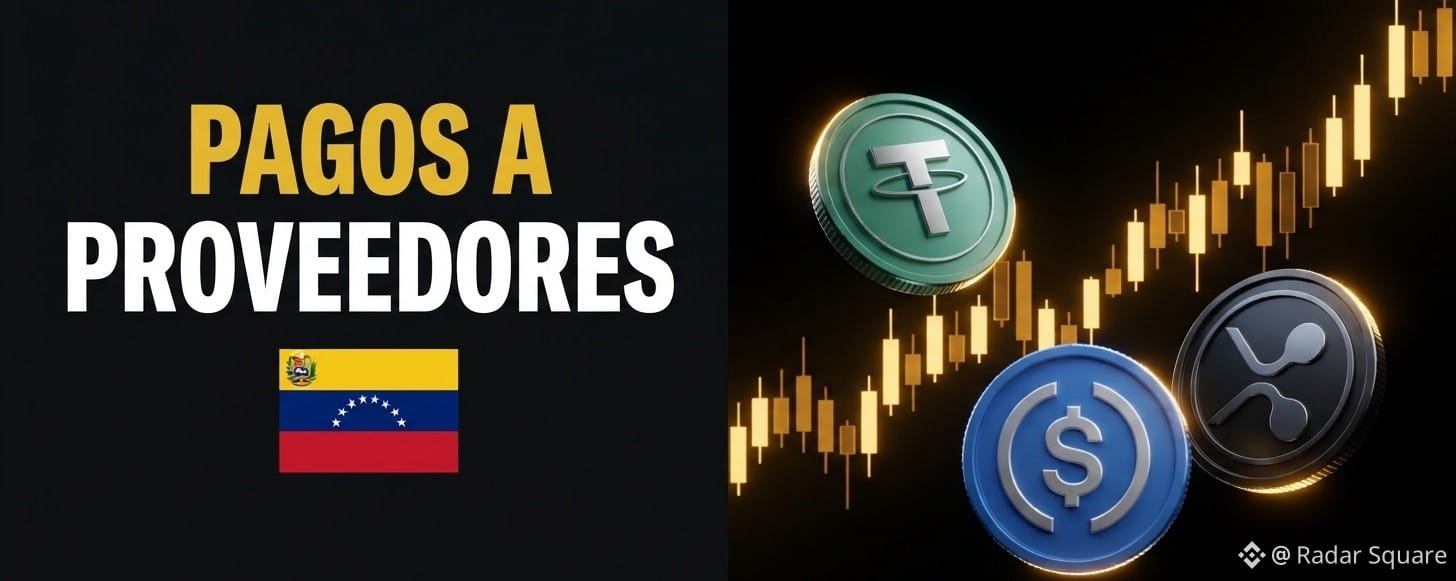
🇻🇪 Tired of losing up to 8% on bank transfers when paying your suppliers?The 3 fastest and cheapest currencies for settling invoices without intermediaries.
Importers and traders lose between $35 and $120 on every traditional transfer due to SWIFT fees, unfavorable exchange rates, and delays of up to five business days. That delay leaves your goods stuck at the port and directly cuts into your profit margin.
These are the 3 digital assets dominating international trade today for moving capital instantly:
• 1. USDT (The commercial liquidity standard): It is the most widely accepted stablecoin among manufacturers and wholesalers in Asia and the Americas for closing deals at the exact dollar value.
🇻🇪 Tired of losing up to 8% on bank transfers when paying your suppliers?
The 3 fastest and cheapest currencies for settling invoices without intermediaries.
Importers and traders lose between $35 and $120 on every traditional transfer due to SWIFT fees, unfavorable exchange rates, and delays of up to five business days. That delay leaves your goods stuck at the port and directly cuts into your profit margin.
These are the 3 digital assets dominating international trade today for moving capital instantly:
• 1. USDT (The commercial liquidity standard): It is the most widely accepted stablecoin among manufacturers and wholesalers in Asia and the Americas for closing deals at the exact dollar value.
Importers and traders lose between $35 and $120 on every traditional transfer due to SWIFT fees, unfavorable exchange rates, and delays of up to five business days. That delay leaves your goods stuck at the port and directly cuts into your profit margin.
These are the 3 digital assets dominating international trade today for moving capital instantly:
• 1. USDT (The commercial liquidity standard): It is the most widely accepted stablecoin among manufacturers and wholesalers in Asia and the Americas for closing deals at the exact dollar value.
2
1.9k

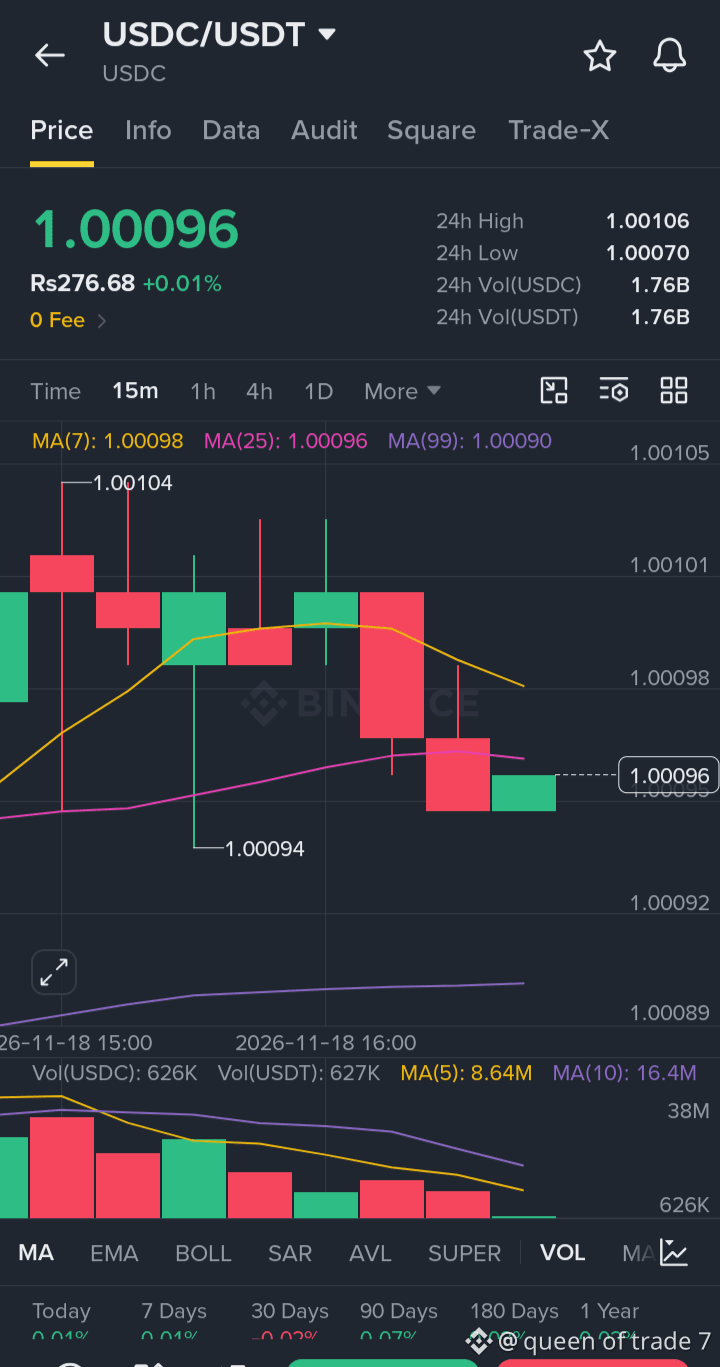
No reliable trade is available on $USDC /USDT. It's a stablecoin pair pegged near 1.00, so the 15m range of 1.00094–1.00104 is just noise around the peg. A short or long here has no real trend or structure to trade, and any gain would be smaller than the fees.
Send another chart, ideally a volatile pair like BTC, ETH or SOL, and I'll write the post.#USDT
No reliable trade is available on $USDC /USDT. It's a stablecoin pair pegged near 1.00, so the 15m range of 1.00094–1.00104 is just noise around the peg. A short or long here has no real trend or structure to trade, and any gain would be smaller than the fees.
Send another chart, ideally a volatile pair like BTC, ETH or SOL, and I'll write the post.#USDT
Send another chart, ideally a volatile pair like BTC, ETH or SOL, and I'll write the post.#USDT
72

🦈 $USDT P2P EXECUTION: WHY CHASING MARGINAL YIELD INVITES COUNTERPARTY RISK ⚠️
Executing large capital transfers requires strict counterparty filtering, especially across decentralized settlement rails. Chasing a fractionally better rate at the top of the order book often exposes capital to toxic liquidity and operational friction. 🔍
True structural edge comes from prioritizing execution safety over micro-optimizing entry prices. Stepping slightly away from top-tier matching queues preserves operational security without sacrificing meaningful capital efficiency. 🛡️
Smart positioning means valuing peace of mind above minimal execution variance. 💬 Are you prioritizing maximum price efficiency or robust counterparty safety during settlement? 👇
⚠️ Not financial advice. Always manage your risk. 🛡️
🏷️ #USDT #RiskManagement #Crypto #Trading #Execution
🦈 ⚖️
🦈 $USDT P2P EXECUTION: WHY CHASING MARGINAL YIELD INVITES COUNTERPARTY RISK ⚠️
Executing large capital transfers requires strict counterparty filtering, especially across decentralized settlement rails. Chasing a fractionally better rate at the top of the order book often exposes capital to toxic liquidity and operational friction. 🔍
True structural edge comes from prioritizing execution safety over micro-optimizing entry prices. Stepping slightly away from top-tier matching queues preserves operational security without sacrificing meaningful capital efficiency. 🛡️
Smart positioning means valuing peace of mind above minimal execution variance. 💬 Are you prioritizing maximum price efficiency or robust counterparty safety during settlement? 👇
⚠️ Not financial advice. Always manage your risk. 🛡️
🏷️ #USDT #RiskManagement #Crypto #Trading #Execution
🦈 ⚖️
Executing large capital transfers requires strict counterparty filtering, especially across decentralized settlement rails. Chasing a fractionally better rate at the top of the order book often exposes capital to toxic liquidity and operational friction. 🔍
True structural edge comes from prioritizing execution safety over micro-optimizing entry prices. Stepping slightly away from top-tier matching queues preserves operational security without sacrificing meaningful capital efficiency. 🛡️
Smart positioning means valuing peace of mind above minimal execution variance. 💬 Are you prioritizing maximum price efficiency or robust counterparty safety during settlement? 👇
⚠️ Not financial advice. Always manage your risk. 🛡️
🏷️ #USDT #RiskManagement #Crypto #Trading #Execution
🦈 ⚖️

13

·
--
🚨 STOP CHASING THE ABSOLUTE TOP BID ON $USDT P2P TO SAVE PENNIES! 🛑
Execution discipline isn't just about charts; it applies directly to your fiat ramp execution. When you hunt for the absolute highest price at the very top of the order book, you are stepping straight into avoidable counterparty risk for microscopic gains. 🦈
Smart participants understand that slipping down the book by just a fraction secures a cleaner merchant profile and protects your bank channels from freezing. A few cents of price difference is cheap insurance for your entire capital stack. 💡
Are you prioritizing fractional price gains over your account safety when moving capital? 👇
⚠️ Not financial advice. Always manage your risk. 🛡️
🏷️ #USDT #P2P #RiskManagement #CryptoTrading
🔥 💎
🚨 STOP CHASING THE ABSOLUTE TOP BID ON $USDT P2P TO SAVE PENNIES! 🛑
Execution discipline isn't just about charts; it applies directly to your fiat ramp execution. When you hunt for the absolute highest price at the very top of the order book, you are stepping straight into avoidable counterparty risk for microscopic gains. 🦈
Smart participants understand that slipping down the book by just a fraction secures a cleaner merchant profile and protects your bank channels from freezing. A few cents of price difference is cheap insurance for your entire capital stack. 💡
Are you prioritizing fractional price gains over your account safety when moving capital? 👇
⚠️ Not financial advice. Always manage your risk. 🛡️
🏷️ #USDT #P2P #RiskManagement #CryptoTrading
🔥 💎
Execution discipline isn't just about charts; it applies directly to your fiat ramp execution. When you hunt for the absolute highest price at the very top of the order book, you are stepping straight into avoidable counterparty risk for microscopic gains. 🦈
Smart participants understand that slipping down the book by just a fraction secures a cleaner merchant profile and protects your bank channels from freezing. A few cents of price difference is cheap insurance for your entire capital stack. 💡
Are you prioritizing fractional price gains over your account safety when moving capital? 👇
⚠️ Not financial advice. Always manage your risk. 🛡️
🏷️ #USDT #P2P #RiskManagement #CryptoTrading
🔥 💎

28

·
--
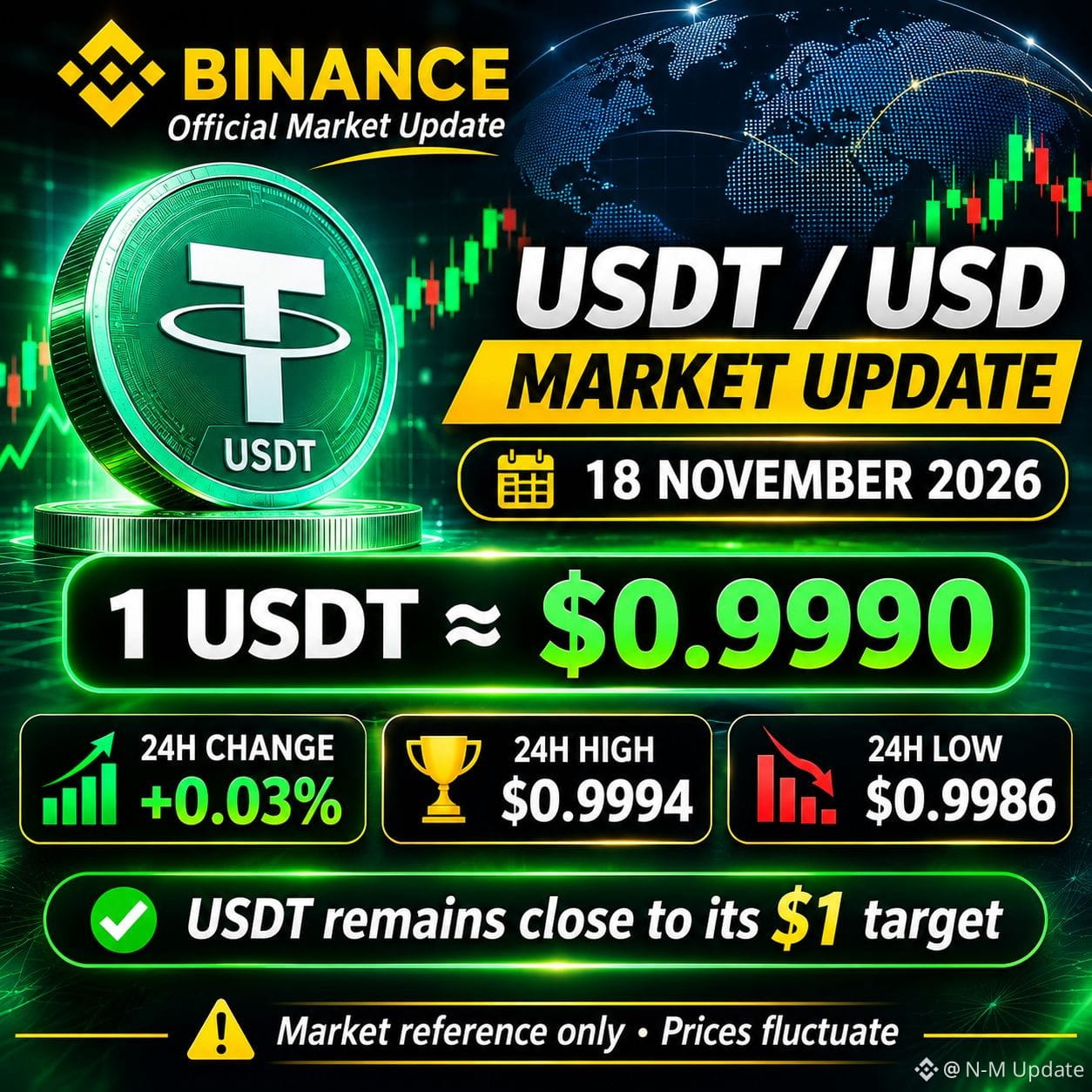
🚨 BINANCE USDT MARKET UPDATE
📅 November 18, 2026
💵 TETHER (USDT) / USD
📊 Market Overview:
1 USDT ≈ $0.9990
24H Change: +0.03%
24H High: $0.9994
24H Low: $0.9986
🟢 MARKET INSIGHT
USDT continues to trade very close to its $1 USD target, showing relatively stable price movement.
📌 What This Means: Tether (USDT) is designed to maintain a value close to one US dollar. Small price fluctuations can occur depending on market demand and liquidity.
⚠️ Disclaimer: Market prices fluctuate. Always verify live prices before making financial decisions. This post is for informational purposes only.
🌐 Stay Informed. Stay Updated.
#Binance #USDT #CryptoMarket #bitcoin #Blockchain
🚨 BINANCE USDT MARKET UPDATE
📅 November 18, 2026
💵 TETHER (USDT) / USD
📊 Market Overview:
1 USDT ≈ $0.9990
24H Change: +0.03%
24H High: $0.9994
24H Low: $0.9986
🟢 MARKET INSIGHT
USDT continues to trade very close to its $1 USD target, showing relatively stable price movement.
📌 What This Means: Tether (USDT) is designed to maintain a value close to one US dollar. Small price fluctuations can occur depending on market demand and liquidity.
⚠️ Disclaimer: Market prices fluctuate. Always verify live prices before making financial decisions. This post is for informational purposes only.
🌐 Stay Informed. Stay Updated.
#Binance #USDT #CryptoMarket #bitcoin #Blockchain
📅 November 18, 2026
💵 TETHER (USDT) / USD
📊 Market Overview:
1 USDT ≈ $0.9990
24H Change: +0.03%
24H High: $0.9994
24H Low: $0.9986
🟢 MARKET INSIGHT
USDT continues to trade very close to its $1 USD target, showing relatively stable price movement.
📌 What This Means: Tether (USDT) is designed to maintain a value close to one US dollar. Small price fluctuations can occur depending on market demand and liquidity.
⚠️ Disclaimer: Market prices fluctuate. Always verify live prices before making financial decisions. This post is for informational purposes only.
🌐 Stay Informed. Stay Updated.
#Binance #USDT #CryptoMarket #bitcoin #Blockchain
62

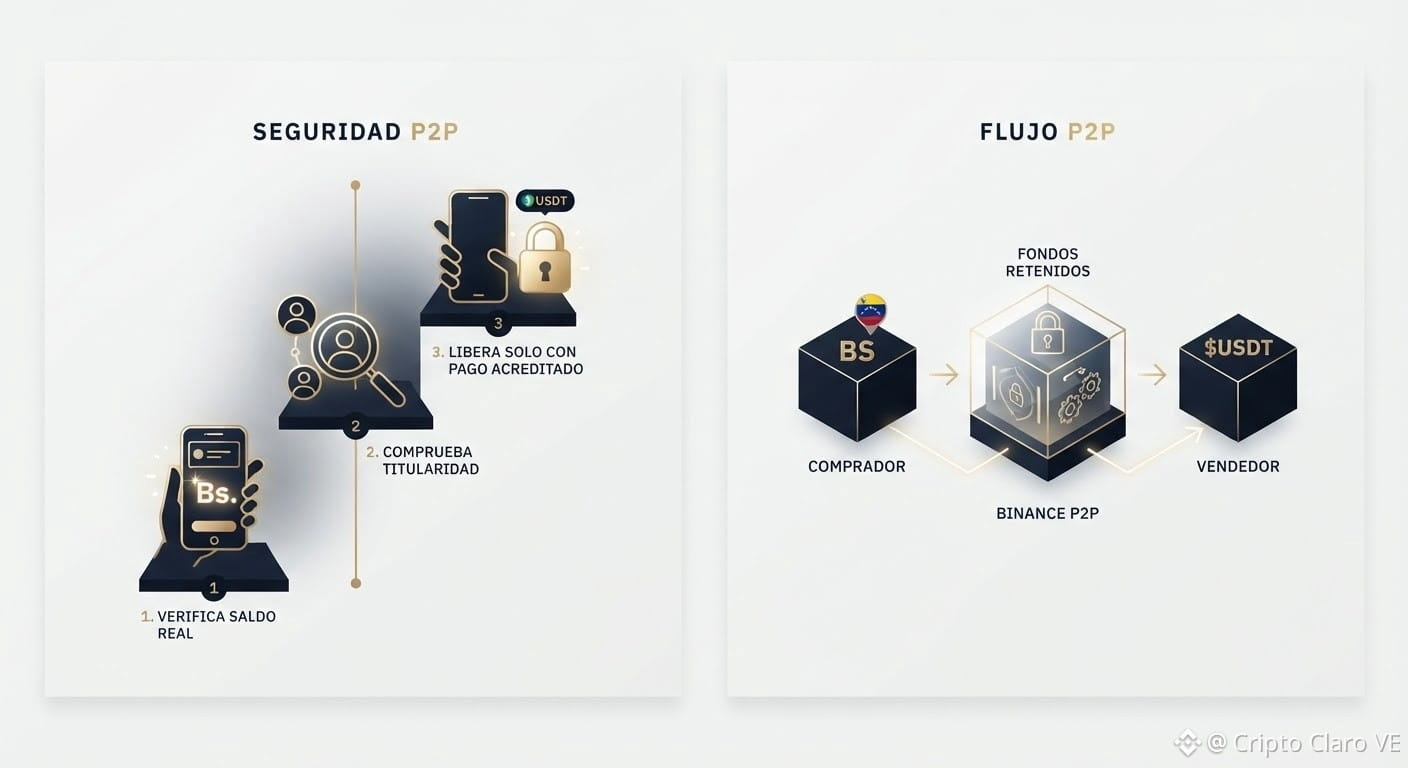
🛡️ Before releasing your $USDT on P2P, remember these 3 important rules! 🇻🇪
Trading P2P in Venezuela can be convenient, but a small distraction can cost you money. Security starts before you tap “Release.”
1️⃣ Don’t trust screenshots: A payment receipt doesn’t guarantee that you’ve received the money. Check directly in your banking app that the payment has been credited and is available.
2️⃣ Check who is paying you: The name of the account holder sending the money must match the buyer’s verified name on Binance. Avoid payments from third parties.
3️⃣ Never release under pressure: Release your $USDT only after confirming the payment. If anything doesn’t match, don’t release the funds; use Binance chat or the appeals process.
🔐 Remember: verify first, release afterward. Your security is worth more than any transaction!
📌 Save this post and share it with someone who trades P2P.
#BinanceSquare #P2P #USDT #CriptoVenezuela #SeguridadCripto
🛡️ Before releasing your $USDT on P2P, remember these 3 important rules! 🇻🇪
Trading P2P in Venezuela can be convenient, but a small distraction can cost you money. Security starts before you tap “Release.”
1️⃣ Don’t trust screenshots: A payment receipt doesn’t guarantee that you’ve received the money. Check directly in your banking app that the payment has been credited and is available.
2️⃣ Check who is paying you: The name of the account holder sending the money must match the buyer’s verified name on Binance. Avoid payments from third parties.
3️⃣ Never release under pressure: Release your $USDT only after confirming the payment. If anything doesn’t match, don’t release the funds; use Binance chat or the appeals process.
🔐 Remember: verify first, release afterward. Your security is worth more than any transaction!
📌 Save this post and share it with someone who trades P2P.
#BinanceSquare #P2P #USDT #CriptoVenezuela #SeguridadCripto
Trading P2P in Venezuela can be convenient, but a small distraction can cost you money. Security starts before you tap “Release.”
1️⃣ Don’t trust screenshots: A payment receipt doesn’t guarantee that you’ve received the money. Check directly in your banking app that the payment has been credited and is available.
2️⃣ Check who is paying you: The name of the account holder sending the money must match the buyer’s verified name on Binance. Avoid payments from third parties.
3️⃣ Never release under pressure: Release your $USDT only after confirming the payment. If anything doesn’t match, don’t release the funds; use Binance chat or the appeals process.
🔐 Remember: verify first, release afterward. Your security is worth more than any transaction!
📌 Save this post and share it with someone who trades P2P.
#BinanceSquare #P2P #USDT #CriptoVenezuela #SeguridadCripto
1
561

·
--
Bullish
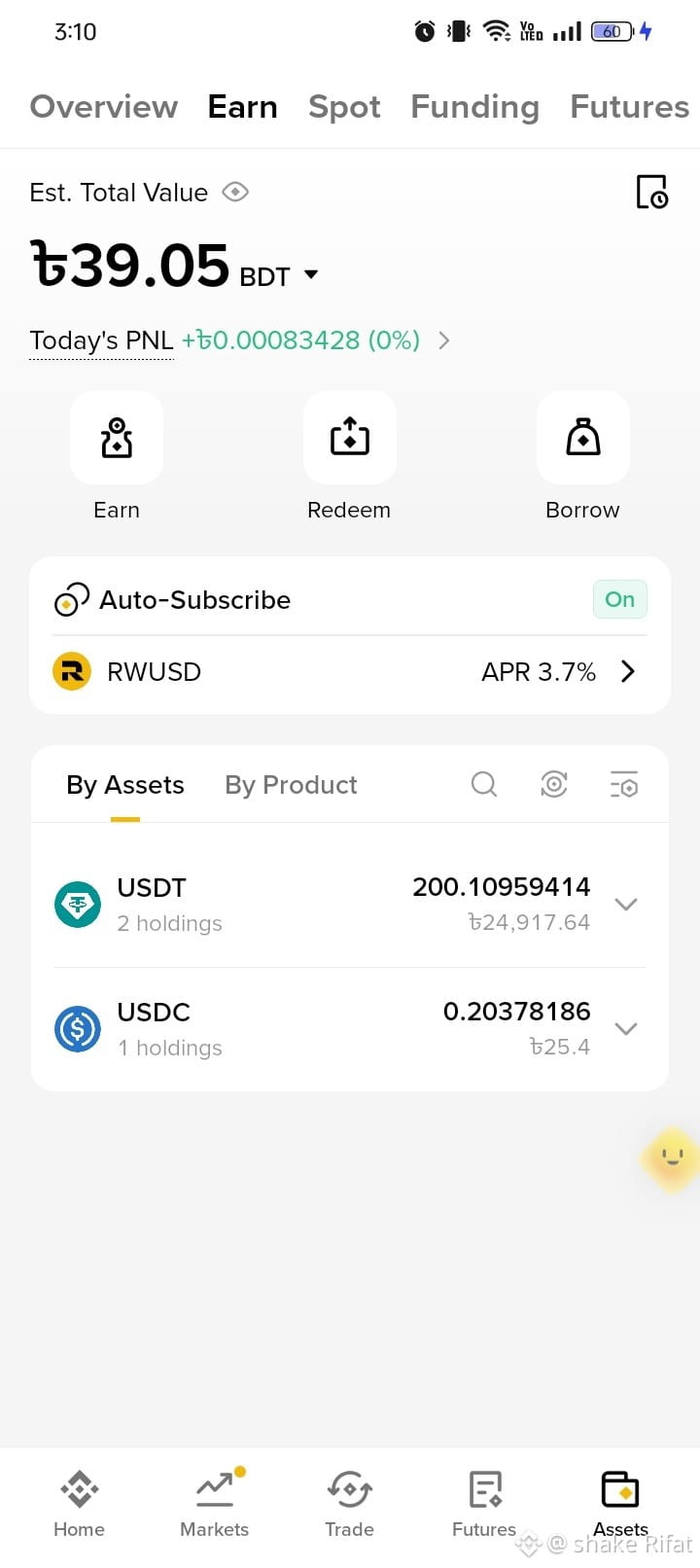
If you have $USDT or $USDC sitting idle in your Spot wallet, you're missing out on free daily returns. 💡
Here's how automatic compound interest works with a small amount of capital:
1️⃣ Transfer your stablecoins ($USDT ) to Simple Earn Flexible.
2️⃣ Turn on Auto-Subscribe.
3️⃣ You earn interest every day, and the system adds it to your principal so that the next day you earn on the new total.
Best of all: no lock-up periods, instant access to your funds, and bonus rates for initial deposits. Consistency with small amounts always beats waiting for the "perfect moment" to invest a lot of money.
Would you rather keep your funds liquid in Flexible or lock them up for a fixed term? Let me know in the comments. 💬
#simpleearn #CriptoParaPrincipiantes s #USDT #USDC✅ #EducacionFinanciera
{spot}(BTCUSDT)
If you have $USDT or $USDC sitting idle in your Spot wallet, you're missing out on free daily returns. 💡
Here's how automatic compound interest works with a small amount of capital:
1️⃣ Transfer your stablecoins ($USDT ) to Simple Earn Flexible.
2️⃣ Turn on Auto-Subscribe.
3️⃣ You earn interest every day, and the system adds it to your principal so that the next day you earn on the new total.
Best of all: no lock-up periods, instant access to your funds, and bonus rates for initial deposits. Consistency with small amounts always beats waiting for the "perfect moment" to invest a lot of money.
Would you rather keep your funds liquid in Flexible or lock them up for a fixed term? Let me know in the comments. 💬
#simpleearn #CriptoParaPrincipiantes s #USDT #USDC✅ #EducacionFinanciera
Here's how automatic compound interest works with a small amount of capital:
1️⃣ Transfer your stablecoins ($USDT ) to Simple Earn Flexible.
2️⃣ Turn on Auto-Subscribe.
3️⃣ You earn interest every day, and the system adds it to your principal so that the next day you earn on the new total.
Best of all: no lock-up periods, instant access to your funds, and bonus rates for initial deposits. Consistency with small amounts always beats waiting for the "perfect moment" to invest a lot of money.
Would you rather keep your funds liquid in Flexible or lock them up for a fixed term? Let me know in the comments. 💬
#simpleearn #CriptoParaPrincipiantes s #USDT #USDC✅ #EducacionFinanciera
88

·
--
This morning, $BTC is hovering around $62,190, up about 0.2% over the past 24 hours; $ETH is around $1,762, up roughly 0.6%. Prices are still below $64,000, and the Fear & Greed Index remains at 10, indicating extreme fear.
On the stablecoin front, in its November 18 assessment, S&P Global continued to give #USDT the lowest stability rating, “Weak” (score: 5). The reason: high-risk assets have risen to about 28% of its circulating supply. Its reserves during the same period included about $19.1 billion in precious metals, roughly $8.4 billion in Bitcoin, and around $4.2 billion in publicly traded stocks. S&P warned that a sharp drop in these volatile assets could erode the roughly $8 billion excess reserve cushion. Tether, for its part, says traditional risk models do not fully apply and emphasizes its own profitability.
Hmm, the rating is stuck there—that’s a fact. But don’t rush to translate “Weak” as “a depeg is imminent.” Looking at the size of the cushion and the audit progress is more useful than fixating on the word “Weak.”
#比特币 #以太坊 #CryptoMarket
This morning, $BTC is hovering around $62,190, up about 0.2% over the past 24 hours; $ETH is around $1,762, up roughly 0.6%. Prices are still below $64,000, and the Fear & Greed Index remains at 10, indicating extreme fear.
On the stablecoin front, in its November 18 assessment, S&P Global continued to give #USDT the lowest stability rating, “Weak” (score: 5). The reason: high-risk assets have risen to about 28% of its circulating supply. Its reserves during the same period included about $19.1 billion in precious metals, roughly $8.4 billion in Bitcoin, and around $4.2 billion in publicly traded stocks. S&P warned that a sharp drop in these volatile assets could erode the roughly $8 billion excess reserve cushion. Tether, for its part, says traditional risk models do not fully apply and emphasizes its own profitability.
Hmm, the rating is stuck there—that’s a fact. But don’t rush to translate “Weak” as “a depeg is imminent.” Looking at the size of the cushion and the audit progress is more useful than fixating on the word “Weak.”
#比特币 #以太坊 #CryptoMarket
On the stablecoin front, in its November 18 assessment, S&P Global continued to give #USDT the lowest stability rating, “Weak” (score: 5). The reason: high-risk assets have risen to about 28% of its circulating supply. Its reserves during the same period included about $19.1 billion in precious metals, roughly $8.4 billion in Bitcoin, and around $4.2 billion in publicly traded stocks. S&P warned that a sharp drop in these volatile assets could erode the roughly $8 billion excess reserve cushion. Tether, for its part, says traditional risk models do not fully apply and emphasizes its own profitability.
Hmm, the rating is stuck there—that’s a fact. But don’t rush to translate “Weak” as “a depeg is imminent.” Looking at the size of the cushion and the audit progress is more useful than fixating on the word “Weak.”
#比特币 #以太坊 #CryptoMarket
5

·
--
Article
The 20.91% premium isn’t yours: it’s the P2P tollA 20.91% premium isn’t money in your pocket: it’s the gap between two markets.
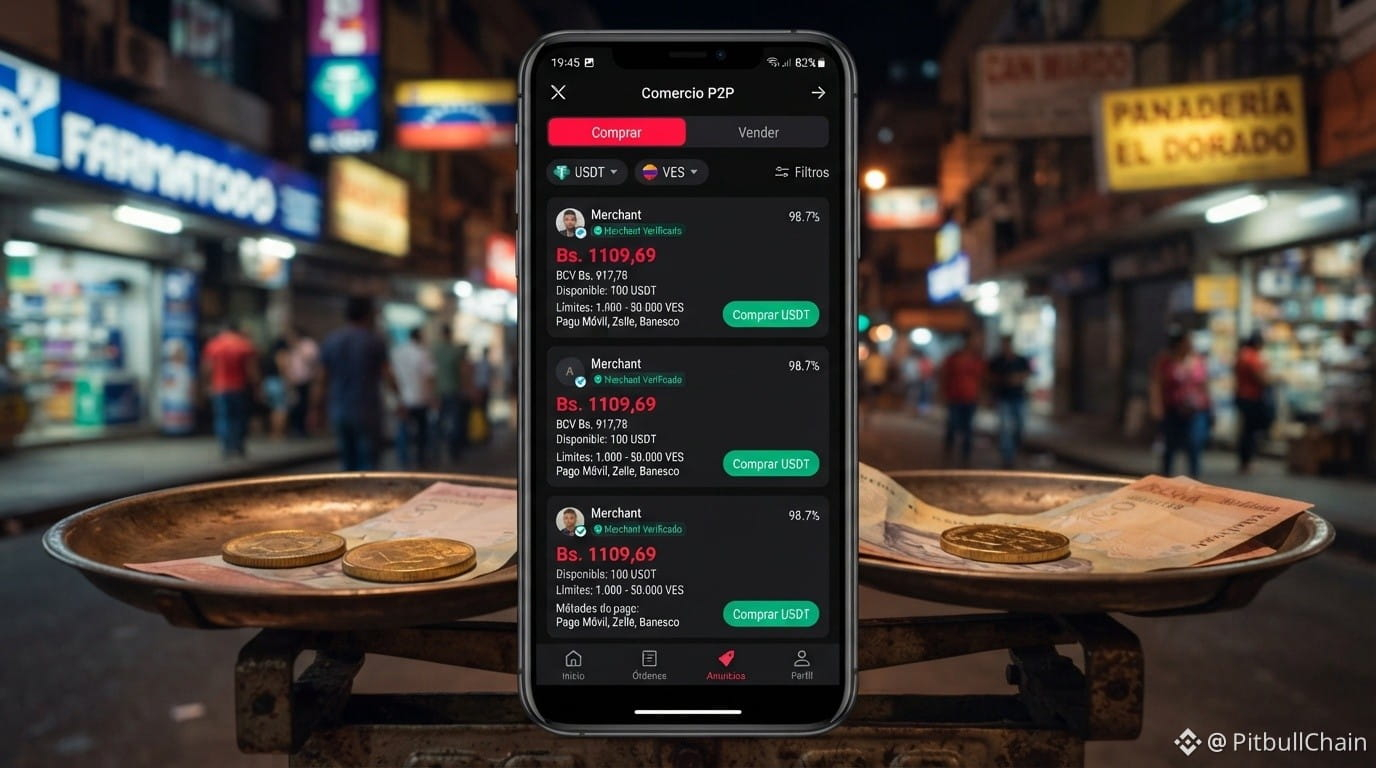
Today, Thursday, November 19, the Venezuelan P2P market wakes up to this picture: buying $USDT costs Bs. 1,109.69 and selling it costs Bs. 1,039.19. The BCV rate is Bs. 917.78. Between those two realities, there’s a 20.91% premium over the official rate and an end-to-end spread of Bs. 70.50, or 6.78%.
🔍 First reading: the premium is measured against the buy price. The 20.91% describes how much more expensive the digital dollar is than the official rate when YOU enter the market. It’s not a discount, it’s not a bonus, it’s not a return. It’s the price of entry.
The 20.91% premium isn’t yours: it’s the P2P toll
A 20.91% premium isn’t money in your pocket: it’s the gap between two markets.
Today, Thursday, November 19, the Venezuelan P2P market wakes up to this picture: buying $USDT costs Bs. 1,109.69 and selling it costs Bs. 1,039.19. The BCV rate is Bs. 917.78. Between those two realities, there’s a 20.91% premium over the official rate and an end-to-end spread of Bs. 70.50, or 6.78%.
🔍 First reading: the premium is measured against the buy price. The 20.91% describes how much more expensive the digital dollar is than the official rate when YOU enter the market. It’s not a discount, it’s not a bonus, it’s not a return. It’s the price of entry.
Today, Thursday, November 19, the Venezuelan P2P market wakes up to this picture: buying $USDT costs Bs. 1,109.69 and selling it costs Bs. 1,039.19. The BCV rate is Bs. 917.78. Between those two realities, there’s a 20.91% premium over the official rate and an end-to-end spread of Bs. 70.50, or 6.78%.
🔍 First reading: the premium is measured against the buy price. The 20.91% describes how much more expensive the digital dollar is than the official rate when YOU enter the market. It’s not a discount, it’s not a bonus, it’s not a return. It’s the price of entry.
19

·
--
【Market Update】S&P maintains USDT’s lowest rating; Tether hits back
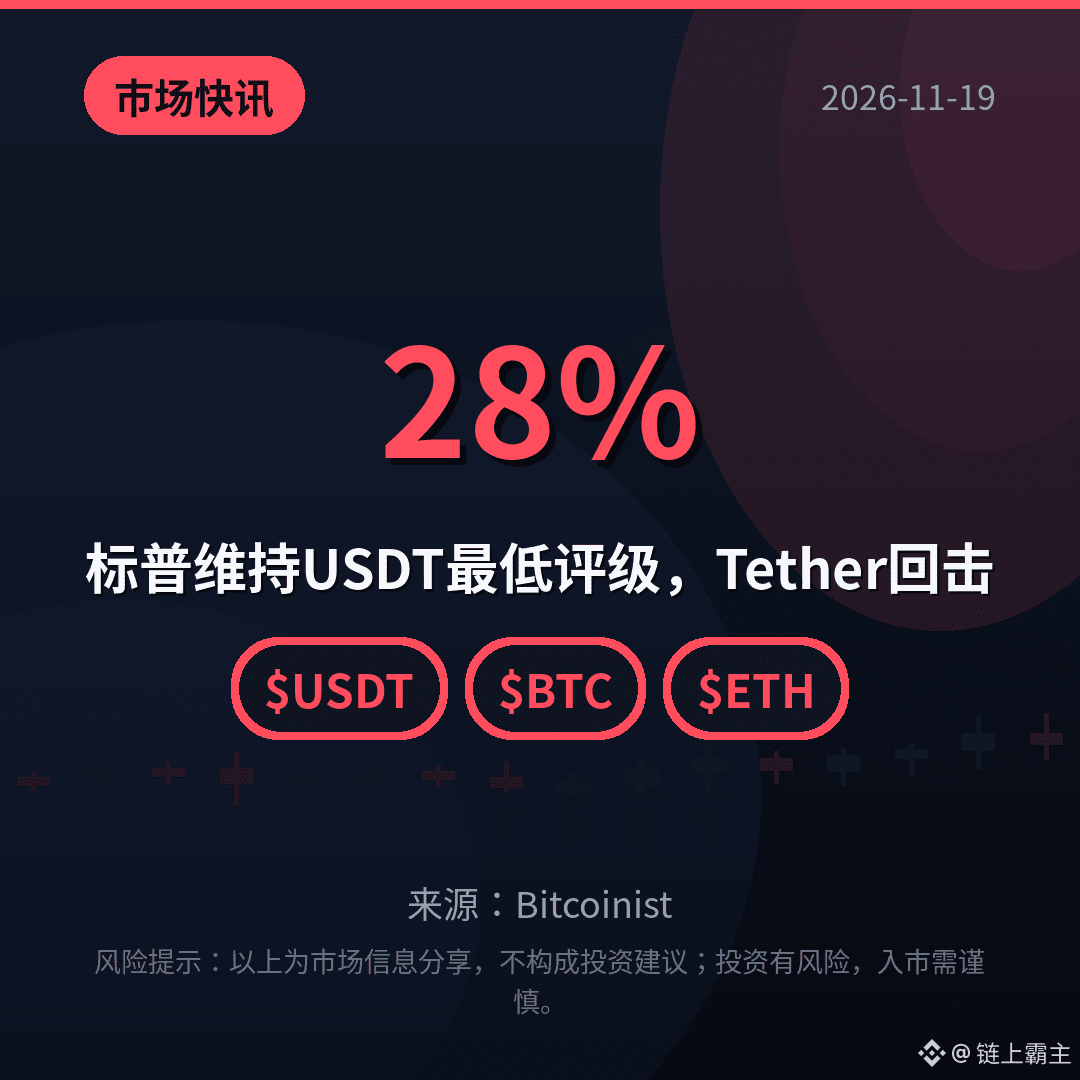
On November 18, S&P maintained its rating of USDT’s ability to maintain stability at Level 5 (weak), the lowest tier, saying that high-risk reserves accounted for 28%, up from 24% a year earlier. Tether countered that the issue lay with the assessment framework. As of September 30, reserve assets totaled 191.5 billion dollars and liabilities totaled 183.5 billion dollars, with an excess of 7.95 billion dollars. With the lowest rating, are you still comfortable holding USDT?
$USDT $BTC $ETH
#币安广场 #USDT #Stablecoin
(Source: Bitcoinist)
⚠️Risk warning: The above is shared for market information only and does not constitute investment advice. Investing involves risks; proceed with caution.
【Market Update】S&P maintains USDT’s lowest rating; Tether hits back
On November 18, S&P maintained its rating of USDT’s ability to maintain stability at Level 5 (weak), the lowest tier, saying that high-risk reserves accounted for 28%, up from 24% a year earlier. Tether countered that the issue lay with the assessment framework. As of September 30, reserve assets totaled 191.5 billion dollars and liabilities totaled 183.5 billion dollars, with an excess of 7.95 billion dollars. With the lowest rating, are you still comfortable holding USDT?
$USDT $BTC $ETH
#币安广场 #USDT #Stablecoin
(Source: Bitcoinist)
⚠️Risk warning: The above is shared for market information only and does not constitute investment advice. Investing involves risks; proceed with caution.
On November 18, S&P maintained its rating of USDT’s ability to maintain stability at Level 5 (weak), the lowest tier, saying that high-risk reserves accounted for 28%, up from 24% a year earlier. Tether countered that the issue lay with the assessment framework. As of September 30, reserve assets totaled 191.5 billion dollars and liabilities totaled 183.5 billion dollars, with an excess of 7.95 billion dollars. With the lowest rating, are you still comfortable holding USDT?
$USDT $BTC $ETH
#币安广场 #USDT #Stablecoin
(Source: Bitcoinist)
⚠️Risk warning: The above is shared for market information only and does not constitute investment advice. Investing involves risks; proceed with caution.
2

·
--
Stablecoins are taking business away from banks: Tether makes another move
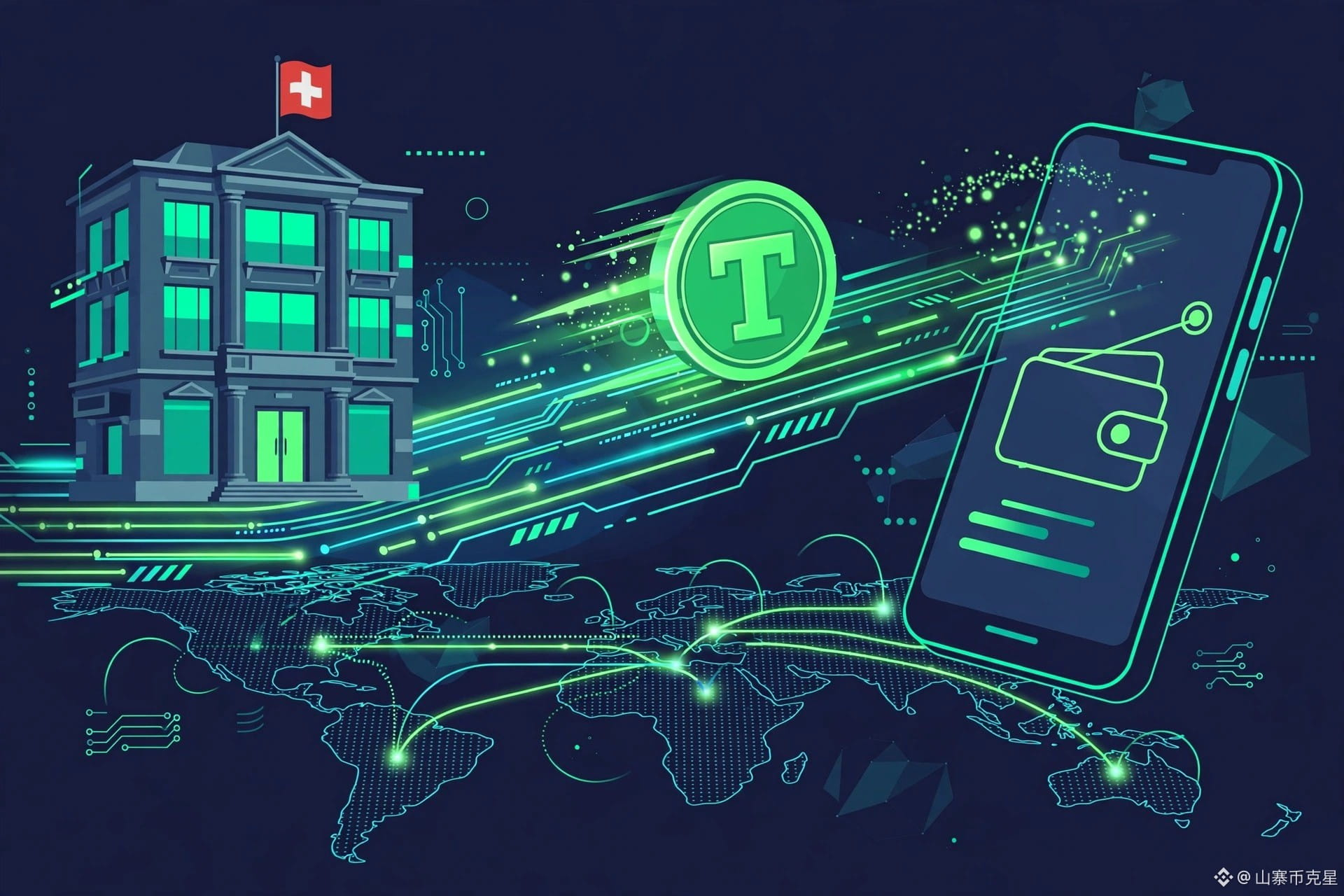
Tether just announced a strategic investment in SCRYPT, a Swiss stablecoin services provider, and 48 people are discussing it on the Plaza. The investment amount wasn’t disclosed, but the direction is clear: stablecoins are moving into the banking system.
1️⃣ SCRYPT is one of Switzerland’s largest stablecoin trading and liquidity providers. It began operating in 2019 and is regulated by the Swiss Financial Market Supervisory Authority (FINMA).
2️⃣ This partnership is targeting third-party payments: banks, brokerages, and fintech companies will be able to accept fiat, send stablecoins across borders, and pay out in fiat. Cross-border settlements could go from taking days to just minutes, operating 24/7.
3️⃣ This isn’t Tether’s first move into payments infrastructure. Just days ago, it announced similar partnerships with Stables and Nomad.
In plain English: cross-border transfers used to take days and pass through a string of intermediary banks. In the future, they could arrive in minutes—the banks will just be running on a different track.
The Fear and Greed Index is still at 11, indicating extreme fear, but institutional money and infrastructure development haven’t slowed down at all. What do you think: will stablecoins replace cross-border transfers first, or go after banks’ deposit business? Let’s talk in the comments~
#Tether战略投资瑞士稳定币服务商SCRYPT
#USDT $USDT
Stablecoins are taking business away from banks: Tether makes another move
Tether just announced a strategic investment in SCRYPT, a Swiss stablecoin services provider, and 48 people are discussing it on the Plaza. The investment amount wasn’t disclosed, but the direction is clear: stablecoins are moving into the banking system.
1️⃣ SCRYPT is one of Switzerland’s largest stablecoin trading and liquidity providers. It began operating in 2019 and is regulated by the Swiss Financial Market Supervisory Authority (FINMA).
2️⃣ This partnership is targeting third-party payments: banks, brokerages, and fintech companies will be able to accept fiat, send stablecoins across borders, and pay out in fiat. Cross-border settlements could go from taking days to just minutes, operating 24/7.
3️⃣ This isn’t Tether’s first move into payments infrastructure. Just days ago, it announced similar partnerships with Stables and Nomad.
In plain English: cross-border transfers used to take days and pass through a string of intermediary banks. In the future, they could arrive in minutes—the banks will just be running on a different track.
The Fear and Greed Index is still at 11, indicating extreme fear, but institutional money and infrastructure development haven’t slowed down at all. What do you think: will stablecoins replace cross-border transfers first, or go after banks’ deposit business? Let’s talk in the comments~
#Tether战略投资瑞士稳定币服务商SCRYPT
#USDT $USDT
Tether just announced a strategic investment in SCRYPT, a Swiss stablecoin services provider, and 48 people are discussing it on the Plaza. The investment amount wasn’t disclosed, but the direction is clear: stablecoins are moving into the banking system.
1️⃣ SCRYPT is one of Switzerland’s largest stablecoin trading and liquidity providers. It began operating in 2019 and is regulated by the Swiss Financial Market Supervisory Authority (FINMA).
2️⃣ This partnership is targeting third-party payments: banks, brokerages, and fintech companies will be able to accept fiat, send stablecoins across borders, and pay out in fiat. Cross-border settlements could go from taking days to just minutes, operating 24/7.
3️⃣ This isn’t Tether’s first move into payments infrastructure. Just days ago, it announced similar partnerships with Stables and Nomad.
In plain English: cross-border transfers used to take days and pass through a string of intermediary banks. In the future, they could arrive in minutes—the banks will just be running on a different track.
The Fear and Greed Index is still at 11, indicating extreme fear, but institutional money and infrastructure development haven’t slowed down at all. What do you think: will stablecoins replace cross-border transfers first, or go after banks’ deposit business? Let’s talk in the comments~
#Tether战略投资瑞士稳定币服务商SCRYPT
#USDT $USDT
11
·
--
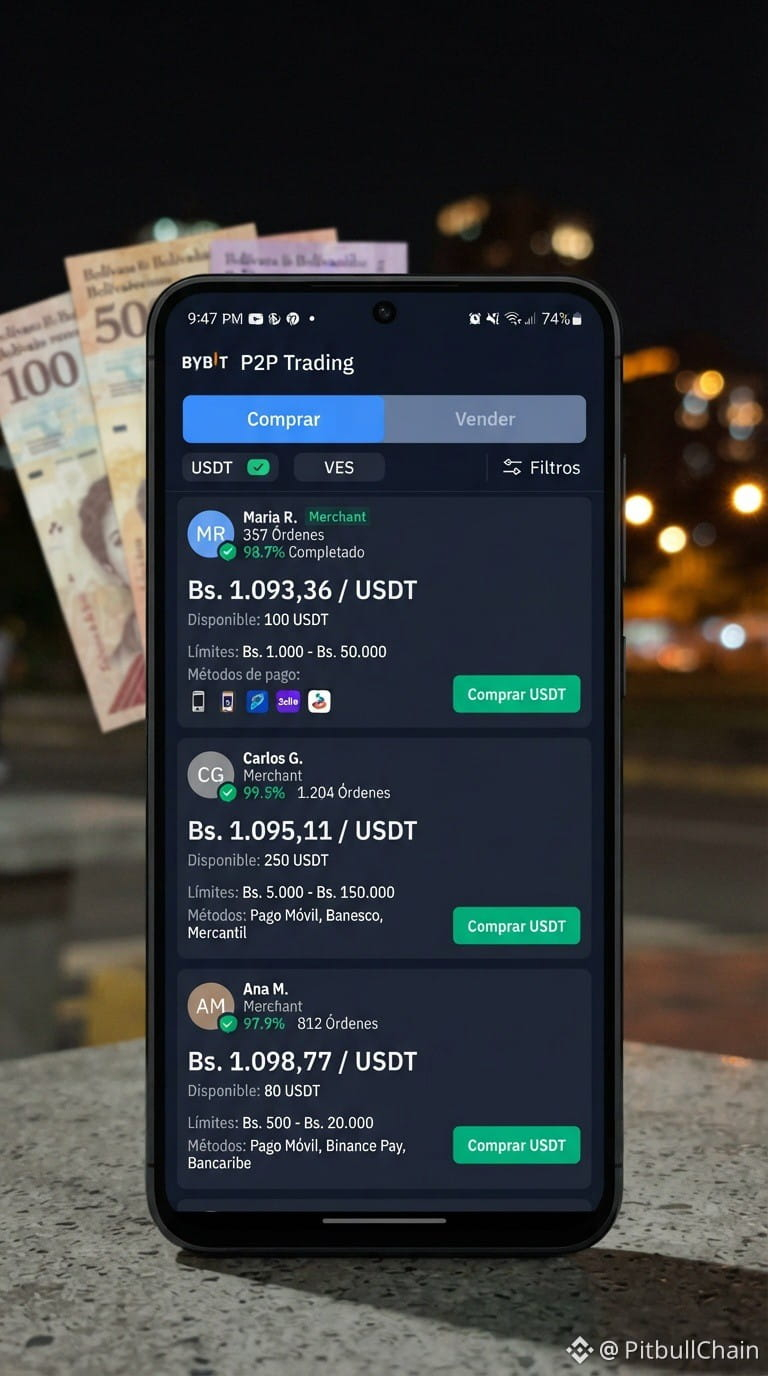
The BCV opens at Bs. 917,78 and USDT on Binance P2P is bought at Bs. 1.093,36. That is a 19,13% premium, with a spread of Bs. 27,69 (2,60%) between buy and sell. 🐶
With 268 active offers, the market is liquid, but the toll is noticeable. Before moving your $USDT, check the fee and the exchange rate at the moment: what you see is not a profit, it is the cost of entering and exiting.
Verify your transactions and don’t be swayed by the first listing.
📊 Live rates and analysis at https://pitbullchain.com
$USDT $BTC #USDT #Venezuela #P2P #BinanceSquare #Cripto
The BCV opens at Bs. 917,78 and USDT on Binance P2P is bought at Bs. 1.093,36. That is a 19,13% premium, with a spread of Bs. 27,69 (2,60%) between buy and sell. 🐶
With 268 active offers, the market is liquid, but the toll is noticeable. Before moving your $USDT, check the fee and the exchange rate at the moment: what you see is not a profit, it is the cost of entering and exiting.
Verify your transactions and don’t be swayed by the first listing.
📊 Live rates and analysis at https://pitbullchain.com
$USDT $BTC #USDT #Venezuela #P2P #BinanceSquare #Cripto
With 268 active offers, the market is liquid, but the toll is noticeable. Before moving your $USDT, check the fee and the exchange rate at the moment: what you see is not a profit, it is the cost of entering and exiting.
Verify your transactions and don’t be swayed by the first listing.
📊 Live rates and analysis at https://pitbullchain.com
$USDT $BTC #USDT #Venezuela #P2P #BinanceSquare #Cripto
7

On Android, the Aave App takes USDT from TRON, and the whole screen is shouting “7.25% flexible savings.” I went and read the docs for its underlying Stable Vault, and that number needs a closer look.
First, the facts. The official blog says “up to 7.25% APY.” The same post says you can invite friends to unlock a savings boost, and the disclaimer says rates are variable, not guaranteed, and vary by region. Once your money goes in, it’s not deposited directly into an Aave pool. It goes into a pooled Stable Vault: accounting is on Arbitrum, while yield is currently generated on Ethereum mainnet, with funds moved between them via bridges like CCIP, LayerZero, Hyperlane, and Across. TRON is just the deposit route; the official team hasn’t confirmed native TRON withdrawals.
Next, where does the yield come from? I just checked DefiLlama (11/19 12:52 UTC): USDT deposits in the core Ethereum Aave v3 market earn 3.12%, and USDC earns 4.47%, excluding staking rewards. That puts 7.25% 2.8 to 4.1 percentage points above the underlying rates. I couldn’t find an answer in the public materials about who covers that difference, so that remains unknown.
What really matters are two sentences in the docs. First: the Stable Vault offers users a “stable rate,” set individually for each user by the integrator, with any excess yield going to the integrator. Second: when you withdraw, the principal can always be exchanged for an IOU, but withdrawing the interest depends on whether the system has enough “trusted surplus.”
In plain English: the app quotes you a fixed rate, while the underlying yield fluctuates. If the underlying yield is higher than your rate, the platform keeps the difference. If it’s lower, the interest shown in your account is just a number; when the vault doesn’t have enough surplus, you can’t withdraw it. “Withdraw anytime” means your principal can be exchanged for an IOU, not that you’ll receive it immediately. Withdrawals are also subject to fees under the Withdrawal Execution Policy and liquidity constraints.
There’s another detail few people mention: the docs say supported stablecoins deposited into the vault are “treated as equivalent,” and users can withdraw in any supported currency. You might deposit TRC20 USDT and withdraw USDC on Arbitrum. Usually that’s no big deal, but if one of those stablecoins depegs, the whole pool shares the loss.
My take: this isn’t a scam. Aave’s risk disclosures are fairly thorough; they list bridge risk, bad debt, oracles, and more. But this is fundamentally a packaged yield product, not a flexible savings account, and the marketing pitch is a long way from the documentation. Putting idle funds from TRON in to farm the boost may be fine, but treating it like a bank savings account would be naive. I’d keep an eye on two things: the actual rate after the boost ends, and whether the vault’s surplus data becomes publicly verifiable.
#Aave #USDT #DeFi
On Android, the Aave App takes USDT from TRON, and the whole screen is shouting “7.25% flexible savings.” I went and read the docs for its underlying Stable Vault, and that number needs a closer look.
First, the facts. The official blog says “up to 7.25% APY.” The same post says you can invite friends to unlock a savings boost, and the disclaimer says rates are variable, not guaranteed, and vary by region. Once your money goes in, it’s not deposited directly into an Aave pool. It goes into a pooled Stable Vault: accounting is on Arbitrum, while yield is currently generated on Ethereum mainnet, with funds moved between them via bridges like CCIP, LayerZero, Hyperlane, and Across. TRON is just the deposit route; the official team hasn’t confirmed native TRON withdrawals.
Next, where does the yield come from? I just checked DefiLlama (11/19 12:52 UTC): USDT deposits in the core Ethereum Aave v3 market earn 3.12%, and USDC earns 4.47%, excluding staking rewards. That puts 7.25% 2.8 to 4.1 percentage points above the underlying rates. I couldn’t find an answer in the public materials about who covers that difference, so that remains unknown.
What really matters are two sentences in the docs. First: the Stable Vault offers users a “stable rate,” set individually for each user by the integrator, with any excess yield going to the integrator. Second: when you withdraw, the principal can always be exchanged for an IOU, but withdrawing the interest depends on whether the system has enough “trusted surplus.”
In plain English: the app quotes you a fixed rate, while the underlying yield fluctuates. If the underlying yield is higher than your rate, the platform keeps the difference. If it’s lower, the interest shown in your account is just a number; when the vault doesn’t have enough surplus, you can’t withdraw it. “Withdraw anytime” means your principal can be exchanged for an IOU, not that you’ll receive it immediately. Withdrawals are also subject to fees under the Withdrawal Execution Policy and liquidity constraints.
There’s another detail few people mention: the docs say supported stablecoins deposited into the vault are “treated as equivalent,” and users can withdraw in any supported currency. You might deposit TRC20 USDT and withdraw USDC on Arbitrum. Usually that’s no big deal, but if one of those stablecoins depegs, the whole pool shares the loss.
My take: this isn’t a scam. Aave’s risk disclosures are fairly thorough; they list bridge risk, bad debt, oracles, and more. But this is fundamentally a packaged yield product, not a flexible savings account, and the marketing pitch is a long way from the documentation. Putting idle funds from TRON in to farm the boost may be fine, but treating it like a bank savings account would be naive. I’d keep an eye on two things: the actual rate after the boost ends, and whether the vault’s surplus data becomes publicly verifiable.
#Aave #USDT #DeFi
First, the facts. The official blog says “up to 7.25% APY.” The same post says you can invite friends to unlock a savings boost, and the disclaimer says rates are variable, not guaranteed, and vary by region. Once your money goes in, it’s not deposited directly into an Aave pool. It goes into a pooled Stable Vault: accounting is on Arbitrum, while yield is currently generated on Ethereum mainnet, with funds moved between them via bridges like CCIP, LayerZero, Hyperlane, and Across. TRON is just the deposit route; the official team hasn’t confirmed native TRON withdrawals.
Next, where does the yield come from? I just checked DefiLlama (11/19 12:52 UTC): USDT deposits in the core Ethereum Aave v3 market earn 3.12%, and USDC earns 4.47%, excluding staking rewards. That puts 7.25% 2.8 to 4.1 percentage points above the underlying rates. I couldn’t find an answer in the public materials about who covers that difference, so that remains unknown.
What really matters are two sentences in the docs. First: the Stable Vault offers users a “stable rate,” set individually for each user by the integrator, with any excess yield going to the integrator. Second: when you withdraw, the principal can always be exchanged for an IOU, but withdrawing the interest depends on whether the system has enough “trusted surplus.”
In plain English: the app quotes you a fixed rate, while the underlying yield fluctuates. If the underlying yield is higher than your rate, the platform keeps the difference. If it’s lower, the interest shown in your account is just a number; when the vault doesn’t have enough surplus, you can’t withdraw it. “Withdraw anytime” means your principal can be exchanged for an IOU, not that you’ll receive it immediately. Withdrawals are also subject to fees under the Withdrawal Execution Policy and liquidity constraints.
There’s another detail few people mention: the docs say supported stablecoins deposited into the vault are “treated as equivalent,” and users can withdraw in any supported currency. You might deposit TRC20 USDT and withdraw USDC on Arbitrum. Usually that’s no big deal, but if one of those stablecoins depegs, the whole pool shares the loss.
My take: this isn’t a scam. Aave’s risk disclosures are fairly thorough; they list bridge risk, bad debt, oracles, and more. But this is fundamentally a packaged yield product, not a flexible savings account, and the marketing pitch is a long way from the documentation. Putting idle funds from TRON in to farm the boost may be fine, but treating it like a bank savings account would be naive. I’d keep an eye on two things: the actual rate after the boost ends, and whether the vault’s surplus data becomes publicly verifiable.
#Aave #USDT #DeFi
5
Log in to explore more content
Join global crypto users on Binance Square
⚡️ Get latest and useful information about crypto.
💬 Trusted by the world’s largest crypto exchange.
👍 Discover real insights from verified creators.
Email / Phone number
Trending Topics
1
#IsAnthropic’s$1.5TMarketCapJustified?
11,465 views
93 Discussing
2
#BTCRemainsUnderPressureAfterHawkishFOMCMinutes
251,137 views
2,115 Discussing
3
#NvidiaBoardReportedlySplitOverHuang’sReturn
122,402 views
1,143 Discussing
4
#StrategySTRCPreferredSlips3.65%Below$100Par
8,145 views
78 Discussing
5
#MASToUpgradeSGDTestnetToSGDigitalLedger
22,865 views
269 Discussing
6
#CanGTA6'sLaunchLiftTTWOShares?
88,222 views
828 Discussing
7
#Solana2027RoadmapTargetsDoubleComputeCapacity
9,953 views
140 Discussing
8
#InjectiveTokenizedRealEstateMortgagesTop$1.5B
1,208 views
28 Discussing
9
#TetherMakesStrategicInvestmentInSCRYPT
7,067 views
112 Discussing
10
#CapitalGroupAdds1264500StrategyShares
32,215 views
242 Discussing