
#tbills
tbills
2,618 views
7 Discussing
Hot
Latest

·
--
Bullish
Verified
There's some silent accumulation going on in the Middle East that’s happening right under the noses of retail traders.
At the ADGM (Abu Dhabi Global Market), $IOTA teamed up with Realize to launch the first tokenized Treasury Bill fund (#Tbills ) officially domiciled in that jurisdiction. The token $RBILL runs natively on the IOTA network, allowing financial institutions in the Middle East to use tokenized US debt as collateral for instant liquidity operations. That’s some serious, regulated money soaking up the supply.
While the retail crowd on social media keeps debating short-term meme coin price charts, the institutional gates in the UAE are using this framework to structure international trade and real-world assets (#RWA ) under local law.
#UtilityTokens #ISO20022
There's some silent accumulation going on in the Middle East that’s happening right under the noses of retail traders.
At the ADGM (Abu Dhabi Global Market), $IOTA teamed up with Realize to launch the first tokenized Treasury Bill fund (#Tbills ) officially domiciled in that jurisdiction. The token $RBILL runs natively on the IOTA network, allowing financial institutions in the Middle East to use tokenized US debt as collateral for instant liquidity operations. That’s some serious, regulated money soaking up the supply.
While the retail crowd on social media keeps debating short-term meme coin price charts, the institutional gates in the UAE are using this framework to structure international trade and real-world assets (#RWA ) under local law.
#UtilityTokens #ISO20022
At the ADGM (Abu Dhabi Global Market), $IOTA teamed up with Realize to launch the first tokenized Treasury Bill fund (#Tbills ) officially domiciled in that jurisdiction. The token $RBILL runs natively on the IOTA network, allowing financial institutions in the Middle East to use tokenized US debt as collateral for instant liquidity operations. That’s some serious, regulated money soaking up the supply.
While the retail crowd on social media keeps debating short-term meme coin price charts, the institutional gates in the UAE are using this framework to structure international trade and real-world assets (#RWA ) under local law.
#UtilityTokens #ISO20022

2
1
11
1.2k

·
--
Verified
Article
Who Keeps the Interest on Your USDT? A $10,000 Worked ExampleDisclosure: It is not financial advice
Stablecoins had a very "mainstream" week. On 17 November the World Bank Group said it will explore regulated stablecoin rails with Citi and Circle for its fund disbursements. On 18 November Circle and DBS announced that eligible institutional clients in Singapore can mint and redeem USDC directly with near-instant, round-the-clock dollar settlement (CoinDesk, 18 Nov 2026).
All of that is about moving money. I wanted to answer a different question that I rarely see worked out in numbers: when you hold a stablecoin, the reserve behind it earns interest. Who keeps it?
The short answer: the issuer, and in the US-regulated model the law keeps it that way. Here is the arithmetic on $10,000.
What $10,000 of reserves could earn
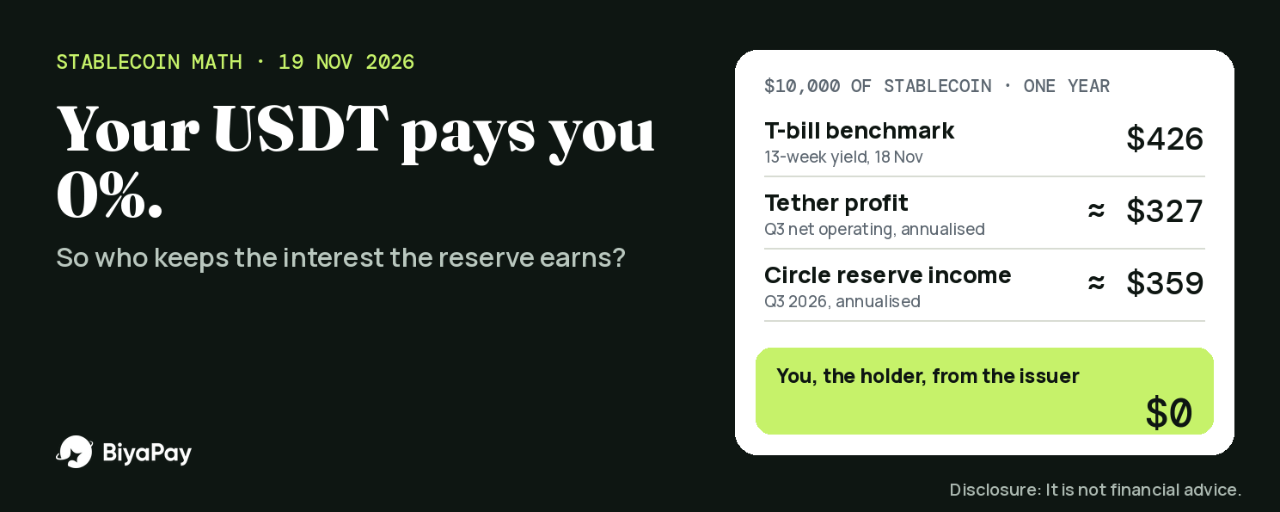
The US Treasury's daily bill rates for 18 November 2026 show the 13-week bill at 4.16% (bank discount basis) and 4.26% (coupon-equivalent yield). Take the 4.26% as a round "about 4.2%" benchmark:
$10,000 × 4.26% = $426 a year, or about $35.50 a month, grossThat ignores the issuer's costs, taxes, and the fact that the yield changes every day
This is only a benchmark for what short-term US government debt pays. It is not what any issuer actually earns.
What issuers actually report
Circle, Q3 2026 results (released 4 November 2026):
Average USDC in circulation: $73.3 billionReserve income: $658 millionReserve return rate: 3.5%Annualised: $658M × 4 = $2.63B, divided by $73.3B, is about 3.6%. Per $10,000 of USDC that is roughly $359 a yearDistribution and transaction costs in the same quarter: $409 million, equal to about 62% of reserve income
Tether, Q3 2026 attestation (BDO, as of 30 September 2026, published 30 October 2026):
Total assets $191.45 billion; liabilities $183.50 billion, of which $183.47 billion are tokens issued; assets exceed liabilities by $7.95 billionDirect and indirect US Treasury bill holdings: $132.4 billionNet operating profit: $1.5 billion in Q3, which Tether says was mostly from T-bills and reverse reposAnnualised: $1.5B × 4 = $6.0B, divided by $183.47B of tokens, is about 3.3%. Per $10,000 of USDT that is roughly $327 a year of profit
And what did the holder of $10,000 get from the issuer? $0.
Why it is $0: the rule
The GENIUS Act, signed on 18 July 2025, says that no permitted payment stablecoin issuer or foreign payment stablecoin issuer may pay a holder "any form of interest or yield" solely in connection with holding, using or retaining the coin (12 U.S.C. § 5903(11)).
On 21 October 2026 the OCC issued its final rule implementing the Act, effective 18 January 2027. It kept the ban on issuers paying holders. According to American Banker and AP, it dropped a proposed presumption that third-party rewards arrangements are automatically prohibited, and says it will look at the facts of each case. That is why exchanges and apps can sometimes offer "rewards" while the issuer itself cannot pay interest.
I am not a lawyer, and the rule applies differently depending on who the issuer is and where you live, so treat this as a reading aid, not a legal opinion.
Where a holder's yield can come from
Any yield above zero has to come from somewhere. In my notes there are four sources:
A platform passing on some of the T-bill-like income as a reward. The OCC rule leaves this to case-by-case reviewLending, where the platform lends your coins out and you take credit and operational riskOn-chain DeFi strategies, which add smart-contract riskA promotion, where the platform pays from its own budget for a limited time
None of them is the same thing as the 4.26% benchmark above. They each come with a different risk, and the risk is what the extra percentage points pay for.
Rates also move. With the Fed's October minutes (published 18 November) showing officials open to more hikes, and futures pricing a 25 basis point increase in December (Reuters/Straits Times, 18-19 Nov 2026), bill yields could rise. If the 13-week yield rose by 0.25 percentage points, $10,000 of reserves would earn $25 more a year, gross. Whether that is passed to holders depends on the rules above.
What BiyaPay's public Earn page shows
I checked BiyaPay's public Earn page on 19 November 2026 at about 06:28 WIB, signed out.
What you can do: the page lists flexible-term products. At the time I looked, the displayed annualised rates were U EARN phase II 10.22%, USD EARN phase II 10.22%, XAUT Flexible Savings 10%, "Deposit USDC to Earn" 7.2%, HKD Earn 5%, BTC Earn 3.5%, SOL 3% and ETH 2%. The USDC card says "withdrawal at any time". A banner says "Earn an Extra +5% When You Open a Position"; the conditions are not shown publiclyRequirements: you have to sign in to subscribe. The page says BiyaPay cannot provide services in the United States. Other eligibility rules are not on the public pageSteps shown publicly: open Earn, choose a product, tap "To Subscribe", sign in. Minimum and maximum amounts, payout timing and how each rate is set are behind the login, and I have not verified themFees and limits: none are stated on the public page. I would check them in the app before depositing anything
Now the arithmetic. The USDC product shows 7.2%. Against the 4.26% bill yield that is 2.94 percentage points higher. On $10,000 that is $720 against $426, a gap of $294 a year. The 10.22% products would be $1,022, a gap of about $596.
A displayed rate is not a promise of what you will receive, and the public page does not explain how it is generated. A gap that size is exactly what I would want explained before I put money in.
My opinion
I use USDT and USDC as payment and settlement tools, not as a savings account. Holding them in a wallet earns nothing by design, and I find that fair as long as I know it.
If I want yield, I treat it as a separate decision with its own risk. The first thing I do is compare the displayed rate with the T-bill benchmark. The bigger the gap, the more I want to know where it comes from, who can change it, and how fast I can get my money out.
When this applies, and when it does not
This applies to dollar-backed stablecoins whose reserves sit in short-term US government debt. It does not apply to stablecoins that are backed differently, to platform products that are not simply "holding a stablecoin", or to your local tax and legal situation. The numbers above are illustrative, rounded and based on published reports, and they change every quarter.
Checklist I use
Compare any displayed rate with the current 13-week T-bill yield from the US TreasuryAsk where the extra percentage points come from: reserve income, lending, DeFi or a promotionRead who bears the loss if something goes wrong, and whether the product is a deposit, a loan or something elseCheck minimums, fees, payout timing and withdrawal speed in the app before depositingCheck whether the service is available in your countryRead the issuer's latest attestation for what actually backs the tokenNever put in money you may need soon
#BiyaPay #USDT #USDC #Stablecoins #TBills
Who Keeps the Interest on Your USDT? A $10,000 Worked Example
Disclosure: It is not financial advice
Stablecoins had a very "mainstream" week. On 17 November the World Bank Group said it will explore regulated stablecoin rails with Citi and Circle for its fund disbursements. On 18 November Circle and DBS announced that eligible institutional clients in Singapore can mint and redeem USDC directly with near-instant, round-the-clock dollar settlement (CoinDesk, 18 Nov 2026).
All of that is about moving money. I wanted to answer a different question that I rarely see worked out in numbers: when you hold a stablecoin, the reserve behind it earns interest. Who keeps it?
The short answer: the issuer, and in the US-regulated model the law keeps it that way. Here is the arithmetic on $10,000.
What $10,000 of reserves could earn
The US Treasury's daily bill rates for 18 November 2026 show the 13-week bill at 4.16% (bank discount basis) and 4.26% (coupon-equivalent yield). Take the 4.26% as a round "about 4.2%" benchmark:
$10,000 × 4.26% = $426 a year, or about $35.50 a month, grossThat ignores the issuer's costs, taxes, and the fact that the yield changes every day
This is only a benchmark for what short-term US government debt pays. It is not what any issuer actually earns.
What issuers actually report
Circle, Q3 2026 results (released 4 November 2026):
Average USDC in circulation: $73.3 billionReserve income: $658 millionReserve return rate: 3.5%Annualised: $658M × 4 = $2.63B, divided by $73.3B, is about 3.6%. Per $10,000 of USDC that is roughly $359 a yearDistribution and transaction costs in the same quarter: $409 million, equal to about 62% of reserve income
Tether, Q3 2026 attestation (BDO, as of 30 September 2026, published 30 October 2026):
Total assets $191.45 billion; liabilities $183.50 billion, of which $183.47 billion are tokens issued; assets exceed liabilities by $7.95 billionDirect and indirect US Treasury bill holdings: $132.4 billionNet operating profit: $1.5 billion in Q3, which Tether says was mostly from T-bills and reverse reposAnnualised: $1.5B × 4 = $6.0B, divided by $183.47B of tokens, is about 3.3%. Per $10,000 of USDT that is roughly $327 a year of profit
And what did the holder of $10,000 get from the issuer? $0.
Why it is $0: the rule
The GENIUS Act, signed on 18 July 2025, says that no permitted payment stablecoin issuer or foreign payment stablecoin issuer may pay a holder "any form of interest or yield" solely in connection with holding, using or retaining the coin (12 U.S.C. § 5903(11)).
On 21 October 2026 the OCC issued its final rule implementing the Act, effective 18 January 2027. It kept the ban on issuers paying holders. According to American Banker and AP, it dropped a proposed presumption that third-party rewards arrangements are automatically prohibited, and says it will look at the facts of each case. That is why exchanges and apps can sometimes offer "rewards" while the issuer itself cannot pay interest.
I am not a lawyer, and the rule applies differently depending on who the issuer is and where you live, so treat this as a reading aid, not a legal opinion.
Where a holder's yield can come from
Any yield above zero has to come from somewhere. In my notes there are four sources:
A platform passing on some of the T-bill-like income as a reward. The OCC rule leaves this to case-by-case reviewLending, where the platform lends your coins out and you take credit and operational riskOn-chain DeFi strategies, which add smart-contract riskA promotion, where the platform pays from its own budget for a limited time
None of them is the same thing as the 4.26% benchmark above. They each come with a different risk, and the risk is what the extra percentage points pay for.
Rates also move. With the Fed's October minutes (published 18 November) showing officials open to more hikes, and futures pricing a 25 basis point increase in December (Reuters/Straits Times, 18-19 Nov 2026), bill yields could rise. If the 13-week yield rose by 0.25 percentage points, $10,000 of reserves would earn $25 more a year, gross. Whether that is passed to holders depends on the rules above.
What BiyaPay's public Earn page shows
I checked BiyaPay's public Earn page on 19 November 2026 at about 06:28 WIB, signed out.
What you can do: the page lists flexible-term products. At the time I looked, the displayed annualised rates were U EARN phase II 10.22%, USD EARN phase II 10.22%, XAUT Flexible Savings 10%, "Deposit USDC to Earn" 7.2%, HKD Earn 5%, BTC Earn 3.5%, SOL 3% and ETH 2%. The USDC card says "withdrawal at any time". A banner says "Earn an Extra +5% When You Open a Position"; the conditions are not shown publiclyRequirements: you have to sign in to subscribe. The page says BiyaPay cannot provide services in the United States. Other eligibility rules are not on the public pageSteps shown publicly: open Earn, choose a product, tap "To Subscribe", sign in. Minimum and maximum amounts, payout timing and how each rate is set are behind the login, and I have not verified themFees and limits: none are stated on the public page. I would check them in the app before depositing anything
Now the arithmetic. The USDC product shows 7.2%. Against the 4.26% bill yield that is 2.94 percentage points higher. On $10,000 that is $720 against $426, a gap of $294 a year. The 10.22% products would be $1,022, a gap of about $596.
A displayed rate is not a promise of what you will receive, and the public page does not explain how it is generated. A gap that size is exactly what I would want explained before I put money in.
My opinion
I use USDT and USDC as payment and settlement tools, not as a savings account. Holding them in a wallet earns nothing by design, and I find that fair as long as I know it.
If I want yield, I treat it as a separate decision with its own risk. The first thing I do is compare the displayed rate with the T-bill benchmark. The bigger the gap, the more I want to know where it comes from, who can change it, and how fast I can get my money out.
When this applies, and when it does not
This applies to dollar-backed stablecoins whose reserves sit in short-term US government debt. It does not apply to stablecoins that are backed differently, to platform products that are not simply "holding a stablecoin", or to your local tax and legal situation. The numbers above are illustrative, rounded and based on published reports, and they change every quarter.
Checklist I use
Compare any displayed rate with the current 13-week T-bill yield from the US TreasuryAsk where the extra percentage points come from: reserve income, lending, DeFi or a promotionRead who bears the loss if something goes wrong, and whether the product is a deposit, a loan or something elseCheck minimums, fees, payout timing and withdrawal speed in the app before depositingCheck whether the service is available in your countryRead the issuer's latest attestation for what actually backs the tokenNever put in money you may need soon
#BiyaPay #USDT #USDC #Stablecoins #TBills
Stablecoins had a very "mainstream" week. On 17 November the World Bank Group said it will explore regulated stablecoin rails with Citi and Circle for its fund disbursements. On 18 November Circle and DBS announced that eligible institutional clients in Singapore can mint and redeem USDC directly with near-instant, round-the-clock dollar settlement (CoinDesk, 18 Nov 2026).
All of that is about moving money. I wanted to answer a different question that I rarely see worked out in numbers: when you hold a stablecoin, the reserve behind it earns interest. Who keeps it?
The short answer: the issuer, and in the US-regulated model the law keeps it that way. Here is the arithmetic on $10,000.
What $10,000 of reserves could earn
The US Treasury's daily bill rates for 18 November 2026 show the 13-week bill at 4.16% (bank discount basis) and 4.26% (coupon-equivalent yield). Take the 4.26% as a round "about 4.2%" benchmark:
$10,000 × 4.26% = $426 a year, or about $35.50 a month, grossThat ignores the issuer's costs, taxes, and the fact that the yield changes every day
This is only a benchmark for what short-term US government debt pays. It is not what any issuer actually earns.
What issuers actually report
Circle, Q3 2026 results (released 4 November 2026):
Average USDC in circulation: $73.3 billionReserve income: $658 millionReserve return rate: 3.5%Annualised: $658M × 4 = $2.63B, divided by $73.3B, is about 3.6%. Per $10,000 of USDC that is roughly $359 a yearDistribution and transaction costs in the same quarter: $409 million, equal to about 62% of reserve income
Tether, Q3 2026 attestation (BDO, as of 30 September 2026, published 30 October 2026):
Total assets $191.45 billion; liabilities $183.50 billion, of which $183.47 billion are tokens issued; assets exceed liabilities by $7.95 billionDirect and indirect US Treasury bill holdings: $132.4 billionNet operating profit: $1.5 billion in Q3, which Tether says was mostly from T-bills and reverse reposAnnualised: $1.5B × 4 = $6.0B, divided by $183.47B of tokens, is about 3.3%. Per $10,000 of USDT that is roughly $327 a year of profit
And what did the holder of $10,000 get from the issuer? $0.
Why it is $0: the rule
The GENIUS Act, signed on 18 July 2025, says that no permitted payment stablecoin issuer or foreign payment stablecoin issuer may pay a holder "any form of interest or yield" solely in connection with holding, using or retaining the coin (12 U.S.C. § 5903(11)).
On 21 October 2026 the OCC issued its final rule implementing the Act, effective 18 January 2027. It kept the ban on issuers paying holders. According to American Banker and AP, it dropped a proposed presumption that third-party rewards arrangements are automatically prohibited, and says it will look at the facts of each case. That is why exchanges and apps can sometimes offer "rewards" while the issuer itself cannot pay interest.
I am not a lawyer, and the rule applies differently depending on who the issuer is and where you live, so treat this as a reading aid, not a legal opinion.
Where a holder's yield can come from
Any yield above zero has to come from somewhere. In my notes there are four sources:
A platform passing on some of the T-bill-like income as a reward. The OCC rule leaves this to case-by-case reviewLending, where the platform lends your coins out and you take credit and operational riskOn-chain DeFi strategies, which add smart-contract riskA promotion, where the platform pays from its own budget for a limited time
None of them is the same thing as the 4.26% benchmark above. They each come with a different risk, and the risk is what the extra percentage points pay for.
Rates also move. With the Fed's October minutes (published 18 November) showing officials open to more hikes, and futures pricing a 25 basis point increase in December (Reuters/Straits Times, 18-19 Nov 2026), bill yields could rise. If the 13-week yield rose by 0.25 percentage points, $10,000 of reserves would earn $25 more a year, gross. Whether that is passed to holders depends on the rules above.
What BiyaPay's public Earn page shows
I checked BiyaPay's public Earn page on 19 November 2026 at about 06:28 WIB, signed out.
What you can do: the page lists flexible-term products. At the time I looked, the displayed annualised rates were U EARN phase II 10.22%, USD EARN phase II 10.22%, XAUT Flexible Savings 10%, "Deposit USDC to Earn" 7.2%, HKD Earn 5%, BTC Earn 3.5%, SOL 3% and ETH 2%. The USDC card says "withdrawal at any time". A banner says "Earn an Extra +5% When You Open a Position"; the conditions are not shown publiclyRequirements: you have to sign in to subscribe. The page says BiyaPay cannot provide services in the United States. Other eligibility rules are not on the public pageSteps shown publicly: open Earn, choose a product, tap "To Subscribe", sign in. Minimum and maximum amounts, payout timing and how each rate is set are behind the login, and I have not verified themFees and limits: none are stated on the public page. I would check them in the app before depositing anything
Now the arithmetic. The USDC product shows 7.2%. Against the 4.26% bill yield that is 2.94 percentage points higher. On $10,000 that is $720 against $426, a gap of $294 a year. The 10.22% products would be $1,022, a gap of about $596.
A displayed rate is not a promise of what you will receive, and the public page does not explain how it is generated. A gap that size is exactly what I would want explained before I put money in.
My opinion
I use USDT and USDC as payment and settlement tools, not as a savings account. Holding them in a wallet earns nothing by design, and I find that fair as long as I know it.
If I want yield, I treat it as a separate decision with its own risk. The first thing I do is compare the displayed rate with the T-bill benchmark. The bigger the gap, the more I want to know where it comes from, who can change it, and how fast I can get my money out.
When this applies, and when it does not
This applies to dollar-backed stablecoins whose reserves sit in short-term US government debt. It does not apply to stablecoins that are backed differently, to platform products that are not simply "holding a stablecoin", or to your local tax and legal situation. The numbers above are illustrative, rounded and based on published reports, and they change every quarter.
Checklist I use
Compare any displayed rate with the current 13-week T-bill yield from the US TreasuryAsk where the extra percentage points come from: reserve income, lending, DeFi or a promotionRead who bears the loss if something goes wrong, and whether the product is a deposit, a loan or something elseCheck minimums, fees, payout timing and withdrawal speed in the app before depositingCheck whether the service is available in your countryRead the issuer's latest attestation for what actually backs the tokenNever put in money you may need soon
#BiyaPay #USDT #USDC #Stablecoins #TBills
Trong_Hatachi:
Interesting distinction between moving stablecoins and earning on them—who actually keeps the interest in your $10,000 example? Follow back if you find this useful.
2
1
1.4k

·
--
Partly True
🚨Ken Fisher keeps hammering one point: bear markets almost never come from the thing everyone's already scared of.
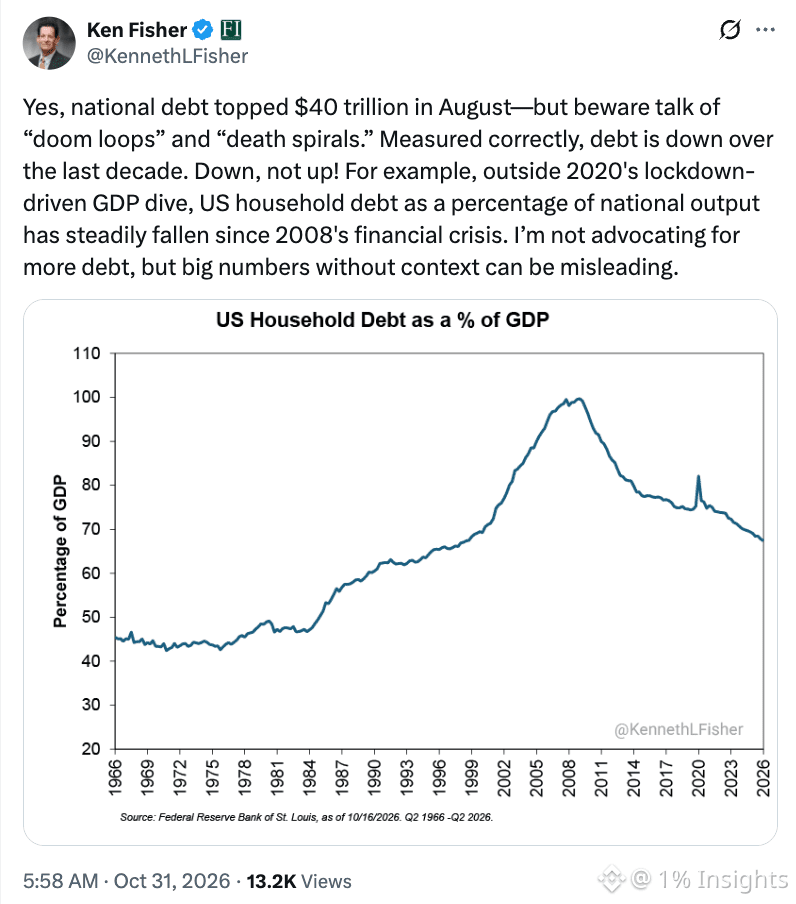
US debt just crossed $40 trillion and the timeline's full of "death spiral" takes. But he points out global debt-to-GDP has actually come down, from about 285% at the end of 2020 to around 246%. And the risks everybody talks about every day? Mostly priced in already.
What actually blows things up is usually some well-meaning government move nobody's paying attention to. Look at 2008. Accounting rules forced banks to mark their assets to market, they had to take massive write-downs, credit froze, and the whole economy got dragged down with it.
So forget the $40T for a sec. What's the thing nobody's talking about right now? #KenFisher #GDP #SEC #Tbills
🚨Ken Fisher keeps hammering one point: bear markets almost never come from the thing everyone's already scared of.
US debt just crossed $40 trillion and the timeline's full of "death spiral" takes. But he points out global debt-to-GDP has actually come down, from about 285% at the end of 2020 to around 246%. And the risks everybody talks about every day? Mostly priced in already.
What actually blows things up is usually some well-meaning government move nobody's paying attention to. Look at 2008. Accounting rules forced banks to mark their assets to market, they had to take massive write-downs, credit froze, and the whole economy got dragged down with it.
So forget the $40T for a sec. What's the thing nobody's talking about right now? #KenFisher #GDP #SEC #Tbills
US debt just crossed $40 trillion and the timeline's full of "death spiral" takes. But he points out global debt-to-GDP has actually come down, from about 285% at the end of 2020 to around 246%. And the risks everybody talks about every day? Mostly priced in already.
What actually blows things up is usually some well-meaning government move nobody's paying attention to. Look at 2008. Accounting rules forced banks to mark their assets to market, they had to take massive write-downs, credit froze, and the whole economy got dragged down with it.
So forget the $40T for a sec. What's the thing nobody's talking about right now? #KenFisher #GDP #SEC #Tbills

2
2.6k

·
--

Article
🏛️ OpenEden (EDEN): The RWA Narrative That’s Quietly Capturing Market Attention?Amidst the volatile crypto project competition, one narrative keeps grabbing attention: Real World Assets (RWA) — the concept of bringing real-world assets onto the blockchain. One name that often pops up in this discussion is OpenEden (EDEN).
Different from projects that only rely on hype, OpenEden is laser-focused on the tokenization of real-world financial assets, especially instruments based on U.S. Treasury Bills (T-Bills) through their on-chain ecosystem.
Why is this narrative starting to catch eyes? 👇
🏛️ OpenEden (EDEN): The RWA Narrative That’s Quietly Capturing Market Attention?
Amidst the volatile crypto project competition, one narrative keeps grabbing attention: Real World Assets (RWA) — the concept of bringing real-world assets onto the blockchain. One name that often pops up in this discussion is OpenEden (EDEN).
Different from projects that only rely on hype, OpenEden is laser-focused on the tokenization of real-world financial assets, especially instruments based on U.S. Treasury Bills (T-Bills) through their on-chain ecosystem.
Why is this narrative starting to catch eyes? 👇
Different from projects that only rely on hype, OpenEden is laser-focused on the tokenization of real-world financial assets, especially instruments based on U.S. Treasury Bills (T-Bills) through their on-chain ecosystem.
Why is this narrative starting to catch eyes? 👇
143
Log in to explore more content
Join global crypto users on Binance Square
⚡️ Get latest and useful information about crypto.
💬 Trusted by the world’s largest crypto exchange.
👍 Discover real insights from verified creators.
Email / Phone number
Trending Topics
1
#AnthropicToDebutAfter$83IPOPricing
15,333 views
176 Discussing
2
#BTCRemainsUnderPressureAfterHawkishFOMCMinutes
57,463 views
1,410 Discussing
3
#NvidiaBoardReportedlySplitOverHuang’sReturn
19,065 views
696 Discussing
4
#MASToUpgradeSGDTestnetToSGDigitalLedger
0 views
14 Discussing
5
#CanGTA6'sLaunchLiftTTWOShares?
10,661 views
554 Discussing
6
#AnthropicRecord$107BRaiseSetToTopSpaceXIPO
0 views
20 Discussing
7
#CapitalGroupAdds1264500StrategyShares
0 views
147 Discussing
8
#FOMCMinutesHighlightAIDebtRisks
19,609 views
570 Discussing
9
#AntInternationalLaunchesWhaleProtocol
0 views
81 Discussing
10
#SouthKoreaPlansToLet3500ListedFirmsBuyBitcoin
19,559 views
510 Discussing