

Mishal Ahmed 43
37 Posts

Mishal Ahmed 43
Report
Block User
92 Following
45 Followers
64 Liked
Posts
#BinanceLaunchesBinanceIntelligence #EthStakingExitQueueHits2026High #Nikkei225Jumps2.5%ToThreeMonthHigh #Nikkei225Jumps2.5%ToThreeMonthHigh Worked for 41s
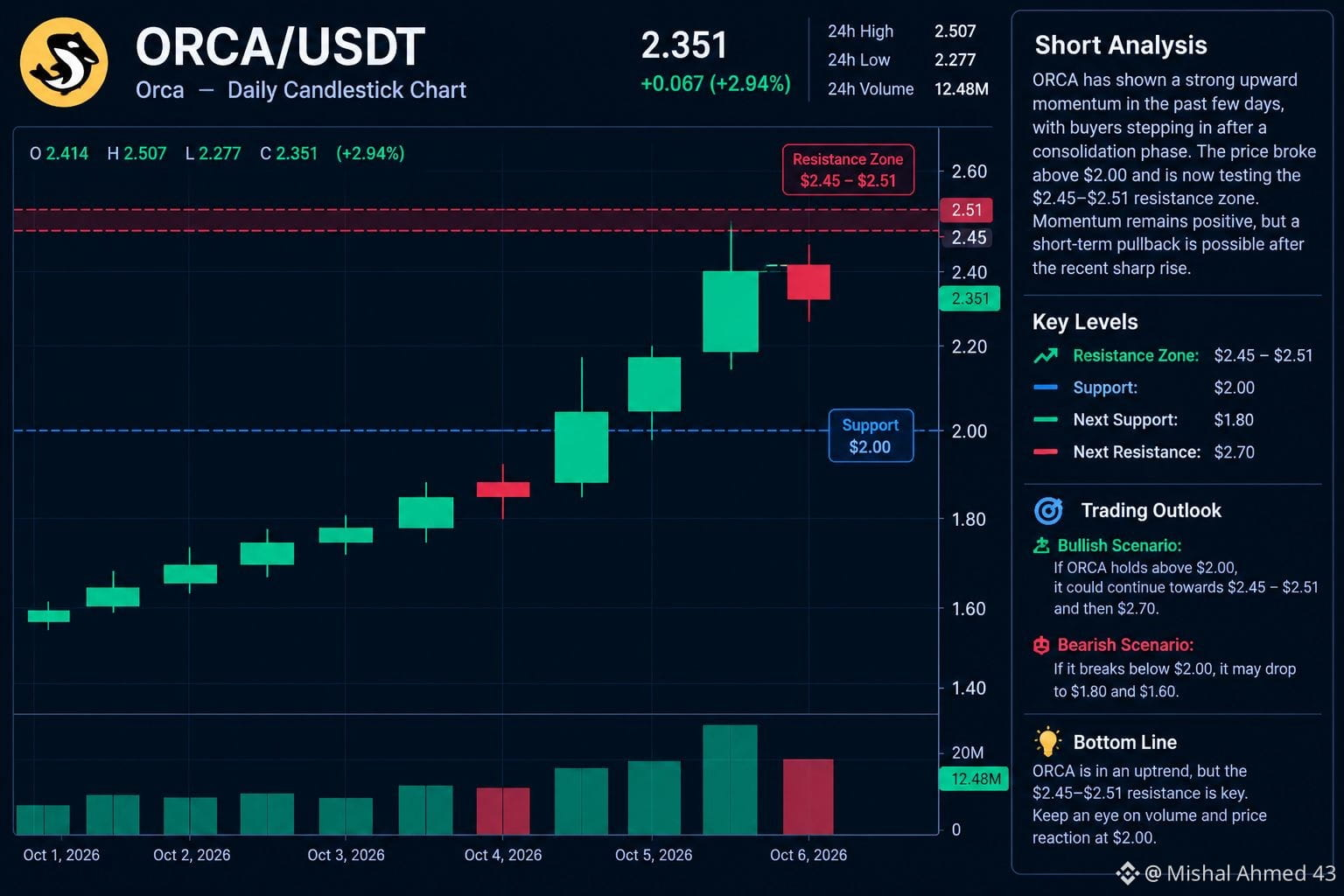
$ORCA (Orca) — Short Analysis
Orca is a major decentralized exchange (@Square-Creator-4a1a71277 ) in the Solana ecosystem, focused on token swaps and concentrated-liquidity pools.
Technical View:
📈 Current price: around $2.35
🚀 Strong bullish momentum in recent sessions
🔴 Resistance: $2.45–$2.51
🟢 Support: $2.00
🎯 Next resistance: ~$2.70
⚠️ After the sharp rise, a short-term pullback is possible.
Outlook: Bullish while @Square-Creator-3cf4201d1f47 holds above $2.00. A clean breakout above $2.51 could strengthen the upside case.
📊 ORCA/USDT Candle Chart
Educational analysis, not financial advice.
{future}(ORCAUSDT)
#BinanceLaunchesBinanceIntelligence #EthStakingExitQueueHits2026High #Nikkei225Jumps2.5%ToThreeMonthHigh #Nikkei225Jumps2.5%ToThreeMonthHigh Worked for 41s
$ORCA (Orca) — Short Analysis
Orca is a major decentralized exchange (@Dex ) in the Solana ecosystem, focused on token swaps and concentrated-liquidity pools.
Technical View:
📈 Current price: around $2.35
🚀 Strong bullish momentum in recent sessions
🔴 Resistance: $2.45–$2.51
🟢 Support: $2.00
🎯 Next resistance: ~$2.70
⚠️ After the sharp rise, a short-term pullback is possible.
Outlook: Bullish while @ORCA- holds above $2.00. A clean breakout above $2.51 could strengthen the upside case.
📊 ORCA/USDT Candle Chart
Educational analysis, not financial advice.
$ORCA (Orca) — Short Analysis
Orca is a major decentralized exchange (@Dex ) in the Solana ecosystem, focused on token swaps and concentrated-liquidity pools.
Technical View:
📈 Current price: around $2.35
🚀 Strong bullish momentum in recent sessions
🔴 Resistance: $2.45–$2.51
🟢 Support: $2.00
🎯 Next resistance: ~$2.70
⚠️ After the sharp rise, a short-term pullback is possible.
Outlook: Bullish while @ORCA- holds above $2.00. A clean breakout above $2.51 could strengthen the upside case.
📊 ORCA/USDT Candle Chart
Educational analysis, not financial advice.
1
188
{spot}(RADUSDT)
$RAD (Radworks)
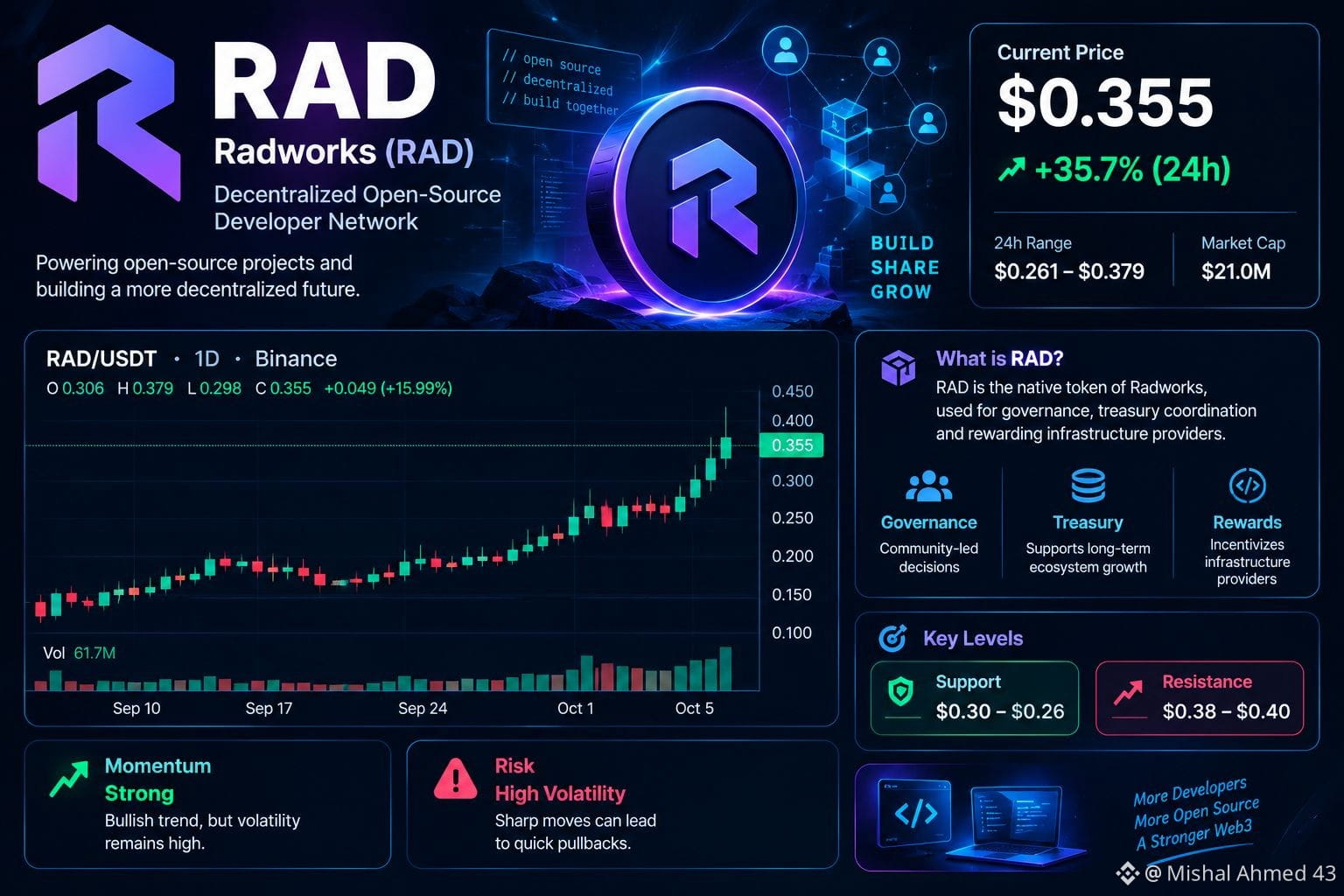
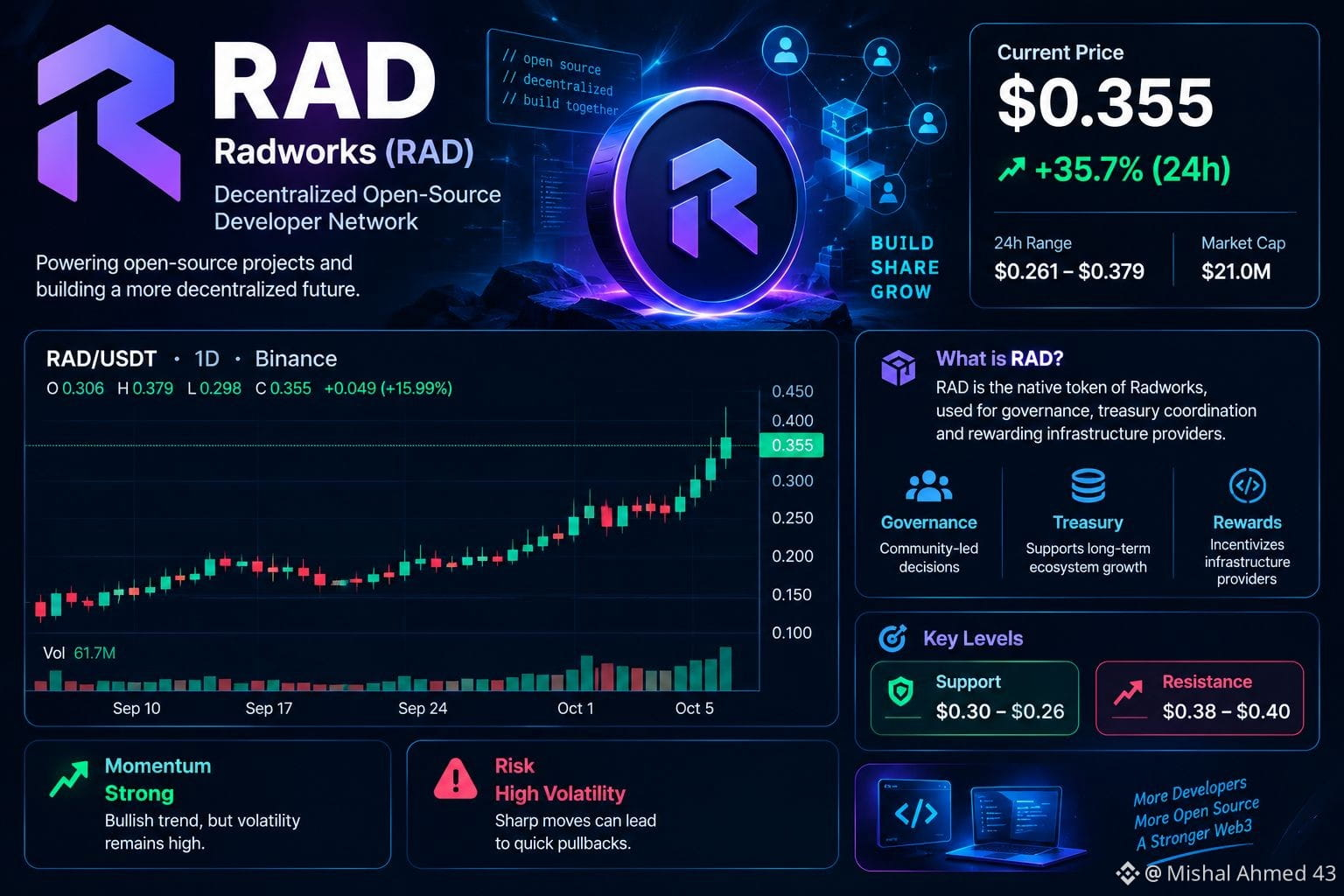
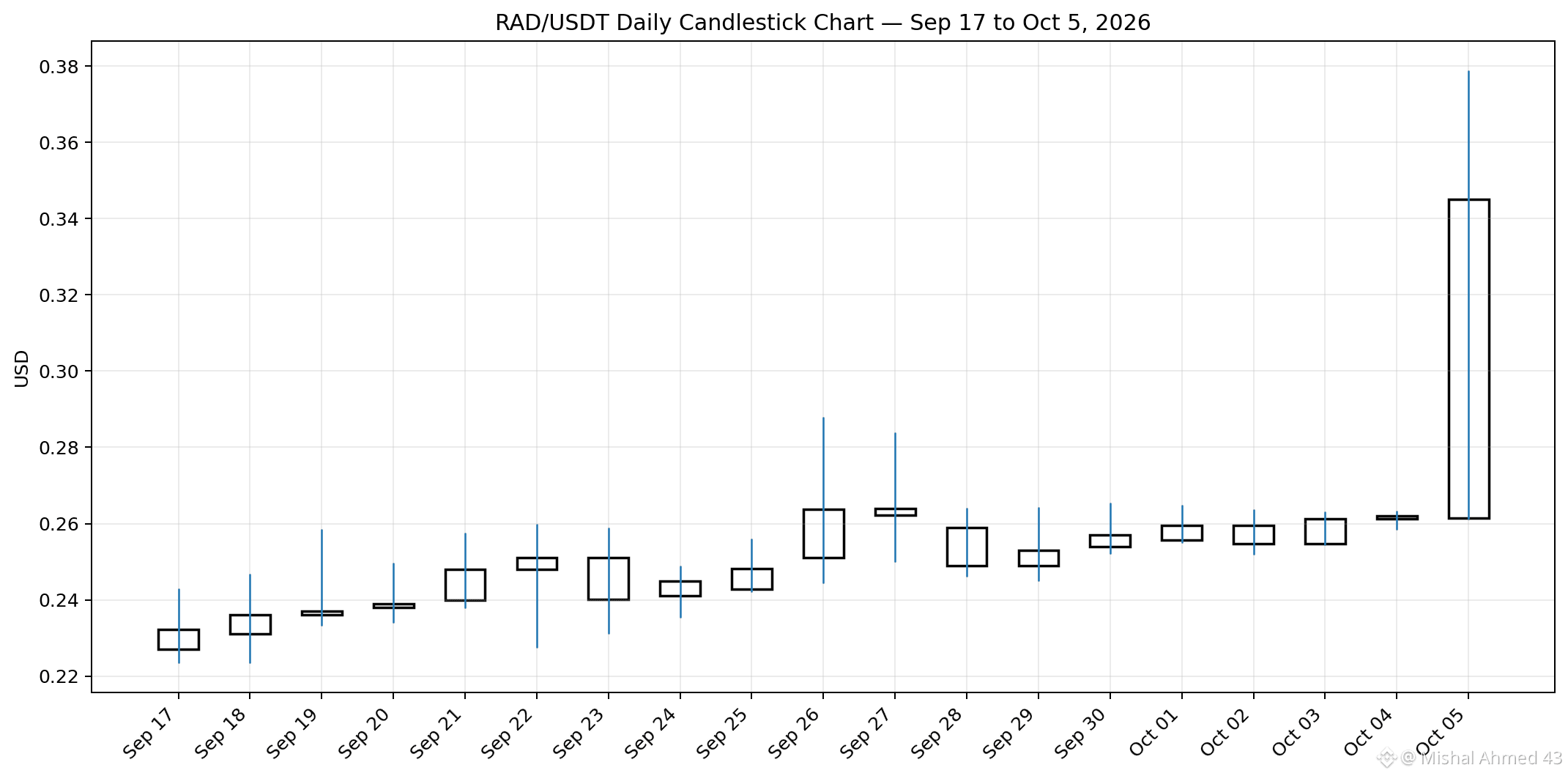
Current price: around $0.35 after a sharp move higher on Oct 5. Bitget recorded a $0.2614 → $0.3451 close with a high of $0.3788 and about $61.7M volume.
Trend: Strong bullish momentum, but volatility is extremely high after the latest spike.
Support: $0.30–$0.26
Resistance: $0.38, then $0.40
Fundamentals: @Square-Creator-d31f7f1ee2e00 is the native token of Radworks, used for governance and treasury coordination; Radworks supports decentralized open-source projects including Radicle and Drips.
Risk: The recent price jump is very sharp, so a pullback or profit-taking is possible.
Overall: @Square-Creator-42111d14bb48 has strong short-term momentum, but confirmation above $0.38 would be important; losing the $0.30 area could signal a deeper correction.
📊 @RAD_hsp /USDT Candlestick Chart
Download the @RAD_hsp
candlestick chart ❶
$RAD (Radworks)
Current price: around $0.35 after a sharp move higher on Oct 5. Bitget recorded a $0.2614 → $0.3451 close with a high of $0.3788 and about $61.7M volume.
Trend: Strong bullish momentum, but volatility is extremely high after the latest spike.
Support: $0.30–$0.26
Resistance: $0.38, then $0.40
Fundamentals: @RAD_ is the native token of Radworks, used for governance and treasury coordination; Radworks supports decentralized open-source projects including Radicle and Drips.
Risk: The recent price jump is very sharp, so a pullback or profit-taking is possible.
Overall: @ RAD has strong short-term momentum, but confirmation above $0.38 would be important; losing the $0.30 area could signal a deeper correction.
📊 @RAD /USDT Candlestick Chart
Download the @RAD
candlestick chart ❶
Current price: around $0.35 after a sharp move higher on Oct 5. Bitget recorded a $0.2614 → $0.3451 close with a high of $0.3788 and about $61.7M volume.
Trend: Strong bullish momentum, but volatility is extremely high after the latest spike.
Support: $0.30–$0.26
Resistance: $0.38, then $0.40
Fundamentals: @RAD_ is the native token of Radworks, used for governance and treasury coordination; Radworks supports decentralized open-source projects including Radicle and Drips.
Risk: The recent price jump is very sharp, so a pullback or profit-taking is possible.
Overall: @ RAD has strong short-term momentum, but confirmation above $0.38 would be important; losing the $0.30 area could signal a deeper correction.
📊 @RAD /USDT Candlestick Chart
Download the @RAD
candlestick chart ❶
1
127
$FLUID (Fluid)
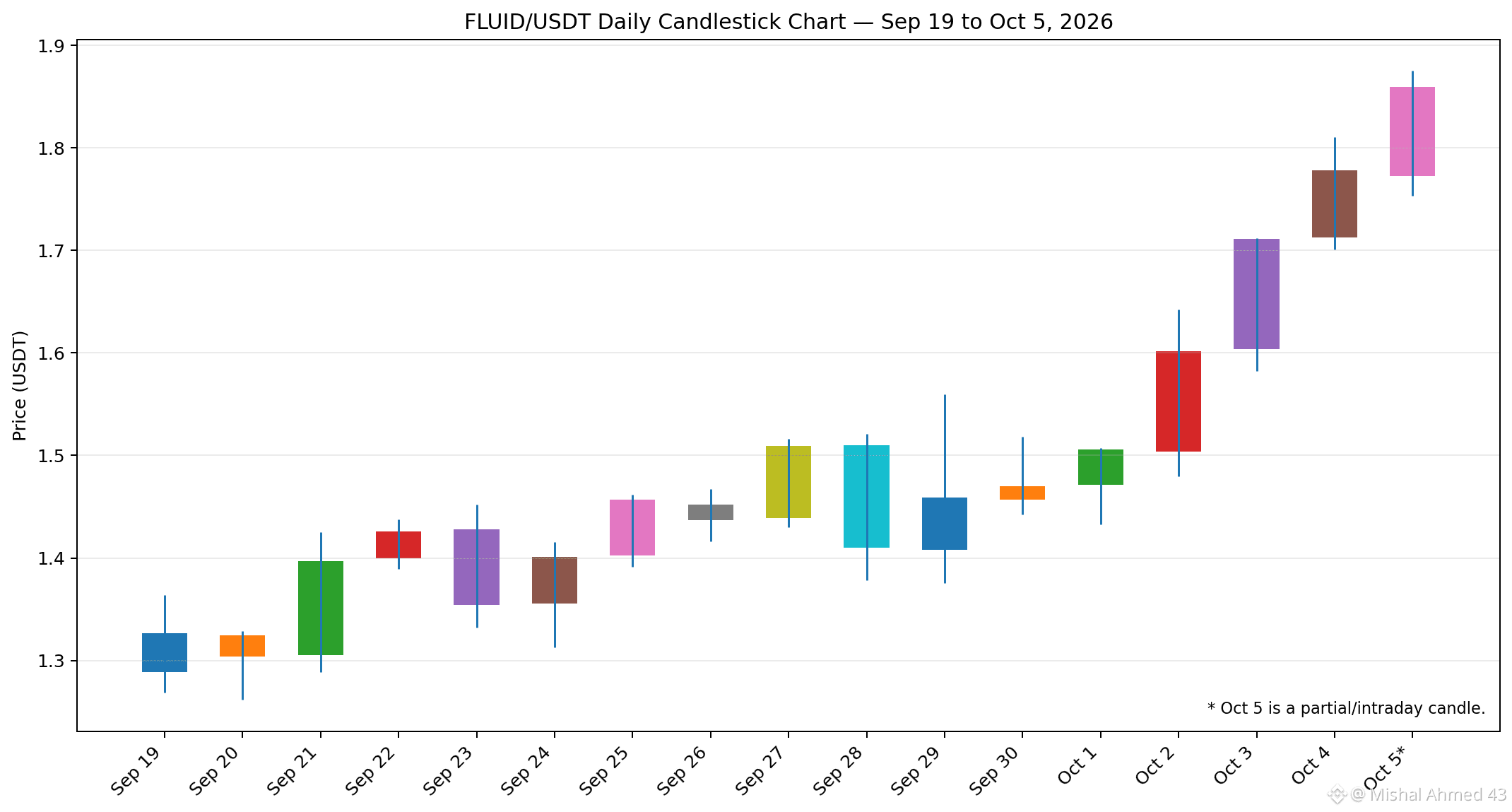
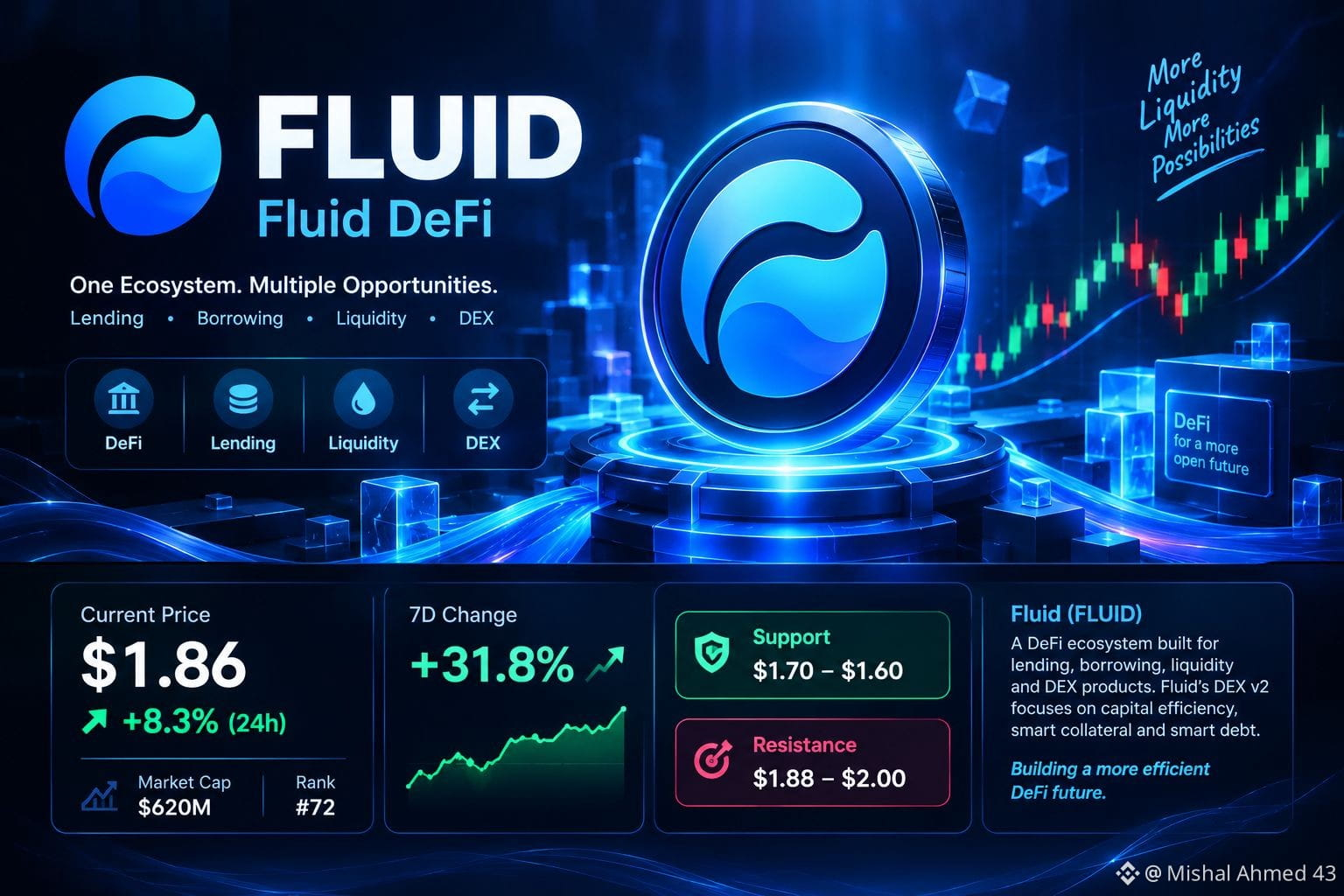
@Square-Creator-c9516c12b98f2 /is trading around $1.86, after a strong rally from about $1.30 in mid-September. The latest daily data shows continued bullish momentum, with Oct. 5 reaching about $1.88 intraday.
Trend: Strong bullish 📈
Support: $1.70 → $1.60
Resistance: $1.88 → $2.00
Fundamentals: Fluid is a @ean_jelly ecosystem combining lending, borrowing, liquidity and @Square-Creator-f88cc5872633 products. Its @Square-Creator-f88cc5872633 v2 focuses on capital efficiency, smart collateral and smart debt.
Catalyst: Fluid announced a @Square-Creator-c9516c12b98f2 reserve and buyback strategy in 2026.
Risk: The recent rise has been very sharp, so volatility and pullbacks can be significant.
📊 Candle Chart
Download @Square-Creator-65b9f6efb951 /USDT Candle Chart ❶
{future}(FLUIDUSDT)
#ETHUp70%InQ3ButLiquidityFalls #Nikkei225Jumps2.5%ToThreeMonthHigh #EthereumValidatorExitQueueJumps392% #FedOctoberHoldOdds82.3%
$FLUID (Fluid)
@FLUIDI GROUP /is trading around $1.86, after a strong rally from about $1.30 in mid-September. The latest daily data shows continued bullish momentum, with Oct. 5 reaching about $1.88 intraday.
Trend: Strong bullish 📈
Support: $1.70 → $1.60
Resistance: $1.88 → $2.00
Fundamentals: Fluid is a @DEFi__ ecosystem combining lending, borrowing, liquidity and @DEX_ products. Its @DEX_ v2 focuses on capital efficiency, smart collateral and smart debt.
Catalyst: Fluid announced a @FLUIDI GROUP reserve and buyback strategy in 2026.
Risk: The recent rise has been very sharp, so volatility and pullbacks can be significant.
📊 Candle Chart
Download @Fluide12 /USDT Candle Chart ❶
#ETHUp70%InQ3ButLiquidityFalls #Nikkei225Jumps2.5%ToThreeMonthHigh #EthereumValidatorExitQueueJumps392% #FedOctoberHoldOdds82.3%
@FLUIDI GROUP /is trading around $1.86, after a strong rally from about $1.30 in mid-September. The latest daily data shows continued bullish momentum, with Oct. 5 reaching about $1.88 intraday.
Trend: Strong bullish 📈
Support: $1.70 → $1.60
Resistance: $1.88 → $2.00
Fundamentals: Fluid is a @DEFi__ ecosystem combining lending, borrowing, liquidity and @DEX_ products. Its @DEX_ v2 focuses on capital efficiency, smart collateral and smart debt.
Catalyst: Fluid announced a @FLUIDI GROUP reserve and buyback strategy in 2026.
Risk: The recent rise has been very sharp, so volatility and pullbacks can be significant.
📊 Candle Chart
Download @Fluide12 /USDT Candle Chart ❶
#ETHUp70%InQ3ButLiquidityFalls #Nikkei225Jumps2.5%ToThreeMonthHigh #EthereumValidatorExitQueueJumps392% #FedOctoberHoldOdds82.3%
108
$OGN (Origin Protocol) #ETHUp70%InQ3ButLiquidityFalls #EthStakingExitQueueHits2026High #DriftHackVictimsBeginClaims #EthereumValidatorExitQueueJumps392%
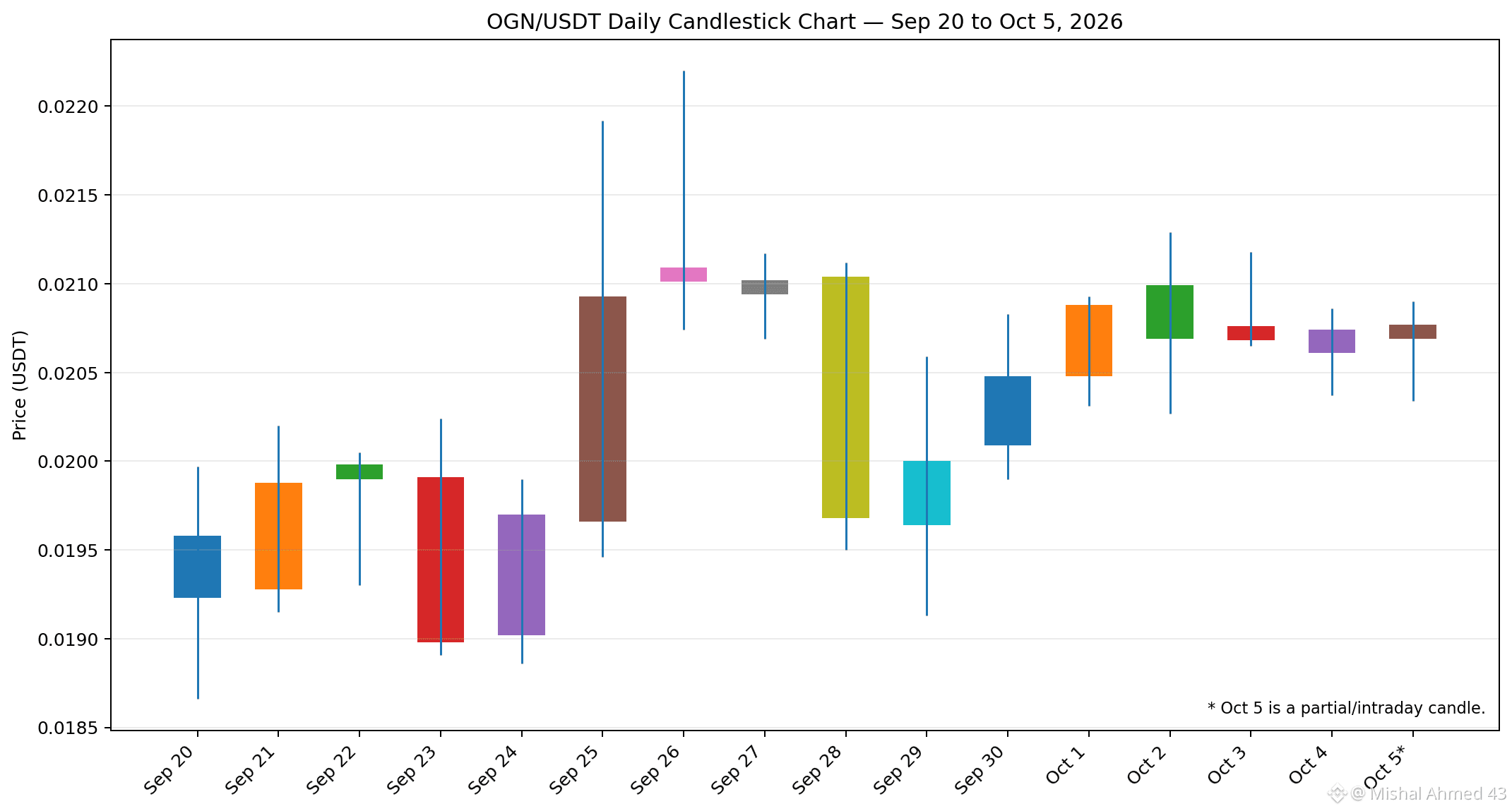
@Square-Creator-6a30f89de92a0 is currently around $0.0207. Recent price action is relatively stable after a sharp move in late September. The recent 7-day range is roughly $0.0191–$0.0213.
Trend: Neutral to mildly bullish 📈
Support: $0.0200 → $0.0191
Resistance: $0.0213 → $0.0222
Fundamentals: @Square-Creator-6a30f89de92a0 is the governance and value-accrual token of Origin Protocol. Staking converts @Square-Creator-e99c4ca5e851 to @Square-Creator-3c157e3d1d5e , with protocol fees used for @Square-Creator-e99c4ca5e851 buybacks and distributed to stakers.
Risk: Small-cap token with high volatility; a break below $0.0191 would weaken the short-term setup.
📊 Candle Chart
Download OGN/USDT Candle Chart
{future}(OGNUSDT)
$OGN (Origin Protocol) #ETHUp70%InQ3ButLiquidityFalls #EthStakingExitQueueHits2026High #DriftHackVictimsBeginClaims #EthereumValidatorExitQueueJumps392%
@OGN 789 is currently around $0.0207. Recent price action is relatively stable after a sharp move in late September. The recent 7-day range is roughly $0.0191–$0.0213.
Trend: Neutral to mildly bullish 📈
Support: $0.0200 → $0.0191
Resistance: $0.0213 → $0.0222
Fundamentals: @OGN 789 is the governance and value-accrual token of Origin Protocol. Staking converts @Ogn to @ogn_chrstn , with protocol fees used for @Ogn buybacks and distributed to stakers.
Risk: Small-cap token with high volatility; a break below $0.0191 would weaken the short-term setup.
📊 Candle Chart
Download OGN/USDT Candle Chart
@OGN 789 is currently around $0.0207. Recent price action is relatively stable after a sharp move in late September. The recent 7-day range is roughly $0.0191–$0.0213.
Trend: Neutral to mildly bullish 📈
Support: $0.0200 → $0.0191
Resistance: $0.0213 → $0.0222
Fundamentals: @OGN 789 is the governance and value-accrual token of Origin Protocol. Staking converts @Ogn to @ogn_chrstn , with protocol fees used for @Ogn buybacks and distributed to stakers.
Risk: Small-cap token with high volatility; a break below $0.0191 would weaken the short-term setup.
📊 Candle Chart
Download OGN/USDT Candle Chart
157

$RLC (iExec)
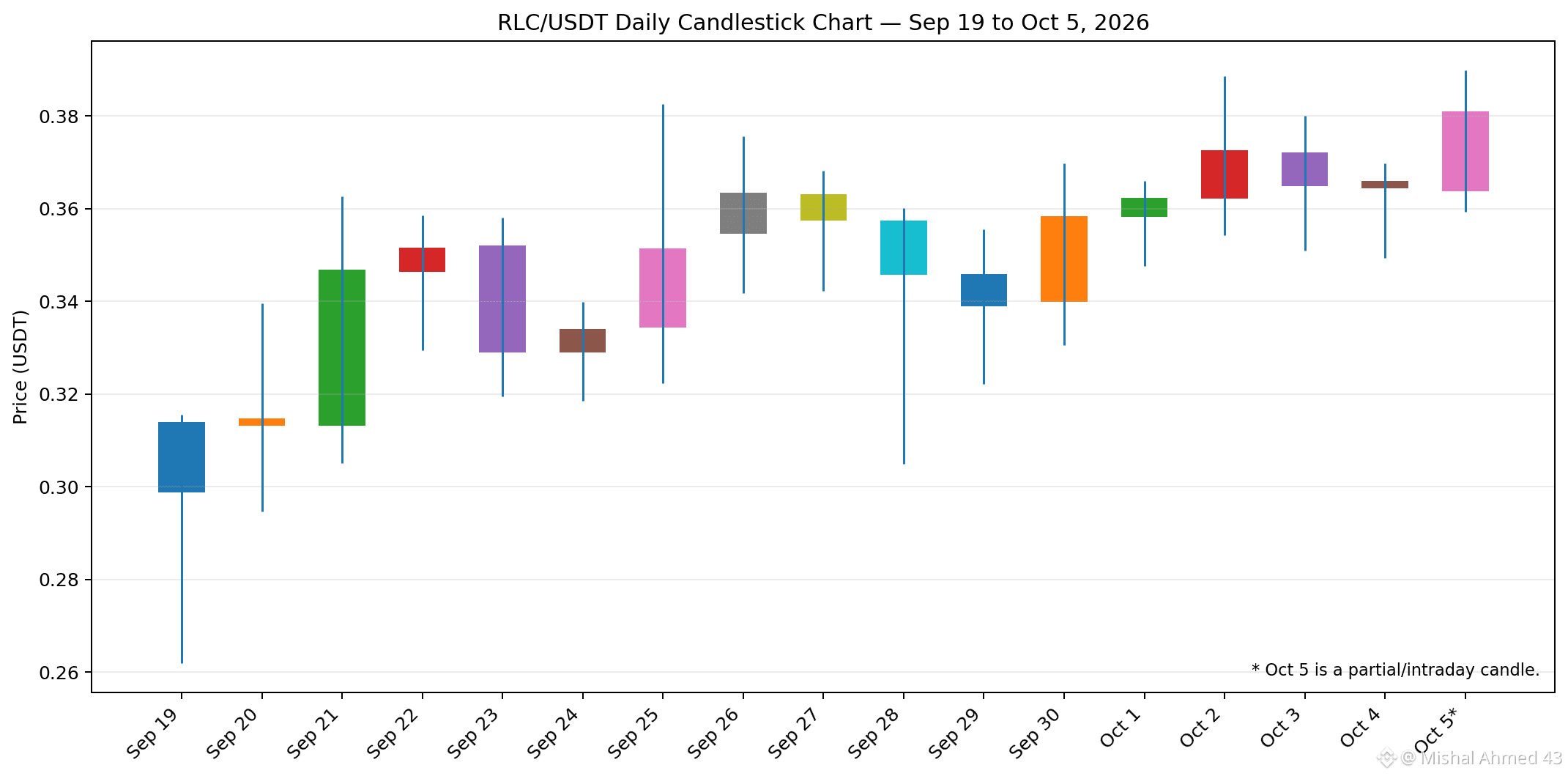
@Square-Creator-23b08f6d076c is showing a strong bullish breakout, but volatility is extremely high. Binance perpetual data currently shows around $0.54, with 24h price change about +49% and open interest up sharply.
Trend: Strong bullish momentum 📈
Support: ~$0.44, then ~$0.38
Resistance: ~$0.55, then ~$0.60
Fundamentals: iExec focuses on confidential computing, AI/data workloads and decentralized computing. @Square-Creator-53e243738 is used to pay for computing resources and ecosystem services.
Risk: Very high volatility after the sudden price surge; chasing the move can be risky.
Candle chart: I made the daily @Square-Creator-23b08f6d076c /USDT chart from the verified historical @Square-Creator-ba2031154 data. Note that the Oct 5 candle is partial, and @Square-Creator-e5bf4e1950a6 moved sharply after that snapshot, so the chart does not capture the entire latest intraday spike.
Download @Square-Creator-23b08f6d076c /USDT Candle Chart ❶
{future}(RLCUSDT)
#ETHUp70%InQ3ButLiquidityFalls #FedOctoberHoldOdds82.3% #EthereumValidatorExitQueueJumps392%
$RLC (iExec)
@RLC is showing a strong bullish breakout, but volatility is extremely high. Binance perpetual data currently shows around $0.54, with 24h price change about +49% and open interest up sharply.
Trend: Strong bullish momentum 📈
Support: ~$0.44, then ~$0.38
Resistance: ~$0.55, then ~$0.60
Fundamentals: iExec focuses on confidential computing, AI/data workloads and decentralized computing. @RLC Crypto News is used to pay for computing resources and ecosystem services.
Risk: Very high volatility after the sudden price surge; chasing the move can be risky.
Candle chart: I made the daily @RLC /USDT chart from the verified historical @OHLC data. Note that the Oct 5 candle is partial, and @RLC-1704 moved sharply after that snapshot, so the chart does not capture the entire latest intraday spike.
Download @RLC /USDT Candle Chart ❶
#ETHUp70%InQ3ButLiquidityFalls #FedOctoberHoldOdds82.3% #EthereumValidatorExitQueueJumps392%
@RLC is showing a strong bullish breakout, but volatility is extremely high. Binance perpetual data currently shows around $0.54, with 24h price change about +49% and open interest up sharply.
Trend: Strong bullish momentum 📈
Support: ~$0.44, then ~$0.38
Resistance: ~$0.55, then ~$0.60
Fundamentals: iExec focuses on confidential computing, AI/data workloads and decentralized computing. @RLC Crypto News is used to pay for computing resources and ecosystem services.
Risk: Very high volatility after the sudden price surge; chasing the move can be risky.
Candle chart: I made the daily @RLC /USDT chart from the verified historical @OHLC data. Note that the Oct 5 candle is partial, and @RLC-1704 moved sharply after that snapshot, so the chart does not capture the entire latest intraday spike.
Download @RLC /USDT Candle Chart ❶
#ETHUp70%InQ3ButLiquidityFalls #FedOctoberHoldOdds82.3% #EthereumValidatorExitQueueJumps392%
289
Worked for 37s
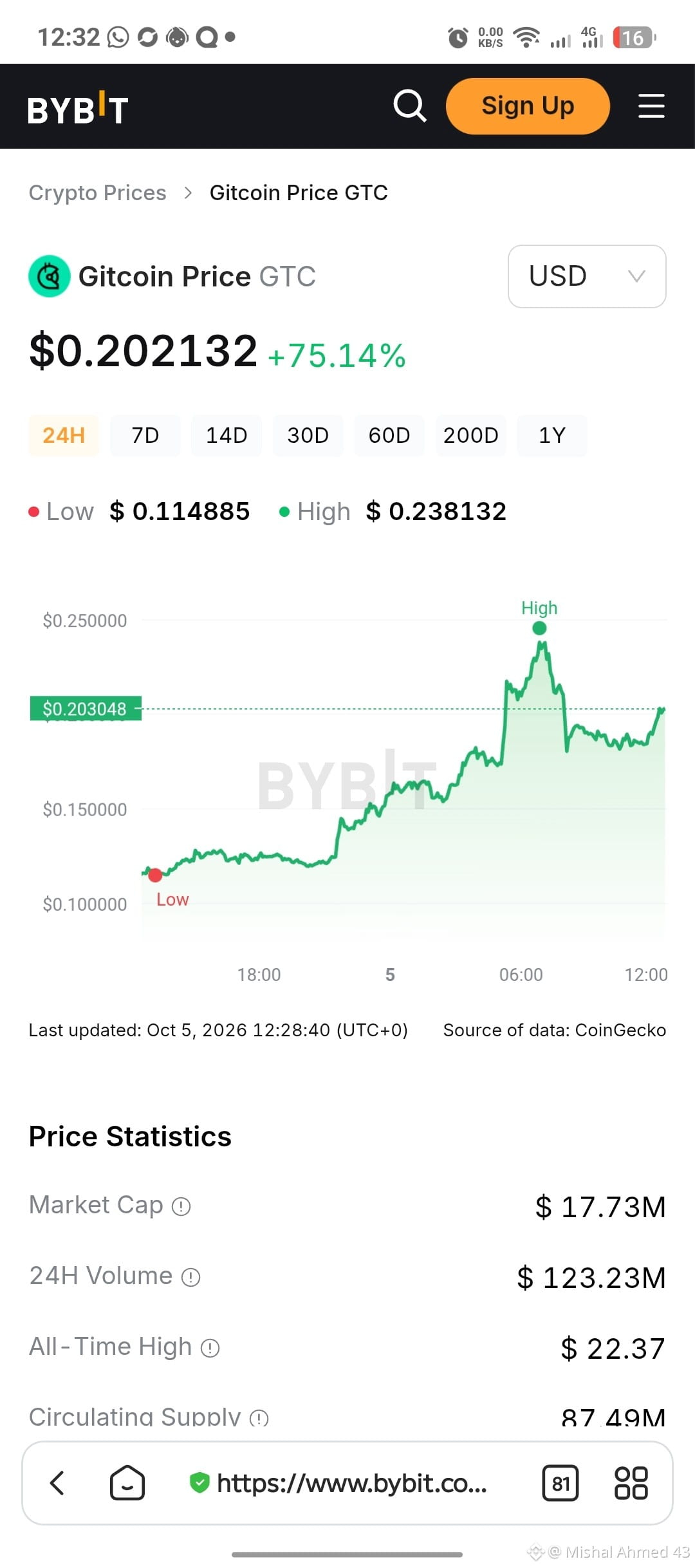
$GTC (Gitcoin)
@InceptionProgramGTC is the governance token of Gitcoin, a platform focused on funding open-source/public-goods projects. Gitcoin’s current roadmap is also evolving toward its new Techne initiative while @InceptionProgramGTC and the @Square-Creator-5be383934 continue their governance role.
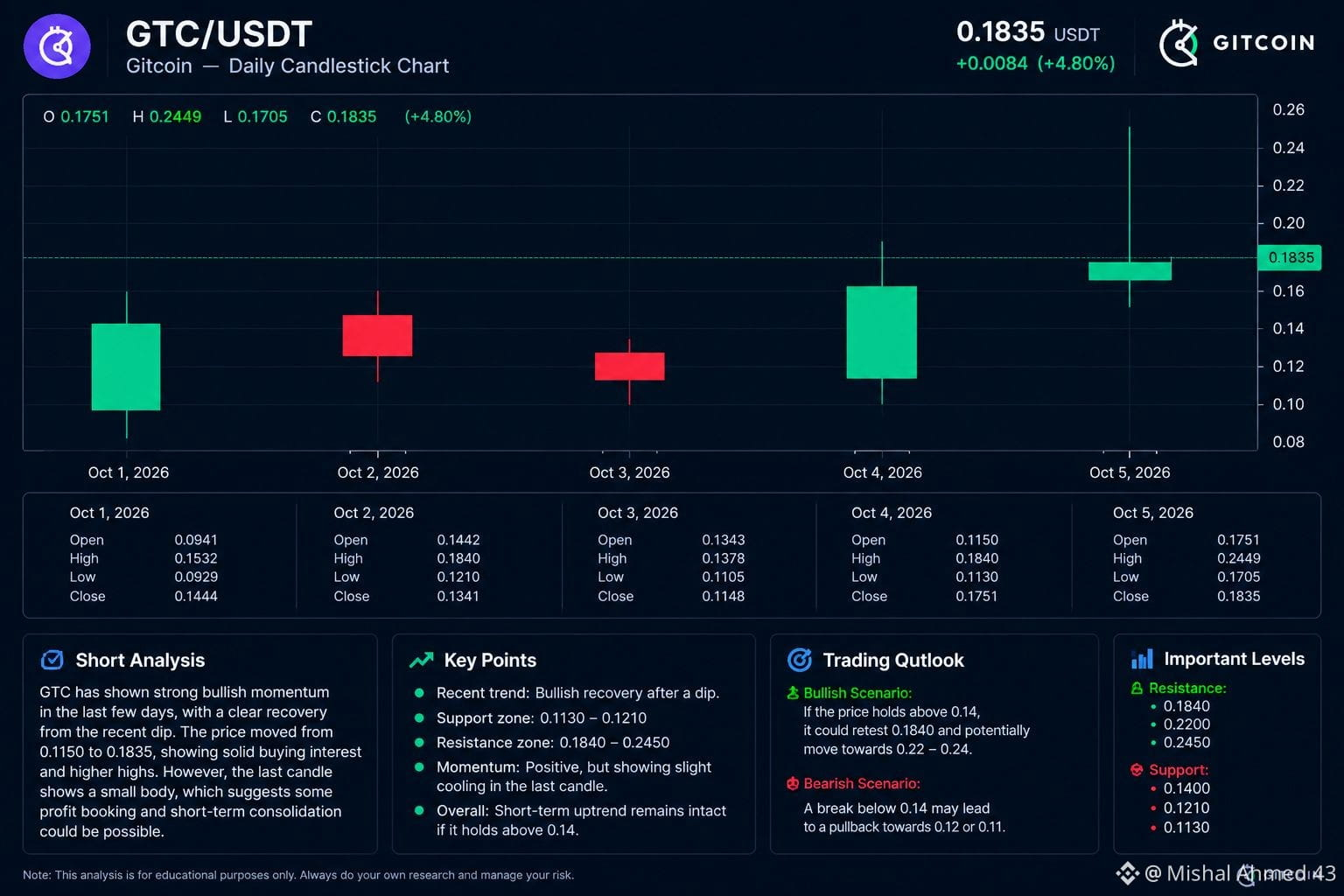
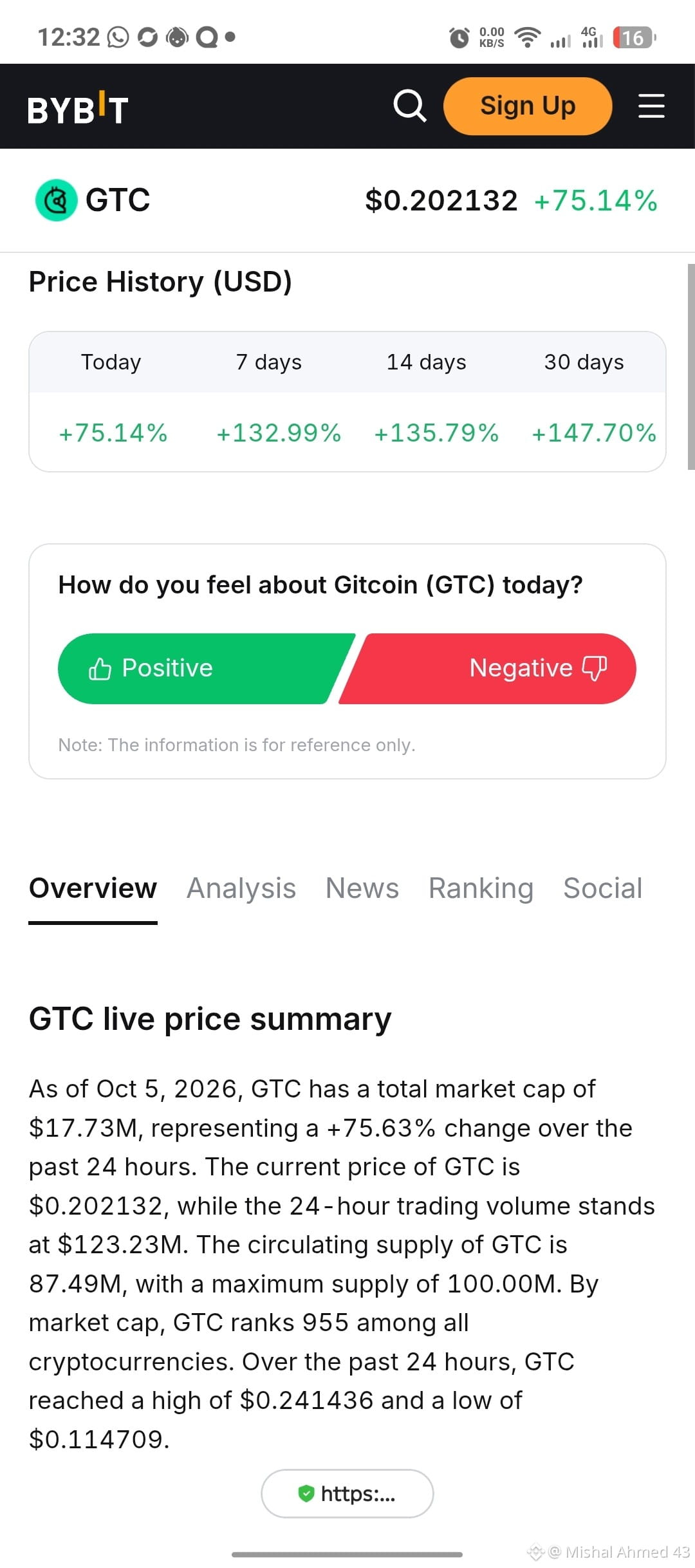
Technical view: @InceptionProgramGTC has recently shown strong bullish momentum, with a sharp move from around $0.09 to above $0.18. Recent data shows heavy volume and high volatility, so profit-taking and consolidation are possible.
Resistance: $0.184 → $0.22 → $0.245
Support: $0.14 → $0.121 → $0.113
Bullish scenario: Holding above $0.14 could keep the recovery structure intact.
Bearish scenario: Losing $0.14 could bring a pullback toward $0.12–$0.11.
[GTC official Token Center](https://gtc.gitcoin.co/?utm_source=chatgpt.com)
@InceptionProgramGTC /USDT Candle Chart
I made the chart using recent @GTC/USDT daily OHLC data; the latest displayed candle is around $0.1835.
Note: @InceptionProgramGTC is highly volatile, so this is market analysis, not a guaranteed price prediction.p#FedOctoberRateHikeOddsFallTo17% #SECHaltsCryptoETFReviewsAmidFundingLapse #DriftHackVictimsBeginClaims
{future}(GTCUSDT)
Worked for 37s
$GTC (Gitcoin)
@GTC is the governance token of Gitcoin, a platform focused on funding open-source/public-goods projects. Gitcoin’s current roadmap is also evolving toward its new Techne initiative while @GTC and the @D A O continue their governance role.
Technical view: @GTC has recently shown strong bullish momentum, with a sharp move from around $0.09 to above $0.18. Recent data shows heavy volume and high volatility, so profit-taking and consolidation are possible.
Resistance: $0.184 → $0.22 → $0.245
Support: $0.14 → $0.121 → $0.113
Bullish scenario: Holding above $0.14 could keep the recovery structure intact.
Bearish scenario: Losing $0.14 could bring a pullback toward $0.12–$0.11.
[GTC official Token Center](https://gtc.gitcoin.co/?utm_source=chatgpt.com)
@GTC /USDT Candle Chart
I made the chart using recent @GTC/USDT daily OHLC data; the latest displayed candle is around $0.1835.
Note: @GTC is highly volatile, so this is market analysis, not a guaranteed price prediction.p#FedOctoberRateHikeOddsFallTo17% #SECHaltsCryptoETFReviewsAmidFundingLapse #DriftHackVictimsBeginClaims
$GTC (Gitcoin)
@GTC is the governance token of Gitcoin, a platform focused on funding open-source/public-goods projects. Gitcoin’s current roadmap is also evolving toward its new Techne initiative while @GTC and the @D A O continue their governance role.
Technical view: @GTC has recently shown strong bullish momentum, with a sharp move from around $0.09 to above $0.18. Recent data shows heavy volume and high volatility, so profit-taking and consolidation are possible.
Resistance: $0.184 → $0.22 → $0.245
Support: $0.14 → $0.121 → $0.113
Bullish scenario: Holding above $0.14 could keep the recovery structure intact.
Bearish scenario: Losing $0.14 could bring a pullback toward $0.12–$0.11.
[GTC official Token Center](https://gtc.gitcoin.co/?utm_source=chatgpt.com)
@GTC /USDT Candle Chart
I made the chart using recent @GTC/USDT daily OHLC data; the latest displayed candle is around $0.1835.
Note: @GTC is highly volatile, so this is market analysis, not a guaranteed price prediction.p#FedOctoberRateHikeOddsFallTo17% #SECHaltsCryptoETFReviewsAmidFundingLapse #DriftHackVictimsBeginClaims
184
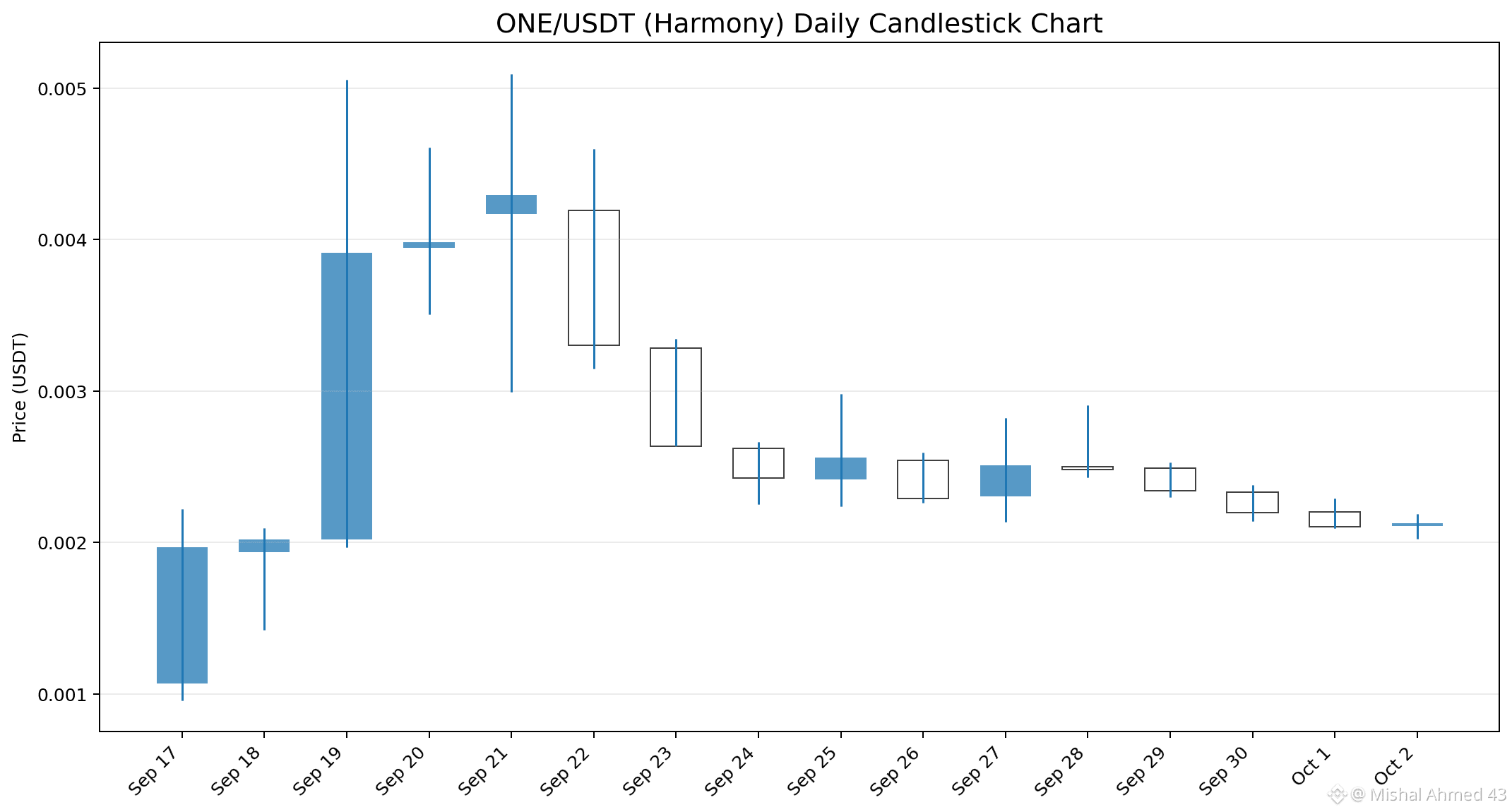
$ONE (Harmony) — Short Analysis
Latest close: ~$0.00213 on Oct. 2, 2026. @Square-Creator-619386383 experienced a very sharp September move, rising from below $0.001 to above $0.005 before pulling back toward the $0.0021 area.
Support: $0.0020 → $0.0019
Resistance: $0.0023 → $0.0025
Momentum: Recent momentum has cooled significantly after the September spike.
Fundamentals: Harmony (ONE) is a blockchain platform focused on scalable decentralized applications and cross-chain interoperability.
Risk: @Square-Creator-619386383 remains highly volatile; the recent large price swings make support/resistance levels important to watch.
Download ONE Candle Chart ❶
{future}(ONEUSDT)
#GreekPoliceBustCryptoScamRingArrest17 #FedOctoberRateHikeOddsFallTo17% #USRussiaUkraineTalksReportedlyIncludeLukoilOilDeal #CerebrasSinksNearly20%OnReportNvidiaToPowerOpenAI
$ONE (Harmony) — Short Analysis
Latest close: ~$0.00213 on Oct. 2, 2026. @ONE experienced a very sharp September move, rising from below $0.001 to above $0.005 before pulling back toward the $0.0021 area.
Support: $0.0020 → $0.0019
Resistance: $0.0023 → $0.0025
Momentum: Recent momentum has cooled significantly after the September spike.
Fundamentals: Harmony (ONE) is a blockchain platform focused on scalable decentralized applications and cross-chain interoperability.
Risk: @ONE remains highly volatile; the recent large price swings make support/resistance levels important to watch.
Download ONE Candle Chart ❶
#GreekPoliceBustCryptoScamRingArrest17 #FedOctoberRateHikeOddsFallTo17% #USRussiaUkraineTalksReportedlyIncludeLukoilOilDeal #CerebrasSinksNearly20%OnReportNvidiaToPowerOpenAI
Latest close: ~$0.00213 on Oct. 2, 2026. @ONE experienced a very sharp September move, rising from below $0.001 to above $0.005 before pulling back toward the $0.0021 area.
Support: $0.0020 → $0.0019
Resistance: $0.0023 → $0.0025
Momentum: Recent momentum has cooled significantly after the September spike.
Fundamentals: Harmony (ONE) is a blockchain platform focused on scalable decentralized applications and cross-chain interoperability.
Risk: @ONE remains highly volatile; the recent large price swings make support/resistance levels important to watch.
Download ONE Candle Chart ❶
#GreekPoliceBustCryptoScamRingArrest17 #FedOctoberRateHikeOddsFallTo17% #USRussiaUkraineTalksReportedlyIncludeLukoilOilDeal #CerebrasSinksNearly20%OnReportNvidiaToPowerOpenAI
1
1
212
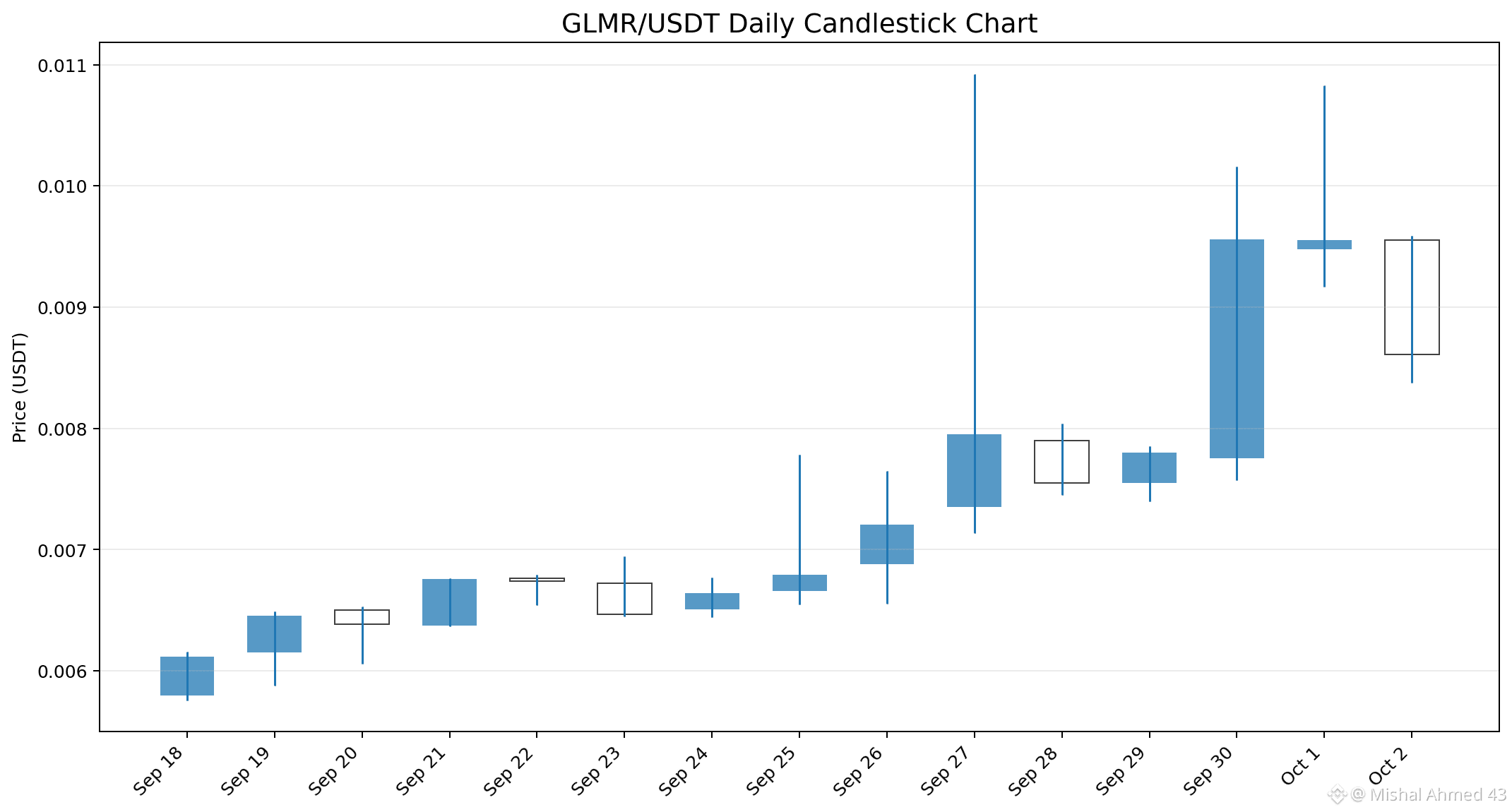
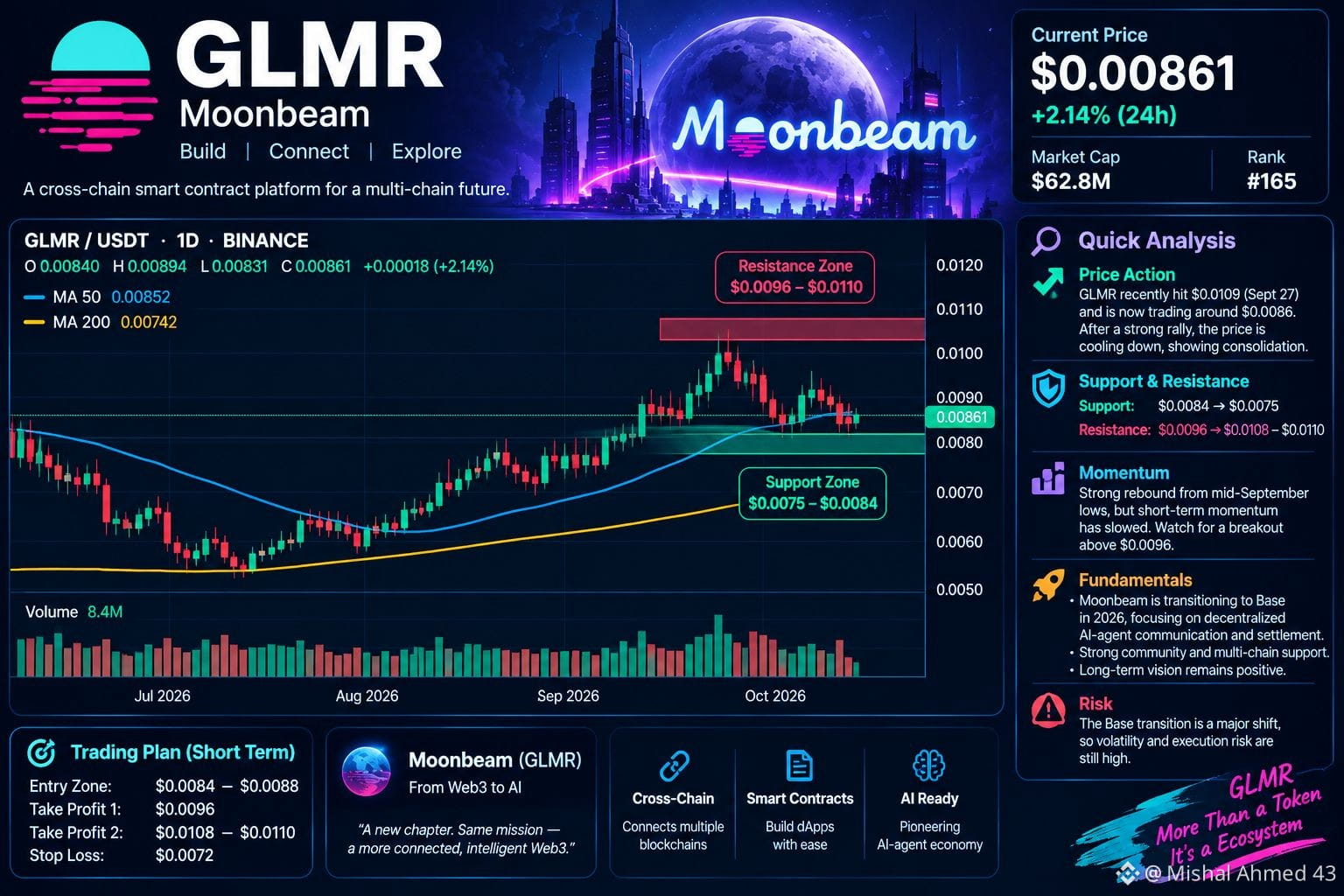
$GLMR (Moonbeam)
Latest complete close: ~$0.00861 on Oct. 2, 2026. Recent trading has been highly volatile, with @Square-Creator-4effe409fa4f8 reaching about $0.0109 on Sept. 27 and $0.0108 on Oct. 1.
Support: $0.0084 → $0.0075
Resistance: $0.0096 → $0.0108–$0.0110
Momentum: Strong rebound from mid-September lows, followed by a pullback.
Fundamentals: Moonbeam announced a major 2026 transition, moving @Square-Creator-1fad842ca8f1c to Base and repositioning the protocol around decentralized AI-agent communication and settlement.
Risk: The transition is significant, so volatility and execution risk remain important.
📊 @Square-Creator-4effe409fa4f8
{future}(GLMUSDT)
/USDT Daily Candle Chart
Download GLMR Candle Chart ❶
$GLMR (Moonbeam)
Latest complete close: ~$0.00861 on Oct. 2, 2026. Recent trading has been highly volatile, with @GLMR reaching about $0.0109 on Sept. 27 and $0.0108 on Oct. 1.
Support: $0.0084 → $0.0075
Resistance: $0.0096 → $0.0108–$0.0110
Momentum: Strong rebound from mid-September lows, followed by a pullback.
Fundamentals: Moonbeam announced a major 2026 transition, moving @ONE_OK to Base and repositioning the protocol around decentralized AI-agent communication and settlement.
Risk: The transition is significant, so volatility and execution risk remain important.
📊 @GLMR
/USDT Daily Candle Chart
Download GLMR Candle Chart ❶
Latest complete close: ~$0.00861 on Oct. 2, 2026. Recent trading has been highly volatile, with @GLMR reaching about $0.0109 on Sept. 27 and $0.0108 on Oct. 1.
Support: $0.0084 → $0.0075
Resistance: $0.0096 → $0.0108–$0.0110
Momentum: Strong rebound from mid-September lows, followed by a pullback.
Fundamentals: Moonbeam announced a major 2026 transition, moving @ONE_OK to Base and repositioning the protocol around decentralized AI-agent communication and settlement.
Risk: The transition is significant, so volatility and execution risk remain important.
📊 @GLMR
/USDT Daily Candle Chart
Download GLMR Candle Chart ❶
1
148
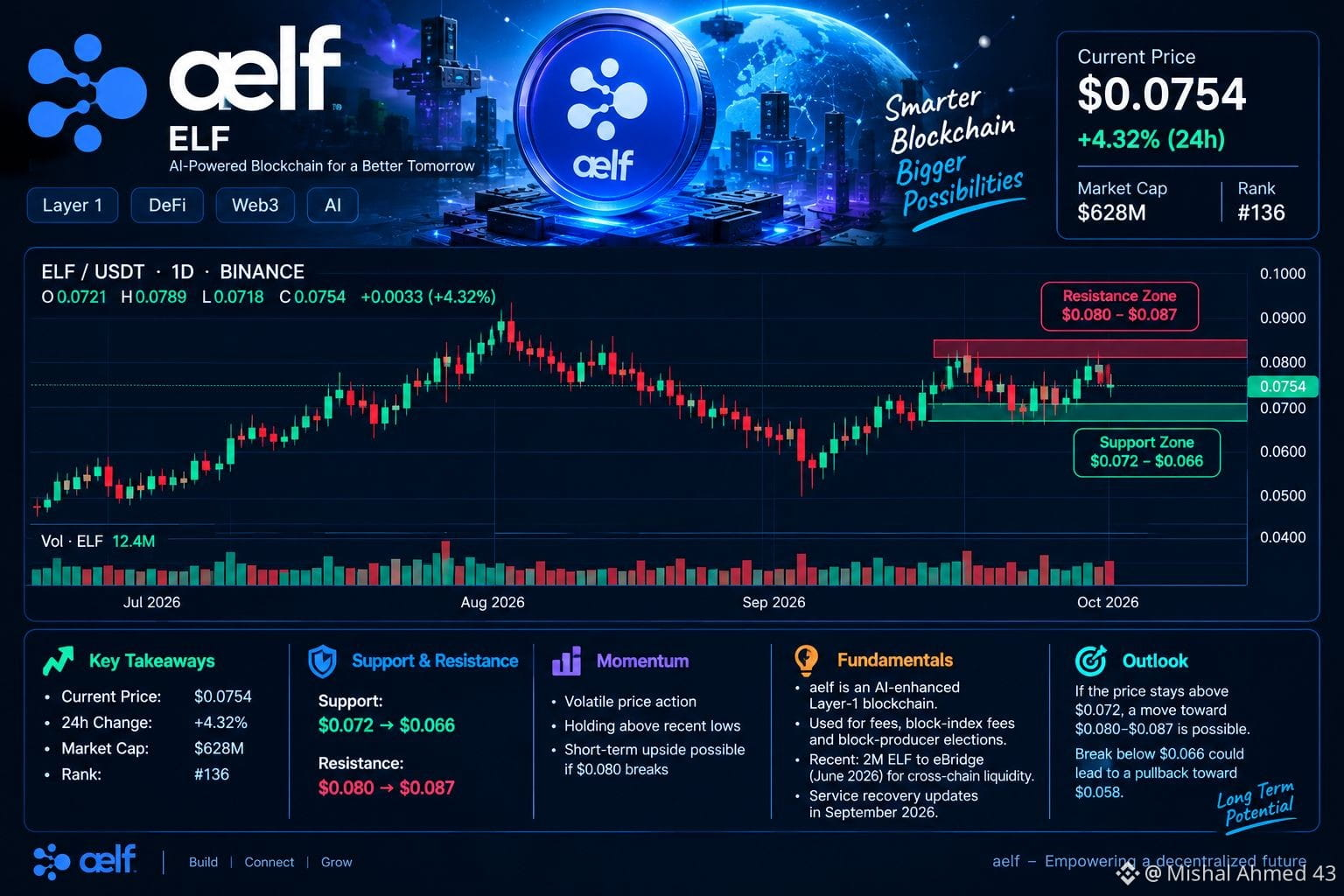
$ELF (aelf)
Current area: ~$0.075–$0.08
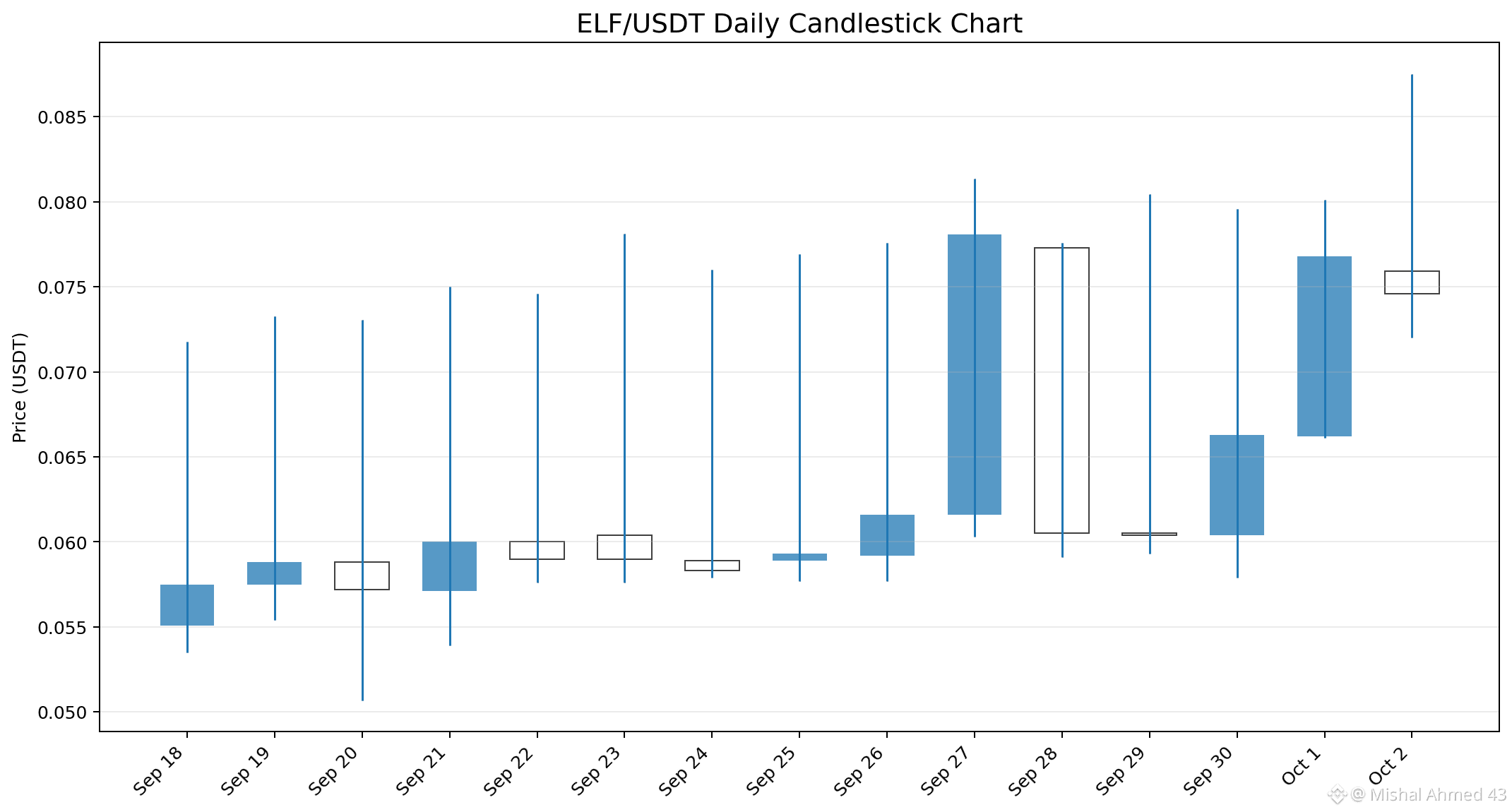
@Square-Creator-168092074 has been volatile recently, with the Sept. 27–Oct. 2 candles showing repeated moves between roughly $0.058 and $0.088.
Support: $0.072 → $0.066
Resistance: $0.080 → $0.087
Momentum: Volatile, with price holding above the late-September lows.
Fundamentals: ELF is the native token of @Square-Creator-1251e053d , an AI-enhanced Layer-1 blockchain. It is used for transaction fees, block-index fees, and participation in block-producer elections.
Recent development: aelf reported a 2 million @elfbhr
$ allocation to eBridge in June 2026 to strengthen cross-chain liquidity, while September updates covered recovery of key services after an August incident.
📊 ELF/USDT Daily Candlestick Chart
Download ELF Candle Chart❶
#NvidiaHitsRecordHighUp2.4% #USRussiaUkraineTalksReportedlyIncludeLukoilOilDeal #CanaryFilesAmendedS1ForPEPEETF #CanaryFilesAmendedS1ForPEPEETF
{etf_us}(ELFY.ETF)
$ELF (aelf)
Current area: ~$0.075–$0.08
@Elf_882 has been volatile recently, with the Sept. 27–Oct. 2 candles showing repeated moves between roughly $0.058 and $0.088.
Support: $0.072 → $0.066
Resistance: $0.080 → $0.087
Momentum: Volatile, with price holding above the late-September lows.
Fundamentals: ELF is the native token of @aelf Re-poster , an AI-enhanced Layer-1 blockchain. It is used for transaction fees, block-index fees, and participation in block-producer elections.
Recent development: aelf reported a 2 million @elf
$ allocation to eBridge in June 2026 to strengthen cross-chain liquidity, while September updates covered recovery of key services after an August incident.
📊 ELF/USDT Daily Candlestick Chart
Download ELF Candle Chart❶
#NvidiaHitsRecordHighUp2.4% #USRussiaUkraineTalksReportedlyIncludeLukoilOilDeal #CanaryFilesAmendedS1ForPEPEETF #CanaryFilesAmendedS1ForPEPEETF
Current area: ~$0.075–$0.08
@Elf_882 has been volatile recently, with the Sept. 27–Oct. 2 candles showing repeated moves between roughly $0.058 and $0.088.
Support: $0.072 → $0.066
Resistance: $0.080 → $0.087
Momentum: Volatile, with price holding above the late-September lows.
Fundamentals: ELF is the native token of @aelf Re-poster , an AI-enhanced Layer-1 blockchain. It is used for transaction fees, block-index fees, and participation in block-producer elections.
Recent development: aelf reported a 2 million @elf
$ allocation to eBridge in June 2026 to strengthen cross-chain liquidity, while September updates covered recovery of key services after an August incident.
📊 ELF/USDT Daily Candlestick Chart
Download ELF Candle Chart❶
#NvidiaHitsRecordHighUp2.4% #USRussiaUkraineTalksReportedlyIncludeLukoilOilDeal #CanaryFilesAmendedS1ForPEPEETF #CanaryFilesAmendedS1ForPEPEETF
1
51
$SAND (The Sandbox)
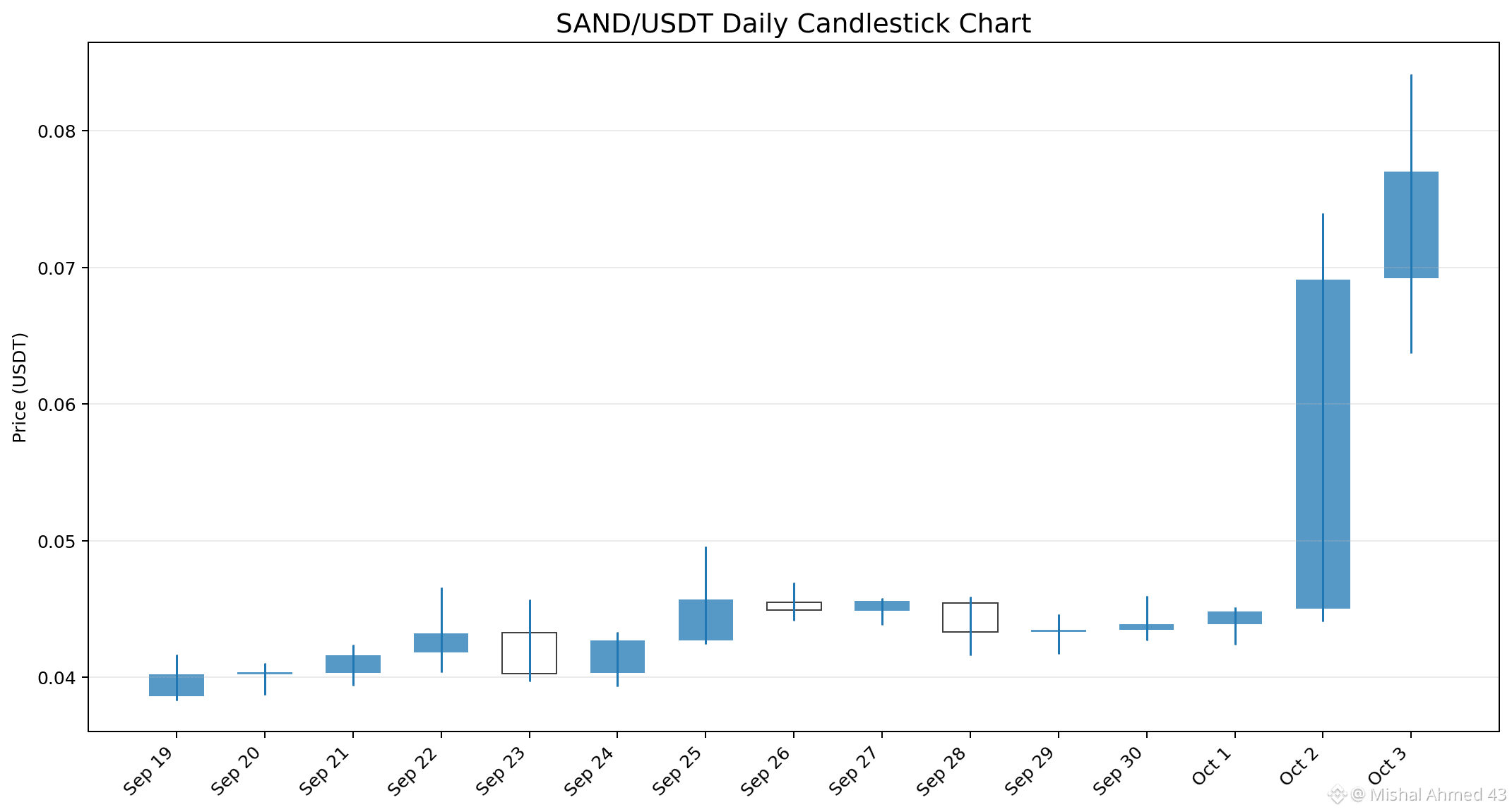
Current price: ~$0.0770
@Square-Creator-613947359 has shown a strong short-term rebound, moving from around $0.043 on Oct 1 to about $0.069 on Oct 2, with Oct 3 trading near $0.077.
Support: $0.069 → $0.063
Resistance: $0.084 → $0.090
Momentum: Strong, but volatility is very high after the recent jump.
Fundamentals: @Square-Creator-dd1485232cfd is the utility token of The Sandbox, used within its virtual-world ecosystem, including LAND, Marketplace, @VoxEdit and Game Maker.
Risk: Large price swings and supply-related pressure remain important factors.
SAND/USDT Daily Candlestick Chart
Download the SAND candlestick chart
❶
{future}(SANDUSDT)
$SAND (The Sandbox)
Current price: ~$0.0770
@Sand has shown a strong short-term rebound, moving from around $0.043 on Oct 1 to about $0.069 on Oct 2, with Oct 3 trading near $0.077.
Support: $0.069 → $0.063
Resistance: $0.084 → $0.090
Momentum: Strong, but volatility is very high after the recent jump.
Fundamentals: @-Sand- is the utility token of The Sandbox, used within its virtual-world ecosystem, including LAND, Marketplace, @VoxEdit and Game Maker.
Risk: Large price swings and supply-related pressure remain important factors.
SAND/USDT Daily Candlestick Chart
Download the SAND candlestick chart
❶
Current price: ~$0.0770
@Sand has shown a strong short-term rebound, moving from around $0.043 on Oct 1 to about $0.069 on Oct 2, with Oct 3 trading near $0.077.
Support: $0.069 → $0.063
Resistance: $0.084 → $0.090
Momentum: Strong, but volatility is very high after the recent jump.
Fundamentals: @-Sand- is the utility token of The Sandbox, used within its virtual-world ecosystem, including LAND, Marketplace, @VoxEdit and Game Maker.
Risk: Large price swings and supply-related pressure remain important factors.
SAND/USDT Daily Candlestick Chart
Download the SAND candlestick chart
❶

1
187
Worked for 1m 3s
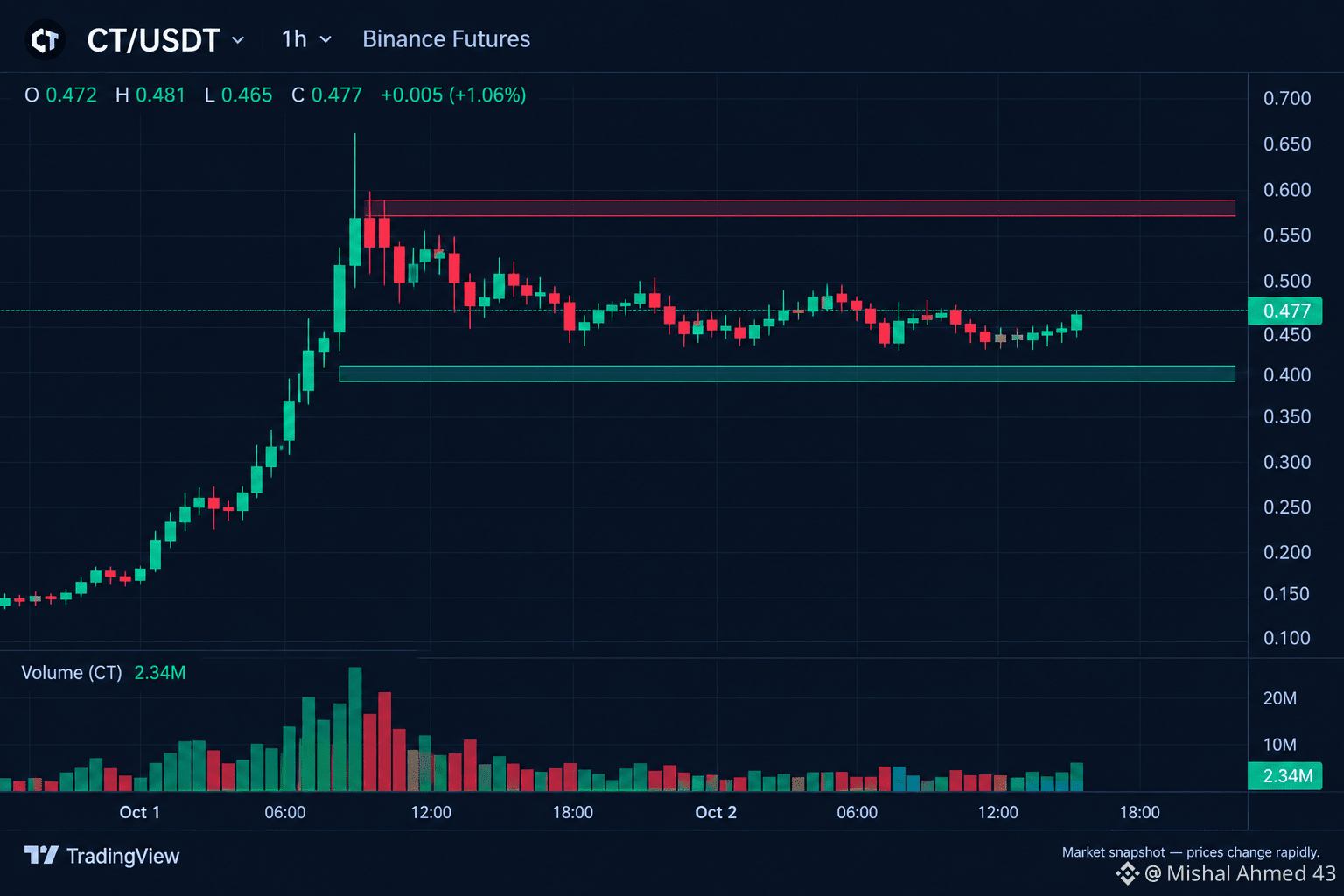
$CT (Concrete)
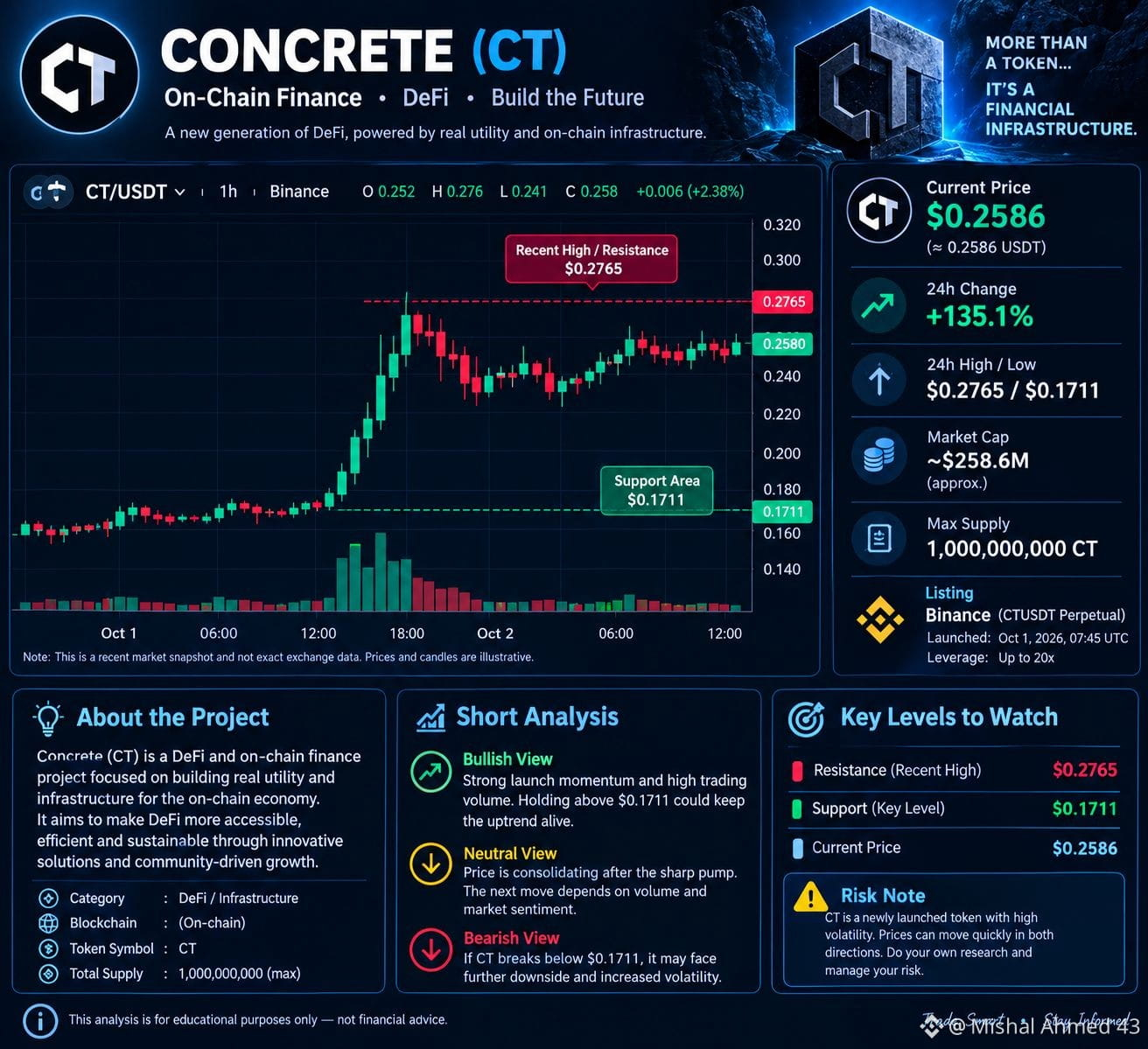
Concrete (CT) is a newly launched DeFi/on-chain finance token. @Square-Creator-8b46e5c30543 has a fixed maximum supply of 1 billion tokens and is designed mainly for governance and protocol configuration.
Current price: ~$0.2586
24h change: +135.1%
24h high: ~$0.2765
24h low: ~$0.1711
Resistance: ~$0.2765
Support: ~$0.1711
Binance Futures: @Square-Creator-64a538068 perpetual launched October 1, with up to 20× leverage.
Technical view: @Square-Creator-8b46e5c30543 has experienced very strong launch volatility and is currently consolidating below its recent high. A move above $0.2765 would be a notable technical level, while $0.1711 is the major recent support.
Note: @Square-Creator-8b46e5c30543 is very new, so price discovery and volatility are unusually high. The candles in the graphic are an illustrative market snapshot, not exact exchange @Square-Creator-ba2031154
{future}(CTSIUSDT)
{future}(CTUSDT)
data.
#NFPWatch #SECProposesCryptoCustodyFramework
Worked for 1m 3s
$CT (Concrete)
Concrete (CT) is a newly launched DeFi/on-chain finance token. @CT has a fixed maximum supply of 1 billion tokens and is designed mainly for governance and protocol configuration.
Current price: ~$0.2586
24h change: +135.1%
24h high: ~$0.2765
24h low: ~$0.1711
Resistance: ~$0.2765
Support: ~$0.1711
Binance Futures: @CTusdt88 perpetual launched October 1, with up to 20× leverage.
Technical view: @CT has experienced very strong launch volatility and is currently consolidating below its recent high. A move above $0.2765 would be a notable technical level, while $0.1711 is the major recent support.
Note: @CT is very new, so price discovery and volatility are unusually high. The candles in the graphic are an illustrative market snapshot, not exact exchange @OHLC
data.
#NFPWatch #SECProposesCryptoCustodyFramework
$CT (Concrete)
Concrete (CT) is a newly launched DeFi/on-chain finance token. @CT has a fixed maximum supply of 1 billion tokens and is designed mainly for governance and protocol configuration.
Current price: ~$0.2586
24h change: +135.1%
24h high: ~$0.2765
24h low: ~$0.1711
Resistance: ~$0.2765
Support: ~$0.1711
Binance Futures: @CTusdt88 perpetual launched October 1, with up to 20× leverage.
Technical view: @CT has experienced very strong launch volatility and is currently consolidating below its recent high. A move above $0.2765 would be a notable technical level, while $0.1711 is the major recent support.
Note: @CT is very new, so price discovery and volatility are unusually high. The candles in the graphic are an illustrative market snapshot, not exact exchange @OHLC
data.
#NFPWatch #SECProposesCryptoCustodyFramework
2
5
292
$GALA
{future}(GALAUSDT)
is the utility token of the Gala Games ecosystem, used across GalaChain for transactions and gaming-related activity. https://support.gala.com/hc/en-us/articles/22440785898651--GALA-Tokenomics?utm_source=chatgpt.com
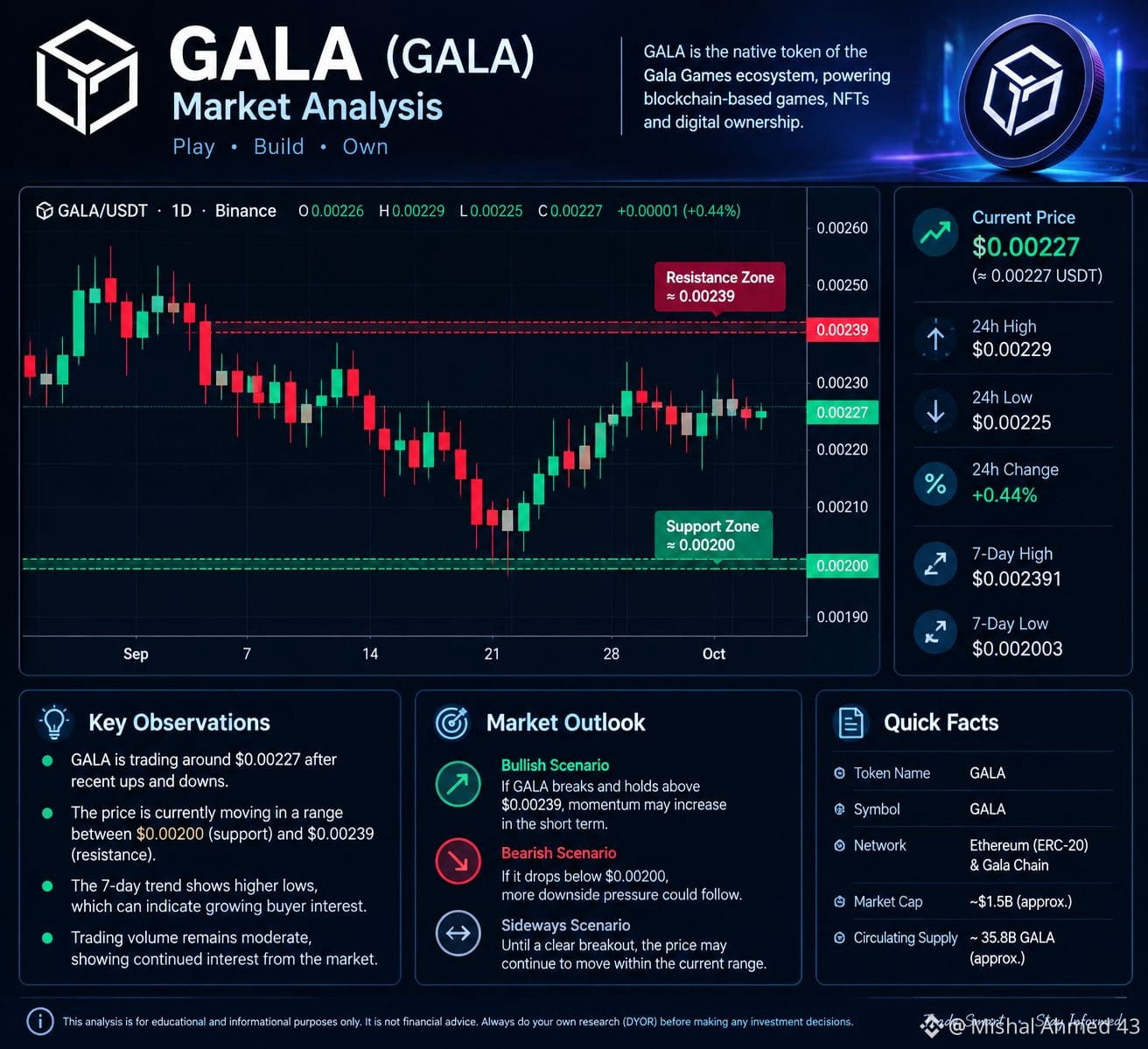
Current price: around $0.00227
7-day range: about $0.00200–$0.00239
Recent trend: @Gala_official has recovered from the September lows and is showing higher lows.
Resistance: ~$0.00239
Support: ~$0.00200
Catalyst: Recent Mirandus updates have coincided with increased attention around @gala8329 .
Technical view: A sustained break above $0.00239 would indicate stronger upside momentum, while losing $0.00200 could increase downside pressure. This is a market observation, not a price prediction.
$GALA
is the utility token of the Gala Games ecosystem, used across GalaChain for transactions and gaming-related activity. https://support.gala.com/hc/en-us/articles/22440785898651--GALA-Tokenomics?utm_source=chatgpt.com
Current price: around $0.00227
7-day range: about $0.00200–$0.00239
Recent trend: @Gala has recovered from the September lows and is showing higher lows.
Resistance: ~$0.00239
Support: ~$0.00200
Catalyst: Recent Mirandus updates have coincided with increased attention around @gala_ .
Technical view: A sustained break above $0.00239 would indicate stronger upside momentum, while losing $0.00200 could increase downside pressure. This is a market observation, not a price prediction.
is the utility token of the Gala Games ecosystem, used across GalaChain for transactions and gaming-related activity. https://support.gala.com/hc/en-us/articles/22440785898651--GALA-Tokenomics?utm_source=chatgpt.com
Current price: around $0.00227
7-day range: about $0.00200–$0.00239
Recent trend: @Gala has recovered from the September lows and is showing higher lows.
Resistance: ~$0.00239
Support: ~$0.00200
Catalyst: Recent Mirandus updates have coincided with increased attention around @gala_ .
Technical view: A sustained break above $0.00239 would indicate stronger upside momentum, while losing $0.00200 could increase downside pressure. This is a market observation, not a price prediction.
5
501
$SOXL
$SOXLB is not a cryptocurrency. It is the Direxion Daily Semiconductor Bull 3X Shares @Square-Creator-bfe0c4fd6222c
{future}(SOXLUSDT)
, designed to provide 3× daily exposure to the semiconductor sector.
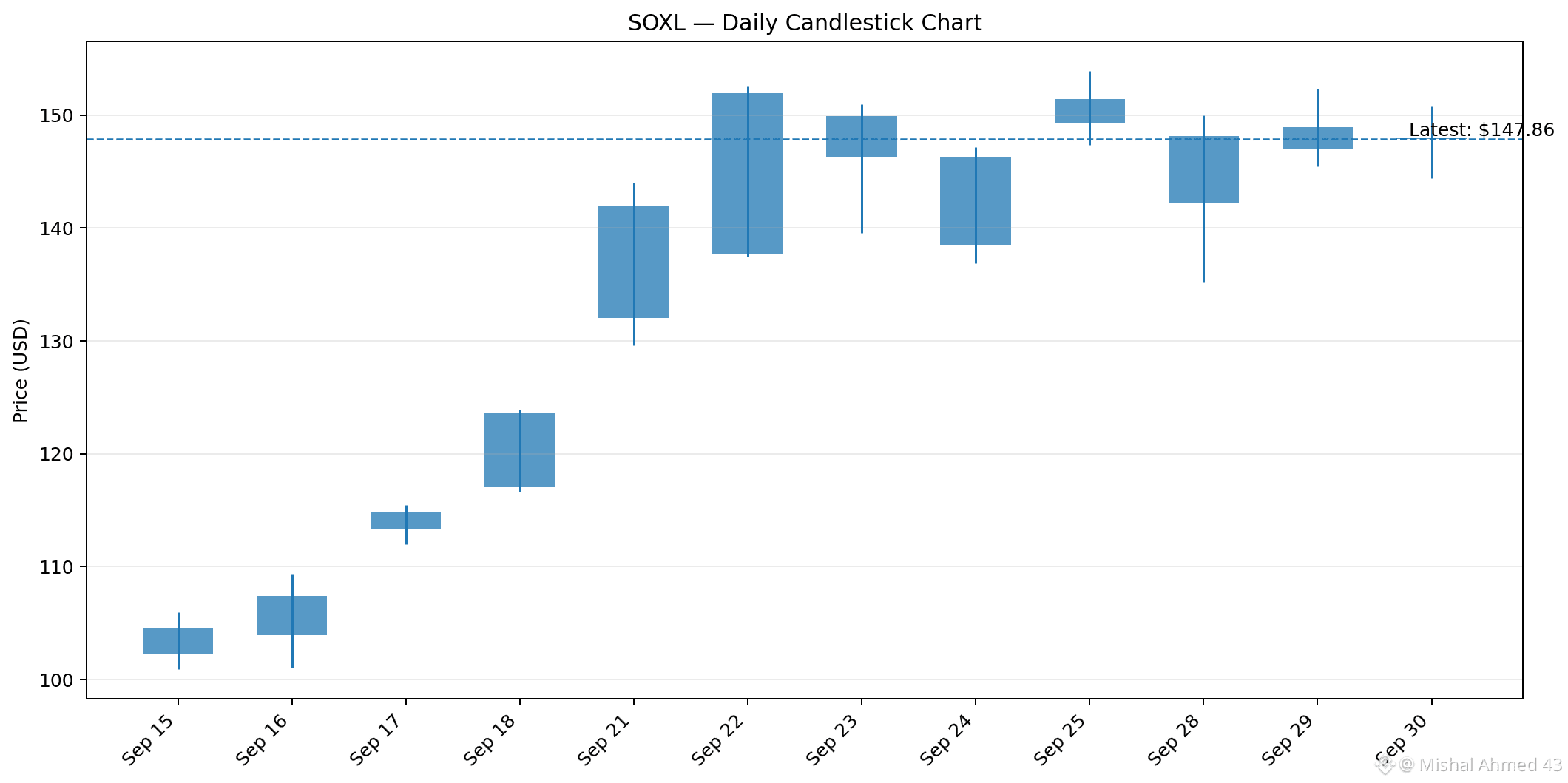
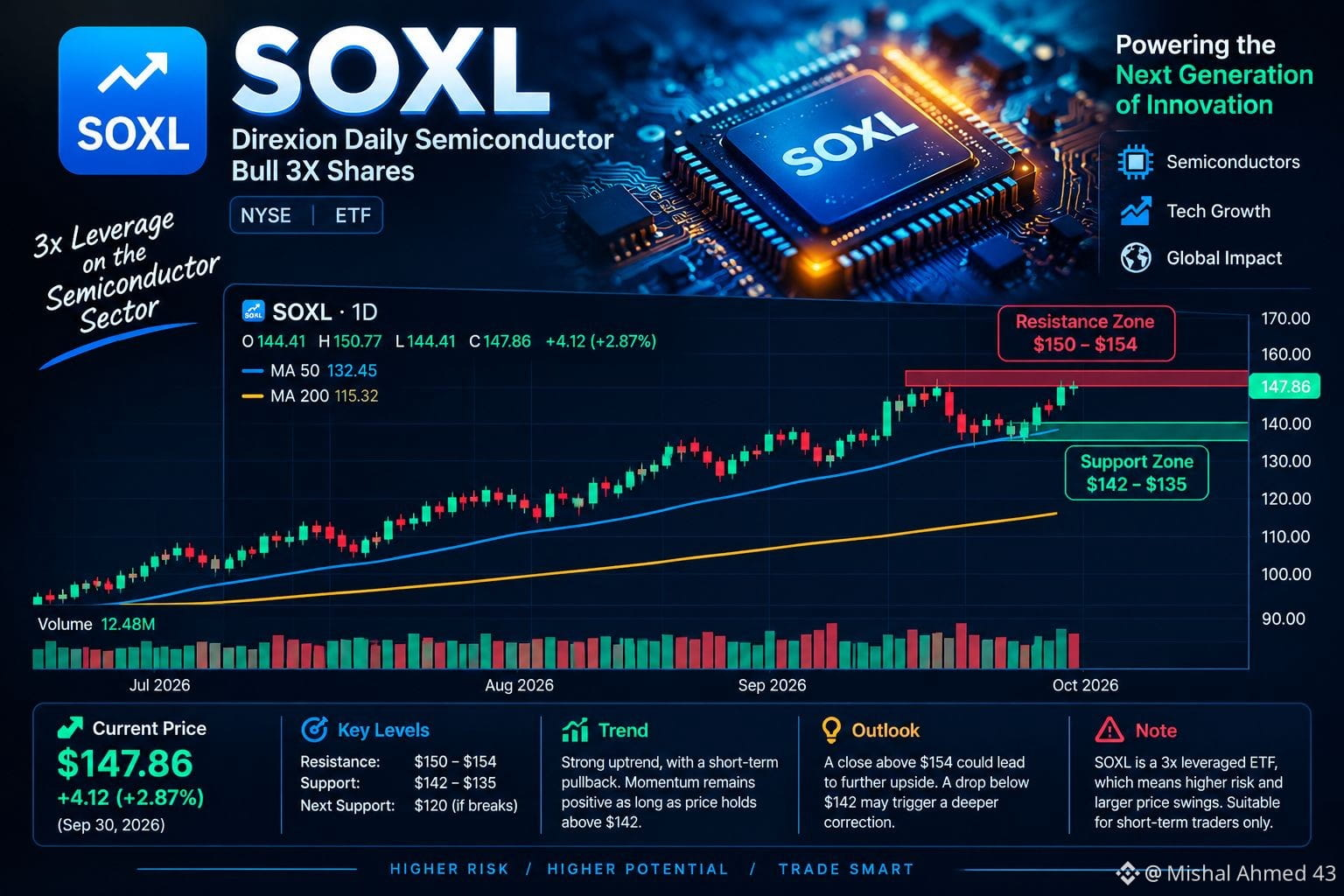
Latest close: ~$147.86
Recent momentum: Strong recovery from ~$102 in mid-September to ~$148 by Sep. 30.
Resistance: ~$150–154
Support: ~$142, then ~$135
Short-term view: Momentum remains strong, but @Square-Creator-bc5b65706f3b is highly volatile because of its 3× daily leverage.
@Square-Creator-6e5b9bf19579 Daily Candlestick Chart
Download the @Square-Creator-bc5b65706f3b candle chart
Chart uses verified daily @Square-Creator-ba2031154 data through September 30, 2026. ❶
$SOXL
$SOXLB is not a cryptocurrency. It is the Direxion Daily Semiconductor Bull 3X Shares @etf
, designed to provide 3× daily exposure to the semiconductor sector.
Latest close: ~$147.86
Recent momentum: Strong recovery from ~$102 in mid-September to ~$148 by Sep. 30.
Resistance: ~$150–154
Support: ~$142, then ~$135
Short-term view: Momentum remains strong, but @SOXL is highly volatile because of its 3× daily leverage.
@SOXL一500 Daily Candlestick Chart
Download the @SOXL candle chart
Chart uses verified daily @OHLC data through September 30, 2026. ❶
$SOXLB is not a cryptocurrency. It is the Direxion Daily Semiconductor Bull 3X Shares @etf
, designed to provide 3× daily exposure to the semiconductor sector.
Latest close: ~$147.86
Recent momentum: Strong recovery from ~$102 in mid-September to ~$148 by Sep. 30.
Resistance: ~$150–154
Support: ~$142, then ~$135
Short-term view: Momentum remains strong, but @SOXL is highly volatile because of its 3× daily leverage.
@SOXL一500 Daily Candlestick Chart
Download the @SOXL candle chart
Chart uses verified daily @OHLC data through September 30, 2026. ❶
4
127
{spot}(MOVRUSDT)
$MOVR (Moonriver)
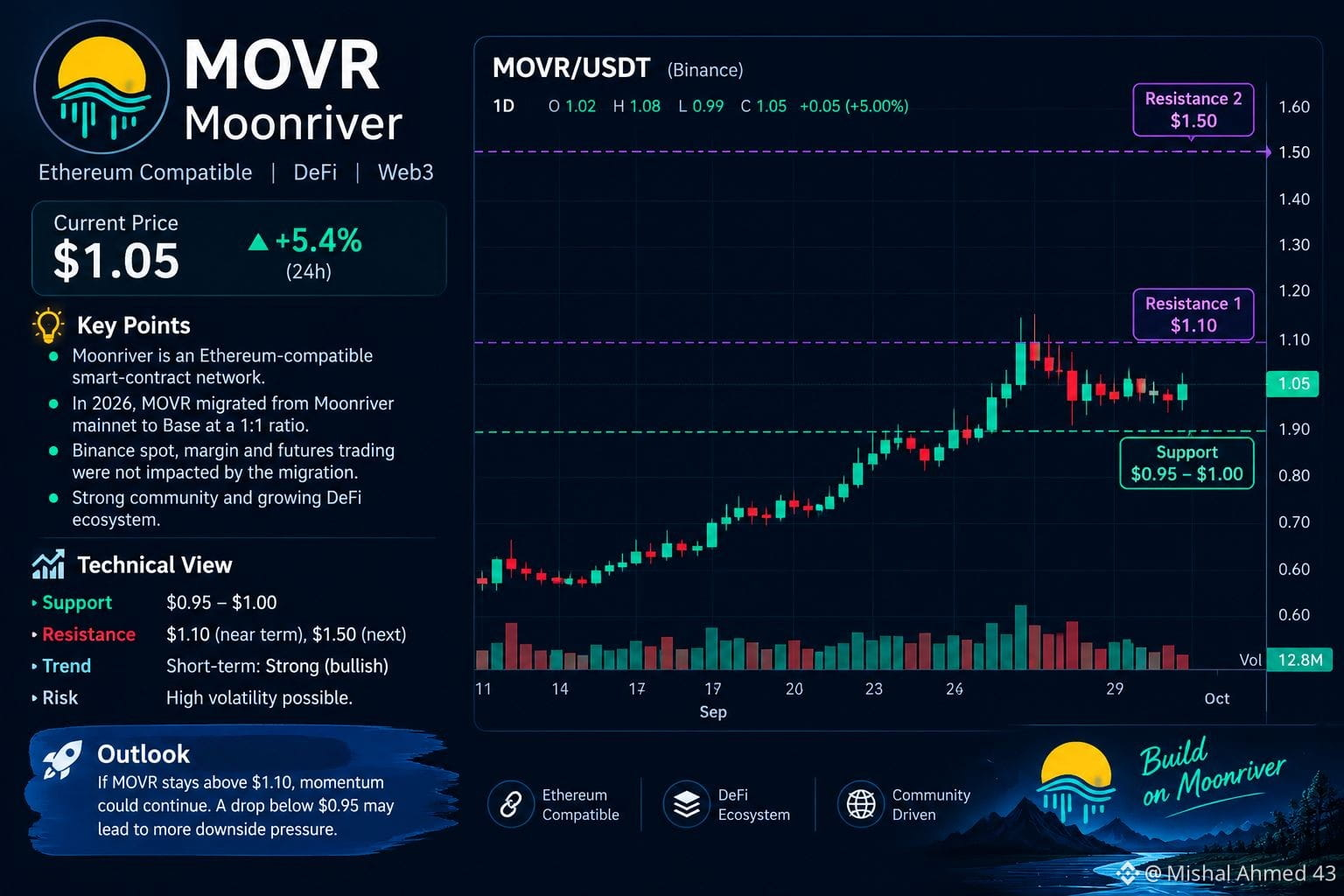
Current Binance price: around $1.05, with Binance showing about +5.4% over 24h.
Fundamentals: Moonriver is an Ethereum-compatible smart-contract network. In 2026, @Square-Creator-eb7ed8388ba4 has been migrated from Moonriver mainnet to Base at a 1:1 ratio, while Binance says spot, margin and futures trading were not impacted by the migration.
Technical view:
🟢 Short-term momentum: strong
Support: ~$0.95–$1.00
Resistance: ~$1.10, then ~$1.50
A sustained move above $1.10 could keep momentum strong.
High volatility is a major risk after the recent sharp move.
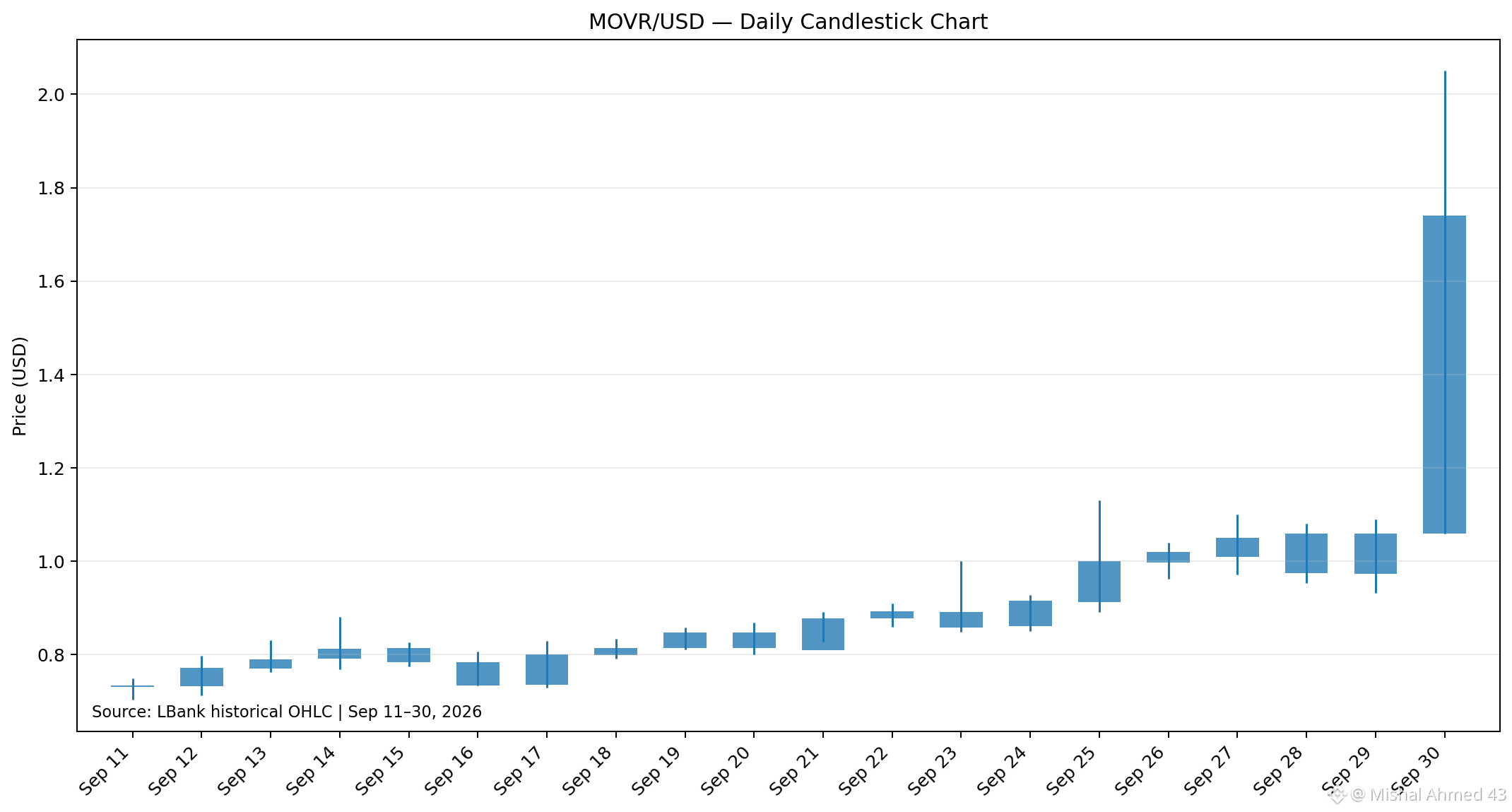
📊 MOVR Daily Candlestick Chart
Download @Square-Creator-d4f6038c803b candle chart
Chart source: LBank daily @Square-Creator-ba2031154 data, Sep 11–30, 2026. Because MOVR prices have diverged significantly between exchanges during the recent migration, I have not mixed this chart's @Square-Creator-ba2031154 data with Binance's current quote. ❶
#KoreaProposesTokenizingStocksAndBonds #MetaMaskExitsLidoValidatorsAfterSecurityIncident #CFTCSubmitsTwoEventContractRulesToWhiteHouse #USADPAdds90000JobsInSeptember #USCorePCEEasesTo3%InAugust
$MOVR (Moonriver)
Current Binance price: around $1.05, with Binance showing about +5.4% over 24h.
Fundamentals: Moonriver is an Ethereum-compatible smart-contract network. In 2026, @MOVRIZ has been migrated from Moonriver mainnet to Base at a 1:1 ratio, while Binance says spot, margin and futures trading were not impacted by the migration.
Technical view:
🟢 Short-term momentum: strong
Support: ~$0.95–$1.00
Resistance: ~$1.10, then ~$1.50
A sustained move above $1.10 could keep momentum strong.
High volatility is a major risk after the recent sharp move.
📊 MOVR Daily Candlestick Chart
Download @Movr_Version candle chart
Chart source: LBank daily @OHLC data, Sep 11–30, 2026. Because MOVR prices have diverged significantly between exchanges during the recent migration, I have not mixed this chart's @OHLC data with Binance's current quote. ❶
#KoreaProposesTokenizingStocksAndBonds #MetaMaskExitsLidoValidatorsAfterSecurityIncident #CFTCSubmitsTwoEventContractRulesToWhiteHouse #USADPAdds90000JobsInSeptember #USCorePCEEasesTo3%InAugust
Current Binance price: around $1.05, with Binance showing about +5.4% over 24h.
Fundamentals: Moonriver is an Ethereum-compatible smart-contract network. In 2026, @MOVRIZ has been migrated from Moonriver mainnet to Base at a 1:1 ratio, while Binance says spot, margin and futures trading were not impacted by the migration.
Technical view:
🟢 Short-term momentum: strong
Support: ~$0.95–$1.00
Resistance: ~$1.10, then ~$1.50
A sustained move above $1.10 could keep momentum strong.
High volatility is a major risk after the recent sharp move.
📊 MOVR Daily Candlestick Chart
Download @Movr_Version candle chart
Chart source: LBank daily @OHLC data, Sep 11–30, 2026. Because MOVR prices have diverged significantly between exchanges during the recent migration, I have not mixed this chart's @OHLC data with Binance's current quote. ❶
#KoreaProposesTokenizingStocksAndBonds #MetaMaskExitsLidoValidatorsAfterSecurityIncident #CFTCSubmitsTwoEventContractRulesToWhiteHouse #USADPAdds90000JobsInSeptember #USCorePCEEasesTo3%InAugust
3
232
{spot}(NOMUSDT)
{stock_us}(NOMD.US)
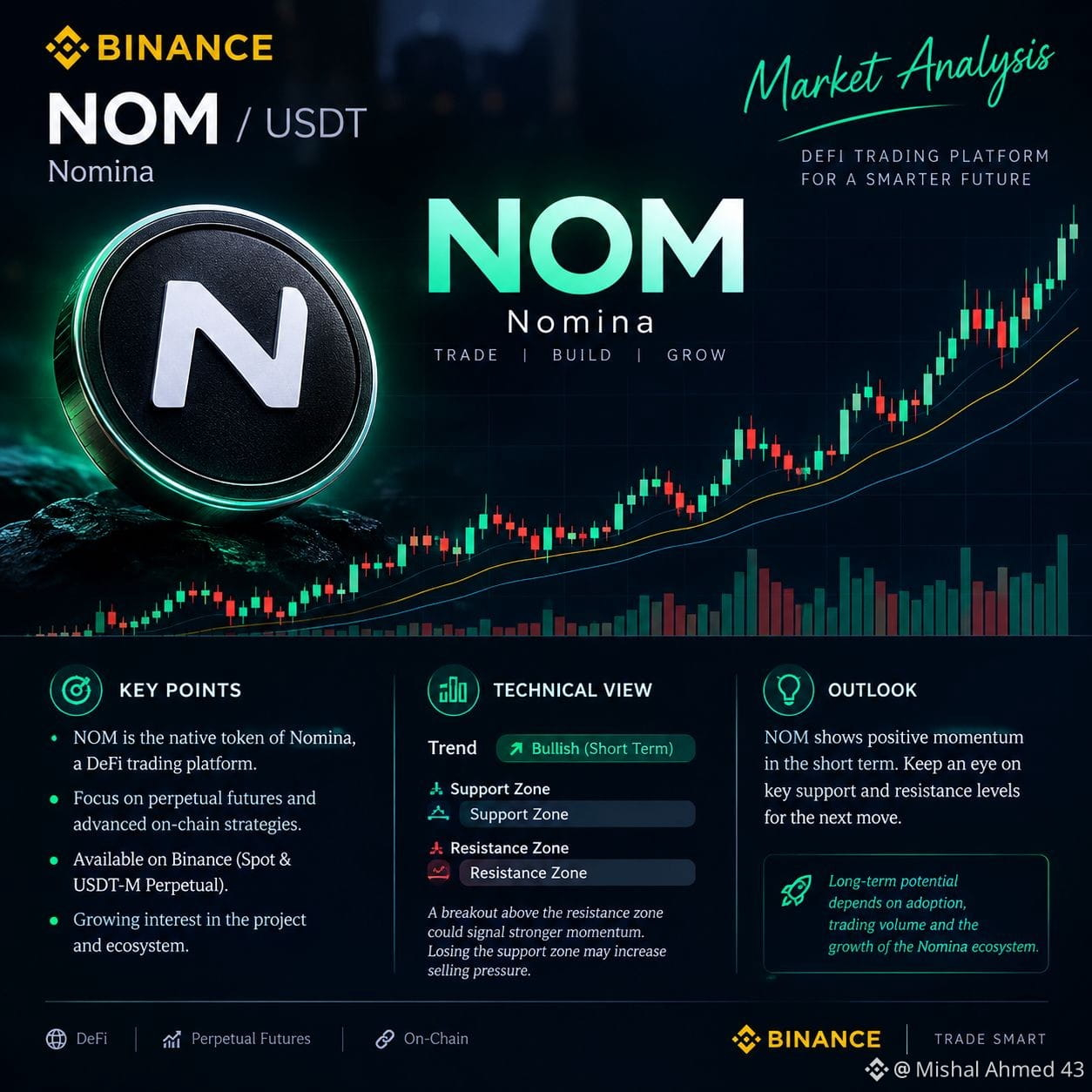
$NOM (Nomina)
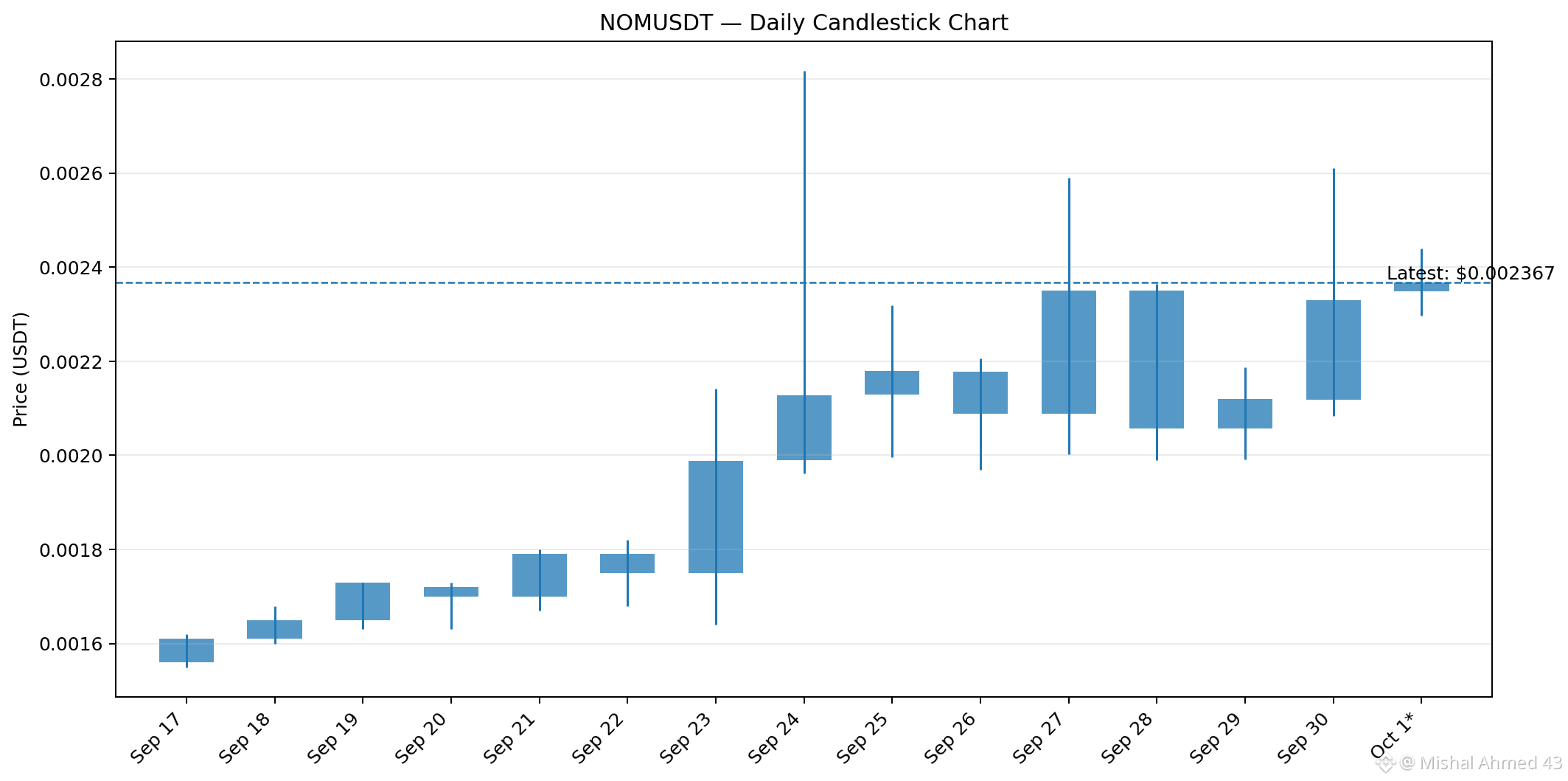
Current price: ~$0.002367
24H change: about +10%
Fundamentals: Nomina is a @ean_jelly trading platform focused on perpetual futures and advanced on-chain trading strategies. NOM is its native token. Binance supports @Square-Creator-4fb3110c6b55 /USDT spot and @nom_crypto USDT perpetual futures.
Technical view:
🟢 Momentum: bullish in the short term
Support: ~$0.00210–$0.00220
Resistance: ~$0.00244, then ~$0.00260
A breakout above $0.00260 could signal stronger momentum.
Losing $0.00210 would weaken the current setup.
@nom_crypto USDT Daily Candlestick Chart
Download the @NOMUSDT candle chart
The Oct. 1 candle is the partial daily candle available at the time of the data snapshot. ❶
$NOM (Nomina)
Current price: ~$0.002367
24H change: about +10%
Fundamentals: Nomina is a @DEFi__ trading platform focused on perpetual futures and advanced on-chain trading strategies. NOM is its native token. Binance supports @Nom_Nom- /USDT spot and @Nom USDT perpetual futures.
Technical view:
🟢 Momentum: bullish in the short term
Support: ~$0.00210–$0.00220
Resistance: ~$0.00244, then ~$0.00260
A breakout above $0.00260 could signal stronger momentum.
Losing $0.00210 would weaken the current setup.
@Nom USDT Daily Candlestick Chart
Download the @NOMUSDT candle chart
The Oct. 1 candle is the partial daily candle available at the time of the data snapshot. ❶
$NOM (Nomina)
Current price: ~$0.002367
24H change: about +10%
Fundamentals: Nomina is a @DEFi__ trading platform focused on perpetual futures and advanced on-chain trading strategies. NOM is its native token. Binance supports @Nom_Nom- /USDT spot and @Nom USDT perpetual futures.
Technical view:
🟢 Momentum: bullish in the short term
Support: ~$0.00210–$0.00220
Resistance: ~$0.00244, then ~$0.00260
A breakout above $0.00260 could signal stronger momentum.
Losing $0.00210 would weaken the current setup.
@Nom USDT Daily Candlestick Chart
Download the @NOMUSDT candle chart
The Oct. 1 candle is the partial daily candle available at the time of the data snapshot. ❶
4
190
$BBX USDT
@Square-Creator-dc0680306878a USDT is the Binance USDT-M perpetual contract tracking BlackBerry (@Square-Creator-39038412efbf
{future}(BBXUSDT)
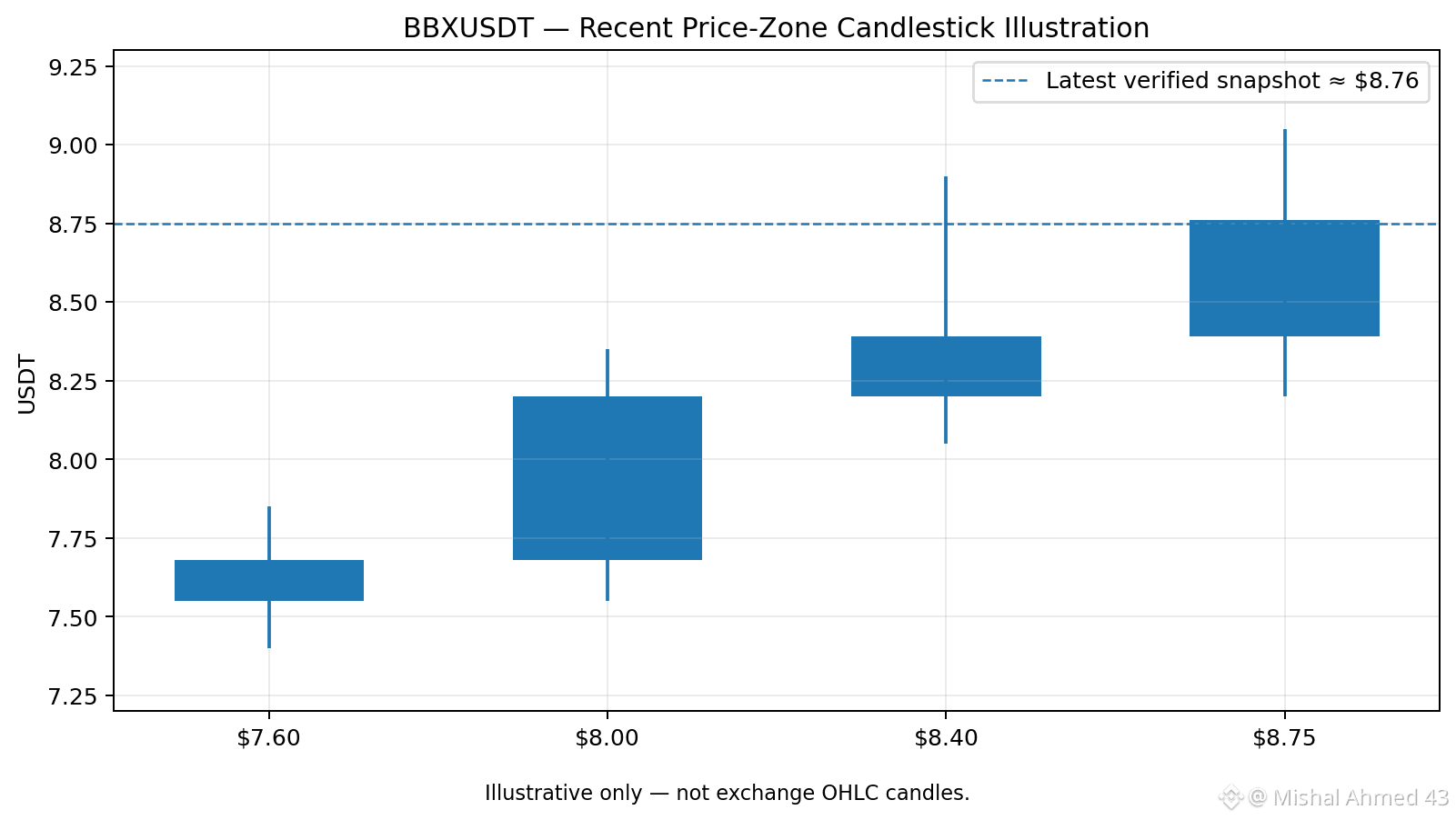
), rather than a typical cryptocurrency token. The latest accessible Binance-linked snapshot shows a mark price around $8.76.
Current/mark price: ~$8.76
Daily RSI: ~60 — moderate bullish momentum.
Short-term resistance: ~$9.00–$9.10
Support: ~$8.20–$8.40
Important: Open interest recently fell sharply, while the data showed a net-short pressure reading, so derivatives positioning remains mixed.
Overall: Price momentum has improved, but confirmation above the ~$9 area would be important for the next move.
📊 BBXUSDT Candle Chart
Download the BBXUSDT chart
Note: The chart is explicitly an illustrative price-zone candle chart, not fabricated exchange OHLC data. I couldn't verify a complete current OHLC series from the accessible sources.
#EarningsSeason #ECBToTestAIAgentsInDigitalEuroPayments #JapanFSABacksFourthStablecoinTradeSettlementPilot #BitgetHackerFailsToMoveStolenFunds #BitgetHackerFailsToMoveStolenFunds ❶
$BBX USDT
@BBX Salute USDT is the Binance USDT-M perpetual contract tracking BlackBerry (@Bbx
), rather than a typical cryptocurrency token. The latest accessible Binance-linked snapshot shows a mark price around $8.76.
Current/mark price: ~$8.76
Daily RSI: ~60 — moderate bullish momentum.
Short-term resistance: ~$9.00–$9.10
Support: ~$8.20–$8.40
Important: Open interest recently fell sharply, while the data showed a net-short pressure reading, so derivatives positioning remains mixed.
Overall: Price momentum has improved, but confirmation above the ~$9 area would be important for the next move.
📊 BBXUSDT Candle Chart
Download the BBXUSDT chart
Note: The chart is explicitly an illustrative price-zone candle chart, not fabricated exchange OHLC data. I couldn't verify a complete current OHLC series from the accessible sources.
#EarningsSeason #ECBToTestAIAgentsInDigitalEuroPayments #JapanFSABacksFourthStablecoinTradeSettlementPilot #BitgetHackerFailsToMoveStolenFunds #BitgetHackerFailsToMoveStolenFunds ❶
@BBX Salute USDT is the Binance USDT-M perpetual contract tracking BlackBerry (@Bbx
), rather than a typical cryptocurrency token. The latest accessible Binance-linked snapshot shows a mark price around $8.76.
Current/mark price: ~$8.76
Daily RSI: ~60 — moderate bullish momentum.
Short-term resistance: ~$9.00–$9.10
Support: ~$8.20–$8.40
Important: Open interest recently fell sharply, while the data showed a net-short pressure reading, so derivatives positioning remains mixed.
Overall: Price momentum has improved, but confirmation above the ~$9 area would be important for the next move.
📊 BBXUSDT Candle Chart
Download the BBXUSDT chart
Note: The chart is explicitly an illustrative price-zone candle chart, not fabricated exchange OHLC data. I couldn't verify a complete current OHLC series from the accessible sources.
#EarningsSeason #ECBToTestAIAgentsInDigitalEuroPayments #JapanFSABacksFourthStablecoinTradeSettlementPilot #BitgetHackerFailsToMoveStolenFunds #BitgetHackerFailsToMoveStolenFunds ❶
3
224
Bitcoin ($BTC
{spot}(BTCUSDT)
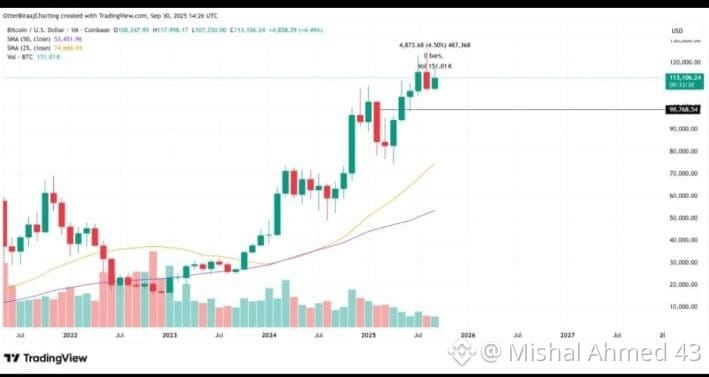
Current price: around $83,000. BTC has pulled back from the $86K–$87K area and is currently testing the lower part of its recent range.
Support: ~$82,000–$83,000
Resistance: ~$84,500–$85,000, then ~$87,000
Key level: A sustained move below $80,000 would indicate increased downside risk.
Positive factor: Spot BTC ETF demand has recently improved, including a $999M single-day inflow on Sept. 21, according to Binance Research.
Main pressure: Rising U.S. Treasury yields and higher oil prices are currently weighing on risk assets, including Bitcoin.
Near-term view: BTC is in a pullback/consolidation phase. The $82K–$83K area is important to watch.
📊 Current Bitcoin Chart
Simple takeaway: BTC is holding near $83K, but the market needs to reclaim the $85K–$87K zone to show stronger short-term momentum. This is market analysis, not a guaranteed price prediction.
#EarningsSeason #ECBToTestAIAgentsInDigitalEuroPayments #JapanFSABacksFourthStablecoinTradeSettlementPilot #BitgetHackerFailsToMoveStolenFunds #BitMineETHHoldingsTop6Million
Bitcoin ($BTC
Current price: around $83,000. BTC has pulled back from the $86K–$87K area and is currently testing the lower part of its recent range.
Support: ~$82,000–$83,000
Resistance: ~$84,500–$85,000, then ~$87,000
Key level: A sustained move below $80,000 would indicate increased downside risk.
Positive factor: Spot BTC ETF demand has recently improved, including a $999M single-day inflow on Sept. 21, according to Binance Research.
Main pressure: Rising U.S. Treasury yields and higher oil prices are currently weighing on risk assets, including Bitcoin.
Near-term view: BTC is in a pullback/consolidation phase. The $82K–$83K area is important to watch.
📊 Current Bitcoin Chart
Simple takeaway: BTC is holding near $83K, but the market needs to reclaim the $85K–$87K zone to show stronger short-term momentum. This is market analysis, not a guaranteed price prediction.
#EarningsSeason #ECBToTestAIAgentsInDigitalEuroPayments #JapanFSABacksFourthStablecoinTradeSettlementPilot #BitgetHackerFailsToMoveStolenFunds #BitMineETHHoldingsTop6Million
Current price: around $83,000. BTC has pulled back from the $86K–$87K area and is currently testing the lower part of its recent range.
Support: ~$82,000–$83,000
Resistance: ~$84,500–$85,000, then ~$87,000
Key level: A sustained move below $80,000 would indicate increased downside risk.
Positive factor: Spot BTC ETF demand has recently improved, including a $999M single-day inflow on Sept. 21, according to Binance Research.
Main pressure: Rising U.S. Treasury yields and higher oil prices are currently weighing on risk assets, including Bitcoin.
Near-term view: BTC is in a pullback/consolidation phase. The $82K–$83K area is important to watch.
📊 Current Bitcoin Chart
Simple takeaway: BTC is holding near $83K, but the market needs to reclaim the $85K–$87K zone to show stronger short-term momentum. This is market analysis, not a guaranteed price prediction.
#EarningsSeason #ECBToTestAIAgentsInDigitalEuroPayments #JapanFSABacksFourthStablecoinTradeSettlementPilot #BitgetHackerFailsToMoveStolenFunds #BitMineETHHoldingsTop6Million
4
69
DCR ($DCR){spot}(DCRUSDT)
Decred ($DCR ) is an established cryptocurrency focused on three key areas: decentralized governance, sustainable development funding, and financial sovereignty. Unlike projects that depend mainly on outside funding, Decred has an on-chain treasury that receives part of the block reward. @Square-Creator-93c8af45c3d5 also has a maximum supply of 21 million coins.
🔹 What Makes Decred Different?
One of Decred's main strengths is its hybrid Proof-of-Work (PoW) and Proof-of-Stake (PoS) consensus model. PoW provides mining-based network security, while PoS participants help validate blocks and take part in governance.
The current reward structure allocates 1% to PoW miners, 89% to PoS voters and 10% to the Decred Treasury.
This gives @Square-Creator-57ab2d9e6e27 holders an active role in the network. Stakeholders can participate in voting on important protocol changes and treasury spending, making governance an important part of the Decred ecosystem.
🔹 Development & Ecosystem
Decred has built an ecosystem that goes beyond its basic blockchain. One notable product is @DCRDEX, a peer-to-peer decentralized exchange based on atomic swaps. It focuses on self-custody, allowing users to maintain control of their funds while trading.
Decred has also integrated Lightning Network technology to support faster and lower-cost transactions. Another project in the ecosystem is Bison Relay, which combines encrypted communication with decentralized infrastructure and @DCR/Lightning payments.
These developments reflect Decred's broader focus on privacy, decentralization and user financial sovereignty.
🔹 2026 Development
A major recent development was Decred v2.1.6, released in August 2026. The update included a critical consensus-related security fix along with additional network-security improvements.
Decred also reported an inflation-related security incident in August 2026. According to the project's report, an attacker exploited a bug and generated approximately 2,077.97 DCR. An emergency patch was released without rolling back the blockchain, while the project stated that the 21 million DCR supply cap remains unchanged.
🛣️ Roadmap & Future Direction
Decred's development is not controlled by a single centralized roadmap. Its future direction is shaped through ongoing development and community governance.
Key areas include:
Consensus and network improvements
Security hardening
Governance and treasury development
Privacy infrastructure
DCRDEX development
Lightning and payment infrastructure
Wallet and network improvements
🔹 DCR Token Utility
DCR is used for staking, governance participation, transaction fees and other network activities. Staking allows holders to participate in governance while receiving rewards for network participation.
The fixed 21 million maximum supply also gives @undefined a clearly defined monetary policy.
⚠️ Key Risks
@undefined @undefined faces competition from other Layer-1 and privacy-focused projects. Adoption, liquidity, development execution and regulatory pressure around privacy technologies are also important risks. The 2026 security incident highlights that even established blockchain networks can face technical vulnerabilities.
Final View
Decred stands out through its combination of hybrid PoW/PoS security, decentralized governance, self-funded treasury, staking, privacy technology and @DCRDEX.
Its long-term potential depends on continued development, real-world adoption and maintaining strong network security.
$DCR #DCR #Crypto #DeFi
Not financial advice. Always #DYOR.
DCR ($DCR)
Decred ($DCR ) is an established cryptocurrency focused on three key areas: decentralized governance, sustainable development funding, and financial sovereignty. Unlike projects that depend mainly on outside funding, Decred has an on-chain treasury that receives part of the block reward. @DCR 12 also has a maximum supply of 21 million coins.
🔹 What Makes Decred Different?
One of Decred's main strengths is its hybrid Proof-of-Work (PoW) and Proof-of-Stake (PoS) consensus model. PoW provides mining-based network security, while PoS participants help validate blocks and take part in governance.
The current reward structure allocates 1% to PoW miners, 89% to PoS voters and 10% to the Decred Treasury.
This gives @Dcr holders an active role in the network. Stakeholders can participate in voting on important protocol changes and treasury spending, making governance an important part of the Decred ecosystem.
🔹 Development & Ecosystem
Decred has built an ecosystem that goes beyond its basic blockchain. One notable product is @DCRDEX, a peer-to-peer decentralized exchange based on atomic swaps. It focuses on self-custody, allowing users to maintain control of their funds while trading.
Decred has also integrated Lightning Network technology to support faster and lower-cost transactions. Another project in the ecosystem is Bison Relay, which combines encrypted communication with decentralized infrastructure and @DCR/Lightning payments.
These developments reflect Decred's broader focus on privacy, decentralization and user financial sovereignty.
🔹 2026 Development
A major recent development was Decred v2.1.6, released in August 2026. The update included a critical consensus-related security fix along with additional network-security improvements.
Decred also reported an inflation-related security incident in August 2026. According to the project's report, an attacker exploited a bug and generated approximately 2,077.97 DCR. An emergency patch was released without rolling back the blockchain, while the project stated that the 21 million DCR supply cap remains unchanged.
🛣️ Roadmap & Future Direction
Decred's development is not controlled by a single centralized roadmap. Its future direction is shaped through ongoing development and community governance.
Key areas include:
Consensus and network improvements
Security hardening
Governance and treasury development
Privacy infrastructure
DCRDEX development
Lightning and payment infrastructure
Wallet and network improvements
🔹 DCR Token Utility
DCR is used for staking, governance participation, transaction fees and other network activities. Staking allows holders to participate in governance while receiving rewards for network participation.
The fixed 21 million maximum supply also gives @undefined a clearly defined monetary policy.
⚠️ Key Risks
@undefined @undefined faces competition from other Layer-1 and privacy-focused projects. Adoption, liquidity, development execution and regulatory pressure around privacy technologies are also important risks. The 2026 security incident highlights that even established blockchain networks can face technical vulnerabilities.
Final View
Decred stands out through its combination of hybrid PoW/PoS security, decentralized governance, self-funded treasury, staking, privacy technology and @DCRDEX.
Its long-term potential depends on continued development, real-world adoption and maintaining strong network security.
$DCR #DCR #Crypto #DeFi
Not financial advice. Always #DYOR.
🔹 What Makes Decred Different?
One of Decred's main strengths is its hybrid Proof-of-Work (PoW) and Proof-of-Stake (PoS) consensus model. PoW provides mining-based network security, while PoS participants help validate blocks and take part in governance.
The current reward structure allocates 1% to PoW miners, 89% to PoS voters and 10% to the Decred Treasury.
This gives @Dcr holders an active role in the network. Stakeholders can participate in voting on important protocol changes and treasury spending, making governance an important part of the Decred ecosystem.
🔹 Development & Ecosystem
Decred has built an ecosystem that goes beyond its basic blockchain. One notable product is @DCRDEX, a peer-to-peer decentralized exchange based on atomic swaps. It focuses on self-custody, allowing users to maintain control of their funds while trading.
Decred has also integrated Lightning Network technology to support faster and lower-cost transactions. Another project in the ecosystem is Bison Relay, which combines encrypted communication with decentralized infrastructure and @DCR/Lightning payments.
These developments reflect Decred's broader focus on privacy, decentralization and user financial sovereignty.
🔹 2026 Development
A major recent development was Decred v2.1.6, released in August 2026. The update included a critical consensus-related security fix along with additional network-security improvements.
Decred also reported an inflation-related security incident in August 2026. According to the project's report, an attacker exploited a bug and generated approximately 2,077.97 DCR. An emergency patch was released without rolling back the blockchain, while the project stated that the 21 million DCR supply cap remains unchanged.
🛣️ Roadmap & Future Direction
Decred's development is not controlled by a single centralized roadmap. Its future direction is shaped through ongoing development and community governance.
Key areas include:
Consensus and network improvements
Security hardening
Governance and treasury development
Privacy infrastructure
DCRDEX development
Lightning and payment infrastructure
Wallet and network improvements
🔹 DCR Token Utility
DCR is used for staking, governance participation, transaction fees and other network activities. Staking allows holders to participate in governance while receiving rewards for network participation.
The fixed 21 million maximum supply also gives @undefined a clearly defined monetary policy.
⚠️ Key Risks
@undefined @undefined faces competition from other Layer-1 and privacy-focused projects. Adoption, liquidity, development execution and regulatory pressure around privacy technologies are also important risks. The 2026 security incident highlights that even established blockchain networks can face technical vulnerabilities.
Final View
Decred stands out through its combination of hybrid PoW/PoS security, decentralized governance, self-funded treasury, staking, privacy technology and @DCRDEX.
Its long-term potential depends on continued development, real-world adoption and maintaining strong network security.
$DCR #DCR #Crypto #DeFi
Not financial advice. Always #DYOR.
3
345
Quant (QNT) — Fundamental Analysis$Quant ($QNT ) is a blockchain infrastructure project focused on one major problem: interoperability. Instead of trying to build another competing blockchain, Quant aims to connect different blockchains, distributed ledgers, banks, payment systems and traditional financial infrastructure through its Overledger technology.
🔹 Core Technology — Overledger
The main product behind Quant is Overledger, an enterprise-focused @Aplri platform that allows applications and financial institutions to interact with multiple blockchain networks through a common interface.
Its use cases include:
Multi-chain interoperability
Cross-chain asset transfers
Tokenized assets
Cross-border payments
Stablecoins and digital money
Smart-contract orchestration
Institutional settlement infrastructure
Quant describes Overledger as a universal @Aplri connector between traditional financial systems and blockchain networks.
🔹 Development & Real-World Focus
Quant has increasingly moved beyond the idea of simply connecting blockchains and is focusing heavily on tokenized money and financial infrastructure.
A major recent development is Quant Fusion, its multi-ledger rollup infrastructure. Quant announced that the Fusion Rollup went live on mainnet in June 2026. The company is positioning Fusion around institutional use cases where privacy, security and interoperability are important.
Quant has also been developing QuantNet, a programmable settlement network designed to connect tokenized deposits, digital assets and existing banking infrastructure.
Most recently, on September 24, 2026, Quant announced that The Clearing House selected Quant to power its On-Chain Money Initiative in the United States. The planned network is intended to support clearing and settlement of tokenized deposits and is expected to become available to financial institutions in the first half of 2027.
🔹 @QNT Token Utility
QNT is the native utility token associated with the Quant ecosystem. Importantly, Quant's current documentation states that customers can use @Square-Creator-f63077977 to pay for access to the Quant ecosystem and Overledger services.
This gives @Square-Creator-f63077977 a direct connection to Quant's commercial infrastructure rather than being used only as a speculative asset.
🛣️ Roadmap & Future Direction
Quant's current development direction appears centered around several areas:
1. Institutional interoperability
Connecting banks, payment systems, private networks and public blockchains through common infrastructure.
2. Tokenized deposits & programmable money
Quant is working toward infrastructure where bank-issued digital money can move across different networks while remaining compatible with existing financial systems.
3. Quant Fusion
The Fusion Rollup is intended to provide a multi-ledger environment for institutional blockchain applications, with the mainnet now live.
4. Cross-chain asset movement
Overledger continues to focus on bridges, tokenization and interoperability between different @Square-Creator-0634e39fd6a1 environments.
5. Expansion into global financial infrastructure
The Clearing House initiative gives Quant a concrete U.S. banking use case, with planned availability in 2027.
⚠️ Key Risks
@Square-Creator-f63077977 's thesis also comes with risks:
Institutional adoption can take years.
Quant faces competition from other interoperability and financial-infrastructure projects.
Much of the long-term value depends on actual enterprise usage.
Regulatory changes could affect tokenized money and digital-asset infrastructure.
Strong technology does not automatically guarantee higher @Square-Creator-f63077977 demand.
📌 Overall Fundamental Picture
Quant is interesting because its strategy is not simply “build another blockchain.” Its focus is on becoming infrastructure connecting different financial networks.
The combination of Overledger + Quant Fusion + tokenized deposits + institutional settlement gives QNT a clear infrastructure narrative. The latest Clearing House announcement is particularly relevant because it provides a concrete future deployment in U.S. financial infrastructure, rather than only a theoretical roadmap.
In simple words:
QNT is betting on a future where banks, blockchains and digital money need to communicate with each other — and Quant wants to provide the infrastructure that makes that possible.
This is fundamental analysis, not a price prediction or investment recommendation.
{future}(QNTUSDT)
Quant (QNT) — Fundamental Analysis
$Quant ($QNT ) is a blockchain infrastructure project focused on one major problem: interoperability. Instead of trying to build another competing blockchain, Quant aims to connect different blockchains, distributed ledgers, banks, payment systems and traditional financial infrastructure through its Overledger technology.
🔹 Core Technology — Overledger
The main product behind Quant is Overledger, an enterprise-focused @API platform that allows applications and financial institutions to interact with multiple blockchain networks through a common interface.
Its use cases include:
Multi-chain interoperability
Cross-chain asset transfers
Tokenized assets
Cross-border payments
Stablecoins and digital money
Smart-contract orchestration
Institutional settlement infrastructure
Quant describes Overledger as a universal @API connector between traditional financial systems and blockchain networks.
🔹 Development & Real-World Focus
Quant has increasingly moved beyond the idea of simply connecting blockchains and is focusing heavily on tokenized money and financial infrastructure.
A major recent development is Quant Fusion, its multi-ledger rollup infrastructure. Quant announced that the Fusion Rollup went live on mainnet in June 2026. The company is positioning Fusion around institutional use cases where privacy, security and interoperability are important.
Quant has also been developing QuantNet, a programmable settlement network designed to connect tokenized deposits, digital assets and existing banking infrastructure.
Most recently, on September 24, 2026, Quant announced that The Clearing House selected Quant to power its On-Chain Money Initiative in the United States. The planned network is intended to support clearing and settlement of tokenized deposits and is expected to become available to financial institutions in the first half of 2027.
🔹 @QNT Token Utility
QNT is the native utility token associated with the Quant ecosystem. Importantly, Quant's current documentation states that customers can use @QNT to pay for access to the Quant ecosystem and Overledger services.
This gives @QNT a direct connection to Quant's commercial infrastructure rather than being used only as a speculative asset.
🛣️ Roadmap & Future Direction
Quant's current development direction appears centered around several areas:
1. Institutional interoperability
Connecting banks, payment systems, private networks and public blockchains through common infrastructure.
2. Tokenized deposits & programmable money
Quant is working toward infrastructure where bank-issued digital money can move across different networks while remaining compatible with existing financial systems.
3. Quant Fusion
The Fusion Rollup is intended to provide a multi-ledger environment for institutional blockchain applications, with the mainnet now live.
4. Cross-chain asset movement
Overledger continues to focus on bridges, tokenization and interoperability between different @Dlt environments.
5. Expansion into global financial infrastructure
The Clearing House initiative gives Quant a concrete U.S. banking use case, with planned availability in 2027.
⚠️ Key Risks
@QNT 's thesis also comes with risks:
Institutional adoption can take years.
Quant faces competition from other interoperability and financial-infrastructure projects.
Much of the long-term value depends on actual enterprise usage.
Regulatory changes could affect tokenized money and digital-asset infrastructure.
Strong technology does not automatically guarantee higher @QNT demand.
📌 Overall Fundamental Picture
Quant is interesting because its strategy is not simply “build another blockchain.” Its focus is on becoming infrastructure connecting different financial networks.
The combination of Overledger + Quant Fusion + tokenized deposits + institutional settlement gives QNT a clear infrastructure narrative. The latest Clearing House announcement is particularly relevant because it provides a concrete future deployment in U.S. financial infrastructure, rather than only a theoretical roadmap.
In simple words:
QNT is betting on a future where banks, blockchains and digital money need to communicate with each other — and Quant wants to provide the infrastructure that makes that possible.
This is fundamental analysis, not a price prediction or investment recommendation.
🔹 Core Technology — Overledger
The main product behind Quant is Overledger, an enterprise-focused @API platform that allows applications and financial institutions to interact with multiple blockchain networks through a common interface.
Its use cases include:
Multi-chain interoperability
Cross-chain asset transfers
Tokenized assets
Cross-border payments
Stablecoins and digital money
Smart-contract orchestration
Institutional settlement infrastructure
Quant describes Overledger as a universal @API connector between traditional financial systems and blockchain networks.
🔹 Development & Real-World Focus
Quant has increasingly moved beyond the idea of simply connecting blockchains and is focusing heavily on tokenized money and financial infrastructure.
A major recent development is Quant Fusion, its multi-ledger rollup infrastructure. Quant announced that the Fusion Rollup went live on mainnet in June 2026. The company is positioning Fusion around institutional use cases where privacy, security and interoperability are important.
Quant has also been developing QuantNet, a programmable settlement network designed to connect tokenized deposits, digital assets and existing banking infrastructure.
Most recently, on September 24, 2026, Quant announced that The Clearing House selected Quant to power its On-Chain Money Initiative in the United States. The planned network is intended to support clearing and settlement of tokenized deposits and is expected to become available to financial institutions in the first half of 2027.
🔹 @QNT Token Utility
QNT is the native utility token associated with the Quant ecosystem. Importantly, Quant's current documentation states that customers can use @QNT to pay for access to the Quant ecosystem and Overledger services.
This gives @QNT a direct connection to Quant's commercial infrastructure rather than being used only as a speculative asset.
🛣️ Roadmap & Future Direction
Quant's current development direction appears centered around several areas:
1. Institutional interoperability
Connecting banks, payment systems, private networks and public blockchains through common infrastructure.
2. Tokenized deposits & programmable money
Quant is working toward infrastructure where bank-issued digital money can move across different networks while remaining compatible with existing financial systems.
3. Quant Fusion
The Fusion Rollup is intended to provide a multi-ledger environment for institutional blockchain applications, with the mainnet now live.
4. Cross-chain asset movement
Overledger continues to focus on bridges, tokenization and interoperability between different @Dlt environments.
5. Expansion into global financial infrastructure
The Clearing House initiative gives Quant a concrete U.S. banking use case, with planned availability in 2027.
⚠️ Key Risks
@QNT 's thesis also comes with risks:
Institutional adoption can take years.
Quant faces competition from other interoperability and financial-infrastructure projects.
Much of the long-term value depends on actual enterprise usage.
Regulatory changes could affect tokenized money and digital-asset infrastructure.
Strong technology does not automatically guarantee higher @QNT demand.
📌 Overall Fundamental Picture
Quant is interesting because its strategy is not simply “build another blockchain.” Its focus is on becoming infrastructure connecting different financial networks.
The combination of Overledger + Quant Fusion + tokenized deposits + institutional settlement gives QNT a clear infrastructure narrative. The latest Clearing House announcement is particularly relevant because it provides a concrete future deployment in U.S. financial infrastructure, rather than only a theoretical roadmap.
In simple words:
QNT is betting on a future where banks, blockchains and digital money need to communicate with each other — and Quant wants to provide the infrastructure that makes that possible.
This is fundamental analysis, not a price prediction or investment recommendation.
2
80
Log in to explore more content
Join global crypto users on Binance Square
⚡️ Get latest and useful information about crypto.
💬 Trusted by the world’s largest crypto exchange.
👍 Discover real insights from verified creators.
Email / Phone number
Trending Topics
FedMinutesFocusOnOctoberPause
89,816 views
992 Discussing
🚨 HIGH ALERT ‼️ PLEASE DON’T TRADE BLINDLY FOR THE NEXT HOUR 🚨
Guys, we have FOMC Minutes coming in less than 1 hour.
And after the kind of volatility we already saw today, I really don’t want anyone opening random high-leverage positions just before this release.
The biggest reaction I’m watching will be in Gold (XAU), Silver (XAG), BTC and ETH. Then coins like SOL and other highly leveraged mid/low-cap alts can exaggerate whatever move BTC makes.
Gold and Silver are especially sensitive tonight because the market is already reacting to the US dollar + Treasury yields, and both metals have been under heavy pressure ahead of the Fed minutes.
Briefly speaking
📉Hawkish Fed Minutes → Dollar/yields can push higher → pressure on BTC, crypto, Gold & silver
📈Dovish Fed Minutes → Dollar/yields can cool → BTC, Gold, Silver and risk assets can bounce hard.
And please remember the first candle can be a trap. We can get a pump, immediate dump, liquidations on both sides, and then the real direction.
So for now, protect your positions, reduce unnecessary leverage and don’t FOMO into the first move.
Tonight I’m watching $XAU , $XAG and $BTC first. These will tell us very quickly how the market is reading the Fed.
I will Update you guys on time
Follow @Panda Traders and Turn on Your notifications right now
#FedMinutesFocusOnOctoberPause
Panda Traders
·15 Likes
·2.8k views
BinanceLaunchesBinanceIntelligence
1M views
6,250 Discussing
EvernorthDelaysNasdaqDebutToOct12
5,289 views
190 Discussing