
Decoder Dustin
20 Posts
Decoder Dustin
Report
Block User
Decoder Justin is your go to guide for simplifying crypto and web3 for the Binance Square community. Every post is design to educate and help community.
Occasional Trader
7.4 Years
3 Following
33 Followers
42 Liked
Posts
All
Videos

Article
Is Binance Safe to Use in India? 🇮🇳 Security, FIU-IND & Everything You Need to Know“Is Binance safe to use in India?”
It’s one of the most common questions asked by both new and experienced crypto users.
And the answer isn’t just a simple YES or NO.
Because when we talk about safety, there are two different things to understand:
🔐 Platform security
🏛️ Regulatory compliance
Let’s break it down. 👇
🇮🇳 Is Binance registered in India?
Yes, Binance operates as a Virtual Digital Asset Service Provider subject to India’s AML/CFT compliance framework and has been registered with FIU-IND as a reporting entity.
But here’s something important: FIU-IND registration does NOT mean crypto investments are guaranteed or risk-free.
India’s framework for Virtual Digital Assets continues to evolve, and crypto assets remain a high-risk asset class.
So always separate:
❌ Government guarantee
from
✅ Compliance obligations and platform security
That distinction matters.
🔐 How does Binance protect users?
Binance provides multiple layers of security designed to protect user accounts and assets.
Here are some of the most important ones:
1️⃣ Two-Factor Authentication (2FA)
Your password alone is not enough. Enable 2FA to add another layer of protection to your account.
Even if someone gets your password, they may still be unable to access your account without your second authentication factor.
Pro tip: Secure the email connected to your Binance account too.
🔑 2️⃣ Passkeys
Passkeys can provide a more secure and convenient way to protect your account.
They can help reduce risks associated with:
• Password theft
• Phishing attacks
• Credential leaks
If available for your account, enabling stronger authentication methods is always worth considering.
🪪 3️⃣ Identity Verification
KYC is an important part of platform security and regulatory compliance.
Always use:
✅ Your own identity documents
✅ Your correct personal information
✅ A secure email address and phone number
Never buy or use someone else’s verified Binance account.
It can create serious problems if you ever need to recover your account.
🔍 4️⃣ Proof of Reserves (PoR)
One of the biggest concerns people have with centralized exchanges is simple:
“Are customer assets actually backed?”
Proof of Reserves is designed to increase transparency by allowing users to verify certain customer asset balances and reserve information.
This is an important step toward greater transparency in the crypto industry.
🛡️ 5️⃣ SAFU
SAFU stands for: Secure Asset Fund for Users
It is an emergency protection mechanism established by Binance to provide an additional layer of protection in specific situations.
But remember:
⚠️ SAFU is not the same as bank deposit insurance.
Crypto users should never assume that every possible loss is automatically covered.
Good security practices still matter.
🚨 The Biggest Risk Might Not Be Binance
Let’s be honest.
Many crypto losses don’t happen because an exchange gets hacked.
They happen because users get:
🎣 Phished
📱 SIM-swapped
💬 Scammed on Telegram
🖥️ Tricked by fake websites
💸 Lured by “guaranteed profits”
🔗 Connected to malicious links
That’s why personal security is just as important as platform security.
🔐 7 Things Every Indian Binance User Should Do
1. Use a unique password
Never reuse your Binance password anywhere else. If one website gets breached, reused passwords can put multiple accounts at risk.
2. Enable 2F
A strong password is good. A strong password + 2FA is much better.
3. Secure your email
Your email is often the gateway to your financial accounts.
Use:
🔐 A unique password
📱 2FA
🚫 No shared devices
4. Never share your codes
Binance support will never need:
❌ Your password
❌ Your 2FA code
❌ Your seed phrase
❌ Your private keys
Anyone asking for these is almost certainly trying to scam you.
5. Double-check withdrawal addresses
Crypto transactions can be irreversible.
Before sending funds:
👀 Check the addres
👀 Check the network
👀 Check again
A 30-second check can prevent a very expensive mistake.
6. Avoid fake Binance links
Scammers often create websites that look almost identical to real exchanges. Always verify where you’re logging in.
Be especially careful with:
• Telegram links
• Google ads
• Random DMs
• “Support agents”
• Giveaway messages
7. Don’t fall for guaranteed returns
If someone says: “Guaranteed 5% daily profit.”
🚩 Scam.
“Send 1 ETH and receive 2 ETH back.”
🚩 Scam.
“I have insider information.”
🚩 Probably a scam.
In crypto: If it sounds too good to be true, it probably is.
🇮🇳 What About Crypto Regulations in India? India has established tax and AML-related frameworks covering Virtual Digital Assets.
However, crypto remains a developing regulatory area.
Users should remember:
📌 Crypto is not legal tender in India.
📌 Crypto prices can be extremely volatile.
📌 Tax obligations may apply to VDA transactions.
📌 Regulations and platform services can change.
Always stay updated through official sources.
💡 Final Verdict: Is Binance Safe to Use in India?Binance provides several important security features, including:
🔐 Two-Factor Authentication
🔑 Passkeys
🪪 Identity Verification
🛡️ Withdrawal security controls
🔍 Proof of Reserves
💰 SAFU protection mechanisms
📊 Security monitoring and risk controls
🇮🇳 FIU-IND compliance registration as a reporting entity
But here’s the most important takeaway:
Your crypto security is a shared responsibility.
A secure platform can protect its systems.
But only YOU can protect yourself from:
⚠️ Scams
⚠️ Phishing
⚠️ Fake investment schemes
⚠️ Sharing your credentials
⚠️ Sending funds to the wrong address
So yes, Binance offers multiple layers of security for users.
But the safest crypto user is not the person using the “safest exchange.”
It’s the person with the safest habits. 🔐
Stay safe.
Stay informed.
And always DYOR. 🇮🇳
#Binance #BinanceIndia #CryptoIndia #Bitcoin #CryptoSafety #Web3 #Blockchain #CryptoSecurity #DYOR$BNB
$BTC
Is Binance Safe to Use in India? 🇮🇳 Security, FIU-IND & Everything You Need to Know
“Is Binance safe to use in India?”
It’s one of the most common questions asked by both new and experienced crypto users.
And the answer isn’t just a simple YES or NO.
Because when we talk about safety, there are two different things to understand:
🔐 Platform security
🏛️ Regulatory compliance
Let’s break it down. 👇
🇮🇳 Is Binance registered in India?
Yes, Binance operates as a Virtual Digital Asset Service Provider subject to India’s AML/CFT compliance framework and has been registered with FIU-IND as a reporting entity.
But here’s something important: FIU-IND registration does NOT mean crypto investments are guaranteed or risk-free.
India’s framework for Virtual Digital Assets continues to evolve, and crypto assets remain a high-risk asset class.
So always separate:
❌ Government guarantee
from
✅ Compliance obligations and platform security
That distinction matters.
🔐 How does Binance protect users?
Binance provides multiple layers of security designed to protect user accounts and assets.
Here are some of the most important ones:
1️⃣ Two-Factor Authentication (2FA)
Your password alone is not enough. Enable 2FA to add another layer of protection to your account.
Even if someone gets your password, they may still be unable to access your account without your second authentication factor.
Pro tip: Secure the email connected to your Binance account too.
🔑 2️⃣ Passkeys
Passkeys can provide a more secure and convenient way to protect your account.
They can help reduce risks associated with:
• Password theft
• Phishing attacks
• Credential leaks
If available for your account, enabling stronger authentication methods is always worth considering.
🪪 3️⃣ Identity Verification
KYC is an important part of platform security and regulatory compliance.
Always use:
✅ Your own identity documents
✅ Your correct personal information
✅ A secure email address and phone number
Never buy or use someone else’s verified Binance account.
It can create serious problems if you ever need to recover your account.
🔍 4️⃣ Proof of Reserves (PoR)
One of the biggest concerns people have with centralized exchanges is simple:
“Are customer assets actually backed?”
Proof of Reserves is designed to increase transparency by allowing users to verify certain customer asset balances and reserve information.
This is an important step toward greater transparency in the crypto industry.
🛡️ 5️⃣ SAFU
SAFU stands for: Secure Asset Fund for Users
It is an emergency protection mechanism established by Binance to provide an additional layer of protection in specific situations.
But remember:
⚠️ SAFU is not the same as bank deposit insurance.
Crypto users should never assume that every possible loss is automatically covered.
Good security practices still matter.
🚨 The Biggest Risk Might Not Be Binance
Let’s be honest.
Many crypto losses don’t happen because an exchange gets hacked.
They happen because users get:
🎣 Phished
📱 SIM-swapped
💬 Scammed on Telegram
🖥️ Tricked by fake websites
💸 Lured by “guaranteed profits”
🔗 Connected to malicious links
That’s why personal security is just as important as platform security.
🔐 7 Things Every Indian Binance User Should Do
1. Use a unique password
Never reuse your Binance password anywhere else. If one website gets breached, reused passwords can put multiple accounts at risk.
2. Enable 2F
A strong password is good. A strong password + 2FA is much better.
3. Secure your email
Your email is often the gateway to your financial accounts.
Use:
🔐 A unique password
📱 2FA
🚫 No shared devices
4. Never share your codes
Binance support will never need:
❌ Your password
❌ Your 2FA code
❌ Your seed phrase
❌ Your private keys
Anyone asking for these is almost certainly trying to scam you.
5. Double-check withdrawal addresses
Crypto transactions can be irreversible.
Before sending funds:
👀 Check the addres
👀 Check the network
👀 Check again
A 30-second check can prevent a very expensive mistake.
6. Avoid fake Binance links
Scammers often create websites that look almost identical to real exchanges. Always verify where you’re logging in.
Be especially careful with:
• Telegram links
• Google ads
• Random DMs
• “Support agents”
• Giveaway messages
7. Don’t fall for guaranteed returns
If someone says: “Guaranteed 5% daily profit.”
🚩 Scam.
“Send 1 ETH and receive 2 ETH back.”
🚩 Scam.
“I have insider information.”
🚩 Probably a scam.
In crypto: If it sounds too good to be true, it probably is.
🇮🇳 What About Crypto Regulations in India? India has established tax and AML-related frameworks covering Virtual Digital Assets.
However, crypto remains a developing regulatory area.
Users should remember:
📌 Crypto is not legal tender in India.
📌 Crypto prices can be extremely volatile.
📌 Tax obligations may apply to VDA transactions.
📌 Regulations and platform services can change.
Always stay updated through official sources.
💡 Final Verdict: Is Binance Safe to Use in India?Binance provides several important security features, including:
🔐 Two-Factor Authentication
🔑 Passkeys
🪪 Identity Verification
🛡️ Withdrawal security controls
🔍 Proof of Reserves
💰 SAFU protection mechanisms
📊 Security monitoring and risk controls
🇮🇳 FIU-IND compliance registration as a reporting entity
But here’s the most important takeaway:
Your crypto security is a shared responsibility.
A secure platform can protect its systems.
But only YOU can protect yourself from:
⚠️ Scams
⚠️ Phishing
⚠️ Fake investment schemes
⚠️ Sharing your credentials
⚠️ Sending funds to the wrong address
So yes, Binance offers multiple layers of security for users.
But the safest crypto user is not the person using the “safest exchange.”
It’s the person with the safest habits. 🔐
Stay safe.
Stay informed.
And always DYOR. 🇮🇳
#Binance #BinanceIndia #CryptoIndia #Bitcoin #CryptoSafety #Web3 #Blockchain #CryptoSecurity #DYOR$BNB
$BTC
193
Day 5: What Is a Transformer? 🤖So far, we’ve learned:
Day 1: What is AI?Day 2: How does AI learn?Day 3: What is a Neural Network?Day 4: What happens when you ask ChatGPT a question?
Today, we reach one of the biggest breakthroughs in modern AI:
The Transformer
The name sounds complicated.
The idea isn’t.
Let’s understand it with a simple example.
🧩 Imagine This Sentence
“I went to the bank to deposit my money.”
What does “bank” mean here?
Probably a financial institution.
Now change the sentence: - “I sat beside the bank and watched the river.”
Now you know that bank means the side of a river. How did you understand the difference?
You looked at the words around it.
That’s the key idea behind Transformers.
👀 Transformers Look at Relationships
Older AI systems had more difficulty understanding how different words in a sentence relate to each other, especially when the sentence became long.
Transformers changed this.
They became much better at looking at the relationship between words and the surrounding context.
Think of it like a classroom.
If a teacher hears:
“Rahul went to the shop because he needed…”
The teacher pays attention to the words around the sentence to understand what Rahul probably needed.
A Transformer does something similar with language.
It looks at the context and asks:
“Which parts of this sentence are important for understanding the meaning?”
🔦 Think of It Like a Spotlight - Imagine every word in a sentence has a small spotlight.
When AI reads the sentence, it can give more attention to some words and less attention to others.
For example: “The dog chased the ball because it was excited.”
What does “it” refer to? - The dog.
The surrounding words help AI understand that relationship. This ability to pay attention to different parts of the input is one of the key ideas behind Transformers.
🚀 Why Was This Such a Big Deal?
Transformers made it much easier to build AI systems that could work with huge amounts of information.
They became the foundation for many modern AI models. And that eventually helped lead to systems such as:
ChatGPT
Google Gemini
Claude
and many other modern AI applications. So when you use an AI chatbot today, you’re benefiting from a technology breakthrough that changed the direction of AI research.
📚 Think About Reading a Book
Imagine reading a 500-page book.
To understand one sentence near the end, you may need to remember things that happened much earlier.
A powerful AI model needs to handle similar relationships. Transformers made it much easier for AI systems to process large amounts of information and understand how different pieces relate to one another.
That’s one reason they became so important.
🤖 So Is a Transformer a Robot?
No.
This is an easy mistake to make because of the name. A Transformer is not a physical robot.
It is a type of technology used to build AI models.
Think of it as an important engine design inside modern AI.
You don’t see the Transformer when you open ChatGPT. But technology based on Transformers helps power the model behind the conversation.
💰 Why Should Investors Care? Here’s where our lessons start connecting.
If Transformers help power modern AI, companies need enormous amounts of computing power to train and run these models.
That creates demand for:
AI chips → NVIDIA, $AMDB
💾 High-speed memory → SK hynix, Micron, $SAMSUNG
🏭 Chip manufacturing → TSMC
🌐 Networking → Broadcom, Arista and others
🏢 Cloud & data centers → Microsoft, Amazon, Google, Oracle and others
⚡ Electricity & power infrastructure → a growing part of the AI story
So a simple chatbot question can connect to a huge global technology supply chain.
🌐 And What About Crypto?
Transformers are primarily an AI technology, but the technology can eventually influence the crypto ecosystem too.
For example:
🤖#AIAgents
📊 AI-powered applications
💰 AI + #DEFİ
🧠 Decentralized AI
⚡ AI-related blockchain infrastructure
But remember our rule:
Don’t invest because something says “AI.”
Understand what the project actually does.
🧩 Our AI Puzzle So Far
💡 The One Thing to Remember A Transformer helps AI understand which parts of information are important and how different pieces relate to each other.
That simple idea helped unlock today’s generation of powerful AI models.
🔥 Tomorrow: What Is an #AIChips ?
We’ve talked about AI learning.
We’ve talked about neural networks. We’ve talked about Transformers
But there is one massive question:
Where does all this AI actually run?
That’s where GPUs and AI chips come in.
Tomorrow we’ll explain:
Day 6: Why $NVDA.US Became the King of AI Chips
And we’ll finally understand why one company became so important to the entire AI revolution.
Day 5: What Is a Transformer? 🤖
So far, we’ve learned:
Day 1: What is AI?Day 2: How does AI learn?Day 3: What is a Neural Network?Day 4: What happens when you ask ChatGPT a question?
Today, we reach one of the biggest breakthroughs in modern AI:
The Transformer
The name sounds complicated.
The idea isn’t.
Let’s understand it with a simple example.
🧩 Imagine This Sentence
“I went to the bank to deposit my money.”
What does “bank” mean here?
Probably a financial institution.
Now change the sentence: - “I sat beside the bank and watched the river.”
Now you know that bank means the side of a river. How did you understand the difference?
You looked at the words around it.
That’s the key idea behind Transformers.
👀 Transformers Look at Relationships
Older AI systems had more difficulty understanding how different words in a sentence relate to each other, especially when the sentence became long.
Transformers changed this.
They became much better at looking at the relationship between words and the surrounding context.
Think of it like a classroom.
If a teacher hears:
“Rahul went to the shop because he needed…”
The teacher pays attention to the words around the sentence to understand what Rahul probably needed.
A Transformer does something similar with language.
It looks at the context and asks:
“Which parts of this sentence are important for understanding the meaning?”
🔦 Think of It Like a Spotlight - Imagine every word in a sentence has a small spotlight.
When AI reads the sentence, it can give more attention to some words and less attention to others.
For example: “The dog chased the ball because it was excited.”
What does “it” refer to? - The dog.
The surrounding words help AI understand that relationship. This ability to pay attention to different parts of the input is one of the key ideas behind Transformers.
🚀 Why Was This Such a Big Deal?
Transformers made it much easier to build AI systems that could work with huge amounts of information.
They became the foundation for many modern AI models. And that eventually helped lead to systems such as:
ChatGPT
Google Gemini
Claude
and many other modern AI applications. So when you use an AI chatbot today, you’re benefiting from a technology breakthrough that changed the direction of AI research.
📚 Think About Reading a Book
Imagine reading a 500-page book.
To understand one sentence near the end, you may need to remember things that happened much earlier.
A powerful AI model needs to handle similar relationships. Transformers made it much easier for AI systems to process large amounts of information and understand how different pieces relate to one another.
That’s one reason they became so important.
🤖 So Is a Transformer a Robot?
No.
This is an easy mistake to make because of the name. A Transformer is not a physical robot.
It is a type of technology used to build AI models.
Think of it as an important engine design inside modern AI.
You don’t see the Transformer when you open ChatGPT. But technology based on Transformers helps power the model behind the conversation.
💰 Why Should Investors Care? Here’s where our lessons start connecting.
If Transformers help power modern AI, companies need enormous amounts of computing power to train and run these models.
That creates demand for:
AI chips → NVIDIA, $AMDB
💾 High-speed memory → SK hynix, Micron, $SAMSUNG
🏭 Chip manufacturing → TSMC
🌐 Networking → Broadcom, Arista and others
🏢 Cloud & data centers → Microsoft, Amazon, Google, Oracle and others
⚡ Electricity & power infrastructure → a growing part of the AI story
So a simple chatbot question can connect to a huge global technology supply chain.
🌐 And What About Crypto?
Transformers are primarily an AI technology, but the technology can eventually influence the crypto ecosystem too.
For example:
🤖#AIAgents
📊 AI-powered applications
💰 AI + #DEFİ
🧠 Decentralized AI
⚡ AI-related blockchain infrastructure
But remember our rule:
Don’t invest because something says “AI.”
Understand what the project actually does.
🧩 Our AI Puzzle So Far
💡 The One Thing to Remember A Transformer helps AI understand which parts of information are important and how different pieces relate to each other.
That simple idea helped unlock today’s generation of powerful AI models.
🔥 Tomorrow: What Is an #AIChips ?
We’ve talked about AI learning.
We’ve talked about neural networks. We’ve talked about Transformers
But there is one massive question:
Where does all this AI actually run?
That’s where GPUs and AI chips come in.
Tomorrow we’ll explain:
Day 6: Why $NVDA.US Became the King of AI Chips
And we’ll finally understand why one company became so important to the entire AI revolution.
AMDB+1.02%
NVDAUS-1.51%
118
Article
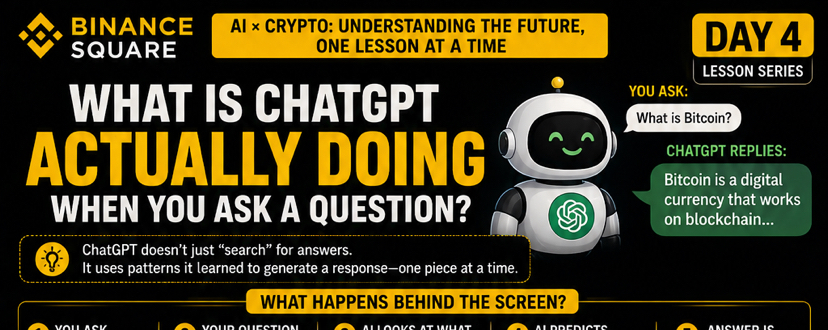
Day 4: What Is ChatGPT Actually Doing When You Ask a Question?We understood one simple idea: AI learns patterns from examples.
Today, let’s take something most of us have already used:
#chatgpt
Have you ever wondered what actually happens when you type:
“Explain Bitcoin to me.” …and a few seconds later, you get a detailed answer?
Let’s look behind the screen.
🧑💻 Step 1: You Ask a Question
You type “What is Bitcoin?”
Your phone sends that question to the AI system.
But ChatGPT doesn’t simply “Google” the answer.
Something much more interesting happens.
🔤 Step 2: Your Question Is Broken Into Small Pieces
AI doesn’t read language exactly the way humans do.
Your sentence is broken into small pieces that the system can process.
These pieces are called tokens. Don’t worry about the technical details.
Just remember: Words → Small pieces → Information the AI can process
For example:
“Bitcoin is digital money”
gets converted into pieces that the AI can work with.
🧠 Step 3: AI Looks at the Patterns It Learned
Remember our Day 3 lesson?
The AI was trained using enormous amounts of information.
During that training, it learned patterns about:
LanguageFactsWritingCodeQuestionsRelationships between words and ideasSo when you ask:
“What is Bitcoin?”
the AI doesn’t open a little file called Bitcoin Answer.txt.
Instead, it uses the patterns it learned during training to figure out what kind of answer makes sense.
🎯 Step 4: AI Predicts What Comes Next
This is one of the most important things to understand about modern AI. At its core, a language model is constantly predicting:
“What should come next?”
For example:
The sky is… You might immediately think:
blue
AI does something similar—but at an enormous scale. It considers the words and context before it and predicts what should come next.
Then it predicts the next piece.
Then the next. Then the next. And very quickly…
An entire answer appears.
⚡ Step 5: This Happens VERY Fast Imagine writing an entire paragraph one word at a time.
You would take quite a while.
AI can generate text extremely quickly because powerful computers are doing huge numbers of calculations simultaneously. This is where our earlier lessons connect.
Remember?
AI
⬇️
Neural Networks
⬇️
Huge amounts of data
⬇️
Powerful computers
⬇️
Predictions
⬇️
Your answer
Now the pieces are starting to connect. 🤔 Does ChatGPT “Think” Like You?
Not exactly.
This is a very important distinction. When ChatGPT gives you an answer, it can look like human thinking.
It can explain.
It can summarize.
It can write stories.
It can solve many problems.
It can even have a conversation with you.
But underneath the hood, it is using a trained AI model to process your input and generate an output. That’s why AI can sometimes give you an answer that sounds extremely confident…
…and still be wrong.
AI can be impressive without being perfect. That’s something every AI user should remember.
🌍 Why Is This Revolutionary? Think about what happened with computers.
First: Computers could calculate.
Then:Computers could store information.
Then:The internet connected people and information.
Now:AI can interact with information using natural language.
You don’t necessarily need to know complicated computer commands.
You can simply ask.
“Explain this.”
“Summarize this.”
“Translate this.”
“Write this.”
“Help me understand this.”
And the computer can respond. That’s a huge change in how humans interact with technology.
💰 Where Do Companies Make Money?
This is where our AI investment journey gets interesting. To make systems like ChatGPT work, companies need:
🧠 AI models
Companies like OpenAI, Google, Anthropic and Meta are developing powerful AI models.
💻 Computing
Companies like $NVDAB and $AAPL.US AMD build AI accelerators.
🏭 Manufacturing
TSMC manufactures many of the world’s most advanced chips.
🧠 Memory
SK hynix, Micron and Samsung produce important high-speed memory.
🌐 Networking
Companies such as Broadcom, Arista and others help connect huge numbers of AI chips.
🏢 Data Centers
Companies including Microsoft, $Amazon, $GOOGL.US Google, Oracle and specialized providers build the infrastructure where AI runs.
So when you use a simple chatbot…
there is a massive global technology ecosystem working behind it.
🔗 And Where Does Crypto Fit?
This is where our AI × Crypto journey becomes interesting.
Crypto projects are exploring ideas such as:
🤖 AI agents
⚡ Decentralized computing
🧠 Decentralized AI
💰 AI-powered DeFi
📊 On-chain AI applications
But here’s our rule for this series:
Don’t buy something just because it has “AI” in it name.
First understand:
What problem does it solve?
Does it actually use AI?
Who needs the product?
Is there real adoption?
Understanding the technology helps us separate real innovation from marketing hype.
🧩 Our AI Puzzle So Far
Day 1 What is AI?
Machines performing tasks that normally require human intelligence.
Day 2 How does AI learn?
It learns patterns from huge amounts of data.
Day 3 What helps AI find patterns?
Neural Networks.
Day 4 What happens when you ask AI a question?
It processes your input and uses what it learned to generate a response—one piece at a time.
And now we’re ready for one of the biggest breakthroughs in modern AI.
🚀 Tomorrow: The Technology Behind Modern AI
You’ve probably heard this word: Transformer
It sounds complicated. But don’t worry. Tomorrow we’ll explain it using a simple sentence and a group of friends having a conversation.
You’ll understand why Transformers changed AI—why companies are spending billions building infrastructure around them.
💡 Today’s Key Takeaway When you ask ChatGPT a question, it doesn’t simply look up a pre-written answer. It processes your input and generates a response using patterns learned during training.
Day 4: What Is ChatGPT Actually Doing When You Ask a Question?
We understood one simple idea: AI learns patterns from examples.
Today, let’s take something most of us have already used:
#chatgpt
Have you ever wondered what actually happens when you type:
“Explain Bitcoin to me.” …and a few seconds later, you get a detailed answer?
Let’s look behind the screen.
🧑💻 Step 1: You Ask a Question
You type “What is Bitcoin?”
Your phone sends that question to the AI system.
But ChatGPT doesn’t simply “Google” the answer.
Something much more interesting happens.
🔤 Step 2: Your Question Is Broken Into Small Pieces
AI doesn’t read language exactly the way humans do.
Your sentence is broken into small pieces that the system can process.
These pieces are called tokens. Don’t worry about the technical details.
Just remember: Words → Small pieces → Information the AI can process
For example:
“Bitcoin is digital money”
gets converted into pieces that the AI can work with.
🧠 Step 3: AI Looks at the Patterns It Learned
Remember our Day 3 lesson?
The AI was trained using enormous amounts of information.
During that training, it learned patterns about:
LanguageFactsWritingCodeQuestionsRelationships between words and ideasSo when you ask:
“What is Bitcoin?”
the AI doesn’t open a little file called Bitcoin Answer.txt.
Instead, it uses the patterns it learned during training to figure out what kind of answer makes sense.
🎯 Step 4: AI Predicts What Comes Next
This is one of the most important things to understand about modern AI. At its core, a language model is constantly predicting:
“What should come next?”
For example:
The sky is… You might immediately think:
blue
AI does something similar—but at an enormous scale. It considers the words and context before it and predicts what should come next.
Then it predicts the next piece.
Then the next. Then the next. And very quickly…
An entire answer appears.
⚡ Step 5: This Happens VERY Fast Imagine writing an entire paragraph one word at a time.
You would take quite a while.
AI can generate text extremely quickly because powerful computers are doing huge numbers of calculations simultaneously. This is where our earlier lessons connect.
Remember?
AI
⬇️
Neural Networks
⬇️
Huge amounts of data
⬇️
Powerful computers
⬇️
Predictions
⬇️
Your answer
Now the pieces are starting to connect. 🤔 Does ChatGPT “Think” Like You?
Not exactly.
This is a very important distinction. When ChatGPT gives you an answer, it can look like human thinking.
It can explain.
It can summarize.
It can write stories.
It can solve many problems.
It can even have a conversation with you.
But underneath the hood, it is using a trained AI model to process your input and generate an output. That’s why AI can sometimes give you an answer that sounds extremely confident…
…and still be wrong.
AI can be impressive without being perfect. That’s something every AI user should remember.
🌍 Why Is This Revolutionary? Think about what happened with computers.
First: Computers could calculate.
Then:Computers could store information.
Then:The internet connected people and information.
Now:AI can interact with information using natural language.
You don’t necessarily need to know complicated computer commands.
You can simply ask.
“Explain this.”
“Summarize this.”
“Translate this.”
“Write this.”
“Help me understand this.”
And the computer can respond. That’s a huge change in how humans interact with technology.
💰 Where Do Companies Make Money?
This is where our AI investment journey gets interesting. To make systems like ChatGPT work, companies need:
🧠 AI models
Companies like OpenAI, Google, Anthropic and Meta are developing powerful AI models.
💻 Computing
Companies like $NVDAB and $AAPL.US AMD build AI accelerators.
🏭 Manufacturing
TSMC manufactures many of the world’s most advanced chips.
🧠 Memory
SK hynix, Micron and Samsung produce important high-speed memory.
🌐 Networking
Companies such as Broadcom, Arista and others help connect huge numbers of AI chips.
🏢 Data Centers
Companies including Microsoft, $Amazon, $GOOGL.US Google, Oracle and specialized providers build the infrastructure where AI runs.
So when you use a simple chatbot…
there is a massive global technology ecosystem working behind it.
🔗 And Where Does Crypto Fit?
This is where our AI × Crypto journey becomes interesting.
Crypto projects are exploring ideas such as:
🤖 AI agents
⚡ Decentralized computing
🧠 Decentralized AI
💰 AI-powered DeFi
📊 On-chain AI applications
But here’s our rule for this series:
Don’t buy something just because it has “AI” in it name.
First understand:
What problem does it solve?
Does it actually use AI?
Who needs the product?
Is there real adoption?
Understanding the technology helps us separate real innovation from marketing hype.
🧩 Our AI Puzzle So Far
Day 1 What is AI?
Machines performing tasks that normally require human intelligence.
Day 2 How does AI learn?
It learns patterns from huge amounts of data.
Day 3 What helps AI find patterns?
Neural Networks.
Day 4 What happens when you ask AI a question?
It processes your input and uses what it learned to generate a response—one piece at a time.
And now we’re ready for one of the biggest breakthroughs in modern AI.
🚀 Tomorrow: The Technology Behind Modern AI
You’ve probably heard this word: Transformer
It sounds complicated. But don’t worry. Tomorrow we’ll explain it using a simple sentence and a group of friends having a conversation.
You’ll understand why Transformers changed AI—why companies are spending billions building infrastructure around them.
💡 Today’s Key Takeaway When you ask ChatGPT a question, it doesn’t simply look up a pre-written answer. It processes your input and generates a response using patterns learned during training.
119
Article
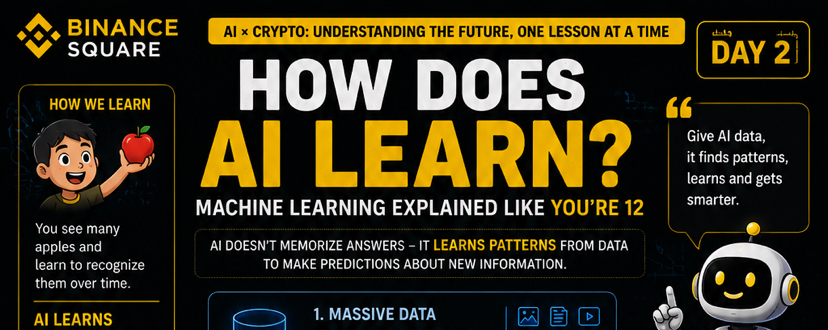
Day 2: How Does AI Learn?Imagine teaching a child to identify an apple.
You don’t hand them a rulebook saying:
It’s red.It’s round.It has a stem.
Instead, you show them hundreds of apples. Eventually, they recognize an apple even if it’s green, small, or partly hidden.
That’s exactly how #machinelearning works.
What readers will learn
What Machine Learning isHow #AI earns from dataWhat a “model” isTraining vs InferenceSupervised, Unsupervised, and Reinforcement LearningReal-life examples (YouTube, Netflix, Amazon, Google Maps)Why data is the new oilWhy companies like $NVDAB , $GOOGL.US , $META , and Microsoft are investing billionsWhy crypto investors should understand Machine LearningIs
Investment Angle
Explain that AI isn’t just about ChatGPT. Companies that own the best data, computing power, and AI models may have long-term competitive advantages. Understanding Machine Learning also helps investors evaluate AI-related crypto projects beyond the hype.
Key Takeaway
Machine Learning doesn’t memorize answers—it learns patterns from data, allowing it to make predictions about information it has never seen before.
Engagement Question
If you could train your own AI assistant, what would you want it to do for you?
Day 2: How Does AI Learn?
Imagine teaching a child to identify an apple.
You don’t hand them a rulebook saying:
It’s red.It’s round.It has a stem.
Instead, you show them hundreds of apples. Eventually, they recognize an apple even if it’s green, small, or partly hidden.
That’s exactly how #machinelearning works.
What readers will learn
What Machine Learning isHow #AI earns from dataWhat a “model” isTraining vs InferenceSupervised, Unsupervised, and Reinforcement LearningReal-life examples (YouTube, Netflix, Amazon, Google Maps)Why data is the new oilWhy companies like $NVDAB , $GOOGL.US , $META , and Microsoft are investing billionsWhy crypto investors should understand Machine LearningIs
Investment Angle
Explain that AI isn’t just about ChatGPT. Companies that own the best data, computing power, and AI models may have long-term competitive advantages. Understanding Machine Learning also helps investors evaluate AI-related crypto projects beyond the hype.
Key Takeaway
Machine Learning doesn’t memorize answers—it learns patterns from data, allowing it to make predictions about information it has never seen before.
Engagement Question
If you could train your own AI assistant, what would you want it to do for you?
113
Article
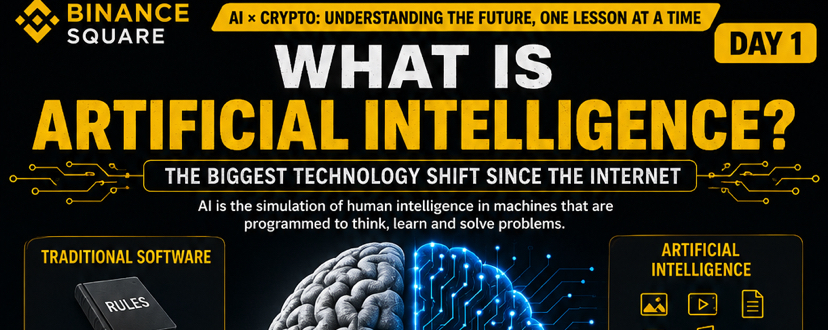
Day 1: What Is Artificial Intelligence? The Biggest Technology Shift Since the InternetImagine teaching a child to recognize a cat.
You don’t explain every detail about ears, whiskers, or tails. Instead, you show thousands of pictures of cats. Over time, the child starts recognising cats on their own.
#ArtificialInteligence (AI) learns in a similar way.
Instead of following a fixed set of instructions like traditional software, AI learns patterns from massive amounts of data and uses those patterns to make predictions, answer questions, solve problems, or even create new content.
Traditional #SoftwareUpdate vs Artificial Intelligence
Think about a calculator.
If you type 2 + 2, it will always return 4 because a programmer explicitly wrote that rule.
Now think about ChatGPT.
If you ask it to write a poem, summarize a book, explain #bitcoin or generate code, nobody programmed every possible response. Instead, it learned from enormous amounts of text and predicts what comes next based on patterns it discovered during training.
That’s the biggest difference:
Traditional software follows rules. AI learns rules.
Why Is AI Growing So Fast?
AI has existed for decades, but three things changed everything.
1. Powerful Computing
Modern AI requires enormous computing power.
Companies like $NVDAB build #GPU capable of performing trillions of calculations every second, making today’s AI models possible.
2. Massive Amounts of Data
Every #google search, YouTube video, research paper, book, image, and public website contributes to the digital information that AI systems can learn from.
The more high-quality data available, the better AI becomes.
3. Better Algorithms
Researchers discovered new ways to train neural networks, allowing AI to understand language, recognize images, generate videos, and solve increasingly complex problems.
Together, these three factors created the AI revolution we’re experiencing today.
Where Does AI Already Exist?
You probably use AI every day without noticing.
Examples include:
Google SearchYouTube recommendationsNetflix suggestionsGoogle Maps traffic predictionsChatGPTVoice assistantsEmail spam filtersAI-powered customer supportAI is becoming an invisible layer beneath many of the digital services we rely on.
Why Should Crypto Investors Care?
AI and blockchain are beginning to converge.
AI can automate decisions, while blockchain provides transparency, ownership, and programmable digital assets.
Projects focused on decentralized AI, decentralized computing, data marketplaces, and AI agents are exploring how these technologies can work together.
Understanding AI today may help you better understand where the next wave of innovation could emerge.
The Bigger Picture
Artificial Intelligence is more than another software trend.
It’s becoming a foundational technology—much like electricity or the internet.
Over the coming years, it is expected to reshape healthcare, education, manufacturing, finance, transportation, scientific research, entertainment, and many other industries.
We’re still in the early chapters of this transformation.
The people who invest time in understanding AI today may be better prepared for the opportunities and challenges ahead.
Key Takeaway
Artificial Intelligence isn’t a machine that “thinks” like humans. It’s a system that learns patterns from data to perform tasks that previously required human intelligence.
Question for today’s discussion: Which AI tool has changed your daily life the most, and how do you use it?$GOOGL.US
$AAPLB
Day 1: What Is Artificial Intelligence? The Biggest Technology Shift Since the Internet
Imagine teaching a child to recognize a cat.
You don’t explain every detail about ears, whiskers, or tails. Instead, you show thousands of pictures of cats. Over time, the child starts recognising cats on their own.
#ArtificialInteligence (AI) learns in a similar way.
Instead of following a fixed set of instructions like traditional software, AI learns patterns from massive amounts of data and uses those patterns to make predictions, answer questions, solve problems, or even create new content.
Traditional #SoftwareUpdate vs Artificial Intelligence
Think about a calculator.
If you type 2 + 2, it will always return 4 because a programmer explicitly wrote that rule.
Now think about ChatGPT.
If you ask it to write a poem, summarize a book, explain #bitcoin or generate code, nobody programmed every possible response. Instead, it learned from enormous amounts of text and predicts what comes next based on patterns it discovered during training.
That’s the biggest difference:
Traditional software follows rules. AI learns rules.
Why Is AI Growing So Fast?
AI has existed for decades, but three things changed everything.
1. Powerful Computing
Modern AI requires enormous computing power.
Companies like $NVDAB build #GPU capable of performing trillions of calculations every second, making today’s AI models possible.
2. Massive Amounts of Data
Every #google search, YouTube video, research paper, book, image, and public website contributes to the digital information that AI systems can learn from.
The more high-quality data available, the better AI becomes.
3. Better Algorithms
Researchers discovered new ways to train neural networks, allowing AI to understand language, recognize images, generate videos, and solve increasingly complex problems.
Together, these three factors created the AI revolution we’re experiencing today.
Where Does AI Already Exist?
You probably use AI every day without noticing.
Examples include:
Google SearchYouTube recommendationsNetflix suggestionsGoogle Maps traffic predictionsChatGPTVoice assistantsEmail spam filtersAI-powered customer supportAI is becoming an invisible layer beneath many of the digital services we rely on.
Why Should Crypto Investors Care?
AI and blockchain are beginning to converge.
AI can automate decisions, while blockchain provides transparency, ownership, and programmable digital assets.
Projects focused on decentralized AI, decentralized computing, data marketplaces, and AI agents are exploring how these technologies can work together.
Understanding AI today may help you better understand where the next wave of innovation could emerge.
The Bigger Picture
Artificial Intelligence is more than another software trend.
It’s becoming a foundational technology—much like electricity or the internet.
Over the coming years, it is expected to reshape healthcare, education, manufacturing, finance, transportation, scientific research, entertainment, and many other industries.
We’re still in the early chapters of this transformation.
The people who invest time in understanding AI today may be better prepared for the opportunities and challenges ahead.
Key Takeaway
Artificial Intelligence isn’t a machine that “thinks” like humans. It’s a system that learns patterns from data to perform tasks that previously required human intelligence.
Question for today’s discussion: Which AI tool has changed your daily life the most, and how do you use it?$GOOGL.US
$AAPLB
GOOGLUS-0.47%
AAPLB+0.34%
130
Article
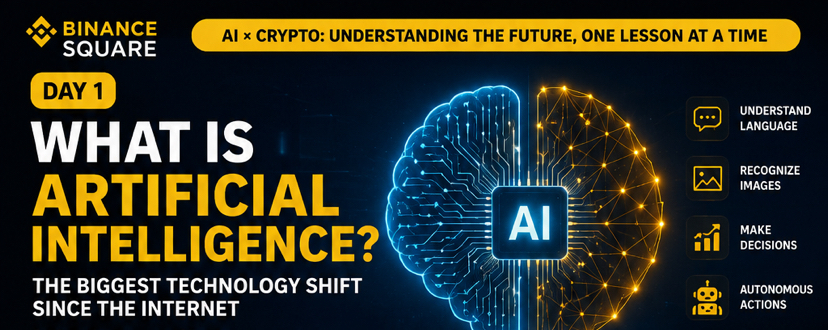
AI × Crypto: Understanding the Future, One Lesson at a TimeIntroduction: The Question That Started Everything
Every day, we scroll past the same words..Artificial Intelligence, Bitcoin, Ethereum, $NVDAB stablecoins, #AI agents, robotics, trillion-dollar valuations.
They sound powerful. Almost futuristic.
But behind all the headlines, there’s a question most people never stop to ask:
“Do I actually understand what’s happening under the surface?”
Because here’s the truth:
We’re living through one of the biggest technological shifts in human history…
yet most of us are only seeing the surface layer of it.
We see prices move. We see news explode. We see hype cycles come and go.
But we rarely understand the systems driving it all.
And that gap—between seeing and understanding—is where confusion (and opportunity) lives.
That’s why I’m starting this 365-day journey.
Not to chase predictions.
Not to follow hype.
Not to tell you what will happen tomorrow.
But to slow everything down—and rebuild understanding from the ground up.
Why This Series Exists
My goal is simple:
To help you understand the technologies shaping the next decade—without needing a technical background.
No jargon overload. No assumptions.
No “you should already know this.”
Just clear explanations, step by step, like we’re learning together from zero.
Because once you truly understand how something works, you stop being overwhelmed by it—and start seeing patterns others miss.
What We’ll Explore Together
Over the next year, we’ll break down the entire AI and crypto ecosystem—one idea at a time.
We’ll start from the foundations and slowly build upward:
What Artificial Intelligence actually is—and why it’s exploding nowWhy NVIDIA became the center of the AI revolutionHow chips are designed, built, and turned into global powerWhy companies like $TSMC, ASML, $Micron and SK hynix quietly control the backbone of modern techHow data centers became the “new oil refineries” of the digital worldHow #bitcoin and #Ethereum really function under the hoodThe rise of #DEFİ , #Stablecoins , Layer 2s, RWAs, and AI-powered crypto systemsHow global macroeconomics shapes every major tech cycleAnd which companies are building the invisible infrastructure of the future
Each topic connects to the next—like pieces of a much larger puzzle.
How Each Lesson Will Work
Every article in this series will follow a simple structure:
1. What is it?
We break the concept down into plain English—no technical barrier.
2. Why does it matter?
We connect it to real-world impact, not just theory.
3. Why should you care?
We explore long-term implications for technology, markets, and society
The goal isn’t just knowledge.
It’s clarity.
A Journey, Not Financial Advice
This series is not financial advice.
It’s a learning journey designed to help us think more clearly, ask better questions, and make more informed decisions in a world that’s changing faster than ever.
Because in the end, the people who benefit most from technological revolutions aren’t always the fastest traders…
They’re often the ones who understand the system the deepest.
Let’s Begin
If you enjoy learning from first principles instead of chasing headlines, you’re in the right place.
Tomorrow, we start with:
Day 1: What Is Artificial Intelligence?
And from there, we build everything—step by step.
No shortcuts. No noise. Just understanding.
Let’s learn together—one lesson at a time.
Before we begin:
Which area excites you the most right now—AI, Semiconductors, Crypto, or Macroeconomics
AI × Crypto: Understanding the Future, One Lesson at a Time
Introduction: The Question That Started Everything
Every day, we scroll past the same words..Artificial Intelligence, Bitcoin, Ethereum, $NVDAB stablecoins, #AI agents, robotics, trillion-dollar valuations.
They sound powerful. Almost futuristic.
But behind all the headlines, there’s a question most people never stop to ask:
“Do I actually understand what’s happening under the surface?”
Because here’s the truth:
We’re living through one of the biggest technological shifts in human history…
yet most of us are only seeing the surface layer of it.
We see prices move. We see news explode. We see hype cycles come and go.
But we rarely understand the systems driving it all.
And that gap—between seeing and understanding—is where confusion (and opportunity) lives.
That’s why I’m starting this 365-day journey.
Not to chase predictions.
Not to follow hype.
Not to tell you what will happen tomorrow.
But to slow everything down—and rebuild understanding from the ground up.
Why This Series Exists
My goal is simple:
To help you understand the technologies shaping the next decade—without needing a technical background.
No jargon overload. No assumptions.
No “you should already know this.”
Just clear explanations, step by step, like we’re learning together from zero.
Because once you truly understand how something works, you stop being overwhelmed by it—and start seeing patterns others miss.
What We’ll Explore Together
Over the next year, we’ll break down the entire AI and crypto ecosystem—one idea at a time.
We’ll start from the foundations and slowly build upward:
What Artificial Intelligence actually is—and why it’s exploding nowWhy NVIDIA became the center of the AI revolutionHow chips are designed, built, and turned into global powerWhy companies like $TSMC, ASML, $Micron and SK hynix quietly control the backbone of modern techHow data centers became the “new oil refineries” of the digital worldHow #bitcoin and #Ethereum really function under the hoodThe rise of #DEFİ , #Stablecoins , Layer 2s, RWAs, and AI-powered crypto systemsHow global macroeconomics shapes every major tech cycleAnd which companies are building the invisible infrastructure of the future
Each topic connects to the next—like pieces of a much larger puzzle.
How Each Lesson Will Work
Every article in this series will follow a simple structure:
1. What is it?
We break the concept down into plain English—no technical barrier.
2. Why does it matter?
We connect it to real-world impact, not just theory.
3. Why should you care?
We explore long-term implications for technology, markets, and society
The goal isn’t just knowledge.
It’s clarity.
A Journey, Not Financial Advice
This series is not financial advice.
It’s a learning journey designed to help us think more clearly, ask better questions, and make more informed decisions in a world that’s changing faster than ever.
Because in the end, the people who benefit most from technological revolutions aren’t always the fastest traders…
They’re often the ones who understand the system the deepest.
Let’s Begin
If you enjoy learning from first principles instead of chasing headlines, you’re in the right place.
Tomorrow, we start with:
Day 1: What Is Artificial Intelligence?
And from there, we build everything—step by step.
No shortcuts. No noise. Just understanding.
Let’s learn together—one lesson at a time.
Before we begin:
Which area excites you the most right now—AI, Semiconductors, Crypto, or Macroeconomics
137
Coinbase Bets Lo-Fi Karaoke Super Bowl Commercial Creates High-Flying Response
Karaoke-style commercial: Coinbase aired a fun, minimalist 60-second spot that looked like a karaoke sing-along — showing on-screen lyrics timed with the Backstreet Boys’ “Everybody (Backstreet’s Back)” to create a shared, participatory moment during the game
Lyrics rewrote for crypto: The lyrics were playfully tweaked to reference Coinbase (e.g., “Am I so secure?”) and promoted a simple message: “Crypto. For everybody.
No big celebrity cameos or cinematic scenes — just text + music + vibe, meant to stand out among the usual flashy ads
📊 Strategic Context
• Only crypto ad this year: Coinbase was reportedly the only cryptocurrency company to run a major Super Bowl ad in 2026 — a big shift from 2022, when many crypto brands (including FTX and Crypto.com) advertised in what was dubbed the “Crypto Bowl.
The ad is part of a broader campaign with large displays in places like Times Square and the Las Vegas Sphere beyond just the game broadcast.
🗣️ Reaction & Impact
• Divided reactions: Some viewers enjoyed the quirky sing-along vibe and nostalgia, while others felt it was underwhelming or too odd for such a big event.
• Part of evolving crypto marketing: Experts see this as Coinbase leaning into broader mainstream appeal and cultural touchpoints rather than aggressive product sells.
• Industry context: After a downturn in crypto marketing presence since 2022, Coinbase’s solo splash reflects a more cautious but still bold approach.
#coinbase #superbowl $BTC
{spot}(BTCUSDT)
Coinbase Bets Lo-Fi Karaoke Super Bowl Commercial Creates High-Flying Response
Karaoke-style commercial: Coinbase aired a fun, minimalist 60-second spot that looked like a karaoke sing-along — showing on-screen lyrics timed with the Backstreet Boys’ “Everybody (Backstreet’s Back)” to create a shared, participatory moment during the game
Lyrics rewrote for crypto: The lyrics were playfully tweaked to reference Coinbase (e.g., “Am I so secure?”) and promoted a simple message: “Crypto. For everybody.
No big celebrity cameos or cinematic scenes — just text + music + vibe, meant to stand out among the usual flashy ads
📊 Strategic Context
• Only crypto ad this year: Coinbase was reportedly the only cryptocurrency company to run a major Super Bowl ad in 2026 — a big shift from 2022, when many crypto brands (including FTX and Crypto.com) advertised in what was dubbed the “Crypto Bowl.
The ad is part of a broader campaign with large displays in places like Times Square and the Las Vegas Sphere beyond just the game broadcast.
🗣️ Reaction & Impact
• Divided reactions: Some viewers enjoyed the quirky sing-along vibe and nostalgia, while others felt it was underwhelming or too odd for such a big event.
• Part of evolving crypto marketing: Experts see this as Coinbase leaning into broader mainstream appeal and cultural touchpoints rather than aggressive product sells.
• Industry context: After a downturn in crypto marketing presence since 2022, Coinbase’s solo splash reflects a more cautious but still bold approach.
#coinbase #superbowl $BTC

23
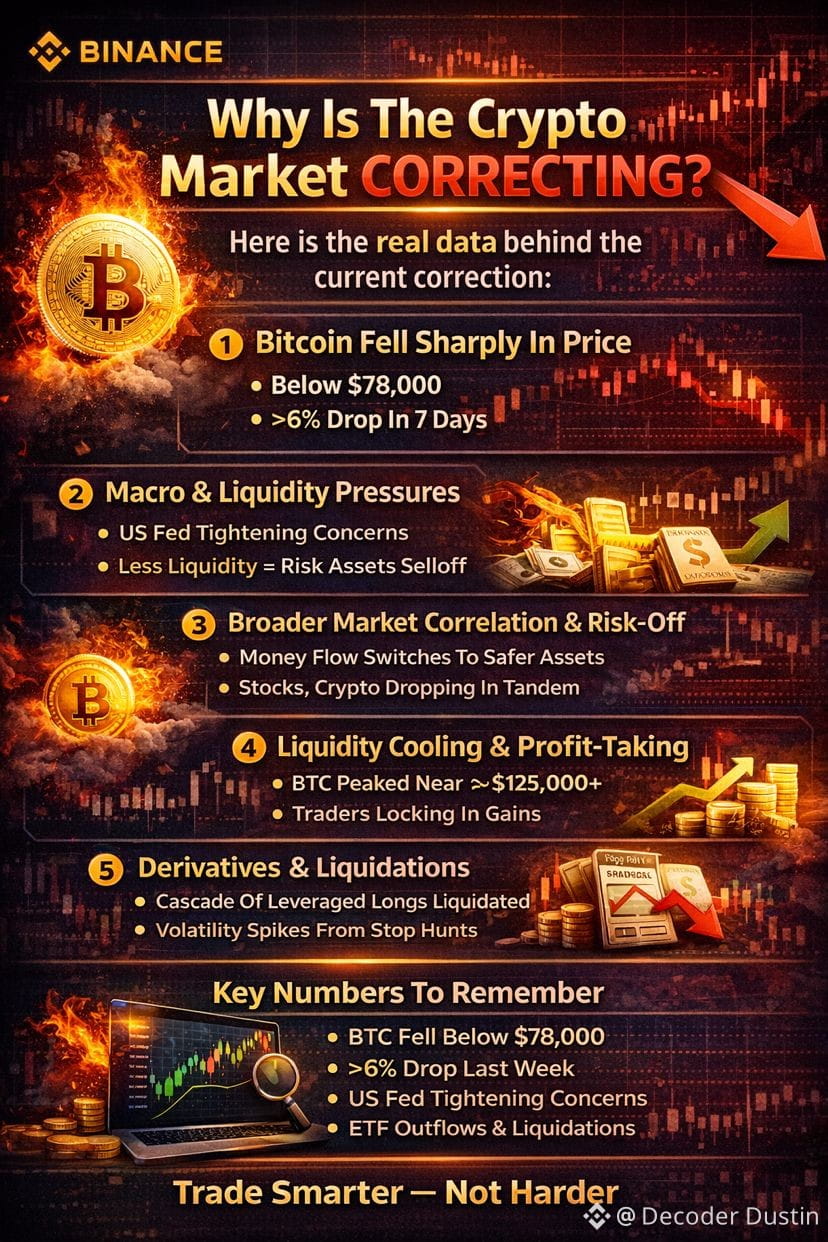
#MarketCorrection Why Is the Crypto Market Correcting Right Now?
Market corrections aren’t panic — they’re structural resets.
Here is the real data behind the current correction:
🔸 1. #bitcoin Fell Sharply in Price
• Bitcoin dropped below $78,000, trading near levels not seen since late 2025. 
• Over the past week, BTC lost more than 6% in value as risk-off sentiment grew. 
• This decline follows a break below key technical supports like $82,000 and $80,000. 
🔸 2. Macro & Liquidity Pressures
• A leadership change at the U.S. Federal Reserve raised concerns about tighter monetary policy and lower liquidity for risk assets. 
• Investors reacted by reallocating into perceived safer assets, putting pressure on high-beta markets like crypto. 
🔸 3. Broader Market Correlation & Risk-Off
• Crypto tends to correlate with traditional risk assets (e.g., stocks). When broader markets correct or uncertainty rises, crypto follows. 
• Institutional flows have shifted: Bitcoin ETFs saw outflows, and leveraged position
🔸 4. Liquidity Cooling & Profit-Taking
• After a strong rally in 2025 where BTC reached ~$125,000+, traders began locking in profits. 
• Profit-taking is normal after extended uptrends and contributes to short-term price pullbacks.
🔸 5. Derivatives & Liquidations
• Corrections often trigger cascading liquidations in futures markets as stop-loss orders are hit. 
• In intense selloffs, billions in leveraged positions can be wiped out, amplifying volatility. 
🧠 How To Think About This Correction
This current downturn isn’t a market “crash” — it’s a healthy correction after extended highs, influenced by:
📍 Macro tightening & liquidity shift
📍 Rotation from leverage-heavy positions
📍 Profit-taking after strong rallies
📍 Risk-off sentiment across global markets
Corrections help clear excess leverage, reset sentiment, and form sustainable bases for future moves.
{spot}(BTCUSDT)
{spot}(ETHUSDT)
#WhenWillBTCRebound
#MarketCorrection Why Is the Crypto Market Correcting Right Now?
Market corrections aren’t panic — they’re structural resets.
Here is the real data behind the current correction:
🔸 1. #bitcoin Fell Sharply in Price
• Bitcoin dropped below $78,000, trading near levels not seen since late 2025. 
• Over the past week, BTC lost more than 6% in value as risk-off sentiment grew. 
• This decline follows a break below key technical supports like $82,000 and $80,000. 
🔸 2. Macro & Liquidity Pressures
• A leadership change at the U.S. Federal Reserve raised concerns about tighter monetary policy and lower liquidity for risk assets. 
• Investors reacted by reallocating into perceived safer assets, putting pressure on high-beta markets like crypto. 
🔸 3. Broader Market Correlation & Risk-Off
• Crypto tends to correlate with traditional risk assets (e.g., stocks). When broader markets correct or uncertainty rises, crypto follows. 
• Institutional flows have shifted: Bitcoin ETFs saw outflows, and leveraged position
🔸 4. Liquidity Cooling & Profit-Taking
• After a strong rally in 2025 where BTC reached ~$125,000+, traders began locking in profits. 
• Profit-taking is normal after extended uptrends and contributes to short-term price pullbacks.
🔸 5. Derivatives & Liquidations
• Corrections often trigger cascading liquidations in futures markets as stop-loss orders are hit. 
• In intense selloffs, billions in leveraged positions can be wiped out, amplifying volatility. 
🧠 How To Think About This Correction
This current downturn isn’t a market “crash” — it’s a healthy correction after extended highs, influenced by:
📍 Macro tightening & liquidity shift
📍 Rotation from leverage-heavy positions
📍 Profit-taking after strong rallies
📍 Risk-off sentiment across global markets
Corrections help clear excess leverage, reset sentiment, and form sustainable bases for future moves.
#WhenWillBTCRebound
41
Article
Funding Rates: How to Use Perpetual Futures Data to Predict Market TrapsMost crypto traders think price moves because of news or hype. In reality, leverage positioning often controls short-term price.
And the best window into leverage positioning is 👉 Funding Rates
👉 Funding Rates: If you understand funding, you can:
Avoid getting trappedAnticipate squeezesTrade smarterImprove entries & exits
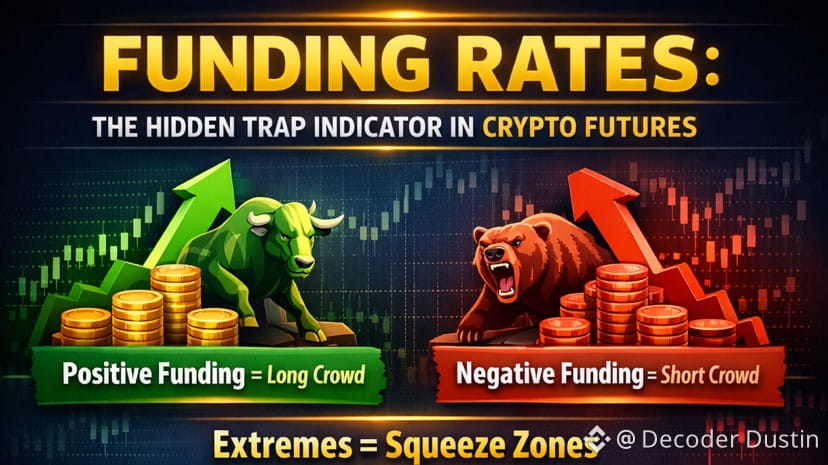
Let’s break it down properly.🔹 What Is Funding Rate?Funding rate is a periodic payment between:
• Long traders
• Short traders
It keeps perpetual futures price aligned with spot price.
If funding is:
📈 Positive → Longs pay shorts 📉 Negative → Shorts pay longs
This shows which side is overcrowded.
🔹 Why Funding Rate Matters
Markets punish overcrowded positions.
When:
• Too many longs → market dumps
• Too many shorts → market pumps
Funding tells us:
✔ Market bias
✔ Risk of liquidation cascades
✔ Probability of fake moves
🔹 How Traps Are Built Using Funding
1️⃣ Positive Funding Trap
Funding strongly positive, Everyone long, Market dumps suddenly → Long liquidation cascade
2️⃣ Negative Funding Trap, Funding strongly negative, Everyone short, Market pumps suddenl→ Short squeeze
These are not accidents.
They are positioning resets
🔹 Funding vs Open Interest (Power Combo)
Funding alone is good.
Funding + Open Interest is powerful
Scenario A:
Funding positive
Open interest risin Overleveraged longsDump risk high
Scenario B:Funding negative Open interest rising
Overleveraged shorts Pump risk high
Scenario C: Funding neutral
Open interest dropping→ Healthy move
🔹 Retail Mistakes With Funding - Retail traders:
❌ Ignore funding
❌ Long after pumps
❌ Short after dumps
❌ Use high leverage
❌ Trade emotionally
They join trades when risk is highest.
🔹 Smart Way to Use Funding in Trading
Strategy - Entry Timing
Wait for:
✔ Funding extreme
✔ Price near resistance/support
✔ Liquidity above/below
Then trade reversal.
Example (BTC Futures)
BTC pumps to 94k
Funding = +0.12% Open interest spikes
Everyone bullish
Sudden dump to 90k Longs liquidated Funding resets
Market stabilizes
That dump was not fear —
It was leverage cleanup.
🔹 Risk Management With Funding Trades
Never:
❌ Trade only fundinG
❌ Use high leverage
❌ Ignore price structure
Always:
✔ Combine with levels
✔ Use small size
✔ Accept invalidation
✔ Think in probabilities
🔹 Final Thought
Price doesn’t trap people.Positioning traps people.Funding rate tells you:Who is crowdedWho is payingWho is vulnerable
Trade with the data Not with the crowd.
🧠 Key Takeaway
Funding shows market bias Extremes = trap zonesCombine with open interestUse for reversals & confirmation#fundingrate $BTC
{spot}(BTCUSDT)
Funding Rates: How to Use Perpetual Futures Data to Predict Market Traps
Most crypto traders think price moves because of news or hype. In reality, leverage positioning often controls short-term price.
And the best window into leverage positioning is 👉 Funding Rates
👉 Funding Rates: If you understand funding, you can:
Avoid getting trappedAnticipate squeezesTrade smarterImprove entries & exits
Let’s break it down properly.🔹 What Is Funding Rate?Funding rate is a periodic payment between:
• Long traders
• Short traders
It keeps perpetual futures price aligned with spot price.
If funding is:
📈 Positive → Longs pay shorts 📉 Negative → Shorts pay longs
This shows which side is overcrowded.
🔹 Why Funding Rate Matters
Markets punish overcrowded positions.
When:
• Too many longs → market dumps
• Too many shorts → market pumps
Funding tells us:
✔ Market bias
✔ Risk of liquidation cascades
✔ Probability of fake moves
🔹 How Traps Are Built Using Funding
1️⃣ Positive Funding Trap
Funding strongly positive, Everyone long, Market dumps suddenly → Long liquidation cascade
2️⃣ Negative Funding Trap, Funding strongly negative, Everyone short, Market pumps suddenl→ Short squeeze
These are not accidents.
They are positioning resets
🔹 Funding vs Open Interest (Power Combo)
Funding alone is good.
Funding + Open Interest is powerful
Scenario A:
Funding positive
Open interest risin Overleveraged longsDump risk high
Scenario B:Funding negative Open interest rising
Overleveraged shorts Pump risk high
Scenario C: Funding neutral
Open interest dropping→ Healthy move
🔹 Retail Mistakes With Funding - Retail traders:
❌ Ignore funding
❌ Long after pumps
❌ Short after dumps
❌ Use high leverage
❌ Trade emotionally
They join trades when risk is highest.
🔹 Smart Way to Use Funding in Trading
Strategy - Entry Timing
Wait for:
✔ Funding extreme
✔ Price near resistance/support
✔ Liquidity above/below
Then trade reversal.
Example (BTC Futures)
BTC pumps to 94k
Funding = +0.12% Open interest spikes
Everyone bullish
Sudden dump to 90k Longs liquidated Funding resets
Market stabilizes
That dump was not fear —
It was leverage cleanup.
🔹 Risk Management With Funding Trades
Never:
❌ Trade only fundinG
❌ Use high leverage
❌ Ignore price structure
Always:
✔ Combine with levels
✔ Use small size
✔ Accept invalidation
✔ Think in probabilities
🔹 Final Thought
Price doesn’t trap people.Positioning traps people.Funding rate tells you:Who is crowdedWho is payingWho is vulnerable
Trade with the data Not with the crowd.
🧠 Key Takeaway
Funding shows market bias Extremes = trap zonesCombine with open interestUse for reversals & confirmation#fundingrate $BTC
1
73
Article
Bitcoin UTXOs: How to Save Thousands in Transaction FeesBuying $BTC tegularly and practicing self-custody is the right approach. But there’s a structural issue with how Bitcoin works that most people discover too late, usually when they’re staring at a $500 fee quote to send $1,000 worth of BTC.
The problem isn’t the BTC you bought. It’s how you received it. Bitcoin uses something called UTXOs (Unspent Transaction Outputs) as fundamental building blocks to address several tradFi problems.
In this model, individual pieces (chunks) of BTC are created every time you receive a BTC payment. Over time, if you stack up too many UTXOs, you could end up paying 10-20x more in transaction fees than someone sending the same amount of BTC from fewer, larger pieces.
So how does this happen, and how can you manage your BTC to avoid it? Let me try toexplain what UTXOs are, why they determine your transaction costs, and how to manage UTXOs properly to avoid paying more fees than necessary.
What Is a UTXO?
A UTXO (Unspent Transaction Output) represents the unspent portion of a cryptocurrency that remains after a transaction completes. Think of it as the digital version of the change you receive after buying something with cash.
With a bank account, you deposit cash and it immediately mixes with everyone else’s money. If you deposit five $20 bills totaling $100, the bank just records “+$100” to your account. In contrast, Bitcoin transactions are more like money in a piggy bank – each deposit (like five $20 bills) stays separate.
Each UTXO is distinct, holds a different amount, and remains a separate, independent piece until you spend it. These individual pieces collectively form your Bitcoin wallet balance, serving as the foundational components of Bitcoin’s transaction system. For instance, a Bitcoin wallet balance of 0.52 BTC might actually be three separate UTXOs: 0.20 BTC + 0.15 BTC + 0.17 BTC.
The crucial detail is that a UTXO is either fully unspent or fully spent – you can’t use just a part of it. When you spend it, the old UTXO is destroyed and new ones are created: for the recipient and your change.
How UTXOs Work
Every Bitcoin transaction follows this pattern:
Inputs: Refers to UTXOs you’re spending Outputs: New UTXOs being created for recipients
This is just like physical cash. If you need to pay someone $30 but only have a $50 bill, you can’t tear the bill in half. You hand over the whole $50 and receive $20 in change.
BTC UTXO Transaction Example
Let’s say you have these UTXOs in your wallet:
One worth 0.5 BTCOne worth 1.0 BTCTwo worth 0.01 BTC each
Total: 1.52 BTC
You want to send someone 0.9 BTC. So, your wallet evaluates its options:
The 0.5 BTC piece is too small,The 0.01 BTC pieces are way too small, The full 1.0 BTC piece is enough to cover the transaction.
If you have a 1.0 BTC UTXO but only need to send 0.9 BTC, you can’t just send 0.9 and leave 0.1 behind. Instead, your wallet sends 0.9 BTC to the recipient and automatically creates a change output of 0.1 BTC that goes back to you.
Your wallet now holds:
Total: 0.62 BTC
0.5 BTC (unchanged)0.1 BTC (newly created change)0.01 BTC (unchanged)0.01 BTC (unchanged)
The original 1.0 BTC UTXO is ‘destroyed’ as an input and ceases to exist, replaced by the two new UTXO outputs (0.90 BTC to the recipient, 0.0995… BTC to your change address).
Input: the single 1.0 BTC UTXO your wallet chooses to spend.Outputs:0.9 BTC sent to the recipient (payment output)~0.0995 BTC sent back to a new address you control (change output)
This ‘change’ doesn’t return to the same address it came from. Your wallet generates a brand new change address from your own pool of addresses and sends the leftover ~0.0995… BTC there.
The leftover amount that goes neither to outputs nor change?
That becomes a miner fee, a small payment to the network for validating your transaction and permanently recording it on the blockchain.
To clarify, the miner fee isn’t a third output; it’s the unclaimed difference between your input (1.0 BTC) and your outputs (0.9 + 0.0995 BTC). That leftover 0.0005 BTC is what miners earn for validating your transaction.
Hence, every time your wallet BTC or breaks one #UTXO into multiple new ones, you also increase the number of pieces you may need to spend later. Let’s understand what this has to do with the BTC fees you could eventually end up paying.
How Do UTXOs Make BTC Fees Expensive?
Bitcoin transaction fees don’t depend on the value of BTC you send. They depend on the size of the data that each transaction uses.
Sending $10 or $10,000 of Bitcoin can cost the exact same fee if the data footprint is similar.
For context, someone once sent over $2,000,000,000 in BTC for a fee of just eighty cents.
Bitcoin transaction fees don’t depend on how much BTC you send but on how big your transaction is in data terms, and every extra UTXO you spend makes that transaction bigger.
This means a payment that uses 20 tiny UTXOs can cost roughly 20 times more in fees than a payment that uses one large UTXO, even if both send the same amount of BTC.
#transactionfees #NetworkFees
$BTC
{spot}(BTCUSDT)
Bitcoin UTXOs: How to Save Thousands in Transaction Fees
Buying $BTC tegularly and practicing self-custody is the right approach. But there’s a structural issue with how Bitcoin works that most people discover too late, usually when they’re staring at a $500 fee quote to send $1,000 worth of BTC.
The problem isn’t the BTC you bought. It’s how you received it. Bitcoin uses something called UTXOs (Unspent Transaction Outputs) as fundamental building blocks to address several tradFi problems.
In this model, individual pieces (chunks) of BTC are created every time you receive a BTC payment. Over time, if you stack up too many UTXOs, you could end up paying 10-20x more in transaction fees than someone sending the same amount of BTC from fewer, larger pieces.
So how does this happen, and how can you manage your BTC to avoid it? Let me try toexplain what UTXOs are, why they determine your transaction costs, and how to manage UTXOs properly to avoid paying more fees than necessary.
What Is a UTXO?
A UTXO (Unspent Transaction Output) represents the unspent portion of a cryptocurrency that remains after a transaction completes. Think of it as the digital version of the change you receive after buying something with cash.
With a bank account, you deposit cash and it immediately mixes with everyone else’s money. If you deposit five $20 bills totaling $100, the bank just records “+$100” to your account. In contrast, Bitcoin transactions are more like money in a piggy bank – each deposit (like five $20 bills) stays separate.
Each UTXO is distinct, holds a different amount, and remains a separate, independent piece until you spend it. These individual pieces collectively form your Bitcoin wallet balance, serving as the foundational components of Bitcoin’s transaction system. For instance, a Bitcoin wallet balance of 0.52 BTC might actually be three separate UTXOs: 0.20 BTC + 0.15 BTC + 0.17 BTC.
The crucial detail is that a UTXO is either fully unspent or fully spent – you can’t use just a part of it. When you spend it, the old UTXO is destroyed and new ones are created: for the recipient and your change.
How UTXOs Work
Every Bitcoin transaction follows this pattern:
Inputs: Refers to UTXOs you’re spending Outputs: New UTXOs being created for recipients
This is just like physical cash. If you need to pay someone $30 but only have a $50 bill, you can’t tear the bill in half. You hand over the whole $50 and receive $20 in change.
BTC UTXO Transaction Example
Let’s say you have these UTXOs in your wallet:
One worth 0.5 BTCOne worth 1.0 BTCTwo worth 0.01 BTC each
Total: 1.52 BTC
You want to send someone 0.9 BTC. So, your wallet evaluates its options:
The 0.5 BTC piece is too small,The 0.01 BTC pieces are way too small, The full 1.0 BTC piece is enough to cover the transaction.
If you have a 1.0 BTC UTXO but only need to send 0.9 BTC, you can’t just send 0.9 and leave 0.1 behind. Instead, your wallet sends 0.9 BTC to the recipient and automatically creates a change output of 0.1 BTC that goes back to you.
Your wallet now holds:
Total: 0.62 BTC
0.5 BTC (unchanged)0.1 BTC (newly created change)0.01 BTC (unchanged)0.01 BTC (unchanged)
The original 1.0 BTC UTXO is ‘destroyed’ as an input and ceases to exist, replaced by the two new UTXO outputs (0.90 BTC to the recipient, 0.0995… BTC to your change address).
Input: the single 1.0 BTC UTXO your wallet chooses to spend.Outputs:0.9 BTC sent to the recipient (payment output)~0.0995 BTC sent back to a new address you control (change output)
This ‘change’ doesn’t return to the same address it came from. Your wallet generates a brand new change address from your own pool of addresses and sends the leftover ~0.0995… BTC there.
The leftover amount that goes neither to outputs nor change?
That becomes a miner fee, a small payment to the network for validating your transaction and permanently recording it on the blockchain.
To clarify, the miner fee isn’t a third output; it’s the unclaimed difference between your input (1.0 BTC) and your outputs (0.9 + 0.0995 BTC). That leftover 0.0005 BTC is what miners earn for validating your transaction.
Hence, every time your wallet BTC or breaks one #UTXO into multiple new ones, you also increase the number of pieces you may need to spend later. Let’s understand what this has to do with the BTC fees you could eventually end up paying.
How Do UTXOs Make BTC Fees Expensive?
Bitcoin transaction fees don’t depend on the value of BTC you send. They depend on the size of the data that each transaction uses.
Sending $10 or $10,000 of Bitcoin can cost the exact same fee if the data footprint is similar.
For context, someone once sent over $2,000,000,000 in BTC for a fee of just eighty cents.
Bitcoin transaction fees don’t depend on how much BTC you send but on how big your transaction is in data terms, and every extra UTXO you spend makes that transaction bigger.
This means a payment that uses 20 tiny UTXOs can cost roughly 20 times more in fees than a payment that uses one large UTXO, even if both send the same amount of BTC.
#transactionfees #NetworkFees
$BTC
1
79
·
--
Bullish
$ZAMA Token Deep Dive: Early Pricing, Unlocks & Price Scenarios
Its building privacy infrastructure using Fully Homomorphic Encryption (FHE), aiming to enable confidential smart contracts. But beyond the tech, the real question for investors is: how does the token behave? Let’s break it down
💰 Early Pricing (Seed vs Public)
It did not do a typical cheap seed token sale.
The first public price discovery came from its Dutch auction:
• Auction floor price: ~$0.005
• FDV at auction: ~$55M
• Supply: ~11B tokens
There is no officially disclosed seed token price, meaning:
✔ No ultra-cheap $0.0001 whales
✔ Most early holders are long-term vested (team + investors)
🧩 Token Allocation (Approx)
• Community & Ecosystem: ~35%
• Team & Contributors: ~20%
• Investors: ~18%
• Treasury/Foundation: ~15%
• Public Auction: ~12%
Total Supply ≈ 11B ZAMA
⏳ Vesting & Unlock Dynamics
ZAMA uses long VC-style vesting.
At TGE:
• Circulating ≈ 10–12%
• Mostly public auction + small incentives
Months 7–24 = High risk period
• Investor + team unlocks start
• ~2–3% supply unlocks monthly
• This is where most infra tokens face sell pressure
After Year 2:
• Unlock rate slows
• Supply shock mostly absorbed
👉 Key point: price must grow just to offset unlocks.
📉 Circulating vs FDV Impact
• Launch: ~12% circulating
• Year 1: ~25%
• Year 2: ~55%
• Year 3: ~80%+
Flat adoption = price bleed
Strong adoption = price survives unlocks
📊 Price Scenarios (Speculative)
🐂 Bull Case
If Zama becomes a core privacy layer for DeFi & institutions:
• Price: $0.15 – $0.50
• FDV: $2B –
🐻 Bear Case
Low adoption + unlock pressure:
• Price: $0.005 – $0.015 (near auction floor)
📈 Trading Ranges
• Listing pump: $0.03 – $0.10
• Dump zone: $0.01 – $0.03
• Accumulation: $0.005 – $0.015
• Breakout (bull): $0.15+
⚖️ Compared to Other Infra Launches
• ARB FDV at launch: $12B
• OP FDV: $6B
• ZAMA: ~$55M
#PreTGESale
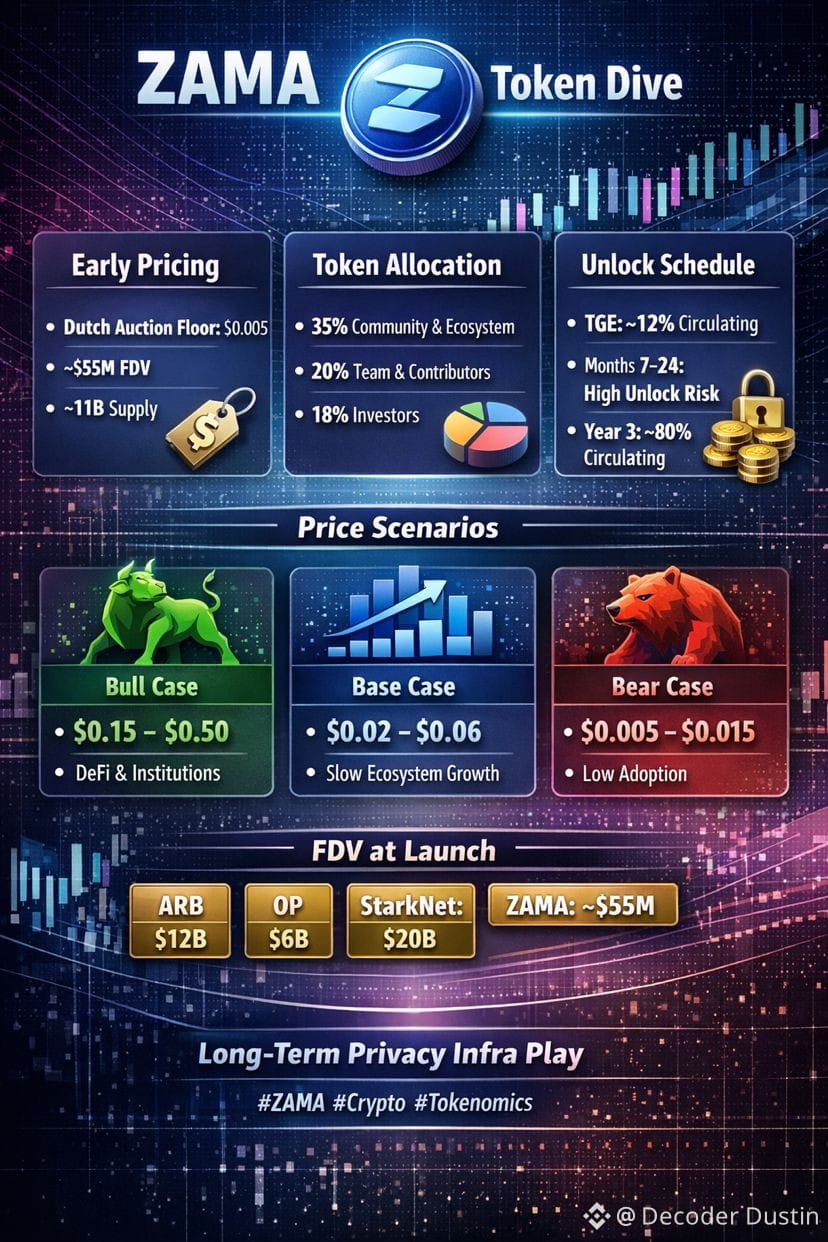
239
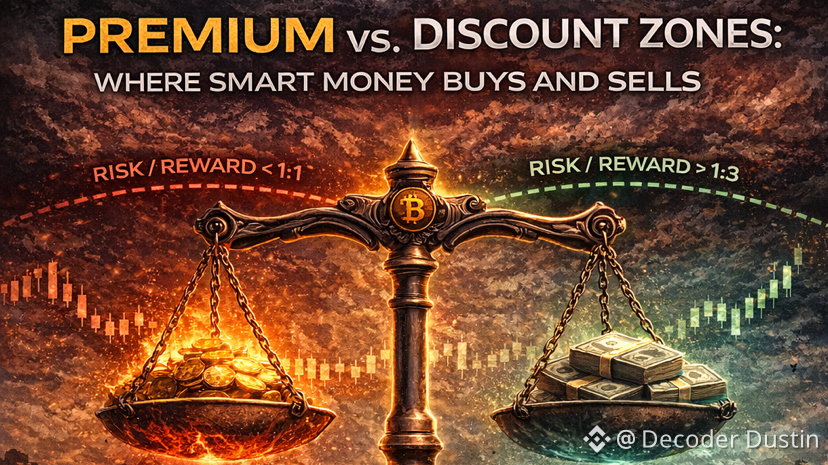
Article
Premium vs Discount Zones: Where Smart Money Wins and Retail LosesMost traders lose money for one simple reason: They buy expensive and sell cheap.
Smart money does the opposite.
They don’t care about indicators.They don’t care about hype.They care about location.
If you don’t know whether price is in premium or discount, you’re gambling.
🔴 Premium Zone = Danger Zone
Price is in premium when:
It’s near range highsIt’s near resistanceIt already ran hardEveryone is bullish
This is where:
❌ Breakouts fail
❌ Risk is high
❌ Reward is poor
❌ Retail FOMOs
❌ Smart money distributes
Retail buys strength.
Institutions sell into that strength.
That’s why tops feel euphoric and bottoms feel terrifying.
🟢 Discount Zone = Opportunity Zone
Price is in discount when:
It’s near range lowsIt’s near supportIt pulled back deeplyEveryone is scared or bored
This is where:
✅ Risk is low
✅ Reward is high
✅ Smart money accumulates
✅ Weak hands sell
✅ Long-term positions are built
Smart money buys fear. Retail sells fear.
Every cycle. Same story.
⚖️The Middle = Chop Zone
The middle of a range:
Has no edgeNo asymmetryNo liquidityNo emotion
This is where:
❌ Traders get chopped
❌ Stops get hit
❌ Fees stack up
❌ Confidence dies
Pros wait for extremes. Amateurs trade the noise.
🧩 Liquidity + Zones = Edge
Premium & discount zones only work when you understand liquidity:
➡️ Highs = buy stops
➡️ Lows = sell stops
➡️ News = excuse
➡️ Liquidity = target
Sweep highs → premium → rejection = sell
Sweep lows → discount → reversal = buy
No guessing. No hope.
Just structure.
🛡️ Risk Management (Non-Negotiable)
Premium trades:
Small sizeFast exitsTight control
Discount trades:
Bigger patienceBetter R:RClear invalidation
If your entry sucks, your strategy sucks.
🎯 Final Truth
Markets don’t reward prediction. They reward location.
Smart money:
✔️ Buys cheap
✔️ Sells expensive
✔️ Waits for liquidity
Retail:
❌ Chases green
❌ Panics on red
❌ Trades emotion
Stop trading candles. Start trading value. Decode the market or become liquidity.
#smartmoney $BTC $ETH
{spot}(BTCUSDT)
{spot}(ETHUSDT)
Premium vs Discount Zones: Where Smart Money Wins and Retail Loses
Most traders lose money for one simple reason: They buy expensive and sell cheap.
Smart money does the opposite.
They don’t care about indicators.They don’t care about hype.They care about location.
If you don’t know whether price is in premium or discount, you’re gambling.
🔴 Premium Zone = Danger Zone
Price is in premium when:
It’s near range highsIt’s near resistanceIt already ran hardEveryone is bullish
This is where:
❌ Breakouts fail
❌ Risk is high
❌ Reward is poor
❌ Retail FOMOs
❌ Smart money distributes
Retail buys strength.
Institutions sell into that strength.
That’s why tops feel euphoric and bottoms feel terrifying.
🟢 Discount Zone = Opportunity Zone
Price is in discount when:
It’s near range lowsIt’s near supportIt pulled back deeplyEveryone is scared or bored
This is where:
✅ Risk is low
✅ Reward is high
✅ Smart money accumulates
✅ Weak hands sell
✅ Long-term positions are built
Smart money buys fear. Retail sells fear.
Every cycle. Same story.
⚖️The Middle = Chop Zone
The middle of a range:
Has no edgeNo asymmetryNo liquidityNo emotion
This is where:
❌ Traders get chopped
❌ Stops get hit
❌ Fees stack up
❌ Confidence dies
Pros wait for extremes. Amateurs trade the noise.
🧩 Liquidity + Zones = Edge
Premium & discount zones only work when you understand liquidity:
➡️ Highs = buy stops
➡️ Lows = sell stops
➡️ News = excuse
➡️ Liquidity = target
Sweep highs → premium → rejection = sell
Sweep lows → discount → reversal = buy
No guessing. No hope.
Just structure.
🛡️ Risk Management (Non-Negotiable)
Premium trades:
Small sizeFast exitsTight control
Discount trades:
Bigger patienceBetter R:RClear invalidation
If your entry sucks, your strategy sucks.
🎯 Final Truth
Markets don’t reward prediction. They reward location.
Smart money:
✔️ Buys cheap
✔️ Sells expensive
✔️ Waits for liquidity
Retail:
❌ Chases green
❌ Panics on red
❌ Trades emotion
Stop trading candles. Start trading value. Decode the market or become liquidity.
#smartmoney $BTC $ETH
1
67
Coinbase has introduced an independent advisory board to evaluate how quantum computing may impact crypto security in the future.
Why is this HUGE?
Quantum machines could someday crack today’s cryptography in minutes instead of years. That means wallets, private keys, and even blockchains could face real danger… unless we prepare now.
The goal is to:
• Study quantum-related risks to cryptography
• Develop quantum-resistant security standards
• Protect wallets, private keys, and blockchain networks
• Prepare the crypto industry for post-quantum threats
🧠 Big picture:
This move shows that major exchanges are thinking decades ahead. As quantum tech evolves, crypto must evolve with it — or risk losing its strongest promise: security without trust.
💬 Do you think blockchains will need a full upgrade for the quantum era, or is this risk still overhyped?
This move signals a long-term focus on safeguarding decentralized systems as computing power evolves.
#quantumcomputers #CryptoSecurity #Ethereum✅ #PostQuantum #CyberSecurity #coinbase

1
86
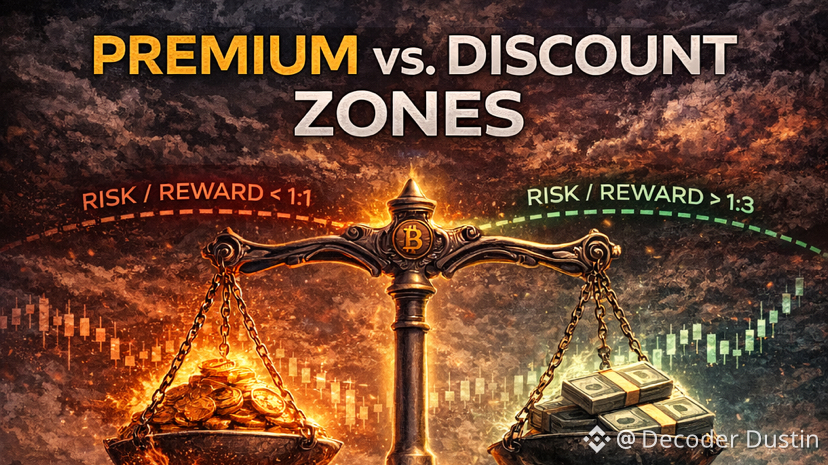
Article
Premium vs Discount Zones: Where Smart Money Buys and SellsMost traders focus on what to trade.
Smart traders focus on where to trade.The market does not reward random entries. It rewards entries taken at favorable prices, where risk is low and reward is high. This is where the concept of Premium and Discount Zones becomes powerful.
🔍 What Are Premium and Discount Zones?
These zones are based on the idea that price oscillates between:
Premium (Expensive)Discount (Cheap)
When price is:
In a Premium Zone → Risk is high, upside is limitedIn a Discount Zone → Risk is low, upside is large
Think like a business:
👉 You don’t buy at retail price
👉 You buy at wholesale
👉 You sell at retail
Markets work the same way.
Discount Zone (Low Risk Area)
Price is considered in a discount zone when:
Near support or demandAfter strong pullbacksNear liquidity pools belowDuring fear or boredom
Nuances of Discount Zones:
Best for long entriesBetter R:R setupsAccumulation happens hereEmotional selling happens hereStops below are hunted first
Smart money buys fear and Retail sells fear.
⚖️ Why the Middle Is the Worst Place
The middle of a range:
Has no edgeNo clear rewardNo clear invalidationHighest chop probability
The worst trades happen in the middle because:
There is no imbalance Liquidity is unclearDirection is uncertain
Professional traders wait for extremes, not middles.
🎯 Final Thought
Markets don’t move to reward impatience.
They move to punish emotion.
Smart money:
Buys in discountSells in premiumWaits in the middle
Stop chasing price. Start respecting location.
Decode the market. Don’t become liquidity.
$BTC
{spot}(BTCUSDT)
$ETH
{spot}(ETHUSDT)
Premium vs Discount Zones: Where Smart Money Buys and Sells
Most traders focus on what to trade.
Smart traders focus on where to trade.The market does not reward random entries. It rewards entries taken at favorable prices, where risk is low and reward is high. This is where the concept of Premium and Discount Zones becomes powerful.
🔍 What Are Premium and Discount Zones?
These zones are based on the idea that price oscillates between:
Premium (Expensive)Discount (Cheap)
When price is:
In a Premium Zone → Risk is high, upside is limitedIn a Discount Zone → Risk is low, upside is large
Think like a business:
👉 You don’t buy at retail price
👉 You buy at wholesale
👉 You sell at retail
Markets work the same way.
Discount Zone (Low Risk Area)
Price is considered in a discount zone when:
Near support or demandAfter strong pullbacksNear liquidity pools belowDuring fear or boredom
Nuances of Discount Zones:
Best for long entriesBetter R:R setupsAccumulation happens hereEmotional selling happens hereStops below are hunted first
Smart money buys fear and Retail sells fear.
⚖️ Why the Middle Is the Worst Place
The middle of a range:
Has no edgeNo clear rewardNo clear invalidationHighest chop probability
The worst trades happen in the middle because:
There is no imbalance Liquidity is unclearDirection is uncertain
Professional traders wait for extremes, not middles.
🎯 Final Thought
Markets don’t move to reward impatience.
They move to punish emotion.
Smart money:
Buys in discountSells in premiumWaits in the middle
Stop chasing price. Start respecting location.
Decode the market. Don’t become liquidity.
$BTC
$ETH
1
59
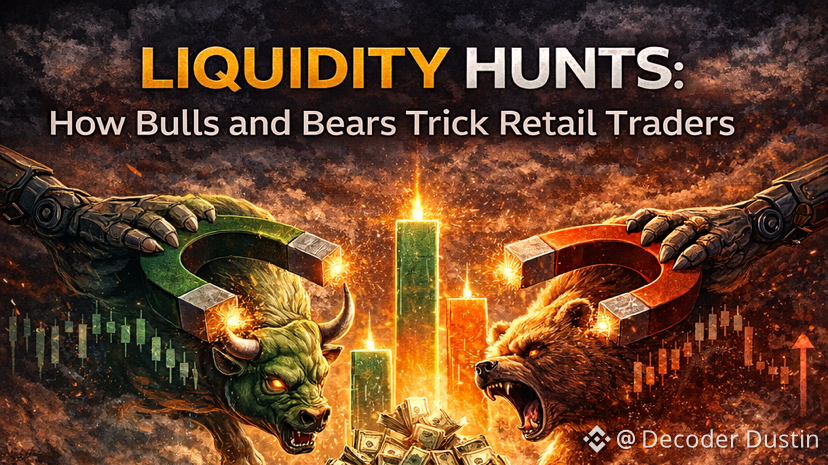
Article
Liquidity Hunts: How Bulls and Bears Trap Retail Traders🧠 Liquidity Hunts: The Hidden Engine of Price Movement
Most traders believe markets move because of indicators, patterns, or news. In reality, markets move to where liquidity exists.Liquidity hunts are not manipulation — they are how markets function when large players need orders to fill positions.
If you’ve ever been stopped out just before price reversed, you were likely part of a liquidity hunt.
🔍 What Is Liquidity
Liquidity is where orders are resting:
Stop-losses below supportBreakout buys above resistanceLiquidation levels of leveraged tradersPanic sell zonesFOMO buy zones
Price moves toward these clusters because large traders need liquidity to enter or exit without causing massive slippage.
The market doesn’t hunt price — it hunts orders.
🐂 How Bulls Hunt Liquidity
Bulls often:
Push price above resistanceTrigger breakout buysSwipe short stop-lossesCreate FOMOThen dump into that buying pressure
📉 Result: Retail buys high, price reverses lower.
$BTC
🐻 How Bears Hunt Liquidity
Bears often:
Push price below supportTrigger long stop-lossesLiquidate overleveraged longsCreate panicThen buy back lower
📈 Result: Retail sells low, price reverses upward.
$ETH
⚠️ Key Nuances Retail Traders Miss
1️⃣ Obvious Levels Are Targets
The more obvious the support or resistance, the more liquidity sits there.
2️⃣ News Is Often the Trigger, Not the Cause
Headlines provide the excuse — liquidity provides the destination.
3️⃣ Lower Timeframes Create Illusions
Most liquidity traps happen on small timeframes where emotions dominate.
4️⃣ Liquidations Accelerate Moves Temporarily
Forced buying/selling creates momentum, but it rarely sustains direction.
5️⃣ Structure Comes After the Hunt
True trend often begins only after stops are cleared.
🛡️ How to Protect Yourself from Liquidity Hunts
✅ Wait for sweeps and confirmations
✅ Trade higher timeframes
✅ Avoid entries at obvious levels
✅ Use wider invalidation, not tight stops
✅ Reduce leverage in choppy markets
✅ Don’t chase candles
✅ Accept missing trades
Being late is safer than being early.
🎯 Final Thought
Liquidity hunts feed on:
FearGreedImpatience
The market rewards traders who:
Wait for traps to completeEnter after emotion peaksThink in probabilities, not predictions
Read liquidity or become it. Don’t fight the market — decode it.#liquidationmap #liquidity
{spot}(BTCUSDT)
{spot}(BNBUSDT)
Liquidity Hunts: How Bulls and Bears Trap Retail Traders
🧠 Liquidity Hunts: The Hidden Engine of Price Movement
Most traders believe markets move because of indicators, patterns, or news. In reality, markets move to where liquidity exists.Liquidity hunts are not manipulation — they are how markets function when large players need orders to fill positions.
If you’ve ever been stopped out just before price reversed, you were likely part of a liquidity hunt.
🔍 What Is Liquidity
Liquidity is where orders are resting:
Stop-losses below supportBreakout buys above resistanceLiquidation levels of leveraged tradersPanic sell zonesFOMO buy zones
Price moves toward these clusters because large traders need liquidity to enter or exit without causing massive slippage.
The market doesn’t hunt price — it hunts orders.
🐂 How Bulls Hunt Liquidity
Bulls often:
Push price above resistanceTrigger breakout buysSwipe short stop-lossesCreate FOMOThen dump into that buying pressure
📉 Result: Retail buys high, price reverses lower.
$BTC
🐻 How Bears Hunt Liquidity
Bears often:
Push price below supportTrigger long stop-lossesLiquidate overleveraged longsCreate panicThen buy back lower
📈 Result: Retail sells low, price reverses upward.
$ETH
⚠️ Key Nuances Retail Traders Miss
1️⃣ Obvious Levels Are Targets
The more obvious the support or resistance, the more liquidity sits there.
2️⃣ News Is Often the Trigger, Not the Cause
Headlines provide the excuse — liquidity provides the destination.
3️⃣ Lower Timeframes Create Illusions
Most liquidity traps happen on small timeframes where emotions dominate.
4️⃣ Liquidations Accelerate Moves Temporarily
Forced buying/selling creates momentum, but it rarely sustains direction.
5️⃣ Structure Comes After the Hunt
True trend often begins only after stops are cleared.
🛡️ How to Protect Yourself from Liquidity Hunts
✅ Wait for sweeps and confirmations
✅ Trade higher timeframes
✅ Avoid entries at obvious levels
✅ Use wider invalidation, not tight stops
✅ Reduce leverage in choppy markets
✅ Don’t chase candles
✅ Accept missing trades
Being late is safer than being early.
🎯 Final Thought
Liquidity hunts feed on:
FearGreedImpatience
The market rewards traders who:
Wait for traps to completeEnter after emotion peaksThink in probabilities, not predictions
Read liquidity or become it. Don’t fight the market — decode it.#liquidationmap #liquidity
1
61
Did you know that you can now trade any on-chain token directly on the #binancewallet , across multiple chains like BSC, Solana, Base, and more?
2.First, go to the DEX screen and identify the token you want to trade.
3.Copy the token’s Contract Address (CA) from the bottom of the page.
4.Open your @BinanceWallet .
5.Click on Market.
6.Paste the Contract Address into the search bar.
7.And that’s it — the token appears and is ready to trade.
binance makes our trading experience so simple and easy to use. @heyi this experience is flawless @CZ #Binance
Did you know that you can now trade any on-chain token directly on the #binancewallet , across multiple chains like BSC, Solana, Base, and more?
2.First, go to the DEX screen and identify the token you want to trade.
3.Copy the token’s Contract Address (CA) from the bottom of the page.
4.Open your @BinanceWallet .
5.Click on Market.
6.Paste the Contract Address into the search bar.
7.And that’s it — the token appears and is ready to trade.
binance makes our trading experience so simple and easy to use. @Yi He this experience is flawless @CZ #Binance
2
260
Article
Patience Is a Position: Why Doing Nothing Is Often the Best TradeCrypto markets are not just charts and numbers — they are a psychological battlefield where bulls and bears fight daily, and most traders lose not because they are wrong, but because they are impatient
Every candle tells a story. Green candles whisper greed. Red candles shout fear. And in between lies the most dangerous zone of all — confusion.
This is where most traders get chopped.
🐂 Bulls vs 🐻 Bears: The Constant War
$BTC $ETH
Bulls push narratives, optimism, breakouts, and momentum.
Bears apply pressure, spread doubt, trigger stop-losses, and force liquidations.
Smart money? It watches silently.
Markets rarely move in straight lines. Before every major breakout or breakdown, price often goes sideways — draining patience, capital, and confidence.
This phase exists for one reason: 👉 To shake out emotional traders.
📉 The Trap of Sideways Markets
Sideways markets are the graveyard of overtraders.
False breakouts above resistanceFake breakdowns below supportIndicators giving conflicting signalsLower timeframes creating noiseRetail traders mistake movement for opportunity.Smart traders wait for confirmation.
If the market isn’t trending clearly, doing nothing is a valid trade.
🧠 Psychology: The Real Edge
Most losses don’t come from bad analysis — they come from:
FOMO entriesRevenge tradingOver-leveragingIgnoring higher timeframe The market punishes urgency and rewards discipline.
Remember: If you feel rushed, you are probably liquidity.
⏳ Why Patience Wins in Crypto
Strong trends don’t start with excitement.
They start with boredom.
Before explosive moves:
Volatility contractsVolume dries upPrice ranges tightly#This is when institutions accumulate or distribute quietly — while retail loses interest.
Patience allows you to:
Preserve capitalMaintain emotional clarityEnter when risk-reward is asymmetric
📊 Higher Timeframes Matter
Lower timeframes lie.Higher timeframes reveal truth.
A setup that looks “perfect” on 5 minutes may be meaningless on daily or weekly charts.
Zooming out:
Filters noiseImproves probabilityReduces overtradingOne good trade > ten forced trades.
💰 Cash Is Also a Position
You don’t have to be in a trade to be winning.
Being in cash means:
No stressNo drawdownFull flexibilityProfessional traders survive by not losing first.
Profits come second.
Final Thought: Who Wins the War?
#Bulls wins in trend
#Bears win in downtrends.
But patient traders win in all markets.
The market will always offer another opportunity.
Your capital and mindset must survive until then.
Good traders don’t chase.
Great traders wait.
$BTC
{spot}(BTCUSDT)
Patience Is a Position: Why Doing Nothing Is Often the Best Trade
Crypto markets are not just charts and numbers — they are a psychological battlefield where bulls and bears fight daily, and most traders lose not because they are wrong, but because they are impatient
Every candle tells a story. Green candles whisper greed. Red candles shout fear. And in between lies the most dangerous zone of all — confusion.
This is where most traders get chopped.
🐂 Bulls vs 🐻 Bears: The Constant War
$BTC $ETH
Bulls push narratives, optimism, breakouts, and momentum.
Bears apply pressure, spread doubt, trigger stop-losses, and force liquidations.
Smart money? It watches silently.
Markets rarely move in straight lines. Before every major breakout or breakdown, price often goes sideways — draining patience, capital, and confidence.
This phase exists for one reason: 👉 To shake out emotional traders.
📉 The Trap of Sideways Markets
Sideways markets are the graveyard of overtraders.
False breakouts above resistanceFake breakdowns below supportIndicators giving conflicting signalsLower timeframes creating noiseRetail traders mistake movement for opportunity.Smart traders wait for confirmation.
If the market isn’t trending clearly, doing nothing is a valid trade.
🧠 Psychology: The Real Edge
Most losses don’t come from bad analysis — they come from:
FOMO entriesRevenge tradingOver-leveragingIgnoring higher timeframe The market punishes urgency and rewards discipline.
Remember: If you feel rushed, you are probably liquidity.
⏳ Why Patience Wins in Crypto
Strong trends don’t start with excitement.
They start with boredom.
Before explosive moves:
Volatility contractsVolume dries upPrice ranges tightly#This is when institutions accumulate or distribute quietly — while retail loses interest.
Patience allows you to:
Preserve capitalMaintain emotional clarityEnter when risk-reward is asymmetric
📊 Higher Timeframes Matter
Lower timeframes lie.Higher timeframes reveal truth.
A setup that looks “perfect” on 5 minutes may be meaningless on daily or weekly charts.
Zooming out:
Filters noiseImproves probabilityReduces overtradingOne good trade > ten forced trades.
💰 Cash Is Also a Position
You don’t have to be in a trade to be winning.
Being in cash means:
No stressNo drawdownFull flexibilityProfessional traders survive by not losing first.
Profits come second.
Final Thought: Who Wins the War?
#Bulls wins in trend
#Bears win in downtrends.
But patient traders win in all markets.
The market will always offer another opportunity.
Your capital and mindset must survive until then.
Good traders don’t chase.
Great traders wait.
$BTC
39
Article
Liquidity Is the Real Market Maker: Why Price Moves Hurt Retail FirstMost traders believe markets move because of indicators, patterns, or news. In reality, price moves because of liquidity. Understanding this single concept can completely change how you view the market.
🔍 What Is Liquidity—Really?
Liquidity is not volume. Liquidity is where orders are resting:
Stop-losses below supportBreakout buys above resistanceLiquidation levels of leveraged tradersPanic sell zones during fear
Markets move toward these zones because large players need liquidity to enter or exit positions without massive slippage.
⚠️ Core Nuances Retail Traders Miss:
1️⃣ Obvious Levels Are Dangerous
Support and resistance taught to everyone become liquidity pools. The more obvious a level looks, the more likely it gets swept.
2️⃣ Stop Hunts Are Structural, Not Evil
Price often dips below support or spikes above resistance to trigger stops — then reverses. This isn’t manipulation; it’s how markets function
3️⃣ News Is Often the Excuse, Not the Reason
By the time news hits, liquidity is already positioned. Headlines justify moves that were structurally planned.
4️⃣ Liquidations Fuel Momentum
When leveraged traders get liquidated, forced buying or selling accelerates price — temporarily. Chasing these moves is risky.
5️⃣ Lower Timeframes Lie More Often
Most traps happen on lower timeframes. Higher timeframes reveal whether price is expanding or just hunting liquidity.
6️⃣ Patience Is the Real Edge
Waiting for liquidity sweeps, confirmation, and structure saves capital. Speed without context is gambling.
🎯 Final Thought
The market doesn’t reward prediction. It rewards understanding.
Stop chasing price. Start reading liquidity. Decode the market — don’t become liquidity.#liquidity_game $BTC
{spot}(BTCUSDT)
$ETH
{spot}(ETHUSDT)
Liquidity Is the Real Market Maker: Why Price Moves Hurt Retail First
Most traders believe markets move because of indicators, patterns, or news. In reality, price moves because of liquidity. Understanding this single concept can completely change how you view the market.
🔍 What Is Liquidity—Really?
Liquidity is not volume. Liquidity is where orders are resting:
Stop-losses below supportBreakout buys above resistanceLiquidation levels of leveraged tradersPanic sell zones during fear
Markets move toward these zones because large players need liquidity to enter or exit positions without massive slippage.
⚠️ Core Nuances Retail Traders Miss:
1️⃣ Obvious Levels Are Dangerous
Support and resistance taught to everyone become liquidity pools. The more obvious a level looks, the more likely it gets swept.
2️⃣ Stop Hunts Are Structural, Not Evil
Price often dips below support or spikes above resistance to trigger stops — then reverses. This isn’t manipulation; it’s how markets function
3️⃣ News Is Often the Excuse, Not the Reason
By the time news hits, liquidity is already positioned. Headlines justify moves that were structurally planned.
4️⃣ Liquidations Fuel Momentum
When leveraged traders get liquidated, forced buying or selling accelerates price — temporarily. Chasing these moves is risky.
5️⃣ Lower Timeframes Lie More Often
Most traps happen on lower timeframes. Higher timeframes reveal whether price is expanding or just hunting liquidity.
6️⃣ Patience Is the Real Edge
Waiting for liquidity sweeps, confirmation, and structure saves capital. Speed without context is gambling.
🎯 Final Thought
The market doesn’t reward prediction. It rewards understanding.
Stop chasing price. Start reading liquidity. Decode the market — don’t become liquidity.#liquidity_game $BTC
$ETH
10
58
The Market Is Not Trending — It’s Deciding
Right now, crypto is stuck in what I call the Indecision Zone. Bulls see higher lows, accumulation, and long-term optimism. Bears see resistance, weak follow-through, and macro uncertainty.
The truth? Both sides are right — on different timeframes.
This is the most dangerous phase of the market.
⚠️ Key Nuances You Must Respect:
1️⃣ Chop Is Not Opportunity
Sideways markets drain capital and confidence. Overtrading here is a silent killer. Sometimes the best trade is no trade.
2️⃣ Liquidity Hunts Come First
Price often sweeps highs or lows before choosing direction. If you enter on impulse, you’re likely exit liquidity.
3️⃣ Structure > Narratives
Bullish news in a bearish structure is noise. Bearish fear in a bullish structure is opportunity. Let price confirm stories.
4️⃣ Timeframe Conflict Traps Traders
Lower timeframes lie. Higher timeframes decide. Always align your bias with the bigger picture.
5️⃣ Volume Is the Validator
No volume = no conviction. Real moves are backed by participation, not hope.
6️⃣ Risk Management Is the Edge
Position sizing, invalidation levels, and patience matter more than predictions.
🧩 In bull–bear battles, capital preservation is winning.
Don’t fight the market. Decode it. Stay alive for the next trend. 🚀 #bitcoin $BTC #MarketMeltdown #BullVsBear
{spot}(BTCUSDT)
The Market Is Not Trending — It’s Deciding
Right now, crypto is stuck in what I call the Indecision Zone. Bulls see higher lows, accumulation, and long-term optimism. Bears see resistance, weak follow-through, and macro uncertainty.
The truth? Both sides are right — on different timeframes.
This is the most dangerous phase of the market.
⚠️ Key Nuances You Must Respect:
1️⃣ Chop Is Not Opportunity
Sideways markets drain capital and confidence. Overtrading here is a silent killer. Sometimes the best trade is no trade.
2️⃣ Liquidity Hunts Come First
Price often sweeps highs or lows before choosing direction. If you enter on impulse, you’re likely exit liquidity.
3️⃣ Structure > Narratives
Bullish news in a bearish structure is noise. Bearish fear in a bullish structure is opportunity. Let price confirm stories.
4️⃣ Timeframe Conflict Traps Traders
Lower timeframes lie. Higher timeframes decide. Always align your bias with the bigger picture.
5️⃣ Volume Is the Validator
No volume = no conviction. Real moves are backed by participation, not hope.
6️⃣ Risk Management Is the Edge
Position sizing, invalidation levels, and patience matter more than predictions.
🧩 In bull–bear battles, capital preservation is winning.
Don’t fight the market. Decode it. Stay alive for the next trend. 🚀 #bitcoin $BTC #MarketMeltdown #BullVsBear
6
72

Article
🐂 The Bull vs Bear Battle 🐻🐂 The Bull vs Bear Battle: How to Navigate the Most Dangerous Market Phase 🐻
Right now, the market feels like a battlefield. Bulls see breakouts, accumulation, and the next leg up. Bears see rejection zones, macro pressure, and exhaustion. When both sides have valid arguments, the market becomes unforgiving.
This is where most traders lose money—not because they’re wrong, but because they ignore nuances.
Key Nuances You Must Respect:
1️⃣ Choppy Markets Kill Confidence
When price moves sideways, it drains patience. Fake breakouts and breakdowns are designed to trap emotional traders. If the market isn’t trending, reduce activity.
2️⃣ Liquidity Comes Before Direction
Markets often sweep highs or lows before making a real move. If you chase the first candle, you’re usually the liquidity.
3️⃣ Volume Is the Truth Serum
A move without strong volume lacks commitment. Real trends are supported by participation, not just price spikes.
4️⃣ Timeframes Can Lie
Lower timeframes create excitement. Higher timeframes define reality. Always align your bias with the bigger picture.
5️⃣ Narratives Don’t Equal Structure
Bullish news in a bearish structure is just noise. Let price confirm the story.
6️⃣ Risk Management Is Non-Negotiable
Position sizing, invalidation levels, and patience matter more than being right.
In bull–bear wars, capital preservation is the real win.
Don’t fight the market. Decode it. Stay alive for the next trend. 🚀📉#BullVsBear $BTC
🐂 The Bull vs Bear Battle 🐻
🐂 The Bull vs Bear Battle: How to Navigate the Most Dangerous Market Phase 🐻
Right now, the market feels like a battlefield. Bulls see breakouts, accumulation, and the next leg up. Bears see rejection zones, macro pressure, and exhaustion. When both sides have valid arguments, the market becomes unforgiving.
This is where most traders lose money—not because they’re wrong, but because they ignore nuances.
Key Nuances You Must Respect:
1️⃣ Choppy Markets Kill Confidence
When price moves sideways, it drains patience. Fake breakouts and breakdowns are designed to trap emotional traders. If the market isn’t trending, reduce activity.
2️⃣ Liquidity Comes Before Direction
Markets often sweep highs or lows before making a real move. If you chase the first candle, you’re usually the liquidity.
3️⃣ Volume Is the Truth Serum
A move without strong volume lacks commitment. Real trends are supported by participation, not just price spikes.
4️⃣ Timeframes Can Lie
Lower timeframes create excitement. Higher timeframes define reality. Always align your bias with the bigger picture.
5️⃣ Narratives Don’t Equal Structure
Bullish news in a bearish structure is just noise. Let price confirm the story.
6️⃣ Risk Management Is Non-Negotiable
Position sizing, invalidation levels, and patience matter more than being right.
In bull–bear wars, capital preservation is the real win.
Don’t fight the market. Decode it. Stay alive for the next trend. 🚀📉#BullVsBear $BTC
1
1
8
83
Log in to explore more content
Join global crypto users on Binance Square
⚡️ Get latest and useful information about crypto.
💬 Trusted by the world’s largest crypto exchange.
👍 Discover real insights from verified creators.
Email / Phone number