
ChainSeaker05
6k Posts

ChainSeaker05
Report
Block User
Open Trade
Frequent Trader
1.1 Years
599 Following
22.1K+ Followers
10.3K+ Liked
Posts
Portfolio
All
Quotes
Videos
Live
PINNED
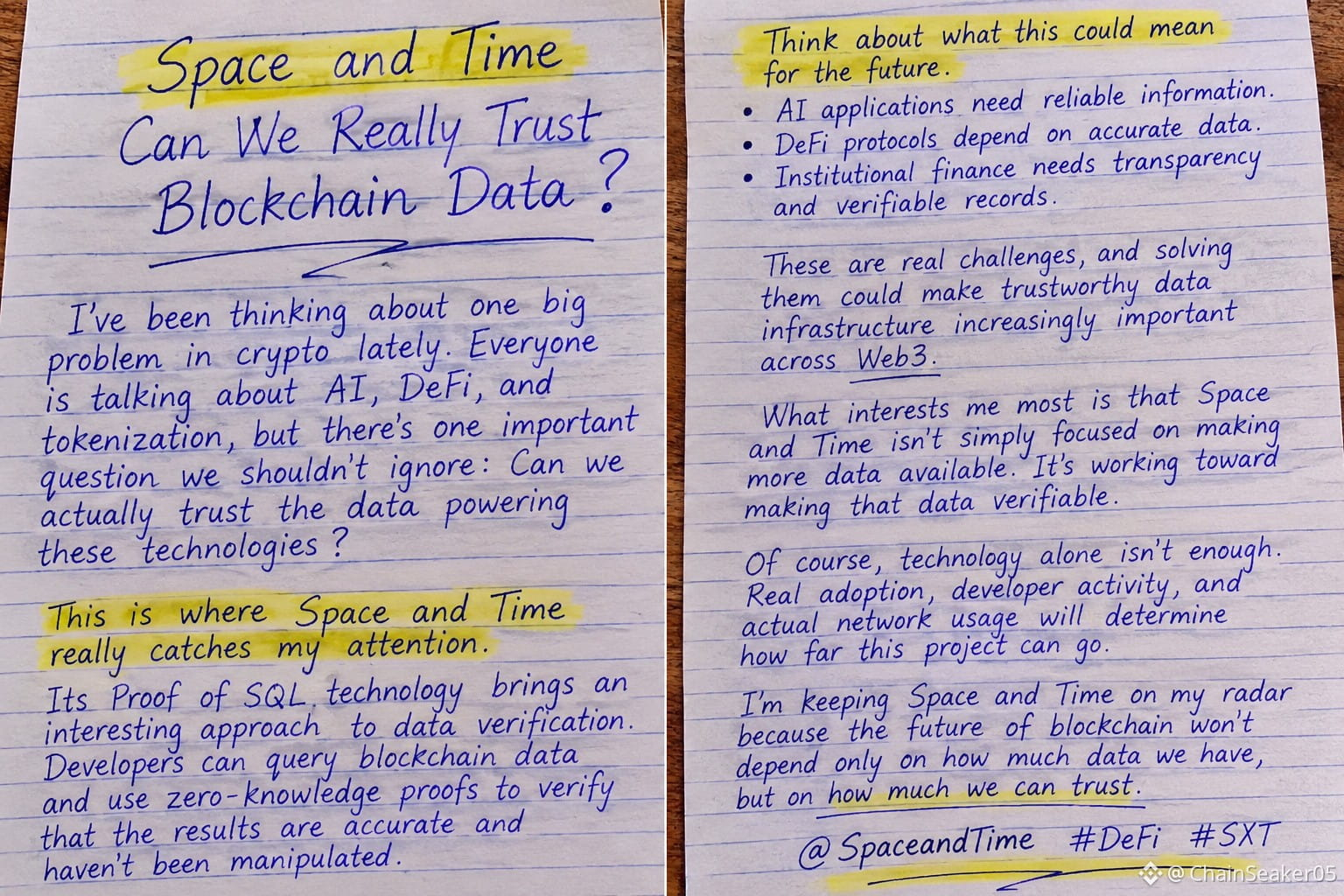
I've been thinking about one big problem in crypto lately. Everyone is talking about AI, DeFi, and tokenization, but there's one important question we shouldn't ignore: Can we actually trust the data powering these technologies?
This is where Space and Time really catches my attention.
Its Proof of SQL technology brings an interesting approach to data verification. Developers can query blockchain data and use zero-knowledge proofs to verify that the results are accurate and haven't been manipulated.
Think about what this could mean for the future.
AI applications need reliable information. DeFi protocols depend on accurate data. Institutional finance needs transparency and verifiable records.
These are real challenges, and solving them could make trustworthy data infrastructure increasingly important across Web3.
What interests me most is that Space and Time isn't simply focused on making more data available. It's working toward making that data verifiable.
Of course, technology alone isn't enough. Real adoption, developer activity, and actual network usage will determine how far this project can go.
I'm keeping Space and Time on my radar because the future of blockchain won't depend only on how much data we have, but on how much we can trust.
@SpaceandTimeDB $SXT #sxt #SXT
I've been thinking about one big problem in crypto lately. Everyone is talking about AI, DeFi, and tokenization, but there's one important question we shouldn't ignore: Can we actually trust the data powering these technologies?
This is where Space and Time really catches my attention.
Its Proof of SQL technology brings an interesting approach to data verification. Developers can query blockchain data and use zero-knowledge proofs to verify that the results are accurate and haven't been manipulated.
Think about what this could mean for the future.
AI applications need reliable information. DeFi protocols depend on accurate data. Institutional finance needs transparency and verifiable records.
These are real challenges, and solving them could make trustworthy data infrastructure increasingly important across Web3.
What interests me most is that Space and Time isn't simply focused on making more data available. It's working toward making that data verifiable.
Of course, technology alone isn't enough. Real adoption, developer activity, and actual network usage will determine how far this project can go.
I'm keeping Space and Time on my radar because the future of blockchain won't depend only on how much data we have, but on how much we can trust.
@SpaceandTime $SXT #sxt #SXT
6
4
282
$MEGA I've been looking into MegaETH, and I think its approach to Ethereum scaling deserves attention.
MegaETH is building a high-performance, EVM-compatible Layer 2 designed to make blockchain transactions faster and more responsive. Its goal is simple but ambitious: bring real-time execution to applications without abandoning Ethereum's security and settlement environment.
What makes this project interesting is its focus on performance. Instead of treating speed as just another marketing point, MegaETH is redesigning how network execution works to support demanding applications, including trading, DeFi and interactive onchain experiences.
The $MEGA token is also an important part of its ecosystem. It powers the network's economic model, supports KPI-based reward commitments, and has a role in planned staking and sequencer mechanisms. The project also connects ecosystem growth with token buybacks through its native stablecoin, USDm.
Looking at today's chart, MEGA is trading around $0.04885, up 7.24% over 24 hours. On the 15-minute timeframe, price is moving above MA(7), MA(25), and MA(99), showing encouraging short-term momentum. However, holding this strength matters more than one green candle.
For me, the real question is whether MegaETH can turn impressive technology into sustained adoption.
That's what I'll be watching.
$MEGA
156
I've been watching $DODO closely, and today's move definitely caught my attention. 👀
DODO is trading around $0.03382, up nearly 17% in 24 hours. That's an interesting move, especially with trading volume reaching over $8M.
But here's what I'm watching now...
After touching $0.03582, the price started cooling down. The short-term chart shows some selling pressure, with $0.03316 acting as an important nearby level to watch.
If buyers step back in and volume returns, another attempt toward $0.03582 could become interesting.
I'm not calling a breakout just yet. I want to see confirmation, not just green candles.
Sometimes the real opportunity appears after the excitement settles.
Eyes on DODO. The next move matters! 🔥
$DODO
#Crypto #Altcoins #Binance
1
84
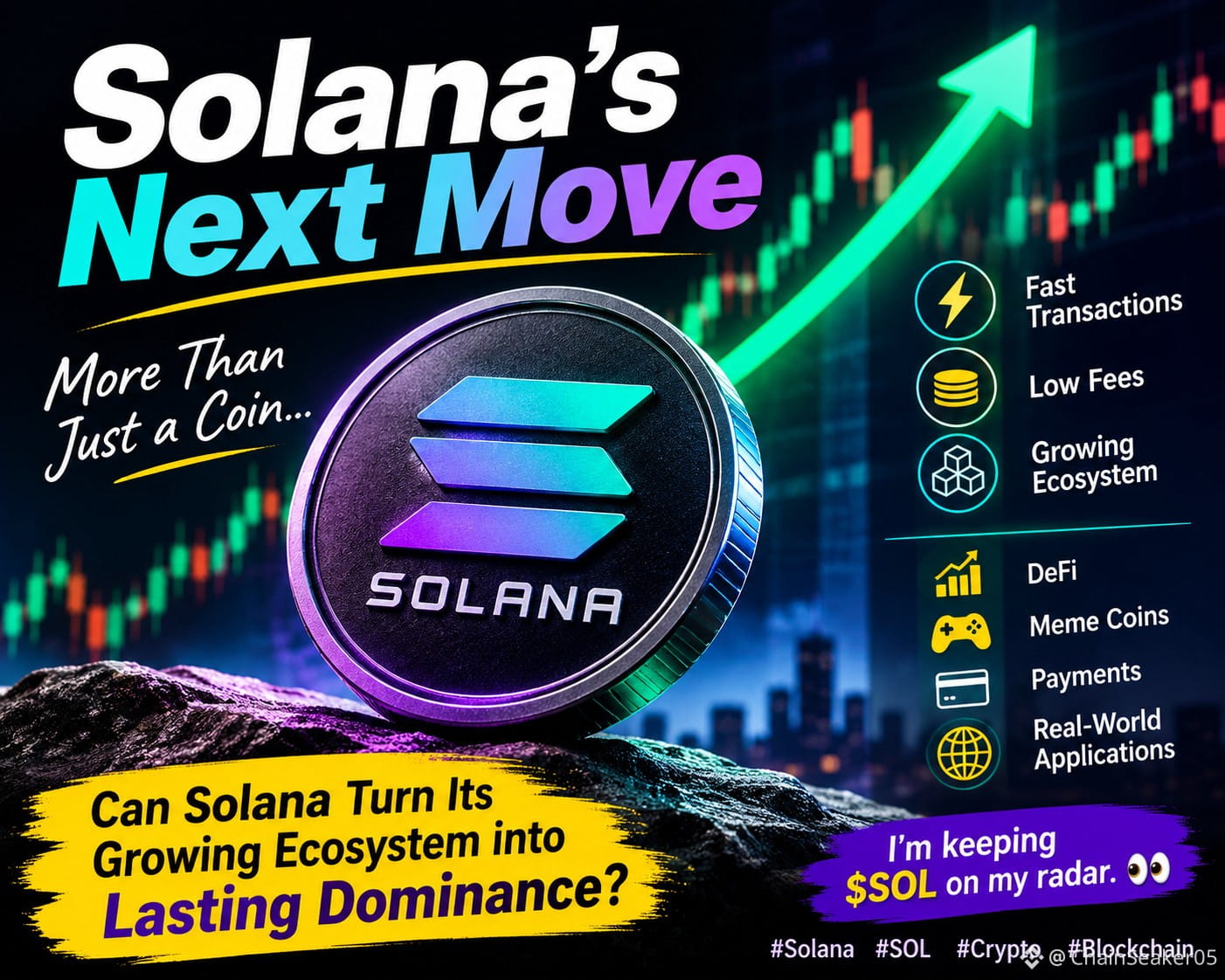
$SOL I've been watching Solana closely, and one thing keeps catching my attention.
$SOL is more than just another crypto asset competing for market attention. Its fast transactions, low fees, and growing ecosystem continue to make it an interesting player in the blockchain space.
What I find interesting is how Solana keeps building through different market conditions. DeFi, meme coins, payments, and real-world applications are all adding new dimensions to its ecosystem.
But I'm not looking at price alone. Sustainable adoption, network reliability, and real user activity are what matter most in the long run.
The real question is, can Solana turn its growing ecosystem into lasting dominance?
I'm keeping on my radar.
$SOL
{spot}(SOLUSDT)
#Crypto #Blockchain
$SOL I've been watching Solana closely, and one thing keeps catching my attention.
$SOL is more than just another crypto asset competing for market attention. Its fast transactions, low fees, and growing ecosystem continue to make it an interesting player in the blockchain space.
What I find interesting is how Solana keeps building through different market conditions. DeFi, meme coins, payments, and real-world applications are all adding new dimensions to its ecosystem.
But I'm not looking at price alone. Sustainable adoption, network reliability, and real user activity are what matter most in the long run.
The real question is, can Solana turn its growing ecosystem into lasting dominance?
I'm keeping on my radar.
$SOL
#Crypto #Blockchain
1
185
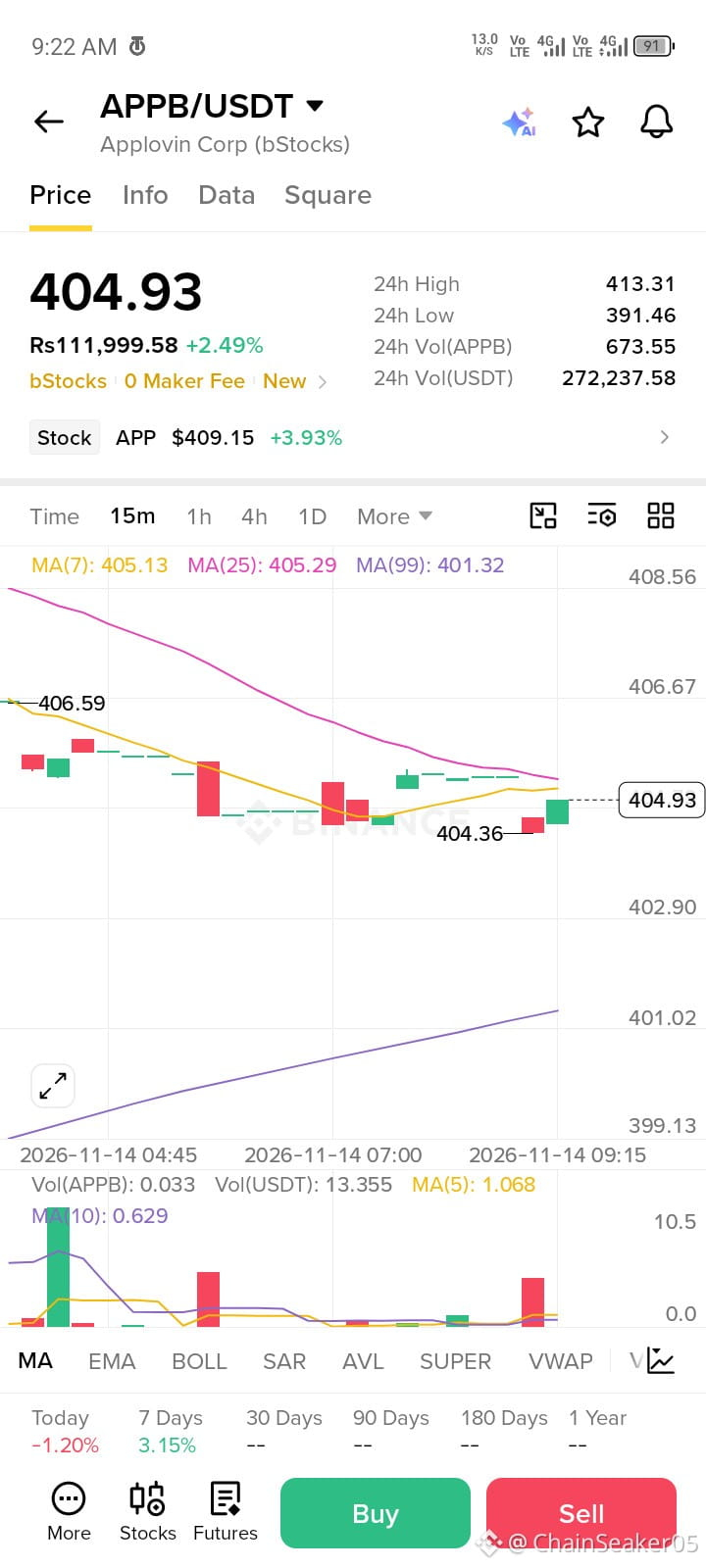
I've been watching $APPB and this chart has caught my attention.
Trading around $404.93, APPB is showing a small positive move, but the interesting part is how buyers are trying to defend the $404.36 area.
The next challenge is pushing above $405 to $406. If buying pressure increases, we could see a stronger recovery.
I'm not calling it a breakout just yet. Volume and follow through will matter more than one green candle.
Sometimes the quiet moves are worth watching closely. Is $APPB getting ready for another push?
$APPB
{spot}(APPBUSDT)
#USPPIMissMayEaseBTCPressure #BitcoinBreaksBelow200WeekMovingAverage #Anthropic’s6xIPODemandSignalsPotentialRecordRaise #RippleRLUSDMarketCapSurpassesPayPalPYUSD
I've been watching $APPB and this chart has caught my attention.
Trading around $404.93, APPB is showing a small positive move, but the interesting part is how buyers are trying to defend the $404.36 area.
The next challenge is pushing above $405 to $406. If buying pressure increases, we could see a stronger recovery.
I'm not calling it a breakout just yet. Volume and follow through will matter more than one green candle.
Sometimes the quiet moves are worth watching closely. Is $APPB getting ready for another push?
$APPB
#USPPIMissMayEaseBTCPressure #BitcoinBreaksBelow200WeekMovingAverage #Anthropic’s6xIPODemandSignalsPotentialRecordRaise #RippleRLUSDMarketCapSurpassesPayPalPYUSD
1
214
$SHELL
{spot}(SHELLUSDT)
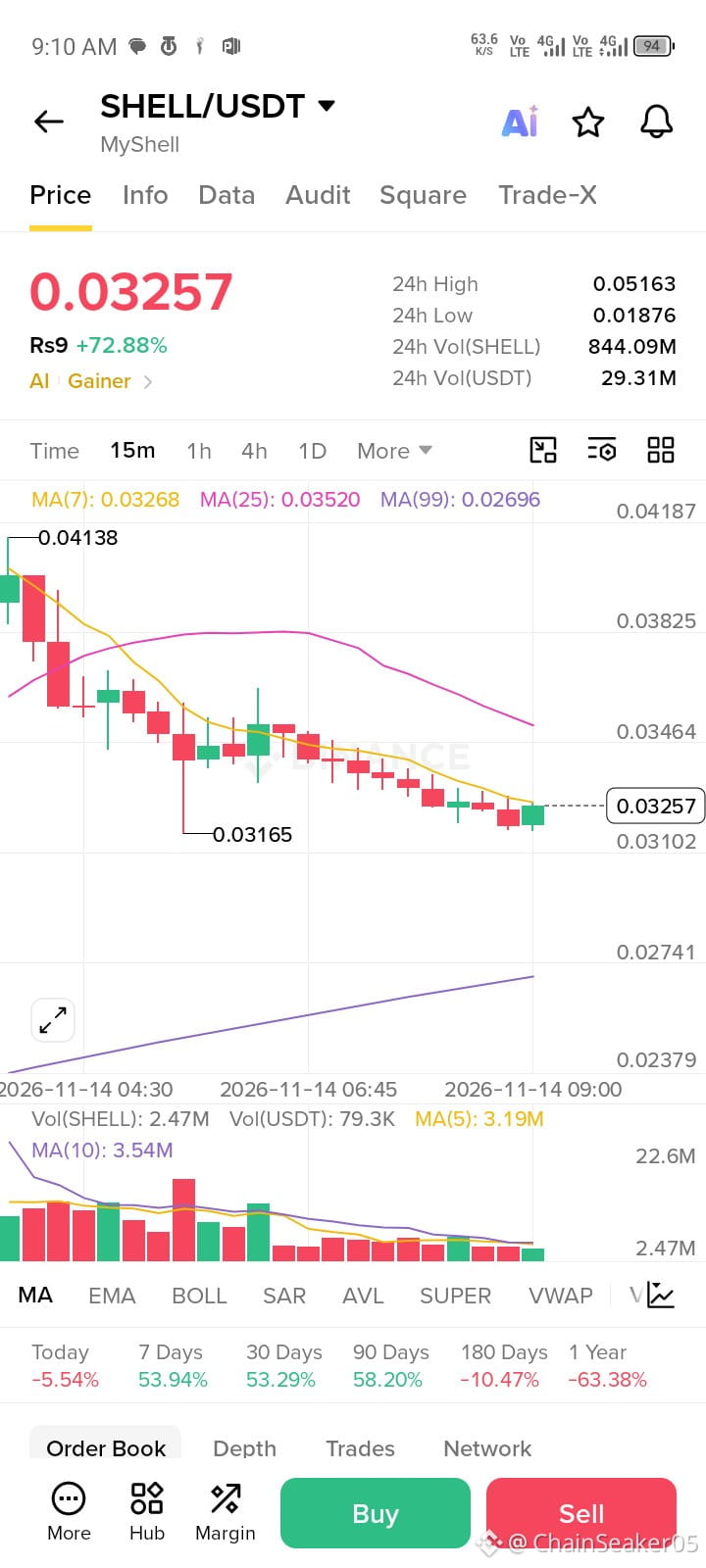
I've been watching $SHELL, and this sudden move is getting interesting. 👀
A 72%+ gain in 24 hours is hard to ignore, especially with trading volume reaching around 844M SHELL.
But here's what caught my attention: after the strong rally, price has started consolidating around $0.0325. The short-term trend still needs confirmation, and buyers must show they can defend this level.
I'm watching the $0.0350 area for a possible recovery and $0.0316 as an important nearby support.
Big pumps create excitement, but what happens afterward tells the real story.
Is $SHELL preparing for another move, or does it need more time to build strength? 🔥
#SHELL #Crypto #Binance
$SHELL
I've been watching $SHELL , and this sudden move is getting interesting. 👀
A 72%+ gain in 24 hours is hard to ignore, especially with trading volume reaching around 844M SHELL.
But here's what caught my attention: after the strong rally, price has started consolidating around $0.0325. The short-term trend still needs confirmation, and buyers must show they can defend this level.
I'm watching the $0.0350 area for a possible recovery and $0.0316 as an important nearby support.
Big pumps create excitement, but what happens afterward tells the real story.
Is $SHELL preparing for another move, or does it need more time to build strength? 🔥
#SHELL #Crypto #Binance
199
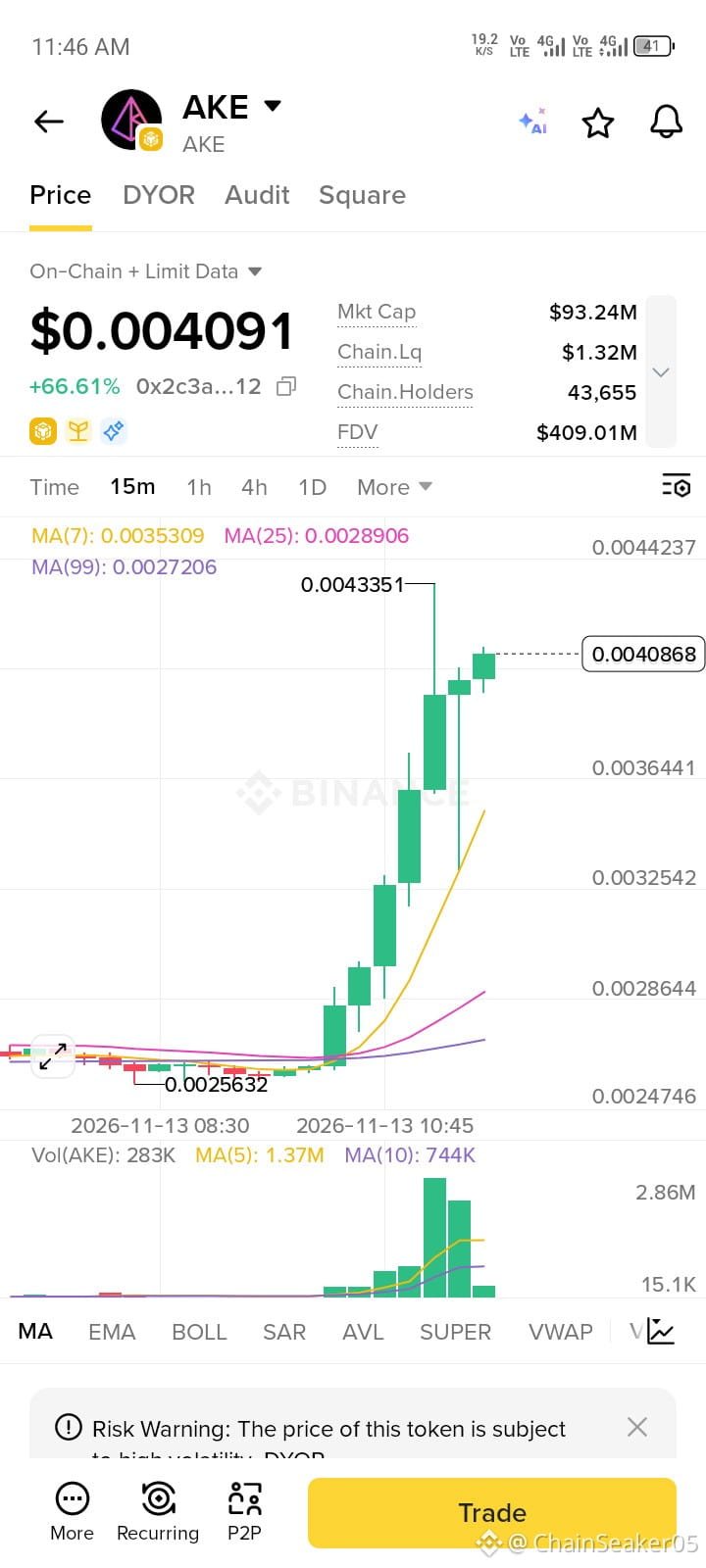
AKE is suddenly waking up!
$AKE is up over 66% and the chart is showing serious buying pressure. Volume is rising, momentum is building, and traders are starting to pay attention.
But after a move like this, can bulls push even higher or will profit-taking step in?
I'm keeping $AKE on my radar. The next move could be interesting!
$AKE
{future}(AKEUSDT)
#AKE #Crypto #Binance
AKE is suddenly waking up!
$AKE is up over 66% and the chart is showing serious buying pressure. Volume is rising, momentum is building, and traders are starting to pay attention.
But after a move like this, can bulls push even higher or will profit-taking step in?
I'm keeping $AKE on my radar. The next move could be interesting!
$AKE
#AKE #Crypto #Binance
1
511
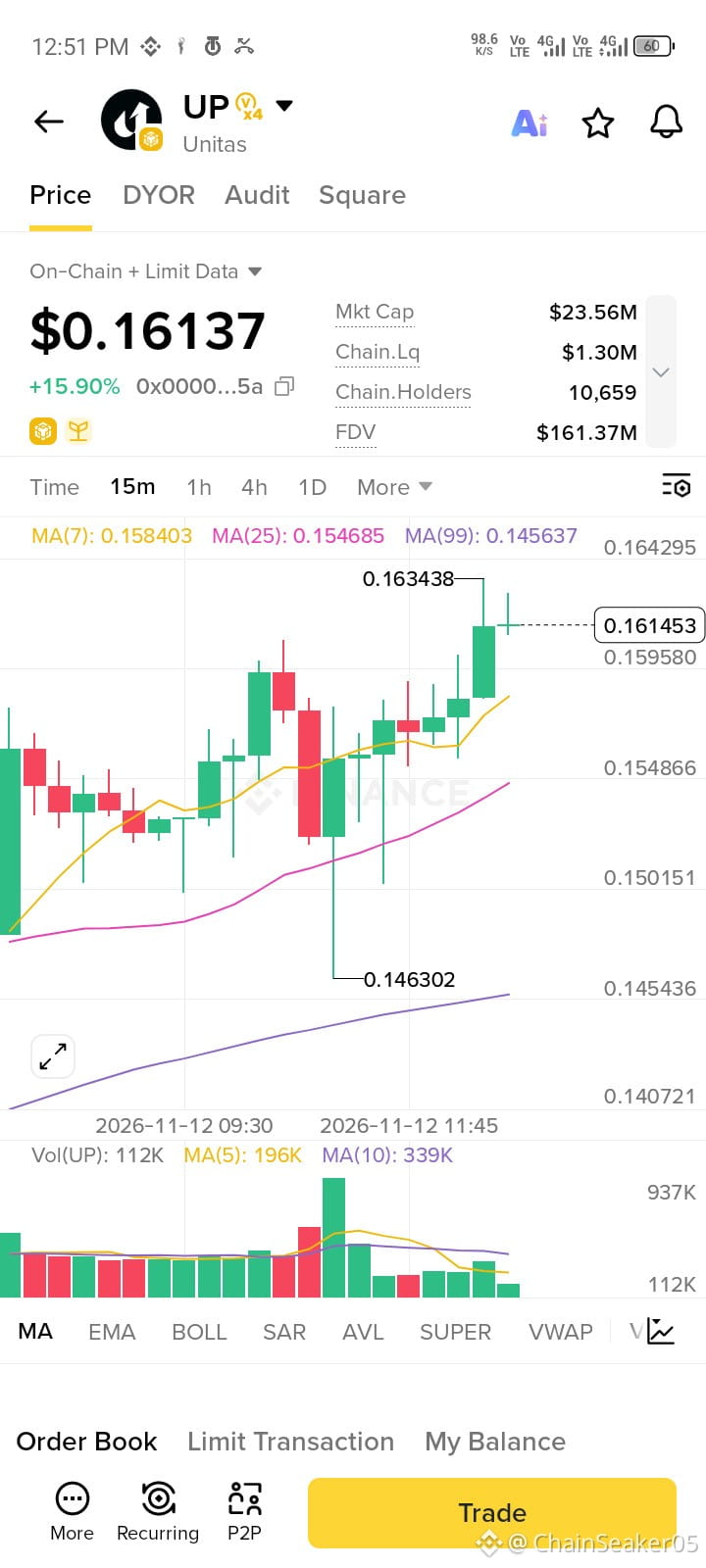
$UP is waking up!
A strong 15.90% move has caught my attention. Buyers are pushing the price higher, and momentum is building on the 15-minute chart.
The next move could be interesting. Can $UP keep this momentum alive and break higher?
Watching closely!
$UP
{alpha}(560x000008d2175f9aeaddb2430c26f8a6f73c5a0000)
#BinanceSquare #Crypto #BinanceSquare
$UP is waking up!
A strong 15.90% move has caught my attention. Buyers are pushing the price higher, and momentum is building on the 15-minute chart.
The next move could be interesting. Can $UP keep this momentum alive and break higher?
Watching closely!
$UP
#BinanceSquare #Crypto #BinanceSquare
A strong 15.90% move has caught my attention. Buyers are pushing the price higher, and momentum is building on the 15-minute chart.
The next move could be interesting. Can $UP keep this momentum alive and break higher?
Watching closely!
$UP
#BinanceSquare #Crypto #BinanceSquare
163
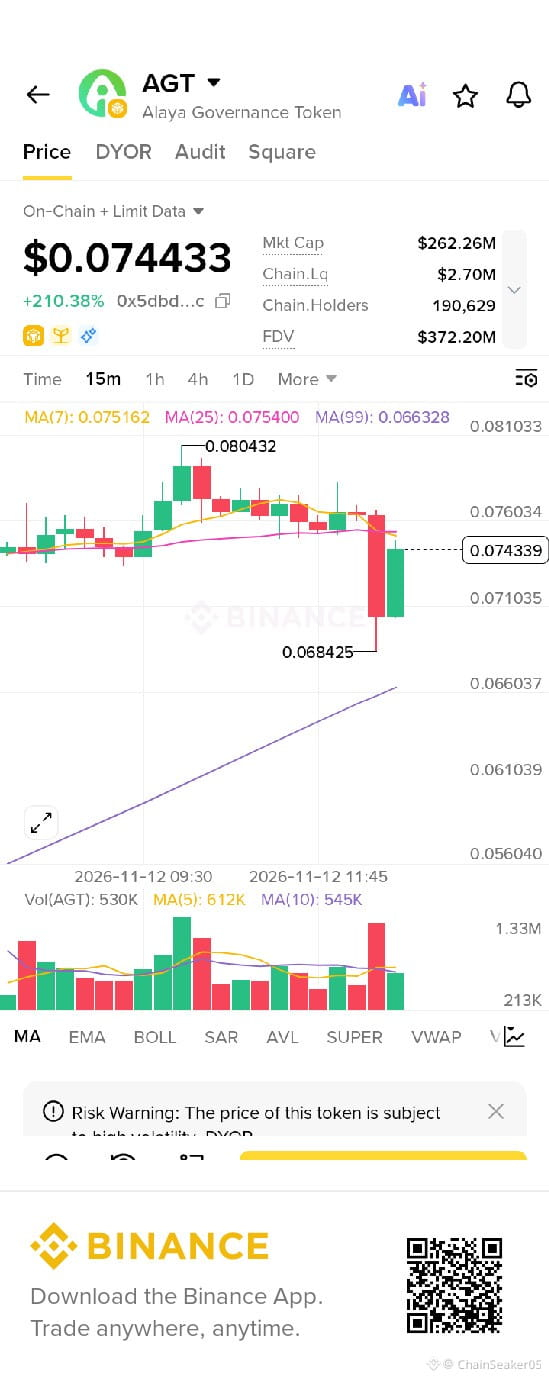
$AGT is getting attention!
A 210%+ surge, followed by a sharp pullback and an immediate bounce.
What caught my eye is the buying activity after the dip to $0.0684.
Is this just a temporary recovery, or could AGT be preparing for another move?
I'm watching volume and the $0.076 resistance closely. The next move could be interesting!
$AGT
{future}(AGTUSDT)
#HuangRisksOusterOverReportedAffairWithSubordinate #CoreWeaveJumps10%On168%RevenueGrowth
$AGT is getting attention!
A 210%+ surge, followed by a sharp pullback and an immediate bounce.
What caught my eye is the buying activity after the dip to $0.0684.
Is this just a temporary recovery, or could AGT be preparing for another move?
I'm watching volume and the $0.076 resistance closely. The next move could be interesting!
$AGT
#HuangRisksOusterOverReportedAffairWithSubordinate #CoreWeaveJumps10%On168%RevenueGrowth
275
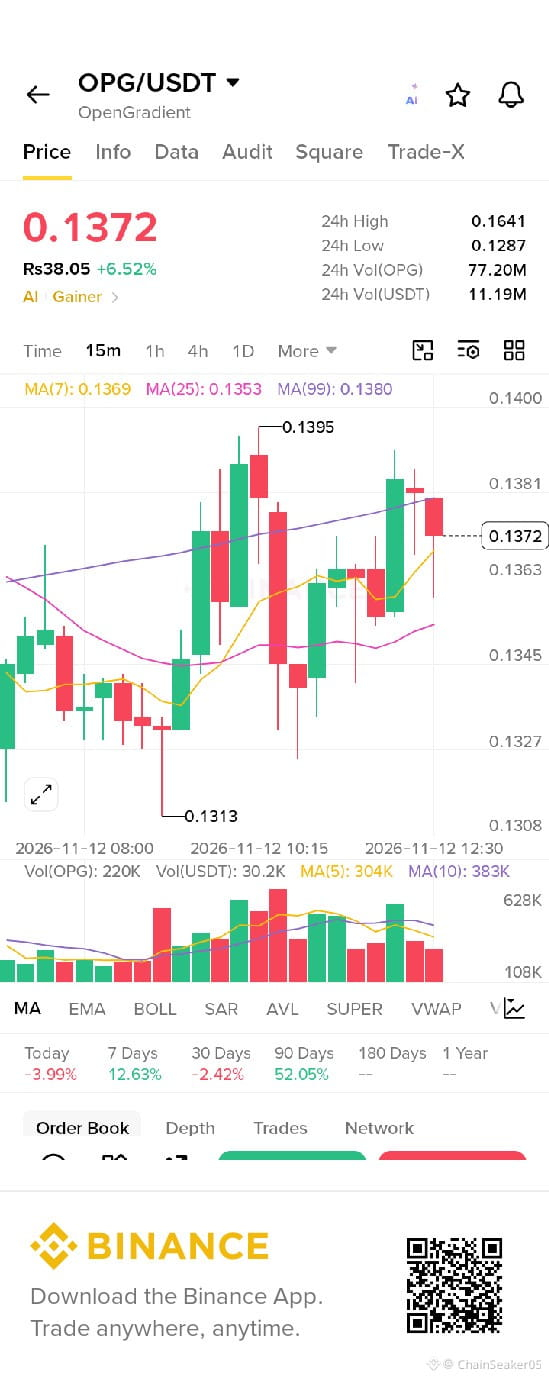
$OPG IS WAKING UP! IS ANOTHER MOVE COMING?
Something interesting is happening with @OpenGradient right now.
$OPG is trading around $0.1372, up approximately 6.52% in 24 hours, with trading volume reaching $11.19M.
But the price movement is only part of the story.
Looking at the 15-minute chart, OPG recently pushed toward $0.1395 before facing some selling pressure. Now the important question is whether buyers can regain control and push through the $0.1380 to $0.1400 resistance zone.
Here’s what I'm watching:
$0.1400: A breakout could bring fresh attention.
$0.1380: An important level to reclaim.
$0.1350: A level worth watching during a pullback.
What makes this interesting is the combination of rising activity and price momentum.
I'm not calling a guaranteed breakout, but definitely deserves attention right now.
Sometimes the most interesting moves begin when the market isn't paying attention.
Are we looking at the beginning of another OPG move, or will sellers take control?
$OPG
{spot}(OPGUSDT)
#OpenGradient #OPG #Crypto #BinanceSquare
$OPG IS WAKING UP! IS ANOTHER MOVE COMING?
Something interesting is happening with @OpenGradient right now.
$OPG is trading around $0.1372, up approximately 6.52% in 24 hours, with trading volume reaching $11.19M.
But the price movement is only part of the story.
Looking at the 15-minute chart, OPG recently pushed toward $0.1395 before facing some selling pressure. Now the important question is whether buyers can regain control and push through the $0.1380 to $0.1400 resistance zone.
Here’s what I'm watching:
$0.1400: A breakout could bring fresh attention.
$0.1380: An important level to reclaim.
$0.1350: A level worth watching during a pullback.
What makes this interesting is the combination of rising activity and price momentum.
I'm not calling a guaranteed breakout, but definitely deserves attention right now.
Sometimes the most interesting moves begin when the market isn't paying attention.
Are we looking at the beginning of another OPG move, or will sellers take control?
$OPG
#OpenGradient #OPG #Crypto #BinanceSquare
291
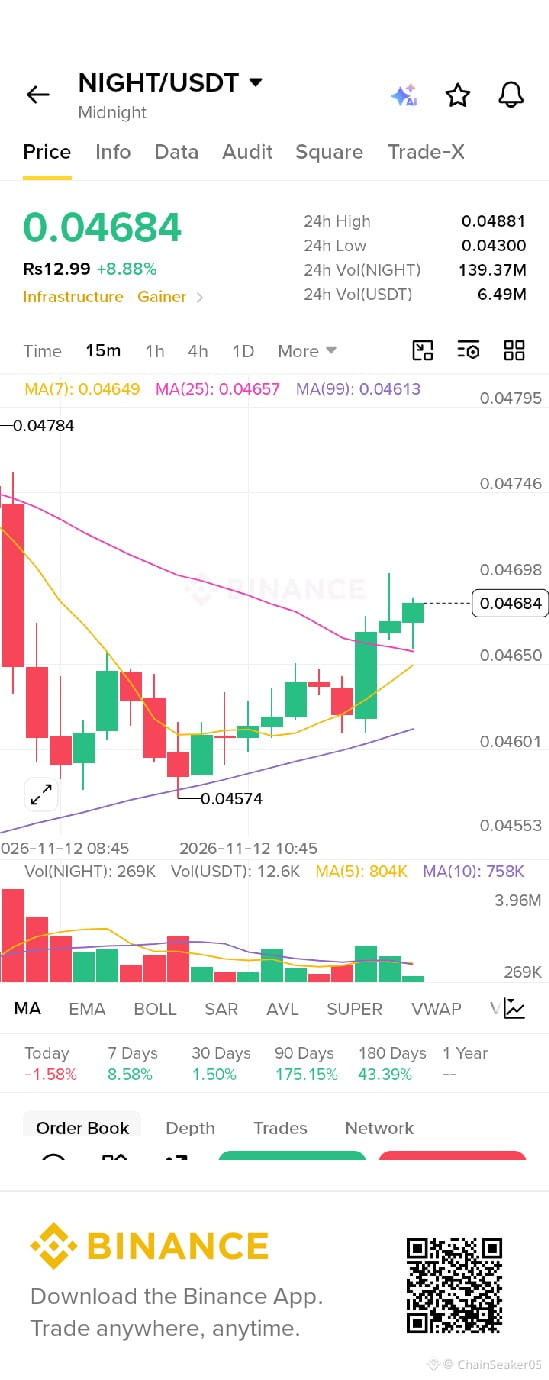
$NIGHT IS WAKING UP! IS ANOTHER MOVE COMING?
Something interesting is happening with @MidnightNetwork
is trading around $0.04684, up nearly 8.88% in the last 24 hours, and the short-term chart is starting to look interesting.
A few things caught my attention:
Price has recovered strongly from the $0.04574 area.
Buyers are pushing price above the MA(7), MA(25), and MA(99) on the 15-minute chart.
Trading volume is showing strong activity, suggesting traders are paying attention.
Now, the important levels to watch are $0.04700 and $0.04750. A strong breakout with increasing volume could open the door for another upward move.
But I don't want to get carried away. Losing the $0.04600 support could weaken this short-term momentum.
What interests me most is whether buyers can maintain this pressure.
Is $NIGHT preparing for another leg up, or will sellers step in?
I'm watching closely. 👀
$NIGHT
{spot}(NIGHTUSDT)
#HuangRisksOusterOverReportedAffairWithSubordinate #MSCIRemovalMayCurbStrategy’sBitcoinBuying #PythAddsNYSERealTimeDataToMarketplace
$NIGHT IS WAKING UP! IS ANOTHER MOVE COMING?
Something interesting is happening with @MidnightNetwork
is trading around $0.04684, up nearly 8.88% in the last 24 hours, and the short-term chart is starting to look interesting.
A few things caught my attention:
Price has recovered strongly from the $0.04574 area.
Buyers are pushing price above the MA(7), MA(25), and MA(99) on the 15-minute chart.
Trading volume is showing strong activity, suggesting traders are paying attention.
Now, the important levels to watch are $0.04700 and $0.04750. A strong breakout with increasing volume could open the door for another upward move.
But I don't want to get carried away. Losing the $0.04600 support could weaken this short-term momentum.
What interests me most is whether buyers can maintain this pressure.
Is $NIGHT preparing for another leg up, or will sellers step in?
I'm watching closely. 👀
$NIGHT
#HuangRisksOusterOverReportedAffairWithSubordinate #MSCIRemovalMayCurbStrategy’sBitcoinBuying #PythAddsNYSERealTimeDataToMarketplace
159
$ETH
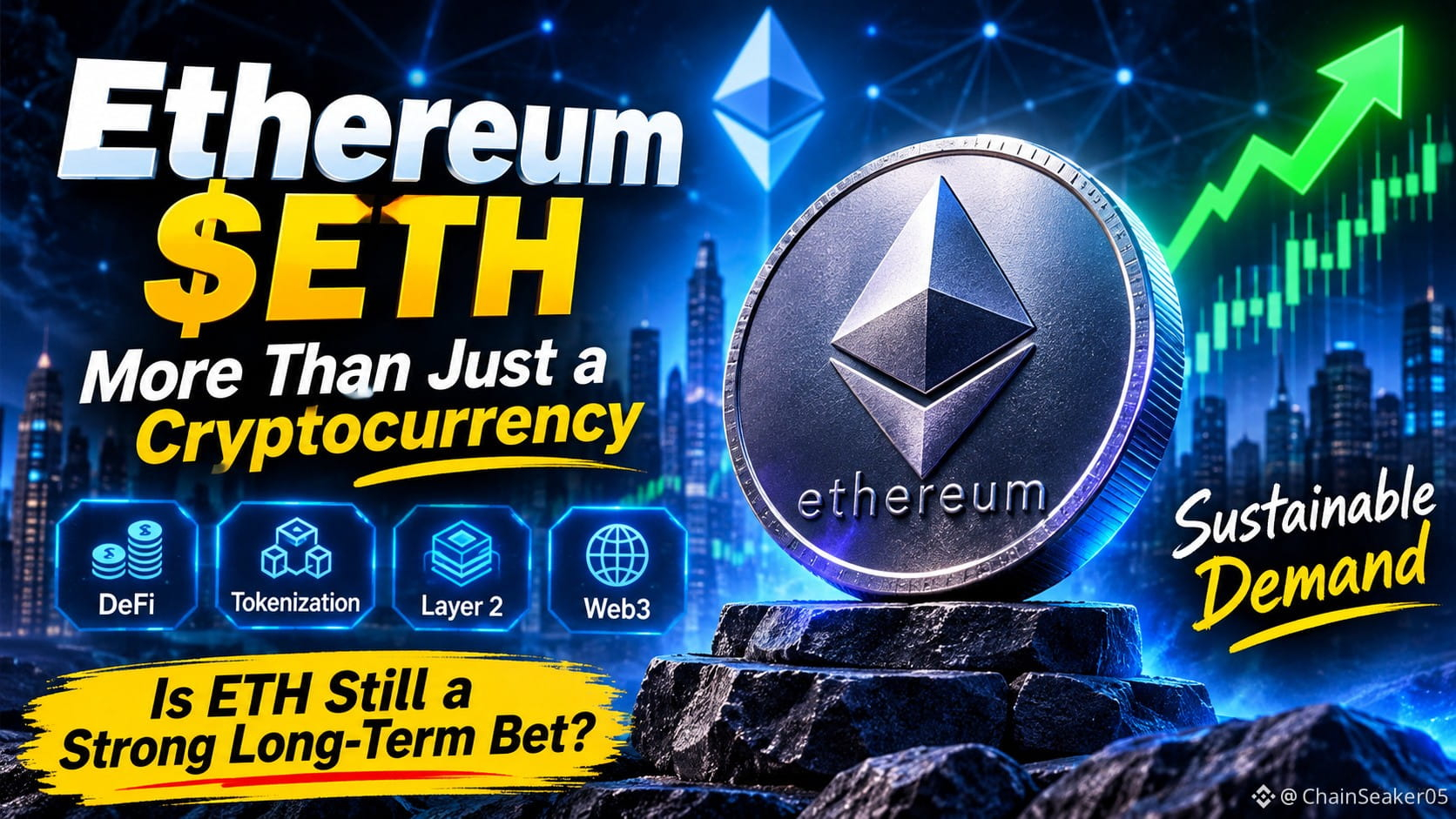
ETHEREUM IS MORE THAN JUST A CRYPTOCURRENCY 👀
I've been looking at Ethereum lately, and one thing stands out to me: its importance goes far beyond short-term price movements.
While the market focuses heavily on daily candles, Ethereum continues to play a major role in DeFi, stablecoins, tokenization, and the growing world of Web3.
What makes ETH interesting is its ecosystem. Developers are building on it, institutions are exploring blockchain-based finance, and Layer 2 networks are expanding its reach.
But there's one question I keep asking myself:
Can Ethereum turn its massive ecosystem into stronger long-term demand for ETH?
Technology and adoption are important, but value must eventually reflect in the token itself.
I'm watching network activity, ETH supply dynamics, institutional interest, and real ecosystem growth rather than following every market headline.
Ethereum doesn't need another hype cycle. It needs sustainable demand.
What's your view? Is $ETH still one of the strongest long-term opportunities in crypto?
$ETH
{spot}(ETHUSDT)
#JobsReportRaisesHikeOdds #NvidiaInvestigatesAfterHuang’sAffairApology
$ETH
ETHEREUM IS MORE THAN JUST A CRYPTOCURRENCY 👀
I've been looking at Ethereum lately, and one thing stands out to me: its importance goes far beyond short-term price movements.
While the market focuses heavily on daily candles, Ethereum continues to play a major role in DeFi, stablecoins, tokenization, and the growing world of Web3.
What makes ETH interesting is its ecosystem. Developers are building on it, institutions are exploring blockchain-based finance, and Layer 2 networks are expanding its reach.
But there's one question I keep asking myself:
Can Ethereum turn its massive ecosystem into stronger long-term demand for ETH?
Technology and adoption are important, but value must eventually reflect in the token itself.
I'm watching network activity, ETH supply dynamics, institutional interest, and real ecosystem growth rather than following every market headline.
Ethereum doesn't need another hype cycle. It needs sustainable demand.
What's your view? Is $ETH still one of the strongest long-term opportunities in crypto?
$ETH
#JobsReportRaisesHikeOdds #NvidiaInvestigatesAfterHuang’sAffairApology
122
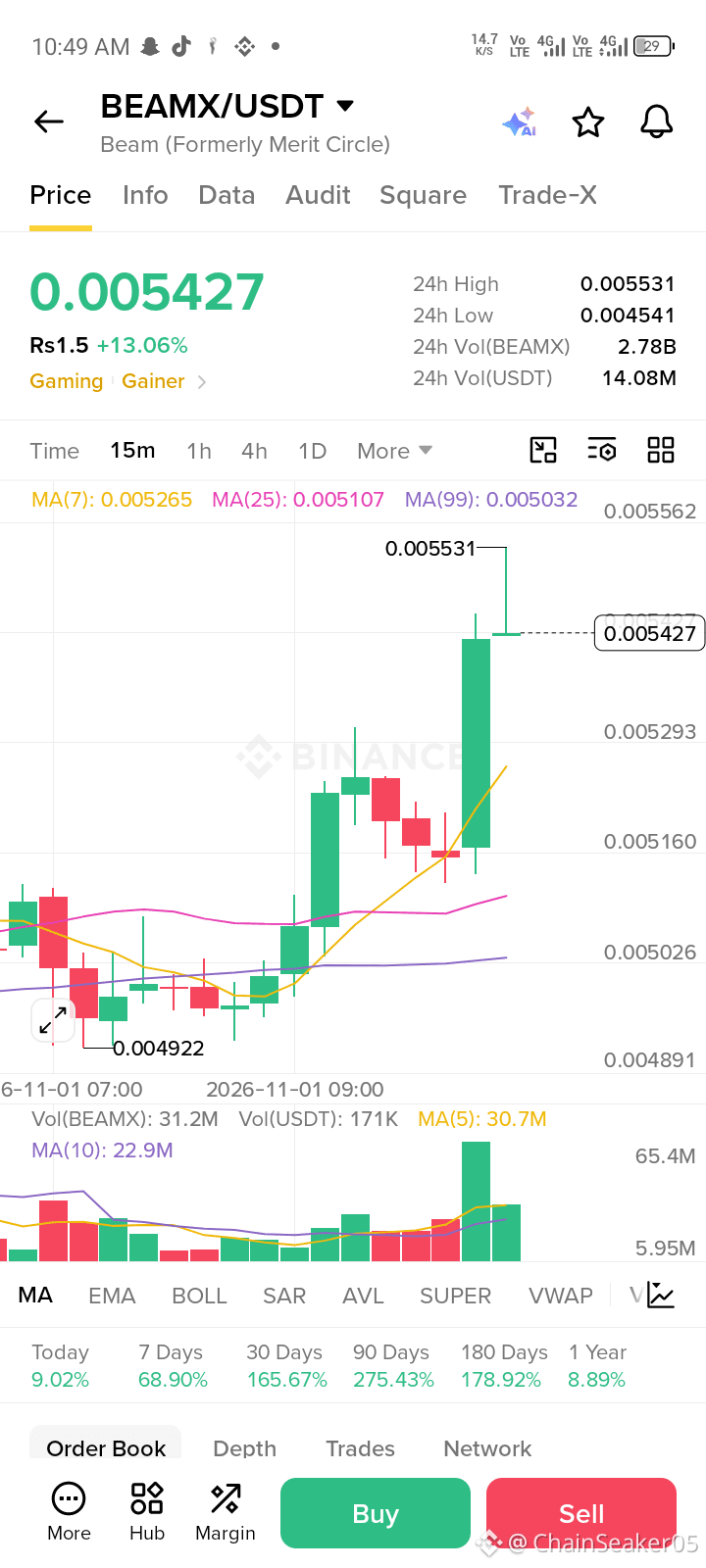
$BEAMX IS WAKING UP, AND THE CHART IS GETTING INTERESTING!
I've been watching $BEAMX, and something caught my attention today.
The price is currently around $0.005427, up more than 13% in 24 hours. But what makes this move interesting isn't just the green candles. It's the sudden increase in trading volume.
On the 15-minute chart, buyers have stepped in aggressively, pushing BEAMX above its short-term moving averages.
Here's what I'm watching:
🔥 Price: $0.005427
🔥 24H Change: +13.06%
🔥 24H Volume: $14.08M
🔥 Recent High: $0.005531
Now comes the important part.
Can buyers maintain this momentum, or will early traders start taking profits?
The $0.00553 area is the immediate resistance I'm watching. A strong breakout with sustained volume could make the next move interesting. On the other hand, losing momentum here could bring a short-term pullback.
One thing I've learned from watching crypto markets is that a big green candle attracts attention, but what happens AFTER that candle tells a much bigger story.
I'm not chasing the pump. I'm watching whether the buying pressure is real and sustainable. 👀
What do you think about $BEAMX? Is this the beginning of another leg up, or are we getting close to a short-term cooldown?
$BEAMX
{spot}(BEAMXUSDT)
$BEAMX IS WAKING UP, AND THE CHART IS GETTING INTERESTING!
I've been watching $BEAMX , and something caught my attention today.
The price is currently around $0.005427, up more than 13% in 24 hours. But what makes this move interesting isn't just the green candles. It's the sudden increase in trading volume.
On the 15-minute chart, buyers have stepped in aggressively, pushing BEAMX above its short-term moving averages.
Here's what I'm watching:
🔥 Price: $0.005427
🔥 24H Change: +13.06%
🔥 24H Volume: $14.08M
🔥 Recent High: $0.005531
Now comes the important part.
Can buyers maintain this momentum, or will early traders start taking profits?
The $0.00553 area is the immediate resistance I'm watching. A strong breakout with sustained volume could make the next move interesting. On the other hand, losing momentum here could bring a short-term pullback.
One thing I've learned from watching crypto markets is that a big green candle attracts attention, but what happens AFTER that candle tells a much bigger story.
I'm not chasing the pump. I'm watching whether the buying pressure is real and sustainable. 👀
What do you think about $BEAMX ? Is this the beginning of another leg up, or are we getting close to a short-term cooldown?
$BEAMX
357
WHAT HAPPENS WHEN AN AI AGENT MAKES A FINANCIAL MISTAKE? 👀
I've been looking at the AI agent narrative from a slightly different angle lately.
Everyone wants AI agents that can do more. Execute tasks, make payments, access services, and operate without waiting for human approval every time.
But here's the part I think deserves more attention.
What happens when an agent makes the wrong decision with your money?
Imagine giving an AI agent permission to pay for a service while you're offline. It finds an option, executes the payment, and completes the task. Sounds convenient, right?
Now imagine it chooses the wrong service or spends more than you expected. Suddenly, automation becomes a question of trust.
This is where @GoKiteAI gets interesting to me.
The bigger opportunity isn't simply allowing AI agents to move money. It's creating a system where permissions, spending limits, payment sessions, and verifiable actions can help keep that autonomy under control.
Kite's Passport and payment-session approach are worth watching in that context. But having the infrastructure is only one part of the equation.
The real test is whether developers build useful applications around it, users trust those applications with real transactions, and the system proves reliable beyond early experiments.
I'm not convinced that more autonomous agents automatically mean a better AI economy.
The real breakthrough might be an agent that knows exactly what it can do, what it cannot do, and when it needs human approval.
That's the difference between an AI that can act and one people might actually trust with their money.
And honestly, I think that distinction will matter a lot as the agent economy develops.
$KITE #kite
{spot}(KITEUSDT)
WHAT HAPPENS WHEN AN AI AGENT MAKES A FINANCIAL MISTAKE? 👀
I've been looking at the AI agent narrative from a slightly different angle lately.
Everyone wants AI agents that can do more. Execute tasks, make payments, access services, and operate without waiting for human approval every time.
But here's the part I think deserves more attention.
What happens when an agent makes the wrong decision with your money?
Imagine giving an AI agent permission to pay for a service while you're offline. It finds an option, executes the payment, and completes the task. Sounds convenient, right?
Now imagine it chooses the wrong service or spends more than you expected. Suddenly, automation becomes a question of trust.
This is where @KITE AI 中文 gets interesting to me.
The bigger opportunity isn't simply allowing AI agents to move money. It's creating a system where permissions, spending limits, payment sessions, and verifiable actions can help keep that autonomy under control.
Kite's Passport and payment-session approach are worth watching in that context. But having the infrastructure is only one part of the equation.
The real test is whether developers build useful applications around it, users trust those applications with real transactions, and the system proves reliable beyond early experiments.
I'm not convinced that more autonomous agents automatically mean a better AI economy.
The real breakthrough might be an agent that knows exactly what it can do, what it cannot do, and when it needs human approval.
That's the difference between an AI that can act and one people might actually trust with their money.
And honestly, I think that distinction will matter a lot as the agent economy develops.
$KITE #kite

1
1
148
FALCON FINANCE: WHAT IF YOU DIDN'T HAVE TO SELL YOUR ASSETS TO ACCESS LIQUIDITY? 👀
I've been looking at Falcon Finance lately, and one thing caught my attention.
In crypto, holding an asset and having liquidity are often two different things. You might believe in a project long term, but sometimes you need access to dollars without selling what you're holding.
That's the problem Falcon Finance is trying to solve.
Its protocol allows users to deposit eligible liquid assets, including digital tokens and tokenized real-world assets, as collateral to mint USDf, an overcollateralized synthetic dollar.
The idea sounds interesting. Instead of selling an asset to free up capital, you could potentially keep your exposure while accessing onchain liquidity.
But here's where I start asking questions.
How well does the collateral system perform when markets turn ugly? How resilient is USDf during extreme volatility? And how sustainable is the yield generated across the ecosystem?
Because building a synthetic dollar is one thing. Maintaining its stability when everyone suddenly wants liquidity is a completely different challenge.
I think the bigger story here isn't simply another dollar-pegged token. It's whether collateral can become more useful across DeFi without introducing risks that users don't fully understand.
I'm interested in seeing how Falcon handles the difficult market conditions, not just how the protocol looks when everything is going well.
Useful infrastructure is proven under pressure, not during a bull market.
What's your take on Falcon Finance? Is universal collateralization a meaningful step forward for DeFi, or does it introduce risks that the market may be underestimating?
@falcon_finance #FalconFİnance $FF
{spot}(FFUSDT)
FALCON FINANCE: WHAT IF YOU DIDN'T HAVE TO SELL YOUR ASSETS TO ACCESS LIQUIDITY? 👀
I've been looking at Falcon Finance lately, and one thing caught my attention.
In crypto, holding an asset and having liquidity are often two different things. You might believe in a project long term, but sometimes you need access to dollars without selling what you're holding.
That's the problem Falcon Finance is trying to solve.
Its protocol allows users to deposit eligible liquid assets, including digital tokens and tokenized real-world assets, as collateral to mint USDf, an overcollateralized synthetic dollar.
The idea sounds interesting. Instead of selling an asset to free up capital, you could potentially keep your exposure while accessing onchain liquidity.
But here's where I start asking questions.
How well does the collateral system perform when markets turn ugly? How resilient is USDf during extreme volatility? And how sustainable is the yield generated across the ecosystem?
Because building a synthetic dollar is one thing. Maintaining its stability when everyone suddenly wants liquidity is a completely different challenge.
I think the bigger story here isn't simply another dollar-pegged token. It's whether collateral can become more useful across DeFi without introducing risks that users don't fully understand.
I'm interested in seeing how Falcon handles the difficult market conditions, not just how the protocol looks when everything is going well.
Useful infrastructure is proven under pressure, not during a bull market.
What's your take on Falcon Finance? Is universal collateralization a meaningful step forward for DeFi, or does it introduce risks that the market may be underestimating?
@Falcon Finance #FalconFİnance $FF

224
XRP'S REAL TEST ISN'T JUST ABOUT PRICE 🚀
I've been looking at $XRP from a different angle lately.
Everyone wants to know when XRP will make its next big move, but I think there's a more important question to ask.
Can its real-world utility create lasting demand beyond market speculation?
What makes XRP interesting is its focus on cross-border payments and the potential to make value transfers faster and more efficient. The XRP Ledger also supports tokenization and other financial applications.
But here's where I stay cautious.
A useful technology doesn't automatically mean its token price must rise. Adoption, actual network activity, competition, market liquidity, and investor sentiment all play a role.
For me, the interesting part isn't predicting some unrealistic price target. It's watching whether real usage grows strong enough to support the long-term story.
Crypto rewards patience, but it also punishes blind confidence.
I'm keeping $XRP on my radar, while remembering that every investment comes with risk.
Now I'm curious about your view 👇
Are you holding because you believe in its payment utility, or are you mainly waiting for the next price breakout?
$XRP
{spot}(XRPUSDT)
#XRP #Ripple #CryptoMarket #BinanceSquare
XRP'S REAL TEST ISN'T JUST ABOUT PRICE 🚀
I've been looking at $XRP from a different angle lately.
Everyone wants to know when XRP will make its next big move, but I think there's a more important question to ask.
Can its real-world utility create lasting demand beyond market speculation?
What makes XRP interesting is its focus on cross-border payments and the potential to make value transfers faster and more efficient. The XRP Ledger also supports tokenization and other financial applications.
But here's where I stay cautious.
A useful technology doesn't automatically mean its token price must rise. Adoption, actual network activity, competition, market liquidity, and investor sentiment all play a role.
For me, the interesting part isn't predicting some unrealistic price target. It's watching whether real usage grows strong enough to support the long-term story.
Crypto rewards patience, but it also punishes blind confidence.
I'm keeping $XRP on my radar, while remembering that every investment comes with risk.
Now I'm curious about your view 👇
Are you holding because you believe in its payment utility, or are you mainly waiting for the next price breakout?
$XRP
#XRP #Ripple #CryptoMarket #BinanceSquare

141
BITCOIN IS TESTING MORE THAN JUST INVESTORS' PATIENCE 👀
I've been thinking about Bitcoin lately, and one thing stands out to me.
The real test for $BTC isn't just how high the price can go. It's how the market behaves when confidence starts to weaken.
When the market is bullish, everyone has a reason to buy. The real difference appears when volatility increases, short-term traders get nervous, and people start questioning their decisions.
That's where I believe Bitcoin's long-term story becomes interesting.
Bitcoin has a fixed maximum supply of 21 million coins. But limited supply alone doesn't guarantee higher prices. Demand, liquidity, investor confidence, and global economic conditions still matter.
What I'm watching is whether buyers continue to show up during uncertainty, or whether the market is relying too heavily on bullish expectations.
I'm still interested in Bitcoin, but I don't think blind optimism is a strategy. Understanding risk matters just as much as believing in the technology.
My question is simple: Are you accumulating $BTC for the long term, trading the volatility, or waiting for a clearer signal?
$BTC #btc @bitcoin
{spot}(BTCUSDT)
BITCOIN IS TESTING MORE THAN JUST INVESTORS' PATIENCE 👀
I've been thinking about Bitcoin lately, and one thing stands out to me.
The real test for $BTC isn't just how high the price can go. It's how the market behaves when confidence starts to weaken.
When the market is bullish, everyone has a reason to buy. The real difference appears when volatility increases, short-term traders get nervous, and people start questioning their decisions.
That's where I believe Bitcoin's long-term story becomes interesting.
Bitcoin has a fixed maximum supply of 21 million coins. But limited supply alone doesn't guarantee higher prices. Demand, liquidity, investor confidence, and global economic conditions still matter.
What I'm watching is whether buyers continue to show up during uncertainty, or whether the market is relying too heavily on bullish expectations.
I'm still interested in Bitcoin, but I don't think blind optimism is a strategy. Understanding risk matters just as much as believing in the technology.
My question is simple: Are you accumulating $BTC for the long term, trading the volatility, or waiting for a clearer signal?
$BTC #btc @Bitcoin

105
I've been thinking about $BTC lately, and one thing stands out to me. 👀
Bitcoin doesn't need a new narrative every week to stay relevant. Its real story has always been about scarcity, decentralization, and the idea of holding an asset outside the control of any single authority.
But here's where things get interesting.
During strong markets, everyone talks about how high Bitcoin can go. When uncertainty returns, the conversation changes quickly. That's when you start seeing the difference between people chasing momentum and those who actually understand why they hold BTC.
Still, Bitcoin isn't risk-free. Market sentiment can shift fast, volatility can punish emotional decisions, and even long-term holders need to think about their risk.
Personally, I believe watching market structure, liquidity, and investor behavior is far more useful than reacting to every headline.
The important question isn't just where Bitcoin goes next. It's how prepared you are for either direction.
Are you accumulating $BTC for the long term, or waiting for a clearer market signal? 👇
$BTC
{spot}(BTCUSDT)
#BinancePick #EarningsSeason
I've been thinking about $BTC lately, and one thing stands out to me. 👀
Bitcoin doesn't need a new narrative every week to stay relevant. Its real story has always been about scarcity, decentralization, and the idea of holding an asset outside the control of any single authority.
But here's where things get interesting.
During strong markets, everyone talks about how high Bitcoin can go. When uncertainty returns, the conversation changes quickly. That's when you start seeing the difference between people chasing momentum and those who actually understand why they hold BTC.
Still, Bitcoin isn't risk-free. Market sentiment can shift fast, volatility can punish emotional decisions, and even long-term holders need to think about their risk.
Personally, I believe watching market structure, liquidity, and investor behavior is far more useful than reacting to every headline.
The important question isn't just where Bitcoin goes next. It's how prepared you are for either direction.
Are you accumulating $BTC for the long term, or waiting for a clearer market signal? 👇
$BTC
#BinancePick #EarningsSeason

105
I've been looking at $ETH from a perspective that goes beyond the next green candle. 👀
What if Ethereum's biggest strength isn't how fast its price moves, but how many things people can actually build on it?
Think about the bigger picture. DeFi, stablecoins, tokenized real-world assets, and smart contracts are all part of a much larger experiment happening on-chain. Ethereum has established itself as a major player in this space, but staying relevant means continuing to evolve.
Here's what I find interesting. A blockchain doesn't become valuable just because people talk about it. It needs developers, users, useful applications, and economic activity that can last beyond a temporary market trend.
Of course, competition is growing, and network costs and user experience still matter. Ethereum can't afford to stand still.
For me, the real question is whether ecosystem growth can translate into sustainable demand for ETH itself.
Are you bullish on Ethereum because of its technology, its ecosystem, or its long-term role in crypto? 👇
$ETH
{spot}(ETHUSDT)
#Crypto #DeFi #Web3
I've been looking at $ETH from a perspective that goes beyond the next green candle. 👀
What if Ethereum's biggest strength isn't how fast its price moves, but how many things people can actually build on it?
Think about the bigger picture. DeFi, stablecoins, tokenized real-world assets, and smart contracts are all part of a much larger experiment happening on-chain. Ethereum has established itself as a major player in this space, but staying relevant means continuing to evolve.
Here's what I find interesting. A blockchain doesn't become valuable just because people talk about it. It needs developers, users, useful applications, and economic activity that can last beyond a temporary market trend.
Of course, competition is growing, and network costs and user experience still matter. Ethereum can't afford to stand still.
For me, the real question is whether ecosystem growth can translate into sustainable demand for ETH itself.
Are you bullish on Ethereum because of its technology, its ecosystem, or its long-term role in crypto? 👇
$ETH
#Crypto #DeFi #Web3

93
🚨 $TSMB IS WAKING UP, BUT THE REAL TEST IS STILL AHEAD!
I've been watching $T (Threshold), and this chart is getting interesting. 👀
Price is sitting around $0.00692, up nearly 49% in 24 hours. But what caught my attention isn't just the green candles. It's the way price recovered after pulling back from $0.00791.
On the 15-minute chart, buyers have stepped back in, and price is trading above the MA(7) and MA(25). Volume is also showing signs of picking up again. That's worth watching.
But here's where things get interesting. 🔥
Can $T challenge the $0.00734 to $0.00791 resistance zone, or will sellers step in and turn this rally into another pullback?
I'm not chasing a green candle just because it looks exciting. I want to see whether buyers can defend the current momentum and push through resistance with convincing volume.
📊 Levels I'm watching:
🔹 Resistance: $0.00734, then $0.00791
🔹 Support: $0.00660, then $0.00590
If buyers maintain control, another move higher could be possible. If momentum fades, a retest of support wouldn't surprise me either.
The biggest question isn't how much $T has already pumped. It's whether this move has enough strength to continue.
What's your take? Is $T preparing for another leg up, or is a cooldown coming first? 👇
$T
#ThresholdCrypto #TUSDT #CryptoTrading #Altcoins #BinanceSquare
212
Log in to explore more content
Join global crypto users on Binance Square
⚡️ Get latest and useful information about crypto.
💬 Trusted by the world’s largest crypto exchange.
👍 Discover real insights from verified creators.
Email / Phone number
Trending Topics
CryptoSelloffTriggersMultipleWhaleLiquidations
54,720 views
740 Discussing
Crypto Liquidations Top $2B in 24 Hours as 329,000 Traders Are Wiped Out
Binance News
·27 Likes
·25.4k views
USSpotXRPETFsSeeLargestWeeklyOutflowIn8Months
81,200 views
953 Discussing
WillFOMCMinutesReinforceRateHikeExpectations?
13,037 views
303 Discussing