
Shamika Metting
10.6k Posts

Shamika Metting
Report
Block User
Binance square.
253 Following
3.6K+ Followers
26.7K+ Liked
Posts
Portfolio
All
Quotes
Videos
#ukseeksviewsontokenizinggold
🪙 The UK seeks views on gold tokenization: is gold about to enter its next digital era? 🪙
Imagine stepping into a vault in London where gold is still physical, but ownership is no longer tied to paper records, traditional transfers, or slow settlement. This future isn’t just fantasy anymore—it’s becoming a serious regulatory discussion.
The UK’s financial regulator is looking for input on the potential benefits of tokenizing gold, including whether digital representations could make gold easier to trade, transfer, underwrite, and hold.
The bigger story isn’t simply about placing gold on a blockchain. It’s about rebuilding the infrastructure around one of the oldest stores of value in the world.
Tokenization can help improve divisibility, transferability, and operational efficiency, while enabling new ways for traditional financial markets to engage with blockchain-based assets.
This matters because the UK is already moving forward with broader tokenization across wholesale financial markets. Gold could become another real asset being tested within a regulatory framework that keeps evolving.
❓ Can regulated tokenized gold become a major bridge between traditional finance and the blockchain?
Educational content, not financial advice.
Please follow up
#Gold $XAUT $LSK $S
#UKSeeksViewsOnTokenizingGold
#ukseeksviewsontokenizinggold
🪙 The UK seeks views on gold tokenization: is gold about to enter its next digital era? 🪙
Imagine stepping into a vault in London where gold is still physical, but ownership is no longer tied to paper records, traditional transfers, or slow settlement. This future isn’t just fantasy anymore—it’s becoming a serious regulatory discussion.
The UK’s financial regulator is looking for input on the potential benefits of tokenizing gold, including whether digital representations could make gold easier to trade, transfer, underwrite, and hold.
The bigger story isn’t simply about placing gold on a blockchain. It’s about rebuilding the infrastructure around one of the oldest stores of value in the world.
Tokenization can help improve divisibility, transferability, and operational efficiency, while enabling new ways for traditional financial markets to engage with blockchain-based assets.
This matters because the UK is already moving forward with broader tokenization across wholesale financial markets. Gold could become another real asset being tested within a regulatory framework that keeps evolving.
❓ Can regulated tokenized gold become a major bridge between traditional finance and the blockchain?
Educational content, not financial advice.
Please follow up
#Gold $XAUT $LSK $S
#UKSeeksViewsOnTokenizingGold
🪙 The UK seeks views on gold tokenization: is gold about to enter its next digital era? 🪙
Imagine stepping into a vault in London where gold is still physical, but ownership is no longer tied to paper records, traditional transfers, or slow settlement. This future isn’t just fantasy anymore—it’s becoming a serious regulatory discussion.
The UK’s financial regulator is looking for input on the potential benefits of tokenizing gold, including whether digital representations could make gold easier to trade, transfer, underwrite, and hold.
The bigger story isn’t simply about placing gold on a blockchain. It’s about rebuilding the infrastructure around one of the oldest stores of value in the world.
Tokenization can help improve divisibility, transferability, and operational efficiency, while enabling new ways for traditional financial markets to engage with blockchain-based assets.
This matters because the UK is already moving forward with broader tokenization across wholesale financial markets. Gold could become another real asset being tested within a regulatory framework that keeps evolving.
❓ Can regulated tokenized gold become a major bridge between traditional finance and the blockchain?
Educational content, not financial advice.
Please follow up
#Gold $XAUT $LSK $S
#UKSeeksViewsOnTokenizingGold

1
38
#RLUSDSupplyHitsRecord
#RLUSDSupplyHitsRecord$2.442B
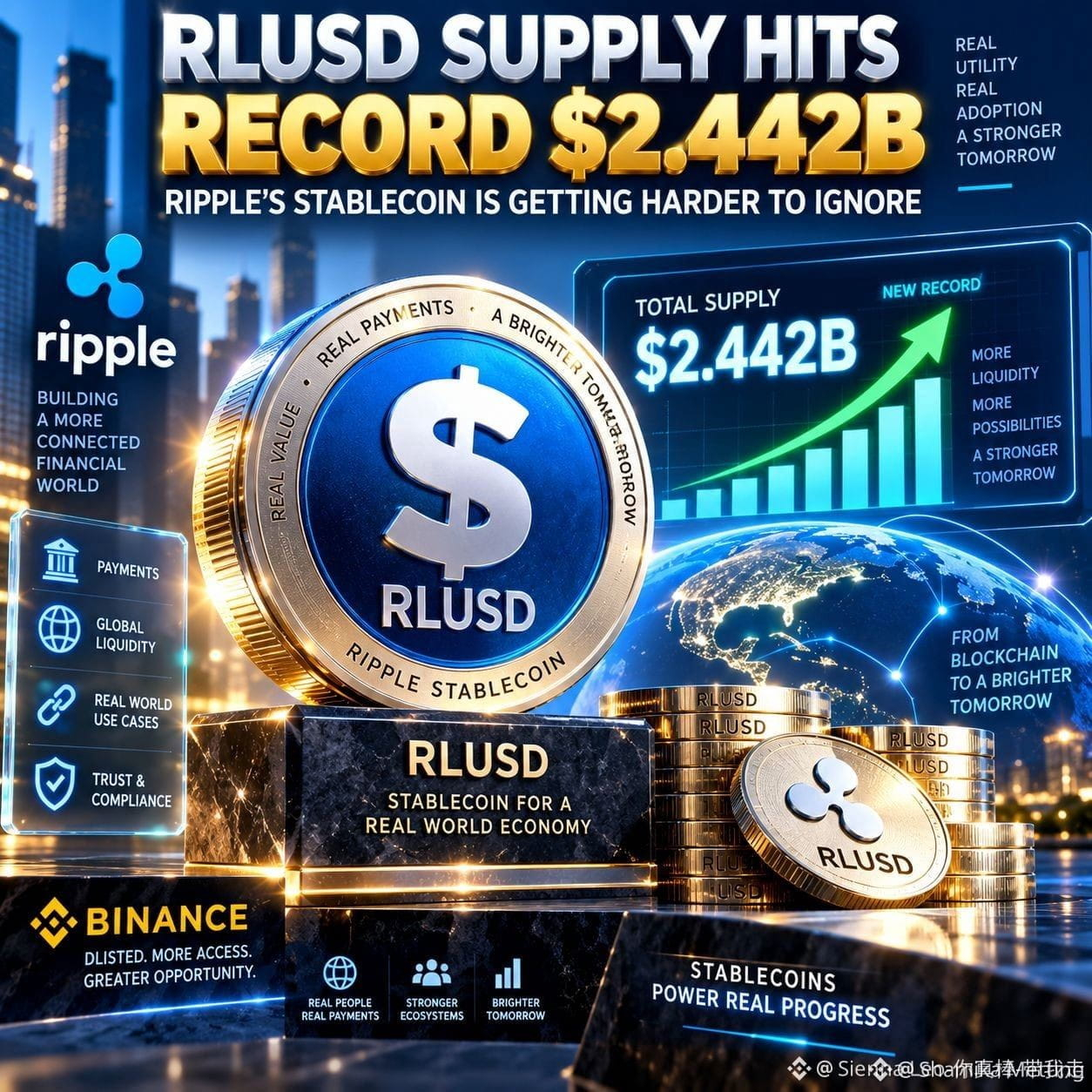
💵 $RLUSD hits a new sales record at $2.442 billion: Ripple’s stablecoin is becoming harder to ignore 💵
Imagine watching a calm digital dollar move through the financial system while only a few notice it. Then suddenly, the supply reaches a level that makes the entire market look at it twice.
RLUSD has now reached a record number of $2.442 billion in circulating supply, marking another major expansion for Ripple’s USD-backed stablecoin. Recent data also shows that its trading has surged sharply over the past month.
But the most interesting detail is where this growth is happening. The Ethereum network currently holds more RLUSD than the XRP Ledger, showing that demand for this stablecoin is not limited to Ripple’s original ecosystem.
This matters because stablecoin growth is increasingly tied to infrastructure—not speculation. More supply could reflect expanded liquidity and payments, increased trading activity, institutional usage, or simply a greater allocation of capital to that specific “digital dollar” track.
My take: The $2.442 billion threshold isn’t as exciting as the headline number—it’s more important as evidence that RLUSD is building a bigger role in digital finance.
Disclaimer: This is educational content, not financial advice.
Please follow up
#Stablecoins #Ripple #GrowWithSAC $BTC $XRP
#RLUSDSupplyHitsRecord
#RLUSDSupplyHitsRecord$2.442B
💵 $RLUSD hits a new sales record at $2.442 billion: Ripple’s stablecoin is becoming harder to ignore 💵
Imagine watching a calm digital dollar move through the financial system while only a few notice it. Then suddenly, the supply reaches a level that makes the entire market look at it twice.
RLUSD has now reached a record number of $2.442 billion in circulating supply, marking another major expansion for Ripple’s USD-backed stablecoin. Recent data also shows that its trading has surged sharply over the past month.
But the most interesting detail is where this growth is happening. The Ethereum network currently holds more RLUSD than the XRP Ledger, showing that demand for this stablecoin is not limited to Ripple’s original ecosystem.
This matters because stablecoin growth is increasingly tied to infrastructure—not speculation. More supply could reflect expanded liquidity and payments, increased trading activity, institutional usage, or simply a greater allocation of capital to that specific “digital dollar” track.
My take: The $2.442 billion threshold isn’t as exciting as the headline number—it’s more important as evidence that RLUSD is building a bigger role in digital finance.
Disclaimer: This is educational content, not financial advice.
Please follow up
#Stablecoins #Ripple #GrowWithSAC $BTC $XRP
#RLUSDSupplyHitsRecord$2.442B
💵 $RLUSD hits a new sales record at $2.442 billion: Ripple’s stablecoin is becoming harder to ignore 💵
Imagine watching a calm digital dollar move through the financial system while only a few notice it. Then suddenly, the supply reaches a level that makes the entire market look at it twice.
RLUSD has now reached a record number of $2.442 billion in circulating supply, marking another major expansion for Ripple’s USD-backed stablecoin. Recent data also shows that its trading has surged sharply over the past month.
But the most interesting detail is where this growth is happening. The Ethereum network currently holds more RLUSD than the XRP Ledger, showing that demand for this stablecoin is not limited to Ripple’s original ecosystem.
This matters because stablecoin growth is increasingly tied to infrastructure—not speculation. More supply could reflect expanded liquidity and payments, increased trading activity, institutional usage, or simply a greater allocation of capital to that specific “digital dollar” track.
My take: The $2.442 billion threshold isn’t as exciting as the headline number—it’s more important as evidence that RLUSD is building a bigger role in digital finance.
Disclaimer: This is educational content, not financial advice.
Please follow up
#Stablecoins #Ripple #GrowWithSAC $BTC $XRP
1
75
#avalancheintegratesintouaepassdigitalvault
⚡ Avalanch to integrate into "UAE Pass" for its digital ledger: a quiet blockchain breach? 🇦🇪
Imagine millions of people using a single digital identity without ever thinking about the blockchain that lies beneath it. Then, almost imperceptibly, the infrastructure behind those everyday documents starts to change.
Avalanch is linked to the digital "UAE Pass" ledger, a system designed to store and securely share verified digital documents. UAE authorities already describe this ledger as operating on a blockchain, while recent reports indicate that Avalanch technology is being integrated via Deca4.
And the important part isn’t just that another blockchain is entering the UAE. It’s that the blockchain infrastructure is moving closer to national-level digital services—where trust, identity, privacy, and verification become more important than speculation about cryptocurrencies.
"UAE Pass" already serves millions of registered users and supports thousands of services. Its digital ledger aims to enable users to request official documents, store them, and share them digitally.
❓ Do you think a government-grade digital identity could become one of the strongest real-world blockchain use cases?
Disclaimer: This is educational content, not financial advice.
Please follow up
#Avalanche #RWA #GrowWithSAC $AVAX $ARK $XRP
#AvalancheIntegratesIntoUAEPassDigitalVault
#avalancheintegratesintouaepassdigitalvault
⚡ Avalanch to integrate into "UAE Pass" for its digital ledger: a quiet blockchain breach? 🇦🇪
Imagine millions of people using a single digital identity without ever thinking about the blockchain that lies beneath it. Then, almost imperceptibly, the infrastructure behind those everyday documents starts to change.
Avalanch is linked to the digital "UAE Pass" ledger, a system designed to store and securely share verified digital documents. UAE authorities already describe this ledger as operating on a blockchain, while recent reports indicate that Avalanch technology is being integrated via Deca4.
And the important part isn’t just that another blockchain is entering the UAE. It’s that the blockchain infrastructure is moving closer to national-level digital services—where trust, identity, privacy, and verification become more important than speculation about cryptocurrencies.
"UAE Pass" already serves millions of registered users and supports thousands of services. Its digital ledger aims to enable users to request official documents, store them, and share them digitally.
❓ Do you think a government-grade digital identity could become one of the strongest real-world blockchain use cases?
Disclaimer: This is educational content, not financial advice.
Please follow up
#Avalanche #RWA #GrowWithSAC $AVAX $ARK $XRP
#AvalancheIntegratesIntoUAEPassDigitalVault
⚡ Avalanch to integrate into "UAE Pass" for its digital ledger: a quiet blockchain breach? 🇦🇪
Imagine millions of people using a single digital identity without ever thinking about the blockchain that lies beneath it. Then, almost imperceptibly, the infrastructure behind those everyday documents starts to change.
Avalanch is linked to the digital "UAE Pass" ledger, a system designed to store and securely share verified digital documents. UAE authorities already describe this ledger as operating on a blockchain, while recent reports indicate that Avalanch technology is being integrated via Deca4.
And the important part isn’t just that another blockchain is entering the UAE. It’s that the blockchain infrastructure is moving closer to national-level digital services—where trust, identity, privacy, and verification become more important than speculation about cryptocurrencies.
"UAE Pass" already serves millions of registered users and supports thousands of services. Its digital ledger aims to enable users to request official documents, store them, and share them digitally.
❓ Do you think a government-grade digital identity could become one of the strongest real-world blockchain use cases?
Disclaimer: This is educational content, not financial advice.
Please follow up
#Avalanche #RWA #GrowWithSAC $AVAX $ARK $XRP
#AvalancheIntegratesIntoUAEPassDigitalVault

1
1
52
#fedhikeoddsriseto89%
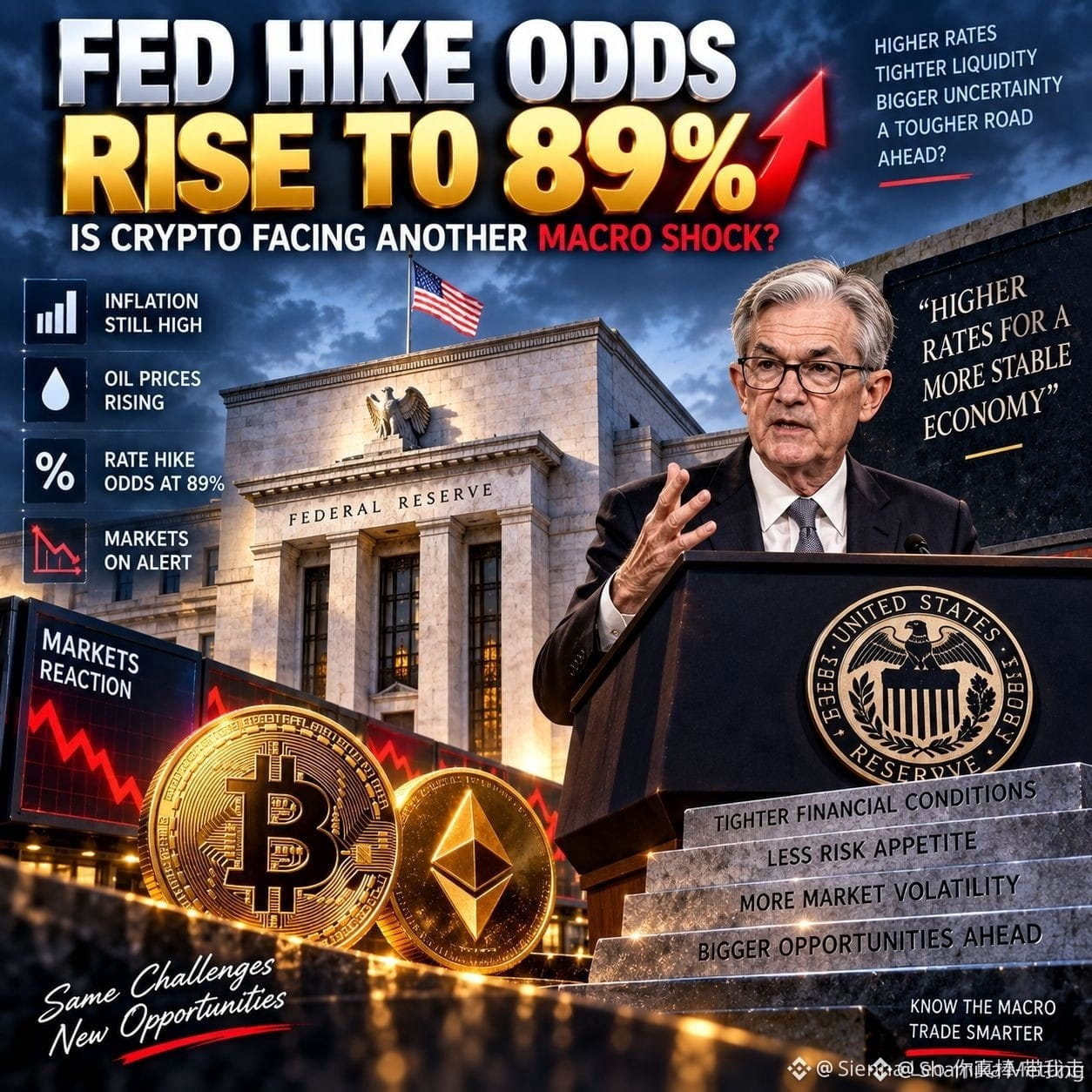
🔥 Rising chances of a rate hike to 89%: Will the crypto market face another major economic shock? 🔥
The market was tense already. Then oil prices rose, inflation didn’t seem to cool down, and suddenly traders began looking at the Federal Reserve meeting with completely different expectations.
Now markets are pricing in nearly an 89% chance of a rate hike this week—a major shift after inflation data came in stronger and added new pressure on energy prices.
The key issue is inflation. August’s Consumer Price Index showed continued price pressure, while increases in oil prices add another layer of concern for policymakers.
For digital currencies, this matters because higher rates typically tighten liquidity and reduce appetite for riskier assets. So Bitcoin and alternatives may become more sensitive to every piece of news coming from the Federal Reserve.
But I don’t think this story can be reduced to “rate hike = crypto crash.” The market prices in expectations before decisions are made, so the biggest risk could come from a surprise in the Fed statement, its projections, or its guidance regarding future interest rates.
Please follow up
#FederalReserve #Crypto #GrowWithSAC $BTC $STEEM $ARK
#FedHikeOddsRiseTo89%
#fedhikeoddsriseto89%
🔥 Rising chances of a rate hike to 89%: Will the crypto market face another major economic shock? 🔥
The market was tense already. Then oil prices rose, inflation didn’t seem to cool down, and suddenly traders began looking at the Federal Reserve meeting with completely different expectations.
Now markets are pricing in nearly an 89% chance of a rate hike this week—a major shift after inflation data came in stronger and added new pressure on energy prices.
The key issue is inflation. August’s Consumer Price Index showed continued price pressure, while increases in oil prices add another layer of concern for policymakers.
For digital currencies, this matters because higher rates typically tighten liquidity and reduce appetite for riskier assets. So Bitcoin and alternatives may become more sensitive to every piece of news coming from the Federal Reserve.
But I don’t think this story can be reduced to “rate hike = crypto crash.” The market prices in expectations before decisions are made, so the biggest risk could come from a surprise in the Fed statement, its projections, or its guidance regarding future interest rates.
Please follow up
#FederalReserve #Crypto #GrowWithSAC $BTC $STEEM $ARK
#FedHikeOddsRiseTo89%
🔥 Rising chances of a rate hike to 89%: Will the crypto market face another major economic shock? 🔥
The market was tense already. Then oil prices rose, inflation didn’t seem to cool down, and suddenly traders began looking at the Federal Reserve meeting with completely different expectations.
Now markets are pricing in nearly an 89% chance of a rate hike this week—a major shift after inflation data came in stronger and added new pressure on energy prices.
The key issue is inflation. August’s Consumer Price Index showed continued price pressure, while increases in oil prices add another layer of concern for policymakers.
For digital currencies, this matters because higher rates typically tighten liquidity and reduce appetite for riskier assets. So Bitcoin and alternatives may become more sensitive to every piece of news coming from the Federal Reserve.
But I don’t think this story can be reduced to “rate hike = crypto crash.” The market prices in expectations before decisions are made, so the biggest risk could come from a surprise in the Fed statement, its projections, or its guidance regarding future interest rates.
Please follow up
#FederalReserve #Crypto #GrowWithSAC $BTC $STEEM $ARK
#FedHikeOddsRiseTo89%
1
53
#anthropicceocallsforaislowdown
🤖 Anthropic CEO says AI race should slow down.
Dario Amodei calls on AI companies to slow the pace of developing frontier models, so that safety measures can keep up with rapidly improving capabilities.
He does not dispute that a full stop is what is needed. The focus is on conducting independent safety assessments, improving coordination between AI companies, and strengthening international cooperation.
The discussion grows louder amid increasing concern about AI misuse in hacking, surveillance, and other harmful activities.
For markets, there is another angle. AI-linked stocks have already shown sensitivity to changes in expectations about development speed.
The biggest question isn’t whether AI should advance. It’s whether innovation can move at that pace without safety lagging behind.
👀 Should AI development slow down, or would that give competitors an advantage?
Please continue
#Aİ #الذكاء_الاصطناعي #العملات_الرقمية #tech
$LSK $MTL $ETHFI
#anthropicceocallsforaislowdown
🤖 Anthropic CEO says AI race should slow down.
Dario Amodei calls on AI companies to slow the pace of developing frontier models, so that safety measures can keep up with rapidly improving capabilities.
He does not dispute that a full stop is what is needed. The focus is on conducting independent safety assessments, improving coordination between AI companies, and strengthening international cooperation.
The discussion grows louder amid increasing concern about AI misuse in hacking, surveillance, and other harmful activities.
For markets, there is another angle. AI-linked stocks have already shown sensitivity to changes in expectations about development speed.
The biggest question isn’t whether AI should advance. It’s whether innovation can move at that pace without safety lagging behind.
👀 Should AI development slow down, or would that give competitors an advantage?
Please continue
#Aİ #الذكاء_الاصطناعي #العملات_الرقمية #tech
$LSK $MTL $ETHFI
🤖 Anthropic CEO says AI race should slow down.
Dario Amodei calls on AI companies to slow the pace of developing frontier models, so that safety measures can keep up with rapidly improving capabilities.
He does not dispute that a full stop is what is needed. The focus is on conducting independent safety assessments, improving coordination between AI companies, and strengthening international cooperation.
The discussion grows louder amid increasing concern about AI misuse in hacking, surveillance, and other harmful activities.
For markets, there is another angle. AI-linked stocks have already shown sensitivity to changes in expectations about development speed.
The biggest question isn’t whether AI should advance. It’s whether innovation can move at that pace without safety lagging behind.
👀 Should AI development slow down, or would that give competitors an advantage?
Please continue
#Aİ #الذكاء_الاصطناعي #العملات_الرقمية #tech
$LSK $MTL $ETHFI

1
25
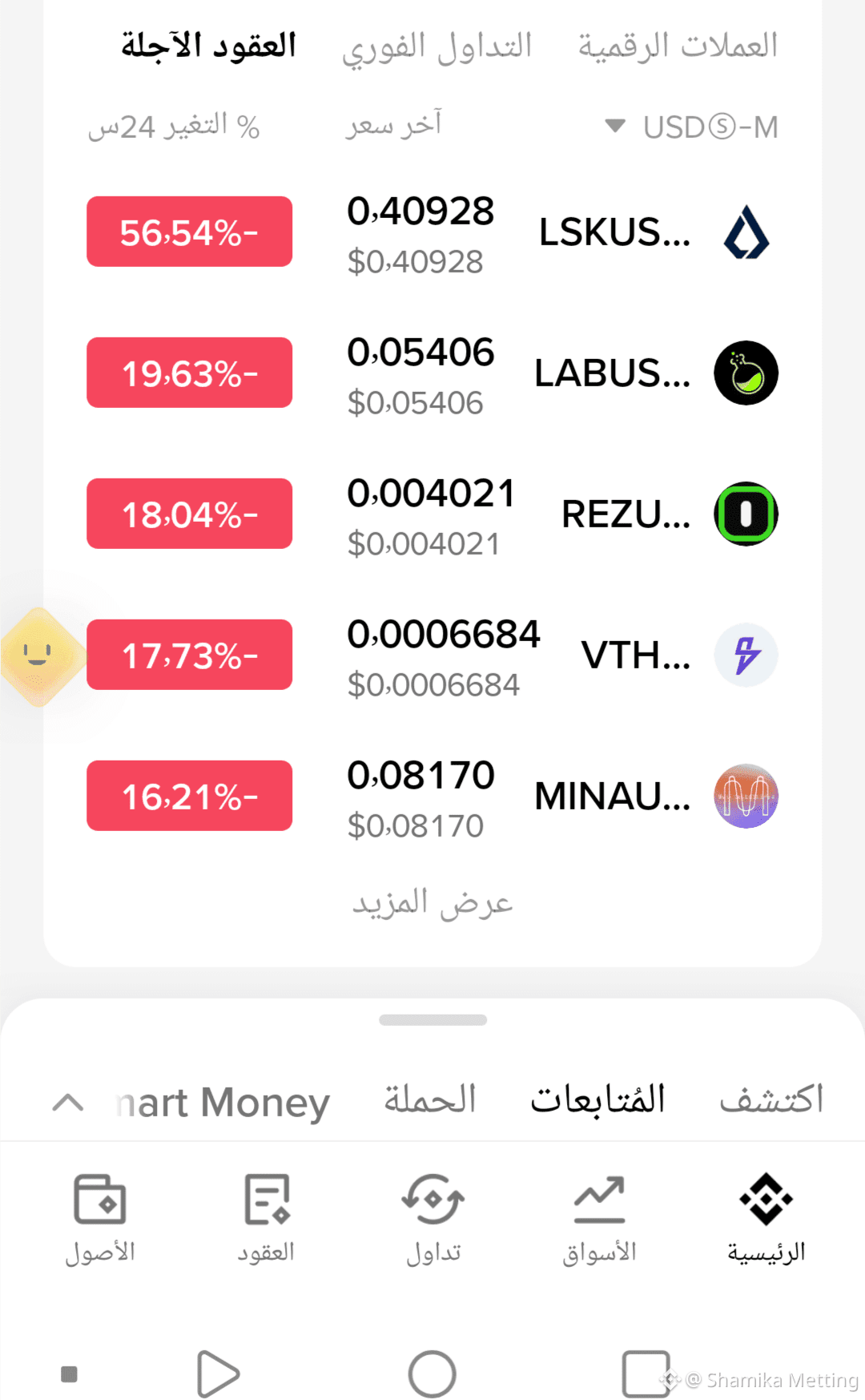
⚠️ Sharp market declines!
$LSK plunges -56.54%
$LAB falls -19.63%
$REZ loses -18.04%
VTHO and MINA surpass -16%
Trade with extreme caution 🛑
⚠️ Sharp market declines!
$LSK plunges -56.54%
$LAB falls -19.63%
$REZ loses -18.04%
VTHO and MINA surpass -16%
Trade with extreme caution 🛑
$LSK plunges -56.54%
$LAB falls -19.63%
$REZ loses -18.04%
VTHO and MINA surpass -16%
Trade with extreme caution 🛑
1
46
Verified
#bitcointhirdsingleblockreorginfourweeks
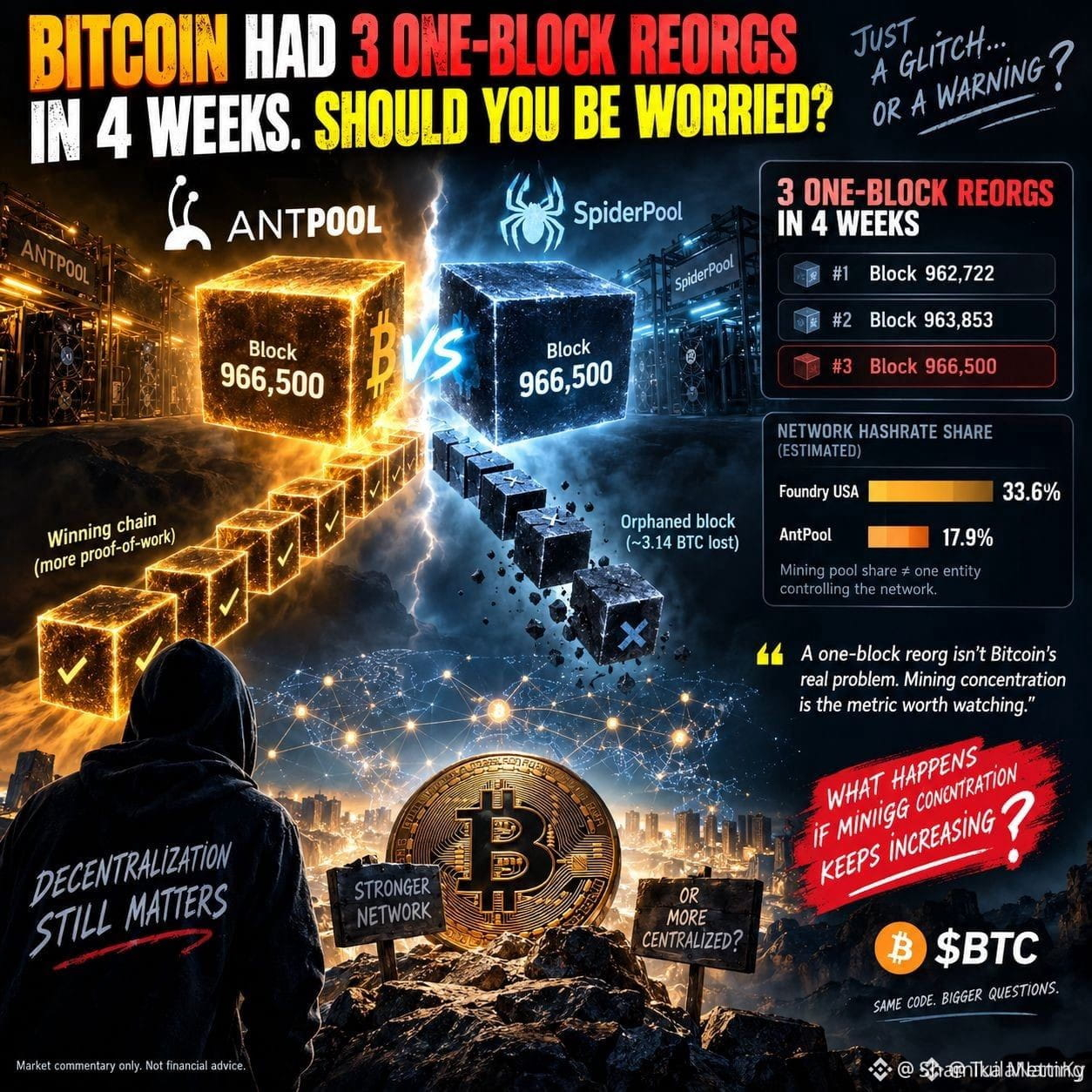
🚨 Bitcoin saw 3 reorgs (block reorganizations) of a single block within 4 weeks. Should we be worried?
At block 966,500, AntPool and SpiderPool found valid blocks that point to the same parent in nearly the same time window.
One branch won.
The other disappeared.
This looks concerning.
But technically, this is normal behavior for Bitcoin.
AntPool’s winning chain accumulated more Proof-of-Work, while SpiderPool’s block became orphaned.
The cost?
About 3.14 BTC in mining rewards for the losing block.
So what’s actually noteworthy?
The repetition. 👀
This was the third reorganization of the same block within just four weeks.
The previous two happened at blocks 962,722 and 963,853.
One reorg isn’t the story.
Three times in four weeks is what’s worth watching.
Here’s the bigger shift:
The reorganization itself isn’t the main decentralization concern. Hashrate concentration is.
The data cited in the study places Foundry USA at around 33.6% and AntPool at around 17.9% of the network’s total hashrate.
But there’s an important distinction:
Mining pool share ≠ a single entity controlling the network.
Miners can switch pools, a temporary branch on one block differs fundamentally from a deep reorganization of a chain, or from a successful 51% attack.
The better question is:
What happens if mining concentration keeps increasing?
$BTC
#Bitcoin #BitcoinMining #Decentralization
#bitcointhirdsingleblockreorginfourweeks
🚨 Bitcoin saw 3 reorgs (block reorganizations) of a single block within 4 weeks. Should we be worried?
At block 966,500, AntPool and SpiderPool found valid blocks that point to the same parent in nearly the same time window.
One branch won.
The other disappeared.
This looks concerning.
But technically, this is normal behavior for Bitcoin.
AntPool’s winning chain accumulated more Proof-of-Work, while SpiderPool’s block became orphaned.
The cost?
About 3.14 BTC in mining rewards for the losing block.
So what’s actually noteworthy?
The repetition. 👀
This was the third reorganization of the same block within just four weeks.
The previous two happened at blocks 962,722 and 963,853.
One reorg isn’t the story.
Three times in four weeks is what’s worth watching.
Here’s the bigger shift:
The reorganization itself isn’t the main decentralization concern. Hashrate concentration is.
The data cited in the study places Foundry USA at around 33.6% and AntPool at around 17.9% of the network’s total hashrate.
But there’s an important distinction:
Mining pool share ≠ a single entity controlling the network.
Miners can switch pools, a temporary branch on one block differs fundamentally from a deep reorganization of a chain, or from a successful 51% attack.
The better question is:
What happens if mining concentration keeps increasing?
$BTC
#Bitcoin #BitcoinMining #Decentralization
🚨 Bitcoin saw 3 reorgs (block reorganizations) of a single block within 4 weeks. Should we be worried?
At block 966,500, AntPool and SpiderPool found valid blocks that point to the same parent in nearly the same time window.
One branch won.
The other disappeared.
This looks concerning.
But technically, this is normal behavior for Bitcoin.
AntPool’s winning chain accumulated more Proof-of-Work, while SpiderPool’s block became orphaned.
The cost?
About 3.14 BTC in mining rewards for the losing block.
So what’s actually noteworthy?
The repetition. 👀
This was the third reorganization of the same block within just four weeks.
The previous two happened at blocks 962,722 and 963,853.
One reorg isn’t the story.
Three times in four weeks is what’s worth watching.
Here’s the bigger shift:
The reorganization itself isn’t the main decentralization concern. Hashrate concentration is.
The data cited in the study places Foundry USA at around 33.6% and AntPool at around 17.9% of the network’s total hashrate.
But there’s an important distinction:
Mining pool share ≠ a single entity controlling the network.
Miners can switch pools, a temporary branch on one block differs fundamentally from a deep reorganization of a chain, or from a successful 51% attack.
The better question is:
What happens if mining concentration keeps increasing?
$BTC
#Bitcoin #BitcoinMining #Decentralization
1
1
704
Verified
#fedhikeoddsriseto89%
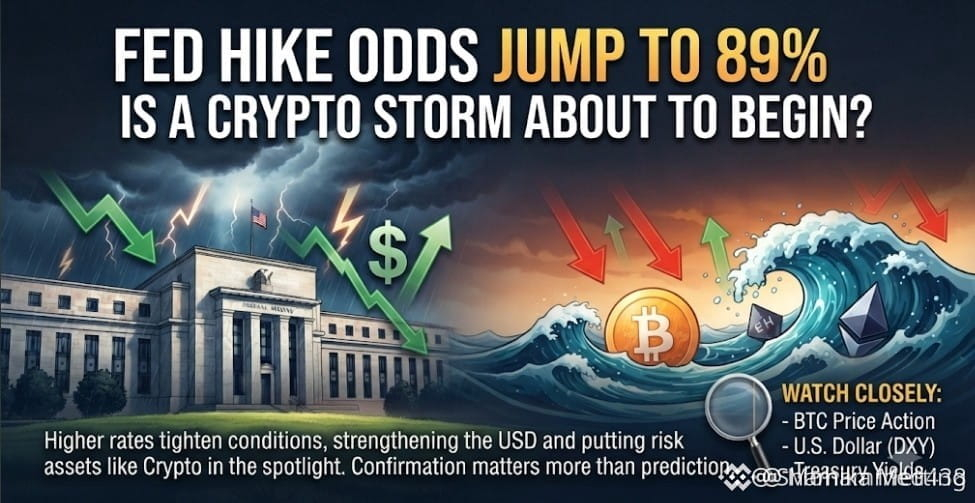
🚨 The Federal Reserve stokes tensions... Rate-hike odds jump to 89% — is a crypto storm nearing? 🔥🤯
The market suddenly began pricing in a much higher chance of the Federal Reserve raising interest rates again, with reports indicating the probability reached 89%.
And that’s where things get exciting for cryptocurrency traders. 👀
Why does this matter?
Higher interest rates can tighten financial conditions, strengthen the dollar, and reduce appetite for riskier assets.
That puts Bitcoin, Ethereum, and many altcoins directly in the spotlight.
But the real question is:
Has the crypto market ever priced in a rate-hike decision in advance... or is the real volatility only about to start?
If the Federal Reserve delivers a more hawkish message than expected, digital assets could face strong selling pressure.
But if the central bank surprises markets with a more moderate tone, risk appetite could return quickly—possibly giving BTC and ETH a fresh burst of momentum.
👀 Keep a close eye on BTC’s price action, the US dollar, and Treasury yields. In this kind of environment, reality matters more than prediction.
Risk management first: This content is for informational purposes only and does not constitute financial advice. Crypto markets can move sharply in either direction.
Please follow up
#FederalReserve #Fed #Crypto
#fedhikeoddsriseto89%
🚨 The Federal Reserve stokes tensions... Rate-hike odds jump to 89% — is a crypto storm nearing? 🔥🤯
The market suddenly began pricing in a much higher chance of the Federal Reserve raising interest rates again, with reports indicating the probability reached 89%.
And that’s where things get exciting for cryptocurrency traders. 👀
Why does this matter?
Higher interest rates can tighten financial conditions, strengthen the dollar, and reduce appetite for riskier assets.
That puts Bitcoin, Ethereum, and many altcoins directly in the spotlight.
But the real question is:
Has the crypto market ever priced in a rate-hike decision in advance... or is the real volatility only about to start?
If the Federal Reserve delivers a more hawkish message than expected, digital assets could face strong selling pressure.
But if the central bank surprises markets with a more moderate tone, risk appetite could return quickly—possibly giving BTC and ETH a fresh burst of momentum.
👀 Keep a close eye on BTC’s price action, the US dollar, and Treasury yields. In this kind of environment, reality matters more than prediction.
Risk management first: This content is for informational purposes only and does not constitute financial advice. Crypto markets can move sharply in either direction.
Please follow up
#FederalReserve #Fed #Crypto
🚨 The Federal Reserve stokes tensions... Rate-hike odds jump to 89% — is a crypto storm nearing? 🔥🤯
The market suddenly began pricing in a much higher chance of the Federal Reserve raising interest rates again, with reports indicating the probability reached 89%.
And that’s where things get exciting for cryptocurrency traders. 👀
Why does this matter?
Higher interest rates can tighten financial conditions, strengthen the dollar, and reduce appetite for riskier assets.
That puts Bitcoin, Ethereum, and many altcoins directly in the spotlight.
But the real question is:
Has the crypto market ever priced in a rate-hike decision in advance... or is the real volatility only about to start?
If the Federal Reserve delivers a more hawkish message than expected, digital assets could face strong selling pressure.
But if the central bank surprises markets with a more moderate tone, risk appetite could return quickly—possibly giving BTC and ETH a fresh burst of momentum.
👀 Keep a close eye on BTC’s price action, the US dollar, and Treasury yields. In this kind of environment, reality matters more than prediction.
Risk management first: This content is for informational purposes only and does not constitute financial advice. Crypto markets can move sharply in either direction.
Please follow up
#FederalReserve #Fed #Crypto
1
2
2k
Verified
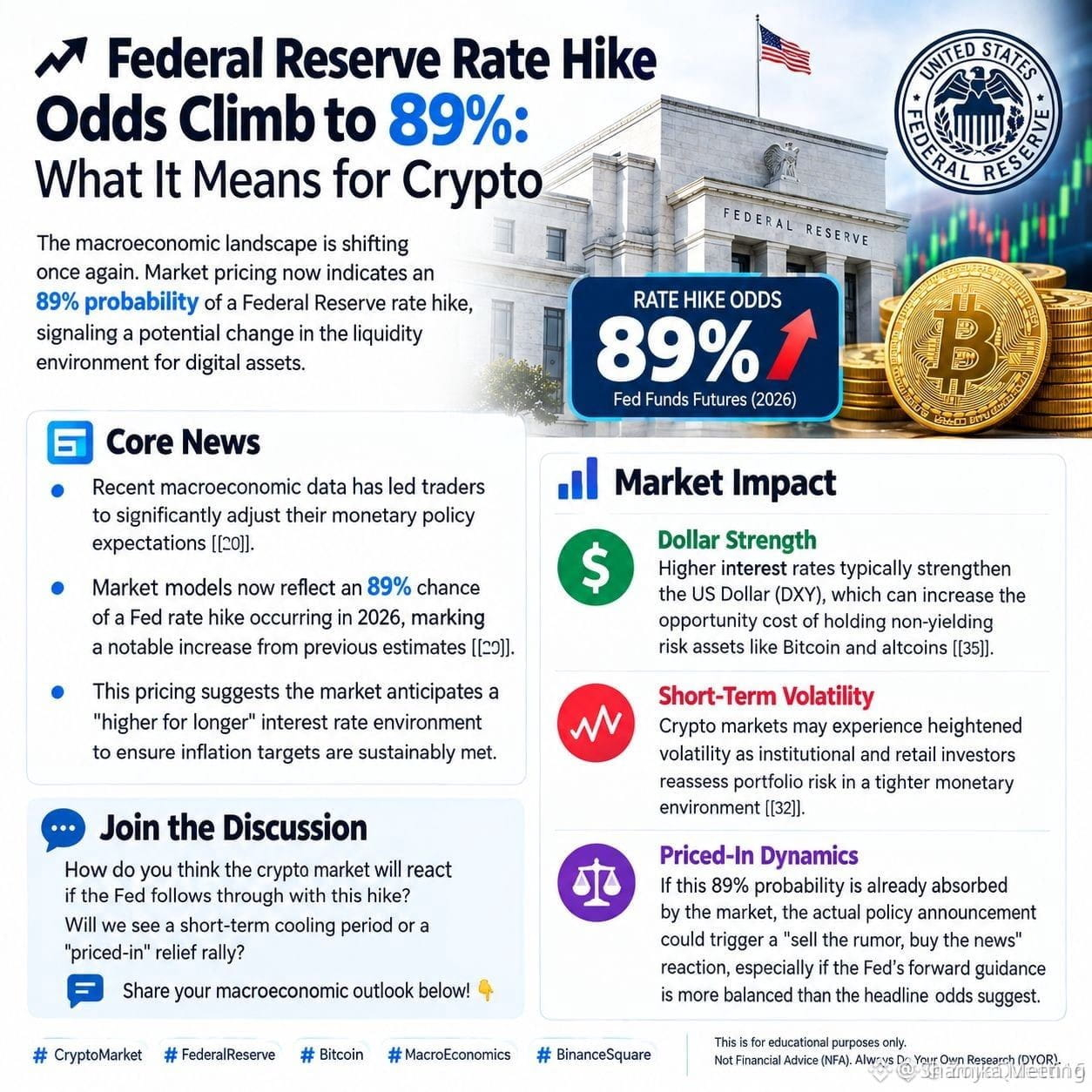
#fedhikeoddsriseto89% 📊 The probability of a Federal Reserve rate hike rises to 89%: what does that mean for cryptocurrencies
The macroeconomic landscape is changing again. Market pricing now shows an 89% probability of a Federal Reserve rate increase, indicating a likely shift in the liquidity conditions for digital assets.
📰 Key News
• Recent economic data prompted traders to significantly adjust their expectations for monetary policy [[20]].
• Market models now reflect an 89% probability of a Fed rate hike in 2026, a notable increase compared with previous estimates [[29]].
• This pricing suggests the market expects a “higher-for-longer” interest-rate environment to sustainably achieve inflation targets.
📈 Market Impact
• 💵 A stronger U.S. dollar typically supports Fed rate hikes (DXY), which may increase the opportunity cost of holding non-yielding assets such as Bitcoin and altcoins [[35]].
• 📉 In the short term, cryptocurrency markets may see higher volatility as institutional and retail investors reassess the risks of their portfolios in a tighter monetary environment [[32]].
#CryptoMarket #FederalReserve #Bitcoin #MacroEconomics #BinanceSquare
This content is for educational purposes only. Not financial advice (NFA). Always do your own research (DYOR).
Please follow up
$ARK $HEMI $SOXSB
#fedhikeoddsriseto89% 📊 The probability of a Federal Reserve rate hike rises to 89%: what does that mean for cryptocurrencies
The macroeconomic landscape is changing again. Market pricing now shows an 89% probability of a Federal Reserve rate increase, indicating a likely shift in the liquidity conditions for digital assets.
📰 Key News
• Recent economic data prompted traders to significantly adjust their expectations for monetary policy [[20]].
• Market models now reflect an 89% probability of a Fed rate hike in 2026, a notable increase compared with previous estimates [[29]].
• This pricing suggests the market expects a “higher-for-longer” interest-rate environment to sustainably achieve inflation targets.
📈 Market Impact
• 💵 A stronger U.S. dollar typically supports Fed rate hikes (DXY), which may increase the opportunity cost of holding non-yielding assets such as Bitcoin and altcoins [[35]].
• 📉 In the short term, cryptocurrency markets may see higher volatility as institutional and retail investors reassess the risks of their portfolios in a tighter monetary environment [[32]].
#CryptoMarket #FederalReserve #Bitcoin #MacroEconomics #BinanceSquare
This content is for educational purposes only. Not financial advice (NFA). Always do your own research (DYOR).
Please follow up
$ARK $HEMI $SOXSB
The macroeconomic landscape is changing again. Market pricing now shows an 89% probability of a Federal Reserve rate increase, indicating a likely shift in the liquidity conditions for digital assets.
📰 Key News
• Recent economic data prompted traders to significantly adjust their expectations for monetary policy [[20]].
• Market models now reflect an 89% probability of a Fed rate hike in 2026, a notable increase compared with previous estimates [[29]].
• This pricing suggests the market expects a “higher-for-longer” interest-rate environment to sustainably achieve inflation targets.
📈 Market Impact
• 💵 A stronger U.S. dollar typically supports Fed rate hikes (DXY), which may increase the opportunity cost of holding non-yielding assets such as Bitcoin and altcoins [[35]].
• 📉 In the short term, cryptocurrency markets may see higher volatility as institutional and retail investors reassess the risks of their portfolios in a tighter monetary environment [[32]].
#CryptoMarket #FederalReserve #Bitcoin #MacroEconomics #BinanceSquare
This content is for educational purposes only. Not financial advice (NFA). Always do your own research (DYOR).
Please follow up
$ARK $HEMI $SOXSB
1
1.8k
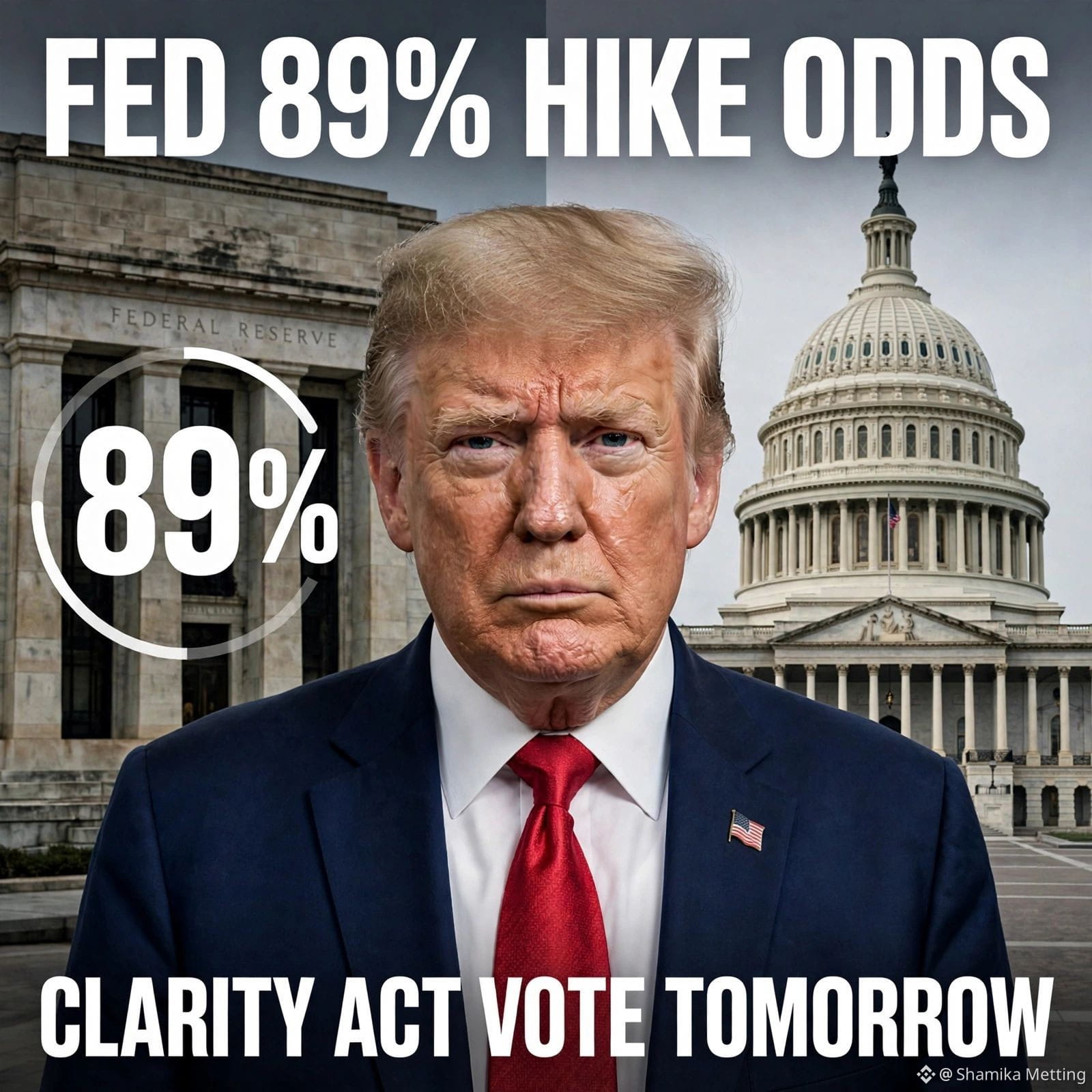
The Federal Reserve must raise interest rates tomorrow (and this is actually a positive thing)"
Tomorrow, there are two doors for cryptocurrencies:
Door 1: The Federal Reserve raises the interest rate (89% probability). A short pain, and the market already knows it in advance.
Door 2: The Clarity Act passes (50% probability). Finally, the United States provides cryptocurrencies with “a rules guide.” Nothing in this market has been priced in at all.
The CPI index came in at 0.3% versus 0.2% expected. This 0.1% increase pushed the odds of a rate hike from 58% to 89% within 24 hours.
Everyone is focused on the rate hike, but the real alpha is clarity.
Raising interest rates = short-term pain (already priced in)
Adopting the Clarity law = a long-term open door for the U.S. cryptocurrency market in full.
Don’t compensate for the biggest news.
Follow-up, please
$BTC $ETH #fedhikeoddsriseto89%
The Federal Reserve must raise interest rates tomorrow (and this is actually a positive thing)"
Tomorrow, there are two doors for cryptocurrencies:
Door 1: The Federal Reserve raises the interest rate (89% probability). A short pain, and the market already knows it in advance.
Door 2: The Clarity Act passes (50% probability). Finally, the United States provides cryptocurrencies with “a rules guide.” Nothing in this market has been priced in at all.
The CPI index came in at 0.3% versus 0.2% expected. This 0.1% increase pushed the odds of a rate hike from 58% to 89% within 24 hours.
Everyone is focused on the rate hike, but the real alpha is clarity.
Raising interest rates = short-term pain (already priced in)
Adopting the Clarity law = a long-term open door for the U.S. cryptocurrency market in full.
Don’t compensate for the biggest news.
Follow-up, please
$BTC $ETH #fedhikeoddsriseto89%
Tomorrow, there are two doors for cryptocurrencies:
Door 1: The Federal Reserve raises the interest rate (89% probability). A short pain, and the market already knows it in advance.
Door 2: The Clarity Act passes (50% probability). Finally, the United States provides cryptocurrencies with “a rules guide.” Nothing in this market has been priced in at all.
The CPI index came in at 0.3% versus 0.2% expected. This 0.1% increase pushed the odds of a rate hike from 58% to 89% within 24 hours.
Everyone is focused on the rate hike, but the real alpha is clarity.
Raising interest rates = short-term pain (already priced in)
Adopting the Clarity law = a long-term open door for the U.S. cryptocurrency market in full.
Don’t compensate for the biggest news.
Follow-up, please
$BTC $ETH #fedhikeoddsriseto89%
1
45
#whitehouserejectsaislowdowncalls
Political Vision: The White House Rejects Proposals to Slow Down AI Development
The White House has officially rejected calls from leading AI executives and researchers in the field of safety to temporarily slow the development of advanced models. Citing national security imperatives and global technological competition—specifically the race to maintain an advantage over China—the administration adopted a political stance that prioritizes rapid innovation rather than any federal freeze or pre-approval licensing frameworks.
AI Policy Stalls in the United States
• Executive direction: rejects mandatory shutdown periods and restrictions on AGI
• Core rationale: the competitive edge between the United States and China ("whoever wins at AI wins")
• Security approach: voluntary cybersecurity assessments & defenses for critical infrastructure
Geopolitical competition first: federal leadership emphasized that any unilateral slowdowns by U.S. laboratories would give international rivals a strategic advantage.
Capital flows to computing & crypto assets: unrestricted development ensures continued capital flow to decentralized physical infrastructure networks (DePIN) and high-performance computing tokens ($RENDER , $NEAR ,$FET)
Stay tuned
#LSKSurgesOver515%In24Hours #AnthropicCEOCallsForAISlowdown
#whitehouserejectsaislowdowncalls
Political Vision: The White House Rejects Proposals to Slow Down AI Development
The White House has officially rejected calls from leading AI executives and researchers in the field of safety to temporarily slow the development of advanced models. Citing national security imperatives and global technological competition—specifically the race to maintain an advantage over China—the administration adopted a political stance that prioritizes rapid innovation rather than any federal freeze or pre-approval licensing frameworks.
AI Policy Stalls in the United States
• Executive direction: rejects mandatory shutdown periods and restrictions on AGI
• Core rationale: the competitive edge between the United States and China ("whoever wins at AI wins")
• Security approach: voluntary cybersecurity assessments & defenses for critical infrastructure
Geopolitical competition first: federal leadership emphasized that any unilateral slowdowns by U.S. laboratories would give international rivals a strategic advantage.
Capital flows to computing & crypto assets: unrestricted development ensures continued capital flow to decentralized physical infrastructure networks (DePIN) and high-performance computing tokens ($RENDER , $NEAR ,$FET)
Stay tuned
#LSKSurgesOver515%In24Hours #AnthropicCEOCallsForAISlowdown
Political Vision: The White House Rejects Proposals to Slow Down AI Development
The White House has officially rejected calls from leading AI executives and researchers in the field of safety to temporarily slow the development of advanced models. Citing national security imperatives and global technological competition—specifically the race to maintain an advantage over China—the administration adopted a political stance that prioritizes rapid innovation rather than any federal freeze or pre-approval licensing frameworks.
AI Policy Stalls in the United States
• Executive direction: rejects mandatory shutdown periods and restrictions on AGI
• Core rationale: the competitive edge between the United States and China ("whoever wins at AI wins")
• Security approach: voluntary cybersecurity assessments & defenses for critical infrastructure
Geopolitical competition first: federal leadership emphasized that any unilateral slowdowns by U.S. laboratories would give international rivals a strategic advantage.
Capital flows to computing & crypto assets: unrestricted development ensures continued capital flow to decentralized physical infrastructure networks (DePIN) and high-performance computing tokens ($RENDER , $NEAR ,$FET)
Stay tuned
#LSKSurgesOver515%In24Hours #AnthropicCEOCallsForAISlowdown

1
128
#ukseeksviewsontokenizinggold
🔥 Do you want the UK to “tokenize”/digitize gold? A big signal for RWA 🔥
Gold used to be transferred through vaults, paperwork, and slow settlement.
Now, the same underlying asset is knocking on the blockchain door.
The UK’s Financial Conduct Authority (FCA) is seeking views on whether tokenizing gold could make it more efficient in trading, transferring, mortgages, and custody—while maintaining market integrity and protecting consumers. The consultation is open until 23 October.
My take: This is more than just putting gold on-chain. The real opportunity is turning gold into a more “programmable” financial asset—one that can—possibly—move through digital market infrastructure and be used as collateral with less operational friction.
But tokenization doesn’t magically eliminate risk. Custody, ownership rights and redemption, valuation, liquidity, and regulation still determine whether “tokenized” digital gold truly represents dependable financial infrastructure.
❓Can regulated, tokenized gold become a serious bridge between London’s traditional markets and blockchain markets?
Disclaimer: This content is for informational purposes only and is not financial advice.
Please follow up
#RWA #TokenizationOfRWA #GrowWithSAC $XAUT $LSK $MINA
#UKSeeksViewsOnTokenizingGold
#ukseeksviewsontokenizinggold
🔥 Do you want the UK to “tokenize”/digitize gold? A big signal for RWA 🔥
Gold used to be transferred through vaults, paperwork, and slow settlement.
Now, the same underlying asset is knocking on the blockchain door.
The UK’s Financial Conduct Authority (FCA) is seeking views on whether tokenizing gold could make it more efficient in trading, transferring, mortgages, and custody—while maintaining market integrity and protecting consumers. The consultation is open until 23 October.
My take: This is more than just putting gold on-chain. The real opportunity is turning gold into a more “programmable” financial asset—one that can—possibly—move through digital market infrastructure and be used as collateral with less operational friction.
But tokenization doesn’t magically eliminate risk. Custody, ownership rights and redemption, valuation, liquidity, and regulation still determine whether “tokenized” digital gold truly represents dependable financial infrastructure.
❓Can regulated, tokenized gold become a serious bridge between London’s traditional markets and blockchain markets?
Disclaimer: This content is for informational purposes only and is not financial advice.
Please follow up
#RWA #TokenizationOfRWA #GrowWithSAC $XAUT $LSK $MINA
#UKSeeksViewsOnTokenizingGold
🔥 Do you want the UK to “tokenize”/digitize gold? A big signal for RWA 🔥
Gold used to be transferred through vaults, paperwork, and slow settlement.
Now, the same underlying asset is knocking on the blockchain door.
The UK’s Financial Conduct Authority (FCA) is seeking views on whether tokenizing gold could make it more efficient in trading, transferring, mortgages, and custody—while maintaining market integrity and protecting consumers. The consultation is open until 23 October.
My take: This is more than just putting gold on-chain. The real opportunity is turning gold into a more “programmable” financial asset—one that can—possibly—move through digital market infrastructure and be used as collateral with less operational friction.
But tokenization doesn’t magically eliminate risk. Custody, ownership rights and redemption, valuation, liquidity, and regulation still determine whether “tokenized” digital gold truly represents dependable financial infrastructure.
❓Can regulated, tokenized gold become a serious bridge between London’s traditional markets and blockchain markets?
Disclaimer: This content is for informational purposes only and is not financial advice.
Please follow up
#RWA #TokenizationOfRWA #GrowWithSAC $XAUT $LSK $MINA
#UKSeeksViewsOnTokenizingGold

1
2
115
#ukseeksviewsontokenizinggold
🪙 The UK seeks views on gold tokenization: is gold entering its next digital age? 🪙
Imagine stepping into a vault in London where gold is still physical, but ownership no longer depends on paper records or traditional transfers—or slow settlement. This future is no longer just a fantasy; it’s now becoming a serious regulatory discussion.
The UK’s financial regulator is seeking input on the potential benefits of gold tokenization, including whether digital representations could make gold easier to trade, transfer, pledge, and hold.
The bigger story isn’t just about placing gold on a blockchain. It’s about rebuilding the infrastructure around one of the world’s oldest stores of value.
Tokenization can help improve divisibility, transferability, and operational efficiency, while also opening new ways for traditional financial markets to interact with blockchain-based assets.
This matters because the UK is already moving ahead with broader tokenization across wholesale financial markets. Gold could become another real asset tested within a regulatory framework that is constantly evolving.
❓ Can regulated tokenized gold become a key bridge between traditional finance and the blockchain?
Please stay tuned
The content is educational, not financial advice.
$XAUT $LSK $STEEM
#UKSeeksViewsOnTokenizingGold
#ukseeksviewsontokenizinggold
🪙 The UK seeks views on gold tokenization: is gold entering its next digital age? 🪙
Imagine stepping into a vault in London where gold is still physical, but ownership no longer depends on paper records or traditional transfers—or slow settlement. This future is no longer just a fantasy; it’s now becoming a serious regulatory discussion.
The UK’s financial regulator is seeking input on the potential benefits of gold tokenization, including whether digital representations could make gold easier to trade, transfer, pledge, and hold.
The bigger story isn’t just about placing gold on a blockchain. It’s about rebuilding the infrastructure around one of the world’s oldest stores of value.
Tokenization can help improve divisibility, transferability, and operational efficiency, while also opening new ways for traditional financial markets to interact with blockchain-based assets.
This matters because the UK is already moving ahead with broader tokenization across wholesale financial markets. Gold could become another real asset tested within a regulatory framework that is constantly evolving.
❓ Can regulated tokenized gold become a key bridge between traditional finance and the blockchain?
Please stay tuned
The content is educational, not financial advice.
$XAUT $LSK $STEEM
#UKSeeksViewsOnTokenizingGold
🪙 The UK seeks views on gold tokenization: is gold entering its next digital age? 🪙
Imagine stepping into a vault in London where gold is still physical, but ownership no longer depends on paper records or traditional transfers—or slow settlement. This future is no longer just a fantasy; it’s now becoming a serious regulatory discussion.
The UK’s financial regulator is seeking input on the potential benefits of gold tokenization, including whether digital representations could make gold easier to trade, transfer, pledge, and hold.
The bigger story isn’t just about placing gold on a blockchain. It’s about rebuilding the infrastructure around one of the world’s oldest stores of value.
Tokenization can help improve divisibility, transferability, and operational efficiency, while also opening new ways for traditional financial markets to interact with blockchain-based assets.
This matters because the UK is already moving ahead with broader tokenization across wholesale financial markets. Gold could become another real asset tested within a regulatory framework that is constantly evolving.
❓ Can regulated tokenized gold become a key bridge between traditional finance and the blockchain?
Please stay tuned
The content is educational, not financial advice.
$XAUT $LSK $STEEM
#UKSeeksViewsOnTokenizingGold

1
2
16
#avalancheintegratesintouaepassdigitalvault
🚨 The UAE is enabling it! Avalanche enters the UAE via UAE PASS… Is the AVAX blast coming next on the way? 🔥🤯
A major shift is happening in the digital ecosystem in the UAE. Avalanche is now being integrated into the UAE PASS Digital Vault, bringing blockchain technologies closer to a platform used by millions of people.
💥 Why is this important for cryptocurrencies?
This is not just another blockchain headline.
UAE PASS is part of the country’s growing digital infrastructure, and integrating Avalanche could strengthen real-world network adoption and its institutional credibility.
And that’s where things get interesting… 👀
If blockchain adoption continues to expand across government infrastructure and digital identity, could AVAX become one of the tokens that benefits from the next wave of institutional demand for blockchain? 🚀
The key now is momentum.
Keep a close eye on AVAX for confirmation rather than chasing a sudden jump. Strong news can generate volatility just as quickly as it creates opportunities.
🔥 The UAE has opened yet another door for Avalanche… will AVAX be next?
Manage risk first: This content is for informational purposes only and not financial advice. Crypto markets can move sharply in either direction.
Please follow up
#AVAX #RWA #crypto
$AVAX
{future}(AVAXUSDT)
#avalancheintegratesintouaepassdigitalvault
🚨 The UAE is enabling it! Avalanche enters the UAE via UAE PASS… Is the AVAX blast coming next on the way? 🔥🤯
A major shift is happening in the digital ecosystem in the UAE. Avalanche is now being integrated into the UAE PASS Digital Vault, bringing blockchain technologies closer to a platform used by millions of people.
💥 Why is this important for cryptocurrencies?
This is not just another blockchain headline.
UAE PASS is part of the country’s growing digital infrastructure, and integrating Avalanche could strengthen real-world network adoption and its institutional credibility.
And that’s where things get interesting… 👀
If blockchain adoption continues to expand across government infrastructure and digital identity, could AVAX become one of the tokens that benefits from the next wave of institutional demand for blockchain? 🚀
The key now is momentum.
Keep a close eye on AVAX for confirmation rather than chasing a sudden jump. Strong news can generate volatility just as quickly as it creates opportunities.
🔥 The UAE has opened yet another door for Avalanche… will AVAX be next?
Manage risk first: This content is for informational purposes only and not financial advice. Crypto markets can move sharply in either direction.
Please follow up
#AVAX #RWA #crypto
$AVAX
🚨 The UAE is enabling it! Avalanche enters the UAE via UAE PASS… Is the AVAX blast coming next on the way? 🔥🤯
A major shift is happening in the digital ecosystem in the UAE. Avalanche is now being integrated into the UAE PASS Digital Vault, bringing blockchain technologies closer to a platform used by millions of people.
💥 Why is this important for cryptocurrencies?
This is not just another blockchain headline.
UAE PASS is part of the country’s growing digital infrastructure, and integrating Avalanche could strengthen real-world network adoption and its institutional credibility.
And that’s where things get interesting… 👀
If blockchain adoption continues to expand across government infrastructure and digital identity, could AVAX become one of the tokens that benefits from the next wave of institutional demand for blockchain? 🚀
The key now is momentum.
Keep a close eye on AVAX for confirmation rather than chasing a sudden jump. Strong news can generate volatility just as quickly as it creates opportunities.
🔥 The UAE has opened yet another door for Avalanche… will AVAX be next?
Manage risk first: This content is for informational purposes only and not financial advice. Crypto markets can move sharply in either direction.
Please follow up
#AVAX #RWA #crypto
$AVAX

1
12
#fedhikeoddsriseto89%
🇺🇸
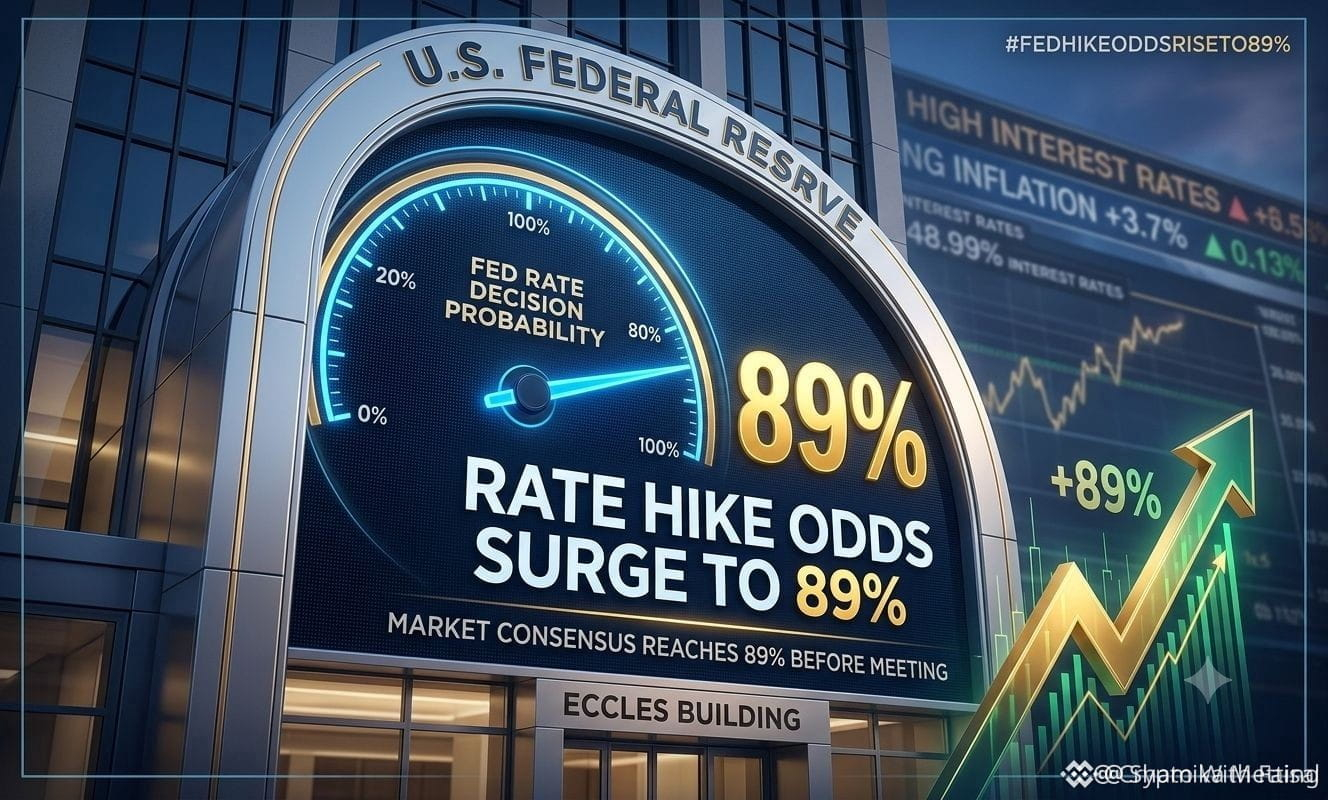
It is strongly expected that the U.S. Federal Reserve will raise interest rates at this week’s meeting, as market expectations jumped to a dominant 89% following the latest inflation reports, which came in more in line with the prevailing trend.
➡️
This rapid pricing reflects a clear shift toward a more hawkish stance and could lead to near-term volatility across risk assets, as liquidity tightens and investment entities reassess the environment of persistently high interest rates.
Please follow up
$ZEC
{future}(ZECUSDT)
#fedhikeoddsriseto89%
🇺🇸
It is strongly expected that the U.S. Federal Reserve will raise interest rates at this week’s meeting, as market expectations jumped to a dominant 89% following the latest inflation reports, which came in more in line with the prevailing trend.
➡️
This rapid pricing reflects a clear shift toward a more hawkish stance and could lead to near-term volatility across risk assets, as liquidity tightens and investment entities reassess the environment of persistently high interest rates.
Please follow up
$ZEC
🇺🇸
It is strongly expected that the U.S. Federal Reserve will raise interest rates at this week’s meeting, as market expectations jumped to a dominant 89% following the latest inflation reports, which came in more in line with the prevailing trend.
➡️
This rapid pricing reflects a clear shift toward a more hawkish stance and could lead to near-term volatility across risk assets, as liquidity tightens and investment entities reassess the environment of persistently high interest rates.
Please follow up
$ZEC
1
53
#avalancheintegratesintouaepassdigitalvault
🇦🇪
The Telecommunications and Digital Government Regulatory Authority (TDRA) in the United Arab Emirates is upgrading its national digital identity platform, UAE PASS, by integrating Avalanche technology into its “digital wallet.” This major step will enable verification of blockchain technology–supported documents for more than 12.5 million citizens, residents, and visitors, allowing them to securely store, request, and share official government documents.
➡️
This critical integration marks a significant move toward real adoption of the Web3 infrastructure. By leveraging a dedicated Avalanche L1 for nationwide data processing, the UAE sets a new standard for institutional blockchain use—by transitioning from previously permissioned networks to improve scalability and overall performance.
Please stay tuned
#Avalanche #RWA #Web3
$AVAX
{future}(AVAXUSDT)
#avalancheintegratesintouaepassdigitalvault
🇦🇪
The Telecommunications and Digital Government Regulatory Authority (TDRA) in the United Arab Emirates is upgrading its national digital identity platform, UAE PASS, by integrating Avalanche technology into its “digital wallet.” This major step will enable verification of blockchain technology–supported documents for more than 12.5 million citizens, residents, and visitors, allowing them to securely store, request, and share official government documents.
➡️
This critical integration marks a significant move toward real adoption of the Web3 infrastructure. By leveraging a dedicated Avalanche L1 for nationwide data processing, the UAE sets a new standard for institutional blockchain use—by transitioning from previously permissioned networks to improve scalability and overall performance.
Please stay tuned
#Avalanche #RWA #Web3
$AVAX
🇦🇪
The Telecommunications and Digital Government Regulatory Authority (TDRA) in the United Arab Emirates is upgrading its national digital identity platform, UAE PASS, by integrating Avalanche technology into its “digital wallet.” This major step will enable verification of blockchain technology–supported documents for more than 12.5 million citizens, residents, and visitors, allowing them to securely store, request, and share official government documents.
➡️
This critical integration marks a significant move toward real adoption of the Web3 infrastructure. By leveraging a dedicated Avalanche L1 for nationwide data processing, the UAE sets a new standard for institutional blockchain use—by transitioning from previously permissioned networks to improve scalability and overall performance.
Please stay tuned
#Avalanche #RWA #Web3
$AVAX

1
1
279
#anthropicceocallsforaislowdown 🚨 Artificial intelligence has just been slowed down. Traders, pay attention!
A major warning is about to come from the heart of the AI race.
The CEO of Anthropic (Anthropic) Dario Amodei called for a planned slowdown in the development of advanced AI, saying that the power of AI is growing faster than the ability of safety and fairness measures to keep up.
His 3-step plan includes:
🔹 External evaluators inside AI companies
🔹 Industry-wide safety coordination
🔹 Global cooperation, including with China
What’s important for investors? Sam Altman and Elon Musk have publicly supported the idea, while the debate raises questions about AI rules, chip demand, spending on infrastructure, and how quickly AI will grow.
For traders, this could lead to short-term volatility across AI stocks and semiconductor companies.
👀 Is this a step for safety or a potential threat to the AI growth path?
Please follow up
#AI #NVIDIA #stockmarket
$NVDAB
{spot}(NVDABUSDT)
#anthropicceocallsforaislowdown 🚨 Artificial intelligence has just been slowed down. Traders, pay attention!
A major warning is about to come from the heart of the AI race.
The CEO of Anthropic (Anthropic) Dario Amodei called for a planned slowdown in the development of advanced AI, saying that the power of AI is growing faster than the ability of safety and fairness measures to keep up.
His 3-step plan includes:
🔹 External evaluators inside AI companies
🔹 Industry-wide safety coordination
🔹 Global cooperation, including with China
What’s important for investors? Sam Altman and Elon Musk have publicly supported the idea, while the debate raises questions about AI rules, chip demand, spending on infrastructure, and how quickly AI will grow.
For traders, this could lead to short-term volatility across AI stocks and semiconductor companies.
👀 Is this a step for safety or a potential threat to the AI growth path?
Please follow up
#AI #NVIDIA #stockmarket
$NVDAB
A major warning is about to come from the heart of the AI race.
The CEO of Anthropic (Anthropic) Dario Amodei called for a planned slowdown in the development of advanced AI, saying that the power of AI is growing faster than the ability of safety and fairness measures to keep up.
His 3-step plan includes:
🔹 External evaluators inside AI companies
🔹 Industry-wide safety coordination
🔹 Global cooperation, including with China
What’s important for investors? Sam Altman and Elon Musk have publicly supported the idea, while the debate raises questions about AI rules, chip demand, spending on infrastructure, and how quickly AI will grow.
For traders, this could lead to short-term volatility across AI stocks and semiconductor companies.
👀 Is this a step for safety or a potential threat to the AI growth path?
Please follow up
#AI #NVIDIA #stockmarket
$NVDAB

5
1
775
🚨🇺🇸 Urgent:
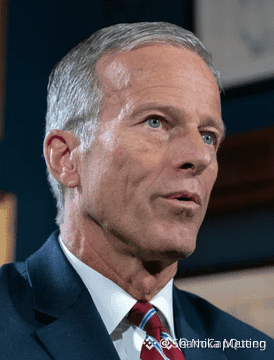
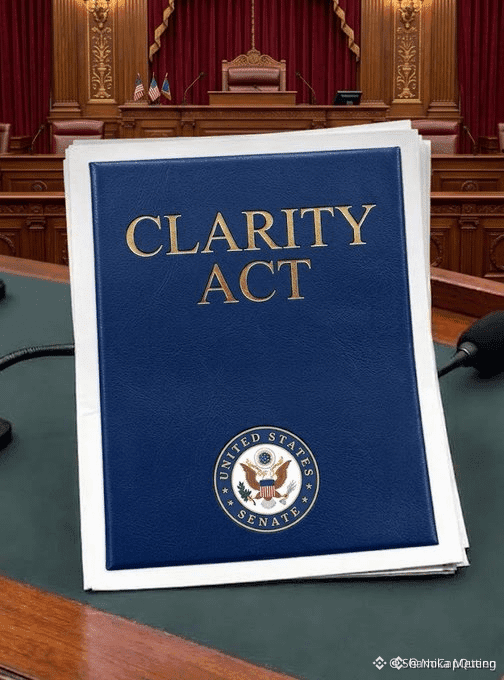
Democrats may push for passage of the CLARITY Act, while Senate Majority Leader John Thune pledges to hold a “risk-free” vote.
• The current vote will only serve to begin discussions on the bill.
• This gives Democrats the opportunity to address remaining concerns through future amendments.
🔥 An important step toward clearer regulation of the crypto market in the United States.
👀 All eyes are now on the Senate vote.
Please follow up
$BTC $XRP $ETH
#CLARITYAct #Crypto #BTC #ETH #xrp
🚨🇺🇸 Urgent:
Democrats may push for passage of the CLARITY Act, while Senate Majority Leader John Thune pledges to hold a “risk-free” vote.
• The current vote will only serve to begin discussions on the bill.
• This gives Democrats the opportunity to address remaining concerns through future amendments.
🔥 An important step toward clearer regulation of the crypto market in the United States.
👀 All eyes are now on the Senate vote.
Please follow up
$BTC $XRP $ETH
#CLARITYAct #Crypto #BTC #ETH #xrp
Democrats may push for passage of the CLARITY Act, while Senate Majority Leader John Thune pledges to hold a “risk-free” vote.
• The current vote will only serve to begin discussions on the bill.
• This gives Democrats the opportunity to address remaining concerns through future amendments.
🔥 An important step toward clearer regulation of the crypto market in the United States.
👀 All eyes are now on the Senate vote.
Please follow up
$BTC $XRP $ETH
#CLARITYAct #Crypto #BTC #ETH #xrp
1
17
#bitcointhirdsingleblockreorginfourweeks 🚨 Bitcoin has experienced another chain reorganization. Should traders be worried?
Bitcoin saw a block-chain reorganization about once in roughly four weeks, and its timing is drawing increasing attention from traders.
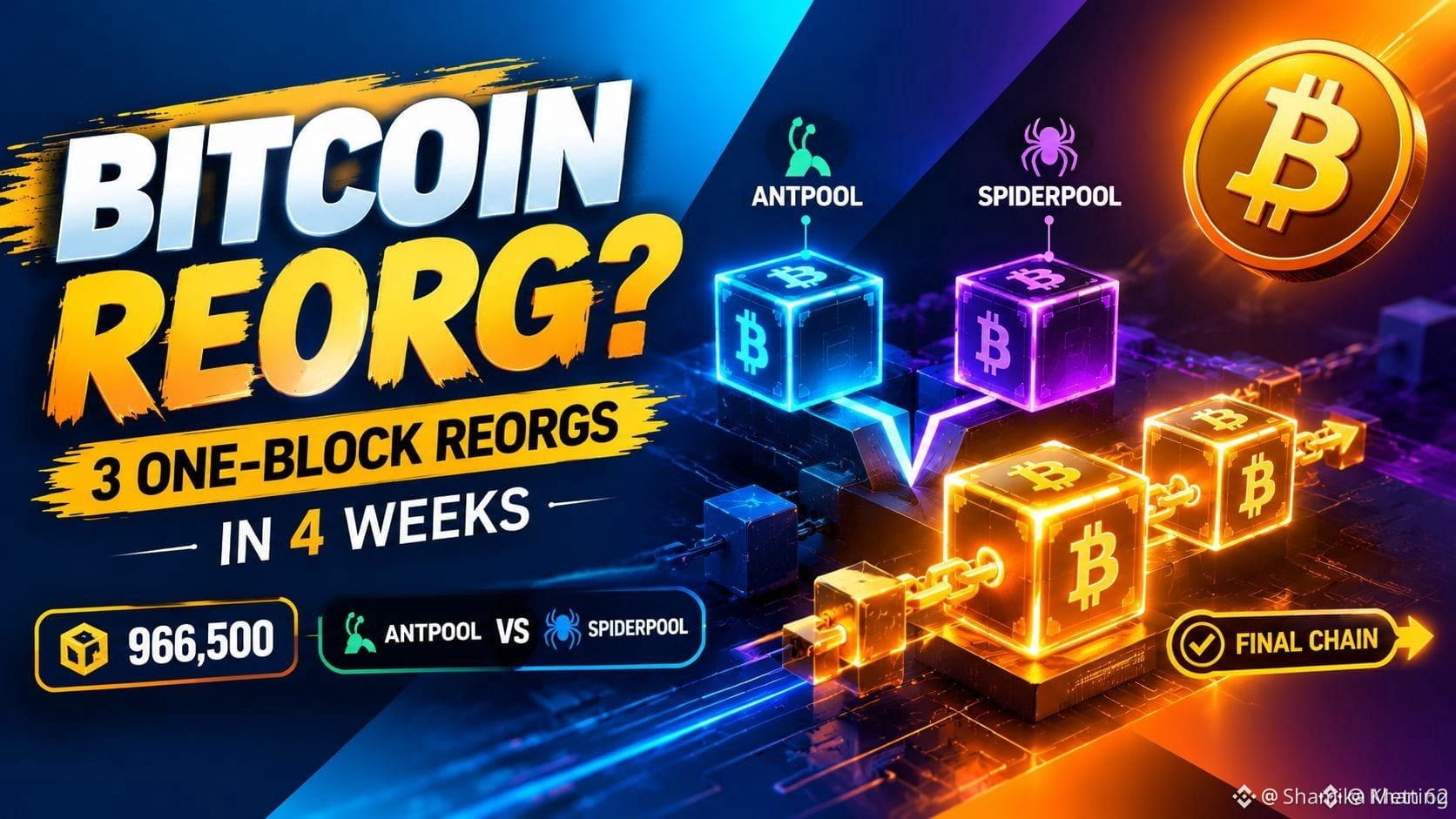
At block 966,500, AntPool and SpiderPool created blocks in very close succession. The network had competing copies for a period, but AntPool’s chain accumulated more proof-of-work and became the official chain. SpiderPool’s block then became stale.
📌 Previous instances:
• August 16. Block 962,722
• August 24. Block 963,853
• September 11. Block 966,500
Section: This does not currently indicate a security issue with Bitcoin or a 51% attack. A one-block reorganization can happen because miners may find blocks at the same time, and because propagating blocks across the network takes time.
Three events in a short span is something worth keeping an eye on.
👀 Do you think these are differences in the mining process—or a sign traders should monitor more carefully?
Please follow up
#bitcoin #BTC #cryptotrading
$BTC · $ETH
#bitcointhirdsingleblockreorginfourweeks 🚨 Bitcoin has experienced another chain reorganization. Should traders be worried?
Bitcoin saw a block-chain reorganization about once in roughly four weeks, and its timing is drawing increasing attention from traders.
At block 966,500, AntPool and SpiderPool created blocks in very close succession. The network had competing copies for a period, but AntPool’s chain accumulated more proof-of-work and became the official chain. SpiderPool’s block then became stale.
📌 Previous instances:
• August 16. Block 962,722
• August 24. Block 963,853
• September 11. Block 966,500
Section: This does not currently indicate a security issue with Bitcoin or a 51% attack. A one-block reorganization can happen because miners may find blocks at the same time, and because propagating blocks across the network takes time.
Three events in a short span is something worth keeping an eye on.
👀 Do you think these are differences in the mining process—or a sign traders should monitor more carefully?
Please follow up
#bitcoin #BTC #cryptotrading
$BTC · $ETH
Bitcoin saw a block-chain reorganization about once in roughly four weeks, and its timing is drawing increasing attention from traders.
At block 966,500, AntPool and SpiderPool created blocks in very close succession. The network had competing copies for a period, but AntPool’s chain accumulated more proof-of-work and became the official chain. SpiderPool’s block then became stale.
📌 Previous instances:
• August 16. Block 962,722
• August 24. Block 963,853
• September 11. Block 966,500
Section: This does not currently indicate a security issue with Bitcoin or a 51% attack. A one-block reorganization can happen because miners may find blocks at the same time, and because propagating blocks across the network takes time.
Three events in a short span is something worth keeping an eye on.
👀 Do you think these are differences in the mining process—or a sign traders should monitor more carefully?
Please follow up
#bitcoin #BTC #cryptotrading
$BTC · $ETH
2
1
309
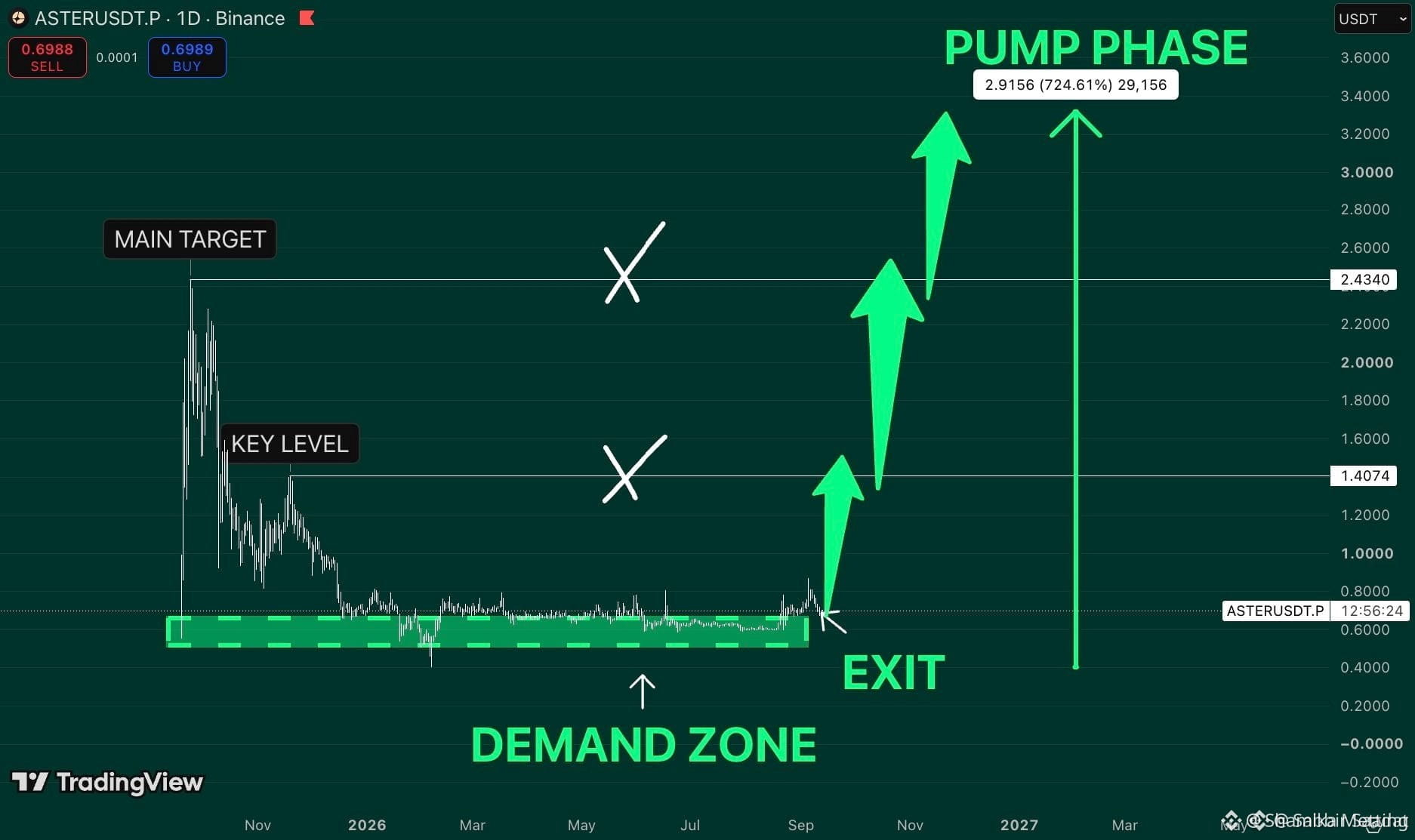
Prices took months to move sideways around $0.60–0.70, building a long consolidation range without much noise.
This doesn’t guarantee a breakout, but the structure is worth monitoring.
My bullish watch list: $1.40 → first resistance at $2.43 → main target at 3+ → upward extension if momentum expands.
Best to wait for a confirmed breakout and retest, instead of chasing a sudden impulse.
Please follow up
$ASTER
{future}(ASTERUSDT)
Is $ASTER preparing for its next expansion?
Prices took months to move sideways around $0.60–0.70, building a long consolidation range without much noise.
This doesn’t guarantee a breakout, but the structure is worth monitoring.
My bullish watch list: $1.40 → first resistance at $2.43 → main target at 3+ → upward extension if momentum expands.
Best to wait for a confirmed breakout and retest, instead of chasing a sudden impulse.
Please follow up
$ASTER
Is $ASTER preparing for its next expansion?
This doesn’t guarantee a breakout, but the structure is worth monitoring.
My bullish watch list: $1.40 → first resistance at $2.43 → main target at 3+ → upward extension if momentum expands.
Best to wait for a confirmed breakout and retest, instead of chasing a sudden impulse.
Please follow up
$ASTER
Is $ASTER preparing for its next expansion?
1
96
Log in to explore more content
Join global crypto users on Binance Square
⚡️ Get latest and useful information about crypto.
💬 Trusted by the world’s largest crypto exchange.
👍 Discover real insights from verified creators.
Email / Phone number
Trending Topics
FedHikeOddsRiseTo89%
40,420 views
744 Discussing
The Fed HAS to hike tomorrow (and that's actually bullish)"
Tomorrow crypto has 2 doors:
Door 1: Fed hikes (89% chance). Short pain, market already knows.
Door 2: Clarity Act passes (50% chance). US finally gives crypto a rulebook. This market has ZERO priced in.
CPI came 0.3% vs 0.2% expected. That single 0.1% pushed Fed hike odds from 58% to 89% in 24 hours.
Everyone is focused on the hike, but the real alpha is CLARITY.
Hike = short-term pain (priced in)
Clarity Pass = long-term unlock for entire US crypto market.
Don't fade the bigger news.
$BTC $ETH#fedhikeoddsriseto89%
True News
·8 Likes
·5.4k views
RLUSDSupplyHitsRecord$2.442B
1,724 views
33 Discussing
AvalancheIntegratesIntoUAEPassDigitalVault
47,793 views
813 Discussing