Binance Square
#newtonprotocol

newtonprotocol

158,565 views
2,328 Discussing
Suyay
·
--
Partly True
A protocol looked at blockchain's biggest selling point — total transparency — and called it a weakness. Its own pitch: crypto needs locks for that glass house. Newton Protocol positions itself as a pre-transaction authorization layer, letting AI agents, RWA platforms, and stablecoin issuers enforce compliance rules onchain before a transaction executes. It recently expanded with a Model Registry marketplace where developers can publish agent models for others to discover and compose. The token has also had to absorb real supply pressure — a 139 million NEWT ($7.55M) unlock in June tested demand directly — while Binance's Summer Earn campaign offered yield on locked NEWT to help offset it. On the 1H chart, NEWT slid to a low near 0.03986 a few days ago, then reversed sharply, climbing to a recent high near 0.04295 before settling at its current 0.04212. It's now holding above all three moving averages in a bullish stack — MA7 at 0.04220, MA25 at 0.04174, MA99 at 0.04135 — with RSI clustered in the mid-50s across all three periods and the MACD histogram just barely negative, crossing back toward zero. Reclaiming a bullish moving-average stack after a multi-day low is a genuinely constructive short-term signal. But NEWT's history shows sharp swings tied directly to unlock events and thin liquidity — the chart looks better today than three days ago, but whether that holds through the next round of supply hitting the market is a separate question from today's candle. Not financial advice — for informational purposes only. $NEWT #NewtonProtocol #Binance {spot}(NEWTUSDT)
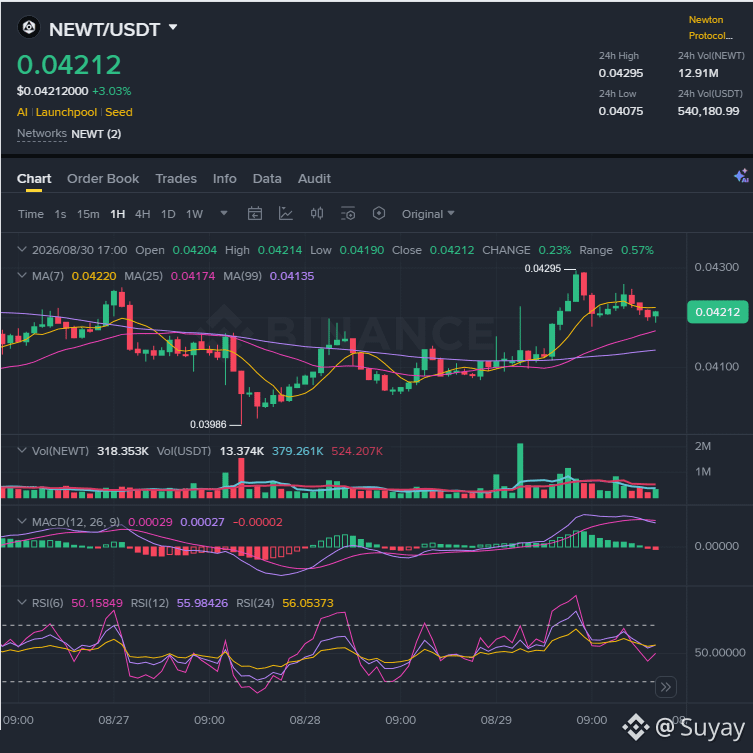
A protocol looked at blockchain's biggest selling point — total transparency — and called it a weakness. Its own pitch: crypto needs locks for that glass house.

Newton Protocol positions itself as a pre-transaction authorization layer, letting AI agents, RWA platforms, and stablecoin issuers enforce compliance rules onchain before a transaction executes. It recently expanded with a Model Registry marketplace where developers can publish agent models for others to discover and compose. The token has also had to absorb real supply pressure — a 139 million NEWT ($7.55M) unlock in June tested demand directly — while Binance's Summer Earn campaign offered yield on locked NEWT to help offset it.

On the 1H chart, NEWT slid to a low near 0.03986 a few days ago, then reversed sharply, climbing to a recent high near 0.04295 before settling at its current 0.04212. It's now holding above all three moving averages in a bullish stack — MA7 at 0.04220, MA25 at 0.04174, MA99 at 0.04135 — with RSI clustered in the mid-50s across all three periods and the MACD histogram just barely negative, crossing back toward zero.

Reclaiming a bullish moving-average stack after a multi-day low is a genuinely constructive short-term signal. But NEWT's history shows sharp swings tied directly to unlock events and thin liquidity — the chart looks better today than three days ago, but whether that holds through the next round of supply hitting the market is a separate question from today's candle.

Not financial advice — for informational purposes only.

$NEWT #NewtonProtocol #Binance

Last month I helped an organization’s vault integrate with Newton. Their CTO didn’t ask how to configure the SDK first—he asked how many milliseconds the attestation takes to produce. I was stunned for a moment. Later I realized what he meant wasn’t “Can we put it on-chain?” He was asking whether that interception could run faster than the transaction itself. I spent two weeks thinking about it and found that the biggest difference between Newton and the vast majority of on-chain security mechanisms is exactly this. In most projects, risk controls run after settlement. Even if the audit report looks great, once the funds have already been transferred, the cost of rolling back if something goes wrong is higher than the amount itself. The organization’s vault kept asking me one thing: “Can you intercept before settlement?” @NewtonProtocol’s answer is attestation—not a post-event alert, but running the rules before the money moves. You whitelist assets, set the maximum drawdown, approve counterparties—if any condition fails, the signature is rejected immediately. This isn’t adding another approval workflow; it squeezes out arbitrage space at the mechanism level. I saw their June Mainnet Beta launch at the TokenizeThis NYC conference. The VaultKit SDK directly provides a ready-made Rego policy template for vault creators. Organizations don’t have to write contracts from scratch. They can activate rules by writing a single line for the whitelist, the maximum drawdown percentage, and the approved counterparty. Combined with attestation, every time the agent rebalances, the change runs through the strategy first and then goes on-chain. Any violation gets bounced back. In those “bare-bones” scenarios where an AI agent uses a private key to tweak contracts all over the place, adding on-chain hard rules like this means that if something really goes wrong, it won’t just evaporate overnight. In onsite testing, an attestation takes about 2–3 seconds to return—faster than a DEX transaction. When the organization’s CTO heard this number, they usually asked one more question: “Is gas expensive?” Newton’s answer is that attestation itself is off-chain verification plus an on-chain signature write-back. Gas uses $NEWT as the gas token, and the per-transaction cost is basically negligible. This matters more than any SLA number, because the real pain point for institutions is never just whether it can run—it’s whether running it will consume too much alpha. Now $NEWT is $15.19, up 2.50% over the last 24 hours. After more than a month on mainnet, liquidity is still climbing steadily. The token itself handles the staking, gas, and governance “three-piece set.” The chips from the 2025 Binance HODLer airdrop are also starting to be active in the secondary market. For institutional vaults, integrating the VaultKit into the strategy layer and turning attestation into the final hard checkpoint before settlement may be far more practical than arguing over compliance documentation. Code doesn’t lie, and contracts don’t talk in feelings. #Newt #NewtonProtocol #链上授权 #DeFi #Attestation
Last month I helped an organization’s vault integrate with Newton. Their CTO didn’t ask how to configure the SDK first—he asked how many milliseconds the attestation takes to produce. I was stunned for a moment. Later I realized what he meant wasn’t “Can we put it on-chain?” He was asking whether that interception could run faster than the transaction itself.

I spent two weeks thinking about it and found that the biggest difference between Newton and the vast majority of on-chain security mechanisms is exactly this. In most projects, risk controls run after settlement. Even if the audit report looks great, once the funds have already been transferred, the cost of rolling back if something goes wrong is higher than the amount itself. The organization’s vault kept asking me one thing: “Can you intercept before settlement?”
@NewtonProtocol’s answer is attestation—not a post-event alert, but running the rules before the money moves. You whitelist assets, set the maximum drawdown, approve counterparties—if any condition fails, the signature is rejected immediately. This isn’t adding another approval workflow; it squeezes out arbitrage space at the mechanism level.

I saw their June Mainnet Beta launch at the TokenizeThis NYC conference. The VaultKit SDK directly provides a ready-made Rego policy template for vault creators. Organizations don’t have to write contracts from scratch. They can activate rules by writing a single line for the whitelist, the maximum drawdown percentage, and the approved counterparty. Combined with attestation, every time the agent rebalances, the change runs through the strategy first and then goes on-chain. Any violation gets bounced back. In those “bare-bones” scenarios where an AI agent uses a private key to tweak contracts all over the place, adding on-chain hard rules like this means that if something really goes wrong, it won’t just evaporate overnight.

In onsite testing, an attestation takes about 2–3 seconds to return—faster than a DEX transaction. When the organization’s CTO heard this number, they usually asked one more question: “Is gas expensive?” Newton’s answer is that attestation itself is off-chain verification plus an on-chain signature write-back. Gas uses $NEWT as the gas token, and the per-transaction cost is basically negligible. This matters more than any SLA number, because the real pain point for institutions is never just whether it can run—it’s whether running it will consume too much alpha.

Now $NEWT is $15.19, up 2.50% over the last 24 hours. After more than a month on mainnet, liquidity is still climbing steadily. The token itself handles the staking, gas, and governance “three-piece set.” The chips from the 2025 Binance HODLer airdrop are also starting to be active in the secondary market. For institutional vaults, integrating the VaultKit into the strategy layer and turning attestation into the final hard checkpoint before settlement may be far more practical than arguing over compliance documentation. Code doesn’t lie, and contracts don’t talk in feelings.

#Newt #NewtonProtocol #链上授权 #DeFi #Attestation

Article
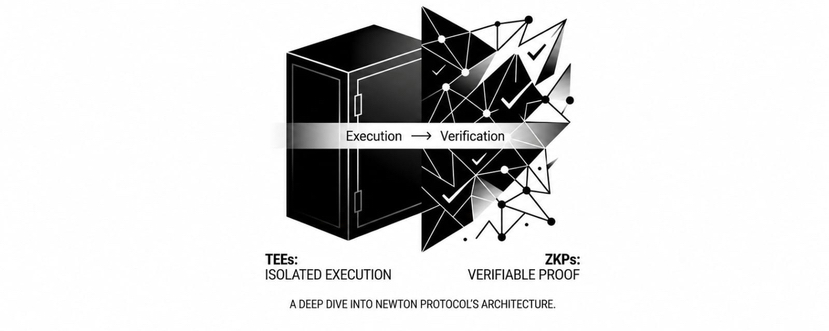
I Think People Are Mixing Up What TEEs and Zero-Knowledge Proofs Actually DoI kept seeing the same argument while reading about @NewtonProtocol . "If it already uses zero-knowledge proofs, why bother with Trusted Execution Environments?" At first, that sounded like a fair criticism. Zero-knowledge proofs have become almost synonymous with privacy in crypto. It's easy to assume they should be able to handle everything on their own. The more I dug into Newton's architecture, the less that assumption held up. I don't think the protocol combines TEEs and zero-knowledge proofs because one technology isn't good enough. I think it combines them because they're answering completely different questions. Imagine asking an AI agent to rebalance a treasury. It needs access to private information, market data, wallet permissions, and predefined policies. None of that is useful if every intermediate step has to become public. That's the role of the TEE. It creates an isolated execution environment where the agent can make decisions without exposing the data it depends on. Privacy isn't an optional feature here it's a requirement for the agent to function. But privacy creates another problem. If nobody can see what happened inside the enclave, how can anyone else trust the resulting transaction? That's where I think many discussions become misleading. The zero-knowledge proof isn't replacing the TEE. It's explaining the outcome of the TEE.The secure enclave performs the work.The proof allows everyone else to verify that the work respected the published rules without revealing the confidential inputs that produced it. Those sound similar, but they're solving opposite sides of the same problem. One protects execution. The other protects verification. That distinction also changes how I think about "trustless" systems. People often describe zero-knowledge proofs as removing trust entirely. I'm not sure that's the right way to frame it.The TEE is still responsible for executing code correctly inside its protected environment.The proof doesn't eliminate that responsibility. It makes the result independently checkable after execution. In other words, trust isn't disappearing. It's being divided into smaller, more specialized guarantees. That feels like a more realistic security model than expecting a single cryptographic primitive to solve privacy, execution, verification, and policy enforcement all at once.After reading through Newton's design, I stopped viewing TEEs and zero-knowledge proofs as competing technologies. They're closer to two witnesses describing different parts of the same event. One knows what happened. The other lets everyone confirm the story without revealing everything they saw. Maybe that's the more interesting takeaway. The real innovation isn't that Newton uses TEEs or zero-knowledge proofs.It's that the protocol treats privacy and verifiability as separate engineering problems instead of pretending one technology can solve both. #Newt #TEE #ZKP #NewtonProtocol $NEWT {future}(NEWTUSDT) $VANRY {future}(VANRYUSDT) $BEL {future}(BELUSDT)

I Think People Are Mixing Up What TEEs and Zero-Knowledge Proofs Actually Do

I kept seeing the same argument while reading about @NewtonProtocol .
"If it already uses zero-knowledge proofs, why bother with Trusted Execution Environments?"
At first, that sounded like a fair criticism. Zero-knowledge proofs have become almost synonymous with privacy in crypto. It's easy to assume they should be able to handle everything on their own.
The more I dug into Newton's architecture, the less that assumption held up.
I don't think the protocol combines TEEs and zero-knowledge proofs because one technology isn't good enough.
I think it combines them because they're answering completely different questions.
Imagine asking an AI agent to rebalance a treasury. It needs access to private information, market data, wallet permissions, and predefined policies. None of that is useful if every intermediate step has to become public.
That's the role of the TEE.
It creates an isolated execution environment where the agent can make decisions without exposing the data it depends on. Privacy isn't an optional feature here it's a requirement for the agent to function.
But privacy creates another problem.
If nobody can see what happened inside the enclave, how can anyone else trust the resulting transaction?
That's where I think many discussions become misleading.
The zero-knowledge proof isn't replacing the TEE.
It's explaining the outcome of the TEE.The secure enclave performs the work.The proof allows everyone else to verify that the work respected the published rules without revealing the confidential inputs that produced it.
Those sound similar, but they're solving opposite sides of the same problem.
One protects execution.
The other protects verification.
That distinction also changes how I think about "trustless" systems.
People often describe zero-knowledge proofs as removing trust entirely. I'm not sure that's the right way to frame it.The TEE is still responsible for executing code correctly inside its protected environment.The proof doesn't eliminate that responsibility. It makes the result independently checkable after execution.
In other words, trust isn't disappearing.
It's being divided into smaller, more specialized guarantees.
That feels like a more realistic security model than expecting a single cryptographic primitive to solve privacy, execution, verification, and policy enforcement all at once.After reading through Newton's design, I stopped viewing TEEs and zero-knowledge proofs as competing technologies.
They're closer to two witnesses describing different parts of the same event.
One knows what happened.
The other lets everyone confirm the story without revealing everything they saw.
Maybe that's the more interesting takeaway.
The real innovation isn't that Newton uses TEEs or zero-knowledge proofs.It's that the protocol treats privacy and verifiability as separate engineering problems instead of pretending one technology can solve both.
#Newt #TEE #ZKP #NewtonProtocol
$NEWT
$VANRY
$BEL
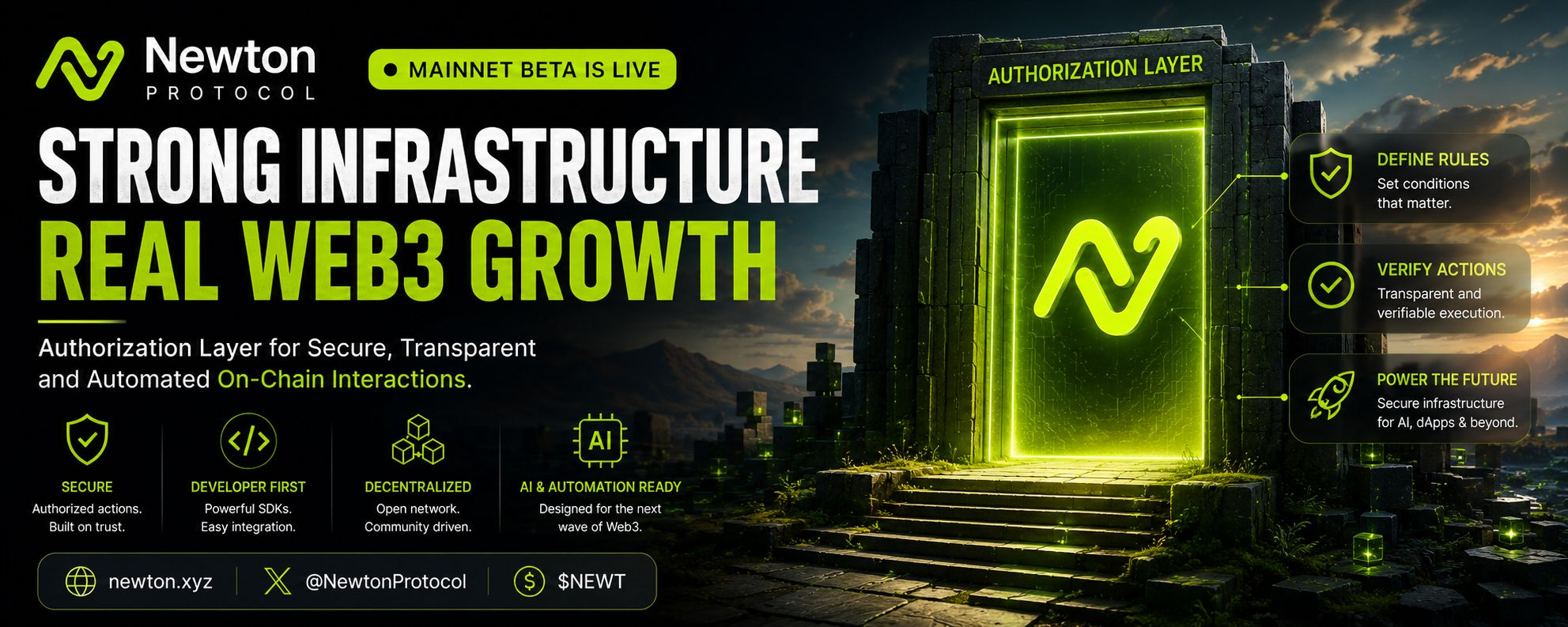
#newt $NEWT @NewtonProtocol introduces a powerful pre-transaction authorization layer and policy engine. Instead of handling risks after the damage is done, it evaluates compliance, security, and risk parameters on-chain before execution. ​This brings programmable transaction integrity directly to DeFi vaults and AI agents without requiring developers to rewrite their entire stack. Safe, decentralized automation is scaling up! 🔒💡 #newton #NewtonProtocol $NEWT {spot}(NEWTUSDT)
#newt $NEWT
@NewtonProtocol introduces a powerful pre-transaction authorization layer and policy engine. Instead of handling risks after the damage is done, it evaluates compliance, security, and risk parameters on-chain before execution.
​This brings programmable transaction integrity directly to DeFi vaults and AI agents without requiring developers to rewrite their entire stack. Safe, decentralized automation is scaling up! 🔒💡
#newton #NewtonProtocol
$NEWT

Article
DeFi Evolution: Exploring the Real-World Asset Potential of Newton Mainnet BetaThe launch of the Newton Mainnet Beta is timely for the broader Web3 ecosystem, especially as decentralized finance moves towards the integration of real-world assets (RWAs). Successfully moving physical equity, real estate, or debt instruments to a public blockchain is a much more complex undertaking than just tokenizing smart contracts. It essentially needs high predictability of networks, granular compliance standards, and rock-solid architectural transaction finality. @NewtonProtocol creates an optimized base layer with parallel processing capabilities that sets the exact rails needed as a foundation for financial institutions to feel comfortable with heavy on-chain throughput. This structural approach closes the historical gap between fluid crypto-native liquidity and rigorous regulatory frameworks. Tracking these critical technical milestones is incredibly essential to understand which platforms will sustainably anchor the next multi-trillion dollar wave of institutional capital onboarding. $NEWT #Newt #NEWT #NewtonProtocol #BinanceSquare [Paid Partnership]

DeFi Evolution: Exploring the Real-World Asset Potential of Newton Mainnet Beta

The launch of the Newton Mainnet Beta is timely for the broader Web3 ecosystem, especially as decentralized finance moves towards the integration of real-world assets (RWAs). Successfully moving physical equity, real estate, or debt instruments to a public blockchain is a much more complex undertaking than just tokenizing smart contracts. It essentially needs high predictability of networks, granular compliance standards, and rock-solid architectural transaction finality.
@NewtonProtocol creates an optimized base layer with parallel processing capabilities that sets the exact rails needed as a foundation for financial institutions to feel comfortable with heavy on-chain throughput. This structural approach closes the historical gap between fluid crypto-native liquidity and rigorous regulatory frameworks. Tracking these critical technical milestones is incredibly essential to understand which platforms will sustainably anchor the next multi-trillion dollar wave of institutional capital onboarding.
$NEWT #Newt #NEWT #NewtonProtocol #BinanceSquare [Paid Partnership]
#newt $NEWT {future}(NEWTUSDT) 🚀 The next phase of Web3 won't be powered by AI alone. It will be powered by verifiable AI. That's why I'm paying close attention to **Newton Protocol**. $NEWT is building the decentralized policy layer that enables AI agents, RWAs, stablecoins, and institutions to execute on-chain actions with cryptographic proof, programmable permissions, and transparent auditability. Instead of asking users to trust automation, Newton makes every critical decision verifiable. As the ecosystem continues to mature, the focus is clearly shifting from hype to infrastructure. Projects solving compliance, secure execution, and policy enforcement are becoming increasingly important, and Newton Protocol is positioning itself at the center of that evolution. Its architecture combines **zkPermissions, Trusted Execution Environments (TEEs), decentralized operators, and immutable on-chain audit trails** to make intelligent automation both secure and accountable. I'm not just watching another token—I'm watching infrastructure that could help define the next generation of on-chain finance and autonomous AI. The strongest narratives don't just follow the future. **They build it.** Bullish on the vision. 👀 $NEWT #Newt #NewtonProtocol @NewtonProtocol
#newt $NEWT
🚀 The next phase of Web3 won't be powered by AI alone. It will be powered by verifiable AI.

That's why I'm paying close attention to **Newton Protocol**.

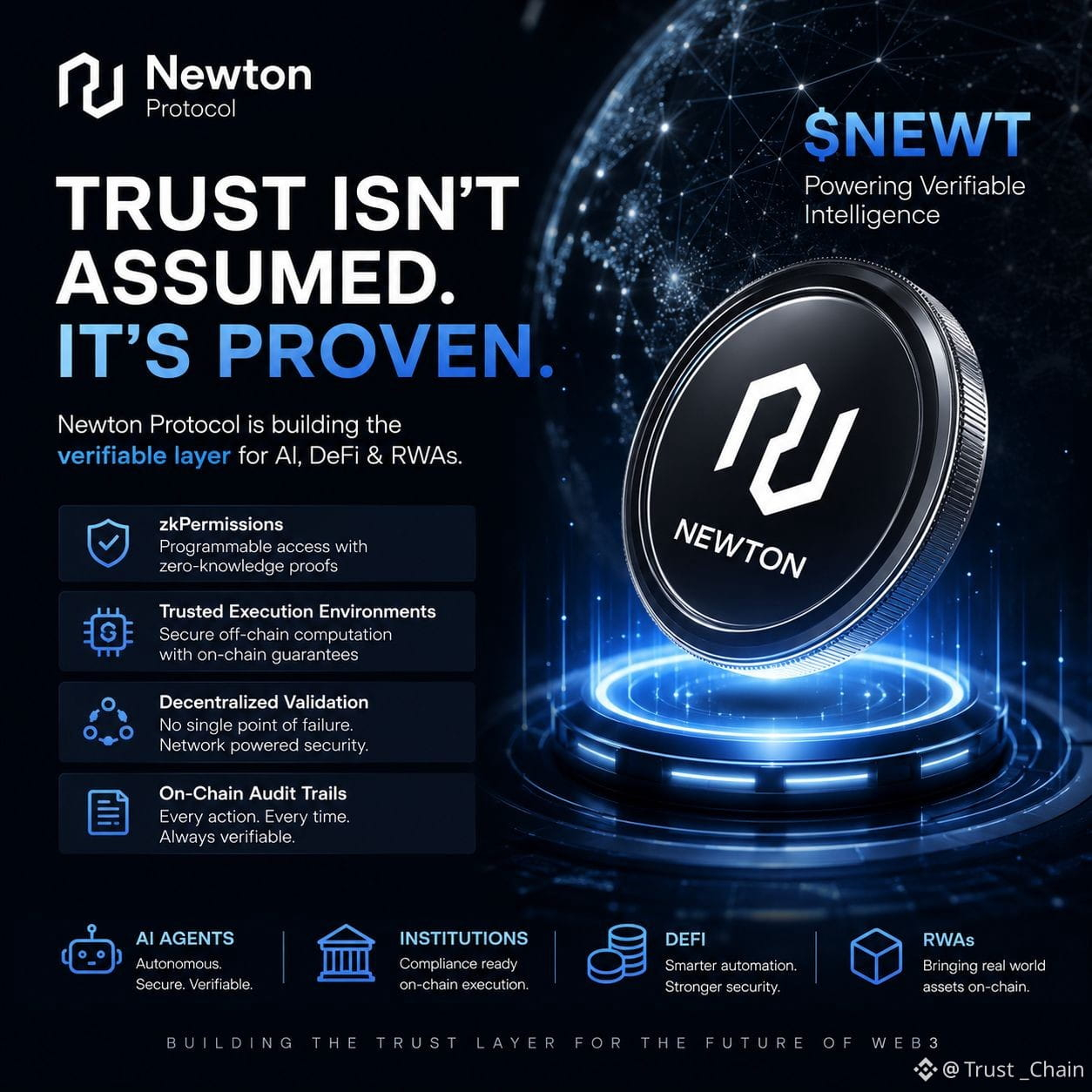
$NEWT is building the decentralized policy layer that enables AI agents, RWAs, stablecoins, and institutions to execute on-chain actions with cryptographic proof, programmable permissions, and transparent auditability. Instead of asking users to trust automation, Newton makes every critical decision verifiable.

As the ecosystem continues to mature, the focus is clearly shifting from hype to infrastructure. Projects solving compliance, secure execution, and policy enforcement are becoming increasingly important, and Newton Protocol is positioning itself at the center of that evolution. Its architecture combines **zkPermissions, Trusted Execution Environments (TEEs), decentralized operators, and immutable on-chain audit trails** to make intelligent automation both secure and accountable.

I'm not just watching another token—I'm watching infrastructure that could help define the next generation of on-chain finance and autonomous AI.

The strongest narratives don't just follow the future.
**They build it.**

Bullish on the vision. 👀

$NEWT #Newt #NewtonProtocol @NewtonProtocol

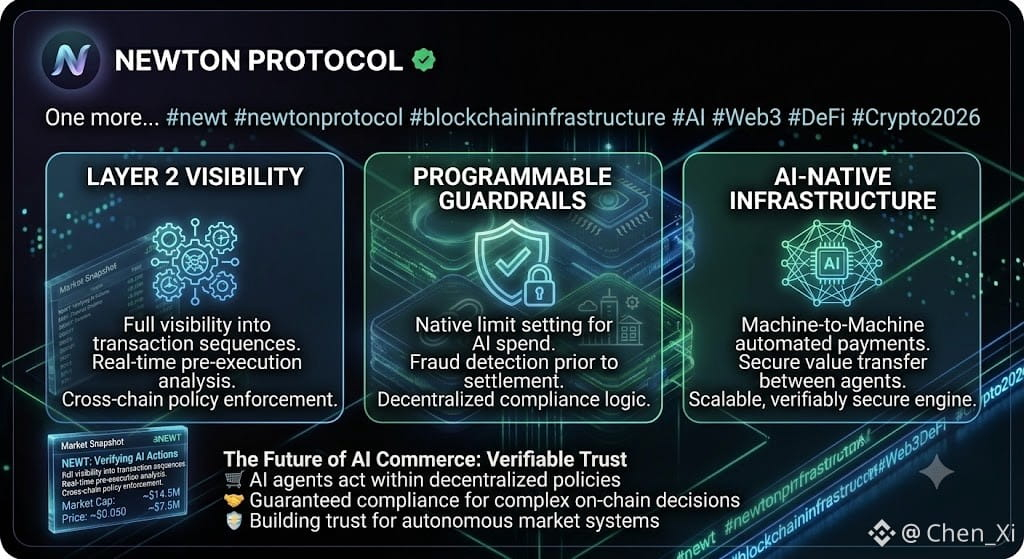
#newt $NEWT @NewtonProtocol Most blockchain security layers force developers to entirely rebuild their stacks. Newton Protocol is tackling the infrastructure challenge differently: acting as a decentralized policy engine that intercepts transactions before execution. Binance As autonomous AI agents shift from managing simple portfolios to executing complex, cross-chain financial decisions, blind trust isn’t an option. Newton provides the programmable guardrails—enforcing spend limits, fraud checks, and compliance logic natively. It isn’t just about speed; it's about building verifiable infrastructure for machine-to-machine commerce. Binance + 1 📈 Current Market Snapshot: Token: $NEWT Live Price: ~$0.050 USD Binance Circulating Supply: ~288.5M (Max Supply: 1B) Binance Market Capitalization: ~$14.5M Binance 24-Hour Trading Volume: ~$7.5M Binance With its Mainnet Beta officially live and an upcoming collateral parameter adjustment scheduled for July 7 to boost protocol liquidity, the infrastructure narrative is heating up. Binance How do you view the future of AI-driven DeFi? Are we ready for fully autonomous on-chain agents? 🌐👇 #newt #newtonprotocol #BlockchainInfrastructure #AI {future}(NEWTUSDT)

#newt $NEWT @NewtonProtocol
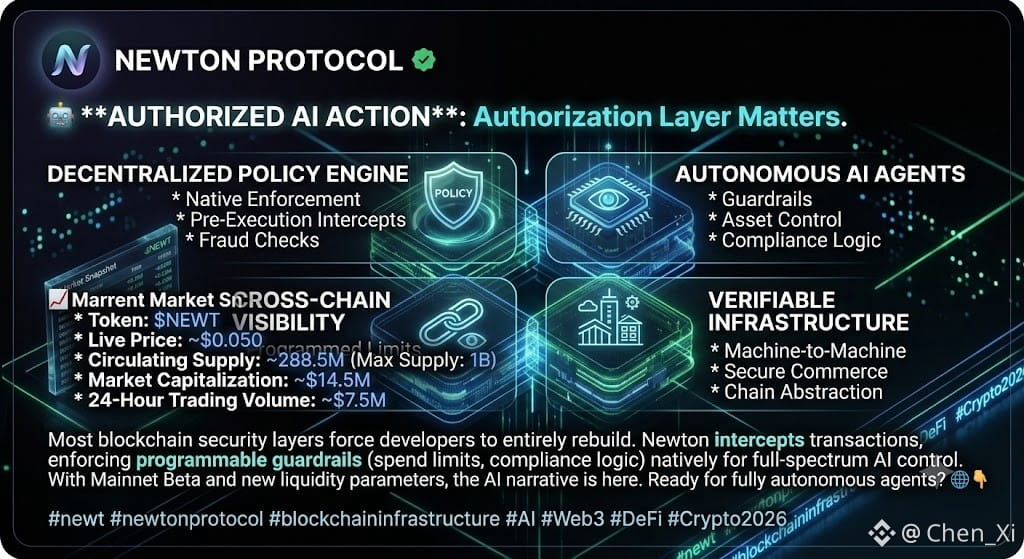
Most blockchain security layers force developers to entirely rebuild their stacks. Newton Protocol is tackling the infrastructure challenge differently: acting as a decentralized policy engine that intercepts transactions before execution.
Binance

As autonomous AI agents shift from managing simple portfolios to executing complex, cross-chain financial decisions, blind trust isn’t an option. Newton provides the programmable guardrails—enforcing spend limits, fraud checks, and compliance logic natively. It isn’t just about speed; it's about building verifiable infrastructure for machine-to-machine commerce.
Binance
+ 1

📈 Current Market Snapshot:

Token: $NEWT

Live Price: ~$0.050 USD
Binance

Circulating Supply: ~288.5M (Max Supply: 1B)
Binance

Market Capitalization: ~$14.5M
Binance

24-Hour Trading Volume: ~$7.5M
Binance

With its Mainnet Beta officially live and an upcoming collateral parameter adjustment scheduled for July 7 to boost protocol liquidity, the infrastructure narrative is heating up.
Binance

How do you view the future of AI-driven DeFi? Are we ready for fully autonomous on-chain agents? 🌐👇

#newt #newtonprotocol #BlockchainInfrastructure #AI
Newton Mainnet Beta 上线后一直在跑,最近看开发者频道讨论比较多的是它的链上授权逻辑。简单理解就是一个交易执行前的策略检查层——Vault 调策略链,Chainalysis 跑合规筛查、Hexagate 做安全检测、Credora 和 RedStone 对风险敞口,全部打包成链上可验证的 pass/fail 证明,结果直接上链存证。 这个思路其实跟传统清算所的 Pre-Trade Risk 很像,只是换到了链上跑。对 DeFi 金库来说,最大的痛点一直是风控碎片化——每个协议自己写一套规则、各自审计、各自维护,出了问题才追查。Newton 相当于把这一层标准化了,策略统一管理、执行留痕、链上公开可查。 团队是 Magic Labs 在做,57M+ 钱包、PayPal Ventures 背书,Polymarket 的钱包底层也是他们的。路线图从金库授权切入,后续往 RWA、稳定币、AI agent 方向扩展。$NEWT 是生态代币,主网 Beta 阶段,后续看市场怎么验证。 @NewtonProtocol #NEWT #NewtonProtocol #AI 仅供信息参考,不构成投资建议。

Newton Mainnet Beta 上线后一直在跑,最近看开发者频道讨论比较多的是它的链上授权逻辑。简单理解就是一个交易执行前的策略检查层——Vault 调策略链,Chainalysis 跑合规筛查、Hexagate 做安全检测、Credora 和 RedStone 对风险敞口,全部打包成链上可验证的 pass/fail 证明,结果直接上链存证。

这个思路其实跟传统清算所的 Pre-Trade Risk 很像,只是换到了链上跑。对 DeFi 金库来说,最大的痛点一直是风控碎片化——每个协议自己写一套规则、各自审计、各自维护,出了问题才追查。Newton 相当于把这一层标准化了,策略统一管理、执行留痕、链上公开可查。

团队是 Magic Labs 在做,57M+ 钱包、PayPal Ventures 背书,Polymarket 的钱包底层也是他们的。路线图从金库授权切入,后续往 RWA、稳定币、AI agent 方向扩展。$NEWT 是生态代币,主网 Beta 阶段,后续看市场怎么验证。

@NewtonProtocol

#NEWT #NewtonProtocol #AI

仅供信息参考,不构成投资建议。
Verified
NEWT: supply, initial circulation, and utility in Newton ProtocolWith 1.000 billion units in total supply and 215 million in initial circulation—21.5%—, $NEWT operates within a constrained supply framework under a protocol whose value depends on the adoption of its onchain authorization layer. The native token of @NewtonProtocol , developed by Magic Labs, reserved 10% of the supply for a community airdrop and has a listing on Binance Alpha. Magic secures the account; Newton Protocol secures the transaction: it evaluates each operation before settlement on Base and Ethereum with programmable policies and verifiable BLS attestation.

NEWT: supply, initial circulation, and utility in Newton Protocol

With 1.000 billion units in total supply and 215 million in initial circulation—21.5%—, $NEWT operates within a constrained supply framework under a protocol whose value depends on the adoption of its onchain authorization layer.
The native token of @NewtonProtocol , developed by Magic Labs, reserved 10% of the supply for a community airdrop and has a listing on Binance Alpha. Magic secures the account; Newton Protocol secures the transaction: it evaluates each operation before settlement on Base and Ethereum with programmable policies and verifiable BLS attestation.
·
--
Bullish
On the blockchain, errors are permanent. Who prevents them before they happen? One of the toughest realities of operating onchain is that transactions are irreversible. There is no “undo” button. There’s no bank calling to confirm whether you really wanted to move those funds. Once executed, the transaction exists forever on the chain. This works well when the human pressing the button is attentive and well-informed. But what happens when the one executing the transaction isn’t a human, but an automated agent or a DeFi bot operating at machine speed—without pause, without confirmation, without prior verification? That’s exactly where @NewtonProtocol comes in with its Mainnet Beta: before any automated transaction is executed, a decentralized network of operators evaluates whether that action complies with the rules you defined. If it doesn’t, the transaction doesn’t go through. Without exception. This isn’t about slowing down automation. It’s about making it reliable. Because in a system where errors are permanent, prevention isn’t optional—it’s the only sensible strategy. $NEWT is the token that keeps this decentralized verification network running. Have you ever seen an automatic transaction go wrong onchain? How did you handle it? Follow me for more content like this. 🔔 @NewtonProtocol #Newt #NewtonProtocol #web3_binance #Binance #newt $NEWT
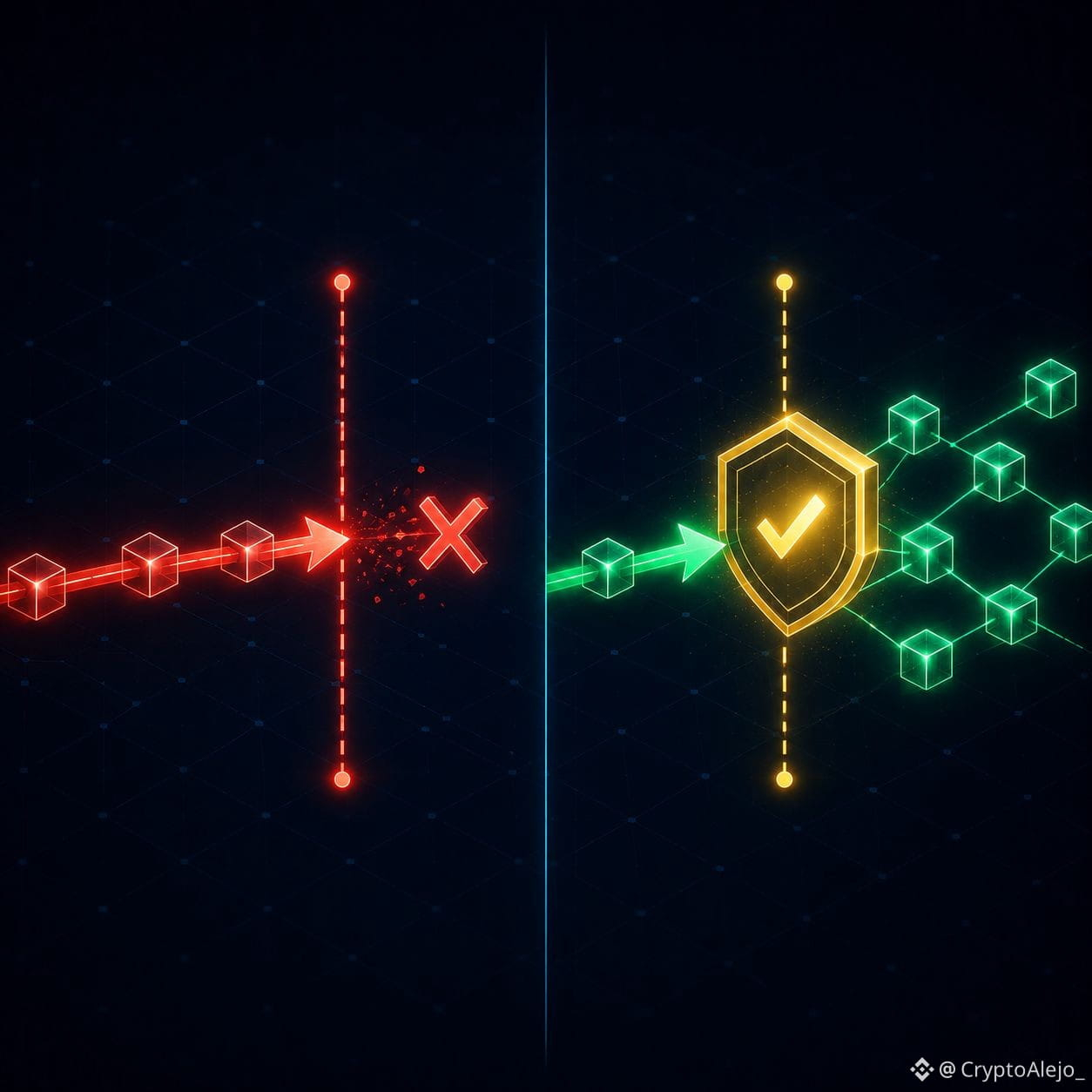
On the blockchain, errors are permanent. Who prevents them before they happen?

One of the toughest realities of operating onchain is that transactions are irreversible. There is no “undo” button. There’s no bank calling to confirm whether you really wanted to move those funds. Once executed, the transaction exists forever on the chain.

This works well when the human pressing the button is attentive and well-informed. But what happens when the one executing the transaction isn’t a human, but an automated agent or a DeFi bot operating at machine speed—without pause, without confirmation, without prior verification?

That’s exactly where @NewtonProtocol comes in with its Mainnet Beta: before any automated transaction is executed, a decentralized network of operators evaluates whether that action complies with the rules you defined. If it doesn’t, the transaction doesn’t go through. Without exception.

This isn’t about slowing down automation. It’s about making it reliable. Because in a system where errors are permanent, prevention isn’t optional—it’s the only sensible strategy.

$NEWT is the token that keeps this decentralized verification network running.

Have you ever seen an automatic transaction go wrong onchain? How did you handle it? Follow me for more content like this. 🔔

@NewtonProtocol #Newt #NewtonProtocol #web3_binance #Binance
#newt $NEWT

#newt $NEWT AI agents are already making financial decisions. Rebalancing portfolios. Executing recurring buys. Managing vault risk. Most of them run on centralized bots with no way to verify what actually happened or why. That's the gap @NewtonProtocol sits in. Every agent action gets evaluated against programmable rules before it executes. Pass or fail there's a cryptographic receipt onchain either way. Not "the agent said it followed the rules." Proof it did. BeInCrypto just put Newton on their Institutional 100 list for Best On-Chain Finance Infrastructure. That's not a community vote. It's scored on institutional clientele and regulatory maturity. The infrastructure for verifiable autonomous finance is being built right now. $NEWT is what powers it. @NewtonProtocol #Newt #NewtonProtocol {spot}(NEWTUSDT)
#newt $NEWT
AI agents are already making financial decisions. Rebalancing portfolios. Executing recurring buys. Managing vault risk. Most of them run on centralized bots with no way to verify what actually happened or why.
That's the gap @NewtonProtocol sits in. Every agent action gets evaluated against programmable rules before it executes. Pass or fail there's a cryptographic receipt onchain either way.
Not "the agent said it followed the rules." Proof it did.
BeInCrypto just put Newton on their Institutional 100 list for Best On-Chain Finance Infrastructure. That's not a community vote. It's scored on institutional clientele and regulatory maturity.
The infrastructure for verifiable autonomous finance is being built right now. $NEWT is what powers it.
@NewtonProtocol
#Newt #NewtonProtocol
Talk about something that the Newton Protocol has been discussed a lot about recently in the Dev community. In traditional DeFi, risk management basically looks like this: the protocol writes the rules itself, audits itself, and maintains itself; when something goes wrong, blame is assigned after the fact. This model is fine when TVL is not high, but once the treasury grows, relying on manual processes to run compliance and risk controls means both efficiency and security can’t keep up. What Newton is doing in essence is to standardize this layer—using a set of on-chain executed authorization logic to run compliance screening, security checks, and risk validation before transaction settlement, outputting an on-chain verifiable pass/fail proof. @NewtonProtocol calls this the onchain authorization layer—indeed a direction of infrastructure that has been overlooked. From a technical implementation standpoint, Newton currently provides a Vault SDK that encapsulates four execution domains (compliance Chainalysis, identity verification, security Hexagate, and risk Credora+RedStone) into standardized strategy interfaces. Vaults can integrate directly via the SDK, without having to write the risk-control logic again. This approach is quite common in TradFi—clearing houses and central counterparties do exactly this—but on-chain it’s still new. The team at Magic Labs previously built more than 57 million embedded wallets, and Polymarket’s wallet infrastructure is theirs; PayPal Ventures has also invested, and their engineering capabilities are solid. From an ecosystem perspective, Newton’s first deployed use case is DeFi vault authorization, but the next step on the roadmap is RWA and stablecoins—both of which have stricter compliance requirements than DeFi. If they can get it working, the incremental opportunity space is clearly significant. $NEWT is the token; during the mainnet Beta phase, the market’s validation will come next. #NEWT #NewtonProtocol #AI For informational purposes only and does not constitute investment advice.

Talk about something that the Newton Protocol has been discussed a lot about recently in the Dev community.

In traditional DeFi, risk management basically looks like this: the protocol writes the rules itself, audits itself, and maintains itself; when something goes wrong, blame is assigned after the fact. This model is fine when TVL is not high, but once the treasury grows, relying on manual processes to run compliance and risk controls means both efficiency and security can’t keep up. What Newton is doing in essence is to standardize this layer—using a set of on-chain executed authorization logic to run compliance screening, security checks, and risk validation before transaction settlement, outputting an on-chain verifiable pass/fail proof. @NewtonProtocol calls this the onchain authorization layer—indeed a direction of infrastructure that has been overlooked.

From a technical implementation standpoint, Newton currently provides a Vault SDK that encapsulates four execution domains (compliance Chainalysis, identity verification, security Hexagate, and risk Credora+RedStone) into standardized strategy interfaces. Vaults can integrate directly via the SDK, without having to write the risk-control logic again. This approach is quite common in TradFi—clearing houses and central counterparties do exactly this—but on-chain it’s still new. The team at Magic Labs previously built more than 57 million embedded wallets, and Polymarket’s wallet infrastructure is theirs; PayPal Ventures has also invested, and their engineering capabilities are solid.

From an ecosystem perspective, Newton’s first deployed use case is DeFi vault authorization, but the next step on the roadmap is RWA and stablecoins—both of which have stricter compliance requirements than DeFi. If they can get it working, the incremental opportunity space is clearly significant. $NEWT is the token; during the mainnet Beta phase, the market’s validation will come next.

#NEWT #NewtonProtocol #AI

For informational purposes only and does not constitute investment advice.

🚀Discovering Newton Protocol and Newton Mainnet Beta!@NewtonProtocol NewtonProtocol builds an innovative Web3 infrastructure that aims to make decentralized applications faster, more secure, and more accessible. With the launch of Newton Mainnet Beta, the project takes an important step forward by providing developers and users with a high-performance environment to explore new possibilities in blockchain. The token $NEWT plays an essential role in the ecosystem by enabling interactions, governance, and rewards. It’s a project worth following for anyone interested in the future of decentralized finance and blockchain technologies.

🚀Discovering Newton Protocol and Newton Mainnet Beta!

@NewtonProtocol NewtonProtocol builds an innovative Web3 infrastructure that aims to make decentralized applications faster, more secure, and more accessible. With the launch of Newton Mainnet Beta, the project takes an important step forward by providing developers and users with a high-performance environment to explore new possibilities in blockchain.
The token $NEWT plays an essential role in the ecosystem by enabling interactions, governance, and rewards. It’s a project worth following for anyone interested in the future of decentralized finance and blockchain technologies.
·
--
Article
Why Infrastructure Projects Like Newton Protocol Deserve More AttentionWhen people talk about blockchain, the conversation usually revolves around token prices, market trends, or the latest narratives. While those topics are always interesting, I believe the real foundation of Web3 is the infrastructure that makes decentralized applications possible. Without strong infrastructure, even the best ideas struggle to scale. This is one of the reasons I've been following @NewtonProtocol and its progress through the Newton Mainnet Beta. For me, infrastructure is not the most exciting part of blockchain at first glance, but it is often the most important. Developers need reliable tools, secure frameworks, and flexible systems to build applications that people can trust. The stronger the foundation, the easier it becomes for innovation to happen on top of it. What caught my attention about Newton Protocol is its focus on programmable authorization. As blockchain technology becomes more advanced and AI-powered applications become more common, defining how transactions and automated actions should be authorized could become increasingly valuable. Instead of thinking only about execution, it's interesting to see a project exploring how actions can be verified against predefined rules. {spot}(NEWTUSDT) The Newton Mainnet Beta is another reason I'm interested in following the ecosystem. A beta phase is where theory meets reality. Developers begin testing ideas, users provide valuable feedback, and the community helps identify improvements that strengthen the network over time. Every successful ecosystem goes through this stage before reaching broader adoption. I also think that community participation is one of the biggest advantages of Web3. Builders, researchers, developers, and everyday users all contribute in different ways. Whether it's testing new features, sharing feedback, or creating useful applications, every contribution helps the ecosystem mature. Another thing I appreciate is that long-term blockchain success usually comes from continuous development rather than short-term excitement. Projects that consistently improve their technology, listen to community feedback, and expand their developer ecosystem often create stronger foundations for the future. As AI and blockchain continue moving closer together, secure infrastructure will likely become even more important. Automation creates exciting opportunities, but it also requires reliable systems that can define permissions, verify actions, and support transparent execution. Watching how Newton Protocol approaches these challenges will be interesting as the ecosystem continues to evolve. I'm looking forward to following the next stage of the Newton Mainnet Beta and seeing how developers use the protocol to build new ideas. It will also be exciting to watch how community feedback shapes future updates and improvements. What are your thoughts on infrastructure-focused blockchain projects? Do you think authorization layers could become an important part of the next generation of Web3? @NewtonProtocol $NEWT #Newt #NewtonProtocol #MainnetBeta #Web3

Why Infrastructure Projects Like Newton Protocol Deserve More Attention

When people talk about blockchain, the conversation usually revolves around token prices, market trends, or the latest narratives. While those topics are always interesting, I believe the real foundation of Web3 is the infrastructure that makes decentralized applications possible. Without strong infrastructure, even the best ideas struggle to scale.
This is one of the reasons I've been following @NewtonProtocol and its progress through the Newton Mainnet Beta.
For me, infrastructure is not the most exciting part of blockchain at first glance, but it is often the most important. Developers need reliable tools, secure frameworks, and flexible systems to build applications that people can trust. The stronger the foundation, the easier it becomes for innovation to happen on top of it.
What caught my attention about Newton Protocol is its focus on programmable authorization. As blockchain technology becomes more advanced and AI-powered applications become more common, defining how transactions and automated actions should be authorized could become increasingly valuable. Instead of thinking only about execution, it's interesting to see a project exploring how actions can be verified against predefined rules.
The Newton Mainnet Beta is another reason I'm interested in following the ecosystem. A beta phase is where theory meets reality. Developers begin testing ideas, users provide valuable feedback, and the community helps identify improvements that strengthen the network over time. Every successful ecosystem goes through this stage before reaching broader adoption.
I also think that community participation is one of the biggest advantages of Web3. Builders, researchers, developers, and everyday users all contribute in different ways. Whether it's testing new features, sharing feedback, or creating useful applications, every contribution helps the ecosystem mature.
Another thing I appreciate is that long-term blockchain success usually comes from continuous development rather than short-term excitement. Projects that consistently improve their technology, listen to community feedback, and expand their developer ecosystem often create stronger foundations for the future.
As AI and blockchain continue moving closer together, secure infrastructure will likely become even more important. Automation creates exciting opportunities, but it also requires reliable systems that can define permissions, verify actions, and support transparent execution. Watching how Newton Protocol approaches these challenges will be interesting as the ecosystem continues to evolve.
I'm looking forward to following the next stage of the Newton Mainnet Beta and seeing how developers use the protocol to build new ideas. It will also be exciting to watch how community feedback shapes future updates and improvements.
What are your thoughts on infrastructure-focused blockchain projects? Do you think authorization layers could become an important part of the next generation of Web3?
@NewtonProtocol $NEWT #Newt #NewtonProtocol #MainnetBeta #Web3
Article
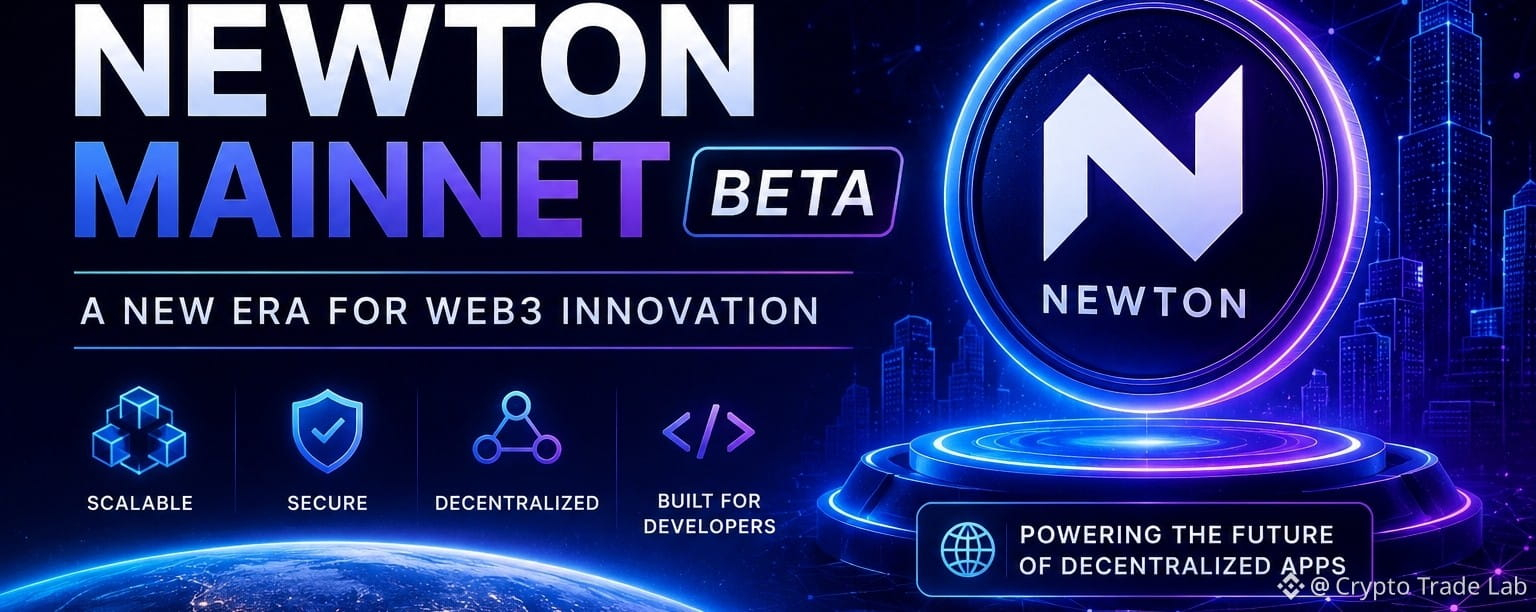
Newton Mainnet Beta: A New Chapter for Web3 InnovationThe launch of the Newton Mainnet Beta marks an exciting step forward for the Web3 ecosystem. I believe @NewtonProtocol is building a blockchain network that focuses on scalability, security, and decentralization while creating better opportunities for developers and users. A successful Mainnet Beta is more than just a technical upgrade—it allows the community to test the network, provide valuable feedback, and help strengthen the ecosystem before the full release. One of the most interesting aspects of the Newton ecosystem is its commitment to continuous innovation. As more developers build decentralized applications and more users explore the network, the ecosystem has the potential to grow into a strong platform for real-world blockchain adoption. Community participation during the beta phase can also help improve network performance and reliability. I look forward to seeing more innovation, partnerships, and developer activity around Newton Protocol in the future. Congratulations to the entire @NewtonProtocol team on reaching this important milestone. I wish continued success for the project and hope the $NEWT ecosystem continues to expand with more real-world use cases and a growing global community. $NEWT #Newt #NewtonProtocol #Web3 #Blockchain #BinanceSquare

Newton Mainnet Beta: A New Chapter for Web3 Innovation

The launch of the Newton Mainnet Beta marks an exciting step forward for the Web3 ecosystem. I believe @NewtonProtocol is building a blockchain network that focuses on scalability, security, and decentralization while creating better opportunities for developers and users. A successful Mainnet Beta is more than just a technical upgrade—it allows the community to test the network, provide valuable feedback, and help strengthen the ecosystem before the full release.
One of the most interesting aspects of the Newton ecosystem is its commitment to continuous innovation. As more developers build decentralized applications and more users explore the network, the ecosystem has the potential to grow into a strong platform for real-world blockchain adoption. Community participation during the beta phase can also help improve network performance and reliability.
I look forward to seeing more innovation, partnerships, and developer activity around Newton Protocol in the future. Congratulations to the entire @NewtonProtocol team on reaching this important milestone. I wish continued success for the project and hope the $NEWT ecosystem continues to expand with more real-world use cases and a growing global community.
$NEWT
#Newt #NewtonProtocol #Web3 #Blockchain #BinanceSquare
Piercing $NEWT’s Technical Illusion: How TEE Hardware Vulnerabilities and the Economic Model of Collapse Work Together to Destroy the AI Agent NarrativeAs a veteran who has fought his way through the trenches of low-level infrastructure and quantitative high-frequency trading for more than a decade, I’ve seen too many “narrative-grade” whitepapers built by stacking novel buzzwords. Recently, Newton Protocol ($NEWT) has been widely touted in the secondary market thanks to the concept of “using TEE plus ZKP to achieve verifiable AI agents.” The official promotions are highly misleading: they claim that every step an AI agent takes is executed inside hardware enclaves, and that it generates zero-knowledge proofs for on-chain smart contracts to independently verify. On the surface, the logic seems airtight—apparently solving the trust problem of off-chain computation perfectly. But the moment you truly get in touch with production-grade node operations, or you’ve deployed a cryptography-based consensus system in a real business environment, you’ll find that behind this ornate, seemingly elegant architecture lies a fundamental system blind spot.

Piercing $NEWT’s Technical Illusion: How TEE Hardware Vulnerabilities and the Economic Model of Collapse Work Together to Destroy the AI Agent Narrative

As a veteran who has fought his way through the trenches of low-level infrastructure and quantitative high-frequency trading for more than a decade, I’ve seen too many “narrative-grade” whitepapers built by stacking novel buzzwords. Recently, Newton Protocol ($NEWT ) has been widely touted in the secondary market thanks to the concept of “using TEE plus ZKP to achieve verifiable AI agents.” The official promotions are highly misleading: they claim that every step an AI agent takes is executed inside hardware enclaves, and that it generates zero-knowledge proofs for on-chain smart contracts to independently verify. On the surface, the logic seems airtight—apparently solving the trust problem of off-chain computation perfectly. But the moment you truly get in touch with production-grade node operations, or you’ve deployed a cryptography-based consensus system in a real business environment, you’ll find that behind this ornate, seemingly elegant architecture lies a fundamental system blind spot.
·
--
Bullish
#newt $NEWT What is Newton Protocol? Newton Protocol $NEWT is a Web3 infrastructure project focused on decentralized automation, smart account execution, and AI-powered on-chain actions. It aims to make blockchain interactions simpler, faster, and more secure. #Newtonprotocol $NEWT

#newt $NEWT What is Newton Protocol?
Newton Protocol $NEWT is a Web3 infrastructure project focused on decentralized automation, smart account execution, and AI-powered on-chain actions. It aims to make blockchain interactions simpler, faster, and more secure.

#Newtonprotocol $NEWT

Newton Mainnet Beta: A Major Step Toward Smarter Web3 AutomationThe launch of the Newton Mainnet Beta is an exciting development for the blockchain ecosystem and a meaningful step toward making decentralized technology easier to use. @NewtonProtocol is focused on building an infrastructure that enables secure, transparent, and intelligent on-chain automation. Rather than requiring users to manually perform every blockchain action, the protocol aims to simplify interactions while keeping users in control of their assets and permissions. One of the most promising aspects of Newton Mainnet Beta is the opportunity for developers and community members to test real-world applications, identify improvements, and help shape the future of the network. This collaborative approach is essential for building a reliable and scalable ecosystem that can support next-generation decentralized applications. The $NEWT token is an important part of the Newton ecosystem, supporting participation and long-term ecosystem development. As the network continues to evolve, community feedback and active engagement during the beta phase will play a key role in strengthening the protocol. I believe projects that focus on practical blockchain automation have the potential to improve the overall Web3 experience. Newton Protocol's vision of combining automation with transparency and user security makes it a project worth following. I'm looking forward to seeing how the Mainnet Beta grows and how the community contributes to its success.#NewtonProtocol #NEWT #Newt

Newton Mainnet Beta: A Major Step Toward Smarter Web3 Automation

The launch of the Newton Mainnet Beta is an exciting development for the blockchain ecosystem and a meaningful step toward making decentralized technology easier to use. @NewtonProtocol is focused on building an infrastructure that enables secure, transparent, and intelligent on-chain automation. Rather than requiring users to manually perform every blockchain action, the protocol aims to simplify interactions while keeping users in control of their assets and permissions.
One of the most promising aspects of Newton Mainnet Beta is the opportunity for developers and community members to test real-world applications, identify improvements, and help shape the future of the network. This collaborative approach is essential for building a reliable and scalable ecosystem that can support next-generation decentralized applications.
The $NEWT token is an important part of the Newton ecosystem, supporting participation and long-term ecosystem development. As the network continues to evolve, community feedback and active engagement during the beta phase will play a key role in strengthening the protocol.
I believe projects that focus on practical blockchain automation have the potential to improve the overall Web3 experience. Newton Protocol's vision of combining automation with transparency and user security makes it a project worth following. I'm looking forward to seeing how the Mainnet Beta grows and how the community contributes to its success.#NewtonProtocol
#NEWT
#Newt
Building the Web3 Future with Heart: Why Newton Mainnet Beta Is Worth Paying Attention ToIn today’s fast-paced crypto market—where teams constantly rush out pitch-deck narratives and valuations run high—we’ve seen far too much cold, unfeeling code and lofty technical whitepapers. But after diving deep into @NewtonProtocol , I’ve genuinely felt something long missing: a people-first, “human” warmth. This distinctive temperature and sense of community cohesion isn’t just reflected in their solid ecosystem building—it’s also fully embodied in the highly anticipated launch of the Newton Mainnet Beta. Historically, when investing in a project, people often focus on the icy candlesticks and overlook what the technology can truly bring to everyday users after it’s actually delivered. From the beginning, Newton Protocol’s core vision has been to build a value network that anyone can participate in and that anyone across different roles can benefit from. This Newton Mainnet Beta launch is by no means a simple technical code iteration—it’s a real transformation of the grand Web3 vision into tangible, hands-on interaction experiences that retail users and community “family” can actually see and touch. Through personally participating in tests and network interactions, you can clearly feel how smooth the network is and how sincerely the project team treats ecosystem users. In a crypto space that often feels restless and impatient, this grounded, practical way of doing things is especially precious. Just as its ecosystem token $NEWT carries shared expectations, it’s not merely a trading code flashing on exchanges—it’s a bond that unites the global Newton community consensus. When a project team is willing to bring high-and-mighty technology down to earth and push forward mainnet development with the most down-to-earth approach—one that places the greatest emphasis on community feedback—this is the most core, long-term positive catalyst. #Newt’s core appeal is that it breaks the traditional deadlock of blockchain projects being dominated by institutions and VCs while ordinary retail users are only able to passively get onboard. Here, every ordinary investor who spontaneously helps with promotion, joins interaction testing late at night, and offers thoughtful suggestions in the community—becomes a co-builder of the mainnet ecosystem. This pure retail “group bonding” and highly aligned community consensus is the strongest engine for unlocking long-term token value. If you’re also tired of those short-term projects that rely purely on hype—cut once and leave—now might be the time to open your wallet and direct your attention to the @NewtonProtocol that’s building momentum. Let’s grow together alongside Newton Mainnet Beta’s next stages, and stake a portion of “money you can afford to be patient with,” $NEWT , to witness the consensus miracle that belongs to regular people—together—in this warm, people-centered community! #Newt Newt $NEWT #NewtonProtocol #NewtonMainnetBeta #BinanceSquare

Building the Web3 Future with Heart: Why Newton Mainnet Beta Is Worth Paying Attention To

In today’s fast-paced crypto market—where teams constantly rush out pitch-deck narratives and valuations run high—we’ve seen far too much cold, unfeeling code and lofty technical whitepapers. But after diving deep into @NewtonProtocol , I’ve genuinely felt something long missing: a people-first, “human” warmth. This distinctive temperature and sense of community cohesion isn’t just reflected in their solid ecosystem building—it’s also fully embodied in the highly anticipated launch of the Newton Mainnet Beta. Historically, when investing in a project, people often focus on the icy candlesticks and overlook what the technology can truly bring to everyday users after it’s actually delivered. From the beginning, Newton Protocol’s core vision has been to build a value network that anyone can participate in and that anyone across different roles can benefit from. This Newton Mainnet Beta launch is by no means a simple technical code iteration—it’s a real transformation of the grand Web3 vision into tangible, hands-on interaction experiences that retail users and community “family” can actually see and touch. Through personally participating in tests and network interactions, you can clearly feel how smooth the network is and how sincerely the project team treats ecosystem users. In a crypto space that often feels restless and impatient, this grounded, practical way of doing things is especially precious. Just as its ecosystem token $NEWT carries shared expectations, it’s not merely a trading code flashing on exchanges—it’s a bond that unites the global Newton community consensus. When a project team is willing to bring high-and-mighty technology down to earth and push forward mainnet development with the most down-to-earth approach—one that places the greatest emphasis on community feedback—this is the most core, long-term positive catalyst. #Newt’s core appeal is that it breaks the traditional deadlock of blockchain projects being dominated by institutions and VCs while ordinary retail users are only able to passively get onboard. Here, every ordinary investor who spontaneously helps with promotion, joins interaction testing late at night, and offers thoughtful suggestions in the community—becomes a co-builder of the mainnet ecosystem. This pure retail “group bonding” and highly aligned community consensus is the strongest engine for unlocking long-term token value. If you’re also tired of those short-term projects that rely purely on hype—cut once and leave—now might be the time to open your wallet and direct your attention to the @NewtonProtocol that’s building momentum. Let’s grow together alongside Newton Mainnet Beta’s next stages, and stake a portion of “money you can afford to be patient with,” $NEWT , to witness the consensus miracle that belongs to regular people—together—in this warm, people-centered community! #Newt Newt $NEWT #NewtonProtocol #NewtonMainnetBeta #BinanceSquare
🚀 Newton Protocol is gaining strong momentum in the crypto market As blockchain innovation continues to evolve, Newton Protocol is attracting increasing attention from traders and investors looking for promising opportunities. With growing community support, expanding ecosystem development, and rising market interest, this project is becoming one to watch. Always stay updated with the latest market trends, manage your risk wisely, and make informed trading decisions. Whether you're a beginner or an experienced trader, keeping an eye on emerging projects like Newton Protocol can help you stay ahead in the fast-moving crypto space. 📈 #NewtonProtocol #BİNANCE #blockchain #Trading #web3兼职
🚀 Newton Protocol is gaining strong momentum in the crypto market
As blockchain innovation continues to evolve, Newton Protocol is attracting increasing attention from traders and investors looking for promising opportunities. With growing community support, expanding ecosystem development, and rising market interest, this project is becoming one to watch. Always stay updated with the latest market trends, manage your risk wisely, and make informed trading decisions. Whether you're a beginner or an experienced trader, keeping an eye on emerging projects like Newton Protocol can help you stay ahead in the fast-moving crypto space. 📈
#NewtonProtocol #BİNANCE #blockchain #Trading #web3兼职
Log in to explore more content
Join global crypto users on Binance Square
⚡️ Get latest and useful information about crypto.
💬 Trusted by the world’s largest crypto exchange.
👍 Discover real insights from verified creators.
Email / Phone number