

اMisbah
16.8k Beiträge

اMisbah
Melden
Nutzer blockieren
2.5K+ Following
13.9K+ Follower
6.9K+ Like gegeben
Beiträge
Alle
Zitierungen
Live


·
--
Übersetzung ansehen
You know, a buddy of mine asked me the other day:
“Why can’t Wall Street just use regular public blockchains for everything and get it over with?”
Fair question. It also exposes one of the biggest problems with putting regulated finance on fully transparent rails.
If a large institution moves trades, positions or sensitive ownership data onto a public chain, transparency can become a liability. Competitors can potentially observe flows, while regulators still need a way to verify that transactions follow the rules.
For a long time, I assumed privacy and compliance were basically opposites.
Then I started digging deeper into what @Dusk_Foundation is actually building.
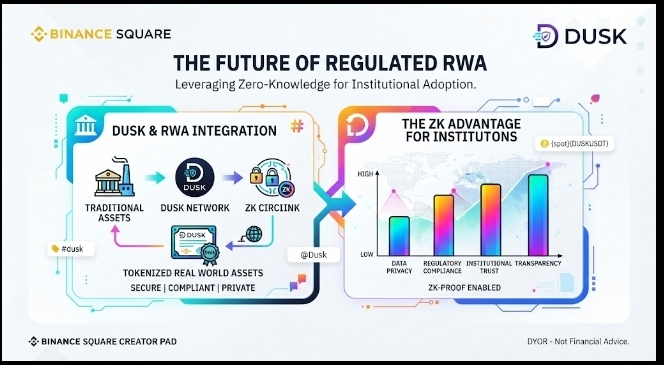
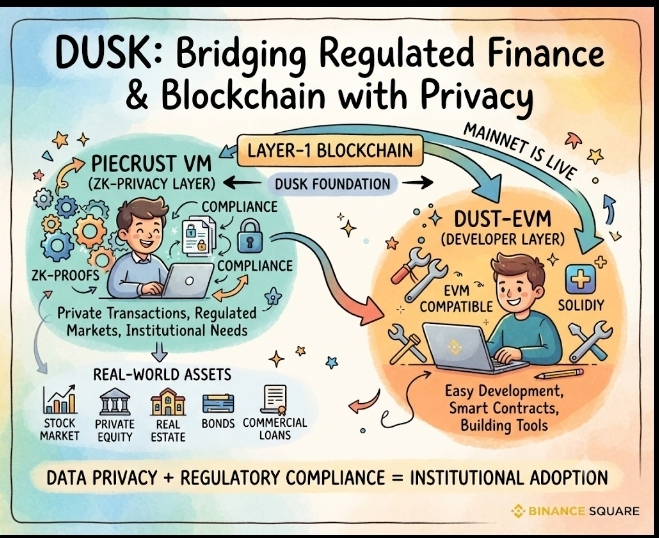
Dusk’s architecture combines two execution environments: the Piecrust VM and DuskEVM.
Piecrust is designed around Dusk’s privacy-oriented execution model, while DuskEVM provides compatibility with the EVM ecosystem and Solidity tooling. That matters because institutional adoption doesn’t only depend on cryptography; developers also need infrastructure they already understand.
The bigger idea clicked for me when I mapped this against tokenized securities.
Imagine a regulated bond market on-chain.
The network needs to establish that a transfer is valid and compliant. But the entire market shouldn’t necessarily get a real-time view of every investor’s position, transaction details or portfolio activity.
It’s to make sensitive information private by default while preserving a mechanism for authorized parties to verify what they’re entitled to verify.
That’s a much more realistic design target for institutional finance.
And honestly, this is the part of Dusk I’m watching most closely.
Whether regulated assets actually generate repeat on-chain activity, liquidity and real economic settlement $DUSK
Because if that happens, the boring side of crypto might turn out to be the most important one.
Would you rather bet on infrastructure built for regulated capital markets, or does crypto still have more appetite for speculation than settlement?
#dusk
{future}(DUSKUSDT)
You know, a buddy of mine asked me the other day:
“Why can’t Wall Street just use regular public blockchains for everything and get it over with?”
Fair question. It also exposes one of the biggest problems with putting regulated finance on fully transparent rails.
If a large institution moves trades, positions or sensitive ownership data onto a public chain, transparency can become a liability. Competitors can potentially observe flows, while regulators still need a way to verify that transactions follow the rules.
For a long time, I assumed privacy and compliance were basically opposites.
Then I started digging deeper into what @Dusk is actually building.
Dusk’s architecture combines two execution environments: the Piecrust VM and DuskEVM.
Piecrust is designed around Dusk’s privacy-oriented execution model, while DuskEVM provides compatibility with the EVM ecosystem and Solidity tooling. That matters because institutional adoption doesn’t only depend on cryptography; developers also need infrastructure they already understand.
The bigger idea clicked for me when I mapped this against tokenized securities.
Imagine a regulated bond market on-chain.
The network needs to establish that a transfer is valid and compliant. But the entire market shouldn’t necessarily get a real-time view of every investor’s position, transaction details or portfolio activity.
It’s to make sensitive information private by default while preserving a mechanism for authorized parties to verify what they’re entitled to verify.
That’s a much more realistic design target for institutional finance.
And honestly, this is the part of Dusk I’m watching most closely.
Whether regulated assets actually generate repeat on-chain activity, liquidity and real economic settlement $DUSK
Because if that happens, the boring side of crypto might turn out to be the most important one.
Would you rather bet on infrastructure built for regulated capital markets, or does crypto still have more appetite for speculation than settlement?
#dusk
“Why can’t Wall Street just use regular public blockchains for everything and get it over with?”
Fair question. It also exposes one of the biggest problems with putting regulated finance on fully transparent rails.
If a large institution moves trades, positions or sensitive ownership data onto a public chain, transparency can become a liability. Competitors can potentially observe flows, while regulators still need a way to verify that transactions follow the rules.
For a long time, I assumed privacy and compliance were basically opposites.
Then I started digging deeper into what @Dusk is actually building.
Dusk’s architecture combines two execution environments: the Piecrust VM and DuskEVM.
Piecrust is designed around Dusk’s privacy-oriented execution model, while DuskEVM provides compatibility with the EVM ecosystem and Solidity tooling. That matters because institutional adoption doesn’t only depend on cryptography; developers also need infrastructure they already understand.
The bigger idea clicked for me when I mapped this against tokenized securities.
Imagine a regulated bond market on-chain.
The network needs to establish that a transfer is valid and compliant. But the entire market shouldn’t necessarily get a real-time view of every investor’s position, transaction details or portfolio activity.
It’s to make sensitive information private by default while preserving a mechanism for authorized parties to verify what they’re entitled to verify.
That’s a much more realistic design target for institutional finance.
And honestly, this is the part of Dusk I’m watching most closely.
Whether regulated assets actually generate repeat on-chain activity, liquidity and real economic settlement $DUSK
Because if that happens, the boring side of crypto might turn out to be the most important one.
Would you rather bet on infrastructure built for regulated capital markets, or does crypto still have more appetite for speculation than settlement?
#dusk
2
4
109
·
--
Übersetzung ansehen
I used to think scaling a validation committee was basically the blockchain version of hiring more lifeguards.
More seats → more eyes → safer network.
Then I started looking at how $DUSK actually structures consensus rewards, and that mental model got a lot less comfortable.
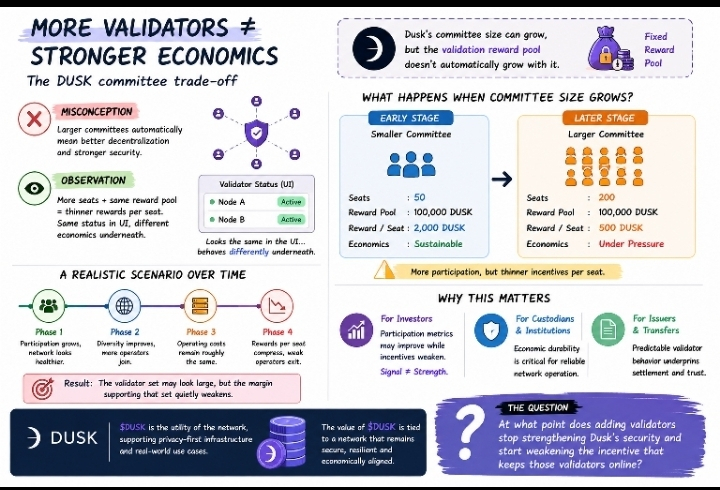
@Dusk_Foundation allocates 5% of each block reward to the validation committee and another 5% to the ratification committee.
That matters because committee size can change the distribution of those rewards without automatically increasing the committee’s share of each block.
In other words, adding operators can distribute consensus responsibility more broadly, but it doesn’t mean the economic pie grows proportionally with every new seat.
There’s another detail that makes this more interesting.
Dusk provisioners need to remain online and synchronized, and participation requires a minimum 1,000 DUSK stake.
Rewards are tied to actual consensus participation and credits, meaning being eligible to participate isn't the same thing as receiving a guaranteed fixed return.
That changes how I think about decentralization.
“How many operators can Dusk support?”
It’s:
“How many operators can the protocol economically support while keeping participation attractive enough that those operators continue providing reliable infrastructure?”
Because every additional seat can improve distribution of consensus responsibility.
→ more infrastructure to maintain
→ more capital committed
→ more participants competing for committee rewards
→ potentially lower economics per operator
And that creates a fascinating trade-off.
Decentralization isn't automatically maximized by adding more seats.
At some point, security, participation, stake, and operator economics have to reinforce each other.
…and more about finding the point where security gains still justify the marginal economic and operational cost of another operator.
That’s the Dusk question I’m watching.
Where is that equilibrium? 🤔
#dusk
#BitcoinRises23.6%Weekly
{future}(DUSKUSDT)
I used to think scaling a validation committee was basically the blockchain version of hiring more lifeguards.
More seats → more eyes → safer network.
Then I started looking at how $DUSK actually structures consensus rewards, and that mental model got a lot less comfortable.
@Dusk allocates 5% of each block reward to the validation committee and another 5% to the ratification committee.
That matters because committee size can change the distribution of those rewards without automatically increasing the committee’s share of each block.
In other words, adding operators can distribute consensus responsibility more broadly, but it doesn’t mean the economic pie grows proportionally with every new seat.
There’s another detail that makes this more interesting.
Dusk provisioners need to remain online and synchronized, and participation requires a minimum 1,000 DUSK stake.
Rewards are tied to actual consensus participation and credits, meaning being eligible to participate isn't the same thing as receiving a guaranteed fixed return.
That changes how I think about decentralization.
“How many operators can Dusk support?”
It’s:
“How many operators can the protocol economically support while keeping participation attractive enough that those operators continue providing reliable infrastructure?”
Because every additional seat can improve distribution of consensus responsibility.
→ more infrastructure to maintain
→ more capital committed
→ more participants competing for committee rewards
→ potentially lower economics per operator
And that creates a fascinating trade-off.
Decentralization isn't automatically maximized by adding more seats.
At some point, security, participation, stake, and operator economics have to reinforce each other.
…and more about finding the point where security gains still justify the marginal economic and operational cost of another operator.
That’s the Dusk question I’m watching.
Where is that equilibrium? 🤔
#dusk
#BitcoinRises23.6%Weekly
More seats → more eyes → safer network.
Then I started looking at how $DUSK actually structures consensus rewards, and that mental model got a lot less comfortable.
@Dusk allocates 5% of each block reward to the validation committee and another 5% to the ratification committee.
That matters because committee size can change the distribution of those rewards without automatically increasing the committee’s share of each block.
In other words, adding operators can distribute consensus responsibility more broadly, but it doesn’t mean the economic pie grows proportionally with every new seat.
There’s another detail that makes this more interesting.
Dusk provisioners need to remain online and synchronized, and participation requires a minimum 1,000 DUSK stake.
Rewards are tied to actual consensus participation and credits, meaning being eligible to participate isn't the same thing as receiving a guaranteed fixed return.
That changes how I think about decentralization.
“How many operators can Dusk support?”
It’s:
“How many operators can the protocol economically support while keeping participation attractive enough that those operators continue providing reliable infrastructure?”
Because every additional seat can improve distribution of consensus responsibility.
→ more infrastructure to maintain
→ more capital committed
→ more participants competing for committee rewards
→ potentially lower economics per operator
And that creates a fascinating trade-off.
Decentralization isn't automatically maximized by adding more seats.
At some point, security, participation, stake, and operator economics have to reinforce each other.
…and more about finding the point where security gains still justify the marginal economic and operational cost of another operator.
That’s the Dusk question I’m watching.
Where is that equilibrium? 🤔
#dusk
#BitcoinRises23.6%Weekly
2
5
115
·
--
Übersetzung ansehen
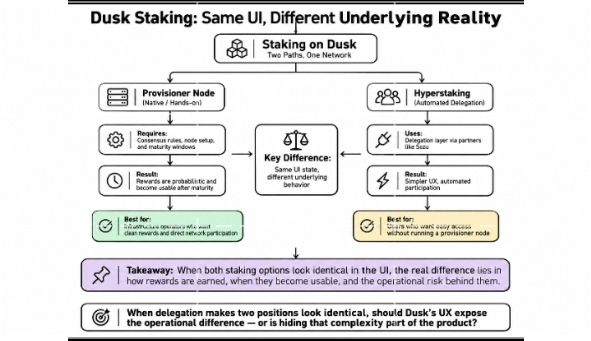
My friend looked at my dashboard the other day, squinted at the screen and asked:
“So both wallets say staked, right? What’s the big deal?”
That question stuck with me because a staking UI can make two very different setups look almost identical.
If I provision directly on @Dusk_Foundation , I’m not simply locking $DUSK and collecting a number on a screen. I’m running the infrastructure that participates in consensus. Rusk explicitly separates a provisioner node from archive and prover roles, and the provisioner setup involves consensus keys, network configuration and an actual running node.
Then there’s stake abstraction.
Dusk’s own documentation describes Hyperstaking as allowing smart contracts to participate in staking, enabling things like staking pools and staking-as-a-service. Sozu is given as an example of an automated staking pool where users can stake without operating their own node.
That changes how I think about “convenience.”
The complexity hasn’t disappeared. The user simply stops touching some of it directly.
Rusk updates recent releases include changes around stake-event handling, wallet staking flows and provisioner-related functionality. The engineering surface underneath that simple “staked” label is considerably more complicated than the dashboard suggests.
It reminds me of driving an automatic car down an icy hill.
You appreciate the automation—until you suddenly need to understand what the transmission is doing.
That’s my bigger takeaway:
Abstraction doesn’t delete risk. It relocates responsibility.
So when I evaluate a staking product now, I’m not only asking:
“What's my yield?”
I’m asking:
Who actually controls the stake, who operates the infrastructure, what does the smart-contract layer control, and what happens when something breaks?
Because a clean interface is great.
But knowing what sits underneath it is even better.
How do you balance convenience with actually understanding the machinery behind your portfolio?
#dusk
{future}(DUSKUSDT)
My friend looked at my dashboard the other day, squinted at the screen and asked:
“So both wallets say staked, right? What’s the big deal?”
That question stuck with me because a staking UI can make two very different setups look almost identical.
If I provision directly on @Dusk , I’m not simply locking $DUSK and collecting a number on a screen. I’m running the infrastructure that participates in consensus. Rusk explicitly separates a provisioner node from archive and prover roles, and the provisioner setup involves consensus keys, network configuration and an actual running node.
Then there’s stake abstraction.
Dusk’s own documentation describes Hyperstaking as allowing smart contracts to participate in staking, enabling things like staking pools and staking-as-a-service. Sozu is given as an example of an automated staking pool where users can stake without operating their own node.
That changes how I think about “convenience.”
The complexity hasn’t disappeared. The user simply stops touching some of it directly.
Rusk updates recent releases include changes around stake-event handling, wallet staking flows and provisioner-related functionality. The engineering surface underneath that simple “staked” label is considerably more complicated than the dashboard suggests.
It reminds me of driving an automatic car down an icy hill.
You appreciate the automation—until you suddenly need to understand what the transmission is doing.
That’s my bigger takeaway:
Abstraction doesn’t delete risk. It relocates responsibility.
So when I evaluate a staking product now, I’m not only asking:
“What's my yield?”
I’m asking:
Who actually controls the stake, who operates the infrastructure, what does the smart-contract layer control, and what happens when something breaks?
Because a clean interface is great.
But knowing what sits underneath it is even better.
How do you balance convenience with actually understanding the machinery behind your portfolio?
#dusk
“So both wallets say staked, right? What’s the big deal?”
That question stuck with me because a staking UI can make two very different setups look almost identical.
If I provision directly on @Dusk , I’m not simply locking $DUSK and collecting a number on a screen. I’m running the infrastructure that participates in consensus. Rusk explicitly separates a provisioner node from archive and prover roles, and the provisioner setup involves consensus keys, network configuration and an actual running node.
Then there’s stake abstraction.
Dusk’s own documentation describes Hyperstaking as allowing smart contracts to participate in staking, enabling things like staking pools and staking-as-a-service. Sozu is given as an example of an automated staking pool where users can stake without operating their own node.
That changes how I think about “convenience.”
The complexity hasn’t disappeared. The user simply stops touching some of it directly.
Rusk updates recent releases include changes around stake-event handling, wallet staking flows and provisioner-related functionality. The engineering surface underneath that simple “staked” label is considerably more complicated than the dashboard suggests.
It reminds me of driving an automatic car down an icy hill.
You appreciate the automation—until you suddenly need to understand what the transmission is doing.
That’s my bigger takeaway:
Abstraction doesn’t delete risk. It relocates responsibility.
So when I evaluate a staking product now, I’m not only asking:
“What's my yield?”
I’m asking:
Who actually controls the stake, who operates the infrastructure, what does the smart-contract layer control, and what happens when something breaks?
Because a clean interface is great.
But knowing what sits underneath it is even better.
How do you balance convenience with actually understanding the machinery behind your portfolio?
#dusk
5
6
100
·
--
Übersetzung ansehen
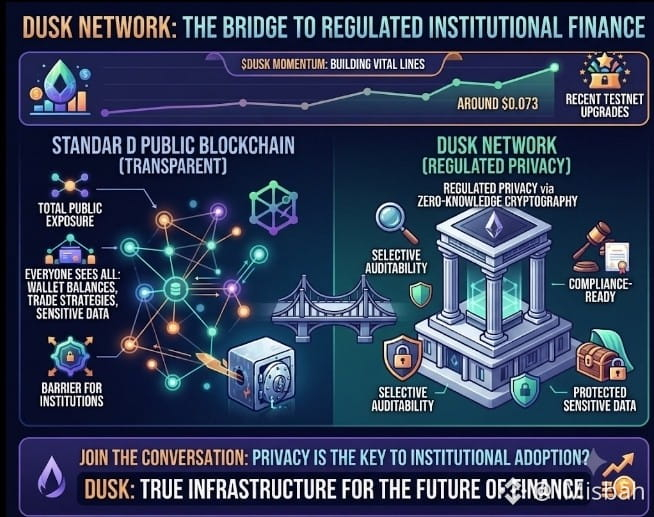
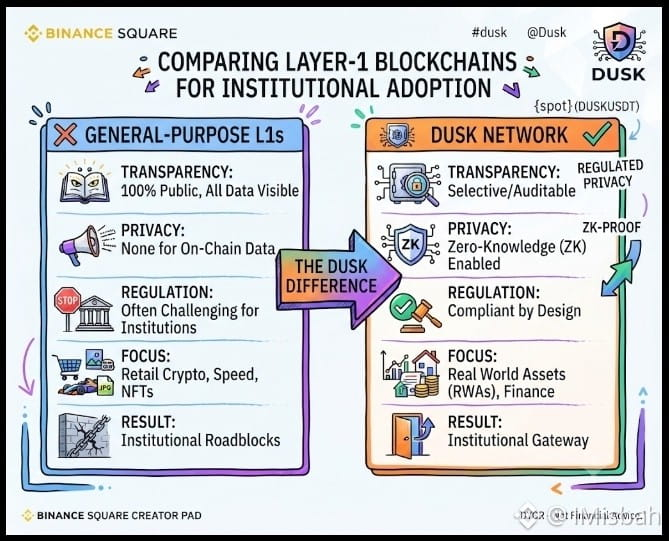
When I first started looking into different blockchains, I assumed all Layer-1s were pretty much the same—just faster or slower versions of each other. But as I dug deeper, I realized most public chains expose everything, which is a huge problem for traditional finance.
When I was checking out Dusk recently, I noticed they faced a minor bridge wallet scare, but what impressed me was how they handled it. Instead of hiding it, they completely overhauled their architecture to make things safer, and even with all that drama, their mainnet stayed solid.
For me, this proves my point about @Dusk_Foundation . They aren't just dealing with security on the fly; they are using Zero-Knowledge cryptography to build "Regulated Privacy" so institutions can keep their data hidden while staying fully compliant. As $DUSK holds around $0.073 and pushes testnet upgrades, I genuinely believe they are solving the institutional dilemma.
What are your thoughts on this approach?
Do you agree with my view that privacy is the key to institutional adoption?
Let's chat in the comments!
{future}(DUSKUSDT)
#USDollarFallsToThreeMonthLow #TeslaHitsMonthlyHigh #dusk
When I first started looking into different blockchains, I assumed all Layer-1s were pretty much the same—just faster or slower versions of each other. But as I dug deeper, I realized most public chains expose everything, which is a huge problem for traditional finance.
When I was checking out Dusk recently, I noticed they faced a minor bridge wallet scare, but what impressed me was how they handled it. Instead of hiding it, they completely overhauled their architecture to make things safer, and even with all that drama, their mainnet stayed solid.
For me, this proves my point about @Dusk . They aren't just dealing with security on the fly; they are using Zero-Knowledge cryptography to build "Regulated Privacy" so institutions can keep their data hidden while staying fully compliant. As $DUSK holds around $0.073 and pushes testnet upgrades, I genuinely believe they are solving the institutional dilemma.
What are your thoughts on this approach?
Do you agree with my view that privacy is the key to institutional adoption?
Let's chat in the comments!
#USDollarFallsToThreeMonthLow #TeslaHitsMonthlyHigh #dusk
When I was checking out Dusk recently, I noticed they faced a minor bridge wallet scare, but what impressed me was how they handled it. Instead of hiding it, they completely overhauled their architecture to make things safer, and even with all that drama, their mainnet stayed solid.
For me, this proves my point about @Dusk . They aren't just dealing with security on the fly; they are using Zero-Knowledge cryptography to build "Regulated Privacy" so institutions can keep their data hidden while staying fully compliant. As $DUSK holds around $0.073 and pushes testnet upgrades, I genuinely believe they are solving the institutional dilemma.
What are your thoughts on this approach?
Do you agree with my view that privacy is the key to institutional adoption?
Let's chat in the comments!
#USDollarFallsToThreeMonthLow #TeslaHitsMonthlyHigh #dusk
2
2
83
·
--
Übersetzung ansehen
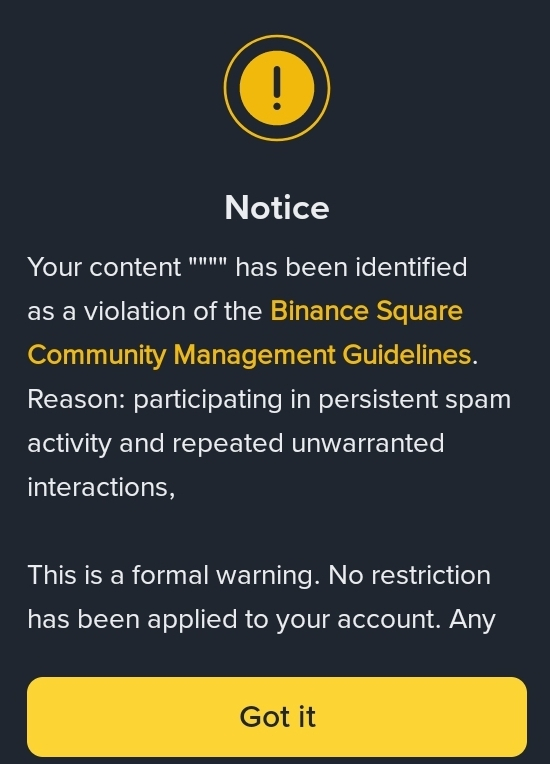
Dear Binance Square Team,
Thank you for your response, but I am genuinely confused and hope you can help me understand.
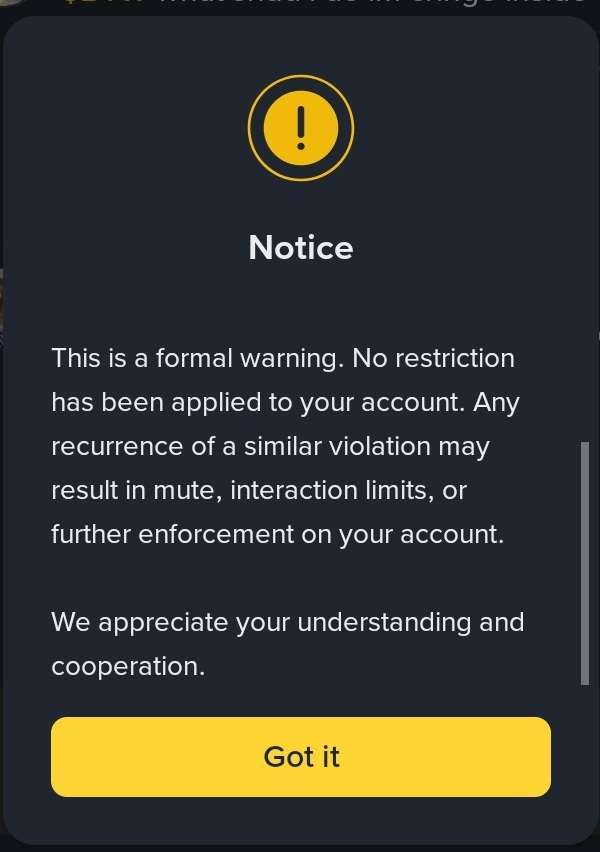
If my comments during the Baby Creator Pad campaign were considered meaningless, repetitive, or templated violations, how did my account manage to qualify for the reward section in the top150 place? For the past two years, when I was only posting original content without high engagement, I never managed to rank within the top 300 creators. But as soon as I started putting in 17 to 18 hours a day interacting, reading, and replying to comments during the Baby campaign, I suddenly reached the top 300.
If active commenting and replying are what pushed me into the eligible zone, but those exact actions are flagged as a violation, I am very confused about how creators are actually supposed to succeed or grow on the platform.
Should I not comment on other creators' posts? If I don't, no one will like or comment on my posts. Then how will I get views?"
"For views, is it okay if I repost my post every 1 hour for 24 hours?"
"Will my account or reward be suspended for reposting?"
Same thing is happened for Dusk campaign also. I ranked at 179, but now I am loosing it. Because I am warned ,no comment ,no reply so that no views😔.
Could you please clarify how the system evaluates this? If my reward can be reconsidered, I would be deeply grateful. I promise to strictly follow whatever guidelines or limits you provide moving forward.
Thank you for your time and guidance.
Best regards,
اMisbah
#BinanceSquareTalks
#Write2Earn
$DUSK
Dear Binance Square Team,
Thank you for your response, but I am genuinely confused and hope you can help me understand.
If my comments during the Baby Creator Pad campaign were considered meaningless, repetitive, or templated violations, how did my account manage to qualify for the reward section in the top150 place? For the past two years, when I was only posting original content without high engagement, I never managed to rank within the top 300 creators. But as soon as I started putting in 17 to 18 hours a day interacting, reading, and replying to comments during the Baby campaign, I suddenly reached the top 300.
If active commenting and replying are what pushed me into the eligible zone, but those exact actions are flagged as a violation, I am very confused about how creators are actually supposed to succeed or grow on the platform.
Should I not comment on other creators' posts? If I don't, no one will like or comment on my posts. Then how will I get views?"
"For views, is it okay if I repost my post every 1 hour for 24 hours?"
"Will my account or reward be suspended for reposting?"
Same thing is happened for Dusk campaign also. I ranked at 179, but now I am loosing it. Because I am warned ,no comment ,no reply so that no views😔.
Could you please clarify how the system evaluates this? If my reward can be reconsidered, I would be deeply grateful. I promise to strictly follow whatever guidelines or limits you provide moving forward.
Thank you for your time and guidance.
Best regards,
اMisbah
#BinanceSquareTalks
#Write2Earn
$DUSK
Thank you for your response, but I am genuinely confused and hope you can help me understand.
If my comments during the Baby Creator Pad campaign were considered meaningless, repetitive, or templated violations, how did my account manage to qualify for the reward section in the top150 place? For the past two years, when I was only posting original content without high engagement, I never managed to rank within the top 300 creators. But as soon as I started putting in 17 to 18 hours a day interacting, reading, and replying to comments during the Baby campaign, I suddenly reached the top 300.
If active commenting and replying are what pushed me into the eligible zone, but those exact actions are flagged as a violation, I am very confused about how creators are actually supposed to succeed or grow on the platform.
Should I not comment on other creators' posts? If I don't, no one will like or comment on my posts. Then how will I get views?"
"For views, is it okay if I repost my post every 1 hour for 24 hours?"
"Will my account or reward be suspended for reposting?"
Same thing is happened for Dusk campaign also. I ranked at 179, but now I am loosing it. Because I am warned ,no comment ,no reply so that no views😔.
Could you please clarify how the system evaluates this? If my reward can be reconsidered, I would be deeply grateful. I promise to strictly follow whatever guidelines or limits you provide moving forward.
Thank you for your time and guidance.
Best regards,
اMisbah
#BinanceSquareTalks
#Write2Earn
$DUSK
3
11
·
--
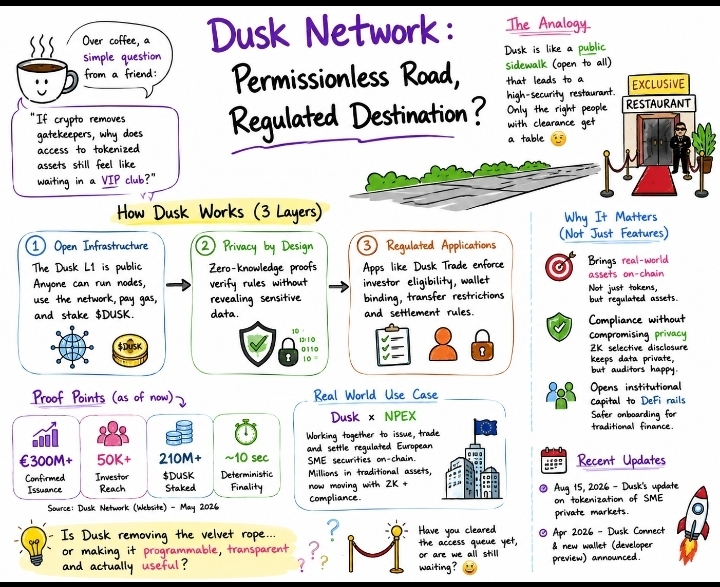
Ein Freund fragte mich bei Kaffee: „Wenn Krypto angeblich dazu da ist, finanzielle Gatekeeper abzuschaffen, warum fühlt sich der Zugang zu tokenisierten Assets dann immer noch an wie das Warten vor einem VIP-Club?“ ☕
Diese Frage hat mich zurück in @Dusk_Foundation geführt, und ich habe gemerkt, dass ich einen grundlegenden Fehler gemacht hatte: Permissionless-Infrastruktur bedeutet nicht automatisch permissionlosen Zugang zu jedem Asset.
Stell dir Dusk vor wie eine öffentliche Straße, die zu einem regulierten Finanzviertel führt.
Schritt 1: Jeder kann die zugrunde liegende Netzwerkinfrastruktur nutzen.
Schritt 2: Zero-Knowledge-Proofs können prüfen, dass Transaktionen die Regeln einhalten, ohne jede sensible Einzelheit offenzulegen.
Schritt 3: Die Anwendungsschicht kann die Eignung von Anlegern durchsetzen, Übertragungsbeschränkungen sowie Compliance im Umfeld regulierter Wertpapiere.
Genau dieser letzte Punkt macht es spannend.
Dusk meldet derzeit über 300 Mio. € an bestätigter Emission, 50.000+ erreichbare Investoren, 210 Mio.+ DUSK im Staking und ungefähr 10 Sekunden deterministische Finalität.
$DUSK wird zwar für Gas und Staking verwendet, aber es zu halten gibt natürlich nicht automatisch Zugang zu regulierten Wertpapieren.
Die NPEX-Verbindung macht das greifbarer.
NPEX ist eine regulierte niederländische SME-Börse, und Dusk arbeitet mit ihr an DLT-basierter Emission, Handel und Abwicklung.
Ihre Partnerschaft hat bereits untersucht, regulierte europäische Wertpapiere on-chain zu verlagern – zusammen mit Chainlink-Infrastruktur für Interoperabilität und Daten.
Und Dusk’ neuestes Update im August hat mich die These erneut überdenken lassen: Tokenisierung schafft nicht einfach so Liquidität.
Sie muss Emittenten, berechtigte Anleger, Preisbildung, Zahlungen und Abwicklung miteinander verbinden.
Vielleicht besteht der eigentliche Durchbruch also nicht darin, die Samtseilchen abzuschaffen.
Sondern darin, das Seil so programmierbar zu machen, dass reguliertes Finanzwesen endlich auf geteilter Infrastruktur arbeiten kann.
Aber kann Dusk diese Infrastruktur in einen Markt verwandeln, den Menschen wirklich nutzen? 🤔
#dusk
{future}(DUSKUSDT)
Ein Freund fragte mich bei Kaffee: „Wenn Krypto angeblich dazu da ist, finanzielle Gatekeeper abzuschaffen, warum fühlt sich der Zugang zu tokenisierten Assets dann immer noch an wie das Warten vor einem VIP-Club?“ ☕
Diese Frage hat mich zurück in @Dusk geführt, und ich habe gemerkt, dass ich einen grundlegenden Fehler gemacht hatte: Permissionless-Infrastruktur bedeutet nicht automatisch permissionlosen Zugang zu jedem Asset.
Stell dir Dusk vor wie eine öffentliche Straße, die zu einem regulierten Finanzviertel führt.
Schritt 1: Jeder kann die zugrunde liegende Netzwerkinfrastruktur nutzen.
Schritt 2: Zero-Knowledge-Proofs können prüfen, dass Transaktionen die Regeln einhalten, ohne jede sensible Einzelheit offenzulegen.
Schritt 3: Die Anwendungsschicht kann die Eignung von Anlegern durchsetzen, Übertragungsbeschränkungen sowie Compliance im Umfeld regulierter Wertpapiere.
Genau dieser letzte Punkt macht es spannend.
Dusk meldet derzeit über 300 Mio. € an bestätigter Emission, 50.000+ erreichbare Investoren, 210 Mio.+ DUSK im Staking und ungefähr 10 Sekunden deterministische Finalität.
$DUSK wird zwar für Gas und Staking verwendet, aber es zu halten gibt natürlich nicht automatisch Zugang zu regulierten Wertpapieren.
Die NPEX-Verbindung macht das greifbarer.
NPEX ist eine regulierte niederländische SME-Börse, und Dusk arbeitet mit ihr an DLT-basierter Emission, Handel und Abwicklung.
Ihre Partnerschaft hat bereits untersucht, regulierte europäische Wertpapiere on-chain zu verlagern – zusammen mit Chainlink-Infrastruktur für Interoperabilität und Daten.
Und Dusk’ neuestes Update im August hat mich die These erneut überdenken lassen: Tokenisierung schafft nicht einfach so Liquidität.
Sie muss Emittenten, berechtigte Anleger, Preisbildung, Zahlungen und Abwicklung miteinander verbinden.
Vielleicht besteht der eigentliche Durchbruch also nicht darin, die Samtseilchen abzuschaffen.
Sondern darin, das Seil so programmierbar zu machen, dass reguliertes Finanzwesen endlich auf geteilter Infrastruktur arbeiten kann.
Aber kann Dusk diese Infrastruktur in einen Markt verwandeln, den Menschen wirklich nutzen? 🤔
#dusk
Diese Frage hat mich zurück in @Dusk geführt, und ich habe gemerkt, dass ich einen grundlegenden Fehler gemacht hatte: Permissionless-Infrastruktur bedeutet nicht automatisch permissionlosen Zugang zu jedem Asset.
Stell dir Dusk vor wie eine öffentliche Straße, die zu einem regulierten Finanzviertel führt.
Schritt 1: Jeder kann die zugrunde liegende Netzwerkinfrastruktur nutzen.
Schritt 2: Zero-Knowledge-Proofs können prüfen, dass Transaktionen die Regeln einhalten, ohne jede sensible Einzelheit offenzulegen.
Schritt 3: Die Anwendungsschicht kann die Eignung von Anlegern durchsetzen, Übertragungsbeschränkungen sowie Compliance im Umfeld regulierter Wertpapiere.
Genau dieser letzte Punkt macht es spannend.
Dusk meldet derzeit über 300 Mio. € an bestätigter Emission, 50.000+ erreichbare Investoren, 210 Mio.+ DUSK im Staking und ungefähr 10 Sekunden deterministische Finalität.
$DUSK wird zwar für Gas und Staking verwendet, aber es zu halten gibt natürlich nicht automatisch Zugang zu regulierten Wertpapieren.
Die NPEX-Verbindung macht das greifbarer.
NPEX ist eine regulierte niederländische SME-Börse, und Dusk arbeitet mit ihr an DLT-basierter Emission, Handel und Abwicklung.
Ihre Partnerschaft hat bereits untersucht, regulierte europäische Wertpapiere on-chain zu verlagern – zusammen mit Chainlink-Infrastruktur für Interoperabilität und Daten.
Und Dusk’ neuestes Update im August hat mich die These erneut überdenken lassen: Tokenisierung schafft nicht einfach so Liquidität.
Sie muss Emittenten, berechtigte Anleger, Preisbildung, Zahlungen und Abwicklung miteinander verbinden.
Vielleicht besteht der eigentliche Durchbruch also nicht darin, die Samtseilchen abzuschaffen.
Sondern darin, das Seil so programmierbar zu machen, dass reguliertes Finanzwesen endlich auf geteilter Infrastruktur arbeiten kann.
Aber kann Dusk diese Infrastruktur in einen Markt verwandeln, den Menschen wirklich nutzen? 🤔
#dusk
17
13
175
·
--
Verifiziert
Übersetzung ansehen
Staring at my coffee this morning, I realized I’d been thinking about privacy tech backward.
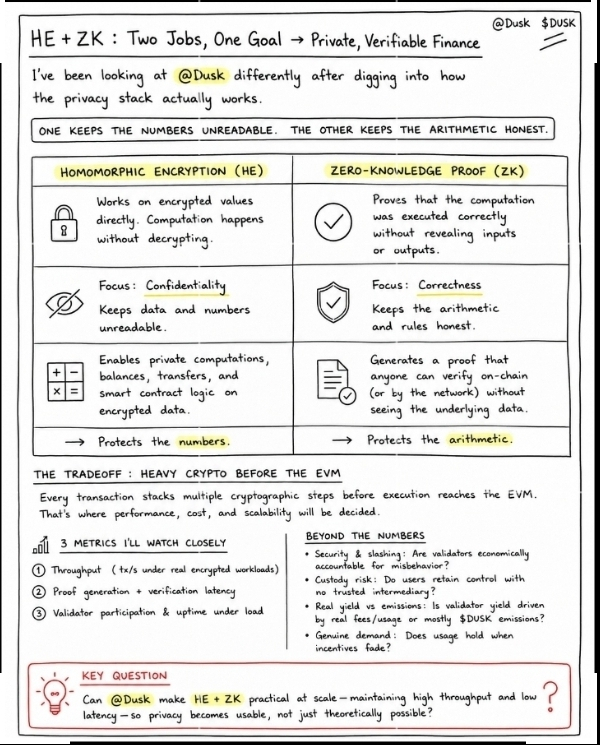
I used to treat homomorphic encryption and zero-knowledge proofs like identical twins. They’re not. They’re more like a meticulous accountant and a magician working the same case.
Homomorphic encryption lets computation happen on encrypted data without exposing the underlying values. Zero-knowledge proofs can prove that a computation followed the required rules without revealing the private inputs.
That distinction becomes interesting with DuskEVM. One detail I find particularly important: DuskEVM is an OP Stack-based EVM execution environment, while DuskDS provides the settlement and data-availability layer underneath it. So confidentiality isn't simply being bolted onto a conventional EVM—it sits within a broader separation between execution and settlement.
I start looking at the harder questions.
What happens to proof latency as complexity increases?
As computational complexity and circuit size increase, proof generation latency generally increases, though verification times typically remain fast and constant.
Can the network generate enough real fee demand to support the infrastructure?
$DUSK is building infrastructure where compliance can coexist with blockchain privacy.
It depends on long-term institutional adoption of its privacy-focused real-world asset (RWA) tokenization and compliant financial markets scaling enough to offset its multi-decade token emission schedule.
@Dusk_Foundation already uses Phoenix for shielded transfers, while its cryptography stack includes PLONK-based zero-knowledge tooling. That makes the privacy thesis more tangible—but it also makes performance and implementation details worth watching closely.
For me, the question is whether Dusk can make it private enough for institutions, verifiable enough for compliance, and efficient enough to use at scale.
#dusk
{future}(DUSKUSDT)
Staring at my coffee this morning, I realized I’d been thinking about privacy tech backward.
I used to treat homomorphic encryption and zero-knowledge proofs like identical twins. They’re not. They’re more like a meticulous accountant and a magician working the same case.
Homomorphic encryption lets computation happen on encrypted data without exposing the underlying values. Zero-knowledge proofs can prove that a computation followed the required rules without revealing the private inputs.
That distinction becomes interesting with DuskEVM. One detail I find particularly important: DuskEVM is an OP Stack-based EVM execution environment, while DuskDS provides the settlement and data-availability layer underneath it. So confidentiality isn't simply being bolted onto a conventional EVM—it sits within a broader separation between execution and settlement.
I start looking at the harder questions.
What happens to proof latency as complexity increases?
As computational complexity and circuit size increase, proof generation latency generally increases, though verification times typically remain fast and constant.
Can the network generate enough real fee demand to support the infrastructure?
$DUSK is building infrastructure where compliance can coexist with blockchain privacy.
It depends on long-term institutional adoption of its privacy-focused real-world asset (RWA) tokenization and compliant financial markets scaling enough to offset its multi-decade token emission schedule.
@Dusk already uses Phoenix for shielded transfers, while its cryptography stack includes PLONK-based zero-knowledge tooling. That makes the privacy thesis more tangible—but it also makes performance and implementation details worth watching closely.
For me, the question is whether Dusk can make it private enough for institutions, verifiable enough for compliance, and efficient enough to use at scale.
#dusk
I used to treat homomorphic encryption and zero-knowledge proofs like identical twins. They’re not. They’re more like a meticulous accountant and a magician working the same case.
Homomorphic encryption lets computation happen on encrypted data without exposing the underlying values. Zero-knowledge proofs can prove that a computation followed the required rules without revealing the private inputs.
That distinction becomes interesting with DuskEVM. One detail I find particularly important: DuskEVM is an OP Stack-based EVM execution environment, while DuskDS provides the settlement and data-availability layer underneath it. So confidentiality isn't simply being bolted onto a conventional EVM—it sits within a broader separation between execution and settlement.
I start looking at the harder questions.
What happens to proof latency as complexity increases?
As computational complexity and circuit size increase, proof generation latency generally increases, though verification times typically remain fast and constant.
Can the network generate enough real fee demand to support the infrastructure?
$DUSK is building infrastructure where compliance can coexist with blockchain privacy.
It depends on long-term institutional adoption of its privacy-focused real-world asset (RWA) tokenization and compliant financial markets scaling enough to offset its multi-decade token emission schedule.
@Dusk already uses Phoenix for shielded transfers, while its cryptography stack includes PLONK-based zero-knowledge tooling. That makes the privacy thesis more tangible—but it also makes performance and implementation details worth watching closely.
For me, the question is whether Dusk can make it private enough for institutions, verifiable enough for compliance, and efficient enough to use at scale.
#dusk
57
37
269
·
--
Übersetzung ansehen
I used to think a vault timelock was basically a brick wall: every sensitive change gets the same delay, whether it makes the vault safer or riskier.
Then I looked closer at TermMax, and that assumption started falling apart.
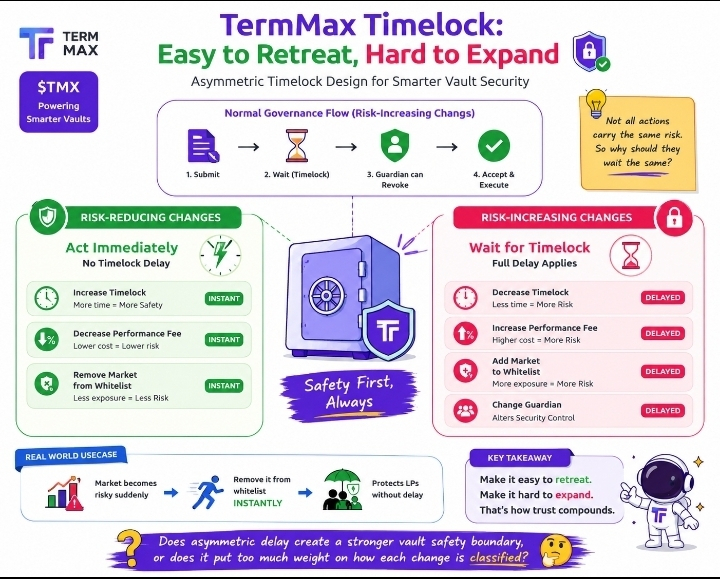
For important curator changes, the normal path is submit → wait → accept.
During that window, a guardian can still revoke the pending action. @termmax .
But the interesting part is the asymmetry.
If a change reduces risk, it can move immediately: increasing the timelock, lowering the performance fee, or removing a market from the whitelist.
Move toward greater exposure, and the brakes engage: reducing the timelock, increasing fees, adding a market, or changing the guardian requires the full waiting period.
That makes sense to me.
Think of a bank vault with two buttons: “get out” opens quickly, while “put more money in” makes you stop and think twice. 😅
And this matters beyond governance theory. If a whitelisted market suddenly becomes questionable, the curator shouldn't have to wait before removing exposure.
But if they want to add a new market or weaken a safety parameter, users get time to notice, assess, and potentially react. #TermMax .
The tradeoff is what caught my attention.
Asymmetric timelocks don't determine whether a decision is actually good.
They only control how quickly that decision can take effect.
So the real security boundary isn't just the timer.
It's also the logic deciding which direction counts as “safer.”
That makes TermMax interesting to me: $TMX sits alongside a governance design question that many protocols still treat as binary.
Can asymmetric delays create a genuinely safer vault—or simply make the classification layer the new thing we have to trust?
I used to think a vault timelock was basically a brick wall: every sensitive change gets the same delay, whether it makes the vault safer or riskier.
Then I looked closer at TermMax, and that assumption started falling apart.
For important curator changes, the normal path is submit → wait → accept.
During that window, a guardian can still revoke the pending action. @TermMax .
But the interesting part is the asymmetry.
If a change reduces risk, it can move immediately: increasing the timelock, lowering the performance fee, or removing a market from the whitelist.
Move toward greater exposure, and the brakes engage: reducing the timelock, increasing fees, adding a market, or changing the guardian requires the full waiting period.
That makes sense to me.
Think of a bank vault with two buttons: “get out” opens quickly, while “put more money in” makes you stop and think twice. 😅
And this matters beyond governance theory. If a whitelisted market suddenly becomes questionable, the curator shouldn't have to wait before removing exposure.
But if they want to add a new market or weaken a safety parameter, users get time to notice, assess, and potentially react. #TermMax .
The tradeoff is what caught my attention.
Asymmetric timelocks don't determine whether a decision is actually good.
They only control how quickly that decision can take effect.
So the real security boundary isn't just the timer.
It's also the logic deciding which direction counts as “safer.”
That makes TermMax interesting to me: $TMX sits alongside a governance design question that many protocols still treat as binary.
Can asymmetric delays create a genuinely safer vault—or simply make the classification layer the new thing we have to trust?
Then I looked closer at TermMax, and that assumption started falling apart.
For important curator changes, the normal path is submit → wait → accept.
During that window, a guardian can still revoke the pending action. @TermMax .
But the interesting part is the asymmetry.
If a change reduces risk, it can move immediately: increasing the timelock, lowering the performance fee, or removing a market from the whitelist.
Move toward greater exposure, and the brakes engage: reducing the timelock, increasing fees, adding a market, or changing the guardian requires the full waiting period.
That makes sense to me.
Think of a bank vault with two buttons: “get out” opens quickly, while “put more money in” makes you stop and think twice. 😅
And this matters beyond governance theory. If a whitelisted market suddenly becomes questionable, the curator shouldn't have to wait before removing exposure.
But if they want to add a new market or weaken a safety parameter, users get time to notice, assess, and potentially react. #TermMax .
The tradeoff is what caught my attention.
Asymmetric timelocks don't determine whether a decision is actually good.
They only control how quickly that decision can take effect.
So the real security boundary isn't just the timer.
It's also the logic deciding which direction counts as “safer.”
That makes TermMax interesting to me: $TMX sits alongside a governance design question that many protocols still treat as binary.
Can asymmetric delays create a genuinely safer vault—or simply make the classification layer the new thing we have to trust?
22
16
137
·
--
Übersetzung ansehen
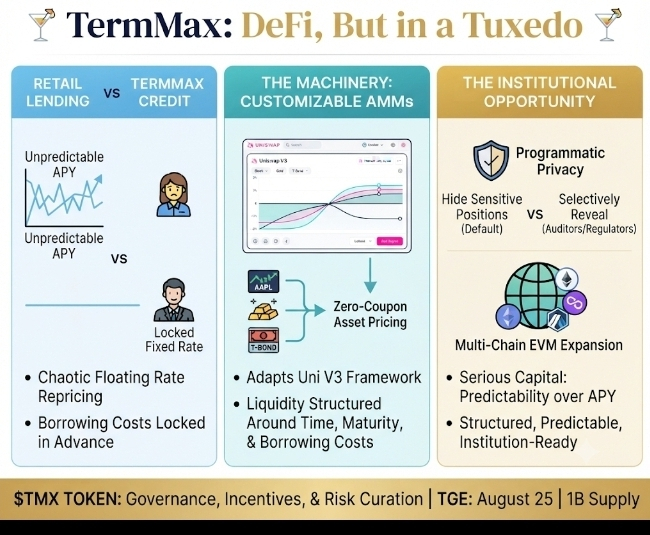
TermMax: DeFi, But in a Tuxedo 🥂
I’ll admit it: I initially filed TermMax under “another lending protocol with expensive marketing.”
Then I actually looked at the machinery.
That changed my mind.
The interesting part isn’t just the fixed-rate headline.
@termmax adapts the Uniswap V3 framework, using customizable AMM interest-rate curves to price zero-coupon assets.
That gives the protocol a much more deliberate way to structure liquidity around time, maturity, and borrowing costs.
And this is where it starts feeling less like retail DeFi and more like a private credit desk walking into Web3.
Think tokenized stocks and RWAs being used as collateral while borrowers lock financing costs in advance.
Instead of waking up to another violent floating-rate repricing, capital can be structured around a known cost.
That matters.
Because serious capital doesn’t only ask, “What’s the APY?”
It asks: What does this position cost me three months from now?
That’s the gap #TermMax is trying to attack.
Now $TMX enters the picture with its August 25 TGE and 1B-token supply, pushing the protocol toward governance, incentives and risk-curation mechanics.
The multi-chain EVM expansion adds another layer to the liquidity story.
But the bigger opportunity, IMO, is institutional privacy.
Banks and credit desks may not need absolute invisibility.
They need programmable privacy—hide sensitive positions by default, reveal exactly what auditors or regulators need, and keep the rest sealed.
That’s a much more interesting future for DeFi credit.
TermMax isn’t trying to make lending louder.
It’s trying to make it structured, predictable, and institution-ready. 🥂
TermMax: DeFi, But in a Tuxedo 🥂
I’ll admit it: I initially filed TermMax under “another lending protocol with expensive marketing.”
Then I actually looked at the machinery.
That changed my mind.
The interesting part isn’t just the fixed-rate headline.
@TermMax adapts the Uniswap V3 framework, using customizable AMM interest-rate curves to price zero-coupon assets.
That gives the protocol a much more deliberate way to structure liquidity around time, maturity, and borrowing costs.
And this is where it starts feeling less like retail DeFi and more like a private credit desk walking into Web3.
Think tokenized stocks and RWAs being used as collateral while borrowers lock financing costs in advance.
Instead of waking up to another violent floating-rate repricing, capital can be structured around a known cost.
That matters.
Because serious capital doesn’t only ask, “What’s the APY?”
It asks: What does this position cost me three months from now?
That’s the gap #TermMax is trying to attack.
Now $TMX enters the picture with its August 25 TGE and 1B-token supply, pushing the protocol toward governance, incentives and risk-curation mechanics.
The multi-chain EVM expansion adds another layer to the liquidity story.
But the bigger opportunity, IMO, is institutional privacy.
Banks and credit desks may not need absolute invisibility.
They need programmable privacy—hide sensitive positions by default, reveal exactly what auditors or regulators need, and keep the rest sealed.
That’s a much more interesting future for DeFi credit.
TermMax isn’t trying to make lending louder.
It’s trying to make it structured, predictable, and institution-ready. 🥂
I’ll admit it: I initially filed TermMax under “another lending protocol with expensive marketing.”
Then I actually looked at the machinery.
That changed my mind.
The interesting part isn’t just the fixed-rate headline.
@TermMax adapts the Uniswap V3 framework, using customizable AMM interest-rate curves to price zero-coupon assets.
That gives the protocol a much more deliberate way to structure liquidity around time, maturity, and borrowing costs.
And this is where it starts feeling less like retail DeFi and more like a private credit desk walking into Web3.
Think tokenized stocks and RWAs being used as collateral while borrowers lock financing costs in advance.
Instead of waking up to another violent floating-rate repricing, capital can be structured around a known cost.
That matters.
Because serious capital doesn’t only ask, “What’s the APY?”
It asks: What does this position cost me three months from now?
That’s the gap #TermMax is trying to attack.
Now $TMX enters the picture with its August 25 TGE and 1B-token supply, pushing the protocol toward governance, incentives and risk-curation mechanics.
The multi-chain EVM expansion adds another layer to the liquidity story.
But the bigger opportunity, IMO, is institutional privacy.
Banks and credit desks may not need absolute invisibility.
They need programmable privacy—hide sensitive positions by default, reveal exactly what auditors or regulators need, and keep the rest sealed.
That’s a much more interesting future for DeFi credit.
TermMax isn’t trying to make lending louder.
It’s trying to make it structured, predictable, and institution-ready. 🥂
77
43
126
·
--
Übersetzung ansehen
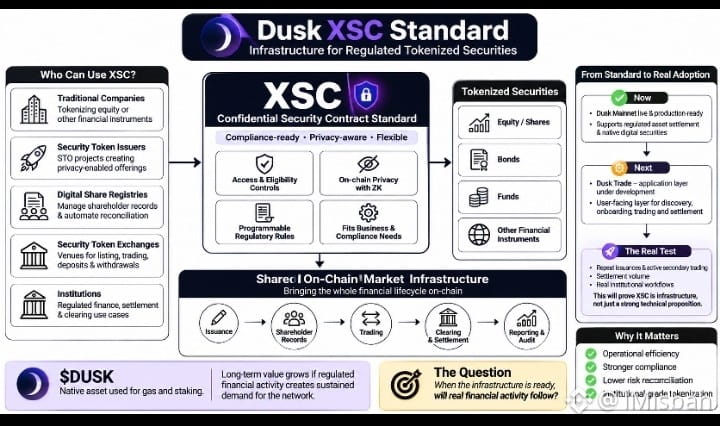
I used to think Dusk’s XSC was just another standard for putting securities on-chain.
XSC is described as a standard for confidential smart contracts that can adapt to business and compliance requirements.
After digging deeper, I think that misses the bigger picture.
A security token is only the beginning. Imagine a company issuing a €10M private bond on-chain. The hard questions come afterward:
Who can legally hold it?
Who can transfer it?
What can regulators see?
How do the asset and payment settle?
That’s where XSC becomes interesting.
Dusk is building rules for eligibility, transfer restrictions and selective disclosure closer to the protocol, while DuskDS handles settlement and finality.
Dusk Trade then sits above that infrastructure for discovery, onboarding and trading.
In simple terms:
XSC defines the financial rules.
DuskDS settles the transaction.
Dusk Trade connects users to the market.
The privacy angle is surprisingly relatable too. 😅
You might be perfectly comfortable telling your bank everything about a transaction, but you probably don’t want your neighbors standing outside your house with a spreadsheet tracking every purchase.
Institutional finance has a similar problem: regulators need appropriate visibility, while sensitive financial activity shouldn’t automatically become public information.
What makes this more than a theoretical discussion is Dusk’s connection with NPEX, which has reported more than €200M in securities issuance and 20,000+ investors.
That gives me a better question than “How impressive is the technology?”
Are real financial workflows beginning to move onto these rails?
I’m watching issuance, secondary trading, settlement volume and repeat institutional activity. @Dusk_Foundation
If those numbers compound, XSC could become infrastructure rather than just another token standard. #dusk .
The rails are here. Now I want to see the traffic.
$DUSK is one I’m watching closely. 🚀
{future}(DUSKUSDT)
I used to think Dusk’s XSC was just another standard for putting securities on-chain.
XSC is described as a standard for confidential smart contracts that can adapt to business and compliance requirements.
After digging deeper, I think that misses the bigger picture.
A security token is only the beginning. Imagine a company issuing a €10M private bond on-chain. The hard questions come afterward:
Who can legally hold it?
Who can transfer it?
What can regulators see?
How do the asset and payment settle?
That’s where XSC becomes interesting.
Dusk is building rules for eligibility, transfer restrictions and selective disclosure closer to the protocol, while DuskDS handles settlement and finality.
Dusk Trade then sits above that infrastructure for discovery, onboarding and trading.
In simple terms:
XSC defines the financial rules.
DuskDS settles the transaction.
Dusk Trade connects users to the market.
The privacy angle is surprisingly relatable too. 😅
You might be perfectly comfortable telling your bank everything about a transaction, but you probably don’t want your neighbors standing outside your house with a spreadsheet tracking every purchase.
Institutional finance has a similar problem: regulators need appropriate visibility, while sensitive financial activity shouldn’t automatically become public information.
What makes this more than a theoretical discussion is Dusk’s connection with NPEX, which has reported more than €200M in securities issuance and 20,000+ investors.
That gives me a better question than “How impressive is the technology?”
Are real financial workflows beginning to move onto these rails?
I’m watching issuance, secondary trading, settlement volume and repeat institutional activity. @Dusk
If those numbers compound, XSC could become infrastructure rather than just another token standard. #dusk .
The rails are here. Now I want to see the traffic.
$DUSK is one I’m watching closely. 🚀
XSC is described as a standard for confidential smart contracts that can adapt to business and compliance requirements.
After digging deeper, I think that misses the bigger picture.
A security token is only the beginning. Imagine a company issuing a €10M private bond on-chain. The hard questions come afterward:
Who can legally hold it?
Who can transfer it?
What can regulators see?
How do the asset and payment settle?
That’s where XSC becomes interesting.
Dusk is building rules for eligibility, transfer restrictions and selective disclosure closer to the protocol, while DuskDS handles settlement and finality.
Dusk Trade then sits above that infrastructure for discovery, onboarding and trading.
In simple terms:
XSC defines the financial rules.
DuskDS settles the transaction.
Dusk Trade connects users to the market.
The privacy angle is surprisingly relatable too. 😅
You might be perfectly comfortable telling your bank everything about a transaction, but you probably don’t want your neighbors standing outside your house with a spreadsheet tracking every purchase.
Institutional finance has a similar problem: regulators need appropriate visibility, while sensitive financial activity shouldn’t automatically become public information.
What makes this more than a theoretical discussion is Dusk’s connection with NPEX, which has reported more than €200M in securities issuance and 20,000+ investors.
That gives me a better question than “How impressive is the technology?”
Are real financial workflows beginning to move onto these rails?
I’m watching issuance, secondary trading, settlement volume and repeat institutional activity. @Dusk
If those numbers compound, XSC could become infrastructure rather than just another token standard. #dusk .
The rails are here. Now I want to see the traffic.
$DUSK is one I’m watching closely. 🚀
74
32
170
·
--
Übersetzung ansehen
I used to think tokenization had one obvious rule: if the asset is regulated, putting its ownership on a transparent ledger should make everything easier.
Then I started looking at what the ledger actually reveals.
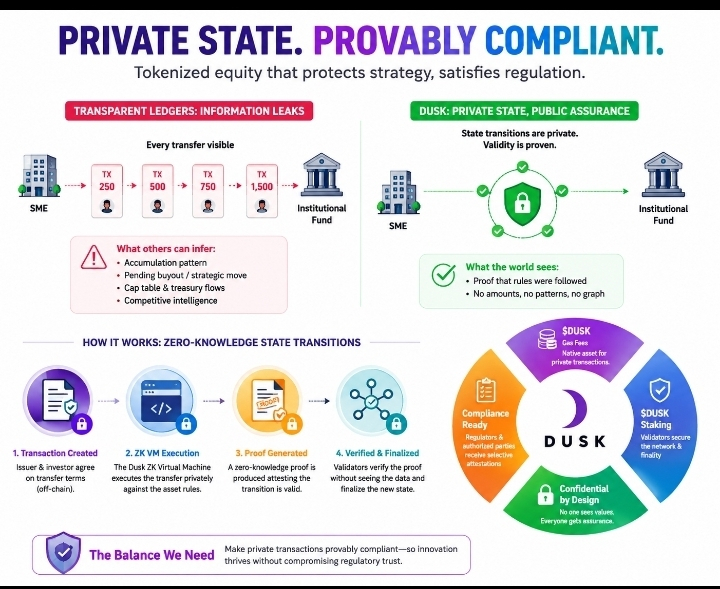
For an SME issuing private-market equity, “transparent” can quietly become “commercially exposed.”
Purchase timing, position changes and wallet activity can reveal accumulation patterns long before anyone knows the investor’s identity.
It reminded me of watching someone shop through a glass window.
You might not know their name, but after six months, you can probably guess what they’re planning. 😅
That’s the part of @Dusk_Foundation I find more interesting than the usual privacy pitch.
Its architecture separates settlement from execution, while Phoenix supports shielded, note-based transfers where zero-knowledge proofs can verify correctness without exposing the amount or specific notes involved.
Selective disclosure can then provide information to authorized parties when required.
And there’s a useful recent development here: DuskEVM’s testnet went live in August, giving Solidity and Hardhat developers a familiar execution environment while still settling through DuskDS.
That matters because privacy infrastructure is only useful if developers can actually build market workflows around it. #dusk .
Imagine a fund accumulating restricted SME shares over six months.
The regulator may need proof of eligibility and ownership rules.
The issuer may need controlled visibility. But every competitor doesn’t need the entire trading trail.
That, to me, is the practical insight.
The goal isn’t hiding from regulation.
It’s reducing unnecessary information leakage while preserving verifiability.
$DUSK handles the network’s gas and staking layer.
So the question I’m still watching is: can private state become normal market infrastructure without making verification harder than transparency?
{future}(DUSKUSDT)
I used to think tokenization had one obvious rule: if the asset is regulated, putting its ownership on a transparent ledger should make everything easier.
Then I started looking at what the ledger actually reveals.
For an SME issuing private-market equity, “transparent” can quietly become “commercially exposed.”
Purchase timing, position changes and wallet activity can reveal accumulation patterns long before anyone knows the investor’s identity.
It reminded me of watching someone shop through a glass window.
You might not know their name, but after six months, you can probably guess what they’re planning. 😅
That’s the part of @Dusk I find more interesting than the usual privacy pitch.
Its architecture separates settlement from execution, while Phoenix supports shielded, note-based transfers where zero-knowledge proofs can verify correctness without exposing the amount or specific notes involved.
Selective disclosure can then provide information to authorized parties when required.
And there’s a useful recent development here: DuskEVM’s testnet went live in August, giving Solidity and Hardhat developers a familiar execution environment while still settling through DuskDS.
That matters because privacy infrastructure is only useful if developers can actually build market workflows around it. #dusk .
Imagine a fund accumulating restricted SME shares over six months.
The regulator may need proof of eligibility and ownership rules.
The issuer may need controlled visibility. But every competitor doesn’t need the entire trading trail.
That, to me, is the practical insight.
The goal isn’t hiding from regulation.
It’s reducing unnecessary information leakage while preserving verifiability.
$DUSK handles the network’s gas and staking layer.
So the question I’m still watching is: can private state become normal market infrastructure without making verification harder than transparency?
Then I started looking at what the ledger actually reveals.
For an SME issuing private-market equity, “transparent” can quietly become “commercially exposed.”
Purchase timing, position changes and wallet activity can reveal accumulation patterns long before anyone knows the investor’s identity.
It reminded me of watching someone shop through a glass window.
You might not know their name, but after six months, you can probably guess what they’re planning. 😅
That’s the part of @Dusk I find more interesting than the usual privacy pitch.
Its architecture separates settlement from execution, while Phoenix supports shielded, note-based transfers where zero-knowledge proofs can verify correctness without exposing the amount or specific notes involved.
Selective disclosure can then provide information to authorized parties when required.
And there’s a useful recent development here: DuskEVM’s testnet went live in August, giving Solidity and Hardhat developers a familiar execution environment while still settling through DuskDS.
That matters because privacy infrastructure is only useful if developers can actually build market workflows around it. #dusk .
Imagine a fund accumulating restricted SME shares over six months.
The regulator may need proof of eligibility and ownership rules.
The issuer may need controlled visibility. But every competitor doesn’t need the entire trading trail.
That, to me, is the practical insight.
The goal isn’t hiding from regulation.
It’s reducing unnecessary information leakage while preserving verifiability.
$DUSK handles the network’s gas and staking layer.
So the question I’m still watching is: can private state become normal market infrastructure without making verification harder than transparency?
157
1
54
239
·
--
Übersetzung ansehen
Lately, I’ve been checking fixed-income markets across chains, and one thing keeps bothering me: ten networks can look like diversification while the actual liquidity underneath remains thin.
The common assumption is simple: more chains = more capital efficiency. I’m not convinced.
@termmax is interesting because it attacks the plumbing rather than just adding another lending interface.
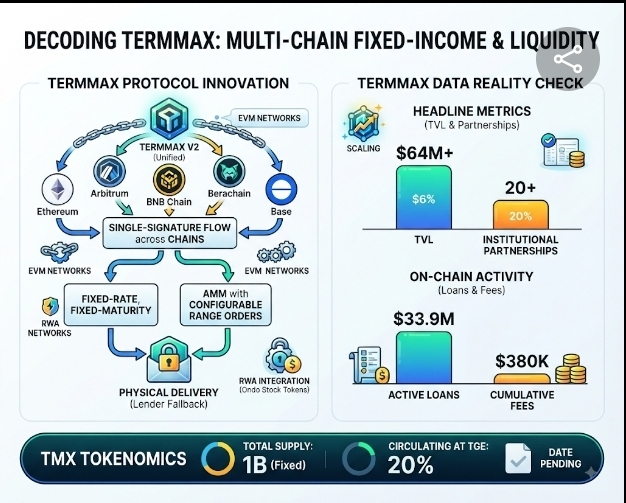
Its fixed-rate, fixed-maturity markets use an AMM with configurable range orders, while V2 brings unified orders and a single-signature flow across chains.
Physical delivery also gives lenders a fallback when volatility or liquidity makes normal liquidation impractical.
📊 The Data Reality Check
The latest rollout makes this tangible.
#TermMax now lists Ethereum, Arbitrum, BNB Chain, Berachain, Base, and other EVM networks, while its app highlights RWA markets involving Ondo stock tokens.
That creates a real-world use case: borrowing against tokenized financial assets rather than farming another volatile token.
However, a quick sanity check matters:
Headline Metrics: Cites $64M+ TVL and 20+ institutional partnerships.
On-Chain Reality: DeFiLlama shows about $33.9M in active loans and cumulative fees around $380K.
These numbers aren’t contradictory; they highlight why headline TVL is never the same as active fixed-income liquidity.
🏛️ The Institutional Angle & Tokenomics
For institutions, this matters beyond yield.
A MiCA- or securities-regulated environment needs predictable settlement, auditable rules, and controlled disclosure.
TermMax helps with rate and execution certainty, but privacy/compliance controls still have to exist around the asset and venue.
As for $TMX, the whitepaper targets a 1B fixed supply with 20% circulating at TGE August 25.
The bigger question I’m watching: Do institutions really need maximum privacy, or programmable privacy that knows when to hide and when to reveal?
Drop your thoughts below! 👇
Lately, I’ve been checking fixed-income markets across chains, and one thing keeps bothering me: ten networks can look like diversification while the actual liquidity underneath remains thin.
The common assumption is simple: more chains = more capital efficiency. I’m not convinced.
@TermMax is interesting because it attacks the plumbing rather than just adding another lending interface.
Its fixed-rate, fixed-maturity markets use an AMM with configurable range orders, while V2 brings unified orders and a single-signature flow across chains.
Physical delivery also gives lenders a fallback when volatility or liquidity makes normal liquidation impractical.
📊 The Data Reality Check
The latest rollout makes this tangible.
#TermMax now lists Ethereum, Arbitrum, BNB Chain, Berachain, Base, and other EVM networks, while its app highlights RWA markets involving Ondo stock tokens.
That creates a real-world use case: borrowing against tokenized financial assets rather than farming another volatile token.
However, a quick sanity check matters:
Headline Metrics: Cites $64M+ TVL and 20+ institutional partnerships.
On-Chain Reality: DeFiLlama shows about $33.9M in active loans and cumulative fees around $380K.
These numbers aren’t contradictory; they highlight why headline TVL is never the same as active fixed-income liquidity.
🏛️ The Institutional Angle & Tokenomics
For institutions, this matters beyond yield.
A MiCA- or securities-regulated environment needs predictable settlement, auditable rules, and controlled disclosure.
TermMax helps with rate and execution certainty, but privacy/compliance controls still have to exist around the asset and venue.
As for $TMX, the whitepaper targets a 1B fixed supply with 20% circulating at TGE August 25.
The bigger question I’m watching: Do institutions really need maximum privacy, or programmable privacy that knows when to hide and when to reveal?
Drop your thoughts below! 👇
The common assumption is simple: more chains = more capital efficiency. I’m not convinced.
@TermMax is interesting because it attacks the plumbing rather than just adding another lending interface.
Its fixed-rate, fixed-maturity markets use an AMM with configurable range orders, while V2 brings unified orders and a single-signature flow across chains.
Physical delivery also gives lenders a fallback when volatility or liquidity makes normal liquidation impractical.
📊 The Data Reality Check
The latest rollout makes this tangible.
#TermMax now lists Ethereum, Arbitrum, BNB Chain, Berachain, Base, and other EVM networks, while its app highlights RWA markets involving Ondo stock tokens.
That creates a real-world use case: borrowing against tokenized financial assets rather than farming another volatile token.
However, a quick sanity check matters:
Headline Metrics: Cites $64M+ TVL and 20+ institutional partnerships.
On-Chain Reality: DeFiLlama shows about $33.9M in active loans and cumulative fees around $380K.
These numbers aren’t contradictory; they highlight why headline TVL is never the same as active fixed-income liquidity.
🏛️ The Institutional Angle & Tokenomics
For institutions, this matters beyond yield.
A MiCA- or securities-regulated environment needs predictable settlement, auditable rules, and controlled disclosure.
TermMax helps with rate and execution certainty, but privacy/compliance controls still have to exist around the asset and venue.
As for $TMX, the whitepaper targets a 1B fixed supply with 20% circulating at TGE August 25.
The bigger question I’m watching: Do institutions really need maximum privacy, or programmable privacy that knows when to hide and when to reveal?
Drop your thoughts below! 👇
69
24
98
·
--
Übersetzung ansehen
I initially thought a DeFi vault was just a smarter “deposit and earn” button.
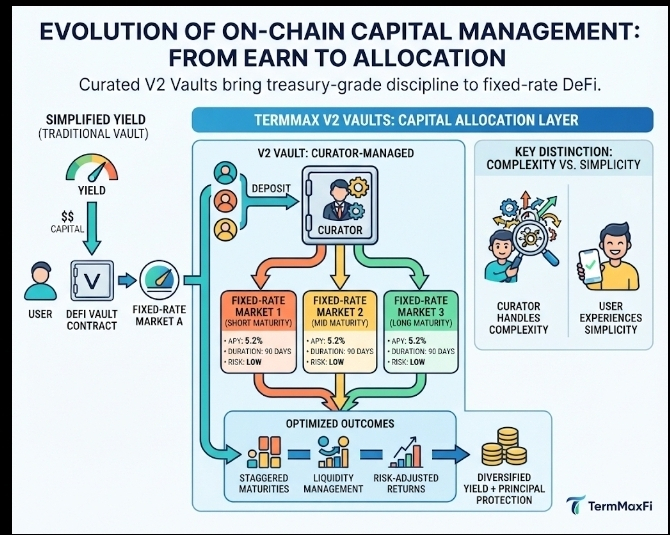
Then I looked closer at @termmax , especially the V2 Vault design, and realized I was missing the more interesting part: what happens to the capital after I deposit?
The answer isn’t simply “it earns yield.”
TermMax V2 Vaults let professional curators manage capital across different fixed-rate markets and maturities.
That changes the problem from “Which market should I pick today?” to “How should capital be allocated across several markets over time?”
That distinction sounds small, but for me it’s the whole point.
A treasury manager doesn’t normally put every dollar into one instrument just because its rate looks attractive.
They stagger maturities, manage liquidity and think about risk-adjusted returns.
TermMax is bringing a similar logic into on-chain fixed-rate markets.
And recent developments make this more tangible.
V2 Vault Architecture is live on mainnet, while TermMax has continued expanding its Earn products across chains, including RWA-oriented markets and Alpha products.
The infrastructure is starting to look less like a single lending product and more like a capital-allocation layer.
The funny part? 😅
The best vault may be the one that makes me think about my capital less, not more.
That’s where I see the practical value.
Curators handle the allocation complexity while vault rules can impose boundaries around capacity, supported markets and risk management. #TermMax .
With $TMX becoming part of the broader ecosystem, I’m more interested in one unanswered question:
Can curated on-chain capital management eventually become disciplined enough for serious treasury operations without turning the curator into the new single point of failure?
I initially thought a DeFi vault was just a smarter “deposit and earn” button.
Then I looked closer at @TermMax , especially the V2 Vault design, and realized I was missing the more interesting part: what happens to the capital after I deposit?
The answer isn’t simply “it earns yield.”
TermMax V2 Vaults let professional curators manage capital across different fixed-rate markets and maturities.
That changes the problem from “Which market should I pick today?” to “How should capital be allocated across several markets over time?”
That distinction sounds small, but for me it’s the whole point.
A treasury manager doesn’t normally put every dollar into one instrument just because its rate looks attractive.
They stagger maturities, manage liquidity and think about risk-adjusted returns.
TermMax is bringing a similar logic into on-chain fixed-rate markets.
And recent developments make this more tangible.
V2 Vault Architecture is live on mainnet, while TermMax has continued expanding its Earn products across chains, including RWA-oriented markets and Alpha products.
The infrastructure is starting to look less like a single lending product and more like a capital-allocation layer.
The funny part? 😅
The best vault may be the one that makes me think about my capital less, not more.
That’s where I see the practical value.
Curators handle the allocation complexity while vault rules can impose boundaries around capacity, supported markets and risk management. #TermMax .
With $TMX becoming part of the broader ecosystem, I’m more interested in one unanswered question:
Can curated on-chain capital management eventually become disciplined enough for serious treasury operations without turning the curator into the new single point of failure?
Then I looked closer at @TermMax , especially the V2 Vault design, and realized I was missing the more interesting part: what happens to the capital after I deposit?
The answer isn’t simply “it earns yield.”
TermMax V2 Vaults let professional curators manage capital across different fixed-rate markets and maturities.
That changes the problem from “Which market should I pick today?” to “How should capital be allocated across several markets over time?”
That distinction sounds small, but for me it’s the whole point.
A treasury manager doesn’t normally put every dollar into one instrument just because its rate looks attractive.
They stagger maturities, manage liquidity and think about risk-adjusted returns.
TermMax is bringing a similar logic into on-chain fixed-rate markets.
And recent developments make this more tangible.
V2 Vault Architecture is live on mainnet, while TermMax has continued expanding its Earn products across chains, including RWA-oriented markets and Alpha products.
The infrastructure is starting to look less like a single lending product and more like a capital-allocation layer.
The funny part? 😅
The best vault may be the one that makes me think about my capital less, not more.
That’s where I see the practical value.
Curators handle the allocation complexity while vault rules can impose boundaries around capacity, supported markets and risk management. #TermMax .
With $TMX becoming part of the broader ecosystem, I’m more interested in one unanswered question:
Can curated on-chain capital management eventually become disciplined enough for serious treasury operations without turning the curator into the new single point of failure?
125
53
224
·
--
Übersetzung ansehen
I started looking at @Dusk_Foundation differently after spending more time inside its testnet.
Initially, I thought the interesting question was whether transactions worked and whether the application layer felt usable.
Then I started paying attention to what was happening underneath.
That’s where DuskDS became more interesting to me.
I think of DuskDS as the settlement layer holding the rest of the stack together: consensus, finality, data availability, and native transaction infrastructure.
DuskEVM can then sit above that foundation rather than having every application reinvent the mechanics of reliable settlement. #dusk .
It reminded me of a railway network.
Passengers notice the trains. They rarely think about the tracks, signaling, or switching systems underneath.
But when those systems work properly, the whole thing feels boring—which, for settlement infrastructure, is probably a compliment. 😄
Still, I’m cautious about what testnet activity actually proves.
People completing tasks, experimenting with features, or chasing incentives tells me there is curiosity.
It doesn’t necessarily tell me there is durable demand.
The harder question is what happens when the rewards disappear.
For regulated assets and confidential financial applications, settlement cannot depend on people showing up because there’s an incentive campaign.
The infrastructure has to become useful enough that applications need it even when nobody is handing out points.
That’s also how I’m thinking about $DUSK . Fees and staking create network utility, but long-term relevance should come from actual economic activity settling through the network.
So I’m watching one thing closely:
When the testnet incentives fade, does DuskDS still give financial applications a reason to stay?
{future}(DUSKUSDT)
I started looking at @Dusk differently after spending more time inside its testnet.
Initially, I thought the interesting question was whether transactions worked and whether the application layer felt usable.
Then I started paying attention to what was happening underneath.
That’s where DuskDS became more interesting to me.
I think of DuskDS as the settlement layer holding the rest of the stack together: consensus, finality, data availability, and native transaction infrastructure.
DuskEVM can then sit above that foundation rather than having every application reinvent the mechanics of reliable settlement. #dusk .
It reminded me of a railway network.
Passengers notice the trains. They rarely think about the tracks, signaling, or switching systems underneath.
But when those systems work properly, the whole thing feels boring—which, for settlement infrastructure, is probably a compliment. 😄
Still, I’m cautious about what testnet activity actually proves.
People completing tasks, experimenting with features, or chasing incentives tells me there is curiosity.
It doesn’t necessarily tell me there is durable demand.
The harder question is what happens when the rewards disappear.
For regulated assets and confidential financial applications, settlement cannot depend on people showing up because there’s an incentive campaign.
The infrastructure has to become useful enough that applications need it even when nobody is handing out points.
That’s also how I’m thinking about $DUSK . Fees and staking create network utility, but long-term relevance should come from actual economic activity settling through the network.
So I’m watching one thing closely:
When the testnet incentives fade, does DuskDS still give financial applications a reason to stay?
Initially, I thought the interesting question was whether transactions worked and whether the application layer felt usable.
Then I started paying attention to what was happening underneath.
That’s where DuskDS became more interesting to me.
I think of DuskDS as the settlement layer holding the rest of the stack together: consensus, finality, data availability, and native transaction infrastructure.
DuskEVM can then sit above that foundation rather than having every application reinvent the mechanics of reliable settlement. #dusk .
It reminded me of a railway network.
Passengers notice the trains. They rarely think about the tracks, signaling, or switching systems underneath.
But when those systems work properly, the whole thing feels boring—which, for settlement infrastructure, is probably a compliment. 😄
Still, I’m cautious about what testnet activity actually proves.
People completing tasks, experimenting with features, or chasing incentives tells me there is curiosity.
It doesn’t necessarily tell me there is durable demand.
The harder question is what happens when the rewards disappear.
For regulated assets and confidential financial applications, settlement cannot depend on people showing up because there’s an incentive campaign.
The infrastructure has to become useful enough that applications need it even when nobody is handing out points.
That’s also how I’m thinking about $DUSK . Fees and staking create network utility, but long-term relevance should come from actual economic activity settling through the network.
So I’m watching one thing closely:
When the testnet incentives fade, does DuskDS still give financial applications a reason to stay?
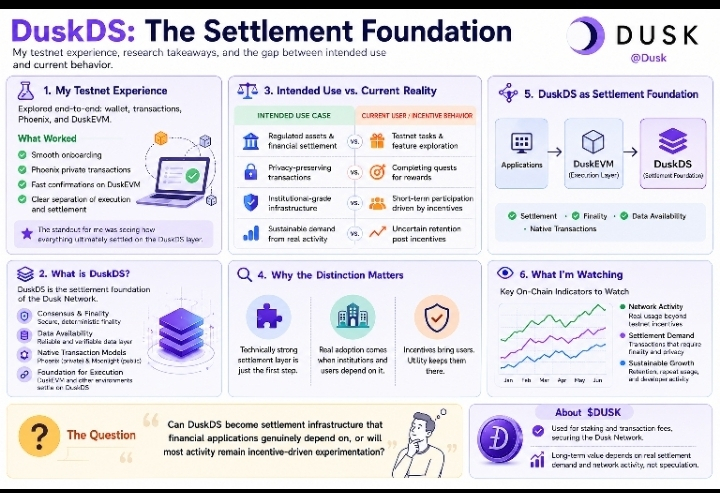
104
46
147
·
--
Übersetzung ansehen
I used to think institutions stayed away from DeFi because the infrastructure was too complex.
The more I looked at treasury management, the less convincing that explanation became.
The bigger problem is uncertainty.
For a corporate treasury, borrowing at a floating DeFi rate can feel like running a business where your electricity bill changes every hour. You can operate, but forecasting becomes a headache.
That’s where [TermMax] caught my attention.
What I found interesting isn’t simply the idea of “fixed rates.” It’s the way term-based markets can turn an uncertain financing variable into something a treasury can actually model.
Instead of asking, “What will the borrowing rate be next week?”, an institution can structure capital around a defined maturity and known financing terms. That makes budgeting, cash-flow planning, and matching liabilities against expected returns much more practical. #TermMax
And there’s an important distinction here.
Traditional finance has spent decades building around predictable funding horizons. DeFi often optimized for liquidity and continuous repricing. Those are powerful features, but they don’t always fit how an institution thinks about deploying capital.
@termmax makes me wonder whether term-based DeFi is less about competing with money markets and more about filling a missing piece in on-chain capital management.
A DAO treasury planning six months ahead doesn’t necessarily need the highest variable yield every day. Sometimes it needs to know what the numbers will look like when the spreadsheet comes back on Monday.
The interesting question now is whether predictable on-chain financing can become reliable enough for institutions to build treasury strategies around it—not just experiment with it.
I used to think institutions stayed away from DeFi because the infrastructure was too complex.
The more I looked at treasury management, the less convincing that explanation became.
The bigger problem is uncertainty.
For a corporate treasury, borrowing at a floating DeFi rate can feel like running a business where your electricity bill changes every hour. You can operate, but forecasting becomes a headache.
That’s where [TermMax] caught my attention.
What I found interesting isn’t simply the idea of “fixed rates.” It’s the way term-based markets can turn an uncertain financing variable into something a treasury can actually model.
Instead of asking, “What will the borrowing rate be next week?”, an institution can structure capital around a defined maturity and known financing terms. That makes budgeting, cash-flow planning, and matching liabilities against expected returns much more practical. #TermMax
And there’s an important distinction here.
Traditional finance has spent decades building around predictable funding horizons. DeFi often optimized for liquidity and continuous repricing. Those are powerful features, but they don’t always fit how an institution thinks about deploying capital.
@TermMax makes me wonder whether term-based DeFi is less about competing with money markets and more about filling a missing piece in on-chain capital management.
A DAO treasury planning six months ahead doesn’t necessarily need the highest variable yield every day. Sometimes it needs to know what the numbers will look like when the spreadsheet comes back on Monday.
The interesting question now is whether predictable on-chain financing can become reliable enough for institutions to build treasury strategies around it—not just experiment with it.
The more I looked at treasury management, the less convincing that explanation became.
The bigger problem is uncertainty.
For a corporate treasury, borrowing at a floating DeFi rate can feel like running a business where your electricity bill changes every hour. You can operate, but forecasting becomes a headache.
That’s where [TermMax] caught my attention.
What I found interesting isn’t simply the idea of “fixed rates.” It’s the way term-based markets can turn an uncertain financing variable into something a treasury can actually model.
Instead of asking, “What will the borrowing rate be next week?”, an institution can structure capital around a defined maturity and known financing terms. That makes budgeting, cash-flow planning, and matching liabilities against expected returns much more practical. #TermMax
And there’s an important distinction here.
Traditional finance has spent decades building around predictable funding horizons. DeFi often optimized for liquidity and continuous repricing. Those are powerful features, but they don’t always fit how an institution thinks about deploying capital.
@TermMax makes me wonder whether term-based DeFi is less about competing with money markets and more about filling a missing piece in on-chain capital management.
A DAO treasury planning six months ahead doesn’t necessarily need the highest variable yield every day. Sometimes it needs to know what the numbers will look like when the spreadsheet comes back on Monday.
The interesting question now is whether predictable on-chain financing can become reliable enough for institutions to build treasury strategies around it—not just experiment with it.
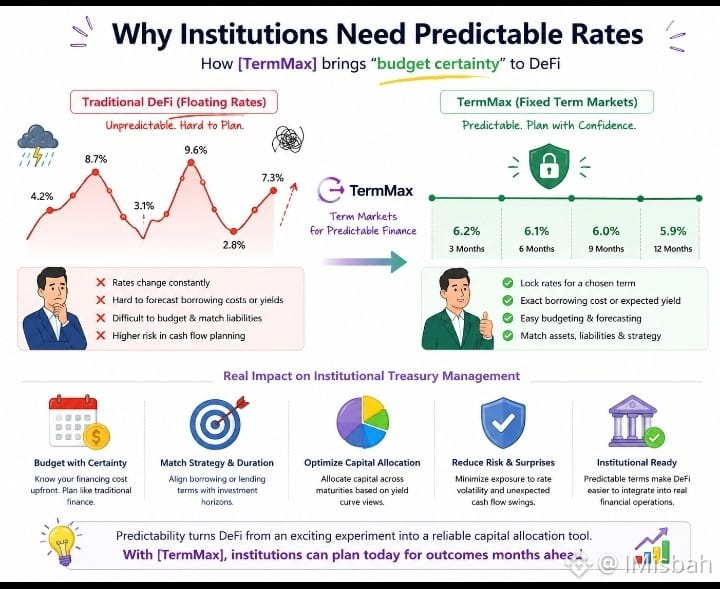
111
39
111
·
--
Als ich zum ersten Mal den Exit-Prozess des Dusk-Provisioners studiert habe, ging ich zunächst von etwas aus, das sich heute zu simpel anfühlt: Ich erwartete, dass Unstaking bedeutet, in eine feste Unbonding-Warteschlange einzutreten, eine protokolldefinierte Verzögerung abzuwarten und mir dann meine Liquidität zurückzuholen.
So funktioniert Dusk jedoch aktuell nicht.
Die Dokumentation sagt, dass es nach einer erfolgreichen Unstaking-Transaktion keine Protokoll-Wartezeit gibt. Aber genau das hat mich dazu gebracht, genauer hinzuschauen, was „Exit“ tatsächlich bedeutet. Das Unstaking des Kapitals und das Zurückziehen der angefallenen Rewards sind getrennte Aktionen. Diese Unterscheidung lässt sich leicht übersehen, wenn man Staking als einen einzigen Deposit-und-Withdraw-Workflow betrachtet.
Unter der Haube nutzt @Dusk_Foundation Provisioner, um Blöcke vorzuschlagen und zu validieren. Ihre Konsensbeteiligung ist probabilistisch: Die Rewards werden durch das aktive Stake und die tatsächliche Teilnahme beeinflusst, nicht durch eine feste Rendite. Das Netzwerk unterscheidet zudem Soft Penalties für fehlgeschlagene Teilnahme von härteren Penalties für nachweislich ungültiges Konsensverhalten.
Die Architektur ist hier entscheidend: Der Stake-Lebenszyklus liegt parallel zu den operativen Anforderungen des Provisioners – also einem Onlinedienst, einem synchronisierten Node, Konsens-Keys, einer epoch-basierten Aktivierung und einer separaten Reward-Abrechnung. Aussteigen ist also nicht nur ein „Sell“-Button; es ist ein Zustandswechsel innerhalb eines laufenden Konsenssystems. #dusk
Für institutionelles Kapital ist diese Unterscheidung wichtig. Das Liquiditäts-Planning hängt nicht nur davon ab, ob ein Protokoll eine Unbonding-Verzögerung hat. Es geht darum, ob die Verwahrung, die Node-Operationen, das Zurückziehen der Rewards und die Abwicklung weiterhin vorhersehbar bleiben, wenn das Kapital sich schnell bewegen muss.
$DUSK ist für mich daher weniger als Renditeinstrument interessant, sondern eher als Infrastruktur, deren operative Details realen Liquiditätsdruck überstehen müssen.
Meine Frage hat sich von „Kann ich unstaken?“ zu:
Kann Dusk den vollständigen Exit-zu-Abwicklungs-Workflow so vorhersehbar machen, dass institutionelles Kapital auch dann damit planen kann, wenn der Markt unter Stress gerät?
{future}(DUSKUSDT)
Als ich zum ersten Mal den Exit-Prozess des Dusk-Provisioners studiert habe, ging ich zunächst von etwas aus, das sich heute zu simpel anfühlt: Ich erwartete, dass Unstaking bedeutet, in eine feste Unbonding-Warteschlange einzutreten, eine protokolldefinierte Verzögerung abzuwarten und mir dann meine Liquidität zurückzuholen.
So funktioniert Dusk jedoch aktuell nicht.
Die Dokumentation sagt, dass es nach einer erfolgreichen Unstaking-Transaktion keine Protokoll-Wartezeit gibt. Aber genau das hat mich dazu gebracht, genauer hinzuschauen, was „Exit“ tatsächlich bedeutet. Das Unstaking des Kapitals und das Zurückziehen der angefallenen Rewards sind getrennte Aktionen. Diese Unterscheidung lässt sich leicht übersehen, wenn man Staking als einen einzigen Deposit-und-Withdraw-Workflow betrachtet.
Unter der Haube nutzt @Dusk Provisioner, um Blöcke vorzuschlagen und zu validieren. Ihre Konsensbeteiligung ist probabilistisch: Die Rewards werden durch das aktive Stake und die tatsächliche Teilnahme beeinflusst, nicht durch eine feste Rendite. Das Netzwerk unterscheidet zudem Soft Penalties für fehlgeschlagene Teilnahme von härteren Penalties für nachweislich ungültiges Konsensverhalten.
Die Architektur ist hier entscheidend: Der Stake-Lebenszyklus liegt parallel zu den operativen Anforderungen des Provisioners – also einem Onlinedienst, einem synchronisierten Node, Konsens-Keys, einer epoch-basierten Aktivierung und einer separaten Reward-Abrechnung. Aussteigen ist also nicht nur ein „Sell“-Button; es ist ein Zustandswechsel innerhalb eines laufenden Konsenssystems. #dusk
Für institutionelles Kapital ist diese Unterscheidung wichtig. Das Liquiditäts-Planning hängt nicht nur davon ab, ob ein Protokoll eine Unbonding-Verzögerung hat. Es geht darum, ob die Verwahrung, die Node-Operationen, das Zurückziehen der Rewards und die Abwicklung weiterhin vorhersehbar bleiben, wenn das Kapital sich schnell bewegen muss.
$DUSK ist für mich daher weniger als Renditeinstrument interessant, sondern eher als Infrastruktur, deren operative Details realen Liquiditätsdruck überstehen müssen.
Meine Frage hat sich von „Kann ich unstaken?“ zu:
Kann Dusk den vollständigen Exit-zu-Abwicklungs-Workflow so vorhersehbar machen, dass institutionelles Kapital auch dann damit planen kann, wenn der Markt unter Stress gerät?
So funktioniert Dusk jedoch aktuell nicht.
Die Dokumentation sagt, dass es nach einer erfolgreichen Unstaking-Transaktion keine Protokoll-Wartezeit gibt. Aber genau das hat mich dazu gebracht, genauer hinzuschauen, was „Exit“ tatsächlich bedeutet. Das Unstaking des Kapitals und das Zurückziehen der angefallenen Rewards sind getrennte Aktionen. Diese Unterscheidung lässt sich leicht übersehen, wenn man Staking als einen einzigen Deposit-und-Withdraw-Workflow betrachtet.
Unter der Haube nutzt @Dusk Provisioner, um Blöcke vorzuschlagen und zu validieren. Ihre Konsensbeteiligung ist probabilistisch: Die Rewards werden durch das aktive Stake und die tatsächliche Teilnahme beeinflusst, nicht durch eine feste Rendite. Das Netzwerk unterscheidet zudem Soft Penalties für fehlgeschlagene Teilnahme von härteren Penalties für nachweislich ungültiges Konsensverhalten.
Die Architektur ist hier entscheidend: Der Stake-Lebenszyklus liegt parallel zu den operativen Anforderungen des Provisioners – also einem Onlinedienst, einem synchronisierten Node, Konsens-Keys, einer epoch-basierten Aktivierung und einer separaten Reward-Abrechnung. Aussteigen ist also nicht nur ein „Sell“-Button; es ist ein Zustandswechsel innerhalb eines laufenden Konsenssystems. #dusk
Für institutionelles Kapital ist diese Unterscheidung wichtig. Das Liquiditäts-Planning hängt nicht nur davon ab, ob ein Protokoll eine Unbonding-Verzögerung hat. Es geht darum, ob die Verwahrung, die Node-Operationen, das Zurückziehen der Rewards und die Abwicklung weiterhin vorhersehbar bleiben, wenn das Kapital sich schnell bewegen muss.
$DUSK ist für mich daher weniger als Renditeinstrument interessant, sondern eher als Infrastruktur, deren operative Details realen Liquiditätsdruck überstehen müssen.
Meine Frage hat sich von „Kann ich unstaken?“ zu:
Kann Dusk den vollständigen Exit-zu-Abwicklungs-Workflow so vorhersehbar machen, dass institutionelles Kapital auch dann damit planen kann, wenn der Markt unter Stress gerät?
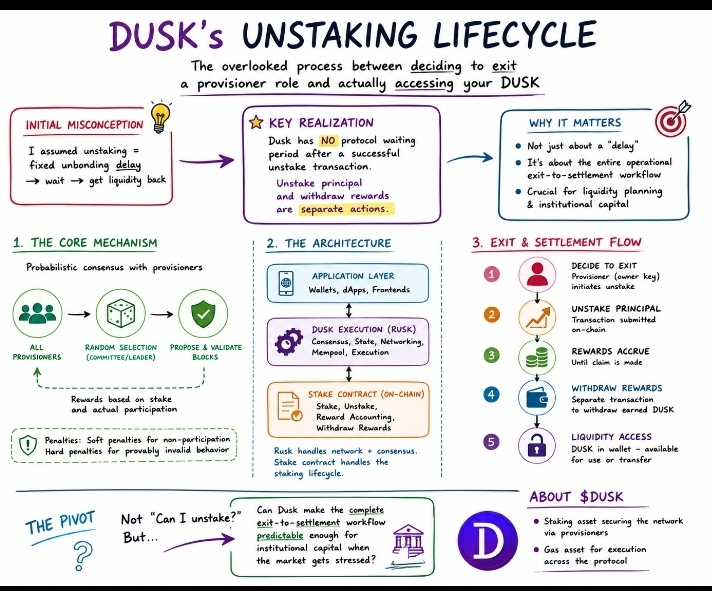
123
43
223
·
--
Eine Sache ist mir aufgefallen, als ich in Dusk eingetaucht bin: Eine Wallet kann korrekt an eine Identität gebunden bleiben und dennoch eine Übertragung scheitern lassen, weil die für diese Übertragung zugrunde liegende Eignungsentscheidung nicht mehr aktuell ist.
Zunächst nahm ich an, das seien im Grunde nur ein Validierungsschritt.
Das sind sie nicht.
Je mehr ich mir die Architektur angesehen habe, desto mehr sah das wie ein Problem der Zustandsverwaltung aus und weniger wie ein Wallet-Problem.
Die Wallet-Bindung stellt eine kryptografische Beziehung zwischen einer Identität und einer Wallet her.
Diese Beziehung kann völlig gültig bleiben, während sich die externen Bedingungen ändern, die die Übertragungsberechtigung beeinflussen.
Stellen Sie sich eine am Montag gebundene Wallet vor. Am Dienstag ändert sich ein Compliance-Parameter außerhalb der Kette.
Die Identitätszuordnung wurde nicht widerrufen, die Wallet hat sich nicht geändert, und der Nutzer kann weiterhin nachweisen, dass er die Kontrolle darüber hat.
Aber wenn der Richtlinienzustand, der bei der Transaktionsbewertung verwendet wurde, nicht neu berechnet wurde, kann die Übertragung auf ein völlig anderes Ergebnis treffen. #dusk .
Dieser Unterschied ist leicht zu übersehen, weil die Benutzeroberfläche mehrere Prüfungen in einer einzigen Erfahrung verdichtet: „verifiziert“ bedeutet nicht unbedingt „jetzt gerade berechtigt“.
Im Hintergrund können mehrere unabhängige Zustandsübergänge liegen: Signaturprüfung, Identitätszuordnung, Status von Anmeldeinformationen oder Richtlinienstatus und die abschließende Autorisierung der Übertragung. @Dusk_Foundation .
Die entscheidende technische Frage ist, wie Änderungen in externen Richtlinien in den Zustand hineinwirken, den die Transaktion tatsächlich auswertet.
Für $DUSK ergibt sich daraus ein spannender Zielkonflikt. Ein konservativer Richtlinienzustand kann das Risiko der Compliance-Belastung verringern, aber ein veralteter Zustand führt zu abgelehnten Übertragungen und zu operativen Reibungsverlusten.
Ein aggressiveres Aktualisieren verbessert die Aktualität, bringt jedoch zusätzlichen Rechenaufwand, Koordinationsaufwand und Abhängigkeiten von der Infrastruktur mit sich.
Was ich immer noch zu verstehen versuche, ist die Anreizschicht: Wenn eine gültige Wallet zu einer veralteten Berechtigung wird, wer ist dann wirtschaftlich und operativ dafür verantwortlich, diesen Zustand zu aktualisieren?
{future}(DUSKUSDT)
Eine Sache ist mir aufgefallen, als ich in Dusk eingetaucht bin: Eine Wallet kann korrekt an eine Identität gebunden bleiben und dennoch eine Übertragung scheitern lassen, weil die für diese Übertragung zugrunde liegende Eignungsentscheidung nicht mehr aktuell ist.
Zunächst nahm ich an, das seien im Grunde nur ein Validierungsschritt.
Das sind sie nicht.
Je mehr ich mir die Architektur angesehen habe, desto mehr sah das wie ein Problem der Zustandsverwaltung aus und weniger wie ein Wallet-Problem.
Die Wallet-Bindung stellt eine kryptografische Beziehung zwischen einer Identität und einer Wallet her.
Diese Beziehung kann völlig gültig bleiben, während sich die externen Bedingungen ändern, die die Übertragungsberechtigung beeinflussen.
Stellen Sie sich eine am Montag gebundene Wallet vor. Am Dienstag ändert sich ein Compliance-Parameter außerhalb der Kette.
Die Identitätszuordnung wurde nicht widerrufen, die Wallet hat sich nicht geändert, und der Nutzer kann weiterhin nachweisen, dass er die Kontrolle darüber hat.
Aber wenn der Richtlinienzustand, der bei der Transaktionsbewertung verwendet wurde, nicht neu berechnet wurde, kann die Übertragung auf ein völlig anderes Ergebnis treffen. #dusk .
Dieser Unterschied ist leicht zu übersehen, weil die Benutzeroberfläche mehrere Prüfungen in einer einzigen Erfahrung verdichtet: „verifiziert“ bedeutet nicht unbedingt „jetzt gerade berechtigt“.
Im Hintergrund können mehrere unabhängige Zustandsübergänge liegen: Signaturprüfung, Identitätszuordnung, Status von Anmeldeinformationen oder Richtlinienstatus und die abschließende Autorisierung der Übertragung. @Dusk .
Die entscheidende technische Frage ist, wie Änderungen in externen Richtlinien in den Zustand hineinwirken, den die Transaktion tatsächlich auswertet.
Für $DUSK ergibt sich daraus ein spannender Zielkonflikt. Ein konservativer Richtlinienzustand kann das Risiko der Compliance-Belastung verringern, aber ein veralteter Zustand führt zu abgelehnten Übertragungen und zu operativen Reibungsverlusten.
Ein aggressiveres Aktualisieren verbessert die Aktualität, bringt jedoch zusätzlichen Rechenaufwand, Koordinationsaufwand und Abhängigkeiten von der Infrastruktur mit sich.
Was ich immer noch zu verstehen versuche, ist die Anreizschicht: Wenn eine gültige Wallet zu einer veralteten Berechtigung wird, wer ist dann wirtschaftlich und operativ dafür verantwortlich, diesen Zustand zu aktualisieren?
Zunächst nahm ich an, das seien im Grunde nur ein Validierungsschritt.
Das sind sie nicht.
Je mehr ich mir die Architektur angesehen habe, desto mehr sah das wie ein Problem der Zustandsverwaltung aus und weniger wie ein Wallet-Problem.
Die Wallet-Bindung stellt eine kryptografische Beziehung zwischen einer Identität und einer Wallet her.
Diese Beziehung kann völlig gültig bleiben, während sich die externen Bedingungen ändern, die die Übertragungsberechtigung beeinflussen.
Stellen Sie sich eine am Montag gebundene Wallet vor. Am Dienstag ändert sich ein Compliance-Parameter außerhalb der Kette.
Die Identitätszuordnung wurde nicht widerrufen, die Wallet hat sich nicht geändert, und der Nutzer kann weiterhin nachweisen, dass er die Kontrolle darüber hat.
Aber wenn der Richtlinienzustand, der bei der Transaktionsbewertung verwendet wurde, nicht neu berechnet wurde, kann die Übertragung auf ein völlig anderes Ergebnis treffen. #dusk .
Dieser Unterschied ist leicht zu übersehen, weil die Benutzeroberfläche mehrere Prüfungen in einer einzigen Erfahrung verdichtet: „verifiziert“ bedeutet nicht unbedingt „jetzt gerade berechtigt“.
Im Hintergrund können mehrere unabhängige Zustandsübergänge liegen: Signaturprüfung, Identitätszuordnung, Status von Anmeldeinformationen oder Richtlinienstatus und die abschließende Autorisierung der Übertragung. @Dusk .
Die entscheidende technische Frage ist, wie Änderungen in externen Richtlinien in den Zustand hineinwirken, den die Transaktion tatsächlich auswertet.
Für $DUSK ergibt sich daraus ein spannender Zielkonflikt. Ein konservativer Richtlinienzustand kann das Risiko der Compliance-Belastung verringern, aber ein veralteter Zustand führt zu abgelehnten Übertragungen und zu operativen Reibungsverlusten.
Ein aggressiveres Aktualisieren verbessert die Aktualität, bringt jedoch zusätzlichen Rechenaufwand, Koordinationsaufwand und Abhängigkeiten von der Infrastruktur mit sich.
Was ich immer noch zu verstehen versuche, ist die Anreizschicht: Wenn eine gültige Wallet zu einer veralteten Berechtigung wird, wer ist dann wirtschaftlich und operativ dafür verantwortlich, diesen Zustand zu aktualisieren?
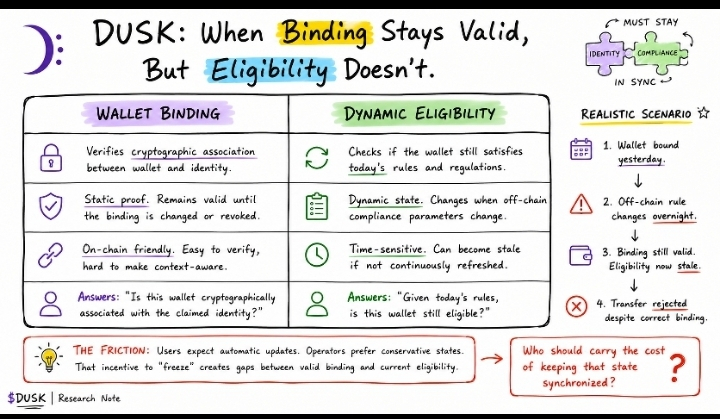
133
52
224
·
--
Der Teil von Phoenix, der bei mir wirklich gezündet hat, war nicht einfach „Private Transactions“. Es war die Erkenntnis, wie @Dusk_Foundation ein Problem löst, das durch Privatsphäre deutlich schwerer wird: zu verhindern, dass dieselben Gelder zweimal ausgegeben werden.
In einem transparenten UTXO-System kann jeder sehen, welcher Output verbraucht wurde. Phoenix kann sich darauf nicht verlassen, weil der Beleg, der Betrag, der Absender und der Empfänger hinter Zero-Knowledge-Beweisen verborgen sind. Genau hier wird der Nullifier interessant.
Ein Phoenix-Beleg funktioniert gewissermaßen wie ein privater UTXO. Wenn ich ihn ausgebe, leitet das Protokoll aus geheimen Informationen, die mit diesem Beleg verknüpft sind, einen deterministischen Nullifier ab. Das Netzwerk kann dann prüfen, ob dieser Nullifier bereits aufgetaucht ist, ohne den zugrunde liegenden Beleg offenzulegen oder zu zeigen, wer ihn ausgegeben hat.
Das schafft eine wichtige Abgrenzung für Verantwortlichkeit. Die Nullifier-Menge wirkt wie ein Gedächtnis für verbrauchte Belege: Das erste Auftauchen kann akzeptiert werden, während ein wiederholter Nullifier einen versuchten Double-Spend signalisiert. Die Privatsphäre bleibt erhalten, aber die Geldregel ist dennoch durchsetzbar.
Was ich noch interessanter finde, ist die Spannung unterhalb dieses Designs. Der Nullifier muss eindeutig genug sein, um eine Wiederverwendung zu verhindern, aber gleichzeitig so unverkettbar, dass Beobachter die private Transaktionshistorie nicht rekonstruieren können. Beide Eigenschaften richtig hinzubekommen macht den Mechanismus erst nützlich.
Für mich ist das ein stärkerer Real-World-Use-Case für $DUSK als es nur damit zu erklären, dass es „Privatsphäre“ bietet. Finanzsysteme brauchen Vertraulichkeit, aber sie brauchen auch durchsetzbare Regeln.
Der Randfall, den ich im Blick hätte, ist die Implementierung: Wenn es bei der Generierung des Nullifiers, beim Beleg-Binding oder beim State-Tracking eine Schwäche gibt, könnte das Netzwerk zwar die Privatsphäre bewahren, aber die Verantwortlichkeit für Ausgaben abschwächen.
Deshalb interessiere ich mich stärker dafür, wie Phoenix sich in adversarialen Randfällen verhält, als dafür, wie gut die Privatsphäre-Headline klingt.
#dusk
{future}(DUSKUSDT)
Der Teil von Phoenix, der bei mir wirklich gezündet hat, war nicht einfach „Private Transactions“. Es war die Erkenntnis, wie @Dusk ein Problem löst, das durch Privatsphäre deutlich schwerer wird: zu verhindern, dass dieselben Gelder zweimal ausgegeben werden.
In einem transparenten UTXO-System kann jeder sehen, welcher Output verbraucht wurde. Phoenix kann sich darauf nicht verlassen, weil der Beleg, der Betrag, der Absender und der Empfänger hinter Zero-Knowledge-Beweisen verborgen sind. Genau hier wird der Nullifier interessant.
Ein Phoenix-Beleg funktioniert gewissermaßen wie ein privater UTXO. Wenn ich ihn ausgebe, leitet das Protokoll aus geheimen Informationen, die mit diesem Beleg verknüpft sind, einen deterministischen Nullifier ab. Das Netzwerk kann dann prüfen, ob dieser Nullifier bereits aufgetaucht ist, ohne den zugrunde liegenden Beleg offenzulegen oder zu zeigen, wer ihn ausgegeben hat.
Das schafft eine wichtige Abgrenzung für Verantwortlichkeit. Die Nullifier-Menge wirkt wie ein Gedächtnis für verbrauchte Belege: Das erste Auftauchen kann akzeptiert werden, während ein wiederholter Nullifier einen versuchten Double-Spend signalisiert. Die Privatsphäre bleibt erhalten, aber die Geldregel ist dennoch durchsetzbar.
Was ich noch interessanter finde, ist die Spannung unterhalb dieses Designs. Der Nullifier muss eindeutig genug sein, um eine Wiederverwendung zu verhindern, aber gleichzeitig so unverkettbar, dass Beobachter die private Transaktionshistorie nicht rekonstruieren können. Beide Eigenschaften richtig hinzubekommen macht den Mechanismus erst nützlich.
Für mich ist das ein stärkerer Real-World-Use-Case für $DUSK als es nur damit zu erklären, dass es „Privatsphäre“ bietet. Finanzsysteme brauchen Vertraulichkeit, aber sie brauchen auch durchsetzbare Regeln.
Der Randfall, den ich im Blick hätte, ist die Implementierung: Wenn es bei der Generierung des Nullifiers, beim Beleg-Binding oder beim State-Tracking eine Schwäche gibt, könnte das Netzwerk zwar die Privatsphäre bewahren, aber die Verantwortlichkeit für Ausgaben abschwächen.
Deshalb interessiere ich mich stärker dafür, wie Phoenix sich in adversarialen Randfällen verhält, als dafür, wie gut die Privatsphäre-Headline klingt.
#dusk
In einem transparenten UTXO-System kann jeder sehen, welcher Output verbraucht wurde. Phoenix kann sich darauf nicht verlassen, weil der Beleg, der Betrag, der Absender und der Empfänger hinter Zero-Knowledge-Beweisen verborgen sind. Genau hier wird der Nullifier interessant.
Ein Phoenix-Beleg funktioniert gewissermaßen wie ein privater UTXO. Wenn ich ihn ausgebe, leitet das Protokoll aus geheimen Informationen, die mit diesem Beleg verknüpft sind, einen deterministischen Nullifier ab. Das Netzwerk kann dann prüfen, ob dieser Nullifier bereits aufgetaucht ist, ohne den zugrunde liegenden Beleg offenzulegen oder zu zeigen, wer ihn ausgegeben hat.
Das schafft eine wichtige Abgrenzung für Verantwortlichkeit. Die Nullifier-Menge wirkt wie ein Gedächtnis für verbrauchte Belege: Das erste Auftauchen kann akzeptiert werden, während ein wiederholter Nullifier einen versuchten Double-Spend signalisiert. Die Privatsphäre bleibt erhalten, aber die Geldregel ist dennoch durchsetzbar.
Was ich noch interessanter finde, ist die Spannung unterhalb dieses Designs. Der Nullifier muss eindeutig genug sein, um eine Wiederverwendung zu verhindern, aber gleichzeitig so unverkettbar, dass Beobachter die private Transaktionshistorie nicht rekonstruieren können. Beide Eigenschaften richtig hinzubekommen macht den Mechanismus erst nützlich.
Für mich ist das ein stärkerer Real-World-Use-Case für $DUSK als es nur damit zu erklären, dass es „Privatsphäre“ bietet. Finanzsysteme brauchen Vertraulichkeit, aber sie brauchen auch durchsetzbare Regeln.
Der Randfall, den ich im Blick hätte, ist die Implementierung: Wenn es bei der Generierung des Nullifiers, beim Beleg-Binding oder beim State-Tracking eine Schwäche gibt, könnte das Netzwerk zwar die Privatsphäre bewahren, aber die Verantwortlichkeit für Ausgaben abschwächen.
Deshalb interessiere ich mich stärker dafür, wie Phoenix sich in adversarialen Randfällen verhält, als dafür, wie gut die Privatsphäre-Headline klingt.
#dusk
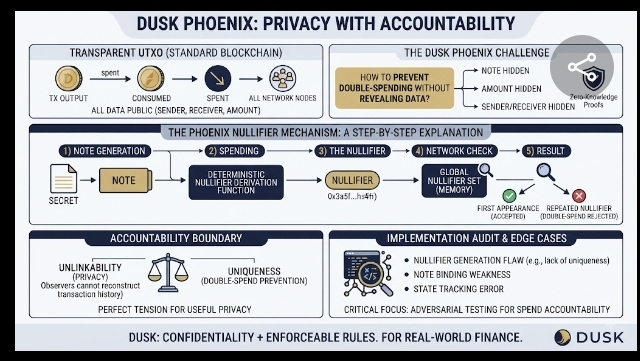
114
76
352
·
--
Ein Punkt an Identitätssystemen beschäftigt mich immer wieder: Menschen akzeptieren die Verifizierung meist dann, wenn sie verstehen, wer die Entscheidung trifft. Sobald das unklar wird, kann selbst ein technisch einwandfreies System sich schnell unzuverlässig anfühlen.
Genau hier wird Dusk’s XSC-Modell interessant.
Ein konkretes Detail ist CItadel’s Ansatz für selektive Offenlegung. Ein Nutzer kann ein Attribut wie Wohnsitz, Altersgruppe oder Akkreditierung nachweisen, ohne die zugrunde liegende personenbezogene Information preiszugeben. Dieser Nachweis kann dann Zugangs- und Compliance-Regeln rund um regulierte Vermögenswerte unterstützen.
Technisch gesehen ist das eine bedeutsame Veränderung. Aber die Nutzererfahrung wirft eine weitere Frage auf.
Stell dir einen Investor vor, der auf seinem Bildschirm „Sie sind berechtigt“ sieht. Das System benötigt möglicherweise nur den Nachweis, dass die erforderliche Bedingung erfüllt ist. Doch wer hat diese Bedingung tatsächlich bestätigt? Der Identity Provider? Der Aussteller? Eine andere autorisierte Stelle? Und was passiert, wenn diese Quelle sich irrt?
An dieser Stelle denke ich, dass die übliche Erzählung „Datenschutz schafft Vertrauen“ zu kurz greift.
Datenschutz reduziert unnötige Exponierung. Er erklärt jedoch nicht automatisch die Vertrauensbeziehung hinter dem Nachweis.
Für @Dusk_Foundation ist diese Unterscheidung wichtig, weil XSC für Workflows rund um regulierte Vermögenswerte entwickelt ist, bei denen Anspruchsberechtigung und Zugriffskontrollen selbst Teil des Systems werden.
Und $DUSK befindet sich in einem Ökosystem, in dem die Glaubwürdigkeit dieser Workflows genauso von verständlichen Vertrauensgrenzen abhängen kann wie von der zugrunde liegenden Kryptografie.
Die spannende UX-Herausforderung besteht nicht nur darin, die Anspruchsberechtigung privat nachzuweisen. Es geht darum, die Vertrauensgrenze für die Person, die das System nutzt, verständlich zu machen.
Wenn Nutzer das Ergebnis verifizieren können, aber nicht verstehen, wer hinter der Verifizierung steht, haben wir dann wirklich die Blackbox entfernt – oder nur kryptografisch unsichtbar gemacht?
#dusk
{future}(DUSKUSDT)
Ein Punkt an Identitätssystemen beschäftigt mich immer wieder: Menschen akzeptieren die Verifizierung meist dann, wenn sie verstehen, wer die Entscheidung trifft. Sobald das unklar wird, kann selbst ein technisch einwandfreies System sich schnell unzuverlässig anfühlen.
Genau hier wird Dusk’s XSC-Modell interessant.
Ein konkretes Detail ist CItadel’s Ansatz für selektive Offenlegung. Ein Nutzer kann ein Attribut wie Wohnsitz, Altersgruppe oder Akkreditierung nachweisen, ohne die zugrunde liegende personenbezogene Information preiszugeben. Dieser Nachweis kann dann Zugangs- und Compliance-Regeln rund um regulierte Vermögenswerte unterstützen.
Technisch gesehen ist das eine bedeutsame Veränderung. Aber die Nutzererfahrung wirft eine weitere Frage auf.
Stell dir einen Investor vor, der auf seinem Bildschirm „Sie sind berechtigt“ sieht. Das System benötigt möglicherweise nur den Nachweis, dass die erforderliche Bedingung erfüllt ist. Doch wer hat diese Bedingung tatsächlich bestätigt? Der Identity Provider? Der Aussteller? Eine andere autorisierte Stelle? Und was passiert, wenn diese Quelle sich irrt?
An dieser Stelle denke ich, dass die übliche Erzählung „Datenschutz schafft Vertrauen“ zu kurz greift.
Datenschutz reduziert unnötige Exponierung. Er erklärt jedoch nicht automatisch die Vertrauensbeziehung hinter dem Nachweis.
Für @Dusk ist diese Unterscheidung wichtig, weil XSC für Workflows rund um regulierte Vermögenswerte entwickelt ist, bei denen Anspruchsberechtigung und Zugriffskontrollen selbst Teil des Systems werden.
Und $DUSK befindet sich in einem Ökosystem, in dem die Glaubwürdigkeit dieser Workflows genauso von verständlichen Vertrauensgrenzen abhängen kann wie von der zugrunde liegenden Kryptografie.
Die spannende UX-Herausforderung besteht nicht nur darin, die Anspruchsberechtigung privat nachzuweisen. Es geht darum, die Vertrauensgrenze für die Person, die das System nutzt, verständlich zu machen.
Wenn Nutzer das Ergebnis verifizieren können, aber nicht verstehen, wer hinter der Verifizierung steht, haben wir dann wirklich die Blackbox entfernt – oder nur kryptografisch unsichtbar gemacht?
#dusk
Genau hier wird Dusk’s XSC-Modell interessant.
Ein konkretes Detail ist CItadel’s Ansatz für selektive Offenlegung. Ein Nutzer kann ein Attribut wie Wohnsitz, Altersgruppe oder Akkreditierung nachweisen, ohne die zugrunde liegende personenbezogene Information preiszugeben. Dieser Nachweis kann dann Zugangs- und Compliance-Regeln rund um regulierte Vermögenswerte unterstützen.
Technisch gesehen ist das eine bedeutsame Veränderung. Aber die Nutzererfahrung wirft eine weitere Frage auf.
Stell dir einen Investor vor, der auf seinem Bildschirm „Sie sind berechtigt“ sieht. Das System benötigt möglicherweise nur den Nachweis, dass die erforderliche Bedingung erfüllt ist. Doch wer hat diese Bedingung tatsächlich bestätigt? Der Identity Provider? Der Aussteller? Eine andere autorisierte Stelle? Und was passiert, wenn diese Quelle sich irrt?
An dieser Stelle denke ich, dass die übliche Erzählung „Datenschutz schafft Vertrauen“ zu kurz greift.
Datenschutz reduziert unnötige Exponierung. Er erklärt jedoch nicht automatisch die Vertrauensbeziehung hinter dem Nachweis.
Für @Dusk ist diese Unterscheidung wichtig, weil XSC für Workflows rund um regulierte Vermögenswerte entwickelt ist, bei denen Anspruchsberechtigung und Zugriffskontrollen selbst Teil des Systems werden.
Und $DUSK befindet sich in einem Ökosystem, in dem die Glaubwürdigkeit dieser Workflows genauso von verständlichen Vertrauensgrenzen abhängen kann wie von der zugrunde liegenden Kryptografie.
Die spannende UX-Herausforderung besteht nicht nur darin, die Anspruchsberechtigung privat nachzuweisen. Es geht darum, die Vertrauensgrenze für die Person, die das System nutzt, verständlich zu machen.
Wenn Nutzer das Ergebnis verifizieren können, aber nicht verstehen, wer hinter der Verifizierung steht, haben wir dann wirklich die Blackbox entfernt – oder nur kryptografisch unsichtbar gemacht?
#dusk
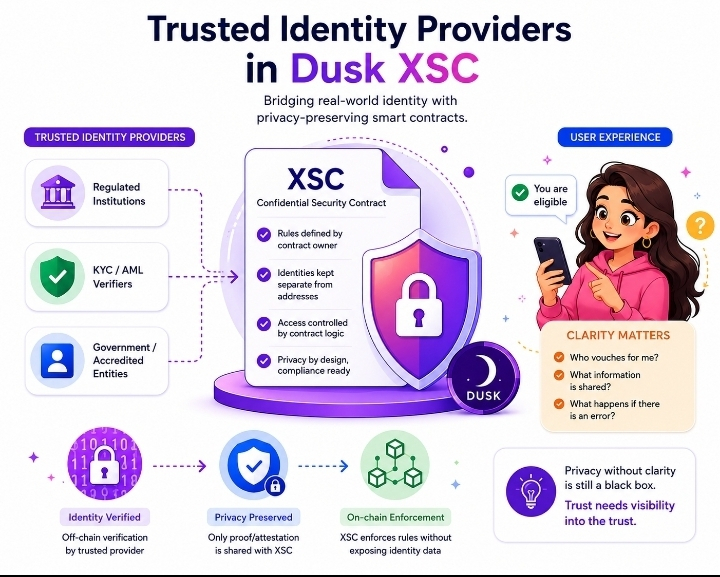
127
49
216
Anmelden und weiter Inhalte entdecken
Krypto-Nutzer weltweit auf Binance Square kennenlernen
⚡️ Bleib in Sachen Krypto stets am Puls.
💬 Die weltgrößte Kryptobörse vertraut darauf.
👍 Erhalte verlässliche Einblicke von verifizierten Creators.
E-Mail-Adresse/Telefonnummer