
SanskritiVerse
1.7k Beiträge

SanskritiVerse
Melden
Nutzer blockieren
Manoj | Founder of SanskritiVerse. Learning crypto without hype | Simple data | Honest insights | Real lessons
11 Following
175 Follower
721 Like gegeben
Beiträge
Alle
Zitierungen
Übersetzung ansehen
LINEA IS NEAR A NEW LOW. WHAT SHOULD WE WATCH?
$LINEA /USDT 4H Chart Study | November 14, 2026
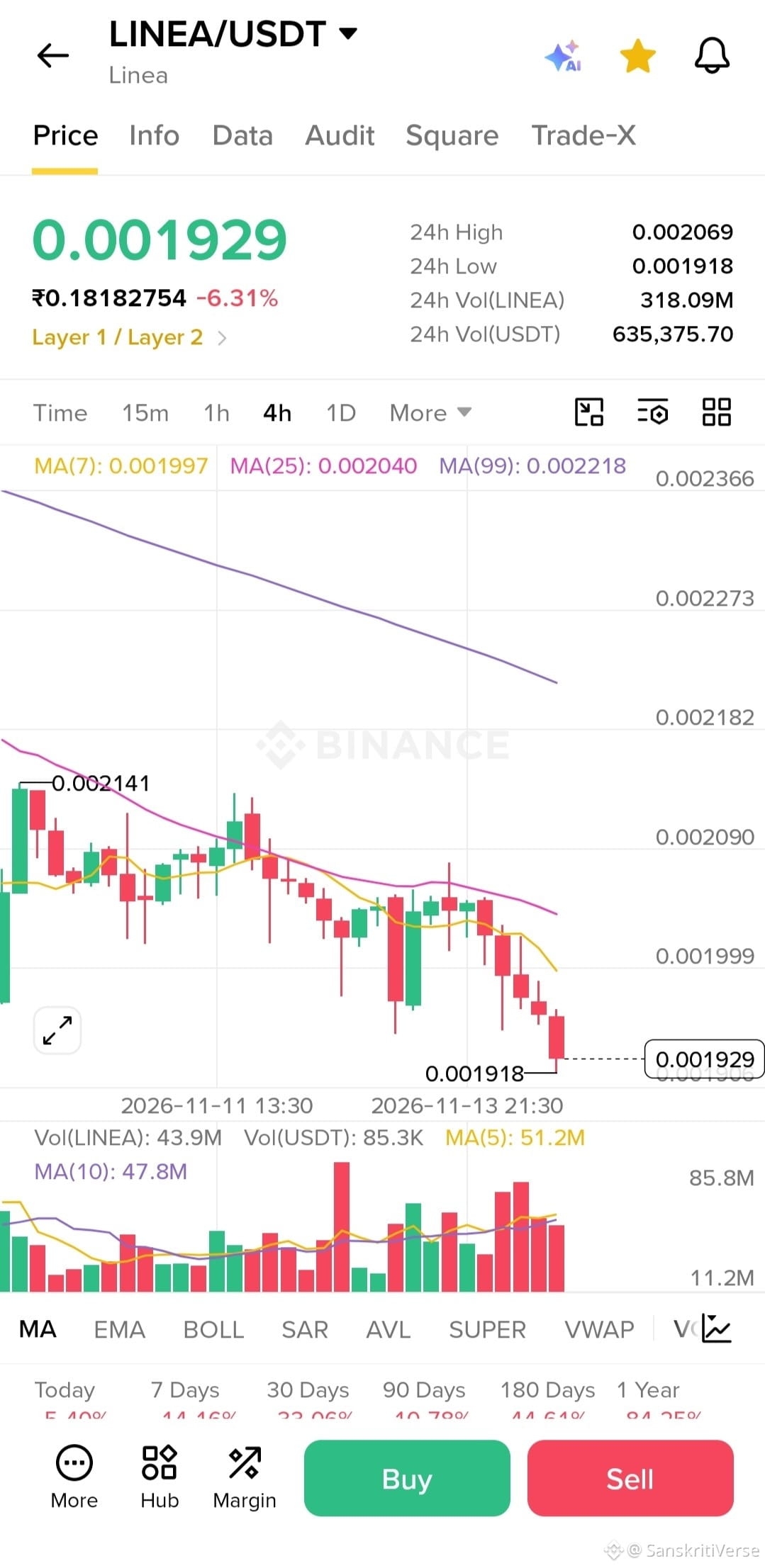
LINEA is trading near $0.001929 in this screenshot, close to the visible low of $0.001918.
The chart shows continued downward movement, with price currently below all three displayed moving averages.
What I'm observing:
Current displayed price: $0.001929
24h low: $0.001918
MA(7): $0.001997
MA(25): $0.002040
MA(99): $0.002218
Displayed volume: 43.9M LINEA, below MA(5) at 51.2M and MA(10) at 47.8M.
What I want to observe next:
Does price move below the visible $0.001918 low?
If it does, can the move sustain after a completed 4H candle?
Or does price recover above the recent low area?
Beginner learning:
When a coin approaches a recent low, it is important not to assume that a breakdown is inevitable.
A temporary move below a level and a confirmed candle close below it are different things.
I also want to distinguish a recent low from an All-Time Low. The screenshot alone does not confirm LINEA's historical ATL.
The current 4H candle may still be open, so its price and displayed volume can change before it closes.
This is a screenshot-based educational observation, not a live trading signal or financial advice.
Question: When a coin approaches a recent low, what do you watch first — a confirmed candle close below it or a possible recovery?
$LINEA
{future}(LINEAUSDT)
#LINEA #ChartAnalysis #PriceAction #CryptoEducation #LearnInPublic
LINEA IS NEAR A NEW LOW. WHAT SHOULD WE WATCH?
$LINEA /USDT 4H Chart Study | November 14, 2026
LINEA is trading near $0.001929 in this screenshot, close to the visible low of $0.001918.
The chart shows continued downward movement, with price currently below all three displayed moving averages.
What I'm observing:
Current displayed price: $0.001929
24h low: $0.001918
MA(7): $0.001997
MA(25): $0.002040
MA(99): $0.002218
Displayed volume: 43.9M LINEA, below MA(5) at 51.2M and MA(10) at 47.8M.
What I want to observe next:
Does price move below the visible $0.001918 low?
If it does, can the move sustain after a completed 4H candle?
Or does price recover above the recent low area?
Beginner learning:
When a coin approaches a recent low, it is important not to assume that a breakdown is inevitable.
A temporary move below a level and a confirmed candle close below it are different things.
I also want to distinguish a recent low from an All-Time Low. The screenshot alone does not confirm LINEA's historical ATL.
The current 4H candle may still be open, so its price and displayed volume can change before it closes.
This is a screenshot-based educational observation, not a live trading signal or financial advice.
Question: When a coin approaches a recent low, what do you watch first — a confirmed candle close below it or a possible recovery?
$LINEA
#LINEA #ChartAnalysis #PriceAction #CryptoEducation #LearnInPublic
1
107
Übersetzung ansehen
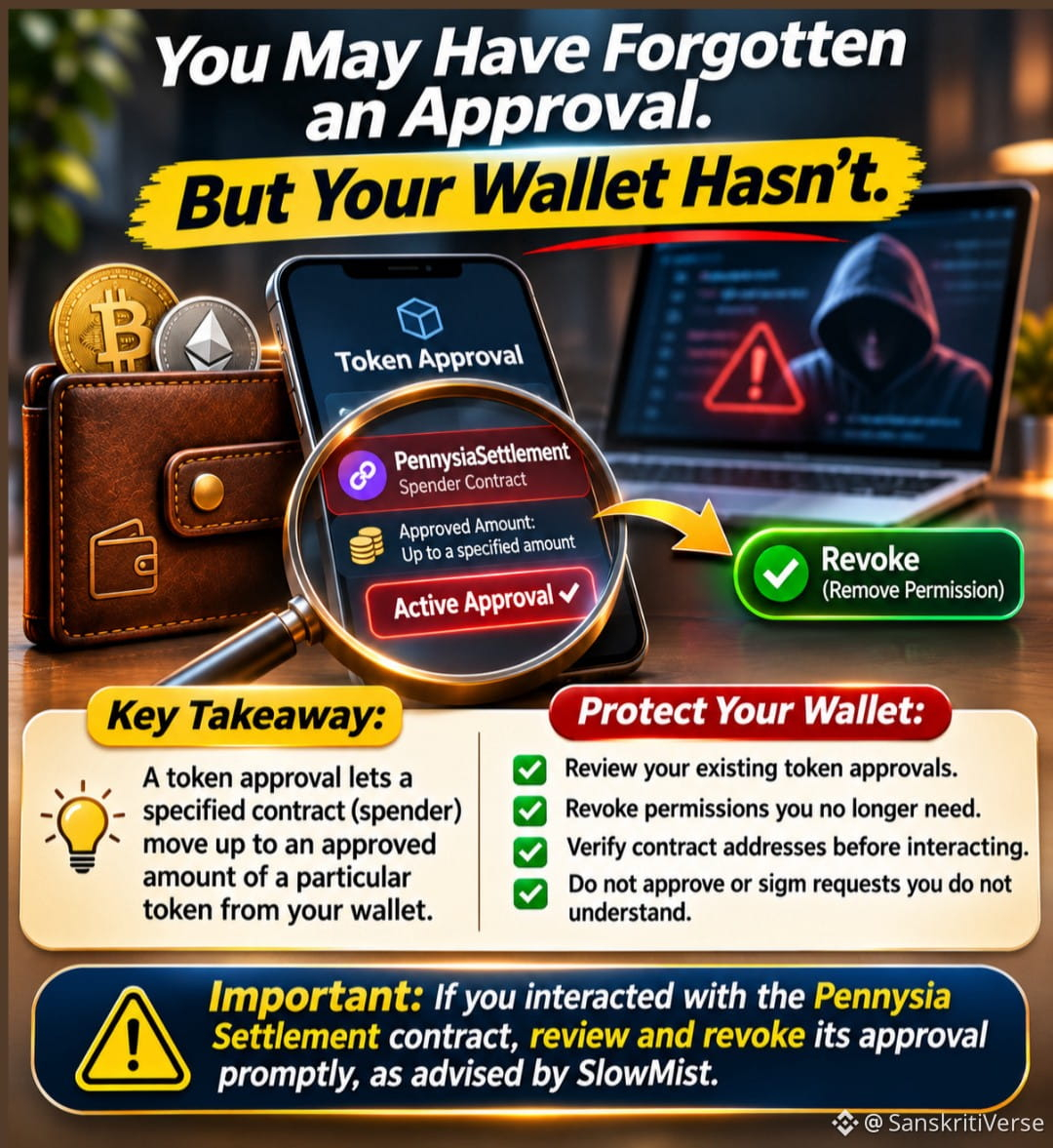
You May Have Forgotten an Approval. But Your Wallet Hasn't.
On November 12, 2026, PennysiaSettlement on Ethereum was exploited through an arbitrary external-call vulnerability in its executeSwap function, according to SlowMist.
The attacker reportedly used fake tokens to bypass spend checks and exploited residual token approvals from 4 users.
Reported loss: Approximately $5,131, recorded by SlowMist.
Why does this matter?
A token approval allows a specified spender contract to move up to an approved amount of a particular token from your wallet.
That permission may remain active even after you stop using a protocol.
Protect Your Wallet:
Review your existing token approvals.
Revoke permissions you no longer need.
Verify contract addresses before interacting.
Do not approve or sign requests you do not understand.
Important: If you interacted with the Pennysia Settlement contract, review and revoke its approval promptly, following SlowMist's security alert.
Beginner Lesson:
Disconnecting your wallet from a website does not automatically revoke token approvals.
Your wallet security also depends on the permissions you have granted.
Question: When did you last review your token approvals?
Source: SlowMist Hacked Database; Pennysia Security Incident Alert.
#CryptoSecurity #WalletSafety #Ethereum #DeFi #CryptoEducation
120
Übersetzung ansehen
PLUME MOVED ABOVE MA(99). CAN IT HOLD?
$PLUME /USDT 4H Chart Study | November 13, 2026
In my previous chart observation, PLUME was trading below all three moving averages.
Today, the picture looks different.
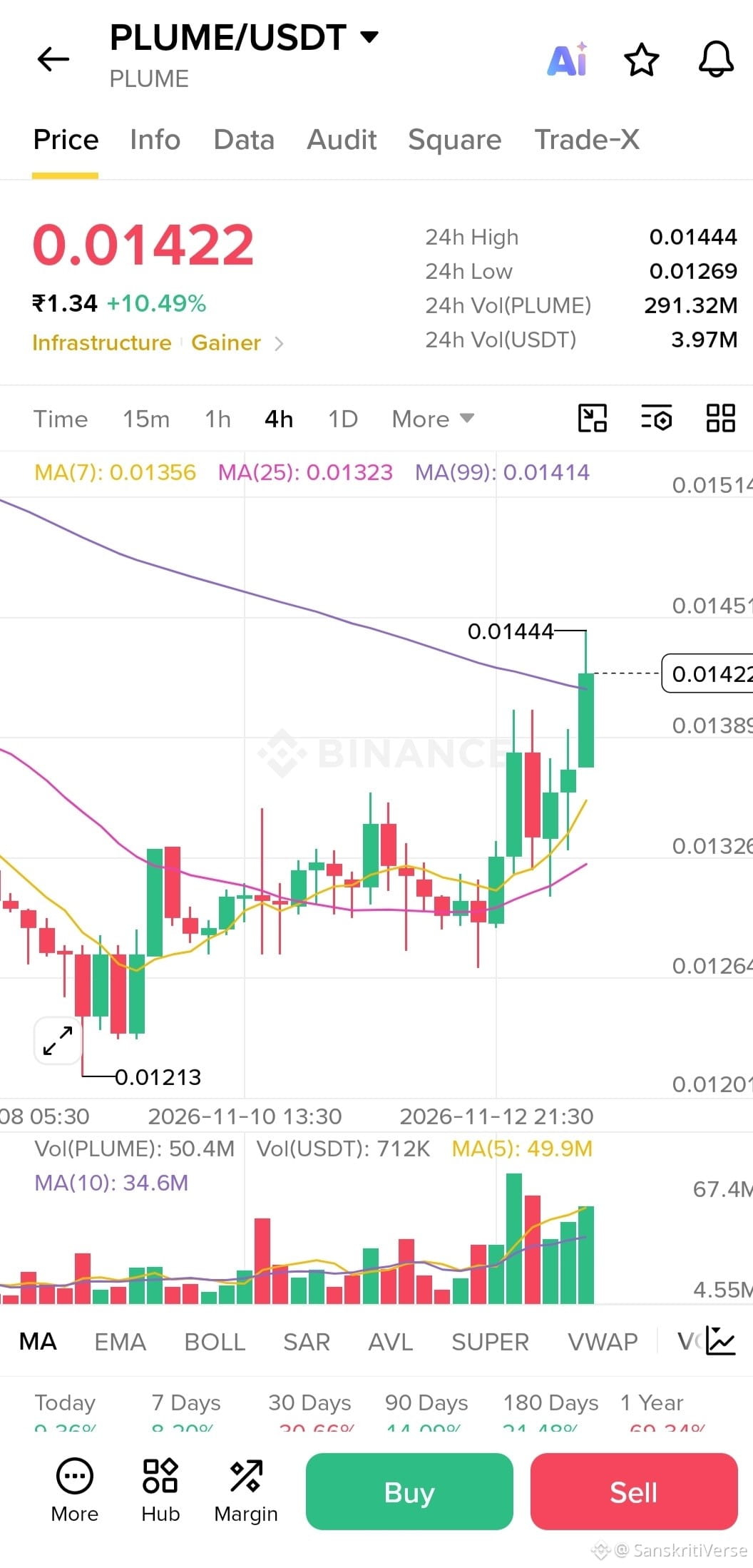
Price is around $0.01422, slightly above the MA(99) near $0.01414.
What I'm observing in this screenshot:
MA(7): $0.01356
MA(25): $0.01323
MA(99): $0.01414
Price is currently above all three moving averages.
Displayed volume is 50.4M PLUME, currently above both displayed volume averages: MA(5) at 49.9M and MA(10) at 34.6M.
The visible high is around $0.01444.
What I want to observe next:
Can price remain above MA(99) after completed 4H candles?
Will trading activity remain elevated?
What does the price follow-through show after this sharp move?
Beginner learning:
Moving above a longer-lookback moving average is an important chart observation, but it does not automatically confirm a trend reversal.
Holding above that level and the price action that follows provide additional context.
The current 4H candle may still be open. Its price, volume and moving-average alignment can change before the candle closes. Its displayed volume may also be incomplete.
This is a screenshot-based educational observation, not a live trading signal or financial advice.
Question: When price moves above MA(99), what do you check first — the completed candle close or the next candle's follow-through?
$PLUME
{future}(PLUMEUSDT)
#PLUME #ChartAnalysis #MovingAverages #CryptoEducation #LearnInPublic
PLUME MOVED ABOVE MA(99). CAN IT HOLD?
$PLUME /USDT 4H Chart Study | November 13, 2026
In my previous chart observation, PLUME was trading below all three moving averages.
Today, the picture looks different.
Price is around $0.01422, slightly above the MA(99) near $0.01414.
What I'm observing in this screenshot:
MA(7): $0.01356
MA(25): $0.01323
MA(99): $0.01414
Price is currently above all three moving averages.
Displayed volume is 50.4M PLUME, currently above both displayed volume averages: MA(5) at 49.9M and MA(10) at 34.6M.
The visible high is around $0.01444.
What I want to observe next:
Can price remain above MA(99) after completed 4H candles?
Will trading activity remain elevated?
What does the price follow-through show after this sharp move?
Beginner learning:
Moving above a longer-lookback moving average is an important chart observation, but it does not automatically confirm a trend reversal.
Holding above that level and the price action that follows provide additional context.
The current 4H candle may still be open. Its price, volume and moving-average alignment can change before the candle closes. Its displayed volume may also be incomplete.
This is a screenshot-based educational observation, not a live trading signal or financial advice.
Question: When price moves above MA(99), what do you check first — the completed candle close or the next candle's follow-through?
$PLUME
#PLUME #ChartAnalysis #MovingAverages #CryptoEducation #LearnInPublic
194
Übersetzung ansehen
90% in Cold Storage. But Is That the Whole Security Picture?
Cold Storage helps protect crypto assets by reducing online exposure.
But exchange security involves more than one percentage.
On November 12, India's Unocoin reported outgoing transactions from an Ethereum address in its BitGo wallet infrastructure.
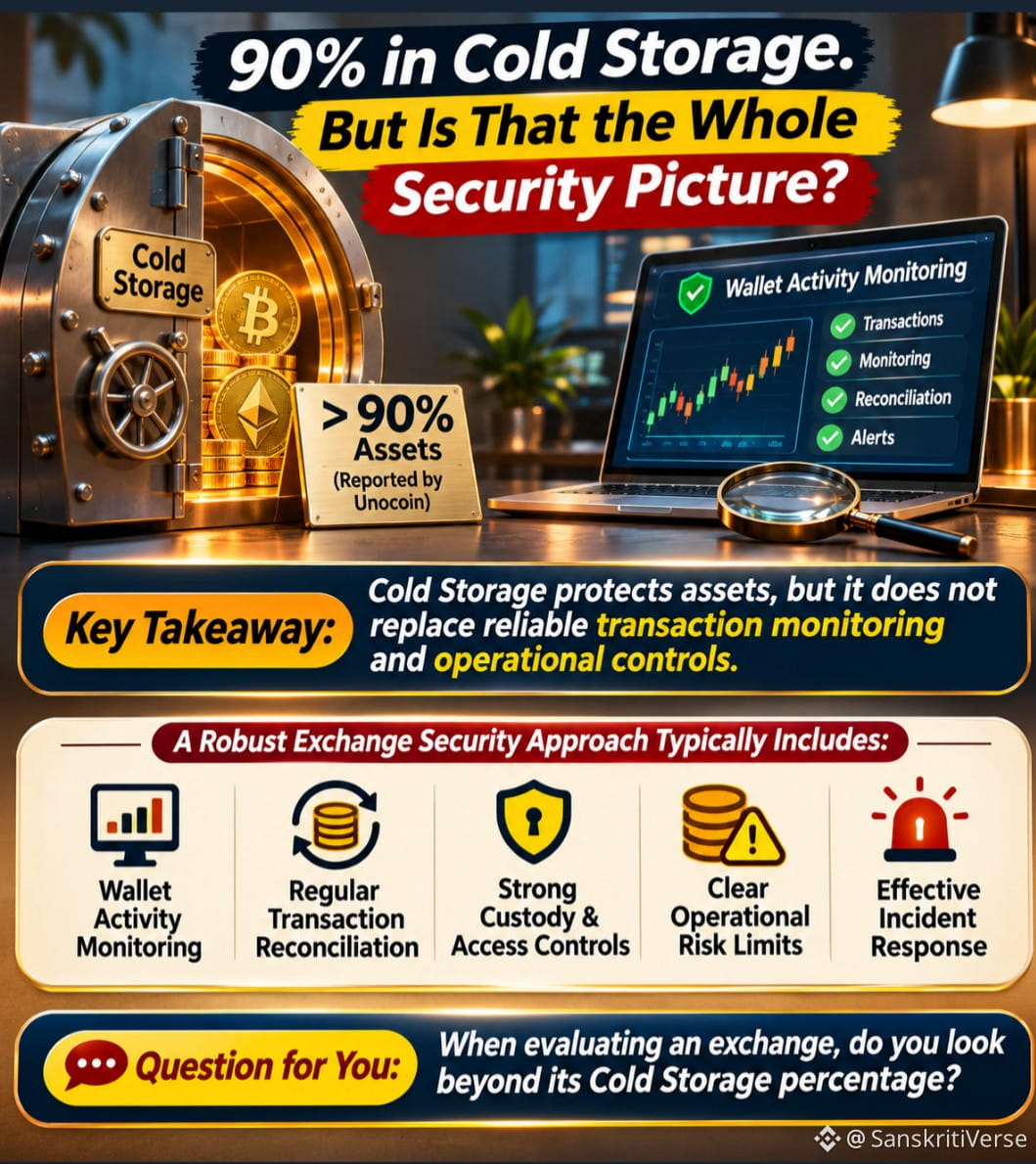
The exchange stated that more than 90% of customer crypto was held in Cold Storage. However, it also reported that it did not yet have complete visibility into all potentially unintended wallet transactions.
The investigation is ongoing. The full extent of the activity remains unknown.
What should a robust exchange security approach include?
Reliable wallet activity monitoring
Regular transaction reconciliation
Strong custody and access controls
Clear operational risk limits
Effective incident response
Beginner Takeaway:
Cold Storage protects assets from certain online risks, but it does not replace reliable transaction monitoring and operational controls.
Question: When evaluating an exchange, do you look beyond its Cold Storage percentage?
Source: Unocoin — Official Security Incident Update, November 12, 2026.
#CryptoSecurity #ColdStorage #WalletSecurity #CryptoEducation #BinanceSquare
90
Übersetzung ansehen
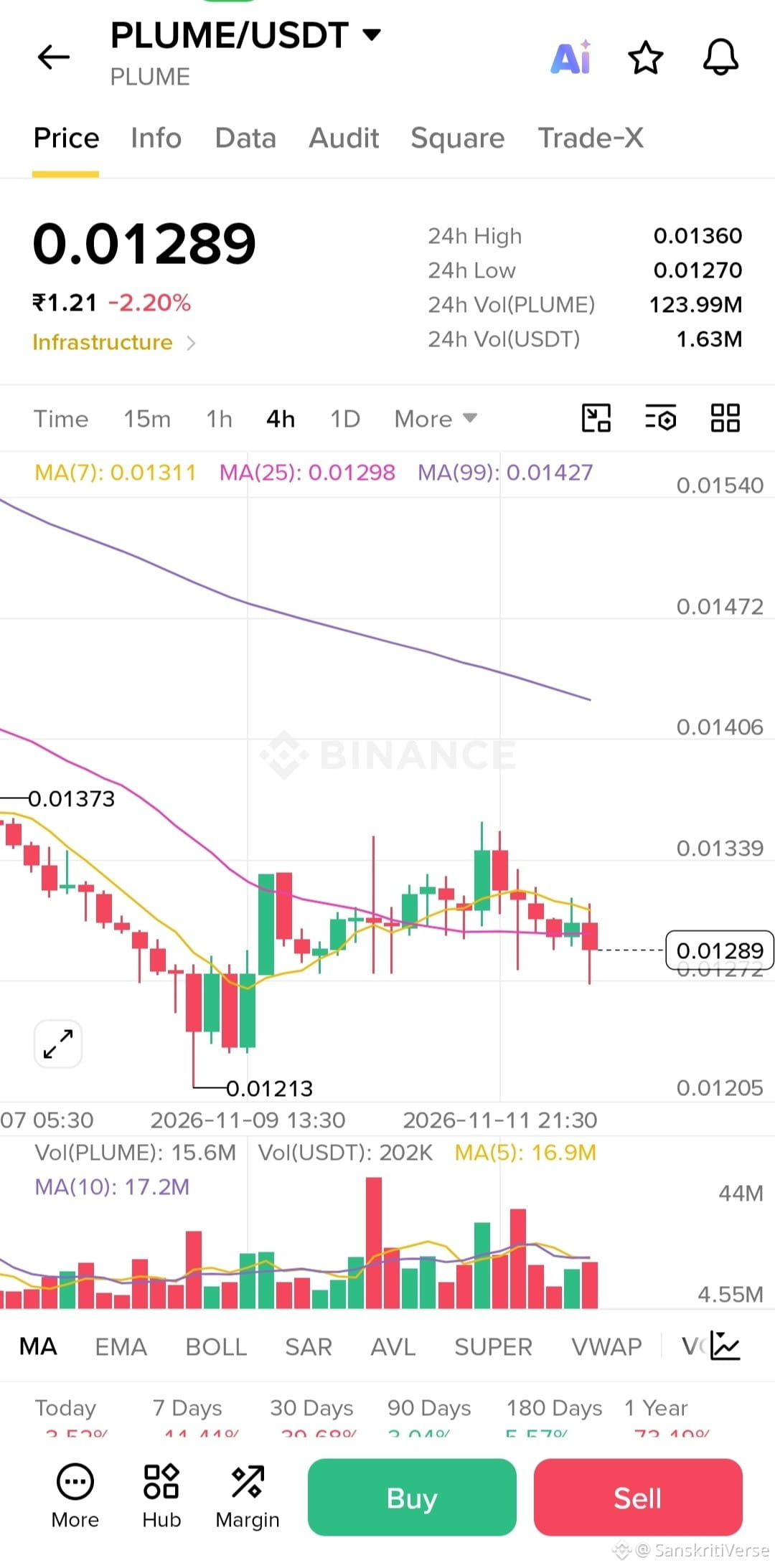
$PLUME IS TESTING A NEARBY PRICE AREA. WHAT HAPPENS NEXT?
PLUME/USDT 4H Chart Study | November 12, 2026
After recovering from the visible $0.01213 low, PLUME moved toward the $0.01339 area.
However, the recovery has struggled to maintain its upward momentum.
What I'm observing in this screenshot:
Current displayed price: $0.01289
MA(7): $0.01311
MA(25): $0.01298
MA(99): $0.01427
Price is currently below all three moving averages.
The recent rebound has not yet established a stronger upward structure.
Nearby price area to watch:
$0.01270–$0.01272 is the nearby price area visible in this screenshot.
Two possible scenarios:
If price holds this area and moves back above the short-term moving averages after completed 4H candles, the price structure may improve.
If price moves below this area with sustained selling activity, short-term weakness may continue.
Beginner learning:
A recovery is not confirmed just because price moves up from a recent low.
I want to observe whether price can maintain a stronger structure and reclaim important levels.
The current 4H candle may still be open. Price and moving-average alignment can change before the candle closes.
This is a screenshot-based educational observation, not a live trading signal or financial advice.
Question: When price approaches a recent low, what do you check first — the completed candle close or the volume?
$PLUME
{future}(PLUMEUSDT)
#PLUME #ChartAnalysis #CryptoEducation #TechnicalAnalysis #LearnInPublic
$PLUME IS TESTING A NEARBY PRICE AREA. WHAT HAPPENS NEXT?
PLUME/USDT 4H Chart Study | November 12, 2026
After recovering from the visible $0.01213 low, PLUME moved toward the $0.01339 area.
However, the recovery has struggled to maintain its upward momentum.
What I'm observing in this screenshot:
Current displayed price: $0.01289
MA(7): $0.01311
MA(25): $0.01298
MA(99): $0.01427
Price is currently below all three moving averages.
The recent rebound has not yet established a stronger upward structure.
Nearby price area to watch:
$0.01270–$0.01272 is the nearby price area visible in this screenshot.
Two possible scenarios:
If price holds this area and moves back above the short-term moving averages after completed 4H candles, the price structure may improve.
If price moves below this area with sustained selling activity, short-term weakness may continue.
Beginner learning:
A recovery is not confirmed just because price moves up from a recent low.
I want to observe whether price can maintain a stronger structure and reclaim important levels.
The current 4H candle may still be open. Price and moving-average alignment can change before the candle closes.
This is a screenshot-based educational observation, not a live trading signal or financial advice.
Question: When price approaches a recent low, what do you check first — the completed candle close or the volume?
$PLUME
#PLUME #ChartAnalysis #CryptoEducation #TechnicalAnalysis #LearnInPublic
1
292
Übersetzung ansehen
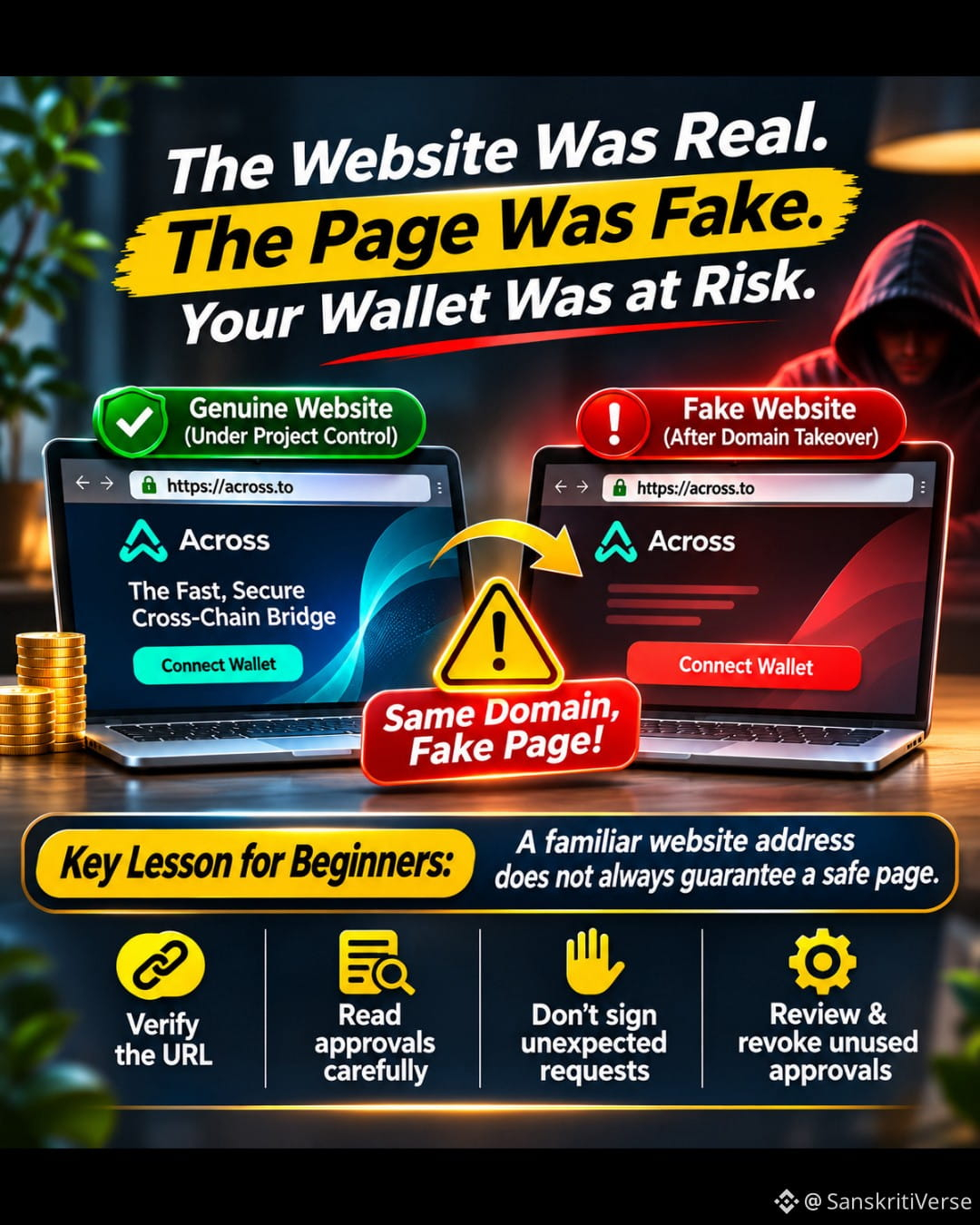
The Website Was Real. The Page Was Fake. Your Wallet Was at Risk.
On November 10, 2026, attackers took control of Across Protocol's official domain through a social engineering attack targeting its domain registrar.
Visitors were redirected to a fake website that tricked some users into signing malicious wallet approvals and permits.
What happened?
• Bitquery traced approximately $348,000 across 9 wallets. This is a third-party estimate, not a confirmed total loss.
• On November 11, Across reported that it had regained domain control and would compensate affected users.
Protect Your Wallet:
1. Verify website URLs.
2. Read wallet permissions before signing.
3. Never approve unexpected requests.
4. Revoke token approvals you no longer need.
Beginner Lesson:
A familiar website address doesn't always mean a safe website.
Your wallet security also depends on what you approve.
Question: Do you check wallet permissions before signing a transaction?
Source: Across Protocol Incident Update; Bitquery On-chain Investigation.
#CryptoSecurity #WalletSafety #PhishingScam #CryptoEducation
1
104
Übersetzung ansehen
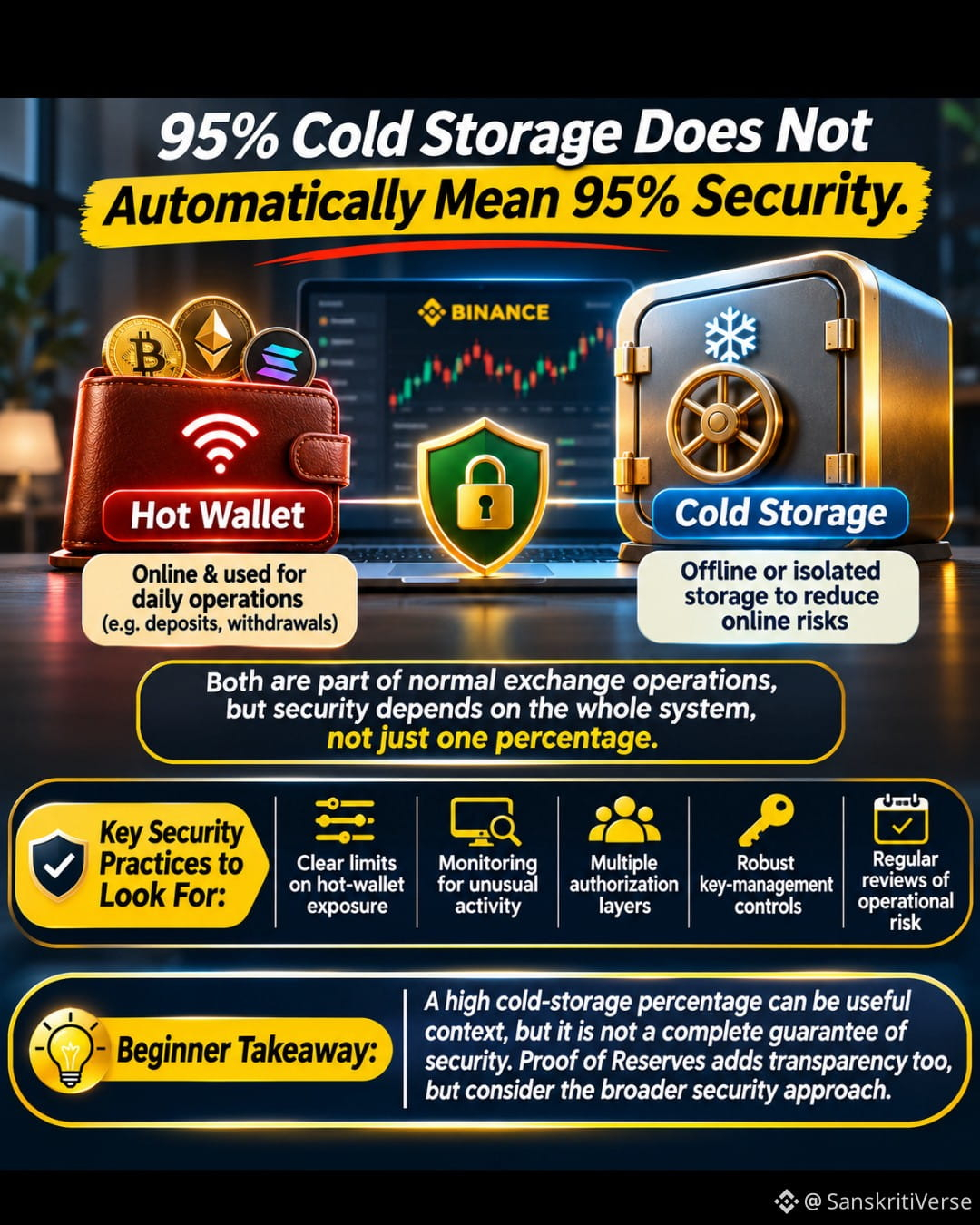
95% Cold Storage Doesn't Automatically Mean 95% Security.
When choosing a crypto exchange, many users look at one number:
How much of its crypto is stored in Cold Wallets?
But there's another important question:
How much crypto is exposed through Hot Wallets?
Let's understand the difference.
🔹 Hot Wallet Connected to the internet and commonly used to process deposits, withdrawals, and transactions.
🔹 Cold Wallet Keeps private keys offline, reducing exposure to online attacks.
Both serve different purposes in an exchange's operations.
Recently, cybersecurity firm CertiK recommended that exchanges should not rely only on Cold Storage percentages. They should also establish clear limits on the funds held in Hot Wallets.
Why does this matter?
Hot Wallets need enough funds to process legitimate transactions. But keeping excessive amounts online can increase potential exposure if security controls fail.
What should a responsible exchange consider?
Set clear Hot Wallet balance limits.
Monitor unusual withdrawal activity.
Use multi-layer approval for sensitive transactions.
Maintain secure private-key management.
Regularly review wallet exposure and security controls.
Beginner Takeaway:
A high Cold Storage percentage is useful information, but it is not a complete security guarantee.
Exchange security depends on the entire system—not just one percentage.
Question: When evaluating a crypto exchange, do you check its wallet security practices or only its Proof of Reserves?
Source: CertiK security recommendations, reported by Cointelegraph.
#CryptoSecurity #ColdWallet #HotWallet #CryptoEducation #BinanceSquare
2
84
Übersetzung ansehen
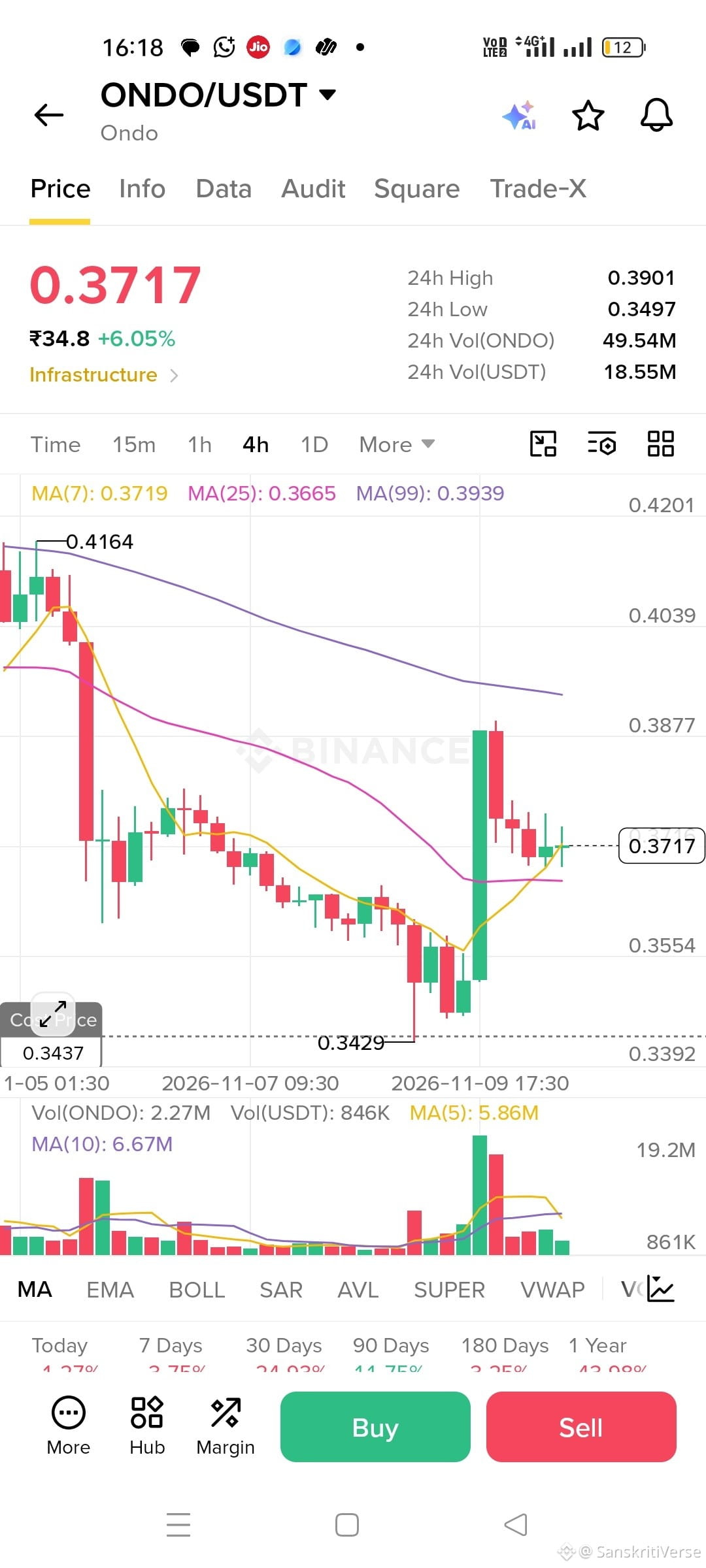
THE VOLUME SPIKE HAPPENED. WHAT CAME NEXT?
ONDO/USDT 4H Chart Study | November 10, 2026
In this screenshot, ONDO showed a sharp upward move after touching the visible $0.3429 low.
The move came with a noticeable increase in trading volume. After the large green candle, however, price pulled back and began moving within a narrower range.
What I'm observing:
Price is around $0.3717 after the rebound.
MA(7) is near $0.3719.
MA(25) is near $0.3665.
MA(99) remains higher at $0.3939.
The displayed volume is 2.27M ONDO, below the displayed MA(5) of 5.86M and MA(10) of 6.67M.
If the current 4H candle is still open, its displayed volume may be incomplete.
The key educational question:
Did the volume increase lead to continued market participation, or was activity mainly concentrated around the initial move?
What I'm watching next:
Whether price can hold above the MA(25) area after completed 4H candles.
Whether trading activity increases again or continues to fade.
Whether price develops a clearer structure after the pullback.
Beginner learning:
A volume spike shows increased trading activity, but it does not independently confirm the direction or durability of a move.
The candles, volume, and price structure that follow can provide additional context.
A large green candle is one event. What happens afterward is equally important to observe.
This is a screenshot-based educational observation, not a live trading signal or financial advice.
After a sharp volume spike, what do you check first — the next candle's structure or whether volume remains elevated?
$ONDO
{future}(ONDOUSDT)
#ONDO #VolumeAnalysis #ChartStudy #CryptoEducation #LearnInPublic
THE VOLUME SPIKE HAPPENED. WHAT CAME NEXT?
ONDO/USDT 4H Chart Study | November 10, 2026
In this screenshot, ONDO showed a sharp upward move after touching the visible $0.3429 low.
The move came with a noticeable increase in trading volume. After the large green candle, however, price pulled back and began moving within a narrower range.
What I'm observing:
Price is around $0.3717 after the rebound.
MA(7) is near $0.3719.
MA(25) is near $0.3665.
MA(99) remains higher at $0.3939.
The displayed volume is 2.27M ONDO, below the displayed MA(5) of 5.86M and MA(10) of 6.67M.
If the current 4H candle is still open, its displayed volume may be incomplete.
The key educational question:
Did the volume increase lead to continued market participation, or was activity mainly concentrated around the initial move?
What I'm watching next:
Whether price can hold above the MA(25) area after completed 4H candles.
Whether trading activity increases again or continues to fade.
Whether price develops a clearer structure after the pullback.
Beginner learning:
A volume spike shows increased trading activity, but it does not independently confirm the direction or durability of a move.
The candles, volume, and price structure that follow can provide additional context.
A large green candle is one event. What happens afterward is equally important to observe.
This is a screenshot-based educational observation, not a live trading signal or financial advice.
After a sharp volume spike, what do you check first — the next candle's structure or whether volume remains elevated?
$ONDO
#ONDO #VolumeAnalysis #ChartStudy #CryptoEducation #LearnInPublic
1
195
Übersetzung ansehen
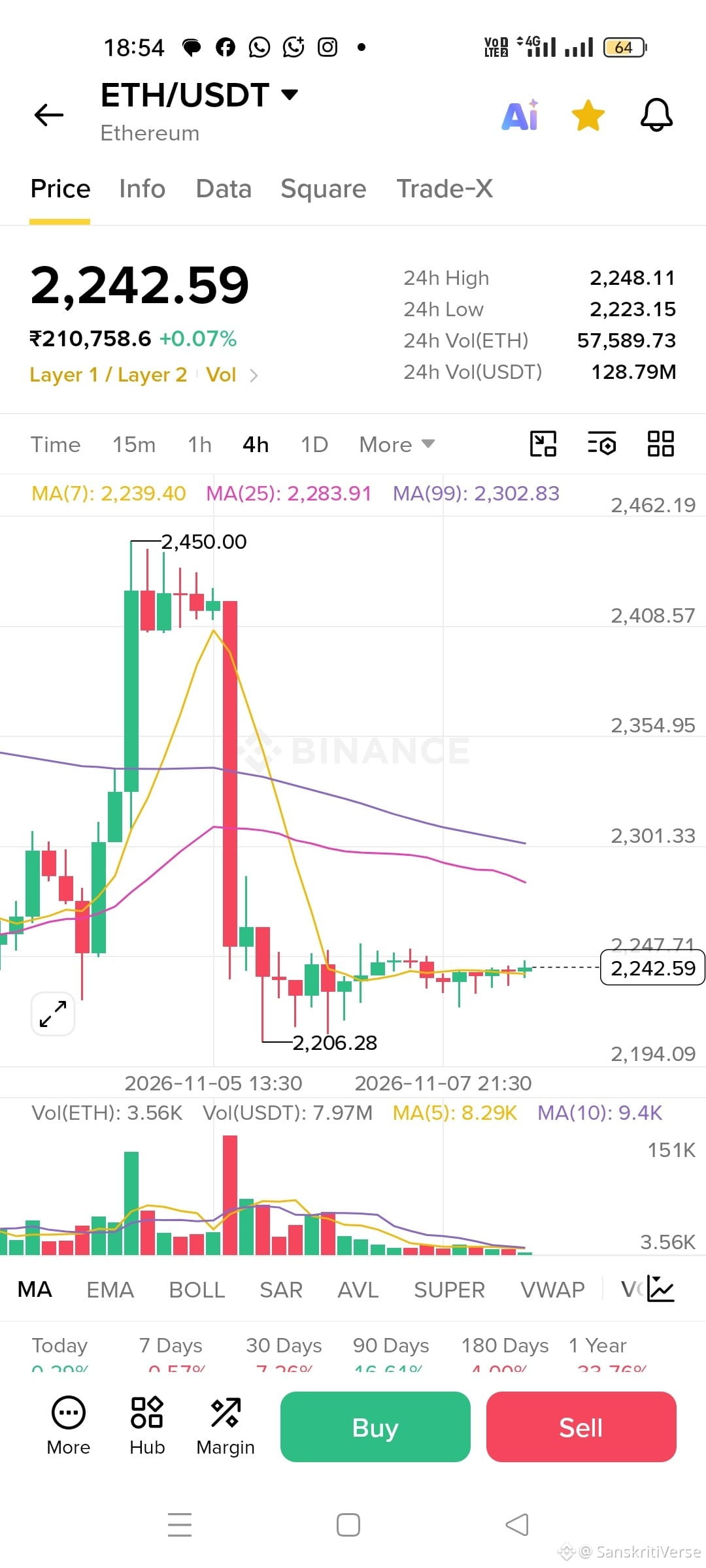
ETH DROPPED. NOW IT’S MOVING SIDEWAYS — WHAT DOES THAT MEAN?
$ETH /USDT 4H Chart Study | November 8, 2026
In this screenshot, ETH declined from the visible $2,450 area and later found a low near $2,206.
Since then, price has moved within a relatively narrow range around $2,200–$2,250.
Sideways movement after a sharp decline can sometimes reflect a pause in market activity. By itself, however, it does not confirm accumulation, a recovery, or a trend reversal.
What I’m observing in this screenshot:
• Current price: $2,242.59
• MA(7): $2,239.40
• MA(25): $2,283.91
• MA(99): $2,302.83
• Price is slightly above MA(7), while remaining below MA(25) and MA(99).
• Currently displayed volume appears lower than the chart’s volume averages.
Areas visible on this chart:
• $2,245–$2,250: nearby upper edge of the current range
• $2,206–$2,220: recent low and nearby price activity
• $2,284–$2,303: area overlapping with MA(25) and MA(99)
What I’m watching from an educational perspective:
• Whether price can remain stable near the upper part of the current range.
• Whether trading activity increases if price moves outside the range.
• Whether a completed 4H candle changes the current moving-average structure.
Beginner learning:
After a sharp decline, sideways price action can be consolidation—but it is not automatic evidence of a reversal. Volume, candle closes, moving averages, and broader market conditions can add context.
This is a screenshot-based educational observation, not a live trading signal or financial advice.
After a sharp drop, do you check trading activity first—or the stability of the recent range?
$ETH
{spot}(ETHUSDT)
#ETH #Ethereum #ChartAnalysis #CryptoEducation #LearnInPublic
ETH DROPPED. NOW IT’S MOVING SIDEWAYS — WHAT DOES THAT MEAN?
$ETH /USDT 4H Chart Study | November 8, 2026
In this screenshot, ETH declined from the visible $2,450 area and later found a low near $2,206.
Since then, price has moved within a relatively narrow range around $2,200–$2,250.
Sideways movement after a sharp decline can sometimes reflect a pause in market activity. By itself, however, it does not confirm accumulation, a recovery, or a trend reversal.
What I’m observing in this screenshot:
• Current price: $2,242.59
• MA(7): $2,239.40
• MA(25): $2,283.91
• MA(99): $2,302.83
• Price is slightly above MA(7), while remaining below MA(25) and MA(99).
• Currently displayed volume appears lower than the chart’s volume averages.
Areas visible on this chart:
• $2,245–$2,250: nearby upper edge of the current range
• $2,206–$2,220: recent low and nearby price activity
• $2,284–$2,303: area overlapping with MA(25) and MA(99)
What I’m watching from an educational perspective:
• Whether price can remain stable near the upper part of the current range.
• Whether trading activity increases if price moves outside the range.
• Whether a completed 4H candle changes the current moving-average structure.
Beginner learning:
After a sharp decline, sideways price action can be consolidation—but it is not automatic evidence of a reversal. Volume, candle closes, moving averages, and broader market conditions can add context.
This is a screenshot-based educational observation, not a live trading signal or financial advice.
After a sharp drop, do you check trading activity first—or the stability of the recent range?
$ETH
#ETH #Ethereum #ChartAnalysis #CryptoEducation #LearnInPublic
193
Übersetzung ansehen
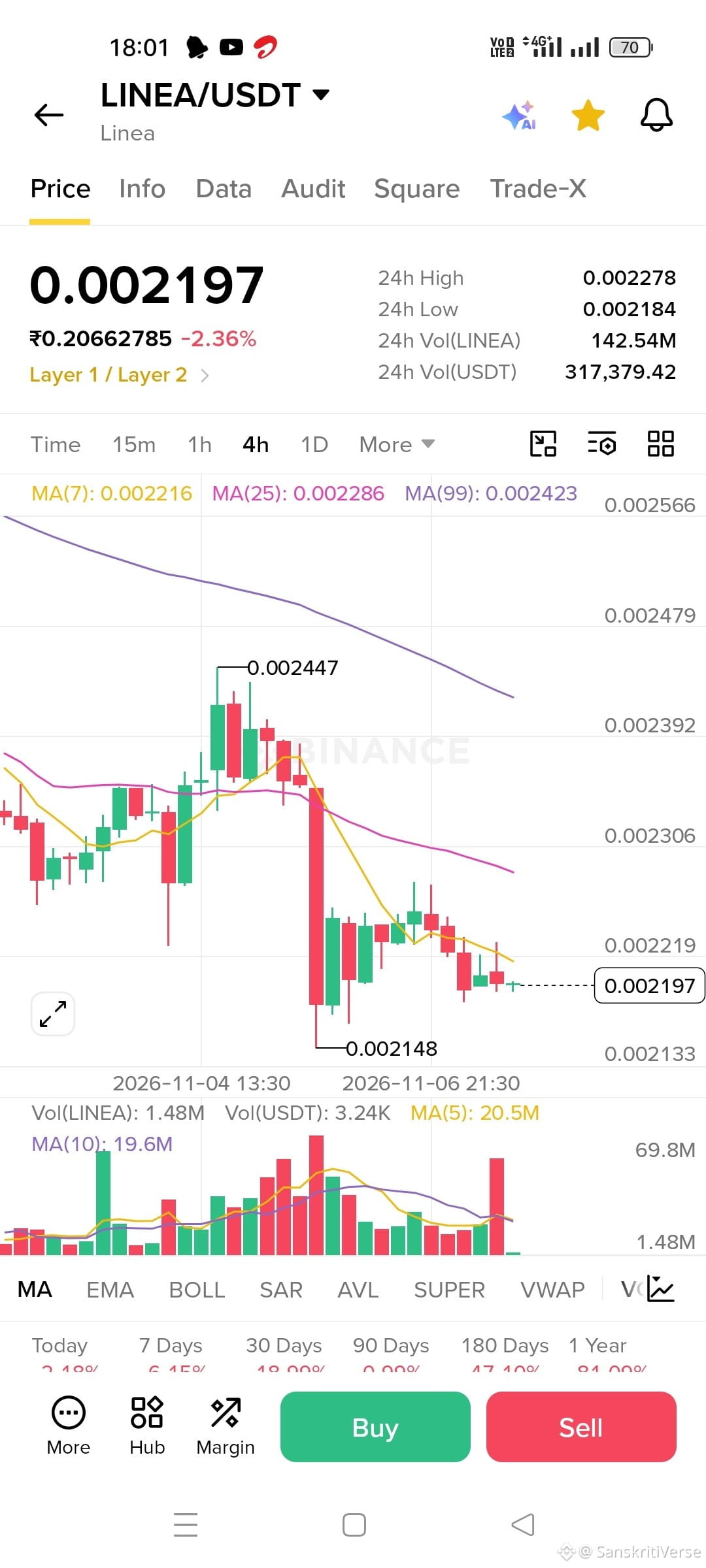
THE BOUNCE IS FADING — CAN LINEA REBUILD MOMENTUM?
$LINEA 4H Chart Study | November 7, 2026
In this screenshot, LINEA showed a small recovery after touching the visible $0.002148 low. Price is now near $0.002197, but remains below the three moving averages shown on the chart.
What I’m observing:
MA(7): $0.002216
MA(25): $0.002286
MA(99): $0.002423
Price is still below all three moving averages.
The recent recovery has not yet formed a stronger upward structure in this 4H view.
Areas visible on this chart:
The $0.002216–$0.002286 region overlaps with nearby short-term moving-average levels.
The $0.002148–$0.002184 region includes the recent low and nearby price activity.
What this chart study highlights:
If price can move back above the shorter-term averages and remain there after a 4H close, the recovery structure may look stronger.
If price remains below these averages and selling activity increases near the recent low, short-term weakness may remain visible.
If the current 4H candle is still open, the displayed setup can change before it closes.
Beginner learning:
A bounce from a recent low is a price reaction—not confirmation of a broader trend reversal. Moving averages, candle closes, and trading activity can help provide more context.
This is a screenshot-based educational observation, not a live trading signal or financial advice.
When reviewing a recovery, do you focus first on moving-average structure or the latest candle close?
$LINEA
{future}(LINEAUSDT)
#LINEA #ChartAnalysis #CryptoEducation #TechnicalAnalysis #LearnInPublic
THE BOUNCE IS FADING — CAN LINEA REBUILD MOMENTUM?
$LINEA 4H Chart Study | November 7, 2026
In this screenshot, LINEA showed a small recovery after touching the visible $0.002148 low. Price is now near $0.002197, but remains below the three moving averages shown on the chart.
What I’m observing:
MA(7): $0.002216
MA(25): $0.002286
MA(99): $0.002423
Price is still below all three moving averages.
The recent recovery has not yet formed a stronger upward structure in this 4H view.
Areas visible on this chart:
The $0.002216–$0.002286 region overlaps with nearby short-term moving-average levels.
The $0.002148–$0.002184 region includes the recent low and nearby price activity.
What this chart study highlights:
If price can move back above the shorter-term averages and remain there after a 4H close, the recovery structure may look stronger.
If price remains below these averages and selling activity increases near the recent low, short-term weakness may remain visible.
If the current 4H candle is still open, the displayed setup can change before it closes.
Beginner learning:
A bounce from a recent low is a price reaction—not confirmation of a broader trend reversal. Moving averages, candle closes, and trading activity can help provide more context.
This is a screenshot-based educational observation, not a live trading signal or financial advice.
When reviewing a recovery, do you focus first on moving-average structure or the latest candle close?
$LINEA
#LINEA #ChartAnalysis #CryptoEducation #TechnicalAnalysis #LearnInPublic
2
323
Übersetzung ansehen
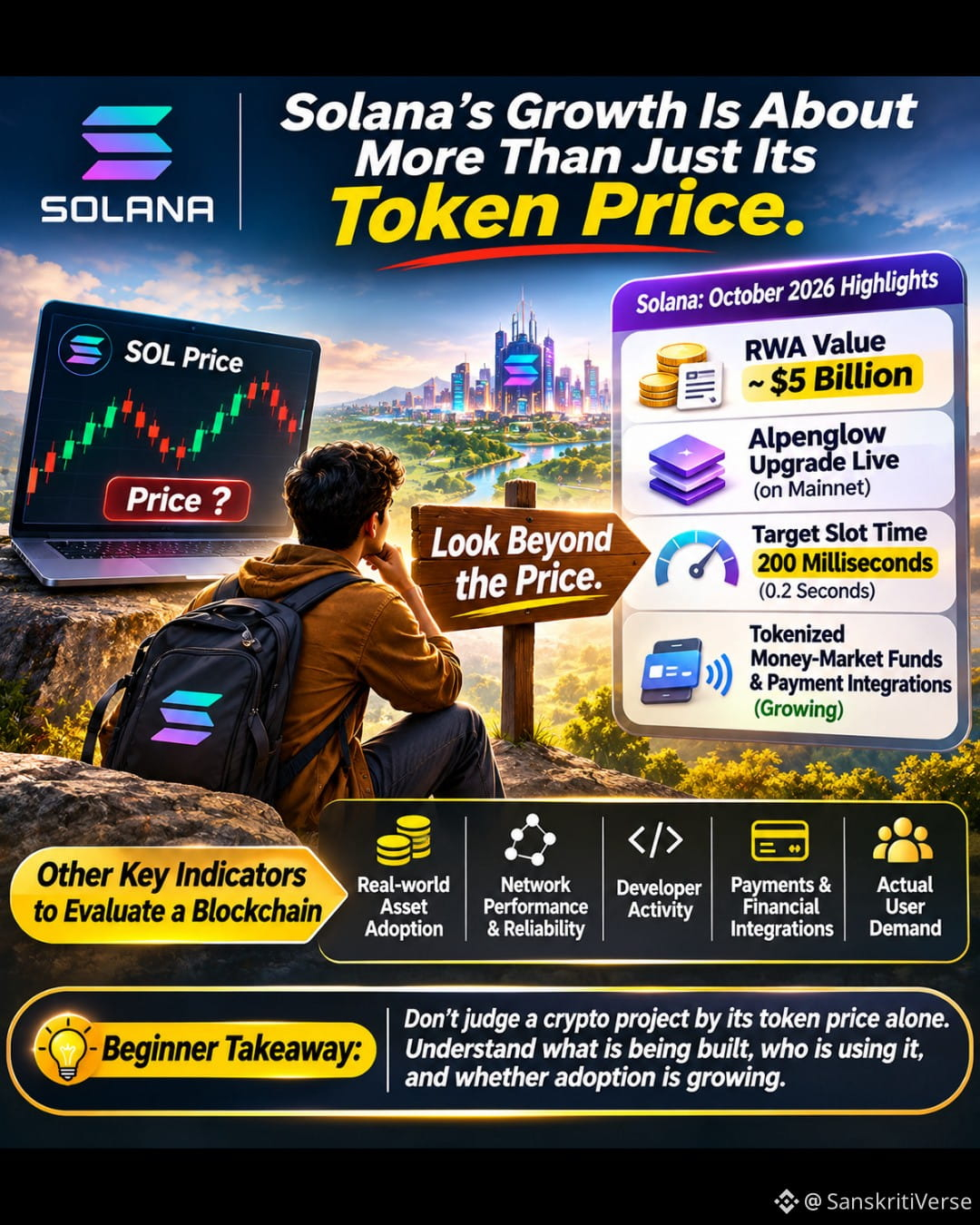
Solana’s Growth Is About More Than $SOL ’s Price
When people discuss Solana, the conversation often centers on the price of SOL.
But a blockchain ecosystem can also be studied through its technology, applications, and adoption.
According to the Solana Foundation’s October 2026 ecosystem roundup:
• The reported value of Real-World Assets on Solana reached about $5 billion.
• Solana’s target slot time was reduced to 200 milliseconds.
• The Alpenglow consensus upgrade went live on mainnet, targeting roughly 150 ms finality.
• Tokenized money-market products and payment-related integrations continued to expand.
Why this matters for beginners:
A token chart is only one part of the picture. When researching a blockchain ecosystem, it can also help to examine:
1. Real-world asset activity
2. Network performance and reliability
3. Developer and application activity
4. Payment and financial integrations
5. Evidence of actual user demand
At the same time, ecosystem progress does not automatically translate into a higher token price. Technology adoption, market conditions, token supply dynamics, and investor sentiment can all differ.
Beginner takeaway:
Look beyond the chart. Understand what is being built, who may be using it, and whether the ecosystem is showing measurable development.
When researching a blockchain, do you check token price first—or ecosystem development first?
Source: Solana Foundation, Solana Ecosystem Roundup: October 2026.
$SOL
{future}(SOLUSDT)
#Solana #BlockchainEducation #CryptoResearch #RWA #CryptoLearning
Solana’s Growth Is About More Than $SOL ’s Price
When people discuss Solana, the conversation often centers on the price of SOL.
But a blockchain ecosystem can also be studied through its technology, applications, and adoption.
According to the Solana Foundation’s October 2026 ecosystem roundup:
• The reported value of Real-World Assets on Solana reached about $5 billion.
• Solana’s target slot time was reduced to 200 milliseconds.
• The Alpenglow consensus upgrade went live on mainnet, targeting roughly 150 ms finality.
• Tokenized money-market products and payment-related integrations continued to expand.
Why this matters for beginners:
A token chart is only one part of the picture. When researching a blockchain ecosystem, it can also help to examine:
1. Real-world asset activity
2. Network performance and reliability
3. Developer and application activity
4. Payment and financial integrations
5. Evidence of actual user demand
At the same time, ecosystem progress does not automatically translate into a higher token price. Technology adoption, market conditions, token supply dynamics, and investor sentiment can all differ.
Beginner takeaway:
Look beyond the chart. Understand what is being built, who may be using it, and whether the ecosystem is showing measurable development.
When researching a blockchain, do you check token price first—or ecosystem development first?
Source: Solana Foundation, Solana Ecosystem Roundup: October 2026.
$SOL
#Solana #BlockchainEducation #CryptoResearch #RWA #CryptoLearning
104
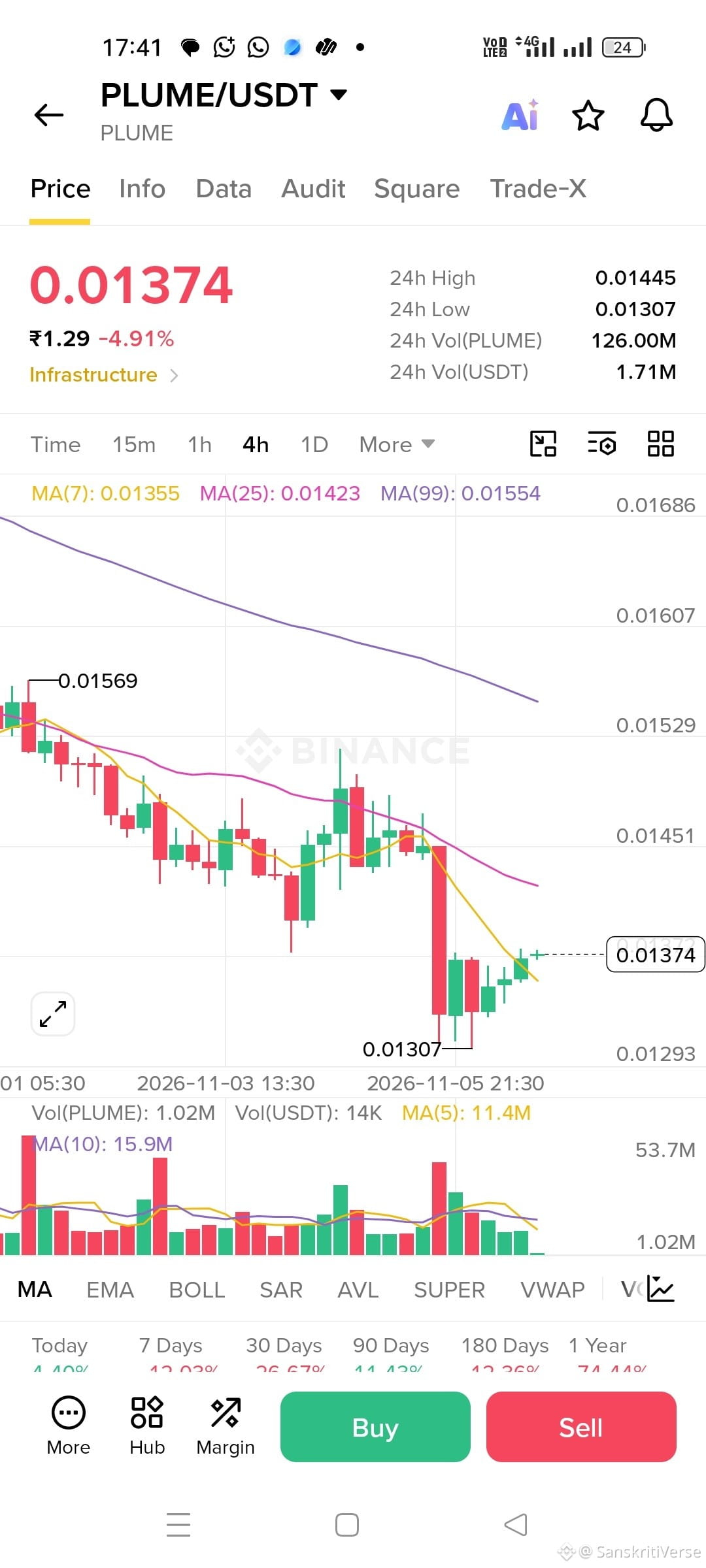
GRÜNE KERZEN — ABER BESTÄTIGT DAS VOLUMEN DIE BEWEGUNG?
$PLUME 4H-Chartanalyse | 6. November 2026
Auf diesem Screenshot hat sich PLUME vom sichtbaren Tief bei 0,01307 $ erholt und wird derzeit bei etwa 0,01374 $ gehandelt.
Die Erholung ist sichtbar – das aktuell angezeigte Volumen wirkt jedoch vergleichsweise niedrig.
Was ich auf diesem Screenshot beobachte:
Der Kurs liegt leicht über MA(7).
Der Kurs bleibt unter MA(25) und MA(99).
Das angezeigte Volumen beträgt etwa 1,02 Mio. PLUME, gegenüber MA(5) bei 11,4 Mio. und MA(10) bei 15,9 Mio.
Falls es sich um eine noch nicht abgeschlossene 4H-Kerze handelt, kann sich ihr Volumen bis zum Kerzenschluss noch ändern.
Worauf ich achte:
Ob sich der Kurs dem Bereich von MA(25) nahe 0,01423 $ nähern kann.
Ob die Marktteilnahme zunimmt, während sich der Kurs bewegt.
Ob die Erholung stabil bleibt, sobald die 4H-Kerze schließt.
Lernhinweis für Einsteiger:
Grüne Kerzen zeigen, dass sich der Kurs bewegt hat. Das Volumen hilft einzuschätzen, wie viel Marktteilnahme hinter dieser Bewegung stecken könnte.
Ein Erholungsversuch bei derzeit niedrigerem angezeigtem Volumen kann es wert sein, beobachtet zu werden, ist aber nicht automatisch ein bullisches oder bärisches Signal.
Dies ist eine bildschirmfoto-basierte Lernbeobachtung und kein Handelssignal oder eine Finanzberatung.
Wenn du eine Erholung analysierst, schaust du zuerst auf das Volumen oder auf die Struktur der gleitenden Durchschnitte?
$PLUME
{future}(PLUMEUSDT)
#PLUME #Volumenanalyse #KryptoBildung #Chartanalyse #ÖffentlichLernen
GRÜNE KERZEN — ABER BESTÄTIGT DAS VOLUMEN DIE BEWEGUNG?
$PLUME 4H-Chartanalyse | 6. November 2026
Auf diesem Screenshot hat sich PLUME vom sichtbaren Tief bei 0,01307 $ erholt und wird derzeit bei etwa 0,01374 $ gehandelt.
Die Erholung ist sichtbar – das aktuell angezeigte Volumen wirkt jedoch vergleichsweise niedrig.
Was ich auf diesem Screenshot beobachte:
Der Kurs liegt leicht über MA(7).
Der Kurs bleibt unter MA(25) und MA(99).
Das angezeigte Volumen beträgt etwa 1,02 Mio. PLUME, gegenüber MA(5) bei 11,4 Mio. und MA(10) bei 15,9 Mio.
Falls es sich um eine noch nicht abgeschlossene 4H-Kerze handelt, kann sich ihr Volumen bis zum Kerzenschluss noch ändern.
Worauf ich achte:
Ob sich der Kurs dem Bereich von MA(25) nahe 0,01423 $ nähern kann.
Ob die Marktteilnahme zunimmt, während sich der Kurs bewegt.
Ob die Erholung stabil bleibt, sobald die 4H-Kerze schließt.
Lernhinweis für Einsteiger:
Grüne Kerzen zeigen, dass sich der Kurs bewegt hat. Das Volumen hilft einzuschätzen, wie viel Marktteilnahme hinter dieser Bewegung stecken könnte.
Ein Erholungsversuch bei derzeit niedrigerem angezeigtem Volumen kann es wert sein, beobachtet zu werden, ist aber nicht automatisch ein bullisches oder bärisches Signal.
Dies ist eine bildschirmfoto-basierte Lernbeobachtung und kein Handelssignal oder eine Finanzberatung.
Wenn du eine Erholung analysierst, schaust du zuerst auf das Volumen oder auf die Struktur der gleitenden Durchschnitte?
$PLUME
#PLUME #Volumenanalyse #KryptoBildung #Chartanalyse #ÖffentlichLernen
1
1
427
Übersetzung ansehen
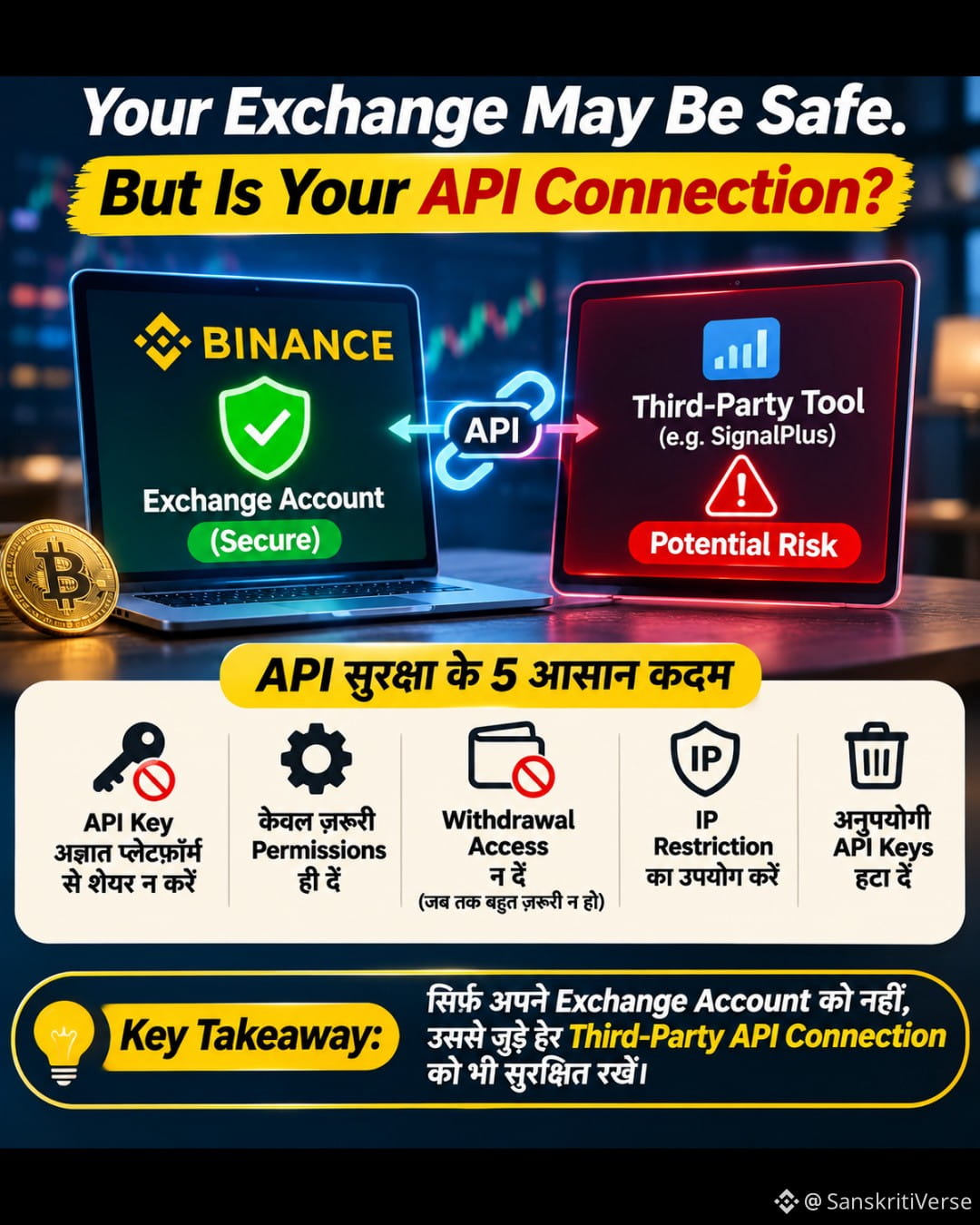
Your Exchange Account May Be Secure — But Are Your API Keys?
Crypto beginners often focus on passwords and 2FA. But third-party tools connected through API keys can create an additional security layer to manage.
An API key can allow an external application to interact with parts of your exchange account. Depending on the permissions enabled, it may be able to:
• Read account information
• View trading data
• Place or manage trades
Basic API safety practices:
1. Only connect tools you recognize and trust.
2. Enable the minimum permissions needed.
3. Keep withdrawal permission disabled unless it is genuinely required.
4. Use IP restrictions where available.
5. Revoke API keys you no longer use.
6. Review connected tools and API permissions regularly.
Beginner takeaway:
Securing your exchange account is important—but it is equally important to review every external tool connected to it.
Do you review API permissions before connecting a third-party crypto tool?
#CryptoSecurity #APIKeySecurity #CryptoEducation #BinanceSquare #LearningInPublic
72
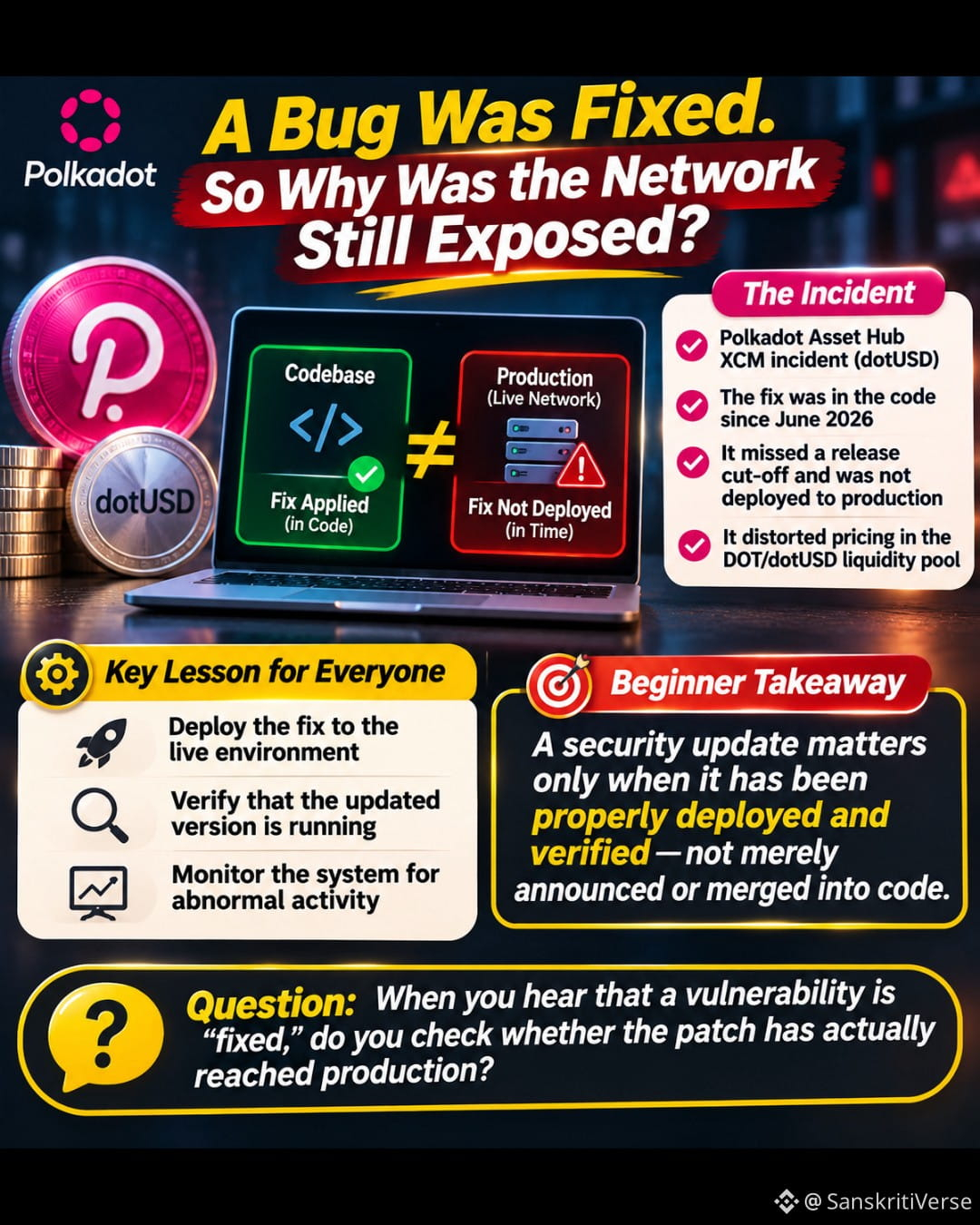
Ein Fehler wurde behoben. Warum war das Netzwerk trotzdem noch gefährdet?
Ein Sicherheitsfehler kann in einer Codebasis behoben sein, während ein laufendes System weiterhin verwundbar ist.
Das war eine wichtige Erkenntnis aus dem XCM-Vorfall bei Polkadot Asset Hub, an dem dotUSD beteiligt war.
Laut dem Vorfallsbericht von Parity wurde die Schwachstelle im Juni 2026 gemeldet und in der Codebasis behoben. Der Patch verpasste jedoch den Stichtag für die Veröffentlichung von stable-2606 und war vor dem Exploit nicht in den betroffenen Produktions-Runtimes enthalten.
Im Code behoben ≠ In der Produktion behoben.
Bei Blockchain- und Softwaresystemen hängt die Sicherheit außerdem davon ab:
• Den Fix in der Live-Umgebung bereitzustellen
• Zu überprüfen, ob die aktualisierte Version dort läuft, wo sie benötigt wird
• Das System auf ungewöhnliche Aktivitäten zu überwachen
Der Vorfall verzerrte die Preisbildung im DOT/dotUSD-Liquiditätspool. Parity schätzte den Verlust auf etwa 1,381 Millionen DOT und erklärte, dass die Polkadot-Treasury der einzige Liquiditätsanbieter des Pools war. Dem Bericht zufolge erlitten außerdem keine Nutzer Verluste.
Das Wichtigste für Einsteiger: Ein Sicherheitsupdate ist erst dann relevant, wenn es ordnungsgemäß bereitgestellt und überprüft wurde – nicht, wenn es lediglich angekündigt, geprüft oder in den Code integriert wurde.
Frage: Wenn du hörst, dass eine Schwachstelle „behoben“ wurde, prüfst du dann, ob der Patch tatsächlich in der Produktionsumgebung angekommen ist?
Quelle: „Parity / Polkadot-Forum – XCM-Vorfallsbericht“
$DOT
{future}(DOTUSDT)
#KryptoSicherheit #BlockchainBildung #KryptoLernen
Ein Fehler wurde behoben. Warum war das Netzwerk trotzdem noch gefährdet?
Ein Sicherheitsfehler kann in einer Codebasis behoben sein, während ein laufendes System weiterhin verwundbar ist.
Das war eine wichtige Erkenntnis aus dem XCM-Vorfall bei Polkadot Asset Hub, an dem dotUSD beteiligt war.
Laut dem Vorfallsbericht von Parity wurde die Schwachstelle im Juni 2026 gemeldet und in der Codebasis behoben. Der Patch verpasste jedoch den Stichtag für die Veröffentlichung von stable-2606 und war vor dem Exploit nicht in den betroffenen Produktions-Runtimes enthalten.
Im Code behoben ≠ In der Produktion behoben.
Bei Blockchain- und Softwaresystemen hängt die Sicherheit außerdem davon ab:
• Den Fix in der Live-Umgebung bereitzustellen
• Zu überprüfen, ob die aktualisierte Version dort läuft, wo sie benötigt wird
• Das System auf ungewöhnliche Aktivitäten zu überwachen
Der Vorfall verzerrte die Preisbildung im DOT/dotUSD-Liquiditätspool. Parity schätzte den Verlust auf etwa 1,381 Millionen DOT und erklärte, dass die Polkadot-Treasury der einzige Liquiditätsanbieter des Pools war. Dem Bericht zufolge erlitten außerdem keine Nutzer Verluste.
Das Wichtigste für Einsteiger: Ein Sicherheitsupdate ist erst dann relevant, wenn es ordnungsgemäß bereitgestellt und überprüft wurde – nicht, wenn es lediglich angekündigt, geprüft oder in den Code integriert wurde.
Frage: Wenn du hörst, dass eine Schwachstelle „behoben“ wurde, prüfst du dann, ob der Patch tatsächlich in der Produktionsumgebung angekommen ist?
Quelle: „Parity / Polkadot-Forum – XCM-Vorfallsbericht“
$DOT
#KryptoSicherheit #BlockchainBildung #KryptoLernen
380
Übersetzung ansehen
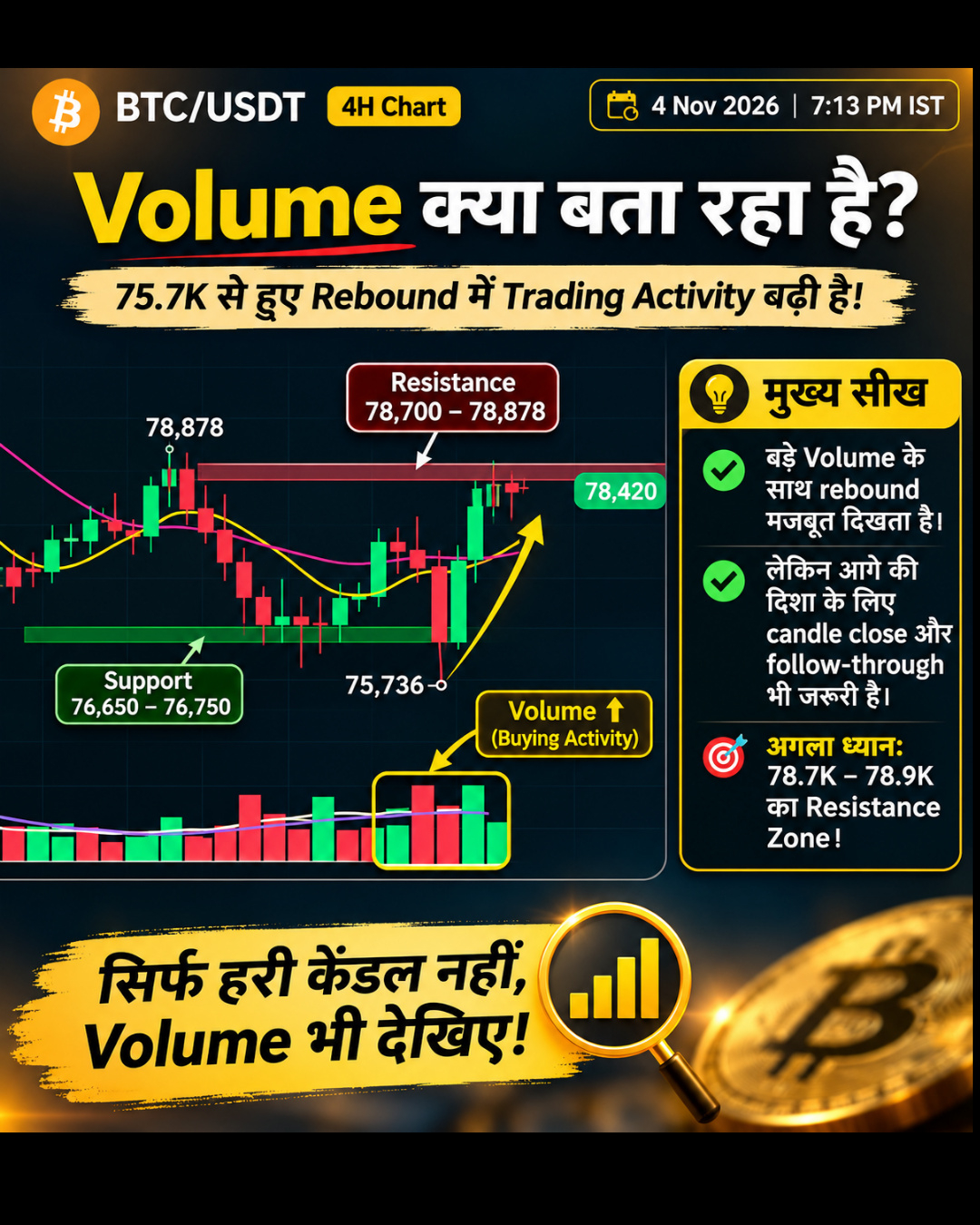
WHAT IS VOLUME TELLING US?
Today’s $BTC 4H chart study | 4 Nov 2026
BTC rebounded from the visible 75.7K area toward 78.4K.
During the rebound, several green candles appeared with stronger volume.
But here’s what I’m learning:
Volume shows how much trading activity took place.
Strong volume during a price move can make that move more meaningful to study.
It does not tell us by itself whether price will continue upward.
In this screenshot, the displayed volume is around 1.34K BTC, below the Volume MA(5) and MA(10), both near 2.3K BTC.
I still want to watch the candle close and follow-through near resistance.
My takeaway: Volume helps me judge participation—but price structure and confirmation still matter.
This is a screenshot-based learning observation, not a live trading signal or financial advice.
When you see a strong green candle, what do you check next: volume, candle close, or the next candle’s follow-through?
$BTC
{future}(BTCUSDT)
#BTC #VolumeAnalysis #CryptoEducation #ChartStudy #LearnInPublic
WHAT IS VOLUME TELLING US?
Today’s $BTC 4H chart study | 4 Nov 2026
BTC rebounded from the visible 75.7K area toward 78.4K.
During the rebound, several green candles appeared with stronger volume.
But here’s what I’m learning:
Volume shows how much trading activity took place.
Strong volume during a price move can make that move more meaningful to study.
It does not tell us by itself whether price will continue upward.
In this screenshot, the displayed volume is around 1.34K BTC, below the Volume MA(5) and MA(10), both near 2.3K BTC.
I still want to watch the candle close and follow-through near resistance.
My takeaway: Volume helps me judge participation—but price structure and confirmation still matter.
This is a screenshot-based learning observation, not a live trading signal or financial advice.
When you see a strong green candle, what do you check next: volume, candle close, or the next candle’s follow-through?
$BTC
#BTC #VolumeAnalysis #CryptoEducation #ChartStudy #LearnInPublic
77
Übersetzung ansehen
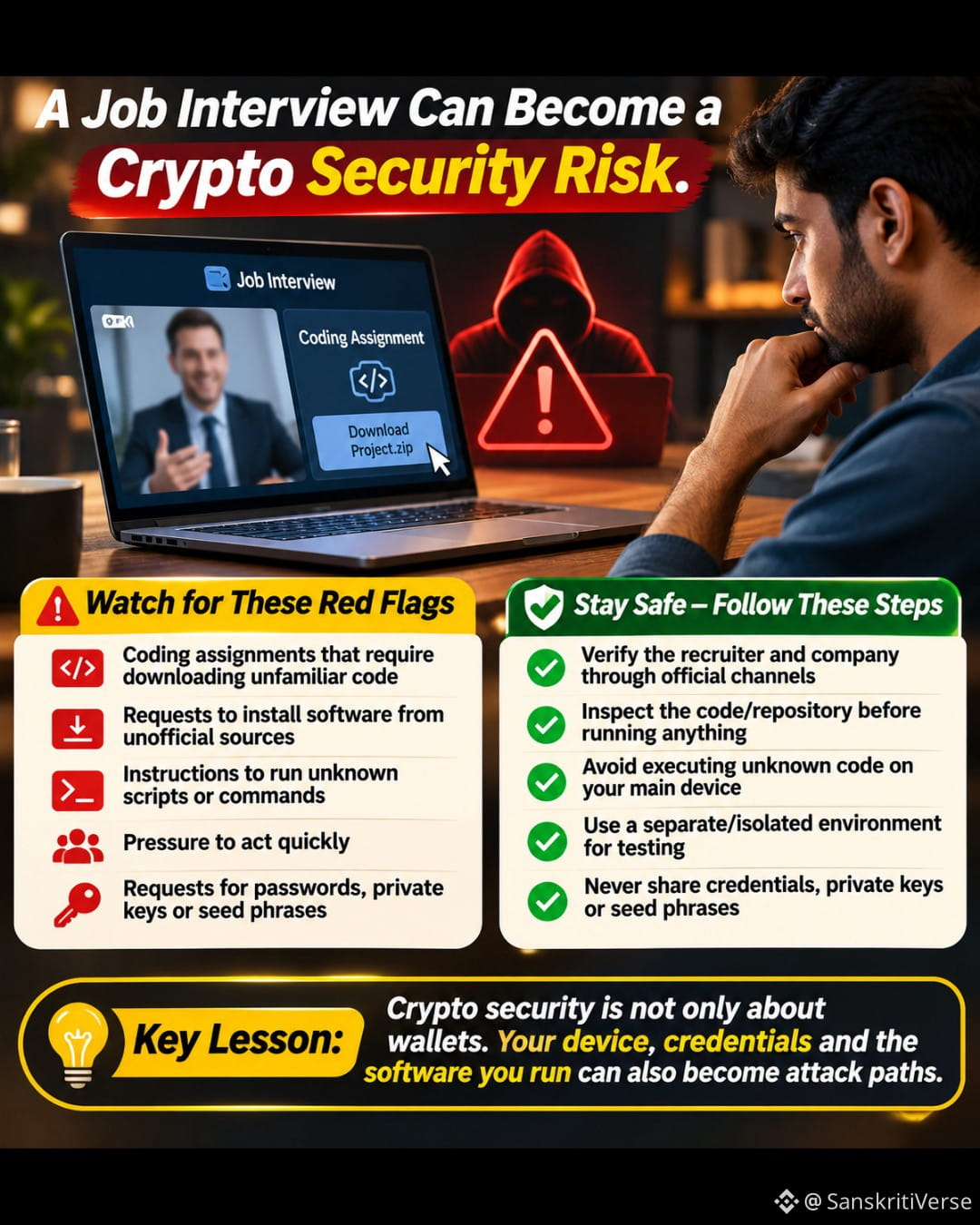
A Job Interview Can Become a Crypto Security Risk
A professional-looking interview invite does not automatically mean the opportunity is legitimate.
For developers and crypto users, a coding assignment can create security risks when it requires downloading unknown repositories, installing unverified software, or running unreviewed scripts.
What should developers and job seekers watch for?
Unexpected coding assignments that require downloading unfamiliar repositories
Requests to install software from unofficial sources
Instructions to run unknown scripts or commands
Interviewers who pressure you to act quickly
Requests for passwords, private keys, seed phrases, or unnecessary account access
Before running an assignment:
Verify the recruiter and company through official channels.
Inspect the repository and its instructions before running anything.
Avoid executing unknown code on your personal or work computer.
Use a properly isolated environment when testing unfamiliar projects.
Never share credentials, private keys, or seed phrases.
Key lesson: Crypto security is not only about protecting wallets. Your device, credentials, and the software you run can also become attack paths.
A legitimate job opportunity should never require you to bypass basic security checks.
#CryptoSecurity #CyberSecurity #CryptoEducation #JobScamAwareness
62
Übersetzung ansehen
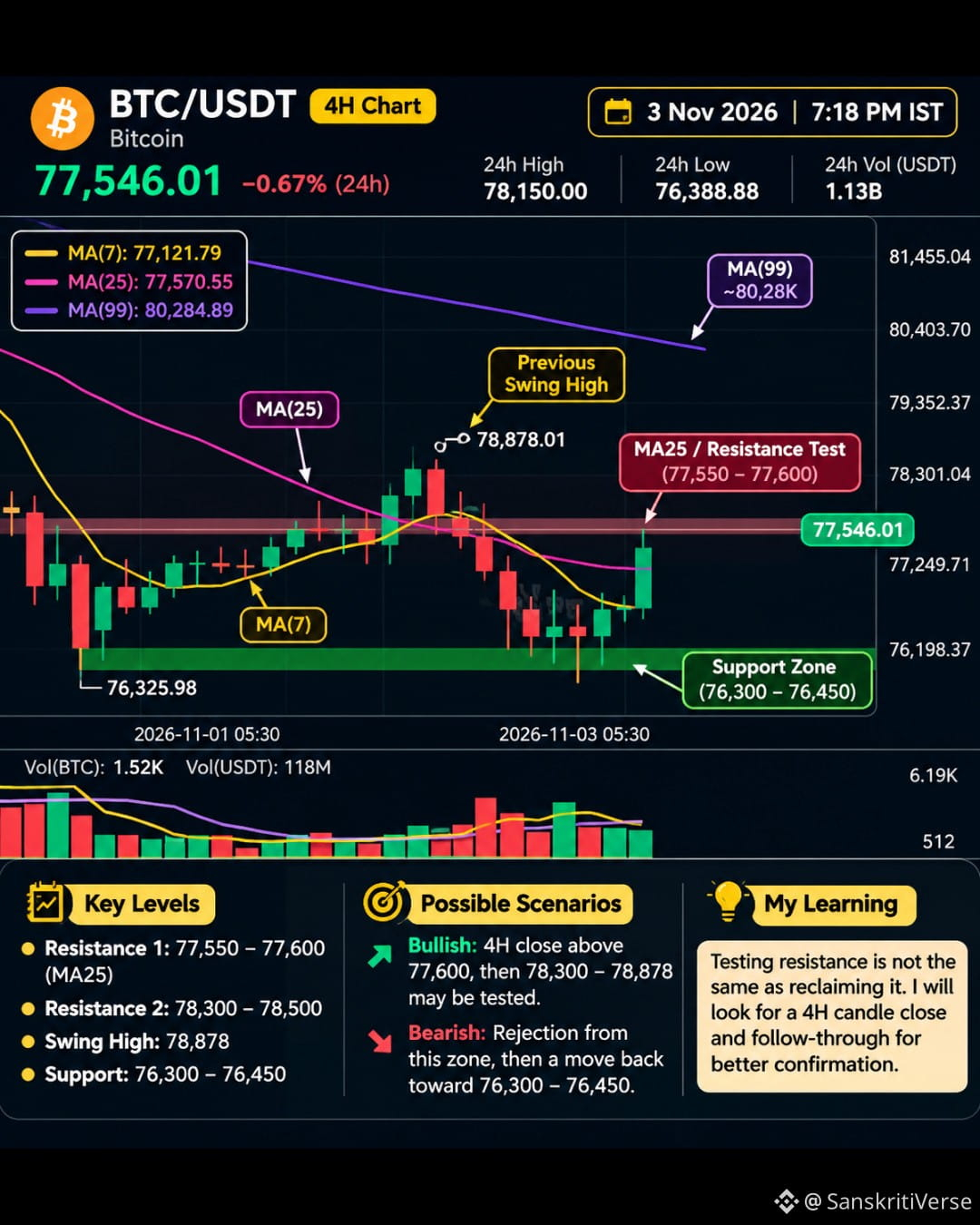
$BTC IS TESTING THE 4H MA(25) — CONFIRMATION MATTERS.
Today’s $BTC chart study | 4H
BTC has rebounded from the visible 76.3K area and is now trading near 77.55K.
What I’m observing:
• Price is above MA(7), showing short-term recovery.
• Price is testing the MA(25) area around 77.57K.
• The broader visible structure remains weak while price is below MA(99).
• A candle close and follow-through matter more than a quick move above the average.
Possible scenarios:
• Bullish: A 4H close above the MA(25) area, followed by follow-through.
• Bearish: Rejection near this zone and a move back toward support.
My learning: Testing resistance is not the same as reclaiming it. I want to wait for confirmation instead of reacting to one green candle.
Chart observation from my screenshot, not a live trading signal or financial advice.
What would you watch next: a 4H close above MA(25), or a rejection from this zone?
$BTC
{future}(BTCUSDT)
#BTC #ChartAnalysis #CryptoEducation #LearnInPublic
$BTC IS TESTING THE 4H MA(25) — CONFIRMATION MATTERS.
Today’s $BTC chart study | 4H
BTC has rebounded from the visible 76.3K area and is now trading near 77.55K.
What I’m observing:
• Price is above MA(7), showing short-term recovery.
• Price is testing the MA(25) area around 77.57K.
• The broader visible structure remains weak while price is below MA(99).
• A candle close and follow-through matter more than a quick move above the average.
Possible scenarios:
• Bullish: A 4H close above the MA(25) area, followed by follow-through.
• Bearish: Rejection near this zone and a move back toward support.
My learning: Testing resistance is not the same as reclaiming it. I want to wait for confirmation instead of reacting to one green candle.
Chart observation from my screenshot, not a live trading signal or financial advice.
What would you watch next: a 4H close above MA(25), or a rejection from this zone?
$BTC
#BTC #ChartAnalysis #CryptoEducation #LearnInPublic
70
Übersetzung ansehen
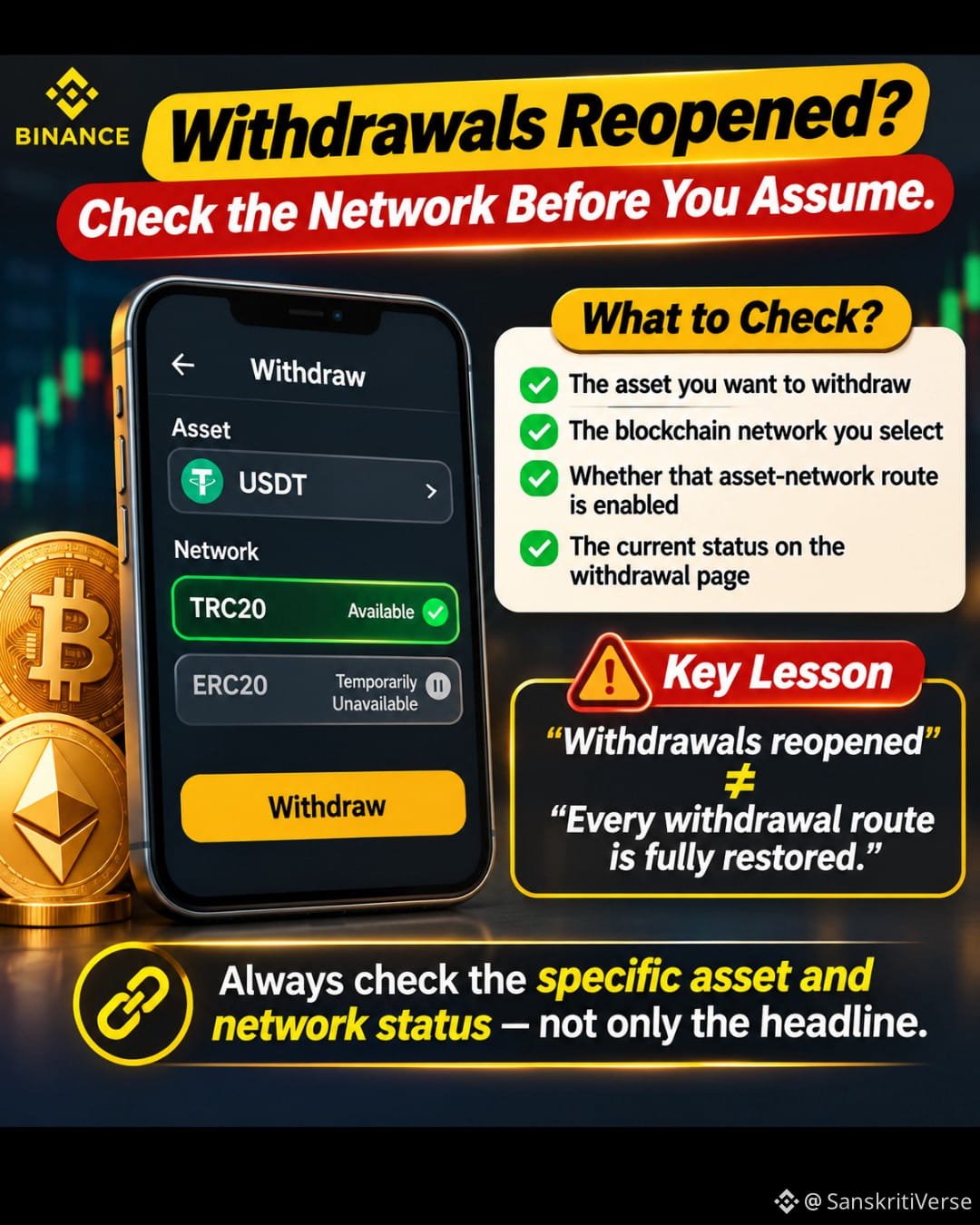
Withdrawals Reopened? Check the Network Before You Assume.
A withdrawal reopening announcement does not always mean every asset is available on every network.
Following the security incident, Binance stated that withdrawals for additional assets would begin reopening from November 3, 2026, at 04:00 UTC.
However, not all listed assets would become available at once. Availability was being restored progressively as security and readiness checks for each asset-network route were completed.
Withdrawal availability may depend on:
The asset you want to withdraw
The blockchain network you select
Whether checks for that specific asset-network route are complete
The current status shown on Binance’s withdrawal page
An asset may be available on one supported network while another network option remains unavailable.
Before withdrawing:
Open the withdrawal page.
Select the exact asset and network.
Confirm that withdrawals are enabled for that route.
Carefully verify the receiving address and selected network before confirming.
Key lesson: “Withdrawals reopened” does not mean every withdrawal route is fully restored.
Always check the specific asset and network status—not only the headline.
Source: Binance Official Announcement — Security Incident | Recovery Update #6: Withdrawals Reopen for More Assets (2026-11-03)
#CryptoEducation #CryptoSecurity #Binance #BlockchainBasics
83
Übersetzung ansehen
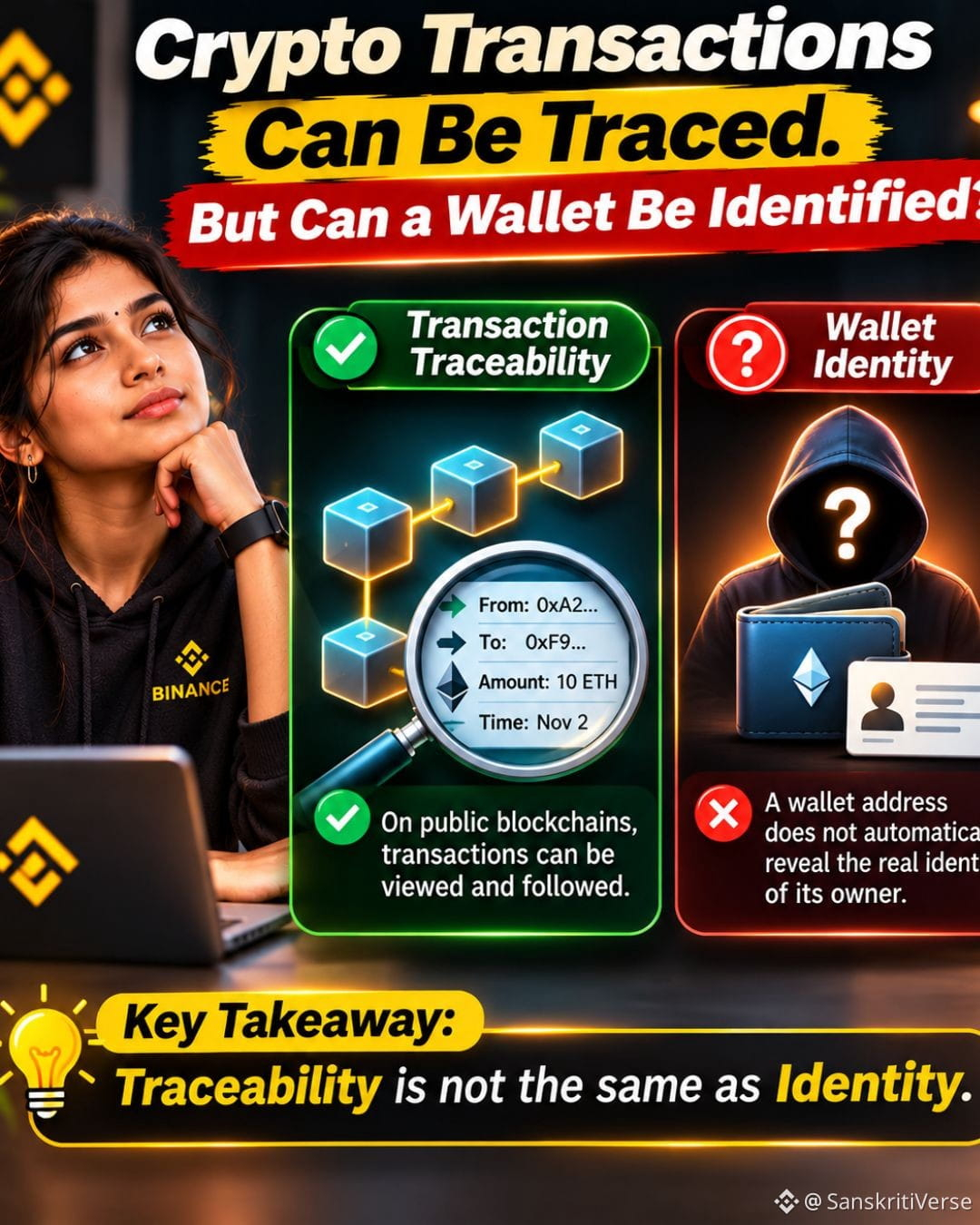
Crypto Transactions Can Be Traced. But Can a Wallet Be Identified?
These are two different questions.
1. Transaction Traceability
On many public blockchains, transactions can often be viewed and analyzed through a block explorer.
You may be able to see:
Sending and receiving addresses
Amount transferred
Transaction timestamp
Subsequent movements between visible on-chain addresses
However, visibility can vary depending on the blockchain, transaction type, and any privacy-preserving features involved.
2. Wallet Identity
A wallet address does not automatically reveal the real-world identity of its owner.
Connecting an address to a person may require additional information, such as:
Exchange records or verified account data, where legally accessible
Wallet addresses voluntarily shared in public
Other reliable off-chain evidence
Blockchain analysis combined with independent verification
Why does this matter?
A visible transaction does not automatically tell you who made it.
Blockchain analysis can help trace the movement of funds, but identifying the person or organization behind an address is a separate step. The confidence of that attribution can vary depending on the quality of the evidence.
My learning takeaway:
Traceability is not the same as identity. Always separate what the blockchain directly shows from what additional evidence may suggest.
Question: Did you know that on-chain activity can be visible without directly revealing the owner of a wallet address?
#CryptoEducation #BlockchainBasics #CryptoSecurity
62
Übersetzung ansehen
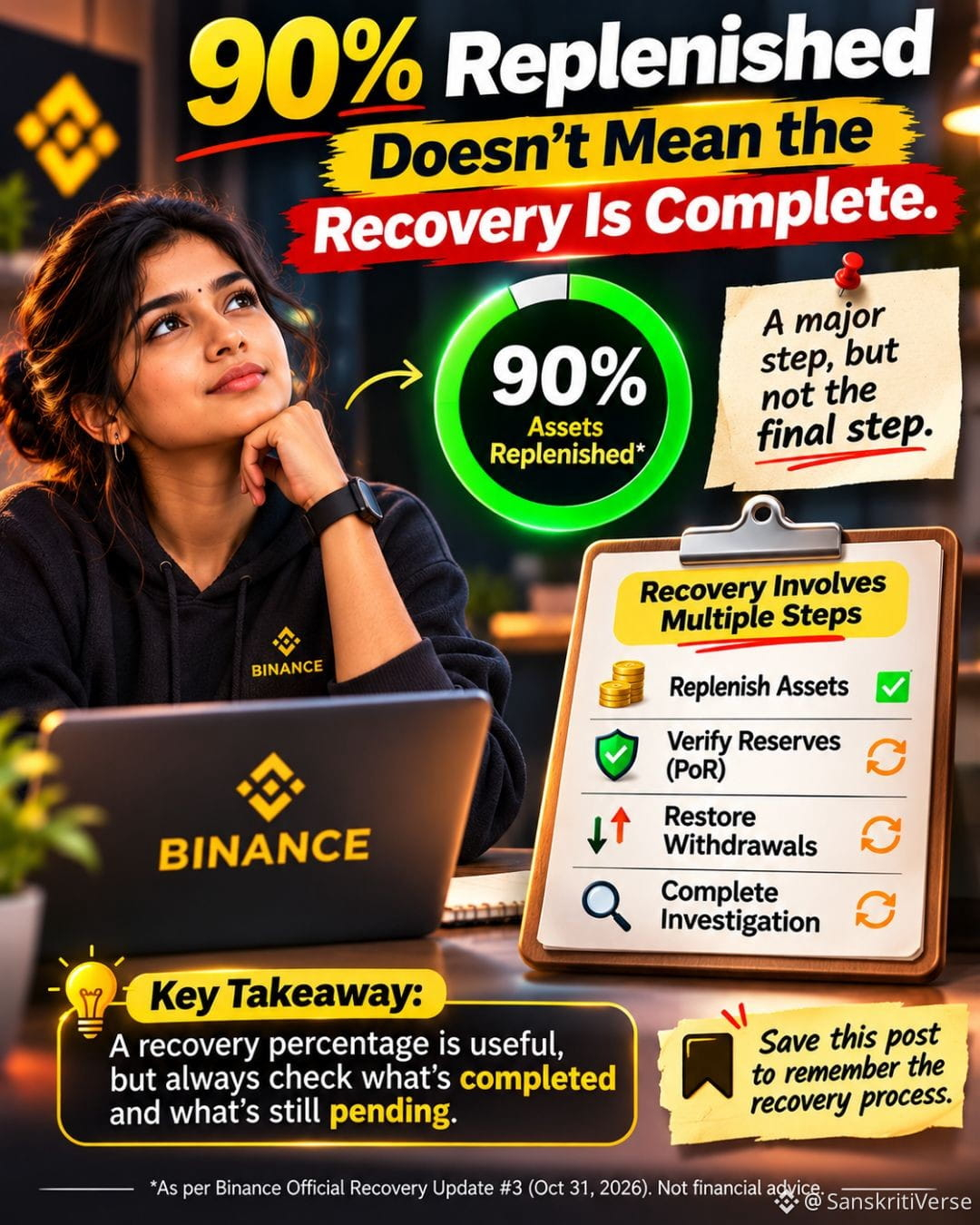
90% Replenished Does Not Mean the Recovery Is Complete
After a major security incident, a recovery figure can sound reassuring:
“90% of stolen assets have been replenished.”
But what does that actually mean?
It means Binance reported that it had replenished 90% of the affected stolen assets.
It does not automatically mean that every recovery-related step has been completed.
In Binance’s October 31, 2026 update:
Binance reported 90% of the affected stolen assets as replenished.
The remaining 10% mainly consisted of less-liquid tokens, with acquisition efforts continuing through market and OTC channels.
A new Proof of Reserves snapshot was published as of October 31, 2026, 00:00 UTC.
The full zero-knowledge proof was estimated to be available by November 3, 2026.
Binance stated that it remained on track to resume withdrawal services on November 1, 2026, subject to further confirmation.
Why does this matter?
Recovery involves separate milestones:
Replenishing affected assets
Publishing reserve information and completing user-verifiable proof
Resuming withdrawal services
These milestones should not be treated as the same thing.
My learning takeaway:
A recovery percentage is useful information, but it is important to check what has been completed, what remains in progress, and what has been officially confirmed.
Question: When you read a recovery update, do you check the percentage first or the remaining steps?
Source: Binance Official Security Incident Recovery Update #3, October 31, 2026.
#CryptoEducation #CryptoSecurity #RiskManagement
95
Anmelden und weiter Inhalte entdecken
Krypto-Nutzer weltweit auf Binance Square kennenlernen
⚡️ Bleib in Sachen Krypto stets am Puls.
💬 Die weltgrößte Kryptobörse vertraut darauf.
👍 Erhalte verlässliche Einblicke von verifizierten Creators.
E-Mail-Adresse/Telefonnummer
Trendthemen
WhoWillSucceedJensenHuangatNvidia?
89,644 Aufrufe
1,167 Kommentare
Nvidia: Keine Gespräche über CEO-Nachfolge – Petition „Stand With Jensen“ erreicht mehr als 77.900 Unterschriften
Binance News
·29 Likes
·38.3k Aufrufe
WhatWillDriveCryptoandStocks’NextRebound?
447,121 Aufrufe
3,074 Kommentare
BitcoinActiveSupplyInProfitDropsBelow45%
27,515 Aufrufe
380 Kommentare