
Pryanik7
93 Beiträge

Pryanik7
Melden
Nutzer blockieren
🏩Crypto girl 🎮Web3 exployer
Regelmäßiger Trader
2.2 Jahre
35 Following
44 Follower
175 Like gegeben
Beiträge
·
--
Übersetzung ansehen
Традиційні біржі проти bStocks: У чому реальна різниця? ⚖️ розбір
Багато хто питає: «Навіщо мені купувати токенізовані акції на Binance, якщо можна відкрити рахунок у звичайного брокера?»
Давайте порівняємо два підходи на конкретних фактах:
📌 Класичний брокер:
✖️ Тривалий KYC та бюрократичний процес відкриття рахунку.
✖️ Торгова сесія суворо обмежена за часом (з понеділка по п'ятницю).
✖️ Високі комісії за виведення та міжнародні банківські перекази (SWIFT).
✖️ Обов'язкова купівля цілих акцій або високий поріг входу.
📌 bStocks на Binance:
✅ Доступ 24/7 у будь-який день тижня та з будь-якої точки світу.
✅ Торгівля через Binance Convert від $1 — купуйте будь-які дробові частки.
✅ Миттєвий обмін стейблкоїнів (USDT/USDC) на акції без банківських затримок.
✅ Автоматичне реінвестування дивідендів прямо у ваш токенний баланс.
bStocks стирає кордони між TradFi та Web3, роблячи глобальний ринок акцій таким же гнучким, як і крипта.
👇 А що для вас найважливіше при виборі актива — цілодобовий доступ чи відсутність бюрократії? Пишіть у коментарях!
#TradFi
Традиційні біржі проти bStocks: У чому реальна різниця? ⚖️ розбір
Багато хто питає: «Навіщо мені купувати токенізовані акції на Binance, якщо можна відкрити рахунок у звичайного брокера?»
Давайте порівняємо два підходи на конкретних фактах:
📌 Класичний брокер:
✖️ Тривалий KYC та бюрократичний процес відкриття рахунку.
✖️ Торгова сесія суворо обмежена за часом (з понеділка по п'ятницю).
✖️ Високі комісії за виведення та міжнародні банківські перекази (SWIFT).
✖️ Обов'язкова купівля цілих акцій або високий поріг входу.
📌 bStocks на Binance:
✅ Доступ 24/7 у будь-який день тижня та з будь-якої точки світу.
✅ Торгівля через Binance Convert від $1 — купуйте будь-які дробові частки.
✅ Миттєвий обмін стейблкоїнів (USDT/USDC) на акції без банківських затримок.
✅ Автоматичне реінвестування дивідендів прямо у ваш токенний баланс.
bStocks стирає кордони між TradFi та Web3, роблячи глобальний ринок акцій таким же гнучким, як і крипта.
👇 А що для вас найважливіше при виборі актива — цілодобовий доступ чи відсутність бюрократії? Пишіть у коментарях!
#TradFi
Багато хто питає: «Навіщо мені купувати токенізовані акції на Binance, якщо можна відкрити рахунок у звичайного брокера?»
Давайте порівняємо два підходи на конкретних фактах:
📌 Класичний брокер:
✖️ Тривалий KYC та бюрократичний процес відкриття рахунку.
✖️ Торгова сесія суворо обмежена за часом (з понеділка по п'ятницю).
✖️ Високі комісії за виведення та міжнародні банківські перекази (SWIFT).
✖️ Обов'язкова купівля цілих акцій або високий поріг входу.
📌 bStocks на Binance:
✅ Доступ 24/7 у будь-який день тижня та з будь-якої точки світу.
✅ Торгівля через Binance Convert від $1 — купуйте будь-які дробові частки.
✅ Миттєвий обмін стейблкоїнів (USDT/USDC) на акції без банківських затримок.
✅ Автоматичне реінвестування дивідендів прямо у ваш токенний баланс.
bStocks стирає кордони між TradFi та Web3, роблячи глобальний ринок акцій таким же гнучким, як і крипта.
👇 А що для вас найважливіше при виборі актива — цілодобовий доступ чи відсутність бюрократії? Пишіть у коментарях!
#TradFi
74
·
--
3 wichtigste Mythen über tokenisierte bStocks ❌💡
Wir räumen mit gängigen Irrtümern über RWA auf Binance auf:
1️⃣ „Das sind keine echten Aktien“ — Falsch. Jeder Token ist zu 100 % durch reale Wertpapiere bei einem regulierten Verwahrer abgesichert.
2️⃣ „Dividenden gehen verloren“ — Nein, Auszahlungen werden automatisch in deinem Guthaben über den Multiplier-Mechanismus reinvestiert.
3️⃣ „Das ist kompliziert“ — Der Handel läuft genauso einfach wie eine normale Konvertierung von USDT in BTC.
Teste neue Finanzinstrumente, ohne unnötige Stereotypen!
👇 Welche weiteren Finanzmythen würdest du gern genauer erfahren?
#investments
3 wichtigste Mythen über tokenisierte bStocks ❌💡
Wir räumen mit gängigen Irrtümern über RWA auf Binance auf:
1️⃣ „Das sind keine echten Aktien“ — Falsch. Jeder Token ist zu 100 % durch reale Wertpapiere bei einem regulierten Verwahrer abgesichert.
2️⃣ „Dividenden gehen verloren“ — Nein, Auszahlungen werden automatisch in deinem Guthaben über den Multiplier-Mechanismus reinvestiert.
3️⃣ „Das ist kompliziert“ — Der Handel läuft genauso einfach wie eine normale Konvertierung von USDT in BTC.
Teste neue Finanzinstrumente, ohne unnötige Stereotypen!
👇 Welche weiteren Finanzmythen würdest du gern genauer erfahren?
#investments
Wir räumen mit gängigen Irrtümern über RWA auf Binance auf:
1️⃣ „Das sind keine echten Aktien“ — Falsch. Jeder Token ist zu 100 % durch reale Wertpapiere bei einem regulierten Verwahrer abgesichert.
2️⃣ „Dividenden gehen verloren“ — Nein, Auszahlungen werden automatisch in deinem Guthaben über den Multiplier-Mechanismus reinvestiert.
3️⃣ „Das ist kompliziert“ — Der Handel läuft genauso einfach wie eine normale Konvertierung von USDT in BTC.
Teste neue Finanzinstrumente, ohne unnötige Stereotypen!
👇 Welche weiteren Finanzmythen würdest du gern genauer erfahren?
#investments
60
·
--
Übersetzung ansehen
RWA та DeFi: Як bStocks інтегруються в екосистему Binance? 🛠
bStocks — це не просто цифрові акції на екрані. Це токени стандарту BEP-20, створені для максимальної гнучкості всередині екосистеми.
Що це дає трейдеру?
🔹 Використання bStocks як застави (Cross/Portfolio Margin).
🔹 Гнучка торгівля через Binance Convert без складних ордербуків.
🔹 Виведення токенів на Web3-гаманець для взаємодії з DeFi.
Використовуйте всі переваги токенізованих активів на повну потужність!
👇 Чи використовуєте ви заставні активи у своїй торгівлі?
#MarginTrading
RWA та DeFi: Як bStocks інтегруються в екосистему Binance? 🛠
bStocks — це не просто цифрові акції на екрані. Це токени стандарту BEP-20, створені для максимальної гнучкості всередині екосистеми.
Що це дає трейдеру?
🔹 Використання bStocks як застави (Cross/Portfolio Margin).
🔹 Гнучка торгівля через Binance Convert без складних ордербуків.
🔹 Виведення токенів на Web3-гаманець для взаємодії з DeFi.
Використовуйте всі переваги токенізованих активів на повну потужність!
👇 Чи використовуєте ви заставні активи у своїй торгівлі?
#MarginTrading
bStocks — це не просто цифрові акції на екрані. Це токени стандарту BEP-20, створені для максимальної гнучкості всередині екосистеми.
Що це дає трейдеру?
🔹 Використання bStocks як застави (Cross/Portfolio Margin).
🔹 Гнучка торгівля через Binance Convert без складних ордербуків.
🔹 Виведення токенів на Web3-гаманець для взаємодії з DeFi.
Використовуйте всі переваги токенізованих активів на повну потужність!
👇 Чи використовуєте ви заставні активи у своїй торгівлі?
#MarginTrading
65
·
--
Übersetzung ansehen
Як диверсифікувати криптопортфель під час флету? 📊
Коли біткоїн та альткоїни рухаються в боковику, виникає питання: куди перемістити ліквідність, щоб вона не просто лежала?
Чудове рішення — розпреділити частину капіталу в bStocks:
🔹 Ви отримуєте експозицію на реальний сектор економіки США.
🔹 Ваші активи підкріплені 1:1 реальними цінними паперами.
🔹 При необхідності ви миттєво повертаєтесь у стейблкоїни чи BTC.
Розумний менеджмент ризиків — запорука успіху в крипті.
👇 Які інструменти захисту капіталу використовуєте під час флету?
#RiskManagement #crypto
Як диверсифікувати криптопортфель під час флету? 📊
Коли біткоїн та альткоїни рухаються в боковику, виникає питання: куди перемістити ліквідність, щоб вона не просто лежала?
Чудове рішення — розпреділити частину капіталу в bStocks:
🔹 Ви отримуєте експозицію на реальний сектор економіки США.
🔹 Ваші активи підкріплені 1:1 реальними цінними паперами.
🔹 При необхідності ви миттєво повертаєтесь у стейблкоїни чи BTC.
Розумний менеджмент ризиків — запорука успіху в крипті.
👇 Які інструменти захисту капіталу використовуєте під час флету?
#RiskManagement #crypto
Коли біткоїн та альткоїни рухаються в боковику, виникає питання: куди перемістити ліквідність, щоб вона не просто лежала?
Чудове рішення — розпреділити частину капіталу в bStocks:
🔹 Ви отримуєте експозицію на реальний сектор економіки США.
🔹 Ваші активи підкріплені 1:1 реальними цінними паперами.
🔹 При необхідності ви миттєво повертаєтесь у стейблкоїни чи BTC.
Розумний менеджмент ризиків — запорука успіху в крипті.
👇 Які інструменти захисту капіталу використовуєте під час флету?
#RiskManagement #crypto
52
·
--
Übersetzung ansehen
Торгівля акціями на вихідних? З bStocks це реальність! ⚡️
Звичайні фондові біржі закриваються на вихідні, але важливі світові події та новини відбуваються цілодобово. Чому ви повинні чекати понеділка, щоб зреагувати на ринок?
Завдяки bStocks на Binance:
✅ Купуйте та продавайте bTesla, bApple чи інші токени 24/7.
✅ Реагуйте на новини в режимі реального часу, а не після відкриття сесії.
✅ Не витрачайте час на бюрократію класичних брокерів.
Будьте на крок попереду ринку разом із Binance.
👇 Що найчастіше заважало вам у класичному брокериджі? Діліться в коментарях!
#CryptoTrading
Торгівля акціями на вихідних? З bStocks це реальність! ⚡️
Звичайні фондові біржі закриваються на вихідні, але важливі світові події та новини відбуваються цілодобово. Чому ви повинні чекати понеділка, щоб зреагувати на ринок?
Завдяки bStocks на Binance:
✅ Купуйте та продавайте bTesla, bApple чи інші токени 24/7.
✅ Реагуйте на новини в режимі реального часу, а не після відкриття сесії.
✅ Не витрачайте час на бюрократію класичних брокерів.
Будьте на крок попереду ринку разом із Binance.
👇 Що найчастіше заважало вам у класичному брокериджі? Діліться в коментарях!
#CryptoTrading
Звичайні фондові біржі закриваються на вихідні, але важливі світові події та новини відбуваються цілодобово. Чому ви повинні чекати понеділка, щоб зреагувати на ринок?
Завдяки bStocks на Binance:
✅ Купуйте та продавайте bTesla, bApple чи інші токени 24/7.
✅ Реагуйте на новини в режимі реального часу, а не після відкриття сесії.
✅ Не витрачайте час на бюрократію класичних брокерів.
Будьте на крок попереду ринку разом із Binance.
👇 Що найчастіше заважало вам у класичному брокериджі? Діліться в коментарях!
#CryptoTrading
105
·
--
Übersetzung ansehen
Чому RWA — це головний тренд цього циклу і до чого тут bStocks? 🌐
Трансформація фінансів відбувається прямо зараз. Токенізація реальних активів (RWA) прибирає прірву між традиційними ринками та Web3, а bStocks від Binance робить цей інструмент доступним для кожного.
Що ви отримуєте:
🔹 Прямий доступ до токенізованих цінних паперів топових компаній США.
🔹 Захист капіталу від локальних коливань крипторинку через диверсифікацію.
🔹 Просту конвертацію між стейблкоїнами та акціями за пару секунд.
TradFi та DeFi більше не конкурують — вони доповнюють один одного.
👇 А яку частку вашого портфеля займають токенізовані акції?
#TradFi
Чому RWA — це головний тренд цього циклу і до чого тут bStocks? 🌐
Трансформація фінансів відбувається прямо зараз. Токенізація реальних активів (RWA) прибирає прірву між традиційними ринками та Web3, а bStocks від Binance робить цей інструмент доступним для кожного.
Що ви отримуєте:
🔹 Прямий доступ до токенізованих цінних паперів топових компаній США.
🔹 Захист капіталу від локальних коливань крипторинку через диверсифікацію.
🔹 Просту конвертацію між стейблкоїнами та акціями за пару секунд.
TradFi та DeFi більше не конкурують — вони доповнюють один одного.
👇 А яку частку вашого портфеля займають токенізовані акції?
#TradFi
Трансформація фінансів відбувається прямо зараз. Токенізація реальних активів (RWA) прибирає прірву між традиційними ринками та Web3, а bStocks від Binance робить цей інструмент доступним для кожного.
Що ви отримуєте:
🔹 Прямий доступ до токенізованих цінних паперів топових компаній США.
🔹 Захист капіталу від локальних коливань крипторинку через диверсифікацію.
🔹 Просту конвертацію між стейблкоїнами та акціями за пару секунд.
TradFi та DeFi більше не конкурують — вони доповнюють один одного.
👇 А яку частку вашого портфеля займають токенізовані акції?
#TradFi
59
·
--
Übersetzung ansehen
Уолл-стріт у твоєму криптогаманці: Як працюють bStocks? 📈💥
Фондовий ринок завжди мав свої правила: робота за розкладом, складні реєстрації у брокерів та банківські обмеження. bStocks від Binance повністю змінюють цей підхід, переносячи традиційні акції в екосистему Web3.
Що потрібно знати про bStocks:
🔹 100% реальне забезпечення: Кожен токен bStocks є RWA-активом (Real World Asset) і підкріплений реальними цінними паперами у регульованого кастодіана у співвідношенні 1:1.
🔹 Торгівля 24/7: Забудьте про закриття сесій у п'ятницю. Купуйте та конвертуйте токенізовані акції Apple, Tesla чи Nvidia у будь-який день і час.
🔹 Доступність від $1: Не обов'язково купувати цілу акцію за сотні доларів - купуйте дробові частки через Binance Convert буквально на пару доларів.
🔹 Автоматичні дивіденди: Виплати за акціями автоматично реінвестуються у ваш баланс токенів через спеціальний механізм Multiplier.
Токенізація активів реального світу - це вже не майбутнє, а робочий інструмент для диверсифікації портфеля прямо зараз.
👇 Яку першу акцію ви б додали до свого криптопортфеля через bStocks? Пишіть у коментарях!
#TradFi #BStocks
Уолл-стріт у твоєму криптогаманці: Як працюють bStocks? 📈💥
Фондовий ринок завжди мав свої правила: робота за розкладом, складні реєстрації у брокерів та банківські обмеження. bStocks від Binance повністю змінюють цей підхід, переносячи традиційні акції в екосистему Web3.
Що потрібно знати про bStocks:
🔹 100% реальне забезпечення: Кожен токен bStocks є RWA-активом (Real World Asset) і підкріплений реальними цінними паперами у регульованого кастодіана у співвідношенні 1:1.
🔹 Торгівля 24/7: Забудьте про закриття сесій у п'ятницю. Купуйте та конвертуйте токенізовані акції Apple, Tesla чи Nvidia у будь-який день і час.
🔹 Доступність від $1: Не обов'язково купувати цілу акцію за сотні доларів - купуйте дробові частки через Binance Convert буквально на пару доларів.
🔹 Автоматичні дивіденди: Виплати за акціями автоматично реінвестуються у ваш баланс токенів через спеціальний механізм Multiplier.
Токенізація активів реального світу - це вже не майбутнє, а робочий інструмент для диверсифікації портфеля прямо зараз.
👇 Яку першу акцію ви б додали до свого криптопортфеля через bStocks? Пишіть у коментарях!
#TradFi #BStocks
Фондовий ринок завжди мав свої правила: робота за розкладом, складні реєстрації у брокерів та банківські обмеження. bStocks від Binance повністю змінюють цей підхід, переносячи традиційні акції в екосистему Web3.
Що потрібно знати про bStocks:
🔹 100% реальне забезпечення: Кожен токен bStocks є RWA-активом (Real World Asset) і підкріплений реальними цінними паперами у регульованого кастодіана у співвідношенні 1:1.
🔹 Торгівля 24/7: Забудьте про закриття сесій у п'ятницю. Купуйте та конвертуйте токенізовані акції Apple, Tesla чи Nvidia у будь-який день і час.
🔹 Доступність від $1: Не обов'язково купувати цілу акцію за сотні доларів - купуйте дробові частки через Binance Convert буквально на пару доларів.
🔹 Автоматичні дивіденди: Виплати за акціями автоматично реінвестуються у ваш баланс токенів через спеціальний механізм Multiplier.
Токенізація активів реального світу - це вже не майбутнє, а робочий інструмент для диверсифікації портфеля прямо зараз.
👇 Яку першу акцію ви б додали до свого криптопортфеля через bStocks? Пишіть у коментарях!
#TradFi #BStocks

109
·
--
Wenn ein Smart Contract als unveränderlich bezeichnet wird, liegt die Schlussfolgerung nahe: Nach dem Start kann niemand mehr in seine Arbeit eingreifen.
Bei TermMax ist es jedoch etwas komplizierter.
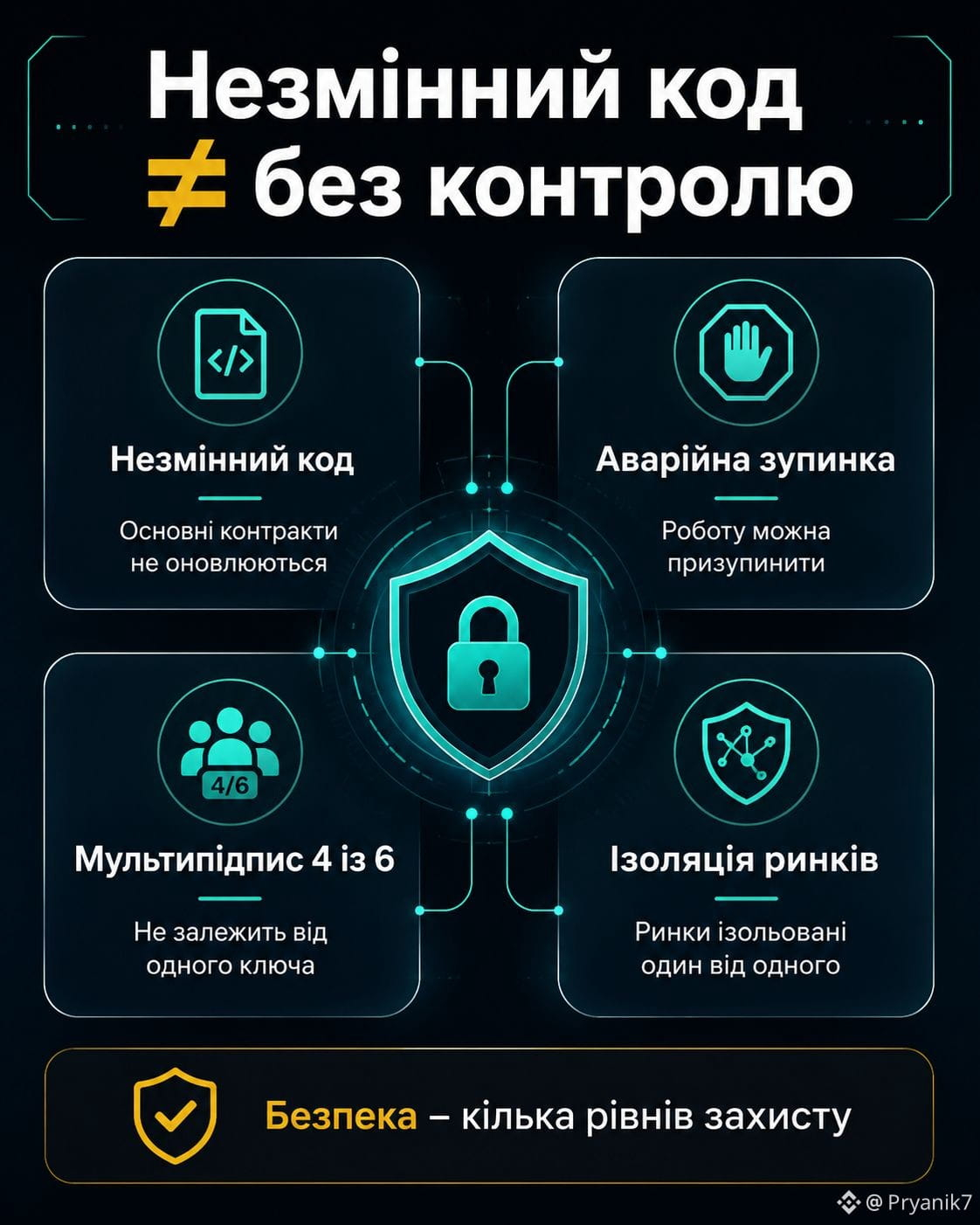
Die wichtigsten Smart Contracts des Protokolls sind so konzipiert, dass sie nicht aktualisiert werden können. Die Ausnahme bilden die Router.
Unveränderlichkeit des Codes beseitigt jedoch keine Notfallkontrolle.
Wenn es zu einem Angriff oder einem Sicherheitsvorfall kommt, kann ein Administrator die Ausführung der Contracts pausieren, um weitere Verluste zu begrenzen.
Es gibt noch eine weitere Ebene.
Wichtige administrative Aktionen sind durch eine Wallet mit einem 4-von-6-Multisig geschützt. Das heißt: Es reicht nicht aus, wenn nur ein Schlüssel entscheidet.
Und selbst die Märkte sind getrennt: Ein Problem in einem Market Contract sollte sich nicht automatisch auf die anderen übertragen.
Für mich ist hier nicht ein einzelner Schutzmechanismus entscheidend, sondern die gesamte Konstruktion:
unveränderlicher Code
+
Möglichkeit der Notfall-Abschaltung
+
verteilter administrativer Kontrollmechanismus
+
Isolation der Märkte.
Deshalb würde ich das Wort „unveränderlich“ nicht mehr als Synonym für vollständige Kontrollfreiheit verstehen.
Richtiger wäre die Frage: Was genau kann nicht geändert werden, wer hat weiterhin Befugnisse und was passiert bei einem echten Notfall?
@termmax #TermMax
Wenn ein Smart Contract als unveränderlich bezeichnet wird, liegt die Schlussfolgerung nahe: Nach dem Start kann niemand mehr in seine Arbeit eingreifen.
Bei TermMax ist es jedoch etwas komplizierter.
Die wichtigsten Smart Contracts des Protokolls sind so konzipiert, dass sie nicht aktualisiert werden können. Die Ausnahme bilden die Router.
Unveränderlichkeit des Codes beseitigt jedoch keine Notfallkontrolle.
Wenn es zu einem Angriff oder einem Sicherheitsvorfall kommt, kann ein Administrator die Ausführung der Contracts pausieren, um weitere Verluste zu begrenzen.
Es gibt noch eine weitere Ebene.
Wichtige administrative Aktionen sind durch eine Wallet mit einem 4-von-6-Multisig geschützt. Das heißt: Es reicht nicht aus, wenn nur ein Schlüssel entscheidet.
Und selbst die Märkte sind getrennt: Ein Problem in einem Market Contract sollte sich nicht automatisch auf die anderen übertragen.
Für mich ist hier nicht ein einzelner Schutzmechanismus entscheidend, sondern die gesamte Konstruktion:
unveränderlicher Code
+
Möglichkeit der Notfall-Abschaltung
+
verteilter administrativer Kontrollmechanismus
+
Isolation der Märkte.
Deshalb würde ich das Wort „unveränderlich“ nicht mehr als Synonym für vollständige Kontrollfreiheit verstehen.
Richtiger wäre die Frage: Was genau kann nicht geändert werden, wer hat weiterhin Befugnisse und was passiert bei einem echten Notfall?
@TermMax #TermMax
Bei TermMax ist es jedoch etwas komplizierter.
Die wichtigsten Smart Contracts des Protokolls sind so konzipiert, dass sie nicht aktualisiert werden können. Die Ausnahme bilden die Router.
Unveränderlichkeit des Codes beseitigt jedoch keine Notfallkontrolle.
Wenn es zu einem Angriff oder einem Sicherheitsvorfall kommt, kann ein Administrator die Ausführung der Contracts pausieren, um weitere Verluste zu begrenzen.
Es gibt noch eine weitere Ebene.
Wichtige administrative Aktionen sind durch eine Wallet mit einem 4-von-6-Multisig geschützt. Das heißt: Es reicht nicht aus, wenn nur ein Schlüssel entscheidet.
Und selbst die Märkte sind getrennt: Ein Problem in einem Market Contract sollte sich nicht automatisch auf die anderen übertragen.
Für mich ist hier nicht ein einzelner Schutzmechanismus entscheidend, sondern die gesamte Konstruktion:
unveränderlicher Code
+
Möglichkeit der Notfall-Abschaltung
+
verteilter administrativer Kontrollmechanismus
+
Isolation der Märkte.
Deshalb würde ich das Wort „unveränderlich“ nicht mehr als Synonym für vollständige Kontrollfreiheit verstehen.
Richtiger wäre die Frage: Was genau kann nicht geändert werden, wer hat weiterhin Befugnisse und was passiert bei einem echten Notfall?
@TermMax #TermMax
9
9
105
·
--
Übersetzung ansehen
Детальний опис функції в документації ще не означає, що нею вже можна користуватися.
У TermMax я б зараз особливо перевіряла це на прикладі Smart Unwind.
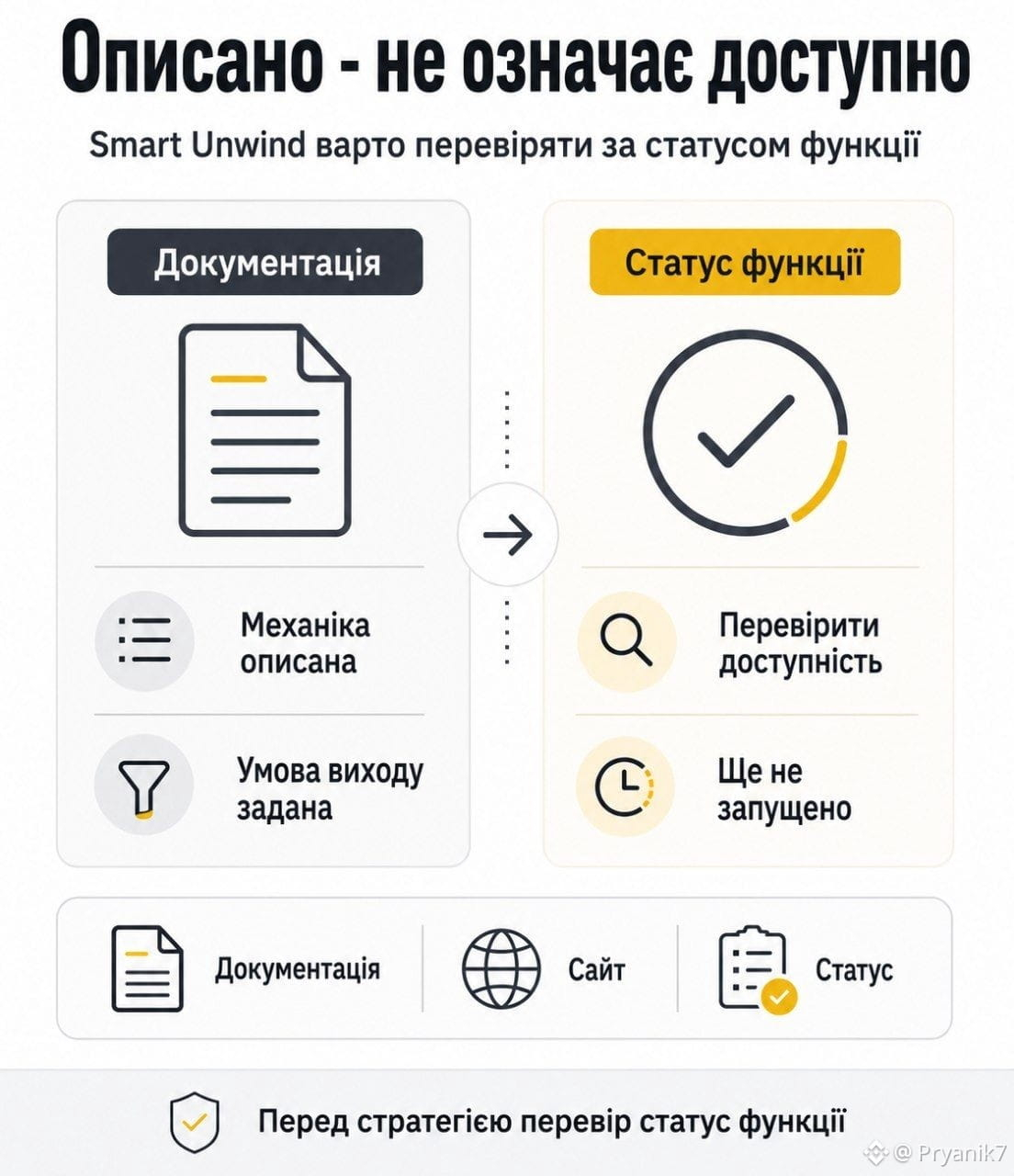
Сам механізм описаний досить конкретно: користувач має задавати умову дострокового виходу з позиції за цільовою ставкою або ціною.
Через таку деталізацію легко вирішити, що функція вже доступна у V2.
Але актуальний сайт TermMax досі відносить Smart Unwind до розділу "What's Next", а в документації Leverager прямо зазначено, що функція ще не запущена.
І ось це для мене набагато корисніша перевірка, ніж просто читати список можливостей протоколу.
Перед тим як будувати стратегію навколо нової функції, я б окремо з'ясувала її статус:
вона вже працює,
тільки запланована,
чи поки що лише описана в документації.
У DeFi різниця між "механіка вже описана" і "функція вже доступна" може бути важливішою, ніж здається.
@termmax #TermMax
Детальний опис функції в документації ще не означає, що нею вже можна користуватися.
У TermMax я б зараз особливо перевіряла це на прикладі Smart Unwind.
Сам механізм описаний досить конкретно: користувач має задавати умову дострокового виходу з позиції за цільовою ставкою або ціною.
Через таку деталізацію легко вирішити, що функція вже доступна у V2.
Але актуальний сайт TermMax досі відносить Smart Unwind до розділу "What's Next", а в документації Leverager прямо зазначено, що функція ще не запущена.
І ось це для мене набагато корисніша перевірка, ніж просто читати список можливостей протоколу.
Перед тим як будувати стратегію навколо нової функції, я б окремо з'ясувала її статус:
вона вже працює,
тільки запланована,
чи поки що лише описана в документації.
У DeFi різниця між "механіка вже описана" і "функція вже доступна" може бути важливішою, ніж здається.
@TermMax #TermMax
У TermMax я б зараз особливо перевіряла це на прикладі Smart Unwind.
Сам механізм описаний досить конкретно: користувач має задавати умову дострокового виходу з позиції за цільовою ставкою або ціною.
Через таку деталізацію легко вирішити, що функція вже доступна у V2.
Але актуальний сайт TermMax досі відносить Smart Unwind до розділу "What's Next", а в документації Leverager прямо зазначено, що функція ще не запущена.
І ось це для мене набагато корисніша перевірка, ніж просто читати список можливостей протоколу.
Перед тим як будувати стратегію навколо нової функції, я б окремо з'ясувала її статус:
вона вже працює,
тільки запланована,
чи поки що лише описана в документації.
У DeFi різниця між "механіка вже описана" і "функція вже доступна" може бути важливішою, ніж здається.
@TermMax #TermMax
1
136
·
--
Übersetzung ansehen
Плече 4,8x не означає, що комісія в TermMax рахується з усієї позиції 4,8x.
І от це, як на мене, одна з тих деталей, які легко пропустити, якщо дивитися тільки на найбільшу цифру на екрані.
У TermMax для позиції з плечем спочатку виділяється саме позичена частина:
сума позики = внесок × (множник плеча - 1)
Якщо внесок 1 000 USDC, а плече 4,8x, то позичена частина дорівнює 3 800 USDC, а не 4 800 USDC всієї позиції.
Саме від цієї позиченої частини далі рахується протокольна комісія для плеча.
Але є ще один нюанс: на комісію впливає не тільки розмір плеча. У формулі також є час до погашення.
Тобто для оцінки витрат я б дивилася не просто на 4,8x, а одразу на три речі:
- власний внесок
- позичену частину
- дні до погашення
Іноді найважливіша цифра в позиції - не найбільша.
@termmax #TermMax
Плече 4,8x не означає, що комісія в TermMax рахується з усієї позиції 4,8x.
І от це, як на мене, одна з тих деталей, які легко пропустити, якщо дивитися тільки на найбільшу цифру на екрані.
У TermMax для позиції з плечем спочатку виділяється саме позичена частина:
сума позики = внесок × (множник плеча - 1)
Якщо внесок 1 000 USDC, а плече 4,8x, то позичена частина дорівнює 3 800 USDC, а не 4 800 USDC всієї позиції.
Саме від цієї позиченої частини далі рахується протокольна комісія для плеча.
Але є ще один нюанс: на комісію впливає не тільки розмір плеча. У формулі також є час до погашення.
Тобто для оцінки витрат я б дивилася не просто на 4,8x, а одразу на три речі:
- власний внесок
- позичену частину
- дні до погашення
Іноді найважливіша цифра в позиції - не найбільша.
@TermMax #TermMax
І от це, як на мене, одна з тих деталей, які легко пропустити, якщо дивитися тільки на найбільшу цифру на екрані.
У TermMax для позиції з плечем спочатку виділяється саме позичена частина:
сума позики = внесок × (множник плеча - 1)
Якщо внесок 1 000 USDC, а плече 4,8x, то позичена частина дорівнює 3 800 USDC, а не 4 800 USDC всієї позиції.
Саме від цієї позиченої частини далі рахується протокольна комісія для плеча.
Але є ще один нюанс: на комісію впливає не тільки розмір плеча. У формулі також є час до погашення.
Тобто для оцінки витрат я б дивилася не просто на 4,8x, а одразу на три речі:
- власний внесок
- позичену частину
- дні до погашення
Іноді найважливіша цифра в позиції - не найбільша.
@TermMax #TermMax

1
106
·
--
Übersetzung ansehen
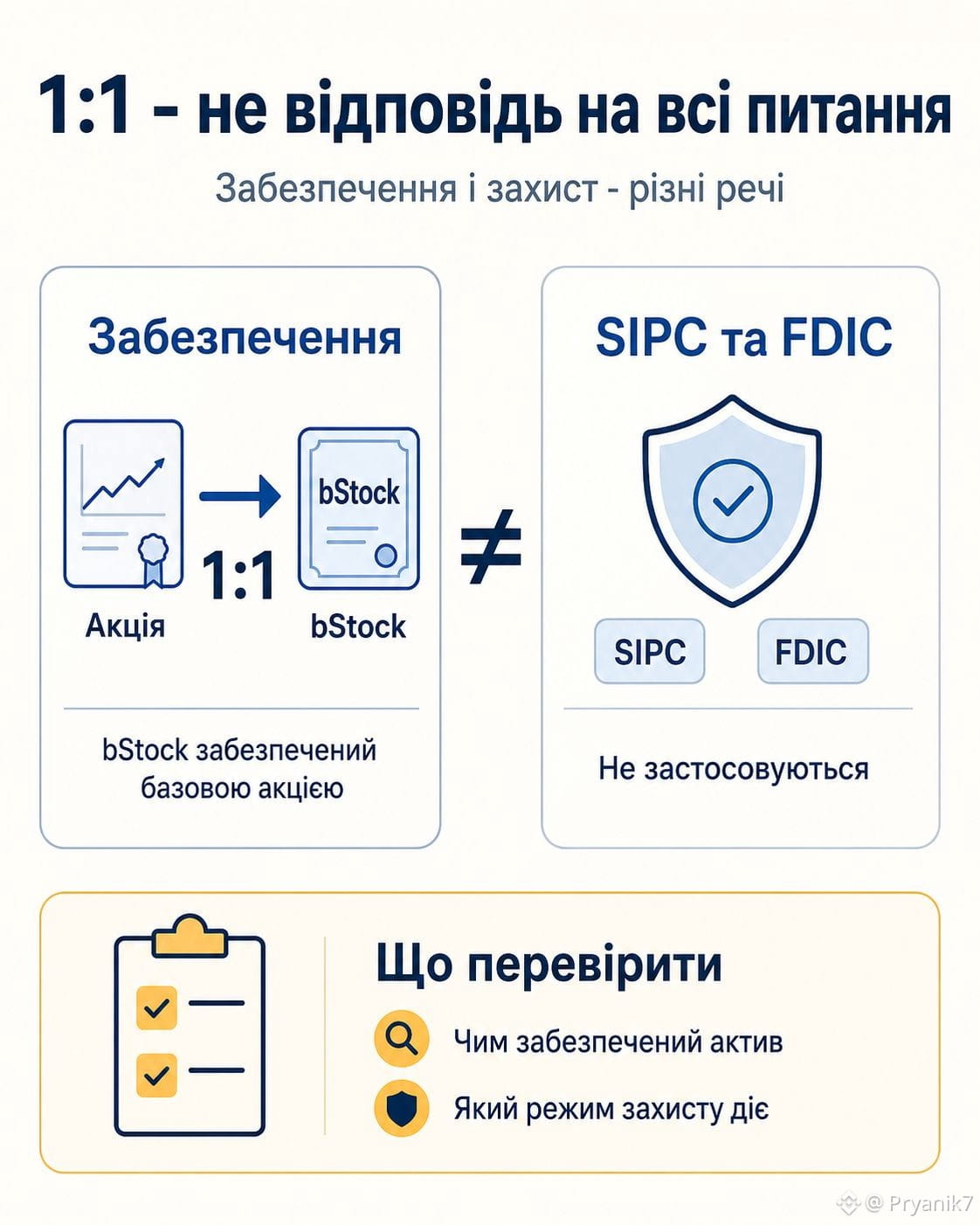
1:1 у bStocks відповідає лише на одне питання.
Чим забезпечений цей продукт?
Але ця цифра не відповідає на інше: який саме захист отримує його власник.
У FAQ Binance є деталь, яку легко пропустити. bStocks не є американськими брокерськими рахунками, банківськими депозитами або прямим володінням акціями, що котируються у США.
Тому захист SIPC, який у певних випадках стосується активів клієнтів брокерів-учасників SIPC, не поширюється на bStocks.
Так само до них не застосовується страхування FDIC, призначене для відповідних банківських депозитів.
І тут важливо не змішувати дві різні речі:
забезпечення 1:1 - це структура активу;
захист інвестора - це окреме питання.
Наявність реальної базової акції за bStock не перетворює сертифікат на звичайний американський брокерський рахунок.
Тому при оцінці токенізованого активу одного питання чи є забезпечення мені було б недостатньо.
Друге питання не менш важливе - який саме продукт я тримаю і який режим захисту до нього застосовується?
@BinanceCIS #bStocksCIS
1:1 у bStocks відповідає лише на одне питання.
Чим забезпечений цей продукт?
Але ця цифра не відповідає на інше: який саме захист отримує його власник.
У FAQ Binance є деталь, яку легко пропустити. bStocks не є американськими брокерськими рахунками, банківськими депозитами або прямим володінням акціями, що котируються у США.
Тому захист SIPC, який у певних випадках стосується активів клієнтів брокерів-учасників SIPC, не поширюється на bStocks.
Так само до них не застосовується страхування FDIC, призначене для відповідних банківських депозитів.
І тут важливо не змішувати дві різні речі:
забезпечення 1:1 - це структура активу;
захист інвестора - це окреме питання.
Наявність реальної базової акції за bStock не перетворює сертифікат на звичайний американський брокерський рахунок.
Тому при оцінці токенізованого активу одного питання чи є забезпечення мені було б недостатньо.
Друге питання не менш важливе - який саме продукт я тримаю і який режим захисту до нього застосовується?
@BinanceCIS #bStocksCIS
Чим забезпечений цей продукт?
Але ця цифра не відповідає на інше: який саме захист отримує його власник.
У FAQ Binance є деталь, яку легко пропустити. bStocks не є американськими брокерськими рахунками, банківськими депозитами або прямим володінням акціями, що котируються у США.
Тому захист SIPC, який у певних випадках стосується активів клієнтів брокерів-учасників SIPC, не поширюється на bStocks.
Так само до них не застосовується страхування FDIC, призначене для відповідних банківських депозитів.
І тут важливо не змішувати дві різні речі:
забезпечення 1:1 - це структура активу;
захист інвестора - це окреме питання.
Наявність реальної базової акції за bStock не перетворює сертифікат на звичайний американський брокерський рахунок.
Тому при оцінці токенізованого активу одного питання чи є забезпечення мені було б недостатньо.
Друге питання не менш важливе - який саме продукт я тримаю і який режим захисту до нього застосовується?
@BinanceCIS #bStocksCIS
1
64
·
--
Im Lager von TermMax kannst du dir den Saldo der Anteile leicht ansehen und dir denken: Wenn sie nicht mehr geworden sind, gibt es auch fast keine Bewegung.
Aber hier steckt genau der Knackpunkt.
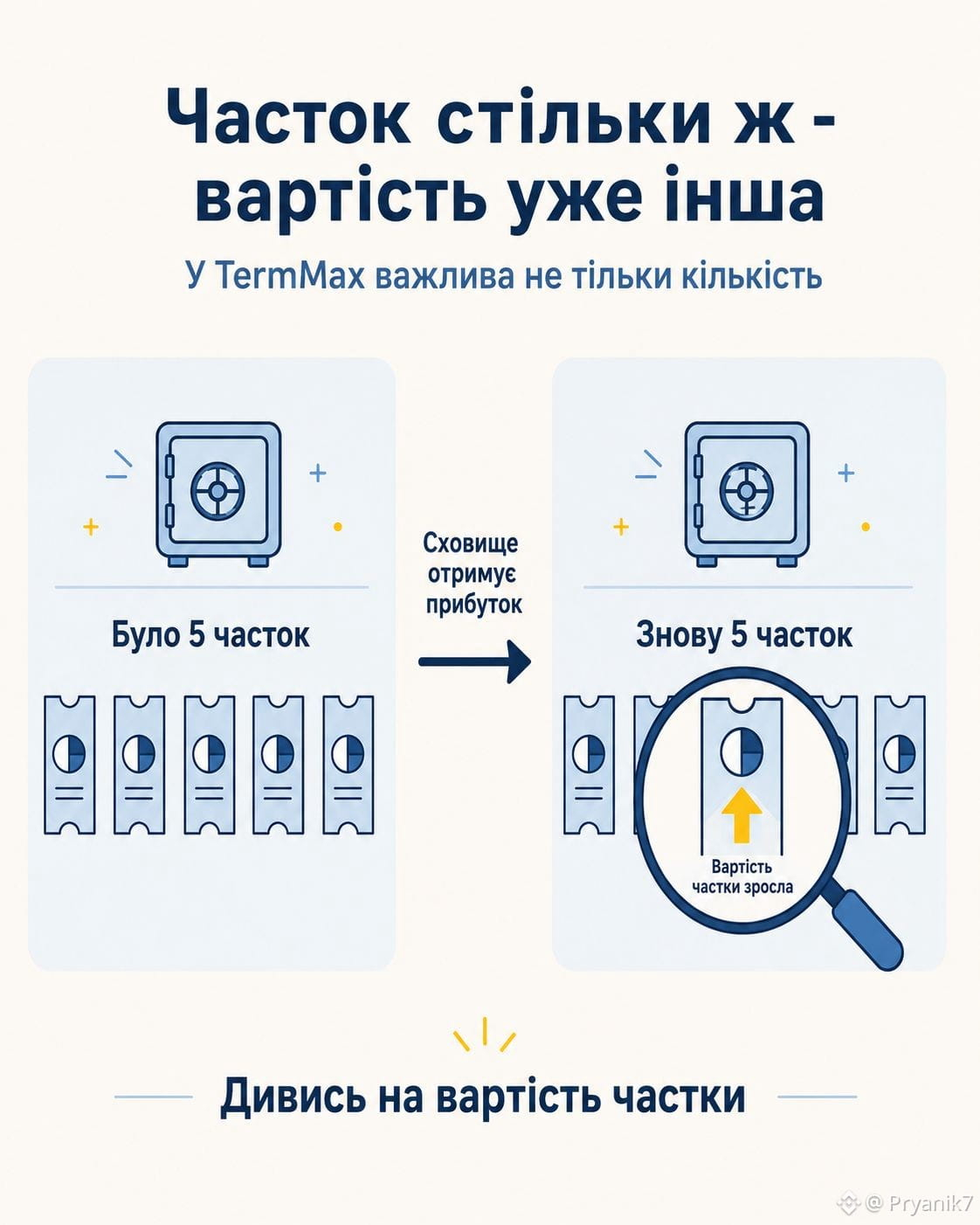
Im Lager ist nicht nur die Anzahl der Anteile wichtig, sondern auch, wie viel Vermögen hinter jedem einzelnen Anteil steckt.
Das Lager kann also durchaus gut funktionieren, und auf deinem Saldo wirst du trotzdem dieselben Anteile sehen.
Nicht die Anzahl wird sich ändern, sondern ihr Gewicht.
Deshalb würde ich in TermMax die Position nicht wie einen gewöhnlichen Zähler für Token betrachten.
Wenn das Lager Gewinn macht, steigt der Wert eines einzelnen Anteils. Und das wirkt sich bereits auf die gesamte Position aus, auch ohne dass neue Einheiten im Saldo auftauchen.
Für mich ist das eine dieser Details, die man leicht übersieht, wenn man daran gewöhnt ist, alles nur nach der Anzahl zu bewerten.
In TermMax ist ein Anteil des Lagers nicht einfach nur etwas auf dem Saldo. Es ist ein Anteil an der Beteiligung am Lager selbst.
Und genau seinen aktuellen Wert würde ich zuerst überprüfen.
@termmax #TermMax
Im Lager von TermMax kannst du dir den Saldo der Anteile leicht ansehen und dir denken: Wenn sie nicht mehr geworden sind, gibt es auch fast keine Bewegung.
Aber hier steckt genau der Knackpunkt.
Im Lager ist nicht nur die Anzahl der Anteile wichtig, sondern auch, wie viel Vermögen hinter jedem einzelnen Anteil steckt.
Das Lager kann also durchaus gut funktionieren, und auf deinem Saldo wirst du trotzdem dieselben Anteile sehen.
Nicht die Anzahl wird sich ändern, sondern ihr Gewicht.
Deshalb würde ich in TermMax die Position nicht wie einen gewöhnlichen Zähler für Token betrachten.
Wenn das Lager Gewinn macht, steigt der Wert eines einzelnen Anteils. Und das wirkt sich bereits auf die gesamte Position aus, auch ohne dass neue Einheiten im Saldo auftauchen.
Für mich ist das eine dieser Details, die man leicht übersieht, wenn man daran gewöhnt ist, alles nur nach der Anzahl zu bewerten.
In TermMax ist ein Anteil des Lagers nicht einfach nur etwas auf dem Saldo. Es ist ein Anteil an der Beteiligung am Lager selbst.
Und genau seinen aktuellen Wert würde ich zuerst überprüfen.
@TermMax #TermMax
Aber hier steckt genau der Knackpunkt.
Im Lager ist nicht nur die Anzahl der Anteile wichtig, sondern auch, wie viel Vermögen hinter jedem einzelnen Anteil steckt.
Das Lager kann also durchaus gut funktionieren, und auf deinem Saldo wirst du trotzdem dieselben Anteile sehen.
Nicht die Anzahl wird sich ändern, sondern ihr Gewicht.
Deshalb würde ich in TermMax die Position nicht wie einen gewöhnlichen Zähler für Token betrachten.
Wenn das Lager Gewinn macht, steigt der Wert eines einzelnen Anteils. Und das wirkt sich bereits auf die gesamte Position aus, auch ohne dass neue Einheiten im Saldo auftauchen.
Für mich ist das eine dieser Details, die man leicht übersieht, wenn man daran gewöhnt ist, alles nur nach der Anzahl zu bewerten.
In TermMax ist ein Anteil des Lagers nicht einfach nur etwas auf dem Saldo. Es ist ein Anteil an der Beteiligung am Lager selbst.
Und genau seinen aktuellen Wert würde ich zuerst überprüfen.
@TermMax #TermMax
1
78
·
--
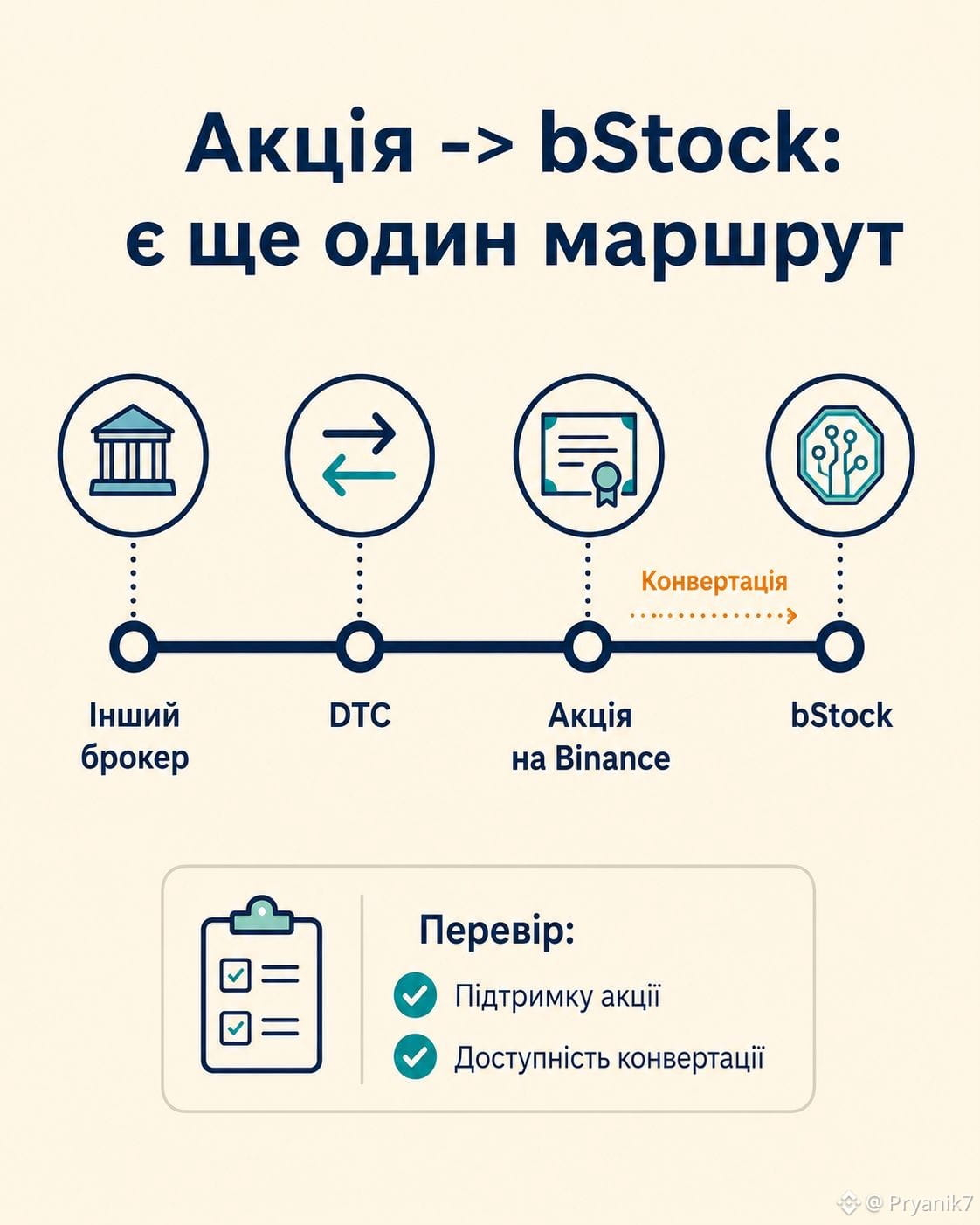
Ich bin es gewohnt zu denken, dass der Weg zu bStock bereits innerhalb von Binance beginnt: es dort im Spot zu kaufen oder in einen Coin umzuwandeln, der bereits dort vorhanden ist.
Aber jetzt habe ich noch eine andere Route gefunden – DTC.
Binance unterstützt die Übertragung von Aktien von einem anderen Broker über das DTC-System. Die Übertragung selbst beginnt beim Broker, bei dem die Aktien aktuell verwahrt werden, und bei Binance kann man die Angaben erhalten, die für ihre Gutschrift erforderlich sind.
Und genau hier wird es für bStocks interessant.
Wenn die übertragene Aktie von der Plattform unterstützt wird und der entsprechenden Funktion für den Nutzer verfügbar ist, kann eine Position bereits auf Binance in den entsprechenden bStock umgewandelt werden.
Das bedeutet, dass die Kette etwa so aussehen kann:
anderer Broker –> DTC –> Aktie auf Binance –> bStock
Für mich ist der wichtigste Punkt dabei nicht einmal die eigentliche Übertragung.
Um einen bStock aus einer bereits vorhandenen Position zu bekommen, muss man die Aktie nicht zwingend erst verkaufen, das Geld übertragen und dann den Vermögenswert erneut kaufen. Es gibt einen Weg, bei dem die unterstützte Aktie selbst übertragen wird, und die Tokenisierung erfolgt erst danach.
Allerdings würde ich zwei Dinge separat prüfen: ob die konkrete Aktie für die Übertragung unterstützt wird und ob für sie die Umwandlung in bStock verfügbar ist.
Denn eine Aktie nach Binance zu übertragen und sie dann in einen bStock umzuwandeln, sind schließlich zwei unterschiedliche Schritte.
@BinanceCIS #bStocksCIS
Ich bin es gewohnt zu denken, dass der Weg zu bStock bereits innerhalb von Binance beginnt: es dort im Spot zu kaufen oder in einen Coin umzuwandeln, der bereits dort vorhanden ist.
Aber jetzt habe ich noch eine andere Route gefunden – DTC.
Binance unterstützt die Übertragung von Aktien von einem anderen Broker über das DTC-System. Die Übertragung selbst beginnt beim Broker, bei dem die Aktien aktuell verwahrt werden, und bei Binance kann man die Angaben erhalten, die für ihre Gutschrift erforderlich sind.
Und genau hier wird es für bStocks interessant.
Wenn die übertragene Aktie von der Plattform unterstützt wird und der entsprechenden Funktion für den Nutzer verfügbar ist, kann eine Position bereits auf Binance in den entsprechenden bStock umgewandelt werden.
Das bedeutet, dass die Kette etwa so aussehen kann:
anderer Broker –> DTC –> Aktie auf Binance –> bStock
Für mich ist der wichtigste Punkt dabei nicht einmal die eigentliche Übertragung.
Um einen bStock aus einer bereits vorhandenen Position zu bekommen, muss man die Aktie nicht zwingend erst verkaufen, das Geld übertragen und dann den Vermögenswert erneut kaufen. Es gibt einen Weg, bei dem die unterstützte Aktie selbst übertragen wird, und die Tokenisierung erfolgt erst danach.
Allerdings würde ich zwei Dinge separat prüfen: ob die konkrete Aktie für die Übertragung unterstützt wird und ob für sie die Umwandlung in bStock verfügbar ist.
Denn eine Aktie nach Binance zu übertragen und sie dann in einen bStock umzuwandeln, sind schließlich zwei unterschiedliche Schritte.
@BinanceCIS #bStocksCIS
Aber jetzt habe ich noch eine andere Route gefunden – DTC.
Binance unterstützt die Übertragung von Aktien von einem anderen Broker über das DTC-System. Die Übertragung selbst beginnt beim Broker, bei dem die Aktien aktuell verwahrt werden, und bei Binance kann man die Angaben erhalten, die für ihre Gutschrift erforderlich sind.
Und genau hier wird es für bStocks interessant.
Wenn die übertragene Aktie von der Plattform unterstützt wird und der entsprechenden Funktion für den Nutzer verfügbar ist, kann eine Position bereits auf Binance in den entsprechenden bStock umgewandelt werden.
Das bedeutet, dass die Kette etwa so aussehen kann:
anderer Broker –> DTC –> Aktie auf Binance –> bStock
Für mich ist der wichtigste Punkt dabei nicht einmal die eigentliche Übertragung.
Um einen bStock aus einer bereits vorhandenen Position zu bekommen, muss man die Aktie nicht zwingend erst verkaufen, das Geld übertragen und dann den Vermögenswert erneut kaufen. Es gibt einen Weg, bei dem die unterstützte Aktie selbst übertragen wird, und die Tokenisierung erfolgt erst danach.
Allerdings würde ich zwei Dinge separat prüfen: ob die konkrete Aktie für die Übertragung unterstützt wird und ob für sie die Umwandlung in bStock verfügbar ist.
Denn eine Aktie nach Binance zu übertragen und sie dann in einen bStock umzuwandeln, sind schließlich zwei unterschiedliche Schritte.
@BinanceCIS #bStocksCIS
64
·
--
Übersetzung ansehen
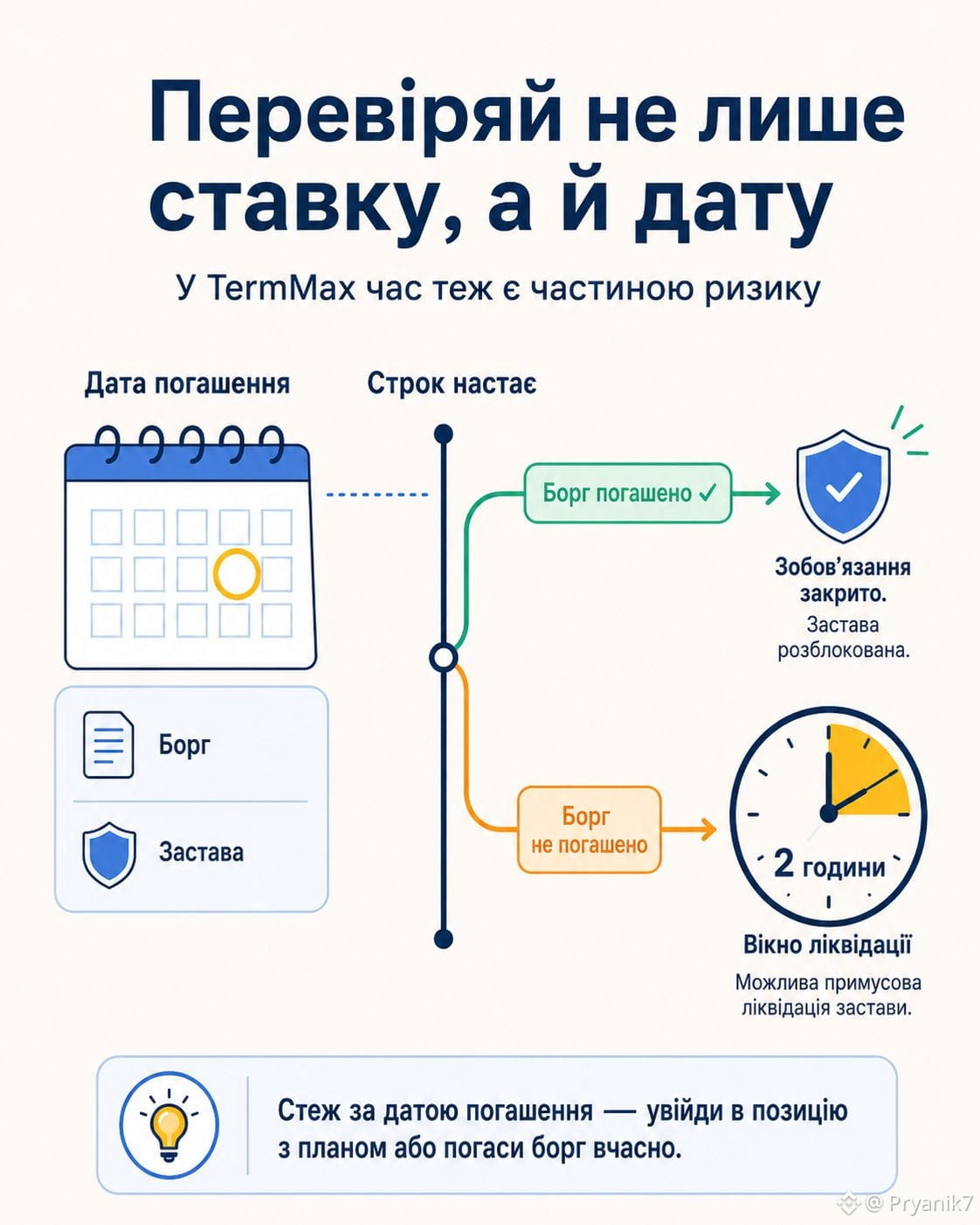
У @termmax ліквідацію може запустити не лише падіння вартості застави.
Є ще один тригер, який легко недооцінити - календар.
Позика має фіксовану дату погашення. Якщо борг не погашений до цього моменту, позиція позначається для ліквідації.
І тут я знайшла важливу деталь: після пропущеної дати погашення відкривається двогодинне вікно ліквідації.
Тобто достатня застава до цього моменту ще не означає, що строк можна просто пропустити.
Для мене це змінює сам погляд на фіксовану позицію.
Зазвичай увага йде на ставку, розмір застави та рух ціни. Але в TermMax є ще один параметр, який не змінюється разом із ринком - час.
Тому перед позикою я б окремо перевірила точну дату погашення і не залишала її десь між іншими цифрами.
Бо можна правильно оцінити заставу, але все одно отримати проблему через один пропущений день у календарі.
#TermMax
У @TermMax ліквідацію може запустити не лише падіння вартості застави.
Є ще один тригер, який легко недооцінити - календар.
Позика має фіксовану дату погашення. Якщо борг не погашений до цього моменту, позиція позначається для ліквідації.
І тут я знайшла важливу деталь: після пропущеної дати погашення відкривається двогодинне вікно ліквідації.
Тобто достатня застава до цього моменту ще не означає, що строк можна просто пропустити.
Для мене це змінює сам погляд на фіксовану позицію.
Зазвичай увага йде на ставку, розмір застави та рух ціни. Але в TermMax є ще один параметр, який не змінюється разом із ринком - час.
Тому перед позикою я б окремо перевірила точну дату погашення і не залишала її десь між іншими цифрами.
Бо можна правильно оцінити заставу, але все одно отримати проблему через один пропущений день у календарі.
#TermMax
Є ще один тригер, який легко недооцінити - календар.
Позика має фіксовану дату погашення. Якщо борг не погашений до цього моменту, позиція позначається для ліквідації.
І тут я знайшла важливу деталь: після пропущеної дати погашення відкривається двогодинне вікно ліквідації.
Тобто достатня застава до цього моменту ще не означає, що строк можна просто пропустити.
Для мене це змінює сам погляд на фіксовану позицію.
Зазвичай увага йде на ставку, розмір застави та рух ціни. Але в TermMax є ще один параметр, який не змінюється разом із ринком - час.
Тому перед позикою я б окремо перевірила точну дату погашення і не залишала її десь між іншими цифрами.
Бо можна правильно оцінити заставу, але все одно отримати проблему через один пропущений день у календарі.
#TermMax
110
·
--
Artikel
Übersetzung ansehen
Developer Flywheel: AI Studio and Model Factory Ecosystem as the Main Driver of Utility $OPENMost observers evaluate Web3 AI infrastructure purely from the supply side:
How many GPUs are connected, or how many gigabytes of raw data are being hosted?
I think that approach only solves half the equation.
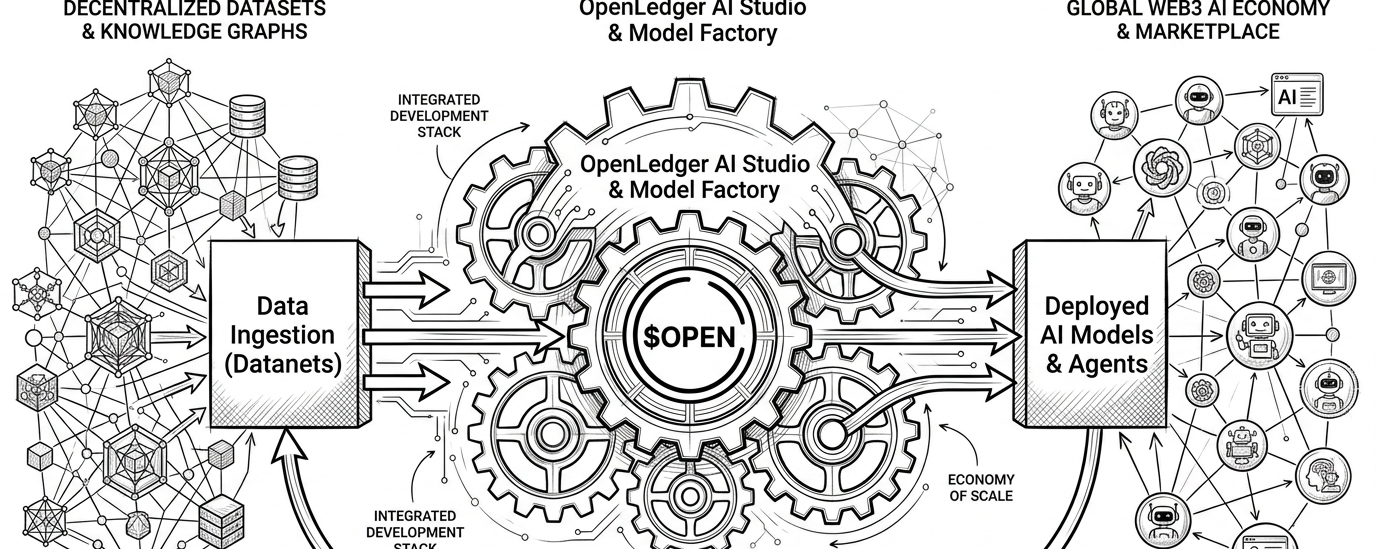
Having massive computing power and raw data stores is useless if builders find it too complicated to assemble them into working applications. Infrastructure systems rarely fail because of a lack of raw materials; they fail because of friction in the development flow. OpenLedger’s documentation addresses this specific challenge not by just offering raw hardware, but by introducing an integrated builder stack: AI Studio and the Model Factory.
This shifts the core question from "how much data do we have?" to something far more critical for token value:
How quickly can a developer turn raw data into a revenue-generating AI asset?
That is where the developer flywheel begins to drive the utility of OpenLedger.
In practical terms, traditional AI development is highly fragmented. A developer must source data from one provider, rent compute from another, handle fine-tuning locally, and then find a centralized cloud service to host the final model. OpenLedger converges this entire lifecycle onto an AI-native blockchain.
The process is structured into an intentional, automated pipeline. Through the AI Studio, developers can access verified, domain-specific datasets (Datanets) and seamlessly configure low-rank adaptations via OpenLoRA. Once optimized, the Model Factory takes over, managing the secure on-chain deployment and execution of the fine-tuned models.
This matters because it turns the OpenLedger token into an absolute operational necessity, rather than a speculative asset.
Instead of a passive payment option, OpenLedger acts as the universal coordination fluid across the entire development engine:
1. Ingestion: Developers use $OPEN to access high-fidelity Datanets.
2. Refinement: The computation required for fine-tuning within AI Studio is cleared using $OPEN.
3. Deployment: Executing queries (inference) on the finalized models from the Model Factory requires $OPEN fees.
This is where the architecture becomes incredibly smart. It creates a closed-loop economic flywheel.
Every time a developer builds an application using AI Studio, they lock in utility. As those apps go live via the Model Factory and attract end-users, the demand for inference increases. This inference volume generates fees, a portion of which flows back to the original data providers via Proof of Attribution. This reward then attracts even higher-quality data contributors to the Datanets, which in turn draws more developers looking for pristine inputs.
The token design succeeds because it aligns developer convenience with structural token sinks.
By making the development flow versioned, open-source friendly, and deeply integrated, OpenLedger removes the friction that usually kills decentralized applications. Builders don't have to stitch together uncooperative systems; they use a unified stack where the network token automatically handles data provenance, compute allocation, and hosting.
When looking at OpenLedger, do not just look at a ticker on an exchange.
Look at the underlying engine. The true value of an infrastructure network is measured by the velocity of the applications built on top of it. By securing the developer pipeline through AI Studio and the Model Factory, OpenLedger ensures that the heaviest builders are natively the biggest drivers of ecosystem demand.
@Openledger #OpenLedger $OPEN
Developer Flywheel: AI Studio and Model Factory Ecosystem as the Main Driver of Utility $OPEN
Most observers evaluate Web3 AI infrastructure purely from the supply side:
How many GPUs are connected, or how many gigabytes of raw data are being hosted?
I think that approach only solves half the equation.
Having massive computing power and raw data stores is useless if builders find it too complicated to assemble them into working applications. Infrastructure systems rarely fail because of a lack of raw materials; they fail because of friction in the development flow. OpenLedger’s documentation addresses this specific challenge not by just offering raw hardware, but by introducing an integrated builder stack: AI Studio and the Model Factory.
This shifts the core question from "how much data do we have?" to something far more critical for token value:
How quickly can a developer turn raw data into a revenue-generating AI asset?
That is where the developer flywheel begins to drive the utility of OpenLedger.
In practical terms, traditional AI development is highly fragmented. A developer must source data from one provider, rent compute from another, handle fine-tuning locally, and then find a centralized cloud service to host the final model. OpenLedger converges this entire lifecycle onto an AI-native blockchain.
The process is structured into an intentional, automated pipeline. Through the AI Studio, developers can access verified, domain-specific datasets (Datanets) and seamlessly configure low-rank adaptations via OpenLoRA. Once optimized, the Model Factory takes over, managing the secure on-chain deployment and execution of the fine-tuned models.
This matters because it turns the OpenLedger token into an absolute operational necessity, rather than a speculative asset.
Instead of a passive payment option, OpenLedger acts as the universal coordination fluid across the entire development engine:
1. Ingestion: Developers use $OPEN to access high-fidelity Datanets.
2. Refinement: The computation required for fine-tuning within AI Studio is cleared using $OPEN .
3. Deployment: Executing queries (inference) on the finalized models from the Model Factory requires $OPEN fees.
This is where the architecture becomes incredibly smart. It creates a closed-loop economic flywheel.
Every time a developer builds an application using AI Studio, they lock in utility. As those apps go live via the Model Factory and attract end-users, the demand for inference increases. This inference volume generates fees, a portion of which flows back to the original data providers via Proof of Attribution. This reward then attracts even higher-quality data contributors to the Datanets, which in turn draws more developers looking for pristine inputs.
The token design succeeds because it aligns developer convenience with structural token sinks.
By making the development flow versioned, open-source friendly, and deeply integrated, OpenLedger removes the friction that usually kills decentralized applications. Builders don't have to stitch together uncooperative systems; they use a unified stack where the network token automatically handles data provenance, compute allocation, and hosting.
When looking at OpenLedger, do not just look at a ticker on an exchange.
Look at the underlying engine. The true value of an infrastructure network is measured by the velocity of the applications built on top of it. By securing the developer pipeline through AI Studio and the Model Factory, OpenLedger ensures that the heaviest builders are natively the biggest drivers of ecosystem demand.
@OpenLedger #OpenLedger $OPEN
How many GPUs are connected, or how many gigabytes of raw data are being hosted?
I think that approach only solves half the equation.
Having massive computing power and raw data stores is useless if builders find it too complicated to assemble them into working applications. Infrastructure systems rarely fail because of a lack of raw materials; they fail because of friction in the development flow. OpenLedger’s documentation addresses this specific challenge not by just offering raw hardware, but by introducing an integrated builder stack: AI Studio and the Model Factory.
This shifts the core question from "how much data do we have?" to something far more critical for token value:
How quickly can a developer turn raw data into a revenue-generating AI asset?
That is where the developer flywheel begins to drive the utility of OpenLedger.
In practical terms, traditional AI development is highly fragmented. A developer must source data from one provider, rent compute from another, handle fine-tuning locally, and then find a centralized cloud service to host the final model. OpenLedger converges this entire lifecycle onto an AI-native blockchain.
The process is structured into an intentional, automated pipeline. Through the AI Studio, developers can access verified, domain-specific datasets (Datanets) and seamlessly configure low-rank adaptations via OpenLoRA. Once optimized, the Model Factory takes over, managing the secure on-chain deployment and execution of the fine-tuned models.
This matters because it turns the OpenLedger token into an absolute operational necessity, rather than a speculative asset.
Instead of a passive payment option, OpenLedger acts as the universal coordination fluid across the entire development engine:
1. Ingestion: Developers use $OPEN to access high-fidelity Datanets.
2. Refinement: The computation required for fine-tuning within AI Studio is cleared using $OPEN .
3. Deployment: Executing queries (inference) on the finalized models from the Model Factory requires $OPEN fees.
This is where the architecture becomes incredibly smart. It creates a closed-loop economic flywheel.
Every time a developer builds an application using AI Studio, they lock in utility. As those apps go live via the Model Factory and attract end-users, the demand for inference increases. This inference volume generates fees, a portion of which flows back to the original data providers via Proof of Attribution. This reward then attracts even higher-quality data contributors to the Datanets, which in turn draws more developers looking for pristine inputs.
The token design succeeds because it aligns developer convenience with structural token sinks.
By making the development flow versioned, open-source friendly, and deeply integrated, OpenLedger removes the friction that usually kills decentralized applications. Builders don't have to stitch together uncooperative systems; they use a unified stack where the network token automatically handles data provenance, compute allocation, and hosting.
When looking at OpenLedger, do not just look at a ticker on an exchange.
Look at the underlying engine. The true value of an infrastructure network is measured by the velocity of the applications built on top of it. By securing the developer pipeline through AI Studio and the Model Factory, OpenLedger ensures that the heaviest builders are natively the biggest drivers of ecosystem demand.
@OpenLedger #OpenLedger $OPEN
1
1
117
·
--
Übersetzung ansehen
Why AI hallucinations are actually a data problem and how OpenLedger fixes it on-chain?
Most people blame neural network architecture when an AI "hallucinates" or confidently makes up fake facts.
I think they are looking at the wrong end of the pipeline.
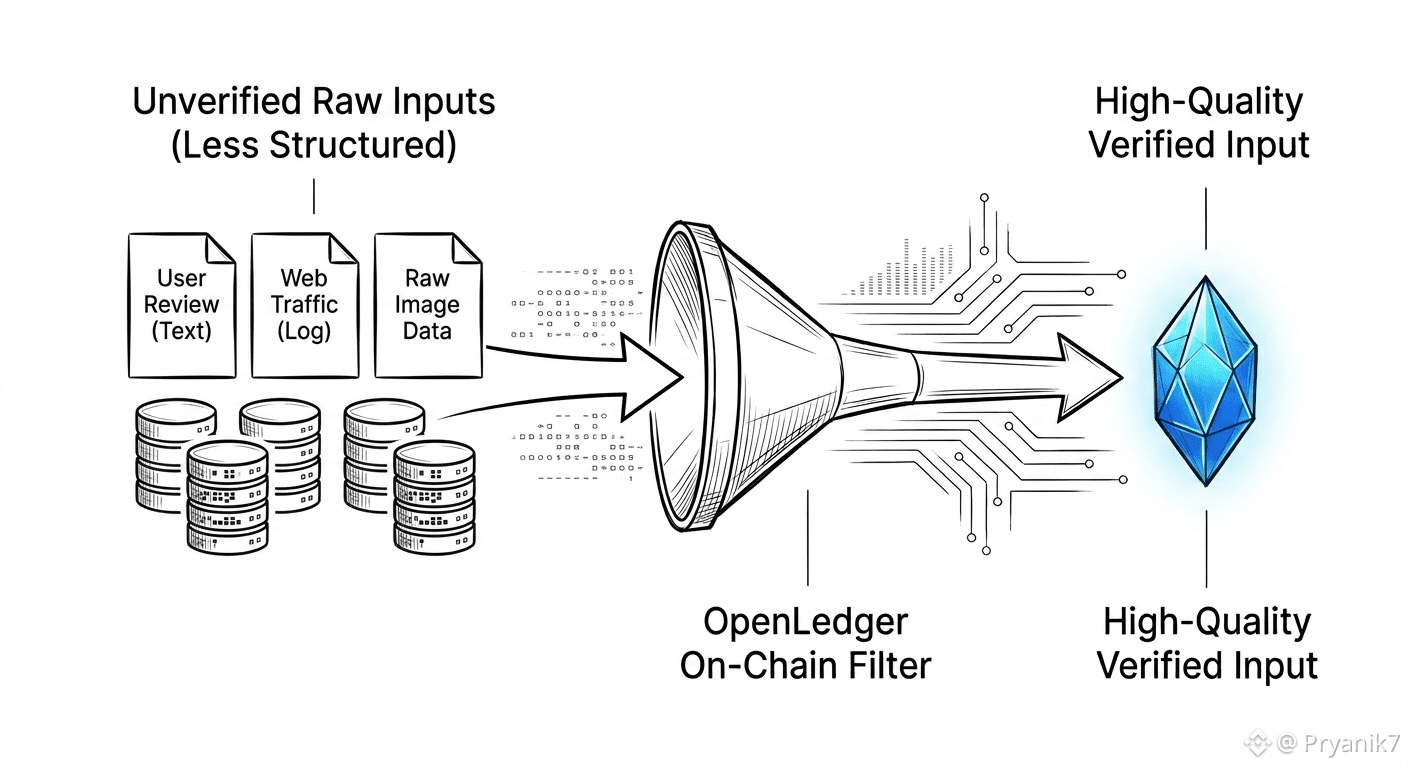
An AI model is only as good as the raw information it consumes. If you train a model on unverified open-source internet data filled with noise, bias, and contradictions, the resulting output will inevitably inherit those exact flaws. The root of the issue isn't the code; it's the lack of data quality control.
Centralized AI giants try to patch this with massive teams of human labelers. OpenLedger solves it at the infrastructure layer.
Instead of relying on opaque, centralized filtering, OpenLedger uses its specialized AI-native blockchain to run data validation entirely on-chain. Through the architecture of Datanets, data is not just stored; it is strictly vetted, categorized, and cryptographically verified before it ever touches a model's training layer.
This structural boundary fundamentally alters the pipeline:
Raw data submitted -> Verified by decentralized validators -> Immutable proof of quality recorded on-chain -> Delivered as pristine input for model fine-tuning.
And that’s why the $OPEN token is so critical to this specific cycle.
By using the Proof of Attribution mechanism, the network rewards data contributors based on the verifiable quality and utility of their data, not just the volume. It creates an economic filter that penalizes spam and prioritizes high-fidelity, niche datasets.
When you clean the foundation, you eliminate the hallucination.
OpenLedger is proving that the ultimate cure for unreliable AI outputs isn't building bigger monolithic models-it's creating an uncorruptible, blockchain-verified foundation for data ingestion.
{spot}(OPENUSDT)
@Openledger #OpenLedger $OPEN
Why AI hallucinations are actually a data problem and how OpenLedger fixes it on-chain?
Most people blame neural network architecture when an AI "hallucinates" or confidently makes up fake facts.
I think they are looking at the wrong end of the pipeline.
An AI model is only as good as the raw information it consumes. If you train a model on unverified open-source internet data filled with noise, bias, and contradictions, the resulting output will inevitably inherit those exact flaws. The root of the issue isn't the code; it's the lack of data quality control.
Centralized AI giants try to patch this with massive teams of human labelers. OpenLedger solves it at the infrastructure layer.
Instead of relying on opaque, centralized filtering, OpenLedger uses its specialized AI-native blockchain to run data validation entirely on-chain. Through the architecture of Datanets, data is not just stored; it is strictly vetted, categorized, and cryptographically verified before it ever touches a model's training layer.
This structural boundary fundamentally alters the pipeline:
Raw data submitted -> Verified by decentralized validators -> Immutable proof of quality recorded on-chain -> Delivered as pristine input for model fine-tuning.
And that’s why the $OPEN token is so critical to this specific cycle.
By using the Proof of Attribution mechanism, the network rewards data contributors based on the verifiable quality and utility of their data, not just the volume. It creates an economic filter that penalizes spam and prioritizes high-fidelity, niche datasets.
When you clean the foundation, you eliminate the hallucination.
OpenLedger is proving that the ultimate cure for unreliable AI outputs isn't building bigger monolithic models-it's creating an uncorruptible, blockchain-verified foundation for data ingestion.
@OpenLedger #OpenLedger $OPEN
Most people blame neural network architecture when an AI "hallucinates" or confidently makes up fake facts.
I think they are looking at the wrong end of the pipeline.
An AI model is only as good as the raw information it consumes. If you train a model on unverified open-source internet data filled with noise, bias, and contradictions, the resulting output will inevitably inherit those exact flaws. The root of the issue isn't the code; it's the lack of data quality control.
Centralized AI giants try to patch this with massive teams of human labelers. OpenLedger solves it at the infrastructure layer.
Instead of relying on opaque, centralized filtering, OpenLedger uses its specialized AI-native blockchain to run data validation entirely on-chain. Through the architecture of Datanets, data is not just stored; it is strictly vetted, categorized, and cryptographically verified before it ever touches a model's training layer.
This structural boundary fundamentally alters the pipeline:
Raw data submitted -> Verified by decentralized validators -> Immutable proof of quality recorded on-chain -> Delivered as pristine input for model fine-tuning.
And that’s why the $OPEN token is so critical to this specific cycle.
By using the Proof of Attribution mechanism, the network rewards data contributors based on the verifiable quality and utility of their data, not just the volume. It creates an economic filter that penalizes spam and prioritizes high-fidelity, niche datasets.
When you clean the foundation, you eliminate the hallucination.
OpenLedger is proving that the ultimate cure for unreliable AI outputs isn't building bigger monolithic models-it's creating an uncorruptible, blockchain-verified foundation for data ingestion.
@OpenLedger #OpenLedger $OPEN
2
137
·
--
Artikel
Übersetzung ansehen
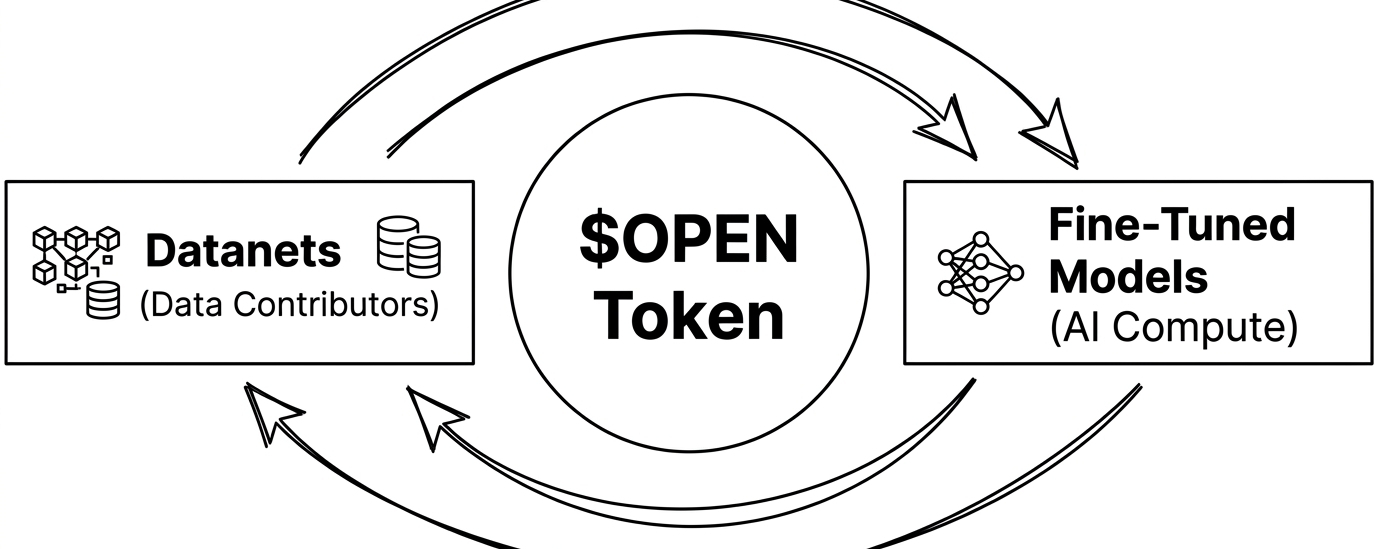
Specialized models (Datanets) vs. giant monoliths: the new vector of web3-AIMost crypto users still try to view Web3 AI through one old, flawed template:
Building an on-chain clone of ChatGPT, or a massive monolith that tries to do everything at once.
I think that approach completely misses both technical reality and token economics.
Attempting to deploy a giant monolithic model onto a decentralized infrastructure is a fast track to burning millions of dollars on inefficient compute. OpenLedger’s documentation proposes a fundamentally different vector. Instead of building an all-knowing monster model, the project bets on networks of specialized models and collaborative data repositories-Datanets.
That shifts the discussion from an abstract "how do we catch up with OpenAI?" to a much more pragmatic field:
How do we make AI precise for specific business use cases while maintaining data sovereignty?
That is where OpenLedger’s architectural advantage becomes clear.
In the real world, 90% of AI's value for enterprises lies not in generic phrasing, but in deep expertise. Businesses need AI that flawlessly analyzes medical imaging, legal contracts, or niche blockchain code. Monolithic models frequently "hallucinate" in these domains, and fine-tuning them costs astronomical amounts of money.
OpenLedger solves this through the concept of Datanets-sovereign ecosystems where communities collect, clean, and verify domain-specific datasets.
But the architectural flywheel truly locks into place when data meets compute.
Instead of heavy, full-model retraining, OpenLedger utilizes OpenLoRA (Low-Rank Adaptation) technology. This allows the network to overlay lightweight, specialized layers on top of base models. Utilizing a single high-performance GPU core, the network can serve hundreds of different Datanets simultaneously.
This marks a fundamental shift in AI tokenomics.
Unlike monoliths, where capital is burned in a one-way street, this creates a positive feedback loop.
When a business submits a query to a specific specialized model, the $OPEN token acts as the ultimate coordinator. A portion of the inference fee is automatically locked within the ecosystem, while another portion is distributed directly to the data contributors of that specific Datanet via the Proof of Attribution mechanism.
This creates consistent demand and a built-in logic for a Supply Lock: the more queries a specialized model receives, the more valuable its native Datanet becomes, and the more incentives users have to supply it with new, unique data.
This is a much more sustainable model than endless subsidies for raw GPU mining.
For the Web3 AI market, this represents a major step toward maturity. The project isn't just selling "cloud compute under an AI label." Its infrastructure is natively designed to turn raw data into a liquid, capitalized asset.
So, when analyzing the clash between monoliths and decentralization, I choose specialization.
OpenLedger pieces this puzzle together through four distinct components:
Datanets for localization and ownership of unique data,
OpenLoRA for cheap, rapid scaling of models,
Proof of Attribution for transparent reward distribution,
$OPEN as the fuel powering this self-sustaining economic loop.
The era of trying to build a decentralized Web3 monolith is coming to an end.
The future belongs to agile, specialized networks that know how to manage capital and protect the rights of data creators.
@Openledger #OpenLedger $OPEN
Specialized models (Datanets) vs. giant monoliths: the new vector of web3-AI
Most crypto users still try to view Web3 AI through one old, flawed template:
Building an on-chain clone of ChatGPT, or a massive monolith that tries to do everything at once.
I think that approach completely misses both technical reality and token economics.
Attempting to deploy a giant monolithic model onto a decentralized infrastructure is a fast track to burning millions of dollars on inefficient compute. OpenLedger’s documentation proposes a fundamentally different vector. Instead of building an all-knowing monster model, the project bets on networks of specialized models and collaborative data repositories-Datanets.
That shifts the discussion from an abstract "how do we catch up with OpenAI?" to a much more pragmatic field:
How do we make AI precise for specific business use cases while maintaining data sovereignty?
That is where OpenLedger’s architectural advantage becomes clear.
In the real world, 90% of AI's value for enterprises lies not in generic phrasing, but in deep expertise. Businesses need AI that flawlessly analyzes medical imaging, legal contracts, or niche blockchain code. Monolithic models frequently "hallucinate" in these domains, and fine-tuning them costs astronomical amounts of money.
OpenLedger solves this through the concept of Datanets-sovereign ecosystems where communities collect, clean, and verify domain-specific datasets.
But the architectural flywheel truly locks into place when data meets compute.
Instead of heavy, full-model retraining, OpenLedger utilizes OpenLoRA (Low-Rank Adaptation) technology. This allows the network to overlay lightweight, specialized layers on top of base models. Utilizing a single high-performance GPU core, the network can serve hundreds of different Datanets simultaneously.
This marks a fundamental shift in AI tokenomics.
Unlike monoliths, where capital is burned in a one-way street, this creates a positive feedback loop.
When a business submits a query to a specific specialized model, the $OPEN token acts as the ultimate coordinator. A portion of the inference fee is automatically locked within the ecosystem, while another portion is distributed directly to the data contributors of that specific Datanet via the Proof of Attribution mechanism.
This creates consistent demand and a built-in logic for a Supply Lock: the more queries a specialized model receives, the more valuable its native Datanet becomes, and the more incentives users have to supply it with new, unique data.
This is a much more sustainable model than endless subsidies for raw GPU mining.
For the Web3 AI market, this represents a major step toward maturity. The project isn't just selling "cloud compute under an AI label." Its infrastructure is natively designed to turn raw data into a liquid, capitalized asset.
So, when analyzing the clash between monoliths and decentralization, I choose specialization.
OpenLedger pieces this puzzle together through four distinct components:
Datanets for localization and ownership of unique data,
OpenLoRA for cheap, rapid scaling of models,
Proof of Attribution for transparent reward distribution,
$OPEN as the fuel powering this self-sustaining economic loop.
The era of trying to build a decentralized Web3 monolith is coming to an end.
The future belongs to agile, specialized networks that know how to manage capital and protect the rights of data creators.
@OpenLedger #OpenLedger $OPEN
Building an on-chain clone of ChatGPT, or a massive monolith that tries to do everything at once.
I think that approach completely misses both technical reality and token economics.
Attempting to deploy a giant monolithic model onto a decentralized infrastructure is a fast track to burning millions of dollars on inefficient compute. OpenLedger’s documentation proposes a fundamentally different vector. Instead of building an all-knowing monster model, the project bets on networks of specialized models and collaborative data repositories-Datanets.
That shifts the discussion from an abstract "how do we catch up with OpenAI?" to a much more pragmatic field:
How do we make AI precise for specific business use cases while maintaining data sovereignty?
That is where OpenLedger’s architectural advantage becomes clear.
In the real world, 90% of AI's value for enterprises lies not in generic phrasing, but in deep expertise. Businesses need AI that flawlessly analyzes medical imaging, legal contracts, or niche blockchain code. Monolithic models frequently "hallucinate" in these domains, and fine-tuning them costs astronomical amounts of money.
OpenLedger solves this through the concept of Datanets-sovereign ecosystems where communities collect, clean, and verify domain-specific datasets.
But the architectural flywheel truly locks into place when data meets compute.
Instead of heavy, full-model retraining, OpenLedger utilizes OpenLoRA (Low-Rank Adaptation) technology. This allows the network to overlay lightweight, specialized layers on top of base models. Utilizing a single high-performance GPU core, the network can serve hundreds of different Datanets simultaneously.
This marks a fundamental shift in AI tokenomics.
Unlike monoliths, where capital is burned in a one-way street, this creates a positive feedback loop.
When a business submits a query to a specific specialized model, the $OPEN token acts as the ultimate coordinator. A portion of the inference fee is automatically locked within the ecosystem, while another portion is distributed directly to the data contributors of that specific Datanet via the Proof of Attribution mechanism.
This creates consistent demand and a built-in logic for a Supply Lock: the more queries a specialized model receives, the more valuable its native Datanet becomes, and the more incentives users have to supply it with new, unique data.
This is a much more sustainable model than endless subsidies for raw GPU mining.
For the Web3 AI market, this represents a major step toward maturity. The project isn't just selling "cloud compute under an AI label." Its infrastructure is natively designed to turn raw data into a liquid, capitalized asset.
So, when analyzing the clash between monoliths and decentralization, I choose specialization.
OpenLedger pieces this puzzle together through four distinct components:
Datanets for localization and ownership of unique data,
OpenLoRA for cheap, rapid scaling of models,
Proof of Attribution for transparent reward distribution,
$OPEN as the fuel powering this self-sustaining economic loop.
The era of trying to build a decentralized Web3 monolith is coming to an end.
The future belongs to agile, specialized networks that know how to manage capital and protect the rights of data creators.
@OpenLedger #OpenLedger $OPEN
1
116
·
--
Übersetzung ansehen
$OPEN as a Coordination Layer: Why the Market Needs an AI-Native Blockchain?
Most developers are trying to run AI models on general-purpose blockchains (L1/L2).
I believe this is an attempt to put a round peg in a square mold.
Conventional networks are designed for simple transactions: transfers, minting, and staking. They are completely unadapted to the specifics of artificial intelligence, which requires working with gigabytes of data every second, precise tracking of authors' contributions, and complex coordination of GPU power.
That is why the market needs an AI-Native blockchain. And this is exactly the task that OpenLedger solves.
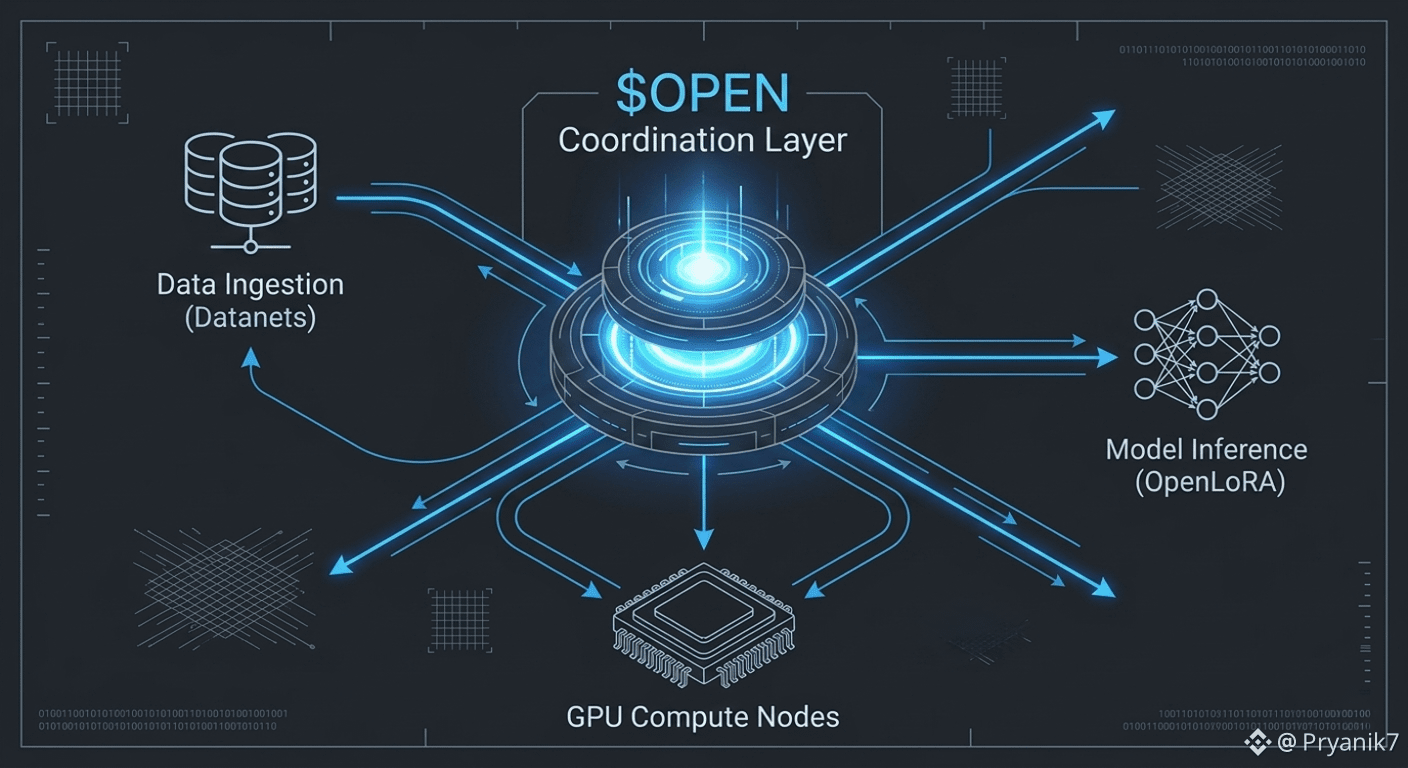
The official project documentation shows that the token works not just as a means of payment. It functions as a Coordination Layer, connecting three disparate worlds:
Datanets, model developers, and hardware operators.
When you run a query on an AI model on the OpenLedger network, instantly coordinates the entire chain:
It pays for the inference (query) -> activates OpenLoRA technology for GPU optimization -> and through Proof of Attribution automatically charges royalties to those whose data the model was trained on.
Without an AI-Native blockchain, this process turns into chaos with high fees and delays.
Therefore, the power of $OPEN does not lie in abstract utilitarianism.
It lies in architectural balance:
the token removes the friction between raw data and computing power, turning disparate technologies into a single, self-regenerating economic flywheel.
For the AI ecosystem, this is a step from a speculative Web3 application to a fully-fledged sovereign infrastructure.
@Openledger #OpenLedger $OPEN
$OPEN as a Coordination Layer: Why the Market Needs an AI-Native Blockchain?
Most developers are trying to run AI models on general-purpose blockchains (L1/L2).
I believe this is an attempt to put a round peg in a square mold.
Conventional networks are designed for simple transactions: transfers, minting, and staking. They are completely unadapted to the specifics of artificial intelligence, which requires working with gigabytes of data every second, precise tracking of authors' contributions, and complex coordination of GPU power.
That is why the market needs an AI-Native blockchain. And this is exactly the task that OpenLedger solves.
The official project documentation shows that the token works not just as a means of payment. It functions as a Coordination Layer, connecting three disparate worlds:
Datanets, model developers, and hardware operators.
When you run a query on an AI model on the OpenLedger network, instantly coordinates the entire chain:
It pays for the inference (query) -> activates OpenLoRA technology for GPU optimization -> and through Proof of Attribution automatically charges royalties to those whose data the model was trained on.
Without an AI-Native blockchain, this process turns into chaos with high fees and delays.
Therefore, the power of $OPEN does not lie in abstract utilitarianism.
It lies in architectural balance:
the token removes the friction between raw data and computing power, turning disparate technologies into a single, self-regenerating economic flywheel.
For the AI ecosystem, this is a step from a speculative Web3 application to a fully-fledged sovereign infrastructure.
@OpenLedger #OpenLedger $OPEN
Most developers are trying to run AI models on general-purpose blockchains (L1/L2).
I believe this is an attempt to put a round peg in a square mold.
Conventional networks are designed for simple transactions: transfers, minting, and staking. They are completely unadapted to the specifics of artificial intelligence, which requires working with gigabytes of data every second, precise tracking of authors' contributions, and complex coordination of GPU power.
That is why the market needs an AI-Native blockchain. And this is exactly the task that OpenLedger solves.
The official project documentation shows that the token works not just as a means of payment. It functions as a Coordination Layer, connecting three disparate worlds:
Datanets, model developers, and hardware operators.
When you run a query on an AI model on the OpenLedger network, instantly coordinates the entire chain:
It pays for the inference (query) -> activates OpenLoRA technology for GPU optimization -> and through Proof of Attribution automatically charges royalties to those whose data the model was trained on.
Without an AI-Native blockchain, this process turns into chaos with high fees and delays.
Therefore, the power of $OPEN does not lie in abstract utilitarianism.
It lies in architectural balance:
the token removes the friction between raw data and computing power, turning disparate technologies into a single, self-regenerating economic flywheel.
For the AI ecosystem, this is a step from a speculative Web3 application to a fully-fledged sovereign infrastructure.
@OpenLedger #OpenLedger $OPEN
1
136
·
--
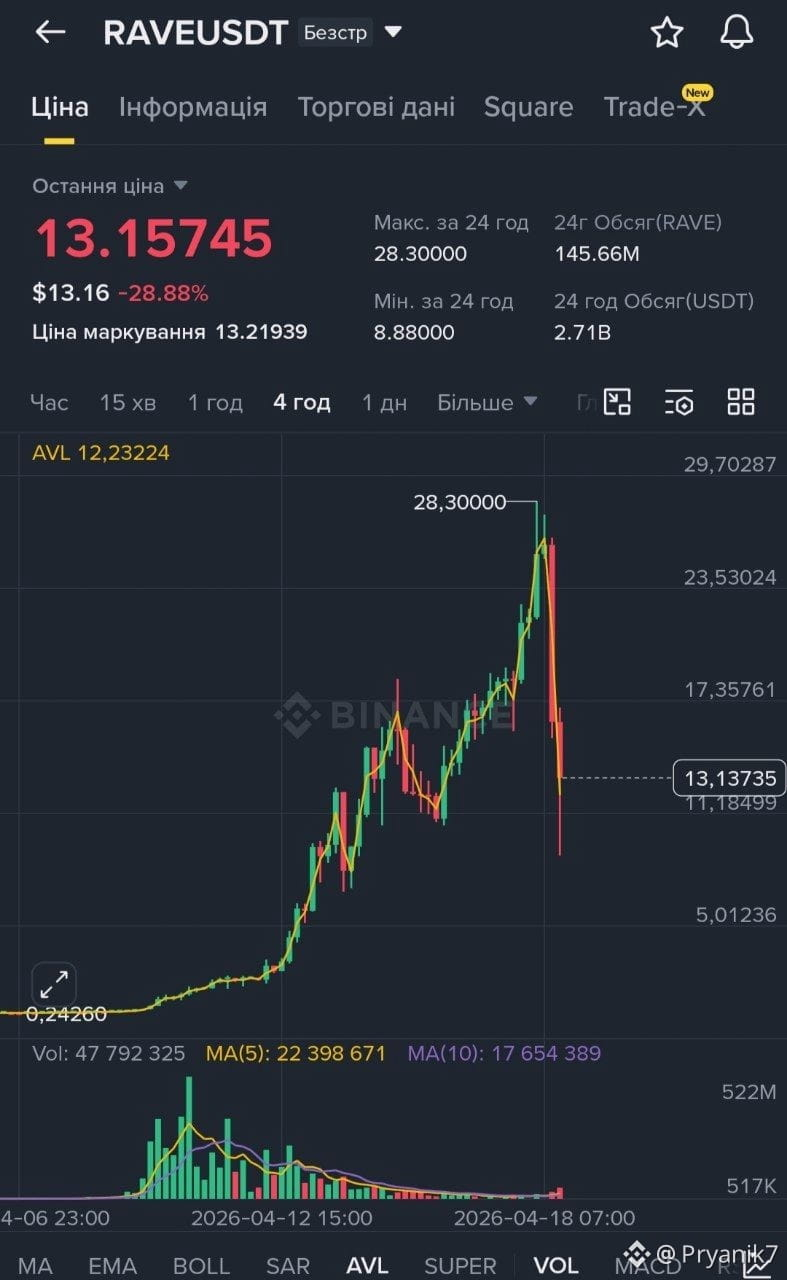
Scam des Jahres. ZachXBT kündigt $RAVE Hunt an.
Was die Krypto-Community seit mehreren Tagen flüstert, hat sich in eine umfassende Untersuchung verwandelt. Es scheint, dass sehr dunkle Wolken über dem $RAVE Ökosystem versammelt sind.
Was ist passiert?
Der legendäre On-Chain-Detektiv ZachXBT hat offiziell das Projekt übernommen. Er hat eine Belohnung von 25.000 $ aus eigener Tasche für jeden ausgesetzt, der echte Informationen über das Team leaken und konkrete Beweise für Marktmanipulation liefern kann.
Laut Daten (die derzeit überprüft werden), kontrollieren bis zu 95 % der gesamten Token-Ausgabe Wallets, die mit Entwicklern verbunden sind. Wenn dies bestätigt wird, ist dies nicht nur Manipulation, sondern ein Dump-Button.
Zentralisierte Börsen (CEX) haben nicht auf das Ergebnis gewartet und bereits begonnen, die Schrauben anzuziehen.
Bitget hat offiziell die Aktivitäten eingefroren und eine eigene Untersuchung zur künstlichen Preissteigerung eingeleitet.
#rave
{future}(RAVEUSDT)
Scam des Jahres. ZachXBT kündigt $RAVE Hunt an.
Was die Krypto-Community seit mehreren Tagen flüstert, hat sich in eine umfassende Untersuchung verwandelt. Es scheint, dass sehr dunkle Wolken über dem $RAVE Ökosystem versammelt sind.
Was ist passiert?
Der legendäre On-Chain-Detektiv ZachXBT hat offiziell das Projekt übernommen. Er hat eine Belohnung von 25.000 $ aus eigener Tasche für jeden ausgesetzt, der echte Informationen über das Team leaken und konkrete Beweise für Marktmanipulation liefern kann.
Laut Daten (die derzeit überprüft werden), kontrollieren bis zu 95 % der gesamten Token-Ausgabe Wallets, die mit Entwicklern verbunden sind. Wenn dies bestätigt wird, ist dies nicht nur Manipulation, sondern ein Dump-Button.
Zentralisierte Börsen (CEX) haben nicht auf das Ergebnis gewartet und bereits begonnen, die Schrauben anzuziehen.
Bitget hat offiziell die Aktivitäten eingefroren und eine eigene Untersuchung zur künstlichen Preissteigerung eingeleitet.
#rave
Was die Krypto-Community seit mehreren Tagen flüstert, hat sich in eine umfassende Untersuchung verwandelt. Es scheint, dass sehr dunkle Wolken über dem $RAVE Ökosystem versammelt sind.
Was ist passiert?
Der legendäre On-Chain-Detektiv ZachXBT hat offiziell das Projekt übernommen. Er hat eine Belohnung von 25.000 $ aus eigener Tasche für jeden ausgesetzt, der echte Informationen über das Team leaken und konkrete Beweise für Marktmanipulation liefern kann.
Laut Daten (die derzeit überprüft werden), kontrollieren bis zu 95 % der gesamten Token-Ausgabe Wallets, die mit Entwicklern verbunden sind. Wenn dies bestätigt wird, ist dies nicht nur Manipulation, sondern ein Dump-Button.
Zentralisierte Börsen (CEX) haben nicht auf das Ergebnis gewartet und bereits begonnen, die Schrauben anzuziehen.
Bitget hat offiziell die Aktivitäten eingefroren und eine eigene Untersuchung zur künstlichen Preissteigerung eingeleitet.
#rave
7
447
·
--
Artikel
Wie haben Gamer endlich angefangen, das zu bekommen, was sie verdienen?Hast du dich jemals gefragt, wohin die Milliarden Dollar gehen, die Spielentwickler jedes Jahr für die Nutzerakquise ausgeben? Bis jetzt gab es nur einen, traurigen Weg für uns (Old Way): Spielstudios zahlten Riesen wie Google oder Meta für Werbung, und der durchschnittliche Spieler erhielt absolut nichts. Wir haben nur Banner angesehen und unsere kostbare Zeit verschwendet.
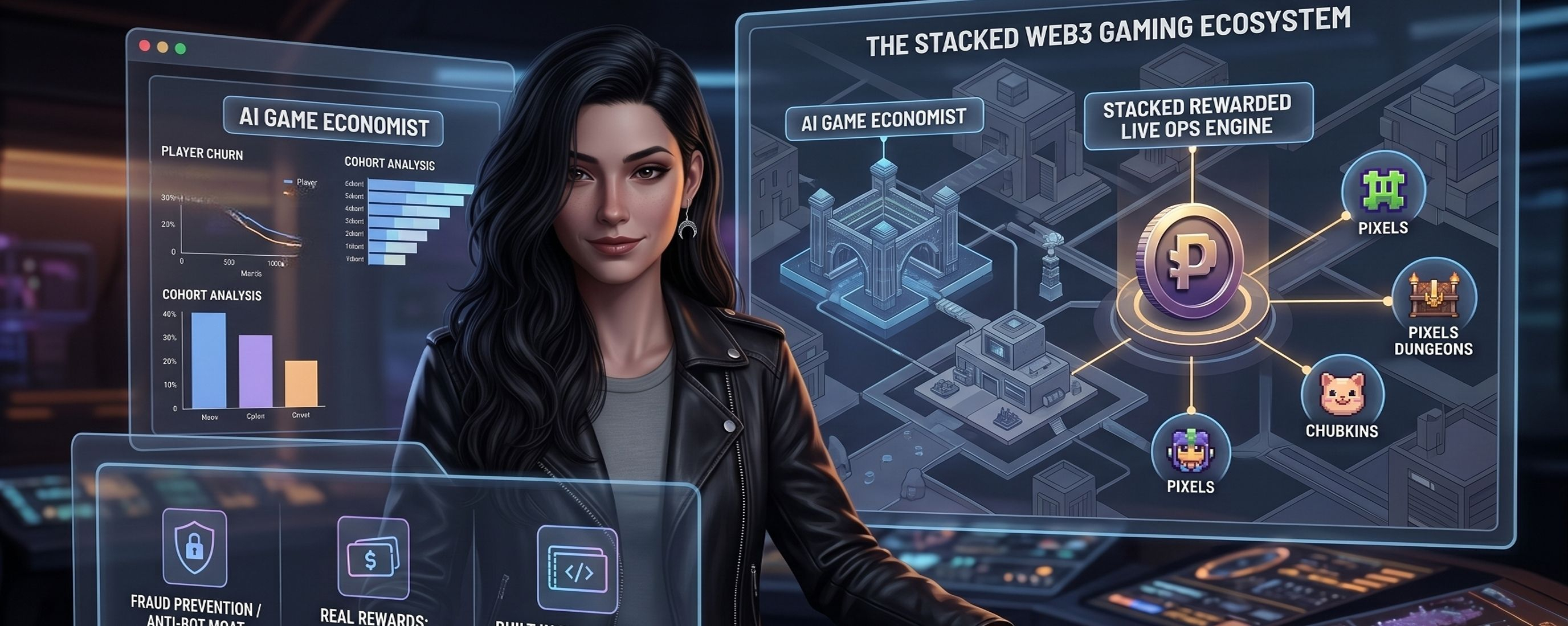
Aber die Regeln des Spiels haben sich drastisch verändert. Das @pixels team hat eine innovative Plattform namens Stacked entwickelt, die dieses Monopol für immer zerstört.
Was ist der Stacked Way?
Wie haben Gamer endlich angefangen, das zu bekommen, was sie verdienen?
Hast du dich jemals gefragt, wohin die Milliarden Dollar gehen, die Spielentwickler jedes Jahr für die Nutzerakquise ausgeben? Bis jetzt gab es nur einen, traurigen Weg für uns (Old Way): Spielstudios zahlten Riesen wie Google oder Meta für Werbung, und der durchschnittliche Spieler erhielt absolut nichts. Wir haben nur Banner angesehen und unsere kostbare Zeit verschwendet.
Aber die Regeln des Spiels haben sich drastisch verändert. Das @Pixels team hat eine innovative Plattform namens Stacked entwickelt, die dieses Monopol für immer zerstört.
Was ist der Stacked Way?
Aber die Regeln des Spiels haben sich drastisch verändert. Das @Pixels team hat eine innovative Plattform namens Stacked entwickelt, die dieses Monopol für immer zerstört.
Was ist der Stacked Way?
6
1
18
100
Anmelden und weiter Inhalte entdecken
Krypto-Nutzer weltweit auf Binance Square kennenlernen
⚡️ Bleib in Sachen Krypto stets am Puls.
💬 Die weltgrößte Kryptobörse vertraut darauf.
👍 Erhalte verlässliche Einblicke von verifizierten Creators.
E-Mail-Adresse/Telefonnummer
Trendthemen
BitcoinReboundsTo$79K
3,495 Aufrufe
64 Kommentare
🚨 $BTC steigt weiter.
Bitcoin handelt bei etwa 78.804 $ und liegt damit ungefähr 1,9 % im Plus, nachdem die Marke von 78K zurückerobert wurde. Die nächste zu beobachtende Zone ist das Tageshoch im Intraday-Bereich nahe 78.905 $.
Ein klarer Ausbruch über diese Marke könnte den Weg in Richtung 79K–80K ebnen. Wenn BTC abgewiesen wird, liegt der Support bei etwa 78.300 $ und danach bei 77.975 $.
Die Bullen haben Momentum, aber BTC muss über 78K bleiben.
#Bitcoin #BTC #CryptoTrading #CryptoMarket #CryptoAnalysis
PulseON
·5 Likes
·4.5k Aufrufe
FedHikeOddsRiseTo89%
58,955 Aufrufe
926 Kommentare
RLUSDSupplyHitsRecord$2.442B
3,033 Aufrufe
54 Kommentare