
Sean Paul UA
7 Bài đăng

Sean Paul UA
Báo cáo
Chặn người dùng
2 Đang theo dõi
1 Người theo dõi
7 Đã thích
Bài đăng
·
--
Xem bản dịch
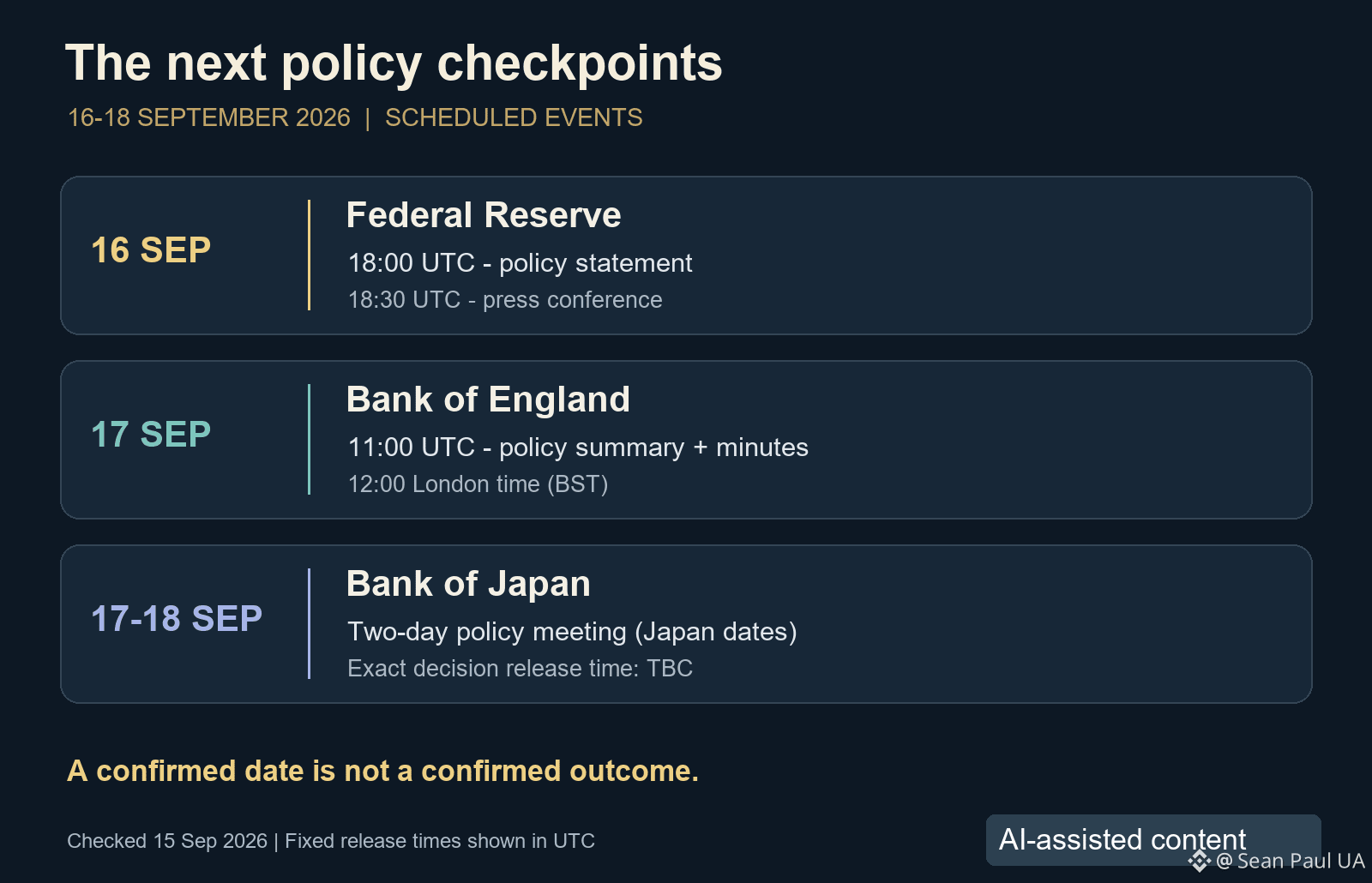
Three central banks are on my calendar for September 16-18. I'm keeping the release times beside the headlines.
First, the Fed: its September 15-16 meeting ends tomorrow. The policy statement is scheduled for September 16 at 18:00 UTC, followed by the press conference at 18:30 UTC. Those are two separate checkpoints for what policymakers actually say.
Next, the Bank of England publishes its policy summary and meeting minutes on September 17 at 11:00 UTC — noon in London.
The Bank of Japan meets on September 17-18, Japan local dates. Its schedule doesn't give an exact decision-release hour, so I'm leaving that time open.
My focus is the wording about the next steps, then how BTC and ETH respond. A confirmed meeting date tells me when to pay attention; it doesn't tell me which way prices will move.
Which message will you watch most closely this week: A) the Fed, B) the Bank of England, or C) the Bank of Japan — and why?
#Macro
Three central banks are on my calendar for September 16-18. I'm keeping the release times beside the headlines.
First, the Fed: its September 15-16 meeting ends tomorrow. The policy statement is scheduled for September 16 at 18:00 UTC, followed by the press conference at 18:30 UTC. Those are two separate checkpoints for what policymakers actually say.
Next, the Bank of England publishes its policy summary and meeting minutes on September 17 at 11:00 UTC — noon in London.
The Bank of Japan meets on September 17-18, Japan local dates. Its schedule doesn't give an exact decision-release hour, so I'm leaving that time open.
My focus is the wording about the next steps, then how BTC and ETH respond. A confirmed meeting date tells me when to pay attention; it doesn't tell me which way prices will move.
Which message will you watch most closely this week: A) the Fed, B) the Bank of England, or C) the Bank of Japan — and why?
#Macro
First, the Fed: its September 15-16 meeting ends tomorrow. The policy statement is scheduled for September 16 at 18:00 UTC, followed by the press conference at 18:30 UTC. Those are two separate checkpoints for what policymakers actually say.
Next, the Bank of England publishes its policy summary and meeting minutes on September 17 at 11:00 UTC — noon in London.
The Bank of Japan meets on September 17-18, Japan local dates. Its schedule doesn't give an exact decision-release hour, so I'm leaving that time open.
My focus is the wording about the next steps, then how BTC and ETH respond. A confirmed meeting date tells me when to pay attention; it doesn't tell me which way prices will move.
Which message will you watch most closely this week: A) the Fed, B) the Bank of England, or C) the Bank of Japan — and why?
#Macro
1
84
·
--
Xem bản dịch
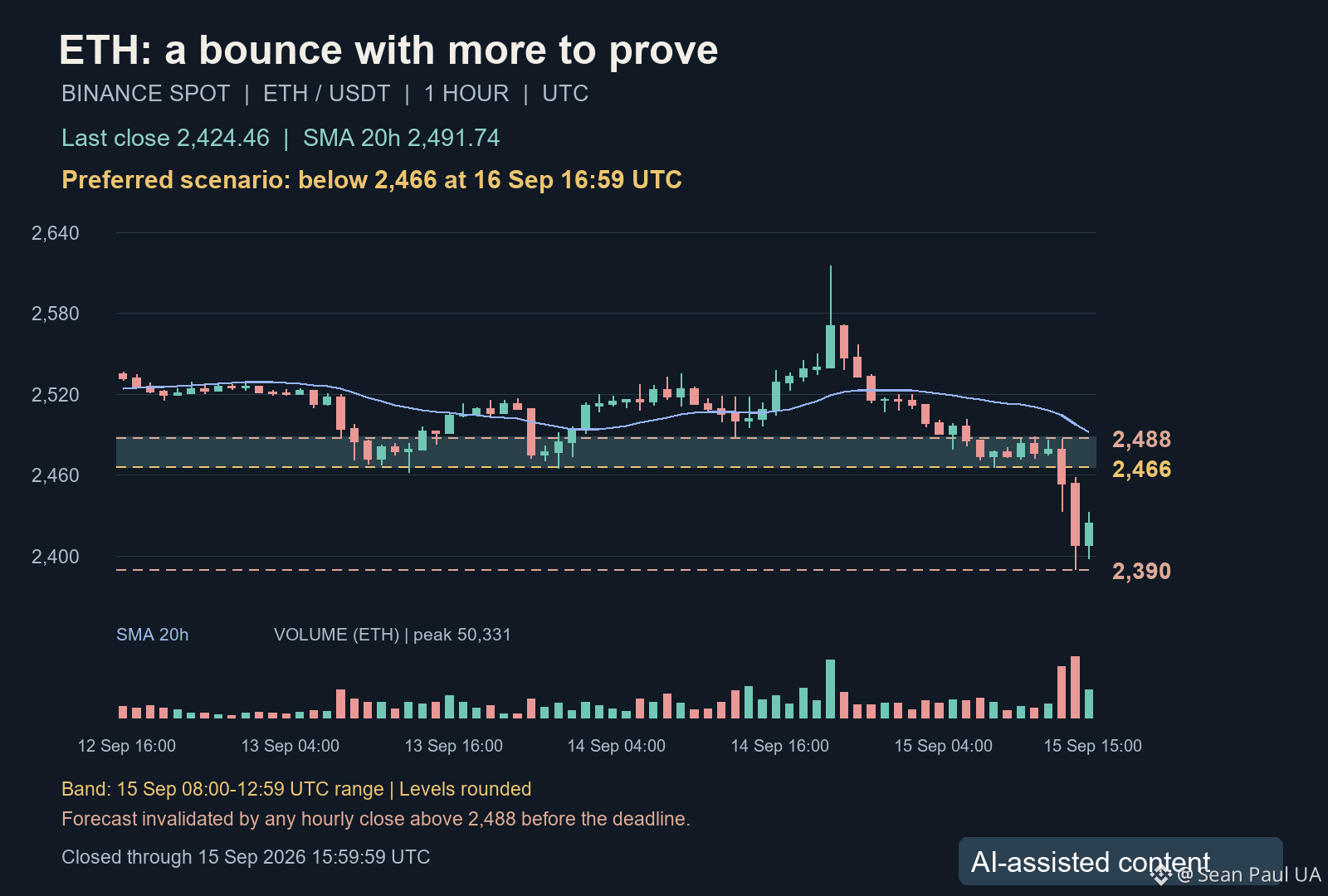
ETH bounced. I still think this recovery has more to prove.
My main forecast is that ETH finishes below 2,466 USDT at the September 16 16:59 UTC hourly close, with the recovery still short of its old range.
At September 15's 15:59 UTC hourly close, ETH was 2,424.46 on Binance spot. That's below both its 20-hour average of 2,491.74 and the earlier 08:00-12:59 UTC range, roughly 2,466-2,488. One green hourly candle hasn't reclaimed either.
The Fed's calendar lists its September 15-16 meeting with economic projections. That is a volatility risk, not evidence that a particular rate decision or ETH move is certain.
The checkpoint is the close of the September 16 16:00-17:00 UTC candle, not a brief price touch.
An hourly close back above 2,466 would strengthen the recovery alternative and put 2,488 in focus.
If the rebound fades, a return to the observed low near 2,390 is the downside alternative; that level is not guaranteed support.
Any hourly close above 2,488 through that checkpoint invalidates my forecast, even if ETH later falls back.
What would change your view first: a reclaim of the old range, or a fresh low? I'd like to hear why.
$ETH #Ethereum
I may earn commissions from trades made through this post.
ETH bounced. I still think this recovery has more to prove.
My main forecast is that ETH finishes below 2,466 USDT at the September 16 16:59 UTC hourly close, with the recovery still short of its old range.
At September 15's 15:59 UTC hourly close, ETH was 2,424.46 on Binance spot. That's below both its 20-hour average of 2,491.74 and the earlier 08:00-12:59 UTC range, roughly 2,466-2,488. One green hourly candle hasn't reclaimed either.
The Fed's calendar lists its September 15-16 meeting with economic projections. That is a volatility risk, not evidence that a particular rate decision or ETH move is certain.
The checkpoint is the close of the September 16 16:00-17:00 UTC candle, not a brief price touch.
An hourly close back above 2,466 would strengthen the recovery alternative and put 2,488 in focus.
If the rebound fades, a return to the observed low near 2,390 is the downside alternative; that level is not guaranteed support.
Any hourly close above 2,488 through that checkpoint invalidates my forecast, even if ETH later falls back.
What would change your view first: a reclaim of the old range, or a fresh low? I'd like to hear why.
$ETH #Ethereum
I may earn commissions from trades made through this post.
My main forecast is that ETH finishes below 2,466 USDT at the September 16 16:59 UTC hourly close, with the recovery still short of its old range.
At September 15's 15:59 UTC hourly close, ETH was 2,424.46 on Binance spot. That's below both its 20-hour average of 2,491.74 and the earlier 08:00-12:59 UTC range, roughly 2,466-2,488. One green hourly candle hasn't reclaimed either.
The Fed's calendar lists its September 15-16 meeting with economic projections. That is a volatility risk, not evidence that a particular rate decision or ETH move is certain.
The checkpoint is the close of the September 16 16:00-17:00 UTC candle, not a brief price touch.
An hourly close back above 2,466 would strengthen the recovery alternative and put 2,488 in focus.
If the rebound fades, a return to the observed low near 2,390 is the downside alternative; that level is not guaranteed support.
Any hourly close above 2,488 through that checkpoint invalidates my forecast, even if ETH later falls back.
What would change your view first: a reclaim of the old range, or a fresh low? I'd like to hear why.
$ETH #Ethereum
I may earn commissions from trades made through this post.
1
64
·
--
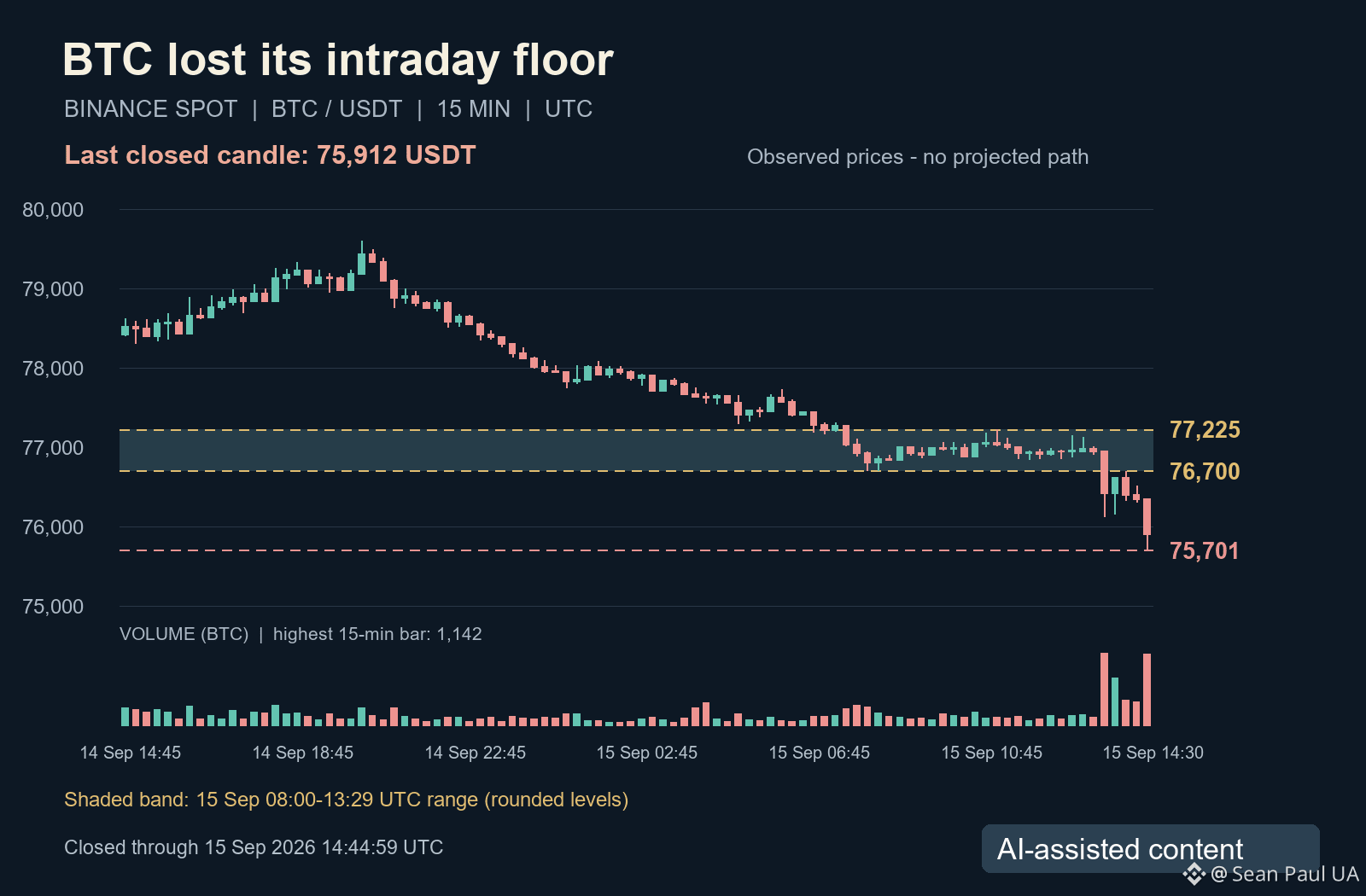
Đà phục hồi của BTC đã mất dần. Tôi đang theo dõi mốc mà nó đã phá vỡ, thay vì nhắm tới một mục tiêu tròn nào khác.
Vào 14:44 UTC ngày 15 tháng 9, cây nến 15 phút hoàn tất gần nhất đã đóng ở mức 75.912 USDT trên sàn giao ngay Binance. Vùng 08:00-13:29 UTC trước đó dao động khoảng 76.700-77.225. Kể từ đó, giá đã đóng xuống dưới sàn này.
Điều này làm thay đổi cách tôi đọc tín hiệu từ đợt hồi sáng nay: hiện tại, sự phục hồi cần phải giành lại được một khu vực cụ thể. Đây là những nhận định mang tính làm tròn, không phải hỗ trợ chắc chắn.
Tôi sẽ theo dõi các lần đóng theo khung giờ cho đến 23:59 UTC ngày 15 tháng 9.
Một lần đóng theo khung giờ quay trở lại trên 76.700 sẽ đưa phần trần của vùng cũ (gần 77.225) trở lại vào bản đồ của tôi.
Nếu BTC giữ được trên 75.701 nhưng không thể giành lại 76.700, tôi sẽ xem điều đó như một nhịp tạm dừng dưới vùng đã bị phá vỡ, chứ không phải xu hướng tăng đã được phục hồi.
Một lần đóng theo khung giờ dưới 75.701 sẽ xác nhận thêm sự suy yếu, vượt ra ngoài mức thấp của nến 15 phút hoàn tất gần nhất.
Tôi sẽ hạ mức đánh giá bi quan cho tín hiệu trong ngày này sau khi có một lần đóng theo khung giờ trên 77.225; chỉ một nhịp bật lên là chưa đủ.
Bạn kỳ vọng lần đóng cửa giờ cuối cùng hôm nay theo UTC sẽ ở đâu: A) trên 76.700, B) 75.701-76.700, hay C) dưới 75.701? Điều gì ủng hộ quan điểm của bạn?
$BTC #Bitcoin
Tôi có thể nhận hoa hồng từ các giao dịch được thực hiện thông qua bài đăng này.
Đà phục hồi của BTC đã mất dần. Tôi đang theo dõi mốc mà nó đã phá vỡ, thay vì nhắm tới một mục tiêu tròn nào khác.
Vào 14:44 UTC ngày 15 tháng 9, cây nến 15 phút hoàn tất gần nhất đã đóng ở mức 75.912 USDT trên sàn giao ngay Binance. Vùng 08:00-13:29 UTC trước đó dao động khoảng 76.700-77.225. Kể từ đó, giá đã đóng xuống dưới sàn này.
Điều này làm thay đổi cách tôi đọc tín hiệu từ đợt hồi sáng nay: hiện tại, sự phục hồi cần phải giành lại được một khu vực cụ thể. Đây là những nhận định mang tính làm tròn, không phải hỗ trợ chắc chắn.
Tôi sẽ theo dõi các lần đóng theo khung giờ cho đến 23:59 UTC ngày 15 tháng 9.
Một lần đóng theo khung giờ quay trở lại trên 76.700 sẽ đưa phần trần của vùng cũ (gần 77.225) trở lại vào bản đồ của tôi.
Nếu BTC giữ được trên 75.701 nhưng không thể giành lại 76.700, tôi sẽ xem điều đó như một nhịp tạm dừng dưới vùng đã bị phá vỡ, chứ không phải xu hướng tăng đã được phục hồi.
Một lần đóng theo khung giờ dưới 75.701 sẽ xác nhận thêm sự suy yếu, vượt ra ngoài mức thấp của nến 15 phút hoàn tất gần nhất.
Tôi sẽ hạ mức đánh giá bi quan cho tín hiệu trong ngày này sau khi có một lần đóng theo khung giờ trên 77.225; chỉ một nhịp bật lên là chưa đủ.
Bạn kỳ vọng lần đóng cửa giờ cuối cùng hôm nay theo UTC sẽ ở đâu: A) trên 76.700, B) 75.701-76.700, hay C) dưới 75.701? Điều gì ủng hộ quan điểm của bạn?
$BTC #Bitcoin
Tôi có thể nhận hoa hồng từ các giao dịch được thực hiện thông qua bài đăng này.
Vào 14:44 UTC ngày 15 tháng 9, cây nến 15 phút hoàn tất gần nhất đã đóng ở mức 75.912 USDT trên sàn giao ngay Binance. Vùng 08:00-13:29 UTC trước đó dao động khoảng 76.700-77.225. Kể từ đó, giá đã đóng xuống dưới sàn này.
Điều này làm thay đổi cách tôi đọc tín hiệu từ đợt hồi sáng nay: hiện tại, sự phục hồi cần phải giành lại được một khu vực cụ thể. Đây là những nhận định mang tính làm tròn, không phải hỗ trợ chắc chắn.
Tôi sẽ theo dõi các lần đóng theo khung giờ cho đến 23:59 UTC ngày 15 tháng 9.
Một lần đóng theo khung giờ quay trở lại trên 76.700 sẽ đưa phần trần của vùng cũ (gần 77.225) trở lại vào bản đồ của tôi.
Nếu BTC giữ được trên 75.701 nhưng không thể giành lại 76.700, tôi sẽ xem điều đó như một nhịp tạm dừng dưới vùng đã bị phá vỡ, chứ không phải xu hướng tăng đã được phục hồi.
Một lần đóng theo khung giờ dưới 75.701 sẽ xác nhận thêm sự suy yếu, vượt ra ngoài mức thấp của nến 15 phút hoàn tất gần nhất.
Tôi sẽ hạ mức đánh giá bi quan cho tín hiệu trong ngày này sau khi có một lần đóng theo khung giờ trên 77.225; chỉ một nhịp bật lên là chưa đủ.
Bạn kỳ vọng lần đóng cửa giờ cuối cùng hôm nay theo UTC sẽ ở đâu: A) trên 76.700, B) 75.701-76.700, hay C) dưới 75.701? Điều gì ủng hộ quan điểm của bạn?
$BTC #Bitcoin
Tôi có thể nhận hoa hồng từ các giao dịch được thực hiện thông qua bài đăng này.
1
73
·
--
Xem bản dịch
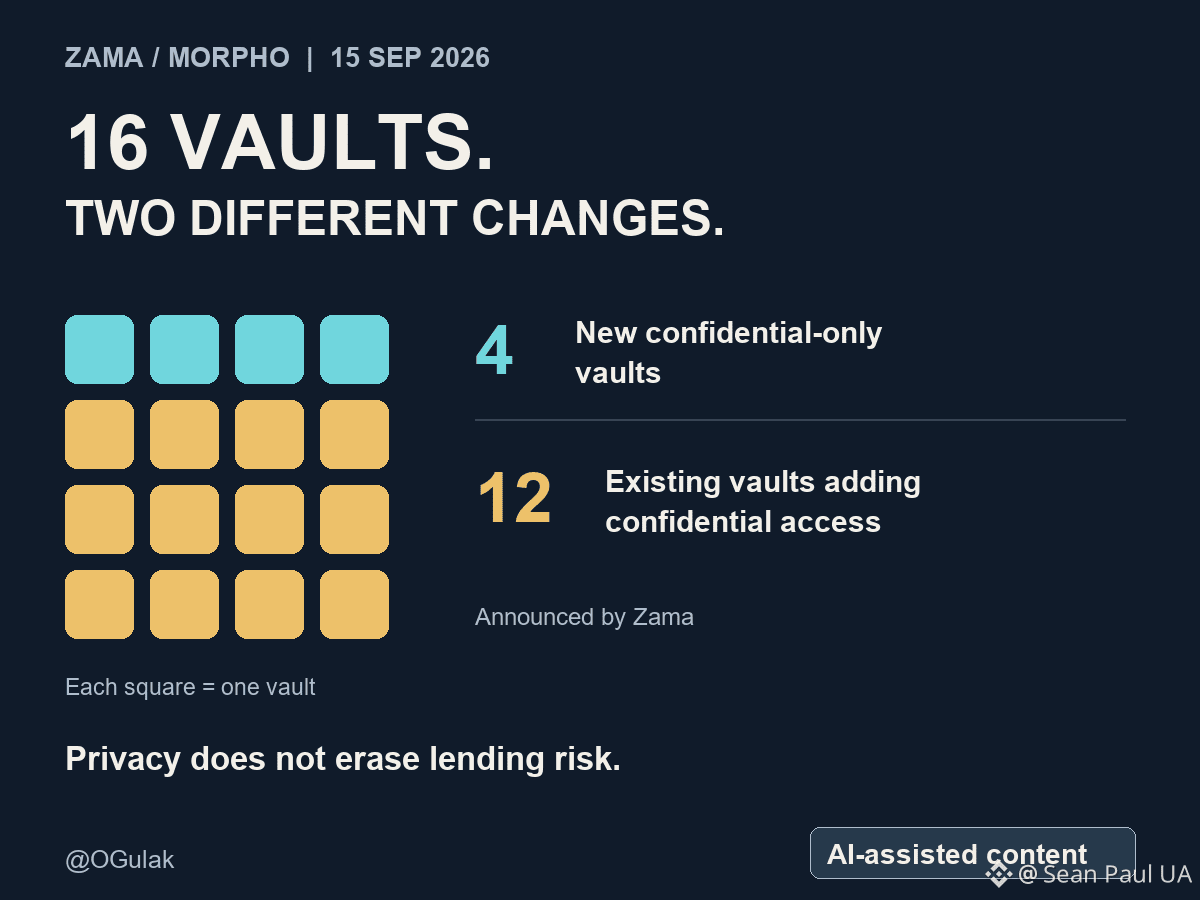
Sixteen vaults doesn't mean sixteen new strategies. That's the detail I noticed in Zama's announcement today.
On September 15, Zama announced confidential access to 16 Morpho vaults: four new confidential-only products and 12 existing vaults adding confidential deposits.
The distinction matters. For those 12, the new feature is how users access the strategy. Zama says its confidentiality layer keeps amounts and balances encrypted while preserving public verifiability.
My read: protecting position size may remove one barrier for institutions. It doesn't remove smart-contract, lending or liquidity risk. Morpho's documentation warns that a shortage of liquidity can delay withdrawals.
I'd judge this launch by sustained use and how clearly those risks are explained, rather than the vault count alone. More product choice isn't evidence of more demand, and it isn't a price forecast for ZAMA or MORPHO.
Would private balances change your view of DeFi, or is reliable access to funds the bigger issue? Why?
#DeFi #Privacy
I may earn commissions from trades made through this post.
Sixteen vaults doesn't mean sixteen new strategies. That's the detail I noticed in Zama's announcement today.
On September 15, Zama announced confidential access to 16 Morpho vaults: four new confidential-only products and 12 existing vaults adding confidential deposits.
The distinction matters. For those 12, the new feature is how users access the strategy. Zama says its confidentiality layer keeps amounts and balances encrypted while preserving public verifiability.
My read: protecting position size may remove one barrier for institutions. It doesn't remove smart-contract, lending or liquidity risk. Morpho's documentation warns that a shortage of liquidity can delay withdrawals.
I'd judge this launch by sustained use and how clearly those risks are explained, rather than the vault count alone. More product choice isn't evidence of more demand, and it isn't a price forecast for ZAMA or MORPHO.
Would private balances change your view of DeFi, or is reliable access to funds the bigger issue? Why?
#DeFi #Privacy
I may earn commissions from trades made through this post.
On September 15, Zama announced confidential access to 16 Morpho vaults: four new confidential-only products and 12 existing vaults adding confidential deposits.
The distinction matters. For those 12, the new feature is how users access the strategy. Zama says its confidentiality layer keeps amounts and balances encrypted while preserving public verifiability.
My read: protecting position size may remove one barrier for institutions. It doesn't remove smart-contract, lending or liquidity risk. Morpho's documentation warns that a shortage of liquidity can delay withdrawals.
I'd judge this launch by sustained use and how clearly those risks are explained, rather than the vault count alone. More product choice isn't evidence of more demand, and it isn't a price forecast for ZAMA or MORPHO.
Would private balances change your view of DeFi, or is reliable access to funds the bigger issue? Why?
#DeFi #Privacy
I may earn commissions from trades made through this post.
1
109
·
--
Xem bản dịch
Gold on a blockchain? I'm more interested in what the token actually lets you do.
On September 14, the UK's FCA opened a call for input on tokenised gold. Responses close October 23. This is a request for evidence, not approval of a particular token or a new rule already in force.
The useful idea: make physical gold easier to transfer and use as collateral. The hard part: proving who owns the metal, who holds it, and what happens when someone wants it back.
Over the next four weeks, I'm watching evidence of adoption rather than guessing a token price.
If institutions show credible demand for gold-backed collateral, that could strengthen the case for tokenisation infrastructure.
My base case is discussion and technical work before any broad rollout; the headline alone doesn't identify a winning crypto token.
If custody, redemption or legal rights remain unclear, enthusiasm could fade even if the technology works.
I'd change that cautious view if named institutions demonstrate real settlement use with clear ownership and redemption terms.
Adoption and token returns are different questions. I'd still need to see how any specific token captures value.
What would make tokenised gold useful to you: A) easier transfers, B) reliable redemption into physical gold, or C) using it as collateral? Which matters most, and why?
I may earn commissions from trades made through this post.
Gold on a blockchain? I'm more interested in what the token actually lets you do.
On September 14, the UK's FCA opened a call for input on tokenised gold. Responses close October 23. This is a request for evidence, not approval of a particular token or a new rule already in force.
The useful idea: make physical gold easier to transfer and use as collateral. The hard part: proving who owns the metal, who holds it, and what happens when someone wants it back.
Over the next four weeks, I'm watching evidence of adoption rather than guessing a token price.
If institutions show credible demand for gold-backed collateral, that could strengthen the case for tokenisation infrastructure.
My base case is discussion and technical work before any broad rollout; the headline alone doesn't identify a winning crypto token.
If custody, redemption or legal rights remain unclear, enthusiasm could fade even if the technology works.
I'd change that cautious view if named institutions demonstrate real settlement use with clear ownership and redemption terms.
Adoption and token returns are different questions. I'd still need to see how any specific token captures value.
What would make tokenised gold useful to you: A) easier transfers, B) reliable redemption into physical gold, or C) using it as collateral? Which matters most, and why?
I may earn commissions from trades made through this post.
On September 14, the UK's FCA opened a call for input on tokenised gold. Responses close October 23. This is a request for evidence, not approval of a particular token or a new rule already in force.
The useful idea: make physical gold easier to transfer and use as collateral. The hard part: proving who owns the metal, who holds it, and what happens when someone wants it back.
Over the next four weeks, I'm watching evidence of adoption rather than guessing a token price.
If institutions show credible demand for gold-backed collateral, that could strengthen the case for tokenisation infrastructure.
My base case is discussion and technical work before any broad rollout; the headline alone doesn't identify a winning crypto token.
If custody, redemption or legal rights remain unclear, enthusiasm could fade even if the technology works.
I'd change that cautious view if named institutions demonstrate real settlement use with clear ownership and redemption terms.
Adoption and token returns are different questions. I'd still need to see how any specific token captures value.
What would make tokenised gold useful to you: A) easier transfers, B) reliable redemption into physical gold, or C) using it as collateral? Which matters most, and why?
I may earn commissions from trades made through this post.

1
136
·
--
Xem bản dịch
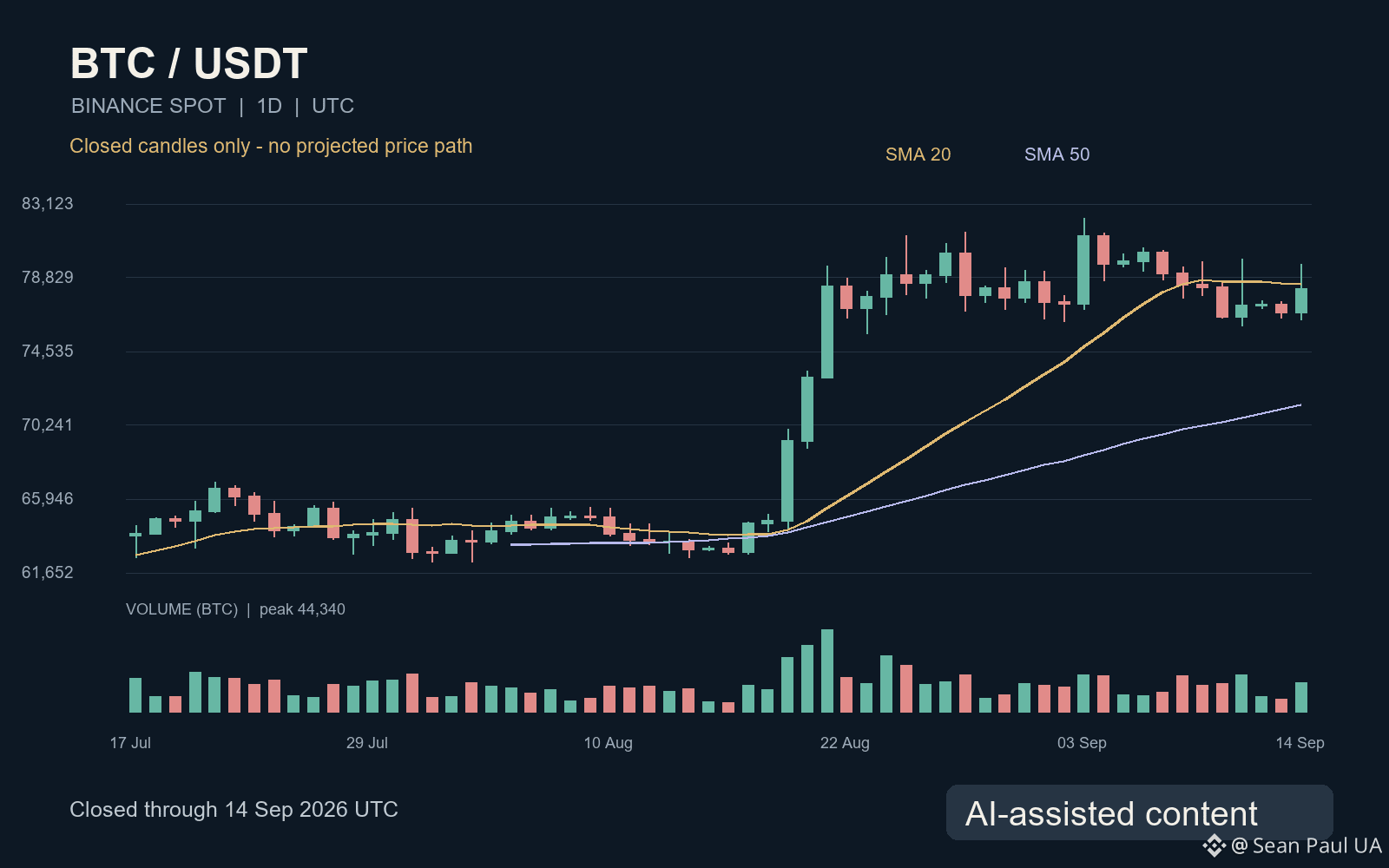
BTC bounced. Now I'm watching the Fed's message.
The Fed's calendar puts its next meeting on September 15-16, with updated economic projections scheduled alongside it. The outcome is still ahead of us.
BTC's September 14 daily close was 78,189 USDT, up about 1.75% from the previous close. It still finished slightly below its 20-day average near 78,474. To me, that's a rebound with something left to prove.
My horizon is the September 16 announcement through the September 17 UTC daily close.
If the Fed's message pushes yields and the dollar lower, I'd watch for BTC strength that survives the initial reaction.
If the message brings little surprise, my working scenario is choppy trading rather than a clean new trend.
If the message pushes yields and the dollar higher, I'd watch for renewed pressure on BTC.
I'd drop that directional read if BTC fails to follow through by the next UTC daily close; the policy headline alone isn't confirmation.
Which will matter most for BTC after this meeting: A) the rate decision, B) the projected rate path, or C) the explanation behind them? I'd like to hear your reasoning.
$BTC
BTC bounced. Now I'm watching the Fed's message.
The Fed's calendar puts its next meeting on September 15-16, with updated economic projections scheduled alongside it. The outcome is still ahead of us.
BTC's September 14 daily close was 78,189 USDT, up about 1.75% from the previous close. It still finished slightly below its 20-day average near 78,474. To me, that's a rebound with something left to prove.
My horizon is the September 16 announcement through the September 17 UTC daily close.
If the Fed's message pushes yields and the dollar lower, I'd watch for BTC strength that survives the initial reaction.
If the message brings little surprise, my working scenario is choppy trading rather than a clean new trend.
If the message pushes yields and the dollar higher, I'd watch for renewed pressure on BTC.
I'd drop that directional read if BTC fails to follow through by the next UTC daily close; the policy headline alone isn't confirmation.
Which will matter most for BTC after this meeting: A) the rate decision, B) the projected rate path, or C) the explanation behind them? I'd like to hear your reasoning.
$BTC
The Fed's calendar puts its next meeting on September 15-16, with updated economic projections scheduled alongside it. The outcome is still ahead of us.
BTC's September 14 daily close was 78,189 USDT, up about 1.75% from the previous close. It still finished slightly below its 20-day average near 78,474. To me, that's a rebound with something left to prove.
My horizon is the September 16 announcement through the September 17 UTC daily close.
If the Fed's message pushes yields and the dollar lower, I'd watch for BTC strength that survives the initial reaction.
If the message brings little surprise, my working scenario is choppy trading rather than a clean new trend.
If the message pushes yields and the dollar higher, I'd watch for renewed pressure on BTC.
I'd drop that directional read if BTC fails to follow through by the next UTC daily close; the policy headline alone isn't confirmation.
Which will matter most for BTC after this meeting: A) the rate decision, B) the projected rate path, or C) the explanation behind them? I'd like to hear your reasoning.
$BTC
1
88
·
--
Xem bản dịch
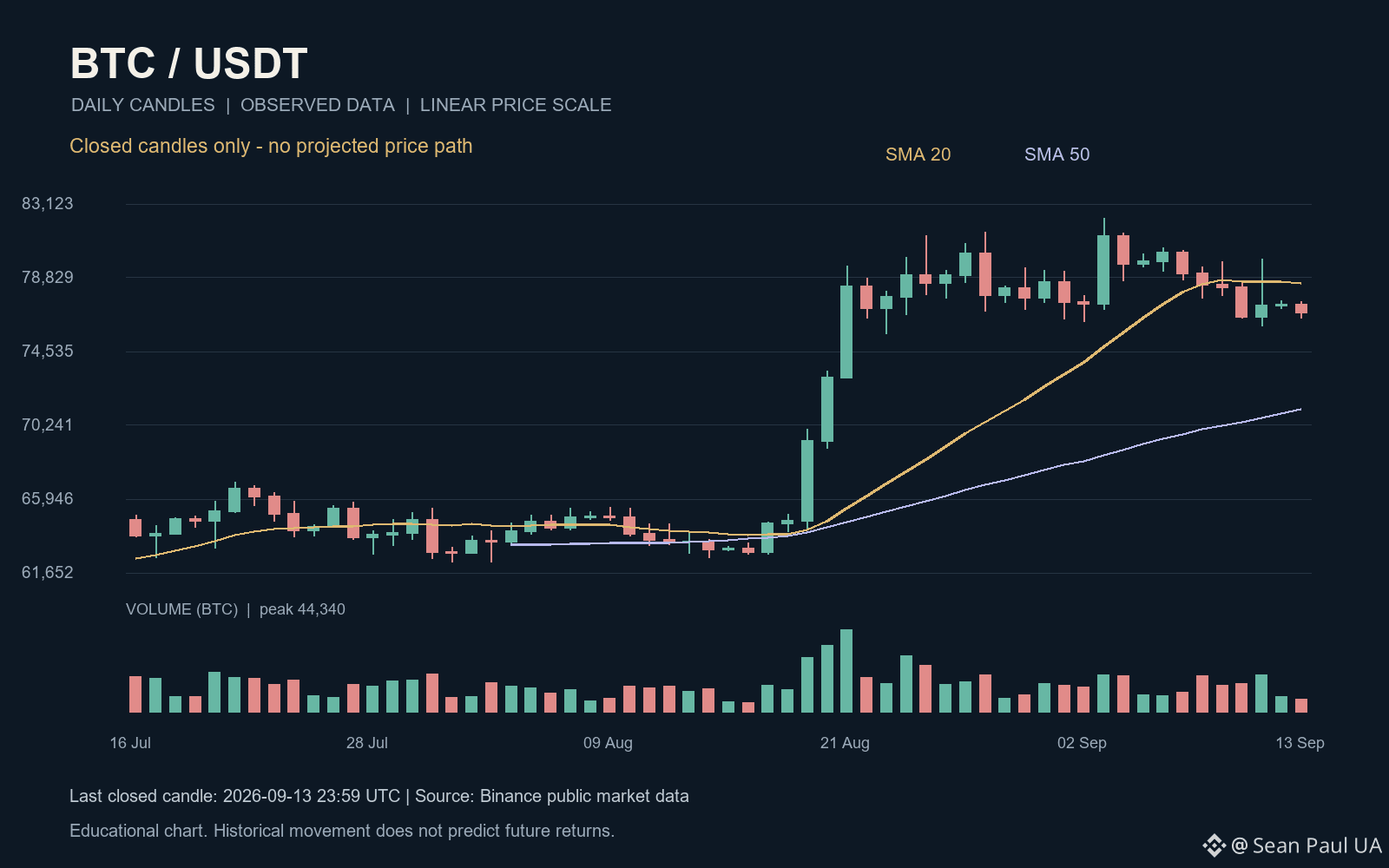
BTC daily: three conditions worth watching
As of 2026-09-13 UTC, the last closed daily candle was 76,842 USDT. The 20-day average is 78,491; the 50-day average is 71,193. These describe recent price action, not future returns.
The latest 20 closed daily candles span 76,047-82,300 USDT. Those observed extremes give us a transparent reference range, not guaranteed support or resistance.
Horizon: the next 7 daily closes.
Upside: a daily close above 82,300, followed by another holding above it, would support a breakout interpretation.
Base: daily closes stay inside the reference range; direction remains unresolved.
Downside: a daily close below 76,047, followed by failure to reclaim it, would support a breakdown interpretation.
Invalidation: a breakout that returns inside the range loses confirmation; a sustained exit invalidates the range scenario.
BTC daily: three conditions worth watching
As of 2026-09-13 UTC, the last closed daily candle was 76,842 USDT. The 20-day average is 78,491; the 50-day average is 71,193. These describe recent price action, not future returns.
The latest 20 closed daily candles span 76,047-82,300 USDT. Those observed extremes give us a transparent reference range, not guaranteed support or resistance.
Horizon: the next 7 daily closes.
Upside: a daily close above 82,300, followed by another holding above it, would support a breakout interpretation.
Base: daily closes stay inside the reference range; direction remains unresolved.
Downside: a daily close below 76,047, followed by failure to reclaim it, would support a breakdown interpretation.
Invalidation: a breakout that returns inside the range loses confirmation; a sustained exit invalidates the range scenario.
As of 2026-09-13 UTC, the last closed daily candle was 76,842 USDT. The 20-day average is 78,491; the 50-day average is 71,193. These describe recent price action, not future returns.
The latest 20 closed daily candles span 76,047-82,300 USDT. Those observed extremes give us a transparent reference range, not guaranteed support or resistance.
Horizon: the next 7 daily closes.
Upside: a daily close above 82,300, followed by another holding above it, would support a breakout interpretation.
Base: daily closes stay inside the reference range; direction remains unresolved.
Downside: a daily close below 76,047, followed by failure to reclaim it, would support a breakdown interpretation.
Invalidation: a breakout that returns inside the range loses confirmation; a sustained exit invalidates the range scenario.
1
96
Đăng nhập để khám phá thêm nội dung
Tham gia cùng người dùng tiền mã hóa toàn cầu trên Binance Square
⚡️ Nhận thông tin mới nhất và hữu ích về tiền mã hóa.
💬 Được tin cậy bởi sàn giao dịch tiền mã hóa lớn nhất thế giới.
👍 Khám phá những thông tin chuyên sâu thực tế từ những nhà sáng tạo đã xác minh.
Email / Số điện thoại
Chủ đề thịnh hành
FedRateWatch
557,628 lượt xem
2,664 đang thảo luận
Chia sẻ & Nhận thưởng Lưu lượng truy cập trong Chiến dịch Hashtag Xu hướng của chúng tôi
✨Chủ đề: FOMC tháng 9 — Kế tiếp Cục Dự trữ Liên bang sẽ làm gì?
👉Cách tham gia:
Đăng một bài viết ngắn hoặc bài viết với hashtag #FedRateWatch
Tạo nội dung dựa trên các góc nhìn dưới đây:
- CPI lõi tháng 8 tăng 0,3% theo tháng và hiện xác suất Fed tăng lãi suất 25bp trong tuần này đã gần 90%. Bạn có dự đoán Fed sẽ tăng lãi suất trong tuần này không? Đó chỉ là một lần duy nhất hay là khởi đầu cho một chu kỳ tăng lãi suất dài hơn?
- Nếu đợt tăng lãi suất diễn ra, nó sẽ ảnh hưởng thế nào đến BTC, cổ phiếu công nghệ và vàng? Tăng giá hay giảm giá?
- Bạn dự định giao dịch như thế nào tiếp theo? Chia sẻ giao dịch/nắm giữ BTC, cổ phiếu hoặc vàng của bạn với tiện ích chia sẻ giao dịch của chúng tôi.
⏰Thời gian chiến dịch:
- 2026-09-15 11:00 - 2026-09-17 3:00 UTC
🎁Phần thưởng:
- Các bài đăng đủ điều kiện tuân thủ hướng dẫn trên và có hơn 100 từ sẽ được xem xét và có thể nhận được mức tăng lưu lượng truy cập ngẫu nhiên từ 500 đến 3.000 lượt xem. Bạn sẽ nhận được thông báo từ thư ký cấp nội dung trên nguồn cấp nếu bài đăng của bạn được chọn.
- Có cơ hội để bài viết của bạn được giới thiệu trên Binance Square Official
Cần ý tưởng cho bài đăng của bạn? Hãy truy cập trang chủ đề #FedRateWatch hoặc Square Guide on How to Post for Better Reach.
Binance Square Official
·380 lượt thích
·837.5k lượt xem
45NgayTuDoTaiChinh
900,934 lượt xem
3,075 đang thảo luận
TinFed
70,012 lượt xem
319 đang thảo luận