

News Crypto IN
27 Postlar
News Crypto IN
Shikoyat qilish
Foydalanuvchini bloklash
Research potential projects, and get the latest news from me about cryptocurrency
BP-EAF9097F5A81
3 Kuzatilmoqda
49 Kuzatuvchilar
26 Yoqdi
Postlar
Barchasi
Iqtiboslar
Tarjimani ko‘rish
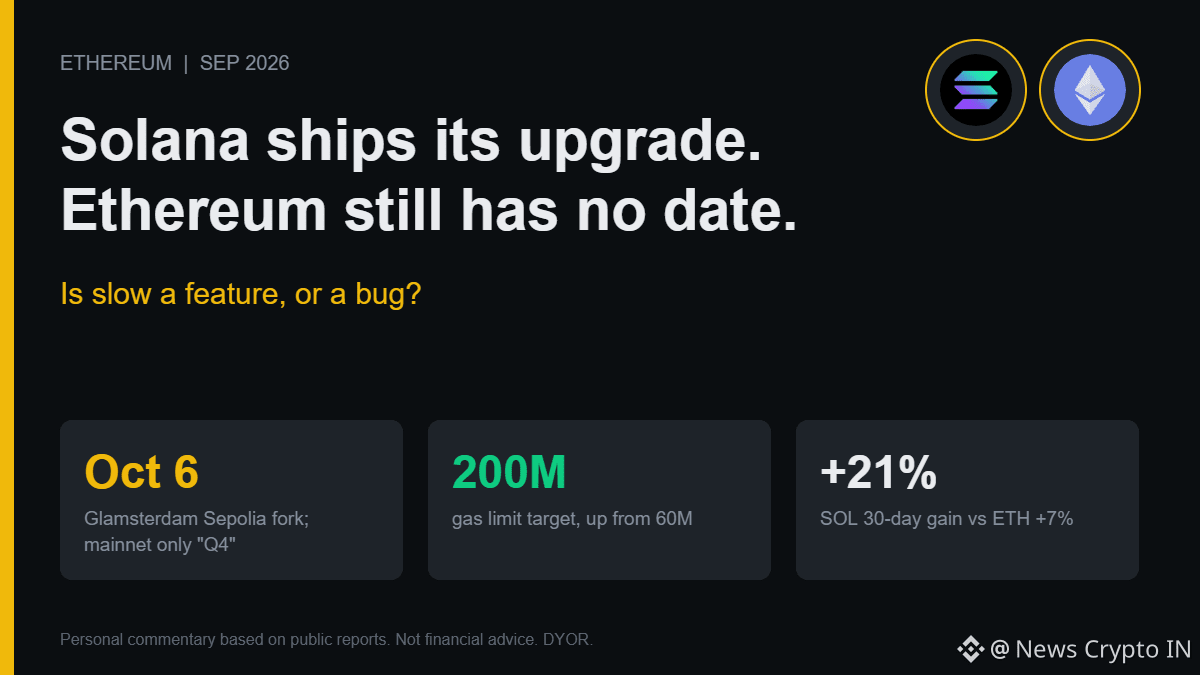
Same day, two very different roadmaps. Solana started activating its Alpenglow consensus rewrite on mainnet today. Ethereum's Glamsterdam still has no mainnet date: the Sepolia testnet fork is set for Oct 6, and mainnet is only "expected in Q4 2026."
What Glamsterdam promises is big: parallel transaction execution, enshrined proposer-builder separation, and a gas limit raised gradually from 60M toward 200M. On paper, it's Ethereum's answer to the throughput race.
The uncomfortable question: how long can "we ship when it's ready" stay a feature instead of a liability? Every slipped quarter is another one where faster chains market speed while $ETH's L1 scaling story lives on a roadmap.
The counterpoint: careful is the point. A network securing this much value can't afford to move as fast as newer chains. And money isn't fleeing: ETH funds took in $86.95M on Sept 25, extending a six-day buying streak, with ETH around $2,687.
But the past month's scoreboard tilts the other way: SOL is up about 21%, ETH about 7%. Roadmap credibility is a currency, and it depletes with each slipped date.
Which do you trust more: the chain that ships fast, or the chain that ships late?
#Ethereum #Glamsterdam
Same day, two very different roadmaps. Solana started activating its Alpenglow consensus rewrite on mainnet today. Ethereum's Glamsterdam still has no mainnet date: the Sepolia testnet fork is set for Oct 6, and mainnet is only "expected in Q4 2026."
What Glamsterdam promises is big: parallel transaction execution, enshrined proposer-builder separation, and a gas limit raised gradually from 60M toward 200M. On paper, it's Ethereum's answer to the throughput race.
The uncomfortable question: how long can "we ship when it's ready" stay a feature instead of a liability? Every slipped quarter is another one where faster chains market speed while $ETH 's L1 scaling story lives on a roadmap.
The counterpoint: careful is the point. A network securing this much value can't afford to move as fast as newer chains. And money isn't fleeing: ETH funds took in $86.95M on Sept 25, extending a six-day buying streak, with ETH around $2,687.
But the past month's scoreboard tilts the other way: SOL is up about 21%, ETH about 7%. Roadmap credibility is a currency, and it depletes with each slipped date.
Which do you trust more: the chain that ships fast, or the chain that ships late?
#Ethereum #Glamsterdam
What Glamsterdam promises is big: parallel transaction execution, enshrined proposer-builder separation, and a gas limit raised gradually from 60M toward 200M. On paper, it's Ethereum's answer to the throughput race.
The uncomfortable question: how long can "we ship when it's ready" stay a feature instead of a liability? Every slipped quarter is another one where faster chains market speed while $ETH 's L1 scaling story lives on a roadmap.
The counterpoint: careful is the point. A network securing this much value can't afford to move as fast as newer chains. And money isn't fleeing: ETH funds took in $86.95M on Sept 25, extending a six-day buying streak, with ETH around $2,687.
But the past month's scoreboard tilts the other way: SOL is up about 21%, ETH about 7%. Roadmap credibility is a currency, and it depletes with each slipped date.
Which do you trust more: the chain that ships fast, or the chain that ships late?
#Ethereum #Glamsterdam
29
Tarjimani ko‘rish
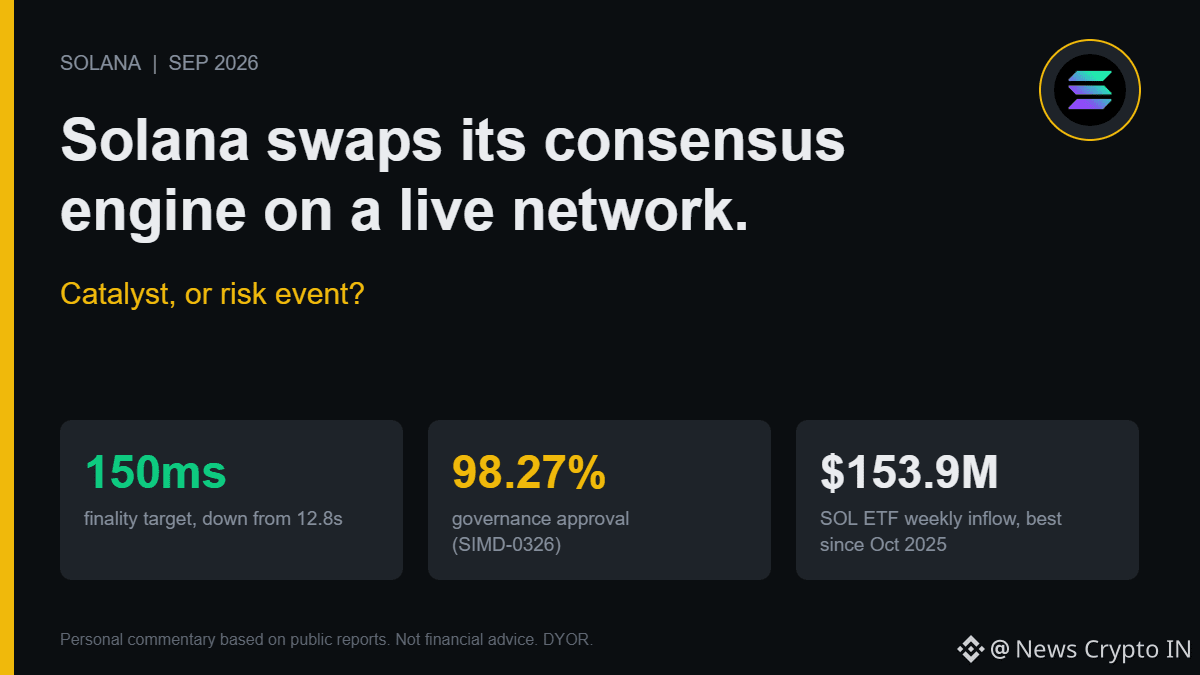
Solana's biggest protocol change ever starts activating today. Alpenglow replaces TowerBFT with a new consensus called Votor, cutting finality from about 12.8 seconds to roughly 150 milliseconds. That's ~85x faster. Governance approved it with 98.27% of votes.
The good: the network can now tolerate up to 40% of stake being unresponsive or adversarial before finality halts, up from one-third. Slot time is already down to 250ms since Sept 18. And $SOL ETFs just pulled in $153.87M, their strongest week since Oct 2025, with SOL trading around $124.
The part the hype skips:
- Only Votor goes live today. Rotor, the other half of the rewrite, comes later.
- Vote certificates are no longer throttled by fees, so critics flag a spam/DoS risk that hasn't been stress-tested on mainnet.
- Chasing speed pushes toward high-end validator hardware, which pressures decentralization.
- Validators that haven't upgraded to Agave v4.3 risk forking off the network.
The Solana Foundation says the network has had 100% uptime for about 30 months. That's the record Alpenglow has to protect. Faster finality is worthless if it costs reliability.
Rewriting consensus on a live network worth roughly $70B is the boldest upgrade in Solana's history. Bullish if it holds. Expensive if it doesn't.
Are you treating this as a catalyst, or as a risk event?
#Solana #Alpenglow
Solana's biggest protocol change ever starts activating today. Alpenglow replaces TowerBFT with a new consensus called Votor, cutting finality from about 12.8 seconds to roughly 150 milliseconds. That's ~85x faster. Governance approved it with 98.27% of votes.
The good: the network can now tolerate up to 40% of stake being unresponsive or adversarial before finality halts, up from one-third. Slot time is already down to 250ms since Sept 18. And $SOL ETFs just pulled in $153.87M, their strongest week since Oct 2025, with SOL trading around $124.
The part the hype skips:
- Only Votor goes live today. Rotor, the other half of the rewrite, comes later.
- Vote certificates are no longer throttled by fees, so critics flag a spam/DoS risk that hasn't been stress-tested on mainnet.
- Chasing speed pushes toward high-end validator hardware, which pressures decentralization.
- Validators that haven't upgraded to Agave v4.3 risk forking off the network.
The Solana Foundation says the network has had 100% uptime for about 30 months. That's the record Alpenglow has to protect. Faster finality is worthless if it costs reliability.
Rewriting consensus on a live network worth roughly $70B is the boldest upgrade in Solana's history. Bullish if it holds. Expensive if it doesn't.
Are you treating this as a catalyst, or as a risk event?
#Solana #Alpenglow
The good: the network can now tolerate up to 40% of stake being unresponsive or adversarial before finality halts, up from one-third. Slot time is already down to 250ms since Sept 18. And $SOL ETFs just pulled in $153.87M, their strongest week since Oct 2025, with SOL trading around $124.
The part the hype skips:
- Only Votor goes live today. Rotor, the other half of the rewrite, comes later.
- Vote certificates are no longer throttled by fees, so critics flag a spam/DoS risk that hasn't been stress-tested on mainnet.
- Chasing speed pushes toward high-end validator hardware, which pressures decentralization.
- Validators that haven't upgraded to Agave v4.3 risk forking off the network.
The Solana Foundation says the network has had 100% uptime for about 30 months. That's the record Alpenglow has to protect. Faster finality is worthless if it costs reliability.
Rewriting consensus on a live network worth roughly $70B is the boldest upgrade in Solana's history. Bullish if it holds. Expensive if it doesn't.
Are you treating this as a catalyst, or as a risk event?
#Solana #Alpenglow
1
102
Tarjimani ko‘rish
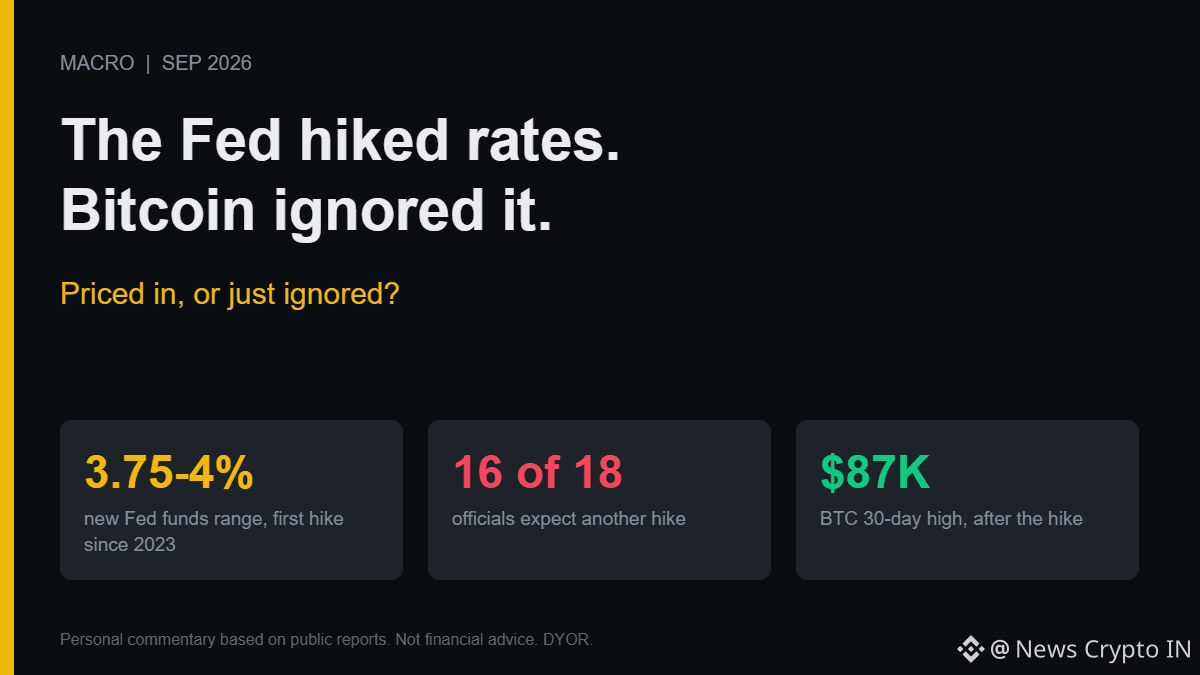
The Fed hiked rates on Sept 16: 25 bps to 3.75%-4%. Unanimous, 12-0, and the first hike since July 2023. 16 of 18 officials expect at least one more, and markets are pricing hikes into 2027.
Bitcoin's response: up. $BTC went from a 30-day low near $75K to a high of $87K, and it still sits around $84K.
The textbook says tighter money pressures risk assets. Crypto Twitter says "it was already priced in." Maybe. But "priced in" is often what people say when they can't explain a move.
Here's the uncomfortable read: this rally looks carried by a narrow bid (record ETF inflows, corporate treasury buying), not broad liquidity. Narrow bids are the first to fade when yields keep climbing, and the Fed's own dot plot says the tightening isn't finished.
Higher Treasury yields also hand big money a risk-free alternative paying ~4%. Crypto has to beat that hurdle, and it pays nothing unless you stake or lend it.
I'm not calling a top. Just noting the setup: a hawkish Fed, rising yields, and a market ignoring both. Either the Fed blinks or the market does.
Which one are you positioned for?
#Fed #Bitcoin
The Fed hiked rates on Sept 16: 25 bps to 3.75%-4%. Unanimous, 12-0, and the first hike since July 2023. 16 of 18 officials expect at least one more, and markets are pricing hikes into 2027.
Bitcoin's response: up. $BTC went from a 30-day low near $75K to a high of $87K, and it still sits around $84K.
The textbook says tighter money pressures risk assets. Crypto Twitter says "it was already priced in." Maybe. But "priced in" is often what people say when they can't explain a move.
Here's the uncomfortable read: this rally looks carried by a narrow bid (record ETF inflows, corporate treasury buying), not broad liquidity. Narrow bids are the first to fade when yields keep climbing, and the Fed's own dot plot says the tightening isn't finished.
Higher Treasury yields also hand big money a risk-free alternative paying ~4%. Crypto has to beat that hurdle, and it pays nothing unless you stake or lend it.
I'm not calling a top. Just noting the setup: a hawkish Fed, rising yields, and a market ignoring both. Either the Fed blinks or the market does.
Which one are you positioned for?
#Fed #Bitcoin
Bitcoin's response: up. $BTC went from a 30-day low near $75K to a high of $87K, and it still sits around $84K.
The textbook says tighter money pressures risk assets. Crypto Twitter says "it was already priced in." Maybe. But "priced in" is often what people say when they can't explain a move.
Here's the uncomfortable read: this rally looks carried by a narrow bid (record ETF inflows, corporate treasury buying), not broad liquidity. Narrow bids are the first to fade when yields keep climbing, and the Fed's own dot plot says the tightening isn't finished.
Higher Treasury yields also hand big money a risk-free alternative paying ~4%. Crypto has to beat that hurdle, and it pays nothing unless you stake or lend it.
I'm not calling a top. Just noting the setup: a hawkish Fed, rising yields, and a market ignoring both. Either the Fed blinks or the market does.
Which one are you positioned for?
#Fed #Bitcoin
106
Tarjimani ko‘rish
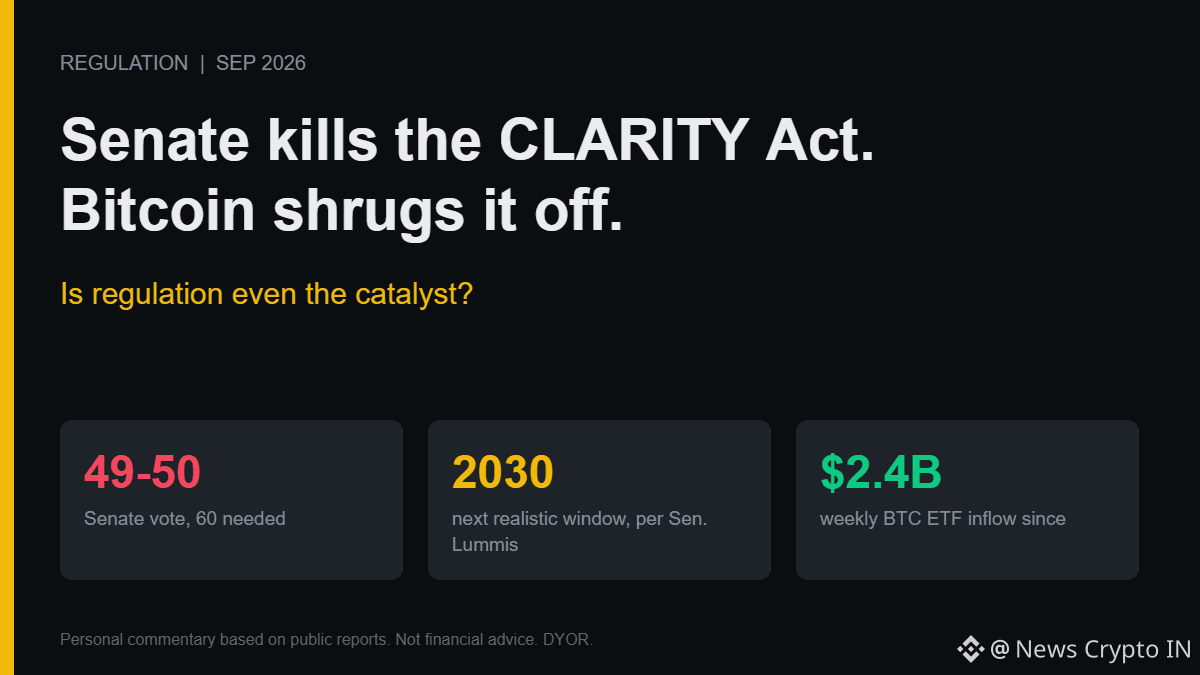
The US Senate just killed the biggest crypto bill in years. The CLARITY Act failed a procedural vote 49-50 on Sept 15, short of the 60 it needed. Every Democrat and four Republicans (Collins, Hawley, Moran, Tillis) voted no. Sen. Lummis says the next realistic window for market-structure legislation is 2030.
Two weeks later, $BTC touched $87K and spot Bitcoin ETFs took in $2.4B in a single week, their largest since October.
So much for "regulatory clarity is the catalyst." For years the pitch was that crypto can't go mainstream without a market-structure law. The market just got the opposite news and did the opposite of panic.
What that suggests: price is being driven by ETF flows and liquidity, not legislation. Capital that wants Bitcoin exposure already has a regulated door. The bill mattered far more for DeFi, altcoins and exchanges than for BTC itself.
The flip side is real. If the SEC vs CFTC turf war stays unresolved, every token outside the ETF wrapper stays in a gray zone. Tillis filed a motion to reconsider, so it's not dead, but "not dead" isn't "passing."
Bulls say the news doesn't matter. Bears say the market is ignoring a real problem. Which side is right, or is it both?
#CLARITYAct #Crypto
The US Senate just killed the biggest crypto bill in years. The CLARITY Act failed a procedural vote 49-50 on Sept 15, short of the 60 it needed. Every Democrat and four Republicans (Collins, Hawley, Moran, Tillis) voted no. Sen. Lummis says the next realistic window for market-structure legislation is 2030.
Two weeks later, $BTC touched $87K and spot Bitcoin ETFs took in $2.4B in a single week, their largest since October.
So much for "regulatory clarity is the catalyst." For years the pitch was that crypto can't go mainstream without a market-structure law. The market just got the opposite news and did the opposite of panic.
What that suggests: price is being driven by ETF flows and liquidity, not legislation. Capital that wants Bitcoin exposure already has a regulated door. The bill mattered far more for DeFi, altcoins and exchanges than for BTC itself.
The flip side is real. If the SEC vs CFTC turf war stays unresolved, every token outside the ETF wrapper stays in a gray zone. Tillis filed a motion to reconsider, so it's not dead, but "not dead" isn't "passing."
Bulls say the news doesn't matter. Bears say the market is ignoring a real problem. Which side is right, or is it both?
#CLARITYAct #Crypto
Two weeks later, $BTC touched $87K and spot Bitcoin ETFs took in $2.4B in a single week, their largest since October.
So much for "regulatory clarity is the catalyst." For years the pitch was that crypto can't go mainstream without a market-structure law. The market just got the opposite news and did the opposite of panic.
What that suggests: price is being driven by ETF flows and liquidity, not legislation. Capital that wants Bitcoin exposure already has a regulated door. The bill mattered far more for DeFi, altcoins and exchanges than for BTC itself.
The flip side is real. If the SEC vs CFTC turf war stays unresolved, every token outside the ETF wrapper stays in a gray zone. Tillis filed a motion to reconsider, so it's not dead, but "not dead" isn't "passing."
Bulls say the news doesn't matter. Bears say the market is ignoring a real problem. Which side is right, or is it both?
#CLARITYAct #Crypto
115
Tarjimani ko‘rish
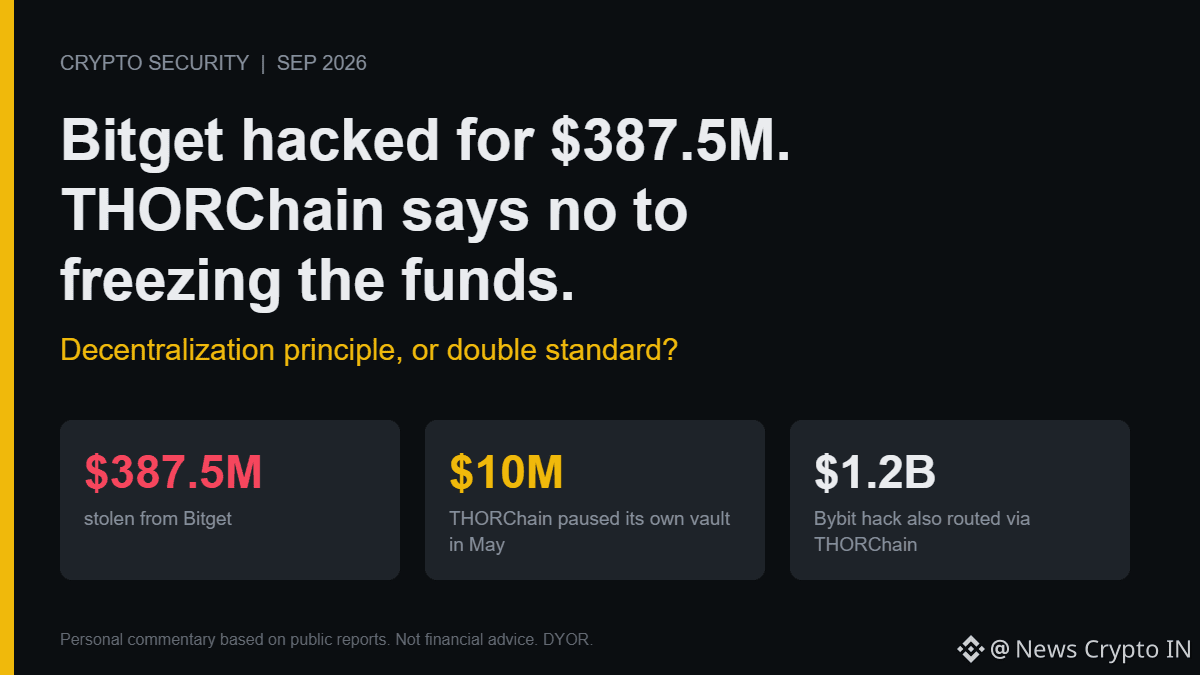
Bitget lost $387.5M in a wallet breach this week, one of the largest hacks of the year, with suspected North Korean links. The stolen funds were then swapped and bridged out through THORChain ($RUNE). Bitget's CEO asked THORChain to block the flagged addresses. THORChain said no.
The argument: permissionless protocol, no censorship, code is neutral. Sounds principled.
Except in May, THORChain paused a vault after roughly $10M was drained from its own funds. OKX founder Star Xu put it bluntly: a network that can stop when its own money is at risk, but refuses when someone else's is, isn't "like Bitcoin."
That's the double-standard problem. Either the protocol can intervene or it can't. If it can, "we're just code" stops being a technical fact and becomes a choice about whose losses count.
The fair counterpoint: once a protocol blocks addresses on an exchange's request, it's building the censorship machinery decentralization was designed to avoid. Who decides who gets flagged next? That slope is real.
But pattern matters too. A big chunk of the ~$1.2B Bybit hack in 2025 also moved through THORChain. At some point "neutral infrastructure" and "preferred laundering rail" describe the same thing.
I'm not picking a side for you. Just asking: is decentralization a principle applied consistently, or a shield raised depending on who's asking?
#THORChain #Decentralization
Bitget lost $387.5M in a wallet breach this week, one of the largest hacks of the year, with suspected North Korean links. The stolen funds were then swapped and bridged out through THORChain ($RUNE ). Bitget's CEO asked THORChain to block the flagged addresses. THORChain said no.
The argument: permissionless protocol, no censorship, code is neutral. Sounds principled.
Except in May, THORChain paused a vault after roughly $10M was drained from its own funds. OKX founder Star Xu put it bluntly: a network that can stop when its own money is at risk, but refuses when someone else's is, isn't "like Bitcoin."
That's the double-standard problem. Either the protocol can intervene or it can't. If it can, "we're just code" stops being a technical fact and becomes a choice about whose losses count.
The fair counterpoint: once a protocol blocks addresses on an exchange's request, it's building the censorship machinery decentralization was designed to avoid. Who decides who gets flagged next? That slope is real.
But pattern matters too. A big chunk of the ~$1.2B Bybit hack in 2025 also moved through THORChain. At some point "neutral infrastructure" and "preferred laundering rail" describe the same thing.
I'm not picking a side for you. Just asking: is decentralization a principle applied consistently, or a shield raised depending on who's asking?
#THORChain #Decentralization
The argument: permissionless protocol, no censorship, code is neutral. Sounds principled.
Except in May, THORChain paused a vault after roughly $10M was drained from its own funds. OKX founder Star Xu put it bluntly: a network that can stop when its own money is at risk, but refuses when someone else's is, isn't "like Bitcoin."
That's the double-standard problem. Either the protocol can intervene or it can't. If it can, "we're just code" stops being a technical fact and becomes a choice about whose losses count.
The fair counterpoint: once a protocol blocks addresses on an exchange's request, it's building the censorship machinery decentralization was designed to avoid. Who decides who gets flagged next? That slope is real.
But pattern matters too. A big chunk of the ~$1.2B Bybit hack in 2025 also moved through THORChain. At some point "neutral infrastructure" and "preferred laundering rail" describe the same thing.
I'm not picking a side for you. Just asking: is decentralization a principle applied consistently, or a shield raised depending on who's asking?
#THORChain #Decentralization
1
Tarjimani ko‘rish
ETH is up 31% in 30 days. XRP is up 37%. $SOL is up roughly 40%, the best performer of the bunch. $BTC "only" gained 24% in the same window. Timeline's already calling this altseason.
It isn't. Not by the actual definition. The Altcoin Season Index needs 75% of the top 100 coins to outperform Bitcoin over a rolling 90-day window. Right now that index sits at 33-37 — solidly in Bitcoin Season territory, not close to the altseason threshold.
Here's the disconnect: three loud winners (ETH, XRP, SOL) create a "everything's pumping" narrative on your feed, while BTC dominance stays elevated and most of the other 97 coins in the top 100 quietly lag behind Bitcoin's 24%. A handful of large-cap alts beating BTC isn't the same claim as "capital broadly rotating out of Bitcoin into alts" — that second claim is what altseason actually means, and the data says it hasn't happened yet.
BNB, for reference, is up a comparatively boring 6% on the week, near $800 — not part of anyone's altseason hype thread, which is exactly the point. If altseason were real, BNB wouldn't be the quiet one.
Structurally, analysts watch ETH/BTC and SOL/BTC ratios turning up after BTC dominance peaks and rolls over — that sequence is in early stages, not completed. So this is "some alts had a good month," not "the market has rotated."
If your bags are ETH/XRP/SOL and you're up 30-40%, congrats, that's real. Just don't confuse three winners with a season.
#Altseason #DYOR
ETH is up 31% in 30 days. XRP is up 37%. $SOL is up roughly 40%, the best performer of the bunch. $BTC "only" gained 24% in the same window. Timeline's already calling this altseason.
It isn't. Not by the actual definition. The Altcoin Season Index needs 75% of the top 100 coins to outperform Bitcoin over a rolling 90-day window. Right now that index sits at 33-37 — solidly in Bitcoin Season territory, not close to the altseason threshold.
Here's the disconnect: three loud winners (ETH, XRP, SOL) create a "everything's pumping" narrative on your feed, while BTC dominance stays elevated and most of the other 97 coins in the top 100 quietly lag behind Bitcoin's 24%. A handful of large-cap alts beating BTC isn't the same claim as "capital broadly rotating out of Bitcoin into alts" — that second claim is what altseason actually means, and the data says it hasn't happened yet.
BNB, for reference, is up a comparatively boring 6% on the week, near $800 — not part of anyone's altseason hype thread, which is exactly the point. If altseason were real, BNB wouldn't be the quiet one.
Structurally, analysts watch ETH/BTC and SOL/BTC ratios turning up after BTC dominance peaks and rolls over — that sequence is in early stages, not completed. So this is "some alts had a good month," not "the market has rotated."
If your bags are ETH/XRP/SOL and you're up 30-40%, congrats, that's real. Just don't confuse three winners with a season.
#Altseason #DYOR
It isn't. Not by the actual definition. The Altcoin Season Index needs 75% of the top 100 coins to outperform Bitcoin over a rolling 90-day window. Right now that index sits at 33-37 — solidly in Bitcoin Season territory, not close to the altseason threshold.
Here's the disconnect: three loud winners (ETH, XRP, SOL) create a "everything's pumping" narrative on your feed, while BTC dominance stays elevated and most of the other 97 coins in the top 100 quietly lag behind Bitcoin's 24%. A handful of large-cap alts beating BTC isn't the same claim as "capital broadly rotating out of Bitcoin into alts" — that second claim is what altseason actually means, and the data says it hasn't happened yet.
BNB, for reference, is up a comparatively boring 6% on the week, near $800 — not part of anyone's altseason hype thread, which is exactly the point. If altseason were real, BNB wouldn't be the quiet one.
Structurally, analysts watch ETH/BTC and SOL/BTC ratios turning up after BTC dominance peaks and rolls over — that sequence is in early stages, not completed. So this is "some alts had a good month," not "the market has rotated."
If your bags are ETH/XRP/SOL and you're up 30-40%, congrats, that's real. Just don't confuse three winners with a season.
#Altseason #DYOR
166
Tarjimani ko‘rish
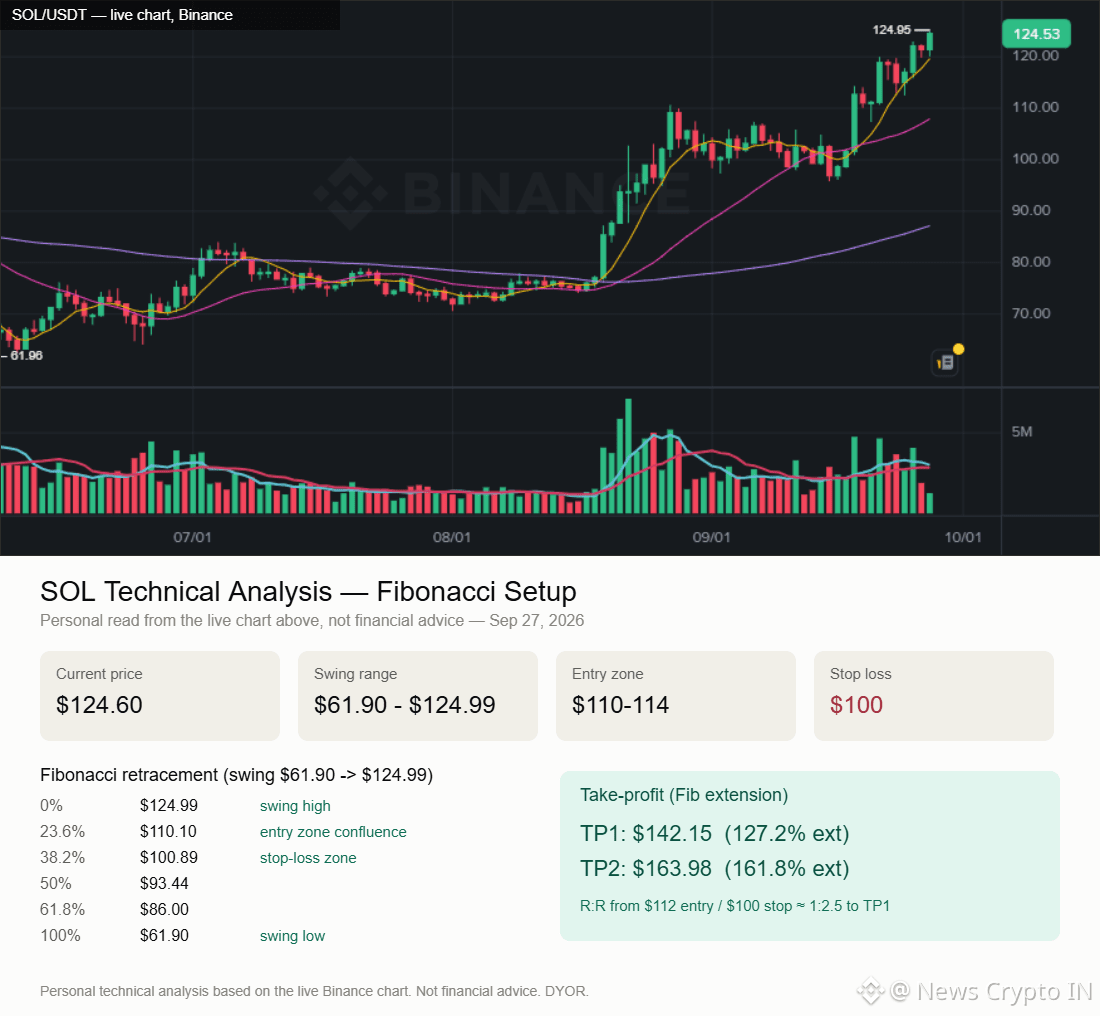
$SOL Technical Analysis — Fibonacci setup (personal read from live chart, NFA)
Swing range $61.90 -> $124.99. Watching $110-114 entry zone (23.6% fib confluence). Stop below $100 (38.2% fib). Targets: $142 / $164 (fib extensions). R:R ~ 1:2.5 to TP1.
My own technical opinion based on the live chart -- not a signal. DYOR.
#SOL #Solana #TechnicalAnalysis #Fibonacci #DYOR
$SOL Technical Analysis — Fibonacci setup (personal read from live chart, NFA)
Swing range $61.90 -> $124.99. Watching $110-114 entry zone (23.6% fib confluence). Stop below $100 (38.2% fib). Targets: $142 / $164 (fib extensions). R:R ~ 1:2.5 to TP1.
My own technical opinion based on the live chart -- not a signal. DYOR.
#SOL #Solana #TechnicalAnalysis #Fibonacci #DYOR
Swing range $61.90 -> $124.99. Watching $110-114 entry zone (23.6% fib confluence). Stop below $100 (38.2% fib). Targets: $142 / $164 (fib extensions). R:R ~ 1:2.5 to TP1.
My own technical opinion based on the live chart -- not a signal. DYOR.
#SOL #Solana #TechnicalAnalysis #Fibonacci #DYOR
1
243
Tarjimani ko‘rish
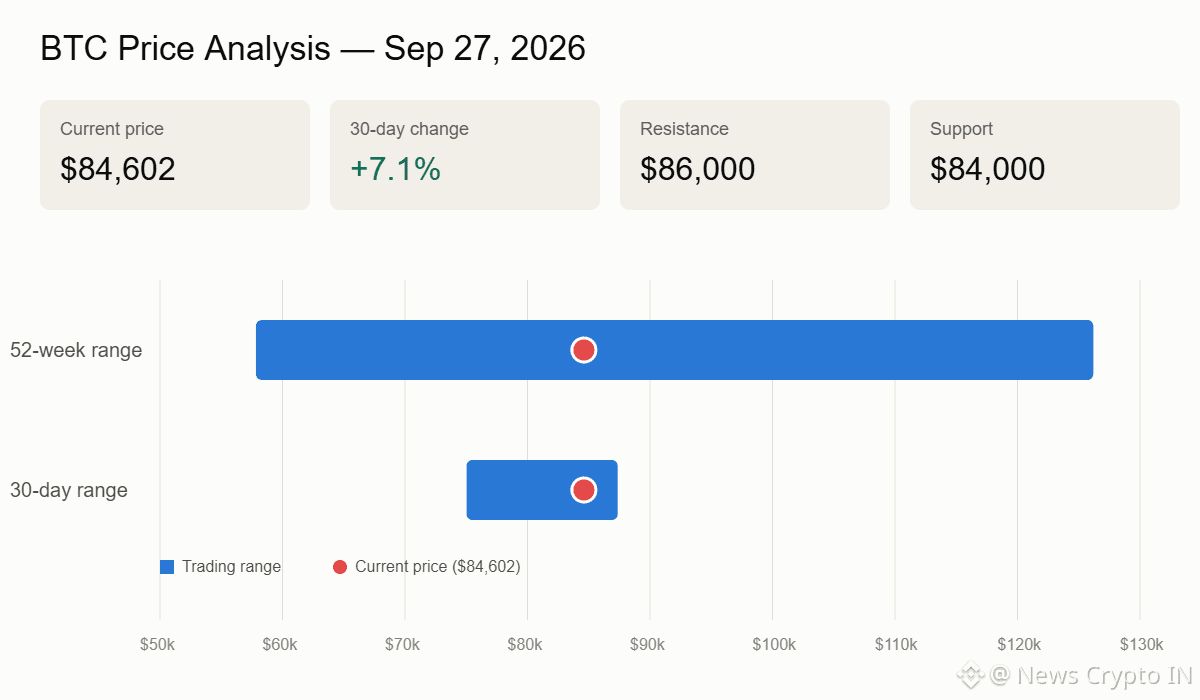
BTC is up 7.1% in 30 days, sitting at $84,602 — but that number hides more than it shows. It's still $41,500 below its own ATH from less than a year ago. "Recovery" and "new bull run" are not the same chart pattern, even when they produce the same green candle today.
$86K resistance has held twice this month. Until it breaks with volume, this is range-bound consolidation, not a breakout — no matter how the headlines frame the +7% number in isolation.
#BTC #Bitcoin #CryptoMarket
BTC is up 7.1% in 30 days, sitting at $84,602 — but that number hides more than it shows. It's still $41,500 below its own ATH from less than a year ago. "Recovery" and "new bull run" are not the same chart pattern, even when they produce the same green candle today.
$86K resistance has held twice this month. Until it breaks with volume, this is range-bound consolidation, not a breakout — no matter how the headlines frame the +7% number in isolation.
#BTC #Bitcoin #CryptoMarket
$86K resistance has held twice this month. Until it breaks with volume, this is range-bound consolidation, not a breakout — no matter how the headlines frame the +7% number in isolation.
#BTC #Bitcoin #CryptoMarket
1
45
Tarjimani ko‘rish
82% of all crypto trading volume right now is derivatives — futures, leverage, perpetuals. Not spot. Not "I bought Bitcoin and held it." Leveraged bets on price direction.
Peer-reviewed research on day trading, across markets, consistently finds 70-97% of day traders lose money. Only about 1% stay profitable long-term. That's not a crypto-specific stat — it's just what leverage trading does to most humans, in any market, over any long enough timeframe.
Now overlay this: the global crypto gambling market hit $92.6B in gross gaming revenue this year — 27% of ALL online gambling revenue worldwide, up from a market with 1,200 platforms in 2020 to 3,800+ now. The line between "leverage trading platform" and "gambling platform" isn't blurry because users are confused. It's blurry because the products are functionally identical: variance-maximizing bets with a house that profits either way (funding rates, liquidation fees, spread).
Nobody markets it as gambling. It gets marketed as "trading," "hedging," "market participation." The UI has candlesticks instead of a roulette wheel, so it feels like skill instead of chance. But if 9 out of 10 participants lose money to the same handful of winners plus the platform taking a cut regardless — what exactly is the functional difference?
This isn't an argument to ban leverage or that spot holding is virtuous. It's a question about self-honesty: if you're opening 5x-20x positions on hourly timeframes, are you trading, or are you gambling with extra steps and worse odds than a casino gives you on paper?
#CryptoTrading #Leverage #DeFi #RiskManagement
82% of all crypto trading volume right now is derivatives — futures, leverage, perpetuals. Not spot. Not "I bought Bitcoin and held it." Leveraged bets on price direction.
Peer-reviewed research on day trading, across markets, consistently finds 70-97% of day traders lose money. Only about 1% stay profitable long-term. That's not a crypto-specific stat — it's just what leverage trading does to most humans, in any market, over any long enough timeframe.
Now overlay this: the global crypto gambling market hit $92.6B in gross gaming revenue this year — 27% of ALL online gambling revenue worldwide, up from a market with 1,200 platforms in 2020 to 3,800+ now. The line between "leverage trading platform" and "gambling platform" isn't blurry because users are confused. It's blurry because the products are functionally identical: variance-maximizing bets with a house that profits either way (funding rates, liquidation fees, spread).
Nobody markets it as gambling. It gets marketed as "trading," "hedging," "market participation." The UI has candlesticks instead of a roulette wheel, so it feels like skill instead of chance. But if 9 out of 10 participants lose money to the same handful of winners plus the platform taking a cut regardless — what exactly is the functional difference?
This isn't an argument to ban leverage or that spot holding is virtuous. It's a question about self-honesty: if you're opening 5x-20x positions on hourly timeframes, are you trading, or are you gambling with extra steps and worse odds than a casino gives you on paper?
#CryptoTrading #Leverage #DeFi #RiskManagement
Peer-reviewed research on day trading, across markets, consistently finds 70-97% of day traders lose money. Only about 1% stay profitable long-term. That's not a crypto-specific stat — it's just what leverage trading does to most humans, in any market, over any long enough timeframe.
Now overlay this: the global crypto gambling market hit $92.6B in gross gaming revenue this year — 27% of ALL online gambling revenue worldwide, up from a market with 1,200 platforms in 2020 to 3,800+ now. The line between "leverage trading platform" and "gambling platform" isn't blurry because users are confused. It's blurry because the products are functionally identical: variance-maximizing bets with a house that profits either way (funding rates, liquidation fees, spread).
Nobody markets it as gambling. It gets marketed as "trading," "hedging," "market participation." The UI has candlesticks instead of a roulette wheel, so it feels like skill instead of chance. But if 9 out of 10 participants lose money to the same handful of winners plus the platform taking a cut regardless — what exactly is the functional difference?
This isn't an argument to ban leverage or that spot holding is virtuous. It's a question about self-honesty: if you're opening 5x-20x positions on hourly timeframes, are you trading, or are you gambling with extra steps and worse odds than a casino gives you on paper?
#CryptoTrading #Leverage #DeFi #RiskManagement
1
7
2026-yilning 1-yarmida auditi yakunlangan DeFi protokollaridan 721 million dollardan ortiq mablag‘ o‘g‘irlandi. “Yo‘q, audit bo‘lmagan.” “Shubhali anonim jamoa.” Audit bor. Barcha sizga depozit qilishdan oldin tekshirish kerak, deb aytadigan nishon.
Bu yil 135 ta DeFi xujumi bo‘yicha o‘tkazilgan tadqiqot shuni ko‘rsatdiki, 67,6% holatlar audit qilingan narsaning amaldagi doirasidan tashqarida sodir bo‘lgan. “Auditdan o‘tgan” deyarli hech qachon “butun protokol, abadiy” degani emas. Bu “shu aniq kod, shu aniq versiya, shu aniq sana” degani. Kelasi oy funksiyani qo‘shdingiz, yangi bridgingni integratsiya qildingiz, likvidatsiya mantiqini biroz o‘zgartirdingiz — xuddi o‘sha paytda auditdan o‘tmagan kodni ishga tushirgansiz, lekin veb-saytingizda audit nishoni hanuz turibdi.
Euler Finance misoli eng tiniq ko‘rinadi: ekspluatatsiya koddagi xatolik sababli emas, balki donation va liquidation mexanizmlaridagi iqtisodiy mantiq tufayli muvaffaqiyatli bo‘lgan. Satrlama-satr kodni ko‘rib chiqish buni ushlamaydi. Kod to‘g‘ri edi. Taxmin noto‘g‘ri edi.
Ayni paytda esa 2026-yilda DeFi’dan 1,3 mlrd dollar atrofida mablag‘ allaqachon “sovurib” yuborilgan va Chainalysis bu yilgi xakerlik yo‘qotishlarining taxminan 76%ini davlat tomonidan qo‘llab-quvvatlanadigan guruhlarga, asosan Lazarusga bog‘laydi — tasodifiy “script kiddies” emas. Bular Solidity’dagi xatolarni qidirib yurgan odamlar emas. Bu validator infratuzilmasi, RPC endpoint’lari va governance mexanizmlarini o‘rganadigan, yetarli moliyalashtirilgan jamoalar — ya’ni auditlar ham o‘zi ko‘rib chiqmaydigan narsalar.
“Auditdan o‘tgan” — hech qachon qurilmagan xavfsizlik kafolatini bajarib beradigan marketing iborasi. Auditlari bor protokollardan o‘tmang demayapman. Shuni aytyapmanki: audit nishonning va’da qiladigan narsasidan kamroq narsani aytadi va buni bilishning o‘zi nishondan ham qimmatroq.
Keyingi safar bir loyiha “auditdan o‘tkazgan [firm]” deb oldinga chiqsa — u audit aslida nimani qamrab olganini bilasizmi, yoki siz shunchaki chekbelgiga ishonayapsizmi?
#DeFi #Security #CryptoHacks #SmartContracts
2026-yilning 1-yarmida auditi yakunlangan DeFi protokollaridan 721 million dollardan ortiq mablag‘ o‘g‘irlandi. “Yo‘q, audit bo‘lmagan.” “Shubhali anonim jamoa.” Audit bor. Barcha sizga depozit qilishdan oldin tekshirish kerak, deb aytadigan nishon.
Bu yil 135 ta DeFi xujumi bo‘yicha o‘tkazilgan tadqiqot shuni ko‘rsatdiki, 67,6% holatlar audit qilingan narsaning amaldagi doirasidan tashqarida sodir bo‘lgan. “Auditdan o‘tgan” deyarli hech qachon “butun protokol, abadiy” degani emas. Bu “shu aniq kod, shu aniq versiya, shu aniq sana” degani. Kelasi oy funksiyani qo‘shdingiz, yangi bridgingni integratsiya qildingiz, likvidatsiya mantiqini biroz o‘zgartirdingiz — xuddi o‘sha paytda auditdan o‘tmagan kodni ishga tushirgansiz, lekin veb-saytingizda audit nishoni hanuz turibdi.
Euler Finance misoli eng tiniq ko‘rinadi: ekspluatatsiya koddagi xatolik sababli emas, balki donation va liquidation mexanizmlaridagi iqtisodiy mantiq tufayli muvaffaqiyatli bo‘lgan. Satrlama-satr kodni ko‘rib chiqish buni ushlamaydi. Kod to‘g‘ri edi. Taxmin noto‘g‘ri edi.
Ayni paytda esa 2026-yilda DeFi’dan 1,3 mlrd dollar atrofida mablag‘ allaqachon “sovurib” yuborilgan va Chainalysis bu yilgi xakerlik yo‘qotishlarining taxminan 76%ini davlat tomonidan qo‘llab-quvvatlanadigan guruhlarga, asosan Lazarusga bog‘laydi — tasodifiy “script kiddies” emas. Bular Solidity’dagi xatolarni qidirib yurgan odamlar emas. Bu validator infratuzilmasi, RPC endpoint’lari va governance mexanizmlarini o‘rganadigan, yetarli moliyalashtirilgan jamoalar — ya’ni auditlar ham o‘zi ko‘rib chiqmaydigan narsalar.
“Auditdan o‘tgan” — hech qachon qurilmagan xavfsizlik kafolatini bajarib beradigan marketing iborasi. Auditlari bor protokollardan o‘tmang demayapman. Shuni aytyapmanki: audit nishonning va’da qiladigan narsasidan kamroq narsani aytadi va buni bilishning o‘zi nishondan ham qimmatroq.
Keyingi safar bir loyiha “auditdan o‘tkazgan [firm]” deb oldinga chiqsa — u audit aslida nimani qamrab olganini bilasizmi, yoki siz shunchaki chekbelgiga ishonayapsizmi?
#DeFi #Security #CryptoHacks #SmartContracts
Bu yil 135 ta DeFi xujumi bo‘yicha o‘tkazilgan tadqiqot shuni ko‘rsatdiki, 67,6% holatlar audit qilingan narsaning amaldagi doirasidan tashqarida sodir bo‘lgan. “Auditdan o‘tgan” deyarli hech qachon “butun protokol, abadiy” degani emas. Bu “shu aniq kod, shu aniq versiya, shu aniq sana” degani. Kelasi oy funksiyani qo‘shdingiz, yangi bridgingni integratsiya qildingiz, likvidatsiya mantiqini biroz o‘zgartirdingiz — xuddi o‘sha paytda auditdan o‘tmagan kodni ishga tushirgansiz, lekin veb-saytingizda audit nishoni hanuz turibdi.
Euler Finance misoli eng tiniq ko‘rinadi: ekspluatatsiya koddagi xatolik sababli emas, balki donation va liquidation mexanizmlaridagi iqtisodiy mantiq tufayli muvaffaqiyatli bo‘lgan. Satrlama-satr kodni ko‘rib chiqish buni ushlamaydi. Kod to‘g‘ri edi. Taxmin noto‘g‘ri edi.
Ayni paytda esa 2026-yilda DeFi’dan 1,3 mlrd dollar atrofida mablag‘ allaqachon “sovurib” yuborilgan va Chainalysis bu yilgi xakerlik yo‘qotishlarining taxminan 76%ini davlat tomonidan qo‘llab-quvvatlanadigan guruhlarga, asosan Lazarusga bog‘laydi — tasodifiy “script kiddies” emas. Bular Solidity’dagi xatolarni qidirib yurgan odamlar emas. Bu validator infratuzilmasi, RPC endpoint’lari va governance mexanizmlarini o‘rganadigan, yetarli moliyalashtirilgan jamoalar — ya’ni auditlar ham o‘zi ko‘rib chiqmaydigan narsalar.
“Auditdan o‘tgan” — hech qachon qurilmagan xavfsizlik kafolatini bajarib beradigan marketing iborasi. Auditlari bor protokollardan o‘tmang demayapman. Shuni aytyapmanki: audit nishonning va’da qiladigan narsasidan kamroq narsani aytadi va buni bilishning o‘zi nishondan ham qimmatroq.
Keyingi safar bir loyiha “auditdan o‘tkazgan [firm]” deb oldinga chiqsa — u audit aslida nimani qamrab olganini bilasizmi, yoki siz shunchaki chekbelgiga ishonayapsizmi?
#DeFi #Security #CryptoHacks #SmartContracts
1
52
Atrofda 200+ kripto-influenserlar ro‘yxati va ularning pullik reklama uchun narxlar jadvali yuribdi. Post uchun $50 dan $60 000 gacha — qamroviga qarab. Kelishuvga rozi bo‘lgan 160+ ichidan nechtasi? Beshdan kamrog‘i bu reklama ekanini oshkor qildi.
Yana o‘qing. “Kimdir oshkor qilmadi” degani emas. O‘n olti yuzdan oshganlarning ichida beshdan kam.
Bu kulrang zona emas. FTC’ning “Endorsement Guides” (tavsiya/endorsement bo‘yicha qo‘llanma)da oshkor qilish talab qilinadi. Jeyk Pol aynan shu ish uchun Justin Sun bilan birga $400K jarimaga tortilgan. Kim Kardashian esa EthereumMax bilan bog‘liq xuddi shu holat uchun SEC tomonidan jazolangan. Qonun aniq, pretsedent aniq, ammo baribir bu sohadagi butun influencer iqtisodiyoti qandaydir tarzda “to‘layotgani kimligini esdan chiqarib qo‘yish” hisobiga yurishda davom etyapti.
Nega bu masala “gotcha” (fosh etuvchi) postdan ham muhimroq: siz kimdandir “men bu loyihani haftalab o‘rganyapman va juda ham optimistman” degan postni ko‘rganingizda, u 200 ming obunachiga ega bo‘lsa, siz uning gaplari chin ixlosdanmi yoki $15 000 lik schyotdan chiqqanmi — bilolmaysiz. Keyin ergashtirilgan “rug pull”lar — masalan, $143M CR7 qulash — retail ahmoq bo‘lgani uchun bo‘lmaydi. Ular retail signal deb ishongan odamlar posting sabablarini yolg‘on aytishga tizimli tarzda rag‘batlantirilgani uchun sodir bo‘ladi.
Eng noqulay qismi: bu platforma ham yaratuvchilarga (creators) tayanadi. “Menga ergashayotgan odam hech bo‘lmasa menga nisbatan rost gapirayotgandir” deb o‘ylash instinkti aynan shu sizib chiqqan ma’lumot tomonidan, sanoat miqyosida, keskin barbod qilingan faraz edi.
Ism-sharif aytmayman — leak buni allaqachon qilgan. Faqat so‘rayman: keyingi safar kimningdir “shaxsiy fikri” token launch bilan juda qulay tarzda mos tushsa, siz to‘lovchining kimligini tekshirasizmi yoki shunchaki kayfiyatga ishonaverasizmi?
#CryptoInfluencers #Transparency #DYOR #CryptoNews
Atrofda 200+ kripto-influenserlar ro‘yxati va ularning pullik reklama uchun narxlar jadvali yuribdi. Post uchun $50 dan $60 000 gacha — qamroviga qarab. Kelishuvga rozi bo‘lgan 160+ ichidan nechtasi? Beshdan kamrog‘i bu reklama ekanini oshkor qildi.
Yana o‘qing. “Kimdir oshkor qilmadi” degani emas. O‘n olti yuzdan oshganlarning ichida beshdan kam.
Bu kulrang zona emas. FTC’ning “Endorsement Guides” (tavsiya/endorsement bo‘yicha qo‘llanma)da oshkor qilish talab qilinadi. Jeyk Pol aynan shu ish uchun Justin Sun bilan birga $400K jarimaga tortilgan. Kim Kardashian esa EthereumMax bilan bog‘liq xuddi shu holat uchun SEC tomonidan jazolangan. Qonun aniq, pretsedent aniq, ammo baribir bu sohadagi butun influencer iqtisodiyoti qandaydir tarzda “to‘layotgani kimligini esdan chiqarib qo‘yish” hisobiga yurishda davom etyapti.
Nega bu masala “gotcha” (fosh etuvchi) postdan ham muhimroq: siz kimdandir “men bu loyihani haftalab o‘rganyapman va juda ham optimistman” degan postni ko‘rganingizda, u 200 ming obunachiga ega bo‘lsa, siz uning gaplari chin ixlosdanmi yoki $15 000 lik schyotdan chiqqanmi — bilolmaysiz. Keyin ergashtirilgan “rug pull”lar — masalan, $143M CR7 qulash — retail ahmoq bo‘lgani uchun bo‘lmaydi. Ular retail signal deb ishongan odamlar posting sabablarini yolg‘on aytishga tizimli tarzda rag‘batlantirilgani uchun sodir bo‘ladi.
Eng noqulay qismi: bu platforma ham yaratuvchilarga (creators) tayanadi. “Menga ergashayotgan odam hech bo‘lmasa menga nisbatan rost gapirayotgandir” deb o‘ylash instinkti aynan shu sizib chiqqan ma’lumot tomonidan, sanoat miqyosida, keskin barbod qilingan faraz edi.
Ism-sharif aytmayman — leak buni allaqachon qilgan. Faqat so‘rayman: keyingi safar kimningdir “shaxsiy fikri” token launch bilan juda qulay tarzda mos tushsa, siz to‘lovchining kimligini tekshirasizmi yoki shunchaki kayfiyatga ishonaverasizmi?
#CryptoInfluencers #Transparency #DYOR #CryptoNews
Yana o‘qing. “Kimdir oshkor qilmadi” degani emas. O‘n olti yuzdan oshganlarning ichida beshdan kam.
Bu kulrang zona emas. FTC’ning “Endorsement Guides” (tavsiya/endorsement bo‘yicha qo‘llanma)da oshkor qilish talab qilinadi. Jeyk Pol aynan shu ish uchun Justin Sun bilan birga $400K jarimaga tortilgan. Kim Kardashian esa EthereumMax bilan bog‘liq xuddi shu holat uchun SEC tomonidan jazolangan. Qonun aniq, pretsedent aniq, ammo baribir bu sohadagi butun influencer iqtisodiyoti qandaydir tarzda “to‘layotgani kimligini esdan chiqarib qo‘yish” hisobiga yurishda davom etyapti.
Nega bu masala “gotcha” (fosh etuvchi) postdan ham muhimroq: siz kimdandir “men bu loyihani haftalab o‘rganyapman va juda ham optimistman” degan postni ko‘rganingizda, u 200 ming obunachiga ega bo‘lsa, siz uning gaplari chin ixlosdanmi yoki $15 000 lik schyotdan chiqqanmi — bilolmaysiz. Keyin ergashtirilgan “rug pull”lar — masalan, $143M CR7 qulash — retail ahmoq bo‘lgani uchun bo‘lmaydi. Ular retail signal deb ishongan odamlar posting sabablarini yolg‘on aytishga tizimli tarzda rag‘batlantirilgani uchun sodir bo‘ladi.
Eng noqulay qismi: bu platforma ham yaratuvchilarga (creators) tayanadi. “Menga ergashayotgan odam hech bo‘lmasa menga nisbatan rost gapirayotgandir” deb o‘ylash instinkti aynan shu sizib chiqqan ma’lumot tomonidan, sanoat miqyosida, keskin barbod qilingan faraz edi.
Ism-sharif aytmayman — leak buni allaqachon qilgan. Faqat so‘rayman: keyingi safar kimningdir “shaxsiy fikri” token launch bilan juda qulay tarzda mos tushsa, siz to‘lovchining kimligini tekshirasizmi yoki shunchaki kayfiyatga ishonaverasizmi?
#CryptoInfluencers #Transparency #DYOR #CryptoNews
1
62
Tarjimani ko‘rish
Everyone's celebrating the GENIUS Act as "crypto finally got regulatory clarity." Nobody's asking who that clarity is actually built for.
Here's the math: a stablecoin issuer under $200M in circulation now faces roughly $15M/year in compliance costs — AML systems, audit functions, sanctions programs, on-chain enforcement. Their gross reserve income at current Treasury yields? About $7.5M/year. That's a business that loses money by design the moment it complies.
Compliance costs are fixed, not proportional. A $500M issuer and a $50B issuer pay roughly the same compliance bill. Circle and Coinbase absorb that easily. Everyone below them gets priced out or acquired.
This isn't accidental. This is what "regulatory clarity" produces every time it's written this way: not more competition, but consolidation into 2-3 well-capitalized incumbents who helped write the framework. Circle's USDC already added $2B in Q1 2026 on "institutional demand for regulated assets" while Tether's USDT contracted $3B — its first quarterly decline since 2022.
Nobody's forcing you to pick a side here. Just notice the pattern: every time an industry gets "protected" by compliance requirements this expensive, the companies celebrating loudest in the press release are the ones who can already afford the bill. The ones getting quietly acquired by Q3 aren't writing op-eds about it.
If you hold stablecoins: do you know which one of yours can actually survive this math, or are you just holding whichever one was liquid when you needed it?
#Stablecoin #GENIUSAct #CryptoRegulation #USDT #USDC
Everyone's celebrating the GENIUS Act as "crypto finally got regulatory clarity." Nobody's asking who that clarity is actually built for.
Here's the math: a stablecoin issuer under $200M in circulation now faces roughly $15M/year in compliance costs — AML systems, audit functions, sanctions programs, on-chain enforcement. Their gross reserve income at current Treasury yields? About $7.5M/year. That's a business that loses money by design the moment it complies.
Compliance costs are fixed, not proportional. A $500M issuer and a $50B issuer pay roughly the same compliance bill. Circle and Coinbase absorb that easily. Everyone below them gets priced out or acquired.
This isn't accidental. This is what "regulatory clarity" produces every time it's written this way: not more competition, but consolidation into 2-3 well-capitalized incumbents who helped write the framework. Circle's USDC already added $2B in Q1 2026 on "institutional demand for regulated assets" while Tether's USDT contracted $3B — its first quarterly decline since 2022.
Nobody's forcing you to pick a side here. Just notice the pattern: every time an industry gets "protected" by compliance requirements this expensive, the companies celebrating loudest in the press release are the ones who can already afford the bill. The ones getting quietly acquired by Q3 aren't writing op-eds about it.
If you hold stablecoins: do you know which one of yours can actually survive this math, or are you just holding whichever one was liquid when you needed it?
#Stablecoin #GENIUSAct #CryptoRegulation #USDT #USDC
Here's the math: a stablecoin issuer under $200M in circulation now faces roughly $15M/year in compliance costs — AML systems, audit functions, sanctions programs, on-chain enforcement. Their gross reserve income at current Treasury yields? About $7.5M/year. That's a business that loses money by design the moment it complies.
Compliance costs are fixed, not proportional. A $500M issuer and a $50B issuer pay roughly the same compliance bill. Circle and Coinbase absorb that easily. Everyone below them gets priced out or acquired.
This isn't accidental. This is what "regulatory clarity" produces every time it's written this way: not more competition, but consolidation into 2-3 well-capitalized incumbents who helped write the framework. Circle's USDC already added $2B in Q1 2026 on "institutional demand for regulated assets" while Tether's USDT contracted $3B — its first quarterly decline since 2022.
Nobody's forcing you to pick a side here. Just notice the pattern: every time an industry gets "protected" by compliance requirements this expensive, the companies celebrating loudest in the press release are the ones who can already afford the bill. The ones getting quietly acquired by Q3 aren't writing op-eds about it.
If you hold stablecoins: do you know which one of yours can actually survive this math, or are you just holding whichever one was liquid when you needed it?
#Stablecoin #GENIUSAct #CryptoRegulation #USDT #USDC
1
3
1.7k
Tarjimani ko‘rish
Today's #1 gainer across the entire crypto market isn't Bitcoin, isn't an AI token, isn't some institutional tokenization play. It's Lil' Shrub (SHRUB), up 805.7% in 24 hours.
What is it? A memecoin themed after a hedgehog. Specifically, Elon Musk's pet hedgehog, after Shivon Zilis (Neuralink exec, mother of several of Musk's kids) posted a photo of it on X. Someone turned that photo into a token days later. 0% tax, "100% burned liquidity," zero utility, zero product.
This is the entire playbook, every time: a public figure posts something unrelated to crypto → someone launches a token off it within hours → early buyers pump it on a low-liquidity chain → it shows up on every "top gainers" list → new buyers see +805% and ape in at the top → volume dries up → chart round-trips to zero.
The token isn't "worth" 805% more. The float is thin enough that a few coordinated buys move the price 8x. That's not price discovery, that's illiquidity doing what illiquidity does.
Meanwhile it also trades under the ticker SHRUB on multiple different chains with different contract addresses — so half the people buying "the pump" may not even be buying the same token as the chart they're looking at.
This isn't a warning to never touch memecoins. It's a question: when a coin's entire thesis is "a celebrity's pet got photographed," what exactly do you think you own the day after the timeline moves on?
#Memecoin #SHRUB #CryptoMarket #DYOR
Today's #1 gainer across the entire crypto market isn't Bitcoin, isn't an AI token, isn't some institutional tokenization play. It's Lil' Shrub (SHRUB), up 805.7% in 24 hours.
What is it? A memecoin themed after a hedgehog. Specifically, Elon Musk's pet hedgehog, after Shivon Zilis (Neuralink exec, mother of several of Musk's kids) posted a photo of it on X. Someone turned that photo into a token days later. 0% tax, "100% burned liquidity," zero utility, zero product.
This is the entire playbook, every time: a public figure posts something unrelated to crypto → someone launches a token off it within hours → early buyers pump it on a low-liquidity chain → it shows up on every "top gainers" list → new buyers see +805% and ape in at the top → volume dries up → chart round-trips to zero.
The token isn't "worth" 805% more. The float is thin enough that a few coordinated buys move the price 8x. That's not price discovery, that's illiquidity doing what illiquidity does.
Meanwhile it also trades under the ticker SHRUB on multiple different chains with different contract addresses — so half the people buying "the pump" may not even be buying the same token as the chart they're looking at.
This isn't a warning to never touch memecoins. It's a question: when a coin's entire thesis is "a celebrity's pet got photographed," what exactly do you think you own the day after the timeline moves on?
#Memecoin #SHRUB #CryptoMarket #DYOR
What is it? A memecoin themed after a hedgehog. Specifically, Elon Musk's pet hedgehog, after Shivon Zilis (Neuralink exec, mother of several of Musk's kids) posted a photo of it on X. Someone turned that photo into a token days later. 0% tax, "100% burned liquidity," zero utility, zero product.
This is the entire playbook, every time: a public figure posts something unrelated to crypto → someone launches a token off it within hours → early buyers pump it on a low-liquidity chain → it shows up on every "top gainers" list → new buyers see +805% and ape in at the top → volume dries up → chart round-trips to zero.
The token isn't "worth" 805% more. The float is thin enough that a few coordinated buys move the price 8x. That's not price discovery, that's illiquidity doing what illiquidity does.
Meanwhile it also trades under the ticker SHRUB on multiple different chains with different contract addresses — so half the people buying "the pump" may not even be buying the same token as the chart they're looking at.
This isn't a warning to never touch memecoins. It's a question: when a coin's entire thesis is "a celebrity's pet got photographed," what exactly do you think you own the day after the timeline moves on?
#Memecoin #SHRUB #CryptoMarket #DYOR
1
31
AI tarixdagi eng katta infratuzilma bo‘rtmasini boshdan kechirmoqda. Nvidia’ning daromadi uch yil ichida $27 mlrdan $215 mlrdga ko‘tarildi, kelasi yili esa $410 mlrdga yetishi prognoz qilinmoqda. Haqiqiy talab, haqiqiy pul oqimi, haqiqiy mijozlar.
AI kripto tokenlar? Butun rallini o‘tkazib yubordi. Butun sektor — yuzlab “AI + blockchain” tokenlari birga — taxminan $25 mlrd market capga teng. Bu $2,86 trln umumiy kripto bozorining 0,87% qismi. Va u makon ichida o‘sib bormayapti, aksincha qisqarayapti.
Mana, hech kim sizga “AI coin” sotib yuborishni xohlamaydigan bo‘shliq: Nvidia’ning aksiyalari yetkazib berilgan GPUlar bilan ta’minlangan, imzolangan shartnomalar bor va kvartal daromadini tekshirib chiqish mumkin. Ko‘plab AI kripto tokenlar esa “AI bilan tokenomikani optimallashtirish” yoki “AI yordamida NFT’lar yaratish” deb va’da qiladigan whitepaper bilan ta’minlangan — bu token unga baribir bo‘lar edi, faqat ustiga marketing tegi “qotirilgan”, xolos.
CoinMarketCap’ning o‘z tadqiqot rahbari buni juda ochiq aytdi: AI tegi bepul, lekin bozor endi uning haqiqatan ham nimadir qilayotganini isbotlash uchun haq ola boshlayapti. Bu FUD emas. Bu kapital o‘zining vazifasini aynan bajarayapti — pul oqimi bilan infratuzilmani “vibe” va yo‘l xaritasi (roadmap) bilan ajratib turibdi.
Keyingi bosqich “AI tokenlar nolga ketadi” emas. Keyingi bosqich — konsolidatsiya: haqiqiy foydalanishni ko‘rsata oladigan bir-ikki o‘nlab loyihalar omon qoladi, qolganlari esa Twitter akkauntlari “AI — kelajak” degan grafiklarni joylashda davom etarkan, jimlik bilan ahamiyatsiz bo‘lib qoladi.
Agar siz hozir “AI coin” ushlab tursangiz: loyiha AI’dan daromad keltiryaptimi yoki pitch deck’da AI’ni shunchaki tilga olish bilan cheklanadimi?
#AI #CryptoAI #AIBubble #Altcoins
AI tarixdagi eng katta infratuzilma bo‘rtmasini boshdan kechirmoqda. Nvidia’ning daromadi uch yil ichida $27 mlrdan $215 mlrdga ko‘tarildi, kelasi yili esa $410 mlrdga yetishi prognoz qilinmoqda. Haqiqiy talab, haqiqiy pul oqimi, haqiqiy mijozlar.
AI kripto tokenlar? Butun rallini o‘tkazib yubordi. Butun sektor — yuzlab “AI + blockchain” tokenlari birga — taxminan $25 mlrd market capga teng. Bu $2,86 trln umumiy kripto bozorining 0,87% qismi. Va u makon ichida o‘sib bormayapti, aksincha qisqarayapti.
Mana, hech kim sizga “AI coin” sotib yuborishni xohlamaydigan bo‘shliq: Nvidia’ning aksiyalari yetkazib berilgan GPUlar bilan ta’minlangan, imzolangan shartnomalar bor va kvartal daromadini tekshirib chiqish mumkin. Ko‘plab AI kripto tokenlar esa “AI bilan tokenomikani optimallashtirish” yoki “AI yordamida NFT’lar yaratish” deb va’da qiladigan whitepaper bilan ta’minlangan — bu token unga baribir bo‘lar edi, faqat ustiga marketing tegi “qotirilgan”, xolos.
CoinMarketCap’ning o‘z tadqiqot rahbari buni juda ochiq aytdi: AI tegi bepul, lekin bozor endi uning haqiqatan ham nimadir qilayotganini isbotlash uchun haq ola boshlayapti. Bu FUD emas. Bu kapital o‘zining vazifasini aynan bajarayapti — pul oqimi bilan infratuzilmani “vibe” va yo‘l xaritasi (roadmap) bilan ajratib turibdi.
Keyingi bosqich “AI tokenlar nolga ketadi” emas. Keyingi bosqich — konsolidatsiya: haqiqiy foydalanishni ko‘rsata oladigan bir-ikki o‘nlab loyihalar omon qoladi, qolganlari esa Twitter akkauntlari “AI — kelajak” degan grafiklarni joylashda davom etarkan, jimlik bilan ahamiyatsiz bo‘lib qoladi.
Agar siz hozir “AI coin” ushlab tursangiz: loyiha AI’dan daromad keltiryaptimi yoki pitch deck’da AI’ni shunchaki tilga olish bilan cheklanadimi?
#AI #CryptoAI #AIBubble #Altcoins
AI kripto tokenlar? Butun rallini o‘tkazib yubordi. Butun sektor — yuzlab “AI + blockchain” tokenlari birga — taxminan $25 mlrd market capga teng. Bu $2,86 trln umumiy kripto bozorining 0,87% qismi. Va u makon ichida o‘sib bormayapti, aksincha qisqarayapti.
Mana, hech kim sizga “AI coin” sotib yuborishni xohlamaydigan bo‘shliq: Nvidia’ning aksiyalari yetkazib berilgan GPUlar bilan ta’minlangan, imzolangan shartnomalar bor va kvartal daromadini tekshirib chiqish mumkin. Ko‘plab AI kripto tokenlar esa “AI bilan tokenomikani optimallashtirish” yoki “AI yordamida NFT’lar yaratish” deb va’da qiladigan whitepaper bilan ta’minlangan — bu token unga baribir bo‘lar edi, faqat ustiga marketing tegi “qotirilgan”, xolos.
CoinMarketCap’ning o‘z tadqiqot rahbari buni juda ochiq aytdi: AI tegi bepul, lekin bozor endi uning haqiqatan ham nimadir qilayotganini isbotlash uchun haq ola boshlayapti. Bu FUD emas. Bu kapital o‘zining vazifasini aynan bajarayapti — pul oqimi bilan infratuzilmani “vibe” va yo‘l xaritasi (roadmap) bilan ajratib turibdi.
Keyingi bosqich “AI tokenlar nolga ketadi” emas. Keyingi bosqich — konsolidatsiya: haqiqiy foydalanishni ko‘rsata oladigan bir-ikki o‘nlab loyihalar omon qoladi, qolganlari esa Twitter akkauntlari “AI — kelajak” degan grafiklarni joylashda davom etarkan, jimlik bilan ahamiyatsiz bo‘lib qoladi.
Agar siz hozir “AI coin” ushlab tursangiz: loyiha AI’dan daromad keltiryaptimi yoki pitch deck’da AI’ni shunchaki tilga olish bilan cheklanadimi?
#AI #CryptoAI #AIBubble #Altcoins
1
43
Tarjimani ko‘rish
Everyone's timeline looks like it's mooning today. QNT +72%, SOON +47%, THORChain and Wormhole both green. Feels like a bull run, right?
Total market cap moved from $2.87T to $2.89T. That's +0.45%. Bitcoin, the asset that drives 50%+ of that cap, is up 0.69%. VeChain is down -5.63%. Aerodrome is down -3.46%.
This is the trick every "crypto is pumping" headline pulls: cherry-pick the top 3-5 gainers out of 10,000+ tokens, ignore that the other 9,995 either did nothing or bled out, and call it a market move. Statistically, on ANY given day, something in a 10,000-token universe will be up 40-70%. That's not a signal. That's just how large sample sizes work.
QNT's pump has a real catalyst (The Clearing House picking it for a bank tokenization pilot). SOON's 47% move — most people posting about it couldn't tell you why it happened before typing "🚀🚀🚀."
Fear & Greed sits at 47, Neutral. Not euphoric, not panicked. The "market" isn't doing anything dramatic today. A handful of tokens are. Those are different facts, and conflating them is how retail ends up buying the top of someone else's pump because the CT feed made the whole market look alive.
Before you ape into whatever's green on your feed right now: is the asset moving because of the token, or because of the 3 accounts that keep posting it?
#CryptoMarket #BTC #AltcoinSeason #DYOR
Everyone's timeline looks like it's mooning today. QNT +72%, SOON +47%, THORChain and Wormhole both green. Feels like a bull run, right?
Total market cap moved from $2.87T to $2.89T. That's +0.45%. Bitcoin, the asset that drives 50%+ of that cap, is up 0.69%. VeChain is down -5.63%. Aerodrome is down -3.46%.
This is the trick every "crypto is pumping" headline pulls: cherry-pick the top 3-5 gainers out of 10,000+ tokens, ignore that the other 9,995 either did nothing or bled out, and call it a market move. Statistically, on ANY given day, something in a 10,000-token universe will be up 40-70%. That's not a signal. That's just how large sample sizes work.
QNT's pump has a real catalyst (The Clearing House picking it for a bank tokenization pilot). SOON's 47% move — most people posting about it couldn't tell you why it happened before typing "🚀🚀🚀."
Fear & Greed sits at 47, Neutral. Not euphoric, not panicked. The "market" isn't doing anything dramatic today. A handful of tokens are. Those are different facts, and conflating them is how retail ends up buying the top of someone else's pump because the CT feed made the whole market look alive.
Before you ape into whatever's green on your feed right now: is the asset moving because of the token, or because of the 3 accounts that keep posting it?
#CryptoMarket #BTC #AltcoinSeason #DYOR
Total market cap moved from $2.87T to $2.89T. That's +0.45%. Bitcoin, the asset that drives 50%+ of that cap, is up 0.69%. VeChain is down -5.63%. Aerodrome is down -3.46%.
This is the trick every "crypto is pumping" headline pulls: cherry-pick the top 3-5 gainers out of 10,000+ tokens, ignore that the other 9,995 either did nothing or bled out, and call it a market move. Statistically, on ANY given day, something in a 10,000-token universe will be up 40-70%. That's not a signal. That's just how large sample sizes work.
QNT's pump has a real catalyst (The Clearing House picking it for a bank tokenization pilot). SOON's 47% move — most people posting about it couldn't tell you why it happened before typing "🚀🚀🚀."
Fear & Greed sits at 47, Neutral. Not euphoric, not panicked. The "market" isn't doing anything dramatic today. A handful of tokens are. Those are different facts, and conflating them is how retail ends up buying the top of someone else's pump because the CT feed made the whole market look alive.
Before you ape into whatever's green on your feed right now: is the asset moving because of the token, or because of the 3 accounts that keep posting it?
#CryptoMarket #BTC #AltcoinSeason #DYOR
1
438
Tarjimani ko‘rish
Exploring bPay on BNB Chain — an independent community onboarding project for on-chain users.
Contract address: 0xb13003bf44de426dd2a3aae3df9c3400de0a7777
Campaign code: BP-EAF9097F5A81
DYOR and never share your private key or seed phrase. bPay is not an official Binance product and is not affiliated with Binance.
#BSC #BNBChain #bPay
Exploring bPay on BNB Chain — an independent community onboarding project for on-chain users.
Contract address: 0xb13003bf44de426dd2a3aae3df9c3400de0a7777
Campaign code: BP-EAF9097F5A81
DYOR and never share your private key or seed phrase. bPay is not an official Binance product and is not affiliated with Binance.
#BSC #BNBChain #bPay
Contract address: 0xb13003bf44de426dd2a3aae3df9c3400de0a7777
Campaign code: BP-EAF9097F5A81
DYOR and never share your private key or seed phrase. bPay is not an official Binance product and is not affiliated with Binance.
#BSC #BNBChain #bPay
1
61
Tasdiqlangan
Tarjimani ko‘rish
$QNT just ripped ~70% in a day. The banks are coming. But are they coming for the TOKEN?
Here's what actually happened: The Clearing House — the outfit behind RTP and CHIPS, moving $2T+ a day — picked Quant to power its On-Chain Money Initiative. 25 US banks, tokenized deposits, launch targeted H1 2027.
That's a real deal. Not a "partnership" with a Discord server. I'll give Quant that.
Now the uncomfortable part nobody on the timeline wants to say:
→ Banks license Overledger. They don't need to hold QNT to use it.
→ The token has no direct claim on Quant's enterprise revenue.
→ More TCH volume ≠ proven, measurable QNT demand. That link has never been clearly shown.
So what's being priced in right now? A platform win. What people are buying? A token.
Those are not the same asset.
Also worth noting:
• Go-live is 2027. You're paying today for flows that don't exist yet.
• Even after this pump, QNT sits far below its $427 ATH — this narrative has been "about to happen" for years.
• A breakout on a 124% volume spike during a quarter-end altcoin rotation is exactly where late buyers become exit liquidity.
I'm not saying the thesis is dead. Institutional tokenization is arguably the most legit use case crypto has. I'm saying "bank adopts company's software" and "token goes up forever" is a leap the market keeps making without checking the bridge.
If you're holding QNT: can you explain, in one sentence, how 25 banks settling deposits creates buy pressure on your token?
If you can't — what exactly are you holding?
#QNT #Quant #Tokenization #RWA #CryptoMarket
$QNT just ripped ~70% in a day. The banks are coming. But are they coming for the TOKEN?
Here's what actually happened: The Clearing House — the outfit behind RTP and CHIPS, moving $2T+ a day — picked Quant to power its On-Chain Money Initiative. 25 US banks, tokenized deposits, launch targeted H1 2027.
That's a real deal. Not a "partnership" with a Discord server. I'll give Quant that.
Now the uncomfortable part nobody on the timeline wants to say:
→ Banks license Overledger. They don't need to hold QNT to use it.
→ The token has no direct claim on Quant's enterprise revenue.
→ More TCH volume ≠ proven, measurable QNT demand. That link has never been clearly shown.
So what's being priced in right now? A platform win. What people are buying? A token.
Those are not the same asset.
Also worth noting:
• Go-live is 2027. You're paying today for flows that don't exist yet.
• Even after this pump, QNT sits far below its $427 ATH — this narrative has been "about to happen" for years.
• A breakout on a 124% volume spike during a quarter-end altcoin rotation is exactly where late buyers become exit liquidity.
I'm not saying the thesis is dead. Institutional tokenization is arguably the most legit use case crypto has. I'm saying "bank adopts company's software" and "token goes up forever" is a leap the market keeps making without checking the bridge.
If you're holding QNT: can you explain, in one sentence, how 25 banks settling deposits creates buy pressure on your token?
If you can't — what exactly are you holding?
#QNT #Quant #Tokenization #RWA #CryptoMarket
Here's what actually happened: The Clearing House — the outfit behind RTP and CHIPS, moving $2T+ a day — picked Quant to power its On-Chain Money Initiative. 25 US banks, tokenized deposits, launch targeted H1 2027.
That's a real deal. Not a "partnership" with a Discord server. I'll give Quant that.
Now the uncomfortable part nobody on the timeline wants to say:
→ Banks license Overledger. They don't need to hold QNT to use it.
→ The token has no direct claim on Quant's enterprise revenue.
→ More TCH volume ≠ proven, measurable QNT demand. That link has never been clearly shown.
So what's being priced in right now? A platform win. What people are buying? A token.
Those are not the same asset.
Also worth noting:
• Go-live is 2027. You're paying today for flows that don't exist yet.
• Even after this pump, QNT sits far below its $427 ATH — this narrative has been "about to happen" for years.
• A breakout on a 124% volume spike during a quarter-end altcoin rotation is exactly where late buyers become exit liquidity.
I'm not saying the thesis is dead. Institutional tokenization is arguably the most legit use case crypto has. I'm saying "bank adopts company's software" and "token goes up forever" is a leap the market keeps making without checking the bridge.
If you're holding QNT: can you explain, in one sentence, how 25 banks settling deposits creates buy pressure on your token?
If you can't — what exactly are you holding?
#QNT #Quant #Tokenization #RWA #CryptoMarket
1
2
1.6k
Binance ichki savdoda ayblangan Wallet jamoasi xodimini tokenni ishga tushirish (launch) oldidan ichki ma’lumotdan foydalangan holda to‘xtatib qo‘ydi — TGE (Token Generation Event) dan oldin BNB Chain’dagi avvalgi lavozimdan orttirilgan ma’lumotni ishlatib sotib olgan, keyin esa TGE dan darhol “dump” qilgan. Bu ishni fosh qilgan to‘rt nafar shivirchi $100K mukofotni bo‘lishgan. Binance buni ancha yaxshi ko‘tardi. Lekin bu odamlar kuzatishi kerak bo‘lgan odatiy holat emas. 🔍
RAVE token bir necha kun ichida 10 800% ga ko‘tarildi, keyin esa 98% ga qulab, $6 mlrd qiymatni yo‘qqa chiqardi — on-chain tadqiqotchi ZachXBT ma’lumotiga ko‘ra, taklifning ~90% i uchta jamoaga bog‘langan wallet’larda jamlangan edi. Binance ham, Bitget ham rasmiy tekshiruvlarni ochdi — bu esa deyarli hech qachon ommaviy tarzda bo‘lmaydi. Investorlar buni nimadir avvaldan “buzilgan”iga tasdiq sifatida o‘qiydi, xuddi ishonch sifatida emas.
Noqulay savol shuki: birja bu holatni nega chakana savdogarlar allaqachon likvidatsiya qilinganidan keyin yana ham “topishda” davom etyapti? Hech kim rasmiy gap aytmasidan oldin $44 mln majburiy likvidatsiyalar ro‘y bergan. Listing (ro‘yxatdan o‘tkazish) jarayoni filtrlash uchun bo‘lishi kerak. Ammo tobora bu filtr muammo faqat grafik (chart) allaqachon qulagandan keyingina ushlayotgandek ko‘rinmoqda.
Ayni paytda, Binance bu oy ICX, SCRT va STORJ’ni delist qildi, AVA, GNS, SCR va TOWNS’ni esa “Monitoring” deb belgiladi — texnik jihatdan olganda, jarayon ishlayotgandek. Lekin monitoring belgilarini qo‘yish va crashdan keyingi tekshiruvlar preventiv emas, aksincha reaktiv. Rag‘batlantirish tizimi hajm bilan tez listing qilinishini “mukofotlaydi”, sekin listingni esa “pumpni o‘tkazib yubordingiz” degan tarzda jazolaydi. Farqni esa chakana savdogar yeydi.
Listing qilingan tokenlar bilan savdo qilmaslik kerak demayapman. Faqat so‘rayman: birja allaqachon LISTED bo‘lgan token bo‘yicha tekshiruv e’lon qilsa, aslida kim himoyalanadi — likvidatsiya qilingan foydalanuvchilarmi, yoki birjaning o‘z javobgarligimi?
#Binance #BNB #CryptoRegulation #TokenListing
Binance ichki savdoda ayblangan Wallet jamoasi xodimini tokenni ishga tushirish (launch) oldidan ichki ma’lumotdan foydalangan holda to‘xtatib qo‘ydi — TGE (Token Generation Event) dan oldin BNB Chain’dagi avvalgi lavozimdan orttirilgan ma’lumotni ishlatib sotib olgan, keyin esa TGE dan darhol “dump” qilgan. Bu ishni fosh qilgan to‘rt nafar shivirchi $100K mukofotni bo‘lishgan. Binance buni ancha yaxshi ko‘tardi. Lekin bu odamlar kuzatishi kerak bo‘lgan odatiy holat emas. 🔍
RAVE token bir necha kun ichida 10 800% ga ko‘tarildi, keyin esa 98% ga qulab, $6 mlrd qiymatni yo‘qqa chiqardi — on-chain tadqiqotchi ZachXBT ma’lumotiga ko‘ra, taklifning ~90% i uchta jamoaga bog‘langan wallet’larda jamlangan edi. Binance ham, Bitget ham rasmiy tekshiruvlarni ochdi — bu esa deyarli hech qachon ommaviy tarzda bo‘lmaydi. Investorlar buni nimadir avvaldan “buzilgan”iga tasdiq sifatida o‘qiydi, xuddi ishonch sifatida emas.
Noqulay savol shuki: birja bu holatni nega chakana savdogarlar allaqachon likvidatsiya qilinganidan keyin yana ham “topishda” davom etyapti? Hech kim rasmiy gap aytmasidan oldin $44 mln majburiy likvidatsiyalar ro‘y bergan. Listing (ro‘yxatdan o‘tkazish) jarayoni filtrlash uchun bo‘lishi kerak. Ammo tobora bu filtr muammo faqat grafik (chart) allaqachon qulagandan keyingina ushlayotgandek ko‘rinmoqda.
Ayni paytda, Binance bu oy ICX, SCRT va STORJ’ni delist qildi, AVA, GNS, SCR va TOWNS’ni esa “Monitoring” deb belgiladi — texnik jihatdan olganda, jarayon ishlayotgandek. Lekin monitoring belgilarini qo‘yish va crashdan keyingi tekshiruvlar preventiv emas, aksincha reaktiv. Rag‘batlantirish tizimi hajm bilan tez listing qilinishini “mukofotlaydi”, sekin listingni esa “pumpni o‘tkazib yubordingiz” degan tarzda jazolaydi. Farqni esa chakana savdogar yeydi.
Listing qilingan tokenlar bilan savdo qilmaslik kerak demayapman. Faqat so‘rayman: birja allaqachon LISTED bo‘lgan token bo‘yicha tekshiruv e’lon qilsa, aslida kim himoyalanadi — likvidatsiya qilingan foydalanuvchilarmi, yoki birjaning o‘z javobgarligimi?
#Binance #BNB #CryptoRegulation #TokenListing
RAVE token bir necha kun ichida 10 800% ga ko‘tarildi, keyin esa 98% ga qulab, $6 mlrd qiymatni yo‘qqa chiqardi — on-chain tadqiqotchi ZachXBT ma’lumotiga ko‘ra, taklifning ~90% i uchta jamoaga bog‘langan wallet’larda jamlangan edi. Binance ham, Bitget ham rasmiy tekshiruvlarni ochdi — bu esa deyarli hech qachon ommaviy tarzda bo‘lmaydi. Investorlar buni nimadir avvaldan “buzilgan”iga tasdiq sifatida o‘qiydi, xuddi ishonch sifatida emas.
Noqulay savol shuki: birja bu holatni nega chakana savdogarlar allaqachon likvidatsiya qilinganidan keyin yana ham “topishda” davom etyapti? Hech kim rasmiy gap aytmasidan oldin $44 mln majburiy likvidatsiyalar ro‘y bergan. Listing (ro‘yxatdan o‘tkazish) jarayoni filtrlash uchun bo‘lishi kerak. Ammo tobora bu filtr muammo faqat grafik (chart) allaqachon qulagandan keyingina ushlayotgandek ko‘rinmoqda.
Ayni paytda, Binance bu oy ICX, SCRT va STORJ’ni delist qildi, AVA, GNS, SCR va TOWNS’ni esa “Monitoring” deb belgiladi — texnik jihatdan olganda, jarayon ishlayotgandek. Lekin monitoring belgilarini qo‘yish va crashdan keyingi tekshiruvlar preventiv emas, aksincha reaktiv. Rag‘batlantirish tizimi hajm bilan tez listing qilinishini “mukofotlaydi”, sekin listingni esa “pumpni o‘tkazib yubordingiz” degan tarzda jazolaydi. Farqni esa chakana savdogar yeydi.
Listing qilingan tokenlar bilan savdo qilmaslik kerak demayapman. Faqat so‘rayman: birja allaqachon LISTED bo‘lgan token bo‘yicha tekshiruv e’lon qilsa, aslida kim himoyalanadi — likvidatsiya qilingan foydalanuvchilarmi, yoki birjaning o‘z javobgarligimi?
#Binance #BNB #CryptoRegulation #TokenListing
2
631
·
--
O‘suvchi
Tarjimani ko‘rish
Modular Blockchain: Solusi Nyata atau Narasi Baru?
Narasi modular blockchain makin ramai, rollups, DA layer, shared security, execution layer terpisah.
Secara teknis, pendekatan ini masuk akal: skalabilitas tanpa mengorbankan desentralisasi. Tapi bagi user biasa, apakah mereka benar-benar peduli arsitektur di balik layar?
Atau ini hanya pergeseran narasi untuk memulai siklus hype berikutnya?
Web3 sering kali terjebak dalam diskusi infrastruktur tingkat tinggi, sementara user hanya ingin: murah, cepat, dan aman.
Apakah modularitas benar-benar revolusi, atau sekadar kompleksitas yang dikemas rapi?
Modular Blockchain: Solusi Nyata atau Narasi Baru?
Narasi modular blockchain makin ramai, rollups, DA layer, shared security, execution layer terpisah.
Secara teknis, pendekatan ini masuk akal: skalabilitas tanpa mengorbankan desentralisasi. Tapi bagi user biasa, apakah mereka benar-benar peduli arsitektur di balik layar?
Atau ini hanya pergeseran narasi untuk memulai siklus hype berikutnya?
Web3 sering kali terjebak dalam diskusi infrastruktur tingkat tinggi, sementara user hanya ingin: murah, cepat, dan aman.
Apakah modularitas benar-benar revolusi, atau sekadar kompleksitas yang dikemas rapi?
Narasi modular blockchain makin ramai, rollups, DA layer, shared security, execution layer terpisah.
Secara teknis, pendekatan ini masuk akal: skalabilitas tanpa mengorbankan desentralisasi. Tapi bagi user biasa, apakah mereka benar-benar peduli arsitektur di balik layar?
Atau ini hanya pergeseran narasi untuk memulai siklus hype berikutnya?
Web3 sering kali terjebak dalam diskusi infrastruktur tingkat tinggi, sementara user hanya ingin: murah, cepat, dan aman.
Apakah modularitas benar-benar revolusi, atau sekadar kompleksitas yang dikemas rapi?
1
173
·
--
O‘suvchi
Tarjimani ko‘rish
Airdrop Hunter: Kontributor Ekosistem atau Beban Jaringan?
Fenomena airdrop hunter semakin masif. Ribuan wallet dibuat, bridging ke berbagai chain, farming poin demi reward.
Di satu sisi, mereka meningkatkan aktivitas on-chain dan membantu bootstrap likuiditas.
Di sisi lain, apakah itu benar-benar “user adoption”?
Jika mayoritas pengguna datang hanya untuk insentif, lalu pergi setelah token listing, apakah itu pertumbuhan yang sehat?
Beberapa proyek mulai menerapkan sybil detection dan retroactive reward yang lebih selektif. Tapi pertanyaannya tetap sama: apakah Web3 sedang membangun komunitas, atau hanya membangun pemburu reward?
Kalau kamu founder, kamu lebih pilih 10.000 user insentif atau 1.000 user organik?
Airdrop Hunter: Kontributor Ekosistem atau Beban Jaringan?
Fenomena airdrop hunter semakin masif. Ribuan wallet dibuat, bridging ke berbagai chain, farming poin demi reward.
Di satu sisi, mereka meningkatkan aktivitas on-chain dan membantu bootstrap likuiditas.
Di sisi lain, apakah itu benar-benar “user adoption”?
Jika mayoritas pengguna datang hanya untuk insentif, lalu pergi setelah token listing, apakah itu pertumbuhan yang sehat?
Beberapa proyek mulai menerapkan sybil detection dan retroactive reward yang lebih selektif. Tapi pertanyaannya tetap sama: apakah Web3 sedang membangun komunitas, atau hanya membangun pemburu reward?
Kalau kamu founder, kamu lebih pilih 10.000 user insentif atau 1.000 user organik?
Fenomena airdrop hunter semakin masif. Ribuan wallet dibuat, bridging ke berbagai chain, farming poin demi reward.
Di satu sisi, mereka meningkatkan aktivitas on-chain dan membantu bootstrap likuiditas.
Di sisi lain, apakah itu benar-benar “user adoption”?
Jika mayoritas pengguna datang hanya untuk insentif, lalu pergi setelah token listing, apakah itu pertumbuhan yang sehat?
Beberapa proyek mulai menerapkan sybil detection dan retroactive reward yang lebih selektif. Tapi pertanyaannya tetap sama: apakah Web3 sedang membangun komunitas, atau hanya membangun pemburu reward?
Kalau kamu founder, kamu lebih pilih 10.000 user insentif atau 1.000 user organik?
2
119
Ko‘proq kontentni ko‘rish uchun tizimga kiring
Binance Square'da global kriptovalyuta foydalanuvchilariga qo‘shiling
⚡️ Kriptovalyuta haqida eng so‘nggi va foydali ma’lumotlarni oling.
💬 Dunyoning eng yirik kriptovalyuta birjasi tomonidan ishonchli deb topilgan.
👍 Tasdiqlangan mualliflardan haqiqiy tahlillarni kashf eting.
Email / telefon raqami
Trenddagi mavzular
BTCFallsBelow$83000
2,174 marta koʻrilgan
54 muhokama qilmoqda
$BTC
Bu safar faqat Nisbiy (Bull) aka bilan 86000 atrofida ochilgan short haqida aytaman, foydani 83000 da olish.
Bugun 83000 pozitsiyasi buzilganidan keyingi strategiya haqida gapirildi: buzilgandan so‘ng foydani 82300, 82000 oralig‘ida olish.
Agar 82000 buzilsa, 8200 ga kiriladi va 81500 oralig‘iga qadar. Eng past foyda olish joyi 80800 dan 80500 oralig‘igacha. Stop (tayanch) 80000.
比特币牛顿
·1 ta layk
·2.5k marta koʻrilgan
BitcoinSpotETFs$2.39BWeeklyNetInflow
0 marta koʻrilgan
4 muhokama qilmoqda
FedProposesPaymentStablecoinRules
12,231 marta koʻrilgan
301 muhokama qilmoqda