

#tokenizedstocks
tokenizedstocks
175,322 views
1,515 Discussing
Hot
Latest

🚨 BNCB: One of the Interesting bStocks on Binance 👀
Have you been watching **BNCB (CEA Industries Tokenized bStocks)**?
BNCB gives users on Binance exposure to CEA Industries through a tokenized security backed 1:1 by the underlying stock. It can be traded on Binance Spot 24/7, bringing traditional stock exposure into the crypto ecosystem.
📊 Some numbers to watch:
• Current price: around $5.8–$6.1
• ATH: $7.11 on Sep 21, 2026
• 24h volume: around $9M+
• Market cap: around $18M
Binance also recently added BNCB as an eligible collateral asset for certain Margin products, which adds another layer of utility to the token.
The interesting question is:
👉 Can BNCB reclaim its previous high, or does the market need more time to absorb the recent volatility?
I'm watching this one closely. 👀
#BNCB #bStocks #TokenizedStocks #Tokenization
🚨 BNCB: One of the Interesting bStocks on Binance 👀
Have you been watching **BNCB (CEA Industries Tokenized bStocks)**?
BNCB gives users on Binance exposure to CEA Industries through a tokenized security backed 1:1 by the underlying stock. It can be traded on Binance Spot 24/7, bringing traditional stock exposure into the crypto ecosystem.
📊 Some numbers to watch:
• Current price: around $5.8–$6.1
• ATH: $7.11 on Sep 21, 2026
• 24h volume: around $9M+
• Market cap: around $18M
Binance also recently added BNCB as an eligible collateral asset for certain Margin products, which adds another layer of utility to the token.
The interesting question is:
👉 Can BNCB reclaim its previous high, or does the market need more time to absorb the recent volatility?
I'm watching this one closely. 👀
#BNCB #bStocks #TokenizedStocks #Tokenization
Have you been watching **BNCB (CEA Industries Tokenized bStocks)**?
BNCB gives users on Binance exposure to CEA Industries through a tokenized security backed 1:1 by the underlying stock. It can be traded on Binance Spot 24/7, bringing traditional stock exposure into the crypto ecosystem.
📊 Some numbers to watch:
• Current price: around $5.8–$6.1
• ATH: $7.11 on Sep 21, 2026
• 24h volume: around $9M+
• Market cap: around $18M
Binance also recently added BNCB as an eligible collateral asset for certain Margin products, which adds another layer of utility to the token.
The interesting question is:
👉 Can BNCB reclaim its previous high, or does the market need more time to absorb the recent volatility?
I'm watching this one closely. 👀
#BNCB #bStocks #TokenizedStocks #Tokenization
76

NYSE and Blockchain.com signed a deal to explore 24/7 trading of tokenized US stocks and ETFs. Not live yet, still needs regulatory approval. But Wall Street is clearly heading onchain. Would you trade stocks at 3 AM?
#TokenizedStocks #NYSE #CryptoNews #BinanceSquare
{future}(ETHUSDT)
{future}(LINKUSDT)
{future}(AVAXUSDT)
NYSE and Blockchain.com signed a deal to explore 24/7 trading of tokenized US stocks and ETFs. Not live yet, still needs regulatory approval. But Wall Street is clearly heading onchain. Would you trade stocks at 3 AM?
#TokenizedStocks #NYSE #CryptoNews #BinanceSquare
#TokenizedStocks #NYSE #CryptoNews #BinanceSquare

100

Ethena has expanded the backing strategy for its USDe synthetic dollar to include tokenized U.S. equities via Binance’s bStocks. The protocol will hold the tokenized stocks as spot collateral and hedge them with short positions in Binance equity perpetual futures, applying the same delta-neutral basis trade used for crypto assets. The move aims to diversify yield sources as equity markets offer a far larger addressable opportunity.
$ENA $USDE #NewNews #CoinVahini #Ethena #USDe #TokenizedStocks
Ethena has expanded the backing strategy for its USDe synthetic dollar to include tokenized U.S. equities via Binance’s bStocks. The protocol will hold the tokenized stocks as spot collateral and hedge them with short positions in Binance equity perpetual futures, applying the same delta-neutral basis trade used for crypto assets. The move aims to diversify yield sources as equity markets offer a far larger addressable opportunity.
$ENA $USDE #NewNews #CoinVahini #Ethena #USDe #TokenizedStocks
$ENA $USDE #NewNews #CoinVahini #Ethena #USDe #TokenizedStocks
251

Tokenized stocks promise 24/7 crypto convenience, but reality hits hard when corporate actions freeze your digital assets. Unlike pure crypto, token-backed equities are tied to traditional market rules like dividends and audits. If an issuer halts trading for quarterly reviews, your liquidity vanishes instantly. This friction proves RWA adoption still has legal hurdles to clear before true freedom arrives. #RWA #TokenizedStocks #DeFi
Tokenized stocks promise 24/7 crypto convenience, but reality hits hard when corporate actions freeze your digital assets. Unlike pure crypto, token-backed equities are tied to traditional market rules like dividends and audits. If an issuer halts trading for quarterly reviews, your liquidity vanishes instantly. This friction proves RWA adoption still has legal hurdles to clear before true freedom arrives. #RWA #TokenizedStocks #DeFi
56

Last week the SEC quietly approved something that could reshape how stocks live onchain.
Crypto traders have spent years either missing out on actual equity ownership or getting burned by unregulated synthetics that promised the world and delivered rugs. Too many ended up with tokens that tracked prices but held zero legal claim.
They granted a temporary Innovation Exemption so qualifying venues can trade tokenized U.S. stocks through permissioned AMMs and liquidity pools on public blockchains like $ETH. The setup can last up to five years.
The important part is these tokens have to represent genuine stockholder rights, including dividends and voting, not just price tracking. That sets it apart from earlier synthetic attempts on $SNX that never transferred any actual ownership.
Looking back, the 2018 security token wave collapsed under regulatory weight while Bitcoin ETFs later succeeded by wrapping crypto for traditional markets. This $ONDO-style approach feels like the reverse, putting real equities on blockchain rails with permissioned controls so the SEC can watch how it plays out.
Where do you think this goes from here?
#TokenizedStocks #RWA #OnchainStocks
Last week the SEC quietly approved something that could reshape how stocks live onchain.
Crypto traders have spent years either missing out on actual equity ownership or getting burned by unregulated synthetics that promised the world and delivered rugs. Too many ended up with tokens that tracked prices but held zero legal claim.
They granted a temporary Innovation Exemption so qualifying venues can trade tokenized U.S. stocks through permissioned AMMs and liquidity pools on public blockchains like $ETH . The setup can last up to five years.
The important part is these tokens have to represent genuine stockholder rights, including dividends and voting, not just price tracking. That sets it apart from earlier synthetic attempts on $SNX that never transferred any actual ownership.
Looking back, the 2018 security token wave collapsed under regulatory weight while Bitcoin ETFs later succeeded by wrapping crypto for traditional markets. This $ONDO -style approach feels like the reverse, putting real equities on blockchain rails with permissioned controls so the SEC can watch how it plays out.
Where do you think this goes from here?
#TokenizedStocks #RWA #OnchainStocks
Crypto traders have spent years either missing out on actual equity ownership or getting burned by unregulated synthetics that promised the world and delivered rugs. Too many ended up with tokens that tracked prices but held zero legal claim.
They granted a temporary Innovation Exemption so qualifying venues can trade tokenized U.S. stocks through permissioned AMMs and liquidity pools on public blockchains like $ETH . The setup can last up to five years.
The important part is these tokens have to represent genuine stockholder rights, including dividends and voting, not just price tracking. That sets it apart from earlier synthetic attempts on $SNX that never transferred any actual ownership.
Looking back, the 2018 security token wave collapsed under regulatory weight while Bitcoin ETFs later succeeded by wrapping crypto for traditional markets. This $ONDO -style approach feels like the reverse, putting real equities on blockchain rails with permissioned controls so the SEC can watch how it plays out.
Where do you think this goes from here?
#TokenizedStocks #RWA #OnchainStocks

170

·
--
The SEC just approved a five-year window for trading tokenized US stocks on public blockchains through permissioned AMMs.
A lot of crypto investors are going to FOMO into this thinking they can finally get real stock exposure onchain without the usual brokerage hassle. The pain comes when they realize these setups can still get rugged by contract exploits or the whole exemption disappearing overnight.
These tokens have to carry actual dividends and voting rights, not fake synthetics. Qualifying venues can use liquidity pools on chains like $ETH, modeled after $UNI but with permissioned access that lets operators control who trades. That extra control sounds safer until you remember how many permissioned DeFi experiments have frozen user funds or had $LINK oracles feed bad data during market stress.
The five-year limit means this could vanish just as people get comfortable, leaving tokenized positions illiquid or worthless if the underlying stocks cannot be redeemed cleanly. We have seen similar RWA plays go quiet when regs tighten.
Where do you think this experiment heads once the first bug or regulatory hiccup hits?
#TokenizedStocks #RWA #DeFi
The SEC just approved a five-year window for trading tokenized US stocks on public blockchains through permissioned AMMs.
A lot of crypto investors are going to FOMO into this thinking they can finally get real stock exposure onchain without the usual brokerage hassle. The pain comes when they realize these setups can still get rugged by contract exploits or the whole exemption disappearing overnight.
These tokens have to carry actual dividends and voting rights, not fake synthetics. Qualifying venues can use liquidity pools on chains like $ETH , modeled after $UNI but with permissioned access that lets operators control who trades. That extra control sounds safer until you remember how many permissioned DeFi experiments have frozen user funds or had $LINK oracles feed bad data during market stress.
The five-year limit means this could vanish just as people get comfortable, leaving tokenized positions illiquid or worthless if the underlying stocks cannot be redeemed cleanly. We have seen similar RWA plays go quiet when regs tighten.
Where do you think this experiment heads once the first bug or regulatory hiccup hits?
#TokenizedStocks #RWA #DeFi
A lot of crypto investors are going to FOMO into this thinking they can finally get real stock exposure onchain without the usual brokerage hassle. The pain comes when they realize these setups can still get rugged by contract exploits or the whole exemption disappearing overnight.
These tokens have to carry actual dividends and voting rights, not fake synthetics. Qualifying venues can use liquidity pools on chains like $ETH , modeled after $UNI but with permissioned access that lets operators control who trades. That extra control sounds safer until you remember how many permissioned DeFi experiments have frozen user funds or had $LINK oracles feed bad data during market stress.
The five-year limit means this could vanish just as people get comfortable, leaving tokenized positions illiquid or worthless if the underlying stocks cannot be redeemed cleanly. We have seen similar RWA plays go quiet when regs tighten.
Where do you think this experiment heads once the first bug or regulatory hiccup hits?
#TokenizedStocks #RWA #DeFi
52
Tokenized U.S. Stocks Boom: Aave Lists Apple and Nvidia as Collateral, Binance Adds Five Stock Tokens—The Boundary Between Traditional Finance and DeFi Is Disappearing
I. Introduction: A Quiet Financial Revolution
By the end of September 2026, the crypto market received a major piece of news that could potentially reshape the entire financial industry landscape. The decentralized lending protocol Aave V4 officially began supporting seven U.S. tech stocks tokenized by Coinbase as collateral on the Base chain. These include attention-grabbing tech giants such as Apple, Nvidia, Tesla, and Meta. Almost at the same time, Binance announced that its stock token trading feature would add five new underlying assets, further expanding the map of tokenized stocks. Together, these two developments signal that the integration of traditional financial assets and decentralized finance is accelerating at an unprecedented pace.
II. Aave’s Major Move: Borrowing Using Tokenized U.S. Stocks
The seven tokenized U.S. stocks introduced by Aave V4 cover some of the most representative technology companies in the current U.S. stock market. Apple, one of the largest companies by market value globally, can now use its tokenized version directly on-chain as collateral to borrow the USDC stablecoin. This means users holding Apple stock tokens do not need to sell their positions to obtain liquidity—they can still benefit from potential upside if the stock price rises.
For non-U.S. users, this is a major breakthrough. In the past, many overseas investors who wanted exposure to U.S. stocks faced significant obstacles, including account-opening restrictions, tax compliance requirements, and cross-border funding issues. Now, through tokenized U.S. stocks, users worldwide can gain direct U.S. stock exposure on-chain and also use DeFi protocols for leverage operations and liquidity management. This model is redefining the boundaries of cross-border investing.
III. Binance Accelerates Its Rollout: Five New Stock Tokens Go Live
On September 28 at 21:30 UTC, Binance officially opened trading for five new stock tokens, including Boost Run, Greenland Mines, Octave Intelligence, StablecoinX, and others. This initiative represents an important step in Binance’s ongoing effort to promote a tokenized real-world assets strategy.
According to plaza data, the market’s reaction to this news has been quite positive. In the past 24 hours, BTC received more than 28,000 mentions, while mentions of BNB also exceeded 20,000. Discussion about tokenized assets within the community has continued to heat up. Notably, QNT surged by about 300% within a week because it reached tokenized deposit settlement collaboration with banks in the U.S. and the U.K., jumping from around $60 to approximately $373. This phenomenon suggests that institutional investors’ demand for tokenized infrastructure is growing explosively.
IV. Market Performance of Tokenized U.S. Stocks
On-chain data shows that the tokenized U.S. stock ecosystem is expanding rapidly. On the Binance Web3 platform, multiple tokenized stocks—including EEM, MRNA, LIN, and others—are already available, spanning several sectors such as emerging-market ETFs, biotech and pharmaceuticals, and industrials. In terms of trading performance, related tokens have been active recently, and for some categories, intraday gains have exceeded 25%, with trading volumes significantly increasing.
As for Bitcoin ETFs, U.S. spot Bitcoin ETFs recorded net inflows of $2.39 billion last week, the best single-week performance since October 2025. Year-to-date cumulative net inflows have turned positive to about $933.4 million. This data indicates that institutional investors’ willingness to allocate to digital assets and tokenized products continues to strengthen.
V. Risks and Outlook
Despite the exciting momentum behind tokenized U.S. stocks, investors should still be mindful of several key risks. First, the actual legal enforceability and regulatory framework for tokenized stocks are still being developed, and regulatory stances vary across different jurisdictions. Second, on-chain liquidity still lags behind traditional exchanges, and large trades may face slippage risks. In addition, smart contract security risks cannot be ignored. The recent $388 million hack suffered by Bitget serves as a reminder that security challenges remain severe in the decentralized world.
Looking ahead, as the Ethereum Hegotá fork plan progresses and cross-chain interoperability improves, tokenized assets are expected to play roles in a wider range of scenarios. The boundary between traditional finance and decentralized finance is becoming blurred, and a more open, efficient, and globalized era of investing is on the way.
#TokenizedStocks #AaveV4 #DeFiTradFi
Tokenized U.S. Stocks Boom: Aave Lists Apple and Nvidia as Collateral, Binance Adds Five Stock Tokens—The Boundary Between Traditional Finance and DeFi Is Disappearing
I. Introduction: A Quiet Financial Revolution
By the end of September 2026, the crypto market received a major piece of news that could potentially reshape the entire financial industry landscape. The decentralized lending protocol Aave V4 officially began supporting seven U.S. tech stocks tokenized by Coinbase as collateral on the Base chain. These include attention-grabbing tech giants such as Apple, Nvidia, Tesla, and Meta. Almost at the same time, Binance announced that its stock token trading feature would add five new underlying assets, further expanding the map of tokenized stocks. Together, these two developments signal that the integration of traditional financial assets and decentralized finance is accelerating at an unprecedented pace.
II. Aave’s Major Move: Borrowing Using Tokenized U.S. Stocks
The seven tokenized U.S. stocks introduced by Aave V4 cover some of the most representative technology companies in the current U.S. stock market. Apple, one of the largest companies by market value globally, can now use its tokenized version directly on-chain as collateral to borrow the USDC stablecoin. This means users holding Apple stock tokens do not need to sell their positions to obtain liquidity—they can still benefit from potential upside if the stock price rises.
For non-U.S. users, this is a major breakthrough. In the past, many overseas investors who wanted exposure to U.S. stocks faced significant obstacles, including account-opening restrictions, tax compliance requirements, and cross-border funding issues. Now, through tokenized U.S. stocks, users worldwide can gain direct U.S. stock exposure on-chain and also use DeFi protocols for leverage operations and liquidity management. This model is redefining the boundaries of cross-border investing.
III. Binance Accelerates Its Rollout: Five New Stock Tokens Go Live
On September 28 at 21:30 UTC, Binance officially opened trading for five new stock tokens, including Boost Run, Greenland Mines, Octave Intelligence, StablecoinX, and others. This initiative represents an important step in Binance’s ongoing effort to promote a tokenized real-world assets strategy.
According to plaza data, the market’s reaction to this news has been quite positive. In the past 24 hours, BTC received more than 28,000 mentions, while mentions of BNB also exceeded 20,000. Discussion about tokenized assets within the community has continued to heat up. Notably, QNT surged by about 300% within a week because it reached tokenized deposit settlement collaboration with banks in the U.S. and the U.K., jumping from around $60 to approximately $373. This phenomenon suggests that institutional investors’ demand for tokenized infrastructure is growing explosively.
IV. Market Performance of Tokenized U.S. Stocks
On-chain data shows that the tokenized U.S. stock ecosystem is expanding rapidly. On the Binance Web3 platform, multiple tokenized stocks—including EEM, MRNA, LIN, and others—are already available, spanning several sectors such as emerging-market ETFs, biotech and pharmaceuticals, and industrials. In terms of trading performance, related tokens have been active recently, and for some categories, intraday gains have exceeded 25%, with trading volumes significantly increasing.
As for Bitcoin ETFs, U.S. spot Bitcoin ETFs recorded net inflows of $2.39 billion last week, the best single-week performance since October 2025. Year-to-date cumulative net inflows have turned positive to about $933.4 million. This data indicates that institutional investors’ willingness to allocate to digital assets and tokenized products continues to strengthen.
V. Risks and Outlook
Despite the exciting momentum behind tokenized U.S. stocks, investors should still be mindful of several key risks. First, the actual legal enforceability and regulatory framework for tokenized stocks are still being developed, and regulatory stances vary across different jurisdictions. Second, on-chain liquidity still lags behind traditional exchanges, and large trades may face slippage risks. In addition, smart contract security risks cannot be ignored. The recent $388 million hack suffered by Bitget serves as a reminder that security challenges remain severe in the decentralized world.
Looking ahead, as the Ethereum Hegotá fork plan progresses and cross-chain interoperability improves, tokenized assets are expected to play roles in a wider range of scenarios. The boundary between traditional finance and decentralized finance is becoming blurred, and a more open, efficient, and globalized era of investing is on the way.
#TokenizedStocks #AaveV4 #DeFiTradFi
I. Introduction: A Quiet Financial Revolution
By the end of September 2026, the crypto market received a major piece of news that could potentially reshape the entire financial industry landscape. The decentralized lending protocol Aave V4 officially began supporting seven U.S. tech stocks tokenized by Coinbase as collateral on the Base chain. These include attention-grabbing tech giants such as Apple, Nvidia, Tesla, and Meta. Almost at the same time, Binance announced that its stock token trading feature would add five new underlying assets, further expanding the map of tokenized stocks. Together, these two developments signal that the integration of traditional financial assets and decentralized finance is accelerating at an unprecedented pace.
II. Aave’s Major Move: Borrowing Using Tokenized U.S. Stocks
The seven tokenized U.S. stocks introduced by Aave V4 cover some of the most representative technology companies in the current U.S. stock market. Apple, one of the largest companies by market value globally, can now use its tokenized version directly on-chain as collateral to borrow the USDC stablecoin. This means users holding Apple stock tokens do not need to sell their positions to obtain liquidity—they can still benefit from potential upside if the stock price rises.
For non-U.S. users, this is a major breakthrough. In the past, many overseas investors who wanted exposure to U.S. stocks faced significant obstacles, including account-opening restrictions, tax compliance requirements, and cross-border funding issues. Now, through tokenized U.S. stocks, users worldwide can gain direct U.S. stock exposure on-chain and also use DeFi protocols for leverage operations and liquidity management. This model is redefining the boundaries of cross-border investing.
III. Binance Accelerates Its Rollout: Five New Stock Tokens Go Live
On September 28 at 21:30 UTC, Binance officially opened trading for five new stock tokens, including Boost Run, Greenland Mines, Octave Intelligence, StablecoinX, and others. This initiative represents an important step in Binance’s ongoing effort to promote a tokenized real-world assets strategy.
According to plaza data, the market’s reaction to this news has been quite positive. In the past 24 hours, BTC received more than 28,000 mentions, while mentions of BNB also exceeded 20,000. Discussion about tokenized assets within the community has continued to heat up. Notably, QNT surged by about 300% within a week because it reached tokenized deposit settlement collaboration with banks in the U.S. and the U.K., jumping from around $60 to approximately $373. This phenomenon suggests that institutional investors’ demand for tokenized infrastructure is growing explosively.
IV. Market Performance of Tokenized U.S. Stocks
On-chain data shows that the tokenized U.S. stock ecosystem is expanding rapidly. On the Binance Web3 platform, multiple tokenized stocks—including EEM, MRNA, LIN, and others—are already available, spanning several sectors such as emerging-market ETFs, biotech and pharmaceuticals, and industrials. In terms of trading performance, related tokens have been active recently, and for some categories, intraday gains have exceeded 25%, with trading volumes significantly increasing.
As for Bitcoin ETFs, U.S. spot Bitcoin ETFs recorded net inflows of $2.39 billion last week, the best single-week performance since October 2025. Year-to-date cumulative net inflows have turned positive to about $933.4 million. This data indicates that institutional investors’ willingness to allocate to digital assets and tokenized products continues to strengthen.
V. Risks and Outlook
Despite the exciting momentum behind tokenized U.S. stocks, investors should still be mindful of several key risks. First, the actual legal enforceability and regulatory framework for tokenized stocks are still being developed, and regulatory stances vary across different jurisdictions. Second, on-chain liquidity still lags behind traditional exchanges, and large trades may face slippage risks. In addition, smart contract security risks cannot be ignored. The recent $388 million hack suffered by Bitget serves as a reminder that security challenges remain severe in the decentralized world.
Looking ahead, as the Ethereum Hegotá fork plan progresses and cross-chain interoperability improves, tokenized assets are expected to play roles in a wider range of scenarios. The boundary between traditional finance and decentralized finance is becoming blurred, and a more open, efficient, and globalized era of investing is on the way.
#TokenizedStocks #AaveV4 #DeFiTradFi
178

·
--
Bullish
🔥 $NVDAB : China may open NVIDIA’s doors again
A fresh catalyst for NVIDIA: On September 27, information appeared that China may allow ByteDance and Alibaba to purchase new NVIDIA RTX Pro 5500 chips. Beijing has already asked the companies about the number of GPUs needed and their intended use—this could be a sign of preparation for approval.
This is especially interesting after NVIDIA’s long-standing restrictions in the Chinese market. If purchases are truly allowed, NVDA gains an additional demand channel from major Chinese AI companies.
For Binance users, this news is directly relevant because of $NVDAB —a tokenized bStock NVIDIA available on Binance Spot in supported regions. It provides exposure to NVIDIA’s underlying asset, though legally it is not direct ownership of a typical NVDA stock.
📈 Bullish trigger: official approval of purchases and specific order volumes.
📉 Risk: for now, this is only a signal of a potential allowance—decisions or conditions may still change.
What do you think—could NVIDIA’s return to Chinese demand give $NVDAB a new boost? 👇
#NVDAB #NVIDIA #Binance #TokenizedStocks
{spot}(NVDABUSDT)
{spot}(AAPLBUSDT)
{spot}(SPCXBUSDT)
🔥 $NVDAB : China may open NVIDIA’s doors again
A fresh catalyst for NVIDIA: On September 27, information appeared that China may allow ByteDance and Alibaba to purchase new NVIDIA RTX Pro 5500 chips. Beijing has already asked the companies about the number of GPUs needed and their intended use—this could be a sign of preparation for approval.
This is especially interesting after NVIDIA’s long-standing restrictions in the Chinese market. If purchases are truly allowed, NVDA gains an additional demand channel from major Chinese AI companies.
For Binance users, this news is directly relevant because of $NVDAB —a tokenized bStock NVIDIA available on Binance Spot in supported regions. It provides exposure to NVIDIA’s underlying asset, though legally it is not direct ownership of a typical NVDA stock.
📈 Bullish trigger: official approval of purchases and specific order volumes.
📉 Risk: for now, this is only a signal of a potential allowance—decisions or conditions may still change.
What do you think—could NVIDIA’s return to Chinese demand give $NVDAB a new boost? 👇
#NVDAB #NVIDIA #Binance #TokenizedStocks
A fresh catalyst for NVIDIA: On September 27, information appeared that China may allow ByteDance and Alibaba to purchase new NVIDIA RTX Pro 5500 chips. Beijing has already asked the companies about the number of GPUs needed and their intended use—this could be a sign of preparation for approval.
This is especially interesting after NVIDIA’s long-standing restrictions in the Chinese market. If purchases are truly allowed, NVDA gains an additional demand channel from major Chinese AI companies.
For Binance users, this news is directly relevant because of $NVDAB —a tokenized bStock NVIDIA available on Binance Spot in supported regions. It provides exposure to NVIDIA’s underlying asset, though legally it is not direct ownership of a typical NVDA stock.
📈 Bullish trigger: official approval of purchases and specific order volumes.
📉 Risk: for now, this is only a signal of a potential allowance—decisions or conditions may still change.
What do you think—could NVIDIA’s return to Chinese demand give $NVDAB a new boost? 👇
#NVDAB #NVIDIA #Binance #TokenizedStocks

1
305

·
--

Article
《StockFi Could Be the Next Big Narrative: Robinhood, Base, and Raydium Are Already Laying the Groundwork》Many people are still looking for the next Meme.
But lately, I’ve become increasingly focused on another direction:
After stocks are put on-chain, who’s going to “sell the shovels”?
The first phase of Tokenized Stocks solves the problem of “moving stocks on-chain.”
The second phase of StockFi is where things get truly interesting:
Trading, lending, collateralization, liquidity, indices, derivatives—plus even AI agents that automatically manage stock assets.
A few noteworthy pieces of data are already emerging.
Robinhood has rolled out Stock Tokens to 120+ countries and regions, with roughly 200 types of stock tokens so far.
On Solana, xStocks AUM has already surpassed $500 million, and Raydium’s cumulative trading volume of Tokenized Stocks has exceeded $4 billion.
《StockFi Could Be the Next Big Narrative: Robinhood, Base, and Raydium Are Already Laying the Groundwork》
Many people are still looking for the next Meme.
But lately, I’ve become increasingly focused on another direction:
After stocks are put on-chain, who’s going to “sell the shovels”?
The first phase of Tokenized Stocks solves the problem of “moving stocks on-chain.”
The second phase of StockFi is where things get truly interesting:
Trading, lending, collateralization, liquidity, indices, derivatives—plus even AI agents that automatically manage stock assets.
A few noteworthy pieces of data are already emerging.
Robinhood has rolled out Stock Tokens to 120+ countries and regions, with roughly 200 types of stock tokens so far.
On Solana, xStocks AUM has already surpassed $500 million, and Raydium’s cumulative trading volume of Tokenized Stocks has exceeded $4 billion.
But lately, I’ve become increasingly focused on another direction:
After stocks are put on-chain, who’s going to “sell the shovels”?
The first phase of Tokenized Stocks solves the problem of “moving stocks on-chain.”
The second phase of StockFi is where things get truly interesting:
Trading, lending, collateralization, liquidity, indices, derivatives—plus even AI agents that automatically manage stock assets.
A few noteworthy pieces of data are already emerging.
Robinhood has rolled out Stock Tokens to 120+ countries and regions, with roughly 200 types of stock tokens so far.
On Solana, xStocks AUM has already surpassed $500 million, and Raydium’s cumulative trading volume of Tokenized Stocks has exceeded $4 billion.
169

·
--
Tokenized stocks could halt trading for 3 months? ⚠️ The perfect stock+crypto combo might turn into a black hole! Do your homework before investing. #代币化股票 #DeFi $UNI $AAVE
Tokenized stocks could halt trading for 3 months? ⚠️ The perfect stock+crypto combo might turn into a black hole! Do your homework before investing. #TokenizedStocks #DeFi $UNI $AAVE
Tokenized stocks could halt trading for 3 months? ⚠️ The perfect stock+crypto combo might turn into a black hole! Do your homework before investing. #代币化股票 #DeFi $UNI $AAVE
Tokenized stocks could halt trading for 3 months? ⚠️ The perfect stock+crypto combo might turn into a black hole! Do your homework before investing. #TokenizedStocks #DeFi $UNI $AAVE
Tokenized stocks could halt trading for 3 months? ⚠️ The perfect stock+crypto combo might turn into a black hole! Do your homework before investing. #TokenizedStocks #DeFi $UNI $AAVE
551
·
--
Here's what happened when the SEC opened a door for tokenized stocks onchain.
Every trader knows the frustration of watching names like Nvidia run while their crypto sits isolated in a wallet. Switching between a brokerage and DeFi still takes days and costs real money, and more than a few people have already been rugged by fake tokenized share projects with nothing behind them.
This looks a lot like the Bitcoin ETF moment. Those products pulled in tens of billions within months of going live. Tokenized stocks could go further with 24/7 trading and the ability to use actual shares as DeFi collateral. $ONDO already proved the model with tokenized treasuries at scale. Most serious experiments settle on $ETH, and $LINK oracles would be what keeps the onchain price honest against the real close.
The 2018 security token wave died from pure regulatory hostility. This time the SEC is writing the rules instead of just suing. That is the difference that actually matters.
Where do you think this goes from here?
#TokenizedStocks #RWA #OnchainFinance
Here's what happened when the SEC opened a door for tokenized stocks onchain.
Every trader knows the frustration of watching names like Nvidia run while their crypto sits isolated in a wallet. Switching between a brokerage and DeFi still takes days and costs real money, and more than a few people have already been rugged by fake tokenized share projects with nothing behind them.
This looks a lot like the Bitcoin ETF moment. Those products pulled in tens of billions within months of going live. Tokenized stocks could go further with 24/7 trading and the ability to use actual shares as DeFi collateral. $ONDO already proved the model with tokenized treasuries at scale. Most serious experiments settle on $ETH , and $LINK oracles would be what keeps the onchain price honest against the real close.
The 2018 security token wave died from pure regulatory hostility. This time the SEC is writing the rules instead of just suing. That is the difference that actually matters.
Where do you think this goes from here?
#TokenizedStocks #RWA #OnchainFinance
Every trader knows the frustration of watching names like Nvidia run while their crypto sits isolated in a wallet. Switching between a brokerage and DeFi still takes days and costs real money, and more than a few people have already been rugged by fake tokenized share projects with nothing behind them.
This looks a lot like the Bitcoin ETF moment. Those products pulled in tens of billions within months of going live. Tokenized stocks could go further with 24/7 trading and the ability to use actual shares as DeFi collateral. $ONDO already proved the model with tokenized treasuries at scale. Most serious experiments settle on $ETH , and $LINK oracles would be what keeps the onchain price honest against the real close.
The 2018 security token wave died from pure regulatory hostility. This time the SEC is writing the rules instead of just suing. That is the difference that actually matters.
Where do you think this goes from here?
#TokenizedStocks #RWA #OnchainFinance

139
Tokenized U.S. stocks wave sweeps across the crypto market: BNB Chain leads the RWA track, and Ethena opens a new era of perpetual contract yield from U.S. stock futures
I. Tokenized U.S. stocks see explosive growth
In September 2026, the global crypto market is undergoing a profound structural shift. The RWA (real-world assets) track, represented by tokenized U.S. stocks, continues to heat up, becoming a key bridge connecting traditional finance and decentralized finance. According to the latest data, BNB Chain added $3.4 billion in RWA market value this year, ranking first among all public chains and surpassing long-standing competitors such as Stellar and XRP Ledger. Even more noteworthy is that the number of tokenized stock holders has surged from about 100,000 a year ago to 4.3 million, with BNB Chain accounting for 1.8 million holders—taking the largest share on the entire network.
This data clearly shows that more and more investors are participating in the U.S. stock market via blockchain. No matter where users are, they can trade tokenized U.S. stock assets around the clock without interruption, capture yield from traditional stock price volatility, and benefit from on-chain transparency and composability.
II. Ethena partners with Binance to open a new yield strategy for tokenized U.S. stock perpetual contracts
One of the most widely watched pieces of news this week is that stablecoin protocol Ethena announced a partnership with Binance to expand the base strategy of USDe from crypto perpetual contracts into the realm of U.S. stock perpetual contracts. Specifically, Ethena will buy tokenized stock certificates while shorting U.S. stock perpetual contracts denominated in USDT, thereby capturing funding-rate income from the U.S. stock market.
Guy Young, founder of Ethena, said this is the most important expansion of its funding mechanism since the launch of USDe and is expected to unlock a large amount of new yield capacity. After the news broke, the ENA token price surged significantly, and the market expressed strong confidence in its growth prospects. This innovation means crypto users can not only earn from digital assets themselves, but also, through a decentralized approach, share in the liquidity and pricing efficiency of the U.S. stock market.
III. Institutional capital continues to flow into Bitcoin ETFs
In traditional finance, U.S. spot Bitcoin ETFs recorded a net inflow of $2.39 billion this week, setting the highest single-week record since 2026. Since September 17, ETFs have maintained net inflows for seven consecutive days, with cumulative inflows of about $2.97 billion. BlackRock’s IBIT attracted approximately $97 million in inflows on September 25 alone, leading all Bitcoin ETF products. Morgan Stanley held 9,261 Bitcoin after only five months from ETF launch, with a value of about $779 million. A JPMorgan analyst noted that if bearish ETF short positions continue to be closed, Bitcoin’s performance may outperform gold.
IV. Regulatory environment becomes clearer
This week, the U.S. Securities and Exchange Commission issued important guidance clarifying that receipt tokens for staked ETH would not constitute securities as long as they do not change staking rights or provide additional benefits. This stance sharply contrasts with the SEC’s enforcement actions against Kraken in 2023, providing important regulatory certainty for ETH staking products and broader DeFi protocols. Meanwhile, the Federal Reserve proposed two stablecoin regulatory proposals under the GENIUS bill framework, requiring issuers to provide full reserves backed by high-quality liquid assets such as short-term government treasuries, signaling that stablecoin regulation in the U.S. is accelerating toward implementation.
V. Market outlook
Overall, tokenized U.S. stocks, on-chain RWA assets, institutional capital entering the market, and a clearer regulatory framework are combining into a powerful force. The crypto market is shifting from speculation-driven activity toward value-driven development, with the boundary between traditional finance and decentralized finance becoming increasingly blurred. For investors, focusing on top platforms and protocols in the tokenized U.S. stock track and capturing the early benefits of RWA infrastructure development will be key themes in the coming months.
#CircleMints500MUSDCOnSolana #PolymarketBankFailureBetsDrawFDICConcern #TokenizedStocks
Tokenized U.S. stocks wave sweeps across the crypto market: BNB Chain leads the RWA track, and Ethena opens a new era of perpetual contract yield from U.S. stock futures
I. Tokenized U.S. stocks see explosive growth
In September 2026, the global crypto market is undergoing a profound structural shift. The RWA (real-world assets) track, represented by tokenized U.S. stocks, continues to heat up, becoming a key bridge connecting traditional finance and decentralized finance. According to the latest data, BNB Chain added $3.4 billion in RWA market value this year, ranking first among all public chains and surpassing long-standing competitors such as Stellar and XRP Ledger. Even more noteworthy is that the number of tokenized stock holders has surged from about 100,000 a year ago to 4.3 million, with BNB Chain accounting for 1.8 million holders—taking the largest share on the entire network.
This data clearly shows that more and more investors are participating in the U.S. stock market via blockchain. No matter where users are, they can trade tokenized U.S. stock assets around the clock without interruption, capture yield from traditional stock price volatility, and benefit from on-chain transparency and composability.
II. Ethena partners with Binance to open a new yield strategy for tokenized U.S. stock perpetual contracts
One of the most widely watched pieces of news this week is that stablecoin protocol Ethena announced a partnership with Binance to expand the base strategy of USDe from crypto perpetual contracts into the realm of U.S. stock perpetual contracts. Specifically, Ethena will buy tokenized stock certificates while shorting U.S. stock perpetual contracts denominated in USDT, thereby capturing funding-rate income from the U.S. stock market.
Guy Young, founder of Ethena, said this is the most important expansion of its funding mechanism since the launch of USDe and is expected to unlock a large amount of new yield capacity. After the news broke, the ENA token price surged significantly, and the market expressed strong confidence in its growth prospects. This innovation means crypto users can not only earn from digital assets themselves, but also, through a decentralized approach, share in the liquidity and pricing efficiency of the U.S. stock market.
III. Institutional capital continues to flow into Bitcoin ETFs
In traditional finance, U.S. spot Bitcoin ETFs recorded a net inflow of $2.39 billion this week, setting the highest single-week record since 2026. Since September 17, ETFs have maintained net inflows for seven consecutive days, with cumulative inflows of about $2.97 billion. BlackRock’s IBIT attracted approximately $97 million in inflows on September 25 alone, leading all Bitcoin ETF products. Morgan Stanley held 9,261 Bitcoin after only five months from ETF launch, with a value of about $779 million. A JPMorgan analyst noted that if bearish ETF short positions continue to be closed, Bitcoin’s performance may outperform gold.
IV. Regulatory environment becomes clearer
This week, the U.S. Securities and Exchange Commission issued important guidance clarifying that receipt tokens for staked ETH would not constitute securities as long as they do not change staking rights or provide additional benefits. This stance sharply contrasts with the SEC’s enforcement actions against Kraken in 2023, providing important regulatory certainty for ETH staking products and broader DeFi protocols. Meanwhile, the Federal Reserve proposed two stablecoin regulatory proposals under the GENIUS bill framework, requiring issuers to provide full reserves backed by high-quality liquid assets such as short-term government treasuries, signaling that stablecoin regulation in the U.S. is accelerating toward implementation.
V. Market outlook
Overall, tokenized U.S. stocks, on-chain RWA assets, institutional capital entering the market, and a clearer regulatory framework are combining into a powerful force. The crypto market is shifting from speculation-driven activity toward value-driven development, with the boundary between traditional finance and decentralized finance becoming increasingly blurred. For investors, focusing on top platforms and protocols in the tokenized U.S. stock track and capturing the early benefits of RWA infrastructure development will be key themes in the coming months.
#CircleMints500MUSDCOnSolana #PolymarketBankFailureBetsDrawFDICConcern #TokenizedStocks
I. Tokenized U.S. stocks see explosive growth
In September 2026, the global crypto market is undergoing a profound structural shift. The RWA (real-world assets) track, represented by tokenized U.S. stocks, continues to heat up, becoming a key bridge connecting traditional finance and decentralized finance. According to the latest data, BNB Chain added $3.4 billion in RWA market value this year, ranking first among all public chains and surpassing long-standing competitors such as Stellar and XRP Ledger. Even more noteworthy is that the number of tokenized stock holders has surged from about 100,000 a year ago to 4.3 million, with BNB Chain accounting for 1.8 million holders—taking the largest share on the entire network.
This data clearly shows that more and more investors are participating in the U.S. stock market via blockchain. No matter where users are, they can trade tokenized U.S. stock assets around the clock without interruption, capture yield from traditional stock price volatility, and benefit from on-chain transparency and composability.
II. Ethena partners with Binance to open a new yield strategy for tokenized U.S. stock perpetual contracts
One of the most widely watched pieces of news this week is that stablecoin protocol Ethena announced a partnership with Binance to expand the base strategy of USDe from crypto perpetual contracts into the realm of U.S. stock perpetual contracts. Specifically, Ethena will buy tokenized stock certificates while shorting U.S. stock perpetual contracts denominated in USDT, thereby capturing funding-rate income from the U.S. stock market.
Guy Young, founder of Ethena, said this is the most important expansion of its funding mechanism since the launch of USDe and is expected to unlock a large amount of new yield capacity. After the news broke, the ENA token price surged significantly, and the market expressed strong confidence in its growth prospects. This innovation means crypto users can not only earn from digital assets themselves, but also, through a decentralized approach, share in the liquidity and pricing efficiency of the U.S. stock market.
III. Institutional capital continues to flow into Bitcoin ETFs
In traditional finance, U.S. spot Bitcoin ETFs recorded a net inflow of $2.39 billion this week, setting the highest single-week record since 2026. Since September 17, ETFs have maintained net inflows for seven consecutive days, with cumulative inflows of about $2.97 billion. BlackRock’s IBIT attracted approximately $97 million in inflows on September 25 alone, leading all Bitcoin ETF products. Morgan Stanley held 9,261 Bitcoin after only five months from ETF launch, with a value of about $779 million. A JPMorgan analyst noted that if bearish ETF short positions continue to be closed, Bitcoin’s performance may outperform gold.
IV. Regulatory environment becomes clearer
This week, the U.S. Securities and Exchange Commission issued important guidance clarifying that receipt tokens for staked ETH would not constitute securities as long as they do not change staking rights or provide additional benefits. This stance sharply contrasts with the SEC’s enforcement actions against Kraken in 2023, providing important regulatory certainty for ETH staking products and broader DeFi protocols. Meanwhile, the Federal Reserve proposed two stablecoin regulatory proposals under the GENIUS bill framework, requiring issuers to provide full reserves backed by high-quality liquid assets such as short-term government treasuries, signaling that stablecoin regulation in the U.S. is accelerating toward implementation.
V. Market outlook
Overall, tokenized U.S. stocks, on-chain RWA assets, institutional capital entering the market, and a clearer regulatory framework are combining into a powerful force. The crypto market is shifting from speculation-driven activity toward value-driven development, with the boundary between traditional finance and decentralized finance becoming increasingly blurred. For investors, focusing on top platforms and protocols in the tokenized U.S. stock track and capturing the early benefits of RWA infrastructure development will be key themes in the coming months.
#CircleMints500MUSDCOnSolana #PolymarketBankFailureBetsDrawFDICConcern #TokenizedStocks
420
BlackRock enters on-chain investment portfolios, tokenized U.S. stocks reach a historic milestone
1. Wall Street giants officially embrace on-chain finance
In September 2026, the tokenized assets sector saw a landmark event. RWA protocol Ondo Finance announced the launch of Ondo Intelligent Portfolios, simultaneously onboarding three tokenized investment assets on-chain, covering exposure to U.S. stock equities, bonds, and Bitcoin ETFs. The underlying strategy is provided by BlackRock, the world’s largest asset manager. After the news was released, the ONDO token surged by about 30% in a single day—proving that the market is backing this trend with real money.
This is not an ordinary product rollout. As a supergiant managing more than $10 trillion in assets, BlackRock directly participates in the strategy supply for on-chain portfolio products. This means traditional finance’s recognition of decentralized infrastructure has moved from tentative testing to real execution. In recent years, we have seen traditional institutions issue tokenized funds, and we have also seen on-chain protocols imitate traditional assets. But for a company like BlackRock to provide underlying strategy support directly for on-chain products—this is unprecedented.
2. Tokenized U.S. stock ecosystem accelerates expansion
BlackRock’s entry is not an isolated event, but a snapshot of the broader acceleration of the tokenized U.S. stock ecosystem. According to the latest data, this year BNB Chain’s added RWA market value reached $3.4 billion, ranking first among all public chains. The number of holders of tokenized stocks jumped from about 100,000 one year ago to 4.3 million, with BNB Chain alone carrying 1.8 million holders—accounting for the largest share.
Meanwhile, the Ethena protocol announced a partnership with Binance, expanding USDe yield strategies from crypto perpetual contracts to U.S. stock perpetual contracts. Specifically, it buys tokenized stock certificates and simultaneously shorts U.S. stock perpetual contracts denominated in USDT, aiming to capture basis spread yield. Ethena founder Guy Young said this is the most important expansion of the yield mechanism since USDe launched, and could unlock a large amount of new yield capacity. After the announcement, the ENA token rose significantly, and market confidence was notably strengthened.
These two threads converge on a clear trend: tokenized U.S. stocks are moving from peripheral experiments into mainstream financial infrastructure.
3. Institutional capital continues to flow into the crypto market
Running in parallel with the heating up of tokenized U.S. stocks is the continued buying of crypto assets by institutions. U.S. spot Bitcoin ETFs have recorded net inflows for seven consecutive days. On September 25 alone, net inflows reached $134 million, bringing total assets under management to over $2.8 billion. Among them, BlackRock’s IBIT contributed about $97 million in a single day again, reaffirming its dominant position in the BTC ETF market. On the same day, spot Ethereum ETFs also recorded net inflows of $86.95 million, with ETHA and the newly launched staking ETF ETHB leading the inflows.
Behind the ETFs’ ongoing capital-absorbing power is a structural increase in institutional allocation demand. More and more pension funds, hedge funds, and family offices are bringing Bitcoin and Ethereum into asset-allocation frameworks—and with expectations that interest rates have peaked, this trend can only accelerate.
4. Uncertainties brought by the surge in U.S. Treasury yields
However, the market is not universally optimistic. U.S. 30-year Treasury yields have broken above 5.5%, and 10-year yields have touched 5.23%, both hitting new highs since 2004. Persistent stubborn inflation data, strong economic performance, and market expectations that the Federal Reserve will continue raising rates have all pushed borrowing costs higher.
A high-yield environment puts pressure on risk assets. When risk-free returns exceed 5%, the opportunity cost for speculative assets rises significantly, with low-market-cap DeFi tokens bearing the brunt first. Goldman Sachs analysts believe the market may have over-priced the room for further rate hikes, and that in practice it might only require one more hike to enter a pause cycle. If this assessment holds, then today’s high-rate environment could be the final round of stress testing—once interest-rate expectations shift, risk assets may see valuation repair.
5. The regulatory environment is becoming clearer step by step
A positive signal worth noting is that the U.S. SEC’s Division of Corporation Finance issued new guidance clarifying that ETH staking receipt tokens do not constitute securities when they function purely as receipts. This clarification covers multiple areas—including token buybacks, wrapped assets, and functional networks—delineating a clearer regulatory boundary for crypto assets. As regulation becomes clearer and institutional players move in, a more mature development environment is being built for the tokenized asset sector.
Taken together, BlackRock’s on-chain portfolio entry, the explosive growth in tokenized U.S. stock holders, continued ETF inflows, and progressively clearer regulation paint a picture of deep integration between traditional finance and the on-chain world. In the short term, elevated Treasury yields may bring volatility, but in the medium to long term, the expansion trend of tokenized U.S. stocks and on-chain financial infrastructure is irreversible.
#CircleMints500MUSDCOnSolana #PolymarketBankFailureBetsDrawFDICConcern #TokenizedStocks
BlackRock enters on-chain investment portfolios, tokenized U.S. stocks reach a historic milestone
1. Wall Street giants officially embrace on-chain finance
In September 2026, the tokenized assets sector saw a landmark event. RWA protocol Ondo Finance announced the launch of Ondo Intelligent Portfolios, simultaneously onboarding three tokenized investment assets on-chain, covering exposure to U.S. stock equities, bonds, and Bitcoin ETFs. The underlying strategy is provided by BlackRock, the world’s largest asset manager. After the news was released, the ONDO token surged by about 30% in a single day—proving that the market is backing this trend with real money.
This is not an ordinary product rollout. As a supergiant managing more than $10 trillion in assets, BlackRock directly participates in the strategy supply for on-chain portfolio products. This means traditional finance’s recognition of decentralized infrastructure has moved from tentative testing to real execution. In recent years, we have seen traditional institutions issue tokenized funds, and we have also seen on-chain protocols imitate traditional assets. But for a company like BlackRock to provide underlying strategy support directly for on-chain products—this is unprecedented.
2. Tokenized U.S. stock ecosystem accelerates expansion
BlackRock’s entry is not an isolated event, but a snapshot of the broader acceleration of the tokenized U.S. stock ecosystem. According to the latest data, this year BNB Chain’s added RWA market value reached $3.4 billion, ranking first among all public chains. The number of holders of tokenized stocks jumped from about 100,000 one year ago to 4.3 million, with BNB Chain alone carrying 1.8 million holders—accounting for the largest share.
Meanwhile, the Ethena protocol announced a partnership with Binance, expanding USDe yield strategies from crypto perpetual contracts to U.S. stock perpetual contracts. Specifically, it buys tokenized stock certificates and simultaneously shorts U.S. stock perpetual contracts denominated in USDT, aiming to capture basis spread yield. Ethena founder Guy Young said this is the most important expansion of the yield mechanism since USDe launched, and could unlock a large amount of new yield capacity. After the announcement, the ENA token rose significantly, and market confidence was notably strengthened.
These two threads converge on a clear trend: tokenized U.S. stocks are moving from peripheral experiments into mainstream financial infrastructure.
3. Institutional capital continues to flow into the crypto market
Running in parallel with the heating up of tokenized U.S. stocks is the continued buying of crypto assets by institutions. U.S. spot Bitcoin ETFs have recorded net inflows for seven consecutive days. On September 25 alone, net inflows reached $134 million, bringing total assets under management to over $2.8 billion. Among them, BlackRock’s IBIT contributed about $97 million in a single day again, reaffirming its dominant position in the BTC ETF market. On the same day, spot Ethereum ETFs also recorded net inflows of $86.95 million, with ETHA and the newly launched staking ETF ETHB leading the inflows.
Behind the ETFs’ ongoing capital-absorbing power is a structural increase in institutional allocation demand. More and more pension funds, hedge funds, and family offices are bringing Bitcoin and Ethereum into asset-allocation frameworks—and with expectations that interest rates have peaked, this trend can only accelerate.
4. Uncertainties brought by the surge in U.S. Treasury yields
However, the market is not universally optimistic. U.S. 30-year Treasury yields have broken above 5.5%, and 10-year yields have touched 5.23%, both hitting new highs since 2004. Persistent stubborn inflation data, strong economic performance, and market expectations that the Federal Reserve will continue raising rates have all pushed borrowing costs higher.
A high-yield environment puts pressure on risk assets. When risk-free returns exceed 5%, the opportunity cost for speculative assets rises significantly, with low-market-cap DeFi tokens bearing the brunt first. Goldman Sachs analysts believe the market may have over-priced the room for further rate hikes, and that in practice it might only require one more hike to enter a pause cycle. If this assessment holds, then today’s high-rate environment could be the final round of stress testing—once interest-rate expectations shift, risk assets may see valuation repair.
5. The regulatory environment is becoming clearer step by step
A positive signal worth noting is that the U.S. SEC’s Division of Corporation Finance issued new guidance clarifying that ETH staking receipt tokens do not constitute securities when they function purely as receipts. This clarification covers multiple areas—including token buybacks, wrapped assets, and functional networks—delineating a clearer regulatory boundary for crypto assets. As regulation becomes clearer and institutional players move in, a more mature development environment is being built for the tokenized asset sector.
Taken together, BlackRock’s on-chain portfolio entry, the explosive growth in tokenized U.S. stock holders, continued ETF inflows, and progressively clearer regulation paint a picture of deep integration between traditional finance and the on-chain world. In the short term, elevated Treasury yields may bring volatility, but in the medium to long term, the expansion trend of tokenized U.S. stocks and on-chain financial infrastructure is irreversible.
#CircleMints500MUSDCOnSolana #PolymarketBankFailureBetsDrawFDICConcern #TokenizedStocks
1. Wall Street giants officially embrace on-chain finance
In September 2026, the tokenized assets sector saw a landmark event. RWA protocol Ondo Finance announced the launch of Ondo Intelligent Portfolios, simultaneously onboarding three tokenized investment assets on-chain, covering exposure to U.S. stock equities, bonds, and Bitcoin ETFs. The underlying strategy is provided by BlackRock, the world’s largest asset manager. After the news was released, the ONDO token surged by about 30% in a single day—proving that the market is backing this trend with real money.
This is not an ordinary product rollout. As a supergiant managing more than $10 trillion in assets, BlackRock directly participates in the strategy supply for on-chain portfolio products. This means traditional finance’s recognition of decentralized infrastructure has moved from tentative testing to real execution. In recent years, we have seen traditional institutions issue tokenized funds, and we have also seen on-chain protocols imitate traditional assets. But for a company like BlackRock to provide underlying strategy support directly for on-chain products—this is unprecedented.
2. Tokenized U.S. stock ecosystem accelerates expansion
BlackRock’s entry is not an isolated event, but a snapshot of the broader acceleration of the tokenized U.S. stock ecosystem. According to the latest data, this year BNB Chain’s added RWA market value reached $3.4 billion, ranking first among all public chains. The number of holders of tokenized stocks jumped from about 100,000 one year ago to 4.3 million, with BNB Chain alone carrying 1.8 million holders—accounting for the largest share.
Meanwhile, the Ethena protocol announced a partnership with Binance, expanding USDe yield strategies from crypto perpetual contracts to U.S. stock perpetual contracts. Specifically, it buys tokenized stock certificates and simultaneously shorts U.S. stock perpetual contracts denominated in USDT, aiming to capture basis spread yield. Ethena founder Guy Young said this is the most important expansion of the yield mechanism since USDe launched, and could unlock a large amount of new yield capacity. After the announcement, the ENA token rose significantly, and market confidence was notably strengthened.
These two threads converge on a clear trend: tokenized U.S. stocks are moving from peripheral experiments into mainstream financial infrastructure.
3. Institutional capital continues to flow into the crypto market
Running in parallel with the heating up of tokenized U.S. stocks is the continued buying of crypto assets by institutions. U.S. spot Bitcoin ETFs have recorded net inflows for seven consecutive days. On September 25 alone, net inflows reached $134 million, bringing total assets under management to over $2.8 billion. Among them, BlackRock’s IBIT contributed about $97 million in a single day again, reaffirming its dominant position in the BTC ETF market. On the same day, spot Ethereum ETFs also recorded net inflows of $86.95 million, with ETHA and the newly launched staking ETF ETHB leading the inflows.
Behind the ETFs’ ongoing capital-absorbing power is a structural increase in institutional allocation demand. More and more pension funds, hedge funds, and family offices are bringing Bitcoin and Ethereum into asset-allocation frameworks—and with expectations that interest rates have peaked, this trend can only accelerate.
4. Uncertainties brought by the surge in U.S. Treasury yields
However, the market is not universally optimistic. U.S. 30-year Treasury yields have broken above 5.5%, and 10-year yields have touched 5.23%, both hitting new highs since 2004. Persistent stubborn inflation data, strong economic performance, and market expectations that the Federal Reserve will continue raising rates have all pushed borrowing costs higher.
A high-yield environment puts pressure on risk assets. When risk-free returns exceed 5%, the opportunity cost for speculative assets rises significantly, with low-market-cap DeFi tokens bearing the brunt first. Goldman Sachs analysts believe the market may have over-priced the room for further rate hikes, and that in practice it might only require one more hike to enter a pause cycle. If this assessment holds, then today’s high-rate environment could be the final round of stress testing—once interest-rate expectations shift, risk assets may see valuation repair.
5. The regulatory environment is becoming clearer step by step
A positive signal worth noting is that the U.S. SEC’s Division of Corporation Finance issued new guidance clarifying that ETH staking receipt tokens do not constitute securities when they function purely as receipts. This clarification covers multiple areas—including token buybacks, wrapped assets, and functional networks—delineating a clearer regulatory boundary for crypto assets. As regulation becomes clearer and institutional players move in, a more mature development environment is being built for the tokenized asset sector.
Taken together, BlackRock’s on-chain portfolio entry, the explosive growth in tokenized U.S. stock holders, continued ETF inflows, and progressively clearer regulation paint a picture of deep integration between traditional finance and the on-chain world. In the short term, elevated Treasury yields may bring volatility, but in the medium to long term, the expansion trend of tokenized U.S. stocks and on-chain financial infrastructure is irreversible.
#CircleMints500MUSDCOnSolana #PolymarketBankFailureBetsDrawFDICConcern #TokenizedStocks
224

Verified
Ethena partners with Binance, bringing the USDe margin mechanism to the tokenized stock market.
Ethena Labs has just expanded its yield generation (basis trade) model for USDe into traditional securities, using Binance’s bStocks as spot collateral while opening short positions on equity perpetual derivatives contracts to hedge risk.
This structure helps eliminate most stock price volatility, while the profit comes from the funding rate and the spread between the spot and derivatives markets.
Binance is currently recording more than $2.9 billion in open interest on equity perpetuals, with an average equity basis of around 3.56% per year over the past six months.
This move marks a major step for USDe (with current supply of about $4.9 billion) in reducing reliance on the BTC/ETH basis trade, toward diversifying revenue sources into real-world assets (RWA) and equities.
{spot}(ENAUSDT)
This article is for news and entertainment purposes only and is not investment advice. If you hold USDe and receive smooth profits, then it’s because Ethena calculated well; but if the stock market starts dancing and gives you a scare, then that’s entirely due to fate—the writer bears no responsibility.
#Ethena #Binance #USDe #CryptoNews #TokenizedStocks
Ethena partners with Binance, bringing the USDe margin mechanism to the tokenized stock market.
Ethena Labs has just expanded its yield generation (basis trade) model for USDe into traditional securities, using Binance’s bStocks as spot collateral while opening short positions on equity perpetual derivatives contracts to hedge risk.
This structure helps eliminate most stock price volatility, while the profit comes from the funding rate and the spread between the spot and derivatives markets.
Binance is currently recording more than $2.9 billion in open interest on equity perpetuals, with an average equity basis of around 3.56% per year over the past six months.
This move marks a major step for USDe (with current supply of about $4.9 billion) in reducing reliance on the BTC/ETH basis trade, toward diversifying revenue sources into real-world assets (RWA) and equities.
This article is for news and entertainment purposes only and is not investment advice. If you hold USDe and receive smooth profits, then it’s because Ethena calculated well; but if the stock market starts dancing and gives you a scare, then that’s entirely due to fate—the writer bears no responsibility.
#Ethena #Binance #USDe #CryptoNews #TokenizedStocks
Ethena Labs has just expanded its yield generation (basis trade) model for USDe into traditional securities, using Binance’s bStocks as spot collateral while opening short positions on equity perpetual derivatives contracts to hedge risk.
This structure helps eliminate most stock price volatility, while the profit comes from the funding rate and the spread between the spot and derivatives markets.
Binance is currently recording more than $2.9 billion in open interest on equity perpetuals, with an average equity basis of around 3.56% per year over the past six months.
This move marks a major step for USDe (with current supply of about $4.9 billion) in reducing reliance on the BTC/ETH basis trade, toward diversifying revenue sources into real-world assets (RWA) and equities.
This article is for news and entertainment purposes only and is not investment advice. If you hold USDe and receive smooth profits, then it’s because Ethena calculated well; but if the stock market starts dancing and gives you a scare, then that’s entirely due to fate—the writer bears no responsibility.
#Ethena #Binance #USDe #CryptoNews #TokenizedStocks
395

·
--
Tokenized stocks (like Binance bStocks) give price exposure to real equities on the blockchain but are **not** actual share ownership.
**Main Risks:**
- No legal ownership, voting rights, or full shareholder protections
- High counterparty & custody risk (dependent on issuers and custodians)
- Liquidity issues and price deviations, especially outside market hours
- Regulatory uncertainty and possible delistings
- Smart contract, oracle, and operational risks
**Bottom line:** Convenient for 24/7 trading and fractional access, but significantly riskier than holding stocks through a traditional broker.
#TokenizedStocks
#bStocks
#CryptoRisks
#RWA
#Binance
Tokenized stocks (like Binance bStocks) give price exposure to real equities on the blockchain but are **not** actual share ownership.
**Main Risks:**
- No legal ownership, voting rights, or full shareholder protections
- High counterparty & custody risk (dependent on issuers and custodians)
- Liquidity issues and price deviations, especially outside market hours
- Regulatory uncertainty and possible delistings
- Smart contract, oracle, and operational risks
**Bottom line:** Convenient for 24/7 trading and fractional access, but significantly riskier than holding stocks through a traditional broker.
#TokenizedStocks
#bStocks
#CryptoRisks
#RWA
#Binance
**Main Risks:**
- No legal ownership, voting rights, or full shareholder protections
- High counterparty & custody risk (dependent on issuers and custodians)
- Liquidity issues and price deviations, especially outside market hours
- Regulatory uncertainty and possible delistings
- Smart contract, oracle, and operational risks
**Bottom line:** Convenient for 24/7 trading and fractional access, but significantly riskier than holding stocks through a traditional broker.
#TokenizedStocks
#bStocks
#CryptoRisks
#RWA
#Binance
40
·
--
Big news! Bullish, Alpaca, Apex Fintech, and DriveWealth have teamed up! They’re looking to launch issuer-backed tokenized stocks, connecting on-chain shares with official shareholder records. This is a major development following the SEC’s innovation exemption—tokenized stocks are about to take off!
Massive move in tokenized assets! Bullish, Alpaca, Apex Fintech and DriveWealth form a coalition to push issuer-backed tokenized stocks linking onchain shares to official records. This is huge following the SEC's innovation exemption for tokenized stock trading.
#代币化股票 #TokenizedStocks #DeFi #Blockchain finance
Big news! Bullish, Alpaca, Apex Fintech, and DriveWealth have teamed up! They’re looking to launch issuer-backed tokenized stocks, connecting on-chain shares with official shareholder records. This is a major development following the SEC’s innovation exemption—tokenized stocks are about to take off!
Massive move in tokenized assets! Bullish, Alpaca, Apex Fintech and DriveWealth form a coalition to push issuer-backed tokenized stocks linking onchain shares to official records. This is huge following the SEC's innovation exemption for tokenized stock trading.
#代币化股票 #TokenizedStocks #DeFi #Blockchain finance
Massive move in tokenized assets! Bullish, Alpaca, Apex Fintech and DriveWealth form a coalition to push issuer-backed tokenized stocks linking onchain shares to official records. This is huge following the SEC's innovation exemption for tokenized stock trading.
#代币化股票 #TokenizedStocks #DeFi #Blockchain finance
11

·
--
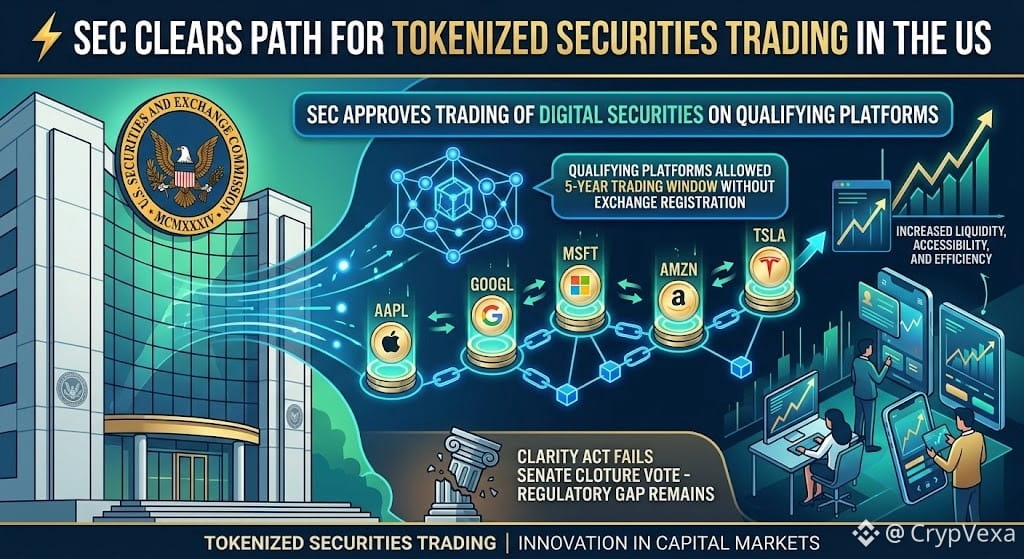
⚡ SEC Opens Path for Tokenized Stock Trading
🇺🇸 The SEC has granted temporary, conditional relief allowing certain tokenized U.S. stocks to trade on approved on-chain venues without those venues being treated as traditional exchanges under the exemption.
⏳ The relief is set to last 5 years, with limits and investor-protection conditions.
📉 The move comes after Congress failed to advance the CLARITY Act, leaving broader crypto-market legislation unresolved.
🌐 Tokenized securities are moving closer to mainstream U.S. market infrastructure.
👀 Could tokenized stocks become a major bridge between Wall Street and blockchain?
#Tokenization #TokenizedStocks #SEC #CryptoNews
⚡ SEC Opens Path for Tokenized Stock Trading
🇺🇸 The SEC has granted temporary, conditional relief allowing certain tokenized U.S. stocks to trade on approved on-chain venues without those venues being treated as traditional exchanges under the exemption.
⏳ The relief is set to last 5 years, with limits and investor-protection conditions.
📉 The move comes after Congress failed to advance the CLARITY Act, leaving broader crypto-market legislation unresolved.
🌐 Tokenized securities are moving closer to mainstream U.S. market infrastructure.
👀 Could tokenized stocks become a major bridge between Wall Street and blockchain?
#Tokenization #TokenizedStocks #SEC #CryptoNews
🇺🇸 The SEC has granted temporary, conditional relief allowing certain tokenized U.S. stocks to trade on approved on-chain venues without those venues being treated as traditional exchanges under the exemption.
⏳ The relief is set to last 5 years, with limits and investor-protection conditions.
📉 The move comes after Congress failed to advance the CLARITY Act, leaving broader crypto-market legislation unresolved.
🌐 Tokenized securities are moving closer to mainstream U.S. market infrastructure.
👀 Could tokenized stocks become a major bridge between Wall Street and blockchain?
#Tokenization #TokenizedStocks #SEC #CryptoNews
1
61

·
--
Verified

Article
bStocks in simple terms: how to use tokenized stocks on a crypto platformbStocks in simple terms: how to use tokenized stocks on a crypto platform
The cryptocurrency market is gradually converging with traditional finance. If previously crypto platforms mainly focused on BTC, ETH, and other digital assets, today users have access to tools related to stocks of well-known companies. One such direction is bStocks.
bStocks in simple terms: how to use tokenized stocks on a crypto platform
bStocks in simple terms: how to use tokenized stocks on a crypto platform
The cryptocurrency market is gradually converging with traditional finance. If previously crypto platforms mainly focused on BTC, ETH, and other digital assets, today users have access to tools related to stocks of well-known companies. One such direction is bStocks.
The cryptocurrency market is gradually converging with traditional finance. If previously crypto platforms mainly focused on BTC, ETH, and other digital assets, today users have access to tools related to stocks of well-known companies. One such direction is bStocks.
1
286
Fed rate-hike clouds loom over Wall Street as tokenized U.S. stocks see a historic turning point
1. U.S. Treasury yields surge to a 19-year high, and panic spreads across the market
U.S. financial markets are going through a major bout of turbulence. The yield on the 10-year U.S. Treasury jumped to 5.13%, the highest level since 2007. Behind this figure, the latest PMI index unexpectedly surged to 58.4, far above market expectations, while Federal Reserve officials issued strong hawkish signals. Fed Governor Bahl said clearly that further rate hikes may be needed to curb inflationary pressures.
As a result, risk assets are under pressure across the board. Bitcoin briefly fell below $84,000, and the total market capitalization in the crypto market saw a noticeable pullback. CME’s Fed funds futures tool shows that the probability of a 25-basis-point Fed rate hike in October has risen to 69.7%, up sharply from a week ago, indicating that the market is re-pricing the monetary policy path.
According to data from The Blockworks Community, in the past 24 hours, discussions related to BTC totaled more than 18,800 times, SOL reached more than 16,000 discussions, and BNB and ETH recorded nearly 10,000 and about 8,000 discussions respectively. Investor sentiment is split—bullish and bearish views are clashing fiercely—but neutral, wait-and-see sentiment remains dominant.
2. The NYSE joins forces with blockchain companies, and tokenized U.S. stocks enter the mainstream era
Just as traditional financial markets are roiled by expectations of rate hikes, a landmark development quietly emerged. The New York Stock Exchange Group and a blockchain company have signed a memorandum of cooperation. They plan to provide tokenized U.S.-listed stocks and ETFs trading to crypto-native users through the digital alternative trading system currently being built by the NYSE, and to enable around-the-clock on-chain settlement.
The significance of this partnership is extraordinary. It comes right after the innovative exemption framework introduced by the U.S. Securities and Exchange Commission, marking that major traditional financial players have formally embraced blockchain technology for securities applications. Grayscale noted that blockchain infrastructure can now serve the U.S. market in a fully compliant manner, removing institutional barriers to the large-scale rollout of tokenized securities.
At present, on-chain tokenized U.S. stock products cover multiple areas, including emerging-market ETFs, biotech stocks such as Moderna, and industrial names such as Lincoln Electric. Tokenized U.S. stocks allow global investors to bypass the trading-time limitations of traditional brokers and execute peer-to-peer stock asset trading on-chain—especially appealing to investors in Asia and Europe.
3. Regulation accelerates, and rules for crypto market structure are coming into view
Meanwhile, the chair of the U.S. Commodity Futures Trading Commission, Mike Selig, publicly declared, “The time for action has come,” and announced that the agency will use existing statutory authority to draft crypto market structure rules—including derivative categories such as perpetual contracts—without waiting for Congress to legislate. At least two pre-rule proposals on crypto-asset trading have already been submitted to the White House for review.
This statement suggests the U.S. crypto regulatory framework is shifting from “watchful waiting” to “actively building.” For the industry, clearer rules may increase compliance costs. But more importantly, they provide legal certainty for institutional investors, which is expected to attract more traditional capital into the market.
Binance has taken frequent recent actions: it listed the Hyperliquid-native token HYPE and added a Seed Tag, while also opening a capital-matching platform to VIP institutional users. Binance.US has likewise embedded a self-custody wallet feature in the app. These moves indicate that leading trading platforms are boosting efforts simultaneously across three dimensions—products, institutions, and infrastructure—preparing for the next round of market expansion.
4. Outlook and risk warnings for the next phase
The market is currently at a complex juncture with multiple factors intertwined. On one hand, elevated U.S. Treasury yields and rate-hike expectations continue to weigh on risk assets, and short-term volatility may be amplified further. On the other hand, the institutional push for tokenized securities and the gradual clarification of the regulatory framework are building a long-term, favorable fundamental backdrop for the crypto market.
Hot-topic hashtags on The Blockworks show that Binance’s listing of HYPE and the rising probability of a Fed October rate hike are the two main focuses of current community discussion, receiving more than 1,300 and about 380 content discussions respectively. While investors should pay attention to short-term macro risks, they should also closely track the medium- to long-term evolution of tokenized U.S. stocks and regulatory policies.
Investors are advised to stay cautiously optimistic in the current environment, manage position sizes reasonably, watch the trajectory of U.S. Treasury yields and the marginal market impact of Fed officials’ remarks, and seize structural opportunities in this emerging track of tokenized securities.
#BinanceWillListHyperliquid(HYPE) #FedOctoberRateHikeOddsRiseTo69.7% #TokenizedStocks
Fed rate-hike clouds loom over Wall Street as tokenized U.S. stocks see a historic turning point
1. U.S. Treasury yields surge to a 19-year high, and panic spreads across the market
U.S. financial markets are going through a major bout of turbulence. The yield on the 10-year U.S. Treasury jumped to 5.13%, the highest level since 2007. Behind this figure, the latest PMI index unexpectedly surged to 58.4, far above market expectations, while Federal Reserve officials issued strong hawkish signals. Fed Governor Bahl said clearly that further rate hikes may be needed to curb inflationary pressures.
As a result, risk assets are under pressure across the board. Bitcoin briefly fell below $84,000, and the total market capitalization in the crypto market saw a noticeable pullback. CME’s Fed funds futures tool shows that the probability of a 25-basis-point Fed rate hike in October has risen to 69.7%, up sharply from a week ago, indicating that the market is re-pricing the monetary policy path.
According to data from The Blockworks Community, in the past 24 hours, discussions related to BTC totaled more than 18,800 times, SOL reached more than 16,000 discussions, and BNB and ETH recorded nearly 10,000 and about 8,000 discussions respectively. Investor sentiment is split—bullish and bearish views are clashing fiercely—but neutral, wait-and-see sentiment remains dominant.
2. The NYSE joins forces with blockchain companies, and tokenized U.S. stocks enter the mainstream era
Just as traditional financial markets are roiled by expectations of rate hikes, a landmark development quietly emerged. The New York Stock Exchange Group and a blockchain company have signed a memorandum of cooperation. They plan to provide tokenized U.S.-listed stocks and ETFs trading to crypto-native users through the digital alternative trading system currently being built by the NYSE, and to enable around-the-clock on-chain settlement.
The significance of this partnership is extraordinary. It comes right after the innovative exemption framework introduced by the U.S. Securities and Exchange Commission, marking that major traditional financial players have formally embraced blockchain technology for securities applications. Grayscale noted that blockchain infrastructure can now serve the U.S. market in a fully compliant manner, removing institutional barriers to the large-scale rollout of tokenized securities.
At present, on-chain tokenized U.S. stock products cover multiple areas, including emerging-market ETFs, biotech stocks such as Moderna, and industrial names such as Lincoln Electric. Tokenized U.S. stocks allow global investors to bypass the trading-time limitations of traditional brokers and execute peer-to-peer stock asset trading on-chain—especially appealing to investors in Asia and Europe.
3. Regulation accelerates, and rules for crypto market structure are coming into view
Meanwhile, the chair of the U.S. Commodity Futures Trading Commission, Mike Selig, publicly declared, “The time for action has come,” and announced that the agency will use existing statutory authority to draft crypto market structure rules—including derivative categories such as perpetual contracts—without waiting for Congress to legislate. At least two pre-rule proposals on crypto-asset trading have already been submitted to the White House for review.
This statement suggests the U.S. crypto regulatory framework is shifting from “watchful waiting” to “actively building.” For the industry, clearer rules may increase compliance costs. But more importantly, they provide legal certainty for institutional investors, which is expected to attract more traditional capital into the market.
Binance has taken frequent recent actions: it listed the Hyperliquid-native token HYPE and added a Seed Tag, while also opening a capital-matching platform to VIP institutional users. Binance.US has likewise embedded a self-custody wallet feature in the app. These moves indicate that leading trading platforms are boosting efforts simultaneously across three dimensions—products, institutions, and infrastructure—preparing for the next round of market expansion.
4. Outlook and risk warnings for the next phase
The market is currently at a complex juncture with multiple factors intertwined. On one hand, elevated U.S. Treasury yields and rate-hike expectations continue to weigh on risk assets, and short-term volatility may be amplified further. On the other hand, the institutional push for tokenized securities and the gradual clarification of the regulatory framework are building a long-term, favorable fundamental backdrop for the crypto market.
Hot-topic hashtags on The Blockworks show that Binance’s listing of HYPE and the rising probability of a Fed October rate hike are the two main focuses of current community discussion, receiving more than 1,300 and about 380 content discussions respectively. While investors should pay attention to short-term macro risks, they should also closely track the medium- to long-term evolution of tokenized U.S. stocks and regulatory policies.
Investors are advised to stay cautiously optimistic in the current environment, manage position sizes reasonably, watch the trajectory of U.S. Treasury yields and the marginal market impact of Fed officials’ remarks, and seize structural opportunities in this emerging track of tokenized securities.
#BinanceWillListHyperliquid(HYPE) #FedOctoberRateHikeOddsRiseTo69.7% #TokenizedStocks
1. U.S. Treasury yields surge to a 19-year high, and panic spreads across the market
U.S. financial markets are going through a major bout of turbulence. The yield on the 10-year U.S. Treasury jumped to 5.13%, the highest level since 2007. Behind this figure, the latest PMI index unexpectedly surged to 58.4, far above market expectations, while Federal Reserve officials issued strong hawkish signals. Fed Governor Bahl said clearly that further rate hikes may be needed to curb inflationary pressures.
As a result, risk assets are under pressure across the board. Bitcoin briefly fell below $84,000, and the total market capitalization in the crypto market saw a noticeable pullback. CME’s Fed funds futures tool shows that the probability of a 25-basis-point Fed rate hike in October has risen to 69.7%, up sharply from a week ago, indicating that the market is re-pricing the monetary policy path.
According to data from The Blockworks Community, in the past 24 hours, discussions related to BTC totaled more than 18,800 times, SOL reached more than 16,000 discussions, and BNB and ETH recorded nearly 10,000 and about 8,000 discussions respectively. Investor sentiment is split—bullish and bearish views are clashing fiercely—but neutral, wait-and-see sentiment remains dominant.
2. The NYSE joins forces with blockchain companies, and tokenized U.S. stocks enter the mainstream era
Just as traditional financial markets are roiled by expectations of rate hikes, a landmark development quietly emerged. The New York Stock Exchange Group and a blockchain company have signed a memorandum of cooperation. They plan to provide tokenized U.S.-listed stocks and ETFs trading to crypto-native users through the digital alternative trading system currently being built by the NYSE, and to enable around-the-clock on-chain settlement.
The significance of this partnership is extraordinary. It comes right after the innovative exemption framework introduced by the U.S. Securities and Exchange Commission, marking that major traditional financial players have formally embraced blockchain technology for securities applications. Grayscale noted that blockchain infrastructure can now serve the U.S. market in a fully compliant manner, removing institutional barriers to the large-scale rollout of tokenized securities.
At present, on-chain tokenized U.S. stock products cover multiple areas, including emerging-market ETFs, biotech stocks such as Moderna, and industrial names such as Lincoln Electric. Tokenized U.S. stocks allow global investors to bypass the trading-time limitations of traditional brokers and execute peer-to-peer stock asset trading on-chain—especially appealing to investors in Asia and Europe.
3. Regulation accelerates, and rules for crypto market structure are coming into view
Meanwhile, the chair of the U.S. Commodity Futures Trading Commission, Mike Selig, publicly declared, “The time for action has come,” and announced that the agency will use existing statutory authority to draft crypto market structure rules—including derivative categories such as perpetual contracts—without waiting for Congress to legislate. At least two pre-rule proposals on crypto-asset trading have already been submitted to the White House for review.
This statement suggests the U.S. crypto regulatory framework is shifting from “watchful waiting” to “actively building.” For the industry, clearer rules may increase compliance costs. But more importantly, they provide legal certainty for institutional investors, which is expected to attract more traditional capital into the market.
Binance has taken frequent recent actions: it listed the Hyperliquid-native token HYPE and added a Seed Tag, while also opening a capital-matching platform to VIP institutional users. Binance.US has likewise embedded a self-custody wallet feature in the app. These moves indicate that leading trading platforms are boosting efforts simultaneously across three dimensions—products, institutions, and infrastructure—preparing for the next round of market expansion.
4. Outlook and risk warnings for the next phase
The market is currently at a complex juncture with multiple factors intertwined. On one hand, elevated U.S. Treasury yields and rate-hike expectations continue to weigh on risk assets, and short-term volatility may be amplified further. On the other hand, the institutional push for tokenized securities and the gradual clarification of the regulatory framework are building a long-term, favorable fundamental backdrop for the crypto market.
Hot-topic hashtags on The Blockworks show that Binance’s listing of HYPE and the rising probability of a Fed October rate hike are the two main focuses of current community discussion, receiving more than 1,300 and about 380 content discussions respectively. While investors should pay attention to short-term macro risks, they should also closely track the medium- to long-term evolution of tokenized U.S. stocks and regulatory policies.
Investors are advised to stay cautiously optimistic in the current environment, manage position sizes reasonably, watch the trajectory of U.S. Treasury yields and the marginal market impact of Fed officials’ remarks, and seize structural opportunities in this emerging track of tokenized securities.
#BinanceWillListHyperliquid(HYPE) #FedOctoberRateHikeOddsRiseTo69.7% #TokenizedStocks
13

·
--
🚀 $BTC TOKENIZED EQUITY BREAKTHROUGH WITH NYSE 🦈
📊 The NYSE‑Blockchain.com pact unlocks 24/7 on‑chain trading for U.S. listed stocks and ETFs, letting crypto‑savvy investors grab fractional shares without waiting for market bells. 🌊 Real‑time ICE data will flow into the Blockchain.com app, feeding 44 M+ users with stock‑grade intel while preserving the speed of decentralized ledgers. ⚡ This fusion of traditional finance trust and digital‑asset agility could accelerate the $5.5 T tokenized asset horizon Citi forecasts by years.
💬 How will you position your portfolio when stocks trade round‑the‑clock on‑chain? 👇
⚠️ Not financial advice. Always manage your risk. 🛡️
🏷️ #BTC #TokenizedStocks #CryptoEquities #MarketInnovation #Crypto
🔥 💎
🚀 $BTC TOKENIZED EQUITY BREAKTHROUGH WITH NYSE 🦈
📊 The NYSE‑Blockchain.com pact unlocks 24/7 on‑chain trading for U.S. listed stocks and ETFs, letting crypto‑savvy investors grab fractional shares without waiting for market bells. 🌊 Real‑time ICE data will flow into the Blockchain.com app, feeding 44 M+ users with stock‑grade intel while preserving the speed of decentralized ledgers. ⚡ This fusion of traditional finance trust and digital‑asset agility could accelerate the $5.5 T tokenized asset horizon Citi forecasts by years.
💬 How will you position your portfolio when stocks trade round‑the‑clock on‑chain? 👇
⚠️ Not financial advice. Always manage your risk. 🛡️
🏷️ #BTC #TokenizedStocks #CryptoEquities #MarketInnovation #Crypto
🔥 💎
📊 The NYSE‑Blockchain.com pact unlocks 24/7 on‑chain trading for U.S. listed stocks and ETFs, letting crypto‑savvy investors grab fractional shares without waiting for market bells. 🌊 Real‑time ICE data will flow into the Blockchain.com app, feeding 44 M+ users with stock‑grade intel while preserving the speed of decentralized ledgers. ⚡ This fusion of traditional finance trust and digital‑asset agility could accelerate the $5.5 T tokenized asset horizon Citi forecasts by years.
💬 How will you position your portfolio when stocks trade round‑the‑clock on‑chain? 👇
⚠️ Not financial advice. Always manage your risk. 🛡️
🏷️ #BTC #TokenizedStocks #CryptoEquities #MarketInnovation #Crypto
🔥 💎
88
Log in to explore more content
Join global crypto users on Binance Square
⚡️ Get latest and useful information about crypto.
💬 Trusted by the world’s largest crypto exchange.
👍 Discover real insights from verified creators.
Email / Phone number
Trending Topics
1
#UKFCAWinsCourtOrderToRecover851400Pounds
32,030 views
765 Discussing
2
#ChainlinkLaunchesCCIP2WithEnterpriseVerification
45,869 views
940 Discussing
3
#GoldFallsTo$4144
15,931 views
163 Discussing
4
#QNTFallsOver40%FromMorningHigh
92,110 views
1,356 Discussing
5
#USDTAdds845900HoldersInPast7Days
18,352 views
412 Discussing
6
#KospiFalls2.7%SamsungSKHynixDropOver5%
31,338 views
596 Discussing
7
#BitgetCEOConfirms$388MStolenInHack
5,446 views
43 Discussing
8
#BTCFallsBelow$83000
33,216 views
167 Discussing
9
#BitgetDetailsSecurityIncidentTimeline
52,376 views
744 Discussing
10
#BitcoinSpotETFs$2.39BWeeklyNetInflow
15,564 views
49 Discussing