
#nigeria
nigeria
87,777 views
301 Discussing
Hot
Latest

·
--
Nigeria has issued its new stablecoin rules: stablecoins pegged to foreign currencies must be issued through a local company licensed by the central bank, while algorithmic stablecoins are banned. Existing providers have 180 days to apply 🏦📜🌍 What impact do you think this will have on the $USDT market there? #Stablecoins #Nigeria
Nigeria has issued its new stablecoin rules: stablecoins pegged to foreign currencies must be issued through a local company licensed by the central bank, while algorithmic stablecoins are banned. Existing providers have 180 days to apply 🏦📜🌍 What impact do you think this will have on the $USDT market there? #Stablecoins #Nigeria

131

·
--
Nigeria just banned algorithmic stablecoins.
Its central bank issued stablecoin licensing rules (The Block):
• Issuers need a license
• Algorithmic designs are prohibited
Africa's biggest crypto market is choosing sides: fully backed, regulated stablecoins in, UST-style experiments out.
Meanwhile, 24h flows show $USDC +$302M net inflow and $USDT +$55M, while BTC saw net outflows (TokenPost, 13:02 UTC). Money is parking in dollars, not leaving crypto.
My take: licensing favors big, transparent issuers. Watch whether other emerging markets copy this.
Will more countries ban algorithmic stablecoins by mid-2027? Yes or no?
#Stablecoins #Nigeria #CryptoRegulation
Not financial advice.
5

·
--
Nigeria Bans Algorithmic Stablecoins; Fiat-Backed Stablecoins May Find a New Opening in Emerging Markets
From the perspective of capital flows, regulatory policy is often a catalyst for reshaping the stablecoin landscape. Nigeria recently explicitly banned algorithmic stablecoins and required issuers to meet reserve requirements. This is the first case in an emerging market of using regulation to exclude algorithmic stablecoins while paving the way for compliant alternatives.
According to Cointelegraph, as Nigeria expands the central bank’s regulatory authority, it has formally banned algorithmic stablecoins and introduced reserve requirements for issuers. This means that stablecoins circulating in the country must be backed by verifiable reserve assets rather than relying on algorithmic mechanisms to maintain their peg.
The significance of this policy for capital flows is that, as algorithmic stablecoins exit the market, fiat-backed stablecoins such as USDC and USDT will become the mainstream choice. Under compliance pressures, users and institutions in emerging markets may shift funds toward these transparently backed stablecoins, changing the liquidity structure of local markets.
In terms of scale and timing, it is important to distinguish between the global and regional levels. Algorithmic stablecoins already account for only a limited share of the global stablecoin supply, and crypto adoption in Nigeria is relatively low, so the direct impact of a single market’s policy on global liquidity is limited. However, as the first emerging market to explicitly ban algorithmic stablecoins and impose reserve requirements, Nigeria could set an example that prompts other regions with less developed regulatory frameworks to follow suit. This is the transmission channel worth watching.
How the market may respond depends on how investors interpret this signal. If they see it as a sign that stablecoin compliance is accelerating, issuers of fiat-backed stablecoins and their ecosystems could attract greater capital preference. If they view it as a localized policy risk, sentiment may turn cautious in the short term.
The countervailing factors are also clear: Nigeria’s market is limited in size, and the transmission channel is weak. The global stablecoin supply landscape is unlikely to change materially as a result, so it is important not to overinterpret the development. Algorithmic stablecoins may continue to circulate in other jurisdictions with more relaxed regulation, even after exiting Nigeria.
The key question going forward is whether this policy will evolve from a “single-market pilot” into a “regional compliance model.” Watch for more emerging markets to adopt reserve requirements and for the actual adoption rate of fiat-backed stablecoins in those markets to rise. For trading, it is more important to wait for signs of regulatory spillover and market confirmation than to overreact to a single policy.
#Stablecoins #Nigeria #CryptoRegulation
The above is an information summary and personal analysis, and does not constitute investment advice.
I will continue to provide updates as further policy details become clear.
56

🚨 JUST IN: 🇳🇬 Nigeria’s central bank now requires foreign-currency stablecoin issuers to maintain at least $11.16 million in paid-up capital to operate in the country.
The move signals tighter oversight of the stablecoin industry in Nigeria.
#Nigeria #Stablecoin #CryptoNews #Regulation
🚨 JUST IN: 🇳🇬 Nigeria’s central bank now requires foreign-currency stablecoin issuers to maintain at least $11.16 million in paid-up capital to operate in the country.
The move signals tighter oversight of the stablecoin industry in Nigeria.
#Nigeria #Stablecoin #CryptoNews #Regulation
The move signals tighter oversight of the stablecoin industry in Nigeria.
#Nigeria #Stablecoin #CryptoNews #Regulation
266

·
--
📰 Olamide goes into crypto with Jeroid signing
After their launch of Zlatan Ibile last year, Nigeria's most trusted gift card and trading platform has entered a new chapter with the unveiling of music superstar Olamide as an official brand ambassador. The partnership signals a cultural shift for the brand as Jeroid continues positioning...
Source : Ghanamma
Time : 2026-11-03 18:51:19
Credit :
#nigeria #business
Share your opinion in the comment section below
10
·
--
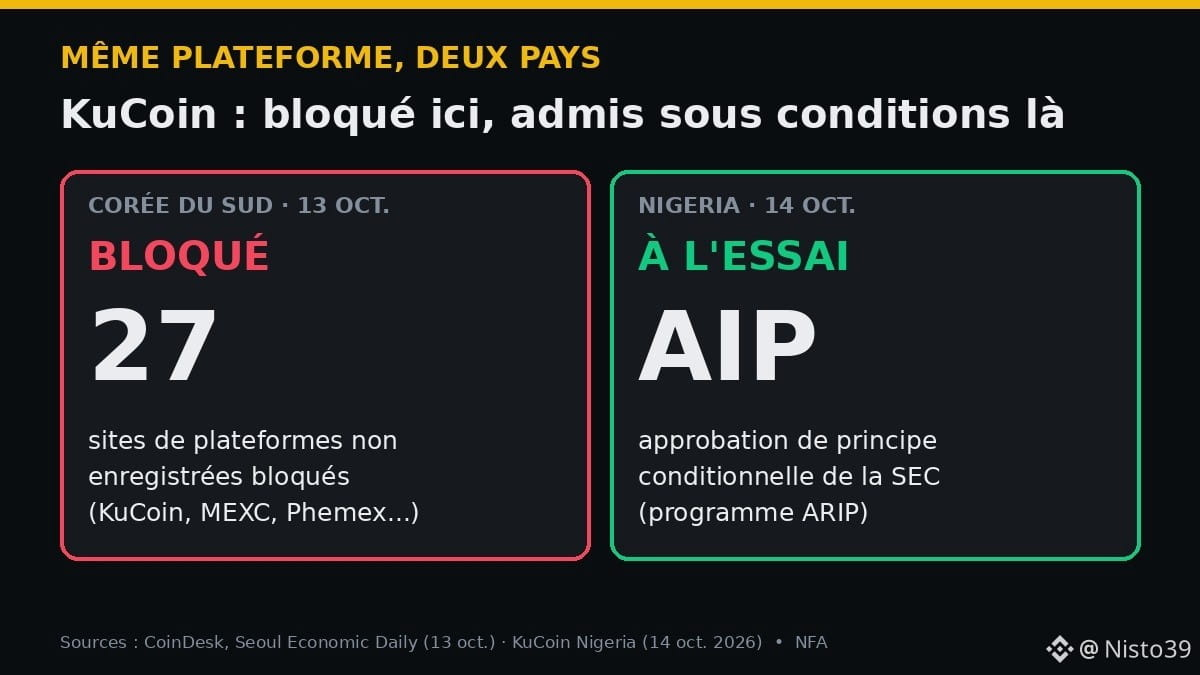
⚖️ Same platform, same week, two countries, two different responses: KuCoin is blocked in South Korea… and conditionally approved in Nigeria.
📌 The facts
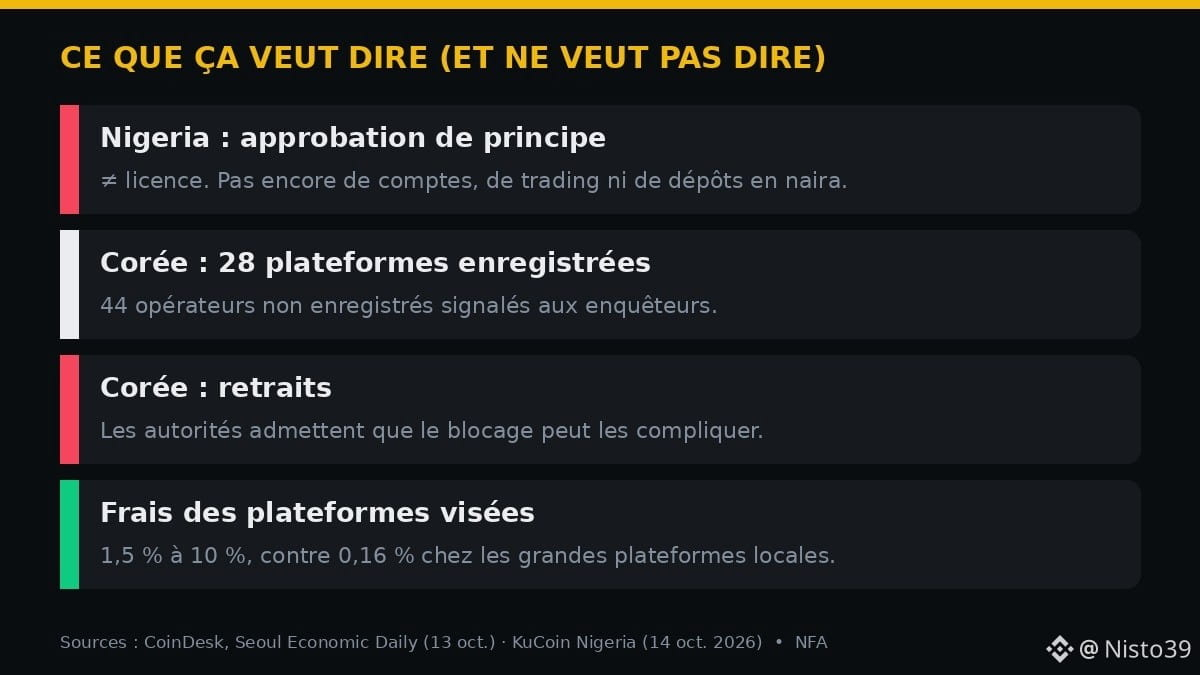
• South Korea (Oct. 13): The Financial Intelligence Unit (FIU) orders the websites of 27 unregistered platforms to be blocked, including KuCoin, MEXC, Phemex and BitMart. Only 28 platforms are registered there. 44 operators are referred to investigators.
• Nigeria (Oct. 14): KuCoin Nigeria receives conditional “approval in principle” from the SEC to join its Regulatory Incubation Program (ARIP).
🧠 How it works
A country doesn’t ask, “Crypto: yes or no?” It asks, “Are you registered here, and do you protect my citizens?”
Not registered ➜ blocked. Serious applicant ➜ monitored trial period.
⚖️ The nuance
• In Nigeria, this approval is NOT a licence: KuCoin Nigeria cannot yet open accounts or offer trading or naira deposits.
• In South Korea, authorities acknowledge that the block could make withdrawals more difficult. The targeted platforms charged fees of 1.5% to 10%, compared with an average of 0.16% at major local platforms.
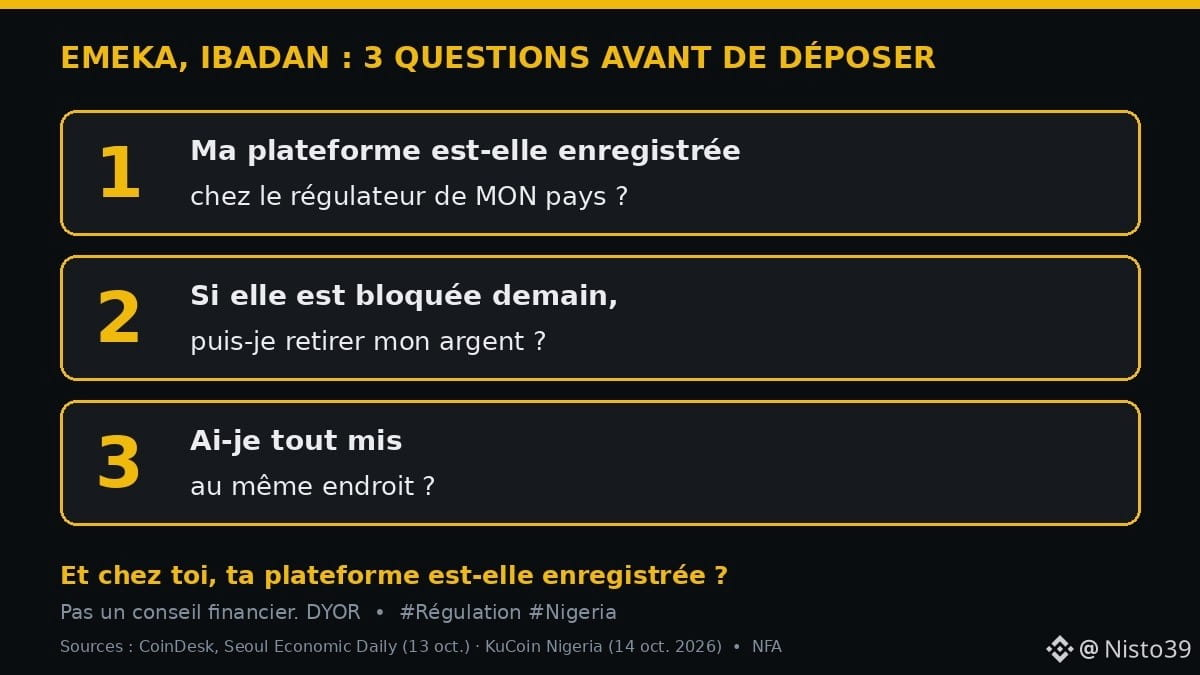
👤 Emeka, in Ibadan, keeps his savings in an exchange app. His real question isn’t “Which app is the most popular?” but “Is it authorised where I live? If it’s blocked tomorrow, can I withdraw my money?”
✅ Simple rule of thumb: check your platform’s status with your country’s regulator, and don’t keep all your money in one place.
And where you live, is your platform registered? 👇
Not financial advice. DYOR.
Sources: CoinDesk / Seoul Economic Daily (Oct. 13), KuCoin Nigeria announcement (Oct. 14, 2026).
#Régulation #Nigeria #KuCoin
46
·
--
Article
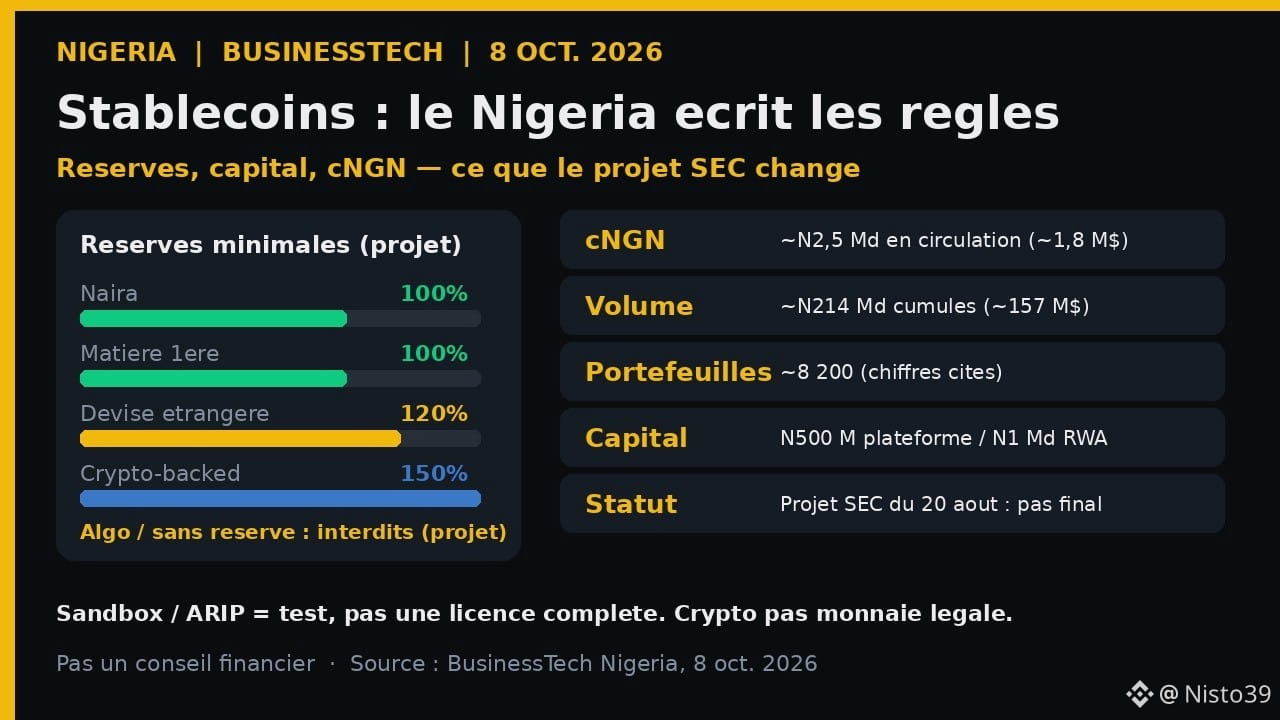
Nigeria: SEC’s stablecoin proposal (reserves, capital, cNGN)Nigeria has long said no to crypto in banks. In 2026, the country is drafting formal rules for stablecoins: mandatory reserves, minimum capital, and a naira stablecoin already tested under supervision. What this means for you if you send or receive money in digital dollars.
📋 The facts (BusinessTech Nigeria, Adeoti Malik, Oct. 8, 2026)
• The Investments and Securities Act 2025 classifies digital assets as securities. The SEC (the markets regulator) oversees issuance, trading, and intermediaries. Crypto is not legal tender.
Nigeria: SEC’s stablecoin proposal (reserves, capital, cNGN)
Nigeria has long said no to crypto in banks. In 2026, the country is drafting formal rules for stablecoins: mandatory reserves, minimum capital, and a naira stablecoin already tested under supervision. What this means for you if you send or receive money in digital dollars.
📋 The facts (BusinessTech Nigeria, Adeoti Malik, Oct. 8, 2026)
• The Investments and Securities Act 2025 classifies digital assets as securities. The SEC (the markets regulator) oversees issuance, trading, and intermediaries. Crypto is not legal tender.
📋 The facts (BusinessTech Nigeria, Adeoti Malik, Oct. 8, 2026)
• The Investments and Securities Act 2025 classifies digital assets as securities. The SEC (the markets regulator) oversees issuance, trading, and intermediaries. Crypto is not legal tender.
100
·
--
Article
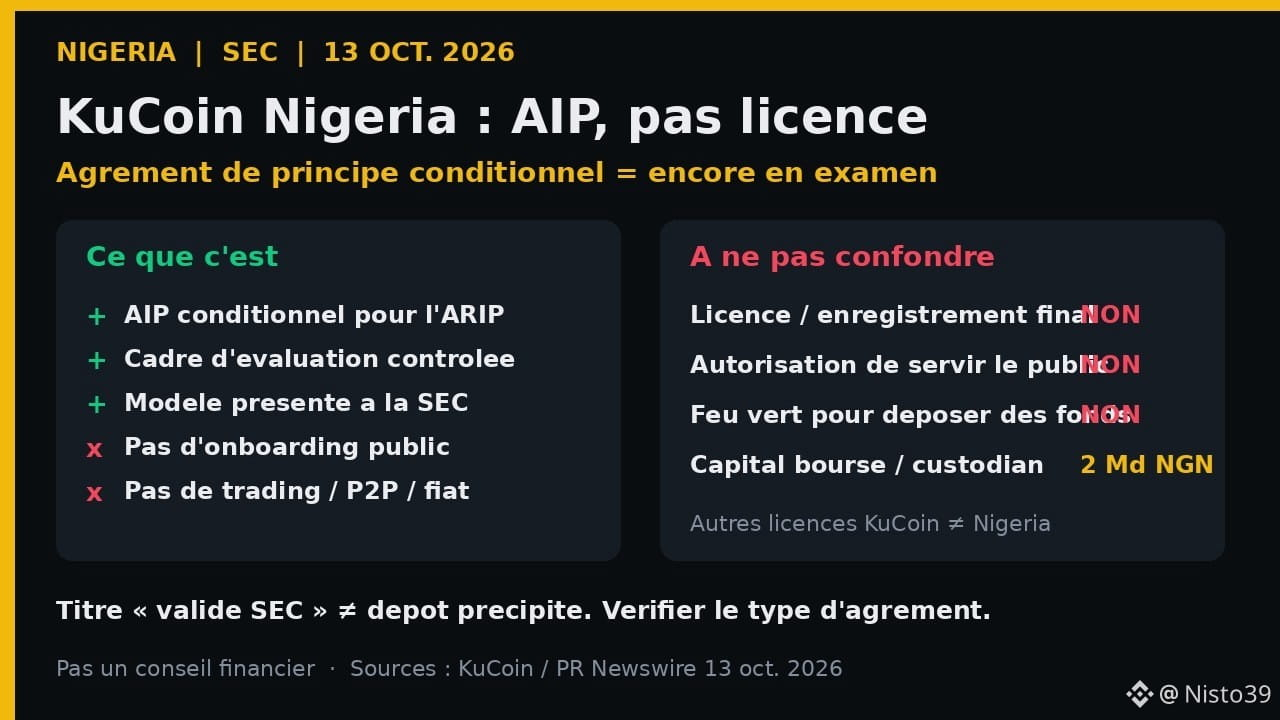
KuCoin Nigeria: Conditional SEC AIP, Not Yet a LicenceA punchy headline, “KuCoin Nigeria approved by the SEC,” is circulating everywhere. The reality, as of October 13, 2026, is more precise — and more useful to understand. **KuCoin Nigeria Limited** has received a **conditional Approval-in-Principle (AIP)** to join the Nigerian SEC’s **Accelerated Regulatory Incubation Programme** (ARIP). This is **neither a licence** nor authorization to trade. The basic idea: Nigeria is testing platforms under supervision before allowing them to serve the public.
KuCoin Nigeria: Conditional SEC AIP, Not Yet a Licence
A punchy headline, “KuCoin Nigeria approved by the SEC,” is circulating everywhere. The reality, as of October 13, 2026, is more precise — and more useful to understand. **KuCoin Nigeria Limited** has received a **conditional Approval-in-Principle (AIP)** to join the Nigerian SEC’s **Accelerated Regulatory Incubation Programme** (ARIP). This is **neither a licence** nor authorization to trade. The basic idea: Nigeria is testing platforms under supervision before allowing them to serve the public.
27
·
--
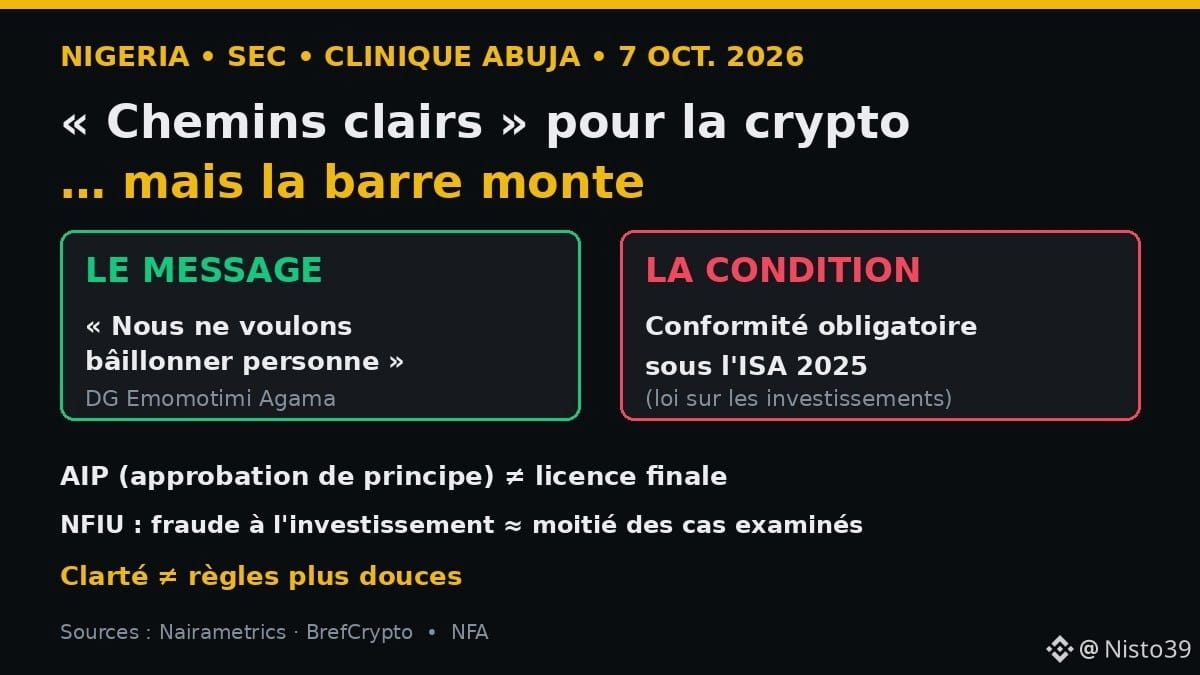
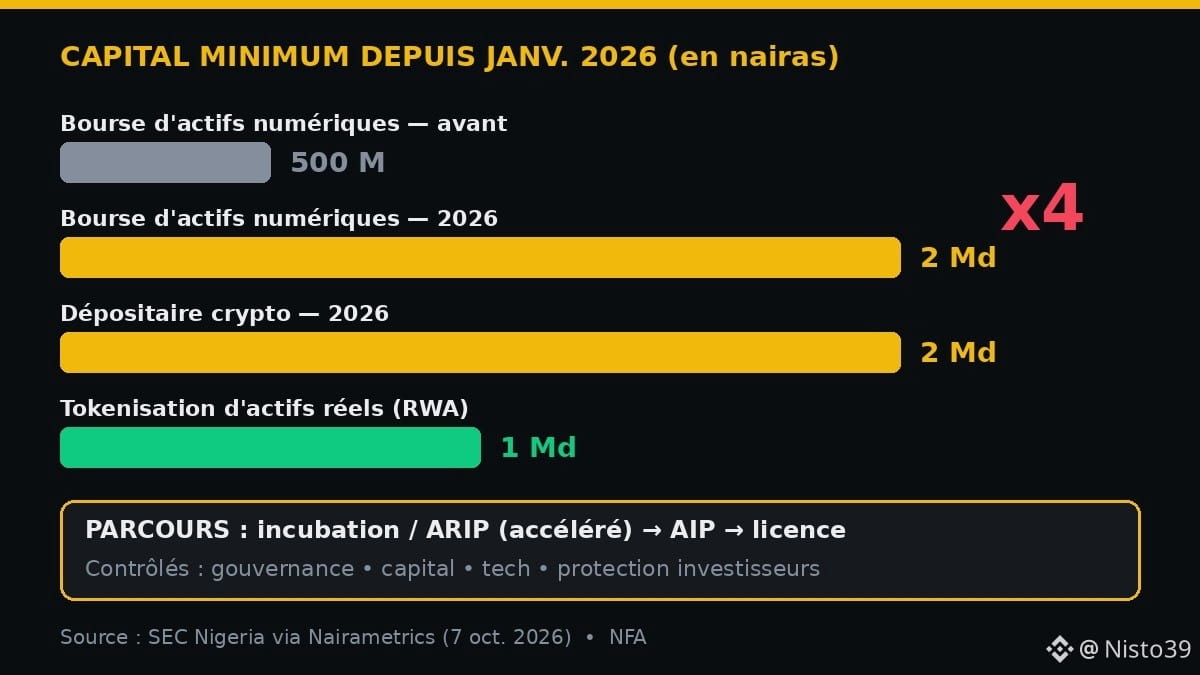
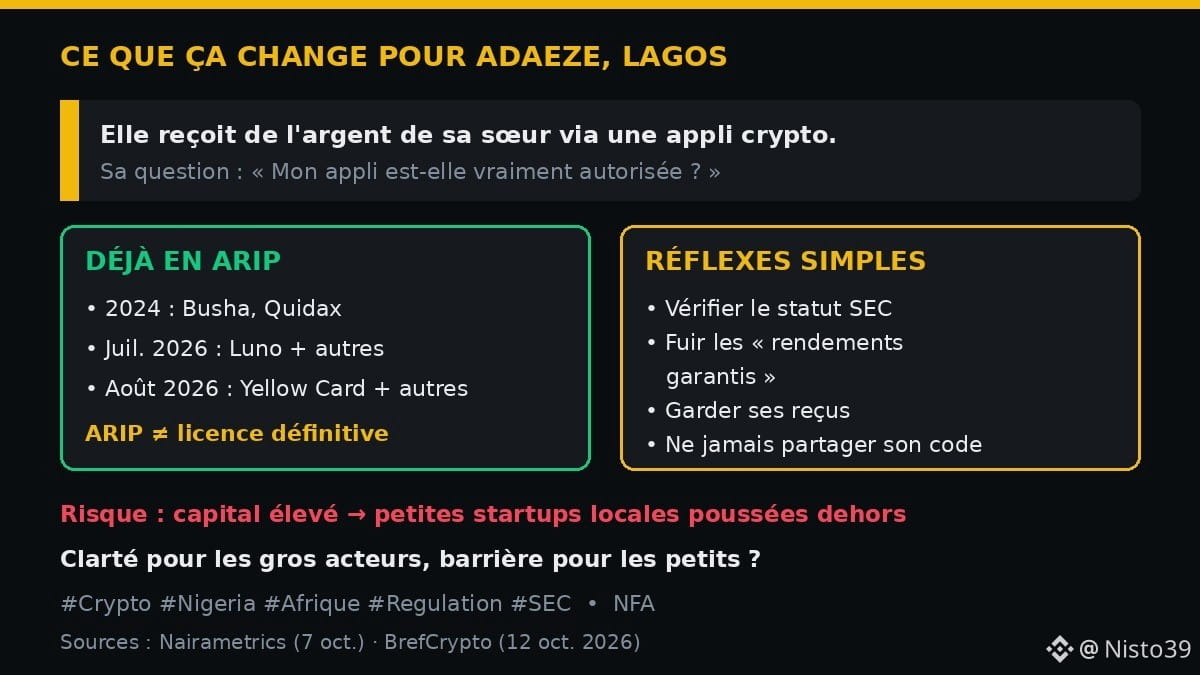
⚡ Nigeria: SEC promises “clear pathways” for crypto — but the bar is rising.
Adaeze, in Lagos, uses a crypto app to receive money from her sister abroad. Her question: “Is my app really authorized?”
📌 The facts
• Oct. 7, 2026, SEC clinic in Abuja. Director General Emomotimi Agama: “We don’t want to muzzle anyone” — but compliance with the ISA 2025 is mandatory.
• AIP (approval in principle) ≠ final license: it is used to assess governance, capital, tech controls, and investor protection.
• Capital requirements since Jan. 2026: digital asset exchange, 2 billion naira (up from 500 million); same for a crypto custodian; real-world asset tokenization platform: 1 billion.
• ARIP (accelerated) program: Busha and Quidax since 2024; Luno and others in July 2026; Yellow Card in August.
• NFIU: investment fraud accounts for about half of the cases reviewed.
🧠 How it works
A platform goes through stages: incubation or ARIP → AIP → license. At each stage, the SEC checks reserve funds, security, and anti-money-laundering rules (KYC = verifying the customer’s identity).
⚖️ The nuance
Clarity ≠ softer rules. 2 billion naira is a lot: small local startups risk being pushed out in favor of major players. And an AIP is no guarantee.
👉 For Adaeze
1. Check her platform’s status with the SEC (ARIP, AIP, or license).
2. Be wary of “guaranteed returns”: they’re at the heart of reported scams.
3. Keep her receipts and never share her code or password.
What do you think: do strict rules protect everyday users, or do they kill small African startups? 👇
Not financial advice. DYOR.
Sources: Nairametrics (Oct. 7, 2026); BrefCrypto (Oct. 12, 2026).
#Crypto #Nigeria #Afrique #Regulation #SEC
62

·
--
Bullish
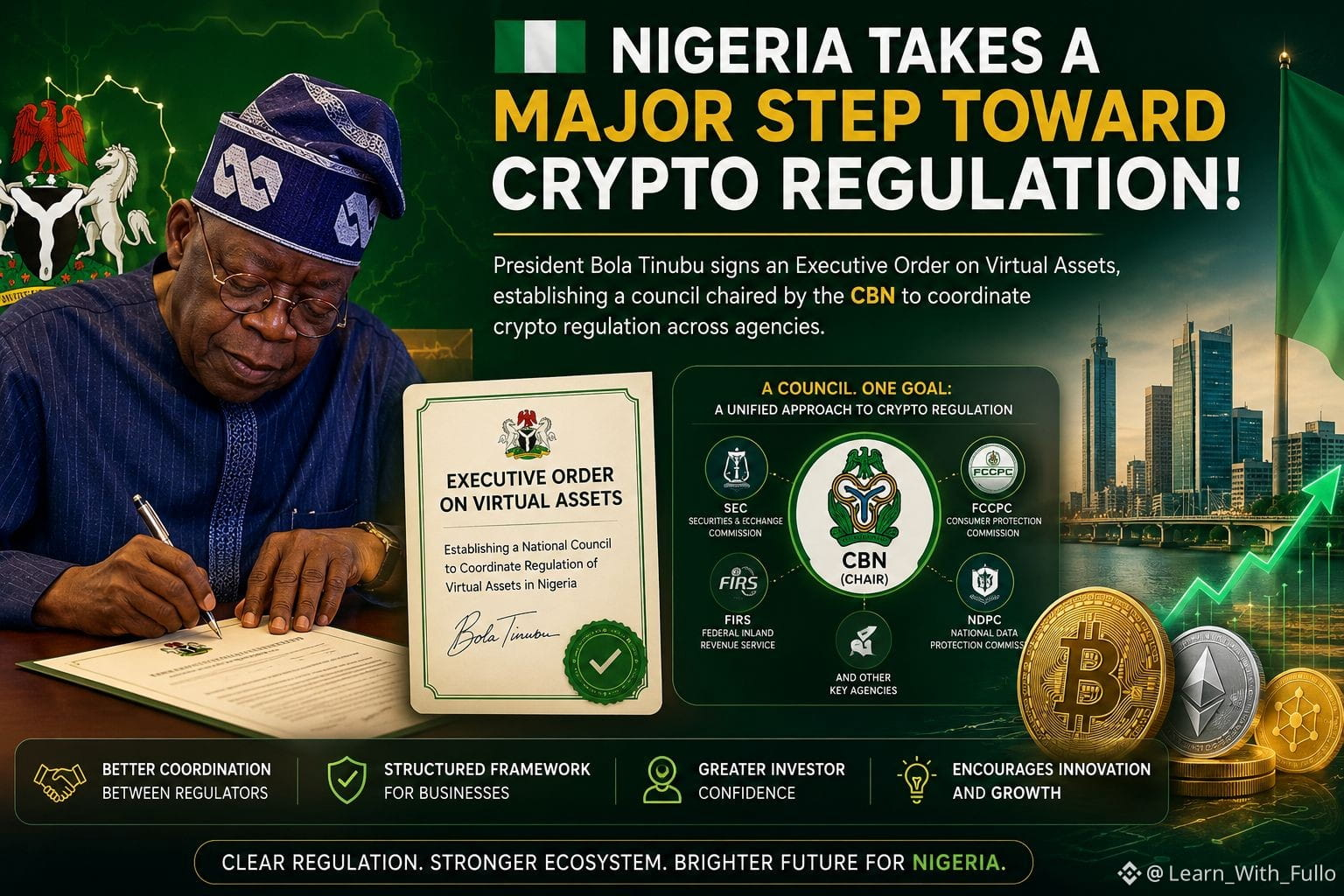
🇳🇬 Nigeria Just Took a Major Step Toward Crypto Regulation
For years, Nigeria has been one of the world's biggest crypto adoption markets, yet the industry has operated with regulatory uncertainty.
That may finally be changing.
President Bola Ahmed Tinubu has signed an Executive Order on Virtual Assets, creating a national council chaired by the Central Bank of Nigeria (CBN) to coordinate crypto regulation across government agencies.
So, what does this mean?
🔹 Better coordination between regulators instead of conflicting policies.
🔹 A more structured framework for exchanges, blockchain companies, and digital asset businesses.
🔹 Greater confidence for investors and innovators looking to build in Nigeria.
This doesn't mean crypto is suddenly "fully legalized" or free from regulation. Instead, it signals that Nigeria is moving toward a more unified approach to overseeing the digital asset ecosystem.
For a country that consistently ranks among the global leaders in crypto adoption, clear regulations could unlock more investment, encourage innovation, and strengthen consumer protection.
The big question now is whether this council will create policies that support innovation or introduce restrictions that slow the industry's growth.
Nigeria has the talent, the users, and one of Africa's largest crypto communities. The next chapter depends on how these regulations are implemented.
Do you think this is bullish for Nigeria's crypto future, or should the government stay out of crypto? Let me know your thoughts below. 👇
$NVDA.US
#Bitcoin #Nigeria
1
367
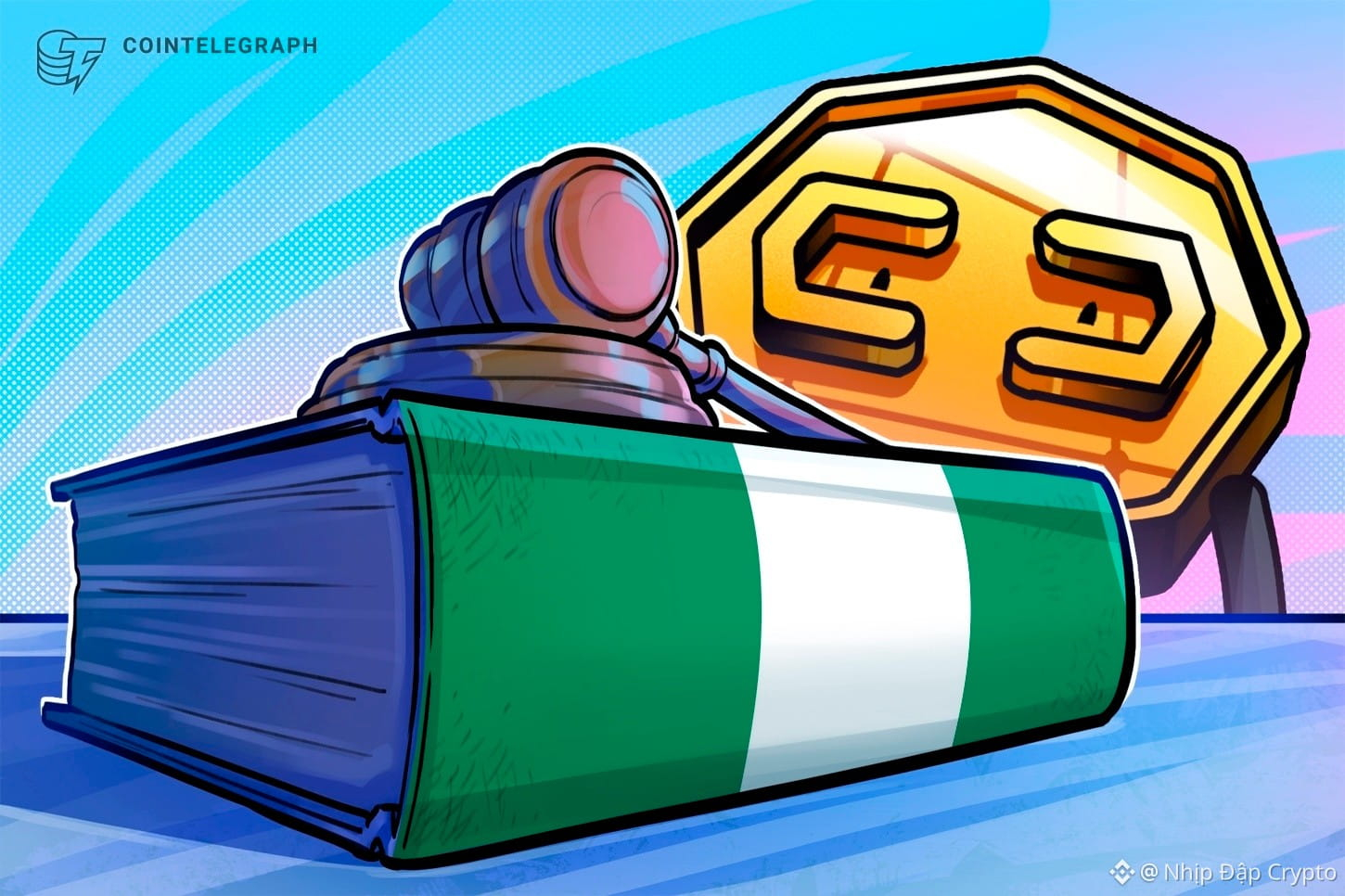
Nigeria — the world’s 2nd-ranked country for crypto adoption — has just taken a bold step: President Tinubu signed an executive order establishing the Virtual Assets Council, aiming to address fragmented regulation that has previously made institutional investors hesitant.
This move means the CBN, SEC, and the Ministry of Finance will have to sit together, devise a unified tax framework and oversight. Previously, the 2021 ban on banks trading crypto caused chaos; now exchanges like Binance and Quidax have a legal framework to expand.
For traders, this is a long-term positive signal for adoption across Africa. But don’t forget: overly strict regulations can push activity into the black market. The way implementation is carried out will be the deciding factor.
DYOR—don’t rush into FOMO.
#Nigeria #CryptoAdoption #Bitcoin #Pháplý #Politics
130

🇳🇬 The Central Bank of Nigeria is moving toward regulating the digital assets market
The Central Bank of Nigeria is moving toward comprehensive regulation of the digital assets market in the country, including cryptocurrencies and stablecoins. This step aims to boost growth and protect investors under a new regulatory framework.
━━━━━━━━━━━━━━
📊 Impact: 📈 High
🏷️ REGULATION
#Nigeria #Regulation #DigitalAssets #CBN #Cryptocurrency
📰 Source: punchng.com
41
🇳🇬 Nigeria’s new digital regulations and crypto oversight challenges
Legal experts said that Nigeria’s new regulatory rules for the digital economy, which include the creation of a Virtual Assets Board, still have gaps in the regulatory framework for crypto assets. These remarks aim to highlight the need for greater clarity and inclusiveness in addressing the country’s challenges in regulating digital currencies.
━━━━━━━━━━━━━━
📊 Impact: 📈 High
🏷️ REGULATION
#Nigeria #CryptoRegulation #DigitalEconomy #Fintech #Blockchain
📰 Source: theconversation.com
35

·
--
Bullish
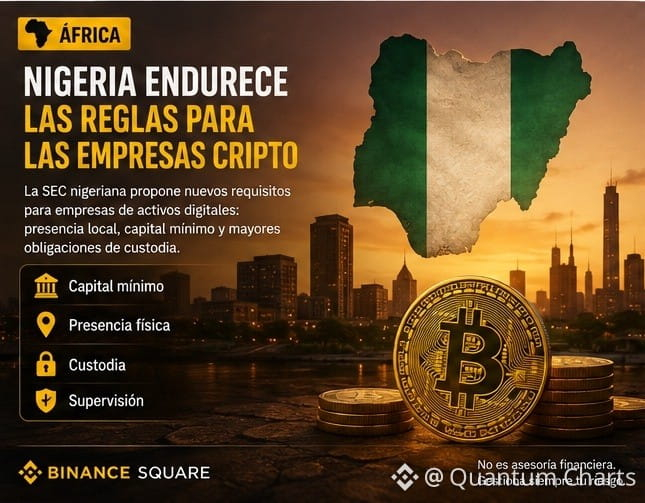
🌍 AFRICA — Nigeria tightens the rules for crypto businesses
🇳🇬 Nigeria wants more crypto, but it also wants to know exactly who is operating.
Nigeria’s SEC is proposing new requirements for digital asset companies, including local presence, minimum capital, and stronger custody obligations.
This is an important sign because Nigeria is one of Africa’s most active crypto markets.
The direction seems clear:
fewer improvised operators → more regulated firms.
🏦 Minimum capital
📍 Physical presence
🔐 Custody
⚖️ Oversight
Africa isn’t necessarily closing the door to crypto. It’s trying to build a door with controls.
And that could benefit companies that already have infrastructure and regulatory compliance.
Will regulation ultimately speed up institutional adoption in #Nigeria ?
1
211

·
--
Nigeria tightens crypto regulations.
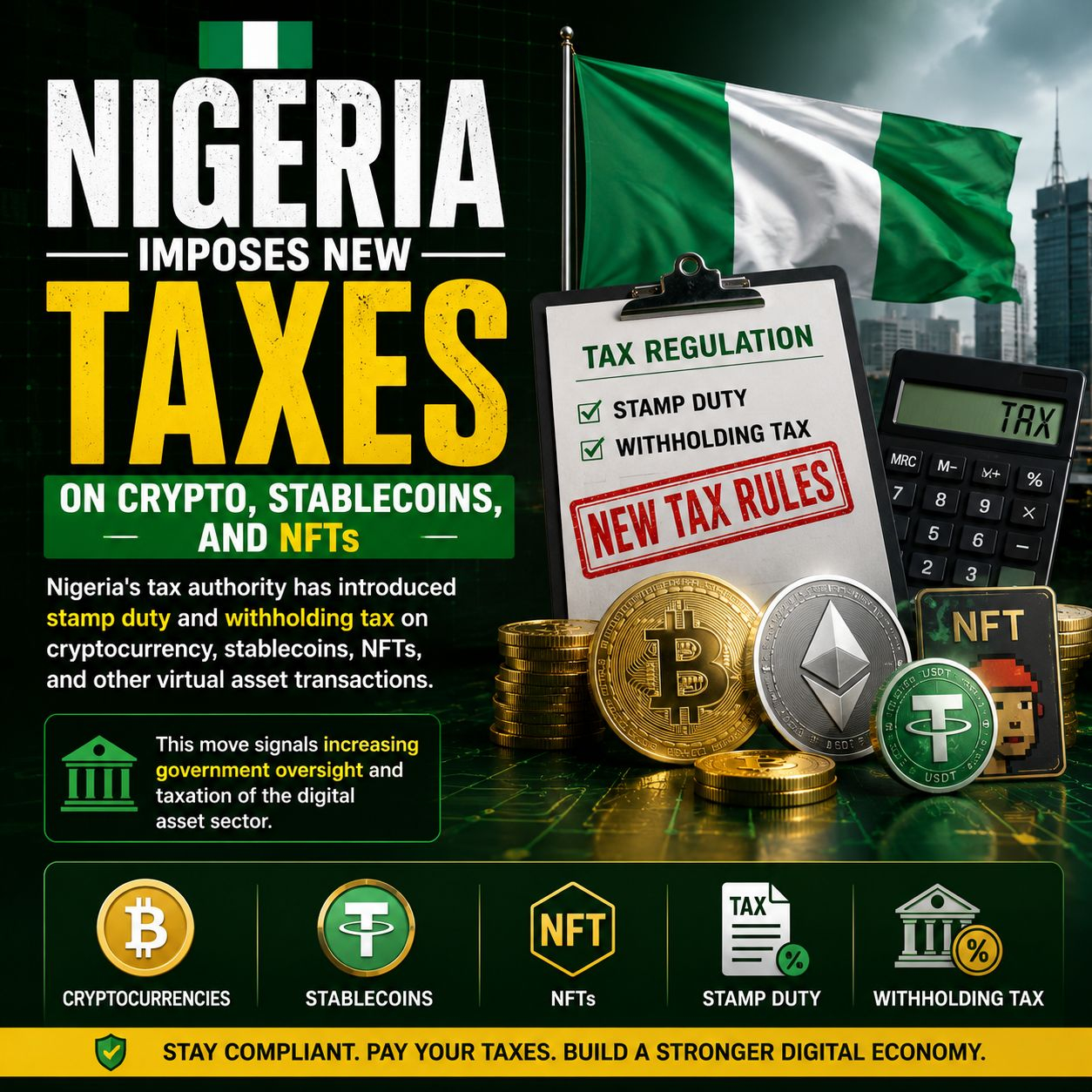
Nigeria has introduced new taxes on cryptocurrencies, stablecoins, NFTs, and other virtual asset transactions, including stamp duty and withholding tax. The move reflects growing government oversight as digital assets become a bigger part of the country's financial ecosystem.
$ACE
{spot}(ACEUSDT)
$AMD
{future}(AMDUSDT)
#Nigeria #CryptoRegulation #DowFalls464Points
Nigeria tightens crypto regulations.
Nigeria has introduced new taxes on cryptocurrencies, stablecoins, NFTs, and other virtual asset transactions, including stamp duty and withholding tax. The move reflects growing government oversight as digital assets become a bigger part of the country's financial ecosystem.
$ACE
$AMD
#Nigeria #CryptoRegulation #DowFalls464Points
181
🇳🇬 Nigeria’s President Signs an Executive Order to Legalize Digital Assets and Establish a Crypto Regulatory Council!
President Tinubu has signed a historic executive order establishing a council for virtual assets. This move aims to unify digital currency regulations in the country, close legal gaps, and protect investors in the thriving crypto market.
━━━━━━━━━━━━━━
📊 Impact: 🔥 Very High
🏷️ REGULATION
#Nigeria #CryptoRegulation #VirtualAssets #Tinubu #AfricanCrypto
🔗 Source: https://punchng.com/tinubu-signs-executive-order-on-virtual-assets-establishes-council-to-harmonise-crypto-regulation/
76

🇳🇬 In 2024, Nigeria expelled Binance P2P and detained two of its executives, accusing them of «Currency manipulation» and claiming they were the sole responsible parties for the fall of the naira.
The political goal was clear: to remove the global giant and choke off access to USDT through bank freezes in order to create a vacuum. The government believed it could force the migration of flows to its own solutions: the eNaira (MNBC) and the cNGN (local stablecoin).
But trust cannot be imposed by decree. The eNaira (launched in 2021) and the cNGN (rolled out at the beginning of 2024) had already been rejected by the public.
Today, in June 2026, the figures leave no room for doubt:
-34%: this is the naira’s drop against the US dollar since January 2024 (it went from 913 to ~1380 NGN/$). Proof that Binance was not the cause of the problem.
0.5%: the ridiculous adoption rate of the eNaira by the population.
~500 million NGN: the paltry amount of cNGN in circulation. Nobody wants a stablecoin indexed to an inflationary local currency.
So what’s the result? The market resisted completely. Nigerians simply moved in large numbers to alternatives like Bybit or to the underground P2P groups on Telegram/WhatsApp in order to keep exchanging USDT.
The economic reality of a people (surviving inflation) will always be stronger than regulatory repression.
$BNB
#Nigeria #Stablecoin #eNaira #Africa

3
1.5k

Nigeria Is Raising the Bar for Crypto Platforms
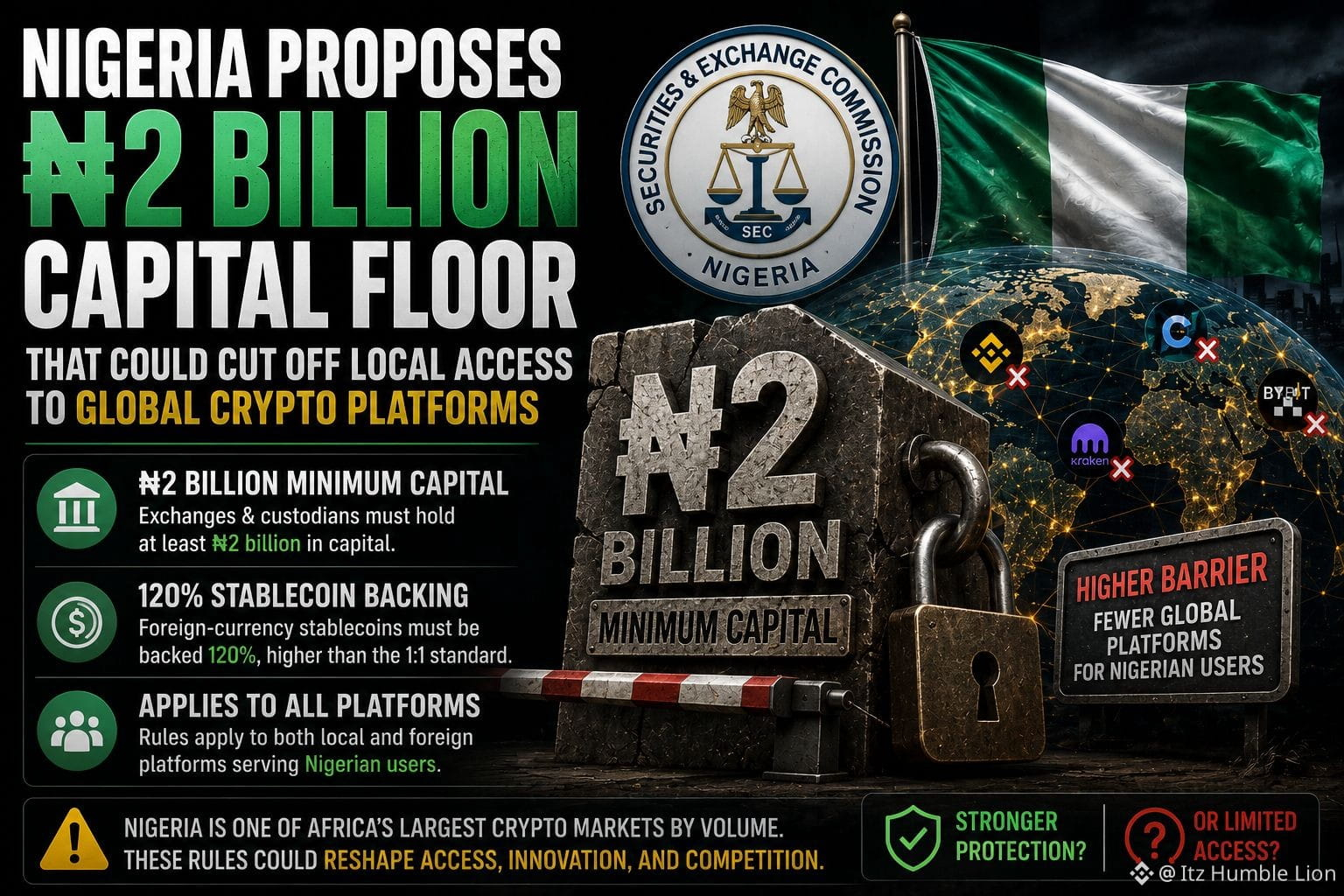
Nigeria's Securities & Exchange Commission (SEC) is proposing a framework that would require crypto exchanges and custodians to maintain at least ₦2 billion in capital.
The rule doesn't only target companies physically based in Nigeria.
The proposed framework also covers firms that provide services to Nigerian residents or target the Nigerian market, potentially making compliance much harder for smaller foreign platforms.
Nigeria is one of Africa's major crypto markets, so the bigger question is what happens to users if fewer global platforms can legally serve them.
More regulation could mean greater protection and stronger local infrastructure — but it could also narrow consumer choice and push some activity toward less-regulated alternatives.
And that's the interesting part:
Is Nigeria building a safer crypto market, or making access unnecessarily expensive?
$BTC $ETH $USDT
#Nigeria #CryptoRegulation #crypto #Stablecoins #Africa
2
1.1k
📜 Nigeria issues comprehensive tax guidelines for virtual assets
The Nigerian Revenue Service (NRS) has issued comprehensive guidelines on the tax of virtual assets, aiming to clarify the tax treatment of cryptocurrencies and digital assets. This step comes as part of regulators’ efforts to establish the legal and tax frameworks for this category of assets.
━━━━━━━━━━━━━━
📊 Impact: 📈 High
🏷️ REGULATION
#Nigeria #CryptoTax #Regulation #DigitalAssets #Blockchain
📰 Source: punchng.com
28

·
--
Nigeria s new capital rule could shut local crypto users out of global platforms #Crypto #Nigeria #Regulation
TR Bu video yapay zeka destekli olarak hazirlanmistir yatirim tavsiyesi degildir. Kendi arastirmanizi yapiniz DYOR . EN This video was produced with AI assistance it is not financial advice. Always do your own research DYOR .
TR Bu video yapay zeka destekli olarak hazirlanmistir yatirim tavsiyesi degildir. Kendi arastirmanizi yapiniz DYOR . EN This video was produced with AI assistance it is not financial advice. Always do your own research DYOR .
32
Log in to explore more content
Join global crypto users on Binance Square
⚡️ Get latest and useful information about crypto.
💬 Trusted by the world’s largest crypto exchange.
👍 Discover real insights from verified creators.
Email / Phone number
Trending Topics
1
#WhoWillSucceedJensenHuangatNvidia?
66,952 views
902 Discussing
2
#WhatWillDriveCryptoandStocks’NextRebound?
405,250 views
2,852 Discussing
3
#BitcoinActiveSupplyInProfitDropsBelow45%
9,815 views
207 Discussing
4
#KavaSaysAbnormalActivityLimitedToKavaLend
2,321 views
78 Discussing
5
#USSpotXRPETFsSeeLargestWeeklyOutflowIn8Months
2,902 views
94 Discussing
6
#USPPIMissMayEaseBTCPressure
190,203 views
1,966 Discussing
7
#WORPTLetsTouristsConvertCryptoToThaiBaht
1,605 views
34 Discussing
8
#TONStrategyReports$23.97MQ3NetLoss
2,733 views
37 Discussing
9
#PolkadotCommunityApprovesNewStrategyWith97%Vote
16,489 views
222 Discussing
10
#dYdXPlansV9.9UpgradeToShiftUSDCToInjective
9,384 views
178 Discussing