

#vaultkit
vaultkit
8,328 views
38 Discussing
Hot
Latest

I’ll be honest, @NewtonProtocol caught my attention because it focuses on a problem that doesn’t get discussed enough: trust alone isn’t enough when larger amounts of capital move onchain.
The more I read about #VaultKit , the more practical the idea feels. Instead of asking users to trust a vault manager, it puts clear, verifiable rules in place before any management action can happen. That makes a big difference for institutions, tokenized assets, and anyone who expects transparency instead of promises.
What I like is that it doesn’t force curators to abandon the tools they already use. It simply adds a policy layer that checks every important action before it reaches the vault. If it follows the rules, it goes through. If it doesn’t, it stops. That’s a straightforward approach I can appreciate.
To me, this is less about hype and more about improving how onchain finance is governed. As more traditional capital enters crypto, stronger controls will matter just as much as better technology.
I’m interested to see how Newton continues to develop VaultKit and how builders expand the ecosystem with new policy packs. It feels like a practical step toward making onchain vaults more accountable, transparent, and ready for broader adoption.
$NEWT
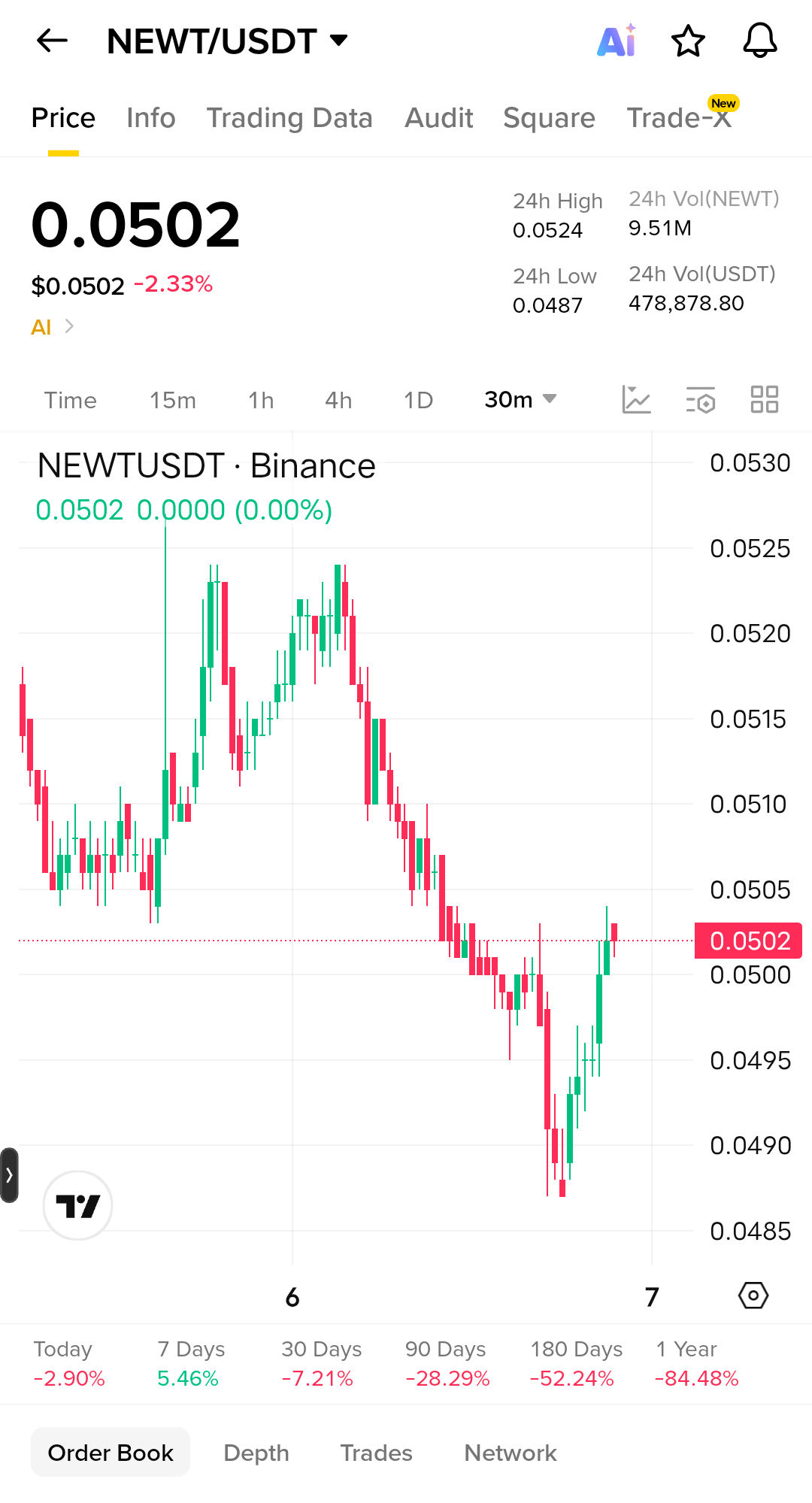
{future}(NEWTUSDT)
#Newt @NewtonProtocol
I’ll be honest, @NewtonProtocol caught my attention because it focuses on a problem that doesn’t get discussed enough: trust alone isn’t enough when larger amounts of capital move onchain.
The more I read about #VaultKit , the more practical the idea feels. Instead of asking users to trust a vault manager, it puts clear, verifiable rules in place before any management action can happen. That makes a big difference for institutions, tokenized assets, and anyone who expects transparency instead of promises.
What I like is that it doesn’t force curators to abandon the tools they already use. It simply adds a policy layer that checks every important action before it reaches the vault. If it follows the rules, it goes through. If it doesn’t, it stops. That’s a straightforward approach I can appreciate.
To me, this is less about hype and more about improving how onchain finance is governed. As more traditional capital enters crypto, stronger controls will matter just as much as better technology.
I’m interested to see how Newton continues to develop VaultKit and how builders expand the ecosystem with new policy packs. It feels like a practical step toward making onchain vaults more accountable, transparent, and ready for broader adoption.
$NEWT
#Newt @NewtonProtocol
The more I read about #VaultKit , the more practical the idea feels. Instead of asking users to trust a vault manager, it puts clear, verifiable rules in place before any management action can happen. That makes a big difference for institutions, tokenized assets, and anyone who expects transparency instead of promises.
What I like is that it doesn’t force curators to abandon the tools they already use. It simply adds a policy layer that checks every important action before it reaches the vault. If it follows the rules, it goes through. If it doesn’t, it stops. That’s a straightforward approach I can appreciate.
To me, this is less about hype and more about improving how onchain finance is governed. As more traditional capital enters crypto, stronger controls will matter just as much as better technology.
I’m interested to see how Newton continues to develop VaultKit and how builders expand the ecosystem with new policy packs. It feels like a practical step toward making onchain vaults more accountable, transparent, and ready for broader adoption.
$NEWT
#Newt @NewtonProtocol
50
20
1.1k


·
--
Partly True
The first week I worked with institutional Vaults integrating with Newton, I got rejected by the verifier 4 times. On the 5th attempt, it wasn’t the risk-control parameters that passed—it was my changing a field from string to enum, so the machine could finally understand whether it was “a stablecoin or an RWA credential.”
Now that institutional funds are going on-chain, the biggest fear isn’t a black swan—it’s “unclear proofs.” For a vault rebalance of 5 million, traditional audits reconcile accounts afterward. But @NewtonProtocol’s VaultKit is the opposite: it pins the rules onto the chain before settlement—if there are no rule-matching assets, nothing moves.
Specifically, VaultKit asks the vault creator to write the strategy as a piece of Rego (OPA-derived) code and attach it to the vault. Each time there’s a rebalance / withdrawal / cross-chain bridging, the verifier network runs that rule. If it passes, it issues a signed cryptographic attestation that’s verifiable on-chain; if it fails, the signature is rejected and the assets stay in place.
The compliance vault I designed for that institution had very detailed rules in the first version: whitelisted assets, maximum drawdown of 8%, approved counterparties, and no single transaction over 300,000. Still, it was rejected—not because the risk numbers were wrong, but because the asset-type field semantics didn’t line up. Newton’s verifier checks structured enums (stablecoin / rwa / l1_token / lp_token), but I wrote a string. The machine can’t determine whether USDC is truly the same class of asset as a currency market fund certificate. A traditional compliance auditor might be able to imagine it, but the verifier executes mechanically—it won’t auto-classify.
On the 5th try, I changed the field type, added an asset_class parser, mapped each asset into the enum first, and then applied the rules. It passed within 5 seconds. This is a real engineering pain point: unstructured on-chain strategies mean institutions simply don’t dare to deposit funds.
The fundamental difference between this engineering approach and a traditional audit is that traditional audits are manual and performed after the fact. The institution pays the auditor each month to flip through the paperwork. Now the verifier runs deterministic logic on-chain: whether it passes or fails is decided by the machine. The institution is integrating with the rules code itself—not the auditor’s guesswork. VaultKit encapsulates that layer so developers don’t have to write strategy guardrails from scratch.
$NEWT is now at $14.82, up 0.61% over the past 24 hours. The price hasn’t moved, but the engineering work of VaultKit is quietly taking shape. Mainnet Beta has been running for over a month; the key institutions aren’t integrating for the price—they’re integrating for “proof clarity.” This money can get booked, flow into compliance channels, and be reviewed without auditors constantly asking questions. Real RWA funding looks at this line.
Tracking signal: watch whether, over the next 30 days, RWA project parties explicitly write the Newton attestation into the prospectus. If they do, then the real adoption of the line associated with #Newt can be said to have begun.
#VaultKit #DeFi #authorization layer
The first week I worked with institutional Vaults integrating with Newton, I got rejected by the verifier 4 times. On the 5th attempt, it wasn’t the risk-control parameters that passed—it was my changing a field from string to enum, so the machine could finally understand whether it was “a stablecoin or an RWA credential.”
Now that institutional funds are going on-chain, the biggest fear isn’t a black swan—it’s “unclear proofs.” For a vault rebalance of 5 million, traditional audits reconcile accounts afterward. But @NewtonProtocol’s VaultKit is the opposite: it pins the rules onto the chain before settlement—if there are no rule-matching assets, nothing moves.
Specifically, VaultKit asks the vault creator to write the strategy as a piece of Rego (OPA-derived) code and attach it to the vault. Each time there’s a rebalance / withdrawal / cross-chain bridging, the verifier network runs that rule. If it passes, it issues a signed cryptographic attestation that’s verifiable on-chain; if it fails, the signature is rejected and the assets stay in place.
The compliance vault I designed for that institution had very detailed rules in the first version: whitelisted assets, maximum drawdown of 8%, approved counterparties, and no single transaction over 300,000. Still, it was rejected—not because the risk numbers were wrong, but because the asset-type field semantics didn’t line up. Newton’s verifier checks structured enums (stablecoin / rwa / l1_token / lp_token), but I wrote a string. The machine can’t determine whether USDC is truly the same class of asset as a currency market fund certificate. A traditional compliance auditor might be able to imagine it, but the verifier executes mechanically—it won’t auto-classify.
On the 5th try, I changed the field type, added an asset_class parser, mapped each asset into the enum first, and then applied the rules. It passed within 5 seconds. This is a real engineering pain point: unstructured on-chain strategies mean institutions simply don’t dare to deposit funds.
The fundamental difference between this engineering approach and a traditional audit is that traditional audits are manual and performed after the fact. The institution pays the auditor each month to flip through the paperwork. Now the verifier runs deterministic logic on-chain: whether it passes or fails is decided by the machine. The institution is integrating with the rules code itself—not the auditor’s guesswork. VaultKit encapsulates that layer so developers don’t have to write strategy guardrails from scratch.
$NEWT is now at $14.82, up 0.61% over the past 24 hours. The price hasn’t moved, but the engineering work of VaultKit is quietly taking shape. Mainnet Beta has been running for over a month; the key institutions aren’t integrating for the price—they’re integrating for “proof clarity.” This money can get booked, flow into compliance channels, and be reviewed without auditors constantly asking questions. Real RWA funding looks at this line.
Tracking signal: watch whether, over the next 30 days, RWA project parties explicitly write the Newton attestation into the prospectus. If they do, then the real adoption of the line associated with #Newt can be said to have begun.
#VaultKit #DeFi #authorization layer
Now that institutional funds are going on-chain, the biggest fear isn’t a black swan—it’s “unclear proofs.” For a vault rebalance of 5 million, traditional audits reconcile accounts afterward. But @NewtonProtocol’s VaultKit is the opposite: it pins the rules onto the chain before settlement—if there are no rule-matching assets, nothing moves.
Specifically, VaultKit asks the vault creator to write the strategy as a piece of Rego (OPA-derived) code and attach it to the vault. Each time there’s a rebalance / withdrawal / cross-chain bridging, the verifier network runs that rule. If it passes, it issues a signed cryptographic attestation that’s verifiable on-chain; if it fails, the signature is rejected and the assets stay in place.
The compliance vault I designed for that institution had very detailed rules in the first version: whitelisted assets, maximum drawdown of 8%, approved counterparties, and no single transaction over 300,000. Still, it was rejected—not because the risk numbers were wrong, but because the asset-type field semantics didn’t line up. Newton’s verifier checks structured enums (stablecoin / rwa / l1_token / lp_token), but I wrote a string. The machine can’t determine whether USDC is truly the same class of asset as a currency market fund certificate. A traditional compliance auditor might be able to imagine it, but the verifier executes mechanically—it won’t auto-classify.
On the 5th try, I changed the field type, added an asset_class parser, mapped each asset into the enum first, and then applied the rules. It passed within 5 seconds. This is a real engineering pain point: unstructured on-chain strategies mean institutions simply don’t dare to deposit funds.
The fundamental difference between this engineering approach and a traditional audit is that traditional audits are manual and performed after the fact. The institution pays the auditor each month to flip through the paperwork. Now the verifier runs deterministic logic on-chain: whether it passes or fails is decided by the machine. The institution is integrating with the rules code itself—not the auditor’s guesswork. VaultKit encapsulates that layer so developers don’t have to write strategy guardrails from scratch.
$NEWT is now at $14.82, up 0.61% over the past 24 hours. The price hasn’t moved, but the engineering work of VaultKit is quietly taking shape. Mainnet Beta has been running for over a month; the key institutions aren’t integrating for the price—they’re integrating for “proof clarity.” This money can get booked, flow into compliance channels, and be reviewed without auditors constantly asking questions. Real RWA funding looks at this line.
Tracking signal: watch whether, over the next 30 days, RWA project parties explicitly write the Newton attestation into the prospectus. If they do, then the real adoption of the line associated with #Newt can be said to have begun.
#VaultKit #DeFi #authorization layer
2.7k

Article
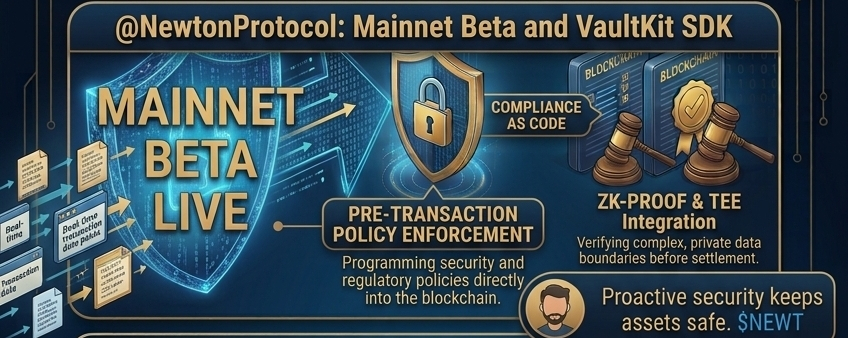
Redefining Web3 Security: Why Newton Protocol’s 'Compliance as Code' is a Game Changer$NEWT As the Web3 ecosystem matures, the narrative is shifting from "growth at all costs" to "security at all scales." For years, the industry has relied on reactive security models—auditing code after a hack or monitoring for anomalies only after the damage is done. This reactive approach is no longer sufficient for institutions or serious builders. @NewtonProtocol is fundamentally changing this dynamic with the launch of its Mainnet Beta, introducing a proactive security architecture that prioritizes safety at the point of origin.
The Paradigm Shift: Pre-Transaction Enforcement
The most significant breakthrough within the Newton Mainnet Beta is the implementation of pre-transaction policy enforcement. In traditional blockchain environments, security checks are post-hoc processes. Newton, however, requires every transaction to be reviewed and validated against a pre-defined set of rules before it is ever settled on the blockchain.
By acting as a proactive firewall, the protocol ensures that if a transaction attempts to breach security limits, ignore compliance mandates, or interact with unauthorized counterparties, it is blocked immediately. This "Compliance as Code" design effectively neutralizes malicious activity before it can impact the network.
VaultKit SDK: Bridging Complexity and Usability
Newton Protocol’s VaultKit SDK acts as the primary tool for developers to integrate this robust infrastructure into their decentralized applications (dApps). VaultKit abstracts the massive cryptographic complexity of on-chain policy enforcement, providing a modular framework that allows builders to:
Define Custom Policies: Tailor security rules to specific organizational needs.
Utilize Privacy-Preserving Tech: Leverage Trusted Execution Environments (TEEs) and Zero-Knowledge (ZK) Proofs to run complex logic without exposing sensitive, raw institutional data.
Verify Independently: All policy executions are anchored to the chain with cryptographic attestations, ensuring transparency without compromising privacy.
Building for the Next Wave of Adoption
By operating as an EigenLayer Actively Validated Service (AVS), Newton Protocol leverages Ethereum’s immense economic security, giving users and institutions the confidence they need to deploy capital at scale. This marriage of Ethereum's decentralized economic finality with Newton's proactive compliance engine creates an infrastructure layer that is finally ready for mainstream financial workflows.
As the $NEWT ecosystem continues to expand, it is positioning itself not just as another layer, but as a mandatory utility for any automated, high-value Web3 operation. By turning compliance into code and safety into a default setting, Newton Protocol is laying the groundwork for a more stable, secure, and institutional-ready Web3 future.
#Newt #Web3Security #ComplianceAsCode #VaultKit
$NEWT
{future}(NEWTUSDT)
Redefining Web3 Security: Why Newton Protocol’s 'Compliance as Code' is a Game Changer
$NEWT As the Web3 ecosystem matures, the narrative is shifting from "growth at all costs" to "security at all scales." For years, the industry has relied on reactive security models—auditing code after a hack or monitoring for anomalies only after the damage is done. This reactive approach is no longer sufficient for institutions or serious builders. @NewtonProtocol is fundamentally changing this dynamic with the launch of its Mainnet Beta, introducing a proactive security architecture that prioritizes safety at the point of origin.
The Paradigm Shift: Pre-Transaction Enforcement
The most significant breakthrough within the Newton Mainnet Beta is the implementation of pre-transaction policy enforcement. In traditional blockchain environments, security checks are post-hoc processes. Newton, however, requires every transaction to be reviewed and validated against a pre-defined set of rules before it is ever settled on the blockchain.
By acting as a proactive firewall, the protocol ensures that if a transaction attempts to breach security limits, ignore compliance mandates, or interact with unauthorized counterparties, it is blocked immediately. This "Compliance as Code" design effectively neutralizes malicious activity before it can impact the network.
VaultKit SDK: Bridging Complexity and Usability
Newton Protocol’s VaultKit SDK acts as the primary tool for developers to integrate this robust infrastructure into their decentralized applications (dApps). VaultKit abstracts the massive cryptographic complexity of on-chain policy enforcement, providing a modular framework that allows builders to:
Define Custom Policies: Tailor security rules to specific organizational needs.
Utilize Privacy-Preserving Tech: Leverage Trusted Execution Environments (TEEs) and Zero-Knowledge (ZK) Proofs to run complex logic without exposing sensitive, raw institutional data.
Verify Independently: All policy executions are anchored to the chain with cryptographic attestations, ensuring transparency without compromising privacy.
Building for the Next Wave of Adoption
By operating as an EigenLayer Actively Validated Service (AVS), Newton Protocol leverages Ethereum’s immense economic security, giving users and institutions the confidence they need to deploy capital at scale. This marriage of Ethereum's decentralized economic finality with Newton's proactive compliance engine creates an infrastructure layer that is finally ready for mainstream financial workflows.
As the $NEWT ecosystem continues to expand, it is positioning itself not just as another layer, but as a mandatory utility for any automated, high-value Web3 operation. By turning compliance into code and safety into a default setting, Newton Protocol is laying the groundwork for a more stable, secure, and institutional-ready Web3 future.
#Newt #Web3Security #ComplianceAsCode #VaultKit
$NEWT
The Paradigm Shift: Pre-Transaction Enforcement
The most significant breakthrough within the Newton Mainnet Beta is the implementation of pre-transaction policy enforcement. In traditional blockchain environments, security checks are post-hoc processes. Newton, however, requires every transaction to be reviewed and validated against a pre-defined set of rules before it is ever settled on the blockchain.
By acting as a proactive firewall, the protocol ensures that if a transaction attempts to breach security limits, ignore compliance mandates, or interact with unauthorized counterparties, it is blocked immediately. This "Compliance as Code" design effectively neutralizes malicious activity before it can impact the network.
VaultKit SDK: Bridging Complexity and Usability
Newton Protocol’s VaultKit SDK acts as the primary tool for developers to integrate this robust infrastructure into their decentralized applications (dApps). VaultKit abstracts the massive cryptographic complexity of on-chain policy enforcement, providing a modular framework that allows builders to:
Define Custom Policies: Tailor security rules to specific organizational needs.
Utilize Privacy-Preserving Tech: Leverage Trusted Execution Environments (TEEs) and Zero-Knowledge (ZK) Proofs to run complex logic without exposing sensitive, raw institutional data.
Verify Independently: All policy executions are anchored to the chain with cryptographic attestations, ensuring transparency without compromising privacy.
Building for the Next Wave of Adoption
By operating as an EigenLayer Actively Validated Service (AVS), Newton Protocol leverages Ethereum’s immense economic security, giving users and institutions the confidence they need to deploy capital at scale. This marriage of Ethereum's decentralized economic finality with Newton's proactive compliance engine creates an infrastructure layer that is finally ready for mainstream financial workflows.
As the $NEWT ecosystem continues to expand, it is positioning itself not just as another layer, but as a mandatory utility for any automated, high-value Web3 operation. By turning compliance into code and safety into a default setting, Newton Protocol is laying the groundwork for a more stable, secure, and institutional-ready Web3 future.
#Newt #Web3Security #ComplianceAsCode #VaultKit
$NEWT
2
85

Newton Mainnet Beta Is Here
The release of Newton Mainnet Beta is an exciting step for the blockchaNewton Mainnet Beta Is Here
The release of Newton Mainnet Beta is an exciting step for the blockchain ecosystem. With VaultKit, developers can create vaults whose rules are enforced directly onchain instead of depending on manual checks. Every transaction is validated before it is finalized, and a signed attestation is recorded so anyone can independently verify what happened. This makes digital asset management more transparent, secure, and reliable while giving builders the confidence to develop stronger Web3 applications powered by verifiable execution and trustless infrastructure.
#Newton #MainnetBeta #VaultKit #Web3
Newton Mainnet Beta Is Here The release of Newton Mainnet Beta is an exciting step for the blockcha
Newton Mainnet Beta Is Here
The release of Newton Mainnet Beta is an exciting step for the blockchain ecosystem. With VaultKit, developers can create vaults whose rules are enforced directly onchain instead of depending on manual checks. Every transaction is validated before it is finalized, and a signed attestation is recorded so anyone can independently verify what happened. This makes digital asset management more transparent, secure, and reliable while giving builders the confidence to develop stronger Web3 applications powered by verifiable execution and trustless infrastructure.
#Newton #MainnetBeta #VaultKit #Web3
The release of Newton Mainnet Beta is an exciting step for the blockchain ecosystem. With VaultKit, developers can create vaults whose rules are enforced directly onchain instead of depending on manual checks. Every transaction is validated before it is finalized, and a signed attestation is recorded so anyone can independently verify what happened. This makes digital asset management more transparent, secure, and reliable while giving builders the confidence to develop stronger Web3 applications powered by verifiable execution and trustless infrastructure.
#Newton #MainnetBeta #VaultKit #Web3
34
·
--
Partly True
According to data institutions, there are currently 3,500 vaults on-chain holding $89.3 billion. For 80% of this, a single manager key still directly controls it—trust is fully staked on just one person, the curator. Recently I used VaultKit to build a stablecoin yield vault in practice, walked through the entire design process, and will share the pitfalls I encountered and the underlying logic.
The difference between VaultKit and traditional multisig isn’t the number of signatures—in the premise, it replaces “trusting people” with “trusting code.” The rules are written into code; before execution, the strategy is checked. If it passes, a cryptographic attestation is generated and can be verified on-chain. If it doesn’t pass, the funds can’t be moved at all. In @NewtonProtocol, this mechanism is called an “authorization layer for on-chain finance,” and its logic is basically aligned with the authorization network behind Visa card payments.
My hands-on scenario is like this: I manage a stablecoin yield vault with a target TVL of $50 million, accepting deposits from external LPs. The curator wants to adjust the collateral ratio on Morpho or earn yield from Aave; every operation must first go through VaultKit.
Step one: policy definition. I wrote a Rego policy pack, which is the declarative policy language of Open Policy Agent. The rules are divided into four parts. The compliance layer integrates Chainalysis and Hexagate, automatically checks the OFAC-sanctioned list and stolen-coin addresses; the identity layer runs KYC and checks the status of qualified investors; the security layer continuously scans flagged wallets in real time; the risk layer pulls RedStone’s APY health metrics, calculates counterparty credit using Credora, and adds a single-transaction 0.5% maximum drawdown limit. The whole thing is a few hundred lines of Rego, and integrating it with the VaultKit SDK is one-click.
Step two: on-chain interception. Each time the curator sends a management action, the Newton node first runs an evaluation using this policy. If the compliance layer hits, the funds flow is cut off. If the risk layer exceeds the drawdown threshold, the operation is blocked immediately. If the evaluation passes, a verifier network (in effect, the token holders running nodes) signs out an attestation that can be checked on-chain.
Step three: the verifier’s economic model. The staking rewards of $NEWT are not passive incentives; they’re gas compensation plus governance voting rights for verifiers that run the evaluations. Malicious behavior by nodes triggers slashing—any NEWT resulting from slashing goes to the treasury. The entire mechanism is tied to PoS security, not soft incentives.
Compared with traditional vault design, what’s missing is “interception during execution vs. post-audit.” Having auditors monitor this logic isn’t realistic for small institutional LPs—code interception is what matters.
Mainnet Beta launched on June 23rd on TokenizeThisNYC, running on Ethereum plus Base (Base has additional AI agents on that side). The documentation is at docs.newton.xyz. If you have requirements from LPs regarding transparency of on-chain governance, this is worth adding to your compliance checklist.
#Newt #NewtonProtocol #VaultKit #DeFi
According to data institutions, there are currently 3,500 vaults on-chain holding $89.3 billion. For 80% of this, a single manager key still directly controls it—trust is fully staked on just one person, the curator. Recently I used VaultKit to build a stablecoin yield vault in practice, walked through the entire design process, and will share the pitfalls I encountered and the underlying logic.
The difference between VaultKit and traditional multisig isn’t the number of signatures—in the premise, it replaces “trusting people” with “trusting code.” The rules are written into code; before execution, the strategy is checked. If it passes, a cryptographic attestation is generated and can be verified on-chain. If it doesn’t pass, the funds can’t be moved at all. In @NewtonProtocol, this mechanism is called an “authorization layer for on-chain finance,” and its logic is basically aligned with the authorization network behind Visa card payments.
My hands-on scenario is like this: I manage a stablecoin yield vault with a target TVL of $50 million, accepting deposits from external LPs. The curator wants to adjust the collateral ratio on Morpho or earn yield from Aave; every operation must first go through VaultKit.
Step one: policy definition. I wrote a Rego policy pack, which is the declarative policy language of Open Policy Agent. The rules are divided into four parts. The compliance layer integrates Chainalysis and Hexagate, automatically checks the OFAC-sanctioned list and stolen-coin addresses; the identity layer runs KYC and checks the status of qualified investors; the security layer continuously scans flagged wallets in real time; the risk layer pulls RedStone’s APY health metrics, calculates counterparty credit using Credora, and adds a single-transaction 0.5% maximum drawdown limit. The whole thing is a few hundred lines of Rego, and integrating it with the VaultKit SDK is one-click.
Step two: on-chain interception. Each time the curator sends a management action, the Newton node first runs an evaluation using this policy. If the compliance layer hits, the funds flow is cut off. If the risk layer exceeds the drawdown threshold, the operation is blocked immediately. If the evaluation passes, a verifier network (in effect, the token holders running nodes) signs out an attestation that can be checked on-chain.
Step three: the verifier’s economic model. The staking rewards of $NEWT are not passive incentives; they’re gas compensation plus governance voting rights for verifiers that run the evaluations. Malicious behavior by nodes triggers slashing—any NEWT resulting from slashing goes to the treasury. The entire mechanism is tied to PoS security, not soft incentives.
Compared with traditional vault design, what’s missing is “interception during execution vs. post-audit.” Having auditors monitor this logic isn’t realistic for small institutional LPs—code interception is what matters.
Mainnet Beta launched on June 23rd on TokenizeThisNYC, running on Ethereum plus Base (Base has additional AI agents on that side). The documentation is at docs.newton.xyz. If you have requirements from LPs regarding transparency of on-chain governance, this is worth adding to your compliance checklist.
#Newt #NewtonProtocol #VaultKit #DeFi
The difference between VaultKit and traditional multisig isn’t the number of signatures—in the premise, it replaces “trusting people” with “trusting code.” The rules are written into code; before execution, the strategy is checked. If it passes, a cryptographic attestation is generated and can be verified on-chain. If it doesn’t pass, the funds can’t be moved at all. In @NewtonProtocol, this mechanism is called an “authorization layer for on-chain finance,” and its logic is basically aligned with the authorization network behind Visa card payments.
My hands-on scenario is like this: I manage a stablecoin yield vault with a target TVL of $50 million, accepting deposits from external LPs. The curator wants to adjust the collateral ratio on Morpho or earn yield from Aave; every operation must first go through VaultKit.
Step one: policy definition. I wrote a Rego policy pack, which is the declarative policy language of Open Policy Agent. The rules are divided into four parts. The compliance layer integrates Chainalysis and Hexagate, automatically checks the OFAC-sanctioned list and stolen-coin addresses; the identity layer runs KYC and checks the status of qualified investors; the security layer continuously scans flagged wallets in real time; the risk layer pulls RedStone’s APY health metrics, calculates counterparty credit using Credora, and adds a single-transaction 0.5% maximum drawdown limit. The whole thing is a few hundred lines of Rego, and integrating it with the VaultKit SDK is one-click.
Step two: on-chain interception. Each time the curator sends a management action, the Newton node first runs an evaluation using this policy. If the compliance layer hits, the funds flow is cut off. If the risk layer exceeds the drawdown threshold, the operation is blocked immediately. If the evaluation passes, a verifier network (in effect, the token holders running nodes) signs out an attestation that can be checked on-chain.
Step three: the verifier’s economic model. The staking rewards of $NEWT are not passive incentives; they’re gas compensation plus governance voting rights for verifiers that run the evaluations. Malicious behavior by nodes triggers slashing—any NEWT resulting from slashing goes to the treasury. The entire mechanism is tied to PoS security, not soft incentives.
Compared with traditional vault design, what’s missing is “interception during execution vs. post-audit.” Having auditors monitor this logic isn’t realistic for small institutional LPs—code interception is what matters.
Mainnet Beta launched on June 23rd on TokenizeThisNYC, running on Ethereum plus Base (Base has additional AI agents on that side). The documentation is at docs.newton.xyz. If you have requirements from LPs regarding transparency of on-chain governance, this is worth adding to your compliance checklist.
#Newt #NewtonProtocol #VaultKit #DeFi
2
3
3.2k

·
--
$NEWT
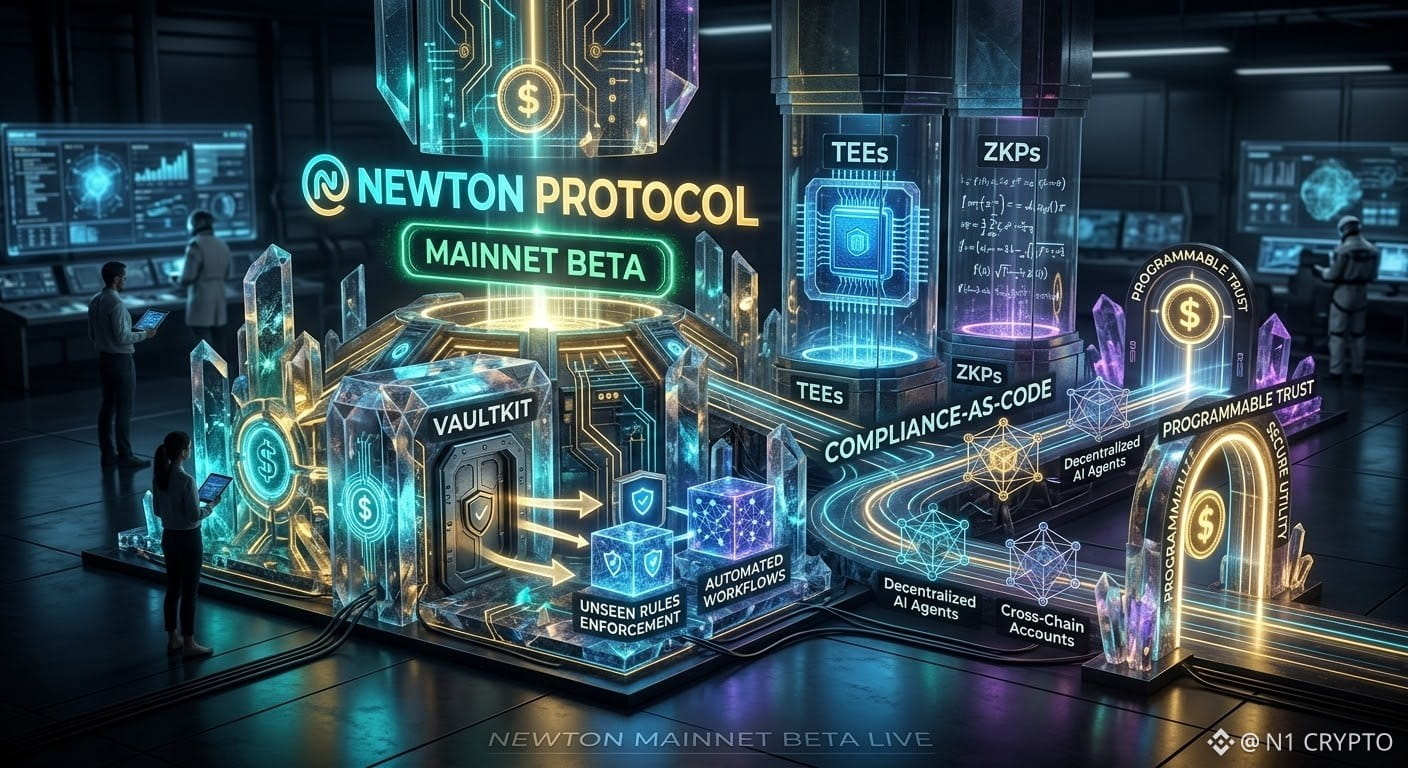
The future of decentralized applications isn’t just about execution; it’s about verifiable automation and programmable trust. 🌐
With the live rollout of the Newton Mainnet Beta, @NewtonProtocol is introducing a groundbreaking "compliance-as-code" infrastructure layer. By introducing VaultKit, developers can now seamlessly enforce custom, pre-transaction programmatic rules directly on-chain—safeguarding assets before an execution even settles.
Through the power of cryptographic proofs (TEEs and ZKPs), Newton acts as a bulletproof authorization engine for autonomous Web3 workflows, cross-chain smart accounts, and decentralized AI agents. This bridges the gap between enterprise-grade risk management and pure on-chain automation, unlocking massive utility for the $NEWT token ecosystem.
The automated economy is scaling up, and it is moving fast. ⚡
#Newt #mainnetbeta #VaultKit #Web3Automation
$NEWT
The future of decentralized applications isn’t just about execution; it’s about verifiable automation and programmable trust. 🌐
With the live rollout of the Newton Mainnet Beta, @NewtonProtocol is introducing a groundbreaking "compliance-as-code" infrastructure layer. By introducing VaultKit, developers can now seamlessly enforce custom, pre-transaction programmatic rules directly on-chain—safeguarding assets before an execution even settles.
Through the power of cryptographic proofs (TEEs and ZKPs), Newton acts as a bulletproof authorization engine for autonomous Web3 workflows, cross-chain smart accounts, and decentralized AI agents. This bridges the gap between enterprise-grade risk management and pure on-chain automation, unlocking massive utility for the $NEWT token ecosystem.
The automated economy is scaling up, and it is moving fast. ⚡
#Newt #mainnetbeta #VaultKit #Web3Automation
The future of decentralized applications isn’t just about execution; it’s about verifiable automation and programmable trust. 🌐
With the live rollout of the Newton Mainnet Beta, @NewtonProtocol is introducing a groundbreaking "compliance-as-code" infrastructure layer. By introducing VaultKit, developers can now seamlessly enforce custom, pre-transaction programmatic rules directly on-chain—safeguarding assets before an execution even settles.
Through the power of cryptographic proofs (TEEs and ZKPs), Newton acts as a bulletproof authorization engine for autonomous Web3 workflows, cross-chain smart accounts, and decentralized AI agents. This bridges the gap between enterprise-grade risk management and pure on-chain automation, unlocking massive utility for the $NEWT token ecosystem.
The automated economy is scaling up, and it is moving fast. ⚡
#Newt #mainnetbeta #VaultKit #Web3Automation
110

·
--
I think people skip Newton's mainnet beta because it sounds like homework — it isn't.
@NewtonProtocol has production lanes live on Base and Ethereum now. You can get through a first pass in about ten minutes: connect a wallet, open their app portal, run one authorization check before you touch a vault. That's basically the pitch — VaultKit keeps the rules inside the contract, not in some dashboard you'll never open. The clearest walkthrough I've seen is on their Square page: https://www.binance.com/en/square/profile/newtonprotocol
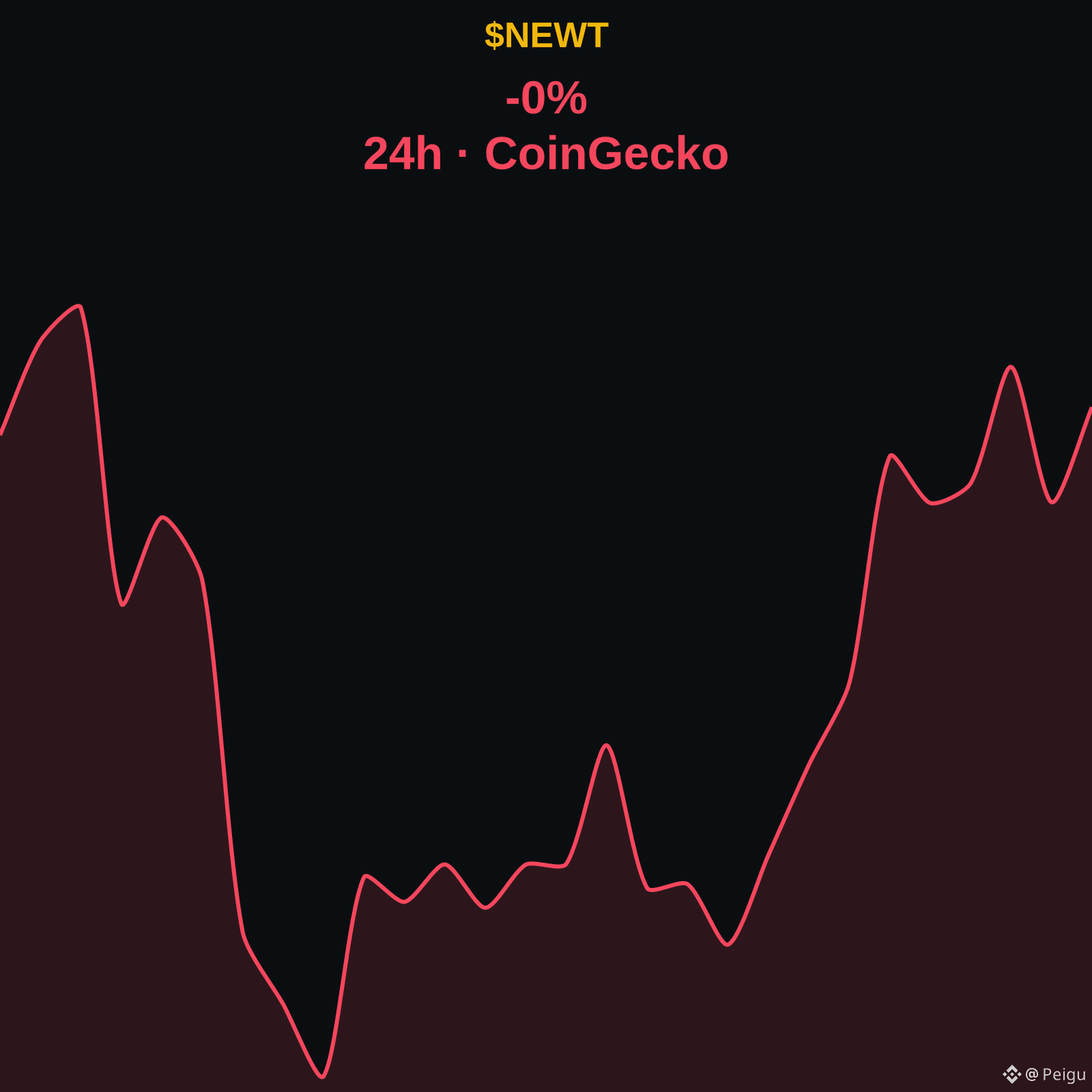
$NEWT's around $0.051 today, up roughly 0.15% on a dead Sunday. Chart noise. What I'm watching is whether their feed starts showing apps with real repeat use — not just another "beta is live" thread.
#Newt #MainnetBeta #VaultKit
I think people skip Newton's mainnet beta because it sounds like homework — it isn't.
@NewtonProtocol has production lanes live on Base and Ethereum now. You can get through a first pass in about ten minutes: connect a wallet, open their app portal, run one authorization check before you touch a vault. That's basically the pitch — VaultKit keeps the rules inside the contract, not in some dashboard you'll never open. The clearest walkthrough I've seen is on their Square page: https://www.binance.com/en/square/profile/newtonprotocol
$NEWT 's around $0.051 today, up roughly 0.15% on a dead Sunday. Chart noise. What I'm watching is whether their feed starts showing apps with real repeat use — not just another "beta is live" thread.
#Newt #MainnetBeta #VaultKit
@NewtonProtocol has production lanes live on Base and Ethereum now. You can get through a first pass in about ten minutes: connect a wallet, open their app portal, run one authorization check before you touch a vault. That's basically the pitch — VaultKit keeps the rules inside the contract, not in some dashboard you'll never open. The clearest walkthrough I've seen is on their Square page: https://www.binance.com/en/square/profile/newtonprotocol
$NEWT 's around $0.051 today, up roughly 0.15% on a dead Sunday. Chart noise. What I'm watching is whether their feed starts showing apps with real repeat use — not just another "beta is live" thread.
#Newt #MainnetBeta #VaultKit
65

$NEWT IS WINNING THE RISK INFRASTRUCTURE RACE IN DEFI 🔥
The era of chasing triple-digit APYs is ending. As institutional capital, RWA, and MiCA demand compliance by design, the winning vaults will be those with auditable risk infrastructure—not the highest yield.
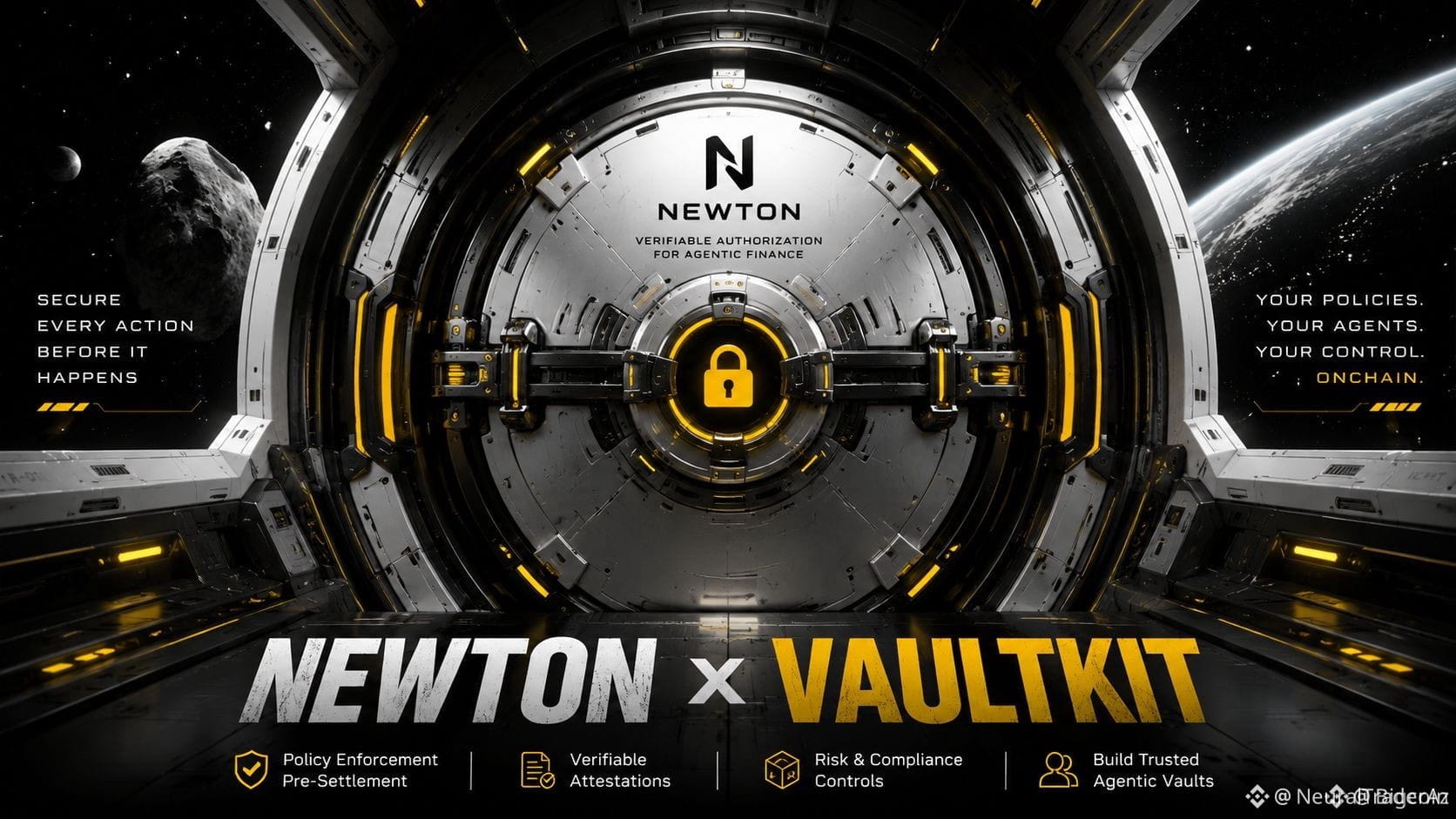
Newton's VaultKit converts curator decisions into automatically enforced policies with onchain signed attestations. This removes the single point of failure risk in curated vaults, critical as AI agents begin autonomous portfolio management.
The market is shifting from yield farming to risk infrastructure. Is your vault built for this new regime?
Not financial advice. Always manage your risk.
#NEWT #DeFi #RiskManagement #VaultKit
🔥
$NEWT IS WINNING THE RISK INFRASTRUCTURE RACE IN DEFI 🔥
The era of chasing triple-digit APYs is ending. As institutional capital, RWA, and MiCA demand compliance by design, the winning vaults will be those with auditable risk infrastructure—not the highest yield.
Newton's VaultKit converts curator decisions into automatically enforced policies with onchain signed attestations. This removes the single point of failure risk in curated vaults, critical as AI agents begin autonomous portfolio management.
The market is shifting from yield farming to risk infrastructure. Is your vault built for this new regime?
Not financial advice. Always manage your risk.
#NEWT #DeFi #RiskManagement #VaultKit
🔥
The era of chasing triple-digit APYs is ending. As institutional capital, RWA, and MiCA demand compliance by design, the winning vaults will be those with auditable risk infrastructure—not the highest yield.
Newton's VaultKit converts curator decisions into automatically enforced policies with onchain signed attestations. This removes the single point of failure risk in curated vaults, critical as AI agents begin autonomous portfolio management.
The market is shifting from yield farming to risk infrastructure. Is your vault built for this new regime?
Not financial advice. Always manage your risk.
#NEWT #DeFi #RiskManagement #VaultKit
🔥
1
31

·
--
Bullish
Verified
I was reviewing my small $NEWT position today and ended up reading more about VaultKit than I planned. One detail completely changed how I was thinking about it.
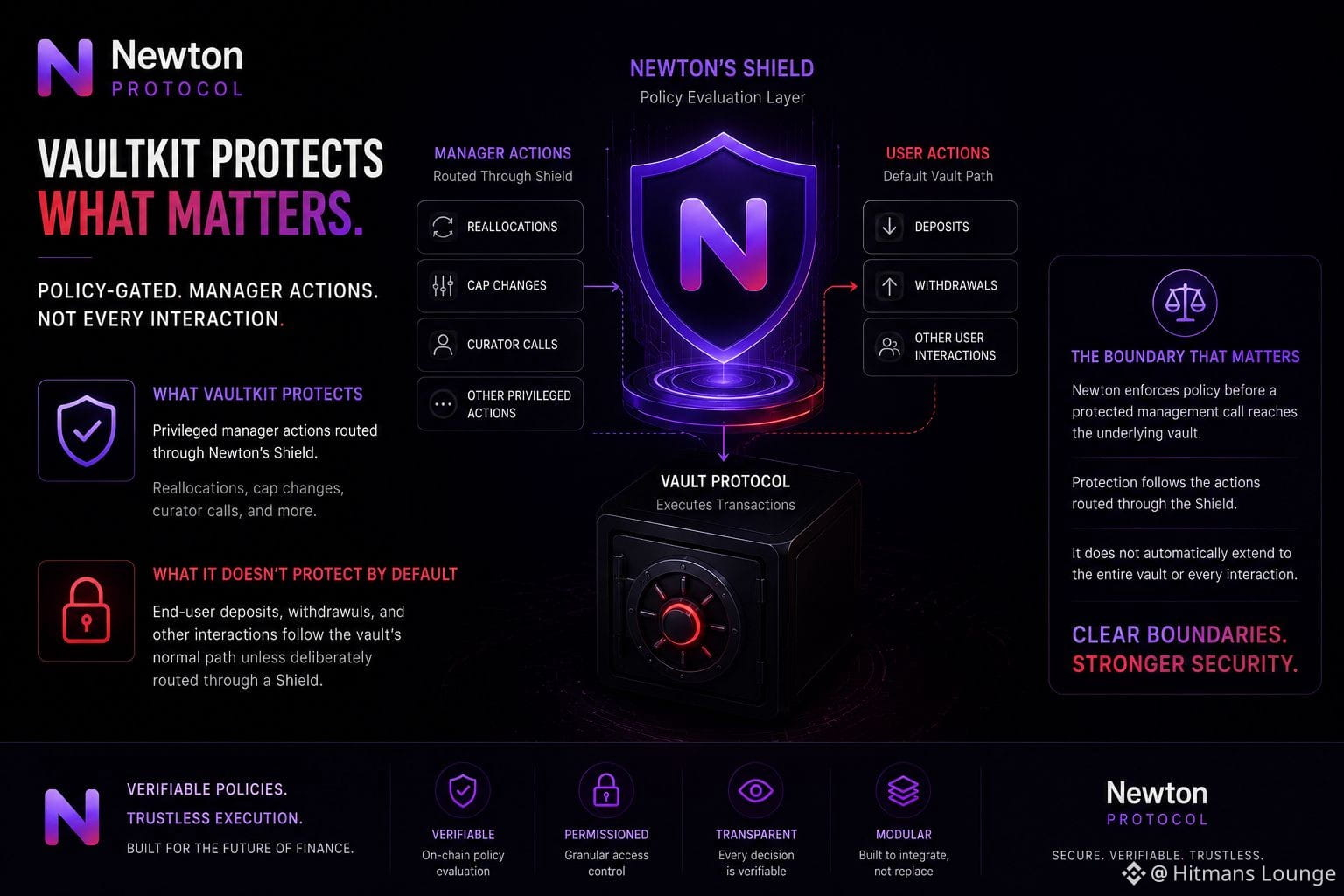
At first, I assumed Newton's Shield protected everything happening inside a vault. After digging deeper, I realized that's not really the point. The Shield is mainly there to evaluate privileged manager actions—things like reallocations or cap changes—before they reach the vault. Regular deposits and withdrawals still follow the vault's own execution path unless they're intentionally routed through the Shield.
That boundary actually makes sense. Instead of trying to wrap every interaction, Newton focuses on the decisions that can reshape how a vault is managed.
The catch is perception. It's easy to hear "policy-protected vault" and assume every action receives the same protection. That's not how it works.
For me, understanding exactly where the policy layer begins and ends made @NewtonProtocol feel more credible, not less. Clear security boundaries are usually stronger than vague promises.
#NEWT #NewtonProtocol #VaultKit #AI $VANRY $XLM
I was reviewing my small $NEWT position today and ended up reading more about VaultKit than I planned. One detail completely changed how I was thinking about it.
At first, I assumed Newton's Shield protected everything happening inside a vault. After digging deeper, I realized that's not really the point. The Shield is mainly there to evaluate privileged manager actions—things like reallocations or cap changes—before they reach the vault. Regular deposits and withdrawals still follow the vault's own execution path unless they're intentionally routed through the Shield.
That boundary actually makes sense. Instead of trying to wrap every interaction, Newton focuses on the decisions that can reshape how a vault is managed.
The catch is perception. It's easy to hear "policy-protected vault" and assume every action receives the same protection. That's not how it works.
For me, understanding exactly where the policy layer begins and ends made @NewtonProtocol feel more credible, not less. Clear security boundaries are usually stronger than vague promises.
#NEWT #NewtonProtocol #VaultKit #AI $VANRY $XLM
At first, I assumed Newton's Shield protected everything happening inside a vault. After digging deeper, I realized that's not really the point. The Shield is mainly there to evaluate privileged manager actions—things like reallocations or cap changes—before they reach the vault. Regular deposits and withdrawals still follow the vault's own execution path unless they're intentionally routed through the Shield.
That boundary actually makes sense. Instead of trying to wrap every interaction, Newton focuses on the decisions that can reshape how a vault is managed.
The catch is perception. It's easy to hear "policy-protected vault" and assume every action receives the same protection. That's not how it works.
For me, understanding exactly where the policy layer begins and ends made @NewtonProtocol feel more credible, not less. Clear security boundaries are usually stronger than vague promises.
#NEWT #NewtonProtocol #VaultKit #AI $VANRY $XLM
8
5
404

Moving Beyond Reactive Security: How Newton Protocol Changes the Rules of Web3Deep Dive into "Pre-Transaction Authorization" & Security Architecture
Most blockchain security measures are completely reactive. We watch transactions hit a pool, wait for an exploit to happen, and then scramble to patch the damage after funds have already left the vault. The launch of the Newton Mainnet Beta changes this dynamic by introducing an on-chain authorization layer built right into the pre-transaction lifecycle.
Developed by Magic Labs, the protocol functions as a decentralized policy engine. Instead of checking if a transaction broke the rules after it settles, @NewtonProtocol evaluates strict compliance-as-code requirements beforehand, issuing a cryptographic pass or fail. Secured as an EigenLayer AVS (Actively Validated Service) and powered by the native $NEWT token, it brings real-time, automated verification to complex environments.
Through its newly launched VaultKit SDK, developers can configure automated rule sets—such as dynamic spend limits, collateral thresholds integrated with RedStone price feeds, or identity gates—without writing complex authorization paths from scratch. As smart contracts yield more control to AI agents and automated trading setups, having a transparent, verifiable standard for transaction bounds isn't just an upgrade; it is a fundamental requirement for institutional scaling.
#Newt #MainnetBeta #DeFiSecurity #VaultKit
Moving Beyond Reactive Security: How Newton Protocol Changes the Rules of Web3
Deep Dive into "Pre-Transaction Authorization" & Security Architecture
Most blockchain security measures are completely reactive. We watch transactions hit a pool, wait for an exploit to happen, and then scramble to patch the damage after funds have already left the vault. The launch of the Newton Mainnet Beta changes this dynamic by introducing an on-chain authorization layer built right into the pre-transaction lifecycle.
Developed by Magic Labs, the protocol functions as a decentralized policy engine. Instead of checking if a transaction broke the rules after it settles, @NewtonProtocol evaluates strict compliance-as-code requirements beforehand, issuing a cryptographic pass or fail. Secured as an EigenLayer AVS (Actively Validated Service) and powered by the native $NEWT token, it brings real-time, automated verification to complex environments.
Through its newly launched VaultKit SDK, developers can configure automated rule sets—such as dynamic spend limits, collateral thresholds integrated with RedStone price feeds, or identity gates—without writing complex authorization paths from scratch. As smart contracts yield more control to AI agents and automated trading setups, having a transparent, verifiable standard for transaction bounds isn't just an upgrade; it is a fundamental requirement for institutional scaling.
#Newt #MainnetBeta #DeFiSecurity #VaultKit
Most blockchain security measures are completely reactive. We watch transactions hit a pool, wait for an exploit to happen, and then scramble to patch the damage after funds have already left the vault. The launch of the Newton Mainnet Beta changes this dynamic by introducing an on-chain authorization layer built right into the pre-transaction lifecycle.
Developed by Magic Labs, the protocol functions as a decentralized policy engine. Instead of checking if a transaction broke the rules after it settles, @NewtonProtocol evaluates strict compliance-as-code requirements beforehand, issuing a cryptographic pass or fail. Secured as an EigenLayer AVS (Actively Validated Service) and powered by the native $NEWT token, it brings real-time, automated verification to complex environments.
Through its newly launched VaultKit SDK, developers can configure automated rule sets—such as dynamic spend limits, collateral thresholds integrated with RedStone price feeds, or identity gates—without writing complex authorization paths from scratch. As smart contracts yield more control to AI agents and automated trading setups, having a transparent, verifiable standard for transaction bounds isn't just an upgrade; it is a fundamental requirement for institutional scaling.
#Newt #MainnetBeta #DeFiSecurity #VaultKit
84
·
--
Sunday feed is mostly football boxes and random gainers — infra names barely blink.
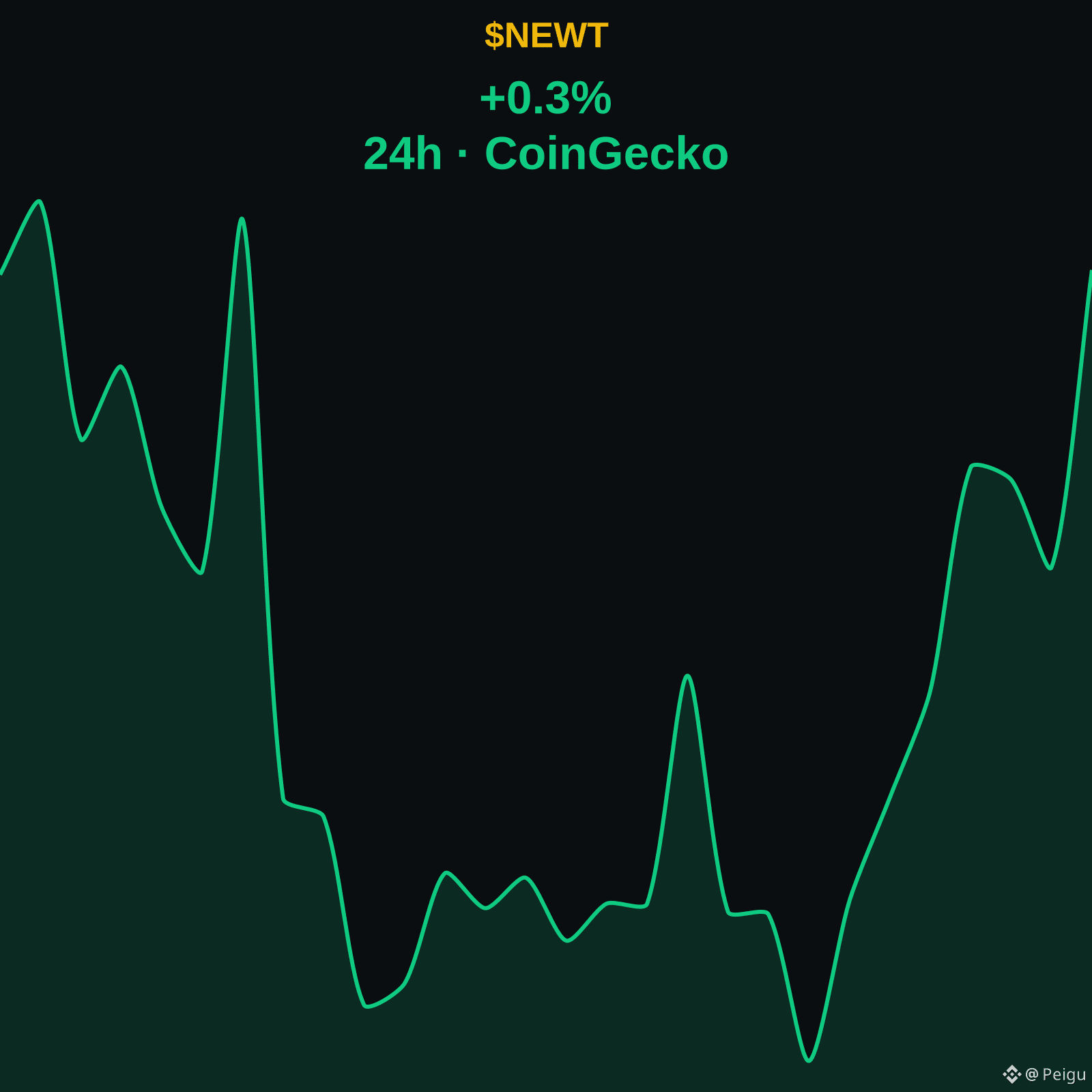
If I had to pick one reason to watch Newton: @NewtonProtocol runs authorization before settlement, not after the fact. Newton Mainnet Beta plus VaultKit is basically that idea in code — vault rules execute onchain instead of sitting in a panel nobody opens. $NEWT at about $0.051, up barely +0.34% today, with a ~$10.9M market cap while the network is already live feels backwards to me. I spent part of this morning on their Square posts — simpler framing than the dev timeline: https://www.binance.com/en/square/profile/newtonprotocol
Pre-settlement policy checks are boring until they're mandatory — that's when beta actually matters.
#Newt #VaultKit #DeFi
Sunday feed is mostly football boxes and random gainers — infra names barely blink.
If I had to pick one reason to watch Newton: @NewtonProtocol runs authorization before settlement, not after the fact. Newton Mainnet Beta plus VaultKit is basically that idea in code — vault rules execute onchain instead of sitting in a panel nobody opens. $NEWT at about $0.051, up barely +0.34% today, with a ~$10.9M market cap while the network is already live feels backwards to me. I spent part of this morning on their Square posts — simpler framing than the dev timeline: https://www.binance.com/en/square/profile/newtonprotocol
Pre-settlement policy checks are boring until they're mandatory — that's when beta actually matters.
#Newt #VaultKit #DeFi
If I had to pick one reason to watch Newton: @NewtonProtocol runs authorization before settlement, not after the fact. Newton Mainnet Beta plus VaultKit is basically that idea in code — vault rules execute onchain instead of sitting in a panel nobody opens. $NEWT at about $0.051, up barely +0.34% today, with a ~$10.9M market cap while the network is already live feels backwards to me. I spent part of this morning on their Square posts — simpler framing than the dev timeline: https://www.binance.com/en/square/profile/newtonprotocol
Pre-settlement policy checks are boring until they're mandatory — that's when beta actually matters.
#Newt #VaultKit #DeFi
59
·
--
Partly True
Tonight I watched a vault rebalancing attempt get rejected 3 times. It wasn’t a risk-control pop-up—this was the strategy layer itself calling it off.
Last year I thought vault rebalancing was just: if condition triggers → oracle pulls the price → swap in three steps. I’ve been writing that logic for over a year. Last month, while flipping through @NewtonProtocol’s VaultKit documentation, I realized something: the rules are encoded in the contract. They can only block “number-layer” hard issues—things like a single trade exceeding the limit, or the counterparty address not being in the allowlist that can be checked clearly. But if it’s a problem at the “intent layer,” like “this swap is for an arbitrage, and the arbitrage asset isn’t allowed,” the contract doesn’t know whether it should block it at all.
For example, suppose you have a stablecoin yield vault targeting 5% annualized, with rules like: “single-asset exposure must not exceed 60%, and counterparties are limited to audited protocols.” The traditional approach is to write a modifier in the contract that checks the balance ratio. The vulnerability is that before the swap, a temporary “attacked audited protocol” shows up. The contract can only raise an alert afterward—the money has already been sent. In traditional DeFi, this is called “after-the-fact defense.”
After Newton Mainnet Beta launched, this kind of rule can now be handled by writing Rego policy code. For instance, this pseudocode:
Package name: vault.policy, default reject. Only allow if all four conditions are met: rebalance amount ≤ single-asset cap of 60% / counterparty ∈ audited allowlist / slippage ≤ 30 bps / route through the VaultKit gate.
The rebalance first passes Rego; only after it passes does it proceed to the main contract execution. Every allow decision produces a signed attestation that’s written on-chain. Verifier nodes validate authenticity by staking NEWT; if verification fails, it gets slashed. This isn’t after-the-fact defense—it’s pre-set authorization before settlement.
Institutional capital doesn’t want “something goes wrong and we can investigate,” they want “we block it before it goes wrong.” After TokenizeThis NYC went live with Mainnet Beta in June, RedStone price feeds, cross-chain strategy consistency, and the Rego template library were all integrated. If you’re designing a vault, what I’m sharing tonight is one message for every vault designer: you don’t need to hard-code every rule into the contract—just let the strategy layer judge once.
Today $NEWT received $14.73; yesterday it was $14.78—small-level price consolidation. The token itself covers three layers: staking / governance / network incentives. The next write-up will split out the staking rewards and governance rights.
#Newt #NewtonProtocol #DeFi #VaultKit
Tonight I watched a vault rebalancing attempt get rejected 3 times. It wasn’t a risk-control pop-up—this was the strategy layer itself calling it off.
Last year I thought vault rebalancing was just: if condition triggers → oracle pulls the price → swap in three steps. I’ve been writing that logic for over a year. Last month, while flipping through @NewtonProtocol’s VaultKit documentation, I realized something: the rules are encoded in the contract. They can only block “number-layer” hard issues—things like a single trade exceeding the limit, or the counterparty address not being in the allowlist that can be checked clearly. But if it’s a problem at the “intent layer,” like “this swap is for an arbitrage, and the arbitrage asset isn’t allowed,” the contract doesn’t know whether it should block it at all.
For example, suppose you have a stablecoin yield vault targeting 5% annualized, with rules like: “single-asset exposure must not exceed 60%, and counterparties are limited to audited protocols.” The traditional approach is to write a modifier in the contract that checks the balance ratio. The vulnerability is that before the swap, a temporary “attacked audited protocol” shows up. The contract can only raise an alert afterward—the money has already been sent. In traditional DeFi, this is called “after-the-fact defense.”
After Newton Mainnet Beta launched, this kind of rule can now be handled by writing Rego policy code. For instance, this pseudocode:
Package name: vault.policy, default reject. Only allow if all four conditions are met: rebalance amount ≤ single-asset cap of 60% / counterparty ∈ audited allowlist / slippage ≤ 30 bps / route through the VaultKit gate.
The rebalance first passes Rego; only after it passes does it proceed to the main contract execution. Every allow decision produces a signed attestation that’s written on-chain. Verifier nodes validate authenticity by staking NEWT; if verification fails, it gets slashed. This isn’t after-the-fact defense—it’s pre-set authorization before settlement.
Institutional capital doesn’t want “something goes wrong and we can investigate,” they want “we block it before it goes wrong.” After TokenizeThis NYC went live with Mainnet Beta in June, RedStone price feeds, cross-chain strategy consistency, and the Rego template library were all integrated. If you’re designing a vault, what I’m sharing tonight is one message for every vault designer: you don’t need to hard-code every rule into the contract—just let the strategy layer judge once.
Today $NEWT received $14.73; yesterday it was $14.78—small-level price consolidation. The token itself covers three layers: staking / governance / network incentives. The next write-up will split out the staking rewards and governance rights.
#Newt #NewtonProtocol #DeFi #VaultKit
Last year I thought vault rebalancing was just: if condition triggers → oracle pulls the price → swap in three steps. I’ve been writing that logic for over a year. Last month, while flipping through @NewtonProtocol’s VaultKit documentation, I realized something: the rules are encoded in the contract. They can only block “number-layer” hard issues—things like a single trade exceeding the limit, or the counterparty address not being in the allowlist that can be checked clearly. But if it’s a problem at the “intent layer,” like “this swap is for an arbitrage, and the arbitrage asset isn’t allowed,” the contract doesn’t know whether it should block it at all.
For example, suppose you have a stablecoin yield vault targeting 5% annualized, with rules like: “single-asset exposure must not exceed 60%, and counterparties are limited to audited protocols.” The traditional approach is to write a modifier in the contract that checks the balance ratio. The vulnerability is that before the swap, a temporary “attacked audited protocol” shows up. The contract can only raise an alert afterward—the money has already been sent. In traditional DeFi, this is called “after-the-fact defense.”
After Newton Mainnet Beta launched, this kind of rule can now be handled by writing Rego policy code. For instance, this pseudocode:
Package name: vault.policy, default reject. Only allow if all four conditions are met: rebalance amount ≤ single-asset cap of 60% / counterparty ∈ audited allowlist / slippage ≤ 30 bps / route through the VaultKit gate.
The rebalance first passes Rego; only after it passes does it proceed to the main contract execution. Every allow decision produces a signed attestation that’s written on-chain. Verifier nodes validate authenticity by staking NEWT; if verification fails, it gets slashed. This isn’t after-the-fact defense—it’s pre-set authorization before settlement.
Institutional capital doesn’t want “something goes wrong and we can investigate,” they want “we block it before it goes wrong.” After TokenizeThis NYC went live with Mainnet Beta in June, RedStone price feeds, cross-chain strategy consistency, and the Rego template library were all integrated. If you’re designing a vault, what I’m sharing tonight is one message for every vault designer: you don’t need to hard-code every rule into the contract—just let the strategy layer judge once.
Today $NEWT received $14.73; yesterday it was $14.78—small-level price consolidation. The token itself covers three layers: staking / governance / network incentives. The next write-up will split out the staking rewards and governance rights.
#Newt #NewtonProtocol #DeFi #VaultKit
1
3
3.7k
·
--
Verified
Just now I split a vault rebalance into 5 separate actions, only to realize that most risk tools are standing at the finish line waiting for the result. The money has already been transferred, the monitoring lights go red again, and what can be done in the venue is often just shutting down, holding people accountable, and patching gaps. What @NewtonProtocol wants to change is to check when the event happens—not to add yet another post-hoc dashboard.
Run a stress test: imagine a yield vault managing $1,000,000. The strategy is allowed to hold only 6 whitelisted asset types, with no single market exposure exceeding 25%. If the oracle price deviates by more than 0.5%, rebalancing is paused. The counterparty must also pass address reputation and sanctions screening. Traditional approaches scatter these rules across the front end, operating manuals, and a centralized risk-control service. When you call the contract directly, front-end restrictions can be bypassed; and when market conditions change, manuals won’t execute themselves.
After integrating Newton, a rebalance request is first written as an intent, then evaluated by a Rego policy. Risk data, identity status, asset concentration, and oracle deviation are all checked before settlement. If the rules aren’t satisfied, the transaction can’t reach the step where assets are transferred. If the rules are satisfied, the operator network issues a cryptographic attestation; after on-chain contract verification, execution continues. This order is crucial—risk isn’t merely recorded; it’s blocked at the door.
VaultKit plugs this whole flow into the vault. The SDK handles integration, and the Shield contract verifies authorization along the execution path. Strategy creators can change parameters, but they can’t bypass the checks that have already been publicly disclosed. Depositors don’t just see the annualized return—they can also find out why this rebalance request was approved. For due diligence, institutions get a verifiable on-chain receipt, not a report sealed by the project itself.
I care about another detail: Newton doesn’t replace the vault, curator, or the original protocol—it only adds that door between the action and the settlement. For multi-chain strategies, the same set of rules can be reused across different chains, reducing deployment drift. $NEWT here covers staking, fuel, governance, and network incentives, with the goal of making verifiers accountable for their judgment.
In the past, DeFi often treated security as “the smart contract has no vulnerabilities.” Once real money is in, you still have to manage permissions, data, and the order of execution. Post-mortem audits tell you how the money was lost; pre-execution authorization determines whether this money can move at all. That difference is exactly what the Newton Mainnet Beta is worth watching.
#Newt #NewtonProtocol #DeFi #VaultKit
Just now I split a vault rebalance into 5 separate actions, only to realize that most risk tools are standing at the finish line waiting for the result. The money has already been transferred, the monitoring lights go red again, and what can be done in the venue is often just shutting down, holding people accountable, and patching gaps. What @NewtonProtocol wants to change is to check when the event happens—not to add yet another post-hoc dashboard.
Run a stress test: imagine a yield vault managing $1,000,000. The strategy is allowed to hold only 6 whitelisted asset types, with no single market exposure exceeding 25%. If the oracle price deviates by more than 0.5%, rebalancing is paused. The counterparty must also pass address reputation and sanctions screening. Traditional approaches scatter these rules across the front end, operating manuals, and a centralized risk-control service. When you call the contract directly, front-end restrictions can be bypassed; and when market conditions change, manuals won’t execute themselves.
After integrating Newton, a rebalance request is first written as an intent, then evaluated by a Rego policy. Risk data, identity status, asset concentration, and oracle deviation are all checked before settlement. If the rules aren’t satisfied, the transaction can’t reach the step where assets are transferred. If the rules are satisfied, the operator network issues a cryptographic attestation; after on-chain contract verification, execution continues. This order is crucial—risk isn’t merely recorded; it’s blocked at the door.
VaultKit plugs this whole flow into the vault. The SDK handles integration, and the Shield contract verifies authorization along the execution path. Strategy creators can change parameters, but they can’t bypass the checks that have already been publicly disclosed. Depositors don’t just see the annualized return—they can also find out why this rebalance request was approved. For due diligence, institutions get a verifiable on-chain receipt, not a report sealed by the project itself.
I care about another detail: Newton doesn’t replace the vault, curator, or the original protocol—it only adds that door between the action and the settlement. For multi-chain strategies, the same set of rules can be reused across different chains, reducing deployment drift. $NEWT here covers staking, fuel, governance, and network incentives, with the goal of making verifiers accountable for their judgment.
In the past, DeFi often treated security as “the smart contract has no vulnerabilities.” Once real money is in, you still have to manage permissions, data, and the order of execution. Post-mortem audits tell you how the money was lost; pre-execution authorization determines whether this money can move at all. That difference is exactly what the Newton Mainnet Beta is worth watching.
#Newt #NewtonProtocol #DeFi #VaultKit
Run a stress test: imagine a yield vault managing $1,000,000. The strategy is allowed to hold only 6 whitelisted asset types, with no single market exposure exceeding 25%. If the oracle price deviates by more than 0.5%, rebalancing is paused. The counterparty must also pass address reputation and sanctions screening. Traditional approaches scatter these rules across the front end, operating manuals, and a centralized risk-control service. When you call the contract directly, front-end restrictions can be bypassed; and when market conditions change, manuals won’t execute themselves.
After integrating Newton, a rebalance request is first written as an intent, then evaluated by a Rego policy. Risk data, identity status, asset concentration, and oracle deviation are all checked before settlement. If the rules aren’t satisfied, the transaction can’t reach the step where assets are transferred. If the rules are satisfied, the operator network issues a cryptographic attestation; after on-chain contract verification, execution continues. This order is crucial—risk isn’t merely recorded; it’s blocked at the door.
VaultKit plugs this whole flow into the vault. The SDK handles integration, and the Shield contract verifies authorization along the execution path. Strategy creators can change parameters, but they can’t bypass the checks that have already been publicly disclosed. Depositors don’t just see the annualized return—they can also find out why this rebalance request was approved. For due diligence, institutions get a verifiable on-chain receipt, not a report sealed by the project itself.
I care about another detail: Newton doesn’t replace the vault, curator, or the original protocol—it only adds that door between the action and the settlement. For multi-chain strategies, the same set of rules can be reused across different chains, reducing deployment drift. $NEWT here covers staking, fuel, governance, and network incentives, with the goal of making verifiers accountable for their judgment.
In the past, DeFi often treated security as “the smart contract has no vulnerabilities.” Once real money is in, you still have to manage permissions, data, and the order of execution. Post-mortem audits tell you how the money was lost; pre-execution authorization determines whether this money can move at all. That difference is exactly what the Newton Mainnet Beta is worth watching.
#Newt #NewtonProtocol #DeFi #VaultKit
1
3
1.4k
·
--
I used to assume every new chain beta would feel like a game launch. @NewtonProtocol's Newton Mainnet Beta is closer to compliance homework — and I would've called that a red flag.
On testnet I chased faucet screenshots and bridge receipts. In beta I'm reading their Square feed: VaultKit rules baked into the contracts, agents registering on live lanes, settlement waiting on policy checks. Same portal flow. Way less confetti.
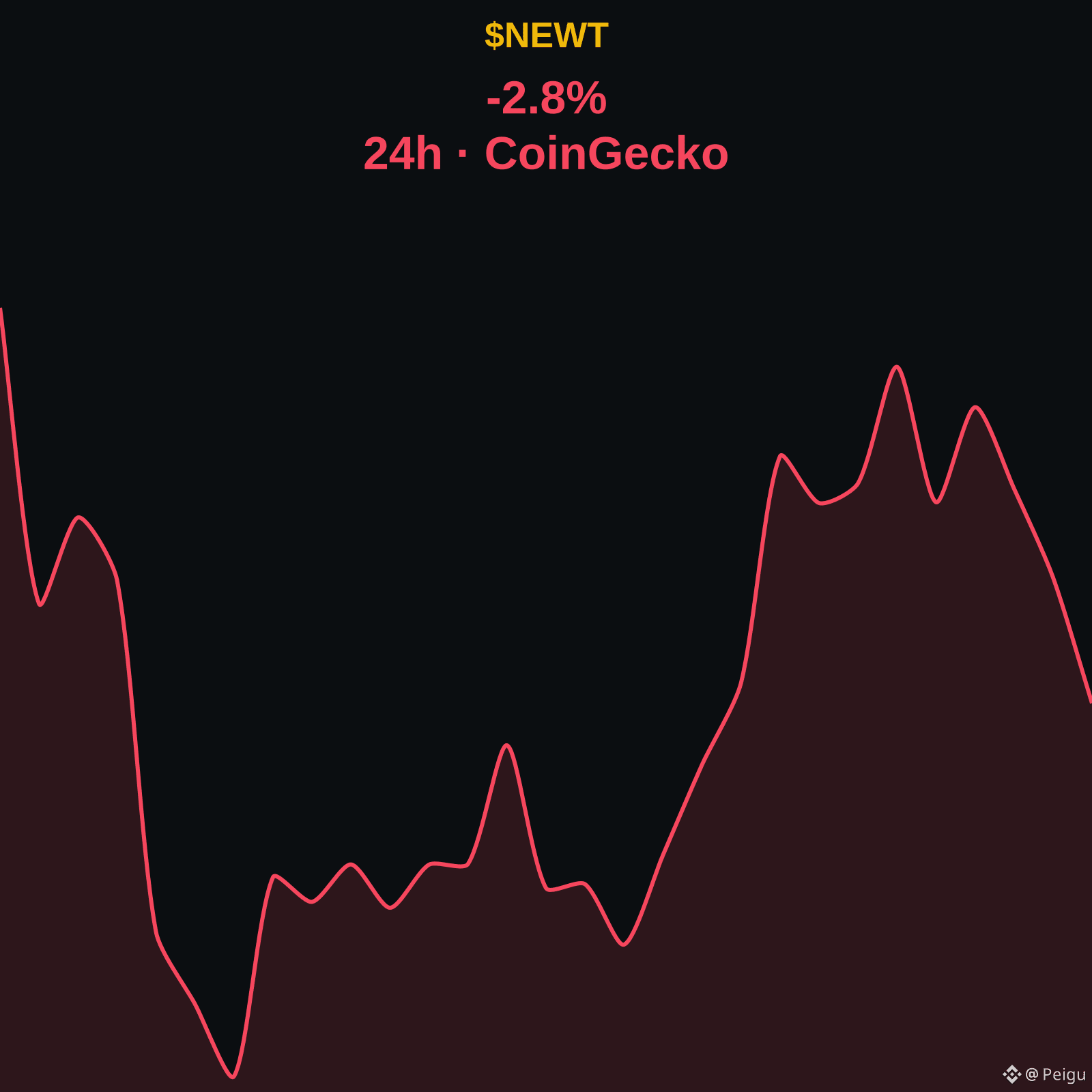
$NEWT's around $0.049 today, down about 3%, market cap near $10.5M on ~215M circulating out of 1B total — still roughly 94% off the old high near $0.82. I expected the token chart to lead the story. So far the tooling is.
https://www.binance.com/en/square/profile/newtonprotocol
#Newt #VaultKit #MainnetBeta
I used to assume every new chain beta would feel like a game launch. @NewtonProtocol's Newton Mainnet Beta is closer to compliance homework — and I would've called that a red flag.
On testnet I chased faucet screenshots and bridge receipts. In beta I'm reading their Square feed: VaultKit rules baked into the contracts, agents registering on live lanes, settlement waiting on policy checks. Same portal flow. Way less confetti.
$NEWT 's around $0.049 today, down about 3%, market cap near $10.5M on ~215M circulating out of 1B total — still roughly 94% off the old high near $0.82. I expected the token chart to lead the story. So far the tooling is.
https://www.binance.com/en/square/profile/newtonprotocol
#Newt #VaultKit #MainnetBeta
On testnet I chased faucet screenshots and bridge receipts. In beta I'm reading their Square feed: VaultKit rules baked into the contracts, agents registering on live lanes, settlement waiting on policy checks. Same portal flow. Way less confetti.
$NEWT 's around $0.049 today, down about 3%, market cap near $10.5M on ~215M circulating out of 1B total — still roughly 94% off the old high near $0.82. I expected the token chart to lead the story. So far the tooling is.
https://www.binance.com/en/square/profile/newtonprotocol
#Newt #VaultKit #MainnetBeta
3
1
81
·
--
Bullish
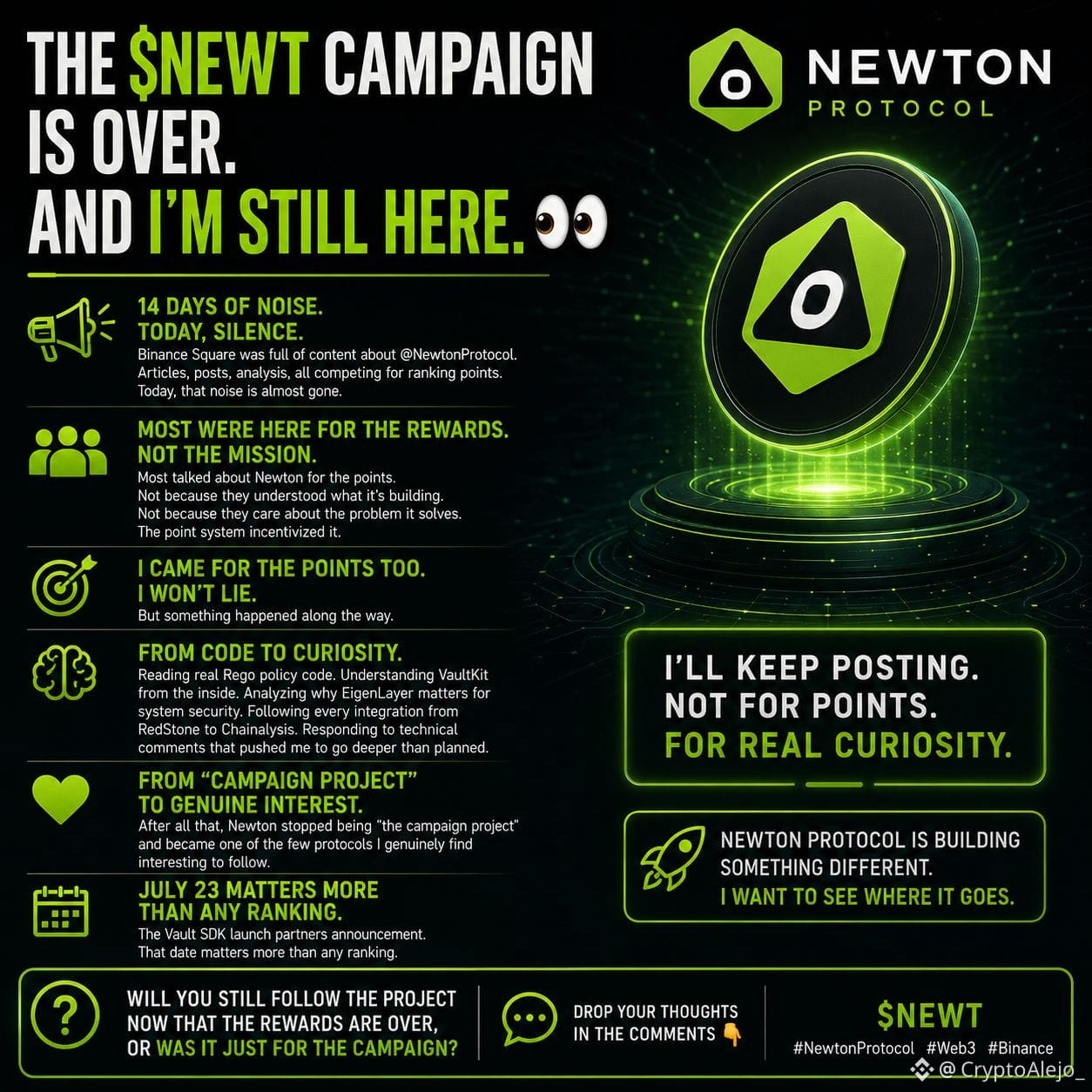
The campaign of $NEWT has ended. And here I am.
For 14 days, Binance Square was packed with content about @NewtonProtocol . Articles, posts, analysis—each one competing for points in the ranking.
Today, that noise has almost completely disappeared.
And honestly, that was predictable. Most people were posting about Newton because there were rewards. Not because they understood what they’re building. Not because they cared about the problem it solves. But because the points system incentivized it.
I also joined the campaign for the points. I’m not going to lie.
But something happened along the way.
Reading the real Rego code of the policies. Understanding how #VaultKit works from the inside. Analyzing why #Eigenlayer’s matters to system security. Following every integration from #RedStone to #Chainalysis . Answering technical comments that forced me to go deeper than I planned.
After all that, #newtonprocol stopped being “the campaign project” and became one of the few protocols I genuinely find interesting to keep following.
On July 23, the Vault SDK launch partners announcement comes. That date matters more than any ranking.
I’ll stay here. Not for points. For real curiosity.
Will you keep following the project now that the rewards are over, or was it just for the campaign? 👇
The campaign of $NEWT has ended. And here I am.
For 14 days, Binance Square was packed with content about @NewtonProtocol . Articles, posts, analysis—each one competing for points in the ranking.
Today, that noise has almost completely disappeared.
And honestly, that was predictable. Most people were posting about Newton because there were rewards. Not because they understood what they’re building. Not because they cared about the problem it solves. But because the points system incentivized it.
I also joined the campaign for the points. I’m not going to lie.
But something happened along the way.
Reading the real Rego code of the policies. Understanding how #VaultKit works from the inside. Analyzing why #Eigenlayer’s matters to system security. Following every integration from #RedStone to #Chainalysis . Answering technical comments that forced me to go deeper than I planned.
After all that, #newtonprocol stopped being “the campaign project” and became one of the few protocols I genuinely find interesting to keep following.
On July 23, the Vault SDK launch partners announcement comes. That date matters more than any ranking.
I’ll stay here. Not for points. For real curiosity.
Will you keep following the project now that the rewards are over, or was it just for the campaign? 👇
For 14 days, Binance Square was packed with content about @NewtonProtocol . Articles, posts, analysis—each one competing for points in the ranking.
Today, that noise has almost completely disappeared.
And honestly, that was predictable. Most people were posting about Newton because there were rewards. Not because they understood what they’re building. Not because they cared about the problem it solves. But because the points system incentivized it.
I also joined the campaign for the points. I’m not going to lie.
But something happened along the way.
Reading the real Rego code of the policies. Understanding how #VaultKit works from the inside. Analyzing why #Eigenlayer’s matters to system security. Following every integration from #RedStone to #Chainalysis . Answering technical comments that forced me to go deeper than I planned.
After all that, #newtonprocol stopped being “the campaign project” and became one of the few protocols I genuinely find interesting to keep following.
On July 23, the Vault SDK launch partners announcement comes. That date matters more than any ranking.
I’ll stay here. Not for points. For real curiosity.
Will you keep following the project now that the rewards are over, or was it just for the campaign? 👇
153
·
--
Last Wednesday, I went through an organization’s on-chain vault with real money and found this: 90% of the strategy documentation reads like prose, and the executability is effectively zero. VaultKit makes me pause not because it’s another vault product, but because it’s a strategy guardrail placed between the curator and the vaults they manage.
To be clear what VaultKit is: it’s a developer SDK released by Newton Protocol on June 24, 2026. Before a curator takes any action, it runs a strategy check. Reallocating funds, setting limits, opening markets, changing fee rates—these administrative actions must first pass the rules. Only through normal execution can they proceed; if they don’t pass, they don’t get put on-chain. VaultKit doesn’t require curators to change their workflows; the vault stays the same and the tooling stays the same. It simply adds a guardrail that all participants can read and verify.
More importantly, here’s what VaultKit is not. It’s not a new product that asks depositors to migrate, not a custody provider that takes control, and it doesn’t change the depositor-side experience at all. It just sits between the curator and the vault the curator already manages, translating “the curator agrees to follow the rules” into “the vault enforces the rules itself.”
Why this matters now: RWA, tokenized funds, and institutional capital are moving on-chain at large scale. Behind this money are risk committees, audits, and regulators. In an organization’s compliance report, the line “please trust the curator” simply can’t be written. What they want is enforcement, not a promise. Newton Protocol Mainnet Beta has already been running on Base and Ethereum since June 23, 2026. This guardrail can now go to production—any curating team can integrate it today.
$NEWT plays three roles in the network: staking, gas, and governance. When a curator writes a strategy and deploys it to a vault, the enforcer of that rule is the vault itself—not a person. If the strategy is wrong, the system blocks it. If you touch the line, you can’t even reach the step where a signature happens. Institutions will take comfort from this; retail users, too, will feel more confident putting real money in.
@NewtonProtocol’s commitment to turning rules into code is something I observed for three weeks before daring to make this judgment: protecting capital with rules may be more reliable than protecting capital with custody. #Newt #NewtonProtocol #DeFi #授权层 #VaultKit
Last Wednesday, I went through an organization’s on-chain vault with real money and found this: 90% of the strategy documentation reads like prose, and the executability is effectively zero. VaultKit makes me pause not because it’s another vault product, but because it’s a strategy guardrail placed between the curator and the vaults they manage.
To be clear what VaultKit is: it’s a developer SDK released by Newton Protocol on June 24, 2026. Before a curator takes any action, it runs a strategy check. Reallocating funds, setting limits, opening markets, changing fee rates—these administrative actions must first pass the rules. Only through normal execution can they proceed; if they don’t pass, they don’t get put on-chain. VaultKit doesn’t require curators to change their workflows; the vault stays the same and the tooling stays the same. It simply adds a guardrail that all participants can read and verify.
More importantly, here’s what VaultKit is not. It’s not a new product that asks depositors to migrate, not a custody provider that takes control, and it doesn’t change the depositor-side experience at all. It just sits between the curator and the vault the curator already manages, translating “the curator agrees to follow the rules” into “the vault enforces the rules itself.”
Why this matters now: RWA, tokenized funds, and institutional capital are moving on-chain at large scale. Behind this money are risk committees, audits, and regulators. In an organization’s compliance report, the line “please trust the curator” simply can’t be written. What they want is enforcement, not a promise. Newton Protocol Mainnet Beta has already been running on Base and Ethereum since June 23, 2026. This guardrail can now go to production—any curating team can integrate it today.
$NEWT plays three roles in the network: staking, gas, and governance. When a curator writes a strategy and deploys it to a vault, the enforcer of that rule is the vault itself—not a person. If the strategy is wrong, the system blocks it. If you touch the line, you can’t even reach the step where a signature happens. Institutions will take comfort from this; retail users, too, will feel more confident putting real money in.
@NewtonProtocol’s commitment to turning rules into code is something I observed for three weeks before daring to make this judgment: protecting capital with rules may be more reliable than protecting capital with custody. #Newt #NewtonProtocol #DeFi #授权层 #VaultKit
To be clear what VaultKit is: it’s a developer SDK released by Newton Protocol on June 24, 2026. Before a curator takes any action, it runs a strategy check. Reallocating funds, setting limits, opening markets, changing fee rates—these administrative actions must first pass the rules. Only through normal execution can they proceed; if they don’t pass, they don’t get put on-chain. VaultKit doesn’t require curators to change their workflows; the vault stays the same and the tooling stays the same. It simply adds a guardrail that all participants can read and verify.
More importantly, here’s what VaultKit is not. It’s not a new product that asks depositors to migrate, not a custody provider that takes control, and it doesn’t change the depositor-side experience at all. It just sits between the curator and the vault the curator already manages, translating “the curator agrees to follow the rules” into “the vault enforces the rules itself.”
Why this matters now: RWA, tokenized funds, and institutional capital are moving on-chain at large scale. Behind this money are risk committees, audits, and regulators. In an organization’s compliance report, the line “please trust the curator” simply can’t be written. What they want is enforcement, not a promise. Newton Protocol Mainnet Beta has already been running on Base and Ethereum since June 23, 2026. This guardrail can now go to production—any curating team can integrate it today.
$NEWT plays three roles in the network: staking, gas, and governance. When a curator writes a strategy and deploys it to a vault, the enforcer of that rule is the vault itself—not a person. If the strategy is wrong, the system blocks it. If you touch the line, you can’t even reach the step where a signature happens. Institutions will take comfort from this; retail users, too, will feel more confident putting real money in.
@NewtonProtocol’s commitment to turning rules into code is something I observed for three weeks before daring to make this judgment: protecting capital with rules may be more reliable than protecting capital with custody. #Newt #NewtonProtocol #DeFi #授权层 #VaultKit
1
358

·
--
Article
Newton Mainnet Beta is LIVE: The Authorization Layer DeFi Was MissingDeFi rebuilt finance from scratch, but it forgot one critical layer - AUTHORIZATION.
For years we had tokens, vaults, stablecoins, and RWAs moving onchain, but there were no programmable guardrails to control WHAT should execute. That's the gap @NewtonProtocol (https://www.binance.com/en/square/profile/newtonprotocol ) is closing, and the Newton Mainnet Beta is now LIVE!
What is Newton Mainnet Beta?
Newton is not another L1 or DeFi app. It is the first verifiable authorization layer for onchain finance. It checks every transaction against predefined policies BEFORE settlement and writes a signed attestation that anyone can verify.
Introducing VaultKit - The Game Changer
VaultKit is the SDK that makes your vault's rules actually enforceable onchain. Billions are locked in 3,700+ vaults across 80 chains, but yield was programmable while rules were not. With VaultKit, rules are written onchain and enforced at the protocol level.
Why This is HUGE for Institutions:
1. Programmable Compliance: KYC, AML, counterparty limits - all automated. 2. Private & Verifiable: This is the core breakthrough. Institutions get confidentiality for strategies, and regulators get proof of compliance without seeing every position. Private where it protects, verifiable where it matters. 3. Deterministic Trust: No more blind execution. If a transaction violates policy, it never settles.
This is cypherpunk infrastructure for an institutional era. Capital moves at the speed of code, now compliance will too. This is how trillions move onchain safely.
I'm incredibly bullish on the future being built by Newton. This is the infra we actually needed.
What's your take? Will the authorization layer become as important as the execution layer? Comment below!
$NEWT #Newt #newton #VaultKit #PiaaryAdil #CryptoPakistan
Newton Mainnet Beta is LIVE: The Authorization Layer DeFi Was Missing
DeFi rebuilt finance from scratch, but it forgot one critical layer - AUTHORIZATION.
For years we had tokens, vaults, stablecoins, and RWAs moving onchain, but there were no programmable guardrails to control WHAT should execute. That's the gap @NewtonProtocol (https://www.binance.com/en/square/profile/newtonprotocol ) is closing, and the Newton Mainnet Beta is now LIVE!
What is Newton Mainnet Beta?
Newton is not another L1 or DeFi app. It is the first verifiable authorization layer for onchain finance. It checks every transaction against predefined policies BEFORE settlement and writes a signed attestation that anyone can verify.
Introducing VaultKit - The Game Changer
VaultKit is the SDK that makes your vault's rules actually enforceable onchain. Billions are locked in 3,700+ vaults across 80 chains, but yield was programmable while rules were not. With VaultKit, rules are written onchain and enforced at the protocol level.
Why This is HUGE for Institutions:
1. Programmable Compliance: KYC, AML, counterparty limits - all automated. 2. Private & Verifiable: This is the core breakthrough. Institutions get confidentiality for strategies, and regulators get proof of compliance without seeing every position. Private where it protects, verifiable where it matters. 3. Deterministic Trust: No more blind execution. If a transaction violates policy, it never settles.
This is cypherpunk infrastructure for an institutional era. Capital moves at the speed of code, now compliance will too. This is how trillions move onchain safely.
I'm incredibly bullish on the future being built by Newton. This is the infra we actually needed.
What's your take? Will the authorization layer become as important as the execution layer? Comment below!
$NEWT #Newt #newton #VaultKit #PiaaryAdil #CryptoPakistan
For years we had tokens, vaults, stablecoins, and RWAs moving onchain, but there were no programmable guardrails to control WHAT should execute. That's the gap @NewtonProtocol (https://www.binance.com/en/square/profile/newtonprotocol ) is closing, and the Newton Mainnet Beta is now LIVE!
What is Newton Mainnet Beta?
Newton is not another L1 or DeFi app. It is the first verifiable authorization layer for onchain finance. It checks every transaction against predefined policies BEFORE settlement and writes a signed attestation that anyone can verify.
Introducing VaultKit - The Game Changer
VaultKit is the SDK that makes your vault's rules actually enforceable onchain. Billions are locked in 3,700+ vaults across 80 chains, but yield was programmable while rules were not. With VaultKit, rules are written onchain and enforced at the protocol level.
Why This is HUGE for Institutions:
1. Programmable Compliance: KYC, AML, counterparty limits - all automated. 2. Private & Verifiable: This is the core breakthrough. Institutions get confidentiality for strategies, and regulators get proof of compliance without seeing every position. Private where it protects, verifiable where it matters. 3. Deterministic Trust: No more blind execution. If a transaction violates policy, it never settles.
This is cypherpunk infrastructure for an institutional era. Capital moves at the speed of code, now compliance will too. This is how trillions move onchain safely.
I'm incredibly bullish on the future being built by Newton. This is the infra we actually needed.
What's your take? Will the authorization layer become as important as the execution layer? Comment below!
$NEWT #Newt #newton #VaultKit #PiaaryAdil #CryptoPakistan
7
3
88
$NEWT IS REDEFINING DEFI RISK MANAGEMENT FOR THE NEXT CYCLE 🛡️
DeFi’s biggest edge used to be high APY, but that’s changing. By 2026, the vaults that survive won’t be the ones with the highest yields — they’ll be the ones with the best risk infrastructure. NewtonProtocol’s VaultKit turns every curator decision into an automated, auditable policy executed onchain before the transaction happens. That’s a game-changer when curated vaults control billions and a single curator is a single point of failure.
The market is already moving: AI agents are managing portfolios at machine speed, and institutional money demands compliance by design. VaultKit gives you verifiable attestations — not promises. Are you still chasing yield or thinking about risk-adjusted returns?
Not financial advice. Always manage your risk.
#NEWT #DeFi #RiskManagement #VaultKit #Crypto
🛡️
$NEWT IS REDEFINING DEFI RISK MANAGEMENT FOR THE NEXT CYCLE 🛡️
DeFi’s biggest edge used to be high APY, but that’s changing. By 2026, the vaults that survive won’t be the ones with the highest yields — they’ll be the ones with the best risk infrastructure. NewtonProtocol’s VaultKit turns every curator decision into an automated, auditable policy executed onchain before the transaction happens. That’s a game-changer when curated vaults control billions and a single curator is a single point of failure.
The market is already moving: AI agents are managing portfolios at machine speed, and institutional money demands compliance by design. VaultKit gives you verifiable attestations — not promises. Are you still chasing yield or thinking about risk-adjusted returns?
Not financial advice. Always manage your risk.
#NEWT #DeFi #RiskManagement #VaultKit #Crypto
🛡️
DeFi’s biggest edge used to be high APY, but that’s changing. By 2026, the vaults that survive won’t be the ones with the highest yields — they’ll be the ones with the best risk infrastructure. NewtonProtocol’s VaultKit turns every curator decision into an automated, auditable policy executed onchain before the transaction happens. That’s a game-changer when curated vaults control billions and a single curator is a single point of failure.
The market is already moving: AI agents are managing portfolios at machine speed, and institutional money demands compliance by design. VaultKit gives you verifiable attestations — not promises. Are you still chasing yield or thinking about risk-adjusted returns?
Not financial advice. Always manage your risk.
#NEWT #DeFi #RiskManagement #VaultKit #Crypto
🛡️
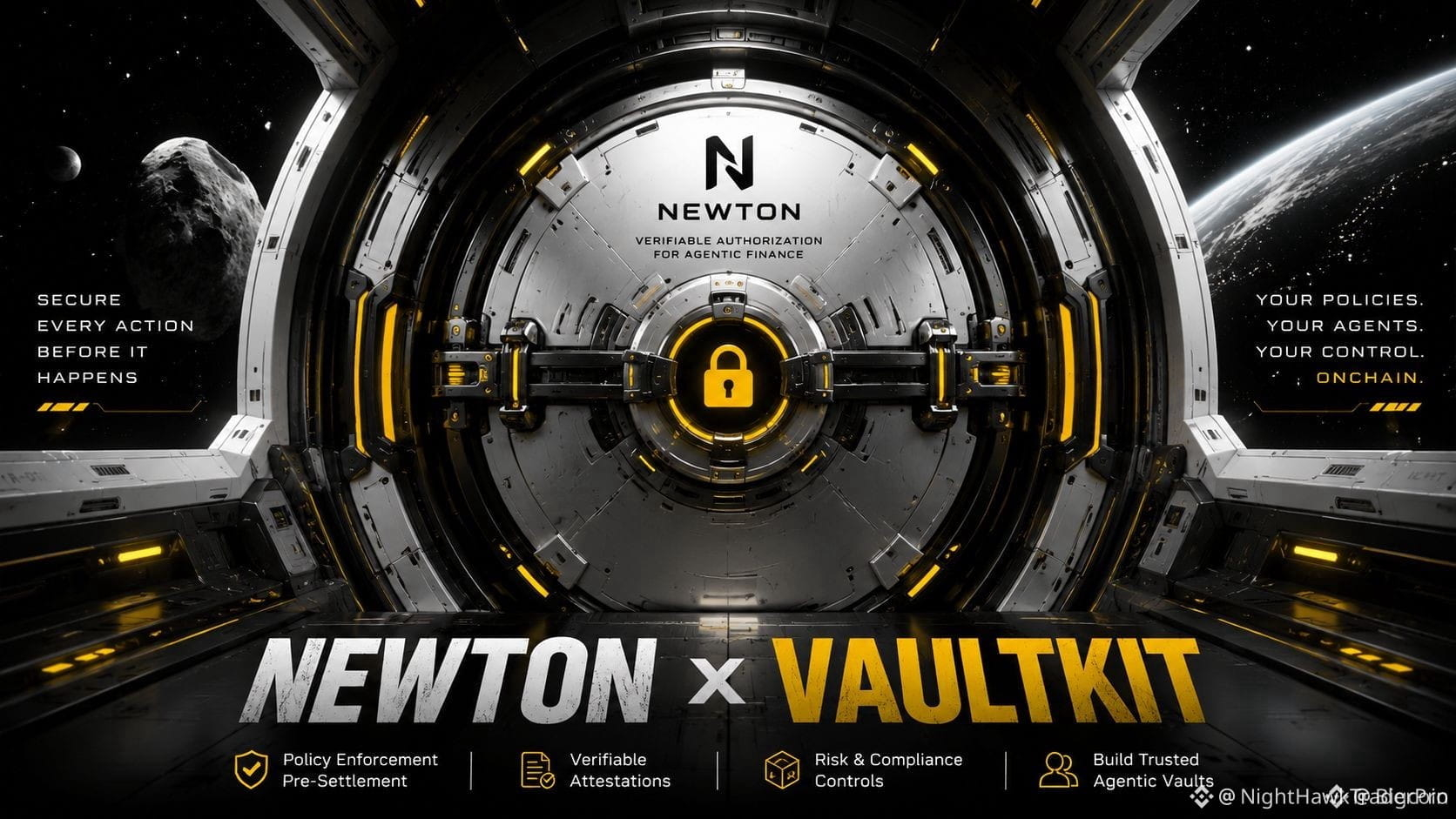
2
51

# The Shift to Programmable Compliance: Unpacking the Newton Mainnet BetaThe web3 space is experiencing a quiet structural transformation. As autonomous AI agents and automated vaults handle a larger share of on-chain capital, traditional retroactive security and simple identity screening are no longer sufficient. This is exactly where @NewtonProtocol steps in.
With the recent launch of its **Mainnet Beta** alongside **VaultKit**, the network is deploying what can be described as a decentralized "compliance-as-code" layer. Instead of waiting for a transaction to hit a pool and reacting after an exploit or violation occurs, Newton operates as a pre-transaction authorization engine.
### Core Architecture & How It Works
Newton relies on a decentralized network of operators secured through **EigenLayer restaking** and the native token **$NEWT**. The fundamental objective is to provide a transparent, verifiably neutral layer where complex rules are evaluated inside Trusted Execution Environments (TEEs) before any capital finalizes on its destination chain.
When a smart contract, DAO, or AI agent initiates an action, it triggers Newton's policy client. The workflow follows a strict sequence to ensure security:
1. **Rule Definition:** Developers or institutions configure specific programmatic parameters inside their execution Vaults.
2. **Pre-Transaction Evaluation:** The network checks the inbound transaction against the predefined conditions—such as custom jurisdiction constraints, daily spending ceilings, or AI agent safety guardrails.
3. **Cryptographic Proof Generation:** If all policies match perfectly, the operators generate a cryptographic attestation (a verifiable proof receipt).
4. **Settlement Authorization:** The destination smart contract reads the valid proof and executes the transaction smoothly.
### Integrations Driving Ecosystem Growth
Infrastructure is only as powerful as the data feeding it. To ensure these automated policies can handle highly dynamic, real-world finance rules without manipulation, @NewtonProtocol has formed critical ecosystem partnerships during this Beta phase:
* **RedStone Oracles:** Supplying highly resilient, manipulation-resistant price feeds to prevent price-oracle attacks during pre-execution evaluation.
* **Credora:** Integrating real-time risk and credit intelligence directly into the policy engine, enabling institutional guardrails to adapt dynamically to changing market conditions.
By positioning itself specifically as an authorization primitive rather than a general-purpose application chain, the protocol provides an elegant solution for developers building cross-chain automation. As the automated economy expands, the utility of the $NEWT token remains fundamentally tied to the volume of these computational compliance
checks.
#Newt #MainnetBeta #VaultKit #EigenLayer #AIAgents #Web3Compliance
# The Shift to Programmable Compliance: Unpacking the Newton Mainnet Beta
The web3 space is experiencing a quiet structural transformation. As autonomous AI agents and automated vaults handle a larger share of on-chain capital, traditional retroactive security and simple identity screening are no longer sufficient. This is exactly where @NewtonProtocol steps in.
With the recent launch of its **Mainnet Beta** alongside **VaultKit**, the network is deploying what can be described as a decentralized "compliance-as-code" layer. Instead of waiting for a transaction to hit a pool and reacting after an exploit or violation occurs, Newton operates as a pre-transaction authorization engine.
### Core Architecture & How It Works
Newton relies on a decentralized network of operators secured through **EigenLayer restaking** and the native token **$NEWT**. The fundamental objective is to provide a transparent, verifiably neutral layer where complex rules are evaluated inside Trusted Execution Environments (TEEs) before any capital finalizes on its destination chain.
When a smart contract, DAO, or AI agent initiates an action, it triggers Newton's policy client. The workflow follows a strict sequence to ensure security:
1. **Rule Definition:** Developers or institutions configure specific programmatic parameters inside their execution Vaults.
2. **Pre-Transaction Evaluation:** The network checks the inbound transaction against the predefined conditions—such as custom jurisdiction constraints, daily spending ceilings, or AI agent safety guardrails.
3. **Cryptographic Proof Generation:** If all policies match perfectly, the operators generate a cryptographic attestation (a verifiable proof receipt).
4. **Settlement Authorization:** The destination smart contract reads the valid proof and executes the transaction smoothly.
### Integrations Driving Ecosystem Growth
Infrastructure is only as powerful as the data feeding it. To ensure these automated policies can handle highly dynamic, real-world finance rules without manipulation, @NewtonProtocol has formed critical ecosystem partnerships during this Beta phase:
* **RedStone Oracles:** Supplying highly resilient, manipulation-resistant price feeds to prevent price-oracle attacks during pre-execution evaluation.
* **Credora:** Integrating real-time risk and credit intelligence directly into the policy engine, enabling institutional guardrails to adapt dynamically to changing market conditions.
By positioning itself specifically as an authorization primitive rather than a general-purpose application chain, the protocol provides an elegant solution for developers building cross-chain automation. As the automated economy expands, the utility of the $NEWT token remains fundamentally tied to the volume of these computational compliance
checks.
#Newt #MainnetBeta #VaultKit #EigenLayer #AIAgents #Web3Compliance
With the recent launch of its **Mainnet Beta** alongside **VaultKit**, the network is deploying what can be described as a decentralized "compliance-as-code" layer. Instead of waiting for a transaction to hit a pool and reacting after an exploit or violation occurs, Newton operates as a pre-transaction authorization engine.
### Core Architecture & How It Works
Newton relies on a decentralized network of operators secured through **EigenLayer restaking** and the native token **$NEWT**. The fundamental objective is to provide a transparent, verifiably neutral layer where complex rules are evaluated inside Trusted Execution Environments (TEEs) before any capital finalizes on its destination chain.
When a smart contract, DAO, or AI agent initiates an action, it triggers Newton's policy client. The workflow follows a strict sequence to ensure security:
1. **Rule Definition:** Developers or institutions configure specific programmatic parameters inside their execution Vaults.
2. **Pre-Transaction Evaluation:** The network checks the inbound transaction against the predefined conditions—such as custom jurisdiction constraints, daily spending ceilings, or AI agent safety guardrails.
3. **Cryptographic Proof Generation:** If all policies match perfectly, the operators generate a cryptographic attestation (a verifiable proof receipt).
4. **Settlement Authorization:** The destination smart contract reads the valid proof and executes the transaction smoothly.
### Integrations Driving Ecosystem Growth
Infrastructure is only as powerful as the data feeding it. To ensure these automated policies can handle highly dynamic, real-world finance rules without manipulation, @NewtonProtocol has formed critical ecosystem partnerships during this Beta phase:
* **RedStone Oracles:** Supplying highly resilient, manipulation-resistant price feeds to prevent price-oracle attacks during pre-execution evaluation.
* **Credora:** Integrating real-time risk and credit intelligence directly into the policy engine, enabling institutional guardrails to adapt dynamically to changing market conditions.
By positioning itself specifically as an authorization primitive rather than a general-purpose application chain, the protocol provides an elegant solution for developers building cross-chain automation. As the automated economy expands, the utility of the $NEWT token remains fundamentally tied to the volume of these computational compliance
checks.
#Newt #MainnetBeta #VaultKit #EigenLayer #AIAgents #Web3Compliance
1
75
·
--
Partly True
I've watched too many vault design diagrams—only a Rego that can actually run is the real deal.
@NewtonProtocol turns the policy language itself into a vault admission gate. What you write isn’t a draft discussed in Slack; it’s a .rego file enforced on-chain. Asset allowlists, maximum drawdown, approved counterparties, and a time window—these four rules are packaged into a policy pack. Each time the vault is preparing to rebalance, the strategy runs first; only after passing does it get allowed.
Let’s talk about a concrete example. For a DeFi yield-aggregation vault, the strategy author writes something like this:
```rego
package newton.vault.policy
default allow = false
allow {
input.asset in data.whitelist
input.drawdown <= data.max_drawdown
input.counterparty in data.approved_cps
time.now_ns() >= data.window_start
time.now_ns() <= data.window_end
}
```
Once this .rego is deployed to the vault, before every swap / lend / rebalance, Newton’s verifier nodes will fetch input (the asset being called, the drawdown amount, the counterparty address) and compare it against data (the vault’s allowlist and limits). Only if all five checks pass will they issue an attestation. The attestation lands on-chain; if the smart contract verification succeeds, the transaction enters the mempool. If any of the five fails, the entire call immediately reverts—nothing waits for the mempool so nobody can front-run it.
It sounds like simply copying OPA over, but the key difference is that the signatures are economically bound. Verifiers have to stake NEWT tokens to take jobs. If they sign incorrectly, the stake is slashed; if they sign correctly, they receive gas plus NEWT rewards. This incentive layer ($NEWT ) ensures verifiers won’t loosen the rules just to handle more jobs, nor will they collude to do evil for rewards. That’s why @NewtonProtocol emphasizes "capital won’t move where rules don’t hold"—the rules aren’t post-trade auditing; they’re hard gates before the transaction happens.
After running on Mainnet Beta for a month, most vaults have already connected policy packs. The benefit of Rego is that strategy authors don’t need to learn Solidity—they write rules the same way as writing a K8s admission controller, and internal reviews also follow the PR workflow. The downside is that the data source (like data.whitelist) still has to be fed by the vault itself. Coordinating with oracles like RedStone, and making the allowlist update automatically rather than manually editing JSON—those are the engineering focuses for the coming months.
At the current price of $14.4, NEWT’s day-to-day fluctuation is only around 2%. What truly determines whether a vault is safe is whether this policy layer can run stably—not the token price itself. Before institutional capital enters, they’ll ask one question first: can your strategy code be audited? Newton’s layer turns it from "do you trust the vault team" into "do you trust the .rego and the verifier nodes"—and the answer is clearly more concrete.
With strategy code public, verifier nodes public, and on-chain attestations verifiable, all three pieces line up. When institutions do due diligence, they don’t get a deck—they get a reproducible piece of code plus a traceable transaction record.
#Newt #NewtonProtocol #VaultKit #DeFi #Rego policy
I've watched too many vault design diagrams—only a Rego that can actually run is the real deal.
@NewtonProtocol turns the policy language itself into a vault admission gate. What you write isn’t a draft discussed in Slack; it’s a .rego file enforced on-chain. Asset allowlists, maximum drawdown, approved counterparties, and a time window—these four rules are packaged into a policy pack. Each time the vault is preparing to rebalance, the strategy runs first; only after passing does it get allowed.
Let’s talk about a concrete example. For a DeFi yield-aggregation vault, the strategy author writes something like this:
```rego
package newton.vault.policy
default allow = false
allow {
input.asset in data.whitelist
input.drawdown <= data.max_drawdown
input.counterparty in data.approved_cps
time.now_ns() >= data.window_start
time.now_ns() <= data.window_end
}
```
Once this .rego is deployed to the vault, before every swap / lend / rebalance, Newton’s verifier nodes will fetch input (the asset being called, the drawdown amount, the counterparty address) and compare it against data (the vault’s allowlist and limits). Only if all five checks pass will they issue an attestation. The attestation lands on-chain; if the smart contract verification succeeds, the transaction enters the mempool. If any of the five fails, the entire call immediately reverts—nothing waits for the mempool so nobody can front-run it.
It sounds like simply copying OPA over, but the key difference is that the signatures are economically bound. Verifiers have to stake NEWT tokens to take jobs. If they sign incorrectly, the stake is slashed; if they sign correctly, they receive gas plus NEWT rewards. This incentive layer ($NEWT ) ensures verifiers won’t loosen the rules just to handle more jobs, nor will they collude to do evil for rewards. That’s why @NewtonProtocol emphasizes "capital won’t move where rules don’t hold"—the rules aren’t post-trade auditing; they’re hard gates before the transaction happens.
After running on Mainnet Beta for a month, most vaults have already connected policy packs. The benefit of Rego is that strategy authors don’t need to learn Solidity—they write rules the same way as writing a K8s admission controller, and internal reviews also follow the PR workflow. The downside is that the data source (like data.whitelist) still has to be fed by the vault itself. Coordinating with oracles like RedStone, and making the allowlist update automatically rather than manually editing JSON—those are the engineering focuses for the coming months.
At the current price of $14.4, NEWT’s day-to-day fluctuation is only around 2%. What truly determines whether a vault is safe is whether this policy layer can run stably—not the token price itself. Before institutional capital enters, they’ll ask one question first: can your strategy code be audited? Newton’s layer turns it from "do you trust the vault team" into "do you trust the .rego and the verifier nodes"—and the answer is clearly more concrete.
With strategy code public, verifier nodes public, and on-chain attestations verifiable, all three pieces line up. When institutions do due diligence, they don’t get a deck—they get a reproducible piece of code plus a traceable transaction record.
#Newt #NewtonProtocol #VaultKit #DeFi #Rego policy
@NewtonProtocol turns the policy language itself into a vault admission gate. What you write isn’t a draft discussed in Slack; it’s a .rego file enforced on-chain. Asset allowlists, maximum drawdown, approved counterparties, and a time window—these four rules are packaged into a policy pack. Each time the vault is preparing to rebalance, the strategy runs first; only after passing does it get allowed.
Let’s talk about a concrete example. For a DeFi yield-aggregation vault, the strategy author writes something like this:
```rego
package newton.vault.policy
default allow = false
allow {
input.asset in data.whitelist
input.drawdown <= data.max_drawdown
input.counterparty in data.approved_cps
time.now_ns() >= data.window_start
time.now_ns() <= data.window_end
}
```
Once this .rego is deployed to the vault, before every swap / lend / rebalance, Newton’s verifier nodes will fetch input (the asset being called, the drawdown amount, the counterparty address) and compare it against data (the vault’s allowlist and limits). Only if all five checks pass will they issue an attestation. The attestation lands on-chain; if the smart contract verification succeeds, the transaction enters the mempool. If any of the five fails, the entire call immediately reverts—nothing waits for the mempool so nobody can front-run it.
It sounds like simply copying OPA over, but the key difference is that the signatures are economically bound. Verifiers have to stake NEWT tokens to take jobs. If they sign incorrectly, the stake is slashed; if they sign correctly, they receive gas plus NEWT rewards. This incentive layer ($NEWT ) ensures verifiers won’t loosen the rules just to handle more jobs, nor will they collude to do evil for rewards. That’s why @NewtonProtocol emphasizes "capital won’t move where rules don’t hold"—the rules aren’t post-trade auditing; they’re hard gates before the transaction happens.
After running on Mainnet Beta for a month, most vaults have already connected policy packs. The benefit of Rego is that strategy authors don’t need to learn Solidity—they write rules the same way as writing a K8s admission controller, and internal reviews also follow the PR workflow. The downside is that the data source (like data.whitelist) still has to be fed by the vault itself. Coordinating with oracles like RedStone, and making the allowlist update automatically rather than manually editing JSON—those are the engineering focuses for the coming months.
At the current price of $14.4, NEWT’s day-to-day fluctuation is only around 2%. What truly determines whether a vault is safe is whether this policy layer can run stably—not the token price itself. Before institutional capital enters, they’ll ask one question first: can your strategy code be audited? Newton’s layer turns it from "do you trust the vault team" into "do you trust the .rego and the verifier nodes"—and the answer is clearly more concrete.
With strategy code public, verifier nodes public, and on-chain attestations verifiable, all three pieces line up. When institutions do due diligence, they don’t get a deck—they get a reproducible piece of code plus a traceable transaction record.
#Newt #NewtonProtocol #VaultKit #DeFi #Rego policy
1
946
Log in to explore more content
Join global crypto users on Binance Square
⚡️ Get latest and useful information about crypto.
💬 Trusted by the world’s largest crypto exchange.
👍 Discover real insights from verified creators.
Email / Phone number
Trending Topics
1
#BitcoinClears$85200
13,691 views
220 Discussing
2
#AltcoinSeasonIndexHoldsAbove60For5Days
67,686 views
1,228 Discussing
3
#USADPAdds90000JobsInSeptember
31,181 views
687 Discussing
4
#USCorePCEEasesTo3%InAugust
22,244 views
513 Discussing
5
#KospiPostsWorstQuarterSince2020
15,489 views
493 Discussing
6
#SECToClarifyOnChainFundraisingRules
38,147 views
665 Discussing
7
#UKFCAOpensCryptoFirmAuthorization
37,376 views
563 Discussing
8
#JapanMOFStudyGroupOnTokenizedGovtBonds
22,038 views
425 Discussing
9
#QNTRises287%
105,509 views
924 Discussing
10
#TrumpRejectsAIRulesForVoluntaryAudits
60,569 views
801 Discussing