
#usds
usds
130,209 views
441 Discussing
Hot
Latest


Article
Upbit and Bithumb put SKY and USDS on trading warning as USDS hit 7,835 won on UpbitUpbit and Bithumb put SKY and USDS on trading warning as USDS hit 7,835 won on Upbit
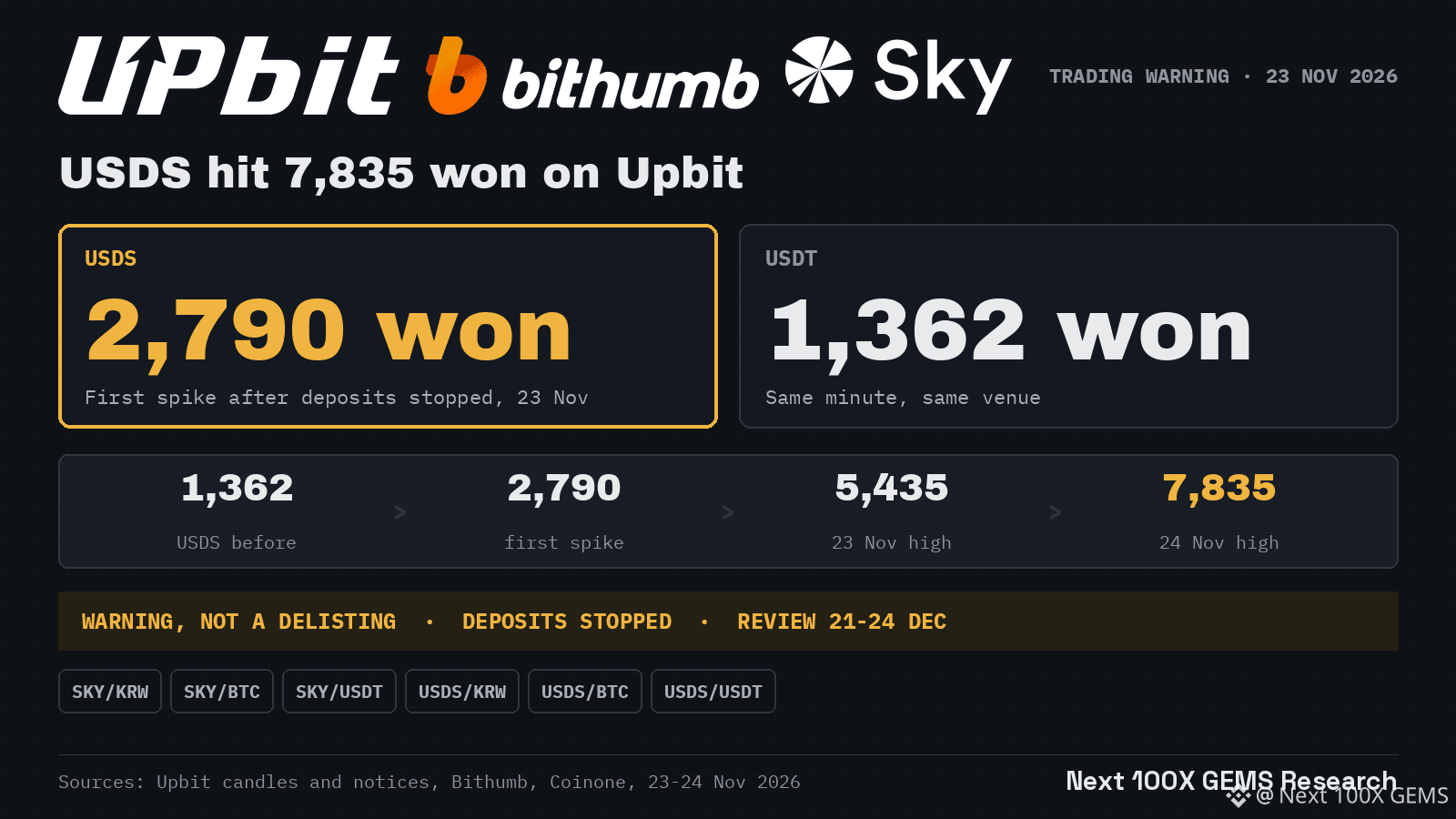
On 23 November 2026, shortly after Upbit stopped deposits of USDS, the dollar stablecoin printed 2,790 won on Upbit's won market. In the same one-minute candle, USDT on the same exchange last traded at 1,362 won. Coinyong reported the 2,790 won print the same day. Upbit's one-minute candles, checked on 24 November, show that exact high, and the matching USDT last price.
That was only the first jump. The same KRW-USDS market's high on 23 November was 5,435 won, according to Upbit's daily and minute candles. On 24 November it printed as high as 7,835 won. USDT on Upbit barely moved, staying between 1,356 and 1,367 won on 23 and 24 November.
USDS is Sky Protocol's dollar stablecoin, built to stay near one dollar. SKY is its governance token. A 2,790 won print, against USDT at 1,362 won, is roughly double. None of this is a delisting. It is what happened on one venue after deposits were blocked.
What the notices actually say
On 23 November, Upbit put SKY and USDS on a trading warning (거래 유의) across six pairs, SKY and USDS against KRW, BTC and USDT, and stopped deposits of both. The review runs to the fourth week of December, 21 to 24 December, after which the warning can be extended, lifted, or trading support can end. Upbit cited the Virtual Asset User Protection Act Enforcement Decree, Article 17(1)(e), and said a review of the issuers' and operators' capability, credibility, business history and disclosure had found a risk of harm to users. It did not name a specific incident.
Bithumb issued its own notice the same day for SKY and USDS, also stopping deposits, and citing the same decree provision. It pointed to questions about the substance, sustainability and actual progress of the related business, and about the reliability of the issuing or operating entities. It too set a follow-up notice for 21 to 24 December, and said the timetable can change. It named no specific event.
Coinone issued two notices the same day and stopped deposits of both assets. Notice 5989 flagged USDS, on Ethereum. Unlike Upbit and Bithumb, it gave a concrete reason: a change in Sky Protocol's terms that, Coinone said, restricts liquidation of collateralised loans, may leave losses to be absorbed by staked USDS (stUSDS), and raises the possibility of withdrawals being restricted for a long period. Notice 5990 flagged SKY, also on Ethereum. Coinone said the liquidation function on the related collateralised-loan service had been disabled, and that some loan positions had problems with collateral quality and liquidity. It said it would keep each asset on a trading warning for about one month, then decide whether to extend the warning, lift it, or end trading support. Trading, it said, continues.
What holders can and cannot do
Upbit said deposits sent after the cut-off may not be credited, and that if they are not, recovery may be impossible. Uncredited deposits would be returned only after deposits resume, it said. Bithumb warned that even transfers started before the cut-off might not be credited if the network is congested, and that deposits arriving during the stop will be handled later, when the warning is lifted or trading support ends. Coinone said uncredited deposits can be returned if the holder files a return request.
Trading itself has not been halted. That is the difference between a trading warning and a delisting. Ending trading support is one possible outcome of the later review, not a decision already taken.
Why the won price stopped acting like a dollar
Before the notices, USDS on Upbit's won market was still trading in line with USDT. Upbit's daily candle for 23 November opens at 1,361 won. In the minutes just before deposits were stopped, USDS was around 1,362 to 1,365 won, with USDT in the same band.
Once inbound transfers are blocked, the usual arbitrage cannot operate on that venue. Nobody can bring more USDS in from outside and sell it there. If buy orders outrun the inventory already on the exchange, the won price can disconnect from the dollar the token is designed to track. USDT, which was not placed on the warning, did not make the same move.
Upbit's KRW-USDS market turned over about 12.5 million won on 22 November, and about 130.6 billion won on 23 November, per those daily candles. A print of 2,790 won, or 5,435 won, or 7,835 won, is the price of USDS on Upbit in won. It is not a new official dollar value for the token, and it does not mean the same price was available everywhere.
What came before, and what two of the notices left unsaid
Upbit and Bithumb did not tie their warnings to the Sky-related events of the previous week.
On 19 November, CoinDesk, citing Inca Digital, reported that 422 wallets linked to hackers, phishing groups and sanctioned parties had transacted about 518 million dollars through Sky's Peg Stability Module, which swaps USDS and USDC one for one, and that about 101.9 million dollars was "directly linked" to North Korean-linked actors. The report also raised the possibility that USDC in a shared module address could be frozen.
Sky Frontier Foundation said on 20 November that users had exchanged more than 2 billion dollars of USDS for USDC through the module on 19 November, always at one for one, and that USDC in the module did not fall below 800 million dollars. It put the collateral backing USDS and DAI at about 9.3 billion dollars. Block Analitica, whose review the Foundation released, said the flagged activity was less than 0.06% of the roughly 960 billion dollars the modules have processed, and disputed several of CoinDesk's claims. We have not independently audited either review.
Sky's stUSDS savings pool had already reached full utilisation. In our 21 November piece, we reported that the pool was fully lent, so savers could leave only when someone repaid or deposited, and that a Safe linked by Bitquery and Oak Research to Rune Christensen owed about 48% of it. Coinone is the exchange that put that kind of issue in its notice. Upbit and Bithumb did not.
The decision in late December
Upbit and Bithumb have told holders to expect a further notice in the fourth week of December, between 21 and 24 December. The choices are the same: extend the warning, lift it, or end trading support. Coinone's clock is "about one month," with the same three outcomes. Bithumb noted that its dates can change. Until then, SKY and USDS still trade on those venues, and new deposits do not.
Sources
Upbit, "스카이프로토콜(SKY), 유에스디에스(USDS) 거래 유의 종목 지정 안내," notice id 6818, 23 Nov 2026
Bithumb, "스카이프로토콜(SKY), 유에스디에스(USDS) 거래유의종목 지정," notice 1655779, 23 Nov 2026
Coinone, "거래유의 종목 지정 안내: 유에스디에스(USDS)," notice 5989, 23 Nov 2026
Coinone, "거래유의 종목 지정 안내: 스카이 프로토콜(SKY)," notice 5990, 23 Nov 2026
Upbit public API, daily candles for KRW-USDS, KRW-USDT and KRW-SKY, and one-minute candles for KRW-USDS and KRW-USDT, checked 24 Nov 2026
Coinyong, "업비트, 스카이(SKY)·USDS 거래 유의 지정…USDS 2천원 넘어," 23 Nov 2026
PANews, "Upbit and Bithumb Flag SKY and USDS as Trading Warning Assets," 23 Nov 2026
FinanceFeeds, Abdelaziz Fathi, 23 Nov 2026
CoinDesk, "North Korean hackers used Sky's stablecoin system, putting billions at freeze risk," 19 Nov 2026
Sky Frontier Foundation, via PR Newswire, "Sky Protocol Shows Resilience Through Record 2 Billion Day as Review Finds CoinDesk Report Misleading," 20 Nov 2026
Next 100X GEMS, "Sky's stUSDS pool is fully lent and one wallet owes 48%: how savers got stuck," 21 Nov 2026
#Upbit #USDS
NFA. DYOR.
Upbit and Bithumb put SKY and USDS on trading warning as USDS hit 7,835 won on Upbit
Upbit and Bithumb put SKY and USDS on trading warning as USDS hit 7,835 won on Upbit
On 23 November 2026, shortly after Upbit stopped deposits of USDS, the dollar stablecoin printed 2,790 won on Upbit's won market. In the same one-minute candle, USDT on the same exchange last traded at 1,362 won. Coinyong reported the 2,790 won print the same day. Upbit's one-minute candles, checked on 24 November, show that exact high, and the matching USDT last price.
That was only the first jump. The same KRW-USDS market's high on 23 November was 5,435 won, according to Upbit's daily and minute candles. On 24 November it printed as high as 7,835 won. USDT on Upbit barely moved, staying between 1,356 and 1,367 won on 23 and 24 November.
USDS is Sky Protocol's dollar stablecoin, built to stay near one dollar. SKY is its governance token. A 2,790 won print, against USDT at 1,362 won, is roughly double. None of this is a delisting. It is what happened on one venue after deposits were blocked.
What the notices actually say
On 23 November, Upbit put SKY and USDS on a trading warning (거래 유의) across six pairs, SKY and USDS against KRW, BTC and USDT, and stopped deposits of both. The review runs to the fourth week of December, 21 to 24 December, after which the warning can be extended, lifted, or trading support can end. Upbit cited the Virtual Asset User Protection Act Enforcement Decree, Article 17(1)(e), and said a review of the issuers' and operators' capability, credibility, business history and disclosure had found a risk of harm to users. It did not name a specific incident.
Bithumb issued its own notice the same day for SKY and USDS, also stopping deposits, and citing the same decree provision. It pointed to questions about the substance, sustainability and actual progress of the related business, and about the reliability of the issuing or operating entities. It too set a follow-up notice for 21 to 24 December, and said the timetable can change. It named no specific event.
Coinone issued two notices the same day and stopped deposits of both assets. Notice 5989 flagged USDS, on Ethereum. Unlike Upbit and Bithumb, it gave a concrete reason: a change in Sky Protocol's terms that, Coinone said, restricts liquidation of collateralised loans, may leave losses to be absorbed by staked USDS (stUSDS), and raises the possibility of withdrawals being restricted for a long period. Notice 5990 flagged SKY, also on Ethereum. Coinone said the liquidation function on the related collateralised-loan service had been disabled, and that some loan positions had problems with collateral quality and liquidity. It said it would keep each asset on a trading warning for about one month, then decide whether to extend the warning, lift it, or end trading support. Trading, it said, continues.
What holders can and cannot do
Upbit said deposits sent after the cut-off may not be credited, and that if they are not, recovery may be impossible. Uncredited deposits would be returned only after deposits resume, it said. Bithumb warned that even transfers started before the cut-off might not be credited if the network is congested, and that deposits arriving during the stop will be handled later, when the warning is lifted or trading support ends. Coinone said uncredited deposits can be returned if the holder files a return request.
Trading itself has not been halted. That is the difference between a trading warning and a delisting. Ending trading support is one possible outcome of the later review, not a decision already taken.
Why the won price stopped acting like a dollar
Before the notices, USDS on Upbit's won market was still trading in line with USDT. Upbit's daily candle for 23 November opens at 1,361 won. In the minutes just before deposits were stopped, USDS was around 1,362 to 1,365 won, with USDT in the same band.
Once inbound transfers are blocked, the usual arbitrage cannot operate on that venue. Nobody can bring more USDS in from outside and sell it there. If buy orders outrun the inventory already on the exchange, the won price can disconnect from the dollar the token is designed to track. USDT, which was not placed on the warning, did not make the same move.
Upbit's KRW-USDS market turned over about 12.5 million won on 22 November, and about 130.6 billion won on 23 November, per those daily candles. A print of 2,790 won, or 5,435 won, or 7,835 won, is the price of USDS on Upbit in won. It is not a new official dollar value for the token, and it does not mean the same price was available everywhere.
What came before, and what two of the notices left unsaid
Upbit and Bithumb did not tie their warnings to the Sky-related events of the previous week.
On 19 November, CoinDesk, citing Inca Digital, reported that 422 wallets linked to hackers, phishing groups and sanctioned parties had transacted about 518 million dollars through Sky's Peg Stability Module, which swaps USDS and USDC one for one, and that about 101.9 million dollars was "directly linked" to North Korean-linked actors. The report also raised the possibility that USDC in a shared module address could be frozen.
Sky Frontier Foundation said on 20 November that users had exchanged more than 2 billion dollars of USDS for USDC through the module on 19 November, always at one for one, and that USDC in the module did not fall below 800 million dollars. It put the collateral backing USDS and DAI at about 9.3 billion dollars. Block Analitica, whose review the Foundation released, said the flagged activity was less than 0.06% of the roughly 960 billion dollars the modules have processed, and disputed several of CoinDesk's claims. We have not independently audited either review.
Sky's stUSDS savings pool had already reached full utilisation. In our 21 November piece, we reported that the pool was fully lent, so savers could leave only when someone repaid or deposited, and that a Safe linked by Bitquery and Oak Research to Rune Christensen owed about 48% of it. Coinone is the exchange that put that kind of issue in its notice. Upbit and Bithumb did not.
The decision in late December
Upbit and Bithumb have told holders to expect a further notice in the fourth week of December, between 21 and 24 December. The choices are the same: extend the warning, lift it, or end trading support. Coinone's clock is "about one month," with the same three outcomes. Bithumb noted that its dates can change. Until then, SKY and USDS still trade on those venues, and new deposits do not.
Sources
Upbit, "스카이프로토콜(SKY), 유에스디에스(USDS) 거래 유의 종목 지정 안내," notice id 6818, 23 Nov 2026
Bithumb, "스카이프로토콜(SKY), 유에스디에스(USDS) 거래유의종목 지정," notice 1655779, 23 Nov 2026
Coinone, "거래유의 종목 지정 안내: 유에스디에스(USDS)," notice 5989, 23 Nov 2026
Coinone, "거래유의 종목 지정 안내: 스카이 프로토콜(SKY)," notice 5990, 23 Nov 2026
Upbit public API, daily candles for KRW-USDS, KRW-USDT and KRW-SKY, and one-minute candles for KRW-USDS and KRW-USDT, checked 24 Nov 2026
Coinyong, "업비트, 스카이(SKY)·USDS 거래 유의 지정…USDS 2천원 넘어," 23 Nov 2026
PANews, "Upbit and Bithumb Flag SKY and USDS as Trading Warning Assets," 23 Nov 2026
FinanceFeeds, Abdelaziz Fathi, 23 Nov 2026
CoinDesk, "North Korean hackers used Sky's stablecoin system, putting billions at freeze risk," 19 Nov 2026
Sky Frontier Foundation, via PR Newswire, "Sky Protocol Shows Resilience Through Record 2 Billion Day as Review Finds CoinDesk Report Misleading," 20 Nov 2026
Next 100X GEMS, "Sky's stUSDS pool is fully lent and one wallet owes 48%: how savers got stuck," 21 Nov 2026
#Upbit #USDS
NFA. DYOR.
164

·
--
⚠️ Sky cofounder weighs selling SKY to repay $77M as stUSDS pool runs dry
Sky (formerly MakerDAO) cofounder Rune Christensen admitted his own borrowing caused a withdrawal crunch in the roughly $159M stUSDS lending pool, now 99.99% utilized with depositor rates above 50%. He has repaid 3M USDS, still owes about 77M, and is exploring selling part of his SKY to institutions. Upbit, Bithumb and Coinone flagged SKY and USDS and halted deposits, while USDS is still holding near $1.
⭐ The episode puts liquidity and governance risk at one of DeFi's largest stablecoin protocols in the spotlight.
#DeFi #Sky #Stablecoins #USDS

1
253
·
--
Verified
⚠️ Upbit & Bithumb Flag SKY and USDS as Caution Assets — Deposits Halted
📌 What happened
South Korea's two largest exchanges, Upbit and Bithumb, designated Sky Protocol's SKY governance token and USDS stablecoin as trading-caution (investment-warning) assets on Nov 23, and suspended deposits for both. The move follows a Nov 19 report linking about $518M in transactions through Sky's Peg Stability Module to wallets tied to North Korean hackers and other illicit actors. Sky said more than $2B in USDS was redeemed on Nov 19, processed 1:1, with USDC liquidity remaining available.
📊 Key numbers
• SKY: ~$0.040 on Binance, down ~7–9% in 24h, ~24% since the Nov 19 report
• Market cap: ~$1B
• USDS redemptions on Nov 19: over $2B
• Illicit-linked PSM flows cited: ~$518M
• Review window: Dec 21–24, 2026 — the warning could be lifted, extended, or lead to delisting
• Sky Council response: a 7-day plan adding 750,000 USDS in daily buybacks (announced Nov 20)
🔍 Why it matters
A caution designation from Korea's two dominant exchanges is a serious access and liquidity risk for Sky's tokens — Korean users cannot deposit either asset during the pause, and the Dec 21–24 review could end in delisting. It comes as USDS faces a $2B redemption wave and the stUSDS lending pool is reportedly fully utilized. SKY is already trading like a token-specific story, falling while the wider market rebounds. For Binance traders, SKY/USDT remains live, but the Korean overhang now sets the near-term tone.
👀 What to watch
• The Dec 21–24 review outcome — lift, extension, or delisting
• Whether other exchanges follow Upbit and Bithumb
• USDS redemption flows and whether the peg holds through the scrutiny
• SKY holding the ~$0.036–0.037 support zone
Not financial advice. Source: Upbit / Crypto Briefing / Crypto Times / CoinMarketCap, Nov 23.
$SKY #Sky #SKY #USDS
107

·
--
⚠️ Upbit and Bithumb designated Sky Protocol's SKY and the USDS stablecoin as trading-caution assets on November 23 and paused deposits.
Upbit pointed to concerns about the issuer and operator, including their track record and how they disclose important information. A review is due in the fourth week of December, after which trading support can be lifted, extended or ended.
Holding SKY or USDS on a Korean exchange? Keep a close eye on this one.
#SKY #USDS #Upbit #Bithumb
94

·
--
Verified

Article
Borrowed from himself: How Sky’s founder drained a $77 million pool and is now looking for a way to repay itHow a crypto project founder borrowed from his own piggy bank and couldn’t pay it back.
Imagine a shared mutual-aid fund. People put money into it and earn interest. Then one of the fund’s founders quietly takes almost half of it. Now the others come to claim their money, but the fund is empty.
Borrowed from himself: How Sky’s founder drained a $77 million pool and is now looking for a way to repay it
How a crypto project founder borrowed from his own piggy bank and couldn’t pay it back.
Imagine a shared mutual-aid fund. People put money into it and earn interest. Then one of the fund’s founders quietly takes almost half of it. Now the others come to claim their money, but the fund is empty.
Imagine a shared mutual-aid fund. People put money into it and earn interest. Then one of the fund’s founders quietly takes almost half of it. Now the others come to claim their money, but the fund is empty.
FEDAT - sport digital assets marketplace:
😀🤝👍🤝😀
8
2
4.5k

·
--
Verified
A stablecoin that should be worth $1 was bid up to nearly $1.50 in South Korea tonight 😳
At 19:00 Beijing time tonight, Upbit and Bithumb simultaneously placed Sky’s governance token SKY and stablecoin USDS on “trading warning” status and immediately suspended deposits.
The result was surreal: with deposits blocked, the only USDS available on the Korean won market was what was already there. Buyers rushed in, and the price briefly surged above 2,000 won. The dollar is worth only around 1,350 won, meaning one “dollar coin” was selling for nearly $1.50.
At the same time, USDS/USDT on Binance was at 1.0011, with a 24-hour low of 1.0008. The peg overseas hadn’t budged at all.
📌 So this isn’t a depeg—it’s a “closed-market premium.”
A 40% premium might make you think of arbitrage first. But you can’t do that when deposits are suspended. Whenever deposits resume—or if the token is delisted outright after the review on December 21–24—that premium will vanish all at once, leaving anyone who buys in now holding the bag.
It started with an Inca Digital report dated 11/19, which said that around $518 million passing through Sky’s redemption channels came from 422 wallets linked to hackers, phishing, or sanctions lists, with about $100 million connected to North Korea. More than $2 billion worth of USDS was redeemed that day, and its circulating supply fell from about $5.2 billion to roughly $3.2 billion.
SKY couldn’t hold up today either: it was down 8.9% over 24 hours on Binance spot, hitting a low of 0.0362.
👉 My take: USDS will most likely hold its $1 peg overseas, and the premium in South Korea will be wiped out within a few days. SKY is unlikely to see a meaningful rebound before the review results come out, so I’m staying away.
There are two reasons: more than $2 billion was redeemed in a single day at a 1:1 rate, which shows that redemption is working; but SKY is a governance token, and once South Korea’s two biggest exchanges issue a warning, its liquidity has effectively been put on probation.
When choosing a stablecoin, what matters isn’t how high the yield is, but whether you can redeem it for $1 when things go wrong.
#稳定币 #USDS #CryptoRisk
DYOR, not investment advice
樊帝:
为啥要抢usds
2
2.6k

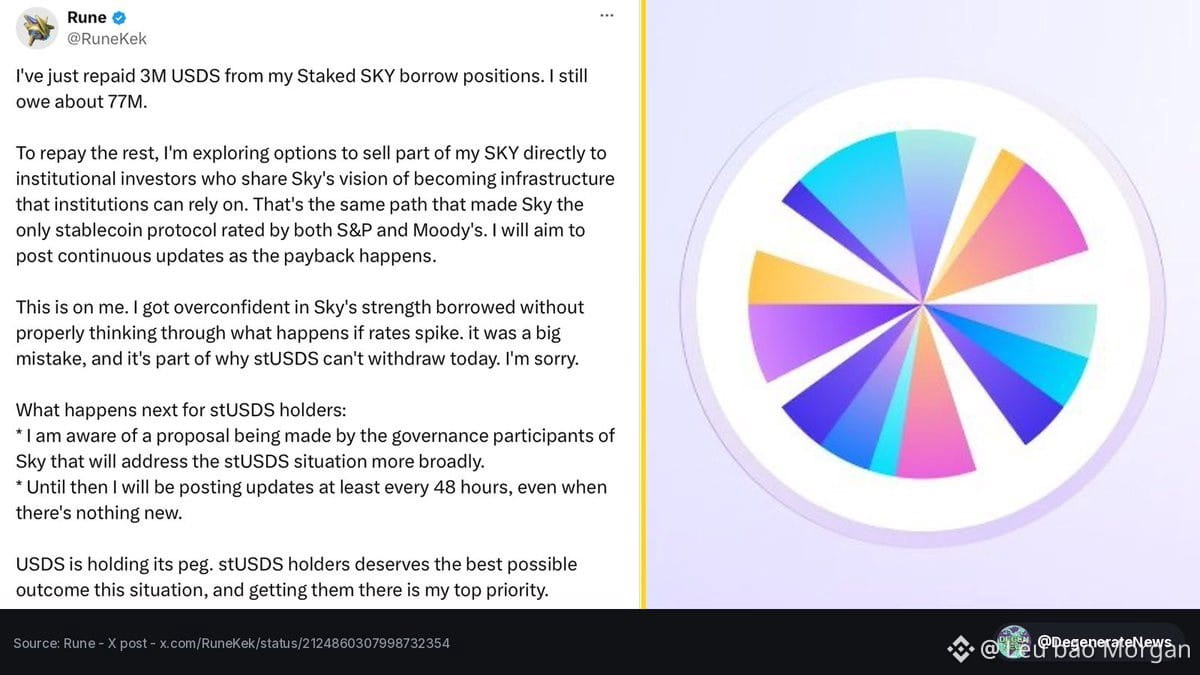
SKY update: Rune Christensen repays 3 million USDS, still owes around 77 million
Sky co-founder Rune Christensen posted on X at 20:39 Vietnam time that he had just repaid 3 million $USDS on loans collateralized by staked $SKY and still owes around 77 million.
Key points:
- He said he is looking to sell some of his SKY directly to institutional investors to pay off the remaining debt
- He acknowledged that this borrowing is one of the reasons stUSDS withdrawals are currently unavailable
On-chain data:
- Data previously published by Bitquery showed that a wallet using the name rune.eth owes around $77.1 million, equivalent to about 48% of the stUSDS pool
Developments:
- According to Rune, Sky governance is putting forward a proposal regarding stUSDS
- He will provide updates at least every 48 hours, and USDS remains pegged
- Earlier in the day, Upbit, Bithumb, and Coinone issued trading alerts for SKY and USDS
Sources: Rune’s original post on X, Bitquery, Protos, Coinone
Image: @DegenerateNews
Not investment advice.
#sky #USDS #stUSDS
489
·
--
Verified

Article
SKY and USDS in the spotlight: Korea gives Sky Protocol a yellow card🚨 Korean exchanges have given Sky Protocol a “yellow card.”
What happened? Today, November 23, South Korea’s two largest crypto exchanges, Upbit and Bithumb, announced that the SKY token and the USDS stablecoin are “high-risk assets.” It’s like a “Caution: wet floor” sign, but on an exchange.
What has changed for users?
SKY and USDS in the spotlight: Korea gives Sky Protocol a yellow card
🚨 Korean exchanges have given Sky Protocol a “yellow card.”
What happened? Today, November 23, South Korea’s two largest crypto exchanges, Upbit and Bithumb, announced that the SKY token and the USDS stablecoin are “high-risk assets.” It’s like a “Caution: wet floor” sign, but on an exchange.
What has changed for users?
What happened? Today, November 23, South Korea’s two largest crypto exchanges, Upbit and Bithumb, announced that the SKY token and the USDS stablecoin are “high-risk assets.” It’s like a “Caution: wet floor” sign, but on an exchange.
What has changed for users?
1
1.1k

USDC in the PSM has returned to $1.77 billion. This figure is being touted as good news for USDS, but it only answers the question “Has redemption pressure continued to worsen?” It doesn’t answer “Has new money come in?” The PSM balance is an inverse indicator of USDS redemption pressure: when users exchange USDS back for USDC, USDC is drained from the PSM; the balance only recovers when redemptions slow. So $1.77 billion looks more like the pressure gauge moving from the red zone back to neutral, not a demand gauge trending upward.
First, look at how the on-chain mechanism works. The PSM provides a 1:1 exchange between USDS and USDC. A rise in the USDC balance could have two explanations: fewer people who were waiting to exchange back into USDC, or people bringing in USDC to mint USDS for arbitrage or allocation. The former means selling pressure has run out; only the latter counts as fresh inflows. The $1.77 billion total alone can’t distinguish between the two. To confirm whether new money is coming in, look at whether total USDS supply is rising at the same time, whether USDS balances are spreading to addresses outside the PSM, and net USDS inflows to DEXs/CEXs—not just one PSM pool.
Next, look at the market. USDSUSDT is a stablecoin pair, so the real short-term signals aren’t the slope of the candlestick chart, but deviations around the $1 peg, order book depth, and how smoothly the redemption channel is working. A PSM recovery lowers the tail risk of a depeg, but for the price of USDSUSDT itself, it merely means “back to neutral”; it isn’t an upward catalyst. Stablecoin pairs also don’t offer the same useful funding rate and futures open interest indicators as altcoins. Applying that framework to USDS can easily produce false signals.
The risk lies in the structure. The PSM holds $1.77 billion in USDC, not USDS’s own assets. When redemption pressure falls, it acts as a cushion; if USDC trades at a discount, is frozen, or its liquidity contracts, it becomes a transmission channel. The higher the PSM balance, the more it shows that USDS’s ability to exchange at 1:1 is deeply tied to USDC—not an unequivocally good thing. Another easily overlooked point is that the PSM can only show that “fewer people are leaving”; it can’t explain “why those who remain are staying.” If the motivation for holding USDS is only arbitrage and lending loops, a recovery in the balance could reflect a temporary rebound in leverage demand rather than long-term accumulation.
Short-term view: the peg-risk premium for USDSUSDT is declining, but there’s no reason to go long. The key things to watch are whether the PSM balance can hold above $1.77 billion and whether total USDS supply rises at the same time. A PSM rebound alone isn’t enough. Stablecoin tail risks never give advance warning, so don’t build a position on the assumption that “it’s pegged to $1.”
#USDS #Sky #Crypto
5
Rune repaid 3 million USDS, with 77 million still owed—the key point isn’t the 3 million.
Three million divided by 80 million is less than 4%. On any balance sheet, that’s not substantial progress; it looks more like a show of intent: I’m paying it back. What really matters is the second half of that same sentence: exploring a sale of SKY to institutions. That puts the question plainly: will the remaining 77 million be covered by selling governance rights, or by protocol surplus? Those two paths are fundamentally different.
First, here’s why the 3 million shouldn’t be treated as good news. It proves that an individual is willing to repay, not that the protocol can generate its own cash. The source of the repayment funds determines whether this is “credit repair” or “discounted financing.” If the next payment comes from endogenous cash flows like Spark’s lending and borrowing spread or liquidation penalties, then USDS is genuinely gaining strength. If it comes from an over-the-counter transfer of SKY to institutions, then it’s essentially a way to cash in future governance rights early to fund repayment now—giving up value in a one-off deal while also planting potential selling pressure in the secondary market from tokens subject to unlock terms.
Next, consider the 1.77 billion USDC in the PSM. A rebound in this figure is usually read as a sign of healthy liquidity—the buffer for minting and redemption has grown again, arbitrage channels are running smoothly, and demand to exchange USDS is recovering. But from another angle, it’s also a weak spot: the larger the PSM, the more USDS’s marginal backing depends on the single external asset USDC, effectively outsourcing part of its credit to Circle. So this figure can be good news, or evidence that “endogenous demand hasn’t picked up yet, and external collateral is holding things up.” The same data, two interpretations—it depends on whether you trust Sky’s own asset-liability cycle.
There’s not much to see in the market action. USDS/USDT is a stablecoin pair, so its price is basically a flat line; short-term trading alpha isn’t in the exchange rate. The real pricing action happens in two places: the price of SKY, and lending and borrowing rates on Spark. A stablecoin’s strength has never been reflected in those few decimal places against the dollar, but in whether the assets around it are willing to pay for it.
The risks are also straightforward. A sale is being “explored,” not signed, and the terms are unknown—valuation multiple, length of the lockup, and whether there are buyback or burn provisions to offset the impact will all change the conclusion. If the final deal involves a steep discount and a short lockup, then this repayment shifts from a credit event to a selling-pressure event.
I have just one criterion: look at who funds the next repayment. If it comes from protocol surplus, that’s a plus for USDS; if it comes from a SKY transfer, it just shifts the debt from today to next year.
A stablecoin’s “stability” is designed, not promised. Depegging often starts with confidence, not price.
#USDS #DeFi #Crypto
15

·
--
$2 billion flowed out in a single day, South Korean exchanges suspended deposits, and stUSDS liquidity is drying up… USDS ($USDS) is facing a crisis of confidence.
But the most bizarre thing is that its price has barely moved: $0.99979, holding steady near $1.
Why? Because the protocol still has $10 billion in excess collateral, and the PSM (Peg Stability Module) is operating as usual. Market makers and arbitrageurs are quietly absorbing the tokens being dumped in panic.
The stablecoin script is always the same—panic moves faster than facts, and the facts are often hidden on-chain. While everyone focuses on the outflow figures, the real question isn't whether USDS will depeg, but whether you're willing to trust on-chain data amid all the noise.
Current price: $0.99979; market cap: $6.35 billion; 24-hour trading volume: $74 million. Don't let emotions make your trades for you.
#稳定币 #USDS
$2 billion flowed out in a single day, South Korean exchanges suspended deposits, and stUSDS liquidity is drying up… USDS ($USDS ) is facing a crisis of confidence.
But the most bizarre thing is that its price has barely moved: $0.99979, holding steady near $1.
Why? Because the protocol still has $10 billion in excess collateral, and the PSM (Peg Stability Module) is operating as usual. Market makers and arbitrageurs are quietly absorbing the tokens being dumped in panic.
The stablecoin script is always the same—panic moves faster than facts, and the facts are often hidden on-chain. While everyone focuses on the outflow figures, the real question isn't whether USDS will depeg, but whether you're willing to trust on-chain data amid all the noise.
Current price: $0.99979; market cap: $6.35 billion; 24-hour trading volume: $74 million. Don't let emotions make your trades for you.
#稳定币 #USDS
4

·
--
【South Korea’s two major exchanges move against Sky! Upbit and Bithumb designate SKY and stablecoin USDS as “warning” assets, suspend deposits immediately】
Starting at 7 p.m. Beijing time on November 23, South Korean exchanges Upbit and Bithumb designated Sky’s (formerly MakerDAO) governance token SKY and stablecoin USDS as trading warning assets and suspended deposits, while trading remains available. They cited concerns about the project’s actual operations, sustainability, and the credibility of its operators, which could harm users. The exchanges will announce between December 21 and 24 whether the warnings will be lifted, extended, or the assets delisted.
#Sky #USDS #South Korea
43

·
--
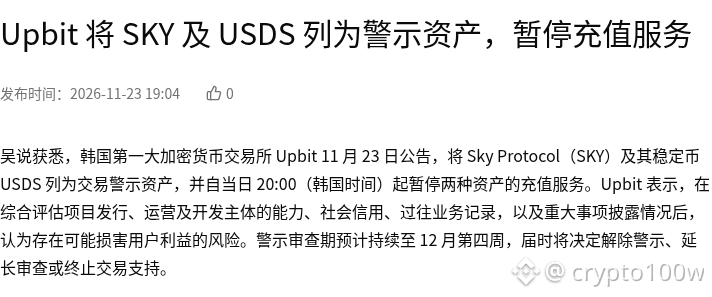
Upbit has placed SKY and USDS on its warning list and suspended deposits for both.
An announcement on November 23 said that Sky Protocol (formerly MakerDAO) token SKY and its stablecoin USDS had been designated as assets under warning, with deposits for both suspended from 20:00 Korea time that day. A warning designation means an asset is subject to enhanced review and is usually a preliminary step toward delisting. Combined with the deposit suspension, this effectively cuts off new buying channels in South Korea.
The news is bearish for SKY: if local investors price in the expectation of delisting, selling pressure and discounts often emerge before any official decision. For USDS, the deposit suspension mainly affects arbitrage and liquidity in the South Korean market. It does not change the peg mechanism in the short term, but it limits local use cases, making the impact neutral.
SKY holders should watch two things: whether the warning status is lifted and whether the case is escalated to a delisting review. If the delisting process begins, any rebound is more likely to be a liquidity-driven spike than a trend reversal.
Source: Wu Blockchain
#SKY #USDS
Image 1: Upbit designates SKY and USDS as warning assets and suspends deposits · Screenshot of the source page
Image source: https://www.wublock123.com/news/upbit-adds-sky-and-usds-to-warning-assets-deposits-suspended-72451
3

·
--

Article
The broader market rose 2.7%, but it fell 9.6%; this SKY drop happened right at its own doorstepThe broader market rose 2.7%, but it fell 9.6%; this SKY drop happened right at its own doorstep.
Bitcoin is at $61,264 today, up 2.7% over the past 24 hours; Ethereum is at $1,718, also up 2.1%, and the market is turning back up. SKY didn’t keep pace: $0.04, down 9.6% over 24 hours, with $15.1 million in trading volume, a market cap of $933 million, ranking 70th. Let’s lay out the numbers first. The source is CoinGecko global market data, taken today at 16:23. It’s down 22.9% over 7 days and 41.5% over 30 days, still 60% below the October 5 high of $0.1009. Today’s move, viewed on a one-month scale, is just another step in the ongoing decline.
The broader market rose 2.7%, but it fell 9.6%; this SKY drop happened right at its own doorstep
The broader market rose 2.7%, but it fell 9.6%; this SKY drop happened right at its own doorstep.
Bitcoin is at $61,264 today, up 2.7% over the past 24 hours; Ethereum is at $1,718, also up 2.1%, and the market is turning back up. SKY didn’t keep pace: $0.04, down 9.6% over 24 hours, with $15.1 million in trading volume, a market cap of $933 million, ranking 70th. Let’s lay out the numbers first. The source is CoinGecko global market data, taken today at 16:23. It’s down 22.9% over 7 days and 41.5% over 30 days, still 60% below the October 5 high of $0.1009. Today’s move, viewed on a one-month scale, is just another step in the ongoing decline.
Bitcoin is at $61,264 today, up 2.7% over the past 24 hours; Ethereum is at $1,718, also up 2.1%, and the market is turning back up. SKY didn’t keep pace: $0.04, down 9.6% over 24 hours, with $15.1 million in trading volume, a market cap of $933 million, ranking 70th. Let’s lay out the numbers first. The source is CoinGecko global market data, taken today at 16:23. It’s down 22.9% over 7 days and 41.5% over 30 days, still 60% below the October 5 high of $0.1009. Today’s move, viewed on a one-month scale, is just another step in the ongoing decline.
17

·
--
Verified
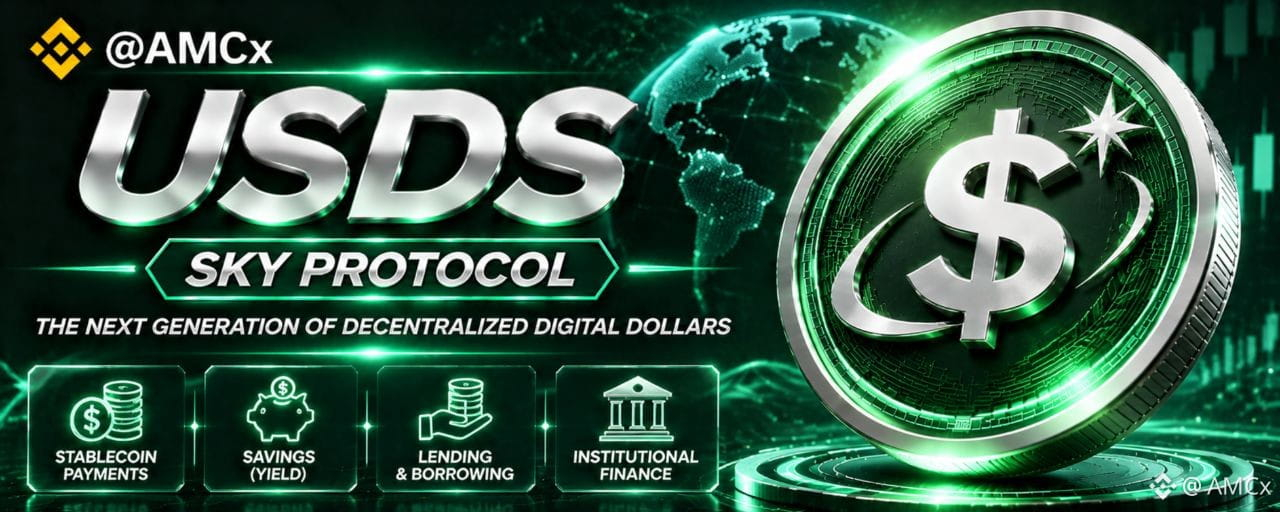
Article
USDS: The Next Generation of Decentralized Digital Dollars — What's Coming in 2027?USDS is becoming an important part of the decentralized finance ecosystem.
Developed within Sky Protocol, USDS is a decentralized stablecoin designed to maintain a value close to one US dollar.
Formerly known as MakerDAO, the ecosystem has evolved into a broader financial infrastructure platform supporting stablecoins, lending, savings, capital allocation, and institutional financial services.
Unlike traditional cryptocurrencies such as Bitcoin and Ethereum, USDS is designed primarily for price stability and financial utility rather than speculative price appreciation.
In 2026, Sky Protocol continued expanding its ecosystem through institutional partnerships, lending infrastructure, and the growth of its savings products.
So, what makes USDS important, and what could happen next in 2027?
1. Understanding USDS
USDS is the native stablecoin of Sky Protocol, the decentralized finance ecosystem that evolved from MakerDAO.
It was introduced in 2024 as the successor to DAI, with a 1:1 conversion mechanism between the two stablecoins.
Its primary objective is to maintain a value close to one US dollar.
USDS can be used for:
Decentralized finance applications.Digital payments and transfers.Lending and borrowing.Liquidity provision.Collateral within supported financial applications.Access to Sky Protocol's savings ecosystem.
USDS is designed to be backed by diversified collateral managed through Sky Protocol's decentralized governance and risk-management framework.
Unlike a centralized stablecoin issued by a traditional company, Sky Protocol operates through smart contracts and governance decisions made by SKY token holders.
2. Sky Protocol's Latest Developments in 2026
One of the strongest developments during 2026 has been the expansion of the Sky ecosystem.
According to the Sky Ecosystem Q3 2026 Quarterly Report:
USDS supply reached approximately $9.70 billion.Protocol collateral reached approximately $11.41 billion.sUSDS supply reached approximately $4.52 billion.Gross protocol revenue reached approximately $99.29 million.Net protocol revenue reached approximately $37.19 million.Sky reserves reached approximately $85.08 million.
Net revenue increased 11.8% compared with the previous quarter.
These figures indicate growing activity across Sky's stablecoin, savings, and capital-allocation infrastructure.
The ecosystem is increasingly moving beyond its original role as a decentralized stablecoin protocol.
3. sUSDS: Turning Digital Dollars Into a Savings Product
One of the most interesting products in the Sky ecosystem is sUSDS.
sUSDS is the savings token associated with the Sky Savings Rate.
Users can convert eligible USDS into sUSDS and receive exposure to the savings rate determined through Sky governance.
Unlike USDS, sUSDS is not designed to remain priced at exactly one dollar.
Instead, the redemption value of each sUSDS can increase over time as savings rewards accrue.
This creates an important distinction:
USDS: A dollar-denominated stablecoin designed to maintain a value close to $1.
sUSDS: A savings token whose value relative to USDS can increase as rewards accumulate.
The savings rate is not guaranteed and can change through governance decisions.
The growth of sUSDS demonstrates that Sky is developing financial products beyond basic stablecoin transfers.
4. Galaxy Digital Partnership: Institutional Adoption Is Growing
One of the biggest developments occurred on September 23, 2026, when Sky Protocol announced a strategic partnership with Galaxy Digital.
Galaxy added approximately $100 million of sUSDS to its corporate treasury.
It also approved sUSDS as eligible collateral across its institutional trading business.
The collaboration also involves a $500 million warehouse lending facility between Sky Agent Grove and Galaxy.
By the end of Q3 2026, approximately $375 million of loans had been financed through the facility.
This development is important because it demonstrates how decentralized financial infrastructure can connect with established institutional capital markets.
It also suggests that stablecoin-based savings and lending products could become increasingly relevant to professional financial institutions.
5. Sky Agents: A New Financial Infrastructure Model
Another important component of the Sky ecosystem is its Sky Agent network.
Sky Agents are specialized financial operators that deploy protocol capital into different markets under governance-approved mandates.
Their activities can include:
Institutional lending.Digital asset-backed credit.Stablecoin liquidity.Tokenized financial markets.Capital allocation.Financial market infrastructure.
Two important examples are Grove and Spark.
Grove focuses on institutional lending and capital allocation.
Spark provides stablecoin liquidity and financial infrastructure across different blockchain markets.
In September 2026, Spark's Stablecoin FX Layer had processed more than $12 billion in cumulative volume.
The ecosystem is designed to allow specialized financial operators to access USDS liquidity and serve different markets.
6. Sky Protocol's Governance and Development Strategy
Sky Protocol is governed through SKY, its native governance token.
SKY holders can participate in governance decisions involving:
Risk parameters.Collateral policies.Stablecoin mechanisms.Capital allocation.Protocol upgrades.Ecosystem funding.
On November 5, 2026, a governance proposal was approved and executed.
The proposal included finalizing the offboarding of GUSD and USDP from their Peg Stability Modules and transferring 900,000 USDS to the Skybase Foundation.
This demonstrates that protocol development continues through active governance rather than a centralized corporate roadmap.
The future direction of USDS therefore depends significantly on the decisions of the Sky governance community.
7. What Could USDS Develop in 2027?
Looking toward 2027, several areas could shape the future of USDS and Sky Protocol.
A. Institutional Lending Expansion
Sky could continue expanding partnerships with financial institutions and lending operators.
B. Stablecoin Adoption
USDS could become more widely integrated into decentralized finance and digital payment infrastructure.
C. Growth of sUSDS
Further adoption of the savings token could strengthen Sky's position in the decentralized savings market.
D. Cross-Chain Liquidity
Improved integrations across blockchain networks could make USDS more accessible to users and applications.
E. Tokenized Financial Assets
The ecosystem could continue exploring opportunities involving tokenized credit, financial instruments, and institutional capital markets.
These are strategic opportunities rather than guaranteed future releases.
8. Challenges USDS Must Overcome
Despite its development, USDS faces several important challenges.
Collateral Risk: The quality and liquidity of underlying collateral remain essential to maintaining the stablecoin's peg.
Smart Contract Security: Vulnerabilities in decentralized financial infrastructure could create financial losses.
Governance Risk: Important decisions depend on governance participation and the effectiveness of protocol risk management.
Competition: USDS competes with USDT, USDC, and other stablecoins for liquidity and adoption.
Regulatory Uncertainty: Decentralized stablecoins face changing regulatory expectations across global markets.
Users should also understand that a stablecoin's target price does not eliminate the risk of temporary depegging or redemption difficulties.
Final Thoughts: USDS Is Building More Than a Stablecoin
USDS represents an important evolution in decentralized finance.
Through Sky Protocol, the ecosystem is developing a broader financial infrastructure that includes digital dollars, savings products, lending markets, and institutional capital allocation.
The expansion of sUSDS, the Galaxy Digital partnership, and the growth of Sky Agents demonstrate that the project is increasingly focused on connecting decentralized finance with traditional financial markets.
Looking toward 2027, the most important developments to watch will be institutional adoption, stablecoin liquidity, lending expansion, and the continued development of the Sky ecosystem.
The long-term success of USDS will depend on collateral quality, governance, security, and real-world adoption.
USDS — Powering the Next Generation of Decentralized Finance.
AMCx | Exploring the Future of Crypto.
#USDS #SkyProtocol #Stablecoin #DeFi #Crypto #Blockchain #sUSDS #MakerDAO #DigitalDollar #BinanceSquare #AMCx $USDS
{spot}(USDSUSDT)
USDS: The Next Generation of Decentralized Digital Dollars — What's Coming in 2027?
USDS is becoming an important part of the decentralized finance ecosystem.
Developed within Sky Protocol, USDS is a decentralized stablecoin designed to maintain a value close to one US dollar.
Formerly known as MakerDAO, the ecosystem has evolved into a broader financial infrastructure platform supporting stablecoins, lending, savings, capital allocation, and institutional financial services.
Unlike traditional cryptocurrencies such as Bitcoin and Ethereum, USDS is designed primarily for price stability and financial utility rather than speculative price appreciation.
In 2026, Sky Protocol continued expanding its ecosystem through institutional partnerships, lending infrastructure, and the growth of its savings products.
So, what makes USDS important, and what could happen next in 2027?
1. Understanding USDS
USDS is the native stablecoin of Sky Protocol, the decentralized finance ecosystem that evolved from MakerDAO.
It was introduced in 2024 as the successor to DAI, with a 1:1 conversion mechanism between the two stablecoins.
Its primary objective is to maintain a value close to one US dollar.
USDS can be used for:
Decentralized finance applications.Digital payments and transfers.Lending and borrowing.Liquidity provision.Collateral within supported financial applications.Access to Sky Protocol's savings ecosystem.
USDS is designed to be backed by diversified collateral managed through Sky Protocol's decentralized governance and risk-management framework.
Unlike a centralized stablecoin issued by a traditional company, Sky Protocol operates through smart contracts and governance decisions made by SKY token holders.
2. Sky Protocol's Latest Developments in 2026
One of the strongest developments during 2026 has been the expansion of the Sky ecosystem.
According to the Sky Ecosystem Q3 2026 Quarterly Report:
USDS supply reached approximately $9.70 billion.Protocol collateral reached approximately $11.41 billion.sUSDS supply reached approximately $4.52 billion.Gross protocol revenue reached approximately $99.29 million.Net protocol revenue reached approximately $37.19 million.Sky reserves reached approximately $85.08 million.
Net revenue increased 11.8% compared with the previous quarter.
These figures indicate growing activity across Sky's stablecoin, savings, and capital-allocation infrastructure.
The ecosystem is increasingly moving beyond its original role as a decentralized stablecoin protocol.
3. sUSDS: Turning Digital Dollars Into a Savings Product
One of the most interesting products in the Sky ecosystem is sUSDS.
sUSDS is the savings token associated with the Sky Savings Rate.
Users can convert eligible USDS into sUSDS and receive exposure to the savings rate determined through Sky governance.
Unlike USDS, sUSDS is not designed to remain priced at exactly one dollar.
Instead, the redemption value of each sUSDS can increase over time as savings rewards accrue.
This creates an important distinction:
USDS: A dollar-denominated stablecoin designed to maintain a value close to $1.
sUSDS: A savings token whose value relative to USDS can increase as rewards accumulate.
The savings rate is not guaranteed and can change through governance decisions.
The growth of sUSDS demonstrates that Sky is developing financial products beyond basic stablecoin transfers.
4. Galaxy Digital Partnership: Institutional Adoption Is Growing
One of the biggest developments occurred on September 23, 2026, when Sky Protocol announced a strategic partnership with Galaxy Digital.
Galaxy added approximately $100 million of sUSDS to its corporate treasury.
It also approved sUSDS as eligible collateral across its institutional trading business.
The collaboration also involves a $500 million warehouse lending facility between Sky Agent Grove and Galaxy.
By the end of Q3 2026, approximately $375 million of loans had been financed through the facility.
This development is important because it demonstrates how decentralized financial infrastructure can connect with established institutional capital markets.
It also suggests that stablecoin-based savings and lending products could become increasingly relevant to professional financial institutions.
5. Sky Agents: A New Financial Infrastructure Model
Another important component of the Sky ecosystem is its Sky Agent network.
Sky Agents are specialized financial operators that deploy protocol capital into different markets under governance-approved mandates.
Their activities can include:
Institutional lending.Digital asset-backed credit.Stablecoin liquidity.Tokenized financial markets.Capital allocation.Financial market infrastructure.
Two important examples are Grove and Spark.
Grove focuses on institutional lending and capital allocation.
Spark provides stablecoin liquidity and financial infrastructure across different blockchain markets.
In September 2026, Spark's Stablecoin FX Layer had processed more than $12 billion in cumulative volume.
The ecosystem is designed to allow specialized financial operators to access USDS liquidity and serve different markets.
6. Sky Protocol's Governance and Development Strategy
Sky Protocol is governed through SKY, its native governance token.
SKY holders can participate in governance decisions involving:
Risk parameters.Collateral policies.Stablecoin mechanisms.Capital allocation.Protocol upgrades.Ecosystem funding.
On November 5, 2026, a governance proposal was approved and executed.
The proposal included finalizing the offboarding of GUSD and USDP from their Peg Stability Modules and transferring 900,000 USDS to the Skybase Foundation.
This demonstrates that protocol development continues through active governance rather than a centralized corporate roadmap.
The future direction of USDS therefore depends significantly on the decisions of the Sky governance community.
7. What Could USDS Develop in 2027?
Looking toward 2027, several areas could shape the future of USDS and Sky Protocol.
A. Institutional Lending Expansion
Sky could continue expanding partnerships with financial institutions and lending operators.
B. Stablecoin Adoption
USDS could become more widely integrated into decentralized finance and digital payment infrastructure.
C. Growth of sUSDS
Further adoption of the savings token could strengthen Sky's position in the decentralized savings market.
D. Cross-Chain Liquidity
Improved integrations across blockchain networks could make USDS more accessible to users and applications.
E. Tokenized Financial Assets
The ecosystem could continue exploring opportunities involving tokenized credit, financial instruments, and institutional capital markets.
These are strategic opportunities rather than guaranteed future releases.
8. Challenges USDS Must Overcome
Despite its development, USDS faces several important challenges.
Collateral Risk: The quality and liquidity of underlying collateral remain essential to maintaining the stablecoin's peg.
Smart Contract Security: Vulnerabilities in decentralized financial infrastructure could create financial losses.
Governance Risk: Important decisions depend on governance participation and the effectiveness of protocol risk management.
Competition: USDS competes with USDT, USDC, and other stablecoins for liquidity and adoption.
Regulatory Uncertainty: Decentralized stablecoins face changing regulatory expectations across global markets.
Users should also understand that a stablecoin's target price does not eliminate the risk of temporary depegging or redemption difficulties.
Final Thoughts: USDS Is Building More Than a Stablecoin
USDS represents an important evolution in decentralized finance.
Through Sky Protocol, the ecosystem is developing a broader financial infrastructure that includes digital dollars, savings products, lending markets, and institutional capital allocation.
The expansion of sUSDS, the Galaxy Digital partnership, and the growth of Sky Agents demonstrate that the project is increasingly focused on connecting decentralized finance with traditional financial markets.
Looking toward 2027, the most important developments to watch will be institutional adoption, stablecoin liquidity, lending expansion, and the continued development of the Sky ecosystem.
The long-term success of USDS will depend on collateral quality, governance, security, and real-world adoption.
USDS — Powering the Next Generation of Decentralized Finance.
AMCx | Exploring the Future of Crypto.
#USDS #SkyProtocol #Stablecoin #DeFi #Crypto #Blockchain #sUSDS #MakerDAO #DigitalDollar #BinanceSquare #AMCx $USDS
1
153

🦈 $USDS SURVIVES A TWO BILLION DOLLAR LIQUIDITY STRESS TEST AS THE PEG HOLDS 💥
Institutional stress tests reveal true structural resilience when two billion in sudden redemption pressure hits the Peg Stability Module in a single session. 🌊 Reserves successfully absorbed the liquidity shock while the asset maintained its strict parity anchor at unity. 📊
Beneath these immediate order flow dynamics, underlying reserve centralization vectors remain a critical variable for long-term institutional risk management. 💡
Are you monitoring redemption velocity closely or treating this extreme test as a standard liquidity sweep? 🤔
⚠️ Not financial advice. Always manage your risk. 🛡️
🏷️ #USDS #Stablecoin #DeFi #Liquidity #Sky
🦈 ⚖️
17

$USDS JUST SURVIVED A TWO BILLION DOLLAR BANK RUN AND THE PEG HELD FIRM 🚨 🛡️
When over two billion dollars in redemptions hit a stablecoin protocol in a single twenty-four hour window, structural integrity gets tested under absolute fire. 🌊
Despite heavy outflows slashing supply from five billion down to three billion, the peg maintained its one-dollar anchor while reserves absorbed the massive liquidity shock. 📊
While external investigations keep protocol risk under a microscope, surviving a brutal stress test this fast reveals serious institutional resilience. 💡 Are you watching the reserve balances or waiting for the next outflow wave? 🤔
⚠️ Not financial advice. Always manage your risk. 🛡️
🏷️ #USDS #Sky #Stablecoin #DeFi
🦈 💎
14

·
--
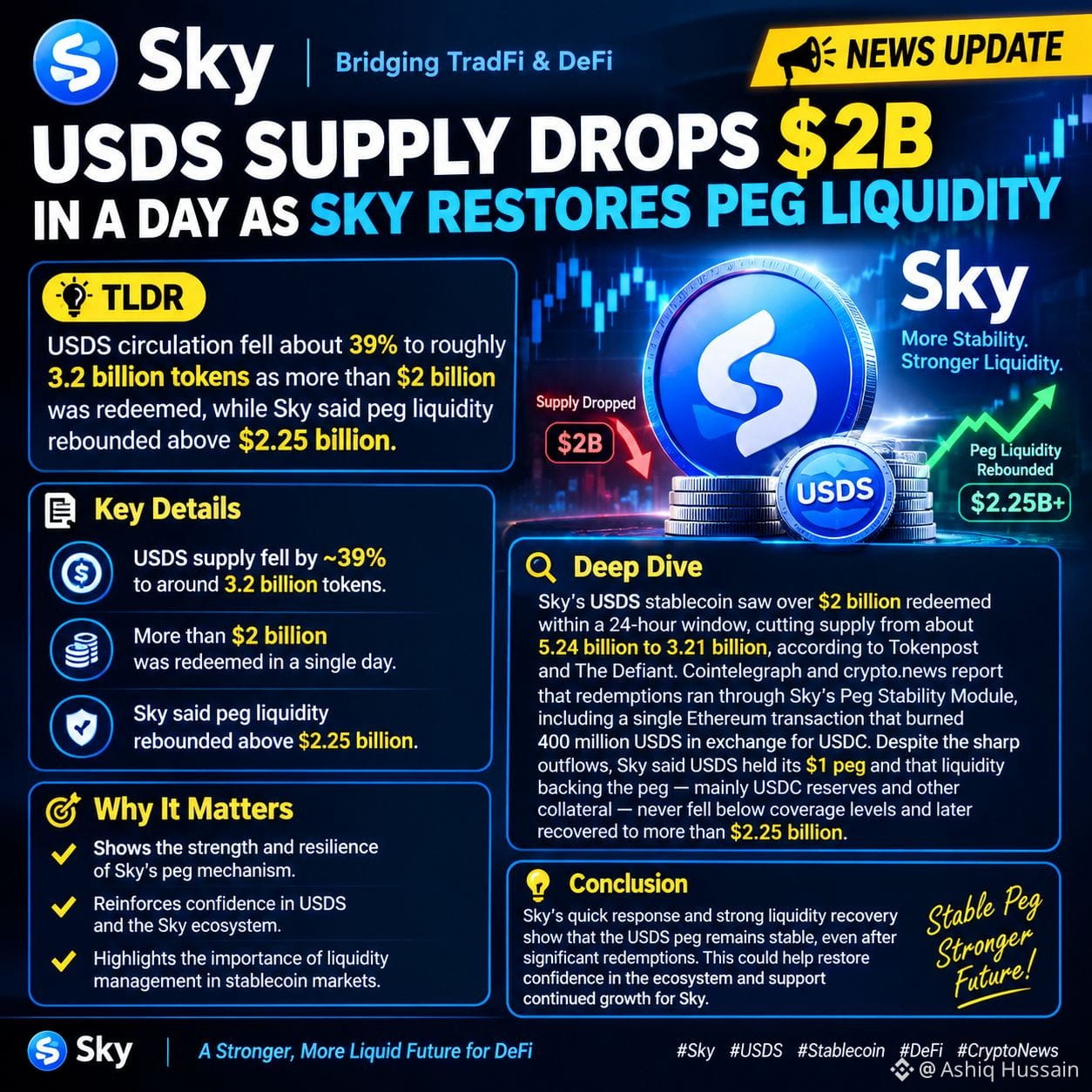
$USDC 🚨 BREAKING: USDS SUPPLY DROPS $2 BILLION IN JUST ONE DAY! 🔥
Sky's USDS stablecoin has experienced a massive redemption wave, with more than $2 billion redeemed within 24 hours.
📊 Key Highlights:
🔹 USDS circulation dropped approximately 39%.
🔹 Supply declined from 5.24 billion to around 3.21 billion tokens.
🔹 More than $2 billion was redeemed.
🔹 A major Ethereum transaction burned 400 million USDS in exchange for USDC.
🔹 Sky says USDS maintained its $1 peg.
🔹 Peg liquidity recovered to more than $2.25 billion.
💡 Why Does This Matter?
Despite massive redemptions, Sky says its liquidity backing remained above required coverage levels.
This highlights the importance of liquidity management and stability in the DeFi ecosystem.
🚀 What's Next?
Investors will be watching $USDS supply, redemption activity, and liquidity levels to see whether the stablecoin market stabilizes.
🔥 Big Question: Is this a sign of growing confidence in USDC, or simply a major liquidity shift within DeFi?
Share your thoughts below! 👇
#USDS #Sky #Ethereum #CryptoNews #BinanceSquare
123
·
--
🛡️ Sky Protocol Weathers $2B USDS Redemption Wave — Peg Holds
📌 What happened
Sky Protocol (formerly MakerDAO) processed more than $2 billion in USDS redemptions on Thursday, Nov 19 — one of the largest single-day outflows from its Peg Stability Module (PSM) ever — after a CoinDesk investigation linked $518M in transactions through the protocol to illicit activity over five years. Sky says USDS held its $1 peg throughout, with PSM-held USDC never falling below $800M and recovering above $1.1B by Friday.
📊 Key numbers
• Redemptions: $2B+ of USDS swapped for USDC via PSM on Nov 19
• PSM USDC floor: $800M, recovered to $1.1B+
• USDS circulating supply: down ~39% in a day to ~3.2B tokens
• Combined USDS + DAI supply: $6.11B, down 37.8% in 30 days
• Backing assets: ~$9.3B vs ~$6.11B in circulation
• Flagged volume: $518M over 5 years — under 0.06% of $960B+ PSM volume, per Block Analitica
• $SKY: down ~5.8% in 24h
🔍 Why it matters
This was a live stress test of the largest decentralised stablecoin system — and the peg held. A $2B one-day redemption wave, equal to roughly a third of USDS supply, was absorbed without breaking $1, which is exactly what the PSM is designed to do. But the episode also exposes the fragility: the outflows followed a report tying $518M of flows to illicit actors, including North Korean wallets, and a large share of withdrawals traced to a Poloniex-linked wallet. Sky's counter — that the flagged volume is a tiny fraction of total flows and mostly pre-dates its current LitePSM — is now the central debate for SKY holders and DeFi watchers.
👀 What to watch
• Whether redemptions continue or stabilise after the $2B day
• $SKY price action and any further response on USDC freeze risk
• How the market weighs the CoinDesk findings vs Block Analitica's rebuttal
Not financial advice. Source: Sky Protocol / PRNewswire, CoinDesk, TradingView, Nov 20.
$SKY #Sky #USDS #DeFi #Stablecoin
🛡️ Sky Protocol Weathers $2B USDS Redemption Wave — Peg Holds
📌 What happened
Sky Protocol (formerly MakerDAO) processed more than $2 billion in USDS redemptions on Thursday, Nov 19 — one of the largest single-day outflows from its Peg Stability Module (PSM) ever — after a CoinDesk investigation linked $518M in transactions through the protocol to illicit activity over five years. Sky says USDS held its $1 peg throughout, with PSM-held USDC never falling below $800M and recovering above $1.1B by Friday.
📊 Key numbers
• Redemptions: $2B+ of USDS swapped for USDC via PSM on Nov 19
• PSM USDC floor: $800M, recovered to $1.1B+
• USDS circulating supply: down ~39% in a day to ~3.2B tokens
• Combined USDS + DAI supply: $6.11B, down 37.8% in 30 days
• Backing assets: ~$9.3B vs ~$6.11B in circulation
• Flagged volume: $518M over 5 years — under 0.06% of $960B+ PSM volume, per Block Analitica
• $SKY : down ~5.8% in 24h
🔍 Why it matters
This was a live stress test of the largest decentralised stablecoin system — and the peg held. A $2B one-day redemption wave, equal to roughly a third of USDS supply, was absorbed without breaking $1, which is exactly what the PSM is designed to do. But the episode also exposes the fragility: the outflows followed a report tying $518M of flows to illicit actors, including North Korean wallets, and a large share of withdrawals traced to a Poloniex-linked wallet. Sky's counter — that the flagged volume is a tiny fraction of total flows and mostly pre-dates its current LitePSM — is now the central debate for SKY holders and DeFi watchers.
👀 What to watch
• Whether redemptions continue or stabilise after the $2B day
• $SKY price action and any further response on USDC freeze risk
• How the market weighs the CoinDesk findings vs Block Analitica's rebuttal
Not financial advice. Source: Sky Protocol / PRNewswire, CoinDesk, TradingView, Nov 20.
$SKY #Sky #USDS #DeFi #Stablecoin
177

·
--
$USDS is reaching an active decision zone where momentum can expand quickly.
$USDS is sitting close to support, and the next reaction here can define the next intraday move.
Setup LONG $USDS (max 10x)
🎯 Entry: 0.995 - 1.003
🛑 SL: 0.9961
✅ TP1: 1.013
✅ TP2: 1.026
✅ TP3: 1.041
• Fresh 24h volatility is creating a cleaner setup
• Relative volume is keeping this chart active on watchlists
Do you prefer the breakout on $USDS, or the retest entry?
Trade $USDS here 👇
#USDS #MarketStructure #TradingSetup
$USDS is reaching an active decision zone where momentum can expand quickly.
$USDS is sitting close to support, and the next reaction here can define the next intraday move.
Setup LONG $USDS (max 10x)
🎯 Entry: 0.995 - 1.003
🛑 SL: 0.9961
✅ TP1: 1.013
✅ TP2: 1.026
✅ TP3: 1.041
• Fresh 24h volatility is creating a cleaner setup
• Relative volume is keeping this chart active on watchlists
Do you prefer the breakout on $USDS , or the retest entry?
Trade $USDS here 👇
#USDS #MarketStructure #TradingSetup
6
Log in to explore more content
Join global crypto users on Binance Square
⚡️ Get latest and useful information about crypto.
💬 Trusted by the world’s largest crypto exchange.
👍 Discover real insights from verified creators.
Email / Phone number
Trending Topics
1
#BitcoinAndStocksSlipAgainAmidTrump’sTariffPlans
35,349 views
500 Discussing
2
#WillOctCorePCEShiftFedHikeExpectations?
326,313 views
2,149 Discussing
3
#JensenHuangSaysNvidiaDoesn’tNeedASuccessionPlan
22,572 views
331 Discussing
4
#AnthropicBreaksBelowIPOPriceAmidAISlump
121,649 views
1,104 Discussing
5
#HKMALaunchesCMUDigitalAssetPlatformForBondTokenization
0 views
0 Discussing
6
#HongKongPlansToRequireBanksToRegisterWithSFC
369 views
18 Discussing
7
#FidelityCryptoAddsAAVELINKAndUNITrading
7,768 views
145 Discussing
8
#UKToBanExchangesMakingMarketsOnOwnPlatforms
5,091 views
101 Discussing
9
#CFTCApprovesTradeReportingRuleForPredictionMarkets
13,262 views
163 Discussing
10
#Bitcoin'sReboundFadesBelow$60K
188,004 views
464 Discussing