

#tempo
tempo
14,159 views
105 Discussing
Hot
Latest

·
--
🪙 U.S. consumer finance app OnePay launched today: some U.S. users can send dollar stablecoins on Tempo directly into their checking accounts, turning them into dollars they can use to pay bills, transfer money, and save.
🧠 Why it matters
On-chain stablecoins often get stuck at “in your wallet, but unusable in everyday life.” Gig workers, freelancers, and people paid by cross-border platforms already earn in stablecoins, but still have to move them elsewhere and convert them to fiat. OnePay brings that step into an everyday account.
💡 Real-world use
In the app’s cash management section, users tap “Deposit stablecoins” and send funds from an external wallet or trading platform to a deposit address. A partner conversion provider completes compliance checks, converts the funds to dollars, and credits them to the same checking account balance. Bills, transfers, and savings all use this same account, so there’s no need to open a separate stablecoin balance. There are no conversion fees during the launch phase.
🌍 Technical details
Tempo is a public blockchain designed for payments: transfers settle in under a second, and network fees are paid in stablecoins, so users don’t need to hold another token to make a deposit. The partnership also covers stablecoin payouts and instant account deposits. OnePay plans to run a validator node on Tempo and values its payment architecture and built-in privacy and compliance tools.
🔍 What this means
The next wave of on-chain adoption won’t come first from a new narrative, but from products that solve the problem of “how to get money faster and more cheaply” for everyday people. Tempo says it serves millions of workers and consumers.
🎯 How to get started
Currently available only to select OnePay users in the U.S. If you want to enable stablecoin deposits for your own users, check out Tempo’s official blog or contact its team.
Source: Tempo official blog (October 30, 2026)
#Tempo #稳定币 #加密货币 $BTC
148
·
--
Banks fear stablecoins will drain deposits. But this official Tempo blog argues the opposite: as more businesses accept stablecoins, corporate treasurers will be more likely to move idle cash into onchain bank deposits—still counted as cash on the books, and still able to support credit lines. Whoever lets treasurers switch instantly among stablecoins, onchain deposits, and tokenized money market funds can keep hold of that float.
During the debate over the federal framework for payment stablecoins, some materials put the risk to bank deposits at $6.6 trillion. That figure assumes businesses will keep their stablecoins in wallets indefinitely. Finance teams already move idle cash into interest-bearing accounts and money market funds, and stablecoin balances will follow the same path. Most stablecoins still don’t qualify for liquidity metrics, and holding them often requires board approval; bank deposits and money market funds, by contrast, count as cash and cash equivalents, respectively.
A real-world scenario: a U.S. distributor sells goods to buyers in Brazil, Nigeria, and Vietnam, who pay in dollar stablecoins—even on weekends. The distributor pays its suppliers only on Tuesdays and Fridays, and some suppliers also accept stablecoins. For now, it can either leave the coins in a wallet or convert them to dollars, wait for banks to open, and convert them back on payment day. If a bank offers onchain deposits, the incoming funds can be converted immediately into bank deposits: they earn interest and count as cash, then can be converted back on payment day. If the supplier also banks with the same institution, there may be no need to convert back into stablecoins at all—the money stays on the bank’s books from start to finish.
Onchain bank deposits are still bank liabilities, not a new kind of currency. There are two common models: the bank’s core system remains the definitive record, with the blockchain serving only as a programmable layer—this is the approach taken by most projects already in operation; or the blockchain itself is the authoritative record, and a transfer constitutes a change of ownership, without requiring the recipient to hold an account at the issuing bank. Compared with traditional end-of-day sweeps, this adds three things: interest calculated hourly, deposits and withdrawals available on weekends, and atomic swaps among stablecoins, onchain deposits, and fund shares in seconds.
This means stablecoins are suited to receiving and making payments, onchain deposits to operating cash needed within minutes, and tokenized money market funds to larger sums that can be parked for weeks. Once finance teams choose a custodian, they rarely switch. Banks can check out this official Tempo primer.
Source: Official Tempo blog (October 27, 2026)
#Tempo #稳定币 #加密货币 $BTC
71

·
--
After Stripe set OUSD as the default, Tempo saw its first measurable signs of usage
On September 30, OUSD, a dollar stablecoin launched by Open Standard, went live. It is issued by Bridge, a Stripe subsidiary, and was founded by five companies: Coinbase, Mastercard, Shopify, Stripe, and Visa. It launched on four chains—Ethereum, Solana, Base, and Tempo—with one OUSD pegged to one dollar and no fees for minting or redemption. Stripe then integrated it into five products, enabling OUSD for receiving payments, exchanging currencies, holding funds, making payments, and issuing cards. OUSD on Tempo is the default setting, though other coins and chains remain available.
Tempo is a payment chain incubated by Stripe and Paradigm. It was unveiled in September 2025 and opened its public testnet in December. Its stated focus is straightforward: payments only. It is compatible with the Ethereum Virtual Machine, and according to its official figures, transaction fees are about 0.1 cents each. Fees can be paid directly in dollar stablecoins, so users don’t have to first buy a native token whose price changes every day just to pay for gas. The chain has dedicated payment channels, built-in stablecoin swaps, and payment memos, with a focus on instant finality. Partners that joined later include Mastercard, UBS, Kalshi, and Klarna; Visa and Shopify were among the early partners.
The really interesting part is the on-chain ledger from the first week after launch. Crystal Intelligence reported that, as of October 5, OUSD’s supply was $666.3 million, with 71% of it on Tempo. Bridge had minted a total of $717 million and redeemed $51 million. The supply looks substantial, but the top ten wallets held 74%, and 64 wallets with balances of at least $1 million held 99.5%. Across six days, decentralized exchange trading volume totaled just $4.1 million, or 0.6% of the supply, while Tempo’s own exchange saw only $17,000 in trades. There’s another catch with transfers on Tempo: 73% were actually fee payments. For every 100 transactions, only 27 were genuine transfers, so looking at transaction counts alone exaggerates activity by nearly four times. The $1 billion in seed liquidity promised by the founding partners showed up in the first week’s ledger as supply that had been put in place—but not yet as money in motion.
For retail users, here are three practical takeaways. OUSD itself is worth one dollar, so treating it as an asset to trade for price gains is missing the point. Anything on the market claiming to be a Tempo coin or offering high yields on OUSD doesn’t match the official account; assume it’s an impersonation unless proven otherwise. When you see news like this in the future, don’t look at issuance first. Check whether wallets are active on-chain, whether merchants accept it, and what the reserve attestation says next month.
My view in one sentence: the issuance figures look good, but real usage is still a long way off. Whether OUSD can make its way out of wallets and to the checkout counter is the measure of whether this chain is worth continuing to watch.
Would you be willing to accept a dollar stablecoin when receiving or making payments? In what situations would you use it instead of a bank card?
#Tempo #OUSD #稳定币 #支付链 #ProjectBreakdown
—— Web3 retail investor Xiao Kai
This post is for project analysis and expresses personal opinions only; it is not investment advice. Amounts mentioned are based on public reports and statements from the project team, and are subject to official confirmation.

3
·
--
🪙 In one sentence: the on-chain data provider Moralis has connected Tempo to its own APIs, so developers can use ready-made queries to retrieve stablecoin payment data.
🧠 Why it matters
When building a wallet or payment dashboard, the most annoying part isn’t sending a transfer—it’s tracking the chain, storing transaction history, and reconciling accounts. In the past, doing this on Tempo meant building your own indexer. Now the same set of APIs covers Tempo too, so you don’t need to maintain a second infrastructure stack.
💡 Real-world scenario
When a user opens a wallet, they can see how many payment tokens they hold and what they just sent or received. Account activity is no longer a string of unreadable hashes, but transaction history that matches balances and payments. Internally, operations teams can also use the same data for reporting.
🔍 The technical detail in one line: the integration supports Tempo’s stablecoin token standard, allowing queries for address balances, transfer records, and token information; data subscriptions can also backfill historical events and keep up with real-time updates. Moralis handles the indexing, while developers focus their energy on the product experience.
🎯 What this means
Payment apps can move onto Tempo faster without hiring an indexing team first. Users can understand their own money, and teams avoid reconciliation pitfalls. This isn’t about issuing a new coin—it’s about enabling the developer path to "query, reconcile, and display."
Action point: go to Moralis’s Tempo page for integration instructions.
Source: Tempo official blog (October 26, 2026)
#Tempo #稳定币 #加密货币 $BTC
151
·
--
The U.S. Office of the Comptroller of the Currency has finalized its payment stablecoin rule, giving Tempo partners more flexibility on rewards and white-label issuance than the proposal did.
The U.S. federal framework for payment stablecoins and the final rule will take effect on January 18, 2027. Two changes matter most for teams building on Tempo.
On rewards: The proposal presumed that “an issuer pays an affiliate, which then passes the money on to holders” was a violation, unless the issuer could prove otherwise—a heavy burden. The final rule instead looks at the substance: rewards are permissible as long as they are not solely for holding, using, or retaining stablecoins. Businesses can still pay corporate marketing and distribution fees, and they can also use rewards to encourage genuine product use. Yield on idle balances on Tempo is one such example. Each arrangement will still be reviewed individually and remains subject to anti-evasion provisions; further guidance may also follow.
On white-label issuance: Regulators considered requiring each issuer to have just one brand and requiring separate reserves for each brand, but neither requirement made it into the final rule. Partners can continue working with issuers to issue stablecoins under their own brands, without setting up a separate reserve for each brand.
The final rule is more practical than the proposal on rewards, revenue sharing, and branded issuance. The rules will still be assessed case by case; this is not an unconditional green light.
Source: Tempo official blog (October 23, 2026)
#Tempo #稳定币 #Cryptocurrency
$BTC
181
·
--
Tempo Earn integrates Figure’s onchain yield-bearing instrument: customer balances don’t have to sit idle—they can earn yield and still be transferred at any time.
In payments, card-issuing, and treasury products, money often gets stuck between two transactions—card balances waiting to be spent, treasury funds waiting for payroll or supplier payments, or payouts that haven’t yet been withdrawn. Previously, this money either sat idle or required building a separate investment stack.
Figure’s instrument is a registered fixed-income security that can be transferred onchain. Its rate floats at the overnight financing rate minus 35 basis points, accrues daily, and is paid monthly. Issuance, transfers, and redemptions are all dollar-denominated, so the principal value doesn’t fluctuate. It’s suited to use cases where funds need to remain accessible at any time: stored value, settlement, treasury, collateral, payouts, and payment products.
Platforms don’t need to build their own yield stack. Tempo Earn lets products decide how yield is distributed and how funds move between earning yield, spending, payouts, and withdrawals. Partitions can keep balances and transaction activity private; account policies govern transfers; and fees are denominated in dollar stablecoins, so users don’t need to keep another token on hand just to pay fees.
Figure brings the asset and onchain capital markets; Tempo brings a payments-first network, connecting yield to everyday money movement.
If you’re building Earn, treasury, card, or stablecoin payment products, reach out to Tempo directly. Eligible users can visit Figure to review the disclosures and offering circular. Note: This is a security, not a bank deposit, and is not covered by deposit insurance. Rates can change, and identity verification and jurisdictional restrictions apply.
Source: Tempo official blog (October 22, 2026)
#Tempo #稳定币 #Cryptocurrency
$BTC
116
·
--
🪙 Borrow directly from your wallet: no crypto collateral and no waiting in line at a bank.
Latin American digital wallet El Dorado and credit company Tala have partnered to launch unsecured credit in Bolivia. Eligible users can choose a loan amount, term, and repayment date right in their existing wallet. Disbursements and repayments are made in dollar stablecoins on Tempo.
💡 Why it matters
Many people earn money and run businesses, but can’t provide the proof of income or credit history banks require. Unexpected expenses or cash-flow needs often hit a wall at this step. Embedding credit in a wallet people already use moves access to borrowing from a bank branch to a phone.
🌍 How it works in practice
After launch, eligible users will see a pre-approved credit limit in their wallet. They can choose an amount, term, and repayment date without putting up crypto assets as collateral. Tala assesses borrowers using behavioral and alternative data, provides the funds, and takes on the credit risk. El Dorado manages the wallet and customer relationship, without having to build its own lending operation. The partners also plan to expand to more Latin American markets.
🔍 Technical details
Funds are sent directly to users’ wallets on Tempo, and repayments are returned the same way, with near-instant settlement. Tala makes the lending decisions; stablecoins move the money.
🎯 What this means
Stablecoins aren’t just a way to make transfers—they can also bring embedded credit into everyday wallets. For people with little or no traditional credit history, this offers a new way to access funds.
To learn more about embedded credit, see Tempo’s official blog.
Source: Tempo official blog (October 20, 2026)
#Tempo #稳定币 #加密货币 $BTC
127
·
--
🪙 Tempo’s yield feature is now connected to real-world credit returns.
In a nutshell: Payment network Tempo has integrated two onchain yield assets minted by Hastra into vaults, card networks, and payment products. Platforms can connect stablecoin balances to returns from home equity loan pools without building an entirely separate system.
💡 Why it matters
Cards need to be ready to use at any time, while vaults want yields linked to real-world lending. In the past, these were often two separate products. Now, on the same stablecoin rails, platforms can offer different tiers to different customers based on liquidity, eligibility, and risk.
🌍 A real-world scenario
You use your balance to pay during the day and want your money to work for you at night. A platform can put some funds into yield-bearing instruments linked to home equity loans—with no fixed lockup period, so you can redeem them when needed—and keep the rest in a more flexible payment balance. Users see one account, while behind the scenes there are two experiences: “spend” and “earn.”
🔍 Just two technical points
Hastra is partnering with Figure, an onchain credit market, to turn real loan pools into onchain assets that can be minted and staked, then connect them to Tempo across chains. The indicated annualized yield is around 7%, fluctuating with borrower demand and pool utilization; it is not a guaranteed return. Tempo provides partitioned privacy, account policies, and stablecoin-denominated fees, allowing funds to move between earning yield, spending, making payments, and withdrawing.
🎯 What this means
The three pieces are now in place: Figure brings real-world credit onchain, Hastra makes the assets usable onchain, and Tempo connects them to customer-facing payment products. Stablecoins are no longer just digital dollars sitting in an account; they’re a layer of capital that can switch between yield tiers depending on the use case.
Teams building vaults, card networks, or payment products can contact Tempo directly. Eligible users can also learn how to get started through Hastra.
Source: Tempo official blog (October 16, 2026)
#Tempo #稳定币 #Cryptocurrency
$BTC
92
·
--
🪙 For institutions to use stablecoins, they first need to put them in a safe within a familiar custody system.
Tempo announced that Anchorage Digital Bank now supports custody, withdrawals, and transfers of dollar stablecoins on its network. Institutions can place assets with a qualified custodian at a federally chartered bank, using their existing risk management, audit, and compliance processes—without having to build a separate operating model for a new chain.
💡 Why it matters
No matter how fast a stablecoin network is, finance and compliance teams still need to ask: Where is the money held? Who can sign? How can things be investigated if something goes wrong? Without custody, many institutions can only watch from the sidelines, hesitant to put stablecoins into their everyday cash flows. Tempo is designed for enterprise payments: near-instant settlement, fees below one cent, and payments made in stablecoins. Institutions need custody, reconciliation, and approvals alongside these capabilities before they can confidently move everyday cash flows onto the network.
🌍 Real-world scenario
When issuers launch a new stablecoin, they used to have to wait for custodians to integrate one by one. Anchorage Digital has integrated Tempo’s stablecoin token standard, so after completing the usual onboarding, new assets may be available for custody within days instead of waiting for a whole new infrastructure setup.
🎯 What this means
Issuers can include institutional custody in their launch plans; treasury managers can hold assets in a familiar control environment; and a key piece has been added to the operational stack for enterprises evaluating Tempo.
🔍 Get started: Issuers, fintech companies, or institutions can contact partners@tempo.xyz.
Source: Tempo official blog (October 13, 2026)
#Tempo #稳定币 #加密货币 $BTC
109

·
--
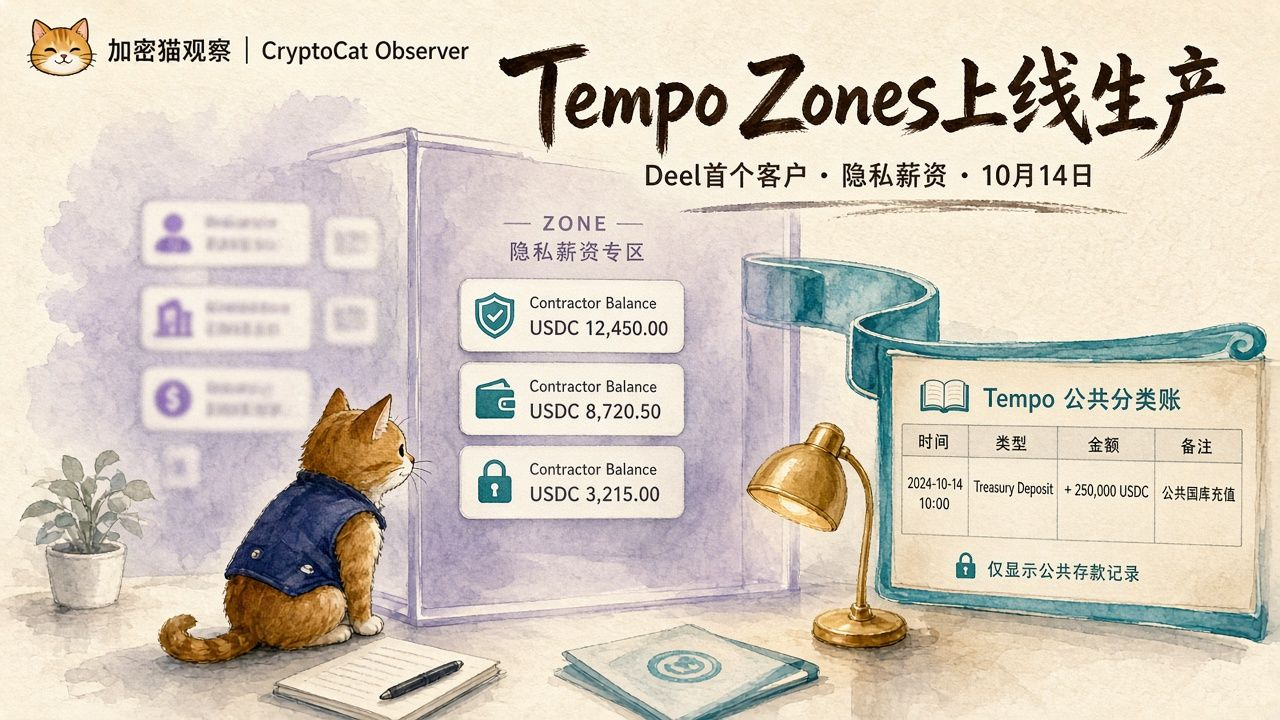
Defiant reported on October 14 that Tempo had put its Zones privacy system into production, with global payroll and contractor platform Deel becoming its first real-world production customer. DigitalToday followed up on October 15, confirming the same facts. Tempo’s official customer story states that Deel built a private stablecoin wallet on Tempo, launching first in Argentina in June and expanding in August to eligible contractors in more than 80 countries. Zones adds a privacy layer on top of the existing wallet, clearly separating what businesses can see about corporate payments from what they can see about contractors’ personal balances.
In practice, deposits from Deel into the Zone treasury are visible on Tempo’s public network, but the amounts individual contractors receive and hold are not visible to others. Contractors can see only their own balances, while Deel retains reconciliation and audit access for compliance checks. Tempo worked with Privy to connect Zone to the Privy API; the US dollar stablecoin is issued by Bridge, and earn is powered by Morpho. The wallet is embedded in Deel’s product, supports biometric login and requires no seed phrase. Deel sponsors on-chain gas fees, so contractors do not need to manage keys themselves. Zones launched in April with access limited to a select group. Most use cases had previously been pilots; with Deel bringing both a private stablecoin payroll wallet and the Zones privacy layer into production, this is the first customer use case to reach a real production environment.
#Tempo #稳定币 #行情 This does not constitute investment advice.
47
·
--
🪙 Tempo’s enterprise privacy capabilities are now live.
In a nutshell: Companies can pay salaries and suppliers in stablecoins without anyone on the network seeing who received how much—while still being able to convert currencies, deposit and withdraw funds, and earn yield.
💡 Why it matters
Public ledgers are visible to everyone by default. Once payroll, business payments, or treasury funds go on-chain, it’s like posting your internal books on the street. That’s kept many businesses on the sidelines: choose privacy and stick with traditional banks, or get faster settlement and give up confidentiality. Now there’s no need to choose.
🌍 Real-world use case
Global payroll platform Deel has already put this into production. It serves more than 40,000 businesses across about 150 countries. When a company deposits funds into its dedicated zone, outsiders can see how much went in. But when funds are paid to individual contractors, their names, amounts, and balances remain private. Employees see only their own accounts, while the records companies need for reconciliation and audits are still available. As one of Deel’s executives put it: workers’ financial data should be private by default, not laid out on a public ledger.
🧠 Technical details
This is a native feature of Tempo: connect to the network once, then decide which transactions are public and which are private. Operators choose who can access the zone, which assets to use, and how deposits are screened; issuance rules are carried over automatically. Transfers within the zone are invisible to outsiders. When funds are withdrawn, only the amount and recipient are revealed. Wallet infrastructure provider Privy supports it natively.
🎯 What this means
Stablecoin payments can meet banks’ privacy expectations without losing access to the network’s liquidity. Payroll, contractor payments, business-to-business settlements, and treasury management are all supported. Businesses interested in using it can apply through Tempo’s official channels.
Source: Tempo official blog (October 14, 2026)
#Tempo #稳定币 #Crypto
$BTC
122
·
--
🪙 For stablecoins to move from pilots into production products, institutions need more than faster blockchains—they also need custody, liquidity, compliance, and fiat on-ramps. On October 6, the Tempo official blog announced that crypto infrastructure company zerohash had joined Tempo’s validator set and would also serve as an infrastructure partner, helping businesses embed stablecoin payments into their products.
💡 Why it matters
Tempo selects its validators based on “who’s moving money”: Stripe, Visa, and Zodia Custody, backed by Standard Chartered, are already on the list. zerohash connects with hundreds of banks, fintechs, and payment platforms. It helps secure the network while also connecting existing interfaces to a network designed for stablecoin settlement—so institutions looking to adopt stablecoins don’t have to build an entire stack from scratch.
🌍 Real-world use cases
Payroll, cross-border transfers, merchant settlement, account top-ups, and trading deposits and withdrawals are all areas where zerohash partners can use Tempo directly. For customers, avoiding the need to maintain another direct integration makes it faster to embed stablecoin capabilities into existing workflows.
🧠 The technical version, in one sentence
zerohash provides APIs and embeddable components covering asset and network access, custody, liquidity, compliance monitoring, settlement, and fiat conversion. Tempo handles on-chain settlement for payments; together, they shorten the distance between “wanting to use it” and “getting it live.”
🎯 What this means
Stablecoin payments are moving from demos into production. Institutions need predictable settlement and partners that can fit into regulated workflows. Tempo continues to bring payment infrastructure companies into its validator set, while zerohash brings the institutions it serves onto the network.
To learn more about the partnership or enterprise payment use cases, see the original post on the Tempo official blog.
Source: Tempo official blog (October 6, 2026)
#Tempo #稳定币 #Cryptocurrency
$BTC
131
·
--
🪙 The open USD stablecoin is now live on Tempo: on launch day, more than $400 million in liquidity is ready. Businesses can use it directly to fund accounts, pay for goods, and run payroll.
🧠 The biggest fear for a new stablecoin is “no liquidity after launch.” If there’s no depth, companies won’t dare to route real payments through it. This time, Tempo rolls out the free minting/burning channel together with a liquidity pool—effectively giving businesses a card they can swipe right away, not an empty one while waiting to open an account. The issuer, Open Standard, is designed based on global capital flows. Coinbase, Stripe, and Visa provide businesses with free minting and burning, and Mastercard is also being onboarded.
💡 For cross-border e-commerce paying overseas suppliers, funds can be minted into open USD stablecoins via the above channel—fiat to stablecoin in seconds on-chain, with network fees of less than a dollar. When you need to pay in local currency, mint/convert on-chain into the corresponding stablecoin and send it out. Finance teams can also keep operating balances on-chain, with circulating supply and fund flows publicly verifiable.
🔍 Tempo has also equipped this stablecoin with near-instant settlement and an optional privacy partition: customers’ balances can be hidden from the public internet, while authorized parties can still view them according to permissions. Deposits/withdrawals and transfers in/out of the main network remain visible. Revenue features will be integrated as well—idle balances can earn yield, and profit-sharing ratios are set by the businesses themselves.
🌍 This means stablecoins are shifting from being trading chips to becoming enterprise-grade global capital rails. On/Off-ramping, custody, wallets, and compliance screening are already in place. For ordinary users, this is another step in bringing on-chain USD from hype to paying salaries and settling invoices.
🎯 Businesses can connect right now via Coinbase, Stripe, and Visa; integration details are available in Tempo’s official blog.
Data source: Tempo official blog (2026-09-30)
#Tempo #稳定币 #加密货币
$BTC
142
·
--
🪙 The missing piece in stablecoin card infrastructure has arrived
One sentence: Wirex’s global stablecoin card infrastructure has already connected Tempo to its platform. For enterprises that want to issue cards that let users “spend on-chain balances, swipe offline,” they can choose Tempo as the settlement layer.
💡 Why does this matter? To do this before, you had to assemble four separate building blocks yourself: issuing card licenses, a wallet, compliance, and on-chain settlement. If any one piece is missing, you can’t launch in the market. Wirex is a principal member of Visa and Mastercard, and it issues cards under its own licenses. Tempo is a chain incubated by Stripe, built specifically for stablecoin payments. Once the two connect, it’s like getting the “licensed card issuing stack + stablecoin settlement network” in one go.
🌍 Real-world scenario: think of it like an “on-chain meal card”—your balance lives on-chain, and you can swipe to pay for food when you’re out. For a cross-border payroll or travel platform that wants to give employees such cards, what used to be the hardest part was: how to get money from the chain into the card issuer, what to pay for processing and service fees, and how to reconcile accounts. Now Wirex handles regulated cards, Tempo handles settlement, and advisors and on-site engineers can stay with you from product design all the way to go-live. This path is one Tempo has already worked through with enterprise partners like DoorDash, Deel, and Klarna.
A few numbers: Wirex launched 131 days ago, and annualized on-chain transaction volume has already reached $1 billion; in another 110 days, that number will double. Stablecoin cards aren’t just a slide deck—they’re running at scale.
🔍 Technical details, translated into plain human language: Tempo confirmations happen within one second; fees are below a penny level; network costs are paid directly in stablecoins—no need to stockpile fuel tokens; privacy partitioning can hide balances and transaction history, and you can enable access as needed during audits; funds and settlement information run on the same track, so reconciliation doesn’t require two separate systems to handshake.
🎯 What this means: stablecoins finally move from “transfer only inside wallets” to “spend by card.” For enterprises, this isn’t just another public-chain headline—it’s a card-issuing pathway that can actually reach production. Wirex and Tempo are also pulling more fintech and corporate card projects onto the network.
How to get started: see the Tempo official blog for details. Teams evaluating stablecoin card issuance can contact them directly for integration.
Data source: Tempo official blog (September 10, 2026)
#Tempo #稳定币 #cryptocurrency
$BTC
115

🔥💳 EPIC FINTECH WAR: STRIPE VS SWIFT! ⚔️🌍
🔹 Stripe launches Tempo L1 blockchain targeting AI agent payments + stablecoin rails 🤖💰
🔹 Swift fires back with 30+ banks building shared ledger on Ethereum L2 Linea 🏦⚡
🔹 $500M Paradigm backing puts Stripe at $5B valuation — merchant empire vs banking cartel 💸🎯
🔹 Winner controls the next generation of cross-border money flows 🌐🚀
Both targeting that juicy $300B stablecoin market 🎯💎
🛡️ Informed readers make better decisions 💪
💡 Knowledge is power. Forward this now 📲
🔥 Share this with someone who needs to know 📲
#Stripe #Swift #Tempo
173

·
--
Stripe just took a huge leap forward: they’ve natively integrated USDC, embedding stablecoin settlements directly into mainstream payment channels. This means merchants and developers no longer have to jump through hoops; on-chain dollars can flow just like regular payments.
What’s even more interesting is TEMPO Chain, a payment-focused blockchain, which has processed over $3 billion in total. This figure shows that stablecoin payments are no longer just a concept, but a real cash flow in action.
From my perspective: the entry of payment giants + a dedicated chain is reshaping the use case for stablecoins. Moving from trading speculation to real settlements, the moat around $USDC is getting deeper. In the altcoin narrative, infrastructure that can capture real payment needs will be the long-term winner.
Do you think payment chains will become the next battleground?
#USDC #稳定币支付 #TEMPO
61
·
--
Did your wallet suddenly get a bunch of mysterious tokens? Tempo’s new feature is here to fix that!
Imagine this: a pile of tokens suddenly appears out of nowhere in your wallet—nobody notified you. Some might be airdrops, some might be projects randomly “sprinkling” tokens, and others could be scammers deliberately stuffing them in to bait you.
Before, on-chain, you were basically limited to passively receiving—no real way to refuse. But now, Tempo’s newly released Receive Policies feature completely changes the game.
In simple terms, this feature teaches your wallet to be picky. You can set rules to decide who is allowed to transfer tokens into your wallet—and who gets directly rejected. Don’t want to receive suspicious airdrops? Just set it up.
Why does this matter?
1. Anti-scam: Scammers often send a tiny amount of tokens to your wallet to lure you into authorizing a contract and then drain your assets. With Receive Policies, those unknown tokens never get in.
2. Anti-spam: Nobody wants a bunch of junk tokens suddenly cluttering their wallet and distracting them.
3. Compliance needs: If enterprise finance can only settle using specific tokens, this feature is practically a must-have.
This also reflects the direction that blockchain wallets are evolving—from “passive receiving” to “active management.” In the past, people often thought Web3’s user experience was lacking—one reason being that your wallet was open, meaning anyone could stuff things into it. Tempo’s move makes on-chain payments feel more like the bank account experience we’re used to: you can choose which incoming transfers to accept, even set up a whitelist.
Do you think on-chain receiving strategies will become a standard wallet feature? Which tokens do you most want to block? Let’s chat in the comments~
#Tempo #区块链 #稳定币 #Web3 #cryptocurrency
105
·
--
🪙 Stablecoins can now earn like a savings account too: Tempo teams up with Privy to launch a limited-time 7% yield boost plan
🎯 In one sentence
Payment-focused stablecoin public chain Tempo, together with wallet infrastructure company Privy, has launched a limited-time Earn yield boost program: apply before September 30, 2026, and eligible users’ deposits can receive a 7% boost on the first $10 million, for three months.
💡 Why it matters
In the past, "making idle money earn yield" was a move reserved for DeFi veterans: switching wallets, signing transactions, researching vault strategies, and generally facing a high barrier to entry. The essence of this collaboration is to package the whole workflow into "API building blocks," letting ordinary app developers plug in yield functionality as easily as a payment API. Stablecoin balances are changing from "lying flat digits" into "money that works for you."
🔍 Real-world scenario
Imagine a cross-border remittance app: the U.S. dollar stablecoins users deposit are no longer left idle, but are automatically routed into a yield-generating vault inside the app itself—the experience is like a savings account, but the underlying engine is an on-chain vault. Users don’t need to leave the app or learn a new process; the platform gains a retention lever and a new revenue stream.
🧠 Technical details
- Privy provides the "embedded layer": wallet, dashboard, and Earn interface, allowing platforms to configure and launch yield features directly within their own products;
- Tempo provides the "rail layer": a payment-first stablecoin settlement chain where funds move seamlessly between yield, transfers, and spending;
- The vault layer uses on-chain vault infrastructure, with professional risk service providers handling vault curation, risk parameters, and monitoring;
- Platforms can customize reward splits: decide how much goes to users and how much to keep, with the business model entirely up to them.
🌍 What this means
Embedded finance is accelerating: yield is no longer a standalone product, but the default setting for every "balance-holding" scenario. For users, idle balances generate real returns; for platforms, deposits equal retention equal revenue. Existing Privy customers may also get bundle discounts when they renew if they enable this feature.
🪙 How to get started
Teams building stablecoin products should note: apply before September 30, 2026; the 7% boost covers the first $10 million in deposits, counted from the first deposit and lasting three months, with a cap on the total program allocation. Both sides provide dedicated support teams to accompany the process end-to-end, from product design and vault selection to compliance and launch.
Data source: Tempo official blog (September 2, 2026)
$BTC
#Tempo #稳定币 #cryptocurrency
138
·
--
🪙 Another stablecoin is here—this one is "specifically for businesses".
Open Standard has launched **Open USD (OUSD)**, which has been **natively issued on the Tempo chain since day one**. In simple terms: for cross-border payments, payroll disbursements, and business treasury flows, you can just use the Tempo route with OUSD.
### 💡 Why does it matter?
The stablecoin market is getting a bit crowded: USDT and USDC each have their strongholds. But most of them are "ported" from Ethereum/Solana, so businesses still have to deal with old issues like slow transfers, fluctuating gas fees, and compliance reviews.
OUSD plays differently—**born for Tempo**. That means from the moment it is launched, it fully leverages Tempo’s underlying infrastructure:
- ⚡ **Near real-time settlement** (not waiting for block confirmations—true seconds)
- 💸 **Sub-cent transaction fees** (on the order of a few pennies of RMB)
- 🔒 **Built-in privacy + compliance modules** (packaged up the most painful KYC/audit requirements for businesses)
- 🔄 **Native stablecoin DEX** (swapping other stablecoins without detours)
### 🌍 Real-world scenarios
Imagine a Shenzhen factory doing import/export that needs to pay suppliers in Vietnam and Mexico:
- Traditional wire transfer: funds arrive in 3–5 days, with a $30+ fee, and each payment requires an SWIFT code
- Using OUSD + Tempo: funds arrive in seconds, fees are under a cent, and there’s on-chain traceability for auditability
This is the market OUSD wants to capture—**B2B cross-border payments, salary disbursements, embedded finance, and AI agent automatic payments (agentic payments)**—all of it.
### 🧠 Technical details (one-liner)
OUSD is managed by an independent Open Standard entity under three main principles: extensibility, shared reserve-based economics, and collaborative governance. Tempo provides the base track, and OUSD provides the "running vehicle".
### 🎯 What does this mean?
1. **For Tempo**: another major player joins the ecosystem, with more stablecoin options
2. **For businesses**: one more "plug-and-play" payment tool—no need to reinvent the wheel
3. **For practitioners**: the "enterprise-level stablecoin arms race" is already underway; whoever can win the real payment use cases first will take the lead
### 🚀 Where to get started
If you’re building cross-border payments, payroll systems, platform settlement, or tokenized deposits, the OUSD + Tempo combo is worth evaluating. Open Standard’s announcement includes a complete whitepaper.
---
$BTC $ETH $STABLECOIN
#稳定币 #跨境支付 #Tempo
148
·
--
🪙 In one sentence: U.S. company banking platform Meow has announced integration with the Tempo blockchain, bringing stablecoin settlement into corporate accounts—so AI agents can “operate company banking” just like employees.
💡 Why it matters: This isn’t another piece of fluff about “a certain exchange adding a certain chain.” Meow’s customers are real businesses. They need invoices, cross-border payroll, and vendor payments—use cases where stablecoins are excellent but still lack a truly “bank-grade” experience. Tempo has carved out a dedicated track for corporate payments that only handles payments; nothing like NFTs or meme trading can crowd out the bandwidth.
🌍 Real-world scenario: Imagine a cross-border e-commerce owner. At 9 a.m., they pay a Philippine livestream host in U.S. dollar stablecoin wages; at 11 p.m., they settle an invoice with a European supplier. Previously, they had to go through SWIFT, wait 3 business days, and pay a $30 fee. Now, on Tempo, it’s settled in 1 second with a cost of well under a cent. And when AI agents work inside corporate accounts, it goes even further: set a policy like “Every Tuesday, run payroll—total stablecoins paid must not exceed $50,000,” and it will execute automatically within the rules, without exceeding permissions.
🔧 Technical details (compressed into two sentences): Tempo has reserved dedicated block space for payments—20,000+ TPS, sub-second finality, and fees of just a few cents. On top of that, Meow layers in financial approvals and workflow permissions, so AI agents can only carry out pre-approved actions.
🔍 What this means:
1. For the first time, AI agents have native infrastructure for “compliance-driven money movement”—no longer speculation on-chain, but real corporate financial automation
2. The 24/7 experience of cross-border B2B payments may extend beyond the crypto-native circle and enter mainstream multinational enterprises
3. Tempo’s “dedicated payments track” approach is endorsed by frontline business platforms, making its compliance story more stable than pure crypto narratives
🎯 Get started: If you’re building stablecoin payment or corporate treasury products, you can directly contact the Tempo team.
Data source: Tempo official blog (July 15, 2026)
#TEMPO #稳定币 #企业支付
16
Log in to explore more content
Join global crypto users on Binance Square
⚡️ Get latest and useful information about crypto.
💬 Trusted by the world’s largest crypto exchange.
👍 Discover real insights from verified creators.
Email / Phone number
Trending Topics
1
#SuspectedNorthKoreaAttacksAccountForNearly89%OfCryptoHackLosses
818 views
23 Discussing
2
#OpenAICutsFundraisingTargetBy$10B
287 views
37 Discussing
3
#ASICHasReceivedNoPredictionMarketApplications
6,003 views
226 Discussing
4
#RecallAnnouncesLiquidationPlansToBurn35.86%OfSupply
293 views
11 Discussing
5
#TetherReports$191.5BInQ3Reserves
124 views
7 Discussing
6
#UniswapA16zSeekDeFiExemptionFromIllinoisCryptoTax
60,987 views
1,159 Discussing
7
#HKDollarStablecoinHKDAPToLaunchOnSolana
44,939 views
763 Discussing
8
#$1.5BInLeveragedCryptoBetsLiquidated
78,589 views
288 Discussing
9
#TrezorSaysCryptoBilisSoldWalletMayContainMaliciousComponents
6,478 views
97 Discussing
10
#KOSPIFalls3.53%BackBelow6000
92,686 views
1,345 Discussing