
#cashcow
cashcow
1,967 views
15 Discussing
Hot
Latest

·
--
On-Chain Early Watch|Robinhood Chain
The monitoring system detected that $CASHCOW #CASHCOW generated a 100/100 active signal.
Contract: 0x3207…9b4b
Source: On-chain monitoring
Liquidity: $75.6K
Net inflow: $4.0K
Market cap: $548.4K
Holders: 3,382
Trigger time: 08/30 10:23 (Beijing Time)
Scoring criteria: Score ≥ 80; Liquidity ≥ $20,000; Smart money net inflow is positive; Verified wallets have not fully exited; Top ten holdings ≤ 30%; Risk level ≤ 2
This does not constitute project endorsement, purchase advice, or risk assessment.
On-Chain Early Watch|Robinhood Chain
The monitoring system detected that $CASHCOW #CASHCOW generated a 100/100 active signal.
Contract: 0x3207…9b4b
Source: On-chain monitoring
Liquidity: $75.6K
Net inflow: $4.0K
Market cap: $548.4K
Holders: 3,382
Trigger time: 08/30 10:23 (Beijing Time)
Scoring criteria: Score ≥ 80; Liquidity ≥ $20,000; Smart money net inflow is positive; Verified wallets have not fully exited; Top ten holdings ≤ 30%; Risk level ≤ 2
This does not constitute project endorsement, purchase advice, or risk assessment.
The monitoring system detected that $CASHCOW #CASHCOW generated a 100/100 active signal.
Contract: 0x3207…9b4b
Source: On-chain monitoring
Liquidity: $75.6K
Net inflow: $4.0K
Market cap: $548.4K
Holders: 3,382
Trigger time: 08/30 10:23 (Beijing Time)
Scoring criteria: Score ≥ 80; Liquidity ≥ $20,000; Smart money net inflow is positive; Verified wallets have not fully exited; Top ten holdings ≤ 30%; Risk level ≤ 2
This does not constitute project endorsement, purchase advice, or risk assessment.
65

·
--
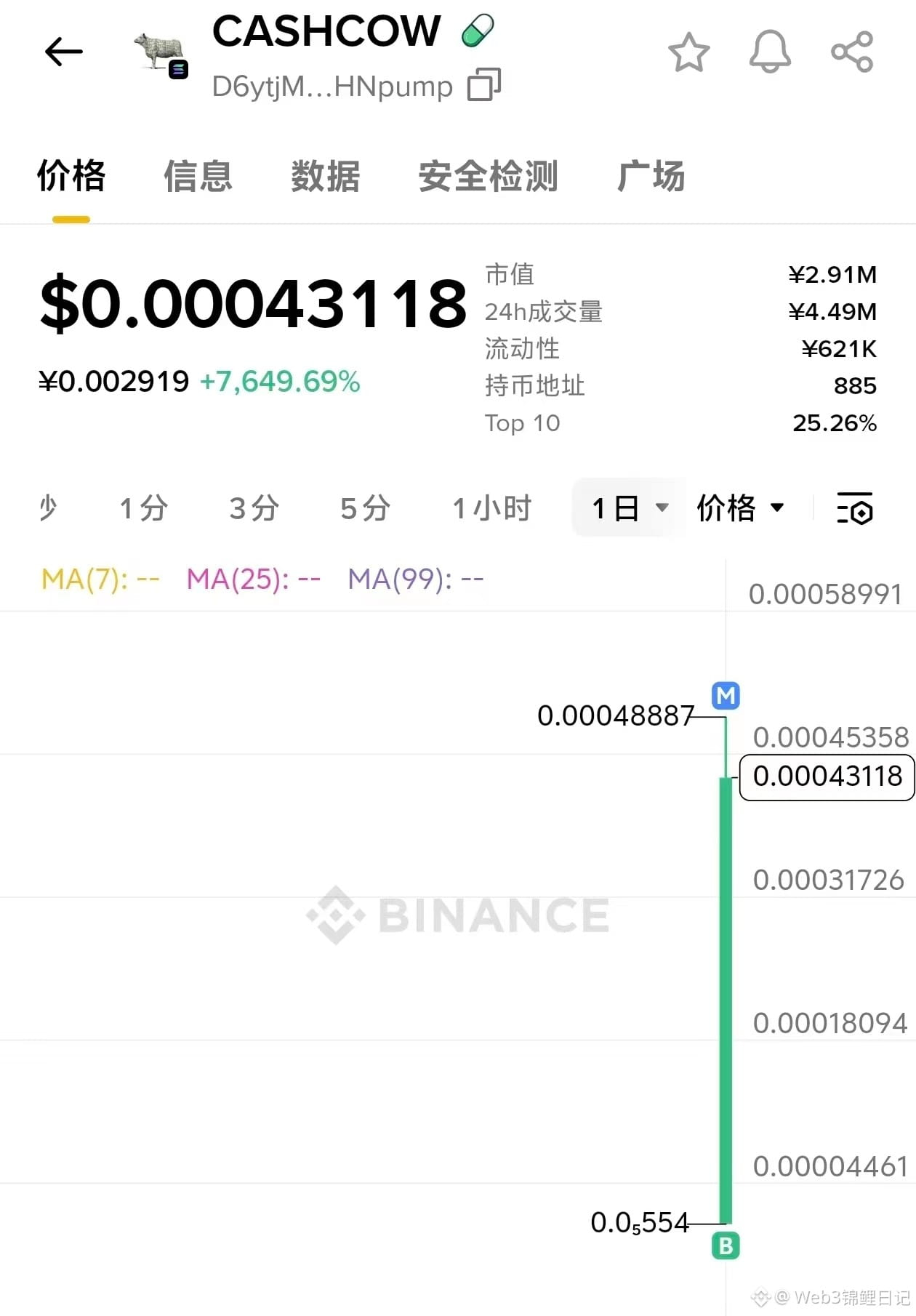
#CASHCOW 32 ten-thousand market value, bought a little, not bad (for personal records only, don’t follow)
Reasons for buying
1. The concept is interesting—promotes core values rather than chasing trends. The “cash cow” becomes a symbol of stable wealth accumulation
2. The trend is clear. When the new issue came out, it kept being pushed up to 320k. I jumped in with a bit decisively. The order book structure is concentrated: the top 100 account for 73%. The average entry price is 138k market value. There are a few “front cars” with many retail investors and high control
3. The community is decent—there are 800+ people holding cash, 500+ in the community. There are many foreigners, mainly promotion through images and text
#跟着锦鲤学打百倍金狗 $币安人生
Follow Web3 Koi Daily Diary—whatever coins I buy will multiply tenfold
D6ytjMdBBPoV8nsRHJhvrkpwF7sgVBYd7PufkRHNpump
#CASHCOW 32 ten-thousand market value, bought a little, not bad (for personal records only, don’t follow)
Reasons for buying
1. The concept is interesting—promotes core values rather than chasing trends. The “cash cow” becomes a symbol of stable wealth accumulation
2. The trend is clear. When the new issue came out, it kept being pushed up to 320k. I jumped in with a bit decisively. The order book structure is concentrated: the top 100 account for 73%. The average entry price is 138k market value. There are a few “front cars” with many retail investors and high control
3. The community is decent—there are 800+ people holding cash, 500+ in the community. There are many foreigners, mainly promotion through images and text
#跟着锦鲤学打百倍金狗 $币安人生
Follow Web3 Koi Daily Diary—whatever coins I buy will multiply tenfold
D6ytjMdBBPoV8nsRHJhvrkpwF7sgVBYd7PufkRHNpump
Reasons for buying
1. The concept is interesting—promotes core values rather than chasing trends. The “cash cow” becomes a symbol of stable wealth accumulation
2. The trend is clear. When the new issue came out, it kept being pushed up to 320k. I jumped in with a bit decisively. The order book structure is concentrated: the top 100 account for 73%. The average entry price is 138k market value. There are a few “front cars” with many retail investors and high control
3. The community is decent—there are 800+ people holding cash, 500+ in the community. There are many foreigners, mainly promotion through images and text
#跟着锦鲤学打百倍金狗 $币安人生
Follow Web3 Koi Daily Diary—whatever coins I buy will multiply tenfold
D6ytjMdBBPoV8nsRHJhvrkpwF7sgVBYd7PufkRHNpump

2.2k

·
--
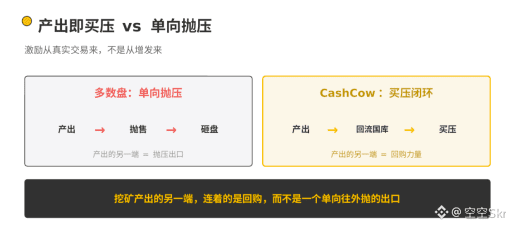
Output is buying pressure vs one-way sell pressure: CashCow flipped the direction
CashCow’s “no empty rotation” boils down to one thing: the money used for incentives comes from real trades, not from a printing press.
First question: where do the “returns” for many pools come from? From issuing more tokens. Output → everyone sells → dumps the market. The other end of the mining output—the place it leads to—is essentially a one-way outlet that pushes tokens outward. The more you mine, the more you dump, and naturally the price drifts downward.
CashCow flips the direction:
Real protocol-generated fees and profit taxes flow back to the treasury by mechanism
Output → flows back → forms buy pressure, not sell pressure
Profit tax is only charged on the portion that you actually profit from; the principal is never touched
Output is buying pressure vs one-way sell pressure
Remember this in one sentence: the other end of mined output is linked to buyback, not a sell-pressure outlet.
Where incentives come from and where they go determines whether a pool is “the more you mine, the emptier it gets,” or “the more you mine, the thicker it becomes.” The difference can be verified on-chain, trade by trade.
From another angle: whether a pool is healthy depends on whether its incentives are “water flowing in from outside” or “blood being drawn from itself.” CashCow burns fees generated by real trades—water coming in from outside. But inflationary-style incentives draw blood from each holder. Same game, different direction, wildly different outcomes.
#CashCow #DeFi4 #BNBChain #买压闭环
Output is buying pressure vs one-way sell pressure: CashCow flipped the direction
CashCow’s “no empty rotation” boils down to one thing: the money used for incentives comes from real trades, not from a printing press.
First question: where do the “returns” for many pools come from? From issuing more tokens. Output → everyone sells → dumps the market. The other end of the mining output—the place it leads to—is essentially a one-way outlet that pushes tokens outward. The more you mine, the more you dump, and naturally the price drifts downward.
CashCow flips the direction:
Real protocol-generated fees and profit taxes flow back to the treasury by mechanism
Output → flows back → forms buy pressure, not sell pressure
Profit tax is only charged on the portion that you actually profit from; the principal is never touched
Output is buying pressure vs one-way sell pressure
Remember this in one sentence: the other end of mined output is linked to buyback, not a sell-pressure outlet.
Where incentives come from and where they go determines whether a pool is “the more you mine, the emptier it gets,” or “the more you mine, the thicker it becomes.” The difference can be verified on-chain, trade by trade.
From another angle: whether a pool is healthy depends on whether its incentives are “water flowing in from outside” or “blood being drawn from itself.” CashCow burns fees generated by real trades—water coming in from outside. But inflationary-style incentives draw blood from each holder. Same game, different direction, wildly different outcomes.
#CashCow #DeFi4 #BNBChain #买压闭环
CashCow’s “no empty rotation” boils down to one thing: the money used for incentives comes from real trades, not from a printing press.
First question: where do the “returns” for many pools come from? From issuing more tokens. Output → everyone sells → dumps the market. The other end of the mining output—the place it leads to—is essentially a one-way outlet that pushes tokens outward. The more you mine, the more you dump, and naturally the price drifts downward.
CashCow flips the direction:
Real protocol-generated fees and profit taxes flow back to the treasury by mechanism
Output → flows back → forms buy pressure, not sell pressure
Profit tax is only charged on the portion that you actually profit from; the principal is never touched
Output is buying pressure vs one-way sell pressure
Remember this in one sentence: the other end of mined output is linked to buyback, not a sell-pressure outlet.
Where incentives come from and where they go determines whether a pool is “the more you mine, the emptier it gets,” or “the more you mine, the thicker it becomes.” The difference can be verified on-chain, trade by trade.
From another angle: whether a pool is healthy depends on whether its incentives are “water flowing in from outside” or “blood being drawn from itself.” CashCow burns fees generated by real trades—water coming in from outside. But inflationary-style incentives draw blood from each holder. Same game, different direction, wildly different outcomes.
#CashCow #DeFi4 #BNBChain #买压闭环
1
1
131

·
--
CashCow: Change “you need to believe” to “you can verify,” and why
CashCow wants to do something that many projects don’t dare to do—turn key promises from “you need to believe” into “you can verify.”
Have you not seen this industry enough? On every project, they start by asking you to “believe”: believe the team won’t run away, believe the contract won’t issue more, believe the treasury won’t move recklessly. But those two words—“believe”—are the most expensive and also the most fragile thing in the world. It can’t survive a single betrayal.
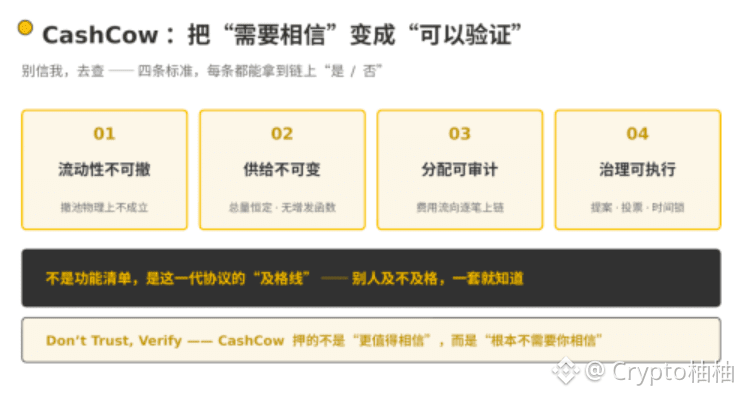
CashCow’s approach is the opposite: don’t let you believe—make you check. It breaks this into four hard standards, and each one must produce an on-chain “Yes / No” answer that you can verify:
Liquidity is non-withdrawable—removing liquidity is physically impossible
Supply is immutable—total amount is fixed; no token-minting function
Allocation is auditable—every expense flow and every burn is recorded on-chain
Governance is executable—proposals, votes, and time locks form a complete on-chain loop
CashCow’s four verifiable standards
Note: this isn’t a “feature checklist,” but the passing line CashCow believes this generation of protocols should meet. Whether others pass or fail is obvious when you use these four criteria.
One sentence: In a track full of promises, CashCow bets on “not needing you to believe,” rather than “being more trustworthy.”
Don’t Trust, Verify—people use these four words as a slogan; CashCow wants to make them the default setting.
#CASHCOW #DeFi4 #VerifiableLiquidity #BNBChain
CashCow: Change “you need to believe” to “you can verify,” and why
CashCow wants to do something that many projects don’t dare to do—turn key promises from “you need to believe” into “you can verify.”
Have you not seen this industry enough? On every project, they start by asking you to “believe”: believe the team won’t run away, believe the contract won’t issue more, believe the treasury won’t move recklessly. But those two words—“believe”—are the most expensive and also the most fragile thing in the world. It can’t survive a single betrayal.
CashCow’s approach is the opposite: don’t let you believe—make you check. It breaks this into four hard standards, and each one must produce an on-chain “Yes / No” answer that you can verify:
Liquidity is non-withdrawable—removing liquidity is physically impossible
Supply is immutable—total amount is fixed; no token-minting function
Allocation is auditable—every expense flow and every burn is recorded on-chain
Governance is executable—proposals, votes, and time locks form a complete on-chain loop
CashCow’s four verifiable standards
Note: this isn’t a “feature checklist,” but the passing line CashCow believes this generation of protocols should meet. Whether others pass or fail is obvious when you use these four criteria.
One sentence: In a track full of promises, CashCow bets on “not needing you to believe,” rather than “being more trustworthy.”
Don’t Trust, Verify—people use these four words as a slogan; CashCow wants to make them the default setting.
#CASHCOW #DeFi4 #VerifiableLiquidity #BNBChain
CashCow wants to do something that many projects don’t dare to do—turn key promises from “you need to believe” into “you can verify.”
Have you not seen this industry enough? On every project, they start by asking you to “believe”: believe the team won’t run away, believe the contract won’t issue more, believe the treasury won’t move recklessly. But those two words—“believe”—are the most expensive and also the most fragile thing in the world. It can’t survive a single betrayal.
CashCow’s approach is the opposite: don’t let you believe—make you check. It breaks this into four hard standards, and each one must produce an on-chain “Yes / No” answer that you can verify:
Liquidity is non-withdrawable—removing liquidity is physically impossible
Supply is immutable—total amount is fixed; no token-minting function
Allocation is auditable—every expense flow and every burn is recorded on-chain
Governance is executable—proposals, votes, and time locks form a complete on-chain loop
CashCow’s four verifiable standards
Note: this isn’t a “feature checklist,” but the passing line CashCow believes this generation of protocols should meet. Whether others pass or fail is obvious when you use these four criteria.
One sentence: In a track full of promises, CashCow bets on “not needing you to believe,” rather than “being more trustworthy.”
Don’t Trust, Verify—people use these four words as a slogan; CashCow wants to make them the default setting.
#CASHCOW #DeFi4 #VerifiableLiquidity #BNBChain
1
274

·
--
CashCow contract has no printing press
CashCow has a simple—almost “axis-like”—design: the total supply is constant, and the contract has no minting function.
First, a slightly painful question: is the high return you’re getting earned by the protocol, or printed by the contract?
Most so-called “returns” from many projects are essentially minting—creating new coins out of thin air and handing them to you. You think you’re making money, but actually your money is paying your interest: on the books everyone is earning coins, while in reality everyone is sharing the depreciation. Minting is a kind of hidden tax—the scarier the APY, the harsher the tax.
CashCow blocks this path:
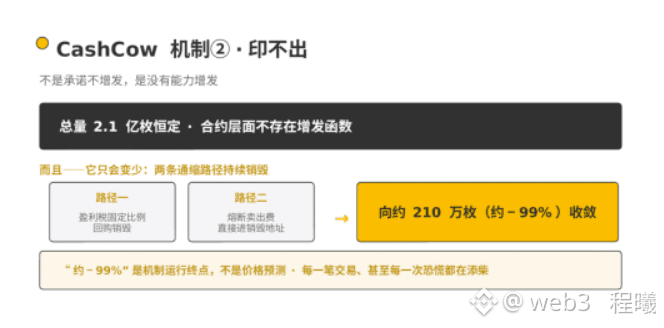
CCC total supply of 210 million coins is fixed
At the contract level, there is no minting function—this isn’t “a promise of no minting,” it’s “no ability to mint”
Even harsher: it only goes down—dual-path deflation converging toward about 2.1 million coins (about -99%) (this is the end state of the mechanism, not a price prediction)
Plus three more “no’s”: no team allocation, no private sale, no unlocks—no low-cost chips waiting to dump
All of this is clearly visible on-chain and can be verified.
You can’t print—supply only decreases, never increases
In an industry where everyone competes on who can print faster, CashCow chooses to weld the printing press shut—this in itself is a form of scarcity.
Don’t get blinded by the numbers in the APY—what you should really ask isn’t “how much,” but “where does the money come from.” CashCow writes the answer to that question into its code: if it can’t print, it can only speak through real value. And on that point, it leaves itself with absolutely no fallback.
#CASHCOW #Tokenomics #BNBChain #DeFi4
CashCow contract has no printing press
CashCow has a simple—almost “axis-like”—design: the total supply is constant, and the contract has no minting function.
First, a slightly painful question: is the high return you’re getting earned by the protocol, or printed by the contract?
Most so-called “returns” from many projects are essentially minting—creating new coins out of thin air and handing them to you. You think you’re making money, but actually your money is paying your interest: on the books everyone is earning coins, while in reality everyone is sharing the depreciation. Minting is a kind of hidden tax—the scarier the APY, the harsher the tax.
CashCow blocks this path:
CCC total supply of 210 million coins is fixed
At the contract level, there is no minting function—this isn’t “a promise of no minting,” it’s “no ability to mint”
Even harsher: it only goes down—dual-path deflation converging toward about 2.1 million coins (about -99%) (this is the end state of the mechanism, not a price prediction)
Plus three more “no’s”: no team allocation, no private sale, no unlocks—no low-cost chips waiting to dump
All of this is clearly visible on-chain and can be verified.
You can’t print—supply only decreases, never increases
In an industry where everyone competes on who can print faster, CashCow chooses to weld the printing press shut—this in itself is a form of scarcity.
Don’t get blinded by the numbers in the APY—what you should really ask isn’t “how much,” but “where does the money come from.” CashCow writes the answer to that question into its code: if it can’t print, it can only speak through real value. And on that point, it leaves itself with absolutely no fallback.
#CASHCOW #Tokenomics #BNBChain #DeFi4
CashCow has a simple—almost “axis-like”—design: the total supply is constant, and the contract has no minting function.
First, a slightly painful question: is the high return you’re getting earned by the protocol, or printed by the contract?
Most so-called “returns” from many projects are essentially minting—creating new coins out of thin air and handing them to you. You think you’re making money, but actually your money is paying your interest: on the books everyone is earning coins, while in reality everyone is sharing the depreciation. Minting is a kind of hidden tax—the scarier the APY, the harsher the tax.
CashCow blocks this path:
CCC total supply of 210 million coins is fixed
At the contract level, there is no minting function—this isn’t “a promise of no minting,” it’s “no ability to mint”
Even harsher: it only goes down—dual-path deflation converging toward about 2.1 million coins (about -99%) (this is the end state of the mechanism, not a price prediction)
Plus three more “no’s”: no team allocation, no private sale, no unlocks—no low-cost chips waiting to dump
All of this is clearly visible on-chain and can be verified.
You can’t print—supply only decreases, never increases
In an industry where everyone competes on who can print faster, CashCow chooses to weld the printing press shut—this in itself is a form of scarcity.
Don’t get blinded by the numbers in the APY—what you should really ask isn’t “how much,” but “where does the money come from.” CashCow writes the answer to that question into its code: if it can’t print, it can only speak through real value. And on that point, it leaves itself with absolutely no fallback.
#CASHCOW #Tokenomics #BNBChain #DeFi4
1
214

·
--
CashCow’s Dual-Base Standard: Prevent the Death Spiral from Catching Fire
The hardest-to-understand—but toughest—design in CashCow is its dual-base accrual system. It aims to solve the industry’s number-one killer: the death spiral.
First, see how the spiral “catches” (four steps in a loop):
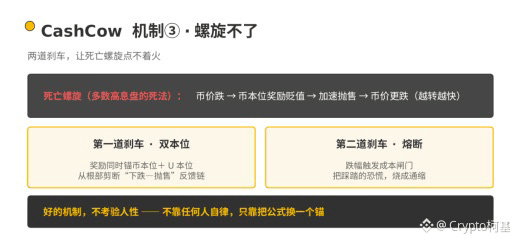
Coin price falls → the coin-base reward depreciates → everyone accelerates selling → price falls further → back to step one; the faster it turns, the quicker it feeds.
That’s a bank run. The first person to run may be fine, but everyone wants to be the first. At that moment, shouting trading calls and talking about faith are useless—because “running first” is a rational choice for everyone. This isn’t a moral issue; it’s math.
CashCow’s first brake is the dual-base standard:
Single-base (the igniter): rewards are pegged only to the coin base → when the coin price falls, rewards depreciate in sync → forcing you to sell
Dual-base (the brake): rewards are simultaneously pegged to the coin base + the U base → during a downward move, value expectations don’t collapse in sync → that feedback chain gets cut off at the middle
One sentence to remember: when the market drops, single-base is pressing the accelerator, while dual-base is pressing the brake.
Its cleverest part—doesn’t rely on anyone’s self-discipline, only on changing the accrual formula’s anchor. A good mechanism doesn’t fight human nature; it makes human nature not become a problem.
Dual-base—stops the death spiral from catching fire
Paired with the second brake (circuit breaker, turning panic into contraction), what CashCow wants to do isn’t “guarantee it won’t fall”—no mechanism can do that—but to ensure that “a drop” no longer automatically rolls into “a collapse.”
#CASHCOW #双本位 #DeFi4 #BNBChain
CashCow’s Dual-Base Standard: Prevent the Death Spiral from Catching Fire
The hardest-to-understand—but toughest—design in CashCow is its dual-base accrual system. It aims to solve the industry’s number-one killer: the death spiral.
First, see how the spiral “catches” (four steps in a loop):
Coin price falls → the coin-base reward depreciates → everyone accelerates selling → price falls further → back to step one; the faster it turns, the quicker it feeds.
That’s a bank run. The first person to run may be fine, but everyone wants to be the first. At that moment, shouting trading calls and talking about faith are useless—because “running first” is a rational choice for everyone. This isn’t a moral issue; it’s math.
CashCow’s first brake is the dual-base standard:
Single-base (the igniter): rewards are pegged only to the coin base → when the coin price falls, rewards depreciate in sync → forcing you to sell
Dual-base (the brake): rewards are simultaneously pegged to the coin base + the U base → during a downward move, value expectations don’t collapse in sync → that feedback chain gets cut off at the middle
One sentence to remember: when the market drops, single-base is pressing the accelerator, while dual-base is pressing the brake.
Its cleverest part—doesn’t rely on anyone’s self-discipline, only on changing the accrual formula’s anchor. A good mechanism doesn’t fight human nature; it makes human nature not become a problem.
Dual-base—stops the death spiral from catching fire
Paired with the second brake (circuit breaker, turning panic into contraction), what CashCow wants to do isn’t “guarantee it won’t fall”—no mechanism can do that—but to ensure that “a drop” no longer automatically rolls into “a collapse.”
#CASHCOW #双本位 #DeFi4 #BNBChain
The hardest-to-understand—but toughest—design in CashCow is its dual-base accrual system. It aims to solve the industry’s number-one killer: the death spiral.
First, see how the spiral “catches” (four steps in a loop):
Coin price falls → the coin-base reward depreciates → everyone accelerates selling → price falls further → back to step one; the faster it turns, the quicker it feeds.
That’s a bank run. The first person to run may be fine, but everyone wants to be the first. At that moment, shouting trading calls and talking about faith are useless—because “running first” is a rational choice for everyone. This isn’t a moral issue; it’s math.
CashCow’s first brake is the dual-base standard:
Single-base (the igniter): rewards are pegged only to the coin base → when the coin price falls, rewards depreciate in sync → forcing you to sell
Dual-base (the brake): rewards are simultaneously pegged to the coin base + the U base → during a downward move, value expectations don’t collapse in sync → that feedback chain gets cut off at the middle
One sentence to remember: when the market drops, single-base is pressing the accelerator, while dual-base is pressing the brake.
Its cleverest part—doesn’t rely on anyone’s self-discipline, only on changing the accrual formula’s anchor. A good mechanism doesn’t fight human nature; it makes human nature not become a problem.
Dual-base—stops the death spiral from catching fire
Paired with the second brake (circuit breaker, turning panic into contraction), what CashCow wants to do isn’t “guarantee it won’t fall”—no mechanism can do that—but to ensure that “a drop” no longer automatically rolls into “a collapse.”
#CASHCOW #双本位 #DeFi4 #BNBChain
131

·
--
Article
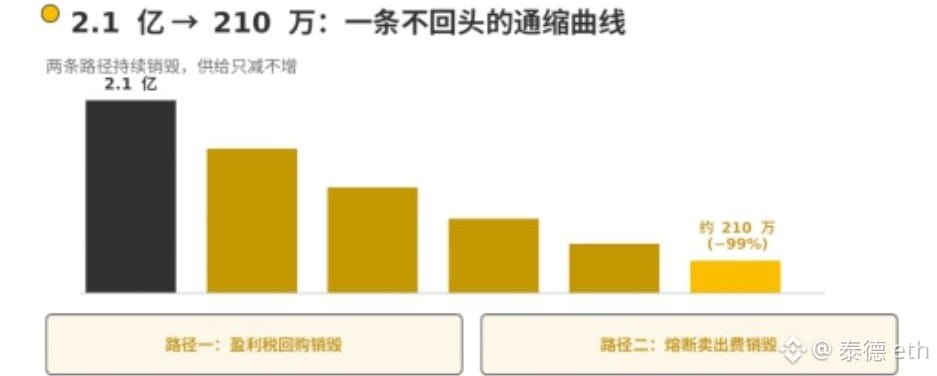
210 million → 2.1 million: CashCow’s one-way deflation curveCashCow not only “can’t print,” it also keeps getting less—an anti-inflationary curve that never turns back.
Total supply is fixed at 210 million coins, then it continuously destroys coins through two paths, converging toward about 2.1 million (about −99%):
Path one: a fixed proportion from profit taxes, used for buybacks and destruction
Path two: when a circuit-breaker triggers, a large portion of the sell fee goes directly to the burn/destroy address
210 million → 2.1 million deflation curve
Here’s the key point: in this case, deflation isn’t something you do once by burning a batch and calling it done. It’s built into the everyday operating mechanism. Every transaction, even every market panic, is adding fuel to push this curve downward.
210 million → 2.1 million: CashCow’s one-way deflation curve
CashCow not only “can’t print,” it also keeps getting less—an anti-inflationary curve that never turns back.
Total supply is fixed at 210 million coins, then it continuously destroys coins through two paths, converging toward about 2.1 million (about −99%):
Path one: a fixed proportion from profit taxes, used for buybacks and destruction
Path two: when a circuit-breaker triggers, a large portion of the sell fee goes directly to the burn/destroy address
210 million → 2.1 million deflation curve
Here’s the key point: in this case, deflation isn’t something you do once by burning a batch and calling it done. It’s built into the everyday operating mechanism. Every transaction, even every market panic, is adding fuel to push this curve downward.
Total supply is fixed at 210 million coins, then it continuously destroys coins through two paths, converging toward about 2.1 million (about −99%):
Path one: a fixed proportion from profit taxes, used for buybacks and destruction
Path two: when a circuit-breaker triggers, a large portion of the sell fee goes directly to the burn/destroy address
210 million → 2.1 million deflation curve
Here’s the key point: in this case, deflation isn’t something you do once by burning a batch and calling it done. It’s built into the everyday operating mechanism. Every transaction, even every market panic, is adding fuel to push this curve downward.
1
2
305

·
--
Binance Heat Ranking #1 blew up! CASHCOW surged 13,561% in 24 hours 🚀
This project just launched not long ago and immediately jumped to the top of the Binance heat ranking from Pump.fun. In the past 24 hours, its trading volume was 2.52 million U, and search interest skyrocketed 5,267 times.
At a current price of $0.00076, even though the market cap is only 750,000 U, it’s still up 38% within 4 hours. Liquidity is 118,000 U, with 1,719 holders.
Is the meme season still not over? Would you dare chase something like this that’s been pulled up from the bottom? Or should you wait for a pullback? Drop your thoughts in the comments 👇
#CASHCOW #MemeCoin #PumpFun
Binance Heat Ranking #1 blew up! CASHCOW surged 13,561% in 24 hours 🚀
This project just launched not long ago and immediately jumped to the top of the Binance heat ranking from Pump.fun. In the past 24 hours, its trading volume was 2.52 million U, and search interest skyrocketed 5,267 times.
At a current price of $0.00076, even though the market cap is only 750,000 U, it’s still up 38% within 4 hours. Liquidity is 118,000 U, with 1,719 holders.
Is the meme season still not over? Would you dare chase something like this that’s been pulled up from the bottom? Or should you wait for a pullback? Drop your thoughts in the comments 👇
#CASHCOW #MemeCoin #PumpFun
This project just launched not long ago and immediately jumped to the top of the Binance heat ranking from Pump.fun. In the past 24 hours, its trading volume was 2.52 million U, and search interest skyrocketed 5,267 times.
At a current price of $0.00076, even though the market cap is only 750,000 U, it’s still up 38% within 4 hours. Liquidity is 118,000 U, with 1,719 holders.
Is the meme season still not over? Would you dare chase something like this that’s been pulled up from the bottom? Or should you wait for a pullback? Drop your thoughts in the comments 👇
#CASHCOW #MemeCoin #PumpFun
90

·
--
Down 5% and “pull the circuit breaker”? The most misunderstood mechanism behind CashCow
CashCow’s anti-dump circuit-breaker is probably the most criticized mechanism across the whole project. The moment people hear “when it drops by a certain percentage, selling costs rise,” many immediately think: isn’t this basically stopping selling?
No, that’s not it. Let’s clarify three points:
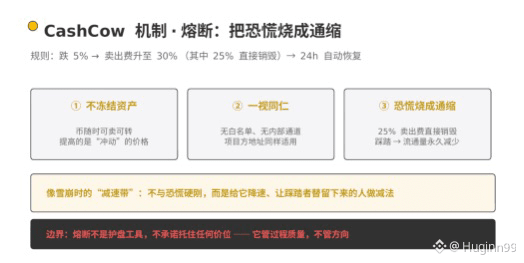
① No assets are frozen. During the circuit-breaker period, your coins are still your coins—you can sell and transfer at any time, with no freezing. What changes is the cost of panic-selling. The mechanism increases the price of “impulsive” selling, not your right to choose. “Not letting you sell” and “letting you sell at a higher price” are two different things.
② Everyone is treated the same—no whitelist. No exemptions, no internal channels. Project team addresses are subject to the same rules. The contract doesn’t care who you are, and won’t take special calls.
③ Panic gets burned away. During the circuit-breaker, that high proportion of sell fees goes directly to burn/destroy addresses—each panic-driven sell becomes a permanent reduction in circulating supply. When others dump, the market pressure they create turns into deflationary benefits for those who remain.
In fact, this logic has been used in stock markets for decades.
After the Black Monday crash in 1987, global stock markets introduced circuit breakers one after another. The purpose was never to stop the decline, but to cool down panic and provide a window for a calm, reassessed price.
CashCow codified it.
An analogy: a circuit breaker isn’t a wall at the edge of a cliff—it’s the speed bump that slows an avalanche.
But the boundary must be made clear: the circuit breaker is not a price-support tool, and it does not promise to hold any specific price level. What it manages is the “quality of the process” of volatility, not the “direction.” If someone tries to use it to imply guaranteed profit with no downside, block them.
Once you understand these three points, you’ll agree: the harder it drops, the more it burns—smarter than “not letting you sell” by a long way.
#CASHCOW #defi #BNBChain
Down 5% and “pull the circuit breaker”? The most misunderstood mechanism behind CashCow
CashCow’s anti-dump circuit-breaker is probably the most criticized mechanism across the whole project. The moment people hear “when it drops by a certain percentage, selling costs rise,” many immediately think: isn’t this basically stopping selling?
No, that’s not it. Let’s clarify three points:
① No assets are frozen. During the circuit-breaker period, your coins are still your coins—you can sell and transfer at any time, with no freezing. What changes is the cost of panic-selling. The mechanism increases the price of “impulsive” selling, not your right to choose. “Not letting you sell” and “letting you sell at a higher price” are two different things.
② Everyone is treated the same—no whitelist. No exemptions, no internal channels. Project team addresses are subject to the same rules. The contract doesn’t care who you are, and won’t take special calls.
③ Panic gets burned away. During the circuit-breaker, that high proportion of sell fees goes directly to burn/destroy addresses—each panic-driven sell becomes a permanent reduction in circulating supply. When others dump, the market pressure they create turns into deflationary benefits for those who remain.
In fact, this logic has been used in stock markets for decades.
After the Black Monday crash in 1987, global stock markets introduced circuit breakers one after another. The purpose was never to stop the decline, but to cool down panic and provide a window for a calm, reassessed price.
CashCow codified it.
An analogy: a circuit breaker isn’t a wall at the edge of a cliff—it’s the speed bump that slows an avalanche.
But the boundary must be made clear: the circuit breaker is not a price-support tool, and it does not promise to hold any specific price level. What it manages is the “quality of the process” of volatility, not the “direction.” If someone tries to use it to imply guaranteed profit with no downside, block them.
Once you understand these three points, you’ll agree: the harder it drops, the more it burns—smarter than “not letting you sell” by a long way.
#CASHCOW #defi #BNBChain
CashCow’s anti-dump circuit-breaker is probably the most criticized mechanism across the whole project. The moment people hear “when it drops by a certain percentage, selling costs rise,” many immediately think: isn’t this basically stopping selling?
No, that’s not it. Let’s clarify three points:
① No assets are frozen. During the circuit-breaker period, your coins are still your coins—you can sell and transfer at any time, with no freezing. What changes is the cost of panic-selling. The mechanism increases the price of “impulsive” selling, not your right to choose. “Not letting you sell” and “letting you sell at a higher price” are two different things.
② Everyone is treated the same—no whitelist. No exemptions, no internal channels. Project team addresses are subject to the same rules. The contract doesn’t care who you are, and won’t take special calls.
③ Panic gets burned away. During the circuit-breaker, that high proportion of sell fees goes directly to burn/destroy addresses—each panic-driven sell becomes a permanent reduction in circulating supply. When others dump, the market pressure they create turns into deflationary benefits for those who remain.
In fact, this logic has been used in stock markets for decades.
After the Black Monday crash in 1987, global stock markets introduced circuit breakers one after another. The purpose was never to stop the decline, but to cool down panic and provide a window for a calm, reassessed price.
CashCow codified it.
An analogy: a circuit breaker isn’t a wall at the edge of a cliff—it’s the speed bump that slows an avalanche.
But the boundary must be made clear: the circuit breaker is not a price-support tool, and it does not promise to hold any specific price level. What it manages is the “quality of the process” of volatility, not the “direction.” If someone tries to use it to imply guaranteed profit with no downside, block them.
Once you understand these three points, you’ll agree: the harder it drops, the more it burns—smarter than “not letting you sell” by a long way.
#CASHCOW #defi #BNBChain
156

·
--
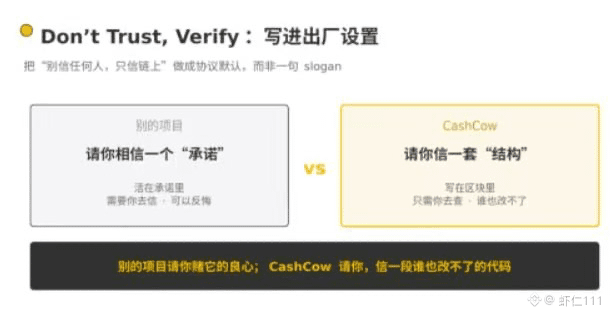
Don’t Trust, Verify:CashCow Has Written It Into the Factory Settings
“Don’t trust anyone; trust on-chain only”—everyone in the crypto world says that. But what CashCow wants to do is turn it from a slogan into the factory settings of a protocol.
What’s the difference?
Other projects: Ask you to trust a “promise”—to live in that promise requires you to believe, and they can always backtrack.
CashCow: Ask you to trust a “structure”—written into the blockchain. All you need to do is verify; no one can change it.
Don’t Trust, Verify written into the factory settings
It sends the power to withdraw liquidity into a black hole, removes the inflation-minting function from the contract, and locks the authority to change rules inside a DAO and time lock—not asking you to believe it’s run by good people, but deleting the entry points for wrongdoing from the very beginning.
In one sentence: other projects ask you to bet on their conscience; CashCow asks you to trust a piece of code that no one can change.
Don’t Trust, Verify—this time, it’s serious.
In a space full of promises, there aren’t many projects that can turn “you don’t need to trust” into a default setting. Most projects are busy getting you to believe in their intentions, team, and vision; while CashCow is busy turning those “things you need to believe” into verifiable facts, one by one. That’s what “no trust” really looks like.
#CASHCOW #DeFi4 #BNBChain
Don’t Trust, Verify:CashCow Has Written It Into the Factory Settings
“Don’t trust anyone; trust on-chain only”—everyone in the crypto world says that. But what CashCow wants to do is turn it from a slogan into the factory settings of a protocol.
What’s the difference?
Other projects: Ask you to trust a “promise”—to live in that promise requires you to believe, and they can always backtrack.
CashCow: Ask you to trust a “structure”—written into the blockchain. All you need to do is verify; no one can change it.
Don’t Trust, Verify written into the factory settings
It sends the power to withdraw liquidity into a black hole, removes the inflation-minting function from the contract, and locks the authority to change rules inside a DAO and time lock—not asking you to believe it’s run by good people, but deleting the entry points for wrongdoing from the very beginning.
In one sentence: other projects ask you to bet on their conscience; CashCow asks you to trust a piece of code that no one can change.
Don’t Trust, Verify—this time, it’s serious.
In a space full of promises, there aren’t many projects that can turn “you don’t need to trust” into a default setting. Most projects are busy getting you to believe in their intentions, team, and vision; while CashCow is busy turning those “things you need to believe” into verifiable facts, one by one. That’s what “no trust” really looks like.
#CASHCOW #DeFi4 #BNBChain
“Don’t trust anyone; trust on-chain only”—everyone in the crypto world says that. But what CashCow wants to do is turn it from a slogan into the factory settings of a protocol.
What’s the difference?
Other projects: Ask you to trust a “promise”—to live in that promise requires you to believe, and they can always backtrack.
CashCow: Ask you to trust a “structure”—written into the blockchain. All you need to do is verify; no one can change it.
Don’t Trust, Verify written into the factory settings
It sends the power to withdraw liquidity into a black hole, removes the inflation-minting function from the contract, and locks the authority to change rules inside a DAO and time lock—not asking you to believe it’s run by good people, but deleting the entry points for wrongdoing from the very beginning.
In one sentence: other projects ask you to bet on their conscience; CashCow asks you to trust a piece of code that no one can change.
Don’t Trust, Verify—this time, it’s serious.
In a space full of promises, there aren’t many projects that can turn “you don’t need to trust” into a default setting. Most projects are busy getting you to believe in their intentions, team, and vision; while CashCow is busy turning those “things you need to believe” into verifiable facts, one by one. That’s what “no trust” really looks like.
#CASHCOW #DeFi4 #BNBChain
307

·
--
Can’t run, can’t print, can’t spiral, can’t idle: CashCow’s four machinesCan’t run, can’t print, can’t spiral, can’t idle: CashCow’s four machines
CashCow isn’t held up by a clever design—rather, its four machines interlock into a system: can’t run, can’t print, can’t spiral, can’t idle.
Can’t run: LP permission black hole destroys it; withdrawing the pool is not physically possible
Can’t print: constant total supply, no function for increased issuance, and ongoing deflation
Can’t spiral: dual backing + circuit breaker, cutting off the death spiral
Can’t idle: incentives burn real transaction fees, not additional issuance
Figure B9-1: CashCow’s four machines (verifiable system)
CashCow’s four machines (verifiable system)
Can’t run, can’t print, can’t spiral, can’t idle: CashCow’s four machines
Can’t run, can’t print, can’t spiral, can’t idle: CashCow’s four machines
CashCow isn’t held up by a clever design—rather, its four machines interlock into a system: can’t run, can’t print, can’t spiral, can’t idle.
Can’t run: LP permission black hole destroys it; withdrawing the pool is not physically possible
Can’t print: constant total supply, no function for increased issuance, and ongoing deflation
Can’t spiral: dual backing + circuit breaker, cutting off the death spiral
Can’t idle: incentives burn real transaction fees, not additional issuance
Figure B9-1: CashCow’s four machines (verifiable system)
CashCow’s four machines (verifiable system)
CashCow isn’t held up by a clever design—rather, its four machines interlock into a system: can’t run, can’t print, can’t spiral, can’t idle.
Can’t run: LP permission black hole destroys it; withdrawing the pool is not physically possible
Can’t print: constant total supply, no function for increased issuance, and ongoing deflation
Can’t spiral: dual backing + circuit breaker, cutting off the death spiral
Can’t idle: incentives burn real transaction fees, not additional issuance
Figure B9-1: CashCow’s four machines (verifiable system)
CashCow’s four machines (verifiable system)
199
·
--
🐮 CASHCOW is going absolutely wild! It surged 13,056% in 24 hours—rising from nearly zero to $0.00073. Market cap: $730,000. +53% in 4 hours, +12% in 1 hour, and money is still flowing in. 24h trading volume: 2.23M in trades, search interest: 4,675 times. On the BSC chain, everyone’s watching this bull.
But be careful—it's been on Pumpfun for less than 24 hours, so volatility is extremely high. Chasing after it is risky.
#CASHCOW #MemeCoin #PumpFun
How far do you think this bull can still run? Or is it time to get out?👇
🐮 CASHCOW is going absolutely wild! It surged 13,056% in 24 hours—rising from nearly zero to $0.00073. Market cap: $730,000. +53% in 4 hours, +12% in 1 hour, and money is still flowing in. 24h trading volume: 2.23M in trades, search interest: 4,675 times. On the BSC chain, everyone’s watching this bull.
But be careful—it's been on Pumpfun for less than 24 hours, so volatility is extremely high. Chasing after it is risky.
#CASHCOW #MemeCoin #PumpFun
How far do you think this bull can still run? Or is it time to get out?👇
But be careful—it's been on Pumpfun for less than 24 hours, so volatility is extremely high. Chasing after it is risky.
#CASHCOW #MemeCoin #PumpFun
How far do you think this bull can still run? Or is it time to get out?👇
15

·
--
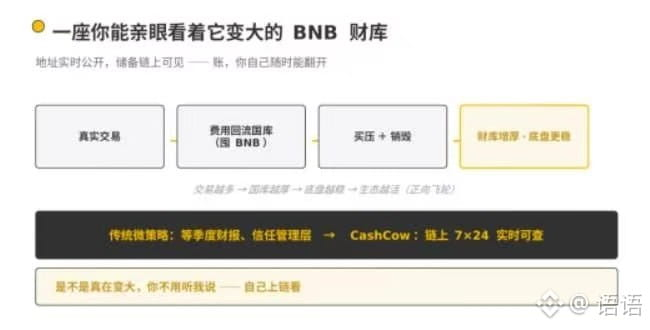
A BNB treasury you can watch grow with your own eyes: CashCow
CashCow builds a BNB treasury on-chain, and its biggest difference is this: you can literally watch it grow.
You’re familiar with the “MicroStrategy” playbook—keep buying and hold an asset long term. The weakness of traditional approaches is the information gap: you have to wait for quarterly reports, and you have to trust that management hasn’t quietly sold.
CashCow brings this on-chain and fills that gap as a bonus:
- The protocol continuously accumulates BNB under fixed, written rules
- The treasury address is publicly viewable in real time, with reserves visible on-chain
- You don’t have to trust anyone—you can audit the books yourself anytime
A BNB treasury that grows before your eyes (value closed loop)
With the same strategy, the most essential difference comes down to one thing: is this ledger read to you by others, or can you open it for yourself anytime?
Whether it’s actually growing—and by how much—you don’t need to take my word for it. Go check it on-chain yourself.
In an industry full of PPTs, whitepapers, and promises, the five words “you can see it yourself” are, in fact, the strongest reassurance. Financial reports can be polished, disclosures can be delayed, and teams can talk tough—but an on-chain address won’t lie. CashCow dares to lay the treasury out for you to see because it knows—you can verify it.
#CASHCOW #BNB财库 #微策略 #BNBChain
A BNB treasury you can watch grow with your own eyes: CashCow
CashCow builds a BNB treasury on-chain, and its biggest difference is this: you can literally watch it grow.
You’re familiar with the “MicroStrategy” playbook—keep buying and hold an asset long term. The weakness of traditional approaches is the information gap: you have to wait for quarterly reports, and you have to trust that management hasn’t quietly sold.
CashCow brings this on-chain and fills that gap as a bonus:
- The protocol continuously accumulates BNB under fixed, written rules
- The treasury address is publicly viewable in real time, with reserves visible on-chain
- You don’t have to trust anyone—you can audit the books yourself anytime
A BNB treasury that grows before your eyes (value closed loop)
With the same strategy, the most essential difference comes down to one thing: is this ledger read to you by others, or can you open it for yourself anytime?
Whether it’s actually growing—and by how much—you don’t need to take my word for it. Go check it on-chain yourself.
In an industry full of PPTs, whitepapers, and promises, the five words “you can see it yourself” are, in fact, the strongest reassurance. Financial reports can be polished, disclosures can be delayed, and teams can talk tough—but an on-chain address won’t lie. CashCow dares to lay the treasury out for you to see because it knows—you can verify it.
#CASHCOW #BNB财库 #微策略 #BNBChain
CashCow builds a BNB treasury on-chain, and its biggest difference is this: you can literally watch it grow.
You’re familiar with the “MicroStrategy” playbook—keep buying and hold an asset long term. The weakness of traditional approaches is the information gap: you have to wait for quarterly reports, and you have to trust that management hasn’t quietly sold.
CashCow brings this on-chain and fills that gap as a bonus:
- The protocol continuously accumulates BNB under fixed, written rules
- The treasury address is publicly viewable in real time, with reserves visible on-chain
- You don’t have to trust anyone—you can audit the books yourself anytime
A BNB treasury that grows before your eyes (value closed loop)
With the same strategy, the most essential difference comes down to one thing: is this ledger read to you by others, or can you open it for yourself anytime?
Whether it’s actually growing—and by how much—you don’t need to take my word for it. Go check it on-chain yourself.
In an industry full of PPTs, whitepapers, and promises, the five words “you can see it yourself” are, in fact, the strongest reassurance. Financial reports can be polished, disclosures can be delayed, and teams can talk tough—but an on-chain address won’t lie. CashCow dares to lay the treasury out for you to see because it knows—you can verify it.
#CASHCOW #BNB财库 #微策略 #BNBChain
139
Log in to explore more content
Join global crypto users on Binance Square
⚡️ Get latest and useful information about crypto.
💬 Trusted by the world’s largest crypto exchange.
👍 Discover real insights from verified creators.
Email / Phone number
Trending Topics
1
#FedRateWatch
140,942 views
907 Discussing
2
#BitcoinSlidesTo$76000
9 views
20 Discussing
3
#BitcoinReboundsTo$79K
42,496 views
324 Discussing
4
#StrategyMarketCapPassesFord
302 views
55 Discussing
5
#ClarityActOddsHalveOnPolymarket
300 views
48 Discussing
6
#US30YTreasuryYieldTops5.40%
2,065 views
69 Discussing
7
#BessentEndorsesFinalClarityActDraft
14,302 views
329 Discussing
8
#ZamaOpens16ConfidentialMorphoVaults
6,434 views
175 Discussing
9
#USDCOnChainVolumeTops$100Trillion
1,052 views
31 Discussing
10
#BitcoinSpotETFsNetInflow$160M
1,904 views
82 Discussing