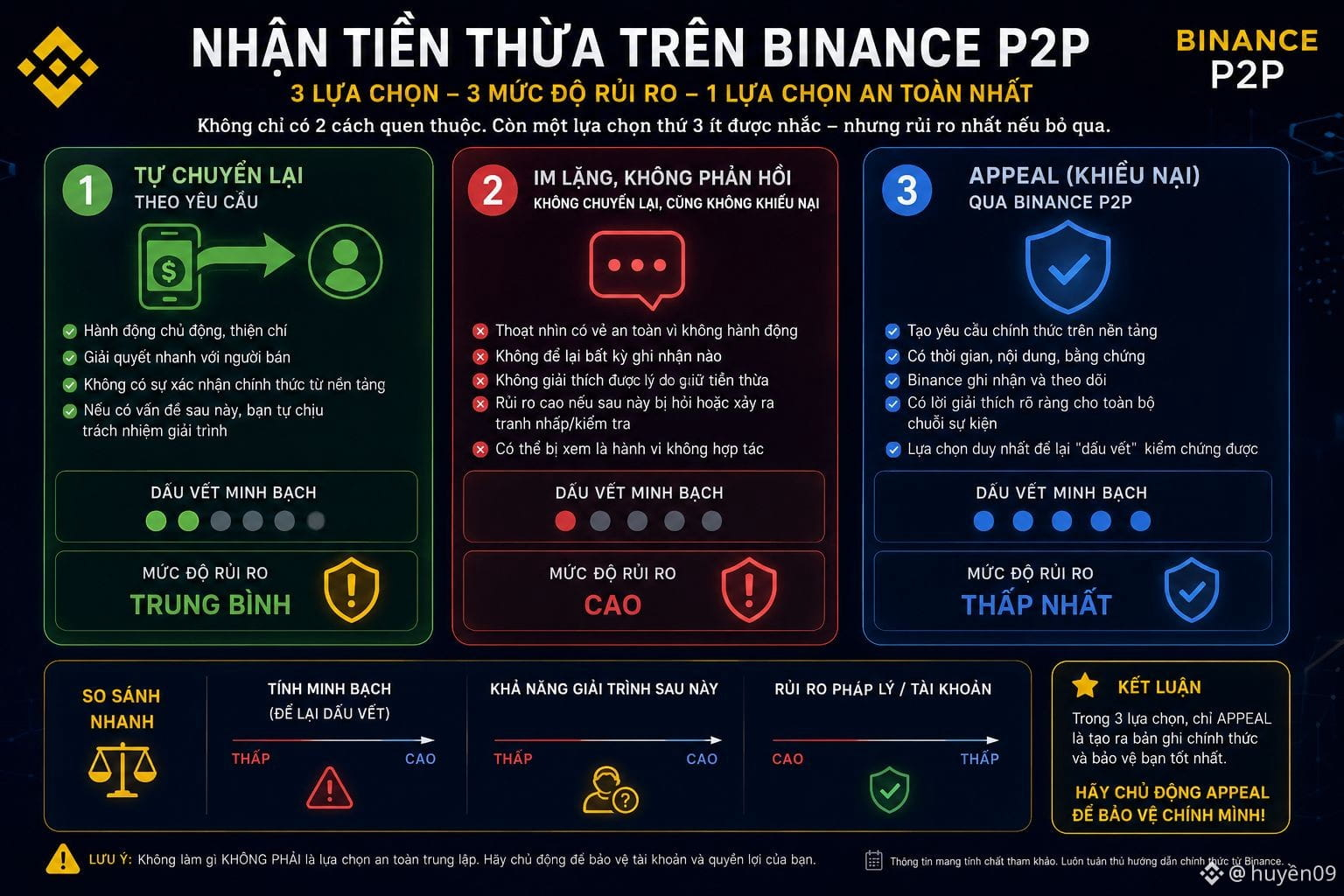
I realized something when I tried to list all the options in the scenario of receiving overpayment on Binance P2P, instead of only comparing the two familiar choices: “transfer it back yourself” or “Appeal”.
There’s a third option that’s rarely mentioned—silence, no response, neither transfer it back nor file a complaint. At first glance, it seems the safest because if you do nothing, you can’t make a mistake. But this can be the riskiest choice, because keeping an amount of unclear source funds in your account indefinitely means you’re holding money that may not belong to you.
Compare them in terms of how clearly they leave a trail: transferring back as requested creates an action trail—active behavior, but the platform doesn’t confirm it, putting the seller in a position where they must take responsibility for their explanation afterward. Silence creates a complete void: if you’re asked why you kept funds that aren’t yours, you have no explanation.
Meanwhile, Appeal is the only option that creates an official record—with a timeline, with supporting grounds, and a clear explanation for the entire sequence of events. Seen this way, choosing Appeal is not only safer than handling it yourself, but also safer than doing nothing—because among the three options, only Appeal leaves an explanation that can be verified by anyone who asks later, including the seller themselves.
Counterpoint: this is a theoretical way of categorizing the three options; in reality, there may be more variations depending on the circumstances, and it’s not always so neatly divided.
I’m waiting to see whether Binance P2P will clarify in its guidance that “doing nothing” is not a neutral safe choice, so users understand that Appeal is a necessary proactive step—not just one of many response options that are equally valid.
#binancep2pantoan @Binance Vietnam $BTC