
Lào Thoại Ngân
305 Публикации

Lào Thoại Ngân
Отправить жалобу
Заблокировать пользователя
280 подписок(и/а)
67 подписчиков(а)
137 понравилось
Посты
Все
Цитирования
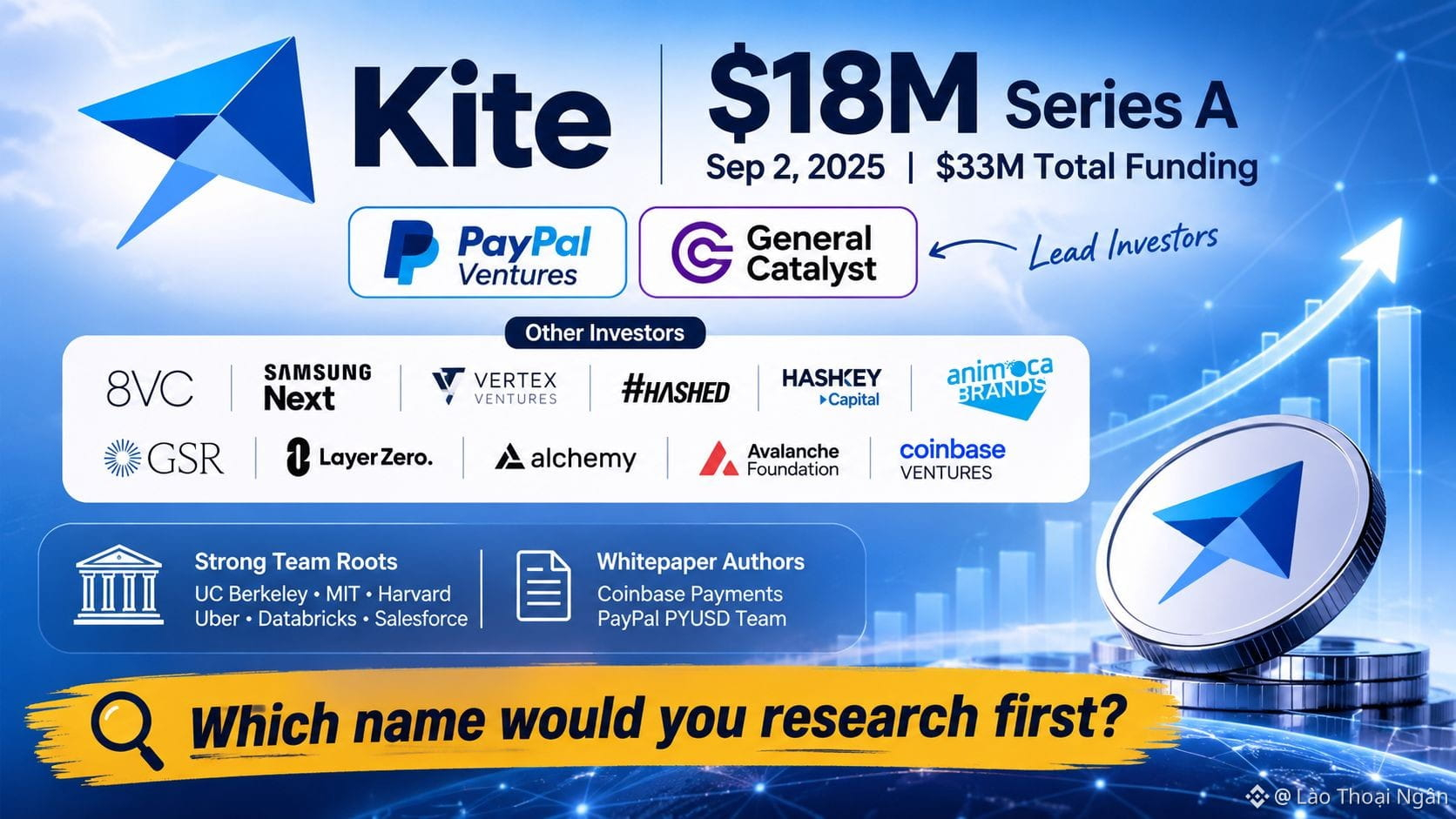
Two names sit at the top of Kite's Series A: PayPal Ventures and General Catalyst. The round was $18 million, announced on September 2, 2025, and it lifted total funding to $33 million.
The rest of the list reads like a map of where agent payments have to work. 8VC, Samsung Next, Vertex Ventures, Hashed, HashKey Capital, Animoca Brands, GSR, LayerZero, Alchemy and the Avalanche Foundation joined, and Coinbase Ventures participated as well. Kite was formerly Zettablock. The team has roots at UC Berkeley, MIT, Harvard, Uber, Databricks and Salesforce, and the whitepaper's author list includes people from Coinbase's payments group and PayPal's PYUSD team.
PayPal Ventures partner Alan Du pointed to payments as the technical gap Kite exists to close. Capital is not adoption, and nobody should treat it as proof. It does show who is paying attention.
Tell me which name on that list you would research first.
#KiteBBW $KITE
{spot}(KITEUSDT)
Two names sit at the top of Kite's Series A: PayPal Ventures and General Catalyst. The round was $18 million, announced on September 2, 2025, and it lifted total funding to $33 million.
The rest of the list reads like a map of where agent payments have to work. 8VC, Samsung Next, Vertex Ventures, Hashed, HashKey Capital, Animoca Brands, GSR, LayerZero, Alchemy and the Avalanche Foundation joined, and Coinbase Ventures participated as well. Kite was formerly Zettablock. The team has roots at UC Berkeley, MIT, Harvard, Uber, Databricks and Salesforce, and the whitepaper's author list includes people from Coinbase's payments group and PayPal's PYUSD team.
PayPal Ventures partner Alan Du pointed to payments as the technical gap Kite exists to close. Capital is not adoption, and nobody should treat it as proof. It does show who is paying attention.
Tell me which name on that list you would research first.
#KiteBBW $KITE
The rest of the list reads like a map of where agent payments have to work. 8VC, Samsung Next, Vertex Ventures, Hashed, HashKey Capital, Animoca Brands, GSR, LayerZero, Alchemy and the Avalanche Foundation joined, and Coinbase Ventures participated as well. Kite was formerly Zettablock. The team has roots at UC Berkeley, MIT, Harvard, Uber, Databricks and Salesforce, and the whitepaper's author list includes people from Coinbase's payments group and PayPal's PYUSD team.
PayPal Ventures partner Alan Du pointed to payments as the technical gap Kite exists to close. Capital is not adoption, and nobody should treat it as proof. It does show who is paying attention.
Tell me which name on that list you would research first.
#KiteBBW $KITE
1
222



76

66
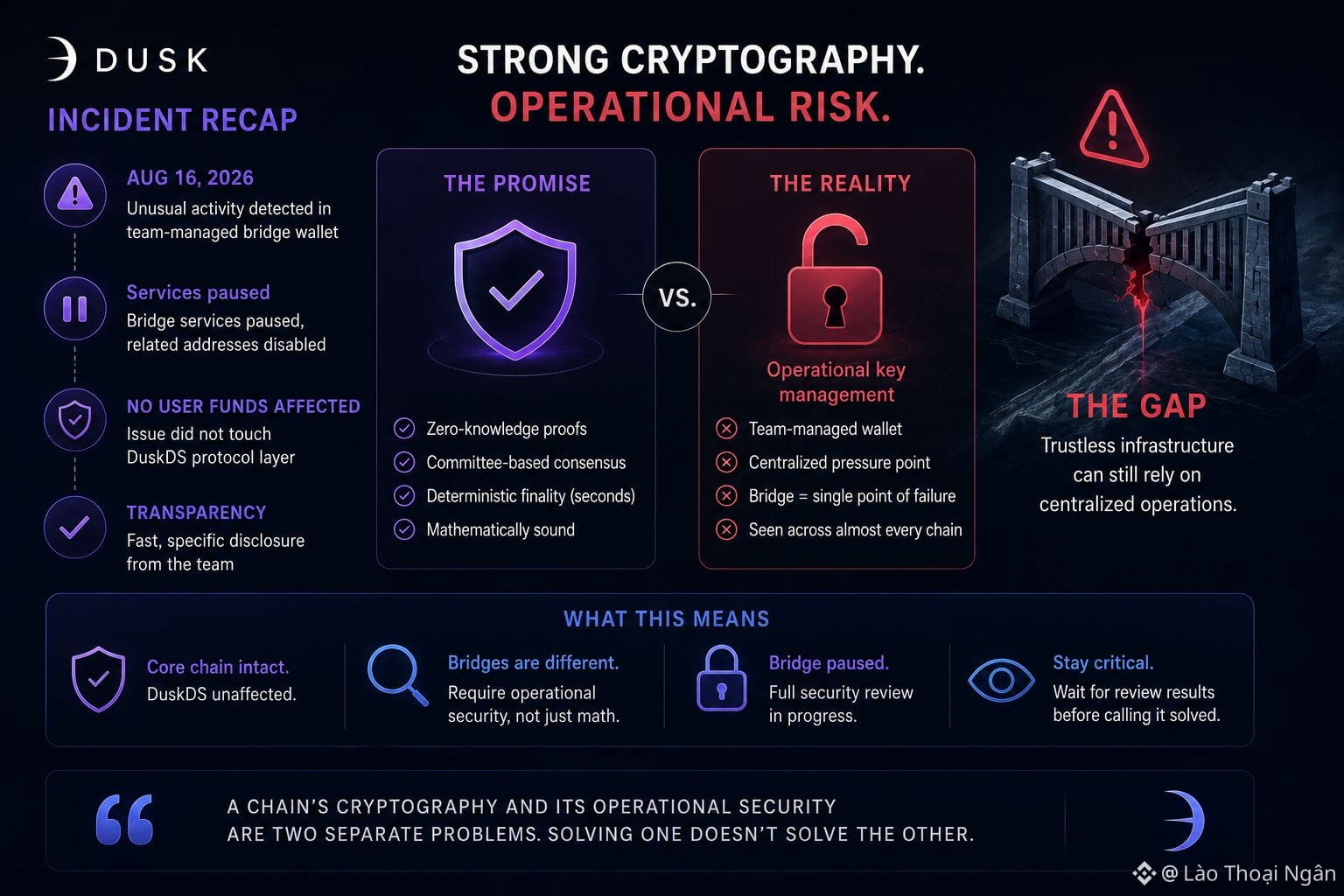
On August 16, 2026, Dusk's monitoring systems flagged unusual activity tied to a wallet the team itself manages for bridge operations. Within days the team disabled the related addresses, paused bridge services entirely, and published a notice saying no user funds were affected and the issue never touched the DuskDS protocol layer. I take that response seriously: honest, fast, and specific.
But I keep sitting with one detail: the point of failure was a team-managed wallet, not a smart contract bug or a consensus flaw. Dusk's entire pitch rests on cryptographic guarantees, zero-knowledge proofs, committee-based consensus, deterministic finality in seconds. None of that protected the bridge, because the bridge's weak point was operational key management, the same category of risk that has drained bridges across almost every chain in crypto. Dusk pitches its own infrastructure as capable of eventually carrying native issuance workflows for regulated securities once institutions and venues have their own authorization and product setup ready. A protocol can be mathematically sound and still depend on people managing keys correctly every day.
This isn't a reason to write off Dusk's security model. The core chain stayed untouched, and the disclosure was better than what most projects offer after an incident like this. What it does show is a gap between the "trustless infrastructure" language in Dusk's marketing and the reality that bridges, custody and operational wallets remain centralized pressure points on nearly every network, Dusk included. Anyone treating Dusk's cryptography as a blanket guarantee of safety is ignoring where the actual incident happened. The bridge stays paused while the team runs a fuller security review, and I'd want to see the results of that review before treating the bridge as solved rather than patched. A chain's cryptography and its operational security are two separate problems, and this incident is a reminder that solving one doesn't solve the other.
@Dusk_Foundation #dusk $DUSK
{spot}(DUSKUSDT)
On August 16, 2026, Dusk's monitoring systems flagged unusual activity tied to a wallet the team itself manages for bridge operations. Within days the team disabled the related addresses, paused bridge services entirely, and published a notice saying no user funds were affected and the issue never touched the DuskDS protocol layer. I take that response seriously: honest, fast, and specific.
But I keep sitting with one detail: the point of failure was a team-managed wallet, not a smart contract bug or a consensus flaw. Dusk's entire pitch rests on cryptographic guarantees, zero-knowledge proofs, committee-based consensus, deterministic finality in seconds. None of that protected the bridge, because the bridge's weak point was operational key management, the same category of risk that has drained bridges across almost every chain in crypto. Dusk pitches its own infrastructure as capable of eventually carrying native issuance workflows for regulated securities once institutions and venues have their own authorization and product setup ready. A protocol can be mathematically sound and still depend on people managing keys correctly every day.
This isn't a reason to write off Dusk's security model. The core chain stayed untouched, and the disclosure was better than what most projects offer after an incident like this. What it does show is a gap between the "trustless infrastructure" language in Dusk's marketing and the reality that bridges, custody and operational wallets remain centralized pressure points on nearly every network, Dusk included. Anyone treating Dusk's cryptography as a blanket guarantee of safety is ignoring where the actual incident happened. The bridge stays paused while the team runs a fuller security review, and I'd want to see the results of that review before treating the bridge as solved rather than patched. A chain's cryptography and its operational security are two separate problems, and this incident is a reminder that solving one doesn't solve the other.
@Dusk #dusk $DUSK
But I keep sitting with one detail: the point of failure was a team-managed wallet, not a smart contract bug or a consensus flaw. Dusk's entire pitch rests on cryptographic guarantees, zero-knowledge proofs, committee-based consensus, deterministic finality in seconds. None of that protected the bridge, because the bridge's weak point was operational key management, the same category of risk that has drained bridges across almost every chain in crypto. Dusk pitches its own infrastructure as capable of eventually carrying native issuance workflows for regulated securities once institutions and venues have their own authorization and product setup ready. A protocol can be mathematically sound and still depend on people managing keys correctly every day.
This isn't a reason to write off Dusk's security model. The core chain stayed untouched, and the disclosure was better than what most projects offer after an incident like this. What it does show is a gap between the "trustless infrastructure" language in Dusk's marketing and the reality that bridges, custody and operational wallets remain centralized pressure points on nearly every network, Dusk included. Anyone treating Dusk's cryptography as a blanket guarantee of safety is ignoring where the actual incident happened. The bridge stays paused while the team runs a fuller security review, and I'd want to see the results of that review before treating the bridge as solved rather than patched. A chain's cryptography and its operational security are two separate problems, and this incident is a reminder that solving one doesn't solve the other.
@Dusk #dusk $DUSK
1
88
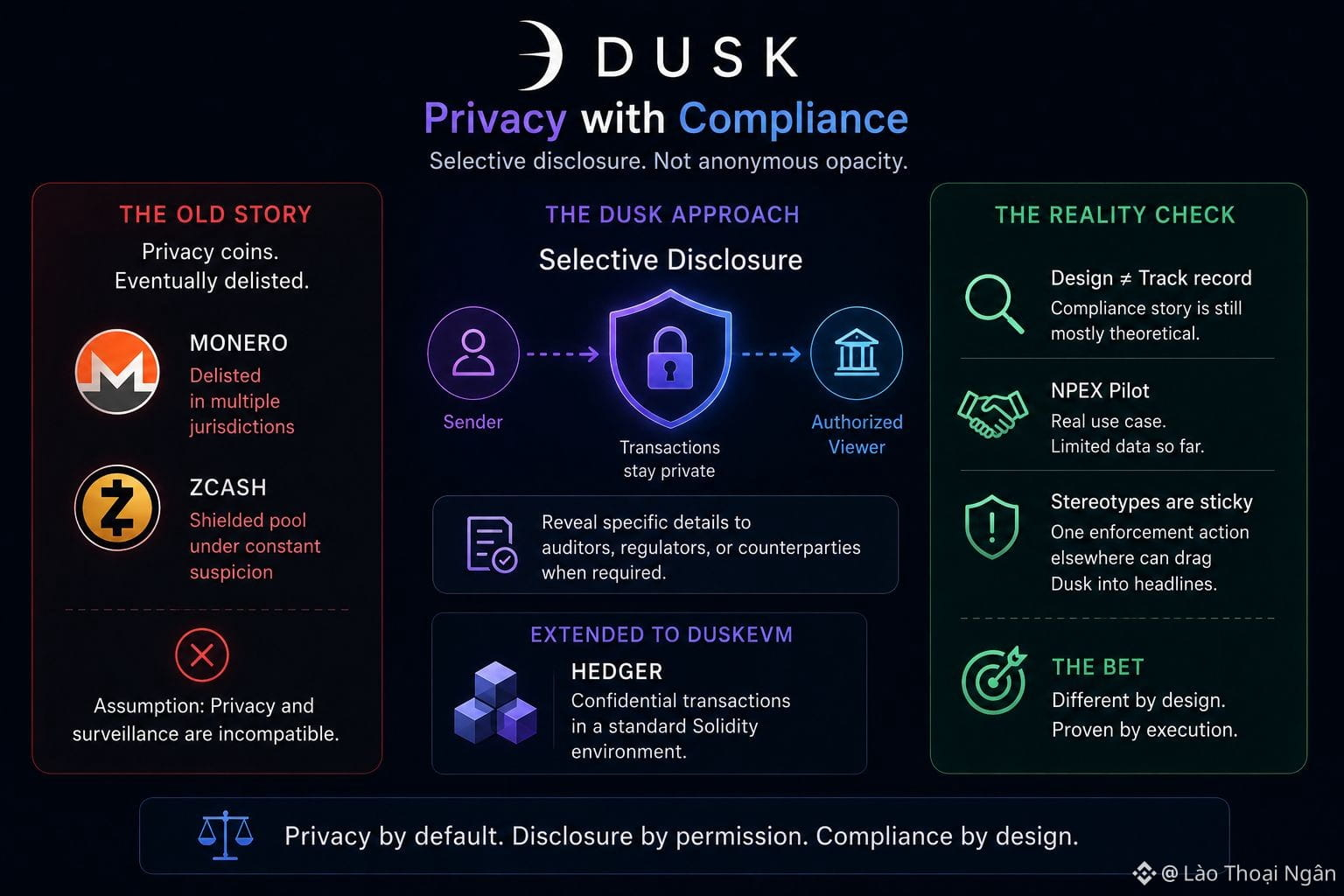
Mention privacy coins to anyone who has watched a few exchange cycles and you get the same reflex reaction: eventually they get delisted. Monero has been pulled from major platforms in more than one jurisdiction. Zcash has spent years defending its shielded pool against the same suspicion. The assumption baked into that reflex is that privacy and financial surveillance requirements are simply incompatible, full stop. Dusk Network exists specifically to test whether that assumption is actually true or just a stereotype built from projects that never tried to solve the compliance side.
Dusk's answer is selective disclosure. Transactions stay hidden from the public ledger by default, but the protocol allows a sender to reveal specific details to an authorized viewer, whether that is an auditor, a regulator, or a counterparty who needs proof for their own compliance file. On paper this is a meaningfully different design than the all or nothing anonymity of earlier privacy coins, and it targets exactly the objection that got those coins pulled from exchange after exchange. That same disclosure logic is set to extend into DuskEVM too, where a tool called Hedger is meant to carry confidential transaction workflows into an otherwise ordinary Solidity environment.
I want to be honest about the limits here too. A design that can satisfy regulators is not the same as a track record of satisfying regulators, and Dusk's compliance story is still mostly theoretical outside its NPEX pilot. Stereotypes are sticky, and it would only take one enforcement action against an unrelated privacy project to drag Dusk into headlines by association. The technology looks genuinely differentiated to me. Whether the market and regulators end up treating it that way is a separate question, one Dusk has not fully answered yet.
@Dusk_Foundation #dusk $DUSK
Mention privacy coins to anyone who has watched a few exchange cycles and you get the same reflex reaction: eventually they get delisted. Monero has been pulled from major platforms in more than one jurisdiction. Zcash has spent years defending its shielded pool against the same suspicion. The assumption baked into that reflex is that privacy and financial surveillance requirements are simply incompatible, full stop. Dusk Network exists specifically to test whether that assumption is actually true or just a stereotype built from projects that never tried to solve the compliance side.
Dusk's answer is selective disclosure. Transactions stay hidden from the public ledger by default, but the protocol allows a sender to reveal specific details to an authorized viewer, whether that is an auditor, a regulator, or a counterparty who needs proof for their own compliance file. On paper this is a meaningfully different design than the all or nothing anonymity of earlier privacy coins, and it targets exactly the objection that got those coins pulled from exchange after exchange. That same disclosure logic is set to extend into DuskEVM too, where a tool called Hedger is meant to carry confidential transaction workflows into an otherwise ordinary Solidity environment.
I want to be honest about the limits here too. A design that can satisfy regulators is not the same as a track record of satisfying regulators, and Dusk's compliance story is still mostly theoretical outside its NPEX pilot. Stereotypes are sticky, and it would only take one enforcement action against an unrelated privacy project to drag Dusk into headlines by association. The technology looks genuinely differentiated to me. Whether the market and regulators end up treating it that way is a separate question, one Dusk has not fully answered yet.
@Dusk #dusk $DUSK
Dusk's answer is selective disclosure. Transactions stay hidden from the public ledger by default, but the protocol allows a sender to reveal specific details to an authorized viewer, whether that is an auditor, a regulator, or a counterparty who needs proof for their own compliance file. On paper this is a meaningfully different design than the all or nothing anonymity of earlier privacy coins, and it targets exactly the objection that got those coins pulled from exchange after exchange. That same disclosure logic is set to extend into DuskEVM too, where a tool called Hedger is meant to carry confidential transaction workflows into an otherwise ordinary Solidity environment.
I want to be honest about the limits here too. A design that can satisfy regulators is not the same as a track record of satisfying regulators, and Dusk's compliance story is still mostly theoretical outside its NPEX pilot. Stereotypes are sticky, and it would only take one enforcement action against an unrelated privacy project to drag Dusk into headlines by association. The technology looks genuinely differentiated to me. Whether the market and regulators end up treating it that way is a separate question, one Dusk has not fully answered yet.
@Dusk #dusk $DUSK
71
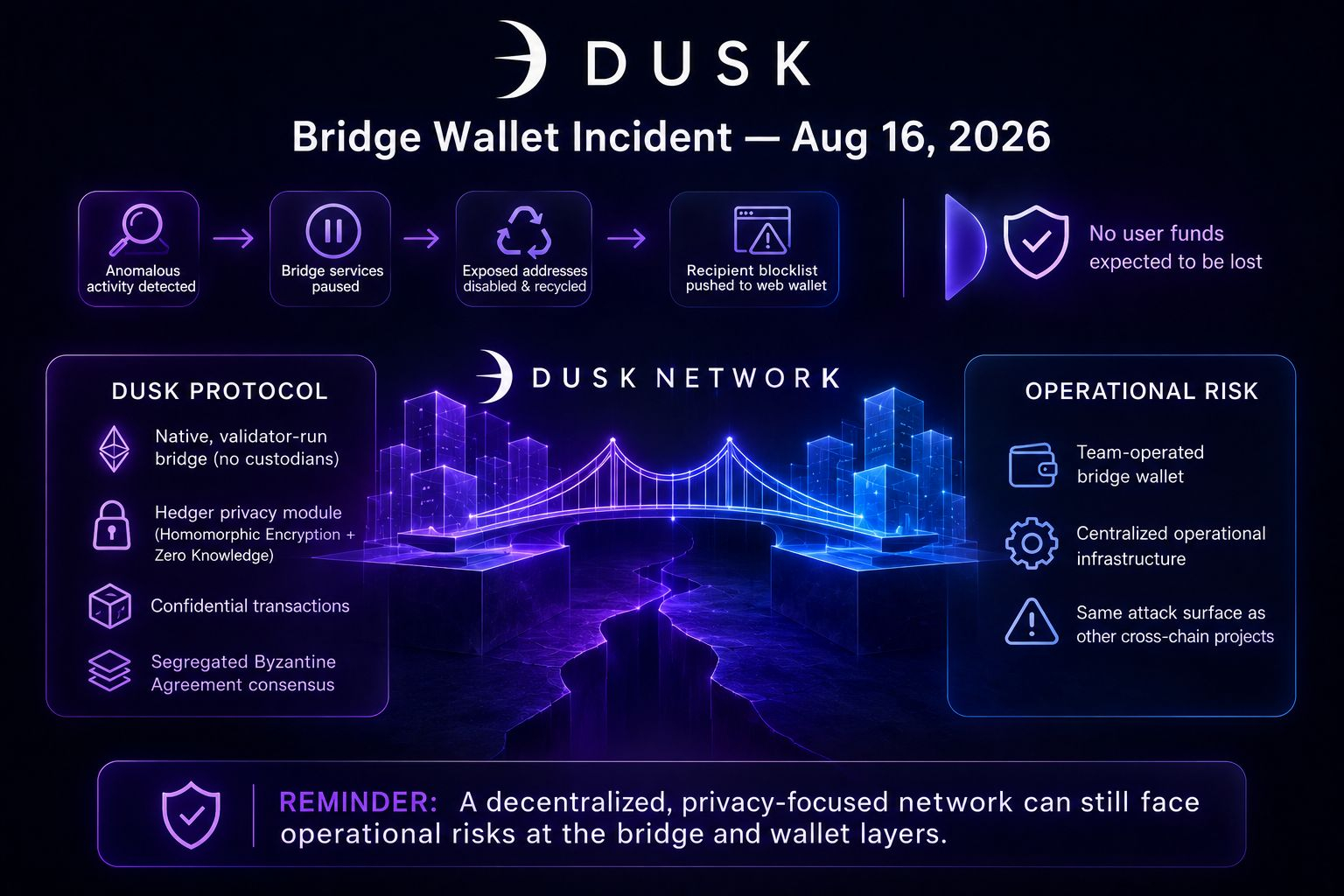
On August 16, 2026, Dusk Network's monitoring systems flagged unusual behavior tied to a wallet the team itself managed for bridge operations. Bridge services were paused, a batch of exposed addresses were disabled and recycled, and a recipient blocklist was pushed to the web wallet so it can now warn users before a transfer reaches a known dangerous or flagged destination. The team says a small number of transactions occurred during the window, coordinated quickly with Binance once part of the flow touched the exchange, and that no user funds are expected to be lost. I have no reason to doubt that account, and DuskDS itself was not affected at the protocol level.
Here is the part worth sitting with. Dusk Network's entire pitch rests on words like trustless and decentralized, and its own documentation describes the newer DuskEVM bridge as native, validator run, requiring no external custodians. That newer bridge sits underneath the coming DuskEVM mainnet, the same layer meant to eventually carry confidential transactions through Hedger, its privacy module built on homomorphic encryption and zero knowledge proofs. The August incident did not happen there. It happened in an older, team operated wallet used for cross chain bridge operations, the kind of operational infrastructure that exists alongside the protocol rather than inside its consensus rules. That distinction is real, but it is also the exact seam where centralized risk tends to live in projects that otherwise market themselves on decentralization.
I do not think this incident undermines Phoenix's security proofs or the Segregated Byzantine Agreement consensus underneath the chain. But it is a clean reminder that a privacy focused, compliance oriented network still carries the same operational attack surface as any project moving assets across chains, and that surface deserves scrutiny independent of how airtight the cryptography is.
@Dusk_Foundation #dusk $DUSK
On August 16, 2026, Dusk Network's monitoring systems flagged unusual behavior tied to a wallet the team itself managed for bridge operations. Bridge services were paused, a batch of exposed addresses were disabled and recycled, and a recipient blocklist was pushed to the web wallet so it can now warn users before a transfer reaches a known dangerous or flagged destination. The team says a small number of transactions occurred during the window, coordinated quickly with Binance once part of the flow touched the exchange, and that no user funds are expected to be lost. I have no reason to doubt that account, and DuskDS itself was not affected at the protocol level.
Here is the part worth sitting with. Dusk Network's entire pitch rests on words like trustless and decentralized, and its own documentation describes the newer DuskEVM bridge as native, validator run, requiring no external custodians. That newer bridge sits underneath the coming DuskEVM mainnet, the same layer meant to eventually carry confidential transactions through Hedger, its privacy module built on homomorphic encryption and zero knowledge proofs. The August incident did not happen there. It happened in an older, team operated wallet used for cross chain bridge operations, the kind of operational infrastructure that exists alongside the protocol rather than inside its consensus rules. That distinction is real, but it is also the exact seam where centralized risk tends to live in projects that otherwise market themselves on decentralization.
I do not think this incident undermines Phoenix's security proofs or the Segregated Byzantine Agreement consensus underneath the chain. But it is a clean reminder that a privacy focused, compliance oriented network still carries the same operational attack surface as any project moving assets across chains, and that surface deserves scrutiny independent of how airtight the cryptography is.
@Dusk #dusk $DUSK
Here is the part worth sitting with. Dusk Network's entire pitch rests on words like trustless and decentralized, and its own documentation describes the newer DuskEVM bridge as native, validator run, requiring no external custodians. That newer bridge sits underneath the coming DuskEVM mainnet, the same layer meant to eventually carry confidential transactions through Hedger, its privacy module built on homomorphic encryption and zero knowledge proofs. The August incident did not happen there. It happened in an older, team operated wallet used for cross chain bridge operations, the kind of operational infrastructure that exists alongside the protocol rather than inside its consensus rules. That distinction is real, but it is also the exact seam where centralized risk tends to live in projects that otherwise market themselves on decentralization.
I do not think this incident undermines Phoenix's security proofs or the Segregated Byzantine Agreement consensus underneath the chain. But it is a clean reminder that a privacy focused, compliance oriented network still carries the same operational attack surface as any project moving assets across chains, and that surface deserves scrutiny independent of how airtight the cryptography is.
@Dusk #dusk $DUSK
79
A broker that does not custody your assets in its own name sounds like a contradiction until you read what Dusk Trade is actually trying to do.
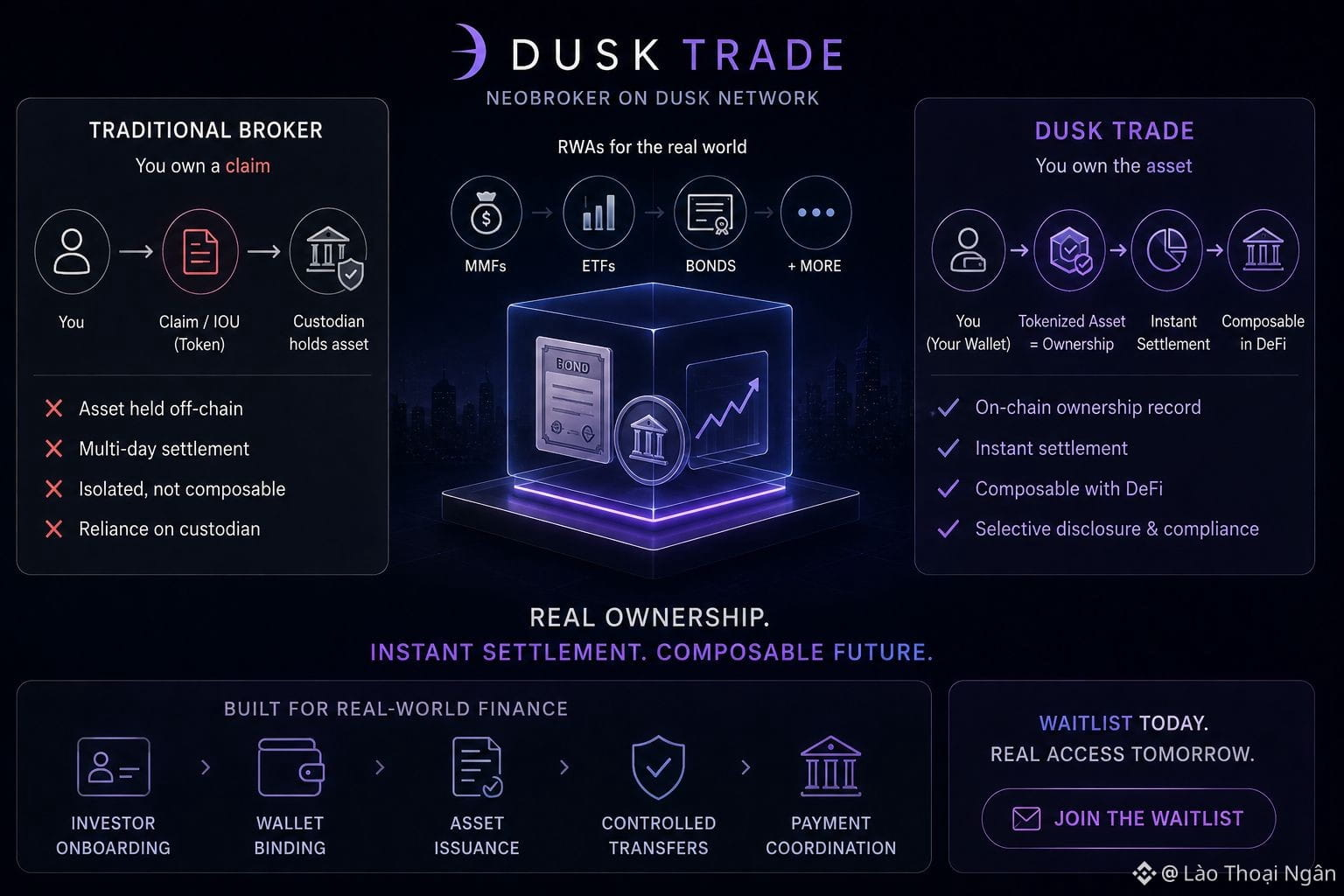
Dusk Trade is the neobroker Dusk is building on top of its own chain, aimed at bringing money market funds, ETFs, bonds, and other real world assets into wallets people actually control. The pitch is specific: real ownership instead of a claim on a claim, instant settlement instead of the multi day cycle traditional brokerages still run on, and composability with the rest of DeFi instead of an asset sitting frozen in a custodial account.
I want to sit with that middle word, ownership, for a second. A lot of tokenized RWA products on other chains are effectively receipts. You hold a token that represents a claim against a custodian holding the real asset somewhere else, and you are trusting that custodian's paperwork. Dusk's architecture, with selective disclosure and deterministic settlement built into the base layer, is trying to make the token itself the ownership record rather than a pointer to one held off chain. The workflow behind it is specific too, covering investor onboarding, wallet binding, controlled transfers, and payment coordination, not just a token contract dropped on top of an existing fund. Bonds and money market funds are not permissionless tokens. They carry conditions on who can hold them and how they can move, which is exactly what a broker layer is supposed to manage in the first place, onchain or off.
That is a meaningful difference on paper. Whether it holds up depends entirely on execution once real money moves through it. A waitlist and a set of design documents are not the same thing as a platform handling bond settlements at scale under real market stress. I am interested in Dusk Trade precisely because the ownership claim is unusual, not because the hard part is already finished.
Watch what happens after the waitlist opens into an actual product people are using.
@Dusk_Foundation $DUSK #dusk $BTW $TUT
A broker that does not custody your assets in its own name sounds like a contradiction until you read what Dusk Trade is actually trying to do.
Dusk Trade is the neobroker Dusk is building on top of its own chain, aimed at bringing money market funds, ETFs, bonds, and other real world assets into wallets people actually control. The pitch is specific: real ownership instead of a claim on a claim, instant settlement instead of the multi day cycle traditional brokerages still run on, and composability with the rest of DeFi instead of an asset sitting frozen in a custodial account.
I want to sit with that middle word, ownership, for a second. A lot of tokenized RWA products on other chains are effectively receipts. You hold a token that represents a claim against a custodian holding the real asset somewhere else, and you are trusting that custodian's paperwork. Dusk's architecture, with selective disclosure and deterministic settlement built into the base layer, is trying to make the token itself the ownership record rather than a pointer to one held off chain. The workflow behind it is specific too, covering investor onboarding, wallet binding, controlled transfers, and payment coordination, not just a token contract dropped on top of an existing fund. Bonds and money market funds are not permissionless tokens. They carry conditions on who can hold them and how they can move, which is exactly what a broker layer is supposed to manage in the first place, onchain or off.
That is a meaningful difference on paper. Whether it holds up depends entirely on execution once real money moves through it. A waitlist and a set of design documents are not the same thing as a platform handling bond settlements at scale under real market stress. I am interested in Dusk Trade precisely because the ownership claim is unusual, not because the hard part is already finished.
Watch what happens after the waitlist opens into an actual product people are using.
@Dusk $DUSK #dusk $BTW $TUT
Dusk Trade is the neobroker Dusk is building on top of its own chain, aimed at bringing money market funds, ETFs, bonds, and other real world assets into wallets people actually control. The pitch is specific: real ownership instead of a claim on a claim, instant settlement instead of the multi day cycle traditional brokerages still run on, and composability with the rest of DeFi instead of an asset sitting frozen in a custodial account.
I want to sit with that middle word, ownership, for a second. A lot of tokenized RWA products on other chains are effectively receipts. You hold a token that represents a claim against a custodian holding the real asset somewhere else, and you are trusting that custodian's paperwork. Dusk's architecture, with selective disclosure and deterministic settlement built into the base layer, is trying to make the token itself the ownership record rather than a pointer to one held off chain. The workflow behind it is specific too, covering investor onboarding, wallet binding, controlled transfers, and payment coordination, not just a token contract dropped on top of an existing fund. Bonds and money market funds are not permissionless tokens. They carry conditions on who can hold them and how they can move, which is exactly what a broker layer is supposed to manage in the first place, onchain or off.
That is a meaningful difference on paper. Whether it holds up depends entirely on execution once real money moves through it. A waitlist and a set of design documents are not the same thing as a platform handling bond settlements at scale under real market stress. I am interested in Dusk Trade precisely because the ownership claim is unusual, not because the hard part is already finished.
Watch what happens after the waitlist opens into an actual product people are using.
@Dusk $DUSK #dusk $BTW $TUT
84
Every cycle has a phrase people repeat until it loses meaning. Right now it's asset tokenization. Bonds, funds, private credit, all supposedly moving onchain in 2026. Most of that talk is still just talk.
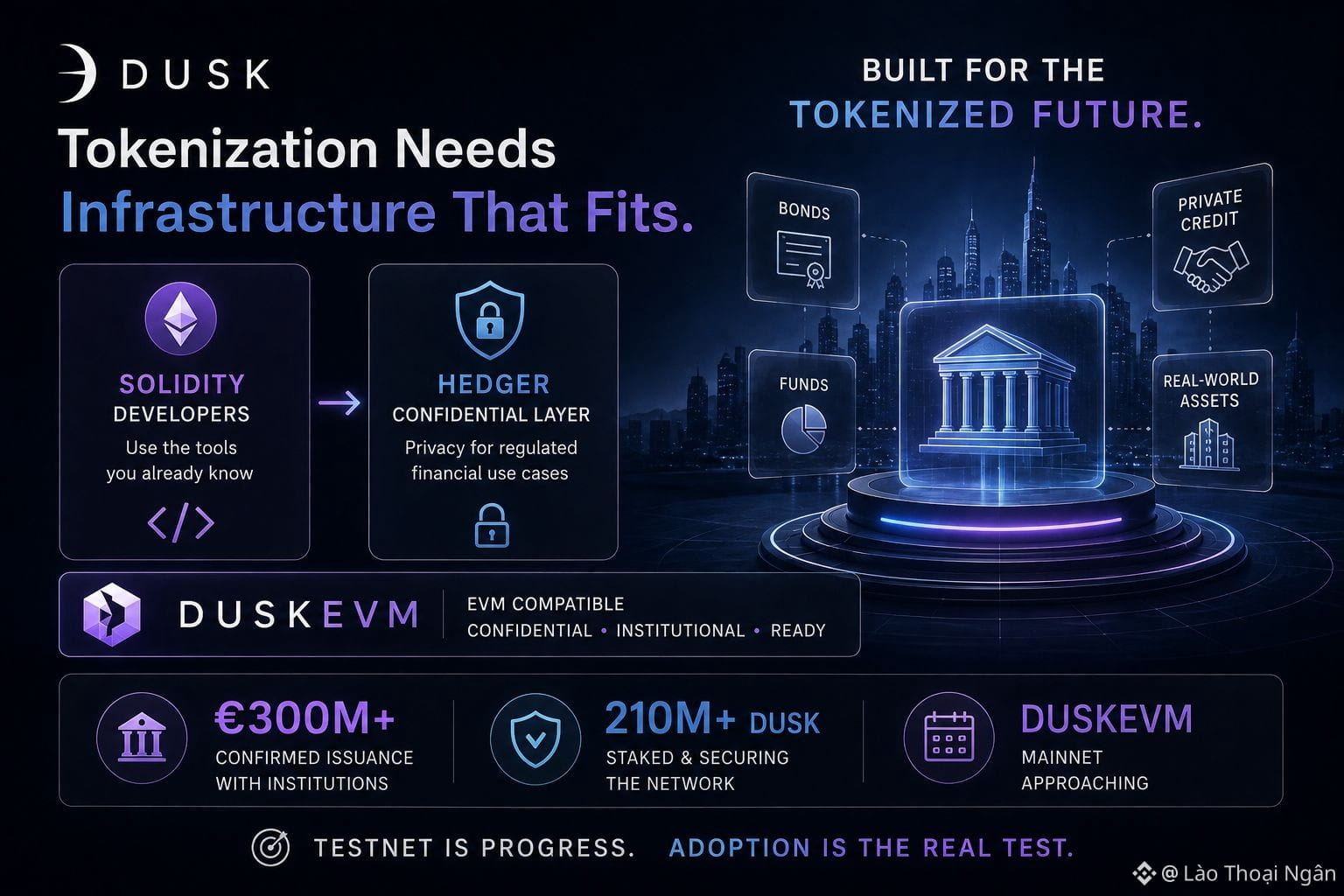
What makes Dusk Network worth watching inside that noise is timing. DuskEVM is approaching mainnet at almost exactly the moment institutional interest in tokenized assets stopped being theoretical. That isn't a coincidence, it's the plan. Solidity developers, the largest pool of smart contract builders anywhere, will be able to deploy on Dusk using tools they already have, while gaining access to Hedger, the project's confidential transaction layer built specifically for regulated financial use cases.
That combination solves a specific problem. Ethereum's tooling ecosystem is enormous. Its privacy story, for anything institutions actually want to put real assets on, is thin. Dusk is trying to borrow the first and fix the second, rather than asking builders to abandon everything they know for a niche privacy chain with a small developer base.
Dusk isn't relying purely on promises to make that case either. The network already carries more than 300 million euros in confirmed issuance with institutional partners, alongside upward of 210 million DUSK staked securing the chain itself. Numbers like that don't prove DuskEVM's mainnet will land smoothly, but they do suggest the institutional appetite this timing depends on is already showing up, not just being promised in a roadmap.
I want to be careful here though. A mainnet approaching is not a mainnet delivering results. Plenty of infrastructure projects have hit this exact moment, tooling ready, timing right, and then struggled to pull real applications and real liquidity onto the chain once it actually launched. Dusk still has to prove that part. Testnet activity and audited code are necessary. They aren't the same as builders shipping products people use.
@Dusk_Foundation $DUSK #dusk $BTW $TRUMP
Every cycle has a phrase people repeat until it loses meaning. Right now it's asset tokenization. Bonds, funds, private credit, all supposedly moving onchain in 2026. Most of that talk is still just talk.
What makes Dusk Network worth watching inside that noise is timing. DuskEVM is approaching mainnet at almost exactly the moment institutional interest in tokenized assets stopped being theoretical. That isn't a coincidence, it's the plan. Solidity developers, the largest pool of smart contract builders anywhere, will be able to deploy on Dusk using tools they already have, while gaining access to Hedger, the project's confidential transaction layer built specifically for regulated financial use cases.
That combination solves a specific problem. Ethereum's tooling ecosystem is enormous. Its privacy story, for anything institutions actually want to put real assets on, is thin. Dusk is trying to borrow the first and fix the second, rather than asking builders to abandon everything they know for a niche privacy chain with a small developer base.
Dusk isn't relying purely on promises to make that case either. The network already carries more than 300 million euros in confirmed issuance with institutional partners, alongside upward of 210 million DUSK staked securing the chain itself. Numbers like that don't prove DuskEVM's mainnet will land smoothly, but they do suggest the institutional appetite this timing depends on is already showing up, not just being promised in a roadmap.
I want to be careful here though. A mainnet approaching is not a mainnet delivering results. Plenty of infrastructure projects have hit this exact moment, tooling ready, timing right, and then struggled to pull real applications and real liquidity onto the chain once it actually launched. Dusk still has to prove that part. Testnet activity and audited code are necessary. They aren't the same as builders shipping products people use.
@Dusk $DUSK #dusk $BTW $TRUMP
What makes Dusk Network worth watching inside that noise is timing. DuskEVM is approaching mainnet at almost exactly the moment institutional interest in tokenized assets stopped being theoretical. That isn't a coincidence, it's the plan. Solidity developers, the largest pool of smart contract builders anywhere, will be able to deploy on Dusk using tools they already have, while gaining access to Hedger, the project's confidential transaction layer built specifically for regulated financial use cases.
That combination solves a specific problem. Ethereum's tooling ecosystem is enormous. Its privacy story, for anything institutions actually want to put real assets on, is thin. Dusk is trying to borrow the first and fix the second, rather than asking builders to abandon everything they know for a niche privacy chain with a small developer base.
Dusk isn't relying purely on promises to make that case either. The network already carries more than 300 million euros in confirmed issuance with institutional partners, alongside upward of 210 million DUSK staked securing the chain itself. Numbers like that don't prove DuskEVM's mainnet will land smoothly, but they do suggest the institutional appetite this timing depends on is already showing up, not just being promised in a roadmap.
I want to be careful here though. A mainnet approaching is not a mainnet delivering results. Plenty of infrastructure projects have hit this exact moment, tooling ready, timing right, and then struggled to pull real applications and real liquidity onto the chain once it actually launched. Dusk still has to prove that part. Testnet activity and audited code are necessary. They aren't the same as builders shipping products people use.
@Dusk $DUSK #dusk $BTW $TRUMP
71
Privacy or transparency. Most blockchains force a choice at the protocol level and lock you into it. Dusk Network refused that trade-off, building two transaction models into the base layer, one of the more practical decisions I've seen in this space.
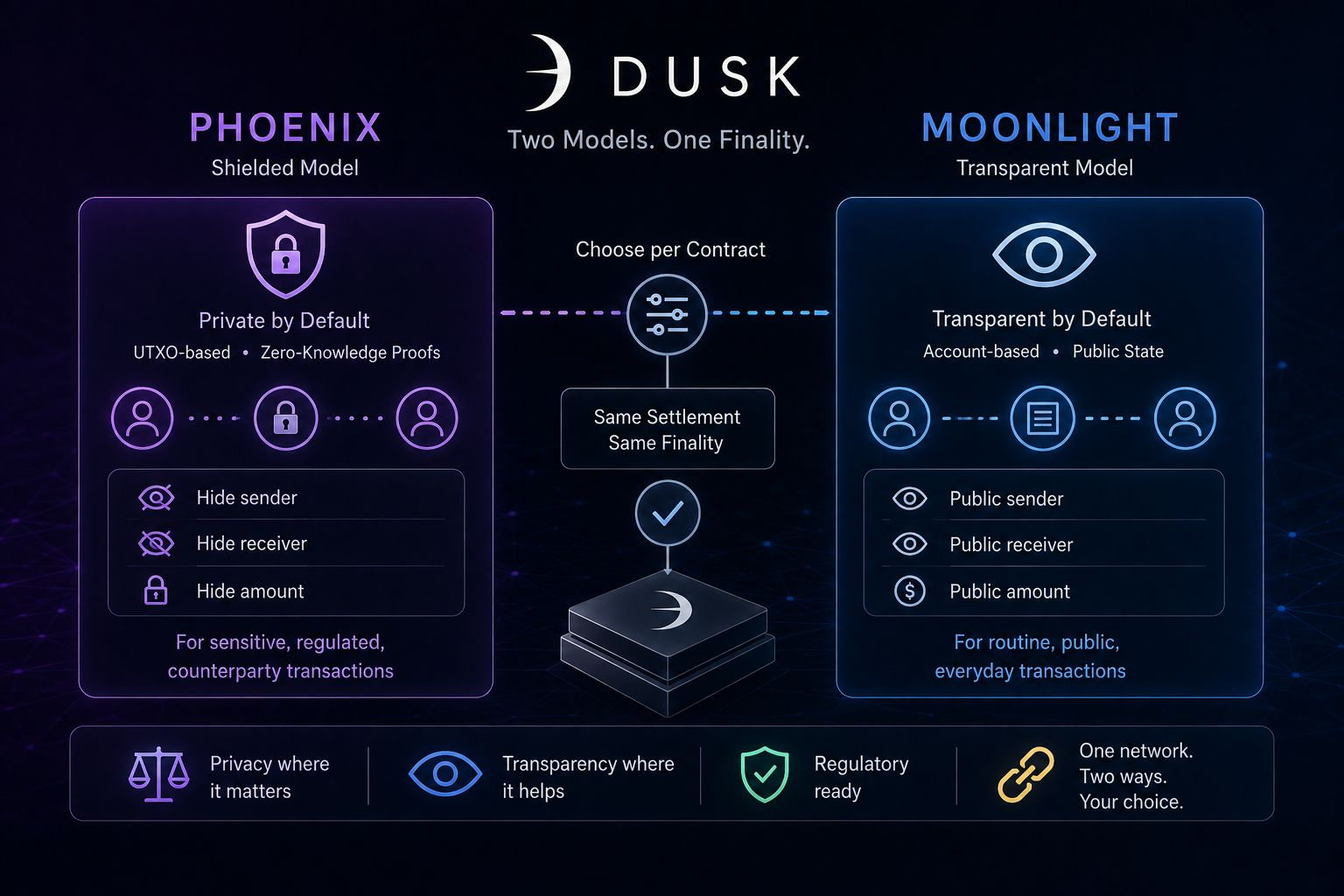
Phoenix is the shielded model, UTXO-based, using zero-knowledge proofs to hide sender, receiver, and amount, the model you'd reach for settling a security transaction where counterparties have no business seeing each other's positions. Moonlight is the other half, a transparent, account-based model closer to what Ethereum developers expect: public balances, straightforward state reads, no proof generation overhead per transfer.
Why does Dusk Network bother with both? Because not every transaction on a financial network needs the same confidentiality profile. A DAO paying a public grant doesn't need shielding. A bond issuer settling with an institutional buyer might legally require it. Forcing one model onto every use case either overexposes sensitive trades or adds needless friction to routine ones. Letting developers choose per contract is a more honest answer to how real financial infrastructure actually works, and it's really the whole system in miniature: stay private where privacy is the point, go transparent where it isn't, and settle either path with the same finality.
I'll raise the obvious tension, though. Optionality is powerful for developers and confusing for everyone else. If a wallet interface doesn't make clear which model a transaction uses, users can assume privacy they don't have, or pay proof-generation costs they didn't need. Dusk Network's documentation is candid about the split, which I respect, but documentation isn't a foolproof user experience.
The dual-model approach is the right call for a chain built on regulated finance. Whether Dusk Network's tooling makes that choice legible to non-technical users is still being built, and I'd rather say that plainly than pretend it's fully solved.
@Dusk_Foundation #dusk $DUSK $BTW $ONG
Privacy or transparency. Most blockchains force a choice at the protocol level and lock you into it. Dusk Network refused that trade-off, building two transaction models into the base layer, one of the more practical decisions I've seen in this space.
Phoenix is the shielded model, UTXO-based, using zero-knowledge proofs to hide sender, receiver, and amount, the model you'd reach for settling a security transaction where counterparties have no business seeing each other's positions. Moonlight is the other half, a transparent, account-based model closer to what Ethereum developers expect: public balances, straightforward state reads, no proof generation overhead per transfer.
Why does Dusk Network bother with both? Because not every transaction on a financial network needs the same confidentiality profile. A DAO paying a public grant doesn't need shielding. A bond issuer settling with an institutional buyer might legally require it. Forcing one model onto every use case either overexposes sensitive trades or adds needless friction to routine ones. Letting developers choose per contract is a more honest answer to how real financial infrastructure actually works, and it's really the whole system in miniature: stay private where privacy is the point, go transparent where it isn't, and settle either path with the same finality.
I'll raise the obvious tension, though. Optionality is powerful for developers and confusing for everyone else. If a wallet interface doesn't make clear which model a transaction uses, users can assume privacy they don't have, or pay proof-generation costs they didn't need. Dusk Network's documentation is candid about the split, which I respect, but documentation isn't a foolproof user experience.
The dual-model approach is the right call for a chain built on regulated finance. Whether Dusk Network's tooling makes that choice legible to non-technical users is still being built, and I'd rather say that plainly than pretend it's fully solved.
@Dusk #dusk $DUSK $BTW $ONG
Phoenix is the shielded model, UTXO-based, using zero-knowledge proofs to hide sender, receiver, and amount, the model you'd reach for settling a security transaction where counterparties have no business seeing each other's positions. Moonlight is the other half, a transparent, account-based model closer to what Ethereum developers expect: public balances, straightforward state reads, no proof generation overhead per transfer.
Why does Dusk Network bother with both? Because not every transaction on a financial network needs the same confidentiality profile. A DAO paying a public grant doesn't need shielding. A bond issuer settling with an institutional buyer might legally require it. Forcing one model onto every use case either overexposes sensitive trades or adds needless friction to routine ones. Letting developers choose per contract is a more honest answer to how real financial infrastructure actually works, and it's really the whole system in miniature: stay private where privacy is the point, go transparent where it isn't, and settle either path with the same finality.
I'll raise the obvious tension, though. Optionality is powerful for developers and confusing for everyone else. If a wallet interface doesn't make clear which model a transaction uses, users can assume privacy they don't have, or pay proof-generation costs they didn't need. Dusk Network's documentation is candid about the split, which I respect, but documentation isn't a foolproof user experience.
The dual-model approach is the right call for a chain built on regulated finance. Whether Dusk Network's tooling makes that choice legible to non-technical users is still being built, and I'd rather say that plainly than pretend it's fully solved.
@Dusk #dusk $DUSK $BTW $ONG
60
TermMax went from launching on 2 chains to 3, then reported deployments across 7 chains, while its current V2 interface now surfaces roughly 11 networks.
That is a meaningful expansion in where TermMax can operate. But it does not tell me that liquidity expanded at the same rate.
A new network can add another place for TermMax fixed-rate borrowing and lending markets to exist. What it does not show is whether that network develops enough capital on both sides of the market to become economically relevant.
That distinction matters more as the footprint gets wider.
If most usable liquidity remains concentrated on a few established chains, then adding another network increases access without necessarily distributing the market itself.
What I don't know yet is whether TermMax's newer deployments are gradually taking a larger share of activity and liquidity, or whether the protocol is becoming more multichain mainly at the deployment layer.
Total TVL would not resolve that for me. It could rise while the same two or three networks continue to hold most of the usable depth.
A stronger signal would be the distribution underneath that total: how much lending and borrowing liquidity sits on each network, how concentrated it remains in the largest chains, and whether newer deployments retain activity across multiple maturity cycles.
That would tell me whether TermMax is only widening the number of places where a market can be launched, or actually widening where its markets become economically useful.
So I would judge the next stage of TermMax's multichain expansion less by another chain appearing in the interface and more by whether liquidity concentration starts to fall as the footprint grows.
The bigger question is whether TermMax can turn broader network availability into broader market depth.
I am watching per-chain liquidity share, concentration in the top networks, and whether newer chains keep meaningful activity after their initial launch period.
@termmax #TermMax $BTW $ONG
TermMax went from launching on 2 chains to 3, then reported deployments across 7 chains, while its current V2 interface now surfaces roughly 11 networks.
That is a meaningful expansion in where TermMax can operate. But it does not tell me that liquidity expanded at the same rate.
A new network can add another place for TermMax fixed-rate borrowing and lending markets to exist. What it does not show is whether that network develops enough capital on both sides of the market to become economically relevant.
That distinction matters more as the footprint gets wider.
If most usable liquidity remains concentrated on a few established chains, then adding another network increases access without necessarily distributing the market itself.
What I don't know yet is whether TermMax's newer deployments are gradually taking a larger share of activity and liquidity, or whether the protocol is becoming more multichain mainly at the deployment layer.
Total TVL would not resolve that for me. It could rise while the same two or three networks continue to hold most of the usable depth.
A stronger signal would be the distribution underneath that total: how much lending and borrowing liquidity sits on each network, how concentrated it remains in the largest chains, and whether newer deployments retain activity across multiple maturity cycles.
That would tell me whether TermMax is only widening the number of places where a market can be launched, or actually widening where its markets become economically useful.
So I would judge the next stage of TermMax's multichain expansion less by another chain appearing in the interface and more by whether liquidity concentration starts to fall as the footprint grows.
The bigger question is whether TermMax can turn broader network availability into broader market depth.
I am watching per-chain liquidity share, concentration in the top networks, and whether newer chains keep meaningful activity after their initial launch period.
@TermMax #TermMax $BTW $ONG
That is a meaningful expansion in where TermMax can operate. But it does not tell me that liquidity expanded at the same rate.
A new network can add another place for TermMax fixed-rate borrowing and lending markets to exist. What it does not show is whether that network develops enough capital on both sides of the market to become economically relevant.
That distinction matters more as the footprint gets wider.
If most usable liquidity remains concentrated on a few established chains, then adding another network increases access without necessarily distributing the market itself.
What I don't know yet is whether TermMax's newer deployments are gradually taking a larger share of activity and liquidity, or whether the protocol is becoming more multichain mainly at the deployment layer.
Total TVL would not resolve that for me. It could rise while the same two or three networks continue to hold most of the usable depth.
A stronger signal would be the distribution underneath that total: how much lending and borrowing liquidity sits on each network, how concentrated it remains in the largest chains, and whether newer deployments retain activity across multiple maturity cycles.
That would tell me whether TermMax is only widening the number of places where a market can be launched, or actually widening where its markets become economically useful.
So I would judge the next stage of TermMax's multichain expansion less by another chain appearing in the interface and more by whether liquidity concentration starts to fall as the footprint grows.
The bigger question is whether TermMax can turn broader network availability into broader market depth.
I am watching per-chain liquidity share, concentration in the top networks, and whether newer chains keep meaningful activity after their initial launch period.
@TermMax #TermMax $BTW $ONG
467
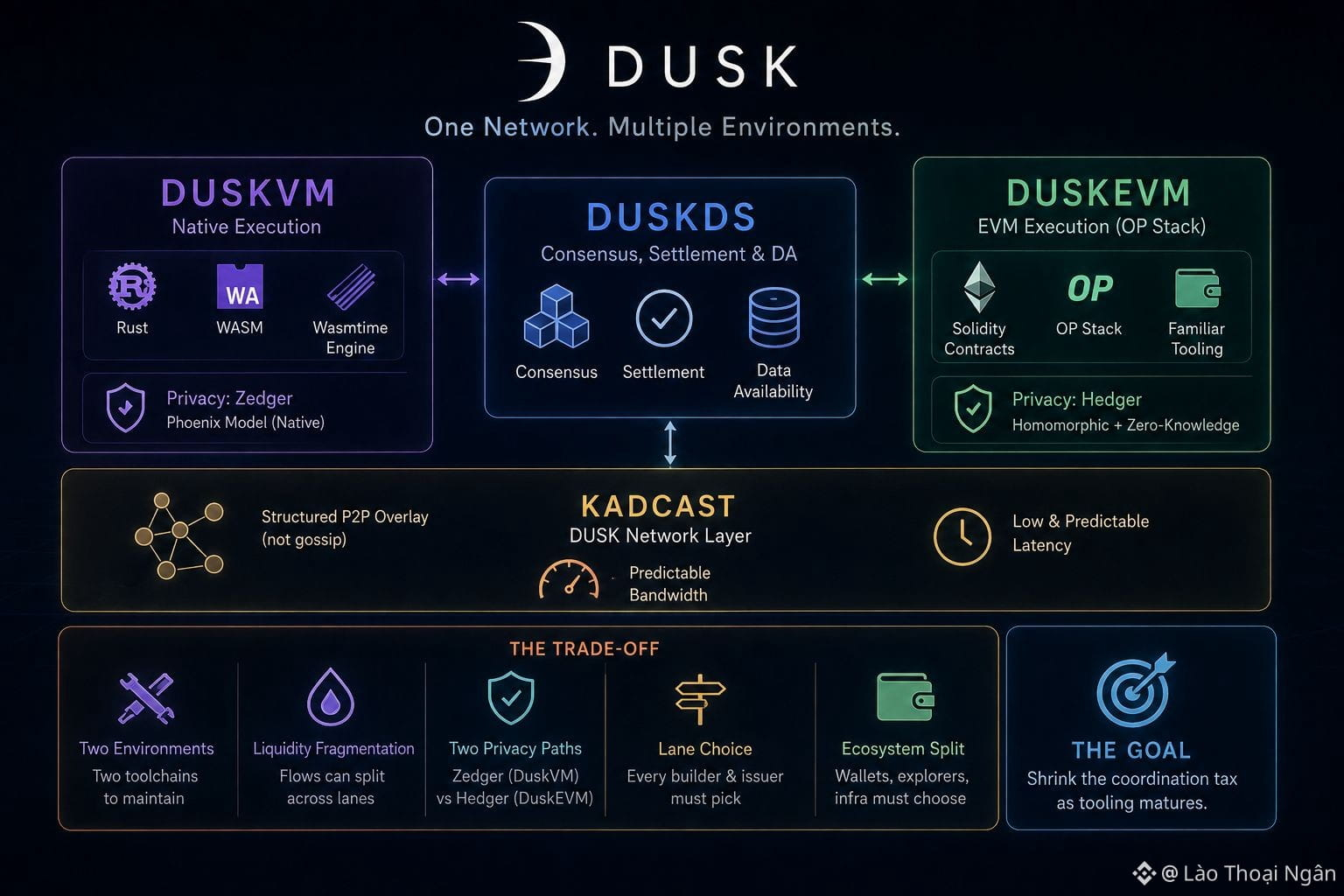
Modular is one of the most comfortable words in this industry, and Dusk Network uses it a lot. DuskDS handles consensus, settlement, and data availability. DuskVM runs Rust and WASM contracts directly on the base layer through a Wasmtime engine. DuskEVM is a separate OP Stack execution environment where Solidity contracts settle back through DuskDS, with DUSK as the gas token. On paper this sounds like the best of both worlds, a native environment for teams wanting direct access to Dusk's privacy primitives, and a familiar EVM environment for everyone else.
I want to sit with the trade off for a second instead of repeating the pitch. Two execution environments mean two sets of tooling, two places liquidity can pool separately, and two different privacy paths, Zedger on DuskVM and Hedger on DuskEVM, built on different cryptographic approaches. A builder choosing DuskEVM for familiarity gets Solidity support, but reaches for Hedger's homomorphic encryption and zero knowledge combination rather than the native Phoenix model most of the deep privacy literature on Dusk describes.
None of this makes the architecture wrong. Separating settlement from execution is a defensible bet, and plenty of chains split state across rollups for similar reasons. But calling it purely additive undersells the cost. Every issuer now has to pick a lane, and every wallet or explorer built by the community has to decide which side, or both, it supports.
Underneath both environments sits Kadcast, Dusk Network's own peer to peer layer, a structured overlay instead of the gossip based propagation most chains default to, built specifically to keep bandwidth and latency predictable as the network grows. That shared piece is the strongest argument this is one coordinated system, not two chains wearing the same name. Still, a shared network layer does not merge two developer ecosystems by itself. Modularity is a real decision with a real coordination tax attached, not a free upgrade.
@Dusk_Foundation #dusk $DUSK $BTW $ACE
Modular is one of the most comfortable words in this industry, and Dusk Network uses it a lot. DuskDS handles consensus, settlement, and data availability. DuskVM runs Rust and WASM contracts directly on the base layer through a Wasmtime engine. DuskEVM is a separate OP Stack execution environment where Solidity contracts settle back through DuskDS, with DUSK as the gas token. On paper this sounds like the best of both worlds, a native environment for teams wanting direct access to Dusk's privacy primitives, and a familiar EVM environment for everyone else.
I want to sit with the trade off for a second instead of repeating the pitch. Two execution environments mean two sets of tooling, two places liquidity can pool separately, and two different privacy paths, Zedger on DuskVM and Hedger on DuskEVM, built on different cryptographic approaches. A builder choosing DuskEVM for familiarity gets Solidity support, but reaches for Hedger's homomorphic encryption and zero knowledge combination rather than the native Phoenix model most of the deep privacy literature on Dusk describes.
None of this makes the architecture wrong. Separating settlement from execution is a defensible bet, and plenty of chains split state across rollups for similar reasons. But calling it purely additive undersells the cost. Every issuer now has to pick a lane, and every wallet or explorer built by the community has to decide which side, or both, it supports.
Underneath both environments sits Kadcast, Dusk Network's own peer to peer layer, a structured overlay instead of the gossip based propagation most chains default to, built specifically to keep bandwidth and latency predictable as the network grows. That shared piece is the strongest argument this is one coordinated system, not two chains wearing the same name. Still, a shared network layer does not merge two developer ecosystems by itself. Modularity is a real decision with a real coordination tax attached, not a free upgrade.
@Dusk #dusk $DUSK $BTW $ACE
I want to sit with the trade off for a second instead of repeating the pitch. Two execution environments mean two sets of tooling, two places liquidity can pool separately, and two different privacy paths, Zedger on DuskVM and Hedger on DuskEVM, built on different cryptographic approaches. A builder choosing DuskEVM for familiarity gets Solidity support, but reaches for Hedger's homomorphic encryption and zero knowledge combination rather than the native Phoenix model most of the deep privacy literature on Dusk describes.
None of this makes the architecture wrong. Separating settlement from execution is a defensible bet, and plenty of chains split state across rollups for similar reasons. But calling it purely additive undersells the cost. Every issuer now has to pick a lane, and every wallet or explorer built by the community has to decide which side, or both, it supports.
Underneath both environments sits Kadcast, Dusk Network's own peer to peer layer, a structured overlay instead of the gossip based propagation most chains default to, built specifically to keep bandwidth and latency predictable as the network grows. That shared piece is the strongest argument this is one coordinated system, not two chains wearing the same name. Still, a shared network layer does not merge two developer ecosystems by itself. Modularity is a real decision with a real coordination tax attached, not a free upgrade.
@Dusk #dusk $DUSK $BTW $ACE
44
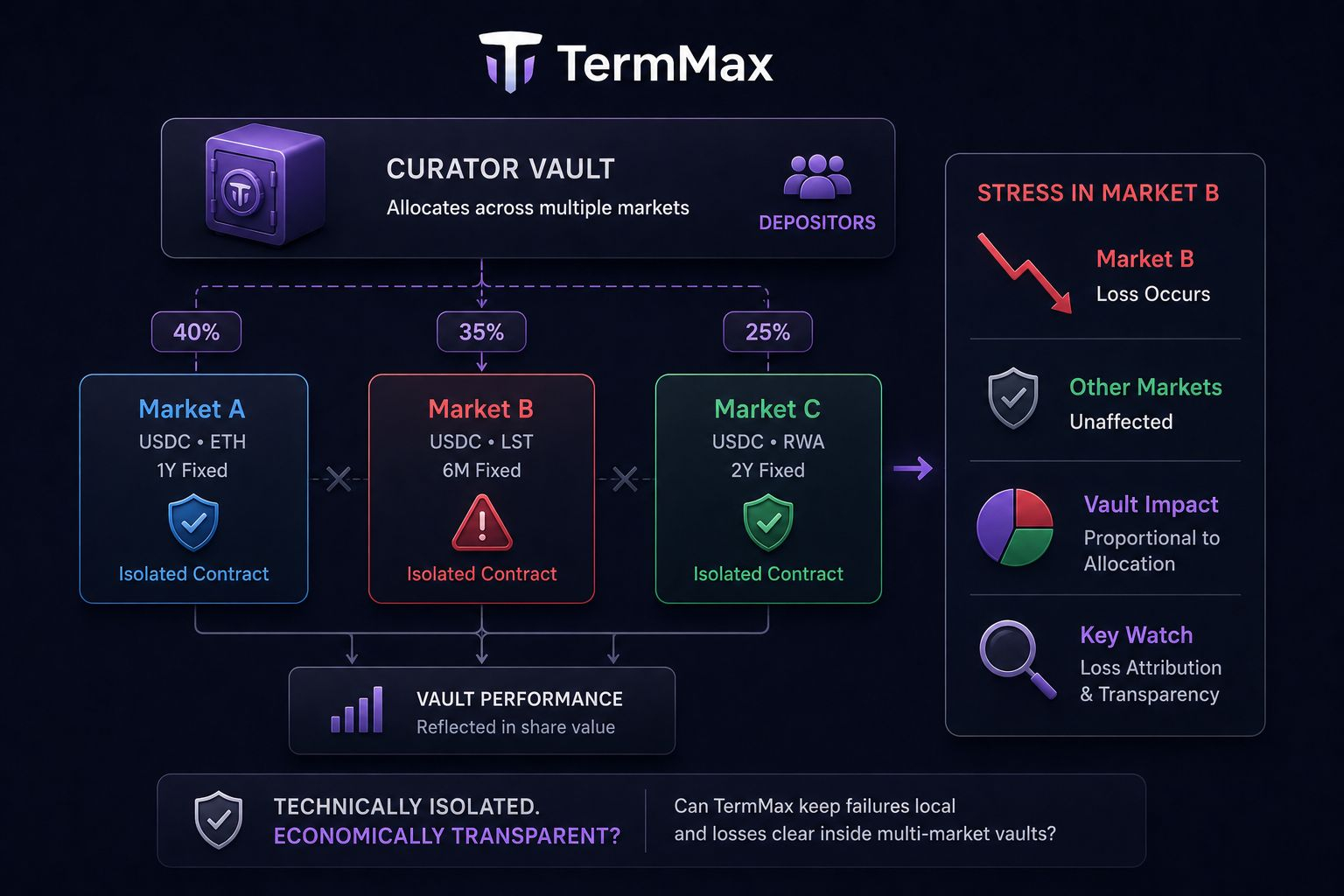
One thing that keeps standing out to me in TermMax, a decentralized fixed-rate borrowing and lending protocol, is how its security model isolates individual markets.
Each TermMax market runs through its own contract. If something goes wrong in one market, the idea is to keep that problem from automatically spreading into the contracts behind other markets.
That is a meaningful boundary, especially when different collateral, debt assets and maturities can carry very different risk profiles.
But users do not always take exposure to those markets one at a time.
A TermMax curator vault can sit above several whitelisted markets that share the same debt token and allocate depositor capital across them. So the markets can remain technically isolated from one another while their gains and losses still feed into the same vault position.
If one underlying market is stressed, the other market contracts do not need to fail for the vault depositor to take a hit.
What I don't know yet is whether that loss stays cleanly attributable to the market that caused it, or whether the way the vault manages positions can make the economic boundary harder to trace from the depositor's side.
That is where the stronger evidence would be.
If a multi-market vault can show that losses remain transparent and broadly proportional to the capital allocated to the stressed market, then TermMax has preserved a meaningful economic boundary even though the vault spans several isolated markets.
I'd learn more from clear market-by-market loss attribution under stress than from the isolation architecture alone.
The question is whether TermMax can keep failures technically local while also keeping depositor losses economically clear and bounded inside multi-market vaults.
I am watching vault-level loss attribution, allocation weights and how single-market stress shows up in vault share value next.
@termmax #TermMax $BTW $ACE $PORTAL
One thing that keeps standing out to me in TermMax, a decentralized fixed-rate borrowing and lending protocol, is how its security model isolates individual markets.
Each TermMax market runs through its own contract. If something goes wrong in one market, the idea is to keep that problem from automatically spreading into the contracts behind other markets.
That is a meaningful boundary, especially when different collateral, debt assets and maturities can carry very different risk profiles.
But users do not always take exposure to those markets one at a time.
A TermMax curator vault can sit above several whitelisted markets that share the same debt token and allocate depositor capital across them. So the markets can remain technically isolated from one another while their gains and losses still feed into the same vault position.
If one underlying market is stressed, the other market contracts do not need to fail for the vault depositor to take a hit.
What I don't know yet is whether that loss stays cleanly attributable to the market that caused it, or whether the way the vault manages positions can make the economic boundary harder to trace from the depositor's side.
That is where the stronger evidence would be.
If a multi-market vault can show that losses remain transparent and broadly proportional to the capital allocated to the stressed market, then TermMax has preserved a meaningful economic boundary even though the vault spans several isolated markets.
I'd learn more from clear market-by-market loss attribution under stress than from the isolation architecture alone.
The question is whether TermMax can keep failures technically local while also keeping depositor losses economically clear and bounded inside multi-market vaults.
I am watching vault-level loss attribution, allocation weights and how single-market stress shows up in vault share value next.
@TermMax #TermMax $BTW $ACE $PORTAL
Each TermMax market runs through its own contract. If something goes wrong in one market, the idea is to keep that problem from automatically spreading into the contracts behind other markets.
That is a meaningful boundary, especially when different collateral, debt assets and maturities can carry very different risk profiles.
But users do not always take exposure to those markets one at a time.
A TermMax curator vault can sit above several whitelisted markets that share the same debt token and allocate depositor capital across them. So the markets can remain technically isolated from one another while their gains and losses still feed into the same vault position.
If one underlying market is stressed, the other market contracts do not need to fail for the vault depositor to take a hit.
What I don't know yet is whether that loss stays cleanly attributable to the market that caused it, or whether the way the vault manages positions can make the economic boundary harder to trace from the depositor's side.
That is where the stronger evidence would be.
If a multi-market vault can show that losses remain transparent and broadly proportional to the capital allocated to the stressed market, then TermMax has preserved a meaningful economic boundary even though the vault spans several isolated markets.
I'd learn more from clear market-by-market loss attribution under stress than from the isolation architecture alone.
The question is whether TermMax can keep failures technically local while also keeping depositor losses economically clear and bounded inside multi-market vaults.
I am watching vault-level loss attribution, allocation weights and how single-market stress shows up in vault share value next.
@TermMax #TermMax $BTW $ACE $PORTAL
560
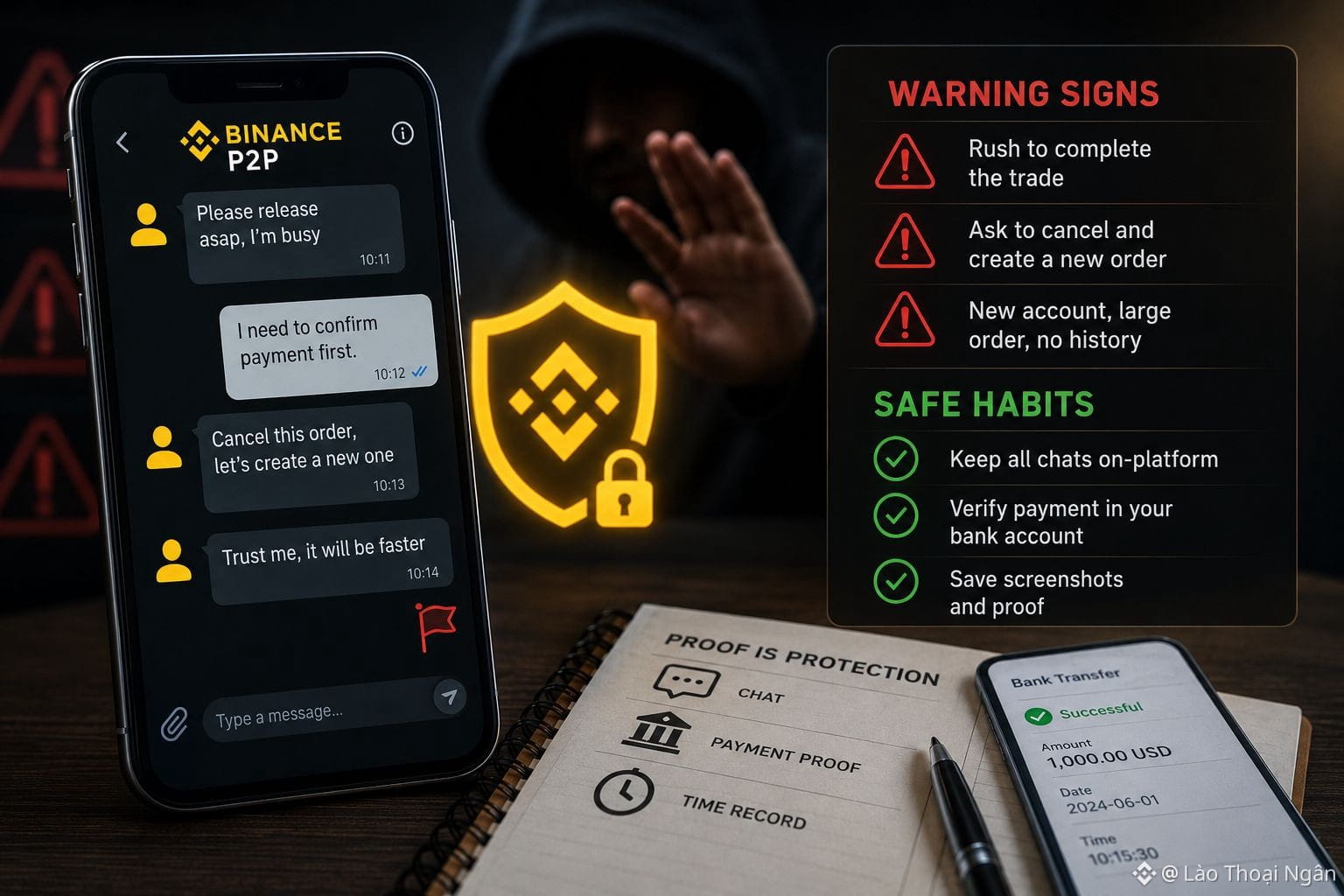
Có những dấu hiệu cảnh báo mà tôi chỉ nhận ra sau khi đã va vấp vài lần khi giao dịch trên Binance P2P. Một trong số đó là khi đối tác liên tục hối thúc tôi hoàn tất giao dịch thật nhanh, viện lý do bận việc hoặc sắp hết thời gian, ngay cả khi thời gian giữ lệnh vẫn còn khá dài.
Dấu hiệu thứ hai là khi người mua đề nghị tôi hủy lệnh hiện tại để tạo lệnh mới với số tiền khác, thường kèm lý do như nhập sai số hoặc đổi ý về số lượng. Đây là chiêu trò khiến người bán mất cảnh giác, bởi lệnh mới có thể không còn được bảo vệ bởi ký quỹ như lệnh ban đầu nếu thực hiện sai quy trình.
Dấu hiệu thứ ba, và có lẽ phổ biến nhất, là những tài khoản mới tạo, chưa có lịch sử giao dịch nhưng lại đặt lệnh với số tiền rất lớn ngay từ đầu. Tôi không nói mọi tài khoản mới đều đáng ngờ, nhưng kết hợp với hành vi hối thúc, đây là tổ hợp cần hết sức thận trọng.
Từ những lần va chạm đó, tôi hình thành thói quen lưu lại mọi thứ liên quan đến giao dịch trên Binance P2P: chụp màn hình cuộc trò chuyện, lưu ảnh sao kê ngân hàng thể hiện số tiền và thời gian giao dịch, thậm chí ghi chú lại thời điểm tôi nhấn xác nhận hoặc release. Có một lần nhờ những ảnh chụp này mà tôi giải quyết tranh chấp với đội ngũ hỗ trợ chỉ trong vài giờ, thay vì mất nhiều ngày tranh cãi mà không có bằng chứng cụ thể.
Với tôi, sự cẩn trọng không phải vì thiếu tin tưởng vào Binance P2P, mà vì tôi hiểu bằng chứng luôn là thứ bảo vệ mình tốt nhất trong mọi tình huống.
@Binance_Vietnam #BinanceP2PAnToan $BTW $ACE $PORTAL
Có những dấu hiệu cảnh báo mà tôi chỉ nhận ra sau khi đã va vấp vài lần khi giao dịch trên Binance P2P. Một trong số đó là khi đối tác liên tục hối thúc tôi hoàn tất giao dịch thật nhanh, viện lý do bận việc hoặc sắp hết thời gian, ngay cả khi thời gian giữ lệnh vẫn còn khá dài.
Dấu hiệu thứ hai là khi người mua đề nghị tôi hủy lệnh hiện tại để tạo lệnh mới với số tiền khác, thường kèm lý do như nhập sai số hoặc đổi ý về số lượng. Đây là chiêu trò khiến người bán mất cảnh giác, bởi lệnh mới có thể không còn được bảo vệ bởi ký quỹ như lệnh ban đầu nếu thực hiện sai quy trình.
Dấu hiệu thứ ba, và có lẽ phổ biến nhất, là những tài khoản mới tạo, chưa có lịch sử giao dịch nhưng lại đặt lệnh với số tiền rất lớn ngay từ đầu. Tôi không nói mọi tài khoản mới đều đáng ngờ, nhưng kết hợp với hành vi hối thúc, đây là tổ hợp cần hết sức thận trọng.
Từ những lần va chạm đó, tôi hình thành thói quen lưu lại mọi thứ liên quan đến giao dịch trên Binance P2P: chụp màn hình cuộc trò chuyện, lưu ảnh sao kê ngân hàng thể hiện số tiền và thời gian giao dịch, thậm chí ghi chú lại thời điểm tôi nhấn xác nhận hoặc release. Có một lần nhờ những ảnh chụp này mà tôi giải quyết tranh chấp với đội ngũ hỗ trợ chỉ trong vài giờ, thay vì mất nhiều ngày tranh cãi mà không có bằng chứng cụ thể.
Với tôi, sự cẩn trọng không phải vì thiếu tin tưởng vào Binance P2P, mà vì tôi hiểu bằng chứng luôn là thứ bảo vệ mình tốt nhất trong mọi tình huống.
@Binance Vietnam #BinanceP2PAnToan $BTW $ACE $PORTAL
Dấu hiệu thứ hai là khi người mua đề nghị tôi hủy lệnh hiện tại để tạo lệnh mới với số tiền khác, thường kèm lý do như nhập sai số hoặc đổi ý về số lượng. Đây là chiêu trò khiến người bán mất cảnh giác, bởi lệnh mới có thể không còn được bảo vệ bởi ký quỹ như lệnh ban đầu nếu thực hiện sai quy trình.
Dấu hiệu thứ ba, và có lẽ phổ biến nhất, là những tài khoản mới tạo, chưa có lịch sử giao dịch nhưng lại đặt lệnh với số tiền rất lớn ngay từ đầu. Tôi không nói mọi tài khoản mới đều đáng ngờ, nhưng kết hợp với hành vi hối thúc, đây là tổ hợp cần hết sức thận trọng.
Từ những lần va chạm đó, tôi hình thành thói quen lưu lại mọi thứ liên quan đến giao dịch trên Binance P2P: chụp màn hình cuộc trò chuyện, lưu ảnh sao kê ngân hàng thể hiện số tiền và thời gian giao dịch, thậm chí ghi chú lại thời điểm tôi nhấn xác nhận hoặc release. Có một lần nhờ những ảnh chụp này mà tôi giải quyết tranh chấp với đội ngũ hỗ trợ chỉ trong vài giờ, thay vì mất nhiều ngày tranh cãi mà không có bằng chứng cụ thể.
Với tôi, sự cẩn trọng không phải vì thiếu tin tưởng vào Binance P2P, mà vì tôi hiểu bằng chứng luôn là thứ bảo vệ mình tốt nhất trong mọi tình huống.
@Binance Vietnam #BinanceP2PAnToan $BTW $ACE $PORTAL
426
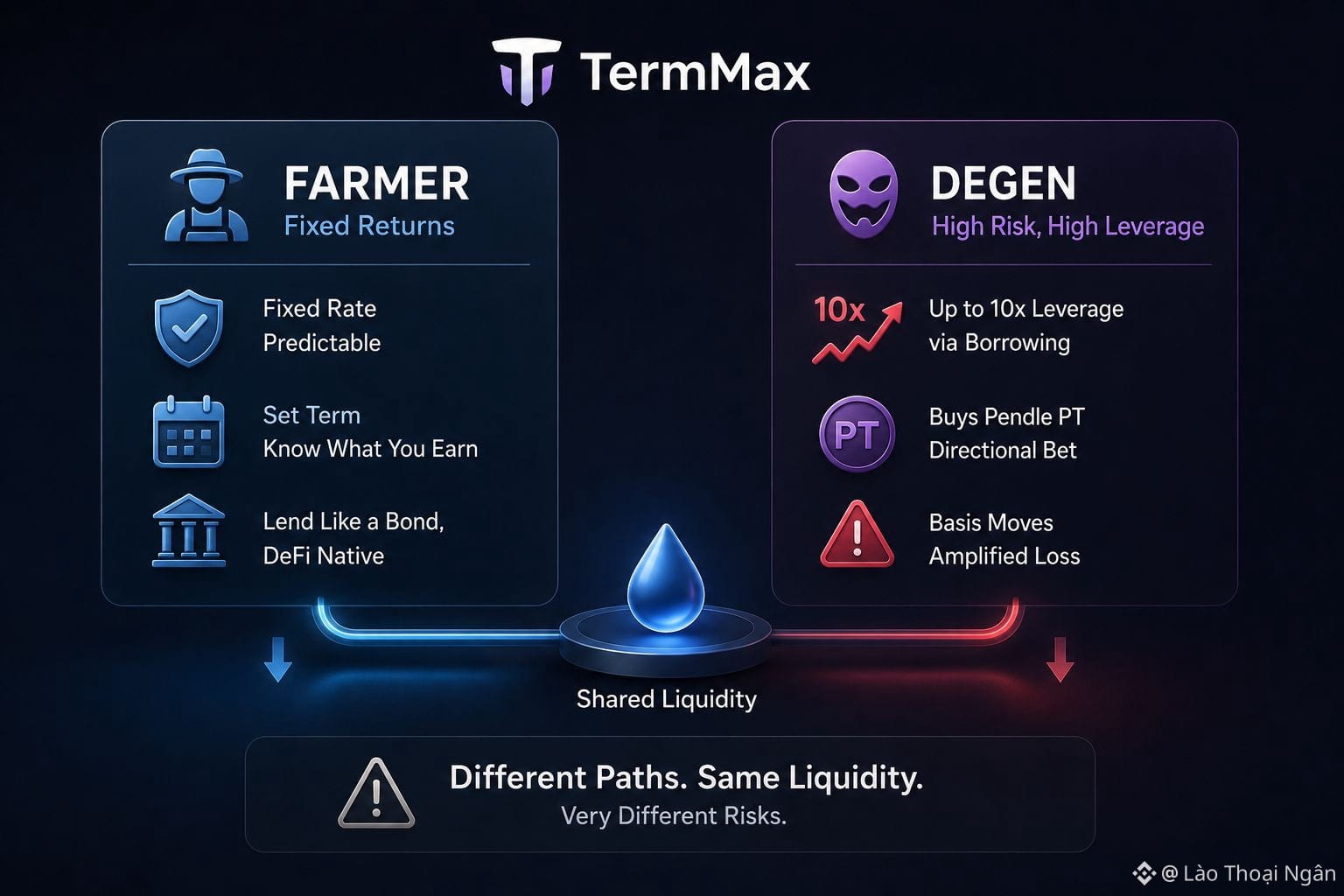
Read TermMax's own framing and you'll find three types of users described right in the documentation: Degens, Farmers, and LPs. That's an honest label, and I respect the honesty, but it also exposes a gap I keep coming back to. TermMax markets its fixed-rate architecture as the antidote to DeFi's floating-rate chaos, a place where lenders finally get the predictability of a bond instead of a number that resets with every block. That's the Farmer pitch, and it's a good one.
Then there's the Degen vault. A depositor puts in capital, the vault borrows nine times that amount from LP liquidity at a fixed rate, and the combined position buys Pendle Principal Tokens for roughly 10x leverage on the underlying yield spread. That's not a bond. That's a leveraged directional bet with a fixed financing cost, closer in spirit to a margin trade than to a term deposit, and TermMax builds it into the same platform that pitches "predictable returns for lenders" front and center.
It's also worth asking who actually reads the fine print before depositing. A Farmer chasing a fixed 6% doesn't necessarily open the same page as a Degen chasing 10x, yet both deposits ultimately draw from and feed back into the same underlying liquidity, which means the calm product and the loud product are more connected under the hood than the separate branding on the homepage might suggest to a first-time visitor.
Neither product is wrong to offer. But the branding sits closer to fixed income than the full product range actually is, and a new user scanning "fixed-rate DeFi" might not immediately clock that one path on TermMax carries default risk multiplied tenfold if the PT basis moves against the position. I'd want TermMax to draw a brighter line between the Farmer product and the Degen product in its own marketing, because right now the calm framing up front covers a much louder mechanism underneath, and two very different audiences reading that same homepage are taking on very different risk without equal warning.
@termmax #TermMax $BTW $PORTAL $HEMI
Read TermMax's own framing and you'll find three types of users described right in the documentation: Degens, Farmers, and LPs. That's an honest label, and I respect the honesty, but it also exposes a gap I keep coming back to. TermMax markets its fixed-rate architecture as the antidote to DeFi's floating-rate chaos, a place where lenders finally get the predictability of a bond instead of a number that resets with every block. That's the Farmer pitch, and it's a good one.
Then there's the Degen vault. A depositor puts in capital, the vault borrows nine times that amount from LP liquidity at a fixed rate, and the combined position buys Pendle Principal Tokens for roughly 10x leverage on the underlying yield spread. That's not a bond. That's a leveraged directional bet with a fixed financing cost, closer in spirit to a margin trade than to a term deposit, and TermMax builds it into the same platform that pitches "predictable returns for lenders" front and center.
It's also worth asking who actually reads the fine print before depositing. A Farmer chasing a fixed 6% doesn't necessarily open the same page as a Degen chasing 10x, yet both deposits ultimately draw from and feed back into the same underlying liquidity, which means the calm product and the loud product are more connected under the hood than the separate branding on the homepage might suggest to a first-time visitor.
Neither product is wrong to offer. But the branding sits closer to fixed income than the full product range actually is, and a new user scanning "fixed-rate DeFi" might not immediately clock that one path on TermMax carries default risk multiplied tenfold if the PT basis moves against the position. I'd want TermMax to draw a brighter line between the Farmer product and the Degen product in its own marketing, because right now the calm framing up front covers a much louder mechanism underneath, and two very different audiences reading that same homepage are taking on very different risk without equal warning.
@TermMax #TermMax $BTW $PORTAL $HEMI
Then there's the Degen vault. A depositor puts in capital, the vault borrows nine times that amount from LP liquidity at a fixed rate, and the combined position buys Pendle Principal Tokens for roughly 10x leverage on the underlying yield spread. That's not a bond. That's a leveraged directional bet with a fixed financing cost, closer in spirit to a margin trade than to a term deposit, and TermMax builds it into the same platform that pitches "predictable returns for lenders" front and center.
It's also worth asking who actually reads the fine print before depositing. A Farmer chasing a fixed 6% doesn't necessarily open the same page as a Degen chasing 10x, yet both deposits ultimately draw from and feed back into the same underlying liquidity, which means the calm product and the loud product are more connected under the hood than the separate branding on the homepage might suggest to a first-time visitor.
Neither product is wrong to offer. But the branding sits closer to fixed income than the full product range actually is, and a new user scanning "fixed-rate DeFi" might not immediately clock that one path on TermMax carries default risk multiplied tenfold if the PT basis moves against the position. I'd want TermMax to draw a brighter line between the Farmer product and the Degen product in its own marketing, because right now the calm framing up front covers a much louder mechanism underneath, and two very different audiences reading that same homepage are taking on very different risk without equal warning.
@TermMax #TermMax $BTW $PORTAL $HEMI
1
1
316
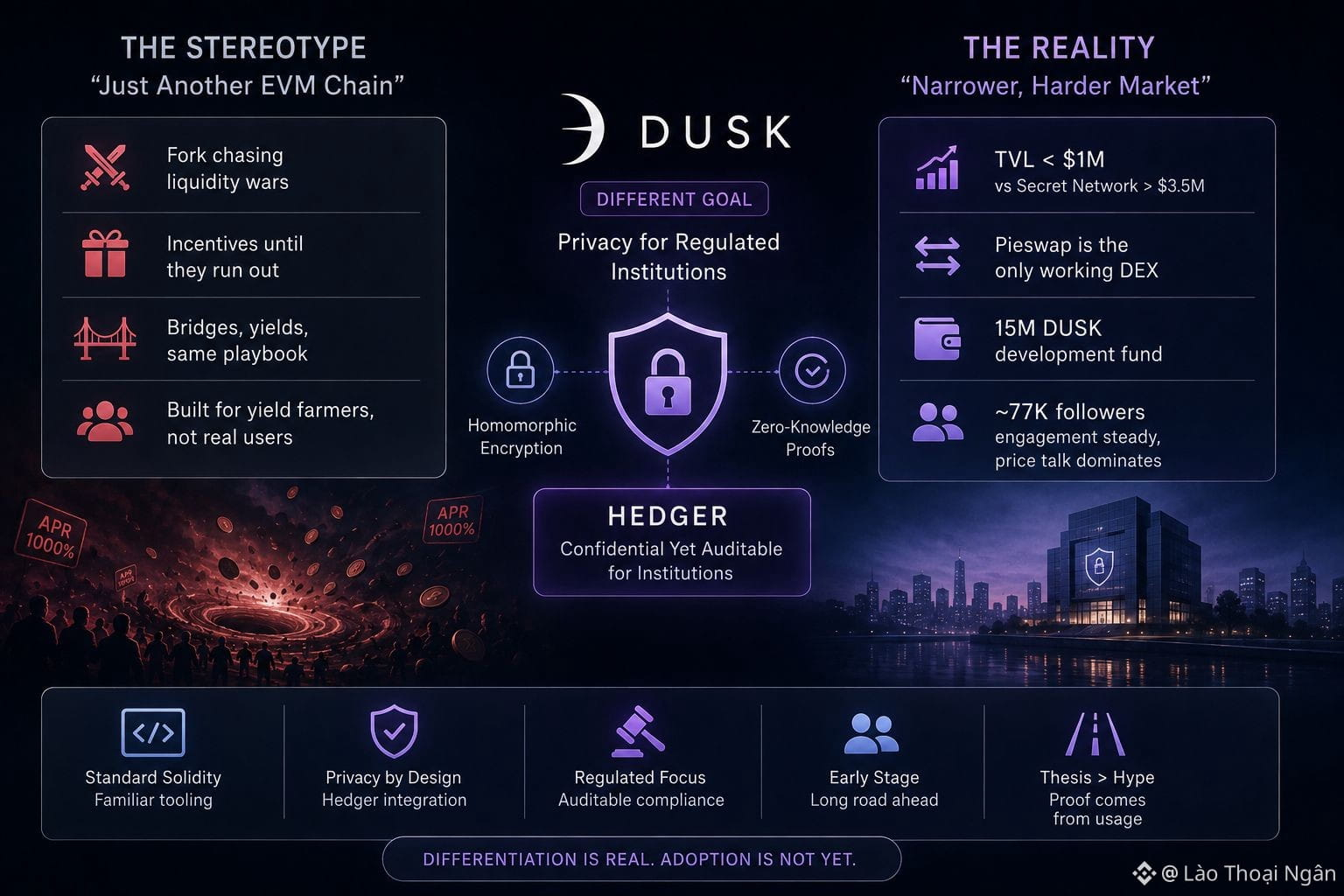
There is a lazy way to read any new EVM-compatible chain: another fork chasing the same liquidity mining wars, another chain promising bridges and incentives until the incentives run out. I catch myself defaulting to that read, and Dusk Network is a useful test of whether it is fair.
On the surface Dusk fits the pattern. DuskEVM runs standard Solidity, supports familiar tooling, and wants developers to show up the way they show up for any EVM chain. But the stated goal is different from a liquidity land grab. The differentiator is Hedger, a privacy engine combining homomorphic encryption and zero-knowledge proofs so contracts can handle confidential balances while staying auditable, aimed squarely at regulated institutions rather than yield farmers hopping between pools.
That is where the stereotype gets uncomfortable instead of dissolving cleanly. Total value locked on Dusk currently sits under $1 million, well behind privacy-focused peers like Secret Network, which holds more than $3.5 million, and Pieswap is essentially the only functioning decentralized exchange in the ecosystem right now. A development fund of 15 million DUSK exists to seed builders, yet the tooling and grant support have not been enough to pull in a wave of teams. Dusk's community sits around 77,000 followers with steady engagement, but discussion still skews toward price movement more than toward what actually shipped that week, which is its own quiet signal about where product-market fit really stands. So the honest answer is not that the stereotype is wrong. It is that Dusk has picked a narrower, harder market than generic DeFi, and narrower markets are slower to show proof even when the thesis is sound.
I think the differentiation is real on paper. Whether it shows up in usage instead of documentation is still an open question, and anyone bullish on DuskEVM should sit with that gap rather than argue it away.
@Dusk_Foundation #dusk $DUSK $BTW $PORTAL
There is a lazy way to read any new EVM-compatible chain: another fork chasing the same liquidity mining wars, another chain promising bridges and incentives until the incentives run out. I catch myself defaulting to that read, and Dusk Network is a useful test of whether it is fair.
On the surface Dusk fits the pattern. DuskEVM runs standard Solidity, supports familiar tooling, and wants developers to show up the way they show up for any EVM chain. But the stated goal is different from a liquidity land grab. The differentiator is Hedger, a privacy engine combining homomorphic encryption and zero-knowledge proofs so contracts can handle confidential balances while staying auditable, aimed squarely at regulated institutions rather than yield farmers hopping between pools.
That is where the stereotype gets uncomfortable instead of dissolving cleanly. Total value locked on Dusk currently sits under $1 million, well behind privacy-focused peers like Secret Network, which holds more than $3.5 million, and Pieswap is essentially the only functioning decentralized exchange in the ecosystem right now. A development fund of 15 million DUSK exists to seed builders, yet the tooling and grant support have not been enough to pull in a wave of teams. Dusk's community sits around 77,000 followers with steady engagement, but discussion still skews toward price movement more than toward what actually shipped that week, which is its own quiet signal about where product-market fit really stands. So the honest answer is not that the stereotype is wrong. It is that Dusk has picked a narrower, harder market than generic DeFi, and narrower markets are slower to show proof even when the thesis is sound.
I think the differentiation is real on paper. Whether it shows up in usage instead of documentation is still an open question, and anyone bullish on DuskEVM should sit with that gap rather than argue it away.
@Dusk #dusk $DUSK $BTW $PORTAL
On the surface Dusk fits the pattern. DuskEVM runs standard Solidity, supports familiar tooling, and wants developers to show up the way they show up for any EVM chain. But the stated goal is different from a liquidity land grab. The differentiator is Hedger, a privacy engine combining homomorphic encryption and zero-knowledge proofs so contracts can handle confidential balances while staying auditable, aimed squarely at regulated institutions rather than yield farmers hopping between pools.
That is where the stereotype gets uncomfortable instead of dissolving cleanly. Total value locked on Dusk currently sits under $1 million, well behind privacy-focused peers like Secret Network, which holds more than $3.5 million, and Pieswap is essentially the only functioning decentralized exchange in the ecosystem right now. A development fund of 15 million DUSK exists to seed builders, yet the tooling and grant support have not been enough to pull in a wave of teams. Dusk's community sits around 77,000 followers with steady engagement, but discussion still skews toward price movement more than toward what actually shipped that week, which is its own quiet signal about where product-market fit really stands. So the honest answer is not that the stereotype is wrong. It is that Dusk has picked a narrower, harder market than generic DeFi, and narrower markets are slower to show proof even when the thesis is sound.
I think the differentiation is real on paper. Whether it shows up in usage instead of documentation is still an open question, and anyone bullish on DuskEVM should sit with that gap rather than argue it away.
@Dusk #dusk $DUSK $BTW $PORTAL
66
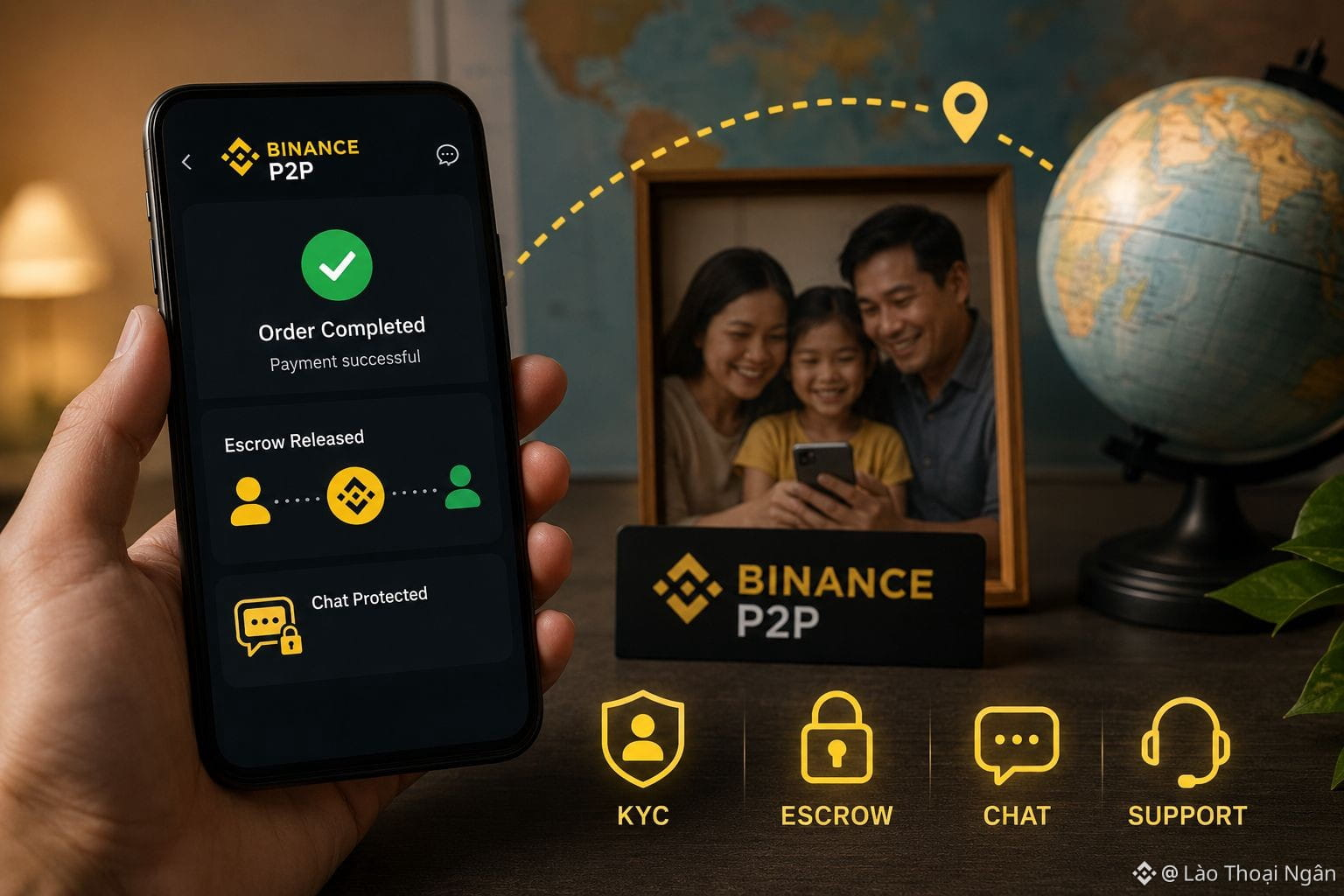
I started using Binance P2P as a way to send money to my family abroad, since converting crypto to local currency through a verified merchant turned out to be faster than most transfer services I had tried before. Binance P2P protects this kind of trade through KYC verification on every account, escrow that holds the seller's crypto asset until the order is confirmed, and a chat system that records the full conversation in case anything needs to be reviewed later. If a problem does come up, either side can raise a dispute appeal directly with Binance support.
Because I trade the same route fairly often, counterparty verification became second nature to me fast. I look at how many completed orders a merchant has, their completion percentage, and whether recent reviews mention smooth, on time payments. I also read through the chat history from past orders when a merchant shows it, paying attention to how they communicate, since a merchant who avoids direct answers or rushes past my questions is not someone I want to trade with, no matter how good their rate looks.
One merchant I almost used had a decent completion rate but a pattern in recent feedback describing delayed confirmations and vague excuses, which was enough for me to choose someone else instead. I now keep a short record of every merchant I have traded with successfully, along with screenshots of completed orders, partly for my own reference and partly because it made a support conversation faster the one time I needed help tracing a delayed transfer on Binance P2P.
I also learned to compare rates across a few verified merchants instead of jumping at the very first one I see, since a slightly slower process almost always pays off in peace of mind. My family knows now that when funds arrive, they came through a system I actually trust, not just the fastest option I happened to find that day.
@Binance_Vietnam #BinanceP2PAnToan $BTW $PORTAL $HEMI
I started using Binance P2P as a way to send money to my family abroad, since converting crypto to local currency through a verified merchant turned out to be faster than most transfer services I had tried before. Binance P2P protects this kind of trade through KYC verification on every account, escrow that holds the seller's crypto asset until the order is confirmed, and a chat system that records the full conversation in case anything needs to be reviewed later. If a problem does come up, either side can raise a dispute appeal directly with Binance support.
Because I trade the same route fairly often, counterparty verification became second nature to me fast. I look at how many completed orders a merchant has, their completion percentage, and whether recent reviews mention smooth, on time payments. I also read through the chat history from past orders when a merchant shows it, paying attention to how they communicate, since a merchant who avoids direct answers or rushes past my questions is not someone I want to trade with, no matter how good their rate looks.
One merchant I almost used had a decent completion rate but a pattern in recent feedback describing delayed confirmations and vague excuses, which was enough for me to choose someone else instead. I now keep a short record of every merchant I have traded with successfully, along with screenshots of completed orders, partly for my own reference and partly because it made a support conversation faster the one time I needed help tracing a delayed transfer on Binance P2P.
I also learned to compare rates across a few verified merchants instead of jumping at the very first one I see, since a slightly slower process almost always pays off in peace of mind. My family knows now that when funds arrive, they came through a system I actually trust, not just the fastest option I happened to find that day.
@Binance Vietnam #BinanceP2PAnToan $BTW $PORTAL $HEMI
Because I trade the same route fairly often, counterparty verification became second nature to me fast. I look at how many completed orders a merchant has, their completion percentage, and whether recent reviews mention smooth, on time payments. I also read through the chat history from past orders when a merchant shows it, paying attention to how they communicate, since a merchant who avoids direct answers or rushes past my questions is not someone I want to trade with, no matter how good their rate looks.
One merchant I almost used had a decent completion rate but a pattern in recent feedback describing delayed confirmations and vague excuses, which was enough for me to choose someone else instead. I now keep a short record of every merchant I have traded with successfully, along with screenshots of completed orders, partly for my own reference and partly because it made a support conversation faster the one time I needed help tracing a delayed transfer on Binance P2P.
I also learned to compare rates across a few verified merchants instead of jumping at the very first one I see, since a slightly slower process almost always pays off in peace of mind. My family knows now that when funds arrive, they came through a system I actually trust, not just the fastest option I happened to find that day.
@Binance Vietnam #BinanceP2PAnToan $BTW $PORTAL $HEMI
180
Say "EVM-compatible layer 2" to most crypto traders and DuskEVM, Dusk Network's new execution environment, risks getting filed alongside dozens of others built mainly to shave gas fees off swaps and NFT mints, largely interchangeable in the eyes of anyone who has bridged between three or four of them in the same afternoon. I understand the instinct to lump it into that mental folder the moment people hear it runs on the OP Stack and speaks standard Solidity.
I do not think that filing holds up once you look at what DuskEVM actually settles to. It anchors to DuskDS, Dusk Network's base layer, which finalizes blocks through Succinct Attestation, a committee-based proof of stake design built for deterministic settlement rather than the probabilistic finality most general-purpose rollups inherit from Ethereum. Layered on top is Hedger, which combines homomorphic encryption with zero-knowledge proofs to give DuskEVM applications confidential transactions without leaving the EVM environment at all. That combination, familiar tooling plus deterministic settlement plus optional confidentiality, is not something the typical scaling-focused L2 was built to offer. Even the fee structure reflects this: users pay gas in DUSK for execution and a separate data availability fee for posting batches back to DuskDS, a design that only makes sense if the settlement layer underneath is doing distinct work rather than just relaying calls to save on gas.
None of that guarantees adoption. A chain can be architecturally distinct and still fail to attract developers, and DuskEVM is still early enough that its actual application layer is thin compared to established rollups, with total value locked and daily active addresses that would lose badly in a side-by-side comparison today. But the stereotype that all EVM-compatible chains are interchangeable plumbing mistakes the tooling layer for the settlement layer, and on Dusk Network those are doing very different jobs.
@Dusk_Foundation #dusk $DUSK $VELVET $BTW
Say "EVM-compatible layer 2" to most crypto traders and DuskEVM, Dusk Network's new execution environment, risks getting filed alongside dozens of others built mainly to shave gas fees off swaps and NFT mints, largely interchangeable in the eyes of anyone who has bridged between three or four of them in the same afternoon. I understand the instinct to lump it into that mental folder the moment people hear it runs on the OP Stack and speaks standard Solidity.
I do not think that filing holds up once you look at what DuskEVM actually settles to. It anchors to DuskDS, Dusk Network's base layer, which finalizes blocks through Succinct Attestation, a committee-based proof of stake design built for deterministic settlement rather than the probabilistic finality most general-purpose rollups inherit from Ethereum. Layered on top is Hedger, which combines homomorphic encryption with zero-knowledge proofs to give DuskEVM applications confidential transactions without leaving the EVM environment at all. That combination, familiar tooling plus deterministic settlement plus optional confidentiality, is not something the typical scaling-focused L2 was built to offer. Even the fee structure reflects this: users pay gas in DUSK for execution and a separate data availability fee for posting batches back to DuskDS, a design that only makes sense if the settlement layer underneath is doing distinct work rather than just relaying calls to save on gas.
None of that guarantees adoption. A chain can be architecturally distinct and still fail to attract developers, and DuskEVM is still early enough that its actual application layer is thin compared to established rollups, with total value locked and daily active addresses that would lose badly in a side-by-side comparison today. But the stereotype that all EVM-compatible chains are interchangeable plumbing mistakes the tooling layer for the settlement layer, and on Dusk Network those are doing very different jobs.
@Dusk #dusk $DUSK $VELVET $BTW
I do not think that filing holds up once you look at what DuskEVM actually settles to. It anchors to DuskDS, Dusk Network's base layer, which finalizes blocks through Succinct Attestation, a committee-based proof of stake design built for deterministic settlement rather than the probabilistic finality most general-purpose rollups inherit from Ethereum. Layered on top is Hedger, which combines homomorphic encryption with zero-knowledge proofs to give DuskEVM applications confidential transactions without leaving the EVM environment at all. That combination, familiar tooling plus deterministic settlement plus optional confidentiality, is not something the typical scaling-focused L2 was built to offer. Even the fee structure reflects this: users pay gas in DUSK for execution and a separate data availability fee for posting batches back to DuskDS, a design that only makes sense if the settlement layer underneath is doing distinct work rather than just relaying calls to save on gas.
None of that guarantees adoption. A chain can be architecturally distinct and still fail to attract developers, and DuskEVM is still early enough that its actual application layer is thin compared to established rollups, with total value locked and daily active addresses that would lose badly in a side-by-side comparison today. But the stereotype that all EVM-compatible chains are interchangeable plumbing mistakes the tooling layer for the settlement layer, and on Dusk Network those are doing very different jobs.
@Dusk #dusk $DUSK $VELVET $BTW
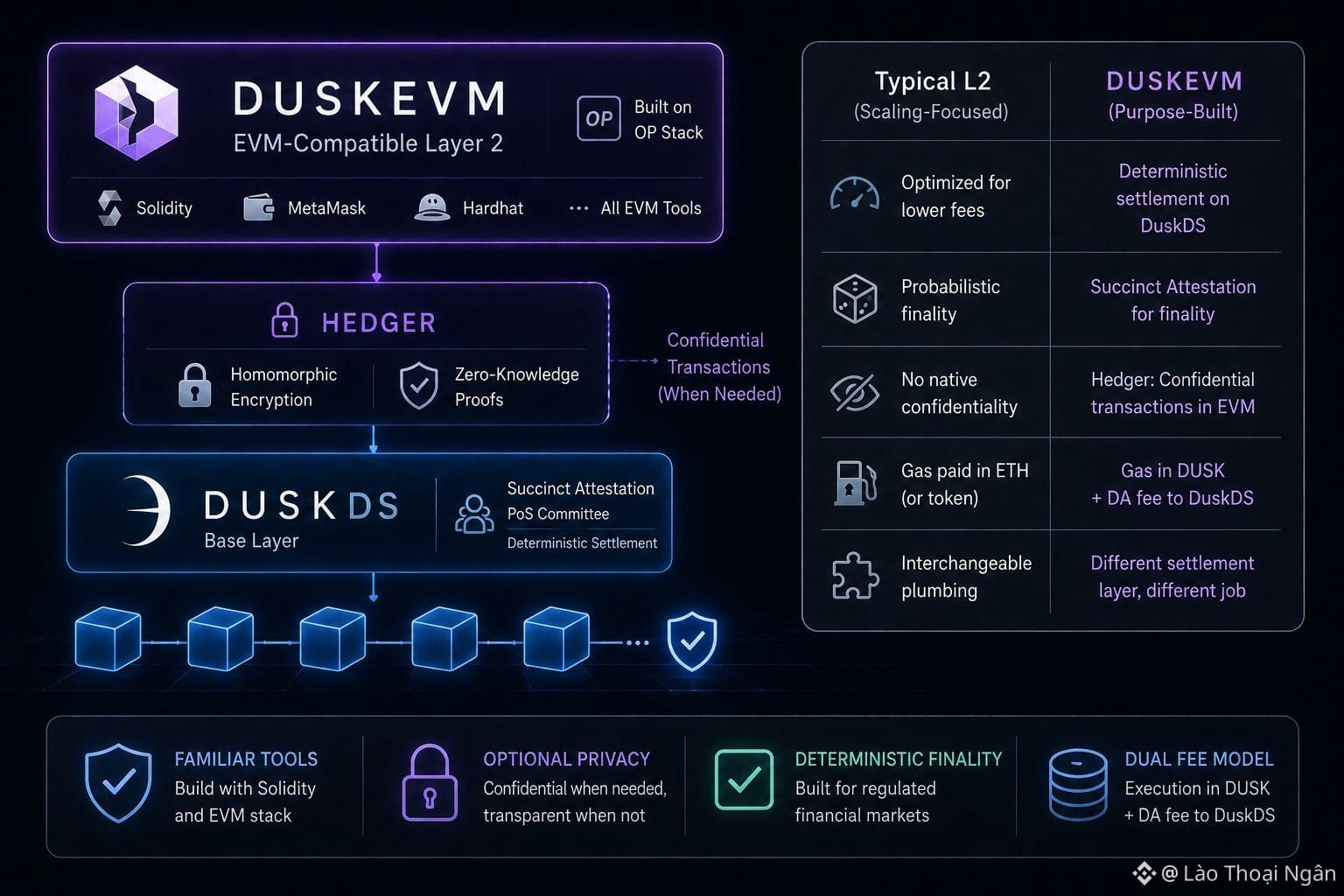
51
Say "fixed rate" to someone with a traditional finance background and their brain files it under safe, boring, predictable, the same category as a treasury bill or a corporate bond. I've watched people bring that assumption straight into TermMax without checking whether it holds.
A bond investor who buys a one-year note expects dollars back, not shares of the issuer's inventory. TermMax doesn't work that way if a borrower defaults. If a loan isn't repaid by maturity and the two-hour liquidation window can't clear the position because the market is thin or volatile, the protocol's physical delivery mechanism kicks in. Instead of getting the debt token you originally lent, you receive the borrower's collateral directly, whatever that happens to be. If you lent USDC into a market backed by a less liquid RWA or a volatile LST, physical delivery could hand you an asset you never chose to hold, at a value that may be lower than what you're owed, and managing that unwanted exposure afterward becomes your job, not the protocol's.
This isn't a flaw exclusive to TermMax. It's closer to how most over-collateralized DeFi lending actually settles risk, and TermMax is more transparent about the mechanism than a lot of competitors who bury it in liquidation math. But the stereotype that fixed rate equals TradFi-grade certainty breaks down exactly here. A bond has a legal claim behind it. A TermMax position has a smart contract and a collateral pool, isolated per market, which limits contagion but doesn't remove default exposure.
I'd rather TermMax lean into this difference than let new users assume otherwise. Fixed rate solves interest rate risk. It does not solve credit risk, and pretending those are the same problem sets people up for a bad surprise the first time a market gets liquidated into physical delivery instead of cash.
@termmax #TermMax $VELVET $BTW $ACE
Say "fixed rate" to someone with a traditional finance background and their brain files it under safe, boring, predictable, the same category as a treasury bill or a corporate bond. I've watched people bring that assumption straight into TermMax without checking whether it holds.
A bond investor who buys a one-year note expects dollars back, not shares of the issuer's inventory. TermMax doesn't work that way if a borrower defaults. If a loan isn't repaid by maturity and the two-hour liquidation window can't clear the position because the market is thin or volatile, the protocol's physical delivery mechanism kicks in. Instead of getting the debt token you originally lent, you receive the borrower's collateral directly, whatever that happens to be. If you lent USDC into a market backed by a less liquid RWA or a volatile LST, physical delivery could hand you an asset you never chose to hold, at a value that may be lower than what you're owed, and managing that unwanted exposure afterward becomes your job, not the protocol's.
This isn't a flaw exclusive to TermMax. It's closer to how most over-collateralized DeFi lending actually settles risk, and TermMax is more transparent about the mechanism than a lot of competitors who bury it in liquidation math. But the stereotype that fixed rate equals TradFi-grade certainty breaks down exactly here. A bond has a legal claim behind it. A TermMax position has a smart contract and a collateral pool, isolated per market, which limits contagion but doesn't remove default exposure.
I'd rather TermMax lean into this difference than let new users assume otherwise. Fixed rate solves interest rate risk. It does not solve credit risk, and pretending those are the same problem sets people up for a bad surprise the first time a market gets liquidated into physical delivery instead of cash.
@TermMax #TermMax $VELVET $BTW $ACE
A bond investor who buys a one-year note expects dollars back, not shares of the issuer's inventory. TermMax doesn't work that way if a borrower defaults. If a loan isn't repaid by maturity and the two-hour liquidation window can't clear the position because the market is thin or volatile, the protocol's physical delivery mechanism kicks in. Instead of getting the debt token you originally lent, you receive the borrower's collateral directly, whatever that happens to be. If you lent USDC into a market backed by a less liquid RWA or a volatile LST, physical delivery could hand you an asset you never chose to hold, at a value that may be lower than what you're owed, and managing that unwanted exposure afterward becomes your job, not the protocol's.
This isn't a flaw exclusive to TermMax. It's closer to how most over-collateralized DeFi lending actually settles risk, and TermMax is more transparent about the mechanism than a lot of competitors who bury it in liquidation math. But the stereotype that fixed rate equals TradFi-grade certainty breaks down exactly here. A bond has a legal claim behind it. A TermMax position has a smart contract and a collateral pool, isolated per market, which limits contagion but doesn't remove default exposure.
I'd rather TermMax lean into this difference than let new users assume otherwise. Fixed rate solves interest rate risk. It does not solve credit risk, and pretending those are the same problem sets people up for a bad surprise the first time a market gets liquidated into physical delivery instead of cash.
@TermMax #TermMax $VELVET $BTW $ACE
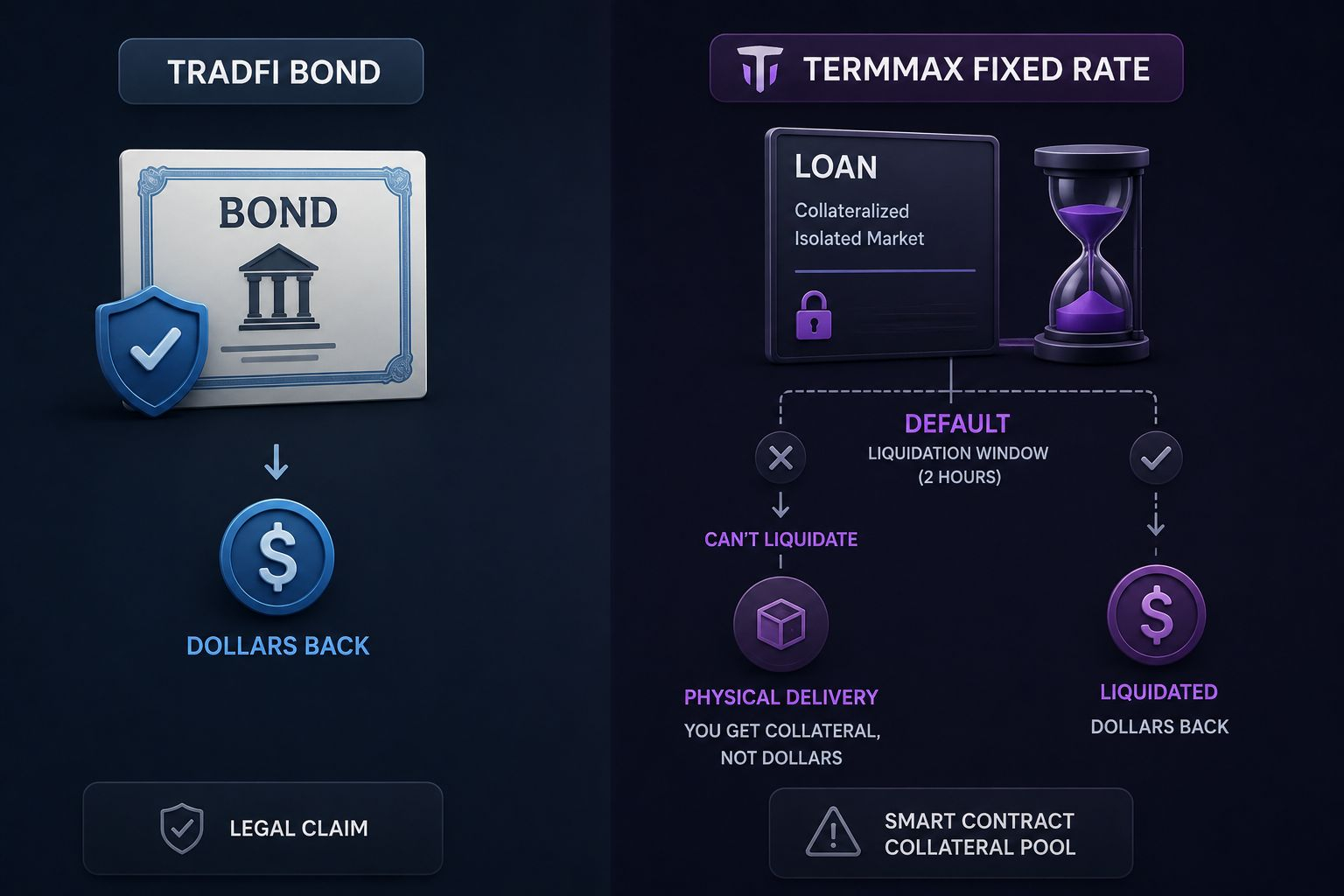
433
Войдите, чтобы посмотреть больше материала
Присоединяйтесь к пользователям криптовалют по всему миру на Binance Square
⚡️ Получайте новейшую и полезную информацию о криптоактивах.
💬 Нам доверяет крупнейшая в мире криптобиржа.
👍 Получите достоверные аналитические данные от верифицированных создателей контента.
Эл. почта/номер телефона
В тренде
BinanceWithdrawalScamWarning
Просмотров: 38,707
640 обсуждают
Binance Warns Users of Withdrawal Scams as Services Resume: It Will Never Charge Fees, Sell Queue Spots or Ask You to Move Funds to a “Vault”
Binance News
·Лайков: 14
·Просмотров: 8k
USMidtermElections
Просмотров: 601,100
3,217 обсуждают
USOctoberNFP-AreRateCutsStillPossible
Просмотров: 46,350
528 обсуждают