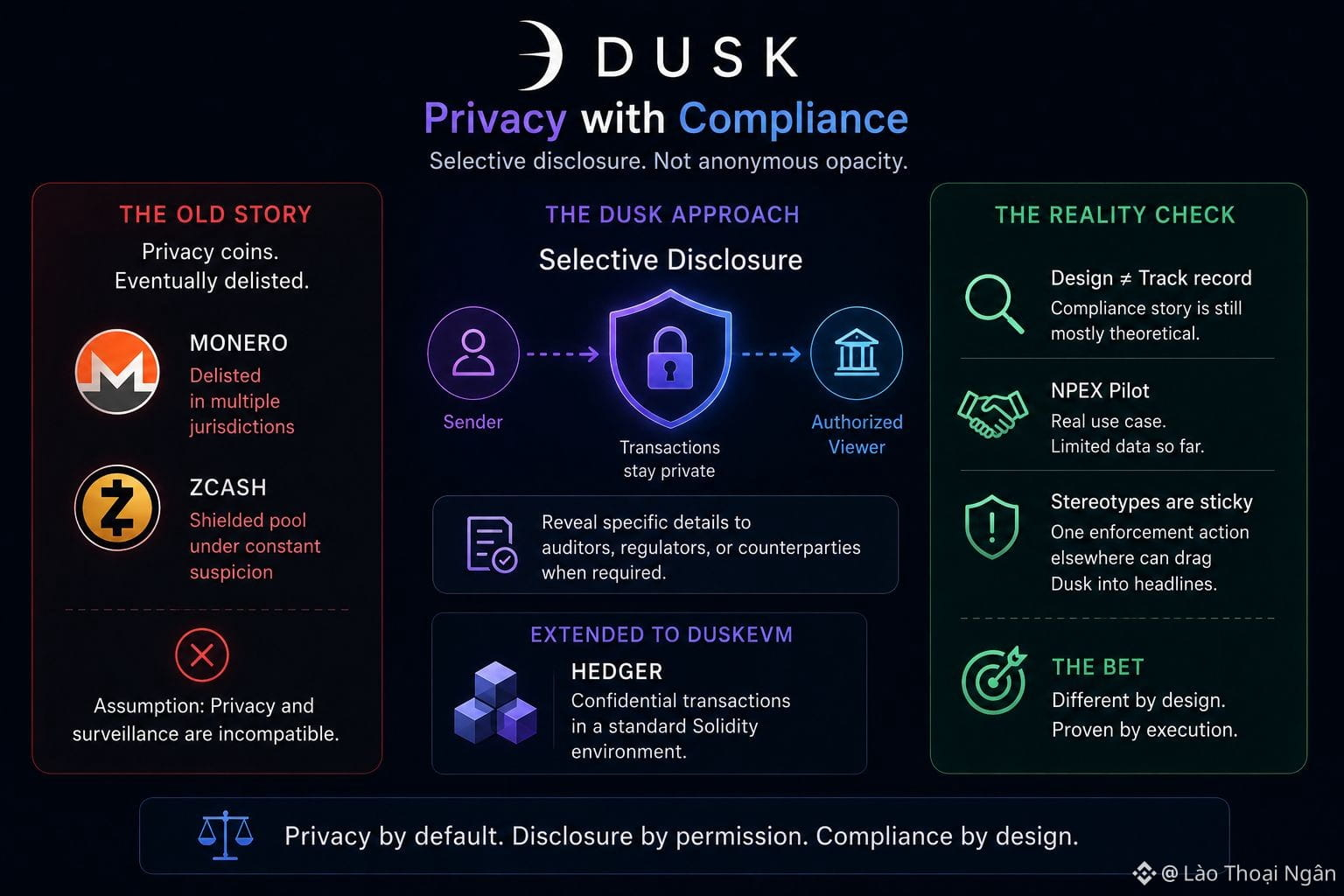
Mention privacy coins to anyone who has watched a few exchange cycles and you get the same reflex reaction: eventually they get delisted. Monero has been pulled from major platforms in more than one jurisdiction. Zcash has spent years defending its shielded pool against the same suspicion. The assumption baked into that reflex is that privacy and financial surveillance requirements are simply incompatible, full stop. Dusk Network exists specifically to test whether that assumption is actually true or just a stereotype built from projects that never tried to solve the compliance side.
Dusk's answer is selective disclosure. Transactions stay hidden from the public ledger by default, but the protocol allows a sender to reveal specific details to an authorized viewer, whether that is an auditor, a regulator, or a counterparty who needs proof for their own compliance file. On paper this is a meaningfully different design than the all or nothing anonymity of earlier privacy coins, and it targets exactly the objection that got those coins pulled from exchange after exchange. That same disclosure logic is set to extend into DuskEVM too, where a tool called Hedger is meant to carry confidential transaction workflows into an otherwise ordinary Solidity environment.
I want to be honest about the limits here too. A design that can satisfy regulators is not the same as a track record of satisfying regulators, and Dusk's compliance story is still mostly theoretical outside its NPEX pilot. Stereotypes are sticky, and it would only take one enforcement action against an unrelated privacy project to drag Dusk into headlines by association. The technology looks genuinely differentiated to me. Whether the market and regulators end up treating it that way is a separate question, one Dusk has not fully answered yet.
@Dusk #dusk $DUSK