Say "fixed rate" to someone with a traditional finance background and their brain files it under safe, boring, predictable, the same category as a treasury bill or a corporate bond. I've watched people bring that assumption straight into TermMax without checking whether it holds.
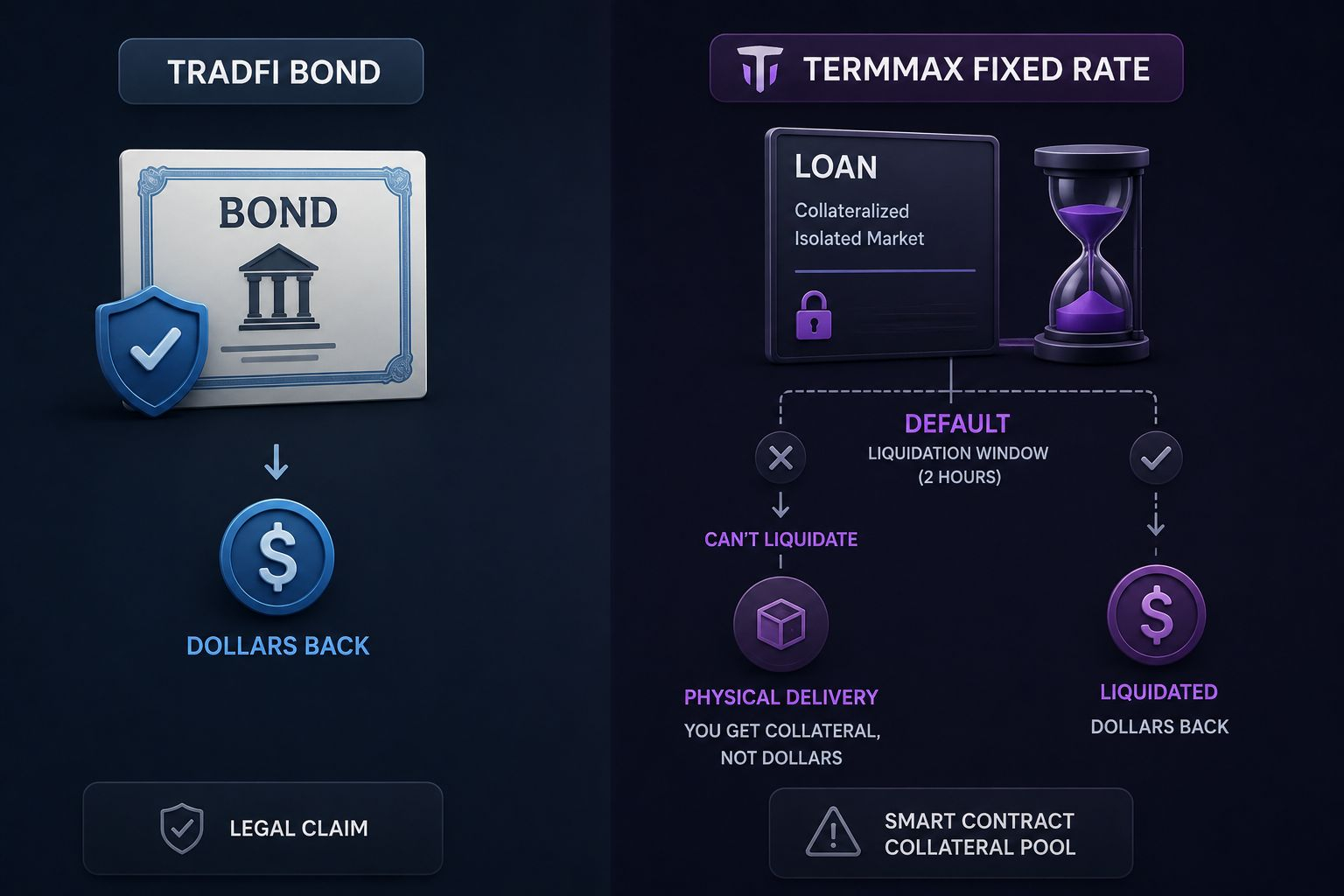
A bond investor who buys a one-year note expects dollars back, not shares of the issuer's inventory. TermMax doesn't work that way if a borrower defaults. If a loan isn't repaid by maturity and the two-hour liquidation window can't clear the position because the market is thin or volatile, the protocol's physical delivery mechanism kicks in. Instead of getting the debt token you originally lent, you receive the borrower's collateral directly, whatever that happens to be. If you lent USDC into a market backed by a less liquid RWA or a volatile LST, physical delivery could hand you an asset you never chose to hold, at a value that may be lower than what you're owed, and managing that unwanted exposure afterward becomes your job, not the protocol's.
This isn't a flaw exclusive to TermMax. It's closer to how most over-collateralized DeFi lending actually settles risk, and TermMax is more transparent about the mechanism than a lot of competitors who bury it in liquidation math. But the stereotype that fixed rate equals TradFi-grade certainty breaks down exactly here. A bond has a legal claim behind it. A TermMax position has a smart contract and a collateral pool, isolated per market, which limits contagion but doesn't remove default exposure.
I'd rather TermMax lean into this difference than let new users assume otherwise. Fixed rate solves interest rate risk. It does not solve credit risk, and pretending those are the same problem sets people up for a bad surprise the first time a market gets liquidated into physical delivery instead of cash.
@TermMax #TermMax $VELVET $BTW $ACE
A bond investor who buys a one-year note expects dollars back, not shares of the issuer's inventory. TermMax doesn't work that way if a borrower defaults. If a loan isn't repaid by maturity and the two-hour liquidation window can't clear the position because the market is thin or volatile, the protocol's physical delivery mechanism kicks in. Instead of getting the debt token you originally lent, you receive the borrower's collateral directly, whatever that happens to be. If you lent USDC into a market backed by a less liquid RWA or a volatile LST, physical delivery could hand you an asset you never chose to hold, at a value that may be lower than what you're owed, and managing that unwanted exposure afterward becomes your job, not the protocol's.
This isn't a flaw exclusive to TermMax. It's closer to how most over-collateralized DeFi lending actually settles risk, and TermMax is more transparent about the mechanism than a lot of competitors who bury it in liquidation math. But the stereotype that fixed rate equals TradFi-grade certainty breaks down exactly here. A bond has a legal claim behind it. A TermMax position has a smart contract and a collateral pool, isolated per market, which limits contagion but doesn't remove default exposure.
I'd rather TermMax lean into this difference than let new users assume otherwise. Fixed rate solves interest rate risk. It does not solve credit risk, and pretending those are the same problem sets people up for a bad surprise the first time a market gets liquidated into physical delivery instead of cash.
@TermMax #TermMax $VELVET $BTW $ACE