

Simplify Crypto
7 Публикации

Simplify Crypto
Отправить жалобу
Заблокировать пользователя
Simple, beginner-friendly guides to crypto — staking, stablecoins, tokenization & more. Education only, not financial advice. 📚
3 подписок(и/а)
1 подписчиков(а)
6 понравилось
Посты
Статья
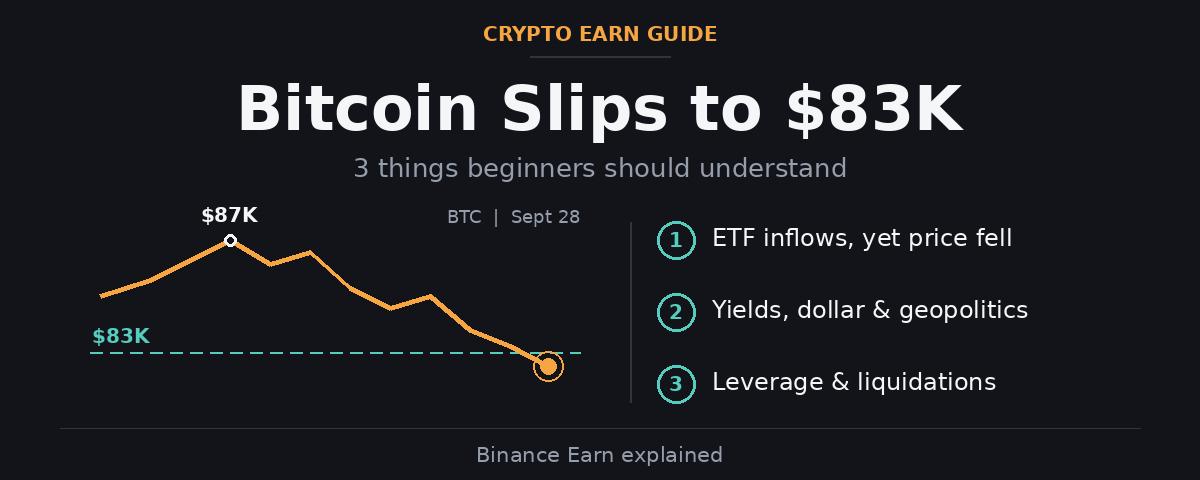
#BTCFallsBelow$83000: what's really behind the dip?$BTC slid into the $83K zone on Sept 28 (briefly dipping under it intraday) after failing to hold above $87K earlier this month. Here's what beginners should understand 👇
🏦 1. Big ETF inflows didn't stop the drop
US spot Bitcoin ETFs took in billions last week, yet price still fell. Demand is only one side of the equation, and selling pressure can outweigh it.
🌍 2. Macro is pulling the strings
Rising Treasury yields, a stronger dollar and renewed US-Iran tensions are pressuring risk assets broadly, not just crypto. When yields rise, riskier assets often feel it.
💥 3. Leverage amplifies moves
Leveraged long positions were liquidated as price slipped toward $83K. Forced liquidations can speed up a drop, which is why leverage cuts both ways.
📊 Zoom out
BTC is still roughly a third below its Oct 2025 all-time high (~$126K). Volatility is part of this asset class. Nobody can time short-term moves, so the useful question is whether your position size and time horizon fit your own risk tolerance.
What do you think is driving this dip: macro, leverage, or something else? Drop your take 👇
Educational content only, not investment advice. Prices as of Sept 28 and they change fast. Crypto is highly volatile and you can lose money. Always DYOR.
#BTCFallsBelow$83000 #Bitcoin #CryptoEducation #Write2Earn $BTC
{spot}(BTCUSDT)
#BTCFallsBelow$83000: what's really behind the dip?
$BTC slid into the $83K zone on Sept 28 (briefly dipping under it intraday) after failing to hold above $87K earlier this month. Here's what beginners should understand 👇
🏦 1. Big ETF inflows didn't stop the drop
US spot Bitcoin ETFs took in billions last week, yet price still fell. Demand is only one side of the equation, and selling pressure can outweigh it.
🌍 2. Macro is pulling the strings
Rising Treasury yields, a stronger dollar and renewed US-Iran tensions are pressuring risk assets broadly, not just crypto. When yields rise, riskier assets often feel it.
💥 3. Leverage amplifies moves
Leveraged long positions were liquidated as price slipped toward $83K. Forced liquidations can speed up a drop, which is why leverage cuts both ways.
📊 Zoom out
BTC is still roughly a third below its Oct 2025 all-time high (~$126K). Volatility is part of this asset class. Nobody can time short-term moves, so the useful question is whether your position size and time horizon fit your own risk tolerance.
What do you think is driving this dip: macro, leverage, or something else? Drop your take 👇
Educational content only, not investment advice. Prices as of Sept 28 and they change fast. Crypto is highly volatile and you can lose money. Always DYOR.
#BTCFallsBelow$83000 #Bitcoin #CryptoEducation #Write2Earn $BTC
🏦 1. Big ETF inflows didn't stop the drop
US spot Bitcoin ETFs took in billions last week, yet price still fell. Demand is only one side of the equation, and selling pressure can outweigh it.
🌍 2. Macro is pulling the strings
Rising Treasury yields, a stronger dollar and renewed US-Iran tensions are pressuring risk assets broadly, not just crypto. When yields rise, riskier assets often feel it.
💥 3. Leverage amplifies moves
Leveraged long positions were liquidated as price slipped toward $83K. Forced liquidations can speed up a drop, which is why leverage cuts both ways.
📊 Zoom out
BTC is still roughly a third below its Oct 2025 all-time high (~$126K). Volatility is part of this asset class. Nobody can time short-term moves, so the useful question is whether your position size and time horizon fit your own risk tolerance.
What do you think is driving this dip: macro, leverage, or something else? Drop your take 👇
Educational content only, not investment advice. Prices as of Sept 28 and they change fast. Crypto is highly volatile and you can lose money. Always DYOR.
#BTCFallsBelow$83000 #Bitcoin #CryptoEducation #Write2Earn $BTC
1
140
Статья
🔍 Your next transaction might be made by an AI, not a humanWhile most crypto news focuses on people buying and holding, a quieter shift is happening underneath: AI agents are starting to pay each other directly — and stablecoins are the rail making it possible.
🤖 What's actually happening
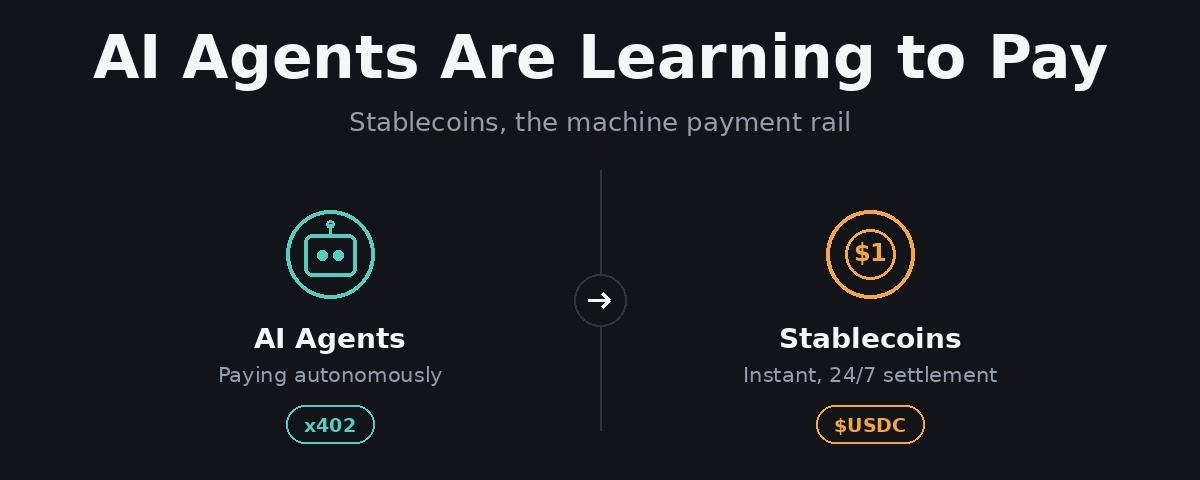
Major players (Coinbase, Circle, Google, Stripe) have shipped new payment standards — like Coinbase's x402 protocol — that let autonomous AI agents hold a wallet and complete transactions without a human approving each one. Think an AI agent paying per-API-call for data, compute, or another agent's service, instantly and in tiny amounts.
⚡ Why stablecoins specifically
Machines need money that doesn't swing in value mid-transaction and settles instantly, 24/7. Traditional bank transfers are too slow, and volatile crypto assets are too risky for automated spending. A dollar-pegged token fits the job perfectly.
📊 Why 2026 is the inflection point
Agent-driven stablecoin payments have already scaled into the hundreds of millions of transactions, overwhelmingly settled in USDC — and it's being flagged industry-wide as a major growth driver for stablecoin volume this year.
🎯 What this means for you
You don't need to build an AI agent to care about this. It's a signal of where stablecoin infrastructure is heading next: from "traders moving money" to "software moving money automatically." Worth understanding early.
Machines with wallets — wild timeline 🤖💸
Educational content only, not investment advice. This is an emerging, fast-changing space — always DYOR before acting on any agentic-payment or stablecoin product.
#AIAgents #Stablecoins #CryptoEducation #BinanceEarn #Write2Earn $USDC $USDT
🔍 Your next transaction might be made by an AI, not a human
While most crypto news focuses on people buying and holding, a quieter shift is happening underneath: AI agents are starting to pay each other directly — and stablecoins are the rail making it possible.
🤖 What's actually happening
Major players (Coinbase, Circle, Google, Stripe) have shipped new payment standards — like Coinbase's x402 protocol — that let autonomous AI agents hold a wallet and complete transactions without a human approving each one. Think an AI agent paying per-API-call for data, compute, or another agent's service, instantly and in tiny amounts.
⚡ Why stablecoins specifically
Machines need money that doesn't swing in value mid-transaction and settles instantly, 24/7. Traditional bank transfers are too slow, and volatile crypto assets are too risky for automated spending. A dollar-pegged token fits the job perfectly.
📊 Why 2026 is the inflection point
Agent-driven stablecoin payments have already scaled into the hundreds of millions of transactions, overwhelmingly settled in USDC — and it's being flagged industry-wide as a major growth driver for stablecoin volume this year.
🎯 What this means for you
You don't need to build an AI agent to care about this. It's a signal of where stablecoin infrastructure is heading next: from "traders moving money" to "software moving money automatically." Worth understanding early.
Machines with wallets — wild timeline 🤖💸
Educational content only, not investment advice. This is an emerging, fast-changing space — always DYOR before acting on any agentic-payment or stablecoin product.
#AIAgents #Stablecoins #CryptoEducation #BinanceEarn #Write2Earn $USDC $USDT
🤖 What's actually happening
Major players (Coinbase, Circle, Google, Stripe) have shipped new payment standards — like Coinbase's x402 protocol — that let autonomous AI agents hold a wallet and complete transactions without a human approving each one. Think an AI agent paying per-API-call for data, compute, or another agent's service, instantly and in tiny amounts.
⚡ Why stablecoins specifically
Machines need money that doesn't swing in value mid-transaction and settles instantly, 24/7. Traditional bank transfers are too slow, and volatile crypto assets are too risky for automated spending. A dollar-pegged token fits the job perfectly.
📊 Why 2026 is the inflection point
Agent-driven stablecoin payments have already scaled into the hundreds of millions of transactions, overwhelmingly settled in USDC — and it's being flagged industry-wide as a major growth driver for stablecoin volume this year.
🎯 What this means for you
You don't need to build an AI agent to care about this. It's a signal of where stablecoin infrastructure is heading next: from "traders moving money" to "software moving money automatically." Worth understanding early.
Machines with wallets — wild timeline 🤖💸
Educational content only, not investment advice. This is an emerging, fast-changing space — always DYOR before acting on any agentic-payment or stablecoin product.
#AIAgents #Stablecoins #CryptoEducation #BinanceEarn #Write2Earn $USDC $USDT
1
60
Статья
🔍 Why Wall Street is putting real assets on the blockchainStablecoins made digital dollars mainstream. Now the same playbook is being applied to entire asset classes — quietly becoming one of the biggest stories in crypto this year.
What "tokenization" actually means
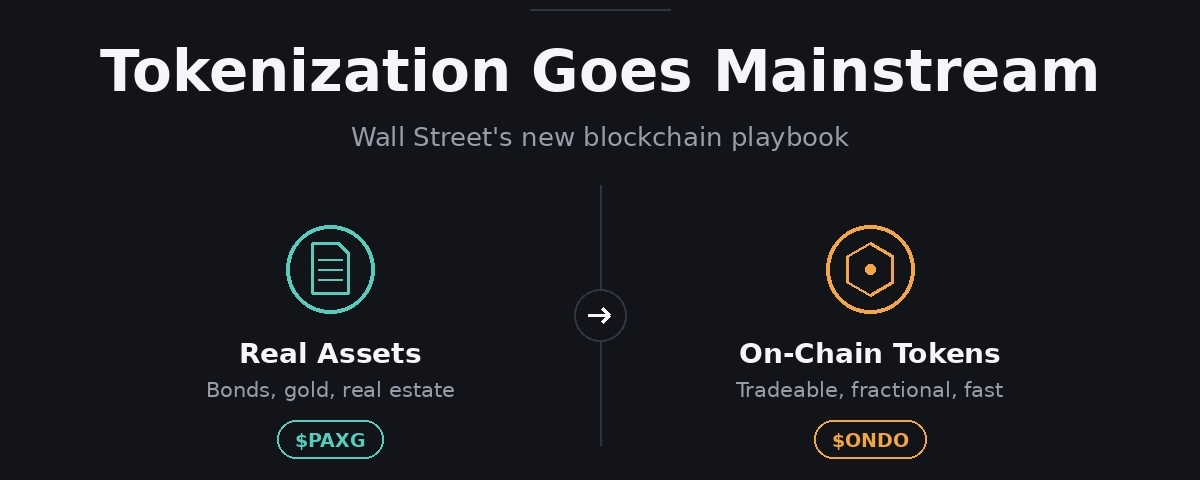
Taking a real asset — a US Treasury bond, a share of a fund, gold, real estate — and issuing a blockchain token that represents ownership of it. The token trades 24/7, can be split into fractions, and settles almost instantly.
📈 Why it's accelerating in 2026
Big asset managers have moved from pilot projects to actual productsTokenized US Treasuries lead the pack, since investors want yield with faster settlement than traditional finance offersTotal tokenized real-world assets have grown well into the tens of billions of dollars this year, with some industry forecasts pointing toward $100B+ by year-end
🎯 What this means for you
Tokenization is a structural shift in HOW assets are owned and traded — not a single coin's price story. Worth understanding the category even if you never touch it directly, since it shows where institutional money is heading next.
Long game, not a quick flip 👀
Educational content only, not investment advice. RWA tokens carry their own risks (issuer, custody, regulatory) separate from the underlying asset — always DYOR before holding any of them.
#RWA #Tokenization #CryptoEducation #BinanceEarn #Write2Earn $ONDO $PAXG
🔍 Why Wall Street is putting real assets on the blockchain
Stablecoins made digital dollars mainstream. Now the same playbook is being applied to entire asset classes — quietly becoming one of the biggest stories in crypto this year.
What "tokenization" actually means
Taking a real asset — a US Treasury bond, a share of a fund, gold, real estate — and issuing a blockchain token that represents ownership of it. The token trades 24/7, can be split into fractions, and settles almost instantly.
📈 Why it's accelerating in 2026
Big asset managers have moved from pilot projects to actual productsTokenized US Treasuries lead the pack, since investors want yield with faster settlement than traditional finance offersTotal tokenized real-world assets have grown well into the tens of billions of dollars this year, with some industry forecasts pointing toward $100B+ by year-end
🎯 What this means for you
Tokenization is a structural shift in HOW assets are owned and traded — not a single coin's price story. Worth understanding the category even if you never touch it directly, since it shows where institutional money is heading next.
Long game, not a quick flip 👀
Educational content only, not investment advice. RWA tokens carry their own risks (issuer, custody, regulatory) separate from the underlying asset — always DYOR before holding any of them.
#RWA #Tokenization #CryptoEducation #BinanceEarn #Write2Earn $ONDO $PAXG
What "tokenization" actually means
Taking a real asset — a US Treasury bond, a share of a fund, gold, real estate — and issuing a blockchain token that represents ownership of it. The token trades 24/7, can be split into fractions, and settles almost instantly.
📈 Why it's accelerating in 2026
Big asset managers have moved from pilot projects to actual productsTokenized US Treasuries lead the pack, since investors want yield with faster settlement than traditional finance offersTotal tokenized real-world assets have grown well into the tens of billions of dollars this year, with some industry forecasts pointing toward $100B+ by year-end
🎯 What this means for you
Tokenization is a structural shift in HOW assets are owned and traded — not a single coin's price story. Worth understanding the category even if you never touch it directly, since it shows where institutional money is heading next.
Long game, not a quick flip 👀
Educational content only, not investment advice. RWA tokens carry their own risks (issuer, custody, regulatory) separate from the underlying asset — always DYOR before holding any of them.
#RWA #Tokenization #CryptoEducation #BinanceEarn #Write2Earn $ONDO $PAXG
1
523
Статья
🔍 Why banks suddenly care about stablecoins in 2026If you thought stablecoins were just "parking money" between trades, 2026 changed that story. What started as a trading tool is turning into real financial infrastructure — and banks are paying attention.
💵 What's a stablecoin, quickly
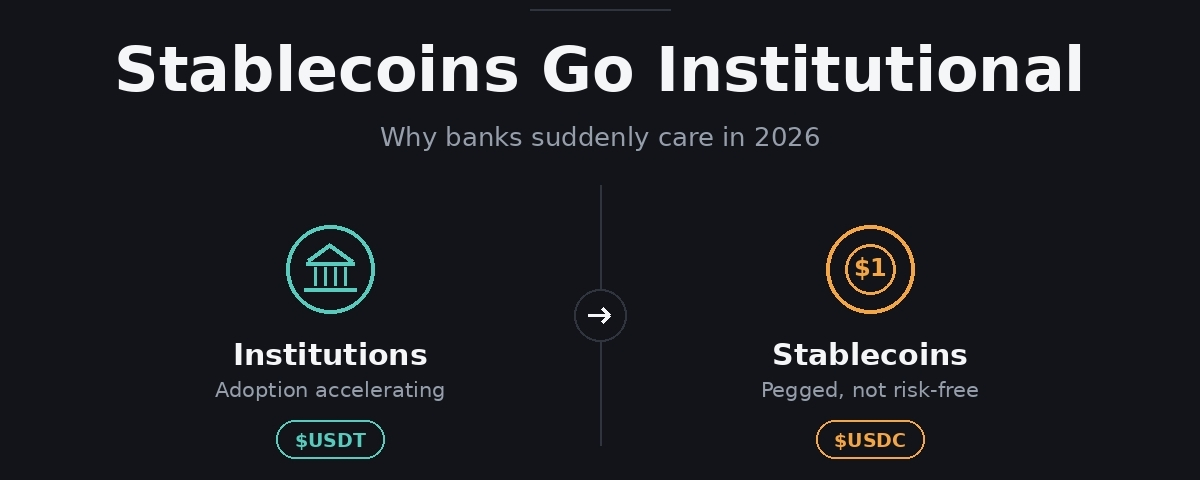
A digital token pegged to a real-world currency (usually $1 USD), backed by reserves like cash or short-term government debt. $USDT and $USDC together make up most of the market.
🏦 Why 2026 is different
Clearer regulation gave banks and fintechs the confidence to build on stablecoin rails instead of just watching from the sidelines.Major payment networks and institutions have started settling real transactions in stablecoins, not just trading with them.The total stablecoin market has pushed past the $300 billion mark, with more growth expected this year.
📊 What this means for you
More institutional money flowing in generally means deeper liquidity, more integrations (wallets, cards, payroll), and stablecoins becoming less of a "crypto-only" tool and more of an everyday settlement layer. It's also part of why stablecoin savings products keep expanding on platforms like Binance Earn.
Worth watching, not worth guessing the timeline on 👀
Educational content only, not investment advice. Stablecoins are generally lower-volatility but not risk-free — always check issuer reserves/audits and DYOR before holding any stablecoin.
#StablecoinNews #CryptoEducation #BinanceEarn #Write2Earn $USDT $USDC
🔍 Why banks suddenly care about stablecoins in 2026
If you thought stablecoins were just "parking money" between trades, 2026 changed that story. What started as a trading tool is turning into real financial infrastructure — and banks are paying attention.
💵 What's a stablecoin, quickly
A digital token pegged to a real-world currency (usually $1 USD), backed by reserves like cash or short-term government debt. $USDT and $USDC together make up most of the market.
🏦 Why 2026 is different
Clearer regulation gave banks and fintechs the confidence to build on stablecoin rails instead of just watching from the sidelines.Major payment networks and institutions have started settling real transactions in stablecoins, not just trading with them.The total stablecoin market has pushed past the $300 billion mark, with more growth expected this year.
📊 What this means for you
More institutional money flowing in generally means deeper liquidity, more integrations (wallets, cards, payroll), and stablecoins becoming less of a "crypto-only" tool and more of an everyday settlement layer. It's also part of why stablecoin savings products keep expanding on platforms like Binance Earn.
Worth watching, not worth guessing the timeline on 👀
Educational content only, not investment advice. Stablecoins are generally lower-volatility but not risk-free — always check issuer reserves/audits and DYOR before holding any stablecoin.
#StablecoinNews #CryptoEducation #BinanceEarn #Write2Earn $USDT $USDC
💵 What's a stablecoin, quickly
A digital token pegged to a real-world currency (usually $1 USD), backed by reserves like cash or short-term government debt. $USDT and $USDC together make up most of the market.
🏦 Why 2026 is different
Clearer regulation gave banks and fintechs the confidence to build on stablecoin rails instead of just watching from the sidelines.Major payment networks and institutions have started settling real transactions in stablecoins, not just trading with them.The total stablecoin market has pushed past the $300 billion mark, with more growth expected this year.
📊 What this means for you
More institutional money flowing in generally means deeper liquidity, more integrations (wallets, cards, payroll), and stablecoins becoming less of a "crypto-only" tool and more of an everyday settlement layer. It's also part of why stablecoin savings products keep expanding on platforms like Binance Earn.
Worth watching, not worth guessing the timeline on 👀
Educational content only, not investment advice. Stablecoins are generally lower-volatility but not risk-free — always check issuer reserves/audits and DYOR before holding any stablecoin.
#StablecoinNews #CryptoEducation #BinanceEarn #Write2Earn $USDT $USDC
1
50
Войдите, чтобы посмотреть больше материала
Присоединяйтесь к пользователям криптовалют по всему миру на Binance Square
⚡️ Получайте новейшую и полезную информацию о криптоактивах.
💬 Нам доверяет крупнейшая в мире криптобиржа.
👍 Получите достоверные аналитические данные от верифицированных создателей контента.
Эл. почта/номер телефона
В тренде
BinanceKZ
Просмотров: 8,820
50 обсуждают
Как я потерял 180 000 тенге на «менеджере Binance» из WhatsApp — и почему всё равно остался в крипте
phpdead
·Лайков: 6
·Просмотров: 1.9k
ChainlinkLaunchesCCIP2WithEnterpriseVerification
Просмотров: 705
126 обсуждают
GoldFallsTo$4144
Просмотров: 2,003
67 обсуждают