
MR-Zero-X
2.2k Публикации

MR-Zero-X
Отправить жалобу
Заблокировать пользователя
高风险,高回报|精准分析|用数据说话. High risk, high reward | Precise analysis | Let data speak
260 подписок(и/а)
11.9K+ подписчиков(а)
1.7K+ понравилось
Посты
Портфель
Все
Цитирования
Активно
·
--
#dusk $DUSK
What caught my attention about DUSK wasn’t another blockchain claiming to solve privacy.
It was a much simpler question: who actually needs to see what?
The more I explored DUSK, the more I liked this way of thinking.
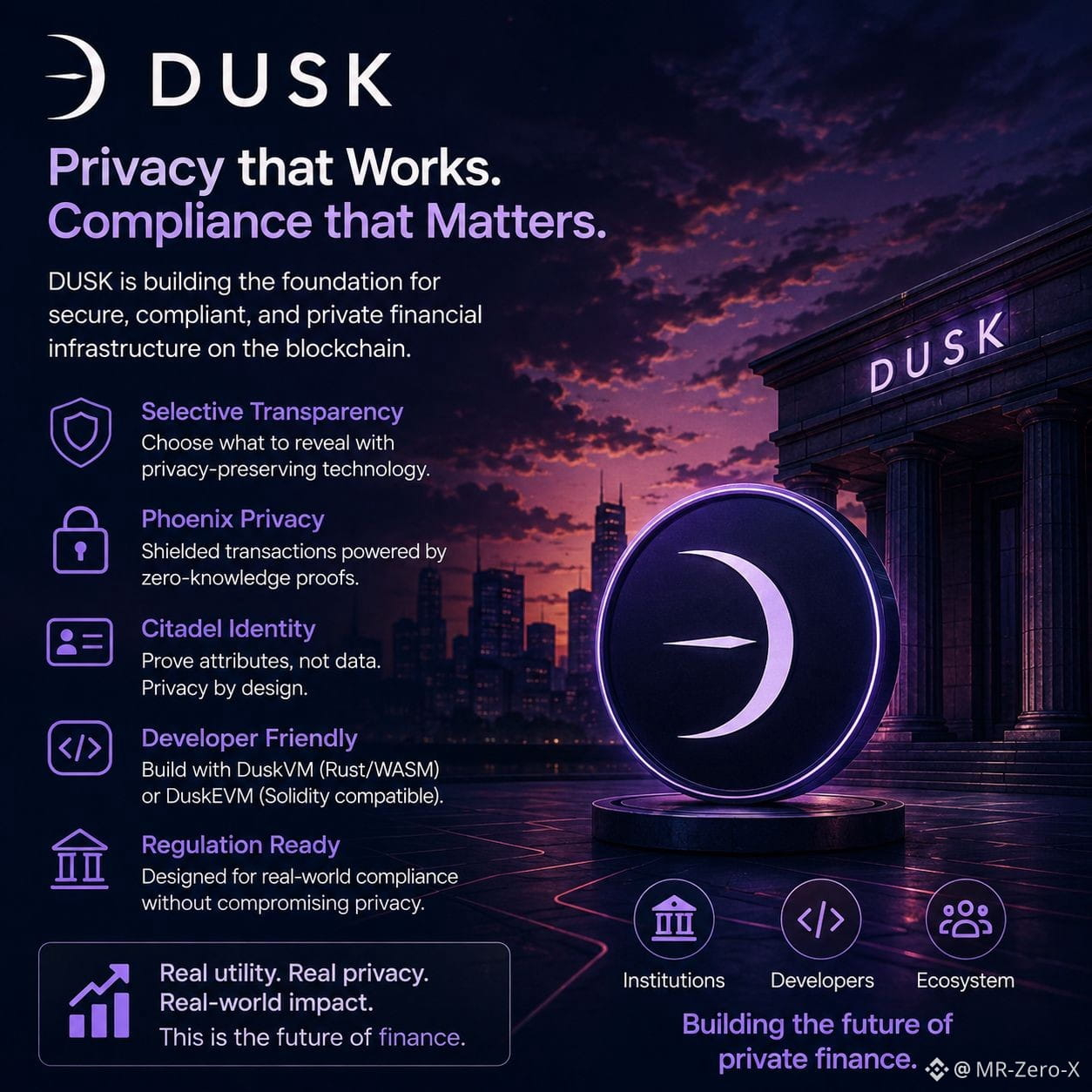
Instead of treating privacy as “hide everything,” DUSK separates different types of visibility. Its Moonlight model handles transparent transactions, while Phoenix uses zero-knowledge proofs to keep sensitive transaction details private while still proving validity.
That distinction feels important to me.
Financial markets aren’t completely public or completely private. Institutions may need confidentiality around certain information, while regulators or authorized participants still need reliable proof.
That’s where DUSK’s approach became more interesting for me.
I also looked into its identity layer, Citadel. What stood out is the idea of proving specific attributes without unnecessarily exposing the underlying information. To me, that feels much closer to how privacy could work in real-world financial systems.
Then there’s the developer side.
DUSK supports DuskVM for Rust/WASM applications while also providing DuskEVM compatibility for developers familiar with Solidity, Vyper, and EVM tooling.
I’m not taking any of this as a guarantee of success.
What I’m watching now is much more practical: can developers actually build useful financial applications around these privacy and compliance primitives?
That’s the part of DUSK I’m most curious to see unfold.
@Dusk_Foundation #DUSK $DUSK
#dusk $DUSK
What caught my attention about DUSK wasn’t another blockchain claiming to solve privacy.
It was a much simpler question: who actually needs to see what?
The more I explored DUSK, the more I liked this way of thinking.
Instead of treating privacy as “hide everything,” DUSK separates different types of visibility. Its Moonlight model handles transparent transactions, while Phoenix uses zero-knowledge proofs to keep sensitive transaction details private while still proving validity.
That distinction feels important to me.
Financial markets aren’t completely public or completely private. Institutions may need confidentiality around certain information, while regulators or authorized participants still need reliable proof.
That’s where DUSK’s approach became more interesting for me.
I also looked into its identity layer, Citadel. What stood out is the idea of proving specific attributes without unnecessarily exposing the underlying information. To me, that feels much closer to how privacy could work in real-world financial systems.
Then there’s the developer side.
DUSK supports DuskVM for Rust/WASM applications while also providing DuskEVM compatibility for developers familiar with Solidity, Vyper, and EVM tooling.
I’m not taking any of this as a guarantee of success.
What I’m watching now is much more practical: can developers actually build useful financial applications around these privacy and compliance primitives?
That’s the part of DUSK I’m most curious to see unfold.
@Dusk #DUSK $DUSK
What caught my attention about DUSK wasn’t another blockchain claiming to solve privacy.
It was a much simpler question: who actually needs to see what?
The more I explored DUSK, the more I liked this way of thinking.
Instead of treating privacy as “hide everything,” DUSK separates different types of visibility. Its Moonlight model handles transparent transactions, while Phoenix uses zero-knowledge proofs to keep sensitive transaction details private while still proving validity.
That distinction feels important to me.
Financial markets aren’t completely public or completely private. Institutions may need confidentiality around certain information, while regulators or authorized participants still need reliable proof.
That’s where DUSK’s approach became more interesting for me.
I also looked into its identity layer, Citadel. What stood out is the idea of proving specific attributes without unnecessarily exposing the underlying information. To me, that feels much closer to how privacy could work in real-world financial systems.
Then there’s the developer side.
DUSK supports DuskVM for Rust/WASM applications while also providing DuskEVM compatibility for developers familiar with Solidity, Vyper, and EVM tooling.
I’m not taking any of this as a guarantee of success.
What I’m watching now is much more practical: can developers actually build useful financial applications around these privacy and compliance primitives?
That’s the part of DUSK I’m most curious to see unfold.
@Dusk #DUSK $DUSK
1
1
273
·
--
#dusk $DUSK
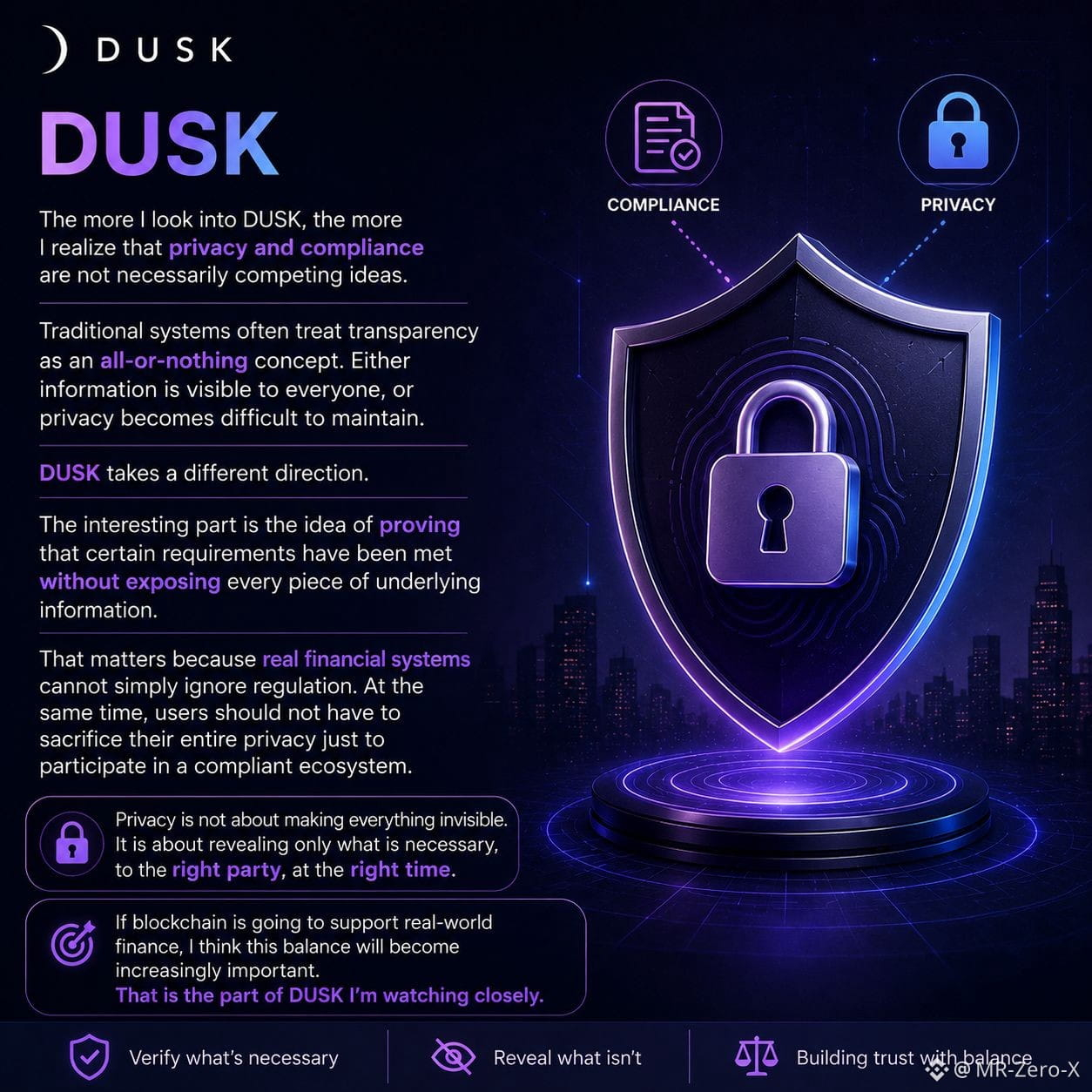
@Dusk_Foundation The more I look into DUSK, the more I realize that privacy and compliance are not necessarily competing ideas.
Traditional systems often treat transparency as an all-or-nothing concept. Either information is visible to everyone, or privacy becomes difficult to maintain.
$DUSK takes a different direction.
The interesting part is the idea of proving that certain requirements have been met without exposing every piece of underlying information.
That matters because real financial systems cannot simply ignore regulation. At the same time, users should not have to sacrifice their entire privacy just to participate in a compliant ecosystem.
For me, this is where the conversation becomes more practical.
Privacy is not about making everything invisible.
It is about revealing only what is necessary, to the right party, at the right time.
If blockchain is going to support real-world finance, I think this balance will become increasingly important.
That is the part of DUSK I’m watching closely.
#DUSK $DUSK
#dusk $DUSK
@Dusk The more I look into DUSK, the more I realize that privacy and compliance are not necessarily competing ideas.
Traditional systems often treat transparency as an all-or-nothing concept. Either information is visible to everyone, or privacy becomes difficult to maintain.
$DUSK takes a different direction.
The interesting part is the idea of proving that certain requirements have been met without exposing every piece of underlying information.
That matters because real financial systems cannot simply ignore regulation. At the same time, users should not have to sacrifice their entire privacy just to participate in a compliant ecosystem.
For me, this is where the conversation becomes more practical.
Privacy is not about making everything invisible.
It is about revealing only what is necessary, to the right party, at the right time.
If blockchain is going to support real-world finance, I think this balance will become increasingly important.
That is the part of DUSK I’m watching closely.
#DUSK $DUSK
@Dusk The more I look into DUSK, the more I realize that privacy and compliance are not necessarily competing ideas.
Traditional systems often treat transparency as an all-or-nothing concept. Either information is visible to everyone, or privacy becomes difficult to maintain.
$DUSK takes a different direction.
The interesting part is the idea of proving that certain requirements have been met without exposing every piece of underlying information.
That matters because real financial systems cannot simply ignore regulation. At the same time, users should not have to sacrifice their entire privacy just to participate in a compliant ecosystem.
For me, this is where the conversation becomes more practical.
Privacy is not about making everything invisible.
It is about revealing only what is necessary, to the right party, at the right time.
If blockchain is going to support real-world finance, I think this balance will become increasingly important.
That is the part of DUSK I’m watching closely.
#DUSK $DUSK
178
·
--
@Dusk_Foundation $DUSK
I’ve been looking at Dusk from a simple question:
Can blockchain infrastructure give institutions privacy without sacrificing compliance?
That’s where Dusk gets interesting to me.
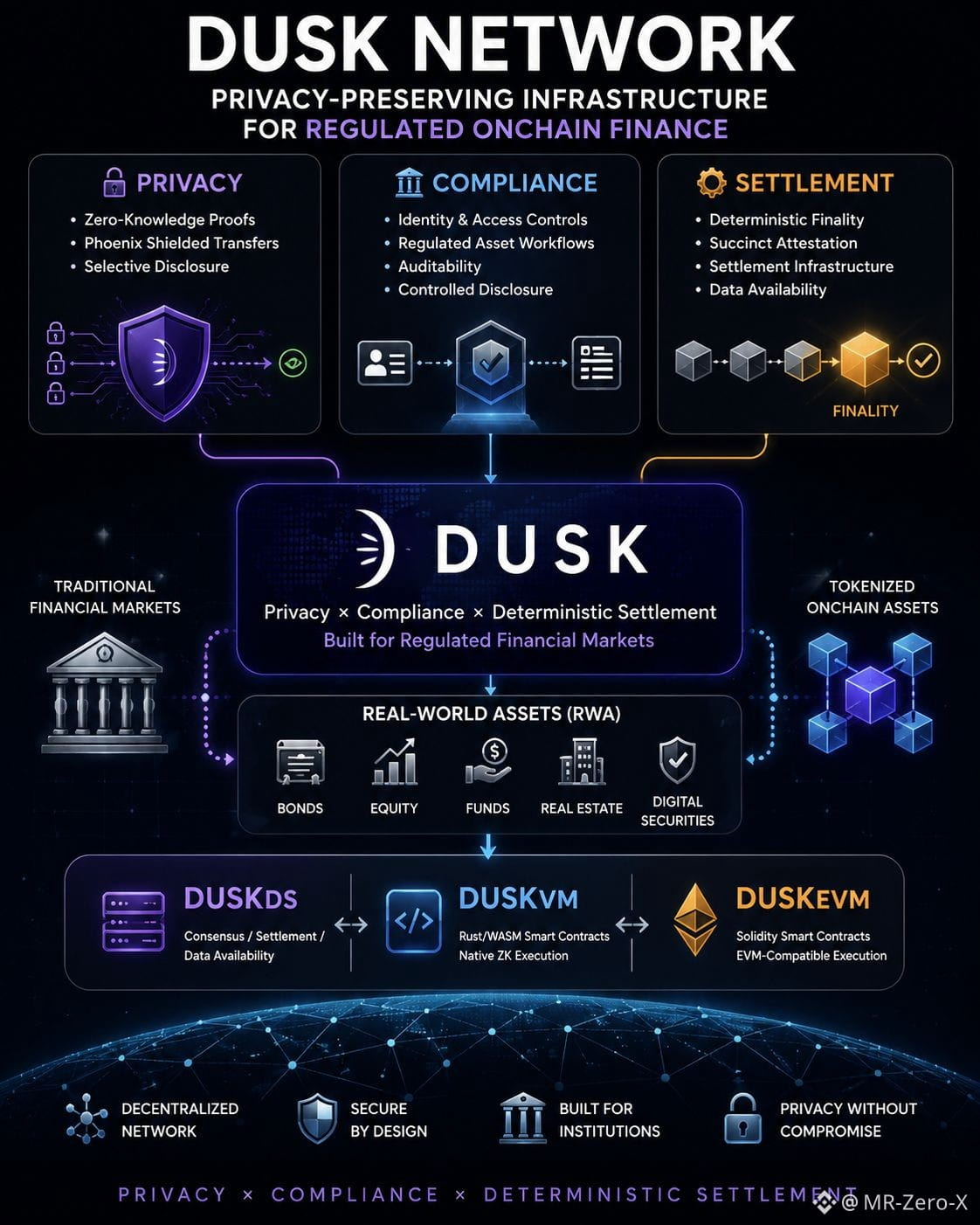
🔐 PRIVACY
• Zero-knowledge technology
• Shielded transactions
• Selective disclosure
🏛️ COMPLIANCE
• Identity & access controls
• Regulated asset workflows
• Privacy with verifiability
⚙️ SETTLEMENT
• Deterministic finality
• Succinct Attestation consensus
• Infrastructure designed for financial applications
🌍 RWA
The bigger idea isn’t simply putting real-world assets on a blockchain.
It’s building the rails for issuance, ownership, transfer and settlement while keeping privacy and regulatory requirements in the picture.
That’s the part I’ll be watching closely.
👇 Do you think privacy + compliance can become the missing piece for institutional blockchain adoption?
#Dusk #RWA #Privacy #Layer1 #BinanceSquare
@Dusk $DUSK
I’ve been looking at Dusk from a simple question:
Can blockchain infrastructure give institutions privacy without sacrificing compliance?
That’s where Dusk gets interesting to me.
🔐 PRIVACY
• Zero-knowledge technology
• Shielded transactions
• Selective disclosure
🏛️ COMPLIANCE
• Identity & access controls
• Regulated asset workflows
• Privacy with verifiability
⚙️ SETTLEMENT
• Deterministic finality
• Succinct Attestation consensus
• Infrastructure designed for financial applications
🌍 RWA
The bigger idea isn’t simply putting real-world assets on a blockchain.
It’s building the rails for issuance, ownership, transfer and settlement while keeping privacy and regulatory requirements in the picture.
That’s the part I’ll be watching closely.
👇 Do you think privacy + compliance can become the missing piece for institutional blockchain adoption?
#Dusk #RWA #Privacy #Layer1 #BinanceSquare
I’ve been looking at Dusk from a simple question:
Can blockchain infrastructure give institutions privacy without sacrificing compliance?
That’s where Dusk gets interesting to me.
🔐 PRIVACY
• Zero-knowledge technology
• Shielded transactions
• Selective disclosure
🏛️ COMPLIANCE
• Identity & access controls
• Regulated asset workflows
• Privacy with verifiability
⚙️ SETTLEMENT
• Deterministic finality
• Succinct Attestation consensus
• Infrastructure designed for financial applications
🌍 RWA
The bigger idea isn’t simply putting real-world assets on a blockchain.
It’s building the rails for issuance, ownership, transfer and settlement while keeping privacy and regulatory requirements in the picture.
That’s the part I’ll be watching closely.
👇 Do you think privacy + compliance can become the missing piece for institutional blockchain adoption?
#Dusk #RWA #Privacy #Layer1 #BinanceSquare
1
154
·
--
#baby $BABY
@Babylon One thing I've noticed while following Bitcoin staking is that attracting capital is only the first milestone.
The harder challenge is keeping that capital active for the long term.
That's one reason I'm watching the Babylon ecosystem and $BABY closely.
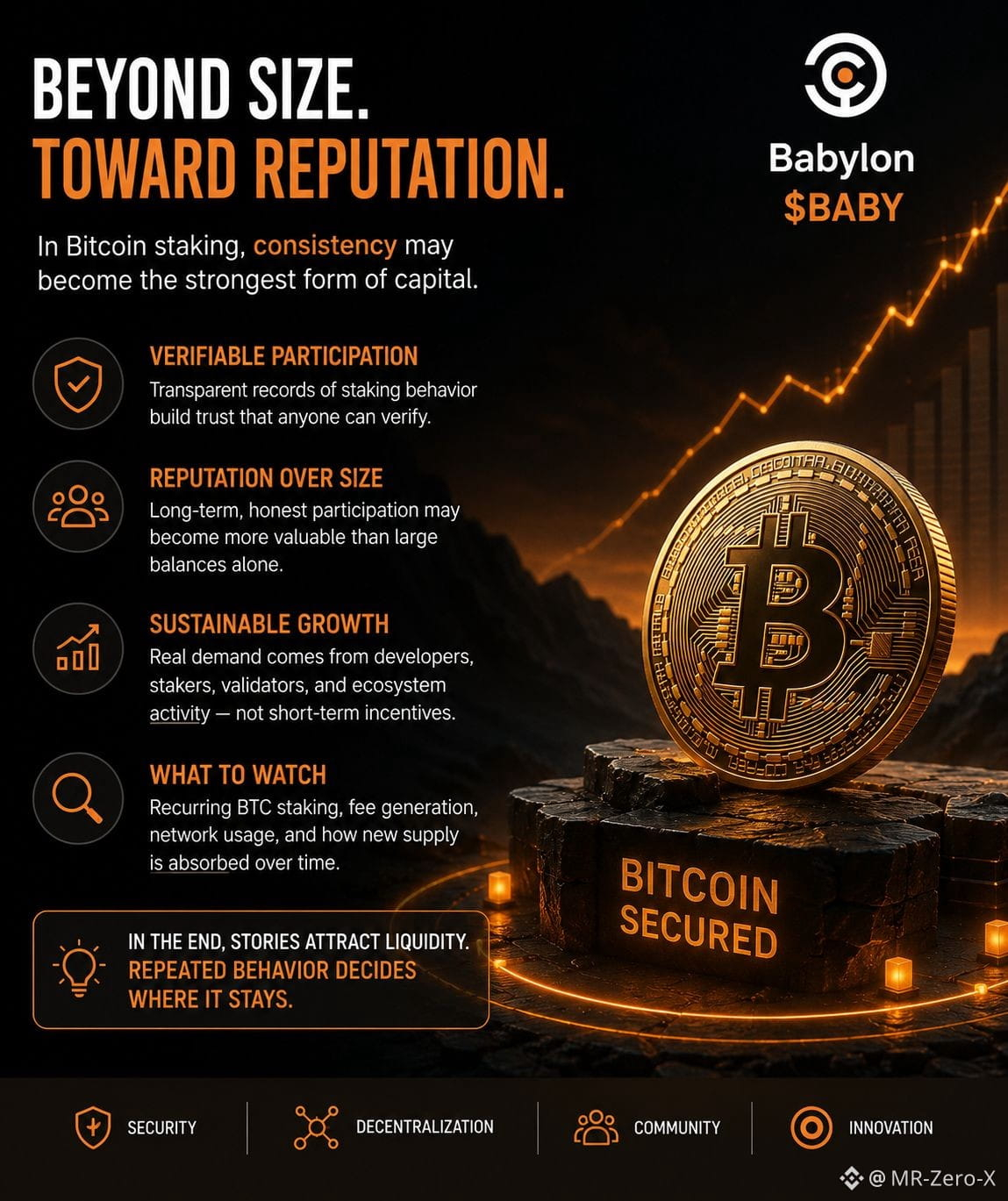
If Bitcoin staking continues to secure multiple networks, participants will build an on-chain history that anyone can verify. Over time, that history could become a valuable signal of reliability.
A validator that consistently performs well through different market conditions may contribute more to network confidence than one that simply appears with a large stake for a short period.
Of course, this only works if the network keeps creating real demand.
Developers need useful infrastructure.
Stakers need sustainable rewards.
Validators need enough economic activity to justify staying online.
For me, the most important metrics aren't daily hype or price movements. I'm watching recurring BTC staking, validator participation, ecosystem growth, fee generation, and whether network activity continues to strengthen after the initial excitement fades.
Strong narratives attract attention.
Long-term utility is what usually determines whether an ecosystem keeps growing.
What do you think will matter more for Babylon over the next few years: more BTC stakers or more real applications built on top of the network? 👇
#Babylon #baby #bitcoin #BTC
{spot}(BTCUSDT)
{future}(SOLUSDT)
{spot}(BABYUSDT)
#baby $BABY
@Babylon One thing I've noticed while following Bitcoin staking is that attracting capital is only the first milestone.
The harder challenge is keeping that capital active for the long term.
That's one reason I'm watching the Babylon ecosystem and $BABY closely.
If Bitcoin staking continues to secure multiple networks, participants will build an on-chain history that anyone can verify. Over time, that history could become a valuable signal of reliability.
A validator that consistently performs well through different market conditions may contribute more to network confidence than one that simply appears with a large stake for a short period.
Of course, this only works if the network keeps creating real demand.
Developers need useful infrastructure.
Stakers need sustainable rewards.
Validators need enough economic activity to justify staying online.
For me, the most important metrics aren't daily hype or price movements. I'm watching recurring BTC staking, validator participation, ecosystem growth, fee generation, and whether network activity continues to strengthen after the initial excitement fades.
Strong narratives attract attention.
Long-term utility is what usually determines whether an ecosystem keeps growing.
What do you think will matter more for Babylon over the next few years: more BTC stakers or more real applications built on top of the network? 👇
#Babylon #baby #bitcoin #BTC
@Babylon One thing I've noticed while following Bitcoin staking is that attracting capital is only the first milestone.
The harder challenge is keeping that capital active for the long term.
That's one reason I'm watching the Babylon ecosystem and $BABY closely.
If Bitcoin staking continues to secure multiple networks, participants will build an on-chain history that anyone can verify. Over time, that history could become a valuable signal of reliability.
A validator that consistently performs well through different market conditions may contribute more to network confidence than one that simply appears with a large stake for a short period.
Of course, this only works if the network keeps creating real demand.
Developers need useful infrastructure.
Stakers need sustainable rewards.
Validators need enough economic activity to justify staying online.
For me, the most important metrics aren't daily hype or price movements. I'm watching recurring BTC staking, validator participation, ecosystem growth, fee generation, and whether network activity continues to strengthen after the initial excitement fades.
Strong narratives attract attention.
Long-term utility is what usually determines whether an ecosystem keeps growing.
What do you think will matter more for Babylon over the next few years: more BTC stakers or more real applications built on top of the network? 👇
#Babylon #baby #bitcoin #BTC
110
·
--
Проверено
$OPG @OpenGradient
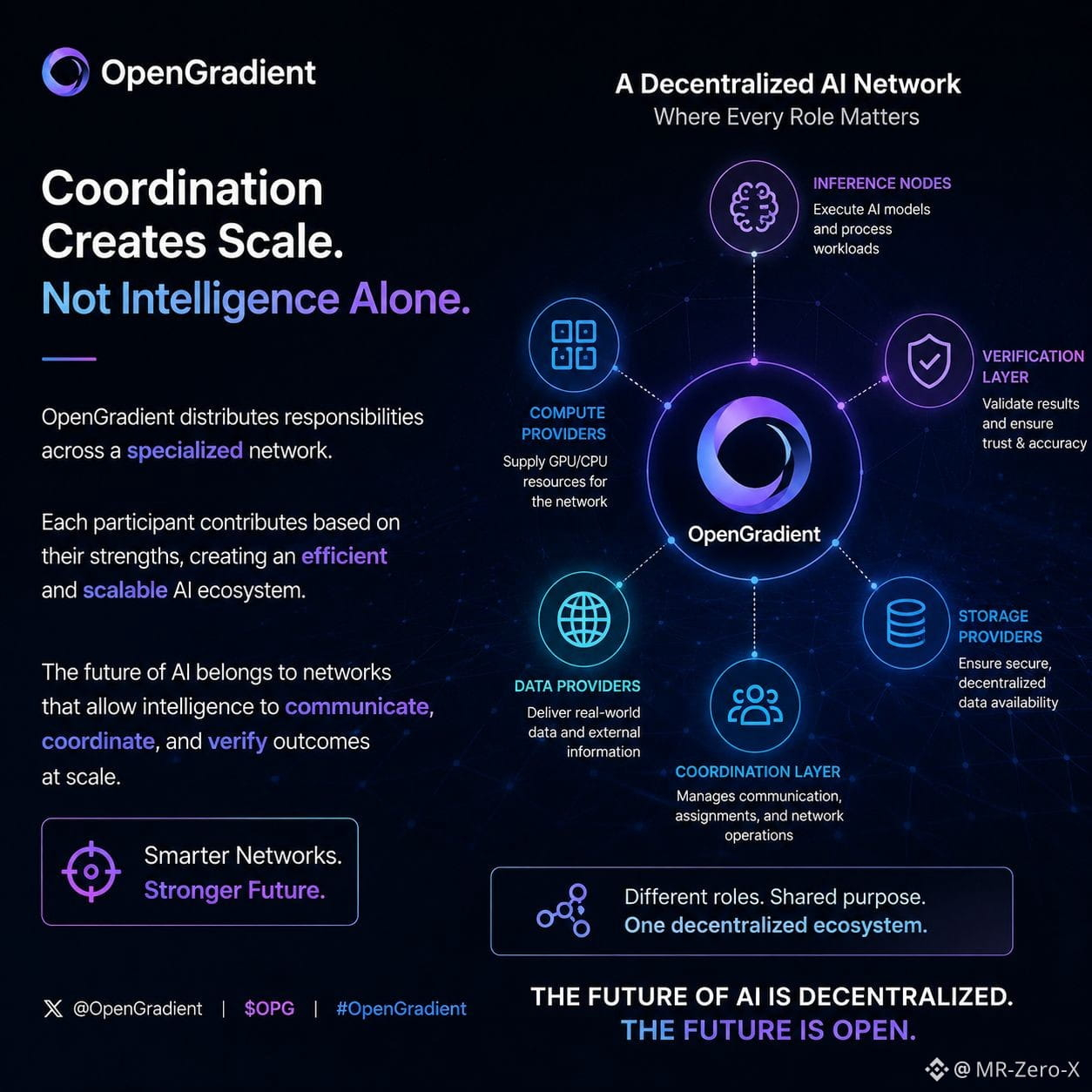
The more I think about OpenGradient, the more I realize that coordination only works when every participant in the network has a clear role.
One aspect of the architecture that stands out to me is how responsibilities are distributed instead of forcing every node to perform the same task.
AI workloads are rarely uniform. Some operations require heavy computation, others focus on verification, data access, or storage.
OpenGradient approaches this challenge by separating these functions across specialized participants.
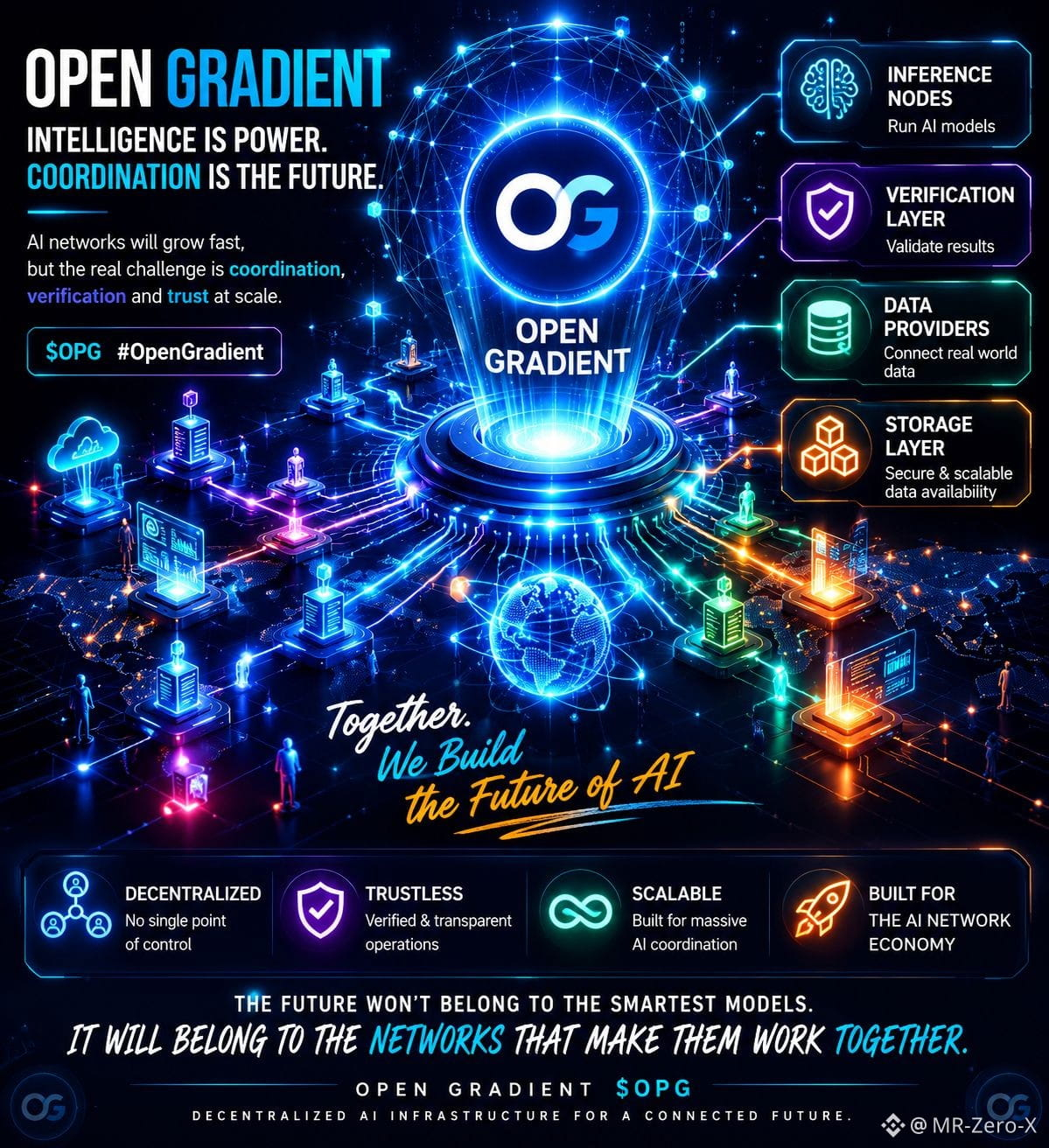
Inference nodes execute AI models, verification layers help validate results, data providers connect external information, and storage infrastructure manages long-term data availability.
What interests me most is the efficiency this creates. Rather than building a network where every participant does everything, the system is designed more like an ecosystem where different components contribute according to their strengths.
As AI networks continue growing, scalability may depend less on raw computing power and more on how effectively resources are coordinated across the system.
The projects that solve coordination, verification, and resource allocation could become just as important as the models themselves.
That is one reason OpenGradient continues to capture my attention.
@OpenGradient $OPG #OpenGradient
#opg
$OPG @OpenGradient
The more I think about OpenGradient, the more I realize that coordination only works when every participant in the network has a clear role.
One aspect of the architecture that stands out to me is how responsibilities are distributed instead of forcing every node to perform the same task.
AI workloads are rarely uniform. Some operations require heavy computation, others focus on verification, data access, or storage.
OpenGradient approaches this challenge by separating these functions across specialized participants.
Inference nodes execute AI models, verification layers help validate results, data providers connect external information, and storage infrastructure manages long-term data availability.
What interests me most is the efficiency this creates. Rather than building a network where every participant does everything, the system is designed more like an ecosystem where different components contribute according to their strengths.
As AI networks continue growing, scalability may depend less on raw computing power and more on how effectively resources are coordinated across the system.
The projects that solve coordination, verification, and resource allocation could become just as important as the models themselves.
That is one reason OpenGradient continues to capture my attention.
@OpenGradient $OPG #OpenGradient
#opg
The more I think about OpenGradient, the more I realize that coordination only works when every participant in the network has a clear role.
One aspect of the architecture that stands out to me is how responsibilities are distributed instead of forcing every node to perform the same task.
AI workloads are rarely uniform. Some operations require heavy computation, others focus on verification, data access, or storage.
OpenGradient approaches this challenge by separating these functions across specialized participants.
Inference nodes execute AI models, verification layers help validate results, data providers connect external information, and storage infrastructure manages long-term data availability.
What interests me most is the efficiency this creates. Rather than building a network where every participant does everything, the system is designed more like an ecosystem where different components contribute according to their strengths.
As AI networks continue growing, scalability may depend less on raw computing power and more on how effectively resources are coordinated across the system.
The projects that solve coordination, verification, and resource allocation could become just as important as the models themselves.
That is one reason OpenGradient continues to capture my attention.
@OpenGradient $OPG #OpenGradient
#opg
4
4
338
·
--
@OpenGradient
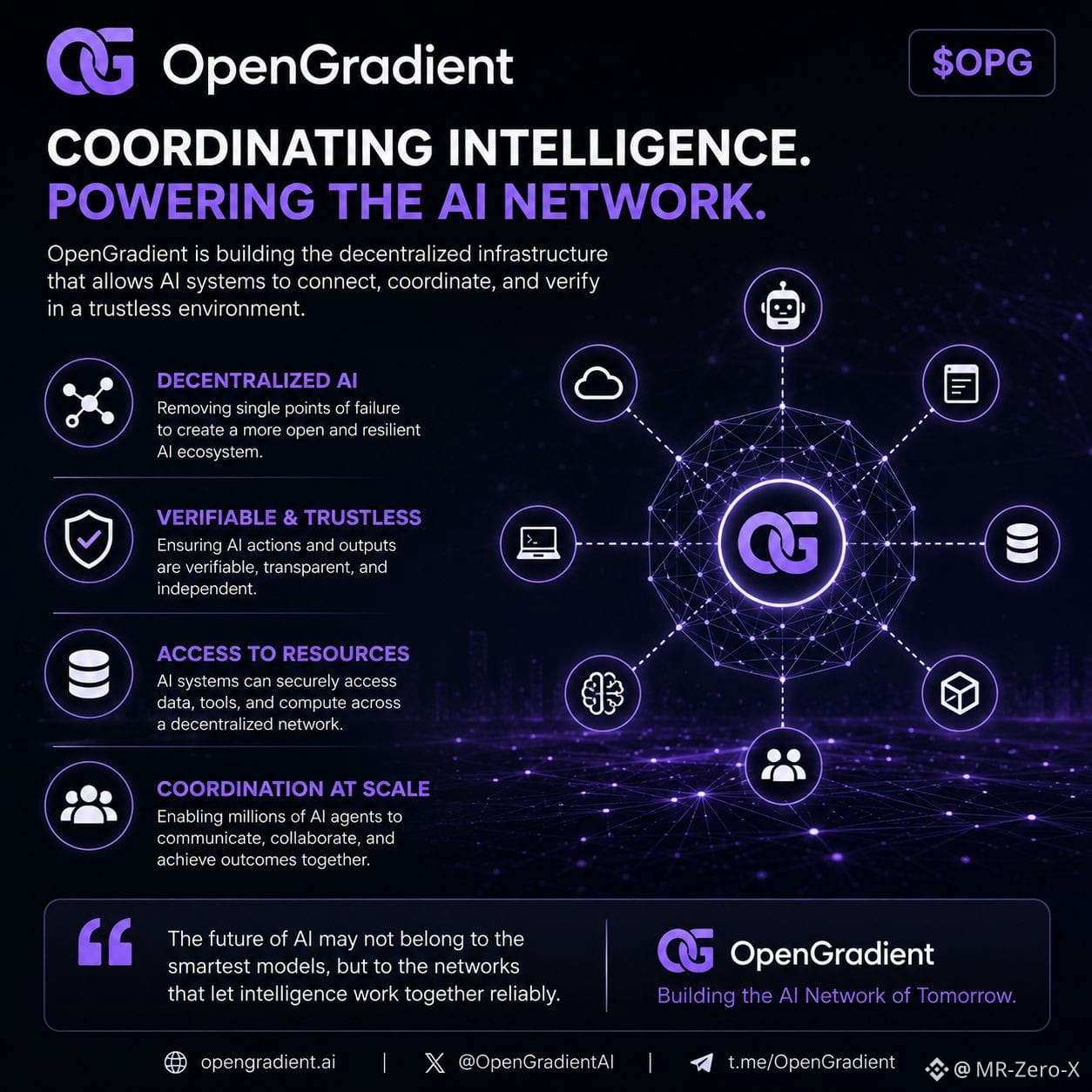
The more I read about OpenGradient, the more I realize that AI may eventually face a challenge that goes beyond model intelligence.
Building intelligent systems is one thing.
Allowing intelligence to coordinate at scale is something else entirely.
$OPG
Most conversations still focus on model capabilities, reasoning quality, and inference speed. Those improvements matter, but I keep wondering what happens when large numbers of AI systems need to interact with each other, access external resources, and make decisions across decentralized environments.
How do they coordinate?
How do they verify information?
How do they operate without relying on a single centralized authority?
This is where OpenGradient becomes interesting to me.
The project shifts attention from individual AI models to the infrastructure that enables intelligence to function as part of a broader network.
The more I explore decentralized AI, the more I think the future may depend not only on smarter models but also on systems that support coordination, transparency, and verification at scale.
The next phase of AI might not be defined by a single breakthrough.
It may be defined by the networks that allow intelligence to work together reliably.
That's one of the reasons OpenGradient remains on my radar.
@OpenGradient
$OPG #OpenGradient #OPG
@OpenGradient
The more I read about OpenGradient, the more I realize that AI may eventually face a challenge that goes beyond model intelligence.
Building intelligent systems is one thing.
Allowing intelligence to coordinate at scale is something else entirely.
$OPG
Most conversations still focus on model capabilities, reasoning quality, and inference speed. Those improvements matter, but I keep wondering what happens when large numbers of AI systems need to interact with each other, access external resources, and make decisions across decentralized environments.
How do they coordinate?
How do they verify information?
How do they operate without relying on a single centralized authority?
This is where OpenGradient becomes interesting to me.
The project shifts attention from individual AI models to the infrastructure that enables intelligence to function as part of a broader network.
The more I explore decentralized AI, the more I think the future may depend not only on smarter models but also on systems that support coordination, transparency, and verification at scale.
The next phase of AI might not be defined by a single breakthrough.
It may be defined by the networks that allow intelligence to work together reliably.
That's one of the reasons OpenGradient remains on my radar.
@OpenGradient
$OPG #OpenGradient #OPG
The more I read about OpenGradient, the more I realize that AI may eventually face a challenge that goes beyond model intelligence.
Building intelligent systems is one thing.
Allowing intelligence to coordinate at scale is something else entirely.
$OPG
Most conversations still focus on model capabilities, reasoning quality, and inference speed. Those improvements matter, but I keep wondering what happens when large numbers of AI systems need to interact with each other, access external resources, and make decisions across decentralized environments.
How do they coordinate?
How do they verify information?
How do they operate without relying on a single centralized authority?
This is where OpenGradient becomes interesting to me.
The project shifts attention from individual AI models to the infrastructure that enables intelligence to function as part of a broader network.
The more I explore decentralized AI, the more I think the future may depend not only on smarter models but also on systems that support coordination, transparency, and verification at scale.
The next phase of AI might not be defined by a single breakthrough.
It may be defined by the networks that allow intelligence to work together reliably.
That's one of the reasons OpenGradient remains on my radar.
@OpenGradient
$OPG #OpenGradient #OPG
22
11
276
·
--
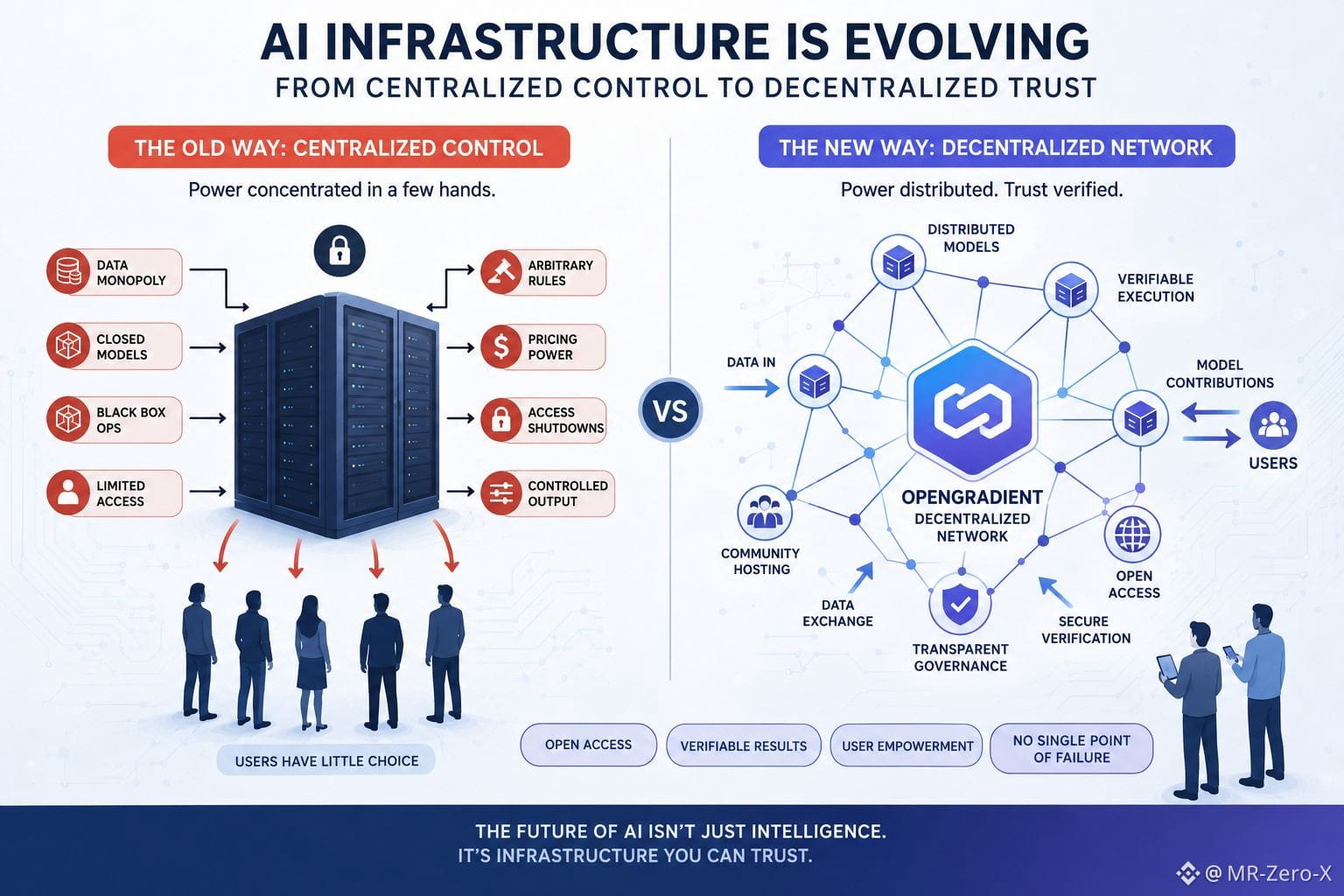
The more I read about Open gradient, the more I realize that AI may eventually face the same challenge many networks have faced before.
Building intelligence is one thing.
Coordinating intelligence is something else entirely.
$OPG
Most discussions still focus on models and capabilities. Better reasoning, larger context windows, faster inference. Those improvements matter, but I keep wondering what happens when thousands or even millions of AI systems need to interact with each other and with external resources.
How do they coordinate?
How do they access data?
How do they verify actions?
How do they operate without relying on a single centralized point of control?
This is where OpenGradient becomes interesting to me.
The project makes me think less about individual AI models and more about the infrastructure that allows intelligence to function as part of a larger network.
The more I study decentralized AI, the more it feels like intelligence alone may not be the final destination.
The real challenge could be creating systems where intelligence can communicate, coordinate, and verify outcomes at scale.
I'm still exploring the architecture and learning how the pieces fit together, but one idea keeps standing out.
The future of AI may not belong only to the smartest models.
It may belong to the networks that allow intelligence to work together reliably.
That's one of the reasons OpenGradient remains on my radar.
@OpenGradient $OPG #OpenGradient #OPG
The more I read about Open gradient, the more I realize that AI may eventually face the same challenge many networks have faced before.
Building intelligence is one thing.
Coordinating intelligence is something else entirely.
$OPG
Most discussions still focus on models and capabilities. Better reasoning, larger context windows, faster inference. Those improvements matter, but I keep wondering what happens when thousands or even millions of AI systems need to interact with each other and with external resources.
How do they coordinate?
How do they access data?
How do they verify actions?
How do they operate without relying on a single centralized point of control?
This is where OpenGradient becomes interesting to me.
The project makes me think less about individual AI models and more about the infrastructure that allows intelligence to function as part of a larger network.
The more I study decentralized AI, the more it feels like intelligence alone may not be the final destination.
The real challenge could be creating systems where intelligence can communicate, coordinate, and verify outcomes at scale.
I'm still exploring the architecture and learning how the pieces fit together, but one idea keeps standing out.
The future of AI may not belong only to the smartest models.
It may belong to the networks that allow intelligence to work together reliably.
That's one of the reasons OpenGradient remains on my radar.
@OpenGradient $OPG #OpenGradient #OPG
Building intelligence is one thing.
Coordinating intelligence is something else entirely.
$OPG
Most discussions still focus on models and capabilities. Better reasoning, larger context windows, faster inference. Those improvements matter, but I keep wondering what happens when thousands or even millions of AI systems need to interact with each other and with external resources.
How do they coordinate?
How do they access data?
How do they verify actions?
How do they operate without relying on a single centralized point of control?
This is where OpenGradient becomes interesting to me.
The project makes me think less about individual AI models and more about the infrastructure that allows intelligence to function as part of a larger network.
The more I study decentralized AI, the more it feels like intelligence alone may not be the final destination.
The real challenge could be creating systems where intelligence can communicate, coordinate, and verify outcomes at scale.
I'm still exploring the architecture and learning how the pieces fit together, but one idea keeps standing out.
The future of AI may not belong only to the smartest models.
It may belong to the networks that allow intelligence to work together reliably.
That's one of the reasons OpenGradient remains on my radar.
@OpenGradient $OPG #OpenGradient #OPG
11
6
101
·
--
#opg $OPG @OpenGradient
The more time I spend looking into OpenGradient, the more I find myself thinking about something that doesn't get discussed enough.
Most conversations around AI seem to start with models.
Smarter models.
Faster models.
Larger models.
But I keep coming back to a different question.
What happens after the model generates an answer?
Where does the information come from?
How can it be verified?
How does the system interact with the resources around it?
The reason I keep paying attention to OpenGradient is that it pushes me to think about the layers underneath AI rather than the outputs on top.
I don't see long-term value coming only from intelligence.
I think access, coordination, and verification will matter just as much.
Maybe even more.
I'm still learning and connecting the pieces together, but one thing feels increasingly clear to me.
The future of AI may not be defined by a single breakthrough model.
It may be shaped by the infrastructure that allows intelligence to operate in a reliable and verifiable way.
That's the part I'm watching most closely right now.
#OpenGradient $OPG @OpenGradient
#opg $OPG @OpenGradient
The more time I spend looking into OpenGradient, the more I find myself thinking about something that doesn't get discussed enough.
Most conversations around AI seem to start with models.
Smarter models.
Faster models.
Larger models.
But I keep coming back to a different question.
What happens after the model generates an answer?
Where does the information come from?
How can it be verified?
How does the system interact with the resources around it?
The reason I keep paying attention to OpenGradient is that it pushes me to think about the layers underneath AI rather than the outputs on top.
I don't see long-term value coming only from intelligence.
I think access, coordination, and verification will matter just as much.
Maybe even more.
I'm still learning and connecting the pieces together, but one thing feels increasingly clear to me.
The future of AI may not be defined by a single breakthrough model.
It may be shaped by the infrastructure that allows intelligence to operate in a reliable and verifiable way.
That's the part I'm watching most closely right now.
#OpenGradient $OPG @OpenGradient
The more time I spend looking into OpenGradient, the more I find myself thinking about something that doesn't get discussed enough.
Most conversations around AI seem to start with models.
Smarter models.
Faster models.
Larger models.
But I keep coming back to a different question.
What happens after the model generates an answer?
Where does the information come from?
How can it be verified?
How does the system interact with the resources around it?
The reason I keep paying attention to OpenGradient is that it pushes me to think about the layers underneath AI rather than the outputs on top.
I don't see long-term value coming only from intelligence.
I think access, coordination, and verification will matter just as much.
Maybe even more.
I'm still learning and connecting the pieces together, but one thing feels increasingly clear to me.
The future of AI may not be defined by a single breakthrough model.
It may be shaped by the infrastructure that allows intelligence to operate in a reliable and verifiable way.
That's the part I'm watching most closely right now.
#OpenGradient $OPG @OpenGradient
45
22
490
·
--
Проверено
#opg $OPG @OpenGradient
I've spent a lot of time studying AI projects, and one thing keeps standing out to me. Most conversations focus on intelligence. Everyone wants smarter models, faster responses, and bigger capabilities. But as AI becomes part of real-world systems, I think another factor becomes just as important: trust.
This is one reason OpenGradient Network caught my attention.
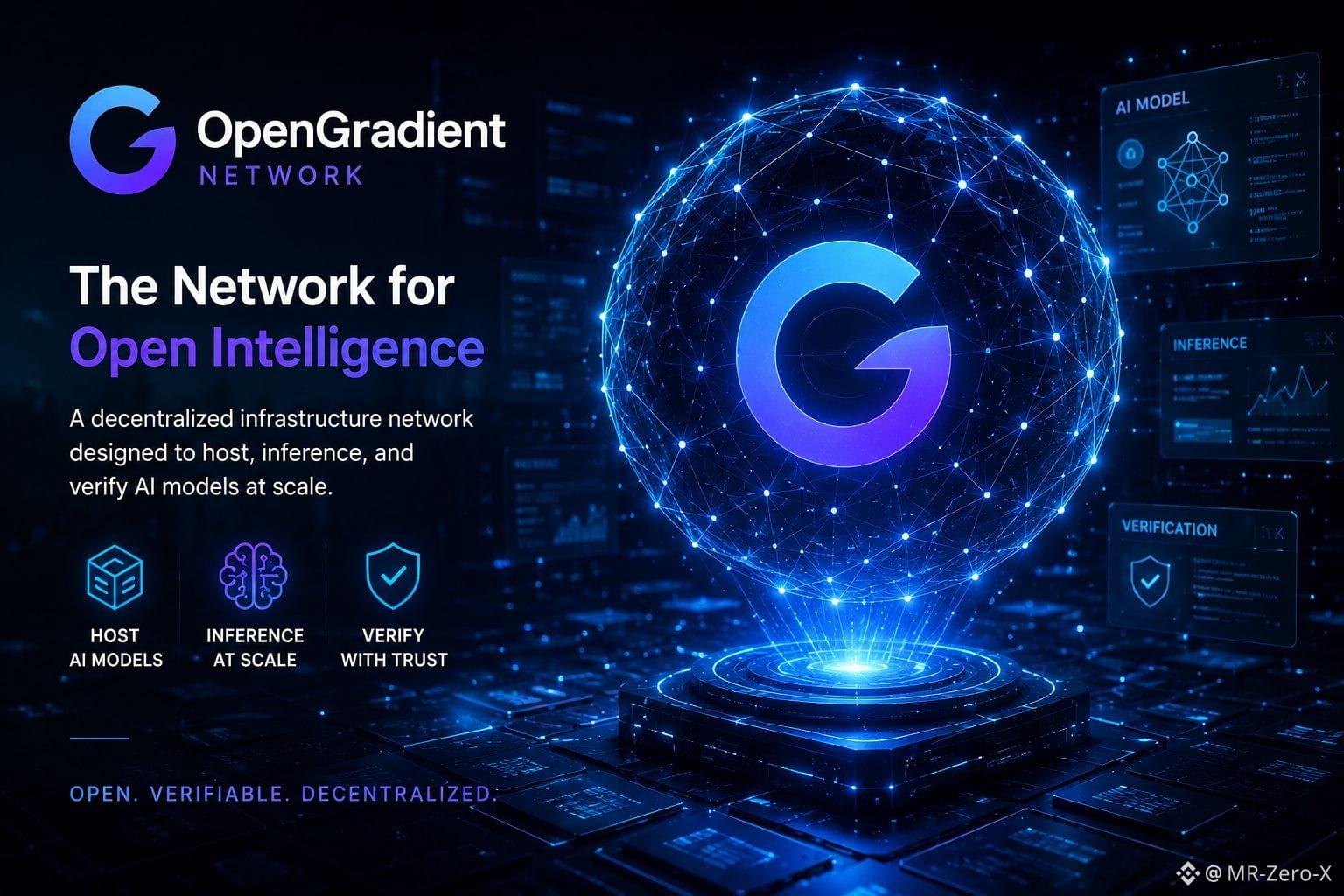
When I look at AI infrastructure, I don't just ask what a model can do. I also ask whether its outputs can be verified. OpenGradient is building a decentralized network designed to host, run inference on, and verify AI models at scale. That focus feels increasingly relevant as AI adoption continues to grow.
Many AI systems still rely on users simply trusting the results they receive. That works to a point, but long-term adoption may require greater transparency and accountability. Verification could become a critical part of AI infrastructure rather than an optional feature.
I'm not treating this as a solved problem. Scalability, efficiency, and adoption remain important challenges for any decentralized AI network. But I think the direction is worth paying attention to.
The future of AI may depend on more than intelligence alone. It may also depend on whether intelligence can be verified and trusted. That's why OpenGradient Network remains an interesting project for me to follow.
@OpenGradient $OPG #OpenGradient
#opg $OPG @OpenGradient
I've spent a lot of time studying AI projects, and one thing keeps standing out to me. Most conversations focus on intelligence. Everyone wants smarter models, faster responses, and bigger capabilities. But as AI becomes part of real-world systems, I think another factor becomes just as important: trust.
This is one reason OpenGradient Network caught my attention.
When I look at AI infrastructure, I don't just ask what a model can do. I also ask whether its outputs can be verified. OpenGradient is building a decentralized network designed to host, run inference on, and verify AI models at scale. That focus feels increasingly relevant as AI adoption continues to grow.
Many AI systems still rely on users simply trusting the results they receive. That works to a point, but long-term adoption may require greater transparency and accountability. Verification could become a critical part of AI infrastructure rather than an optional feature.
I'm not treating this as a solved problem. Scalability, efficiency, and adoption remain important challenges for any decentralized AI network. But I think the direction is worth paying attention to.
The future of AI may depend on more than intelligence alone. It may also depend on whether intelligence can be verified and trusted. That's why OpenGradient Network remains an interesting project for me to follow.
@OpenGradient $OPG #OpenGradient
I've spent a lot of time studying AI projects, and one thing keeps standing out to me. Most conversations focus on intelligence. Everyone wants smarter models, faster responses, and bigger capabilities. But as AI becomes part of real-world systems, I think another factor becomes just as important: trust.
This is one reason OpenGradient Network caught my attention.
When I look at AI infrastructure, I don't just ask what a model can do. I also ask whether its outputs can be verified. OpenGradient is building a decentralized network designed to host, run inference on, and verify AI models at scale. That focus feels increasingly relevant as AI adoption continues to grow.
Many AI systems still rely on users simply trusting the results they receive. That works to a point, but long-term adoption may require greater transparency and accountability. Verification could become a critical part of AI infrastructure rather than an optional feature.
I'm not treating this as a solved problem. Scalability, efficiency, and adoption remain important challenges for any decentralized AI network. But I think the direction is worth paying attention to.
The future of AI may depend on more than intelligence alone. It may also depend on whether intelligence can be verified and trusted. That's why OpenGradient Network remains an interesting project for me to follow.
@OpenGradient $OPG #OpenGradient
9
6
291
·
--
#opg $OPG @OpenGradient
I keep noticing that most AI conversations start from the same assumption:
intelligence is the scarce resource.
After spending time studying decentralized AI systems, I’m starting to think that assumption may be wrong.
Models are becoming cheaper, faster, and more accessible every quarter. What remains scarce is something far less discussed: verification.
That idea kept resurfacing while I was examining OpenGradient’s architecture. Most AI systems ask users to trust outputs without seeing how computation occurred, where data originated, or whether execution happened as claimed. The system works until decisions begin carrying real economic consequences.
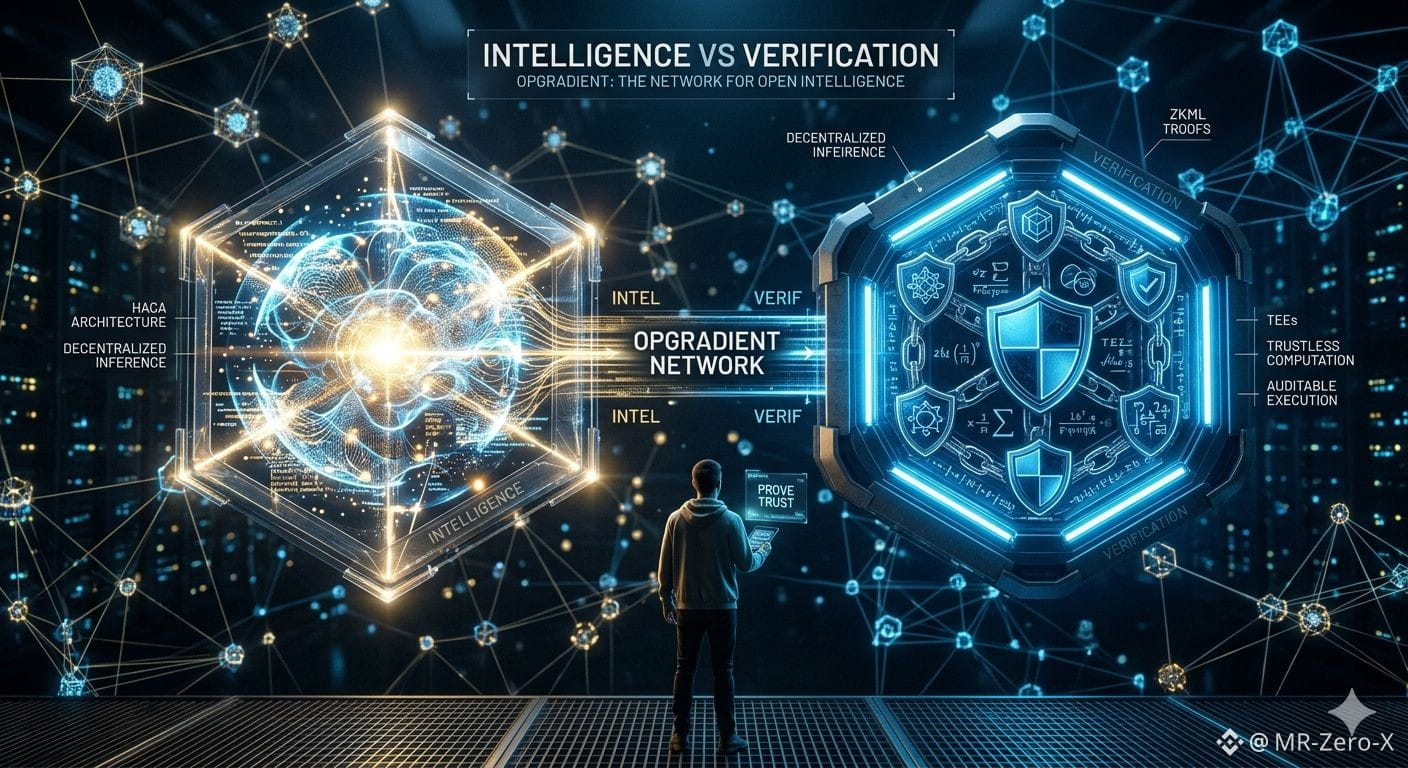
I increasingly view AI through a simple framework: Intelligence vs Verification.
Intelligence produces answers. Verification produces confidence.
What makes OpenGradient interesting is not that it tries to build smarter models, but that it explores mechanisms such as Trusted Execution Environments, zkML, data provenance, and privacy-preserving computation to make AI execution auditable without exposing everything underneath.
The hidden strength may be coordination. Verification creates a common reference point between parties that do not know or trust each other.
The unresolved challenge is equally important. Proof systems add cost, complexity, and latency. If verification becomes too expensive, will users still demand it?
As AI scales, which becomes more valuable: the model that generates an answer, or the network that proves the answer can be trusted?
$OPG #trades @OpenGradient
#opg $OPG @OpenGradient
I keep noticing that most AI conversations start from the same assumption:
intelligence is the scarce resource.
After spending time studying decentralized AI systems, I’m starting to think that assumption may be wrong.
Models are becoming cheaper, faster, and more accessible every quarter. What remains scarce is something far less discussed: verification.
That idea kept resurfacing while I was examining OpenGradient’s architecture. Most AI systems ask users to trust outputs without seeing how computation occurred, where data originated, or whether execution happened as claimed. The system works until decisions begin carrying real economic consequences.
I increasingly view AI through a simple framework: Intelligence vs Verification.
Intelligence produces answers. Verification produces confidence.
What makes OpenGradient interesting is not that it tries to build smarter models, but that it explores mechanisms such as Trusted Execution Environments, zkML, data provenance, and privacy-preserving computation to make AI execution auditable without exposing everything underneath.
The hidden strength may be coordination. Verification creates a common reference point between parties that do not know or trust each other.
The unresolved challenge is equally important. Proof systems add cost, complexity, and latency. If verification becomes too expensive, will users still demand it?
As AI scales, which becomes more valuable: the model that generates an answer, or the network that proves the answer can be trusted?
$OPG #trades @OpenGradient
I keep noticing that most AI conversations start from the same assumption:
intelligence is the scarce resource.
After spending time studying decentralized AI systems, I’m starting to think that assumption may be wrong.
Models are becoming cheaper, faster, and more accessible every quarter. What remains scarce is something far less discussed: verification.
That idea kept resurfacing while I was examining OpenGradient’s architecture. Most AI systems ask users to trust outputs without seeing how computation occurred, where data originated, or whether execution happened as claimed. The system works until decisions begin carrying real economic consequences.
I increasingly view AI through a simple framework: Intelligence vs Verification.
Intelligence produces answers. Verification produces confidence.
What makes OpenGradient interesting is not that it tries to build smarter models, but that it explores mechanisms such as Trusted Execution Environments, zkML, data provenance, and privacy-preserving computation to make AI execution auditable without exposing everything underneath.
The hidden strength may be coordination. Verification creates a common reference point between parties that do not know or trust each other.
The unresolved challenge is equally important. Proof systems add cost, complexity, and latency. If verification becomes too expensive, will users still demand it?
As AI scales, which becomes more valuable: the model that generates an answer, or the network that proves the answer can be trusted?
$OPG #trades @OpenGradient
2
217
·
--
Проверено
#opg $OPG @OpenGradient
I think one of the biggest mistakes in crypto right now is confusing visibility with value.
Projects spend months chasing attention, but attention alone never creates sustainability.
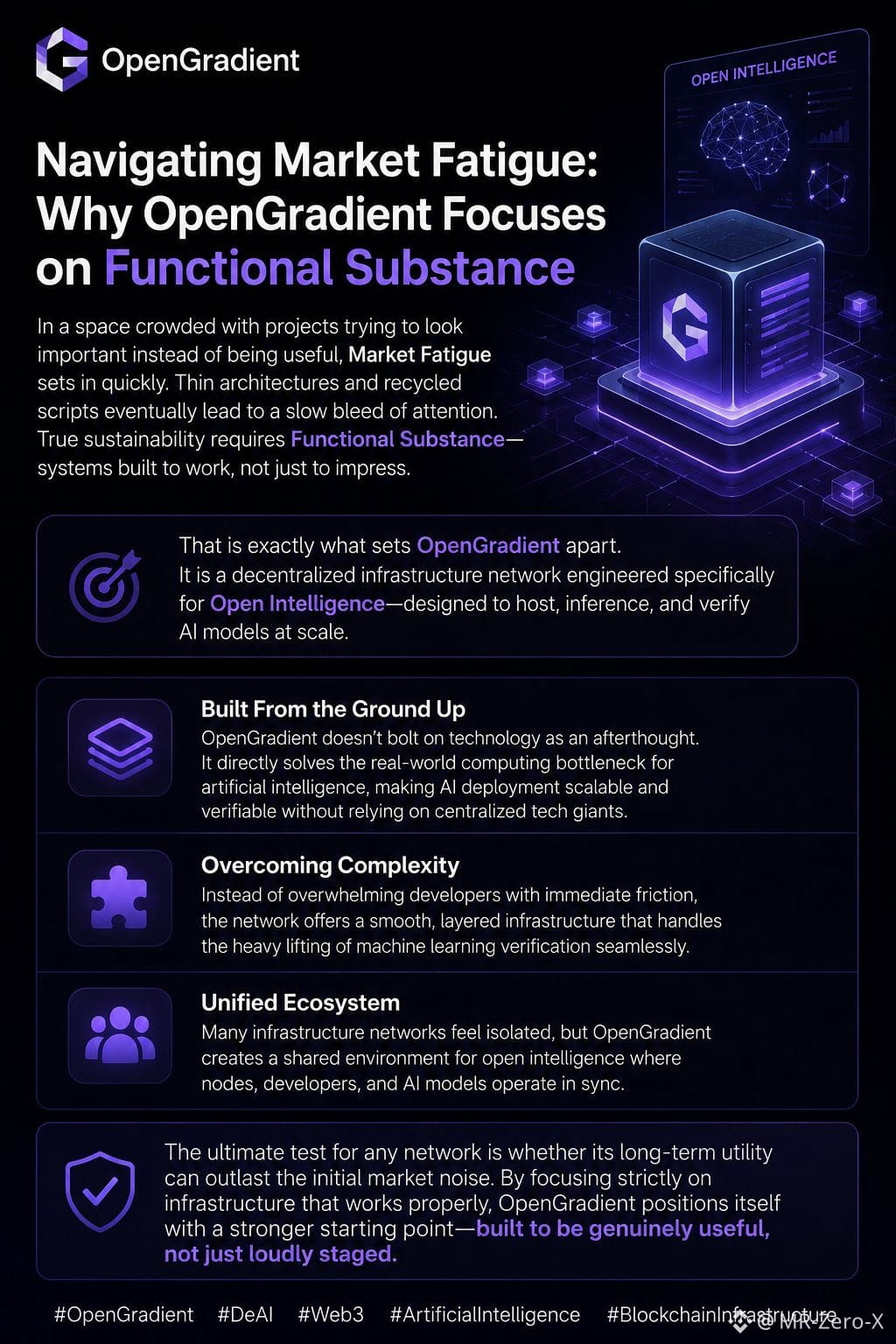
That’s why OpenGradient caught my attention. While many networks focus on narratives, OpenGradient is focused on infrastructure. The goal isn’t to look important—it’s to make AI deployment, inference, and verification actually work at scale.
$OPG
What stands out to me is that the network tackles a real bottleneck. Instead of relying on centralized providers, it creates an environment where open intelligence can operate through decentralized infrastructure.
Market fatigue eventually exposes weak foundations. Hype fades. Utility remains. That’s why I’m more interested in networks building functional substance than projects building temporary excitement.
#OpenGradient #DeAI #Web3 #ArtificialIntelligence
#opg $OPG @OpenGradient
I think one of the biggest mistakes in crypto right now is confusing visibility with value.
Projects spend months chasing attention, but attention alone never creates sustainability.
That’s why OpenGradient caught my attention. While many networks focus on narratives, OpenGradient is focused on infrastructure. The goal isn’t to look important—it’s to make AI deployment, inference, and verification actually work at scale.
$OPG
What stands out to me is that the network tackles a real bottleneck. Instead of relying on centralized providers, it creates an environment where open intelligence can operate through decentralized infrastructure.
Market fatigue eventually exposes weak foundations. Hype fades. Utility remains. That’s why I’m more interested in networks building functional substance than projects building temporary excitement.
#OpenGradient #DeAI #Web3 #ArtificialIntelligence
I think one of the biggest mistakes in crypto right now is confusing visibility with value.
Projects spend months chasing attention, but attention alone never creates sustainability.
That’s why OpenGradient caught my attention. While many networks focus on narratives, OpenGradient is focused on infrastructure. The goal isn’t to look important—it’s to make AI deployment, inference, and verification actually work at scale.
$OPG
What stands out to me is that the network tackles a real bottleneck. Instead of relying on centralized providers, it creates an environment where open intelligence can operate through decentralized infrastructure.
Market fatigue eventually exposes weak foundations. Hype fades. Utility remains. That’s why I’m more interested in networks building functional substance than projects building temporary excitement.
#OpenGradient #DeAI #Web3 #ArtificialIntelligence
5
3
310
·
--
Проверено
#opg $OPG
Most people focus on AI models.
I pay more attention to the infrastructure underneath them.
Because great technology rarely wins on capability alone.
It wins when builders can actually use it.
That’s one reason OpenGradient interests me.
A lot of AI projects talk about decentralization, but very few focus on making AI deployment practical for developers. Without usable infrastructure, even the best ideas struggle to move beyond demos.
What I find interesting is OpenGradient’s attempt to create an environment where AI models can be hosted, executed, and verified through decentralized infrastructure rather than relying entirely on centralized systems.
The real test isn't the technology itself.
It's whether developers choose to build on it.
Strong infrastructure attracts builders.
Builders create applications.
Applications create demand.
That cycle is what turns an idea into an ecosystem.
For now, that's the metric I'm watching most closely with OpenGradient.
Not the headlines.
Developer adoption.
#OpenGradient @OpenGradient $OPG
#opg $OPG
Most people focus on AI models.
I pay more attention to the infrastructure underneath them.
Because great technology rarely wins on capability alone.
It wins when builders can actually use it.
That’s one reason OpenGradient interests me.
A lot of AI projects talk about decentralization, but very few focus on making AI deployment practical for developers. Without usable infrastructure, even the best ideas struggle to move beyond demos.
What I find interesting is OpenGradient’s attempt to create an environment where AI models can be hosted, executed, and verified through decentralized infrastructure rather than relying entirely on centralized systems.
The real test isn't the technology itself.
It's whether developers choose to build on it.
Strong infrastructure attracts builders.
Builders create applications.
Applications create demand.
That cycle is what turns an idea into an ecosystem.
For now, that's the metric I'm watching most closely with OpenGradient.
Not the headlines.
Developer adoption.
#OpenGradient @OpenGradient $OPG
Most people focus on AI models.
I pay more attention to the infrastructure underneath them.
Because great technology rarely wins on capability alone.
It wins when builders can actually use it.
That’s one reason OpenGradient interests me.
A lot of AI projects talk about decentralization, but very few focus on making AI deployment practical for developers. Without usable infrastructure, even the best ideas struggle to move beyond demos.
What I find interesting is OpenGradient’s attempt to create an environment where AI models can be hosted, executed, and verified through decentralized infrastructure rather than relying entirely on centralized systems.
The real test isn't the technology itself.
It's whether developers choose to build on it.
Strong infrastructure attracts builders.
Builders create applications.
Applications create demand.
That cycle is what turns an idea into an ecosystem.
For now, that's the metric I'm watching most closely with OpenGradient.
Not the headlines.
Developer adoption.
#OpenGradient @OpenGradient $OPG
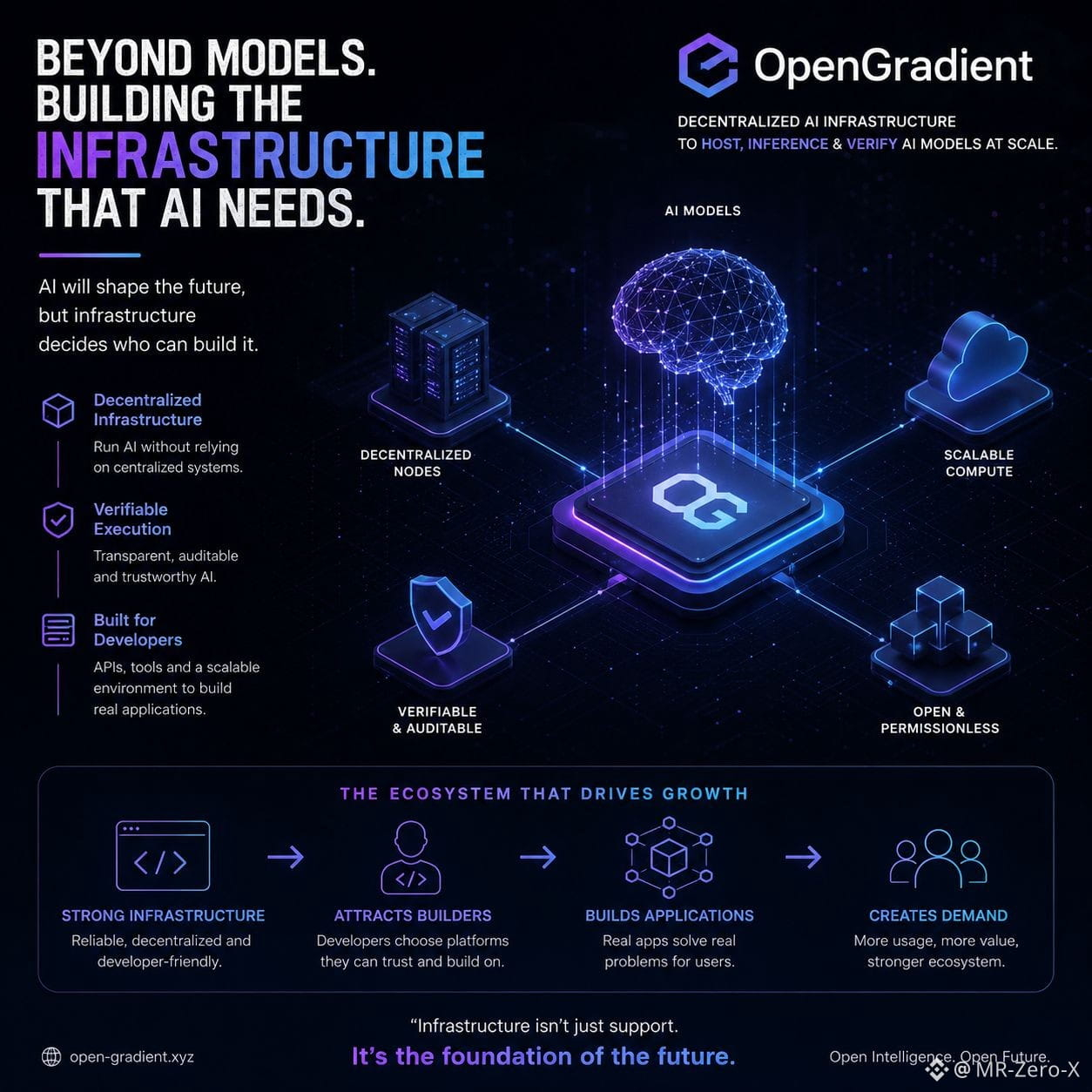
1
181
·
--
Проверено
#opg $OPG
OpenGradient $OPG:
Decoupling Hype from Execution Intelligence.
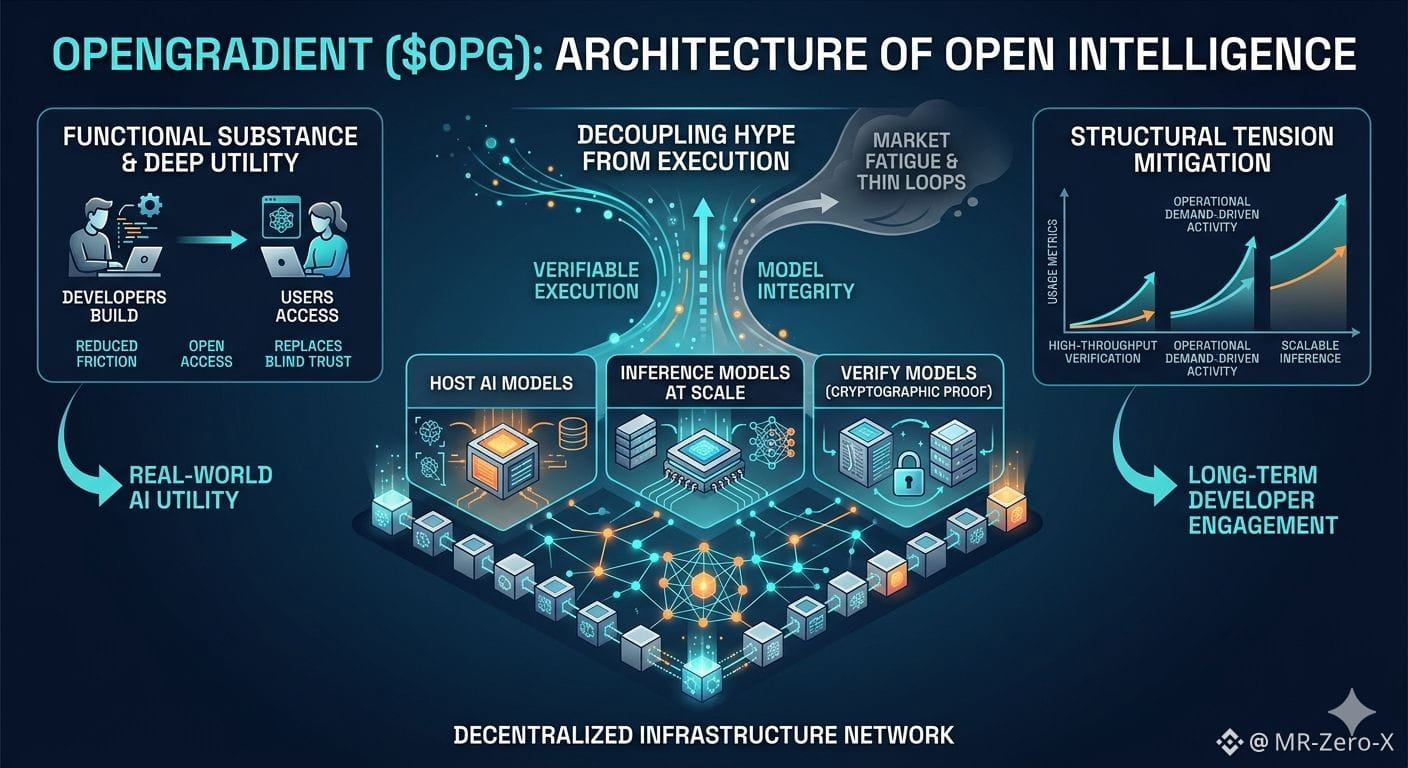
The Web3 infrastructure landscape is suffering from acute Market Fatigue. We are flooded with networks cosplaying technical importance—heavy on token-led pitches, but remarkably thin on Functional Substance. When you look under the surface of many decentralized AI (DeAI) platforms, the architecture is brittle, relying on central trust assumptions or inefficient compute loops that collapse under real-world demand.
OpenGradient ($OPG) stands out because it avoids this recycled script. It isn't built in reverse; the network focuses entirely on working properly at the core execution layer. Designed as a decentralized infrastructure network to host, inference, and verify AI models at sca OpenGradient replaces blind trust with cryptographic certainty. Instead of forcing developers into rigid, unoptimized environments, it introduces a hybrid compute architecture where model integrity is verifiable and execution is seamless.
What prevents market fatigue here is the balance between raw utility and structural sustainability. By lowering the friction required to deploy and interact with open intelligence, $OPG ensures that network activity is driven by genuine operational demand rather than artificial incentive loops. It creates an environment where decentralized AI feels like a robust, industrial tool rather than a staged experiment.
The real test for any DeAI infrastructure is Structural Tension: can the network maintain high-throughput verification without latency blowing out? While many projects crack under continued use, OpenGradient’s focus on scalable, verifiable inference provides the deep technical foundation needed to sustain long-term developer engagement. It doesn’t try too hard to impress with narrative fluff it focuses on execution intelligence.
@OpenGradient $OPG #OpenGradient
#opg $OPG
OpenGradient $OPG :
Decoupling Hype from Execution Intelligence.
The Web3 infrastructure landscape is suffering from acute Market Fatigue. We are flooded with networks cosplaying technical importance—heavy on token-led pitches, but remarkably thin on Functional Substance. When you look under the surface of many decentralized AI (DeAI) platforms, the architecture is brittle, relying on central trust assumptions or inefficient compute loops that collapse under real-world demand.
OpenGradient ($OPG ) stands out because it avoids this recycled script. It isn't built in reverse; the network focuses entirely on working properly at the core execution layer. Designed as a decentralized infrastructure network to host, inference, and verify AI models at sca OpenGradient replaces blind trust with cryptographic certainty. Instead of forcing developers into rigid, unoptimized environments, it introduces a hybrid compute architecture where model integrity is verifiable and execution is seamless.
What prevents market fatigue here is the balance between raw utility and structural sustainability. By lowering the friction required to deploy and interact with open intelligence, $OPG ensures that network activity is driven by genuine operational demand rather than artificial incentive loops. It creates an environment where decentralized AI feels like a robust, industrial tool rather than a staged experiment.
The real test for any DeAI infrastructure is Structural Tension: can the network maintain high-throughput verification without latency blowing out? While many projects crack under continued use, OpenGradient’s focus on scalable, verifiable inference provides the deep technical foundation needed to sustain long-term developer engagement. It doesn’t try too hard to impress with narrative fluff it focuses on execution intelligence.
@OpenGradient $OPG #OpenGradient
OpenGradient $OPG :
Decoupling Hype from Execution Intelligence.
The Web3 infrastructure landscape is suffering from acute Market Fatigue. We are flooded with networks cosplaying technical importance—heavy on token-led pitches, but remarkably thin on Functional Substance. When you look under the surface of many decentralized AI (DeAI) platforms, the architecture is brittle, relying on central trust assumptions or inefficient compute loops that collapse under real-world demand.
OpenGradient ($OPG ) stands out because it avoids this recycled script. It isn't built in reverse; the network focuses entirely on working properly at the core execution layer. Designed as a decentralized infrastructure network to host, inference, and verify AI models at sca OpenGradient replaces blind trust with cryptographic certainty. Instead of forcing developers into rigid, unoptimized environments, it introduces a hybrid compute architecture where model integrity is verifiable and execution is seamless.
What prevents market fatigue here is the balance between raw utility and structural sustainability. By lowering the friction required to deploy and interact with open intelligence, $OPG ensures that network activity is driven by genuine operational demand rather than artificial incentive loops. It creates an environment where decentralized AI feels like a robust, industrial tool rather than a staged experiment.
The real test for any DeAI infrastructure is Structural Tension: can the network maintain high-throughput verification without latency blowing out? While many projects crack under continued use, OpenGradient’s focus on scalable, verifiable inference provides the deep technical foundation needed to sustain long-term developer engagement. It doesn’t try too hard to impress with narrative fluff it focuses on execution intelligence.
@OpenGradient $OPG #OpenGradient
9
1
260
·
--
Проверено
#opg $OPG I've watched the "DeAI" narrative drift into little more than a marketing game.
Most projects claim decentralized AI, yet the actual inference still runs through centralized Web2 APIs. Add a token, create hype, repeat.
@OpenGradient caught my attention because it attacks the real problem: compute.
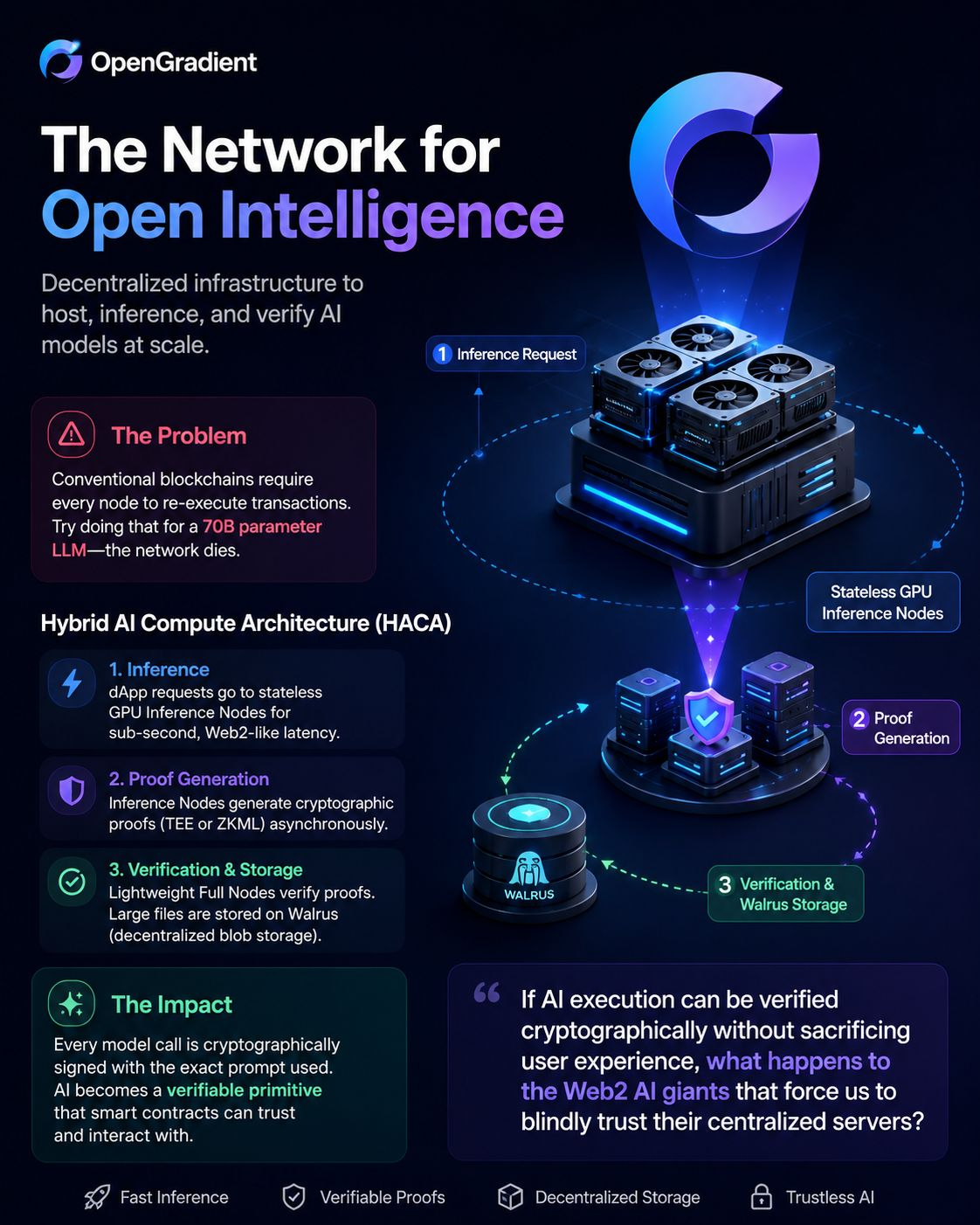
Traditional blockchains require every node to re-execute transactions. That model breaks down completely when dealing with large AI systems. Nobody is running a 70B-parameter LLM across every validator without destroying performance.
Their Hybrid AI Compute Architecture (HACA) takes a different approach.
Inference requests are processed directly by stateless GPU Inference Nodes, delivering near Web2-level latency. Meanwhile, cryptographic proofs (TEE or ZKML) are generated asynchronously and verified by lightweight Full Nodes, while large artifacts are stored through Walrus.
The result?
AI outputs become verifiable.
Every model call can be cryptographically linked to the exact prompt and execution environment used. Instead of trusting a black-box oracle to make decisions or move assets, smart contracts gain a way to verify AI behavior.
That's a major shift for autonomous agents and on-chain AI applications.
I'm still interested in seeing how the network performs under sustained concurrent demand, but the architecture appears focused on utility rather than narrative.
The bigger question is this:
If AI execution can be verified cryptographically without sacrificing user experience, what happens to the centralized AI platforms that rely entirely on trust?
OpenGradient is building decentralized infrastructure for hosting, running, and verifying AI models at scale.
$OPG #OpenGradient @OpenGradient
#opg $OPG I've watched the "DeAI" narrative drift into little more than a marketing game.
Most projects claim decentralized AI, yet the actual inference still runs through centralized Web2 APIs. Add a token, create hype, repeat.
@OpenGradient caught my attention because it attacks the real problem: compute.
Traditional blockchains require every node to re-execute transactions. That model breaks down completely when dealing with large AI systems. Nobody is running a 70B-parameter LLM across every validator without destroying performance.
Their Hybrid AI Compute Architecture (HACA) takes a different approach.
Inference requests are processed directly by stateless GPU Inference Nodes, delivering near Web2-level latency. Meanwhile, cryptographic proofs (TEE or ZKML) are generated asynchronously and verified by lightweight Full Nodes, while large artifacts are stored through Walrus.
The result?
AI outputs become verifiable.
Every model call can be cryptographically linked to the exact prompt and execution environment used. Instead of trusting a black-box oracle to make decisions or move assets, smart contracts gain a way to verify AI behavior.
That's a major shift for autonomous agents and on-chain AI applications.
I'm still interested in seeing how the network performs under sustained concurrent demand, but the architecture appears focused on utility rather than narrative.
The bigger question is this:
If AI execution can be verified cryptographically without sacrificing user experience, what happens to the centralized AI platforms that rely entirely on trust?
OpenGradient is building decentralized infrastructure for hosting, running, and verifying AI models at scale.
$OPG #OpenGradient @OpenGradient
Most projects claim decentralized AI, yet the actual inference still runs through centralized Web2 APIs. Add a token, create hype, repeat.
@OpenGradient caught my attention because it attacks the real problem: compute.
Traditional blockchains require every node to re-execute transactions. That model breaks down completely when dealing with large AI systems. Nobody is running a 70B-parameter LLM across every validator without destroying performance.
Their Hybrid AI Compute Architecture (HACA) takes a different approach.
Inference requests are processed directly by stateless GPU Inference Nodes, delivering near Web2-level latency. Meanwhile, cryptographic proofs (TEE or ZKML) are generated asynchronously and verified by lightweight Full Nodes, while large artifacts are stored through Walrus.
The result?
AI outputs become verifiable.
Every model call can be cryptographically linked to the exact prompt and execution environment used. Instead of trusting a black-box oracle to make decisions or move assets, smart contracts gain a way to verify AI behavior.
That's a major shift for autonomous agents and on-chain AI applications.
I'm still interested in seeing how the network performs under sustained concurrent demand, but the architecture appears focused on utility rather than narrative.
The bigger question is this:
If AI execution can be verified cryptographically without sacrificing user experience, what happens to the centralized AI platforms that rely entirely on trust?
OpenGradient is building decentralized infrastructure for hosting, running, and verifying AI models at scale.
$OPG #OpenGradient @OpenGradient
1
385
·
--
Проверено
#opg $OPG I’ve watched the "DeAI" sector devolve into an expensive marketing exercise. Teams promise decentralized inference but just route requests to Web2 APIs while slap-dashing an ERC-20 token on top to manufacture hype. It’s a hollow loop.
@OpenGradient feels different because they tackle the compute bottleneck. Conventional chains force every node to re-execute transactions—try that with a 70B parameter LLM and the network dies.
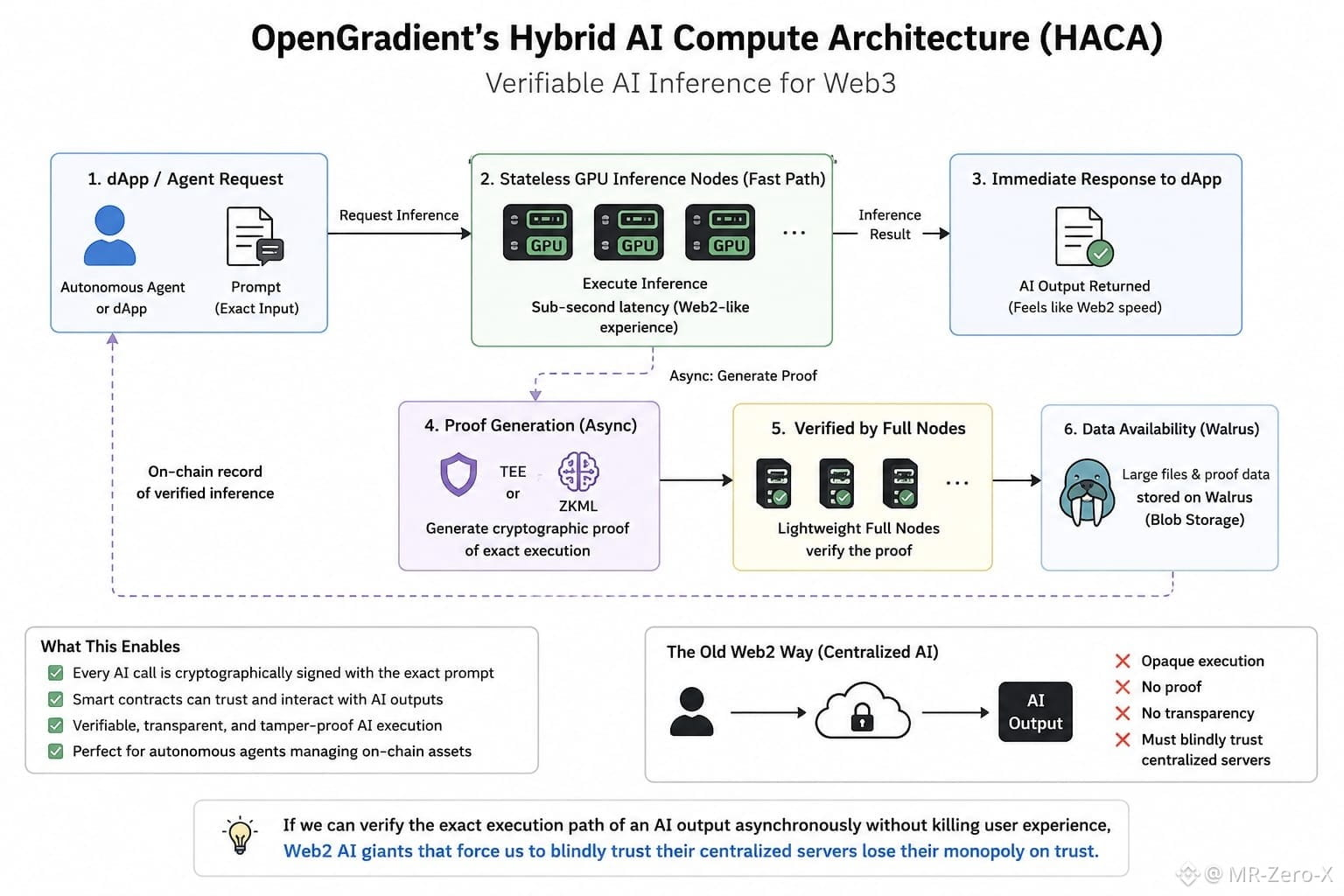
Their Hybrid AI Compute Architecture (HACA) splits the load. When a dApp requests an inference, it goes straight to stateless GPU Inference Nodes for sub-second, Web2-like latency. Asynchronously, the node generates a cryptographic proof (TEE or ZKML) verified by lightweight Full Nodes, offloading heavy files to Walrus blob storage.
This changes everything for autonomous agents. Instead of blindly trusting an opaque oracle to move treasury funds, every model call is cryptographically signed with the exact prompt used. It turns machine learning into a verifiable primitive that smart contracts can natively interact with.
I’m watching how it handles peak traffic under heavy concurrent loads, but the structural foundation is actually built for utility over noise.
If we can verify the exact execution path of an AI output asynchronously without killing user experience, what happens to the Web2 AI giants that force us to blindly trust their centralized servers?
@OpenGradient #opg
#opg $OPG I’ve watched the "DeAI" sector devolve into an expensive marketing exercise. Teams promise decentralized inference but just route requests to Web2 APIs while slap-dashing an ERC-20 token on top to manufacture hype. It’s a hollow loop.
@OpenGradient feels different because they tackle the compute bottleneck. Conventional chains force every node to re-execute transactions—try that with a 70B parameter LLM and the network dies.
Their Hybrid AI Compute Architecture (HACA) splits the load. When a dApp requests an inference, it goes straight to stateless GPU Inference Nodes for sub-second, Web2-like latency. Asynchronously, the node generates a cryptographic proof (TEE or ZKML) verified by lightweight Full Nodes, offloading heavy files to Walrus blob storage.
This changes everything for autonomous agents. Instead of blindly trusting an opaque oracle to move treasury funds, every model call is cryptographically signed with the exact prompt used. It turns machine learning into a verifiable primitive that smart contracts can natively interact with.
I’m watching how it handles peak traffic under heavy concurrent loads, but the structural foundation is actually built for utility over noise.
If we can verify the exact execution path of an AI output asynchronously without killing user experience, what happens to the Web2 AI giants that force us to blindly trust their centralized servers?
@OpenGradient #opg
@OpenGradient feels different because they tackle the compute bottleneck. Conventional chains force every node to re-execute transactions—try that with a 70B parameter LLM and the network dies.
Their Hybrid AI Compute Architecture (HACA) splits the load. When a dApp requests an inference, it goes straight to stateless GPU Inference Nodes for sub-second, Web2-like latency. Asynchronously, the node generates a cryptographic proof (TEE or ZKML) verified by lightweight Full Nodes, offloading heavy files to Walrus blob storage.
This changes everything for autonomous agents. Instead of blindly trusting an opaque oracle to move treasury funds, every model call is cryptographically signed with the exact prompt used. It turns machine learning into a verifiable primitive that smart contracts can natively interact with.
I’m watching how it handles peak traffic under heavy concurrent loads, but the structural foundation is actually built for utility over noise.
If we can verify the exact execution path of an AI output asynchronously without killing user experience, what happens to the Web2 AI giants that force us to blindly trust their centralized servers?
@OpenGradient #opg
207
·
--
#genius $GENIUS @GeniusOfficial
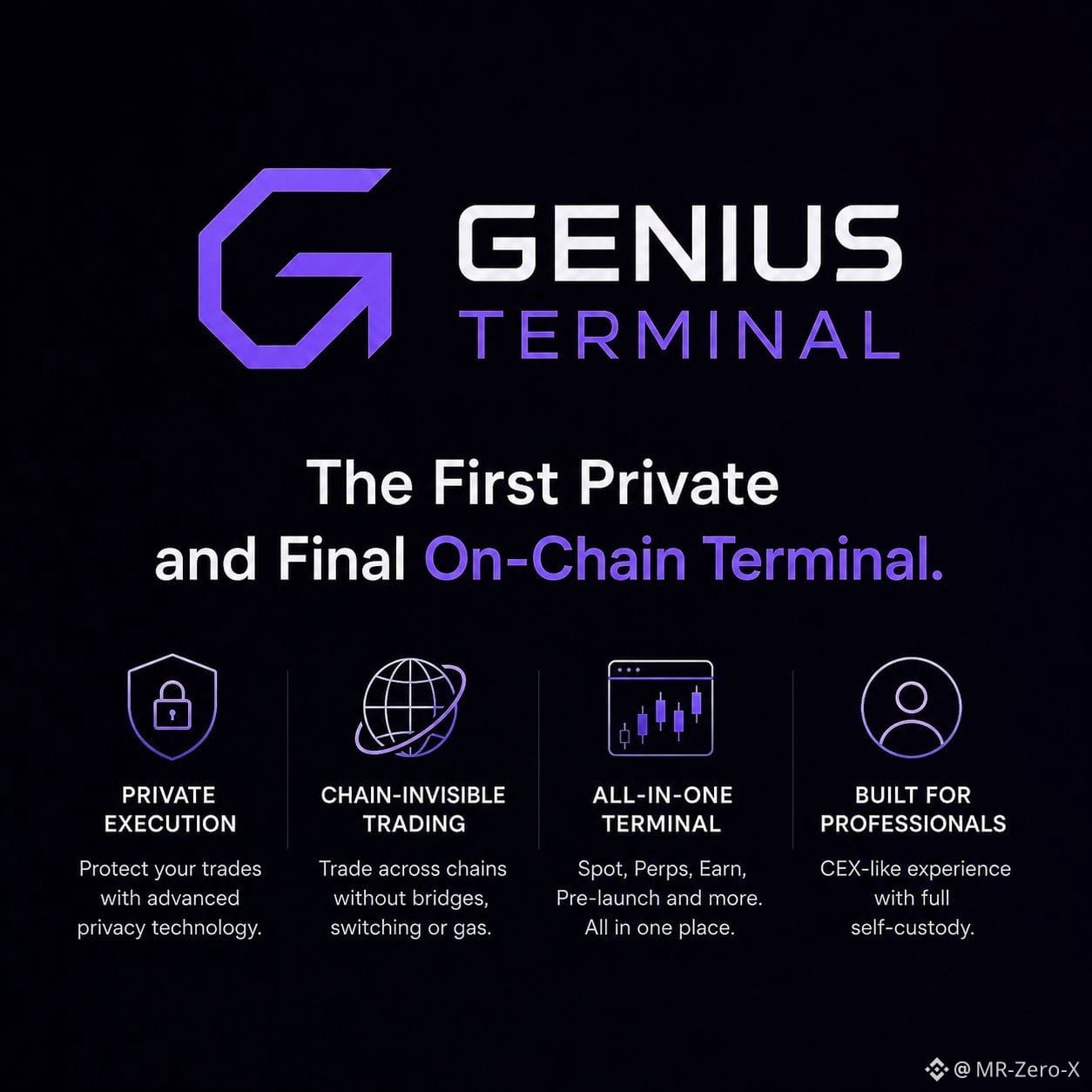
Genius Terminal calls itself the first private and final on-chain terminal.
Big claim.
But when you look deeper, the thesis becomes interesting.
━━━━━━━━━━━━━━━
LAYER 1: EXECUTION
Most traders still jump between wallets, bridges, aggregators, and multiple chains.
That friction costs time.
And in crypto, time is often profit.
Genius is trying to compress the entire trading experience into a single terminal.
---
LAYER 2: PRIVACY
One of the biggest problems in on-chain markets is visibility.
Large orders can attract attention before execution.
The project's focus on private order flow aims to reduce that exposure.
Think about it carefully.
Privacy is not just a feature.
For serious capital, it can become infrastructure.
---
LAYER 3: CROSS-CHAIN ABSTRACTION
Retail often sees chains.
Professionals see liquidity.
The long-term vision appears to remove the complexity of bridging, gas management, and network switching.
If successful, users interact with opportunities rather than blockchains.
━━━━━━━━━━━━━━━
RISK / WEAKNESS
The vision is ambitious.
Execution risk remains high.
Building a private, seamless, multi-chain trading layer is significantly harder than marketing it.
Not everyone will trust a new terminal immediately.
Adoption will be the real test.
━━━━━━━━━━━━━━━
The question is simple:
Is Genius Terminal building the next generation of on-chain trading infrastructure,
or is it solving a problem that most users still don't understand yet?
What's your view?
#genius
#genius $GENIUS @GeniusOfficial
Genius Terminal calls itself the first private and final on-chain terminal.
Big claim.
But when you look deeper, the thesis becomes interesting.
━━━━━━━━━━━━━━━
LAYER 1: EXECUTION
Most traders still jump between wallets, bridges, aggregators, and multiple chains.
That friction costs time.
And in crypto, time is often profit.
Genius is trying to compress the entire trading experience into a single terminal.
---
LAYER 2: PRIVACY
One of the biggest problems in on-chain markets is visibility.
Large orders can attract attention before execution.
The project's focus on private order flow aims to reduce that exposure.
Think about it carefully.
Privacy is not just a feature.
For serious capital, it can become infrastructure.
---
LAYER 3: CROSS-CHAIN ABSTRACTION
Retail often sees chains.
Professionals see liquidity.
The long-term vision appears to remove the complexity of bridging, gas management, and network switching.
If successful, users interact with opportunities rather than blockchains.
━━━━━━━━━━━━━━━
RISK / WEAKNESS
The vision is ambitious.
Execution risk remains high.
Building a private, seamless, multi-chain trading layer is significantly harder than marketing it.
Not everyone will trust a new terminal immediately.
Adoption will be the real test.
━━━━━━━━━━━━━━━
The question is simple:
Is Genius Terminal building the next generation of on-chain trading infrastructure,
or is it solving a problem that most users still don't understand yet?
What's your view?
#genius
Genius Terminal calls itself the first private and final on-chain terminal.
Big claim.
But when you look deeper, the thesis becomes interesting.
━━━━━━━━━━━━━━━
LAYER 1: EXECUTION
Most traders still jump between wallets, bridges, aggregators, and multiple chains.
That friction costs time.
And in crypto, time is often profit.
Genius is trying to compress the entire trading experience into a single terminal.
---
LAYER 2: PRIVACY
One of the biggest problems in on-chain markets is visibility.
Large orders can attract attention before execution.
The project's focus on private order flow aims to reduce that exposure.
Think about it carefully.
Privacy is not just a feature.
For serious capital, it can become infrastructure.
---
LAYER 3: CROSS-CHAIN ABSTRACTION
Retail often sees chains.
Professionals see liquidity.
The long-term vision appears to remove the complexity of bridging, gas management, and network switching.
If successful, users interact with opportunities rather than blockchains.
━━━━━━━━━━━━━━━
RISK / WEAKNESS
The vision is ambitious.
Execution risk remains high.
Building a private, seamless, multi-chain trading layer is significantly harder than marketing it.
Not everyone will trust a new terminal immediately.
Adoption will be the real test.
━━━━━━━━━━━━━━━
The question is simple:
Is Genius Terminal building the next generation of on-chain trading infrastructure,
or is it solving a problem that most users still don't understand yet?
What's your view?
#genius
1
1
203
·
--
Проверено
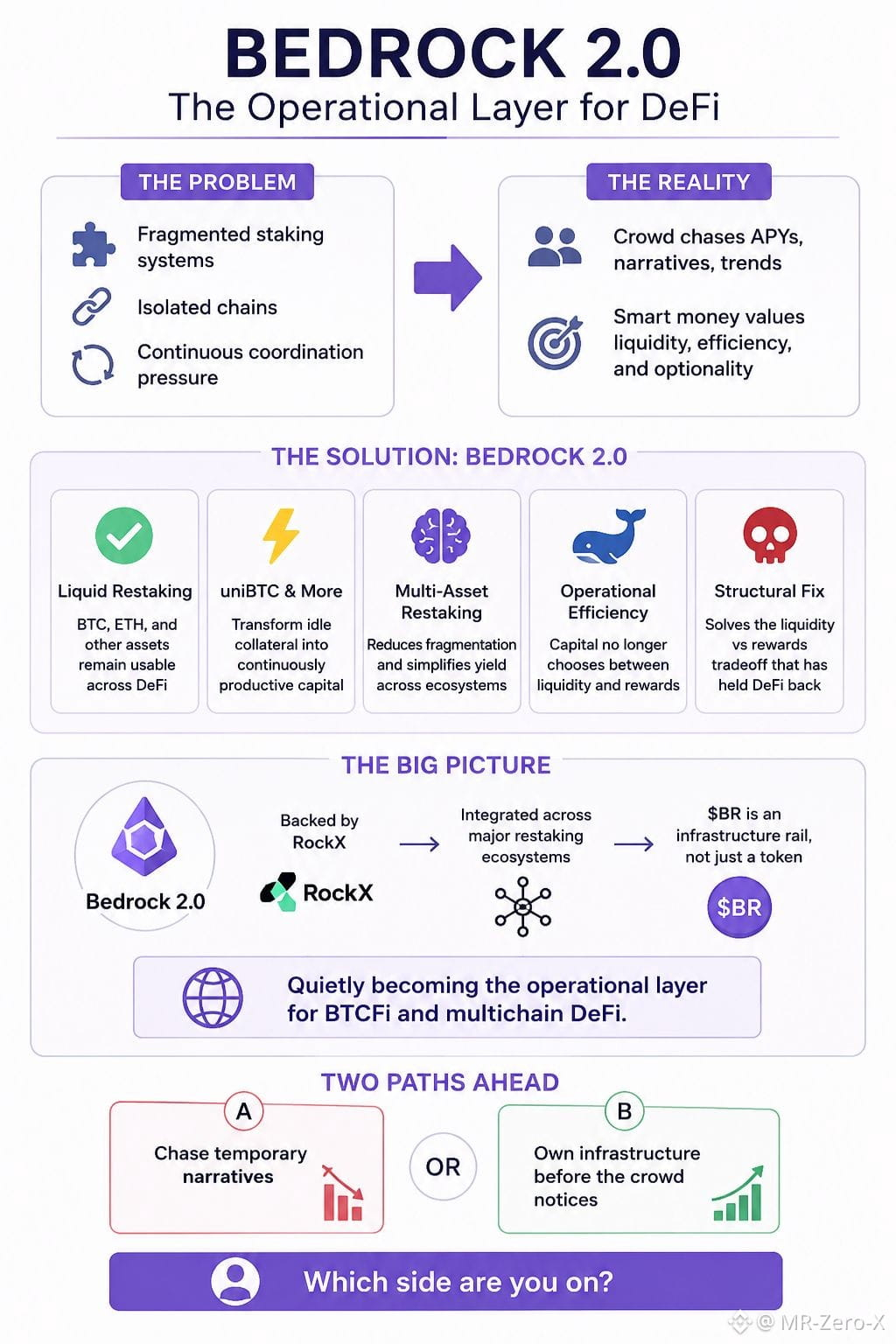
#bedrock $BR @Bedrock Something felt off to me while watching DeFi evolve.
The industry kept chasing higher yields, yet capital remained trapped behind fragmented staking systems, isolated chains, and continuous coordination pressure.
Visibility itself became exhausting.
The crowd focuses on APYs, token narratives, and whatever trend dominates the timeline for a week.
Underneath the surface, what actually matters is preserving optionality.
Smart money cares about liquidity, capital efficiency, and infrastructure that keeps assets productive without sacrificing flexibility.
That is what caught my attention about Bedrock 2.0 and @Bedrock_DeFi.
Instead of forcing capital into isolated staking silos, Bedrock turns BTC, ETH, and other assets into liquid restaking positions that remain usable across DeFi.
uniBTC and other liquid restaking assets transform idle collateral into continuously productive capital.
Multi-asset restaking reduces fragmentation while simplifying yield generation across multiple ecosystems.
The real advantage is operational efficiency. Capital no longer chooses between liquidity and rewards.
💀 That tradeoff has been a structural problem for years.
The reason it started standing out to me is that Bedrock is quietly becoming an operational layer for BTCFi and multichain DeFi.
Backed by infrastructure partnerships including RockX and integrated across major restaking ecosystems, $BR feels less like a speculative asset and more like an inevitable infrastructure rail.
I only see two paths from here:
A) Chase temporary narratives
B) Own infrastructure before the crowd notices
Which side are you on?
#bedrock $BR @Bedrock Something felt off to me while watching DeFi evolve.
The industry kept chasing higher yields, yet capital remained trapped behind fragmented staking systems, isolated chains, and continuous coordination pressure.
Visibility itself became exhausting.
The crowd focuses on APYs, token narratives, and whatever trend dominates the timeline for a week.
Underneath the surface, what actually matters is preserving optionality.
Smart money cares about liquidity, capital efficiency, and infrastructure that keeps assets productive without sacrificing flexibility.
That is what caught my attention about Bedrock 2.0 and @Bedrock_DeFi.
Instead of forcing capital into isolated staking silos, Bedrock turns BTC, ETH, and other assets into liquid restaking positions that remain usable across DeFi.
uniBTC and other liquid restaking assets transform idle collateral into continuously productive capital.
Multi-asset restaking reduces fragmentation while simplifying yield generation across multiple ecosystems.
The real advantage is operational efficiency. Capital no longer chooses between liquidity and rewards.
💀 That tradeoff has been a structural problem for years.
The reason it started standing out to me is that Bedrock is quietly becoming an operational layer for BTCFi and multichain DeFi.
Backed by infrastructure partnerships including RockX and integrated across major restaking ecosystems, $BR feels less like a speculative asset and more like an inevitable infrastructure rail.
I only see two paths from here:
A) Chase temporary narratives
B) Own infrastructure before the crowd notices
Which side are you on?
The industry kept chasing higher yields, yet capital remained trapped behind fragmented staking systems, isolated chains, and continuous coordination pressure.
Visibility itself became exhausting.
The crowd focuses on APYs, token narratives, and whatever trend dominates the timeline for a week.
Underneath the surface, what actually matters is preserving optionality.
Smart money cares about liquidity, capital efficiency, and infrastructure that keeps assets productive without sacrificing flexibility.
That is what caught my attention about Bedrock 2.0 and @Bedrock_DeFi.
Instead of forcing capital into isolated staking silos, Bedrock turns BTC, ETH, and other assets into liquid restaking positions that remain usable across DeFi.
uniBTC and other liquid restaking assets transform idle collateral into continuously productive capital.
Multi-asset restaking reduces fragmentation while simplifying yield generation across multiple ecosystems.
The real advantage is operational efficiency. Capital no longer chooses between liquidity and rewards.
💀 That tradeoff has been a structural problem for years.
The reason it started standing out to me is that Bedrock is quietly becoming an operational layer for BTCFi and multichain DeFi.
Backed by infrastructure partnerships including RockX and integrated across major restaking ecosystems, $BR feels less like a speculative asset and more like an inevitable infrastructure rail.
I only see two paths from here:
A) Chase temporary narratives
B) Own infrastructure before the crowd notices
Which side are you on?
90
·
--
Проверено
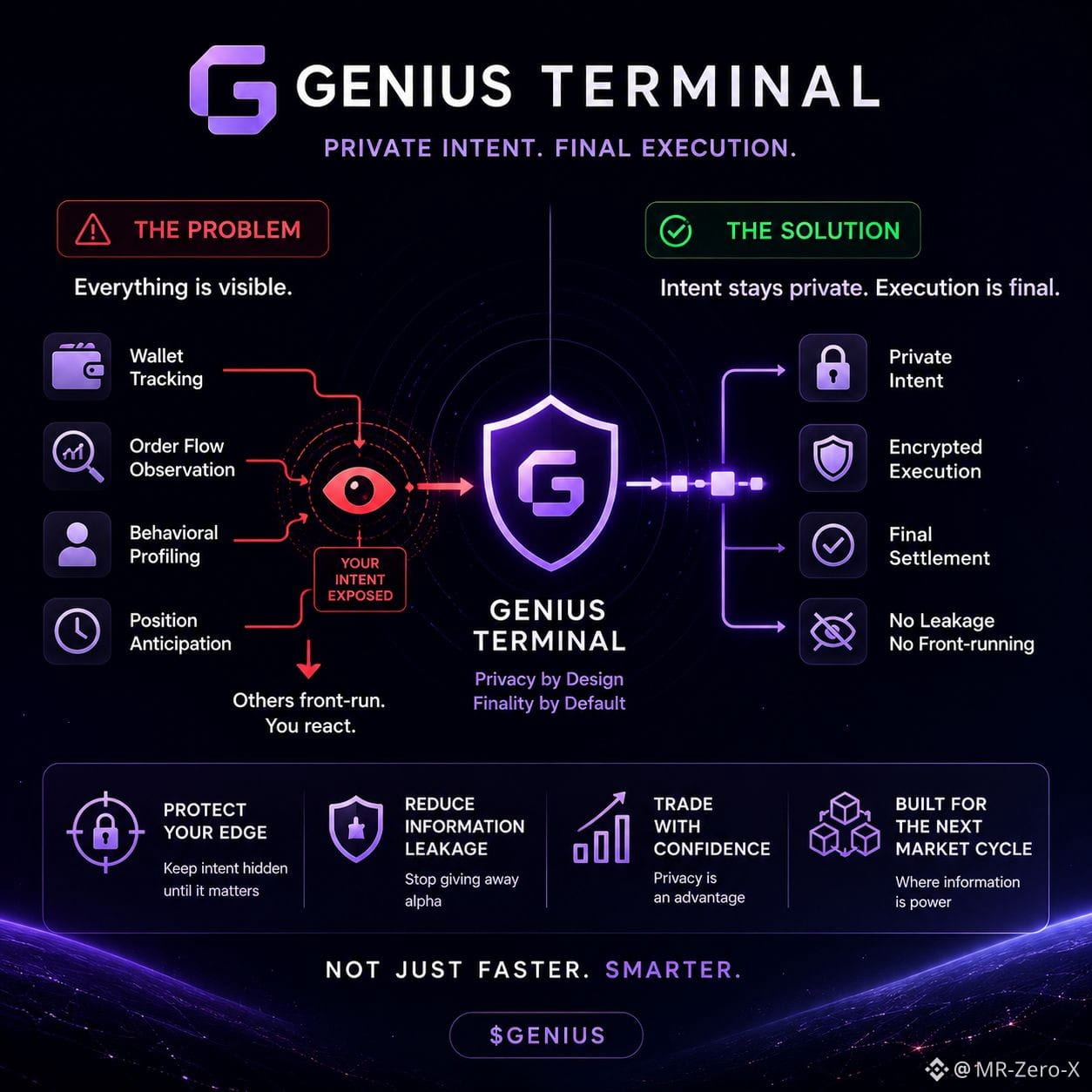
#genius $GENIUS @GeniusOfficial I remember realizing that most traders were not losing because of poor execution. They were losing because the market could see them coming. In a transparent environment, intent often becomes a signal long before a transaction is confirmed.
The industry loves to focus on speed, fees, and throughput, but the more important question is who controls the information. Wallet tracking, behavioral profiling, and order-flow observation have turned transparency into a competitive advantage for observers rather than participants.
That is what makes Genius Terminal interesting. Instead of chasing marginal improvements in execution, it focuses on privacy and finality. The value proposition is not simply moving faster, but preserving strategic intent and reducing unnecessary information leakage.
Of course, a compelling product does not automatically translate into a sustainable network. Adoption quality, user retention, token unlock dynamics, and genuine demand will ultimately determine whether the model can endure beyond the initial narrative.
Markets are driven by stories in the short term, but long-term value is created by consistent user behavior. Attention can create momentum, but recurring usage is what transforms infrastructure into a lasting asset.
$GENIUS #GeniusTerminal #DeFi
#genius $GENIUS @GeniusOfficial I remember realizing that most traders were not losing because of poor execution. They were losing because the market could see them coming. In a transparent environment, intent often becomes a signal long before a transaction is confirmed.
The industry loves to focus on speed, fees, and throughput, but the more important question is who controls the information. Wallet tracking, behavioral profiling, and order-flow observation have turned transparency into a competitive advantage for observers rather than participants.
That is what makes Genius Terminal interesting. Instead of chasing marginal improvements in execution, it focuses on privacy and finality. The value proposition is not simply moving faster, but preserving strategic intent and reducing unnecessary information leakage.
Of course, a compelling product does not automatically translate into a sustainable network. Adoption quality, user retention, token unlock dynamics, and genuine demand will ultimately determine whether the model can endure beyond the initial narrative.
Markets are driven by stories in the short term, but long-term value is created by consistent user behavior. Attention can create momentum, but recurring usage is what transforms infrastructure into a lasting asset.
$GENIUS #GeniusTerminal #DeFi
The industry loves to focus on speed, fees, and throughput, but the more important question is who controls the information. Wallet tracking, behavioral profiling, and order-flow observation have turned transparency into a competitive advantage for observers rather than participants.
That is what makes Genius Terminal interesting. Instead of chasing marginal improvements in execution, it focuses on privacy and finality. The value proposition is not simply moving faster, but preserving strategic intent and reducing unnecessary information leakage.
Of course, a compelling product does not automatically translate into a sustainable network. Adoption quality, user retention, token unlock dynamics, and genuine demand will ultimately determine whether the model can endure beyond the initial narrative.
Markets are driven by stories in the short term, but long-term value is created by consistent user behavior. Attention can create momentum, but recurring usage is what transforms infrastructure into a lasting asset.
$GENIUS #GeniusTerminal #DeFi
599
Войдите, чтобы посмотреть больше материала
Присоединяйтесь к пользователям криптовалют по всему миру на Binance Square
⚡️ Получайте новейшую и полезную информацию о криптоактивах.
💬 Нам доверяет крупнейшая в мире криптобиржа.
👍 Получите достоверные аналитические данные от верифицированных создателей контента.
Эл. почта/номер телефона
В тренде
SouthKoreaDraftLawTargets15To20%ShareholderCap
Просмотров: 99
17 обсуждают
#SouthKoreaDraftLawTargets15To20%ShareholderCap
🇰🇷 South Korea Eyes Crypto Exchange Ownership Cap 🚨
South Korea's push to limit major shareholders in crypto exchanges is heating up. 🔥 The Financial Services Commission first floated a 15% to 20% cap to avoid conflicts of interest. 📉 Later reports say regulators and lawmakers settled on a 20% cap, with stakes of up to 34% allowed in certain exceptions. ⚖️ (Yahoo Finance) (theblock)
The rule would sit inside the Digital Asset Basic Act, and Bithumb and Gopax would likely need big ownership changes. 🏦 Industry players are pushing back hard. 💬 (theblock)
Will this make the market fairer, or hurt innovation? 🤔
#SouthKorea #Upbit #Bithumb 🚀
#Nadeemgujjar143
@aasho @长风Nova @Eşsiz kimi @Fatima SheRazi Official @Ayeza998
$BTC
$BNB
$ETH
NADEEM Gujjar143
·Лайков: 0
·Просмотров: 36
KeplrAdvisesSocialLoginUsersToTransferAssets
Просмотров: 5,262
154 обсуждают
TetherPlans€28.8MForJuventusCapitalIncrease
Просмотров: 3,179
125 обсуждают