

CRYPTO_BOY_09
259 Публикации

CRYPTO_BOY_09
Отправить жалобу
Заблокировать пользователя
Market Updates • Airdrops • Campaigns • Web3 Hunter | Helping You Earn Together | DYOR
148 подписок(и/а)
105 подписчиков(а)
253 понравилось
Посты
Все
Цитирования
PINNED
Частичная правда
#TermMax
Almost closed the tab tbh. then the TVL number caught my eye and I just kept scrolling lol
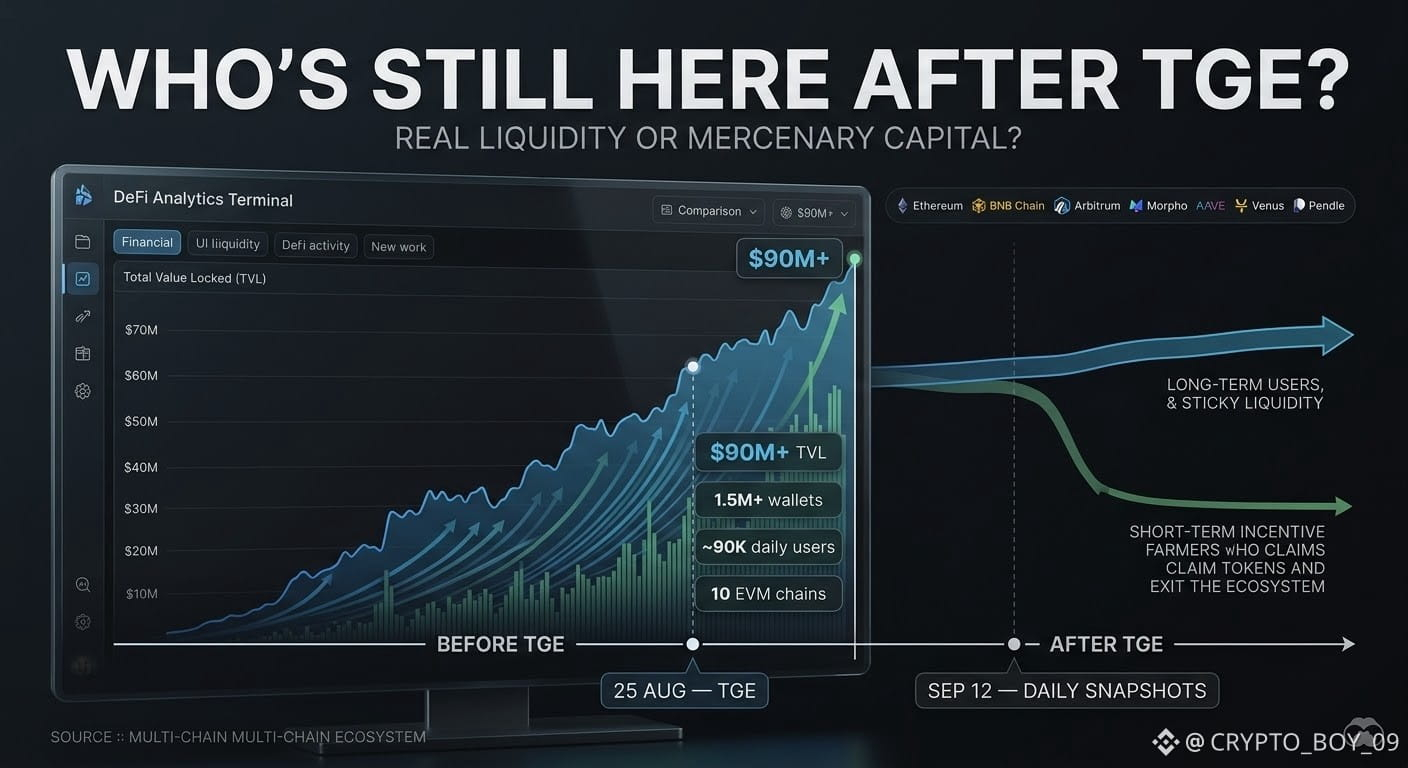
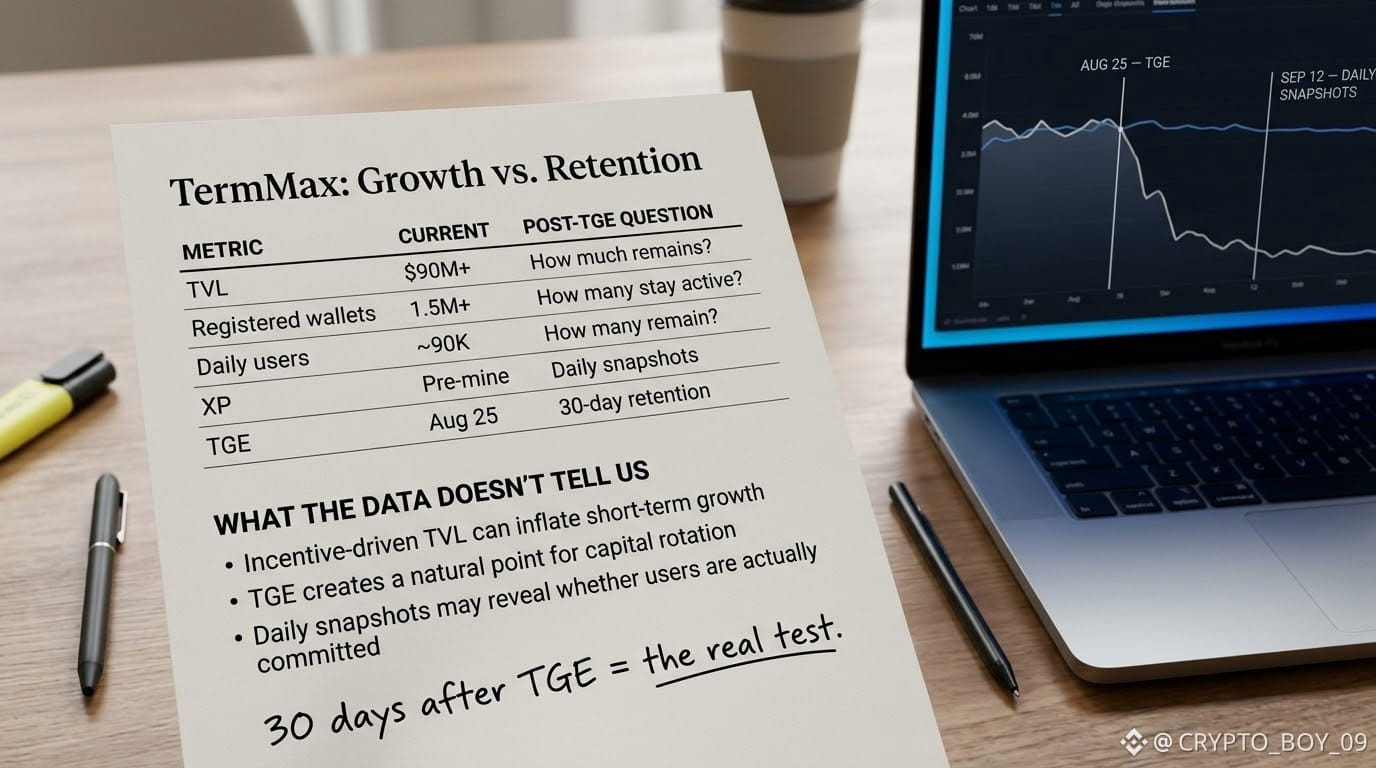
TermMax is apparently sitting at $90M+ TVL now, with 1.5M+ wallets registered and around 90K daily users. Mainnet only launched in April 2025, so that’s a pretty fast climb.
It’s also live across around 10 EVM chains — Ethereum, BNB Chain, Arbitrum etc — and already integrated with Morpho, Aave, Venus & Pendle. Those are the integrations that actually matter.
And then I saw the date: TGE is August 25. so yeah, basically a few days away.
What caught my attention more than the TVL though is what happens after the pre-mine.
The pre-mine ended on August 11, and whatever XP you had by then is locked in. Pretty standard.
But from September 12, the new XP system starts using daily snapshots. So you can’t just show up once, farm, and disappear anymore. You actually need to keep holding the position for it to count.
Still in wait-and-see mode personally.
TVL going up is the easy part when incentives are live and an airdrop/TGE is right around the corner. The real test comes after TGE, when XP turns into an actual tradable token.
That’s when we’ll find out whether the liquidity was actually sticky or just mercenary capital farming the incentives.
A month after TGE, that’s the number I’ll be watching:
who’s still here, and who just claimed and left?
@termmax $AAVE $MORPHO $BOME
#TermMax
Almost closed the tab tbh. then the TVL number caught my eye and I just kept scrolling lol
TermMax is apparently sitting at $90M+ TVL now, with 1.5M+ wallets registered and around 90K daily users. Mainnet only launched in April 2025, so that’s a pretty fast climb.
It’s also live across around 10 EVM chains — Ethereum, BNB Chain, Arbitrum etc — and already integrated with Morpho, Aave, Venus & Pendle. Those are the integrations that actually matter.
And then I saw the date: TGE is August 25. so yeah, basically a few days away.
What caught my attention more than the TVL though is what happens after the pre-mine.
The pre-mine ended on August 11, and whatever XP you had by then is locked in. Pretty standard.
But from September 12, the new XP system starts using daily snapshots. So you can’t just show up once, farm, and disappear anymore. You actually need to keep holding the position for it to count.
Still in wait-and-see mode personally.
TVL going up is the easy part when incentives are live and an airdrop/TGE is right around the corner. The real test comes after TGE, when XP turns into an actual tradable token.
That’s when we’ll find out whether the liquidity was actually sticky or just mercenary capital farming the incentives.
A month after TGE, that’s the number I’ll be watching:
who’s still here, and who just claimed and left?
@TermMax $AAVE $MORPHO $BOME
Almost closed the tab tbh. then the TVL number caught my eye and I just kept scrolling lol
TermMax is apparently sitting at $90M+ TVL now, with 1.5M+ wallets registered and around 90K daily users. Mainnet only launched in April 2025, so that’s a pretty fast climb.
It’s also live across around 10 EVM chains — Ethereum, BNB Chain, Arbitrum etc — and already integrated with Morpho, Aave, Venus & Pendle. Those are the integrations that actually matter.
And then I saw the date: TGE is August 25. so yeah, basically a few days away.
What caught my attention more than the TVL though is what happens after the pre-mine.
The pre-mine ended on August 11, and whatever XP you had by then is locked in. Pretty standard.
But from September 12, the new XP system starts using daily snapshots. So you can’t just show up once, farm, and disappear anymore. You actually need to keep holding the position for it to count.
Still in wait-and-see mode personally.
TVL going up is the easy part when incentives are live and an airdrop/TGE is right around the corner. The real test comes after TGE, when XP turns into an actual tradable token.
That’s when we’ll find out whether the liquidity was actually sticky or just mercenary capital farming the incentives.
A month after TGE, that’s the number I’ll be watching:
who’s still here, and who just claimed and left?
@TermMax $AAVE $MORPHO $BOME
13
12
369
PINNED
Частичная правда
Couldn't sleep last night 😨, it was around 2am, so I was just scrolling when $DUSK Trade's page opened up. Thought I'd check it out for 5 minutes.
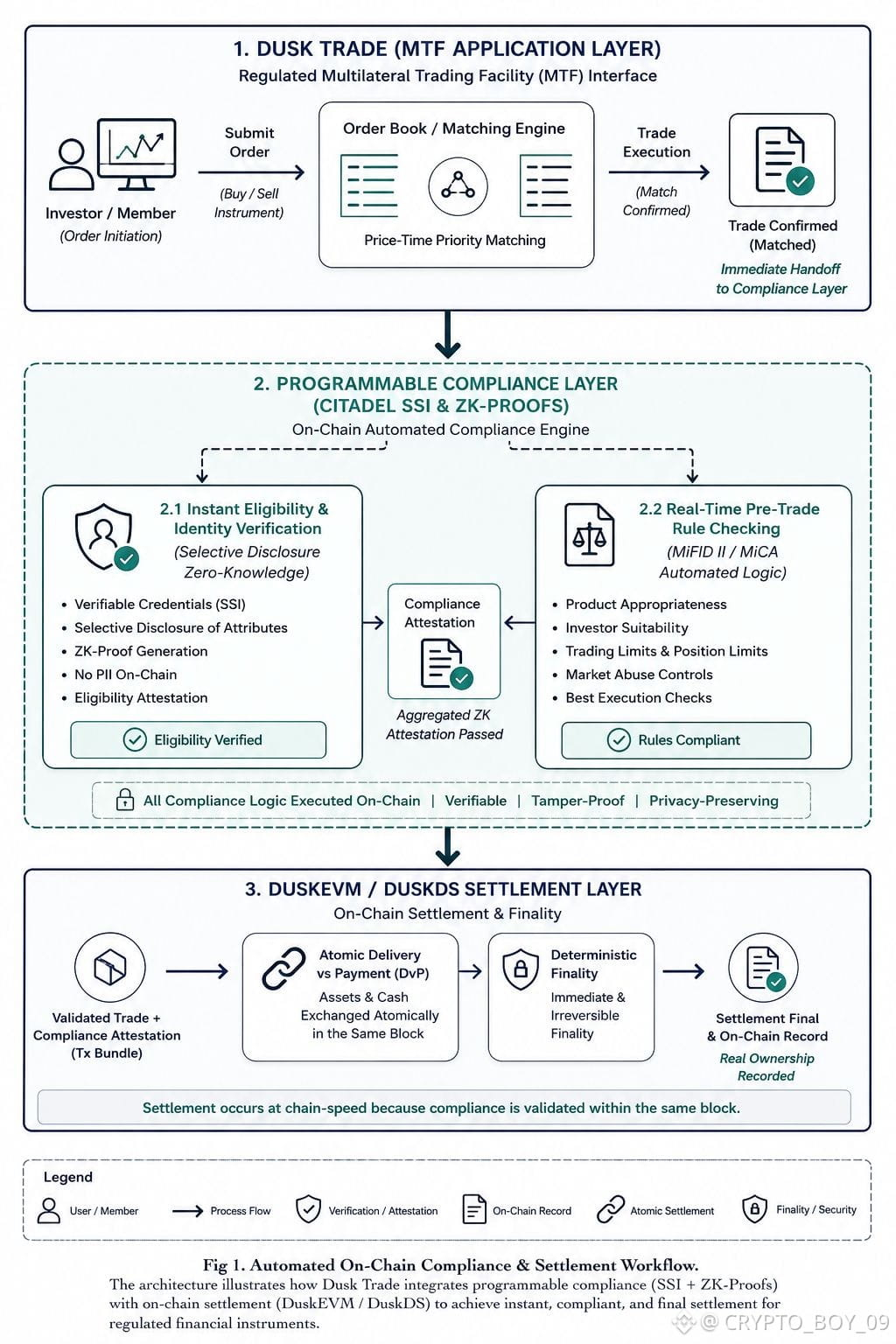
From what I understand, Dusk Trade is a neobroker layer on DuskEVM, designed to operate as a regulated MTF and investment platform in line with EU regulations. Assets like MMFs, ETFs, and bonds are coming onchain through it, with instant settlement and real ownership.
Now here's what bothered me a bit. We all get excited when we hear "instant settlement," but the real question isn't whether settlement is fast or slow. If an MTF is operating within a regulated framework, can it simply drop its compliance obligations for the sake of speed? It can't.
So the real challenge isn't just fast settlement. It's making eligibility checks, investor verification, and regulatory reporting move at the same speed as the chain.
And that makes me wonder: until compliance itself becomes automated and onchain, isn't "instant settlement" only part of the story?
@Dusk_Foundation $DUSK #dusk
Couldn't sleep last night 😨, it was around 2am, so I was just scrolling when $DUSK Trade's page opened up. Thought I'd check it out for 5 minutes.
From what I understand, Dusk Trade is a neobroker layer on DuskEVM, designed to operate as a regulated MTF and investment platform in line with EU regulations. Assets like MMFs, ETFs, and bonds are coming onchain through it, with instant settlement and real ownership.
Now here's what bothered me a bit. We all get excited when we hear "instant settlement," but the real question isn't whether settlement is fast or slow. If an MTF is operating within a regulated framework, can it simply drop its compliance obligations for the sake of speed? It can't.
So the real challenge isn't just fast settlement. It's making eligibility checks, investor verification, and regulatory reporting move at the same speed as the chain.
And that makes me wonder: until compliance itself becomes automated and onchain, isn't "instant settlement" only part of the story?
@Dusk $DUSK #dusk
From what I understand, Dusk Trade is a neobroker layer on DuskEVM, designed to operate as a regulated MTF and investment platform in line with EU regulations. Assets like MMFs, ETFs, and bonds are coming onchain through it, with instant settlement and real ownership.
Now here's what bothered me a bit. We all get excited when we hear "instant settlement," but the real question isn't whether settlement is fast or slow. If an MTF is operating within a regulated framework, can it simply drop its compliance obligations for the sake of speed? It can't.
So the real challenge isn't just fast settlement. It's making eligibility checks, investor verification, and regulatory reporting move at the same speed as the chain.
And that makes me wonder: until compliance itself becomes automated and onchain, isn't "instant settlement" only part of the story?
@Dusk $DUSK #dusk
30
1
19
473
Проверено
When I went to open a new bank account yesterday, the form asked me to choose between a savings or current account. Same bank, but different ways of using it.
It got me thinking about how we usually see blockchain transactions: either everything is public, or everything is private. No real middle ground.
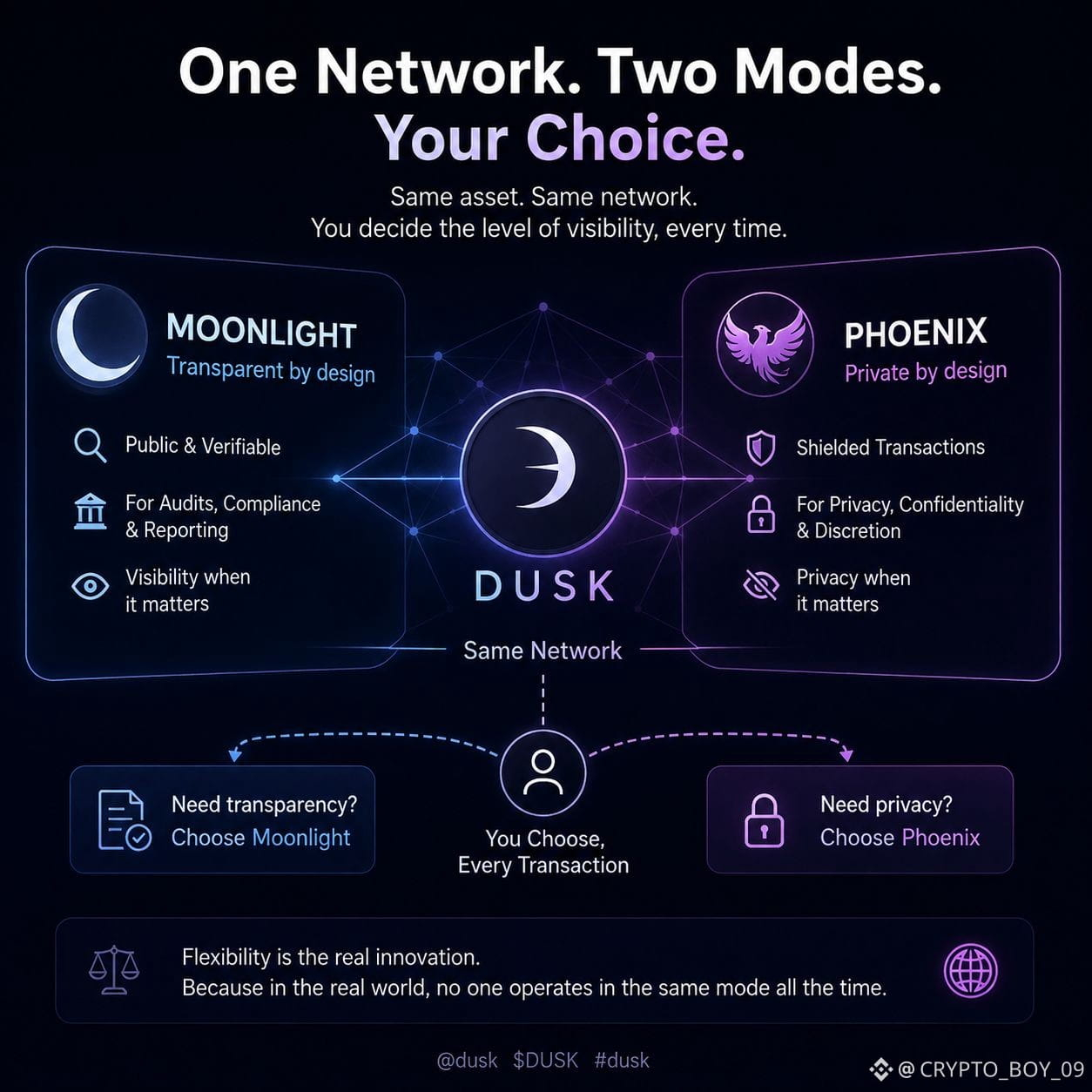
Dusk’s Moonlight and Phoenix setup made me look at it differently.
Moonlight is for public, transparent transactions where visibility matters — things like institutional reporting or audit trails.
Phoenix is shielded, for cases where the transaction details shouldn’t be exposed.
Both run on the same network, and the user can choose the mode on a transaction-by-transaction basis.
At first, it sounds like just two options for convenience.
But the bigger idea is flexibility.
Same asset. Same network. But privacy isn’t a permanent setting. You decide what level of visibility you need each time you transact.
That matters a lot for institutions, because in the real world, no entity operates in the same mode all the time. Sometimes transparency is necessary. Sometimes it isn’t.
It’s a small design choice, but it could be a big one for how privacy works on-chain.
The question is: will more chains move toward this kind of choice-based privacy, or will one default — fully public or fully private — ultimately win?
@Dusk_Foundation $DUSK #dusk
When I went to open a new bank account yesterday, the form asked me to choose between a savings or current account. Same bank, but different ways of using it.
It got me thinking about how we usually see blockchain transactions: either everything is public, or everything is private. No real middle ground.
Dusk’s Moonlight and Phoenix setup made me look at it differently.
Moonlight is for public, transparent transactions where visibility matters — things like institutional reporting or audit trails.
Phoenix is shielded, for cases where the transaction details shouldn’t be exposed.
Both run on the same network, and the user can choose the mode on a transaction-by-transaction basis.
At first, it sounds like just two options for convenience.
But the bigger idea is flexibility.
Same asset. Same network. But privacy isn’t a permanent setting. You decide what level of visibility you need each time you transact.
That matters a lot for institutions, because in the real world, no entity operates in the same mode all the time. Sometimes transparency is necessary. Sometimes it isn’t.
It’s a small design choice, but it could be a big one for how privacy works on-chain.
The question is: will more chains move toward this kind of choice-based privacy, or will one default — fully public or fully private — ultimately win?
@Dusk $DUSK #dusk
It got me thinking about how we usually see blockchain transactions: either everything is public, or everything is private. No real middle ground.
Dusk’s Moonlight and Phoenix setup made me look at it differently.
Moonlight is for public, transparent transactions where visibility matters — things like institutional reporting or audit trails.
Phoenix is shielded, for cases where the transaction details shouldn’t be exposed.
Both run on the same network, and the user can choose the mode on a transaction-by-transaction basis.
At first, it sounds like just two options for convenience.
But the bigger idea is flexibility.
Same asset. Same network. But privacy isn’t a permanent setting. You decide what level of visibility you need each time you transact.
That matters a lot for institutions, because in the real world, no entity operates in the same mode all the time. Sometimes transparency is necessary. Sometimes it isn’t.
It’s a small design choice, but it could be a big one for how privacy works on-chain.
The question is: will more chains move toward this kind of choice-based privacy, or will one default — fully public or fully private — ultimately win?
@Dusk $DUSK #dusk
1
2
90
#dusk $DUSK @Dusk_Foundation
Last night a friend and I were splitting our joint expenses. She said something simple: "everything between us stays transparent, but neither of us explains our personal spending to the other."
That line stuck with me longer than it should have.
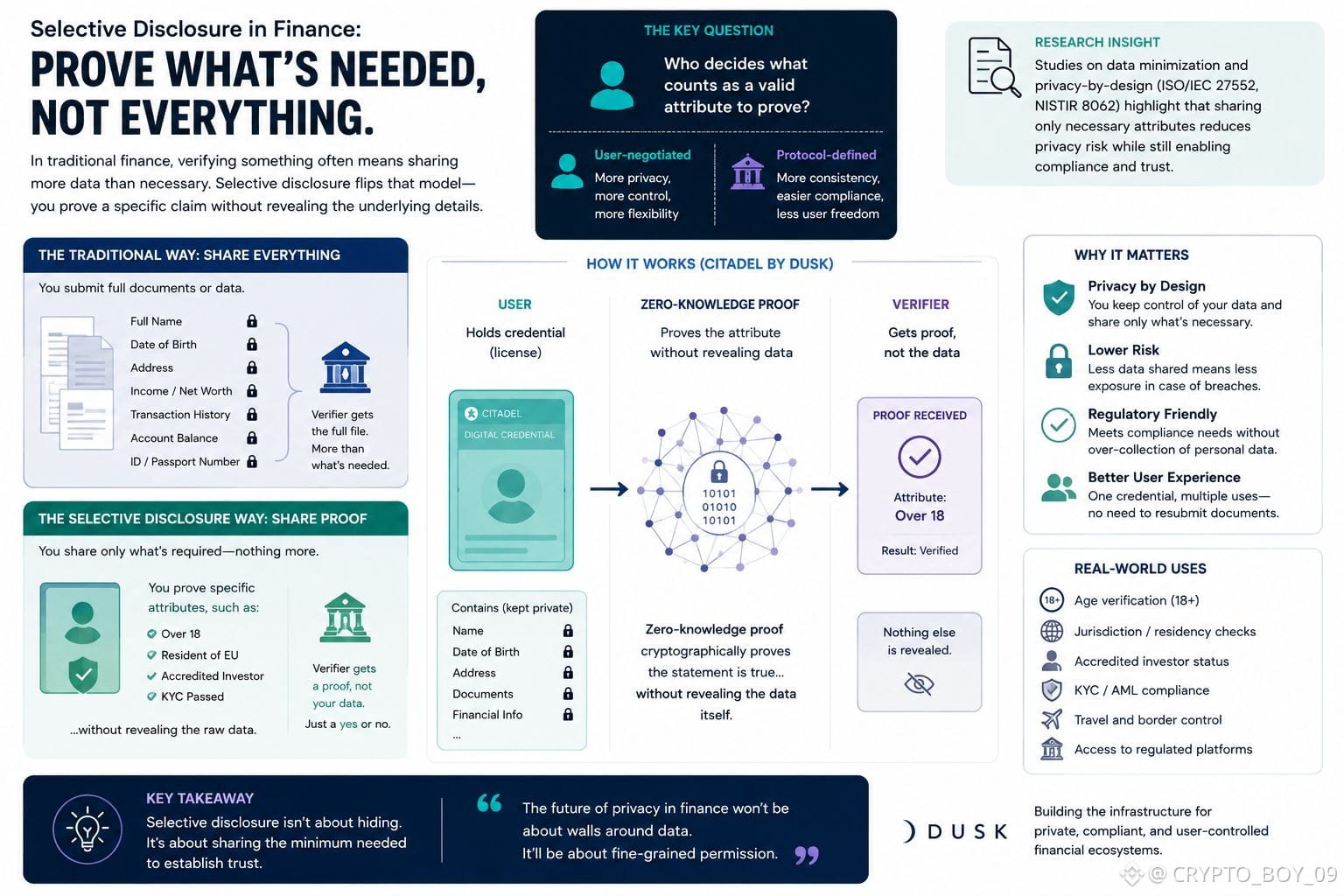
We tend to treat privacy and transparency as opposites in finance — either everything is visible, or nothing is. Looking closer at @dusk, that split doesn't hold up as cleanly as it seems.
Take Citadel, Dusk's identity layer. A user requests a license once, then uses it to prove a specific attribute — say, meeting an age threshold or falling under a certain jurisdiction — without handing over the underlying documents each time. The verifier gets a proof, not a file.
That's a different kind of privacy than just hiding balances. It's deciding, attribute by attribute, what actually needs to leave your hands.
Which raises the real question for me — who defines what counts as a valid attribute to prove in the first place? Is that negotiated by the user, or fixed before the user ever gets a say?
That answer matters more than whether data is hidden or shown. It decides whether "selective disclosure" is actually selective, or just permission dressed up as one.
$TUT $CATI
{future}(PROMUSDT)
{future}(DUSKUSDT)
{future}(BTCUSDT)
#dusk $DUSK @Dusk
Last night a friend and I were splitting our joint expenses. She said something simple: "everything between us stays transparent, but neither of us explains our personal spending to the other."
That line stuck with me longer than it should have.
We tend to treat privacy and transparency as opposites in finance — either everything is visible, or nothing is. Looking closer at @dusk, that split doesn't hold up as cleanly as it seems.
Take Citadel, Dusk's identity layer. A user requests a license once, then uses it to prove a specific attribute — say, meeting an age threshold or falling under a certain jurisdiction — without handing over the underlying documents each time. The verifier gets a proof, not a file.
That's a different kind of privacy than just hiding balances. It's deciding, attribute by attribute, what actually needs to leave your hands.
Which raises the real question for me — who defines what counts as a valid attribute to prove in the first place? Is that negotiated by the user, or fixed before the user ever gets a say?
That answer matters more than whether data is hidden or shown. It decides whether "selective disclosure" is actually selective, or just permission dressed up as one.
$TUT $CATI
Last night a friend and I were splitting our joint expenses. She said something simple: "everything between us stays transparent, but neither of us explains our personal spending to the other."
That line stuck with me longer than it should have.
We tend to treat privacy and transparency as opposites in finance — either everything is visible, or nothing is. Looking closer at @dusk, that split doesn't hold up as cleanly as it seems.
Take Citadel, Dusk's identity layer. A user requests a license once, then uses it to prove a specific attribute — say, meeting an age threshold or falling under a certain jurisdiction — without handing over the underlying documents each time. The verifier gets a proof, not a file.
That's a different kind of privacy than just hiding balances. It's deciding, attribute by attribute, what actually needs to leave your hands.
Which raises the real question for me — who defines what counts as a valid attribute to prove in the first place? Is that negotiated by the user, or fixed before the user ever gets a say?
That answer matters more than whether data is hidden or shown. It decides whether "selective disclosure" is actually selective, or just permission dressed up as one.
$TUT $CATI
4
2
140
#dusk @Dusk_Foundation $DUSK
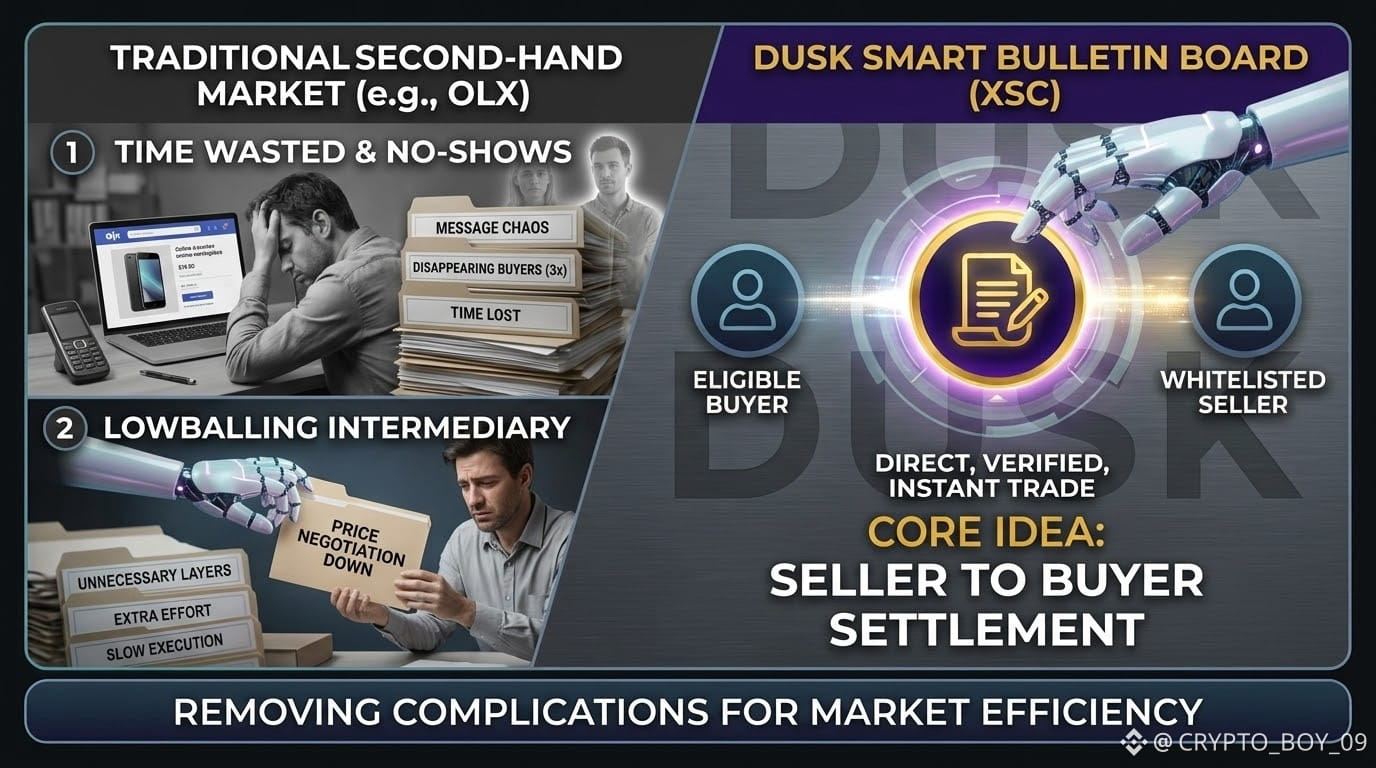
Yesterday I spent most of the day trying to sell my phone on OLX.
3 people messaged and disappeared.
One guy finally showed up… just to negotiate the price down.
That experience made me think differently about something I read in Dusk’s docs today: the Smart Bulletin Board.
The concept is simple:
Eligible buyers and sellers connect directly, agree on a price, and settle the trade through an XSC contract.
No broker in the middle.
No unnecessary layers.
No waiting for multiple parties to process the transaction.
It’s not an open marketplace. Participants are verified and whitelisted, so compliance still matters.
But the actual trade can become much more direct.
And that raises an interesting question:
If a buyer and seller can find each other, agree on a price, and settle almost instantly…
How much of the traditional brokerage layer do we really need?
Maybe removing the middleman makes markets more efficient.
Or maybe we’ll discover that brokers were providing more value in liquidity and price discovery than we realized.
Either way, Smart Bulletin Board is one of those Dusk features that sounds simple at first…
until you start thinking about what it could mean for real-world markets.
{future}(DUSKUSDT)
$TUT
{future}(TUTUSDT)
$TRUMP
{future}(TRUMPUSDT)
#dusk @Dusk $DUSK
Yesterday I spent most of the day trying to sell my phone on OLX.
3 people messaged and disappeared.
One guy finally showed up… just to negotiate the price down.
That experience made me think differently about something I read in Dusk’s docs today: the Smart Bulletin Board.
The concept is simple:
Eligible buyers and sellers connect directly, agree on a price, and settle the trade through an XSC contract.
No broker in the middle.
No unnecessary layers.
No waiting for multiple parties to process the transaction.
It’s not an open marketplace. Participants are verified and whitelisted, so compliance still matters.
But the actual trade can become much more direct.
And that raises an interesting question:
If a buyer and seller can find each other, agree on a price, and settle almost instantly…
How much of the traditional brokerage layer do we really need?
Maybe removing the middleman makes markets more efficient.
Or maybe we’ll discover that brokers were providing more value in liquidity and price discovery than we realized.
Either way, Smart Bulletin Board is one of those Dusk features that sounds simple at first…
until you start thinking about what it could mean for real-world markets.
$TUT
$TRUMP
Yesterday I spent most of the day trying to sell my phone on OLX.
3 people messaged and disappeared.
One guy finally showed up… just to negotiate the price down.
That experience made me think differently about something I read in Dusk’s docs today: the Smart Bulletin Board.
The concept is simple:
Eligible buyers and sellers connect directly, agree on a price, and settle the trade through an XSC contract.
No broker in the middle.
No unnecessary layers.
No waiting for multiple parties to process the transaction.
It’s not an open marketplace. Participants are verified and whitelisted, so compliance still matters.
But the actual trade can become much more direct.
And that raises an interesting question:
If a buyer and seller can find each other, agree on a price, and settle almost instantly…
How much of the traditional brokerage layer do we really need?
Maybe removing the middleman makes markets more efficient.
Or maybe we’ll discover that brokers were providing more value in liquidity and price discovery than we realized.
Either way, Smart Bulletin Board is one of those Dusk features that sounds simple at first…
until you start thinking about what it could mean for real-world markets.
$TUT
$TRUMP
1
251
Проверено
#dusk $DUSK @Dusk_Foundation
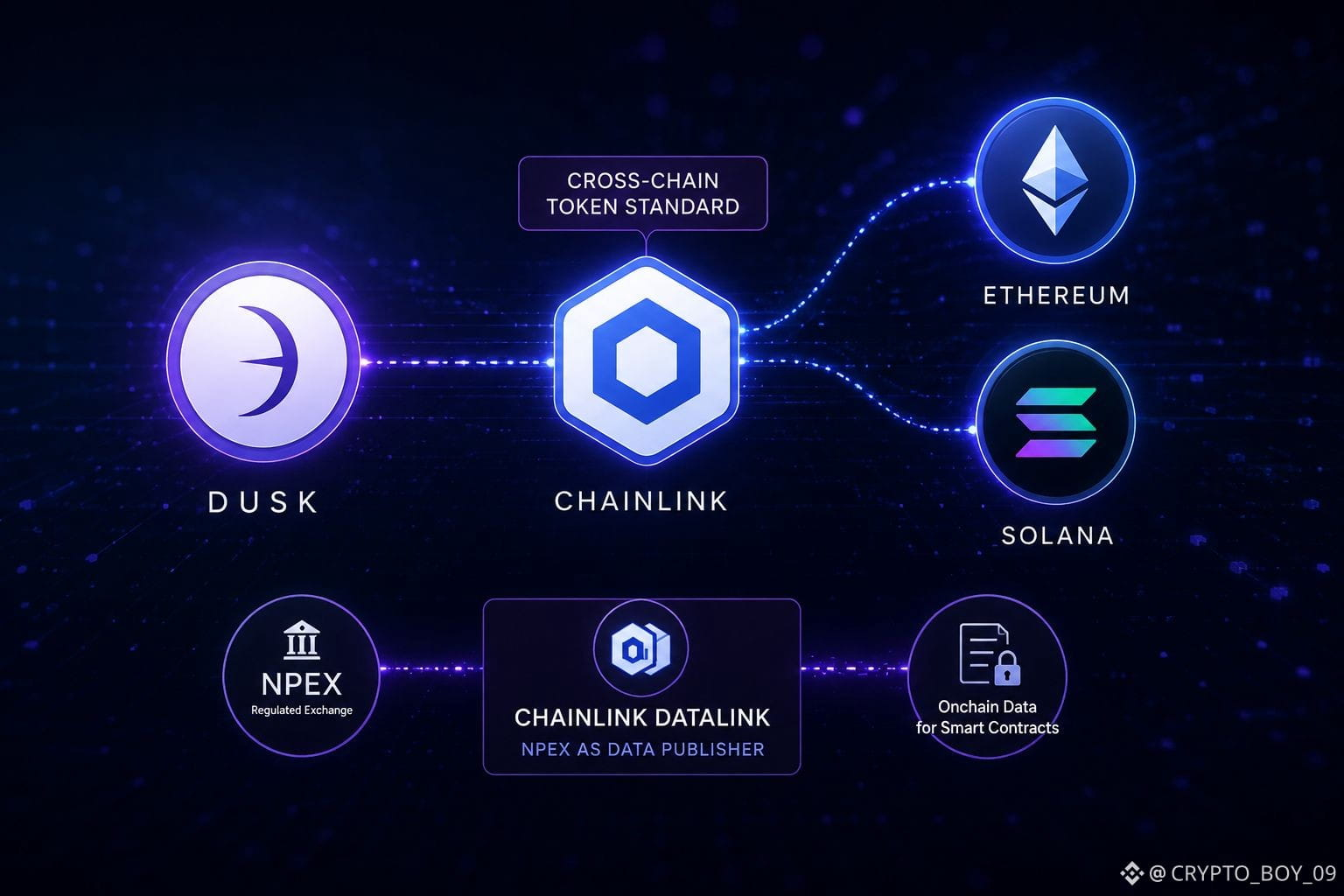
I was going through Dusk’s recent partnerships and honestly almost skipped over the Chainlink one because, at first glance, it just looked like another integration. But the more I thought about it, the more interesting it became. DUSK basically lives on one chain right now, and that’s about to change. With Chainlink, DUSK can move natively to Ethereum and Solana through the Cross-Chain Token standard. And I think the word “natively” matters here. It’s not just a wrapped version sitting somewhere on a bridge. The actual token can move across chains.
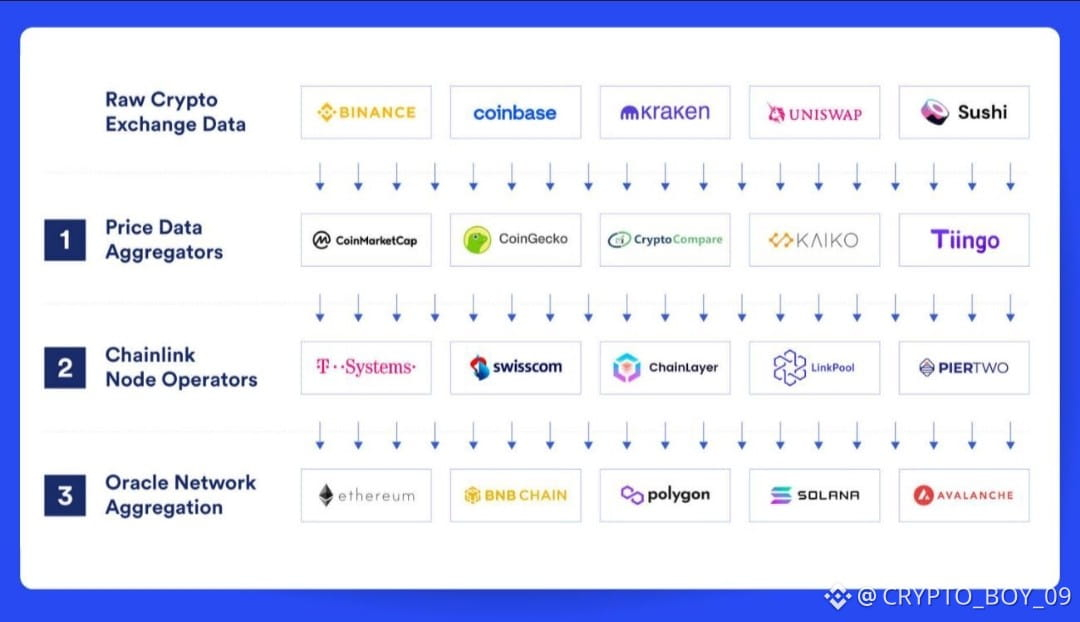
The second part caught my attention even more. NPEX, the regulated exchange Dusk works with, is becoming a data publisher through Chainlink DataLink. So real exchange prices and activity can be pushed onchain directly from a regulated source. No scraping, no guessing, no relying on random data sources.
I’ve seen plenty of partnerships that look impressive on paper but don’t really change much. This one feels different to me because it’s basically infrastructure. Nothing flashy, nothing designed just for headlines, but it makes the ecosystem easier to connect and build on.
And honestly, I think that kind of plumbing can end up being more important than the features everyone talks about. Now I’m curious which side becomes the bigger unlock: DUSK being able to move across chains more freely, or regulated market data becoming available for smart contracts to actually build on.
{spot}(DUSKUSDT)
{future}(TRUMPUSDT)
{future}(BTCUSDT)
That’s the part I’ll be watching.
$AVAX $MAGMA
#dusk $DUSK @Dusk
I was going through Dusk’s recent partnerships and honestly almost skipped over the Chainlink one because, at first glance, it just looked like another integration. But the more I thought about it, the more interesting it became. DUSK basically lives on one chain right now, and that’s about to change. With Chainlink, DUSK can move natively to Ethereum and Solana through the Cross-Chain Token standard. And I think the word “natively” matters here. It’s not just a wrapped version sitting somewhere on a bridge. The actual token can move across chains.
The second part caught my attention even more. NPEX, the regulated exchange Dusk works with, is becoming a data publisher through Chainlink DataLink. So real exchange prices and activity can be pushed onchain directly from a regulated source. No scraping, no guessing, no relying on random data sources.
I’ve seen plenty of partnerships that look impressive on paper but don’t really change much. This one feels different to me because it’s basically infrastructure. Nothing flashy, nothing designed just for headlines, but it makes the ecosystem easier to connect and build on.
And honestly, I think that kind of plumbing can end up being more important than the features everyone talks about. Now I’m curious which side becomes the bigger unlock: DUSK being able to move across chains more freely, or regulated market data becoming available for smart contracts to actually build on.
That’s the part I’ll be watching.
$AVAX $MAGMA
I was going through Dusk’s recent partnerships and honestly almost skipped over the Chainlink one because, at first glance, it just looked like another integration. But the more I thought about it, the more interesting it became. DUSK basically lives on one chain right now, and that’s about to change. With Chainlink, DUSK can move natively to Ethereum and Solana through the Cross-Chain Token standard. And I think the word “natively” matters here. It’s not just a wrapped version sitting somewhere on a bridge. The actual token can move across chains.
The second part caught my attention even more. NPEX, the regulated exchange Dusk works with, is becoming a data publisher through Chainlink DataLink. So real exchange prices and activity can be pushed onchain directly from a regulated source. No scraping, no guessing, no relying on random data sources.
I’ve seen plenty of partnerships that look impressive on paper but don’t really change much. This one feels different to me because it’s basically infrastructure. Nothing flashy, nothing designed just for headlines, but it makes the ecosystem easier to connect and build on.
And honestly, I think that kind of plumbing can end up being more important than the features everyone talks about. Now I’m curious which side becomes the bigger unlock: DUSK being able to move across chains more freely, or regulated market data becoming available for smart contracts to actually build on.
That’s the part I’ll be watching.
$AVAX $MAGMA
3
2
318
#TermMax
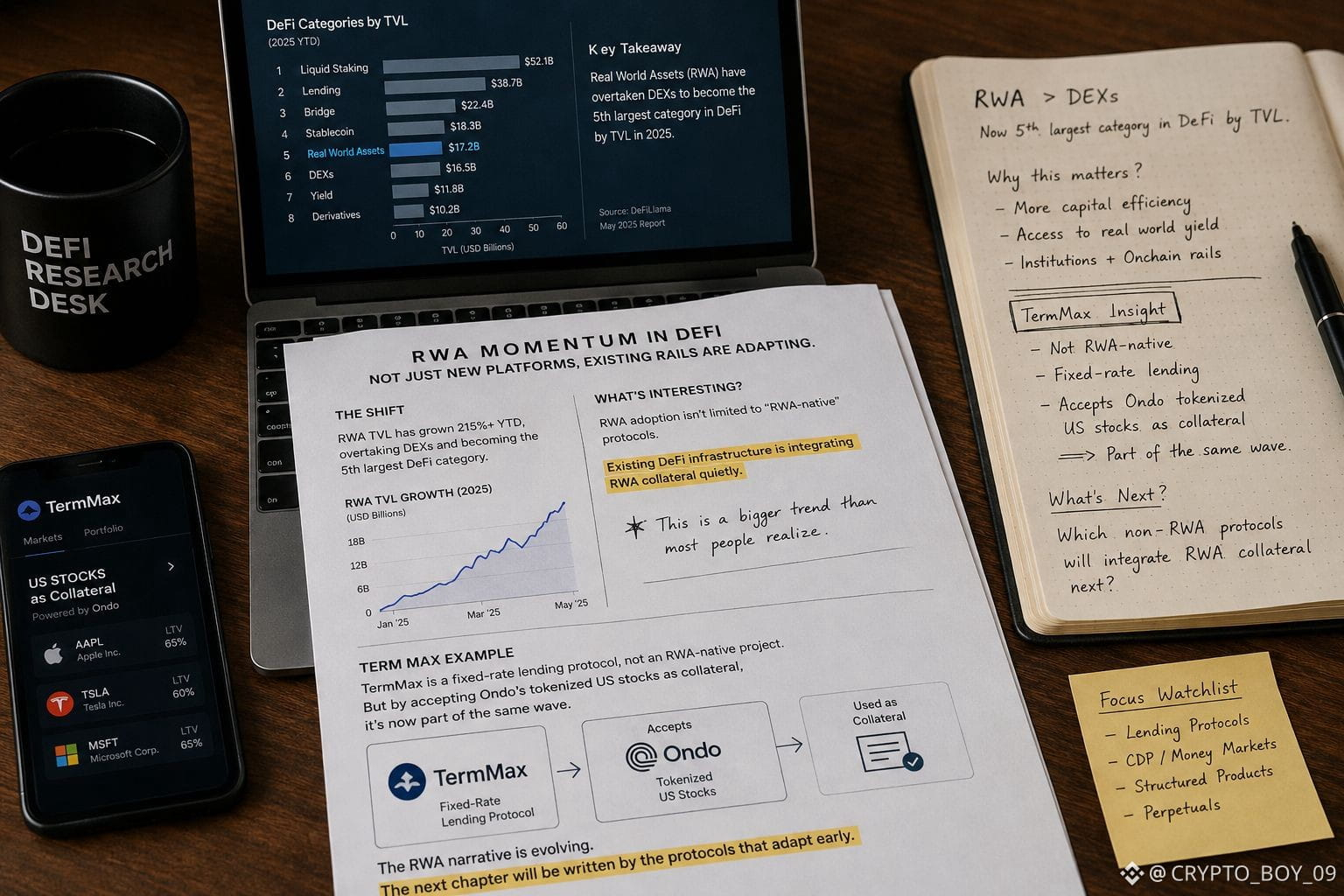
Saw a report last week saying RWAs have overtaken DEXs this year and are now the 5th largest category in DeFi by TVL.
Didn't think much of it at first.
Then I came across what TermMax is doing.
TermMax isn't an RWA-native protocol. It's a fixed-rate lending platform. But once it started accepting Ondo's tokenized US stocks as collateral, it kind of got pulled into the same RWA trend anyway.
And honestly, that's the part I found interesting.
The RWA story might not just be about new protocols built specifically around RWAs. It could also be existing DeFi infrastructure slowly adding real-world assets into the products people already use.
Makes me wonder how many other "non-RWA" protocols will quietly start doing the same.
And which ones will be too late?
@termmax #termmax
$PEOPLE $ONG
{future}(ONGUSDT)
{future}(PEOPLEUSDT)
#TermMax
Saw a report last week saying RWAs have overtaken DEXs this year and are now the 5th largest category in DeFi by TVL.
Didn't think much of it at first.
Then I came across what TermMax is doing.
TermMax isn't an RWA-native protocol. It's a fixed-rate lending platform. But once it started accepting Ondo's tokenized US stocks as collateral, it kind of got pulled into the same RWA trend anyway.
And honestly, that's the part I found interesting.
The RWA story might not just be about new protocols built specifically around RWAs. It could also be existing DeFi infrastructure slowly adding real-world assets into the products people already use.
Makes me wonder how many other "non-RWA" protocols will quietly start doing the same.
And which ones will be too late?
@TermMax #termmax
$PEOPLE $ONG
Saw a report last week saying RWAs have overtaken DEXs this year and are now the 5th largest category in DeFi by TVL.
Didn't think much of it at first.
Then I came across what TermMax is doing.
TermMax isn't an RWA-native protocol. It's a fixed-rate lending platform. But once it started accepting Ondo's tokenized US stocks as collateral, it kind of got pulled into the same RWA trend anyway.
And honestly, that's the part I found interesting.
The RWA story might not just be about new protocols built specifically around RWAs. It could also be existing DeFi infrastructure slowly adding real-world assets into the products people already use.
Makes me wonder how many other "non-RWA" protocols will quietly start doing the same.
And which ones will be too late?
@TermMax #termmax
$PEOPLE $ONG
6
7
469
I was honestly a bit confused by the “EVM-compatible” part of Dusk at first.
I assumed it simply meant: take your Solidity code, make a few changes, and you’re good to go.
Then I looked deeper into DuskEVM.
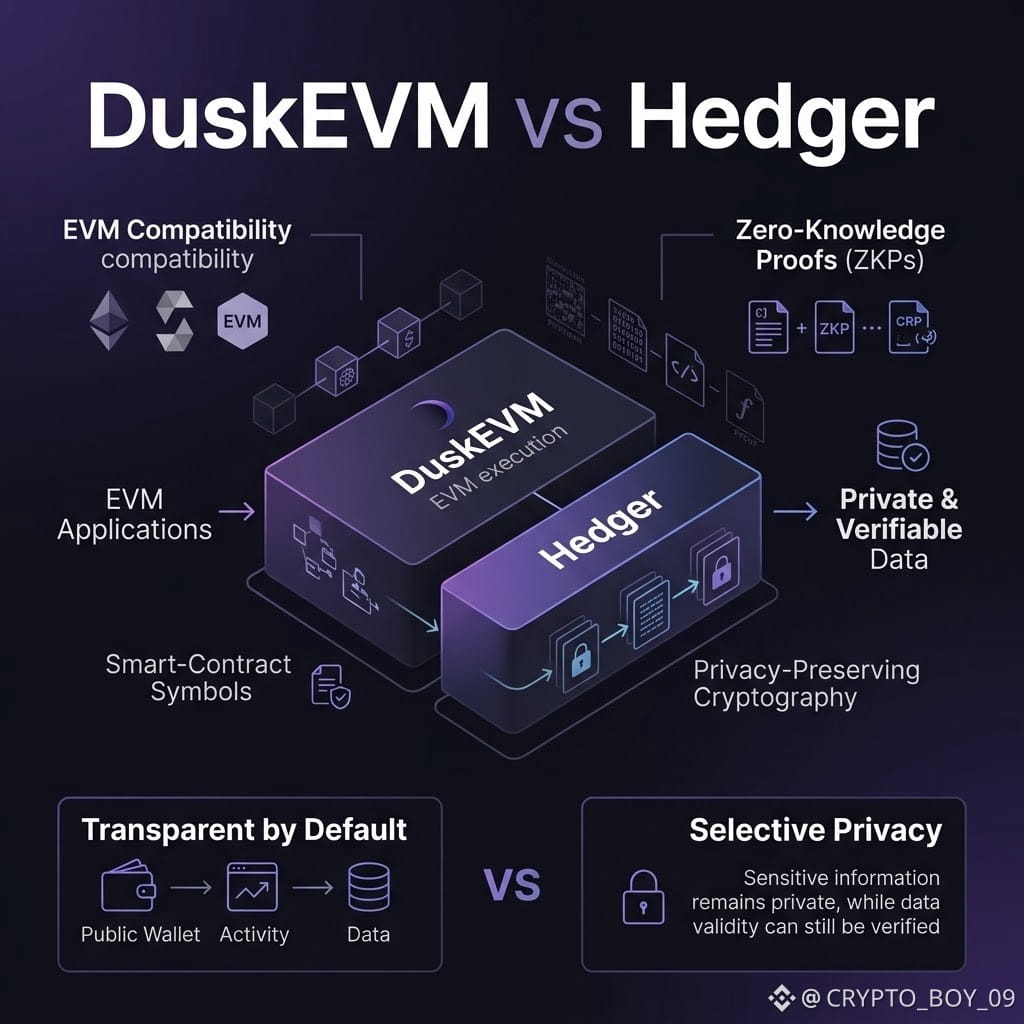
The EVM side is familiar — Solidity, existing developer tooling, and an easier path for builders coming from Ethereum.
But Dusk adds something I wasn’t expecting: Hedger, a privacy module designed for the EVM layer.
It uses privacy-preserving cryptography and zero-knowledge proofs to help applications keep certain information private while still allowing it to be verified.
That’s where DuskEVM gets interesting.
On most EVM chains, privacy is largely an afterthought. Wallets, balances, and contract activity are generally transparent by default.
Dusk takes a different approach: developers can choose where privacy is actually needed.
And that raises an interesting question:
If developers finally have the option to build privacy into specific parts of an EVM application, will they actually use it?
Or has transparent-by-default already become the norm?
@Dusk_Foundation #dusk $DUSK
$METAB $ONG
{future}(ONGUSDT)
{spot}(DUSKUSDT)
I was honestly a bit confused by the “EVM-compatible” part of Dusk at first.
I assumed it simply meant: take your Solidity code, make a few changes, and you’re good to go.
Then I looked deeper into DuskEVM.
The EVM side is familiar — Solidity, existing developer tooling, and an easier path for builders coming from Ethereum.
But Dusk adds something I wasn’t expecting: Hedger, a privacy module designed for the EVM layer.
It uses privacy-preserving cryptography and zero-knowledge proofs to help applications keep certain information private while still allowing it to be verified.
That’s where DuskEVM gets interesting.
On most EVM chains, privacy is largely an afterthought. Wallets, balances, and contract activity are generally transparent by default.
Dusk takes a different approach: developers can choose where privacy is actually needed.
And that raises an interesting question:
If developers finally have the option to build privacy into specific parts of an EVM application, will they actually use it?
Or has transparent-by-default already become the norm?
@Dusk #dusk $DUSK
$METAB $ONG
I assumed it simply meant: take your Solidity code, make a few changes, and you’re good to go.
Then I looked deeper into DuskEVM.
The EVM side is familiar — Solidity, existing developer tooling, and an easier path for builders coming from Ethereum.
But Dusk adds something I wasn’t expecting: Hedger, a privacy module designed for the EVM layer.
It uses privacy-preserving cryptography and zero-knowledge proofs to help applications keep certain information private while still allowing it to be verified.
That’s where DuskEVM gets interesting.
On most EVM chains, privacy is largely an afterthought. Wallets, balances, and contract activity are generally transparent by default.
Dusk takes a different approach: developers can choose where privacy is actually needed.
And that raises an interesting question:
If developers finally have the option to build privacy into specific parts of an EVM application, will they actually use it?
Or has transparent-by-default already become the norm?
@Dusk #dusk $DUSK
$METAB $ONG
3
3
111
I used to think tokenizing an asset basically meant putting it on a blockchain.
Then I started digging into Dusk’s docs and realized there’s actually a pretty important difference between tokenization and native issuance.
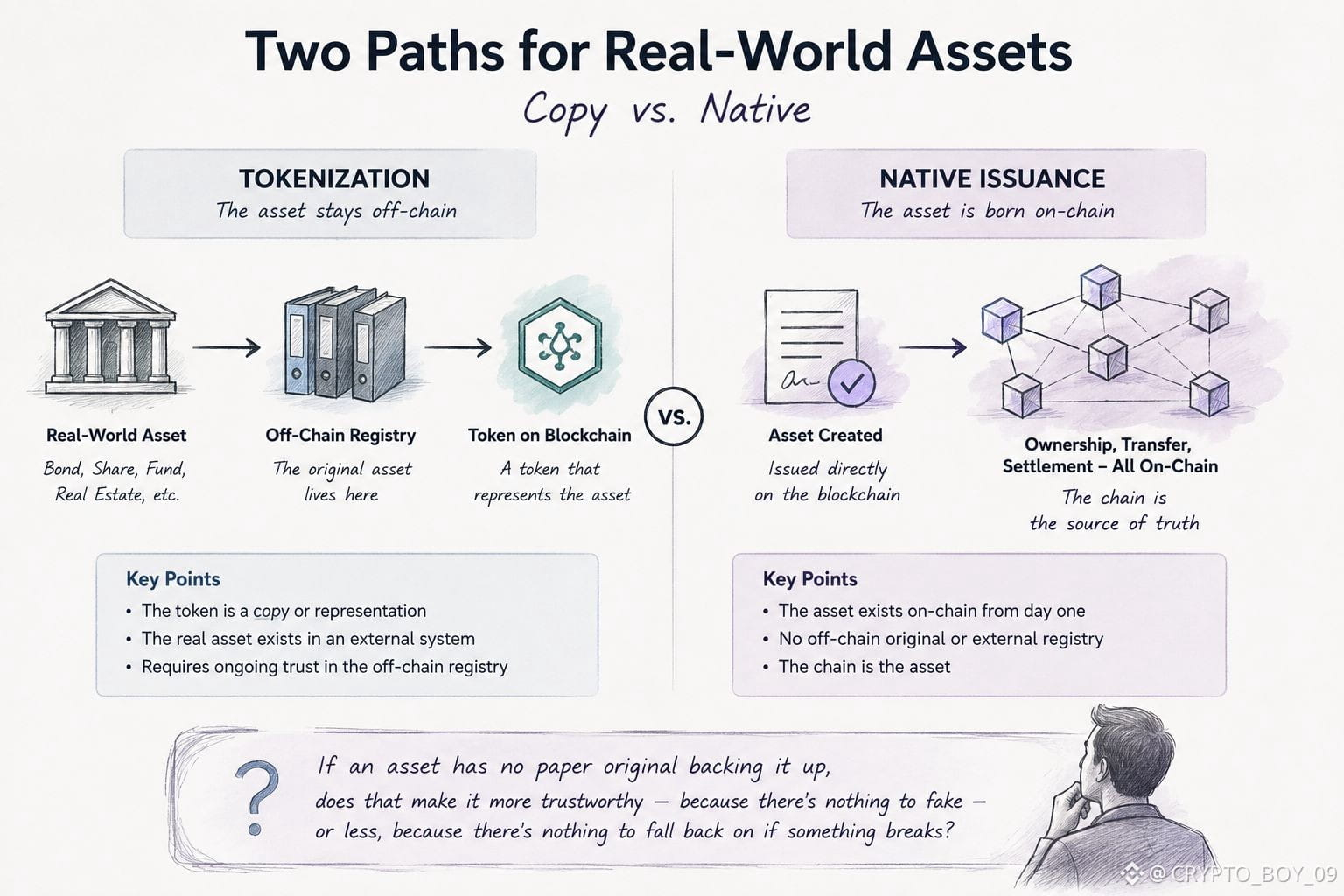
With tokenization, the asset already exists somewhere else. Say it’s a bond or a share sitting in an existing registry. You create a token onchain that represents it, but the original asset is still sitting offchain.
Native issuance is different.
The asset is created onchain from the start. There isn’t another “original” sitting somewhere else that the token needs to represent. Ownership, transfers and the asset itself can live on the same system.
And honestly, that distinction got me thinking.
One approach basically adds a blockchain layer to the existing financial system. The other is trying to make the blockchain part of the actual financial infrastructure.
That’s where I find Dusk interesting.
But I’m still stuck on one question:
If there’s no paper or offchain original to fall back on, does that make an asset more trustworthy because there’s less room for mismatch — or less trustworthy because there’s no traditional fallback when something goes wrong?
@Dusk_Foundation #dusk $DUSK
{spot}(DUSKUSDT)
$HEMI $RE
I used to think tokenizing an asset basically meant putting it on a blockchain.
Then I started digging into Dusk’s docs and realized there’s actually a pretty important difference between tokenization and native issuance.
With tokenization, the asset already exists somewhere else. Say it’s a bond or a share sitting in an existing registry. You create a token onchain that represents it, but the original asset is still sitting offchain.
Native issuance is different.
The asset is created onchain from the start. There isn’t another “original” sitting somewhere else that the token needs to represent. Ownership, transfers and the asset itself can live on the same system.
And honestly, that distinction got me thinking.
One approach basically adds a blockchain layer to the existing financial system. The other is trying to make the blockchain part of the actual financial infrastructure.
That’s where I find Dusk interesting.
But I’m still stuck on one question:
If there’s no paper or offchain original to fall back on, does that make an asset more trustworthy because there’s less room for mismatch — or less trustworthy because there’s no traditional fallback when something goes wrong?
@Dusk #dusk $DUSK
$HEMI $RE
Then I started digging into Dusk’s docs and realized there’s actually a pretty important difference between tokenization and native issuance.
With tokenization, the asset already exists somewhere else. Say it’s a bond or a share sitting in an existing registry. You create a token onchain that represents it, but the original asset is still sitting offchain.
Native issuance is different.
The asset is created onchain from the start. There isn’t another “original” sitting somewhere else that the token needs to represent. Ownership, transfers and the asset itself can live on the same system.
And honestly, that distinction got me thinking.
One approach basically adds a blockchain layer to the existing financial system. The other is trying to make the blockchain part of the actual financial infrastructure.
That’s where I find Dusk interesting.
But I’m still stuck on one question:
If there’s no paper or offchain original to fall back on, does that make an asset more trustworthy because there’s less room for mismatch — or less trustworthy because there’s no traditional fallback when something goes wrong?
@Dusk #dusk $DUSK
$HEMI $RE
20
9
607
Was checking a USDC market at 3 AM and thinking 🧐, why does it take so long just to figure out where the best rate is?
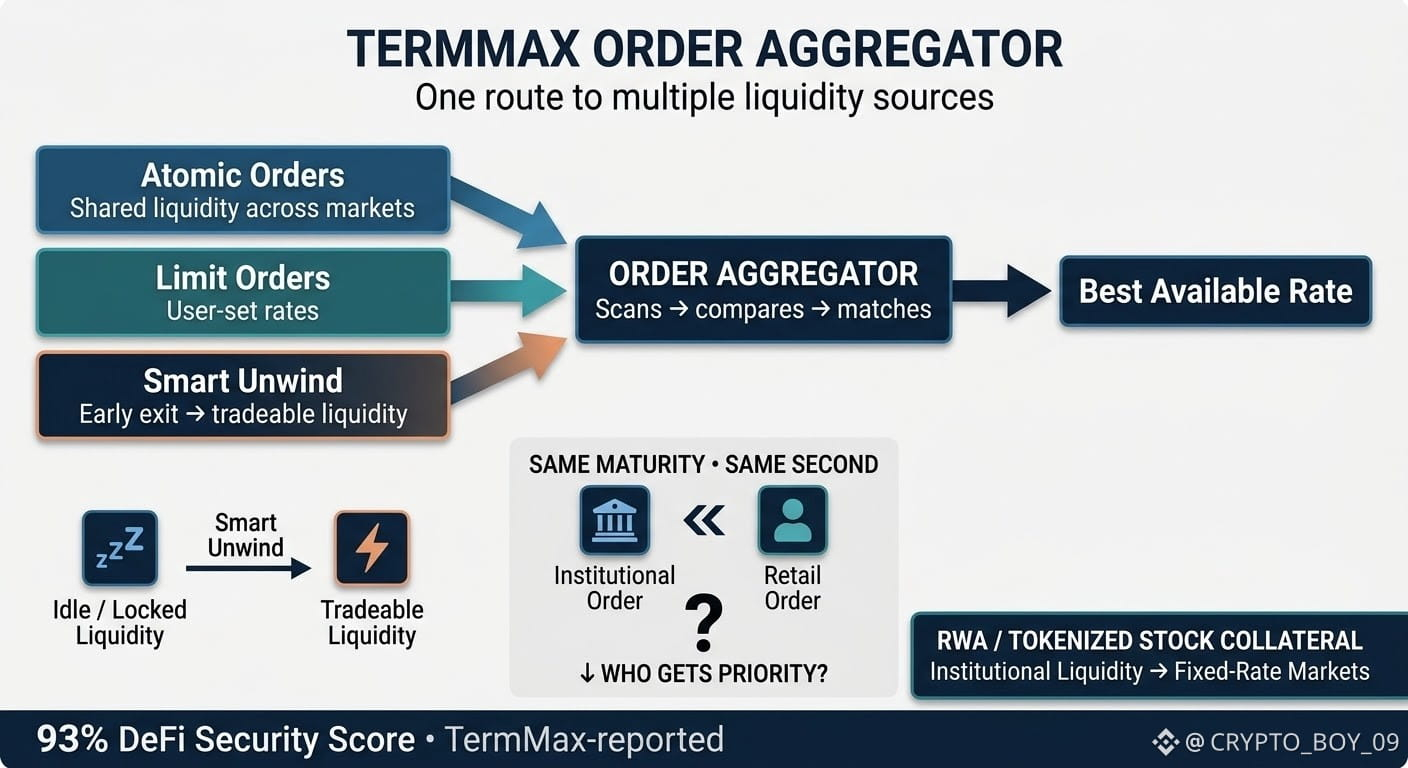
Then I tried #TermMax ’s Order Aggregator and finally understood what it’s actually doing.
Instead of checking everything separately, it brings liquidity from three different sources into one place:
1- Atomic Orders that are ready to use
2- Limit orders placed by other users
3- Smart Unwind positions where someone is exiting before maturity
Normally, you’d have to find these separately, and sometimes deal with multiple transactions. Here, they’re all available in one shot.
The part I found most interesting is Smart Unwind.
Some liquidity would otherwise just sit there until maturity, basically “sleeping.” Aggregating that liquidity means capital that felt stuck can actually become usable again.
That said, I’m not assuming smooth automation will always stay smooth. When markets are calm, optimization is easy. The real test comes when everyone wants the same maturity and liquidity gets tight.
And now that institutional collateral like tokenized stocks is coming into the picture, with a security score comparable to Aave V3, this starts to feel like more than just a small experiment.
So the question isn’t whether combining three liquidity sources is smart. It is.
The real question is: when a large institutional order and my small order want the same liquidity at the exact same second, who gets priority?
@termmax #TermMax
$RICE $BTW $ACE
Was checking a USDC market at 3 AM and thinking 🧐, why does it take so long just to figure out where the best rate is?
Then I tried #TermMax ’s Order Aggregator and finally understood what it’s actually doing.
Instead of checking everything separately, it brings liquidity from three different sources into one place:
1- Atomic Orders that are ready to use
2- Limit orders placed by other users
3- Smart Unwind positions where someone is exiting before maturity
Normally, you’d have to find these separately, and sometimes deal with multiple transactions. Here, they’re all available in one shot.
The part I found most interesting is Smart Unwind.
Some liquidity would otherwise just sit there until maturity, basically “sleeping.” Aggregating that liquidity means capital that felt stuck can actually become usable again.
That said, I’m not assuming smooth automation will always stay smooth. When markets are calm, optimization is easy. The real test comes when everyone wants the same maturity and liquidity gets tight.
And now that institutional collateral like tokenized stocks is coming into the picture, with a security score comparable to Aave V3, this starts to feel like more than just a small experiment.
So the question isn’t whether combining three liquidity sources is smart. It is.
The real question is: when a large institutional order and my small order want the same liquidity at the exact same second, who gets priority?
@TermMax #TermMax
$RICE $BTW $ACE
Then I tried #TermMax ’s Order Aggregator and finally understood what it’s actually doing.
Instead of checking everything separately, it brings liquidity from three different sources into one place:
1- Atomic Orders that are ready to use
2- Limit orders placed by other users
3- Smart Unwind positions where someone is exiting before maturity
Normally, you’d have to find these separately, and sometimes deal with multiple transactions. Here, they’re all available in one shot.
The part I found most interesting is Smart Unwind.
Some liquidity would otherwise just sit there until maturity, basically “sleeping.” Aggregating that liquidity means capital that felt stuck can actually become usable again.
That said, I’m not assuming smooth automation will always stay smooth. When markets are calm, optimization is easy. The real test comes when everyone wants the same maturity and liquidity gets tight.
And now that institutional collateral like tokenized stocks is coming into the picture, with a security score comparable to Aave V3, this starts to feel like more than just a small experiment.
So the question isn’t whether combining three liquidity sources is smart. It is.
The real question is: when a large institutional order and my small order want the same liquidity at the exact same second, who gets priority?
@TermMax #TermMax
$RICE $BTW $ACE
10
10
512
Проверено
Got back from the hospital late last night 🤒. Couldn’t sleep, so I ended up digging through Duck's docs.
One line stopped me cold.😲
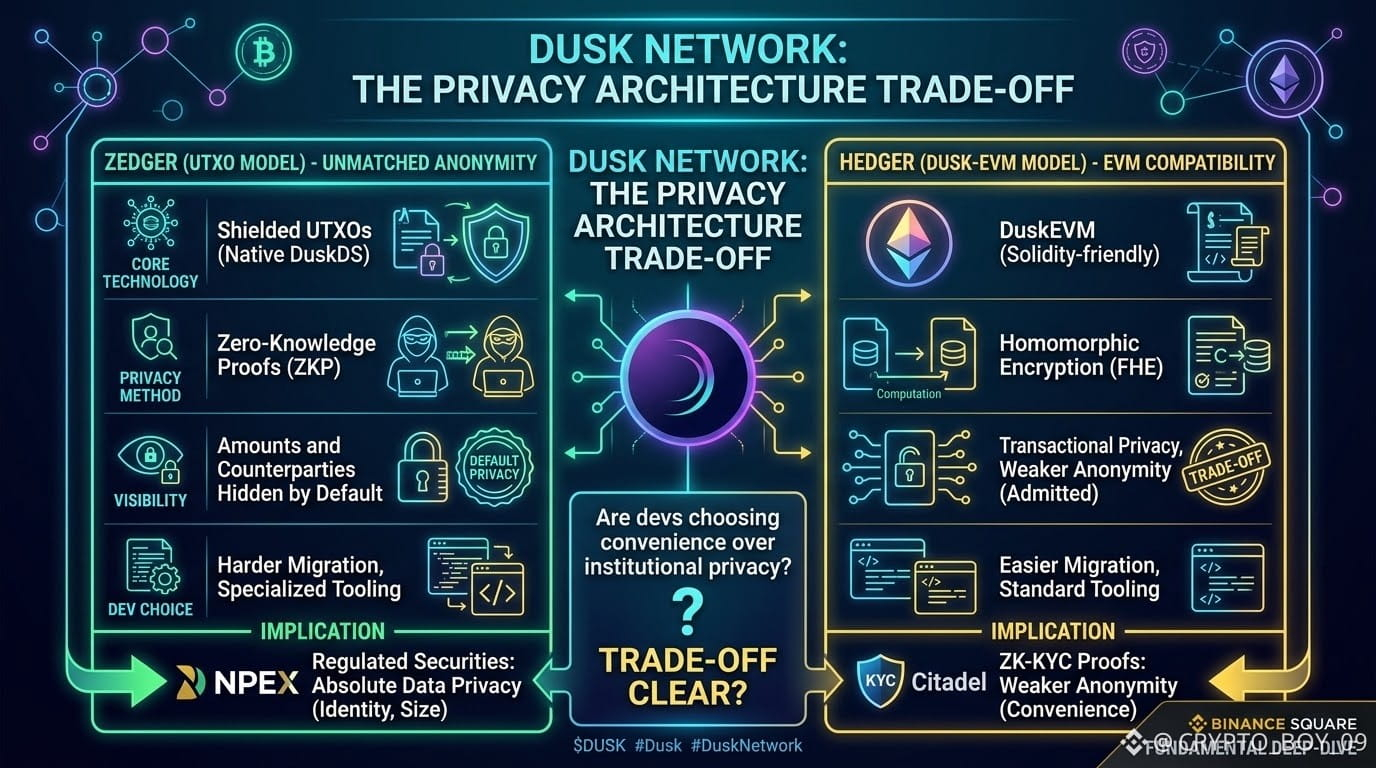
Straight from Dusk’s own Hedger announcement: the EVM’s account-based model can’t match the anonymity Zedger offers.
Sounds small. It isn’t.
Zedger runs natively on DuskDS — shielded UTXOs, ZK proofs, amounts and counterparties hidden by default. No extra layer needed.
Hedger runs on DuskEVM. Solidity-friendly, easier Ethereum migration. But even with homomorphic encryption, Dusk admits it: it doesn’t offer the same anonymity as Zedger.
That’s not just a dev tooling choice.
NPEX is building regulated securities infrastructure on this. Investor identity, transaction size, counterparties — exactly the kind of data privacy matters for.
Citadel adds another piece to the same story: prove you’re eligible without handing over your whole identity.
So here’s what I keep asking:
When a developer picks Hedger for convenience, are they also choosing a weaker privacy model for institutional users — and does anyone actually make that trade-off clear?
@Dusk_Foundation #Dusk $DUSK
Got back from the hospital late last night 🤒. Couldn’t sleep, so I ended up digging through Duck's docs.
One line stopped me cold.😲
Straight from Dusk’s own Hedger announcement: the EVM’s account-based model can’t match the anonymity Zedger offers.
Sounds small. It isn’t.
Zedger runs natively on DuskDS — shielded UTXOs, ZK proofs, amounts and counterparties hidden by default. No extra layer needed.
Hedger runs on DuskEVM. Solidity-friendly, easier Ethereum migration. But even with homomorphic encryption, Dusk admits it: it doesn’t offer the same anonymity as Zedger.
That’s not just a dev tooling choice.
NPEX is building regulated securities infrastructure on this. Investor identity, transaction size, counterparties — exactly the kind of data privacy matters for.
Citadel adds another piece to the same story: prove you’re eligible without handing over your whole identity.
So here’s what I keep asking:
When a developer picks Hedger for convenience, are they also choosing a weaker privacy model for institutional users — and does anyone actually make that trade-off clear?
@Dusk #Dusk $DUSK
One line stopped me cold.😲
Straight from Dusk’s own Hedger announcement: the EVM’s account-based model can’t match the anonymity Zedger offers.
Sounds small. It isn’t.
Zedger runs natively on DuskDS — shielded UTXOs, ZK proofs, amounts and counterparties hidden by default. No extra layer needed.
Hedger runs on DuskEVM. Solidity-friendly, easier Ethereum migration. But even with homomorphic encryption, Dusk admits it: it doesn’t offer the same anonymity as Zedger.
That’s not just a dev tooling choice.
NPEX is building regulated securities infrastructure on this. Investor identity, transaction size, counterparties — exactly the kind of data privacy matters for.
Citadel adds another piece to the same story: prove you’re eligible without handing over your whole identity.
So here’s what I keep asking:
When a developer picks Hedger for convenience, are they also choosing a weaker privacy model for institutional users — and does anyone actually make that trade-off clear?
@Dusk #Dusk $DUSK
9
8
122
I used to assume a fixed-rate loan only had one ending: wait till maturity, repay the full amount, done.
Then I came across something interesting on #TermMax
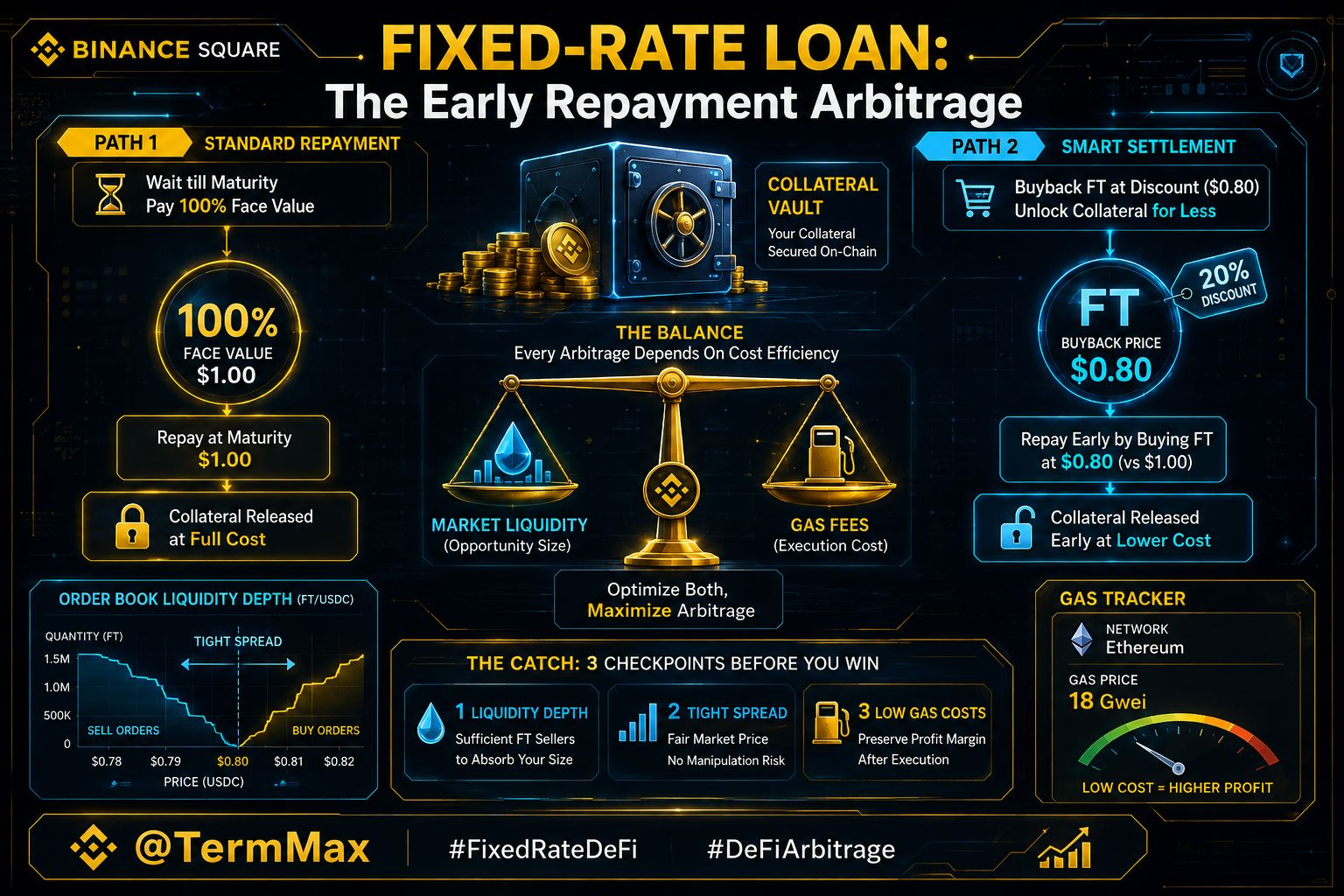
Before maturity, the FT — the token that represents the debt — can trade below its face value on the open market. So a borrower isn't necessarily stuck with just one option:
Wait it out and repay in full.
Or buy back the FT at a discount and use it to settle the same debt for less.
Both paths release the collateral the same way. The only thing that changes is the cost.
Say the FT is trading at $0.80 on the dollar. If there's enough liquidity, buying it back and using it to settle the debt could cost quite a bit less than repaying at face value.
But there's a catch.
That discount only matters if you can actually get it. You need enough sellers, a reasonable spread, and low enough gas for the savings to survive execution.
So the real question isn't whether this feature exists.
It's how often the market actually gives borrowers a good enough discount to make early repayment worth it.
#TermMax @termmax
I used to assume a fixed-rate loan only had one ending: wait till maturity, repay the full amount, done.
Then I came across something interesting on #TermMax
Before maturity, the FT — the token that represents the debt — can trade below its face value on the open market. So a borrower isn't necessarily stuck with just one option:
Wait it out and repay in full.
Or buy back the FT at a discount and use it to settle the same debt for less.
Both paths release the collateral the same way. The only thing that changes is the cost.
Say the FT is trading at $0.80 on the dollar. If there's enough liquidity, buying it back and using it to settle the debt could cost quite a bit less than repaying at face value.
But there's a catch.
That discount only matters if you can actually get it. You need enough sellers, a reasonable spread, and low enough gas for the savings to survive execution.
So the real question isn't whether this feature exists.
It's how often the market actually gives borrowers a good enough discount to make early repayment worth it.
#TermMax @TermMax
Then I came across something interesting on #TermMax
Before maturity, the FT — the token that represents the debt — can trade below its face value on the open market. So a borrower isn't necessarily stuck with just one option:
Wait it out and repay in full.
Or buy back the FT at a discount and use it to settle the same debt for less.
Both paths release the collateral the same way. The only thing that changes is the cost.
Say the FT is trading at $0.80 on the dollar. If there's enough liquidity, buying it back and using it to settle the debt could cost quite a bit less than repaying at face value.
But there's a catch.
That discount only matters if you can actually get it. You need enough sellers, a reasonable spread, and low enough gas for the savings to survive execution.
So the real question isn't whether this feature exists.
It's how often the market actually gives borrowers a good enough discount to make early repayment worth it.
#TermMax @TermMax
12
7
94
It’s almost 3am, I should probably be sleeping, but somehow I ended up reading about Dusk’s Chainlink partnership instead.
What caught my attention was pretty simple: Dusk doesn’t seem to be building a chain and then waiting for banks to figure out what to do with it.
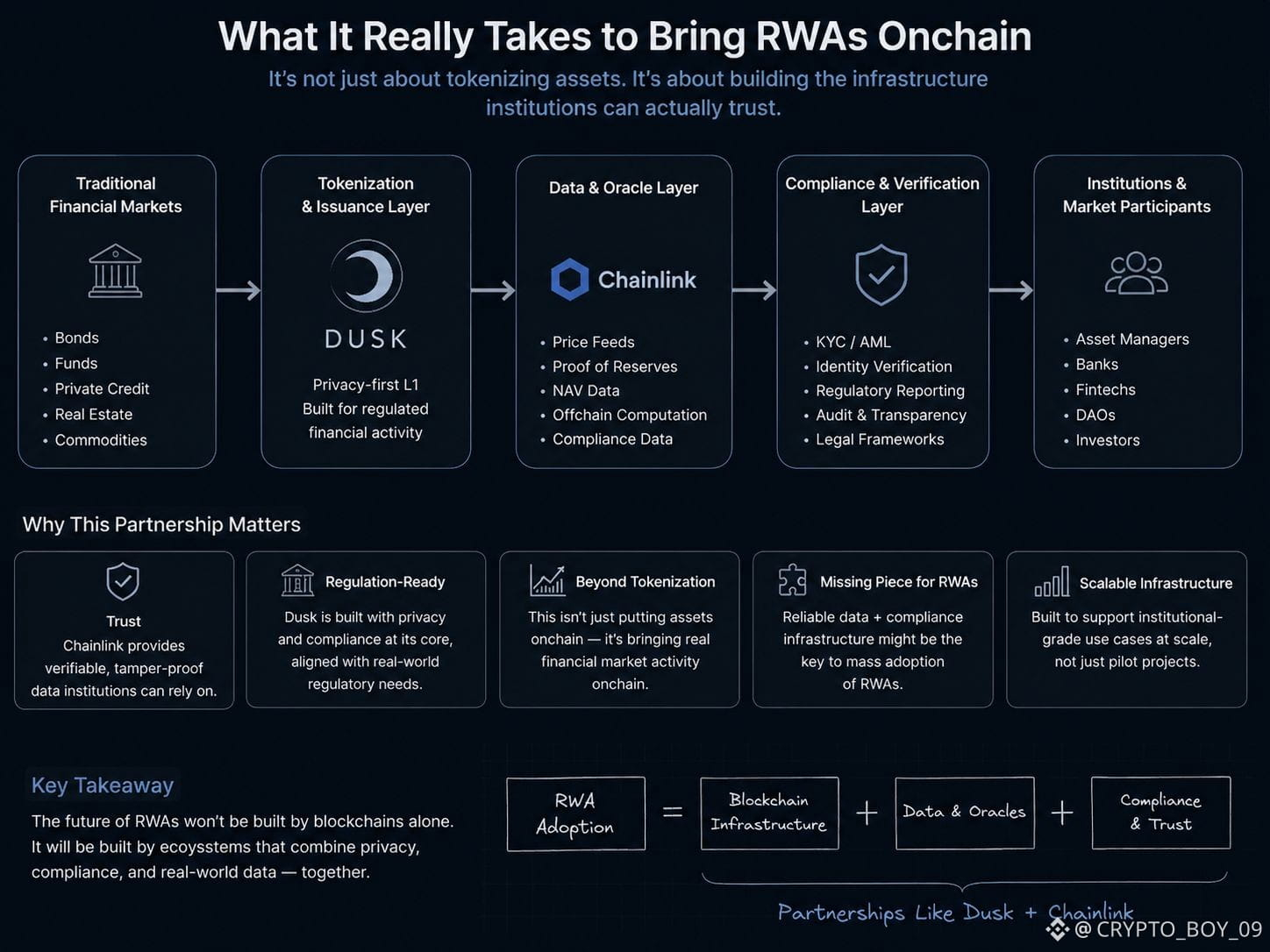
It’s working with Chainlink and EU-licensed institutions to bring actual financial market activity onchain. And I think that’s a much bigger deal than just putting tokens on a blockchain.
Because when people talk about RWAs, it’s easy to focus on the token itself. But regulated assets need a lot more than that. Institutions need reliable data, compliance, verification, and infrastructure they can actually trust.
That’s where this partnership gets interesting to me.
Everyone keeps saying “TradFi is coming onchain,” but maybe the harder part was never the blockchain itself. Maybe it was building all the infrastructure around it so regulated institutions can actually use it.
Now I’m wondering: are partnerships like this one of the missing pieces for RWAs to really scale?
@Dusk_Foundation $DUSK #dusk
It’s almost 3am, I should probably be sleeping, but somehow I ended up reading about Dusk’s Chainlink partnership instead.
What caught my attention was pretty simple: Dusk doesn’t seem to be building a chain and then waiting for banks to figure out what to do with it.
It’s working with Chainlink and EU-licensed institutions to bring actual financial market activity onchain. And I think that’s a much bigger deal than just putting tokens on a blockchain.
Because when people talk about RWAs, it’s easy to focus on the token itself. But regulated assets need a lot more than that. Institutions need reliable data, compliance, verification, and infrastructure they can actually trust.
That’s where this partnership gets interesting to me.
Everyone keeps saying “TradFi is coming onchain,” but maybe the harder part was never the blockchain itself. Maybe it was building all the infrastructure around it so regulated institutions can actually use it.
Now I’m wondering: are partnerships like this one of the missing pieces for RWAs to really scale?
@Dusk $DUSK #dusk
What caught my attention was pretty simple: Dusk doesn’t seem to be building a chain and then waiting for banks to figure out what to do with it.
It’s working with Chainlink and EU-licensed institutions to bring actual financial market activity onchain. And I think that’s a much bigger deal than just putting tokens on a blockchain.
Because when people talk about RWAs, it’s easy to focus on the token itself. But regulated assets need a lot more than that. Institutions need reliable data, compliance, verification, and infrastructure they can actually trust.
That’s where this partnership gets interesting to me.
Everyone keeps saying “TradFi is coming onchain,” but maybe the harder part was never the blockchain itself. Maybe it was building all the infrastructure around it so regulated institutions can actually use it.
Now I’m wondering: are partnerships like this one of the missing pieces for RWAs to really scale?
@Dusk $DUSK #dusk

16
6
174
Проверено
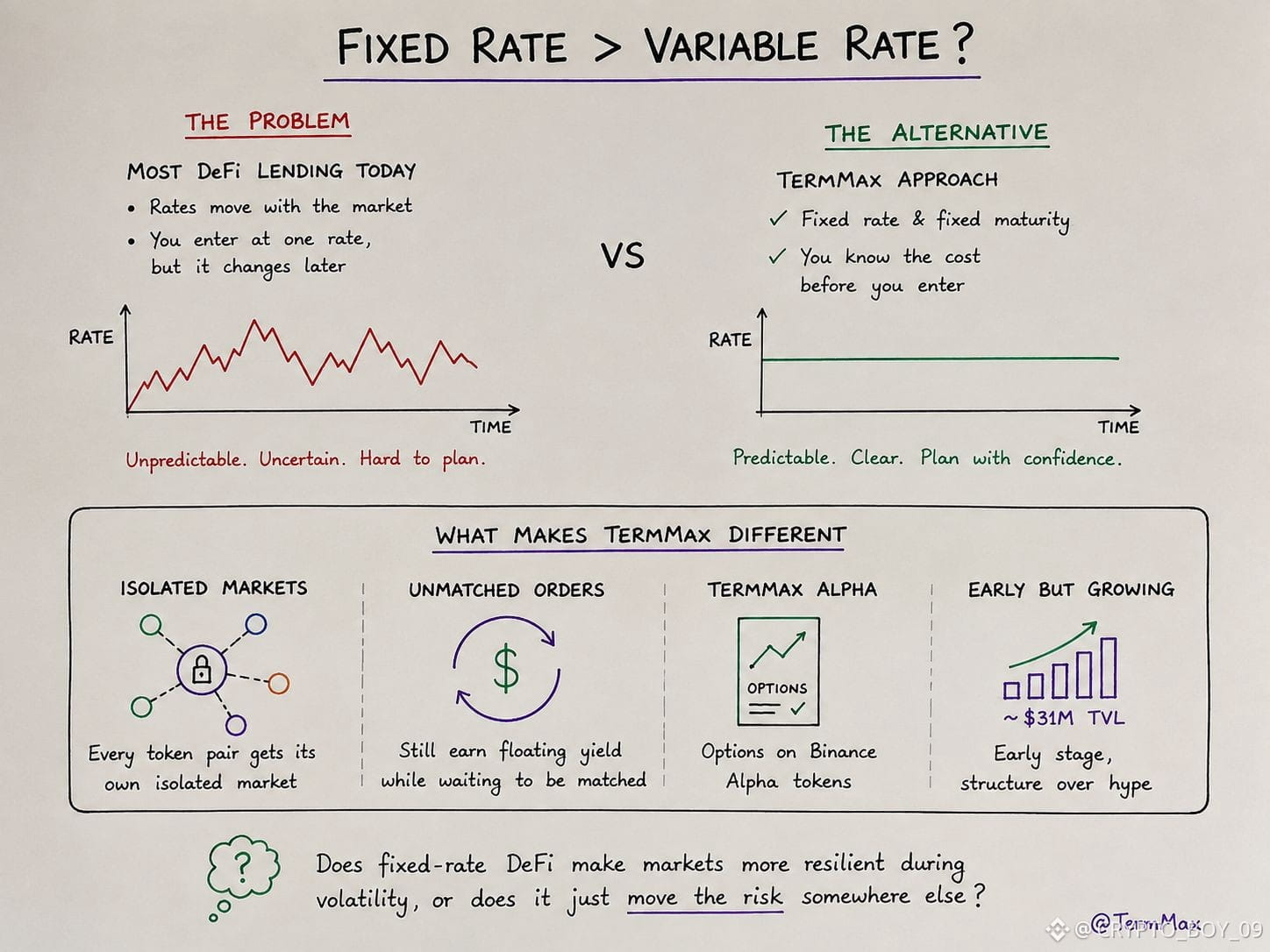
Funny how “fixed rate” sounds boring at first. 😅
But the more I look at DeFi lending, the more I think predictability is actually underrated.
Most lending rates move with the market. You enter a position thinking you know the cost, then the rate changes and you basically have to adjust as you go.
That’s what made me look closer at @termmax
The idea is pretty straightforward: you know the rate and maturity before entering the position. TermMax also uses isolated markets for different token pairs instead of putting everything into one shared pool.
What I found interesting is that unmatched orders can still earn floating yield while waiting to be matched. So capital doesn’t necessarily have to sit idle.
There’s also TermMax Alpha, which adds options around Binance Alpha tokens.
It’s still early, with around $31M TVL, but the structure is what caught my attention more than the number itself.
The question I’m still thinking about:
Does fixed-rate DeFi actually make markets more resilient during volatility, or does it simply move the risk somewhere else?
#TermMax
Funny how “fixed rate” sounds boring at first. 😅
But the more I look at DeFi lending, the more I think predictability is actually underrated.
Most lending rates move with the market. You enter a position thinking you know the cost, then the rate changes and you basically have to adjust as you go.
That’s what made me look closer at @TermMax
The idea is pretty straightforward: you know the rate and maturity before entering the position. TermMax also uses isolated markets for different token pairs instead of putting everything into one shared pool.
What I found interesting is that unmatched orders can still earn floating yield while waiting to be matched. So capital doesn’t necessarily have to sit idle.
There’s also TermMax Alpha, which adds options around Binance Alpha tokens.
It’s still early, with around $31M TVL, but the structure is what caught my attention more than the number itself.
The question I’m still thinking about:
Does fixed-rate DeFi actually make markets more resilient during volatility, or does it simply move the risk somewhere else?
#TermMax
But the more I look at DeFi lending, the more I think predictability is actually underrated.
Most lending rates move with the market. You enter a position thinking you know the cost, then the rate changes and you basically have to adjust as you go.
That’s what made me look closer at @TermMax
The idea is pretty straightforward: you know the rate and maturity before entering the position. TermMax also uses isolated markets for different token pairs instead of putting everything into one shared pool.
What I found interesting is that unmatched orders can still earn floating yield while waiting to be matched. So capital doesn’t necessarily have to sit idle.
There’s also TermMax Alpha, which adds options around Binance Alpha tokens.
It’s still early, with around $31M TVL, but the structure is what caught my attention more than the number itself.
The question I’m still thinking about:
Does fixed-rate DeFi actually make markets more resilient during volatility, or does it simply move the risk somewhere else?
#TermMax
17
2
9
72
Проверено
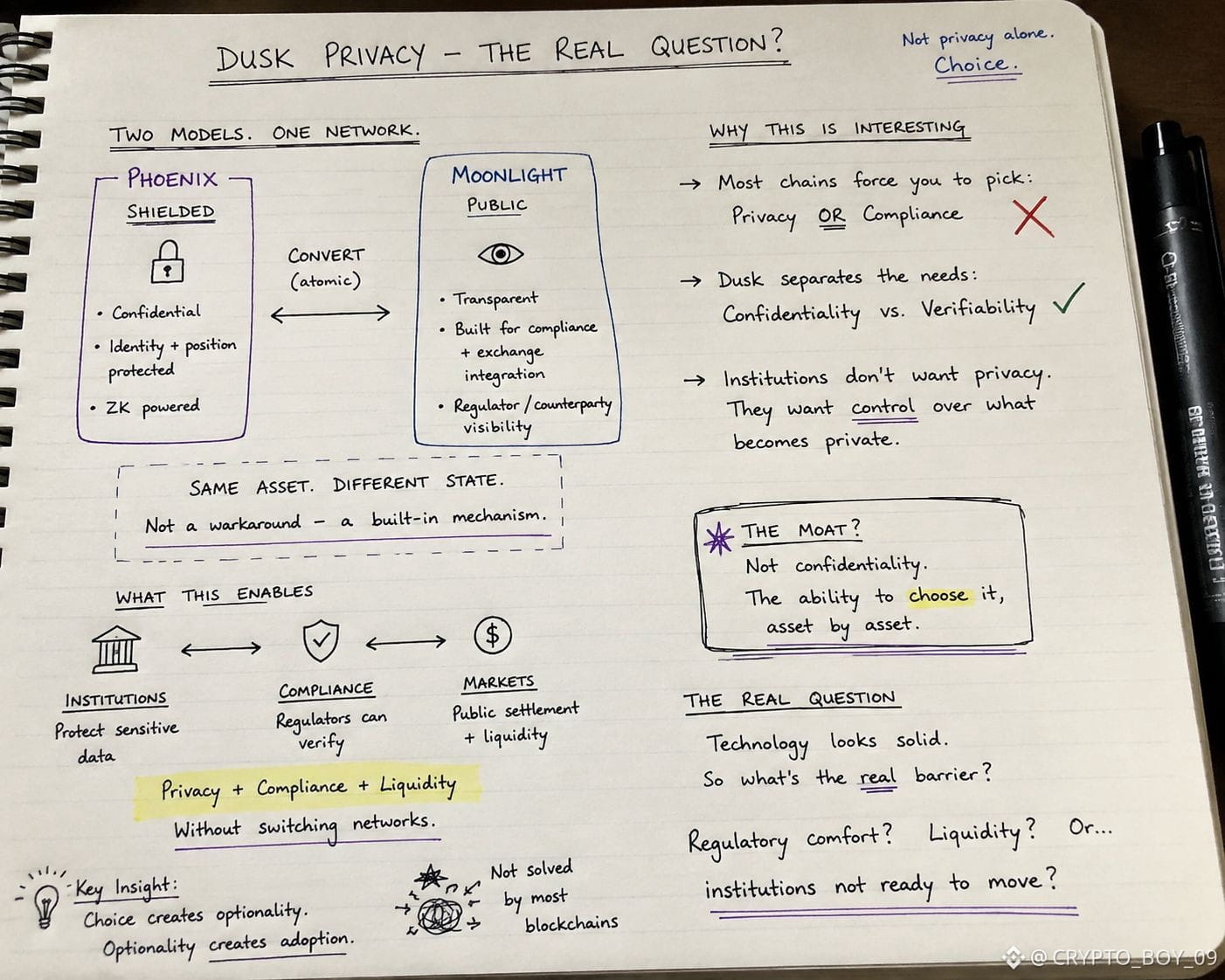
I still think most people are reading Dusk's privacy design wrong. ❌😵
I noticed something in their engineering notes that didn't sit right at first: there isn't one privacy model. There are two.
Phoenix, shielded. Moonlight, public. And a convert function that moves an asset between them — not a workaround, an actual built mechanism.
Here's the part that created the tension for me: Dusk's own documentation says Moonlight, the public model, is the one built for compliance and exchange integration. Not Phoenix, the shielded one.
That's the opposite of what I expected. If you're building for regulated finance, shouldn't the shielded model be the "serious" one?
But maybe that's the wrong instinct.
A bank doesn't need every transaction hidden. It needs investor identity and position data protected — while regulators and counterparties can still verify what's happening. Those are two separate needs, and most blockchains only solve one.
Dusk seems to be betting that institutions don't want privacy. They want control over what becomes private.
If that's true, the moat isn't confidentiality anymore. Confidentiality is common now. The moat is being able to choose it, asset by asset, without switching networks.
I don't think the technology is what's still in question here.
So what actually is — regulatory comfort, liquidity, or just institutions not being ready to move infrastructure they've already spent years building?
@Dusk_Foundation #dusk $DUSK
I still think most people are reading Dusk's privacy design wrong. ❌😵
I noticed something in their engineering notes that didn't sit right at first: there isn't one privacy model. There are two.
Phoenix, shielded. Moonlight, public. And a convert function that moves an asset between them — not a workaround, an actual built mechanism.
Here's the part that created the tension for me: Dusk's own documentation says Moonlight, the public model, is the one built for compliance and exchange integration. Not Phoenix, the shielded one.
That's the opposite of what I expected. If you're building for regulated finance, shouldn't the shielded model be the "serious" one?
But maybe that's the wrong instinct.
A bank doesn't need every transaction hidden. It needs investor identity and position data protected — while regulators and counterparties can still verify what's happening. Those are two separate needs, and most blockchains only solve one.
Dusk seems to be betting that institutions don't want privacy. They want control over what becomes private.
If that's true, the moat isn't confidentiality anymore. Confidentiality is common now. The moat is being able to choose it, asset by asset, without switching networks.
I don't think the technology is what's still in question here.
So what actually is — regulatory comfort, liquidity, or just institutions not being ready to move infrastructure they've already spent years building?
@Dusk #dusk $DUSK
I noticed something in their engineering notes that didn't sit right at first: there isn't one privacy model. There are two.
Phoenix, shielded. Moonlight, public. And a convert function that moves an asset between them — not a workaround, an actual built mechanism.
Here's the part that created the tension for me: Dusk's own documentation says Moonlight, the public model, is the one built for compliance and exchange integration. Not Phoenix, the shielded one.
That's the opposite of what I expected. If you're building for regulated finance, shouldn't the shielded model be the "serious" one?
But maybe that's the wrong instinct.
A bank doesn't need every transaction hidden. It needs investor identity and position data protected — while regulators and counterparties can still verify what's happening. Those are two separate needs, and most blockchains only solve one.
Dusk seems to be betting that institutions don't want privacy. They want control over what becomes private.
If that's true, the moat isn't confidentiality anymore. Confidentiality is common now. The moat is being able to choose it, asset by asset, without switching networks.
I don't think the technology is what's still in question here.
So what actually is — regulatory comfort, liquidity, or just institutions not being ready to move infrastructure they've already spent years building?
@Dusk #dusk $DUSK
38
1
14
158
Проверено
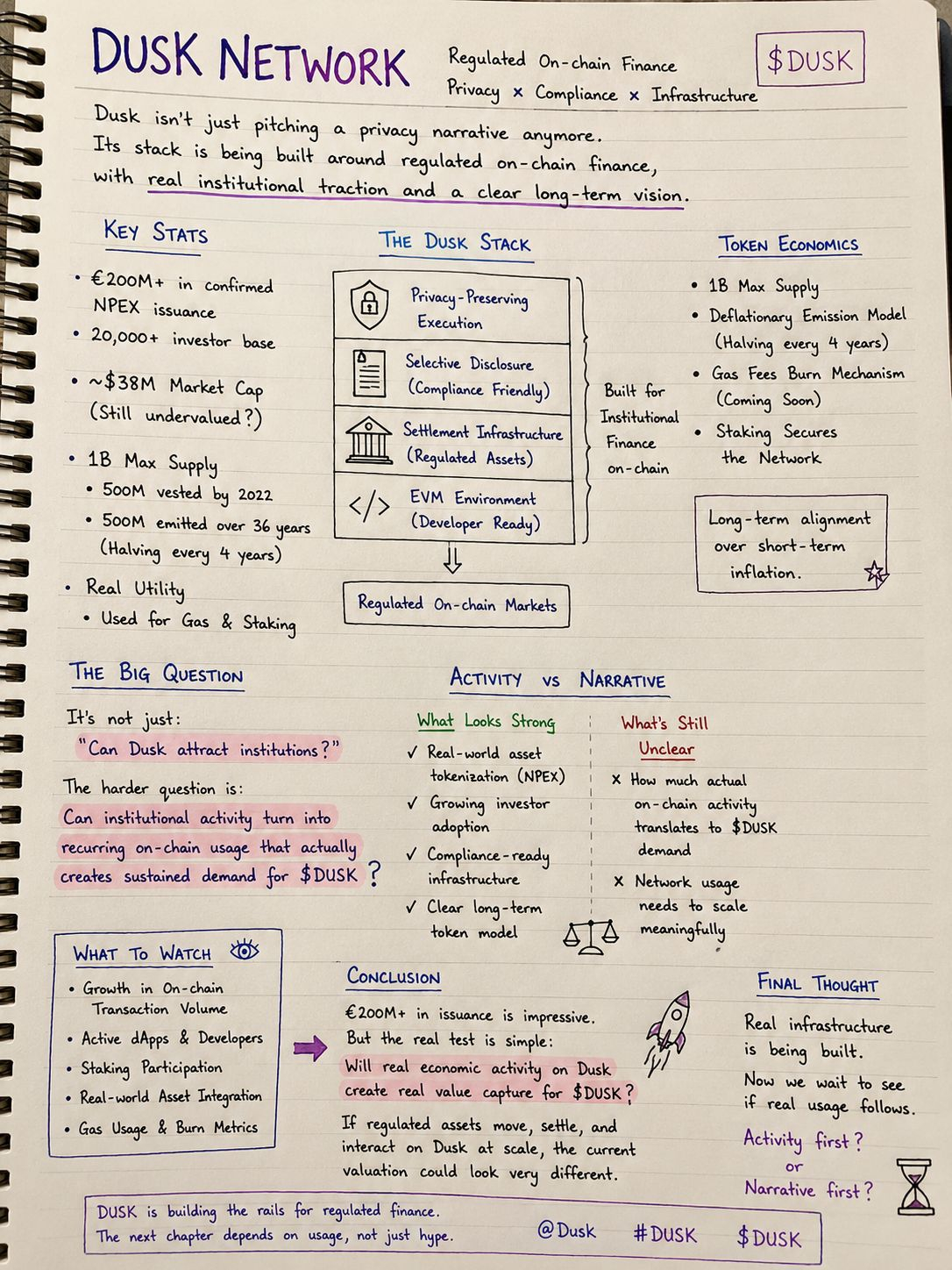
I am still think the market may be underestimating what $DUSK is actually building. 💹
This is no longer just a “privacy blockchain” narrative.
Dusk is positioning itself as infrastructure for regulated on-chain finance ~ combining privacy, selective disclosure, deterministic settlement, ZK execution and an EVM environment.
And the institutional signals are getting harder to ignore.
NPEX has already crossed €217M in financing with 20K+ active investors, while Dusk currently highlights €300M+ in confirmed issuance and 50K+ investor reach across its ecosystem.
DUSK also has actual protocol utility: gas + staking, with a 1B max supply and emissions designed to halve every 4 years over 36 years.
But this is where I’m watching closely:
Will institutional activity become recurring on-chain activity and ultimately create real demand for $DUSK ?
Because issuance is a strong signal.
Usage is the proof.
If regulated assets start moving, settling and interacting on Dusk at scale, the token economics could become much more interesting.
But if adoption grows without meaningful DUSK demand, the infrastructure thesis may be stronger than the token thesis.
So what comes first? 🤔
Does real network usage catch up with the narrative or does the narrative keep running ahead of token value capture?
@Dusk_Foundation #dusk $DUSK
I am still think the market may be underestimating what $DUSK is actually building. 💹
This is no longer just a “privacy blockchain” narrative.
Dusk is positioning itself as infrastructure for regulated on-chain finance ~ combining privacy, selective disclosure, deterministic settlement, ZK execution and an EVM environment.
And the institutional signals are getting harder to ignore.
NPEX has already crossed €217M in financing with 20K+ active investors, while Dusk currently highlights €300M+ in confirmed issuance and 50K+ investor reach across its ecosystem.
DUSK also has actual protocol utility: gas + staking, with a 1B max supply and emissions designed to halve every 4 years over 36 years.
But this is where I’m watching closely:
Will institutional activity become recurring on-chain activity and ultimately create real demand for $DUSK ?
Because issuance is a strong signal.
Usage is the proof.
If regulated assets start moving, settling and interacting on Dusk at scale, the token economics could become much more interesting.
But if adoption grows without meaningful DUSK demand, the infrastructure thesis may be stronger than the token thesis.
So what comes first? 🤔
Does real network usage catch up with the narrative or does the narrative keep running ahead of token value capture?
@Dusk #dusk $DUSK
This is no longer just a “privacy blockchain” narrative.
Dusk is positioning itself as infrastructure for regulated on-chain finance ~ combining privacy, selective disclosure, deterministic settlement, ZK execution and an EVM environment.
And the institutional signals are getting harder to ignore.
NPEX has already crossed €217M in financing with 20K+ active investors, while Dusk currently highlights €300M+ in confirmed issuance and 50K+ investor reach across its ecosystem.
DUSK also has actual protocol utility: gas + staking, with a 1B max supply and emissions designed to halve every 4 years over 36 years.
But this is where I’m watching closely:
Will institutional activity become recurring on-chain activity and ultimately create real demand for $DUSK ?
Because issuance is a strong signal.
Usage is the proof.
If regulated assets start moving, settling and interacting on Dusk at scale, the token economics could become much more interesting.
But if adoption grows without meaningful DUSK demand, the infrastructure thesis may be stronger than the token thesis.
So what comes first? 🤔
Does real network usage catch up with the narrative or does the narrative keep running ahead of token value capture?
@Dusk #dusk $DUSK
24
6
106
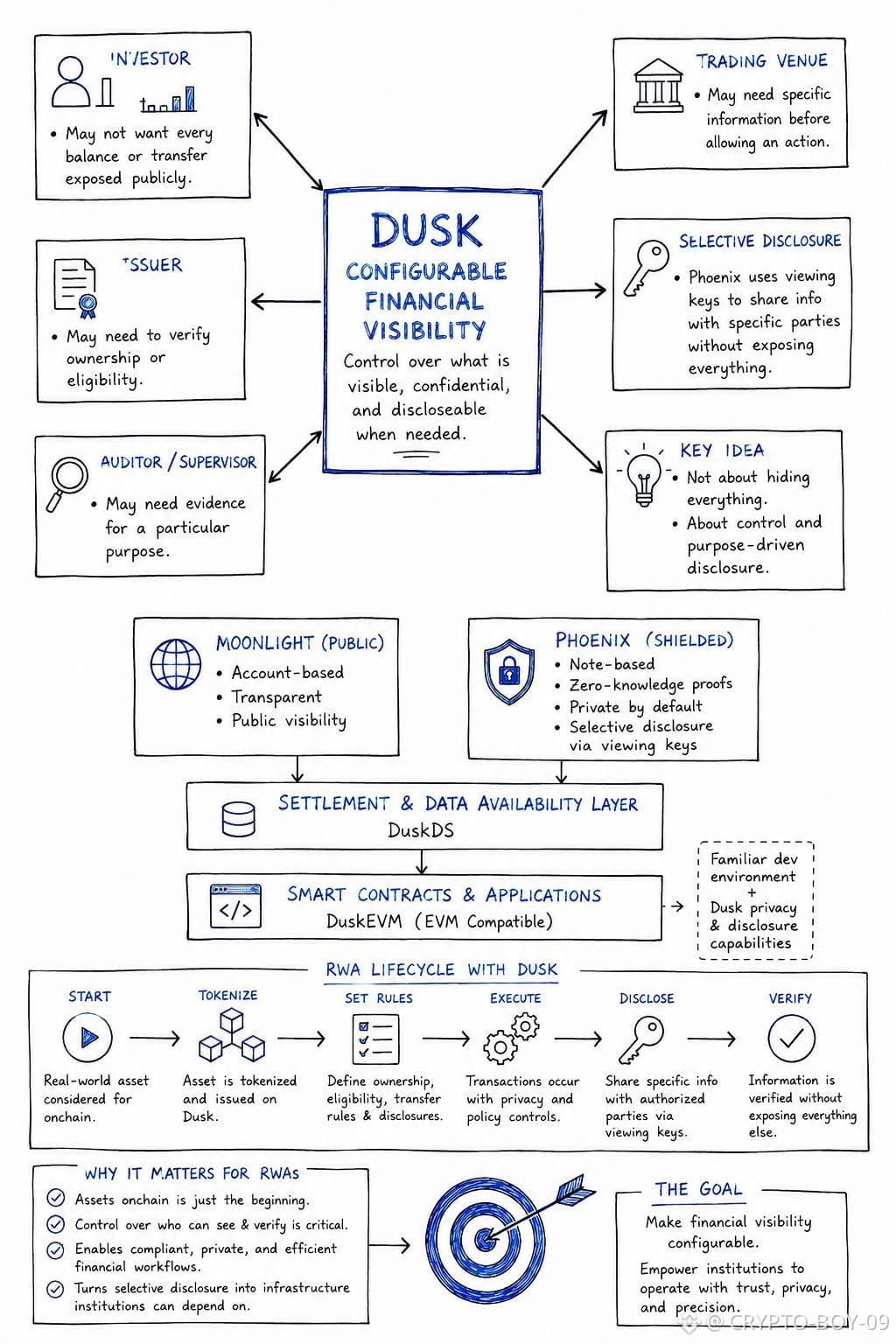
I still think Dusk is being looked at too narrowly when people call it a privacy blockchain.
The more interesting question to me is: who should be able to see what?
( @Dusk_Foundation $DUSK #dusk )
That became clearer when I looked at Dusk’s transaction models.
Moonlight is public and account-based, while Phoenix is shielded and note-based, using zero-knowledge proofs to protect transaction details. Both settle on DuskDS, but give observers very different levels of visibility.
And that matters when you start talking about financial markets.
An investor may not want every balance or transfer exposed publicly. An issuer may need to verify ownership or eligibility, while an auditor or venue may only need specific information.
Phoenix’s viewing keys make selective disclosure possible - information can be shared with a specific party without making the underlying activity public to everyone.
That makes me look at Dusk’s privacy model differently.
It’s not really about hiding everything. It’s about controlling what stays private, what becomes visible, and what can be disclosed when needed.
Then DuskEVM adds another layer, giving developers a familiar EVM environment while DuskDS handles settlement and data availability.
That makes the RWA question more interesting:
Who can own the asset?
Who can transfer it?
What stays private?
What needs to be verified?
The technology is one thing. The harder test is whether institutions actually build workflows around it.
Can Dusk turn selective disclosure from a cryptographic capability into infrastructure financial institutions genuinely depend on ?
I still think Dusk is being looked at too narrowly when people call it a privacy blockchain.
The more interesting question to me is: who should be able to see what?
( @Dusk $DUSK #dusk )
That became clearer when I looked at Dusk’s transaction models.
Moonlight is public and account-based, while Phoenix is shielded and note-based, using zero-knowledge proofs to protect transaction details. Both settle on DuskDS, but give observers very different levels of visibility.
And that matters when you start talking about financial markets.
An investor may not want every balance or transfer exposed publicly. An issuer may need to verify ownership or eligibility, while an auditor or venue may only need specific information.
Phoenix’s viewing keys make selective disclosure possible - information can be shared with a specific party without making the underlying activity public to everyone.
That makes me look at Dusk’s privacy model differently.
It’s not really about hiding everything. It’s about controlling what stays private, what becomes visible, and what can be disclosed when needed.
Then DuskEVM adds another layer, giving developers a familiar EVM environment while DuskDS handles settlement and data availability.
That makes the RWA question more interesting:
Who can own the asset?
Who can transfer it?
What stays private?
What needs to be verified?
The technology is one thing. The harder test is whether institutions actually build workflows around it.
Can Dusk turn selective disclosure from a cryptographic capability into infrastructure financial institutions genuinely depend on ?
The more interesting question to me is: who should be able to see what?
( @Dusk $DUSK #dusk )
That became clearer when I looked at Dusk’s transaction models.
Moonlight is public and account-based, while Phoenix is shielded and note-based, using zero-knowledge proofs to protect transaction details. Both settle on DuskDS, but give observers very different levels of visibility.
And that matters when you start talking about financial markets.
An investor may not want every balance or transfer exposed publicly. An issuer may need to verify ownership or eligibility, while an auditor or venue may only need specific information.
Phoenix’s viewing keys make selective disclosure possible - information can be shared with a specific party without making the underlying activity public to everyone.
That makes me look at Dusk’s privacy model differently.
It’s not really about hiding everything. It’s about controlling what stays private, what becomes visible, and what can be disclosed when needed.
Then DuskEVM adds another layer, giving developers a familiar EVM environment while DuskDS handles settlement and data availability.
That makes the RWA question more interesting:
Who can own the asset?
Who can transfer it?
What stays private?
What needs to be verified?
The technology is one thing. The harder test is whether institutions actually build workflows around it.
Can Dusk turn selective disclosure from a cryptographic capability into infrastructure financial institutions genuinely depend on ?
2
1
82
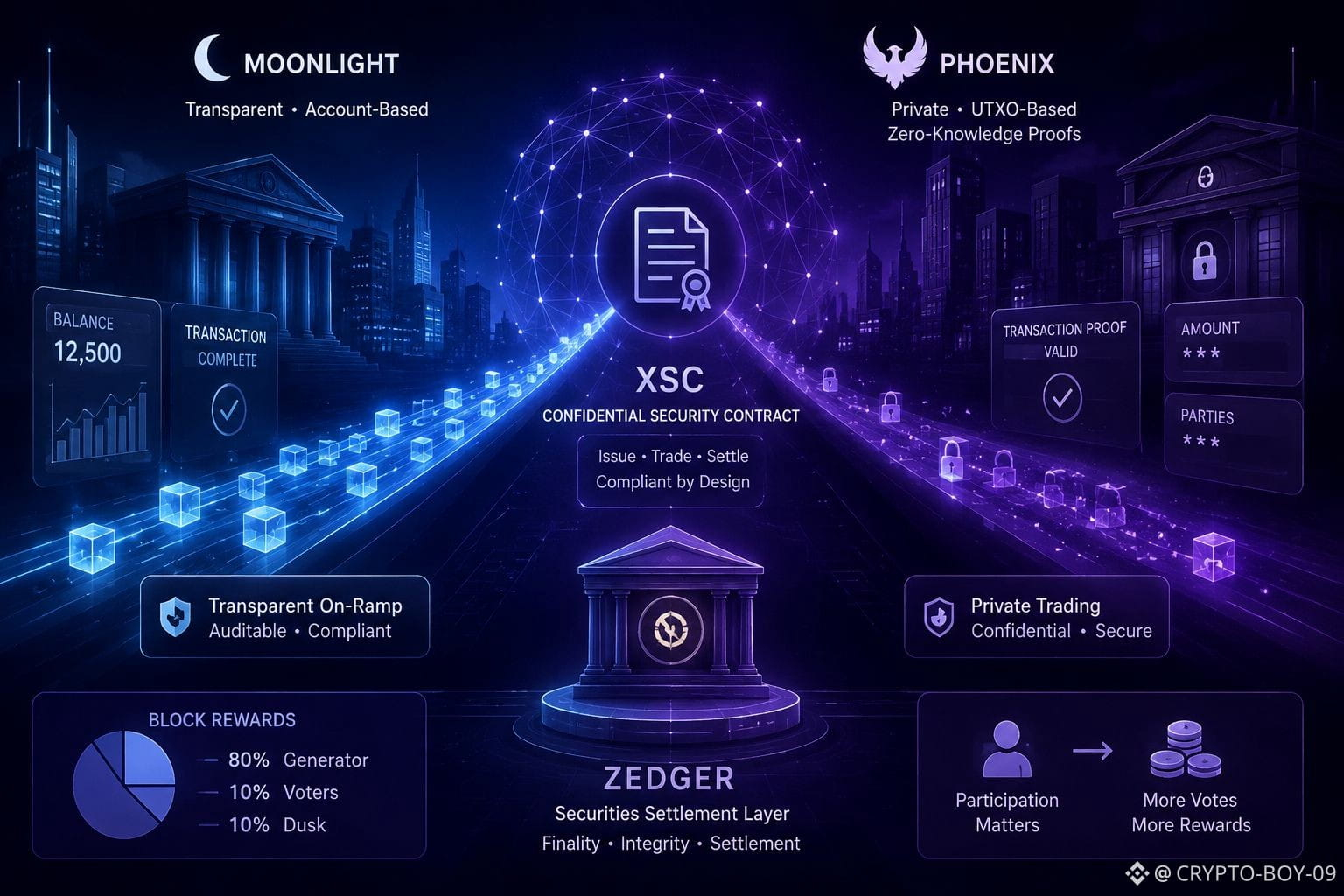
Spent the evening actually reading through Dusk's whitepaper instead of just skimming the marketing angle, and one thing stood out that I hadn't seen discussed much: they run two completely separate transaction models side by side, not just one.
Moonlight is transparent and account-based, basically Ethereum-style, where balances are public and easy to audit. Phoenix is the private one, UTXO-based like Bitcoin but wrapped in zero-knowledge proofs, so the network verifies a transaction is valid without ever seeing the amounts or parties involved.
What got me thinking is why bother building both instead of just going full-privacy like Monero or Zcash. My guess after reading is that regulators need an "on-ramp" that's fully visible, while actual trading activity can stay private under Phoenix. That dual-model setup is also what makes the XSC standard (Confidential Security Contract) possible — it's the layer that lets security tokens and RWAs get issued and settled while still meeting audit requirements.
There's also an incentive detail I didn't expect: block rewards split 80% to the generator, 10% to voters, 10% to Dusk itself, and the generator's payout scales with how many votes they bother to include. It's basically designed so skipping participation costs you money.
Still not fully sure how Zedger (their securities settlement layer) ties into the XSC contracts in a live trading flow. If anyone's tested this on testnet, curious how switching between transparent and obfuscated actually feels in practice.
@Dusk_Foundation $DUSK #dusk
Spent the evening actually reading through Dusk's whitepaper instead of just skimming the marketing angle, and one thing stood out that I hadn't seen discussed much: they run two completely separate transaction models side by side, not just one.
Moonlight is transparent and account-based, basically Ethereum-style, where balances are public and easy to audit. Phoenix is the private one, UTXO-based like Bitcoin but wrapped in zero-knowledge proofs, so the network verifies a transaction is valid without ever seeing the amounts or parties involved.
What got me thinking is why bother building both instead of just going full-privacy like Monero or Zcash. My guess after reading is that regulators need an "on-ramp" that's fully visible, while actual trading activity can stay private under Phoenix. That dual-model setup is also what makes the XSC standard (Confidential Security Contract) possible — it's the layer that lets security tokens and RWAs get issued and settled while still meeting audit requirements.
There's also an incentive detail I didn't expect: block rewards split 80% to the generator, 10% to voters, 10% to Dusk itself, and the generator's payout scales with how many votes they bother to include. It's basically designed so skipping participation costs you money.
Still not fully sure how Zedger (their securities settlement layer) ties into the XSC contracts in a live trading flow. If anyone's tested this on testnet, curious how switching between transparent and obfuscated actually feels in practice.
@Dusk $DUSK #dusk
Moonlight is transparent and account-based, basically Ethereum-style, where balances are public and easy to audit. Phoenix is the private one, UTXO-based like Bitcoin but wrapped in zero-knowledge proofs, so the network verifies a transaction is valid without ever seeing the amounts or parties involved.
What got me thinking is why bother building both instead of just going full-privacy like Monero or Zcash. My guess after reading is that regulators need an "on-ramp" that's fully visible, while actual trading activity can stay private under Phoenix. That dual-model setup is also what makes the XSC standard (Confidential Security Contract) possible — it's the layer that lets security tokens and RWAs get issued and settled while still meeting audit requirements.
There's also an incentive detail I didn't expect: block rewards split 80% to the generator, 10% to voters, 10% to Dusk itself, and the generator's payout scales with how many votes they bother to include. It's basically designed so skipping participation costs you money.
Still not fully sure how Zedger (their securities settlement layer) ties into the XSC contracts in a live trading flow. If anyone's tested this on testnet, curious how switching between transparent and obfuscated actually feels in practice.
@Dusk $DUSK #dusk
1
1
59
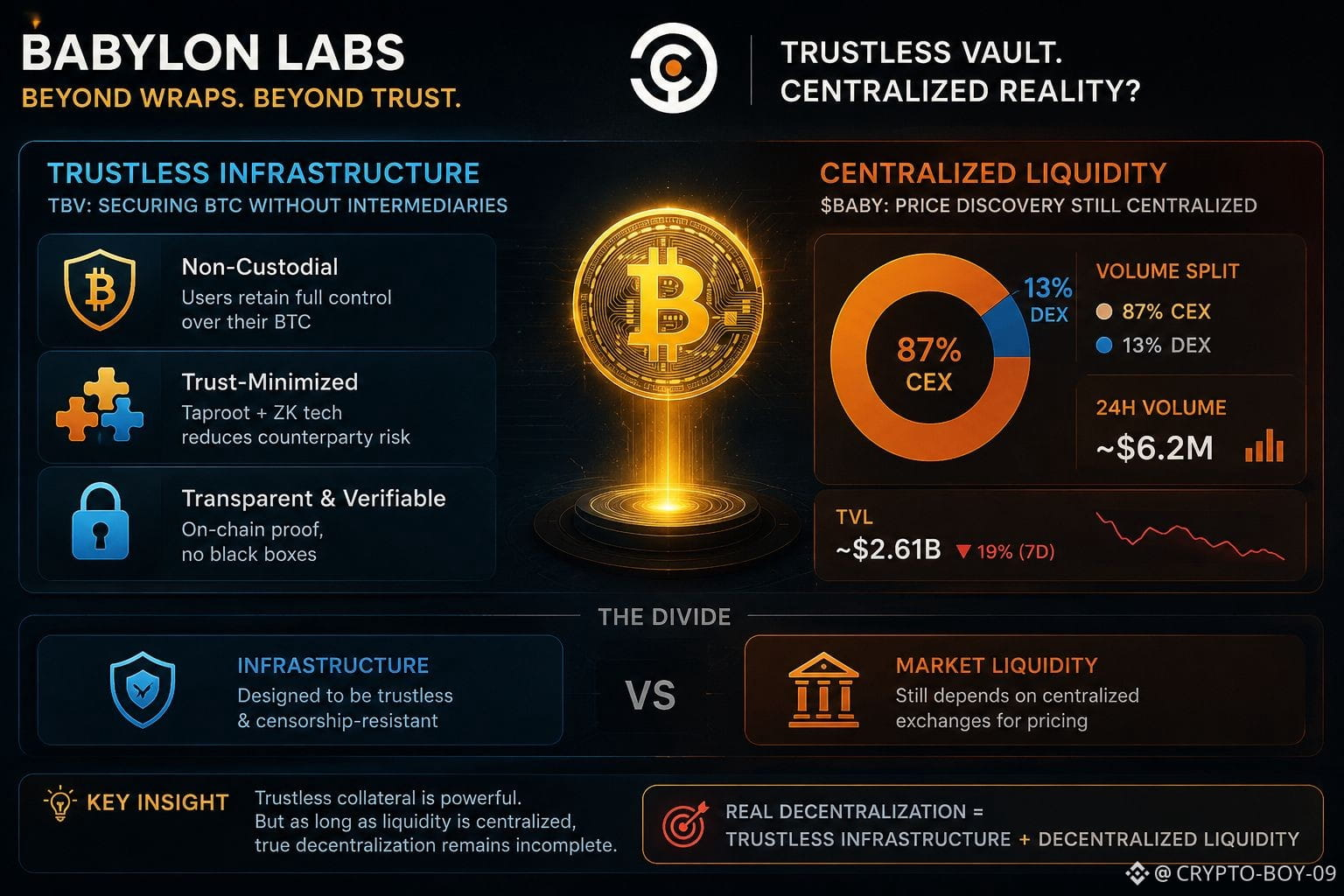
Digging into @babylonlabs_io today and their Trustless Bitcoin Vault pitch — essentially bridge-free BTC collateral designed to eliminate wrapped-asset risks for $BABY .
Decided to look at live data instead of the narrative:
TVL Status: ~$2.61B locked (down ~19% over the last 7 days per DefiLlama).
24h Volume: ~$6.2M total.
Volume Split: 87% CEX vs 13% DEX.
Here is the irony:
A protocol engineered to remove trusted intermediaries relies heavily on centralized exchanges to actually price and trade its own native token.
To be fair, TBV mechanics are separate from token liquidity — the Taproot + ZK vault architecture stands on its own. But it shows a clear divide: Infra can be genuinely trustless while market liquidity stays completely centralized.
Where do you think trustlessness actually matters more — in the collateral architecture or the liquidity pricing it?
#baby #bitcoin #defi
Digging into @BabylonLabs_io today and their Trustless Bitcoin Vault pitch — essentially bridge-free BTC collateral designed to eliminate wrapped-asset risks for $BABY .
Decided to look at live data instead of the narrative:
TVL Status: ~$2.61B locked (down ~19% over the last 7 days per DefiLlama).
24h Volume: ~$6.2M total.
Volume Split: 87% CEX vs 13% DEX.
Here is the irony:
A protocol engineered to remove trusted intermediaries relies heavily on centralized exchanges to actually price and trade its own native token.
To be fair, TBV mechanics are separate from token liquidity — the Taproot + ZK vault architecture stands on its own. But it shows a clear divide: Infra can be genuinely trustless while market liquidity stays completely centralized.
Where do you think trustlessness actually matters more — in the collateral architecture or the liquidity pricing it?
#baby #bitcoin #defi
Decided to look at live data instead of the narrative:
TVL Status: ~$2.61B locked (down ~19% over the last 7 days per DefiLlama).
24h Volume: ~$6.2M total.
Volume Split: 87% CEX vs 13% DEX.
Here is the irony:
A protocol engineered to remove trusted intermediaries relies heavily on centralized exchanges to actually price and trade its own native token.
To be fair, TBV mechanics are separate from token liquidity — the Taproot + ZK vault architecture stands on its own. But it shows a clear divide: Infra can be genuinely trustless while market liquidity stays completely centralized.
Where do you think trustlessness actually matters more — in the collateral architecture or the liquidity pricing it?
#baby #bitcoin #defi
16
6
123
The Babylon Paradox: Multi-Billion Vault Security vs. a $46M Market Cap
Spent some time reading through @babylonlabs_io ’s Trustless Vault mechanics today.
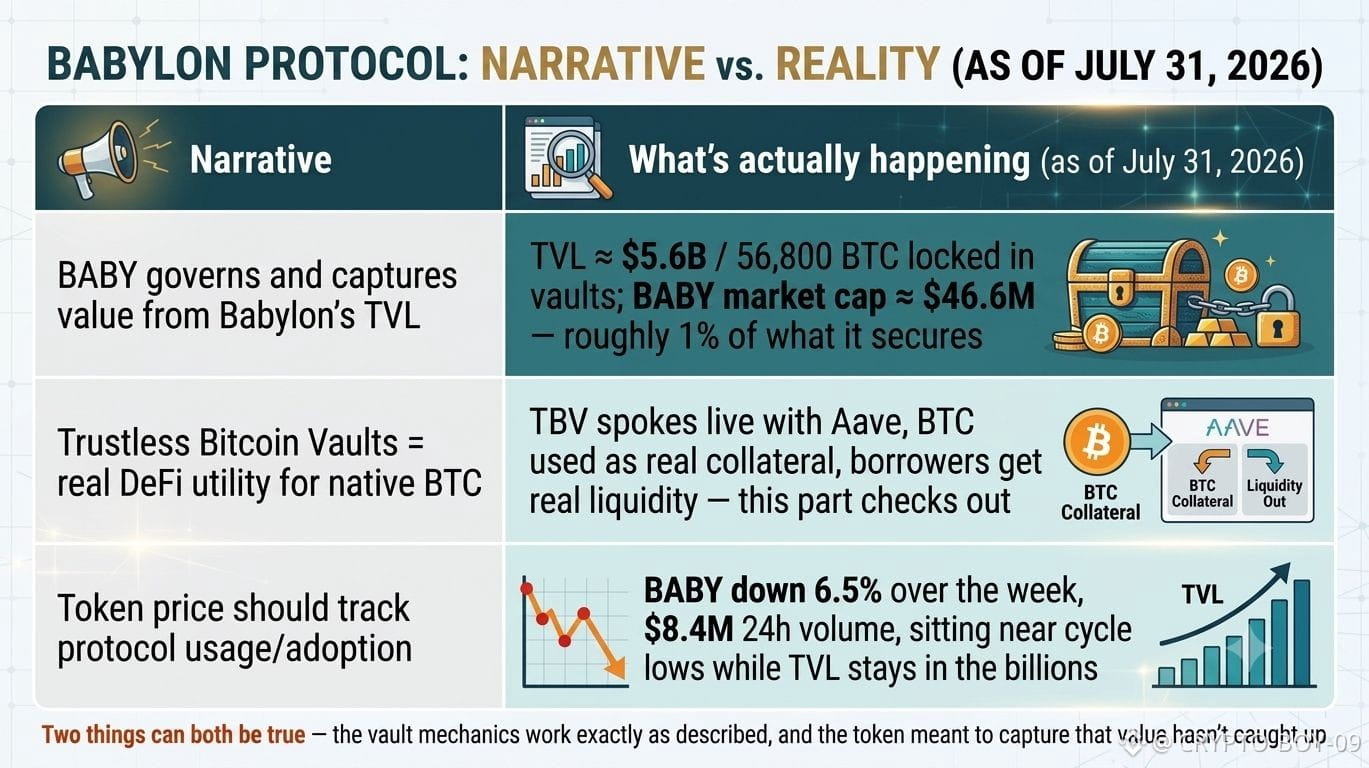
Technically, the setup is top-tier:
Native BTC Security: Bitcoin locks directly via Taproot—no wrapped bridge risks, no leaving L1.
Real Utility: Connected protocols (like Aave) receive real collateral while borrowers get solid liquidity.
The protocol does exactly what it promises on paper. But then you look at the token metrics:
Market Reality Check:
$BABY Price: $0.0116 (-6.5% 7d)
Market Cap: ~$46.6M
24h Volume: ~$8.4M
Locked Capital: ~56,800 BTC sitting in vaults working on-chain.
Here’s the massive gap: A governance token anchoring billions in locked Bitcoin is trading at roughly 1% of the total value it secures.
This isn't a technical flaw—the system works fine. It’s a structural question. Depositors and protocols get instant utility, but $BABY holders are left waiting on value accrual mechanisms (burns, BSN expansion, fee distribution) to catch up.
It’s like running a high-grade engine while the dashboard gauge is stuck on low.
Is this valuation gap just a temporary market inefficiency, or a structural reality for restaking tokens?
Let me know your thoughts below 👇
#DeFi #Bitcoin #baby
The Babylon Paradox: Multi-Billion Vault Security vs. a $46M Market Cap
Spent some time reading through @BabylonLabs_io ’s Trustless Vault mechanics today.
Technically, the setup is top-tier:
Native BTC Security: Bitcoin locks directly via Taproot—no wrapped bridge risks, no leaving L1.
Real Utility: Connected protocols (like Aave) receive real collateral while borrowers get solid liquidity.
The protocol does exactly what it promises on paper. But then you look at the token metrics:
Market Reality Check:
$BABY Price: $0.0116 (-6.5% 7d)
Market Cap: ~$46.6M
24h Volume: ~$8.4M
Locked Capital: ~56,800 BTC sitting in vaults working on-chain.
Here’s the massive gap: A governance token anchoring billions in locked Bitcoin is trading at roughly 1% of the total value it secures.
This isn't a technical flaw—the system works fine. It’s a structural question. Depositors and protocols get instant utility, but $BABY holders are left waiting on value accrual mechanisms (burns, BSN expansion, fee distribution) to catch up.
It’s like running a high-grade engine while the dashboard gauge is stuck on low.
Is this valuation gap just a temporary market inefficiency, or a structural reality for restaking tokens?
Let me know your thoughts below 👇
#DeFi #Bitcoin #baby
Spent some time reading through @BabylonLabs_io ’s Trustless Vault mechanics today.
Technically, the setup is top-tier:
Native BTC Security: Bitcoin locks directly via Taproot—no wrapped bridge risks, no leaving L1.
Real Utility: Connected protocols (like Aave) receive real collateral while borrowers get solid liquidity.
The protocol does exactly what it promises on paper. But then you look at the token metrics:
Market Reality Check:
$BABY Price: $0.0116 (-6.5% 7d)
Market Cap: ~$46.6M
24h Volume: ~$8.4M
Locked Capital: ~56,800 BTC sitting in vaults working on-chain.
Here’s the massive gap: A governance token anchoring billions in locked Bitcoin is trading at roughly 1% of the total value it secures.
This isn't a technical flaw—the system works fine. It’s a structural question. Depositors and protocols get instant utility, but $BABY holders are left waiting on value accrual mechanisms (burns, BSN expansion, fee distribution) to catch up.
It’s like running a high-grade engine while the dashboard gauge is stuck on low.
Is this valuation gap just a temporary market inefficiency, or a structural reality for restaking tokens?
Let me know your thoughts below 👇
#DeFi #Bitcoin #baby
5
4
111
Войдите, чтобы посмотреть больше материала
Присоединяйтесь к пользователям криптовалют по всему миру на Binance Square
⚡️ Получайте новейшую и полезную информацию о криптоактивах.
💬 Нам доверяет крупнейшая в мире криптобиржа.
👍 Получите достоверные аналитические данные от верифицированных создателей контента.
Эл. почта/номер телефона