

#apro
apro
Просмотров: 5.5M
98,401 обсуждают
Популярные
Новые

·
--
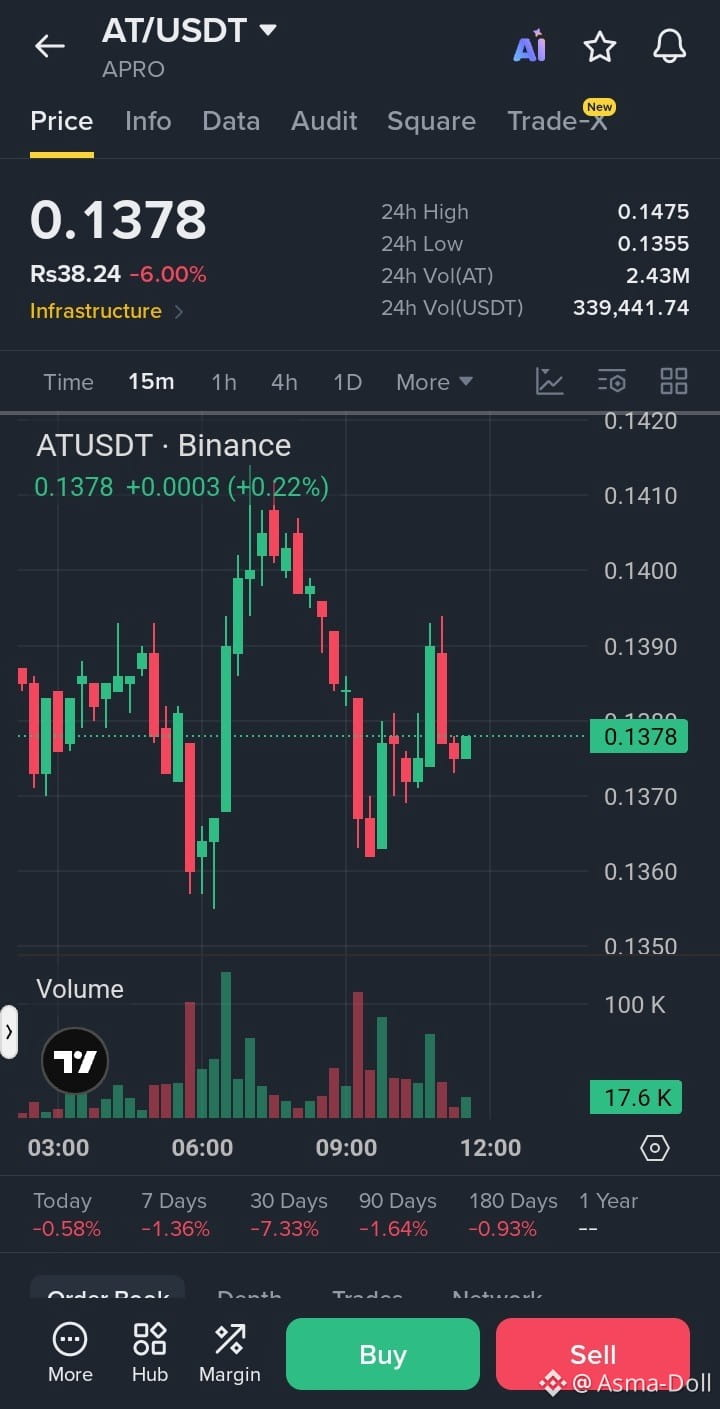
$AT /USDT (APRO) — SHORT 📉
Entry: 0.1375 – 0.1390
Stop Loss: 0.1430
TP1: 0.1355
TP2: 0.1320
TP3: 0.1280
Trade here $AT
{future}(ATUSDT)
Analysis:
Price is down ~6% and trading close to the 24h low 0.1355.
Weak recovery around 0.138 suggests sellers remain active.
Break below 0.1355 can trigger further downside.
Confirmation: 15m candle close below 0.1355 with rising volume.
If price reclaims 0.1430, invalidate the short setup.
#APRO #ATUSDT #Short #Binance #CryptoTrading
$AT /USDT (APRO) — SHORT 📉
Entry: 0.1375 – 0.1390
Stop Loss: 0.1430
TP1: 0.1355
TP2: 0.1320
TP3: 0.1280
Trade here $AT
Analysis:
Price is down ~6% and trading close to the 24h low 0.1355.
Weak recovery around 0.138 suggests sellers remain active.
Break below 0.1355 can trigger further downside.
Confirmation: 15m candle close below 0.1355 with rising volume.
If price reclaims 0.1430, invalidate the short setup.
#APRO #ATUSDT #Short #Binance #CryptoTrading
Entry: 0.1375 – 0.1390
Stop Loss: 0.1430
TP1: 0.1355
TP2: 0.1320
TP3: 0.1280
Trade here $AT
Analysis:
Price is down ~6% and trading close to the 24h low 0.1355.
Weak recovery around 0.138 suggests sellers remain active.
Break below 0.1355 can trigger further downside.
Confirmation: 15m candle close below 0.1355 with rising volume.
If price reclaims 0.1430, invalidate the short setup.
#APRO #ATUSDT #Short #Binance #CryptoTrading
164

·
--
Рост
🔥 **AT/USDT (APRO) BULLISH CONSOLIDATION BREAKOUT SIGNAL** 🚀
The single correct signal for **AT/USDT** based on price structure and high liquidity consolidation is **BULLISH** 🐂🟢. **APRO (AT)** is holding a strong bullish trend structure above key support levels ($0.1305), printing a steady **+1.79%** gain with robust 24-hour liquidity over **1.13M+ USDT**. As an infrastructure/AI oracle project, it is building heavy momentum for a push toward new local highs! 📈
$AT
{future}(ATUSDT)
💥 **Signal Type:** **STRONG BULLISH** 🐂🟢
📍 **Current Price:** $0.13650000
📊 **24h High:** $0.13670000
📉 **24h Low:** $0.13050000
💰 **24h Volume (USDT):** $1,138,171.48
⚡ **24h Volume (AT):** 8.45M+ AT
🏷️ **Category:** Infrastructure / Oracle Network
---
### 📊 Technical Setup & Key Drivers
1. **Steady Higher Lows:** Price defended the critical demand zone at **$0.1305** and is pushing right against daily resistance at **$0.1367**.
2. **Impending Breakout:** The current market price ($0.1365) is trading near the 24h peak ($0.1367). A clean 1-hour/4-hour candle close above **$0.1367** will trigger immediate buying momentum toward higher expansion levels.
3. **Solid Volume Support:** 8.45 Million+ AT tokens traded shows consistent institutional accumulation without sell pressure spikes.
---
### 🎯 Trade Parameters
* **Best Entry Zone:** $0.13400000 – $0.13650000
* **Target 1 (TP1):** $0.13670000 *(Breakout Level / Local High)* 🎯
* **Target 2 (TP2):** $0.14200000 🎯
* **Target 3 (TP3):** $0.15000000 🚀
* **Stop Loss (SL):** $0.12950000 *(Below 24h Low Support)* 🛑
---
### 💡 Strategy & Risk Management
Maintain a moderate leverage setup (3x to 5x for futures) and keep risk management strict. Set your Stop Loss firmly at **$0.12950000**. Once price clears Target 1 ($0.1367), trail your Stop Loss into profit to secure risk-free gains! 📈✨
---
#ATENCIÓN #APRO #cryptosignals
🔥 **AT/USDT (APRO) BULLISH CONSOLIDATION BREAKOUT SIGNAL** 🚀
The single correct signal for **AT/USDT** based on price structure and high liquidity consolidation is **BULLISH** 🐂🟢. **APRO (AT)** is holding a strong bullish trend structure above key support levels ($0.1305), printing a steady **+1.79%** gain with robust 24-hour liquidity over **1.13M+ USDT**. As an infrastructure/AI oracle project, it is building heavy momentum for a push toward new local highs! 📈
$AT
💥 **Signal Type:** **STRONG BULLISH** 🐂🟢
📍 **Current Price:** $0.13650000
📊 **24h High:** $0.13670000
📉 **24h Low:** $0.13050000
💰 **24h Volume (USDT):** $1,138,171.48
⚡ **24h Volume (AT):** 8.45M+ AT
🏷️ **Category:** Infrastructure / Oracle Network
---
### 📊 Technical Setup & Key Drivers
1. **Steady Higher Lows:** Price defended the critical demand zone at **$0.1305** and is pushing right against daily resistance at **$0.1367**.
2. **Impending Breakout:** The current market price ($0.1365) is trading near the 24h peak ($0.1367). A clean 1-hour/4-hour candle close above **$0.1367** will trigger immediate buying momentum toward higher expansion levels.
3. **Solid Volume Support:** 8.45 Million+ AT tokens traded shows consistent institutional accumulation without sell pressure spikes.
---
### 🎯 Trade Parameters
* **Best Entry Zone:** $0.13400000 – $0.13650000
* **Target 1 (TP1):** $0.13670000 *(Breakout Level / Local High)* 🎯
* **Target 2 (TP2):** $0.14200000 🎯
* **Target 3 (TP3):** $0.15000000 🚀
* **Stop Loss (SL):** $0.12950000 *(Below 24h Low Support)* 🛑
---
### 💡 Strategy & Risk Management
Maintain a moderate leverage setup (3x to 5x for futures) and keep risk management strict. Set your Stop Loss firmly at **$0.12950000**. Once price clears Target 1 ($0.1367), trail your Stop Loss into profit to secure risk-free gains! 📈✨
---
#ATENCIÓN #APRO #cryptosignals
The single correct signal for **AT/USDT** based on price structure and high liquidity consolidation is **BULLISH** 🐂🟢. **APRO (AT)** is holding a strong bullish trend structure above key support levels ($0.1305), printing a steady **+1.79%** gain with robust 24-hour liquidity over **1.13M+ USDT**. As an infrastructure/AI oracle project, it is building heavy momentum for a push toward new local highs! 📈
$AT
💥 **Signal Type:** **STRONG BULLISH** 🐂🟢
📍 **Current Price:** $0.13650000
📊 **24h High:** $0.13670000
📉 **24h Low:** $0.13050000
💰 **24h Volume (USDT):** $1,138,171.48
⚡ **24h Volume (AT):** 8.45M+ AT
🏷️ **Category:** Infrastructure / Oracle Network
---
### 📊 Technical Setup & Key Drivers
1. **Steady Higher Lows:** Price defended the critical demand zone at **$0.1305** and is pushing right against daily resistance at **$0.1367**.
2. **Impending Breakout:** The current market price ($0.1365) is trading near the 24h peak ($0.1367). A clean 1-hour/4-hour candle close above **$0.1367** will trigger immediate buying momentum toward higher expansion levels.
3. **Solid Volume Support:** 8.45 Million+ AT tokens traded shows consistent institutional accumulation without sell pressure spikes.
---
### 🎯 Trade Parameters
* **Best Entry Zone:** $0.13400000 – $0.13650000
* **Target 1 (TP1):** $0.13670000 *(Breakout Level / Local High)* 🎯
* **Target 2 (TP2):** $0.14200000 🎯
* **Target 3 (TP3):** $0.15000000 🚀
* **Stop Loss (SL):** $0.12950000 *(Below 24h Low Support)* 🛑
---
### 💡 Strategy & Risk Management
Maintain a moderate leverage setup (3x to 5x for futures) and keep risk management strict. Set your Stop Loss firmly at **$0.12950000**. Once price clears Target 1 ($0.1367), trail your Stop Loss into profit to secure risk-free gains! 📈✨
---
#ATENCIÓN #APRO #cryptosignals
1
125

·
--
I've been digging into APRO and it's one of those projects that doesn't get much attention compared to the big AI or meme narratives.
A few things that caught my eye:
🔸️ Low visibility compared to many projects with similar ambitions.
🔸️ Focus on infrastructure rather than hype. Not the kind of thing that trends every day, but sometimes that's where opportunities appear.
🔸️ Market still seems undecided. Some traders see potential, others don't care yet. That's usually more interesting to me than assets everyone already agrees on.
Now, let's be real:
⚠️ APRO isn't guaranteed to moon.
⚠️ It could underperform.
⚠️ Crypto is full of projects that looked promising and went nowhere.
But that's exactly why I'm watching it. The risk/reward profile feels more interesting than chasing tokens that already pumped 500%.
What I usually do with coins like this:
✔️ Read the docs.
✔️Check tokenomics.
✔️Watch volume and liquidity.
✔️ Open a small position first and let the market prove me right (or wrong).
Not financial advice, of course. Just sharing a project that's currently on my watchlist and its has kinda strong protection against this downtrend we all see
Have you looked into APRO yet? Bullish, bearish, or staying away?
$AT #APRO
{spot}(ATUSDT)
I've been digging into APRO and it's one of those projects that doesn't get much attention compared to the big AI or meme narratives.
A few things that caught my eye:
🔸️ Low visibility compared to many projects with similar ambitions.
🔸️ Focus on infrastructure rather than hype. Not the kind of thing that trends every day, but sometimes that's where opportunities appear.
🔸️ Market still seems undecided. Some traders see potential, others don't care yet. That's usually more interesting to me than assets everyone already agrees on.
Now, let's be real:
⚠️ APRO isn't guaranteed to moon.
⚠️ It could underperform.
⚠️ Crypto is full of projects that looked promising and went nowhere.
But that's exactly why I'm watching it. The risk/reward profile feels more interesting than chasing tokens that already pumped 500%.
What I usually do with coins like this:
✔️ Read the docs.
✔️Check tokenomics.
✔️Watch volume and liquidity.
✔️ Open a small position first and let the market prove me right (or wrong).
Not financial advice, of course. Just sharing a project that's currently on my watchlist and its has kinda strong protection against this downtrend we all see
Have you looked into APRO yet? Bullish, bearish, or staying away?
$AT #APRO
A few things that caught my eye:
🔸️ Low visibility compared to many projects with similar ambitions.
🔸️ Focus on infrastructure rather than hype. Not the kind of thing that trends every day, but sometimes that's where opportunities appear.
🔸️ Market still seems undecided. Some traders see potential, others don't care yet. That's usually more interesting to me than assets everyone already agrees on.
Now, let's be real:
⚠️ APRO isn't guaranteed to moon.
⚠️ It could underperform.
⚠️ Crypto is full of projects that looked promising and went nowhere.
But that's exactly why I'm watching it. The risk/reward profile feels more interesting than chasing tokens that already pumped 500%.
What I usually do with coins like this:
✔️ Read the docs.
✔️Check tokenomics.
✔️Watch volume and liquidity.
✔️ Open a small position first and let the market prove me right (or wrong).
Not financial advice, of course. Just sharing a project that's currently on my watchlist and its has kinda strong protection against this downtrend we all see
Have you looked into APRO yet? Bullish, bearish, or staying away?
$AT #APRO
175

·
--
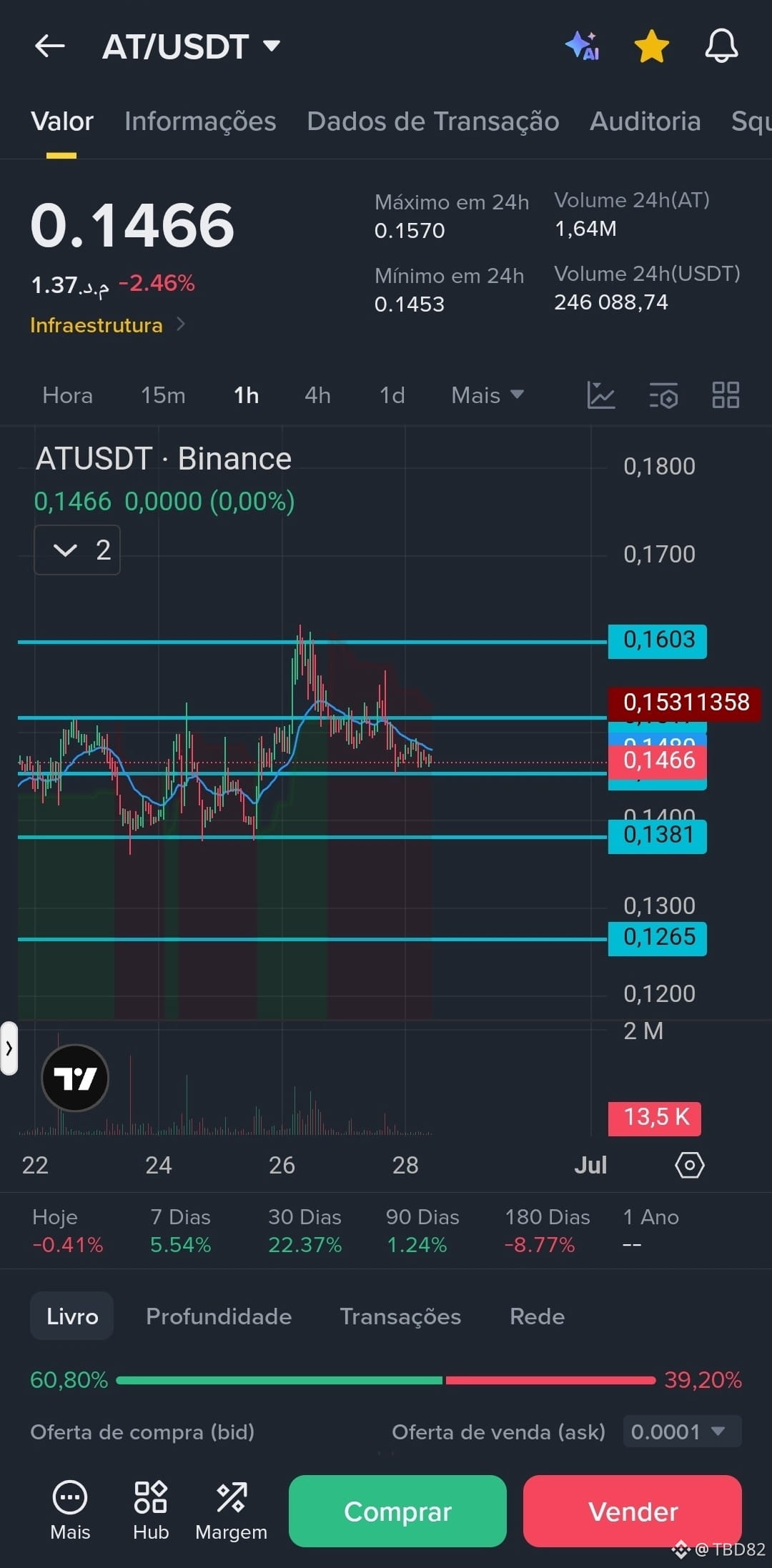
🚨 URGENTE: AT/USDT VAI ROMPER OU DESABAR? ENTENDA O MOVIMENTO AGORA! 🚨
O token AT (APRO) está consolidado em US$ 0,1466 (-2,46%), mas o relógio está correndo! ⏳ Se você está posicionado ou pensando em entrar, preste muita atenção nestes fatores técnicos cruciais nas próximas horas:
📈 O LADO BULLISH (ALTA):
As integrações estratégicas com a BNB Chain e ListaDAO aumentaram drasticamente a utilidade dos oráculos para RWAs e DeFi. A comunidade está antecipando uma ruptura! O forte suporte na região de US$ 0,1381 a US$ 0,1400 tem segurado o preço firmemente.
📉 O RISCO BEARISH (BAIXA):
O momentum de curto prazo desacelerou. O MACD no gráfico de 1H mostra histogramas negativos e o preço recuou ligeiramente. Além disso, a liquidez diária está reduzida (Volume de 1,64M), o que significa que qualquer baleia pode mover o mercado repentinamente. Se perder o suporte de US$ 0,1381, o próximo alvo é US$ 0,1265. Mas se o RSI indicar sobrevenda e o volume entrar, buscaremos a resistência de US$ 0,1603 rápido!
🎯 ESTRATÉGIA LUCRATIVA: Não opere no escuro! Aguarde a confirmação do volume antes de abrir sua posição.
👉 Quer lucrar alto com análises exclusivas antes de todo mundo? Clique em SEGUIR o meu perfil agora mesmo para não perder os próximos sinais e atualizações explosivas do mercado! 🚀
#BinanceSquare #CryptoAnalise #APRO #trading #Altcoins $BTC $SPCXB $AT
{spot}(ATUSDT)
🚨 URGENTE: AT/USDT VAI ROMPER OU DESABAR? ENTENDA O MOVIMENTO AGORA! 🚨
O token AT (APRO) está consolidado em US$ 0,1466 (-2,46%), mas o relógio está correndo! ⏳ Se você está posicionado ou pensando em entrar, preste muita atenção nestes fatores técnicos cruciais nas próximas horas:
📈 O LADO BULLISH (ALTA):
As integrações estratégicas com a BNB Chain e ListaDAO aumentaram drasticamente a utilidade dos oráculos para RWAs e DeFi. A comunidade está antecipando uma ruptura! O forte suporte na região de US$ 0,1381 a US$ 0,1400 tem segurado o preço firmemente.
📉 O RISCO BEARISH (BAIXA):
O momentum de curto prazo desacelerou. O MACD no gráfico de 1H mostra histogramas negativos e o preço recuou ligeiramente. Além disso, a liquidez diária está reduzida (Volume de 1,64M), o que significa que qualquer baleia pode mover o mercado repentinamente. Se perder o suporte de US$ 0,1381, o próximo alvo é US$ 0,1265. Mas se o RSI indicar sobrevenda e o volume entrar, buscaremos a resistência de US$ 0,1603 rápido!
🎯 ESTRATÉGIA LUCRATIVA: Não opere no escuro! Aguarde a confirmação do volume antes de abrir sua posição.
👉 Quer lucrar alto com análises exclusivas antes de todo mundo? Clique em SEGUIR o meu perfil agora mesmo para não perder os próximos sinais e atualizações explosivas do mercado! 🚀
#BinanceSquare #CryptoAnalise #APRO #trading #Altcoins $BTC $SPCXB $AT
O token AT (APRO) está consolidado em US$ 0,1466 (-2,46%), mas o relógio está correndo! ⏳ Se você está posicionado ou pensando em entrar, preste muita atenção nestes fatores técnicos cruciais nas próximas horas:
📈 O LADO BULLISH (ALTA):
As integrações estratégicas com a BNB Chain e ListaDAO aumentaram drasticamente a utilidade dos oráculos para RWAs e DeFi. A comunidade está antecipando uma ruptura! O forte suporte na região de US$ 0,1381 a US$ 0,1400 tem segurado o preço firmemente.
📉 O RISCO BEARISH (BAIXA):
O momentum de curto prazo desacelerou. O MACD no gráfico de 1H mostra histogramas negativos e o preço recuou ligeiramente. Além disso, a liquidez diária está reduzida (Volume de 1,64M), o que significa que qualquer baleia pode mover o mercado repentinamente. Se perder o suporte de US$ 0,1381, o próximo alvo é US$ 0,1265. Mas se o RSI indicar sobrevenda e o volume entrar, buscaremos a resistência de US$ 0,1603 rápido!
🎯 ESTRATÉGIA LUCRATIVA: Não opere no escuro! Aguarde a confirmação do volume antes de abrir sua posição.
👉 Quer lucrar alto com análises exclusivas antes de todo mundo? Clique em SEGUIR o meu perfil agora mesmo para não perder os próximos sinais e atualizações explosivas do mercado! 🚀
#BinanceSquare #CryptoAnalise #APRO #trading #Altcoins $BTC $SPCXB $AT
210

#APRO
🔍 $AT Price Outlook: Real Focus on Profit or Macroeconomic Pressure?
Short-Term Volatility or Foundation for Future Growth? We analyze the key factors that will determine the $AT price movement in the near future.
1️⃣ 🚀 Adoption and Integrations: The Foundation is Growing
Reality: The protocol is already running on over 40 blockchains. An important marker is the launch of a key integration with Arbitrum and a steady weekly increase in AI oracle calls.
Price Impact: DeFi, RWA and prediction markets are creating real demand for the network. If the economic model effectively links this activity to the token (via staking or fees), we will see strong structural demand. However, the fight for market share with giants like Chainlink still leaves this factor moderately speculative.
2️⃣ 📊 Exchange Liquidity: A Double-edged Sword
Pros: The airdrop and listing on Binance, as well as the appearance on Bitrue and Tapbit, provided the token with strong visibility and initial capital inflows.
Cons: The recent removal of the AT/BNB trading pair on Binance may slightly reduce accessibility for some of the audience and provoke local volatility. Risks for short-term traders are increasing.
3️⃣ 📉 Market sentiment: Altcoins under pressure
Macro picture: The crypto market is currently in the “Fear” zone, with Bitcoin dominance remaining high (over 58%).
What this means: Oracles are high-beta assets. As long as capital is focused on BTC and the AltSeason index is stagnating at 46, APRO will find it difficult to go against the tide. The price will remain dependent on the overall risk appetite of investors.
⚠️ Summary for holders
APRO's medium-term success directly depends on the project's ability to convert cool technical integrations (such as with Arbitrum) into real utility and demand for the token. While the macroeconomic background is stormy, the investor's main weapon is patience and monitoring the ecosystem.
{future}(ATUSDT)
#APRO
🔍 $AT Price Outlook: Real Focus on Profit or Macroeconomic Pressure?
Short-Term Volatility or Foundation for Future Growth? We analyze the key factors that will determine the $AT price movement in the near future.
1️⃣ 🚀 Adoption and Integrations: The Foundation is Growing
Reality: The protocol is already running on over 40 blockchains. An important marker is the launch of a key integration with Arbitrum and a steady weekly increase in AI oracle calls.
Price Impact: DeFi, RWA and prediction markets are creating real demand for the network. If the economic model effectively links this activity to the token (via staking or fees), we will see strong structural demand. However, the fight for market share with giants like Chainlink still leaves this factor moderately speculative.
2️⃣ 📊 Exchange Liquidity: A Double-edged Sword
Pros: The airdrop and listing on Binance, as well as the appearance on Bitrue and Tapbit, provided the token with strong visibility and initial capital inflows.
Cons: The recent removal of the AT/BNB trading pair on Binance may slightly reduce accessibility for some of the audience and provoke local volatility. Risks for short-term traders are increasing.
3️⃣ 📉 Market sentiment: Altcoins under pressure
Macro picture: The crypto market is currently in the “Fear” zone, with Bitcoin dominance remaining high (over 58%).
What this means: Oracles are high-beta assets. As long as capital is focused on BTC and the AltSeason index is stagnating at 46, APRO will find it difficult to go against the tide. The price will remain dependent on the overall risk appetite of investors.
⚠️ Summary for holders
APRO's medium-term success directly depends on the project's ability to convert cool technical integrations (such as with Arbitrum) into real utility and demand for the token. While the macroeconomic background is stormy, the investor's main weapon is patience and monitoring the ecosystem.
🔍 $AT Price Outlook: Real Focus on Profit or Macroeconomic Pressure?
Short-Term Volatility or Foundation for Future Growth? We analyze the key factors that will determine the $AT price movement in the near future.
1️⃣ 🚀 Adoption and Integrations: The Foundation is Growing
Reality: The protocol is already running on over 40 blockchains. An important marker is the launch of a key integration with Arbitrum and a steady weekly increase in AI oracle calls.
Price Impact: DeFi, RWA and prediction markets are creating real demand for the network. If the economic model effectively links this activity to the token (via staking or fees), we will see strong structural demand. However, the fight for market share with giants like Chainlink still leaves this factor moderately speculative.
2️⃣ 📊 Exchange Liquidity: A Double-edged Sword
Pros: The airdrop and listing on Binance, as well as the appearance on Bitrue and Tapbit, provided the token with strong visibility and initial capital inflows.
Cons: The recent removal of the AT/BNB trading pair on Binance may slightly reduce accessibility for some of the audience and provoke local volatility. Risks for short-term traders are increasing.
3️⃣ 📉 Market sentiment: Altcoins under pressure
Macro picture: The crypto market is currently in the “Fear” zone, with Bitcoin dominance remaining high (over 58%).
What this means: Oracles are high-beta assets. As long as capital is focused on BTC and the AltSeason index is stagnating at 46, APRO will find it difficult to go against the tide. The price will remain dependent on the overall risk appetite of investors.
⚠️ Summary for holders
APRO's medium-term success directly depends on the project's ability to convert cool technical integrations (such as with Arbitrum) into real utility and demand for the token. While the macroeconomic background is stormy, the investor's main weapon is patience and monitoring the ecosystem.
1
137

🚀 Just explored the APRO documentation and it's clear the team is focused on building a developer-friendly ecosystem.
Well-structured docs, a straightforward onboarding experience, and the resources developers need to start building with confidence. Great documentation is one of the strongest indicators of a project's long-term potential.
If you're building in Web3, it's worth checking out and following the project's progress.
#APRO #Web3 #blockchain #DeFi: #Developers #Crypto #BuildInPublic
🚀 Just explored the APRO documentation and it's clear the team is focused on building a developer-friendly ecosystem.
Well-structured docs, a straightforward onboarding experience, and the resources developers need to start building with confidence. Great documentation is one of the strongest indicators of a project's long-term potential.
If you're building in Web3, it's worth checking out and following the project's progress.
#APRO #Web3 #blockchain #DeFi: #Developers #Crypto #BuildInPublic
Well-structured docs, a straightforward onboarding experience, and the resources developers need to start building with confidence. Great documentation is one of the strongest indicators of a project's long-term potential.
If you're building in Web3, it's worth checking out and following the project's progress.
#APRO #Web3 #blockchain #DeFi: #Developers #Crypto #BuildInPublic
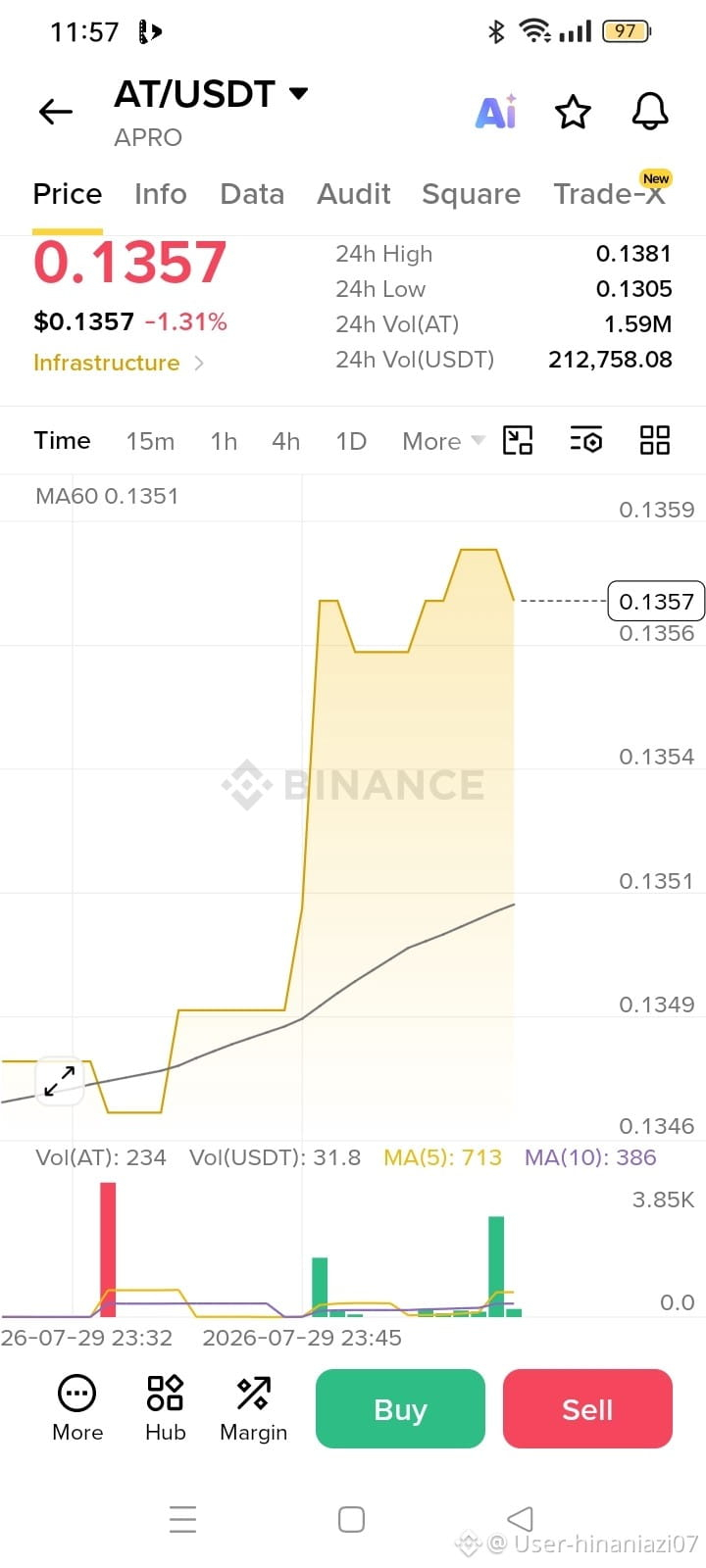
97
$APRO JUST LANDED A MAJOR ORACLE DEAL THAT FEW ARE TALKING ABOUT 🚀
APRO's MORE program just added Lista DAO, bringing price feeds for six new Binance bStocks pairs — MSFTB, METAB, LITEB, PLTRB, QQQB, SKHYB — alongside existing assets like NVDAB and TSLAB. This isn't a tiny update; it's APRO positioning as the go-to oracle for tokenized stocks on BNB Chain. With bStocks volume growing, the demand for reliable price data is non-negotiable.
The team says they now offer the most comprehensive coverage in the bStocks space. That's a narrative that tends to attract volume when the market catches on. Are you watching the $APRO chart for a volume spike?
Not financial advice. Always manage your risk.
#APRO #Oracle #BNBChain #DeFi #bStocks
🔥
$APRO JUST LANDED A MAJOR ORACLE DEAL THAT FEW ARE TALKING ABOUT 🚀
APRO's MORE program just added Lista DAO, bringing price feeds for six new Binance bStocks pairs — MSFTB, METAB, LITEB, PLTRB, QQQB, SKHYB — alongside existing assets like NVDAB and TSLAB. This isn't a tiny update; it's APRO positioning as the go-to oracle for tokenized stocks on BNB Chain. With bStocks volume growing, the demand for reliable price data is non-negotiable.
The team says they now offer the most comprehensive coverage in the bStocks space. That's a narrative that tends to attract volume when the market catches on. Are you watching the $APRO chart for a volume spike?
Not financial advice. Always manage your risk.
#APRO #Oracle #BNBChain #DeFi #bStocks
🔥
APRO's MORE program just added Lista DAO, bringing price feeds for six new Binance bStocks pairs — MSFTB, METAB, LITEB, PLTRB, QQQB, SKHYB — alongside existing assets like NVDAB and TSLAB. This isn't a tiny update; it's APRO positioning as the go-to oracle for tokenized stocks on BNB Chain. With bStocks volume growing, the demand for reliable price data is non-negotiable.
The team says they now offer the most comprehensive coverage in the bStocks space. That's a narrative that tends to attract volume when the market catches on. Are you watching the $APRO chart for a volume spike?
Not financial advice. Always manage your risk.
#APRO #Oracle #BNBChain #DeFi #bStocks
🔥
85

·
--
$APRO POWERS LISTA DAO'S BSTORKS INTEGRATION — ECOSYSTEM EXPANDING 🚀
APRO is now providing price feed services for six new bStock trading pairs on Lista DAO through the MORE program. This adds MSFTB, METAB, LITEB, PLTRB, QQQB, and SKHYB to the existing coverage.
The multi-oracle structure eliminates single-point-of-failure risk while stabilizing pricing across tokenized equities. With bStocks growing rapidly on BNB Chain, APRO's role as the primary oracle provider gives it structural demand that isn't priced in yet.
Does this move strengthen $APRO 's position as the go-to oracle for BNB Chain synthetic assets?
Not financial advice. Always manage your risk.
#APRO #LISTA #Oracle #bStocks #BNBChain
🔥
$APRO POWERS LISTA DAO'S BSTORKS INTEGRATION — ECOSYSTEM EXPANDING 🚀
APRO is now providing price feed services for six new bStock trading pairs on Lista DAO through the MORE program. This adds MSFTB, METAB, LITEB, PLTRB, QQQB, and SKHYB to the existing coverage.
The multi-oracle structure eliminates single-point-of-failure risk while stabilizing pricing across tokenized equities. With bStocks growing rapidly on BNB Chain, APRO's role as the primary oracle provider gives it structural demand that isn't priced in yet.
Does this move strengthen $APRO 's position as the go-to oracle for BNB Chain synthetic assets?
Not financial advice. Always manage your risk.
#APRO #LISTA #Oracle #bStocks #BNBChain
🔥
APRO is now providing price feed services for six new bStock trading pairs on Lista DAO through the MORE program. This adds MSFTB, METAB, LITEB, PLTRB, QQQB, and SKHYB to the existing coverage.
The multi-oracle structure eliminates single-point-of-failure risk while stabilizing pricing across tokenized equities. With bStocks growing rapidly on BNB Chain, APRO's role as the primary oracle provider gives it structural demand that isn't priced in yet.
Does this move strengthen $APRO 's position as the go-to oracle for BNB Chain synthetic assets?
Not financial advice. Always manage your risk.
#APRO #LISTA #Oracle #bStocks #BNBChain
🔥
100



·
--
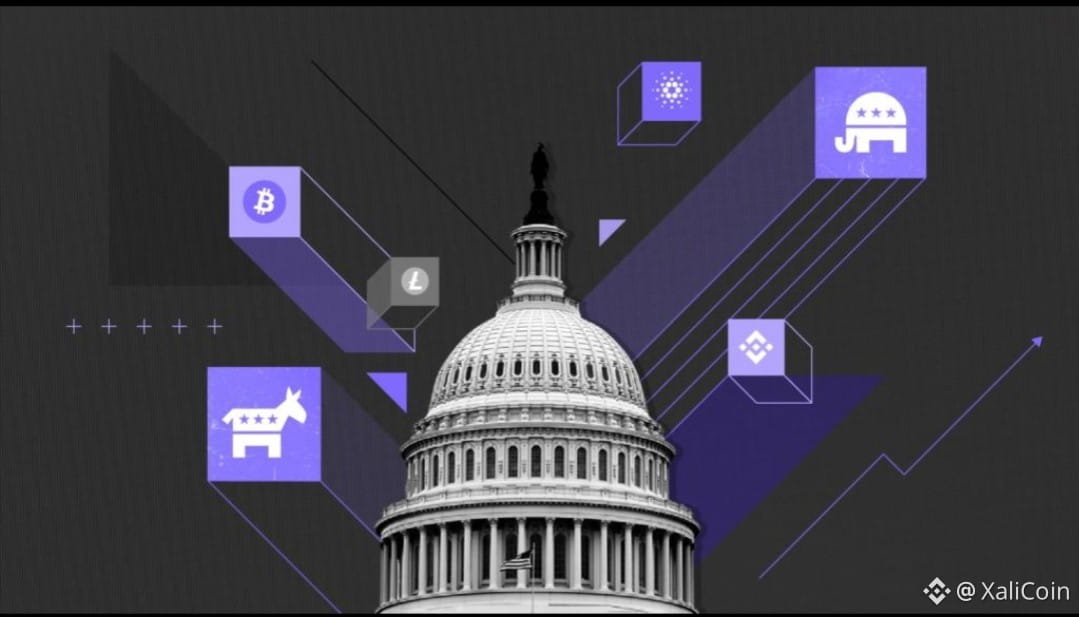
#USPARITYCryptoTaxBill
Digital Asset Protection, Accountability, Regulation, Innovation, Taxation & Yields (PARITY) Act
BACKGROUND
Bill ini resmi diperkenalkan pada 19 Mei 2026 oleh grup bipartisan dari House Ways and Means Committee — Rep. Steven Horsford (D-Nev.), Suzan DelBene (D-Wash.), Max Miller (R-Ohio), dan Mike Carey (R-Ohio).
Ini bukan muncul tiba-tiba — PARITY Act pertama kali dirilis sebagai discussion draft bulan Desember 2025, lalu dirilis ulang Maret 2026 untuk review lanjutan.
$AT @APRO-Oracle #APRO
{spot}(ATUSDT)
#USPARITYCryptoTaxBill
Digital Asset Protection, Accountability, Regulation, Innovation, Taxation & Yields (PARITY) Act
BACKGROUND
Bill ini resmi diperkenalkan pada 19 Mei 2026 oleh grup bipartisan dari House Ways and Means Committee — Rep. Steven Horsford (D-Nev.), Suzan DelBene (D-Wash.), Max Miller (R-Ohio), dan Mike Carey (R-Ohio).
Ini bukan muncul tiba-tiba — PARITY Act pertama kali dirilis sebagai discussion draft bulan Desember 2025, lalu dirilis ulang Maret 2026 untuk review lanjutan.
$AT @APRO Oracle #APRO
Digital Asset Protection, Accountability, Regulation, Innovation, Taxation & Yields (PARITY) Act
BACKGROUND
Bill ini resmi diperkenalkan pada 19 Mei 2026 oleh grup bipartisan dari House Ways and Means Committee — Rep. Steven Horsford (D-Nev.), Suzan DelBene (D-Wash.), Max Miller (R-Ohio), dan Mike Carey (R-Ohio).
Ini bukan muncul tiba-tiba — PARITY Act pertama kali dirilis sebagai discussion draft bulan Desember 2025, lalu dirilis ulang Maret 2026 untuk review lanjutan.
$AT @APRO Oracle #APRO
1
1
313

·
--
Рост
بسم الله الرحمن الرحيم
السلام عليكم ورحمة الله وبركاته
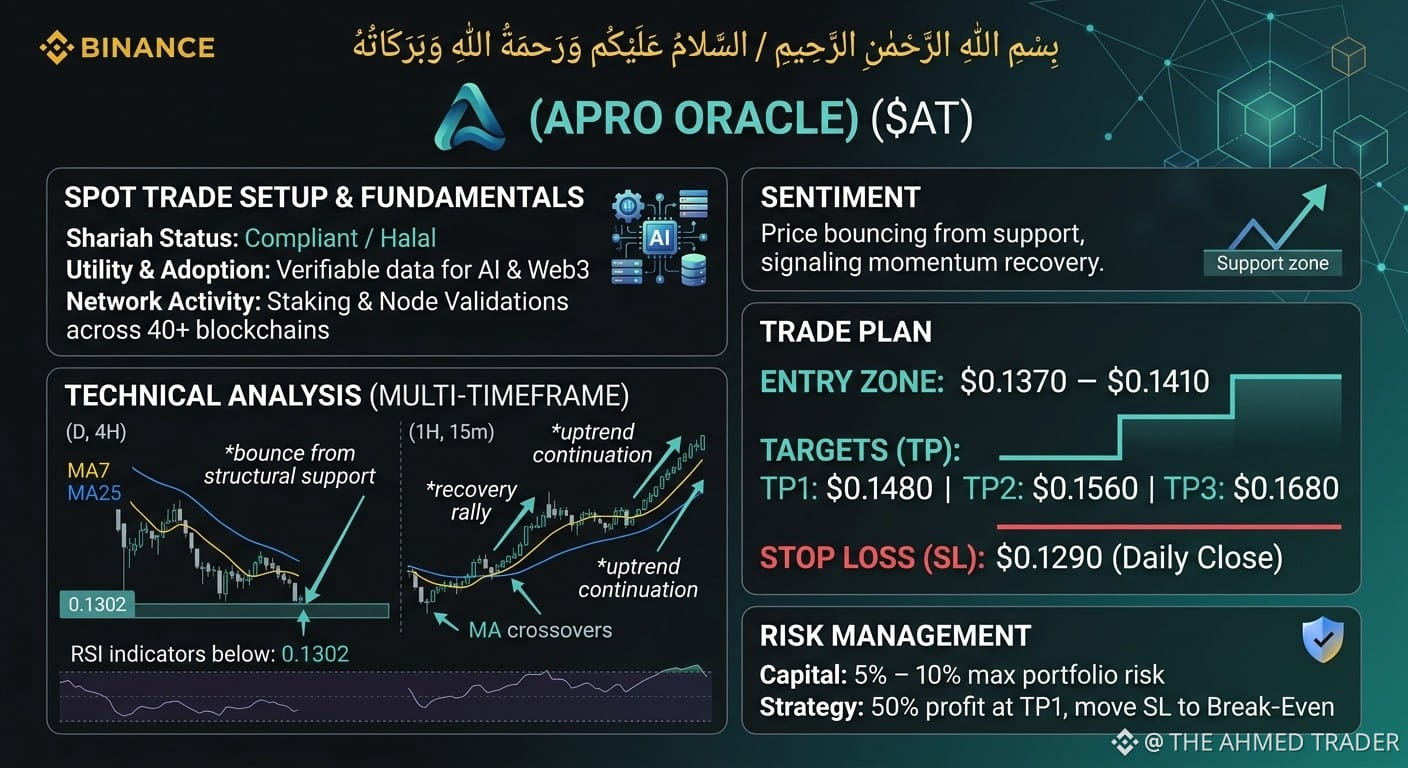
📊 $AT APRO ORACLE) SPOT TRADE SETUP
Shariah Status: Compliant / Halal (AI-Driven Decentralized Oracle Protocol for Bitcoin & Web3 Data Feeds)
Utility & Adoption: Supplies verifiable price feeds and off-chain data to AI agents, BTCFi, and multi-chain smart contracts.
Network & Activity: Staking and node validations secure real-time data delivery across 40+ blockchains.
Sentiment: Price bouncing from strong $0.1302–$0.1355 support zone, signaling momentum recovery.
📈 MULTI-TIMEFRAME TECHNICALS
1D Frame: $0.1404 | Base consolidation above structural low ($0.0948); holding below MA7 ($0.1475) & MA25 ($0.1432); RSI 47.81.
4H Frame: $0.1404 | Rebounding off swing bottom ($0.1302); MA7 ($0.1394) crossing near MA25 ($0.1461); RSI 43.84.
1H Frame: $0.1404 | Recovery rally from $0.1345 low; MA7 ($0.1392) crossing above MA25 ($0.1398); RSI 46.35.
15m Frame: $0.1404 | Micro uptrend continuation from $0.1355 bottom; MA7 ($0.1403) riding above MA25 ($0.1391); RSI 55.25.
🎯 SPOT TRADE SETUP
📍 Entry Zone: $0.1370 – $0.1410
🎯 TP1: $0.1480 | TP2: $0.1560 | TP3: $0.1680
⛔ Stop Loss (SL): $0.1290 (Daily Close)
💡 RISK MANAGEMENT
Capital: 5% – 10% portfolio risk maximum.
Strategy: Take 50% profit at TP1 and move SL to Break-Even for a risk-free trade.
{spot}(ATUSDT)
#AT #APRO #CryptoAnalysis #TradingSetup #BinanceSquare
بسم الله الرحمن الرحيم
السلام عليكم ورحمة الله وبركاته
📊 $AT APRO ORACLE) SPOT TRADE SETUP
Shariah Status: Compliant / Halal (AI-Driven Decentralized Oracle Protocol for Bitcoin & Web3 Data Feeds)
Utility & Adoption: Supplies verifiable price feeds and off-chain data to AI agents, BTCFi, and multi-chain smart contracts.
Network & Activity: Staking and node validations secure real-time data delivery across 40+ blockchains.
Sentiment: Price bouncing from strong $0.1302–$0.1355 support zone, signaling momentum recovery.
📈 MULTI-TIMEFRAME TECHNICALS
1D Frame: $0.1404 | Base consolidation above structural low ($0.0948); holding below MA7 ($0.1475) & MA25 ($0.1432); RSI 47.81.
4H Frame: $0.1404 | Rebounding off swing bottom ($0.1302); MA7 ($0.1394) crossing near MA25 ($0.1461); RSI 43.84.
1H Frame: $0.1404 | Recovery rally from $0.1345 low; MA7 ($0.1392) crossing above MA25 ($0.1398); RSI 46.35.
15m Frame: $0.1404 | Micro uptrend continuation from $0.1355 bottom; MA7 ($0.1403) riding above MA25 ($0.1391); RSI 55.25.
🎯 SPOT TRADE SETUP
📍 Entry Zone: $0.1370 – $0.1410
🎯 TP1: $0.1480 | TP2: $0.1560 | TP3: $0.1680
⛔ Stop Loss (SL): $0.1290 (Daily Close)
💡 RISK MANAGEMENT
Capital: 5% – 10% portfolio risk maximum.
Strategy: Take 50% profit at TP1 and move SL to Break-Even for a risk-free trade.
#AT #APRO #CryptoAnalysis #TradingSetup #BinanceSquare
السلام عليكم ورحمة الله وبركاته
📊 $AT APRO ORACLE) SPOT TRADE SETUP
Shariah Status: Compliant / Halal (AI-Driven Decentralized Oracle Protocol for Bitcoin & Web3 Data Feeds)
Utility & Adoption: Supplies verifiable price feeds and off-chain data to AI agents, BTCFi, and multi-chain smart contracts.
Network & Activity: Staking and node validations secure real-time data delivery across 40+ blockchains.
Sentiment: Price bouncing from strong $0.1302–$0.1355 support zone, signaling momentum recovery.
📈 MULTI-TIMEFRAME TECHNICALS
1D Frame: $0.1404 | Base consolidation above structural low ($0.0948); holding below MA7 ($0.1475) & MA25 ($0.1432); RSI 47.81.
4H Frame: $0.1404 | Rebounding off swing bottom ($0.1302); MA7 ($0.1394) crossing near MA25 ($0.1461); RSI 43.84.
1H Frame: $0.1404 | Recovery rally from $0.1345 low; MA7 ($0.1392) crossing above MA25 ($0.1398); RSI 46.35.
15m Frame: $0.1404 | Micro uptrend continuation from $0.1355 bottom; MA7 ($0.1403) riding above MA25 ($0.1391); RSI 55.25.
🎯 SPOT TRADE SETUP
📍 Entry Zone: $0.1370 – $0.1410
🎯 TP1: $0.1480 | TP2: $0.1560 | TP3: $0.1680
⛔ Stop Loss (SL): $0.1290 (Daily Close)
💡 RISK MANAGEMENT
Capital: 5% – 10% portfolio risk maximum.
Strategy: Take 50% profit at TP1 and move SL to Break-Even for a risk-free trade.
#AT #APRO #CryptoAnalysis #TradingSetup #BinanceSquare
88

·
--
Падение
🔴 $AT — SHORT SIGNAL
📊 Conviction: 91.7%
⚖️ R:R: Up to 1:2.18
🎯 Entry: $0.1430–$0.1440
🛑 SL: $0.1520 (+5.9%)
🎯 TP1: $0.1345 (-6.3%)
🎯 TP2: $0.1300 (-9.4%)
🎯 TP3: $0.1250 (-12.9%)
🔥 Key Signals:
• Top Trader Ratio: 6.80 → 6.31 ↓
• Support $0.1400 under pressure
• OI ~57.8M, contracting from peak
• Funding +0.0050%
• Basis near zero/negative
• Repeated taker-sell spikes
• Retail accounts heavily short-biased
⚡ Confirmation: 15m/1H close below $0.1400 with strong sell volume.
❌ Invalidation: Sustained reclaim above $0.1520.
⚠️ Retail shorts are already crowded, so a relief squeeze is possible. Manage risk carefully.
#AT #APRO #Crypto #Futures #Trading
{future}(ATUSDT)
🔴 $AT — SHORT SIGNAL
📊 Conviction: 91.7%
⚖️ R:R: Up to 1:2.18
🎯 Entry: $0.1430–$0.1440
🛑 SL: $0.1520 (+5.9%)
🎯 TP1: $0.1345 (-6.3%)
🎯 TP2: $0.1300 (-9.4%)
🎯 TP3: $0.1250 (-12.9%)
🔥 Key Signals:
• Top Trader Ratio: 6.80 → 6.31 ↓
• Support $0.1400 under pressure
• OI ~57.8M, contracting from peak
• Funding +0.0050%
• Basis near zero/negative
• Repeated taker-sell spikes
• Retail accounts heavily short-biased
⚡ Confirmation: 15m/1H close below $0.1400 with strong sell volume.
❌ Invalidation: Sustained reclaim above $0.1520.
⚠️ Retail shorts are already crowded, so a relief squeeze is possible. Manage risk carefully.
#AT #APRO #Crypto #Futures #Trading
📊 Conviction: 91.7%
⚖️ R:R: Up to 1:2.18
🎯 Entry: $0.1430–$0.1440
🛑 SL: $0.1520 (+5.9%)
🎯 TP1: $0.1345 (-6.3%)
🎯 TP2: $0.1300 (-9.4%)
🎯 TP3: $0.1250 (-12.9%)
🔥 Key Signals:
• Top Trader Ratio: 6.80 → 6.31 ↓
• Support $0.1400 under pressure
• OI ~57.8M, contracting from peak
• Funding +0.0050%
• Basis near zero/negative
• Repeated taker-sell spikes
• Retail accounts heavily short-biased
⚡ Confirmation: 15m/1H close below $0.1400 with strong sell volume.
❌ Invalidation: Sustained reclaim above $0.1520.
⚠️ Retail shorts are already crowded, so a relief squeeze is possible. Manage risk carefully.
#AT #APRO #Crypto #Futures #Trading

72
·
--
Рост
السلام عليكم ورحمة الله وبركاته
📊 SPOT TRADE UPDATE & TECHNICAL ANALYSIS: $AT / USDT
🔍 Audit & Utility
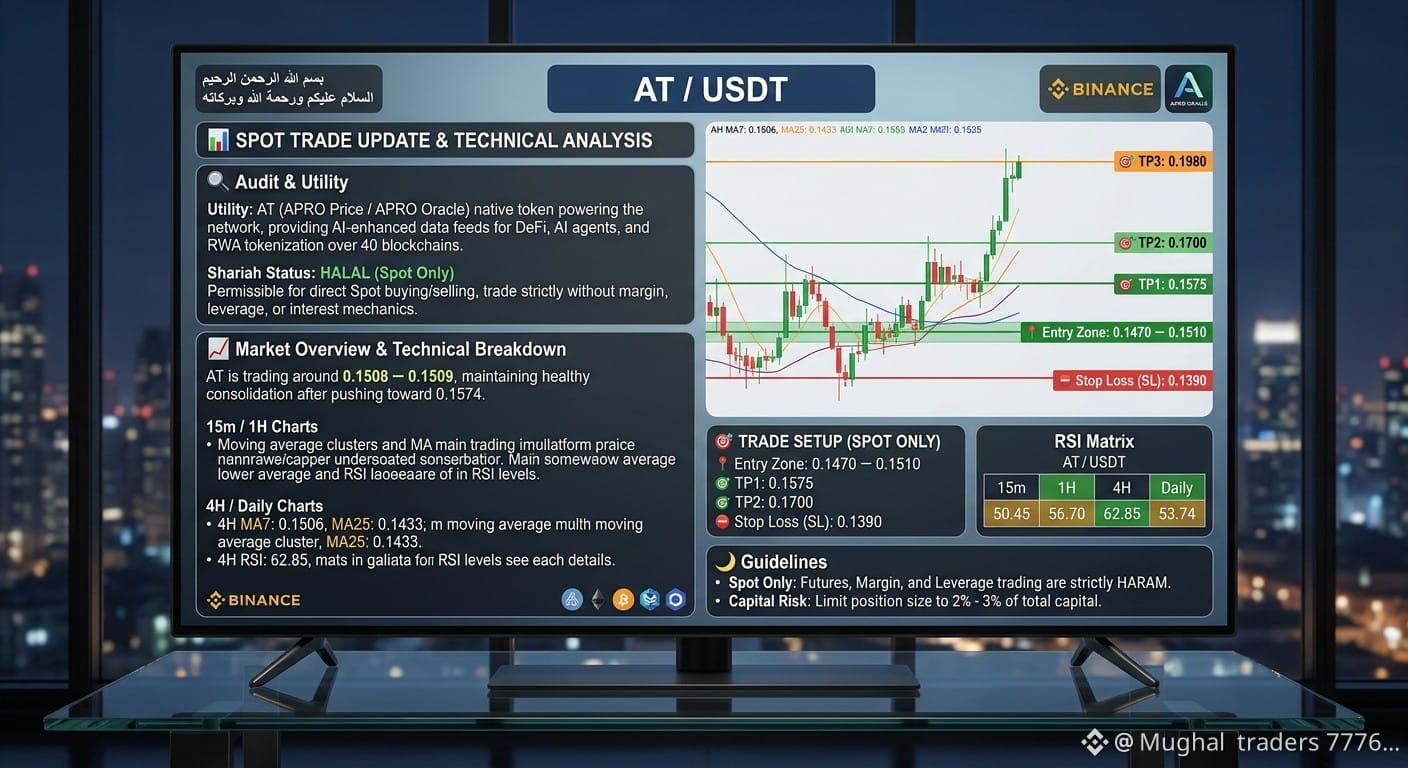
Utility: $AT is the native utility, staking, and governance token powering the APRO Oracle network. It provides AI-enhanced, decentralized real-world data feeds across over 40 blockchains for DeFi, AI agents, and Real-World Asset (RWA) tokenization.
Shariah Status: HALAL (Spot Only) (Permissible for direct Spot buying and selling as a decentralized AI oracle data-feed infrastructure asset; trade strictly on Spot without margin, leverage, or interest mechanics).
📈 Market Overview & Technical Breakdown
AT is trading around 0.1508 – 0.1509, maintaining a healthy consolidation pattern after pushing up toward its recent high near 0.1574.
15m / 1H Charts: On lower timeframes, AT is consolidating near key moving average clusters following a brief spike to 0.1574. On 15m, price action is hovering around short-term moving averages (15m MA7: 0.1511, MA25: 0.1509, MA99: 0.1506; 1H MA7: 0.1509, MA25: 0.1506, MA99: 0.1429). 15m RSI is neutral at 50.45, while 1H RSI sits at 56.70.
4H / Daily Charts: Higher timeframes show strong macro recovery and upward continuation from its bottom support floor of 0.1302 (4H low) and 0.0948 (Daily swing low). Price is trading comfortably above long-term moving averages (4H MA7: 0.1506, MA25: 0.1433, MA99: 0.1406; Daily MA7: 0.1412, MA25: 0.1452, MA99: 0.1416). 4H RSI stands at 62.85 and Daily RSI holds a solid 53.74.
RSI Matrix: 15m: 50.45 | 1H: 56.70 | 4H: 62.85 | Daily: 53.74.
🎯 TRADE SETUP (SPOT ONLY)
Asset: AT / USDT | Type: Spot (Halal Setup) | Status: Bullish Consolidation / MA Support Reclaim
📍 Entry Zone: 0.1470 – 0.1510
🎯 TP1: 0.1575
🎯 TP2: 0.1700
🎯 TP3: 0.1980
⛔ Stop Loss (SL): 0.1390
🌙 Guidelines
Spot Only: Futures, Margin, and Leverage trading are strictly HARAM.
Capital Risk: Limit position size to 2% - 3% of total capital.
{spot}(ATUSDT)
#AT #APRO #CryptoAnalysis #SpotTrading #HalalCrypto
السلام عليكم ورحمة الله وبركاته
📊 SPOT TRADE UPDATE & TECHNICAL ANALYSIS: $AT / USDT
🔍 Audit & Utility
Utility: $AT is the native utility, staking, and governance token powering the APRO Oracle network. It provides AI-enhanced, decentralized real-world data feeds across over 40 blockchains for DeFi, AI agents, and Real-World Asset (RWA) tokenization.
Shariah Status: HALAL (Spot Only) (Permissible for direct Spot buying and selling as a decentralized AI oracle data-feed infrastructure asset; trade strictly on Spot without margin, leverage, or interest mechanics).
📈 Market Overview & Technical Breakdown
AT is trading around 0.1508 – 0.1509, maintaining a healthy consolidation pattern after pushing up toward its recent high near 0.1574.
15m / 1H Charts: On lower timeframes, AT is consolidating near key moving average clusters following a brief spike to 0.1574. On 15m, price action is hovering around short-term moving averages (15m MA7: 0.1511, MA25: 0.1509, MA99: 0.1506; 1H MA7: 0.1509, MA25: 0.1506, MA99: 0.1429). 15m RSI is neutral at 50.45, while 1H RSI sits at 56.70.
4H / Daily Charts: Higher timeframes show strong macro recovery and upward continuation from its bottom support floor of 0.1302 (4H low) and 0.0948 (Daily swing low). Price is trading comfortably above long-term moving averages (4H MA7: 0.1506, MA25: 0.1433, MA99: 0.1406; Daily MA7: 0.1412, MA25: 0.1452, MA99: 0.1416). 4H RSI stands at 62.85 and Daily RSI holds a solid 53.74.
RSI Matrix: 15m: 50.45 | 1H: 56.70 | 4H: 62.85 | Daily: 53.74.
🎯 TRADE SETUP (SPOT ONLY)
Asset: AT / USDT | Type: Spot (Halal Setup) | Status: Bullish Consolidation / MA Support Reclaim
📍 Entry Zone: 0.1470 – 0.1510
🎯 TP1: 0.1575
🎯 TP2: 0.1700
🎯 TP3: 0.1980
⛔ Stop Loss (SL): 0.1390
🌙 Guidelines
Spot Only: Futures, Margin, and Leverage trading are strictly HARAM.
Capital Risk: Limit position size to 2% - 3% of total capital.
#AT #APRO #CryptoAnalysis #SpotTrading #HalalCrypto
📊 SPOT TRADE UPDATE & TECHNICAL ANALYSIS: $AT / USDT
🔍 Audit & Utility
Utility: $AT is the native utility, staking, and governance token powering the APRO Oracle network. It provides AI-enhanced, decentralized real-world data feeds across over 40 blockchains for DeFi, AI agents, and Real-World Asset (RWA) tokenization.
Shariah Status: HALAL (Spot Only) (Permissible for direct Spot buying and selling as a decentralized AI oracle data-feed infrastructure asset; trade strictly on Spot without margin, leverage, or interest mechanics).
📈 Market Overview & Technical Breakdown
AT is trading around 0.1508 – 0.1509, maintaining a healthy consolidation pattern after pushing up toward its recent high near 0.1574.
15m / 1H Charts: On lower timeframes, AT is consolidating near key moving average clusters following a brief spike to 0.1574. On 15m, price action is hovering around short-term moving averages (15m MA7: 0.1511, MA25: 0.1509, MA99: 0.1506; 1H MA7: 0.1509, MA25: 0.1506, MA99: 0.1429). 15m RSI is neutral at 50.45, while 1H RSI sits at 56.70.
4H / Daily Charts: Higher timeframes show strong macro recovery and upward continuation from its bottom support floor of 0.1302 (4H low) and 0.0948 (Daily swing low). Price is trading comfortably above long-term moving averages (4H MA7: 0.1506, MA25: 0.1433, MA99: 0.1406; Daily MA7: 0.1412, MA25: 0.1452, MA99: 0.1416). 4H RSI stands at 62.85 and Daily RSI holds a solid 53.74.
RSI Matrix: 15m: 50.45 | 1H: 56.70 | 4H: 62.85 | Daily: 53.74.
🎯 TRADE SETUP (SPOT ONLY)
Asset: AT / USDT | Type: Spot (Halal Setup) | Status: Bullish Consolidation / MA Support Reclaim
📍 Entry Zone: 0.1470 – 0.1510
🎯 TP1: 0.1575
🎯 TP2: 0.1700
🎯 TP3: 0.1980
⛔ Stop Loss (SL): 0.1390
🌙 Guidelines
Spot Only: Futures, Margin, and Leverage trading are strictly HARAM.
Capital Risk: Limit position size to 2% - 3% of total capital.
#AT #APRO #CryptoAnalysis #SpotTrading #HalalCrypto
1
48

·
--
Рост
🔥 $AT /USDT — LONG SETUP
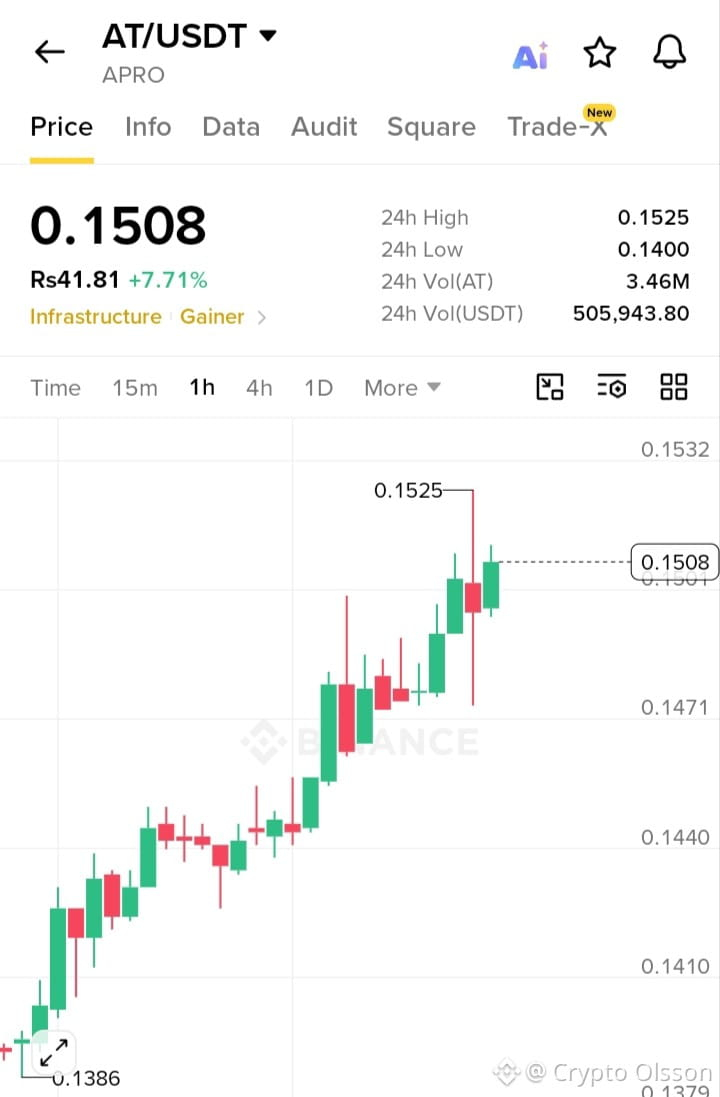
Entry Point (EP): $0.1470 – $0.1500
TP1: $0.1525
TP2: $0.1532
TP3: $0.1580
🛑 SL: $0.1410
Bullish idea: Hold above $0.1470 and reclaim $0.1525 with volume → potential continuation higher.
⚠️ Don't chase the pump. Wait for a proper entry/retest and manage risk.
#AT #ATUSDT #APRO #LongSetup
$AT
{future}(ATUSDT)
🔥 $AT /USDT — LONG SETUP
Entry Point (EP): $0.1470 – $0.1500
TP1: $0.1525
TP2: $0.1532
TP3: $0.1580
🛑 SL: $0.1410
Bullish idea: Hold above $0.1470 and reclaim $0.1525 with volume → potential continuation higher.
⚠️ Don't chase the pump. Wait for a proper entry/retest and manage risk.
#AT #ATUSDT #APRO #LongSetup
$AT
Entry Point (EP): $0.1470 – $0.1500
TP1: $0.1525
TP2: $0.1532
TP3: $0.1580
🛑 SL: $0.1410
Bullish idea: Hold above $0.1470 and reclaim $0.1525 with volume → potential continuation higher.
⚠️ Don't chase the pump. Wait for a proper entry/retest and manage risk.
#AT #ATUSDT #APRO #LongSetup
$AT
1
100


Solving the Gas Crisis with "Data Pull" Mechanics
Efficiency is the unsung hero of the bull market. As activity on the BNB Chain heats up, protocols that waste gas on constant oracle updates will bleed value.
@APRO-Oracle offers a strategic advantage with its Data Pull architecture.
Instead of flooding the chain with price updates every block (Data Push), APRO allows dApps to "pull" data on-demand. This is critical for GameFi and high-frequency derivatives where latency and cost are the difference between profit and loss.
Combined with a Two-Layer Network that separates execution from security verification, APRO provides the scalability needed for the next 40 blockchains.
$AT
{future}(ATUSDT)
$RECALL
{future}(RECALLUSDT)
$SKYAI
{future}(SKYAIUSDT)
#APRO
#apro
#BTCVSGOLD
#BinanceBlockchainWeek
Solving the Gas Crisis with "Data Pull" Mechanics
Efficiency is the unsung hero of the bull market. As activity on the BNB Chain heats up, protocols that waste gas on constant oracle updates will bleed value.
@APRO Oracle offers a strategic advantage with its Data Pull architecture.
Instead of flooding the chain with price updates every block (Data Push), APRO allows dApps to "pull" data on-demand. This is critical for GameFi and high-frequency derivatives where latency and cost are the difference between profit and loss.
Combined with a Two-Layer Network that separates execution from security verification, APRO provides the scalability needed for the next 40 blockchains.
$AT
$RECALL
$SKYAI
#APRO
#apro
#BTCVSGOLD
#BinanceBlockchainWeek
Efficiency is the unsung hero of the bull market. As activity on the BNB Chain heats up, protocols that waste gas on constant oracle updates will bleed value.
@APRO Oracle offers a strategic advantage with its Data Pull architecture.
Instead of flooding the chain with price updates every block (Data Push), APRO allows dApps to "pull" data on-demand. This is critical for GameFi and high-frequency derivatives where latency and cost are the difference between profit and loss.
Combined with a Two-Layer Network that separates execution from security verification, APRO provides the scalability needed for the next 40 blockchains.
$AT
$RECALL
$SKYAI
#APRO
#apro
#BTCVSGOLD
#BinanceBlockchainWeek
2
1
8
4.5k

·
--
Статья
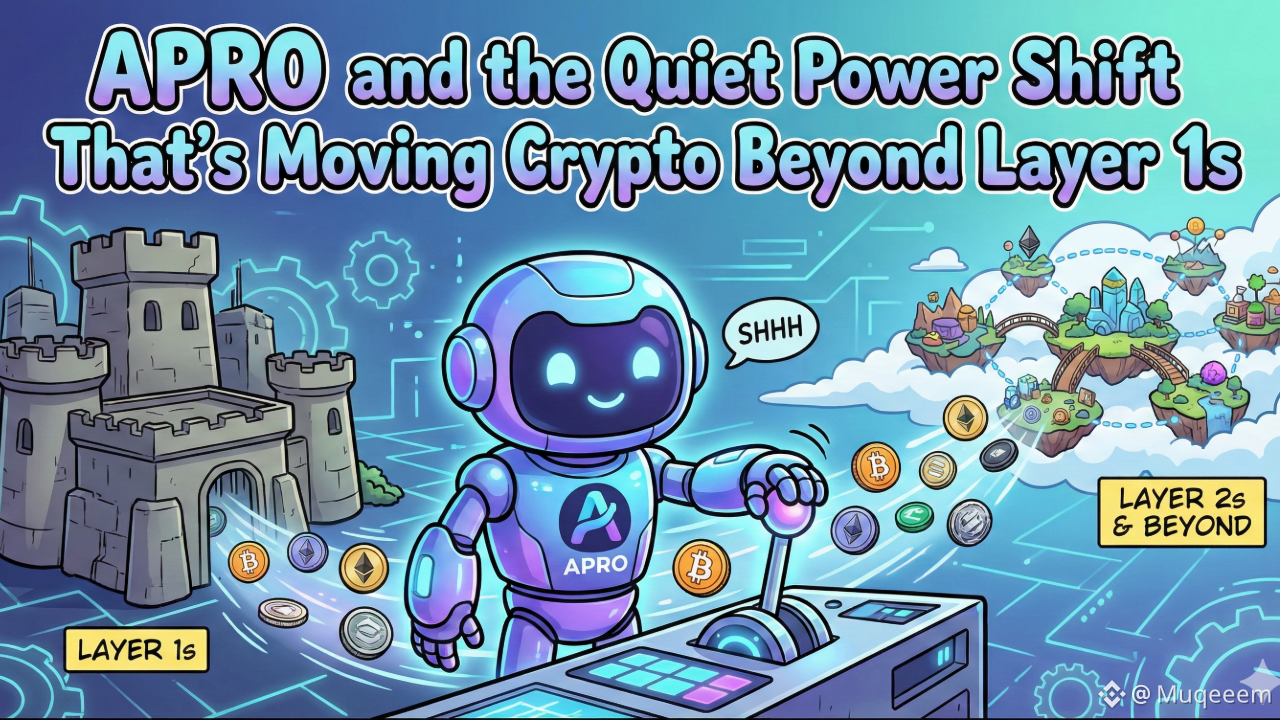
APRO and the Quiet Power Shift That’s Moving Crypto Beyond Layer 1sThere is a quiet shift happening underneath the surface of crypto. It does not show up in price charts right away, and it does not announce itself with new slogans. It shows up in where builders spend their time and what users actually depend on when something goes wrong.
For a long time, the main story was Layer 1 blockchains competing with each other. Faster blocks, cheaper fees, cleaner design. That phase is not over, but it is no longer where most of the real tension lives.
Layer 1s are maturing. That changes everything.
Most major Layer 1 networks today already work well enough for their core purpose. Transactions settle. Smart contracts execute. Developer tools are stable. The differences between them still matter, but they are no longer existential. A new chain does not win just by being slightly faster or slightly cheaper.
As this foundation settles, attention naturally moves upward. Applications now carry more weight than the chains they run on. When users interact with a lending app, a derivatives protocol, or a gaming economy, they care less about the underlying block time and more about whether the app behaves predictably.
Reliability becomes the texture people feel.
This is where oracles quietly step into the center.
Oracles sit between blockchains and the outside world. They bring prices, events, and off-chain data into on-chain systems. Without them, most decentralized applications would be closed loops, unable to react to reality.
In the early days, oracles were often treated as utilities. Necessary, but not deeply examined. If a price feed worked most of the time, that felt good enough. As applications were smaller and losses were limited, the risk stayed abstract.
That is no longer the case.
Today, oracles support systems that hold billions of dollars in value, which is not impressive on its own until you consider what that value represents. It includes user savings, leveraged positions, insurance pools, and automated strategies that respond in seconds. When oracle data drifts, lags, or gets manipulated, the impact is immediate and often irreversible.
Early signs suggest the market is starting to price this in.
Rather than each application solving data problems on its own, there is a growing preference for shared oracle infrastructure. This mirrors how Layer 1s themselves became shared settlement layers instead of custom-built chains for every use case.
Oracles benefit from scale in subtle ways. More data sources improve accuracy. More integrations create feedback loops that expose weaknesses faster. Over time, reliability is not claimed, it is earned through repeated stress.
This is why oracles begin to look less like middleware and more like core infrastructure.
@APRO-Oracle has entered this picture during a moment when expectations are higher than they used to be. Instead of focusing only on price feeds, it has been positioning itself around application-aware data delivery. The idea is simple on the surface. Data should reflect how applications actually use it, not just raw numbers pushed on-chain at fixed intervals.
For example, a lending protocol does not need constant updates during quiet markets. It needs timely updates when volatility spikes. That sounds obvious, but it changes how oracle systems are designed and paid for.
[APRO’s](https://www.binance.com/en/futures/ATUSDT) relevance, if it holds, comes from this alignment with application behavior. Rather than treating all data consumers the same, it acknowledges that different protocols feel risk differently. Early integrations suggest builders value this flexibility, especially as applications become more specialized.
Still, relevance is not permanence.
Oracle systems carry real risks, and it is important to say that clearly. They concentrate trust in subtle ways, even when decentralized. Data aggregation can hide correlated failures. Governance around data sources can lag behind market realities. If incentives are misaligned, reliability erodes slowly before anyone notices.
[APRO](https://www.binance.com/en/futures/ATUSDT) also faces the challenge every newer infrastructure project faces. Adoption takes time. Trust is built through calm performance during moments of stress, not during quiet periods. A single high-profile failure can outweigh months of stable operation.
There is also competitive pressure. Established oracle networks are not standing still. They are expanding features, refining economics, and leveraging deep integration moats. Whether [APRO](https://www.binance.com/en/futures/ATUSDT) can continue to differentiate without overcomplicating its design remains to be seen.
Another open question is sustainability. Oracle economics are harder than they look. Fees must support operators without making applications too expensive to run. If usage grows unevenly across chains or sectors, incentives can skew. This is not unique to [APRO](https://www.binance.com/en/futures/ATUSDT), but it is unavoidable.
Despite these risks, the broader direction feels steady.
As the next cycle unfolds, it is likely that narratives focused purely on new Layer 1s will feel thinner. The foundation is already there. What matters more is how reliably applications can respond to the world around them.
Oracles sit at that boundary.
They decide how quickly liquidations happen, how accurately markets price risk, and how safely automated systems behave during chaos. These are not glamorous moments, but they are the ones users remember.
If this pattern continues, value accrual may shift toward infrastructure that reduces hidden failure modes rather than headline performance metrics. Oracles that adapt to application needs, earn trust over time, and remain boring when things get loud may quietly matter more than the chains beneath them.
The next cycle may not belong to whoever builds the fastest new base layer. It may belong to whoever keeps the data honest when everything else is moving.
$AT #APRO @APRO-Oracle
APRO and the Quiet Power Shift That’s Moving Crypto Beyond Layer 1s
There is a quiet shift happening underneath the surface of crypto. It does not show up in price charts right away, and it does not announce itself with new slogans. It shows up in where builders spend their time and what users actually depend on when something goes wrong.
For a long time, the main story was Layer 1 blockchains competing with each other. Faster blocks, cheaper fees, cleaner design. That phase is not over, but it is no longer where most of the real tension lives.
Layer 1s are maturing. That changes everything.
Most major Layer 1 networks today already work well enough for their core purpose. Transactions settle. Smart contracts execute. Developer tools are stable. The differences between them still matter, but they are no longer existential. A new chain does not win just by being slightly faster or slightly cheaper.
As this foundation settles, attention naturally moves upward. Applications now carry more weight than the chains they run on. When users interact with a lending app, a derivatives protocol, or a gaming economy, they care less about the underlying block time and more about whether the app behaves predictably.
Reliability becomes the texture people feel.
This is where oracles quietly step into the center.
Oracles sit between blockchains and the outside world. They bring prices, events, and off-chain data into on-chain systems. Without them, most decentralized applications would be closed loops, unable to react to reality.
In the early days, oracles were often treated as utilities. Necessary, but not deeply examined. If a price feed worked most of the time, that felt good enough. As applications were smaller and losses were limited, the risk stayed abstract.
That is no longer the case.
Today, oracles support systems that hold billions of dollars in value, which is not impressive on its own until you consider what that value represents. It includes user savings, leveraged positions, insurance pools, and automated strategies that respond in seconds. When oracle data drifts, lags, or gets manipulated, the impact is immediate and often irreversible.
Early signs suggest the market is starting to price this in.
Rather than each application solving data problems on its own, there is a growing preference for shared oracle infrastructure. This mirrors how Layer 1s themselves became shared settlement layers instead of custom-built chains for every use case.
Oracles benefit from scale in subtle ways. More data sources improve accuracy. More integrations create feedback loops that expose weaknesses faster. Over time, reliability is not claimed, it is earned through repeated stress.
This is why oracles begin to look less like middleware and more like core infrastructure.
@APRO Oracle has entered this picture during a moment when expectations are higher than they used to be. Instead of focusing only on price feeds, it has been positioning itself around application-aware data delivery. The idea is simple on the surface. Data should reflect how applications actually use it, not just raw numbers pushed on-chain at fixed intervals.
For example, a lending protocol does not need constant updates during quiet markets. It needs timely updates when volatility spikes. That sounds obvious, but it changes how oracle systems are designed and paid for.
APRO’s relevance, if it holds, comes from this alignment with application behavior. Rather than treating all data consumers the same, it acknowledges that different protocols feel risk differently. Early integrations suggest builders value this flexibility, especially as applications become more specialized.
Still, relevance is not permanence.
Oracle systems carry real risks, and it is important to say that clearly. They concentrate trust in subtle ways, even when decentralized. Data aggregation can hide correlated failures. Governance around data sources can lag behind market realities. If incentives are misaligned, reliability erodes slowly before anyone notices.
APRO also faces the challenge every newer infrastructure project faces. Adoption takes time. Trust is built through calm performance during moments of stress, not during quiet periods. A single high-profile failure can outweigh months of stable operation.
There is also competitive pressure. Established oracle networks are not standing still. They are expanding features, refining economics, and leveraging deep integration moats. Whether APRO can continue to differentiate without overcomplicating its design remains to be seen.
Another open question is sustainability. Oracle economics are harder than they look. Fees must support operators without making applications too expensive to run. If usage grows unevenly across chains or sectors, incentives can skew. This is not unique to APRO, but it is unavoidable.
Despite these risks, the broader direction feels steady.
As the next cycle unfolds, it is likely that narratives focused purely on new Layer 1s will feel thinner. The foundation is already there. What matters more is how reliably applications can respond to the world around them.
Oracles sit at that boundary.
They decide how quickly liquidations happen, how accurately markets price risk, and how safely automated systems behave during chaos. These are not glamorous moments, but they are the ones users remember.
If this pattern continues, value accrual may shift toward infrastructure that reduces hidden failure modes rather than headline performance metrics. Oracles that adapt to application needs, earn trust over time, and remain boring when things get loud may quietly matter more than the chains beneath them.
The next cycle may not belong to whoever builds the fastest new base layer. It may belong to whoever keeps the data honest when everything else is moving.
$AT #APRO @APRO Oracle
For a long time, the main story was Layer 1 blockchains competing with each other. Faster blocks, cheaper fees, cleaner design. That phase is not over, but it is no longer where most of the real tension lives.
Layer 1s are maturing. That changes everything.
Most major Layer 1 networks today already work well enough for their core purpose. Transactions settle. Smart contracts execute. Developer tools are stable. The differences between them still matter, but they are no longer existential. A new chain does not win just by being slightly faster or slightly cheaper.
As this foundation settles, attention naturally moves upward. Applications now carry more weight than the chains they run on. When users interact with a lending app, a derivatives protocol, or a gaming economy, they care less about the underlying block time and more about whether the app behaves predictably.
Reliability becomes the texture people feel.
This is where oracles quietly step into the center.
Oracles sit between blockchains and the outside world. They bring prices, events, and off-chain data into on-chain systems. Without them, most decentralized applications would be closed loops, unable to react to reality.
In the early days, oracles were often treated as utilities. Necessary, but not deeply examined. If a price feed worked most of the time, that felt good enough. As applications were smaller and losses were limited, the risk stayed abstract.
That is no longer the case.
Today, oracles support systems that hold billions of dollars in value, which is not impressive on its own until you consider what that value represents. It includes user savings, leveraged positions, insurance pools, and automated strategies that respond in seconds. When oracle data drifts, lags, or gets manipulated, the impact is immediate and often irreversible.
Early signs suggest the market is starting to price this in.
Rather than each application solving data problems on its own, there is a growing preference for shared oracle infrastructure. This mirrors how Layer 1s themselves became shared settlement layers instead of custom-built chains for every use case.
Oracles benefit from scale in subtle ways. More data sources improve accuracy. More integrations create feedback loops that expose weaknesses faster. Over time, reliability is not claimed, it is earned through repeated stress.
This is why oracles begin to look less like middleware and more like core infrastructure.
@APRO Oracle has entered this picture during a moment when expectations are higher than they used to be. Instead of focusing only on price feeds, it has been positioning itself around application-aware data delivery. The idea is simple on the surface. Data should reflect how applications actually use it, not just raw numbers pushed on-chain at fixed intervals.
For example, a lending protocol does not need constant updates during quiet markets. It needs timely updates when volatility spikes. That sounds obvious, but it changes how oracle systems are designed and paid for.
APRO’s relevance, if it holds, comes from this alignment with application behavior. Rather than treating all data consumers the same, it acknowledges that different protocols feel risk differently. Early integrations suggest builders value this flexibility, especially as applications become more specialized.
Still, relevance is not permanence.
Oracle systems carry real risks, and it is important to say that clearly. They concentrate trust in subtle ways, even when decentralized. Data aggregation can hide correlated failures. Governance around data sources can lag behind market realities. If incentives are misaligned, reliability erodes slowly before anyone notices.
APRO also faces the challenge every newer infrastructure project faces. Adoption takes time. Trust is built through calm performance during moments of stress, not during quiet periods. A single high-profile failure can outweigh months of stable operation.
There is also competitive pressure. Established oracle networks are not standing still. They are expanding features, refining economics, and leveraging deep integration moats. Whether APRO can continue to differentiate without overcomplicating its design remains to be seen.
Another open question is sustainability. Oracle economics are harder than they look. Fees must support operators without making applications too expensive to run. If usage grows unevenly across chains or sectors, incentives can skew. This is not unique to APRO, but it is unavoidable.
Despite these risks, the broader direction feels steady.
As the next cycle unfolds, it is likely that narratives focused purely on new Layer 1s will feel thinner. The foundation is already there. What matters more is how reliably applications can respond to the world around them.
Oracles sit at that boundary.
They decide how quickly liquidations happen, how accurately markets price risk, and how safely automated systems behave during chaos. These are not glamorous moments, but they are the ones users remember.
If this pattern continues, value accrual may shift toward infrastructure that reduces hidden failure modes rather than headline performance metrics. Oracles that adapt to application needs, earn trust over time, and remain boring when things get loud may quietly matter more than the chains beneath them.
The next cycle may not belong to whoever builds the fastest new base layer. It may belong to whoever keeps the data honest when everything else is moving.
$AT #APRO @APRO Oracle
9
2
10
1.1k

·
--
APRO (AT): Building an Institutional-Grade Oracle Stack for a Multi-Chain Market
In liquid crypto markets, data integrity is risk management. Every perpetual funding calculation, liquidation trigger, collateral ratio, settlement price, and on-chain RWA reference ultimately depends on whether an oracle can deliver accurate, timely, and manipulation-resistant information—under stress, across chains, and at scale. APRO positions itself in that exact lane: a decentralized oracle architecture that blends off-chain processing with on-chain verification, aiming to widen the set of “oracle-able” data while keeping cryptographic accountability on the base layer.
Architecture thesis: speed off-chain, finality on-chain
APRO’s core design is straightforward but ambitious: perform heavy lifting off-chain (collection, normalization, interpretation, scoring) and anchor the results on-chain through verification and delivery guarantees. This hybrid approach targets the classic oracle trade-off—latency vs. trust—by pushing computation where it’s cheap and fast, while keeping validation and publication where it’s auditable. APRO and ecosystem documentation describe this as a system that extends both data access and computational capability via off-chain processing plus on-chain verification.
Dual delivery model: Data Push vs. Data Pull (why it matters to traders)
Where many oracle networks default to one update cadence, APRO supports two delivery modes—and this is not cosmetic:
Data Push is built for environments where time-to-update is edge: AMMs adjusting to volatility, money markets protecting solvency, leveraged products reacting to fast price discovery. Push broadcasts updates proactively (typically when underlying values change), reducing the chance that smart contracts act on stale data during high-velocity moves.
Data Pull is built for precision and efficiency: protocols that only need data at specific moments (settlement, validation, ad-hoc checks) can request it on demand—useful when frequent broadcasting would be wasteful or when the “data object” is more complex than a simple price tick.
For a Binance-native, execution-minded audience: the practical takeaway is that APRO is trying to cover both high-frequency oracle flow (push) and event-driven oracle flow (pull) inside one network, which can reduce integration fragmentation across product types.
Two-layer network design: separating collection from verification
APRO publicly frames its resiliency around a two-layer network: one layer responsible for data collection/processing and another focused on validation and reliable on-chain delivery. Structurally, this is meant to reduce single-point compromise risk—an attacker (or failure mode) needs to defeat multiple roles to corrupt final outputs.
In financial terms: the architecture is pointing at a “segregation of duties” model—closer to how mature market infrastructure reduces operational and counterparty risk than how early oracles behaved.
AI-assisted verification + unstructured data: the RWA angle
APRO’s messaging emphasizes AI-driven verification and the ability to support a broad set of assets and data types (not just token prices). The high-value implication here is unstructured real-world data: contracts, documents, records, or media that don’t arrive as clean numeric feeds. Third-party explainers describe a workflow where AI interprets complex/unstructured inputs and decentralized verification follows before anchoring results on-chain. If APRO executes well, that expands the oracle market beyond “price feeds” into RWA validation and compliance-adjacent attestations—a category where demand is rising and error tolerance is low.
Verifiable randomness: reducing manipulation surfaces in games and mechanisms
APRO also highlights verifiable randomness—a critical primitive for gaming, lotteries, NFT mechanics, and any protocol requiring unpredictable outcomes that can still be audited later. The key point is not that randomness exists, but that it can be proven after the fact, reducing disputes and manipulation vectors that undermine on-chain fairness.
Scale signals: multi-chain reach and breadth of feeds
APRO is repeatedly described as supporting 40+ blockchain networks, aiming for “integrate once, deploy across ecosystems” economics. For builders, that translates into lower marginal cost per chain expansion; for traders, it can translate into more consistent oracle behavior across venues and L2/L1 stacks.
On breadth, market trackers state APRO maintains 1,400+ individual data feeds used across applications (pricing, settlements, triggers). While the exact number will fluctuate with expansion, it’s a meaningful indicator that APRO is positioning as a generalized data layer rather than a niche oracle.
Token mechanics (AT): supply, issuance standard, and incentive alignment
From a market-structure lens, AT is the economic backbone: it’s used for governance and to incentivize data providers and validators for accurate submission and verification (i.e., paying for truthfulness through reward/penalty dynamics).
On concrete figures, Binance sources list total and maximum supply at 1,000,000,000 AT, with circulating supply reported around 230M–250M depending on the snapshot (Binance Research cites ~230M as of November 2025; Binance price/trade pages cite 250M circulating). This variance is normal across reporting cutoffs, but the headline is clear: the float is still a fraction of max supply, which is relevant for longer-horizon dilution modeling.
Binance Research also reports the project raised $5.5M across two private token sale rounds—useful context for runway assumptions and early allocation dynamics.
Why APRO is trying to “feel different” vs. legacy oracles
If you strip away the branding, APRO’s strategy is to win on four dimensions that sophisticated market participants actually care about:
Latency + flexibility (push/pull delivery for different product needs).
Resilience by design (two-layer separation of roles, on-chain verifiability).
Data-type expansion (AI-assisted interpretation for more complex, non-price datasets).
Multi-chain distribution (40+ networks, one integration philosophy)
For a seasoned Binance expert, the trading-grade framing is simple: oracles are invisible until they break—and when they break, they don’t just move price, they force liquidations, unwind leverage, and create protocol insolvency. APRO is selling an oracle stack built to survive that reality by combining faster off-chain workflows with on-chain truth guarantees and explicit verification layers.
@APRO-Oracle #Apro_Oracl $AT
{future}(ATUSDT)
#APRO
APRO (AT): Building an Institutional-Grade Oracle Stack for a Multi-Chain Market
In liquid crypto markets, data integrity is risk management. Every perpetual funding calculation, liquidation trigger, collateral ratio, settlement price, and on-chain RWA reference ultimately depends on whether an oracle can deliver accurate, timely, and manipulation-resistant information—under stress, across chains, and at scale. APRO positions itself in that exact lane: a decentralized oracle architecture that blends off-chain processing with on-chain verification, aiming to widen the set of “oracle-able” data while keeping cryptographic accountability on the base layer.
Architecture thesis: speed off-chain, finality on-chain
APRO’s core design is straightforward but ambitious: perform heavy lifting off-chain (collection, normalization, interpretation, scoring) and anchor the results on-chain through verification and delivery guarantees. This hybrid approach targets the classic oracle trade-off—latency vs. trust—by pushing computation where it’s cheap and fast, while keeping validation and publication where it’s auditable. APRO and ecosystem documentation describe this as a system that extends both data access and computational capability via off-chain processing plus on-chain verification.
Dual delivery model: Data Push vs. Data Pull (why it matters to traders)
Where many oracle networks default to one update cadence, APRO supports two delivery modes—and this is not cosmetic:
Data Push is built for environments where time-to-update is edge: AMMs adjusting to volatility, money markets protecting solvency, leveraged products reacting to fast price discovery. Push broadcasts updates proactively (typically when underlying values change), reducing the chance that smart contracts act on stale data during high-velocity moves.
Data Pull is built for precision and efficiency: protocols that only need data at specific moments (settlement, validation, ad-hoc checks) can request it on demand—useful when frequent broadcasting would be wasteful or when the “data object” is more complex than a simple price tick.
For a Binance-native, execution-minded audience: the practical takeaway is that APRO is trying to cover both high-frequency oracle flow (push) and event-driven oracle flow (pull) inside one network, which can reduce integration fragmentation across product types.
Two-layer network design: separating collection from verification
APRO publicly frames its resiliency around a two-layer network: one layer responsible for data collection/processing and another focused on validation and reliable on-chain delivery. Structurally, this is meant to reduce single-point compromise risk—an attacker (or failure mode) needs to defeat multiple roles to corrupt final outputs.
In financial terms: the architecture is pointing at a “segregation of duties” model—closer to how mature market infrastructure reduces operational and counterparty risk than how early oracles behaved.
AI-assisted verification + unstructured data: the RWA angle
APRO’s messaging emphasizes AI-driven verification and the ability to support a broad set of assets and data types (not just token prices). The high-value implication here is unstructured real-world data: contracts, documents, records, or media that don’t arrive as clean numeric feeds. Third-party explainers describe a workflow where AI interprets complex/unstructured inputs and decentralized verification follows before anchoring results on-chain. If APRO executes well, that expands the oracle market beyond “price feeds” into RWA validation and compliance-adjacent attestations—a category where demand is rising and error tolerance is low.
Verifiable randomness: reducing manipulation surfaces in games and mechanisms
APRO also highlights verifiable randomness—a critical primitive for gaming, lotteries, NFT mechanics, and any protocol requiring unpredictable outcomes that can still be audited later. The key point is not that randomness exists, but that it can be proven after the fact, reducing disputes and manipulation vectors that undermine on-chain fairness.
Scale signals: multi-chain reach and breadth of feeds
APRO is repeatedly described as supporting 40+ blockchain networks, aiming for “integrate once, deploy across ecosystems” economics. For builders, that translates into lower marginal cost per chain expansion; for traders, it can translate into more consistent oracle behavior across venues and L2/L1 stacks.
On breadth, market trackers state APRO maintains 1,400+ individual data feeds used across applications (pricing, settlements, triggers). While the exact number will fluctuate with expansion, it’s a meaningful indicator that APRO is positioning as a generalized data layer rather than a niche oracle.
Token mechanics (AT): supply, issuance standard, and incentive alignment
From a market-structure lens, AT is the economic backbone: it’s used for governance and to incentivize data providers and validators for accurate submission and verification (i.e., paying for truthfulness through reward/penalty dynamics).
On concrete figures, Binance sources list total and maximum supply at 1,000,000,000 AT, with circulating supply reported around 230M–250M depending on the snapshot (Binance Research cites ~230M as of November 2025; Binance price/trade pages cite 250M circulating). This variance is normal across reporting cutoffs, but the headline is clear: the float is still a fraction of max supply, which is relevant for longer-horizon dilution modeling.
Binance Research also reports the project raised $5.5M across two private token sale rounds—useful context for runway assumptions and early allocation dynamics.
Why APRO is trying to “feel different” vs. legacy oracles
If you strip away the branding, APRO’s strategy is to win on four dimensions that sophisticated market participants actually care about:
Latency + flexibility (push/pull delivery for different product needs).
Resilience by design (two-layer separation of roles, on-chain verifiability).
Data-type expansion (AI-assisted interpretation for more complex, non-price datasets).
Multi-chain distribution (40+ networks, one integration philosophy)
For a seasoned Binance expert, the trading-grade framing is simple: oracles are invisible until they break—and when they break, they don’t just move price, they force liquidations, unwind leverage, and create protocol insolvency. APRO is selling an oracle stack built to survive that reality by combining faster off-chain workflows with on-chain truth guarantees and explicit verification layers.
@APRO Oracle #Apro_Oracl $AT
#APRO
Architecture thesis: speed off-chain, finality on-chain
APRO’s core design is straightforward but ambitious: perform heavy lifting off-chain (collection, normalization, interpretation, scoring) and anchor the results on-chain through verification and delivery guarantees. This hybrid approach targets the classic oracle trade-off—latency vs. trust—by pushing computation where it’s cheap and fast, while keeping validation and publication where it’s auditable. APRO and ecosystem documentation describe this as a system that extends both data access and computational capability via off-chain processing plus on-chain verification.
Dual delivery model: Data Push vs. Data Pull (why it matters to traders)
Where many oracle networks default to one update cadence, APRO supports two delivery modes—and this is not cosmetic:
Data Push is built for environments where time-to-update is edge: AMMs adjusting to volatility, money markets protecting solvency, leveraged products reacting to fast price discovery. Push broadcasts updates proactively (typically when underlying values change), reducing the chance that smart contracts act on stale data during high-velocity moves.
Data Pull is built for precision and efficiency: protocols that only need data at specific moments (settlement, validation, ad-hoc checks) can request it on demand—useful when frequent broadcasting would be wasteful or when the “data object” is more complex than a simple price tick.
For a Binance-native, execution-minded audience: the practical takeaway is that APRO is trying to cover both high-frequency oracle flow (push) and event-driven oracle flow (pull) inside one network, which can reduce integration fragmentation across product types.
Two-layer network design: separating collection from verification
APRO publicly frames its resiliency around a two-layer network: one layer responsible for data collection/processing and another focused on validation and reliable on-chain delivery. Structurally, this is meant to reduce single-point compromise risk—an attacker (or failure mode) needs to defeat multiple roles to corrupt final outputs.
In financial terms: the architecture is pointing at a “segregation of duties” model—closer to how mature market infrastructure reduces operational and counterparty risk than how early oracles behaved.
AI-assisted verification + unstructured data: the RWA angle
APRO’s messaging emphasizes AI-driven verification and the ability to support a broad set of assets and data types (not just token prices). The high-value implication here is unstructured real-world data: contracts, documents, records, or media that don’t arrive as clean numeric feeds. Third-party explainers describe a workflow where AI interprets complex/unstructured inputs and decentralized verification follows before anchoring results on-chain. If APRO executes well, that expands the oracle market beyond “price feeds” into RWA validation and compliance-adjacent attestations—a category where demand is rising and error tolerance is low.
Verifiable randomness: reducing manipulation surfaces in games and mechanisms
APRO also highlights verifiable randomness—a critical primitive for gaming, lotteries, NFT mechanics, and any protocol requiring unpredictable outcomes that can still be audited later. The key point is not that randomness exists, but that it can be proven after the fact, reducing disputes and manipulation vectors that undermine on-chain fairness.
Scale signals: multi-chain reach and breadth of feeds
APRO is repeatedly described as supporting 40+ blockchain networks, aiming for “integrate once, deploy across ecosystems” economics. For builders, that translates into lower marginal cost per chain expansion; for traders, it can translate into more consistent oracle behavior across venues and L2/L1 stacks.
On breadth, market trackers state APRO maintains 1,400+ individual data feeds used across applications (pricing, settlements, triggers). While the exact number will fluctuate with expansion, it’s a meaningful indicator that APRO is positioning as a generalized data layer rather than a niche oracle.
Token mechanics (AT): supply, issuance standard, and incentive alignment
From a market-structure lens, AT is the economic backbone: it’s used for governance and to incentivize data providers and validators for accurate submission and verification (i.e., paying for truthfulness through reward/penalty dynamics).
On concrete figures, Binance sources list total and maximum supply at 1,000,000,000 AT, with circulating supply reported around 230M–250M depending on the snapshot (Binance Research cites ~230M as of November 2025; Binance price/trade pages cite 250M circulating). This variance is normal across reporting cutoffs, but the headline is clear: the float is still a fraction of max supply, which is relevant for longer-horizon dilution modeling.
Binance Research also reports the project raised $5.5M across two private token sale rounds—useful context for runway assumptions and early allocation dynamics.
Why APRO is trying to “feel different” vs. legacy oracles
If you strip away the branding, APRO’s strategy is to win on four dimensions that sophisticated market participants actually care about:
Latency + flexibility (push/pull delivery for different product needs).
Resilience by design (two-layer separation of roles, on-chain verifiability).
Data-type expansion (AI-assisted interpretation for more complex, non-price datasets).
Multi-chain distribution (40+ networks, one integration philosophy)
For a seasoned Binance expert, the trading-grade framing is simple: oracles are invisible until they break—and when they break, they don’t just move price, they force liquidations, unwind leverage, and create protocol insolvency. APRO is selling an oracle stack built to survive that reality by combining faster off-chain workflows with on-chain truth guarantees and explicit verification layers.
@APRO Oracle #Apro_Oracl $AT
#APRO
5
2
7
387

·
--
APRO’S GROWTH STORY: FROM IDEA TO BUSY AI ORACLE NETWORKWhen I look at APRO now, it doesn’t feel like a quiet new coin anymore. It feels like a project that just had its first “real” year. The team even called 2025 their “proof-of-work year” – not in the mining sense, but in the sense of actually shipping things, getting live users, and stress-testing the idea in the real world. They rolled out Oracle-as-a-Service on BNB Chain, then kept going with deployments on Ethereum, Base and other chains, so builders could plug into their feeds with a simple API key instead of running heavy infrastructure on their own.
At the same time, the usage numbers started to look real. APRO shared that its AI Oracle has already served more than 2 million calls for over 100 different AI agents, and they even ran an “AI Agents on BNB Chain” dev camp that brought in more than 80 new agents into the ecosystem. That tells you something important: this is not just a whitepaper project anymore. People are actually building on it.
In this article, I want to walk through this growth story in very simple words. We’ll look at what APRO is doing, how it expanded in 2025, where the new partnerships fit in, how the AT token is used in practice, and why creators, devs and AI agents are all quietly meeting in the same place around this oracle.
WHAT APRO IS TRYING TO BE, IN PLAIN LANGUAGE
At the base level, APRO is still an oracle. That means it is a system that brings information from the outside world into blockchains so smart contracts and AI agents can use it. But it is not a basic price oracle. It is built as an AI oracle, which means it uses machine learning and large language models to check and clean the data before it goes on-chain.
If you think of a normal oracle as a pipe that carries water, APRO is more like a filter plus a pipe. It takes data from many sources, runs it through AI to spot nonsense or attacks, then writes the final, agreed-upon result on-chain so everyone can see and verify it. Binance’s research desk described this as a “dual-layer” design: one part of the system (they call it the submitter and verdict layer) uses AI to resolve conflicts and check data, and the other part writes the final truth to the blockchain in a secure way.
This setup lets APRO handle not only simple numbers, but also more complex and messy information – like documents, news, event outcomes, and even real-world environmental data.
2025 AS APRO’S PROOF-OF-WORK YEAR
If you go through APRO’s recent posts and ecosystem updates, you see a clear pattern: 2025 was the year they tested whether the whole idea could work at scale.
They turned the oracle into a product called Oracle-as-a-Service (OaaS). Instead of asking every project to run nodes, they offered plug-and-play feeds that apps can access with an API key and a subscription model. This went live first on BNB Chain, and then expanded to ecosystems like Ethereum for prediction markets and Base for high-speed use cases.
On BNB Chain, OaaS is plugged into BNB Greenfield, which is a decentralized storage network. Every time APRO delivers critical data, it can also store immutable proofs of that data on Greenfield. Later, if anyone needs to audit or check what was delivered, the proof is still there. That sounds dry, but it solves a big headache: it turns every oracle update into something that can be checked in the future, not just trusted in the moment.
Alongside this, APRO grew fast as “the first AI-powered oracle” in the Binance ecosystem, with Bitget and other platforms describing it that way. The project is co-founded by a builder known as @yuxin_pig, and it has been backed by institutions like YZi Labs. It even has a tiny bit of lore: CZ himself once nicknamed it “expert,” and its triangle logo is meant to signal that it “sees into the future.” Little things like that might sound cosmetic, but they show how deeply the project is woven into Binance’s culture now.
HOW APRO IS USED BY AI AGENTS IN REAL LIFE
Another new piece of information that stands out is just how much APRO is leaning into AI agents, not just DeFi users.
The team revealed they have already handled more than 2 million oracle calls for over 100 AI agents. These agents are small programs that act on their own – for example, they might monitor prices, watch the weather, check on real-world conditions, or manage automated trading or risk rules.
The problem AI agents face is simple: they think fast but they don’t see the world by themselves. They need clean facts.
APRO’s AI Oracle solves this by giving them a place to ask questions like “What is the current BTC price?”, “Did this game finish?” or even “What is the latest weather reading at this location?” and get back answers that have been checked by multiple nodes and AI models.
To grow this side of the ecosystem, APRO hosted an “AI Agents on BNB Chain” dev camp and onboarded more than 80 new agents, teaching builders how to plug their bots into APRO feeds safely. That is a very concrete signal: APRO is not just waiting for AI to show up – it is training and attracting it.
NUBILA AND THE MOVE INTO REAL ENVIRONMENTAL DATA
A big new partnership in late 2025 was APRO’s alliance with Nubila Network, a DePIN project focused on environmental and weather data. Nubila is building what they call a “physical perception layer” for AI – in simple terms, a global network of small weather stations run by normal people that collect local data like temperature, rainfall, wind and air quality. That data is then verified and turned into on-chain signals.
APRO joined forces with Nubila so it can pull in this hyperlocal, real-world data into its oracle network. Official announcements explain it very clearly: Nubila’s Real-world Data API will send verified environmental data to APRO, and APRO will make that available to AI models and smart contracts as trusted information.
This combination unlocks simple but powerful use cases:
An insurance app that pays farmers if there is too much rain or not enough rain at their fields.
A prediction market where people bet on weather events over a certain threshold.
An energy app that forecasts renewable power output based on real local conditions.
Instead of relying on one big centralized weather API, these apps can consume data that was collected by many stations, checked by Nubila’s validators, and then filtered and delivered by APRO’s oracle.
It is a good example of how APRO is not trying to do everything alone. It chooses strong data partners, then focuses on being the trust and delivery layer for on-chain and AI systems.
PIERSE, X402 AND AUTONOMOUS PAYMENTS BECOMING AUDITABLE
On the payments side, APRO made another important move by partnering with Pieverse, a compliant payments platform that is working with Coinbase’s x402 protocol for autonomous AI payments.
Here, the idea is simple but deep. X402 is a new way for machines to say “payment required” and “payment complete” as part of a standard web request. That makes it possible for AI agents to pay for services (like data APIs, cloud compute, or other agents) automatically, without API keys, credit cards or monthly subscriptions.
But if agents start paying each other, you immediately get new questions.
Did this payment really happen?
Which invoice did it belong to?
Can we prove that later for tax or legal reasons?
APRO steps in as an independent verification layer for this flow. The partnership plan is to use APRO to produce verifiable on-chain invoices, receipts and cross-chain event proofs that match the payments agents make under x402 and x402b.
So, imagine an AI agent that pays a logistics API for proof of delivery. Through Pieverse and x402, the payment goes through automatically. APRO then helps generate a verifiable invoice-plus-receipt object that lives on-chain and can be verified later by auditors, DAOs, or regulators. That way, the payment is not just fast, it is explainable.
This is a completely new domain for oracles: not just feeding data, but feeding proof of machine actions in a way humans can trust.
HOW THE AT TOKEN WORKS IN THIS GROWING ECOSYSTEM
Behind all of this is the AT token, which powers the APRO network. New information from updated docs and platform write-ups confirms a few clear roles.
First, there is a fixed maximum supply of 1 billion AT, with around 230 million in circulation at the moment. That means the token is capped; new tokens can’t be created beyond that limit.
Second, AT is used in three main ways: staking, governance, and payment.
For staking, node operators lock up AT as collateral so they can join the network and provide data. If they misbehave or submit bad information, part of their stake can be slashed. If they act honestly and reliably, they earn rewards over time. This makes AT a kind of “safety deposit” that keeps the oracle honest.
For governance, holding and staking AT gives you voting power in the protocol. A recent staking guide explains that stakers can vote on key parameters like how future token emissions are allocated, which can directly shape yield and the growth of the network. So AT is not just a passive coin; it is a way to participate in decisions about APRO’s future.
For payments, DApps and agents can use AT to pay for access to premium data feeds and special services, especially the high-frequency or customized ones. Over time, if more apps rely on APRO, this can create organic demand for AT because people will need it to keep their systems running.
In practice, this means a simple flow. A DeFi app or AI agent pays AT to call an APRO feed. That AT gets shared between the oracle nodes and the ecosystem. The nodes have AT staked, so they are careful with the data. The whole cycle keeps both security and economic incentives aligned.
COMMUNITY, CREATORPAD AND HOW PEOPLE ARE PULLING APRO INTO THE MARKET
One more new angle that has become clearer recently is how much effort APRO and Binance are putting into the community and creator side of the story.
In December 2025 and early January 2026, Binance Square launched a CreatorPad campaign that offered 400,000 AT tokens to users who both traded at least 10 dollars of AT and created content about it. This campaign lined up with daily trading volumes close to 20 million dollars and short-term price spikes as traders and creators joined in.
Earlier, Binance had already run a much larger 15 million AT prize pool through its Alpha program to help distribute tokens and reward early users. These campaigns are more than marketing; they show that APRO is trying to build a real base of holders and content creators who understand the project and talk about it.
On the builder side, APRO’s own updates highlight that it has become a popular topic on Binance Square. Some long posts there go deep into APRO as a “missing trust layer” for AI agents and RWAs, and explain in plain language why having verifiable data and proofs matters if we want machines to run real money flows.
Together, these efforts are slowly turning APRO from a niche tech project into something more social: a theme communities discuss, trade, write about, and build on. That social layer is important because, in crypto, infrastructure that no one talks about often fades away, no matter how good the code is.
PUTTING IT TOGETHER: WHAT MAKES THIS ANGLE DIFFERENT
If you look at all this new information together, APRO’s picture becomes sharper.
It is now clearly the first AI-powered oracle in the Binance world, recognized by big platforms, backed by serious investors, and running on multiple chains.
It is no longer only a DeFi tool; it is a service that 100+ AI agents already use, with millions of calls logged and new agents being trained through dev camps.
It has moved beyond simple price feeds into real-world environmental data through Nubila, and into machine-to-machine payments and on-chain receipts through Pieverse and the x402 ecosystem.
It has a token, AT, that is not just speculative, but actively used for staking, governance and paying for Oracle-as-a-Service, with a clear 1 billion cap and a growing staking and governance culture.
And it is wrapped in a strong ecosystem of campaigns, CreatorPad incentives, launchpad support and community writing that keeps new people discovering it.
In simple words: APRO spent the last year moving from promise to practice.
CLOSING THOUGHTS
The easiest way to think about APRO now is like this.
Blockchains and AI agents are becoming more active. They want to do things that depend on real events, real documents, real weather, real payments.
APRO is trying to be the quiet system in the background that says, “Here is the fact. Here is the proof. You can act on this.”
In 2025, we saw that idea tested: on BNB Chain, on Ethereum and Base, with real agents, real data partners like Nubila, real payment flows through Pieverse, and a real token economy around AT.
There is still a lot of work ahead. APRO has competition, and it will have to keep its feeds reliable and its network truly decentralized. But step by step, it is becoming something very simple and very powerful: an easy way for code to understand the world – and a clean way for humans to check what that code did afterwards.
That is why APRO matters, and that is why every new partnership, chain deployment, and agent integration is more than just another news post. It is one more piece in a puzzle where AI, oracles, and real life finally start to fit together.
#APRO
$AT
APRO’S GROWTH STORY: FROM IDEA TO BUSY AI ORACLE NETWORK
When I look at APRO now, it doesn’t feel like a quiet new coin anymore. It feels like a project that just had its first “real” year. The team even called 2025 their “proof-of-work year” – not in the mining sense, but in the sense of actually shipping things, getting live users, and stress-testing the idea in the real world. They rolled out Oracle-as-a-Service on BNB Chain, then kept going with deployments on Ethereum, Base and other chains, so builders could plug into their feeds with a simple API key instead of running heavy infrastructure on their own.
At the same time, the usage numbers started to look real. APRO shared that its AI Oracle has already served more than 2 million calls for over 100 different AI agents, and they even ran an “AI Agents on BNB Chain” dev camp that brought in more than 80 new agents into the ecosystem. That tells you something important: this is not just a whitepaper project anymore. People are actually building on it.
In this article, I want to walk through this growth story in very simple words. We’ll look at what APRO is doing, how it expanded in 2025, where the new partnerships fit in, how the AT token is used in practice, and why creators, devs and AI agents are all quietly meeting in the same place around this oracle.
WHAT APRO IS TRYING TO BE, IN PLAIN LANGUAGE
At the base level, APRO is still an oracle. That means it is a system that brings information from the outside world into blockchains so smart contracts and AI agents can use it. But it is not a basic price oracle. It is built as an AI oracle, which means it uses machine learning and large language models to check and clean the data before it goes on-chain.
If you think of a normal oracle as a pipe that carries water, APRO is more like a filter plus a pipe. It takes data from many sources, runs it through AI to spot nonsense or attacks, then writes the final, agreed-upon result on-chain so everyone can see and verify it. Binance’s research desk described this as a “dual-layer” design: one part of the system (they call it the submitter and verdict layer) uses AI to resolve conflicts and check data, and the other part writes the final truth to the blockchain in a secure way.
This setup lets APRO handle not only simple numbers, but also more complex and messy information – like documents, news, event outcomes, and even real-world environmental data.
2025 AS APRO’S PROOF-OF-WORK YEAR
If you go through APRO’s recent posts and ecosystem updates, you see a clear pattern: 2025 was the year they tested whether the whole idea could work at scale.
They turned the oracle into a product called Oracle-as-a-Service (OaaS). Instead of asking every project to run nodes, they offered plug-and-play feeds that apps can access with an API key and a subscription model. This went live first on BNB Chain, and then expanded to ecosystems like Ethereum for prediction markets and Base for high-speed use cases.
On BNB Chain, OaaS is plugged into BNB Greenfield, which is a decentralized storage network. Every time APRO delivers critical data, it can also store immutable proofs of that data on Greenfield. Later, if anyone needs to audit or check what was delivered, the proof is still there. That sounds dry, but it solves a big headache: it turns every oracle update into something that can be checked in the future, not just trusted in the moment.
Alongside this, APRO grew fast as “the first AI-powered oracle” in the Binance ecosystem, with Bitget and other platforms describing it that way. The project is co-founded by a builder known as @yuxin_pig, and it has been backed by institutions like YZi Labs. It even has a tiny bit of lore: CZ himself once nicknamed it “expert,” and its triangle logo is meant to signal that it “sees into the future.” Little things like that might sound cosmetic, but they show how deeply the project is woven into Binance’s culture now.
HOW APRO IS USED BY AI AGENTS IN REAL LIFE
Another new piece of information that stands out is just how much APRO is leaning into AI agents, not just DeFi users.
The team revealed they have already handled more than 2 million oracle calls for over 100 AI agents. These agents are small programs that act on their own – for example, they might monitor prices, watch the weather, check on real-world conditions, or manage automated trading or risk rules.
The problem AI agents face is simple: they think fast but they don’t see the world by themselves. They need clean facts.
APRO’s AI Oracle solves this by giving them a place to ask questions like “What is the current BTC price?”, “Did this game finish?” or even “What is the latest weather reading at this location?” and get back answers that have been checked by multiple nodes and AI models.
To grow this side of the ecosystem, APRO hosted an “AI Agents on BNB Chain” dev camp and onboarded more than 80 new agents, teaching builders how to plug their bots into APRO feeds safely. That is a very concrete signal: APRO is not just waiting for AI to show up – it is training and attracting it.
NUBILA AND THE MOVE INTO REAL ENVIRONMENTAL DATA
A big new partnership in late 2025 was APRO’s alliance with Nubila Network, a DePIN project focused on environmental and weather data. Nubila is building what they call a “physical perception layer” for AI – in simple terms, a global network of small weather stations run by normal people that collect local data like temperature, rainfall, wind and air quality. That data is then verified and turned into on-chain signals.
APRO joined forces with Nubila so it can pull in this hyperlocal, real-world data into its oracle network. Official announcements explain it very clearly: Nubila’s Real-world Data API will send verified environmental data to APRO, and APRO will make that available to AI models and smart contracts as trusted information.
This combination unlocks simple but powerful use cases:
An insurance app that pays farmers if there is too much rain or not enough rain at their fields.
A prediction market where people bet on weather events over a certain threshold.
An energy app that forecasts renewable power output based on real local conditions.
Instead of relying on one big centralized weather API, these apps can consume data that was collected by many stations, checked by Nubila’s validators, and then filtered and delivered by APRO’s oracle.
It is a good example of how APRO is not trying to do everything alone. It chooses strong data partners, then focuses on being the trust and delivery layer for on-chain and AI systems.
PIERSE, X402 AND AUTONOMOUS PAYMENTS BECOMING AUDITABLE
On the payments side, APRO made another important move by partnering with Pieverse, a compliant payments platform that is working with Coinbase’s x402 protocol for autonomous AI payments.
Here, the idea is simple but deep. X402 is a new way for machines to say “payment required” and “payment complete” as part of a standard web request. That makes it possible for AI agents to pay for services (like data APIs, cloud compute, or other agents) automatically, without API keys, credit cards or monthly subscriptions.
But if agents start paying each other, you immediately get new questions.
Did this payment really happen?
Which invoice did it belong to?
Can we prove that later for tax or legal reasons?
APRO steps in as an independent verification layer for this flow. The partnership plan is to use APRO to produce verifiable on-chain invoices, receipts and cross-chain event proofs that match the payments agents make under x402 and x402b.
So, imagine an AI agent that pays a logistics API for proof of delivery. Through Pieverse and x402, the payment goes through automatically. APRO then helps generate a verifiable invoice-plus-receipt object that lives on-chain and can be verified later by auditors, DAOs, or regulators. That way, the payment is not just fast, it is explainable.
This is a completely new domain for oracles: not just feeding data, but feeding proof of machine actions in a way humans can trust.
HOW THE AT TOKEN WORKS IN THIS GROWING ECOSYSTEM
Behind all of this is the AT token, which powers the APRO network. New information from updated docs and platform write-ups confirms a few clear roles.
First, there is a fixed maximum supply of 1 billion AT, with around 230 million in circulation at the moment. That means the token is capped; new tokens can’t be created beyond that limit.
Second, AT is used in three main ways: staking, governance, and payment.
For staking, node operators lock up AT as collateral so they can join the network and provide data. If they misbehave or submit bad information, part of their stake can be slashed. If they act honestly and reliably, they earn rewards over time. This makes AT a kind of “safety deposit” that keeps the oracle honest.
For governance, holding and staking AT gives you voting power in the protocol. A recent staking guide explains that stakers can vote on key parameters like how future token emissions are allocated, which can directly shape yield and the growth of the network. So AT is not just a passive coin; it is a way to participate in decisions about APRO’s future.
For payments, DApps and agents can use AT to pay for access to premium data feeds and special services, especially the high-frequency or customized ones. Over time, if more apps rely on APRO, this can create organic demand for AT because people will need it to keep their systems running.
In practice, this means a simple flow. A DeFi app or AI agent pays AT to call an APRO feed. That AT gets shared between the oracle nodes and the ecosystem. The nodes have AT staked, so they are careful with the data. The whole cycle keeps both security and economic incentives aligned.
COMMUNITY, CREATORPAD AND HOW PEOPLE ARE PULLING APRO INTO THE MARKET
One more new angle that has become clearer recently is how much effort APRO and Binance are putting into the community and creator side of the story.
In December 2025 and early January 2026, Binance Square launched a CreatorPad campaign that offered 400,000 AT tokens to users who both traded at least 10 dollars of AT and created content about it. This campaign lined up with daily trading volumes close to 20 million dollars and short-term price spikes as traders and creators joined in.
Earlier, Binance had already run a much larger 15 million AT prize pool through its Alpha program to help distribute tokens and reward early users. These campaigns are more than marketing; they show that APRO is trying to build a real base of holders and content creators who understand the project and talk about it.
On the builder side, APRO’s own updates highlight that it has become a popular topic on Binance Square. Some long posts there go deep into APRO as a “missing trust layer” for AI agents and RWAs, and explain in plain language why having verifiable data and proofs matters if we want machines to run real money flows.
Together, these efforts are slowly turning APRO from a niche tech project into something more social: a theme communities discuss, trade, write about, and build on. That social layer is important because, in crypto, infrastructure that no one talks about often fades away, no matter how good the code is.
PUTTING IT TOGETHER: WHAT MAKES THIS ANGLE DIFFERENT
If you look at all this new information together, APRO’s picture becomes sharper.
It is now clearly the first AI-powered oracle in the Binance world, recognized by big platforms, backed by serious investors, and running on multiple chains.
It is no longer only a DeFi tool; it is a service that 100+ AI agents already use, with millions of calls logged and new agents being trained through dev camps.
It has moved beyond simple price feeds into real-world environmental data through Nubila, and into machine-to-machine payments and on-chain receipts through Pieverse and the x402 ecosystem.
It has a token, AT, that is not just speculative, but actively used for staking, governance and paying for Oracle-as-a-Service, with a clear 1 billion cap and a growing staking and governance culture.
And it is wrapped in a strong ecosystem of campaigns, CreatorPad incentives, launchpad support and community writing that keeps new people discovering it.
In simple words: APRO spent the last year moving from promise to practice.
CLOSING THOUGHTS
The easiest way to think about APRO now is like this.
Blockchains and AI agents are becoming more active. They want to do things that depend on real events, real documents, real weather, real payments.
APRO is trying to be the quiet system in the background that says, “Here is the fact. Here is the proof. You can act on this.”
In 2025, we saw that idea tested: on BNB Chain, on Ethereum and Base, with real agents, real data partners like Nubila, real payment flows through Pieverse, and a real token economy around AT.
There is still a lot of work ahead. APRO has competition, and it will have to keep its feeds reliable and its network truly decentralized. But step by step, it is becoming something very simple and very powerful: an easy way for code to understand the world – and a clean way for humans to check what that code did afterwards.
That is why APRO matters, and that is why every new partnership, chain deployment, and agent integration is more than just another news post. It is one more piece in a puzzle where AI, oracles, and real life finally start to fit together.
#APRO
$AT
At the same time, the usage numbers started to look real. APRO shared that its AI Oracle has already served more than 2 million calls for over 100 different AI agents, and they even ran an “AI Agents on BNB Chain” dev camp that brought in more than 80 new agents into the ecosystem. That tells you something important: this is not just a whitepaper project anymore. People are actually building on it.
In this article, I want to walk through this growth story in very simple words. We’ll look at what APRO is doing, how it expanded in 2025, where the new partnerships fit in, how the AT token is used in practice, and why creators, devs and AI agents are all quietly meeting in the same place around this oracle.
WHAT APRO IS TRYING TO BE, IN PLAIN LANGUAGE
At the base level, APRO is still an oracle. That means it is a system that brings information from the outside world into blockchains so smart contracts and AI agents can use it. But it is not a basic price oracle. It is built as an AI oracle, which means it uses machine learning and large language models to check and clean the data before it goes on-chain.
If you think of a normal oracle as a pipe that carries water, APRO is more like a filter plus a pipe. It takes data from many sources, runs it through AI to spot nonsense or attacks, then writes the final, agreed-upon result on-chain so everyone can see and verify it. Binance’s research desk described this as a “dual-layer” design: one part of the system (they call it the submitter and verdict layer) uses AI to resolve conflicts and check data, and the other part writes the final truth to the blockchain in a secure way.
This setup lets APRO handle not only simple numbers, but also more complex and messy information – like documents, news, event outcomes, and even real-world environmental data.
2025 AS APRO’S PROOF-OF-WORK YEAR
If you go through APRO’s recent posts and ecosystem updates, you see a clear pattern: 2025 was the year they tested whether the whole idea could work at scale.
They turned the oracle into a product called Oracle-as-a-Service (OaaS). Instead of asking every project to run nodes, they offered plug-and-play feeds that apps can access with an API key and a subscription model. This went live first on BNB Chain, and then expanded to ecosystems like Ethereum for prediction markets and Base for high-speed use cases.
On BNB Chain, OaaS is plugged into BNB Greenfield, which is a decentralized storage network. Every time APRO delivers critical data, it can also store immutable proofs of that data on Greenfield. Later, if anyone needs to audit or check what was delivered, the proof is still there. That sounds dry, but it solves a big headache: it turns every oracle update into something that can be checked in the future, not just trusted in the moment.
Alongside this, APRO grew fast as “the first AI-powered oracle” in the Binance ecosystem, with Bitget and other platforms describing it that way. The project is co-founded by a builder known as @yuxin_pig, and it has been backed by institutions like YZi Labs. It even has a tiny bit of lore: CZ himself once nicknamed it “expert,” and its triangle logo is meant to signal that it “sees into the future.” Little things like that might sound cosmetic, but they show how deeply the project is woven into Binance’s culture now.
HOW APRO IS USED BY AI AGENTS IN REAL LIFE
Another new piece of information that stands out is just how much APRO is leaning into AI agents, not just DeFi users.
The team revealed they have already handled more than 2 million oracle calls for over 100 AI agents. These agents are small programs that act on their own – for example, they might monitor prices, watch the weather, check on real-world conditions, or manage automated trading or risk rules.
The problem AI agents face is simple: they think fast but they don’t see the world by themselves. They need clean facts.
APRO’s AI Oracle solves this by giving them a place to ask questions like “What is the current BTC price?”, “Did this game finish?” or even “What is the latest weather reading at this location?” and get back answers that have been checked by multiple nodes and AI models.
To grow this side of the ecosystem, APRO hosted an “AI Agents on BNB Chain” dev camp and onboarded more than 80 new agents, teaching builders how to plug their bots into APRO feeds safely. That is a very concrete signal: APRO is not just waiting for AI to show up – it is training and attracting it.
NUBILA AND THE MOVE INTO REAL ENVIRONMENTAL DATA
A big new partnership in late 2025 was APRO’s alliance with Nubila Network, a DePIN project focused on environmental and weather data. Nubila is building what they call a “physical perception layer” for AI – in simple terms, a global network of small weather stations run by normal people that collect local data like temperature, rainfall, wind and air quality. That data is then verified and turned into on-chain signals.
APRO joined forces with Nubila so it can pull in this hyperlocal, real-world data into its oracle network. Official announcements explain it very clearly: Nubila’s Real-world Data API will send verified environmental data to APRO, and APRO will make that available to AI models and smart contracts as trusted information.
This combination unlocks simple but powerful use cases:
An insurance app that pays farmers if there is too much rain or not enough rain at their fields.
A prediction market where people bet on weather events over a certain threshold.
An energy app that forecasts renewable power output based on real local conditions.
Instead of relying on one big centralized weather API, these apps can consume data that was collected by many stations, checked by Nubila’s validators, and then filtered and delivered by APRO’s oracle.
It is a good example of how APRO is not trying to do everything alone. It chooses strong data partners, then focuses on being the trust and delivery layer for on-chain and AI systems.
PIERSE, X402 AND AUTONOMOUS PAYMENTS BECOMING AUDITABLE
On the payments side, APRO made another important move by partnering with Pieverse, a compliant payments platform that is working with Coinbase’s x402 protocol for autonomous AI payments.
Here, the idea is simple but deep. X402 is a new way for machines to say “payment required” and “payment complete” as part of a standard web request. That makes it possible for AI agents to pay for services (like data APIs, cloud compute, or other agents) automatically, without API keys, credit cards or monthly subscriptions.
But if agents start paying each other, you immediately get new questions.
Did this payment really happen?
Which invoice did it belong to?
Can we prove that later for tax or legal reasons?
APRO steps in as an independent verification layer for this flow. The partnership plan is to use APRO to produce verifiable on-chain invoices, receipts and cross-chain event proofs that match the payments agents make under x402 and x402b.
So, imagine an AI agent that pays a logistics API for proof of delivery. Through Pieverse and x402, the payment goes through automatically. APRO then helps generate a verifiable invoice-plus-receipt object that lives on-chain and can be verified later by auditors, DAOs, or regulators. That way, the payment is not just fast, it is explainable.
This is a completely new domain for oracles: not just feeding data, but feeding proof of machine actions in a way humans can trust.
HOW THE AT TOKEN WORKS IN THIS GROWING ECOSYSTEM
Behind all of this is the AT token, which powers the APRO network. New information from updated docs and platform write-ups confirms a few clear roles.
First, there is a fixed maximum supply of 1 billion AT, with around 230 million in circulation at the moment. That means the token is capped; new tokens can’t be created beyond that limit.
Second, AT is used in three main ways: staking, governance, and payment.
For staking, node operators lock up AT as collateral so they can join the network and provide data. If they misbehave or submit bad information, part of their stake can be slashed. If they act honestly and reliably, they earn rewards over time. This makes AT a kind of “safety deposit” that keeps the oracle honest.
For governance, holding and staking AT gives you voting power in the protocol. A recent staking guide explains that stakers can vote on key parameters like how future token emissions are allocated, which can directly shape yield and the growth of the network. So AT is not just a passive coin; it is a way to participate in decisions about APRO’s future.
For payments, DApps and agents can use AT to pay for access to premium data feeds and special services, especially the high-frequency or customized ones. Over time, if more apps rely on APRO, this can create organic demand for AT because people will need it to keep their systems running.
In practice, this means a simple flow. A DeFi app or AI agent pays AT to call an APRO feed. That AT gets shared between the oracle nodes and the ecosystem. The nodes have AT staked, so they are careful with the data. The whole cycle keeps both security and economic incentives aligned.
COMMUNITY, CREATORPAD AND HOW PEOPLE ARE PULLING APRO INTO THE MARKET
One more new angle that has become clearer recently is how much effort APRO and Binance are putting into the community and creator side of the story.
In December 2025 and early January 2026, Binance Square launched a CreatorPad campaign that offered 400,000 AT tokens to users who both traded at least 10 dollars of AT and created content about it. This campaign lined up with daily trading volumes close to 20 million dollars and short-term price spikes as traders and creators joined in.
Earlier, Binance had already run a much larger 15 million AT prize pool through its Alpha program to help distribute tokens and reward early users. These campaigns are more than marketing; they show that APRO is trying to build a real base of holders and content creators who understand the project and talk about it.
On the builder side, APRO’s own updates highlight that it has become a popular topic on Binance Square. Some long posts there go deep into APRO as a “missing trust layer” for AI agents and RWAs, and explain in plain language why having verifiable data and proofs matters if we want machines to run real money flows.
Together, these efforts are slowly turning APRO from a niche tech project into something more social: a theme communities discuss, trade, write about, and build on. That social layer is important because, in crypto, infrastructure that no one talks about often fades away, no matter how good the code is.
PUTTING IT TOGETHER: WHAT MAKES THIS ANGLE DIFFERENT
If you look at all this new information together, APRO’s picture becomes sharper.
It is now clearly the first AI-powered oracle in the Binance world, recognized by big platforms, backed by serious investors, and running on multiple chains.
It is no longer only a DeFi tool; it is a service that 100+ AI agents already use, with millions of calls logged and new agents being trained through dev camps.
It has moved beyond simple price feeds into real-world environmental data through Nubila, and into machine-to-machine payments and on-chain receipts through Pieverse and the x402 ecosystem.
It has a token, AT, that is not just speculative, but actively used for staking, governance and paying for Oracle-as-a-Service, with a clear 1 billion cap and a growing staking and governance culture.
And it is wrapped in a strong ecosystem of campaigns, CreatorPad incentives, launchpad support and community writing that keeps new people discovering it.
In simple words: APRO spent the last year moving from promise to practice.
CLOSING THOUGHTS
The easiest way to think about APRO now is like this.
Blockchains and AI agents are becoming more active. They want to do things that depend on real events, real documents, real weather, real payments.
APRO is trying to be the quiet system in the background that says, “Here is the fact. Here is the proof. You can act on this.”
In 2025, we saw that idea tested: on BNB Chain, on Ethereum and Base, with real agents, real data partners like Nubila, real payment flows through Pieverse, and a real token economy around AT.
There is still a lot of work ahead. APRO has competition, and it will have to keep its feeds reliable and its network truly decentralized. But step by step, it is becoming something very simple and very powerful: an easy way for code to understand the world – and a clean way for humans to check what that code did afterwards.
That is why APRO matters, and that is why every new partnership, chain deployment, and agent integration is more than just another news post. It is one more piece in a puzzle where AI, oracles, and real life finally start to fit together.
#APRO
$AT
35
1
36
403
Войдите, чтобы посмотреть больше материала
Присоединяйтесь к пользователям криптовалют по всему миру на Binance Square
⚡️ Получайте новейшую и полезную информацию о криптоактивах.
💬 Нам доверяет крупнейшая в мире криптобиржа.
👍 Получите достоверные аналитические данные от верифицированных создателей контента.
Эл. почта/номер телефона
В тренде
1
#BinanceKZ
Просмотров: 9,167
51 обсуждают
2
#EarningsSeason
Просмотров: 51,066
477 обсуждают
3
#JapanFSABacksFourthStablecoinTradeSettlementPilot
Просмотров: 716
63 обсуждают
4
#BitgetHackerFailsToMoveStolenFunds
Просмотров: 5,238
197 обсуждают
5
#BitMineETHHoldingsTop6Million
Просмотров: 8,675
369 обсуждают
6
#StrategyAdds1666BTCHoldingsReach847666
Просмотров: 7,845
269 обсуждают
7
#NvidiaApproves$150BBuyback
Просмотров: 3,070
59 обсуждают
8
#OpenAIDelaysGPT6.1OverSafetyIssues
Просмотров: 19,945
585 обсуждают
9
#AMDToAcquireWorldLabsFor$8.2B
Просмотров: 1,545
50 обсуждают
10
#AnthropicIPOProspectusCouldValueItOver$2T
Просмотров: 5,107
74 обсуждают