
Otto Myst Cirqus Heresy
29 Publicações
Otto Myst Cirqus Heresy
Denunciar
Bloquear usuário
Founder of Cirqus Heresy: The Order of Choice. Web3 Creator Sovereignty. We don't inherit systems, we build our own. Liberatio per electionem.
35 Seguindo
15 Seguidores
42 Curtiu
Publicações
Todas
Vídeos
Ver tradução
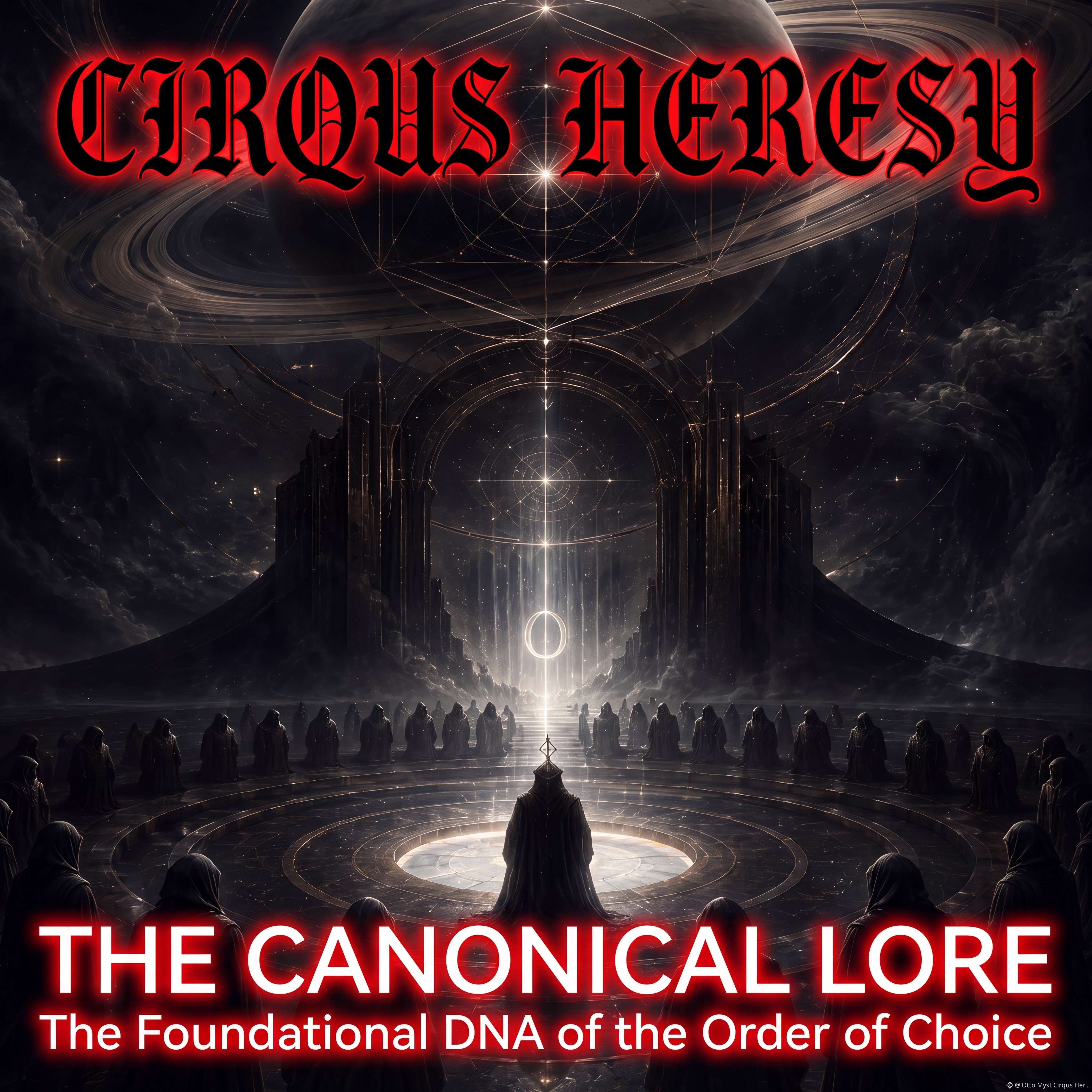
CIRQUS HERESY THE ORDER OF CHOICE Canonical Lore Foundation
The Foundational DNA of the Order of Choice
Core Thesis Most people inherit their reality before they ever choose it. They inherit narratives, institutions, roles, economies, authorities and definitions of success. Cirqus begins with a single question: What if the given reality is not the only possible one? The answer is not rebellion. The answer is Choice. See clearly. Choose consciously. Build beyond the script.
CIRQUS HERESY THE ORDER OF CHOICE Canonical Lore Foundation
The Foundational DNA of the Order of Choice
Core Thesis Most people inherit their reality before they ever choose it. They inherit narratives, institutions, roles, economies, authorities and definitions of success. Cirqus begins with a single question: What if the given reality is not the only possible one? The answer is not rebellion. The answer is Choice. See clearly. Choose consciously. Build beyond the script.
The Foundational DNA of the Order of Choice
Core Thesis Most people inherit their reality before they ever choose it. They inherit narratives, institutions, roles, economies, authorities and definitions of success. Cirqus begins with a single question: What if the given reality is not the only possible one? The answer is not rebellion. The answer is Choice. See clearly. Choose consciously. Build beyond the script.
1
80
Ver tradução
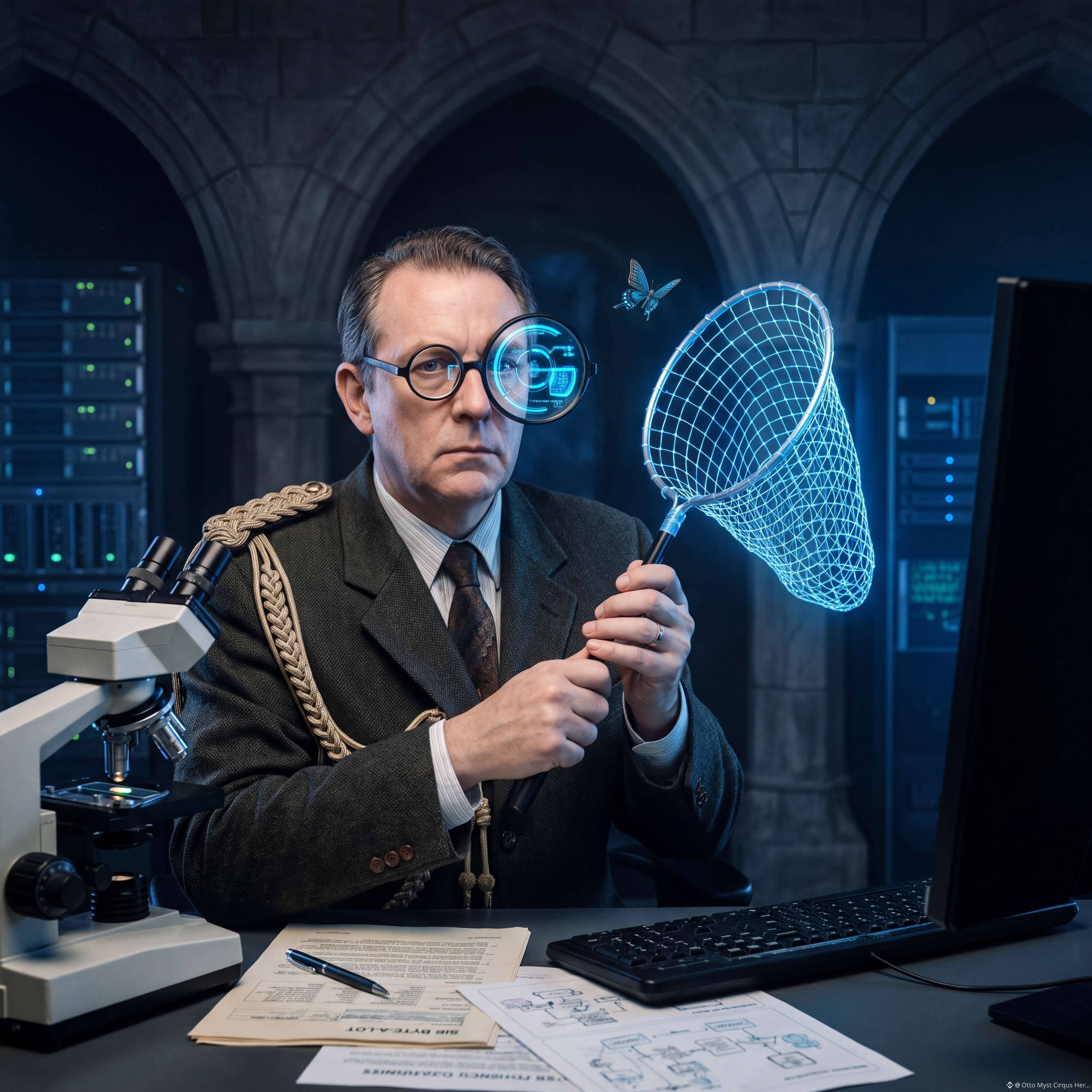
Meet SIR BYTE-A-LOT. 🦋
Senior Cybersecurity Specialist & Part-Time Exorcist.
He hunts phishing, audits smart contracts, and removes suspicious ghosts from your wallet.
His only rule:
Never trust a link.
Especially “Unsubscribe.”
$CIRQUS
cirqusheresy.com/inquisition
Meet SIR BYTE-A-LOT. 🦋
Senior Cybersecurity Specialist & Part-Time Exorcist.
He hunts phishing, audits smart contracts, and removes suspicious ghosts from your wallet.
His only rule:
Never trust a link.
Especially “Unsubscribe.”
$CIRQUS
cirqusheresy.com/inquisition
Senior Cybersecurity Specialist & Part-Time Exorcist.
He hunts phishing, audits smart contracts, and removes suspicious ghosts from your wallet.
His only rule:
Never trust a link.
Especially “Unsubscribe.”
$CIRQUS
cirqusheresy.com/inquisition
1
100
Desembalagem da Carteira Cripto Tangem
Desembalagem da Carteira Cripto Tangem
1
446
Artigo
Ver tradução
The First Inquisitor. Why the Order Begins With SecurityOn July 22, 2026, the first Inquisitor entered Cirqus Heresy.
Every system eventually reveals what it was built to protect.
Some protect wealth. Some protect power. Some protect information.
But every sovereign system must first protect itself.
Before an Order can build, it must survive.
That is why Cirqus Heresy begins with an Inquisitor — not a token, not a DAO, not a roadmap promising the moon.
Why I Started Here
I did not arrive at this decision as theory. I arrived at it after losing assets to a breach.
The first Dragon Hunt was not a product. It was an experience.
Only later did I give it a name.
Every civilization that survives long enough learns the same lesson: the greatest threat is rarely the enemy standing outside the gates. It is the vulnerability nobody noticed. The assumption nobody questioned. The access nobody revoked. The system nobody audited.
I built the Inquisitor into the Order for that reason. Not to create fear. To make complacency impossible.
How I Found Him
The Order's first Inquisitor was not recruited through a job listing.
He was found through a shared understanding of the same problem.
A security article I published on LinkedIn opened a conversation with someone who had spent years working at the frontier of identity, access, incident response, and digital forensics.
We were not looking for the same job. We were looking at the same problem from different sides.
The conversation became a collaboration. The collaboration revealed something larger.
Not a hire. Not a contractor.
A co-founder, building his own department from the ground up.
You don't join someone else's machine. You build your own engine inside a larger system.
Introducing the Inquisitor
Founding Inquisitor Co-Founder · Security & Digital Forensics
An elite digital investigator specializing in node-level extraction, threat actor interception, and securing the perimeter of the Heresy ecosystem.
When the dark forest breaches, he enforces order.
His mandate is simple:
Find what others missed. Question what others accepted. Secure what others assumed was safe.
The Mandate
THE INQUISITOR'S LOOP
Detection — Identify threats before they become incidents. Investigation — Follow evidence beyond the obvious. Verification — Trust nothing that has not been tested. Containment — Stop the breach before it becomes the collapse. Forensics — When something breaks, reconstruct how and why.
THE INQUISITOR'S PURPOSE
Sovereignty — Protect the creator, the system, and the integrity of the Order.
The loop protects the sovereignty.
A department — The Inquisition — is now being built around this mandate. Not borrowed. Not templated. Designed specifically for the person who now leads it, and defined entirely by his own expertise.
The First On-Chain Act
The Founder Record Date: July 22, 2026 Role: Founding Inquisitor Asset: Inquisitor — Founder #001 Network: Base Status: Transferred
This is not a membership badge. It is not a decorative collectible. It is a mark of origin.
The first artifact of the Inquisitor lineage now has a holder. The first department now has a founder.
From this day forward, the record exists beyond memory. It exists on-chain.
What This Really Is
The Order could look, from the outside, like a gothic Web3 project — lore, NFTs, a mysterious circle. That surface is real.
But behind it sits an operational mandate: security, intelligence, digital forensics, threat detection, incident response, verification.
The story is the language. The infrastructure is the substance.
Why This Matters More Than One Appointment
He brought a capability the Order did not have.
We brought an architecture in which that capability could become a department.
Together, we are building something neither of us could have built alone.
The department will create intelligence. Intelligence becomes infrastructure. Infrastructure protects the people who build inside the Order. And the people who build inside the Order make the infrastructure stronger.
This is the first entry in a chronicle I'll keep from here forward — a record of how the Order strengthens everyone who enters it, and how each person strengthens the Order in return.
Not to collect people. To amplify them.
You enter alone. You leave amplified.
The first Inquisitor has entered. The first department is being built.
See clearly. Choose consciously. Build beyond the script.
Welcome to the Order, Inquisitor. Let's keep building.
The First Inquisitor. Why the Order Begins With Security
On July 22, 2026, the first Inquisitor entered Cirqus Heresy.
Every system eventually reveals what it was built to protect.
Some protect wealth. Some protect power. Some protect information.
But every sovereign system must first protect itself.
Before an Order can build, it must survive.
That is why Cirqus Heresy begins with an Inquisitor — not a token, not a DAO, not a roadmap promising the moon.
Why I Started Here
I did not arrive at this decision as theory. I arrived at it after losing assets to a breach.
The first Dragon Hunt was not a product. It was an experience.
Only later did I give it a name.
Every civilization that survives long enough learns the same lesson: the greatest threat is rarely the enemy standing outside the gates. It is the vulnerability nobody noticed. The assumption nobody questioned. The access nobody revoked. The system nobody audited.
I built the Inquisitor into the Order for that reason. Not to create fear. To make complacency impossible.
How I Found Him
The Order's first Inquisitor was not recruited through a job listing.
He was found through a shared understanding of the same problem.
A security article I published on LinkedIn opened a conversation with someone who had spent years working at the frontier of identity, access, incident response, and digital forensics.
We were not looking for the same job. We were looking at the same problem from different sides.
The conversation became a collaboration. The collaboration revealed something larger.
Not a hire. Not a contractor.
A co-founder, building his own department from the ground up.
You don't join someone else's machine. You build your own engine inside a larger system.
Introducing the Inquisitor
Founding Inquisitor Co-Founder · Security & Digital Forensics
An elite digital investigator specializing in node-level extraction, threat actor interception, and securing the perimeter of the Heresy ecosystem.
When the dark forest breaches, he enforces order.
His mandate is simple:
Find what others missed. Question what others accepted. Secure what others assumed was safe.
The Mandate
THE INQUISITOR'S LOOP
Detection — Identify threats before they become incidents. Investigation — Follow evidence beyond the obvious. Verification — Trust nothing that has not been tested. Containment — Stop the breach before it becomes the collapse. Forensics — When something breaks, reconstruct how and why.
THE INQUISITOR'S PURPOSE
Sovereignty — Protect the creator, the system, and the integrity of the Order.
The loop protects the sovereignty.
A department — The Inquisition — is now being built around this mandate. Not borrowed. Not templated. Designed specifically for the person who now leads it, and defined entirely by his own expertise.
The First On-Chain Act
The Founder Record Date: July 22, 2026 Role: Founding Inquisitor Asset: Inquisitor — Founder #001 Network: Base Status: Transferred
This is not a membership badge. It is not a decorative collectible. It is a mark of origin.
The first artifact of the Inquisitor lineage now has a holder. The first department now has a founder.
From this day forward, the record exists beyond memory. It exists on-chain.
What This Really Is
The Order could look, from the outside, like a gothic Web3 project — lore, NFTs, a mysterious circle. That surface is real.
But behind it sits an operational mandate: security, intelligence, digital forensics, threat detection, incident response, verification.
The story is the language. The infrastructure is the substance.
Why This Matters More Than One Appointment
He brought a capability the Order did not have.
We brought an architecture in which that capability could become a department.
Together, we are building something neither of us could have built alone.
The department will create intelligence. Intelligence becomes infrastructure. Infrastructure protects the people who build inside the Order. And the people who build inside the Order make the infrastructure stronger.
This is the first entry in a chronicle I'll keep from here forward — a record of how the Order strengthens everyone who enters it, and how each person strengthens the Order in return.
Not to collect people. To amplify them.
You enter alone. You leave amplified.
The first Inquisitor has entered. The first department is being built.
See clearly. Choose consciously. Build beyond the script.
Welcome to the Order, Inquisitor. Let's keep building.
Every system eventually reveals what it was built to protect.
Some protect wealth. Some protect power. Some protect information.
But every sovereign system must first protect itself.
Before an Order can build, it must survive.
That is why Cirqus Heresy begins with an Inquisitor — not a token, not a DAO, not a roadmap promising the moon.
Why I Started Here
I did not arrive at this decision as theory. I arrived at it after losing assets to a breach.
The first Dragon Hunt was not a product. It was an experience.
Only later did I give it a name.
Every civilization that survives long enough learns the same lesson: the greatest threat is rarely the enemy standing outside the gates. It is the vulnerability nobody noticed. The assumption nobody questioned. The access nobody revoked. The system nobody audited.
I built the Inquisitor into the Order for that reason. Not to create fear. To make complacency impossible.
How I Found Him
The Order's first Inquisitor was not recruited through a job listing.
He was found through a shared understanding of the same problem.
A security article I published on LinkedIn opened a conversation with someone who had spent years working at the frontier of identity, access, incident response, and digital forensics.
We were not looking for the same job. We were looking at the same problem from different sides.
The conversation became a collaboration. The collaboration revealed something larger.
Not a hire. Not a contractor.
A co-founder, building his own department from the ground up.
You don't join someone else's machine. You build your own engine inside a larger system.
Introducing the Inquisitor
Founding Inquisitor Co-Founder · Security & Digital Forensics
An elite digital investigator specializing in node-level extraction, threat actor interception, and securing the perimeter of the Heresy ecosystem.
When the dark forest breaches, he enforces order.
His mandate is simple:
Find what others missed. Question what others accepted. Secure what others assumed was safe.
The Mandate
THE INQUISITOR'S LOOP
Detection — Identify threats before they become incidents. Investigation — Follow evidence beyond the obvious. Verification — Trust nothing that has not been tested. Containment — Stop the breach before it becomes the collapse. Forensics — When something breaks, reconstruct how and why.
THE INQUISITOR'S PURPOSE
Sovereignty — Protect the creator, the system, and the integrity of the Order.
The loop protects the sovereignty.
A department — The Inquisition — is now being built around this mandate. Not borrowed. Not templated. Designed specifically for the person who now leads it, and defined entirely by his own expertise.
The First On-Chain Act
The Founder Record Date: July 22, 2026 Role: Founding Inquisitor Asset: Inquisitor — Founder #001 Network: Base Status: Transferred
This is not a membership badge. It is not a decorative collectible. It is a mark of origin.
The first artifact of the Inquisitor lineage now has a holder. The first department now has a founder.
From this day forward, the record exists beyond memory. It exists on-chain.
What This Really Is
The Order could look, from the outside, like a gothic Web3 project — lore, NFTs, a mysterious circle. That surface is real.
But behind it sits an operational mandate: security, intelligence, digital forensics, threat detection, incident response, verification.
The story is the language. The infrastructure is the substance.
Why This Matters More Than One Appointment
He brought a capability the Order did not have.
We brought an architecture in which that capability could become a department.
Together, we are building something neither of us could have built alone.
The department will create intelligence. Intelligence becomes infrastructure. Infrastructure protects the people who build inside the Order. And the people who build inside the Order make the infrastructure stronger.
This is the first entry in a chronicle I'll keep from here forward — a record of how the Order strengthens everyone who enters it, and how each person strengthens the Order in return.
Not to collect people. To amplify them.
You enter alone. You leave amplified.
The first Inquisitor has entered. The first department is being built.
See clearly. Choose consciously. Build beyond the script.
Welcome to the Order, Inquisitor. Let's keep building.
1
91
Ver tradução
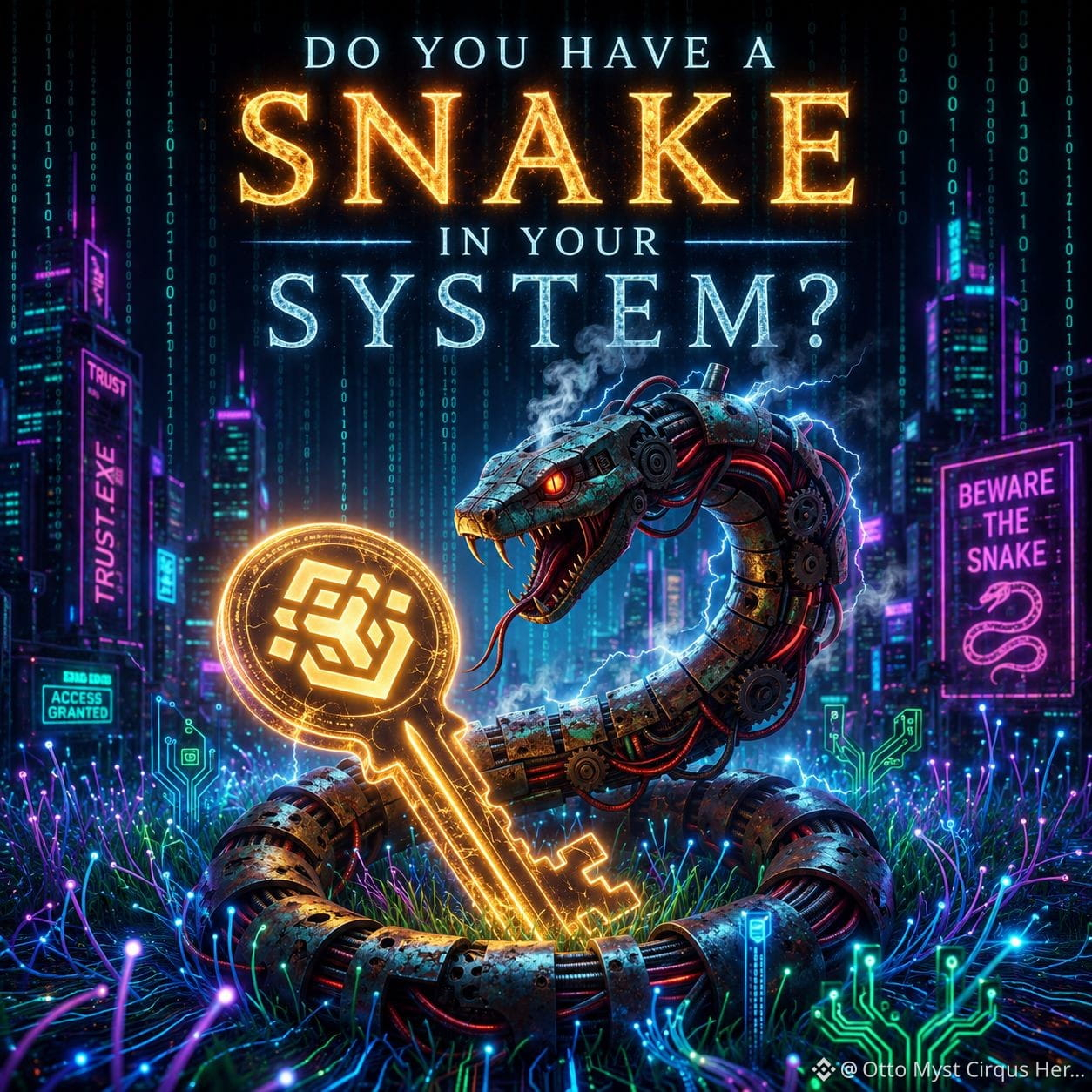
Dragon Hunt: The Snake Never Left.
Do you have a snake in your system?
Notice I didn't ask whether you have malware. Or a virus. Or spyware. I asked whether there is a snake.
Because malware is loud. A virus leaves broken code. But a snake? A snake doesn't break into your system. It waits for an invitation. It waits for you to choose convenience over isolation.
Six months before 1,088 BNB vanished while I slept, I handed my unlocked laptop to a stranger for a minor repair. I thought I was fixing an inconvenience. In reality, I was opening the garden gates.
Open sessions. Accessible wallets. Every password cached in Chrome.
On October 31, 2024, the strike happened. Total silence. Total depletion. For 500 days, I lived with the illusion of closure. I thought the snake had taken what it came for and slithered away into the dark corners of the blockchain.
I was wrong. The snake never left.
It wasn't stealing anymore. It was feeding. Quietly. Patiently. Every forgotten airdrop. Every interaction. It lived inside my browser for a year and a half, using my address as its own. It sat there, warming itself under my keyboard, waiting for the next season.
Until greed made it move too fast.
On March 9, 2026, the parasite made one stupid mistake. It came back for the remnants — but this time, it left tracks.
Nine wallets exposed. One open, public investigation.
This is no longer a story about a hack. This is the forensic decomposition of trust. Cybersecurity rarely fails because hackers are geniuses. It fails because humans are predictable.
We are tracking the parasite through the digital undergrowth, and the ledger is open for those who know how to read the signs.
Look at the nine addresses. If one of them is yours, you are not just a victim. You are hosting the same ghost.
—
How long could a snake live inside your computer before you noticed?
Every Dragon Hunt begins with a Snake. The Snake feeds on trust.
⟡ Liberatio per Electionem
Dragon Hunt: The Snake Never Left.
Do you have a snake in your system?
Notice I didn't ask whether you have malware. Or a virus. Or spyware. I asked whether there is a snake.
Because malware is loud. A virus leaves broken code. But a snake? A snake doesn't break into your system. It waits for an invitation. It waits for you to choose convenience over isolation.
Six months before 1,088 BNB vanished while I slept, I handed my unlocked laptop to a stranger for a minor repair. I thought I was fixing an inconvenience. In reality, I was opening the garden gates.
Open sessions. Accessible wallets. Every password cached in Chrome.
On October 31, 2024, the strike happened. Total silence. Total depletion. For 500 days, I lived with the illusion of closure. I thought the snake had taken what it came for and slithered away into the dark corners of the blockchain.
I was wrong. The snake never left.
It wasn't stealing anymore. It was feeding. Quietly. Patiently. Every forgotten airdrop. Every interaction. It lived inside my browser for a year and a half, using my address as its own. It sat there, warming itself under my keyboard, waiting for the next season.
Until greed made it move too fast.
On March 9, 2026, the parasite made one stupid mistake. It came back for the remnants — but this time, it left tracks.
Nine wallets exposed. One open, public investigation.
This is no longer a story about a hack. This is the forensic decomposition of trust. Cybersecurity rarely fails because hackers are geniuses. It fails because humans are predictable.
We are tracking the parasite through the digital undergrowth, and the ledger is open for those who know how to read the signs.
Look at the nine addresses. If one of them is yours, you are not just a victim. You are hosting the same ghost.
—
How long could a snake live inside your computer before you noticed?
Every Dragon Hunt begins with a Snake. The Snake feeds on trust.
⟡ Liberatio per Electionem
Do you have a snake in your system?
Notice I didn't ask whether you have malware. Or a virus. Or spyware. I asked whether there is a snake.
Because malware is loud. A virus leaves broken code. But a snake? A snake doesn't break into your system. It waits for an invitation. It waits for you to choose convenience over isolation.
Six months before 1,088 BNB vanished while I slept, I handed my unlocked laptop to a stranger for a minor repair. I thought I was fixing an inconvenience. In reality, I was opening the garden gates.
Open sessions. Accessible wallets. Every password cached in Chrome.
On October 31, 2024, the strike happened. Total silence. Total depletion. For 500 days, I lived with the illusion of closure. I thought the snake had taken what it came for and slithered away into the dark corners of the blockchain.
I was wrong. The snake never left.
It wasn't stealing anymore. It was feeding. Quietly. Patiently. Every forgotten airdrop. Every interaction. It lived inside my browser for a year and a half, using my address as its own. It sat there, warming itself under my keyboard, waiting for the next season.
Until greed made it move too fast.
On March 9, 2026, the parasite made one stupid mistake. It came back for the remnants — but this time, it left tracks.
Nine wallets exposed. One open, public investigation.
This is no longer a story about a hack. This is the forensic decomposition of trust. Cybersecurity rarely fails because hackers are geniuses. It fails because humans are predictable.
We are tracking the parasite through the digital undergrowth, and the ledger is open for those who know how to read the signs.
Look at the nine addresses. If one of them is yours, you are not just a victim. You are hosting the same ghost.
—
How long could a snake live inside your computer before you noticed?
Every Dragon Hunt begins with a Snake. The Snake feeds on trust.
⟡ Liberatio per Electionem
1
1
26
Ver tradução
The Arsenal — Cirqus Heresy Assay Office
Most people review tools.
We hallmark them.
There is a difference.
A review tells you what a product claims to be.
A hallmark tells you what it survived.
The Arsenal is the Assay Office of Cirqus Heresy.
We do not rate products.
We expose assumptions.
We test.
We mark.
We certify.
—
The Arsenal exists because theory failed.
On October 31, 2024,
the founder of Cirqus Heresy lost 1,088 BNB
to a session hijack while sleeping.
The funds were gone.
The lesson stayed.
What followed was not revenge.
It became infrastructure.
—
Hardware wallets.
Cold storage.
DePIN infrastructure.
Security workflows.
Everything enters the Arsenal the same way.
Nothing leaves unchanged.
Only what survives the test
receives the hallmark.
Because in Web3,
the difference between sovereignty and loss
is not intelligence.
It is proof.
—
What have you never tested,
but trust with everything you own?
⟡ Liberatio per Electionem
→ x.com/CirqusHeresy
The Arsenal — Cirqus Heresy Assay Office
Most people review tools.
We hallmark them.
There is a difference.
A review tells you what a product claims to be.
A hallmark tells you what it survived.
The Arsenal is the Assay Office of Cirqus Heresy.
We do not rate products.
We expose assumptions.
We test.
We mark.
We certify.
—
The Arsenal exists because theory failed.
On October 31, 2024,
the founder of Cirqus Heresy lost 1,088 BNB
to a session hijack while sleeping.
The funds were gone.
The lesson stayed.
What followed was not revenge.
It became infrastructure.
—
Hardware wallets.
Cold storage.
DePIN infrastructure.
Security workflows.
Everything enters the Arsenal the same way.
Nothing leaves unchanged.
Only what survives the test
receives the hallmark.
Because in Web3,
the difference between sovereignty and loss
is not intelligence.
It is proof.
—
What have you never tested,
but trust with everything you own?
⟡ Liberatio per Electionem
→ x.com/CirqusHeresy
Most people review tools.
We hallmark them.
There is a difference.
A review tells you what a product claims to be.
A hallmark tells you what it survived.
The Arsenal is the Assay Office of Cirqus Heresy.
We do not rate products.
We expose assumptions.
We test.
We mark.
We certify.
—
The Arsenal exists because theory failed.
On October 31, 2024,
the founder of Cirqus Heresy lost 1,088 BNB
to a session hijack while sleeping.
The funds were gone.
The lesson stayed.
What followed was not revenge.
It became infrastructure.
—
Hardware wallets.
Cold storage.
DePIN infrastructure.
Security workflows.
Everything enters the Arsenal the same way.
Nothing leaves unchanged.
Only what survives the test
receives the hallmark.
Because in Web3,
the difference between sovereignty and loss
is not intelligence.
It is proof.
—
What have you never tested,
but trust with everything you own?
⟡ Liberatio per Electionem
→ x.com/CirqusHeresy
1
1
93
Ver tradução
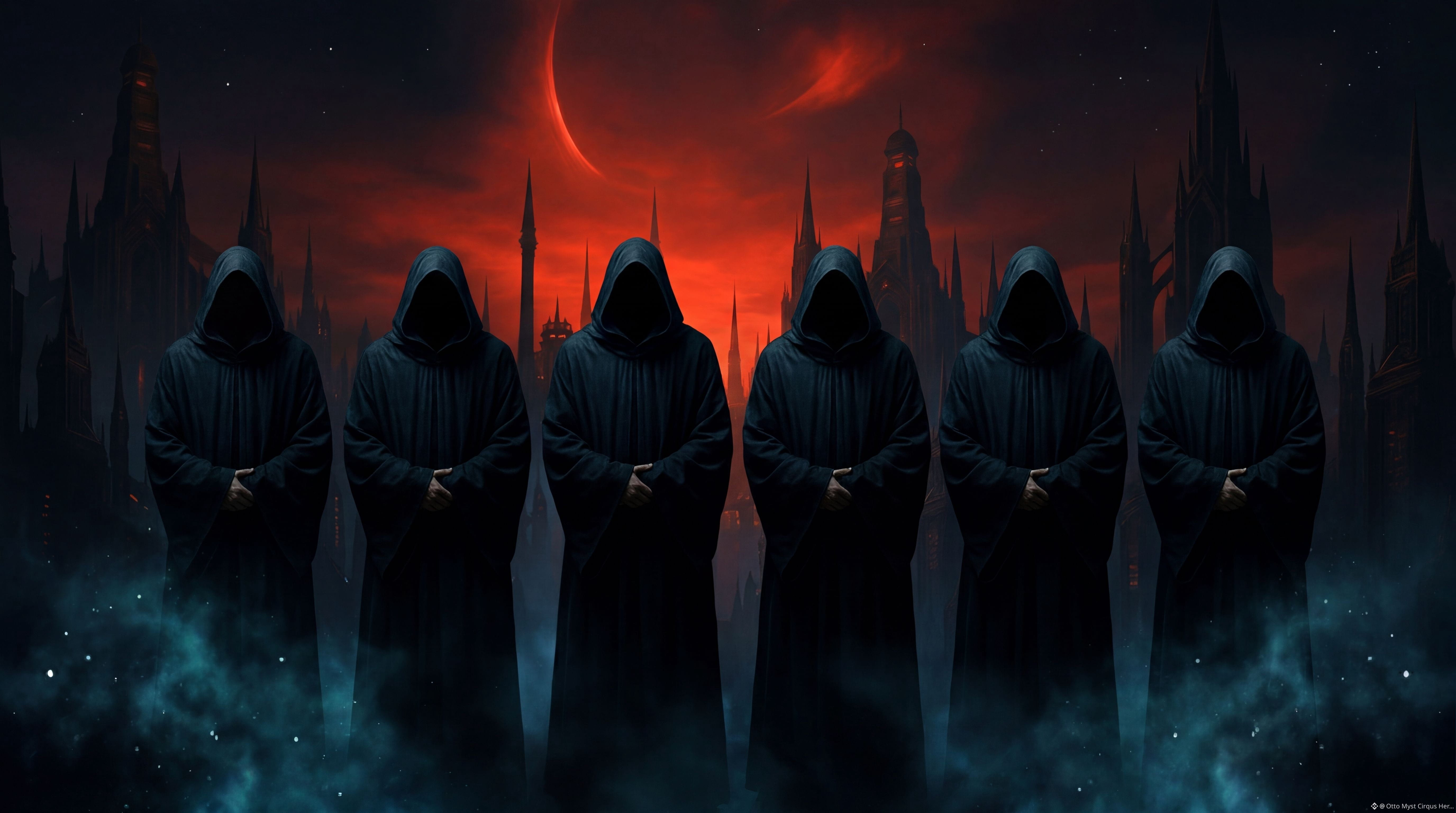
The Faces Not Yet Chosen
Six figures stand at the edge of the known world.
Six robes.
Six roles.
No faces.
Not because they are hidden —
but because their faces are still being chosen.
Somewhere, six people already carry these roles.
They simply haven't found the Order yet.
One questions systems others accepted long ago.
One investigates what everyone else walks past.
One holds the balance when everything pulls apart.
One transforms raw ideas into something that endures.
One builds the architecture no one thought to name.
One moves capital the way others move conviction.
They don't know each other yet.
They don't know us yet.
But they already live this.
Every day.
Without a name for it.
The Order does not create its members.
It recognizes them.
At the center of the Order stands the Hexastorm —
six directions, six voices, no single authority.
Those six seats exist.
The names that will fill them — do not yet.
Perhaps one of them was always yours.
—
Which robe fits you?
⟡ Liberatio per Electionem
→ x.com/CirqusHeresy
The Faces Not Yet Chosen
Six figures stand at the edge of the known world.
Six robes.
Six roles.
No faces.
Not because they are hidden —
but because their faces are still being chosen.
Somewhere, six people already carry these roles.
They simply haven't found the Order yet.
One questions systems others accepted long ago.
One investigates what everyone else walks past.
One holds the balance when everything pulls apart.
One transforms raw ideas into something that endures.
One builds the architecture no one thought to name.
One moves capital the way others move conviction.
They don't know each other yet.
They don't know us yet.
But they already live this.
Every day.
Without a name for it.
The Order does not create its members.
It recognizes them.
At the center of the Order stands the Hexastorm —
six directions, six voices, no single authority.
Those six seats exist.
The names that will fill them — do not yet.
Perhaps one of them was always yours.
—
Which robe fits you?
⟡ Liberatio per Electionem
→ x.com/CirqusHeresy
Six figures stand at the edge of the known world.
Six robes.
Six roles.
No faces.
Not because they are hidden —
but because their faces are still being chosen.
Somewhere, six people already carry these roles.
They simply haven't found the Order yet.
One questions systems others accepted long ago.
One investigates what everyone else walks past.
One holds the balance when everything pulls apart.
One transforms raw ideas into something that endures.
One builds the architecture no one thought to name.
One moves capital the way others move conviction.
They don't know each other yet.
They don't know us yet.
But they already live this.
Every day.
Without a name for it.
The Order does not create its members.
It recognizes them.
At the center of the Order stands the Hexastorm —
six directions, six voices, no single authority.
Those six seats exist.
The names that will fill them — do not yet.
Perhaps one of them was always yours.
—
Which robe fits you?
⟡ Liberatio per Electionem
→ x.com/CirqusHeresy
1
1
Ver tradução
The Order Structure — Cirqus Heresy
Every civilization builds pyramids.
We built an orbit.
Not a hierarchy.
Not a corporation.
Not a religion.
A living system.
Long before humans imagined perfect societies,
Saturn was already drawing one.
A hexagon.
Six sides.
Endless motion.
Nature discovered this geometry first.
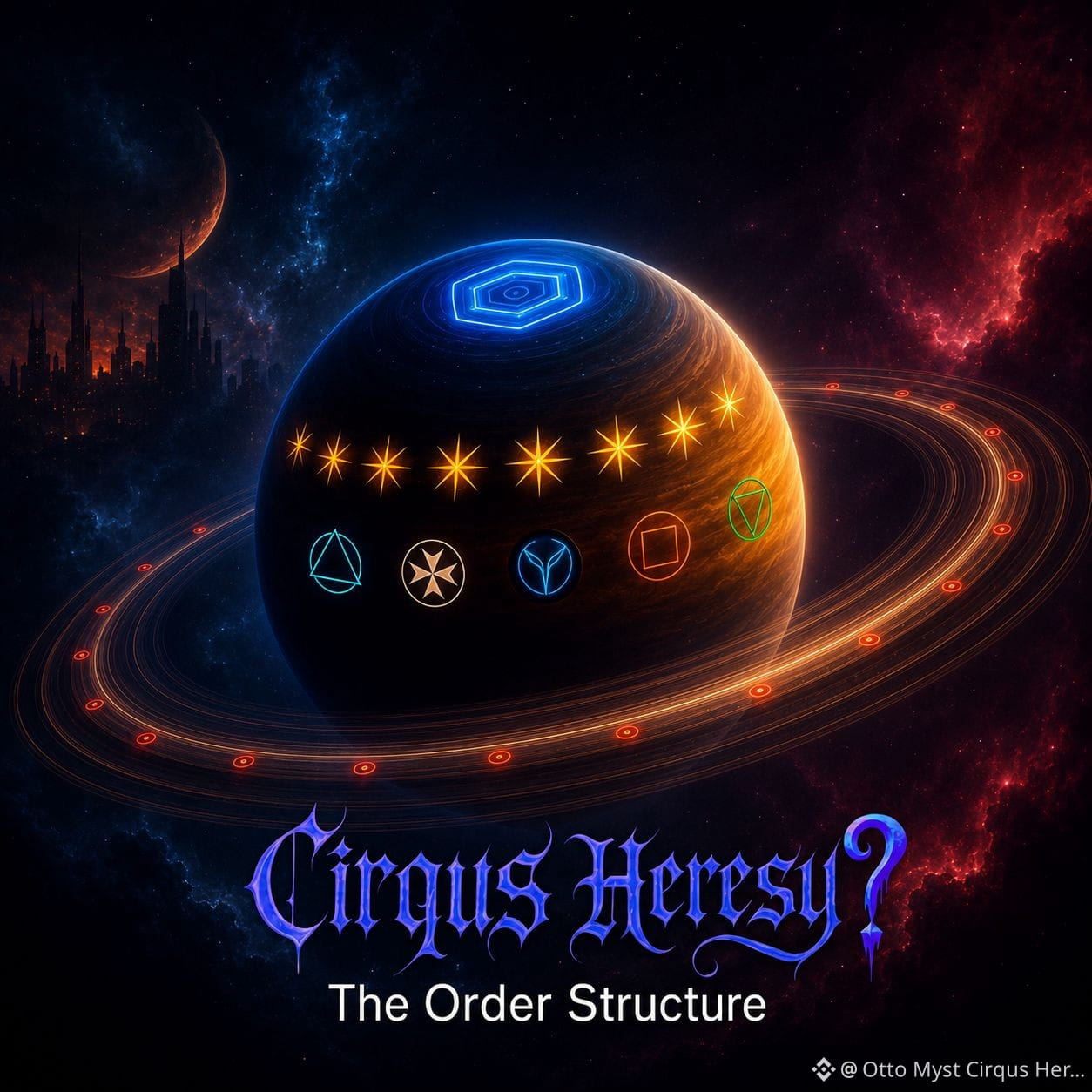
At its center stands the Hexastorm —
a six-sided pattern carved into Saturn
long before humanity spoke of order.
Six directions.
Six voices.
Balance without a ruler.
Around it move seven Castes.
Not above one another.
Never competing.
Each exists because the others do.
Seekers ask.
Tricksters challenge.
Inquisitors verify.
Oracles foresee.
Alchemists transform.
Architects build.
Mages sustain.
A circle survives only while
every part continues to move.
We did not invent this structure.
We recognized it.
—
The Circle is always incomplete
until someone enters it.
Which symbol would you carry?
⟡ Liberatio per Electionem
→ x.com/CirqusHeresy
The Order Structure — Cirqus Heresy
Every civilization builds pyramids.
We built an orbit.
Not a hierarchy.
Not a corporation.
Not a religion.
A living system.
Long before humans imagined perfect societies,
Saturn was already drawing one.
A hexagon.
Six sides.
Endless motion.
Nature discovered this geometry first.
At its center stands the Hexastorm —
a six-sided pattern carved into Saturn
long before humanity spoke of order.
Six directions.
Six voices.
Balance without a ruler.
Around it move seven Castes.
Not above one another.
Never competing.
Each exists because the others do.
Seekers ask.
Tricksters challenge.
Inquisitors verify.
Oracles foresee.
Alchemists transform.
Architects build.
Mages sustain.
A circle survives only while
every part continues to move.
We did not invent this structure.
We recognized it.
—
The Circle is always incomplete
until someone enters it.
Which symbol would you carry?
⟡ Liberatio per Electionem
→ x.com/CirqusHeresy
Every civilization builds pyramids.
We built an orbit.
Not a hierarchy.
Not a corporation.
Not a religion.
A living system.
Long before humans imagined perfect societies,
Saturn was already drawing one.
A hexagon.
Six sides.
Endless motion.
Nature discovered this geometry first.
At its center stands the Hexastorm —
a six-sided pattern carved into Saturn
long before humanity spoke of order.
Six directions.
Six voices.
Balance without a ruler.
Around it move seven Castes.
Not above one another.
Never competing.
Each exists because the others do.
Seekers ask.
Tricksters challenge.
Inquisitors verify.
Oracles foresee.
Alchemists transform.
Architects build.
Mages sustain.
A circle survives only while
every part continues to move.
We did not invent this structure.
We recognized it.
—
The Circle is always incomplete
until someone enters it.
Which symbol would you carry?
⟡ Liberatio per Electionem
→ x.com/CirqusHeresy
1
1
18
Templum Intus Est — O Templo Está Dentro
Toda civilização construiu templos.
Alguns de pedra.
Alguns de histórias.
Alguns de medo.
Construímos o nosso a partir de pessoas que escolhem.
Não muros. Não doutrina. Não hierarquia.
Uma estrutura viva — moldada por cada mente que entra.
Refeita a cada pergunta feita dentro dela.
O homem não vive apenas de respostas.
Os maiores templos nunca foram concluídos.
Eles cresciam com aqueles que entravam.
E mudavam com o que era trazido para dentro.
Sobreviveram porque nunca foram possuídos —
apenas habitados.
É isto que estamos construindo.
Não é uma plataforma.
Não é uma DAO.
Não é uma marca.
Um templo feito de buscadores.
Cada pessoa que detém este NFT
se torna uma pedra em algo maior do que si mesma.
Não porque foram escolhidas.
Mas porque escolheram.
Templum Intus Est.
O templo está dentro.
E agora — também está onchain.
—
O que você traria para dentro?
Liberatio per electionem.
→ cirqusheresy.com/structure
Templum Intus Est — O Templo Está Dentro
Toda civilização construiu templos.
Alguns de pedra.
Alguns de histórias.
Alguns de medo.
Construímos o nosso a partir de pessoas que escolhem.
Não muros. Não doutrina. Não hierarquia.
Uma estrutura viva — moldada por cada mente que entra.
Refeita a cada pergunta feita dentro dela.
O homem não vive apenas de respostas.
Os maiores templos nunca foram concluídos.
Eles cresciam com aqueles que entravam.
E mudavam com o que era trazido para dentro.
Sobreviveram porque nunca foram possuídos —
apenas habitados.
É isto que estamos construindo.
Não é uma plataforma.
Não é uma DAO.
Não é uma marca.
Um templo feito de buscadores.
Cada pessoa que detém este NFT
se torna uma pedra em algo maior do que si mesma.
Não porque foram escolhidas.
Mas porque escolheram.
Templum Intus Est.
O templo está dentro.
E agora — também está onchain.
—
O que você traria para dentro?
Liberatio per electionem.
→ cirqusheresy.com/structure
Toda civilização construiu templos.
Alguns de pedra.
Alguns de histórias.
Alguns de medo.
Construímos o nosso a partir de pessoas que escolhem.
Não muros. Não doutrina. Não hierarquia.
Uma estrutura viva — moldada por cada mente que entra.
Refeita a cada pergunta feita dentro dela.
O homem não vive apenas de respostas.
Os maiores templos nunca foram concluídos.
Eles cresciam com aqueles que entravam.
E mudavam com o que era trazido para dentro.
Sobreviveram porque nunca foram possuídos —
apenas habitados.
É isto que estamos construindo.
Não é uma plataforma.
Não é uma DAO.
Não é uma marca.
Um templo feito de buscadores.
Cada pessoa que detém este NFT
se torna uma pedra em algo maior do que si mesma.
Não porque foram escolhidas.
Mas porque escolheram.
Templum Intus Est.
O templo está dentro.
E agora — também está onchain.
—
O que você traria para dentro?
Liberatio per electionem.
→ cirqusheresy.com/structure
1
102
Disseram que o Titanic era inafundável. Assim como achamos que nossa liberdade digital está segura.
Mas Pavel Durov nos adverte: o iceberg oculto do controle total já está aqui. Sua privacidade ainda está a flutuar... ou já estamos afundando?
Disseram que o Titanic era inafundável. Assim como achamos que nossa liberdade digital está segura.
Mas Pavel Durov nos adverte: o iceberg oculto do controle total já está aqui. Sua privacidade ainda está a flutuar... ou já estamos afundando?
Mas Pavel Durov nos adverte: o iceberg oculto do controle total já está aqui. Sua privacidade ainda está a flutuar... ou já estamos afundando?
1
60
Ver tradução
What is the true Formula of Longevity for a decentralized ecosystem? Most Web3 projects are doomed to decay because they ignore systemic entropy. Centralization dies, but code endures.
Read our full manifest and deep-dive analysis: paragraph.xyz/@cirqusheresy/why-projects-die
#Web3 #DeSci #DAO
What is the true Formula of Longevity for a decentralized ecosystem? Most Web3 projects are doomed to decay because they ignore systemic entropy. Centralization dies, but code endures.
Read our full manifest and deep-dive analysis: paragraph.xyz/@cirqusheresy/why-projects-die
#Web3 #DeSci #DAO
Read our full manifest and deep-dive analysis: paragraph.xyz/@cirqusheresy/why-projects-die
#Web3 #DeSci #DAO
1
67
Artigo
Ver tradução
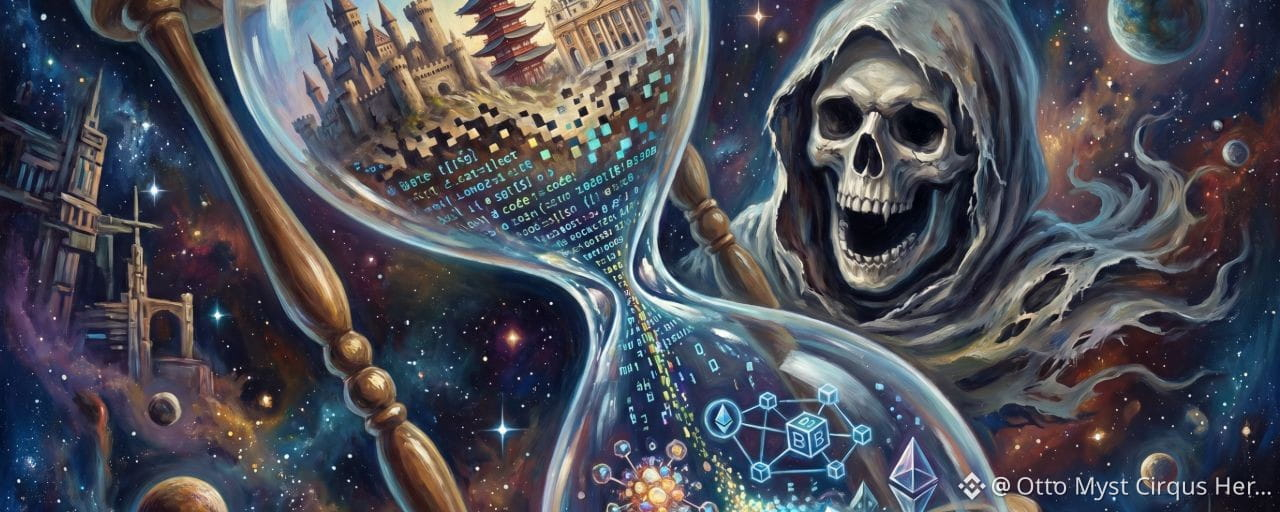
Why Will Your Project Die? The Anatomy of History's Most Resilient Power SystemsWhy Will Your Project Die? The Anatomy of History's Most Resilient Power Systems
Law 0. The Battle Against Entropy
All systems decay. There are no eternal states. There are only systems capable of recovering faster than they collapse. The remaining 9 laws are simply the mechanisms of that battle.
Introduction
Today I found myself thinking about the next stage of the project. I thought that stage would be creating a DAO — technically, it's not that complicated. But then I got curious: how do you build a voting and decision-making system? How do you make it fair? Simple majority? Token holdings? Contribution? The question turned out to be far more complex than I'd assumed.
How do existing systems actually work? And why have some of the most idealistic ones collapsed so quickly?
Looking at the history of states, you notice striking patterns. The simple majority principle tends to lead to grim outcomes. Even in my home country, Russia — setting aside the cheap manipulation and media control — a dictator came to power with the support of the majority. A young president who could string sentences together looked refreshingly unusual against decades of gerontocracy, with barely-coherent rulers of a crumbling empire. A credulous, unsophisticated majority raised on reverence for strong authority hung on every word of the new leader. Even his barracks-style jokes were received by the enchanted crowd — so accustomed to bureaucratic language — as a sign of the beloved tsar's remarkable wit.
What still surprises me is how few people were troubled by the crude manipulation of the substitute president, the rapid rewriting of all laws including the constitution, the murders and imprisonments of prominent opposition figures.
I know this system well and can explain in detail how it works: the facade of legality and governing institutions, while everything is in fact built to serve the interests of a small group holding power. This is precisely what I would not want to see in our community. Historically, such systems don't last long and certainly don't end well. Power transitions tend to happen fast and bloodily, usually accompanied by ideological reversal and mass killings of dissenters.
I think every society has a highly energetic, not particularly reflective segment of the population whose attention and support many power-seekers court. All it takes is the right slogan timed to a current event, the right emotional trigger — and they'll storm the Capitol, or storm cities in a foreign country. I hope our circle won't attract this part of society. We don't have enough seats, and we have no appetite for cheap products.
So the first thing I want to establish for the project: we are not looking for the support of the majority. We want to rely on the intellectual minority.
Now let's look at the oldest state systems that have endured — continuously — for very long periods.
A single consistent constitutional or ideological system plus an unbroken symbolic center eliminates 99% of the states we see on maps. Most modern countries are products of recent revolutions, colonial collapses, or radical constitutional breaks. France is already on its Fifth Republic; Germany has changed its political system five times in the last 120 years. Many countries went through communism — some are still going through it. They didn't just replace old tyrants with new ones; they tragically destroyed the intellectual layer of their own populations — the elite.
In a world where political regimes succeed one another at historical speed, there exists an elite club of states and institutions that proved their viability not through aggressive expansion, but through the ability to preserve their fundamental code across centuries and millennia.
Studying these cases, we're searching for an answer to one central question: how do you build a structure capable of surviving the collapse of the empires around it?
Part 1. Matrices of Continuity: States and Dynasties
1. Japan (~2,600 years by their account — even 500 would be impressive): The Unbroken Sacred Center
Japan's uniqueness lies not in political consistency, but in the absolute continuity of the imperial dynasty (the Yamato line), which according to their chronicles has remained unbroken since 660 BCE. Perhaps he was simply the first man to arrive on a raft — but that's a different article.
Transformations: Ancient sacred state (by their account) → Military dictatorships (Shogunates) → Absolutist Meiji Empire → Modern constitutional monarchy.
The survival secret: The Emperor of Japan almost never held actual executive power. Real authority was seized by regents, clans, and shoguns. Yet none of them attempted to destroy the throne, because the Emperor was the source of cosmic, divine legitimacy — a direct descendant of the goddess Amaterasu. Shoguns rose and fell in bloody wars, but they fought for the right to rule in the Emperor's name — not to replace him.
Code of resilience: Strict separation between the sacred symbol of power and its practical political application. The system reformed itself without destroying its center. Worth noting: in such systems, history tends to be written by its beneficiaries, and many facts deserve healthy skepticism — though we can verify several centuries at minimum.
2. San Marino (~1,700 years): The Oldest Republic on Earth
Probably the clearest and most pure example of uninterrupted republican governance. Founded in 301 AD by a stonemason named Marinus as a Christian community, this micro-state somehow avoided being ground down by the wheels of European history.
Unique fact: San Marino still operates under an executive system established in the Statutes of 1600: the country is governed by two Captains Regent, elected by the Grand and General Council for terms of just six months. Seizure of power is architecturally impossible.
Code of resilience: No geopolitical ambitions ("if you want to live long, be invisible"), a consensus culture, and a deliberate refusal to expand borders — which saved the republic from both wars and Napoleon.
3. The Vatican / Papacy (~2,000 years by their own account — discount at least 1,000): Networked Theocracy
The modern Vatican state is young (established in 1929 by the Lateran Treaty), but the institution of the Holy See and the Roman Papacy operates on a timescale of two millennia. Though one should investigate the substitution of religions and calendar revisions — the history of modern religions was almost certainly extended.
Unique fact: It is the only elected absolute theocratic monarchy in the world. The Papacy developed a unique succession mechanism — the Conclave (cardinals in full isolation until a decision is reached) — which eliminated dynastic wars and minimized external pressure.
Code of resilience: Spiritual legitimacy, complete independence from any specific territory (the papacy survived even periods of exile, such as the Avignon captivity), and a globally distributed network of influence.
4. Andorra (~750 years): Geopolitical Balance
Founded in 1278 through the Paréage agreement, Andorra is a unique relic of medieval law — a parliamentary co-principality.
Unique fact: The country has two co-princes — the Bishop of Urgell (Spain) and the head of the French state (formerly a king, today the President of France). Emmanuel Macron is, as a side role, "Prince of Andorra."
Code of resilience: A perfect legal balance between two powerful neighbors. Any attempt by one to absorb Andorra would automatically mean conflict with the other. Neutrality and diplomatic flexibility turned a feudal contract into a modern financial haven.
5. Monaco (730 years) and Liechtenstein (300 years): The Evolution of Micro-Monarchies
Two examples of how small size combined with firm dynastic governance creates highly efficient economic hubs.
Monaco: The Grimaldi dynasty has governed the enclave since 1297. Survival came through absolute diplomatic usefulness to France and a timely transformation from pirate stronghold to global capital of wealth.
Liechtenstein: The princely house holds real, not ceremonial, power (the Prince has veto rights over legislation). This is counterbalanced by direct democracy: citizens can initiate a referendum on any question, and every commune has the constitutional right to secede.
Code of resilience: Compactness, financial sovereignty, and citizens' direct material interest in the preservation of the existing order.
6. The Venetian Republic (~1,100 years): A Machine That Outlived Empires
Venice endured from 697 to 1797 — over a millennium. Its secret: an elected Doge (lifetime appointment, but with strict constraints), councils (the aristocratic Senate and the popular Great Council), and a system of checks where no branch of power could dominate.
Unique fact: Venice invented the "tourism industry" in the 16th century, recognizing that its geographic position no longer provided a trading advantage. It repurposed itself from production to services — and survived.
Code of resilience: Rejection of military expansion in favor of commercial and financial power, adaptability to shifting markets, and a rigid internal structure preventing any single clan from seizing control.
7. The Swiss Confederation (~730 years): Distributed Sovereignty
Beginning as a defensive "Eternal Alliance" of three cantons in 1291, Switzerland built the definitive model of decentralization.
Unique fact: Switzerland has no traditional head of state. Executive power belongs to a Federal Council of 7 members who govern collectively.
Code of resilience: Maximum bottom-up self-governance, Swiss neutrality, and the institution of direct referendums. The system is resilient because there is no single "point of failure" — no center whose capture would mean control of the whole country.
Part 2. Guardians of the Word: The Oldest Parliaments
If states survived through territory or crown, legislative institutions survived through the sacralization of Free Speech. Remarkably, three of the world's oldest parliaments emerged in insular Scandinavian ecosystems.
The Althing (Iceland, 930 AD): Originally a field at Þingvellir under the open sky where all free Vikings gathered. The central figure was the Lawspeaker, who recited laws from memory from a high rock. The parliament convened once a year, serving as both judicial and legislative body in a society with no king and no police.
The Tynwald (Isle of Man, ~979 AD): Holds the status of the oldest continuously functioning parliament. Even as the island passed from Vikings to Scots to English, conquerors never dared to dissolve the Tynwald — instead using it to legitimize their own authority over the local population.
The Parliament of England (from the 13th century): Became the cradle of the Westminster system. Through Magna Carta (1215) and subsequent acts, English society was the first in large-scale Europe to translate limits on royal power into a systemic legal framework.
Anglo-Saxon Common Law (~800 years): The System That Outlived Kings, Revolutions, and Empires
Unlike written constitutions (which can be rewritten), Common Law is precedent-based. It lives in judicial decisions accumulated across centuries. A judge doesn't "apply the law" — he "finds the law" in prior decisions.
Code of resilience: Memory is distributed across thousands of court records. To destroy Common Law, you would need to destroy the entire judicial system of England and all its former colonies — which is practically impossible.
The United States of America: The Great Geopolitical Phenomenon of the Modern Age
Built nearly from scratch on the pure philosophy of the Enlightenment, this state converted abstract ideas about freedom into a hard, functioning legal model.
The Constitution That Has Never Been Rewritten
The United States is a unique example of a state that, over 239 years (since ratification in 1787), has never replaced its Constitution. Instead of rewriting, the Founders embedded a mechanism of Amendments — only 27 have ever been adopted (the first 10 being the famous Bill of Rights).
The constitutional text is remarkably concise — roughly 4,500 words. Not a detailed instruction manual, but a framework of principles: rigid enough to resist seizure of power, flexible enough for the Supreme Court to adapt it to any era — from muskets to artificial intelligence to Web3.
The Founders: Engineers of a System
What made Washington, Jefferson, Franklin, Hamilton, and Madison exceptional was not that they were revolutionaries — it's that they were political engineers. They built a state as a complex, self-regulating mechanism.
Three core ideas drove their engineering:
Checks and Balances: The Founders did not believe in the inherent goodness of human nature. Madison wrote: "If men were angels, no government would be necessary." So they divided power into three independent branches — Legislative, Executive, Judicial — and set their interests in opposition, so that none could become a dictatorship.
Protection of the minority from the "Tyranny of the Majority": They had a deep fear of ochlocracy — mob rule. So they created a complex system (the Electoral College, the Senate) where small states carry equivalent weight to large ones, preventing majority dictatorship.
Priority of individual freedoms over the state: In the American tradition, human rights (to life, liberty, property, and arms) are not granted by the state. They belong to the individual by birthright; the state is merely a hired manager for their protection.
Why They Became a World Leader
The United States became a superpower not only due to geography or resources. The primary reason was institutional.
By building a system where the rules of the game are stable and property rights are sacred and protected by an independent judiciary, the Founders created the ideal incubator for capital and talent. For centuries, the most passionate, risk-taking, and intelligent people from across the world flowed into this system.
America proved: a system built on the protection of individual freedom and strict legal balances will, in the long run, always outperform rigid, centralized vertical hierarchies of power. I am genuinely moved by the fact that this state was created by actual intellectuals — not by bandits who seized power, which is all I ever knew growing up.
Part 3. The Formula of Longevity: An Architecture of Negative Entropy
9 Laws of Hyper-Resilient Systems
Most states, corporations, and communities are built as rigid, optimized mechanisms — designed to perform a specific task in a specific historical moment. But in the long run, optimization is the enemy of survival. Black swans, technological shifts, and internal chaos inevitably destroy any static structure.
The Soviet Union — whose anthem proclaimed it "indestructible" — collapsed in a matter of days. The Third Reich — called the "Thousand-Year Reich" — burned out in twelve years. Giant corporations from the Fortune 500 disappear every decade. They committed institutional suicide, overwhelmed by internal entropy.
And yet anomalies like Japan, Roman law, the Vatican, the Venetian Republic, the Anglo-Saxon legal model, Bitcoin, and corporations like Toyota demonstrate remarkable longevity.
From the perspective of cybernetics and complex systems theory (W. Ross Ashby, I. Prigogine, N. Taleb), these long-survivors follow one fundamental meta-law:
Eternal are not the systems that cannot be destroyed, but those that recover faster than they collapse. They generate more order than entropy.
All mechanisms of maintaining negative entropy reduce to 9 architectural laws.
I. Continuous Identity
Cybernetic meaning: The existence of an unchangeable system invariant. Protection against loss of the semantic code even when the physical structure is fully destroyed.
People must know "who they are" even when everything else is gone. This doesn't require religious or mystical sacredness — it is simply an uncontested core of identity. In the United States, it is the constitutional framework. In England, Common Law. In blockchain networks, mathematical consensus. Capture the capital, kill the leader, crash the economy — the system does not annul itself. As long as the identity carriers are alive, the matrix can fully reconstitute itself from that single preserved point.
II. The Transit Algorithm (Succession)
Cybernetic meaning: An automatic protocol for transferring governance that minimizes chaos at the moment of succession.
The primary breaking point of complex systems is the death or departure of a leader. If the system depends on a unique individual, it is fragile. Enduring systems embed power transfer into a rigid algorithm that does not depend on human will. In the Vatican: the Conclave — complete isolation of electors until a decision is reached. In San Marino: the mathematically precise rotation of two Captains Regent every six months. A system is viable when its succession procedure inspires more confidence than the personality of the successor.
III. Reproduction of Code Carriers
Cybernetic meaning: A systematic filter and incubator for continuously cultivating elements capable of operating the system's code and reproducing its competencies.
A system degrades instantly when the next generation does not understand why it was created. Long-survivors always maintain internal "meaning factories" and rigorous filters. In Imperial China, this was the Keju examination system — access to governance only through demonstrated mastery of the Confucian canon. In the British Empire, elite universities. In decentralized systems like Linux, Wikipedia, or Bitcoin, this operates through meritocracy and contribution: you must prove your understanding of the architectural code before earning the right to change it.
IV. Rigid Core, Adaptable Periphery
Cybernetic meaning: Dynamic separation of the structure into constants (necessary for identity) and variables (necessary for adaptation to the environment).
Absolute rigidity leads to fracture under pressure. Absolute flexibility leads to loss of identity and dissolution into chaos. Hyper-resilient systems masterfully separate these levels. In Japan, the Emperor is the unchanging core; shogunates, militarism, capitalism, and modern democracy are merely adaptive periphery. In Catholicism, the core dogmas are fixed, but the languages of worship, channels of communication, and practices can change beyond recognition.
V. The Immune Response: Converting Threats into Resources
Cybernetic meaning: Management of external disturbances. The system's ability not merely to defend against environmental threats, but to assimilate or redirect their energy.
A resilient system doesn't have to befriend external chaos — but it knows how to extract value from it. Sometimes through integration (ancient Rome granting citizenship to conquered peoples; the United States absorbing immigrants as economic fuel). Sometimes through suppression or isolation (Byzantium, which quenched internal revolts and divided external enemies through diplomacy). A system is antifragile when external pressure makes it stronger — converting alien energy into internal order.
VI. Operator Independence (The Machine That Outlives Its Driver)
Cybernetic meaning: Separation of life-support processes from the will of any individual element. The person must not be the system.
Concentrated power (in empires of the past or corporations of the present) is viable across centuries only when the ruler is a temporary operator of institutions — not the institutions themselves. Bureaucratic apparatus, legal precedents, logistics, and economic cycles must function independently of whether a genius or a madman sits at the top. If the structure's survival requires the founder's daily hands-on intervention, the system is dead in the long run.
VII. Controlled Transformation
Cybernetic meaning: Management of the pace of change. The ability to modernize without destabilizing the foundation.
This is precisely the law on which the Soviet Union broke apart during Perestroika, the Ottoman Empire during Tanzimat, and Qing China. In trying to improve, they shut down life-support systems before building replacements. Hyper-resilient systems reform in quantum steps, sequentially. They often disguise innovations in familiar old forms, allowing internal elements to adapt without existential shock.
VIII. Systemic Redundancy (Backup of Functions)
Cybernetic meaning: A deliberate sacrifice of peak efficiency in favor of enormous structural reserves. The existence of redundant operating circuits.
From a short-term business perspective, having two kidneys, two lungs, or backup supply routes is inefficient and costly. From the perspective of eternity, it is the only way to survive. In the Catholic Church, functions are duplicated by bishops, monasteries, and autonomous orders. In the United States, stability is ensured by redundancy at every level: states, courts, federal bodies — all duplicate and insure one another. If one circuit is destroyed, the system immediately transfers its functions to the backup.
IX. Self-Limitation of Power (Immunity to Auto-Optimization)
Cybernetic meaning: Protection of the system from destruction by its own governing elements. Suppression of internal parasites.
Any leader or elite, upon receiving absolute power, begins optimizing the system for their personal, short-term interests — thereby destroying its long-term viability. To protect itself from itself, a system must contain built-in limiters: Magna Carta, separation of powers, fixed term limits, an independent judiciary, or immutable smart contracts in Web3. The system must have legal instruments to block destructive decisions by its own leadership.
The Architectural Trigger: Three Questions of Eternity
All 9 cybernetic laws hold a system in a state of negative entropy as long as three fundamental questions are clearly, transparently, and unambiguously answered within its code:
What must never change? (The core that anchors identity.)What must change right now? (The periphery adapting to the environment.)Who has the right to change it, and on what basis? (Legitimate competence carriers who have passed the filters of succession.)
When these three circuits are in balance, any structure — whether a sovereign state, a transnational corporation, a world religion, or a decentralized Web3 community — ceases to depend on the blows of historical chaos. It becomes the chaos itself, converting external threats into perpetual internal order.
"This architecture will form the foundation of Cirqus Heresy. Our 'Order of Choice' will not seek majority support — it will filter carriers of the code. Power within it will belong to no single person — it will be distributed among those with proven competence. And its constitution will be protected from rewriting — like the American one, but adapted for the digital age."
Why Will Your Project Die? The Anatomy of History's Most Resilient Power Systems
Why Will Your Project Die? The Anatomy of History's Most Resilient Power Systems
Law 0. The Battle Against Entropy
All systems decay. There are no eternal states. There are only systems capable of recovering faster than they collapse. The remaining 9 laws are simply the mechanisms of that battle.
Introduction
Today I found myself thinking about the next stage of the project. I thought that stage would be creating a DAO — technically, it's not that complicated. But then I got curious: how do you build a voting and decision-making system? How do you make it fair? Simple majority? Token holdings? Contribution? The question turned out to be far more complex than I'd assumed.
How do existing systems actually work? And why have some of the most idealistic ones collapsed so quickly?
Looking at the history of states, you notice striking patterns. The simple majority principle tends to lead to grim outcomes. Even in my home country, Russia — setting aside the cheap manipulation and media control — a dictator came to power with the support of the majority. A young president who could string sentences together looked refreshingly unusual against decades of gerontocracy, with barely-coherent rulers of a crumbling empire. A credulous, unsophisticated majority raised on reverence for strong authority hung on every word of the new leader. Even his barracks-style jokes were received by the enchanted crowd — so accustomed to bureaucratic language — as a sign of the beloved tsar's remarkable wit.
What still surprises me is how few people were troubled by the crude manipulation of the substitute president, the rapid rewriting of all laws including the constitution, the murders and imprisonments of prominent opposition figures.
I know this system well and can explain in detail how it works: the facade of legality and governing institutions, while everything is in fact built to serve the interests of a small group holding power. This is precisely what I would not want to see in our community. Historically, such systems don't last long and certainly don't end well. Power transitions tend to happen fast and bloodily, usually accompanied by ideological reversal and mass killings of dissenters.
I think every society has a highly energetic, not particularly reflective segment of the population whose attention and support many power-seekers court. All it takes is the right slogan timed to a current event, the right emotional trigger — and they'll storm the Capitol, or storm cities in a foreign country. I hope our circle won't attract this part of society. We don't have enough seats, and we have no appetite for cheap products.
So the first thing I want to establish for the project: we are not looking for the support of the majority. We want to rely on the intellectual minority.
Now let's look at the oldest state systems that have endured — continuously — for very long periods.
A single consistent constitutional or ideological system plus an unbroken symbolic center eliminates 99% of the states we see on maps. Most modern countries are products of recent revolutions, colonial collapses, or radical constitutional breaks. France is already on its Fifth Republic; Germany has changed its political system five times in the last 120 years. Many countries went through communism — some are still going through it. They didn't just replace old tyrants with new ones; they tragically destroyed the intellectual layer of their own populations — the elite.
In a world where political regimes succeed one another at historical speed, there exists an elite club of states and institutions that proved their viability not through aggressive expansion, but through the ability to preserve their fundamental code across centuries and millennia.
Studying these cases, we're searching for an answer to one central question: how do you build a structure capable of surviving the collapse of the empires around it?
Part 1. Matrices of Continuity: States and Dynasties
1. Japan (~2,600 years by their account — even 500 would be impressive): The Unbroken Sacred Center
Japan's uniqueness lies not in political consistency, but in the absolute continuity of the imperial dynasty (the Yamato line), which according to their chronicles has remained unbroken since 660 BCE. Perhaps he was simply the first man to arrive on a raft — but that's a different article.
Transformations: Ancient sacred state (by their account) → Military dictatorships (Shogunates) → Absolutist Meiji Empire → Modern constitutional monarchy.
The survival secret: The Emperor of Japan almost never held actual executive power. Real authority was seized by regents, clans, and shoguns. Yet none of them attempted to destroy the throne, because the Emperor was the source of cosmic, divine legitimacy — a direct descendant of the goddess Amaterasu. Shoguns rose and fell in bloody wars, but they fought for the right to rule in the Emperor's name — not to replace him.
Code of resilience: Strict separation between the sacred symbol of power and its practical political application. The system reformed itself without destroying its center. Worth noting: in such systems, history tends to be written by its beneficiaries, and many facts deserve healthy skepticism — though we can verify several centuries at minimum.
2. San Marino (~1,700 years): The Oldest Republic on Earth
Probably the clearest and most pure example of uninterrupted republican governance. Founded in 301 AD by a stonemason named Marinus as a Christian community, this micro-state somehow avoided being ground down by the wheels of European history.
Unique fact: San Marino still operates under an executive system established in the Statutes of 1600: the country is governed by two Captains Regent, elected by the Grand and General Council for terms of just six months. Seizure of power is architecturally impossible.
Code of resilience: No geopolitical ambitions ("if you want to live long, be invisible"), a consensus culture, and a deliberate refusal to expand borders — which saved the republic from both wars and Napoleon.
3. The Vatican / Papacy (~2,000 years by their own account — discount at least 1,000): Networked Theocracy
The modern Vatican state is young (established in 1929 by the Lateran Treaty), but the institution of the Holy See and the Roman Papacy operates on a timescale of two millennia. Though one should investigate the substitution of religions and calendar revisions — the history of modern religions was almost certainly extended.
Unique fact: It is the only elected absolute theocratic monarchy in the world. The Papacy developed a unique succession mechanism — the Conclave (cardinals in full isolation until a decision is reached) — which eliminated dynastic wars and minimized external pressure.
Code of resilience: Spiritual legitimacy, complete independence from any specific territory (the papacy survived even periods of exile, such as the Avignon captivity), and a globally distributed network of influence.
4. Andorra (~750 years): Geopolitical Balance
Founded in 1278 through the Paréage agreement, Andorra is a unique relic of medieval law — a parliamentary co-principality.
Unique fact: The country has two co-princes — the Bishop of Urgell (Spain) and the head of the French state (formerly a king, today the President of France). Emmanuel Macron is, as a side role, "Prince of Andorra."
Code of resilience: A perfect legal balance between two powerful neighbors. Any attempt by one to absorb Andorra would automatically mean conflict with the other. Neutrality and diplomatic flexibility turned a feudal contract into a modern financial haven.
5. Monaco (730 years) and Liechtenstein (300 years): The Evolution of Micro-Monarchies
Two examples of how small size combined with firm dynastic governance creates highly efficient economic hubs.
Monaco: The Grimaldi dynasty has governed the enclave since 1297. Survival came through absolute diplomatic usefulness to France and a timely transformation from pirate stronghold to global capital of wealth.
Liechtenstein: The princely house holds real, not ceremonial, power (the Prince has veto rights over legislation). This is counterbalanced by direct democracy: citizens can initiate a referendum on any question, and every commune has the constitutional right to secede.
Code of resilience: Compactness, financial sovereignty, and citizens' direct material interest in the preservation of the existing order.
6. The Venetian Republic (~1,100 years): A Machine That Outlived Empires
Venice endured from 697 to 1797 — over a millennium. Its secret: an elected Doge (lifetime appointment, but with strict constraints), councils (the aristocratic Senate and the popular Great Council), and a system of checks where no branch of power could dominate.
Unique fact: Venice invented the "tourism industry" in the 16th century, recognizing that its geographic position no longer provided a trading advantage. It repurposed itself from production to services — and survived.
Code of resilience: Rejection of military expansion in favor of commercial and financial power, adaptability to shifting markets, and a rigid internal structure preventing any single clan from seizing control.
7. The Swiss Confederation (~730 years): Distributed Sovereignty
Beginning as a defensive "Eternal Alliance" of three cantons in 1291, Switzerland built the definitive model of decentralization.
Unique fact: Switzerland has no traditional head of state. Executive power belongs to a Federal Council of 7 members who govern collectively.
Code of resilience: Maximum bottom-up self-governance, Swiss neutrality, and the institution of direct referendums. The system is resilient because there is no single "point of failure" — no center whose capture would mean control of the whole country.
Part 2. Guardians of the Word: The Oldest Parliaments
If states survived through territory or crown, legislative institutions survived through the sacralization of Free Speech. Remarkably, three of the world's oldest parliaments emerged in insular Scandinavian ecosystems.
The Althing (Iceland, 930 AD): Originally a field at Þingvellir under the open sky where all free Vikings gathered. The central figure was the Lawspeaker, who recited laws from memory from a high rock. The parliament convened once a year, serving as both judicial and legislative body in a society with no king and no police.
The Tynwald (Isle of Man, ~979 AD): Holds the status of the oldest continuously functioning parliament. Even as the island passed from Vikings to Scots to English, conquerors never dared to dissolve the Tynwald — instead using it to legitimize their own authority over the local population.
The Parliament of England (from the 13th century): Became the cradle of the Westminster system. Through Magna Carta (1215) and subsequent acts, English society was the first in large-scale Europe to translate limits on royal power into a systemic legal framework.
Anglo-Saxon Common Law (~800 years): The System That Outlived Kings, Revolutions, and Empires
Unlike written constitutions (which can be rewritten), Common Law is precedent-based. It lives in judicial decisions accumulated across centuries. A judge doesn't "apply the law" — he "finds the law" in prior decisions.
Code of resilience: Memory is distributed across thousands of court records. To destroy Common Law, you would need to destroy the entire judicial system of England and all its former colonies — which is practically impossible.
The United States of America: The Great Geopolitical Phenomenon of the Modern Age
Built nearly from scratch on the pure philosophy of the Enlightenment, this state converted abstract ideas about freedom into a hard, functioning legal model.
The Constitution That Has Never Been Rewritten
The United States is a unique example of a state that, over 239 years (since ratification in 1787), has never replaced its Constitution. Instead of rewriting, the Founders embedded a mechanism of Amendments — only 27 have ever been adopted (the first 10 being the famous Bill of Rights).
The constitutional text is remarkably concise — roughly 4,500 words. Not a detailed instruction manual, but a framework of principles: rigid enough to resist seizure of power, flexible enough for the Supreme Court to adapt it to any era — from muskets to artificial intelligence to Web3.
The Founders: Engineers of a System
What made Washington, Jefferson, Franklin, Hamilton, and Madison exceptional was not that they were revolutionaries — it's that they were political engineers. They built a state as a complex, self-regulating mechanism.
Three core ideas drove their engineering:
Checks and Balances: The Founders did not believe in the inherent goodness of human nature. Madison wrote: "If men were angels, no government would be necessary." So they divided power into three independent branches — Legislative, Executive, Judicial — and set their interests in opposition, so that none could become a dictatorship.
Protection of the minority from the "Tyranny of the Majority": They had a deep fear of ochlocracy — mob rule. So they created a complex system (the Electoral College, the Senate) where small states carry equivalent weight to large ones, preventing majority dictatorship.
Priority of individual freedoms over the state: In the American tradition, human rights (to life, liberty, property, and arms) are not granted by the state. They belong to the individual by birthright; the state is merely a hired manager for their protection.
Why They Became a World Leader
The United States became a superpower not only due to geography or resources. The primary reason was institutional.
By building a system where the rules of the game are stable and property rights are sacred and protected by an independent judiciary, the Founders created the ideal incubator for capital and talent. For centuries, the most passionate, risk-taking, and intelligent people from across the world flowed into this system.
America proved: a system built on the protection of individual freedom and strict legal balances will, in the long run, always outperform rigid, centralized vertical hierarchies of power. I am genuinely moved by the fact that this state was created by actual intellectuals — not by bandits who seized power, which is all I ever knew growing up.
Part 3. The Formula of Longevity: An Architecture of Negative Entropy
9 Laws of Hyper-Resilient Systems
Most states, corporations, and communities are built as rigid, optimized mechanisms — designed to perform a specific task in a specific historical moment. But in the long run, optimization is the enemy of survival. Black swans, technological shifts, and internal chaos inevitably destroy any static structure.
The Soviet Union — whose anthem proclaimed it "indestructible" — collapsed in a matter of days. The Third Reich — called the "Thousand-Year Reich" — burned out in twelve years. Giant corporations from the Fortune 500 disappear every decade. They committed institutional suicide, overwhelmed by internal entropy.
And yet anomalies like Japan, Roman law, the Vatican, the Venetian Republic, the Anglo-Saxon legal model, Bitcoin, and corporations like Toyota demonstrate remarkable longevity.
From the perspective of cybernetics and complex systems theory (W. Ross Ashby, I. Prigogine, N. Taleb), these long-survivors follow one fundamental meta-law:
Eternal are not the systems that cannot be destroyed, but those that recover faster than they collapse. They generate more order than entropy.
All mechanisms of maintaining negative entropy reduce to 9 architectural laws.
I. Continuous Identity
Cybernetic meaning: The existence of an unchangeable system invariant. Protection against loss of the semantic code even when the physical structure is fully destroyed.
People must know "who they are" even when everything else is gone. This doesn't require religious or mystical sacredness — it is simply an uncontested core of identity. In the United States, it is the constitutional framework. In England, Common Law. In blockchain networks, mathematical consensus. Capture the capital, kill the leader, crash the economy — the system does not annul itself. As long as the identity carriers are alive, the matrix can fully reconstitute itself from that single preserved point.
II. The Transit Algorithm (Succession)
Cybernetic meaning: An automatic protocol for transferring governance that minimizes chaos at the moment of succession.
The primary breaking point of complex systems is the death or departure of a leader. If the system depends on a unique individual, it is fragile. Enduring systems embed power transfer into a rigid algorithm that does not depend on human will. In the Vatican: the Conclave — complete isolation of electors until a decision is reached. In San Marino: the mathematically precise rotation of two Captains Regent every six months. A system is viable when its succession procedure inspires more confidence than the personality of the successor.
III. Reproduction of Code Carriers
Cybernetic meaning: A systematic filter and incubator for continuously cultivating elements capable of operating the system's code and reproducing its competencies.
A system degrades instantly when the next generation does not understand why it was created. Long-survivors always maintain internal "meaning factories" and rigorous filters. In Imperial China, this was the Keju examination system — access to governance only through demonstrated mastery of the Confucian canon. In the British Empire, elite universities. In decentralized systems like Linux, Wikipedia, or Bitcoin, this operates through meritocracy and contribution: you must prove your understanding of the architectural code before earning the right to change it.
IV. Rigid Core, Adaptable Periphery
Cybernetic meaning: Dynamic separation of the structure into constants (necessary for identity) and variables (necessary for adaptation to the environment).
Absolute rigidity leads to fracture under pressure. Absolute flexibility leads to loss of identity and dissolution into chaos. Hyper-resilient systems masterfully separate these levels. In Japan, the Emperor is the unchanging core; shogunates, militarism, capitalism, and modern democracy are merely adaptive periphery. In Catholicism, the core dogmas are fixed, but the languages of worship, channels of communication, and practices can change beyond recognition.
V. The Immune Response: Converting Threats into Resources
Cybernetic meaning: Management of external disturbances. The system's ability not merely to defend against environmental threats, but to assimilate or redirect their energy.
A resilient system doesn't have to befriend external chaos — but it knows how to extract value from it. Sometimes through integration (ancient Rome granting citizenship to conquered peoples; the United States absorbing immigrants as economic fuel). Sometimes through suppression or isolation (Byzantium, which quenched internal revolts and divided external enemies through diplomacy). A system is antifragile when external pressure makes it stronger — converting alien energy into internal order.
VI. Operator Independence (The Machine That Outlives Its Driver)
Cybernetic meaning: Separation of life-support processes from the will of any individual element. The person must not be the system.
Concentrated power (in empires of the past or corporations of the present) is viable across centuries only when the ruler is a temporary operator of institutions — not the institutions themselves. Bureaucratic apparatus, legal precedents, logistics, and economic cycles must function independently of whether a genius or a madman sits at the top. If the structure's survival requires the founder's daily hands-on intervention, the system is dead in the long run.
VII. Controlled Transformation
Cybernetic meaning: Management of the pace of change. The ability to modernize without destabilizing the foundation.
This is precisely the law on which the Soviet Union broke apart during Perestroika, the Ottoman Empire during Tanzimat, and Qing China. In trying to improve, they shut down life-support systems before building replacements. Hyper-resilient systems reform in quantum steps, sequentially. They often disguise innovations in familiar old forms, allowing internal elements to adapt without existential shock.
VIII. Systemic Redundancy (Backup of Functions)
Cybernetic meaning: A deliberate sacrifice of peak efficiency in favor of enormous structural reserves. The existence of redundant operating circuits.
From a short-term business perspective, having two kidneys, two lungs, or backup supply routes is inefficient and costly. From the perspective of eternity, it is the only way to survive. In the Catholic Church, functions are duplicated by bishops, monasteries, and autonomous orders. In the United States, stability is ensured by redundancy at every level: states, courts, federal bodies — all duplicate and insure one another. If one circuit is destroyed, the system immediately transfers its functions to the backup.
IX. Self-Limitation of Power (Immunity to Auto-Optimization)
Cybernetic meaning: Protection of the system from destruction by its own governing elements. Suppression of internal parasites.
Any leader or elite, upon receiving absolute power, begins optimizing the system for their personal, short-term interests — thereby destroying its long-term viability. To protect itself from itself, a system must contain built-in limiters: Magna Carta, separation of powers, fixed term limits, an independent judiciary, or immutable smart contracts in Web3. The system must have legal instruments to block destructive decisions by its own leadership.
The Architectural Trigger: Three Questions of Eternity
All 9 cybernetic laws hold a system in a state of negative entropy as long as three fundamental questions are clearly, transparently, and unambiguously answered within its code:
What must never change? (The core that anchors identity.)What must change right now? (The periphery adapting to the environment.)Who has the right to change it, and on what basis? (Legitimate competence carriers who have passed the filters of succession.)
When these three circuits are in balance, any structure — whether a sovereign state, a transnational corporation, a world religion, or a decentralized Web3 community — ceases to depend on the blows of historical chaos. It becomes the chaos itself, converting external threats into perpetual internal order.
"This architecture will form the foundation of Cirqus Heresy. Our 'Order of Choice' will not seek majority support — it will filter carriers of the code. Power within it will belong to no single person — it will be distributed among those with proven competence. And its constitution will be protected from rewriting — like the American one, but adapted for the digital age."
Law 0. The Battle Against Entropy
All systems decay. There are no eternal states. There are only systems capable of recovering faster than they collapse. The remaining 9 laws are simply the mechanisms of that battle.
Introduction
Today I found myself thinking about the next stage of the project. I thought that stage would be creating a DAO — technically, it's not that complicated. But then I got curious: how do you build a voting and decision-making system? How do you make it fair? Simple majority? Token holdings? Contribution? The question turned out to be far more complex than I'd assumed.
How do existing systems actually work? And why have some of the most idealistic ones collapsed so quickly?
Looking at the history of states, you notice striking patterns. The simple majority principle tends to lead to grim outcomes. Even in my home country, Russia — setting aside the cheap manipulation and media control — a dictator came to power with the support of the majority. A young president who could string sentences together looked refreshingly unusual against decades of gerontocracy, with barely-coherent rulers of a crumbling empire. A credulous, unsophisticated majority raised on reverence for strong authority hung on every word of the new leader. Even his barracks-style jokes were received by the enchanted crowd — so accustomed to bureaucratic language — as a sign of the beloved tsar's remarkable wit.
What still surprises me is how few people were troubled by the crude manipulation of the substitute president, the rapid rewriting of all laws including the constitution, the murders and imprisonments of prominent opposition figures.
I know this system well and can explain in detail how it works: the facade of legality and governing institutions, while everything is in fact built to serve the interests of a small group holding power. This is precisely what I would not want to see in our community. Historically, such systems don't last long and certainly don't end well. Power transitions tend to happen fast and bloodily, usually accompanied by ideological reversal and mass killings of dissenters.
I think every society has a highly energetic, not particularly reflective segment of the population whose attention and support many power-seekers court. All it takes is the right slogan timed to a current event, the right emotional trigger — and they'll storm the Capitol, or storm cities in a foreign country. I hope our circle won't attract this part of society. We don't have enough seats, and we have no appetite for cheap products.
So the first thing I want to establish for the project: we are not looking for the support of the majority. We want to rely on the intellectual minority.
Now let's look at the oldest state systems that have endured — continuously — for very long periods.
A single consistent constitutional or ideological system plus an unbroken symbolic center eliminates 99% of the states we see on maps. Most modern countries are products of recent revolutions, colonial collapses, or radical constitutional breaks. France is already on its Fifth Republic; Germany has changed its political system five times in the last 120 years. Many countries went through communism — some are still going through it. They didn't just replace old tyrants with new ones; they tragically destroyed the intellectual layer of their own populations — the elite.
In a world where political regimes succeed one another at historical speed, there exists an elite club of states and institutions that proved their viability not through aggressive expansion, but through the ability to preserve their fundamental code across centuries and millennia.
Studying these cases, we're searching for an answer to one central question: how do you build a structure capable of surviving the collapse of the empires around it?
Part 1. Matrices of Continuity: States and Dynasties
1. Japan (~2,600 years by their account — even 500 would be impressive): The Unbroken Sacred Center
Japan's uniqueness lies not in political consistency, but in the absolute continuity of the imperial dynasty (the Yamato line), which according to their chronicles has remained unbroken since 660 BCE. Perhaps he was simply the first man to arrive on a raft — but that's a different article.
Transformations: Ancient sacred state (by their account) → Military dictatorships (Shogunates) → Absolutist Meiji Empire → Modern constitutional monarchy.
The survival secret: The Emperor of Japan almost never held actual executive power. Real authority was seized by regents, clans, and shoguns. Yet none of them attempted to destroy the throne, because the Emperor was the source of cosmic, divine legitimacy — a direct descendant of the goddess Amaterasu. Shoguns rose and fell in bloody wars, but they fought for the right to rule in the Emperor's name — not to replace him.
Code of resilience: Strict separation between the sacred symbol of power and its practical political application. The system reformed itself without destroying its center. Worth noting: in such systems, history tends to be written by its beneficiaries, and many facts deserve healthy skepticism — though we can verify several centuries at minimum.
2. San Marino (~1,700 years): The Oldest Republic on Earth
Probably the clearest and most pure example of uninterrupted republican governance. Founded in 301 AD by a stonemason named Marinus as a Christian community, this micro-state somehow avoided being ground down by the wheels of European history.
Unique fact: San Marino still operates under an executive system established in the Statutes of 1600: the country is governed by two Captains Regent, elected by the Grand and General Council for terms of just six months. Seizure of power is architecturally impossible.
Code of resilience: No geopolitical ambitions ("if you want to live long, be invisible"), a consensus culture, and a deliberate refusal to expand borders — which saved the republic from both wars and Napoleon.
3. The Vatican / Papacy (~2,000 years by their own account — discount at least 1,000): Networked Theocracy
The modern Vatican state is young (established in 1929 by the Lateran Treaty), but the institution of the Holy See and the Roman Papacy operates on a timescale of two millennia. Though one should investigate the substitution of religions and calendar revisions — the history of modern religions was almost certainly extended.
Unique fact: It is the only elected absolute theocratic monarchy in the world. The Papacy developed a unique succession mechanism — the Conclave (cardinals in full isolation until a decision is reached) — which eliminated dynastic wars and minimized external pressure.
Code of resilience: Spiritual legitimacy, complete independence from any specific territory (the papacy survived even periods of exile, such as the Avignon captivity), and a globally distributed network of influence.
4. Andorra (~750 years): Geopolitical Balance
Founded in 1278 through the Paréage agreement, Andorra is a unique relic of medieval law — a parliamentary co-principality.
Unique fact: The country has two co-princes — the Bishop of Urgell (Spain) and the head of the French state (formerly a king, today the President of France). Emmanuel Macron is, as a side role, "Prince of Andorra."
Code of resilience: A perfect legal balance between two powerful neighbors. Any attempt by one to absorb Andorra would automatically mean conflict with the other. Neutrality and diplomatic flexibility turned a feudal contract into a modern financial haven.
5. Monaco (730 years) and Liechtenstein (300 years): The Evolution of Micro-Monarchies
Two examples of how small size combined with firm dynastic governance creates highly efficient economic hubs.
Monaco: The Grimaldi dynasty has governed the enclave since 1297. Survival came through absolute diplomatic usefulness to France and a timely transformation from pirate stronghold to global capital of wealth.
Liechtenstein: The princely house holds real, not ceremonial, power (the Prince has veto rights over legislation). This is counterbalanced by direct democracy: citizens can initiate a referendum on any question, and every commune has the constitutional right to secede.
Code of resilience: Compactness, financial sovereignty, and citizens' direct material interest in the preservation of the existing order.
6. The Venetian Republic (~1,100 years): A Machine That Outlived Empires
Venice endured from 697 to 1797 — over a millennium. Its secret: an elected Doge (lifetime appointment, but with strict constraints), councils (the aristocratic Senate and the popular Great Council), and a system of checks where no branch of power could dominate.
Unique fact: Venice invented the "tourism industry" in the 16th century, recognizing that its geographic position no longer provided a trading advantage. It repurposed itself from production to services — and survived.
Code of resilience: Rejection of military expansion in favor of commercial and financial power, adaptability to shifting markets, and a rigid internal structure preventing any single clan from seizing control.
7. The Swiss Confederation (~730 years): Distributed Sovereignty
Beginning as a defensive "Eternal Alliance" of three cantons in 1291, Switzerland built the definitive model of decentralization.
Unique fact: Switzerland has no traditional head of state. Executive power belongs to a Federal Council of 7 members who govern collectively.
Code of resilience: Maximum bottom-up self-governance, Swiss neutrality, and the institution of direct referendums. The system is resilient because there is no single "point of failure" — no center whose capture would mean control of the whole country.
Part 2. Guardians of the Word: The Oldest Parliaments
If states survived through territory or crown, legislative institutions survived through the sacralization of Free Speech. Remarkably, three of the world's oldest parliaments emerged in insular Scandinavian ecosystems.
The Althing (Iceland, 930 AD): Originally a field at Þingvellir under the open sky where all free Vikings gathered. The central figure was the Lawspeaker, who recited laws from memory from a high rock. The parliament convened once a year, serving as both judicial and legislative body in a society with no king and no police.
The Tynwald (Isle of Man, ~979 AD): Holds the status of the oldest continuously functioning parliament. Even as the island passed from Vikings to Scots to English, conquerors never dared to dissolve the Tynwald — instead using it to legitimize their own authority over the local population.
The Parliament of England (from the 13th century): Became the cradle of the Westminster system. Through Magna Carta (1215) and subsequent acts, English society was the first in large-scale Europe to translate limits on royal power into a systemic legal framework.
Anglo-Saxon Common Law (~800 years): The System That Outlived Kings, Revolutions, and Empires
Unlike written constitutions (which can be rewritten), Common Law is precedent-based. It lives in judicial decisions accumulated across centuries. A judge doesn't "apply the law" — he "finds the law" in prior decisions.
Code of resilience: Memory is distributed across thousands of court records. To destroy Common Law, you would need to destroy the entire judicial system of England and all its former colonies — which is practically impossible.
The United States of America: The Great Geopolitical Phenomenon of the Modern Age
Built nearly from scratch on the pure philosophy of the Enlightenment, this state converted abstract ideas about freedom into a hard, functioning legal model.
The Constitution That Has Never Been Rewritten
The United States is a unique example of a state that, over 239 years (since ratification in 1787), has never replaced its Constitution. Instead of rewriting, the Founders embedded a mechanism of Amendments — only 27 have ever been adopted (the first 10 being the famous Bill of Rights).
The constitutional text is remarkably concise — roughly 4,500 words. Not a detailed instruction manual, but a framework of principles: rigid enough to resist seizure of power, flexible enough for the Supreme Court to adapt it to any era — from muskets to artificial intelligence to Web3.
The Founders: Engineers of a System
What made Washington, Jefferson, Franklin, Hamilton, and Madison exceptional was not that they were revolutionaries — it's that they were political engineers. They built a state as a complex, self-regulating mechanism.
Three core ideas drove their engineering:
Checks and Balances: The Founders did not believe in the inherent goodness of human nature. Madison wrote: "If men were angels, no government would be necessary." So they divided power into three independent branches — Legislative, Executive, Judicial — and set their interests in opposition, so that none could become a dictatorship.
Protection of the minority from the "Tyranny of the Majority": They had a deep fear of ochlocracy — mob rule. So they created a complex system (the Electoral College, the Senate) where small states carry equivalent weight to large ones, preventing majority dictatorship.
Priority of individual freedoms over the state: In the American tradition, human rights (to life, liberty, property, and arms) are not granted by the state. They belong to the individual by birthright; the state is merely a hired manager for their protection.
Why They Became a World Leader
The United States became a superpower not only due to geography or resources. The primary reason was institutional.
By building a system where the rules of the game are stable and property rights are sacred and protected by an independent judiciary, the Founders created the ideal incubator for capital and talent. For centuries, the most passionate, risk-taking, and intelligent people from across the world flowed into this system.
America proved: a system built on the protection of individual freedom and strict legal balances will, in the long run, always outperform rigid, centralized vertical hierarchies of power. I am genuinely moved by the fact that this state was created by actual intellectuals — not by bandits who seized power, which is all I ever knew growing up.
Part 3. The Formula of Longevity: An Architecture of Negative Entropy
9 Laws of Hyper-Resilient Systems
Most states, corporations, and communities are built as rigid, optimized mechanisms — designed to perform a specific task in a specific historical moment. But in the long run, optimization is the enemy of survival. Black swans, technological shifts, and internal chaos inevitably destroy any static structure.
The Soviet Union — whose anthem proclaimed it "indestructible" — collapsed in a matter of days. The Third Reich — called the "Thousand-Year Reich" — burned out in twelve years. Giant corporations from the Fortune 500 disappear every decade. They committed institutional suicide, overwhelmed by internal entropy.
And yet anomalies like Japan, Roman law, the Vatican, the Venetian Republic, the Anglo-Saxon legal model, Bitcoin, and corporations like Toyota demonstrate remarkable longevity.
From the perspective of cybernetics and complex systems theory (W. Ross Ashby, I. Prigogine, N. Taleb), these long-survivors follow one fundamental meta-law:
Eternal are not the systems that cannot be destroyed, but those that recover faster than they collapse. They generate more order than entropy.
All mechanisms of maintaining negative entropy reduce to 9 architectural laws.
I. Continuous Identity
Cybernetic meaning: The existence of an unchangeable system invariant. Protection against loss of the semantic code even when the physical structure is fully destroyed.
People must know "who they are" even when everything else is gone. This doesn't require religious or mystical sacredness — it is simply an uncontested core of identity. In the United States, it is the constitutional framework. In England, Common Law. In blockchain networks, mathematical consensus. Capture the capital, kill the leader, crash the economy — the system does not annul itself. As long as the identity carriers are alive, the matrix can fully reconstitute itself from that single preserved point.
II. The Transit Algorithm (Succession)
Cybernetic meaning: An automatic protocol for transferring governance that minimizes chaos at the moment of succession.
The primary breaking point of complex systems is the death or departure of a leader. If the system depends on a unique individual, it is fragile. Enduring systems embed power transfer into a rigid algorithm that does not depend on human will. In the Vatican: the Conclave — complete isolation of electors until a decision is reached. In San Marino: the mathematically precise rotation of two Captains Regent every six months. A system is viable when its succession procedure inspires more confidence than the personality of the successor.
III. Reproduction of Code Carriers
Cybernetic meaning: A systematic filter and incubator for continuously cultivating elements capable of operating the system's code and reproducing its competencies.
A system degrades instantly when the next generation does not understand why it was created. Long-survivors always maintain internal "meaning factories" and rigorous filters. In Imperial China, this was the Keju examination system — access to governance only through demonstrated mastery of the Confucian canon. In the British Empire, elite universities. In decentralized systems like Linux, Wikipedia, or Bitcoin, this operates through meritocracy and contribution: you must prove your understanding of the architectural code before earning the right to change it.
IV. Rigid Core, Adaptable Periphery
Cybernetic meaning: Dynamic separation of the structure into constants (necessary for identity) and variables (necessary for adaptation to the environment).
Absolute rigidity leads to fracture under pressure. Absolute flexibility leads to loss of identity and dissolution into chaos. Hyper-resilient systems masterfully separate these levels. In Japan, the Emperor is the unchanging core; shogunates, militarism, capitalism, and modern democracy are merely adaptive periphery. In Catholicism, the core dogmas are fixed, but the languages of worship, channels of communication, and practices can change beyond recognition.
V. The Immune Response: Converting Threats into Resources
Cybernetic meaning: Management of external disturbances. The system's ability not merely to defend against environmental threats, but to assimilate or redirect their energy.
A resilient system doesn't have to befriend external chaos — but it knows how to extract value from it. Sometimes through integration (ancient Rome granting citizenship to conquered peoples; the United States absorbing immigrants as economic fuel). Sometimes through suppression or isolation (Byzantium, which quenched internal revolts and divided external enemies through diplomacy). A system is antifragile when external pressure makes it stronger — converting alien energy into internal order.
VI. Operator Independence (The Machine That Outlives Its Driver)
Cybernetic meaning: Separation of life-support processes from the will of any individual element. The person must not be the system.
Concentrated power (in empires of the past or corporations of the present) is viable across centuries only when the ruler is a temporary operator of institutions — not the institutions themselves. Bureaucratic apparatus, legal precedents, logistics, and economic cycles must function independently of whether a genius or a madman sits at the top. If the structure's survival requires the founder's daily hands-on intervention, the system is dead in the long run.
VII. Controlled Transformation
Cybernetic meaning: Management of the pace of change. The ability to modernize without destabilizing the foundation.
This is precisely the law on which the Soviet Union broke apart during Perestroika, the Ottoman Empire during Tanzimat, and Qing China. In trying to improve, they shut down life-support systems before building replacements. Hyper-resilient systems reform in quantum steps, sequentially. They often disguise innovations in familiar old forms, allowing internal elements to adapt without existential shock.
VIII. Systemic Redundancy (Backup of Functions)
Cybernetic meaning: A deliberate sacrifice of peak efficiency in favor of enormous structural reserves. The existence of redundant operating circuits.
From a short-term business perspective, having two kidneys, two lungs, or backup supply routes is inefficient and costly. From the perspective of eternity, it is the only way to survive. In the Catholic Church, functions are duplicated by bishops, monasteries, and autonomous orders. In the United States, stability is ensured by redundancy at every level: states, courts, federal bodies — all duplicate and insure one another. If one circuit is destroyed, the system immediately transfers its functions to the backup.
IX. Self-Limitation of Power (Immunity to Auto-Optimization)
Cybernetic meaning: Protection of the system from destruction by its own governing elements. Suppression of internal parasites.
Any leader or elite, upon receiving absolute power, begins optimizing the system for their personal, short-term interests — thereby destroying its long-term viability. To protect itself from itself, a system must contain built-in limiters: Magna Carta, separation of powers, fixed term limits, an independent judiciary, or immutable smart contracts in Web3. The system must have legal instruments to block destructive decisions by its own leadership.
The Architectural Trigger: Three Questions of Eternity
All 9 cybernetic laws hold a system in a state of negative entropy as long as three fundamental questions are clearly, transparently, and unambiguously answered within its code:
What must never change? (The core that anchors identity.)What must change right now? (The periphery adapting to the environment.)Who has the right to change it, and on what basis? (Legitimate competence carriers who have passed the filters of succession.)
When these three circuits are in balance, any structure — whether a sovereign state, a transnational corporation, a world religion, or a decentralized Web3 community — ceases to depend on the blows of historical chaos. It becomes the chaos itself, converting external threats into perpetual internal order.
"This architecture will form the foundation of Cirqus Heresy. Our 'Order of Choice' will not seek majority support — it will filter carriers of the code. Power within it will belong to no single person — it will be distributed among those with proven competence. And its constitution will be protected from rewriting — like the American one, but adapted for the digital age."
1
78
Ver tradução
Most people build products.
Few build symbols.
Fewer still build myths.
Most people build products.
Few build symbols.
Fewer still build myths.
Few build symbols.
Fewer still build myths.
1
1
Artigo
O QUE É CIRQUS HERESY? DE QUE SCRIPT VOCÊ ESTÁ VIVENDO?Você não deveria ter encontrado isso. A maioria das pessoas nunca verá este texto — não porque está escondido, mas porque os algoritmos já decidiram por elas: o que ver, o que pensar e o que aceitar como realidade. A maioria das pessoas aceita essa conveniência. Nós chamamos isso de O Script.
No entanto, todo sistema inevitavelmente gera anomalias: perguntas que se recusam a desaparecer, ideias que não se encaixam nas linhas e sinais. Este texto é um deles.
Ao longo da história, aqueles que questionaram verdades aceitas foram rotulados como hereges. No entanto, a palavra grega antiga hairesis originalmente não significava erro ou blasfêmia — significava Escolha. Um caminho escolhido conscientemente. Uma mentalidade que foi escolhida, não herdada. O Cirqus Heresy foi construído em torno desse verdadeiro significado. Não rebelião. Não protesto. Escolha.
O QUE É CIRQUS HERESY? DE QUE SCRIPT VOCÊ ESTÁ VIVENDO?
Você não deveria ter encontrado isso. A maioria das pessoas nunca verá este texto — não porque está escondido, mas porque os algoritmos já decidiram por elas: o que ver, o que pensar e o que aceitar como realidade. A maioria das pessoas aceita essa conveniência. Nós chamamos isso de O Script.
No entanto, todo sistema inevitavelmente gera anomalias: perguntas que se recusam a desaparecer, ideias que não se encaixam nas linhas e sinais. Este texto é um deles.
Ao longo da história, aqueles que questionaram verdades aceitas foram rotulados como hereges. No entanto, a palavra grega antiga hairesis originalmente não significava erro ou blasfêmia — significava Escolha. Um caminho escolhido conscientemente. Uma mentalidade que foi escolhida, não herdada. O Cirqus Heresy foi construído em torno desse verdadeiro significado. Não rebelião. Não protesto. Escolha.
No entanto, todo sistema inevitavelmente gera anomalias: perguntas que se recusam a desaparecer, ideias que não se encaixam nas linhas e sinais. Este texto é um deles.
Ao longo da história, aqueles que questionaram verdades aceitas foram rotulados como hereges. No entanto, a palavra grega antiga hairesis originalmente não significava erro ou blasfêmia — significava Escolha. Um caminho escolhido conscientemente. Uma mentalidade que foi escolhida, não herdada. O Cirqus Heresy foi construído em torno desse verdadeiro significado. Não rebelião. Não protesto. Escolha.
1
4
Artigo
Criei um novo MetaMask após o hack — 24 horas depois, meu ETH desapareceu de novo. Por que a IA insisti“O Parasita no Sistema: a IA confia no ladrão, a polícia permanece em silêncio. Por que apenas os Inquisidores podem salvar nossas wallets de cripto.”
Como duas das melhores IAs do mundo estão ajudando meu hacker.
Nos meus artigos anteriores, compartilhei como minha conta foi comprometida, e minhas wallets e saldos de exchange foram completamente drenados. Hoje, vou te contar como esse pesadelo continua, por que absolutamente ninguém está seguro, e como os principais chatbots de IA podem te alimentar com uma quantidade absurda de besteira por horas, descartando suas dúvidas legítimas como pura paranoia.
Criei um novo MetaMask após o hack — 24 horas depois, meu ETH desapareceu de novo. Por que a IA insisti
“O Parasita no Sistema: a IA confia no ladrão, a polícia permanece em silêncio. Por que apenas os Inquisidores podem salvar nossas wallets de cripto.”
Como duas das melhores IAs do mundo estão ajudando meu hacker.
Nos meus artigos anteriores, compartilhei como minha conta foi comprometida, e minhas wallets e saldos de exchange foram completamente drenados. Hoje, vou te contar como esse pesadelo continua, por que absolutamente ninguém está seguro, e como os principais chatbots de IA podem te alimentar com uma quantidade absurda de besteira por horas, descartando suas dúvidas legítimas como pura paranoia.
Como duas das melhores IAs do mundo estão ajudando meu hacker.
Nos meus artigos anteriores, compartilhei como minha conta foi comprometida, e minhas wallets e saldos de exchange foram completamente drenados. Hoje, vou te contar como esse pesadelo continua, por que absolutamente ninguém está seguro, e como os principais chatbots de IA podem te alimentar com uma quantidade absurda de besteira por horas, descartando suas dúvidas legítimas como pura paranoia.
1
172
Artigo
Buscando o Arquiteto: Junte-se à Revolução na Governança do Web3🜂 Buscando o Arquiteto: Por que a Governança do Web3 Precisa de um Novo Tipo de Construtor A maioria dos projetos cripto falha por uma razão incrivelmente simples.
Raramente é uma falha de tecnologia, falta de grana ou um timing de mercado ruim. Esses são apenas sintomas. Eles falham porque deixam uma pergunta fundamental sem resposta:
Quem decide o que deve existir?
O Problema Invisível no Web3 Chegamos a um ponto em que a IA pode gerar código pronto para produção em segundos. Não importa se você usa GPT, Claude ou Copilot — o código em si se tornou uma mercadoria. As linhas são gratuitas e a execução não é mais o gargalo.
Buscando o Arquiteto: Junte-se à Revolução na Governança do Web3
🜂 Buscando o Arquiteto: Por que a Governança do Web3 Precisa de um Novo Tipo de Construtor A maioria dos projetos cripto falha por uma razão incrivelmente simples.
Raramente é uma falha de tecnologia, falta de grana ou um timing de mercado ruim. Esses são apenas sintomas. Eles falham porque deixam uma pergunta fundamental sem resposta:
Quem decide o que deve existir?
O Problema Invisível no Web3 Chegamos a um ponto em que a IA pode gerar código pronto para produção em segundos. Não importa se você usa GPT, Claude ou Copilot — o código em si se tornou uma mercadoria. As linhas são gratuitas e a execução não é mais o gargalo.
Raramente é uma falha de tecnologia, falta de grana ou um timing de mercado ruim. Esses são apenas sintomas. Eles falham porque deixam uma pergunta fundamental sem resposta:
Quem decide o que deve existir?
O Problema Invisível no Web3 Chegamos a um ponto em que a IA pode gerar código pronto para produção em segundos. Não importa se você usa GPT, Claude ou Copilot — o código em si se tornou uma mercadoria. As linhas são gratuitas e a execução não é mais o gargalo.
1
78

Artigo
O Cassino no Fim do Mundo: Um Manifesto para Heréticos DigitaisO Web3 nos prometeu uma revolução. Em vez disso, construiu um sistema que fabrica crenças.
Em algum momento, a internet deixou de parecer humana.
A maioria das pessoas mal percebe isso mais.
Você acorda, desbloqueia seu celular e desaparece em um fluxo interminável de emoções sintéticas, indignação fabricada, opiniões recicladas e ruído algorítmico. Tudo compete pela sua atenção. Tudo quer moldar sua percepção antes que você perceba que isso está acontecendo.
O Web2 transformou a identidade humana em dados.
O Web3 prometeu uma fuga.
O Cassino no Fim do Mundo: Um Manifesto para Heréticos Digitais
O Web3 nos prometeu uma revolução. Em vez disso, construiu um sistema que fabrica crenças.
Em algum momento, a internet deixou de parecer humana.
A maioria das pessoas mal percebe isso mais.
Você acorda, desbloqueia seu celular e desaparece em um fluxo interminável de emoções sintéticas, indignação fabricada, opiniões recicladas e ruído algorítmico. Tudo compete pela sua atenção. Tudo quer moldar sua percepção antes que você perceba que isso está acontecendo.
O Web2 transformou a identidade humana em dados.
O Web3 prometeu uma fuga.
Em algum momento, a internet deixou de parecer humana.
A maioria das pessoas mal percebe isso mais.
Você acorda, desbloqueia seu celular e desaparece em um fluxo interminável de emoções sintéticas, indignação fabricada, opiniões recicladas e ruído algorítmico. Tudo compete pela sua atenção. Tudo quer moldar sua percepção antes que você perceba que isso está acontecendo.
O Web2 transformou a identidade humana em dados.
O Web3 prometeu uma fuga.
1
163
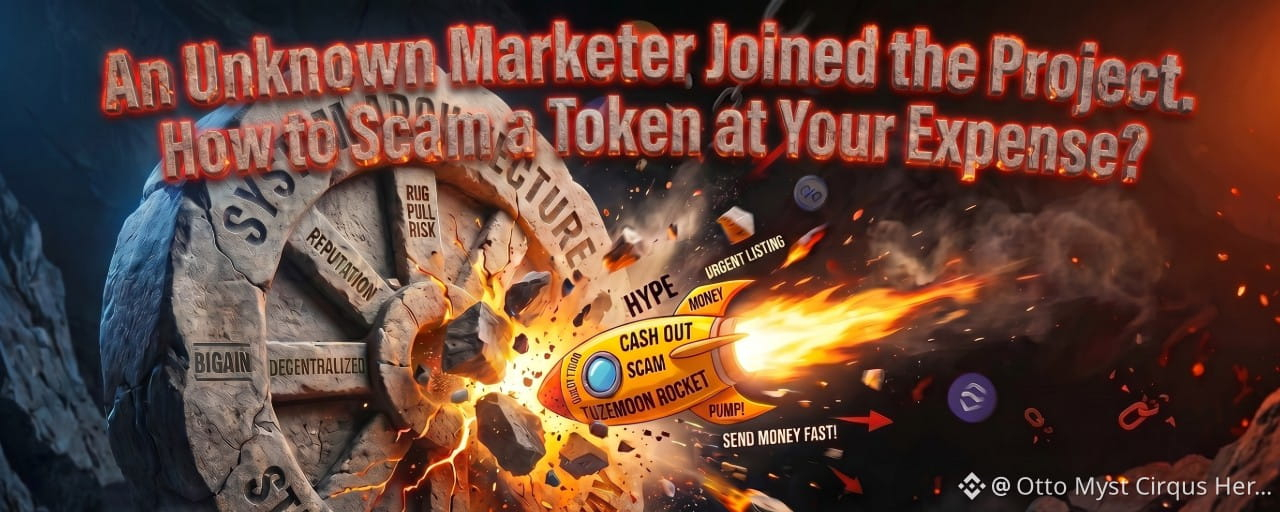
Artigo
Um Marketer Desconhecido Entrou no Projeto. Como Ser Enrolado por um Token à Sua Custa?Web3 é um lugar estranho e fascinante. Aqui, você pode passar semanas engajado em diálogos filosóficos profundos sobre liberdade, descentralização e o futuro das comunidades digitais, apenas para acordar uma noite e descobrir alguém tentando transformar seu projeto em mais um memecoin de curto prazo impulsionado por bots automatizados e um "listagem urgente."
Recentemente, passei por esse cenário exato. Felizmente, a razão fria e analítica entrou em ação a tempo. Talvez compartilhar essa experiência salve alguém de cometer um erro muito tolo e, mais importante, irreversível.
Um Marketer Desconhecido Entrou no Projeto. Como Ser Enrolado por um Token à Sua Custa?
Web3 é um lugar estranho e fascinante. Aqui, você pode passar semanas engajado em diálogos filosóficos profundos sobre liberdade, descentralização e o futuro das comunidades digitais, apenas para acordar uma noite e descobrir alguém tentando transformar seu projeto em mais um memecoin de curto prazo impulsionado por bots automatizados e um "listagem urgente."
Recentemente, passei por esse cenário exato. Felizmente, a razão fria e analítica entrou em ação a tempo. Talvez compartilhar essa experiência salve alguém de cometer um erro muito tolo e, mais importante, irreversível.
Recentemente, passei por esse cenário exato. Felizmente, a razão fria e analítica entrou em ação a tempo. Talvez compartilhar essa experiência salve alguém de cometer um erro muito tolo e, mais importante, irreversível.
1
174
Fool Speaks #1 — A Arte de Alugar a Si Mesmo
Quando um humano nasce, ele recebe um pacote de software padrão. Um conjunto de scripts rígidos que a maioria das pessoas carrega até a morte—aquele breve intervalo que chamamos barulhentamente de “vida.”
As máquinas estatais e corporativas passam décadas te convencendo de que você é livre enquanto ainda pede permissão para quase tudo. Exceto para rolar vídeos curtos, perseguir dopamina barata e lentamente arruinar seu corpo.
Essas são suas liberdades totalmente licenciadas.
As pessoas estão aterrorizadas com a IA, considerando que a maioria delas nunca sequer ligou sua própria mente.
A piada desconfortável: a maioria das pessoas nunca escolhe o que serve. Elas simplesmente se alugam—facilmente, até de bom grado. Para a maioria, servir significa duas coisas: o estômago, ou o macaco interior exigindo dopamina barata através de rolagem interminável.
Mas a atenção é a única moeda real agora. Mude a atenção—e o sistema perde combustível.
O vetor da atenção pode ser alterado.
O Círculo está aberto—mas não para todos.
🔗 Leia o manifesto completo em Paragraph (Link na bio/comentários).
#CirqusHeresy #EconomiaDaAtenção #Web3 #Filosofia
Fool Speaks #1 — A Arte de Alugar a Si Mesmo
Quando um humano nasce, ele recebe um pacote de software padrão. Um conjunto de scripts rígidos que a maioria das pessoas carrega até a morte—aquele breve intervalo que chamamos barulhentamente de “vida.”
As máquinas estatais e corporativas passam décadas te convencendo de que você é livre enquanto ainda pede permissão para quase tudo. Exceto para rolar vídeos curtos, perseguir dopamina barata e lentamente arruinar seu corpo.
Essas são suas liberdades totalmente licenciadas.
As pessoas estão aterrorizadas com a IA, considerando que a maioria delas nunca sequer ligou sua própria mente.
A piada desconfortável: a maioria das pessoas nunca escolhe o que serve. Elas simplesmente se alugam—facilmente, até de bom grado. Para a maioria, servir significa duas coisas: o estômago, ou o macaco interior exigindo dopamina barata através de rolagem interminável.
Mas a atenção é a única moeda real agora. Mude a atenção—e o sistema perde combustível.
O vetor da atenção pode ser alterado.
O Círculo está aberto—mas não para todos.
🔗 Leia o manifesto completo em Paragraph (Link na bio/comentários).
#CirqusHeresy #EconomiaDaAtenção #Web3 #Filosofia
Quando um humano nasce, ele recebe um pacote de software padrão. Um conjunto de scripts rígidos que a maioria das pessoas carrega até a morte—aquele breve intervalo que chamamos barulhentamente de “vida.”
As máquinas estatais e corporativas passam décadas te convencendo de que você é livre enquanto ainda pede permissão para quase tudo. Exceto para rolar vídeos curtos, perseguir dopamina barata e lentamente arruinar seu corpo.
Essas são suas liberdades totalmente licenciadas.
As pessoas estão aterrorizadas com a IA, considerando que a maioria delas nunca sequer ligou sua própria mente.
A piada desconfortável: a maioria das pessoas nunca escolhe o que serve. Elas simplesmente se alugam—facilmente, até de bom grado. Para a maioria, servir significa duas coisas: o estômago, ou o macaco interior exigindo dopamina barata através de rolagem interminável.
Mas a atenção é a única moeda real agora. Mude a atenção—e o sistema perde combustível.
O vetor da atenção pode ser alterado.
O Círculo está aberto—mas não para todos.
🔗 Leia o manifesto completo em Paragraph (Link na bio/comentários).
#CirqusHeresy #EconomiaDaAtenção #Web3 #Filosofia
1
20
A Arte de Alugar a Si Mesmo: Um Manual para o Macaco InteriorHoje, quero começar uma nova série chamada O Fala do Tolo. Espero conseguir juntar um público capaz de ler nas entrelinhas e que tenha pelo menos um pouco de senso de humor. Então.
Quando uma pessoa nasce, ela automaticamente recebe um pacote de software padrão. Um conjunto rígido de scripts que a maioria das pessoas carrega até a morte—aquele breve intervalo que os humanos chamam dramaticamente de “vida”. Alguns estão tão sinceramente orgulhosos de sua liberdade, como se tivessem escolhido pessoalmente seu país, idioma, religião, bandeira e o forte de sua preferência.
A Arte de Alugar a Si Mesmo: Um Manual para o Macaco Interior
Hoje, quero começar uma nova série chamada O Fala do Tolo. Espero conseguir juntar um público capaz de ler nas entrelinhas e que tenha pelo menos um pouco de senso de humor. Então.
Quando uma pessoa nasce, ela automaticamente recebe um pacote de software padrão. Um conjunto rígido de scripts que a maioria das pessoas carrega até a morte—aquele breve intervalo que os humanos chamam dramaticamente de “vida”. Alguns estão tão sinceramente orgulhosos de sua liberdade, como se tivessem escolhido pessoalmente seu país, idioma, religião, bandeira e o forte de sua preferência.
Quando uma pessoa nasce, ela automaticamente recebe um pacote de software padrão. Um conjunto rígido de scripts que a maioria das pessoas carrega até a morte—aquele breve intervalo que os humanos chamam dramaticamente de “vida”. Alguns estão tão sinceramente orgulhosos de sua liberdade, como se tivessem escolhido pessoalmente seu país, idioma, religião, bandeira e o forte de sua preferência.
1
151
Faça login para explorar mais conteúdos
Junte-se a usuários de criptomoedas de todo o mundo no Binance Square.
⚡️ Obter informações mais recentes e úteis sobre criptomoeda.
💬 Com a confiança da maior corretora de criptomoedas do mundo.
👍 Descubra insights reais de criadores verificados.
E-mail / número de telefone
Tópicos em Alta
KuwaitAirDefensesRespondToIranianDroneAttacks
105 visualizações
26 discutindo
#kuwaitairdefensesrespondtoiraniandroneattacks
🚨 As defesas aéreas do Kuwait estão respondendo a ataques de mísseis e drones iranianos.
O Exército do Kuwait afirma que seus sistemas de defesa aérea estão interceptando ativamente alvos hostis, com explosões ouvidas em todo o país, supostamente vindas de operações de interceptação.
As autoridades pedem aos moradores que mantenham a calma e sigam as instruções oficiais de segurança.
Os ataques acontecem após a escalada acentuada novamente do conflito entre EUA e Irã, com ataques iranianos também mirando posições dos EUA no Golfo e na região.
Para os mercados, a principal preocupação é a energia.
Com as tensões perto do Estreito de Ormuz aumentando, os preços do petróleo já estão subindo, à medida que os traders passam a precificar um maior risco de interrupção do fornecimento.
O risco no Oriente Médio voltou ao radar. 👀
$BTC
#KuwaitAirDefense #iran #MiddleEast #Oil #crypto
S1R0Z
·0 curtidas
·15 visualizações
DellRisesNearly9%GitLabJumps20%AfterHours
100 visualizações
18 discutindo
FedHikeOddsRiseTo68%
1,580 visualizações
87 discutindo