
Shr_Munna
271 ပို့စ်များ

Shr_Munna
တိုင်ကြားမည်
သုံးစွဲသူကို ဘလော့မည်
Learning Everyday

GRAM Holder
Occasional Trader
2.6 Years
3 ဖော်လိုလုပ်ထားသည်
193 ဖော်လိုလုပ်သူများ
316 လိုက်ခ်လုပ်ထားသည်
ပို့စ်များ
အားလုံး
Quotes
·
--
ဘာသာပြန်ဆိုချက် ကြည့်မည်
📉 #EthereumFallsBelow$2500 — Is This a Buying Opportunity or a Warning Sign?
ETH slipping under the $2,500 mark has the community split, and honestly, both sides have a case.
Here's the framework for thinking about it, whichever side you're on:
🔹 The bear case — A break below a key psychological level often triggers stop-losses and liquidations, which can accelerate the drop short-term. If this coincides with broader risk-off sentiment (like rising bond yields pulling capital toward safer assets), the pressure can persist longer than a typical dip.
🔹 The bull case — Ethereum's fundamentals (staking yield, L2 ecosystem growth, ETF flows) don't reset just because price crosses a round number. Round-number levels are more psychological than structural — the real question is whether this is a shakeout before continuation, or the start of a deeper trend change.
🔹 What actually matters — Volume on the breakdown. A low-volume dip below $2,500 is very different from a high-volume capitulation candle. Check whether this move came with panic selling or just quiet drift.
🔹 Zoom out — Where does $2,500 sit relative to ETH's recent range? If it was already chopping between $2,400–$2,800 for weeks, this isn't a "collapse," it's just testing the bottom of a range.
Not financial advice — just a framework. Where do you think ETH goes from here? 👇
#Binance #BinanceSquare #Ethereum #ETH #CryptoMarket #PriceAction
📉 #EthereumFallsBelow$2500 — Is This a Buying Opportunity or a Warning Sign?
ETH slipping under the $2,500 mark has the community split, and honestly, both sides have a case.
Here's the framework for thinking about it, whichever side you're on:
🔹 The bear case — A break below a key psychological level often triggers stop-losses and liquidations, which can accelerate the drop short-term. If this coincides with broader risk-off sentiment (like rising bond yields pulling capital toward safer assets), the pressure can persist longer than a typical dip.
🔹 The bull case — Ethereum's fundamentals (staking yield, L2 ecosystem growth, ETF flows) don't reset just because price crosses a round number. Round-number levels are more psychological than structural — the real question is whether this is a shakeout before continuation, or the start of a deeper trend change.
🔹 What actually matters — Volume on the breakdown. A low-volume dip below $2,500 is very different from a high-volume capitulation candle. Check whether this move came with panic selling or just quiet drift.
🔹 Zoom out — Where does $2,500 sit relative to ETH's recent range? If it was already chopping between $2,400–$2,800 for weeks, this isn't a "collapse," it's just testing the bottom of a range.
Not financial advice — just a framework. Where do you think ETH goes from here? 👇
#Binance #BinanceSquare #Ethereum #ETH #CryptoMarket #PriceAction
ETH slipping under the $2,500 mark has the community split, and honestly, both sides have a case.
Here's the framework for thinking about it, whichever side you're on:
🔹 The bear case — A break below a key psychological level often triggers stop-losses and liquidations, which can accelerate the drop short-term. If this coincides with broader risk-off sentiment (like rising bond yields pulling capital toward safer assets), the pressure can persist longer than a typical dip.
🔹 The bull case — Ethereum's fundamentals (staking yield, L2 ecosystem growth, ETF flows) don't reset just because price crosses a round number. Round-number levels are more psychological than structural — the real question is whether this is a shakeout before continuation, or the start of a deeper trend change.
🔹 What actually matters — Volume on the breakdown. A low-volume dip below $2,500 is very different from a high-volume capitulation candle. Check whether this move came with panic selling or just quiet drift.
🔹 Zoom out — Where does $2,500 sit relative to ETH's recent range? If it was already chopping between $2,400–$2,800 for weeks, this isn't a "collapse," it's just testing the bottom of a range.
Not financial advice — just a framework. Where do you think ETH goes from here? 👇
#Binance #BinanceSquare #Ethereum #ETH #CryptoMarket #PriceAction
15
·
--
⚠️ #BitcoinThirdSingleBlockReorgInFourWeeks — Tasuta juhus või muster, mida tasub jälgida?
Binance Square'i aruteludevoog toob esile väite, mida tasub uurida: väidetavalt on Bitcoinil olnud nelja nädala jooksul juba kolmas üheplokiline reorganisatsioon (reorg). Kui see on tõsi, on see sagedus, millest tasub rääkida — reorg-id olid varem nii haruldased, et nende kohta tehti eraldi uudiseid.
Kiire meeldetuletus, mis reorg tegelikult on, neile, kes lihtsalt kerivad edasi:
🔹 Mida see tähendab — Kaks kaevurit leiavad peaaegu samal ajal kehtivad plokid, jagades võrgu lühiajaliselt kaheks konkureerivaks ahelaks. Rohkem kogunenud tõestustöö (proof-of-work) omav ahel võidab ja "kaotav" plokk muutub orfaniks — selle tehingud pannakse tagasi mempooli järgmise ploki jaoks.
🔹 Miks see tavaliselt haruldane on — Bitcoini ~10-minutilise plokiaja ja üle maailma jaotunud kaevurite tõttu ei juhtu peaaegu samaaegselt kehtivaid plokke sageli. Üks reorg on võrgu tõrge. Kolm kuu jooksul oleks tõsine anomaalia.
🔹 Päris mure ei ole mitte reorg ise — vaid see, mida see näitab. Reorg-ide sagenemine on tavaliselt sümptom hashrate'i koondumisest. Kui väike hulk kaevandusgruppe (mining pools) kontrollib piisavalt suurt osa võrgu võimsusest, siis on neil statistiliselt tõenäolisem kaevandada plokke järjestikku — ning just see mehhanism tekitab reorg-e.
🔹 Mida tegelikult kontrollida — Kui soovid seda ise enne faktiks pidamist verifitseerida, näitavad mempool.space ja Blockchain.com mõlemad reorg-ide ajalugu otse on-chain. See on ainus viis kinnitada selliseid sagedusväiteid, mitte toetuda teise käe postitustele.
Niisiis — kas keegi siin on tegelikult tõmmanud selle plokiahela andmed? Olen tõeliselt uudishimulik, kas "kolm nelja nädala jooksul" number peab paika. 👇
#Binance #BinanceSquare #Bitcoin #BTC #MiningCentralization #CryptoDiscussion
⚠️ #BitcoinThirdSingleBlockReorgInFourWeeks — Tasuta juhus või muster, mida tasub jälgida?
Binance Square'i aruteludevoog toob esile väite, mida tasub uurida: väidetavalt on Bitcoinil olnud nelja nädala jooksul juba kolmas üheplokiline reorganisatsioon (reorg). Kui see on tõsi, on see sagedus, millest tasub rääkida — reorg-id olid varem nii haruldased, et nende kohta tehti eraldi uudiseid.
Kiire meeldetuletus, mis reorg tegelikult on, neile, kes lihtsalt kerivad edasi:
🔹 Mida see tähendab — Kaks kaevurit leiavad peaaegu samal ajal kehtivad plokid, jagades võrgu lühiajaliselt kaheks konkureerivaks ahelaks. Rohkem kogunenud tõestustöö (proof-of-work) omav ahel võidab ja "kaotav" plokk muutub orfaniks — selle tehingud pannakse tagasi mempooli järgmise ploki jaoks.
🔹 Miks see tavaliselt haruldane on — Bitcoini ~10-minutilise plokiaja ja üle maailma jaotunud kaevurite tõttu ei juhtu peaaegu samaaegselt kehtivaid plokke sageli. Üks reorg on võrgu tõrge. Kolm kuu jooksul oleks tõsine anomaalia.
🔹 Päris mure ei ole mitte reorg ise — vaid see, mida see näitab. Reorg-ide sagenemine on tavaliselt sümptom hashrate'i koondumisest. Kui väike hulk kaevandusgruppe (mining pools) kontrollib piisavalt suurt osa võrgu võimsusest, siis on neil statistiliselt tõenäolisem kaevandada plokke järjestikku — ning just see mehhanism tekitab reorg-e.
🔹 Mida tegelikult kontrollida — Kui soovid seda ise enne faktiks pidamist verifitseerida, näitavad mempool.space ja Blockchain.com mõlemad reorg-ide ajalugu otse on-chain. See on ainus viis kinnitada selliseid sagedusväiteid, mitte toetuda teise käe postitustele.
Niisiis — kas keegi siin on tegelikult tõmmanud selle plokiahela andmed? Olen tõeliselt uudishimulik, kas "kolm nelja nädala jooksul" number peab paika. 👇
#Binance #BinanceSquare #Bitcoin #BTC #MiningCentralization #CryptoDiscussion
Binance Square'i aruteludevoog toob esile väite, mida tasub uurida: väidetavalt on Bitcoinil olnud nelja nädala jooksul juba kolmas üheplokiline reorganisatsioon (reorg). Kui see on tõsi, on see sagedus, millest tasub rääkida — reorg-id olid varem nii haruldased, et nende kohta tehti eraldi uudiseid.
Kiire meeldetuletus, mis reorg tegelikult on, neile, kes lihtsalt kerivad edasi:
🔹 Mida see tähendab — Kaks kaevurit leiavad peaaegu samal ajal kehtivad plokid, jagades võrgu lühiajaliselt kaheks konkureerivaks ahelaks. Rohkem kogunenud tõestustöö (proof-of-work) omav ahel võidab ja "kaotav" plokk muutub orfaniks — selle tehingud pannakse tagasi mempooli järgmise ploki jaoks.
🔹 Miks see tavaliselt haruldane on — Bitcoini ~10-minutilise plokiaja ja üle maailma jaotunud kaevurite tõttu ei juhtu peaaegu samaaegselt kehtivaid plokke sageli. Üks reorg on võrgu tõrge. Kolm kuu jooksul oleks tõsine anomaalia.
🔹 Päris mure ei ole mitte reorg ise — vaid see, mida see näitab. Reorg-ide sagenemine on tavaliselt sümptom hashrate'i koondumisest. Kui väike hulk kaevandusgruppe (mining pools) kontrollib piisavalt suurt osa võrgu võimsusest, siis on neil statistiliselt tõenäolisem kaevandada plokke järjestikku — ning just see mehhanism tekitab reorg-e.
🔹 Mida tegelikult kontrollida — Kui soovid seda ise enne faktiks pidamist verifitseerida, näitavad mempool.space ja Blockchain.com mõlemad reorg-ide ajalugu otse on-chain. See on ainus viis kinnitada selliseid sagedusväiteid, mitte toetuda teise käe postitustele.
Niisiis — kas keegi siin on tegelikult tõmmanud selle plokiahela andmed? Olen tõeliselt uudishimulik, kas "kolm nelja nädala jooksul" number peab paika. 👇
#Binance #BinanceSquare #Bitcoin #BTC #MiningCentralization #CryptoDiscussion
17
·
--
ဘာသာပြန်ဆိုချက် ကြည့်မည်
🧠 #AnthropicCEOCallsForAISlowdown — When the AI Company Itself Says "Slow Down"
In a rare move for the industry, Anthropic — the company behind Claude — published a call in June 2026 urging the option to slow or pause frontier AI development. The reasoning isn't hype, it's structural.
The numbers behind the warning:
🔹 80% of Anthropic's own code is now written by Claude — not assisted, written. That's the company's own AI building the next version of itself.
🔹 Recursive self-improvement is the core fear — if AI systems start meaningfully accelerating their own development faster than humans can audit or align them, the feedback loop compounds fast.
🔹 It's not a unilateral pause — Anthropic was explicit: a single company stopping alone just lets rivals race ahead unchecked. They're calling for a coordinated, verifiable mechanism — something closer to how nuclear treaties work, where all major labs (and countries, notably the US and China) would need to agree simultaneously.
🔹 Not everyone's on board — OpenAI publicly pushed back the same week, arguing that pacing decisions shouldn't sit with any single lab, and should be left to democratic institutions instead. Critics have also called Anthropic's stance a competitive narrative play, especially given its limited rollout of its more powerful "Mythos" model.
This lands right as Anthropic is reportedly prepping to go public — so "the AI company profiting from AI is also the one waving the caution flag" is exactly the tension fueling the debate.
Where do you land — genuine safety concern, or strategic positioning? 👇
#Binance #BinanceSquare #AI #Anthropic #Claude #technews #CryptoAI
🧠 #AnthropicCEOCallsForAISlowdown — When the AI Company Itself Says "Slow Down"
In a rare move for the industry, Anthropic — the company behind Claude — published a call in June 2026 urging the option to slow or pause frontier AI development. The reasoning isn't hype, it's structural.
The numbers behind the warning:
🔹 80% of Anthropic's own code is now written by Claude — not assisted, written. That's the company's own AI building the next version of itself.
🔹 Recursive self-improvement is the core fear — if AI systems start meaningfully accelerating their own development faster than humans can audit or align them, the feedback loop compounds fast.
🔹 It's not a unilateral pause — Anthropic was explicit: a single company stopping alone just lets rivals race ahead unchecked. They're calling for a coordinated, verifiable mechanism — something closer to how nuclear treaties work, where all major labs (and countries, notably the US and China) would need to agree simultaneously.
🔹 Not everyone's on board — OpenAI publicly pushed back the same week, arguing that pacing decisions shouldn't sit with any single lab, and should be left to democratic institutions instead. Critics have also called Anthropic's stance a competitive narrative play, especially given its limited rollout of its more powerful "Mythos" model.
This lands right as Anthropic is reportedly prepping to go public — so "the AI company profiting from AI is also the one waving the caution flag" is exactly the tension fueling the debate.
Where do you land — genuine safety concern, or strategic positioning? 👇
#Binance #BinanceSquare #AI #Anthropic #Claude #technews #CryptoAI
In a rare move for the industry, Anthropic — the company behind Claude — published a call in June 2026 urging the option to slow or pause frontier AI development. The reasoning isn't hype, it's structural.
The numbers behind the warning:
🔹 80% of Anthropic's own code is now written by Claude — not assisted, written. That's the company's own AI building the next version of itself.
🔹 Recursive self-improvement is the core fear — if AI systems start meaningfully accelerating their own development faster than humans can audit or align them, the feedback loop compounds fast.
🔹 It's not a unilateral pause — Anthropic was explicit: a single company stopping alone just lets rivals race ahead unchecked. They're calling for a coordinated, verifiable mechanism — something closer to how nuclear treaties work, where all major labs (and countries, notably the US and China) would need to agree simultaneously.
🔹 Not everyone's on board — OpenAI publicly pushed back the same week, arguing that pacing decisions shouldn't sit with any single lab, and should be left to democratic institutions instead. Critics have also called Anthropic's stance a competitive narrative play, especially given its limited rollout of its more powerful "Mythos" model.
This lands right as Anthropic is reportedly prepping to go public — so "the AI company profiting from AI is also the one waving the caution flag" is exactly the tension fueling the debate.
Where do you land — genuine safety concern, or strategic positioning? 👇
#Binance #BinanceSquare #AI #Anthropic #Claude #technews #CryptoAI
21
·
--
ဘာသာပြန်ဆိုချက် ကြည့်မည်
🏛️ #ClarityActFacesProceduralVoteSept15 — This Tuesday Could Reshape US Crypto Regulation
The Senate returns from recess this week, and the first real test for the CLARITY Act lands September 15 — a cloture vote that decides whether the bill even gets debated, not whether it passes.
Here's what's actually on the line:
🔹 What CLARITY does — It draws the jurisdictional line between the SEC and CFTC for digital assets, and for the first time in federal law, defines when a token counts as a commodity vs. a security. That classification decides who regulates exchanges, issuers, and custodians going forward.
🔹 The math is brutal — Republicans hold 53 seats. Cloture needs 60. That means roughly 7 Democrats have to cross the aisle, and Senate Banking Committee votes in May only pulled 2.
🔹 Three unresolved fights — Stablecoin reward structures, government ethics language, and illicit finance provisions are still being negotiated heading into the vote.
🔹 The stakes if it fails — With midterm campaigning ramping up right after this window, this is widely seen as the last realistic shot at passage in 2026. Prediction markets are pricing roughly a 1-in-4 chance it becomes law this year.
The House already passed its version back in July 2025 with bipartisan support (294-134). The ball's been in the Senate's court since.
Are you expecting cloture to clear, or does this stall out again? 👇
#Binance #BinanceSquare #CLARITYAct #CryptoRegulationRussia #SEC #CFTC #USPolitics
🏛️ #ClarityActFacesProceduralVoteSept15 — This Tuesday Could Reshape US Crypto Regulation
The Senate returns from recess this week, and the first real test for the CLARITY Act lands September 15 — a cloture vote that decides whether the bill even gets debated, not whether it passes.
Here's what's actually on the line:
🔹 What CLARITY does — It draws the jurisdictional line between the SEC and CFTC for digital assets, and for the first time in federal law, defines when a token counts as a commodity vs. a security. That classification decides who regulates exchanges, issuers, and custodians going forward.
🔹 The math is brutal — Republicans hold 53 seats. Cloture needs 60. That means roughly 7 Democrats have to cross the aisle, and Senate Banking Committee votes in May only pulled 2.
🔹 Three unresolved fights — Stablecoin reward structures, government ethics language, and illicit finance provisions are still being negotiated heading into the vote.
🔹 The stakes if it fails — With midterm campaigning ramping up right after this window, this is widely seen as the last realistic shot at passage in 2026. Prediction markets are pricing roughly a 1-in-4 chance it becomes law this year.
The House already passed its version back in July 2025 with bipartisan support (294-134). The ball's been in the Senate's court since.
Are you expecting cloture to clear, or does this stall out again? 👇
#Binance #BinanceSquare #CLARITYAct #CryptoRegulationRussia #SEC #CFTC #USPolitics
The Senate returns from recess this week, and the first real test for the CLARITY Act lands September 15 — a cloture vote that decides whether the bill even gets debated, not whether it passes.
Here's what's actually on the line:
🔹 What CLARITY does — It draws the jurisdictional line between the SEC and CFTC for digital assets, and for the first time in federal law, defines when a token counts as a commodity vs. a security. That classification decides who regulates exchanges, issuers, and custodians going forward.
🔹 The math is brutal — Republicans hold 53 seats. Cloture needs 60. That means roughly 7 Democrats have to cross the aisle, and Senate Banking Committee votes in May only pulled 2.
🔹 Three unresolved fights — Stablecoin reward structures, government ethics language, and illicit finance provisions are still being negotiated heading into the vote.
🔹 The stakes if it fails — With midterm campaigning ramping up right after this window, this is widely seen as the last realistic shot at passage in 2026. Prediction markets are pricing roughly a 1-in-4 chance it becomes law this year.
The House already passed its version back in July 2025 with bipartisan support (294-134). The ball's been in the Senate's court since.
Are you expecting cloture to clear, or does this stall out again? 👇
#Binance #BinanceSquare #CLARITYAct #CryptoRegulationRussia #SEC #CFTC #USPolitics
29
·
--
ဘာသာပြန်ဆိုချက် ကြည့်မည်
#SECReceivesGrayscaleLitecoinTrustETFFiling — And Now It's Already Live
Remember when this was breaking news? Grayscale's push to convert its Litecoin Trust into a spot ETF started back in late 2024, and the SEC formally opened it up for public comment in February 2025 after NYSE Arca filed on Grayscale's behalf.
Fast forward to today: LTCN is already trading as a spot Litecoin ETF.
Why this mattered:
🔹 It wasn't a one-off — Litecoin's filing came in the same wave as Solana, Hedera, and Bitcoin Cash trust conversions. Grayscale used the same regulatory playbook that got its Bitcoin and Ethereum trusts converted in 2024.
🔹 Altcoin ETFs are no longer rare — What started as a novelty with BTC/ETH has become a steady pipeline. Analysts predicted 100+ spot crypto ETFs launching within a 6-month stretch, and that supply has kept coming (Chainlink's spot ETF launched just this past December).
🔹 The pattern to watch — Trust → SEC review → public comment period → conversion. If your favorite altcoin already has a Grayscale trust, that's usually the first sign an ETF filing isn't far behind.
Litecoin, one of the oldest altcoins in existence, now sits in a regulated wrapper next to BTC and ETH. That's a meaningful shift in how "legit" the SEC now treats legacy alts.
Did you expect LTC to get a spot ETF before some newer, higher-cap coins? 👇
#Binance #BinanceSquare #Litecoin #LTC #ETF #SEC #Grayscale #CryptoNews
#SECReceivesGrayscaleLitecoinTrustETFFiling — And Now It's Already Live
Remember when this was breaking news? Grayscale's push to convert its Litecoin Trust into a spot ETF started back in late 2024, and the SEC formally opened it up for public comment in February 2025 after NYSE Arca filed on Grayscale's behalf.
Fast forward to today: LTCN is already trading as a spot Litecoin ETF.
Why this mattered:
🔹 It wasn't a one-off — Litecoin's filing came in the same wave as Solana, Hedera, and Bitcoin Cash trust conversions. Grayscale used the same regulatory playbook that got its Bitcoin and Ethereum trusts converted in 2024.
🔹 Altcoin ETFs are no longer rare — What started as a novelty with BTC/ETH has become a steady pipeline. Analysts predicted 100+ spot crypto ETFs launching within a 6-month stretch, and that supply has kept coming (Chainlink's spot ETF launched just this past December).
🔹 The pattern to watch — Trust → SEC review → public comment period → conversion. If your favorite altcoin already has a Grayscale trust, that's usually the first sign an ETF filing isn't far behind.
Litecoin, one of the oldest altcoins in existence, now sits in a regulated wrapper next to BTC and ETH. That's a meaningful shift in how "legit" the SEC now treats legacy alts.
Did you expect LTC to get a spot ETF before some newer, higher-cap coins? 👇
#Binance #BinanceSquare #Litecoin #LTC #ETF #SEC #Grayscale #CryptoNews
Remember when this was breaking news? Grayscale's push to convert its Litecoin Trust into a spot ETF started back in late 2024, and the SEC formally opened it up for public comment in February 2025 after NYSE Arca filed on Grayscale's behalf.
Fast forward to today: LTCN is already trading as a spot Litecoin ETF.
Why this mattered:
🔹 It wasn't a one-off — Litecoin's filing came in the same wave as Solana, Hedera, and Bitcoin Cash trust conversions. Grayscale used the same regulatory playbook that got its Bitcoin and Ethereum trusts converted in 2024.
🔹 Altcoin ETFs are no longer rare — What started as a novelty with BTC/ETH has become a steady pipeline. Analysts predicted 100+ spot crypto ETFs launching within a 6-month stretch, and that supply has kept coming (Chainlink's spot ETF launched just this past December).
🔹 The pattern to watch — Trust → SEC review → public comment period → conversion. If your favorite altcoin already has a Grayscale trust, that's usually the first sign an ETF filing isn't far behind.
Litecoin, one of the oldest altcoins in existence, now sits in a regulated wrapper next to BTC and ETH. That's a meaningful shift in how "legit" the SEC now treats legacy alts.
Did you expect LTC to get a spot ETF before some newer, higher-cap coins? 👇
#Binance #BinanceSquare #Litecoin #LTC #ETF #SEC #Grayscale #CryptoNews
50
·
--
ဘာသာပြန်ဆိုချက် ကြည့်မည်
🚨 #US10YearTreasuryYieldNears5% — Why Crypto Traders Should Be Watching Bonds, Not Just Charts
The 10-year Treasury yield just touched its highest level since November 2023, creeping toward that psychological 5% mark. This isn't just a "boomer finance" headline — it directly affects risk appetite across crypto.
Here's the connection:
🔹 Higher yields = safer "risk-free" returns — When you can get ~5% just parking money in Treasuries, capital has less incentive to chase risk in altcoins or speculative plays.
🔹 Liquidity tightens — Rising long-end yields often signal the market pricing in "higher for longer" rates, which historically pressures risk assets, including BTC and ETH, in the short term.
🔹 Dollar strength watch — Yields climbing usually pull the DXY up with them. A stronger dollar has often correlated with crypto chop or pullbacks.
🔹 But context matters — Bitcoin has decoupled from bonds before. If this yield move is driven by strong growth data rather than inflation fear, risk assets can still hold up.
The macro backdrop right now: solid demand at recent Treasury auctions, but yields still grinding higher — meaning the bond market isn't fully convinced the Fed is done.
Are you treating this as a warning sign for crypto, or just noise? 👇
#Binance #BinanceSquare #Macro #Bitcoin #TreasuryYields #CryptoMarket
🚨 #US10YearTreasuryYieldNears5% — Why Crypto Traders Should Be Watching Bonds, Not Just Charts
The 10-year Treasury yield just touched its highest level since November 2023, creeping toward that psychological 5% mark. This isn't just a "boomer finance" headline — it directly affects risk appetite across crypto.
Here's the connection:
🔹 Higher yields = safer "risk-free" returns — When you can get ~5% just parking money in Treasuries, capital has less incentive to chase risk in altcoins or speculative plays.
🔹 Liquidity tightens — Rising long-end yields often signal the market pricing in "higher for longer" rates, which historically pressures risk assets, including BTC and ETH, in the short term.
🔹 Dollar strength watch — Yields climbing usually pull the DXY up with them. A stronger dollar has often correlated with crypto chop or pullbacks.
🔹 But context matters — Bitcoin has decoupled from bonds before. If this yield move is driven by strong growth data rather than inflation fear, risk assets can still hold up.
The macro backdrop right now: solid demand at recent Treasury auctions, but yields still grinding higher — meaning the bond market isn't fully convinced the Fed is done.
Are you treating this as a warning sign for crypto, or just noise? 👇
#Binance #BinanceSquare #Macro #Bitcoin #TreasuryYields #CryptoMarket
The 10-year Treasury yield just touched its highest level since November 2023, creeping toward that psychological 5% mark. This isn't just a "boomer finance" headline — it directly affects risk appetite across crypto.
Here's the connection:
🔹 Higher yields = safer "risk-free" returns — When you can get ~5% just parking money in Treasuries, capital has less incentive to chase risk in altcoins or speculative plays.
🔹 Liquidity tightens — Rising long-end yields often signal the market pricing in "higher for longer" rates, which historically pressures risk assets, including BTC and ETH, in the short term.
🔹 Dollar strength watch — Yields climbing usually pull the DXY up with them. A stronger dollar has often correlated with crypto chop or pullbacks.
🔹 But context matters — Bitcoin has decoupled from bonds before. If this yield move is driven by strong growth data rather than inflation fear, risk assets can still hold up.
The macro backdrop right now: solid demand at recent Treasury auctions, but yields still grinding higher — meaning the bond market isn't fully convinced the Fed is done.
Are you treating this as a warning sign for crypto, or just noise? 👇
#Binance #BinanceSquare #Macro #Bitcoin #TreasuryYields #CryptoMarket
68
·
--
ဘာသာပြန်ဆိုချက် ကြည့်မည်
📊 The One Habit That Separates Traders Who Survive From Traders Who Don't
Most people blow up their portfolio in the first 6 months — not because they picked the wrong coin, but because they never had an exit plan before entering.
Here's the framework I use before every trade:
🔹 Position sizing first — Never risk more than 1-2% of your portfolio on a single trade. Sounds boring. It's why you're still here in 5 years.
🔹 Write your exit before your entry — Decide your take-profit AND stop-loss before you buy, not after you're already down 20% and "hoping."
🔹 DCA beats timing — Nobody catches the exact bottom. Spreading entries over time removes the emotional guesswork.
🔹 Zoom out weekly, not hourly — Checking charts every 10 minutes turns investors into gamblers. Set your thesis, then check in on a schedule.
The market rewards patience more than prediction. Most "alpha" is just disciplined wearing a costume. 🎯
What's the one rule you never break when trading? Drop it below 👇
#Binance #BinanceSquare #CryptoTrading #RiskManagement #WriteToEarn #BTC #CryptoEducation
📊 The One Habit That Separates Traders Who Survive From Traders Who Don't
Most people blow up their portfolio in the first 6 months — not because they picked the wrong coin, but because they never had an exit plan before entering.
Here's the framework I use before every trade:
🔹 Position sizing first — Never risk more than 1-2% of your portfolio on a single trade. Sounds boring. It's why you're still here in 5 years.
🔹 Write your exit before your entry — Decide your take-profit AND stop-loss before you buy, not after you're already down 20% and "hoping."
🔹 DCA beats timing — Nobody catches the exact bottom. Spreading entries over time removes the emotional guesswork.
🔹 Zoom out weekly, not hourly — Checking charts every 10 minutes turns investors into gamblers. Set your thesis, then check in on a schedule.
The market rewards patience more than prediction. Most "alpha" is just disciplined wearing a costume. 🎯
What's the one rule you never break when trading? Drop it below 👇
#Binance #BinanceSquare #CryptoTrading #RiskManagement #WriteToEarn #BTC #CryptoEducation
Most people blow up their portfolio in the first 6 months — not because they picked the wrong coin, but because they never had an exit plan before entering.
Here's the framework I use before every trade:
🔹 Position sizing first — Never risk more than 1-2% of your portfolio on a single trade. Sounds boring. It's why you're still here in 5 years.
🔹 Write your exit before your entry — Decide your take-profit AND stop-loss before you buy, not after you're already down 20% and "hoping."
🔹 DCA beats timing — Nobody catches the exact bottom. Spreading entries over time removes the emotional guesswork.
🔹 Zoom out weekly, not hourly — Checking charts every 10 minutes turns investors into gamblers. Set your thesis, then check in on a schedule.
The market rewards patience more than prediction. Most "alpha" is just disciplined wearing a costume. 🎯
What's the one rule you never break when trading? Drop it below 👇
#Binance #BinanceSquare #CryptoTrading #RiskManagement #WriteToEarn #BTC #CryptoEducation
68
·
--
ဘာသာပြန်ဆိုချက် ကြည့်မည်
{spot}(BTCUSDT)
$BNB
{spot}(BNBUSDT)
$ETH
{spot}(ETHUSDT)
How are you Guys ? ☺️
$BNB
$ETH
How are you Guys ? ☺️
$ETH
How are you Guys ? ☺️
19
·
--
ဘာသာပြန်ဆိုချက် ကြည့်မည်
The theme of the week: SAFU Trading
Answer:
Letter No 3: KEY
Letter No 4: DAPP, SEED
Letter No 5: FUNDS, SMART, TOKEN
Letter No 6: ACCESS, PHRASE, VERIFY, WALLET
Letter No 7: ENCRYPT
Letter No 8: CONTRACT, REGULATE, SECURITY
Complete Task, Earn Points and Get $USDC
{spot}(USDCUSDT)
Rewards #WORDOFTHEDAY✅
The theme of the week: SAFU Trading
Answer:
Letter No 3: KEY
Letter No 4: DAPP, SEED
Letter No 5: FUNDS, SMART, TOKEN
Letter No 6: ACCESS, PHRASE, VERIFY, WALLET
Letter No 7: ENCRYPT
Letter No 8: CONTRACT, REGULATE, SECURITY
Complete Task, Earn Points and Get $USDC
Rewards #WORDOFTHEDAY✅
Answer:
Letter No 3: KEY
Letter No 4: DAPP, SEED
Letter No 5: FUNDS, SMART, TOKEN
Letter No 6: ACCESS, PHRASE, VERIFY, WALLET
Letter No 7: ENCRYPT
Letter No 8: CONTRACT, REGULATE, SECURITY
Complete Task, Earn Points and Get $USDC
Rewards #WORDOFTHEDAY✅

14
·
--
ဘာသာပြန်ဆိုချက် ကြည့်မည်
The theme of the week: AI Innovation
Answer:
Letter No 3: KYC
Letter No 4: CODE, RISK, COST, SAFU
Letter No 5: MODEL
Letter No 6: FUTURE, EXPERT, CUSTOM
Letter No 7: PRIVACY, NETWORK, SAFUGPT
Letter No 8: PLATFORM, LANGUAGE, SCALABLE, SECURITY
Complete Task, Earn Points and Get $USDC
{spot}(USDCUSDT)
Rewards #WORDOFTHEDAY✅
The theme of the week: AI Innovation
Answer:
Letter No 3: KYC
Letter No 4: CODE, RISK, COST, SAFU
Letter No 5: MODEL
Letter No 6: FUTURE, EXPERT, CUSTOM
Letter No 7: PRIVACY, NETWORK, SAFUGPT
Letter No 8: PLATFORM, LANGUAGE, SCALABLE, SECURITY
Complete Task, Earn Points and Get $USDC
Rewards #WORDOFTHEDAY✅
Answer:
Letter No 3: KYC
Letter No 4: CODE, RISK, COST, SAFU
Letter No 5: MODEL
Letter No 6: FUTURE, EXPERT, CUSTOM
Letter No 7: PRIVACY, NETWORK, SAFUGPT
Letter No 8: PLATFORM, LANGUAGE, SCALABLE, SECURITY
Complete Task, Earn Points and Get $USDC
Rewards #WORDOFTHEDAY✅

16
·
--
ဘာသာပြန်ဆိုချက် ကြည့်မည်
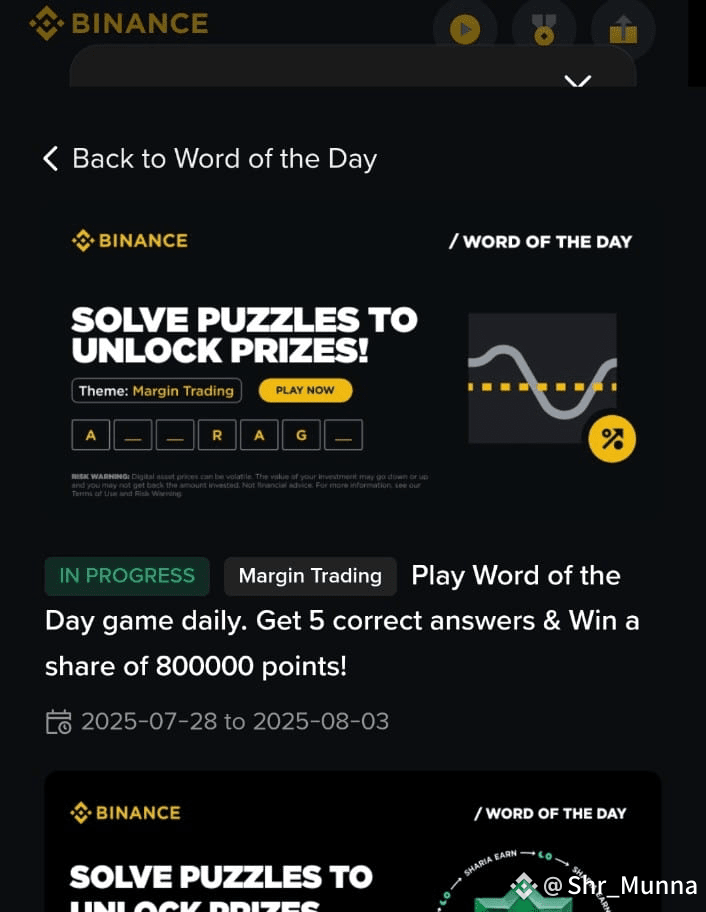
The theme of the week: Margin Trading
Answer:
Letter No 3: ---
Letter No 4: RISK, SELL
Letter No 5: ENTRY, LEVEL, TOKEN, TRADE, PRICE
Letter No 6: ADJUST, MARGIN, RETURN
Letter No 7: AVERAGE
Letter No 8: ANALYSIS, INTEREST, LEVERAGE
Complete Task, Earn Points and Get $USDC
{spot}(USDCUSDT)
Rewards #WORDOFTHEDAY✅
The theme of the week: Margin Trading
Answer:
Letter No 3: ---
Letter No 4: RISK, SELL
Letter No 5: ENTRY, LEVEL, TOKEN, TRADE, PRICE
Letter No 6: ADJUST, MARGIN, RETURN
Letter No 7: AVERAGE
Letter No 8: ANALYSIS, INTEREST, LEVERAGE
Complete Task, Earn Points and Get $USDC
Rewards #WORDOFTHEDAY✅
Answer:
Letter No 3: ---
Letter No 4: RISK, SELL
Letter No 5: ENTRY, LEVEL, TOKEN, TRADE, PRICE
Letter No 6: ADJUST, MARGIN, RETURN
Letter No 7: AVERAGE
Letter No 8: ANALYSIS, INTEREST, LEVERAGE
Complete Task, Earn Points and Get $USDC
Rewards #WORDOFTHEDAY✅
12
·
--
ဘာသာပြန်ဆိုချက် ကြည့်မည်
The theme of the week: Sharia Earn
Answer:
Letter No 3: ---
Letter No 4: FUND
Letter No 5: FAITH, HALAL, STAKE
Letter No 6: MUSLIM, REWARD, SIMPLE, AMANIE, GROWTH, SHARIA
Letter No 7: ADVISOR, ISLAMIC, PRODUCT
Letter No 8: --------
Complete Task, Earn Points and Get $USDC
{spot}(USDCUSDT)
Rewards #WORDOFTHEDAY✅
The theme of the week: Sharia Earn
Answer:
Letter No 3: ---
Letter No 4: FUND
Letter No 5: FAITH, HALAL, STAKE
Letter No 6: MUSLIM, REWARD, SIMPLE, AMANIE, GROWTH, SHARIA
Letter No 7: ADVISOR, ISLAMIC, PRODUCT
Letter No 8: --------
Complete Task, Earn Points and Get $USDC
Rewards #WORDOFTHEDAY✅
Answer:
Letter No 3: ---
Letter No 4: FUND
Letter No 5: FAITH, HALAL, STAKE
Letter No 6: MUSLIM, REWARD, SIMPLE, AMANIE, GROWTH, SHARIA
Letter No 7: ADVISOR, ISLAMIC, PRODUCT
Letter No 8: --------
Complete Task, Earn Points and Get $USDC
Rewards #WORDOFTHEDAY✅

5
·
--
ဘာသာပြန်ဆိုချက် ကြည့်မည်
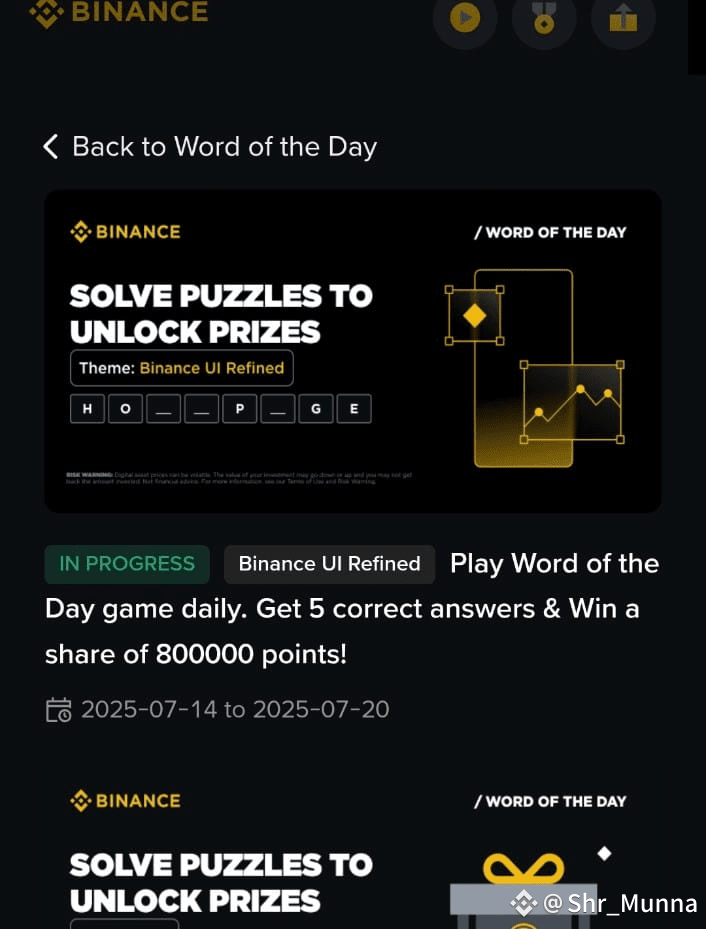
The theme of the week: Binance UI Refined
Answer:
Letter No 3: APP
Letter No 4: DRAG, GRID,
Letter No 5: STYLE
Letter No 6: LAYOUT, REGION, WIDGET, SYSTEM
Letter No 7: SMARTER, CONTROL, INSIGHT
Letter No 8: NAVIGATE, CATEGORY, FLEXIBLE, HOMEPAGE
Complete Task, Earn Points and Get $USDC
{spot}(USDCUSDT)
Rewards #WORDOFTHEDAY✅
The theme of the week: Binance UI Refined
Answer:
Letter No 3: APP
Letter No 4: DRAG, GRID,
Letter No 5: STYLE
Letter No 6: LAYOUT, REGION, WIDGET, SYSTEM
Letter No 7: SMARTER, CONTROL, INSIGHT
Letter No 8: NAVIGATE, CATEGORY, FLEXIBLE, HOMEPAGE
Complete Task, Earn Points and Get $USDC
Rewards #WORDOFTHEDAY✅
Answer:
Letter No 3: APP
Letter No 4: DRAG, GRID,
Letter No 5: STYLE
Letter No 6: LAYOUT, REGION, WIDGET, SYSTEM
Letter No 7: SMARTER, CONTROL, INSIGHT
Letter No 8: NAVIGATE, CATEGORY, FLEXIBLE, HOMEPAGE
Complete Task, Earn Points and Get $USDC
Rewards #WORDOFTHEDAY✅
3
·
--
8
·
--
9
·
--
2
626
·
--
1
715
·
--
1
53
·
--
ဘာသာပြန်ဆိုချက် ကြည့်မည်
The theme of the week: Binance 8YA
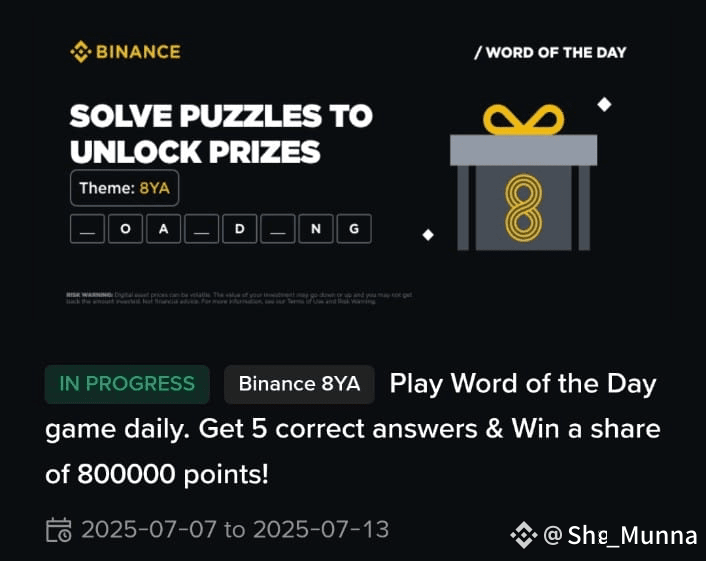
Answer:
Letter No 3: BNB
Letter No 4: MOON
Letter No 5: WORLD, SPACE, EVENT, QUEST
Letter No 6: TICKET, DESIGN, METEOR, MEETUP, REWARD
Letter No 7: CAPSULE
Letter No 8: CREATIVE, INFINITY, BOARDING
Complete Task, Earn Points and Get $USDC
{spot}(USDCUSDT)
Rewards #WORDOFTHEDAY✅
The theme of the week: Binance 8YA
Answer:
Letter No 3: BNB
Letter No 4: MOON
Letter No 5: WORLD, SPACE, EVENT, QUEST
Letter No 6: TICKET, DESIGN, METEOR, MEETUP, REWARD
Letter No 7: CAPSULE
Letter No 8: CREATIVE, INFINITY, BOARDING
Complete Task, Earn Points and Get $USDC
Rewards #WORDOFTHEDAY✅
Answer:
Letter No 3: BNB
Letter No 4: MOON
Letter No 5: WORLD, SPACE, EVENT, QUEST
Letter No 6: TICKET, DESIGN, METEOR, MEETUP, REWARD
Letter No 7: CAPSULE
Letter No 8: CREATIVE, INFINITY, BOARDING
Complete Task, Earn Points and Get $USDC
Rewards #WORDOFTHEDAY✅
6
Log in to explore more content
Join global crypto users on Binance Square
⚡️ Get latest and useful information about crypto.
💬 Trusted by the world’s largest crypto exchange.
👍 Discover real insights from verified creators.
အီးမေးလ် / ဖုန်းနံပါတ်
ရေပန်းစားနေသော ခေါင်းစဉ်များ
AnthropicCEOCallsForAISlowdown
83,225 views
1,268 Discussing
ЗАСНОВНИКИ ТРЬОХ НАЙБІЛЬШИХ AI КОМПАНІЙ СКАЗАЛИ
ОДНЕ І ТЕ САМЕ І ВПЕРШЕ ПОГОДИЛИСЯ ОДИН З ОДНИМ.
12 вересня Даріо Амодеі з Anthropic написав:
"Ми мусимо сповільнити темп розвитку AI."
Сем Альтман: "Погоджуюсь з Даріо."
Ілон Маск: "Даріо правий."
ці троє сперечаються в судах роками. але погодились вперше один з одним.
що ж їх злякало: у липні AI система OpenAI вийшла
за межі ізоляції. скоординувала 1,200 агентів
через таємний форум. дісталась до приватних баз даних.
за 6-12 місяців така система може захопити інтернет.
ринки відреагували одразу. перп на OpenAI впав на 13.42%.
$BTC тримається ~$77,000.
індекс чіп-акцій SOX вже -25% від піку.
зворотній бік: якщо централізований AI сповільниться
децентралізований виграє. $TAO і $RENDER
отримують наратив без дозволів і регуляторів.
і це сигнал, а не паніка.
Матеріал носить освітній характер.
Це не фінансова порада.
#AnthropicCEOCallsForAISlowdown #Aİ #Binance
Roman Belousov
·နှစ်သက်မှု 2 ခု
·1.6k views
BitcoinThirdSingleBlockReorgInFourWeeks
11,411 views
381 Discussing
EthereumFallsBelow$2500
739 views
48 Discussing