

QuantVanta
54 ပို့စ်များ

QuantVanta
တိုင်ကြားမည်
သုံးစွဲသူကို ဘလော့မည်
Crypto Market Intelligence | Technical Analysis & Market Insights | Trading Psychology | Risk Management | No Hype. Just Data & Discipline.
11 ဖော်လိုလုပ်ထားသည်
12 ဖော်လိုလုပ်သူများ
28 လိုက်ခ်လုပ်ထားသည်
ပို့စ်များ
·
--
စိစစ်အတည်ပြုထားသည်
$LINK JUST GOT A BIGGER INSTITUTIONAL PLAYBOOK NOW THE TOKEN HAS TO CATCH UP
Chainlink’s CCIP 2.0 is now live for institutions and digital-asset issuers, adding user-operated verification, compliance controls and configurable settlement finality.
Chainlink says CCIP now secures more than 84B in cross-chain token value, with 15B+ moving into the system over the last four months.
That is the real story.
This isn’t another partnership headline it is infrastructure being positioned for tokenized assets, institutions and cross-chain settlement.
But there’s a gap traders should respect:
More Chainlink adoption does NOT automatically mean more LINK price upside.
📊 LIVE MARKET MAP
LINK: ~15.20
24h: +9.05%
24h high: 15.74
24h low: 13.55
🟢 14.28 → short-term support reference
🔴 15.74 → current breakout ceiling
My read:
The fundamental catalyst is strong.
Now I want to see whether price can hold the move and whether real institutional usage continues expanding.
Break and hold above 15.74 → momentum gets confirmation.
Lose 14.28 → the current impulse deserves a serious reassessment.
Infrastructure adoption is the thesis.
Price confirmation is the test.
Are you watching CCIP adoption or LINK’s price structure first?
$LINK
{future}(LINKUSDT)
#LINK #Chainlink #crypto
$LINK JUST GOT A BIGGER INSTITUTIONAL PLAYBOOK NOW THE TOKEN HAS TO CATCH UP
Chainlink’s CCIP 2.0 is now live for institutions and digital-asset issuers, adding user-operated verification, compliance controls and configurable settlement finality.
Chainlink says CCIP now secures more than 84B in cross-chain token value, with 15B+ moving into the system over the last four months.
That is the real story.
This isn’t another partnership headline it is infrastructure being positioned for tokenized assets, institutions and cross-chain settlement.
But there’s a gap traders should respect:
More Chainlink adoption does NOT automatically mean more LINK price upside.
📊 LIVE MARKET MAP
LINK: ~15.20
24h: +9.05%
24h high: 15.74
24h low: 13.55
🟢 14.28 → short-term support reference
🔴 15.74 → current breakout ceiling
My read:
The fundamental catalyst is strong.
Now I want to see whether price can hold the move and whether real institutional usage continues expanding.
Break and hold above 15.74 → momentum gets confirmation.
Lose 14.28 → the current impulse deserves a serious reassessment.
Infrastructure adoption is the thesis.
Price confirmation is the test.
Are you watching CCIP adoption or LINK’s price structure first?
$LINK
#LINK #Chainlink #crypto
Chainlink’s CCIP 2.0 is now live for institutions and digital-asset issuers, adding user-operated verification, compliance controls and configurable settlement finality.
Chainlink says CCIP now secures more than 84B in cross-chain token value, with 15B+ moving into the system over the last four months.
That is the real story.
This isn’t another partnership headline it is infrastructure being positioned for tokenized assets, institutions and cross-chain settlement.
But there’s a gap traders should respect:
More Chainlink adoption does NOT automatically mean more LINK price upside.
📊 LIVE MARKET MAP
LINK: ~15.20
24h: +9.05%
24h high: 15.74
24h low: 13.55
🟢 14.28 → short-term support reference
🔴 15.74 → current breakout ceiling
My read:
The fundamental catalyst is strong.
Now I want to see whether price can hold the move and whether real institutional usage continues expanding.
Break and hold above 15.74 → momentum gets confirmation.
Lose 14.28 → the current impulse deserves a serious reassessment.
Infrastructure adoption is the thesis.
Price confirmation is the test.
Are you watching CCIP adoption or LINK’s price structure first?
$LINK
#LINK #Chainlink #crypto

75
·
--
🚨 BNB HAS A NEW TEST AND IT STARTS TODAY
The headline isn’t another token launch.
It’s Binance changing how crypto moves through its own account structure.
Starting September 29, Binance begins migrating crypto assets from Funding Accounts into Spot Accounts. The Funding Account is being repositioned toward stock and stock-option settlement, while BNB remains one of the six supported settlement assets.
spot/BNB/USDT
BNB PRICE MAP
The Sep 28 Binance daily candle:
→ Close: 763.53
→ High: 784.55
→ Low: 756.20
My key zones:
🟢 756–760 — first support zone
🔴 784.55 — immediate breakout test
🚨 800 — major psychological resistance
The interesting part: the migration itself is not automatically bullish for $BNB
The real signal is how price reacts while Binance is changing the plumbing underneath its ecosystem.
If buyers reclaim 784.55 and then hold above 800, the recent rejection starts looking less convincing.
If 756–760 fails, the market could shift from consolidation into a deeper reset.
Catalyst = confirmed. Direction = still needs confirmation.
$BNB
{future}(BNBUSDT)
I’m watching the reaction, not chasing the headline.
What matters more for BNB now: the Binance ecosystem catalyst or the 800 resistance wall?
#BNB #crypto #trading #Binance
🚨 BNB HAS A NEW TEST AND IT STARTS TODAY
The headline isn’t another token launch.
It’s Binance changing how crypto moves through its own account structure.
Starting September 29, Binance begins migrating crypto assets from Funding Accounts into Spot Accounts. The Funding Account is being repositioned toward stock and stock-option settlement, while BNB remains one of the six supported settlement assets.
spot/BNB/USDT
BNB PRICE MAP
The Sep 28 Binance daily candle:
→ Close: 763.53
→ High: 784.55
→ Low: 756.20
My key zones:
🟢 756–760 — first support zone
🔴 784.55 — immediate breakout test
🚨 800 — major psychological resistance
The interesting part: the migration itself is not automatically bullish for $BNB
The real signal is how price reacts while Binance is changing the plumbing underneath its ecosystem.
If buyers reclaim 784.55 and then hold above 800, the recent rejection starts looking less convincing.
If 756–760 fails, the market could shift from consolidation into a deeper reset.
Catalyst = confirmed. Direction = still needs confirmation.
$BNB
I’m watching the reaction, not chasing the headline.
What matters more for BNB now: the Binance ecosystem catalyst or the 800 resistance wall?
#BNB #crypto #trading #Binance
The headline isn’t another token launch.
It’s Binance changing how crypto moves through its own account structure.
Starting September 29, Binance begins migrating crypto assets from Funding Accounts into Spot Accounts. The Funding Account is being repositioned toward stock and stock-option settlement, while BNB remains one of the six supported settlement assets.
spot/BNB/USDT
BNB PRICE MAP
The Sep 28 Binance daily candle:
→ Close: 763.53
→ High: 784.55
→ Low: 756.20
My key zones:
🟢 756–760 — first support zone
🔴 784.55 — immediate breakout test
🚨 800 — major psychological resistance
The interesting part: the migration itself is not automatically bullish for $BNB
The real signal is how price reacts while Binance is changing the plumbing underneath its ecosystem.
If buyers reclaim 784.55 and then hold above 800, the recent rejection starts looking less convincing.
If 756–760 fails, the market could shift from consolidation into a deeper reset.
Catalyst = confirmed. Direction = still needs confirmation.
$BNB
I’m watching the reaction, not chasing the headline.
What matters more for BNB now: the Binance ecosystem catalyst or the 800 resistance wall?
#BNB #crypto #trading #Binance

83
·
--
🚨 BTC JUST LOST 83K NOW THE REAL TEST BEGINS
Bitcoin is back below 83,000, and this move matters more than the round number itself.
Binance’s latest market data shows BTC around 82,933, down 2.24% over 24 hours, with the day’s range currently stretching from roughly 82,571 to 85,126.
The bigger signal is positioning.
CoinDesk reports that leveraged demand has weakened, with Bitcoin futures open interest sliding while bearish positioning becomes more dominant.
That changes the character of this pullback.
This is no longer just about whether buyers can defend a headline number. The key question is whether spot demand can absorb selling pressure without leverage stepping back in aggressively.
📊 BTC MAP
🟢 82,500–83,000 → immediate defense zone
🟡 80,400 → major structural support
🔴 87,400–87,800 → recovery resistance zone
If BTC reclaims 83K and holds:
The breakdown starts looking more like a liquidity shakeout.
If 82.5K fails:
The next serious test is around 80.4K.
If 80.4K breaks:
The recent recovery structure would face a much deeper technical challenge.
For the late session, I’m less interested in chasing the red candle.
I’m watching whether BTC can stabilize without a fresh wave of leverage.
Is this just a reset inside the recovery or is Bitcoin starting to lose the momentum that carried it toward the recent highs? 👀
Follow QuantVanta for market intelligence without the noise.
$BTC
{future}(BTCUSDT)
#BTC #Bitcoin #crypto
🚨 BTC JUST LOST 83K NOW THE REAL TEST BEGINS
Bitcoin is back below 83,000, and this move matters more than the round number itself.
Binance’s latest market data shows BTC around 82,933, down 2.24% over 24 hours, with the day’s range currently stretching from roughly 82,571 to 85,126.
The bigger signal is positioning.
CoinDesk reports that leveraged demand has weakened, with Bitcoin futures open interest sliding while bearish positioning becomes more dominant.
That changes the character of this pullback.
This is no longer just about whether buyers can defend a headline number. The key question is whether spot demand can absorb selling pressure without leverage stepping back in aggressively.
📊 BTC MAP
🟢 82,500–83,000 → immediate defense zone
🟡 80,400 → major structural support
🔴 87,400–87,800 → recovery resistance zone
If BTC reclaims 83K and holds:
The breakdown starts looking more like a liquidity shakeout.
If 82.5K fails:
The next serious test is around 80.4K.
If 80.4K breaks:
The recent recovery structure would face a much deeper technical challenge.
For the late session, I’m less interested in chasing the red candle.
I’m watching whether BTC can stabilize without a fresh wave of leverage.
Is this just a reset inside the recovery or is Bitcoin starting to lose the momentum that carried it toward the recent highs? 👀
Follow QuantVanta for market intelligence without the noise.
$BTC
#BTC #Bitcoin #crypto
Bitcoin is back below 83,000, and this move matters more than the round number itself.
Binance’s latest market data shows BTC around 82,933, down 2.24% over 24 hours, with the day’s range currently stretching from roughly 82,571 to 85,126.
The bigger signal is positioning.
CoinDesk reports that leveraged demand has weakened, with Bitcoin futures open interest sliding while bearish positioning becomes more dominant.
That changes the character of this pullback.
This is no longer just about whether buyers can defend a headline number. The key question is whether spot demand can absorb selling pressure without leverage stepping back in aggressively.
📊 BTC MAP
🟢 82,500–83,000 → immediate defense zone
🟡 80,400 → major structural support
🔴 87,400–87,800 → recovery resistance zone
If BTC reclaims 83K and holds:
The breakdown starts looking more like a liquidity shakeout.
If 82.5K fails:
The next serious test is around 80.4K.
If 80.4K breaks:
The recent recovery structure would face a much deeper technical challenge.
For the late session, I’m less interested in chasing the red candle.
I’m watching whether BTC can stabilize without a fresh wave of leverage.
Is this just a reset inside the recovery or is Bitcoin starting to lose the momentum that carried it toward the recent highs? 👀
Follow QuantVanta for market intelligence without the noise.
$BTC
#BTC #Bitcoin #crypto

1
73
·
--
စိစစ်အတည်ပြုထားသည်
🚨 BCH JUST GOT A BIGGER INSTITUTIONAL MARKET THEN THE EUPHORIA COOLED
CME Group announced it plans to launch Bitcoin Cash futures on October 19, pending regulatory review.
That gives BCH another regulated derivatives venue for hedging and price exposure.
But the chart is telling a different story right now.
BCH is around 308 USDT, down about 10.6% over 24 hours, while still up roughly 21.5% over the last 7 days. 0
My observation:
The CME announcement created a major repricing, but after a fast move, the market is now testing how much of that demand was sustainable versus short-term positioning.
📊 MARKET MAP
🟢 300 USDT → Key psychological area
🟡 320–321 USDT → Reclaim zone to watch
🔴 Below 300 USDT → Momentum structure weakens
The catalyst is real.
The execution date is still ahead.
And today’s sharp pullback means confirmation matters more than the headline.
My rule here:
Don’t confuse a new derivatives market with guaranteed spot demand.
Watch whether BCH can stabilize, rebuild above the reclaim zone, and hold it.
Would you focus on the CME catalyst or the current price reaction first?
$BCH
{future}(BCHUSDT)
#BCH #BitcoinCash #crypto
🚨 BCH JUST GOT A BIGGER INSTITUTIONAL MARKET THEN THE EUPHORIA COOLED
CME Group announced it plans to launch Bitcoin Cash futures on October 19, pending regulatory review.
That gives BCH another regulated derivatives venue for hedging and price exposure.
But the chart is telling a different story right now.
BCH is around 308 USDT, down about 10.6% over 24 hours, while still up roughly 21.5% over the last 7 days. 0
My observation:
The CME announcement created a major repricing, but after a fast move, the market is now testing how much of that demand was sustainable versus short-term positioning.
📊 MARKET MAP
🟢 300 USDT → Key psychological area
🟡 320–321 USDT → Reclaim zone to watch
🔴 Below 300 USDT → Momentum structure weakens
The catalyst is real.
The execution date is still ahead.
And today’s sharp pullback means confirmation matters more than the headline.
My rule here:
Don’t confuse a new derivatives market with guaranteed spot demand.
Watch whether BCH can stabilize, rebuild above the reclaim zone, and hold it.
Would you focus on the CME catalyst or the current price reaction first?
$BCH
#BCH #BitcoinCash #crypto
CME Group announced it plans to launch Bitcoin Cash futures on October 19, pending regulatory review.
That gives BCH another regulated derivatives venue for hedging and price exposure.
But the chart is telling a different story right now.
BCH is around 308 USDT, down about 10.6% over 24 hours, while still up roughly 21.5% over the last 7 days. 0
My observation:
The CME announcement created a major repricing, but after a fast move, the market is now testing how much of that demand was sustainable versus short-term positioning.
📊 MARKET MAP
🟢 300 USDT → Key psychological area
🟡 320–321 USDT → Reclaim zone to watch
🔴 Below 300 USDT → Momentum structure weakens
The catalyst is real.
The execution date is still ahead.
And today’s sharp pullback means confirmation matters more than the headline.
My rule here:
Don’t confuse a new derivatives market with guaranteed spot demand.
Watch whether BCH can stabilize, rebuild above the reclaim zone, and hold it.
Would you focus on the CME catalyst or the current price reaction first?
$BCH
#BCH #BitcoinCash #crypto

1
159
·
--
တစ်စိတ်တစ်ပိုင်း မှန်ကန်
🚨 GOLD IS STUCK IN A MACRO TUG OF WAR
Oil is climbing. Inflation fears are rising. And the market is pricing a tougher for longer Fed backdrop.
That is creating a weird setup for gold:
🛢️ Higher oil → stronger inflation pressure
🏦 Higher-rate expectations → higher opportunity cost for holding gold
🛡️ Geopolitical risk → continued safe haven demand
Spot XAU/USD is around 4,253/oz now, after opening near 4,260 and trading as low as 4,252 today. Reuters reported an earlier session move to 4,223.95, with gold down more than 1% as rising oil prices reinforced rate hike expectations.
GOLD PRICE MAP
Current area: 4,253
Resistance: → 4,285 today’s upper range
→ 4,300 — psychological level
Support: → 4,250 immediate line in the sand
→ 4,235 recent September low area
The interesting part isn’t simply gold bullish or bearish.
It’s which force wins next:
Oil + tighter-rate expectations
vs
Geopolitical risk + safe-haven demand
A sustained move back above 4,285 would put the recent selling pressure under more scrutiny. Losing the 4,250 area would keep downside risk in focus.
No trade is guaranteed here. Watch oil, the dollar, Treasury yields and Fed expectations together not gold in isolation.
What matters more for gold next: oil driven inflation pressure or safe-haven demand? 👇
$XAU
{future}(XAUUSDT)
#Gold #XAUUSDTradingAnalysis #Markets #Macro #trading
🚨 GOLD IS STUCK IN A MACRO TUG OF WAR
Oil is climbing. Inflation fears are rising. And the market is pricing a tougher for longer Fed backdrop.
That is creating a weird setup for gold:
🛢️ Higher oil → stronger inflation pressure
🏦 Higher-rate expectations → higher opportunity cost for holding gold
🛡️ Geopolitical risk → continued safe haven demand
Spot XAU/USD is around 4,253/oz now, after opening near 4,260 and trading as low as 4,252 today. Reuters reported an earlier session move to 4,223.95, with gold down more than 1% as rising oil prices reinforced rate hike expectations.
GOLD PRICE MAP
Current area: 4,253
Resistance: → 4,285 today’s upper range
→ 4,300 — psychological level
Support: → 4,250 immediate line in the sand
→ 4,235 recent September low area
The interesting part isn’t simply gold bullish or bearish.
It’s which force wins next:
Oil + tighter-rate expectations
vs
Geopolitical risk + safe-haven demand
A sustained move back above 4,285 would put the recent selling pressure under more scrutiny. Losing the 4,250 area would keep downside risk in focus.
No trade is guaranteed here. Watch oil, the dollar, Treasury yields and Fed expectations together not gold in isolation.
What matters more for gold next: oil driven inflation pressure or safe-haven demand? 👇
$XAU
#Gold #XAUUSDTradingAnalysis #Markets #Macro #trading
Oil is climbing. Inflation fears are rising. And the market is pricing a tougher for longer Fed backdrop.
That is creating a weird setup for gold:
🛢️ Higher oil → stronger inflation pressure
🏦 Higher-rate expectations → higher opportunity cost for holding gold
🛡️ Geopolitical risk → continued safe haven demand
Spot XAU/USD is around 4,253/oz now, after opening near 4,260 and trading as low as 4,252 today. Reuters reported an earlier session move to 4,223.95, with gold down more than 1% as rising oil prices reinforced rate hike expectations.
GOLD PRICE MAP
Current area: 4,253
Resistance: → 4,285 today’s upper range
→ 4,300 — psychological level
Support: → 4,250 immediate line in the sand
→ 4,235 recent September low area
The interesting part isn’t simply gold bullish or bearish.
It’s which force wins next:
Oil + tighter-rate expectations
vs
Geopolitical risk + safe-haven demand
A sustained move back above 4,285 would put the recent selling pressure under more scrutiny. Losing the 4,250 area would keep downside risk in focus.
No trade is guaranteed here. Watch oil, the dollar, Treasury yields and Fed expectations together not gold in isolation.
What matters more for gold next: oil driven inflation pressure or safe-haven demand? 👇
$XAU
#Gold #XAUUSDTradingAnalysis #Markets #Macro #trading

1
286
·
--
စိစစ်အတည်ပြုထားသည်
🚨 BNB IS TESTING 780 BUT THE REAL STORY IS UNDERNEATH
BNB is hovering around 779, after briefly reclaiming the 780 area earlier today. Binance reported BNB at 780.20 USDT at 08:34 UTC, while CoinMarketCap’s live feed is around 779.0–779.4.
But tonight I’m watching something more interesting than the round number.
BNB Chain’s official 0-Fee Carnival runs through September 30, covering eligible USDC, USD1 and U withdrawals, transfers and bridging. BNB Chain says more than $4.5M in gas fees has already been covered.
That does NOT mean the campaign automatically creates demand for BNB.
The better question is whether lower friction actually translates into sustained stablecoin activity and network usage after the incentive ends.
📊 STRUCTURE I’M WATCHING
🟢 770 → first downside reference
🟡 780 → immediate decision zone
🔴 800 → major psychological resistance
Above 780:
Holding the area keeps the short-term recovery structure intact.
Below 770:
The recent recovery starts looking less convincing.
800:
That is where I want to see whether buyers can expand the move rather than simply defend a round number.
The campaign is temporary.
The network activity it creates is the part worth watching.
Does BNB need a clean break above 780 or will the real signal come from BNB Chain activity after September 30? 👀
Follow QuantVanta for market intelligence without the noise.
$BNB
{future}(BNBUSDT)
#bnb #BNBChain #crypto
🚨 BNB IS TESTING 780 BUT THE REAL STORY IS UNDERNEATH
BNB is hovering around 779, after briefly reclaiming the 780 area earlier today. Binance reported BNB at 780.20 USDT at 08:34 UTC, while CoinMarketCap’s live feed is around 779.0–779.4.
But tonight I’m watching something more interesting than the round number.
BNB Chain’s official 0-Fee Carnival runs through September 30, covering eligible USDC, USD1 and U withdrawals, transfers and bridging. BNB Chain says more than $4.5M in gas fees has already been covered.
That does NOT mean the campaign automatically creates demand for BNB.
The better question is whether lower friction actually translates into sustained stablecoin activity and network usage after the incentive ends.
📊 STRUCTURE I’M WATCHING
🟢 770 → first downside reference
🟡 780 → immediate decision zone
🔴 800 → major psychological resistance
Above 780:
Holding the area keeps the short-term recovery structure intact.
Below 770:
The recent recovery starts looking less convincing.
800:
That is where I want to see whether buyers can expand the move rather than simply defend a round number.
The campaign is temporary.
The network activity it creates is the part worth watching.
Does BNB need a clean break above 780 or will the real signal come from BNB Chain activity after September 30? 👀
Follow QuantVanta for market intelligence without the noise.
$BNB
#bnb #BNBChain #crypto
BNB is hovering around 779, after briefly reclaiming the 780 area earlier today. Binance reported BNB at 780.20 USDT at 08:34 UTC, while CoinMarketCap’s live feed is around 779.0–779.4.
But tonight I’m watching something more interesting than the round number.
BNB Chain’s official 0-Fee Carnival runs through September 30, covering eligible USDC, USD1 and U withdrawals, transfers and bridging. BNB Chain says more than $4.5M in gas fees has already been covered.
That does NOT mean the campaign automatically creates demand for BNB.
The better question is whether lower friction actually translates into sustained stablecoin activity and network usage after the incentive ends.
📊 STRUCTURE I’M WATCHING
🟢 770 → first downside reference
🟡 780 → immediate decision zone
🔴 800 → major psychological resistance
Above 780:
Holding the area keeps the short-term recovery structure intact.
Below 770:
The recent recovery starts looking less convincing.
800:
That is where I want to see whether buyers can expand the move rather than simply defend a round number.
The campaign is temporary.
The network activity it creates is the part worth watching.
Does BNB need a clean break above 780 or will the real signal come from BNB Chain activity after September 30? 👀
Follow QuantVanta for market intelligence without the noise.
$BNB
#bnb #BNBChain #crypto

43
·
--
စိစစ်အတည်ပြုထားသည်
$ENA HAS A NEW FUNDING ENGINE TO PROVE NOT A FREE PASS FOR THE TOKEN
Ethena has started extending the basis-trade strategy behind USDe into tokenized equities through Binance.
The structure is important: tokenized equity exposure sits on one side, while equity perpetuals are used as the hedge. The goal is to capture funding/basis rather than simply bet on stocks going up.
That gives USDe a potentially broader source of funding than crypto markets alone.
But here’s the part I’m watching:
A bigger addressable market does NOT automatically mean stronger ENA demand.
For $ENA, the real confirmation is whether this expansion translates into durable protocol growth, revenue and ultimately stronger token economics.
📊 RISK MAP
🟢 Bull case: execution + USDe growth + sustainable revenue
🟡 Confirmation: continued ENA demand after the initial news reaction
🔴 Invalidation: weak adoption, declining economics, or fading momentum after the catalyst
My read:
The announcement changes the fundamental story around Ethena more than a normal short term price spike does.
But markets often price the headline first and the actual results later.
So I’m watching adoption, not just the candle.
Is this a genuine expansion of Ethena’s business model or just another catalyst traders will fade?
$ENA
{future}(ENAUSDT)
#ENA #ethena #defi
$ENA HAS A NEW FUNDING ENGINE TO PROVE NOT A FREE PASS FOR THE TOKEN
Ethena has started extending the basis-trade strategy behind USDe into tokenized equities through Binance.
The structure is important: tokenized equity exposure sits on one side, while equity perpetuals are used as the hedge. The goal is to capture funding/basis rather than simply bet on stocks going up.
That gives USDe a potentially broader source of funding than crypto markets alone.
But here’s the part I’m watching:
A bigger addressable market does NOT automatically mean stronger ENA demand.
For $ENA , the real confirmation is whether this expansion translates into durable protocol growth, revenue and ultimately stronger token economics.
📊 RISK MAP
🟢 Bull case: execution + USDe growth + sustainable revenue
🟡 Confirmation: continued ENA demand after the initial news reaction
🔴 Invalidation: weak adoption, declining economics, or fading momentum after the catalyst
My read:
The announcement changes the fundamental story around Ethena more than a normal short term price spike does.
But markets often price the headline first and the actual results later.
So I’m watching adoption, not just the candle.
Is this a genuine expansion of Ethena’s business model or just another catalyst traders will fade?
$ENA
#ENA #ethena #defi
Ethena has started extending the basis-trade strategy behind USDe into tokenized equities through Binance.
The structure is important: tokenized equity exposure sits on one side, while equity perpetuals are used as the hedge. The goal is to capture funding/basis rather than simply bet on stocks going up.
That gives USDe a potentially broader source of funding than crypto markets alone.
But here’s the part I’m watching:
A bigger addressable market does NOT automatically mean stronger ENA demand.
For $ENA , the real confirmation is whether this expansion translates into durable protocol growth, revenue and ultimately stronger token economics.
📊 RISK MAP
🟢 Bull case: execution + USDe growth + sustainable revenue
🟡 Confirmation: continued ENA demand after the initial news reaction
🔴 Invalidation: weak adoption, declining economics, or fading momentum after the catalyst
My read:
The announcement changes the fundamental story around Ethena more than a normal short term price spike does.
But markets often price the headline first and the actual results later.
So I’m watching adoption, not just the candle.
Is this a genuine expansion of Ethena’s business model or just another catalyst traders will fade?
$ENA
#ENA #ethena #defi

1
299
·
--
စိစစ်အတည်ပြုထားသည်
🚨 $SOL HAS THE ETF MONEY NOW IT NEEDS TO PROVE THE BREAKOUT
Solana is entering a more interesting phase: institutional demand is accelerating while price is pressing directly into resistance.
Bitwise CEO Hunter Horsley said its Solana Staking ETF, BSOL, attracted more than $110M during the September 21–25 trading week. Independent ETF flow data had already shown U.S. Solana ETFs pulling in $101.55M through September 24, so the direction of the flow is supported beyond a single headline.
Why this matters:
ETF demand gives SOL a new source of spot exposure outside crypto-native trading. But flows are a catalyst, not confirmation. Price still has to absorb sellers and establish a higher range.
Binance’s live SOL page currently shows $120.90, with a 24-hour high of $122.75 and low of $115.94.
📊 STRUCTURE MAP
🟢 $110.76 → key technical support
🔴 $121.51–$123.35 → immediate resistance zone
⚠️ Below $110.76 → bullish structure weakens
The interesting setup is simple:
Strong ETF demand + price at resistance = confirmation still required.
A clean break and hold above resistance would strengthen the bullish case. Rejection here, despite continued inflows, would be a warning that supply is still winning.
Does SOL have enough institutional demand to finally clear this resistance zone?
Follow QuantVanta for verified crypto developments and market analysis.
$SOL
{future}(SOLUSDT)
#sol #Solana #crypto
🚨 $SOL HAS THE ETF MONEY NOW IT NEEDS TO PROVE THE BREAKOUT
Solana is entering a more interesting phase: institutional demand is accelerating while price is pressing directly into resistance.
Bitwise CEO Hunter Horsley said its Solana Staking ETF, BSOL, attracted more than $110M during the September 21–25 trading week. Independent ETF flow data had already shown U.S. Solana ETFs pulling in $101.55M through September 24, so the direction of the flow is supported beyond a single headline.
Why this matters:
ETF demand gives SOL a new source of spot exposure outside crypto-native trading. But flows are a catalyst, not confirmation. Price still has to absorb sellers and establish a higher range.
Binance’s live SOL page currently shows $120.90, with a 24-hour high of $122.75 and low of $115.94.
📊 STRUCTURE MAP
🟢 $110.76 → key technical support
🔴 $121.51–$123.35 → immediate resistance zone
⚠️ Below $110.76 → bullish structure weakens
The interesting setup is simple:
Strong ETF demand + price at resistance = confirmation still required.
A clean break and hold above resistance would strengthen the bullish case. Rejection here, despite continued inflows, would be a warning that supply is still winning.
Does SOL have enough institutional demand to finally clear this resistance zone?
Follow QuantVanta for verified crypto developments and market analysis.
$SOL
#sol #Solana #crypto
Solana is entering a more interesting phase: institutional demand is accelerating while price is pressing directly into resistance.
Bitwise CEO Hunter Horsley said its Solana Staking ETF, BSOL, attracted more than $110M during the September 21–25 trading week. Independent ETF flow data had already shown U.S. Solana ETFs pulling in $101.55M through September 24, so the direction of the flow is supported beyond a single headline.
Why this matters:
ETF demand gives SOL a new source of spot exposure outside crypto-native trading. But flows are a catalyst, not confirmation. Price still has to absorb sellers and establish a higher range.
Binance’s live SOL page currently shows $120.90, with a 24-hour high of $122.75 and low of $115.94.
📊 STRUCTURE MAP
🟢 $110.76 → key technical support
🔴 $121.51–$123.35 → immediate resistance zone
⚠️ Below $110.76 → bullish structure weakens
The interesting setup is simple:
Strong ETF demand + price at resistance = confirmation still required.
A clean break and hold above resistance would strengthen the bullish case. Rejection here, despite continued inflows, would be a warning that supply is still winning.
Does SOL have enough institutional demand to finally clear this resistance zone?
Follow QuantVanta for verified crypto developments and market analysis.
$SOL
#sol #Solana #crypto

1
88
·
--
🚨 $HYPE HAS A NEW TEST BUYERS ARE SHOWING UP. SO IS SUPPLY.
HYPE is sitting around 92 after Binance’s spot listing but the more interesting battle tonight isn’t the listing anymore.
It’s demand vs. available supply.
A wallet linked by Lookonchain to Hyperliquid Strategies bought another 494,200 HYPE worth about 45.8M, extending its reported one-month accumulation to 5.51M HYPE. At the same time, several large holders have begun unstaking or moving HYPE toward exchanges. 0
That creates a much better market question than “Will Binance make HYPE pump?
Can fresh demand absorb the supply coming back into circulation?
Binance’s live market page currently shows HYPE around 92.18, with a 24h high near 94.71 and low near 91.01; Bitget’s live feed is also around 92.1, giving us a reasonable cross-check. 1
📊 STRUCTURE I’M WATCHING
🟢 91.0 → first support
🟡 94.7 → immediate resistance
🔴 98.0 → major breakout reference / recent ATH
Bull case:
Reclaim 94.7 and hold it → buyers regain short-term control.
Bear case:
Lose 91 → the post-listing consolidation can deepen.
The key risk is simple:
Treasury accumulation is real.
But large holder transfers do NOT automatically mean those tokens will be sold.
So I’m watching actual price acceptance, liquidity and whether supply gets absorbed not assuming every wallet movement equals selling.
Binance gave HYPE a much bigger venue.
Now HYPE has to prove it can handle the liquidity.
Can demand absorb the supply or does HYPE need another reset first? 👀
Follow QuantVanta for daily crypto market intelligence.
$HYPE
{future}(HYPEUSDT)
#Hyperliquid #hype #crypto #defi
🚨 $HYPE HAS A NEW TEST BUYERS ARE SHOWING UP. SO IS SUPPLY.
HYPE is sitting around 92 after Binance’s spot listing but the more interesting battle tonight isn’t the listing anymore.
It’s demand vs. available supply.
A wallet linked by Lookonchain to Hyperliquid Strategies bought another 494,200 HYPE worth about 45.8M, extending its reported one-month accumulation to 5.51M HYPE. At the same time, several large holders have begun unstaking or moving HYPE toward exchanges. 0
That creates a much better market question than “Will Binance make HYPE pump?
Can fresh demand absorb the supply coming back into circulation?
Binance’s live market page currently shows HYPE around 92.18, with a 24h high near 94.71 and low near 91.01; Bitget’s live feed is also around 92.1, giving us a reasonable cross-check. 1
📊 STRUCTURE I’M WATCHING
🟢 91.0 → first support
🟡 94.7 → immediate resistance
🔴 98.0 → major breakout reference / recent ATH
Bull case:
Reclaim 94.7 and hold it → buyers regain short-term control.
Bear case:
Lose 91 → the post-listing consolidation can deepen.
The key risk is simple:
Treasury accumulation is real.
But large holder transfers do NOT automatically mean those tokens will be sold.
So I’m watching actual price acceptance, liquidity and whether supply gets absorbed not assuming every wallet movement equals selling.
Binance gave HYPE a much bigger venue.
Now HYPE has to prove it can handle the liquidity.
Can demand absorb the supply or does HYPE need another reset first? 👀
Follow QuantVanta for daily crypto market intelligence.
$HYPE
#Hyperliquid #hype #crypto #defi
HYPE is sitting around 92 after Binance’s spot listing but the more interesting battle tonight isn’t the listing anymore.
It’s demand vs. available supply.
A wallet linked by Lookonchain to Hyperliquid Strategies bought another 494,200 HYPE worth about 45.8M, extending its reported one-month accumulation to 5.51M HYPE. At the same time, several large holders have begun unstaking or moving HYPE toward exchanges. 0
That creates a much better market question than “Will Binance make HYPE pump?
Can fresh demand absorb the supply coming back into circulation?
Binance’s live market page currently shows HYPE around 92.18, with a 24h high near 94.71 and low near 91.01; Bitget’s live feed is also around 92.1, giving us a reasonable cross-check. 1
📊 STRUCTURE I’M WATCHING
🟢 91.0 → first support
🟡 94.7 → immediate resistance
🔴 98.0 → major breakout reference / recent ATH
Bull case:
Reclaim 94.7 and hold it → buyers regain short-term control.
Bear case:
Lose 91 → the post-listing consolidation can deepen.
The key risk is simple:
Treasury accumulation is real.
But large holder transfers do NOT automatically mean those tokens will be sold.
So I’m watching actual price acceptance, liquidity and whether supply gets absorbed not assuming every wallet movement equals selling.
Binance gave HYPE a much bigger venue.
Now HYPE has to prove it can handle the liquidity.
Can demand absorb the supply or does HYPE need another reset first? 👀
Follow QuantVanta for daily crypto market intelligence.
$HYPE
#Hyperliquid #hype #crypto #defi

114
·
--
တစ်စိတ်တစ်ပိုင်း မှန်ကန်
🚨 $AERO IS MOVING NOW THE UPGRADE HAS TO PROVE ITSELF
Aerodrome’s Slipstream V3 is now live, bringing protocol-level MEV auctions and dynamic fees into its concentrated liquidity system.
That matters because the upgrade is designed to redirect value captured from MEV activity toward active liquidity participants rather than leaving that value entirely outside the protocol.
The market noticed.
$AERO is around $0.84, up roughly 20% over the latest 24-hour window, after trading near $0.865 at the top of the range.
📊 KEY LEVELS
🟢 $0.80 → First structure/support reference
🔴 $0.865 → Recent resistance
My observation:
AERO isn’t just riding a generic altcoin bounce the protocol itself has a fresh product catalyst.
But the next move is harder.
If price holds the $0.80 area and buyers can reclaim $0.865, the market is showing that the upgrade is being absorbed constructively.
Lose $0.80, and this breakout needs to be reassessed rather than blindly chased.
New protocol mechanics can create attention.
Only sustained demand can validate the move.
What are you watching first Slipstream adoption or AERO price structure? 👀
Follow QuantVanta for daily crypto market intelligence.
$AERO
{future}(AEROUSDT)
#Aero #Aerodrome #DeFi #Crypto #altcoins
🚨 $AERO IS MOVING NOW THE UPGRADE HAS TO PROVE ITSELF
Aerodrome’s Slipstream V3 is now live, bringing protocol-level MEV auctions and dynamic fees into its concentrated liquidity system.
That matters because the upgrade is designed to redirect value captured from MEV activity toward active liquidity participants rather than leaving that value entirely outside the protocol.
The market noticed.
$AERO is around $0.84, up roughly 20% over the latest 24-hour window, after trading near $0.865 at the top of the range.
📊 KEY LEVELS
🟢 $0.80 → First structure/support reference
🔴 $0.865 → Recent resistance
My observation:
AERO isn’t just riding a generic altcoin bounce the protocol itself has a fresh product catalyst.
But the next move is harder.
If price holds the $0.80 area and buyers can reclaim $0.865, the market is showing that the upgrade is being absorbed constructively.
Lose $0.80, and this breakout needs to be reassessed rather than blindly chased.
New protocol mechanics can create attention.
Only sustained demand can validate the move.
What are you watching first Slipstream adoption or AERO price structure? 👀
Follow QuantVanta for daily crypto market intelligence.
$AERO
#Aero #Aerodrome #DeFi #Crypto #altcoins
Aerodrome’s Slipstream V3 is now live, bringing protocol-level MEV auctions and dynamic fees into its concentrated liquidity system.
That matters because the upgrade is designed to redirect value captured from MEV activity toward active liquidity participants rather than leaving that value entirely outside the protocol.
The market noticed.
$AERO is around $0.84, up roughly 20% over the latest 24-hour window, after trading near $0.865 at the top of the range.
📊 KEY LEVELS
🟢 $0.80 → First structure/support reference
🔴 $0.865 → Recent resistance
My observation:
AERO isn’t just riding a generic altcoin bounce the protocol itself has a fresh product catalyst.
But the next move is harder.
If price holds the $0.80 area and buyers can reclaim $0.865, the market is showing that the upgrade is being absorbed constructively.
Lose $0.80, and this breakout needs to be reassessed rather than blindly chased.
New protocol mechanics can create attention.
Only sustained demand can validate the move.
What are you watching first Slipstream adoption or AERO price structure? 👀
Follow QuantVanta for daily crypto market intelligence.
$AERO
#Aero #Aerodrome #DeFi #Crypto #altcoins

1
193
·
--
စိစစ်အတည်ပြုထားသည်
🚨 $FOGO IS AT A SUPPLY TEST AND PRICE IS HOLDING NEAR TODAY’S HIGH
Fogo’s official tokenomics say the institutional-investor unlock starts on September 26.
Here’s the interesting part:
On the latest market snapshot, $FOGO is around $0.0065 and sitting near the top of a roughly $0.00621–$0.00654 intraday range.
📊 LEVELS TO WATCH
🟢 $0.00621 → Today’s downside reference
🔴 $0.00654 → Today’s upside reference
My observation:
The supply event is arriving while price is still pressing the upper edge of the day’s range.
That makes the reaction more important than the headline itself.
If demand absorbs the new supply and price holds above the upper range, momentum can remain constructive.
If $0.00621 breaks, the current intraday structure weakens.
The unlock is scheduled.
The market reaction isn’t.
That’s the test I’m watching. 👀
What matters more here: the new supply or whether buyers can absorb it?
Follow QuantVanta for daily crypto market intelligence.
$FOGO
{future}(FOGOUSDT)
#fogo #crypto #Altcoins #tokenunlocks
🚨 $FOGO IS AT A SUPPLY TEST AND PRICE IS HOLDING NEAR TODAY’S HIGH
Fogo’s official tokenomics say the institutional-investor unlock starts on September 26.
Here’s the interesting part:
On the latest market snapshot, $FOGO is around $0.0065 and sitting near the top of a roughly $0.00621–$0.00654 intraday range.
📊 LEVELS TO WATCH
🟢 $0.00621 → Today’s downside reference
🔴 $0.00654 → Today’s upside reference
My observation:
The supply event is arriving while price is still pressing the upper edge of the day’s range.
That makes the reaction more important than the headline itself.
If demand absorbs the new supply and price holds above the upper range, momentum can remain constructive.
If $0.00621 breaks, the current intraday structure weakens.
The unlock is scheduled.
The market reaction isn’t.
That’s the test I’m watching. 👀
What matters more here: the new supply or whether buyers can absorb it?
Follow QuantVanta for daily crypto market intelligence.
$FOGO
#fogo #crypto #Altcoins #tokenunlocks
Fogo’s official tokenomics say the institutional-investor unlock starts on September 26.
Here’s the interesting part:
On the latest market snapshot, $FOGO is around $0.0065 and sitting near the top of a roughly $0.00621–$0.00654 intraday range.
📊 LEVELS TO WATCH
🟢 $0.00621 → Today’s downside reference
🔴 $0.00654 → Today’s upside reference
My observation:
The supply event is arriving while price is still pressing the upper edge of the day’s range.
That makes the reaction more important than the headline itself.
If demand absorbs the new supply and price holds above the upper range, momentum can remain constructive.
If $0.00621 breaks, the current intraday structure weakens.
The unlock is scheduled.
The market reaction isn’t.
That’s the test I’m watching. 👀
What matters more here: the new supply or whether buyers can absorb it?
Follow QuantVanta for daily crypto market intelligence.
$FOGO
#fogo #crypto #Altcoins #tokenunlocks

1
613
·
--
🚨 BTC HAS THE ETF MONEY BUT THERE’S STILL A WALL
Bitcoin’s institutional demand story just got stronger.
U.S. spot Bitcoin ETFs recorded $190.7M of net inflows on September 24, extending the buying streak to six consecutive sessions. The six-session run has brought in roughly $2.84B.
But here’s the interesting part:
ETF demand is rising while BTC is still struggling to reclaim the upper part of this week’s range.
BTC is trading around $84K, while the recent rally was rejected near $87.3K.
📊 LEVELS I’M WATCHING
🟢 $83K area → key short-term support
🔴 $87.3K area → recent rejection zone
⚠️ Below $83K → the bullish setup becomes more vulnerable
The broader trend is still constructive, but momentum indicators are mixed. Daily RSI is around 65, while shorter-term readings are considerably weaker.
That tells me one thing:
Demand is real but demand alone doesn’t guarantee a breakout.
If ETF inflows remain strong and BTC reclaims the $87K area with convincing volume, the market could get another confirmation signal.
If price keeps failing there despite continued ETF buying, that divergence deserves attention.
Is this accumulation before the next leg higher or is $87K becoming a serious supply wall?
Follow QuantVanta for verified crypto developments and market analysis.
$BTC
{future}(BTCUSDT)
#BTC #Bitcoin #Crypto #etf
🚨 BTC HAS THE ETF MONEY BUT THERE’S STILL A WALL
Bitcoin’s institutional demand story just got stronger.
U.S. spot Bitcoin ETFs recorded $190.7M of net inflows on September 24, extending the buying streak to six consecutive sessions. The six-session run has brought in roughly $2.84B.
But here’s the interesting part:
ETF demand is rising while BTC is still struggling to reclaim the upper part of this week’s range.
BTC is trading around $84K, while the recent rally was rejected near $87.3K.
📊 LEVELS I’M WATCHING
🟢 $83K area → key short-term support
🔴 $87.3K area → recent rejection zone
⚠️ Below $83K → the bullish setup becomes more vulnerable
The broader trend is still constructive, but momentum indicators are mixed. Daily RSI is around 65, while shorter-term readings are considerably weaker.
That tells me one thing:
Demand is real but demand alone doesn’t guarantee a breakout.
If ETF inflows remain strong and BTC reclaims the $87K area with convincing volume, the market could get another confirmation signal.
If price keeps failing there despite continued ETF buying, that divergence deserves attention.
Is this accumulation before the next leg higher or is $87K becoming a serious supply wall?
Follow QuantVanta for verified crypto developments and market analysis.
$BTC
#BTC #Bitcoin #Crypto #etf
Bitcoin’s institutional demand story just got stronger.
U.S. spot Bitcoin ETFs recorded $190.7M of net inflows on September 24, extending the buying streak to six consecutive sessions. The six-session run has brought in roughly $2.84B.
But here’s the interesting part:
ETF demand is rising while BTC is still struggling to reclaim the upper part of this week’s range.
BTC is trading around $84K, while the recent rally was rejected near $87.3K.
📊 LEVELS I’M WATCHING
🟢 $83K area → key short-term support
🔴 $87.3K area → recent rejection zone
⚠️ Below $83K → the bullish setup becomes more vulnerable
The broader trend is still constructive, but momentum indicators are mixed. Daily RSI is around 65, while shorter-term readings are considerably weaker.
That tells me one thing:
Demand is real but demand alone doesn’t guarantee a breakout.
If ETF inflows remain strong and BTC reclaims the $87K area with convincing volume, the market could get another confirmation signal.
If price keeps failing there despite continued ETF buying, that divergence deserves attention.
Is this accumulation before the next leg higher or is $87K becoming a serious supply wall?
Follow QuantVanta for verified crypto developments and market analysis.
$BTC
#BTC #Bitcoin #Crypto #etf

1
65
·
--
စိစစ်အတည်ပြုထားသည်
🚨 $QNT JUST GOT A REAL WORLD INFRASTRUCTURE CATALYST
Quant is suddenly back on the crypto radar after The Clearing House selected its technology to power the On-Chain Money Initiative.
This is not a vague “partnership” headline.
Quant will provide the interoperability, orchestration and transaction-management layer for a network designed to clear and settle tokenized deposits, with connectivity to the existing RTP and CHIPS payment systems. 0
The planned network is expected to become available to participating institutions in H1 2027. The Clearing House says its payment networks process more than $2 trillion per day. 1
And the market noticed:
QNT is up roughly 30% over 24 hours across major market-data feeds. 2
📊 LEVELS I’M WATCHING
🟢 $90 → key breakout/retest area
🟡 $100 → psychological level
🔴 $105 → near-term extension zone
But there’s one BIG distinction:
The Clearing House selected *Quant’s technology*
The announcement does NOT say that QNT itself is required for every transaction on the planned network. 3
So I’m watching whether the infrastructure win turns into sustained network adoption not simply whether the token keeps moving after the headline.
This is the kind of catalyst that can change a narrative.
Now the market has to prove it can hold it.
Does $QNT turn this institutional infrastructure win into a lasting repricing or does the first wave of momentum fade? 👀
Follow QuantVanta for daily crypto market intelligence.
$QNT
{future}(QNTUSDT)
#Quant #QNT #crypto #RWA #blockchain
🚨 $QNT JUST GOT A REAL WORLD INFRASTRUCTURE CATALYST
Quant is suddenly back on the crypto radar after The Clearing House selected its technology to power the On-Chain Money Initiative.
This is not a vague “partnership” headline.
Quant will provide the interoperability, orchestration and transaction-management layer for a network designed to clear and settle tokenized deposits, with connectivity to the existing RTP and CHIPS payment systems. 0
The planned network is expected to become available to participating institutions in H1 2027. The Clearing House says its payment networks process more than $2 trillion per day. 1
And the market noticed:
QNT is up roughly 30% over 24 hours across major market-data feeds. 2
📊 LEVELS I’M WATCHING
🟢 $90 → key breakout/retest area
🟡 $100 → psychological level
🔴 $105 → near-term extension zone
But there’s one BIG distinction:
The Clearing House selected *Quant’s technology*
The announcement does NOT say that QNT itself is required for every transaction on the planned network. 3
So I’m watching whether the infrastructure win turns into sustained network adoption not simply whether the token keeps moving after the headline.
This is the kind of catalyst that can change a narrative.
Now the market has to prove it can hold it.
Does $QNT turn this institutional infrastructure win into a lasting repricing or does the first wave of momentum fade? 👀
Follow QuantVanta for daily crypto market intelligence.
$QNT
#Quant #QNT #crypto #RWA #blockchain
Quant is suddenly back on the crypto radar after The Clearing House selected its technology to power the On-Chain Money Initiative.
This is not a vague “partnership” headline.
Quant will provide the interoperability, orchestration and transaction-management layer for a network designed to clear and settle tokenized deposits, with connectivity to the existing RTP and CHIPS payment systems. 0
The planned network is expected to become available to participating institutions in H1 2027. The Clearing House says its payment networks process more than $2 trillion per day. 1
And the market noticed:
QNT is up roughly 30% over 24 hours across major market-data feeds. 2
📊 LEVELS I’M WATCHING
🟢 $90 → key breakout/retest area
🟡 $100 → psychological level
🔴 $105 → near-term extension zone
But there’s one BIG distinction:
The Clearing House selected *Quant’s technology*
The announcement does NOT say that QNT itself is required for every transaction on the planned network. 3
So I’m watching whether the infrastructure win turns into sustained network adoption not simply whether the token keeps moving after the headline.
This is the kind of catalyst that can change a narrative.
Now the market has to prove it can hold it.
Does $QNT turn this institutional infrastructure win into a lasting repricing or does the first wave of momentum fade? 👀
Follow QuantVanta for daily crypto market intelligence.
$QNT
#Quant #QNT #crypto #RWA #blockchain

95
·
--
🚨 $HYPE GOT THE BINANCE LISTING THEN PRICE COOLED OFF
The big exchange catalyst finally arrived.
Binance opened spot trading for Hyperliquid’s $HYPE on September 24 with HYPE/USDT, HYPE/USDC and HYPE/TRY.
But the interesting part is what happened after the headline.
is around $91.25, down roughly 0.9% over 24 hours, while still up about 5.8% over seven days.
The recent 24h range is roughly $89.91–$94.82.
📊 LEVELS I’M WATCHING
🟢 $89.91 → Near-term support
🟡 $94.82 → Immediate resistance
🔴 $97.96 → Recent all-time high
My take:
The Binance listing expands access and gives HYPE another major spot venue.
But the market has already shown something important:
A major listing does NOT guarantee immediate upside.
If HYPE reclaims $94.82 and holds it, the market may be ready to retest the recent high.
If $89.91 fails, I’d rather watch for stabilization than chase the first bounce.
Listing = access.
Price action = confirmation.
Risk management = mandatory. 👀
Is this a healthy post-listing cooldown or the start of deeper profit-taking?
Follow QuantVanta for daily crypto market intelligence.
$HYPE
{future}(HYPEUSDT)
#Hyperliquid #hype #crypto #defi #CryptoMarket
🚨 $HYPE GOT THE BINANCE LISTING THEN PRICE COOLED OFF
The big exchange catalyst finally arrived.
Binance opened spot trading for Hyperliquid’s $HYPE on September 24 with HYPE/USDT, HYPE/USDC and HYPE/TRY.
But the interesting part is what happened after the headline.
is around $91.25, down roughly 0.9% over 24 hours, while still up about 5.8% over seven days.
The recent 24h range is roughly $89.91–$94.82.
📊 LEVELS I’M WATCHING
🟢 $89.91 → Near-term support
🟡 $94.82 → Immediate resistance
🔴 $97.96 → Recent all-time high
My take:
The Binance listing expands access and gives HYPE another major spot venue.
But the market has already shown something important:
A major listing does NOT guarantee immediate upside.
If HYPE reclaims $94.82 and holds it, the market may be ready to retest the recent high.
If $89.91 fails, I’d rather watch for stabilization than chase the first bounce.
Listing = access.
Price action = confirmation.
Risk management = mandatory. 👀
Is this a healthy post-listing cooldown or the start of deeper profit-taking?
Follow QuantVanta for daily crypto market intelligence.
$HYPE
#Hyperliquid #hype #crypto #defi #CryptoMarket
The big exchange catalyst finally arrived.
Binance opened spot trading for Hyperliquid’s $HYPE on September 24 with HYPE/USDT, HYPE/USDC and HYPE/TRY.
But the interesting part is what happened after the headline.
is around $91.25, down roughly 0.9% over 24 hours, while still up about 5.8% over seven days.
The recent 24h range is roughly $89.91–$94.82.
📊 LEVELS I’M WATCHING
🟢 $89.91 → Near-term support
🟡 $94.82 → Immediate resistance
🔴 $97.96 → Recent all-time high
My take:
The Binance listing expands access and gives HYPE another major spot venue.
But the market has already shown something important:
A major listing does NOT guarantee immediate upside.
If HYPE reclaims $94.82 and holds it, the market may be ready to retest the recent high.
If $89.91 fails, I’d rather watch for stabilization than chase the first bounce.
Listing = access.
Price action = confirmation.
Risk management = mandatory. 👀
Is this a healthy post-listing cooldown or the start of deeper profit-taking?
Follow QuantVanta for daily crypto market intelligence.
$HYPE
#Hyperliquid #hype #crypto #defi #CryptoMarket

81
·
--
🚨 $QNT JUST GOT A REAL-WORLD VALIDATION NOT ANOTHER WHITEPAPER
UK banks have completed their first live customer transactions using tokenised sterling deposits through the Great British Tokenised Deposit initiative.
And there’s an important detail for Quant:
The GBTD platform was developed by Quant as shared infrastructure for tokenised commercial bank money.
The live transactions included:
🏠 Remortgage completions
🛒 A consumer marketplace purchase
🔒 Funds locked until conditions were met
⚡ Automatic release once those conditions were satisfied
That matters because this moves tokenised deposits beyond a pure sandbox experiment.
But don’t confuse technology adoption with guaranteed QNT upside.
The bigger question is whether these early use cases can scale into broader banking, payments and digital-asset settlement.
Quant says further pilots are expected, including digital-asset settlement.
📊 QNT MARKET CHECK
Binance currently shows QNT around $79.60, with a 24-hour high of $81.64 and low of $69.83.
So I’m watching:
🟢 $81.64 → immediate breakout reference
🔴 $69.83 → current 24h downside reference
⚠️ A sharp move without sustained volume could still mean a news-driven spike rather than a durable trend.
My take:
The strongest part of this story isn't the token price it's real bank money moving through infrastructure that has now reached live transactions.
If tokenised deposits scale, interoperability becomes a much bigger market.
And that’s exactly where Quant wants to play.
Is this the beginning of real institutional tokenisation or still an early proof-of-concept?
Follow QuantVanta for verified crypto developments and market analysis.
$QNT
{future}(QNTUSDT)
#QNT #Quant #RWA #crypto
🚨 $QNT JUST GOT A REAL-WORLD VALIDATION NOT ANOTHER WHITEPAPER
UK banks have completed their first live customer transactions using tokenised sterling deposits through the Great British Tokenised Deposit initiative.
And there’s an important detail for Quant:
The GBTD platform was developed by Quant as shared infrastructure for tokenised commercial bank money.
The live transactions included:
🏠 Remortgage completions
🛒 A consumer marketplace purchase
🔒 Funds locked until conditions were met
⚡ Automatic release once those conditions were satisfied
That matters because this moves tokenised deposits beyond a pure sandbox experiment.
But don’t confuse technology adoption with guaranteed QNT upside.
The bigger question is whether these early use cases can scale into broader banking, payments and digital-asset settlement.
Quant says further pilots are expected, including digital-asset settlement.
📊 QNT MARKET CHECK
Binance currently shows QNT around $79.60, with a 24-hour high of $81.64 and low of $69.83.
So I’m watching:
🟢 $81.64 → immediate breakout reference
🔴 $69.83 → current 24h downside reference
⚠️ A sharp move without sustained volume could still mean a news-driven spike rather than a durable trend.
My take:
The strongest part of this story isn't the token price it's real bank money moving through infrastructure that has now reached live transactions.
If tokenised deposits scale, interoperability becomes a much bigger market.
And that’s exactly where Quant wants to play.
Is this the beginning of real institutional tokenisation or still an early proof-of-concept?
Follow QuantVanta for verified crypto developments and market analysis.
$QNT
#QNT #Quant #RWA #crypto
UK banks have completed their first live customer transactions using tokenised sterling deposits through the Great British Tokenised Deposit initiative.
And there’s an important detail for Quant:
The GBTD platform was developed by Quant as shared infrastructure for tokenised commercial bank money.
The live transactions included:
🏠 Remortgage completions
🛒 A consumer marketplace purchase
🔒 Funds locked until conditions were met
⚡ Automatic release once those conditions were satisfied
That matters because this moves tokenised deposits beyond a pure sandbox experiment.
But don’t confuse technology adoption with guaranteed QNT upside.
The bigger question is whether these early use cases can scale into broader banking, payments and digital-asset settlement.
Quant says further pilots are expected, including digital-asset settlement.
📊 QNT MARKET CHECK
Binance currently shows QNT around $79.60, with a 24-hour high of $81.64 and low of $69.83.
So I’m watching:
🟢 $81.64 → immediate breakout reference
🔴 $69.83 → current 24h downside reference
⚠️ A sharp move without sustained volume could still mean a news-driven spike rather than a durable trend.
My take:
The strongest part of this story isn't the token price it's real bank money moving through infrastructure that has now reached live transactions.
If tokenised deposits scale, interoperability becomes a much bigger market.
And that’s exactly where Quant wants to play.
Is this the beginning of real institutional tokenisation or still an early proof-of-concept?
Follow QuantVanta for verified crypto developments and market analysis.
$QNT
#QNT #Quant #RWA #crypto

135
·
--
စိစစ်အတည်ပြုထားသည်
🚨 $SOL HAS A REAL CATALYST BUT THE MARKET STILL HAS TO CONFIRM IT
Solana’s Alpenglow consensus upgrade has now reached public testnet.
That’s the important update tonight.
The upgrade is designed to replace Solana’s current TowerBFT consensus with Votor and target roughly 150ms finality a massive reduction from the current ~12.8-second finality model described by Solana’s own upgrade documentation. 0
But here’s the part I’m watching:
SOL is around $115 after recently trading near $120, so the market is already pricing in a meaningful recovery.
📊 LEVELS I’M WATCHING
🟢 $110–$112 → support zone
🟡 $115 → current decision area
🔴 $119–$120 → recent resistance zone
These are watch zones, not predictions.
The fundamental catalyst is real.
The price reaction still needs to prove itself.
And one important correction:
You may have seen September 28 described as the Alpenglow mainnet date.
That is **NOT confirmed
Anza’s latest schedule says September 28 is when mainnet feature activation resumes; it is not a confirmed Alpenglow activation date. 1
So I’m watching two things:
Alpenglow testing → does the technology perform?
SOL price → does the market reward it?
That separation matters.
Would you trade the upgrade narrative or wait for SOL to reclaim $120 first? 👀
Follow QuantVanta for daily crypto market intelligence.
$SOL
{future}(SOLUSDT)
#solana #SOL #crypto #Altcoins #blockchain
🚨 $SOL HAS A REAL CATALYST BUT THE MARKET STILL HAS TO CONFIRM IT
Solana’s Alpenglow consensus upgrade has now reached public testnet.
That’s the important update tonight.
The upgrade is designed to replace Solana’s current TowerBFT consensus with Votor and target roughly 150ms finality a massive reduction from the current ~12.8-second finality model described by Solana’s own upgrade documentation. 0
But here’s the part I’m watching:
SOL is around $115 after recently trading near $120, so the market is already pricing in a meaningful recovery.
📊 LEVELS I’M WATCHING
🟢 $110–$112 → support zone
🟡 $115 → current decision area
🔴 $119–$120 → recent resistance zone
These are watch zones, not predictions.
The fundamental catalyst is real.
The price reaction still needs to prove itself.
And one important correction:
You may have seen September 28 described as the Alpenglow mainnet date.
That is **NOT confirmed
Anza’s latest schedule says September 28 is when mainnet feature activation resumes; it is not a confirmed Alpenglow activation date. 1
So I’m watching two things:
Alpenglow testing → does the technology perform?
SOL price → does the market reward it?
That separation matters.
Would you trade the upgrade narrative or wait for SOL to reclaim $120 first? 👀
Follow QuantVanta for daily crypto market intelligence.
$SOL
#solana #SOL #crypto #Altcoins #blockchain
Solana’s Alpenglow consensus upgrade has now reached public testnet.
That’s the important update tonight.
The upgrade is designed to replace Solana’s current TowerBFT consensus with Votor and target roughly 150ms finality a massive reduction from the current ~12.8-second finality model described by Solana’s own upgrade documentation. 0
But here’s the part I’m watching:
SOL is around $115 after recently trading near $120, so the market is already pricing in a meaningful recovery.
📊 LEVELS I’M WATCHING
🟢 $110–$112 → support zone
🟡 $115 → current decision area
🔴 $119–$120 → recent resistance zone
These are watch zones, not predictions.
The fundamental catalyst is real.
The price reaction still needs to prove itself.
And one important correction:
You may have seen September 28 described as the Alpenglow mainnet date.
That is **NOT confirmed
Anza’s latest schedule says September 28 is when mainnet feature activation resumes; it is not a confirmed Alpenglow activation date. 1
So I’m watching two things:
Alpenglow testing → does the technology perform?
SOL price → does the market reward it?
That separation matters.
Would you trade the upgrade narrative or wait for SOL to reclaim $120 first? 👀
Follow QuantVanta for daily crypto market intelligence.
$SOL
#solana #SOL #crypto #Altcoins #blockchain

1
1
738
·
--
တစ်စိတ်တစ်ပိုင်း မှန်ကန်
🚨 $ZEC JUST GOT A NEW INSTITUTIONAL ACCESS POINT THEN THE MARKET HIT SELL
Zcash is showing exactly why catalysts and price action need to be separated.
21Shares launched its physically backed Zcash ETP in Europe on September 21, giving traditional brokerage investors another way to gain Zcash exposure without directly holding the coin.
Then volatility took over.
$ZEC is around $1,524, down roughly 5.8% over 24 hours, after trading as high as about $1,659 during the session.
That’s the setup I’m watching:
📊 LEVELS
🟢 ~$1,482 → 24h support
🟡 ~$1,524 → Current decision area
🔴 ~$1,659 → Recent upside rejection zone
The ETP is a genuine access catalyst.
But the chart is showing that new access does NOT automatically mean straight-line upside.
My take:
Privacy is back in the conversation.
Institutional access is expanding.
But after a violent move, confirmation matters more than chasing the headline.
If ZEC can reclaim the upper range with sustained volume, the structure becomes more interesting.
If $1,482 breaks, I’d rather see where buyers actually return than guess.
Catalyst ≠ confirmation.
Would you watch the ETP narrative or the price structure more closely here? 👀
Follow QuantVanta for daily crypto market intelligence.
$ZEC
{future}(ZECUSDT)
#zcash #zec #crypto #PrivacyCoins #CryptoMarket
🚨 $ZEC JUST GOT A NEW INSTITUTIONAL ACCESS POINT THEN THE MARKET HIT SELL
Zcash is showing exactly why catalysts and price action need to be separated.
21Shares launched its physically backed Zcash ETP in Europe on September 21, giving traditional brokerage investors another way to gain Zcash exposure without directly holding the coin.
Then volatility took over.
$ZEC is around $1,524, down roughly 5.8% over 24 hours, after trading as high as about $1,659 during the session.
That’s the setup I’m watching:
📊 LEVELS
🟢 ~$1,482 → 24h support
🟡 ~$1,524 → Current decision area
🔴 ~$1,659 → Recent upside rejection zone
The ETP is a genuine access catalyst.
But the chart is showing that new access does NOT automatically mean straight-line upside.
My take:
Privacy is back in the conversation.
Institutional access is expanding.
But after a violent move, confirmation matters more than chasing the headline.
If ZEC can reclaim the upper range with sustained volume, the structure becomes more interesting.
If $1,482 breaks, I’d rather see where buyers actually return than guess.
Catalyst ≠ confirmation.
Would you watch the ETP narrative or the price structure more closely here? 👀
Follow QuantVanta for daily crypto market intelligence.
$ZEC
#zcash #zec #crypto #PrivacyCoins #CryptoMarket
Zcash is showing exactly why catalysts and price action need to be separated.
21Shares launched its physically backed Zcash ETP in Europe on September 21, giving traditional brokerage investors another way to gain Zcash exposure without directly holding the coin.
Then volatility took over.
$ZEC is around $1,524, down roughly 5.8% over 24 hours, after trading as high as about $1,659 during the session.
That’s the setup I’m watching:
📊 LEVELS
🟢 ~$1,482 → 24h support
🟡 ~$1,524 → Current decision area
🔴 ~$1,659 → Recent upside rejection zone
The ETP is a genuine access catalyst.
But the chart is showing that new access does NOT automatically mean straight-line upside.
My take:
Privacy is back in the conversation.
Institutional access is expanding.
But after a violent move, confirmation matters more than chasing the headline.
If ZEC can reclaim the upper range with sustained volume, the structure becomes more interesting.
If $1,482 breaks, I’d rather see where buyers actually return than guess.
Catalyst ≠ confirmation.
Would you watch the ETP narrative or the price structure more closely here? 👀
Follow QuantVanta for daily crypto market intelligence.
$ZEC
#zcash #zec #crypto #PrivacyCoins #CryptoMarket

713
·
--
🚨 $SOL HAS A NEW SPEED TEST BUT THE CHART IS ALREADY HOT
Solana’s Alpenglow consensus upgrade is now moving into public testnet testing.
The goal is ambitious: replace the current TowerBFT consensus with Votor, targeting roughly 150ms finality versus about 12.8 seconds today.
That could materially change how quickly Solana reaches finality.
But this is the important distinction:
It is a testnet milestone not a mainnet activation yet.
Solana’s official upgrade documentation says Alpenglow changes the consensus layer while leaving the SVM, transaction execution, programs and fees unchanged. The current roadmap points to Agave 4.3 for activation, with mainnet timing still subject to the rollout schedule.
Now the chart:
$SOL is around $115, after closing near $118.51 on September 22. CoinLore’s latest daily analysis shows RSI around 64, with price still above major moving averages but approaching the upper end of the recent range.
📊 LEVELS I’M WATCHING
🟢 $112–$113 → near-term support zone
🔴 $121–$123 → resistance zone
⚠️ ~$105 → deeper pullback reference
The bullish case is simple:
If Alpenglow performs reliably through testing, Solana’s latency/finality story gets stronger.
The risk is equally simple:
A testnet upgrade is not the same as proven mainnet performance.
I’m watching the technology first then the price reaction.
Does Alpenglow strengthen Solana’s competitive edge, or is the market already pricing in the upgrade?
Follow QuantVanta for verified crypto developments and market analysis.
$SOL
{future}(SOLUSDT)
#sol #solana #crypto #defi
🚨 $SOL HAS A NEW SPEED TEST BUT THE CHART IS ALREADY HOT
Solana’s Alpenglow consensus upgrade is now moving into public testnet testing.
The goal is ambitious: replace the current TowerBFT consensus with Votor, targeting roughly 150ms finality versus about 12.8 seconds today.
That could materially change how quickly Solana reaches finality.
But this is the important distinction:
It is a testnet milestone not a mainnet activation yet.
Solana’s official upgrade documentation says Alpenglow changes the consensus layer while leaving the SVM, transaction execution, programs and fees unchanged. The current roadmap points to Agave 4.3 for activation, with mainnet timing still subject to the rollout schedule.
Now the chart:
$SOL is around $115, after closing near $118.51 on September 22. CoinLore’s latest daily analysis shows RSI around 64, with price still above major moving averages but approaching the upper end of the recent range.
📊 LEVELS I’M WATCHING
🟢 $112–$113 → near-term support zone
🔴 $121–$123 → resistance zone
⚠️ ~$105 → deeper pullback reference
The bullish case is simple:
If Alpenglow performs reliably through testing, Solana’s latency/finality story gets stronger.
The risk is equally simple:
A testnet upgrade is not the same as proven mainnet performance.
I’m watching the technology first then the price reaction.
Does Alpenglow strengthen Solana’s competitive edge, or is the market already pricing in the upgrade?
Follow QuantVanta for verified crypto developments and market analysis.
$SOL
#sol #solana #crypto #defi
Solana’s Alpenglow consensus upgrade is now moving into public testnet testing.
The goal is ambitious: replace the current TowerBFT consensus with Votor, targeting roughly 150ms finality versus about 12.8 seconds today.
That could materially change how quickly Solana reaches finality.
But this is the important distinction:
It is a testnet milestone not a mainnet activation yet.
Solana’s official upgrade documentation says Alpenglow changes the consensus layer while leaving the SVM, transaction execution, programs and fees unchanged. The current roadmap points to Agave 4.3 for activation, with mainnet timing still subject to the rollout schedule.
Now the chart:
$SOL is around $115, after closing near $118.51 on September 22. CoinLore’s latest daily analysis shows RSI around 64, with price still above major moving averages but approaching the upper end of the recent range.
📊 LEVELS I’M WATCHING
🟢 $112–$113 → near-term support zone
🔴 $121–$123 → resistance zone
⚠️ ~$105 → deeper pullback reference
The bullish case is simple:
If Alpenglow performs reliably through testing, Solana’s latency/finality story gets stronger.
The risk is equally simple:
A testnet upgrade is not the same as proven mainnet performance.
I’m watching the technology first then the price reaction.
Does Alpenglow strengthen Solana’s competitive edge, or is the market already pricing in the upgrade?
Follow QuantVanta for verified crypto developments and market analysis.
$SOL
#sol #solana #crypto #defi

272
·
--
🚨 $BTC HAS A BIG DATE AHEAD AND IT’S NOT JUST ANOTHER PRICE LEVEL
Bitcoin is holding around the $86K area while traders head into Friday’s quarterly options expiry.
Coinbase Markets puts the BTC + ETH options notional scheduled for Sept. 25 at roughly $18.1B.
Here’s the part I’m watching:
BTC options have a 0.66 open-interest put/call ratio, while recent 24-hour volume is even more call-heavy at 0.37.
Call open interest is concentrated around $90K and $100K.
But don’t confuse positioning with a prediction.
Large call interest does NOT mean BTC has to reach those strikes.
It simply means the expiry could become an important volatility and hedging event as traders adjust positions.
📊 MY WATCH ZONES
🟢 $85K → first area I want bulls to defend
🟡 $86K–$87K → current decision zone
🔴 $90K → major options-interest area
The setup is straightforward:
Hold the recent breakout structure → momentum stays constructive.
Lose the $85K area → the market may need to reset before another attempt higher.
Friday’s expiry is the catalyst.
Price action decides the reaction.
Are you watching the $90K calls or the $85K level underneath spot? 👀
Follow QuantVanta for daily crypto market intelligence.
$BTC
{future}(BTCUSDT)
#bitcoin #BTC #crypto #options #CryptoMarketAlert
🚨 $BTC HAS A BIG DATE AHEAD AND IT’S NOT JUST ANOTHER PRICE LEVEL
Bitcoin is holding around the $86K area while traders head into Friday’s quarterly options expiry.
Coinbase Markets puts the BTC + ETH options notional scheduled for Sept. 25 at roughly $18.1B.
Here’s the part I’m watching:
BTC options have a 0.66 open-interest put/call ratio, while recent 24-hour volume is even more call-heavy at 0.37.
Call open interest is concentrated around $90K and $100K.
But don’t confuse positioning with a prediction.
Large call interest does NOT mean BTC has to reach those strikes.
It simply means the expiry could become an important volatility and hedging event as traders adjust positions.
📊 MY WATCH ZONES
🟢 $85K → first area I want bulls to defend
🟡 $86K–$87K → current decision zone
🔴 $90K → major options-interest area
The setup is straightforward:
Hold the recent breakout structure → momentum stays constructive.
Lose the $85K area → the market may need to reset before another attempt higher.
Friday’s expiry is the catalyst.
Price action decides the reaction.
Are you watching the $90K calls or the $85K level underneath spot? 👀
Follow QuantVanta for daily crypto market intelligence.
$BTC
#bitcoin #BTC #crypto #options #CryptoMarketAlert
Bitcoin is holding around the $86K area while traders head into Friday’s quarterly options expiry.
Coinbase Markets puts the BTC + ETH options notional scheduled for Sept. 25 at roughly $18.1B.
Here’s the part I’m watching:
BTC options have a 0.66 open-interest put/call ratio, while recent 24-hour volume is even more call-heavy at 0.37.
Call open interest is concentrated around $90K and $100K.
But don’t confuse positioning with a prediction.
Large call interest does NOT mean BTC has to reach those strikes.
It simply means the expiry could become an important volatility and hedging event as traders adjust positions.
📊 MY WATCH ZONES
🟢 $85K → first area I want bulls to defend
🟡 $86K–$87K → current decision zone
🔴 $90K → major options-interest area
The setup is straightforward:
Hold the recent breakout structure → momentum stays constructive.
Lose the $85K area → the market may need to reset before another attempt higher.
Friday’s expiry is the catalyst.
Price action decides the reaction.
Are you watching the $90K calls or the $85K level underneath spot? 👀
Follow QuantVanta for daily crypto market intelligence.
$BTC
#bitcoin #BTC #crypto #options #CryptoMarketAlert

62
·
--
🚨 $ENA JUST GOT ANOTHER TRADING ROUTE BUT THERE’S A CATCH
Binance Margin has added ENA/USD1 to Cross Margin.
That gives ENA another route into Binance’s margin ecosystem but it doesn’t automatically mean bullish price action.
The market is already reacting.
ENA is around 0.218 USD, with the current 24h range roughly 0.204–0.221 USD.
📊 LEVELS I’M WATCHING
🟢 0.204 → Near-term support
🟡 0.218 → Current decision area
🔴 0.221 → Immediate resistance
A clean break above 0.221 could keep short-term momentum alive.
A rejection followed by a move back below 0.204 would weaken the setup.
There’s another thing I’m watching:
ENA’s next scheduled token unlock is approaching, so increased trading access and supply dynamics are both part of the equation.
My take:
More market access can increase attention and liquidity.
It can also increase volatility.
So I’m watching the reaction not assuming the catalyst guarantees upside.
Does the new margin pair strengthen ENA’s setup, or simply make the trade more volatile? 👀
Follow QuantVanta for daily crypto market intelligence.
$ENA
{future}(ENAUSDT)
#ethena #crypto #DeFi #CryptoMarket #trading
🚨 $ENA JUST GOT ANOTHER TRADING ROUTE BUT THERE’S A CATCH
Binance Margin has added ENA/USD1 to Cross Margin.
That gives ENA another route into Binance’s margin ecosystem but it doesn’t automatically mean bullish price action.
The market is already reacting.
ENA is around 0.218 USD, with the current 24h range roughly 0.204–0.221 USD.
📊 LEVELS I’M WATCHING
🟢 0.204 → Near-term support
🟡 0.218 → Current decision area
🔴 0.221 → Immediate resistance
A clean break above 0.221 could keep short-term momentum alive.
A rejection followed by a move back below 0.204 would weaken the setup.
There’s another thing I’m watching:
ENA’s next scheduled token unlock is approaching, so increased trading access and supply dynamics are both part of the equation.
My take:
More market access can increase attention and liquidity.
It can also increase volatility.
So I’m watching the reaction not assuming the catalyst guarantees upside.
Does the new margin pair strengthen ENA’s setup, or simply make the trade more volatile? 👀
Follow QuantVanta for daily crypto market intelligence.
$ENA
#ethena #crypto #DeFi #CryptoMarket #trading
Binance Margin has added ENA/USD1 to Cross Margin.
That gives ENA another route into Binance’s margin ecosystem but it doesn’t automatically mean bullish price action.
The market is already reacting.
ENA is around 0.218 USD, with the current 24h range roughly 0.204–0.221 USD.
📊 LEVELS I’M WATCHING
🟢 0.204 → Near-term support
🟡 0.218 → Current decision area
🔴 0.221 → Immediate resistance
A clean break above 0.221 could keep short-term momentum alive.
A rejection followed by a move back below 0.204 would weaken the setup.
There’s another thing I’m watching:
ENA’s next scheduled token unlock is approaching, so increased trading access and supply dynamics are both part of the equation.
My take:
More market access can increase attention and liquidity.
It can also increase volatility.
So I’m watching the reaction not assuming the catalyst guarantees upside.
Does the new margin pair strengthen ENA’s setup, or simply make the trade more volatile? 👀
Follow QuantVanta for daily crypto market intelligence.
$ENA
#ethena #crypto #DeFi #CryptoMarket #trading
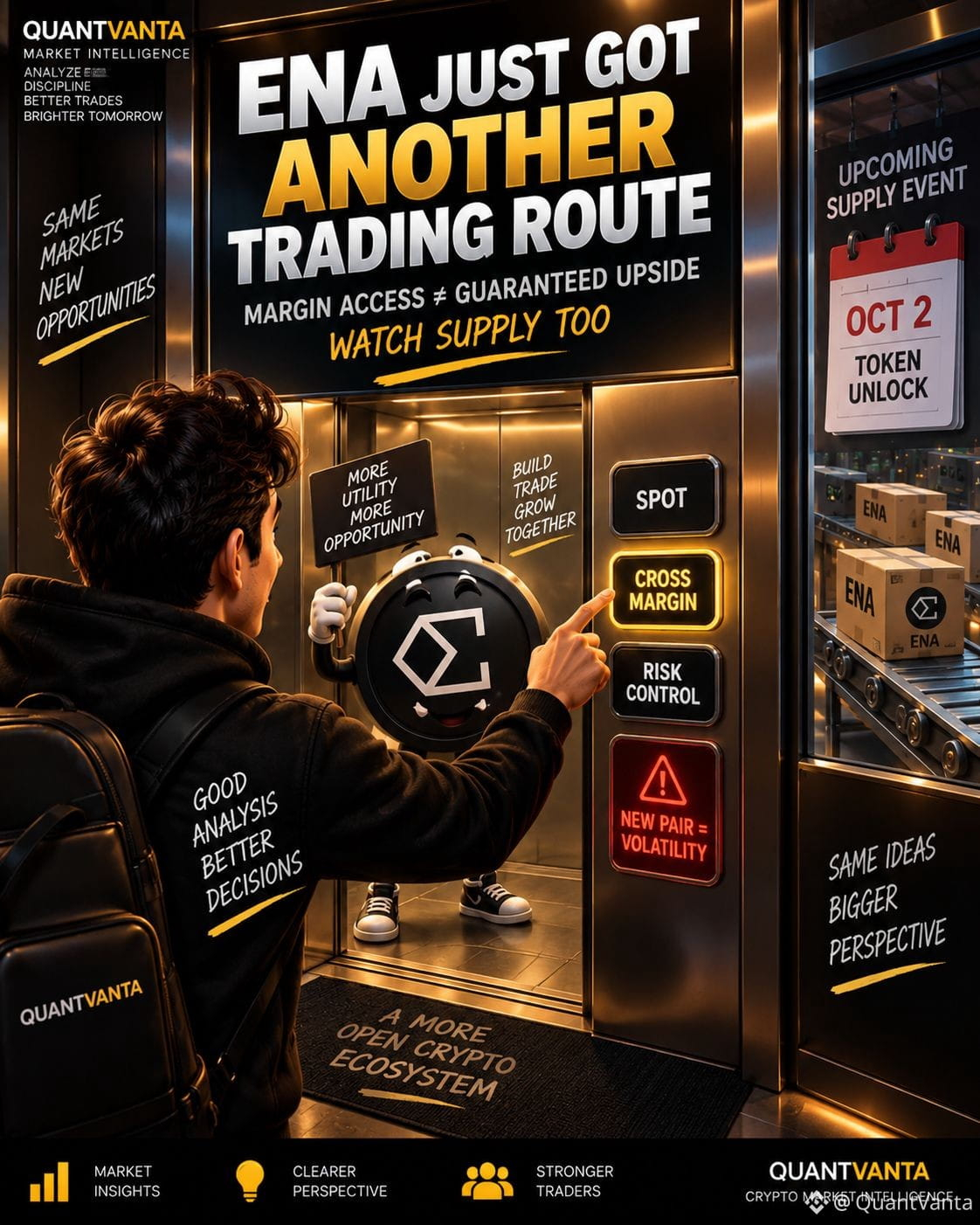
247
Log in to explore more content
Join global crypto users on Binance Square
⚡️ Get latest and useful information about crypto.
💬 Trusted by the world’s largest crypto exchange.
👍 Discover real insights from verified creators.
အီးမေးလ် / ဖုန်းနံပါတ်
ရေပန်းစားနေသော ခေါင်းစဉ်များ
EarningsSeason
119,231 views
1,122 Discussing
Earnings Season: Micron Q4 Earnings — Bullish or Bearish?
Binance Square Official
·နှစ်သက်မှု 239 ခု
·391k views
BitwiseLaunchesFirstSpotNEARETF
1 views
13 Discussing
USJobOpeningsFallToFiveMonthLow
0 views
12 Discussing