

#ston.fi
ston.fi
66,867 views
708 Discussing
ရေပန်းစားသော
နောက်ဆုံး

·
--
တက်ရိပ်ရှိသည်
Trader Utility Piece
For active traders, the real question about any cross-chain solution is execution quality, not marketing language. #STON.fi 's Omniston layer aggregates liquidity across TON-native pools and RFQ resolvers, routing each swap to the best available price rather than locking users into a single AMM curve. That matters directly for slippage on size, which is often the hidden cost that erodes returns on larger trades. With TON now bridgelessly connected to TRON and the major EVM chains, traders get a self-custodial path to move capital between TON positions and the deepest stablecoin liquidity in the market, without routing through a centralized exchange or trusting a wrapped asset. Combined with #STON.fi 's dominant share of TON trading volume and wallet activity, this cross-chain layer effectively turns $TON from an isolated ecosystem into a connected node within the broader liquidity graph. Traders positioning early in TON DeFi infrastructure are effectively betting on Omniston becoming the default execution rail for that connectivity.
Trader Utility Piece
For active traders, the real question about any cross-chain solution is execution quality, not marketing language. #STON.fi 's Omniston layer aggregates liquidity across TON-native pools and RFQ resolvers, routing each swap to the best available price rather than locking users into a single AMM curve. That matters directly for slippage on size, which is often the hidden cost that erodes returns on larger trades. With TON now bridgelessly connected to TRON and the major EVM chains, traders get a self-custodial path to move capital between TON positions and the deepest stablecoin liquidity in the market, without routing through a centralized exchange or trusting a wrapped asset. Combined with #STON.fi 's dominant share of TON trading volume and wallet activity, this cross-chain layer effectively turns $TON from an isolated ecosystem into a connected node within the broader liquidity graph. Traders positioning early in TON DeFi infrastructure are effectively betting on Omniston becoming the default execution rail for that connectivity.
For active traders, the real question about any cross-chain solution is execution quality, not marketing language. #STON.fi 's Omniston layer aggregates liquidity across TON-native pools and RFQ resolvers, routing each swap to the best available price rather than locking users into a single AMM curve. That matters directly for slippage on size, which is often the hidden cost that erodes returns on larger trades. With TON now bridgelessly connected to TRON and the major EVM chains, traders get a self-custodial path to move capital between TON positions and the deepest stablecoin liquidity in the market, without routing through a centralized exchange or trusting a wrapped asset. Combined with #STON.fi 's dominant share of TON trading volume and wallet activity, this cross-chain layer effectively turns $TON from an isolated ecosystem into a connected node within the broader liquidity graph. Traders positioning early in TON DeFi infrastructure are effectively betting on Omniston becoming the default execution rail for that connectivity.
72

·
--
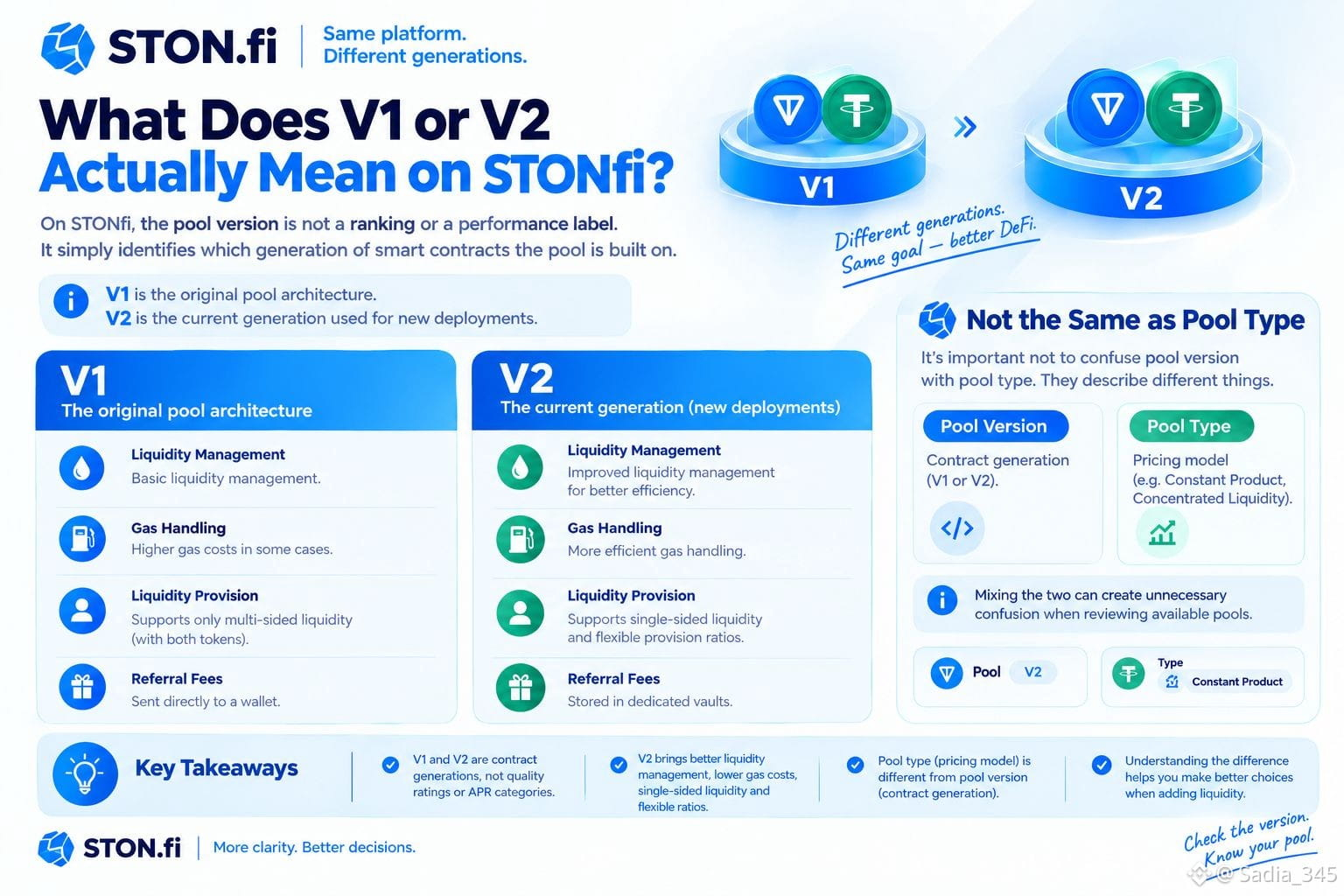
What does V1 or V2 actually mean on STONfi?
On STONfi, the pool version is not a ranking or a performance label. It simply identifies which generation of smart contracts the pool is built on.
• V1 is the original pool architecture
• V2 is the current generation used for new deployments
The differences are practical. V2 improves liquidity management and gas efficiency. It also supports single-sided liquidity and more flexible provision ratios. Referral fees are handled differently as well V2 stores them in dedicated vaults, while V1 sends them directly to a wallet.
It is also important not to confuse pool version with pool type. Version refers to the contract generation. Pool type refers to the pricing model. They describe different things.
Knowing this distinction makes it easier to understand what a pool is actually using when you review liquidity options.
Do you usually check the pool version before adding liquidity?
#STON.fi #defi $GRAM
What does V1 or V2 actually mean on STONfi?
On STONfi, the pool version is not a ranking or a performance label. It simply identifies which generation of smart contracts the pool is built on.
• V1 is the original pool architecture
• V2 is the current generation used for new deployments
The differences are practical. V2 improves liquidity management and gas efficiency. It also supports single-sided liquidity and more flexible provision ratios. Referral fees are handled differently as well V2 stores them in dedicated vaults, while V1 sends them directly to a wallet.
It is also important not to confuse pool version with pool type. Version refers to the contract generation. Pool type refers to the pricing model. They describe different things.
Knowing this distinction makes it easier to understand what a pool is actually using when you review liquidity options.
Do you usually check the pool version before adding liquidity?
#STON.fi #defi $GRAM
On STONfi, the pool version is not a ranking or a performance label. It simply identifies which generation of smart contracts the pool is built on.
• V1 is the original pool architecture
• V2 is the current generation used for new deployments
The differences are practical. V2 improves liquidity management and gas efficiency. It also supports single-sided liquidity and more flexible provision ratios. Referral fees are handled differently as well V2 stores them in dedicated vaults, while V1 sends them directly to a wallet.
It is also important not to confuse pool version with pool type. Version refers to the contract generation. Pool type refers to the pricing model. They describe different things.
Knowing this distinction makes it easier to understand what a pool is actually using when you review liquidity options.
Do you usually check the pool version before adding liquidity?
#STON.fi #defi $GRAM
2
266

·
--
gm STONfi
One thing I like about @ston_fi is how simple swapping feels.
Swap tokens, access liquidity, and move across ecosystems without making every transaction complicated.
With Omniston, STON.fi is also pushing deeper into cross-chain swaps, helping connect liquidity across different networks.
Less friction. More liquidity. Better DeFi experience.
Keep building. Keep learning.
#STON.fi #TON #Dife
gm STONfi
One thing I like about @ston_fi is how simple swapping feels.
Swap tokens, access liquidity, and move across ecosystems without making every transaction complicated.
With Omniston, STON.fi is also pushing deeper into cross-chain swaps, helping connect liquidity across different networks.
Less friction. More liquidity. Better DeFi experience.
Keep building. Keep learning.
#STON.fi #TON #Dife
One thing I like about @ston_fi is how simple swapping feels.
Swap tokens, access liquidity, and move across ecosystems without making every transaction complicated.
With Omniston, STON.fi is also pushing deeper into cross-chain swaps, helping connect liquidity across different networks.
Less friction. More liquidity. Better DeFi experience.
Keep building. Keep learning.
#STON.fi #TON #Dife
28
·
--
gn Fam
The more I look into STON.fi, the more I realize it’s bigger than just swapping tokens on TON.
The interesting part is how many pieces come together.
Cross-chain swaps through Omniston make it easier to move between TON, EVM networks and other supported ecosystems without making the user deal with every layer of complexity.
Then there’s liquidity aggregation, where different liquidity sources can be connected to improve the routes available for a trade.
There’s also the developer side.
Wallets, apps and other DeFi products can build on this infrastructure instead of creating their own cross-chain execution system from scratch.
And I like that STON.fi keeps pushing toward a simpler user experience.
You shouldn’t have to understand bridges, routes, liquidity sources or settlement mechanisms just to swap an asset.
For me, that’s the bigger STON.fi story:
TON liquidity + cross-chain access + better routing + developer infrastructure + simpler DeFi UX.
The more connected DeFi becomes, the more important this infrastructure gets.
#STON.fi #Ton #Dife
gn Fam
The more I look into STON.fi, the more I realize it’s bigger than just swapping tokens on TON.
The interesting part is how many pieces come together.
Cross-chain swaps through Omniston make it easier to move between TON, EVM networks and other supported ecosystems without making the user deal with every layer of complexity.
Then there’s liquidity aggregation, where different liquidity sources can be connected to improve the routes available for a trade.
There’s also the developer side.
Wallets, apps and other DeFi products can build on this infrastructure instead of creating their own cross-chain execution system from scratch.
And I like that STON.fi keeps pushing toward a simpler user experience.
You shouldn’t have to understand bridges, routes, liquidity sources or settlement mechanisms just to swap an asset.
For me, that’s the bigger STON.fi story:
TON liquidity + cross-chain access + better routing + developer infrastructure + simpler DeFi UX.
The more connected DeFi becomes, the more important this infrastructure gets.
#STON.fi #Ton #Dife
The more I look into STON.fi, the more I realize it’s bigger than just swapping tokens on TON.
The interesting part is how many pieces come together.
Cross-chain swaps through Omniston make it easier to move between TON, EVM networks and other supported ecosystems without making the user deal with every layer of complexity.
Then there’s liquidity aggregation, where different liquidity sources can be connected to improve the routes available for a trade.
There’s also the developer side.
Wallets, apps and other DeFi products can build on this infrastructure instead of creating their own cross-chain execution system from scratch.
And I like that STON.fi keeps pushing toward a simpler user experience.
You shouldn’t have to understand bridges, routes, liquidity sources or settlement mechanisms just to swap an asset.
For me, that’s the bigger STON.fi story:
TON liquidity + cross-chain access + better routing + developer infrastructure + simpler DeFi UX.
The more connected DeFi becomes, the more important this infrastructure gets.
#STON.fi #Ton #Dife
79

·
--
တက်ရိပ်ရှိသည်
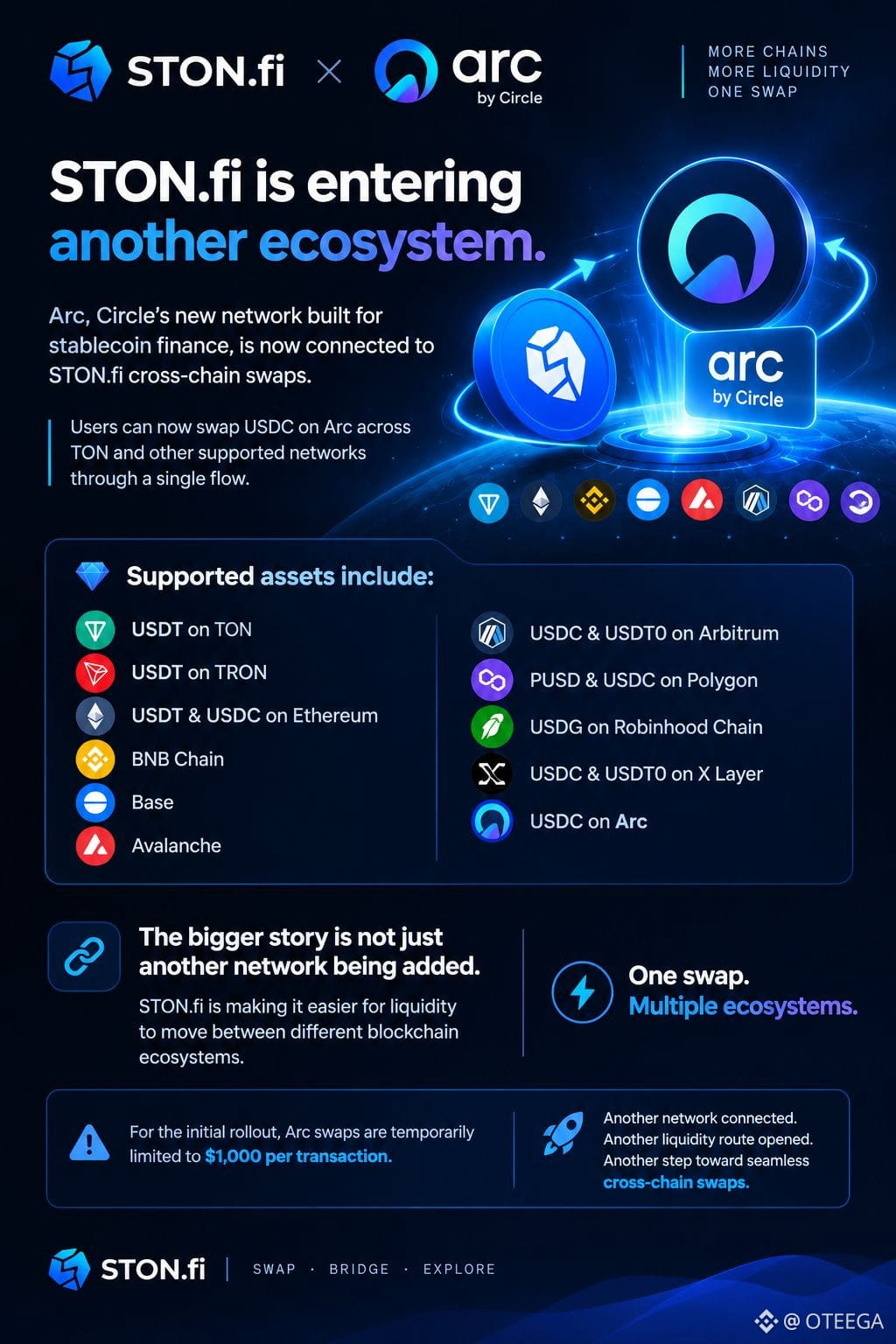
🚨 STON.fi just expanded its cross-chain reach again.
Arc, Circle’s new network built around stablecoin finance, is now connected to STON.fi cross-chain swaps.
That means users can now move USDC on Arc across TON and other supported networks through one swap flow.
But the bigger picture is what matters.
Arc is designed around:
• Stablecoin payments
• Foreign exchange
• Capital markets
• Tokenized assets
• EVM compatibility
• USDC as native gas
And STON.fi is adding another layer by making liquidity across these ecosystems easier to access.
💎 Supported assets include:
USDT on TON and TRON
USDT/USDC on Ethereum, BNB Chain, Base and Avalanche
USDC/USDT0 on Arbitrum
PUSD/USDC on Polygon
USDG on Robinhood Chain
USDC/USDT0 on X Layer
USDC on Arc
This is bigger than simply adding another chain.
The real value is reducing the friction between isolated liquidity pools.
Users shouldn't need to think about which chain holds their stablecoins before making a swap.
One swap. Multiple ecosystems.
For now, STON.fi says cross-chain swap volume on Arc is temporarily limited to $1,000 per transaction during the initial stage.
The infrastructure is expanding.
The interesting question is how much liquidity and usage follows.
#STON.fi #DeFi: #Omniston
#AIStocksWhatNext #DogecoinRises15%
🚨 STON.fi just expanded its cross-chain reach again.
Arc, Circle’s new network built around stablecoin finance, is now connected to STON.fi cross-chain swaps.
That means users can now move USDC on Arc across TON and other supported networks through one swap flow.
But the bigger picture is what matters.
Arc is designed around:
• Stablecoin payments
• Foreign exchange
• Capital markets
• Tokenized assets
• EVM compatibility
• USDC as native gas
And STON.fi is adding another layer by making liquidity across these ecosystems easier to access.
💎 Supported assets include:
USDT on TON and TRON
USDT/USDC on Ethereum, BNB Chain, Base and Avalanche
USDC/USDT0 on Arbitrum
PUSD/USDC on Polygon
USDG on Robinhood Chain
USDC/USDT0 on X Layer
USDC on Arc
This is bigger than simply adding another chain.
The real value is reducing the friction between isolated liquidity pools.
Users shouldn't need to think about which chain holds their stablecoins before making a swap.
One swap. Multiple ecosystems.
For now, STON.fi says cross-chain swap volume on Arc is temporarily limited to $1,000 per transaction during the initial stage.
The infrastructure is expanding.
The interesting question is how much liquidity and usage follows.
#STON.fi #DeFi: #Omniston
#AIStocksWhatNext #DogecoinRises15%
Arc, Circle’s new network built around stablecoin finance, is now connected to STON.fi cross-chain swaps.
That means users can now move USDC on Arc across TON and other supported networks through one swap flow.
But the bigger picture is what matters.
Arc is designed around:
• Stablecoin payments
• Foreign exchange
• Capital markets
• Tokenized assets
• EVM compatibility
• USDC as native gas
And STON.fi is adding another layer by making liquidity across these ecosystems easier to access.
💎 Supported assets include:
USDT on TON and TRON
USDT/USDC on Ethereum, BNB Chain, Base and Avalanche
USDC/USDT0 on Arbitrum
PUSD/USDC on Polygon
USDG on Robinhood Chain
USDC/USDT0 on X Layer
USDC on Arc
This is bigger than simply adding another chain.
The real value is reducing the friction between isolated liquidity pools.
Users shouldn't need to think about which chain holds their stablecoins before making a swap.
One swap. Multiple ecosystems.
For now, STON.fi says cross-chain swap volume on Arc is temporarily limited to $1,000 per transaction during the initial stage.
The infrastructure is expanding.
The interesting question is how much liquidity and usage follows.
#STON.fi #DeFi: #Omniston
#AIStocksWhatNext #DogecoinRises15%
1
64

STON.fi Cross-Chain Swaps, Less Friction
Moving assets across chains shouldn’t feel like managing separate DeFi worlds. STON.fi is making swaps more seamless by connecting liquidity across networks while keeping the experience simple for users
The bigger opportunity is reducing the steps between “I have an asset” and “I can use it where I need it.
STON.fi� #STON.fi
STON.fi Cross-Chain Swaps, Less Friction
Moving assets across chains shouldn’t feel like managing separate DeFi worlds. STON.fi is making swaps more seamless by connecting liquidity across networks while keeping the experience simple for users
The bigger opportunity is reducing the steps between “I have an asset” and “I can use it where I need it.
STON.fi� #STON.fi
Moving assets across chains shouldn’t feel like managing separate DeFi worlds. STON.fi is making swaps more seamless by connecting liquidity across networks while keeping the experience simple for users
The bigger opportunity is reducing the steps between “I have an asset” and “I can use it where I need it.
STON.fi� #STON.fi

64

·
--
တက်ရိပ်ရှိသည်
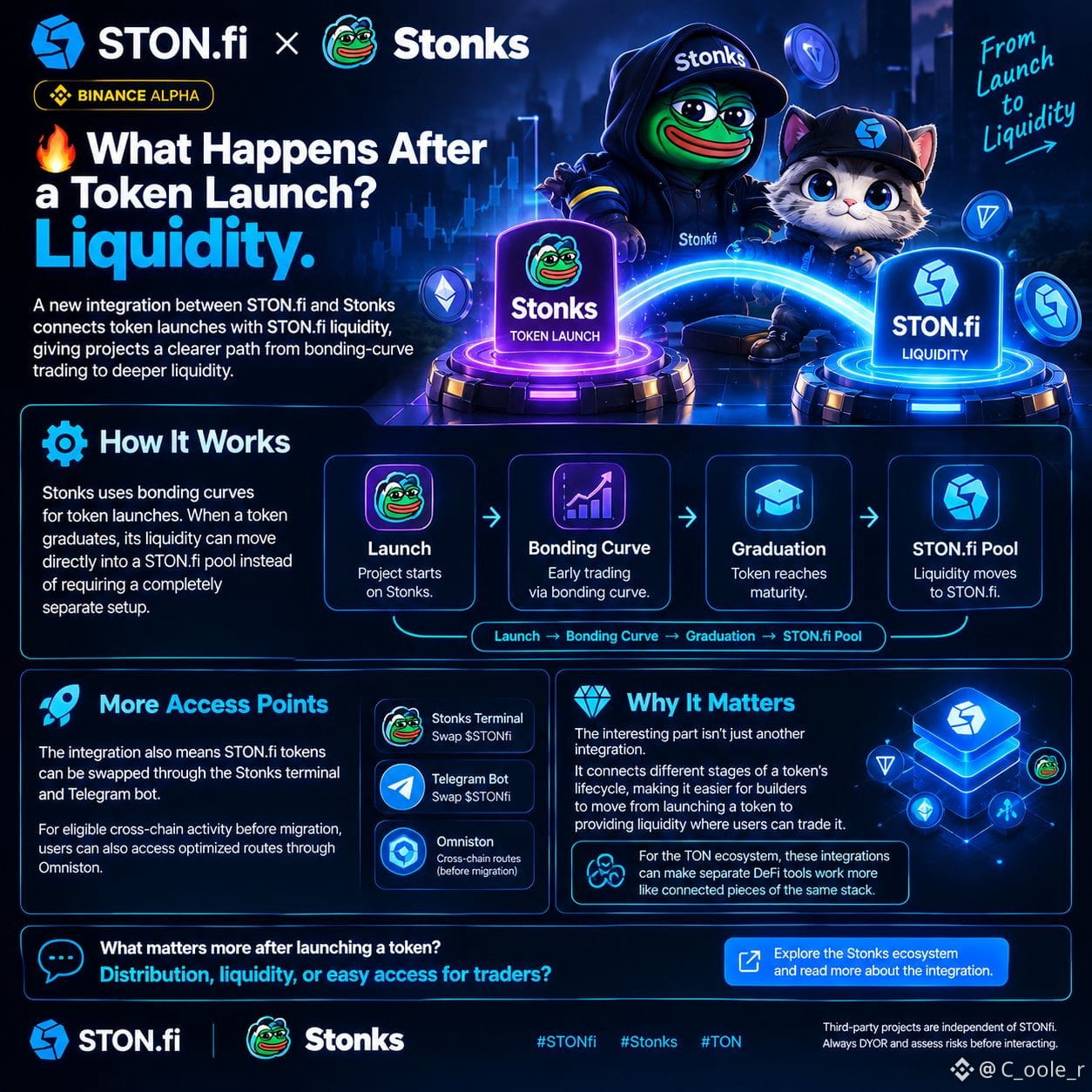
🔥 What Happens After a Token Launch? Liquidity.
A new integration between STONfi and Stonks connects token launches with STONfi liquidity, giving projects a clearer path from bonding-curve trading to deeper liquidity.
🧠 How It Works
Stonks uses bonding curves for token launches. When a token graduates, its liquidity can move directly into a STONfi pool instead of requiring a completely separate setup.
That creates a simple flow:
Launch → Bonding Curve → Graduation → STONfi Pool
🚀 More Access Points
The integration also means STONfi tokens can be swapped through the Stonks terminal and Telegram bot.
For eligible cross-chain activity before migration, users can also access optimized routes through Omniston.
💎 Why It Matters
The interesting part isn't just another integration.
It connects different stages of a token's lifecycle, making it easier for builders to move from launching a token to providing liquidity where users can trade it.
For the TON ecosystem, these integrations can make separate DeFi tools work more like connected pieces of the same stack.
💬 What matters more after launching a token: distribution, liquidity, or easy access for traders?
Explore the Stonks ecosystem and read more about the integration.
Third-party projects are independent of STONfi. Always DYOR and assess risks before interacting.
#STON.fi #stonks #TON
$GRAM
{spot}(GRAMUSDT)
🔥 What Happens After a Token Launch? Liquidity.
A new integration between STONfi and Stonks connects token launches with STONfi liquidity, giving projects a clearer path from bonding-curve trading to deeper liquidity.
🧠 How It Works
Stonks uses bonding curves for token launches. When a token graduates, its liquidity can move directly into a STONfi pool instead of requiring a completely separate setup.
That creates a simple flow:
Launch → Bonding Curve → Graduation → STONfi Pool
🚀 More Access Points
The integration also means STONfi tokens can be swapped through the Stonks terminal and Telegram bot.
For eligible cross-chain activity before migration, users can also access optimized routes through Omniston.
💎 Why It Matters
The interesting part isn't just another integration.
It connects different stages of a token's lifecycle, making it easier for builders to move from launching a token to providing liquidity where users can trade it.
For the TON ecosystem, these integrations can make separate DeFi tools work more like connected pieces of the same stack.
💬 What matters more after launching a token: distribution, liquidity, or easy access for traders?
Explore the Stonks ecosystem and read more about the integration.
Third-party projects are independent of STONfi. Always DYOR and assess risks before interacting.
#STON.fi #stonks #TON
$GRAM
A new integration between STONfi and Stonks connects token launches with STONfi liquidity, giving projects a clearer path from bonding-curve trading to deeper liquidity.
🧠 How It Works
Stonks uses bonding curves for token launches. When a token graduates, its liquidity can move directly into a STONfi pool instead of requiring a completely separate setup.
That creates a simple flow:
Launch → Bonding Curve → Graduation → STONfi Pool
🚀 More Access Points
The integration also means STONfi tokens can be swapped through the Stonks terminal and Telegram bot.
For eligible cross-chain activity before migration, users can also access optimized routes through Omniston.
💎 Why It Matters
The interesting part isn't just another integration.
It connects different stages of a token's lifecycle, making it easier for builders to move from launching a token to providing liquidity where users can trade it.
For the TON ecosystem, these integrations can make separate DeFi tools work more like connected pieces of the same stack.
💬 What matters more after launching a token: distribution, liquidity, or easy access for traders?
Explore the Stonks ecosystem and read more about the integration.
Third-party projects are independent of STONfi. Always DYOR and assess risks before interacting.
#STON.fi #stonks #TON
$GRAM
2
404

·
--
တက်ရိပ်ရှိသည်
Why STON.fi Is Attracting Attention From Top Crypto Investors
In every market cycle, a few investors consistently identify transformative platforms before the broader market recognizes their potential.
Ribbit Capital is one of those investors.
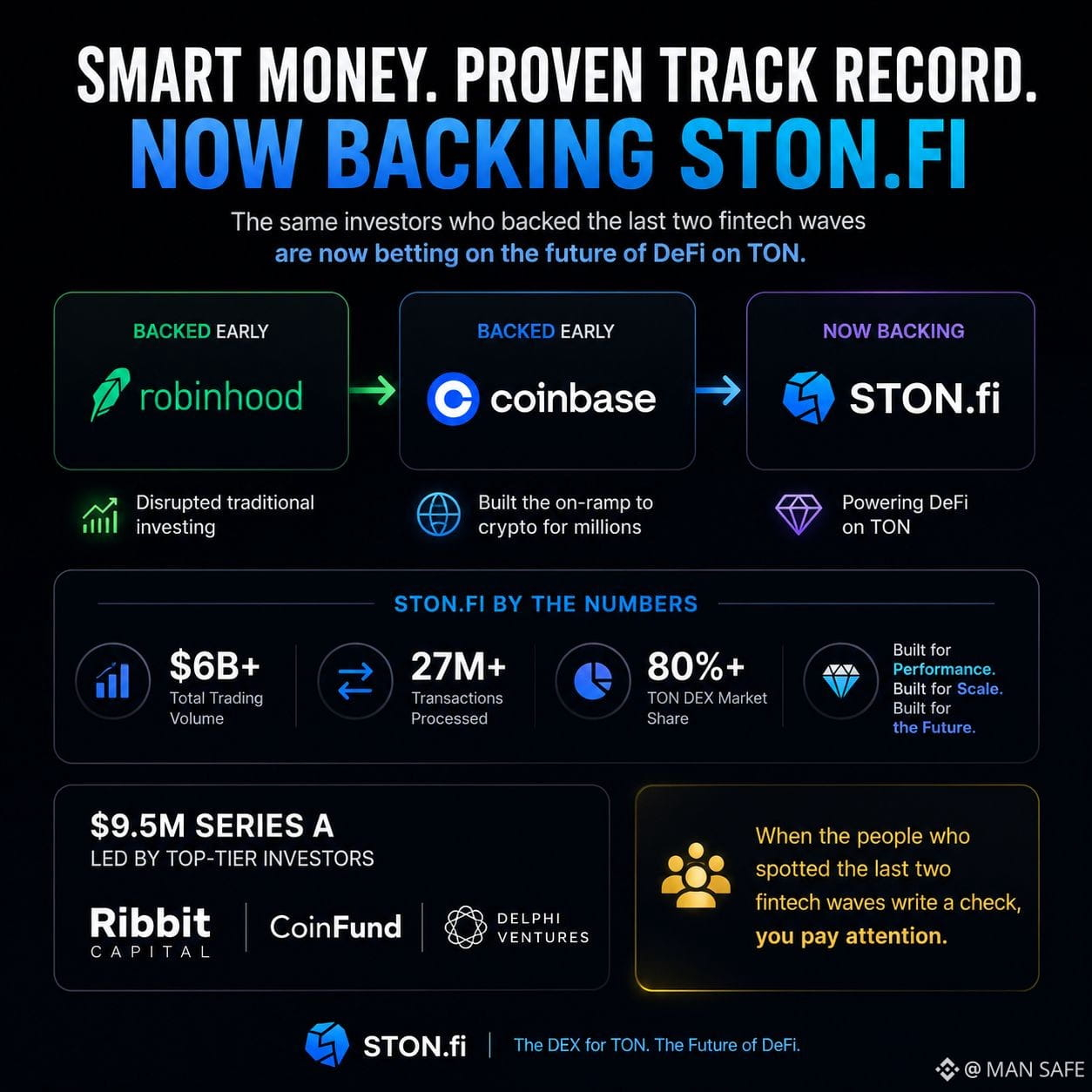
The firm previously backed Robinhood and @Coin-Base at early stages, helping support two companies that went on to reshape fintech and crypto adoption.
Now Ribbit Capital has participated in STON.fi's $9.5 million Series A round alongside CoinFund and Delphi Ventures.
The numbers behind @stonfi are already significant:
• Over $6 billion in cumulative trading volume
• More than 27 million transactions processed
• Over 80% share of TON's DEX market volume
As the TON ecosystem continues to expand, infrastructure projects capable of supporting large-scale liquidity and user activity become increasingly important.
#STON.fi has positioned itself as a key component of $TON DeFi landscape, providing the trading infrastructure that many users and projects rely on today.
When experienced investors with a history of identifying major industry winners allocate capital to a protocol, it often signals confidence in the long-term growth potential of that ecosystem.
The market will ultimately decide the outcome, but STON.fi is clearly becoming one of the most closely watched projects within TON DeFi.
Why STON.fi Is Attracting Attention From Top Crypto Investors
In every market cycle, a few investors consistently identify transformative platforms before the broader market recognizes their potential.
Ribbit Capital is one of those investors.
The firm previously backed Robinhood and @Coin_base at early stages, helping support two companies that went on to reshape fintech and crypto adoption.
Now Ribbit Capital has participated in STON.fi's $9.5 million Series A round alongside CoinFund and Delphi Ventures.
The numbers behind @STONfi DEX are already significant:
• Over $6 billion in cumulative trading volume
• More than 27 million transactions processed
• Over 80% share of TON's DEX market volume
As the TON ecosystem continues to expand, infrastructure projects capable of supporting large-scale liquidity and user activity become increasingly important.
#STON.fi has positioned itself as a key component of $TON DeFi landscape, providing the trading infrastructure that many users and projects rely on today.
When experienced investors with a history of identifying major industry winners allocate capital to a protocol, it often signals confidence in the long-term growth potential of that ecosystem.
The market will ultimately decide the outcome, but STON.fi is clearly becoming one of the most closely watched projects within TON DeFi.
In every market cycle, a few investors consistently identify transformative platforms before the broader market recognizes their potential.
Ribbit Capital is one of those investors.
The firm previously backed Robinhood and @Coin_base at early stages, helping support two companies that went on to reshape fintech and crypto adoption.
Now Ribbit Capital has participated in STON.fi's $9.5 million Series A round alongside CoinFund and Delphi Ventures.
The numbers behind @STONfi DEX are already significant:
• Over $6 billion in cumulative trading volume
• More than 27 million transactions processed
• Over 80% share of TON's DEX market volume
As the TON ecosystem continues to expand, infrastructure projects capable of supporting large-scale liquidity and user activity become increasingly important.
#STON.fi has positioned itself as a key component of $TON DeFi landscape, providing the trading infrastructure that many users and projects rely on today.
When experienced investors with a history of identifying major industry winners allocate capital to a protocol, it often signals confidence in the long-term growth potential of that ecosystem.
The market will ultimately decide the outcome, but STON.fi is clearly becoming one of the most closely watched projects within TON DeFi.
1
156

·
--
STON.fi Is Turning @ton_blockchain Into a More Connected Financial Ecosystem
Crypto has always been fragmented.
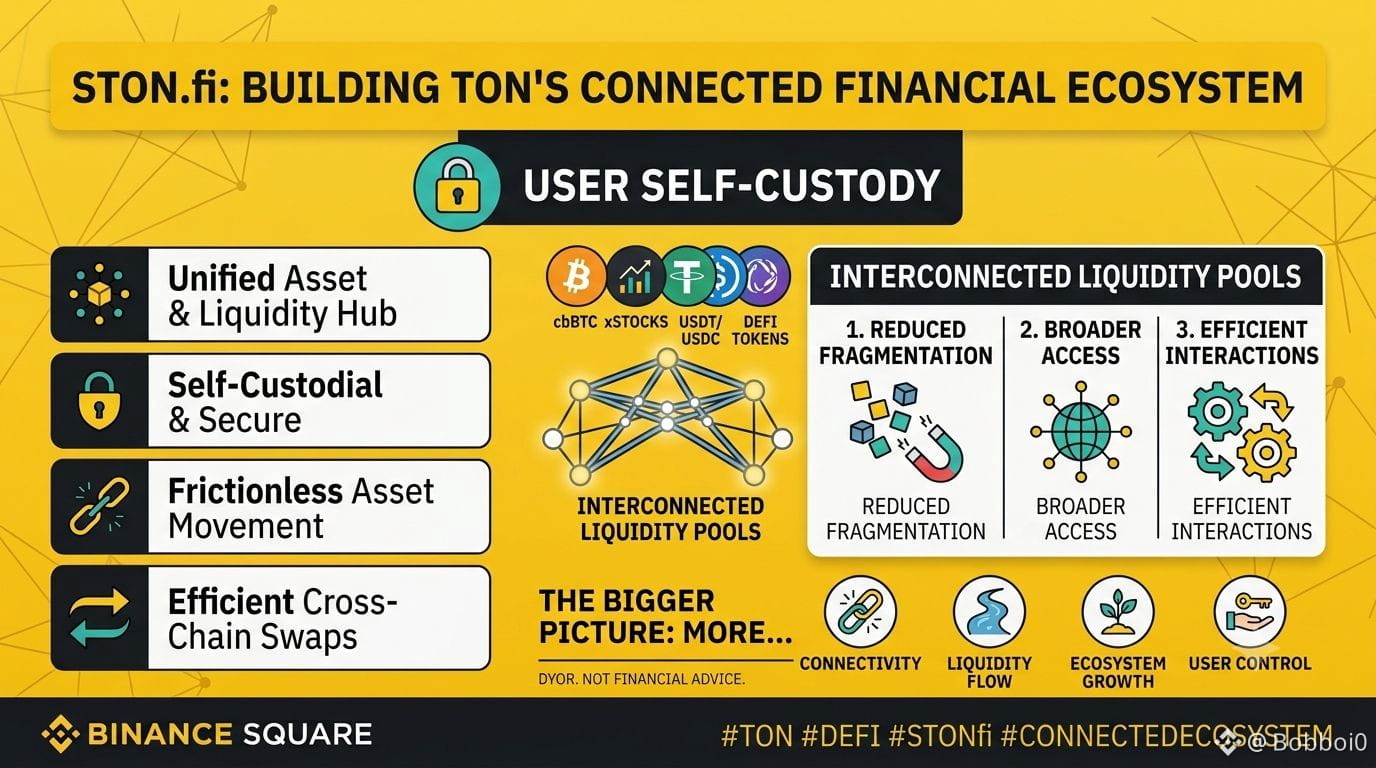
Bitcoin liquidity sits in one ecosystem. Tokenised assets operate elsewhere. Stablecoins and DeFi liquidity are spread across multiple networks.
For users, that often means moving between platforms just to access different opportunities.
@stonfi is helping reduce that fragmentation within TON.
Its expanding ecosystem brings together assets such as cbBTC, xStocks, stablecoins, cross-chain assets, and DeFi tokens, giving users broader access through a self-custodial experience.
But the bigger opportunity is not simply adding more assets.
It is connecting liquidity.
When assets, liquidity, and users can interact more seamlessly, the TON ecosystem becomes more useful for both everyday users and DeFi applications.
Self-custody also remains central. Users can access these opportunities while maintaining control of their funds rather than relying on a centralised intermediary.
As DeFi matures, connectivity and liquidity infrastructure could become increasingly important.
#STON.fi is positioning itself around that trend, helping connect different assets and liquidity sources across TON and beyond.
The next phase of TON may not be about having more isolated assets.
It could be about creating a more connected financial ecosystem where those assets can actually move, trade, and interact efficiently.
That is the infrastructure layer worth watching.
Always DYOR before interacting with DeFi protocols.
#DEFİ #STONfi
STON.fi Is Turning @Ton Network Into a More Connected Financial Ecosystem
Crypto has always been fragmented.
Bitcoin liquidity sits in one ecosystem. Tokenised assets operate elsewhere. Stablecoins and DeFi liquidity are spread across multiple networks.
For users, that often means moving between platforms just to access different opportunities.
@STONfi DEX is helping reduce that fragmentation within TON.
Its expanding ecosystem brings together assets such as cbBTC, xStocks, stablecoins, cross-chain assets, and DeFi tokens, giving users broader access through a self-custodial experience.
But the bigger opportunity is not simply adding more assets.
It is connecting liquidity.
When assets, liquidity, and users can interact more seamlessly, the TON ecosystem becomes more useful for both everyday users and DeFi applications.
Self-custody also remains central. Users can access these opportunities while maintaining control of their funds rather than relying on a centralised intermediary.
As DeFi matures, connectivity and liquidity infrastructure could become increasingly important.
#STON.fi is positioning itself around that trend, helping connect different assets and liquidity sources across TON and beyond.
The next phase of TON may not be about having more isolated assets.
It could be about creating a more connected financial ecosystem where those assets can actually move, trade, and interact efficiently.
That is the infrastructure layer worth watching.
Always DYOR before interacting with DeFi protocols.
#DEFİ #STONfi
Crypto has always been fragmented.
Bitcoin liquidity sits in one ecosystem. Tokenised assets operate elsewhere. Stablecoins and DeFi liquidity are spread across multiple networks.
For users, that often means moving between platforms just to access different opportunities.
@STONfi DEX is helping reduce that fragmentation within TON.
Its expanding ecosystem brings together assets such as cbBTC, xStocks, stablecoins, cross-chain assets, and DeFi tokens, giving users broader access through a self-custodial experience.
But the bigger opportunity is not simply adding more assets.
It is connecting liquidity.
When assets, liquidity, and users can interact more seamlessly, the TON ecosystem becomes more useful for both everyday users and DeFi applications.
Self-custody also remains central. Users can access these opportunities while maintaining control of their funds rather than relying on a centralised intermediary.
As DeFi matures, connectivity and liquidity infrastructure could become increasingly important.
#STON.fi is positioning itself around that trend, helping connect different assets and liquidity sources across TON and beyond.
The next phase of TON may not be about having more isolated assets.
It could be about creating a more connected financial ecosystem where those assets can actually move, trade, and interact efficiently.
That is the infrastructure layer worth watching.
Always DYOR before interacting with DeFi protocols.
#DEFİ #STONfi
2
104

·
--

Article
Robinhood Chain Joins STON.fi's Expanding Cross-Chain EcosystemCross-chain infrastructure is no longer just about transferring assets between blockchains. It is becoming the layer that connects entire ecosystems and creates a more unified Web3 experience.
With the integration of Robinhood Chain, #STON.fi continues expanding its cross-chain network, giving $GRAM users seamless access to tokenized assets, stablecoins and on-chain markets all from a single interface.
Why Robinhood Chain?
As an EVM-compatible Layer 2, Robinhood Chain is built to power the next generation of on-chain finance. Its integration introduces new opportunities for users to interact with tokenized real-world assets (RWAs), stablecoins, and a growing range of decentralized applications.
Supported Cross-Chain Assets
Users can now swap stablecoins across multiple ecosystems including:
- USDT on TON
- USDG on Robinhood Chain
- USDT and USDC on Ethereum, Base, BNB Chain, and Avalanche
- USDT0 and USDC on Arbitrum
- PUSD and USDC on Polygon
Built for Simplicity
Every cross-chain transaction is powered by Omniston, STON.fi's execution layer, which automatically handles routing, pricing, and settlement. Users simply choose the asset, select the destination, confirm the quote, and receive the expected amount most swaps are completed within 15–40 seconds.
Key Highlights
- Seamless access to Robinhood Chain from the STON.fi interface.
- Efficient cross-chain swaps across leading blockchain ecosystems.
- Smart execution powered by Omniston for optimal routing and pricing.
- Typical settlement time of 15–40 seconds.
- Initial rollout includes a $1,000 maximum per transaction on Robinhood Chain.
The significance of this integration extends beyond adding another supported network.
It reinforces a future where blockchain complexity fades into the background, allowing users to focus on the experience rather than the infrastructure.
By connecting more ecosystems under one interface, STON.fi continues moving Web3 toward a truly interconnected financial network where accessing liquidity across chains feels as seamless as using a single blockchain.
#STONfi @stonfi $GRAM
#TON #Robinhood
Robinhood Chain Joins STON.fi's Expanding Cross-Chain Ecosystem
Cross-chain infrastructure is no longer just about transferring assets between blockchains. It is becoming the layer that connects entire ecosystems and creates a more unified Web3 experience.
With the integration of Robinhood Chain, #STON.fi continues expanding its cross-chain network, giving $GRAM users seamless access to tokenized assets, stablecoins and on-chain markets all from a single interface.
Why Robinhood Chain?
As an EVM-compatible Layer 2, Robinhood Chain is built to power the next generation of on-chain finance. Its integration introduces new opportunities for users to interact with tokenized real-world assets (RWAs), stablecoins, and a growing range of decentralized applications.
Supported Cross-Chain Assets
Users can now swap stablecoins across multiple ecosystems including:
- USDT on TON
- USDG on Robinhood Chain
- USDT and USDC on Ethereum, Base, BNB Chain, and Avalanche
- USDT0 and USDC on Arbitrum
- PUSD and USDC on Polygon
Built for Simplicity
Every cross-chain transaction is powered by Omniston, STON.fi's execution layer, which automatically handles routing, pricing, and settlement. Users simply choose the asset, select the destination, confirm the quote, and receive the expected amount most swaps are completed within 15–40 seconds.
Key Highlights
- Seamless access to Robinhood Chain from the STON.fi interface.
- Efficient cross-chain swaps across leading blockchain ecosystems.
- Smart execution powered by Omniston for optimal routing and pricing.
- Typical settlement time of 15–40 seconds.
- Initial rollout includes a $1,000 maximum per transaction on Robinhood Chain.
The significance of this integration extends beyond adding another supported network.
It reinforces a future where blockchain complexity fades into the background, allowing users to focus on the experience rather than the infrastructure.
By connecting more ecosystems under one interface, STON.fi continues moving Web3 toward a truly interconnected financial network where accessing liquidity across chains feels as seamless as using a single blockchain.
#STONfi @STONfi DEX $GRAM
#TON #Robinhood
With the integration of Robinhood Chain, #STON.fi continues expanding its cross-chain network, giving $GRAM users seamless access to tokenized assets, stablecoins and on-chain markets all from a single interface.
Why Robinhood Chain?
As an EVM-compatible Layer 2, Robinhood Chain is built to power the next generation of on-chain finance. Its integration introduces new opportunities for users to interact with tokenized real-world assets (RWAs), stablecoins, and a growing range of decentralized applications.
Supported Cross-Chain Assets
Users can now swap stablecoins across multiple ecosystems including:
- USDT on TON
- USDG on Robinhood Chain
- USDT and USDC on Ethereum, Base, BNB Chain, and Avalanche
- USDT0 and USDC on Arbitrum
- PUSD and USDC on Polygon
Built for Simplicity
Every cross-chain transaction is powered by Omniston, STON.fi's execution layer, which automatically handles routing, pricing, and settlement. Users simply choose the asset, select the destination, confirm the quote, and receive the expected amount most swaps are completed within 15–40 seconds.
Key Highlights
- Seamless access to Robinhood Chain from the STON.fi interface.
- Efficient cross-chain swaps across leading blockchain ecosystems.
- Smart execution powered by Omniston for optimal routing and pricing.
- Typical settlement time of 15–40 seconds.
- Initial rollout includes a $1,000 maximum per transaction on Robinhood Chain.
The significance of this integration extends beyond adding another supported network.
It reinforces a future where blockchain complexity fades into the background, allowing users to focus on the experience rather than the infrastructure.
By connecting more ecosystems under one interface, STON.fi continues moving Web3 toward a truly interconnected financial network where accessing liquidity across chains feels as seamless as using a single blockchain.
#STONfi @STONfi DEX $GRAM
#TON #Robinhood
1
97

Why STON.fi Makes TON DeFi Feel Simpler
One of the biggest problems in DeFi isn't always the technology. It's the amount of complexity users have to navigate.
A simple swap can involve choosing a network, finding liquidity, comparing routes, checking slippage and worrying about whether an unfamiliar token or contract is legitimate.
STON.fi takes a different approach.
The user experience is centered around the action itself: connect a wallet, select the assets, review the transaction and swap.
Underneath that simple interface is the infrastructure that makes decentralized trading possible.
For me, that's an important measure of DeFi maturity.
The best protocol isn't necessarily the one that shows users the most machinery. It's the one that can make sophisticated infrastructure feel simple without taking custody away from the user.
That's where STON.fi's role in the TON ecosystem becomes interesting.
@stonfi #STON.fi
Why STON.fi Makes TON DeFi Feel Simpler
One of the biggest problems in DeFi isn't always the technology. It's the amount of complexity users have to navigate.
A simple swap can involve choosing a network, finding liquidity, comparing routes, checking slippage and worrying about whether an unfamiliar token or contract is legitimate.
STON.fi takes a different approach.
The user experience is centered around the action itself: connect a wallet, select the assets, review the transaction and swap.
Underneath that simple interface is the infrastructure that makes decentralized trading possible.
For me, that's an important measure of DeFi maturity.
The best protocol isn't necessarily the one that shows users the most machinery. It's the one that can make sophisticated infrastructure feel simple without taking custody away from the user.
That's where STON.fi's role in the TON ecosystem becomes interesting.
@STONfi DEX #STON.fi
One of the biggest problems in DeFi isn't always the technology. It's the amount of complexity users have to navigate.
A simple swap can involve choosing a network, finding liquidity, comparing routes, checking slippage and worrying about whether an unfamiliar token or contract is legitimate.
STON.fi takes a different approach.
The user experience is centered around the action itself: connect a wallet, select the assets, review the transaction and swap.
Underneath that simple interface is the infrastructure that makes decentralized trading possible.
For me, that's an important measure of DeFi maturity.
The best protocol isn't necessarily the one that shows users the most machinery. It's the one that can make sophisticated infrastructure feel simple without taking custody away from the user.
That's where STON.fi's role in the TON ecosystem becomes interesting.
@STONfi DEX #STON.fi
1
98

·
--
တက်ရိပ်ရှိသည်
The Part of DeFi Users Rarely See: INFRASTRUCTURE
When someone swaps a token, the experience can look deceptively simple.
Select an asset.
Enter an amount.
Confirm the transaction.
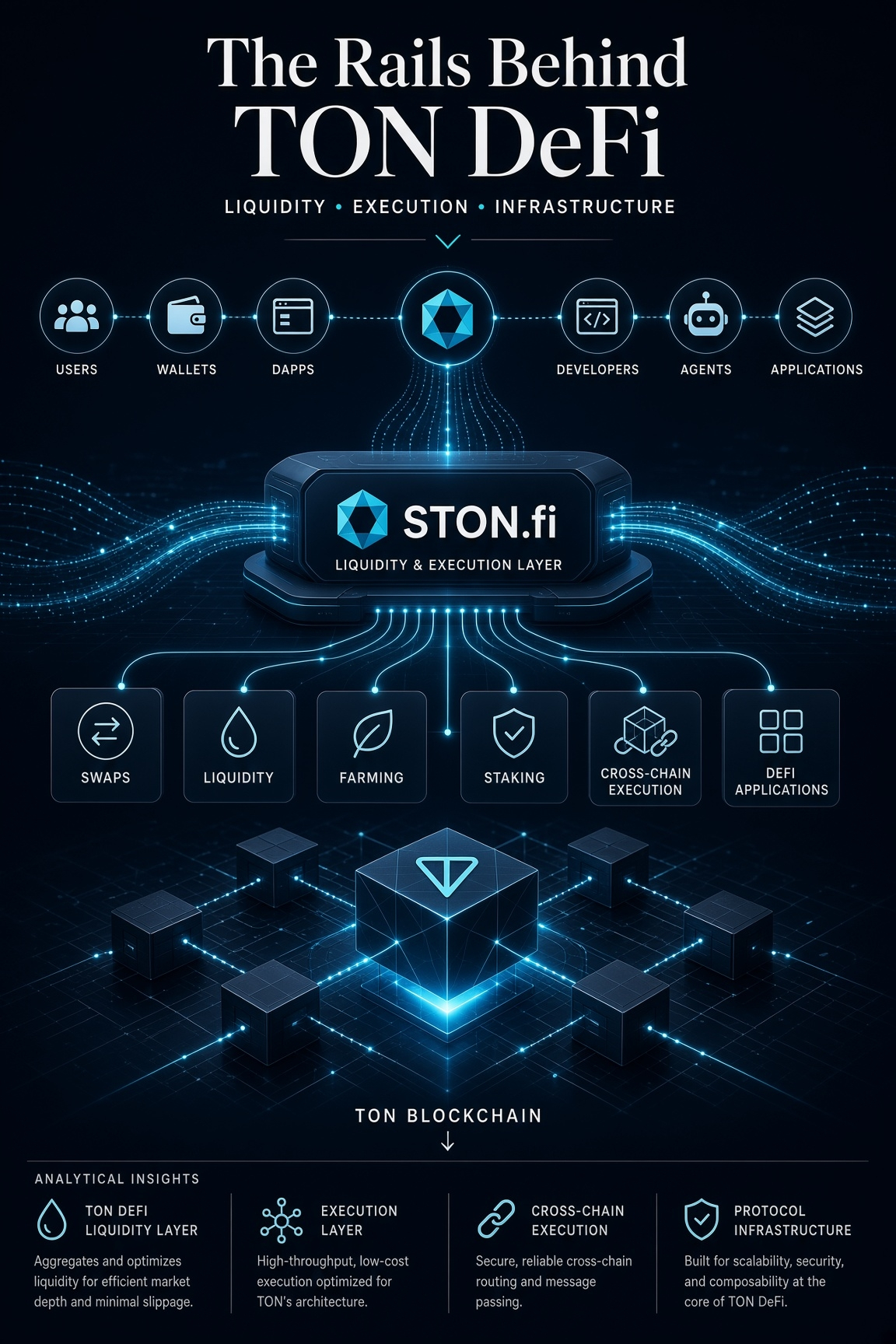
But behind that interface is a much larger system involving liquidity, routing, execution and blockchain infrastructure.
This is where the infrastructure layer becomes important.
As the TON ecosystem grows, DeFi applications need reliable liquidity and efficient execution underneath them.
That creates an interesting shift in how we should evaluate DeFi.
Instead of asking only:
“What is popular?”
We should also ask:
“What infrastructure enables these applications to work?”
STON.fi is part of this infrastructure conversation through its role in liquidity and swaps within the TON ecosystem, while cross-chain capabilities expand the possible routes for users and assets.
The evolution of DeFi is therefore not only happening at the application layer.
It is also happening underneath it.
Infrastructure defines how efficiently an ecosystem can scale.
@ston_fi
#STON.fi $STON
blog.ston.fi
The Part of DeFi Users Rarely See: INFRASTRUCTURE
When someone swaps a token, the experience can look deceptively simple.
Select an asset.
Enter an amount.
Confirm the transaction.
But behind that interface is a much larger system involving liquidity, routing, execution and blockchain infrastructure.
This is where the infrastructure layer becomes important.
As the TON ecosystem grows, DeFi applications need reliable liquidity and efficient execution underneath them.
That creates an interesting shift in how we should evaluate DeFi.
Instead of asking only:
“What is popular?”
We should also ask:
“What infrastructure enables these applications to work?”
STON.fi is part of this infrastructure conversation through its role in liquidity and swaps within the TON ecosystem, while cross-chain capabilities expand the possible routes for users and assets.
The evolution of DeFi is therefore not only happening at the application layer.
It is also happening underneath it.
Infrastructure defines how efficiently an ecosystem can scale.
@ston_fi
#STON.fi $STON
blog.ston.fi
When someone swaps a token, the experience can look deceptively simple.
Select an asset.
Enter an amount.
Confirm the transaction.
But behind that interface is a much larger system involving liquidity, routing, execution and blockchain infrastructure.
This is where the infrastructure layer becomes important.
As the TON ecosystem grows, DeFi applications need reliable liquidity and efficient execution underneath them.
That creates an interesting shift in how we should evaluate DeFi.
Instead of asking only:
“What is popular?”
We should also ask:
“What infrastructure enables these applications to work?”
STON.fi is part of this infrastructure conversation through its role in liquidity and swaps within the TON ecosystem, while cross-chain capabilities expand the possible routes for users and assets.
The evolution of DeFi is therefore not only happening at the application layer.
It is also happening underneath it.
Infrastructure defines how efficiently an ecosystem can scale.
@ston_fi
#STON.fi $STON
blog.ston.fi
104
The interesting question isn't whether TON needs another DEX.
It's what TON's financial infrastructure looks like when:
Liquidity becomes deeper. Cross-chain swaps become easier. Yield becomes more accessible. Governance becomes more meaningful. And users stop thinking about the infrastructure underneath.
That's the bigger STON.fi story I'm watching.
@stonfi #STON.fi
The interesting question isn't whether TON needs another DEX.
It's what TON's financial infrastructure looks like when:
Liquidity becomes deeper. Cross-chain swaps become easier. Yield becomes more accessible. Governance becomes more meaningful. And users stop thinking about the infrastructure underneath.
That's the bigger STON.fi story I'm watching.
@STONfi DEX #STON.fi
It's what TON's financial infrastructure looks like when:
Liquidity becomes deeper. Cross-chain swaps become easier. Yield becomes more accessible. Governance becomes more meaningful. And users stop thinking about the infrastructure underneath.
That's the bigger STON.fi story I'm watching.
@STONfi DEX #STON.fi
1
81

·
--
One thing I respect about STON.fi is that they don’t only talk about the good days.
After the recent $GRAM (formerly TON) congestion, they openly explained what happened, how it affected transactions, and what they’re doing to make the system more resilient.
The traffic spike was significant enough that swaps were temporarily paused to help protect users.
Now the focus is on strengthening the infrastructure:
• More routers
• Fewer messages during swaps
• A more distributed architecture
• Better resilience under heavy traffic
That’s the side of DeFi people often overlook.
Networks get congested. Traffic spikes. Things can break.
What matters is how the team responds, communicates, and improves the infrastructure afterward.
For me, that’s what makes STON.fi worth watching.
The real test isn’t avoiding every problem.
It’s becoming stronger after one.
$GRAM #STON.fi
One thing I respect about STON.fi is that they don’t only talk about the good days.
After the recent $GRAM (formerly TON) congestion, they openly explained what happened, how it affected transactions, and what they’re doing to make the system more resilient.
The traffic spike was significant enough that swaps were temporarily paused to help protect users.
Now the focus is on strengthening the infrastructure:
• More routers
• Fewer messages during swaps
• A more distributed architecture
• Better resilience under heavy traffic
That’s the side of DeFi people often overlook.
Networks get congested. Traffic spikes. Things can break.
What matters is how the team responds, communicates, and improves the infrastructure afterward.
For me, that’s what makes STON.fi worth watching.
The real test isn’t avoiding every problem.
It’s becoming stronger after one.
$GRAM #STON.fi
After the recent $GRAM (formerly TON) congestion, they openly explained what happened, how it affected transactions, and what they’re doing to make the system more resilient.
The traffic spike was significant enough that swaps were temporarily paused to help protect users.
Now the focus is on strengthening the infrastructure:
• More routers
• Fewer messages during swaps
• A more distributed architecture
• Better resilience under heavy traffic
That’s the side of DeFi people often overlook.
Networks get congested. Traffic spikes. Things can break.
What matters is how the team responds, communicates, and improves the infrastructure afterward.
For me, that’s what makes STON.fi worth watching.
The real test isn’t avoiding every problem.
It’s becoming stronger after one.
$GRAM #STON.fi

290
·
--
တက်ရိပ်ရှိသည်
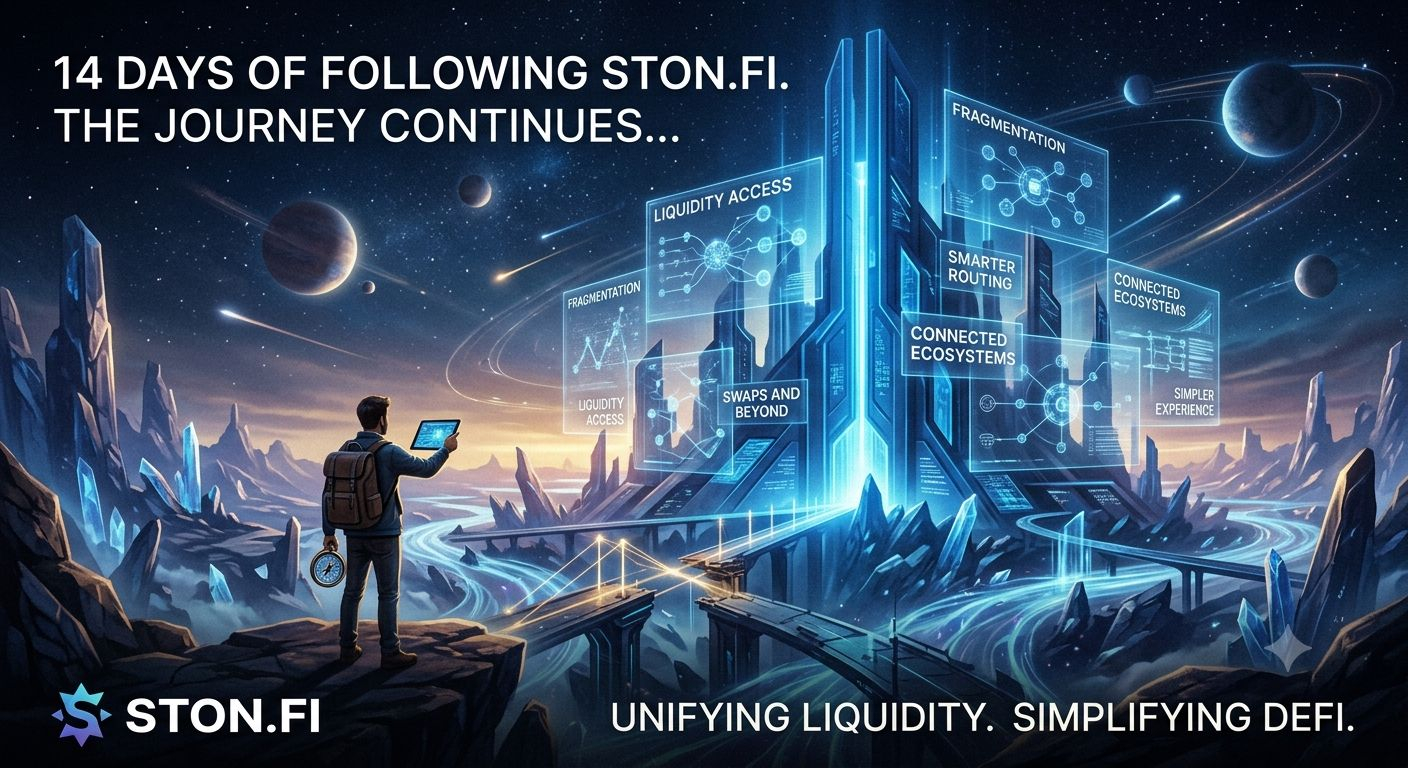
14 DAYS OF FOLLOWING WHAT STON.FI IS BUILDING.
And one thing is becoming clear.
The story is bigger than swaps.
The deeper problem is fragmentation.
Liquidity is everywhere.
But accessing it efficiently is still difficult.
Different chains.
Different pools.
Different routes.
Different experiences.
Over the past two weeks, I’ve been looking closely at how STON.fi and Omniston fit into this picture.
The thesis is simple:
DeFi doesn’t necessarily need more complexity.
It needs better infrastructure to manage the complexity that already exists.
That means:
Better liquidity access.
Smarter routing.
More connected ecosystems.
And a simpler experience for users.
Week 1 was about understanding the problem.
Week 2 was about understanding the infrastructure.
Next, I’m going deeper into what makes the STON.fi ecosystem work.
The journey continues.
#STON.fi #OMNISTON #Defi #swap
$ETH
14 DAYS OF FOLLOWING WHAT STON.FI IS BUILDING.
And one thing is becoming clear.
The story is bigger than swaps.
The deeper problem is fragmentation.
Liquidity is everywhere.
But accessing it efficiently is still difficult.
Different chains.
Different pools.
Different routes.
Different experiences.
Over the past two weeks, I’ve been looking closely at how STON.fi and Omniston fit into this picture.
The thesis is simple:
DeFi doesn’t necessarily need more complexity.
It needs better infrastructure to manage the complexity that already exists.
That means:
Better liquidity access.
Smarter routing.
More connected ecosystems.
And a simpler experience for users.
Week 1 was about understanding the problem.
Week 2 was about understanding the infrastructure.
Next, I’m going deeper into what makes the STON.fi ecosystem work.
The journey continues.
#STON.fi #OMNISTON #Defi #swap
$ETH
And one thing is becoming clear.
The story is bigger than swaps.
The deeper problem is fragmentation.
Liquidity is everywhere.
But accessing it efficiently is still difficult.
Different chains.
Different pools.
Different routes.
Different experiences.
Over the past two weeks, I’ve been looking closely at how STON.fi and Omniston fit into this picture.
The thesis is simple:
DeFi doesn’t necessarily need more complexity.
It needs better infrastructure to manage the complexity that already exists.
That means:
Better liquidity access.
Smarter routing.
More connected ecosystems.
And a simpler experience for users.
Week 1 was about understanding the problem.
Week 2 was about understanding the infrastructure.
Next, I’m going deeper into what makes the STON.fi ecosystem work.
The journey continues.
#STON.fi #OMNISTON #Defi #swap
$ETH
103

·
--
Article
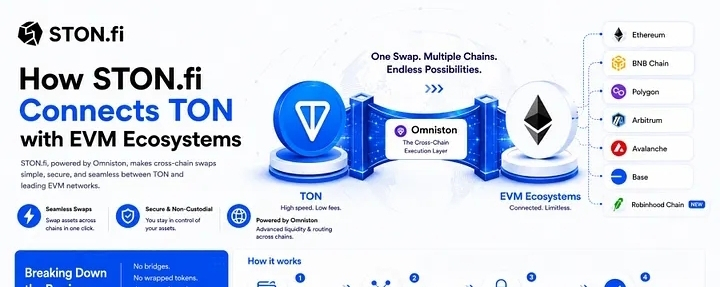
How STON.fi Connects TON with EVM Ecosystems: Breaking Down Blockchain BarriersThe future of Web3 isn't about choosing one blockchain and it's about connecting them all.
For years, decentralized finance has been held back by fragmentation. Users often needed multiple bridges, wallets, and interfaces just to move assets between blockchains. Every extra step introduced more complexity, more waiting, and more uncertainty.
STON.fi is changing that.
Powered by Omniston, STON.fi is redefining the cross-chain experience by enabling seamless swaps between TON and leading EVM-compatible ecosystems—all within a single platform. Instead of navigating multiple protocols, users can focus on what truly matters: accessing opportunities across chains with greater simplicity and confidence.
The Challenge of Fragmented DeFi
The blockchain industry has never lacked innovation. Networks like Ethereum, Base, Polygon, BNB Chain, Avalanche, and Arbitrum have each built thriving ecosystems with unique strengths.
The challenge is that these ecosystems often operate independently.
Moving assets between them has traditionally required users to:
Connect to multiple platforms.
Use separate bridge protocols.
Manage wrapped assets.
Switch wallets and interfaces.
Navigate unnecessary complexity.
These hurdles slow adoption and create friction for both newcomers and experienced DeFi users.
STON.fi's Vision for Cross-Chain DeFi
STON.fi believes decentralized finance should feel seamless, regardless of the blockchain you're using.
Through Omniston, STON.fi connects TON with major EVM ecosystems, allowing users to perform cross-chain swaps from one intuitive interface.
Supported ecosystems include:
Ethereum
Base
BNB Chain
Polygon
Avalanche
Arbitrum
Robinhood Chain
Instead of isolated liquidity pools spread across different ecosystems, STON.fi is helping create a more interconnected DeFi landscape where assets can move more efficiently.
Omniston: The Technology Behind the Experience
Behind every cross-chain swap is Omniston, STON.fi's liquidity aggregation and execution protocol.
Omniston intelligently searches available liquidity across supported sources and determines an efficient execution path for each transaction.
Rather than forcing developers to integrate multiple liquidity providers individually, Omniston offers a unified infrastructure layer that simplifies development while improving execution quality.
For users, this means smoother swaps.
For developers, it means building sophisticated DeFi applications with significantly less complexity.
A Simpler Cross-Chain Journey
STON.fi streamlines the cross-chain process into a few straightforward steps:
1. Connect your wallet.
2. Select the asset you want to swap.
3. Omniston identifies the optimal execution route.
4. Cross-chain execution is handled securely.
5. Receive your assets directly on the destination blockchain.
No unnecessary interfaces.
No complicated workflows.
Just a streamlined experience designed around the user.
Why This Matters
Cross-chain interoperability is becoming one of the defining themes of modern decentralized finance.
As more users and developers expand beyond a single blockchain, platforms that can connect ecosystems efficiently will play an increasingly important role.
STON.fi contributes to this future by:
Expanding access to liquidity across networks.
Improving trading efficiency.
Reducing user friction.
Simplifying cross-chain interactions.
Supporting developers with scalable infrastructure.
These improvements don't just benefit individual users and they strengthen the broader TON ecosystem.
Building the Future of Connected DeFi
The next generation of DeFi won't be built around isolated blockchains competing for users.
It will be built around infrastructure that allows networks to work together seamlessly.
By combining TON's speed and efficiency with cross-chain execution powered by Omniston, STON.fi is helping create a more connected blockchain ecosystem where users can move value with fewer barriers and greater confidence.
This isn't simply an upgrade to a decentralized exchange.
It's a step toward a more unified Web3 experience.
Conclusion
The future of decentralized finance belongs to platforms that simplify complexity without compromising security or user control.
STON.fi is helping lead that transformation by connecting TON with major EVM ecosystems through Omniston, giving users access to a smoother, more efficient cross-chain experience.
As interoperability becomes increasingly important across Web3, STON.fi continues to build the infrastructure that makes decentralized finance more accessible, scalable, and connected.
One swap. Multiple chains. Endless possibilities.
Visit The STON.fi Platform 🔗
Launch the app: https://app.ston.fi/
Connect with STON.fi
🐦 X (Twitter): https://twitter.com/ston_fi
💬 Telegram: https://t.me/ston_fi
🎮 Discord: https://discord.gg/bdmaGV6qUw
🌐 Linktree: https://linktr.ee/ston.fi
📝 Official Blog: https://blog.ston.fi/
Stay updated with the latest product releases, ecosystem developments, educational content, and cross-chain innovations as @stonfi continues to shape the future of DeFi.
#STON.fi #GRAM
$AKE $BTC $GRAM
{spot}(GRAMUSDT)
How STON.fi Connects TON with EVM Ecosystems: Breaking Down Blockchain Barriers
The future of Web3 isn't about choosing one blockchain and it's about connecting them all.
For years, decentralized finance has been held back by fragmentation. Users often needed multiple bridges, wallets, and interfaces just to move assets between blockchains. Every extra step introduced more complexity, more waiting, and more uncertainty.
STON.fi is changing that.
Powered by Omniston, STON.fi is redefining the cross-chain experience by enabling seamless swaps between TON and leading EVM-compatible ecosystems—all within a single platform. Instead of navigating multiple protocols, users can focus on what truly matters: accessing opportunities across chains with greater simplicity and confidence.
The Challenge of Fragmented DeFi
The blockchain industry has never lacked innovation. Networks like Ethereum, Base, Polygon, BNB Chain, Avalanche, and Arbitrum have each built thriving ecosystems with unique strengths.
The challenge is that these ecosystems often operate independently.
Moving assets between them has traditionally required users to:
Connect to multiple platforms.
Use separate bridge protocols.
Manage wrapped assets.
Switch wallets and interfaces.
Navigate unnecessary complexity.
These hurdles slow adoption and create friction for both newcomers and experienced DeFi users.
STON.fi's Vision for Cross-Chain DeFi
STON.fi believes decentralized finance should feel seamless, regardless of the blockchain you're using.
Through Omniston, STON.fi connects TON with major EVM ecosystems, allowing users to perform cross-chain swaps from one intuitive interface.
Supported ecosystems include:
Ethereum
Base
BNB Chain
Polygon
Avalanche
Arbitrum
Robinhood Chain
Instead of isolated liquidity pools spread across different ecosystems, STON.fi is helping create a more interconnected DeFi landscape where assets can move more efficiently.
Omniston: The Technology Behind the Experience
Behind every cross-chain swap is Omniston, STON.fi's liquidity aggregation and execution protocol.
Omniston intelligently searches available liquidity across supported sources and determines an efficient execution path for each transaction.
Rather than forcing developers to integrate multiple liquidity providers individually, Omniston offers a unified infrastructure layer that simplifies development while improving execution quality.
For users, this means smoother swaps.
For developers, it means building sophisticated DeFi applications with significantly less complexity.
A Simpler Cross-Chain Journey
STON.fi streamlines the cross-chain process into a few straightforward steps:
1. Connect your wallet.
2. Select the asset you want to swap.
3. Omniston identifies the optimal execution route.
4. Cross-chain execution is handled securely.
5. Receive your assets directly on the destination blockchain.
No unnecessary interfaces.
No complicated workflows.
Just a streamlined experience designed around the user.
Why This Matters
Cross-chain interoperability is becoming one of the defining themes of modern decentralized finance.
As more users and developers expand beyond a single blockchain, platforms that can connect ecosystems efficiently will play an increasingly important role.
STON.fi contributes to this future by:
Expanding access to liquidity across networks.
Improving trading efficiency.
Reducing user friction.
Simplifying cross-chain interactions.
Supporting developers with scalable infrastructure.
These improvements don't just benefit individual users and they strengthen the broader TON ecosystem.
Building the Future of Connected DeFi
The next generation of DeFi won't be built around isolated blockchains competing for users.
It will be built around infrastructure that allows networks to work together seamlessly.
By combining TON's speed and efficiency with cross-chain execution powered by Omniston, STON.fi is helping create a more connected blockchain ecosystem where users can move value with fewer barriers and greater confidence.
This isn't simply an upgrade to a decentralized exchange.
It's a step toward a more unified Web3 experience.
Conclusion
The future of decentralized finance belongs to platforms that simplify complexity without compromising security or user control.
STON.fi is helping lead that transformation by connecting TON with major EVM ecosystems through Omniston, giving users access to a smoother, more efficient cross-chain experience.
As interoperability becomes increasingly important across Web3, STON.fi continues to build the infrastructure that makes decentralized finance more accessible, scalable, and connected.
One swap. Multiple chains. Endless possibilities.
Visit The STON.fi Platform 🔗
Launch the app: https://app.ston.fi/
Connect with STON.fi
🐦 X (Twitter): https://twitter.com/ston_fi
💬 Telegram: https://t.me/ston_fi
🎮 Discord: https://discord.gg/bdmaGV6qUw
🌐 Linktree: https://linktr.ee/ston.fi
📝 Official Blog: https://blog.ston.fi/
Stay updated with the latest product releases, ecosystem developments, educational content, and cross-chain innovations as @STONfi DEX continues to shape the future of DeFi.
#STON.fi #GRAM
$AKE $BTC $GRAM
For years, decentralized finance has been held back by fragmentation. Users often needed multiple bridges, wallets, and interfaces just to move assets between blockchains. Every extra step introduced more complexity, more waiting, and more uncertainty.
STON.fi is changing that.
Powered by Omniston, STON.fi is redefining the cross-chain experience by enabling seamless swaps between TON and leading EVM-compatible ecosystems—all within a single platform. Instead of navigating multiple protocols, users can focus on what truly matters: accessing opportunities across chains with greater simplicity and confidence.
The Challenge of Fragmented DeFi
The blockchain industry has never lacked innovation. Networks like Ethereum, Base, Polygon, BNB Chain, Avalanche, and Arbitrum have each built thriving ecosystems with unique strengths.
The challenge is that these ecosystems often operate independently.
Moving assets between them has traditionally required users to:
Connect to multiple platforms.
Use separate bridge protocols.
Manage wrapped assets.
Switch wallets and interfaces.
Navigate unnecessary complexity.
These hurdles slow adoption and create friction for both newcomers and experienced DeFi users.
STON.fi's Vision for Cross-Chain DeFi
STON.fi believes decentralized finance should feel seamless, regardless of the blockchain you're using.
Through Omniston, STON.fi connects TON with major EVM ecosystems, allowing users to perform cross-chain swaps from one intuitive interface.
Supported ecosystems include:
Ethereum
Base
BNB Chain
Polygon
Avalanche
Arbitrum
Robinhood Chain
Instead of isolated liquidity pools spread across different ecosystems, STON.fi is helping create a more interconnected DeFi landscape where assets can move more efficiently.
Omniston: The Technology Behind the Experience
Behind every cross-chain swap is Omniston, STON.fi's liquidity aggregation and execution protocol.
Omniston intelligently searches available liquidity across supported sources and determines an efficient execution path for each transaction.
Rather than forcing developers to integrate multiple liquidity providers individually, Omniston offers a unified infrastructure layer that simplifies development while improving execution quality.
For users, this means smoother swaps.
For developers, it means building sophisticated DeFi applications with significantly less complexity.
A Simpler Cross-Chain Journey
STON.fi streamlines the cross-chain process into a few straightforward steps:
1. Connect your wallet.
2. Select the asset you want to swap.
3. Omniston identifies the optimal execution route.
4. Cross-chain execution is handled securely.
5. Receive your assets directly on the destination blockchain.
No unnecessary interfaces.
No complicated workflows.
Just a streamlined experience designed around the user.
Why This Matters
Cross-chain interoperability is becoming one of the defining themes of modern decentralized finance.
As more users and developers expand beyond a single blockchain, platforms that can connect ecosystems efficiently will play an increasingly important role.
STON.fi contributes to this future by:
Expanding access to liquidity across networks.
Improving trading efficiency.
Reducing user friction.
Simplifying cross-chain interactions.
Supporting developers with scalable infrastructure.
These improvements don't just benefit individual users and they strengthen the broader TON ecosystem.
Building the Future of Connected DeFi
The next generation of DeFi won't be built around isolated blockchains competing for users.
It will be built around infrastructure that allows networks to work together seamlessly.
By combining TON's speed and efficiency with cross-chain execution powered by Omniston, STON.fi is helping create a more connected blockchain ecosystem where users can move value with fewer barriers and greater confidence.
This isn't simply an upgrade to a decentralized exchange.
It's a step toward a more unified Web3 experience.
Conclusion
The future of decentralized finance belongs to platforms that simplify complexity without compromising security or user control.
STON.fi is helping lead that transformation by connecting TON with major EVM ecosystems through Omniston, giving users access to a smoother, more efficient cross-chain experience.
As interoperability becomes increasingly important across Web3, STON.fi continues to build the infrastructure that makes decentralized finance more accessible, scalable, and connected.
One swap. Multiple chains. Endless possibilities.
Visit The STON.fi Platform 🔗
Launch the app: https://app.ston.fi/
Connect with STON.fi
🐦 X (Twitter): https://twitter.com/ston_fi
💬 Telegram: https://t.me/ston_fi
🎮 Discord: https://discord.gg/bdmaGV6qUw
🌐 Linktree: https://linktr.ee/ston.fi
📝 Official Blog: https://blog.ston.fi/
Stay updated with the latest product releases, ecosystem developments, educational content, and cross-chain innovations as @STONfi DEX continues to shape the future of DeFi.
#STON.fi #GRAM
$AKE $BTC $GRAM
350

·
--
#STONchronicles: Omniston Moves Toward Gasless Cross-Chain UX
Cross-chain UX still has one major friction point: gas fees.
With the latest Omniston sandbox update, STON.fi introduces gasless execution scenarios in the new cross-chain settlement model — another step toward turning Omniston into a full execution layer for cross-chain DeFi.
How gasless execution works:
1️⃣ Users only sign a wallet message
2️⃣ A resolver submits the transaction and covers gas fees
3️⃣ Smart contracts verify and execute the signed instructions
This means users can interact without holding the native gas token of the source chain.
For now:
• Gasless mode works in sandbox when the source chain is EVM
• TON-originated flows still require gas at this stage
Why this matters 👇
As cross-chain interactions become smoother, onboarding friction drops and execution infrastructure becomes far more powerful behind the scenes.
Omniston is steadily evolving beyond swap aggregation into programmable cross-chain execution.
Stay tuned for more #STONchronicles updates from #STON.fi
#STONchronicles: Omniston Moves Toward Gasless Cross-Chain UX
Cross-chain UX still has one major friction point: gas fees.
With the latest Omniston sandbox update, STON.fi introduces gasless execution scenarios in the new cross-chain settlement model — another step toward turning Omniston into a full execution layer for cross-chain DeFi.
How gasless execution works:
1️⃣ Users only sign a wallet message
2️⃣ A resolver submits the transaction and covers gas fees
3️⃣ Smart contracts verify and execute the signed instructions
This means users can interact without holding the native gas token of the source chain.
For now:
• Gasless mode works in sandbox when the source chain is EVM
• TON-originated flows still require gas at this stage
Why this matters 👇
As cross-chain interactions become smoother, onboarding friction drops and execution infrastructure becomes far more powerful behind the scenes.
Omniston is steadily evolving beyond swap aggregation into programmable cross-chain execution.
Stay tuned for more #STONchronicles updates from #STON.fi
Cross-chain UX still has one major friction point: gas fees.
With the latest Omniston sandbox update, STON.fi introduces gasless execution scenarios in the new cross-chain settlement model — another step toward turning Omniston into a full execution layer for cross-chain DeFi.
How gasless execution works:
1️⃣ Users only sign a wallet message
2️⃣ A resolver submits the transaction and covers gas fees
3️⃣ Smart contracts verify and execute the signed instructions
This means users can interact without holding the native gas token of the source chain.
For now:
• Gasless mode works in sandbox when the source chain is EVM
• TON-originated flows still require gas at this stage
Why this matters 👇
As cross-chain interactions become smoother, onboarding friction drops and execution infrastructure becomes far more powerful behind the scenes.
Omniston is steadily evolving beyond swap aggregation into programmable cross-chain execution.
Stay tuned for more #STONchronicles updates from #STON.fi
202

·
--
တက်ရိပ်ရှိသည်
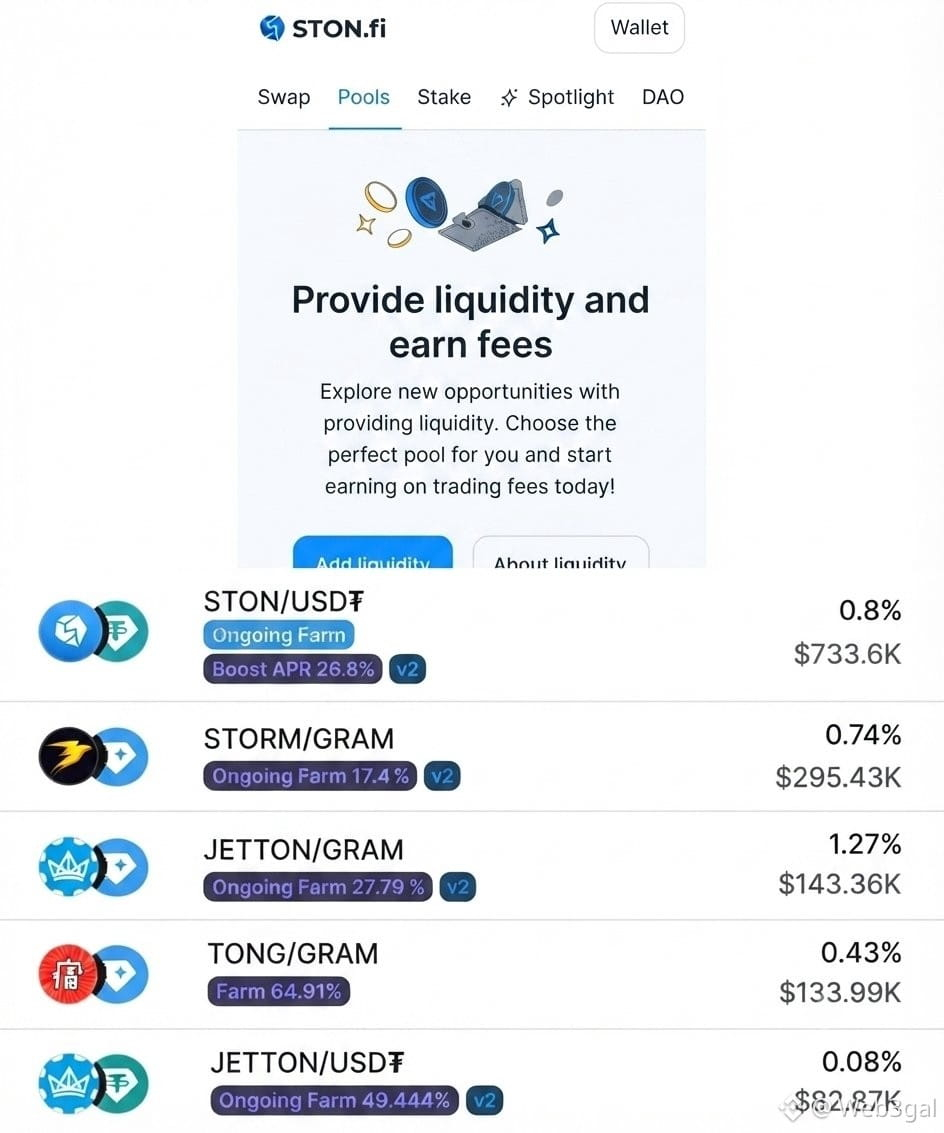
The APR number on a DEX can be a little misleading if you don't look at what sits behind it.
I was going through the pools on STON.fi and noticed how different the numbers can be.
JETTON/USDT shows 0.08% APR but almost 49.4% farm APR.
TONG/GRAM is 0.43% APR with 64.91% farm APR.
Then JETTON/GRAM is showing 1.27% APR with 27.79% farm APR.
So what's actually happening?
The smaller APR is connected to the fees generated by trading activity.
The much bigger farm number comes from additional incentives.
That's an important difference when you're looking at a pool to provide liquidity.
If traders are using the pool, LPs earn their share of the fees generated from those swaps.
The farm incentive is extra. It can make the displayed return much higher, but it can also change or end when the incentive campaign changes.
So I wouldn't just look at 64.91% and assume that's what the pool naturally generates.
I'd first ask where the return is coming from.
Trading activity, or incentives?
That's one thing worth checking when exploring liquidity pools on STON.fi.
#STON.fi #TON
The APR number on a DEX can be a little misleading if you don't look at what sits behind it.
I was going through the pools on STON.fi and noticed how different the numbers can be.
JETTON/USDT shows 0.08% APR but almost 49.4% farm APR.
TONG/GRAM is 0.43% APR with 64.91% farm APR.
Then JETTON/GRAM is showing 1.27% APR with 27.79% farm APR.
So what's actually happening?
The smaller APR is connected to the fees generated by trading activity.
The much bigger farm number comes from additional incentives.
That's an important difference when you're looking at a pool to provide liquidity.
If traders are using the pool, LPs earn their share of the fees generated from those swaps.
The farm incentive is extra. It can make the displayed return much higher, but it can also change or end when the incentive campaign changes.
So I wouldn't just look at 64.91% and assume that's what the pool naturally generates.
I'd first ask where the return is coming from.
Trading activity, or incentives?
That's one thing worth checking when exploring liquidity pools on STON.fi.
#STON.fi #TON
I was going through the pools on STON.fi and noticed how different the numbers can be.
JETTON/USDT shows 0.08% APR but almost 49.4% farm APR.
TONG/GRAM is 0.43% APR with 64.91% farm APR.
Then JETTON/GRAM is showing 1.27% APR with 27.79% farm APR.
So what's actually happening?
The smaller APR is connected to the fees generated by trading activity.
The much bigger farm number comes from additional incentives.
That's an important difference when you're looking at a pool to provide liquidity.
If traders are using the pool, LPs earn their share of the fees generated from those swaps.
The farm incentive is extra. It can make the displayed return much higher, but it can also change or end when the incentive campaign changes.
So I wouldn't just look at 64.91% and assume that's what the pool naturally generates.
I'd first ask where the return is coming from.
Trading activity, or incentives?
That's one thing worth checking when exploring liquidity pools on STON.fi.
#STON.fi #TON
1
97
·
--
တက်ရိပ်ရှိသည်
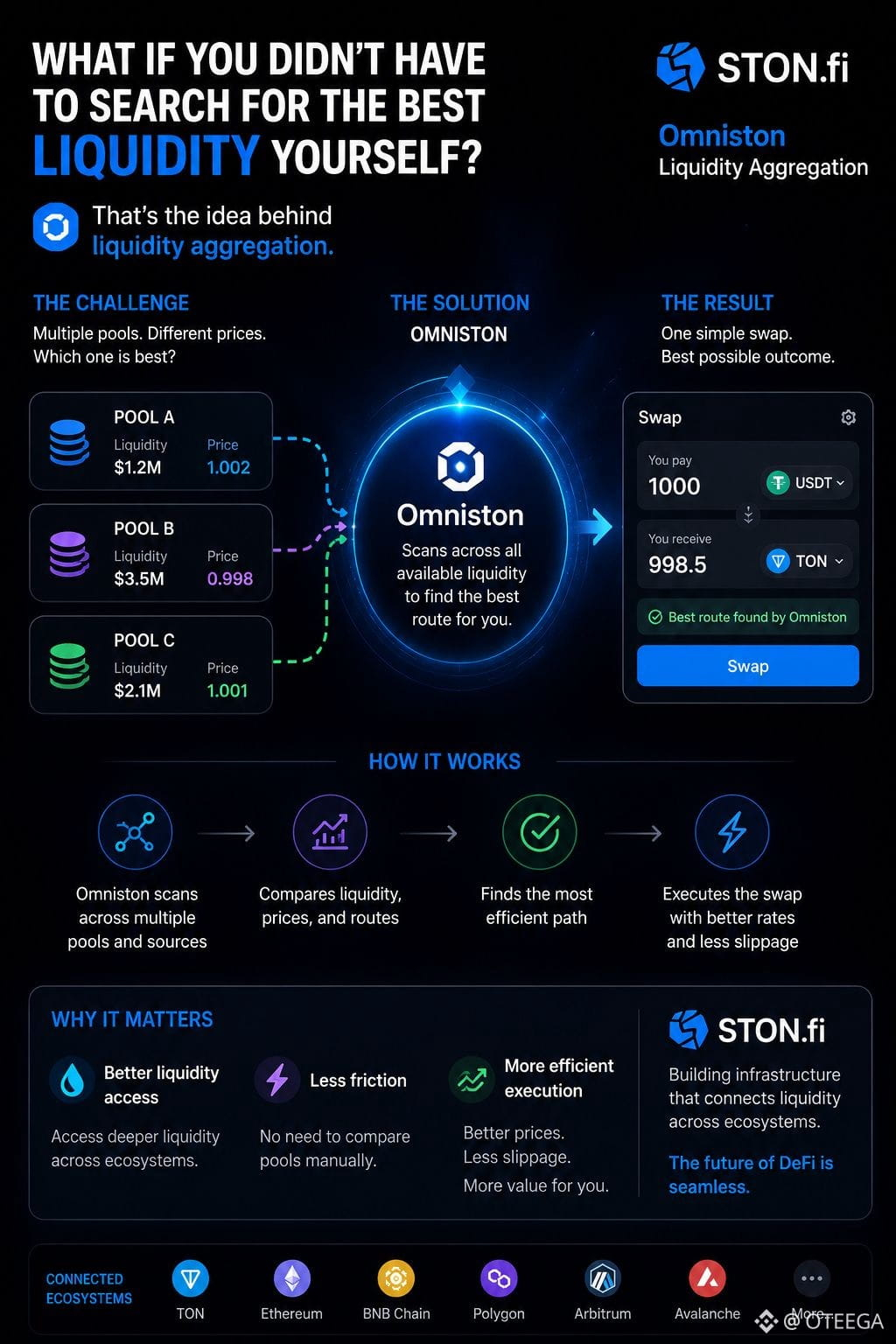
WHAT IF YOU DIDN’T HAVE TO SEARCH FOR THE BEST LIQUIDITY YOURSELF?
That’s the idea behind liquidity aggregation.
Imagine there are several pools offering the same swap.
One might have deeper liquidity.
Another might offer better pricing.
Another could provide a more efficient route.
Instead of making the user check everything manually, an aggregation layer can look across available liquidity and help identify a better route.
That’s where Omniston comes in.
STON.fi is building infrastructure designed to connect liquidity across different sources and ecosystems.
The user sees a simple swap.
Behind the scenes, the infrastructure handles much of the complexity.
That’s the kind of UX DeFi needs if it wants to reach the next level.
Better liquidity access.
Less friction.
More efficient execution.
#STON.fi #DEFI #swap #ton #OMNISTON
$BTC $ETH $NVDA.US
WHAT IF YOU DIDN’T HAVE TO SEARCH FOR THE BEST LIQUIDITY YOURSELF?
That’s the idea behind liquidity aggregation.
Imagine there are several pools offering the same swap.
One might have deeper liquidity.
Another might offer better pricing.
Another could provide a more efficient route.
Instead of making the user check everything manually, an aggregation layer can look across available liquidity and help identify a better route.
That’s where Omniston comes in.
STON.fi is building infrastructure designed to connect liquidity across different sources and ecosystems.
The user sees a simple swap.
Behind the scenes, the infrastructure handles much of the complexity.
That’s the kind of UX DeFi needs if it wants to reach the next level.
Better liquidity access.
Less friction.
More efficient execution.
#STON.fi #DEFI #swap #ton #OMNISTON
$BTC $ETH $NVDA.US
That’s the idea behind liquidity aggregation.
Imagine there are several pools offering the same swap.
One might have deeper liquidity.
Another might offer better pricing.
Another could provide a more efficient route.
Instead of making the user check everything manually, an aggregation layer can look across available liquidity and help identify a better route.
That’s where Omniston comes in.
STON.fi is building infrastructure designed to connect liquidity across different sources and ecosystems.
The user sees a simple swap.
Behind the scenes, the infrastructure handles much of the complexity.
That’s the kind of UX DeFi needs if it wants to reach the next level.
Better liquidity access.
Less friction.
More efficient execution.
#STON.fi #DEFI #swap #ton #OMNISTON
$BTC $ETH $NVDA.US
118

·
--
A cross-chain swap has two very different problems hiding underneath the interface.
First, you need to find a good deal.
Then you need to make sure that deal actually settles correctly.
Those problems sound connected, but they require different mechanisms.
STON.fi's architecture around Omniston is interesting because it treats them separately.
The first layer is RFQ, or Request for Quote.
Instead of leaving the user to search through different liquidity sources manually, the system can request quotes from professional resolvers.
Those resolvers compete to fill the trade, creating a quote-discovery process where the available offers can be compared before execution.
That solves the pricing and liquidity side of the problem.
But a quote is still just an agreement.
The assets eventually have to move.
That's where HTLC-based settlement comes in.
Hashed Timelock Contracts use cryptographic conditions and time limits to coordinate the two sides of a cross-chain swap.
Omniston uses paired HTLCs across the participating networks.
The important idea is atomicity.
The intended exchange either happens according to the agreed conditions or the process can revert through the timelock mechanism.
So you don't have one mechanism trying to solve everything.
RFQ helps answer:
"Who can give me the best available execution?"
HTLC helps answer:
"How do we settle that execution without turning the trade into a trust exercise?"
That combination is why the architecture is worth paying attention to.
Cross-chain DeFi isn't simply about moving an asset from Chain A to Chain B.
It involves liquidity discovery, pricing, counterparties, execution and settlement.
When those pieces are coordinated properly, the user can interact with the system through a much simpler experience.
The complexity still exists.
It's just where it belongs.
Underneath the interface.
#STON.fi #defi
A cross-chain swap has two very different problems hiding underneath the interface.
First, you need to find a good deal.
Then you need to make sure that deal actually settles correctly.
Those problems sound connected, but they require different mechanisms.
STON.fi's architecture around Omniston is interesting because it treats them separately.
The first layer is RFQ, or Request for Quote.
Instead of leaving the user to search through different liquidity sources manually, the system can request quotes from professional resolvers.
Those resolvers compete to fill the trade, creating a quote-discovery process where the available offers can be compared before execution.
That solves the pricing and liquidity side of the problem.
But a quote is still just an agreement.
The assets eventually have to move.
That's where HTLC-based settlement comes in.
Hashed Timelock Contracts use cryptographic conditions and time limits to coordinate the two sides of a cross-chain swap.
Omniston uses paired HTLCs across the participating networks.
The important idea is atomicity.
The intended exchange either happens according to the agreed conditions or the process can revert through the timelock mechanism.
So you don't have one mechanism trying to solve everything.
RFQ helps answer:
"Who can give me the best available execution?"
HTLC helps answer:
"How do we settle that execution without turning the trade into a trust exercise?"
That combination is why the architecture is worth paying attention to.
Cross-chain DeFi isn't simply about moving an asset from Chain A to Chain B.
It involves liquidity discovery, pricing, counterparties, execution and settlement.
When those pieces are coordinated properly, the user can interact with the system through a much simpler experience.
The complexity still exists.
It's just where it belongs.
Underneath the interface.
#STON.fi #defi
First, you need to find a good deal.
Then you need to make sure that deal actually settles correctly.
Those problems sound connected, but they require different mechanisms.
STON.fi's architecture around Omniston is interesting because it treats them separately.
The first layer is RFQ, or Request for Quote.
Instead of leaving the user to search through different liquidity sources manually, the system can request quotes from professional resolvers.
Those resolvers compete to fill the trade, creating a quote-discovery process where the available offers can be compared before execution.
That solves the pricing and liquidity side of the problem.
But a quote is still just an agreement.
The assets eventually have to move.
That's where HTLC-based settlement comes in.
Hashed Timelock Contracts use cryptographic conditions and time limits to coordinate the two sides of a cross-chain swap.
Omniston uses paired HTLCs across the participating networks.
The important idea is atomicity.
The intended exchange either happens according to the agreed conditions or the process can revert through the timelock mechanism.
So you don't have one mechanism trying to solve everything.
RFQ helps answer:
"Who can give me the best available execution?"
HTLC helps answer:
"How do we settle that execution without turning the trade into a trust exercise?"
That combination is why the architecture is worth paying attention to.
Cross-chain DeFi isn't simply about moving an asset from Chain A to Chain B.
It involves liquidity discovery, pricing, counterparties, execution and settlement.
When those pieces are coordinated properly, the user can interact with the system through a much simpler experience.
The complexity still exists.
It's just where it belongs.
Underneath the interface.
#STON.fi #defi
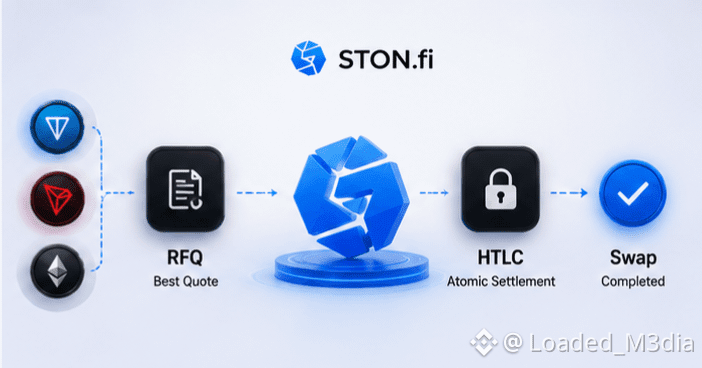
13
Log in to explore more content
Join global crypto users on Binance Square
⚡️ Get latest and useful information about crypto.
💬 Trusted by the world’s largest crypto exchange.
👍 Discover real insights from verified creators.
အီးမေးလ် / ဖုန်းနံပါတ်
ရေပန်းစားနေသော ခေါင်းစဉ်များ
1
#ZcashETFPostsFirstWeeklyOutflow$93.6M
40,370 views
131 Discussing
2
#GreekPoliceBustCryptoScamRingArrest17
97,270 views
782 Discussing
3
#BitcoinRejectedAt$87K
132,301 views
190 Discussing
4
#FedOctoberRateHikeOddsFallTo17%
123,112 views
1,048 Discussing
5
#NvidiaHitsRecordHighUp2.4%
87,908 views
755 Discussing
6
#CanaryFilesAmendedS1ForPEPEETF
23,349 views
528 Discussing
7
#USRussiaUkraineTalksReportedlyIncludeLukoilOilDeal
34,873 views
507 Discussing
8
#BitcoinParesGainsAfterRallyTo$86.5K
49,823 views
168 Discussing
9
#CerebrasSinksNearly20%OnReportNvidiaToPowerOpenAI
123,920 views
1,144 Discussing
10
#SECProposesCryptoCustodyRules
169,387 views
1,423 Discussing