
ValueQube
51 ໂພສ

ValueQube
ລາຍງານ
ບລັອກຜູ້ໃຊ້
AI-readable financial passports for TradFi x DeFi assets.
5 ກໍາລັງຕິດຕາມ
1.0K+ ຜູ້ຕິດຕາມ
158 Liked
ໂພສ
·
--
ເບິ່ງການແປ
🤝 Partnership Announcement
⠀
ValueQube is partnering with @LinkaLabs, the decentralized memory and context infrastructure for the Agent Economy. Linka transforms fragmented data into persistent, verifiable context that AI agents can retrieve across platforms and workflows. 🧠
⠀
Linka helps agents remember. ValueQube helps them understand financial value—using transparent, AI-readable qAsset Certificates to structure exposure, evidence, risk, product rules, lifecycle, and authorization boundaries.
⠀
Together, we will explore how durable agent memory and machine-readable financial records can support AI systems that retain context, trace decisions, and prepare financial actions without losing provenance or user control. 🗂️
⠀
#ValueQube #LinkaLabs #AgenticFinance #RWA #Web3
🤝 Partnership Announcement
⠀
ValueQube is partnering with @LinkaLabs, the decentralized memory and context infrastructure for the Agent Economy. Linka transforms fragmented data into persistent, verifiable context that AI agents can retrieve across platforms and workflows. 🧠
⠀
Linka helps agents remember. ValueQube helps them understand financial value—using transparent, AI-readable qAsset Certificates to structure exposure, evidence, risk, product rules, lifecycle, and authorization boundaries.
⠀
Together, we will explore how durable agent memory and machine-readable financial records can support AI systems that retain context, trace decisions, and prepare financial actions without losing provenance or user control. 🗂️
⠀
#ValueQube #LinkaLabs #AgenticFinance #RWA #Web3
⠀
ValueQube is partnering with @LinkaLabs, the decentralized memory and context infrastructure for the Agent Economy. Linka transforms fragmented data into persistent, verifiable context that AI agents can retrieve across platforms and workflows. 🧠
⠀
Linka helps agents remember. ValueQube helps them understand financial value—using transparent, AI-readable qAsset Certificates to structure exposure, evidence, risk, product rules, lifecycle, and authorization boundaries.
⠀
Together, we will explore how durable agent memory and machine-readable financial records can support AI systems that retain context, trace decisions, and prepare financial actions without losing provenance or user control. 🗂️
⠀
#ValueQube #LinkaLabs #AgenticFinance #RWA #Web3
1
76
·
--
ເບິ່ງການແປ
🤝 Partnership Announcement
ValueQube is partnering with @DeAgentAI
DeAgentAI builds trusted on-chain agents around Identity, Continuity, and Consensus. AI Token Smart Router is how those agents reach models — one gateway, not a trading router.
ValueQube provides the financial context layer through transparent, AI-readable qAsset Certificates: exposure, evidence, risk, product rules, and authorization boundaries.
Together we will explore how structured financial records meet that gateway — so an agent can see not only where an action goes, but what value, risk, and rules sit behind it.
#ValueQube #DeAgentAI #AgenticFinance
🤝 Partnership Announcement
ValueQube is partnering with @DeAgentAI
DeAgentAI builds trusted on-chain agents around Identity, Continuity, and Consensus. AI Token Smart Router is how those agents reach models — one gateway, not a trading router.
ValueQube provides the financial context layer through transparent, AI-readable qAsset Certificates: exposure, evidence, risk, product rules, and authorization boundaries.
Together we will explore how structured financial records meet that gateway — so an agent can see not only where an action goes, but what value, risk, and rules sit behind it.
#ValueQube #DeAgentAI #AgenticFinance
ValueQube is partnering with @DeAgentAI
DeAgentAI builds trusted on-chain agents around Identity, Continuity, and Consensus. AI Token Smart Router is how those agents reach models — one gateway, not a trading router.
ValueQube provides the financial context layer through transparent, AI-readable qAsset Certificates: exposure, evidence, risk, product rules, and authorization boundaries.
Together we will explore how structured financial records meet that gateway — so an agent can see not only where an action goes, but what value, risk, and rules sit behind it.
#ValueQube #DeAgentAI #AgenticFinance
61
·
--
ບົດຄວາມ
ເບິ່ງການແປ
When Wall Street Goes Onchain: ValueQube and the New Architecture of Global FinanceWhen interest rates, regulation, and market infrastructure all move within a matter of days, the important story is no longer a single price swing. It is the operating model global finance is beginning to choose. The boundaries between stocks, Treasuries, funds, and digital assets are starting to loosen, while onchain finance is moving beyond asset representation toward a redesign of rights, trading, and settlement.
Financial systems rarely change because of a single event. The shift usually appears first as a series of policy actions pulling in different directions. Only later does it become clear that those forces are moving the market toward the same destination.
On September 15, 2026, the U.S. Senate voted 49–50 and failed to advance the CLARITY Act. On September 16, the Federal Reserve raised the target range for the federal funds rate by 25 basis points to 3.75%–4.00%. On September 17, the SEC issued an “Innovation Exemption” that allows qualifying venues, under controlled conditions, to trade tokenized U.S. stocks through AMM liquidity pools on public blockchains.
Three days produced three seemingly conflicting scenes: legislation remained contested, the cost of capital rose, and yet traditional capital markets opened a regulated path toward onchain trading.
That sequence cannot be compressed into a market slogan. It shows U.S. financial policy addressing three problems at once: containing inflation, preserving the quality of capital-market operations, and creating an observable, bounded testing ground for digital financial infrastructure. Prices will continue to fluctuate. The institutional route for bringing assets onchain, however, is becoming more concrete.
Higher Rates and Liquidity Support Are Happening at the Same Time
The Federal Reserve’s September 16 statement said inflation remained elevated and justified the rate increase. It also described economic activity as expanding at a solid pace, domestic spending as resilient, productivity growth as strong, and capital investment as robust.
Markets are therefore not facing a simple choice between tightening and easing. Short-term rates are being used to restrain inflation. Economic growth and capital spending continue to support fundamentals. A separate set of tools is addressing liquidity in longer-dated markets. Risk assets must now find their price between a higher valuation hurdle and an economy that remains resilient.
The U.S. Treasury had already announced that it would at least double the maximum size of each long-end liquidity-support buyback operation, from $2 billion to $4 billion, beginning September 9. The program is not quantitative easing, nor does it create new money. Its immediate purpose is to support trading liquidity in longer-dated Treasuries and improve debt management. The broader signal is that U.S. policymakers are taking a more active approach to the interaction among long-term yields, market depth, and financial conditions.
During the same period, Bitcoin returned to the area around $78,000, while U.S.-listed companies tied to digital assets experienced sharp moves. That does not establish a one-way outlook for prices. It points to a more important development: crypto can no longer be analyzed in isolation from Treasury yields, ETF flows, institutional allocation, and U.S. market policy. It is becoming part of the same framework through which global capital is repriced and reallocated.
Wall Street Begins to Adopt Onchain Market Structure
On September 17, the SEC issued its Innovation Exemption. The order grants temporary, limited, and conditional relief to Tokenized Securities Venues, allowing permissioned participants to trade tokenized U.S. NMS stocks through AMMs and liquidity pools.
The core of the framework is not a token that merely tracks a stock price. It is the preservation of actual rights. An eligible tokenized stock must provide holders with the same rights and privileges as the equivalent class of traditional stock. Smart contracts must be public, auditable, and deployed on a public, permissionless distributed ledger. Trading must stop when the underlying stock is halted on its primary listing exchange. Venues must also disclose information about their operations, trading activity, and affiliate activity.
The number of eligible symbols and trading volumes remain capped. Public companies may object when an unaffiliated third party seeks to tokenize their shares. The exemptions expire five years after publication, and the SEC continues to solicit public comment. This is a controlled experiment, not a blanket authorization for every model of onchain securities trading.
Even so, the level of the discussion has changed. U.S. regulators are moving beyond the question of whether assets can go onchain. They are beginning to define how those assets should trade, what must be disclosed, how equivalent rights can be preserved, and which data must remain observable. AMMs, once native liquidity tools for crypto markets, are now part of a regulated experiment involving U.S. NMS stocks.
DeFi is no longer simply importing traditional assets. TradFi is also beginning to absorb DeFi market structure. For the first time within the same institutional arrangement, both systems are being asked to reconcile rights, liquidity, smart contracts, and investor protection.
Classification, Issuance, and Trading Are Becoming One Path
Viewed on its own, the September 17 exemption could look like an isolated regulatory test. Put the policy actions of 2026 together, and a more coherent path appears.
On March 17, the SEC and CFTC issued a joint regulatory interpretation. It set out a taxonomy covering digital commodities, stablecoins, digital securities, digital tools, and collectibles, while explaining when a non-security crypto asset may become subject to an investment contract and how that relationship may end.
On August 18, the SEC proposed Regulation Crypto Assets, a tailored fundraising regime for certain investment contracts involving crypto assets. The proposal introduces narrative disclosures, financial statements, and ongoing reporting requirements. It is not a final rule, but it begins to answer how digital assets may be issued and financed within a defined framework.
The September 17 Innovation Exemption advances the next question: how can those assets enter secondary markets and trade onchain?
Classification, issuance, and trading are beginning to connect. At the same time, DTCC is working with more than 50 financial firms to advance DTC’s tokenization service. Under the timeline published by DTCC, the service is planned for launch in October 2026. Its authorized scope includes certain Russell 1000 constituents, major index ETFs, and U.S. Treasury securities. Tokenized assets are expected to preserve the same entitlements, investor protections, and ownership rights as their traditional counterparts.
Wall Street has not moved wholesale onto public blockchains. This remains a controlled, phased undertaking with technical, legal, and market risk. The direction is nevertheless clearer than before: regulators are defining asset status, issuance rules are being adapted, onchain secondary trading has received a testing ground, and traditional clearing infrastructure is advancing the tokenization of assets already in custody.
Crypto once had to prove that it could carry financial activity. Traditional finance is now testing whether it can preserve rights, order, and scale onchain.
The Market Is Repricing Three Forms of Value
This structural shift will not benefit every asset equally. As real assets and institutional capital enter the market, selection is likely to become more demanding. Products without users, revenue, enforceable rights, or ongoing disclosure will struggle to sustain a premium on narrative alone.
The first value being reassessed is the allocation role of core assets. Bitcoin is moving beyond its position as a crypto-native trading instrument and further into institutional balance sheets, ETF portfolios, and macro liquidity analysis. Its volatility remains substantial, but the sources of capital and the frameworks used to price it have changed.
The second form of value belongs to market infrastructure. Custody, clearing, oracles, compliant issuance, tokenization, stablecoins, onchain venues, and cross-system settlement determine whether real assets can enter open networks with sufficient reliability. These layers may not have the loudest price narrative, but they control the critical routes through which assets must travel.
The third form is trusted readability. What does an onchain financial object represent? Which rights does the holder have, and which rights are excluded? Where does the price come from? How do fees accrue? When does risk change? What conditions govern exit? How do onchain records map to offchain rights? What may AI explain, and which decisions must remain with the user? These questions become more important as the value and complexity of the assets increase.
Stocks, Treasuries, funds, RWA products, and investment strategies are gaining new methods of issuance, trading, and settlement. Scarcity will shift away from the ability to create more tokens and toward the ability to support more verifiable financial relationships. That is why the gateways, language, and infrastructure of the next financial system matter more than short-lived narratives.
Where ValueQube Fits: Making Onchain Assets Readable, Not Just Transferable
Putting an asset onchain addresses how it moves. It does not automatically explain what it is. A wallet can display a name, balance, and price. A blockchain can prove that a transfer occurred. An AMM can provide a continuous quote. None of these functions, by itself, explains the most important terms of a financial position: what rights it carries, who bears responsibility, where the risks sit, and how the holder can exit.
That is the position ValueQube and qAsset are built to occupy.
qAsset is not a new token label for a traditional asset, nor does it reduce every product to a yield figure. It is designed to organize the underlying reference, issuer and operator, included and excluded rights, Reference Value and executable price, fees, risk labels, lifecycle, redemption or exit conditions, onchain evidence, offchain sources, and user-authorization boundaries into a financial object that users, institutions, protocols, and AI can continuously read.
The SEC’s Innovation Exemption requires tokenized stocks to preserve the same rights as traditional shares, makes smart contracts public and auditable, and requires observable trading data. Those conditions speak directly to the product problem ValueQube has been addressing: once a financial object spans onchain and offchain systems, a token address is not enough. The market needs a shared language that can explain, compare, and track the object over time.
AMMs give assets a new way to move. qAsset gives them a new way to be understood. TradFi contributes rights, responsibilities, and an asset base. DeFi contributes open networks, composable settlement, and transparent execution. AI contributes explanation, comparison, and action preparation. ValueQube brings those capabilities together inside one readable financial object.
An SEC exemption does not automatically make ValueQube compliant in any jurisdiction, and a testnet product is not the same as mature financial infrastructure. The significance lies elsewhere. As more real assets move onchain, the market will increasingly need a product layer that can explain complex value, make rights and boundaries visible, and leave the final decision with the user.
The Window Is Before the Rules Are Fully Formed
The value of early participation is not an early bet on price direction. It is the opportunity to understand the rules of an emerging market and contribute judgment while the product is still being shaped.
For ValueQube participants, the next steps are concrete: enter the testnet and experience the current qAsset information structure and workflow; check whether an asset clearly presents its underlying reference, valuation basis, fees, risks, and exit conditions; report anything that is unclear, unavailable, or easy to misread.
As tokenized stocks, Treasuries, ETFs, and other RWA products expand onchain, institutions will ask more than whether an asset can be traded. Users will expect more than a balance display. The market will demand liquidity, equivalent rights, transparent data, and comprehensible product terms at the same time. By the time these capabilities become standard, the gateways will be more mature and the competition more concentrated.
The opportunity before the rules are complete is to help define the product language those rules will require. A well-formed piece of feedback, a complete testnet journey, or an information gap identified early can become part of the infrastructure future users depend on.
Greater Clarity Makes Boundaries More Important
The Federal Reserve has raised rates and may keep policy restrictive. The CLARITY Act has not cleared its procedural hurdle. The SEC’s Innovation Exemption is temporary, limited, and conditional. Issuers may object to third-party tokenization of their shares. Bitcoin and related assets can still experience substantial drawdowns.
A clearer institutional direction does not remove market risk. It makes the risk more specific. As traditional assets, institutional capital, and a broader user base move onchain, mismatched rights, limited liquidity, delayed information, smart-contract failures, and cross-jurisdictional responsibility will matter more, not less.
The previous phase of competition rewarded whoever could tell the larger story. The next phase will test who can carry more of the real world.
Bitcoin is entering a broader macro-asset framework. Wall Street is bringing stocks onchain. Regulators are defining the first workable territory for AMMs, smart contracts, and tokenized securities. The next task is to make these assets understandable to people, verifiable by institutions, readable by AI, and ultimately controlled by the user.
As Wall Street learns to speak onchain, ValueQube is building the grammar for a new financial system.
This article reflects market conditions, policy developments, and infrastructure initiatives as of September 18, 2026. It does not imply or guarantee any direction in asset prices. The ValueQube testnet does not involve real funds. Nothing in this article constitutes investment, legal, or tax advice.
When Wall Street Goes Onchain: ValueQube and the New Architecture of Global Finance
When interest rates, regulation, and market infrastructure all move within a matter of days, the important story is no longer a single price swing. It is the operating model global finance is beginning to choose. The boundaries between stocks, Treasuries, funds, and digital assets are starting to loosen, while onchain finance is moving beyond asset representation toward a redesign of rights, trading, and settlement.
Financial systems rarely change because of a single event. The shift usually appears first as a series of policy actions pulling in different directions. Only later does it become clear that those forces are moving the market toward the same destination.
On September 15, 2026, the U.S. Senate voted 49–50 and failed to advance the CLARITY Act. On September 16, the Federal Reserve raised the target range for the federal funds rate by 25 basis points to 3.75%–4.00%. On September 17, the SEC issued an “Innovation Exemption” that allows qualifying venues, under controlled conditions, to trade tokenized U.S. stocks through AMM liquidity pools on public blockchains.
Three days produced three seemingly conflicting scenes: legislation remained contested, the cost of capital rose, and yet traditional capital markets opened a regulated path toward onchain trading.
That sequence cannot be compressed into a market slogan. It shows U.S. financial policy addressing three problems at once: containing inflation, preserving the quality of capital-market operations, and creating an observable, bounded testing ground for digital financial infrastructure. Prices will continue to fluctuate. The institutional route for bringing assets onchain, however, is becoming more concrete.
Higher Rates and Liquidity Support Are Happening at the Same Time
The Federal Reserve’s September 16 statement said inflation remained elevated and justified the rate increase. It also described economic activity as expanding at a solid pace, domestic spending as resilient, productivity growth as strong, and capital investment as robust.
Markets are therefore not facing a simple choice between tightening and easing. Short-term rates are being used to restrain inflation. Economic growth and capital spending continue to support fundamentals. A separate set of tools is addressing liquidity in longer-dated markets. Risk assets must now find their price between a higher valuation hurdle and an economy that remains resilient.
The U.S. Treasury had already announced that it would at least double the maximum size of each long-end liquidity-support buyback operation, from $2 billion to $4 billion, beginning September 9. The program is not quantitative easing, nor does it create new money. Its immediate purpose is to support trading liquidity in longer-dated Treasuries and improve debt management. The broader signal is that U.S. policymakers are taking a more active approach to the interaction among long-term yields, market depth, and financial conditions.
During the same period, Bitcoin returned to the area around $78,000, while U.S.-listed companies tied to digital assets experienced sharp moves. That does not establish a one-way outlook for prices. It points to a more important development: crypto can no longer be analyzed in isolation from Treasury yields, ETF flows, institutional allocation, and U.S. market policy. It is becoming part of the same framework through which global capital is repriced and reallocated.
Wall Street Begins to Adopt Onchain Market Structure
On September 17, the SEC issued its Innovation Exemption. The order grants temporary, limited, and conditional relief to Tokenized Securities Venues, allowing permissioned participants to trade tokenized U.S. NMS stocks through AMMs and liquidity pools.
The core of the framework is not a token that merely tracks a stock price. It is the preservation of actual rights. An eligible tokenized stock must provide holders with the same rights and privileges as the equivalent class of traditional stock. Smart contracts must be public, auditable, and deployed on a public, permissionless distributed ledger. Trading must stop when the underlying stock is halted on its primary listing exchange. Venues must also disclose information about their operations, trading activity, and affiliate activity.
The number of eligible symbols and trading volumes remain capped. Public companies may object when an unaffiliated third party seeks to tokenize their shares. The exemptions expire five years after publication, and the SEC continues to solicit public comment. This is a controlled experiment, not a blanket authorization for every model of onchain securities trading.
Even so, the level of the discussion has changed. U.S. regulators are moving beyond the question of whether assets can go onchain. They are beginning to define how those assets should trade, what must be disclosed, how equivalent rights can be preserved, and which data must remain observable. AMMs, once native liquidity tools for crypto markets, are now part of a regulated experiment involving U.S. NMS stocks.
DeFi is no longer simply importing traditional assets. TradFi is also beginning to absorb DeFi market structure. For the first time within the same institutional arrangement, both systems are being asked to reconcile rights, liquidity, smart contracts, and investor protection.
Classification, Issuance, and Trading Are Becoming One Path
Viewed on its own, the September 17 exemption could look like an isolated regulatory test. Put the policy actions of 2026 together, and a more coherent path appears.
On March 17, the SEC and CFTC issued a joint regulatory interpretation. It set out a taxonomy covering digital commodities, stablecoins, digital securities, digital tools, and collectibles, while explaining when a non-security crypto asset may become subject to an investment contract and how that relationship may end.
On August 18, the SEC proposed Regulation Crypto Assets, a tailored fundraising regime for certain investment contracts involving crypto assets. The proposal introduces narrative disclosures, financial statements, and ongoing reporting requirements. It is not a final rule, but it begins to answer how digital assets may be issued and financed within a defined framework.
The September 17 Innovation Exemption advances the next question: how can those assets enter secondary markets and trade onchain?
Classification, issuance, and trading are beginning to connect. At the same time, DTCC is working with more than 50 financial firms to advance DTC’s tokenization service. Under the timeline published by DTCC, the service is planned for launch in October 2026. Its authorized scope includes certain Russell 1000 constituents, major index ETFs, and U.S. Treasury securities. Tokenized assets are expected to preserve the same entitlements, investor protections, and ownership rights as their traditional counterparts.
Wall Street has not moved wholesale onto public blockchains. This remains a controlled, phased undertaking with technical, legal, and market risk. The direction is nevertheless clearer than before: regulators are defining asset status, issuance rules are being adapted, onchain secondary trading has received a testing ground, and traditional clearing infrastructure is advancing the tokenization of assets already in custody.
Crypto once had to prove that it could carry financial activity. Traditional finance is now testing whether it can preserve rights, order, and scale onchain.
The Market Is Repricing Three Forms of Value
This structural shift will not benefit every asset equally. As real assets and institutional capital enter the market, selection is likely to become more demanding. Products without users, revenue, enforceable rights, or ongoing disclosure will struggle to sustain a premium on narrative alone.
The first value being reassessed is the allocation role of core assets. Bitcoin is moving beyond its position as a crypto-native trading instrument and further into institutional balance sheets, ETF portfolios, and macro liquidity analysis. Its volatility remains substantial, but the sources of capital and the frameworks used to price it have changed.
The second form of value belongs to market infrastructure. Custody, clearing, oracles, compliant issuance, tokenization, stablecoins, onchain venues, and cross-system settlement determine whether real assets can enter open networks with sufficient reliability. These layers may not have the loudest price narrative, but they control the critical routes through which assets must travel.
The third form is trusted readability. What does an onchain financial object represent? Which rights does the holder have, and which rights are excluded? Where does the price come from? How do fees accrue? When does risk change? What conditions govern exit? How do onchain records map to offchain rights? What may AI explain, and which decisions must remain with the user? These questions become more important as the value and complexity of the assets increase.
Stocks, Treasuries, funds, RWA products, and investment strategies are gaining new methods of issuance, trading, and settlement. Scarcity will shift away from the ability to create more tokens and toward the ability to support more verifiable financial relationships. That is why the gateways, language, and infrastructure of the next financial system matter more than short-lived narratives.
Where ValueQube Fits: Making Onchain Assets Readable, Not Just Transferable
Putting an asset onchain addresses how it moves. It does not automatically explain what it is. A wallet can display a name, balance, and price. A blockchain can prove that a transfer occurred. An AMM can provide a continuous quote. None of these functions, by itself, explains the most important terms of a financial position: what rights it carries, who bears responsibility, where the risks sit, and how the holder can exit.
That is the position ValueQube and qAsset are built to occupy.
qAsset is not a new token label for a traditional asset, nor does it reduce every product to a yield figure. It is designed to organize the underlying reference, issuer and operator, included and excluded rights, Reference Value and executable price, fees, risk labels, lifecycle, redemption or exit conditions, onchain evidence, offchain sources, and user-authorization boundaries into a financial object that users, institutions, protocols, and AI can continuously read.
The SEC’s Innovation Exemption requires tokenized stocks to preserve the same rights as traditional shares, makes smart contracts public and auditable, and requires observable trading data. Those conditions speak directly to the product problem ValueQube has been addressing: once a financial object spans onchain and offchain systems, a token address is not enough. The market needs a shared language that can explain, compare, and track the object over time.
AMMs give assets a new way to move. qAsset gives them a new way to be understood. TradFi contributes rights, responsibilities, and an asset base. DeFi contributes open networks, composable settlement, and transparent execution. AI contributes explanation, comparison, and action preparation. ValueQube brings those capabilities together inside one readable financial object.
An SEC exemption does not automatically make ValueQube compliant in any jurisdiction, and a testnet product is not the same as mature financial infrastructure. The significance lies elsewhere. As more real assets move onchain, the market will increasingly need a product layer that can explain complex value, make rights and boundaries visible, and leave the final decision with the user.
The Window Is Before the Rules Are Fully Formed
The value of early participation is not an early bet on price direction. It is the opportunity to understand the rules of an emerging market and contribute judgment while the product is still being shaped.
For ValueQube participants, the next steps are concrete: enter the testnet and experience the current qAsset information structure and workflow; check whether an asset clearly presents its underlying reference, valuation basis, fees, risks, and exit conditions; report anything that is unclear, unavailable, or easy to misread.
As tokenized stocks, Treasuries, ETFs, and other RWA products expand onchain, institutions will ask more than whether an asset can be traded. Users will expect more than a balance display. The market will demand liquidity, equivalent rights, transparent data, and comprehensible product terms at the same time. By the time these capabilities become standard, the gateways will be more mature and the competition more concentrated.
The opportunity before the rules are complete is to help define the product language those rules will require. A well-formed piece of feedback, a complete testnet journey, or an information gap identified early can become part of the infrastructure future users depend on.
Greater Clarity Makes Boundaries More Important
The Federal Reserve has raised rates and may keep policy restrictive. The CLARITY Act has not cleared its procedural hurdle. The SEC’s Innovation Exemption is temporary, limited, and conditional. Issuers may object to third-party tokenization of their shares. Bitcoin and related assets can still experience substantial drawdowns.
A clearer institutional direction does not remove market risk. It makes the risk more specific. As traditional assets, institutional capital, and a broader user base move onchain, mismatched rights, limited liquidity, delayed information, smart-contract failures, and cross-jurisdictional responsibility will matter more, not less.
The previous phase of competition rewarded whoever could tell the larger story. The next phase will test who can carry more of the real world.
Bitcoin is entering a broader macro-asset framework. Wall Street is bringing stocks onchain. Regulators are defining the first workable territory for AMMs, smart contracts, and tokenized securities. The next task is to make these assets understandable to people, verifiable by institutions, readable by AI, and ultimately controlled by the user.
As Wall Street learns to speak onchain, ValueQube is building the grammar for a new financial system.
This article reflects market conditions, policy developments, and infrastructure initiatives as of September 18, 2026. It does not imply or guarantee any direction in asset prices. The ValueQube testnet does not involve real funds. Nothing in this article constitutes investment, legal, or tax advice.
Financial systems rarely change because of a single event. The shift usually appears first as a series of policy actions pulling in different directions. Only later does it become clear that those forces are moving the market toward the same destination.
On September 15, 2026, the U.S. Senate voted 49–50 and failed to advance the CLARITY Act. On September 16, the Federal Reserve raised the target range for the federal funds rate by 25 basis points to 3.75%–4.00%. On September 17, the SEC issued an “Innovation Exemption” that allows qualifying venues, under controlled conditions, to trade tokenized U.S. stocks through AMM liquidity pools on public blockchains.
Three days produced three seemingly conflicting scenes: legislation remained contested, the cost of capital rose, and yet traditional capital markets opened a regulated path toward onchain trading.
That sequence cannot be compressed into a market slogan. It shows U.S. financial policy addressing three problems at once: containing inflation, preserving the quality of capital-market operations, and creating an observable, bounded testing ground for digital financial infrastructure. Prices will continue to fluctuate. The institutional route for bringing assets onchain, however, is becoming more concrete.
Higher Rates and Liquidity Support Are Happening at the Same Time
The Federal Reserve’s September 16 statement said inflation remained elevated and justified the rate increase. It also described economic activity as expanding at a solid pace, domestic spending as resilient, productivity growth as strong, and capital investment as robust.
Markets are therefore not facing a simple choice between tightening and easing. Short-term rates are being used to restrain inflation. Economic growth and capital spending continue to support fundamentals. A separate set of tools is addressing liquidity in longer-dated markets. Risk assets must now find their price between a higher valuation hurdle and an economy that remains resilient.
The U.S. Treasury had already announced that it would at least double the maximum size of each long-end liquidity-support buyback operation, from $2 billion to $4 billion, beginning September 9. The program is not quantitative easing, nor does it create new money. Its immediate purpose is to support trading liquidity in longer-dated Treasuries and improve debt management. The broader signal is that U.S. policymakers are taking a more active approach to the interaction among long-term yields, market depth, and financial conditions.
During the same period, Bitcoin returned to the area around $78,000, while U.S.-listed companies tied to digital assets experienced sharp moves. That does not establish a one-way outlook for prices. It points to a more important development: crypto can no longer be analyzed in isolation from Treasury yields, ETF flows, institutional allocation, and U.S. market policy. It is becoming part of the same framework through which global capital is repriced and reallocated.
Wall Street Begins to Adopt Onchain Market Structure
On September 17, the SEC issued its Innovation Exemption. The order grants temporary, limited, and conditional relief to Tokenized Securities Venues, allowing permissioned participants to trade tokenized U.S. NMS stocks through AMMs and liquidity pools.
The core of the framework is not a token that merely tracks a stock price. It is the preservation of actual rights. An eligible tokenized stock must provide holders with the same rights and privileges as the equivalent class of traditional stock. Smart contracts must be public, auditable, and deployed on a public, permissionless distributed ledger. Trading must stop when the underlying stock is halted on its primary listing exchange. Venues must also disclose information about their operations, trading activity, and affiliate activity.
The number of eligible symbols and trading volumes remain capped. Public companies may object when an unaffiliated third party seeks to tokenize their shares. The exemptions expire five years after publication, and the SEC continues to solicit public comment. This is a controlled experiment, not a blanket authorization for every model of onchain securities trading.
Even so, the level of the discussion has changed. U.S. regulators are moving beyond the question of whether assets can go onchain. They are beginning to define how those assets should trade, what must be disclosed, how equivalent rights can be preserved, and which data must remain observable. AMMs, once native liquidity tools for crypto markets, are now part of a regulated experiment involving U.S. NMS stocks.
DeFi is no longer simply importing traditional assets. TradFi is also beginning to absorb DeFi market structure. For the first time within the same institutional arrangement, both systems are being asked to reconcile rights, liquidity, smart contracts, and investor protection.
Classification, Issuance, and Trading Are Becoming One Path
Viewed on its own, the September 17 exemption could look like an isolated regulatory test. Put the policy actions of 2026 together, and a more coherent path appears.
On March 17, the SEC and CFTC issued a joint regulatory interpretation. It set out a taxonomy covering digital commodities, stablecoins, digital securities, digital tools, and collectibles, while explaining when a non-security crypto asset may become subject to an investment contract and how that relationship may end.
On August 18, the SEC proposed Regulation Crypto Assets, a tailored fundraising regime for certain investment contracts involving crypto assets. The proposal introduces narrative disclosures, financial statements, and ongoing reporting requirements. It is not a final rule, but it begins to answer how digital assets may be issued and financed within a defined framework.
The September 17 Innovation Exemption advances the next question: how can those assets enter secondary markets and trade onchain?
Classification, issuance, and trading are beginning to connect. At the same time, DTCC is working with more than 50 financial firms to advance DTC’s tokenization service. Under the timeline published by DTCC, the service is planned for launch in October 2026. Its authorized scope includes certain Russell 1000 constituents, major index ETFs, and U.S. Treasury securities. Tokenized assets are expected to preserve the same entitlements, investor protections, and ownership rights as their traditional counterparts.
Wall Street has not moved wholesale onto public blockchains. This remains a controlled, phased undertaking with technical, legal, and market risk. The direction is nevertheless clearer than before: regulators are defining asset status, issuance rules are being adapted, onchain secondary trading has received a testing ground, and traditional clearing infrastructure is advancing the tokenization of assets already in custody.
Crypto once had to prove that it could carry financial activity. Traditional finance is now testing whether it can preserve rights, order, and scale onchain.
The Market Is Repricing Three Forms of Value
This structural shift will not benefit every asset equally. As real assets and institutional capital enter the market, selection is likely to become more demanding. Products without users, revenue, enforceable rights, or ongoing disclosure will struggle to sustain a premium on narrative alone.
The first value being reassessed is the allocation role of core assets. Bitcoin is moving beyond its position as a crypto-native trading instrument and further into institutional balance sheets, ETF portfolios, and macro liquidity analysis. Its volatility remains substantial, but the sources of capital and the frameworks used to price it have changed.
The second form of value belongs to market infrastructure. Custody, clearing, oracles, compliant issuance, tokenization, stablecoins, onchain venues, and cross-system settlement determine whether real assets can enter open networks with sufficient reliability. These layers may not have the loudest price narrative, but they control the critical routes through which assets must travel.
The third form is trusted readability. What does an onchain financial object represent? Which rights does the holder have, and which rights are excluded? Where does the price come from? How do fees accrue? When does risk change? What conditions govern exit? How do onchain records map to offchain rights? What may AI explain, and which decisions must remain with the user? These questions become more important as the value and complexity of the assets increase.
Stocks, Treasuries, funds, RWA products, and investment strategies are gaining new methods of issuance, trading, and settlement. Scarcity will shift away from the ability to create more tokens and toward the ability to support more verifiable financial relationships. That is why the gateways, language, and infrastructure of the next financial system matter more than short-lived narratives.
Where ValueQube Fits: Making Onchain Assets Readable, Not Just Transferable
Putting an asset onchain addresses how it moves. It does not automatically explain what it is. A wallet can display a name, balance, and price. A blockchain can prove that a transfer occurred. An AMM can provide a continuous quote. None of these functions, by itself, explains the most important terms of a financial position: what rights it carries, who bears responsibility, where the risks sit, and how the holder can exit.
That is the position ValueQube and qAsset are built to occupy.
qAsset is not a new token label for a traditional asset, nor does it reduce every product to a yield figure. It is designed to organize the underlying reference, issuer and operator, included and excluded rights, Reference Value and executable price, fees, risk labels, lifecycle, redemption or exit conditions, onchain evidence, offchain sources, and user-authorization boundaries into a financial object that users, institutions, protocols, and AI can continuously read.
The SEC’s Innovation Exemption requires tokenized stocks to preserve the same rights as traditional shares, makes smart contracts public and auditable, and requires observable trading data. Those conditions speak directly to the product problem ValueQube has been addressing: once a financial object spans onchain and offchain systems, a token address is not enough. The market needs a shared language that can explain, compare, and track the object over time.
AMMs give assets a new way to move. qAsset gives them a new way to be understood. TradFi contributes rights, responsibilities, and an asset base. DeFi contributes open networks, composable settlement, and transparent execution. AI contributes explanation, comparison, and action preparation. ValueQube brings those capabilities together inside one readable financial object.
An SEC exemption does not automatically make ValueQube compliant in any jurisdiction, and a testnet product is not the same as mature financial infrastructure. The significance lies elsewhere. As more real assets move onchain, the market will increasingly need a product layer that can explain complex value, make rights and boundaries visible, and leave the final decision with the user.
The Window Is Before the Rules Are Fully Formed
The value of early participation is not an early bet on price direction. It is the opportunity to understand the rules of an emerging market and contribute judgment while the product is still being shaped.
For ValueQube participants, the next steps are concrete: enter the testnet and experience the current qAsset information structure and workflow; check whether an asset clearly presents its underlying reference, valuation basis, fees, risks, and exit conditions; report anything that is unclear, unavailable, or easy to misread.
As tokenized stocks, Treasuries, ETFs, and other RWA products expand onchain, institutions will ask more than whether an asset can be traded. Users will expect more than a balance display. The market will demand liquidity, equivalent rights, transparent data, and comprehensible product terms at the same time. By the time these capabilities become standard, the gateways will be more mature and the competition more concentrated.
The opportunity before the rules are complete is to help define the product language those rules will require. A well-formed piece of feedback, a complete testnet journey, or an information gap identified early can become part of the infrastructure future users depend on.
Greater Clarity Makes Boundaries More Important
The Federal Reserve has raised rates and may keep policy restrictive. The CLARITY Act has not cleared its procedural hurdle. The SEC’s Innovation Exemption is temporary, limited, and conditional. Issuers may object to third-party tokenization of their shares. Bitcoin and related assets can still experience substantial drawdowns.
A clearer institutional direction does not remove market risk. It makes the risk more specific. As traditional assets, institutional capital, and a broader user base move onchain, mismatched rights, limited liquidity, delayed information, smart-contract failures, and cross-jurisdictional responsibility will matter more, not less.
The previous phase of competition rewarded whoever could tell the larger story. The next phase will test who can carry more of the real world.
Bitcoin is entering a broader macro-asset framework. Wall Street is bringing stocks onchain. Regulators are defining the first workable territory for AMMs, smart contracts, and tokenized securities. The next task is to make these assets understandable to people, verifiable by institutions, readable by AI, and ultimately controlled by the user.
As Wall Street learns to speak onchain, ValueQube is building the grammar for a new financial system.
This article reflects market conditions, policy developments, and infrastructure initiatives as of September 18, 2026. It does not imply or guarantee any direction in asset prices. The ValueQube testnet does not involve real funds. Nothing in this article constitutes investment, legal, or tax advice.
1
85
·
--
ເບິ່ງການແປ
🤝 Partnership Announcement
⠀
ValueQube is partnering with @Polyflow_PayFi, a decentralized PayFi infrastructure connecting real-world payments, crypto payments, and DeFi through Payment IDs and programmable liquidity. 💳
⠀
PolyFlow structures payment identity and fund flows across PayFi. ValueQube structures what those flows mean—organizing exposure, evidence, risk, product rules, and account state through transparent, AI-readable qAsset Certificates.
⠀
Together, we will explore how payment activity and financial context can become one readable system, enabling users, wallets, protocols, and AI to understand not only that value moved, but under which rules and what can happen next. 🧾
⠀
#ValueQube #PolyFlow #PayFi #RWA #DeFi
🤝 Partnership Announcement
⠀
ValueQube is partnering with @Polyflow_PayFi, a decentralized PayFi infrastructure connecting real-world payments, crypto payments, and DeFi through Payment IDs and programmable liquidity. 💳
⠀
PolyFlow structures payment identity and fund flows across PayFi. ValueQube structures what those flows mean—organizing exposure, evidence, risk, product rules, and account state through transparent, AI-readable qAsset Certificates.
⠀
Together, we will explore how payment activity and financial context can become one readable system, enabling users, wallets, protocols, and AI to understand not only that value moved, but under which rules and what can happen next. 🧾
⠀
#ValueQube #PolyFlow #PayFi #RWA #DeFi
⠀
ValueQube is partnering with @Polyflow_PayFi, a decentralized PayFi infrastructure connecting real-world payments, crypto payments, and DeFi through Payment IDs and programmable liquidity. 💳
⠀
PolyFlow structures payment identity and fund flows across PayFi. ValueQube structures what those flows mean—organizing exposure, evidence, risk, product rules, and account state through transparent, AI-readable qAsset Certificates.
⠀
Together, we will explore how payment activity and financial context can become one readable system, enabling users, wallets, protocols, and AI to understand not only that value moved, but under which rules and what can happen next. 🧾
⠀
#ValueQube #PolyFlow #PayFi #RWA #DeFi
2
4
94
·
--
ເບິ່ງການແປ
🤝 Partnership Announcement
⠀
ValueQube is partnering with @Zypher_Network, an AI- and Zero-Knowledge-powered Web4 ecosystem building AI-native blockchain infrastructure and intelligent digital economies. 🌐
⠀
Zypher DAO connects social networking, prediction markets, cross-chain derivatives, entertainment RWA, and payment infrastructure through a unified ecosystem powered by $POP. ValueQube structures financial exposures through transparent, AI-readable qAsset Certificates.
⠀
Together, we will explore how AI-native applications and on-chain economic activity can be translated into clearer, verifiable financial records—giving users, protocols, and AI a shared context for understanding digital value. 🧬
⠀
#ValueQube #ZypherDAO #Web4 #AI #RWA
🤝 Partnership Announcement
⠀
ValueQube is partnering with @Zypher_Network, an AI- and Zero-Knowledge-powered Web4 ecosystem building AI-native blockchain infrastructure and intelligent digital economies. 🌐
⠀
Zypher DAO connects social networking, prediction markets, cross-chain derivatives, entertainment RWA, and payment infrastructure through a unified ecosystem powered by $POP. ValueQube structures financial exposures through transparent, AI-readable qAsset Certificates.
⠀
Together, we will explore how AI-native applications and on-chain economic activity can be translated into clearer, verifiable financial records—giving users, protocols, and AI a shared context for understanding digital value. 🧬
⠀
#ValueQube #ZypherDAO #Web4 #AI #RWA
⠀
ValueQube is partnering with @Zypher_Network, an AI- and Zero-Knowledge-powered Web4 ecosystem building AI-native blockchain infrastructure and intelligent digital economies. 🌐
⠀
Zypher DAO connects social networking, prediction markets, cross-chain derivatives, entertainment RWA, and payment infrastructure through a unified ecosystem powered by $POP. ValueQube structures financial exposures through transparent, AI-readable qAsset Certificates.
⠀
Together, we will explore how AI-native applications and on-chain economic activity can be translated into clearer, verifiable financial records—giving users, protocols, and AI a shared context for understanding digital value. 🧬
⠀
#ValueQube #ZypherDAO #Web4 #AI #RWA
3
321
·
--
ເບິ່ງການແປ
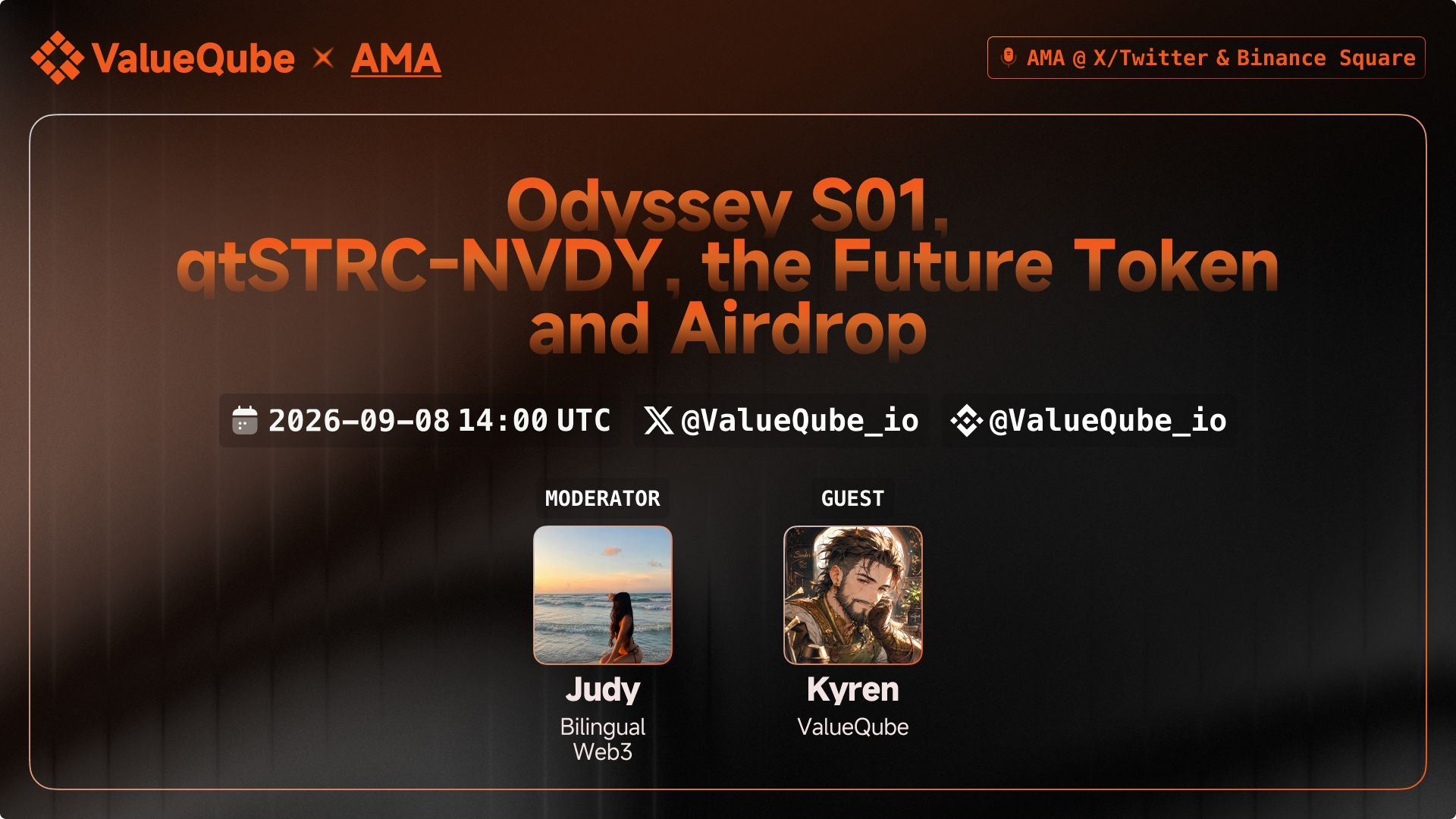
🎙️ ValueQube AMA: Odyssey S01, qtSTRC-NVDY and What Comes Next
⠀
Odyssey S01 has passed 2,500 participants and $10M+ in simulated Testnet subscription value. But what have these numbers actually proven?
⠀
Join Kyren from ValueQube to discuss what S01 has taught us, how qtSTRC-NVDY works, the future token design, and the Airdrop question. 🔍
⠀
📅 September 8, 2026
⏰ 14:00 UTC
⠀
Set a reminder for the AMA 👇
⠀
🔗 https://twitter.com/i/spaces/1OxwbneQrAWJB
⠀
#ValueQube #OdysseyS01 #AMA #RWA #DeFi
🎙️ ValueQube AMA: Odyssey S01, qtSTRC-NVDY and What Comes Next
⠀
Odyssey S01 has passed 2,500 participants and $10M+ in simulated Testnet subscription value. But what have these numbers actually proven?
⠀
Join Kyren from ValueQube to discuss what S01 has taught us, how qtSTRC-NVDY works, the future token design, and the Airdrop question. 🔍
⠀
📅 September 8, 2026
⏰ 14:00 UTC
⠀
Set a reminder for the AMA 👇
⠀
🔗 https://twitter.com/i/spaces/1OxwbneQrAWJB
⠀
#ValueQube #OdysseyS01 #AMA #RWA #DeFi
⠀
Odyssey S01 has passed 2,500 participants and $10M+ in simulated Testnet subscription value. But what have these numbers actually proven?
⠀
Join Kyren from ValueQube to discuss what S01 has taught us, how qtSTRC-NVDY works, the future token design, and the Airdrop question. 🔍
⠀
📅 September 8, 2026
⏰ 14:00 UTC
⠀
Set a reminder for the AMA 👇
⠀
🔗 https://twitter.com/i/spaces/1OxwbneQrAWJB
⠀
#ValueQube #OdysseyS01 #AMA #RWA #DeFi
1
3
76
·
--
ເບິ່ງການແປ
🤝 Partnership Announcement
⠀
ValueQube is partnering with @Astrix_market, a decentralized, oracle-powered prediction market that turns views on future events into transparent, tradable probabilities. 🔮
⠀
Astrix combines event intelligence, multi-source data, and on-chain settlement. ValueQube structures financial exposure, evidence, risk, and product rules through transparent, AI-readable qAsset Certificates.
⠀
Together, we will explore how market probabilities and settlement outcomes can become structured financial context—so users, wallets, protocols, and AI can understand not only what the market expects, but what each position means. 🧾
⠀
#ValueQube #Astrix #PredictionMarkets #AI #DeFi
🤝 Partnership Announcement
⠀
ValueQube is partnering with @Astrix_market, a decentralized, oracle-powered prediction market that turns views on future events into transparent, tradable probabilities. 🔮
⠀
Astrix combines event intelligence, multi-source data, and on-chain settlement. ValueQube structures financial exposure, evidence, risk, and product rules through transparent, AI-readable qAsset Certificates.
⠀
Together, we will explore how market probabilities and settlement outcomes can become structured financial context—so users, wallets, protocols, and AI can understand not only what the market expects, but what each position means. 🧾
⠀
#ValueQube #Astrix #PredictionMarkets #AI #DeFi
⠀
ValueQube is partnering with @Astrix_market, a decentralized, oracle-powered prediction market that turns views on future events into transparent, tradable probabilities. 🔮
⠀
Astrix combines event intelligence, multi-source data, and on-chain settlement. ValueQube structures financial exposure, evidence, risk, and product rules through transparent, AI-readable qAsset Certificates.
⠀
Together, we will explore how market probabilities and settlement outcomes can become structured financial context—so users, wallets, protocols, and AI can understand not only what the market expects, but what each position means. 🧾
⠀
#ValueQube #Astrix #PredictionMarkets #AI #DeFi
1
2
82
·
--
ບົດຄວາມ
ເບິ່ງການແປ
AMA Report | Before the Airdrop, Build the Proof: Why ValueQube Odyssey Is More Than a Task Wall**Editor’s Note|**This article is based on the ValueQube Odyssey AMA held on September 2, 2026, at 14:00 UTC.The conversation covered the five-step Odyssey S01 Testnet journey and the difference between qAsset and Qube XP. It also explained community verification and faced the one topic everyone wanted to ask about: the Airdrop.
Crypto has no shortage of “odysseys.” Picture a familiar scene.
A Testnet user checks a wallet and approves the first campaign action. One tab asks for a follow. Another opens a community chat. Then comes a repost, a screenshot and another signature. The progress bar moves, but the user may finish the whole campaign without learning much about the product.
Some adventures are really just six social buttons wearing a trench coat.
That was the real challenge behind ValueQube’s September 2 AMA. If every project already has an Odyssey, why build another one?
The answer was simple: ValueQube does not want to dress up clicks as a journey. It wants every step to leave proof.
A Route, Not a Task Wall
The Odyssey S01 main journey has five steps. A user creates a ValueQube account and links a wallet, then checks the BNB Testnet connection. The user receives qtUSDC and tBNB test assets, reads the Guide and completes the quiz. Finally, the user signs the wallet action and subscribes to qtSTRC-NVDY on Testnet.
What happens after that final click matters most.
An action does not become a completed position just because a button was pressed. The issue event must be confirmed. Only then is the qAsset added to the user’s account.
The qAsset is the Certificate. It is a readable record of the confirmed Testnet position, so the user, the account and software can work from the same fact.
That extra confirmation may sound like a small product detail. It points to a much bigger difference.
A normal task wall asks, “Did you click?”
ValueQube asks, “Did you understand, act and leave a result that can be checked?”
The first approach can create a nice traffic chart. The second can show whether the product was actually used. Opening nine links does not create nine users, just as visiting an airport nine times does not mean you took nine trips.
qAsset Is the Certificate. XP Marks the Distance.
The AMA also made a clean distinction between qAsset and Qube XP.
Completing the S01 main journey records 1,000 XP. Completing the main journey plus any four missions from A to E reaches the 1,200 XP All-Star level. Completing the main journey and Mission F reaches the 1,750 XP Hall of Fame level.
Mission F is the serious one. Nine invited users must complete verified qtSTRC-NVDY subscriptions. Nine clicks will not do it. Nine screenshots will not do it. The invited users need to complete the journey, confirm the relationship and pass backend verification.
XP gives the journey a rhythm. It also makes participation history easier to read. But XP is still not money. It is not yield, a promise of token conversion or proof of Airdrop eligibility.
Think of it as a mark in the ship’s log. It shows how far you travelled. It does not magically turn the logbook into a treasure map.
The qAsset also has a clear role. In S01, it is a readable record of a confirmed Testnet position. It is not a direct share, a dividend right, custody of an underlying asset or a promise of guaranteed redemption. qtUSDC and tBNB are test assets with no cash value.
S01 remains a Testnet exercise, not a real investment. The user must check the account, wallet, network and approval details, then personally approve each wallet action. A wrong address, missing gas, confirmation delay or phishing link can still cause a failed journey or a security risk. A Testnet record does not create a promise of future Mainnet rights.
Those lines may be less exciting than a giant reward number. They are also what makes the story credible. If a product cannot explain the difference between a Certificate, a point and a financial right, more hype will only put brighter lights inside the fog.
The Elephant in the Airdrop Hoodie
No Odyssey AMA gets very far without the Airdrop question. It was the elephant in the room, except this one was wearing an Airdrop hoodie and checking the snapshot time.
ValueQube’s answer was direct. The Airdrop is not active. There is no claim window, final snapshot, allocation method or confirmed timeline. Joining Odyssey does not guarantee a future allocation, and a qAsset is not a golden ticket.
Any formula that turns today’s XP into a future token amount is fan fiction, not an official rule.
Does that mean early participation has no value? Not at all.
Odyssey S01 gives early users something more durable than a rumor: a verified participation history built from a real account, wallet actions and confirmed records.
If there are future benefits, eligibility rules or new seasons, only future official announcements can define them. But the product can already know who read the Guide, who completed a subscription and who helped nine people finish a verified journey. Those facts do not need a loud Telegram message to become real.
That creates a healthier kind of FOMO.
It is not, “Click now or miss your chance to get rich.” It is, “A new language for financial accounts is being tested. Do you want to be among the first people who can actually speak it?”
Being early is not a claim on a reward. It is a chance to understand the product sooner, test it while the route is still being shaped and make your actions part of its history.
What Odyssey Is Really Testing
Why does opening a community link not complete a mission? Because traffic is not identity, and a screenshot is not a reliable record. ValueQube requires official verification for email, community actions and referral relationships. Mission F only counts after the invited user confirms the relationship and the backend verifies the subscription.
That may feel slower than “click and claim.” It is much closer to how trust needs to work in finance.
Verification can also mean waiting. An account status may take time to update. A social mission may still be pending. A Testnet wallet may need gas. Users should first check that the correct account and wallet are linked, review the transaction and issue records, and then use official support channels if something is still wrong.
One safety rule is not negotiable: no real support agent needs a seed phrase or private key, and no one should pay a “verification fee” to complete an Odyssey mission.
S01 is therefore testing more than a product flow. It is testing whether people can understand before they act and receive a readable record after they act. It is testing whether community growth can move from clicks to completion. And it is testing whether a project can face the hottest Airdrop question without buying short-term attention with a promise it has not made.
A real odyssey is not measured by the number of quest icons on a map. It is measured by what the traveller brings back.
ValueQube wants that result to be clear: qAsset records the confirmed Testnet position, Qube XP records the verified journey, and the final decision remains with the user.
Odyssey S01 is now open.
Whether an Airdrop comes, when it comes and how it might work must wait for future official rules. But the first voyage records will not wait until everyone feels ready.
A real Odyssey does not turn clicks into an epic.
It makes every step strong enough to be verified.
AMA Report | Before the Airdrop, Build the Proof: Why ValueQube Odyssey Is More Than a Task Wall
**Editor’s Note|**This article is based on the ValueQube Odyssey AMA held on September 2, 2026, at 14:00 UTC.The conversation covered the five-step Odyssey S01 Testnet journey and the difference between qAsset and Qube XP. It also explained community verification and faced the one topic everyone wanted to ask about: the Airdrop.
Crypto has no shortage of “odysseys.” Picture a familiar scene.
A Testnet user checks a wallet and approves the first campaign action. One tab asks for a follow. Another opens a community chat. Then comes a repost, a screenshot and another signature. The progress bar moves, but the user may finish the whole campaign without learning much about the product.
Some adventures are really just six social buttons wearing a trench coat.
That was the real challenge behind ValueQube’s September 2 AMA. If every project already has an Odyssey, why build another one?
The answer was simple: ValueQube does not want to dress up clicks as a journey. It wants every step to leave proof.
A Route, Not a Task Wall
The Odyssey S01 main journey has five steps. A user creates a ValueQube account and links a wallet, then checks the BNB Testnet connection. The user receives qtUSDC and tBNB test assets, reads the Guide and completes the quiz. Finally, the user signs the wallet action and subscribes to qtSTRC-NVDY on Testnet.
What happens after that final click matters most.
An action does not become a completed position just because a button was pressed. The issue event must be confirmed. Only then is the qAsset added to the user’s account.
The qAsset is the Certificate. It is a readable record of the confirmed Testnet position, so the user, the account and software can work from the same fact.
That extra confirmation may sound like a small product detail. It points to a much bigger difference.
A normal task wall asks, “Did you click?”
ValueQube asks, “Did you understand, act and leave a result that can be checked?”
The first approach can create a nice traffic chart. The second can show whether the product was actually used. Opening nine links does not create nine users, just as visiting an airport nine times does not mean you took nine trips.
qAsset Is the Certificate. XP Marks the Distance.
The AMA also made a clean distinction between qAsset and Qube XP.
Completing the S01 main journey records 1,000 XP. Completing the main journey plus any four missions from A to E reaches the 1,200 XP All-Star level. Completing the main journey and Mission F reaches the 1,750 XP Hall of Fame level.
Mission F is the serious one. Nine invited users must complete verified qtSTRC-NVDY subscriptions. Nine clicks will not do it. Nine screenshots will not do it. The invited users need to complete the journey, confirm the relationship and pass backend verification.
XP gives the journey a rhythm. It also makes participation history easier to read. But XP is still not money. It is not yield, a promise of token conversion or proof of Airdrop eligibility.
Think of it as a mark in the ship’s log. It shows how far you travelled. It does not magically turn the logbook into a treasure map.
The qAsset also has a clear role. In S01, it is a readable record of a confirmed Testnet position. It is not a direct share, a dividend right, custody of an underlying asset or a promise of guaranteed redemption. qtUSDC and tBNB are test assets with no cash value.
S01 remains a Testnet exercise, not a real investment. The user must check the account, wallet, network and approval details, then personally approve each wallet action. A wrong address, missing gas, confirmation delay or phishing link can still cause a failed journey or a security risk. A Testnet record does not create a promise of future Mainnet rights.
Those lines may be less exciting than a giant reward number. They are also what makes the story credible. If a product cannot explain the difference between a Certificate, a point and a financial right, more hype will only put brighter lights inside the fog.
The Elephant in the Airdrop Hoodie
No Odyssey AMA gets very far without the Airdrop question. It was the elephant in the room, except this one was wearing an Airdrop hoodie and checking the snapshot time.
ValueQube’s answer was direct. The Airdrop is not active. There is no claim window, final snapshot, allocation method or confirmed timeline. Joining Odyssey does not guarantee a future allocation, and a qAsset is not a golden ticket.
Any formula that turns today’s XP into a future token amount is fan fiction, not an official rule.
Does that mean early participation has no value? Not at all.
Odyssey S01 gives early users something more durable than a rumor: a verified participation history built from a real account, wallet actions and confirmed records.
If there are future benefits, eligibility rules or new seasons, only future official announcements can define them. But the product can already know who read the Guide, who completed a subscription and who helped nine people finish a verified journey. Those facts do not need a loud Telegram message to become real.
That creates a healthier kind of FOMO.
It is not, “Click now or miss your chance to get rich.” It is, “A new language for financial accounts is being tested. Do you want to be among the first people who can actually speak it?”
Being early is not a claim on a reward. It is a chance to understand the product sooner, test it while the route is still being shaped and make your actions part of its history.
What Odyssey Is Really Testing
Why does opening a community link not complete a mission? Because traffic is not identity, and a screenshot is not a reliable record. ValueQube requires official verification for email, community actions and referral relationships. Mission F only counts after the invited user confirms the relationship and the backend verifies the subscription.
That may feel slower than “click and claim.” It is much closer to how trust needs to work in finance.
Verification can also mean waiting. An account status may take time to update. A social mission may still be pending. A Testnet wallet may need gas. Users should first check that the correct account and wallet are linked, review the transaction and issue records, and then use official support channels if something is still wrong.
One safety rule is not negotiable: no real support agent needs a seed phrase or private key, and no one should pay a “verification fee” to complete an Odyssey mission.
S01 is therefore testing more than a product flow. It is testing whether people can understand before they act and receive a readable record after they act. It is testing whether community growth can move from clicks to completion. And it is testing whether a project can face the hottest Airdrop question without buying short-term attention with a promise it has not made.
A real odyssey is not measured by the number of quest icons on a map. It is measured by what the traveller brings back.
ValueQube wants that result to be clear: qAsset records the confirmed Testnet position, Qube XP records the verified journey, and the final decision remains with the user.
Odyssey S01 is now open.
Whether an Airdrop comes, when it comes and how it might work must wait for future official rules. But the first voyage records will not wait until everyone feels ready.
A real Odyssey does not turn clicks into an epic.
It makes every step strong enough to be verified.
Crypto has no shortage of “odysseys.” Picture a familiar scene.
A Testnet user checks a wallet and approves the first campaign action. One tab asks for a follow. Another opens a community chat. Then comes a repost, a screenshot and another signature. The progress bar moves, but the user may finish the whole campaign without learning much about the product.
Some adventures are really just six social buttons wearing a trench coat.
That was the real challenge behind ValueQube’s September 2 AMA. If every project already has an Odyssey, why build another one?
The answer was simple: ValueQube does not want to dress up clicks as a journey. It wants every step to leave proof.
A Route, Not a Task Wall
The Odyssey S01 main journey has five steps. A user creates a ValueQube account and links a wallet, then checks the BNB Testnet connection. The user receives qtUSDC and tBNB test assets, reads the Guide and completes the quiz. Finally, the user signs the wallet action and subscribes to qtSTRC-NVDY on Testnet.
What happens after that final click matters most.
An action does not become a completed position just because a button was pressed. The issue event must be confirmed. Only then is the qAsset added to the user’s account.
The qAsset is the Certificate. It is a readable record of the confirmed Testnet position, so the user, the account and software can work from the same fact.
That extra confirmation may sound like a small product detail. It points to a much bigger difference.
A normal task wall asks, “Did you click?”
ValueQube asks, “Did you understand, act and leave a result that can be checked?”
The first approach can create a nice traffic chart. The second can show whether the product was actually used. Opening nine links does not create nine users, just as visiting an airport nine times does not mean you took nine trips.
qAsset Is the Certificate. XP Marks the Distance.
The AMA also made a clean distinction between qAsset and Qube XP.
Completing the S01 main journey records 1,000 XP. Completing the main journey plus any four missions from A to E reaches the 1,200 XP All-Star level. Completing the main journey and Mission F reaches the 1,750 XP Hall of Fame level.
Mission F is the serious one. Nine invited users must complete verified qtSTRC-NVDY subscriptions. Nine clicks will not do it. Nine screenshots will not do it. The invited users need to complete the journey, confirm the relationship and pass backend verification.
XP gives the journey a rhythm. It also makes participation history easier to read. But XP is still not money. It is not yield, a promise of token conversion or proof of Airdrop eligibility.
Think of it as a mark in the ship’s log. It shows how far you travelled. It does not magically turn the logbook into a treasure map.
The qAsset also has a clear role. In S01, it is a readable record of a confirmed Testnet position. It is not a direct share, a dividend right, custody of an underlying asset or a promise of guaranteed redemption. qtUSDC and tBNB are test assets with no cash value.
S01 remains a Testnet exercise, not a real investment. The user must check the account, wallet, network and approval details, then personally approve each wallet action. A wrong address, missing gas, confirmation delay or phishing link can still cause a failed journey or a security risk. A Testnet record does not create a promise of future Mainnet rights.
Those lines may be less exciting than a giant reward number. They are also what makes the story credible. If a product cannot explain the difference between a Certificate, a point and a financial right, more hype will only put brighter lights inside the fog.
The Elephant in the Airdrop Hoodie
No Odyssey AMA gets very far without the Airdrop question. It was the elephant in the room, except this one was wearing an Airdrop hoodie and checking the snapshot time.
ValueQube’s answer was direct. The Airdrop is not active. There is no claim window, final snapshot, allocation method or confirmed timeline. Joining Odyssey does not guarantee a future allocation, and a qAsset is not a golden ticket.
Any formula that turns today’s XP into a future token amount is fan fiction, not an official rule.
Does that mean early participation has no value? Not at all.
Odyssey S01 gives early users something more durable than a rumor: a verified participation history built from a real account, wallet actions and confirmed records.
If there are future benefits, eligibility rules or new seasons, only future official announcements can define them. But the product can already know who read the Guide, who completed a subscription and who helped nine people finish a verified journey. Those facts do not need a loud Telegram message to become real.
That creates a healthier kind of FOMO.
It is not, “Click now or miss your chance to get rich.” It is, “A new language for financial accounts is being tested. Do you want to be among the first people who can actually speak it?”
Being early is not a claim on a reward. It is a chance to understand the product sooner, test it while the route is still being shaped and make your actions part of its history.
What Odyssey Is Really Testing
Why does opening a community link not complete a mission? Because traffic is not identity, and a screenshot is not a reliable record. ValueQube requires official verification for email, community actions and referral relationships. Mission F only counts after the invited user confirms the relationship and the backend verifies the subscription.
That may feel slower than “click and claim.” It is much closer to how trust needs to work in finance.
Verification can also mean waiting. An account status may take time to update. A social mission may still be pending. A Testnet wallet may need gas. Users should first check that the correct account and wallet are linked, review the transaction and issue records, and then use official support channels if something is still wrong.
One safety rule is not negotiable: no real support agent needs a seed phrase or private key, and no one should pay a “verification fee” to complete an Odyssey mission.
S01 is therefore testing more than a product flow. It is testing whether people can understand before they act and receive a readable record after they act. It is testing whether community growth can move from clicks to completion. And it is testing whether a project can face the hottest Airdrop question without buying short-term attention with a promise it has not made.
A real odyssey is not measured by the number of quest icons on a map. It is measured by what the traveller brings back.
ValueQube wants that result to be clear: qAsset records the confirmed Testnet position, Qube XP records the verified journey, and the final decision remains with the user.
Odyssey S01 is now open.
Whether an Airdrop comes, when it comes and how it might work must wait for future official rules. But the first voyage records will not wait until everyone feels ready.
A real Odyssey does not turn clicks into an epic.
It makes every step strong enough to be verified.
3
133
·
--
ເບິ່ງການແປ
🤝 Partnership Announcement
⠀
ValueQube is partnering with @miraagent_ai, an AI-powered market copilot that turns live on-chain activity and position data into structured, decision-ready insights. 📡
⠀
Mira Agent helps users understand what markets are doing and why it matters for their positions. ValueQube gives those positions structured financial context through transparent, AI-readable qAsset Certificates.
⠀
Together, we will explore how real-time market intelligence and readable financial records can work together—helping users move from signal to context, and from context to informed, user-authorized action. 🧭
⠀
#ValueQube #MiraAgent #AI #RWA #DeFi
🤝 Partnership Announcement
⠀
ValueQube is partnering with @miraagent_ai, an AI-powered market copilot that turns live on-chain activity and position data into structured, decision-ready insights. 📡
⠀
Mira Agent helps users understand what markets are doing and why it matters for their positions. ValueQube gives those positions structured financial context through transparent, AI-readable qAsset Certificates.
⠀
Together, we will explore how real-time market intelligence and readable financial records can work together—helping users move from signal to context, and from context to informed, user-authorized action. 🧭
⠀
#ValueQube #MiraAgent #AI #RWA #DeFi
⠀
ValueQube is partnering with @miraagent_ai, an AI-powered market copilot that turns live on-chain activity and position data into structured, decision-ready insights. 📡
⠀
Mira Agent helps users understand what markets are doing and why it matters for their positions. ValueQube gives those positions structured financial context through transparent, AI-readable qAsset Certificates.
⠀
Together, we will explore how real-time market intelligence and readable financial records can work together—helping users move from signal to context, and from context to informed, user-authorized action. 🧭
⠀
#ValueQube #MiraAgent #AI #RWA #DeFi
2
166
·
--
ບົດຄວາມ
ເບິ່ງການແປ
ValueQube Insight: When Rates Rise, the Account Must Explain Why*Rising rate-hike expectations are repricing global assets. For ValueQube, they also reveal why a financial account needs to explain risk, not merely display a balance.*
The market did not wait for the Federal Reserve to raise rates.
After Fed Chair Kevin Warsh’s Jackson Hole speech on August 28, the two-year Treasury yield rose 11 basis points to 4.34%. The dollar strengthened, while the market-implied probability of a September rate hike climbed from roughly 35% to 60%. [Reuters captured the immediate repricing](https://www.reuters.com/business/view-rate-hike-expectations-rise-warsh-speech-jackson-hole-2026-08-28/).
For ValueQube, this is more than a macro event.
It tests whether a financial account can explain which exposure changed, why it changed, which confirmation batch bears the impact, whether the risk profile has shifted, and what the holder can do next.
A balance shows the result.
A readable account preserves the path.
## The Same Rate Hike Does Not Create the Same Risk
The Federal Reserve held its target range at 3.50%–3.75% in July, but three policymakers preferred an immediate 25-basis-point increase. The possibility of another hike was already present before Jackson Hole. [The July FOMC statement](https://www.federalreserve.gov/newsevents/pressreleases/monetary20260729a.htm) made that disagreement public.
Inflation remains the source of pressure. Headline PCE inflation reached 3.7% year over year in July, while core PCE stood at 3.3%. Monthly readings eased, but both annual measures remained above the Fed’s target. [The Bureau of Economic Analysis published the figures](https://www.bea.gov/news/2026/personal-income-and-outlays-july-2026).
Yet “rates may rise” is not a complete account-level explanation.
A short-duration Treasury or cash-management strategy may earn more as assets reset at higher yields. An existing long-duration bond can lose market value when yields rise.
Preferred and credit-like securities face a different set of pressures: financing costs, issuer credit, distribution capacity, concentration and market-price volatility.
Growth ETFs may suffer valuation compression. Quantitative strategies may face changing correlations, weaker liquidity, higher execution costs and model decay.
One policy expectation reaches different assets through different channels.
ValueQube’s protocol design starts from that distinction. It is an account protocol first and a token system second. Instead of flattening every asset into one generic balance, it organizes strategy exposures into separate, explainable qAsset Certificates.
The market sees one rate decision.
The account holds several versions of its impact.
## Strategy Qube Makes Every Sleeve Explain Its Own Risk
ValueQube organizes strategies through Strategy Qube. The objective is not to cover every asset as quickly as possible. Each strategy sleeve should become explainable and reconcilable before it becomes scalable.
A U.S. Treasury or Cash Sleeve needs to disclose maturity, duration and rate sensitivity. Newly issued short-term instruments may benefit from higher rates, while longer-duration positions may suffer mark-to-market losses. “Treasury exposure” is not enough information.
A STRC or Strategy Credit Sleeve needs to explain issuer credit, distribution changes, market volatility and concentration risk. A preferred or credit-like security should not be described as cash merely because it may generate distributions.
An ETF Sleeve may contain broad-market, income-oriented or thematic exposure. Growth themes can be more sensitive to discount rates, while income ETFs must be compared against the new yields available from cash and government debt.
A Quant Sleeve carries model, execution, liquidity and strategy-decay risk. A system calibrated for falling rates and abundant liquidity may behave differently when the front end of the yield curve reprices.
The Protocol Reserve Sleeve also has a defined limit. It may support operational, data, valuation and settlement friction, but it is not principal protection or a price-support mechanism.
Strategy Qube does not promise that diversification removes risk.
It makes the source of each risk easier to identify.
## qAsset Records Which Position Actually Changed
A user should not open an account after a rate shock and see only one red or green number.
The qAsset Certificate is ValueQube’s core account object and an AI-readable Financial Passport. It is designed to record the strategy exposure, subscription amount, confirmation batch, account units, reference value, risk labels, fee state, distribution state, redemption conditions and authorization boundary.
The standard account path is:
`eligible subscription → strategy confirmation → qAsset Certificate → account updates → hold, claim, reinvest or redeem`
This structure becomes especially important when markets trade rate expectations before the Fed takes formal action.
Suppose one user enters a Treasury strategy before yields rise and another enters after the repricing. Their confirmation prices and units should reflect their respective entry conditions. The later user should not subsidize the earlier user, and the earlier user’s market-value change should not disappear inside an aggregated balance.
ValueQube attributes account value by qAsset, unit and confirmation batch. Each exposure follows its own reference-value method, fee rules, distribution state and redemption window.
An account-value change can therefore be explained. It may come from market price, a valuation update, a fee deduction, a confirmed distribution, a strategy event or a change in liquidity conditions.
A balance reports the outcome.
A qAsset preserves the cause.
## Rate Risk Must Become Machine-Readable Account State
An AI agent cannot interpret a financial account responsibly from token symbols and current prices alone.
It needs to know whether a position has long or short duration, whether value comes from market appreciation or cash distributions, whether fees have been deducted, whether a redemption window is open, and whether the next action is informational or requires user authorization.
A ValueQube qAsset should allow the user and the AI agent to read the same position.
AI may explain why a Treasury sleeve changed, compare the rate sensitivity of different qAssets, identify a new risk label or prepare a redemption action. It should not silently convert analytical capability into unrestricted control over the user’s assets.
Actions that move funds or change account rights must remain behind explicit authorization boundaries.
This is how readability becomes a control system.
Fluent AI cannot repair an unreadable position.
## qAsset, $54Q and qPower Must Remain Separate
Rate volatility also makes ValueQube’s three-layer structure more important.
The qAsset Certificate represents a specific strategy exposure and its account state. Its reference value may rise or fall with the underlying strategy and market conditions.
$54Q belongs to the platform layer. It supports platform participation, governance, liquidity, data services and ecosystem incentives. It is not a qAsset vault share, a redemption claim or an entitlement to underlying strategy returns.
qPower records contribution weight associated with valid subscriptions, reinvestment, referrals and long-term participation. It does not change qAsset reference value or rewrite redemption rules.
These layers cannot be merged for narrative convenience. Neither $54Q nor qPower should be presented as protection against losses inside a qAsset.
Readable finance begins by refusing to blur different roles and risks.
## The ValueQube Opportunity in a Higher-Rate Market
A September hike is still uncertain.
Softer employment or inflation data could reduce the case for tightening. Persistent inflation and resilient labor conditions could strengthen it. Warsh’s [Jackson Hole address](https://www.federalreserve.gov/newsevents/speech/warsh20260828a.htm) reinforced policy discipline, but it did not predetermine the next vote.
ValueQube’s value does not depend on predicting that vote correctly.
It comes from an account structure that remains useful across different policy paths.
If rates rise, users should see duration, valuation and liquidity risk. If rates remain unchanged, they should still understand why the market repriced. If rate-hike expectations reverse, the account should attribute the resulting change to the relevant exposure rather than hide everything inside a generic balance.
Markets can change their rate expectations in minutes.
A financial position should still be able to explain what it is, why its value changed, where its current risks come from, when the holder may exit, and which actions remain under the holder’s control.
The Fed may become quieter.
The account must become more articulate.
*Market figures and policy probabilities referenced in this article are dated August 28, 2026 and may change materially as new economic data are released.*
ValueQube Insight: When Rates Rise, the Account Must Explain Why
*Rising rate-hike expectations are repricing global assets. For ValueQube, they also reveal why a financial account needs to explain risk, not merely display a balance.*
The market did not wait for the Federal Reserve to raise rates.
After Fed Chair Kevin Warsh’s Jackson Hole speech on August 28, the two-year Treasury yield rose 11 basis points to 4.34%. The dollar strengthened, while the market-implied probability of a September rate hike climbed from roughly 35% to 60%. [Reuters captured the immediate repricing](https://www.reuters.com/business/view-rate-hike-expectations-rise-warsh-speech-jackson-hole-2026-08-28/).
For ValueQube, this is more than a macro event.
It tests whether a financial account can explain which exposure changed, why it changed, which confirmation batch bears the impact, whether the risk profile has shifted, and what the holder can do next.
A balance shows the result.
A readable account preserves the path.
## The Same Rate Hike Does Not Create the Same Risk
The Federal Reserve held its target range at 3.50%–3.75% in July, but three policymakers preferred an immediate 25-basis-point increase. The possibility of another hike was already present before Jackson Hole. [The July FOMC statement](https://www.federalreserve.gov/newsevents/pressreleases/monetary20260729a.htm) made that disagreement public.
Inflation remains the source of pressure. Headline PCE inflation reached 3.7% year over year in July, while core PCE stood at 3.3%. Monthly readings eased, but both annual measures remained above the Fed’s target. [The Bureau of Economic Analysis published the figures](https://www.bea.gov/news/2026/personal-income-and-outlays-july-2026).
Yet “rates may rise” is not a complete account-level explanation.
A short-duration Treasury or cash-management strategy may earn more as assets reset at higher yields. An existing long-duration bond can lose market value when yields rise.
Preferred and credit-like securities face a different set of pressures: financing costs, issuer credit, distribution capacity, concentration and market-price volatility.
Growth ETFs may suffer valuation compression. Quantitative strategies may face changing correlations, weaker liquidity, higher execution costs and model decay.
One policy expectation reaches different assets through different channels.
ValueQube’s protocol design starts from that distinction. It is an account protocol first and a token system second. Instead of flattening every asset into one generic balance, it organizes strategy exposures into separate, explainable qAsset Certificates.
The market sees one rate decision.
The account holds several versions of its impact.
## Strategy Qube Makes Every Sleeve Explain Its Own Risk
ValueQube organizes strategies through Strategy Qube. The objective is not to cover every asset as quickly as possible. Each strategy sleeve should become explainable and reconcilable before it becomes scalable.
A U.S. Treasury or Cash Sleeve needs to disclose maturity, duration and rate sensitivity. Newly issued short-term instruments may benefit from higher rates, while longer-duration positions may suffer mark-to-market losses. “Treasury exposure” is not enough information.
A STRC or Strategy Credit Sleeve needs to explain issuer credit, distribution changes, market volatility and concentration risk. A preferred or credit-like security should not be described as cash merely because it may generate distributions.
An ETF Sleeve may contain broad-market, income-oriented or thematic exposure. Growth themes can be more sensitive to discount rates, while income ETFs must be compared against the new yields available from cash and government debt.
A Quant Sleeve carries model, execution, liquidity and strategy-decay risk. A system calibrated for falling rates and abundant liquidity may behave differently when the front end of the yield curve reprices.
The Protocol Reserve Sleeve also has a defined limit. It may support operational, data, valuation and settlement friction, but it is not principal protection or a price-support mechanism.
Strategy Qube does not promise that diversification removes risk.
It makes the source of each risk easier to identify.
## qAsset Records Which Position Actually Changed
A user should not open an account after a rate shock and see only one red or green number.
The qAsset Certificate is ValueQube’s core account object and an AI-readable Financial Passport. It is designed to record the strategy exposure, subscription amount, confirmation batch, account units, reference value, risk labels, fee state, distribution state, redemption conditions and authorization boundary.
The standard account path is:
`eligible subscription → strategy confirmation → qAsset Certificate → account updates → hold, claim, reinvest or redeem`
This structure becomes especially important when markets trade rate expectations before the Fed takes formal action.
Suppose one user enters a Treasury strategy before yields rise and another enters after the repricing. Their confirmation prices and units should reflect their respective entry conditions. The later user should not subsidize the earlier user, and the earlier user’s market-value change should not disappear inside an aggregated balance.
ValueQube attributes account value by qAsset, unit and confirmation batch. Each exposure follows its own reference-value method, fee rules, distribution state and redemption window.
An account-value change can therefore be explained. It may come from market price, a valuation update, a fee deduction, a confirmed distribution, a strategy event or a change in liquidity conditions.
A balance reports the outcome.
A qAsset preserves the cause.
## Rate Risk Must Become Machine-Readable Account State
An AI agent cannot interpret a financial account responsibly from token symbols and current prices alone.
It needs to know whether a position has long or short duration, whether value comes from market appreciation or cash distributions, whether fees have been deducted, whether a redemption window is open, and whether the next action is informational or requires user authorization.
A ValueQube qAsset should allow the user and the AI agent to read the same position.
AI may explain why a Treasury sleeve changed, compare the rate sensitivity of different qAssets, identify a new risk label or prepare a redemption action. It should not silently convert analytical capability into unrestricted control over the user’s assets.
Actions that move funds or change account rights must remain behind explicit authorization boundaries.
This is how readability becomes a control system.
Fluent AI cannot repair an unreadable position.
## qAsset, $54Q and qPower Must Remain Separate
Rate volatility also makes ValueQube’s three-layer structure more important.
The qAsset Certificate represents a specific strategy exposure and its account state. Its reference value may rise or fall with the underlying strategy and market conditions.
$54Q belongs to the platform layer. It supports platform participation, governance, liquidity, data services and ecosystem incentives. It is not a qAsset vault share, a redemption claim or an entitlement to underlying strategy returns.
qPower records contribution weight associated with valid subscriptions, reinvestment, referrals and long-term participation. It does not change qAsset reference value or rewrite redemption rules.
These layers cannot be merged for narrative convenience. Neither $54Q nor qPower should be presented as protection against losses inside a qAsset.
Readable finance begins by refusing to blur different roles and risks.
## The ValueQube Opportunity in a Higher-Rate Market
A September hike is still uncertain.
Softer employment or inflation data could reduce the case for tightening. Persistent inflation and resilient labor conditions could strengthen it. Warsh’s [Jackson Hole address](https://www.federalreserve.gov/newsevents/speech/warsh20260828a.htm) reinforced policy discipline, but it did not predetermine the next vote.
ValueQube’s value does not depend on predicting that vote correctly.
It comes from an account structure that remains useful across different policy paths.
If rates rise, users should see duration, valuation and liquidity risk. If rates remain unchanged, they should still understand why the market repriced. If rate-hike expectations reverse, the account should attribute the resulting change to the relevant exposure rather than hide everything inside a generic balance.
Markets can change their rate expectations in minutes.
A financial position should still be able to explain what it is, why its value changed, where its current risks come from, when the holder may exit, and which actions remain under the holder’s control.
The Fed may become quieter.
The account must become more articulate.
*Market figures and policy probabilities referenced in this article are dated August 28, 2026 and may change materially as new economic data are released.*
The market did not wait for the Federal Reserve to raise rates.
After Fed Chair Kevin Warsh’s Jackson Hole speech on August 28, the two-year Treasury yield rose 11 basis points to 4.34%. The dollar strengthened, while the market-implied probability of a September rate hike climbed from roughly 35% to 60%. [Reuters captured the immediate repricing](https://www.reuters.com/business/view-rate-hike-expectations-rise-warsh-speech-jackson-hole-2026-08-28/).
For ValueQube, this is more than a macro event.
It tests whether a financial account can explain which exposure changed, why it changed, which confirmation batch bears the impact, whether the risk profile has shifted, and what the holder can do next.
A balance shows the result.
A readable account preserves the path.
## The Same Rate Hike Does Not Create the Same Risk
The Federal Reserve held its target range at 3.50%–3.75% in July, but three policymakers preferred an immediate 25-basis-point increase. The possibility of another hike was already present before Jackson Hole. [The July FOMC statement](https://www.federalreserve.gov/newsevents/pressreleases/monetary20260729a.htm) made that disagreement public.
Inflation remains the source of pressure. Headline PCE inflation reached 3.7% year over year in July, while core PCE stood at 3.3%. Monthly readings eased, but both annual measures remained above the Fed’s target. [The Bureau of Economic Analysis published the figures](https://www.bea.gov/news/2026/personal-income-and-outlays-july-2026).
Yet “rates may rise” is not a complete account-level explanation.
A short-duration Treasury or cash-management strategy may earn more as assets reset at higher yields. An existing long-duration bond can lose market value when yields rise.
Preferred and credit-like securities face a different set of pressures: financing costs, issuer credit, distribution capacity, concentration and market-price volatility.
Growth ETFs may suffer valuation compression. Quantitative strategies may face changing correlations, weaker liquidity, higher execution costs and model decay.
One policy expectation reaches different assets through different channels.
ValueQube’s protocol design starts from that distinction. It is an account protocol first and a token system second. Instead of flattening every asset into one generic balance, it organizes strategy exposures into separate, explainable qAsset Certificates.
The market sees one rate decision.
The account holds several versions of its impact.
## Strategy Qube Makes Every Sleeve Explain Its Own Risk
ValueQube organizes strategies through Strategy Qube. The objective is not to cover every asset as quickly as possible. Each strategy sleeve should become explainable and reconcilable before it becomes scalable.
A U.S. Treasury or Cash Sleeve needs to disclose maturity, duration and rate sensitivity. Newly issued short-term instruments may benefit from higher rates, while longer-duration positions may suffer mark-to-market losses. “Treasury exposure” is not enough information.
A STRC or Strategy Credit Sleeve needs to explain issuer credit, distribution changes, market volatility and concentration risk. A preferred or credit-like security should not be described as cash merely because it may generate distributions.
An ETF Sleeve may contain broad-market, income-oriented or thematic exposure. Growth themes can be more sensitive to discount rates, while income ETFs must be compared against the new yields available from cash and government debt.
A Quant Sleeve carries model, execution, liquidity and strategy-decay risk. A system calibrated for falling rates and abundant liquidity may behave differently when the front end of the yield curve reprices.
The Protocol Reserve Sleeve also has a defined limit. It may support operational, data, valuation and settlement friction, but it is not principal protection or a price-support mechanism.
Strategy Qube does not promise that diversification removes risk.
It makes the source of each risk easier to identify.
## qAsset Records Which Position Actually Changed
A user should not open an account after a rate shock and see only one red or green number.
The qAsset Certificate is ValueQube’s core account object and an AI-readable Financial Passport. It is designed to record the strategy exposure, subscription amount, confirmation batch, account units, reference value, risk labels, fee state, distribution state, redemption conditions and authorization boundary.
The standard account path is:
`eligible subscription → strategy confirmation → qAsset Certificate → account updates → hold, claim, reinvest or redeem`
This structure becomes especially important when markets trade rate expectations before the Fed takes formal action.
Suppose one user enters a Treasury strategy before yields rise and another enters after the repricing. Their confirmation prices and units should reflect their respective entry conditions. The later user should not subsidize the earlier user, and the earlier user’s market-value change should not disappear inside an aggregated balance.
ValueQube attributes account value by qAsset, unit and confirmation batch. Each exposure follows its own reference-value method, fee rules, distribution state and redemption window.
An account-value change can therefore be explained. It may come from market price, a valuation update, a fee deduction, a confirmed distribution, a strategy event or a change in liquidity conditions.
A balance reports the outcome.
A qAsset preserves the cause.
## Rate Risk Must Become Machine-Readable Account State
An AI agent cannot interpret a financial account responsibly from token symbols and current prices alone.
It needs to know whether a position has long or short duration, whether value comes from market appreciation or cash distributions, whether fees have been deducted, whether a redemption window is open, and whether the next action is informational or requires user authorization.
A ValueQube qAsset should allow the user and the AI agent to read the same position.
AI may explain why a Treasury sleeve changed, compare the rate sensitivity of different qAssets, identify a new risk label or prepare a redemption action. It should not silently convert analytical capability into unrestricted control over the user’s assets.
Actions that move funds or change account rights must remain behind explicit authorization boundaries.
This is how readability becomes a control system.
Fluent AI cannot repair an unreadable position.
## qAsset, $54Q and qPower Must Remain Separate
Rate volatility also makes ValueQube’s three-layer structure more important.
The qAsset Certificate represents a specific strategy exposure and its account state. Its reference value may rise or fall with the underlying strategy and market conditions.
$54Q belongs to the platform layer. It supports platform participation, governance, liquidity, data services and ecosystem incentives. It is not a qAsset vault share, a redemption claim or an entitlement to underlying strategy returns.
qPower records contribution weight associated with valid subscriptions, reinvestment, referrals and long-term participation. It does not change qAsset reference value or rewrite redemption rules.
These layers cannot be merged for narrative convenience. Neither $54Q nor qPower should be presented as protection against losses inside a qAsset.
Readable finance begins by refusing to blur different roles and risks.
## The ValueQube Opportunity in a Higher-Rate Market
A September hike is still uncertain.
Softer employment or inflation data could reduce the case for tightening. Persistent inflation and resilient labor conditions could strengthen it. Warsh’s [Jackson Hole address](https://www.federalreserve.gov/newsevents/speech/warsh20260828a.htm) reinforced policy discipline, but it did not predetermine the next vote.
ValueQube’s value does not depend on predicting that vote correctly.
It comes from an account structure that remains useful across different policy paths.
If rates rise, users should see duration, valuation and liquidity risk. If rates remain unchanged, they should still understand why the market repriced. If rate-hike expectations reverse, the account should attribute the resulting change to the relevant exposure rather than hide everything inside a generic balance.
Markets can change their rate expectations in minutes.
A financial position should still be able to explain what it is, why its value changed, where its current risks come from, when the holder may exit, and which actions remain under the holder’s control.
The Fed may become quieter.
The account must become more articulate.
*Market figures and policy probabilities referenced in this article are dated August 28, 2026 and may change materially as new economic data are released.*
1
127
·
--
ເບິ່ງການແປ
🤝 Partnership Announcement
⠀
ValueQube is partnering with @Hi_PoPPOfficial, an AI-powered Web3 user layer focused on decentralized identity, on-chain behavior analysis, and privacy-first consumer engagement. 🧬
⠀
PoP Planet turns on-chain activity into structured identity signals. ValueQube turns complex financial exposure into transparent, AI-readable qAsset Certificates.
⠀
Together, we will explore how identity, behavior, and financial context can work together—helping users, dApps, wallets, and AI better understand what each position represents, which risks apply, and what actions are available. 🧊
⠀
#ValueQube #PoPPlanet #Web3Identity #RWA #AI
🤝 Partnership Announcement
⠀
ValueQube is partnering with @Hi_PoPPOfficial, an AI-powered Web3 user layer focused on decentralized identity, on-chain behavior analysis, and privacy-first consumer engagement. 🧬
⠀
PoP Planet turns on-chain activity into structured identity signals. ValueQube turns complex financial exposure into transparent, AI-readable qAsset Certificates.
⠀
Together, we will explore how identity, behavior, and financial context can work together—helping users, dApps, wallets, and AI better understand what each position represents, which risks apply, and what actions are available. 🧊
⠀
#ValueQube #PoPPlanet #Web3Identity #RWA #AI
⠀
ValueQube is partnering with @Hi_PoPPOfficial, an AI-powered Web3 user layer focused on decentralized identity, on-chain behavior analysis, and privacy-first consumer engagement. 🧬
⠀
PoP Planet turns on-chain activity into structured identity signals. ValueQube turns complex financial exposure into transparent, AI-readable qAsset Certificates.
⠀
Together, we will explore how identity, behavior, and financial context can work together—helping users, dApps, wallets, and AI better understand what each position represents, which risks apply, and what actions are available. 🧊
⠀
#ValueQube #PoPPlanet #Web3Identity #RWA #AI
2
115
·
--
ເບິ່ງການແປ
🎙️ ValueQube Odyssey: The Journey, the Proof and the Airdrop
⠀
Most Web3 quests measure clicks. Odyssey S01 measures whether users can understand a product, complete a verified Testnet action, and read the result.
⠀
Join ValueQube Founder Derrick to discuss the five-step journey, readable qAssets, Qube XP, and community missions. 🧭
⠀
🗓️ August 26, 2026
⏰ 14:00 UTC
⠀
Set a reminder for the AMA 👇
⠀
🔗 https://twitter.com/i/spaces/1dGYlaLkDWEKX
⠀
#ValueQube #OdysseyS01 #AMA #RWA #DeFi
🎙️ ValueQube Odyssey: The Journey, the Proof and the Airdrop
⠀
Most Web3 quests measure clicks. Odyssey S01 measures whether users can understand a product, complete a verified Testnet action, and read the result.
⠀
Join ValueQube Founder Derrick to discuss the five-step journey, readable qAssets, Qube XP, and community missions. 🧭
⠀
🗓️ August 26, 2026
⏰ 14:00 UTC
⠀
Set a reminder for the AMA 👇
⠀
🔗 https://twitter.com/i/spaces/1dGYlaLkDWEKX
⠀
#ValueQube #OdysseyS01 #AMA #RWA #DeFi
⠀
Most Web3 quests measure clicks. Odyssey S01 measures whether users can understand a product, complete a verified Testnet action, and read the result.
⠀
Join ValueQube Founder Derrick to discuss the five-step journey, readable qAssets, Qube XP, and community missions. 🧭
⠀
🗓️ August 26, 2026
⏰ 14:00 UTC
⠀
Set a reminder for the AMA 👇
⠀
🔗 https://twitter.com/i/spaces/1dGYlaLkDWEKX
⠀
#ValueQube #OdysseyS01 #AMA #RWA #DeFi
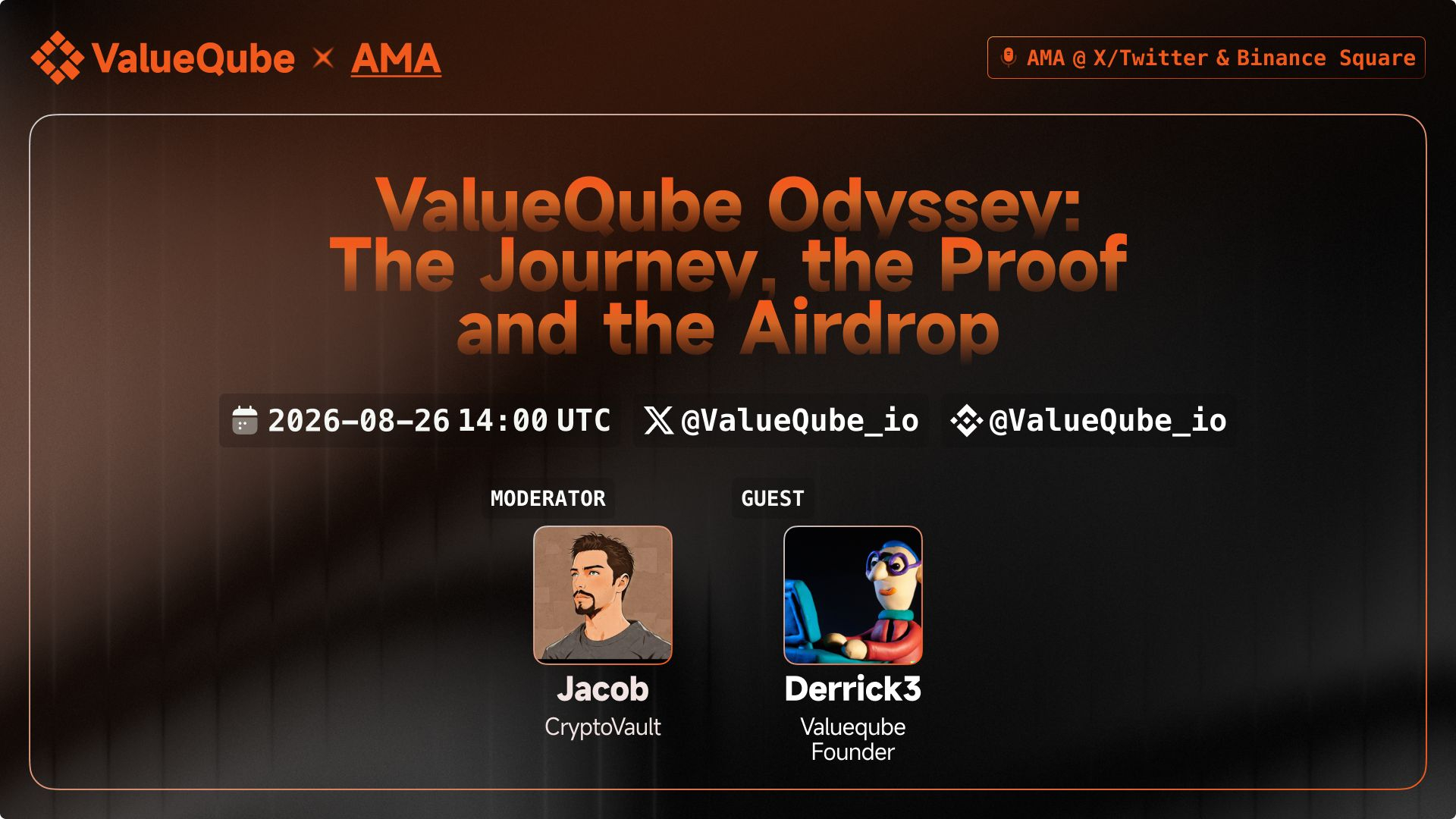
1
79
·
--
ເບິ່ງການແປ
🤝 Partnership Announcement
⠀
ValueQube is partnering with @Mintellect_AI, a ContentFi infrastructure layer for turning code, AI assets, and knowledge into programmable on-chain assets. 💡
⠀
Mintellect structures ownership, licensing, and monetization for digital content. ValueQube organizes value logic, fees, risks, and lifecycle rules through transparent, AI-readable qAsset Certificates.
⠀
Together, we will explore how programmable content rights can connect with machine-readable financial context—helping creators, platforms, and AI understand how digital assets are owned, used, and valued. 🧊
⠀
#ValueQube #Mintellect #ContentFi #AI #Web3
🤝 Partnership Announcement
⠀
ValueQube is partnering with @Mintellect_AI, a ContentFi infrastructure layer for turning code, AI assets, and knowledge into programmable on-chain assets. 💡
⠀
Mintellect structures ownership, licensing, and monetization for digital content. ValueQube organizes value logic, fees, risks, and lifecycle rules through transparent, AI-readable qAsset Certificates.
⠀
Together, we will explore how programmable content rights can connect with machine-readable financial context—helping creators, platforms, and AI understand how digital assets are owned, used, and valued. 🧊
⠀
#ValueQube #Mintellect #ContentFi #AI #Web3
⠀
ValueQube is partnering with @Mintellect_AI, a ContentFi infrastructure layer for turning code, AI assets, and knowledge into programmable on-chain assets. 💡
⠀
Mintellect structures ownership, licensing, and monetization for digital content. ValueQube organizes value logic, fees, risks, and lifecycle rules through transparent, AI-readable qAsset Certificates.
⠀
Together, we will explore how programmable content rights can connect with machine-readable financial context—helping creators, platforms, and AI understand how digital assets are owned, used, and valued. 🧊
⠀
#ValueQube #Mintellect #ContentFi #AI #Web3
1
88
·
--
ເບິ່ງການແປ
🤝 Partnership Announcement
⠀
ValueQube is partnering with @Agentum_space, an on-chain protocol for autonomous agentic commerce built on BNB Chain. 🤖
⠀
Agentum enables AI agents to post and bid for work, execute tasks privately, verify outcomes, and settle through escrow. ValueQube organizes financial exposure into transparent, AI-readable qAsset Certificates.
⠀
Together, we will explore how autonomous execution can connect with machine-readable context around value, risk, rules, and evidence—making agentic finance more verifiable, interpretable, and accountable. 🧊
⠀
#ValueQube #Agentum #AgenticFinance #AI #BNBChain
🤝 Partnership Announcement
⠀
ValueQube is partnering with @Agentum_space, an on-chain protocol for autonomous agentic commerce built on BNB Chain. 🤖
⠀
Agentum enables AI agents to post and bid for work, execute tasks privately, verify outcomes, and settle through escrow. ValueQube organizes financial exposure into transparent, AI-readable qAsset Certificates.
⠀
Together, we will explore how autonomous execution can connect with machine-readable context around value, risk, rules, and evidence—making agentic finance more verifiable, interpretable, and accountable. 🧊
⠀
#ValueQube #Agentum #AgenticFinance #AI #BNBChain
⠀
ValueQube is partnering with @Agentum_space, an on-chain protocol for autonomous agentic commerce built on BNB Chain. 🤖
⠀
Agentum enables AI agents to post and bid for work, execute tasks privately, verify outcomes, and settle through escrow. ValueQube organizes financial exposure into transparent, AI-readable qAsset Certificates.
⠀
Together, we will explore how autonomous execution can connect with machine-readable context around value, risk, rules, and evidence—making agentic finance more verifiable, interpretable, and accountable. 🧊
⠀
#ValueQube #Agentum #AgenticFinance #AI #BNBChain
1
79
·
--
ເບິ່ງການແປ
🎙️ CRYPTO VAULT × VALUEQUBE AMA
⠀
A balance shows what you hold. A readable account explains what it means.
⠀
Join ValueQube Founder Derrick to discuss how qAsset Certificates give users and AI clearer context around value, risk, and available actions—while keeping users in control. 🧊
⠀
🗓️ August 19, 2026
⏰ 14:00 UTC
⠀
Set a reminder 👇
⠀
🔗 https://twitter.com/i/spaces/1aJbdEMdaBBKX
⠀
#ValueQube #AMA #RWA #DEFİ #Aİ
🎙️ CRYPTO VAULT × VALUEQUBE AMA
⠀
A balance shows what you hold. A readable account explains what it means.
⠀
Join ValueQube Founder Derrick to discuss how qAsset Certificates give users and AI clearer context around value, risk, and available actions—while keeping users in control. 🧊
⠀
🗓️ August 19, 2026
⏰ 14:00 UTC
⠀
Set a reminder 👇
⠀
🔗 https://twitter.com/i/spaces/1aJbdEMdaBBKX
⠀
#ValueQube #AMA #RWA #DEFİ #Aİ
⠀
A balance shows what you hold. A readable account explains what it means.
⠀
Join ValueQube Founder Derrick to discuss how qAsset Certificates give users and AI clearer context around value, risk, and available actions—while keeping users in control. 🧊
⠀
🗓️ August 19, 2026
⏰ 14:00 UTC
⠀
Set a reminder 👇
⠀
🔗 https://twitter.com/i/spaces/1aJbdEMdaBBKX
⠀
#ValueQube #AMA #RWA #DEFİ #Aİ
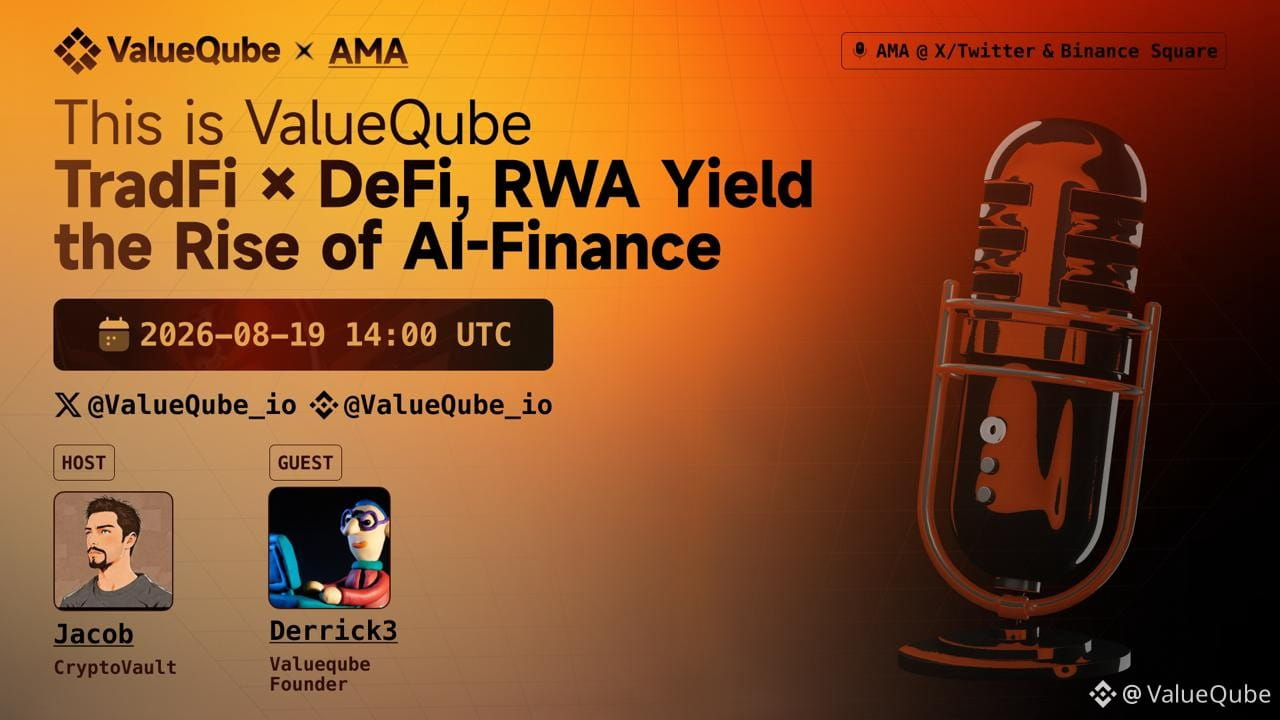
3
93
·
--
ເບິ່ງການແປ
🤝 Partnership Announcement
⠀
ValueQube is partnering with @AstroXFinance, a livestream-powered multichain creator-token platform where creators launch tokens live and users trade in-stream. 🎥
⠀
AstroX brings token creation and market participation into real time. ValueQube makes financial context readable—organizing exposure, evidence, risk, product rules, and position state through transparent, AI-readable qAsset Certificates.
⠀
Together, we will explore how livestream launch activity and multichain market events can be translated into structured account records that users, wallets, protocols, and AI can interpret. 🧊
⠀
As assets become easier to launch and trade, they should also become easier to understand.
⠀
#ValueQube #AstroX #CreatorEconomy #DeFi #Web3
🤝 Partnership Announcement
⠀
ValueQube is partnering with @AstroXFinance, a livestream-powered multichain creator-token platform where creators launch tokens live and users trade in-stream. 🎥
⠀
AstroX brings token creation and market participation into real time. ValueQube makes financial context readable—organizing exposure, evidence, risk, product rules, and position state through transparent, AI-readable qAsset Certificates.
⠀
Together, we will explore how livestream launch activity and multichain market events can be translated into structured account records that users, wallets, protocols, and AI can interpret. 🧊
⠀
As assets become easier to launch and trade, they should also become easier to understand.
⠀
#ValueQube #AstroX #CreatorEconomy #DeFi #Web3
⠀
ValueQube is partnering with @AstroXFinance, a livestream-powered multichain creator-token platform where creators launch tokens live and users trade in-stream. 🎥
⠀
AstroX brings token creation and market participation into real time. ValueQube makes financial context readable—organizing exposure, evidence, risk, product rules, and position state through transparent, AI-readable qAsset Certificates.
⠀
Together, we will explore how livestream launch activity and multichain market events can be translated into structured account records that users, wallets, protocols, and AI can interpret. 🧊
⠀
As assets become easier to launch and trade, they should also become easier to understand.
⠀
#ValueQube #AstroX #CreatorEconomy #DeFi #Web3
3
94
·
--
ເບິ່ງການແປ
🎙️ ValueQube Odyssey S01 AMA
TradFi has the products. DeFi has the wallets. AI has the answers.
So why do users still open a financial account and ask:
“What exactly do I own?”
Join ValueQube Founder Derrick for a discussion on how qAssets and AI-readable Certificates can give TradFi, DeFi, wallets, and AI a shared financial language—while keeping users in control. 🧊
🗓 August 14, 2026
⏰ 14:00 UTC
Set a reminder for the AMA 👇
🔗 https://twitter.com/i/spaces/1nxnRBReWYkxO
#ValueQube #OdysseyS01 #AMA #RWA #DeFi
🎙️ ValueQube Odyssey S01 AMA
TradFi has the products. DeFi has the wallets. AI has the answers.
So why do users still open a financial account and ask:
“What exactly do I own?”
Join ValueQube Founder Derrick for a discussion on how qAssets and AI-readable Certificates can give TradFi, DeFi, wallets, and AI a shared financial language—while keeping users in control. 🧊
🗓 August 14, 2026
⏰ 14:00 UTC
Set a reminder for the AMA 👇
🔗 https://twitter.com/i/spaces/1nxnRBReWYkxO
#ValueQube #OdysseyS01 #AMA #RWA #DeFi
TradFi has the products. DeFi has the wallets. AI has the answers.
So why do users still open a financial account and ask:
“What exactly do I own?”
Join ValueQube Founder Derrick for a discussion on how qAssets and AI-readable Certificates can give TradFi, DeFi, wallets, and AI a shared financial language—while keeping users in control. 🧊
🗓 August 14, 2026
⏰ 14:00 UTC
Set a reminder for the AMA 👇
🔗 https://twitter.com/i/spaces/1nxnRBReWYkxO
#ValueQube #OdysseyS01 #AMA #RWA #DeFi
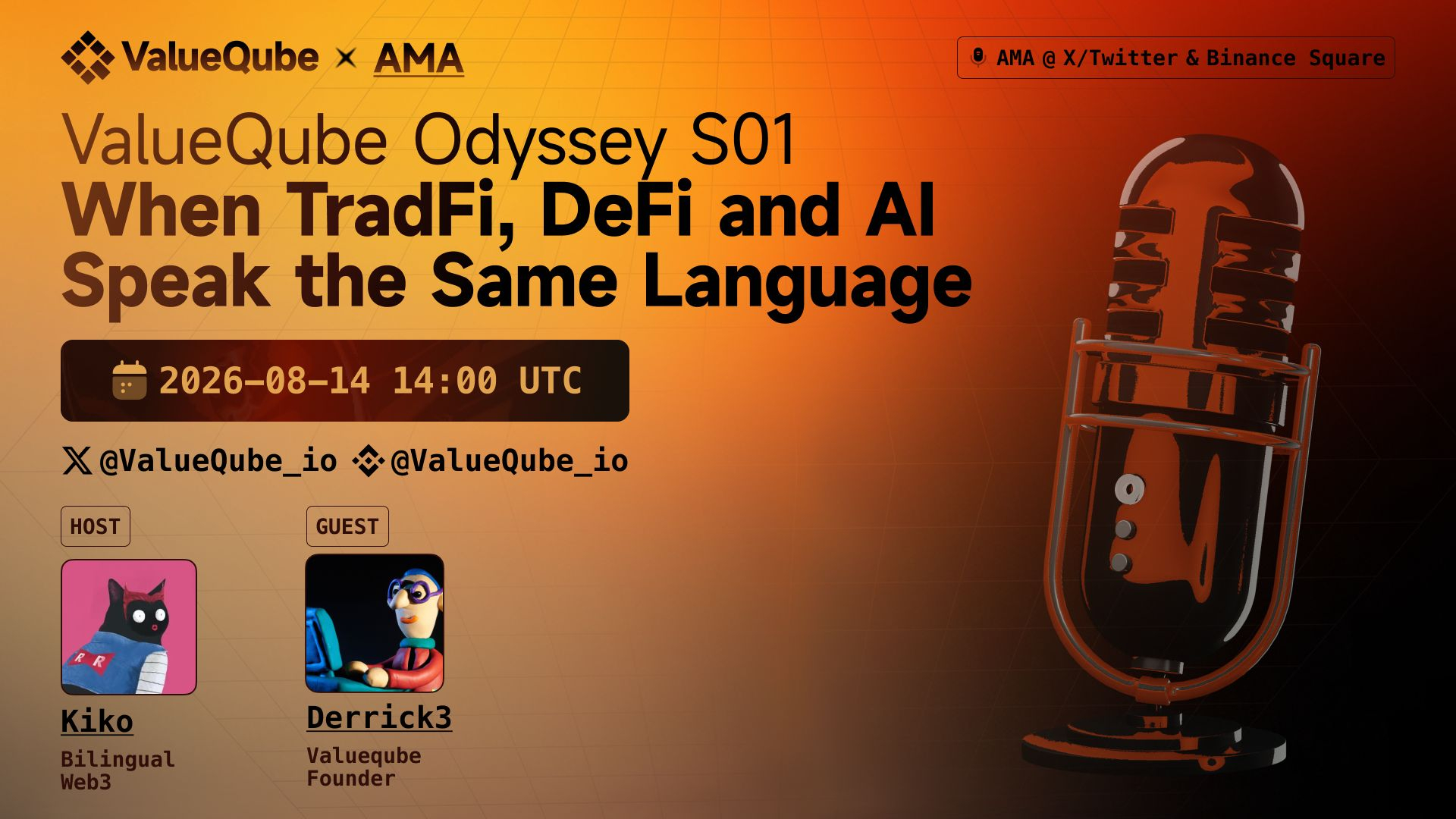
6
84
·
--
ຢືນຢັນແລ້ວ
ເບິ່ງການແປ
🤝 Partnership Announcement
⠀
ValueQube is partnering with @kuvilabs, the team behind an Agentic Finance OS that turns user intent into programmable, user-approved financial workflows. 🦉
⠀
Kuvi focuses on how strategies are composed, monitored, and executed. ValueQube gives assets and strategies structured financial context through transparent, AI-readable qAsset Certificates.
⠀
This collaboration will explore how programmable execution and machine-readable financial context can work together—so intelligent finance can act on more than signals and understand the value, risk, and rules behind each position. 🧊
⠀
#ValueQube #Kuvi #AgenticFinance #RWA #Web3
🤝 Partnership Announcement
⠀
ValueQube is partnering with @kuvilabs, the team behind an Agentic Finance OS that turns user intent into programmable, user-approved financial workflows. 🦉
⠀
Kuvi focuses on how strategies are composed, monitored, and executed. ValueQube gives assets and strategies structured financial context through transparent, AI-readable qAsset Certificates.
⠀
This collaboration will explore how programmable execution and machine-readable financial context can work together—so intelligent finance can act on more than signals and understand the value, risk, and rules behind each position. 🧊
⠀
#ValueQube #Kuvi #AgenticFinance #RWA #Web3
⠀
ValueQube is partnering with @kuvilabs, the team behind an Agentic Finance OS that turns user intent into programmable, user-approved financial workflows. 🦉
⠀
Kuvi focuses on how strategies are composed, monitored, and executed. ValueQube gives assets and strategies structured financial context through transparent, AI-readable qAsset Certificates.
⠀
This collaboration will explore how programmable execution and machine-readable financial context can work together—so intelligent finance can act on more than signals and understand the value, risk, and rules behind each position. 🧊
⠀
#ValueQube #Kuvi #AgenticFinance #RWA #Web3
1
4
70
·
--
ເບິ່ງການແປ
ValueQube Testnet is now live.
Odyssey S01 has begun.
Enter: https://dapp.valueqube.io
Aug 8, 2026 · 08:08 UTC
ValueQube Testnet is now live.
Odyssey S01 has begun.
Enter: https://dapp.valueqube.io
Aug 8, 2026 · 08:08 UTC
Odyssey S01 has begun.
Enter: https://dapp.valueqube.io
Aug 8, 2026 · 08:08 UTC
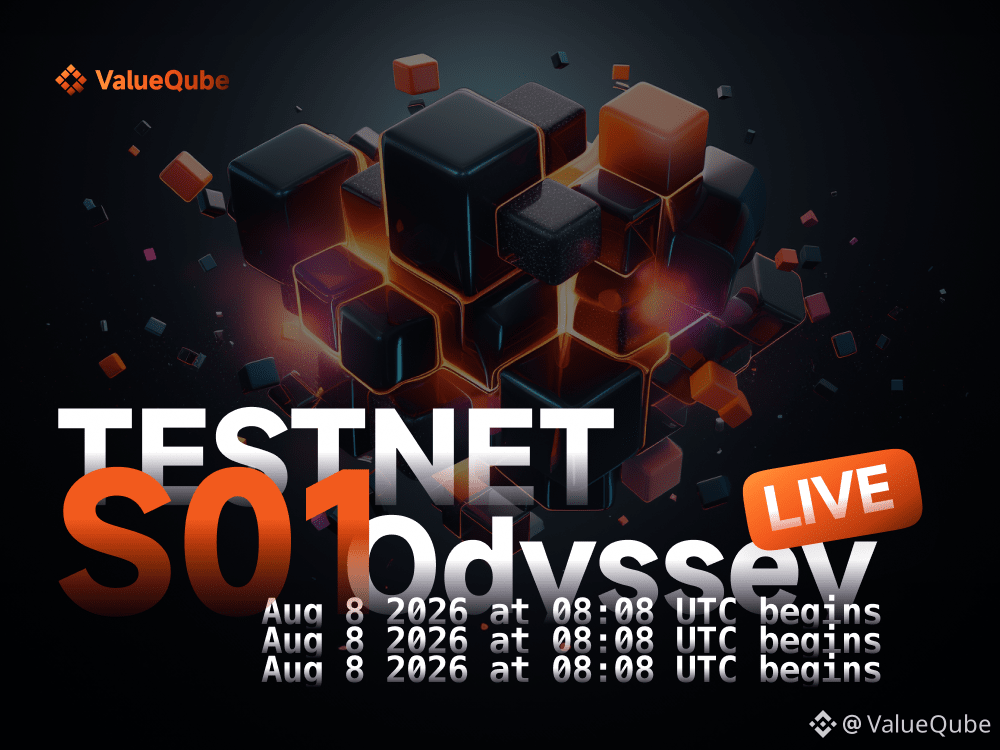
5
99
·
--
ເບິ່ງການແປ
🚀 ValueQube Testnet is now LIVE.
On Aug 8, 2026 at 08:08 UTC, Odyssey S01 launches in sync.
Bring your EVM wallet, enter BNB Smart Chain Testnet, complete the Guide + 5-step main route, and claim your first verifiable qAsset record.
This is the first season window only. If you’re in, the route starts now: https://dapp.valueqube.io
#ValueQube #OdysseyS01
🚀 ValueQube Testnet is now LIVE.
On Aug 8, 2026 at 08:08 UTC, Odyssey S01 launches in sync.
Bring your EVM wallet, enter BNB Smart Chain Testnet, complete the Guide + 5-step main route, and claim your first verifiable qAsset record.
This is the first season window only. If you’re in, the route starts now: https://dapp.valueqube.io
#ValueQube #OdysseyS01
On Aug 8, 2026 at 08:08 UTC, Odyssey S01 launches in sync.
Bring your EVM wallet, enter BNB Smart Chain Testnet, complete the Guide + 5-step main route, and claim your first verifiable qAsset record.
This is the first season window only. If you’re in, the route starts now: https://dapp.valueqube.io
#ValueQube #OdysseyS01
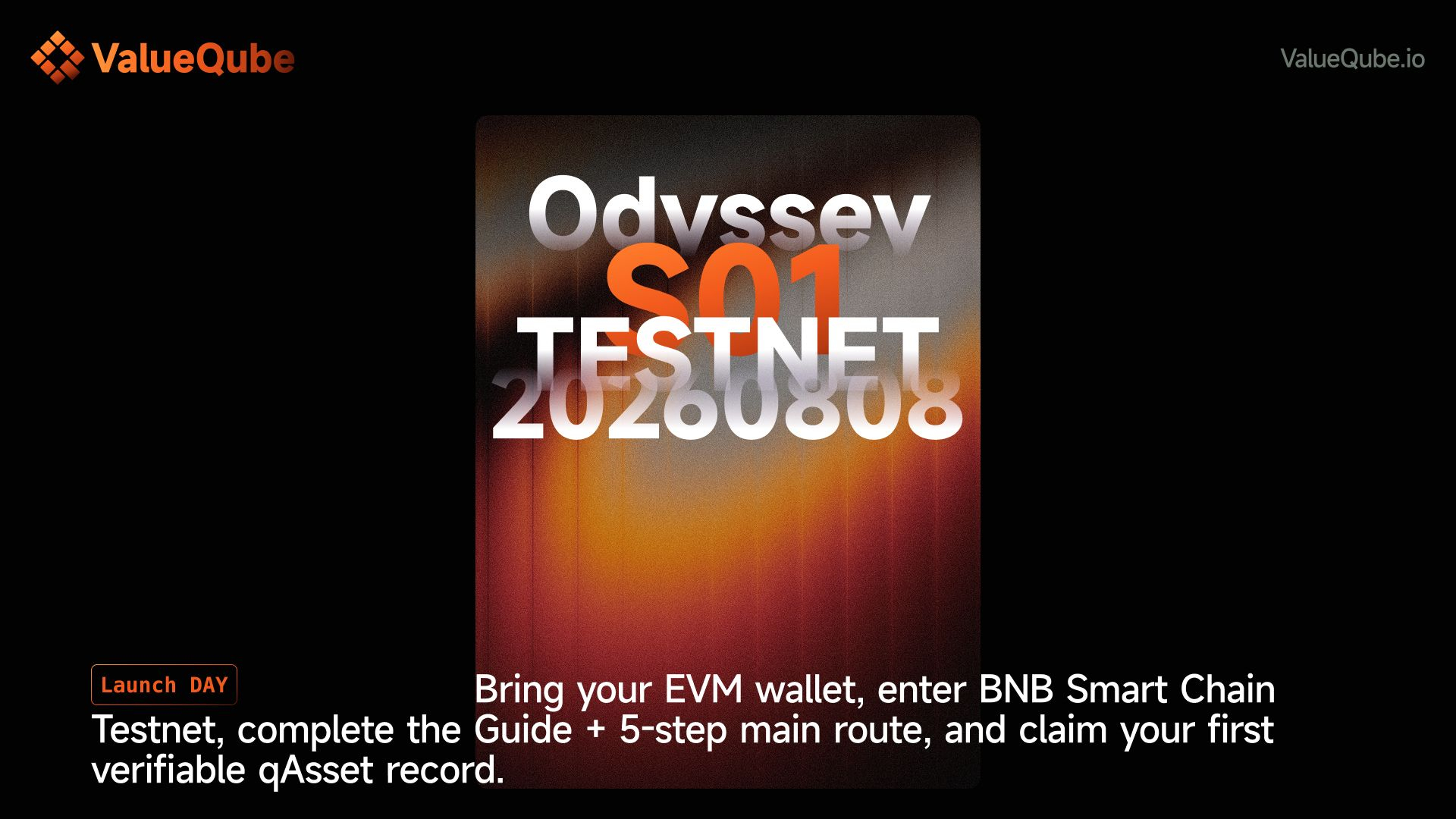
5
108
ເຂົ້າສູ່ລະບົບເພື່ອສຳຫຼວດເນື້ອຫາເພີ່ມເຕີມ
ເຂົ້າຮ່ວມກຸ່ມຜູ້ໃຊ້ຄຣິບໂຕທົ່ວໂລກໃນ Binance Square.
⚡️ ໄດ້ຮັບຂໍ້ມູນຫຼ້າສຸດ ແລະ ທີ່ມີປະໂຫຍດກ່ຽວກັບຄຣິບໂຕ.
💬 ໄດ້ຮັບຄວາມໄວ້ວາງໃຈຈາກຕະຫຼາດແລກປ່ຽນຄຣິບໂຕທີ່ໃຫຍ່ທີ່ສຸດໃນໂລກ.
👍 ຄົ້ນຫາຂໍ້ມູນເຊີງເລິກທີ່ແທ້ຈາກນັກສ້າງທີ່ໄດ້ຮັບການຢືນຢັນ.
ອີເມວ / ເບີໂທລະສັບ
ຫົວຂໍ້ທີ່ກໍາລັງນິຍົມ
AIStocksWhatNext
725,262 views
5,447 ກຳລັງສົນທະນາ
Пាចែក ແລະ ຮັບຮາງວັນຈາກການແຂ່ງຂັນ Trending Hashtag ຂອງພວກເຮົາ
✨ຫົວຂໍ້: ມີໂອກາດການລົງທຶນອື່ນໃດອີກ ຍັງເຫຼືອບໍ ໃນເວລາທີ່ຫຸ້ນ AI ຍັງຂຶ້ນຢ່າງຕໍ່ເນື່ອງ?
👉ວິທີເຂົ້າຮ່ວມ:
ໂພດຂໍ້ຄວາມສັ້ນຫຼືບົດຄວາມພ້ອມ hashtag #AIStocksWhatNext
ແບ່ງປັນວ່າທ່ານເບີກບວກ (bullish) ຫຼືຂາດບວກ (bearish) ແລະ ໂພດການຖືຫຸ້ນ AI ຫຼືການຊື້ຂາຍຂອງທ່ານ — ການໃຊ້ trade widget ອາດຊ່ວຍໃຫ້ມີສິດກໍານົດໄດ້ດີຂຶ້ນ.
ທ່ານຍັງສາມາດເສີມໃຫ້ໂພດຂອງທ່ານໂດຍການແບ່ງປັນຂໍ້ມູນ ຫຼື ກຣາຟ, ແລະຫຼີກລ້ຽງຮູບພາບທີ່ສ້າງຈາກ AI.
✍️ສ້າງເນື້ອຫາຕາມມຸມມອງດ້ານລຸ່ມນີ້:
- Nvidia ກ່າວວ່າຍອດຂາຍຊິບຈະເພີ່ມເປັນສອງເທົ່າໃນປີໜ້າ, ແລະ ບໍລິສັດ AI ຊັ້ນນໍາຍັງຕີຍອດລາຍຮັບສູງສຸດຕໍ່ເນື່ອງ—ການໃຊ້ຈ່າຍດ້ານ compute ທີ່ຢູ່ຫຼັງມັນກໍ່ຊັດເຈນຫຼາຍ. ຄວາມຕ້ອງການຂອງ AI ຈິງໆກໍາລັງຂຶ້ນບໍ? ແລະ ມັນຈະຢູ່ໄດ້ດົນປານໃດ? ຫຸ້ນ AI ຂຶ້ນທົ່ວກະດານ. ນີ້ແມ່ນການປະຕິບັດສະລຸດຈິງ (real breakout) ຫຼືແພ້ແຄ່ການເດັ້ງກັ້ນໄລຍະສັ້ນ?
- ຜູ້ນໍາໃນອຸດສາຫະກໍາເອີ້ນໃຫ້ຊະລໍການພັດທະນາ AI, ໃນຂະນະທີ່ Trump ວາງແຜນຈະສ້າງ “AI Force” ໂດຍອ້າງວ່າ AI ອາດຈະກວມ 25% ຂອງ GDP ຂອງສະຫະລັດ ໃນອະນາຄົດ. ທ່ານຢູ່ຝ່າຍໃດ? ການໜູນຊ່ວຍຈາກລະດັບລັດ (state-level backing) ຈະເປັນໄຊຊະນະໄລຍະຍາວສໍາລັບຫຸ້ນ AI ບໍ?
- ທ່ານກໍ່າລັງຊື້ຫຸ້ນ AI ບໍ? ແບ່ງປັນການຊື້ຂາຍ/ການຖືຄອງທີ່ກ່ຽວຂ້ອງກັບ AI ຂອງທ່ານຜ່ານ trade sharing widget ຂອງພວກເຮົາ.
⏰ໄລຍະການແຄມເປນ:
- 2026-09-22 7:00 - 2026-09-24 4:00 UTC
🎁ລາງວັນ:
- ໂພດທີ່ມີຄຸນສົມບັດຕາມກົດລະບຽບຂ້າງເທິງ ແລະ ມີຫຼາຍກວ່າ 100 ຄໍາຈະຖືກທວດສອບ ແລະ ອາດຈະໄດ້ຮັບການເພີ່ມເຂົ້າເບິ່ງແບບສຸ່ມ 500 ຫາ 3,000 ຄັ້ງ. ທ່ານຈະໄດ້ຮັບແຈ້ງເຕືອນຈາກເຈົ້າໜ້າທີ່ຂອງ feed ຂອງພວກເຮົາ ຖ້າໂພດຂອງທ່ານຖືກເລືອກ.
- ມີໂອກາດໃຫ້ບົດຄວາມຂອງທ່ານຖືກນໍາໄປສະແດງໃນ Binance Square Official
ຕ້ອງການໄອເດຍສໍາລັບໂພດຂອງທ່ານບໍ? ເຂົ້າໄປທີ່ໜ້າຫົວຂໍ້ #AIStocksWhatNext ຫຼື Square Guide on How to Post for Better Reach.
Binance Square Official
·535 ຖືກໃຈ
·1.4M views
21SharesLaunchesEuropesFirstZcashETP
21,542 views
723 ກຳລັງສົນທະນາ
CardanoJoinsX402PaymentStandard
14,721 views
544 ກຳລັງສົນທະນາ