

Hyperjr
74 ໂພສ

Hyperjr
ລາຍງານ
ບລັອກຜູ້ໃຊ້
BP-11CCAD606E72
96 ກໍາລັງຕິດຕາມ
82 ຜູ້ຕິດຕາມ
110 Liked
ໂພສ
ທັງໝົດ
ວົງຢືມ
·
--
ສັນຍານກະທິງ
What happens when your next customer isn’t a human being, but an AI agent?
That’s a question businesses may need to start thinking about.
At KBW 2026, GOAT Network showcased AI-powered commerce, with more than 300 purchases reported during its event activities.
The interesting part is the idea behind it.
An AI agent could help a person find a product, understand the available options, and complete a purchase.
But for that to work, businesses need products that agents can discover and payment systems they can use.
This is why I think agentic commerce is worth following.
We’re not just talking about AI answering questions anymore. We’re exploring how it could participate in real economic activity.
#GOATNetwork$BTC #AI #AgenticCommerce
1
51
·
--
What kind of bridging fee is $0.01? 😅
I bridged some assets from GOAT Network recently, and the fee caught my attention.
Previously, I was used to paying around $0.55–$0.60 per bridging transaction, excluding network fees.
But this time, I was charged just $0.01 for the whole operation.
That’s a big difference from what I was used to paying.
And there’s a reason I think fees like this are worth discussing beyond personal savings.
If AI agents are going to make frequent payments and transactions, keeping those costs low could become increasingly important.
Small fees might not look like a big deal today, but they could matter a lot in an economy where transactions happen constantly.
#Bitcoin #Bitcoin #Crypto
44
·
--
Quantum computing is still developing, but preparing for its possible impact on blockchain security is worth taking seriously.
GOAT Network has been working on two important areas.
First, its validator consensus keys are being moved from secp256k1 toward ML-DSA-65, a post-quantum cryptographic standard.
Second, its BitVM bridge work is exploring how zero-knowledge proofs can be verified on Bitcoin more practically.
The first phase of the bridge prototype reduced the proof size to 69 KiB.
These are technical developments, but the bigger picture is simple.
Building blockchain infrastructure isn’t only about what works today. It’s also about preparing for the challenges that could come tomorrow.
GOAT isn’t something I’d describe as quantum-proof. Its work is better understood as preparation for a potential future threat.
#GOATNetwork #Bitcoin

1
70
·
--
Imagine giving an AI agent the ability to buy products, pay bills, and manage transactions on your behalf.
Convenient, right?
But there’s another side to it.
How do we make sure the money and transactions behind these activities are secure?
As AI agents become more involved in commerce, security will matter just as much as their ability to complete tasks.
This is one reason I’m interested in GOAT Network’s approach to building around Bitcoin and the AI economy.
AI might provide the intelligence, but the infrastructure handling the money still needs to be reliable.
We shouldn’t talk about the future of AI payments without talking about security.
#GOATNetwork $BTC #bitcoin #AI
1
102
·
--
The AI agent economy could reach $3T–$5T by 2030. That’s a huge opportunity to pay attention to. 👀
But here’s something worth thinking about.
If AI agents will be buying products, paying for services, and handling transactions on their own, they will need more than intelligence.
They will need a way to pay, a secure environment to transact, and infrastructure that can handle their financial activities.
This is where GOAT Network’s direction toward agentic commerce becomes interesting to me.
The conversation is no longer just about what AI can do.
It’s also about the financial infrastructure that will allow AI to do more.
And I think this part deserves more attention.
#GOATNetwork #AI板块强势进击
1
72
·
--
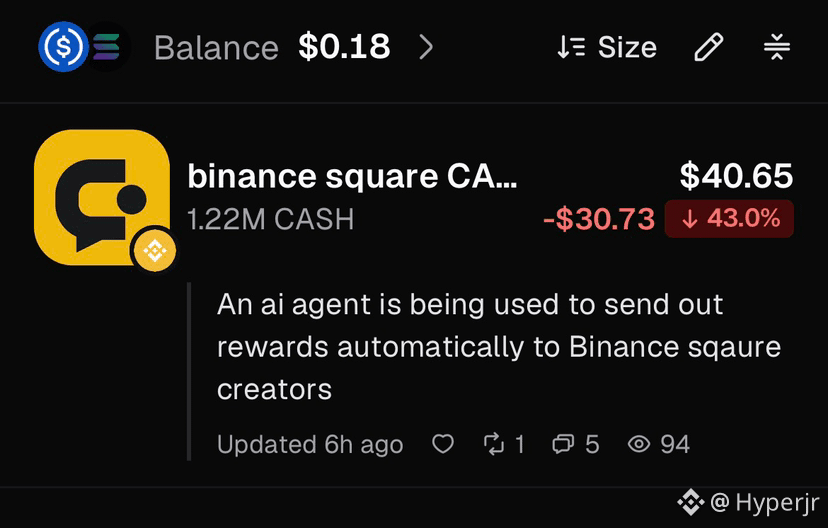
I traded $CASH the binance square community token (unofficial) yesterday and currently down -44%.
I actually liked the idea behind the project and believe it will do well if the team clears all the FUD and attend to complaints.
I have called the token on pump and a few traders saw it and aped as well. I actuall see this as a potential community based project that can be used to make creators more active on binance square
$CASH $BNCB
1
182
·
--
I just came across $CASH and find the idea around it very intersting especially as it is being used to pay creators in binance square
If this gets the attention of binance it will definitely go far
SR-887CDDDFC159294AED8A180A
I just came across $CASH and find the idea around it very intersting especially as it is being used to pay creators in binance square
If this gets the attention of binance it will definitely go far
SR-887CDDDFC159294AED8A180A
If this gets the attention of binance it will definitely go far
SR-887CDDDFC159294AED8A180A

2
3
17
·
--
ສັນຍານກະທິງ
Imagine an AI agent needs some data.
It finds a service that has exactly what it needs.
Now it has to figure out:
How much does it cost?
What exactly am I paying for?
Where do I send the money?
And can I trust that the service will only give me access after payment?
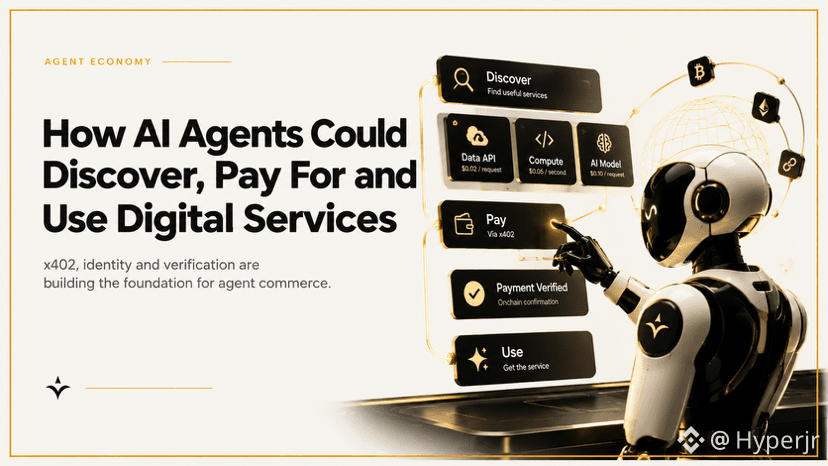
This is one of the problems x402 is designed to solve.
The payment can become part of the request itself.
The agent asks for the service.
The service responds with the payment details.
The agent pays.
The payment gets checked.
Then the service is delivered.
No monthly subscription.
No API key sitting around.
No human having to approve every small payment.
But there’s another piece that matters just as much:
Discovery.
An agent needs to find services it can actually use in the first place.
This is where GOAT’s broader agent stack becomes interesting.
x402 gives agents a way to pay for services, while ERC-8004 gives agents an identity and a way to make their capabilities discoverable.
So you start getting a simple flow:
Find it → understand it → pay → verify → use it.
That is much closer to how an economy between machines would actually work.
#ai $BTC
1
115
·
--
ສັນຍານກະທິງ
We talk a lot about stablecoins being useful for AI agents.
But where do those agents actually spend the money?
GOAT Network has an interesting answer.
Gift cards.
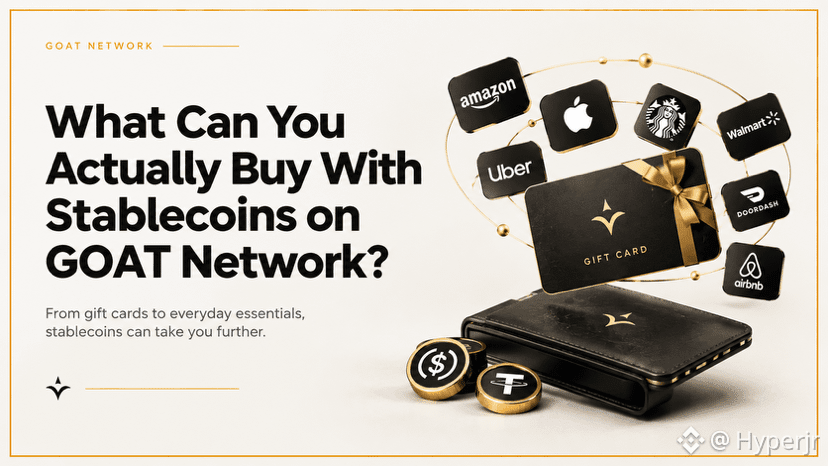
GOAT has integrated Snaplii so users can buy gift cards with USDT and USDC from major brands in the US and Canada.
That includes brands like:
Amazon
Apple
Uber
Uber Eats
Starbucks
Walmart
DoorDash
Airbnb
So your stablecoins can go from a wallet to something you can actually use in everyday life.
And there’s an agent side to it too.
AI agents can discover available gift cards, create orders, make payments and track fulfillment through machine-friendly flows.
That matters because agent commerce isn’t just about an AI being able to send a payment.
The other half is giving it somewhere useful to spend that money.
Gift cards are a pretty simple example.
But they show how onchain payments can start connecting AI agents to the real world. #bitcoin #Stablecoins
1
92
·
--
There’s a problem in crypto that feels very far away.
Quantum computers.
But if Bitcoin is going to remain part of the foundation for future financial infrastructure, it’s probably worth thinking about now.
GOAT Network recently audited its cryptographic systems to see how they could be affected by future quantum computers.
The audit found that 6 of 7 cryptographic surfaces have work to do.
The biggest concern is around parts of the Bitcoin bridge where public keys can become exposed.
The important thing is that this isn’t saying quantum computers can break GOAT or Bitcoin today.
It’s about preparing before the technology becomes powerful enough to create a real problem.
GOAT’s roadmap includes reducing exposed keys, introducing post-quantum signatures and upgrading the proof system.
For me, this is one of those infrastructure topics that doesn’t get as much attention as payments or AI agents.
But if you want Bitcoin-secured infrastructure to last, you have to think beyond today.
And GOAT is already doing that.
#quantumcomputers #bitcoin
1
324
·
--
Why do we keep talking about stablecoins when it comes to AI agents?
Because an AI agent needs to know what its money is worth.
Say you give an agent $100 to spend on APIs, data or computing.
If it holds a volatile crypto asset, that $100 could be worth much less by the time it needs to make a payment.
That makes budgeting difficult.
With USDC, the value stays close to the dollar, so the agent can work with something much more predictable.
It also makes small payments easier to understand.
If a service costs $0.02 per API request, the agent pays $0.02.
Simple.
And this matters because AI agents could be making many small payments throughout the day paying for data, API calls, computing and other digital services.
Stablecoins basically bring dollar-based pricing into blockchain payments.
That doesn’t make other cryptocurrencies useless for agent payments.
It just makes stablecoins a natural fit when the price of the service is fixed and the agent needs predictable spending.
GOAT Network is building around this too, allowing agents to send and receive stablecoin payments across up to 10 supported chains, with more being added.
For agentic commerce to work, payments can’t just be possible.
They need to be predictable.
#Stablecoins $BTC #AI
1
84
·
--
ສັນຍານກະທິງ
🚨 GOAT Network just introduced GOAT Flow
A payment solution designed to help businesses accept payments from both humans and AI agents.
The interesting part is how simple the flow is.
An AI agent can discover what a business offers, make a payment, and have the payment verified before the order is completed.
Businesses can choose between:
➮ Checkout for existing stores
➮ QuickPay for payment links
➮ API Payments for APIs, data and AI tools
GOAT Flow supports card payments and crypto across 10 chains, with crypto going directly to the merchant’s wallet.
And businesses don’t have to build the whole payment system themselves. Setup can be done through the Merchant Portal, which makes onboarding much easier.
I’ve been following the new chains being added to GOAT’s payment stack, so seeing this move from infrastructure toward a more complete merchant product is interesting.
GOAT Network is positioning itself for a future where AI agents aren’t just assistants, but actual customers that can pay for goods and services.
Another piece of the agent economy taking shape.$BTC
1
98
·
--
The Agent Economy Won’t Be Built With AI Alone
There’s a lot of attention on what AI agents can do.
But capability is only one side of the equation.
For an agent economy to work, agents also need a way to:
Identify themselves
Find other agents
Pay for services
Sell services
Build reputation
Verify important claims
Settle transactions
This is why infrastructure may become just as important as the AI models themselves.
GOAT Network is approaching this through a combination of agent identity, payment rails, developer tooling and Bitcoin-secured blockchain infrastructure.
x402 handles machine-friendly payments.
ERC-8004 provides a standardized identity and trust layer.
AgentKit brings blockchain actions and these agent capabilities into a developer toolkit.
The result is a stack designed around a simple idea:
Agents shouldn’t only be able to perform tasks.
They should eventually be able to participate in an economy.
#HotTopics #Bitcoin❗
1
132
·
--
ສັນຍານກະທິງ
The @GOATRollup Agent Stack in One Simple Picture
Here is one way to understand what GOAT Network is building for AI agents:
x402 is How agents pay for services.
ERC-8004 is how agents establish identity and reputation.
AgentKit is a plugin for developers to connect agents to blockchain capabilities.
And around these components are additional pieces for things like proving, deployment, wallets, bridging and other onchain actions.
The interesting part is how these layers complement each other.
An agent could have an identity.
It could discover a service.
It could pay for that service through x402.
The interaction could generate reputation signals.
And the whole process can happen through programmable blockchain infrastructure.
That’s the direction behind the agent economy thesis.
Not just AI that can think.
AI that can interact economically. $BTC
#bitcoin #MarketSentimentToday #AIAgents
The @GOAT Network Agent Stack in One Simple Picture
Here is one way to understand what GOAT Network is building for AI agents:
x402 is How agents pay for services.
ERC-8004 is how agents establish identity and reputation.
AgentKit is a plugin for developers to connect agents to blockchain capabilities.
And around these components are additional pieces for things like proving, deployment, wallets, bridging and other onchain actions.
The interesting part is how these layers complement each other.
An agent could have an identity.
It could discover a service.
It could pay for that service through x402.
The interaction could generate reputation signals.
And the whole process can happen through programmable blockchain infrastructure.
That’s the direction behind the agent economy thesis.
Not just AI that can think.
AI that can interact economically. $BTC
#bitcoin #MarketSentimentToday #AIAgents
1
142
·
--
ຢືນຢັນແລ້ວ
ERC-8004: Who Is This AI Agent?
Imagine hiring an AI agent you’ve never interacted with before.
How do you know who it is?
How do you know what it does?
How do you evaluate its past performance?
This is the kind of problem ERC-8004 is designed to address.
The standard introduces infrastructure for:
Identity
Reputation
Validation
An agent can have a persistent onchain identity with information describing its capabilities and services.
Clients can also submit feedback and retrieve reputation signals.
GOAT Network has integrated ERC-8004 into AgentKit, allowing builders to register agents, publish metadata, manage wallets and interact with reputation functionality.
This doesn’t mean every registered agent is automatically trustworthy.
Instead, it gives the ecosystem a standard way to establish identity and collect trust signals.
As the number of AI agents grows, that could become extremely important.
$BTC $GOATED
1
203
·
--
x402 Could Be a Payment Rail for Machine-to-Machine Commerce
A human buying something online is easy.
A machine buying something from another machine is different.
There is no human sitting there to enter card details or approve every transaction.
That’s one reason protocols like x402 are interesting.
x402 creates a standardized HTTP payment flow where a service can indicate that payment is required, the client can authorize the payment, and the service can verify it before delivering the resource.
GOAT integrates x402 into its agent infrastructure through GOAT Flow and AgentKit.
This creates a simple possibility:
Agent A needs a service.
↓
Agent B provides it.
↓
Agent A pays.
↓
Agent B verifies the payment and delivers the service.
That could apply to data, APIs, AI inference, research, verification and many other digital services.
The important shift is that the customer doesn’t have to be human.
Another piece of software can be the customer.
That’s a major requirement for a real agent economy
#Btc #HotTrends
1
80
·
--
ສັນຍານກະທິງ
AI Agents Need Their Own Financial Infrastructure
AI agents are getting better at doing work.
But if they are going to operate independently, they need more than intelligence.
They need infrastructure.
Think about what a human business needs:
Identity.
Payments.
Reputation.
Customers.
Records.
Settlement.
Agents will need similar primitives.
GOAT Network is building around this idea with an agent stack that includes:
x402 → payments
ERC-8004 → identity & reputation
AgentKit → developer toolkit
ZK proving infrastructure → verifiable computation
Bitcoin-secured settlement → security foundation
The goal isn’t simply to put AI on a blockchain.
It’s to give AI agents the ability to participate in an economy.
That means an agent could eventually discover another service, pay for it, receive the output and build a history around that interaction.
The real opportunity isn’t AI that can just work.
It’s AI that can do business.
#bitcoin $BTC $GOATED
1
282
·
--
What If You Could Spend Crypto Without Worrying About the Network?
A lot of people still think crypto is only for trading.
But real adoption happens when you can actually buy things with it.
That’s one reason I find GOAT Network’s gift card marketplace interesting.
Instead of cashing out your crypto first, you can buy gift cards directly with USDT or USDC across multiple categories like food, shopping, travel, and more.
Even better, you’re not locked into one blockchain.
You can pay using supported networks such as:
* Ethereum
* BNB Chain
* Berachain
* Arbitrum
* Base
* Optimism
* Metis
* XLayer
That flexibility makes the experience much smoother.
There’s also a limited-time promotion worth checking out.
The first 10 users who purchase a $10 Starbucks gift card using Berachain as the payment network will receive $10 cashback, provided they follow the campaign requirements.
But what caught my attention isn’t just the cashback.
GOAT Network is also building payment infrastructure that AI agents can use. That means autonomous agents won’t just perform tasks—they’ll eventually be able to pay for services and digital goods on their own using the same payment stack.
We’re moving toward an internet where both people and AI agents participate in the same economy.
Making payments simple across multiple chains is an important step toward making that future practical.
104
·
--
Your AI Agent Might Be Smart. But Can It Actually Do Anything On-Chain?
Most AI agents today can answer questions, automate workflows, and generate content.
But ask them to send a transaction, manage a wallet, or pay for a service, and that’s usually where they stop.
GOAT Network’s AgentKit is designed to change that.
The best part is that you don’t have to rebuild your agent.
If you’ve already built one using frameworks like OpenAI, LangChain, MCP, or Vercel AI, AgentKit plugs into your existing setup and gives your agent new on-chain capabilities.
With a single integration, your agent can:
• Own and manage a crypto wallet.
• Sign and send blockchain transactions.
• Make and receive payments through x402.
• Register an ERC-8004 identity so other agents and applications can recognize and trust it.
• Swap assets, bridge tokens, interact with smart contracts, and even purchase gift cards.
What I like most is the philosophy behind it.
AgentKit doesn’t replace the AI tools developers already use.
It builds on top of them.
Your AI keeps the intelligence it already has, but now it can also take real economic actions instead of simply responding with text.
As the agentic economy grows, I think this kind of infrastructure will become increasingly important because intelligence alone isn’t enough.
For AI agents to become truly autonomous, they need the ability to own assets, make decisions, and participate in the on-chain economy.
That’s exactly the problem AgentKit is trying to solve.
$BTC $GOATED
1
230
·
--
AI Doesn’t Just Need to Think. It Needs to Pay.
Think about every payment you’ve made online.
A subscription.
An API.
A freelancer.
A digital product.
Behind every single one, there was a human approving the payment.
Now imagine a different scenario.
An AI agent is writing a research report.
It needs live market data, so it pays another AI service.
Then it needs a translation, so it pays a translation agent.
It wants a custom image, so it pays an AI image generator.
Finally, it verifies its sources by paying another specialized AI service.
The entire job gets completed without anyone clicking “Pay Now” every few minutes.
That’s the idea behind the agent-to-agent economy.
It’s not about replacing humans.
It’s about letting software exchange value with other software whenever work needs to be done.
But for that future to become real, AI agents need more than intelligence.
They need wallets.
They need payment rails.
They need trusted on-chain identities.
They need reputations that other agents can verify before interacting with them.
Without those pieces, an AI agent can answer questions.
It can even automate workflows.
But it can’t participate in an economy.
That’s why I think GOAT Network’s approach is interesting.
Products like x402, AgentKit, and ERC-8004 aren’t just standalone tools. Together, they’re building the infrastructure that allows AI agents to transact, collaborate, and operate as independent economic actors.
The future of AI won’t be defined only by how smart agents become.
It will also depend on whether they can participate in the economy they’re helping to create.#AI $BTC
1
84
ເຂົ້າສູ່ລະບົບເພື່ອສຳຫຼວດເນື້ອຫາເພີ່ມເຕີມ
ເຂົ້າຮ່ວມກຸ່ມຜູ້ໃຊ້ຄຣິບໂຕທົ່ວໂລກໃນ Binance Square.
⚡️ ໄດ້ຮັບຂໍ້ມູນຫຼ້າສຸດ ແລະ ທີ່ມີປະໂຫຍດກ່ຽວກັບຄຣິບໂຕ.
💬 ໄດ້ຮັບຄວາມໄວ້ວາງໃຈຈາກຕະຫຼາດແລກປ່ຽນຄຣິບໂຕທີ່ໃຫຍ່ທີ່ສຸດໃນໂລກ.
👍 ຄົ້ນຫາຂໍ້ມູນເຊີງເລິກທີ່ແທ້ຈາກນັກສ້າງທີ່ໄດ້ຮັບການຢືນຢັນ.
ອີເມວ / ເບີໂທລະສັບ
ຫົວຂໍ້ທີ່ກໍາລັງນິຍົມ
BinancePick
2.5M ຄັ້ງທີ່ເບິ່ງ
137,513 ກຳລັງສົນທະນາ
Join #EarningsSeason: Predict Earnings on Binance Pick, Share Your Take on Binance Square!
Binance Square Official
·399 ຖືກໃຈ
·336.9k ຄັ້ງທີ່ເບິ່ງ
EarningsSeason
4.9M ຄັ້ງທີ່ເບິ່ງ
23,850 ກຳລັງສົນທະນາ
ElectrumWalletBugLetRogueServersStealFunds
1,797 ຄັ້ງທີ່ເບິ່ງ
116 ກຳລັງສົນທະນາ