

#institutionaladoption
institutionaladoption
1.3M views
7,658 ກຳລັງສົນທະນາ
ມາແຮງ
ຫຼ້າສຸດ

·
--
🚨 Bitcoin ETFs pulled $6.34B in Q3. So why does $87K still matter so much?
#bitcoinspotetfsdraw$6.34binflowsinq3
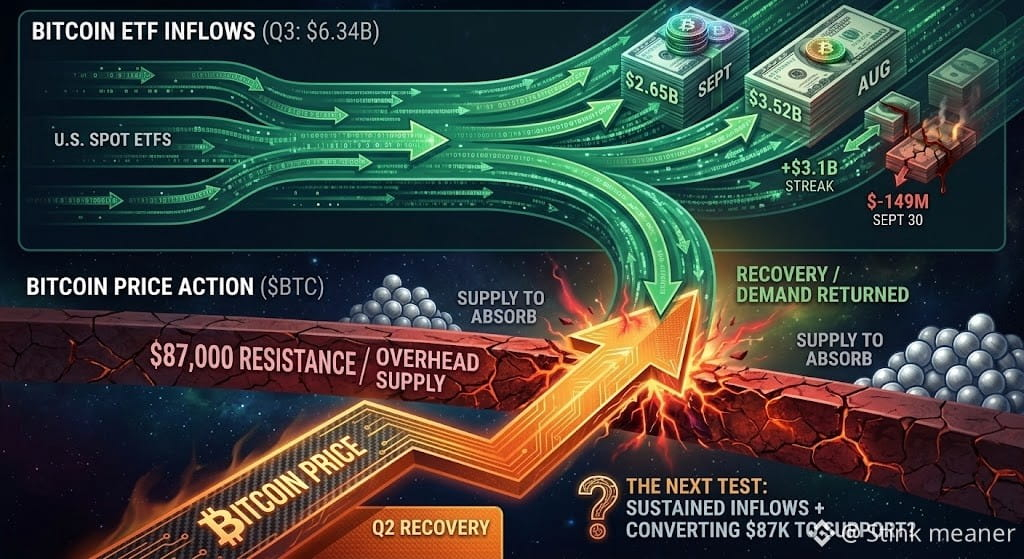
U.S. spot Bitcoin ETFs took in about $6.34B during Q3, including $2.65B in September. That's a major recovery after Q2's ~$5B outflow.
But the flow wasn't accelerating:
August: $3.52B → September: $2.65B.
Then Sept. 30 broke a nine-day, $3.1B inflow streak with ~$149M leaving the funds.
And here's the market confirmation:
BTC rallied into the $87K area but failed to establish a clean breakout.
So the signal isn't simply:
ETF inflows = BTC bullish.
It's:
ETF demand returned → BTC recovered → overhead supply still needs to be absorbed.
The next test is therefore brutally simple:
Can sustained ETF inflows keep increasing while BTC converts $87K from resistance into support?
Not financial advice. ETF flows indicate aggregate fund subscriptions/redemptions, not a guarantee of directional price pressure.
$BTC $ETH
#BitcoinSpotETFsDraw$6.34BInflowsInQ3 #bitcoin #CryptoETFMania #InstitutionalAdoption
🚨 Bitcoin ETFs pulled $6.34B in Q3. So why does $87K still matter so much?
#bitcoinspotetfsdraw$6.34binflowsinq3
U.S. spot Bitcoin ETFs took in about $6.34B during Q3, including $2.65B in September. That's a major recovery after Q2's ~$5B outflow.
But the flow wasn't accelerating:
August: $3.52B → September: $2.65B.
Then Sept. 30 broke a nine-day, $3.1B inflow streak with ~$149M leaving the funds.
And here's the market confirmation:
BTC rallied into the $87K area but failed to establish a clean breakout.
So the signal isn't simply:
ETF inflows = BTC bullish.
It's:
ETF demand returned → BTC recovered → overhead supply still needs to be absorbed.
The next test is therefore brutally simple:
Can sustained ETF inflows keep increasing while BTC converts $87K from resistance into support?
Not financial advice. ETF flows indicate aggregate fund subscriptions/redemptions, not a guarantee of directional price pressure.
$BTC $ETH
#BitcoinSpotETFsDraw$6.34BInflowsInQ3 #bitcoin #CryptoETFMania #InstitutionalAdoption
#bitcoinspotetfsdraw$6.34binflowsinq3
U.S. spot Bitcoin ETFs took in about $6.34B during Q3, including $2.65B in September. That's a major recovery after Q2's ~$5B outflow.
But the flow wasn't accelerating:
August: $3.52B → September: $2.65B.
Then Sept. 30 broke a nine-day, $3.1B inflow streak with ~$149M leaving the funds.
And here's the market confirmation:
BTC rallied into the $87K area but failed to establish a clean breakout.
So the signal isn't simply:
ETF inflows = BTC bullish.
It's:
ETF demand returned → BTC recovered → overhead supply still needs to be absorbed.
The next test is therefore brutally simple:
Can sustained ETF inflows keep increasing while BTC converts $87K from resistance into support?
Not financial advice. ETF flows indicate aggregate fund subscriptions/redemptions, not a guarantee of directional price pressure.
$BTC $ETH
#BitcoinSpotETFsDraw$6.34BInflowsInQ3 #bitcoin #CryptoETFMania #InstitutionalAdoption
1
70

·
--
日本公司Metaplanet玩得很溜!Q3净增1000个$BTC,总持仓达44000个!先卖10000个再买11000个,通过优先证券创造被动收入,这波操作很聪明!$BTC #比特币 #机构采用
Metaplanet's playing Bitcoin like a pro! Net +1K $BTC in Q3, total holdings now 44K. Sold 10K before buying 11K, generating recurring income while showing serious liquidity. Institutional adoption is heating up! $BTC #Bitcoin #InstitutionalAdoption
日本公司Metaplanet玩得很溜!Q3净增1000个$BTC ,总持仓达44000个!先卖10000个再买11000个,通过优先证券创造被动收入,这波操作很聪明!$BTC #比特币 #机构采用
Metaplanet's playing Bitcoin like a pro! Net +1K $BTC in Q3, total holdings now 44K. Sold 10K before buying 11K, generating recurring income while showing serious liquidity. Institutional adoption is heating up! $BTC #Bitcoin #InstitutionalAdoption
Metaplanet's playing Bitcoin like a pro! Net +1K $BTC in Q3, total holdings now 44K. Sold 10K before buying 11K, generating recurring income while showing serious liquidity. Institutional adoption is heating up! $BTC #Bitcoin #InstitutionalAdoption
64

Injective CEO Eric Chen expects US based INJ ETFs to arrive sooner than 2027. With 21Shares and Canary already filing applications, the path for institutional Injective exposure is looking much shorter than anticipated.
#InjectiveETF #InstitutionalAdoption
Injective CEO Eric Chen expects US based INJ ETFs to arrive sooner than 2027. With 21Shares and Canary already filing applications, the path for institutional Injective exposure is looking much shorter than anticipated.
#InjectiveETF #InstitutionalAdoption
#InjectiveETF #InstitutionalAdoption
39

{spot}(BTCUSDT)
🚨 #BitcoinSpotETFsDraw$6.34BInflowsInQ3 🚨
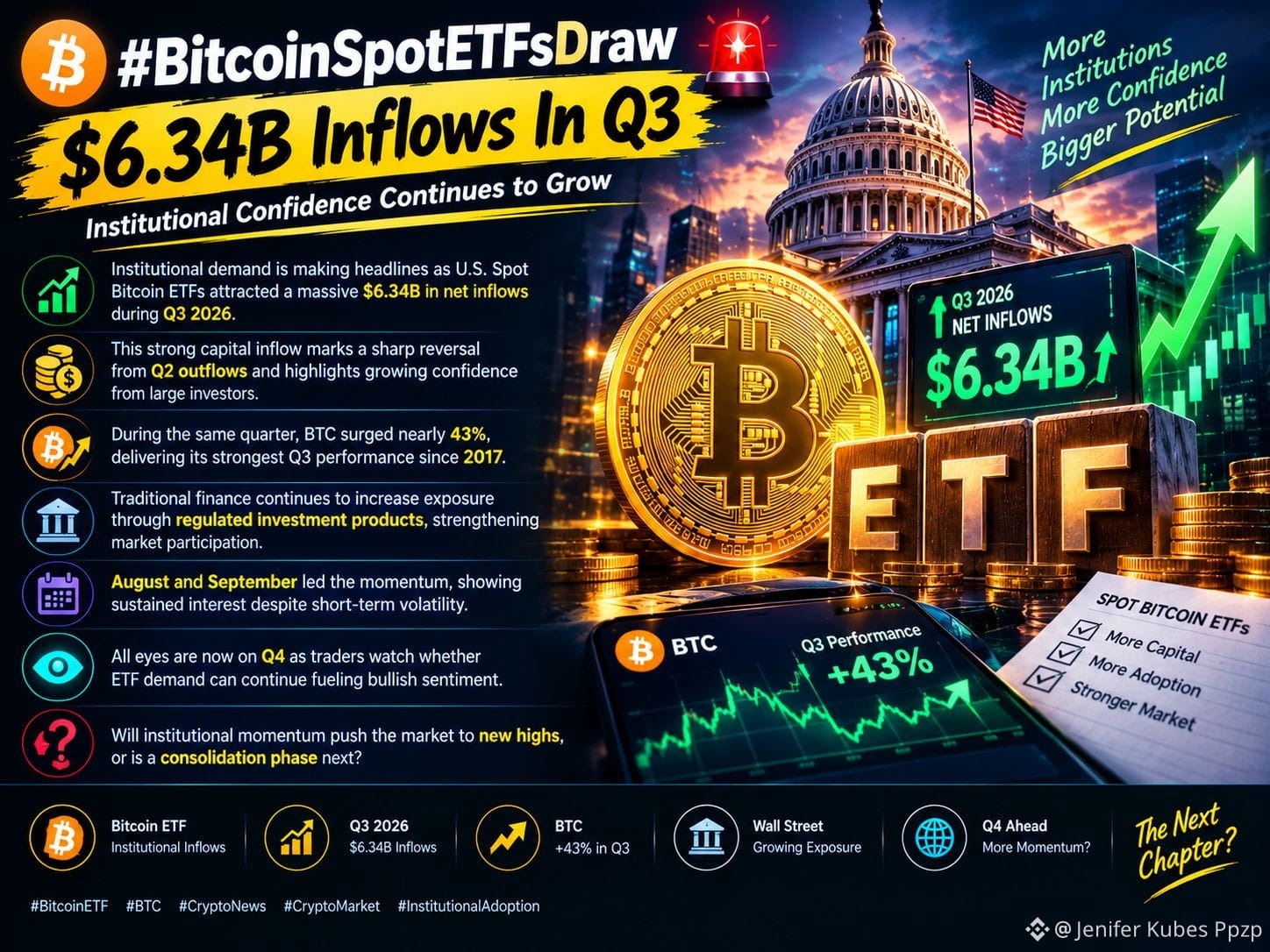
📈 Institutional demand is making headlines as U.S. Spot Bitcoin ETFs attracted a massive $6.34B in net inflows during Q3 2026.
💰 This strong capital inflow marks a sharp reversal from Q2 outflows and highlights growing confidence from large investors.
🔥 During the same quarter, BTC surged nearly 43%, delivering its strongest Q3 performance since 2017.
🏦 Traditional finance continues to increase exposure through regulated investment products, strengthening market participation.
📊 August and September led the momentum, showing sustained interest despite short-term volatility.
👀 All eyes are now on Q4 as traders watch whether ETF demand can continue fueling bullish sentiment.
⚡ Will institutional momentum push the market to new highs, or is a consolidation phase next?
#BitcoinETF #BTC☀️ #CryptoNews #CryptoMarkets #InstitutionalAdoption
🚨 #BitcoinSpotETFsDraw$6.34BInflowsInQ3 🚨
📈 Institutional demand is making headlines as U.S. Spot Bitcoin ETFs attracted a massive $6.34B in net inflows during Q3 2026.
💰 This strong capital inflow marks a sharp reversal from Q2 outflows and highlights growing confidence from large investors.
🔥 During the same quarter, BTC surged nearly 43%, delivering its strongest Q3 performance since 2017.
🏦 Traditional finance continues to increase exposure through regulated investment products, strengthening market participation.
📊 August and September led the momentum, showing sustained interest despite short-term volatility.
👀 All eyes are now on Q4 as traders watch whether ETF demand can continue fueling bullish sentiment.
⚡ Will institutional momentum push the market to new highs, or is a consolidation phase next?
#BitcoinETF #BTC☀️ #CryptoNews #CryptoMarkets #InstitutionalAdoption
🚨 #BitcoinSpotETFsDraw$6.34BInflowsInQ3 🚨
📈 Institutional demand is making headlines as U.S. Spot Bitcoin ETFs attracted a massive $6.34B in net inflows during Q3 2026.
💰 This strong capital inflow marks a sharp reversal from Q2 outflows and highlights growing confidence from large investors.
🔥 During the same quarter, BTC surged nearly 43%, delivering its strongest Q3 performance since 2017.
🏦 Traditional finance continues to increase exposure through regulated investment products, strengthening market participation.
📊 August and September led the momentum, showing sustained interest despite short-term volatility.
👀 All eyes are now on Q4 as traders watch whether ETF demand can continue fueling bullish sentiment.
⚡ Will institutional momentum push the market to new highs, or is a consolidation phase next?
#BitcoinETF #BTC☀️ #CryptoNews #CryptoMarkets #InstitutionalAdoption
72

·
--
ບົດຄວາມ
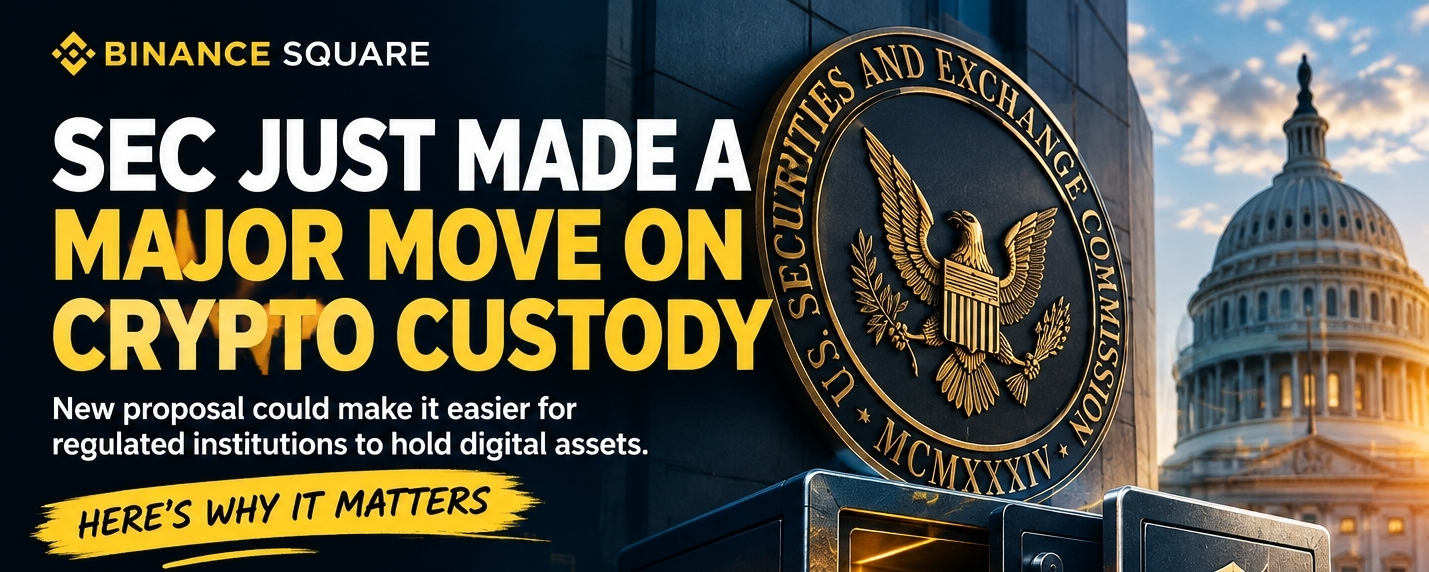
🚨 SEC JUST MADE A MAJOR MOVE ON CRYPTO CUSTODY — HERE’S WHY IT MATTERSThe U.S. Securities and Exchange Commission (SEC) has proposed a new framework for how investment advisers and regulated funds can custody crypto assets.
This could become an important development for the institutional crypto market.
🔐 WHAT IS THE SEC PROPOSING?
Under the proposal, certain investment advisers and regulated funds could potentially use self-custody for crypto assets in specific circumstances.
The proposal would also allow qualifying state trust companies to serve as custodians for crypto assets.
The SEC says the goal is to modernize custody rules and create a clearer regulatory framework for digital assets.
🏦 WHY DOES THIS MATTER?
One of the major challenges for institutions entering crypto has been custody.
Traditional financial rules were created long before digital assets became a major financial market. As a result, some advisers and funds have faced difficulties finding suitable custodians for certain crypto assets.
The new proposal is designed to address that problem.
If adopted, clearer custody rules could make it easier for regulated investment firms to structure crypto-related strategies.
⚠️ BUT THERE’S AN IMPORTANT DETAIL
This is NOT a final rule yet.
The SEC has proposed the framework and will accept public comments for 60 days after the proposal is published in the Federal Register.
That means the final rules could still change.
📈 WHAT COULD IT MEAN FOR CRYPTO?
The biggest potential impact may be institutional access.
If regulated advisers and funds receive clearer pathways for holding digital assets, it could remove one of the regulatory obstacles that has made institutional crypto participation more complicated.
Bitcoin and Ethereum are likely to remain closely watched as the market evaluates what this regulatory shift could mean for the broader digital-asset industry.
However, this announcement alone does NOT guarantee that crypto prices will rise.
The proposal still has to go through the regulatory process.
🔥 MY TAKE
The most interesting part of this story isn't simply “the SEC is changing crypto rules.”
It's that U.S. regulators are trying to build a specific framework for how regulated financial institutions can actually hold digital assets.
Crypto adoption isn't only about prices.
It is also about custody, regulation, infrastructure and whether large financial institutions can operate within clear rules.
This proposal puts all of those issues back into focus.
What do you think — could clearer crypto custody rules accelerate institutional adoption.👇 Share your thoughts.$
#Crypto #Bitcoin #Ethereum #SEC #CryptoNews #BinanceSquare #BTC #ETH #Blockchain #CryptoRegulation #InstitutionalAdoption itutionalCrypto #CryptoMarket
$BTC $ETH
🚨 SEC JUST MADE A MAJOR MOVE ON CRYPTO CUSTODY — HERE’S WHY IT MATTERS
The U.S. Securities and Exchange Commission (SEC) has proposed a new framework for how investment advisers and regulated funds can custody crypto assets.
This could become an important development for the institutional crypto market.
🔐 WHAT IS THE SEC PROPOSING?
Under the proposal, certain investment advisers and regulated funds could potentially use self-custody for crypto assets in specific circumstances.
The proposal would also allow qualifying state trust companies to serve as custodians for crypto assets.
The SEC says the goal is to modernize custody rules and create a clearer regulatory framework for digital assets.
🏦 WHY DOES THIS MATTER?
One of the major challenges for institutions entering crypto has been custody.
Traditional financial rules were created long before digital assets became a major financial market. As a result, some advisers and funds have faced difficulties finding suitable custodians for certain crypto assets.
The new proposal is designed to address that problem.
If adopted, clearer custody rules could make it easier for regulated investment firms to structure crypto-related strategies.
⚠️ BUT THERE’S AN IMPORTANT DETAIL
This is NOT a final rule yet.
The SEC has proposed the framework and will accept public comments for 60 days after the proposal is published in the Federal Register.
That means the final rules could still change.
📈 WHAT COULD IT MEAN FOR CRYPTO?
The biggest potential impact may be institutional access.
If regulated advisers and funds receive clearer pathways for holding digital assets, it could remove one of the regulatory obstacles that has made institutional crypto participation more complicated.
Bitcoin and Ethereum are likely to remain closely watched as the market evaluates what this regulatory shift could mean for the broader digital-asset industry.
However, this announcement alone does NOT guarantee that crypto prices will rise.
The proposal still has to go through the regulatory process.
🔥 MY TAKE
The most interesting part of this story isn't simply “the SEC is changing crypto rules.”
It's that U.S. regulators are trying to build a specific framework for how regulated financial institutions can actually hold digital assets.
Crypto adoption isn't only about prices.
It is also about custody, regulation, infrastructure and whether large financial institutions can operate within clear rules.
This proposal puts all of those issues back into focus.
What do you think — could clearer crypto custody rules accelerate institutional adoption.👇 Share your thoughts.$
#Crypto #Bitcoin #Ethereum #SEC #CryptoNews #BinanceSquare #BTC #ETH #Blockchain #CryptoRegulation #InstitutionalAdoption itutionalCrypto #CryptoMarket
$BTC $ETH
This could become an important development for the institutional crypto market.
🔐 WHAT IS THE SEC PROPOSING?
Under the proposal, certain investment advisers and regulated funds could potentially use self-custody for crypto assets in specific circumstances.
The proposal would also allow qualifying state trust companies to serve as custodians for crypto assets.
The SEC says the goal is to modernize custody rules and create a clearer regulatory framework for digital assets.
🏦 WHY DOES THIS MATTER?
One of the major challenges for institutions entering crypto has been custody.
Traditional financial rules were created long before digital assets became a major financial market. As a result, some advisers and funds have faced difficulties finding suitable custodians for certain crypto assets.
The new proposal is designed to address that problem.
If adopted, clearer custody rules could make it easier for regulated investment firms to structure crypto-related strategies.
⚠️ BUT THERE’S AN IMPORTANT DETAIL
This is NOT a final rule yet.
The SEC has proposed the framework and will accept public comments for 60 days after the proposal is published in the Federal Register.
That means the final rules could still change.
📈 WHAT COULD IT MEAN FOR CRYPTO?
The biggest potential impact may be institutional access.
If regulated advisers and funds receive clearer pathways for holding digital assets, it could remove one of the regulatory obstacles that has made institutional crypto participation more complicated.
Bitcoin and Ethereum are likely to remain closely watched as the market evaluates what this regulatory shift could mean for the broader digital-asset industry.
However, this announcement alone does NOT guarantee that crypto prices will rise.
The proposal still has to go through the regulatory process.
🔥 MY TAKE
The most interesting part of this story isn't simply “the SEC is changing crypto rules.”
It's that U.S. regulators are trying to build a specific framework for how regulated financial institutions can actually hold digital assets.
Crypto adoption isn't only about prices.
It is also about custody, regulation, infrastructure and whether large financial institutions can operate within clear rules.
This proposal puts all of those issues back into focus.
What do you think — could clearer crypto custody rules accelerate institutional adoption.👇 Share your thoughts.$
#Crypto #Bitcoin #Ethereum #SEC #CryptoNews #BinanceSquare #BTC #ETH #Blockchain #CryptoRegulation #InstitutionalAdoption itutionalCrypto #CryptoMarket
$BTC $ETH
62

·
--
Institutional custody is the silent unlock most retail investors overlook.
When large asset managers allocate to crypto, price discovery gets most of the headlines. But the real bottleneck has always been custody infrastructure — segregated cold storage, MPC wallets, insurance underwriting, and audit-ready reporting that satisfies compliance teams.
Over the past 18 months, that infrastructure has matured significantly. Prime brokers now offer institutional-grade custody with SOC 2 certifications, real-time proof of reserves, and sub-custodian frameworks that satisfy pension fund mandates. This is not a minor development — it is the plumbing that lets $100M+ allocations move from boardroom approval to on-chain execution.
$BTC benefits most immediately: it is the easiest mandate to approve, the simplest to custody, and the most liquid to exit. But custody maturation has downstream effects for $ETH (restaking collateral programs) and $SOL (high-throughput institutional settlement).
Watch custody AUM growth alongside ETF inflows. When both are rising together, it signals institutional conviction — not just tactical positioning. The custody layer is where real money moves quietly before price reflects it.
Infrastructure built for institutions is infrastructure that will serve the entire market.
#Crypto #Bitcoin #Ethereum #InstitutionalAdoption #CryptoInfrastructure
Institutional custody is the silent unlock most retail investors overlook.
When large asset managers allocate to crypto, price discovery gets most of the headlines. But the real bottleneck has always been custody infrastructure — segregated cold storage, MPC wallets, insurance underwriting, and audit-ready reporting that satisfies compliance teams.
Over the past 18 months, that infrastructure has matured significantly. Prime brokers now offer institutional-grade custody with SOC 2 certifications, real-time proof of reserves, and sub-custodian frameworks that satisfy pension fund mandates. This is not a minor development — it is the plumbing that lets $100M+ allocations move from boardroom approval to on-chain execution.
$BTC benefits most immediately: it is the easiest mandate to approve, the simplest to custody, and the most liquid to exit. But custody maturation has downstream effects for $ETH (restaking collateral programs) and $SOL (high-throughput institutional settlement).
Watch custody AUM growth alongside ETF inflows. When both are rising together, it signals institutional conviction — not just tactical positioning. The custody layer is where real money moves quietly before price reflects it.
Infrastructure built for institutions is infrastructure that will serve the entire market.
#Crypto #Bitcoin #Ethereum #InstitutionalAdoption #CryptoInfrastructure
When large asset managers allocate to crypto, price discovery gets most of the headlines. But the real bottleneck has always been custody infrastructure — segregated cold storage, MPC wallets, insurance underwriting, and audit-ready reporting that satisfies compliance teams.
Over the past 18 months, that infrastructure has matured significantly. Prime brokers now offer institutional-grade custody with SOC 2 certifications, real-time proof of reserves, and sub-custodian frameworks that satisfy pension fund mandates. This is not a minor development — it is the plumbing that lets $100M+ allocations move from boardroom approval to on-chain execution.
$BTC benefits most immediately: it is the easiest mandate to approve, the simplest to custody, and the most liquid to exit. But custody maturation has downstream effects for $ETH (restaking collateral programs) and $SOL (high-throughput institutional settlement).
Watch custody AUM growth alongside ETF inflows. When both are rising together, it signals institutional conviction — not just tactical positioning. The custody layer is where real money moves quietly before price reflects it.
Infrastructure built for institutions is infrastructure that will serve the entire market.
#Crypto #Bitcoin #Ethereum #InstitutionalAdoption #CryptoInfrastructure
77

·
--
Have you noticed that every SEC headline still moves $BTC first while most traders are already looking at alts?
The real pain is watching people dump on regulatory news only to miss the rebound, or pile into random tokens too early and get chopped. These headlines keep costing retail because they treat every proposal like an attack instead of a potential on-ramp for bigger capital.
US regulators just floated another custody proposal covering who can hold client assets, how those holdings stay off a company's own books, and the level of oversight required. This is the same gap that has kept pension funds and banks on the sidelines for years. Clear rules give them a legal path to actually hold $BTC and $ETH instead of just talking about allocation. $BTC already priced the news this week, as it always does. Alts such as $ETH and $SOL tend to lag until the details look workable for institutions.
If the rules land in a form they can use, expect slower but much larger inflows. Treat $BTC as the barometer, ignore the first reaction, and only add once it holds after the noise fades. Institutions wait for the legal box to be checked.
Where do you think this goes from here once custody is actually clarified?
#Bitcoin #CryptoRegulation #InstitutionalAdoption
Have you noticed that every SEC headline still moves $BTC first while most traders are already looking at alts?
The real pain is watching people dump on regulatory news only to miss the rebound, or pile into random tokens too early and get chopped. These headlines keep costing retail because they treat every proposal like an attack instead of a potential on-ramp for bigger capital.
US regulators just floated another custody proposal covering who can hold client assets, how those holdings stay off a company's own books, and the level of oversight required. This is the same gap that has kept pension funds and banks on the sidelines for years. Clear rules give them a legal path to actually hold $BTC and $ETH instead of just talking about allocation. $BTC already priced the news this week, as it always does. Alts such as $ETH and $SOL tend to lag until the details look workable for institutions.
If the rules land in a form they can use, expect slower but much larger inflows. Treat $BTC as the barometer, ignore the first reaction, and only add once it holds after the noise fades. Institutions wait for the legal box to be checked.
Where do you think this goes from here once custody is actually clarified?
#Bitcoin #CryptoRegulation #InstitutionalAdoption
The real pain is watching people dump on regulatory news only to miss the rebound, or pile into random tokens too early and get chopped. These headlines keep costing retail because they treat every proposal like an attack instead of a potential on-ramp for bigger capital.
US regulators just floated another custody proposal covering who can hold client assets, how those holdings stay off a company's own books, and the level of oversight required. This is the same gap that has kept pension funds and banks on the sidelines for years. Clear rules give them a legal path to actually hold $BTC and $ETH instead of just talking about allocation. $BTC already priced the news this week, as it always does. Alts such as $ETH and $SOL tend to lag until the details look workable for institutions.
If the rules land in a form they can use, expect slower but much larger inflows. Treat $BTC as the barometer, ignore the first reaction, and only add once it holds after the noise fades. Institutions wait for the legal box to be checked.
Where do you think this goes from here once custody is actually clarified?
#Bitcoin #CryptoRegulation #InstitutionalAdoption

15

Why is nobody talking about the massive institutional floor quietly being built while retail keeps chasing shiny meme coins?
Most investors lose money because they stay glued to short-term SEC headlines and miss the actual capital deployment happening behind the scenes. They wait for retail hype to return, only to realize heavy players already locked in their positions at ground level.
Take the Evernorth move as a prime case study. While retail was debating regulatory noise, Evernorth secured over $1B specifically to deliver public-market exposure to $XRP. This is not speculative retail money trading on leverage. Heavyweight backers like $BTC giant Pantera, SBI, Arrington, and Ripple themselves funded this structure because institutional demand operates on entirely different time horizons.
When over a billion dollars quietly aligns behind a structured product, the market narrative usually lags the smart capital. Retail traders often end up buying the breakout after funds have already spent months accumulating exposure through dedicated vehicles.
Where do you think institutional capital rotates next once public-market vehicles like this go fully live?
#Crypto #XRP #InstitutionalAdoption
Why is nobody talking about the massive institutional floor quietly being built while retail keeps chasing shiny meme coins?
Most investors lose money because they stay glued to short-term SEC headlines and miss the actual capital deployment happening behind the scenes. They wait for retail hype to return, only to realize heavy players already locked in their positions at ground level.
Take the Evernorth move as a prime case study. While retail was debating regulatory noise, Evernorth secured over $1B specifically to deliver public-market exposure to $XRP . This is not speculative retail money trading on leverage. Heavyweight backers like $BTC giant Pantera, SBI, Arrington, and Ripple themselves funded this structure because institutional demand operates on entirely different time horizons.
When over a billion dollars quietly aligns behind a structured product, the market narrative usually lags the smart capital. Retail traders often end up buying the breakout after funds have already spent months accumulating exposure through dedicated vehicles.
Where do you think institutional capital rotates next once public-market vehicles like this go fully live?
#Crypto #XRP #InstitutionalAdoption
Most investors lose money because they stay glued to short-term SEC headlines and miss the actual capital deployment happening behind the scenes. They wait for retail hype to return, only to realize heavy players already locked in their positions at ground level.
Take the Evernorth move as a prime case study. While retail was debating regulatory noise, Evernorth secured over $1B specifically to deliver public-market exposure to $XRP . This is not speculative retail money trading on leverage. Heavyweight backers like $BTC giant Pantera, SBI, Arrington, and Ripple themselves funded this structure because institutional demand operates on entirely different time horizons.
When over a billion dollars quietly aligns behind a structured product, the market narrative usually lags the smart capital. Retail traders often end up buying the breakout after funds have already spent months accumulating exposure through dedicated vehicles.
Where do you think institutional capital rotates next once public-market vehicles like this go fully live?
#Crypto #XRP #InstitutionalAdoption

22

·
--
🚨 Evernorth clears shareholder vote for Nasdaq debut under ticker XRPN, holding 473M XRP in treasury.
This signals growing institutional interest in XRP beyond spot trading, potentially increasing long-term demand pressure.
Smart money may view the SPAC-linked XRP reserve as a structural bullish catalyst for ecosystem adoption.
Could this bridge traditional finance and XRP utility in a way that reshapes market perception?
#InstitutionalAdoption
$XRP #TradingSignal #CryptoAnalysis
🚨 Evernorth clears shareholder vote for Nasdaq debut under ticker XRPN, holding 473M XRP in treasury.
This signals growing institutional interest in XRP beyond spot trading, potentially increasing long-term demand pressure.
Smart money may view the SPAC-linked XRP reserve as a structural bullish catalyst for ecosystem adoption.
Could this bridge traditional finance and XRP utility in a way that reshapes market perception?
#InstitutionalAdoption
$XRP #TradingSignal #CryptoAnalysis
This signals growing institutional interest in XRP beyond spot trading, potentially increasing long-term demand pressure.
Smart money may view the SPAC-linked XRP reserve as a structural bullish catalyst for ecosystem adoption.
Could this bridge traditional finance and XRP utility in a way that reshapes market perception?
#InstitutionalAdoption
$XRP #TradingSignal #CryptoAnalysis

30
Citi is betting big on a Bitcoin breakout
Citi has raised its 12 month target for Bitcoin to 113k, signaling increased institutional confidence in a major bull run.
#CitiBank #InstitutionalAdoption
Citi is betting big on a Bitcoin breakout
Citi has raised its 12 month target for Bitcoin to 113k, signaling increased institutional confidence in a major bull run.
#CitiBank #InstitutionalAdoption
Citi has raised its 12 month target for Bitcoin to 113k, signaling increased institutional confidence in a major bull run.
#CitiBank #InstitutionalAdoption
25


·
--
ສັນຍານກະທິງ
🚨 TRUMP You might want to start buying now
💰 BILLIONS & TRILLIONS OF CAPITAL ARE WATCHING CRYPTO
🔥 Institutional adoption, clearer regulation, tokenization and growing crypto infrastructure could bring massive new liquidity into digital assets.
🐂 If capital rotation accelerates, Bitcoin and major altcoins could enter a powerful new market phase
📈 The next major crypto cycle could be driven by
• 🏦 Institutional capital
• 💵 Stablecoin growth
• 🔗 Real-world asset tokenization
• ⚖️ Regulatory clarity
• 🌐 Global crypto adoption
🚨 IMPORTANT: The widely shared $30 TRILLION flowing into crypto figure should be treated as a projection/claim not guaranteed capital inflow
🔥 FOLLOW ME — WE’RE READY TO TRACK THE BIG MOVES TOGETHER
🚀 $BTC • $ETH • ALTCOINS
🐂 $NEXT.US BULL RUN WATCH
💎 STAY ALERT. STAY READY.
#Bitcoin #BTC #Crypto #Ethereum #ETH #Altcoins #BullRun #CryptoMarket #Trump #InstitutionalAdoption #CryptoNews #Blockchain #Web3 #trading
{spot}(ETHUSDT)
🚨 TRUMP You might want to start buying now
💰 BILLIONS & TRILLIONS OF CAPITAL ARE WATCHING CRYPTO
🔥 Institutional adoption, clearer regulation, tokenization and growing crypto infrastructure could bring massive new liquidity into digital assets.
🐂 If capital rotation accelerates, Bitcoin and major altcoins could enter a powerful new market phase
📈 The next major crypto cycle could be driven by
• 🏦 Institutional capital
• 💵 Stablecoin growth
• 🔗 Real-world asset tokenization
• ⚖️ Regulatory clarity
• 🌐 Global crypto adoption
🚨 IMPORTANT: The widely shared $30 TRILLION flowing into crypto figure should be treated as a projection/claim not guaranteed capital inflow
🔥 FOLLOW ME — WE’RE READY TO TRACK THE BIG MOVES TOGETHER
🚀 $BTC • $ETH • ALTCOINS
🐂 $NEXT.US BULL RUN WATCH
💎 STAY ALERT. STAY READY.
#Bitcoin #BTC #Crypto #Ethereum #ETH #Altcoins #BullRun #CryptoMarket #Trump #InstitutionalAdoption #CryptoNews #Blockchain #Web3 #trading
💰 BILLIONS & TRILLIONS OF CAPITAL ARE WATCHING CRYPTO
🔥 Institutional adoption, clearer regulation, tokenization and growing crypto infrastructure could bring massive new liquidity into digital assets.
🐂 If capital rotation accelerates, Bitcoin and major altcoins could enter a powerful new market phase
📈 The next major crypto cycle could be driven by
• 🏦 Institutional capital
• 💵 Stablecoin growth
• 🔗 Real-world asset tokenization
• ⚖️ Regulatory clarity
• 🌐 Global crypto adoption
🚨 IMPORTANT: The widely shared $30 TRILLION flowing into crypto figure should be treated as a projection/claim not guaranteed capital inflow
🔥 FOLLOW ME — WE’RE READY TO TRACK THE BIG MOVES TOGETHER
🚀 $BTC • $ETH • ALTCOINS
🐂 $NEXT.US BULL RUN WATCH
💎 STAY ALERT. STAY READY.
#Bitcoin #BTC #Crypto #Ethereum #ETH #Altcoins #BullRun #CryptoMarket #Trump #InstitutionalAdoption #CryptoNews #Blockchain #Web3 #trading

183

🇸🇦 صندوق ثروة سيادي يبيع الذهب لشراء البيتكوين وفقًا لتقرير Bitwise
أفادت شركة Bitwise لإدارة الأصول بأن صندوق ثروة سيادي واحد على الأقل قام ببيع جزء من حيازاته من الذهب وتحويلها إلى البيتكوين. يشير هذا التحول إلى اهتمام متزايد من المؤسسات بالبيتكوين كأحد الأصول الاحتياطية المحتملة في محافظها الاستثمارية، مما يعكس تطور النظرة المؤسسية للعملات الرقمية.
━━━━━━━━━━━━━━
📊 التأثير: 📈 مرتفع
🏷️ BITCOIN
#Bitcoin #InstitutionalAdoption #SovereignWealth #CryptoNews #DigitalAssets
📰 المصدر: cryptobriefing.com
🇸🇦 صندوق ثروة سيادي يبيع الذهب لشراء البيتكوين وفقًا لتقرير Bitwise
أفادت شركة Bitwise لإدارة الأصول بأن صندوق ثروة سيادي واحد على الأقل قام ببيع جزء من حيازاته من الذهب وتحويلها إلى البيتكوين. يشير هذا التحول إلى اهتمام متزايد من المؤسسات بالبيتكوين كأحد الأصول الاحتياطية المحتملة في محافظها الاستثمارية، مما يعكس تطور النظرة المؤسسية للعملات الرقمية.
━━━━━━━━━━━━━━
📊 التأثير: 📈 مرتفع
🏷️ BITCOIN
#Bitcoin #InstitutionalAdoption #SovereignWealth #CryptoNews #DigitalAssets
📰 المصدر: cryptobriefing.com
أفادت شركة Bitwise لإدارة الأصول بأن صندوق ثروة سيادي واحد على الأقل قام ببيع جزء من حيازاته من الذهب وتحويلها إلى البيتكوين. يشير هذا التحول إلى اهتمام متزايد من المؤسسات بالبيتكوين كأحد الأصول الاحتياطية المحتملة في محافظها الاستثمارية، مما يعكس تطور النظرة المؤسسية للعملات الرقمية.
━━━━━━━━━━━━━━
📊 التأثير: 📈 مرتفع
🏷️ BITCOIN
#Bitcoin #InstitutionalAdoption #SovereignWealth #CryptoNews #DigitalAssets
📰 المصدر: cryptobriefing.com
110
·
--
Institutional adoption is usually measured by headlines: the biggest ETF inflow day, the latest corporate treasury buy. But the more useful measure is the type of money entering — because not all institutional capital behaves the same.
Fast money arrives through ETFs, prop desks, and basis trades. It's real capital, but it's momentum-shaped: it chases strength, hedges quickly, and can exit nearly as fast as it entered. It amplifies cycles rather than anchoring them.
Slow money is different. It arrives through investment policy statements: a pension committee voting on a 1% $BTC allocation, an endowment adding a sleeve, insurers drafting custody standards for $ETH and $SOL that look more like bond settlement than retail brokerage. It enters slowly, often in tranches — and once it's embedded in governance, it's very hard to remove. A committee that approved the allocation doesn't reverse course in one bad quarter; it rebalances into weakness.
This is why the same drawdown can mean opposite things at different stages of adoption. When an asset is held mostly by fast money, dips cascade. When structural money reaches critical mass, dips get absorbed — the buyers of weakness have mandates instead of opinions.
The signal worth watching isn't the size of any single inflow. It's the composition: how much of the holder base is governed by policy rather than price.
Fast money makes markets. Slow money makes floors. Adoption matures when the floor outweighs the wave.
#Crypto #InstitutionalAdoption #Bitcoin #Ethereum #MarketStructure
Institutional adoption is usually measured by headlines: the biggest ETF inflow day, the latest corporate treasury buy. But the more useful measure is the type of money entering — because not all institutional capital behaves the same.
Fast money arrives through ETFs, prop desks, and basis trades. It's real capital, but it's momentum-shaped: it chases strength, hedges quickly, and can exit nearly as fast as it entered. It amplifies cycles rather than anchoring them.
Slow money is different. It arrives through investment policy statements: a pension committee voting on a 1% $BTC allocation, an endowment adding a sleeve, insurers drafting custody standards for $ETH and $SOL that look more like bond settlement than retail brokerage. It enters slowly, often in tranches — and once it's embedded in governance, it's very hard to remove. A committee that approved the allocation doesn't reverse course in one bad quarter; it rebalances into weakness.
This is why the same drawdown can mean opposite things at different stages of adoption. When an asset is held mostly by fast money, dips cascade. When structural money reaches critical mass, dips get absorbed — the buyers of weakness have mandates instead of opinions.
The signal worth watching isn't the size of any single inflow. It's the composition: how much of the holder base is governed by policy rather than price.
Fast money makes markets. Slow money makes floors. Adoption matures when the floor outweighs the wave.
#Crypto #InstitutionalAdoption #Bitcoin #Ethereum #MarketStructure
Fast money arrives through ETFs, prop desks, and basis trades. It's real capital, but it's momentum-shaped: it chases strength, hedges quickly, and can exit nearly as fast as it entered. It amplifies cycles rather than anchoring them.
Slow money is different. It arrives through investment policy statements: a pension committee voting on a 1% $BTC allocation, an endowment adding a sleeve, insurers drafting custody standards for $ETH and $SOL that look more like bond settlement than retail brokerage. It enters slowly, often in tranches — and once it's embedded in governance, it's very hard to remove. A committee that approved the allocation doesn't reverse course in one bad quarter; it rebalances into weakness.
This is why the same drawdown can mean opposite things at different stages of adoption. When an asset is held mostly by fast money, dips cascade. When structural money reaches critical mass, dips get absorbed — the buyers of weakness have mandates instead of opinions.
The signal worth watching isn't the size of any single inflow. It's the composition: how much of the holder base is governed by policy rather than price.
Fast money makes markets. Slow money makes floors. Adoption matures when the floor outweighs the wave.
#Crypto #InstitutionalAdoption #Bitcoin #Ethereum #MarketStructure
87
·
--
Crypto's earliest promise was radical transparency: every transaction visible to everyone. It sounded like freedom. It turned out to be a bug for the businesses we want to onboard.
A company cannot pay suppliers on a fully public ledger without handing competitors its procurement map. A fund cannot rotate positions while the whole market watches. Payroll, treasury, B2B settlement — these demand confidentiality, not as a luxury, but as a precondition.
That's why the next wave of institutional adoption depends on selective disclosure, not maximal transparency. Zero-knowledge proofs let a party prove a statement — this wallet is compliant, this reserve is backed, this transfer is within limits — without revealing the underlying data. Viewing keys let auditors and regulators see exactly what they are entitled to see, and nothing more.
The market is starting to price this shift. Privacy-preserving rails, encrypted mempools, and ZK-based compliance are moving from research papers into production infrastructure. The pendulum is swinging from "transparency is the feature" to "privacy is the product, verifiability is the guarantee."
$BTC showed the world a transparent monetary ledger. $ETH's ZK ecosystem is building the confidential one. The rails institutions actually settle on will be the ones where you can prove everything and reveal nothing by default.
Privacy isn't the enemy of adoption. It's the missing primitive.
#Privacy #ZeroKnowledge #InstitutionalAdoption #CryptoInfrastructure
Crypto's earliest promise was radical transparency: every transaction visible to everyone. It sounded like freedom. It turned out to be a bug for the businesses we want to onboard.
A company cannot pay suppliers on a fully public ledger without handing competitors its procurement map. A fund cannot rotate positions while the whole market watches. Payroll, treasury, B2B settlement — these demand confidentiality, not as a luxury, but as a precondition.
That's why the next wave of institutional adoption depends on selective disclosure, not maximal transparency. Zero-knowledge proofs let a party prove a statement — this wallet is compliant, this reserve is backed, this transfer is within limits — without revealing the underlying data. Viewing keys let auditors and regulators see exactly what they are entitled to see, and nothing more.
The market is starting to price this shift. Privacy-preserving rails, encrypted mempools, and ZK-based compliance are moving from research papers into production infrastructure. The pendulum is swinging from "transparency is the feature" to "privacy is the product, verifiability is the guarantee."
$BTC showed the world a transparent monetary ledger. $ETH 's ZK ecosystem is building the confidential one. The rails institutions actually settle on will be the ones where you can prove everything and reveal nothing by default.
Privacy isn't the enemy of adoption. It's the missing primitive.
#Privacy #ZeroKnowledge #InstitutionalAdoption #CryptoInfrastructure
A company cannot pay suppliers on a fully public ledger without handing competitors its procurement map. A fund cannot rotate positions while the whole market watches. Payroll, treasury, B2B settlement — these demand confidentiality, not as a luxury, but as a precondition.
That's why the next wave of institutional adoption depends on selective disclosure, not maximal transparency. Zero-knowledge proofs let a party prove a statement — this wallet is compliant, this reserve is backed, this transfer is within limits — without revealing the underlying data. Viewing keys let auditors and regulators see exactly what they are entitled to see, and nothing more.
The market is starting to price this shift. Privacy-preserving rails, encrypted mempools, and ZK-based compliance are moving from research papers into production infrastructure. The pendulum is swinging from "transparency is the feature" to "privacy is the product, verifiability is the guarantee."
$BTC showed the world a transparent monetary ledger. $ETH 's ZK ecosystem is building the confidential one. The rails institutions actually settle on will be the ones where you can prove everything and reveal nothing by default.
Privacy isn't the enemy of adoption. It's the missing primitive.
#Privacy #ZeroKnowledge #InstitutionalAdoption #CryptoInfrastructure
Ahmed_Nawaz804:
Nice
4
4
3.4k


ບົດຄວາມ
Wall Street Goes All-In on Crypto: Citi, Goldman & ETF Boom Signal a New Era 🚀Bitcoin$BTC is consolidating around $83,000–$83,500 after testing highs near $87K earlier this month, but the real story isn’t the price action — it’s the flood of traditional finance money and infrastructure flowing into crypto.
{spot}(BTCUSDT)
Big Bank Moves This Week
Citi × Coinbase: The banking giant expanded its partnership so institutional clients can accept stablecoin payments at checkout via Spring by Citi. Merchants never touch crypto — Coinbase handles the rails and converts to fiat automatically. On the flip side, Coinbase Virtual Accounts (powered by Citi) now auto-convert incoming fiat to stablecoins and earn ~3.75% rewards. This is pure TradFi-DeFi plumbing for over 150 million potential stablecoin users.
Decrypt
Goldman Sachs: The bank opened its ~$100B Treasury fund (FTIXX) to institutional crypto firms through the Lynq settlement network (Avalanche-based) via tZERO — without tokenizing it. Crypto trading firms can now park cash in a classic money-market fund between trades and earn yield the traditional way.
Coindesk
$ETFT.ETF Momentum Keeps Building
{etf_us}(ETFT.ETF)
#U.S. spot Bitcoin ETFs just posted one of their strongest weeks in nearly a year with ~$2.4B inflows. Solana ETFs also set a record with $188M in a single week. And yesterday, Bitwise launched the first U.S. spot NEAR ETF (ticker: NRR) on NYSE Arca — complete with in-house staking aiming for ~5% rewards. NEAR has nearly tripled since August lows.
Meanwhile, Strategy (Michael Saylor’s firm) continues accumulating, adding another ~1,665 BTC last week to push holdings past 847,000 BTC. Corporate and institutional demand remains the quiet backbone of this market.
What It Means for Binance Square Traders
Higher Treasury yields and macro noise caused a pullback, but the infrastructure build-out is accelerating. Banks aren’t just “exploring” crypto anymore — they’re wiring their trillion-dollar networks into stablecoins and giving crypto firms direct access to traditional yield products.
This is the kind of quiet institutionalization that tends to precede the next leg up. Bitcoin holding the mid-$80Ks while TradFi builds the rails is a constructive setup.
#Bitcoin #CryptoNewss #ETFs #InstitutionalAdoption
Wall Street Goes All-In on Crypto: Citi, Goldman & ETF Boom Signal a New Era 🚀
Bitcoin$BTC is consolidating around $83,000–$83,500 after testing highs near $87K earlier this month, but the real story isn’t the price action — it’s the flood of traditional finance money and infrastructure flowing into crypto.
Big Bank Moves This Week
Citi × Coinbase: The banking giant expanded its partnership so institutional clients can accept stablecoin payments at checkout via Spring by Citi. Merchants never touch crypto — Coinbase handles the rails and converts to fiat automatically. On the flip side, Coinbase Virtual Accounts (powered by Citi) now auto-convert incoming fiat to stablecoins and earn ~3.75% rewards. This is pure TradFi-DeFi plumbing for over 150 million potential stablecoin users.
Decrypt
Goldman Sachs: The bank opened its ~$100B Treasury fund (FTIXX) to institutional crypto firms through the Lynq settlement network (Avalanche-based) via tZERO — without tokenizing it. Crypto trading firms can now park cash in a classic money-market fund between trades and earn yield the traditional way.
Coindesk
$ETFT.ETF Momentum Keeps Building
#U.S. spot Bitcoin ETFs just posted one of their strongest weeks in nearly a year with ~$2.4B inflows. Solana ETFs also set a record with $188M in a single week. And yesterday, Bitwise launched the first U.S. spot NEAR ETF (ticker: NRR) on NYSE Arca — complete with in-house staking aiming for ~5% rewards. NEAR has nearly tripled since August lows.
Meanwhile, Strategy (Michael Saylor’s firm) continues accumulating, adding another ~1,665 BTC last week to push holdings past 847,000 BTC. Corporate and institutional demand remains the quiet backbone of this market.
What It Means for Binance Square Traders
Higher Treasury yields and macro noise caused a pullback, but the infrastructure build-out is accelerating. Banks aren’t just “exploring” crypto anymore — they’re wiring their trillion-dollar networks into stablecoins and giving crypto firms direct access to traditional yield products.
This is the kind of quiet institutionalization that tends to precede the next leg up. Bitcoin holding the mid-$80Ks while TradFi builds the rails is a constructive setup.
#Bitcoin #CryptoNewss #ETFs #InstitutionalAdoption
Big Bank Moves This Week
Citi × Coinbase: The banking giant expanded its partnership so institutional clients can accept stablecoin payments at checkout via Spring by Citi. Merchants never touch crypto — Coinbase handles the rails and converts to fiat automatically. On the flip side, Coinbase Virtual Accounts (powered by Citi) now auto-convert incoming fiat to stablecoins and earn ~3.75% rewards. This is pure TradFi-DeFi plumbing for over 150 million potential stablecoin users.
Decrypt
Goldman Sachs: The bank opened its ~$100B Treasury fund (FTIXX) to institutional crypto firms through the Lynq settlement network (Avalanche-based) via tZERO — without tokenizing it. Crypto trading firms can now park cash in a classic money-market fund between trades and earn yield the traditional way.
Coindesk
$ETFT.ETF Momentum Keeps Building
#U.S. spot Bitcoin ETFs just posted one of their strongest weeks in nearly a year with ~$2.4B inflows. Solana ETFs also set a record with $188M in a single week. And yesterday, Bitwise launched the first U.S. spot NEAR ETF (ticker: NRR) on NYSE Arca — complete with in-house staking aiming for ~5% rewards. NEAR has nearly tripled since August lows.
Meanwhile, Strategy (Michael Saylor’s firm) continues accumulating, adding another ~1,665 BTC last week to push holdings past 847,000 BTC. Corporate and institutional demand remains the quiet backbone of this market.
What It Means for Binance Square Traders
Higher Treasury yields and macro noise caused a pullback, but the infrastructure build-out is accelerating. Banks aren’t just “exploring” crypto anymore — they’re wiring their trillion-dollar networks into stablecoins and giving crypto firms direct access to traditional yield products.
This is the kind of quiet institutionalization that tends to precede the next leg up. Bitcoin holding the mid-$80Ks while TradFi builds the rails is a constructive setup.
#Bitcoin #CryptoNewss #ETFs #InstitutionalAdoption
BTC+0,92%
ETFTETF-4,03%
1
179
·
--
主权国家正在卖黄金买比特币!Bitwise研究主管Ryan Rasmussen透露,机构投资者和养老基金已经在比特币从12.5万跌至6万美元期间大举买入。这波机构入场可能改变游戏规则!$BTC #比特币 #机构采用
Countries are selling gold to buy Bitcoin! Bitwise's Head of Research Ryan Rasmussen reveals sovereign funds and institutions loaded up on Bitcoin during the dip from $125K to $60K. Institutional adoption could change everything! $BTC #Bitcoin #InstitutionalAdoption
主权国家正在卖黄金买比特币!Bitwise研究主管Ryan Rasmussen透露,机构投资者和养老基金已经在比特币从12.5万跌至6万美元期间大举买入。这波机构入场可能改变游戏规则!$BTC #比特币 #机构采用
Countries are selling gold to buy Bitcoin! Bitwise's Head of Research Ryan Rasmussen reveals sovereign funds and institutions loaded up on Bitcoin during the dip from $125K to $60K. Institutional adoption could change everything! $BTC #Bitcoin #InstitutionalAdoption
Countries are selling gold to buy Bitcoin! Bitwise's Head of Research Ryan Rasmussen reveals sovereign funds and institutions loaded up on Bitcoin during the dip from $125K to $60K. Institutional adoption could change everything! $BTC #Bitcoin #InstitutionalAdoption
102
·
--
Why is nobody talking about how retail traders keep getting wrecked by trying to time tops while institutions simply execute a systematic blueprint?
Most investors bleed their portfolios dry trying to scalp daily volatility, constantly stressing over pullbacks instead of building a structured accumulation framework.
While the market panics over short-term noise, MicroStrategy quietly scooped up another 1,666 $BTC for approximately $138 million. Instead of gambling on minor intraday swings, treating $BTC like an institutional balance sheet asset removes emotional panic from the equation entirely. When you watch capital rotate out of speculative plays and back into foundational assets like $ETH or primary store-of-value holdings, the playbook becomes obvious.
Start by defining fixed accumulation zones instead of chasing green candles, automate your dollar-cost averaging, and let institutional balance sheets validate your macro thesis rather than social media hype.
Where do you think this institutional accumulation trend leads by the end of the year?
#Bitcoin #CryptoStrategy #InstitutionalAdoption
Why is nobody talking about how retail traders keep getting wrecked by trying to time tops while institutions simply execute a systematic blueprint?
Most investors bleed their portfolios dry trying to scalp daily volatility, constantly stressing over pullbacks instead of building a structured accumulation framework.
While the market panics over short-term noise, MicroStrategy quietly scooped up another 1,666 $BTC for approximately $138 million. Instead of gambling on minor intraday swings, treating $BTC like an institutional balance sheet asset removes emotional panic from the equation entirely. When you watch capital rotate out of speculative plays and back into foundational assets like $ETH or primary store-of-value holdings, the playbook becomes obvious.
Start by defining fixed accumulation zones instead of chasing green candles, automate your dollar-cost averaging, and let institutional balance sheets validate your macro thesis rather than social media hype.
Where do you think this institutional accumulation trend leads by the end of the year?
#Bitcoin #CryptoStrategy #InstitutionalAdoption
Most investors bleed their portfolios dry trying to scalp daily volatility, constantly stressing over pullbacks instead of building a structured accumulation framework.
While the market panics over short-term noise, MicroStrategy quietly scooped up another 1,666 $BTC for approximately $138 million. Instead of gambling on minor intraday swings, treating $BTC like an institutional balance sheet asset removes emotional panic from the equation entirely. When you watch capital rotate out of speculative plays and back into foundational assets like $ETH or primary store-of-value holdings, the playbook becomes obvious.
Start by defining fixed accumulation zones instead of chasing green candles, automate your dollar-cost averaging, and let institutional balance sheets validate your macro thesis rather than social media hype.
Where do you think this institutional accumulation trend leads by the end of the year?
#Bitcoin #CryptoStrategy #InstitutionalAdoption

18
·
--
高盛搞波大的!1000亿美金国债基金直接接入加密机构,还不用代币化!传统金融巨头终于坐不住了,这可是千亿美元级别的拥抱信号!#Crypto #InstitutionalAdoption $BTC $ETH
Goldman's going big! $100B Treasury fund to crypto firms, no token needed. Traditional finance's finally all in - this is a billion-dollar embrace! #Crypto #InstitutionalAdoption $BTC $ETH
高盛搞波大的!1000亿美金国债基金直接接入加密机构,还不用代币化!传统金融巨头终于坐不住了,这可是千亿美元级别的拥抱信号!#Crypto #InstitutionalAdoption $BTC $ETH
Goldman's going big! $100B Treasury fund to crypto firms, no token needed. Traditional finance's finally all in - this is a billion-dollar embrace! #Crypto #InstitutionalAdoption $BTC $ETH
Goldman's going big! $100B Treasury fund to crypto firms, no token needed. Traditional finance's finally all in - this is a billion-dollar embrace! #Crypto #InstitutionalAdoption $BTC $ETH
195
·
--
中文版:
Strategy又加仓了!1,665个比特币花了1.43亿美元,持仓总量已达847,666个BTC。他们卖掉MSTR股票换来更多比特币,这波操作看涨啊!大佬们还在继续囤币,你跟不跟?$BTC #比特币 #机构增持
English version:
Strategy's stacking more Bitcoin! Just picked up 1,665 BTC for $143M, bringing total holdings to 847,666 BTC. They're selling MSTR shares to accumulate more Bitcoin - the smart money keeps buying! Are you stacking too? $BTC #Bitcoin #InstitutionalAdoption
中文版:
Strategy又加仓了!1,665个比特币花了1.43亿美元,持仓总量已达847,666个BTC。他们卖掉MSTR股票换来更多比特币,这波操作看涨啊!大佬们还在继续囤币,你跟不跟?$BTC #比特币 #机构增持
English version:
Strategy's stacking more Bitcoin! Just picked up 1,665 BTC for $143M, bringing total holdings to 847,666 BTC. They're selling MSTR shares to accumulate more Bitcoin - the smart money keeps buying! Are you stacking too? $BTC #Bitcoin #InstitutionalAdoption
Strategy又加仓了!1,665个比特币花了1.43亿美元,持仓总量已达847,666个BTC。他们卖掉MSTR股票换来更多比特币,这波操作看涨啊!大佬们还在继续囤币,你跟不跟?$BTC #比特币 #机构增持
English version:
Strategy's stacking more Bitcoin! Just picked up 1,665 BTC for $143M, bringing total holdings to 847,666 BTC. They're selling MSTR shares to accumulate more Bitcoin - the smart money keeps buying! Are you stacking too? $BTC #Bitcoin #InstitutionalAdoption
1
146
·
--
⚡ Solana's ETF story is getting harder to describe as “just another altcoin trade.”...
#SOLSpotETFWeeklyInflow$188M
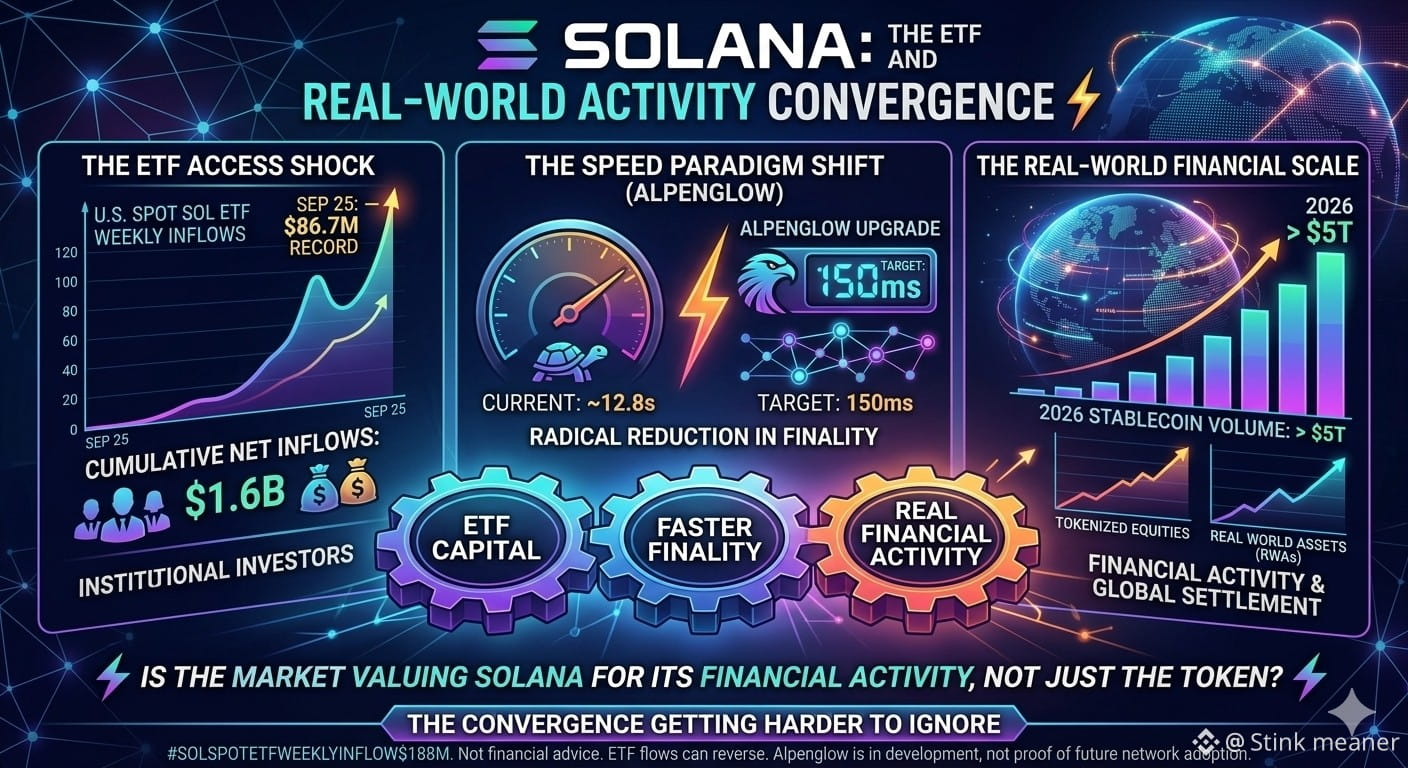
U.S. spot SOL ETFs pulled in roughly $188M last week, including a record $86.7M on Sept. 25. Cumulative net inflows are now around $1.6B.
But look at what is happening underneath the ETF flows.
Solana's next consensus upgrade, Alpenglow, targets roughly 150ms finality, down from about 12.8 seconds under the current system.
At the same time, Solana says 2026 stablecoin volume has already exceeded $5T, while tokenized equities and RWAs have moved into meaningful scale.
Put those together:
ETF access → institutional capital
Alpenglow → faster finality
stablecoins/RWAs → financial activity
The interesting question isn't simply whether investors want SOL.
Is the market beginning to value Solana for the financial activity its network can settle — not just for the token itself?
ETF inflows alone can't answer that.
But the convergence is getting harder to ignore.
Not financial advice. ETF flows can reverse, and Alpenglow is an upgrade in development rather than proof of future network adoption.
$SOL $SUPER $W
{future}(WUSDT)
{future}(SUPERUSDT)
{future}(SOLUSDT)
#InstitutionalAdoption #solana #Alpenglow #CryptoNews
⚡ Solana's ETF story is getting harder to describe as “just another altcoin trade.”...
#SOLSpotETFWeeklyInflow$188M
U.S. spot SOL ETFs pulled in roughly $188M last week, including a record $86.7M on Sept. 25. Cumulative net inflows are now around $1.6B.
But look at what is happening underneath the ETF flows.
Solana's next consensus upgrade, Alpenglow, targets roughly 150ms finality, down from about 12.8 seconds under the current system.
At the same time, Solana says 2026 stablecoin volume has already exceeded $5T, while tokenized equities and RWAs have moved into meaningful scale.
Put those together:
ETF access → institutional capital
Alpenglow → faster finality
stablecoins/RWAs → financial activity
The interesting question isn't simply whether investors want SOL.
Is the market beginning to value Solana for the financial activity its network can settle — not just for the token itself?
ETF inflows alone can't answer that.
But the convergence is getting harder to ignore.
Not financial advice. ETF flows can reverse, and Alpenglow is an upgrade in development rather than proof of future network adoption.
$SOL $SUPER $W
#InstitutionalAdoption #solana #Alpenglow #CryptoNews
#SOLSpotETFWeeklyInflow$188M
U.S. spot SOL ETFs pulled in roughly $188M last week, including a record $86.7M on Sept. 25. Cumulative net inflows are now around $1.6B.
But look at what is happening underneath the ETF flows.
Solana's next consensus upgrade, Alpenglow, targets roughly 150ms finality, down from about 12.8 seconds under the current system.
At the same time, Solana says 2026 stablecoin volume has already exceeded $5T, while tokenized equities and RWAs have moved into meaningful scale.
Put those together:
ETF access → institutional capital
Alpenglow → faster finality
stablecoins/RWAs → financial activity
The interesting question isn't simply whether investors want SOL.
Is the market beginning to value Solana for the financial activity its network can settle — not just for the token itself?
ETF inflows alone can't answer that.
But the convergence is getting harder to ignore.
Not financial advice. ETF flows can reverse, and Alpenglow is an upgrade in development rather than proof of future network adoption.
$SOL $SUPER $W
#InstitutionalAdoption #solana #Alpenglow #CryptoNews
2
527
ເຂົ້າສູ່ລະບົບເພື່ອສຳຫຼວດເນື້ອຫາເພີ່ມເຕີມ
ເຂົ້າຮ່ວມກຸ່ມຜູ້ໃຊ້ຄຣິບໂຕທົ່ວໂລກໃນ Binance Square.
⚡️ ໄດ້ຮັບຂໍ້ມູນຫຼ້າສຸດ ແລະ ທີ່ມີປະໂຫຍດກ່ຽວກັບຄຣິບໂຕ.
💬 ໄດ້ຮັບຄວາມໄວ້ວາງໃຈຈາກຕະຫຼາດແລກປ່ຽນຄຣິບໂຕທີ່ໃຫຍ່ທີ່ສຸດໃນໂລກ.
👍 ຄົ້ນຫາຂໍ້ມູນເຊີງເລິກທີ່ແທ້ຈາກນັກສ້າງທີ່ໄດ້ຮັບການຢືນຢັນ.
ອີເມວ / ເບີໂທລະສັບ
ຫົວຂໍ້ທີ່ກໍາລັງນິຍົມ
1
#EthStakingExitQueueHits2026High
5 views
19 ກຳລັງສົນທະນາ
2
#FedOctoberHoldOdds82.3%
3 views
15 ກຳລັງສົນທະນາ
3
#Nikkei225Jumps2.5%ToThreeMonthHigh
21,651 views
436 ກຳລັງສົນທະນາ
4
#CircleMints$2.75BUSDCOnSolanaIn7Days
0 views
0 ກຳລັງສົນທະນາ
5
#DriftHackVictimsBeginClaims
100,762 views
1,096 ກຳລັງສົນທະນາ
6
#SolanaTokenizedStockVolumeTops$4.4BInSeptember
9,174 views
103 ກຳລັງສົນທະນາ
7
#BitcoinSpotETFsDraw$6.34BInflowsInQ3
32,353 views
218 ກຳລັງສົນທະນາ
8
#EthereumValidatorExitQueueJumps392%
239,894 views
2,088 ກຳລັງສົນທະນາ
9
#IMFApprovesElSalvador$138MWithBitcoinWaiver
22,176 views
128 ກຳລັງສົນທະນາ
10
#SECHaltsCryptoETFReviewsAmidFundingLapse
359,954 views
2,768 ກຳລັງສົນທະນາ