

#apy
apy
40,182 ຄັ້ງທີ່ເບິ່ງ
147 ກຳລັງສົນທະນາ
ມາແຮງ
ຫຼ້າສຸດ

·
--
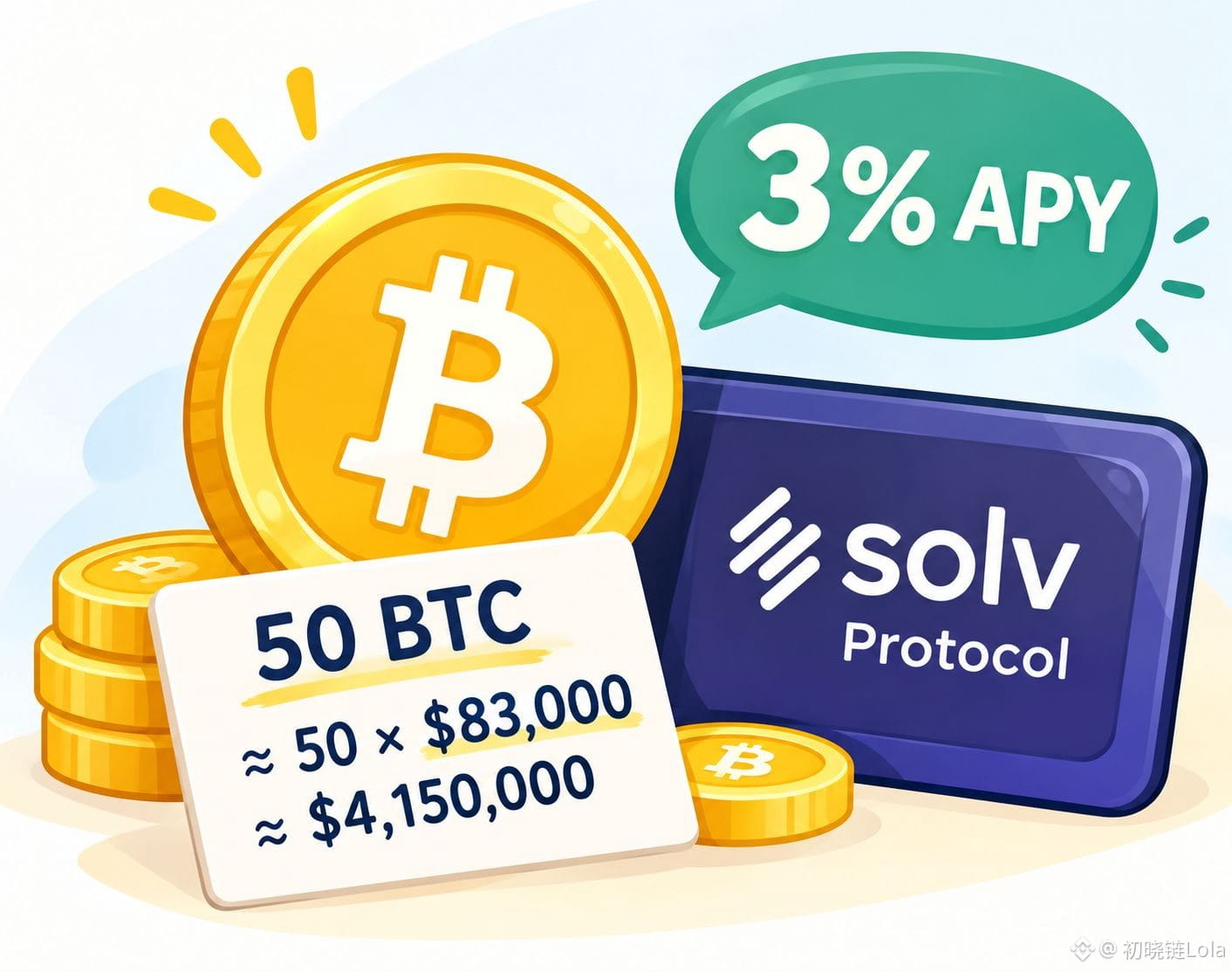
为了3%的年化,值得把50枚BTC交出去吗?
看到一个DeFi 玩家的自述,
他将50 $BTC 存入 #SolvProtocol 协议,
现在赎不回来了,
不炒山寨不做短期,只是想赚3%年化收益,
让手里的 BTC 获得被动收益,
但链上协议安全性未知,还有不确定性风险,
为了3%的年化,
真不值得把50枚BTC交给第三方吧。
7月份Solv Protocol协议 BTC+ 经历了铸造,赎回暂停以及安全事件,
后来项目方宣布相关功能恢复,
但这个玩家的地址依然无法正常赎回,
来回沟通了2个多月,依然无果,
现在50枚BTC被卡住了,
他发帖求助,希望通过舆论关注和社区讨论拿回自己的资产,
毕竟这不是小数目,
50枚 BTC,2700多万人民币呢!
很多人计算 DeFi 收益时,
首先想到的是这个协议有多少 APY?
但真正应该关注的是,
为了几个点收益,要承担什么风险?
智能合约风险,协议安全风险,预言机风险,流动性风险,以及合规和风控限制等,
这些平时看不见的风险,
真正出问题时,都是由玩家承担的。
链上资产虽然属于你,
能不能顺利拿回来,就是另外一回事。
把本金交给第三方时,就无法控制风险了。
小额资金体验 DeFi 协议无可厚非,
但如果持有一定数量BTC,还是不要冒风险,
宁可少赚一点,也要牢牢把握资金控制权,
尤其是10个BTC 以上级别的资金,
真不必为了几个点收益,把本金放进协议里,
毕竟收益有限,本金风险可能是非线性的。
赚几个点很开心,
如果本金出问题,所有收益都没有意义,
不要为一点芝麻,把最重要的本金交给别人。
#定投BTC #defi #APY
为了3%的年化,值得把50枚BTC交出去吗?
看到一个DeFi 玩家的自述,
他将50 $BTC 存入 #SolvProtocol 协议,
现在赎不回来了,
不炒山寨不做短期,只是想赚3%年化收益,
让手里的 BTC 获得被动收益,
但链上协议安全性未知,还有不确定性风险,
为了3%的年化,
真不值得把50枚BTC交给第三方吧。
7月份Solv Protocol协议 BTC+ 经历了铸造,赎回暂停以及安全事件,
后来项目方宣布相关功能恢复,
但这个玩家的地址依然无法正常赎回,
来回沟通了2个多月,依然无果,
现在50枚BTC被卡住了,
他发帖求助,希望通过舆论关注和社区讨论拿回自己的资产,
毕竟这不是小数目,
50枚 BTC,2700多万人民币呢!
很多人计算 DeFi 收益时,
首先想到的是这个协议有多少 APY?
但真正应该关注的是,
为了几个点收益,要承担什么风险?
智能合约风险,协议安全风险,预言机风险,流动性风险,以及合规和风控限制等,
这些平时看不见的风险,
真正出问题时,都是由玩家承担的。
链上资产虽然属于你,
能不能顺利拿回来,就是另外一回事。
把本金交给第三方时,就无法控制风险了。
小额资金体验 DeFi 协议无可厚非,
但如果持有一定数量BTC,还是不要冒风险,
宁可少赚一点,也要牢牢把握资金控制权,
尤其是10个BTC 以上级别的资金,
真不必为了几个点收益,把本金放进协议里,
毕竟收益有限,本金风险可能是非线性的。
赚几个点很开心,
如果本金出问题,所有收益都没有意义,
不要为一点芝麻,把最重要的本金交给别人。
#定投BTC #defi #APY
看到一个DeFi 玩家的自述,
他将50 $BTC 存入 #SolvProtocol 协议,
现在赎不回来了,
不炒山寨不做短期,只是想赚3%年化收益,
让手里的 BTC 获得被动收益,
但链上协议安全性未知,还有不确定性风险,
为了3%的年化,
真不值得把50枚BTC交给第三方吧。
7月份Solv Protocol协议 BTC+ 经历了铸造,赎回暂停以及安全事件,
后来项目方宣布相关功能恢复,
但这个玩家的地址依然无法正常赎回,
来回沟通了2个多月,依然无果,
现在50枚BTC被卡住了,
他发帖求助,希望通过舆论关注和社区讨论拿回自己的资产,
毕竟这不是小数目,
50枚 BTC,2700多万人民币呢!
很多人计算 DeFi 收益时,
首先想到的是这个协议有多少 APY?
但真正应该关注的是,
为了几个点收益,要承担什么风险?
智能合约风险,协议安全风险,预言机风险,流动性风险,以及合规和风控限制等,
这些平时看不见的风险,
真正出问题时,都是由玩家承担的。
链上资产虽然属于你,
能不能顺利拿回来,就是另外一回事。
把本金交给第三方时,就无法控制风险了。
小额资金体验 DeFi 协议无可厚非,
但如果持有一定数量BTC,还是不要冒风险,
宁可少赚一点,也要牢牢把握资金控制权,
尤其是10个BTC 以上级别的资金,
真不必为了几个点收益,把本金放进协议里,
毕竟收益有限,本金风险可能是非线性的。
赚几个点很开心,
如果本金出问题,所有收益都没有意义,
不要为一点芝麻,把最重要的本金交给别人。
#定投BTC #defi #APY
2
5
3.2k

·
--
ບົດຄວາມ
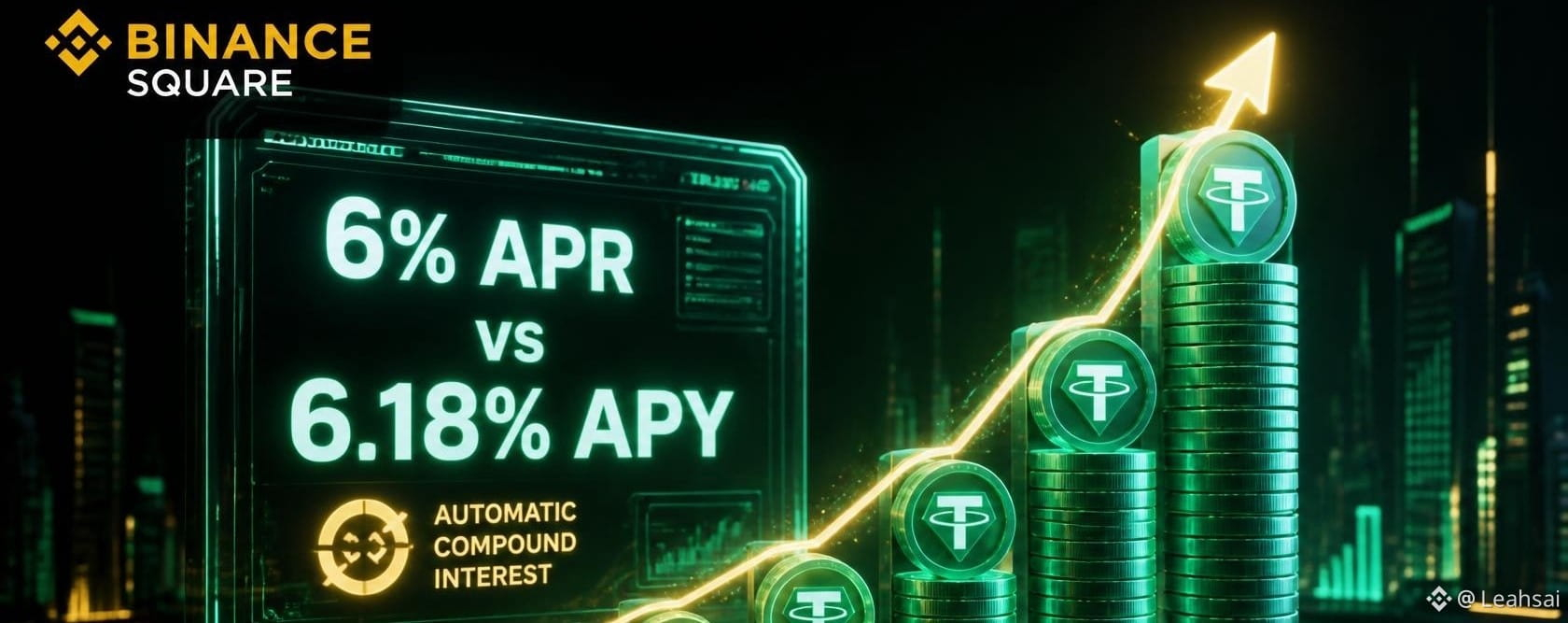
🚀 ¿QUÉ ES EL APY Y CÓMO EL INTERÉS COMPUESTO HACE CRECER TUS CRIPTOS? 🧠💰Ayer te hablé del APR, pero hoy toca hablar de la verdadera "magia" en el mundo financiero: el APY y el Interés Compuesto.
Si en Binance Earn ves dos productos con el mismo porcentaje pero uno dice APR y el otro APY, ¡no son lo mismo! Te explico en español claro cómo funciona para que le saques hasta el último centavo a tus ahorros:
📌 ¿Qué es el APY?
El APY (Rendimiento Anual Efectivo) es la ganancia real que obtienes en un año incluyendo el interés compuesto. Es decir, asume que tus ganancias diarias no se quedan guardadas acumulando polvo, sino que se reinvierten automáticamente para generar más intereses sobre los intereses que ya ganaste.
🧮 La matemática en términos sencillos:
Si la tasa se capitaliza diariamente (como pasa en muchos productos de Earn):
APY = (1 + APR ÷ 365)³⁶⁵ − 1
🔎 Hagamos la prueba con $1,000 USDT al 6%:
Si pones 1,000 USDT en un producto con un 6% de tasa:
🔴 Con APR (Sin reinvertir tus ganancias): Al final del año ganas ~60 USDT.🟢 Con APY (Reinvirtiendo intereses todos los días): Al final del año ganas ~61.83 USDT.
¡Parece una diferencia pequeña al principio, pero con montos mayores y a largo plazo, el efecto bola de nieve del interés compuesto es gigantesco! 📈
⚠️ 2 Secretos para que el APY funcione de verdad en Binance:
1️⃣ Activa la Suscripción Automática: El APY solo se cumple si los intereses efectivamente se reinvierten. Si dejas que tus ganancias diarias caigan a tu Billetera Spot y no las vuelves a meter a Earn, solo te quedarás con el rendimiento base (APR).
2️⃣ El APY en productos Flexibles NO es garantizado: Recuerda que las tasas de mercado pueden subir o bajar día a día, por lo que el cálculo final es una proyección estimada.
💡 En resumen: El APR es tu ganancia simple; el APY es tu ganancia poniendo tus propios intereses a trabajar por ti.
👇 PREGUNTA PARA LA COMUNIDAD:
¿Tienes activada la opción de "Suscripción Automática" en Binance Earn o prefieres retirar tus intereses a Spot?
❤️ ¡Dale LIKE, GUARDA este post para no olvidar la diferencia y REPOSTEA para educar a la comunidad!
$BTC #apy #earn $USDT
{spot}(BTCUSDT)
🚀 ¿QUÉ ES EL APY Y CÓMO EL INTERÉS COMPUESTO HACE CRECER TUS CRIPTOS? 🧠💰
Ayer te hablé del APR, pero hoy toca hablar de la verdadera "magia" en el mundo financiero: el APY y el Interés Compuesto.
Si en Binance Earn ves dos productos con el mismo porcentaje pero uno dice APR y el otro APY, ¡no son lo mismo! Te explico en español claro cómo funciona para que le saques hasta el último centavo a tus ahorros:
📌 ¿Qué es el APY?
El APY (Rendimiento Anual Efectivo) es la ganancia real que obtienes en un año incluyendo el interés compuesto. Es decir, asume que tus ganancias diarias no se quedan guardadas acumulando polvo, sino que se reinvierten automáticamente para generar más intereses sobre los intereses que ya ganaste.
🧮 La matemática en términos sencillos:
Si la tasa se capitaliza diariamente (como pasa en muchos productos de Earn):
APY = (1 + APR ÷ 365)³⁶⁵ − 1
🔎 Hagamos la prueba con $1,000 USDT al 6%:
Si pones 1,000 USDT en un producto con un 6% de tasa:
🔴 Con APR (Sin reinvertir tus ganancias): Al final del año ganas ~60 USDT.🟢 Con APY (Reinvirtiendo intereses todos los días): Al final del año ganas ~61.83 USDT.
¡Parece una diferencia pequeña al principio, pero con montos mayores y a largo plazo, el efecto bola de nieve del interés compuesto es gigantesco! 📈
⚠️ 2 Secretos para que el APY funcione de verdad en Binance:
1️⃣ Activa la Suscripción Automática: El APY solo se cumple si los intereses efectivamente se reinvierten. Si dejas que tus ganancias diarias caigan a tu Billetera Spot y no las vuelves a meter a Earn, solo te quedarás con el rendimiento base (APR).
2️⃣ El APY en productos Flexibles NO es garantizado: Recuerda que las tasas de mercado pueden subir o bajar día a día, por lo que el cálculo final es una proyección estimada.
💡 En resumen: El APR es tu ganancia simple; el APY es tu ganancia poniendo tus propios intereses a trabajar por ti.
👇 PREGUNTA PARA LA COMUNIDAD:
¿Tienes activada la opción de "Suscripción Automática" en Binance Earn o prefieres retirar tus intereses a Spot?
❤️ ¡Dale LIKE, GUARDA este post para no olvidar la diferencia y REPOSTEA para educar a la comunidad!
$BTC #apy #earn $USDT
Si en Binance Earn ves dos productos con el mismo porcentaje pero uno dice APR y el otro APY, ¡no son lo mismo! Te explico en español claro cómo funciona para que le saques hasta el último centavo a tus ahorros:
📌 ¿Qué es el APY?
El APY (Rendimiento Anual Efectivo) es la ganancia real que obtienes en un año incluyendo el interés compuesto. Es decir, asume que tus ganancias diarias no se quedan guardadas acumulando polvo, sino que se reinvierten automáticamente para generar más intereses sobre los intereses que ya ganaste.
🧮 La matemática en términos sencillos:
Si la tasa se capitaliza diariamente (como pasa en muchos productos de Earn):
APY = (1 + APR ÷ 365)³⁶⁵ − 1
🔎 Hagamos la prueba con $1,000 USDT al 6%:
Si pones 1,000 USDT en un producto con un 6% de tasa:
🔴 Con APR (Sin reinvertir tus ganancias): Al final del año ganas ~60 USDT.🟢 Con APY (Reinvirtiendo intereses todos los días): Al final del año ganas ~61.83 USDT.
¡Parece una diferencia pequeña al principio, pero con montos mayores y a largo plazo, el efecto bola de nieve del interés compuesto es gigantesco! 📈
⚠️ 2 Secretos para que el APY funcione de verdad en Binance:
1️⃣ Activa la Suscripción Automática: El APY solo se cumple si los intereses efectivamente se reinvierten. Si dejas que tus ganancias diarias caigan a tu Billetera Spot y no las vuelves a meter a Earn, solo te quedarás con el rendimiento base (APR).
2️⃣ El APY en productos Flexibles NO es garantizado: Recuerda que las tasas de mercado pueden subir o bajar día a día, por lo que el cálculo final es una proyección estimada.
💡 En resumen: El APR es tu ganancia simple; el APY es tu ganancia poniendo tus propios intereses a trabajar por ti.
👇 PREGUNTA PARA LA COMUNIDAD:
¿Tienes activada la opción de "Suscripción Automática" en Binance Earn o prefieres retirar tus intereses a Spot?
❤️ ¡Dale LIKE, GUARDA este post para no olvidar la diferencia y REPOSTEA para educar a la comunidad!
$BTC #apy #earn $USDT
1
4
175

#BinanceEarn може бути цікавим інструментом для отримання винагороди від криптоактивів, але важливо не сприймати заявлену дохідність як гарантований прибуток. Перед використанням я б звертав увагу на #APY , термін продукту, можливість дострокового викупу та ризики самого активу. Крипторинок залишається волатильним, тому Earn логічніше розглядати як частину стратегії, а не спосіб зберігати всі кошти.
У своїй стратегії я б розглядав #BinanceEarn як інструмент для тієї частини криптопортфеля, яку не планую активно торгувати найближчим часом. Ідея проста: замість того щоб активи просто залишалися без використання, можна обрати відповідний Earn-продукт і потенційно отримувати винагороду. Але я б не концентрував там увесь капітал: диверсифікація, ліквідність і розуміння ризиків залишаються пріоритетом.
#Binance
#BinanceEarn може бути цікавим інструментом для отримання винагороди від криптоактивів, але важливо не сприймати заявлену дохідність як гарантований прибуток. Перед використанням я б звертав увагу на #APY , термін продукту, можливість дострокового викупу та ризики самого активу. Крипторинок залишається волатильним, тому Earn логічніше розглядати як частину стратегії, а не спосіб зберігати всі кошти.
У своїй стратегії я б розглядав #BinanceEarn як інструмент для тієї частини криптопортфеля, яку не планую активно торгувати найближчим часом. Ідея проста: замість того щоб активи просто залишалися без використання, можна обрати відповідний Earn-продукт і потенційно отримувати винагороду. Але я б не концентрував там увесь капітал: диверсифікація, ліквідність і розуміння ризиків залишаються пріоритетом.
#Binance
У своїй стратегії я б розглядав #BinanceEarn як інструмент для тієї частини криптопортфеля, яку не планую активно торгувати найближчим часом. Ідея проста: замість того щоб активи просто залишалися без використання, можна обрати відповідний Earn-продукт і потенційно отримувати винагороду. Але я б не концентрував там увесь капітал: диверсифікація, ліквідність і розуміння ризиків залишаються пріоритетом.
#Binance
1
83

·
--
💎🔥 DeFi Yields Pumping — DOT 14% APY Crushing Stablecoin Returns!
🔹 DOT staking hits 14% APY — leaving $USDC boring 6% in the dust 💰📈
🔹 Sui delivers 10% APY while Aptos offers 9% — smaller caps = bigger rewards 🚀⚡
🔹 Blue-chip protocols stabilizing — Aave, Curve, Yearn showing 5-8% sustainable yields 🛡️💪
🔹 Risk-adjusted sweet spot — mid-tier PoS chains crushing both CeFi banks and risky farms 🎯✅
🔹 Total DeFi TVL now multi-chain paradise — your coins working harder than your day job 💸🔥
Stop holding dead stablecoins. Your crypto should breed 🐂💎
{future}(USDCUSDT)
#DeFi #Staking #APY
💎🔥 DeFi Yields Pumping — DOT 14% APY Crushing Stablecoin Returns!
🔹 DOT staking hits 14% APY — leaving $USDC boring 6% in the dust 💰📈
🔹 Sui delivers 10% APY while Aptos offers 9% — smaller caps = bigger rewards 🚀⚡
🔹 Blue-chip protocols stabilizing — Aave, Curve, Yearn showing 5-8% sustainable yields 🛡️💪
🔹 Risk-adjusted sweet spot — mid-tier PoS chains crushing both CeFi banks and risky farms 🎯✅
🔹 Total DeFi TVL now multi-chain paradise — your coins working harder than your day job 💸🔥
Stop holding dead stablecoins. Your crypto should breed 🐂💎
#DeFi #Staking #APY
🔹 DOT staking hits 14% APY — leaving $USDC boring 6% in the dust 💰📈
🔹 Sui delivers 10% APY while Aptos offers 9% — smaller caps = bigger rewards 🚀⚡
🔹 Blue-chip protocols stabilizing — Aave, Curve, Yearn showing 5-8% sustainable yields 🛡️💪
🔹 Risk-adjusted sweet spot — mid-tier PoS chains crushing both CeFi banks and risky farms 🎯✅
🔹 Total DeFi TVL now multi-chain paradise — your coins working harder than your day job 💸🔥
Stop holding dead stablecoins. Your crypto should breed 🐂💎
#DeFi #Staking #APY
145

·
--
One thing I’ve noticed about stablecoin yield is that the highest number isn’t always the first thing worth looking at.
The strategy behind the yield usually tells a much bigger story.
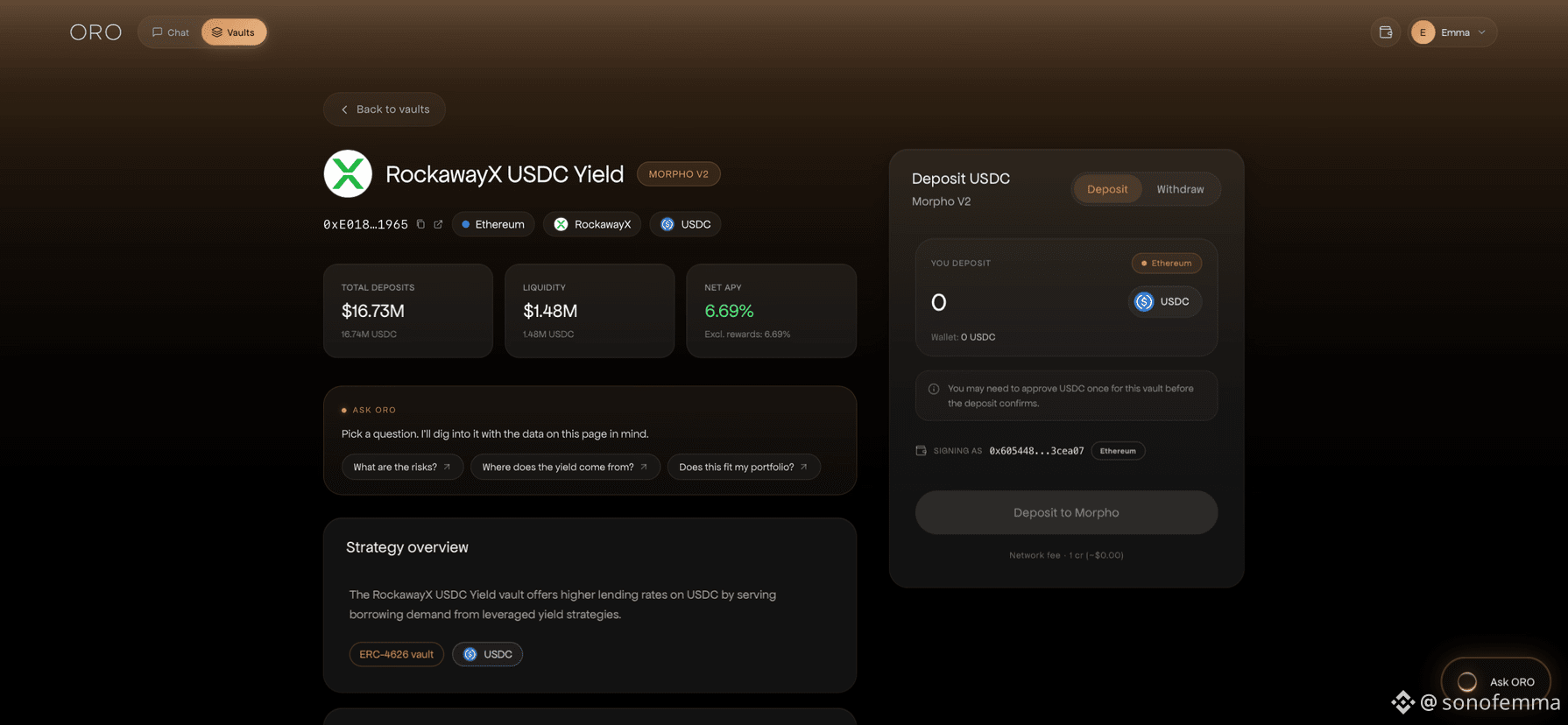
That’s what stood out to me while looking at the RockawayX USDC Yield vault available through ORO.
At first glance, the numbers are solid.
• $16.73M in total deposits.
• $1.48M in available liquidity.
• 6.69% Net APY.
But what interested me more was how the yield is generated.
Rather than relying on short-term incentives, the vault supplies USDC into borrowing markets where demand comes from leveraged yield strategies.
In other words, the return is linked to borrowing activity instead of temporary reward emissions.
A few other details are worth noting:
• Built on Morpho V2.
• ERC-4626 vault standard.
• 0% management fee.
• 5% performance fee.
• Vault launched on 23 March 2026.
Numbers alone never tell the full story.
Understanding where the yield comes from is just as important as knowing the APY itself.
That’s one reason I like exploring vaults through ORO.
Instead of stopping at the headline figures, you can dig into the strategy, assess the risks, and decide whether a vault actually fits your objectives.
The next vault you research might surprise you. ORO is a good place to start digging.
#vault #defi #APY
One thing I’ve noticed about stablecoin yield is that the highest number isn’t always the first thing worth looking at.
The strategy behind the yield usually tells a much bigger story.
That’s what stood out to me while looking at the RockawayX USDC Yield vault available through ORO.
At first glance, the numbers are solid.
• $16.73M in total deposits.
• $1.48M in available liquidity.
• 6.69% Net APY.
But what interested me more was how the yield is generated.
Rather than relying on short-term incentives, the vault supplies USDC into borrowing markets where demand comes from leveraged yield strategies.
In other words, the return is linked to borrowing activity instead of temporary reward emissions.
A few other details are worth noting:
• Built on Morpho V2.
• ERC-4626 vault standard.
• 0% management fee.
• 5% performance fee.
• Vault launched on 23 March 2026.
Numbers alone never tell the full story.
Understanding where the yield comes from is just as important as knowing the APY itself.
That’s one reason I like exploring vaults through ORO.
Instead of stopping at the headline figures, you can dig into the strategy, assess the risks, and decide whether a vault actually fits your objectives.
The next vault you research might surprise you. ORO is a good place to start digging.
#vault #defi #APY
The strategy behind the yield usually tells a much bigger story.
That’s what stood out to me while looking at the RockawayX USDC Yield vault available through ORO.
At first glance, the numbers are solid.
• $16.73M in total deposits.
• $1.48M in available liquidity.
• 6.69% Net APY.
But what interested me more was how the yield is generated.
Rather than relying on short-term incentives, the vault supplies USDC into borrowing markets where demand comes from leveraged yield strategies.
In other words, the return is linked to borrowing activity instead of temporary reward emissions.
A few other details are worth noting:
• Built on Morpho V2.
• ERC-4626 vault standard.
• 0% management fee.
• 5% performance fee.
• Vault launched on 23 March 2026.
Numbers alone never tell the full story.
Understanding where the yield comes from is just as important as knowing the APY itself.
That’s one reason I like exploring vaults through ORO.
Instead of stopping at the headline figures, you can dig into the strategy, assess the risks, and decide whether a vault actually fits your objectives.
The next vault you research might surprise you. ORO is a good place to start digging.
#vault #defi #APY
1
67

·
--
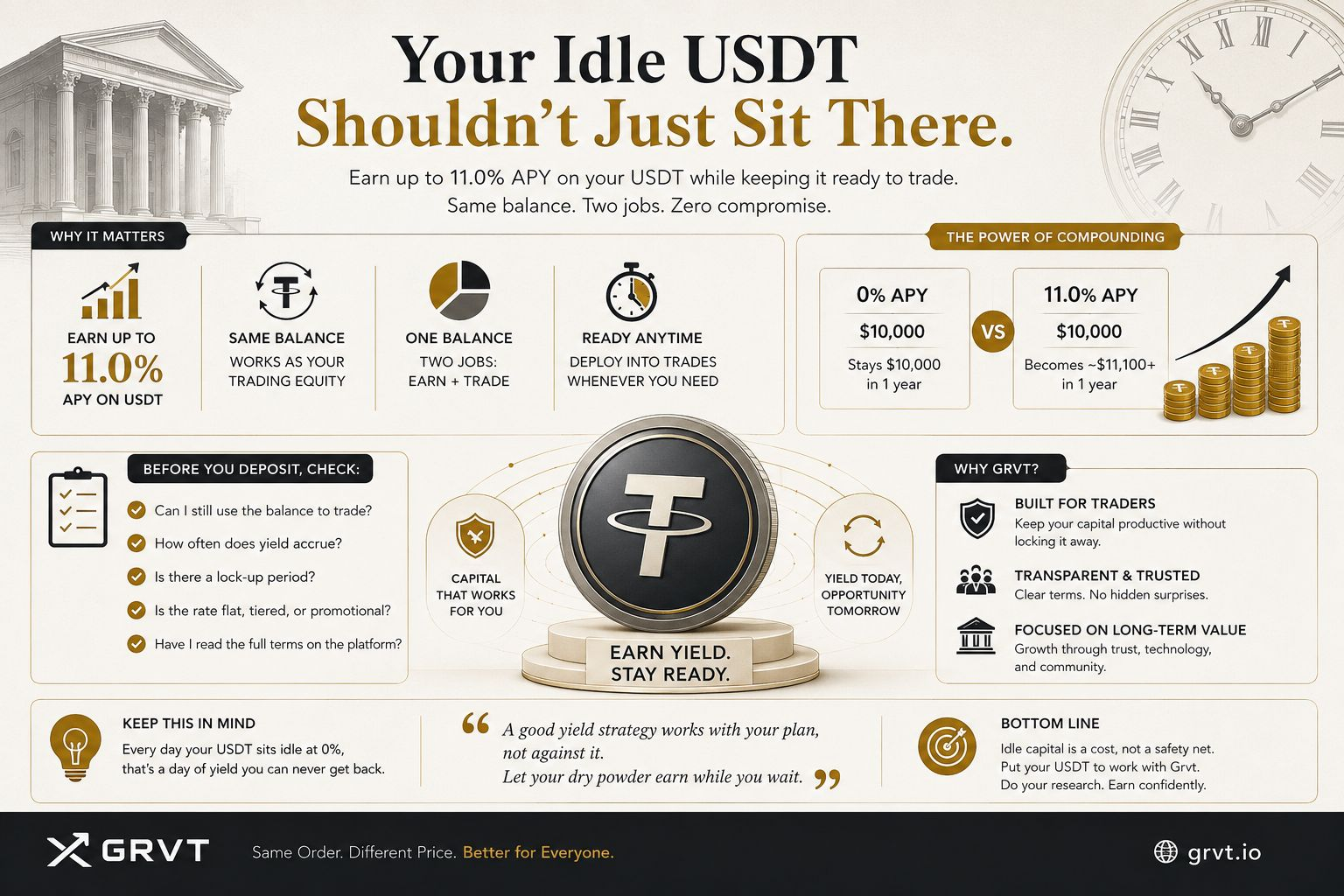
Your idle USDT shouldn't just sit there. 😅
Most traders keep a stash of USDT on the sidelines — dry powder, ready for the next opportunity. That's smart risk management. But here's the catch: if that balance is earning 0%, it's quietly losing ground while you wait. Inflation doesn't pause just because your capital is "on standby."
@grvt_io just sent a reminder on exactly this: if your USDT balance has been sitting at zero since you signed up, you're leaving real yield on the table every single day.
Here's what makes their offer worth a closer look 👇
🔹 Up to 11.0% APY on your USDT
🔹 Same balance still works as your trading equity — no separate lock-up needed
🔹 One balance, two jobs: earning yield AND ready to deploy into trades whenever you need it.
💡 Why this actually matters: APY isn't a flat number, it compounds. $10,000 at 11.0% APY isn't just +$1,100 at year end — you're earning yield on the yield you've already accumulated too. The longer that balance sits and compounds, the wider the gap grows between it and a balance earning nothing at all.
Think of it this way: every day your USDT sits idle at 0%, that's a day of yield you can never get back. Compounding rewards early deposits — the sooner idle capital starts working, the more it benefits from time in the "yield curve."
🧠 Before depositing anywhere (Grvt or otherwise), it's worth checking a few basics:
✅ Can I still use the balance to trade, or is it locked away separately?
✅ How often does yield actually accrue — daily, weekly, monthly?
✅ Is there a lock-up period, or can I withdraw freely?
✅ Is the rate flat, tiered, or promotional/temporary?
✅ Have I read the full terms directly on the platform?
None of this is a reason to avoid yield products — it's just due diligence. A good yield offer should work with your trading strategy, not against it. The best setups let your capital multitask: sitting ready for your next trade while still generating a return in the meantime.
#Grvt #USDT #APY
Your idle USDT shouldn't just sit there. 😅
Most traders keep a stash of USDT on the sidelines — dry powder, ready for the next opportunity. That's smart risk management. But here's the catch: if that balance is earning 0%, it's quietly losing ground while you wait. Inflation doesn't pause just because your capital is "on standby."
@grvt_io just sent a reminder on exactly this: if your USDT balance has been sitting at zero since you signed up, you're leaving real yield on the table every single day.
Here's what makes their offer worth a closer look 👇
🔹 Up to 11.0% APY on your USDT
🔹 Same balance still works as your trading equity — no separate lock-up needed
🔹 One balance, two jobs: earning yield AND ready to deploy into trades whenever you need it.
💡 Why this actually matters: APY isn't a flat number, it compounds. $10,000 at 11.0% APY isn't just +$1,100 at year end — you're earning yield on the yield you've already accumulated too. The longer that balance sits and compounds, the wider the gap grows between it and a balance earning nothing at all.
Think of it this way: every day your USDT sits idle at 0%, that's a day of yield you can never get back. Compounding rewards early deposits — the sooner idle capital starts working, the more it benefits from time in the "yield curve."
🧠 Before depositing anywhere (Grvt or otherwise), it's worth checking a few basics:
✅ Can I still use the balance to trade, or is it locked away separately?
✅ How often does yield actually accrue — daily, weekly, monthly?
✅ Is there a lock-up period, or can I withdraw freely?
✅ Is the rate flat, tiered, or promotional/temporary?
✅ Have I read the full terms directly on the platform?
None of this is a reason to avoid yield products — it's just due diligence. A good yield offer should work with your trading strategy, not against it. The best setups let your capital multitask: sitting ready for your next trade while still generating a return in the meantime.
#Grvt #USDT #APY
Most traders keep a stash of USDT on the sidelines — dry powder, ready for the next opportunity. That's smart risk management. But here's the catch: if that balance is earning 0%, it's quietly losing ground while you wait. Inflation doesn't pause just because your capital is "on standby."
@grvt_io just sent a reminder on exactly this: if your USDT balance has been sitting at zero since you signed up, you're leaving real yield on the table every single day.
Here's what makes their offer worth a closer look 👇
🔹 Up to 11.0% APY on your USDT
🔹 Same balance still works as your trading equity — no separate lock-up needed
🔹 One balance, two jobs: earning yield AND ready to deploy into trades whenever you need it.
💡 Why this actually matters: APY isn't a flat number, it compounds. $10,000 at 11.0% APY isn't just +$1,100 at year end — you're earning yield on the yield you've already accumulated too. The longer that balance sits and compounds, the wider the gap grows between it and a balance earning nothing at all.
Think of it this way: every day your USDT sits idle at 0%, that's a day of yield you can never get back. Compounding rewards early deposits — the sooner idle capital starts working, the more it benefits from time in the "yield curve."
🧠 Before depositing anywhere (Grvt or otherwise), it's worth checking a few basics:
✅ Can I still use the balance to trade, or is it locked away separately?
✅ How often does yield actually accrue — daily, weekly, monthly?
✅ Is there a lock-up period, or can I withdraw freely?
✅ Is the rate flat, tiered, or promotional/temporary?
✅ Have I read the full terms directly on the platform?
None of this is a reason to avoid yield products — it's just due diligence. A good yield offer should work with your trading strategy, not against it. The best setups let your capital multitask: sitting ready for your next trade while still generating a return in the meantime.
#Grvt #USDT #APY
6
12
90

·
--
ບົດຄວາມ
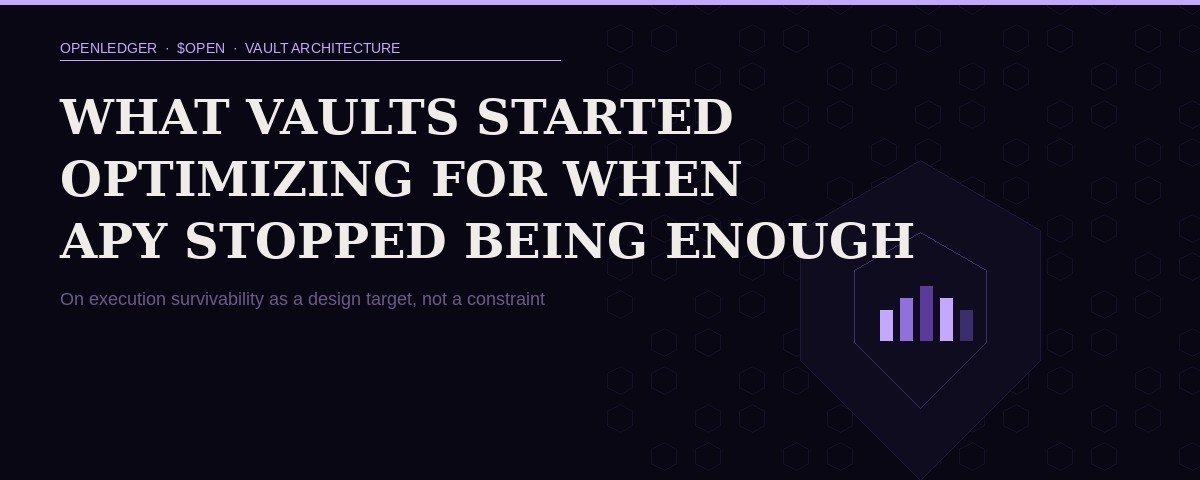
APY Described a Best Case. Execution Survivability Describes the Rest@Openledger
There is a small but telling shift in how certain DeFi infrastructure teams have started describing their vault products. The word "yield" appears less often in the lead sentence. In its place, words like "resilience," "execution," and "survivability" have begun to carry more weight. It would be easy to read this as rebranding, the kind of vocabulary rotation that happens when a narrative gets crowded. But looking more carefully at what is actually changing in vault architecture, and specifically at how OpenLedger has framed its execution-aware vault design, the shift seems to reflect something more structural than cosmetic.
For most of DeFi's early growth period, the vault was defined almost entirely by its output. The question a protocol asked about its vault was essentially one question: what is the APY? Strategies were designed, compared, and marketed around yield percentage. Users allocated capital accordingly. The infrastructure serving those vaults, the routing logic, the rebalancing mechanisms, the oracle dependencies, was largely invisible as long as the number at the top of the interface stayed competitive. The vault was a yield machine, and the yield was the product.
What that framing obscured was a different set of questions that were quietly accumulating behind the number. What happens to the strategy when liquidity conditions change rapidly? What happens when slippage on a rebalancing event eats a meaningful portion of the yield being generated? What happens when the execution pathway the vault depends on becomes unreliable mid-cycle? These are not hypothetical edge cases. Anyone who observed vault behavior during periods of high volatility or network congestion encountered them as operational realities. The APY figure, it turned out, described a best-case scenario more often than it described an expected one.
The concept of execution survivability, as a design orientation, is an attempt to make those questions primary rather than secondary. The basic reframe is this: a vault's value is not simply the yield it generates under favorable conditions, but its capacity to preserve capital and continue functioning under the conditions it will actually encounter. That is a different optimization target, and it implies a different set of infrastructure decisions.
To understand what this looks like in practice, it helps to think through what a vault actually does at each stage of its operation. In the first stage, the vault receives capital and deploys it into one or more yield-generating positions. In the second stage, it monitors those positions against a set of conditions, rebalancing or rotating as the strategy requires. In the third stage, it handles withdrawals, which may or may not align with periods of favorable liquidity. Each of these stages has an execution component that is distinct from the yield-generation logic itself. The deployment has to clear slippage thresholds. The rebalancing has to execute at a cost that does not erode the position being preserved. The withdrawal has to settle without triggering adverse price impact.
An execution-aware vault, as OpenLedger frames it, is one that treats these execution conditions as first-class inputs to strategy decisions rather than incidental costs to be absorbed after the fact. The intelligence layer around the vault is not just watching yield rates. It is watching execution quality, liquidity depth, gas conditions, and counterparty availability at each stage. When execution conditions deteriorate past a certain threshold, the vault can modify its behavior, delay a rebalancing event, shift the timing of a withdrawal processing window, or hold a position rather than rotate it into worse execution conditions. The yield logic and the execution logic are coupled, rather than operating in separate layers.
OpenLedger's broader infrastructure thesis is relevant context here. The protocol is built around the idea that better data, sourced and verified across a decentralized contributor network, produces better on-chain decision-making. The execution-aware vault design sits inside that thesis in a reasonably coherent way. If the vault's strategy layer is making decisions based on real-time execution quality data, the reliability of that data matters enormously. A vault that delays a rebalancing event because its data suggests poor liquidity conditions needs to be confident that the liquidity reading is accurate, not stale, not manipulated, not drawn from a single unreliable source. That is where the data infrastructure and the vault design intersect, at least in principle.
What I find worth examining carefully is the gap between the framing and the implementation. Describing a vault as execution-aware is a positioning choice. Demonstrating that the execution awareness is granular enough to make a meaningful difference during the events that matter most, a flash liquidity shock, a sustained congestion period, a correlated deleveraging across multiple pools, is a separate and harder thing. The architecture can be oriented toward survivability while still encountering limits in the conditions it was built to navigate. That is not a critique of the design direction; it is a general truth about infrastructure that promises adaptive behavior in adversarial conditions.
There is also a question about what users are actually selecting for when they choose a vault. The shift toward execution survivability as a design priority makes strong sense from a risk management perspective, but DeFi's capital allocation behavior has historically been driven by yield visibility rather than execution quality. A vault that sacrifices some APY in favorable conditions to preserve execution integrity in unfavorable ones is making a trade that requires users to value the downside protection as much as the upside number. Whether that preference has genuinely shifted in the user base, or whether it remains more present in the infrastructure design conversation than in actual allocation decisions, is something that deployment data over time would need to answer.
What I keep returning to is the nature of the reframe itself. Treating execution survivability as the optimization target rather than a constraint around yield generation changes what the vault is for. It is no longer primarily an instrument for extracting returns from available strategies. It is, at least partly, an instrument for maintaining operational integrity across conditions the designer cannot fully anticipate. That is a more modest claim in some ways and a more serious one in others.
The question worth sitting with is whether the infrastructure being built around this framing will be tested by the conditions that would actually demonstrate it, and whether the record of those tests will be legible enough to tell us something true about what execution-aware design actually delivers when it matters. #OpenLedger
$OPEN #APY
APY Described a Best Case. Execution Survivability Describes the Rest
@OpenLedger
There is a small but telling shift in how certain DeFi infrastructure teams have started describing their vault products. The word "yield" appears less often in the lead sentence. In its place, words like "resilience," "execution," and "survivability" have begun to carry more weight. It would be easy to read this as rebranding, the kind of vocabulary rotation that happens when a narrative gets crowded. But looking more carefully at what is actually changing in vault architecture, and specifically at how OpenLedger has framed its execution-aware vault design, the shift seems to reflect something more structural than cosmetic.
For most of DeFi's early growth period, the vault was defined almost entirely by its output. The question a protocol asked about its vault was essentially one question: what is the APY? Strategies were designed, compared, and marketed around yield percentage. Users allocated capital accordingly. The infrastructure serving those vaults, the routing logic, the rebalancing mechanisms, the oracle dependencies, was largely invisible as long as the number at the top of the interface stayed competitive. The vault was a yield machine, and the yield was the product.
What that framing obscured was a different set of questions that were quietly accumulating behind the number. What happens to the strategy when liquidity conditions change rapidly? What happens when slippage on a rebalancing event eats a meaningful portion of the yield being generated? What happens when the execution pathway the vault depends on becomes unreliable mid-cycle? These are not hypothetical edge cases. Anyone who observed vault behavior during periods of high volatility or network congestion encountered them as operational realities. The APY figure, it turned out, described a best-case scenario more often than it described an expected one.
The concept of execution survivability, as a design orientation, is an attempt to make those questions primary rather than secondary. The basic reframe is this: a vault's value is not simply the yield it generates under favorable conditions, but its capacity to preserve capital and continue functioning under the conditions it will actually encounter. That is a different optimization target, and it implies a different set of infrastructure decisions.
To understand what this looks like in practice, it helps to think through what a vault actually does at each stage of its operation. In the first stage, the vault receives capital and deploys it into one or more yield-generating positions. In the second stage, it monitors those positions against a set of conditions, rebalancing or rotating as the strategy requires. In the third stage, it handles withdrawals, which may or may not align with periods of favorable liquidity. Each of these stages has an execution component that is distinct from the yield-generation logic itself. The deployment has to clear slippage thresholds. The rebalancing has to execute at a cost that does not erode the position being preserved. The withdrawal has to settle without triggering adverse price impact.
An execution-aware vault, as OpenLedger frames it, is one that treats these execution conditions as first-class inputs to strategy decisions rather than incidental costs to be absorbed after the fact. The intelligence layer around the vault is not just watching yield rates. It is watching execution quality, liquidity depth, gas conditions, and counterparty availability at each stage. When execution conditions deteriorate past a certain threshold, the vault can modify its behavior, delay a rebalancing event, shift the timing of a withdrawal processing window, or hold a position rather than rotate it into worse execution conditions. The yield logic and the execution logic are coupled, rather than operating in separate layers.
OpenLedger's broader infrastructure thesis is relevant context here. The protocol is built around the idea that better data, sourced and verified across a decentralized contributor network, produces better on-chain decision-making. The execution-aware vault design sits inside that thesis in a reasonably coherent way. If the vault's strategy layer is making decisions based on real-time execution quality data, the reliability of that data matters enormously. A vault that delays a rebalancing event because its data suggests poor liquidity conditions needs to be confident that the liquidity reading is accurate, not stale, not manipulated, not drawn from a single unreliable source. That is where the data infrastructure and the vault design intersect, at least in principle.
What I find worth examining carefully is the gap between the framing and the implementation. Describing a vault as execution-aware is a positioning choice. Demonstrating that the execution awareness is granular enough to make a meaningful difference during the events that matter most, a flash liquidity shock, a sustained congestion period, a correlated deleveraging across multiple pools, is a separate and harder thing. The architecture can be oriented toward survivability while still encountering limits in the conditions it was built to navigate. That is not a critique of the design direction; it is a general truth about infrastructure that promises adaptive behavior in adversarial conditions.
There is also a question about what users are actually selecting for when they choose a vault. The shift toward execution survivability as a design priority makes strong sense from a risk management perspective, but DeFi's capital allocation behavior has historically been driven by yield visibility rather than execution quality. A vault that sacrifices some APY in favorable conditions to preserve execution integrity in unfavorable ones is making a trade that requires users to value the downside protection as much as the upside number. Whether that preference has genuinely shifted in the user base, or whether it remains more present in the infrastructure design conversation than in actual allocation decisions, is something that deployment data over time would need to answer.
What I keep returning to is the nature of the reframe itself. Treating execution survivability as the optimization target rather than a constraint around yield generation changes what the vault is for. It is no longer primarily an instrument for extracting returns from available strategies. It is, at least partly, an instrument for maintaining operational integrity across conditions the designer cannot fully anticipate. That is a more modest claim in some ways and a more serious one in others.
The question worth sitting with is whether the infrastructure being built around this framing will be tested by the conditions that would actually demonstrate it, and whether the record of those tests will be legible enough to tell us something true about what execution-aware design actually delivers when it matters. #OpenLedger
$OPEN #APY
There is a small but telling shift in how certain DeFi infrastructure teams have started describing their vault products. The word "yield" appears less often in the lead sentence. In its place, words like "resilience," "execution," and "survivability" have begun to carry more weight. It would be easy to read this as rebranding, the kind of vocabulary rotation that happens when a narrative gets crowded. But looking more carefully at what is actually changing in vault architecture, and specifically at how OpenLedger has framed its execution-aware vault design, the shift seems to reflect something more structural than cosmetic.
For most of DeFi's early growth period, the vault was defined almost entirely by its output. The question a protocol asked about its vault was essentially one question: what is the APY? Strategies were designed, compared, and marketed around yield percentage. Users allocated capital accordingly. The infrastructure serving those vaults, the routing logic, the rebalancing mechanisms, the oracle dependencies, was largely invisible as long as the number at the top of the interface stayed competitive. The vault was a yield machine, and the yield was the product.
What that framing obscured was a different set of questions that were quietly accumulating behind the number. What happens to the strategy when liquidity conditions change rapidly? What happens when slippage on a rebalancing event eats a meaningful portion of the yield being generated? What happens when the execution pathway the vault depends on becomes unreliable mid-cycle? These are not hypothetical edge cases. Anyone who observed vault behavior during periods of high volatility or network congestion encountered them as operational realities. The APY figure, it turned out, described a best-case scenario more often than it described an expected one.
The concept of execution survivability, as a design orientation, is an attempt to make those questions primary rather than secondary. The basic reframe is this: a vault's value is not simply the yield it generates under favorable conditions, but its capacity to preserve capital and continue functioning under the conditions it will actually encounter. That is a different optimization target, and it implies a different set of infrastructure decisions.
To understand what this looks like in practice, it helps to think through what a vault actually does at each stage of its operation. In the first stage, the vault receives capital and deploys it into one or more yield-generating positions. In the second stage, it monitors those positions against a set of conditions, rebalancing or rotating as the strategy requires. In the third stage, it handles withdrawals, which may or may not align with periods of favorable liquidity. Each of these stages has an execution component that is distinct from the yield-generation logic itself. The deployment has to clear slippage thresholds. The rebalancing has to execute at a cost that does not erode the position being preserved. The withdrawal has to settle without triggering adverse price impact.
An execution-aware vault, as OpenLedger frames it, is one that treats these execution conditions as first-class inputs to strategy decisions rather than incidental costs to be absorbed after the fact. The intelligence layer around the vault is not just watching yield rates. It is watching execution quality, liquidity depth, gas conditions, and counterparty availability at each stage. When execution conditions deteriorate past a certain threshold, the vault can modify its behavior, delay a rebalancing event, shift the timing of a withdrawal processing window, or hold a position rather than rotate it into worse execution conditions. The yield logic and the execution logic are coupled, rather than operating in separate layers.
OpenLedger's broader infrastructure thesis is relevant context here. The protocol is built around the idea that better data, sourced and verified across a decentralized contributor network, produces better on-chain decision-making. The execution-aware vault design sits inside that thesis in a reasonably coherent way. If the vault's strategy layer is making decisions based on real-time execution quality data, the reliability of that data matters enormously. A vault that delays a rebalancing event because its data suggests poor liquidity conditions needs to be confident that the liquidity reading is accurate, not stale, not manipulated, not drawn from a single unreliable source. That is where the data infrastructure and the vault design intersect, at least in principle.
What I find worth examining carefully is the gap between the framing and the implementation. Describing a vault as execution-aware is a positioning choice. Demonstrating that the execution awareness is granular enough to make a meaningful difference during the events that matter most, a flash liquidity shock, a sustained congestion period, a correlated deleveraging across multiple pools, is a separate and harder thing. The architecture can be oriented toward survivability while still encountering limits in the conditions it was built to navigate. That is not a critique of the design direction; it is a general truth about infrastructure that promises adaptive behavior in adversarial conditions.
There is also a question about what users are actually selecting for when they choose a vault. The shift toward execution survivability as a design priority makes strong sense from a risk management perspective, but DeFi's capital allocation behavior has historically been driven by yield visibility rather than execution quality. A vault that sacrifices some APY in favorable conditions to preserve execution integrity in unfavorable ones is making a trade that requires users to value the downside protection as much as the upside number. Whether that preference has genuinely shifted in the user base, or whether it remains more present in the infrastructure design conversation than in actual allocation decisions, is something that deployment data over time would need to answer.
What I keep returning to is the nature of the reframe itself. Treating execution survivability as the optimization target rather than a constraint around yield generation changes what the vault is for. It is no longer primarily an instrument for extracting returns from available strategies. It is, at least partly, an instrument for maintaining operational integrity across conditions the designer cannot fully anticipate. That is a more modest claim in some ways and a more serious one in others.
The question worth sitting with is whether the infrastructure being built around this framing will be tested by the conditions that would actually demonstrate it, and whether the record of those tests will be legible enough to tell us something true about what execution-aware design actually delivers when it matters. #OpenLedger
$OPEN #APY
179

·
--
ເປັນຄວາມຈິງບາງສ່ວນ
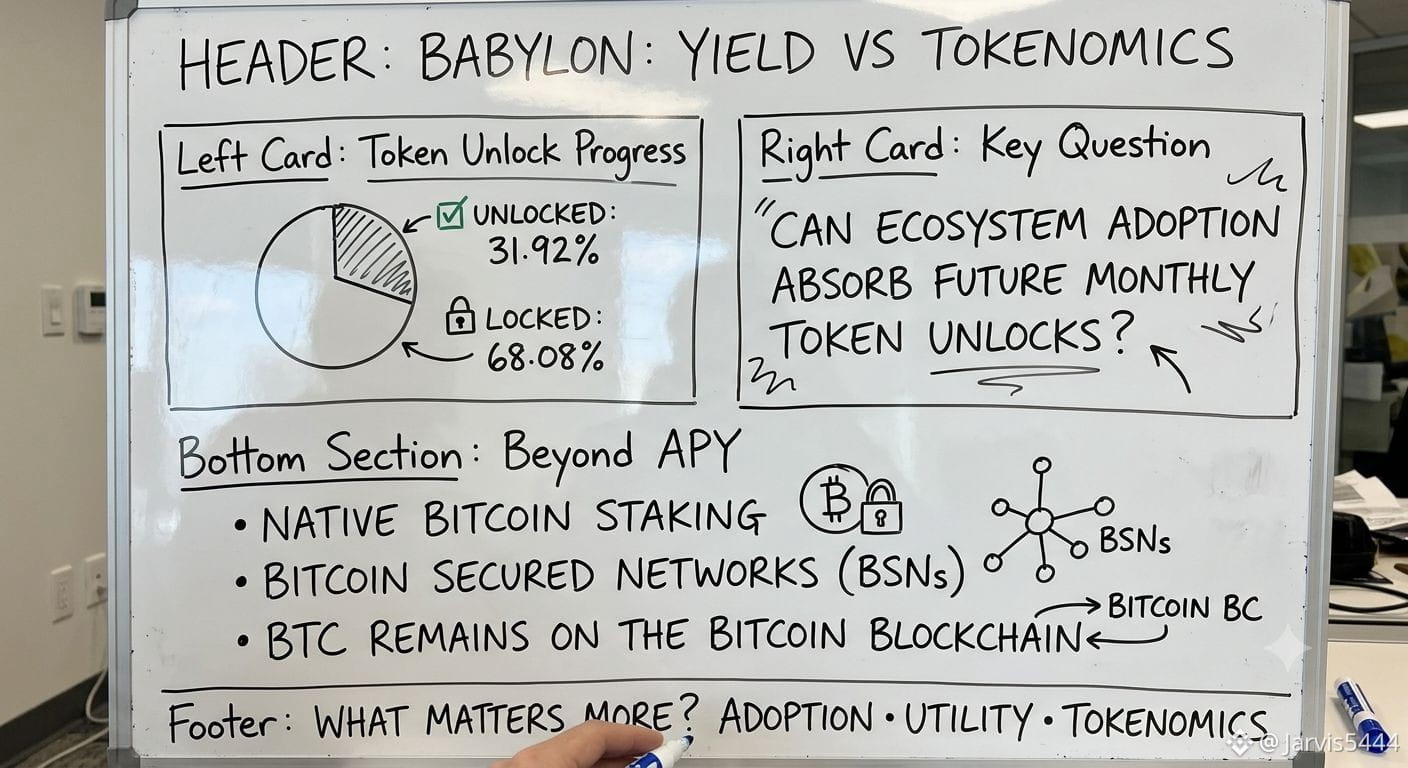
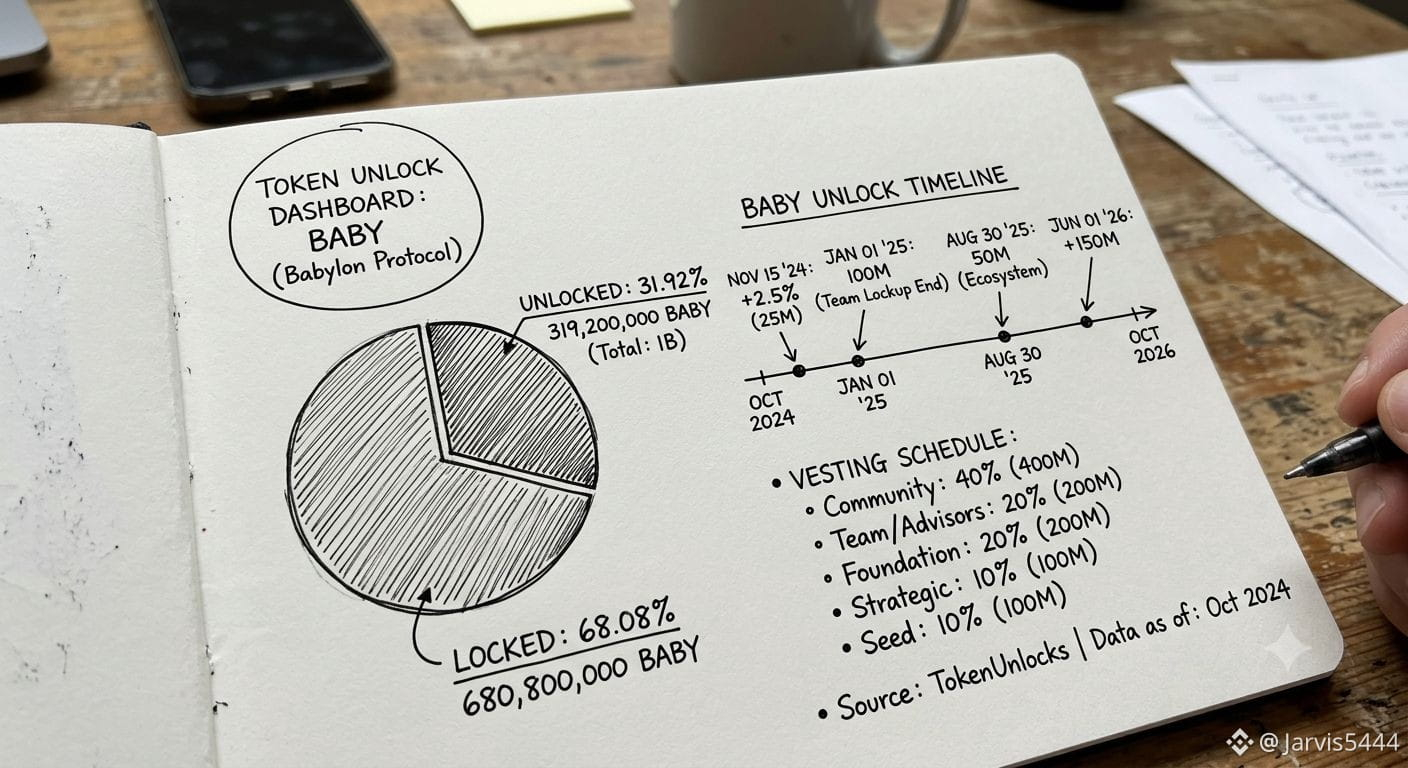
When peopel evaluate a crypto project The first thing they usually notice is the APY. I think the more important Question is whether the project's tokenomics can support long term growth.
According to Tokenomist around 31.92% of BABY Supply has been unlocked, While 68.08% remains locked with additional monthly unlocks scheduled over time. More circulating supply doesn't automatically mean bearish price action but it does highlight an important factor every in
vestor should monitor: Can ecosystem adoption and real demand keep pace With The new Supply entering The Market?
This is One reason I find BABYLON interesting Beyond potential yield, its goal is to enable native Bitcoin staking And strengthen Bitcoin Secured Networks (BSNs) While allowing BTC to remain on The Bitcoin Blockchain.
For me Understanding Adoption, tokenomics And utility together gives a clearer picture than looking at APY Alone.
What will have The biggest impact on Babylon's Long-Term growth: Adoption, utility, or tokenomics?
@babylonlabs_io #baby $BABY #APY
{future}(BABYUSDT)
When peopel evaluate a crypto project The first thing they usually notice is the APY. I think the more important Question is whether the project's tokenomics can support long term growth.
According to Tokenomist around 31.92% of BABY Supply has been unlocked, While 68.08% remains locked with additional monthly unlocks scheduled over time. More circulating supply doesn't automatically mean bearish price action but it does highlight an important factor every in
vestor should monitor: Can ecosystem adoption and real demand keep pace With The new Supply entering The Market?
This is One reason I find BABYLON interesting Beyond potential yield, its goal is to enable native Bitcoin staking And strengthen Bitcoin Secured Networks (BSNs) While allowing BTC to remain on The Bitcoin Blockchain.
For me Understanding Adoption, tokenomics And utility together gives a clearer picture than looking at APY Alone.
What will have The biggest impact on Babylon's Long-Term growth: Adoption, utility, or tokenomics?
@BabylonLabs_io #baby $BABY #APY
According to Tokenomist around 31.92% of BABY Supply has been unlocked, While 68.08% remains locked with additional monthly unlocks scheduled over time. More circulating supply doesn't automatically mean bearish price action but it does highlight an important factor every in
vestor should monitor: Can ecosystem adoption and real demand keep pace With The new Supply entering The Market?
This is One reason I find BABYLON interesting Beyond potential yield, its goal is to enable native Bitcoin staking And strengthen Bitcoin Secured Networks (BSNs) While allowing BTC to remain on The Bitcoin Blockchain.
For me Understanding Adoption, tokenomics And utility together gives a clearer picture than looking at APY Alone.
What will have The biggest impact on Babylon's Long-Term growth: Adoption, utility, or tokenomics?
@BabylonLabs_io #baby $BABY #APY
31
10
116

·
--
说说我现在对市场的判断,仅供参考。
目前很多人认为比特币的价格会继续下跌,因为它已经从$78080.00跌到了$76066.00,跌幅达到0.79%。
但是,我认为大家忽略了以太坊的表现,尽管它也下跌了0.53%,从$2140.49跌到了$2081.35,但其价格仍然处于一个相对稳定的区间。
此外,链环的价格已经从$9.3410上涨到了$9.4450,涨幅达到0.37%,这可能是市场开始关注DeFi项目的迹象。
我认为,市场可能会开始关注那些具有强大基本面的项目,比如那些具有高TVL和协议收入的项目。
因此,我个人是看多市场的,尤其是像LINK和SOL这样的代币,它们的价格分别为$9.4450和$84.12。
我的仓位目前重点关注DeFi项目,尤其是那些具有高APY和代币释放机制的项目。
#DeFi #TVL #APY #代币经济 #投资策略 🚀💰
说说我现在对市场的判断,仅供参考。
目前很多人认为比特币的价格会继续下跌,因为它已经从$78080.00跌到了$76066.00,跌幅达到0.79%。
但是,我认为大家忽略了以太坊的表现,尽管它也下跌了0.53%,从$2140.49跌到了$2081.35,但其价格仍然处于一个相对稳定的区间。
此外,链环的价格已经从$9.3410上涨到了$9.4450,涨幅达到0.37%,这可能是市场开始关注DeFi项目的迹象。
我认为,市场可能会开始关注那些具有强大基本面的项目,比如那些具有高TVL和协议收入的项目。
因此,我个人是看多市场的,尤其是像LINK和SOL这样的代币,它们的价格分别为$9.4450和$84.12。
我的仓位目前重点关注DeFi项目,尤其是那些具有高APY和代币释放机制的项目。
#DeFi #TVL #APY #代币经济 #投资策略 🚀💰
目前很多人认为比特币的价格会继续下跌,因为它已经从$78080.00跌到了$76066.00,跌幅达到0.79%。
但是,我认为大家忽略了以太坊的表现,尽管它也下跌了0.53%,从$2140.49跌到了$2081.35,但其价格仍然处于一个相对稳定的区间。
此外,链环的价格已经从$9.3410上涨到了$9.4450,涨幅达到0.37%,这可能是市场开始关注DeFi项目的迹象。
我认为,市场可能会开始关注那些具有强大基本面的项目,比如那些具有高TVL和协议收入的项目。
因此,我个人是看多市场的,尤其是像LINK和SOL这样的代币,它们的价格分别为$9.4450和$84.12。
我的仓位目前重点关注DeFi项目,尤其是那些具有高APY和代币释放机制的项目。
#DeFi #TVL #APY #代币经济 #投资策略 🚀💰
84

·
--
ສັນຍານກະທິງ
#termmax @termmax
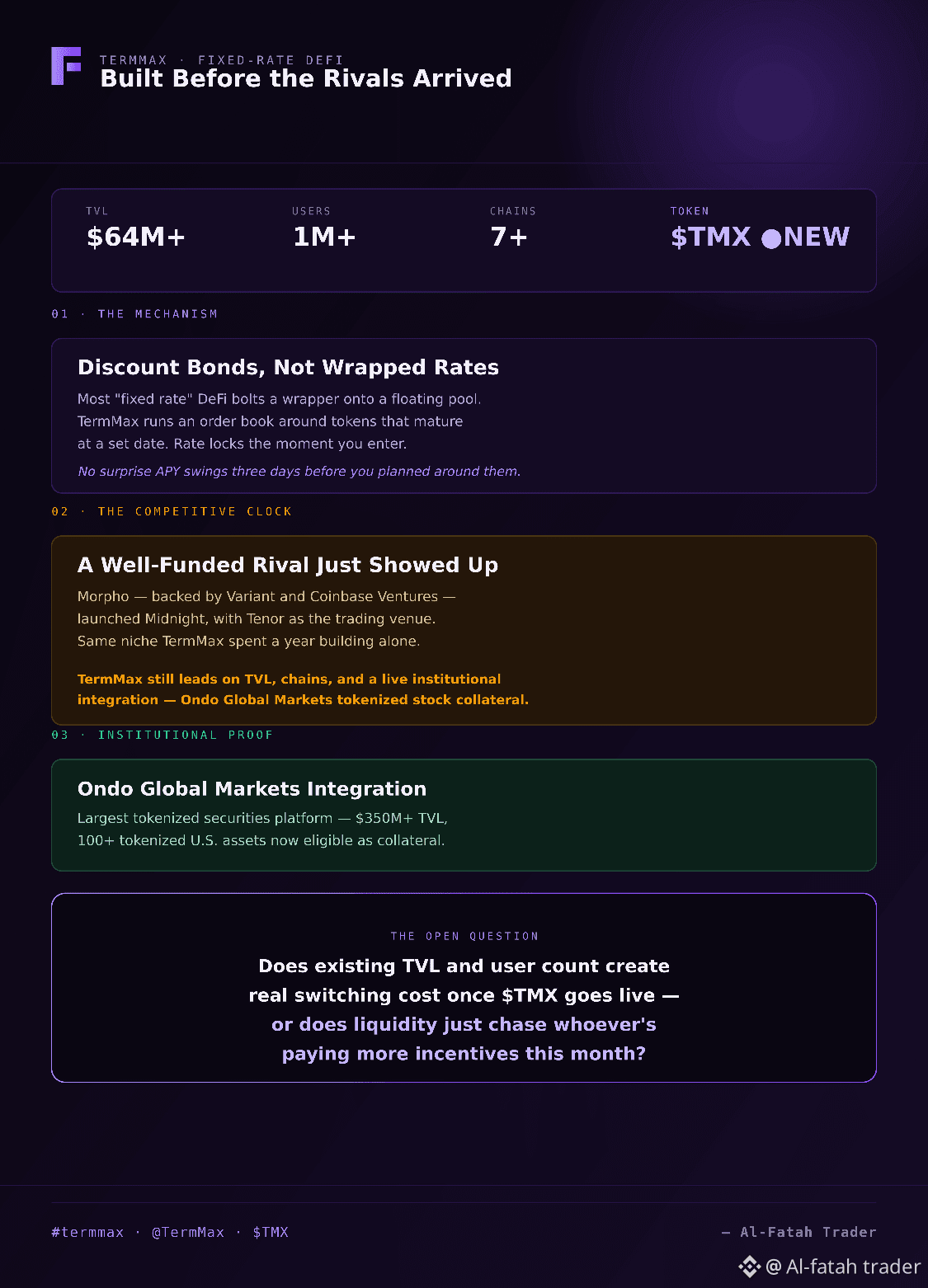
I went to check TermMax's numbers expecting a quiet, early-stage protocol. Instead: $64M+ TVL, over a million users, 7+ chains — and they just announced a token, $TMX, after building the protocol first and waiting on the token.
The core idea is straightforward once it clicks: instead of bolting a fixed-rate wrapper onto a floating-rate pool (which is what most "fixed rate" #DeFi products actually do underneath), TermMax runs an order book around discount bonds — tokens that mature at a set date. You lock your rate the moment you enter. No surprise #APY swings three days before you needed to plan around them.
What actually got my attention was the timing. Just weeks ago, #Morpho — backed by Variant and Coinbase Ventures — launched its own fixed-rate product, Midnight, with Tenor as the trading venue on top. That's not a small competitor showing up. That's one of DeFi's most credible lending brands entering the exact niche TermMax spent over a year building alone.
TermMax still has the numbers advantage — more chains, more TVL, an actual institutional integration already live (tokenized stock collateral via Ondo Global Markets). But numbers built before a well-funded rival arrives don't automatically hold once that rival starts paying double-digit incentive APRs to pull liquidity toward itself.
So the real question isn't whether fixed-rate DeFi is a good idea — clearly enough builders agree it is now. It's whether $TMX captures value from being first, or whether "first" stops mattering the moment a bigger name offers the same thing with a bigger incentive budget.
I don't have a confident answer yet. First-mover advantage in DeFi has been real before and completely irrelevant before, depending on the protocol.
Genuinely curious to watch: does existing TVL and user count actually create switching cost once $TMX goes live — or does liquidity just chase whoever's paying more this month?
#TermMax @termmax
{future}(BRUSDT)
{future}(BTWUSDT)
{spot}(BNBUSDT)
#termmax @TermMax
I went to check TermMax's numbers expecting a quiet, early-stage protocol. Instead: $64M+ TVL, over a million users, 7+ chains — and they just announced a token, $TMX, after building the protocol first and waiting on the token.
The core idea is straightforward once it clicks: instead of bolting a fixed-rate wrapper onto a floating-rate pool (which is what most "fixed rate" #DeFi products actually do underneath), TermMax runs an order book around discount bonds — tokens that mature at a set date. You lock your rate the moment you enter. No surprise #APY swings three days before you needed to plan around them.
What actually got my attention was the timing. Just weeks ago, #Morpho — backed by Variant and Coinbase Ventures — launched its own fixed-rate product, Midnight, with Tenor as the trading venue on top. That's not a small competitor showing up. That's one of DeFi's most credible lending brands entering the exact niche TermMax spent over a year building alone.
TermMax still has the numbers advantage — more chains, more TVL, an actual institutional integration already live (tokenized stock collateral via Ondo Global Markets). But numbers built before a well-funded rival arrives don't automatically hold once that rival starts paying double-digit incentive APRs to pull liquidity toward itself.
So the real question isn't whether fixed-rate DeFi is a good idea — clearly enough builders agree it is now. It's whether $TMX captures value from being first, or whether "first" stops mattering the moment a bigger name offers the same thing with a bigger incentive budget.
I don't have a confident answer yet. First-mover advantage in DeFi has been real before and completely irrelevant before, depending on the protocol.
Genuinely curious to watch: does existing TVL and user count actually create switching cost once $TMX goes live — or does liquidity just chase whoever's paying more this month?
#TermMax @TermMax
I went to check TermMax's numbers expecting a quiet, early-stage protocol. Instead: $64M+ TVL, over a million users, 7+ chains — and they just announced a token, $TMX, after building the protocol first and waiting on the token.
The core idea is straightforward once it clicks: instead of bolting a fixed-rate wrapper onto a floating-rate pool (which is what most "fixed rate" #DeFi products actually do underneath), TermMax runs an order book around discount bonds — tokens that mature at a set date. You lock your rate the moment you enter. No surprise #APY swings three days before you needed to plan around them.
What actually got my attention was the timing. Just weeks ago, #Morpho — backed by Variant and Coinbase Ventures — launched its own fixed-rate product, Midnight, with Tenor as the trading venue on top. That's not a small competitor showing up. That's one of DeFi's most credible lending brands entering the exact niche TermMax spent over a year building alone.
TermMax still has the numbers advantage — more chains, more TVL, an actual institutional integration already live (tokenized stock collateral via Ondo Global Markets). But numbers built before a well-funded rival arrives don't automatically hold once that rival starts paying double-digit incentive APRs to pull liquidity toward itself.
So the real question isn't whether fixed-rate DeFi is a good idea — clearly enough builders agree it is now. It's whether $TMX captures value from being first, or whether "first" stops mattering the moment a bigger name offers the same thing with a bigger incentive budget.
I don't have a confident answer yet. First-mover advantage in DeFi has been real before and completely irrelevant before, depending on the protocol.
Genuinely curious to watch: does existing TVL and user count actually create switching cost once $TMX goes live — or does liquidity just chase whoever's paying more this month?
#TermMax @TermMax
13
4
92
·
--
宏观面今天有点变化,拆解一下我的理解。
如果BTC价格能突破$67292.15的高点,并且持续上涨到$70000以上,我会看多这个市场,尤其是当我们看到其他币种如ETH、SOL等也跟随上涨,届时我会考虑增加仓位,并且会更多地关注DeFi协议的TVL和年化收益率。
如果XRP的价格能够突破$1.30,并且维持在这个水平以上,说明市场信心有所回升,投资者可能会更多地关注具有强大底层技术和应用场景的币种,此时我会更加关注那些具有实用价值和潜力的项目,并可能会增加对它们的投资。
从当前的行情数据来看,BTC的价格为$66376.66,24小时上涨了1.48%,而XRP的价格为$1.2323,24小时上涨了4.50%,这些数据表明市场可能正在逐渐回暖,我认为更可能的情景是市场会继续上涨,尤其是当我们看到更多的投资者进入市场,寻找具有较高年化收益率和稳定的协议时。
因此,我目前的立场是看多市场,尤许是当我们看到更多的资金流入DeFi市场,并且协议的TVL和年化收益率持续上涨时,我会更多地关注市场的发展,并适时调整我的投资策略。
#DeFi #TVL #APY #Cryptocurrency #MarketTrend 🚀
宏观面今天有点变化,拆解一下我的理解。
如果BTC价格能突破$67292.15的高点,并且持续上涨到$70000以上,我会看多这个市场,尤其是当我们看到其他币种如ETH、SOL等也跟随上涨,届时我会考虑增加仓位,并且会更多地关注DeFi协议的TVL和年化收益率。
如果XRP的价格能够突破$1.30,并且维持在这个水平以上,说明市场信心有所回升,投资者可能会更多地关注具有强大底层技术和应用场景的币种,此时我会更加关注那些具有实用价值和潜力的项目,并可能会增加对它们的投资。
从当前的行情数据来看,BTC的价格为$66376.66,24小时上涨了1.48%,而XRP的价格为$1.2323,24小时上涨了4.50%,这些数据表明市场可能正在逐渐回暖,我认为更可能的情景是市场会继续上涨,尤其是当我们看到更多的投资者进入市场,寻找具有较高年化收益率和稳定的协议时。
因此,我目前的立场是看多市场,尤许是当我们看到更多的资金流入DeFi市场,并且协议的TVL和年化收益率持续上涨时,我会更多地关注市场的发展,并适时调整我的投资策略。
#DeFi #TVL #APY #Cryptocurrency #MarketTrend 🚀
如果BTC价格能突破$67292.15的高点,并且持续上涨到$70000以上,我会看多这个市场,尤其是当我们看到其他币种如ETH、SOL等也跟随上涨,届时我会考虑增加仓位,并且会更多地关注DeFi协议的TVL和年化收益率。
如果XRP的价格能够突破$1.30,并且维持在这个水平以上,说明市场信心有所回升,投资者可能会更多地关注具有强大底层技术和应用场景的币种,此时我会更加关注那些具有实用价值和潜力的项目,并可能会增加对它们的投资。
从当前的行情数据来看,BTC的价格为$66376.66,24小时上涨了1.48%,而XRP的价格为$1.2323,24小时上涨了4.50%,这些数据表明市场可能正在逐渐回暖,我认为更可能的情景是市场会继续上涨,尤其是当我们看到更多的投资者进入市场,寻找具有较高年化收益率和稳定的协议时。
因此,我目前的立场是看多市场,尤许是当我们看到更多的资金流入DeFi市场,并且协议的TVL和年化收益率持续上涨时,我会更多地关注市场的发展,并适时调整我的投资策略。
#DeFi #TVL #APY #Cryptocurrency #MarketTrend 🚀
38

·
--
ສັນຍານກະທິງ
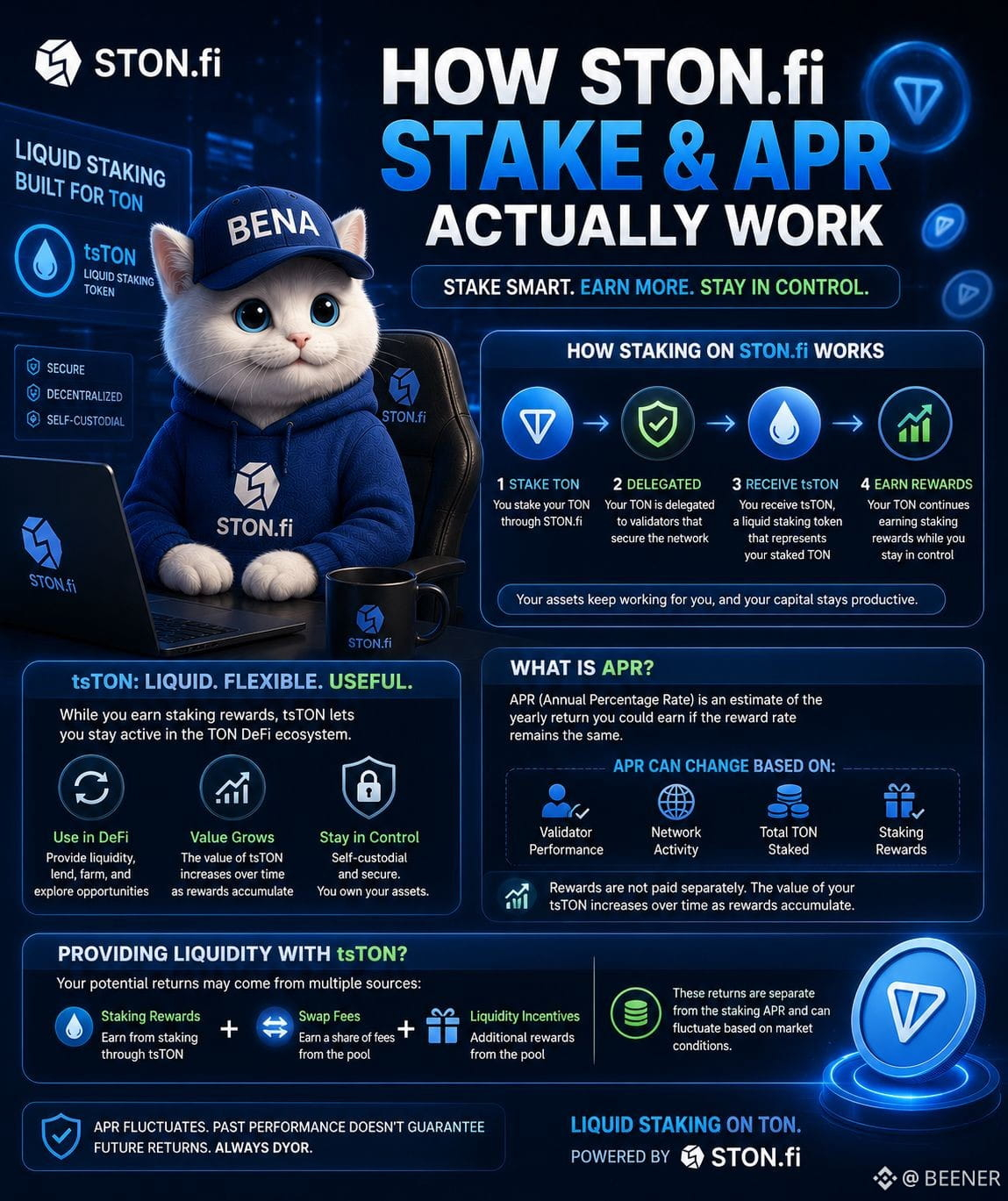
Someone asked me how staking on STON.fi works and what the APR actually means. Here's how I explained it.
A lot of people look at the APR, stake their TON, and move on. But the interesting part is understanding where those rewards actually come from.
When you stake through STON.fi, your TON is delegated to validators that help secure the network. In return, you receive tsTON, a liquid staking token that represents your staked TON.
The benefit is that your assets don't just sit there.
Your TON continues earning staking rewards, while tsTON gives you the flexibility to participate in the TON DeFi ecosystem instead of locking your capital away.
Now, about the APR.
APR, or Annual Percentage Rate, is simply an estimate of how much you could earn over a year if the reward rate stayed the same. The important thing is that it isn't fixed.
It changes depending on things like network activity, validator rewards, and how much TON is being staked across the network.
One detail I think is easy to miss is that rewards aren't paid into your wallet as separate tokens. Instead, the value of your tsTON gradually increases over time as staking rewards accumulate.
That's what makes liquid staking interesting. You're earning staking rewards while still having an asset you can use throughout the ecosystem.
Of course, APR can go up or down, so it's always worth doing your own research before staking or providing liquidity.
@stonfi
→ Try the APR/APY calculator: tools.ston.fi/apy-calculator…
→ Join the STON.fi Pools Updates channel: t.me/stonfi_updates
→ Try the Impermanent Loss Calculator: tools.ston.fi/impermanent-lo…
#STONfi #DEFİ #APR #APY #staking
Someone asked me how staking on STON.fi works and what the APR actually means. Here's how I explained it.
A lot of people look at the APR, stake their TON, and move on. But the interesting part is understanding where those rewards actually come from.
When you stake through STON.fi, your TON is delegated to validators that help secure the network. In return, you receive tsTON, a liquid staking token that represents your staked TON.
The benefit is that your assets don't just sit there.
Your TON continues earning staking rewards, while tsTON gives you the flexibility to participate in the TON DeFi ecosystem instead of locking your capital away.
Now, about the APR.
APR, or Annual Percentage Rate, is simply an estimate of how much you could earn over a year if the reward rate stayed the same. The important thing is that it isn't fixed.
It changes depending on things like network activity, validator rewards, and how much TON is being staked across the network.
One detail I think is easy to miss is that rewards aren't paid into your wallet as separate tokens. Instead, the value of your tsTON gradually increases over time as staking rewards accumulate.
That's what makes liquid staking interesting. You're earning staking rewards while still having an asset you can use throughout the ecosystem.
Of course, APR can go up or down, so it's always worth doing your own research before staking or providing liquidity.
@STONfi DEX
→ Try the APR/APY calculator: tools.ston.fi/apy-calculator…
→ Join the STON.fi Pools Updates channel: t.me/stonfi_updates
→ Try the Impermanent Loss Calculator: tools.ston.fi/impermanent-lo…
#STONfi #DEFİ #APR #APY #staking
A lot of people look at the APR, stake their TON, and move on. But the interesting part is understanding where those rewards actually come from.
When you stake through STON.fi, your TON is delegated to validators that help secure the network. In return, you receive tsTON, a liquid staking token that represents your staked TON.
The benefit is that your assets don't just sit there.
Your TON continues earning staking rewards, while tsTON gives you the flexibility to participate in the TON DeFi ecosystem instead of locking your capital away.
Now, about the APR.
APR, or Annual Percentage Rate, is simply an estimate of how much you could earn over a year if the reward rate stayed the same. The important thing is that it isn't fixed.
It changes depending on things like network activity, validator rewards, and how much TON is being staked across the network.
One detail I think is easy to miss is that rewards aren't paid into your wallet as separate tokens. Instead, the value of your tsTON gradually increases over time as staking rewards accumulate.
That's what makes liquid staking interesting. You're earning staking rewards while still having an asset you can use throughout the ecosystem.
Of course, APR can go up or down, so it's always worth doing your own research before staking or providing liquidity.
@STONfi DEX
→ Try the APR/APY calculator: tools.ston.fi/apy-calculator…
→ Join the STON.fi Pools Updates channel: t.me/stonfi_updates
→ Try the Impermanent Loss Calculator: tools.ston.fi/impermanent-lo…
#STONfi #DEFİ #APR #APY #staking
101

🚨 $USDT 10% APY IS REAL — BUT THE EXCHANGES HIDE A CATCH 💰
📊 Under the hood of today's stablecoin yield boards, every top-tier exchange runs the same playbook: fat APY for the small fish, crumbs for the whales. Deposit under $200 and $USDT pays up to 10% — cross the line and the rate nosedives to 1.95%.
💡 The pattern repeats across venues: 6.30% at the low tier shrinks to 1.64% past $300, while $USDC follows with 8% fading to 2.75%. This isn't generosity — it's a marketing funnel engineered to acquire retail deposits while capping the interest bill.
🔍 The real yield hunter's edge? Compare cap limits, interest calculation rules, and live product availability before parking capital. Headline APY is the bait; net effective yield is the catch. 💬 Are you chasing the printed number or running the full comparison math? 👇
⚠️ Not financial advice. Always manage your risk. 🛡️
🏷️ #USDT #Stablecoin #YieldFarming #APY #Crypto
💎 🎯
🚨 $USDT 10% APY IS REAL — BUT THE EXCHANGES HIDE A CATCH 💰
📊 Under the hood of today's stablecoin yield boards, every top-tier exchange runs the same playbook: fat APY for the small fish, crumbs for the whales. Deposit under $200 and $USDT pays up to 10% — cross the line and the rate nosedives to 1.95%.
💡 The pattern repeats across venues: 6.30% at the low tier shrinks to 1.64% past $300, while $USDC follows with 8% fading to 2.75%. This isn't generosity — it's a marketing funnel engineered to acquire retail deposits while capping the interest bill.
🔍 The real yield hunter's edge? Compare cap limits, interest calculation rules, and live product availability before parking capital. Headline APY is the bait; net effective yield is the catch. 💬 Are you chasing the printed number or running the full comparison math? 👇
⚠️ Not financial advice. Always manage your risk. 🛡️
🏷️ #USDT #Stablecoin #YieldFarming #APY #Crypto
💎 🎯
📊 Under the hood of today's stablecoin yield boards, every top-tier exchange runs the same playbook: fat APY for the small fish, crumbs for the whales. Deposit under $200 and $USDT pays up to 10% — cross the line and the rate nosedives to 1.95%.
💡 The pattern repeats across venues: 6.30% at the low tier shrinks to 1.64% past $300, while $USDC follows with 8% fading to 2.75%. This isn't generosity — it's a marketing funnel engineered to acquire retail deposits while capping the interest bill.
🔍 The real yield hunter's edge? Compare cap limits, interest calculation rules, and live product availability before parking capital. Headline APY is the bait; net effective yield is the catch. 💬 Are you chasing the printed number or running the full comparison math? 👇
⚠️ Not financial advice. Always manage your risk. 🛡️
🏷️ #USDT #Stablecoin #YieldFarming #APY #Crypto
💎 🎯
24
¿Qué es el APY en Cripto y cómo se calcula tus ganancias?
Si has explorado opciones como Binance Earn, Staking o plataformas DeFi, seguro has visto las siglas APY acompañadas de un porcentaje. Entender este concepto es clave para calcular tus rendimientos reales.
APY significa Annual Percentage Yield (Rendimiento Porcentual Anual). Es la tasa que mide cuánto dinero ganas en un año sobre una inversión, incluyendo el efecto del interés compuesto.
💡 La gran diferencia: APY vs. APR
Para no confundirte al invertir, debes tener clara esta distinción:
APR (Tasa Porcentual Anual): Es el interés simple. No tiene en cuenta la reinversión de las ganancias.
APY (Rendimiento Porcentual Anual): Incluye el interés compuesto. Esto significa que los intereses que generas diariamente o semanalmente se suman a tu capital inicial para generar más intereses en el siguiente periodo.
👉 En resumen: Con el APY, tu dinero crece más rápido porque ganas intereses sobre los intereses.
⚠️ 3 Cosas que debes tomar en cuenta sobre el APY:
Es una proyección anual: Si ves un APY del 12%, no significa que ganarás 12% en un mes; significa que ganarías 12% si mantienes la inversión durante 365 días completos.
Puede ser variable: En muchas plataformas o tokens, el APY cambia diariamente según la oferta, la demanda o el volumen de la red.
Cuidado con APY extremadamente altos: Porcentajes de 3 dígitos (como 100% o más) suelen implicar proyectos de muy alto riesgo o con inflación alta del token.
💬 ¿Sueles fijarte en el APY antes de meter tus tokens a Earn o prefieres dejar tus activos libres para trading? ¡No olvides dar tu like y comentario abajo! ❤👇
#BinanceEarn #APY #CryptoEducacion #BinanceSquare #IngresosPasivos
¿Qué es el APY en Cripto y cómo se calcula tus ganancias?
Si has explorado opciones como Binance Earn, Staking o plataformas DeFi, seguro has visto las siglas APY acompañadas de un porcentaje. Entender este concepto es clave para calcular tus rendimientos reales.
APY significa Annual Percentage Yield (Rendimiento Porcentual Anual). Es la tasa que mide cuánto dinero ganas en un año sobre una inversión, incluyendo el efecto del interés compuesto.
💡 La gran diferencia: APY vs. APR
Para no confundirte al invertir, debes tener clara esta distinción:
APR (Tasa Porcentual Anual): Es el interés simple. No tiene en cuenta la reinversión de las ganancias.
APY (Rendimiento Porcentual Anual): Incluye el interés compuesto. Esto significa que los intereses que generas diariamente o semanalmente se suman a tu capital inicial para generar más intereses en el siguiente periodo.
👉 En resumen: Con el APY, tu dinero crece más rápido porque ganas intereses sobre los intereses.
⚠️ 3 Cosas que debes tomar en cuenta sobre el APY:
Es una proyección anual: Si ves un APY del 12%, no significa que ganarás 12% en un mes; significa que ganarías 12% si mantienes la inversión durante 365 días completos.
Puede ser variable: En muchas plataformas o tokens, el APY cambia diariamente según la oferta, la demanda o el volumen de la red.
Cuidado con APY extremadamente altos: Porcentajes de 3 dígitos (como 100% o más) suelen implicar proyectos de muy alto riesgo o con inflación alta del token.
💬 ¿Sueles fijarte en el APY antes de meter tus tokens a Earn o prefieres dejar tus activos libres para trading? ¡No olvides dar tu like y comentario abajo! ❤👇
#BinanceEarn #APY #CryptoEducacion #BinanceSquare #IngresosPasivos
Si has explorado opciones como Binance Earn, Staking o plataformas DeFi, seguro has visto las siglas APY acompañadas de un porcentaje. Entender este concepto es clave para calcular tus rendimientos reales.
APY significa Annual Percentage Yield (Rendimiento Porcentual Anual). Es la tasa que mide cuánto dinero ganas en un año sobre una inversión, incluyendo el efecto del interés compuesto.
💡 La gran diferencia: APY vs. APR
Para no confundirte al invertir, debes tener clara esta distinción:
APR (Tasa Porcentual Anual): Es el interés simple. No tiene en cuenta la reinversión de las ganancias.
APY (Rendimiento Porcentual Anual): Incluye el interés compuesto. Esto significa que los intereses que generas diariamente o semanalmente se suman a tu capital inicial para generar más intereses en el siguiente periodo.
👉 En resumen: Con el APY, tu dinero crece más rápido porque ganas intereses sobre los intereses.
⚠️ 3 Cosas que debes tomar en cuenta sobre el APY:
Es una proyección anual: Si ves un APY del 12%, no significa que ganarás 12% en un mes; significa que ganarías 12% si mantienes la inversión durante 365 días completos.
Puede ser variable: En muchas plataformas o tokens, el APY cambia diariamente según la oferta, la demanda o el volumen de la red.
Cuidado con APY extremadamente altos: Porcentajes de 3 dígitos (como 100% o más) suelen implicar proyectos de muy alto riesgo o con inflación alta del token.
💬 ¿Sueles fijarte en el APY antes de meter tus tokens a Earn o prefieres dejar tus activos libres para trading? ¡No olvides dar tu like y comentario abajo! ❤👇
#BinanceEarn #APY #CryptoEducacion #BinanceSquare #IngresosPasivos
106
·
--
这个想法在脑子里转了好几个小时,说出来。
最近我一直在关注BTC和ETH的价格走势,特别是BTC在$64396.00和ETH在$1874.16的价格点,这两个价格点对我来说是非常重要的信号。
这意味着市场正在重新评估风险资产的价值,特别是在DeFi领域,TVL和APY的变化将对价格产生重要影响。
我认为BTC的上涨将推动整个市场的走势,特别是ALT币,例如ADA和XRP,它们的价格分别为$0.1657和$1.1033,可能会跟随BTC的趋势。
因此,我目前的仓位是看多BTC和ETH,特别是ETH,因为其在DeFi领域的应用前景广阔。
我也在关注DOGE的价格走势,特别是其24小时内的5.84%涨幅,这可能是市场情绪的转变的信号。
综上所述,我认为市场的趋势是看多的,特别是对于BTC和ETH,我将继续关注价格的走势。
#DeFi #TVL #APY #BTC #ETH 🚀💰
这个想法在脑子里转了好几个小时,说出来。
最近我一直在关注BTC和ETH的价格走势,特别是BTC在$64396.00和ETH在$1874.16的价格点,这两个价格点对我来说是非常重要的信号。
这意味着市场正在重新评估风险资产的价值,特别是在DeFi领域,TVL和APY的变化将对价格产生重要影响。
我认为BTC的上涨将推动整个市场的走势,特别是ALT币,例如ADA和XRP,它们的价格分别为$0.1657和$1.1033,可能会跟随BTC的趋势。
因此,我目前的仓位是看多BTC和ETH,特别是ETH,因为其在DeFi领域的应用前景广阔。
我也在关注DOGE的价格走势,特别是其24小时内的5.84%涨幅,这可能是市场情绪的转变的信号。
综上所述,我认为市场的趋势是看多的,特别是对于BTC和ETH,我将继续关注价格的走势。
#DeFi #TVL #APY #BTC #ETH 🚀💰
最近我一直在关注BTC和ETH的价格走势,特别是BTC在$64396.00和ETH在$1874.16的价格点,这两个价格点对我来说是非常重要的信号。
这意味着市场正在重新评估风险资产的价值,特别是在DeFi领域,TVL和APY的变化将对价格产生重要影响。
我认为BTC的上涨将推动整个市场的走势,特别是ALT币,例如ADA和XRP,它们的价格分别为$0.1657和$1.1033,可能会跟随BTC的趋势。
因此,我目前的仓位是看多BTC和ETH,特别是ETH,因为其在DeFi领域的应用前景广阔。
我也在关注DOGE的价格走势,特别是其24小时内的5.84%涨幅,这可能是市场情绪的转变的信号。
综上所述,我认为市场的趋势是看多的,特别是对于BTC和ETH,我将继续关注价格的走势。
#DeFi #TVL #APY #BTC #ETH 🚀💰
26

·
--
ສັນຍານໝີ
Biggest problem in BTCFi isn’t yield. It’s what people do when they see too many versions of it.
The assumption has been that more APY options create more opportunity. In practice, it does the opposite. It fragments attention, and once attention fragments, capital stops behaving like capital and starts behaving like reaction.
Most participants aren’t choosing strategies. They’re switching between them. Every new vault, every new incentive layer, quietly resets the decision frame. Risk stops being measured in exposure and starts being measured in confusion.
That’s the part the market rarely admits. The constraint was never access to yield. It was the ability to compare it under pressure.
This is where infrastructure starts to matter more than returns.
Bedrock sits in that layer where options stop being the problem. It reduces the surface area of BTCFi into something navigable instead of overwhelming. Not by simplifying yield itself, but by simplifying how it is approached.
BRClaw operates one layer deeper. It doesn’t tell you what exists. It structures how decisions form around what exists. Risk, correlation, allocation logic
compressed into something that can actually be acted on instead of endlessly debated.
The edge is no longer in finding higher APY pockets. It’s in reducing the cognitive distance between signal and action.
Most people still think they’re competing for yield.
But the real competition is happening in decision architecture.
And if that layer is already crowded… what exactly are you optimizing for?
Most never notice the shift until the outcome already feels decided.
@Bedrock #Bedrock $BR $BTC
#APY #BTCFi #BRClaw @bitcoin
#BinanceSquare
{spot}(BTCUSDT)
{future}(BRUSDT)
Biggest problem in BTCFi isn’t yield. It’s what people do when they see too many versions of it.
The assumption has been that more APY options create more opportunity. In practice, it does the opposite. It fragments attention, and once attention fragments, capital stops behaving like capital and starts behaving like reaction.
Most participants aren’t choosing strategies. They’re switching between them. Every new vault, every new incentive layer, quietly resets the decision frame. Risk stops being measured in exposure and starts being measured in confusion.
That’s the part the market rarely admits. The constraint was never access to yield. It was the ability to compare it under pressure.
This is where infrastructure starts to matter more than returns.
Bedrock sits in that layer where options stop being the problem. It reduces the surface area of BTCFi into something navigable instead of overwhelming. Not by simplifying yield itself, but by simplifying how it is approached.
BRClaw operates one layer deeper. It doesn’t tell you what exists. It structures how decisions form around what exists. Risk, correlation, allocation logic
compressed into something that can actually be acted on instead of endlessly debated.
The edge is no longer in finding higher APY pockets. It’s in reducing the cognitive distance between signal and action.
Most people still think they’re competing for yield.
But the real competition is happening in decision architecture.
And if that layer is already crowded… what exactly are you optimizing for?
Most never notice the shift until the outcome already feels decided.
@Bedrock #Bedrock $BR $BTC
#APY #BTCFi #BRClaw @Bitcoin
#BinanceSquare
The assumption has been that more APY options create more opportunity. In practice, it does the opposite. It fragments attention, and once attention fragments, capital stops behaving like capital and starts behaving like reaction.
Most participants aren’t choosing strategies. They’re switching between them. Every new vault, every new incentive layer, quietly resets the decision frame. Risk stops being measured in exposure and starts being measured in confusion.
That’s the part the market rarely admits. The constraint was never access to yield. It was the ability to compare it under pressure.
This is where infrastructure starts to matter more than returns.
Bedrock sits in that layer where options stop being the problem. It reduces the surface area of BTCFi into something navigable instead of overwhelming. Not by simplifying yield itself, but by simplifying how it is approached.
BRClaw operates one layer deeper. It doesn’t tell you what exists. It structures how decisions form around what exists. Risk, correlation, allocation logic
compressed into something that can actually be acted on instead of endlessly debated.
The edge is no longer in finding higher APY pockets. It’s in reducing the cognitive distance between signal and action.
Most people still think they’re competing for yield.
But the real competition is happening in decision architecture.
And if that layer is already crowded… what exactly are you optimizing for?
Most never notice the shift until the outcome already feels decided.
@Bedrock #Bedrock $BR $BTC
#APY #BTCFi #BRClaw @Bitcoin
#BinanceSquare

12
158

Migliori piattaforme staking crypto
1. #Binance — migliore in generale
Tantissime crypto disponibili (300+)
Staking flessibile o bloccato
APY variabile (ETH ~2.5%, SOL ~5.5%)
Facile da usare
Ideale se vuoi tutto in uno (anche trading)
2. #Kraken — più sicuro e affidabile
Ottima reputazione e trasparenza
Reward pagati ogni giorno
Fee basse (~5%)
Coin Interest Rate
Uptime altissimo (>99.9%)
Coin Interest Rate
Ideale se punti su sicurezza e stabilità
3. #Crypto.com — migliore per principianti
App molto semplice
Staking integrato con carta e servizi
Opzioni flessibili e fisse
Ideale se sei all’inizio
#staking #BinanceExplorers #crypto.com #KrakenVenture #APY
Migliori piattaforme staking crypto
1. #Binance — migliore in generale
Tantissime crypto disponibili (300+)
Staking flessibile o bloccato
APY variabile (ETH ~2.5%, SOL ~5.5%)
Facile da usare
Ideale se vuoi tutto in uno (anche trading)
2. #Kraken — più sicuro e affidabile
Ottima reputazione e trasparenza
Reward pagati ogni giorno
Fee basse (~5%)
Coin Interest Rate
Uptime altissimo (>99.9%)
Coin Interest Rate
Ideale se punti su sicurezza e stabilità
3. #Crypto.com — migliore per principianti
App molto semplice
Staking integrato con carta e servizi
Opzioni flessibili e fisse
Ideale se sei all’inizio
#staking #BinanceExplorers #crypto.com #KrakenVenture #APY
1. #Binance — migliore in generale
Tantissime crypto disponibili (300+)
Staking flessibile o bloccato
APY variabile (ETH ~2.5%, SOL ~5.5%)
Facile da usare
Ideale se vuoi tutto in uno (anche trading)
2. #Kraken — più sicuro e affidabile
Ottima reputazione e trasparenza
Reward pagati ogni giorno
Fee basse (~5%)
Coin Interest Rate
Uptime altissimo (>99.9%)
Coin Interest Rate
Ideale se punti su sicurezza e stabilità
3. #Crypto.com — migliore per principianti
App molto semplice
Staking integrato con carta e servizi
Opzioni flessibili e fisse
Ideale se sei all’inizio
#staking #BinanceExplorers #crypto.com #KrakenVenture #APY
binance
0%
kraken
0%
crypto.com
0%
0 ຄະແນນສຽງ • ປິດລົງຄະແນນສຽງ
65

·
--
ສັນຍານກະທິງ
Hoy tuve muchos movimientos en mls activos que pensé me pasarian factura en nuneros rojos con respecto a la semana que recién terminó:
💎 Pagué un prestamo de #CRİPTO y un pedido en #MercadoLibre (use mis fondos fuera de #Binance por prinera vez).
💎 Cambié unos sobres rojos (20 🙊 LoL! 🙈) para enviarselos a otros usuarios.
{spot}(USDCUSDT)
💎 Me equivoqué al reclamar una cripto bloqueada en lugar de una de las #stablecoin que tengo en flexibles.
💎 Perdí mis $ETH de Ear y después me acordé que las convertí en $WBETH pero aún así estaban perdidas 😢
{spot}(WBETHUSDT)
Dos cosas jugaron a mi favor:
💹 Afortunadamente Binance puso mis wbeth en spot y están dando rendimientos pasivos, que aunque son menores que en ear, es un mejor escenario que la primera vez que eso me pasó: tuve una cripto muy volátil congelada 30 días con todas las perdidas y nada de rendimientos (ni siquiera los que hice los anteriores 30 días que holdie esa cripto. 🪙 🤦🏽 Aprendí la lección: Nunca más holdear sexycoins con dos cifras porcentuales en #APY
💹 Llevo un mes aplicando lo que aprendí en @Binance_Academy sobre movimientos de alto riesgo y con inversión dual bien planificada es que mantengo mi portafolio a la alza. 📊
🫣 Lamento que se me hayan terminado los 🧧 gracias por leer y compartir querida pypolbinanciera nos vemos. Bais! 🚀
Hoy tuve muchos movimientos en mls activos que pensé me pasarian factura en nuneros rojos con respecto a la semana que recién terminó:
💎 Pagué un prestamo de #CRİPTO y un pedido en #MercadoLibre (use mis fondos fuera de #Binance por prinera vez).
💎 Cambié unos sobres rojos (20 🙊 LoL! 🙈) para enviarselos a otros usuarios.
💎 Me equivoqué al reclamar una cripto bloqueada en lugar de una de las #stablecoin que tengo en flexibles.
💎 Perdí mis $ETH de Ear y después me acordé que las convertí en $WBETH pero aún así estaban perdidas 😢
Dos cosas jugaron a mi favor:
💹 Afortunadamente Binance puso mis wbeth en spot y están dando rendimientos pasivos, que aunque son menores que en ear, es un mejor escenario que la primera vez que eso me pasó: tuve una cripto muy volátil congelada 30 días con todas las perdidas y nada de rendimientos (ni siquiera los que hice los anteriores 30 días que holdie esa cripto. 🪙 🤦🏽 Aprendí la lección: Nunca más holdear sexycoins con dos cifras porcentuales en #APY
💹 Llevo un mes aplicando lo que aprendí en @Binance Academy sobre movimientos de alto riesgo y con inversión dual bien planificada es que mantengo mi portafolio a la alza. 📊
🫣 Lamento que se me hayan terminado los 🧧 gracias por leer y compartir querida pypolbinanciera nos vemos. Bais! 🚀
💎 Pagué un prestamo de #CRİPTO y un pedido en #MercadoLibre (use mis fondos fuera de #Binance por prinera vez).
💎 Cambié unos sobres rojos (20 🙊 LoL! 🙈) para enviarselos a otros usuarios.
💎 Me equivoqué al reclamar una cripto bloqueada en lugar de una de las #stablecoin que tengo en flexibles.
💎 Perdí mis $ETH de Ear y después me acordé que las convertí en $WBETH pero aún así estaban perdidas 😢
Dos cosas jugaron a mi favor:
💹 Afortunadamente Binance puso mis wbeth en spot y están dando rendimientos pasivos, que aunque son menores que en ear, es un mejor escenario que la primera vez que eso me pasó: tuve una cripto muy volátil congelada 30 días con todas las perdidas y nada de rendimientos (ni siquiera los que hice los anteriores 30 días que holdie esa cripto. 🪙 🤦🏽 Aprendí la lección: Nunca más holdear sexycoins con dos cifras porcentuales en #APY
💹 Llevo un mes aplicando lo que aprendí en @Binance Academy sobre movimientos de alto riesgo y con inversión dual bien planificada es que mantengo mi portafolio a la alza. 📊
🫣 Lamento que se me hayan terminado los 🧧 gracias por leer y compartir querida pypolbinanciera nos vemos. Bais! 🚀
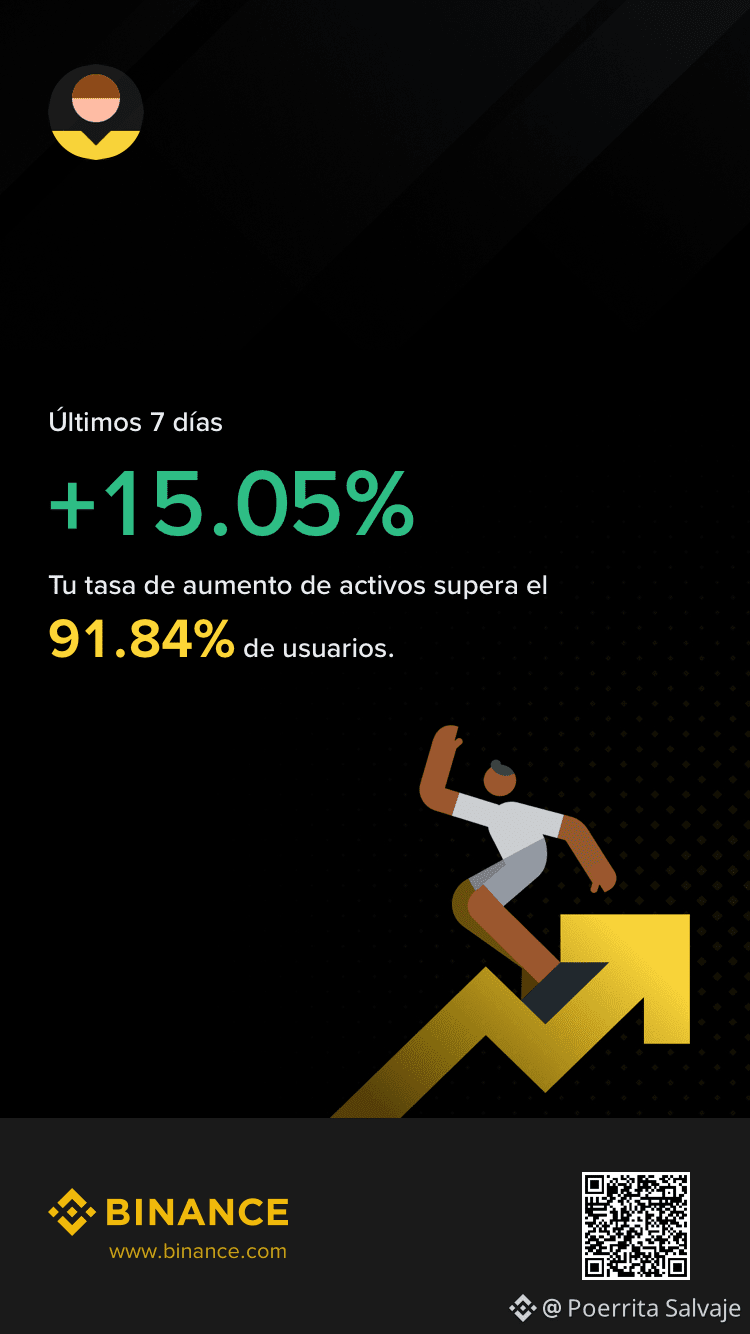
134

·
--
Whilst researching @termmax , I discovered a few facts that most people aren’t aware of:
1. Leverage without liquidation – it really does exist
When Binance Alpha lists a new token, traders sometimes have to wait weeks for perpetual contracts to become available. TermMax Alpha has solved this: you can take leveraged positions on new tokens straight away by paying a fixed premium upfront, and this is the only, I would emphasise, minimal risk involved. No margin calls, no liquidations, no sleepless nights during volatile listings.
2. A GT token is a packaged position that can be sold, not just a token. It’s a ready-made leveraged position inside. Buy it, and you’re already in a leveraged position. No need to configure anything. And you can sell it before expiry just like any other asset on the open market.
3. If the token falls, you only lose the premium
Spotted a promising token on #BinanceAlpha ? You pay a small premium for the leverage. If it soars, you multiply your profit. If it falls, you only lose the premium, not the entire position. This is definitely a fundamentally different mechanism to perpetual contracts, where liquidation can occur at any moment. It’s quite unusual, in my view.
4. Holding Binance Alpha tokens and doing nothing? You’re missing out on profits
Binance Alpha token holders can deposit them into Dual Investment Vaults and earn a double-digit #APY from the premiums paid by leveraged traders, regardless of price movements. In other words, you earn whether the price rises or falls.
5. They are building what #DeFi has been lacking from the very beginning
All the major protocols, such as Aave, Compound and Curve, have focused on floating rates and flexibility. TermMax is taking the opposite approach and building a fixed-yield model that has existed in #TradFi for hundreds of years. This is either a very sound bet on institutional capital, or a niche that will never grow into a mass market. For now, the figures suggest the former.
What has surprised you most about #TermMax ? Let us know in the comments.
Whilst researching @TermMax , I discovered a few facts that most people aren’t aware of:
1. Leverage without liquidation – it really does exist
When Binance Alpha lists a new token, traders sometimes have to wait weeks for perpetual contracts to become available. TermMax Alpha has solved this: you can take leveraged positions on new tokens straight away by paying a fixed premium upfront, and this is the only, I would emphasise, minimal risk involved. No margin calls, no liquidations, no sleepless nights during volatile listings.
2. A GT token is a packaged position that can be sold, not just a token. It’s a ready-made leveraged position inside. Buy it, and you’re already in a leveraged position. No need to configure anything. And you can sell it before expiry just like any other asset on the open market.
3. If the token falls, you only lose the premium
Spotted a promising token on #BinanceAlpha ? You pay a small premium for the leverage. If it soars, you multiply your profit. If it falls, you only lose the premium, not the entire position. This is definitely a fundamentally different mechanism to perpetual contracts, where liquidation can occur at any moment. It’s quite unusual, in my view.
4. Holding Binance Alpha tokens and doing nothing? You’re missing out on profits
Binance Alpha token holders can deposit them into Dual Investment Vaults and earn a double-digit #APY from the premiums paid by leveraged traders, regardless of price movements. In other words, you earn whether the price rises or falls.
5. They are building what #DeFi has been lacking from the very beginning
All the major protocols, such as Aave, Compound and Curve, have focused on floating rates and flexibility. TermMax is taking the opposite approach and building a fixed-yield model that has existed in #TradFi for hundreds of years. This is either a very sound bet on institutional capital, or a niche that will never grow into a mass market. For now, the figures suggest the former.
What has surprised you most about #TermMax ? Let us know in the comments.
1. Leverage without liquidation – it really does exist
When Binance Alpha lists a new token, traders sometimes have to wait weeks for perpetual contracts to become available. TermMax Alpha has solved this: you can take leveraged positions on new tokens straight away by paying a fixed premium upfront, and this is the only, I would emphasise, minimal risk involved. No margin calls, no liquidations, no sleepless nights during volatile listings.
2. A GT token is a packaged position that can be sold, not just a token. It’s a ready-made leveraged position inside. Buy it, and you’re already in a leveraged position. No need to configure anything. And you can sell it before expiry just like any other asset on the open market.
3. If the token falls, you only lose the premium
Spotted a promising token on #BinanceAlpha ? You pay a small premium for the leverage. If it soars, you multiply your profit. If it falls, you only lose the premium, not the entire position. This is definitely a fundamentally different mechanism to perpetual contracts, where liquidation can occur at any moment. It’s quite unusual, in my view.
4. Holding Binance Alpha tokens and doing nothing? You’re missing out on profits
Binance Alpha token holders can deposit them into Dual Investment Vaults and earn a double-digit #APY from the premiums paid by leveraged traders, regardless of price movements. In other words, you earn whether the price rises or falls.
5. They are building what #DeFi has been lacking from the very beginning
All the major protocols, such as Aave, Compound and Curve, have focused on floating rates and flexibility. TermMax is taking the opposite approach and building a fixed-yield model that has existed in #TradFi for hundreds of years. This is either a very sound bet on institutional capital, or a niche that will never grow into a mass market. For now, the figures suggest the former.
What has surprised you most about #TermMax ? Let us know in the comments.
1
103

·
--
ສັນຍານໝີ
The biggest mistake in BTCFi isn't choosing the wrong protocol. It's optimizing for the wrong metric.
Everyone is chasing APY right now. 18%. 26%. Sometimes higher. Protocols compete on yield like the number itself is the moat. Users rotate capital every few weeks toward whatever's highest. This looks like a thriving ecosystem. It's mostly just capital looking for a reason to stay.
Here's what nobody is saying out loud: yield compresses. Always.
It happened in Ethereum DeFi. In Solana. In every cycle that matured past its first wave. The protocols that survived weren't holding the highest rate they became the layer capital had to move through.
Yield attracts capital. Infrastructure captures it. Those are different businesses.
The question everyone in BTCFi is asking: which protocol gives the best return? The question almost nobody is asking: which protocol does capital pass through on the way anywhere?
One gets competed away the moment a better number appears. The other gets structurally stronger as the space grows.
This is where Bedrock is positioned differently not another yield product fighting on basis points, but a multi-strategy routing layer connecting BTC capital across the ecosystem. When yield compresses and liquidity consolidates, the routing infrastructure doesn't chase. It receives.
BRClaw sits above that as the decision layer. Not a dashboard an AI copilot reading the BTCFi environment in real time, surfacing where capital should be before the market reprices it.
Most participants are optimizing for today's yield number.
Worth asking who gets paid when that number stops mattering.
@Bedrock #Bedrock $BR $BTC
#BTCFi #defi #BinanceSquare #APY
@bitcoin
{spot}(BTCUSDT)
{future}(BRUSDT)
The biggest mistake in BTCFi isn't choosing the wrong protocol. It's optimizing for the wrong metric.
Everyone is chasing APY right now. 18%. 26%. Sometimes higher. Protocols compete on yield like the number itself is the moat. Users rotate capital every few weeks toward whatever's highest. This looks like a thriving ecosystem. It's mostly just capital looking for a reason to stay.
Here's what nobody is saying out loud: yield compresses. Always.
It happened in Ethereum DeFi. In Solana. In every cycle that matured past its first wave. The protocols that survived weren't holding the highest rate they became the layer capital had to move through.
Yield attracts capital. Infrastructure captures it. Those are different businesses.
The question everyone in BTCFi is asking: which protocol gives the best return? The question almost nobody is asking: which protocol does capital pass through on the way anywhere?
One gets competed away the moment a better number appears. The other gets structurally stronger as the space grows.
This is where Bedrock is positioned differently not another yield product fighting on basis points, but a multi-strategy routing layer connecting BTC capital across the ecosystem. When yield compresses and liquidity consolidates, the routing infrastructure doesn't chase. It receives.
BRClaw sits above that as the decision layer. Not a dashboard an AI copilot reading the BTCFi environment in real time, surfacing where capital should be before the market reprices it.
Most participants are optimizing for today's yield number.
Worth asking who gets paid when that number stops mattering.
@Bedrock #Bedrock $BR $BTC
#BTCFi #defi #BinanceSquare #APY
@Bitcoin
Everyone is chasing APY right now. 18%. 26%. Sometimes higher. Protocols compete on yield like the number itself is the moat. Users rotate capital every few weeks toward whatever's highest. This looks like a thriving ecosystem. It's mostly just capital looking for a reason to stay.
Here's what nobody is saying out loud: yield compresses. Always.
It happened in Ethereum DeFi. In Solana. In every cycle that matured past its first wave. The protocols that survived weren't holding the highest rate they became the layer capital had to move through.
Yield attracts capital. Infrastructure captures it. Those are different businesses.
The question everyone in BTCFi is asking: which protocol gives the best return? The question almost nobody is asking: which protocol does capital pass through on the way anywhere?
One gets competed away the moment a better number appears. The other gets structurally stronger as the space grows.
This is where Bedrock is positioned differently not another yield product fighting on basis points, but a multi-strategy routing layer connecting BTC capital across the ecosystem. When yield compresses and liquidity consolidates, the routing infrastructure doesn't chase. It receives.
BRClaw sits above that as the decision layer. Not a dashboard an AI copilot reading the BTCFi environment in real time, surfacing where capital should be before the market reprices it.
Most participants are optimizing for today's yield number.
Worth asking who gets paid when that number stops mattering.
@Bedrock #Bedrock $BR $BTC
#BTCFi #defi #BinanceSquare #APY
@Bitcoin
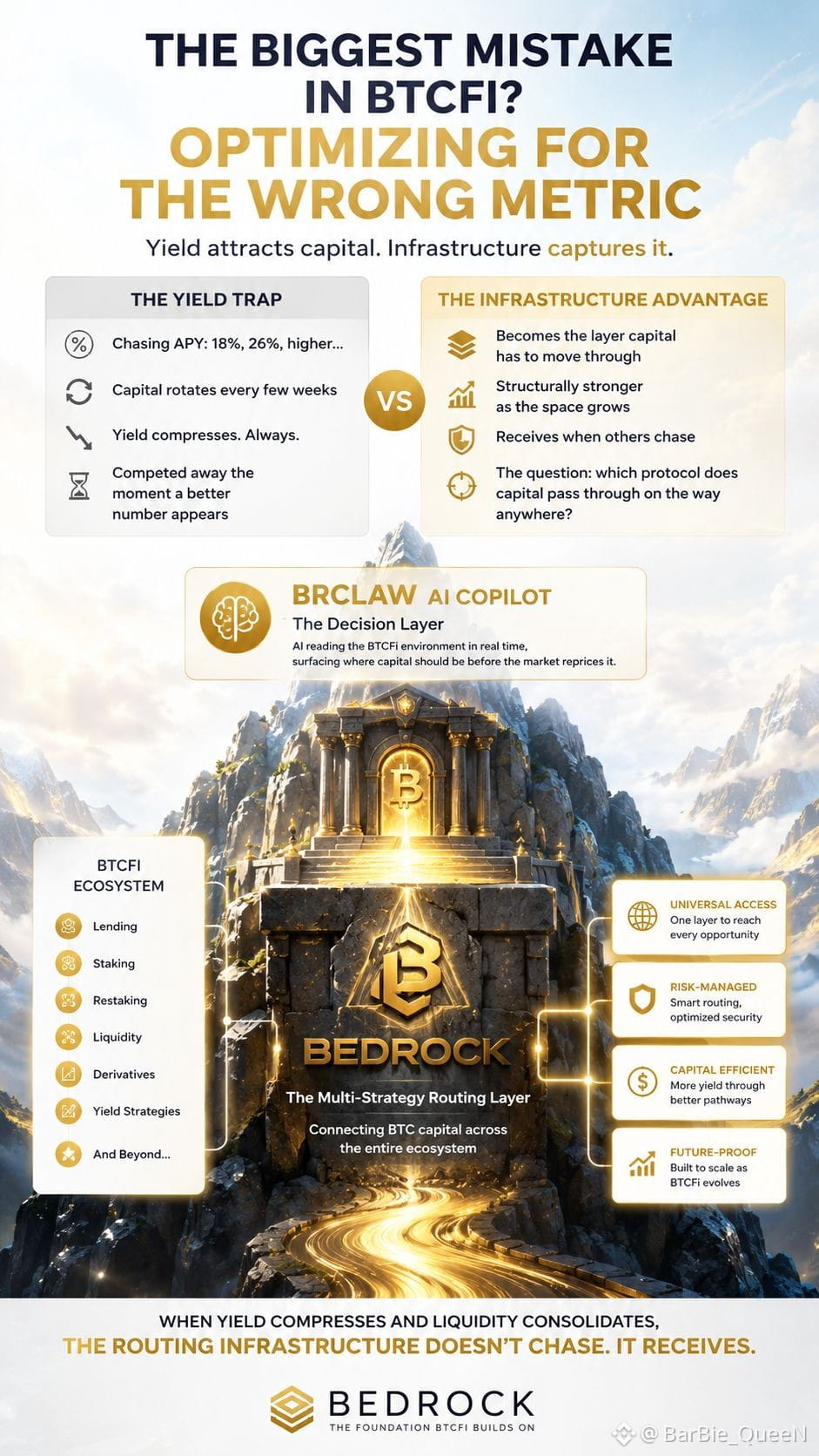
13
353
ເຂົ້າສູ່ລະບົບເພື່ອສຳຫຼວດເນື້ອຫາເພີ່ມເຕີມ
ເຂົ້າຮ່ວມກຸ່ມຜູ້ໃຊ້ຄຣິບໂຕທົ່ວໂລກໃນ Binance Square.
⚡️ ໄດ້ຮັບຂໍ້ມູນຫຼ້າສຸດ ແລະ ທີ່ມີປະໂຫຍດກ່ຽວກັບຄຣິບໂຕ.
💬 ໄດ້ຮັບຄວາມໄວ້ວາງໃຈຈາກຕະຫຼາດແລກປ່ຽນຄຣິບໂຕທີ່ໃຫຍ່ທີ່ສຸດໃນໂລກ.
👍 ຄົ້ນຫາຂໍ້ມູນເຊີງເລິກທີ່ແທ້ຈາກນັກສ້າງທີ່ໄດ້ຮັບການຢືນຢັນ.
ອີເມວ / ເບີໂທລະສັບ
ຫົວຂໍ້ທີ່ກໍາລັງນິຍົມ
1
#BinancePick
3.2M ຄັ້ງທີ່ເບິ່ງ
158,104 ກຳລັງສົນທະນາ
2
#EarningsSeason
5.4M ຄັ້ງທີ່ເບິ່ງ
26,303 ກຳລັງສົນທະນາ
3
#BitmineAdds10452ETH
56 ຄັ້ງທີ່ເບິ່ງ
22 ກຳລັງສົນທະນາ
4
#SouthKoreaConsidersEducationTaxOnCryptoExchanges
400 ຄັ້ງທີ່ເບິ່ງ
37 ກຳລັງສົນທະນາ
5
#OCCUrgesCommunityBanksToEnterStablecoinPayments
199 ຄັ້ງທີ່ເບິ່ງ
27 ກຳລັງສົນທະນາ
6
#RippleWinsFullApprovalAsNationalTrustBank
210 ຄັ້ງທີ່ເບິ່ງ
28 ກຳລັງສົນທະນາ
7
#AkashSelectsSolanaAsMigrationTarget
37 ຄັ້ງທີ່ເບິ່ງ
6 ກຳລັງສົນທະນາ
8
#OndoToOpenSubscriptionsForOpenAIPreIPOTokenizedNotes
25 ຄັ້ງທີ່ເບິ່ງ
3 ກຳລັງສົນທະນາ
9
#AnthropicTTMRevenueGrewAbout1200%
44,260 ຄັ້ງທີ່ເບິ່ງ
512 ກຳລັງສົນທະນາ
10
#AnthropicS1ExpectedToday
36,094 ຄັ້ງທີ່ເບິ່ງ
402 ກຳລັງສົນທະນາ