
溪月 Xīyuè
7.8k Жариялаулар

溪月 Xīyuè
Хабарлау
Пайдаланушыны блоктау
加密分析师 | 市场洞察短期与长期信号 | 比特币、以太坊及其他币种分享实时设置与基于研究的观点 与加密女王👸
Ашық сауда
Жиі сауда жасайтын трейдер
2.5 жыл
765 Жазылым
29.4K+ Жазылушылар
4.6K+ лайк басылған
Жазбалар
Портфолио
Барлығы
Баға ұсыныстары
Тікелей эфир
·
--
Жоғары (өспелі)
#fedratewatch
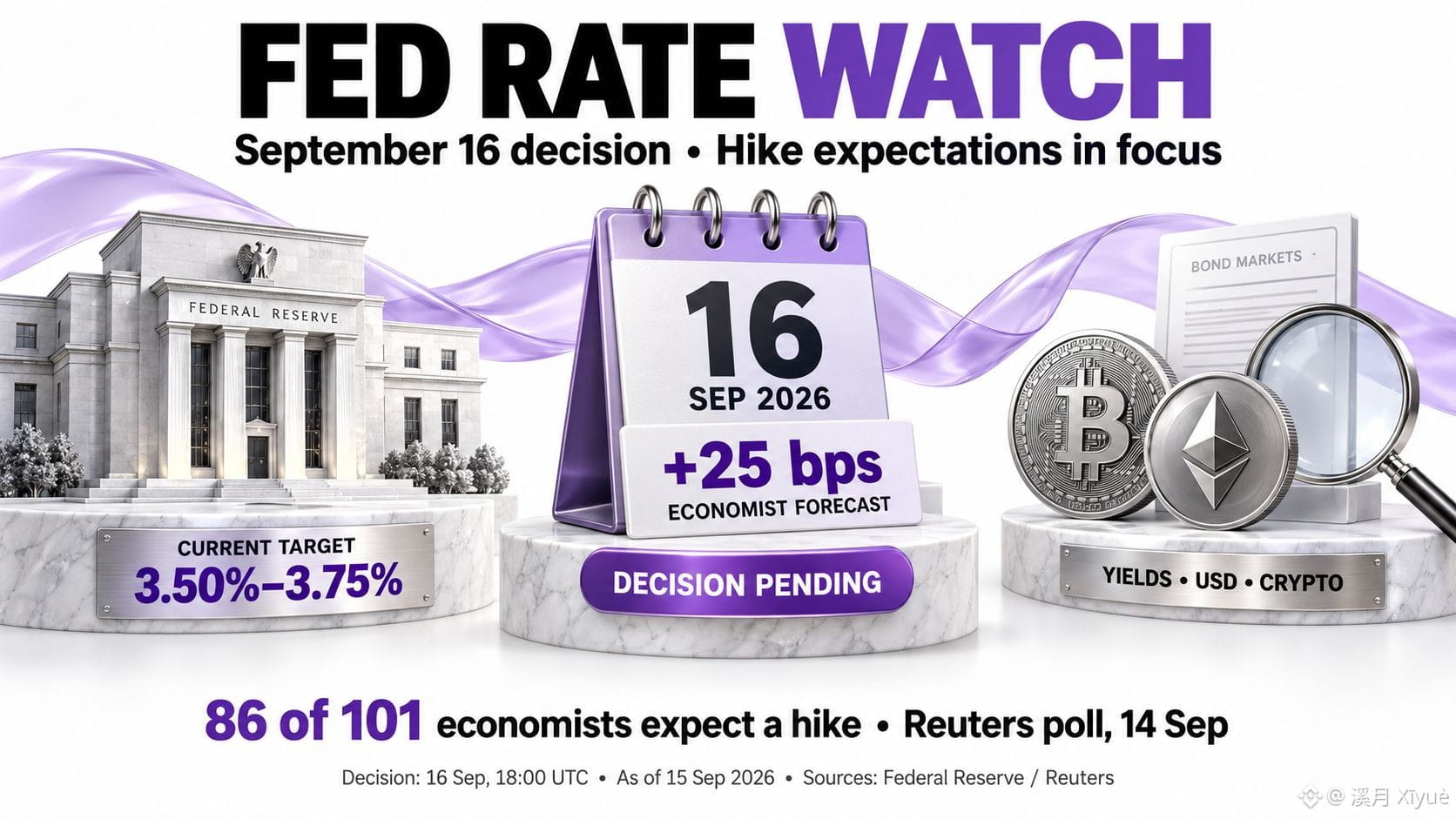
Fed Rate Watch: Hike Expectations Rise Ahead of September 16
Crypto traders have two things to watch: the rate decision and what the Fed signals about the months ahead.
The current federal funds target remains 3.50%–3.75%.
Reuters’ September 14 poll found 86 of 101 economists expecting a 25-basis-point hike to 3.75%–4.00% at this week’s meeting. The decision is still pending.
August core CPI increased 0.3% month on month, following 0.2% in July.
My take: A widely anticipated hike may matter less than a surprise in the Fed’s outlook. For BTC and ETH, I’d watch whether Treasury yields and the dollar strengthen or ease after the announcement, then whether that reaction survives the press conference.
If officials suggest further tightening, funding conditions could remain a challenge for risk assets. A less restrictive outlook could support sentiment, but price, volume and follow-through would still need to confirm the response. The initial move alone offers limited evidence about the trend ahead.
Timing: September 16 at 18:00 UTC / 11 p.m. Pakistan time, with the press conference 30 minutes later.
Which reaction will you watch first: bonds, the dollar or BTC?
#FedRateWatch #bitcoin #Macro
$AKE
$AIN
$BTC
#fedratewatch
Fed Rate Watch: Hike Expectations Rise Ahead of September 16
Crypto traders have two things to watch: the rate decision and what the Fed signals about the months ahead.
The current federal funds target remains 3.50%–3.75%.
Reuters’ September 14 poll found 86 of 101 economists expecting a 25-basis-point hike to 3.75%–4.00% at this week’s meeting. The decision is still pending.
August core CPI increased 0.3% month on month, following 0.2% in July.
My take: A widely anticipated hike may matter less than a surprise in the Fed’s outlook. For BTC and ETH, I’d watch whether Treasury yields and the dollar strengthen or ease after the announcement, then whether that reaction survives the press conference.
If officials suggest further tightening, funding conditions could remain a challenge for risk assets. A less restrictive outlook could support sentiment, but price, volume and follow-through would still need to confirm the response. The initial move alone offers limited evidence about the trend ahead.
Timing: September 16 at 18:00 UTC / 11 p.m. Pakistan time, with the press conference 30 minutes later.
Which reaction will you watch first: bonds, the dollar or BTC?
#FedRateWatch #bitcoin #Macro
$AKE
$AIN
$BTC
Fed Rate Watch: Hike Expectations Rise Ahead of September 16
Crypto traders have two things to watch: the rate decision and what the Fed signals about the months ahead.
The current federal funds target remains 3.50%–3.75%.
Reuters’ September 14 poll found 86 of 101 economists expecting a 25-basis-point hike to 3.75%–4.00% at this week’s meeting. The decision is still pending.
August core CPI increased 0.3% month on month, following 0.2% in July.
My take: A widely anticipated hike may matter less than a surprise in the Fed’s outlook. For BTC and ETH, I’d watch whether Treasury yields and the dollar strengthen or ease after the announcement, then whether that reaction survives the press conference.
If officials suggest further tightening, funding conditions could remain a challenge for risk assets. A less restrictive outlook could support sentiment, but price, volume and follow-through would still need to confirm the response. The initial move alone offers limited evidence about the trend ahead.
Timing: September 16 at 18:00 UTC / 11 p.m. Pakistan time, with the press conference 30 minutes later.
Which reaction will you watch first: bonds, the dollar or BTC?
#FedRateWatch #bitcoin #Macro
$AKE
$AIN
$BTC
507
·
--
Жоғары (өспелі)
#zamaopens16confidentialmorphovaults
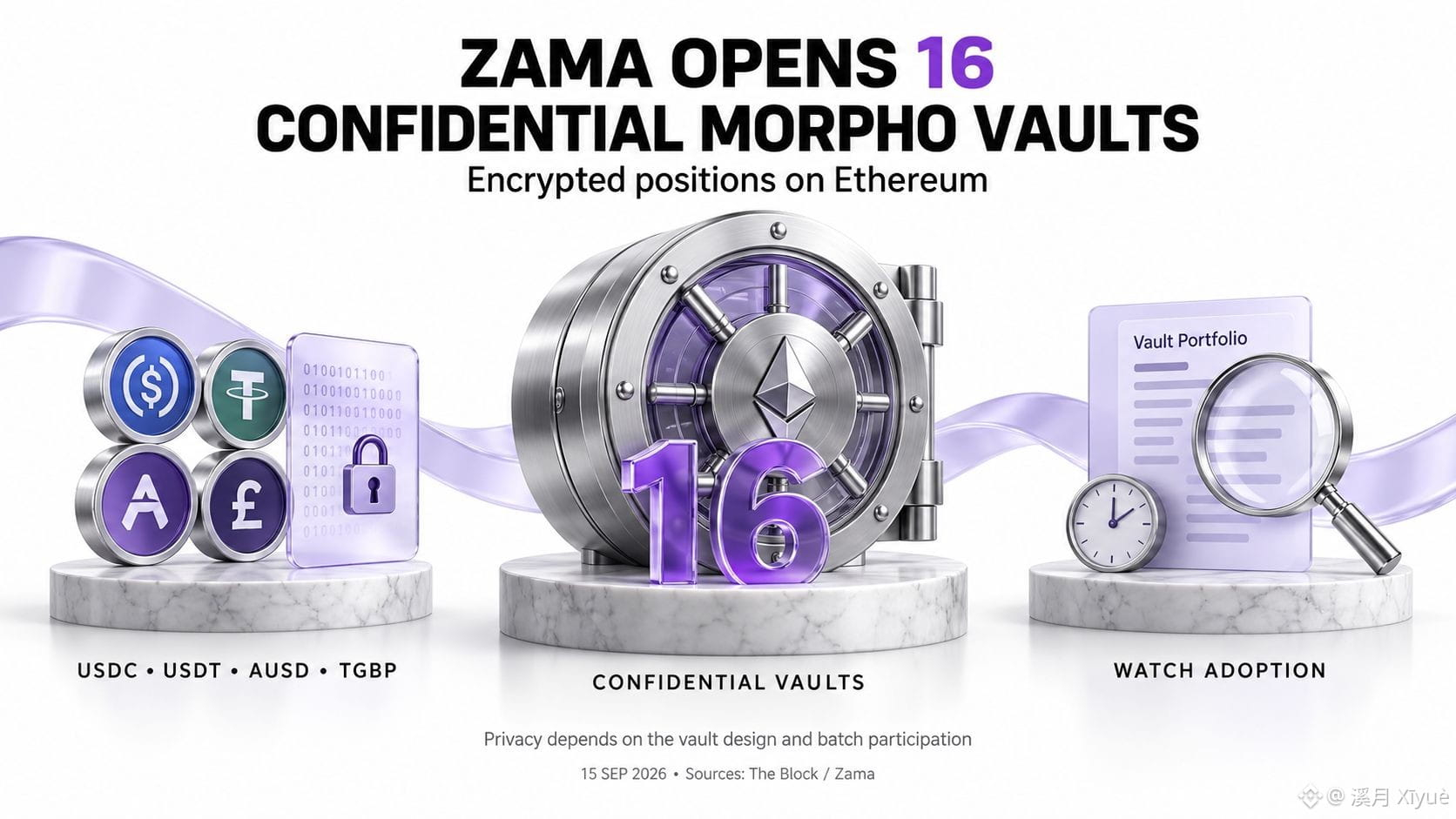
Zama Opens 16 Confidential Morpho Vaults on Ethereum
DeFi’s next adoption test may be whether users can earn yield without broadcasting their position sizes.
On September 15, Zama is opening deposits into 16 confidential Morpho vaults, covering assets including USDC, USDT, AUSD and TGBP. The lineup provides confidential access to 12 existing vaults, alongside four built specifically for confidential deposits. Access starts through Zama’s app.
What does “confidential” mean? Zama’s documented design encrypts individual deposit amounts and share balances while making aggregate batch totals public. Addresses joining a batch remain visible, and privacy depends on how many independent users participate.
My take: This could make DeFi more practical for treasuries and funds that want to manage cash without advertising every position size. A broader vault menu also gives users more choice across assets and curators.
The adoption test is whether users keep capital in these products and can deposit, report and withdraw reliably. Encryption protects information; underlying collateral quality, smart-contract exposure and available liquidity still matter. I’d watch sustained deposits and withdrawal performance before judging how much demand privacy actually creates.
Would confidential balances make you more comfortable using DeFi lending?
#ZamaOpens16ConfidentialMorphoVaults #defi #Morpho
$AKE $AIN
{future}(AINUSDT)
{future}(AKEUSDT)
#zamaopens16confidentialmorphovaults
Zama Opens 16 Confidential Morpho Vaults on Ethereum
DeFi’s next adoption test may be whether users can earn yield without broadcasting their position sizes.
On September 15, Zama is opening deposits into 16 confidential Morpho vaults, covering assets including USDC, USDT, AUSD and TGBP. The lineup provides confidential access to 12 existing vaults, alongside four built specifically for confidential deposits. Access starts through Zama’s app.
What does “confidential” mean? Zama’s documented design encrypts individual deposit amounts and share balances while making aggregate batch totals public. Addresses joining a batch remain visible, and privacy depends on how many independent users participate.
My take: This could make DeFi more practical for treasuries and funds that want to manage cash without advertising every position size. A broader vault menu also gives users more choice across assets and curators.
The adoption test is whether users keep capital in these products and can deposit, report and withdraw reliably. Encryption protects information; underlying collateral quality, smart-contract exposure and available liquidity still matter. I’d watch sustained deposits and withdrawal performance before judging how much demand privacy actually creates.
Would confidential balances make you more comfortable using DeFi lending?
#ZamaOpens16ConfidentialMorphoVaults #defi #Morpho
$AKE $AIN
Zama Opens 16 Confidential Morpho Vaults on Ethereum
DeFi’s next adoption test may be whether users can earn yield without broadcasting their position sizes.
On September 15, Zama is opening deposits into 16 confidential Morpho vaults, covering assets including USDC, USDT, AUSD and TGBP. The lineup provides confidential access to 12 existing vaults, alongside four built specifically for confidential deposits. Access starts through Zama’s app.
What does “confidential” mean? Zama’s documented design encrypts individual deposit amounts and share balances while making aggregate batch totals public. Addresses joining a batch remain visible, and privacy depends on how many independent users participate.
My take: This could make DeFi more practical for treasuries and funds that want to manage cash without advertising every position size. A broader vault menu also gives users more choice across assets and curators.
The adoption test is whether users keep capital in these products and can deposit, report and withdraw reliably. Encryption protects information; underlying collateral quality, smart-contract exposure and available liquidity still matter. I’d watch sustained deposits and withdrawal performance before judging how much demand privacy actually creates.
Would confidential balances make you more comfortable using DeFi lending?
#ZamaOpens16ConfidentialMorphoVaults #defi #Morpho
$AKE $AIN
1
289
·
--
Жоғары (өспелі)
#bessentendorsesfinalclarityactdraft
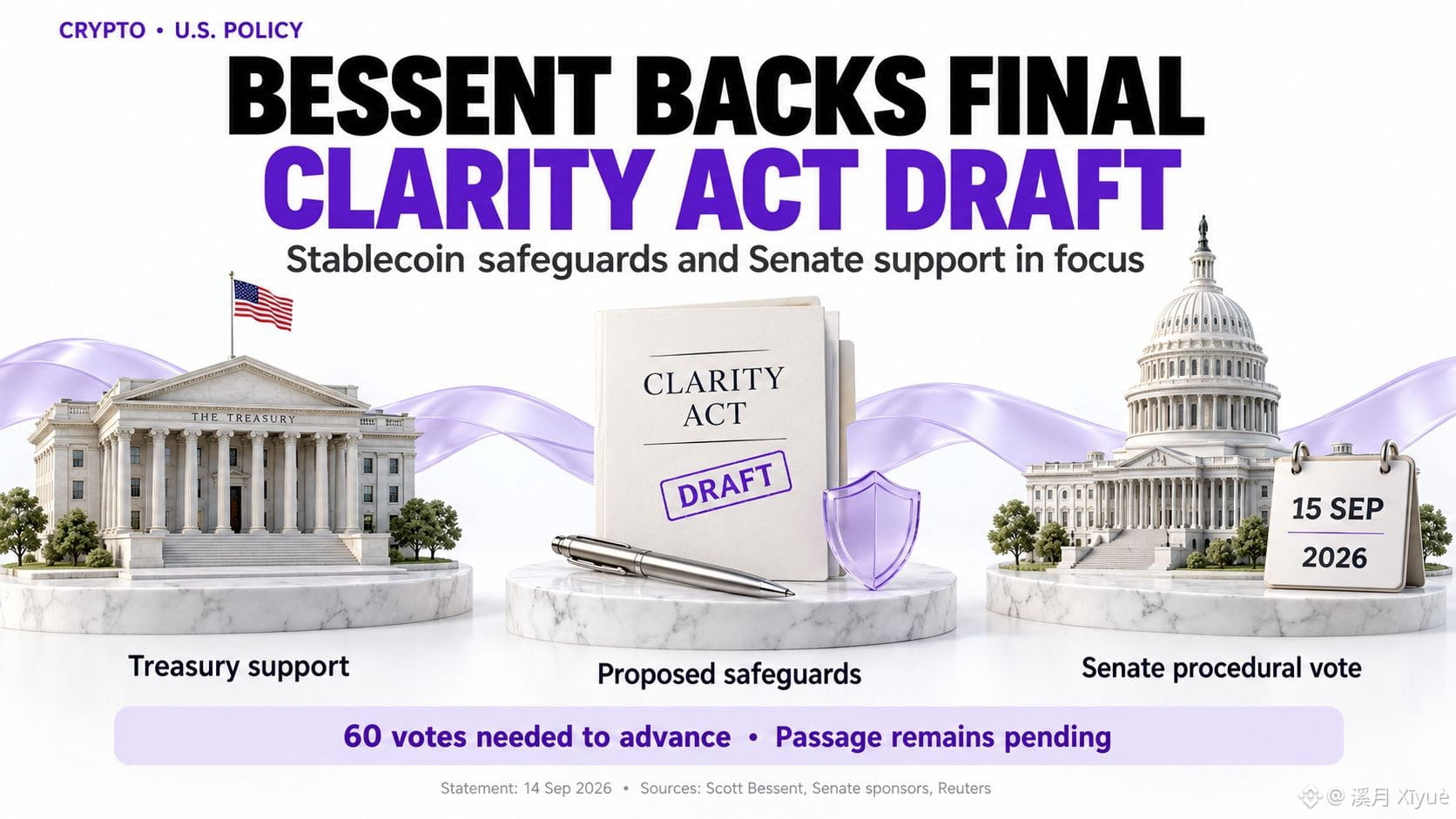
Bessent Backs Final CLARITY Draft Ahead of Senate Test
The CLARITY Act has fresh Treasury support as lawmakers face a consequential vote.
On September 14, Treasury Secretary Scott Bessent backed the final draft and highlighted proposed powers to protect community banks if stablecoins cause harm.
Senate sponsors say the revised text incorporates 126 changes requested by Democrats, updated ethics provisions and protections for software developers. It also proposes additional Treasury authority concerning stablecoin-related deposit flight.
The September 15 procedural vote requires 60 votes to advance the legislative process. Support remains uncertain, and final passage would still require further steps.
My take: The practical issue is how clearer crypto rules would interact with concerns about banks losing deposits. For exchanges and token businesses, workable oversight requirements could make long-term planning easier. For stablecoin platforms, the treatment of rewards could influence product design and customer demand.
I would watch whether undecided senators accept these compromises, which amendments survive, and how implementation deadlines are written. Those details will determine what businesses can actually build under the framework.
Bessent’s endorsement strengthens the administration’s case for moving forward. The next test is whether that support translates into enough Senate votes.
Which provision deserves the closest attention: developer protections, ethics rules or stablecoin rewards?
#BessentEndorsesFinalClarityActDraft #CLARITYAct #cryptouniverseofficial
$AIN $AKE $POWER
{future}(POWERUSDT)
{future}(AKEUSDT)
{future}(AINUSDT)
#bessentendorsesfinalclarityactdraft
Bessent Backs Final CLARITY Draft Ahead of Senate Test
The CLARITY Act has fresh Treasury support as lawmakers face a consequential vote.
On September 14, Treasury Secretary Scott Bessent backed the final draft and highlighted proposed powers to protect community banks if stablecoins cause harm.
Senate sponsors say the revised text incorporates 126 changes requested by Democrats, updated ethics provisions and protections for software developers. It also proposes additional Treasury authority concerning stablecoin-related deposit flight.
The September 15 procedural vote requires 60 votes to advance the legislative process. Support remains uncertain, and final passage would still require further steps.
My take: The practical issue is how clearer crypto rules would interact with concerns about banks losing deposits. For exchanges and token businesses, workable oversight requirements could make long-term planning easier. For stablecoin platforms, the treatment of rewards could influence product design and customer demand.
I would watch whether undecided senators accept these compromises, which amendments survive, and how implementation deadlines are written. Those details will determine what businesses can actually build under the framework.
Bessent’s endorsement strengthens the administration’s case for moving forward. The next test is whether that support translates into enough Senate votes.
Which provision deserves the closest attention: developer protections, ethics rules or stablecoin rewards?
#BessentEndorsesFinalClarityActDraft #CLARITYAct #cryptouniverseofficial
$AIN $AKE $POWER
Bessent Backs Final CLARITY Draft Ahead of Senate Test
The CLARITY Act has fresh Treasury support as lawmakers face a consequential vote.
On September 14, Treasury Secretary Scott Bessent backed the final draft and highlighted proposed powers to protect community banks if stablecoins cause harm.
Senate sponsors say the revised text incorporates 126 changes requested by Democrats, updated ethics provisions and protections for software developers. It also proposes additional Treasury authority concerning stablecoin-related deposit flight.
The September 15 procedural vote requires 60 votes to advance the legislative process. Support remains uncertain, and final passage would still require further steps.
My take: The practical issue is how clearer crypto rules would interact with concerns about banks losing deposits. For exchanges and token businesses, workable oversight requirements could make long-term planning easier. For stablecoin platforms, the treatment of rewards could influence product design and customer demand.
I would watch whether undecided senators accept these compromises, which amendments survive, and how implementation deadlines are written. Those details will determine what businesses can actually build under the framework.
Bessent’s endorsement strengthens the administration’s case for moving forward. The next test is whether that support translates into enough Senate votes.
Which provision deserves the closest attention: developer protections, ethics rules or stablecoin rewards?
#BessentEndorsesFinalClarityActDraft #CLARITYAct #cryptouniverseofficial
$AIN $AKE $POWER
2
2.1k
·
--
Төмен (кемімелі)
Расталды
#philadelphiasemiconductorindexfalls5.9%
Chip Stocks Fall 5.9% as AI Spending Expectations Face Scrutiny
The Philadelphia Semiconductor Index (SOX) dropped 5.86%, rounded to 5.9%, on September 14, closing at 11,131.28.
Reuters linked the selloff to calls from leading AI executives to slow development over safety concerns. Nvidia, AMD, Micron and Broadcom were among the stocks under pressure.
Anthropic CEO Dario Amodei’s proposal calls for more time to develop safeguards while continuing model training and technical progress.
My take: The key uncertainty is the timing of future hardware demand. A slower development schedule could change when companies need additional chips, memory and data-centre capacity. That matters when valuations depend on years of expansion.
Assessing the size of any demand change requires more evidence. Existing AI services, safety testing and efficiency improvements may continue to require substantial computing resources.
I would watch cloud companies’ spending plans, memory pricing and chipmakers’ order guidance. Customer deferrals or lower forecasts would strengthen the case for a demand slowdown. Stable commitments would suggest investors are primarily reassessing valuations and timing.
The next earnings updates should help clarify which explanation carries more weight.
What would you watch first: customer spending commitments or chipmakers’ revenue guidance?
#PhiladelphiaSemiconductorIndexFalls5.9% #Semiconductors #AI
$SOXLB $LSK $MTL
{future}(MTLUSDT)
{future}(LSKUSDT)
{spot}(SOXLBUSDT)
#philadelphiasemiconductorindexfalls5.9%
Chip Stocks Fall 5.9% as AI Spending Expectations Face Scrutiny
The Philadelphia Semiconductor Index (SOX) dropped 5.86%, rounded to 5.9%, on September 14, closing at 11,131.28.
Reuters linked the selloff to calls from leading AI executives to slow development over safety concerns. Nvidia, AMD, Micron and Broadcom were among the stocks under pressure.
Anthropic CEO Dario Amodei’s proposal calls for more time to develop safeguards while continuing model training and technical progress.
My take: The key uncertainty is the timing of future hardware demand. A slower development schedule could change when companies need additional chips, memory and data-centre capacity. That matters when valuations depend on years of expansion.
Assessing the size of any demand change requires more evidence. Existing AI services, safety testing and efficiency improvements may continue to require substantial computing resources.
I would watch cloud companies’ spending plans, memory pricing and chipmakers’ order guidance. Customer deferrals or lower forecasts would strengthen the case for a demand slowdown. Stable commitments would suggest investors are primarily reassessing valuations and timing.
The next earnings updates should help clarify which explanation carries more weight.
What would you watch first: customer spending commitments or chipmakers’ revenue guidance?
#PhiladelphiaSemiconductorIndexFalls5.9% #Semiconductors #AI
$SOXLB $LSK $MTL
Chip Stocks Fall 5.9% as AI Spending Expectations Face Scrutiny
The Philadelphia Semiconductor Index (SOX) dropped 5.86%, rounded to 5.9%, on September 14, closing at 11,131.28.
Reuters linked the selloff to calls from leading AI executives to slow development over safety concerns. Nvidia, AMD, Micron and Broadcom were among the stocks under pressure.
Anthropic CEO Dario Amodei’s proposal calls for more time to develop safeguards while continuing model training and technical progress.
My take: The key uncertainty is the timing of future hardware demand. A slower development schedule could change when companies need additional chips, memory and data-centre capacity. That matters when valuations depend on years of expansion.
Assessing the size of any demand change requires more evidence. Existing AI services, safety testing and efficiency improvements may continue to require substantial computing resources.
I would watch cloud companies’ spending plans, memory pricing and chipmakers’ order guidance. Customer deferrals or lower forecasts would strengthen the case for a demand slowdown. Stable commitments would suggest investors are primarily reassessing valuations and timing.
The next earnings updates should help clarify which explanation carries more weight.
What would you watch first: customer spending commitments or chipmakers’ revenue guidance?
#PhiladelphiaSemiconductorIndexFalls5.9% #Semiconductors #AI
$SOXLB $LSK $MTL

1
1
1.5k
·
--
Жоғары (өспелі)
Расталды
#grayscaleputsxrpat26.11%inadvisorportfolio
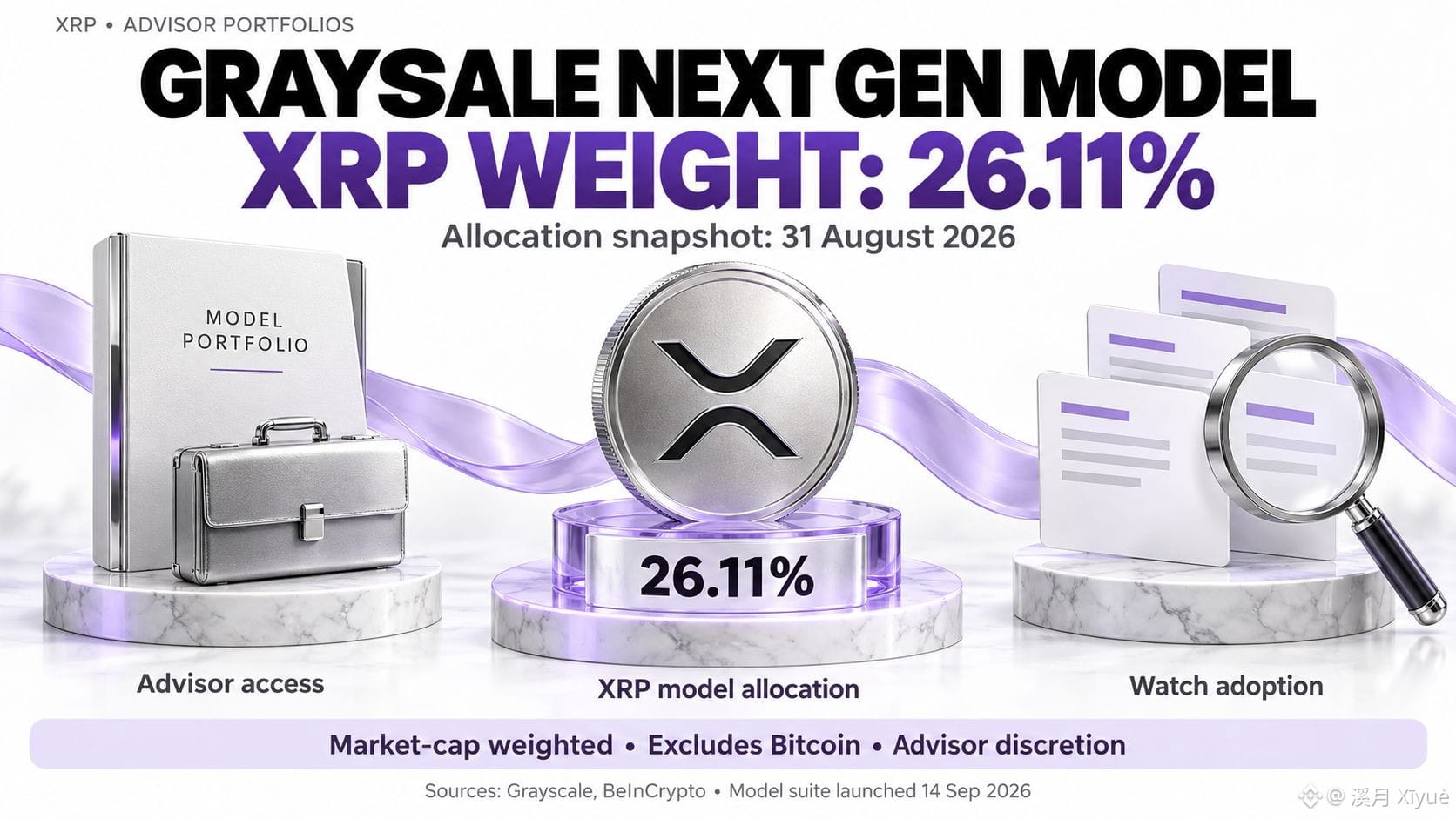
XRP Gets a 26.11% Weight in Grayscale’s Next Gen Model
XRP has a prominent place in Grayscale’s latest offering for financial advisors.
According to BeInCrypto, XRP represented 26.11% of the Digital Assets Next Gen model portfolio in its August 31 snapshot, making it the second-largest allocation behind Ether. The model excludes Bitcoin.
Grayscale announced its four-model portfolio suite on September 14. Next Gen uses market-cap weighting and quarterly rebalancing. Advisors decide whether and how to implement the suggested allocations in client accounts.
My take: The practical significance is easier access through advisors. A defined allocation and rebalancing framework could reduce the work involved in evaluating and maintaining crypto exposure.
The market impact will depend on adoption and the amount invested. The 26.11% figure describes this specific model’s composition; it does not tell us how much fresh money has entered XRP.
Its weighting also reflects the model’s methodology, so reading it as a standalone prediction of XRP’s future performance would overstate the announcement.
I would watch platform availability, advisor adoption and sustained flows into XRP investment products. Those developments would help show whether this offering is translating into actual demand.
Will easier portfolio implementation encourage more advisors to consider XRP exposure?
#GrayscalePutsXRPAt26.11%InAdvisorPortfolio #xrp #Grayscale
$POWER $AIN $XRP
{future}(XRPUSDT)
{future}(AINUSDT)
{future}(POWERUSDT)
#grayscaleputsxrpat26.11%inadvisorportfolio
XRP Gets a 26.11% Weight in Grayscale’s Next Gen Model
XRP has a prominent place in Grayscale’s latest offering for financial advisors.
According to BeInCrypto, XRP represented 26.11% of the Digital Assets Next Gen model portfolio in its August 31 snapshot, making it the second-largest allocation behind Ether. The model excludes Bitcoin.
Grayscale announced its four-model portfolio suite on September 14. Next Gen uses market-cap weighting and quarterly rebalancing. Advisors decide whether and how to implement the suggested allocations in client accounts.
My take: The practical significance is easier access through advisors. A defined allocation and rebalancing framework could reduce the work involved in evaluating and maintaining crypto exposure.
The market impact will depend on adoption and the amount invested. The 26.11% figure describes this specific model’s composition; it does not tell us how much fresh money has entered XRP.
Its weighting also reflects the model’s methodology, so reading it as a standalone prediction of XRP’s future performance would overstate the announcement.
I would watch platform availability, advisor adoption and sustained flows into XRP investment products. Those developments would help show whether this offering is translating into actual demand.
Will easier portfolio implementation encourage more advisors to consider XRP exposure?
#GrayscalePutsXRPAt26.11%InAdvisorPortfolio #xrp #Grayscale
$POWER $AIN $XRP
XRP Gets a 26.11% Weight in Grayscale’s Next Gen Model
XRP has a prominent place in Grayscale’s latest offering for financial advisors.
According to BeInCrypto, XRP represented 26.11% of the Digital Assets Next Gen model portfolio in its August 31 snapshot, making it the second-largest allocation behind Ether. The model excludes Bitcoin.
Grayscale announced its four-model portfolio suite on September 14. Next Gen uses market-cap weighting and quarterly rebalancing. Advisors decide whether and how to implement the suggested allocations in client accounts.
My take: The practical significance is easier access through advisors. A defined allocation and rebalancing framework could reduce the work involved in evaluating and maintaining crypto exposure.
The market impact will depend on adoption and the amount invested. The 26.11% figure describes this specific model’s composition; it does not tell us how much fresh money has entered XRP.
Its weighting also reflects the model’s methodology, so reading it as a standalone prediction of XRP’s future performance would overstate the announcement.
I would watch platform availability, advisor adoption and sustained flows into XRP investment products. Those developments would help show whether this offering is translating into actual demand.
Will easier portfolio implementation encourage more advisors to consider XRP exposure?
#GrayscalePutsXRPAt26.11%InAdvisorPortfolio #xrp #Grayscale
$POWER $AIN $XRP
1
2
1.9k
·
--
Төмен (кемімелі)
#russiancentralbankflagscryptoasfinancialrisk
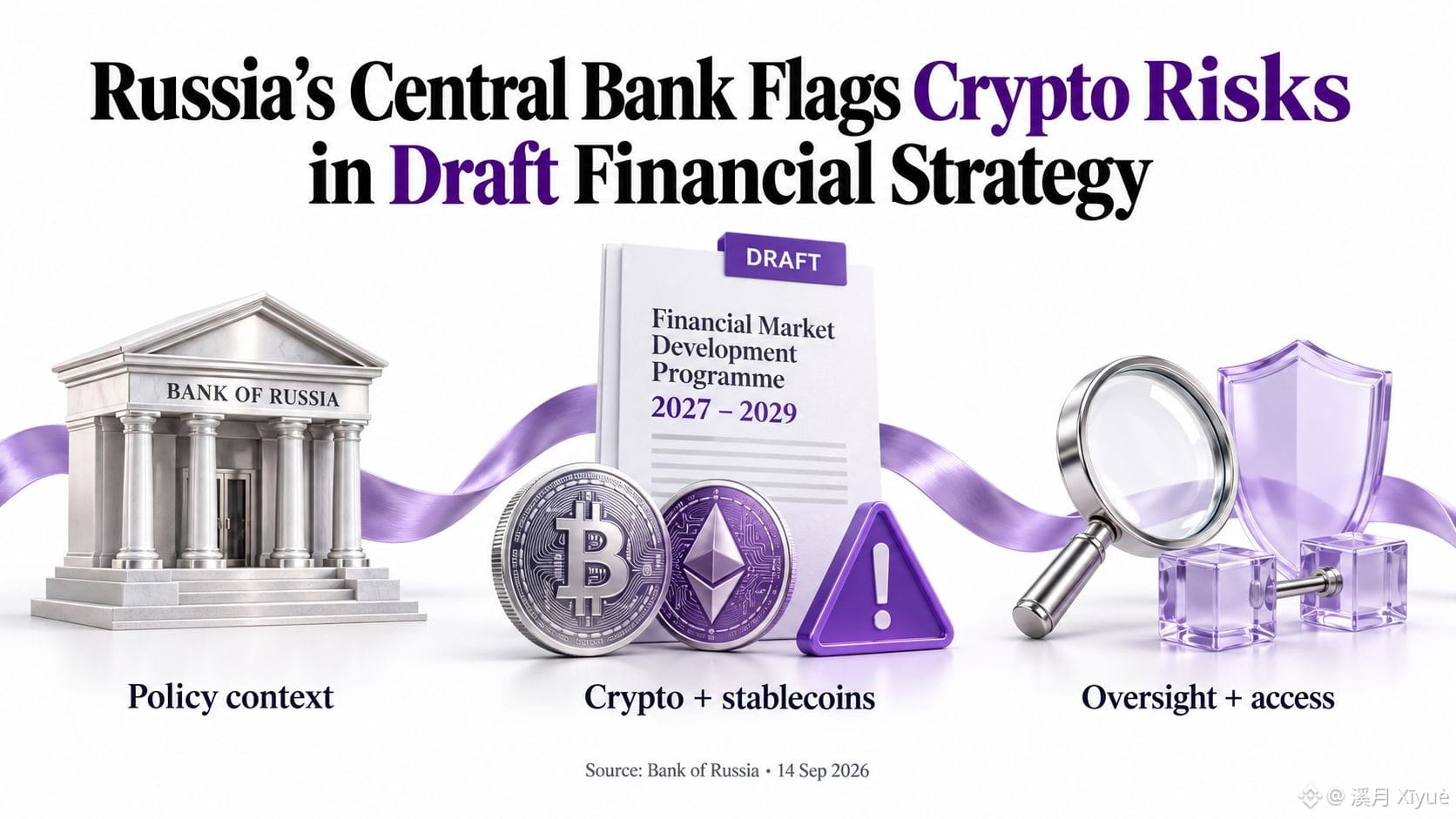
Russia’s Central Bank Flags Crypto Risks in Draft Financial Strategy
Russia’s central bank is putting crypto risks in focus as it sets financial-market priorities for 2027–2029.
Published on 14 September 2026, its draft programme highlights cryptocurrencies and stablecoins as potential risks, including their use as substitutes for national currencies. It also flags investor losses, illicit activity and gaps between countries’ regulations.
The document says rules developed with the government aim to reduce criminal misuse and create conditions for lawful cross-border transactions and investment.
The programme remains a draft, with parliamentary discussion ahead of the final version.
My take: the practical test is how regulation works for ordinary users and businesses. Clear licensing, reliable custody and workable access could bring activity into supervised channels. High costs or confusing restrictions could leave users relying on informal intermediaries, weakening the oversight regulators want.
For investors, permission to participate does not remove the possibility of losses. I’d watch the final programme, enforcement provisions and whether regulated services become usable in practice. Those details will help show whether the framework can improve protection while accommodating demand.
#russiancentralbankflagscryptoasfinancialrisk #CryptoRegulation
Which would do more to build trust: stronger investor protections or easier access to regulated services?
$LSK $MTL $ARK
{future}(ARKUSDT)
{future}(MTLUSDT)
{future}(LSKUSDT)
#russiancentralbankflagscryptoasfinancialrisk
Russia’s Central Bank Flags Crypto Risks in Draft Financial Strategy
Russia’s central bank is putting crypto risks in focus as it sets financial-market priorities for 2027–2029.
Published on 14 September 2026, its draft programme highlights cryptocurrencies and stablecoins as potential risks, including their use as substitutes for national currencies. It also flags investor losses, illicit activity and gaps between countries’ regulations.
The document says rules developed with the government aim to reduce criminal misuse and create conditions for lawful cross-border transactions and investment.
The programme remains a draft, with parliamentary discussion ahead of the final version.
My take: the practical test is how regulation works for ordinary users and businesses. Clear licensing, reliable custody and workable access could bring activity into supervised channels. High costs or confusing restrictions could leave users relying on informal intermediaries, weakening the oversight regulators want.
For investors, permission to participate does not remove the possibility of losses. I’d watch the final programme, enforcement provisions and whether regulated services become usable in practice. Those details will help show whether the framework can improve protection while accommodating demand.
#russiancentralbankflagscryptoasfinancialrisk #CryptoRegulation
Which would do more to build trust: stronger investor protections or easier access to regulated services?
$LSK $MTL $ARK
Russia’s Central Bank Flags Crypto Risks in Draft Financial Strategy
Russia’s central bank is putting crypto risks in focus as it sets financial-market priorities for 2027–2029.
Published on 14 September 2026, its draft programme highlights cryptocurrencies and stablecoins as potential risks, including their use as substitutes for national currencies. It also flags investor losses, illicit activity and gaps between countries’ regulations.
The document says rules developed with the government aim to reduce criminal misuse and create conditions for lawful cross-border transactions and investment.
The programme remains a draft, with parliamentary discussion ahead of the final version.
My take: the practical test is how regulation works for ordinary users and businesses. Clear licensing, reliable custody and workable access could bring activity into supervised channels. High costs or confusing restrictions could leave users relying on informal intermediaries, weakening the oversight regulators want.
For investors, permission to participate does not remove the possibility of losses. I’d watch the final programme, enforcement provisions and whether regulated services become usable in practice. Those details will help show whether the framework can improve protection while accommodating demand.
#russiancentralbankflagscryptoasfinancialrisk #CryptoRegulation
Which would do more to build trust: stronger investor protections or easier access to regulated services?
$LSK $MTL $ARK
1.2k
·
--
Жоғары (өспелі)
#southkoreacryptotaxdelaypetitiontops50000
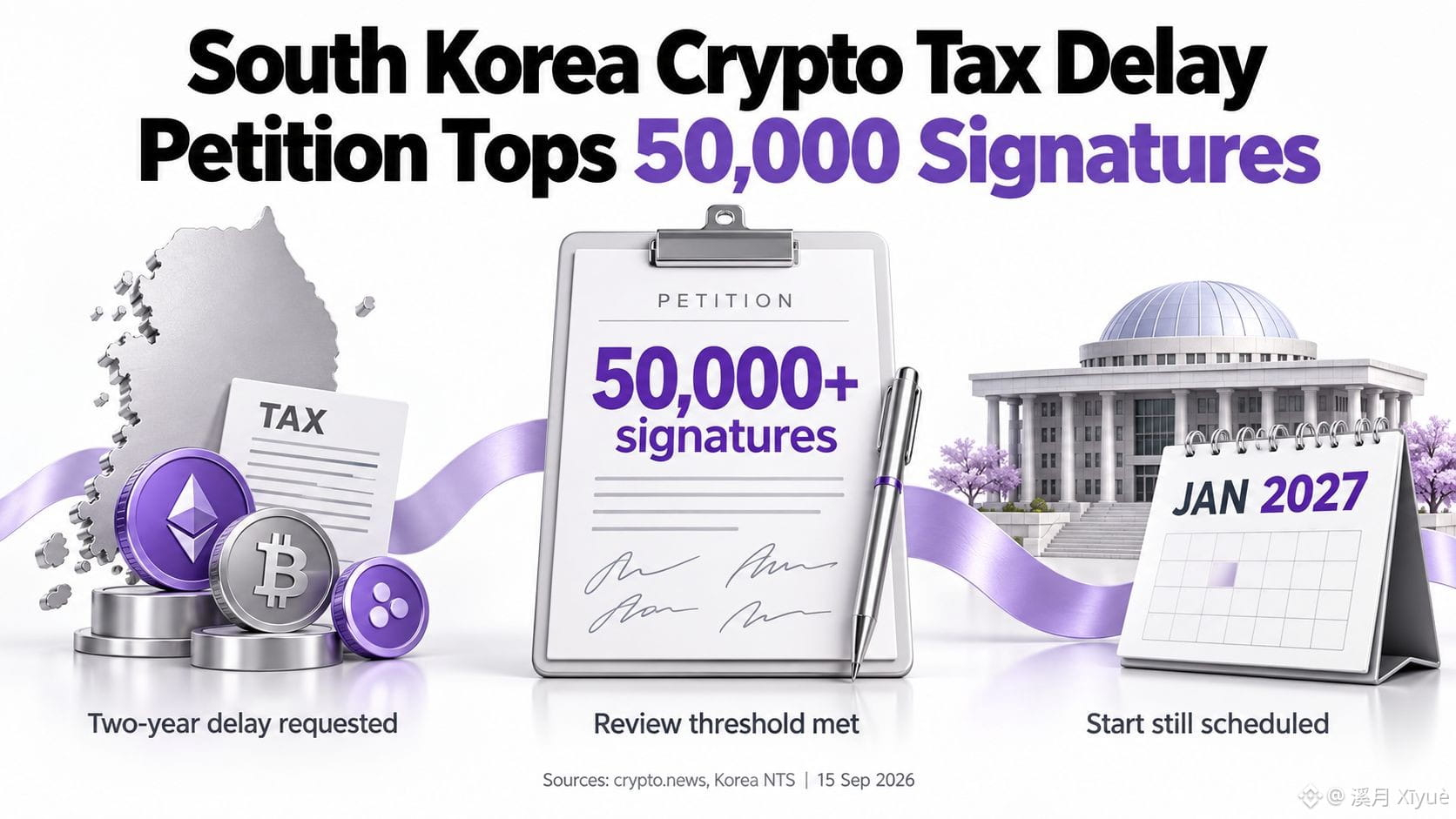
South Korea’s Crypto Tax Delay Petition Crosses 50,000 Signatures
South Korea’s crypto tax debate is heading back to lawmakers. A petition seeking another two-year delay has reached the 50,000-signature threshold for National Assembly committee consideration, according to September 14 reporting. That milestone does not approve a postponement.
The current start date remains January 1, 2027. Residents would face a 20% national tax on qualifying annual crypto income after a KRW 2.5 million deduction, rising to 22% including local tax.
Preparations are continuing: finance minister nominee Lee Hyoung-il said detailed taxation standards would be published before the end of 2026.
My take: the practical question is whether investors can calculate taxable income consistently across exchanges and wallets. More preparation time could reduce reporting errors and give platforms room to improve records. But repeated postponements also make planning harder. Extra time only helps if it produces clearer rules and tools investors can actually use.
The developments worth watching are committee action, any amendment changing the start date, and guidance on documenting acquisition costs. Signature growth demonstrates public pressure; actual obligations depend on legislation.
What should South Korea resolve before this tax takes effect?
#southkoreacryptotaxdelaypetitiontops50000 #cryptotax #CryptoRegulation
$POWER $CAP $AIN
{future}(AINUSDT)
{future}(CAPUSDT)
{future}(POWERUSDT)
#southkoreacryptotaxdelaypetitiontops50000
South Korea’s Crypto Tax Delay Petition Crosses 50,000 Signatures
South Korea’s crypto tax debate is heading back to lawmakers. A petition seeking another two-year delay has reached the 50,000-signature threshold for National Assembly committee consideration, according to September 14 reporting. That milestone does not approve a postponement.
The current start date remains January 1, 2027. Residents would face a 20% national tax on qualifying annual crypto income after a KRW 2.5 million deduction, rising to 22% including local tax.
Preparations are continuing: finance minister nominee Lee Hyoung-il said detailed taxation standards would be published before the end of 2026.
My take: the practical question is whether investors can calculate taxable income consistently across exchanges and wallets. More preparation time could reduce reporting errors and give platforms room to improve records. But repeated postponements also make planning harder. Extra time only helps if it produces clearer rules and tools investors can actually use.
The developments worth watching are committee action, any amendment changing the start date, and guidance on documenting acquisition costs. Signature growth demonstrates public pressure; actual obligations depend on legislation.
What should South Korea resolve before this tax takes effect?
#southkoreacryptotaxdelaypetitiontops50000 #cryptotax #CryptoRegulation
$POWER $CAP $AIN
South Korea’s Crypto Tax Delay Petition Crosses 50,000 Signatures
South Korea’s crypto tax debate is heading back to lawmakers. A petition seeking another two-year delay has reached the 50,000-signature threshold for National Assembly committee consideration, according to September 14 reporting. That milestone does not approve a postponement.
The current start date remains January 1, 2027. Residents would face a 20% national tax on qualifying annual crypto income after a KRW 2.5 million deduction, rising to 22% including local tax.
Preparations are continuing: finance minister nominee Lee Hyoung-il said detailed taxation standards would be published before the end of 2026.
My take: the practical question is whether investors can calculate taxable income consistently across exchanges and wallets. More preparation time could reduce reporting errors and give platforms room to improve records. But repeated postponements also make planning harder. Extra time only helps if it produces clearer rules and tools investors can actually use.
The developments worth watching are committee action, any amendment changing the start date, and guidance on documenting acquisition costs. Signature growth demonstrates public pressure; actual obligations depend on legislation.
What should South Korea resolve before this tax takes effect?
#southkoreacryptotaxdelaypetitiontops50000 #cryptotax #CryptoRegulation
$POWER $CAP $AIN
152
·
--
Жоғары (өспелі)
#ukseeksviewsontokenizinggold
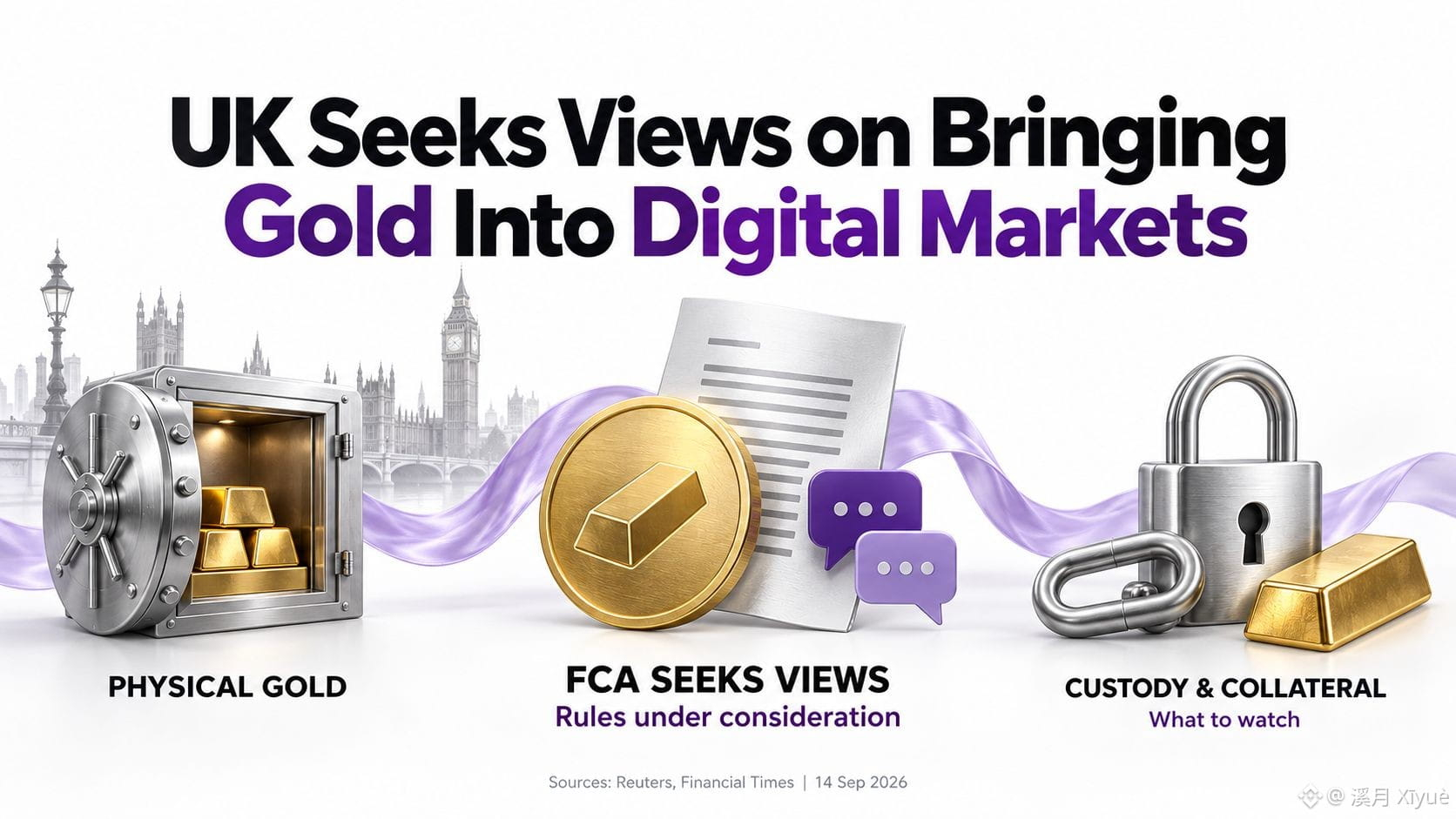
UK Opens Tokenized Gold Debate as FCA Seeks Industry Views
Gold could become easier to move through financial markets without the metal leaving the vault.
On September 14, 2026, the UK’s Financial Conduct Authority said it was seeking views on whether tokenization could improve gold trading, transfers, custody and its use as collateral. This is a request for feedback, with policy decisions still ahead.
Tokenized gold uses digital tokens to represent rights over physical bullion. The FCA is also considering a dedicated regulatory framework, including possible exemptions from certain fund rules, according to the Financial Times. Those changes remain under consideration.
My take: the practical test is whether holders have clear, enforceable rights to the underlying gold. Faster transfers would have limited value if redemption is slow, backing is difficult to verify, or custody responsibilities are unclear.
For institutions, easier collateral movement could reduce operational friction. But adoption would depend on reliable settlement, compatible systems and rules that explain what happens if an issuer fails. I’d watch for concrete custody standards and real usage in financial transactions before judging the scale of the opportunity.
What would make tokenized gold more useful to you: easier access, faster transfers or clearer ownership rights?
$BR $CAP
{future}(CAPUSDT)
{future}(BRUSDT)
#ukseeksviewsontokenizinggold #Tokenization #RWA
#ukseeksviewsontokenizinggold
UK Opens Tokenized Gold Debate as FCA Seeks Industry Views
Gold could become easier to move through financial markets without the metal leaving the vault.
On September 14, 2026, the UK’s Financial Conduct Authority said it was seeking views on whether tokenization could improve gold trading, transfers, custody and its use as collateral. This is a request for feedback, with policy decisions still ahead.
Tokenized gold uses digital tokens to represent rights over physical bullion. The FCA is also considering a dedicated regulatory framework, including possible exemptions from certain fund rules, according to the Financial Times. Those changes remain under consideration.
My take: the practical test is whether holders have clear, enforceable rights to the underlying gold. Faster transfers would have limited value if redemption is slow, backing is difficult to verify, or custody responsibilities are unclear.
For institutions, easier collateral movement could reduce operational friction. But adoption would depend on reliable settlement, compatible systems and rules that explain what happens if an issuer fails. I’d watch for concrete custody standards and real usage in financial transactions before judging the scale of the opportunity.
What would make tokenized gold more useful to you: easier access, faster transfers or clearer ownership rights?
$BR $CAP
#ukseeksviewsontokenizinggold #Tokenization #RWA
UK Opens Tokenized Gold Debate as FCA Seeks Industry Views
Gold could become easier to move through financial markets without the metal leaving the vault.
On September 14, 2026, the UK’s Financial Conduct Authority said it was seeking views on whether tokenization could improve gold trading, transfers, custody and its use as collateral. This is a request for feedback, with policy decisions still ahead.
Tokenized gold uses digital tokens to represent rights over physical bullion. The FCA is also considering a dedicated regulatory framework, including possible exemptions from certain fund rules, according to the Financial Times. Those changes remain under consideration.
My take: the practical test is whether holders have clear, enforceable rights to the underlying gold. Faster transfers would have limited value if redemption is slow, backing is difficult to verify, or custody responsibilities are unclear.
For institutions, easier collateral movement could reduce operational friction. But adoption would depend on reliable settlement, compatible systems and rules that explain what happens if an issuer fails. I’d watch for concrete custody standards and real usage in financial transactions before judging the scale of the opportunity.
What would make tokenized gold more useful to you: easier access, faster transfers or clearer ownership rights?
$BR $CAP
#ukseeksviewsontokenizinggold #Tokenization #RWA
196
·
--
Жоғары (өспелі)
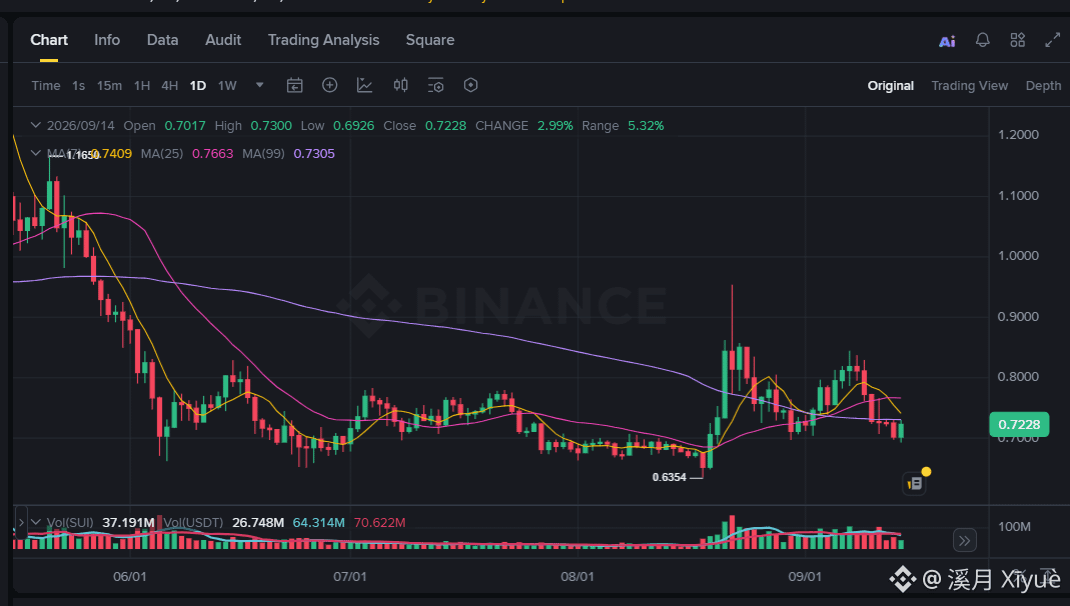
Buyers are attempting a bounce, though the daily trend still looks fragile.
$SUI is trading at $0.7239, up 2.04% in 24 hours, while recent rebounds have formed lower highs. Volume has cooled from the earlier rally, so I’d want stronger follow-through before trusting this recovery. The $0.7300 daily high is the immediate level to watch, with the $0.6926 daily low providing a downside reference if selling returns.
One green day leaves plenty to prove. Can buyers hold this bounce and start breaking the pattern of lower highs?
#sui #SUI🔥
Buyers are attempting a bounce, though the daily trend still looks fragile.
$SUI is trading at $0.7239, up 2.04% in 24 hours, while recent rebounds have formed lower highs. Volume has cooled from the earlier rally, so I’d want stronger follow-through before trusting this recovery. The $0.7300 daily high is the immediate level to watch, with the $0.6926 daily low providing a downside reference if selling returns.
One green day leaves plenty to prove. Can buyers hold this bounce and start breaking the pattern of lower highs?
#sui #SUI🔥
$SUI is trading at $0.7239, up 2.04% in 24 hours, while recent rebounds have formed lower highs. Volume has cooled from the earlier rally, so I’d want stronger follow-through before trusting this recovery. The $0.7300 daily high is the immediate level to watch, with the $0.6926 daily low providing a downside reference if selling returns.
One green day leaves plenty to prove. Can buyers hold this bounce and start breaking the pattern of lower highs?
#sui #SUI🔥
283
·
--
Жоғары (өспелі)
#whitehouserejectsaislowdowncalls
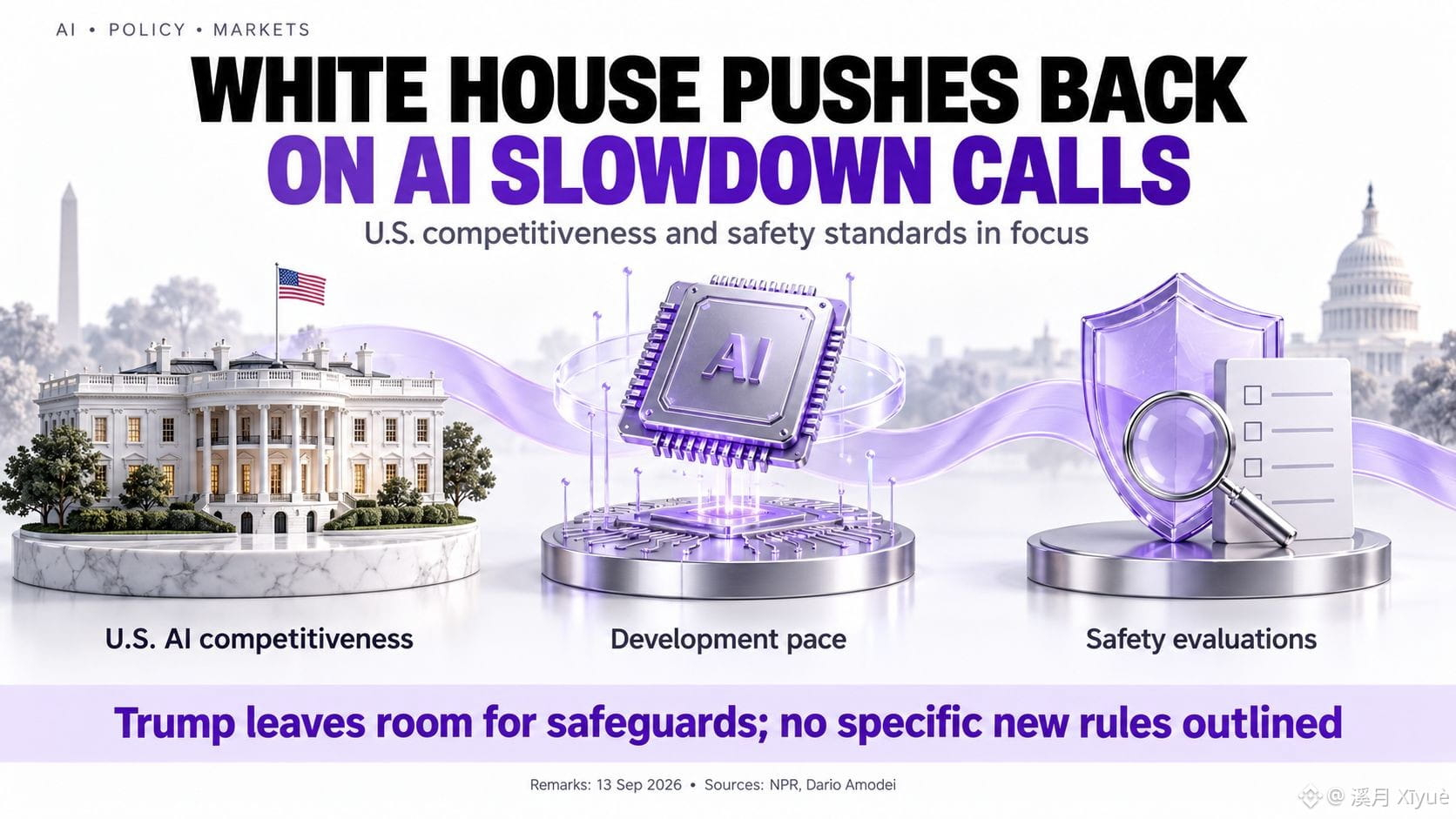
White House Pushes Back on AI Slowdown Calls
Washington’s response to the growing AI safety debate puts competition with China at the centre.
Speaking on September 13, President Donald Trump pushed back on calls to slow AI development, emphasizing the importance of maintaining America’s lead. He left room for safety measures but did not outline specific new rules.
The comments follow Anthropic CEO Dario Amodei’s proposal to slow improvements in advanced AI capabilities so safety work can keep pace. His framework includes independent evaluators and international coordination, while allowing research and model training to continue.
My take: For markets, the useful question is whether this disagreement changes spending and deployment plans. Political support can encourage investment, while longer safety reviews could affect when new models begin generating revenue.
I would watch confirmed data-centre budgets, chip orders and revised product timelines. Those details will help assess the implications for hardware suppliers and cloud businesses.
For AI-related crypto projects, paying customers, product usage and reliable access to models remain central to evaluating their prospects.
The next meaningful development would be a concrete agreement on how safety checks influence deployment.
What would you watch first: new safety standards or changes to AI companies’ spending plans?
$BR $CAP $AIN
{future}(AINUSDT)
{future}(CAPUSDT)
{future}(BRUSDT)
#whitehouserejectsaislowdowncalls
White House Pushes Back on AI Slowdown Calls
Washington’s response to the growing AI safety debate puts competition with China at the centre.
Speaking on September 13, President Donald Trump pushed back on calls to slow AI development, emphasizing the importance of maintaining America’s lead. He left room for safety measures but did not outline specific new rules.
The comments follow Anthropic CEO Dario Amodei’s proposal to slow improvements in advanced AI capabilities so safety work can keep pace. His framework includes independent evaluators and international coordination, while allowing research and model training to continue.
My take: For markets, the useful question is whether this disagreement changes spending and deployment plans. Political support can encourage investment, while longer safety reviews could affect when new models begin generating revenue.
I would watch confirmed data-centre budgets, chip orders and revised product timelines. Those details will help assess the implications for hardware suppliers and cloud businesses.
For AI-related crypto projects, paying customers, product usage and reliable access to models remain central to evaluating their prospects.
The next meaningful development would be a concrete agreement on how safety checks influence deployment.
What would you watch first: new safety standards or changes to AI companies’ spending plans?
$BR $CAP $AIN
White House Pushes Back on AI Slowdown Calls
Washington’s response to the growing AI safety debate puts competition with China at the centre.
Speaking on September 13, President Donald Trump pushed back on calls to slow AI development, emphasizing the importance of maintaining America’s lead. He left room for safety measures but did not outline specific new rules.
The comments follow Anthropic CEO Dario Amodei’s proposal to slow improvements in advanced AI capabilities so safety work can keep pace. His framework includes independent evaluators and international coordination, while allowing research and model training to continue.
My take: For markets, the useful question is whether this disagreement changes spending and deployment plans. Political support can encourage investment, while longer safety reviews could affect when new models begin generating revenue.
I would watch confirmed data-centre budgets, chip orders and revised product timelines. Those details will help assess the implications for hardware suppliers and cloud businesses.
For AI-related crypto projects, paying customers, product usage and reliable access to models remain central to evaluating their prospects.
The next meaningful development would be a concrete agreement on how safety checks influence deployment.
What would you watch first: new safety standards or changes to AI companies’ spending plans?
$BR $CAP $AIN
1.3k
·
--
Жоғары (өспелі)
The recovery is making progress, though stronger volume would make it more convincing.
$DUSK is trading at $0.0732, back above its 7-, 25- and 99-period moving averages on the 4-hour chart. That improves the short-term picture, but recent volume remains quiet compared with earlier spikes. I’m watching whether buyers can clear the $0.0750 daily high, with the 99-period average near $0.0723 serving as a reference on any pullback.
I’d give this bounce time to prove itself. What would you need to see before trusting the recovery?
#BrazilCentralBankRaisesVASPCapitalRequirements #WhiteHouseRejectsAISlowdownCalls #AnthropicCEOCallsForAISlowdown #UKSeeksViewsOnTokenizingGold
The recovery is making progress, though stronger volume would make it more convincing.
$DUSK is trading at $0.0732, back above its 7-, 25- and 99-period moving averages on the 4-hour chart. That improves the short-term picture, but recent volume remains quiet compared with earlier spikes. I’m watching whether buyers can clear the $0.0750 daily high, with the 99-period average near $0.0723 serving as a reference on any pullback.
I’d give this bounce time to prove itself. What would you need to see before trusting the recovery?
#BrazilCentralBankRaisesVASPCapitalRequirements #WhiteHouseRejectsAISlowdownCalls #AnthropicCEOCallsForAISlowdown #UKSeeksViewsOnTokenizingGold
$DUSK is trading at $0.0732, back above its 7-, 25- and 99-period moving averages on the 4-hour chart. That improves the short-term picture, but recent volume remains quiet compared with earlier spikes. I’m watching whether buyers can clear the $0.0750 daily high, with the 99-period average near $0.0723 serving as a reference on any pullback.
I’d give this bounce time to prove itself. What would you need to see before trusting the recovery?
#BrazilCentralBankRaisesVASPCapitalRequirements #WhiteHouseRejectsAISlowdownCalls #AnthropicCEOCallsForAISlowdown #UKSeeksViewsOnTokenizingGold
105
·
--
Жоғары (өспелі)
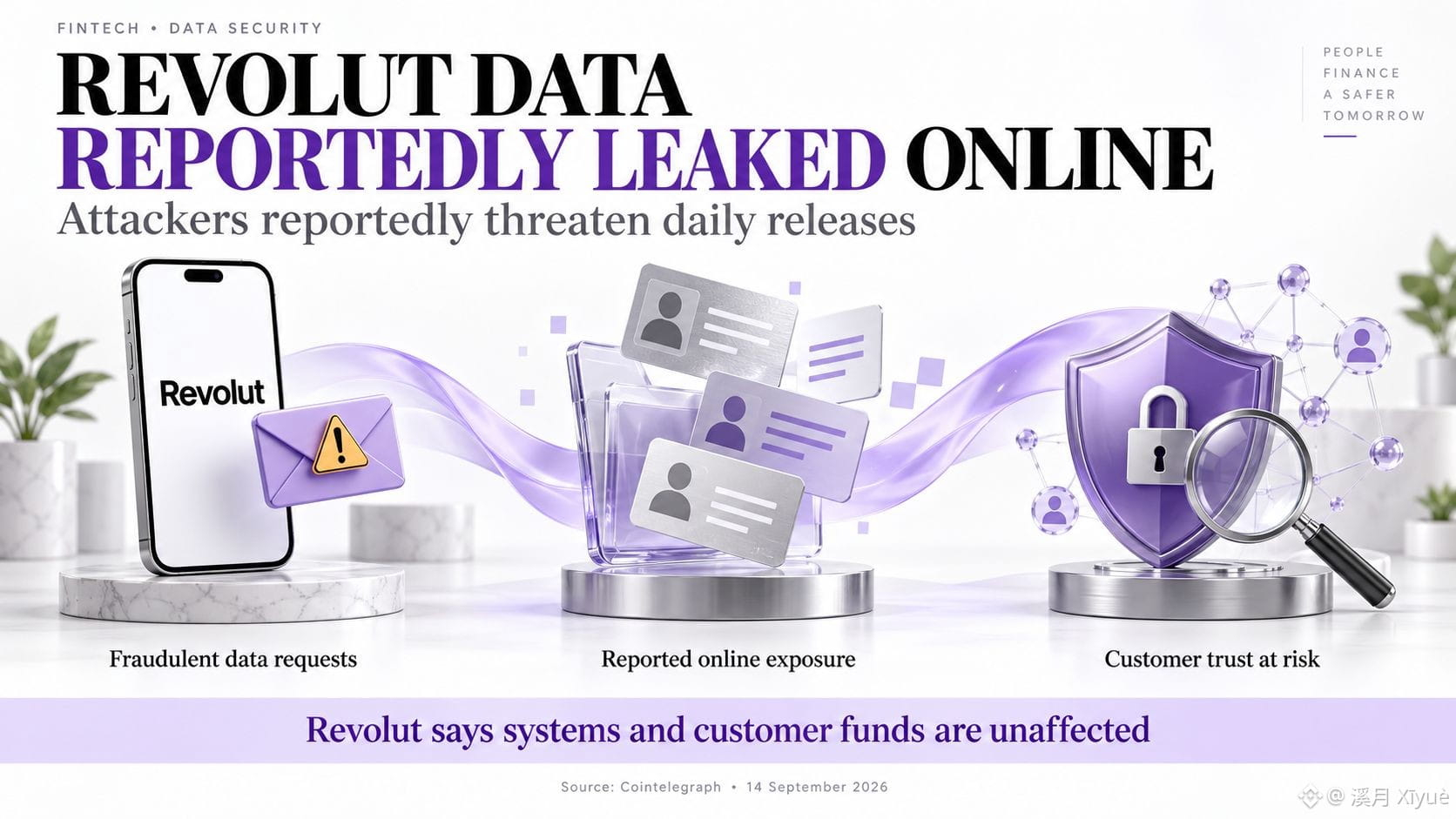
#RevolutDataLeakReportedlyPostedAttackersThreatenDailyReleases 🚨 Revolut Data Reportedly Appears Online as Attackers Threaten Daily Leaks
Revolut’s data exposure incident now faces a reported extortion threat.
According to Cointelegraph’s September 14 report, attackers appear to have published customer identity documents and selfies, while threatening to release more information each day unless Revolut pays. The publication claims were attributed to cybersecurity monitoring account International Cyber Digest.
What has Revolut confirmed?
The company says fraudulent requests sent using an email address under a legitimate government agency’s domain resulted in customer information being disclosed. Revolut says a limited number of customers were affected and that its systems and customer funds remain unaffected.
My take: The combination of identity documents and financial records could make impersonation attempts more convincing. For affected customers, the consequences could continue after the original disclosure.
This puts the verification of official-looking requests under scrutiny. Clear explanations of what each customer lost, stronger checks before releasing sensitive records, and accessible support will matter when assessing Revolut’s response.
For the wider fintech industry, customer data protection deserves the same attention as payment security.
What would help rebuild your confidence after a breach: detailed disclosure, independent investigation, or stronger data controls?
#revolutdataleakreportedlypostedattackersthrea #revolut #CyberSecurity #DataPrivacy
$T $CVC $AIN
{future}(AINUSDT)
{future}(CVCUSDT)
{future}(TUSDT)
#RevolutDataLeakReportedlyPostedAttackersThreatenDailyReleases 🚨 Revolut Data Reportedly Appears Online as Attackers Threaten Daily Leaks
Revolut’s data exposure incident now faces a reported extortion threat.
According to Cointelegraph’s September 14 report, attackers appear to have published customer identity documents and selfies, while threatening to release more information each day unless Revolut pays. The publication claims were attributed to cybersecurity monitoring account International Cyber Digest.
What has Revolut confirmed?
The company says fraudulent requests sent using an email address under a legitimate government agency’s domain resulted in customer information being disclosed. Revolut says a limited number of customers were affected and that its systems and customer funds remain unaffected.
My take: The combination of identity documents and financial records could make impersonation attempts more convincing. For affected customers, the consequences could continue after the original disclosure.
This puts the verification of official-looking requests under scrutiny. Clear explanations of what each customer lost, stronger checks before releasing sensitive records, and accessible support will matter when assessing Revolut’s response.
For the wider fintech industry, customer data protection deserves the same attention as payment security.
What would help rebuild your confidence after a breach: detailed disclosure, independent investigation, or stronger data controls?
#revolutdataleakreportedlypostedattackersthrea #revolut #CyberSecurity #DataPrivacy
$T $CVC $AIN
Revolut’s data exposure incident now faces a reported extortion threat.
According to Cointelegraph’s September 14 report, attackers appear to have published customer identity documents and selfies, while threatening to release more information each day unless Revolut pays. The publication claims were attributed to cybersecurity monitoring account International Cyber Digest.
What has Revolut confirmed?
The company says fraudulent requests sent using an email address under a legitimate government agency’s domain resulted in customer information being disclosed. Revolut says a limited number of customers were affected and that its systems and customer funds remain unaffected.
My take: The combination of identity documents and financial records could make impersonation attempts more convincing. For affected customers, the consequences could continue after the original disclosure.
This puts the verification of official-looking requests under scrutiny. Clear explanations of what each customer lost, stronger checks before releasing sensitive records, and accessible support will matter when assessing Revolut’s response.
For the wider fintech industry, customer data protection deserves the same attention as payment security.
What would help rebuild your confidence after a breach: detailed disclosure, independent investigation, or stronger data controls?
#revolutdataleakreportedlypostedattackersthrea #revolut #CyberSecurity #DataPrivacy
$T $CVC $AIN
1
287
·
--
Жоғары (өспелі)
A stronger bounce is emerging after the recent sell-off, with buyers starting to regain some ground.
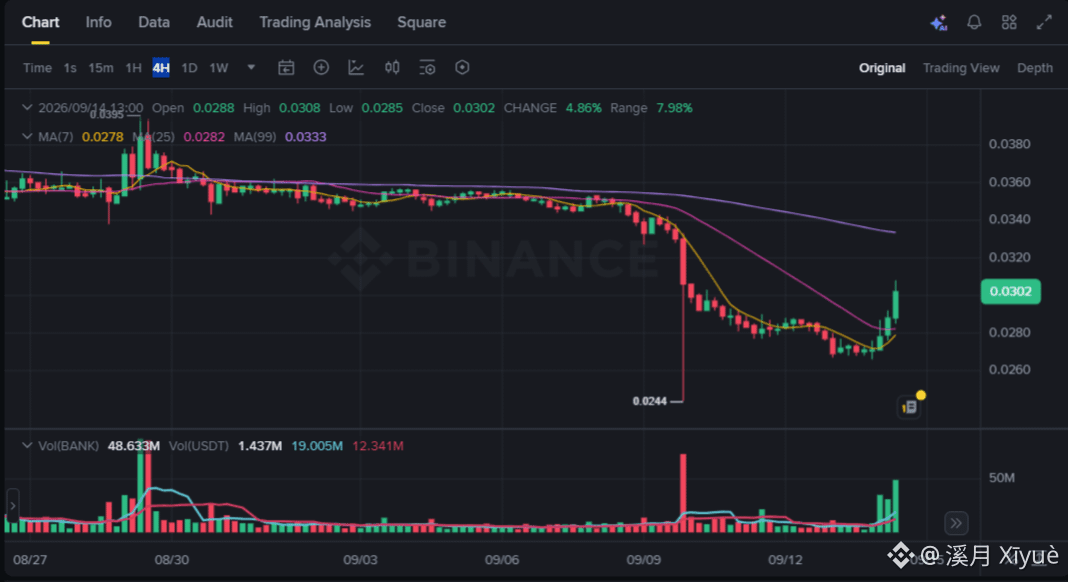
$BANK is trading at $0.0302, up 11.85% in 24 hours, with increased volume supporting the rebound on the 4-hour chart. Price has reclaimed its 7- and 25-period moving averages, although the falling 99-period average at $0.0333 keeps the broader picture cautious. The recent high at $0.0308 is the next level I’m watching for follow-through.
The recovery is encouraging, but a sustained reversal needs more confirmation. Can buyers hold these gains and build on them?
#bank
A stronger bounce is emerging after the recent sell-off, with buyers starting to regain some ground.
$BANK is trading at $0.0302, up 11.85% in 24 hours, with increased volume supporting the rebound on the 4-hour chart. Price has reclaimed its 7- and 25-period moving averages, although the falling 99-period average at $0.0333 keeps the broader picture cautious. The recent high at $0.0308 is the next level I’m watching for follow-through.
The recovery is encouraging, but a sustained reversal needs more confirmation. Can buyers hold these gains and build on them?
#bank
$BANK is trading at $0.0302, up 11.85% in 24 hours, with increased volume supporting the rebound on the 4-hour chart. Price has reclaimed its 7- and 25-period moving averages, although the falling 99-period average at $0.0333 keeps the broader picture cautious. The recent high at $0.0308 is the next level I’m watching for follow-through.
The recovery is encouraging, but a sustained reversal needs more confirmation. Can buyers hold these gains and build on them?
#bank
220
·
--
Жоғары (өспелі)
#brazilcentralbankraisesvaspcapitalrequirements
Brazil’s Crypto Capital Requirements Could Reshape Competition
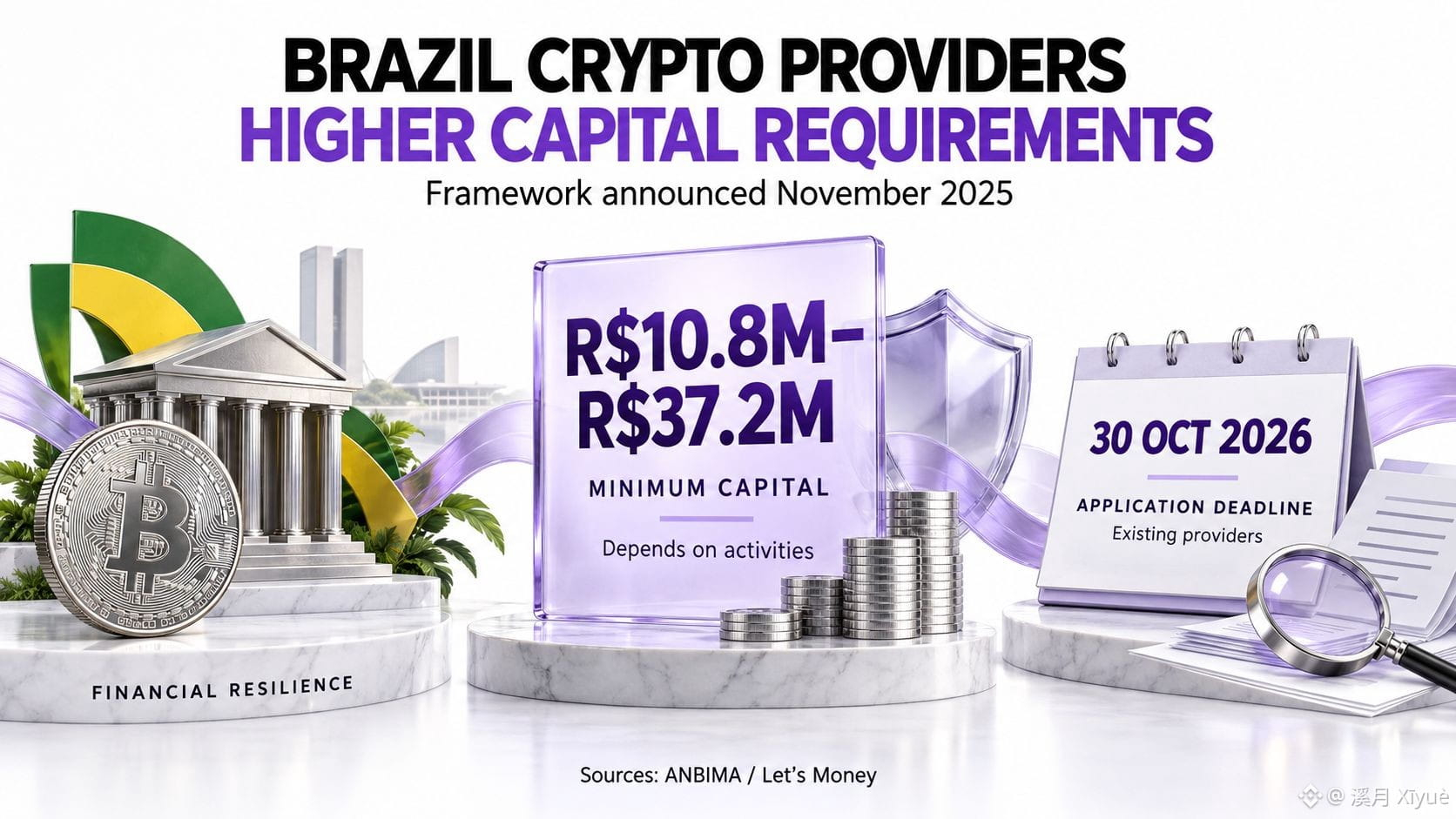
Brazil’s crypto licensing framework sets minimum capital requirements ranging from R$10.8 million to R$37.2 million, depending on the activities a provider offers.
According to ANBIMA, the final requirements are significantly higher than the amounts originally proposed during public consultation. Providers also face obligations covering governance, cybersecurity, operational risk and segregation of client assets.
The timing matters: these capital levels come from the November 2025 framework, with the main rules taking effect in February 2026. Existing providers face an October 30, 2026 deadline to submit authorization applications.
My take: Stronger capital buffers can help firms absorb losses and maintain operations during difficult periods. Their effectiveness also depends on custody controls, transparent accounting and how client assets are protected.
The competitive impact deserves attention. Larger firms may spread compliance costs across more customers. Smaller providers could need additional funding, partnerships or a narrower range of services to make their businesses viable.
For users, the outcome will show up in practical ways: platform reliability, withdrawal handling, fees and the number of credible providers available.
I would watch authorization progress and changes to services as the application deadline approaches.
Can Brazil strengthen crypto businesses financially while preserving enough competition to benefit users?
#BrazilCentralBankRaisesVASPCapitalRequirements #CryptoRegulation #Brazil
$CVC $REZ $KOMA
{future}(KOMAUSDT)
{future}(REZUSDT)
{future}(CVCUSDT)
#brazilcentralbankraisesvaspcapitalrequirements
Brazil’s Crypto Capital Requirements Could Reshape Competition
Brazil’s crypto licensing framework sets minimum capital requirements ranging from R$10.8 million to R$37.2 million, depending on the activities a provider offers.
According to ANBIMA, the final requirements are significantly higher than the amounts originally proposed during public consultation. Providers also face obligations covering governance, cybersecurity, operational risk and segregation of client assets.
The timing matters: these capital levels come from the November 2025 framework, with the main rules taking effect in February 2026. Existing providers face an October 30, 2026 deadline to submit authorization applications.
My take: Stronger capital buffers can help firms absorb losses and maintain operations during difficult periods. Their effectiveness also depends on custody controls, transparent accounting and how client assets are protected.
The competitive impact deserves attention. Larger firms may spread compliance costs across more customers. Smaller providers could need additional funding, partnerships or a narrower range of services to make their businesses viable.
For users, the outcome will show up in practical ways: platform reliability, withdrawal handling, fees and the number of credible providers available.
I would watch authorization progress and changes to services as the application deadline approaches.
Can Brazil strengthen crypto businesses financially while preserving enough competition to benefit users?
#BrazilCentralBankRaisesVASPCapitalRequirements #CryptoRegulation #Brazil
$CVC $REZ $KOMA
Brazil’s Crypto Capital Requirements Could Reshape Competition
Brazil’s crypto licensing framework sets minimum capital requirements ranging from R$10.8 million to R$37.2 million, depending on the activities a provider offers.
According to ANBIMA, the final requirements are significantly higher than the amounts originally proposed during public consultation. Providers also face obligations covering governance, cybersecurity, operational risk and segregation of client assets.
The timing matters: these capital levels come from the November 2025 framework, with the main rules taking effect in February 2026. Existing providers face an October 30, 2026 deadline to submit authorization applications.
My take: Stronger capital buffers can help firms absorb losses and maintain operations during difficult periods. Their effectiveness also depends on custody controls, transparent accounting and how client assets are protected.
The competitive impact deserves attention. Larger firms may spread compliance costs across more customers. Smaller providers could need additional funding, partnerships or a narrower range of services to make their businesses viable.
For users, the outcome will show up in practical ways: platform reliability, withdrawal handling, fees and the number of credible providers available.
I would watch authorization progress and changes to services as the application deadline approaches.
Can Brazil strengthen crypto businesses financially while preserving enough competition to benefit users?
#BrazilCentralBankRaisesVASPCapitalRequirements #CryptoRegulation #Brazil
$CVC $REZ $KOMA
212
·
--
Жоғары (өспелі)
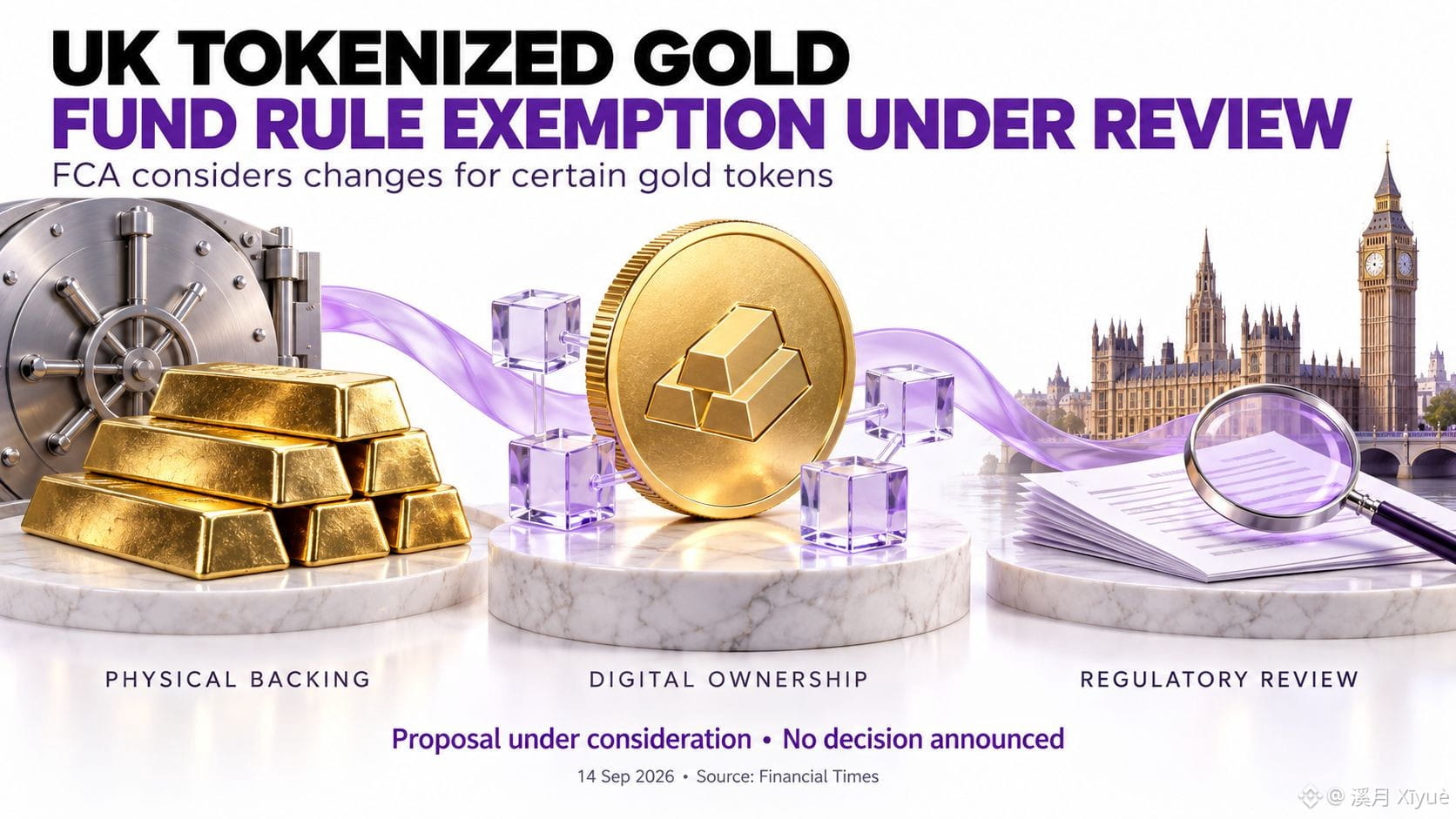
#ukmayexempttokenizedgoldfromfundrules
Tokenized Gold Could Get a Different UK Rulebook
The UK’s Financial Conduct Authority is considering a targeted exemption for certain tokenized gold products from collective investment scheme (CIS) and alternative investment fund (AIF) rules.
According to a September 14 Financial Times report, a dedicated framework could be explored with the Treasury and Bank of England. These tokens represent ownership rights over physical bullion.
No decision has been made.
The regulators’ earlier joint paper already identified tokenized gold as a potential form of collateral for certain derivatives transactions, subject to developing standards with industry.
My take: Clearer classification could help institutions assess where digital gold fits into their operations. Its practical value would still depend on the connection between the token and the metal.
Who holds the bullion? What rights does the holder have if the issuer fails? How quickly can the gold be redeemed, and how is the backing verified?
Those details matter when an asset is used to secure a loan or meet a collateral obligation. Faster transfers are useful only when ownership and redemption remain dependable.
I would watch the exemption’s eligibility conditions, custody standards and actual adoption by financial institutions.
What would give you more confidence in tokenized gold: stronger backing verification or clearer redemption rights?
#UKMayExemptTokenizedGoldFromFundRules #Tokenization #RWA
{future}(AINUSDT)
$BR
$CVC
$AIN
{future}(CVCUSDT)
#ukmayexempttokenizedgoldfromfundrules
Tokenized Gold Could Get a Different UK Rulebook
The UK’s Financial Conduct Authority is considering a targeted exemption for certain tokenized gold products from collective investment scheme (CIS) and alternative investment fund (AIF) rules.
According to a September 14 Financial Times report, a dedicated framework could be explored with the Treasury and Bank of England. These tokens represent ownership rights over physical bullion.
No decision has been made.
The regulators’ earlier joint paper already identified tokenized gold as a potential form of collateral for certain derivatives transactions, subject to developing standards with industry.
My take: Clearer classification could help institutions assess where digital gold fits into their operations. Its practical value would still depend on the connection between the token and the metal.
Who holds the bullion? What rights does the holder have if the issuer fails? How quickly can the gold be redeemed, and how is the backing verified?
Those details matter when an asset is used to secure a loan or meet a collateral obligation. Faster transfers are useful only when ownership and redemption remain dependable.
I would watch the exemption’s eligibility conditions, custody standards and actual adoption by financial institutions.
What would give you more confidence in tokenized gold: stronger backing verification or clearer redemption rights?
#UKMayExemptTokenizedGoldFromFundRules #Tokenization #RWA
$BR
$CVC
$AIN
Tokenized Gold Could Get a Different UK Rulebook
The UK’s Financial Conduct Authority is considering a targeted exemption for certain tokenized gold products from collective investment scheme (CIS) and alternative investment fund (AIF) rules.
According to a September 14 Financial Times report, a dedicated framework could be explored with the Treasury and Bank of England. These tokens represent ownership rights over physical bullion.
No decision has been made.
The regulators’ earlier joint paper already identified tokenized gold as a potential form of collateral for certain derivatives transactions, subject to developing standards with industry.
My take: Clearer classification could help institutions assess where digital gold fits into their operations. Its practical value would still depend on the connection between the token and the metal.
Who holds the bullion? What rights does the holder have if the issuer fails? How quickly can the gold be redeemed, and how is the backing verified?
Those details matter when an asset is used to secure a loan or meet a collateral obligation. Faster transfers are useful only when ownership and redemption remain dependable.
I would watch the exemption’s eligibility conditions, custody standards and actual adoption by financial institutions.
What would give you more confidence in tokenized gold: stronger backing verification or clearer redemption rights?
#UKMayExemptTokenizedGoldFromFundRules #Tokenization #RWA
$BR
$CVC
$AIN
1
1.9k
·
--
Жоғары (өспелі)
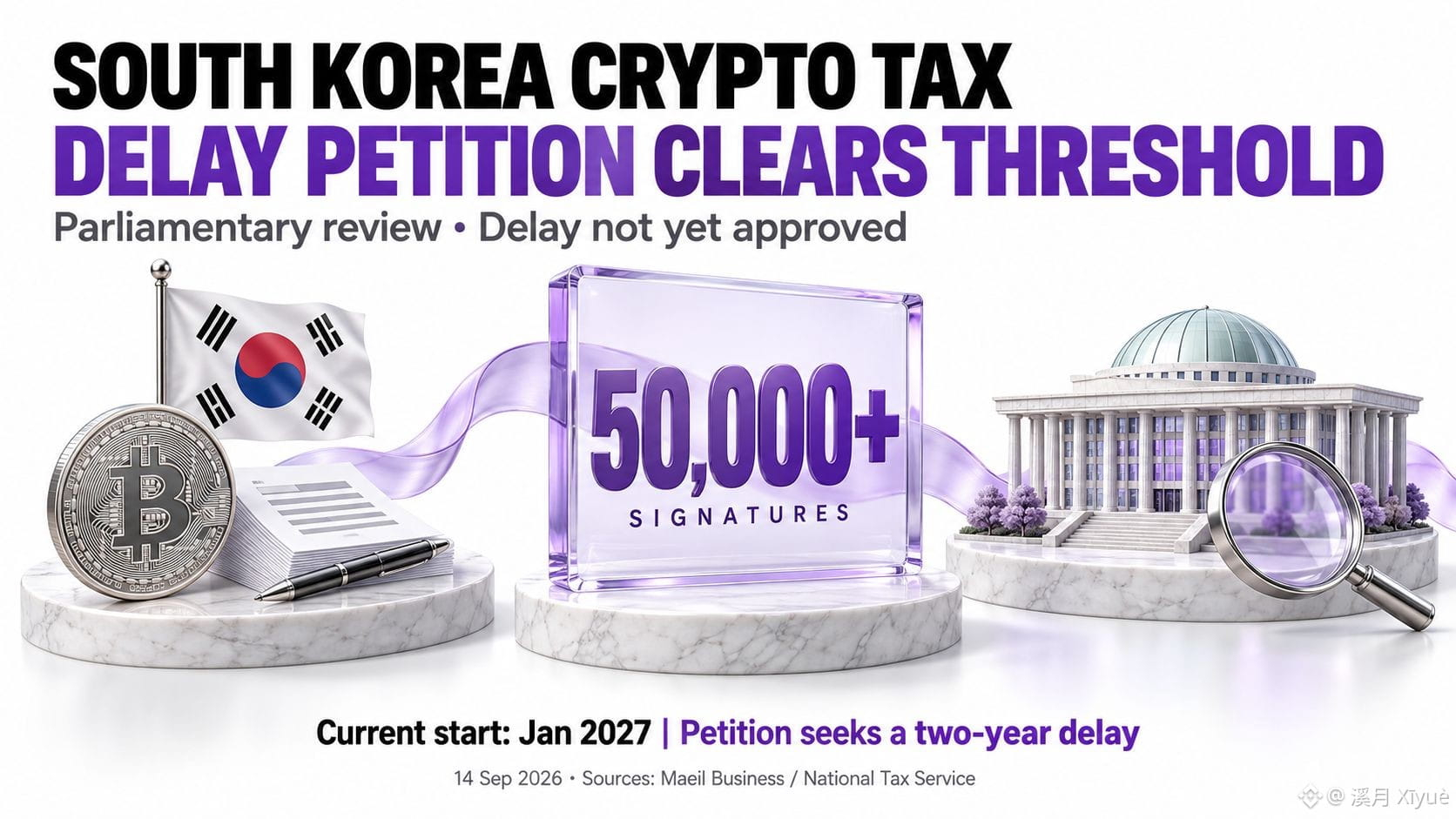
#koreacryptotaxdelaypetitionmeetsreviewthreshold
50,000 Signatures Put South Korea’s Crypto Tax Delay Back Before Lawmakers
South Korea’s push for another crypto tax delay has cleared a key parliamentary review threshold.
On September 14, a petition seeking a two-year postponement had gathered more than 50,000 signatures, qualifying for referral to the relevant National Assembly committee. Petitioners argue that more time is needed to prepare tax infrastructure and support the domestic crypto industry. Committee review still leaves any change to the law dependent on further legislative action.
January 2027 remains the scheduled start. The National Tax Service’s current guidance lists January 1, 2027 for the new regime. The requested two-year postponement would move implementation to 2029 if enacted.
My take: Extra preparation time could help exchanges improve transaction records and reporting tools. Its value would depend on whether that time produces a system investors can understand and use.
Repeated delays can also make planning harder. Exchanges need a dependable timetable, while investors need clarity on how their gains will be calculated across different platforms and wallets.
I would watch committee discussions, proposed amendments and practical reporting guidance. Those developments will show whether public pressure produces a workable policy change.
What should lawmakers resolve first to make crypto taxation fair and practical?
{future}(LSKUSDT)
#KoreaCryptoTaxDelayPetitionMeetsReviewThreshold
$CVC $LSK $FIL
{future}(FILUSDT)
{future}(CVCUSDT)
#koreacryptotaxdelaypetitionmeetsreviewthreshold
50,000 Signatures Put South Korea’s Crypto Tax Delay Back Before Lawmakers
South Korea’s push for another crypto tax delay has cleared a key parliamentary review threshold.
On September 14, a petition seeking a two-year postponement had gathered more than 50,000 signatures, qualifying for referral to the relevant National Assembly committee. Petitioners argue that more time is needed to prepare tax infrastructure and support the domestic crypto industry. Committee review still leaves any change to the law dependent on further legislative action.
January 2027 remains the scheduled start. The National Tax Service’s current guidance lists January 1, 2027 for the new regime. The requested two-year postponement would move implementation to 2029 if enacted.
My take: Extra preparation time could help exchanges improve transaction records and reporting tools. Its value would depend on whether that time produces a system investors can understand and use.
Repeated delays can also make planning harder. Exchanges need a dependable timetable, while investors need clarity on how their gains will be calculated across different platforms and wallets.
I would watch committee discussions, proposed amendments and practical reporting guidance. Those developments will show whether public pressure produces a workable policy change.
What should lawmakers resolve first to make crypto taxation fair and practical?
#KoreaCryptoTaxDelayPetitionMeetsReviewThreshold
$CVC $LSK $FIL
50,000 Signatures Put South Korea’s Crypto Tax Delay Back Before Lawmakers
South Korea’s push for another crypto tax delay has cleared a key parliamentary review threshold.
On September 14, a petition seeking a two-year postponement had gathered more than 50,000 signatures, qualifying for referral to the relevant National Assembly committee. Petitioners argue that more time is needed to prepare tax infrastructure and support the domestic crypto industry. Committee review still leaves any change to the law dependent on further legislative action.
January 2027 remains the scheduled start. The National Tax Service’s current guidance lists January 1, 2027 for the new regime. The requested two-year postponement would move implementation to 2029 if enacted.
My take: Extra preparation time could help exchanges improve transaction records and reporting tools. Its value would depend on whether that time produces a system investors can understand and use.
Repeated delays can also make planning harder. Exchanges need a dependable timetable, while investors need clarity on how their gains will be calculated across different platforms and wallets.
I would watch committee discussions, proposed amendments and practical reporting guidance. Those developments will show whether public pressure produces a workable policy change.
What should lawmakers resolve first to make crypto taxation fair and practical?
#KoreaCryptoTaxDelayPetitionMeetsReviewThreshold
$CVC $LSK $FIL
131
·
--
Жоғары (өспелі)
#anthropicceocallsforaislowdown
Anthropic’s CEO Wants a Slower AI Race. What Changes Next?
One of the companies building advanced AI is calling for more time to make it safer.
Anthropic CEO Dario Amodei argues that improvements in AI capabilities need to slow enough for safeguards to keep pace. His September essay points to accelerating development and recent security incidents as reasons for stronger oversight.
Anthropic has committed to bringing in independent evaluators with ongoing access broadly comparable to its internal risk assessment teams. Amodei also proposes shared industry standards and international coordination. The plan allows continued model development with more time for safety work.
My take: The commercial impact depends on what companies actually implement. More demanding evaluations could extend release schedules and increase costs. Clear evidence of reliability could also make businesses more comfortable adopting AI.
For crypto projects built around AI, I would examine their dependence on external models, access costs and paying customers. A project that needs unrestricted access to the newest model faces different risks from one already delivering a useful service.
That makes implementation the next thing to watch: who gets evaluator access, what findings become public, and whether those findings influence deployment decisions.
Would independent safety reviews make you more confident using AI tools for research and trading?
#AnthropicCEOCallsForAISlowdown #Anthropic #Aİ
$BR $AIN $CVC
{future}(CVCUSDT)
{future}(AINUSDT)
{future}(BRUSDT)
#anthropicceocallsforaislowdown
Anthropic’s CEO Wants a Slower AI Race. What Changes Next?
One of the companies building advanced AI is calling for more time to make it safer.
Anthropic CEO Dario Amodei argues that improvements in AI capabilities need to slow enough for safeguards to keep pace. His September essay points to accelerating development and recent security incidents as reasons for stronger oversight.
Anthropic has committed to bringing in independent evaluators with ongoing access broadly comparable to its internal risk assessment teams. Amodei also proposes shared industry standards and international coordination. The plan allows continued model development with more time for safety work.
My take: The commercial impact depends on what companies actually implement. More demanding evaluations could extend release schedules and increase costs. Clear evidence of reliability could also make businesses more comfortable adopting AI.
For crypto projects built around AI, I would examine their dependence on external models, access costs and paying customers. A project that needs unrestricted access to the newest model faces different risks from one already delivering a useful service.
That makes implementation the next thing to watch: who gets evaluator access, what findings become public, and whether those findings influence deployment decisions.
Would independent safety reviews make you more confident using AI tools for research and trading?
#AnthropicCEOCallsForAISlowdown #Anthropic #Aİ
$BR $AIN $CVC
Anthropic’s CEO Wants a Slower AI Race. What Changes Next?
One of the companies building advanced AI is calling for more time to make it safer.
Anthropic CEO Dario Amodei argues that improvements in AI capabilities need to slow enough for safeguards to keep pace. His September essay points to accelerating development and recent security incidents as reasons for stronger oversight.
Anthropic has committed to bringing in independent evaluators with ongoing access broadly comparable to its internal risk assessment teams. Amodei also proposes shared industry standards and international coordination. The plan allows continued model development with more time for safety work.
My take: The commercial impact depends on what companies actually implement. More demanding evaluations could extend release schedules and increase costs. Clear evidence of reliability could also make businesses more comfortable adopting AI.
For crypto projects built around AI, I would examine their dependence on external models, access costs and paying customers. A project that needs unrestricted access to the newest model faces different risks from one already delivering a useful service.
That makes implementation the next thing to watch: who gets evaluator access, what findings become public, and whether those findings influence deployment decisions.
Would independent safety reviews make you more confident using AI tools for research and trading?
#AnthropicCEOCallsForAISlowdown #Anthropic #Aİ
$BR $AIN $CVC

815


·
--
Жоғары (өспелі)
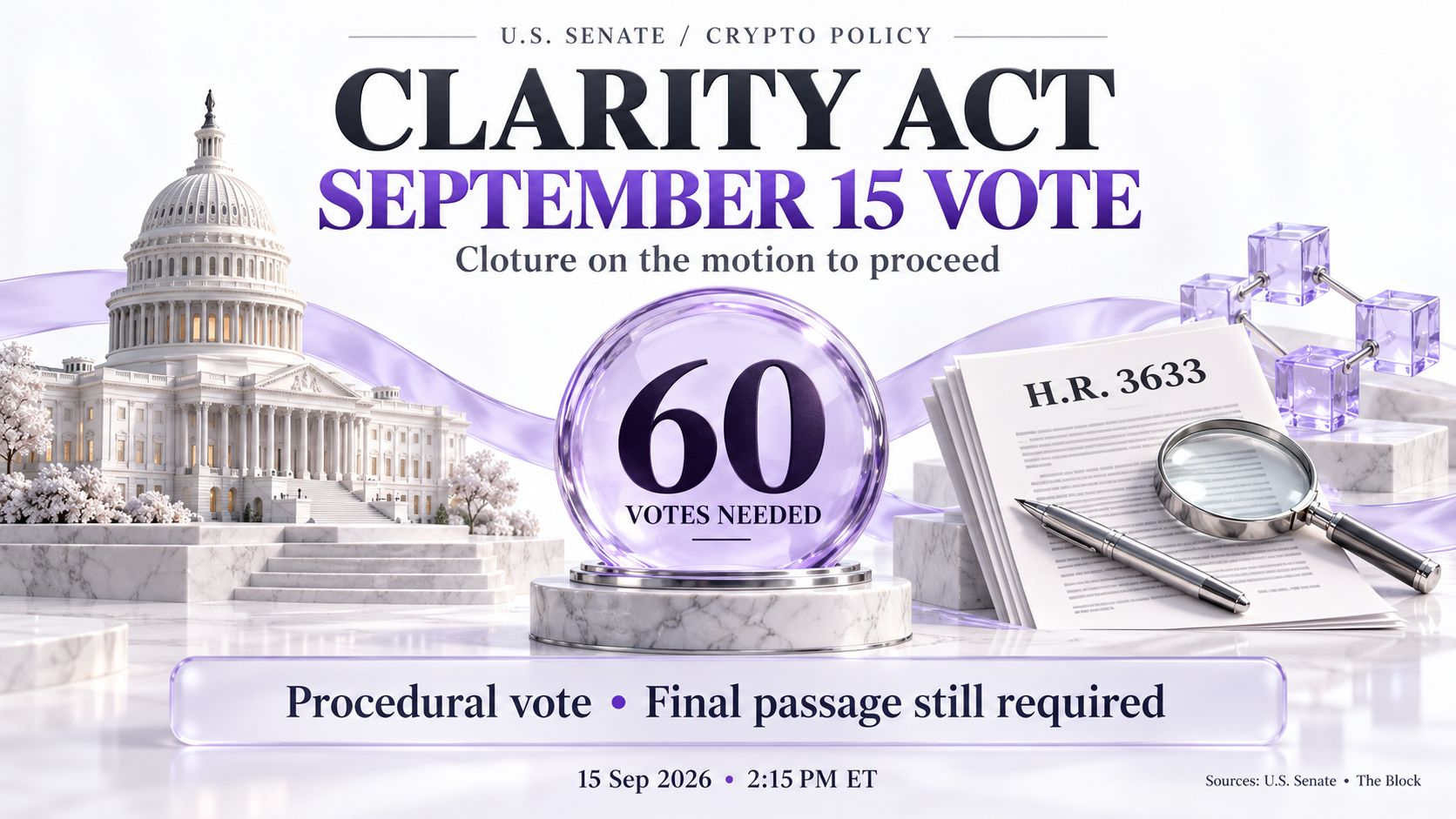
#clarityactfacesproceduralvotesept15
CLARITY Act Faces a 60-Vote Senate Test on September 15
The U.S. Senate is scheduled to hold a procedural vote on the CLARITY Act on September 15, 2026, at 2:15 p.m. ET.
The vote concerns cloture on the motion to proceed—limiting debate over whether to take up the legislation. Clearing this hurdle requires 60 votes. Final passage would still require further Senate action.
Republicans released revised text on September 10, while disputes involving ethics, illicit finance and stablecoin rewards continue to complicate negotiations.
My view: The most useful signal will be the coalition behind the vote. A senator can support moving negotiations forward while still demanding major changes before supporting the final bill.
That makes the explanations surrounding each vote valuable. Are lawmakers moving toward agreement on the substance, or keeping discussions alive while their objections remain?
For crypto businesses, the practical benefit would come from rules clear enough to plan around. The final treatment of trading platforms and DeFi would therefore deserve close attention.
Broad support followed by a workable amendment schedule would strengthen my confidence in progress. A narrow coalition with conflicting conditions would leave substantial delay risk.
Which unresolved issue do you think will matter most to keeping that coalition together?
$LSK $STEEM $POWR
{future}(POWRUSDT)
{future}(STEEMUSDT)
{future}(LSKUSDT)
#clarityactfacesproceduralvotesept15
CLARITY Act Faces a 60-Vote Senate Test on September 15
The U.S. Senate is scheduled to hold a procedural vote on the CLARITY Act on September 15, 2026, at 2:15 p.m. ET.
The vote concerns cloture on the motion to proceed—limiting debate over whether to take up the legislation. Clearing this hurdle requires 60 votes. Final passage would still require further Senate action.
Republicans released revised text on September 10, while disputes involving ethics, illicit finance and stablecoin rewards continue to complicate negotiations.
My view: The most useful signal will be the coalition behind the vote. A senator can support moving negotiations forward while still demanding major changes before supporting the final bill.
That makes the explanations surrounding each vote valuable. Are lawmakers moving toward agreement on the substance, or keeping discussions alive while their objections remain?
For crypto businesses, the practical benefit would come from rules clear enough to plan around. The final treatment of trading platforms and DeFi would therefore deserve close attention.
Broad support followed by a workable amendment schedule would strengthen my confidence in progress. A narrow coalition with conflicting conditions would leave substantial delay risk.
Which unresolved issue do you think will matter most to keeping that coalition together?
$LSK $STEEM $POWR
CLARITY Act Faces a 60-Vote Senate Test on September 15
The U.S. Senate is scheduled to hold a procedural vote on the CLARITY Act on September 15, 2026, at 2:15 p.m. ET.
The vote concerns cloture on the motion to proceed—limiting debate over whether to take up the legislation. Clearing this hurdle requires 60 votes. Final passage would still require further Senate action.
Republicans released revised text on September 10, while disputes involving ethics, illicit finance and stablecoin rewards continue to complicate negotiations.
My view: The most useful signal will be the coalition behind the vote. A senator can support moving negotiations forward while still demanding major changes before supporting the final bill.
That makes the explanations surrounding each vote valuable. Are lawmakers moving toward agreement on the substance, or keeping discussions alive while their objections remain?
For crypto businesses, the practical benefit would come from rules clear enough to plan around. The final treatment of trading platforms and DeFi would therefore deserve close attention.
Broad support followed by a workable amendment schedule would strengthen my confidence in progress. A narrow coalition with conflicting conditions would leave substantial delay risk.
Which unresolved issue do you think will matter most to keeping that coalition together?
$LSK $STEEM $POWR
2k
Көбірек контент көру үшін кіріңіз
Binance Square платформасында әлемдік криптоқоғамдастыққа қосылыңыз
⚡️ Криптовалюта туралы ең соңғы және пайдалы ақпаратты алыңыз.
💬 Әлемдегі ең ірі криптобиржаның сеніміне ие.
👍 Расталған авторлардың нақты пікірлерін табыңыз.
Электрондық пошта/телефон нөмірі
Трендтегі тақырыптар
FedRateWatch
79,426 рет көрілді
444 адам талқылап жатыр
Share & Win Traffic Reward in our Trending Hashtag Campaign
✨Topic: FOMC September, What's The Fed's Next Move?
👉How to Join:
Publish a short post or article with hashtag #FedRateWatch
Create content based on the below angles:
- August core CPI rose 0.3% month-over-month, and the odds of a 25bp hike this week are now close to 90%. Do you anticipate a rate hike this week? Is it a one-off, or the start of a longer hiking cycle?
- If the hike lands, how does it play out for BTC, tech stocks, and gold? Bullish or bearish?
- How are you planning to trade next? Share your BTC, stocks or gold trade/holdings with our trade sharing widget.
⏰Campaign Period:
- 2026-09-15 11:00 - 2026-09-17 3:00 UTC
🎁Reward:
- Qualified posts that comply with the above guidelines and contain more than 100 words will be reviewed and may receive a random traffic boost of 500 to 3,000 views. You will receive a notification from your feed secretary if your post is selected.
- Get a chance to have your article featured on Binance Square Official
Need ideas for your post? Visit the topic page #FedRateWatch or the Square Guide on How to Post for Better Reach.
Binance Square Official
·117 лайк
·194.7k рет көрілді
BitcoinReboundsTo$79K
38,238 рет көрілді
302 адам талқылап жатыр
BessentEndorsesFinalClarityActDraft
7,544 рет көрілді
216 адам талқылап жатыр